
bill of rights Crossword Puzzles
Women's Liberation Icons of 70s 2024-05-30

Across
- - Lorde, Caribbean-American writer and feminist
- - Schlafly, conservative activist
- - Atwood, feminist author
- - Veil, French lawyer and politician
- - Rich, poet and feminist
- - Faludi, feminist author
- - Abzug, women's rights activist
- - Maathai, environmentalist and activist
- - Bunch, women's rights activist
- - Friedan, author of "The Feminine Mystique"
- - Greer, Australian feminist
- - Feminist Steinem
Down
- - Mankiller, Cherokee leader and activist
- - Walker, author of "The Color Purple"
- - Pankhurst, suffragette and feminist
- - Lorde, poet and feminist
- - Chisholm, first African American congresswoman
- - Kristeva, French feminist philosopher
- - Kennedy, women's rights lawyer
- - Morgan, feminist author and activist
- - Huerta, labor leader and activist
- - Jordan, U.S. congresswoman and civil rights activist
- - de Beauvoir, French existentialist and feminist
- - Davis, activist and scholar
- - Millett, feminist author
25 Clues: - Feminist Steinem • - Atwood, feminist author • - Rich, poet and feminist • - Faludi, feminist author • - Lorde, poet and feminist • - Millett, feminist author • - Greer, Australian feminist • - Davis, activist and scholar • - Kennedy, women's rights lawyer • - Abzug, women's rights activist • - Bunch, women's rights activist • - Schlafly, conservative activist • ...
Reconcile 2021-09-17

Across
- British North America Act.
- The huge charter territory which became the North West Territories.
- Premier of Saskatchewan.
- Inherent Rights.
- Rights between the First Nations,Crown or Government.
- National Chief.
- Principles of good relations.
- Federation of Saskatchewan Indian Nations Chief.
Down
- Canada's Aboriginal Action Plan.
- Robinson Treaties of 1850.
- First treaty between the First Nations and the Crown.
- Also known as the Lake Winnipeg Treaty.
- Living together on the land in harmony.
- Minister of Indian Affairs.
- Lieutenant Governor.
- Instruments used by the Crown.
16 Clues: National Chief. • Inherent Rights. • Lieutenant Governor. • Premier of Saskatchewan. • British North America Act. • Robinson Treaties of 1850. • Minister of Indian Affairs. • Principles of good relations. • Instruments used by the Crown. • Canada's Aboriginal Action Plan. • Also known as the Lake Winnipeg Treaty. • Living together on the land in harmony. • ...
Government 2015-10-02

Across
- All political parties and independent Members who do not belong to the governing party.
- The Upper House of Parliament is made up of 105 Senators.
- A Senator or a Member of the House of Commons.
- Person with full political rights.
- The city where a country's legislature is located and the government carries out its business.
Down
- The set of rules that a country like Canada follows to work as a nation.
- A king or queen of the country.
- The process of choosing a representative by vote.
- A proposal for the law to be considered by Parliament.
- A rule for all Canadians made by Senators, Members of Parliament and the Governor General through discussion and voting.
10 Clues: A king or queen of the country. • Person with full political rights. • A Senator or a Member of the House of Commons. • The process of choosing a representative by vote. • A proposal for the law to be considered by Parliament. • The Upper House of Parliament is made up of 105 Senators. • The set of rules that a country like Canada follows to work as a nation. • ...
CIVICS 2026-05-23

Across
- – Freedoms protected by law, like freedom of speech.
- – The month when Presidential elections are held.
- – A person who is an official member of a country.
- – Rules made by the government that everyone must follow.
- – The President's power to reject a bill passed by Congress.
- – The sheet of paper or electronic screen used to cast a vote.
- – A government where the people have the power to choose their leaders.
- – The supreme law of the land that contains our country's rules.
- – To choose a leader or a law in an election.
Down
- – The leader of an individual state's government.
- – The highest court in the United States is the ________ Court.
- – The group of people in the legislative branch who make the laws.
- – The leader of the executive branch and our country.
- – The building where Congress meets to work on laws.
- – A change or addition made to the Constitution.
- – Money paid by citizens to the government to fund public services like schools and roads.
- – The capital city of the United States (________, D.C.).
17 Clues: – To choose a leader or a law in an election. • – A change or addition made to the Constitution. • – The leader of an individual state's government. • – The month when Presidential elections are held. • – A person who is an official member of a country. • – Freedoms protected by law, like freedom of speech. • – The building where Congress meets to work on laws. • ...
Government Vocabulary 2021-04-07

Across
- law system A body of unwritten laws based on legal precedents established by the courts.
- An agreement between countries covering particular matters
- proposed legislation under consideration by a legislature.
- Someone who has complete or almost complete control over one or more people.
- A body of voters in a specified area who elect a representative to a legislative body.
- The part of a country's set of laws which is concerned with the private affairs of citizens.
- The basic principles and laws of a nation that determine the powers of the government and guarantee certain rights to the people in it.
- Form of government in which one person or a small group possesses absolute power
- A member of a council.
- A form of government in which the people have the authority to choose their governing legislators.
- A body of high-ranking state officials
- A political and social philosophy promoting traditional social institutions.
Down
- A system of government in which most of the important decisions are made by state officials
- A form of government in which political parties cooperate to form a government.
- A movement whose ultimate goal is the establishment of a communist society
- The set of conditions required to make changes to the. Constitution.
- The quality or state of having the same rights, social status, etc.
- Work in an organized and active way toward a particular goal
- Quebecois A federal political party in Canada devoted to Quebec nationalism
- An economic system based on the private ownership of the means of production and their operation for profit.
- A member of parliament who occupies no governmental office and is not a frontbench spokesperson.
- A secret vote from members on a particular issue.
- leader or ruler of a people or clan.
- A meeting of supporters or members of a political party or movement.
- The Charter of the French Language
25 Clues: A member of a council. • The Charter of the French Language • leader or ruler of a people or clan. • A body of high-ranking state officials • A secret vote from members on a particular issue. • An agreement between countries covering particular matters • proposed legislation under consideration by a legislature. • ...
Government Vocabulary 2021-04-07

Across
- Form of government in which one person or a small group possesses absolute power
- The part of a country's set of laws which is concerned with the private affairs of citizens.
- A secret vote from members on a particular issue.
- An agreement between countries covering particular matters
- A system of government in which most of the important decisions are made by state officials
- Quebecois A federal political party in Canada devoted to Quebec nationalism
- A movement whose ultimate goal is the establishment of a communist society
- The quality or state of having the same rights, social status, etc.
- A political and social philosophy promoting traditional social institutions.
- Someone who has complete or almost complete control over one or more people.
- The set of conditions required to make changes to the. Constitution.
- A body of high-ranking state officials
Down
- A form of government in which political parties cooperate to form a government.
- A body of voters in a specified area who elect a representative to a legislative body.
- A member of parliament who occupies no governmental office and is not a frontbench spokesperson.
- proposed legislation under consideration by a legislature.
- leader or ruler of a people or clan.
- A form of government in which the people have the authority to choose their governing legislators.
- A member of a council.
- law system A body of unwritten laws based on legal precedents established by the courts.
- An economic system based on the private ownership of the means of production and their operation for profit.
- The basic principles and laws of a nation that determine the powers of the government and guarantee certain rights to the people in it.
- Work in an organized and active way toward a particular goal
- The Charter of the French Language
- A meeting of supporters or members of a political party or movement.
25 Clues: A member of a council. • The Charter of the French Language • leader or ruler of a people or clan. • A body of high-ranking state officials • A secret vote from members on a particular issue. • proposed legislation under consideration by a legislature. • An agreement between countries covering particular matters • ...
1.03 Vocabulary Osha 2020-01-16

Across
- A device that warns you when a resident is doing something that is not safe.
- A facility that does not use restraints
- The Omnibus Budget Reconciliation Act. A 1987 Bill of Rights to create a set of national min. set of standards of care and rights for people living in certified nursing facilities.
Down
- Something used to limit the persons ability. Can be physical or chemical.
- A group that provides opportunities for discussion. Gives residents a voice in facility operations.
- A person that pleads cause of another. The person protects the patients of resident's right. An advocate has the opportunity to speak up for the resident.
- Residents are unhappy about care they are being received
7 Clues: A facility that does not use restraints • Residents are unhappy about care they are being received • Something used to limit the persons ability. Can be physical or chemical. • A device that warns you when a resident is doing something that is not safe. • A group that provides opportunities for discussion. Gives residents a voice in facility operations. • ...
General Mortgage Knowledge 2024-09-30

Across
- This is also known as a 1004:
- This act was created in 2008 to protect consumers:
- A mortgage, like a dollar bill, can be considered a:
- Reviews, analyzes, and approves or denies an application
- This is a government sponsored enterprise (GSE).
- This the credit score provided by averaging the 3 credit report scores:
- RESPA's general focus is on?
- Meets the loan limits of Fannie and Freddie Mae
- Mortgage, A conventional loan is consider a "" mortgage.
- How many days can you consider that a disclosure has been received?
Down
- A bridge loan would be considered a "" loan:
- What does the P stand for in PITI?
- Another word for closing/funding
- The "" Processor: This employee doesn't need to be license, but collects and submits documents to the Underwriter:
- This protects the lender on a "Risky" mortgage loans:
- An MLO, needs a score of at least "" percent or higher on the SAFE exam:
- The pooling and selling of mortgages are sold in the secondary market, for the rights of "" the loan:
- PITI represents one of the I's
- A loan that has a back end ratio of 43%?
- This is also referred to a:
20 Clues: This is also referred to a: • RESPA's general focus is on? • This is also known as a 1004: • PITI represents one of the I's • Another word for closing/funding • What does the P stand for in PITI? • A loan that has a back end ratio of 43%? • A bridge loan would be considered a "" loan: • Meets the loan limits of Fannie and Freddie Mae • ...
Be Excellent To Each Other 2021-07-14

Across
- Little Ted
- Alex
- Rufus's Gym Teacher
- Keanu
- The Band
- Bass player
- The Brother
- Most
- George
- Little Bill
- A mineral?
- The Mentor
- Strange Things are afoot at the
Down
- The Princesses
- Air
- The twins
- A short dead dude
- "...I mean, mom"
- The Journey
- William Stanley Preston, Esq
- Noah's Wife
- What number are we thinking of?
- Iron
- The Adventure
- Dust. Wind. [....].
- Non-Non-Non-Non-
- Theodore Logan III
- The Music
28 Clues: Air • Alex • Iron • Most • Keanu • George • The Band • The twins • The Music • Little Ted • A mineral? • The Mentor • The Journey • Noah's Wife • Bass player • The Brother • Little Bill • The Adventure • The Princesses • "...I mean, mom" • Non-Non-Non-Non- • A short dead dude • Theodore Logan III • Rufus's Gym Teacher • Dust. Wind. [....]. • William Stanley Preston, Esq • What number are we thinking of? • ...
Reform 2022-04-04

Across
- Worked to free the slaves
- making changes
- Helped slaves escaped
- Got public education for everyone
- where slaves would go so someone would buy them
- was aginst slavery
- the first meeting for womans rights
Down
- was part of women's rights movement
- where sussan b anthony lived as a teacher
- help sussan and elizbeth get woman rights
- did not want slavery
- the right to vote
- Worked with sussan b anthony for rights
- Moved ill people out of jails
- was part of the woman rights movement
15 Clues: making changes • the right to vote • was aginst slavery • did not want slavery • Helped slaves escaped • Worked to free the slaves • Moved ill people out of jails • Got public education for everyone • was part of women's rights movement • the first meeting for womans rights • was part of the woman rights movement • Worked with sussan b anthony for rights • ...
Topic 8 & 9 Crossword 2023-10-18

Across
- part of the 5th amendment stating that no person can be put in jeopardy of life or limb twice; once a person has been tried for a crime, they cannot be tried again for the same crime
- part of the 14th amendment which guarantees that no State deny basic rights to its people
- formal complaint before a grand jusry that charges the accused with one or more crimes
- idea that government cannot curb ideas before they are expressed
- part of the 1st amendment of the Constitution that guarantees the separation of church and state
- law applied to an act committed before its passage
- a member of a state or nation who owes allegiance to it by birth or naturalization and is entitled to full civil rights
- constitutional rights that police must read to a suspect before questioning can occur
- crime of attempting to overthrow the government by force or to disrupt its lawful activities by violent acts
- term used for positive acts of government that seek to make constitutional guarantees a reality for all people
- to gather with one another in order to express view on public matters
- court order that prevents unjust arrests and imprisonments
- the legal process by which citizens of one country become citizens of another
Down
- the second part of the constitutional guarantee of religious freedom; guarantees to each person the right to believe whatever they choose to believe in matters of religion
- doctrine that holds that the government must act fairly and in accord with established rules in all that it does
- court order authorizing a search
- idea that the laws of a state, or of the nation, must treat any given individual in the same way as it would treat other individuals who are in similar conditions and circumstances
- the power of a government to take private property for public use
- a form of protest in which people deliberately but non-violently violate the law as a means of expressing their opposition to come particular law of public policy
- false and malicious use of printed words
- a citizen’s right to bring his or her view to the attention of public officials by such means as written petitions, letters, lobbying, and matches
- ruling stating that evidence gained as the result of an illegal act by police cannot be used against the person from whom it was seized
- first ten amendments to the Constitution
- the process of incorporating, or including, most of the guarantees in the Bill of Rights into the 14th Amendment’s Due Process Clause
- guarantees of the safety of persons, opinion, and property from the arbitrary acts of government, including freedom of speech and freedom of religion
- false and malicious use of spoken words
- reasonable grounds, a reasonable suspicion of crime
27 Clues: court order authorizing a search • false and malicious use of spoken words • false and malicious use of printed words • first ten amendments to the Constitution • law applied to an act committed before its passage • reasonable grounds, a reasonable suspicion of crime • court order that prevents unjust arrests and imprisonments • ...
Legislative Review 2021-02-08

Across
- Where a bill goes after it is introduced.
- who can propose an idea for a bill.
- what Congress can do after the President vetos a bill.
- amount of votes to pass a bill in the Senate.*not a number*
- what happens after a bill is passed by a committee.
Down
- true or false? A bill has to be passed by both chambers of Congress in order to go to the President.
- a topic in which requires to have a bill start in the house of rep.
- for the President to "ignore it"
- amount of votes to pass a bill in the house of rep.*not a number*
- person who makes a ruling after being approved by both chambers of Congress.
10 Clues: for the President to "ignore it" • who can propose an idea for a bill. • Where a bill goes after it is introduced. • what happens after a bill is passed by a committee. • what Congress can do after the President vetos a bill. • amount of votes to pass a bill in the Senate.*not a number* • amount of votes to pass a bill in the house of rep.*not a number* • ...
Age of Contact 2025-09-12

Across
- Spanish explorer who was the first European to set foot on Texas
- a Spanish conquistador who mapped the coast of Texas
- the period of time when Europeans explored the New World
- travel undertaken to discover what a place is like or its location
- a journey undertaken by a group of people with a definite purpose
- reason for someone to want to move away from a place
- a document that explains a form of government
Down
- a Spanish explorer who searched for wealth and land in the Americas
- a personal liberty and privilege guaranteed to U.S. citizens by the Bill or Rights
- something pulling someone to move to a new place
- a country or area under the full or partial political control of another country
11 Clues: a document that explains a form of government • something pulling someone to move to a new place • a Spanish conquistador who mapped the coast of Texas • reason for someone to want to move away from a place • the period of time when Europeans explored the New World • Spanish explorer who was the first European to set foot on Texas • ...
Study Guide Scavenger Hunt 2026-04-30

Across
- Price where supply and demand meet (X) anyone can buy or sell at that price.
- What can the President do if he does NOT want a bill to become a law?
- The powers that are saved for the states.
- System of government that we have. The people rule.
- Which branch enforces the laws and is led by the President.
- What system officially elects the President and Vice President.
- Worldwide buying and selling of goods and services.
- Businesses and individuals make the decisions for the ________ sector.
- Freedom of Religion, Assembly, Press, Petition and Speech
- Protection against unreasonable searches and seizures
- The inability to satisfy all wants at the same time.
- The media can publish information and criticize the government. The freedom of the _________.
- The powers that are specifically listed in the Constitution.
- Government makes decisions for the ________ sector.
Down
- This document has 27 amendments, contains the Bill of Rights and the Preamble.
- Which branch makes the laws and is led by Congress?
- The central bank of the United States, this is the Government's bank
- The right to worship freely defined in the 1st amendment as freedom of ________.
- The process to become a citizen in the United States.
- Which branch interprets the laws and tries cases?
- This deal made the decision for our legislature (Congress) to have two houses.
- Virginia's bicameral legislature.
- Banned poll taxes for voting.
- Political Parties educate voters about ________.
- Opposed the Constitution and wanted strong state government
- Supported the Constitution and a strong central government.
- Someone who takes a risk in order to make a profit.
- Political Parties recruit and nominate _________.
- This is defined in the 5th and 14th Amendments. It says the government must treat everyone fai
- Type of economy we have in the United States. The people, businesses, and government all share decisions and resources.
30 Clues: Banned poll taxes for voting. • Virginia's bicameral legislature. • The powers that are saved for the states. • Political Parties educate voters about ________. • Which branch interprets the laws and tries cases? • Political Parties recruit and nominate _________. • Which branch makes the laws and is led by Congress? • ...
the constitution 2025-03-01

Across
- big mistake
- the fundamental or organic law of the U.S., framed in 1787 by the Constitutional Convention. It went into effect March 4, 1789.
Down
- the branch of government having the power to make law
- an alteration of or addition to a motion, bill, constitution, etc.
- we need to make a new government
- many rights
6 Clues: big mistake • many rights • we need to make a new government • the branch of government having the power to make law • an alteration of or addition to a motion, bill, constitution, etc. • the fundamental or organic law of the U.S., framed in 1787 by the Constitutional Convention. It went into effect March 4, 1789.
Government Words 2012-11-28

Across
- When two Congressmembers agree to support each others' bills
- Joe Biden (D) Delaware
- John Boehner (R) Ohio
- Whoever Joe makes run the Senate in his stead
- Congress' responsibility to follow up on passed laws and formed agencies
- An agreed upon allocation bill passed by Congress
- A committee from a committee (committeception)
- President-appointed commander of the Military
- A belief held in agreement
- The outline of the Federal Government's spending for the year
- Elected head of executive branch
- Head of the Military
- Intra-government system giving jobs to candidates' supporters
- The person in charge of negotiating treaties with other nations
- Enforcer of Supreme Court decisions
- A financial summary of one year
Down
- The committee formed when both houses pass differing versions of the same bill
- A law before it gets signed by the President
- The speech a Senator will give to buy time
- When the Senate votes to end a speech prematurely
- The opposite of a bipartisan
- Established line of succession for the Presidency
- Chief Legislator
- The people behind an elected official
- Veto power used after Congress has adjourned
- To forgive a crime and remove all penalties
- FREE MAIL
- When a representative will redraw their district to better serve their political agenda
- Established judicial review
- A vastly held thought
- The voted upon removal of an elected official
- Unelected government employees
- Assists party leaders in attaining their legislative goals
- A formal agreement between two nations
- When the President refuses to sign a bill into law
35 Clues: FREE MAIL • Chief Legislator • Head of the Military • John Boehner (R) Ohio • A vastly held thought • Joe Biden (D) Delaware • A belief held in agreement • Established judicial review • The opposite of a bipartisan • Unelected government employees • A financial summary of one year • Elected head of executive branch • Enforcer of Supreme Court decisions • ...
1960's 2013-01-24

Across
- Muslim minister and human rights activist
- ColdWarEra
- invasion that went wrong
- 35th president
- Wife of JFk/ First lady
- Assassin of JFK
- clostest we came to nuclear war
- helping people who are poor
Down
- American actress, model, and singer,
- Son of JFK
- Civil Rights Activist
- Popular entertainer "Jail House Rock"
- Assassinated the Assassin
- music festivl
- brother of JFK
- Vice pres. of JFK
- Rights read to you before interegation.
- daughter of JFK
- Place that JFK died in
- Help improves young peoples life
- American film actor
- LeaderOfCuba
22 Clues: Son of JFK • ColdWarEra • LeaderOfCuba • music festivl • brother of JFK • 35th president • daughter of JFK • Assassin of JFK • Vice pres. of JFK • American film actor • Civil Rights Activist • Place that JFK died in • Wife of JFk/ First lady • invasion that went wrong • Assassinated the Assassin • helping people who are poor • clostest we came to nuclear war • Help improves young peoples life • ...
musicals 2023-10-10

Across
- nasty
- small scary retail
- Acorns for biggest Simpson
- stylish freight
- impartial woman belongs to me
- avenue of life, the universe and everything
- fast celestial glow
- american mum's accent, over the top
- lagomorphs talk to God
- Mr Jones loves Pavarotti
- lubricant
Down
- a bend in the leg
- reveal the geological frightener
- bodily fluid in siblings
- girl loses yearning breath
- bill! bill! Pop! Pop!
- half a dozen
- Felines
- placed on the ground sadly.
- Italian shock
20 Clues: nasty • Felines • lubricant • half a dozen • Italian shock • stylish freight • a bend in the leg • small scary retail • fast celestial glow • bill! bill! Pop! Pop! • lagomorphs talk to God • bodily fluid in siblings • Mr Jones loves Pavarotti • Acorns for biggest Simpson • girl loses yearning breath • placed on the ground sadly. • impartial woman belongs to me • reveal the geological frightener • ...
musicals 2023-10-14

Across
- Small scary retail
- American mum's accent, over the top
- Reveal the geological frightener
- Lagomorphs talk to God
- Stylish freight
- Girl loses yearning breath
- fast celestial glow
- Lubricant
Down
- Bill! Bill! Pop! Pop!
- Felines
- Placed on the ground sadly.
- Bodily fluid in siblings
- Acorns for biggest Simpson
- Mr Jones loves Pavarotti
- Impartial woman belongs to me
- A bend in the leg
- Italian shock
- Avenue of life, the universe and everything
- Nasty
- Half a dozen
20 Clues: Nasty • Felines • Lubricant • Half a dozen • Italian shock • Stylish freight • A bend in the leg • Small scary retail • fast celestial glow • Bill! Bill! Pop! Pop! • Lagomorphs talk to God • Bodily fluid in siblings • Mr Jones loves Pavarotti • Acorns for biggest Simpson • Girl loses yearning breath • Placed on the ground sadly. • Impartial woman belongs to me • Reveal the geological frightener • ...
Topic 8 & 9 Crossword 2023-10-18

Across
- idea that government cannot curb ideas before they are expressed
- reasonable grounds, a reasonable suspicion of crime
- idea that the laws of a state, or of the nation, must treat any given individual in the same way as it would treat other individuals who are in similar conditions and circumstances
- guarantees of the safety of persons, opinion, and property from the arbitrary acts of government, including freedom of speech and freedom of religion
- crime of attempting to overthrow the government by force or to disrupt its lawful activities by violent acts
- doctrine that holds that the government must act fairly and in accord with established rules in all that it does
- the power of a government to take private property for public use
- to gather with one another in order to express view on public matters
- a member of a state or nation who owes allegiance to it by birth or naturalization and is entitled to full civil rights
- part of the 14th amendment which guarantees that no State deny basic rights to its people
Down
- false and malicious use of printed words
- ruling stating that evidence gained as the result of an illegal act by police cannot be used against the person from whom it was seized
- the process of incorporating, or including, most of the guarantees in the Bill of Rights into the 14th Amendment’s Due Process Clause
- first ten amendments to the Constitution
- a citizen’s right to bring his or her view to the attention of public officials by such means as written petitions, letters, lobbying, and matches
- a form of protest in which people deliberately but non-violently violate the law as a means of expressing their opposition to come particular law of public policy
- the second part of the constitutional guarantee of religious freedom; guarantees to each person the right to believe whatever they choose to believe in matters of religion
- law applied to an act committed before its passage
- court order that prevents unjust arrests and imprisonments
- term used for positive acts of government that seek to make constitutional guarantees a reality for all people
- part of the 5th amendment stating that no person can be put in jeopardy of life or limb twice; once a person has been tried for a crime, they cannot be tried again for the same crime
- the legal process by which citizens of one country become citizens of another
- part of the 1st amendment of the Constitution that guarantees the separation of church and state
- formal complaint before a grand jusry that charges the accused with one or more crimes
- false and malicious use of spoken words
- constitutional rights that police must read to a suspect before questioning can occur
- court order authorizing a search
27 Clues: court order authorizing a search • false and malicious use of spoken words • false and malicious use of printed words • first ten amendments to the Constitution • law applied to an act committed before its passage • reasonable grounds, a reasonable suspicion of crime • court order that prevents unjust arrests and imprisonments • ...
Government Vocabulary 2021-04-07

Across
- A system of government in which most of the important decisions are made by state officials
- A form of government in which the people have the authority to choose their governing legislators.
- An economic system based on the private ownership of the means of production and their operation for profit.
- Work in an organized and active way toward a particular goal
- A member of parliament who occupies no governmental office and is not a frontbench spokesperson.
- A member of a council.
- A body of voters in a specified area who elect a representative to a legislative body.
- A secret vote from members on a particular issue.
- A meeting of supporters or members of a political party or movement.
- A movement whose ultimate goal is the establishment of a communist society
- leader or ruler of a people or clan.
- The part of a country's set of laws which is concerned with the private affairs of citizens.
- Quebecois A federal political party in Canada devoted to Quebec nationalism
Down
- Someone who has complete or almost complete control over one or more people.
- An agreement between countries covering particular matters
- A form of government in which political parties cooperate to form a government.
- The quality or state of having the same rights, social status, etc.
- A body of high-ranking state officials
- The basic principles and laws of a nation that determine the powers of the government and guarantee certain rights to the people in it.
- Form of government in which one person or a small group possesses absolute power
- proposed legislation under consideration by a legislature.
- The set of conditions required to make changes to the. Constitution.
- The Charter of the French Language
- law system A body of unwritten laws based on legal precedents established by the courts.
- A political and social philosophy promoting traditional social institutions.
25 Clues: A member of a council. • The Charter of the French Language • leader or ruler of a people or clan. • A body of high-ranking state officials • A secret vote from members on a particular issue. • An agreement between countries covering particular matters • proposed legislation under consideration by a legislature. • ...
British and American English 1 2020-04-15

Across
- autumn
- centre
- queue
- analyse
- crisps
- lift
- film (cinema)
- bill
- sweets
Down
- pocket money
- nought
- programme
- note (money)
- biscuit
- torch
- chemist’s
- petrol
17 Clues: lift • bill • torch • queue • autumn • nought • centre • crisps • petrol • sweets • biscuit • analyse • programme • chemist’s • pocket money • note (money) • film (cinema)
General Knowlege 2013-07-10

Across
- in Asia where the Dragon is seen as a national symbol
- name of the Maori elder on the fifty dollar bill
- name of the man on the five dollar bill
- where the four leaf clover (a sign of good luck) originated from
- where Pasta and Pizza originated from
Down
- is the most well known religous symbol
- event happened in New Zealand that lead the Government to deport many pacific Islanders becasue they were overstayers
- where tacos originated from
- name of the scientist on the one hundred dollar bill
- name of the woman on the ten dollar bill
- Country in Europe is known for having a bear as it's national animal?
- is the name of the famous mountain in the Himilayan region
- maori festival that celebrates stars
- namtional animal of the United States
- country is known to be the home of the first Olympics over a thousand years ago
- Basketball teams from the NBA that are from the same city; one is clalled the Lakers and the other is known as the clippers
- name of the country that has a leaf on its flag
17 Clues: where tacos originated from • maori festival that celebrates stars • namtional animal of the United States • where Pasta and Pizza originated from • is the most well known religous symbol • name of the man on the five dollar bill • name of the woman on the ten dollar bill • name of the country that has a leaf on its flag • name of the Maori elder on the fifty dollar bill • ...
Progressive Era 2012-09-28

Across
- / Females who fight for the right to vote
- / Person who wanted to end all trusts
- / Person who seeks to start his or her own personal business
- / Machine used to transport goods or people long distances along premade tracks
- / Multiple companies fighting to lower prices and attract each others' customers to buy from them instead
- / Organization founded by W.E.B. Du Bois in 1909 to work towards equal rights of all Americans.
- / Process by which people vote directly on a bill
Down
- / Wealthy person who donates large amounts of money to charities.
- / Giving jobs to loyal supporters
- / Process by which voters can remove an elected official from office
- / Writers of books and newspapers who brought attention to the problems of society
- / When one company controls an entire industry or market
12 Clues: / Giving jobs to loyal supporters • / Person who wanted to end all trusts • / Females who fight for the right to vote • / Process by which people vote directly on a bill • / When one company controls an entire industry or market • / Person who seeks to start his or her own personal business • / Wealthy person who donates large amounts of money to charities. • ...
7th Grade Unit 6 2026-03-01

Across
- Louis XIV is nicknamed the _____ king.
- King James angered the _________ who tried to kill him by putting explosives in the basement of Parliament.
- An advisory council to the king is called ______.
- Shakespeare helped to build this theater in London.
- Names of Louis XIV's palace
- The word "bureaucrat" comes from the French word for _____.
Down
- The political parties formed after James II signed the Declaration of Indulgence were the ____ and the Tories.
- This nickname for the Parliamentarians were against King Charles I in the civil wars.
- This nickname for the Royalists supported King Charles I in the civil wars.
- The Scottish Presbyterians were nicknamed ___________.
- The attempt on King James failed which caused more controversy between the Catholics and _________.
- The English Bill of Rights was signed in 1689 by ______ and Mary.
12 Clues: Names of Louis XIV's palace • Louis XIV is nicknamed the _____ king. • An advisory council to the king is called ______. • Shakespeare helped to build this theater in London. • The Scottish Presbyterians were nicknamed ___________. • The word "bureaucrat" comes from the French word for _____. • The English Bill of Rights was signed in 1689 by ______ and Mary. • ...
Pike Family Crossword Puzzle 2025-11-30

Across
- The cafe the Pikes attended for Mother's Day 2021, where Linda ordered chicken instead of Lamb because she "felt less bad"
- the road where the Pike household is located
- something that Matt could smell, driving through Boothbay
- the city where Bill's mom is from
- the city where Linda's mom is from
- where the Pike family visited in 2025
- Sam's beloved cotton friend
- the name of the office where Tess works
- where Bill and his frat boy father in law, in their drunken state, did not attend with the rest of the family
- One of Tess's favorite terms of endearment
- the hardware store that Bill's dad worked at
Down
- the submarine that sank that Linda's dad could've been on
- where Matt suggested Sam go to "play around"
- a name the kids use for Linda
- A name the kids use for Bill
- The airline the Pikes flew on their 2025 family trip
- what Linda must make before bed
- Where Linda and Bill met
- "ooh, thats..."
- a common nickname for Brady
- the animal that Linda collected toy versions of as a kid
21 Clues: "ooh, thats..." • Where Linda and Bill met • a common nickname for Brady • Sam's beloved cotton friend • A name the kids use for Bill • a name the kids use for Linda • what Linda must make before bed • the city where Bill's mom is from • the city where Linda's mom is from • where the Pike family visited in 2025 • the name of the office where Tess works • ...
Progressive Era 2022-09-20

Across
- Upton Sinclair wrote a book called "The ____________," which described the unsanitary conditions in the meatpacking plants.
- A populist leader who tried 3 times to become President and was made famous by his Cross of Gold Speech.
- Founded settlement houses to help immigrants assimilate
- This law required the government to hire officials based on experience and test scores.
- Susan B. __________________ fought for women's suffrage
- The 17th Amendment allowed state citizens to directly elect ______________ from their state.
- Progressive President Theodore Roosevelt passed the ______________ Deal to protect consumer health
- This movement was determined to bring down large corporations and help the common workers.
- Illegal, underground bars that still served alcohol after the Prohibition Amendment was passed.
- A person who tries to expose corruption or wrong doing.
- The _________________ amendment repealed the eighteenth amendment and made alcohol legal once again.
- The __________________ Falls Convention was the first women's rights meeting
Down
- The __________________ amendment was ratified in 1920 and granted women the right to vote.
- This law was established to reduce child labor
- A ______________________ allowed citizens to request a bill be placed on the ballot.
- Political parties not associated with Republicans or Democrats are known as ________________.
- Was an all-purpose community center for poor people living in big cities.
- The Graduated ________________ Tax took a higher percentage tax from the income of the wealthy.
- This organization was devoted to securing African-American rights.
- The movement to ban alcohol.
- A literary movement that wanted to accurately tell the story of life in detail.
- The right to vote is called _______________.
- The __________________ amendment prohibited the consumption and sale of alcohol.
- A leading realist author who wrote The Gilded Age, Tom Sawyer, and Huckleberry Finn.
24 Clues: The movement to ban alcohol. • The right to vote is called _______________. • This law was established to reduce child labor • Founded settlement houses to help immigrants assimilate • Susan B. __________________ fought for women's suffrage • A person who tries to expose corruption or wrong doing. • This organization was devoted to securing African-American rights. • ...
Receptionist Crossword 2013-02-12

Across
- bar
- cancel
- host
- spell
- happyhour
- meeting
- recommend
- creditcard
- manager
- vegetarian
- complaint
- address
- special
- request
- website
Down
- bill
- menu
- booth
- cuisine
- reservation
- patio
- elevator
- server
- alcohol
- message
- parking
- chef
27 Clues: bar • bill • menu • host • chef • booth • spell • patio • cancel • server • cuisine • meeting • manager • alcohol • message • address • special • parking • request • website • elevator • happyhour • recommend • complaint • creditcard • vegetarian • reservation
Black History Month 2022-02-09

Across
- an American activist in the civil rights movement best known for her pivotal role in the Montgomery bus boycott.
- American politician, educator, and author.
- American physician, nurse and author.
- the first African-American to receive a Ph.D. in economics in the United States.
- an American abolitionist and women's rights activist.
- civil rights and human rights activist.
- American pioneer of the 1950s civil rights movement and retired nurse aide.
Down
- American author who was the first African-American author of a published book of poetry.
- an American educator, philanthropist, humanitarian, womanist, and civil rights activist.
- an African-American abolitionist and wealthy businessman in Philadelphia, Pennsylvania.
- the first African-American woman to graduate from Yale Law School, earning her J.D. in 1931.
- American professional cyclist.
- one of the foremost Black intellectuals of his era.
- African American civil rights and women's rights activist, and book writer.
14 Clues: American professional cyclist. • American physician, nurse and author. • civil rights and human rights activist. • American politician, educator, and author. • one of the foremost Black intellectuals of his era. • an American abolitionist and women's rights activist. • African American civil rights and women's rights activist, and book writer. • ...
Human Rights 2020-04-28

Across
- A party or country that has signed an agreement
- The action of signing or giving formal consent
- Right to work is an example of an ___ right
- Convention on the Elimination of All Forms of ___ Discrimination (1966)
- A declaration made by a state that it will not apply certain provisions of a treaty
- Right to a fair trial is an example of a ___ right
- Not capable of being taken away or denied
- When a state becomes a party to a treaty already signed by other states
- Applies to everyone in the world
- Rights which exist and are protected by the legal system
- Also known as a country
Down
- Agreements between two or more nation states
- Unable to be divided or separated
- Convention on the Rights of the ___ (1990)
- Right to privacy is an example of a ___ right
- A convention may also be called this
- Rules, principles and practices that govern relationships between nations
- Convention on the Elimination of All Forms of Discrimination Against ___ (1976)
- Established in 1945
- International Convenant on Economic, Social and ___ Rights (1966)
- Rights that apply to groups of individuals
- An agreement involving three or more parties
- Rights which may or may not be protected by the legal system
- International Convenant on ___ and Political Rights (1966)
- Established the principle that all people are subject to the law
- Convention Relating to the ___ of Refugees (1951)
26 Clues: Established in 1945 • Also known as a country • Applies to everyone in the world • Unable to be divided or separated • A convention may also be called this • Not capable of being taken away or denied • Convention on the Rights of the ___ (1990) • Rights that apply to groups of individuals • Right to work is an example of an ___ right • ...
Legislative Word Search 2025-10-17

Across
- The lower chamber of Congress based on state population
- The legislative branch of federal government
- A two house legislative body
- A group of members who review and shape legislation
- The upper chamber of Congress with equal representation
- The process of revising a bill in committee
- Powers specifically listed in the Constitution
Down
- Assists the majority leader in managing party discipline and vote counts
- A smaller group within a standing committee that handles specific issues
- The president's power to reject a bill passed by Congress
- A current officeholder running for re-election
- The process of charging a federal official with misconduct
- Manipulating district lines to favor one political party
- A proposed law introduced in Congress
- Population count every 10 years that determines House representation
- Powers not stated directly but derived from Necessary and Proper Clause
- System ensuring no branch becomes too powerful
17 Clues: A two house legislative body • A proposed law introduced in Congress • The process of revising a bill in committee • The legislative branch of federal government • A current officeholder running for re-election • System ensuring no branch becomes too powerful • Powers specifically listed in the Constitution • A group of members who review and shape legislation • ...
POLITICS AND GOVERNANCE 2023-08-23

Across
- The principle of government by the people.
- The authority or right to issue orders or make decisions.
- The process of counting citizens in a country.
- A group of representatives in a legislature. .
- To regulate behavior, legislation is created and enforced through social or governmental institutions.
- A state of being confined.
- Public support or endorsement of a particular cause or policy.
- The head of a city government.
- People are eager to learn about the decision-making process and its implementation. TRANSPARENCY
- A meeting of political party members.
- OF RIGHTS The first ten amendments to the U.S. Constitution.
- Individuals who create, amend, or repeal laws.
- A country's internal affairs and policies.
- A branch of a large organization, such as the government, that focuses on a specific subject, commodity, or area of activity.
- A set of fundamental principles or precedents by which a state or other organization is acknowledged to be governed.
Down
- The process of removing a president from office.
- Individuals appointed by a head of state to lead executive departments and serve as official advisers. CABINET
- Exerting cunning or deception, especially for one's own benefit.
- A political system with two major parties.
- It is based on the principle that every individual or group is accountable for their actions, particularly when those actions affect public interest.
- Person in charge of court proceedings.
- The process of electing representatives.
- Believe that in order to conduct objective research, one must be value free.
- A form of government with a single ruler.
- The official residence of a head of state.
- The head of a state in a monarchy.
- The official currency of the European Union.
- A group of states with a common government.
- A policy of avoiding involvement in foreign conflicts.
- A document that grants permission to start a government.
- A well-established rule, practice, or custom.
- The rights of a citizen to vote.
32 Clues: A state of being confined. • The head of a city government. • The rights of a citizen to vote. • The head of a state in a monarchy. • A meeting of political party members. • Person in charge of court proceedings. • The process of electing representatives. • A form of government with a single ruler. • The principle of government by the people. • ...
c 2025-01-26

Across
- City famous for its voting rights marches.
- Unity or agreement among people.
- Effort to improve or change laws or systems.
- Continuing in the face of challenges.
- Discrimination based on race.
- First name of the woman who refused to give up her bus seat.
- City known for its bus boycott.
- Last name of the Underground Railroad conductor.
Down
- System where people are treated as property.
- Coming together for a common cause.
- Collective effort for social change.
- Last name of the leader of the Civil Rights Movement.
- Prolonged cruel treatment or control.
- Feeling of dignity and self-respect.
- What is left behind for future generations.
- The act of gaining freedom.
- First name of the civil rights leader known for his powerful speeches.
- Public demonstration against injustice.
- Organized walk for a cause.
- Organization fighting for civil rights.
20 Clues: The act of gaining freedom. • Organized walk for a cause. • Discrimination based on race. • City known for its bus boycott. • Unity or agreement among people. • Coming together for a common cause. • Collective effort for social change. • Feeling of dignity and self-respect. • Prolonged cruel treatment or control. • Continuing in the face of challenges. • ...
Bill Hankins 2021-07-20

Across
- Bill's first dachshund in California. She was the famous singer
- the company Bill worked for until his retirement in 1985
- Bill's favorite song he would play on his harmonica.
- the device he sold to hang up terracotta pots.
Down
- The NFL team Bill would be watching every Sunday.
- State where Bill was born.
- Bill's forever sweetheart
- the number of grandchildren for Bill and Willie
- Bills favorite food to cook his family
- his favorite little sister
- Bill's favorite big sister
- Bills favorite basketball team
12 Clues: Bill's forever sweetheart • State where Bill was born. • his favorite little sister • Bill's favorite big sister • Bills favorite basketball team • Bills favorite food to cook his family • the device he sold to hang up terracotta pots. • the number of grandchildren for Bill and Willie • The NFL team Bill would be watching every Sunday. • ...
Law 12 Chapter 4 Crossword 2016-04-20

Across
- Section 3-5 of the Charter outlines these rights
- to include or incorporate one thing into another or to protect and guarantee a right or freedom
- Section 33 of the Charter
- Section 16-23 of the Charter outlines these rights
- A crime punishable by death in some jurisdictions
- Section 6 of the Charter outlines these rights
- prevail over
- Prime Minister of Canada who wanted to patriate the Constitution and entrench the Charter
- guaranteed entitlements that can't be transferred
- Section 15 of the Charter outlines these rights
Down
- to put into effect
- singed by King John in 1215
- Section 2 of the Charter outlines these freedoms
- surrendering an accused person to another jurisdiction to stand trial
- to abolish or annul
- Section 1 of the Charter
- Sections 7-14 of the Charter outlines these rights
- The Supreme Court of Canada is also known as the "_______ of the Constitution"
- the ability to conduct one's affairs without being hampered
- the right to vote
- to improve
- spreading ideas widely
- to take away or detract
- gave the British parliament supremacy over the monarchy
24 Clues: to improve • prevail over • the right to vote • to put into effect • to abolish or annul • spreading ideas widely • to take away or detract • Section 1 of the Charter • Section 33 of the Charter • singed by King John in 1215 • Section 6 of the Charter outlines these rights • Section 15 of the Charter outlines these rights • Section 3-5 of the Charter outlines these rights • ...
Law 12 Chapter 4 Crossword 2016-04-20

Across
- Prime Minister of Canada who wanted to patriate the Constitution and entrench the Charter
- to improve
- to abolish or annul
- Section 15 of the Charter outlines these rights
- gave the British parliament supremacy over the monarchy
- prevail over
- Section 33 of the Charter
- Section 2 of the Charter outlines these freedoms
- surrendering an accused person to another jurisdiction to stand trial
- the right to vote
Down
- Section 6 of the Charter outlines these rights
- guaranteed entitlements that can't be transferred
- Section 3-5 of the Charter outlines these rights
- Section 1 of the Charter
- Sections 7-14 of the Charter outlines these rights
- to include or incorporate one thing into another or to protect and guarantee a right or freedom
- A crime punishable by death in some jurisdictions
- Section 16-23 of the Charter outlines these rights
- the ability to conduct one's affairs without being hampered
- to put into effect
- to take away or detract
- spreading ideas widely
- The Supreme Court of Canada is also known as the "_______ of the Constitution"
- singed by King John in 1215
24 Clues: to improve • prevail over • the right to vote • to put into effect • to abolish or annul • spreading ideas widely • to take away or detract • Section 1 of the Charter • Section 33 of the Charter • singed by King John in 1215 • Section 6 of the Charter outlines these rights • Section 15 of the Charter outlines these rights • Section 3-5 of the Charter outlines these rights • ...
Law 12 Chapter 4 Crossword 2016-04-20

Across
- Section 3-5 of the Charter outlines these rights
- spreading ideas widely
- Section 33 of the Charter
- to abolish or annul
- Section 2 of the Charter outlines these freedoms
- Section 6 of the Charter outlines these rights
- Sections 7-14 of the Charter outlines these rights
- Section 15 of the Charter outlines these rights
- prevail over
Down
- the right to vote
- singed by King John in 1215
- gave the British parliament supremacy over the monarchy
- guaranteed entitlements that can't be transferred
- to take away or detract
- to include or incorporate one thing into another or to protect and guarantee a right or freedom
- Section 1 of the Charter
- A crime punishable by death in some jurisdictions
- surrendering an accused person to another jurisdiction to stand trial
- to improve
- Prime Minister of Canada who wanted to patriate the Constitution and entrench the Charter
- Section 16-23 of the Charter outlines these rights
- the ability to conduct one's affairs without being hampered
- to put into effect
- The Supreme Court of Canada is also known as the "_______ of the Constitution"
24 Clues: to improve • prevail over • the right to vote • to put into effect • to abolish or annul • spreading ideas widely • to take away or detract • Section 1 of the Charter • Section 33 of the Charter • singed by King John in 1215 • Section 6 of the Charter outlines these rights • Section 15 of the Charter outlines these rights • Section 3-5 of the Charter outlines these rights • ...
Law 12 Chapter 4 Crossword 2016-04-20

Across
- to put into effect
- The Supreme Court of Canada is also known as the "_______ of the Constitution"
- to include or incorporate one thing into another or to protect and guarantee a right or freedom
- A crime punishable by death in some jurisdictions
- the right to vote
- Section 3-5 of the Charter outlines these rights
- spreading ideas widely
- Section 1 of the Charter
- to take away or detract
- surrendering an accused person to another jurisdiction to stand trial
- Section 15 of the Charter outlines these rights
Down
- Section 33 of the Charter
- Sections 7-14 of the Charter outlines these rights
- Prime Minister of Canada who wanted to patriate the Constitution and entrench the Charter
- singed by King John in 1215
- to improve
- guaranteed entitlements that can't be transferred
- prevail over
- the ability to conduct one's affairs without being hampered
- Section 2 of the Charter outlines these freedoms
- Section 6 of the Charter outlines these rights
- Section 16-23 of the Charter outlines these rights
- gave the British parliament supremacy over the monarchy
- to abolish or annul
24 Clues: to improve • prevail over • the right to vote • to put into effect • to abolish or annul • spreading ideas widely • to take away or detract • Section 1 of the Charter • Section 33 of the Charter • singed by King John in 1215 • Section 6 of the Charter outlines these rights • Section 15 of the Charter outlines these rights • Section 2 of the Charter outlines these freedoms • ...
Law 12 Chapter 4 Crossword 2016-04-20

Across
- Section 3-5 of the Charter outlines these rights
- guaranteed entitlements that can't be transferred
- the ability to conduct one's affairs without being hampered
- The Supreme Court of Canada is also known as the "_______ of the Constitution"
- Section 16-23 of the Charter outlines these rights
- to take away or detract
- prevail over
- the right to vote
- surrendering an accused person to another jurisdiction to stand trial
- Section 6 of the Charter outlines these rights
- Section 1 of the Charter
- spreading ideas widely
Down
- singed by King John in 1215
- A crime punishable by death in some jurisdictions
- Section 33 of the Charter
- to improve
- gave the British parliament supremacy over the monarchy
- to include or incorporate one thing into another or to protect and guarantee a right or freedom
- Section 2 of the Charter outlines these freedoms
- Sections 7-14 of the Charter outlines these rights
- Section 15 of the Charter outlines these rights
- Prime Minister of Canada who wanted to patriate the Constitution and entrench the Charter
- to abolish or annul
- to put into effect
24 Clues: to improve • prevail over • the right to vote • to put into effect • to abolish or annul • spreading ideas widely • to take away or detract • Section 1 of the Charter • Section 33 of the Charter • singed by King John in 1215 • Section 6 of the Charter outlines these rights • Section 15 of the Charter outlines these rights • Section 3-5 of the Charter outlines these rights • ...
Law 12 Chapter 4 Crossword 2016-04-20

Across
- The Supreme Court of Canada is also known as the "_______ of the Constitution"
- Prime Minister of Canada who wanted to patriate the Constitution and entrench the Charter
- gave the British parliament supremacy over the monarchy
- Section 15 of the Charter outlines these rights
- surrendering an accused person to another jurisdiction to stand trial
- Section 1 of the Charter
- Section 16-23 of the Charter outlines these rights
- the right to vote
- to abolish or annul
- Section 6 of the Charter outlines these rights
- to put into effect
- to improve
- to include or incorporate one thing into another or to protect and guarantee a right or freedom
- spreading ideas widely
Down
- Section 33 of the Charter
- A crime punishable by death in some jurisdictions
- the ability to conduct one's affairs without being hampered
- guaranteed entitlements that can't be transferred
- singed by King John in 1215
- Sections 7-14 of the Charter outlines these rights
- to bring home the Constitution
- Section 3-5 of the Charter outlines these rights
- Section 2 of the Charter outlines these freedoms
- to take away or detract
- prevail over
- moral, legal or social entitlements given to people
26 Clues: to improve • prevail over • the right to vote • to put into effect • to abolish or annul • spreading ideas widely • to take away or detract • Section 1 of the Charter • Section 33 of the Charter • singed by King John in 1215 • to bring home the Constitution • Section 6 of the Charter outlines these rights • Section 15 of the Charter outlines these rights • ...
Progressive Era 2025-03-04

Across
- The __________________ amendment was ratified in 1920 and granted women the right to vote.
- The _________________ amendment repealed the eighteenth amendment and made alcohol legal once again.
- The 17th Amendment allowed state citizens to directly elect ______________ from their state.
- Progressive President Theodore Roosevelt passed the ______________ Deal to protect consumer health
- This law required the government to hire officials based on experience and test scores.
- This organization was devoted to securing African-American rights.
- Illegal, underground bars that still served alcohol after the Prohibition Amendment was passed.
- A leading realist author who wrote The Gilded Age, Tom Sawyer, and Huckleberry Finn.
- The right to vote is called _______________.
- A ______________________ allowed citizens to request a bill be placed on the ballot.
- A literary movement that wanted to accurately tell the story of life in detail.
- The Graduated ________________ Tax took a higher percentage tax from the income of the wealthy.
Down
- This law was established to reduce child labor
- Political parties not associated with Republicans or Democrats are known as ________________.
- The movement to ban alcohol.
- The __________________ amendment prohibited the consumption and sale of alcohol.
- Upton Sinclair wrote a book called "The ____________," which described the unsanitary conditions in the meatpacking plants.
- A populist leader who tried 3 times to become President and was made famous by his Cross of Gold Speech.
- A person who tries to expose corruption or wrong doing.
- Founded settlement houses to help immigrants assimilate
- This movement was determined to bring down large corporations and help the common workers.
- Was an all-purpose community center for poor people living in big cities.
- Susan B. __________________ fought for women's suffrage
- The __________________ Falls Convention was the first women's rights meeting
24 Clues: The movement to ban alcohol. • The right to vote is called _______________. • This law was established to reduce child labor • A person who tries to expose corruption or wrong doing. • Founded settlement houses to help immigrants assimilate • Susan B. __________________ fought for women's suffrage • This organization was devoted to securing African-American rights. • ...
Civil Rights Vocabulary. 2016-03-10

Across
- Parks / Black seamstress
- / Form of protest
- Bus Boycott / Mass protest by African Americans
- facto segregation / Racial segregation
- X / African American political leader
- Amendment / Constitution of prohibiting
- Panthers / Fighting for black rights
Down
- v. Board of Education / Color separation in public schools
- Luther King, Jr. / American civil rights activist
- Rights Act / Voting for African Americans
- v. Ferguson / Supreme court case
- of Islam / Organization by African Americans
- Summer / volunteer campaign
- on Washington / March for jobs and freedom
- Rights Act of 1964 / outlawed discrimination
- / Student meeting
16 Clues: / Form of protest • / Student meeting • Parks / Black seamstress • Summer / volunteer campaign • v. Ferguson / Supreme court case • Panthers / Fighting for black rights • X / African American political leader • facto segregation / Racial segregation • Amendment / Constitution of prohibiting • Rights Act / Voting for African Americans • ...
Social Studies 30-2 Unit 2 Review 2024-02-02

Across
- A period of time characterized by laissez-faire capitalism and mechanization.
- When the gov't begins to provide services that assist more groups in society.
- A group of people who try to improve working conditions and wages for their industry.
- A socialist ideology that advocates for a classless society, achieved through violent revolution.
- This type of socialist believes that democracy can be used to switch from capitalist to socialism.
- An ideology that supports individual rights and freedoms.
- An economic system based on private ownership and minimal gov't intervention.
- The process of introducing machines into a process; this occurred during the Industrial Revolution.
- A set of laws introduced to begin to regulate workers' and childrens' rights in England.
Down
- Believed that individual rights and freedoms are paramount and so the gov't's only job is to uphold individual rights.
- The idea that an ideal society with improved rights can be achieved through embracing collectivist values.
- Advocating for the equality of men and women.
- This has a high, middle, and low. It's defined by the jobs and wealth people have, and their roles in society.
- The process of people moving from rural areas to cities.
- A form of liberalism that supports the maximum rights an individual can have and as little gov't intervention as possible.
- An ideology based on collectivist values.
- An industrialist who believed in his responsibility to create better living conditions for his workers.
- A group that fought against mechanization and the Industrial Revolution.
- A form of liberalism that favours individual rights and freedoms but allows gov't intervention for those who need it.
- This type of taxation means that the more money you make, the more taxes you pay.
20 Clues: An ideology based on collectivist values. • Advocating for the equality of men and women. • The process of people moving from rural areas to cities. • An ideology that supports individual rights and freedoms. • A group that fought against mechanization and the Industrial Revolution. • A period of time characterized by laissez-faire capitalism and mechanization. • ...
Civil Rights Movement of the 1960s 2024-11-26

Across
- - Part of MLK’s famous quote.
- - Leader of the movement (initials).
- - Parks, who refused to give up her bus seat.
- - Legal guarantees sought.
- - Rights demanded by protesters.
- - Refusal to use or buy.
- - Site of famous marches.
- - Nonviolent restaurant protest.
Down
- - Goal of the movement.
- - Protest on foot.
- - Powerful words by MLK in Washington.
- - Key demand of the movement.
- - Focus of desegregation protests.
- - Fought for with the Voting Rights Act.
- - Civil rights student organization.
15 Clues: - Protest on foot. • - Goal of the movement. • - Refusal to use or buy. • - Site of famous marches. • - Legal guarantees sought. • - Part of MLK’s famous quote. • - Key demand of the movement. • - Rights demanded by protesters. • - Nonviolent restaurant protest. • - Focus of desegregation protests. • - Leader of the movement (initials). • - Civil rights student organization. • ...
1960s activists 2023-09-01

Across
- - Counterculture enthusiast
- - X in the civil rights movement
- - Farm workers' advocate
- - Psychedelic advocate
- - Beatles icon
- - Anti-war actress
- - Folk protest singer
- - Social reformer
- - Social critic and author
- - Civil rights strategist
- - Beat Generation poet
- - Folk singer and activist
- - Environmental activist
- - Civil rights martyr
- - Civil rights leader
Down
- - Beat Generation author
- - Boxing and civil rights champ
- - Cuban revolutionary
- - Anti-apartheid leader
- - Black Panther co-founder
- - Civil rights minister
- - Anti-lynching journalist
- - Yippie co-founder
- - Black Panther activist
- - Voting rights activist
- - Black power advocate
- - Folk singer and activist
- - Bus protest heroine
- - Feminist trailblazer
- - Birth control pioneer
30 Clues: - Beatles icon • - Social reformer • - Anti-war actress • - Yippie co-founder • - Cuban revolutionary • - Folk protest singer • - Bus protest heroine • - Civil rights martyr • - Civil rights leader • - Psychedelic advocate • - Black power advocate • - Beat Generation poet • - Feminist trailblazer • - Anti-apartheid leader • - Civil rights minister • - Birth control pioneer • ...
Final crossword 2021-06-08

Across
- when enough supply is being produced to meet demand, but not more
- the amount of a resource requested by a person or place
- the amount of a resource that a person or place can produce
- money charged on loans based on a percent of the loan
- the process used to charge a public official of misconduct
- a body of non-elected officials that are part of the executive branch
- the opinion of a supreme court justice that isn't shared by 5 or more justices
- the decrease in the value of money that happens over time
- Congressional _________ is used to review, monitor, and supervise the executive branch
- the opinion of a supreme court justice that is shared by 5 or more justices, but for different reasons
- _______ powers are presidential powers not included in the Constitution, but are suggested by it
- the authority of a court to hear a case
Down
- a universal measure and store of value, as well as a medium of exchange
- The US system of government
- the branch of the federal government that makes the laws
- Civil _________ are liberties granted by the constitution
- a small bit of a company's ownership
- the branch of the federal government that judges the laws
- the combined value of all goods and services in a country
- the branch of the federal government that executes the laws
- funds that combine the money of many investors to invest in multiple businesses
- a loan issued by businesses or, more commonly, the government
- The bill of _____ is a list of rights that the people are granted
- the opinion of a supreme court justice that is shared by 5 or more justices
- a measure of how easy something can be exchanged and traded for it's value
25 Clues: The US system of government • a small bit of a company's ownership • the authority of a court to hear a case • money charged on loans based on a percent of the loan • the amount of a resource requested by a person or place • the branch of the federal government that makes the laws • Civil _________ are liberties granted by the constitution • ...
POLITICS AND GOVERNANCE 2023-08-23

Across
- A branch of a large organization, such as the government, that focuses on a specific subject, commodity, or area of activity.
- Believe that in order to conduct objective research, one must be value free.
- OF RIGHTS The first ten amendments to the U.S. Constitution.
- The process of removing a president from office.
- A state of being confined.
- A meeting of political party members.
- The head of a state in a monarchy.
- Individuals appointed by a head of state to lead executive departments and serve as official advisers. CABINET
- A document that grants permission to start a government.
- The process of electing representatives.
- Public support or endorsement of a particular cause or policy.
- To regulate behavior, legislation is created and enforced through social or governmental institutions.
- A group of states with a common government.
- A political system with two major parties.
- Person in charge of court proceedings.
- Exerting cunning or deception, especially for one's own benefit.
Down
- The rights of a citizen to vote.
- The authority or right to issue orders or make decisions.
- The head of a city government.
- The principle of government by the people.
- A well-established rule, practice, or custom.
- A country's internal affairs and policies.
- A set of fundamental principles or precedents by which a state or other organization is acknowledged to be governed.
- People are eager to learn about the decision-making process and its implementation. TRANSPARENCY
- A form of government with a single ruler.
- A group of representatives in a legislature. .
- The official currency of the European Union.
- The official residence of a head of state.
- Individuals who create, amend, or repeal laws.
- A policy of avoiding involvement in foreign conflicts.
- The process of counting citizens in a country.
- It is based on the principle that every individual or group is accountable for their actions, particularly when those actions affect public interest.
32 Clues: A state of being confined. • The head of a city government. • The rights of a citizen to vote. • The head of a state in a monarchy. • A meeting of political party members. • Person in charge of court proceedings. • The process of electing representatives. • A form of government with a single ruler. • The principle of government by the people. • ...
Chapter 18 Crosswords 2013-05-27

Across
- John Wilkes Booth killed this President
- Wilkes Booth a famous actor in the south
- Sumner was from Massachusetts and was the chief Radical Republican in the senate
- amendment allowed citizenship to all people born in the United States
- Lincoln refused to sign this bill
- men and women who use to be slaves
- Bureau gave food and clothing to former slaves
- a government pardon
- Republicans people who didnt agree with President Johnson
- Revels the first african american senator in 1870
Down
- amendment it was approved in January 1865
- the african americans was allowed to go to this when the Freedmen's Bureau was passed
- Bruce the first african american to serve a full term in the Senate.
- Stevens Is from Pennsylvania and led the Radicals in House
- _____ money was worthless
- codes limited the rights of freedman
- Percent Plan a plan that President Lincoln made for the southern states
- Forten was an african american that volunteered as a teacher
- the House of Representatives voted to _____ President Johnson
- Johnson He became the President after Lincoln died.
20 Clues: a government pardon • _____ money was worthless • Lincoln refused to sign this bill • men and women who use to be slaves • codes limited the rights of freedman • John Wilkes Booth killed this President • Wilkes Booth a famous actor in the south • amendment it was approved in January 1865 • Bureau gave food and clothing to former slaves • ...
Branches of Government 2025-05-01

Across
- This branch makes laws
- The two houses that make up the legislative branch
- The presidential power to reject a bill
- A bill usually starts as one of these
- The president can appoint judges but the Senate must ______ the appointments
- The "Supreme Law of the Land"
- This branch enforces or carries out laws
- A group of advisers for the president
- The number of branches we have in our government
Down
- We choose representatives and vote on laws through
- A power of Congress that allows them to remove a President or Judge
- Congress can pass a bill, even when it has been vetoed with a 2/3 vote
- This system helps to make sure no branch of the government becomes too powerful
- Court They have the power to declare laws and acts of Congress unconstitutional
- The number of senators for each state
- This branch interprets laws
- The length of a Presidential term
- Court The highest court in the United States
- A member of the supreme court
- The President serves as Commander in ______ of the Armed Forces
20 Clues: This branch makes laws • This branch interprets laws • The "Supreme Law of the Land" • A member of the supreme court • The length of a Presidential term • The number of senators for each state • A bill usually starts as one of these • A group of advisers for the president • The presidential power to reject a bill • This branch enforces or carries out laws • ...
Civil Rights Movement 2024-07-10

Across
- Form of nonviolent protest
- Prejudice based on race
- Desired state
- Right fought for in the movement
- Laws enforcing racial segregation
- Goal of the movement
- State with significant civil rights events
- MLK's protest philosophy
- Activists who rode interstate buses
- Fair treatment goal
- Civil rights organization
Down
- Site of a major boycott
- MLK's famous speech
- Opposite of segregation
- System of racial separation
- Refusal to buy or use services
- Protest on foot
- City of a famous march
- Civil rights leader's initials
19 Clues: Desired state • Protest on foot • MLK's famous speech • Fair treatment goal • Goal of the movement • City of a famous march • Site of a major boycott • Opposite of segregation • Prejudice based on race • MLK's protest philosophy • Civil rights organization • Form of nonviolent protest • System of racial separation • Refusal to buy or use services • Civil rights leader's initials • ...
toms hass crossword puzzle 2022-08-12

Across
- the president of the U.S.A
- A vote decided by the people to make changes to the constitution.
- A term used to describe the act or status of being a citizen of a society our country
- refers to the authority that sets rules for a society
- A legal document that describes the rules of being a citizen of a society or contry
- the concept that people and society should behave in a way that is fair equal and balanced for all
Down
- a person who holds citizenship of a country
- A form of government in which is ruled by a king our queen.
- the branch of government responsible for applying law.
- the rights of being a human.
- a proposed law
- the representative of the monarch in the Australia jurisdiction according to the Australian Constitution and so is head of state.
12 Clues: a proposed law • the president of the U.S.A • the rights of being a human. • a person who holds citizenship of a country • refers to the authority that sets rules for a society • the branch of government responsible for applying law. • A form of government in which is ruled by a king our queen. • A vote decided by the people to make changes to the constitution. • ...
Legislative Vocab 2015-03-05

Across
- Two houses
- How the Senate can end a filibuster
- To formally charge with a crime
- Someone hired by a business or a cause to persuade legislators to support that business or cause
- To talk a bill to death
- People that are represented
- How long House members serve
- Organizations made up of people with common interests
- Spending bills must start out here
- How long Senators serve
- How old someone has to be to serve in the Senate
Down
- Permanent Congressional committees
- Officially tries officials who are impeached
- A draft of a proposed law
- How old someone has to be to serve in the House
- Allows Congress to "stretch" its powers to meet new needs
- To refuse to sign a bill
- Government projects that primarily benefit the home district
- Power that are not clearly listed
- Power that are clearly listed
- An oddly shaped congressional district
- The total number of Senators
22 Clues: Two houses • To talk a bill to death • How long Senators serve • To refuse to sign a bill • A draft of a proposed law • People that are represented • How long House members serve • The total number of Senators • Power that are clearly listed • To formally charge with a crime • Power that are not clearly listed • Permanent Congressional committees • Spending bills must start out here • ...
Legislative Branch 2025-11-14

Across
- Senate tactic to delay or block a vote.
- The current officeholder.
- Vote to end a filibuster.
- Smaller division of a committee.
- Permanent committee.
- Upper chamber of Congress.
- Congressional reversal of a veto.
- Leader of the House.
Down
- The national legislature of the United States.
- Party leader responsible for vote counting and discipline.
- Powers explicitly listed in the Constitution.
- Two-house legislature.
- Powers not written but inferred.
- Small group working on legislation.
- Proposed law.
- Presidential rejection of a bill.
- President, President of the Senate.
17 Clues: Proposed law. • Permanent committee. • Leader of the House. • Two-house legislature. • The current officeholder. • Vote to end a filibuster. • Upper chamber of Congress. • Powers not written but inferred. • Smaller division of a committee. • Presidential rejection of a bill. • Congressional reversal of a veto. • Small group working on legislation. • ...
revolutionary war 2025-01-17

Across
- - A type of bag or pack that soldiers used to carry their food.
- - A person in America who stayed loyal to Britain and the king.
- army - The official army of the United States that was established by the Continental Congress.
- - Part of the Massachusetts militia that was prepared to fight at a moment's notice.
- of Rights - The first ten amendments to the Constitution that guaranteed the rights of the individual.
- - A government where the power and laws are made by a single person called a monarch or king.
- - A branch of government that has the power to make laws.
- - A person who supported the adoption of the Constitution.
- - An area of land that is under the control of a country, but not fully part of the country.
- - A blade attached to the end of a musket.
- - Citizens who were prepared to fight. They held drills a few times a year and had their own weapons and gear.
- of Independence - A document which announced that the American colonies now considered themselves independent states and they would no longer answer to the authority of Great Britain.
- - A military force that is set to defend a fort or city.
- - A type of government that is ruled directly by the people.
Down
- - Soldiers from the German land of Hesse who came to fight in America.
- of Confederation - An agreement between the thirteen colonies to form a single government under the United States of America. It served as the country's first constitution.
- - The main governing body of the British government.
- - An American that wanted independence from Britain.
- Congress - A group of delegates from each colony or state. It became the first governing body of the United States of America.
- horn - A hollowed out horn with a cap used to carry gunpowder.
- - The group of thirteen states that united together.
- - A smooth bore gun with a long barrel that fired lead balls.
- - A set of documents and laws that define the government of a country.
- - A long thin rod that pushed gunpowder down the barrel of a musket.
24 Clues: - A blade attached to the end of a musket. • - The main governing body of the British government. • - An American that wanted independence from Britain. • - The group of thirteen states that united together. • - A military force that is set to defend a fort or city. • - A branch of government that has the power to make laws. • ...
Family 2024-10-31

Across
- Ava
- Lois
- Anette
- Joe
- Bryan
- Lumen
- Erin
- Jenny
- Luke
Down
- Bill
- Anne
- Britton
- Gordon
- Carlson
- Josie
- Madison
16 Clues: Ava • Joe • Bill • Anne • Lois • Erin • Luke • Bryan • Josie • Lumen • Jenny • Anette • Gordon • Britton • Carlson • Madison
Gov't! 2021-03-17

Across
- idea where the federal government overrides the state
- idea where courts have final say of unconstitutional
- idea where certain rights cannot be given or taken away
- idea where monarchs get their right to rule from God
- one thing the Articles of Confederation could not do
- group of people with some common interests
- movement that finally allowed minorities to vote unimpeded
- idea where all the branches of government have equal power
- President can use this to stop a bill from becoming law
- amendment that defined citizenship
- Not getting in trouble for doing something at the time that was still legal
- person who had a problem with not getting paid for the war
- early state constitutions had this attached to protect individuals
- thing put in place because we don’t know which President to vote for
- enslaved man who sued for freedom and lost
- idea where someone focuses on inner faith, rather than the community
- clause Congress uses to help it carry out its duties
- colony whose constitution most closely resembled our current national constitution
Down
- the most powerful branch in early U.S. government
- extra things attached to the Constitution that modify how it works
- plan that lists the powers and structures of government
- state that wanted proportional representation
- idea where individuals have inherent rights given at birth
- English document that made the King follow the rules
- the rules a government must follow when enforcing laws
- the right rule of many
- person who wanted small national government
- series of extras attached to the Constitution that guarantee personal rights
- term a judge uses looking at a previous case to determine outcome of a current case
- protection against unlawful imprisonment
- idea where people follow a common good for the community
- the court system where there are two opposing lawyers arguing
- the corrupt rule of many
- ability to vote
- form of government where people elect others to represent their interests
- tax on people stopping them from voting
- specifically listed in the Constitution for Congress
- ordinance that banned slavery in its area and serves as directions for statehood
38 Clues: ability to vote • the right rule of many • the corrupt rule of many • amendment that defined citizenship • tax on people stopping them from voting • protection against unlawful imprisonment • group of people with some common interests • enslaved man who sued for freedom and lost • person who wanted small national government • state that wanted proportional representation • ...
Enlightenment 2021-01-08
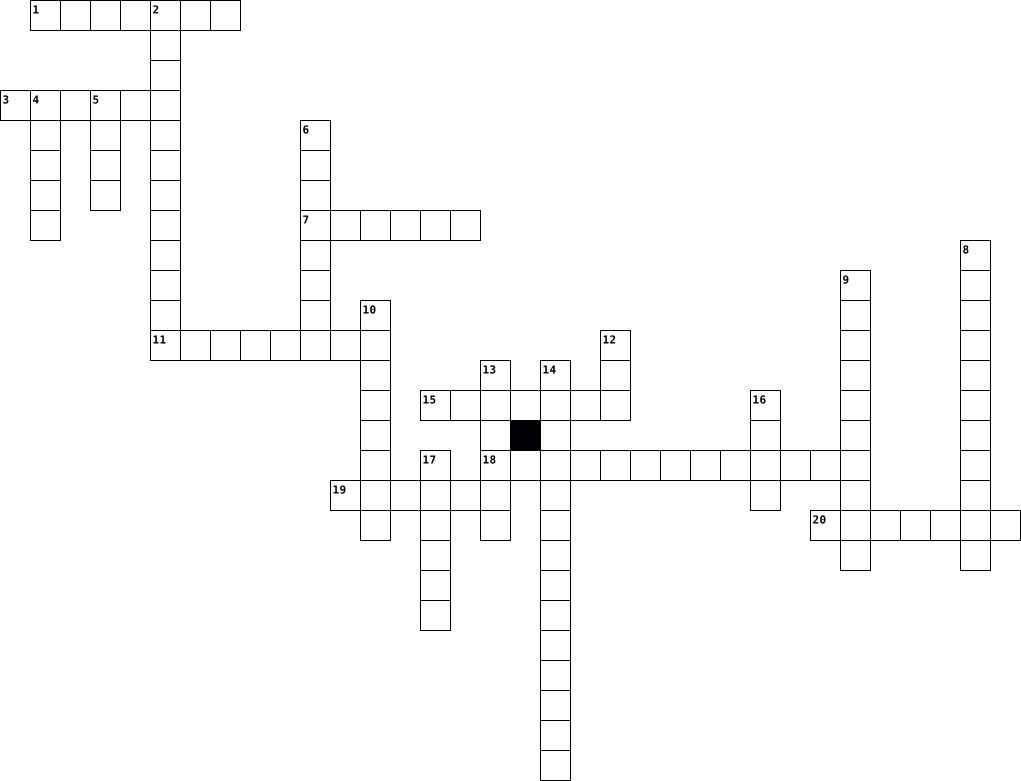
Across
- Bacon Bacon, during the enlightenment era, now, and forever, is a symbol for science and rational thought.
- Thomas Hobbes, an English philosopher and scientist, was one of the key figures in the political debates of the Enlightenment period
- The national Enlightenment in the Russian Empire differed from its Western European counterpart in that it promoted further modernization of all aspects of Russian life and was concerned with abolishing the institution of serfdom in Russia.
- Variations Instead, during the tide of "national salvation and revolution," they were simplistically rejected as the merely worrisome garbage of the bourgeois class.
- Broadly speaking, Enlightenment science greatly valued empiricism and rational thought, and was embedded with the Enlightenment ideal of advancement and progress.
- deficient in mental or spiritual enlightenment
- Delacroix an impressionist whose paintings portrayed emotion, nature, love, religion and nationalism
- Academies By the middle of the eighteenth century the number of learned academies and societies in Europe and its overseas colonies was in the hundreds, and many academies had come and gone in the preceding two centuries.
Down
- of the United States a document that is built on the ideas of Enlightenment thinkers which grants citizens rights and freedoms
- Everyone was open with each other during this time of period.
- of Rights the first ten amendments to the U.S. Constitution that included the 5 freedoms and the protection of basic rights
- Revolution A war that earned the colonies freedom and independence from Britain.
- he Enlightenment, a philosophical movement that dominated in Europe during the 18th century, was centered around the idea that reason is the primary source of authority and legitimacy, and advocated such ideals as liberty, progress, tolerance, fraternity, constitutional government, and separation of church and state.
- Locke argued that human nature was mutable and that knowledge was gained through accumulated experience rather than by accessing some sort of outside truth.
- Revolution The Glorious Revolution of 1688 is a part of the Enlightenment due to its focus on the ideals of liberty, constitutional government, and the rights of the people
- Republic of Letters The Republic of Letters (Respublica literaria) is the long-distance intellectual community in the late 17th and 18th centuries in Europe and the Americas. It fostered communication among the intellectuals of the Age of Enlightenment, or philosophes as they were called in France.
- de Cervantes Cervantes himself states that he wrote Don Quixote in order to undermine the influence of those "vain and empty books of chivalry" as well as to provide some merry, original, and sometimes prudent material for his readers' entertainment.
- Individualism was another prominent theme of the Enlightenment
- Jean-Jacques Rousseau was a Francophone Genevan philosopher, writer, and composer. His political philosophy influenced the Enlightenment in France and across Europe
- Diderot the author of the Encyclopedia which contained Enlightenment views
20 Clues: deficient in mental or spiritual enlightenment • Everyone was open with each other during this time of period. • Individualism was another prominent theme of the Enlightenment • Diderot the author of the Encyclopedia which contained Enlightenment views • Revolution A war that earned the colonies freedom and independence from Britain. • ...
American Revolution Impact 2023-10-17

Across
- / The first name of a famous woman that started as a nurse, then took cannon unit.
- / Founded after the war to improve hopes of democracy.
- / The worth of a slave according to the compromise.
- / The first name of a famous woman spy on the British side of war.
Down
- / The first word of a document promising rights to the common people.
- / The idea of freedom for slaves.
- / The British governmental system prior to the Revolution.
7 Clues: / The idea of freedom for slaves. • / The worth of a slave according to the compromise. • / Founded after the war to improve hopes of democracy. • / The British governmental system prior to the Revolution. • / The first name of a famous woman spy on the British side of war. • / The first word of a document promising rights to the common people. • ...
Jayden-citizenship 2020-10-26

Across
- is the capital of state 5. what is the symbol of
- is the fourth of july 9. what are the colors of
- star
Down
- is the symbol of the tree.7. what is the symbol of the chain
- is the bill of rights 1. what is the duties of
- elects congress 3. what colors are the
- flag
7 Clues: flag • star • elects congress 3. what colors are the • is the bill of rights 1. what is the duties of • is the fourth of july 9. what are the colors of • is the capital of state 5. what is the symbol of • is the symbol of the tree.7. what is the symbol of the chain
POLITICS AND GOVERNANCE 2023-08-23

Across
- A state of being confined. CONFINEMENT
- A group of representatives in a legislature. Separation Of Powers The principle of government separation.
- Individuals who create, amend, or repeal laws.
- A political system with two major parties.
- It is based on the principle that every individual or group is accountable for their actions, particularly when those actions affect public interest.
- A group of states with a common government.
- The process of electing representatives.
- A well-established rule, practice, or custom.
- A branch of a large organization, such as the government, that focuses on a specific subject, commodity, or area of activity.
- Person in charge of court proceedings.
- Believe that in order to conduct objective research, one must be value free.
- People are eager to learn about the decision-making process and its implementation. TRANSPARENCY
- The head of a state in a monarchy.
- The authority or right to issue orders or make decisions.
- The rights of a citizen to vote.
Down
- A meeting of political party members.
- The process of removing a president from office.
- Exerting cunning or deception, especially for one's own benefit.
- A policy of avoiding involvement in foreign conflicts.
- The official residence of a head of state.
- focuses on the investigation of political phenomena. POLITICAL SCIENCE
- To regulate behavior, legislation is created and enforced through social or governmental institutions.
- A document that grants permission to start a government.
- A set of fundamental principles or precedents by which a state or other organization is acknowledged to be governed.
- Individuals appointed by a head of state to lead executive departments and serve as official advisers. CABINET
- The principle of government by the people.
- A country's internal affairs and policies.
- POWER The authority to make legal decisions and judgments.
- Of Rights The first ten amendments to the U.S. Constitution.
- Public support or endorsement of a particular cause or policy.
30 Clues: The rights of a citizen to vote. • The head of a state in a monarchy. • A meeting of political party members. • A state of being confined. CONFINEMENT • Person in charge of court proceedings. • The process of electing representatives. • The official residence of a head of state. • A political system with two major parties. • The principle of government by the people. • ...
Libraries and Censorship 2023-01-04

Across
- The name of the student in the 1982 Supreme Court case about book banning in schools.
- What a library book is called if it is removed from the collection due to an objection.
- Number one most challenged book of 2021
Down
- One of the titles most recently challenged in our school district
- What is a library book is called when an objection is brought against it.
- Banned Book week is in this month.
- The last name of the wizard whose adventures made for the most challenged books of 2000-2009
- The number of policies in the Library Bill of Rights
- The Amendment that protects intellectual freedom
- The Freedom to Read is essential to our ________.
10 Clues: Banned Book week is in this month. • Number one most challenged book of 2021 • The Amendment that protects intellectual freedom • The Freedom to Read is essential to our ________. • The number of policies in the Library Bill of Rights • One of the titles most recently challenged in our school district • ...
Banking Introduction 2015-01-13

Across
- not for profit
- manner in which a business performs for its customers
- money you place in a savings or checking account
- on a one hundred dollar bill
- a container in a secure vault that is rented to individuals for the safekeeping of personal valuables.
- on a one dollar bill
- card that allows you to get basic services from a machine
- on a twenty dollar bill
Down
- ona fifty dollar bill
- business w/a state or federal gov charter that takes deposits and uses them to make loans
- an establishment for lending, borrowing, exchanging and safe guarding money
- an agreement in which lender gives money or property to a borrower
- that you can use like a credit card
- medium of exchange
- a charge or fee a bank charges for handling checking accounts and performing other financial services to its customers.
15 Clues: not for profit • medium of exchange • on a one dollar bill • ona fifty dollar bill • on a twenty dollar bill • on a one hundred dollar bill • that you can use like a credit card • money you place in a savings or checking account • manner in which a business performs for its customers • card that allows you to get basic services from a machine • ...
European Revolution 2022-04-08

Across
- no forced religion and no discrimination
- main purpose of government is to provide security
- decisions should be based on reason and logic
- governed completely and absolutely by one person
- longest Russian female empress
- also called a benevolent despot
- the agreement to compromise certain rights and privileges in exchange for protection from the government
- those governed should have a say
- french thinkers, scientists in 18th century
- intellectual movement of 17th century
- rights people are believed to be born with
Down
- A Vindication of the Rights of Woman
- the gov. is to protect rights and public good
- the belief that a monarch receives the right to rule from God, not the people
- led to the emergence of modern science
- aims at the common good
- the division of different jobs in a government
- separation of church and state
- women played a central role
- king of Prussia
20 Clues: king of Prussia • aims at the common good • women played a central role • longest Russian female empress • separation of church and state • also called a benevolent despot • those governed should have a say • A Vindication of the Rights of Woman • intellectual movement of 17th century • led to the emergence of modern science • no forced religion and no discrimination • ...
Constitution Vocab 2025-11-10

Across
- The government must follow established legal procedures and treat all people equally.
- The branch of government that interprets laws.
- Powers shared by both the federal and state governments.
- A legislature with two houses, like the US Congress which has the House of Representatives and the Senate
- Powers held only by the states.
- The branch of government that enforces laws.
- A change or addition to the Constitution.
- A system where power is divided between national and state governments.
- The right to vote.
- To formally approve a law or agreement.
Down
- The first ten amendments to the Constitution, guaranteeing individual rights.
- The introduction to a document, like the Constitution.
- The branch of government that makes laws.
- The power of the Supreme Court to review the constitutionality of laws.
- The division of government into legislative, executive, and judicial branches to prevent any one from becoming too powerful.
- A system where each branch of government has some control over the others.
- The idea that the people hold the ultimate authority.
- A government whose powers are restricted by law.
- The power of the president to reject a bill.
19 Clues: The right to vote. • Powers held only by the states. • To formally approve a law or agreement. • The branch of government that makes laws. • A change or addition to the Constitution. • The power of the president to reject a bill. • The branch of government that enforces laws. • The branch of government that interprets laws. • ...
Civil Rights and its People 2014-06-11

Across
- the color purple
- leading role, little rock integration crisis 1957
- rode interstate buses
- Quaker family,women suffrage movement
- Muslim minister rights activist
- dedicated to fight racism
- equalize education,job opportunities
- SNCC
- ministers,civil rights leaders
- president Johnson,urban violence
- Oklahoma city sit in movement,retired school teacher
- ended discrimination
- Mississippi,passing voting rights
- inspiration Dr martin Luther king speech
- first lady of civil rights
Down
- loving v. Virginia
- 1960's movement leader
- African American,define own goals
- first woman,ran for democratic presidential
- black Muslims
- movement 1954-68
- i have a dream
- educator, Montgomery,Alabama
- daughter,Mississippi sharecroppers
- police brutality
- american administration,educator,women rights activist
- cultural icon, propaganda
- civil and human right, African Americans
- laws enacted
- court case,all white university of Mississippi
30 Clues: SNCC • laws enacted • black Muslims • i have a dream • the color purple • movement 1954-68 • police brutality • loving v. Virginia • ended discrimination • rode interstate buses • 1960's movement leader • dedicated to fight racism • cultural icon, propaganda • first lady of civil rights • educator, Montgomery,Alabama • ministers,civil rights leaders • Muslim minister rights activist • ...
AP Gov Facts and Terms Crossword 2026-01-06

Across
- A specific number or percentage of positions (in jobs or schools) that must be filled by members of a specific group.
- Rights: Policies designed to protect people against arbitrary or discriminatory treatment by government officials or individuals.
- Restraint: Government actions that prevent material from being published; a form of censorship that is usually unconstitutional.
- Being forced to be a witness against oneself; prohibited by the 5th Amendment.
- v. US: The 1944 Supreme Court decision that upheld the internment of Japanese Americans during World War II as constitutional.
- Process Clause: Part of the 14th Amendment guaranteeing that persons cannot be deprived of life, liberty, or property by the government without due process of law.
- and Unusual Punishment: Court sentences prohibited by the 8th Amendment (such as torture).
- of Rights: The first 10 amendments to the U.S. Constitution, which define basic liberties such as freedom of religion, speech, and press.
- Rights Act of 1964: The law making racial discrimination in public accommodations (like hotels) and employment illegal.
- Worth: The principle that men and women should receive equal pay when they perform work that involves similar skills and responsibilities.
- v. Reed: The 1971 case in which the Supreme Court for the first time upheld a claim of gender discrimination.
- Amendment: The constitutional amendment adopted after the Civil War that guarantees "equal protection of the laws" and due process for all citizens.
- Liberties: The legal constitutional protections against government actions, formally set down in the Bill of Rights.
- Harassment: Unwelcome sexual advances or conduct that creates a hostile or offensive work environment.
- The legal right to vote.
- Clause: Part of the 1st Amendment stating that "Congress shall make no law respecting an establishment of religion."
- The publication of false and malicious statements that damage someone’s reputation.
- Amendment: The constitutional amendment ratified after the Civil War that forbade slavery and involuntary servitude.
- v. New York: The 1925 Supreme Court case holding that freedoms of press and speech are protected by the due process clause of the 14th Amendment from impairment by the states.
- Amendment: The constitutional amendment adopted in 1920 that guarantees women the right to vote.
- Exercise Clause: A 1st Amendment provision that prohibits government from interfering with the practice of religion.
Down
- Speech: Nonverbal communication, such as burning a flag or wearing an armband, which is protected under the 1st Amendment.
- Speech: Communication in the form of advertising, which can be restricted more than other types of speech.
- to Privacy: The right to a private personal life free from the intrusion of government, implied by various amendments.
- Action: A policy designed to give special attention to or compensatory treatment for members of previously disadvantaged groups.
- Rights Act of 1965: A law designed to help end formal and informal barriers to African American suffrage, such as literacy tests.
- v. Ferguson: The 1896 Supreme Court decision that provided a constitutional justification for segregation by ruling that "separate but equal" facilities were legal.
- v. Board of Education: The 1954 landmark decision holding that school segregation was inherently unconstitutional.
- with Disabilities Act: A 1990 law that requires employers and public facilities to make "reasonable accommodations" for people with disabilities.
- Material that is considered lewd or offensive by contemporary community standards and lacks serious literary, artistic, or scientific value.
- Tax: Small taxes levied on the right to vote; used by Southern states to exclude African Americans from the polls.
- Doctrine: The legal concept under which the Supreme Court has nationalized the Bill of Rights by making most of its provisions applicable to the states.
- Protection Clause: Part of the 14th Amendment emphasizing that the laws must provide equivalent protection to all people.
- Rule: The rule that evidence cannot be used in a trial if it was obtained through unconstitutional means (like an illegal search).
- Amendment: The constitutional amendment passed in 1964 that declared poll taxes void in federal elections.
- Amendment: The constitutional amendment that protects the four great liberties: freedom of religion, speech, press, and assembly.
- v. Sandford: The 1857 decision ruling that a slave who had escaped to a free state enjoyed no rights as a citizen and that Congress could not ban slavery.
- Rights Amendment: A proposed amendment stating that "equality of rights... shall not be denied... on account of sex." It failed to be ratified by enough states.
- Amendment: The constitutional amendment adopted in 1870 to extend suffrage to African Americans.
- Bargaining: A bargain struck between a defendant's lawyer and a prosecutor where the defendant pleads guilty to a lesser crime in exchange for a lighter sentence.
40 Clues: The legal right to vote. • Being forced to be a witness against oneself; prohibited by the 5th Amendment. • The publication of false and malicious statements that damage someone’s reputation. • and Unusual Punishment: Court sentences prohibited by the 8th Amendment (such as torture). • ...
Unit 3 Vocabulary Social Studies is your FAVORITE! 2023-08-30

Across
- capacity to endure pain or hardship
- granted by the Crown to an individual, giving them powers of legislation
- a document containing a formal statement of rights
- a pattern of colonial commerce connecting three regions and crossing the Atlantic Ocean
- a member of a volunteer committee organized to suppress and punish crime
- there were numerous restrictions to enforce social contro
- a schedule of rates or charges of a business or a public utility
- produced or gathered primarily for market
- a grant or guarantee of rights, franchises, or privileges from the sovereign power of a state or country
- animals kept or raised; farm animals kept for use and profit
- to commit (money) in order to earn a financial return
- a system in which a country attempts to amass wealth through trade with other countries, exporting more than it imports and increasing stores of gold and precious metals.
- a person who signs and is bound by to work for another for a specified time especially in return for payment of travel expenses and maintenance
- one granted ownership of a colony and full prerogatives of establishing a government and distributing land
Down
- the largest territorial division for local government within a state
- an order of a government prohibiting the departure of commercial ships from its ports
- opposition to one in authority or dominance
- to take by force or wrongfully
- a party or group that is often contentious or self-seeking
- a ruling class made up of planters
- farming or a system of farming that produces a minimum and often inadequate return to the farmer
- a member of a group of Black people inhabiting the sea islands and coastal districts of South Carolina, Georgia, and northeastern Florida
- the state or a period of forced absence from one's country or home
- the country of one's parents or ancestors
- a part of the organized armed forces of a country liable to call only in emergency
25 Clues: to take by force or wrongfully • a ruling class made up of planters • capacity to endure pain or hardship • produced or gathered primarily for market • the country of one's parents or ancestors • opposition to one in authority or dominance • a document containing a formal statement of rights • to commit (money) in order to earn a financial return • ...
American Revolution Crossword 2021-01-04

Across
- a branch of government that has the power to make laws
- An area of land that is under the control of a country, but not fully part of the country.
- A type of democratic government where people elect officials to represent them.
- Another name for loyalists who supported the British government.
- Part of the Massachusetts militia that was prepared to fight at a moment's notice.
- An American that wanted independence from Britain.
- of liberty A group of patriots organized by Samuel Adams to protest the Stamp Act and other actions of the British government.
- A person who supported the adoption of the Constitution.
- act A tax placed on the American colonies by the British government. It taxed all sorts of paper documents including newspapers, magazines, and legal documents.
- the group of thirteen colonies that united together
- A smooth bore gun with a long barrel that fired lead balls.
- A person in America who stayed loyal to Britain and the king.
- Citizens who were prepared to fight. They held drills a few times a year and had their own weapons and gear.
Down
- a type of government ruled directly by the people
- A blade attached to the end of a musket.
- of confederation An agreement between the thirteen colonies to form a single government under the United States of America. It served as the country's first constitution.
- a set of documents and laws that define the government as a country
- A military force that is set to defend a fort or city.
- The main governing body of the British government.
- of paris A treaty signed by both the United States and Britain that ended the Revolutionary War.
- of rights The first ten amendments to the Constitution that guaranteed the rights of the individual.
21 Clues: A blade attached to the end of a musket. • a type of government ruled directly by the people • The main governing body of the British government. • An American that wanted independence from Britain. • the group of thirteen colonies that united together • a branch of government that has the power to make laws • A military force that is set to defend a fort or city. • ...
Bill of Rights& the 7 Principles of Government 2022-02-16

Across
- support for a republican system of government.
- the federal principle or system of government.
- people have the right to keep and bear arms
- a body whose main function is the protection of people and their property
Down
- counterbalancing influences by which an organization or system is regulated, typically those ensuring that political power is not concentrated in the hands of individuals or groups.
- is the principle that the authority of a state and its government are created and sustained by the consent of its people, through their elected representatives
- an act of vesting the legislative, executive, and judicial powers of government in separate bodies.
- an amendment to the US Constitution that prohibits any law limiting freedom with respect to religion, expression, peaceful assembly, or the right of citizens to petition the government
8 Clues: people have the right to keep and bear arms • support for a republican system of government. • the federal principle or system of government. • a body whose main function is the protection of people and their property • an act of vesting the legislative, executive, and judicial powers of government in separate bodies. • ...
Texas Legislature 2023-10-25

Across
- To kill a bill by placing it at the bottom of a committee's agenda
- Can be stricken by an item veto
- A bicameral legislature has two
- Type of committee to work out differences between House and Senate versions of a bill
- Share of the Senate that is elected every two years
- A marathon speech in the Senate
- Each legislator is elected from their own
- Sets the agenda for special sessions of the legislature
Down
- Manipulation of district boundaries to affect who gets elected
- Number of years in a senator's term
- Presiding officer of the House of Representatives
- A proposed law
- Type of equality required by "one person, one vote"
- Preventing a vote by offering needless amendments
- Place where all members of a house meet to debate and vote
15 Clues: A proposed law • Can be stricken by an item veto • A bicameral legislature has two • A marathon speech in the Senate • Number of years in a senator's term • Each legislator is elected from their own • Presiding officer of the House of Representatives • Preventing a vote by offering needless amendments • Type of equality required by "one person, one vote" • ...
Crim Quiz Review 2024-11-14

Across
- offences where no defence
- Object. case..failing to provide necessities/life
- type of objective intent..leave gun in open
- detention case...meaning of detention
- Mack case about this practice by police
- accused state of mind...(intent type)
- cause theory...your environment when young
- guilty mind
Down
- turning away from truth (intent)
- two or more plan a crime
- guilty act
- what a reasonable person...(intent type)
- intent..swinging a bat in full classroom
- case..search and detention...crack house
- assisting in commission of a crime
- s. 9 rights
- cause theory...you choose crime
- encouraging commission of a crime
- object. case..officer accidentally fires weapon
- cause theory..genetic??
- arrest rights case..legal aid here??
- cause theory...who you associate with
- s. 8 rights
- s. 10 rights
24 Clues: guilty act • s. 9 rights • s. 8 rights • guilty mind • s. 10 rights • cause theory..genetic?? • two or more plan a crime • offences where no defence • cause theory...you choose crime • turning away from truth (intent) • encouraging commission of a crime • assisting in commission of a crime • arrest rights case..legal aid here?? • detention case...meaning of detention • ...
Legislative Branch 2025-08-26

Across
- people hired by interest groups to talk to Congresspeople
- a person who is in a legislature
- the formal name of our legislature
- total number of members of the Senate
- the main purpose of Congress
- the number of the amendment that changed election of Senators
- you must be at least this age to serve in the House of Representatives
- the number of years a Senator serves
- what you would call someone who is in the chamber led by the President Pro Tempore
- only the House can start these kind of bills
- the "upper" or more prestigious house
Down
- refers to two houses
- a government's law making body
- the number of years a House Representative serves
- how the number of representatives in the House is determined
- where detailed lawmaking happens
- the "lower" or less prestigious house
- when a president rejects a bill
- person who signs a bill into law
- a shortened name for the leader of the House of Representatives
- a proposed law
- Constitutional leader of the Senate
- you must be at least this age to serve in the Senate
- party with the most members in a house
24 Clues: a proposed law • refers to two houses • the main purpose of Congress • a government's law making body • when a president rejects a bill • a person who is in a legislature • where detailed lawmaking happens • person who signs a bill into law • the formal name of our legislature • Constitutional leader of the Senate • the number of years a Senator serves • ...
Unit 3 - crossword 2023-02-06

Across
- of Rights- the first ten amendments to the US Constitution, ratified in 1791 and guaranteeing such rights as the freedoms of speech, assembly, and worship.
- federal principle or system of government.
- to the constitution- a change or addition to the constitution
- body of fundamental principles or established precedents according to which a state or other organization is acknowledged to be governed.
- Hamilton- a founding father of the United States, who fought in the American Revolutionary War, helped draft the Constitution, and served as the first secretary of the treasury.
- -to prevent the trial and imprisonment of debt-ridden citizens
- of the constitution-an introduction to the highest law of the land; it is not the law
Down
- papers-a series of eighty-five essays urging the citizens of New York to ratify the new United States Constitution.
- fundamental truth or proposition that serves as the foundation for a system of belief or behavior or for a chain of reasoning.
- person who opposed the adoption of the U.S. Constitution
- of Confederation -the original constitution of the US, ratified in 1781, which was replaced by the US Constitution in 1789.
- Madison- America’s fourth president(1809-1817)
- Jay- was one of the framers of the Constitution, author of five of The Federalist Papers, and the first Chief Justice of the United States.
- of the constitution-talk about the duties of the three main parts of government: the Executive Branch, the Legislative Branch, and the Judicial Branch.
14 Clues: federal principle or system of government. • Madison- America’s fourth president(1809-1817) • person who opposed the adoption of the U.S. Constitution • to the constitution- a change or addition to the constitution • -to prevent the trial and imprisonment of debt-ridden citizens • ...
SS Crossword - Muhammad Shahmeer 2022-04-21

Across
- people who build factories or industries
- A machine that helps separate cotton from cotton seeds
- are parts of a mechanism that can be substituted one for another
- to protest against something such as rights or a higher pay
- System a method of production in which large crews of people performed work in one location
- the transition from a preindustrial economy to a market-oriented capitalist economy
- becoming larger or more extensive
- existing before war.
- swap items kind of like buying
- cultivated land or the cultivation of land.
- rights granted to people but not listed in the bill of rights.
- are the basic materials in which things are made
- an artificial waterway constructed to allow the passage of boats or ships inland or to convey water for irrigation.
- representing womans rights during the revolution
- the cloth, and clothing made from cotton and other raw materials
- people in Missouri could own slaves
- the ability to do something
- wealth and resources of a country or region
- Machines that combine thread
- Moves water and turns a generator wheel
- a track or set of tracks made of steel rails along which passenger and freight trains run.
- an era in which widespread production by machinery replaced goods made by hand
- is a person advocating or supporting the republican government
Down
- people who innovate
- the identification with and loyalty to a particular part of the country, such as the North or the South.
- a machine that cuts stalks of wheat or oats
- the process of acquiring or developing something.
- is a place where crops may be cultivated.
- land filled with soil rich with nutrients helps make better crops
- a non violent opposition to authority
- a boat outfitted with steam boiler engines to power the paddle wheels that propel it forward
- one's own nation and support for its interests
- any intervention by external powers in the politics of the Americas is a potentially hostile act against the US.
- trade of enslaved people within the United States
- to become less violent or severe
- land where people plant, raise, harvest their crops and livestock
- spirits
- is the refusal to accept or comply with something; the attempt to prevent something by action or argument.
- restricts commerce with a specified country or the exchange of specific goods
- is an estate where crops may be cultivated.
- the action of making or manufacturing from components or raw materials or the process of being so manufactured.
- to destroy or get rid of
- is the exclusive possession or control of the supply of or trade in a commodity or service.
- sent messages over electrical wires using a series of long and short pulses known as Morse code.
- a geographic area that isn’t organized
- promoting industry in the U.S. by adoption of a high protective tariff
- a building equipped with machinery for grinding grain into flour.
- the wealth and resources of a country or region, especially in terms of the production and consumption of goods and services.
- a river, canal, or another route for travel by water.
- relating to or looking like the countryside.
50 Clues: spirits • people who innovate • existing before war. • to destroy or get rid of • the ability to do something • Machines that combine thread • swap items kind of like buying • to become less violent or severe • becoming larger or more extensive • people in Missouri could own slaves • a non violent opposition to authority • a geographic area that isn’t organized • ...
ss crossword puzzle 2022-04-20

Across
- people in Missouri could own slaves
- existing before war.
- an era in which widespread production by machinery replaced goods made by hand
- an artificial waterway constructed to allow the passage of boats or ships inland or to convey water for irrigation.
- any intervention by external powers in the politics of the Americas is a potentially hostile act against the US.
- becoming larger or more extensive
- trade of enslaved people within the United States
- the ability to do something
- land filled with soil rich with nutrients helps make better crops
- is the exclusive possession or control of the supply of or trade in a commodity or service.
- is an estate where crops may be cultivated.
- is the refusal to accept or comply with something; the attempt to prevent something by action or argument.
- relating to or looking like the countryside.
- the identification with and loyalty to a particular part of the country, such as the North or the South.
- representing womans rights during the revolution
- the cloth, and clothing made from cotton and other raw materials
- sent messages over electrical wires using a series of long and short pulses known as Morse code.
- the wealth and resources of a country or region, especially in terms of the production and consumption of goods and services.
- Moves water and turns a generator wheel
- is a person advocating or supporting the republican government
- the process of acquiring or developing something.
- the transition from a preindustrial economy to a market-oriented capitalist economy
- people who build factories or industries
- swap items kind of like buying
- a track or set of tracks made of steel rails along which passenger and freight trains run.
- are the basic materials in which things are made
- to destroy or get rid of
- the action of making or manufacturing from components or raw materials or the process of being so manufactured.
- spirits
- land where people plant, raise, harvest their crops and livestock
Down
- a boat outfitted with steam boiler engines to power the paddle wheels that propel it forward
- a building equipped with machinery for grinding grain into flour.
- to become less violent or severe
- a geographic area that isn’t organized
- promoting industry in the U.S. by adoption of a high protective tariff
- is a place where crops may be cultivated.
- restricts commerce with a specified country or the exchange of specific goods
- are parts of a mechanism that can be substituted one for another
- Machines that combine thread
- to protest against something such as rights or a higher pay
- a non violent opposition to authority
- a river, canal, or another route for travel by water.
- rights granted to people but not listed in the bill of rights.
- people who innovate
- System a method of production in which large crews of people performed work in one location
- A machine that helps separate cotton from cotton seeds
- cultivated land or the cultivation of land.
- one's own nation and support for its interests
- wealth and resources of a country or region
- a machine that cuts stalks of wheat or oats
50 Clues: spirits • people who innovate • existing before war. • to destroy or get rid of • the ability to do something • Machines that combine thread • swap items kind of like buying • to become less violent or severe • becoming larger or more extensive • people in Missouri could own slaves • a non violent opposition to authority • a geographic area that isn’t organized • ...
mock trial review 2025-04-14

Across
- this is a due process step that promises a lawyer
- the idea that the government has to treat everyone fairly under the law
- this is the part of the trial where they present the evidence to the jury and judge
- a lawsuit where you have been denied a service due to a protected class such as gender or race
- a lawyer that is provided for free by the government
- this is a due process step that ensure the case is fair and overseen by a unbiased entity
- a lawyer that defends their client
- this is the lawyers last chance to speak and convince the jury or judge
- jury duty is________.
- the person accused of a crime or wrong doing
- a group of people that decide whether a person is guilty or not guilty
- the proper way to behave in a courtroom
- the amendment that give sus the right to a fast, public and fair trial
- the amendment that protects our right to remain silent
- also known as the court deputy, they keep the peace
- this means everyone agrees
- the protection that requires police to read you your rights when arresting you for a crime
Down
- this is when the other side gets a chance to also question the witness
- a lawyer that works for the government to convict criminals
- a document that protects due process
- the number of people on a jury
- a case where someone has commited a crime
- the amendment that gives us the right to a jury trial
- a person who testifies their side of the story in court
- the 1st time the layers speak
- the person who brings a case to court
- this is a type of case that a person didn't like the outcome and takes it to a higher court
- the amendment that protects us from cruel or unusual punishments
- the first thing to happen before a trial starts
- a lawsuit where someone tells lies about you and it hurts your reputation
- a type of case where they decide the punishment for a guilty person
- 10 amendments that protect our rights
- a case that is a person versus a person
- a lawsuit about when a person copies and steals your ideas
- a case brough to court when you have been wronged and you seek financial compensation
- the person who holds the highest authority in the court
36 Clues: jury duty is________. • this means everyone agrees • the 1st time the layers speak • the number of people on a jury • a lawyer that defends their client • a document that protects due process • the person who brings a case to court • 10 amendments that protect our rights • the proper way to behave in a courtroom • a case that is a person versus a person • ...
Legislative Vocab 2015-03-05

Across
- Someone hired by a business or a cause to persuade legislators to support that business or cause
- Two houses
- How old someone has to be to serve in the Senate
- Permanent Congressional committees
- A draft of a proposed law
- Power that are clearly listed
- How long House members serve
- Spending bills must start out here
- Officially tries officials who are impeached
- People that are represented
- How long Senators serve
Down
- Government projects that primarily benefit the home district
- Allows Congress to "stretch" its powers to meet new needs
- Organizations made up of people with common interests
- Power that are not clearly listed
- How old someone has to be to serve in the House
- To talk a bill to death
- An oddly shaped congressional district
- To refuse to sign a bill
- The total number of Senators
- How the Senate can end a filibuster
- To formally charge with a crime
22 Clues: Two houses • To talk a bill to death • How long Senators serve • To refuse to sign a bill • A draft of a proposed law • People that are represented • The total number of Senators • How long House members serve • Power that are clearly listed • To formally charge with a crime • Power that are not clearly listed • Permanent Congressional committees • Spending bills must start out here • ...
Diary of a Wimpy Kid Diper Overload 2023-04-24

Across
- Who was Bill's Girlfriend
- How old was Bill
- What did Rodrick play
- What was Sebastion eating when the band arrived
- Did MetaliChihuahua reunite
- What did the band have to clean to talk to Sebastion
- What competition did Loaded Diper participate in
- Where did Rodrick try to win the van
- How did Sebastion play the drums
- Who was Bill's favorite band
- What is Greg's mom's name
- What did the band use for transportation
- Where did Bill meet Becky
Down
- What almost ruined Loaded Diper
- What was the name of Rodricks band
- Where did Susan buy all of the costumes
- Who is telling the story
- Who started the band
- Who is one first guitarist
- Who is the lead singer of Loaded Diper
- Where did Rodrick want to perform
- Why did MetaliChuhuahua quit
- Who is Rodricks favorite band
- Who is the second guitarist
- How did Loaded Diper plug themselves
- Where did Loaded Diper practice
26 Clues: How old was Bill • Who started the band • What did Rodrick play • Who is telling the story • Who was Bill's Girlfriend • What is Greg's mom's name • Where did Bill meet Becky • Who is one first guitarist • Did MetaliChihuahua reunite • Who is the second guitarist • Why did MetaliChuhuahua quit • Who was Bill's favorite band • Who is Rodricks favorite band • ...
Civics Test Revision 2016-05-25

Across
- Laws developed by Aboriginal and Torres Strait Islanders
- The name for a law on carbon that was passed in 2011 to reduce climate change
- Type of law which deals with crimes against people
- The name for two political parties in power together
- The person suing another person in a civil matter
- Referring to previous cases as evidence in court
- Court at the bottom of the Hierarchy
- The ... of proof - the prosecution has to prove the accused committed a crime
- Step ... - The Bill goes through a 'Second Reading'
Down
- Law that has been developed by judges
- A Bill once it has been signed by the Governor-General
- Law made by parliament
- Type of law that deals with serious crimes where you can go to jail
- The Foreign Minister: Julie ...
- The ... of proof - level of evidence which must be reached to go to trial/to win
- Location of the High Court
- The political party currently in power
- A proposed law that hasn't been agreed on by parliament
18 Clues: Law made by parliament • Location of the High Court • The Foreign Minister: Julie ... • Court at the bottom of the Hierarchy • Law that has been developed by judges • The political party currently in power • Referring to previous cases as evidence in court • The person suing another person in a civil matter • Type of law which deals with crimes against people • ...
The Civil Rights Movement 2014-05-18

Across
- first African American athlete to play major league baseball
- where did the letter MLK wrote come from
- who organized the Little Rock Nine desegregation events
- speech MLK gave at the civil rights march on Washington
- what has the civil rights movement been called before
- an Arkansas high school where the brown decision was enforced
- where did the brown vs board of education take place
- where was MLK assassinated
- where did the freedom march take place
Down
- 1954 supreme court decision that all schools to be desegregated
- what was the name of the school desegregation event
- which president was assassinated in Dallas, Texas
- law passed under President Johnson which outlawed literacy testing as a qualification to vote
- who was the leader of the SNCC
- Law passed by President Johnson which prohibited discrimination based on race
- they wanted equal rights in...
- the march on Washington occurred because they wanted equal..
- what president signed the civil rights act of 1964
- ordered the desegregation of the federal government
- who led the freedom march on Washington
20 Clues: where was MLK assassinated • who was the leader of the SNCC • they wanted equal rights in... • where did the freedom march take place • who led the freedom march on Washington • where did the letter MLK wrote come from • which president was assassinated in Dallas, Texas • what president signed the civil rights act of 1964 • ...
Feminist Movement of the 1960s 2024-11-29

Across
- - Proposed Equal Rights Amendment.
- - Reproductive rights focus.
- - Demonstration for equality.
- - National women's organization.
- - Prejudice against women.
- - Focus of gender fairness.
- - Gap targeted by feminists.
- - IX, promoting educational equity.
- - Symbolic ceiling to break.
Down
- - Author of The Feminine Mystique.
- - Women's equality goal.
- - Feminist demand.
- - Landmark case on abortion rights.
- - Public feminist action.
- - Movement for freedom.
15 Clues: - Feminist demand. • - Movement for freedom. • - Women's equality goal. • - Public feminist action. • - Prejudice against women. • - Focus of gender fairness. • - Reproductive rights focus. • - Gap targeted by feminists. • - Symbolic ceiling to break. • - Demonstration for equality. • - National women's organization. • - Author of The Feminine Mystique. • ...
U.S. History Origins of the Cold War/Civil Rights Movement 2026-03-19

Across
- The U.S. and Soviet Union competed in a "race" to acquire the most of these types of bombs, which led to several tense standoffs.
- Two word name for the period of mass paranoia and fear in America in which innocent Americans were accused of being communist spies.
- Isaac Woodard became this after being severely beaten by a sheriff just hours after returning home from WWII. This showed that racial injustice was still widespread in America even after winning WWII.
- This two letter bill promised a bright future for WWII veterans returning home, but most of the benefits were never provided to Black veterans.
- The name of the fighting style the Vietcong used against the U.S. during the Vietnam War. It revolves around ambushing your enemy. Hint: it sounds like an animal, but the spelling is different!
- Dr. King made the decision to use this group in the Birmingham Campaign protesting racial segregation. The violence they faced made people criticize Dr. King's decision.
- Two word name for the period of tension that existed between the U.S. and the Soviet Union following the end of World War II through the 1990s.
- An intense 13 day standoff between the U.S. and the Soviet Union began in 1962 when the U.S. discovered that the Soviet Union had placed nuclear missiles in this nearby country. Thankfully, cooler heads prevailed.
- In order to get around the blockade the Soviet Union set up around West Berlin shortly after World War II, the U.S. used these to deliver supplies to the people of West Berlin.
- Two word name for the type of funeral that Mamie Till decided to have following the brutal murder of her son, Emmett Till. This served as a big spark for the Civil Rights Movement.
- The Black residents of Montgomery agreed to hold one of these after Rosa Parks was arrested for refusing to give up her seat to a White person on a city bus.
- Three letter initials of the man who is considered the "leader" of the Civil Rights Movement. He advocated using nonviolent direct action, such as sit-ins and demonstrations, to force racial segregation to be eliminated.
- Communist supported in the Soviet Union criticized capitalism by saying it led to economic this in society, in which some people become very wealthy while many others struggle to get by.
Down
- The U.S. led a covert operation to overthrow the president of this country in 1954, believing that his land reform policies were evidence of him being a communist threat.
- In his "Letter from Birmingham Jail," Dr. King explained that this was neutral, and could be used positively or negatively. Dr. King argued that it had been used negatively too long in the U.S.
- The Civil Rights Act of 1964 was a huge victory for the Civil Rights Movement, as it finally outlawed this throughout the South.
- Two word name for the competition between the U.S. and the Soviet Union to demonstrate superior technological advancements. It ended with the U.S. successfully having a man land on the moon in 1969.
- Two word name for the discriminatory practice that was eliminated by the Voting Rights Act of 1965, allowing thousands of Black Americans to finally exercise their right to vote.
- Name of the city in Alabama that was chosen to stage a campaign for voting rights. The sheriff of this city, Jim Clark, was known to use violent strategies to prevent Black Americans from voting.
- Although the U.S. framed the Vietnam War as a war against the spread of communism, the North Vietnamese framed the war as a fight for Vietnam's this.
- Last name of the president who gave a moving speech in support of the Civil Rights Movement in June, 1964. Sadly, he was assassinated just months later.
- Capitalist supporters in the U.S. criticized communism by saying it gave too much power to the government, threatening people's this.
- The type of jellied gasoline dropped all throughout South Vietnam by the U.S. military during the Vietnam War. Its harmful effects on innocent civilians was one of the reasons why the U.S. failed to win the "Hearts and Minds" of the South Vietnamese.
23 Clues: The Civil Rights Act of 1964 was a huge victory for the Civil Rights Movement, as it finally outlawed this throughout the South. • The U.S. and Soviet Union competed in a "race" to acquire the most of these types of bombs, which led to several tense standoffs. • ...
The Civil Rights Movement (pp. 380 - 395) 2026-01-11

Across
- The legal doctrine established by the Plessy v. Ferguson case
- Student-led group organizing sit-ins and voter registration campaigns
- Unfair exams used to limit African American voting rights
- Nonviolent leader of the Civil Rights Movement (acronym)
- Civil rights leader who argued for change “by any means necessary”
- Organization founded in 1909 to challenge racial inequality in courts
- Number of the amendment that allowed African American men to vote
- Laws that enforced racial segregation in the South
- Turned over Plessy v. Ferguson
Down
- Being denied the right to vote
- the mobilization of the political and economic power of African Americans, especially to compel respect for their rights and to improve their condition
- Civil rights–era group that ran community programs and armed patrols
- Discriminatory charges that limited voting rights
- Policy that protected white voting rights by using ancestry
- Her arrest helped spark the Montgomery Bus Boycott
15 Clues: Being denied the right to vote • Turned over Plessy v. Ferguson • Discriminatory charges that limited voting rights • Laws that enforced racial segregation in the South • Her arrest helped spark the Montgomery Bus Boycott • Nonviolent leader of the Civil Rights Movement (acronym) • Unfair exams used to limit African American voting rights • ...
Pecos Bill 2022-12-09

Across
- What Pecos Bill thought he was
- What Pecos Bill fell out of
- What Pecos Bill used as a lasso
- What Pecos Bill's girlfriend was riding on when Pecos Bill found her
- Pecos Bill's girlfriend
Down
- Pecos Bill's horse
- What Pecos Bill rode that took him across four states
- Who Pecos Bill was found by when he became a cowboy
- The river where Pecos bill got lost
9 Clues: Pecos Bill's horse • Pecos Bill's girlfriend • What Pecos Bill fell out of • What Pecos Bill thought he was • What Pecos Bill used as a lasso • The river where Pecos bill got lost • Who Pecos Bill was found by when he became a cowboy • What Pecos Bill rode that took him across four states • What Pecos Bill's girlfriend was riding on when Pecos Bill found her
Government Terms 2023-07-23

Across
- a system of government
- a proposal on procedure
- a way of controlling boundaries
- supreme law of the land
- becoming a citizen
- accusations against a civil official
- the quality of having two branches
- an act of congress
- a native or naturalized subject of a nation
- a measure which has become law
Down
- a meeting of party members
- less than half
- an addition to a constitution
- the process of choosing government
- action by the president refusing to approve bill
- a seat of legislative power
- a person who moves from one country to another
- prolonged talking by a senator
- to approve an agreement
- a measure introduced in house
20 Clues: less than half • becoming a citizen • an act of congress • a system of government • a proposal on procedure • supreme law of the land • to approve an agreement • a meeting of party members • a seat of legislative power • an addition to a constitution • a measure introduced in house • prolonged talking by a senator • a measure which has become law • a way of controlling boundaries • ...
Jacey Kaiser - 2nd Hour Government Final Project 1/7/22 2022-01-07

Across
- when people don't like the constitution.
- when a bill is sent to a ___ to be studies in detail.
- powers that aren't in the constitution, but are "necessary and proper" yo accomplish what is listed.
- when a juvenile is found guilty of a crime.
- the money that is raised or collected by the government taxes.
- When a country's actions towards other counties. (2 words)
- each functioning brach gets power when divided effectively. (three words)
- when political parties are responsible for selecting candidates who will run or political office is called a ___. (2 words)
- people that are a citizen of a state.
- when a formal agreement between countries.
- when citizens vote to approve or reject a bill that their states legislature is proposing or has already passed into a law.
- when all of the budget deficits add up. (2 words)
- colonists purchase a stamp to put on newspapers if sold in colonies. (2 words)
Down
- ____ are less serious crimes when the penalty is usually less that a year in jail or even just a fine.
- our nations first form of government as an independent nation. (3 words)
- when the number of votes depend on the population, and larger states have more power. (2 words)
- everybody is even, nobody is above the law. (3 words)
- when topics are focused on that affect the general public. (2 words)
- every person has a privilege to have for themselves. (2 words)
- when you ___ a candidate that is running for office and suggest that the group's members vote for him or her.
- when each state have one vote and the smaller states have more power. (3 words)
- the powers that is divided between the federal and state government.
- a group that insists the constitution alone is enough to protect the citizens' rights.
- when congress is made up of two chambers, the senate and house of reps.
- ___ is usually help settles disagreements between people. (2 words)
25 Clues: people that are a citizen of a state. • when people don't like the constitution. • when a formal agreement between countries. • when a juvenile is found guilty of a crime. • when all of the budget deficits add up. (2 words) • when a bill is sent to a ___ to be studies in detail. • everybody is even, nobody is above the law. (3 words) • ...
AP Government Crossword 2025-12-08

Across
- The one being accused in a court of law
- The head of the majority party in a legislative body, especially the US Senate or House of Representatives.
- Federal funding that is set to be used for a specific use in the State and local government.
- A formal directive issued by the president that manages Federal or state operations of policy.
- President waits 10 days
- The federal governments ultimate authority to rule over their territory without outside control, often shared between the states and their people.
- The attempt to delay or block votes on a bill by prolonging debate.
- Fixed sum of federal money given to the State and local governments.
- A member of the executive branch that is there to help the president.
- One parties legal rights to bring an lawsuit, which requires a direct connection to the issue being challenged.
- Power divided between Federal and State governments
- A trail court for federal or state criminals, usually the primary entry point
- The SCOTUS case that resulted in the Necessary and Proper Clause
- When the President says no to a bill
Down
- Dividing districts
- SCOTUS case about gun control in school zones
- A past court ruling or event that serves as an example or rule for future decisions.
- The court legal authority to hear and decide a case, defining its power over specific area, matters, and people.
- An agreement between the U.S. President and a foreign leader bypassing Senate ratification.
- Drawing boundaries to favor one party over the other
- The inherent powers of the State governments to enact laws and regulations to protect the public.
- Reserved powers not stated in the Constitution to give States more power.
- The powers held by individual states rather than the government
- Federalist paper that argues for a strong, unitary executive for the government.
- The party that brings legal action or a lawsuit to the court.
25 Clues: Dividing districts • President waits 10 days • When the President says no to a bill • The one being accused in a court of law • SCOTUS case about gun control in school zones • Power divided between Federal and State governments • Drawing boundaries to favor one party over the other • The party that brings legal action or a lawsuit to the court. • ...
Executive 2025-10-22

Across
- the president postponing a sentence.
- how long the president has to live in the US to run
- President must receive a majority to win the election
- successor to vp
- if Congress adjourns during the ten-day period and the President doesn’t sign it, the bill dies.
- the president must be one
- what happens when the president is removed from office
- a general pardon given to a group of people
- Commander in chief
- what the president must do for a bill to pass
Down
- presidential successor
- limited president to two terms
- election happens every four year
- what the president can do to not let a bill pass
- powers held by the president
- the presidents ability to reduce the length of a sentence or the size of a fine.
- age the president must be
- the group that actually votes for the president
- there are two major ones
- the presidents ability to give legal forgiveness for a crime.
20 Clues: successor to vp • Commander in chief • presidential successor • there are two major ones • age the president must be • the president must be one • powers held by the president • limited president to two terms • election happens every four year • the president postponing a sentence. • a general pardon given to a group of people • what the president must do for a bill to pass • ...
15.4-15.6 2023-03-07

Across
- principle requiring that the government not unreasonable interfere with a basic right
- a watch kept over a person, group, etc.
- standard of judicial review where the court presumes the policy to be invalid
- a local group of armed citizens
- tactic where participants seat themselves in a location and refuse to move
- a middle ground between rational basis and strict scrutiny
- exists when there is a logical relationship between the treatment or classification of some group of people and the purpose of the law
- policies that give preferences to women or minorities
Down
- a physical or mental condition that causes a person to have difficulties on a daily basis
- to demonstrate, often against a government's policies or actions
- making a distinction based on the group, class, or category to which a person belongs
- the process by which the Bill of Rights was extended to the states
- a certain number of spots reserved for minorities
- gaining access into telephone wires for information
- laws requiring racial segregation
15 Clues: a local group of armed citizens • laws requiring racial segregation • a watch kept over a person, group, etc. • a certain number of spots reserved for minorities • gaining access into telephone wires for information • policies that give preferences to women or minorities • a middle ground between rational basis and strict scrutiny • ...
Legislative Branch 2022-11-03

Across
- The drawing of electoral district lines to the advantage of a party or group
- Two year period of time during which Congress meets
- Legal rights of a person to reproduce, publish, or sell their creations
- To begin a new session of Congress
- Period of time each year during which Congress assembles and conducts business
- Legislative committee composed of members of both branches
- Suspend, as in a session of Congress
- Lawmakers who vote based on their conscience and judgement
- Expression describing how most bills introduced in each session of Congress are put away or never acted upon
- People with authority to represent others at a conference or convention
- The people and interests that an elected official represents
- The presiding officer of a senate in Congress, the Vice President of the United States
- exclusive power of Congress to regulate interstate and foreign trade
Down
- The legal process by which citizens of one country become citizens of another
- Act of lying under oath
- legislative committee created for a limited time and for some specific purpose
- A type of veto a chief executive may use after a legislature has adjourned when the chief does not sign or reject a bill within the time allowed to do so
- The member of the U.S Senate, or upper house of a State legislature, chosen to preside in the absence of the president of the Senate
- Permanate committee in a legislative body to which bills in a specified subject area are referred
- An order for a person to appear and to produce documents or other requested materials
- Lawmakers who owe their first allegiance to their political party and vote according to the part line
- Division of existing committee that is formed to address specific issues
- A licence insured to an inventor granting the exclusive right to make, sell , use for a limited time
- Broad agreement on public question
- The presiding officer of th House of Representatives, chosen by and from the majority party in the house
- A closed meeting of a partys house or senate members
- A stalling tactic to delay the Senate floor so a bill cannot be brought to vote
- A procedure to limit or end floor debate
- The current office holder
- The floor leader of the party that holds the majority of seats in each house of Congress
- The floor leader of the party that holds the minority of seats in each house of Congress
- Cheif executive power to reject a bill passed by a legislature
- To bring formal charges against a public official
- Distributed, as in seats in a legislative body
- To find not guilty of charge
35 Clues: Act of lying under oath • The current office holder • To find not guilty of charge • To begin a new session of Congress • Broad agreement on public question • Suspend, as in a session of Congress • A procedure to limit or end floor debate • Distributed, as in seats in a legislative body • To bring formal charges against a public official • ...
Legal Studies Chapter 2 - Origins of law 2023-08-17

Across
- treaty
- sanction
- appeal
- common_law
- bill
- federation
- delegated_legislation
- statute_law
- legislative_powers
- concurrent_powers
- precedent
- original_jurisdiction
- appellate_jurisdiction
- domestic_law
- referendum
- exclusive_powers
Down
- jurisdiction
- indictable_offences
- summary_offences
- committal_hearings
- declarations
- coronial_inquests
- stare_decisis
- residual_powers
- ratify
- bicameral
- adversarial_system
- act_of_parliament
- mediation
29 Clues: bill • treaty • appeal • ratify • sanction • bicameral • precedent • mediation • common_law • federation • referendum • statute_law • jurisdiction • declarations • domestic_law • stare_decisis • residual_powers • summary_offences • exclusive_powers • coronial_inquests • act_of_parliament • concurrent_powers • committal_hearings • adversarial_system • legislative_powers • indictable_offences • delegated_legislation • ...
AP GOV PROJECT 2024-12-12

Across
- protection clause, part of the Fourteenth Amendment to the United States Constitution that requires the law to treat people in similar situations equally. It states that no state can deny any person within its jurisdiction equal protection under the law.
- York Times Co. v. United States, dealt with the First Amendment and the freedom of press.
- v. Vitale, This case addressed the issue of state-sponsored prayer in public schools.
- rights, the legal rights that law enforcement must inform a suspect of after arresting them Executive privilege, the authority of the President to withhold documents or information in his possession or in the possession of the Executive Branch from the Legislative or Judicial Branch of the government. .
- v. Reno, unconstitutional to segregate voters based on race.
- v. Chicago, addressed the issue of gun rights in the United States.
- powers, are powers of the United States government that are not explicitly stated in the Constitution, but are suggested to be applicable in some or all cases.
- Incorporation, the legal doctrine where the Supreme Court applies individual rights from the Bill of Rights to state governments on a case-by-case-basis
- opinion, a written opinion by a judge who agrees with the majority decision in a case, but provides different reasoning or justification for reaching that decision
- clause, gives Congress the power to create laws that are not explicitly listed in the Constitution.
- opinion, a written statement by one or more judges that disagrees with the majority opinion in a legal case
- review, review by the US Supreme Court of the constitutional validity of a legislative act.
- v. Wade, addressed the issue of abortion rights in the United States.
- v. Wainwright, significantly impacted the rights of defendants in criminal cases.
- process, the idea that the government must follow fair procedures before taking away a person's life, liberty, or property.
- the political manipulation of electoral district boundaries to advantage a party, group, or socioeconomic class within the constituency.
- Court, The pinnacle of the American judicial system. The Court ensures uniformity in interpreting national laws, resolves conflicts among states, and maintains national supremacy in law. it has both original jurisdiction and appellate jurisdiction.
- v. United States, dealt with limited speech.
- speech, non-verbal actions that are intended to convey a particular message or statement, and are considered protected under the First Amendment as a form of speech
- v. Madison, led to the creation of judicial review and reestablished check and balances among the branches of government.
- rights, legal protections that guarantee equal social opportunities and protection under the law for all people, regardless of their race, religion, or other characteristics.
Down
- clause, prohibits the government from establishing a religion or favoring one religion over another
- v. Des Moines, addressed the issue of free speech in public schools.
- the division of power between the national government and state governments.
- Clause, gives Congress the power to regulate commerce Supremacy Clause, constitution is law of the land.
- PACs, committees that may receive unlimited contributions from individuals, corporations, labor unions and other PACs for the purpose of financing independent expenditures and other independent political activity.
- v. Yoder, dealt with the balance between state interests and individual religious freedoms.
- a previous court decision that is used as a guiding principle to decide similar cases in the future Nine, how many supreme court judges are there?
- v. Board of Education, created integration for all public schools in America.
- States v. Lopez, dealt with the limits of Congress's power under the Commerce Clause.
- United v. Federal Election Commission, A case in which The Court held that corporate funding of independent political broadcasts in elections cannot be limited under the First Amendment.
- v. Carr, established the "one person, one vote doctrine, gave federal courts power to hear redistricting cases.
- exercise, protects individuals right to practice their religion without government interference
- restraint, a government action that prevenis the publication or distribution of speech or information before it is released to the public
- and proper clause, allows congress the ability to make laws or to act where the constitution doesn't give it authority to act. Sometimes thought of as implied powers.
- v. Maryland, addressed the balance of power between the federal government and the states.
- decisis, A Latin phrase meaning "let the decision stand." Most cases reaching appellate courts are settled on this principle.
37 Clues: v. United States, dealt with limited speech. • v. Reno, unconstitutional to segregate voters based on race. • v. Chicago, addressed the issue of gun rights in the United States. • v. Des Moines, addressed the issue of free speech in public schools. • v. Wade, addressed the issue of abortion rights in the United States. • ...
Government 2015-10-29

Across
- A large, heavy, silver-and-gold-covered staff that is a symbol of the power ans authority of Parliament
- The city where a country's legislature is located and the government carries out its business
- The Upper House of Parliament
- Is a group of all Ministers, from House of Commons and Senate, who make decisions about the Government's priorities and policies
- A step in the passage of a bill through both the Senate and the House of Commons
- A Member of the Senate or House of Commons who does not belong to a political party
- Of two chambers, or rooms
- A daily period of time in the Senate and House of Commons when parliamentarians ask the government questions about its activities or important issues
- To place a document before the Senate, the House of Commons, or a committee for consideration
- A person living in an area in Canada represented by an MP
- A discussion in which the arguments for and against a subject are presented according to specific rules
- The periods into which a Parliament is divided
- The process of choosing a representative by vote
Down
- To choose a representative in an election
- A king or queen of a country
- A person who has full political and civil rights in his or her country
- Another name for the House of Commons
- Bills that are passed by Parliament
- To pick one person from a group of several people by voting
- a formal event that follows rules or traditions
- A special title given to Senators and Cabinet Ministers for life, and to the Speaker of the House of Commons as long as he of she is the Speaker
- The The daily official record of debates in the Senate and the House of Commons in English and French
- The government's plan for how much it will collect and spend money each year
- The agreement by the provinces to join together to form the nation of Canada and create an federal Parliament
- The senior official in the Senate, and the main advisor to the Speaker of the Senate and to Senators regarding the Senate's rules and procedures
- A university student who works for the Senate or the House of Commons
- A group of Senators, MPs, or both, selected to study a specific subject of bill and write a report about it
- The leader of the party in power and the Head of Government
- a proposal for a law to be considered by Parliament
- A meeting of the Senate or of the House of Commons within a session
30 Clues: Of two chambers, or rooms • A king or queen of a country • The Upper House of Parliament • Bills that are passed by Parliament • Another name for the House of Commons • To choose a representative in an election • The periods into which a Parliament is divided • a formal event that follows rules or traditions • The process of choosing a representative by vote • ...
French & American Revolutions 2022-01-24

Across
- This "era" wanted equality and civic rights
- Set the framework of USA government
- Patriots felt they could change an unjust...
- Life, Liberty & The pursuit of happiness are these kind of rights
- We elect representatives to make laws in this government
- Idea of 3 branches or checks & balances
- Both revolutions were fought to give increased rights to these...
Down
- Complaints about King George
- The 1st 10 of these protected individual rights
- Did France have a series of governments during their revolution?
- He spread his code of laws & spread French Revolutionary ideas
- This settled issues caused by Napoleon
- This Latin American was inspired by the American & French Revolutions
- The first ten amendments AKA...
- System where states and the national government share some powers
- The French Revolution overthrew Louis XVI he was a...
- Jefferson used this mans idea of unalienable rights
17 Clues: Complaints about King George • The first ten amendments AKA... • Set the framework of USA government • This settled issues caused by Napoleon • Idea of 3 branches or checks & balances • This "era" wanted equality and civic rights • Patriots felt they could change an unjust... • The 1st 10 of these protected individual rights • ...
Congress 2014-10-30

Across
- limiting debate
- refuse to sign bill
- are similar to bills, and when passed have the force of law
- is a proposed law presented to the house or senate for consideration
- deals with with unrelated matters
Down
- divisions of existing committees formed to address specific issues
- is one composed of members of both houses
- attempt to "talk a bill to death"
- majority of the full memborship
- once a bill has been approved at second reading
10 Clues: limiting debate • refuse to sign bill • majority of the full memborship • attempt to "talk a bill to death" • deals with with unrelated matters • is one composed of members of both houses • once a bill has been approved at second reading • are similar to bills, and when passed have the force of law • divisions of existing committees formed to address specific issues • ...
Martin Luther King Jr.'s Legacy 2024-05-01

Across
- - MLK's lasting impact
- - Parks, Bus Boycott catalyst
- - from Birmingham Jail
- - MLK's church
- - Campaign, 1963
- - Bus Boycott city
- - Tragic event in 1968
- - MLK's principle
- - on Washington, 1963
- - MLK's birthplace
Down
- - Rights Act of 1964
- - Voting Rights March
- - MLK's wife
- - Racial separation
- - Riders, protest group
- - Initials of the leader
- - Rights advocate
- - Assassination location
- - Crow laws
- - Montgomery Bus Boycott
- - Christian Leadership Conference
- - I Have a Dream
- - Peace Prize recipient
- - People's Campaign
- - from Selma to Montgomery
25 Clues: - Crow laws • - MLK's wife • - MLK's church • - Campaign, 1963 • - I Have a Dream • - Rights advocate • - MLK's principle • - Bus Boycott city • - MLK's birthplace • - Racial separation • - People's Campaign • - Rights Act of 1964 • - Voting Rights March • - on Washington, 1963 • - MLK's lasting impact • - from Birmingham Jail • - Tragic event in 1968 • - Riders, protest group • ...
Human Rights - Claire Porter 2023-07-28

Across
- - ______ Security
- - No one can take away _______ human rights
- - The right to _____ a safe place to live
- - Right to a ___________
- - A fair and ____ world
- - Freedom of ________
- - No _________
- - The right to ___________
- - We're all equal before the ___
- - _______ of thoughts
Down
- - ___ torture
- - We're always __________ till proven guilty
- - No unfair __________
- - Food and ______ for all
- - You have ______ no matter where you go
- - The right to your own _______
- - Marriage and ________
- - The right to ________
- - We are all born free and _____
- - ________ rights
20 Clues: - ___ torture • - No _________ • - ______ Security • - ________ rights • - Freedom of ________ • - _______ of thoughts • - No unfair __________ • - A fair and ____ world • - Marriage and ________ • - The right to ________ • - Right to a ___________ • - Food and ______ for all • - The right to ___________ • - The right to your own _______ • - We are all born free and _____ • ...
american principles in the constitution 2024-09-10

Across
- each branch of government has the ability to limit powers of the other branches to ensure a balance of power
- the 3 branches of government
- the authority of the government is derived from the people
Down
- the constitution protects ___________, through the bill of rights
- the division of power between national and state government
- everyone, including the government is subject to the law
6 Clues: the 3 branches of government • everyone, including the government is subject to the law • the authority of the government is derived from the people • the division of power between national and state government • the constitution protects ___________, through the bill of rights • ...
Civil Rights 2025-12-18

Across
- A court decision that serves as an example or rule for future cases
- The right to vote
- The authority of a nation or group to govern itself
- The process by which the Supreme Court applies the protections of the Bill of Rights to the states through the 14th Amendment
- Unfair treatment of individuals or groups based on characteristics such as race, ethnicity, or disability
Down
- The enforced separation of groups, especially based on race
- Efforts to prevent certain groups from exercising their right to vote
- A strategy of protest that rejects physical force and emphasizes peaceful resistance
- The percentage of eligible voters who participate in an election
- A formal agreement between sovereign governments
- Laws passed by a governing body, such as Congress
- State and local laws that enforced racial segregation and discrimination, especially in the South
- The organized refusal to use a product or service as a form of protest
13 Clues: The right to vote • A formal agreement between sovereign governments • Laws passed by a governing body, such as Congress • The authority of a nation or group to govern itself • The enforced separation of groups, especially based on race • The percentage of eligible voters who participate in an election • ...
Government Vocabulary 2306 Unit II 2022-02-22

Across
- - a written statement issued by a grand jury that charges a suspect with a crime and states that a trial is warranted.
- committee - a joint committee created to work out a compromise on House and Senate versions of a piece of legislation
- - a permanent committee with the power to propose and write legislation that covers a particular subject, such as finance or agriculture
- bill - a bill that applies to all people and/or property in the state
- action - the fourth step in the legislative process, during which a bill referred by a standing committee is scheduled for floor debate by the Calendars Committee
- - having a legislative assembly composed of two chambers or houses
- - the formal charge by the House of Representatives that leads to a trial in the Senate and the possible removal of a state official.
- - a proposed law that has been sponsored by a member of the legislature and submitted to the clerk of the House or Senate
- - the first step in the legislative process, during which a member of the legislature drafts a bill and files a copy of it with the clerk of the House or secretary of the Senate
- - an expression of opinion on an issue by a legislative body
- - the power to control floor debate by recognizing who can speak before the House and Senate
- - a civil wrong that causes harm to another; it is remedied by awarding economic damages to the injured party.
- resolution - a resolution of interest to both chambers of the legislature and which must pass both the House and Senate and generally be signed by the governor
- - a bill affecting only units of local government, such as a city, county, or special district
- - occurring every two years
- - a tactic used by members of the Senate to prevent action on legislation they oppose by continuously holding the floor and speaking until the majority backs down.
- - a regulation enacted by a city government in each of Texas’s incorporated cities and towns.
- - a serious criminal offense, punishable by a prison sentence or a fine
Down
- - the process of redrawing election districts and redistributing legislative representatives in the Texas House, Texas Senate, and U.S. House.
- - the chief presiding officer of the House of Representatives
- - the governor’s power to turn down legislation
- resolution - a resolution that concerns only the Texas House or Senate, such as the adoption of a rule or the appointment of an employee, and which does not require the governor's signature
- - the second step in the legislative process, during which a bill is assigned to the appropriate standing committee by the Speaker
- - the power of the chief executive, whether the president of the United States or the governor of a state, to appoint persons to office
- - the complex structure of offices, tasks, rules, and principles of organization that is employed by all large-scale institutions to coordinate the work of their personnel.
- - the presentation of a grievance by the plaintiff in a civil case
- - a step in the legislative process during v a bill is killed by the chair of a standing committee to which it was referred, as a result of his or her setting the bill aside and not bringing it before the committee
- - a person who is represented by an elected official
- - the resources available to higher officials, usually opportunities to make political appointments to offices and to confer grants, licenses, or special favors to supporters.
- - elected state official who directs the collection of taxes and other revenues and estimates revenues for the budgeting process.
- resolution - concurrent resolution is a resolution of interest to both chambers of the legislature and which must pass both the House and Senate and generally be signed by the governor joint resolution a resolution, commonly a proposed amendment to the Texas Constitution or ratification of an amendment to the U.S. Constitution, that must pass both the House and Senate but which does not require the governor's signature
31 Clues: - occurring every two years • - the governor’s power to turn down legislation • - a person who is represented by an elected official • - an expression of opinion on an issue by a legislative body • - the chief presiding officer of the House of Representatives • - the presentation of a grievance by the plaintiff in a civil case • ...