
bill of rights Crossword Puzzles
Taylor's Crossword 2023-05-19

Across
- providing security, political and peace building support, prevents conflict in the UN
- allowed residents of Canada to have a citizenship despite not being of Canadian origin
- Egyptian canal problems leading to Israeli/Egyptian war
- bill providing canadians with certain rights in federal law
- abbreviation for international organization to maintain peace and security among nations
- plan to develop economically and socially in Asian countries
- political barrier dividing Europe during Cold War
- war from 1955 to 1975, between communists and anti-communists
- state of hostility between Soviets and western powers
- abbreviation for security alliance of 30 countries across NA + EU
- plan that intended to provide economic assistance in European infrastructure
- fallout shelter created to house government staff and military in event of nuclear attack on Canada
Down
- first premier of newfoundland, influenced newfoundland to join canada
- defected cipher clerk from Russia
- international financial organization that supplies monetary assistance to lower income countries
- group of 56 members, maintains association between countries that were previously under British Empire
- national health insuance run by federal law
- highest court in canadian judicial system
- aircraft that was intended to be RCAFs, then PM requested all to be destroyed
- abbreviation for organization between US + Canada for air protection
20 Clues: defected cipher clerk from Russia • highest court in canadian judicial system • national health insuance run by federal law • political barrier dividing Europe during Cold War • state of hostility between Soviets and western powers • Egyptian canal problems leading to Israeli/Egyptian war • bill providing canadians with certain rights in federal law • ...
Crossword Puzzle (Medium) 2025-04-14

Across
- – A U.S spy plane shot down over the USSR
- – A 14-year-old African American boy who was lynched in Mississippi, sparking national outrage and becoming a catalyst for the Civil Rights Movement.
- – 37th President of the United States
- – A prominent African American leader and member of the Nation of Islam, known for advocating for black empowerment and self-defense before shifting towards a more inclusive approach to civil rights.
- – A group of nine African American students who integrated Central High School in Little Rock, Arkansas, with federal support following violent opposition.
- – A period in time when vibrant musicians and cultural expressions among African Americans, centered in Harlem and New York.
- – A form of protest in which activists would sit at segregated lunch counters and demand service, a tactic that became a hallmark of the Civil Rights Movement.
- (StudentNonviolentCoordinatingCommittee) – Civil rights group formed by students to organize grassroots activism.
- – A historic rally where over 250,000 people gathered to demand jobs and freedom, most famously featuring Martin Luther King Jr.'s “I Have a Dream” speech.
Down
- – Banned poll taxes in federal elections, removing a barrier for many Black voters.
- – A civil rights organization led by Martin Luther King Jr. that coordinated nonviolent protests and aimed to use churches as a base for social change.
- – A series of programs initiated by President Johnson in the 1960s aimed at reducing poverty and inequality, which included initiatives like Medicare, Medicaid, and educational reform.
- – Massive U.S aid package to rebuild Western Europe and contain communism after WWII
- – A racially motivated bombing at the 16th Street Baptist Church in Birmingham, Alabama, that killed four African American girls and galvanized public support for the Civil Rights Movement.
- – Major civil rights movement led by MLK; drew national attention due to brutal police response.
- – The first African American Supreme Court Justice and a key figure in the legal battles of the Civil Rights Movement, most notably the Brown v. Board case.
- – A tool used in the South to disenfranchise African American voters by testing their literacy, often using confusing or unfair questions to prevent them from voting.
- – Government programs providing health care for the elderly and poor, part of LBJ’s Great Society.
- – A tense confrontation between the U.S. and the Soviet Union over the presence of Soviet missiles in Cuba.
- – Voter registration campaign in Mississippi, aimed at increasing African American voting rights in the South.
- – President John F. Kennedy's domestic program aimed at addressing poverty, civil rights, and space exploration, symbolized by the Apollo program.
- – Efforts to resist school desegregation by offering parents "choice" in schools, often used in Southern states to delay or avoid full integration.
- – Leader of the Soviet Union during WWII and the early Cold War, known for his totalitarian rule and policies that led to millions of deaths.
- – Letter that MLK wrote while being imprisoned
- – A law that banned discrimination in housing, marking another major victory in the Civil Rights Movement.
25 Clues: – 37th President of the United States • – A U.S spy plane shot down over the USSR • – Letter that MLK wrote while being imprisoned • – Banned poll taxes in federal elections, removing a barrier for many Black voters. • – Massive U.S aid package to rebuild Western Europe and contain communism after WWII • ...
Reform 2017-03-02

Across
- bring womens rights to the world
- who wants to end slavery
- womens power in society
- unique importants in individuals
- rights to vote
- reform:Organized groups that help improve life
- outdoor religious meetings
- into slavery and learned to read
- movement to end alchol abuse
Down
- into and helped end slavery
- Quaker who disbelived in violence
- Stanton with womens rights
- slaves and was called Moses
- and nature
- up cause of school reform
- on sale and consuption of alchol
- prison reform
- dose not pick were you go
- supported by tax
- make a copy of
- a number of revivals
- feelings
- leading transcendent
- way of
24 Clues: way of • feelings • and nature • prison reform • rights to vote • make a copy of • supported by tax • a number of revivals • leading transcendent • womens power in society • who wants to end slavery • up cause of school reform • dose not pick were you go • Stanton with womens rights • outdoor religious meetings • into and helped end slavery • slaves and was called Moses • ...
Cruciverba di Storia 2022-05-16

Across
- Antica prigione simbolo della Riv. Francese.
- La città dove apparvero le 95 tesi di Lutero.
- Organo politico-istituzionale posto al vertice delle istituzioni francesi nell'ultima parte della Riv. francese.
- I mercenari di Carlo V.
- "Rivoluzionari con i pantaloni".
- Scrisse il primo diario di circumnavigazione del globo.
- Il Granducato di Toscana fu il primo stato al mondo ad abolirla.
- L'ordine di Bartolomeo de Las Casas.
- Approvazione dell'autorità ecclesiastica ai libri che venivano stampati.
- Seimila donne contro Versailles.
- Avvia il Concilio di Trento.
Down
- La pace che concede libertà religiosa ai principi tedeschi.
- Fu conquistata nel 1453 dai Turchi ottomani.
- Assemblea che riunì a Versailles i rappresentanti di clero, nobiltà e terzo stato nel maggio del 1789.
- La politica economica di Jean-Baptiste Colbert.
- La flotta di Filippo II sconfitta dagli inglesi nel 1588.
- Coraggioso predicatore fiorentino contro i vizi della città.
- Jacques-Louis David lo ritrasse in punto di morte.
- I repubblicani moderati durante la Riv. Francese.
- Luigi XIV.
- Lo scisma di Enrico VIII.
- Bill of...
22 Clues: Luigi XIV. • Bill of... • I mercenari di Carlo V. • Lo scisma di Enrico VIII. • Avvia il Concilio di Trento. • "Rivoluzionari con i pantaloni". • Seimila donne contro Versailles. • L'ordine di Bartolomeo de Las Casas. • Fu conquistata nel 1453 dai Turchi ottomani. • Antica prigione simbolo della Riv. Francese. • La città dove apparvero le 95 tesi di Lutero. • ...
Cruciverba di Storia 2022-05-16

Across
- Assemblea che riunì a Versailles i rappresentanti di clero, nobiltà e terzo stato nel maggio del 1789.
- Luigi XIV.
- Il Granducato di Toscana fu il primo stato al mondo ad abolirla.
- Organo politico-istituzionale posto al vertice delle istituzioni francesi nell'ultima parte della Riv. francese.
- Scrisse il primo diario di circumnavigazione del globo.
- Seimila donne contro Versailles.
- Avvia il Concilio di Trento.
- I mercenari di Carlo V.
- Lo scisma di Enrico VIII.
- La politica economica di Jean-Baptiste Colbert.
- Antica prigione simbolo della Riv. Francese.
Down
- La città dove apparvero le 95 tesi di Lutero.
- I repubblicani moderati durante la Riv. Francese.
- Coraggioso predicatore fiorentino contro i vizi della città.
- La flotta di Filippo II sconfitta dagli inglesi nel 1588.
- Jacques-Louis David lo ritrasse in punto di morte.
- L'ordine di Bartolomeo de Las Casas.
- Approvazione dell'autorità ecclesiastica ai libri che venivano stampati.
- Fu conquistata nel 1453 dai Turchi ottomani.
- La pace che concede libertà religiosa ai principi tedeschi.
- "Rivoluzionari con i pantaloni".
- Bill of...
22 Clues: Luigi XIV. • Bill of... • I mercenari di Carlo V. • Lo scisma di Enrico VIII. • Avvia il Concilio di Trento. • Seimila donne contro Versailles. • "Rivoluzionari con i pantaloni". • L'ordine di Bartolomeo de Las Casas. • Fu conquistata nel 1453 dai Turchi ottomani. • Antica prigione simbolo della Riv. Francese. • La città dove apparvero le 95 tesi di Lutero. • ...
Cruciverba di Storia 2022-05-16

Across
- I mercenari di Carlo V.
- La pace che concede libertà religiosa ai principi tedeschi.
- Jacques-Louis David lo ritrasse in punto di morte.
- Organo politico-istituzionale posto al vertice delle istituzioni francesi nell'ultima parte della Riv. francese.
- Fu conquistata nel 1453 dai Turchi ottomani.
- L'ordine di Bartolomeo de Las Casas.
- La flotta di Filippo II sconfitta dagli inglesi nel 1588.
- Assemblea che riunì a Versailles i rappresentanti di clero, nobiltà e terzo stato nel maggio del 1789.
- Approvazione dell'autorità ecclesiastica ai libri che venivano stampati.
- La politica economica di Jean-Baptiste Colbert.
- Il Granducato di Toscana fu il primo stato al mondo ad abolirla.
Down
- Scrisse il primo diario di circumnavigazione del globo.
- I repubblicani moderati durante la Riv. Francese.
- "Rivoluzionari con i pantaloni".
- Coraggioso predicatore fiorentino contro i vizi della città.
- Seimila donne contro Versailles.
- Bill of...
- La città dove apparvero le 95 tesi di Lutero.
- Antica prigione simbolo della Riv. Francese.
- Luigi XIV.
- Lo scisma di Enrico VIII.
- Avvia il Concilio di Trento.
22 Clues: Bill of... • Luigi XIV. • I mercenari di Carlo V. • Lo scisma di Enrico VIII. • Avvia il Concilio di Trento. • "Rivoluzionari con i pantaloni". • Seimila donne contro Versailles. • L'ordine di Bartolomeo de Las Casas. • Antica prigione simbolo della Riv. Francese. • Fu conquistata nel 1453 dai Turchi ottomani. • La città dove apparvero le 95 tesi di Lutero. • ...
Civil Rights Heroes 2026-01-15

Across
- Protests at lunch counters
- Martin Luther ____ Jr.
- Civil ____ Act of 1964
- I Have a ____ speech
- Montgomery ____ Boycott
- The goal of the movement
- Civil rights organization
- ____ on Washington
Down
- ____ Marshall (Supreme Court Justice)
- Jackie ____ broke baseball color barrier
- ____ Riders
- ____ X
- ____ Rights Act of 1965
- City of the famous bridge march
- Rosa ____ refused to give up her seat
15 Clues: ____ X • ____ Riders • ____ on Washington • I Have a ____ speech • Martin Luther ____ Jr. • Civil ____ Act of 1964 • ____ Rights Act of 1965 • Montgomery ____ Boycott • The goal of the movement • Civil rights organization • Protests at lunch counters • City of the famous bridge march • ____ Marshall (Supreme Court Justice) • Rosa ____ refused to give up her seat • ...
AA History Unit 7--2025-2026 2018-04-15

Across
- taxes made illegal by 24th Amendment
- discrimination forbade 1964 Act
- eliminated by 1965 Voting Rights Act
- millions witnessed racial brutality
- caused the Montgomery Bus Boycott
- ended "separate but equal" doctrine
- bus and train depot protests
- black nationalist slogan
- done to pressure Congress for 1964 Act
- came up with Bus Boycott idea
- integrated University of Mississippi
- attack of civil rights marchers in Selma
- Chicago kid lynched in Mississippi
- allowed criminals to join US Army
- new type protest by SNCC in 1960
- voting drive led to 3 murders
- first black Supreme Court Justice
Down
- prize for Dr. King's civil rights efforts
- athlete who refused the draft
- President with most legislation for blacks
- bloodiest race riot
- organization created by Huey Newton
- caused Johnson to turn against King
- consequence of black ghetto riots
- social war led by President Johnson
- black students integrated Arkansas school
- called Dr. King the most dangerous man
- Dr King's civil rights organization
- campaign by Dr. King against poverty
- where famous Dr. King letter was written
- first black women in Congress
- civil rights battle of the 1970s
32 Clues: bloodiest race riot • black nationalist slogan • bus and train depot protests • athlete who refused the draft • came up with Bus Boycott idea • first black women in Congress • voting drive led to 3 murders • discrimination forbade 1964 Act • civil rights battle of the 1970s • new type protest by SNCC in 1960 • caused the Montgomery Bus Boycott • consequence of black ghetto riots • ...
Civil Rights and Civil Liberties 2017-04-11

Across
- Supreme Court decision that recognized a constitutional right of privacy for a woman to determine whether to terminate a pregnancy.
- Communication such as advertising that can be restricted more than any other type of speech
- Supreme Court decision that ruled that suspects in police custody have certain rights and that they must be informed of those rights (right to remain silent, right to an attorney).
- The process by which different protections in the Bill of Rights were incorporated into the 14th Amendment partially and gradually, thus guaranteeing citizens' protection from state as well as national governments
- Supreme Court decision that said mandatory school prayer violates the First Amendment
- A guarantee under the 14th Amendment to the U.S. Constitution that a state must treat an individual or class of individuals the same as it treats other individuals or classes in like circumstances
- A characteristic that cannot be used to deny a citizen the right to vote under the 15th Amendment
- Established rules and regulations that restrain government officials
- Campaign finance Supreme Court decision that stated spending money to influence elections is protected speech
- A legal rule that bars unlawfully obtained evidence from being used in court proceedings
Down
- A type of court order requiring explanation to a judge why a prisoner is being held in custody
- Landmark case that said wearing armbands in protest of Vietnam War was symbolic speech, protected under the Constitution
- Part of the First Amendment stating Congress shall make no law respecting an establishment of religion
- Individuals who gained suffrage under the 19th amendment
- Policies designed to protect people against arbitrary or discriminatory treatment by government officials or individuals
- Supreme Court decision that ruled that in state trials, those who cannot afford an attorney will have one provided by the state
- Protections of citizens from unwarranted government action
- Landmark case that said flag burning was symbolic speech, protected under the Constitution.
- Part of the First Amendment that prohibits government from interfering with the practice of religion
- Supreme Court decision that established aid to church-related schools must 1) have a primarily secular purpose; 2)a principal effect that neither advances nor inhibits religion; and 3) not create excessive entanglement between government and religion
- Type of unprotected written speech
- The first incorporation case where the 14th Amendment was used to apply the 1st Amendment to the states
- Outlawed by Brown v. Board of Education on equal protection grounds
23 Clues: Type of unprotected written speech • Individuals who gained suffrage under the 19th amendment • Protections of citizens from unwarranted government action • Outlawed by Brown v. Board of Education on equal protection grounds • Established rules and regulations that restrain government officials • ...
Crossword Puzzle 2021-03-06

Across
- __________ means that these rights are inherent and beyond challenge.
- __________ means that the rights are for every human being.
- No one but ______ bestows rights on us
- A right is a claim we can make on other people and on society so we can live a full, ________ life.
- _________ on Earth is an important social justice encyclical that lists important human rights.
Down
- ___________ means that these rights are untouchable because they come from God.
- The fundamental right that must be respected is the right of _______
- We have a duty to respect other people's _______
- ____________ is a pastoral letter sent to the whole Church on some important aspect of Church teaching.
- To claim one's rights while ignoring one's responsibilities diminishes the ________ of humans.
- The right to a decent standard of living demands the right to a __________ lifestyle.
- The right to seek out the _________ calls for the corresponding duty to search for truth.
- Rights must be exercised ______
13 Clues: Rights must be exercised ______ • No one but ______ bestows rights on us • We have a duty to respect other people's _______ • __________ means that the rights are for every human being. • The fundamental right that must be respected is the right of _______ • __________ means that these rights are inherent and beyond challenge. • ...
New vocab 2021-09-10

Across
- the calculated area of a property x1.5 to get billable area
- our cost of electricity used passed to the customer without markup
- customer requests investigation of bill
- #days billed for
- Equivalent Residential Unit
- capacity measure of solid waste
- Meter read needs review; delays bill
- Fee charged for any active service
- kWh
Down
- a central location where solid waste is taken
- charge added to defray the cost of capacity
- average winter consumption -water
- water unit; Kgal/Tgal
- usage information gathered from meter
- billing structure based on volume used
- usage; srvc quantity
- charge added to some sewer services for particles in the water.
- Validation, estimation and editing
- History based consumption - Sewer
19 Clues: kWh • #days billed for • usage; srvc quantity • water unit; Kgal/Tgal • Equivalent Residential Unit • capacity measure of solid waste • average winter consumption -water • History based consumption - Sewer • Validation, estimation and editing • Fee charged for any active service • Meter read needs review; delays bill • usage information gathered from meter • ...
Cruciverba di Storia 2022-05-16

Across
- Bill of...
- Assemblea che riunì a Versailles i rappresentanti di clero, nobiltà e terzo stato nel maggio del 1789.
- Seimila donne contro Versailles.
- La flotta di Filippo II sconfitta dagli inglesi nel 1588.
- La politica economica di Jean-Baptiste Colbert.
- "Rivoluzionari con i pantaloni".
- I mercenari di Carlo V.
- Jacques-Louis David lo ritrasse in punto di morte.
Down
- La pace che concede libertà religiosa ai principi tedeschi.
- Coraggioso predicatore fiorentino contro i vizi della città.
- Fu conquistata nel 1453 dai Turchi ottomani.
- Organo politico-istituzionale posto al vertice delle istituzioni francesi nell'ultima parte della Riv. francese.
- Approvazione dell'autorità ecclesiastica ai libri che venivano stampati.
- I repubblicani moderati durante la Riv. Francese.
- Avvia il Concilio di Trento.
- La città dove apparvero le 95 tesi di Lutero.
- L'ordine di Bartolomeo de Las Casas.
- Antica prigione simbolo della Riv. Francese.
- Luigi XIV.
- Scrisse il primo diario di circumnavigazione del globo.
- Lo scisma di Enrico VIII.
- Il Granducato di Toscana fu il primo stato al mondo ad abolirla.
22 Clues: Bill of... • Luigi XIV. • I mercenari di Carlo V. • Lo scisma di Enrico VIII. • Avvia il Concilio di Trento. • Seimila donne contro Versailles. • "Rivoluzionari con i pantaloni". • L'ordine di Bartolomeo de Las Casas. • Fu conquistata nel 1453 dai Turchi ottomani. • Antica prigione simbolo della Riv. Francese. • La città dove apparvero le 95 tesi di Lutero. • ...
The Rights of Women 2024-03-19

Across
- Reformer who investigated sweatshops and was made chief factory inspector for Illinois
- Amendment that banned the consumption of alcohol
- African American women formed this club to fight against segregation and advocate for suffrage
- women's rights leader that detailed a strategy to win suffrage state-by-state
- first college to grant a Ph.D. (doctoral degree) to a woman
- group that pushed for a constitutional amendment to give women the right to vote
Down
- leader for women's rights that was arrested for trying to vote
- Amendment guaranteeing women's right to vote
- movement against alcohol abuse
- a ban on the sale and consumption of alcohol
- people who worked for women's right to vote
- women's rights leader that met with President Woodrow Wilson to advocate for women's voting rights
- radical temperance crusader swung a hatchet to smash beer kegs and liquor bottles
- territory that applied for statehood in 1890 that advocated for women's voting rights
- Became President of Woman's Christian Temperance Union and spoke tirelessly against evils of alcohol
15 Clues: movement against alcohol abuse • people who worked for women's right to vote • Amendment guaranteeing women's right to vote • a ban on the sale and consumption of alcohol • Amendment that banned the consumption of alcohol • first college to grant a Ph.D. (doctoral degree) to a woman • leader for women's rights that was arrested for trying to vote • ...
P1 Social Studies Review 2024-10-16

Across
- abrupt overthrow of government
- he believed in a Philosopher King
- believed a middle-class citizen could rule
- he opposed absolute monarchy
- he oversaw death by guillotine
- government of select few
- believed in women's rights
- he wrote Declaration of Independence
Down
- period of new ideas of government
- he is the father of the constitution
- a castle people looked for gunpowder
- set of rules of a country
- he lost the battle of waterloo
- birthplace of The Republic
- government where people rule themselves
- rights no one can take away
- the Reign of ___ last 2 years
- he believed in inalienable rights
18 Clues: government of select few • set of rules of a country • birthplace of The Republic • believed in women's rights • rights no one can take away • he opposed absolute monarchy • the Reign of ___ last 2 years • abrupt overthrow of government • he lost the battle of waterloo • he oversaw death by guillotine • period of new ideas of government • he believed in a Philosopher King • ...
Chapter 6 Vocabulary 2024-09-18

Across
- _____________ law means a set of laws that are superior to other laws.
- The Bill of ____________ is the first ten amendments to the Constitution. It lists some basic rights of the people that the federal government may not interfere with and must protect.
- ___________ of powers means the division of powers among the different branches of government. In the United States, powers are divided among the legislative, executive, and judicial branches.
- The ____________ branch is the branch of government that interprets and applies the laws and settles disputes.
- The _____________ branch is the branch of government that carries out the laws made by the legislative branch.
Down
- ____________ and balances are the sharing and balancing of power among different branches of government so no one branch can completely control the others.
- The _______________ branch is the branch of government that makes the laws.
7 Clues: _____________ law means a set of laws that are superior to other laws. • The _______________ branch is the branch of government that makes the laws. • The ____________ branch is the branch of government that interprets and applies the laws and settles disputes. • ...
BLAW 3100 - Chapter 2 Vocab 2018-02-17

Across
- the law determining how the substantive laws will be enforced
- the rules that govern our personal, social, and business relations, which are enforced by one person's suing another in a private or civil action
- the law of the Roman Empire, from which the common law drew its concepts
- supplementary rules passed under authority of a statute and having the status of law
- an earlier court decision
- the law establishing both the rights an individual has in society and also the limits on her conduct
- rules of natural justice that a hearing must follow
- legal principles founded upon fairness, as developed in the Court of Chancery to relieve the harshness of the common law
- the principle that the primary law-making body is Parliament or the provincial legislatures in their respective jurisdictions and that statues take priority over the common law
- the part of the government composed of courts and officers of the court
- an unwritten convention inherited from Britain that recognizes that although Parliament us supreme and can create any law considered appropriate, citizens are protected from the arbitrary actions of the government
- law development by the merchant guild and the source of common law to negotiate instruments such as cheques and promissory notes
- the public good;law concerning the government and individual's relationships with it, including criminal law and the regulations created by government agencies
- the legal system in England based on judges applying the customs and traditions of the people and then following each other's decisions
- basic rights enumerated in the Canadian Charter of Rights and Freedoms including freedom of conscience and religion, of thought and belief, of opinion and expression, and of assembly and association
- a provision in equity whereby one person transfers property to a second person obligated to use it to the benefit of a third person
Down
- a draft of a proposed law introduced before Parliament or a legislature
- right to life, liberty, and security of the person; and security against unreasonable search and seizure or arbitrary imprisonment or detention
- the final approval of the representative of the British Crown by which a bill becomes law in Canada
- right not to be discriminated against on the basis of grounds such as gender, age, religion, race, or colour, and the guarantee of equal benefit of and protection by the law
- a system of law collateral to the common law, developed by the Court of Chancery
- a.k.a Court of Chancery; a court administering equity and proceeding according to the forms and principles of equity
- the process that united the British colonies in North America as the Dominion of Canada
- the principle that when a matter is addressed by both valid federal and provincial legislation and there is a conflict, the federal legislation takes precedence
- the part of the government empowered with enacting laws
- the process judges use to decide which case is the binding precedent
- the part of the government composed of the Queen acting through the Prime Minister, cabinet, deputy ministers, and government departments and officials
- law in the form of legislation passed by Parliament
- the three historical English courts, where in theory law was discovered in the customs and traditions of the people
- a.k.a. church law; the legal system if the Catholic church, from which law drew principles relating to families and estates
- the legal system used in most of Europe based on a central code, which lists rules stated as broad principles of law that judges apply to the cases that come before them
- the body of rules made by government that can be enforced by the courts or by other government agencies
32 Clues: an earlier court decision • rules of natural justice that a hearing must follow • law in the form of legislation passed by Parliament • the part of the government empowered with enacting laws • the law determining how the substantive laws will be enforced • the process judges use to decide which case is the binding precedent • ...
21 2025-02-15

Across
- Women's rights movement grew
- 1967 music festival in California
- Iconic rock and blues singer
- Dance style of the sixties
- Art and music of the counterculture
- Site of 1965 voting rights marches
- Infamous 1969 rock concert
- Rival subculture to the Mods
- Influential psychedelic rock band
- Instrument popularized by the Beatles
- Radical civil rights group
Down
- 1967 cultural phenomenon
- American rock band of the era
- Legendary electric guitarist
- Dance style of the sixties
- Boxer who became Muhammad Ali
- Turning point in Vietnam War
- Nonviolent protest tactic
- Symbol of peace and love
- 1965 Los Angeles riots
- Nonviolent protest tactic
- British youth subculture
- Controversial military conscription
- 1964 voter registration drive "...Summer"
- San Francisco's hippie district
25 Clues: 1965 Los Angeles riots • 1967 cultural phenomenon • Symbol of peace and love • British youth subculture • Nonviolent protest tactic • Nonviolent protest tactic • Dance style of the sixties • Dance style of the sixties • Infamous 1969 rock concert • Radical civil rights group • Women's rights movement grew • Legendary electric guitarist • Iconic rock and blues singer • ...
Politics 2022-03-16

Across
- someone who represents a specific group (usually at political assembly)
- legislation passed by Congress that provides funding for certain programs
- apportionment again
- congressmen who determines if a party can block/pass legislation based on if they have enough votes (helps inform party leader stay of what the members are thinking)
- programs that every citizen benefits from
- officer of the Senate who takes role of Vice President when he is not there for Congress
- when money is appropriated for projects that will bring in money specifically to a representative's district
- caucus of conservative Republican HR members
- dividing the seats in Congress according to state population
- procedure to stop filibuster (time limit can be placed on how long the Senate can debate a bill)
- 2 chambers in one body Congress (HR and Senate)
- when passing laws is hard because they are not meeting the needs of the people
- legislation passed by Congress that creates a program or changes already existing programs
- depending on what the issue is, elected representatives will act as trustees or as delegate
- a provision that is added to the bill, even if it does not have relevance to the bill
- caucus of Democrats who are moderates and fiscally responsible
- group of congressmen with similar interests. They discuss these issues and possibly how to fix it
- person who is in office
- changes to a bill made by committee members before it goes to the floor
- legislative leader of the political party that is not the party with the most seats in the HR
Down
- when district boundaries are rearranged so election results would come out different
- can order someone to come to court and give evidence/statement
- a strategy used to prevent the voting process of a bill by extending the debate
- legislative leader of the political party that is the party with the most seats in the HR
- when Congress watches over executive branch to make sure they are faithfully carrying out job
- congressmen with 2 year terms, elections every 2 years
- when congressmen agree to support each other’s bills
- when two opposing parties compromise
- member of the Senate who represents their state in Congress
- where congressmen speak during a session. Bills get discussed on the floor
- law that includes several topics (usually has no relevance to each other)
- politician who lost political influence due to electoral defeat or statutory limitation
- when a senator tells their floor leader that they do not want a bill to be considered on the floor
- when elected representatives do what they want, not the constituents
- congressmen with 6 year terms, staggered elections every 2 years
35 Clues: apportionment again • person who is in office • when two opposing parties compromise • programs that every citizen benefits from • caucus of conservative Republican HR members • 2 chambers in one body Congress (HR and Senate) • when congressmen agree to support each other’s bills • congressmen with 2 year terms, elections every 2 years • ...
Enlightenment, Big Ideas, and Founding Documents 2020-09-30

Across
- limted the gov't by listing rights
- everyone is equal under the law
- limited kings power and gave rights to nobles
- permission of the people
- ideas were natural rights and social contract
- things gov't must do before taking rights away
- life, liberty, and property
- creator of separation of powers
Down
- branches limit the power of each other
- author of common sense
- argued for independence from England
- Agreement between the people and gov't
- social contract for pilgrims
- legislative, executive, and judicial
14 Clues: author of common sense • permission of the people • life, liberty, and property • social contract for pilgrims • everyone is equal under the law • creator of separation of powers • limted the gov't by listing rights • argued for independence from England • legislative, executive, and judicial • branches limit the power of each other • Agreement between the people and gov't • ...
Unit 3 District Test Review 2024-01-10

Across
- Wanted a strong central/federal government
- This branch enforces the laws.
- Principle - part of the government's job is to protect basic freedoms of its people
- _____ Amendment - cannot deprive a citizen to a trial by jury
- the guidelines created to turn territories into 5 new states to the WEST. Must have a population of 60,000 people
- 1st ten amendments that came out at the same time as the Constitution
- This was the 1st Constitution in the US and was created when the colonies gained their Independence from Great Britain. It turned the colonies of America into new states and was ratified in 1781.
- _____ Amendment - the right to not have to testify against yourself (incriminate) in court
- ______ Amendment - the right to bear arms
- formal changes to a legal document
- _____ Amendment - Freedom of Speech, Religion, Press, Petition the government
- agreement between the people at the Constitutional Convention concerning the issue of representation in Congress
- "Life, Liberty, and the Pursuit of Happiness"
Down
- Principle - keeps one branch from becoming too powerful
- Article I describes the duties and responsibilities of this branch
- Principle - describes the process of selecting representatives
- Principle - some powers belong to the states, some belong to the Federal government, and some are shared (concurrent powers)
- a plan presented at the Constitutional Convention that would give states more/less representation based on their population
- _____ Amendment - all powers not given to the Federal government belong to the states
- This branch creates the laws
- Famous Federalist, $10 bill
- Principle - each branch has its own job
- _____ Amendment - prevents troops from being quartered in people's homes
- to formally approve a legal document
- These complaints came from the Declaration of Independence and were used to help create the Bill of Rights
- Wanted a weak central/federal government
- Principle - says everyone must follow the law
- Principle - the government's job is to represent the will of the people
- the power of a branch to check another branch
- ______ Amendment - protection from unreasonable searches and seizures
30 Clues: Famous Federalist, $10 bill • This branch creates the laws • This branch enforces the laws. • formal changes to a legal document • to formally approve a legal document • Principle - each branch has its own job • Wanted a weak central/federal government • ______ Amendment - the right to bear arms • Wanted a strong central/federal government • ...
Jacob Shaw 3rd Period 2021-09-16

Across
- The Southern state that the Mississippi River flows out of
- The Third United States president
- The leader of the Jacobin club and responsible for the Reign of Terror during the French Revolution
- The ship that is said to have sunk due to an iceberg in the Atlantic
- The amount of states that the United States initially had
- The person who built a fort in Jamestown in 1608
- A Slave that wrote about his experiences in the New World
Down
- The wife of John Rolfe who later died in 1617
- The first permanent English settlement in the New World
- A rebellion involving the burning of Jamestown and the slaughter of Native Americans
- People who worked for the settlers that paid for their journey to the New World
- The holiday that is always on the fourth Thursday of November
- The bill that made it to where it was a crime to restrict the religious rights of Christians
- The name of the law to control slaves
- The first people who discovered North America
15 Clues: The Third United States president • The name of the law to control slaves • The wife of John Rolfe who later died in 1617 • The first people who discovered North America • The person who built a fort in Jamestown in 1608 • The first permanent English settlement in the New World • The amount of states that the United States initially had • ...
Crossword Puzzle 2021-03-06

Across
- __________ means that these rights are inherent and beyond challenge.
- __________ means that the rights are for every human being.
- No one but ______ bestows rights on us
- A right is a claim we can make on other people and on society so we can live a full, ________ life.
- _________ on Earth is an important social justice encyclical that lists important human rights.
Down
- ___________ means that these rights are untouchable because they come from God.
- The fundamental right that must be respected is the right of _______
- We have a duty to respect other people's _______
- ____________ is a pastoral letter sent to the whole Church on some important aspect of Church teaching.
- To claim one's rights while ignoring one's responsibilities diminishes the ________ of humans.
- The right to a decent standard of living demands the right to a __________ lifestyle.
- The right to seek out the _________ calls for the corresponding duty to search for truth.
- Rights must be exercised ______
13 Clues: Rights must be exercised ______ • No one but ______ bestows rights on us • We have a duty to respect other people's _______ • __________ means that the rights are for every human being. • The fundamental right that must be respected is the right of _______ • __________ means that these rights are inherent and beyond challenge. • ...
Influential Women in History 2 2023-11-26

Across
- Former Queen of Jordan and philanthropist, involved in various humanitarian causes.
- K'iche' Maya woman from Guatemala, awarded the Nobel Peace Prize for her work in social justice.
- American author known for her influential books for young adults.
- American astronaut and physicist, the first American woman in space.
- British computer scientist and a key figure in the development of the first computer, the ENIAC.
- African American abolitionist and women's rights activist.
- English writer, philosopher, and advocate for women's rights.
- Confederate spy during the American Civil War.
Down
- American tennis player and LGBT rights advocate.
- Brazilian politician and human rights activist, known for her work against police brutality.
- Pharaoh of Ancient Egypt, known for her successful reign and building projects.
- Swedish environmental activist, advocating for climate action and sustainability.
- One of the greatest monarchs in English history, ruling during the Elizabethan era.
- Actress and humanitarian, known for her elegance and philanthropic work.
- Marine biologist and conservationist, author of "Silent Spring."
- English suffragette, key figure in the women's suffrage movement.
- American primatologist and conservationist, studied mountain gorillas in Rwanda.
- Former Prime Minister of the United Kingdom, known as the "Iron Lady."
- American singer and civil rights activist.
- Mathematician, physicist, and the first woman to earn a doctorate in France.
20 Clues: American singer and civil rights activist. • Confederate spy during the American Civil War. • American tennis player and LGBT rights advocate. • African American abolitionist and women's rights activist. • English writer, philosopher, and advocate for women's rights. • Marine biologist and conservationist, author of "Silent Spring." • ...
Bill's 70th Birthday (Warm-Up Puzzle) 2024-04-20

Across
- If Bill had a favorite cannabis, this would be it
- The secret ingredient in Bill's favorite bread?
- We're not sure if Bill prefers Clausen or Vlasic varieties of these
- This must be Bill's favorite Dairy Queen treat
Down
- What they almost changed the name of Bill's law firm to
- Was Bill possibly named for this capital of East Timor?
- The perfect prelude to Dum Dum
- Don't do this, Bill, or you'll be late!
- What Bill uses to spice up his salmon
9 Clues: The perfect prelude to Dum Dum • What Bill uses to spice up his salmon • Don't do this, Bill, or you'll be late! • This must be Bill's favorite Dairy Queen treat • The secret ingredient in Bill's favorite bread? • If Bill had a favorite cannabis, this would be it • What they almost changed the name of Bill's law firm to • ...
Feathered Friends Challenge 2023-10-09

Across
- - Coastal bird known for scavenging
- - Tall wading bird with pink plumage
- - Small songbird often kept as a pet
- - Wading bird often seen in wetlands
- - Tropical bird with a large, colorful bill
- - Largest and flightless bird
- - Intelligent, black-plumaged bird
- - Agile bird known for its speed
- - Small, common songbird
Down
- - Majestic bird of prey
- - Colorful and ornate tail-feathered bird
- - Nocturnal bird of prey
- - Tiny bird known for rapid wing-flapping
- - Flightless bird found in the Southern Hemisphere
- - Colorful, talking bird
- - Songbird with a red breast
- - Large water bird with a distinctive bill
- - Scavenging bird of prey
- - Graceful waterfowl with a long neck
- - Swift and sharp-eyed raptor
20 Clues: - Majestic bird of prey • - Nocturnal bird of prey • - Colorful, talking bird • - Small, common songbird • - Scavenging bird of prey • - Songbird with a red breast • - Largest and flightless bird • - Swift and sharp-eyed raptor • - Agile bird known for its speed • - Intelligent, black-plumaged bird • - Coastal bird known for scavenging • - Tall wading bird with pink plumage • ...
Structure of the U.S Government Crossword 2023-04-01

Across
- One of the main sections of the Constitution that outlines the powers and limitations of a branch of government or a government institution.
- The system by which the President of the United States is elected, in which each state is allocated a certain number of electors based on their population.
- The branch of government responsible for enforcing laws and managing the day-to-day operations of the government.
- A proposed law that is introduced in Congress and must be passed by both the House of Representatives and the Senate before it can become law.
Down
- The first ten amendments to the Constitution, which outline the basic rights and freedoms of American citizens.
- The branch of government responsible for making laws, which is composed of the Senate and the House of Representatives.
- A change or addition made to the Constitution, often used to extend or modify rights.
- The process of officially approving or accepting a law or constitutional amendment.
- The division of power between the federal government and state governments, in which both levels of government have their own set of powers and responsibilities.
- The introduction to the Constitution that outlines the purpose and goals of the document.
- The branch of government responsible for interpreting laws and ensuring that they are applied fairly and impartially.
11 Clues: The process of officially approving or accepting a law or constitutional amendment. • A change or addition made to the Constitution, often used to extend or modify rights. • The introduction to the Constitution that outlines the purpose and goals of the document. • ...
Legal Vocab Crossword 2024-06-21

Across
- TYPE OF DAMAGE SUFFERED BY PERSON
- PLAINTIFF PROVING THAT BREACH OF RIGHTS HAD HARM CAUSED
- REGULATES DISPUTES SUCH AS BREACH OF RIGHTS
- RESOLVES RIGHTS FOR PEOPLES RIGHTS BREACHED WHO SIGNED LEGAL AGREEMENTS
- DAMAGE TO SOMEONE'S REPUTATION
- PARTY WHO CREATES LEGAL CLAIM AGAINST ANOTHER PARTY
- TO PARTIALLY HOLD RESPONSIBLE FOR AN ACT THEY DID NOT COMMIT BUT KNEW ABOUT
- TO INTERFERE WITH AND HARM ANOTHER PERSON'S PROPERTY, GOODS OR LAND
- RELIEF OR COMPENSATION FOR HARM SUFFERED
- BREACHING DUTY OF CARE CAUSING HARM
Down
- WHEN PERSON IS INVOLVED IN WRONGDOING
- PERIOD OF TIME WHICH A PERSON CAN REPORT A BREACH OF CIVIL LAW
- PARTY WHO BREACHED CIVIL LAW
- PROOF THAT PLAINTIFF IS RIGHT AND DEFENDANT IS WRONG
- COMPENSATION FOR HARM TO PLAINTIFF/VICTIM
- AN ACT OF HARM AGAINST ANOTHER
- ENJOYMENT OF PROPERTY INTERFERENCE
- TO TAKE CIVIL ACTION AGAINST A WRONGDOER
18 Clues: PARTY WHO BREACHED CIVIL LAW • AN ACT OF HARM AGAINST ANOTHER • DAMAGE TO SOMEONE'S REPUTATION • TYPE OF DAMAGE SUFFERED BY PERSON • ENJOYMENT OF PROPERTY INTERFERENCE • BREACHING DUTY OF CARE CAUSING HARM • WHEN PERSON IS INVOLVED IN WRONGDOING • TO TAKE CIVIL ACTION AGAINST A WRONGDOER • RELIEF OR COMPENSATION FOR HARM SUFFERED • COMPENSATION FOR HARM TO PLAINTIFF/VICTIM • ...
3 Branches of Government 2022-01-07

Across
- Decision disapproved by judge
- State or Federal case; Murder/Robbery
- Population=435
- Redrawing of district lines to your parties advantage
- Higher court decides to review a lower case decision
- People who make laws
- Prolonged speech that obstructs progress in the variety of a bill
- Document can evolve
- Variety of departments; direct communication
- Breaking a contract or diverse
- Power given to government agencies/departments
Down
- An activist who seeks to persuade members of government to vote for a bill
- 2 per state=100
- Enforces a law
- Decision supported by a judge
- Stick to what is said in constitution
- Bicameral System
- Declares laws unconstitutional
- Level of communication
- Advisors report to president
20 Clues: Enforces a law • Population=435 • 2 per state=100 • Bicameral System • Document can evolve • People who make laws • Level of communication • Advisors report to president • Decision disapproved by judge • Decision supported by a judge • Declares laws unconstitutional • Breaking a contract or diverse • State or Federal case; Murder/Robbery • Stick to what is said in constitution • ...
Parliament 2018-05-11

Across
- When amendments to a Bill move backwards between the Houses of Parliament
- Type of Delegated Legislation introduced by a Government Minister
- An MP who is not a member of the Government
- House of Parliament that is appointed
- The Act needed for Delegated Legislation to be introduced
- Number of years an MP is elected for
Down
- House of Parliament that is elected
- Area of the country represented by an MP
- What the Minister failed to do in the Aylesbury Mushroom Case
- Type of Delegated Legislation passed by the Queen and her Privy Council
- What the Delegated Legislation was described as in the Wednesbury Picture House Case
- A Resolution Procedure in which Parliament must approve the Delegated Legislation within 28 Days
- A Resolution Procedure in which Delegated Legislation will become law unless rejected within 40 Days
- What Queen gives to turn a Bill into an Act
- A consultation paper before a Bill is published
15 Clues: House of Parliament that is elected • Number of years an MP is elected for • House of Parliament that is appointed • Area of the country represented by an MP • An MP who is not a member of the Government • What Queen gives to turn a Bill into an Act • A consultation paper before a Bill is published • The Act needed for Delegated Legislation to be introduced • ...
Civil Rights Movement Review 2023-03-23

Across
- Woman who started the Montgomery Bus Boycotts
- document signed by many southern leaders that promoted segregation
- Laws that enforced segregation in the South
- Place where the biggest bus boycott took place
- Group that fought for Native American rights
- Supreme Court case that established "Separate but equal"
- Segregation that was written into law.
- Largest organization that fought for civil rights
- Major march that took place in front of Lincoln Memorial
- Civil rights leader who was more violent than Dr. King
- Constitutional amendment that failed
- Place where a major sit-in occurred
Down
- Place where nine high schoolers were escorted by troops
- Supreme Court case that outlawed segregation in schools
- Most prolific civil rights leader who promoted peace
- Major march across a bridge in Alabama
- First African-American MLB player
- group that fought for women's rights
- Book that promoted women's liberation
- Place where the AIM movement basically ended
- First African-American on the Supreme Court
- Group that helped Mexican-American workers
- MLK's group that fought for civil rights
- Movement that fought for Mexican-American laborers
24 Clues: First African-American MLB player • Place where a major sit-in occurred • group that fought for women's rights • Constitutional amendment that failed • Book that promoted women's liberation • Major march across a bridge in Alabama • Segregation that was written into law. • MLK's group that fought for civil rights • Group that helped Mexican-American workers • ...
America history by Eric 2022-04-03

Across
- dividing power among different branches of government.
- Each state constitution began with a “bill” or “declaration” listing basic rights and freedoms.
- Two months later, on June 17, 1775, a true battle was fought between opposing armies on the outskirts of Boston.
- over all states.
- a system with a strong but limited central government.
- wrote “Common Sense”
- german Mercenaries that fought alongside the British soldiers
- it was granted to Americans so that they could transfer cargoes in New Orleans without paying duties to the Spanish government.
- Those attending the congress were outwardly similar: all were wealthy White men.
- a statement originally issued by Massachusetts.
Down
- a new view of their status in society evolved, a change referred to
- Government with
- Written plan of Government
- he was appointed the commander-in-chief of a new colonial army and sent to Boston to lead the Massachusetts militia and volunteer units from other colonies.
- the only federal court mentioned in the Constitution
- largely by James Madison, the ten BillofRights ratified by the states in 1791
16 Clues: Government with • over all states. • wrote “Common Sense” • Written plan of Government • a statement originally issued by Massachusetts. • the only federal court mentioned in the Constitution • dividing power among different branches of government. • a system with a strong but limited central government. • german Mercenaries that fought alongside the British soldiers • ...
Birds of a feather 2025-06-28

Across
- Received its name from a timepiece
- Looks like a Cardinal
- A texas favorite with a yellow belly
- Fishcatcher
- Wader
- Mother _______
- Lockheed fighter jet
- Warbler named after a state
- a merry carefree adventure
- Bird with decurved bill
- Taylor ______
- Associated with Buffalo herds
Down
- Warbler named after a city
- an ailment causing a sore throat
- Murder a fawn
- Type of Dive
- sandpiper that nests in trees
- Tube-nosed seabird
- Warbler named after a Country
- Madera Canyon, Arizona specialty
- Our largest night predator
- Found in the Rime of the Ancient Mariner
- Grebe with white and black bill
23 Clues: Wader • Fishcatcher • Type of Dive • Murder a fawn • Taylor ______ • Mother _______ • Tube-nosed seabird • Lockheed fighter jet • Looks like a Cardinal • Bird with decurved bill • Warbler named after a city • Our largest night predator • a merry carefree adventure • Warbler named after a state • sandpiper that nests in trees • Warbler named after a Country • Associated with Buffalo herds • ...
The Way We Do Business 2013-11-04

Across
- first of the Six Rights
- third of the Six Rights
- developed to support our company's growth plans by encouraging employees to pursue their careers at Costco and creating management tools to help position employees for success
- fourth of the Six Rights
- Take care of our
- Take care of our
- Reward our
- sixth of the Six Rights
Down
- fifth of the Six Rights
- To continually provide our Members with quality goods and services at the lowest possible prices
- In order to achieve our mission we conduct our business with five of these in mind
- Respect our
- second of the Six Rights
13 Clues: Reward our • Respect our • Take care of our • Take care of our • fifth of the Six Rights • first of the Six Rights • third of the Six Rights • sixth of the Six Rights • fourth of the Six Rights • second of the Six Rights • In order to achieve our mission we conduct our business with five of these in mind • ...
Medieval Europe 2021-10-15

Across
- those obligations that a person assumes for themselves - taking on responsibilities based on the choices we make in life. These are obligations we make to ourselves and our families.
- those duties that each person has to society
- people who have been lawfully admitted to the United States, are also granted certain legal rights and protections even if they are not citizens.
- a legal document showing a permanent resident has the right to live and work legally in the U.S.
- voluntarily give up their Interactive citizenship.
- putting aside their own personal interests to work toward the common good.
- good,
- in 1798. declared that noncitizens had to reside in the United States for at least fourteen years to qualify for naturalization and even authorized the President to deport noncitizens who were citizens of foreign countries with which the United States was at war
- e those rights that allow a person to choose to do what he or she wants as long as it does not infringe on the rights of others.
- those who do not have legal status to live or work in the United States
- a Latin term meaning “law of the soil” or “right of birthplace.” This idea means that any child born in the United States, no matter the citizenship status of his or her parents, is a citizen of the United States.
- the position or status of being a citizen of a particular country.
- society considered as a community of citizens linked by common interests and collective activity.
- someone may be a citizen of two or more countries. The following countries permit dual citizenship: Canada, France, Mexico, Australia and the United Kingdom to name a few. Japan requires that a Japanese national holding dual nationality to choose when they turn twenty years old. Germany and India do not permit dual citizenship.
Down
- those rights that guarantee our freedom to engage in the political process in the United States, are also important to our understanding of rights in the United States. Without these rights, we would not be allowed to participate in our representative democracy
- a legally recognized subject or national of a state or commonwealth, either native or naturalized.
- the ways in which people participate in the life of their communities or improve the conditions and quality of life for others using political and non-political processes.
- rights that expressly limit the power of government.
- rights that require government to do something - to take positive action to guarantee rights.
- Congress’s first rule for naturalization This rule simply stated that “free white persons” living in the United States for two years could be granted citizenship as long as they exhibited good moral character and swore allegiance to the Constitution.
- a sworn declaration that every citizenship applicant must recite during a formal ceremony in order to become a naturalized American citizen.
- the social ties that we develop throughout our lives.
- Scott v. Sandford an enslaved African American born in Virginia, was declared not to be a citizen and therefore could not sue for his freedom in federal court. Chief Justice Roger Taney argued that the Framers never meant to include slaves under the protections of the Constitution.
- how people from other countries become citizens of the United States
- revoke, a person’s citizenship if they commit certain actions.
- include the right of people to buy property and sell property, and use their private property as they see fit without unreasonable government interference. People also have the right to seek a job where they please and to change jobs if they want. Also, people have the right to join labor unions if they choose, and can enter into contracts with others.
- This law granted Native Americans citizenship to both the United States and to the states where they lived; however, most were still denied the right to vote by many state laws until 1957.
- Written by Senator Jacob M. Howard from Michigan, Section 1 states: “All persons born or naturalized in the United States, and subject to the jurisdiction thereof, are citizens of the United States and of the State wherein they reside.”
- “law of the blood” which means that a child inherits the citizenship of its parents.
- rights that you are inherently born with and cannot be given up or taken away.
- a deliberate, open, non-violent action which breaks the law. It involves the willingness to accept the punishment for the lawbreaking. It is not the same thing as rebellion or revolution, but rather an action that is based on a moral conscience and a recognition of a higher law.
31 Clues: good, • those duties that each person has to society • voluntarily give up their Interactive citizenship. • rights that expressly limit the power of government. • the social ties that we develop throughout our lives. • revoke, a person’s citizenship if they commit certain actions. • the position or status of being a citizen of a particular country. • ...
Citizenship 2021-10-15

Across
- those obligations that a person assumes for themselves - taking on responsibilities based on the choices we make in life. These are obligations we make to ourselves and our families.
- those duties that each person has to society
- people who have been lawfully admitted to the United States, are also granted certain legal rights and protections even if they are not citizens.
- a legal document showing a permanent resident has the right to live and work legally in the U.S.
- voluntarily give up their Interactive citizenship.
- putting aside their own personal interests to work toward the common good.
- good,
- in 1798. declared that noncitizens had to reside in the United States for at least fourteen years to qualify for naturalization and even authorized the President to deport noncitizens who were citizens of foreign countries with which the United States was at war
- e those rights that allow a person to choose to do what he or she wants as long as it does not infringe on the rights of others.
- those who do not have legal status to live or work in the United States
- a Latin term meaning “law of the soil” or “right of birthplace.” This idea means that any child born in the United States, no matter the citizenship status of his or her parents, is a citizen of the United States.
- the position or status of being a citizen of a particular country.
- society considered as a community of citizens linked by common interests and collective activity.
- someone may be a citizen of two or more countries. The following countries permit dual citizenship: Canada, France, Mexico, Australia and the United Kingdom to name a few. Japan requires that a Japanese national holding dual nationality to choose when they turn twenty years old. Germany and India do not permit dual citizenship.
Down
- those rights that guarantee our freedom to engage in the political process in the United States, are also important to our understanding of rights in the United States. Without these rights, we would not be allowed to participate in our representative democracy
- a legally recognized subject or national of a state or commonwealth, either native or naturalized.
- the ways in which people participate in the life of their communities or improve the conditions and quality of life for others using political and non-political processes.
- rights that expressly limit the power of government.
- rights that require government to do something - to take positive action to guarantee rights.
- Congress’s first rule for naturalization This rule simply stated that “free white persons” living in the United States for two years could be granted citizenship as long as they exhibited good moral character and swore allegiance to the Constitution.
- a sworn declaration that every citizenship applicant must recite during a formal ceremony in order to become a naturalized American citizen.
- the social ties that we develop throughout our lives.
- Scott v. Sandford an enslaved African American born in Virginia, was declared not to be a citizen and therefore could not sue for his freedom in federal court. Chief Justice Roger Taney argued that the Framers never meant to include slaves under the protections of the Constitution.
- how people from other countries become citizens of the United States
- revoke, a person’s citizenship if they commit certain actions.
- include the right of people to buy property and sell property, and use their private property as they see fit without unreasonable government interference. People also have the right to seek a job where they please and to change jobs if they want. Also, people have the right to join labor unions if they choose, and can enter into contracts with others.
- This law granted Native Americans citizenship to both the United States and to the states where they lived; however, most were still denied the right to vote by many state laws until 1957.
- Written by Senator Jacob M. Howard from Michigan, Section 1 states: “All persons born or naturalized in the United States, and subject to the jurisdiction thereof, are citizens of the United States and of the State wherein they reside.”
- “law of the blood” which means that a child inherits the citizenship of its parents.
- rights that you are inherently born with and cannot be given up or taken away.
- a deliberate, open, non-violent action which breaks the law. It involves the willingness to accept the punishment for the lawbreaking. It is not the same thing as rebellion or revolution, but rather an action that is based on a moral conscience and a recognition of a higher law.
31 Clues: good, • those duties that each person has to society • voluntarily give up their Interactive citizenship. • rights that expressly limit the power of government. • the social ties that we develop throughout our lives. • revoke, a person’s citizenship if they commit certain actions. • the position or status of being a citizen of a particular country. • ...
Government and Politics 2022-05-09

Across
- The constitutional process of bringing charges against a government official.
- A formal, public agreement between the United States and one or more nations that must be approved by two-thirds of the Senate.
- An attempt to stall or defeat a bill in the senate by talking for an extended period of time.
- A stalling approach by which a senator asks to be informed before a particular bill is
- The use of government authority to control or change business practices in the private sector.
- The presidential power to deny a bill passed by Congress.
- A large, complex organization composed of appointed officials.
- decisions of other members.
Down
- A senator or representative who assists the party leader by staying informed about the
- The individuals who live in the area an elected official is representing.
- Official forgiveness of a crime
- The inability of the government to act because opposing parties control different parts of the government and cannot agree on a course of action.
- to the floor; tactic used to stop a bill from reaching the floor.
- The minimum number of members who must be present for business to be conducted in congress
- The heads of the fifteen executive branch departments that also serve as advisors to the president.
15 Clues: decisions of other members. • Official forgiveness of a crime • The presidential power to deny a bill passed by Congress. • A large, complex organization composed of appointed officials. • to the floor; tactic used to stop a bill from reaching the floor. • The individuals who live in the area an elected official is representing. • ...
Government and Politics 2022-05-09

Across
- The constitutional process of bringing charges against a government official.
- A formal, public agreement between the United States and one or more nations that must be approved by two-thirds of the Senate.
- An attempt to stall or defeat a bill in the senate by talking for an extended period of time.
- A stalling approach by which a senator asks to be informed before a particular bill is
- The use of government authority to control or change business practices in the private sector.
- The presidential power to deny a bill passed by Congress.
- A large, complex organization composed of appointed officials.
- decisions of other members.
Down
- A senator or representative who assists the party leader by staying informed about the
- The individuals who live in the area an elected official is representing.
- Official forgiveness of a crime
- The inability of the government to act because opposing parties control different parts of the government and cannot agree on a course of action.
- to the floor; tactic used to stop a bill from reaching the floor.
- The minimum number of members who must be present for business to be conducted in congress
- The heads of the fifteen executive branch departments that also serve as advisors to the president.
15 Clues: decisions of other members. • Official forgiveness of a crime • The presidential power to deny a bill passed by Congress. • A large, complex organization composed of appointed officials. • to the floor; tactic used to stop a bill from reaching the floor. • The individuals who live in the area an elected official is representing. • ...
Chapter 5 Review Terms 2025-02-21

Across
- Congress forbidding the implementation of an agency's policy without the President's consent
- members represent a particular population group
- limits Senators to a maximum of one hour to speak on a bill
- when the President nominates a federal officer who is to serve in a particular state
- speech and arrest privileges given to members of Congress
- this person leads their party in their house
- the amendment that states that any pay raise that Congress gives won't go in effect until the next session
- the required number of members to do business
- a formal accusation against a federal official
- the proportional distribution of congressional seats among the states
- congressional monitoring of the bureaucracy to make sure that the laws are being faithfully executed
- the amendment that allowed voters of a state to elect senators
- a private meeting of political party members to decide on policy or to choose their party leaders
- to be officially condemned for misconduct by Congress
- a temporary committee of Congress members for the purpose of working out a compromise of a bill
- the presiding officer of the Senate; also the VP of the US
- a record of roll call and all questions on the floor of Congress each day
- the presiding officer of the House
- the entire House sits temporarily as one entire committee
Down
- the representative votes according to the desires of his people rather than his personal beliefs
- the power to make laws
- the way the President attempts to stop a bill from passing
- those powers not specifically stated in the Constitution
- an attempt to kill a bill by stalling the vote on it
- when district boundaries are drawn in a way to favor the party in power
- this person keeps the members on task by urging party members to vote with their party
- powers given to Congress in the Constitution
- a proposed new law
- the representative votes according to his personal judgment rather than the views of the people he represents
- this allows Congressmen to pay no postage for official mail
- the greatest penalty for a disorderly member of Congress
- the amendment that changed both the meeting time of Congress and the day they begin (Jan. 3rd)
- gives Congress authority to put into operation both the expressed and implied powers granted by the Constitution
- gives the committee chair position to the member of the majority party who has had the most years of continuous service on that committee
- a counting of the number of people in a specific area
- a rule that states if a member can get 218 signatures on a petition, he can get his bill out of committee and onto the floor
36 Clues: a proposed new law • the power to make laws • the presiding officer of the House • this person leads their party in their house • powers given to Congress in the Constitution • the required number of members to do business • a formal accusation against a federal official • members represent a particular population group • ...
Harry Potter characters 2020-03-12

Across
- son of George
- godfather to Harry
- father of Harry
- loves muggle things
- twin son of Luna
- works with dragons
- son of Bill
- son of draco
- half blood Prince
- the boy who lived
- oldest daughter of Bill
- loves Voldemort
- was on Gryffindor Quidditch team with her husband and one of her brother in law
- a faithful death eater and brother
- was a twin and has 2 kids named one after his brother
- daughter of Ron
- Son of Remus and Goodson of Harry
- bite by Fenrir Greyback
- the dark lord
- daughter of Percy
- oldest son of Harry
- left his family after they sided with Harry and dumbledore
- married to Lucius
- daughter of Percy
- married and has 3 kids and a werewolf
- became minister of magic after the war
- friends with Harry and has 2 kids
Down
- married even though her husband got mulled by Greyback
- daughter of George
- now owns the leaky cauldron
- werewolf on voldemort side
- didn't want to dark mark
- son of Ron
- youngest and only girl in the Weasley family
- as 2 kids one is named after her mother in law
- right hand man to voldemort
- wife of draco
- mother of Harry
- place were Charlie went to after Hogwarts
- daught of Harry
- like to work with plants
- daughter of voldemort and bellatrix
- working on getting house elfs free
- died in the war
- middle child of Harry
- twin son of Luna
- disowned for marrying a muggle born
- mother of teddy
- a faithful death eater and a brother
- disguised as mad eye moody
- Married Andromeda even though he wasn't a pureblood
- middle child of Bill
- killed Bellatrix
- killed Remus
- grandson of Newt
- died by Severus
- see things that no-one else does
57 Clues: son of Ron • son of Bill • son of draco • killed Remus • son of George • wife of draco • the dark lord • father of Harry • mother of Harry • daught of Harry • died in the war • loves Voldemort • mother of teddy • daughter of Ron • died by Severus • twin son of Luna • twin son of Luna • killed Bellatrix • grandson of Newt • half blood Prince • the boy who lived • daughter of Percy • married to Lucius • ...
America history by Eric 2022-04-03

Across
- dividing power among different branches of government.
- Each state constitution began with a “bill” or “declaration” listing basic rights and freedoms.
- Two months later, on June 17, 1775, a true battle was fought between opposing armies on the outskirts of Boston.
- over all states.
- a system with a strong but limited central government.
- wrote “Common Sense”
- german Mercenaries that fought alongside the British soldiers
- it was granted to Americans so that they could transfer cargoes in New Orleans without paying duties to the Spanish government.
- Those attending the congress were outwardly similar: all were wealthy White men.
- a statement originally issued by Massachusetts.
Down
- a new view of their status in society evolved, a change referred to
- Government with
- Written plan of Government
- he was appointed the commander-in-chief of a new colonial army and sent to Boston to lead the Massachusetts militia and volunteer units from other colonies.
- the only federal court mentioned in the Constitution
- largely by James Madison, the ten BillofRights ratified by the states in 1791
16 Clues: Government with • over all states. • wrote “Common Sense” • Written plan of Government • a statement originally issued by Massachusetts. • the only federal court mentioned in the Constitution • dividing power among different branches of government. • a system with a strong but limited central government. • german Mercenaries that fought alongside the British soldiers • ...
Diary of a Wimpy Kid: Diper Överlöde 2025-10-27

Across
- Name of the amusement park that the band thought about.
- What event did Greg go to with his dad, where you could meet famous people and get autographs?
- Greg's older brother, who is the drummer in his band.
- Lead drummer of Metallichihuahua, who also gave Löded Diper advice.
- Where did Löded Diper go to get drumsticks for Rodrick?
- What is the conflict for Löded Diper?
- The band that Bill switches to after the Löded Diper gets in a fight.
- Protagonist of the story.
- Greg's younger brother.
Down
- What does Mackie get stuck to his leg while trying to find drumsticks?
- What club/restaurant does Löded Diper perform at?
- What does Becky sell at her job?
- Lead singer in Löded Diper.
- Did Rodrick still compete in the Battle of the Bands after Löded Diper broke up?
- Rodricks' favorite band.
- Competition that Löded Diper competes in.
- What does Sebastian suggest that Löded Diper should do if they want to make it big?
- Who did Bill date?
- Who is the Hipp ´o´ Henry's security guard?
- What type of vehicle did Rodrick replace his van with when it got rear-ended?
20 Clues: Who did Bill date? • Greg's younger brother. • Rodricks' favorite band. • Protagonist of the story. • Lead singer in Löded Diper. • What does Becky sell at her job? • What is the conflict for Löded Diper? • Competition that Löded Diper competes in. • Who is the Hipp ´o´ Henry's security guard? • What club/restaurant does Löded Diper perform at? • ...
U3L2 Puzzle 2023-11-09

Across
- Some are forced to work in unbearable conditions for example; Children, prisoners and uneducated people.
- The disparity of wealth between the rich and the poor is getting bigger.
- Export jobs typically require a high skill level and higher education; because of that, these workers receive a better salary.
- Companies get more competitive and lower their prices to attract more customers. This competition helps to keep the inflation low
- Big multinational corporations can utilize their wealth to manipulate global politics due to their annual output that can be greater than the GDP of some countries.
- The coverage of human rights violations in countries that participate in international business by the media, has brought world pressure to improve human rights.
- Opportunities to access cheaper labour and raw materials offered by other countries
- When a country has a comparative advantage on a product they produce, their productivity rises. This increase gives us improved standards of living.
- It is easy for consumers to compare prices between countries.
- No speculation about changes in the exchange rate is needed for consumers.
Down
- No fees to financial institutions are required when consumers do currency transactions.
- Companies in other EU countries have an easier way to bill customers.
- A few Canadian companies will lose their comparative advantages to countries with cheaper labour.
- Some diseases like AIDS or SARS are contracted by travellers that bring them back to their home country.
- To provide employment for their citizens, countries want foreign investments. Having a good relation with foreign countries allows companies to receive loans from foreign financial institutions.
- A lot of workers live with the fear of one day losing their job to countries with cheaper labour forces.
- The relation established between countries around the world allows new ideas to be shared from one country to another.
- Companies like KFC offer products that have a negative effect on citizens’ health. Bad products for their health from foreign countries also get into the Canadian market due to the lower regulations in these countries.
- Jobs occupied by Canadians have been lost due to outsourcing. The replacement jobs are usually lower paying.
- Companies build their factories in countries with lower environmental regulations to lower their production costs.
20 Clues: It is easy for consumers to compare prices between countries. • Companies in other EU countries have an easier way to bill customers. • The disparity of wealth between the rich and the poor is getting bigger. • No speculation about changes in the exchange rate is needed for consumers. • ...
energy 2015-02-04
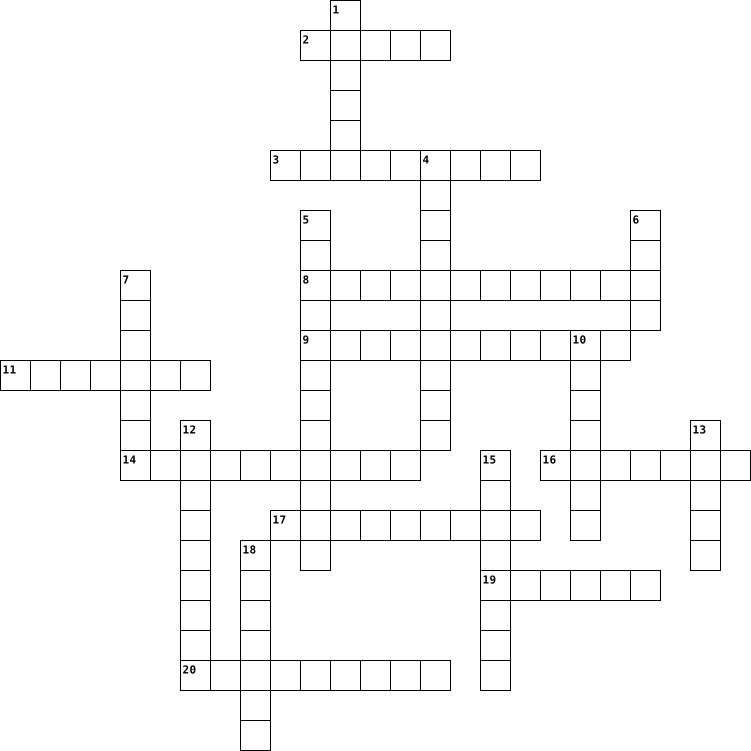
Across
- i walk to the _____ of my own drum
- CAN flow freely
- not able to renew
- electrical energy, __________ bill, powers a light bulb
- bat + tree
- radius is to radiation as conduct is to __________
- sir+kit
- you have potential
- potential energy,saved, kept for later
- off is to on as nonrenewable is to _________
Down
- moving, kinetic energy, running
- a type of oven
- Conserve + Nation
- fossil ____, powers things, car ____, gas=____
- connect (sounds like the word)
- Turn + Bine
- CAN NOT flow freely
- sun _____, _____bulb, flash_____
- ________ student, i _________ schools, i will ________ the money into your account
- Bill Nye The _______ Guy
20 Clues: sir+kit • bat + tree • Turn + Bine • a type of oven • CAN flow freely • Conserve + Nation • not able to renew • you have potential • CAN NOT flow freely • Bill Nye The _______ Guy • connect (sounds like the word) • moving, kinetic energy, running • sun _____, _____bulb, flash_____ • i walk to the _____ of my own drum • potential energy,saved, kept for later • ...
America history by Eric 2022-04-03

Across
- dividing power among different branches of government.
- Each state constitution began with a “bill” or “declaration” listing basic rights and freedoms.
- Two months later, on June 17, 1775, a true battle was fought between opposing armies on the outskirts of Boston.
- over all states.
- a system with a strong but limited central government.
- wrote “Common Sense”
- german Mercenaries that fought alongside the British soldiers
- it was granted to Americans so that they could transfer cargoes in New Orleans without paying duties to the Spanish government.
- Those attending the congress were outwardly similar: all were wealthy White men.
- a statement originally issued by Massachusetts.
Down
- a new view of their status in society evolved, a change referred to
- Government with
- Written plan of Government
- he was appointed the commander-in-chief of a new colonial army and sent to Boston to lead the Massachusetts militia and volunteer units from other colonies.
- the only federal court mentioned in the Constitution
- largely by James Madison, the ten BillofRights ratified by the states in 1791
16 Clues: Government with • over all states. • wrote “Common Sense” • Written plan of Government • a statement originally issued by Massachusetts. • the only federal court mentioned in the Constitution • dividing power among different branches of government. • a system with a strong but limited central government. • german Mercenaries that fought alongside the British soldiers • ...
America history by Eric 2022-04-03

Across
- dividing power among different branches of government.
- Each state constitution began with a “bill” or “declaration” listing basic rights and freedoms.
- Two months later, on June 17, 1775, a true battle was fought between opposing armies on the outskirts of Boston.
- over all states.
- a system with a strong but limited central government.
- wrote “Common Sense”
- german Mercenaries that fought alongside the British soldiers
- it was granted to Americans so that they could transfer cargoes in New Orleans without paying duties to the Spanish government.
- Those attending the congress were outwardly similar: all were wealthy White men.
- a statement originally issued by Massachusetts.
Down
- a new view of their status in society evolved, a change referred to
- Government with
- Written plan of Government
- he was appointed the commander-in-chief of a new colonial army and sent to Boston to lead the Massachusetts militia and volunteer units from other colonies.
- the only federal court mentioned in the Constitution
- largely by James Madison, the ten BillofRights ratified by the states in 1791
16 Clues: Government with • over all states. • wrote “Common Sense” • Written plan of Government • a statement originally issued by Massachusetts. • the only federal court mentioned in the Constitution • dividing power among different branches of government. • a system with a strong but limited central government. • german Mercenaries that fought alongside the British soldiers • ...
Chapter 6 vocabulary 2023-02-01

Across
- power of Legislative branch to review the policies of the Executive branch
- willful obstruction of justic
- freedom from prosecution for witnesses whose testimony ties them to illegal acts
- the formal accusation of misconduct.
- the yearly financial plan for the federal government.
- trade among states
- the exclusive right to publish and sell a literary, musical, or artistic work for a period of time.
- bill that established a program and says how much can be spent on the program.
Down
- exclusive right of an inventor to manufacture, use and sell their invention
- - provision that Congress wrote into some laws that allowed it to review and cancel actions of executive agencies.
- the president's refusal to spend money Congress has voted to fund a program.
- a proposed law to authorize spending money
- the power of an executive to reject one of more items in a bill without vetoing the entire bill.
- proposed law for raising money
- a legal order that a person must appear or produce requested documents.
- lying under oath
16 Clues: lying under oath • trade among states • willful obstruction of justic • proposed law for raising money • the formal accusation of misconduct. • a proposed law to authorize spending money • the yearly financial plan for the federal government. • a legal order that a person must appear or produce requested documents. • ...
Unit One Escape Room (8th) 2022-09-21

Across
- Wanted larger states to have more representation in government
- Made slaves 3/5th of a person towards taxation, votes, and population
- To approve or agree formally
- This was the original document of the United States government that eventually failed.
- The greatest teacher of all time. #GOAT
- Wanted every state to have equal representation to ensure one state doesn't become to powerful
- Wanted a strong central government and weak state governments
Down
- James Madison, Alexander Hamilton, and John Jay wrote these papers to convince states to ratify the Constitution.
- Wanted a weak central government and strong state governments
- Someone who helped write the Constitution
- This separate body of people decides who becomes President
- Combined the New Jersey and Virginia Plans to create Congress
- This person wrote the Virginia Plan, Bill of Rights, and Federalist Papers. He also took detailed notes and proposed many ideas.
- This had to be added to the Constitution in order for some states to approve it
- The city that the Constitutional Convention took place
- The best class everrrrrrr. Duhhhhhh!
16 Clues: To approve or agree formally • The best class everrrrrrr. Duhhhhhh! • The greatest teacher of all time. #GOAT • Someone who helped write the Constitution • The city that the Constitutional Convention took place • This separate body of people decides who becomes President • Wanted a weak central government and strong state governments • ...
America history by Eric 2022-04-03

Across
- dividing power among different branches of government.
- Each state constitution began with a “bill” or “declaration” listing basic rights and freedoms.
- Two months later, on June 17, 1775, a true battle was fought between opposing armies on the outskirts of Boston.
- over all states.
- a system with a strong but limited central government.
- wrote “Common Sense”
- german Mercenaries that fought alongside the British soldiers
- it was granted to Americans so that they could transfer cargoes in New Orleans without paying duties to the Spanish government.
- Those attending the congress were outwardly similar: all were wealthy White men.
- a statement originally issued by Massachusetts.
Down
- a new view of their status in society evolved, a change referred to
- Government with
- Written plan of Government
- he was appointed the commander-in-chief of a new colonial army and sent to Boston to lead the Massachusetts militia and volunteer units from other colonies.
- the only federal court mentioned in the Constitution
- largely by James Madison, the ten BillofRights ratified by the states in 1791
16 Clues: Government with • over all states. • wrote “Common Sense” • Written plan of Government • a statement originally issued by Massachusetts. • the only federal court mentioned in the Constitution • dividing power among different branches of government. • a system with a strong but limited central government. • german Mercenaries that fought alongside the British soldiers • ...
Group Teaching Crossword 2025-04-28

Across
- branch of the US military did James Meredith served in from 1951-1960
- What comission was established by the Civil RIghts act of 1964?
- ___________ was 60 years before the Brown v. Board of Education
- What set of laws were dismantled due to the Civil RIghts act of 1964?
- major Civil Rights Activist that helped lead the March Against Fear
- How much did education cost for military families?
- What right did the Civil Rights Act of 1957 mainly focus on?
- Number of Little Rock African American Students
- State of Little Rock High School
Down
- Mayor of Little Rock
- quote from Brown II Supreme Court ruling
- Month Little Rock 9 is admitted
- Who signed the Civil Rights Act of 1957 into action?
- Little Rock 9´s first day of school is the ___ of September
- what did the Brown Supreme Court cases encourage people to push further with
15 Clues: Mayor of Little Rock • Month Little Rock 9 is admitted • State of Little Rock High School • quote from Brown II Supreme Court ruling • Number of Little Rock African American Students • How much did education cost for military families? • Who signed the Civil Rights Act of 1957 into action? • Little Rock 9´s first day of school is the ___ of September • ...
Civil Rights Crossword 2026-04-30

Across
- leaders motivated people
- 1961 protested bus segregation
- 1963 feminist journalism
- racial discrimination
- 1963 huge protest in DC
- government action
- 1970s women in new professions
- media showed problems
- 1961 college activists
Down
- 1896 laws later overturned
- WWII sparked change
- 1964 ended discrimination law
- 1963 wrote Feminine Mystique
- 1968 violent protests after MLK death
- 1960s black nationalist leader
- 1950s family roles changing
- 1960s civil rights leader
- 1968 killing of MLK
- 1954 ended school segregation
- lack of equality
- 1940s women entering jobs
- 1963 I Have a Dream
- 1960s women’s rights movement
- nonviolent demonstrations
- cause of movement
25 Clues: lack of equality • government action • cause of movement • WWII sparked change • 1968 killing of MLK • 1963 I Have a Dream • racial discrimination • media showed problems • 1961 college activists • 1963 huge protest in DC • leaders motivated people • 1963 feminist journalism • 1960s civil rights leader • 1940s women entering jobs • nonviolent demonstrations • 1896 laws later overturned • ...
PPKn 2015-05-21

Across
- Keadaan berdiri sendiri
- Hak (Inggris)
- Hak Asasi Manusia (singk.)
- Pembunuhan besar-besaran secara berencana thd suatu bangsa atau ras
- Badan organisasi persiapan kemerdekaan indonesia yang di bentuk oleh jepang pada 1 Maret 1945 (singk.)
- Hak yang tercantum pada UU No. 39 Tahun 1999 pasal 52-60
- Mendasar
- Ajaran yg mengatur tata keimanan
- Dokumen Hukum di Inggris pada tahun 1689
- Perubahan secara drastis untuk perbaikan dl suatu masyarakat atau negara
- Undang-undang Dasar (Belanda)
- Kesamarataan
- Sebutan proses memilih orang untuk mengisi jabatan-jabatan politik tertentu.
- Sebutan resmi Piagam PBB (singk. Inggris)
- Alias Jean Jacques Rousseau
Down
- Hukum dasar tertulis pemerintahan NKRI (singk.)
- Keadilan (Belanda)
- Keleluasaan
- Kode hukum dimulainya pencatatan nilai dan aturan HAM
- Kesamaan (Perancis)
- Perjanjian di Inggris pada tahun 1215
- Penandatangan dokumen hukum Bill Of Rights
- Persaudaraan atau kesetiakawanan (Perancis)
- Hak yang tercantum pada UU No. 39 Tahun 1999 pasal 45-51
- Sebutan bagi masa pemerintahan Presiden Soeharto
- Hak yang tercantum pada UU No. 39 Tahun 1999 pasal 9
- Kota dideklarasikan-nya piagam PBB
- United Nation (singk. Ind.)
28 Clues: Mendasar • Keleluasaan • Kesamarataan • Hak (Inggris) • Keadilan (Belanda) • Kesamaan (Perancis) • Keadaan berdiri sendiri • Hak Asasi Manusia (singk.) • United Nation (singk. Ind.) • Alias Jean Jacques Rousseau • Undang-undang Dasar (Belanda) • Ajaran yg mengatur tata keimanan • Kota dideklarasikan-nya piagam PBB • Perjanjian di Inggris pada tahun 1215 • ...
Cruciverba di Storia 2022-05-16

Across
- "Rivoluzionari con i pantaloni".
- Bill of...
- Scrisse il primo diario di circumnavigazione del globo.
- Lo scisma di Enrico VIII.
- I mercenari di Carlo V.
- L'ordine di Bartolomeo de Las Casas.
- La città dove apparvero le 95 tesi di Lutero.
- Approvazione dell'autorità ecclesiastica ai libri che venivano stampati.
- Seimila donne contro Versailles.
- Luigi XIV.
- La politica economica di Jean-Baptiste Colbert.
Down
- La flotta di Filippo II sconfitta dagli inglesi nel 1588.
- Fu conquistata nel 1453 dai Turchi ottomani.
- Assemblea che riunì a Versailles i rappresentanti di clero, nobiltà e terzo stato nel maggio del 1789.
- Jacques-Louis David lo ritrasse in punto di morte.
- Antica prigione simbolo della Riv. Francese.
- Il Granducato di Toscana fu il primo stato al mondo ad abolirla.
- Organo politico-istituzionale posto al vertice delle istituzioni francesi nell'ultima parte della Riv. francese.
- I repubblicani moderati durante la Riv. Francese.
- Avvia il Concilio di Trento.
- Coraggioso predicatore fiorentino contro i vizi della città.
- La pace che concede libertà religiosa ai principi tedeschi.
22 Clues: Bill of... • Luigi XIV. • I mercenari di Carlo V. • Lo scisma di Enrico VIII. • Avvia il Concilio di Trento. • "Rivoluzionari con i pantaloni". • Seimila donne contro Versailles. • L'ordine di Bartolomeo de Las Casas. • Fu conquistata nel 1453 dai Turchi ottomani. • Antica prigione simbolo della Riv. Francese. • La città dove apparvero le 95 tesi di Lutero. • ...
Amendment & Vocab 2022-05-26

Across
- Father of the constitution
- Made up of three branches
- House and Senate
- believes in a superbeing
- Rights of accused persons
- right to a speedy, public trial
- Unbiased
- A peaceful
- No Quartering troops
- A protest
- A written request
- Powers of state & people
- Search& Seizure
- Someone who has violated the law
- A written authorization of
Down
- Rights of the people
- Ability to express yourself
- Washington First President
- Limits of times and punishment
- rights
- Untrained
- Change for something
- branch Carries out and enforces laws
- Forbidden
- decides meaning of laws
- Media coverage
- A rule
- Right to bear arms
- Officially
- Trial by Jury in civil cases
30 Clues: rights • A rule • Unbiased • Untrained • Forbidden • A protest • A peaceful • Officially • Media coverage • Search& Seizure • House and Senate • A written request • Right to bear arms • Rights of the people • Change for something • No Quartering troops • decides meaning of laws • believes in a superbeing • Powers of state & people • Made up of three branches • Rights of accused persons • ...
Ch 9 People 2026-01-07

Across
- chief of the Sac and Fox Nation who led his people back to their former home near Rock Island
- ran against the newly formed Whig party for presidency
- composed the Tariff of 1833
- earned the nickname "Old Tippecanoe"
- a preacher and a slave who stirred up a slave rebellion in Virginia
- published the paper "The Liberator"
- published the paper called "The North Star"
Down
- a brilliant political thinker who wrote the pamphlet "South Carolina Exposition and Protest"
- attempted to get the president to sign a bank charter bill, but their plan backfired and the bank lost the charter
- was a general in the War of 1812 and Creek and Seminole Wars
- remembered for being the first vice president to succeed to the presidency due to death of a president
- an English minister to the US who helped ease tension between Britain and the US
- was sent to debate the issues of states rights by President Calhoun
- coined the famous quote "Liberty and Union, now and forever, one and inseparable"
14 Clues: composed the Tariff of 1833 • published the paper "The Liberator" • earned the nickname "Old Tippecanoe" • published the paper called "The North Star" • ran against the newly formed Whig party for presidency • was a general in the War of 1812 and Creek and Seminole Wars • was sent to debate the issues of states rights by President Calhoun • ...
Legislative Branch 2021-10-28

Across
- congressional committees appointed for specific purpose
- officer of the senate selected by the majority party to act as chair in absence of the vice president
- the process of reassigning representation based on population
- the residents of a congressional district or state
- people hired by private groups to influence government decision makers
- the redrawing of congressional and other legislative district lines following the census, to accommodate population shifts
- two year period in which Congress can conduct business
- a formal, public reprimand for an infraction/violation
- committee committee deals w/ specific topic, work of congress goes through committees
- a permanent committee established in a legislature, usually focusing on a policy area
- a procedure allowing one or more senators to prevent a motion from reading the floor
- those already holding office
- a bill approving the spending of extra public money
- president of the Senate
- an agreement by every senator to the terms of debate on a given piece of legislation
- the leader of the majority party who serves as the presiding officer of the House of Representatives
Down
- groups of people who have similar interests working together
- enagaing in activities aimed at influencing public officials and the policies they enact
- process of redrawing legislative boundaries for the purpose of benefiting the party in power
- they make laws and are made up of two chambers
- committee appointed by the presiding officers of each chamber to adjust differences on a particular bill passed by each in different form
- division of existing committee that is formed to talk about specific issues
- a procedure that allow each senator to speak only one hour on a bill under debate
- the ascension to power by one ruler after the death, resignation, or removal from office of another
- argue about a subject, especially in a formal manner
- a meeting of local party members to choose party officials/candidates for public office and decide the platform
- charged with managing communications between party leaders and members
- a higher-up group that reviews all bills comming from a House committee before they go to the full House
- the legislative leader elected by party members holding the majority of seats in the House/Senate
- a formal expression of congressional opinion that must be approved by both the House and president
- the minimum number of members who must be present for business to be conducted in Congress
- a proposed law
- to alter in any way (subtracting, adding, or substituting)
- a session where a committee listens to a testimony from people who are interested in a bill
- a procedural practice (in Senate) where a Senate can refuse to give up the floor and delay any proceedings and prevent any vote on a controversial topic
- chief executive's power to reject a bill passed by a legislature
36 Clues: a proposed law • president of the Senate • those already holding office • they make laws and are made up of two chambers • the residents of a congressional district or state • a bill approving the spending of extra public money • argue about a subject, especially in a formal manner • two year period in which Congress can conduct business • ...
Civil Rights 2024-12-10

Across
- Marshall Represented the Brown Family in Brown V. Board of Education in 1954. he became the first African American Justice on the Supreme Court in 1967
- Crow A white actor would cover his face with charcoal and then sing and dance in a silly way
- Used a variety of strategies to end racial discrimination
- F. Kennedy Asked for Legislation "giving all Americans the right to be served in facilities which are open to the public-hotels, restaurants, theaters, retail stores, and similar establishments" as well as "greater protection for the right to vote"
- Luther King Jr. Helped found the Southern Christians Leadership Conference
- When one group is kept separated from another group
- When one group is treated differently from another
- Evers A civil right activist who investigated cases for Notional Association for the Advancement of Colored people (NAACP)
- to bring races together
- X Promoted black independence, self-defense, and human rights
Down
- A word that means the mixing of races
- Brown A third grader who helped changed the laws about school segregation
- Called for consumers to avoid a product or service that discriminated against African Americans
- It was a way to integrate a business or public area. African Americans would sit at "white only" areas and wait to be served
- Involved large group of protesters taking to the streets with signs, banners, songs, and chants
- Intolerance
- more than one race
- Methods to call attention to a problem and pressure the government in a peaceful way
- Codes Creating a legal form of segregation
- A place where a person spends time
- to weaken, efforts at equality
- Rock Nine integrated their all white high school in 1957
- B. Johnson Helped push the bill through Congress. Finally, the Civil Rights Act of 1964 became law
23 Clues: Intolerance • more than one race • to bring races together • to weaken, efforts at equality • A place where a person spends time • A word that means the mixing of races • Codes Creating a legal form of segregation • When one group is treated differently from another • When one group is kept separated from another group • ...
Constitution Crossword 24 2024-12-09

Across
- The President can sign or ______ a bill
- The 1st government of the U.S., the Articles of _______
- Separation of powers and checks and balances both prevent _______\
- Only Congress can officially declare _____
- Relationship between people and government, existed only for good of people= ________ Contract
- Officially elects the President= _______ College
- Most work in congress gets done in _________
- Number of terms a President may serve
- Only the House of Representatives can propose this type of bill
- Allows Congress to make laws that are necessary and proper= _______ clause
- A written plan that provides the basic framework of a government
- National laws are the __________ law of the land
- Presides over impeachment trial= ______ Justice
- Power to declare act of Congress or President "unconstitutional"= _______ Review
- 1st African American Justice= ______ Marshall
- Lists the goals of the Constitution
- Makes law=________ Branch
- Interprets law= ________ Branch
- citizens and leaders lived modest lives, worked hard and put common welfare above own selfish interests=civic ________
- 1st written document of self government in America= ________ Compact
- Nickname for the highest court (Hint= see booklet cover)
Down
- Representation in the House of Representatives is based on states __________
- Took power away from King and made subject to law= Magna ______
- Has power of impeachment= House of ________
- There are 94 _____ courts
- Solution at Constitutional Convention for state representation in Congress= Great ______
- Enforces law= _______ Branch
- proposed law
- When president signs a bill it becomes ________
- Promoted idea of separation of power= Baron de ________
- ________ Rebellion showed weakness of the Articles of Confederation
- Approves presidential appointees
- The president's top advisors(Heads of Executive Departments)
- Commander and Chief of armed forces
- Shared power between federal government and states
- States have ________ representation in the Senate
- Political authority belongs to the people= popular ________
- Congress works on _______ Hill in Washington D.C.
- There are 13 court of ______
- supported ratification of the Constitution
- Term of supreme Court Justice
- Formally approve a plan or an agreement.
42 Clues: proposed law • There are 94 _____ courts • Makes law=________ Branch • Enforces law= _______ Branch • There are 13 court of ______ • Term of supreme Court Justice • Interprets law= ________ Branch • Approves presidential appointees • Commander and Chief of armed forces • Lists the goals of the Constitution • Number of terms a President may serve • ...
bill smoothing 2025-04-02

Across
- navigate to form confirmation if bank or credit card
- command to check credit recovery activity
- when changing to bill smoothing from quarterly this must be cancelled
- cards or accounts have to be this nationality
- contact log category
- AltaAU will take you to this screen (2 words)
- contact log left as after every transaction with credit card
Down
- bill smoothing can be set up using this on myaccount
- payments can be either monthly or
- if customer is in this they are not able to have bill smoothing
- how do we verify previously used credit card details
- what happens when 3 instalments are missed
- has to be read and accepted each time this is set
- to establish this has to have zero or credit balance
14 Clues: contact log category • payments can be either monthly or • command to check credit recovery activity • what happens when 3 instalments are missed • cards or accounts have to be this nationality • AltaAU will take you to this screen (2 words) • has to be read and accepted each time this is set • bill smoothing can be set up using this on myaccount • ...
Chemistry of the week 2017-05-11

Across
- table / lists all of the elements
- Nye / blew up Star Labs
- / a person who conducts scientific experiments
- / often scientists form one of these before conducting an experiment
- / chemistry is about these kinds of experiments
- / a cure for this was found by a young child in one of the articles in this newspaper
Down
- / conducts chemical experiments
- / chemistry between two people
- / the topic of this newspaper
- / Bill Nye caused one of these in the feature story
- toothpaste / Bill Nye made a mistake making this and caused a massive explosion
- / you need to try to keep ________ when conducting an experiment
12 Clues: Nye / blew up Star Labs • / the topic of this newspaper • / chemistry between two people • / conducts chemical experiments • table / lists all of the elements • / a person who conducts scientific experiments • / chemistry is about these kinds of experiments • / Bill Nye caused one of these in the feature story • ...
Ansley's Civics Crossword Puzzle 2024-12-13

Across
- chief law enforcer of a county
- city, town, or village
- teams of parties
- far left
- answers you give while under oath
- largest unit of local gov
- power split between nation and state
- formally presented with charges and asked to enter a plea
- what animal does the President pardon
Down
- talk bill to death
- refuse to make law
- individual states unite for purpose
- a president carries out ___
- every how many years are presidential elections held
- goes before defendant in a trial
- what a bill starts as
- crimes against property, people, victimless crimes
- far right
- 3+ candidates win election with a majority
- outcome in court (guilty, not guilty)
20 Clues: far left • far right • teams of parties • talk bill to death • refuse to make law • what a bill starts as • city, town, or village • largest unit of local gov • a president carries out ___ • chief law enforcer of a county • goes before defendant in a trial • answers you give while under oath • individual states unite for purpose • power split between nation and state • ...
(Medium) Crossword Puzzle 2025-04-14

Across
- Frontier – President John F. Kennedy's domestic program aimed at addressing poverty, civil rights, and space exploration, symbolized by the Apollo program.
- Stalin – Leader of the Soviet Union during WWII and the early Cold War, known for his totalitarian rule and policies that led to millions of deaths.
- B. Johnson - 37th President of the United States
- Plan- Massive U.S aid package to rebuild Western Europe and contain communism after WWII
- Missile Crisis – A tense confrontation between the U.S. and the Soviet Union over the presence of Soviet missiles in Cuba.
- Bombing – A racially motivated bombing at the 16th Street Baptist Church in Birmingham, Alabama, that killed four African American girls and galvanized public support for the Civil Rights Movement.
- Amendment – Banned poll taxes in federal elections, removing a barrier for many Black voters.
- of Choice Plans – Efforts to resist school desegregation by offering parents "choice" in schools, often used in Southern states to delay or avoid full integration.
- on Washington – A historic rally where over 250,000 people gathered to demand jobs and freedom, most famously featuring Martin Luther King Jr.'s “I Have a Dream” speech.
- Literacy Tests – A tool used in the South to disenfranchise African American voters by testing their literacy, often using confusing or unfair questions to prevent them from voting.
- Rock Nine – A group of nine African American students who integrated Central High School in Little Rock, Arkansas, with federal support following violent opposition.
- and Medicaid – Government programs providing health care for the elderly and poor, part of LBJ’s Great Society.
- X – A prominent African American leader and member of the Nation of Islam, known for advocating for black empowerment and self-defense before shifting towards a more inclusive approach to civil rights.
Down
- From Birmingham Jail - Letter that MLK wrote while being imprisoned
- B. Johnson's "War on Poverty" – A series of programs initiated by President Johnson in the 1960s aimed at reducing poverty and inequality, which included initiatives like Medicare, Medicaid, and educational reform.
- Campaign – Major civil rights movement led by MLK; drew national attention due to brutal police response.
- (Southern Christian Leadership Conference) – A civil rights organization led by Martin Luther King Jr. that coordinated nonviolent protests and aimed to use churches as a base for social change.
- Renaissance - A period in time when vibrant musicians and cultural expressions among african americans, centered in Harlem and New York.
- (Student Nonviolent Coordinating Committee) – Civil rights group formed by students to organize grassroots activism.
- – A form of protest in which activists would sit at segregated lunch counters and demand service, a tactic that became a hallmark of the Civil Rights Movement.
- Incident- A U.S spy plane shot down over the USSR
- Till – A 14-year-old African American boy who was lynched in Mississippi, sparking national outrage and becoming a catalyst for the Civil Rights Movement.
- Rights Act of 1968 – A law that banned discrimination in housing, marking another major victory in the Civil Rights Movement.
- Summer – Voter registration campaign in Mississippi, aimed at increasing African American voting rights in the South.
- Marshall – The first African American Supreme Court Justice and a key figure in the legal battles of the Civil Rights Movement, most notably the Brown v. Board case.
25 Clues: B. Johnson - 37th President of the United States • Incident- A U.S spy plane shot down over the USSR • From Birmingham Jail - Letter that MLK wrote while being imprisoned • Plan- Massive U.S aid package to rebuild Western Europe and contain communism after WWII • Amendment – Banned poll taxes in federal elections, removing a barrier for many Black voters. • ...
1st semester US History Review 2020-10-01

Across
- amendment all person born or naturalized in the united states and subject to the jurisdiction therof are citizens
- a person who vigorously supports their country and is prepared
- a farmer village on the James River in Virginia
- Bill of rights is the first 10 amendments to the constitution
- act the law allowed for the president to break up reservation land
- a person who remains loyal to the established rule
- and Indian War was the North American conflict in a larger imperial war
Down
- an estate on which crops such as coffee sugar and tobacco
- war a war that is unrestricted in terms of the weapons used the territory
- information of a biased or misleading nature used to promote or publicize
- destiny the 19th century doctrine or belief
- the action of withdrawing formally from membership
- the action or an act of abolishing a system practice or institution
- crop a crop produced for its commercial value rather than for use by the grower
14 Clues: destiny the 19th century doctrine or belief • a farmer village on the James River in Virginia • the action of withdrawing formally from membership • a person who remains loyal to the established rule • an estate on which crops such as coffee sugar and tobacco • Bill of rights is the first 10 amendments to the constitution • ...
Prgressive Georgia 2025-03-28

Across
- civil rights effort to end segregation in Albany, Georgia.
- law that ended segregation and job discrimination.
- civil rights group led by MLK that used nonviolent protests.
- 1963 protest for civil rights where MLK gave his "I Have a Dream" speech.
- Atlanta mayor who helped grow the city’s airport and supported civil rights.
- group that studied segregation and helped Georgia integrate schools.
- movement in the 1950s–60s to end segregation and gain equal rights.
- 1954 Supreme Court case that banned school segregation.
- civil rights leader who promoted nonviolence and led the March on Washington.
Down
- civil rights group known for sit-ins and Freedom Rides.
- dispute over Georgia’s governor after Eugene Talmadge died before taking office.
- Atlanta mayor in the 1960s who opposed segregation.
- Farming, a key part of Georgia’s economy.
- Georgia governor who opposed desegregation but later improved conditions for minorities.
- civil rights activist and longtime U.S. Representative from Georgia.
- Elections where only white people could vote, banned in 1944.
16 Clues: Farming, a key part of Georgia’s economy. • law that ended segregation and job discrimination. • Atlanta mayor in the 1960s who opposed segregation. • civil rights group known for sit-ins and Freedom Rides. • 1954 Supreme Court case that banned school segregation. • civil rights effort to end segregation in Albany, Georgia. • ...
Pg 168-170 2022-01-28

Across
- A committee responsible for determining how long a bill is debated.
- The only way to end a filibuster is to vote on this.
- Another work for electorates or constituents
- Provisions within legislation that appropriate money to a specific project.
- A tactic used to delay a vote on a bill.
- Whoever introduces a bill
- Many black and Hispanic voters identify with this party.
Down
- Poison pill or "______" amendments
- "Congress draws its members primarily from the legal and ________ worlds."
- Represented by members of Congress
- "_______ and Cracking"; To isolate minorities in a district.
- "Public __________"; A non-legislative task of Congress allowing them to increase public awareness of issues.
- The _____ has 435 members.
- "Legislative __________"; Control of one house over the other
- "The power of the _____"; gives Congress the power to influence the president or bureaucrats by withholding funds.
- "Bills of _________"; laws that find people guilty of a crime and sentence them to prison without a trial.
- A non-legislative task of Congress that allows them to check the executive branch
- "House Ways and _____ Committee"; oversees taxes and spending legislation.
- "____ barrels"; designed to bring federal money to a home state
19 Clues: Whoever introduces a bill • The _____ has 435 members. • Poison pill or "______" amendments • Represented by members of Congress • A tactic used to delay a vote on a bill. • Another work for electorates or constituents • The only way to end a filibuster is to vote on this. • Many black and Hispanic voters identify with this party. • ...
Civil Rights 2024-12-10

Across
- Marshall Represented the Brown Family in Brown V. Board of Education in 1954. he became the first African American Justice on the Supreme Court in 1967
- Crow A white actor would cover his face with charcoal and then sing and dance in a silly way
- Used a variety of strategies to end racial discrimination
- F. Kennedy Asked for Legislation "giving all Americans the right to be served in facilities which are open to the public-hotels, restaurants, theaters, retail stores, and similar establishments" as well as "greater protection for the right to vote"
- Luther King Jr. Helped found the Southern Christians Leadership Conference
- When one group is kept separated from another group
- When one group is treated differently from another
- Evers A civil right activist who investigated cases for Notional Association for the Advancement of Colored people (NAACP)
- to bring races together
- X Promoted black independence, self-defense, and human rights
Down
- A word that means the mixing of races
- Brown A third grader who helped changed the laws about school segregation
- Called for consumers to avoid a product or service that discriminated against African Americans
- It was a way to integrate a business or public area. African Americans would sit at "white only" areas and wait to be served
- Involved large group of protesters taking to the streets with signs, banners, songs, and chants
- Intolerance
- more than one race
- Methods to call attention to a problem and pressure the government in a peaceful way
- Codes Creating a legal form of segregation
- A place where a person spends time
- to weaken, efforts at equality
- Rock Nine integrated their all white high school in 1957
- B. Johnson Helped push the bill through Congress. Finally, the Civil Rights Act of 1964 became law
23 Clues: Intolerance • more than one race • to bring races together • to weaken, efforts at equality • A place where a person spends time • A word that means the mixing of races • Codes Creating a legal form of segregation • When one group is treated differently from another • When one group is kept separated from another group • ...
Bill Monroe 165-182 2013-01-16

Across
- Talk of an extension to the Bluegrass Hall of Fame was discussed to include what items of Bill’s life?
- What state was the Bluegrass Hall of Fame first located?
- Where is the current location of the Bluegrass Hall of Fame?
- What instruments of Bill Monroe’s did a vandal break?
- After undergoing surgery, Bill insisted on going to a festival in Nova Scotia. What did Bill sit in while playing?
- What’s the first name of the 44-year-old Bill married?
Down
- What is the famous instrumental that Bill composed that everyone assumed was his final goodbye?
- Who was the maker of Bill’s instrument?
- How many individual artists are in the Hall of fame room?
- A luthier in Gibson’s Research and Development department was responsible for the restoration of Bill’s mandolin, what is his first name?
10 Clues: Who was the maker of Bill’s instrument? • What instruments of Bill Monroe’s did a vandal break? • What’s the first name of the 44-year-old Bill married? • What state was the Bluegrass Hall of Fame first located? • How many individual artists are in the Hall of fame room? • Where is the current location of the Bluegrass Hall of Fame? • ...
Birds 2022-06-17

Across
- Social birds who like company. In the wild, they often live in flocks or loose groups.
- Gentle, plump, small-billed birds with a skin saddle between the bill and forehead
- Raptors with long wings and weak legs which spend a great deal of time soaring
- Acrobtic flier
- Brightly coloured bird with fan like feathers
- Also known as sea parrot
- A male domestic fow
- Singing bird
- Large flightless bird found only in open country in Africa
Down
- Known for their large and strikingly coloured bil
- Also known as man-o'-war birds.
- Medium-sized flightless bird that roams the forests of New Zealand.
- Classified as stout-bodied birds with short necks
- Aquatic flightless bird
- A family of brightly colored and unusual looking birds that live near rivers and bodies of water
- A group of particularly large birds
- A large bird which has long legs and a long beak and which eats fish
- A very tall long-legged wading bird with a long heavy bill and typically with white and black plumage
- Tall, pink wading birds
- are characterized by a long, down-curved bill which is frequently brightly coloured
20 Clues: Singing bird • Acrobtic flier • A male domestic fow • Aquatic flightless bird • Tall, pink wading birds • Also known as sea parrot • Also known as man-o'-war birds. • A group of particularly large birds • Brightly coloured bird with fan like feathers • Known for their large and strikingly coloured bil • Classified as stout-bodied birds with short necks • ...
Congress in action 2016-03-24

Across
- A measure relating to the business of either house,or expressing an opinion.
- A proposed law presented to a legislative body for consideration.
- To print a bill in its final form.
- Division of existing committee that is formed to address specific issues.
- Chief executives power to reject a bill passed by a legislature.
- Least number of members who must be present for a legislative body to conduct business; majority.
Down
- Members of the house and senate picked by their parties to carry out party decisions and steer legislative action to meet party goals.
- Procedure that may be used to limit or end floor debate in a legislative body.
- Assistants to the floor leaders in the house and senate.
- Various tactics aimed at defeating a bill in a legislative body by preventing a final vote.
- Unpopular provision added to an important bill certain to pass so that it will 'ride' through the legislative process.
11 Clues: To print a bill in its final form. • Assistants to the floor leaders in the house and senate. • Chief executives power to reject a bill passed by a legislature. • A proposed law presented to a legislative body for consideration. • Division of existing committee that is formed to address specific issues. • ...
Unit 3- The English Colonies 2025-10-31

Across
- She publicly discussed religious ideas that were considered radical.
- A colonist who received free passage to America in exchange for working without pay for a certain amount of years.
- Married colonist John Rolfe, bringing a temporary peace between the Powhatan tribe and the colonists.
- This Bill made it a crime to restrict the religious rights of Christians in Maryland.
- A patuxet man, also called Squanto, helped the Pilgrims adapt to life in America and form an alliance with the Wampanoag.
Down
- The first English colony in North America.
- A member of a Protestant group that wanted to reform the Church of England.
- A document written by Pilgrims in 1670 outlining principles of self-government.
- A member of a Protestant group that wanted to separate from the Church of England.
- People who have left their country of birth to live in another country.
- Led the Puritan colonists to MAssachusetts to seek religious freedom.
- Laws to control slaves.
- The one who founded Pennsylvania.
- English colony who helped save the Jamestown colony from starvation.
- Members of a Protestant sect, also called the Society of Friends.
15 Clues: Laws to control slaves. • The one who founded Pennsylvania. • The first English colony in North America. • Members of a Protestant sect, also called the Society of Friends. • She publicly discussed religious ideas that were considered radical. • English colony who helped save the Jamestown colony from starvation. • ...
Human Rights and Violations 2025-05-28

Across
- the state of being equal in opportunities, rights, and status (1 wrd)
- the right to housing, food, social security (2 wrds)
- the right to vote,equal employment, free basic education (2 wrds)
- physically/mentally abusing a person purposefully (1 wrd)
- social movement that aims to abolish racism and discrimination towards black individuals (3 wrds)
- the act of forcing a child to work for longer than legally allowed (2 wrds)
- freedoms that are protected by the U.S. Constitution (2 wrds)
- a country in Asia that has been seen as the worst for protecting human rights (2 wrds)
- the right to act, think, or speak however one wants without restraint (1 wrd)
Down
- celebration day of the adoption of the Universal Declaration of Human Rights on December 10 (3 wrds)
- right to _________(the right to have a hearing before prosecution) (2 wrds)
- basic freedoms/rights of every human that are given at birth (2 wrds)
- unfair treatment based on prejudice or bias (1 wrd)
- abbreviated UN organization that works to promote and protect human rights (1 wrd)
- mass killing of a specific ethnic/religious group of people (1 wrd)
- the type of rights that cannot be taken away (1 wrd)
16 Clues: unfair treatment based on prejudice or bias (1 wrd) • the right to housing, food, social security (2 wrds) • the type of rights that cannot be taken away (1 wrd) • physically/mentally abusing a person purposefully (1 wrd) • freedoms that are protected by the U.S. Constitution (2 wrds) • the right to vote,equal employment, free basic education (2 wrds) • ...
International Animal Rights Day. 2021-12-08

Across
- Monkeys are protected under this act (1972) and cannot be displayed or owned.
- In 2014, the Supreme Court of India banned this sport.
- nature-centered approach to environmental law.
- IARD was established on the ___ anniversary of signing The Universal Declaration of Human Rights.
- IUCN, WWF, and BirdLife are its international organization partners.
- an international agreement, signed by 183 parties, designed to ensure that international trade in animals and plants does not threaten their survival in the wild.
- IARD coincides with this day.
- Animal cruelty index focused on farm animals.
- Name of organization that created IARD.
- This year marks the ___ year of International Animal Rights Day (IARD).
Down
- Symbolization of this day; "shedding light" on animal rights.
- Ranked first on the Swiftest animal rights index, 2021.
- India's rank in the Global Animal Protection Index 2020.
- French delicacy banned in India.
- human-centered approach to environmental law.
- committee that drafts guidelines and monitors animal experimentation in India.
- the body of the government of India formed to bring Indian zoos up to international standards.
- Universal Declaration established in 1978, based on the Universal Declaration of Human Rights.
- Organizing of or participating in or inciting any animal fight is a cognizable offense under this act (1960).
19 Clues: IARD coincides with this day. • French delicacy banned in India. • Name of organization that created IARD. • human-centered approach to environmental law. • Animal cruelty index focused on farm animals. • nature-centered approach to environmental law. • In 2014, the Supreme Court of India banned this sport. • Ranked first on the Swiftest animal rights index, 2021. • ...
Pinkerton Family Trivia 2013-05-24

Across
- What is Freda's youngest brother's middle name?
- What unit did David belong to in the British military?
- Name Grandpa Pinky's youngest sister
- First name of Grandpa Pinky's mother
- What name was Freda given at birth?
- Nana Pinky's first name
- Name of company Freda worked for when she first got married
- How many sisters did Grandpa Pinky have?
- Number of children in Grandpa Pinkerton's family
- Total # of children that Nana and Grandpa Pinky's children have?
- What city did the Pinkerton family immigrate to?
- What day in March was Bill Jr. born?
- Name Grandpa Pinky's youngest sister's child
Down
- What was Aunt Mabel's married name?
- Name of company Bill Jr. worked for when he met Phyllis
- Bill Pinkerton Jr.'s middle name
- Birth month of David
- What musical instrument did Grandpa Pinky play?
- How many children did Mabel Pinkerton have?
- What was the name of Bill's first dog in Canada?
- Youngest daughter of Nana Pinky's sister
- City where Freda was born
- Name of street Freda lived on when she got married
- The month and year the Pinkerton family immigrated to Canada
- Name of Nana Pinky's youngest brother
- What city did Nana Pinky's mother live in?
26 Clues: Birth month of David • Nana Pinky's first name • City where Freda was born • Bill Pinkerton Jr.'s middle name • What was Aunt Mabel's married name? • What name was Freda given at birth? • Name Grandpa Pinky's youngest sister • First name of Grandpa Pinky's mother • What day in March was Bill Jr. born? • Name of Nana Pinky's youngest brother • ...
Government (Cont.) 2023-01-08

Across
- Protections of citizens against government abuse found in the Constitution and Bill of Rights
- Interprets the laws
- People can gather and publish information, including some that criticizes the government
- Government actions to protect individuals from discrimination
Down
- Individuals are able to practice their beliefs
5 Clues: Interprets the laws • Individuals are able to practice their beliefs • Government actions to protect individuals from discrimination • People can gather and publish information, including some that criticizes the government • Protections of citizens against government abuse found in the Constitution and Bill of Rights
Human Rights and Violations 2025-05-28

Across
- the state of being equal in opportunities, rights, and status (1 wrd)
- the right to housing, food, social security (2 wrds)
- the right to vote,equal employment, free basic education (2 wrds)
- physically/mentally abusing a person purposefully (1 wrd)
- social movement that aims to abolish racism and discrimination towards black individuals (3 wrds)
- the act of forcing a child to work for longer than legally allowed (2 wrds)
- freedoms that are protected by the U.S. Constitution (2 wrds)
- a country in Asia that has been seen as the worst for protecting human rights (2 wrds)
- the right to act, think, or speak however one wants without restraint (1 wrd)
Down
- celebration day of the adoption of the Universal Declaration of Human Rights on December 10 (3 wrds)
- right to _________(the right to have a hearing before prosecution) (2 wrds)
- basic freedoms/rights of every human that are given at birth (2 wrds)
- unfair treatment based on prejudice or bias (1 wrd)
- abbreviated UN organization that works to promote and protect human rights (1 wrd)
- mass killing of a specific ethnic/religious group of people (1 wrd)
- the type of rights that cannot be taken away (1 wrd)
16 Clues: unfair treatment based on prejudice or bias (1 wrd) • the right to housing, food, social security (2 wrds) • the type of rights that cannot be taken away (1 wrd) • physically/mentally abusing a person purposefully (1 wrd) • freedoms that are protected by the U.S. Constitution (2 wrds) • the right to vote,equal employment, free basic education (2 wrds) • ...
Know Your Constitution! 2025-06-14

Across
- Abolished slavery
- System where each branch can limit the powers of the others
- Gave women the right to vote
- Prohibits the government from establishing an official religion
- Limits the President to two terms
- Prohibits poll taxes in federal elections
- Creates the Legislative Branch and gives Congress its powers
- Explains how states must interact with each other and the federal government
- Created two-house Congress: Senate and House
- Right to a trial by jury in civil cases
- Declares that the Constitution is the highest law of the land
- Declares the Constitution the supreme law of the land
- Explains how the Constitution was ratified
- The supreme law of the United States; replaced the Articles of Confederation
- Counted enslaved people partly for representation
- Sets up the Executive Branch and outlines presidential powers
- No quartering of soldiers in private homes without consent
- Protects against self-incrimination and double jeopardy
- Allows Congress to make laws that are "necessary and proper"
- Opposed the Constitution and wanted a Bill of Rights
- Right to bear arms
Down
- Powers not given to the federal government belong to the states
- Right to a fair, speedy, and public trial
- Gives Congress power to regulate trade between states and other countries
- Lowers the voting age to 18
- Gave African American men the right to vote
- Establishes the Judicial Branch and the federal court system
- Rights not listed in the Constitution are still protected
- The first ten amendments to the Constitution and guaranteeing rights to the people
- Part of the 14th Amendment; says the law must treat all people equally
- No cruel or unusual punishment
- Requires states to respect the laws and records of other states
- uprising by Massachusetts farmers protesting debt and taxes, showing weaknesses of the Articles
- Power comes from the people
- Protects people’s right to practice their religion freely
- Guarantees freedom of speech, religion, press, assembly, and petition
- Divides government into three branches with distinct powers
- Grants citizenship and equal protection under the law
- Plan at the Constitutional Convention calling for equal representation for each state
- Division of power between national and state governments
- Describes how to amend the Constitution
- Essays written to support ratification of the Constitution
- Found in the 5th and 14th Amendments; guarantees fair treatment by the government
- Protection against unreasonable searches and seizures
44 Clues: Abolished slavery • Right to bear arms • Lowers the voting age to 18 • Power comes from the people • Gave women the right to vote • No cruel or unusual punishment • Limits the President to two terms • Right to a trial by jury in civil cases • Describes how to amend the Constitution • Right to a fair, speedy, and public trial • Prohibits poll taxes in federal elections • ...
Unit 11 Test Review Crossword Puzzle 2021-04-27

Across
- Where many African Americans moved after the great depression. Also called the Great Migration
- African Americans experienced less of this in Europe during World War II
- President of the United States who passed many Civil Rights legislation
- this was the name of Russia during the cold war
- this political group disagreed with Johnson's Great Society plan
- This party did not agree, therefore it was divided.
- Tejanos were not allowed to do this in the war.
- James L. Farmer Jr. created this civil rights organization which pushed for equality
- an organization that fights for Latin American civil rights, and desegregation of schools
- War on _______________.
- 45 year long conflict between United States and Soviet Russia
Down
- A period in the United States history when everyone was so caught up in stopping communism, and investigated people within their community for being communists.
- an economic system in which the government owns the land and means of production.
- guarantees of equal social opportunities and equal protection under the law, regardless of race, religion, or other personal characteristics.
- Brown v Board of education outlawed this in schools across the country.
- the practice of spying or of using spies, typically by governments to obtain political and military information.
- bringing together people from different races in an attempt to give people equal rights.
- Civil rights activists who rode interstate buses into the segregated Southern United States. Their goal was to desegregate the bus system
- this person was a Mexican American physician, surgeon, World War II veteran, civil rights advocate, and founder of the American G.I. Forum.
19 Clues: War on _______________. • this was the name of Russia during the cold war • Tejanos were not allowed to do this in the war. • This party did not agree, therefore it was divided. • 45 year long conflict between United States and Soviet Russia • this political group disagreed with Johnson's Great Society plan • ...
Unit 11 Test Review Crossword Puzzle 2021-04-27

Across
- this political group disagreed with Johnson's Great Society plan
- War on _______________.
- This party did not agree, therefore it was divided.
- an economic system in which the government owns the land and means of production.
- Civil rights activists who rode interstate buses into the segregated Southern United States. Their goal was to desegregate the bus system
- the practice of spying or of using spies, typically by governments to obtain political and military information.
- President of the United States who passed many Civil Rights legislation
- 45 year long conflict between United States and Soviet Russia
- bringing together people from different races in an attempt to give people equal rights.
- Tejanos were not allowed to do this in the war.
- African Americans experienced less of this in Europe during World War II
Down
- this person was a Mexican American physician, surgeon, World War II veteran, civil rights advocate, and founder of the American G.I. Forum.
- this was the name of Russia during the cold war
- Brown v Board of education outlawed this in schools across the country.
- James L. Farmer Jr. created this civil rights organization which pushed for equality
- guarantees of equal social opportunities and equal protection under the law, regardless of race, religion, or other personal characteristics.
- A period in the United States history when everyone was so caught up in stopping communism, and investigated people within their community for being communists.
- Where many African Americans moved after the great depression. Also called the Great Migration
- an organization that fights for Latin American civil rights, and desegregation of schools
19 Clues: War on _______________. • this was the name of Russia during the cold war • Tejanos were not allowed to do this in the war. • This party did not agree, therefore it was divided. • 45 year long conflict between United States and Soviet Russia • this political group disagreed with Johnson's Great Society plan • ...
ap gov unit 3 2023-11-02

Across
- person selected bc of their knowledge to act to the best of their belief to represent a group of people in some political assembly of the United States
- process of dividing seats in the U.S. House of Representatives among the states after census
- ___ ___ veto = power of an executive authority to nullify or cancel specific provisions of a bill, usually a budget appropriations bill, without vetoing the entire legislative package
- congress has this to review, monitor, and supervise federal agencies, programs, activities, and policy implementation
- ____ Committee (aka Special Committee) - temporary committee appointed for specific purpose
- ___ and ____ Committee - chief tax-writing committee of the United States House of Representatives.
- type of jurisdiction over a case heard before in a lower court, only on constitutional issues
- ___ v. ___ was the first case about gerrymandering, which declared "one person one vote"
- ____ advantage = easier for someone already holding office to be reelected
- Congress law giving an agency budget authority
- done by Congress via legislation that “can establish, continue, or modify an agency, program, or activity for a fixed or indefinite period of time”
- ___ ____ act in 1973 to try & restrain prez's war-declaring powers by making them notify Congress after troop deployment (little effect)
- used to help bills get passed by adding $ for a home project on a bill
- ___ Committee - responsible for the rules under which bills will be presented to the House of Representatives
- _____ Committee - deal with legislation and very powerful bc members permanently on there are experts
- ___ __ __ is specific intent to give or receive a “thing of value” in exchange for some future action that the public official will take
- Independent _______ = those agencies that exist outside of the federal executive branch
- Stare ______ is a legal principle that directs courts to adhere to previous judgments (or judgments of higher tribunals) while resolving a case with allegedly comparable facts
- (___ #__)Hamilton essay arguing for a single, robust executive provided for in the United States Constitution
- _______ Service Act gave accountability regulation by making bureaucrats be hired for merit, not through spoils
- any action – or inaction – by an officer or employee of the federal government that precludes federal funds from being obligated or spent
- ___ petition = means of bringing a bill out of committee and to the floor for consideration without a report from the committee
Down
- Writ of _____ is a request for a court to order up records from a case from lower courts
- (#) amendment says if VP position is vacant, prez will appoint a new one confirmed by senate & if prez is incapactitated (agreed upon by cabinet), VP will become acting prez
- person selected to reflect the ppl's belief to represent a group of people in some political assembly of the United States
- enforce that the will of party leaders gets done
- (#) amendment established the electoral college where one vote cast for prez and one for vp
- ____ Committee - joint committee made to iron out dif b/w senate & house versions of specific piece of legislation
- Senatorial ______ is a custom where presidential appointments are confirmed only if there is no objection to them by the senators from the appointee's state
- ____ Committee - with members from both the House & Senate
- ____ and Proper clause used to create National Bank
- clause that requires the President to “take Care that the Laws be faithfully executed
- ____ _____ term used to describe the president's power to create the political agenda bc of their immense media coverage & popularity
- ___ v. ____ case which made it illegal to gerrymander on racial grounds
- ___ ____ legislation - allows reps to bring home "bacon" to their districts (earmarking) by setting aside $ for specific programs
- a person/politician with strong political views
- used as incentive to pass bills by a social trade of votes
- type of bill which is all-encompassing
- _____ statement = written pronouncement issued by the President of the United States upon the signing of a bill into law
- _____ v. ______ declared the Writ of habeas corpus unconstitutional and established judicial review
- (#) amendment says no person shall be elected to the office of the President more than twice
- vote to end debate in Congress
- Federal _____ = proposed rules in bureaucracy open for public discussion
- executive _______ = the ______(same word) claimed by the president for the executive branch of the US government, of withholding information in the public interest
- a bill that rides on another bill, like an amendment (attach something the other party wants to a bill)
- Independent _____ Commissions = federal agencies created by an act of Congress that are independent of the executive departments
46 Clues: vote to end debate in Congress • type of bill which is all-encompassing • Congress law giving an agency budget authority • a person/politician with strong political views • enforce that the will of party leaders gets done • ____ and Proper clause used to create National Bank • ____ Committee - with members from both the House & Senate • ...
Social Issues and Activism 2023-10-25

Across
- Promoting equal opportunities for people with disabilities.
- Efforts to eliminate discrimination based on age.
- A global movement to combat climate change.
- Advocacy for fair treatment of workers and better wages.
- Advocacy for prison reform and criminal justice reform.
- The movement to end violence against women.
- The movement advocating for gender equality.
- Advocacy for the rights and well-being of children.
- Advocacy for the rights and well-being of the elderly.
- Campaigns against the use of animal products.
Down
- Efforts to reduce food waste and alleviate hunger.
- A global effort to eliminate poverty and inequality.
- The fight against racial discrimination and injustice.
- A movement for the rights and equality of LGBTQ+ individuals.
- Promoting access to quality education for all.
- Advocacy for affordable housing and homelessness solutions.
- The movement to ensure clean and safe drinking water.
- The global movement against human trafficking.
- Advocacy for mental health awareness and support.
- Efforts to ensure accessible and affordable healthcare.
20 Clues: A global movement to combat climate change. • The movement to end violence against women. • The movement advocating for gender equality. • Campaigns against the use of animal products. • Promoting access to quality education for all. • The global movement against human trafficking. • Efforts to eliminate discrimination based on age. • ...
Women's History Month 2025-03-25

Across
- First Black woman in U.S. Congress.
- The right to vote, won by U.S. women with the 19th Amendment in 1920.
- The process of formally approving a law, such as the 19th Amendment.
- The act of gaining freedom from oppression or inequality.
- Suffragist who played a key role in the 19th Amendment and appeared on a U.S. dollar coin.
- Civil rights leader known for refusing to give up her bus seat.
- Encouraging and supporting women in gaining control over their lives.
- Ensuring fair treatment and opportunities, not just equality.
- First African woman to win the Nobel Peace Prize for environmental activism.
Down
- Unity and mutual support among those advocating for women's rights.
- The advocacy of women's rights based on gender equality.
- Leader of the British suffragette movement.
- An enslaved woman who sued for and won her freedom in Massachusetts.
- The concept that different aspects of identity (race, gender, class) shape experiences.
- Civil rights activist who fought for Black voting rights and women's equality.
- Pioneering physicist and chemist who discovered radium and polonium.
- Abolitionist and leader of the Underground Railroad.
- Taking direct action to promote or oppose social and political change.
- The systemic barriers and injustices faced by marginalized groups.
- Scientist whose X-ray diffraction research helped uncover DNA’s structure.
20 Clues: First Black woman in U.S. Congress. • Leader of the British suffragette movement. • Abolitionist and leader of the Underground Railroad. • The advocacy of women's rights based on gender equality. • The act of gaining freedom from oppression or inequality. • Ensuring fair treatment and opportunities, not just equality. • ...
American Revolution Part 1 2022-09-14

Across
- The Stamp act was a _____ on printed items in the colonies including newspapers, pamphlets, and stamps.
- Benjamin Franklin negotiated with this nation to give Aid to the Americans.
- The first 10 amendments to the Constitution are known as the Bill of _____________.
- This "Siege" was the final defeat for the British
- The Treaty of ____________ ends the war, sealing American victory.
Down
- The fourth president. (Last name only)
- The ___________ Tea Party took place after King George III imposed a tax on the item.
- The Battle of _____________(1777) motivated the French to support the Americans.
- Benedict Arnold was a _____________ in the Continental army who betrayed his soldiers and joined the British.
9 Clues: The fourth president. (Last name only) • This "Siege" was the final defeat for the British • The Treaty of ____________ ends the war, sealing American victory. • Benjamin Franklin negotiated with this nation to give Aid to the Americans. • The Battle of _____________(1777) motivated the French to support the Americans. • ...
America history by Eric 2022-04-03

Across
- dividing power among different branches of government.
- Each state constitution began with a “bill” or “declaration” listing basic rights and freedoms.
- Two months later, on June 17, 1775, a true battle was fought between opposing armies on the outskirts of Boston.
- over all states.
- a system with a strong but limited central government.
- wrote “Common Sense”
- german Mercenaries that fought alongside the British soldiers
- it was granted to Americans so that they could transfer cargoes in New Orleans without paying duties to the Spanish government.
- Those attending the congress were outwardly similar: all were wealthy White men.
- a statement originally issued by Massachusetts.
Down
- a new view of their status in society evolved, a change referred to
- Government with
- Written plan of Government
- he was appointed the commander-in-chief of a new colonial army and sent to Boston to lead the Massachusetts militia and volunteer units from other colonies.
- the only federal court mentioned in the Constitution
- largely by James Madison, the ten BillofRights ratified by the states in 1791
16 Clues: Government with • over all states. • wrote “Common Sense” • Written plan of Government • a statement originally issued by Massachusetts. • the only federal court mentioned in the Constitution • dividing power among different branches of government. • a system with a strong but limited central government. • german Mercenaries that fought alongside the British soldiers • ...
50s Postwar Boom Vocab 2025-01-27

Across
- Provide financial aid to veterans for education and housing
- Designing products with a short lifespan to encourage repeat purchasing
- A blend of African American rhythms and blues with white mainstream culture
- A large corporation that owns multiple businesses in different industries
- A Mexican laborer who was allowed to work temporarily in the U.S. during and after WWII
- A cultural movement focused on literature, music, and anti-conformity in the 1950s
- Improvisation and a mix of African American and European musical traditions
- A community on the outskirts of a city, typically residential
- A significant increase in birth rates following World War II
- End the federal government’s recognition of Native American tribes as sovereign nations
Down
- Regulating and licensing radio, television, and other telecommunications industries
- Southern Democrats who supported racial segregation
- The revitalization and redevelopment of deteriorating city neighborhoods
- An increased demand for goods and services
- The communication channels used to reach large audiences, such as television, radio, and newspapers
- A large corporation that owns multiple businesses in different industries
- Expanding social programs and civil rights
17 Clues: An increased demand for goods and services • Expanding social programs and civil rights • Southern Democrats who supported racial segregation • Provide financial aid to veterans for education and housing • A significant increase in birth rates following World War II • A community on the outskirts of a city, typically residential • ...
FFF 2024-05-26

Across
- Responsibilities of a citizen, such as voting and obeying laws.
- Organized groups that seek to gain power in government by winning elections.
- A process that allows citizens to propose laws or amendments.
- The head of state and government in the U.S., and the commander-in-chief of the armed forces.
- Changes or additions to the Constitution.
- A body of electors chosen by the voters to elect the President and Vice President.
- Government of a specific state within a country.
- A system of government in which power is divided between a central authority and constituent political units.
- The right to vote in political elections.
- The power of courts to declare laws unconstitutional.
- Principles on which social laws are based.
- The branch responsible for implementing and enforcing laws.
- A state in which supreme power is held by the people and their elected representatives.
- The act of attempting to influence decisions made by officials in the government.
- The power of a president or governor to reject a bill proposed by a legislature.
- Legal rights designed to protect the ability of citizens to vote.
- A charge of misconduct made against the holder of a public office.
- The upper chamber of Congress
- A person represented by an elected official.
- Organizations that seek to influence public policy.
- Rights protecting individuals' freedom from infringement by governments.
- A legislature with two houses or chambers.
Down
- Mechanisms that allow each branch of government to limit the powers of the other branches.
- A procedure allowing voters to remove an elected official from office.
- A prolonged speech that obstructs progress in a legislative assembly.
- Legal requirement that the state must respect all legal rights owed to a person.
- The branch that makes laws.
- The highest judicial court in the U.S.
- A system of government by the whole population, typically through elected representatives.
- A direct vote by the electorate on a particular proposal or issue.
- The national legislative body of the U.S., consisting of the Senate and the House of Representatives.
- Manipulating electoral boundaries to favor one party or class.
- The branch that interprets laws.
- The process by which a foreign citizen becomes a citizen of a new country.
- Money that is raised and spent to influence the outcome of elections.
- Cities or towns with their own local governments.
- Government of a specific locality, such as a city or county.
- The status of being a legal member of a particular country.
- A system where multiple governments share control over the same geographic area.
- A document outlining the fundamental principles and structures of a government.
- The principle that all people and institutions are subject to and accountable to law.
- The first ten amendments to the U.S. Constitution, guaranteeing individual liberties.
- Division of government responsibilities into distinct branches
- The lower chamber of Congress
- Fundamental individual rights protected by law
- Organization that raise money to support candidates or legislation.
46 Clues: The branch that makes laws. • The lower chamber of Congress • The upper chamber of Congress • The branch that interprets laws. • The highest judicial court in the U.S. • Changes or additions to the Constitution. • The right to vote in political elections. • Principles on which social laws are based. • A legislature with two houses or chambers. • ...
american25 2024-06-08

Across
- Group opposing Reconstruction.
- Main goal of Reconstruction.
- Johnson's frequent response to Congress.
- Laws governing Reconstruction.
- First African American senator.
- Johnson faced this.
- Southern Union supporters.
- Founded during Reconstruction.
- Amendment granting voting rights.
- Act limiting presidential power.
Down
- Northerners who moved South.
- Amendment granting citizenship.
- Republicans leading Reconstruction.
- Common postwar agricultural system.
- Offered to former Confederates.
- Laws restricting freedmen's rights.
- Districts established in the South.
- 1866 law protecting rights.
- President after Lincoln.
- Newly freed slaves.
20 Clues: Johnson faced this. • Newly freed slaves. • President after Lincoln. • Southern Union supporters. • 1866 law protecting rights. • Northerners who moved South. • Main goal of Reconstruction. • Group opposing Reconstruction. • Laws governing Reconstruction. • Founded during Reconstruction. • Amendment granting citizenship. • First African American senator. • ...
The Southern Colonies 2020-11-06

Across
- That part of the Carolina's that had small tobacco farmers
- A colony set up mainly to provide religious freedom for Catholics
- The leader of a 1676 uprising that started because of increased taxes and ended with the burning of Jamestown
- The free and forced labor of someone that increased as the colonies grew
- _____ servants made four to seven year contracts to work for someone who paid their passage to America
- This colony started from the settlement of Jamestown in 1607
- The Native Americans who fought the colonist for more than twenty years
Down
- A former slave who exposed the brutality of slavery
- The daughter of the Powhatan leader who married John Rolfe in 1614
- The first permanent English settlement in North America
- Located just north of a Spanish colony, this colony was started as a refuge for debtors
- Slave _____ were laws set up to control slaves
- These settlers in _____ Carolina were large plantation owners
- This man told the colonists if you don't work then you don't eat
- A 1649 bill that made it a crime to restrict the religious rights of Christians was the ______ Act
15 Clues: Slave _____ were laws set up to control slaves • A former slave who exposed the brutality of slavery • The first permanent English settlement in North America • That part of the Carolina's that had small tobacco farmers • This colony started from the settlement of Jamestown in 1607 • These settlers in _____ Carolina were large plantation owners • ...
Chapter 3 Lesson 3 The Constitution 2024-04-10

Across
- This section of the Constitution states how the government will be set up.
- Writers of the Constitution.
- The total number of amendments to the Constitution.
- This section of the Constitution states the purpose and goals of the government.
- When people believe Congress can only act as the Constitution mentions, this is called a ______________________interpretation.
- The Bill of Rights are the first _____________amendments to the Constitution.
- The system of government that is explained in Article IV of the Constitution.
- When people believe Congress can make laws not forbidden by Congress, this is called a _________________interpretaion.
Down
- This branch of government interprets the laws and has different courts determined by Congress.
- The bicameral legislature created by Article One.
- Article six declares the Constitution this law.
- This is the law that the Constitution gives the federal government.
- The process used to approve the Constitution, explained in Article VII.
- This court is the highest court in the United States, responsible for determining if laws are Constitutional.
- This legislative body has two representatives per state, as directed in Article 1.
- This section of the Constitution states how the Constitution can be changed.
16 Clues: Writers of the Constitution. • Article six declares the Constitution this law. • The bicameral legislature created by Article One. • The total number of amendments to the Constitution. • This is the law that the Constitution gives the federal government. • The process used to approve the Constitution, explained in Article VII. • ...
Chapter 19 Sections 1&2 2024-01-25

Across
- the first ten amendments, became apart of the Constitution on December 15, 1791
- prohibits an “establishment of religion”
- 14th Amendment, no state can deny any right that is “basic or essential to the American concept of ordered liberty.”
- people who are not citizens of the country in which they live
Down
- combined most of the guarantees in the Bill of Rights into the 14th Amendment Due Process Clause
- any arbitrary interference by government with the “free exercise thereof”
- positive acts of government that seek to make Constitutional guarantees a reality for all people
- protections against the government, guarantees of the safety of people, opinions, and property from arbitrary acts of government
- church related schools
9 Clues: church related schools • prohibits an “establishment of religion” • people who are not citizens of the country in which they live • any arbitrary interference by government with the “free exercise thereof” • the first ten amendments, became apart of the Constitution on December 15, 1791 • ...
MLK 2022-05-18

Across
- the city where Dr. King was shot and killed
- everyone has the same protected rights
- Luther King, Jr leader of the Civil Rights movement
- where King went to college
- differences in skin color or ethnic background
- the house and senate of the US government
- Gandhi he fought for racial equality in India
- city in Alabama, Rosa Parks started the boycott
- treated the same regardless of racial difference
- relating to private relations between members of a community
Down
- continuing to work for change
- Peace Prize award for peace efforts, Dr King won 1964
- a sate in the US south
- a state in the south
- Rights Day day honoring who championed civil rights
- sent to jail
- where Dr King trained to be a minister
- resistance resist laws without violence
- a month in spring
- University where King earned his doctoral degree
- War the war between the states, that ended slavery
- Parks the lady who refused to give up seat on the bus
22 Clues: sent to jail • a month in spring • a state in the south • a sate in the US south • where King went to college • continuing to work for change • everyone has the same protected rights • where Dr King trained to be a minister • resistance resist laws without violence • the house and senate of the US government • the city where Dr. King was shot and killed • ...
Thurgood Marshall 2024-11-07

Across
- Referring to rights he fought to protect
- Referring to his heritage as an influential Black leader
- Type of role he held on the Supreme Court
- Legal action he was known for in civil rights cases
- Major issue he addressed in his legal battles
- A strong supporter of civil rights and social justice
- Term describing his groundbreaking achievements in law
Down
- City where he was born and began his career
- Thurgood Marshall's title on the Supreme Court
- Supporter of other civil rights activists
- Concept he advocated for in education and society
- Lasting impact of Marshall's work on civil rights law
- Landmark Supreme Court case on desegregation
- Organization he worked for as chief counsel
- Thurgood Marshall's profession before becoming a judge
15 Clues: Referring to rights he fought to protect • Type of role he held on the Supreme Court • Supporter of other civil rights activists • City where he was born and began his career • Organization he worked for as chief counsel • Landmark Supreme Court case on desegregation • Major issue he addressed in his legal battles • Thurgood Marshall's title on the Supreme Court • ...
American Revolution Part 1 2022-09-14

Across
- The Stamp act was a _____ on printed items in the colonies including newspapers, pamphlets, and stamps.
- Benjamin Franklin negotiated with this nation to give Aid to the Americans.
- The first 10 amendments to the Constitution are known as the Bill of _____________.
- This "Siege" was the final defeat for the British
- The Treaty of ____________ ends the war, sealing American victory.
Down
- The fourth president. (Last name only)
- The ___________ Tea Party took place after King George III imposed a tax on the item.
- The Battle of _____________(1777) motivated the French to support the Americans.
- Benedict Arnold was a _____________ in the Continental army who betrayed his soldiers and joined the British.
9 Clues: The fourth president. (Last name only) • This "Siege" was the final defeat for the British • The Treaty of ____________ ends the war, sealing American victory. • Benjamin Franklin negotiated with this nation to give Aid to the Americans. • The Battle of _____________(1777) motivated the French to support the Americans. • ...
STAAR REVIEW #4 Constitutional Convention 2017-04-27

Across
- The city where 55 delegates met to revise the Articles of Confederation
- when goods or services are sent to another country
- Plan based on equal representation among states and favored by states with a small population
- The system created to determine President and Vice President of the United States
- The lower house of Congress where representatives are based on population
- A Federalist and known as "The Father of the Constitution"
- The number of states needed to ratify the U.S. Constitution
- authored by James Madison which called for a stronger central government and separate the powers into three branches
Down
- Those who opposed ratification of the Constitution without a Bill of Rights
- The event that proved the Articles of Confederation was too weak and needed to be revised; the event where farmers burned down courthouses
- a set of 85 essays written to convince
- A synonym for central government
- A compromise that determined how slaves were to be counted in regards to population
- The upper house of Congress giving each state two representatives
- Two house legislature
15 Clues: Two house legislature • A synonym for central government • a set of 85 essays written to convince • when goods or services are sent to another country • A Federalist and known as "The Father of the Constitution" • The number of states needed to ratify the U.S. Constitution • The upper house of Congress giving each state two representatives • ...
History of the civil rights movement 2021-02-24

Across
- association for the advancement of colored people
- 1966
- pay taxes and fines
- provision of the U.S. Constitution
- refused to give up seat
- supreme Court Case
- to ride city buses
- State and local laws
- american lawyer
- Legal Case
- desegregation
- refusal of certain laws
- rights organization
- ofeducation
- baseball player
- luther king jr. Letter
Down
- leader of civil rights
- form of protest
- coordinatingcommittee black people of voice
- boardofeducation bussing programs
- civil rights land mark
- slavery
- conference
- No state shall enforce laws
- declared a state law
- land mark
- jail
- US constitution granted
- unanimous decision
- Court of appeals
- equality
- another african leader
- ended racial segregation
- Racial quotas
34 Clues: 1966 • jail • slavery • equality • land mark • conference • Legal Case • ofeducation • desegregation • Racial quotas • form of protest • american lawyer • baseball player • Court of appeals • supreme Court Case • unanimous decision • to ride city buses • pay taxes and fines • rights organization • declared a state law • State and local laws • leader of civil rights • civil rights land mark • another african leader • ...
Budgeting 2025-03-12

Across
- Things you spend money on
- Where you keep money that you are going to spend - you use your debit card to access the money in this account
- Goods or services that are needed for survival
- Expenses that don’t change from month to month
- Goods or services that make your life better, but they are not needed for survival.
- Money that you owe to someone
- A card you have to pay off monthly or you will be charged extra money called interest.
- When you buy or sell something
- Money that is added to the cost of things you buy with credit cards.
Down
- the amount of money in a paycheck before taxes have been taken out
- The amount of money in a paycheck after taxes have been taken out, the amount you take home.
- Expenses that changes from month to month - water bill, electricity bill, car gas bill, grocery bill
- Where you put money to save, many times these accounts earn interest
- A card you use to get to the money in your checking account
- Dividing your income into categories based on how you will spend the money.
- money that you earn or receive
16 Clues: Things you spend money on • Money that you owe to someone • money that you earn or receive • When you buy or sell something • Goods or services that are needed for survival • Expenses that don’t change from month to month • A card you use to get to the money in your checking account • the amount of money in a paycheck before taxes have been taken out • ...
Reading Wonders Story Review 2025-06-09

Across
- Workers use a ____ to keep track of how many bills are printed and destroyed.
- Pablo wants to save Earth ____.
- Two years later, the man is not sure if the worn out and torn bill is ____.
- The class's supply of art ____ is low.
- The girl gets the dollar bill as ____.
- The dollar bill goes to the boy for his ____.
- Pablo says that the class can use the paper in the ____ bin.
- The boy decides the book is a good ____, so he buys the book.
- The ability to do work is called ____.
- People also ____ on bicycles and produce power in gyms.
- Hal is ____ about Pablo's idea.
- ____ energy comes from the Sun.
Down
- When you pedal a bike, you ____ energy.
- The ____ center is having an art contest.
- A ____ often uses more than 700 watts per hour.
- The class creates a paper crane ____.
- One day, a ____ ____ is printed at the United States Bureau of Engraving and Printing.
- The wheel spins the generator, and the ____ produces electricity.
18 Clues: Pablo wants to save Earth ____. • Hal is ____ about Pablo's idea. • ____ energy comes from the Sun. • The class creates a paper crane ____. • The class's supply of art ____ is low. • The girl gets the dollar bill as ____. • The ability to do work is called ____. • When you pedal a bike, you ____ energy. • The ____ center is having an art contest. • ...
Congress in action 2016-03-24

Across
- A proposed law presented to a legislative body for consideration.
- Least number of members who must be present for a legislative body to conduct business; majority.
- Division of existing committee that is formed to address specific issues.
- Unpopular provision added to an important bill certain to pass so that it will 'ride' through the legislative process.
- To print a bill in its final form.
Down
- Assistants to the floor leaders in the house and senate.
- Various tactics aimed at defeating a bill in a legislative body by preventing a final vote.
- Members of the house and senate picked by their parties to carry out party decisions and steer legislative action to meet party goals.
- Chief executives power to reject a bill passed by a legislature.
- A measure relating to the business of either house,or expressing an opinion.
- Procedure that may be used to limit or end floor debate in a legislative body.
11 Clues: To print a bill in its final form. • Assistants to the floor leaders in the house and senate. • Chief executives power to reject a bill passed by a legislature. • A proposed law presented to a legislative body for consideration. • Division of existing committee that is formed to address specific issues. • ...
USHG B - Exam Review Crossword 2023-05-30

Across
- Someone who favors war or continuing to escalate an existing conflict as opposed to other solutions.
- Interlocking political scandals of the administration of U.S. Pres. Richard M. Nixon that were revealed following the arrest of five burglars at Democratic National Committee (DNC) headquarters in the Watergate office-apartment-hotel complex in Washington, D.C., on June 17, 1972.
- A long, costly, and divisive conflict that pitted the communist government of North Vietnam against South Vietnam and its principal ally, the United States.
- The equal rights of all people and mixing of races in public places.
- Event of the Civil Rights Movement that saw people challenge segregation in the Southern bus stations.
- Those who supported U.S. intervention to stop the spread of communism, but who opposed military means, and to those who opposed U.S. intervention altogether.
- Civil Rights leader who promoted equality by any means necessary.
- Locations of the two atomic bombs the United States dropped on Japan to help end World War Two.
- Weapon with great explosive power that results from the sudden release of energy upon the splitting, or fission, of the nuclei of a heavy element such as plutonium or uranium
- Movement that tried to establish equal rights for African Americans under the law.
- The dissemination of information—facts, arguments, rumor's, half-truths, or lies—to influence public opinion.
- President of the United States that was removed from office for the Watergate Scandal
- Sought to end discrimination of any group in the United States by law.
- Political belief that was directly opposed to Democracy
- An attempt by the United States to stop the spread of Communism
- the promotion of a widespread fear of a potential rise of communism, anarchism or other leftist ideologies by a society or state.
- Even of the Civil Rights Movement that saw the African American Community of Birmingham Alabama boycott the city busses for segregation.
Down
- Civil Rights organization that promoted equal rights through non violence
- Civil Rights leader who promoted non violence.
- A type of protest that involved not comiting any violence or even defending ones self.
- The political practice of publicizing accusations of disloyalty or subversion with insufficient regard to evidence.
- Idea that if one nation fell to Communisms, the ones around it would likely fall as well.
- The location of Japans attack on the United States which brought America into World War Two.
23 Clues: Civil Rights leader who promoted non violence. • Political belief that was directly opposed to Democracy • An attempt by the United States to stop the spread of Communism • Civil Rights leader who promoted equality by any means necessary. • The equal rights of all people and mixing of races in public places. • ...
Federalists and Anti-Federalists 2015-11-03

Across
- Alexander _____________ thought that the Constitution created a government in which individuals are important.
- One huge issue of debate was the inclusion of a bill of _________.
- Whenever possible, the Federalists wanted things clearly spelled out in the _______________.
Down
- worried about the voice of the individual
- argued that Articles of Confederation created a weak union.
- The separation of powers into three _____________ would prevent one part of the government from becoming too powerful.
6 Clues: worried about the voice of the individual • argued that Articles of Confederation created a weak union. • One huge issue of debate was the inclusion of a bill of _________. • Whenever possible, the Federalists wanted things clearly spelled out in the _______________. • ...
International Animal Rights Day. 2021-12-08

Across
- In 2014, the Supreme Court of India banned this sport.
- Animal cruelty index focused on farm animals.
- IARD was established on the ___ anniversary of signing The Universal Declaration of Human Rights.
- This year marks the ___ year of International Animal Rights Day (IARD).
- India's rank in the Global Animal Protection Index 2020.
- French delicacy banned in India.
- IUCN, WWF, and BirdLife are its international organization partners.
- An international agreement, signed by 183 parties, designed to ensure that international trade in animals and plants does not threaten their survival in the wild.
- Ranked first on the Swiftest animal rights index, 2021.
Down
- IARD coincides with this day.
- Committee that drafts guidelines and monitors animal experimentation in India.
- the body of the government of India formed to bring Indian zoos up to international standards.
- Symbolization of this day; "shedding light" on animal rights.
- Human-centered approach to environmental law.
- Monkeys are protected under this act (1972) and cannot be displayed or owned.
- Name of organization that created IARD.
- Organizing of or participating in or inciting any animal fight is a cognizable offense under this act (1960).
- Universal Declaration established in 1978, based on the Universal Declaration of Human Rights.
- Nature-centered approach to environmental law.
19 Clues: IARD coincides with this day. • French delicacy banned in India. • Name of organization that created IARD. • Animal cruelty index focused on farm animals. • Human-centered approach to environmental law. • Nature-centered approach to environmental law. • In 2014, the Supreme Court of India banned this sport. • Ranked first on the Swiftest animal rights index, 2021. • ...
Civil Rights Movement: Individuals and Events 2022-05-12

Across
- First major civil rights legislation since reconstruction.
- Civil rights leader who was Radical and Violent in his methods and Muslim.
- March consisting of over 5000 school students in Alabama.
- Most violent march from the Selma marches
- Organization that encouraged students to get involved in the Civil Rights Movement.
- Chief organizer of the March on Washington.
- Essential Figure in passing the Civil Rights Act of 1964.
- America's Oldest and largest civil rights organization.
- American lawyer and civil rights activist who served as Associate Justice of the Supreme Court of the United States
Down
- Four black college students do a sit in at a white diner until they are served.
- seven Black and six white activists who ride a bus throughout America to test Boynton v Virginia.
- Event where nine black students were continuously harassed for attending a white high school.
- He Ended Apartheid
- Head of the Brotherhood of Sleeping Car Porters.
14 Clues: He Ended Apartheid • Most violent march from the Selma marches • Chief organizer of the March on Washington. • Head of the Brotherhood of Sleeping Car Porters. • America's Oldest and largest civil rights organization. • March consisting of over 5000 school students in Alabama. • Essential Figure in passing the Civil Rights Act of 1964. • ...