
biology&title=crosswordlabs.com Crossword Puzzles
Biology Vocabulary 2025-04-07

Across
- always expressed
- different alleles
- nitrogenous base that pairs with adenine
- shape of DNA
- cell creates RNA copy of a specific DNA sequence
- process that changes mRNA into amino acids
- cross for two traits
- carries genetic information
- chromosomes unwind,spindle breaks down(stage 4)
- chromatids pulled apart (stage 3)
- nitrogenous base that pairs with cytosine
- nitrogenous base that pairs with thymine
- only expressed if both alleles are present
- Same alleles
- links sugar and base molecules of nucleotide together
- type of sugar key to DNA
Down
- two structures fit together perfectly
- single unit that makes up DNA
- cross for a single trait
- stage that prepares for cell division
- cell division,results in two identical cells
- division of cytoplasm
- random change in the sequence of a gene
- single stranded version of DNA
- molecules that carry genetic information
- process where cells create amino acids
- chromosomes line up in middle (stage 2)
- nitrogenous base that pairs with guanine
- cell growth phases
- nucleus disappears(stage 1)
30 Clues: shape of DNA • Same alleles • always expressed • different alleles • cell growth phases • cross for two traits • division of cytoplasm • cross for a single trait • type of sugar key to DNA • carries genetic information • nucleus disappears(stage 1) • single unit that makes up DNA • single stranded version of DNA • chromatids pulled apart (stage 3) • two structures fit together perfectly • ...
Biology Review 2025-04-07

Across
- Changes in DNA sequence that may alter genetic information.
- Molecules that carry genetic information, single-stranded
- The basic unit of DNA and RNA, made of sugar, phosphate, and a nitrogen base.
- The stage of mitosis where chromosomes align in the center of the cell.
- The phase of the cell cycle where a cell grows and duplicates its DNA before division.
- Cell division that results in two genetically identical daughter cells.
- The process of copying DNA into RNA.
- A component of nucleotides that links sugars in the DNA/RNA backbone.
- The first stage of mitosis where chromosomes condense and spindle fibers form.
- crosses involving two traits.
- A nitrogen base that pairs with thymine in DNA or uracil in RNA.
- Bases: Building blocks of DNA and RNA; adenine, guanine, cytosine, thymine (DNA) or uracil (RNA).
- Genetic crosses involving one trait
Down
- Having two identical alleles for a particular gene.
- A trait expressed only when two recessive alleles are present.
- A nitrogen base that pairs with guanine in DNA and RNA.
- Refers to base pairs in DNA or RNA that fit together (e.g., adenine with thymine, guanine with cytosine).
- A nitrogen base that pairs with cytosine in DNA and RNA.
- The stage of mitosis where sister chromatids separate and move to opposite poles.
- Molecules that carry genetic information, double-stranded
- Stage of interphase where the cell grows (G1) and prepares for mitosis (G2).
- A nitrogen base found only in DNA that pairs with adenine.
- Synthesis: The process of making proteins from genetic instructions in DNA via RNA.
- The process of converting RNA into a protein.
- Part of a nucleotide that forms the backbone of DNA or RNA.
- The division of the cytoplasm into two daughter cells after mitosis.
- Having two different alleles for a particular gene.
- The final stage of mitosis where nuclei reform around separated chromosomes.
- A trait that is expressed when at least one dominant allele is present.
- Stage of interphase where the cell prepares for mitosis
- Helix: The twisted ladder structure of DNA.
31 Clues: crosses involving two traits. • Genetic crosses involving one trait • The process of copying DNA into RNA. • Helix: The twisted ladder structure of DNA. • The process of converting RNA into a protein. • Having two identical alleles for a particular gene. • Having two different alleles for a particular gene. • A nitrogen base that pairs with guanine in DNA and RNA. • ...
Biology G9 2025-04-11

Across
- a chemical that is essential to living things and is cycled through ecosystems
- the total mass of living organisms in a defined group or area
- The regions of Earth where living organisms exist
- an ecosystem that is capable of withstanding pressure and giving support to a variety of organisms
- measure of the amount of energy or biomass transferred from one trophic level to the next higher trophic level
- the hard part of Earth’s surface
- an ecosystem that is water- based, either fresh water or salt water
- an ecosystem that is land-based
- a process that changes solar energy into chemical energy
- a process in which materials, especially toxins, are ingested by an organism at a rate greater than they are eliminated
- the living parts of an ecosystem
- A process that releases energy from organic molecules, especially carbohydrates, in the absence of oxygen
- the non-living parts of an ecosystem
- a process in which nutrient levels in aquatic ecosystems increase, leading to an increase in the populations of primary producers
- The warming of Earth as a result of greenhouse gases, which trap some of the energy that would otherwise leave Earth
Down
- the layer of gases above Earth’s surface
- all the interacting parts of a biological community and its environment
- all the water found on Earth, including lakes, oceans, and ground water
- A process that releases energy from organic molecules, especially carbohydrates, in the presence of oxygen
- Atmospheric gases that prevent heat from leaving the atmosphere, thus increasing the temperature of the atmosphere
- a category of organisms that is defined by how the organisms gain their energy
- Rain,snow,or fog that is naturally acidic due to gases in the atmosphere that react with water to form acids
22 Clues: an ecosystem that is land-based • the hard part of Earth’s surface • the living parts of an ecosystem • the non-living parts of an ecosystem • the layer of gases above Earth’s surface • The regions of Earth where living organisms exist • a process that changes solar energy into chemical energy • the total mass of living organisms in a defined group or area • ...
Biology Crossword 2025-04-12

Across
- practice of keeping bees for the manufacture of honey and beeswax
- known as the Father of Medicine
- study of animals
- study of algae,also called Algology
- study of plants
- science and art of growing fruits,vegetables,flowers or ornamental plants
- known as the Founder of Biology
- the study of genomes as opposed to individual genes
- study of prehistoric form of life through fossil of plants and animals
- study of reptiles
- science of naming,also called systematics
- one of the newest sciences to study life else were in the universe
- study of metabolism of organisms and their parts
Down
- the technique of growing fish
- study of relationship of an organism to both its biotic and abiotic environment
- management and analysis of biological information stored in databases
- science which aims to improve the human race through controlled heredity
- technique of producing silk by raising silkworms
- the use of living cells or microorganisms in industry and technology
- study of form and structure of plants and animals
- study of structure and function of animals and plants cell
21 Clues: study of plants • study of animals • study of reptiles • the technique of growing fish • known as the Father of Medicine • known as the Founder of Biology • study of algae,also called Algology • science of naming,also called systematics • technique of producing silk by raising silkworms • study of metabolism of organisms and their parts • ...
Biology Crossword 2025-04-16

Across
- The bases of RNA are translated into Ribosomes
- Chromosomes line up in the middle
- AGCTU
- Links sugar molecules of adjacent nucleotides
- Two stages of interphase split apart by the "S" phase
- A type of Allele most likely to be selected
- Composed of Nucleotides
- The nucleus is split in two
- The longest phase of the cell cycle
- Labeled as "T" when looking at diagrams of DNA
- Chromosomes condensing and becoming visible
- A cell splits in two
Down
- An abnormal change in the chain of nucleic acids
- Proteins made from translation of RNA
- Two Alleles are the same whether dominant or recessive
- The cytoplasm of a cell is split in two
- DNA is transcripted onto a RNA strand, resulting in different letters being displayed
- Two genes interact to produce a certain phenotype
- Two alleles are different, one being dominant and one being recessive
- A type of Allele least likely to be selected
- Bases of nitrogen
- A sweet carbohydrate
- Labeled as "T" when looking at diagrams of DNA
- Labeled as "G" when looking at diagrams of DNA
- Labeled as "C" when looking at diagrams of DNA
- Double Helix
- The chromosomes are pulled away
- Breeding organisms that differ In one trait
28 Clues: AGCTU • Double Helix • Bases of nitrogen • A sweet carbohydrate • A cell splits in two • Composed of Nucleotides • The nucleus is split in two • The chromosomes are pulled away • Chromosomes line up in the middle • The longest phase of the cell cycle • Proteins made from translation of RNA • The cytoplasm of a cell is split in two • A type of Allele most likely to be selected • ...
Biology Review 2025-04-03

Across
- Having one of each allele
- Random change in genes
- Nitrogen base that pairs with Thymine
- Two phases where cell grows and carries out functions
- RNA copy of the DNA being made
- Another name for protein duplication
- Process of cells dividing
- There are unique amounts in different DNA
- Ribose sugar base
- Opposite side of DNA is...
- Makes up the DNA
- Cross of only one gene
- What Deoxyribose and Ribose are
- Shape of DNA
Down
- First phase of mitosis
- Nitrogen base that pairs with adenine
- Cytoplasm dividing into two cells
- Phase where chromatids line up in middle
- RNA being changed into amino acids
- Final phase of mitosis that splits it into two cells
- What the capital allele is called
- Chromatids being pulled apart
- Nitrogen base that pairs with Guanine
- Nitrogen base that pairs with Cytosine
- Phase where cell grows and synthesizes
- Is part of DNA with the sugar and nitrogen
- Cross of two genes
- Having two of the same alleles
- Deoxyribose sugar base
- Opposite of dominant
30 Clues: Shape of DNA • Makes up the DNA • Ribose sugar base • Cross of two genes • Opposite of dominant • First phase of mitosis • Random change in genes • Cross of only one gene • Deoxyribose sugar base • Having one of each allele • Process of cells dividing • Opposite side of DNA is... • Chromatids being pulled apart • RNA copy of the DNA being made • Having two of the same alleles • ...
Biology Crossword 2025-05-05

Across
- Movement of small, uncharged molecules across a cell membrane HIGH to LOW concentration Passive does NOT require ATP/Energy
- What goes into a formula, the Ingredients
- One direction, DNA->RNA->Protein, Start in Nucleus -> Nucleus -> Ribosomes
- Can live without oxygen, Does NOT use oxygen
- Protein factors
- Found only in plants and bacteria, Cell organelle’s capture light energy and convert it to a chemical energy aka photosynthesis
- Cell production line
- Sends information
- Located inside the nucleus of cells, Carries genetic information from one generation to the next
- Cannot live without oxygen, Aero:Air/O2
- Another word for this is a producer, Organisms that make their own food (plants and algae)
- Deoxyribonucleic Acid, Formula is ATGC, Stores genetic information, Molecule inside cells, Develops and helps organisms function
- Traps light energy to give leaves and stems their green color, Found in the chloroplast
- The protective Barrier
- What comes out of the formula, What was made
- Movement of large and/or charged molecules across a cell membrane using a protein channel. From HIGH to LOW concentration Passive does NOT require ATP/Energy
Down
- Speeds up a reaction/process
- Happens by simple diffusion and facilitated diffusion,H2O,Movement of water across a semipermeable membrane,HIGH to LOW concentration,Passive; does NOT require ATP/Energy
- Membrane bound organelles in plant and animal cells that transform energy for the cell, Uses cellular respiration
- Part of DNA that is passed from parent to child, Located on chromosome in nucleus of cells
- Movement of molecules across a cell membrane against the concentration gradient, LOW to HIGH concentration, Requires the use of ATP
- Break down waste
- Found in both plant and animal cells, DNA found in the nuclear membrane, Bigger and more complicated
- More than one building block of a biomolecule
- Store and transport
- Directs protein synthesis within cells, Carries copied genetic information from DNA, Nucleic Acid
- Command center
- Building block of a biomolecule
- No nucleus, DNA found in the cytoplasm,Does not contain membrane bound organelles, Single celled
- Powerhouse of the cell
30 Clues: Command center • Protein factors • Break down waste • Sends information • Store and transport • Cell production line • The protective Barrier • Powerhouse of the cell • Speeds up a reaction/process • Building block of a biomolecule • Cannot live without oxygen, Aero:Air/O2 • What goes into a formula, the Ingredients • Can live without oxygen, Does NOT use oxygen • ...
Review Biology 2025-05-05

Across
- contians organelles that are found in cells that make plants green
- A substance that kills or inhibit growth and reproduction of other mircroorgainsms
- that are use energy stored in chemical compounds to manufacture their own nutrient
- diffusion-movement of a small uncharged molecule across the cell membrane
- plants convert light energy into chemical energy
- type of cell division in seveatiy reproducing organisms that reduce the number of chromosomes imgametes
- necessary for life, protein,carbs, lipids and nucleic acids
- only bacteria cells
- gradual change int the characteristics of living things across generations
- proteins that act as biological catalysts in living things
- where DNA is converted into messenger RNA
- respiration- A chemical reaction that does not require the presence of oxygen
- membrane- controls what goes in and out of the cell
Down
- - the phases of th cell cycle when a cell grow doubles the DNA
- a molecule that carries genetic information in cells and viruses
- breaks down waste materials within the cells
- division process in which DNA of cell nucelcus is split into two set of chromosomes
- What the body does to maintain the same or balances
- where MRNA is read by ribosomes to assemble amino acids into protein
- tree- a diagram that shows relationships among organisms
- transport- movement of molecules across a cell membrane against the concentration gradient
- a molecule it's like a book of code that tells your cells what to do
- only plant and animal cells
- a diagram used to predict gnotypes and phenotypes of offspring
- traps light energy found in chloroplasts makes plants green
- diffusion- movement of large or uncharaged molecules molecules across a cell membrane using a protein channel
- bond- pairs of nitrogen bases held together by twoProtein synthesis synthsis- which creates new proteins
- respiration- A chemical reaction that requires the presence of oxygen
- movement of water across a semi-premeable membranes
29 Clues: only bacteria cells • only plant and animal cells • where DNA is converted into messenger RNA • breaks down waste materials within the cells • plants convert light energy into chemical energy • What the body does to maintain the same or balances • movement of water across a semi-premeable membranes • membrane- controls what goes in and out of the cell • ...
Biology Review 2025-05-05

Across
- only bacteria cells
- breaks down waste materials within the cells
- controls what goes in and out of the cell
- necessary for life, protein,carbs, lipids and nucleic acids
- movement of a small uncharged molecule across the cell membrane
- the phases of the cell cycle when a cell grow doubles the DNA
- pairs of nitrogen bases held together by two or three….
- where MRNA is read by ribosomes to assemble amino acids into protein
- only plant and animal cells
- division process in which DNA of cell nucleus is split into two set of chromosomes
- contains organelles that are found in cells that make plants green
- where DNA is converted into messenger RNA
- A chemical reaction that does not require the presence of oxygen
Down
- What the body does to maintain the same or balances
- plants convert light energy into chemical energy
- which creates new proteins
- that are use energy stored in chemical compounds to manufacture their own nutrient
- square- a diagram used to predict geninpes and phenotypes of offspring
- traps light energy found in chloroplasts makes plants green
- movement of large or uncharged molecules molecules across a cell membrane using a protein channel
- a molecule it's like a book of code that tells your cells what to do
- type of cell division in severity reproducing organisms that reduce the number of chromosomes in gametes
- A chemical reaction that requires the presence of oxygen
- gradual change int the characteristics of living things across generations
- proteins that act as biological catalysts in living things
- A substance that kills or inhibit growth and reproduction of other microorganisms
- movement of molecules across a cell membrane against the concentration gradient
- tree- a diagram that shows relationships among organisms
- movement of water across a semipermeable membranes
- a molecule that carries genetic information in cells and viruses
30 Clues: only bacteria cells • which creates new proteins • only plant and animal cells • controls what goes in and out of the cell • where DNA is converted into messenger RNA • breaks down waste materials within the cells • plants convert light energy into chemical energy • movement of water across a semipermeable membranes • What the body does to maintain the same or balances • ...
Biology terms 2025-04-25

Across
- A specific sequence of DNA located on a chromosome. Contains the instructions to make a specific protein, creating an organism’s traits.
- Part of the plant that supports leaves, flowers, and fruits, transports water and dissolved substances from the roots to other parts of the plant.
- The sticky, receptive surface at the top of a flower’s female reproductive organ where pollen grains land and begin the process of fertilization.
- The ability of an organism to survive in its environment long enough to reproduce
- A lack of evolutionary change over a long period during the history of a species. The species stays the same for hundreds or thousands or even millions of years
- Organ of a plant that anchors it into the ground and takes in water and nutrients
- The growth movement of a plant in response to light
- Differences in the sequences of genes between individuals. This is what makes organisms of the same species look different from each other.
- The slow, gradual genetic change in an entire population of organisms over time.
Down
- Vascular plant tissue that transports water and dissolved minerals away from the roots through the plant.
- A taxonomic group that includes multiple species that are closely related and share common characteristics
- Organisms have the same structures organisms have the same structures (for example same types of bones) that have different functions (jobs) for the organism.
- A specific characteristic of an organism. Such as eye color, height, etc.
- Species evolve through small,sometimes hard to see, changes over long periods of time.
- The formation of a new species can occur in a variety of ways. Final result t is a new species that can no longer successfully interbreed with the original species
- Organism’s reaction to a stimulus (a change in an organism’s environment)
- A molecule of DNA that is tightly coiled. Carries the genetic information of an individual. Humans have 46 (23 pairs) = ½ from father, ½ from mother.
- A tiny opening on the surface of a plant leaf or stem, surrounded by guard cells, which control the exchange of gases like carbon dioxide and oxygen between the plant and its environment.
- Physical or behavioral change that makes a species more likely to be successful in its environment
- Plant structure that develops into a seed when fertilized.
20 Clues: The growth movement of a plant in response to light • Plant structure that develops into a seed when fertilized. • Organism’s reaction to a stimulus (a change in an organism’s environment) • A specific characteristic of an organism. Such as eye color, height, etc. • The slow, gradual genetic change in an entire population of organisms over time. • ...
Biology Crossword 2025-04-25

Across
- A complex molecule composed of amino acids, essential for various biological functions.
- All the chemical reactions that occur within a living organism.
- System: A group of organs working together to carry out a major body function.
- System: A system of cells and tissues that protect the body from infection and disease.
- System: A system of glands that secrete hormones to regulate various bodily functions.
- A trait that helps an organism survive and reproduce in its environment.
- The process in which a male and female reproductive cells combine to form a zygote.
- The basic structural and functional unit of life.
- The process of change in the inherited characteristics of biological populations over generations.
- Reproduction: Reproduction that does not involve the fusion of gametes.
- A structure composed of different tissues working together to perform a specific function.
- The process by which organisms create new individuals of their own kind.
- Reproduction: Reproduction that involves the fusion of gametes
- The process by which plants convert light energy into chemical energy.
- An unborn offspring of an animal, especially a mammal, in the later stages of development.
Down
- A structure within a cell that contains DNA.
- Selection: The process by which individuals with traits that make them better suited to their environment survive and reproduce more successfully.
- A change in the DNA sequence of a gene.
- The study of genes, heredity, and variation in living organisms.
- A living individual.
- Acid: The basic building blocks of proteins.
- A unit of heredity that is passed from parent to offspring.
- Deoxyribonucleic acid, the molecule that carries genetic instructions in all living things.
- System: A network of nerve cells that transmit signals throughout the body.
- The variety of life on Earth at all levels, from genes to ecosystems.
- Respiration: The process by which cells break down food to release energy.
- The study of the interactions between organisms and their environment.
- An early stage in the development of an organism.
- A group of similar cells performing a specific function.
- A close and long-term interaction between two or more different biological species.
30 Clues: A living individual. • A change in the DNA sequence of a gene. • A structure within a cell that contains DNA. • Acid: The basic building blocks of proteins. • The basic structural and functional unit of life. • An early stage in the development of an organism. • A group of similar cells performing a specific function. • ...
Crossword Biology 2025-04-22

Across
- the study of geographical distribution of plants and animals
- management and analysis of biological information stored in database
- the study of viruses
- the study of prehistoric forms
- the study of insects
- the study of parasites
- the technique of growing fish
- the study of fungi
- the study of life else were in the universe
- the study of algae
- the science of naming
- the study of animals
- the technique of producing silk
Down
- the study of reptiles
- to improve the human race
- treatment and surgery of animals
- the study of gross structure of the organs in the organism
- the study of origin
- the study of form and structure
- the art of growing fruits
20 Clues: the study of fungi • the study of algae • the study of origin • the study of viruses • the study of insects • the study of animals • the study of reptiles • the science of naming • the study of parasites • to improve the human race • the art of growing fruits • the technique of growing fish • the study of prehistoric forms • the study of form and structure • the technique of producing silk • ...
Introducing Biology 2025-04-22

Across
- The father of Botany
- Biology The study of survival problems of living things in outer space
- The study of geographical distribution of plants and animals
- The study of metabolism of organisms and their parts
- The study of animals
- The study of structure and function of animals and plants cells
- The study of fungi
- The study of chemical and reactions that take place inside the living things. One of its numerous application is DNA fingerprinting
- The study of origin and descent of organisms
Down
- The study of minute structures or tiny bits of the body at tissue level as seen with the help of a compound microscope
- The study of bacteria
- The study of of gross structure of the organs in an organism as seen in dissection
- The study of fishes
- The study of diseases of plants and animals
- The study of plants
- The study of formation and development of embryo of plants and animals
- The first person to study animals in sufficient detail and he is called
- The study of the relationship of an organism to both its biotic and abiotic environment
- Biology The study of life in the sea
- The study of insects
20 Clues: The study of fungi • The study of fishes • The study of plants • The father of Botany • The study of animals • The study of insects • The study of bacteria • Biology The study of life in the sea • The study of diseases of plants and animals • The study of origin and descent of organisms • The study of metabolism of organisms and their parts • ...
Introducing Biology 2025-04-22

Across
- The father of Botany
- Biology The study of survival problems of living things in outer space
- The study of geographical distribution of plants and animals
- The study of metabolism of organisms and their parts
- The study of animals
- The study of structure and function of animals and plants cells
- The study of fungi
- The study of chemical and reactions that take place inside the living things. One of its numerous application is DNA fingerprinting
- The study of origin and descent of organisms
Down
- The study of minute structures or tiny bits of the body at tissue level as seen with the help of a compound microscope
- The study of bacteria
- The study of of gross structure of the organs in an organism as seen in dissection
- The study of fishes
- The study of diseases of plants and animals
- The study of plants
- The study of formation and development of embryo of plants and animals
- The first person to study animals in sufficient detail and he is called
- The study of the relationship of an organism to both its biotic and abiotic environment
- Biology The study of life in the sea
- The study of insects
20 Clues: The study of fungi • The study of fishes • The study of plants • The father of Botany • The study of animals • The study of insects • The study of bacteria • Biology The study of life in the sea • The study of diseases of plants and animals • The study of origin and descent of organisms • The study of metabolism of organisms and their parts • ...
Biology Crossword 2024-03-24

Across
- niche, refers to the specific role an organism plays within its ecosystem
- succession, type of ecological succession in which plants and animals first colonize a barren
- an organism that decomposes
- the long-term weather pattern in a region
- an interacting group of various species in a common location
- resource, usable energy derived from replenishable sources
- the increase in concentration of a substance
- the study of the relationships between organisms and their environment
- factor, a non-living element of the environment that influences the way organisms and ecosystems function.
- resource, resources are limited in supply and cannot be used sustainably
- any type of a close and long-term biological interaction between two biological organisms
- organisms that can produce their own food, using materials from inorganic sources
Down
- species, a species that has a disproportionately large effect on the communities in which it lives
- new microorganisms joining another population
- factor, non-living factors that impact an ecosystem
- the weight or total quantity of living organisms of one animal or plant species
- level, the level of an organism is the position it occupies in a food web
- interactions between organisms of two different species in which each organism benefits from the interaction in some way.
- species, the first to colonize a barren ecosystem
- capacity, the maximum population size of a biological species
- organisms that depend on other sources of organic carbon for their energy and nutrients
- factor, a resource or environmental condition which limits the growth distribution or abundance of an organism or population within an ecosystem
- factor, the living parts of an ecosystem
- a distinct geographical region with specific climate vegetation, and animal life
- a type of symbiotic relationship or long-term relationship between two species where one member the parasite gains benefits that come at the expense of the host member.
- energy at each trophic level in an ecosystem.
26 Clues: an organism that decomposes • factor, the living parts of an ecosystem • the long-term weather pattern in a region • the increase in concentration of a substance • new microorganisms joining another population • energy at each trophic level in an ecosystem. • species, the first to colonize a barren ecosystem • factor, non-living factors that impact an ecosystem • ...
biology crossword 2024-04-02

Across
- a hybrid that is heterozygous for one two different genes
- the division of cells
- the phase where the cell prepares for divison
- ___ molecules
- a pair of traits that is specific to one gene
- pairs with adenine
- pairs with cytosine
- a pair of nitrogen bases that complement eachother
- pairs with Guanine
- groups that make up DNA
- double stranded, that genetic material
- when the cells make protein
- second phase of mitosis
- final stage of mitosis
- a change in DNA
- fourth phase of mitosis
- a trait that is more common over another trait
Down
- a process where RNA makes DNA
- the backbone in DNA
- first stage in mitosis
- the shape of DNA
- single stranded that carries genetic material
- a pair a genes that are not specific to one gene
- cell checkpoint decides if it can proceed with process
- more cell growth
- pairs with thymine
- turning mRNA into protein
- third phase of mitosis
- makes up DNA
- a hybrid that is heterozygous for one gene
- a trait that is less common than another trait
31 Clues: makes up DNA • ___ molecules • a change in DNA • the shape of DNA • more cell growth • pairs with adenine • pairs with thymine • pairs with Guanine • the backbone in DNA • pairs with cytosine • the division of cells • first stage in mitosis • third phase of mitosis • final stage of mitosis • groups that make up DNA • second phase of mitosis • fourth phase of mitosis • turning mRNA into protein • ...
Biology Vocabulary 2024-04-02

Across
- The matching pair (for nitrogen bases)
- Part of a nucleotide
- A nitrogen-base and pairs with Thymine
- Turning DNA into mRNA
- Genetic Information
- Another way of saying DNA is double stranded
- A nitrogen-base and pairs with Guanine
- Turning mRNA into amino acids (protein)
- The last step of the cell cycle, division of cytoplasm, 2 new identical cells are formed
- Nuclear cell division process
- Turning DNA into protein (through transcription and translation)
- Cell growth in the cell cycle in interphase
- The second step of Mitosis (chromosomes line up in the middle, attached to spindle fibers)
- The fourth step of Mitosis (2 new nuclei form)
- The first step of Mitosis (chromosomes become visible and the nucleus disappears)
Down
- Monohybrid is 1 trait, Dihybrid is 2 traits
- A nitrogen-base and pairs with Cytosine
- The uppercase letter in a punnet square
- A random change in the sequence of a gene
- The third step of Mitosis (Chromosomes begin to separate)
- Same alleles (big big, little little)
- The lowercase letter in a punnet square, and needs 2 to express trait
- A nitrogen-base and pairs with Adenine
- Bases Part of a nucleotide
- A single unit that makes up DNA (Deoxyribose sugar, phosphate, 4 Nitrogen Bases)
- Different alleles (big small)
- A part of a nucleotide
- The longest stage of the cell cycle. Cell grows and prepares for M-phase
28 Clues: Genetic Information • Part of a nucleotide • Turning DNA into mRNA • A part of a nucleotide • Nuclear cell division process • Different alleles (big small) • Bases Part of a nucleotide • Same alleles (big big, little little) • The matching pair (for nitrogen bases) • A nitrogen-base and pairs with Thymine • A nitrogen-base and pairs with Guanine • ...
Biology - Classification 2024-03-05

Across
- unicellular or multicellular eukaryote that is stationary, absorbs nutrients from organic materials in the environment and has cell walls that contain chitin
- taxonomic group of related phyla or divisions
- taxonomic term used instead of phylum to group related classes of plants and bacteria
- taxonomic method that models evolutionary relationships based on shared derived characters and phylogenetic trees
- the branch of biology that deals with the form of living organisms, and with relationships between their structures.
- Linnaeus’s system of naming organisms
- taxonomic group of related classes
- diagram with branches that represents the hypothesized phylogeny or evolution of a species or group
- evolutionary history of a species
- any cell or organism that possesses a clearly defined nucleus
Down
- taxonomic group of closely related species with a common ancestor
- group of organisms or objects based on a set of criteria that helps organize, communicate, and retain information
- hereditary changes in groups of living organisms over time
- prokaryotes whose cell walls do not contain peptidoglycan
- branch of biology that identifies, names, and classifies species based on the natural relationships
- taxonomic group that contains one or more related orders
- taxonomic group of one or more kingdoms
- named group of organisms, such as a phylum, genus, or species
- unicellular, multicellular, or colonial eukaryote whose cell walls may contain cellulose
- inherited morphological or biochemical feature that varies among species and can be used to determine patterns of descent
- model that uses comparisons of DNA sequences to estimate phylogeny and rate of evolutionary change
- taxonomic group that contains related families
- taxonomic group of similar, related genera that is smaller than an order and larger than a genus
23 Clues: evolutionary history of a species • taxonomic group of related classes • Linnaeus’s system of naming organisms • taxonomic group of one or more kingdoms • taxonomic group of related phyla or divisions • taxonomic group that contains related families • taxonomic group that contains one or more related orders • prokaryotes whose cell walls do not contain peptidoglycan • ...
Biology Vocab 2024-04-14

Across
- base principle in DNA replication
- chromosomes line up
- division of cytoplasm *not mitosis*
- the process in which cells make protein
- DNA structure
- gas
- phase of the cell cycle
- made from nucleotide
- apple, tree, car, gas
- trait "stronger" than the other?
- first step in mitosis
- opposite traits
Down
- chromosomes are split up
- weaker trait?
- tree
- Duplication, deletion, insertion
- mRNA to protein
- M phase in the cell cycle
- car
- two nuclei form
- component in lipid bilayer of the cell membrane
- DNA to mRNA
- crosses involving one or two traits
- apple
- a carbohydrate
- same traits
- bases in DNA
- grow phases in the cell cycle
28 Clues: car • gas • tree • apple • DNA to mRNA • same traits • bases in DNA • weaker trait? • DNA structure • a carbohydrate • mRNA to protein • two nuclei form • opposite traits • chromosomes line up • made from nucleotide • apple, tree, car, gas • first step in mitosis • phase of the cell cycle • chromosomes are split up • M phase in the cell cycle • grow phases in the cell cycle • Duplication, deletion, insertion • ...
Biology Vocab 2024-04-14

Across
- base principle in DNA replication
- chromosomes line up
- division of cytoplasm *not mitosis*
- the process in which cells make protein
- DNA structure
- gas
- phase of the cell cycle
- made from nucleotide
- apple, tree, car, gas
- trait "stronger" than the other?
- first step in mitosis
- opposite traits
Down
- chromosomes are split up
- weaker trait?
- tree
- Duplication, deletion, insertion
- mRNA to protein
- M phase in the cell cycle
- car
- two nuclei form
- component in lipid bilayer of the cell membrane
- DNA to mRNA
- crosses involving one or two traits
- apple
- a carbohydrate
- same traits
- bases in DNA
- grow phases in the cell cycle
28 Clues: car • gas • tree • apple • DNA to mRNA • same traits • bases in DNA • weaker trait? • DNA structure • a carbohydrate • mRNA to protein • two nuclei form • opposite traits • chromosomes line up • made from nucleotide • apple, tree, car, gas • first step in mitosis • phase of the cell cycle • chromosomes are split up • M phase in the cell cycle • grow phases in the cell cycle • Duplication, deletion, insertion • ...
Biology Crossword 2024-04-04

Across
- final stage of mitosis
- RNA copy of DNA
- different traits
- DNA to mRNA
- covers recessive trait
- G1 G2 S phase
- pairs with Guanine
- Pairs with Cytosine
- change in DNA sequence
- makes up DNA
- Creates Protein
- 3rd phase in mitosis
- both traits are the same
- Apple Tree Car Garage
Down
- pairs with Adenine
- Pairs with Thymine
- opposite nitrogenous bases
- smallest part of nucleotide
- 1st phase of mitosis
- Genetic Material
- structure of DNA
- cell splits in 2
- Hidden by Dominant trait
- starts with prophase
- deoxyribose
- 2nd stage in mitosis
- punnet square
- Growth
28 Clues: Growth • DNA to mRNA • deoxyribose • makes up DNA • G1 G2 S phase • punnet square • RNA copy of DNA • Creates Protein • different traits • Genetic Material • structure of DNA • cell splits in 2 • pairs with Adenine • Pairs with Thymine • pairs with Guanine • Pairs with Cytosine • 1st phase of mitosis • starts with prophase • 2nd stage in mitosis • 3rd phase in mitosis • Apple Tree Car Garage • ...
Biology Vocabulary 2024-04-04

Across
- Two types of Punnet Squares, not the dominance ones
- Opposite of recessive
- The chromosomes begin to separate in this phase
- Adenine, Thymine, ang Guanine are examples of _____
- two bases that pair up are _________
- Frameshift, Point, and chromosomal ________
- Pairs with Guanine
- A base exclusive to DNA
- The process of making protein withhin your body
- One of the main parts of the DNA, not Deoxyribose sugars
- The first letter in I Pour Milk And Tea
- Pairs with Thymine and Uracil
- Don't have too much ______ or you'll get diabetes
- Two different alleles paired together
Down
- DNA has a ______________ structure
- Two alleles that are the same paired together
- Seperated chromosome reach the pole of the cell
- DNA is made of ________
- A trait that is only shown when there is a pair of the same letters
- RNA->Amino acid chain
- DNA->RNA
- Pairs with Cytosine
- The process of cell division(NOT DNA division)
- The first phase in the process of cell division
- nucleic acids
- The final phase of cell division
- The WHOLE cycle of cell division
27 Clues: DNA->RNA • nucleic acids • Pairs with Guanine • Pairs with Cytosine • Opposite of recessive • RNA->Amino acid chain • DNA is made of ________ • A base exclusive to DNA • Pairs with Thymine and Uracil • The final phase of cell division • The WHOLE cycle of cell division • DNA has a ______________ structure • two bases that pair up are _________ • Two different alleles paired together • ...
Biology vocabulary 2021-06-06

Across
- is a chemical element with the symbol C and atomic number 6.
- is any substance that is consumed to provide nutritional support to an organism.
- an entity capable of carrying on life functions.
- is the ability to do work, It may exist in kinetic, thermal, electrical, chemical, or other forms.
- an atom is the smallest unit of ordinary matter that makes up a chemical element.
- is the brittle or crumbly surface layer that covers the Earth's surface.
- an animal that feeds on plants.
- it is a major group of living organisms, such as trees, flowers, herbs, shrubs, weeds, et.
- it is the basic structural and functional unit of living organisms.
- it is the smallest part of a substance that retains the chemical and physical properties of a substance.
Down
- an animal that feeds on flesh.
- is plant materials used as biofuels.
- are large biomolecules and macromolecules consisting of one or more long chains of amino acid residues.
- is a molecule consisting of two chains of polynucleotides wrapped around each other.
- is the chemical element with the symbol O and atomic number 8.
- is an organic compound of formula n, consisting of a linear chain of several hundred to several thousand linked.
- is a simple sugar with the molecular formula C₆H₁₂O₆.
- is any natural space and what it contains living organisms, plants, animals, or non-living materials.
- energy It is the quantitative property that must be transferred to an object.
- is a polymeric carbohydrate composed of glucose units.
20 Clues: an animal that feeds on flesh. • an animal that feeds on plants. • is plant materials used as biofuels. • an entity capable of carrying on life functions. • is a simple sugar with the molecular formula C₆H₁₂O₆. • is a polymeric carbohydrate composed of glucose units. • is a chemical element with the symbol C and atomic number 6. • ...
Biology vocabularye 2021-06-06

Across
- is an organic compound of formula n, consisting of a linear chain of several hundred to several thousand linked.
- to change in form, appearance, or structure, metamorphose.
- it is a major group of living organisms, such as trees, flowers, herbs, shrubs, weeds, et.
- an entity capable of carrying on life functions.
- is the ability to do work, It may exist in kinetic, thermal, electrical, chemical, or other forms.
- it is the smallest part of a substance that retains the chemical and physical properties of a substance.
- an animal that feeds on plants.
- is a simple sugar with the molecular formula C₆H₁₂O₆.
- an atom is the smallest unit of ordinary matter that makes up a chemical element.
- is a chemical element with the symbol C and atomic number 6.
- is the brittle or crumbly surface layer that covers the Earth's surface.
Down
- is any substance that is consumed to provide nutritional support to an organism.
- is any natural space and what it contains living organisms, plants, animals, or non-living materials.
- is plant materials used as biofuels.
- an animal that feeds on flesh.
- is a molecule consisting of two chains of polynucleotides wrapped around each other.
- is a polymeric carbohydrate composed of glucose units.
- energy it is the quantitative property that must be transferred to an object.
- are large biomolecules and macromolecules consisting of one or more long chains of amino acid residues.
- is the chemical element with the symbol O and atomic number 8.
- it is the basic structural and functional unit of living organisms.
21 Clues: an animal that feeds on flesh. • an animal that feeds on plants. • is plant materials used as biofuels. • an entity capable of carrying on life functions. • is a simple sugar with the molecular formula C₆H₁₂O₆. • is a polymeric carbohydrate composed of glucose units. • to change in form, appearance, or structure, metamorphose. • ...
biology bonus 2022-01-03

Across
- What kind of cells does mitosis produces?
- What contains a nucleus and membrane-bound structures?
- What is the microscopic opening in the leaves of plants that allows for gas exchange and water loss?
- what increases genetic variance when natural selection selects for tow more extreme phenotypes when each have specific advantages?
- What are the cells that can become more than one type of cell?
- What is it called when you group thing into levels based upon similarities?
- What happens during the G1 phase of the cell cycle?
- What is a disorder in which body cells lose the ability to control cell division?
- What occurs at the same time as telophase?
Down
- DNA makes up genes which make up...
- What makes up the sides of the DNA molecules?
- When both alleles are expressed but neither one is dominant over the other?
- When all organisms have died?
- What are the preserved remains or impression of an organism?
- What controls all function of cells
- What is the resulting cell called after fertilization?
- The delivery of characteristics from parent to offspring?
- All living things are made of...
- What type of mutation allow one or more bases to be inserted into a DNA sequence?
- The way an organism looks or the trait the organism possesses?
- When cancer cells spread to new parts of the body?
21 Clues: When all organisms have died? • All living things are made of... • DNA makes up genes which make up... • What controls all function of cells • What kind of cells does mitosis produces? • What occurs at the same time as telophase? • What makes up the sides of the DNA molecules? • When cancer cells spread to new parts of the body? • ...
BIOLOGY TEST 2022-01-04

Across
- fluid that fills the spaces between the cells
- gland located in the loop of duodenum
- muscles that make the heart
- emergency hormone
- chemical substance secreted by endocrine gland
- hormone that regulates salt and water balance
- state of mental strain
- receiving chambers of the heart
- master gland
- female hormone
Down
- gland, like a cap over the kidneys
- valve inbetween the left auricle and left ventricle
- lower chambers of the heart
- hormone that regulates metabolic activities
- membrane covering the heart
- biological term for RBC
- hyposecretion of thyroxine in children
- natural pacemaker of the heart
- period between 10-19 yrs of age in one's life
- lowers the blood sugar
20 Clues: master gland • female hormone • emergency hormone • lowers the blood sugar • state of mental strain • biological term for RBC • lower chambers of the heart • membrane covering the heart • muscles that make the heart • natural pacemaker of the heart • receiving chambers of the heart • gland, like a cap over the kidneys • gland located in the loop of duodenum • ...
Biology Terms 2025-06-04

Across
- first visual evidence of interaction between dermis and epidermis
- type of cell that are an extension of the body's immune system
- cells contain keratohyalin granules in this layer of skin, new lamellar granules become more active
- trimester where significant growth occurs, volar padd regression, minutiae set, and sweat ducts and pores
- transient swellings of tissue under the epidermis on hands and feet
- the primary cell of the epidermis
- tissue of volar pads
- outerlayer acts as a receptor organ
- cell proliferatoins resulting in downfolds of the basal epidermis
- by this many weeks EGA the joints of the hand have formed and appear similar in proportion to that of an infant
- keratinocytes undergo an abrupt transition in this layer, cells are keratinized and have completed their programmed cell death
- percent of palms that have no pattern in the hypothenar
- only appendage of the friction ridge skin
- high, symmetrical pads tend to make this pattern with high ridge count
- when volar pads are overtaken by the faster growth of the larger surrounding surface
- mad by low volar pads
- area of the foot with the hightest prevalence of classifiable patterns
Down
- lamellar granules appear in cells as they are pushed toward the limit of this layer of skin, shape becomes more rectangular
- layer of connective tissue
- type of cell that are an extension of the nervous system and participate in the transmission of the sensation of touch
- growth of hands and feet, regular flexion creases, volar pads
- innermost layer of epidermis
- produce the pgments that are deposited into the keratinocytes
- link basal cells to dermis
- shape of volar pad that tend to make loops
- regions of divergence or convergence
- drive the timing of the ridge development
- malleable, peglik projections of the papillary dermis between the primary and secondary ridges
- loose connective tissue made of fat cells and serve as energy reserve
- first volar pad to appear
- the significant epidermal layer that allows skin to act as a major barrior, brick and mortar model
- trimester where mainly a period for protected growth for the fetus
- remnants of dermis left projecting upward into the epidermis when anastomoses bridge primary and secondary ridges
- first creast to appear around 8 weeks EGA followed by flexion creases in fingers
- shape of volar pad that tend to make whorls
35 Clues: tissue of volar pads • mad by low volar pads • first volar pad to appear • layer of connective tissue • link basal cells to dermis • innermost layer of epidermis • the primary cell of the epidermis • outerlayer acts as a receptor organ • regions of divergence or convergence • drive the timing of the ridge development • only appendage of the friction ridge skin • ...
Biology crossword 2025-06-02

Across
- nucleic acid single strand, can go outside nuclies, ribosome
- process in miosis that makes gametes genetically diffrent
- Shape of DNA
- gene that makes checkpoints in the cell cycle making it so the cell is not cansoures and does not divide constintly
- differences among the genomes of members of the same species
- a disease caused by an uncontrolled division of abnormal cells in a part of the body.
- Base that pairs with Thymine
- Makes 4 haploid cells that are genetically diffrent gametes
- Base that pairs with Cytosine
- Tumor that grows
- Cells that divide uncontrollably make?
- Base that pairs with Adenine
- Tumor that stays still
- DNA-RNA-Protien
- UNZIP
- messanger to the ribosome
- Base that pairs with Guanine
- 1st step in making protein. makes MRna
- In DNA, sugar
- Longest part of the cell cycle
- a sequence of events in which a cell grows, replicates its DNA, and divides into two daughter cells
Down
- Phosphate, Dexyribose sugar, and nitrogen base
- GLUE
- A-T G-C
- _ phase, where DNA replicates
- base is amino acids, help your body repair cells and make new ones
- When DNA is split into two identical peices
- predict genetic probability
- family trait chart
- the process by which a parent cell splits into two or more daughter cells
- a method of creating new organisms by combining the genetic material of two parents, resulting in offspring with unique traits from both
- 2nd step in making protein. uses MRna and TRna to link amino acids and create protein.
- process of both the sperm and egg coming together
- One of the main bases of proteins
- SORT
- Deoxyribose Nucloc Acid, Building blocks of life
- Made of DNA and Proteins
- results in two identical diploid daughter cells
38 Clues: GLUE • SORT • UNZIP • A-T G-C • Shape of DNA • In DNA, sugar • DNA-RNA-Protien • Tumor that grows • family trait chart • Tumor that stays still • Made of DNA and Proteins • messanger to the ribosome • predict genetic probability • Base that pairs with Thymine • Base that pairs with Adenine • Base that pairs with Guanine • _ phase, where DNA replicates • Base that pairs with Cytosine • ...
Biology Vocabulary 2022-10-17

Across
- the study of living organisms
- A cell with membrane-bound organelles
- Builds muscle (CHON)
- part of an organism that has a vital function
- Biochemical energy is converted into ATP
- Perform the functions of life
- Group of cells
- High to low concentration
- Glucose, Fructose
- Nonliving, infective agent
- Source of nuclear energy
Down
- Regulation of an organism's internal environment.
- Group of vital body parts that work together
- Light energy to chemical energy
- DNA and RNA (CHONP)
- the carrier of genetic information.
- Protein cell of a Virus
- System of molecules that perform functions of life
- Single-celled organism
- Fats (CHO)
- Low to high concentration
- any of a number of specialized structures within a living cell
- an individual animal, plant, or single-celled life form.
- A protein that catalyzes a reaction without being changed.
24 Clues: Fats (CHO) • Group of cells • Glucose, Fructose • DNA and RNA (CHONP) • Builds muscle (CHON) • Single-celled organism • Protein cell of a Virus • Source of nuclear energy • Low to high concentration • High to low concentration • Nonliving, infective agent • the study of living organisms • Perform the functions of life • Light energy to chemical energy • the carrier of genetic information. • ...
biology vocab 2022-10-06

Across
- -basic unit of matter
- -electrons are shared between atoms
- -the attraction between molecules of the same substance
- -is a homogeneous mixture
- -a pure substance consisting of all the same types of atom.
- -when electrons are gained or lost ____ are formed
- -the parts of the mixture are very evenly mixed (milk,blood,etc.)
- -any compound that forms OH- ion concentration than pure water
- -an attraction between molecules of different substances
- -cells that prevent sharp,sudden changes in pH
Down
- -electrons are shared unequally resulting in a a molecule which has roles.
- -the electrons are shared equally
- -the chemical combination of two or more elements in definite proportion
- -the parts of the mixture are unevenly mixed (oil + water, chicken noodle soup)
- - transferred from one atom to another
- -a mixture of water and undissolved materials
- -the substance that does the dissolving (water)
- -two or more elements or compounds that are physically mixed together but not chemically combined (trail mix)
- -the substance that gets dissolved (salt)
- -any compound that forms H+ ions in a solution
20 Clues: -basic unit of matter • -is a homogeneous mixture • -the electrons are shared equally • -electrons are shared between atoms • - transferred from one atom to another • -the substance that gets dissolved (salt) • -a mixture of water and undissolved materials • -any compound that forms H+ ions in a solution • -cells that prevent sharp,sudden changes in pH • ...
Biology Project 2022-10-05

Across
- small, membrane-enclosed organelles that contain enzymes involved in a variety of metabolic reactions, including several aspects of energy metabolism
- the material of which the chromosomes of organisms other than bacteria (i.e., eukaryotes) are composed. It consists of protein, RNA, and DNA
- a microscopic network of protein filaments and tubules in the cytoplasm of many living cells, giving them shape and coherence
- wall, surrounds the plasma membrane of plant cells
- reticulum, a network of membranous tubules within the cytoplasm of a eukaryotic cell, continuous with the nuclear membrane. It usually has ribosomes attached and is involved in protein and lipid synthesis
- a membrane-bound cell organelle that contains digestive enzymes
- occurring in pairs and involved in the development of spindle fibers in cell division
- endoplasmic reticulum, synthesizes lipids, phospholipids as in plasma membranes, and steroids
- the gelatinous liquid that fills the inside of cell
- a minute particle consisting of RNA and associated proteins found in large numbers in the cytoplasm of living cells. They bind messenger RNA and transfer RNA to synthesize polypeptides and proteins
- a space or vesicle within the cytoplasm of a cell, enclosed by a membrane and typically containing fluid
- Endoplasmic, produce proteins for the rest of the cell to function
Down
- a microscopic double layer of lipids and proteins that bounds cells and organelles and forms structures within cells
- apparatus, a complex of vesicles and folded membranes within the cytoplasm of most eukaryotic cells, involved in secretion and intracellular transport
- help transport materials that an organism needs to survive and recycle waste materials
- increase the surface area of the cell exposed to the lumen to enhance absorption and secretion
- a plastid that contains chlorophyll and in which photosynthesis takes place
- the positively charged central core of an atom, consisting of protons and neutrons and containing nearly all its mass
- an organelle found in large numbers in most cells, in which the biochemical processes of respiration and energy production occur. It has a double membrane, the inner layer being folded inward to form layers
- a slender threadlike structure, especially a microscopic appendage that enables many protozoa, bacteria, spermatozoa
- any of several organized or specialized structures within a living cell
- a short eyelash-like filament that is numerous on tissue cells of most animals and provides the means for locomotion of protozoans of the phylum Ciliophora
- The aqueous solution of a cell's cytoplasm consists of water, organic molecules, and inorganic ions
- membrane, a double layer that encloses the cell's nucleus, where the chromosomes reside
24 Clues: wall, surrounds the plasma membrane of plant cells • the gelatinous liquid that fills the inside of cell • a membrane-bound cell organelle that contains digestive enzymes • Endoplasmic, produce proteins for the rest of the cell to function • any of several organized or specialized structures within a living cell • ...
Biology A 2022-11-07

Across
- occurs when there is more water either inside or outside the cell
- lacks nucleus
- read mRNA
- a mutation that doesn´t affect the amino acids produced
- half of a gene
- the removal of a nucleotide from the DNA strand
- mixes well with water
- the physical trait shown
- follows the natural concentration gradient
- the A nucleotide
- the addition of a nucleotide to the DNA strand
- fights against the concentration gradient
- none of the recessive gene is shown
- the G nucleotide
- the powerhouse of the cell
- scared of water
Down
- has a nucleus
- the addition of deletion of one nucleotide
- the C nucleotide
- X and Y chromosomes
- the cells ¨brain¨
- genes that are more likely to be shown
- blotches of both traits
- equal on both sides
- includes cell walls
- the genes you carry
- when the genes get passed from parent to child
- gains water
- the ¨weaker gene¨
- cell the cells we are made of
- the G nucleotide
- contains chlorophyll
- mixed genes
- loses water
- the end of the DNA strand.
- equal concentration gradient
- last name Jones
- ¨blended¨ traits
- when 2 heterozygous parents mix
- ¨pure breed¨
40 Clues: read mRNA • gains water • mixed genes • loses water • ¨pure breed¨ • has a nucleus • lacks nucleus • half of a gene • last name Jones • scared of water • the C nucleotide • the G nucleotide • the A nucleotide • the G nucleotide • ¨blended¨ traits • the cells ¨brain¨ • the ¨weaker gene¨ • X and Y chromosomes • equal on both sides • includes cell walls • the genes you carry • contains chlorophyll • ...
Cell Biology 2022-11-01

Across
- cells divide for growth and _______
- what does the enzyme catalase break down?
- a type of enzyme reaction, when large molecules are broken down into smaller molecules
- the transfer of genetic information from one organism to another
- provides structure and support for a cell
- loops of DNA that are found in bacterial cells
- another word for cell division
- an enzyme is specific to only one type of s____________
- the two types of stem cells are adult stem cells and ____________ stem cells
- a small section of DNA that codes for a protein
- a product that is made by genetic engineering and is used to treat type 1 diabetes
Down
- the enzyme that breaks down starch into maltose
- site of chemical reactions
- found in all living cells, they speed up chemical reactions
- the type of washing powder that DOES contain enzymes
- the enzyme that builds up glucose-1-phosphate into starch
- stem cells are used to treat d__________
- the shape of DNA
- the base of DNA that pairs with guanine
- caused by uncontrolled cell division
- thin threads that attach to chromosomes during cell division
- part of the cell that controls all cell activities
- site of protein synthesis
- how many bases of DNA are there?
- cells that can specialise (differentiate) into a range of cell types
25 Clues: the shape of DNA • site of protein synthesis • site of chemical reactions • another word for cell division • how many bases of DNA are there? • cells divide for growth and _______ • caused by uncontrolled cell division • the base of DNA that pairs with guanine • stem cells are used to treat d__________ • what does the enzyme catalase break down? • ...
Biology A 2022-11-06

Across
- mixed genes
- occurs when there is more water either inside or outside the cell
- includes cell walls
- last name Jones
- the G nucleotide
- ¨blended¨ traits
- the end of the DNA strand.
- the powerhouse of the cell
- loses water
Down
- the addition of deletion of one nucleotide
- read mRNA
- contains chlorophyll
- genes that are more likely to be shown
- the A nucleotide
- follows the natural concentration gradient
- lacks nucleus
- the physical trait shown
- scared of water
- ¨pure breed¨
- a mutation that doesn´t affect the amino acids produced
20 Clues: read mRNA • mixed genes • loses water • ¨pure breed¨ • lacks nucleus • last name Jones • scared of water • the A nucleotide • the G nucleotide • ¨blended¨ traits • includes cell walls • contains chlorophyll • the physical trait shown • the end of the DNA strand. • the powerhouse of the cell • genes that are more likely to be shown • the addition of deletion of one nucleotide • ...
biology project 2022-01-07

Across
- what do we do to the extracted cells in order to multiply by mitosis.
- how does the cell get its energy?
- What forms at the beginning of prophase?
- helps in the storage of materials inside the cell.
- It plays an important role in cell division.
- during interphase the cell grows and ____.
- jelly like substance inside the cell in which all the organelles are embedded.
- carry the genetic information.
- what happens to the chromatins in prophase?
- control center of the cell.
Down
- synthesizes ribosomes.
- what instrument is used to observe the chromosomes
- only present in plant cells.
- present in animal cells only. It is responsible for breaking down the cell debris.
- what type of solution should we place the cells for them to spread
- what is the power house of the cell?
- extract ____ blood cells from the collected blood sample.
- every chromosome is two chromatids joint by a?
- how many stages is interphase divided into?
- what is the second stage of interphase called?
- characterized by their ability to multiply rapidly in vitro
- what is interphase responsible for in a cell?
- in the final stage of interphase what does the cell prepare itself for?
- help in protein synthesis
- mitosis is a continuous process of cell division that occurs in the somatic cell during which a diploid mother cell duplicates and divides to give 2 __ diploid daughter cells.
25 Clues: synthesizes ribosomes. • help in protein synthesis • control center of the cell. • only present in plant cells. • carry the genetic information. • how does the cell get its energy? • what is the power house of the cell? • What forms at the beginning of prophase? • during interphase the cell grows and ____. • how many stages is interphase divided into? • ...
Biology Crossword 2022-01-27

Across
- a plant growth regulator (plant hormone) that stimulates cell elongation
- the net movement of molecules or ions from a region of higher concentration to a region of lower concentration down a gradient, as a result of the random movements of particles
- the loss of water vapour from a plant to its environment, by diffusion down a water potential gradient; most transpiration takes place through the stomata in the leaves
- a lipid whose molecules are made up of a glycerol molecule and three fatty acids
- a nitrogenous excretory product produced in the liver from the deamination of amino acids
- a device that uses a biological material such as an enzyme to measure the concentration of a chemical compound
- in the environment in which it is found
- a green pigment responsible for light capture in photosynthesis in algae and plants
- the probability of an organism surviving and
- a haploid cell specialised for fertilisation
Down
- protection against infectious diseases, gained either actively or passively
- having two identical alleles of a gene
- a hormone secreted by the adrenal glands in times of stress or excitemen
- enzymatic release of energy from organic compounds in living cells
- tissue containing sieve tubes and other types of cell, responsible for the translocation of assimilates such as sucrose through a plant
- the variety of ecosystems and species in an area and the genetic diversity within species
- an illness in which the pancreas does not make sufficient insulin, or where cells do not respond appropriately to insulin
- damage to the brain caused by bursting or blockage of an artery
- a length of DNA that codes for a particular protein or polypeptide
- nitrogen-containing purine base found in DNA and RNA
20 Clues: having two identical alleles of a gene • in the environment in which it is found • the probability of an organism surviving and • a haploid cell specialised for fertilisation • nitrogen-containing purine base found in DNA and RNA • damage to the brain caused by bursting or blockage of an artery • enzymatic release of energy from organic compounds in living cells • ...
Biology Crossword 2022-01-27

Across
- A process where the heart wall simply flutters rather than contracting as a whole and then relaxing as a whole
- The inhibitor that closely resembles the chemical structure and molecular geometry of the substrate
- The study and practice of classification which involves placing organisms in a series of taxonomic units (taxa)
- The process, which occurs in living cells that releases energy stored in organic molecules such as glucose
- A nucleotide that replaces thymine in RNA
- A process in plant metabolism where the enzyme RuBisCO oxygenates RuBP, wasting some of the energy produced by photosynthesis
- The ability to distinguish between two separate
- A modified form of parenchyma with extra cellulose deposited at the corners of the cells
- The process by which the normal value of potential difference +70 mV is returned due to the outward movement of potassium ions
- The regulation of the internal conditions of a cell or organism within a set point
- The bulk uptake of liquid
- The process by which diploid precursor cells undergo meiotic division to become haploid gametes
- The DNA made by joining pieces from two or more different sources
Down
- The process during which the sister chromatids separate at the centromere and are pulled to the edge of the cell
- The first stage of protein synthesis that occurs in the nucleus
- Phagocytic white blood cells that patrol the surfaces of the airways scavenging small particles such as bacteria and fine dust particles
- A kind of phagocyte and form about 60% of the white cells in the blood
- The evolution of new species from existing ones
- Large biological molecule such as protein, polysaccharide or nucleic acid
- The role of an organism in an ecosystem
20 Clues: The bulk uptake of liquid • The role of an organism in an ecosystem • A nucleotide that replaces thymine in RNA • The ability to distinguish between two separate • The evolution of new species from existing ones • The first stage of protein synthesis that occurs in the nucleus • The DNA made by joining pieces from two or more different sources • ...
Biology 6 2022-02-15

Across
- a phylum or group of phyla that comprises the single-celled microscopic animals, which include amoebas, flagellates, ciliates, sporozoans, and many other forms. They are now usually treated as a number of phyla belonging to the kingdom Protista.
- reproduction also can be asexual by
- free swimming or fixed to an object
- mouth pore through a short tube is called
- its slipper shape is maintained by the flexible and firm outer covering called
- a representative ciliate is the
- some can change form, depending upon environment they are in this ability is called
- indigestible wastes pass out of the ciliate by the
- any of a group of spore-producing organisms feeding on organic matter, including molds, yeast, mushrooms, and toadstools.
- is a unicellular fungus that causes dough to rise
- regulation of water and elimination of excess water is done by organelle called
- includes all organisms that are not animals, plants , or fungi
Down
- feed on in living organisms
- histolytica that causes severe diarrhea called
- in human history caused more deaths than any other disease
- can contaminate water and cause diarrhea
- spread by the tsetse fly which only lives in Africa
- which type of movement is it
- feed on dead organic material
- all are one-celled
- a simple, nonflowering, and typically aquatic plant of a large group that includes the seaweeds and many single-celled forms.
- short hair like structures
- food gets swept into the indentation called
- sexual reproduction called
- they can respond to a stimulus; this action is called
25 Clues: all are one-celled • short hair like structures • sexual reproduction called • feed on in living organisms • which type of movement is it • feed on dead organic material • a representative ciliate is the • reproduction also can be asexual by • free swimming or fixed to an object • can contaminate water and cause diarrhea • mouth pore through a short tube is called • ...
Biology Revision 2022-04-22

Across
- Drooping or inelastic through lack of water.
- Molecules that make up a cell membrane.
- Made of cellulose material.
- A statement that can be tested.
- Controls all of the activities of a cell and contains DNA.
- Passive process where molecules move from areas of high concentration to areas of low concentration.
- The variable that the experimenter changes or compares.
- Solution that has a high solute concentration
- Passive process where water molecules move across a semi permeable membrane from areas of high water concentration to areas of low water concentration.
- Packages proteins ready for exiting a cell.
Down
- Protein that allows bulk water into a cell.
- The structure in a plant cell where photosynthesis takes place.
- Solution which is equal in water concentration to a cell.
- Cell structure that allows substances to enter and exit a cell.
- A swollen or distended cell.
- Cell structure which is the source of energy production of a cell.
- Solution that has a low solute concentration.
- The variable that the experimenter is measuring or recording.
- The variables that need to be kept the same in an experiment.
- Process in plant cells where the membrane pulls away from the cell wall in a hypertonic solution.
- Synthesises proteins
- Stain used to turn starch blue/black.
22 Clues: Synthesises proteins • Made of cellulose material. • A swollen or distended cell. • A statement that can be tested. • Stain used to turn starch blue/black. • Molecules that make up a cell membrane. • Protein that allows bulk water into a cell. • Packages proteins ready for exiting a cell. • Drooping or inelastic through lack of water. • ...
Biology crossword 2022-04-29

Across
- Variable which we measure with
- Fourth type of classification
- Holds up the stigma
- seventh type of classification
- Produces pollen
- The process of pollen from one flower getting to the stigma of another flower
- What cell walls are made of
- sixth type of classification
- Multicellular, tissue and organs, have nuclei without cell walls
- Catches pollen grains
- Holds up the anther
- Multicellular, apart from yeast, live in or on dead matter with nuclei and cell walls with Chitin
- Attracts insects
Down
- When pollen fuses with an ovum
- Unicellular cells without nuclei and a flexible cell wall
- Third type of classification
- Mostly unicellular with nuclei and some have cell walls
- Where photosynthesis occurs
- Multicellular, tissue and organs, have chloroplasts with nuclei and cellulose cell walls
- First type of classification
- Second type of classification
- Variable which you change
- Fifth type of classification
23 Clues: Produces pollen • Attracts insects • Holds up the stigma • Holds up the anther • Catches pollen grains • Variable which you change • Where photosynthesis occurs • What cell walls are made of • Third type of classification • First type of classification • sixth type of classification • Fifth type of classification • Fourth type of classification • Second type of classification • ...
Marine Biology 2022-05-11

Across
- any organism living in the ocean, but away from the shore and ocean bottom
- a coral reef that forms along the shoreline
- a limestone ridge that is formed from hard coral
- water in the open ocean divided into different zones based upon how much sunlight reaches that depth of water
- any organism that lives on the bottom of the ocean
- microscopic algae that live inside of and have a symbiotic relationship with coral
- when a group of fish swims together in the same direction in a synchronized manner
- cetaceans that have teeth these include beaked whales, porpoises, and dolphins
- animals with a backbone or spinal column
- when a group of fish lives together for social aspects
Down
- when ocean water reaches the lowest point along the shore due to the gravitational pull of the moon and sun
- a shallow body of water that remains within rocks along the intertidal zone during low tide
- the branch of science that investigates the organisms that live in salt water
- when animals move to a new place based upon the seasons
- the area of the ocean shore found between the high tide and the low tide
- the gently sloping section of shallow seawater that goes from the shore into the ocean
- a small, soft-bodied, single animal that secretes a limestone shell that forms coral reefs
- a coral reef that is separated from the shoreline by a deep channel of water
- animals with no backbone or spinal column
- tide when ocean water reaches the highest point along the shore due to the gravitational pull of the moon and sun
- the portion of the ocean that slopes between the edge of the continental shelf and the deep sea floor
- the ability of an animal to find the location of an object by making a sound and hearing the sound reflected
- a ring-shaped coral reef, often formed from the sinking of a volcanic island
- a large area of sea typically divided into geographic locations
- coral polyps that grow together in a group
- cetaceans that filter feed and have baleen plates instead of teeth
26 Clues: animals with a backbone or spinal column • animals with no backbone or spinal column • coral polyps that grow together in a group • a coral reef that forms along the shoreline • a limestone ridge that is formed from hard coral • any organism that lives on the bottom of the ocean • when a group of fish lives together for social aspects • ...
Molecular Biology 2023-01-09

Across
- Spaces where the samples for electrophoresis are placed
- Nucleotide that binds to adenine in RNA
- Electrophoresis separates samples by _____
- Shape of DNA
- Enzyme that cuts DNA at specific sites to form fragments
- PCR step where primers bind to the DNA
- Enzyme that helps reform phosphodiester bonds
- Enzyme used to cut DNA in CRISPR
- Gel that is used during electrophoresis
- DNA strand that is also known as the coding strand
- Plasmid DNA with the target gene
- RNA to Protein
- Site that is used by Cas9 to locate the cut site
Down
- When an organism takes in genetic material from the environment
- Monomers that are used to build DNA during PCR
- Nucleotides bond to one another through ____________
- Enzyme that is used when plasmid closes without target gene
- PCR step where DNA is separated into two strands
- Nucleotide that binds to guanine
- Three nucleotide sequence that codes for an amino acid
- Staggered cut ends are also known as _____________
- The process by which DNA is converted to protein
- DNA to RNA
23 Clues: DNA to RNA • Shape of DNA • RNA to Protein • Nucleotide that binds to guanine • Enzyme used to cut DNA in CRISPR • Plasmid DNA with the target gene • PCR step where primers bind to the DNA • Nucleotide that binds to adenine in RNA • Gel that is used during electrophoresis • Electrophoresis separates samples by _____ • Enzyme that helps reform phosphodiester bonds • ...
Molecular Biology 2023-01-09

Across
- Enzyme that is used when plasmid closes without target gene
- Nucleotides bond to one another through ____________
- Enzyme used to cut DNA in CRISPR
- Gel that is used during electrophoresis
- Nucleotide that binds to guanine
- Plasmid DNA with the target gene
- RNA to Protein
- Spaces where the samples for electrophoresis are placed
- Nucleotide that binds to adenine in RNA
- Site that is used by Cas9 to locate the cut site
- PCR step where primers bind to the DNA
Down
- Staggered cut ends are also known as _____________
- When an organism takes in genetic material from the environment
- DNA to RNA
- DNA strand that is also known as the coding strand
- Enzyme that cuts DNA at specific sites to form fragments
- Shape of DNA
- The process by which DNA is converted to protein
- PCR step where DNA is separated into two strands
- Three nucleotide sequence that codes for an amino acid
- Monomers that are used to build DNA during PCR
- Electrophoresis separates samples by _____
- Enzyme that helps reform phosphodiester bonds
23 Clues: DNA to RNA • Shape of DNA • RNA to Protein • Enzyme used to cut DNA in CRISPR • Nucleotide that binds to guanine • Plasmid DNA with the target gene • PCR step where primers bind to the DNA • Gel that is used during electrophoresis • Nucleotide that binds to adenine in RNA • Electrophoresis separates samples by _____ • Enzyme that helps reform phosphodiester bonds • ...
Molecular Biology 2023-01-09

Across
- Enzyme that is used when plasmid closes without target gene
- Site that is used by Cas9 to locate the cut site
- PCR step where primers bind to the DNA
- RNA to Protein
- Three nucleotide sequence that codes for an amino acid
- Enzyme that helps reform phosphodiester bonds
- DNA to RNA
- Shape of DNA
- Spaces where the samples for electrophoresis are placed
- Electrophoresis separates samples by ______
Down
- Plasmid DNA with the target gene
- Nucleotides bond to one another through ______
- The process by which DNA is converted to protein
- PCR step where DNA is separated into two strands
- When an organism takes in genetic material from the environment
- Enzyme that cuts DNA at specific sites to form fragments
- Gel that is used during electrophoresis
- Nucleotide that binds to guanine
- Nucleotide that binds to adenine in RNA
- Staggered cut ends are also known as _______
- Monomers that are used to build DNA during PCR
- Enzyme used to cut DNA in CRISPR
- DNA strand that is also known as the coding strand
23 Clues: DNA to RNA • Shape of DNA • RNA to Protein • Plasmid DNA with the target gene • Nucleotide that binds to guanine • Enzyme used to cut DNA in CRISPR • PCR step where primers bind to the DNA • Gel that is used during electrophoresis • Nucleotide that binds to adenine in RNA • Electrophoresis separates samples by ______ • Staggered cut ends are also known as _______ • ...
Biology crossword 2023-01-19

Across
- splitting of cells to create new somatic cells
- means Deoxyribonucleic Acid
- usually affect no more than a single amino acid
- heritable changes in genetic information
- diffusion of water across a membrane
- protein is made by adding amino acids to a growing peptide chain
- simple sugar
- produce changes in a single gene
- polar head and non polar tails
- moving molecules out of the cell
- mRNA is made from the DNA
- produce changes in whole chromosomes
- made up of monosaccharide polymers
Down
- joins the Okazaki fragments together to make one strand
- series of short segments on the lagging strand
- shift the reading frame for every
- synthesized disdcontinually against the overall direction of replication
- synthesized as a single strand from the point of origin toward the replication fork
- unwinds and separates the 2 DNA strands by breaking the weak hydrogen bonds
- large molecules move materials into the cell
- involve changes in one or a few nucleotides
- a balanced internal condition of cells
- splitting of cells to create gametes
- molecules move from area of high to low concentration
- stands for Adenosine Triphosphate
25 Clues: simple sugar • mRNA is made from the DNA • means Deoxyribonucleic Acid • polar head and non polar tails • produce changes in a single gene • moving molecules out of the cell • shift the reading frame for every • stands for Adenosine Triphosphate • made up of monosaccharide polymers • diffusion of water across a membrane • splitting of cells to create gametes • ...
GENERAL BIOLOGY 2023-01-04

Across
- Are Cyclic Hydrocarbons usually composed of four rin
- These enzymes break proteins down into amino acids in the small intestine.
- is a very important factor in enzyme activity
- breaks lactose, the sugar in milk, into glucose and galactose.
- Makes up the major part of ribosomes, which is where proteins are made.
- reserve amino acids for the body until ready for use.
- are proteins that act as biological catalysts by accelerating chemical reactions.
- This also occurs in the saliva, and breaks the sugar maltose into glucose.
- are substances that stop/ slow the enzymatic reaction
- are carrier proteins that move molecules from one place to another in the body.
- Are Lipids with a phosphate group
- Transfers amino acids to ribosomes during protein synthesis
- are the sites of PROTEIN SYNTHESIS
- refers to a decrease in enzyme-related processes, enzyme production or enzyme activity
Down
- of a protein refers to the regularly repeating local structures that are stabilized by hydrogen bonds
- pertains to the linear sequence of amino acids that make up a polypeptide chain or a protein.
- is SINGLE STRANDED and does not have to stay in the nucleus!
- A large group of structural proteins maintains and protects the structure of the animal body.
- helps change starches into sugars.
- Carries copies of instructions for the assembly of amino acids into proteins from DNA to the rest of the cell (serve as “messenger”)
- is the alteration of the shape of enzyme. The substrate does not anymore fit to the active site; there will be no reaction.
- Long-chain carboxylic acids that are insoluble in water
- is needed to turn reactant into product
- are biomolecules comprised of amino acid residues joined together by peptide bonds.
- are specialized proteins that defend the body against antigens or foreign invaders.
- proteins are responsible for muscle contraction and movement.
- binds to the active site and prevents the attachment of the of the partner substrate
- This group of enzymes help digest fats in the gut.
- are messenger proteins that help coordinate certain bodily functions.
- occurs in the NUCLEUS
30 Clues: occurs in the NUCLEUS • Are Lipids with a phosphate group • helps change starches into sugars. • are the sites of PROTEIN SYNTHESIS • is needed to turn reactant into product • is a very important factor in enzyme activity • This group of enzymes help digest fats in the gut. • Are Cyclic Hydrocarbons usually composed of four rin • ...
GENERAL BIOLOGY 2023-01-04

Across
- Are Cyclic Hydrocarbons usually composed of four rin
- These enzymes break proteins down into amino acids in the small intestine.
- is a very important factor in enzyme activity
- breaks lactose, the sugar in milk, into glucose and galactose.
- Makes up the major part of ribosomes, which is where proteins are made.
- reserve amino acids for the body until ready for use.
- are proteins that act as biological catalysts by accelerating chemical reactions.
- This also occurs in the saliva, and breaks the sugar maltose into glucose.
- are substances that stop/ slow the enzymatic reaction
- are carrier proteins that move molecules from one place to another in the body.
- Are Lipids with a phosphate group
- Transfers amino acids to ribosomes during protein synthesis
- are the sites of PROTEIN SYNTHESIS
- refers to a decrease in enzyme-related processes, enzyme production or enzyme activity
Down
- of a protein refers to the regularly repeating local structures that are stabilized by hydrogen bonds
- pertains to the linear sequence of amino acids that make up a polypeptide chain or a protein.
- is SINGLE STRANDED and does not have to stay in the nucleus!
- A large group of structural proteins maintains and protects the structure of the animal body.
- helps change starches into sugars.
- Carries copies of instructions for the assembly of amino acids into proteins from DNA to the rest of the cell (serve as “messenger”)
- is the alteration of the shape of enzyme. The substrate does not anymore fit to the active site; there will be no reaction.
- Long-chain carboxylic acids that are insoluble in water
- is needed to turn reactant into product
- are biomolecules comprised of amino acid residues joined together by peptide bonds.
- are specialized proteins that defend the body against antigens or foreign invaders.
- proteins are responsible for muscle contraction and movement.
- binds to the active site and prevents the attachment of the of the partner substrate
- This group of enzymes help digest fats in the gut.
- are messenger proteins that help coordinate certain bodily functions.
- occurs in the NUCLEUS
30 Clues: occurs in the NUCLEUS • Are Lipids with a phosphate group • helps change starches into sugars. • are the sites of PROTEIN SYNTHESIS • is needed to turn reactant into product • is a very important factor in enzyme activity • This group of enzymes help digest fats in the gut. • Are Cyclic Hydrocarbons usually composed of four rin • ...
Biology Crossword! 2022-12-12

Across
- The organelle in which respiration takes place
- The part of the leaf which transports water
- How glucose is stored in plants
- The variable which is changed
- The point at which levels of Respiration and Photosynthesis are the same
- The water plant used in many tests
- The alcohol used to remove chlorophyll from leaves
- The protective layer on the top of the leaf
- The thing that makes plants green
- organelle that controls the cell's DNA
- The organelles which produce enzymes
Down
- The chemical name for the liquid used in Photosynthesis
- A cell with an adaption
- The site of photosynthesis
- The reaction in which the plant produces Water
- The waste gas produced in Respiration
- The outer organelle found in plants (which can provide structure)
- Mineral needed for the reaction which produces Glucose
- The reaction in which the plant produces oxygen
- The part of the leaf which transports sugars
- How particles move through a substance
21 Clues: A cell with an adaption • The site of photosynthesis • The variable which is changed • How glucose is stored in plants • The thing that makes plants green • The water plant used in many tests • The organelles which produce enzymes • The waste gas produced in Respiration • How particles move through a substance • organelle that controls the cell's DNA • ...
Cell Biology 2022-09-16

Across
- contains the items in the cell
- used to produce proteins
- example of a lipid
- cell which contains a nucleus
- makes proteins
- used as short term energy
- packages/folds proteins
- contains genetic information
- a function of lipids
- site of photosynthesis
- example of a protein
- contains carbon,hydrogen, oxygen
- moves items in the cell
- example of a carbohydrate
- used as long term energy
- multiple monomers bonded together
Down
- destroys invaders in the cell
- single molecule
- smallest unit of nucleic acid
- makes energy
- repairs cells, movement
- controls the cell
- contains genetic information
- stores water and waste
- protects the cell
- element found in protein
- cell which does not contain a nucleus
27 Clues: makes energy • makes proteins • single molecule • controls the cell • protects the cell • example of a lipid • a function of lipids • example of a protein • stores water and waste • site of photosynthesis • repairs cells, movement • packages/folds proteins • moves items in the cell • used to produce proteins • element found in protein • used as long term energy • used as short term energy • ...
Biology activity 2025-06-11

Across
- study of geographical distribution of plants and animals
- The study of formation and development of embryo of plants and animals
- the study of prehistoric forms of life through fossils of plants and animals
- The study of form and structure of plants and animals
- The science of naming grouping and classify animals and plants
- The science of the transmission of body characteristics from parents to offsprings
- The Study of relationship of an organism to both its biotic and abiotic environment
- The study of gross structure of organs in an organism as seen in dissection
- the study of viruses
- the study of algae
- The study of metabolism of animals and their parts
Down
- the study of fungi
- the study of bacteria
- The study of insects
- The study of structure and function of animal and plant cell
- The study of minute structures or tiny bits of the body at tissue level as seen with the help of a compound microscope
- The study of origin and decent of organism
- the study of fishes
- the study of birds
- the study of reptiles like lizards,snake
20 Clues: the study of fungi • the study of birds • the study of algae • the study of fishes • The study of insects • the study of viruses • the study of bacteria • the study of reptiles like lizards,snake • The study of origin and decent of organism • The study of metabolism of animals and their parts • The study of form and structure of plants and animals • ...
Environmental Biology 2025-05-26

Across
- The process where water vapor turns into liquid water.
- A liquid that plants need to grow and make food.
- A living thing (like a plant) that makes its own food.
- A gas that plants give off during photosynthesis.
- The process where liquid water changes into water vapor.
- Living things in an ecosystem.
- How plants use sunlight, water, and air to make food (sugar) and oxygen.
- A kind of sugar made by plants; it gives energy.
- The power to move, change things, or do work.
- A living thing, such as a plant, animal, or microbe.
- A tiny living things that help change nitrogen into forms plants can use.
- An animal that eats only plants.
Down
- A living thing that eats other living things.
- The usual weather in a place over a long time.
- A model that shows who eats what in nature.
- Anything that takes up space and has weight.
- A gas in the air that plants and animals need to grow.
- The process where animals and plants use oxygen and release carbon dioxide.
- The green part of plants that helps them use sunlight.
- A living thing that breaks down dead plants and animals (like fungi or bacteria).
- Water that falls from the sky as rain, snow, sleet, or hail.
- The energy made in cells that helps them work.
- A place where living things and non-living things live and work together.
- A model that shows how many food chains connect in nature.
24 Clues: Living things in an ecosystem. • An animal that eats only plants. • A model that shows who eats what in nature. • Anything that takes up space and has weight. • A living thing that eats other living things. • The power to move, change things, or do work. • The usual weather in a place over a long time. • The energy made in cells that helps them work. • ...
Molecular Biology 2025-06-09

Across
- proteins that cut DNA at specific sequences
- protein that acts as a biological catalyst
- enzyme that acts like a molecular glue
- protein found in jellyfish that emits green light
- single-stranded DNA sequences used to initiate synthesis
- making an RNA copy of a DNA sequence
- used to carry a DNA segment into a host cell
- single-stranded overhang of DNA from a staggered cut
- hormone that regulates blood sugar levels
- three nucleotides that code for an amino acid
- Francis Crick created this concept
Down
- bases that form the rungs of DNA
- pairing complementary strands by hydrogen bonding
- cells takes up foreign genetic material
- mRNA is used to build proteins
- rapid increase in temperature during transformation
- joining two DNA fragments together
- nucleotide base paired with cytosine
- known DNA fragment sizes used in electrophoresis
- two complementary DNA nucleotide bases
- double-stranded DNA with a cut at the same position
- sugar that allows the GFP gene to be expressed
- a gene editing technology
- molecular "scissors" used in CRISPR
24 Clues: a gene editing technology • mRNA is used to build proteins • bases that form the rungs of DNA • joining two DNA fragments together • Francis Crick created this concept • molecular "scissors" used in CRISPR • nucleotide base paired with cytosine • making an RNA copy of a DNA sequence • enzyme that acts like a molecular glue • two complementary DNA nucleotide bases • ...
Biology Vocabluary 2025-08-26

Across
- Eats other organisms for food
- arrangement pattern within a population
- happens in an area with no former life
- an organism's feeding level
- shows all the interactions of species in an ecosystem
- Pattern of logistical population growth
- Both organisms benefit
- fighting for limited resources
- population increases at exponential rate
- the amount of organisms that an area can hold
- parasite harms host
- only gets plants
- Makes its own food
Down
- shows a one way interaction in an ecosystem
- the start of every food web and chain
- how many organisms of the same species live there
- organisms preying on prey
- how a environment comes back after a disturbance
- the relationship between two organisms
- breaks down dead organisms
- influence that affects the population
- the study of life
- occurs after a disaster
- eats other organisms
- one organism benefits the other is unaffected
- rapid growth in a population
26 Clues: only gets plants • the study of life • Makes its own food • parasite harms host • eats other organisms • Both organisms benefit • occurs after a disaster • organisms preying on prey • breaks down dead organisms • an organism's feeding level • rapid growth in a population • Eats other organisms for food • fighting for limited resources • the start of every food web and chain • ...
Biology Crossword 2025-09-08

Across
- organelle, boundary of the cell, decides what comes in and out
- organelle, full of enzymes to break down substances
- macromolecule, made of nucleotides, stores genetic information
- small subunit, used to build polymers
- macromolecule, made of amino acids, used for enzymes, transport, and cell structures
- organelle, site of photosynthesis, creates glucose
- process of building monomers into polymers
- protein that speeds up biological reactions by lowering the activation energy
- organelle, site of cellular respiration, creates ATP
- passive transport process, causes water to move toward the hypertonic side of a membrane
- organelle, used to store substances, plants have one large, animals have many small
- study of living things
- macromolecule, made of monosaccharides, source of energy for living things
- place on an enzyme that binds to a substrate
- organelle, control center of the cell, holds dna
Down
- type of cellular that requires energy, includes solute pumping, endocytosis, and exocytosis
- organelle, makes proteins, created in the nucleolus
- organelle, used for structure and support in some cells, plants and fungi
- organelle, folds transports and exports proteins(rough) or lipids (smooth)
- type of cellular transport that does not require energy, includess diffusion, faciliated diffusion, and osmosis
- organelle, modifies sorts and sorts and packages proteins into vesicles
- macromolecule, made of a glycerol and fatty acids, used for energy storage and membranes
- basic unit of structure and function in living things
23 Clues: study of living things • small subunit, used to build polymers • process of building monomers into polymers • place on an enzyme that binds to a substrate • organelle, control center of the cell, holds dna • organelle, site of photosynthesis, creates glucose • organelle, makes proteins, created in the nucleolus • organelle, full of enzymes to break down substances • ...
Biology M1 2025-08-21

Across
- the maintenance of stable internal conditions
- the sum total of all processes in an organism that break down chemicals to produce energy and simple chemical building blocks
- organism that lacks an internal mechanism for regulating body heat
- organisms that eat only plants
- a suggested, testable answer to a well-defined scientific question or a possible, testable explanation for observations
- organisms that eat both plants and other organisms
- logical interpretation based on prior knowledge, experience, or evidence
- organism that is internally warmed by a heat-generating metabolic process
- an abrupt and marked change in the DNA of an organism compared to that of its parents
- the study of life
- organisms that eat only organisms other than plants
- the smallest units of an organism considered alive
- organisms that depend on other organisms for their food
Down
- the process by which green plants and some other organisms use the energy of sunlight and simple chemicals to produce their own food
- organisms that are able to make their own food
- a special structure that allows a living organism to sense the conditions of their internal or external environment
- the idea that long ago, very simple life forms spontaneously appeared through chemical reactions
- the collected body of data from experiments and observations
- the sum total of processes in an organism that use energy and simple chemical building blocks to produce large chemicals and structures necessary for life
- the sum total of all processes in an organism that convert energy and matter from outside sources and use that energy and matter to sustain the organism's life functions
- a factor that changes in an experiment
21 Clues: the study of life • organisms that eat only plants • a factor that changes in an experiment • the maintenance of stable internal conditions • organisms that are able to make their own food • organisms that eat both plants and other organisms • the smallest units of an organism considered alive • organisms that eat only organisms other than plants • ...
Biology Vocab 2025-09-05

Across
- macromolecule, made of amino acids, used for transport and enzymes
- macromolecule, made of nucleotides, stores genetic energy
- basic unit of structure and function of living things
- organelle that packages proteins within vesicles to be transferred
- transports and exports proteins (rough) and lipids (smooth)
- the brain of the cell, stores and protects DNA
- cellular transport that does not require energy; diffusion, facilitated diffusion, osmosis
- creates energy for the cell to use
- organelle, makes proteins
Down
- process of building monomers into polymers
- a sac of water within a cell
- fights off foreign objects within a cell and protects the insides
- boundary of the cell
- macromolecule, made of glycerol and fatty acids, used for energy
- the extra lining in a plant cell to allow more structural support
- organelle in plant cells that allows photosynthesis
- study of life and how it works
- passive transport process, water moves toward hypertonic side
- place an enzyme binds to a substrate
- macromolecule, made of monosaccharides, source of energy
20 Clues: boundary of the cell • organelle, makes proteins • a sac of water within a cell • study of life and how it works • creates energy for the cell to use • place an enzyme binds to a substrate • process of building monomers into polymers • the brain of the cell, stores and protects DNA • organelle in plant cells that allows photosynthesis • ...
Biology unit5 2025-12-11

Across
- Used to organize dna to fit in the nucleus, together with dna makes up chromatin
- Gene mutation - when a base is substituted - changes only 1 amino acid
- Replicating strand of dna that adds nucleotides moving toward helicase
- Organelle where proteins are made
- Single stranded nucleic acid used by cells, has bases a, u, g, and c, types include mrna, trna, and rna
- 3 letter section of mrna that codes for an amino acid
- Section of a gene that codes for protein
- Enzyme used to unzip the dna molecule during dna replication
- Replicating strand of dna that adds nucleotides moving away from helicase
- Monomer of proteins - these are carried by tra molecules during translation
- Section of dna that codes for a protein, has introns and exons - passed from parents to offspring
- 2nd step of protein synthesis, takes place at a ribosome and uses tra molecules to assemble amino acids into proteins
- Refers to dna and histone proteins that make up chromosomes
- Type of mutation that changes whole sections of a chromosome by adding, deletion, inverting, or moving sections
- Type of mutation that only affects one gene by substituting, adding, or deleting bases
- Double stranded nucleic acid that has all genetic material, bases include a, t, g, and c, located in the nucleus
- Strand of rna created during transcription - each 3-letter section is called a codon
Down
- Section of a gene between exons - does not code for proteins, "junk"
- Segment of newly formed dna on the lagging strand, connected together by ligase during dna replication
- Macromolecule made of amino acids - used for enzymes, transport, and cell structures
- Making a copy of dna, occurs during the s phase of interphase
- Monomer of nucleic acids - made of a sugar, phosphate, and nitrogen base
- 1st step of protein synthesis, takes place in the nucleus and creates a strand of mrna
- 3 letter section of tra that matches to a codon of mrna
- Gene mutation - when a base is added or deleted and changes all amino acids after the mutation
- Part of a nucleotide along with a 5 carbon sugar and phosphate group
- Type of rna used during translation, carries the amino acid and matches up with the mrna codon
27 Clues: Organelle where proteins are made • Section of a gene that codes for protein • 3 letter section of mrna that codes for an amino acid • 3 letter section of tra that matches to a codon of mrna • Refers to dna and histone proteins that make up chromosomes • Enzyme used to unzip the dna molecule during dna replication • ...
BIOLOGY FLOWER 2025-09-12

Across
- Filaments fused into two bundles
- Part that receives pollen
- Petals fused together
- Male and female flowers on same plant
- Swollen tip of pedicel bearing all whorls
- The mode of Arrangement of flowers on the axis of a plant
- The manner in which the ovules are arranged to the wall of the ovary
- Stalk connecting stigma to ovary
- Stamens free from each other
- Stalk supporting anther
- Extra whorl outside calyx, e.g. china rose
- Leaf-like structure at flower base
- Filaments fused into one bundle
- Contains ovules
Down
- Sepals free from each other
- Sepals fused together
- Filaments fused into more than two bundles
- Collective name for all carpels
- Petals free from each other
- Single female reproductive unit
- Stigma + style + ovary together
- Male and female flowers on separate plants
- Part of stamen that produces pollen
23 Clues: Contains ovules • Sepals fused together • Petals fused together • Stalk supporting anther • Part that receives pollen • Sepals free from each other • Petals free from each other • Stamens free from each other • Collective name for all carpels • Single female reproductive unit • Stigma + style + ovary together • Filaments fused into one bundle • Filaments fused into two bundles • ...
Biology Review 2026-01-09

Across
- An organism that has 2 of the same alleles
- The universal receiver for blood
- An organism's complete set of genetics
- The first generation from true breeding parents
- Made of DNA and Protein and is carried in the nucleus
- A diagram that shows family's genetic history
- It can dictate eye colour, height, hair colour ect
- A gene that shows itself when there are two of them
Down
- An organism that has 2 or more alleles
- The final stage of the interphase
- A gene that shows itself even if its the only one
- The universal donor for blood
- The first stage of the cell cycle's interphase
- The offsprings from the F1 generation from true breeding
- Division of a cell at the end of mitosis
- A genetic pattern where both alleles are both fully and equally expressed
- A molecule that carries the development, growth and reproduction of you
- Process of a cell that divides into a identical cell
- When the cell grows, duplicates its DNA and splits into 2
- True breeding parents in a genetic cross
20 Clues: The universal donor for blood • The universal receiver for blood • The final stage of the interphase • An organism that has 2 or more alleles • An organism's complete set of genetics • Division of a cell at the end of mitosis • True breeding parents in a genetic cross • An organism that has 2 of the same alleles • A diagram that shows family's genetic history • ...
Biology 2.0 2025-10-02

Across
- uses trapped light-energy
- Eats others
- 2nd step of aerobic respiration
- all water
- 3 phosphates
- Living things
- Recyclers
- Site of photosynthesis
- Situation w/o Oxygen
- Gases around earth
- 1st step aerobic respiration
Down
- Backbone for macromolecules
- 2nd step of photosynthesis
- Own food
- 1st step of photoysnthesis
- Soil, rocks
- Situation w/ Oxygen
- 2 phosphates
- alcoholic, lactic
- Breaks down glucose
- 32 units of atp
21 Clues: Own food • all water • Recyclers • Soil, rocks • Eats others • 3 phosphates • 2 phosphates • Living things • 32 units of atp • alcoholic, lactic • Gases around earth • Situation w/ Oxygen • Breaks down glucose • Situation w/o Oxygen • Site of photosynthesis • uses trapped light-energy • 2nd step of photosynthesis • 1st step of photoysnthesis • Backbone for macromolecules • 1st step aerobic respiration • ...
MICRO BIOLOGY 2025-09-22

Across
- All amino acid contains carbon,hydrogen,oxygen and what other element.(HINI:starts and end with same letter).
- Arabinose is a test-tube test used for.
- What is the term for the thread that make up the mycelium of fungus.
- Scanning Electron Microscopy(SEM)uses to metals to stain objects to be scanned one of them is gold.what is the other?
- Peptic ulcer is caused by?
- What jelly like substance obtained from the cell wall of red algae is often used as a substance in petri dish?
- Which term describe the breaking down of cell's membrane after the outer protection has been damaged?
- 5HTP:5-Hydroxytryptophan (5-HTP)is a naturally occuring amino acid that is a precursor to which neurotransmitter that helps regulate your mood?
- In US,basal cell carcinoma is the most common form of what type of cancer?
- Which infection disease that spread to human by mosquito bites is caused by Plasmodium spp?
Down
- What trapping agent is used in gram staining to inhibit the decolourization of stained bacteria?
- "Micrographia" is the tittle of ground breaking 1665 book written by which english scientist.
- Which Light-production enzyme can occur naturally in organism such as Fireflies?
- Lowentein-Jensen medium is used for culturing.
- What causes pontaic fever?
- Medusa head colony is found in.
- What organellE found in the cytoplasm of living cells build protein from amino acid ?
- What's the term for an organism that loves and thrives in an environment with the PH under 4?
- A Dermatophyte is a fungus that needs what protein found in skin to grow?(HINT: it's also great for your hair and nails).
- Which is the protective protein coating or "shell" around virus.
20 Clues: Peptic ulcer is caused by? • What causes pontaic fever? • Medusa head colony is found in. • Arabinose is a test-tube test used for. • Lowentein-Jensen medium is used for culturing. • Which is the protective protein coating or "shell" around virus. • What is the term for the thread that make up the mycelium of fungus. • ...
Biology Crossword 2025-11-14

Across
- The second stage of cellular respiration
- Body Inspects and packages proteins
- The type of cellular respiration which uses oxygen
- The process where organic compounds are turned into ATP
- The type of cellular respiration that does not use oxygen
- The final stage of cellular respiration
- An additional non-living barrier found in plant cells
- A storage and transportation vehicle
- The barrier responsible for maintaining homeostasis
- The bodies major energy source
- Structures that help aid in cell division
- The first stage of cellular respiration
Down
- Site of photosynthesis
- The dark spot on a nucleus and where ribosomes are made
- the part of the ER with no attached ribosomes
- Where DNA is located in a cell
- Read instructions from DNA to build proteins
- A part of the cytoskeleton in animal cells
- The main site of cellular respiration and the powerhouse of a cell
- the highway of a cell with attached ribosomes
- structures that help clean up the cell
- The barrier found around the nucleus
- A fluid material that holds the cells organelles
- The process used by plants to produce oxygen
- The way Biologists classify each different species based on characteristics
25 Clues: Site of photosynthesis • Where DNA is located in a cell • The bodies major energy source • Body Inspects and packages proteins • The barrier found around the nucleus • A storage and transportation vehicle • structures that help clean up the cell • The final stage of cellular respiration • The first stage of cellular respiration • The second stage of cellular respiration • ...
Biology Crossword 2025-11-14

Across
- The second stage of cellular respiration
- Body Inspects and packages proteins
- The type of cellular respiration which uses oxygen
- The process where organic compounds are turned into ATP
- The type of cellular respiration that does not use oxygen
- The final stage of cellular respiration
- An additional non-living barrier found in plant cells
- A storage and transportation vehicle
- The barrier responsible for maintaining homeostasis
- The bodies major energy source
- Structures that help aid in cell division
- The first stage of cellular respiration
Down
- Site of photosynthesis
- The dark spot on a nucleus and where ribosomes are made
- the part of the ER with no attached ribosomes
- Where DNA is located in a cell
- Read instructions from DNA to build proteins
- A part of the cytoskeleton in animal cells
- The main site of cellular respiration and the powerhouse of a cell
- the highway of a cell with attached ribosomes
- structures that help clean up the cell
- The barrier found around the nucleus
- A fluid material that holds the cells organelles
- The process used by plants to produce oxygen
- The way Biologists classify each different species based on characteristics
25 Clues: Site of photosynthesis • Where DNA is located in a cell • The bodies major energy source • Body Inspects and packages proteins • The barrier found around the nucleus • A storage and transportation vehicle • structures that help clean up the cell • The final stage of cellular respiration • The first stage of cellular respiration • The second stage of cellular respiration • ...
Marine Biology 2025-10-29

Across
- Salt concentration in water
- Tentacled ocean creature with ink defense
- Marine plants that perform photosynthesis
- Small fish-like creature eaten by whales
- Floating microscopic plants
- Community of organisms and their environment
- Marine animal with five arms
- Small crustacean that attaches to rocks and ships
- Underwater structure formed by coral
Down
- Order including whales and dolphins
- Hard, colorful marine animals that build reefs
- Symbiotic sea creature with stinging tentacles
- Tiny drifting organisms forming the marine food chain
- Transparent, stinging marine animal
- Coastal trees growing in saltwater
- Intelligent marine mammal with echolocation
- Where freshwater meets saltwater
- Sea animal with horse-like head
- Whale species with a long spiral tusk
- Rise and fall of sea levels
20 Clues: Salt concentration in water • Floating microscopic plants • Rise and fall of sea levels • Marine animal with five arms • Sea animal with horse-like head • Where freshwater meets saltwater • Coastal trees growing in saltwater • Order including whales and dolphins • Transparent, stinging marine animal • Underwater structure formed by coral • Whale species with a long spiral tusk • ...
Biology Benchmark 2025-12-02

Across
- Organisms that obtain energy from foods it consumes.
- Diffusion of water through a selectively permeable membrane.
- First step of releasing energy of glucose.Glucose is broken into two molecules of pyruvic acidacid
- Compound made up of carbon, hydrogen, and oxygen. Major source of energy for living organisms.
- Homologous chromosomes exchange a portion of the chromatids during meiosis
- When comparing two solutions, the solution with the greater concentration.
- Process that releases energy by breaking down glucose and other food molecules in the presence of oxygen
- One of two identical sister parts of a duplicated chromosome
- When comparing two solutions, the solution with the weaker concentration.
- Process by which cells release energy in the absence of oxygen
- Compound that forms hydrogen ions in a solution.
- Movement of the specific molecules across cell membranes through protein channels
- Organism whose cells does not contain nuclei
- A large compound formed from combinations of many monomers.
- Macromolecule containing carbon, hydrogen, oxygen, nitrogen, and phosphorus. DNA and RNA are examples.
Down
- Energy needed to start a chemical reaction.
- Energy-requiring process that moves material across a membrane against a concentration difference
- Protein that acts as a biological catalyst.
- Organisms that can capture energy from sunlight or chemicals and use it to produce its own food from inorganic compounds.
- Monomer of proteins. Compound of amino group, carboxyl group, and an R-group.
- Large macromolecule formed from monosaccharides
- A substance that speeds up the rate of a chemical reaction.
- Compound that produces hydroxide ions in solution.
- Process by which organisms maintain a stable internal environment
- Macromolecule made up of carbon and hydrogen. Fats, oils, and waxes.
- Process by which molecules tend to move from an area of higher concentration to an area of lower concentration.
- Change over time
- Small unit that can join together with other small units to form polymers.
- System used to indicate the concentration of hydrogen ions
- Series of events a cell goes through as it grows and divides
- When the concentrations of two substances are the same.
- Basic unit of life
32 Clues: Change over time • Basic unit of life • Energy needed to start a chemical reaction. • Protein that acts as a biological catalyst. • Organism whose cells does not contain nuclei • Large macromolecule formed from monosaccharides • Compound that forms hydrogen ions in a solution. • Compound that produces hydroxide ions in solution. • ...
Cell Biology 2025-11-18

Across
- name for 3 base pairs that code for an amino acid
- ------ transport requires energy and transport proteins
- name for the state of bacteria after a modified plasmid has been inserted in it
- glucose + oxygen -> carbon dioxide + water + energy
- number of ATP molecules created by glycolysis
- ----------- enzyme used to cut DNA
- first stage of respiration,
- human hormone now produced in genetically modified bacteria
- movement of water through a semi permeable membrane
- 3 carbon product of glycolysis
- type of protein with an active site
- site of many chemical reactions in cells
- random movement of particles down a concentration gradient, requires no energy
Down
- another name for anaerobic respiration
- organelle that contains enzymes for respiration, cell powerhouse
- ------------- DNA base pairs eg G-C, A-T
- site of protein synthesis
- another type of protein
- molecule stores energy
- main fibres present in plant cell walls
- organelle that contains genetic material in eukaryotic cells
- double -----, the structure of DNA
- circular piece of DNA found in bacteria
23 Clues: molecule stores energy • another type of protein • site of protein synthesis • first stage of respiration, • 3 carbon product of glycolysis • ----------- enzyme used to cut DNA • double -----, the structure of DNA • type of protein with an active site • another name for anaerobic respiration • main fibres present in plant cell walls • circular piece of DNA found in bacteria • ...
Marine Biology 2025-12-05

Across
- The deepest part of the ocean, generally between 4,000 and 6,000 meters.
- The "dark" zone of the open ocean, roughly 1,000 to 4,000 meters deep
- An organism that thrives under high pressure.
- Pertaining to the deepest regions of the ocean, often found in trenches 6,000 to 11,000 m
- Free-swimming organisms in the pelagic zone, capable of swimming against currents.
- The "twilight" zone of the open ocean, roughly 200 to 1,000 meters deep.
- The production of light by a living organism.
- The process of generating energy (food) from inorganic chemical reactions, often occurring near deep-sea vents.
- Pertaining to the water column in the open ocean.
Down
- The zone of the open ocean or open water, not near the bottom.
- Zone of the open ocean from 4,000 to 6,000 meters deep.
- All the animal life in a particular region.
- The process where one tectonic plate moves under another.
- An organism that thrives in physically or geochemically extreme conditions.
- A fissure in the ocean floor from which super-heated, mineral-rich water is released.
- A submersible vehicle designed for the exploration of ocean depths.
- A long, narrow, deep depression in the ocean floor, typically one marking a plate boundary
- A distinct layer in a large body of water where the chemical composition changes significantly with depth.
- Organisms floating or drifting in a body of water.
- Pertaining to the sea bottom or the organisms that live there.
20 Clues: All the animal life in a particular region. • An organism that thrives under high pressure. • The production of light by a living organism. • Pertaining to the water column in the open ocean. • Organisms floating or drifting in a body of water. • Zone of the open ocean from 4,000 to 6,000 meters deep. • The process where one tectonic plate moves under another. • ...
Biology Crossword 2025-12-07

Across
- Reaction where energy shows up as a reactant
- The kind of transport that does not require energy and moves down the gradient
- The term for adding a phosphate group
- ___ law of thermodynamics states that every energy conversion adds to the entropy of the universe
- ___ transport uses energy to move a solute against its gradient
- ___ energy is based on its structure or location
- Reaction where energy shows up as a product
Down
- Results in a shriveled cell
- Diffusion of water across a selectively permeable membrane
- The action of substances spreading out into available space
- ___ law of thermodynamics states that energy in the universe is constant
- When solute is equal between the inside and outside of a cell
- Some substances are easier to cross than others
- A special transport protein used to move water in either direction
- Powers almost all forms of cellular work
- Same amount of solute outside and inside
- ___tonic is when there is more solute inside of a cell
- The energy found in a cup of water
- An example is a falling pen
- The term for all of the reactions in a cell
20 Clues: Results in a shriveled cell • An example is a falling pen • The energy found in a cup of water • The term for adding a phosphate group • Powers almost all forms of cellular work • Same amount of solute outside and inside • The term for all of the reactions in a cell • Reaction where energy shows up as a product • Reaction where energy shows up as a reactant • ...
Biology Crossword 2025-11-24

Across
- The fluid portion of the chloroplast
- The process that autotrophs use to turn sunlight into sugar
- Saclike photosynthetic membranes within the chloroplast
- Biological machinery located in the thylakoids that carry out photosynthesis
- The electron carrier molecule of Cellular Respiration
- A series of electron carrier proteins that shuttle high energy electrons during ATP-generating reactions
- The amount of energy needed to raise the temperature of 1 gram of water 1 degree Celsius
- Light absorbing molecules
- Organisms that obtain food by consuming other things
- The second set of reactions in Cellular Respiration
- The first set of reactions in Cellular Respiration
- Organisms that make their own food
- A plants principal pigment
Down
- An electron carrier molecule used in photosynthesis
- A reaction that requires Oxygen to run
- One of the most important compounds that cells use to store and release energy
- The protein that uses H + ions to create ATP
- The innermost compartment of the Mitochondria
- The portion of photosynthesis that does not require light
- The portion of photosynthesis that requires light
- The process that releases energy from food in the presence of oxygen
- The process of releasing energy from food in the absence of oxygen
- Another name for the light-independent reactions
- A reaction that does not require Oxygen to run
- When writing a chemical reaction, on what side of the arrow do products go?
25 Clues: Light absorbing molecules • A plants principal pigment • Organisms that make their own food • The fluid portion of the chloroplast • A reaction that requires Oxygen to run • The protein that uses H + ions to create ATP • The innermost compartment of the Mitochondria • A reaction that does not require Oxygen to run • Another name for the light-independent reactions • ...
Biology Crossword 2025-12-08

Across
- Kuno
- Bacillus
- Virologi
- Reseptor
- uniseluler
- Inang
- Fungi
- Tmv
- Vaksin
Down
- Monera
- Replikasi
- Archaio
- Klorofil
- steptokokus
- Spirilium
- Litik
- salmonella
- Bactery
- Virion
- Kapsid
20 Clues: Tmv • Kuno • Litik • Inang • Fungi • Monera • Virion • Kapsid • Vaksin • Archaio • Bactery • Klorofil • Bacillus • Virologi • Reseptor • Replikasi • Spirilium • uniseluler • salmonella • steptokokus
5th Biology 2025-12-10

Across
- Universal donor blood group
- Protein-digesting stomach enzyme
- Tooth for grinding food
- Primary colon function
- Stomach pH creator
- Rib muscles contracting in inhalation
- Inhalation-lowering muscle
- Bile-producing organ
- Final starch digestion product
- Brain part detecting CO2 change
- Trachea common name
- Hormone chemical messengers from glands
- Blood fluid component, mostly water
- Substance emulsifying fats in small intestine
- Voice box name
- Trachea-branching tubes
Down
- Trachea-open-keeping cartilage
- Muscle action moving food in canal
- Skeleton-protecting bones for heart
- Joint-lubricating substance
- Enzyme in saliva digesting starch
- Vertebrae-protecting structure
- Oxygen-transporting pigment
- Red blood cell shape
- Diabetes-treating hormone
- Lung air sacs for gas exchange
- Gas exchanged from blood to lungs
- Gland producing lipase
- Muscle-to-bone connectors
- Blood cell production site
- Biological catalysts that break down food
- Stomach wall protector from acid
32 Clues: Voice box name • Stomach pH creator • Trachea common name • Red blood cell shape • Bile-producing organ • Primary colon function • Gland producing lipase • Tooth for grinding food • Trachea-branching tubes • Diabetes-treating hormone • Muscle-to-bone connectors • Inhalation-lowering muscle • Blood cell production site • Universal donor blood group • Joint-lubricating substance • ...
Quarter 2 Root Words 2023-12-13

Across
- to make something smaller or shorter; to become smaller
- the art of making beautiful handwriting
- words that are written on or cut into a surface
- likely to cause people to argue or disagree
- able to move from one place to another
- a science that deals with things that are alive, such as plants and animals; the study of life
- the amount that something is stretched; an uneasy feeling that makes it difficult to relax
- a reason for doing something
- not named or identified; made or done by someone unknown
- a name for something that is formed from the first letter of each of the words in a title
Down
- the condition of being eager to act or work
- the act or power of carefully thinking about, listening to, or watching someone or something
- generous and friendly to guests or visitors
- a place or position
- not friendly; having or showing unfriendly feelings; harsh or unpleasant
- a name a person, such as a writer, uses instead of his or her real name
- to force someone or something to move from a place or position
- a person who is captured by someone who demands that certain things be done before the captured person is freed
- capable of being slowly broken down into very small parts by natural processes
19 Clues: a place or position • a reason for doing something • able to move from one place to another • the art of making beautiful handwriting • the condition of being eager to act or work • generous and friendly to guests or visitors • likely to cause people to argue or disagree • words that are written on or cut into a surface • ...
School subjects 2024-02-12

Across
- Český jazyk
- Matematika
- Přírodopis
- Zeměpis
- Věda
- Španělština
Down
- Dějepis
- Angličtina
- Výtvarná výchova
- Tělesná výchova
- Francouzština
- Hudební výchova
- Informatika
13 Clues: Věda • Dějepis • Zeměpis • Matematika • Angličtina • Přírodopis • Český jazyk • Informatika • Španělština • Francouzština • Tělesná výchova • Hudební výchova • Výtvarná výchova
School subjects 2025-11-26

Across
- ķīmija
- ģeogrāfija
- mūzika
- informātika
- angļu valoda
- franču valoda
Down
- vizuālā māksla
- vēsture
- fizika
- sports
- matemātika
- bioloģija
- vācu valoda
13 Clues: ķīmija • fizika • sports • mūzika • vēsture • bioloģija • ģeogrāfija • matemātika • informātika • vācu valoda • angļu valoda • franču valoda • vizuālā māksla
April SOL Terms 2024-05-01

Across
- The results of the experiment were considered _______ due to a procedural error.
- in biology, this describes a body that is aerodynamic
- decomposition or rotting
- synonymous with: ideal, best
- to gather or collect
- to separate or set apart from other
- describes a chemical reaction that absorbs heat
- maintaining internal equilibrium
Down
- many bacteria use these to move
- a gradual decrease or deterioriation
- combining multiple amino acids into proteins is an example of _________.
- synonymous with movement
- in biology, this is the ability of an organism to survive and reproduce
13 Clues: to gather or collect • decomposition or rotting • synonymous with movement • synonymous with: ideal, best • many bacteria use these to move • maintaining internal equilibrium • to separate or set apart from other • a gradual decrease or deterioriation • describes a chemical reaction that absorbs heat • in biology, this describes a body that is aerodynamic • ...
Botany Intr 2023-02-08

Across
- is the set of populations inhabiting a particular area
- is the branch of biology concerned with the scientific study of plants including their physiology, structure, genetics, ecology, distribution, classification, and economic importance
- are individual living entities
- system is a higher level of organization that consists of functionally related organs
Down
- are arranged into molecules
- tree is a diagram showing the evolutionary relationships among biological species based on similarities and differences in genetic or physical traits or both
- is the study of the biology and the evolution of plants in the geologic past
- together form tissues
- anatomy is microscopic plant structure (cells and tissues)
- means, "the science of life"
10 Clues: together form tissues • are arranged into molecules • means, "the science of life" • are individual living entities • is the set of populations inhabiting a particular area • anatomy is microscopic plant structure (cells and tissues) • is the study of the biology and the evolution of plants in the geologic past • ...
SCOPE OF BIOLOGY 2023-06-11

Across
- The branch of botany that studies the arrangement and external forms of plant organs
- Root is part of?
- The study of all living organisms that are too small to be seen by the human eye
- The science that studies the structure of living things.
Down
- This division of biology deals with the study of animals
- The branch of Biology that studies living systems
- What zoologists observe and learn when writing research articles and reports
- The branch of botany that studies plants purely
- This division of biology deals with the study of plants
- The part of the plant that has the function of photosynthesis
10 Clues: Root is part of? • The branch of botany that studies plants purely • The branch of Biology that studies living systems • This division of biology deals with the study of plants • This division of biology deals with the study of animals • The science that studies the structure of living things. • The part of the plant that has the function of photosynthesis • ...
Biology Crossword puzzle 2022-09-27

Across
- The part of the genetic makeup of a cell.
- known as cellular biology
- when the heterozygous genotype results in a phenotype where both alleles are fully and separately expressed
- A DNA molecule consisting all the genetic material of an organism
- type of genotype is composed of similar alleles that produce gametes that are all alike
Down
- A branch of science that encompasses the description, identification, nomenclature, and classification of organisms.
- The branch and specialty of biology that studies bacteria
- The study of genes, genetic variation, and heredity in living organisms.
- The composite of an organism's observable cellbiology characteristics or traits.
- The branch of biology that studies the animal kingdom.
10 Clues: known as cellular biology • The part of the genetic makeup of a cell. • The branch of biology that studies the animal kingdom. • The branch and specialty of biology that studies bacteria • A DNA molecule consisting all the genetic material of an organism • The study of genes, genetic variation, and heredity in living organisms. • ...
Ecology 2014-02-11

Across
- branch of biology that studies the structure and function of cells
- of animals
- it all happens
- has interaction among them and their environment
Down
- is the study of ecology
- of plants
- the word ecology comes from
- it is studied in
- people who study ecology
- of organisms iterating among them and their environment
- does ecology help
11 Clues: of plants • of animals • it all happens • it is studied in • does ecology help • is the study of ecology • people who study ecology • the word ecology comes from • has interaction among them and their environment • of organisms iterating among them and their environment • branch of biology that studies the structure and function of cells
Jesus 2023-07-27

Across
- Symbol of Jesus' sacrifice and purity
- "God with us," a Messianic title
- Title for Jesus, meaning "Anointed One"
- Anointed Savior and Redeemer
- Ruler and sovereign authority
- Mediator between God and humanity
- One who buys back and saves
Down
- First letter of the Greek alphabet
- Divine messenger and revealer of God's will
- Central figure of Christianity
- Last letter of the Greek alphabet
- Title for God and Jesus as Master
- One who rescues and delivers from sin
- Jesus as God's divine Son
- Divine and supreme being
15 Clues: Divine and supreme being • Jesus as God's divine Son • One who buys back and saves • Anointed Savior and Redeemer • Ruler and sovereign authority • Central figure of Christianity • "God with us," a Messianic title • Last letter of the Greek alphabet • Title for God and Jesus as Master • Mediator between God and humanity • First letter of the Greek alphabet • ...
Life at school 2021-01-29

Across
- schoolroom
- school leaving exam
- notes
- to help
- diary
- pupil
- bullying
Down
- to learn
- absent
- pen
- help
- to shut up
- to pass
- biology
14 Clues: pen • help • notes • diary • pupil • absent • to help • to pass • biology • to learn • bullying • schoolroom • to shut up • school leaving exam
Shakespeare characters 2024-03-14

Across
- The mischievous fairy in "A Midsummer Night's Dream"
- Cleopatra's lover in "Antony and Cleopatra"
- The title character in "King Lear"
- The servant to Lady Macbeth
- ghost of Hamlet's father
- Desdemona's jealous husband in "Othello"
- The ambitious wife in "Macbeth"
- The tragic heroine in "Romeo and Juliet"
- The title character in "Coriolanus"
Down
- King of Scotland in "Macbeth"
- Powerful sorcerer in "The Tempest"
- The manipulative title character in "Richard IlI"
- The loyal friend of Julius Caesar
- Protagonist in "Hamlet"
- The scheming villain in "Othello"
- The manipulative title character in "Richard IlI"
- The mischievous servant in "The Taming of the Shrew"
- The witty, clever heroine in "Much Ado About Nothing"
- The nobleman who is in love with Lady Olivia in "Twelfth Night"
- The young nobleman who is the protagonist in "Henry V"
20 Clues: Protagonist in "Hamlet" • ghost of Hamlet's father • The servant to Lady Macbeth • King of Scotland in "Macbeth" • The ambitious wife in "Macbeth" • The loyal friend of Julius Caesar • The scheming villain in "Othello" • Powerful sorcerer in "The Tempest" • The title character in "King Lear" • The title character in "Coriolanus" • Desdemona's jealous husband in "Othello" • ...
Shakespeare characters 2024-03-14

Across
- The title character in "Coriolanus"
- The title character in "King Lear"
- The mischievous fairy in "A Midsummer Night's Dream"
- King of Scotland in "Macbeth"
- The ambitious wife in "Macbeth"
- The mischievous servant in "The Taming of the Shrew"
- The nobleman who is in love with Lady Olivia in "Twelfth Night"
- The servant to Lady Macbeth
- Powerful sorcerer in "The Tempest"
- Cleopatra's lover in "Antony and Cleopatra"
Down
- The witty, clever heroine in "Much Ado About Nothing"
- The manipulative title character in "Richard IlI"
- The tragic heroine in "Romeo and Juliet"
- The scheming villain in "Othello"
- The manipulative title character in "Richard IlI"
- ghost of Hamlet's father
- Protagonist in "Hamlet"
- Desdemona's jealous husband in "Othello"
- The loyal friend of Julius Caesar
- The young nobleman who is the protagonist in "Henry V"
20 Clues: Protagonist in "Hamlet" • ghost of Hamlet's father • The servant to Lady Macbeth • King of Scotland in "Macbeth" • The ambitious wife in "Macbeth" • The scheming villain in "Othello" • The loyal friend of Julius Caesar • The title character in "King Lear" • Powerful sorcerer in "The Tempest" • The title character in "Coriolanus" • The tragic heroine in "Romeo and Juliet" • ...
School Subjects 2022-06-20
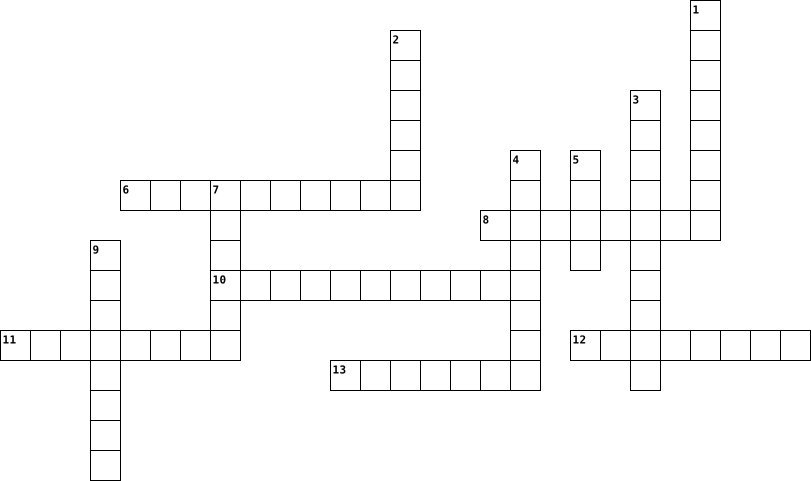
Across
- chimie
- histoire
- Communications Technology, technologie
- biologie
- education, Education physique
- français
Down
- physique
- mathématiques
- géographie
- sciences
- arts plastiques
- musique
- anglais
13 Clues: chimie • musique • anglais • physique • sciences • histoire • biologie • français • géographie • mathématiques • arts plastiques • education, Education physique • Communications Technology, technologie
Brain teaser 2018-11-19

Across
- enzyme
- product
- wonder
- division
- Health trend
- peder Holk Nielsen
- Annual Report Team
Down
- skill
- Investor
- transformative innovation
- HQ
- intranet
- Humungus
- Catalyze
14 Clues: HQ • skill • enzyme • wonder • product • Investor • intranet • division • Humungus • Catalyze • Health trend • peder Holk Nielsen • Annual Report Team • transformative innovation
Chapter 2 French Crossword 2012-02-17

Across
- a high school
- strong (masc)
- same
- history
- a teacher
- a friend (masc)
- biology
- all
Down
- strict
- chemistry
- difficult
- bad (masc)
- easy
- english
14 Clues: all • same • easy • strict • history • english • biology • chemistry • difficult • a teacher • bad (masc) • a high school • strong (masc) • a friend (masc)
French Cours 2024-12-03

Across
- Weight Lifting
- Chemistry
- fitness
- Biology
- Psychology
Down
- History
- Physics
- Science
- Algebra
- Anatomy
- Dance
- Music
12 Clues: Dance • Music • History • Physics • Science • Algebra • Anatomy • fitness • Biology • Chemistry • Psychology • Weight Lifting
Subjects 2024-08-21

Across
- Kunst & håndverk
- tysk
- svømming
- historie
- vitenskap/naturfag
- kjemi
- musikk
- spansk
- engelsk
- biologi
Down
- RLE (to ord i ett)
- fransk
- valgfag (to ord i ett)
- matematikk
- geografi
- kroppsøving (to ord i ett)
- fysikk
17 Clues: tysk • kjemi • fransk • fysikk • musikk • spansk • engelsk • biologi • svømming • geografi • historie • matematikk • Kunst & håndverk • RLE (to ord i ett) • vitenskap/naturfag • valgfag (to ord i ett) • kroppsøving (to ord i ett)
STS 2020-04-07

Across
- studying the biology of animals that are under the control of humankind
- Father of Biology
- Founder of the Copernican Revolution
- taxonomic rank used in the biological classification of living and fossil organisms, as well as viruses, in biology
- sometimes called biological chemistry
- farming of fish, crustaceans, molluscs, aquatic plants, algae, and other organisms.
- study of medicine
- study of body function
- place where papyrus was invented
- variations in ecosystems within a geographical location and its overall impact on human existence and the environment.
- member of a large group of unicellular microorganisms which have cell walls but lack organelles and an organized nucleus, including some which can cause disease
- science and art of cultivating plants and livestock
- Came from the latin word “Modo”
- Father of Taxonomy
- profession that breeds animals
- called plant science, plant biology or phytology
- also known as smart card
- weather conditions prevailing in an area in general or over a long period.
- also known as artificial selection
- Imaginary location of genes
- any organism whose genetic material has been altered using genetic engineering techniques
- Father of Anatomy
- Father of Human Medicine
- air-breathing vertebrates covered in special skin made up of scales, bony plates, or a combination of both
- branch of science that deals with microorganisms.
- study of Body parts
- branch of biology that studies the animal kingdom, including the structure, embryology, evolution, classification, habits, and distribution of all animals, both living and extinct, and how they interact with their ecosystems
- A Fundamental and relatively sudden change in political power and political organization
- limbless cold-blooded vertebrate animal with gills and fins and living wholly in water
Down
- from the greek word “demokratia”
- Largest Christian Denomination
- variety and variability of life on Earth
- island where Darwin stayed and theorized about evolution
- technology that utilizes biological systems, living organisms or parts of this to develop or create different products
- study of diseases
- meaning middle age
- set of observable characteristics of an individual resulting from the interaction of its genotype with the environment
- total number of genetic characteristics in the genetic makeup of a species
- artificial device that replaces a missing body part
- Galileo’s book that is published in 1610
- Father of Evolution
- specific group of domestic animals within the same species but with clear distinction
- Father of Microbiology
- vertebrate animals constituting the class Mammalia, and characterized by the presence of mammary glands which in females produce milk for feeding their young, a neocortex, fur or hair, and three middle ear bones
- Copernicus’ book
- basic unit of classification and a taxonomic rank of an organism, as well as a unit of biodiversity
- Italian astronomer, physicist and engineer, sometimes described as a polymath, from Pisa.
- Father of Physiology
- part of the genetic makeup of a cell, and therefore of any individual, which determines one of its characteristics
- Father of Genetics
- Oldest civilization
- Father of Pathology
- state of the atmosphere at a place and time as regards heat, dryness, sunshine, wind, rain, etc
- study of parasites
- branch of biology concerning interactions among organisms and their biophysical environment, which includes both biotic and abiotic components
- branch of science that deals with the structure of matter and how the fundamental constituents of the universe interact.
56 Clues: Copernicus’ book • Father of Biology • study of diseases • study of medicine • Father of Anatomy • meaning middle age • Father of Taxonomy • Father of Genetics • study of parasites • Father of Evolution • Oldest civilization • Father of Pathology • study of Body parts • Father of Physiology • study of body function • Father of Microbiology • also known as smart card • Father of Human Medicine • ...
School And Education By Alessia Battistini 2014-02-24

Across
- scrivania
- matematica
- biologia
- righello
- penna
- libro
- dizionario
Down
- diario
- compagno di classe
- gomma
- matita
- storia
12 Clues: gomma • penna • libro • diario • matita • storia • biologia • righello • scrivania • matematica • dizionario • compagno di classe
Las clases 2025-12-02

Across
- lunch
- music
- biology
- computer class
- test
- art
Down
- high school
- schedule
- English
- history
- Spanish
- math
12 Clues: art • math • test • lunch • music • English • history • Spanish • biology • schedule • high school • computer class
koulusanastoa 2022-08-21
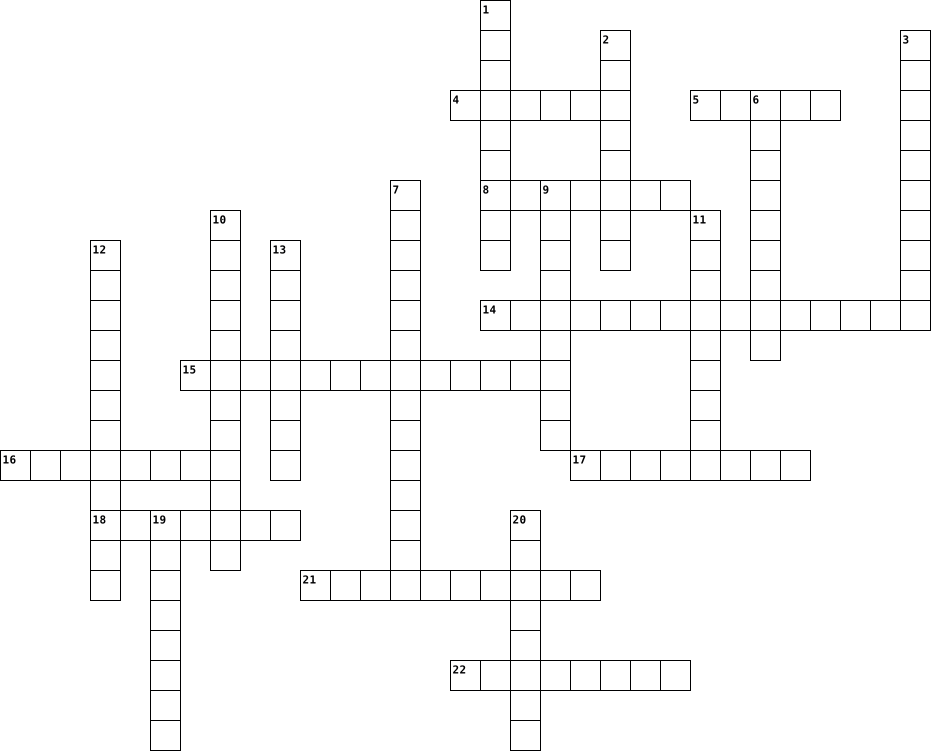
Across
- Swedish
- chemistry
- religion
- social studies
- an autumn term
- music
- physics
- handcraft
- home economics
- English
Down
- a term
- physical education
- native/mother language
- geography
- a spring term
- visual art
- health education
- a school year
- maths
- a report card
- a mid-autumn break
- biology
22 Clues: maths • music • a term • Swedish • physics • biology • English • religion • chemistry • geography • handcraft • visual art • a spring term • a school year • a report card • social studies • an autumn term • home economics • health education • physical education • a mid-autumn break • native/mother language
Days of the Week/Subjects 2022-12-02

Across
- week
- journalism
- wednesday
- sciences
- physics
- art
- What day is it?
- Sunday
- When?
- geography
- biology
- English
- economics
- Tuesday
- music
- Saturday
- Today is
Down
- mathematics
- computer science
- Spanish
- psychology
- literature
- history
- chemistry
- Thursday
- humanities
- Monday
- Friday
28 Clues: art • week • When? • music • Sunday • Monday • Friday • Spanish • history • physics • biology • English • Tuesday • sciences • Thursday • Saturday • Today is • wednesday • chemistry • geography • economics • journalism • psychology • literature • humanities • mathematics • What day is it? • computer science
Spanish Vocab Pages 40-41 2020-10-05

Across
- test; quiz
- laboratory
- school
- cafeteria
- art
- bookstore
- Spanish
- accounting
- physics
- trimester; quarter
- geography
- classmate
Down
- library
- sciences
- semester
- homework
- music
- test; exam
- schedule
- biology
- house; home
- stadium
- university; college
- economics
- computer science
- class
- course
27 Clues: art • music • class • school • course • library • biology • stadium • Spanish • physics • sciences • semester • homework • schedule • cafeteria • bookstore • economics • geography • classmate • test; quiz • laboratory • test; exam • accounting • house; home • computer science • trimester; quarter • university; college
FR I Au lycée 2021-01-06

Across
- music
- French
- easy
- recess, break
- German
- dismissal, exit
- subject
- art
- interesting
- chemistry
- worthless, no good
- test
- physics
- gym
Down
- biology
- math
- history
- course, class
- homework
- English
- hard, difficult
- fascinating
- geography
- because
- Spanish
- computers, technology
- boring
27 Clues: art • gym • math • easy • test • music • French • German • boring • biology • history • English • subject • because • Spanish • physics • homework • geography • chemistry • fascinating • interesting • course, class • recess, break • hard, difficult • dismissal, exit • worthless, no good • computers, technology
In Der Schule 2021-09-17

Across
- i already have
- calculator
- pencil
- today
- sweatshirt
- folder
- binder
- pen
- backpack
- biology
- notebook
- gym shorts
- crayon
- tissue
Down
- water bottle
- scissors
- glue
- sticky note
- science
- colored pencil
- on sale
- thank you
- department store
- ruler
- sport store
25 Clues: pen • glue • today • ruler • pencil • folder • binder • crayon • tissue • science • on sale • biology • scissors • backpack • notebook • thank you • calculator • sweatshirt • gym shorts • sticky note • sport store • water bottle • i already have • colored pencil • department store
Vocabulary 2023-02-28

Across
- /classmate
- /accounting
- /art
- /physics
- /laboratory
- /test;exam
- / music
- /computer science
- /class
- /schedule
- /biology
- /libary
Down
- /trimester;quarter
- /test;quiz
- /university;college
- /bookstore
- /semester
- /sciences
- /cafeteria
- /homework
- /course
- / geography
- /spanish
- /school
- /house;home
- /stadium
- /economics
27 Clues: /art • /class • /course • /school • / music • /libary • /physics • /spanish • /stadium • /biology • /semester • /sciences • /homework • /schedule • /test;quiz • /classmate • /bookstore • /cafeteria • /test;exam • /economics • /accounting • /laboratory • / geography • /house;home • /computer science • /trimester;quarter • /university;college
School and Education By Daniele Ramberti 2014-02-24

Across
- matita
- porfessore
- storia
- matematica
- banco
- studente
- diritto
- preside
- biologia
- scuola
- sedia
- insegnante
- tecnologia
- scienze
- zaino
Down
- allievo
- righello
- temperino
- religione
- educazione fisica
- chimica
- gesso
- bidello
- diario
- materia
- geografia
- fisica
- astuccio
- quaderno
- gomma
30 Clues: banco • gesso • sedia • zaino • gomma • matita • storia • diario • fisica • scuola • allievo • chimica • bidello • diritto • materia • preside • scienze • righello • studente • biologia • astuccio • quaderno • temperino • religione • geografia • porfessore • matematica • insegnante • tecnologia • educazione fisica
Chapter 4 Vocabulary 2015-03-26

Across
- movie theather
- book
- they rent
- soccer
- practice
- we eat
- movies
- gusta I like
- practice
- pen
- blue
- I listen
- folder
Down
- dance
- history
- notebook
- I want
- paper
- after
- I have
- math
- lunch
- class
- I am
- biology
- pencil
- run
27 Clues: pen • run • book • math • I am • blue • dance • paper • after • lunch • class • I want • soccer • I have • we eat • movies • pencil • folder • history • biology • notebook • practice • practice • I listen • they rent • gusta I like • movie theather
Capitulo 1B 2017-07-24

Across
- chemistry
- there is
- small (b)
- easy
- biology
- physics
- spanish
- social studies
- same (b)
- class
- a lot (boys)
- all (girls)
- difficult
Down
- course
- boring (b)
- math
- french
- english
- big
- teacher (g)
- sciences
- history
- few (girls)
- german
- hard
25 Clues: big • math • easy • hard • class • course • french • german • english • biology • physics • spanish • history • there is • sciences • same (b) • chemistry • small (b) • difficult • boring (b) • teacher (g) • few (girls) • all (girls) • a lot (boys) • social studies