
body parts Crossword Puzzles
body parts 2020-09-09

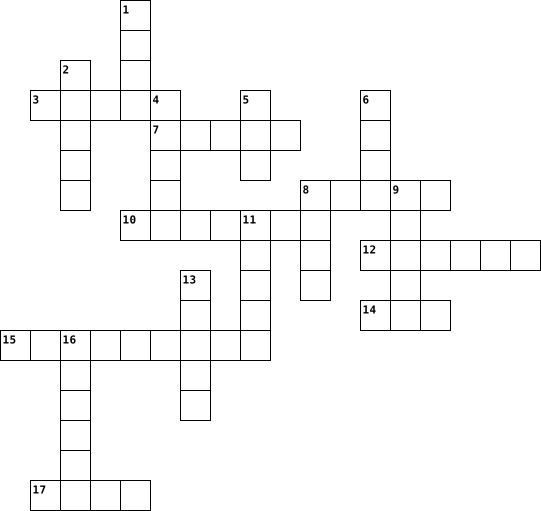
Across
- at the top of your body
- you can smell with it
- you can open it and close it
Down
- it has 5 fingers
- they can be of different colours
- it has 5 toes
6 Clues: it has 5 toes • it has 5 fingers • you can smell with it • at the top of your body • you can open it and close it • they can be of different colours
body parts 2020-09-27

Across
- asda
- asjd
- asdh
- ahsd
- asjd
Down
- ajsod
- asd
- asda
8 Clues: asd • asda • asjd • asdh • asda • ahsd • asjd • ajsod
Body Parts 2021-06-16

Across
- it joins the head to the shoulders
- you should brush them after eating
- You can see with them
Down
- you use it to smell something
- you can hear loud sounds with them
- you can comb and brush it
6 Clues: You can see with them • you can comb and brush it • you use it to smell something • it joins the head to the shoulders • you should brush them after eating • you can hear loud sounds with them
body parts 2021-04-15

Across
- we can eat with it
- can see with it
- we can nod and shake with it
Down
- we can smell with it
- we can listen with it
- : we wash it every day
6 Clues: can see with it • we can eat with it • we can smell with it • we can listen with it • : we wash it every day • we can nod and shake with it
body parts 2021-04-15

Across
- : we wash it every day
- we can smell with it
- we can nod and shake with it
Down
- we can listen with it
- can see with it
- we can eat with it
6 Clues: can see with it • we can eat with it • we can smell with it • we can listen with it • : we wash it every day • we can nod and shake with it
body parts 2021-07-22

Across
- i use these to chew food
- i use these to see and look
- i use them to walk
Down
- i use it to smell
- i have 10 on my hand
- i have 10 on my feet
6 Clues: i use it to smell • i use them to walk • i have 10 on my hand • i have 10 on my feet • i use these to chew food • i use these to see and look
Body parts 2024-04-22

Across
- / brings oxygen and nutrients to all the parts of the body
- / sends blood throughout our bodies
- / provide support for our bodies and help form our shape
Down
- / support the body weight and provide for locomotion
- / carry something red around the body
- / capture the light
6 Clues: / capture the light • / sends blood throughout our bodies • / carry something red around the body • / support the body weight and provide for locomotion • / provide support for our bodies and help form our shape • / brings oxygen and nutrients to all the parts of the body
Body Parts 2024-07-13

Across
- You use these to hold things
- You use these to see
Down
- You use this to eat.
- You use this to hear.
- You use this to smell.
- You use these to walk.
6 Clues: You use this to eat. • You use these to see • You use this to hear. • You use this to smell. • You use these to walk. • You use these to hold things
body parts 2023-08-20

Across
- you can listen with them
- you eat with it
- you can smell things with it
Down
- you wear a shoe on it
- you see things with them
- you write using it
6 Clues: you eat with it • you write using it • you wear a shoe on it • you can listen with them • you see things with them • you can smell things with it
BODY PARTS 2021-10-05

Across
- our leg's fingers
- we can see with
- we can smell with
Down
- pumps our blood
- we can stand on it
- we can hear with
6 Clues: pumps our blood • we can see with • we can hear with • our leg's fingers • we can smell with • we can stand on it
BODY PARTS 2021-10-05

Across
- our leg's fingers
- we can see with
- we can smell with
Down
- pumps our blood
- we can stand on it
- we can hear with
6 Clues: pumps our blood • we can see with • we can hear with • our leg's fingers • we can smell with • we can stand on it
BODY PARTS 2021-10-05

Across
- our leg's fingers
- we can see with
- we can smell with
Down
- pumps our blood
- we can stand on it
- we can hear with
6 Clues: pumps our blood • we can see with • we can hear with • our leg's fingers • we can smell with • we can stand on it
Body Parts 2022-02-16

Across
- My heart is broken
- I like to lick ice cream
- I breathe through my lungs
Down
- My bones are strong
- I think with my brain
- My stomach is empty
6 Clues: My heart is broken • My bones are strong • My stomach is empty • I think with my brain • I like to lick ice cream • I breathe through my lungs
Body parts 2025-02-10

Across
- used to smell things
- used to hear things
- used to hold things
Down
- used to speak
- used to walk and run
- connects the head and the body
6 Clues: used to speak • used to hear things • used to hold things • used to smell things • used to walk and run • connects the head and the body
Body parts 2024-12-19

Across
- connects the head t the truck
- we use them to listen
- It covers the head
Down
- Each foot have five
- Connects the foot to the leg
- Front of the lower leg
6 Clues: It covers the head • Each foot have five • we use them to listen • Front of the lower leg • Connects the foot to the leg • connects the head t the truck
BODY PARTS 2023-10-11

Across
- It goes from the wrist to the tips of the fingers.
- You can use it to count.
- With what you can see.
Down
- What you can breathe with.
- Expression that a person's features have.
- Pumps blood throughout the body.
6 Clues: With what you can see. • You can use it to count. • What you can breathe with. • Pumps blood throughout the body. • Expression that a person's features have. • It goes from the wrist to the tips of the fingers.
Body Parts 2025-03-17

Across
- (5 letras) → La parte que conecta tu cabeza con tu cuerpo.
- (6 letras) → La articulación que conecta el brazo superior con el antebrazo.
- (7 letras) → El músculo en la parte trasera de tu brazo superior.
Down
- (7 letras) → Los dígitos al final de la mano.
- (7 letras) → El área donde almacenas y digieres la comida.
- (4 letras) → La parte del cuerpo que protege los pulmones.
6 Clues: (7 letras) → Los dígitos al final de la mano. • (5 letras) → La parte que conecta tu cabeza con tu cuerpo. • (7 letras) → El área donde almacenas y digieres la comida. • (4 letras) → La parte del cuerpo que protege los pulmones. • (7 letras) → El músculo en la parte trasera de tu brazo superior. • ...
Body Parts 2022-01-20

Across
- Makes you think
- Gets you from here to there
- You use these to see
Down
- Something that smells
- Wave goodbye
- Do you hear something?
6 Clues: Wave goodbye • Makes you think • You use these to see • Something that smells • Do you hear something? • Gets you from here to there
Body parts 2022-07-06

Across
- - you have 1 and it helps you smell
- - they are white
- - you have 2 and they help you hear things
Down
- - you eat with it
- - you have 2 and they help you see things
- - it's back
6 Clues: - it's back • - they are white • - you eat with it • - you have 1 and it helps you smell • - you have 2 and they help you see things • - you have 2 and they help you hear things
Body Parts 2025-10-16

Across
- what you use to talk
- what you use to see
- what you use to feel
Down
- what you use to walk
- what you use to smell
- what you use to hear
6 Clues: what you use to see • what you use to walk • what you use to talk • what you use to hear • what you use to feel • what you use to smell
Les Parties Du Corps 2020-12-15

Across
- chest
- back
- waist
- knees
- throat
- foot
- hair (m)
- elbow
- face (f)
- face (m)
- chin
- shoulders (f)
- ear (f)
- head
- eyes (m)
- ankle
- finger
- feet (m)
Down
- cheek
- mouth
- mouth
- arm
- tongue
- body
- knee
- parts of the body
- nose
- behind
- neck
- toes
- hand
- leg
- stomach
- eye
- teeth (f)
35 Clues: arm • leg • eye • back • body • knee • nose • foot • neck • toes • hand • chin • head • cheek • mouth • chest • mouth • waist • knees • elbow • ankle • tongue • throat • behind • finger • stomach • ear (f) • hair (m) • face (f) • face (m) • eyes (m) • feet (m) • teeth (f) • shoulders (f) • parts of the body
HUMAN BODY 2025-11-03

Across
- Internal skeleton that provides structure, support, and protection for the internal organs and tissues of an organism.
- A living thing.
- Two organs that help the body maintain balance by filtering and eliminating waste from the blood to make urine.
- An animal that lacks a backbone.
- The organ that secretes bile to aid in digestion; removes harmful substances from the blood.
- Structures inside your body that allow your body to move.
- The organ that uses digestive juices to break down food to supply energy to the body.
- Made of bones; internal structure that holds the body together; stores important nutrients and minerals; makes blood cells.
- A large mass of similar tissue that makes up a part of an organism that performs a specific function.
- Two organs that take in (inhale) oxygen and release (exhale) carbon dioxide into the air.
Down
- The organ that collects and holds urine.
- The process of making more organisms of the same kind.
- Gland behind the stomach that produces insulin; makes juices to help the small intestine digest fat and protein.
- The organ that protects the internal organs of the body; senses heat, cold, pressure, and pain; the outside layer of the body.
- The organ that receives and sends messages throughout the body in order to tell body parts what to do; the control center of the body.
- A hard external skeleton (outer covering) that supports and protects an animal's body.
- An animal that has a backbone.
- The organ that pumps blood enriched with nutrients to all of the body parts.
18 Clues: A living thing. • An animal that has a backbone. • An animal that lacks a backbone. • The organ that collects and holds urine. • The process of making more organisms of the same kind. • Structures inside your body that allow your body to move. • The organ that pumps blood enriched with nutrients to all of the body parts. • ...
Modern Dance Crossword 2021-06-24

Across
- feet and knees facing forward.
- a movement or movement sequence that forms a connective bridge between two sections or parts of a composition.
- the letting go of tension or energy; in Graham technique it usually follows an extension.
- to "turn around" or rotate on an axis
- the arrangement of parts to produce a complete and unifying whole.
Down
- folding of body to "table top" position while standing - shoulders in line with hips
- a sinking movement involving the controlled release of tension of the entire body parts.
- the grouping of units into a unified design.
- muscular tension that produces a foreshortening of body parts; a principle of the Graham technique.
- a balanced, even design; an even correspondence of design, space, rhythm, or position of the body.
10 Clues: feet and knees facing forward. • to "turn around" or rotate on an axis • the grouping of units into a unified design. • the arrangement of parts to produce a complete and unifying whole. • folding of body to "table top" position while standing - shoulders in line with hips • a sinking movement involving the controlled release of tension of the entire body parts. • ...
Body parts 2020-05-08

Across
- to smell with
- to chew with
Down
- to hear with
- to touch with
- to taste with
- to see with
6 Clues: to see with • to hear with • to chew with • to touch with • to taste with • to smell with
body parts 2021-04-15

Across
- we can eat with it
- can see with it
- can nod and shake with it
Down
- we can smell with it
- : we wash it every day
- we can listen with it
6 Clues: can see with it • we can eat with it • we can smell with it • we can listen with it • : we wash it every day • can nod and shake with it
body parts 2021-04-15

Across
- we can eat with it
- can see with it
- we can nod and shake with it
Down
- we can smell with it
- we can listen with it
- : we wash it every day
6 Clues: can see with it • we can eat with it • we can smell with it • we can listen with it • : we wash it every day • we can nod and shake with it
body parts 2021-03-24

Across
- ciò che si appoggia sul terreno
- ciò che sono rette dal busto
- ciò che contiene il cervello
Down
- ciò che è sui piedi
- ciò che è retto dalle braccia
- ciò che regge la testa
6 Clues: ciò che è sui piedi • ciò che regge la testa • ciò che sono rette dal busto • ciò che contiene il cervello • ciò che è retto dalle braccia • ciò che si appoggia sul terreno
BODY PARTS 2021-11-16

Across
- JJJJ
- PPPPPP
- OOOOO
- NNNNNN
Down
- ÑÑÑÑ
- MMMM
6 Clues: ÑÑÑÑ • JJJJ • MMMM • OOOOO • PPPPPP • NNNNNN
body parts 2022-04-06

Across
- you smell things with this
- you see with these
- it is on your head and it can be short or long
Down
- you have 5 of these on each hand
- you walk with these
- you can carry things with this
6 Clues: you see with these • you walk with these • you smell things with this • you can carry things with this • you have 5 of these on each hand • it is on your head and it can be short or long
Body parts 2022-04-03

Across
- I eat
- I kneel
- I hear
Down
- I walk
- I touch
- I see
6 Clues: I eat • I see • I walk • I hear • I touch • I kneel
Body parts 2019-07-11

Across
- you use this to smell with
- you use this to think
- you have 2 of these (long)
Down
- you use these to hear
- you have 10 of these
- you see with these
6 Clues: you see with these • you have 10 of these • you use these to hear • you use this to think • you use this to smell with • you have 2 of these (long)
Body Parts 2023-12-13

Across
- You use this to taste your food.
- You use these to hear.
- This is what you use to see.
Down
- This is at the end of your arm.
- You wear shoes on these.
- You use this to smell things.
6 Clues: You use these to hear. • You wear shoes on these. • This is what you use to see. • You use this to smell things. • This is at the end of your arm. • You use this to taste your food.
Body Parts 2023-11-23

Across
- What you stand on, at the end of your leg
- Where your arm connects to your body
Down
- Connects your head to your body
- The part of your face used for smelling
- The part of your face used for eating and talking
- The part of your body that holds your brain
6 Clues: Connects your head to your body • Where your arm connects to your body • The part of your face used for smelling • What you stand on, at the end of your leg • The part of your body that holds your brain • The part of your face used for eating and talking
Body parts 2023-11-27

Across
- part of your body that you use to taste.
- round, coloured part of your eye
Down
- part of your body that helps you walk.
- The part of your body that you use to hear.
- part of your body that you use to give a thumbs up.
- part of your face that you use to smell
6 Clues: round, coloured part of your eye • part of your body that helps you walk. • part of your face that you use to smell • part of your body that you use to taste. • The part of your body that you use to hear. • part of your body that you use to give a thumbs up.
Body parts 2022-06-29

Across
- the way one sits, stands or walks
- it joins two bones.
- it is used to keep my teeth clean
- the parts below the neck
Down
- natural source of vitamin D
- my uncles son is my ____________
6 Clues: it joins two bones. • the parts below the neck • natural source of vitamin D • my uncles son is my ____________ • the way one sits, stands or walks • it is used to keep my teeth clean
body parts 2024-05-22

Across
- I taste with my
- I jump with my
- I see with my
- I touch with my
Down
- I smell with my
- I hear with my
- I kick with my
7 Clues: I see with my • I hear with my • I jump with my • I kick with my • I taste with my • I smell with my • I touch with my
body parts 2023-04-30

Across
- body
- finger
Down
- toes
- hand
- neck
- foot
6 Clues: toes • hand • body • neck • foot • finger
body parts 2025-04-12

Across
- 嘴
- 鼻子
- 腿
Down
- 胳膊
- 手
- 眼睛
6 Clues: 嘴 • 手 • 腿 • 胳膊 • 鼻子 • 眼睛
Body parts 2025-01-10

Across
- you can use this to write
- you can use it to talk
- you can use it to read
- you can use it to listen to music
Down
- these are under your head
- these are finger , but on your feet
6 Clues: you can use it to talk • you can use it to read • these are under your head • you can use this to write • you can use it to listen to music • these are finger , but on your feet
Body parts 2025-11-04

Across
- without you'll be bold
- we taste food by it
- we use it to eat
Down
- we brush them before we sleep
- we hit with our arms
- we use it to see
6 Clues: we use it to see • we use it to eat • we taste food by it • we hit with our arms • without you'll be bold • we brush them before we sleep
body parts 2026-05-13

Across
- ankle
- dislocated
- pulled
Down
- head
- twisted
- leg
6 Clues: leg • head • ankle • pulled • twisted • dislocated
Levels of Organization 2023-03-13

Across
- organelle, cell, tissue, organ, organ system, organism
- cell structures that carry out special functions in a cell
- a bunch of tissues that carry out a specialized function of the body
- a group of similar cells that are organized to do a specific job
- tissue that covers outside of the body and lines organs and cavities
- a body tissue that carries electrical messages back and forth between the brain and every other part of the body
- a living thing made of a group of organ systems
Down
- group of organs that work together to perform a specific function
- basic unit of structure & function in a living thing
- moves the body and its parts
- connects bone to bone
- provides support for your body and connects all its parts
- connects muscle to bone
13 Clues: connects bone to bone • connects muscle to bone • moves the body and its parts • a living thing made of a group of organ systems • basic unit of structure & function in a living thing • organelle, cell, tissue, organ, organ system, organism • provides support for your body and connects all its parts • cell structures that carry out special functions in a cell • ...
Conner Boyd Period 5 game 1 2022-09-21

Across
- there are how many different types of lubrication
- a vertical plane running from front to back. This divides the body or any of its parts into right and left sides
- A horizontal plane dividing the body or any of its parts into upper and lower parts.
- A thin layer of dense, fibrous connective tissue unites the bones of the skull
- A vertical plane running from side to side. This divides the body or any of its parts front and back portions
- example of gomphoses
Down
- joints that lack
- The inner layer secretes synovial fluid into the joint cavity for
- joints where a conical process fits into a socket and is held in place by ligaments
- most joints in the body are
10 Clues: joints that lack • example of gomphoses • most joints in the body are • there are how many different types of lubrication • The inner layer secretes synovial fluid into the joint cavity for • A thin layer of dense, fibrous connective tissue unites the bones of the skull • joints where a conical process fits into a socket and is held in place by ligaments • ...
ZOOLOGY VOCABULARY CHAPTER 7 2023-11-13

Across
- the study of the naming of organisms in the fashion that reflects their evolutionary relationships
- without a balanced arrangement of similar parts on either side of a a point or axis
- the development of a head with an accumulation of nervous tissue into a brain
- the study of the classification and phylogeny of organisms
- the description of species and the grouping of organisms to reflect evolutionary relationships
- a group of organisms descended from a single ancestor
- a group of organisms that are genetically related
- the outer embryological tissue layer
- a form of symmetry in which only the midsagittal plane divides an organism into mirror images
- analogous resemblances between animals that result from animals adapting under similar evolutionary pressures
- an assemblage of organisms that includes multiple evolutionary lineages
- a form of symmetry in which any plane passing through the oral-aboral axis divides an organism into mirror images
Down
- without a body cavity
- a description of the evolutionary history of a group of taxa, usually depicted by tree diagrams
- a group that includes some, but not all, members of a lineage
- the innermost embryological tissue layer
- any animal attribute that has a genetic basis and that can be measured
- a balanced arrangement of similar parts on either side of a common point or axis
- animals whose body parts are organized into layers that are derived embryologically from two tissue layers
- animals whos e body parts are organized into layers that are derived embryologically form three tissue layers
20 Clues: without a body cavity • the outer embryological tissue layer • the innermost embryological tissue layer • a group of organisms that are genetically related • a group of organisms descended from a single ancestor • the study of the classification and phylogeny of organisms • a group that includes some, but not all, members of a lineage • ...
measurement 2014-05-19

Across
- parts of are body help us to measure the things
- are the first people who find the measurement devices
- are measure in
- inch equal to cm
- kg equal to eleven gram-true/false
- weight is measured in
- your bed in hand span
- m= km
Down
- method you use to make the bigger to smaller
- is greater -kg/g
- your weight in g
- use for weighting things
- is measured in
- are measure in
- we use are body parts as the measuring device
- is priced by
16 Clues: m= km • is priced by • is measured in • are measure in • are measure in • is greater -kg/g • your weight in g • inch equal to cm • weight is measured in • your bed in hand span • use for weighting things • kg equal to eleven gram-true/false • method you use to make the bigger to smaller • we use are body parts as the measuring device • parts of are body help us to measure the things • ...
Garrett Holzemer 7 2024-02-01

Across
- -parts of the skeleton that connects to the spine
- -you can control
- -muscles that make up organs
- -tissues work together
- -cells that work together
- -muscles that make up the heart
- -holds bones to bones
- -you can't control
- -organs work together
Down
- -a system that supports and protects
- -parts of the skeleton that don't connect to the spine
- -body regulates itself
- -smooth outer layer of a bone
- -muscles that are attached to bone
- -a part of the body that holds muscle to bone
15 Clues: -you can control • -you can't control • -holds bones to bones • -organs work together • -body regulates itself • -tissues work together • -cells that work together • -muscles that make up organs • -smooth outer layer of a bone • -muscles that make up the heart • -muscles that are attached to bone • -a system that supports and protects • -a part of the body that holds muscle to bone • ...
Body 2023-09-14
Across
- - top part of your leg between your knee and hip
- - the joint where your arm bends
- - the front part of your body between the neck and stomach
- - the organ where food begins to be digested
- - one of the two organs in your lower back that separates waste products from your blood and makes urine
- - one of the long parts of your body that your feet are joined to
- - long tube in your body through which food passes after it leaves your stomach
- - the part of the body that joins your head and your shoulders
Down
- - one of the two organs that you breathe with
- - the thickest finger on your hand
- - organ in your chest that pumps blood through your body
- - one of the five moveable parts at the end of your foot
- - front part of your head, where your eyes, nose and face are
- - front part of your face below the mouth
- - the row of bones down the centre of your back that supports your body
- - the joint between your foot and your leg
- - part of your body where your hand joins your arm
- - soft part inside the mouth that you can move around and use for eating and speaking
18 Clues: - the joint where your arm bends • - the thickest finger on your hand • - front part of your face below the mouth • - the joint between your foot and your leg • - the organ where food begins to be digested • - one of the two organs that you breathe with • - top part of your leg between your knee and hip • - part of your body where your hand joins your arm • ...
Joint movements 2025-04-09

Across
- Movement that turns a body part around its own axis
- Movement that decreases the angle between two bones or body parts
- Movement of a limb toward the midline of the body
- Turning the sole of the foot outward
- Turning the sole of the foot inward
- Turning the palm downward
Down
- Movement of a limb away from the midline of the body
- Turning the palm upward
- Movement that increases the angle between two bones or body parts
- Moving the top of the foot closer to the shin
- flexion: Pointing the toes downward
11 Clues: Turning the palm upward • Turning the palm downward • flexion: Pointing the toes downward • Turning the sole of the foot inward • Turning the sole of the foot outward • Moving the top of the foot closer to the shin • Movement of a limb toward the midline of the body • Movement that turns a body part around its own axis • ...
Nursing 1.1 2023-04-08

Across
- it feels as if it were caused by heart or a fire
- is a tube in the body that carries from heart to other parts of the body
- is the major tube in the heart that carries blood to the body
- are unpleasant pains in the body
- is a doctor who specializes in treating heart conditions
- is a college degree higher than a bachelor's degree
Down
- is a small tube in the body that lets blood and tissue exchange oxygen and nutrients
- is a loss of blood. It occurs when blood escapes from the circulatory system
- is one of two limbs at the side of the body with the hands at the end
- is a drug that destroys harmful bacteria in the body
- is the displaying of emotion through facial expressions, movements,etc.
- is a sore on the body caused by lying down in the same position for too long
- is the medical discipline that deals with the heart
- is one of the hard white parts inside a person's body that gives the body shape
- is a condition where people have trouble breathing because of narrow or blocked air passages
15 Clues: are unpleasant pains in the body • it feels as if it were caused by heart or a fire • is the medical discipline that deals with the heart • is a college degree higher than a bachelor's degree • is a drug that destroys harmful bacteria in the body • is a doctor who specializes in treating heart conditions • ...
Unit 1 Cells and Tissues Vocabulary 2022-08-17

Across
- anything outside of the cell
- pertaining to an internal organ of the body or the inner part of a structure
- divides the body or any of its parts into anterior and posterior portions
- anything inside of the cell
- internal secretion
- study of the function of living organisms
Down
- external secretion
- membrane lines a body cavity that opens to the outside of the body
- nonliving material in connective tissue consisting of ground substance and fibers; separates the living cells
- pertaining to the walls of a cavity
- of or in a plane to the sagittal suture, especially that dividing the body into left & right halves
- a state of body equilibrium or stable internal environment of the body
- membrane extracellular material consisting of a basal lamina secreted by epithelial cells and a reticular lamina secreted by underlying connective tissue cells
- dividing the body or an organ into superior and inferior parts
- membrane the epithelial membrane that lines the closed ventral cavities of the body; makes up the pleura and pericardium thin layer of tissue that covers internal body cavities and secretes a fluid that keeps the membrane moist
- study of the structure of living organisms
16 Clues: external secretion • internal secretion • anything inside of the cell • anything outside of the cell • pertaining to the walls of a cavity • study of the function of living organisms • study of the structure of living organisms • dividing the body or an organ into superior and inferior parts • membrane lines a body cavity that opens to the outside of the body • ...
Brain Control 2025-09-04

Across
- something you see that tricks or confuses your brain.
- a test used to discover new information about a question.
- nerves the parts of the body that carry signals from the brain to muscles.
- system the brain and all the nerves in the body.
Down
- to take something apart to study it.
- part of the body that receives, processes, and responds to signals from the nerves.
- the parts of the body that carry signals from one part of the body to another.
- nerves the parts of the body that carry signals from the senses to the brain
- the part of the body that attaches to bones and allows the body to move.
9 Clues: to take something apart to study it. • system the brain and all the nerves in the body. • something you see that tricks or confuses your brain. • a test used to discover new information about a question. • the part of the body that attaches to bones and allows the body to move. • nerves the parts of the body that carry signals from the brain to muscles. • ...
Les Parties du Corps 2020-12-16

Across
- leg
- tongue
- ankle
- Parts of the body
- waist
- shoulders(f)
- arm
- knee
- behind
- face(f)
- throat
- head
- chin
- neck
- face(m)
- back
- teeth(f)
Down
- hand
- feet(m)
- foot
- arms
- body
- chest
- ear(f)
- finger
- toes
- eye/eyes(m)
- nose
- cheek
- hair(m)
- elbow
- mouth
32 Clues: leg • arm • hand • foot • arms • body • toes • knee • nose • head • chin • neck • back • ankle • waist • chest • cheek • elbow • mouth • tongue • ear(f) • finger • behind • throat • feet(m) • face(f) • hair(m) • face(m) • teeth(f) • eye/eyes(m) • shoulders(f) • Parts of the body
Semester Exam Review (Units 1-4) 2023-12-18

Across
- type of reproduction where two parents combine their genetic material to produce a new organism, which differs from both parents
- provides protection and support for plant cells only.
- The basic unit of structure and function in all organisms
- body system that carries oxygen and nutrients to all parts of the body
- something that you are taught or learn from experience
- body system made of skin, hair, nails
- threadlike structure made of DNA molecules that contain the genes
- storage for water, food, waste
- a trait that is apparent only when two for the same characteristic are inherited
- A group of tissues that work together to perform a specific function
- characteristic, quality, or tendency that someone or something has
- contains DNA (genetic material) and controls the cell's actions.
- a characteristic passed on from a parent to an offspring like eye color
- body system that absorbs oxygen from the air and releases carbon dioxide from the body
- body system that sends and receives stimuli to coordinate body actions and reactions
- body system that allows movement in the body
- body system that provides structure, supports and protects body parts
Down
- controls what can enter/exit the cell.
- green oval shaped that converts light energy into chemical energy via photosynthesis. Found in plants only.
- body system that chemically breaks down food into nutrients
- A segment of DNA on a chromosome that codes for a specific trait
- A trait that is always expressed in the offspring whenever it is present
- jelly-like liquid that supports other organelles in the cell.
- body system that filters out fluid and waste from the body
- A group of cells that perform a specific function
- Process by which a single parent reproduces by itself
- bean-shaped and provides the cell with energy by breaking down sugars.
- Passing of traits from parents to offspring
- A complex molecule containing the genetic information that makes up the chromosomes.
29 Clues: storage for water, food, waste • body system made of skin, hair, nails • controls what can enter/exit the cell. • Passing of traits from parents to offspring • body system that allows movement in the body • A group of cells that perform a specific function • provides protection and support for plant cells only. • Process by which a single parent reproduces by itself • ...
Evolution 2023-05-10

Across
- bodily changes that enhance survival mimicry
- a species adjustment to its environment
- "Survival of the fittest" through genetic variation
- species change over time through natural selection
- change in DNA sequence
- imitating another species for survival
- famous for his theory that suggests "organisms altered their behavior in response to environmental change"
- random fluctuations in gene frequencies within a population
- physical features that aid life
- the act of concealing oneself
Down
- similar body parts with different functions
- some individuals in a population reproduce more successfully
- father of evolutionary theory
- different origins, similar functions
- the ability to survive and reproduce in an environment
- seasonal movement
- intentional breeding for desired traits
- functionless body parts
18 Clues: seasonal movement • change in DNA sequence • functionless body parts • father of evolutionary theory • the act of concealing oneself • physical features that aid life • different origins, similar functions • imitating another species for survival • a species adjustment to its environment • intentional breeding for desired traits • similar body parts with different functions • ...
Warm up/safety in sport 2013-04-22

Across
- Without great force
- You are organised well
- where you go to practisee
- A type of running
- Over time you improve
- A short band of tough, flexible tissue
Down
- the pulse of the heart beating
- You do this to lose weight
- It circulates around the body
- Able to bend parts of your body
- Keep doing this then you get better at it
- Fast form of running
- breaking it into different parts
- a band of tissue in a human or animal
14 Clues: A type of running • Without great force • Fast form of running • Over time you improve • You are organised well • where you go to practisee • You do this to lose weight • It circulates around the body • the pulse of the heart beating • Able to bend parts of your body • breaking it into different parts • a band of tissue in a human or animal • A short band of tough, flexible tissue • ...
measurement 2014-05-19

Across
- parts of are body help us to measure the things
- are the first people who find the measurement devices
- are measure in
- inch equal to cm
- kg equal to eleven gram-true/false
- weight is measured in
- your bed in hand span
- m= km
Down
- method you use to make the bigger to smaller
- is greater -kg/g
- your weight in g
- use for weighting things
- is measured in
- are measure in
- we use are body parts as the measuring device
- is priced by
16 Clues: m= km • is priced by • is measured in • are measure in • are measure in • is greater -kg/g • your weight in g • inch equal to cm • weight is measured in • your bed in hand span • use for weighting things • kg equal to eleven gram-true/false • method you use to make the bigger to smaller • we use are body parts as the measuring device • parts of are body help us to measure the things • ...
Sports Med Terms 2022-01-27

Across
- towards the back
- a bruise
- turning ankles outward
- divides the body into the left and right
- below or lower than
- tearing of tissue
- far away in proximity
- kidnapping
- towards the head of the body
- rotation of the forearm and palm
- lengthening of a joint
Down
- turning ankles inward
- close in location
- long lasting pain
- divides the body into superior and inferior parts
- wound; damage to the skin
- vertical plane that divides the body
- bending of a joint
- movement towards the body
- to the side, or away from
- new pain or injury
- towards the middle
- creaky joints
- movement to turn the hands prosteriorly
24 Clues: a bruise • kidnapping • creaky joints • towards the back • close in location • long lasting pain • tearing of tissue • bending of a joint • new pain or injury • towards the middle • below or lower than • turning ankles inward • far away in proximity • turning ankles outward • lengthening of a joint • wound; damage to the skin • movement towards the body • to the side, or away from • ...
Invertebrate 2018-05-11

Across
- the organ posterior to the crop in earthworm to grind food
- cnidarian body form that is umbrella-shaped w/ tentacles
- innermost primary germ layer in an animal embryo
- hard covering on the outside of some animals
- a muscular blood vessel from the dorsal and ventral parts of an animals body
- an opening in a sponge where water exists
- method in which food particles are filtered from the water as it passes by or through some part of the organism
- the divison of the body of an organism into a series of similar parts
- internal network of fluid filled canals involved in feeding, respiration, internal transport, elimination of wastes, and movement in enchinoderms
- system where blood moves thru vessels into open spaces around organs
- rhythmic muscular contractions that move food through digestive system
- an animal that can produce both egg and sperm
- any of the flagellate cells that line the cavities of a sponge
- back end of bilateral symmetrical organism
- in insects, a series of chemically-controlled changes in body structure from juvenile to adult
- a body cavity that is completely lined by mesoderm and that contains internal organs
- arrangement of body structures
- the periodic shedding of an old exoskeleton
Down
- animal with a backbone
- sphere shaped collection of amebocytes surrounded by spricules which can grow into a new sponge
- small cluster of nerve cells
- stinging structure on tentacles of cnidarians that is used to paralyze or kill prey
- system in which blood moves through the body entirely enclosed in vessels
- a rasping, tonguelike organ that is covered with chitinuos teeth and that is used for feeding by many mollusks
- organism that is permanently attached to a surface
- organism that survives by living and feeding either inside or attached to outer surfaces of another organism doing harm to the host
- gathering of sense organs/nerve organs into the head region
- animal without a backbone
- 5 symmetrical parts
- any structure, such as a leg or antenna, that grows out of an animals body
- arrangement of body parts of an organism that they repeat around an imaginary line drawn through the centre of the organism
- immature stage of organism that is unlike adult form in appearance
- a free-swimming, cilliated larva of many worms and some mollusks
- internal skeleton
- resting stage of metamorphosis in which tissues of insect are organized in adult form
- an independent and immature form of an organism that is morphologically different from the adult
- cnidarian body form that is tube-shaped w/ mouth surrounded by tentacles
- food storing organ in an earthworm
- thin delicate layer of tissue that covers most of a mollusks body and secretes the shell when one is present
39 Clues: internal skeleton • 5 symmetrical parts • animal with a backbone • animal without a backbone • small cluster of nerve cells • arrangement of body structures • food storing organ in an earthworm • an opening in a sponge where water exists • back end of bilateral symmetrical organism • the periodic shedding of an old exoskeleton • hard covering on the outside of some animals • ...
Kineseology cross word 2023-09-19

Across
- What does kinei mean?
- A horizontal plane dividing the body or any of its parts into upper and lower parts
- he human body stands erect, eyes looking forward, arms at the sides and feet facing forward
- A vertical plane running from side to side. This divides the body or any of its parts into front and back portions
Down
- A vertical plane running from front to back. This divides the body or any of its parts into left and right sides
- What does ology mean
- Slightly moveable joint
- The fibula is what to the tibia
- The ankle is what to the knee
- Immovable joint
10 Clues: Immovable joint • What does ology mean • What does kinei mean? • Slightly moveable joint • The ankle is what to the knee • The fibula is what to the tibia • A horizontal plane dividing the body or any of its parts into upper and lower parts • he human body stands erect, eyes looking forward, arms at the sides and feet facing forward • ...
Cumulative Study Puzzle 2024-05-29

Across
- a group of these make a community
- variable that stays the same
- the physical appearance of the trait
- cell parts
- a change in the DNA that leads to a new trait/variation in the species
- male chromosomes
- variable that is measured
- controls the cell
- DNA pair with a double bond
- both alleles' traits are shown
- body parts that no longer have a purpose
- body parts that have different functions but the same structure
- produces proteins
- This trait is learned
- represents a female in a pedigree
- aka hybrid, 2 different alleles
- types of a gene
- survival of the fittest, how organisms evolve over time
- supports the cell, only found in plant cells
Down
- This will mask the recessive gene
- shape of dna
- protects the cell
- 2 alleles mix together to form a different trait
- A tool used to identify organisms
- variable that changes
- DNA pair with a triple bond
- a group of these make a population
- aka purebred, 2 of the same alleles
- organisms that can reproduce and pass on DNA/traits
- body parts with the same structure but different functions
- A diagram to show a trait being passed down through generations
- a group of ecosystems make this
- the allele pair that codes for a trait
- when you breed 2 specific organisms to get a desired trait
- represents a male in a pedigree
- group of these make an ecosystem
- This trait is received from your parents
37 Clues: cell parts • shape of dna • types of a gene • male chromosomes • protects the cell • controls the cell • produces proteins • variable that changes • This trait is learned • variable that is measured • DNA pair with a triple bond • DNA pair with a double bond • both alleles' traits are shown • a group of ecosystems make this • aka hybrid, 2 different alleles • group of these make an ecosystem • ...
BODY MOVEMENTS (BY USHMA TEOTIA) 2020-08-21

Across
- SOFT PARTS OF SKELETON THAT CAN BE BENT
- HELP EARTHWORM TO EXTEND AND SHORTEN THE BODY
- PROTECTS BRAIN
- JOINT ALLOWING MOVEMENT IN ALL DIRECTIONS
- MADE UP OF SEVERAL VERTEBRAE
Down
- PROTECTS THE LUNGS
- SHAPE OF FISH BODY
- HELP TO BEND AND ROTATE OUR BODY PARTS
- BODY FRAMEWORK
9 Clues: PROTECTS BRAIN • BODY FRAMEWORK • PROTECTS THE LUNGS • SHAPE OF FISH BODY • MADE UP OF SEVERAL VERTEBRAE • HELP TO BEND AND ROTATE OUR BODY PARTS • SOFT PARTS OF SKELETON THAT CAN BE BENT • JOINT ALLOWING MOVEMENT IN ALL DIRECTIONS • HELP EARTHWORM TO EXTEND AND SHORTEN THE BODY
The human body 2022-05-05

Across
- Used to stop germs from entering the body t through the nose and mouth.
- What humans inhale while breathing.
- Smallest organ in the body.
- Brings oxygen and nutrients to all parts of the body.
- Smallest blood vessels.
- Fist-suzed organ that pumps blood throughout the body.
- The largest gland in the human body.
- dioxide What humans exhale while breathing.
- The largest organ.
- Blood vessels used to bring deoxygenated blood from organs to the heart.
- Commonly know as the most useless organ in the body.
- Organ used to remove waste and extra fluids from the body.
Down
- Anither name for tailbone.
- Most complex organ in the human body.
- Chemicals that control bodily functions.
- Provides main support for the body.
- Organ used to break down food and absorb nutrients.
- Organ used to store bile.
- Protects vital organs found in the chest.
- Organs used for breathing.
20 Clues: The largest organ. • Smallest blood vessels. • Organ used to store bile. • Anither name for tailbone. • Organs used for breathing. • Smallest organ in the body. • Provides main support for the body. • What humans inhale while breathing. • The largest gland in the human body. • Most complex organ in the human body. • Chemicals that control bodily functions. • ...
Biology 2013-09-26

Across
- Cell division that creates genetically identical clones
- Blood Cell Carries oxygen through the body
- Body system responsible for movement of blood
- needed for photosynthesis
- Cell division that creates gametes
- Movement of particles from high concentration to low concentration
Down
- Controls what goes in and out of the cell
- Body system responsible for breathing
- used to transport products of photosynthesis up and down the plant
- Site of respiration
- Male parts of a flower
- Female parts of a flower
12 Clues: Site of respiration • Male parts of a flower • Female parts of a flower • needed for photosynthesis • Cell division that creates gametes • Body system responsible for breathing • Controls what goes in and out of the cell • Blood Cell Carries oxygen through the body • Body system responsible for movement of blood • Cell division that creates genetically identical clones • ...
The human body 2022-05-05

Across
- Used to stop germs from entering the body t through the nose and mouth.
- What humans inhale while breathing.
- Smallest organ in the body.
- Brings oxygen and nutrients to all parts of the body.
- Smallest blood vessels.
- Fist-suzed organ that pumps blood throughout the body.
- The largest gland in the human body.
- dioxide What humans exhale while breathing.
- The largest organ.
- Blood vessels used to bring deoxygenated blood from organs to the heart.
- Commonly know as the most useless organ in the body.
- Organ used to remove waste and extra fluids from the body.
Down
- Anither name for tailbone.
- Most complex organ in the human body.
- Chemicals that control bodily functions.
- Provides main support for the body.
- Organ used to break down food and absorb nutrients.
- Organ used to store bile.
- Protects vital organs found in the chest.
- Organs used for breathing.
20 Clues: The largest organ. • Smallest blood vessels. • Organ used to store bile. • Anither name for tailbone. • Organs used for breathing. • Smallest organ in the body. • Provides main support for the body. • What humans inhale while breathing. • The largest gland in the human body. • Most complex organ in the human body. • Chemicals that control bodily functions. • ...
PARTS OF THE BODY 2021-01-19

Across
- The part of the body that hears things
- The part of the body that holds things.
- The part of the body that has your skull in it
- The partS of the body used to step on things
Down
- the part of the body used to eat food
- the part of the body used to see things
- The part of the body that is connected to your hip and feet
- The part of the body that is a bone in your mouth.
- The thing that includes all the body parts
- the part of the body that smells things
10 Clues: the part of the body used to eat food • The part of the body that hears things • the part of the body used to see things • The part of the body that holds things. • the part of the body that smells things • The thing that includes all the body parts • The partS of the body used to step on things • The part of the body that has your skull in it • ...
PARTS OF THE BODY 2021-01-19

Across
- The part of the body that hears things
- The part of the body that holds things.
- The part of the body that has your skull in it
- The partS of the body used to step on things
Down
- the part of the body used to eat food
- the part of the body used to see things
- The part of the body that is connected to your hip and feet
- The part of the body that is a bone in your mouth.
- The thing that includes all the body parts
- the part of the body that smells things
10 Clues: the part of the body used to eat food • The part of the body that hears things • the part of the body used to see things • The part of the body that holds things. • the part of the body that smells things • The thing that includes all the body parts • The partS of the body used to step on things • The part of the body that has your skull in it • ...
PARTS OF THE BODY 2021-01-18

Across
- The part of the body that hears things
- The part of the body that holds things.
- The part of the body that has your skull in it
- The partS of the body used to step on things
Down
- the part of the body used to eat food
- the part of the body used to see things
- The part of the body that is connected to your hip and feet
- The part of the body that is a bone in your mouth.
- The thing that includes all the body parts
- the part of the body that smells things
10 Clues: the part of the body used to eat food • The part of the body that hears things • the part of the body used to see things • The part of the body that holds things. • the part of the body that smells things • The thing that includes all the body parts • The partS of the body used to step on things • The part of the body that has your skull in it • ...
Health - A Checkup 2022-03-01

Across
- the thin layer of tissue forming the natural outer covering of the body of a person or animal.
- the pressure of the blood in the body.
- human body parts for a person or animal to walk and stand.
- the pulse of the heart
- a medical exam
- firm or balanced, not shaking or moving
Down
- feeling bad and not well.
- a small round mark has a different color
- find out how heavy someone is.
- the measurement from base to top or (of a standing person) from head to foot
- a person whose job is to care for the sick people in a hospital
- short, small, little
- human body parts from the shoulder to the hand.
- medical therapy
14 Clues: a medical exam • medical therapy • short, small, little • the pulse of the heart • feeling bad and not well. • find out how heavy someone is. • the pressure of the blood in the body. • firm or balanced, not shaking or moving • a small round mark has a different color • human body parts from the shoulder to the hand. • human body parts for a person or animal to walk and stand. • ...
Human Body Terms 2021-04-15

Across
- motion toward the midline
- plane that travels through the body and cuts body into two parts left and right
- front side of a human
- motion away from the midline
- backside of a human
Down
- description of any region or part of a body in a specific stance.
- what the body can do
- plane that travels through the center of the body and cuts it into two parts front and back
- plane that travels through the center of the body and cuts body into top and bottom.
- what the body is made up of
10 Clues: backside of a human • what the body can do • front side of a human • motion toward the midline • what the body is made up of • motion away from the midline • description of any region or part of a body in a specific stance. • plane that travels through the body and cuts body into two parts left and right • ...
Nervous System 2025-09-29

Across
- One of the parts of the Nervous system. Throughout the body
- Transmits signals. Known as nerve cells
- A bundle of nerves protected by a vertebrae
- Control center of the body
- A medical professional who dedicates their life to the nervous system
Down
- One of the parts of the Nervous system. In the middle of the body
- Produces detailed pictures of the inside of the body
- A body system that transmits signals through the body
- Transmits signals through the body. Works with neurons
- Helps you sense. Part of the body.
10 Clues: Control center of the body • Helps you sense. Part of the body. • Transmits signals. Known as nerve cells • A bundle of nerves protected by a vertebrae • Produces detailed pictures of the inside of the body • A body system that transmits signals through the body • Transmits signals through the body. Works with neurons • ...
Vocabulary Crossword 1 2024-04-17

Across
- something you use to take pictures t parties
- a shape with four sides
- white drink that comes from a cow
- the color of broccoli
- the color of bananas
- a thing you take when you get sick
- a thing you can play on at the park
- clothes to cover you from the cold
Down
- body parts on the side of the head
- a shape with three sides
- body part that connects the head to the torso
- a shape with zero sides
- a pet fish
- a bird with black and white feathers
- the color of apples
- parts of the head
- a thing you use to shop
- something you can put your fod on
- clothes to cover your neck
19 Clues: a pet fish • parts of the head • the color of apples • the color of bananas • the color of broccoli • a shape with four sides • a shape with zero sides • a thing you use to shop • a shape with three sides • clothes to cover your neck • white drink that comes from a cow • something you can put your fod on • body parts on the side of the head • a thing you take when you get sick • ...
Macromolecules Word Puzzle 2021-02-26

Across
- These are the Monomers of Carbohydrates.
- The monomers of Carbohydrates. Simple sugars stored in bonds.
- They contain the instructions for creating proteins within the body.
- They perform major functions in your body including performing chemical reactions as enzymes.
- Amino Acids bonded together in long chains to create proteins.
- A process where water splits apart a bond.
- A chain of Monosaccharides.
- It carries important instructions from DNA.
- The monomers of Proteins.
Down
- Its main function is to provide Energy.
- Smaller Parts of Polymers.
- They are saturated and are the most common monomers of lipids.
- A process where water molecules are formed to make bonds to create.
- It contains all of your genes that make up you.
- Contains three parts a phosphate, a sugar, and a base they are the monomers of nucleic acids.
- Its function is to form membranes in cells as vitamins.
- Made up of smaller parts.
17 Clues: Made up of smaller parts. • The monomers of Proteins. • Smaller Parts of Polymers. • A chain of Monosaccharides. • Its main function is to provide Energy. • These are the Monomers of Carbohydrates. • A process where water splits apart a bond. • It carries important instructions from DNA. • It contains all of your genes that make up you. • ...
Arthritis 2022-11-03

Across
- a deformed part, especially of the body; a malformation.
- Painful inflammation and stiffness of the joints.
- A structure in the human or animal body at which two parts of the skeleton are fitted together.
- Is the enlargement of organs, skin, or other body parts.
- the identification of the nature of an illness or other problem by examination of the symptoms.
- Is a synthetic compound used widely as an analgesic and anti-inflammatory drug.
- Is a disease in which defective metabolism of uric acid causes arthritis, especially in the smaller bones of the feet, deposition of chalkstones, and episodes of acute pain.
- Arthritis is an autoimmune and inflammatory disease.
- Is a process by which your body's white blood cells and the things they make protect you from infection from outside invaders, such as bacteria and viruses.
- An inflammatory disease caused when the immune system attacks its own tissues.
Down
- A tough, flexible tissue that lines joints and gives structure to the nose, ears, larynx, and other parts of the body.
- The ability to move or be moved freely and easily.
- age Is the later part of normal life.
- arthritis is an infection in the joint.
- A person qualified to practice medicine.
- Degeneration of joint cartilage and the underlying bone, most common from middle age onward. It causes pain and stiffness, especially in the hip, knee, and thumb joints.
- An instance of being injured.
- are bony outgrowth associated with the degeneration of cartilage at joints.
- natural defense systems can't tell the difference between your own cells and foreign cells, causing the body to mistakenly attack normal cells.
- Is a physical or mental condition that limits a person's movements, senses, or activities.
20 Clues: An instance of being injured. • age Is the later part of normal life. • arthritis is an infection in the joint. • A person qualified to practice medicine. • Painful inflammation and stiffness of the joints. • The ability to move or be moved freely and easily. • Arthritis is an autoimmune and inflammatory disease. • ...
Physical Skills 2025-09-30

Across
- The ability to stop/start movement/change direction.
- The way the body is held.
- The efficient combination of body parts.
- Correct placement of body parts in relation to each other.
- Maintaining physical and mental energy.
- A steady or held position.
- The range of movement in a joint; the ability to move fluently from action to action
Down
- Lengthening one or more limbs/ muscles.
- The range of movement in the joints.
- An independent movement of part of the body.
- Muscular power.
11 Clues: Muscular power. • The way the body is held. • A steady or held position. • The range of movement in the joints. • Lengthening one or more limbs/ muscles. • Maintaining physical and mental energy. • The efficient combination of body parts. • An independent movement of part of the body. • The ability to stop/start movement/change direction. • ...
Fitness 2022-03-28
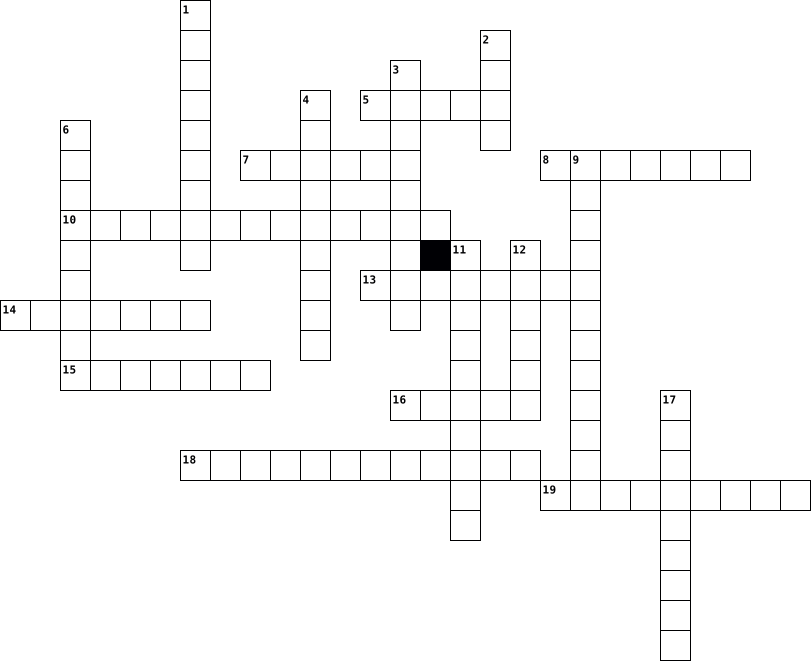
Across
- the beat of blood being pumped by the heart
- to straighten a joint
- to maintain or regain stability
- Playing within the rules w/ a good attitude
- the large muscle of the chest
- to change body parts quickly and accurately
- muscle of the buttocks
- large muscle in front part of upper arm
- integrate movements by different body parts
- Stamina
Down
- equilibrium or balance
- to bend a joint
- Muscle on the front of the thigh
- How physically hard the activity
- muscle on the back of the thigh
- The rate of change over time
- exercise to improve flexibility
- Muscle on the back of the arm
- supply water to maintain a balance of fluids
19 Clues: Stamina • to bend a joint • to straighten a joint • equilibrium or balance • muscle of the buttocks • The rate of change over time • Muscle on the back of the arm • the large muscle of the chest • muscle on the back of the thigh • to maintain or regain stability • exercise to improve flexibility • Muscle on the front of the thigh • How physically hard the activity • ...
Radiological positioning-1 2025-08-21

Across
- Standing or sitting upright.
- Back of the hand or top of the foot.
- plane: At an angle to the above planes, used for specific projections
- plane: Divides the body into left and right portions.
- (axial) plane: Divides body into superior (top) and inferior (bottom) parts.
- Sole of the foot.
- Beam passes at an angle; the side closest to the IR is specified.
- (PA): Beam passes from posterior to anterior.
Down
- Lying on the back.
- Beam passes from one side of the body to the other (e.g., right lateral, left lateral).
- plane: Divides the body into anterior (front) and posterior (back) parts.
- Side lying.
- (AP): Beam passes from anterior to posterior.
- Palm of the hand.
- Lying face down.
- Rotated to an angle, neither fully lateral nor AP/PA.
16 Clues: Side lying. • Lying face down. • Palm of the hand. • Sole of the foot. • Lying on the back. • Standing or sitting upright. • Back of the hand or top of the foot. • (AP): Beam passes from anterior to posterior. • (PA): Beam passes from posterior to anterior. • plane: Divides the body into left and right portions. • Rotated to an angle, neither fully lateral nor AP/PA. • ...
Skills for Thrills 2022-09-06

Across
- maintaining balance while the body is in motion
- information provided to a performer about the quality and/or outcome of the performance
- the ability of the mind to know what is required of the trunk and limbs, and to be conscious of how a movement is being performed
- the ability to coordinate movements with precision
- the method used to perform a skill or movement
- is the quantity of matter of which a body is composed. It is slightly different from weightin that it remains constant, whereas weight is affected by gravity.
- a small part of a skill; for example, the toss is part of the skill of serving in tennis
- develops when two objects rub together
- relates to when certain movements occur within a pattern or the use of the body inrelation to time; the way in which parts of a movement flow together
- in this context refers to a person or an object such as a javelin
- the ability to weigh up game situations and decide which option to take and when to take it
- an extension of intermediate and advanced skill drills; take place within a grid or defined area
- maintaining a balanced position while not moving
- the physical and social environment in which skills are learnt and developed through practice
Down
- our ability to predict whether a particular action will occur
- policies, laws and guidelines that promote fair play and enhance safety in sport
- practice drills designed to allow the individual to learn and perform skills in an environment that ignores outside elements such as the opposition or movement
- the point at which all weight is evenly distributed, enabling the body or object to be balanced
- grounds, equipment and facilities being safe to use
- the ability to control equilibrium while we are stationary or moving
- the quantity of motion that a body displays
- the proficiency with which we execute movement in all types of physical activity
- the parts of the body (or object) in contact with the ground and the area between these supporting parts
- the ability to maintain a current state or position
- the ability to move and control an object
- the ability to weigh up game situations and decide which option to take and when to take it
- the sense that detects movement, body weight and body position
- a state that arises from our senses about the position and balance of our body
28 Clues: develops when two objects rub together • the ability to move and control an object • the quantity of motion that a body displays • the method used to perform a skill or movement • maintaining balance while the body is in motion • maintaining a balanced position while not moving • the ability to coordinate movements with precision • ...
CH.9 Vocabulary test review 2024-03-21

Across
- body plan in which an organism can be divided into two parts that are nearly mirror images of each other
- the organ that exchanges carbon dioxide for oxygen in water
- special tissue that produces milk for young mammals
- an internal rigid framework that supports humans and other animals
- the animal that survives by living inside or on another organism, gets food from the organism, and does not help in the organism’s survival/organism that lives on or in a host organism and gets its food from its host
- a stinging capsular organelle of the tentacle of a cnidarian (such as a box jellyfish or sea anemone) that contains a coiled, hollow, usually barbed, venomous thread that is discharged especially for catching prey and defending against enemies
- an inherited trait that increases an organism’s chances of surviving and reproducing in its environment
- fluid-filled internal cavity surrounded by muscle tissue
- to fasten
- a thin layer of tissue that covers a mollusk’s internal organs
- an animal that generates body heat from the inside
Down
- body plan that can be divided into two parts that are nearly mirror images of each other anywhere through the central axis
- a process in which the body form of an animal changes as it grows from an egg to an adult
- body plan that cannot be divided into any two parts that are nearly mirror images of each other
- the process of shedding and replacing an outer covering
- small, flat, rigid external body covering
- groove along the side of a developing chordate that will develop into other body structures
- a group of organisms with similar traits and able to produce fertile offspring
- an animal that heats its body with heat from the environment
- the flexible rod-shaped structure that supports the body of a developing chordate
- the protective membrane surrounding an embryo
- thick, hard outer covering that protects crabs and other animals
- any bristle or bristle-like appendage, or stiff hair in invertebrates and some plants. The bristles or setae help anchor and control the worm when moving through the soil. The bristles hold a section of the worm firmly into the ground while the other part of the body protrudes forward.
23 Clues: to fasten • small, flat, rigid external body covering • the protective membrane surrounding an embryo • an animal that generates body heat from the inside • special tissue that produces milk for young mammals • the process of shedding and replacing an outer covering • fluid-filled internal cavity surrounded by muscle tissue • ...
Vocab 2025-09-16

Across
- A calculated guess of the repair cost.
- Process of tightening stretched metal back to shape.
- Damage Secondary damage caused by stress and force traveling through the panel.
- Additional charges found after the estimate is written.
- Rate Hourly cost for work done on a vehicle.
- Raised area around a dent caused by displaced metal.
- Remove and Replace Removing a part and installing a new one.
- Loss When repair cost is more than the car’s value.
- The amount a customer pays before insurance covers the rest.
- and Dolly Tools used together to reshape and straighten metal.
- Edge Smooth transition from filler into surrounding paint or bare metal.
Down
- Parts Non-original parts made by a third party.
- Condition when metal becomes thinner and expanded after impact.
- Detailed analysis of the full extent of damage.
- Catalyst mixed with body filler to cause curing.
- Prep Cleaning, sanding, and scuffing before applying filler.
- Remove and Install Taking a part off and putting it back on.
- Parts Original Equipment Manufacturer parts.
- Filler A two-part polyester-based material used to smooth imperfections after metal repair.
- Damage The area that received the initial impact.
- Spot The sunken part of the dent.
- A depression in the surface of a panel caused by impact.
22 Clues: Spot The sunken part of the dent. • A calculated guess of the repair cost. • Rate Hourly cost for work done on a vehicle. • Parts Original Equipment Manufacturer parts. • Parts Non-original parts made by a third party. • Detailed analysis of the full extent of damage. • Catalyst mixed with body filler to cause curing. • Damage The area that received the initial impact. • ...
Health Intro/Chp 1 Vocabulary 2014-07-09

Across
- basic building blocks of the body
- tissues that bind
- free from disease;of sound mind & body
- tissues that line
- physical, mental, social, spiritual oneness
- personal standards of worth
- related organs
Down
- tissues that cause movement
- related tissues
- doing what's right regardless
- constant internal environment
- how the body functions
- tissues that receive and transmit impulses
- structure, form, and arrangement of body parts
- related cells
15 Clues: related cells • related organs • related tissues • tissues that bind • tissues that line • how the body functions • tissues that cause movement • personal standards of worth • doing what's right regardless • constant internal environment • basic building blocks of the body • free from disease;of sound mind & body • tissues that receive and transmit impulses • ...
Parts of the Body 2023-06-12

Across
- Organs for seeing.
- The backbone that runs down your back.
- Joints in the middle of your legs.
- Organ that digests food.
- Organ for thought and controlling the body.
Down
- Organ that detoxifies chemicals and metabolizes drugs.
- Tissues that help your body parts move.
- Organ that pumps blood throughout the body.
- Organs that help you breathe.
- Body parts at the end of our arms with fingers.
10 Clues: Organs for seeing. • Organ that digests food. • Organs that help you breathe. • Joints in the middle of your legs. • The backbone that runs down your back. • Tissues that help your body parts move. • Organ that pumps blood throughout the body. • Organ for thought and controlling the body. • Body parts at the end of our arms with fingers. • ...
Lesson 9 Vocabulary 2024-05-06

Across
- Where unconscious muscle movements are controlled
- Gland that controls many hormones throughout the body
- Neurons that take information to the brain
- The response from the ANS that prepares our body to defend itself
- The visible part of the cerebrum, which is folded
- The system that contains the brain and spinal cord
- Where conscious thoughts and actions are controlled
- The information system that operates using hormones
- The nervous system that operates based on our conscious thoughts
- The nervous system's ability to sense and react to information
- All the systems of the body work together to maintain a stable healthy condition
- Parts of a neuron that gather information into the cell
- Parts of a neuron that transmits information to its terminal
- The empty space between neurons where neurotransmitters sent
- Gland that produces a hormone that speeds up energy consumption
- Chemicals that bring instructions to cells in our bodies
Down
- Fatty tissue that speeds the passing of information in a neuron
- A hormone that works to give us a burst of energy
- Connects the brain to the spinal cord
- Cells that send and receive information in the brain
- Neurons that take information from the brain to parts of the body
- Chemicals that transmit information from one neuron to another
- 24 nerves that come directly from the brain
- Neurons that form a connection between other neurons
- The system that connects the brain to the rest of the body
- 62 nerves that come from the spinal cord
- Glands that produce hormones for our "fight or flight" response
- The nervous system that operates on its own
- Gland that makes stem cells produce a specific kind of leukocyte
29 Clues: Connects the brain to the spinal cord • 62 nerves that come from the spinal cord • Neurons that take information to the brain • 24 nerves that come directly from the brain • The nervous system that operates on its own • A hormone that works to give us a burst of energy • Where unconscious muscle movements are controlled • ...
A+P Terminology Crossword 2022-08-18

Across
- seperated by a dome-shaped muscle, chest area
- is the external covering of the body, synthesizes vitamin D
- returns leaked fluid from blood, cleanses the blood
- the longitudinal plane, divides into left and right
- posterior, towards the back of the body
- heel of the foot
- forearm
- below the head, lower part of the body structure
- the area of the back between the hips and the ribs
Down
- heart and blood cells in cardiovascular system work to circulate resources to all body cells
- the body cavity that is larger than the dorsal cavity
- forehead
- neck area
- base of skull
- farther from the center of the body, think limbs
- posterior knee areas
- closer, in comparison, to another organ to the mid line of the body
- shoulder blade area
- the study of the body and how its parts function
- close to the origin of the body, the center
20 Clues: forearm • forehead • neck area • base of skull • heel of the foot • shoulder blade area • posterior knee areas • posterior, towards the back of the body • close to the origin of the body, the center • seperated by a dome-shaped muscle, chest area • farther from the center of the body, think limbs • the study of the body and how its parts function • ...
Fundamentals of A&P Vocabulary 2025-01-28

Across
- starting point
- farther from the surface
- close to the surface
- close to the middle
- the front side of your body
- means on the same side
- horizontal plane that divides the body into top and bottom parts
- above or higher
- a vertical plane that divides the body into left and right halves
- the point where a muscle attaches to a bone that moves
- tissue that makes your muscles
Down
- back side of your body
- a type of tissue that holds everything together
- tissue that lines and protects organs, skin, and surfaces inside of your body
- a tissue that sends messages between your brain, spinal cord, and rest of your body
- something on both sides of the body
- away from the middle
- something on the opposite side of your body
- below or lower down
- vertical plant dividing the body into front and back sections
20 Clues: starting point • above or higher • close to the middle • below or lower down • close to the surface • away from the middle • back side of your body • means on the same side • farther from the surface • the front side of your body • tissue that makes your muscles • something on both sides of the body • something on the opposite side of your body • ...
Medical Terms 2017-12-12

Across
- what muscle is voluntary
- muscular function
- one of the most type of cancer
- plegia
- prefix meaning difficult
- Skin function
- term for cartilage
- parts of the integumentary system
- surgical removal
- excessive, high
- word for oste
Down
- bones in fingers and toes
- muscle to muscle
- suffix meaning of pain
- skeletal function
- towards the midline of the body
- inflammation of the joint
- the body part is called
- long bone of the body
- how many layers of skin do we have
20 Clues: plegia • Skin function • word for oste • excessive, high • muscle to muscle • surgical removal • muscular function • skeletal function • term for cartilage • long bone of the body • suffix meaning of pain • the body part is called • what muscle is voluntary • prefix meaning difficult • bones in fingers and toes • inflammation of the joint • one of the most type of cancer • ...
anatomical terms crossword 2025-09-22

Across
- below
- further away
- Head moving on neck
- towards back
- frontwards
- shoulder, hip
- Angle is getting larger
- ribs, spine
- Angle to body gets smaller
- close distance
- wrist, ankle
Down
- thumb
- Taking part away from body
- Circular motion
- away from middle
- forearm, head to neck
- skull
- Palms of hands forming bowl shape
- Sole of foot turns laterally
- closer to middle
- wrist, ankle
- Adding parts to body
- above
- elbow, knee finger, etc
- ankle, wrist, etc
25 Clues: thumb • skull • below • above • frontwards • ribs, spine • further away • towards back • wrist, ankle • wrist, ankle • shoulder, hip • close distance • Circular motion • away from middle • closer to middle • ankle, wrist, etc • Head moving on neck • Adding parts to body • forearm, head to neck • Angle is getting larger • elbow, knee finger, etc • Taking part away from body • Angle to body gets smaller • ...
Human anatomy 2026-05-08

Across
- Group of tissues performing specific function
- Community of similar cells
- Moving away from midline
- Filters waste part of urinary system
- Digestive organ
- Rotating forearm palm downward
- Bending forward movement
- Moving toward midline
- Straightening backward movement
- Respiratory system organ
- Moving body part backward
- Toward the head
- Part of muscular tissue
Down
- Plane dividing body into front and back parts
- Plane dividing body into right and left halves
- Rotating forearm palm upward
- Stores urine
- Part of urinary system
- Toward the front
- Part of nervous tissue
20 Clues: Stores urine • Digestive organ • Toward the head • Toward the front • Moving toward midline • Part of urinary system • Part of nervous tissue • Part of muscular tissue • Moving away from midline • Bending forward movement • Respiratory system organ • Moving body part backward • Community of similar cells • Rotating forearm palm upward • Rotating forearm palm downward • ...
Anatomy 2024-07-04

Across
- – The body parts at the end of the arms used for grasping.
- – Blood vessels that carry oxygenated blood away from the heart.
- – The organ that stores urine.
- – The rear part of the human body from the neck to the end of the spine.
- – Organs that allow hearing and balance.
- – Organs used for breathing and oxygen exchange.
- – Organs that filter blood and produce urine.
- – The organ that detoxifies chemicals and metabolizes drugs.
- – The organ used for smelling and breathing.
- – The joints connecting the arms to the torso.
- – The organ that pumps blood through the body.
- – The opening through which food is ingested.
- – The organ involved in filtering blood and immune response.
- – Organs that allow vision.
- – The structures that make up the skeleton and support the body.
- – The bones protecting the chest cavity and organs.
- – The body's largest organ that protects internal organs.
Down
- – The organ that produces insulin and digestive enzymes.
- – The muscle in the mouth used for tasting and speaking.
- – The organ that stores bile produced by the liver.
- – The connections between bones that allow movement.
- – A small organ attached to the large intestine, with a debated function.
- – Fibers that transmit signals between the brain and other parts of the body.
- – The five digits on each hand.
- – The series of vertebrae extending from the skull to the lower back.
- – Blood vessels that carry deoxygenated blood toward the heart.
- – The organ where digestion begins by breaking down food.
- – The front part of the body between the neck and the abdomen.
- – The body parts at the end of the legs used for standing and walking.
- – The tissues that contract to produce movement.
- – The five digits on each foot.
- – Hard structures in the mouth used for chewing.
- – The gland that regulates metabolism.
- – The part of the body connecting the head to the torso.
- – The organ that controls thought, memory, and other functions.
- – The fleshy borders of the mouth.
36 Clues: – Organs that allow vision. • – The organ that stores urine. • – The five digits on each hand. • – The five digits on each foot. • – The fleshy borders of the mouth. • – The gland that regulates metabolism. • – Organs that allow hearing and balance. • – The organ used for smelling and breathing. • – Organs that filter blood and produce urine. • ...
Circulatory System 2025-12-14

Across
- When Sally exercises, her body needs more ___________.
- dioxide _____________-rich blood enters the right side of the heart from the other parts of the body.
- The blood vessels are a set of _________ found inside our body.
- The heart _________ blood to the lungs and other parts of the body.
- Sally's heart rate ______________ when she exercises.
Down
- _________-rich blood leaves the left side of the heart and is transported to the other parts of the body.
- The circulatory system is the body's __________ system.
- The circulatory system transports oxygen, water and _____________ to all parts of the body.
8 Clues: Sally's heart rate ______________ when she exercises. • When Sally exercises, her body needs more ___________. • The circulatory system is the body's __________ system. • The blood vessels are a set of _________ found inside our body. • The heart _________ blood to the lungs and other parts of the body. • ...
Animal Terms 2021-11-02

Across
- an animal with 8 legs and 2 body parts
- birds and mammals are
- an animal with 6 legs and 3 body parts
- animals active during the day are _
- animals that eat meat
- what kind of animal breathes with gills
- what kind of animal has feathers
- what kind of animal has dry skin & scales
- where an animal lives
- animals active during the night are __
- what kind of animal gives its young milk
Down
- herbivores eat ________
- most animals are
- one of the seven large land masses on earth
- animals that are pets or used in agriculture
- what kind of animal lives on land & in water
- animals with a backbone
- animals without a backbone
- eat both plants and meat
19 Clues: most animals are • birds and mammals are • animals that eat meat • where an animal lives • herbivores eat ________ • animals with a backbone • eat both plants and meat • animals without a backbone • what kind of animal has feathers • animals active during the day are _ • an animal with 8 legs and 2 body parts • an animal with 6 legs and 3 body parts • ...
Basic Anatomy Vocabulary 2025-09-24

Across
- of a Muscle The fixed attachment point of a muscle, usually closer to the center of the body.
- Bending a joint to decrease the angle between two bones (ex: bending the elbow).
- Movement of a limb toward the midline of the body (ex: bringing the arm back down).
- The place where two or more bones meet, allowing movement and providing support.
- Farther away from the midline of the body (ex: the arms are lateral to the chest).
- A tough band of tissue that connects one bone to another, providing joint stability.
- Smooth, flexible tissue that covers the ends of bones at joints to reduce friction and absorb shock.
- An injury to a muscle or tendon, usually from overstretching or overuse.
- The study of how the body parts work and carry out their functions.
- An injury to a ligament, often caused by overstretching or tearing.
Down
- Closer to the midline of the body (ex: the nose is medial to the ears).
- of a Muscle The movable attachment point of a muscle, usually farther from the center of the body.
- A position toward the back of the body (ex: the spine is posterior to the sternum).
- The study of the structure of the human body and its parts.
- Movement of a limb away from the midline of the body (ex: lifting the arm out to the side).
- A position toward the front of the body (ex: the chest is anterior to the spine).
- Straightening a joint to increase the angle between two bones (ex: straightening the knee).
- A small fluid-filled sac that reduces friction between moving tissues like tendons and bones.
- Crescent-shaped cartilage in the knee joint that cushions and stabilizes movement
- A strong cord of tissue that connects muscle to bone.
20 Clues: A strong cord of tissue that connects muscle to bone. • The study of the structure of the human body and its parts. • The study of how the body parts work and carry out their functions. • An injury to a ligament, often caused by overstretching or tearing. • Closer to the midline of the body (ex: the nose is medial to the ears). • ...
Vocab Test Re-Learn 2026-02-03

Across
- or hormone system: a group of ductless glands that release hormones into the body
- animal with single-compartment stomach
- compound milk sugar
- muscle:muscle that can be controlled by animals to do things such as walk and eat food
- woody fiber parts that make up plant cell walls
- system: system that removes waste materials from the blood
- system: the system that provides food and oxygen to the cells in the body and filters waste materials from the body
- nutrient made up of amino acids and essential for maintenance, growth, and reproduction
- responsible for the breakdown of cellulose in feed consumed
- nervous system: system that controls the functions of the body tissues, including the organs
- substance used to help prevent or control infections and diseases of animals
- simple milk sugar
- system: system that provides food for the body of the animal and for all its systems
- starches and sugars that provide energy in the diet
- the amount of feed fed in one day
- that regulates the activities of the body
- major energy source in livestock feeds
Down
- feed high in total digestible nutrients and low in fiber.
- system: system that provides oxygen to the blood of the animal
- muscle: muscle that operates in the body without control by the will of the animal
- the structure and arrangement of the various parts of the body of an animal or plants
- system: bones joined together by cartilage and ligaments
- compound cane sugar
- simple fruit sugar
- nervous system: the brain and spinal cord
- chemical essential for normal body functions
- an animal that has a stomach with 4 digestive chambers
- system: the lean meat of an animal
- nutrients that have 2.25 times as much energy as carbohydrates
- grass, hay or silage and other feeds high in fiber and low in TDN
- total digestible nutrients, the measure of digestibility of feed
- the process whereby all body parts recieve materials needed for function, growth, and renewal
- Matter: material left after all water is removed from a feed material.
- disease:condition resulting from improper levels or balances of nutrients
- Additive: a nonnutritive substance added to feed to improve growth, increase feed efficiency or maintain health.
35 Clues: simple milk sugar • simple fruit sugar • compound milk sugar • compound cane sugar • the amount of feed fed in one day • system: the lean meat of an animal • animal with single-compartment stomach • major energy source in livestock feeds • nervous system: the brain and spinal cord • that regulates the activities of the body • chemical essential for normal body functions • ...
Drugs 2013-10-27

Across
- System of rules
- A disease which can be caused by smoking which can affect the lungs, throat, tongue, esophagus, stomach and other parts
- A performing enhancing drug often used by body builders
- Parts of the body that are affected by smoking and other drugs
- Stimulants that are illegal but can be prescribed by a doctor to treat ADHD
- Sniffing drugs, usually through a tube
- An intoxicating liquid used in drinks
- A crime committed of driving and drinking
Down
- A drug also known as marijuana
- The proper name for this drug is MDMA
- A drug known as Ice in Australia
- Pupil dilation, reduced or increased appetite, and wakefulness.
- Inhaling a cigarette
- A way of putting drugs into the body
- Smoking, drinking and drugs becomes this after constant use
- A substance which has a physiological effect when ingested or otherwise introduced into the body
16 Clues: System of rules • Inhaling a cigarette • A drug also known as marijuana • A drug known as Ice in Australia • A way of putting drugs into the body • The proper name for this drug is MDMA • An intoxicating liquid used in drinks • Sniffing drugs, usually through a tube • A crime committed of driving and drinking • A performing enhancing drug often used by body builders • ...
Chapter 5 2025-09-25

Across
- Parts of the body that lie closer to the midline; also called inner
- The main part of a term that contains the primary meaning
- Closer to or on the skin.
- lines intersect at the umbilicus, dividing the abdomen into four
- The straightening of a joint.
- The forward-facing part of the hand in the anatomic position.
- Farther from the trunk or nearer to the free end of the extremity.
- Describes the sections of the abdominal cavity, in which two
- Lying face down.
- The part of a term that comes after the word root, at the end of the
- The back surface of the body; the side away from you in the
- The front surface of the body; the side facing you in the standard
- Below a body part or nearer to the feet.
- The anterior surface of the body.
- A body part or condition that appears on both sides of the
- Lying face up.
- Parts of the body that lie farther from the midline; also called outer
Down
- The vowel used to combine two word roots or a word root
- Part of a term that appears before a word root, changing the
- The posterior surface of the body, including the back of the hand.
- Farther inside the body and away from the skin.
- The bottom surface of the foot.
- Motion of a limb away from the midline.
- Above a body part or nearer to the head.
- The pointed extremity of a conical structure.
- The bending of a joint.
- Closer to the trunk.
- An inclined position in which the head of the bed is raised.
- Motion of a limb toward the midline.
29 Clues: Lying face up. • Lying face down. • Closer to the trunk. • The bending of a joint. • Closer to or on the skin. • The straightening of a joint. • The bottom surface of the foot. • The anterior surface of the body. • Motion of a limb toward the midline. • Motion of a limb away from the midline. • Above a body part or nearer to the head. • Below a body part or nearer to the feet. • ...
Marine biology 2026-03-23

Across
- The flexible rubbery stuff in your nose and ears that makes up a sharks whole Skeleton
- A type of reproduction where a baby grows right out of the parents side like a branch
- A circular body plan that looks the same all the way around like a pie or a wheel
- A skeleton that is inside the body covered by muscle and skin
- Tough waterproof eggs that allow animals to lay them on land without drying out
- A hard suit of armor on the outside of the body
- A body that has matching left and right sides like a human or a butterfly
- Cold-blooded animals that have to sit in the sun to get warm
Down
- An internal balloon that fish inflate or deflate to float at different depths
- An animal that has both male and female body parts for making babies
- The parts of a mother mammals body that produce milk for her babies
- A bell-shaped body that swims around with its mouth facing down like a jellyfish
- An animal that has a backbone
- Anything that lives on the very bottom of the ocean or a lake
- A tube-shaped body that stays stuck to one spot with its mouth facing up like a sea anemone
- Warm-blooded animals that create their own body heat from the inside
- An animal that does not have a backbone
- A special organ that passes food and oxygen from a mother to her baby before it is born
- Vascular System A system of water-filled tubes that starfish use to move their feet
- shed an old tight shell or skin so the animal has room to grow bigger
- A body shape that is irregular and cannot be divided into equal halves
21 Clues: An animal that has a backbone • An animal that does not have a backbone • A hard suit of armor on the outside of the body • Cold-blooded animals that have to sit in the sun to get warm • Anything that lives on the very bottom of the ocean or a lake • A skeleton that is inside the body covered by muscle and skin • ...
Chapter 1 2013-07-31

Across
- The study of the processes and functions of the body involved in supporting life
- Tissue that coordinates and regulates body activity
- Type of tissue that has the ability to provide movement through contraction
- Type of connective tissue that is the packing material among glands, muscles, and nerves; attaches the skin to the underlying tissues; and supplies nourishment because of its high vascularity
- Type of anatomy that is the study of the structures of a particular area of the body
Down
- Type of anatomy that is the study of the structure of a particular body system
- Type of tissue that covers and protects the surface of the body and its parts
- Type of tissue that supports and holds together the body and its parts, transports substances through the body, and protects the body from foreign substances
- Type of connective tissue that is a source of fuel, helps to insulate and pad organs and tissues, and stores fat-soluble vitamins
- Type of anatomy that is the study of body structures visible to the naked eye
- The study of the structures of the body and the relationship of its parts
11 Clues: Tissue that coordinates and regulates body activity • The study of the structures of the body and the relationship of its parts • Type of tissue that has the ability to provide movement through contraction • Type of tissue that covers and protects the surface of the body and its parts • ...
Medical Terms 2017-12-12

Across
- excessive, high
- muscular function
- one of the most type of cancer
- suffix meaning of pain
- term for cartilage
- towards the midline of the body
- long bone of the body
- how many layers of skin do we have
- bones in fingers and toes
- inflammation of the joint
- prefix meaning difficult
Down
- word for oste
- what muscle is voluntary
- surgical removal
- Skin function
- the body part is called
- plegia
- muscle to muscle
- skeletal function
- parts of the integumentary system
20 Clues: plegia • word for oste • Skin function • excessive, high • surgical removal • muscle to muscle • muscular function • skeletal function • term for cartilage • long bone of the body • suffix meaning of pain • the body part is called • what muscle is voluntary • prefix meaning difficult • bones in fingers and toes • inflammation of the joint • one of the most type of cancer • ...
Medical Terms 2017-12-12

Across
- how many layers of skin do we have
- one of the most type of cancer
- what muscle is voluntary
- muscular function
- inflammation of the joint
- towards the midline of the body
- term for cartilage
- parts of the integumentary system
- muscle to muscle
Down
- surgical removal
- bones in fingers and toes
- skeletal function
- excessive, high
- the body part is called
- Skin function
- plegia
- word for oste
- prefix meaning difficult
- long bone of the body
- suffix meaning of pain
20 Clues: plegia • Skin function • word for oste • excessive, high • surgical removal • muscle to muscle • skeletal function • muscular function • term for cartilage • long bone of the body • suffix meaning of pain • the body part is called • what muscle is voluntary • prefix meaning difficult • bones in fingers and toes • inflammation of the joint • one of the most type of cancer • ...
Medical Terms 2017-12-12

Across
- muscular function
- what muscle is voluntary
- term for cartilage
- plegia
- suffix meaning of pain
- skeletal function
- Skin function
- excessive, high
Down
- word for oste
- prefix meaning difficult
- one of the most type of cancer
- inflammation of the joint
- the body part is called
- parts of the integumentary system
- bones in fingers and toes
- muscle to muscle
- towards the midline of the body
- long bone of the body
- surgical removal
- how many layers of skin do we have
20 Clues: plegia • word for oste • Skin function • excessive, high • muscle to muscle • surgical removal • muscular function • skeletal function • term for cartilage • long bone of the body • suffix meaning of pain • the body part is called • prefix meaning difficult • what muscle is voluntary • inflammation of the joint • bones in fingers and toes • one of the most type of cancer • ...
Beyond Medical 407-261-1001 2025-01-29

Across
- Health services that includes prevention, wellness, and treatment for common illnesses
- The treatment of disease or injury by physical methods such as exercise rather than by drugs or surgery.
- Act or process of nourishing or being nourished
- the specific, normal, and proper activity or role that a particular body part, organ, or system performs within a living organism
- Non-invasive, painless, and highly effective way to promote healing and stimulate cellular tissue
- A slight misalignment of the vertebrae, regarded in chiropractic medicine as the cause of many health problems
- A band or bundle of fibrous tissue in a body that has the ability to contract, producing movement in or maintaining the position of parts of the body
- Advanced chiropractic technology that scans your spine and delivers a computerized image of the stress and tension to your nervous system.
- The branch of medicine dealing with children and their diseases
- One of the sections of bone or cartilage that make up the spinal column
Down
- Health profession concerned with the diagnosis, treatment and prevention of mechanical disorders of the musculoskeletal system, and the effects of these disorders on the function of the nervous system and general health
- Position of one part of the body with relation to other parts and the general way of holding the body
- The act of practicing healthy habits on a daily basis to attain better physical and mental health outcomes, so that instead of just surviving, you’re thriving
- Technique of inserting thin needles through the skin at specific points on the body to control pain and other symptoms
- treatment of the whole person, taking into account mental and social factors, rather than just the symptoms of an illness
- Condition of being sound in body, mind or spirit; especially: freedom from disease or illness
- Arise from the spinal cord and passes to various parts of the body and of which there are normally 31 pairs in human beings
- before birth; during or relating to pregnancy
- Imaging that creates pictures of the inside of your body
19 Clues: before birth; during or relating to pregnancy • Act or process of nourishing or being nourished • Imaging that creates pictures of the inside of your body • The branch of medicine dealing with children and their diseases • One of the sections of bone or cartilage that make up the spinal column • ...