
chemical reaction Crossword Puzzles
Chapter 9,10 & 11 2015-03-06

Across
- an ionic compound that produces hydroxide ions when dissolved in water
- compound that contains one or more hydrogen atoms and produces hydrogen ions (H+) when dissolved in water
- formula basic ratio that gives the lowest whole-number ratio of the atoms of the elements in a compound
- of definite proportions samples of any chemical compound, the masses of the elements are always in the same proportions
- particle the smallest unit into which a substance can be broken down without a change in composition, usually atoms, molecules, or ions
- the amount of a substance that contains 6.02 × 10²³ representative particles of that substance
- equation a representation of a chemical reaction; the formulas of the reactants re connected by an arrow with the formulas of the products
- mass mass of a mole of an element
- of multiple proportions the different masses of one element that combine with the same mass of the other element are in the ratio of small whole numbers
- reaction a chemical change in which an element or a compound reacts with oxygen, often producing energy in the form of heat and light
- reaction a chemical change in which a single compound breaks down into two or more simpler products
- replacement reaction a chemical change in which one element replaces a second element in a compound
- equation a chemical equation that does not indicate the relative amounts of the reactants and products
- reaction a chemical change in which two or more substances react to form a single new substance; also called a synthesis reaction
- composition the percent by mass of each element in a compound
- series a list of elements in order of decreasing activity; the activity series of halogens is Fl, Cl, Br, I
Down
- replacement reaction a chemical change involving an exchange of positive ions between two compounds
- a chemical equation in which mass is conserved; each side of the equation has the same number of atoms of each element
- ions a tightly bound group of atoms that behaves as a unit and has a positive or negative charge
- ionic compounds an equation for a reaction in solution that shows only those particles that are directly involved in the chemical change
- ion an equation for a reaction in solution that shows only those particles that are directly involved in the chemical change
- volume the volume occupied by 1 mole of a gas at standard temperature and pressure
- a substance that speeds up the reaction but is not used up in the reaction
- a small whole number that appears in front of a formula in a balanced chemical equation
- ions consist of a single atom with a positive or negative charge resulting from the loss or gain of one or more valence electrons, respectively
- the conditions under which the volume of a gas is usually measured; standard temperature is 0°C, and standard pressure is 101.3 kPa, or 1 atmosphere (atm)
- ionic equation an equation that shows dissolved ionic compounds as dissociated free ions
- number The number of representative particles in a mole, 6.02 × 10²³
- compound composed of two elements and can be either ionic or molecular
29 Clues: mass mass of a mole of an element • composition the percent by mass of each element in a compound • number The number of representative particles in a mole, 6.02 × 10²³ • an ionic compound that produces hydroxide ions when dissolved in water • compound composed of two elements and can be either ionic or molecular • ...
Separates only 2024-07-10

Across
- What can Avogadro's law be used to calculate.
- The symbol for moles.
- The number for the molar volume of gas.
- Calculated by: (actual yield of product/theoretical yield of product)x100
- The name given to the volume occupied by one mole of any gas at room temperature and pressure.
- The name of the product wanted in a chemical reaction.
- Products that are not desired from a chemical reaction.
Down
- Calculated by: (total Mr of desired product/total Mr of all reactants)x100
- The maximum possible yield of a product from a chemical reaction.
- Which law states that when temperature and pressure stay the same equal volumes of different gases contain an equal number of molecules.
- The type of reaction that occurs if yield is less than 100%.
- The amount of product made in a chemical reaction.
- Some reactants undergo these and so do not create the desired product.
- Atom economy is 100% when ____ reactants end up in the desired product.
- The number of products made in a chemical reaction where atom economy is 100%.
- What is not gained or lost in a chemical reaction.
16 Clues: The symbol for moles. • The number for the molar volume of gas. • What can Avogadro's law be used to calculate. • The amount of product made in a chemical reaction. • What is not gained or lost in a chemical reaction. • The name of the product wanted in a chemical reaction. • Products that are not desired from a chemical reaction. • ...
YEAR 7 FINAL VOCABULARY 2025-12-04

Across
- Substances formed during a chemical reaction.
- Type of change where no new substance is formed.
- A solid that forms from mixing two liquids.
- Physical process where sugar mixes into water.
- Two or more atoms chemically joined.
- The quantity that rises when water absorbs energy.
- A physical change of state from solid to liquid.
- The reverse process of photosynthesis.
- Reaction that produces heat and light.
- Liquid turning into gas; requires energy.
- Evidence of gas being released in a reaction.
Down
- A chemical change where iron reacts with oxygen.
- Substances found on the left side of a chemical equation.
- Substance represented by the formula C₆H₁₂O₆.
- Gas changing into a liquid; an exothermic process.
- A reaction that takes in energy from the surroundings.
- Gas that reacts with magnesium to produce a bright white light.
- Type of change that forms a new substance.
- A reaction that releases energy to the surroundings.
- A substance made from two or more elements bonded.
20 Clues: Two or more atoms chemically joined. • The reverse process of photosynthesis. • Reaction that produces heat and light. • Liquid turning into gas; requires energy. • Type of change that forms a new substance. • A solid that forms from mixing two liquids. • Substances formed during a chemical reaction. • Substance represented by the formula C₆H₁₂O₆. • ...
Chemistry Puzzle 2026-04-27

Across
- – A chemical that reacts with a base to make salt and water; sour taste.
- – A substance that speeds up a reaction without being used up.
- – Negatively charged ions that gained electrons.
- – Positively charged ions that lost electrons.
- – A chemical that reacts with an acid to make salt and water; bitter taste.
- – Two substances join to make one compound.
- – A substance that can wear away materials.
- – A reaction that slowly damages metal.
- – When old bonds break and new bonds form.
- – A short-lived unstable stage during a reaction.
- – The minimum energy needed to start a reaction.
Down
- – An enzyme in saliva that breaks starch into sugar.
- – Energy stored in chemical bonds.
- – A chemical that can harm people, property, or the environment.
- – An enzyme in the liver that breaks down hydrogen peroxide.
- – One compound breaks into simpler substances.
- – A base that dissolves in water.
- – A solution where water is the solvent.
- – A reaction with oxygen that releases heat.
- – A molecule made of two atoms.
20 Clues: – A molecule made of two atoms. • – A base that dissolves in water. • – Energy stored in chemical bonds. • – A reaction that slowly damages metal. • – A solution where water is the solvent. • – When old bonds break and new bonds form. • – Two substances join to make one compound. • – A substance that can wear away materials. • – A reaction with oxygen that releases heat. • ...
Bonus point Crossword Puzzle 2026-04-28

Across
- the amount of solute in mol divided solute in L
- A reaction that releases heat to the surroundings.
- The calculation of reactants and products in chemical reactions based on the conservation of mass.
- The point at which a solution can no longer dissolve additional solute at a given temperature.
- A solid that forms and settles out of a liquid mixture during a chemical reaction.
- A group of two or more atoms bonded together, representing the smallest fundamental unit of a chemical compound.
- A mixture in which one substance, consisting of microscopically dispersed insoluble particles, is suspended throughout another substance
- An atom or molecule that has a net electric charge due to the loss or gain of one or more electrons.
Down
- A state in a chemical reaction where the rates of the forward and reverse reactions are equal.
- A substance that increases the rate of a chemical reaction without being consumed in the process.
- A substance that donates protons (H+) in a chemical reaction.
- A substance that donates protons (H+) in a chemical reaction.
- The amount of a substance in a given volume of solution.
- A substance that dissolves a solute, resulting in a solution.
- The minimum energy required for a chemical reaction to occur.
- A process that involves the loss of electrons or an increase in oxidation state by a molecule, atom, or ion.
- A scale measuring how acidic or basic an object is
- A substance that is dissolved in a solvent to form a solution.
- A substance formed when two or more different types of atoms bond together.
- A reaction that absorbs heat from the surroundings.
20 Clues: the amount of solute in mol divided solute in L • A reaction that releases heat to the surroundings. • A scale measuring how acidic or basic an object is • A reaction that absorbs heat from the surroundings. • The amount of a substance in a given volume of solution. • A substance that donates protons (H+) in a chemical reaction. • ...
chemicals: 2016-10-23

Across
- a green chemical found in the chloroplasts of green plants, needed to carry out photosynthesis
- a reaction of acid with a base, forming salt and water
- single celled organisms that live in water
- a process in which chemicals move
- chemicals that take part in a chemical reaction
- a green coating of copper hydroxide that is produced when copper reacts with moisture, carbon dioxide and oxygen in the atmosphere
- hydrated iron (III) oxide
- a biological catalyst that speeds up reactions
Down
- endothermic reaction that takes place in green plants. uses energy from sunlight to combine water and carbon dioxide and produces glucose and oxygen gas.
- a simple sugar formed by photosynthesis
- highly combustible chemicals
- a rapid reaction with oxygen that releases energy in the form of heat and/ or light
- a chemical reaction that absorbs energy
- chemicals produced in a chemical reaction
- a term commonly used for sodium chloride
- a chemical reaction that releases energy
- a way of protecting aluminium from corrosion, by deliberately creating a layer of aluminium oxide over it
17 Clues: hydrated iron (III) oxide • highly combustible chemicals • a process in which chemicals move • a simple sugar formed by photosynthesis • a chemical reaction that absorbs energy • a term commonly used for sodium chloride • a chemical reaction that releases energy • chemicals produced in a chemical reaction • single celled organisms that live in water • ...
chemical interactions 2022-03-21

Across
- the substances you have at the beginning.
- a reaction that releases energy in the form of heat.
- use chemical formulas and other symbols instead of words to summarize reaction.
- a material that used to work by preventing reactants from coming together.
- the study of matter and how matter changes
- the amount of a substance in a given volume
- when two or more elements or compounds combine to make more complex substances.
- a solid that forms from solution during a chemical reaction
- a characteristic of a substance that can be observed without changing the substance into another substance.
- the cells in your body contain biological catalysts.
- matter can enter from or escape to surroundings.
- can be described in the terms of two kinds of properties, physical and chemical.
- when the reaction is complete, you have new substances.
Down
- the minimum amount of energy needed to start a chemical reaction.
- during a chemical reaction, matter is not created or destroyed.
- any change that alters the form or appearance of a substance but that does not make the substance into another substance.
- a reaction in which energy is absorbed
- when two elements in different compounds trade places.
- the result of fire
- matter is not allowed to enter or leave.
- a characteristic of a substance that describes its ability to change into other substances.
- a material that increases the rate of a reaction by lowering the activation energy.
- a number placed in front of a chemical formula in am equation
- breaks down compounds into simpler products.
- A change in matter that produces one or more new substances
- a material that releases energy when it burns
26 Clues: the result of fire • a reaction in which energy is absorbed • matter is not allowed to enter or leave. • the substances you have at the beginning. • the study of matter and how matter changes • the amount of a substance in a given volume • breaks down compounds into simpler products. • a material that releases energy when it burns • ...
Chemistry 2023-11-14

Across
- _____model is an early atomic model depicting electrons orbiting the nucleus
- resulting substance(s) formed in a chemical reaction
- ________ chemical reaction absorbs heat from its surroundings during a chemical reaction
- neutrally charged subatomic particle found in the nucleus
- numeric factor indicating the quantity of a substance in a chemical reaction
- positively charged particle found in the nucleus
- _________Chemical reaction releases heat to its surroundings during a reaction
- basic unit of matter, consisting of protons neutrons and electrons
Down
- small number indicating the number of atoms in a molecule
- rapid reaction with oxygen which produces water and Carbon dioxide
- combination of substances to form a more complex product
- negatively charged particle found in the electron cloud
- substance entering a chemical reaction (Left side)
- breakdown of a compound into simpler substances
14 Clues: breakdown of a compound into simpler substances • positively charged particle found in the nucleus • substance entering a chemical reaction (Left side) • resulting substance(s) formed in a chemical reaction • negatively charged particle found in the electron cloud • combination of substances to form a more complex product • ...
Chemical Reactions 2015-12-06

Across
- Reaction that involves a substance rapidly combining with oxygen, usually accompanied by a flame; burning
- Chemical compound with a pH > 7 that tastes bitter and is soapy to touch
- Shorthand way of describing the ratio of elements in a compound or molecule
- Solution formed by soluble bases
- Reaction that involves the breakdown of a compound into simpler substances; energy in the form of heat or electricity is required to break the bonds in the reactants
- Shorthand way of showing what happens to the reactants and products in a chemical reaction
- Insoluble compound formed in a precipitation reaction
- When solid products ‘fall out’ of solution of ionic substances
- When an acid and a base react to neutralise each other and form a salt and water
- Chemical substance formed in a reaction between an acid and a base, usually a metal and non-metal combination
Down
- Substance that changes colour in the presence of an acid or base
- Shorthand way of describing a chemical reaction in words; reactants are on one side of the equation and products on the other
- Compound of carbon and hydrogen
- Scientific law that states the total mass of the reactants in a chemical reaction always equals the total mass of the products
- Base that dissolves in water
- Chemical compound with a pH < 7 that tastes sour and contains at least one hydrogen atom
- Swapping of ions between two salts in solution
- Substance that is neither an acid nor a base; pH = 7
- Reaction that involves the oxidation of a substance, usually a metal
- Scale that indicates the relative acidity or alkalinity of a solution; ranges from 0 to 14
20 Clues: Base that dissolves in water • Compound of carbon and hydrogen • Solution formed by soluble bases • Swapping of ions between two salts in solution • Substance that is neither an acid nor a base; pH = 7 • Insoluble compound formed in a precipitation reaction • When solid products ‘fall out’ of solution of ionic substances • ...
Science Key Words 2022-12-06

Across
- Information without numbers or measures
- The organelle where photosynthesis occurs
- chemical reaction which frees energy
- The study of plants
- the results of a chemical reaction
- The organelle where respiration occurs
- A chemical reaction which makes glucose
- A simple sugar which living things use for energy
- A living thing which can make its own food
- The study of animals
Down
- A protist which can photosynthesize
- Information with numbers or measures
- the ingredients of a chemical reaction
- The comparison of Volume or Area to Mass
- A living thing which must eat others for energy
- The three elements which all life is made of
- Complex sugar which is comprised of many glucoses
- The study of the ecosystems
- The study of life
19 Clues: The study of life • The study of plants • The study of animals • The study of the ecosystems • the results of a chemical reaction • A protist which can photosynthesize • Information with numbers or measures • chemical reaction which frees energy • the ingredients of a chemical reaction • The organelle where respiration occurs • Information without numbers or measures • ...
Lesson 4 2025-10-27

Across
- term that means potential for hydrogen
- polymer that is hard to break and can be recycled
- a base that neutralizes the acid upsetting your stomach
- when heat energy is absorbed in a chemical reaction
- substances you start with in a chemical reaction
- reaction when two or more substances interact to form new molecules
Down
- substance that speeds up a chemical reaction
- reaction that doesn't change the molecules, but can change appearance or state
- solids with a regular, repeating arrangement of atoms
- molecules arranged in long chains of repeating small molecules
- valuable crystals used to make jewelry
- substance that donates hydrogen ions, tastes sour and conducts electricity
- when heat energy is released in a chemical reaction
- chemical opposite of an acid
14 Clues: chemical opposite of an acid • term that means potential for hydrogen • valuable crystals used to make jewelry • substance that speeds up a chemical reaction • substances you start with in a chemical reaction • polymer that is hard to break and can be recycled • when heat energy is absorbed in a chemical reaction • when heat energy is released in a chemical reaction • ...
Exam Review 2024-05-24

Across
- Percent
- Nickel
- Chemical
- Aluminum
- Goggles
- Keq
- PercentError
- Scale
- Tin
Down
- Equilibrium
- Lead
- BunsenBurner
- BeakerTongs
- Data
- Metal
- Reaction
16 Clues: Keq • Tin • Lead • Data • Metal • Scale • Nickel • Percent • Goggles • Chemical • Aluminum • Reaction • Equilibrium • BeakerTongs • BunsenBurner • PercentError
Brandon De la Cruz 2020-01-17

Across
- Complex the structure that results in the maximum energy point along the reaction path
- a substance obtained from another substance through chemical change
- a substance that speeds up a chemical reaction, but is not consumed by the reaction; hence a catalyst can be recovered chemically unchanged at the end of the reaction it has been used to speed up
- thermodynamic function that describes the randomness and disorder of molecules based on the number of different arrangements available to them in a given system or reaction
- Chatelier's Principle if the equilibrium of a system is disturbed by a change in one or more of the determining factors (as temperature, pressure, or concentration) the system tends to adjust itself to a new equilibrium by counteracting as far as possible the effect of the change
- is the ratio of solute in a solution to either solvent or total solution
- a chemical property referring to the ability for a given substance, the solute, to dissolve in a solvent. It is measured in terms of the maximum amount of solute dissolved in a solvent at equilibrium
- he loss of electrons during a reaction by a molecule, atom or ion
- a solution that can resist pH change upon the addition of an acidic or basic components
- when two or more chemicals combine and form a more complex product
- a force exerted by the substance per unit area on another substance
Down
- any substance that undergoes a chemical change in a given reaction
- Energy the minimum quantity of energy which the reacting species must possess in order to undergo a specified reaction
- a chemical reaction that occurs between a fuel and an oxidizing agent that produces energy, usually in the form of heat and light It is also known as burning
- is the property of matter which reflects the quantity of energy of motion of the component particles
- Chemical Reaction Reversible reactions will reach an equilibrium point where the concentrations of the reactants and products will no longer change
- It is often expressed in terms of either the concentration (amount per unit volume) of a product that is formed in a unit of time or the concentration of a reactant that is consumed in a unit of time
- Electron outer shell electron that is associated with an atom, and that can participate in the formation of a chemical bond if the outer shell is not closed; in a single covalent bond, both atoms in the bond contribute one valence electron in order to form a shared pair
- a type of chemical reaction in which a single compound breaks down into two or more elements or new compounds
- It is the sum of the internal energy added to the product of the pressure and volume of the system
- Replacement Reaction a type of chemical reaction where an element reacts with a compound and takes the place of another element in that compound
- a substance that decreases the rate of, or prevents, a chemical reaction
- Area how much exposed area a solid object has, expressed in square units
23 Clues: he loss of electrons during a reaction by a molecule, atom or ion • any substance that undergoes a chemical change in a given reaction • when two or more chemicals combine and form a more complex product • a substance obtained from another substance through chemical change • a force exerted by the substance per unit area on another substance • ...
YEAR 8 CHEMISTRY FINAL VOCABULARY 2025-12-04

Across
- Substances formed during a chemical reaction.
- Type of change where no new substance is formed.
- A solid that forms from mixing two liquids.
- Physical process where sugar mixes into water.
- Two or more atoms chemically joined.
- The quantity that rises when water absorbs energy.
- A physical change of state from solid to liquid.
- The reverse process of photosynthesis.
- Reaction that produces heat and light.
- Liquid turning into gas; requires energy.
- Evidence of gas being released in a reaction.
Down
- A chemical change where iron reacts with oxygen.
- Substances found on the left side of a chemical equation.
- Substance represented by the formula C₆H₁₂O₆.
- Gas changing into a liquid; an exothermic process.
- A reaction that takes in energy from the surroundings.
- Gas that reacts with magnesium to produce a bright white light.
- Type of change that forms a new substance.
- A reaction that releases energy to the surroundings.
- A substance made from two or more elements bonded.
20 Clues: Two or more atoms chemically joined. • The reverse process of photosynthesis. • Reaction that produces heat and light. • Liquid turning into gas; requires energy. • Type of change that forms a new substance. • A solid that forms from mixing two liquids. • Substances formed during a chemical reaction. • Substance represented by the formula C₆H₁₂O₆. • ...
Chemistry Bonus 2026-04-28

Across
- horizontal rows on the periodic table
- movement of gas molecules from high to low concentration
- boiling point of water at sea level
- pressure exerted on surface by weight of gases in Earth atmosphere
- device measuring heat absorption or release in chemical reaction
- minimum amount of energy applied to initiate chemical reaction
- process to figure out the concentration of an unknown substance
- speeds up chemical reaction without going under one itself
- total amount of energy
- has one valence electron
Down
- the point when substance exist at a solid, liquid, and a gas
- One element swaps places with another element
- solid changing directly into a gas
- this reaction ends in a salt and water
- Evidence a chemical reaction has occurred
- what law is an example of a can exploding from heat?
- this law states that volume of gas is inversely proportional to pressure
- 273.15K is the standard in Gas Laws
- double displacement reactions produce ionic compounds that are…
- All gases have the same … energy
20 Clues: total amount of energy • has one valence electron • All gases have the same … energy • solid changing directly into a gas • boiling point of water at sea level • 273.15K is the standard in Gas Laws • horizontal rows on the periodic table • this reaction ends in a salt and water • Evidence a chemical reaction has occurred • One element swaps places with another element • ...
Chemical Reaction - RMS 2024-10-17

Across
- Something that is made of all the same atoms or group of atoms.
- To change the order or position of something.
- An ending substance that is part of a chemical reaction.
- Mixing the substances to make elephant's toothpaste was an example of a ______ change.
- A process in which atoms rearrange to form new substances (two words)
- The name of the town in Amplify with the reddish-brown water
- An object,diagram, or computer program that helps us understand something by making it simpler or easier to see.
Down
- A starting substance that is part of a chemical reaction.
- The class demonstration with vinegar and baking soda was an example of a chemical change because a _____ was produced.
- Another name for iron oxide
- Something that can be observed about a substance such as its color, smell, or boiling point.
- Two or more atoms bonded (connected) together.
- The relative size of things
- The tiny piece that all matter, all the stuff in the world, is made of.
14 Clues: Another name for iron oxide • The relative size of things • To change the order or position of something. • Two or more atoms bonded (connected) together. • An ending substance that is part of a chemical reaction. • A starting substance that is part of a chemical reaction. • The name of the town in Amplify with the reddish-brown water • ...
Types of Chemical Reactions by Levin 2024-04-30

Across
- A type of reaction involving both oxidation and reduction processes.
- Chemical decomposition produced by passing an electric current through a solution.
- The breakdown of a compound into simpler substances.
- A substance composed of two or more elements chemically combined.
- A reaction that absorbs heat energy from its surroundings.
- A reaction that releases heat energy to its surroundings.
- Substances initially present in a chemical reaction.
- The loss of electrons or increase in oxidation state during a reaction.
- The gain of electrons or decrease in oxidation state during a reaction.
- Relating to heat or energy transfer in a system.
Down
- Substances formed as a result of a chemical reaction.
- A reaction where one element replaces another in a compound.
- When two or more substances unite to form a single product.
- A solid formed in a solution during a chemical reaction.
- A compound produced by the reaction of calcium oxide with water.
15 Clues: Relating to heat or energy transfer in a system. • The breakdown of a compound into simpler substances. • Substances initially present in a chemical reaction. • Substances formed as a result of a chemical reaction. • A solid formed in a solution during a chemical reaction. • A reaction that releases heat energy to its surroundings. • ...
Chapter 16/17 Vocabulary Review 2015-12-15

Across
- a type of protein used to speed up chemical reactions in living things
- a bond that transfers one or more electrons from one atom to another, resulting in attraction between oppositely charged ions.
- a fat in which the carbon atoms are surrounded by as many hydrogen atoms as possible
- a representation of a compound that includes the symbols and ratios of atoms of each element in the compound
- a compound that is composed of long chains of smaller molecules
- a group of energy-rich compounds that are made from carbon, hydrogen, and oxygen and that include fats, waxes, and oils
- a chemical reaction in which one element replaces a similar element in a compound
- the electrons in the highest, unfilled energy level of an atom
- a fat that has fewer hydrogen atoms because double bonds exist among some of the carbon atoms
- a branch of chemistry that specializes in the study of carbon compounds, also known as organic molecules
- a chemical reaction in which ions from two compounds in a solution exchange places to produce two new compounds
- a type of nucleic acid that contains the genetic code for an organism
- a group of energy-rich compounds that are made from carbon, hydrogen, and oxygen and that includes sugars and starches
- a group of very large molecules made of carbon, hydrogen, oxygen, and sometimes sulfur.
- a chemical reaction in which two or more substances combine to form a new compound (A + B = AB)
- a starting ingredient in a chemical reaction
- a quantity that indicates the charge on an atom when it gains, loses, or shares electrons during bond formation
Down
- A bond that forms when atoms transfer or share electrons
- the sum of the atomic mass values of the atoms in a chemical formula
- a chemical reaction in which a compound is broken down into two or more smaller substances
- the number of atoms or molecules in a mole of any substance
- a solid that forms and is insoluable in a reaction mixture
- a new substance formed in a chemical reaction
- a group of smaller molecules that are the building blocks of proteins
- a principle that states that the total mass of the reactants equals the total mass of the products in a chemical reaction
- a chemical bond formed by atoms that are sharing one or more electrons
- the process of breaking chemical bonds in one or more substances and the reforming of new bonds to create new substances
- the formation of polymers by a series of addition reactions
- an atom (or group) that has an electric charge other than zero. Created when an atom gains or loses an electron.
- a unit of any substance that contains the Avogadro number of atoms or molecules
- a chemical reaction that results in a large amount of energy being released when a carbon compound combines with oxygen
- compounds made of long, repeating chains of smaller molecules called nucleotides
- the mass, in grams, of one mole of a compound
- a method for representing an atom's valence electrons using dots around the elemental symbol
- a chemical compound that consists of two elements
- an expression of a chemical reaction using chemical formulas and symbols
- a whole number placed in front of a chemical formula in a chemical equation
37 Clues: a starting ingredient in a chemical reaction • a new substance formed in a chemical reaction • the mass, in grams, of one mole of a compound • a chemical compound that consists of two elements • A bond that forms when atoms transfer or share electrons • a solid that forms and is insoluable in a reaction mixture • ...
Kiley bruegs 2024-05-15

Across
- when a water droplet doesn't want to separate
- a branch of science dealing with matter and elements
- what goes into a chemical reaction to get the product
- all matter has blank and takes up space
- baking soda nad vinegar
- pure substance/cannot be broken down into smaller substances
- the outcome of a chemical reaction
- a property that can be observed without changing the object
- everything is made up of blank
- a reaction that takes in heat
Down
- something increases the rate of a chemical reaction
- a change that does not change the chemical bonds
- melting point flammability etc
- building block of matter
- the amount of matter or mass an object has
- molecules are made of blank
- the ability to do work or cause change
- a reaction that releases heat
18 Clues: baking soda nad vinegar • building block of matter • molecules are made of blank • a reaction that releases heat • a reaction that takes in heat • melting point flammability etc • everything is made up of blank • the outcome of a chemical reaction • the ability to do work or cause change • all matter has blank and takes up space • the amount of matter or mass an object has • ...
Changes In Matter Vocab -Kyle Saffer 2024-05-15

Across
- the form of energy transferred between two things
- a characteristic of a substance that can be observed in a chemical reaction
- matter sticking together
- the part that goes through change in a reaction
- the science that deals with chemicals and properties
- a change of material into another
- reactants to products
- holds molecules together
- a characteristic of a substance that can be observed without change`
Down
- a type of change where the physical properties undergo a change
- makes up everything
- releasing heat
- enduring chemical reaction without actually being a chemical reaction
- smallest unit of matter
- the ability to do work
- has weight
- 2 elements together
- absorbing heat
18 Clues: has weight • releasing heat • absorbing heat • makes up everything • 2 elements together • reactants to products • the ability to do work • smallest unit of matter • matter sticking together • holds molecules together • a change of material into another • the part that goes through change in a reaction • the form of energy transferred between two things • ...
Chemical Reaction: Precipitate Form 2025-11-12

Across
- the result of the experiment is consistent and repeatable
- the sound produced in testing hydrogen
- the process when you mix the acids and alkalis solution together
- a solution where water is the solvent
- substance to test the presence of carbon dioxide
- the small number written below in a chemical formula showing how many atoms of an element are in a molecule
- variable that is changed
- the substances you start with in a chemical reaction
- the big number in front of a chemical formula showing how many molecules of that substance are present
- a mixture formed when a solute dissolves in a solvent
Down
- ability of substance that is not able to dissolve in a liquid
- the colour changed when the carbon dioxide is present
- the observation in testing the oxygen
- the process of forming a precipitate.
- ability of substance that is able to dissolve in a liquid (usually water)
- variable that is measured
- a solid that forms when two soluble reactants react and produce an insoluble substance
- the substance that dissolves
- a special equipment for neutralisation
- the new substances formed after the reaction
- the liquid that does the dissolving
- when a solid mixes evenly with a liquid so that it disappears and forms a solution
- breaking down or rotting of once-living materials, like plants or animals
- the experiment tests what it is supposed to test(correct variables)
- variable that is controlled
25 Clues: variable that is changed • variable that is measured • variable that is controlled • the substance that dissolves • the liquid that does the dissolving • the observation in testing the oxygen • the process of forming a precipitate. • a solution where water is the solvent • the sound produced in testing hydrogen • a special equipment for neutralisation • ...
Chapter 7 Vocab 2023-01-03

Across
- a chemical reaction that releases energy to its surroundings
- a representation of a chemical reaction in which the reactants and products are expressed as formulas
- replacement reaction - a chemical reaction in which two compounds exchange positive ions and form new compounds
- substances that undergo change in a chemical reaction
Down
- a chemical reaction in which a compound breaks down into two or more simpler substances
- numbers that appear before a formula in a chemical equation to show the relative proportions of each reactant and product
- reaction a chemical reaction in which two or more substances react to form a single substance
- replacement reaction - a chemical reaction in which one element takes the place of another element in a compound
- the energy stored in chemical bonds
- an amount of a substance that contains approximately 6.02 x 10²³ particles of the substance
- new substances formed as a result of a chemical reaction
- the mass of one mole of a substance
12 Clues: the energy stored in chemical bonds • the mass of one mole of a substance • substances that undergo change in a chemical reaction • new substances formed as a result of a chemical reaction • a chemical reaction that releases energy to its surroundings • a chemical reaction in which a compound breaks down into two or more simpler substances • ...
Semester 2 Final Exam Vocabulary Review 2018-06-10

Across
- orbitals with different energies, shapes, etc., than the component atomic orbitals
- is the measure of bond strength in a chemical bond
- a formula giving the proportions of the elements present in a compound but not the actual numbers or arrangement of atoms
- the ratio of moles of one substance to the moles of another substance in a balanced equation
- also called a molecular bond, is a chemical bond that involves the sharing of electron pairs between atoms
- mass of a given substance (chemical element or chemical compound) divided by the amount of substance
- a chemical compound composed of ions held together by electrostatic forces termed ionic bonding
- a formula giving the number of atoms of each of the elements present in one molecule of a specific compound.
- valence electrons are represented by dots placed around the chemical symbol.
- in a chemical reaction is the substance that is totally consumed when the chemical reaction is complete
- percent by mass of each element present in a compound
- mass in an isolated system is neither created nor destroyed by chemical reactions or physical transformations
- a molecule in which a concentration of positive electric charge is separated from a concentration of negative charge.
- a chemical property that describes the tendency of an atom to attract a shared pair of electrons (or electron density) towards itself
- a group of atoms bonded together, representing the smallest fundamental unit of a chemical compound that can take part in a chemical reaction
- reaction which a hydrocarbon reacts with oxygen to produce carbon dioxide and water.
- the sum of atomic masses of all atoms in a formula, regardless of whether or not the compound is molecular
- a type of chemical reaction where an element reacts with a compound and takes the place of another element in that compound
- chemical reaction in which two or more simple substances combine to form a more complex product
- defined as the distance between the centers of two covalently bonded atoms
- a charged chemical species (ion) composed of two or more atoms covalently bonded or of a metal complex that can be considered to be acting as a single unit
- refers to the number of lone pairs or bond locations around a particular atom in a molecule
- the lowest whole number ratio of ions represented in an ionic compound
Down
- is a type of chemical reaction where two compounds react, and the positive ions (cation) and the negative ions (anion) of the two reactants switch places, forming two new compounds or products.
- a type of chemical reaction in which a single compound breaks down into two or more elements or new compounds
- reactant in a chemical reaction that remains when a reaction stops
- a lasting attraction between atoms, ions or molecules that enables the formation of chemical compounds
- Uses words to describe chemical reactions
- in chemistry, a separation of electric charge
- contains exactly 6.022 × 10^23 entities
- substance composed of exactly two different elements
- Ions which can have lots of oxidative states
- the concept of mixing atomic orbitals into new hybrid orbitals
- a type of chemical bond where two atoms equally share a pair of electrons with each other
- a solid formed from a solution
- a formula that shows the arrangement of atoms in the molecule of a compound
- a type of chemical bond where a pair of electrons is unequally shared between two atoms.
- usually characterized by a chemical change, and they yield one or more products, which usually have properties different from the reactants
- chemical rule of thumb that reflects observation that atoms of main-group elements tend to combine in such a way that each atom has eight electrons in its valence shell
- a way of presenting information about the chemical proportions of atoms that constitute a particular chemical compound or molecule, using chemical element symbols, numbers
- the property of a solid, liquid or gaseous chemical substance called solute to dissolve in a solid, liquid or gaseous solvent
- a type of chemical bonding that involves the electrostatic attraction between oppositely charged ions
42 Clues: a solid formed from a solution • contains exactly 6.022 × 10^23 entities • Uses words to describe chemical reactions • Ions which can have lots of oxidative states • in chemistry, a separation of electric charge • is the measure of bond strength in a chemical bond • substance composed of exactly two different elements • ...
Chemical Reactions & Equations - Crossword by Ahmad Rayyan 2024-04-30

Across
- A type of decomposition reaction where heat is involved is known as...
- The transformation of a chemical substance into another chemical substance is known as...
- The colour of Copper Oxide is...
- A reaction where a more reactive element displaces a lesser reactive element is known as...
- A reaction where compound is broken down into 2 or more elements is known as...
- The colour of the 2 gasses on the products side in Ferric Sulphate Hepta Hydrate is...
- A reaction where energy is produced in the form of heat is known as...
Down
- A reaction where energy is absorbed in the form of heatis known as...
- The least reactive element on the Reavtivity Series is...
- A type of Decomposition reaction where Light is involved is known as...
- A type of decomposition reaction where electric current is involved is known as...
- A reaction where 2 or more reactants combine to form only 1 product is known as...
- A reaction where ions are exchanged between 2 reactants to form new compounds is known as...
- Substances that take part in Chemical Reactions are called...
- The test taken to check the presence of Hydrogen is known as...
- Class of the Student is...
- Name of the Student is...
- New Substances that are formed after a Chemical Reaction are called...
- The name of the Greek Alphabet used to show heat is known as...
- The Color of Copper Sulphate is...
- The highest reactive element on Reactivity Series is...
21 Clues: Name of the Student is... • Class of the Student is... • The colour of Copper Oxide is... • The Color of Copper Sulphate is... • The highest reactive element on Reactivity Series is... • The least reactive element on the Reavtivity Series is... • Substances that take part in Chemical Reactions are called... • ...
Rate of Reactions - Concentration 2024-08-19

Across
- A group of atoms bonded together, representing the smallest unit of a chemical compound.
- A principle that explains how reactions occur, involving collision and energy.
- A material involved in a chemical reaction.
- High concentration of harmful substances in the air can lead to faster degradation of buildings and health.
- The relationship between concentration and rate in a first-order reaction.
- Required interaction for a reaction to occur between molecules.
- The speed at which a chemical reaction occurs.
- A type of reaction that occurs faster when oxygen concentration is increased, such as in a fire.
- A factor that affects reaction rate by influencing the energy of collisions.
Down
- A factor that affects reaction rates in gases; increasing it increases concentration.
- Describes large-scale applications where concentration control is vital, such as in chemical manufacturing.
- Energy: The minimum energy required for a reaction to occur.
- The amount of a substance in a given volume.
- The area of a solid reactant exposed to a reaction; increasing this area usually increases reaction rate.
- A substance that speeds up a reaction without being consumed.
- An everyday process where increasing the concentration of acid (like vinegar) can speed up the tenderising of meat.
- The process where substances are transformed into different substances.
- The process in plants that increases with higher carbon dioxide concentration.
18 Clues: A material involved in a chemical reaction. • The amount of a substance in a given volume. • The speed at which a chemical reaction occurs. • Energy: The minimum energy required for a reaction to occur. • A substance that speeds up a reaction without being consumed. • Required interaction for a reaction to occur between molecules. • ...
Unlock the Elements: Chemical Equations & Reactions 2025-04-27

Across
- ____ agent that is reduced
- The starting substances in a chemical reaction
- Decomposition through heating
- A reaction releasing heat and light
- addition of oxygen.
- A reaction where a compound breaks down
- ____ agent that is oxidized
- reaction where one element replaces another in a compound
- Equation with equal numbers of atoms on both sides
- Decomposition through electricity
Down
- reaction that absorbs energy
- Decomposition through Light
- reaction that gives off heat
- These are formed as a result of a chemical reaction
- A reaction where substance combine
- removal of oxygen.
- An insoluble solid that is sometimes formed
- speeds up a reaction but is not used up in the process
18 Clues: removal of oxygen. • addition of oxygen. • ____ agent that is reduced • Decomposition through Light • ____ agent that is oxidized • reaction that absorbs energy • reaction that gives off heat • Decomposition through heating • Decomposition through electricity • A reaction where substance combine • A reaction releasing heat and light • A reaction where a compound breaks down • ...
Adjectives in Chemistry 2022-06-23

Across
- chemical reaction that release heat.
- is a stable chemical that does not produce chemical reaction.
- chemical reaction that absorb heat.
- is substance that are not acidic or basic.
- reactions where chemicals react strongly with each other.
- substance is alkaline.
- substances react instantly with other chemicals.
- is chemical reactions that occurs naturally.
Down
- is used to describe the chemicals involve in the chemical reaction.
- substances are very dangerous and acidic.
- is the total of the atomic weights of all the elements in a compound.
- compounds contains carbon atoms.
- compounds have carbon atoms.
- substance is acid.
- reactions where chemicals don'react with each other.
15 Clues: substance is acid. • compounds have carbon atoms. • substance is alkaline. • compounds contains carbon atoms. • chemical reaction that absorb heat. • chemical reaction that release heat. • substances are very dangerous and acidic. • is substance that are not acidic or basic. • is chemical reactions that occurs naturally. • ...
Chemical reactions and equations 2025-04-26

Across
- A reaction where one element replaces another in a compound.
- Gain of oxygen or loss of hydrogen in a reaction.
- A reaction that releases heat energy.
- A reaction where two or more substances combine to form one.
- A substance that speeds up a chemical reaction without being consumed.
- The spoilage of food containing fats and oils due to oxidation.
- Loss of oxygen or gain of hydrogen in a reaction.
- A reaction that absorbs heat energy.
- Substances formed as a result of a chemical reaction.
Down
- A reaction where a single substance breaks down into two or more substances.
- A reaction where two compounds exchange ions to form new compounds.
- The gradual destruction of metals due to reactions with air or moisture.
- Substances that undergo chemical change in a reaction.
- An insoluble solid that forms during a chemical reaction in a solution.
- The process in which glucose reacts with oxygen to release energy in cells.
15 Clues: A reaction that absorbs heat energy. • A reaction that releases heat energy. • Gain of oxygen or loss of hydrogen in a reaction. • Loss of oxygen or gain of hydrogen in a reaction. • Substances formed as a result of a chemical reaction. • Substances that undergo chemical change in a reaction. • A reaction where one element replaces another in a compound. • ...
unit 4: reactions 2017-05-10

Across
- / a chemical reactions in which a substance reacts rapidly with oxygen, often producing heat and light.
- / A change ( chemical) that requires or absorbs heat.
- / A change (chemical reactions) that releases heat.
- / A compound breaks down into 2 or more simpler substances(one thing becoming 2 or more.
- Replacement / a chemical reaction in which two compounds exchange positive ions and form two new compounds.
- Equation / a representation of a chemical reaction in which the reactants and products are expressed as formulas
- Rate / the rate at which reactants change into products overtime
Down
- / A number in front of a chemical formula in an equation that indicates how many molecules or atoms of each reactant and product are involved in a reaction.
- / the number that is written below the element that lets you know the amount of atoms it has.
- / a substance that undergoes change in a chemical reaction
- Replacement / a chemical reaction in which one element takes the place of another element in a compound.
- / (chemistry) a substance that initiates or accelerates a chemical reaction without itself being affected
- / the combination of 2 or more substances to form a compound (things combining together to become one.
- / new substances formed as a result of a chemical reaction
14 Clues: / A change (chemical reactions) that releases heat. • / A change ( chemical) that requires or absorbs heat. • / a substance that undergoes change in a chemical reaction • / new substances formed as a result of a chemical reaction • Rate / the rate at which reactants change into products overtime • ...
chem 100 ch 7 2022-06-21

Across
- The perspective from the level of real quantities used in a lab. (2 words)
- The perspective from the level of atoms and molecules. (2 words)
- A depiction of energy changes as a function of the progress of a chemical reaction. (3 words)
- A product of a chemical reaction that does not appear in the balanced chemical equation. (2 words)
- A number that precedes the chemical formula for a reactant and/or product in a balanced chemical equation.
Down
- The use of balanced chemical equations to quantify reactants and products.
- The energy required for a chemical reaction to scale the energy hill. (2 words)
- A representation of a chemical process that uses chemical formulas to depict reactants and products. (2 words)
- A substance formed during a chemical reaction.
- Absorbing heat energy.
- A substance that undergoes a chemical reaction.
- Producing heat energy.
- A substance that increases the rate of a chemical reaction.
13 Clues: Absorbing heat energy. • Producing heat energy. • A substance formed during a chemical reaction. • A substance that undergoes a chemical reaction. • A substance that increases the rate of a chemical reaction. • The perspective from the level of atoms and molecules. (2 words) • The use of balanced chemical equations to quantify reactants and products. • ...
Chemical Reactions 2023-05-01

Across
- The energy stored in the chemical bonds of a substance
- When a single compound breaks down into two or more products
- The substances present after a chemical reaction occurs
- Reactions that absorb energy from the surroundings
- The mass of the reactants always equals the mass of the products
- A reaction involving the exchange of positive ions between two compounds
- Reactions that release energy to the surroundings
- Energy is neither created nor destroyed in a chemical reaction
- When one element replaces another element in a compound
- This theory states that bonds are broken when molecules collide
Down
- A chemical; equation that does not indicate
- These are used to balance the chemical equation
- A chemical change that happens when an element or compound reacts with oxygen
- A compound composed of hydrogen and carbon
- The relative reactivities of elements within groups
- When tow or more substances react to from a single new substance
- The speed at which reactants become products
- Substances present before the chemical reaction occurs
18 Clues: A compound composed of hydrogen and carbon • A chemical; equation that does not indicate • The speed at which reactants become products • These are used to balance the chemical equation • Reactions that release energy to the surroundings • Reactions that absorb energy from the surroundings • The relative reactivities of elements within groups • ...
Changes In Matter Vocab 2024-05-15

Across
- the form of energy transferred between two things
- a characteristic of a substance that can be observed in a chemical reaction
- matter sticking together
- the part that goes through change in a reaction
- the science that deals with chemicals and properties
- a change of material into another
- reactants to products
- holds molecules together
- a characteristic of a substance that can be observed without change`
Down
- a type of change where the physical properties undergo a change
- makes up everything
- releasing heat
- enduring chemical reaction without actually being a chemical reaction
- smallest unit of matter
- the ability to do work
- has weight
- 2 elements together
- absorbing heat
18 Clues: has weight • releasing heat • absorbing heat • makes up everything • 2 elements together • reactants to products • the ability to do work • smallest unit of matter • matter sticking together • holds molecules together • a change of material into another • the part that goes through change in a reaction • the form of energy transferred between two things • ...
Elements, Compounds, and Mixtures 2022-05-24

Across
- forms a chemical element
- undergoes change during a reaction
- group 18 of the periodic table
- row on the periodic table
- composition is uniform throughout the mixture
- has the properties of both metals and nonmetals
- brittle, dull, and poor conductors
- positively charged particle
- ductile, lustrous, and good conductors
- cannot be further broken down by any chemical reaction
Down
- substance that is formed from a chemical reaction
- column on the periodic table
- quantity of matter in an atom of an element
- neutral particle
- composition is not uniform throughout the mixture
- tabular display of the chemical elements
- made of identical molecules consisting of atoms of two or more chemical elements
- equal protons but different neutrons
- length*width*height
- negatively charged particle
20 Clues: neutral particle • length*width*height • forms a chemical element • row on the periodic table • positively charged particle • negatively charged particle • column on the periodic table • group 18 of the periodic table • undergoes change during a reaction • brittle, dull, and poor conductors • equal protons but different neutrons • ductile, lustrous, and good conductors • ...
sience 2025-05-16

Across
- what is the flow of energy
- change the change that transforms chemicals
- speeds up chemical reaction
- the ability to work
- result of chemical reaction
- small group of two or more atoms
- what is the natural branch of science
- building block of matter
- the force of two molecules
Down
- change what alters appearence
- what takes up space or weight
- what substances introduce
- how hot or cold something is
- holds atoms together
- two or more substances combined
- the reaction from chemicals
- intreads or transforms
- what is the quantity of matter
18 Clues: the ability to work • holds atoms together • intreads or transforms • building block of matter • what substances introduce • what is the flow of energy • the force of two molecules • speeds up chemical reaction • result of chemical reaction • the reaction from chemicals • how hot or cold something is • change what alters appearence • what takes up space or weight • ...
Changes In Matter Vocabulary Crossword 2025-04-24

Across
- result of chemical reaction
- substance made of one type of atom
- amount of matter in an object
- how hot or cold something is
- how chemicals react to each other
- is there at the start of the reaction, gone at the end
- Molecules attraction to one another
- blend of two substances
Down
- branch of science
- amount of matter in something
- two or more atoms together
- releases heat
- kept in chemical bonds
- speeds up chemical reaction
- energy transferred
- has weight and takes up space
- smallest unit of matter, building Block for matter
- holds chemicals together
18 Clues: releases heat • branch of science • energy transferred • kept in chemical bonds • blend of two substances • holds chemicals together • two or more atoms together • result of chemical reaction • speeds up chemical reaction • how hot or cold something is • amount of matter in something • amount of matter in an object • has weight and takes up space • how chemicals react to each other • ...
Adjectives in Chemistry 2022-06-23

Across
- substances are very dangerous and acidic.
- reactions where chemicals react strongly with each other.
- substances react instantly with other chemicals.
- is a stable chemical that does not produce chemical reaction.
- chemical reaction that release heat.
- is used to describe the chemicals involve in the chemical reaction.
Down
- compounds contains carbon atoms.
- reactions where chemicals don'react with each other.
- is a bitter substance.
- is the total of the atomic weights of all the elements in a compound.
- is substance that are not acidic or basic.
- chemical reaction that absorb heat.
- is chemical reactions that occurs naturally.
- atoms exist in inorganic compounds.
- is a sour substance.
15 Clues: is a sour substance. • is a bitter substance. • compounds contains carbon atoms. • chemical reaction that absorb heat. • atoms exist in inorganic compounds. • chemical reaction that release heat. • substances are very dangerous and acidic. • is substance that are not acidic or basic. • is chemical reactions that occurs naturally. • ...
Chemical Chameleon: A Spectrum of Transformational Tales 2024-04-30

Across
- Substances that take part in a chemical reaction
- when heat is absorbed
- Removal of O2
- more reactive element displaces a less reactive metal from it's salt solution
- when oxidation or reduction takes place simultaneously
- the simple form of a chemical reaction
- one compound breaks into elements and compounds
- Slow oxidation of oil and fat
- an equation for a chemical reaction in which the number of atoms for each element in the reaction and the total charge are the same for both the reactants and the products
Down
- Substances that are produced at the end of the reaction
- chemical reaction expressed in words rather than chemical formulas
- deterioration of metals by air, moisture, chemicals, etc
- Addition of O2
- Two compounds exchange their ions to for new compounds
- two elements or compounds combine to form new compounds
- when heat is released
16 Clues: Removal of O2 • Addition of O2 • when heat is absorbed • when heat is released • Slow oxidation of oil and fat • the simple form of a chemical reaction • one compound breaks into elements and compounds • Substances that take part in a chemical reaction • when oxidation or reduction takes place simultaneously • Two compounds exchange their ions to for new compounds • ...
Chemistry Crossword Unit B 2017-11-12

Across
- change of state from a gas to a solid
- catalyst involved in chemical reactions in living things
- invisible negatively charged particle that orbits the nucleus of an atom
- anything that has mass and occupies space
- the sum of the number of protons and neutrons in an atom
- change change that results when two or more substances react to create a different substance or substances; the new substances have completely different properties from the original ones
- group 2 elements in the periodic table; their reactivity is not as strong as that of the alkali metals
- substance that helps a chemical reaction to proceed more quickly
- group 17 elements in the periodic table; the most reactive non-metals
- number of protons in the nucleus of one atom of an element
- chemical reaction that occurs when oxygen reacts with a substance to form a new substance and give off energy
- chemical reaction that releases energy
- orbit of electrons around the nucleus of an atom
- group 1 elements in the periodic table; the most reactive of the metals
- pure substance formed when at least one metal and one non-metal combine
Down
- chemical reaction that takes place in cells; food (sugar) reacts with oxygen to produce energy, water, and carbon dioxide
- pure substance that cannot be broken down into other substances; substance made up of only one type of atom
- chemical reaction that absorbs energy
- the smallest part of an element that is representative of that element; a neutral particle made up of a nucleus containing protons and neutrons,
- measure of atomic mass; 1 ___ is equal to 1/12th the mass of a carbon 12 atom
- energy fundamental principle that energy cannot be created or destroyed
- shiny, malleable, ductile element that conducts electricity p
- ability of a substance to conduct electricity or heat
- a solution in which water is the solvent
- system an experiment in which all reactants and all products of a chemical reaction are accounted for; no substance can escape nor enter the area in which the reaction is occurring in
- change of state from a gas to a liquid
- chemical combination of two or more elements in a specific ratio
27 Clues: change of state from a gas to a solid • chemical reaction that absorbs energy • chemical reaction that releases energy • change of state from a gas to a liquid • a solution in which water is the solvent • anything that has mass and occupies space • orbit of electrons around the nucleus of an atom • ability of a substance to conduct electricity or heat • ...
Biomolecules/Enzymes 2020-10-23

Across
- Many Monomers joined together
- Monomers of Carbohydrates
- Attaches to the Enzyme at the Active Site
- Quick energy
- Elements in Proteins
- Most Enzymes end in...
- Monomer of Nucleic Acid
- A _____ Reaction is when one chemical turns into another
- Monomers of Lipids
- Make up cell membranes
Down
- Store genetic information
- Long-lasting energy
- Without this enzyme, you'd be considered Lactose intolerant
- To function properly, an Enzyme needs a specific pH and...what?
- Monomers of Proteins
- A substance that speeds up a Chemical Reaction
- An Enzyme ____ the amount of energy needed for a chemical reaction
- Carbohydrates end in...
- Elements in Nucleic Acid
- Elements in Carbohydrates and Lipids
20 Clues: Quick energy • Monomers of Lipids • Long-lasting energy • Monomers of Proteins • Elements in Proteins • Most Enzymes end in... • Make up cell membranes • Carbohydrates end in... • Monomer of Nucleic Acid • Elements in Nucleic Acid • Store genetic information • Monomers of Carbohydrates • Many Monomers joined together • Elements in Carbohydrates and Lipids • ...
Chemistry Vocabulary Final 2025-05-06

Across
- ion that consists of two or more atoms bonded together, which collectively have a net charge
- negatively charged subatomic particle found outside the nucleus
- distance from the nucleus of an ion to the outermost electron after the atom has gained or lost electrons to form an ion
- chemical compound consisting of a hydrogen and a carbon
- the ability of an atom to attract electrons towards itself when it is part of a chemical bond
- deals with quantitative relationships between reactants and products in a chemical reaction; uses a balanced chemical reaction
- chemical bond formed when two nonmetal atoms share electrons in order to achieve a full outer electron shell
- substance in a chemical reaction that is used up first
- pairs of electrons that are shared between two atoms in a chemical bond
- solid that forms and separates from a liquid solution during a chemical reaction
- amount of space an object takes up
- substances that are present at the beginning of a chemical reaction
- refers to the region around a central atom where electrons are likely to be found
- positively charged ion that has lost electrons
- substance made of two or more elements chemically combined in a fixed ratio
- number of protons in the nucleus of an atom
- pure substance made of only one type of atom
- type of chemical reaction in which a compound breaks down into simpler substances
- chemical compound formed when two nonmetal atoms share electrons in order to achieve a full electron shell
- an ionic compound formed with a metal and a nonmetal
- combination of two or more substances physically combined in variable proportions
- refers to the emission and transmission of energy in the form of waves or particles when an atoms nucleus decays
- 6.022x10^23 particles
- process in which reactants are transformed into products through the breaking and forming of chemical bonds
- subatomic particle found in the outermost shell of an atom
- states that atoms tend to gain, lose, or share electrons in order to have a full outer electron shell
- new substances formed from a chemical reaction
- molecule that has a net dipole, meaning there is an uneven distribution of electrons
- force of attraction that holds atoms together in a compound by either transferring or sharing electrons to become more stable
- mixture in which the components are not evenly distributed and composition is not uniform
- measure of the efficiency of a chemical reaction, compares actual and theoretical yield
- total number of protons and neutrons found in the nucleus of an atom
- region of space around the nucleus of an atom where there is a high probability of finding an electron
- the amount of energy required to remove one electron from a neutral atom
- substance in a chemical reaction that is not completely used up when the reaction is finished
- maximum amount of product that can be formed in a chemical reaction, calculated based on the balanced chemical equation and the amount of limiting reactant
- chemical reaction in which one element replaces another in a compound
Down
- measure of a fluids resistance to flow
- the temperature at which a liquid changes to a gas
- diagram that shows a representation of valence electrons of an element or molecules represented by dots
- chemical compound formed by the electrostatic attraction between cations and anions
- chemical reaction in which two or more compounds exchange ions to form two new compounds
- used to convert a quantity from one unit to another without changing its value
- number assigned to an atom that represents its charge in an ionic compound
- conversion factor derived from the coefficients of a balanced equation, showing the ratio of moles between substances
- the distance from the nucleus of an atom to the outermost electron shell
- positively charged subatomic particle found in the nucleus
- a regular, repeating arrangement of atoms, ions, or molecules in a solid
- the arrangement of electrons in their most stable form in an orbital
- same element with different different number of neutrons
- neutrally charged subatomic particle found in the nucleus
- mass of one mole of a substance
- mixture in which the components are evenly distributed and has uniform composition
- building block of all matter
- type of chemical reaction in which two or more simple substances combine to form a complex compound
- type of chemical bond formed when electrons are transferred from one atom to another,resulting in the formation of cations and anions
- chemical reaction that absorbs energy, usually in the form of heat
- Pairs of valence electrons that are not involved in bonding with other atoms
- elements that naturally exist as molecules composed of two identical atoms bonded together because they are more stable in this form than as individual atoms
- used to measure the amount of a substance
- anything that has mass and takes up space
- refers to the percentage by mass of each element in a compound
- atom or molecule with an electric charge because it has gained or lost electrons
- amount of matter in an object
- weighted average of all the masses of all the naturally occurring isotopes on the periodic table
- chemical reaction in which a substance reacts with oxygen to produce carbon dioxide and water
- chemical compound containing at least one oxygen atom
- measured amount of product obtained from a chemical reaction
- chemical reaction that releases energy in the form of heat or light
- family on the periodic table that corresponds to the number of valence electrons
- sum of the atomic masses of all the atoms in a chemical formula, expressed in amu
- horizontal row in the periodic table that corresponds to the number of energy levels
- negatively charged ion that has gained electrons
- measure of how readily an element or compound undergoes a chemical reaction
- molecules that do not have a net dipole, meaning there is an even distribution of charge
75 Clues: 6.022x10^23 particles • building block of all matter • amount of matter in an object • mass of one mole of a substance • amount of space an object takes up • measure of a fluids resistance to flow • used to measure the amount of a substance • anything that has mass and takes up space • number of protons in the nucleus of an atom • pure substance made of only one type of atom • ...
Elephant Toothpaste Vocab 2025-04-29

Across
- Peroxide The chemical that decomposes
- Amount of space something takes up
- What you do to add a liquid
- Reaction that releases heat
- Helps create foam by lowering surface tension
- A change when chemicals combine
- How fast the reaction happens
- Worn to protect eyes during lab work
- A form of matter
Down
- Breaking down of a compound
- Rises during exothermic reactions
- Mass per unit volume
- Lab container used for the reaction
- The act of collecting data
- A substance used in science
- Substance that speeds up a reaction
- Used for safety when handling chemicals
- Bubbly substance formed in the reaction
- A biological catalyst sometimes used
- Gas released during the reaction
20 Clues: A form of matter • Mass per unit volume • The act of collecting data • Breaking down of a compound • What you do to add a liquid • Reaction that releases heat • A substance used in science • How fast the reaction happens • A change when chemicals combine • Gas released during the reaction • Rises during exothermic reactions • Amount of space something takes up • ...
Arianna Rice Crossword Puzzle 2017-03-01

Across
- substance that takes part in and undergoes change during a reaction.
- article or substance that is manufactured or refined for sale.
- replacement- s a type of chemical reaction where an element reacts with a compound and takes the place of another element in that compound. This type of reaction is typically pictured like this: Here, A replaces B in the compound BC.
- Combustion reactions always involve molecular oxygen O2. Anytime anything burns (in the usual sense), it is a combustion reaction. Combustion reactions are almost always exothermic
- chemical decomposition produced by passing an electric current through a liquid or solution containing ions.
- replacement- double replacement reaction or metathesis reaction, is a type of reaction that occurs when the cations and anions switch between two reactants to form new products.
- a substance that increases the rate of a chemical reaction without itself undergoing any permanent chemical change.
- ion- A polyatomic ion, as a molecular ion, is a charged chemical species (ion) composed of two or more atoms covalently bonded or of a metal complex that can be considered to be acting as a single unit. The prefix poly- means "many," in Greek, but even ions of two atoms are commonly referred to as polyatomic.
- produce or provide (a natural, agricultural, or industrial product).
- the process or result of oxidizing or being oxidized.
- They are hydrogen, nitrogen, oxygen, fluorine, chlorine, bromine, iodine and astatine.
Down
- combination or composition, in particular.
- equation- A chemical equation is the symbolic representation of a chemical reaction in the form of symbols and formulae, wherein the reactant entities are given on the left-hand side and the product entities on the right-hand side.
- compound- A binary compound is a chemical compound that contains exactly two different elements. [1] Examples of binary ionic compounds include calcium chloride (CaCl2), sodium fluoride (NaF), and magnesium oxide (MgO), whilst examples of binary covalent compounds include water
- of or containing water, typically as a solvent or medium.
- cause (an event or situation, typically one that is bad or undesirable) to happen suddenly, unexpectedly, or prematurely.
- A number or symbol multiplied with a variable or an unknown quantity in an algebraic term. For example, 4 is the coefficient in the term 4x, and x is the coefficient in x(a + b). A numerical measure of a physical or chemical property that is constant for a system under specified conditions.
- the state or process of rotting; decay.
- Reduction Definition. A half-reaction in which a chemical species decreases its oxidation number, usually by gaining electrons. The other half of the reaction involves oxidation, in which electrons are lost. Together, reduction and oxidation form redox reactions (reduction-oxidation = redox)
19 Clues: the state or process of rotting; decay. • combination or composition, in particular. • the process or result of oxidizing or being oxidized. • of or containing water, typically as a solvent or medium. • article or substance that is manufactured or refined for sale. • substance that takes part in and undergoes change during a reaction. • ...
Types of chemical reactions 2024-08-06

Across
- refers to the loss of electrons.
- -Displacement reaction is a type of reaction in which two ionic compounds are mixed together.
- reaction is which an insoluble solid is formed during a chemical reaction.
- the opposite of base.
- reaction a reaction in which one substance is reduced and the other substance is oxidized.
- a reaction in which the less reactive element is displaced by a more reactive element in a chemical reaction.
- a reaction in which hydrocarbon reacts with oxygen to produce carbon dioxide and water.
- a reaction where a substance is formed as a result of chemical combination.
- a base that can dissolve in water.
- -Displacement reaction is a type of reaction where a more reactive element displaces another less reactive element from a compound.
Down
- a reaction where one reactants yields two or more products. It is the opposite of combination reaction.
- the reaction between an acid and a base.
- the law of .....of mass states that matter can neither be created nor destroyed.
- chemical .... represent the names of the reactants and the products that are written on each side of the arrow to make a word equation for the reaction.
- refers to the gaining of electrons.
- ....rules describe which compounds are soluble and which compounds are not soluble.
16 Clues: the opposite of base. • refers to the loss of electrons. • a base that can dissolve in water. • refers to the gaining of electrons. • the reaction between an acid and a base. • reaction is which an insoluble solid is formed during a chemical reaction. • a reaction where a substance is formed as a result of chemical combination. • ...
reaction rates jasmine a romero 2020-01-17

Across
- s a force exerted by the substance per unit area on another substance. The pressure of a gas is the force that the gas exerts on the walls of its container
- must possess to undergo a specified reaction.' buffering
- to treat with a buffer.
- the state of being decomposed; decay.
- [ sol-yuh-bil-i-tee ]SHOW IPA
- oxidation not accompanied by high temperature and light.
- redox is a type of chemical reaction in which the oxidation states of atoms are changed. Redox reactions are characterized by the transfer of electrons between chemical species, most often with one species undergoing oxidation while another species undergoes reduction
- the quality or property of being soluble; relative capability of being dissolved
- Also called interactant. Chemistry. any substance that undergoes a chemical change in a given reaction.
- combination attended by the production of heat and light.
- chemistry. a substance that causes or accelerates a chemical reaction without itself being affected.
- replacement reaction where an element reacts with a compound and takes the place of another element in that compound. This type of reaction is typically pictured like this: Here, A replaces B in the compound
Down
- rapid oxidation accompanied by heat and, usually, light.
- of the warmth or coldness of an object or substance concerning some standard value. The temperature of the two systems is the same when the systems are in thermal equilibrium.
- pressure, or composition, that is a measure of the energy that is not available for work during a thermodynamic process. A closed system evolves toward a state of maximum entropy.
- a substance obtained from another substance through chemical change.
- reaction noun Chemistry.
- (in a solution) a measure of the amount of dissolved substance contained per unit of volume.
- energy he minimum quantity of energy which the reacting Le Chatelier's principle, also called Chatelier's principle of "The Equilibrium Law", can be used to predict the effect of a change in conditions on some chemical equilibria. The principle is named after Henry Louis Le Chatelier and sometimes Karl Ferdinand Braun who discovered it independent
- that, depending on ambient conditions, can proceed in either of two directions: the production of the reaction products from the reactants, or the production of the original reactants from the formed reaction products. Compa
- process, the change in the quantity is equal to the heat transferred during the process. Symbol: H
- Chemical synthesis is the artificial execution of useful chemical reactions to obtain one or several products. This occurs by physical and chemical manipulations usually involving one or more reactions.
- chemistry. a substance that decreases the rate of or stops completely a chemical reaction.
- complex In chemistry an activated complex is defined by the International Union of Pure and Applied Chemistry as "that assembly of atoms which corresponds to an arbitrary infinitesimally small region at or near the col of a potential energy surface".
- a quantity associated with a thermodynamic system, expressed as the internal energy of a system plus the product of the pressure and volume of the system, having the property that during an
- electron
- area is important in chemical kinetics. Increasing the surface area of a substance generally increases the rate of a chemical reaction. For example, iron in a fine powder will combust, while in solid blocks it is stable enough to use in structures.
- electron of an atom, located in the outermost shell (valence shell) of the atom, that can be transferred to or shared with another atom
28 Clues: electron • to treat with a buffer. • reaction noun Chemistry. • [ sol-yuh-bil-i-tee ]SHOW IPA • the state of being decomposed; decay. • rapid oxidation accompanied by heat and, usually, light. • must possess to undergo a specified reaction.' buffering • oxidation not accompanied by high temperature and light. • combination attended by the production of heat and light. • ...
POK 1 Crossword- Marian Qiqieh 2017-03-15

Across
- scale The measure of acidity or alkalinity in a substance.
- itself and still have the properties of that substance.
- The smallest particle of a compound which can normally exist
- An ion with a positive electric charge. An atom which has lost one or more electrons.
- A substance which contains hydrogen that can be replaced by a metal in solution, it turns litmus red.
- reaction A chemical reaction that gives off energy
- The way chemists write down chemical reactions,
- the substances formed as a result of a chemical change,
- reaction A chemical reaction that takes in energy
- A substance which alters the speed of a chemical reaction but remains chemically unchanged itself at the end of the reaction.
- substances that undergo chemical change
- energy The energy needed for a reaction to occur
- A charged particle, an atom or group of atoms which has lost or
Down
- A solid which forms and settles in a solution
- A substance which reacts with an acid to form a salt and water.
- compound A compound made up of molecules: the molecules
- of atoms that are linked by sharing electrons.
- electrons
- compound A compound made up of ions.
- combined.
- A way of describing the composition of a substances , using symbols and numbers
- A substance containing two or more elements which have been
- The removal of acidity or alkalinity in a substance.
- An ion with a negative electric charge. An atom which has gained one or more electrons.
24 Clues: electrons • combined. • compound A compound made up of ions. • substances that undergo chemical change • A solid which forms and settles in a solution • of atoms that are linked by sharing electrons. • The way chemists write down chemical reactions, • energy The energy needed for a reaction to occur • reaction A chemical reaction that takes in energy • ...
Chemistry 2021-08-30
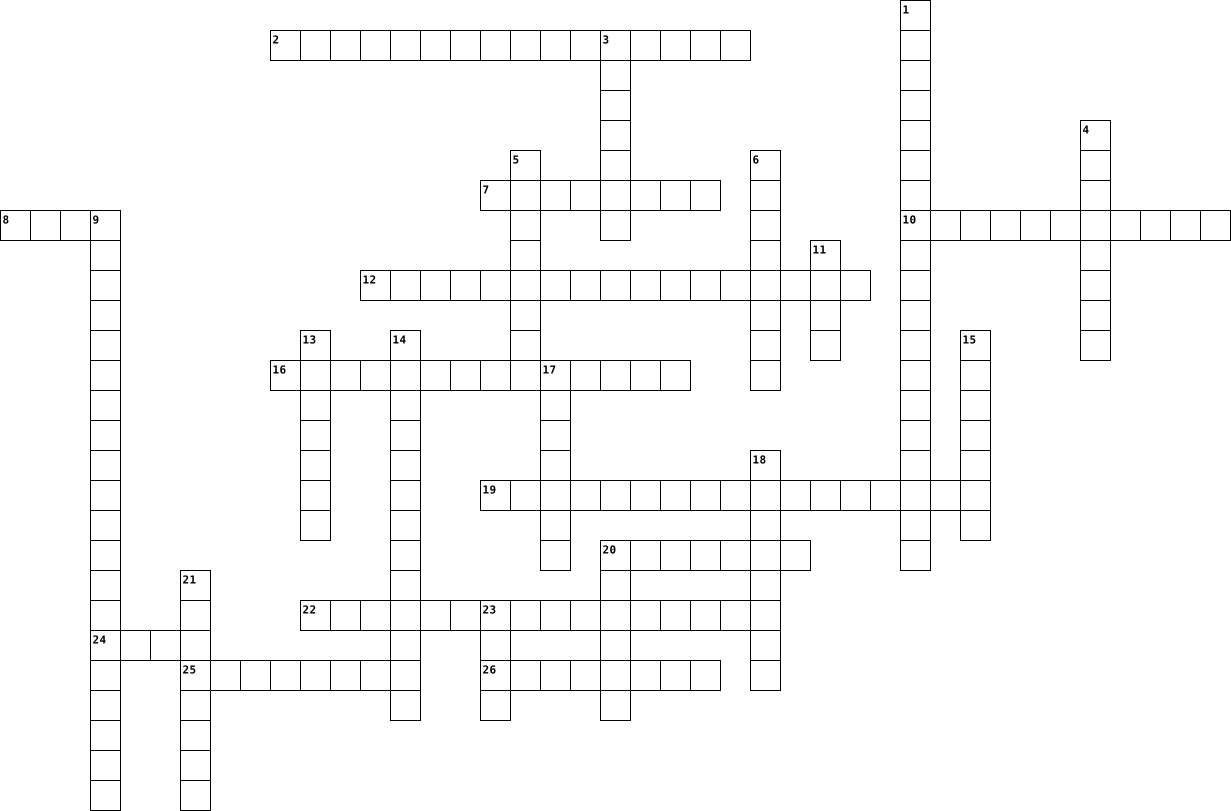
Across
- held energy
- substance dispersed in another substance
- tastes bitter
- total number of protons and neutrons
- transformation of one substance to another
- motion energy
- symbolic representation of a reaction
- right side of a chemical equation
- H2O
- smallest unit of ordinary matter
- 0-7 acid and 7-14 base
- differ in nucleon numbers
Down
- surrounding area gets warmer
- subatomic particle with a neutral charge
- special type of mixture
- more than one atom held together by bonds
- subatomic particle with a negative charge
- surrounding area gets colder
- uneven number of protons and electrons
- substances not chemically combined
- number of protons found in that element
- pure substance consisting only of atoms
- positively charged central core of an atom
- left side of a chemical equation
- subatomic particle with a positive charge
- more than one element held together by bonds
- tastes sour
27 Clues: H2O • held energy • tastes sour • tastes bitter • motion energy • 0-7 acid and 7-14 base • special type of mixture • differ in nucleon numbers • surrounding area gets warmer • surrounding area gets colder • left side of a chemical equation • smallest unit of ordinary matter • right side of a chemical equation • substances not chemically combined • total number of protons and neutrons • ...
Chemistry of Life Crossword 2023-11-09

Across
- (two words) the breaking and forming of bonds between different substances during chemical changes
- main function is short-term energy storage
- Endothermic reactions ______ energy
- large organic molecules that make up all living things
- (two words) the amount of energy needed to make a chemical reaction start
- where we find nucleic acids
- substances that are made by a chemical reaction
- the number of phosphate groups in ATP
- (two words) the macromolecule we get from our parents
Down
- functions include insulation, protection, and structure
- (two words)where a reactant binds to an enzyme
- a special lipid with a hydrophilic head and hydrophobic tail
- the substances that are changed during a chemical reaction
- exothermic reactions _____ energy
- the number of levels to protein structures
- macromolecule that has no main function
- polymers are made out of _______
- Adenosine Triphosphate is also known as what?
- proteins that speed up chemical reactions
- a reaction with an enzyme needs ______ activation energy
20 Clues: where we find nucleic acids • polymers are made out of _______ • exothermic reactions _____ energy • Endothermic reactions ______ energy • the number of phosphate groups in ATP • macromolecule that has no main function • proteins that speed up chemical reactions • main function is short-term energy storage • the number of levels to protein structures • ...
Chemistry Vocabulary Crossword Puzzle 2020-11-11

Across
- a chemical reaction that absorbs heat
- substance that does the dissolving in a chemical solution
- chemical bond between atoms caused by an electrostatic force in opposite charged ions
- expression which states the number and types of atoms in a molecule
- part of the atomic nucleus that has a charge of +1
- chemical species formed when two or more elements form a chemical bond
- a substance that cannot be subdivided and is identified by the number of protons in its atoms
- chemical mass unit equal to Avogadro's number
- any element found in the last column of the periodic table
- part of the atomic nucleus that has a charge of -1
- whole number that is the sum of protons and neutrons in the atomic nucleus
- outer electron that is most likely to participate in a bond formation or a chemical reaction
- part of the atomic nucleus that has a charge of 0
- measure of hydrogen ion in a solution showing the acidity or basicity of a substance
- a chemical species that accepts protons
- chemical bond between atoms where electrons are more or less evenly shared
Down
- a chemical reaction that releases heat
- the arrangement of elements by increase of their atomic number
- homogenous mixture of two or more substances
- atoms that have the same number of protons but different amount of neutrons changing its atomic weight
- the number of protons in the nucleus of an atom of an element
- a chemical species that donates protons
- any element found in the 1st column of the periodic table
- substance that is dissolved in a chemical solution
- substance formed as a result of a chemical reaction
- starting material for a chemical reaction
- any element found in the 2nd column of the periodic table
- the ability to do work
28 Clues: the ability to do work • a chemical reaction that absorbs heat • a chemical reaction that releases heat • a chemical species that donates protons • a chemical species that accepts protons • starting material for a chemical reaction • homogenous mixture of two or more substances • chemical mass unit equal to Avogadro's number • ...
chem 2021-02-08

Across
- made up of atoms and molecules it has no shape or volume
- one of more substances that react together
- solid formed out of a solution
- chemical substance made up of two or more identical elements
- reaction of an acid and a base
- happens when two ionic compounds are exchanged and then make two new compounds
- two or more products being formed in a reactant
- a fluid that can make the shape of its container but isn't firm like a solid
- numbers that come after a symbol and below
- substance to the left arrow
- measure of the chemical reactions efficiency
Down
- chemical reaction where one element replaces another element in a compound
- something that is firm in a shape
- representation with symbols of a chemical reaction
- two atoms chemically bonded
- substance reacts with oxygen and transfers energy around
- reactions that occur when two or more substances combine to form
- a solution where the solvent is a liquid
- number placed in front of a chemical symbol
- the substance at the end of a chemical reaction
20 Clues: two atoms chemically bonded • substance to the left arrow • solid formed out of a solution • reaction of an acid and a base • something that is firm in a shape • a solution where the solvent is a liquid • numbers that come after a symbol and below • one of more substances that react together • number placed in front of a chemical symbol • ...
Science Chapter 5 vocab 2020-02-12

Across
- thousands of biological catalysts.
- a solid that forms from liquids in a chemical change
- matter does not leave or enter
- change in matter that makes a substance into a other substance
- a law that states that during a chemical reaction matter is not destroyed or created.
- when compounds break down into simpler products
- When two or more elements or compounds combine to make a more complex substance
- when one element take the place of another element or if two different compounds trade.
- the amount of a substance in a given volume.
- energy minimum amount of energy needed to start a chemical reaction.
Down
- the energy released as the products form is greater than the required energy to break it.
- The energy to break it is is greater than the energy that is released by the formation of the product
- New substances that are made
- Any change to the substance that does not change it to another substance
- A way to show a chemical reaction using symbols
- is a number placed in front of a chemical formula
- Substances that gone through a chemical change
- A material used to decrease the rate of a chemical reaction
- matter can enter from or escape to the surroundings
- increases the reaction rate by lowering the activation energy needed.
20 Clues: New substances that are made • matter does not leave or enter • thousands of biological catalysts. • the amount of a substance in a given volume. • Substances that gone through a chemical change • A way to show a chemical reaction using symbols • when compounds break down into simpler products • is a number placed in front of a chemical formula • ...
Chemistry Crossword 2015-11-19

Across
- Change of state from a gas to liquid.
- Description of a substance that can be pounded or rolled into sheet.
- Shiny, malleable, ductile element that conducts electricity.
- Substance that strongly resist the flow of electricity.
- Chemical reaction that absorb energy.
- The smallest part of an element that is representative of that element.
- Measure of atomic mass.
- Vertical column of element in the periodic table.
- Chemical combination of two or more elements in a specific ratio.
- Change of state from a liquid to gas.
- Change of state from solid to liquid.
Down
- Chemical reaction that takes place in cell.
- Ability to work.
- Catalyst involved in a chemical reaction in living things.
- Change of state from a gas to solid.
- Slow chemical change that occurs when oxygen in the air reacts with a metal.
- Number of protons in the nucleus of one atom of an element.
- Group 17 elements in the periodic table.
- Invisible negatively charged particle that orbits the nucleus of an atom.
- A material that that electric charge can move through easily.
- Chang of state from a liquid to solid.
- Anything that has mass and occupies space.
- Substance that helps a chemical reaction to proceed more quickly.
- Chemical reaction that releases energy.
- Amount of mass in a given volume of a substance.
25 Clues: Ability to work. • Measure of atomic mass. • Change of state from a gas to solid. • Change of state from a gas to liquid. • Chemical reaction that absorb energy. • Change of state from a liquid to gas. • Change of state from solid to liquid. • Chang of state from a liquid to solid. • Chemical reaction that releases energy. • Group 17 elements in the periodic table. • ...
Energy flow between organisms 2025-03-21

Across
- A type of sugar that is produced from photosynthesis.
- The chemical that absorbs the sunlight.
- The site where photosynthesis occurs.
- Indicates the number of molecules involved in a chemical reaction.
- A process in which plants and animal convert food (glucose) into energy (ATP) needed for cells to function.
- A byproduct of photosynthesis that is needed for cellular respiration.
- The tiny structures that help cells carry out processes to stay alive.
- The main source of energy.
Down
- A gas that plants need for photosynthesis.
- The process in which plants convert sunlight to chemical energy (glucose).
- The results that a chemical reaction produces.
- The secondary product of a chemical reaction
- The energy molecule that is produced from cellular respiration.
- A mineral that plants absorb through their roots.
- The site where cellular respiration occurs.
- The ingredients needed for a chemical reaction to occur.
- A series of steps taken in order to achieve a particular result.
- The light color that is reflected from chlorophyll.
- All chemical reactions that occur within an organism to stay alive.
19 Clues: The main source of energy. • The site where photosynthesis occurs. • The chemical that absorbs the sunlight. • A gas that plants need for photosynthesis. • The site where cellular respiration occurs. • The secondary product of a chemical reaction • The results that a chemical reaction produces. • A mineral that plants absorb through their roots. • ...
7th Grade 2026-04-09

Across
- When the atoms of the reactants equal the atom of the products.
- What is generated when baking soda and vinegar react?
- The temperature that a liquid becomes a gas.
- pH 0-6
- Whether a substance can ignite or burn.
- The temperature that a solid becomes a liquid.
- The term for a chemical reaction that becomes cold.
- Mass or weight divided by volume.
Down
- When the atoms of the reactants and products are not the same.
- A representation of chemical reaction with reactants on the left and products on the right.
- A sign of a chemical reaction that is similar to scent.
- Whether a solute will dissolve in a solvent.
- The smallest part of an element.
- An insoluble solid that forms during a chemical reaction.
- The term for a chemical reaction that becomes warm.
- pH 8-14
- The pH of water.
17 Clues: pH 0-6 • pH 8-14 • The pH of water. • The smallest part of an element. • Mass or weight divided by volume. • Whether a substance can ignite or burn. • Whether a solute will dissolve in a solvent. • The temperature that a liquid becomes a gas. • The temperature that a solid becomes a liquid. • The term for a chemical reaction that becomes warm. • ...
Chemistry Vocabulary Crossword Puzzle 2020-11-11

Across
- a chemical reaction that absorbs heat
- substance that does the dissolving in a chemical solution
- chemical bond between atoms caused by an electrostatic force in opposite charged ions
- expression which states the number and types of atoms in a molecule
- part of the atomic nucleus that has a charge of +1
- chemical species formed when two or more elements form a chemical bond
- a substance that cannot be subdivided and is identified by the number of protons in its atoms
- chemical mass unit equal to Avogadro's number
- any element found in the last column of the periodic table
- part of the atomic nucleus that has a charge of -1
- whole number that is the sum of protons and neutrons in the atomic nucleus
- outer electron that is most likely to participate in a bond formation or a chemical reaction
- part of the atomic nucleus that has a charge of 0
- measure of hydrogen ion in a solution showing the acidity or basicity of a substance
- a chemical species that accepts protons
- chemical bond between atoms where electrons are more or less evenly shared
Down
- a chemical reaction that releases heat
- the arrangement of elements by increase of their atomic number
- homogenous mixture of two or more substances
- atoms that have the same number of protons but different amount of neutrons changing its atomic weight
- the number of protons in the nucleus of an atom of an element
- a chemical species that donates protons
- any element found in the 1st column of the periodic table
- substance that is dissolved in a chemical solution
- substance formed as a result of a chemical reaction
- starting material for a chemical reaction
- any element found in the 2nd column of the periodic table
- the ability to do work
28 Clues: the ability to do work • a chemical reaction that absorbs heat • a chemical reaction that releases heat • a chemical species that donates protons • a chemical species that accepts protons • starting material for a chemical reaction • homogenous mixture of two or more substances • chemical mass unit equal to Avogadro's number • ...
CHEMICAL REACTIONS 2026-01-11

Across
- The principle that matter is neither created nor destroyed in a chemical reaction (12,2,4)
- A process in which reactants change into products
- A gas produced during respiration (6,7)
- A compound used as a fuel for respiration in living organisms
- The substances that take part in a chemical reaction and are used up
Down
- A chemical reaction in living cells that releases energy from glucose using oxygen
- Another word for ‘produces,’ indicated by → in a chemical equation
- A reaction in plants that uses light energy to convert carbon dioxide and water into glucose and oxygen
- Describes a chemical equation with the same number of each type of atom on both sides
- The calculation of quantities of reactants and products in a chemical reaction
- The number placed in front of a chemical formula that can be changed to balance an equation
- A compound made of hydrogen and carbon often used as a fuel
- The substances formed as a result of a chemical reaction
- A reaction in which a substance reacts with oxygen usually releasing heat and light
14 Clues: A gas produced during respiration (6,7) • A process in which reactants change into products • The substances formed as a result of a chemical reaction • A compound made of hydrogen and carbon often used as a fuel • A compound used as a fuel for respiration in living organisms • Another word for ‘produces,’ indicated by → in a chemical equation • ...
Chemical Magic 2023-02-14

Across
- the ______ points to the products.
- created when a chemical reaction occurs.
- In TGCOPE, the C stands for ________ change.
- In TGCOPE, the O stands for _________ change.
- In TGCOPE, E stands for________ release.
- When a chemical reaction has occurred there is a new substance with new ________.
- the C in CER stands for:
Down
- the R in CER stands for:
- In TGCOPE, the T stands for:
- In TGCOPE, the G stands for ______ produced
- The Law of __________ states: Atoms cannot be created or destroyed they can only be rearranged.
- what goes into a chemical reaction.
- ____________ is always and indicator of a chemical reaction.
- what is made after a chemical reaction.
- the E in CER stands for:
15 Clues: the R in CER stands for: • the E in CER stands for: • the C in CER stands for: • In TGCOPE, the T stands for: • the ______ points to the products. • what goes into a chemical reaction. • what is made after a chemical reaction. • created when a chemical reaction occurs. • In TGCOPE, E stands for________ release. • In TGCOPE, the G stands for ______ produced • ...
Adjectives in Chemistry 2022-06-23

Across
- is used to describe the chemicals involve in the chemical reaction.
- atoms exist in inorganic compounds.
- is the total of the atomic weights of all the elements in a compound.
- is substance that are not acidic or basic.
- is a stable chemical that does not produce chemical reaction.
- chemical reaction that release heat.
- substances react instantly with other chemicals.
Down
- substances are very dangerous and acidic.
- is chemical reactions that occurs naturally.
- compounds contains carbon atoms.
- reactions where chemicals don'react with each other.
- chemical reaction that absorb heat.
- is a sour substance.
- is a bitter substance.
- reactions where chemicals react strongly with each other.
15 Clues: is a sour substance. • is a bitter substance. • compounds contains carbon atoms. • chemical reaction that absorb heat. • atoms exist in inorganic compounds. • chemical reaction that release heat. • substances are very dangerous and acidic. • is substance that are not acidic or basic. • is chemical reactions that occurs naturally. • ...
Checmical Reactions Crossword 2025-08-20

Across
- When a chemical reaction occurs ______ is transferred to or from the surroundings. [6]
- A substance made of two or more different atoms chemical joined. [8]
- A type of reaction that may produce a colour change, a gas or a new solid. [8,8]
- Safety equipment used to protect the eyes. [6,7]
- Reacts with oxygen/burning. [10]
- Two substances joining to make one. [9]
- A chemical _________ shows how many atoms are in a compound, often uses symbols. [7]
- A possible source of danger. [6]
- A type of reaction where elements swap places. [12]
Down
- A type of chemical reaction where you cannot get back the substances you started with. [12]
- A reactions which gives out energy to the surroundings. [10]
- One substance breaks down into two or more substances. [13]
- The substances that are produced by a chemical reaction. [8]
- A reaction which takes in energy from the surroundings. [11]
- The chemicals that react together in a chemical reaction. [9]
15 Clues: Reacts with oxygen/burning. [10] • A possible source of danger. [6] • Two substances joining to make one. [9] • Safety equipment used to protect the eyes. [6,7] • A type of reaction where elements swap places. [12] • One substance breaks down into two or more substances. [13] • A reactions which gives out energy to the surroundings. [10] • ...
Chemical Reactions Vocabulary 2024-02-25

Across
- a reaction that absorbs heat
- a way of showing how many of each atom are in a molecule
- a bond between a metal and electrons that involves moving electrons
- a positively charged subatomic particle found in the nucleus of the atom
- changing a chemical into a new chemical
- the study of the properties and behavior of matter
- what you end with in a chemical reaction
- a reaction that has the same number of each atom in the reactants and products
- a bond between nonmetals that involves sharing electrons
- the smallest particle of a chemical element that can exist
Down
- a reaction that releases heat
- either solid, liquid, or gas
- what you start with in a chemical reaction
- a negatively charged subatomic particle found orbiting the nucleus of the atom
- a table of elements organized by atomic number
- a measurement of acidity or basicity of a chemical
- a neutrally charged subatomic particle found in the nucleus of the atom
17 Clues: a reaction that absorbs heat • either solid, liquid, or gas • a reaction that releases heat • changing a chemical into a new chemical • what you end with in a chemical reaction • what you start with in a chemical reaction • a table of elements organized by atomic number • a measurement of acidity or basicity of a chemical • ...
biomolecules vocab choice board 2024-05-01

Across
- a simple molecule with two or more binding sites through which it forms covalent linkages with other monomer molecules to form the macromolecule.
- a molecule that has nitrogen and chemical properties of a base.
- A chemical element that's stable and adaptable
- molecules that are long-chained and polymeric
- A chemical compound that’s in biotic organisms.
- A natural compound that occurs, or a imatitive of a compound
- a molecule that enzymes react with
- Molecules that are living and insoluble in insoluble in water
Down
- large organic compounds that are essential to lives
- substances made by the cells of animals and plants.
- the minimum energy amount that’s needed to activate atoms and molecules to a condition where chemical transformation or physical transport can occur.
- a chemical reaction when water is mainly used to break down chemical bonds substances
- substances that participate in a chemical reaction to form a product
- a substance that can increase the rate of chemical reactions without being consumed and changed by the reacting chemicals is called a catalyst.
- building blocks of fat in our bodies and the food that we eat.
- Where the chemical reaction occurs in a antibody or enzyme
- a substance that’s formed as the result of a chemical reaction.
- big molecules made of monomers
- a sugar biological molecule, also in DNA
- Molecules that can be put together and create proteins.
20 Clues: big molecules made of monomers • a molecule that enzymes react with • a sugar biological molecule, also in DNA • molecules that are long-chained and polymeric • A chemical element that's stable and adaptable • A chemical compound that’s in biotic organisms. • large organic compounds that are essential to lives • substances made by the cells of animals and plants. • ...
Chapter 7 & 13 Crossword 2023-05-02

Across
- increases the rate of a chemical reaction
- A substance that is added to create a chemical reaction
- A breakdown of a chemical
- A chemical reaction in the form of symbols or formulas
- The amount of a substance
- Home of the Spartans
- an upward force that is exerted by a fluid
- a process that releases energy from the system to its surroundings
- A substance mass per unit of volume ( D= M/V)
- a process that absorbs heat
- One of something
Down
- The artificial execution of a chemical reaction to get one or more products
- a room in a school where students are taught at
- A species that is created from chemical reactions
- The distance between the top and bottom of something
- Words that don’t make sense or don’t have a meaning
- A number that is placed in front of a formula, can be used to balance equations
- A time period that is after noon
- A force produced by the motion of a fluid past an object
- two of something
- A liquid or a gas that flows
21 Clues: two of something • One of something • Home of the Spartans • A breakdown of a chemical • The amount of a substance • a process that absorbs heat • A liquid or a gas that flows • A time period that is after noon • increases the rate of a chemical reaction • an upward force that is exerted by a fluid • A substance mass per unit of volume ( D= M/V) • ...
Changes in matter vocabulary 2025-04-23

Across
- noting or pertaining to a chemical change
- very small particle
- A substance that starts or speeds up a chemical reaction
- the measurement of matter
- A ... happens when you mix chemicals together
- reactions of the chemical elements and the compounds they form
- A composition of two or more substances that are not chemically combined
- A substance consisting of atoms or ions of two or more different elements
Down
- A number or quantity obtained by multiplication
- transfer heat energy to another physical system
- A force of attraction that holds atoms or ions together in a molecule or crystal
- a chemical reaction that absorbs heat
- The force of attraction that holds molecules
- Internal energy that is transferred to a physical system from outside the system
- A substance participating in a chemical reaction
- solid, liquid, or gas
- combinations of neutrons and protons
- ... lets you have power
- A substance that cannot be broken down into simpler substances by chemical
- The amount of space occupied by a three-dimensional object or region of space
20 Clues: very small particle • solid, liquid, or gas • ... lets you have power • the measurement of matter • combinations of neutrons and protons • a chemical reaction that absorbs heat • noting or pertaining to a chemical change • The force of attraction that holds molecules • A ... happens when you mix chemicals together • A number or quantity obtained by multiplication • ...
Bonus Points U5F1 2022-02-22

Across
- The speed at which a chemical reaction occurs
- the minimum quantity of energy which the reacting species must possess in order to undergo a specified reaction.
- any chemical substance produced during the conversion of some reactant to a product
- when energy is taken from the surroundings
- the outside part or uppermost layer of something
- a state of anxiety or nervous excitement.
Down
- reaction in which the conversion of reactants to products and the conversion of products to reactants occur simultaneously
- a reaction in which products are produced from reactants and it goes from left to right in a reversible reaction.
- the branch of physical chemistry that is concerned with understanding how fast or how slow chemical reactions occur
- the sum of the internal energy and the product of the pressure and volume of a thermodynamic system.
- coordinate diagram a graph that plots energyversus reaction progress
- a substance that delays, slows or prevents a chemical reaction
- is a "reaction for which the overall standard enthalpy change ΔH⚬ is negative
- quantitative measure of how hot or cold something is
- any substance that increases the rate of a reaction without itself being consumed
- eat absorbed or evolved (or the change in enthalpy) in any chemical reaction is a fixed quantity
16 Clues: a state of anxiety or nervous excitement. • when energy is taken from the surroundings • The speed at which a chemical reaction occurs • the outside part or uppermost layer of something • quantitative measure of how hot or cold something is • a substance that delays, slows or prevents a chemical reaction • ...
Unit 6 & 7 Vocabulary Crossword 2013-12-04

Across
- Reactant Reactant that remains after the chemical reaction stops
- ABA+B
- Yield Maximum amount of product that can be produced from a given amount of reactant
- Absorbs heat
- Energy Minimum amount of energy required to start a chemical reaction
- Ratio Ratio between the numbers of moles of any two substances
- Replacement AB+CD AD+BC
- A+B AB
- by Mass Percentage determined by ratio of the mass of each element to the total mass of the compound
- of Conservation of Mass States that matter cannot be created nor destroyed
Down
- Replacement A+BCAC+B
- Study of quantitative relationships between the amount of reactants used and the products formed
- Reactant Reactant totally consumed during a chemical reaction
- Releases heat
- mass Mass of 1 mole of a substance
- C H+OCO2+H2O
- Increases rate of a chemical reaction
- Yield Amount of product produced when a chemical reaction is carried out
18 Clues: ABA+B • A+B AB • Absorbs heat • Releases heat • C H+OCO2+H2O • Replacement A+BCAC+B • Replacement AB+CD AD+BC • mass Mass of 1 mole of a substance • Increases rate of a chemical reaction • Reactant Reactant totally consumed during a chemical reaction • Ratio Ratio between the numbers of moles of any two substances • ...
Chemistry Crossword 2015-11-19

Across
- chemical combination of two or more elements in a specific ratio
- a substance that helps a chemical reaction that proceed more quickly
- group 18 on the periodic table
- substance made of only one kind of matter
- an organic catalyst
- most reactive non meta
- a chemical that releases heat
- positively charged particle
- a combination of symbols that represent a compound
- a reaction that takes place when two or more substances react to make a new substance
- negatively charged particle
- atomic number 8 on the periodic table
- the horizontal column on the periodic table
- an atom that has been electrically charged
Down
- an element with both metal and non metal properties
- most stable and nonreactive elements
- the result of a chemical reaction when a new substance is formed
- vertical column of elements on the periodic table
- two nonmetals combined
- slow chemical change that occurs when oxygen in the air reacts with metals
- how many protons are in the nucleus
- neutral
- a chemical reaction that absorbs energy
- two metals combined
- a solution in which water is the solvent
25 Clues: neutral • an organic catalyst • two metals combined • two nonmetals combined • most reactive non meta • positively charged particle • negatively charged particle • a chemical that releases heat • group 18 on the periodic table • how many protons are in the nucleus • most stable and nonreactive elements • atomic number 8 on the periodic table • a chemical reaction that absorbs energy • ...
Unit 2 Extra Credit Crossword Puzzle 2023-11-01

Across
- Property of water where water sticks to other molecules
- Lipid that makes up the cell membrane
- The building block of proteins
- Bond that forms between water molecules
- The type of fat that is liquid at room temperature
- Location where an enzyme binds to the substrate
- Something that speeds up chemical reactions
- When we combine monomers, we get a...
- Name for all molecules building blocks
- The polymer of carbs
- Polymer of proteins
- Macromolecule that provides organisms with quick energy
- Carbohydrate made up of only two rings
Down
- Energy required to start a chemical reaction
- Raw materials of a chemical reaction
- Chemical reaction that breaks large molecules down
- The type of fat that is solid at room temperature
- Molecule that is considered a 'protein catalyst'
- Molecule with the chemical formula H2O
- Lipid made of glycerol and three fatty acid chains
- Property of water where water sticks to other water molecules
- Results of a chemical reaction
- Macromolecule that provides organisms with structure, defense, and enzymes
- Macromolecule that provides organisms with long term energy
24 Clues: Polymer of proteins • The polymer of carbs • The building block of proteins • Results of a chemical reaction • Raw materials of a chemical reaction • Lipid that makes up the cell membrane • When we combine monomers, we get a... • Molecule with the chemical formula H2O • Name for all molecules building blocks • Carbohydrate made up of only two rings • ...
Module 1 revision 2019-11-06

Across
- H2SO4
- A chemical which has a pH less than 7
- A type of reaction where the chemical breaks down with heating
- NH3
- Cl-
- A scale that shows the strength of acids and alkalis
- A reaction between acids and alkalis which react together to make a solution of water at pH 7
- HCl
- SO42-
- A reaction that gives out energy to the surroundings
- This is the particle that is alkali eg OH-
Down
- A dye which changes colour depending on whether it is added to an acid or an alkali
- NaOH
- CO32-
- A reaction that takes in energy from the surroundings
- HNO3
- This is the particle that is acid eg H+
- NO3-
- A substance that speeds up the rate of a reaction
- A chemical which has a pH more than 7
20 Clues: NH3 • Cl- • HCl • NaOH • HNO3 • NO3- • CO32- • H2SO4 • SO42- • A chemical which has a pH less than 7 • A chemical which has a pH more than 7 • This is the particle that is acid eg H+ • This is the particle that is alkali eg OH- • A substance that speeds up the rate of a reaction • A scale that shows the strength of acids and alkalis • A reaction that gives out energy to the surroundings • ...
Law of Conservation of Mass 2022-02-10

Across
- The numbers behind chemical symbols
- and environment where matter can enter or escape
- A chemical equation with the same number of atoms in each element on the sides of the equation
- a part or aspect of something abstract, especially one that is essential or characteristic.
- A group of atoms bonded together is a _______
- _________ are what you have at the end of a chemical reaction
- when the total mass of the reactant is equal to the mass of the product the equation is _________
- Mass can also be called ________
- during a chemical reaction matter cannot be created or destroyed
- 2 or more substances combine to form a new compound
Down
- 1 element replaces another element in a compound
- The substances present before the reaction occurs
- Mass cannot be _________ or destroyed
- an environment where matter cannot enter or escape
- burning wood, rust, campfire are examples of a
- A chemical reaction that requires heat
- a single unit of a pure substance, or "element".
- a compound decomposes into 2 or more simpler substances
- The numbers in front of chemical symbols
- What does the arrow mean in a chemical equation?
20 Clues: Mass can also be called ________ • The numbers behind chemical symbols • Mass cannot be _________ or destroyed • A chemical reaction that requires heat • The numbers in front of chemical symbols • A group of atoms bonded together is a _______ • burning wood, rust, campfire are examples of a • 1 element replaces another element in a compound • ...
Physical and Chemical Changes, Chemical Reactions and Phase Changes 2025-09-17

Across
- properties of substances that can be observed without changing the identity of a substance are known as ___properties
- a reaction that absorbs energy
- a reaction that releases energy
- phase change from a liquid to a solid
- substances that exist before a chemical reaction
- phase change from a gas to a liquid
- what the reactants turn into
- state of matter with a definite volume but no definite shape
- a change in which the identity of the substance does NOT change
Down
- name given to a new solid produced in a chemical reaction
- energy that is transferred from a warmer thing to cooler things
- phase change from a solid to a liquid
- an energy ___ is a sign of a chemical reaction; light is produced or a temperature change occurs
- chemical ___ are ways to represent chemical reactions
- state of matter with no definite shape or volume
- anything that has mass and takes up space
- a change in which the identity of the substance DOES change
- bubbling is a sign that a ___ is being produced during a chemical reaction
- properties of substances that can only be observed by changing the identity of a substance are known as ___ properties
- state of matter with definite shape and volume
20 Clues: what the reactants turn into • a reaction that absorbs energy • a reaction that releases energy • phase change from a gas to a liquid • phase change from a solid to a liquid • phase change from a liquid to a solid • anything that has mass and takes up space • state of matter with definite shape and volume • state of matter with no definite shape or volume • ...
chapter 8 2012-07-26

Across
- The binding of a regulatory molecule to a protein
- A spontaneous chemical reaction/ a net release of free energy
- A non-spontaneous chemical reaction/ free energy absorbed
- The energy that matter possesses as a result of its location
- A macromolecule serving as a catalyst, usually a protein
- A series of chemical reactions that breaks down molecules
- Anabolic pathway or catabolic pathway
- The magnitude of a cell's membrane voltage at equilibrium
Down
- A chemical agent that increases reaction without being consumed
- The study of energy transformations that occur in matter
- A series of chemical reactions that builds a complex molecule
- Releases free energy to drive endergonic reaction in cells
- A measure of disorder or randomness
- Any non-protein molecule or ion required for proper enzyme function
- Splitting macromolecules by the enzymatic addition of water
- Energy available in molecules for release in a chemical reaction
- The energy associated with the relative motion of objects
17 Clues: A measure of disorder or randomness • Anabolic pathway or catabolic pathway • The binding of a regulatory molecule to a protein • The study of energy transformations that occur in matter • A macromolecule serving as a catalyst, usually a protein • A non-spontaneous chemical reaction/ free energy absorbed • A series of chemical reactions that breaks down molecules • ...
Redox Reaction 2020-07-02

Across
- cell System in which there's an electric current flowing while a chemical reaction occurs.
- Oxidation________ electrons
- Metal that can prevent rusting
- Site which oxidation or reduction:anode and cathode
- Oxidizing agent
- Where oxidation occur
- Gain of electrons and the loss of oxidation number
- _______Oxidation number
- Electrochemical cell in which a spontaneous chemical reaction causes a flow of electrons.
- Reaction that shows either oxidation or reduction portion of a redox reaction.
Down
- Number assign to keep track of electron gain or loss redox reaction
- Itself oxidized
- Part of a voltaic cell that connects two containers and allow flow of ions.
- Oxidation__________ hydrogen
- Reduction_______ electrons
- Cell that requires a non spontaneous chemical reaction occur(uses battery)
- An oxidation-reduction reaction
- Particle in redox reaction
18 Clues: Itself oxidized • Oxidizing agent • Where oxidation occur • _______Oxidation number • Reduction_______ electrons • Particle in redox reaction • Oxidation________ electrons • Oxidation__________ hydrogen • Metal that can prevent rusting • An oxidation-reduction reaction • Gain of electrons and the loss of oxidation number • Site which oxidation or reduction:anode and cathode • ...
Chemistry Crossword 2017-11-07

Across
- a material that electric charge can move through easily
- description of a solid that can be stretched into a long wire
- chemical reaction that occurs when oxygen reacts with a substance to form a new substance and give off energy
- reaction that takes place when two or more substances react to form new substances
- table in which the elements are organized by their physical and chemical properties
- pure substance formed when non-metals combine
- chemical reaction that releases energy
- pure substance that cannot be broken down into other substances; substance made up of only one type of atom
- group 17 elements in the periodic table; the most reactive non-metals
- property that describes the physical appearance and composition of a substance
- substance that reacts with another substance or substances in a chemical reaction to create new substances with different property
- gases group 18 elements in the periodic table;the most stable and nonreactive elements
Down
- slow chemical change that occurs when oxygen in the air reacts with a metal
- chemical reaction that absorbs energy
- combination of symbols that represent a compound; the formula identifies the elements in the compound and the amount of each element
- ability of a substance to conduct electricity or heat
- description of how a substance interacts with other substances, such as acids;chemical properties are observable only when chemical change occurs
- energy stored in chemicals and released when chemicals react; a form of potential or stored energy
- dull, brittle element that does not conduct electricity
- substance that helps a chemical reaction to proceed more quickly
- (CO(g))colorless, odorless gas;produced by incomplete combustion of chemicals containing carbon (e.g. hydrocarbons); major source: motor vehicles
- Workplace Hazardous Materials Information System; a system of easy-to-see warning symbols on hazardous materials
- change in the appearance or state of a substance that does not change the composition
- catalyst involved in chemical reaction in living things
- change that results when two or more substances react to create a different substance or substances; the new substances have completely different properties from the original ones
25 Clues: chemical reaction that absorbs energy • chemical reaction that releases energy • pure substance formed when non-metals combine • ability of a substance to conduct electricity or heat • a material that electric charge can move through easily • dull, brittle element that does not conduct electricity • catalyst involved in chemical reaction in living things • ...
MIKE INCORVAIA CHAPTER 13 mr burkholder 2016-10-11

Across
- a rapid exothermic oxidation
- a reaction between an acid and a base
- Substance that donates hydrogen ions
- polyatomic ion made by adding a proton to a water molecule
- polyatomic ion made by removing a proton from a water molecule
- chemical reaction in which there is a net absorption
- deterioration of metal
- chemical reaction which there is a net release
- accepts hydrogen ions
Down
- concentration is higher than the hydronium ion concentration
- the minimal energy for for a chemical reaction to proceed
- reactant loses one or more electrons
- behave as either an acid or a base
- new materials formed in a chemical reaction
- the reacting substances in a chemical change
15 Clues: accepts hydrogen ions • deterioration of metal • a rapid exothermic oxidation • behave as either an acid or a base • Substance that donates hydrogen ions • reactant loses one or more electrons • a reaction between an acid and a base • new materials formed in a chemical reaction • the reacting substances in a chemical change • chemical reaction which there is a net release • ...
VOCABULARY CHEMICAL MATTERS. 2024-10-31

Across
- Mass in grams of one mole of a substance.
- A substance that slows down or prevents a particular chemical reaction or other process, or that reduces the activity of a particular reactant, catalyst, or enzyme.
- Gain of electrons.
- Is a substance that is formed as the result of a chemical reaction.
- A process in which one or more substances, the reactants, are converted to one or more different substances called the products.
- Loss of electrons.
- of reaction: The speed at which reactants are converted in products.
- For any system closed to all transfers of matter and energy, the mass of the system must remain constant overtime, as systems mass cannot change, so quantity cannot be added or removed.
- A substance that takes part in and undergoes chase during a reaction.
Down
- A substance produced by a living organism that acts as a catalyst to bring about a specific biochemical reaction.
- A type of lettering form written lower than the things around it. In chemical formulas the number of atoms in molecule is written in this manner
- is a chemical equation with the same number of atoms of each element on both sides of the arrow.
- is the number in front of the formula, that is related to the properties of the products. For example 2 H20 means there are two molecules of water.
- A representation of a chemical reaction using symbols of the elements to indicate the amount of substance, usually in moles, of each reactant and product.
- of a substance that contains 6.02x10^23 particles of that substance.
- reaction: Are those which absorb energy from the surroundings and result in a net decrease in temperature.
- A chemical reaction that releases energy in the form of light or heat.
- A substance that increases in the rate of a chemical reaction without itself undergoing any permanent chemical change.
18 Clues: Gain of electrons. • Loss of electrons. • Mass in grams of one mole of a substance. • Is a substance that is formed as the result of a chemical reaction. • of a substance that contains 6.02x10^23 particles of that substance. • of reaction: The speed at which reactants are converted in products. • A substance that takes part in and undergoes chase during a reaction. • ...
enzyme 2026-03-04

Across
- ENERGY:The energy required to start any reaction
- chemical reaction that absorbs free energy from the surroundings,
- synthesis of complex molecules from simpler ones, which requires an input of energy
- in the active site, the chemical reaction can take place.
- chemical reaction that releases free energy to the surroundings
- substance that is formed as a result of a chemical reaction
- KEY: The substrate molecules fit perfectly into active site, like a key in a lock.
Down
- breakdown of complex molecules into simpler ones, releasing energy in the process
- reduce or stop the enzyme from functioning. Reducing enzyme
- cofactors
- also reduces the reaction rate.
- substance that enters and is consumed in a chemical reaction
- the totality of an organism's chemical reactions
- FIT: a flexible active site that changes shape, or conforms, to the substrate as they bond together
14 Clues: cofactors • also reduces the reaction rate. • ENERGY:The energy required to start any reaction • the totality of an organism's chemical reactions • in the active site, the chemical reaction can take place. • reduce or stop the enzyme from functioning. Reducing enzyme • substance that is formed as a result of a chemical reaction • ...
Week 5 Vocabulary List 2025-03-25

Across
- substances that are made during a chemical reaction
- uncontrolled cell growth
- structure that contains genetic material in a condensed form
- a catalyst that speeds up chemical reactions by lowering activation energy
- cell division that is used to repair, replace, and for asexual reproduction
- molecule that speeds up chemical reactions by lowering activation energy
- substances that are changed during a chemical reaction
- area where sister chromatids are attached
- a mass of cells growing in one place due to cancer
Down
- process that changes one set of molecules into a new set of molecules
- name for reactants in an enzyme catalyzed reaction
- a copy of a chromosome
- division of cytoplasm
- DNA in a loose state
- a tumor that is cancerous
- energy needed to start a chemical reaction
- a tumor that doesn't move non-cancer
- organelle that moves chromosomes during cell division
- stages G1, S, G2 a cell must complete before cell division
- when a cell goes through mitosis to make identical cells
20 Clues: DNA in a loose state • division of cytoplasm • a copy of a chromosome • uncontrolled cell growth • a tumor that is cancerous • a tumor that doesn't move non-cancer • area where sister chromatids are attached • energy needed to start a chemical reaction • name for reactants in an enzyme catalyzed reaction • a mass of cells growing in one place due to cancer • ...
Final Review 2017-12-17

Across
- / a system in which matter cannot enter or escape
- / substance that is present in a solution in the largest amount
- / fire is this type of change
- / the solution produced when too much solute is added to the solvent
- / mixture containing small, undissolved particles
- / a system in which matter can enter or escape
- / this type of solution has a lot of solute in the solvent
- in which particles are easily seen and separated
- / the amount of solute a solvent is able to dissolve
- / a type of change that does not chemically alter the object
- / on the right side of a chemical equation
Down
- / this chemical ____ is the easy way of naming a compound
- / substance that is dissolved by the solvent
- / substance that increases activation energy of a chemical reaction
- / substance that lowers activation energy of a chemical reaction
- / amount of substance in a given volume
- / type of reaction that swaps elements in compounds
- / type of reaction that breaks down a compound into multiple products
- / type of reaction that combines multiple reactants to form one product
- / mixture containing a solute and solvent
- / on the left side of a chemical equation
- / this type of solution has a little amount of solute dissolved in the solvent
22 Clues: / fire is this type of change • / amount of substance in a given volume • / mixture containing a solute and solvent • / on the left side of a chemical equation • / on the right side of a chemical equation • / substance that is dissolved by the solvent • / a system in which matter can enter or escape • in which particles are easily seen and separated • ...
vocab 2024-04-24

Across
- a fatty/waxy organic compound that is readily soluble in a nonpolar solvent and not in a polar solvent.
- a substance taking part in a chemical reaction
- made up of chemical "building blocks" that are called amino acids
- the minimum amount of energy which the reacting species must have to undergo a specified reaction
- the substance that the ezyme act upon
- the main use is to act as a catalyst to make the reaction faster without being changed in the process
- something capable of speeding up or initiating a chemical reaction
- made by molecules that combine to form proteins
- a molecule produced by a living organism
Down
- a nitrogen-containing organic compound that has the chemical properties of a base
- a substance that has very large molecules called macromolecules
- large biomolecules that have an essential role in all cells and viruses.
- acid a subunit of fats, oils, and waxes
- sugar molecules
- an important sugar in bodies used to make their DNA
- a region where catalytic energy occurs
- combined to other identical molecules to form a polymer
- the chemical breakdown of a compound due to reaction with water
- a result from an action or process
- a chemical element found in nature
20 Clues: sugar molecules • a result from an action or process • a chemical element found in nature • the substance that the ezyme act upon • a region where catalytic energy occurs • acid a subunit of fats, oils, and waxes • a molecule produced by a living organism • a substance taking part in a chemical reaction • made by molecules that combine to form proteins • ...
Chemistry crossword 2015-11-13

Across
- something that helps speed up the chemical reaction
- positively charged centre of an atom
- a chemical reaction in which heat is abosorbed
- able to form the object to something else without breaking it
- a compound made from a metal and non-metal elements
- a change where a new substance is made
- the most reactive element
- a compound made with 2 non-metal elements
- an experiment in which is one or more products of a chemical reaction can escape
- how well the element or compound is able to conduct electricity
- a group of atoms joined by covalent bonds
- a group of elements that are the most reactive non-metals
- hydogen's symbol
- a combination of pure chemicals
Down
- this is a principle saying that matter cannot be gained or lost in a chemical reaction
- a chemical reaction that releases heat
- chemical combination of 2 ore more elements in a specific ratio
- the metals found in group 1
- an element that has the bot metallic and non-metallic properties
- number the sum of the number of protons and neutrons in an atom
- a change in the appearance.
- water's chemical formula
- a group of non-metal elements that are the most stable
- substance that has a strong resistance to the flow of electricity
- neutral particle in the nucleus of an atom
25 Clues: hydogen's symbol • water's chemical formula • the most reactive element • the metals found in group 1 • a change in the appearance. • a combination of pure chemicals • positively charged centre of an atom • a chemical reaction that releases heat • a change where a new substance is made • a compound made with 2 non-metal elements • a group of atoms joined by covalent bonds • ...
Chemistry Crossword 2015-11-19

Across
- Catalyst involved in a chemical reaction in living things.
- The smallest part of an element that is representative of that element.
- A material that that electric charge can move through easily.
- Shiny, malleable, ductile element that conducts electricity.
- Chemical reaction that takes place in cell.
- Change of state from a liquid to gas.
- Chemical combination of two or more elements in a specific ratio.
- Chemical reaction that releases energy.
- Anything that has mass and occupies space.
- Slow chemical change that occurs when oxygen in the air reacts with a metal.
- Change of state from solid to liquid.
Down
- Number of protons in the nucleus of one atom of an element.
- Invisible negatively charged particle that orbits the nucleus of an atom.
- Measure of atomic mass.
- Description of a substance that can be pounded or rolled into sheet.
- Chemical reaction that absorb energy.
- Substance that helps a chemical reaction to proceed more quickly.
- Change of state from a gas to liquid.
- Change of state from a gas to solid.
- Vertical column of element in the periodic table.
- Group 17 elements in the periodic table.
- Substance that strongly resist the flow of electricity.
- Chang of state from a liquid to solid.
- Amount of mass in a given volume of a substance.
- Ability to work.
25 Clues: Ability to work. • Measure of atomic mass. • Change of state from a gas to solid. • Chemical reaction that absorb energy. • Change of state from a gas to liquid. • Change of state from a liquid to gas. • Change of state from solid to liquid. • Chang of state from a liquid to solid. • Chemical reaction that releases energy. • Group 17 elements in the periodic table. • ...
Unit 8 Crossword 2025-05-11

Across
- All ________, except Ca+2, Sr+2, Ba+2, Hg2+2, and Pb+2, are soluble.
- Illustrates a chemical reaction using symbols and chemical formulas or elements.
- _______ of a chemical reaction include the formation of a gas or a precipitate, a change in energy, or a change in color.
- AB + O2 → CO2 + H2O
- All ________, except those of group 1 and NH4+, are insoluble.
- All ________, except Ag+ and Pb+2, are soluble.
- _______Displacement AB + CD → AD + CB
- AB → A + B
- A + B → AB
- All _________ are soluble
- The small number found after a chemical symbol or ion. This shows the specific number of atoms in a molecule or compound.
- Starting materials
- Displacement will not occur and result in no reaction if C is more _______ than A (single displacement).
Down
- Most nonmetals are a ________
- _______ displacement A + BC → AC + B
- A compound dissolved in water is known as ______
- _______ separates when ionic compounds are dissolved in water
- Most metals are a ________
- Ending materials
- Chemical equations must be ________ because matter can not be created or destroyed during a reaction.
- The number found before a chemical formula or element to show how many atoms or molecules are involved in a chemical reaction.
- Carbon and hydrogen bonded together is a __________
- Only bromine and mercury are a _______
- BrINClHOF
- 3 elements in a compound is a ________
25 Clues: BrINClHOF • AB → A + B • A + B → AB • Ending materials • Starting materials • AB + O2 → CO2 + H2O • All _________ are soluble • Most metals are a ________ • Most nonmetals are a ________ • _______ displacement A + BC → AC + B • Only bromine and mercury are a _______ • 3 elements in a compound is a ________ • _______Displacement AB + CD → AD + CB • ...
Chemical Reactions 2017-05-03

Across
- / organic group which has one or more electrons available for bonding
- / negatively charged ion
- / multiplicative factor
- / substance that changes the rate of a chemical reaction without being consumed or changed
- / released when a chemical compound reacts to produce new compounds
- / molecular ion with two or more atoms covalently bonded
- / all the diatomic elements Hydrogen, oxygen, fluorine, bromine, iodine, nitrogen, and chlorine
- / chemical process which requires heat
Down
- / consisting of two atoms
- / nonconductive element which lacks luster
- / being the same in quantity
- / chemical reaction in which heat is released
- / any chemical change in which one species is oxidized (loses an electron)
- / solid that is produced as a result of a chemical reaction in a solution
- / positively charged ion
- / oxidation reaction of an organic compound in which heat is released
- / a conductive element
17 Clues: / a conductive element • / multiplicative factor • / negatively charged ion • / positively charged ion • / consisting of two atoms • / being the same in quantity • / chemical process which requires heat • / nonconductive element which lacks luster • / chemical reaction in which heat is released • / molecular ion with two or more atoms covalently bonded • ...
TOPIC 2: FORMULAS & EQUATIONS 2023-09-17

Across
- describes a reaction that absorbs heat
- the composition of a substance is changed
- does not alter the chemical properties of a substance
- covalently bonded group of atoms with a net electrical charge
- the one, two, or three letter designation of an element
- the smaller number written after a chemical symbol
- simplest integer ratio in a compound
- information that is either counted or measured
Down
- smallest unit of a covalently bonded substance
- information that is neither counted or measured
- symbols and subscripts use to represent a chemical substance
- a substance formed in a chemical reaction
- another term for decomposition into simpler substances
- formed by two identical covalently bonded atoms
- an element takes the place of a less reactive element
- ions exchange places
- describes a reaction that releases heat
- two or more substances combine to form one product
- the number placed before a formula
- a starting substance in a chemical reaction
20 Clues: ions exchange places • the number placed before a formula • simplest integer ratio in a compound • describes a reaction that absorbs heat • describes a reaction that releases heat • a substance formed in a chemical reaction • the composition of a substance is changed • a starting substance in a chemical reaction • smallest unit of a covalently bonded substance • ...
test review 2024-10-29

Across
- Reaction absorbing heat energy from its surroundings.
- Two or more atoms chemically bonded together.
- Equation: Representation of a chemical reaction using symbols.
- Atoms of the same element with different neutron counts.
- Smallest unit of an element, containing protons, neutrons, electrons.
- Atom or molecule with an electrical charge due to electron gain/loss.
- Gain of electrons during a chemical reaction.
- Light wave with frequencies higher than visible light.
- Bond: Bond where atoms share electron pairs.
- The part of the electromagnetic spectrum detectable by human eyes.
- Substance that donates protons (H⁺ ions) in solution.
- Substance that increases reaction rate without being consumed.
- Loss of electrons during a chemical reaction.
- Electrons: Electrons in the outer shell involved in chemical bonding.
- Scale indicating the acidity or basicity of a solution.
- Refers to microwaves; electromagnetic waves with shorter wavelengths than radio.
- A wave that travels through a medium, carrying audible energy.
- Bond: Bond formed by attraction between oppositely charged ions.
Down
- Substance formed as a result of a chemical reaction.
- Reaction where energy is given off to its surroundings
- Pure substance of only one type of atom.
- waves that are a form of radiation that travel through the universe
- Electromagnetic wave visible to the human eye.
- the particles of the medium vibrate at right angles to the direction that the energy travels
- wave that moves in the same direction as the way in which the particles are moving
- Starting substance in a chemical reaction.
- Lowest point on a wave, opposite the crest.
- Homogeneous mixture of two or more substances.
- Substance that accepts protons or donates hydroxide ions (OH⁻).
- Number of wave cycles passing a point per second.
- Highest point on a wave, where displacement is maximum.
- Height of a wave from rest to crest or trough.
- Substance made of two or more elements chemically combined.
33 Clues: Pure substance of only one type of atom. • Starting substance in a chemical reaction. • Lowest point on a wave, opposite the crest. • Bond: Bond where atoms share electron pairs. • Two or more atoms chemically bonded together. • Gain of electrons during a chemical reaction. • Loss of electrons during a chemical reaction. • Electromagnetic wave visible to the human eye. • ...
Matter vocab 2024-05-15

Across
- When you burn a fire it gives off ____?
- A science that deals with the composition, structure, and properties of substances and of the transformations that they undergo.
- Hydrogen
- Describes how a substance behaves during a physical reaction.
- The starting materials in a reaction that undergo a chemical change to form a product.
- The smallest unit of a substance.
- The force that holds a piece of matter together.
- Anything that has mass and takes up space.
- A substance that is formed as the result of a chemical reaction.
- Chemical reactions where chemical bonds are either created, broken, or both.
- The amount of space the object takes up.
- An attraction between atoms.
Down
- Everything that can make change or cause something to react has ____?
- The measure of hotness or coldness (Fahrenheit,Celsius).
- Chemical reactions in which the reactants absorb heat energy from the surroundings to form products.
- A process in which one or more substances are converted to one or more different substances.
- Describes how a substance behaves during a chemical reaction.
- The material involved in the change are the same before and after the change
- Two or more substances that are mixed together.
- The amount of matter that makes up an object.
- anything that gives off heat (opposite of endothermic.)
- Basic particles of the chemical elements.
- H2O
23 Clues: H2O • Hydrogen • An attraction between atoms. • The smallest unit of a substance. • When you burn a fire it gives off ____? • The amount of space the object takes up. • Basic particles of the chemical elements. • Anything that has mass and takes up space. • The amount of matter that makes up an object. • Two or more substances that are mixed together. • ...
chemistry compo 2020-03-29

Across
- subatomic particle with no mass and negative electrical charge
- any species that increases the concentration of OH- in an aqueous solution
- an ion with a negative charge
- the number of electrons needed to fill the outermost shell of an atom
- the resulting substance of a physical or chemical reaction
- produce salts when reacting with metals; Group 17 of the Periodic Table
- a lasting attraction between atoms, ions or molecults that enables the formation of chemical compounds
- any species that increases the concentration of H+ in an aqueous solution
- an electrically neutral group of two or more atoms held together by chemical bonds
- a chemical reaction in which heat is absorbed
- center of a an atom
- metallic element that has valence electrons in two shells instead of one
- a structure made of ions
- substance that is changed in a physical or chemical reaction
- a baryon considered to be composed of two up quarks and one down quark
Down
- complete transfer of valence electrons between atoms
- a baryon considered to be composed of two down quarks and one up quark
- a chemical element with metal and nonmetal properties
- compound that contains exactly two different elements
- a column of elements in the periodic table
- also known as the lithium family of elements
- molecular bond; a chemical bond that involves the sharing of electron paris between
- a group of rare gases that exhibit great stability and extremely low reaction rates
- the theory that all matter is made up of atoms
- the loss of electrons during a reaction by a molecule, atom or ion
- a chemical reaction that releases energy through light or heat
- an ion with a positive charge
- a chemical element that mostly lacks the characteristics of a metal
- a species of atoms which all have the same number of protons in their atomic nuclei
- a chemical reaction in which the oxidation states (charges) of atoms are changed
30 Clues: center of a an atom • a structure made of ions • an ion with a negative charge • an ion with a positive charge • a column of elements in the periodic table • also known as the lithium family of elements • a chemical reaction in which heat is absorbed • the theory that all matter is made up of atoms • complete transfer of valence electrons between atoms • ...
chapter 2: chemistry of life 2018-04-03

Across
- / one particular type of atom, and it cannot be broken down into a simpler substance by ordinary chemical means.
- / the attraction among molecules of different substances.
- / a polymer made of monomers called amino acids.
- / forms through the electrical force between oppositely charged ions.
- / a compound that releases a proton when it dissolves in water.
- / a chemical reaction releases more energy than it absorbs.
- / a substance that decreases the activation energy needed to start a chemical reaction, and increases the rate of the chemical reaction.
- / compounds that remove H+ ions from a solution.
- / each subunit in the complete molecule.
- / polymers that are made up of monomers called nucleotides.
- / a macromolecule made of many monomers bonded together.
- / change substances into different substances by breaking and forming chemical bonds.
- / the substance changed during a chemical reaction.
- / two or more atoms held together by covalent bonds.
Down
- / a substance that dissolves in a solvent.
- / the attraction among molecules stick to each other.
- / a homogeneous mixture.
- / the specific reactants that an enzyme acts one.
- / molecules that contain carbon, hydrogen, oxygen, nitrogen, and sometimes sulfur.
- / an atom that has gained or lost one or more electrons.
- / the substance that is present in the greater amount and that dissolves another substance.
- / nonpolar molecules that include fats, oils, and cholesterol.
- / the amount of energy that needs to be absorbed for a chemical reaction to start.
- / molecules composed of carbon, hydrogen, and oxygen, and they include sugars and starches.
- / chains of carbon atoms bonded to hydrogen atoms.
- / The smallest basic unit of matter.
- / reached when both the reactants and products are made at the same rate.
- / forms when atoms share a pair of electrons.
- / the substances made by a chemical reaction.
- / catalysts for chemical reactions in living things.
- / the amount of energy that will break a bond between two atoms.
- / a chemical reaction absorbs more energy than it releases.
- / a substance made of atoms of different elements bonded together in a certain ratio.
33 Clues: / a homogeneous mixture. • / The smallest basic unit of matter. • / each subunit in the complete molecule. • / a substance that dissolves in a solvent. • / forms when atoms share a pair of electrons. • / the substances made by a chemical reaction. • / a polymer made of monomers called amino acids. • / compounds that remove H+ ions from a solution. • ...
BOUNS POINTS: Crossword from Enzymes Lesson 2022-10-17

Across
- transmit genetic information/store directions for making proteins
- a chemical reaction that releases energy as heat
- reaction examples include ripping of paper or melting of ice
- large molecules to small molecules (release energy/heat)
- the resulting materials at the end of a chemical reaction
- change one substance into another
Down
- store long-term energy and form protective barriers
- the energy needed to start a chemical reaction
- enzymes are an example of this type of macromolecule
- a chemical reaction that absorbs energy
- examples include frying an egg or rusting of metal
- the starting materials in a chemical reaction
- complex chemistry in the body
- small molecules are built into large molecules (need energy/heat)
- A main source of energy for organisms in the form of sugar or starches
15 Clues: complex chemistry in the body • change one substance into another • a chemical reaction that absorbs energy • the starting materials in a chemical reaction • the energy needed to start a chemical reaction • a chemical reaction that releases energy as heat • examples include frying an egg or rusting of metal • store long-term energy and form protective barriers • ...
Chemistry Crossword 2017-11-10

Across
- Organic catalyst
- Made up of one type of matter and has a unique set of
- A chemical change, which absorbs heat energy.
- When material change state, but does not change composition
- An experiment kin which all reactants and all products of a chemical
- A pure substance formed when at least one metal and one non-metal
- Greek word for "same kind"
- A substance that reacts with another substance or substance
- Mixture in which the different substance are easy to see.
- Mixtures of two or more pure substance that look like one substance.
- A new substance produced in a chemical reaction between reactant.
- substance to form a new substance and gives off energy.
- A chemical change, which release heat energy.
Down
- are accounted for.
- Cloudy mixture that can be separated.
- chemical reaction to create a new substance with different products
- Greek word for "different kind"
- Hazardous household materials information system
- Is a chemical reaction that occurs when oxygen reacts with
- When two or more substance react to form a new substance(the new substance has new properties)
- An expirement in which one or more products of a chemical reaction can
- properties.
- Cloudy mixture that cannot be separated.
- Made up of two or more substances combined together.
- Workplace hazardous materials information system
25 Clues: properties. • Organic catalyst • are accounted for. • Greek word for "same kind" • Greek word for "different kind" • Cloudy mixture that can be separated. • Cloudy mixture that cannot be separated. • A chemical change, which absorbs heat energy. • A chemical change, which release heat energy. • Hazardous household materials information system • ...
Vocab Unit 3 Science 7A 2026-04-29

Across
- Transfer of energy through electromagnetic waves.
- A synthetic material that is made by mixing together materials to form a new one.
- The substance/s that form in a chemical reaction.
- Change: The identity of a substance remains the same after one.
- Copying nature.
- Thermal energy being transferred.
- Reaction: The process in which atoms are rearranged to produce different substances, changed identity.
- A number placed in front of a chemical formula to show how many molecules of the substance are represented in the chemical equation.
- The substances that form in a chemical reaction.
- The original substance or substances in a chemical reaction.
- A number below and to the right of the symbol.
- It doesn't have the same number of each type of atom on both sides of the equation.
- The original substance or substances in a chemical reaction.
- Formula: A combination of chemical symbols and numbers that is used to represent a single unit of substance.
- A reaction that gains thermal energy (gain).
- A reaction that releases thermal energy (loss).
- Thermal energy being transferred through liquids and gases.
- Long molecules that are made up of five or more repeating units.
- Renewable: Renewable material resources, but they must be managed so they do not ru of Renewable: The rate of which a resource can be renewable.
- Result that follows naturally after the actions of a person or group.
- Can be tiny, big, an event, or a phenomenon. See how they interact to form a unified whole.
- Increasing the concentration of reactants can cause a reaction to occur faster.
Down
- Human-made materials that are produced using natural or synthetic material.
- When matter and energy cycle through Earth's systems, they are often transformed, changed identity.
- A solid that is produced as a result of a chemical reaction in a liquid.
- Matter and energy are conserved, to preserve.
- A situation that involves giving something up in return for gaining something else.
- A natural resource that cannot be replaced as quickly as it is used.
- A resource that cannot be used up by humans.
- A chemical reaction in which substances react with oxygen.
- Materials that increase the rate of a chemical reaction by bringing together reactions.
- Source: Substance, material, object or source of energy that is found in nature and that is useful or valuable to humans.
- A material that slows the transfer of thermal energy.
- Composed of 2 or more atoms bonded chemically.
- A natural resource that can be replaced as quickly as it is used.
- of Conservation of Matter: States that matter cannot be created or destroyed in ordinary chemical or physical changes.
- Equation: Uses chemical formulas to model what happens in a chemical reaction.
- (Physical & Chemical): Physical: identified without changing identity. Chemical: observed during or after chemical process.
- A substance made up by two or more different types of atoms joined together by chemical bonds.
- It has the same number of each type of atom on both sides of the equation.
- Thermal energy being transferred through particles contact.
- A material that speeds up the transfer of thermal energy.
42 Clues: Copying nature. • Thermal energy being transferred. • A resource that cannot be used up by humans. • A reaction that gains thermal energy (gain). • Matter and energy are conserved, to preserve. • Composed of 2 or more atoms bonded chemically. • A number below and to the right of the symbol. • A reaction that releases thermal energy (loss). • ...
Stoichiometry 2024-04-01

Across
- The mass of one mole of a substance, in grams per mole (g/mol).
- A representation of a chemical reaction, showing the reactants on the left side and the products on the right side, with an arrow indicating the direction of the reaction.
- Numbers placed in front of chemical formulas in a balanced equation to tell the relative number of moles of each substance involved in the reaction.
- The reactant that is not completely consumed in a chemical reaction because there is more of it than required to react with the limiting reactant.
- The ratio of the masses of one substance to the masses of another substance in the chemical reaction.
- The substances that go through a chemical reaction to form products.
- The number of particles (atoms, molecules, ions, etc.) in one mole of a substance. 6.022×10^23
- The calculations of products and reactants in a chemical reaction
Down
- An equation representing a chemical reaction where the number of atoms of each element is the same on both sides of the equation.
- The ratio of the number of moles of one substance to the number of moles of another substance in a balanced equation.
- The reactant that is consumed in a chemical reaction, limiting the amount of product formed.
- The substances that are formed as a result of a chemical reaction between reactants.
- A process in which one or more substances are converted into different substances through the ordering of atoms.
- A unit to measure the amount of a substance. One mole of a substance contains Avogadro's number of particles.
- A number written to the right and below an element's symbol in a chemical formula, indicating the number of atoms of that element in a molecule.
15 Clues: The mass of one mole of a substance, in grams per mole (g/mol). • The calculations of products and reactants in a chemical reaction • The substances that go through a chemical reaction to form products. • The substances that are formed as a result of a chemical reaction between reactants. • ...
Biomolecules Vocabulary 2024-04-30

Across
- A pentose sugar important to the formation of DNA
- The inputs of a chemical reation
- Element 6 on the periodic table and a substance that is in all living things
- Large biomolecules that play essential roles in all cells EX:DNA and RNA
- A region on an enzyme that binds to a protein or other substance during a reaction
- Energy formed by green plants from co2 and water during photosynthesis
- Fatty biomolecules that can be used for insulation and membrane in the body
- Proteins that help speed up metabolism or the chemical reactions in our bodies
Down
- A substance that changes the rate of a chemical reaction without undergoing any chemical change itself
- A molecule that contains nitrogen and has the chemical properties of a base
- The result of a chemical reaction
- A molecule that an enzyme interacts with
- Organic compounds that are important to body structures like muscle development
- Molecules used by all living things to make proteins
- Molecules produced by living organisms
- A chemical reaction in which water is used to break down the chemical bonds of a substance
- The minimum quantity of energy in which the reactants must posses to undergo a specified reaction
- Small atoms or molecules that bond together to form more complex structures like polymers
- The building blocks of fat in our bodies and the food that we eat
- Large molecules made by bonding a series of building blocks
20 Clues: The inputs of a chemical reation • The result of a chemical reaction • Molecules produced by living organisms • A molecule that an enzyme interacts with • A pentose sugar important to the formation of DNA • Molecules used by all living things to make proteins • Large molecules made by bonding a series of building blocks • ...
Biomolecules Vocabulary 2024-04-26

Across
- Substance entered into and is altered in the curse of a chemical reaction
- Chemical compound that is found in living organisms
- Surface of which an organism lives on which the enzyme acts on
- Substance that speeds up a chemical reaction or lowers the pressure or temperature to start one
- Molecular subunit that is combined with similar subunits to form large molecules
- Initial energy input, that is later paid back as the reaction proceeds
- Element that takes a solid and forms it into either graphite or diamond
- Fatty compound that performs many types of functions in the body
- Molecule that is made up of amino acids
- Final result after a biological process occured
- Molecule that contains nitrogen and has chemical properties of the base
Down
- Common form of a chemical reaction where it is mostly used to break down the chemical bonds that exist between a particular substance
- Region of enzyme where substrate molecules undergo a chemical reaction
- A sugar molecule
- Large biomolecule that plays an essential role in all cells and viruses
- Building blocks of fat in our bodies and in the food we eat
- Large molecules that are made by bonding which is a series of building blocks
- Pentose sugar that is important for the formation of DNA or deoxyribonucleic acid
- Molecules that are combined to form proteins
- Protein that speeds up matabolism or chemical reactions in the body
20 Clues: A sugar molecule • Molecule that is made up of amino acids • Molecules that are combined to form proteins • Final result after a biological process occured • Chemical compound that is found in living organisms • Building blocks of fat in our bodies and in the food we eat • Surface of which an organism lives on which the enzyme acts on • ...
Biomolecules Vocabulary 2024-04-26

Across
- Substance entered into and is altered in the curse of a chemical reaction
- Chemical compound that is found in living organisms
- Surface of which an organism lives on which the enzyme acts on
- Substance that speeds up a chemical reaction or lowers the pressure or temperature to start one
- Molecular subunit that is combined with similar subunits to form large molecules
- Initial energy input, that is later paid back as the reaction proceeds
- Element that takes a solid and forms it into either graphite or diamond
- Fatty compound that performs many types of functions in the body
- Molecule that is made up of amino acids
- Final result after a biological process occured
- Molecule that contains nitrogen and has chemical properties of the base
Down
- Common form of a chemical reaction where it is mostly used to break down the chemical bonds that exist between a particular substance
- Region of enzyme where substrate molecules undergo a chemical reaction
- A sugar molecule
- Large biomolecule that plays an essential role in all cells and viruses
- Building blocks of fat in our bodies and in the food we eat
- Large molecules that are made by bonding which is a series of building blocks
- Pentose sugar that is important for the formation of DNA or deoxyribonucleic acid
- Molecules that are combined to form proteins
- Protein that speeds up matabolism or chemical reactions in the body
20 Clues: A sugar molecule • Molecule that is made up of amino acids • Molecules that are combined to form proteins • Final result after a biological process occured • Chemical compound that is found in living organisms • Building blocks of fat in our bodies and in the food we eat • Surface of which an organism lives on which the enzyme acts on • ...
Sophia Celona 2019-06-12

Across
- Na+, Mg2+, Al3+,NH4+
- A chemical rule of thumb that reflects observation that atoms of main group elements tend to bond.
- An atom as a small, positively charged nucleus surrounded by electrons.
- The outer shell electron that is associated with an atom.
- An equation in which each side has the same number of atoms of each element.
- Any system closed to all transfers of matter and energy.
- A table of the chemical elements arranged in order of atomic number.
- Are substances initially presented in a chemical reaction that are consumed during the reaction to make products.
- A number in front of a chemical like 2H2o
- AB + CD ---> CB + AD
- A solution in which the solvent is water.
- A substance that is formed as the result of a chemical reaction.
- Bonds form to make atoms “happy” and allow atoms to follow the octet rule.
- A chemical bond that involves the sharing of electron pairs between atoms.
Down
- A reaction in which the atoms of one element replace the atoms of a second element.
- A chemical bond that generates two oppositely charged ions.
- 1s2s2p
- A reaction in which a single compound is broken down into simpler substances.
- A diagram that shows bonding between atoms of a molecule and the lone pairs of electrons that may exist in the molecule.
- CH4 + 2O2 ---> CO2 + 2H2O
- Chemical formulas in place of chemical names
- Nitrate ion (NO3-)
- A + B ---> AB
- Hydrochloric acid (HCL), Nitric acid (HNO3)
- A negatively charged ion
25 Clues: 1s2s2p • A + B ---> AB • Nitrate ion (NO3-) • Na+, Mg2+, Al3+,NH4+ • AB + CD ---> CB + AD • A negatively charged ion • CH4 + 2O2 ---> CO2 + 2H2O • A number in front of a chemical like 2H2o • A solution in which the solvent is water. • Hydrochloric acid (HCL), Nitric acid (HNO3) • Chemical formulas in place of chemical names • ...
Chapter 7 Vocabulary 2023-01-12

Across
- eactions that occur when two different atoms or molecules interact to form a different molecule or compound
- reaction where heat energy is absorbed
- any chemical reaction in which the oxidation number of a molecule, atom, or ion changes by gaining or losing an electron
- substance present after a chemical reaction
Down
- symbolic representations of chemical reactions where reactants and the products are expressed
- a chemical reaction in which a fuel undergoes oxidation by reacting with an oxidising agent, resulting in the release of energy
- substance that undergoes change in a reaction
- a reaction in which one element is substituted for another element in a compound
- a chemical reaction in which one reactant breaks down into two or more products
- the amount of substance of a system which contains as many elementary entities
- energy stored in the bonds of chemical compounds, like atoms and molecules.
- reaction where heat engery is released
- a number placed in front of a chemical symbol or formula
- reactions in which the positive and negative ions of two ionic compounds exchange places to form two new compounds
- the ratio between the mass and the amount of substance
15 Clues: reaction where heat energy is absorbed • reaction where heat engery is released • substance present after a chemical reaction • substance that undergoes change in a reaction • the ratio between the mass and the amount of substance • a number placed in front of a chemical symbol or formula • energy stored in the bonds of chemical compounds, like atoms and molecules. • ...
perfect 10 2023-03-01

Across
- representation of a chemical reaction in symbols
- matter can neither be created nor destroyed
- something that creates a chemical reaction
- any substance present at the start of a chemical reaction
- result of a chemical reaction
- chemical reaction that involves releasing energy in heat or light form
Down
- a solid that is created when two solutions are mixed
- one is when energy can come and leave and the other is the opposite
- the process of turning one or more substances into new substances
- reaction that absorbs heat
- number placed infront of a chemical equation
- number next to a chemical reaction
12 Clues: reaction that absorbs heat • result of a chemical reaction • number next to a chemical reaction • something that creates a chemical reaction • matter can neither be created nor destroyed • number placed infront of a chemical equation • representation of a chemical reaction in symbols • a solid that is created when two solutions are mixed • ...
C3.3 Types of chemical reactions 2021-05-18

Across
- the relative acidity or alkalinity of an aqueous solution
- a solution that resists changes in pH
- a substance that neutralises acids forming a salt and water only
- describes a substance that has gained oxygen, or lost electrons, in a chemical reaction
- a solution, not acidic or alkaline, with a pH of 7
- a solution in which the solvent is water
- describes a substance that has lost oxygen, or gained electrons, in a chemical reaction
- a measure of the amount of dissolved solute present in a solution
- ionic compounds that contain the carbonate ion
- a soluble base
- when a solution contains a relatively high amount of solute
- bubbling or fizzing observed in a chemical reaction
- to adjust the reading on an instrument to match the observed value with the value of the quantity being measured
- a reaction between an acid and a base or alkali, producing a salt plus water
- a gain of oxygen, or loss of electrons, by a substance in a chemical reaction
Down
- a type of chemical equation that models the change that happens to one reactant in a reaction
- a substance that reduces another substance by accepting oxygen or by donating electrons
- a chemical reaction in which one substance is reduced while another is oxidised
- a substance that oxidises another substance by donating oxygen or by accepting electrons
- ascale that measures relative acidity or alkalinity of an aqueous solution, from 0 (strongly acidic) through 7 (neutral), to 14 (strongly alkaline)
- a loss of oxygen, or gain of electrons, by a substance in a chemical reaction
- a solution with a relatively low amount of solute
- a substance that ionises in water, releasing hydrogen ions
- an acid that is fully ionised in aqueous solution
- acid only partially ionised in aqueous solution
- a compound formed when hydrogen ions in an acid are replaced by metal ions or ammonium ions.
26 Clues: a soluble base • a solution that resists changes in pH • a solution in which the solvent is water • ionic compounds that contain the carbonate ion • acid only partially ionised in aqueous solution • a solution with a relatively low amount of solute • an acid that is fully ionised in aqueous solution • a solution, not acidic or alkaline, with a pH of 7 • ...
Unit 3 Crossword 2014-11-12

Across
- Rate the measure of change in concentration of the reactants
- production of chemical compounds that react from simpler materials
- decay; the process of decay
- cations and anions of elements switch places
- he concentration of reactants and products participating in a chemical reaction exhibit no net change over time
- any chemical reaction that involves the gaining of electrons
- Result of change
Down
- undergoes change
- a substance that increases the rate of a chemical reaction
- process of burning something
- release of energy in the form of heat
- one element replaces another element in a compound
- absorbs energy in the form of heat
- the interaction between oxygen molecules and all the different substances they may contact
- cause a substance to be deposited in solid from a solution
- Coefficients are the numbers placed before the reactants in a chemical equation
- Equation consists of the chemical formulas of the reactants and the chemical formula of the products
17 Clues: undergoes change • Result of change • decay; the process of decay • process of burning something • absorbs energy in the form of heat • release of energy in the form of heat • cations and anions of elements switch places • one element replaces another element in a compound • a substance that increases the rate of a chemical reaction • ...
chapter 2: chemistry of life 2018-04-03

Across
- / the substances made by a chemical reaction.
- / molecules that contain carbon, hydrogen, oxygen, nitrogen, and sometimes sulfur.
- / forms through the electrical force between oppositely charged ions.
- / a macromolecule made of many monomers bonded together.
- / two or more atoms held together by covalent bonds.
- / a compound that releases a proton when it dissolves in water.
- / reached when both the reactants and products are made at the same rate.
- / The smallest basic unit of matter.
- / polymers that are made up of monomers called nucleotides.
- / change substances into different substances by breaking and forming chemical bonds.
- / molecules composed of carbon, hydrogen, and oxygen, and they include sugars and starches.
- / the amount of energy that will break a bond between two atoms.
- / a substance made of atoms of different elements bonded together in a certain ratio.
- / the specific reactants that an enzyme acts one.
- / the attraction among molecules of different substances.
- / a substance that dissolves in a solvent.
- / each subunit in the complete molecule.
Down
- / catalysts for chemical reactions in living things.
- / the attraction among molecules stick to each other.
- / the amount of energy that needs to be absorbed for a chemical reaction to start.
- / a polymer made of monomers called amino acids.
- / nonpolar molecules that include fats, oils, and cholesterol.
- / the substance that is present in the greater amount and that dissolves another substance.
- / a substance that decreases the activation energy needed to start a chemical reaction, and increases the rate of the chemical reaction.
- / a chemical reaction absorbs more energy than it releases.
- / forms when atoms share a pair of electrons.
- / chains of carbon atoms bonded to hydrogen atoms.
- / the substance changed during a chemical reaction.
- / a chemical reaction releases more energy than it absorbs.
- / an atom that has gained or lost one or more electrons.
- / a homogeneous mixture.
- / compounds that remove H+ ions from a solution.
- / one particular type of atom, and it cannot be broken down into a simpler substance by ordinary chemical means.
33 Clues: / a homogeneous mixture. • / The smallest basic unit of matter. • / each subunit in the complete molecule. • / a substance that dissolves in a solvent. • / the substances made by a chemical reaction. • / forms when atoms share a pair of electrons. • / a polymer made of monomers called amino acids. • / compounds that remove H+ ions from a solution. • ...