
chemical reaction Crossword Puzzles
Chem Mod 9 Vocab 2023-04-26

Across
- the heat energy given out when one mole of a substance burns completely in oxygen
- the extent of a reaction when it is at equilibrium
- chemical reaction where the reactants form products that, in turn, react together to give the reactants back
- the amount of energy that is transferred from one system to its surroundings because of a temperature difference
- the measurement of energy in a thermodynamic system
- condition in the course of a reversible chemical reaction in which no net change in the amounts of reactants and products occurs
- everything that is not a part of the system
- the energy stored in the chemical bonds of a substance
- unit of work or energy in the International System of Units
- the amount of energy is neither created nor destroyed
- physical destruction of an object that is exposed to intense heat
Down
- one in which all species are present in the same phase
- one in which species exist in more than one phase
- the quantity of heat required to raise the temperature of one gram of a substance by one Celsius degree
- change in one of the variables that describe a system at equilibrium produces a shift in the position of the equilibrium that counteracts the effect of this change
- the study of heat and energy related to various physical transformations and chemical reactions
- reaction in which the conversion of reactants to products and the conversion of products to reactants occur simultaneously
- effect on an equilibrium when one or more species in the reaction is shared with another reaction.
- the amount of energy needed to change one mole of a substance from the solid phase to the liquid phase at constant temperature and pressure
- a device used to measure the heat flow of a chemical reaction or physical change
- A system is the set of substances and energy that is being studied
- when the rate of the forward reaction equals the rate of the reverse reaction
- the capacity to supply heat or do work
- condition in the course of a reversible chemical reaction in which no net change in the amounts of reactants and products occurs
- the amount of energy needed to warm 1 g of H2O by 1°C
25 Clues: the capacity to supply heat or do work • everything that is not a part of the system • one in which species exist in more than one phase • the extent of a reaction when it is at equilibrium • the measurement of energy in a thermodynamic system • the amount of energy is neither created nor destroyed • the amount of energy needed to warm 1 g of H2O by 1°C • ...
Chemistry Crossword 2014-11-04

Across
- Things that accelerate chemical reaction
- A Factor of rection
- Pure substance created when two non-metals combine
- Na
- Fe
- The system that allows gases to escape
- The amount in a given space
- Pb
- Hot and Cold
- The state in "The Middle"
Down
- Anti-Heat
- The system that does not allow gas to escape
- The least hard stater posible
- The amount of weight
- Positives and negitives
- Has heavy concentration in the air
- A reaction that changes the molecular composition
- Its all around us
- The first element on the Table
- The Hardest state possible
- Fr
- Pro-Heat
- The result of a chemical reaction
23 Clues: Na • Fe • Pb • Fr • Pro-Heat • Anti-Heat • Hot and Cold • Its all around us • A Factor of rection • The amount of weight • Positives and negitives • The state in "The Middle" • The Hardest state possible • The amount in a given space • The least hard stater posible • The first element on the Table • The result of a chemical reaction • Has heavy concentration in the air • ...
Combustion and Chemical reaction 2026-02-12

Across
- when cations and anions combine
- conversion of a substance from the liquid or solid phase into a gas
- a natural component of the air and apart of the carbon cycle
- the breaking of dead, organic matter
- the reaction of an acid and a base
- a positively charged ion
Down
- a joining or merging of different parts or qualities
- is any hydrogen containing substance that can donate a proton
- a substance whose atoms all have the same atomic number or number of protons
- a negatively charged ion
- occurs as a result of diffusion down a concentration gradient
- the amount of living matter
- one phase of matter in which a substance exist and particles move freely
- the process that occurs when atoms or groups of atoms lose electrons
- starting a fire
15 Clues: starting a fire • a negatively charged ion • a positively charged ion • the amount of living matter • when cations and anions combine • the reaction of an acid and a base • the breaking of dead, organic matter • a joining or merging of different parts or qualities • a natural component of the air and apart of the carbon cycle • ...
chemical equations 2022-10-06

Across
- a chemical reaction showing matter was +/-
- substances present before chemical reaction
- changing reactants into products
- a pure substance that cant be broken down
- mass is never created ordestroyed
Down
- the substances after a chemical reaction
- the number in front of a chemical formula
- chemical reaction showing no matter was +/-
- a group of atoms bonded together
- anything that has mass and takes up space
10 Clues: changing reactants into products • a group of atoms bonded together • mass is never created ordestroyed • the substances after a chemical reaction • the number in front of a chemical formula • a pure substance that cant be broken down • anything that has mass and takes up space • a chemical reaction showing matter was +/- • substances present before chemical reaction • ...
Chemical Reaction vocab 2025-01-23

Across
- chemical equation that does not indicate the relative amounts of the reactants and products
- show the substance present before the reaction
- chemical change in which an element or a compound reacts with oxygen often producing heat and light.
- a chemical change in which two or more substances react to form a single substance
- compound composed of hydrogen and carbon
Down
- chemical change involving an exchange of positive ions between two compounds
- chemical change in which a single compound break down into two or more products
- chemical change in which one element replaces a second element in a compound
- substance present after the reaction
- lists the relative reactivities of elements within groups like halogens.
10 Clues: substance present after the reaction • compound composed of hydrogen and carbon • show the substance present before the reaction • lists the relative reactivities of elements within groups like halogens. • chemical change involving an exchange of positive ions between two compounds • chemical change in which one element replaces a second element in a compound • ...
Microbial Metabolism 2021-02-13

Across
- Reduced form of 4 down
- Energy currency of the cell
- This kind of energy is needed to form or break chemical bonds and convert reactants to products
- All animals; energy source is chemical and carbon source is organic
- Nicotinamide Adenine Dinucleotide, most common mobile electron carrier used to catabolism, oxidized form
- Term used to describe the chemical reactions inside a cell
- Type of reaction that is spontaneous and releases energy
- Endergonic metabolic pathway involved in biosynthesis
Down
- Organisms that convert inorganic CO2 into organic carbon compounds
- Oxidized form of flavin adenine dinucleotide
- Exergonic metabolic pathway that breaks down complex organisms into simpler ones
- Type of reaction that requires energy
- Oxidized form/variant that contains an extra phosphate group
- This type of reaction adds electrons to acceptor molecules
- Organisms that rely on more complex organic compounds as nutrients
- Reduced form of 11 across
- This type of reaction removes electrons from donor molecules
17 Clues: Reduced form of 4 down • Reduced form of 11 across • Energy currency of the cell • Type of reaction that requires energy • Oxidized form of flavin adenine dinucleotide • Endergonic metabolic pathway involved in biosynthesis • Type of reaction that is spontaneous and releases energy • This type of reaction adds electrons to acceptor molecules • ...
Unit B Crossword 2017-11-13

Across
- a reaction that takes place when two or more substances to react to form new substances
- vertical column of elements in the periodic table
- change of state from a solid to a gas
- group 1 elements in the periodic table; the most reactive of the metals
- group 2 elements in the periodic table; reactivity is not as strong as the alkali metals
- change of state from a gas to a solid
- new substance produced in a chemical reaction between reactants
- combination of symbols that represent a compound
- refers to the three common states in which matter can exist
- a system of easy-to-see warning symbols on hazardous materials
- characteristic that describes a particular substance
Down
- change that results when two or more substances react to create a different substance or substances
- chemical reaction that occurs when oxygen reacts with a substance to form a new substance and give off energy
- ability of a substance to conduct electricity or heat
- positively charged centre of an atom
- chemical combination of two or more elements in a specific ratio
- description of how a substance interacts with other substances
- change of state from a gas to a liquid
- horizontal row of elements in the periodic table
- an experiment in which all reactants and all products of a chemical reaction are accounted for
- substance that helps a chemical reaction to proceed more quickly
- change of state from a solid to a liquid
- smallest part of an element that is representative of that element
- change of state from a liquid to a gas
- change of state from a liquid to a solid
25 Clues: positively charged centre of an atom • change of state from a solid to a gas • change of state from a gas to a solid • change of state from a gas to a liquid • change of state from a liquid to a gas • change of state from a solid to a liquid • change of state from a liquid to a solid • horizontal row of elements in the periodic table • ...
Chemistry Vocabulary Revision 2021-11-04

Across
- A chemical reaction where energy is absorbed
- A change where a new substance is formed, it is usually irreversible
- The process by which plants make their own food in the form of glucose
- How fast the reaction goes
- A substance with a pH of more than 7
- A substance with a pH of less than 7
Down
- A substance that can be added to a chemical reaction to increase the reaction rate
- The substances that the reaction starts with (the chemicals that react together in a reaction)
- The substances that the reaction ends with (the chemicals produced in a reaction)
- A chemical reaction where energy is released
- The first element on the periodic table
- A substance that is formed when acids react with based, metals or metal carbonates
12 Clues: How fast the reaction goes • A substance with a pH of more than 7 • A substance with a pH of less than 7 • The first element on the periodic table • A chemical reaction where energy is absorbed • A chemical reaction where energy is released • A change where a new substance is formed, it is usually irreversible • ...
Chemistry Crossword 2015-11-17

Across
- Pure substance formed when at least one metal and one non-metal combine.
- The smallest part of an element that is representative of that element; a neutral particle made up of a nucleus containing protons and neutrons, and in which the number of electrons equals the number of protons.
- Group 18 elements in the periodic table; the most stable and unreactive elements.
- New substance produced in a chemical reaction between reactants.
- Chemical reaction that absorbs energy; example cold pack.
- Pure substance formed when non-metals combine.
- A pure substance that cannot be broken down into other substances; the substance is made up of only one type of atom.
- Metals Group 2 elements in the periodic table; their reactivity is not as strong as that of the alkali metals.
- Number of protons in the nucleus of one atom of an element.
- Group of atoms acting as one (for example, carbonate or CO32-).
Down
- Principle that matter is not created or destroyed in a chemical reaction; the mass of the products always equals the mass of the reactants.
- Substance that helps a chemical reaction to proceed more quickly.
- Description of a solid that can be stretched into a long wire.
- Change that results when two or more substances react to create a different substance or substances and the new substances have completely different properties from the original ones.
- Change in the appearance or state of a substance that does not change the composition.
- Chemical reaction that releases energy; example fire.
- A reaction that takes place when two or more substances react to form new substances.
- Mass of one atom of an element calculated from the total number of protons, neutrons, and electrons of that atom; measured in amu.
- Anything that has mass and occupies space.
- Description of a substance that can be pounded or rolled into sheets.
- Ability of a substance to conduct electricity or heat.
- Substance that reacts with another substance or substances in a chemical reaction to create new substances with different properties.
- Group 1 elements in the periodic table, not including hydrogen; the most reactive of the metals.
- Group 17 elements in the periodic table; the most reactive non-metals.
- Atom that has become electrically charged because it has lost or gained electrons.
25 Clues: Anything that has mass and occupies space. • Pure substance formed when non-metals combine. • Chemical reaction that releases energy; example fire. • Ability of a substance to conduct electricity or heat. • Chemical reaction that absorbs energy; example cold pack. • Number of protons in the nucleus of one atom of an element. • ...
Puzzle #61 2025-11-30

Across
- Principle predicting reaction shift
- Species with unpaired electron
- Quantum bit storing superposition of states
- Balanced state of chemical reaction
- Decomposition by light
- Compound containing metal-carbon bond
- Measure of disorder or randomness
- Proportionality in rate law
- Palladium-catalyzed arylation reaction
- Reaction occurring without external input
- Coupling forming carbon-carbon triple bonds
Down
- Heat content at constant pressure
- Electron-donating species
- Coupling using tin reagent
- Electron-seeking species
- Minimum energy to initiate reaction
- Short-lived species in reaction
- Energy available to do work
- Requires energy to occur
- Reagent with magnesium-carbon bond
- Cross-coupling reaction forming C–C bond
- Free energy determining spontaneity
22 Clues: Decomposition by light • Electron-seeking species • Requires energy to occur • Electron-donating species • Coupling using tin reagent • Energy available to do work • Proportionality in rate law • Species with unpaired electron • Short-lived species in reaction • Heat content at constant pressure • Measure of disorder or randomness • Reagent with magnesium-carbon bond • ...
Chemical Change 2024-11-06

Across
- Mass can not be created or destroyed.
- A compound made of nonmetas that share electrons equally.
- A reaction that absorbs more energy that it releases.
- Energy that is transferred from one body to another as a result of a difference in temperature.
- A chemical reactions take the original atoms and ______ them into new atoms.
- The right side of a chemical equation: The resulting substances.
- What is added to substances in chemical equations to balance them: shows how many atoms of a substance are present.
- The smallest unit of a compound.
- The study of heat energy
- A substance made up of only one type of atom.
- A reaction that released more energy than it absorbs.
- A Measurement of how strongly an atom holds onto its electrons.
- A chemical equation is _______ when the number of atoms are equal on both sides.
- In an endothermic reaction, energy is _______ from the surroundings.
- Show the number of a specific element present in a chemical equation.
- Created when two nonmetals share two pairs of electrons.
- A group of covalently bonded atoms that have a collective charge.
- A compound made of nonmetals that share electrons, but the electrons are not shared equally.
- Energy can not be created or destroyed, only transformed.
Down
- The left side of a chemical equation: Original substances.
- The symbolic representation of a chemical reaction.
- A bond formed when nonmetals share pairs of electrons.
- When a substance changes shape, size, or phase, but does not change what the substance is.
- A way of presenting information about the chemical proportions of atoms.
- The beginning step to balancing an equation: the equation with no coefficients.
- What we check and reduce (if needed) at the end of balancing an equation.
- The measure of the intensity of heat.
- In an exothermic reaction, energy is _______ into the surroundings.
- When a substance changes its structure or composition, changes what the substance is.
- The way the arrow in a chemical equation is read.
- A bond formed when metals give electrons to nonmetals.
- Created when two nonmetals share one pair of electrons.
- Created when two nonmetals share three pairs of electrons.
33 Clues: The study of heat energy • The smallest unit of a compound. • Mass can not be created or destroyed. • The measure of the intensity of heat. • A substance made up of only one type of atom. • The way the arrow in a chemical equation is read. • The symbolic representation of a chemical reaction. • A reaction that absorbs more energy that it releases. • ...
Metabolism Crossword 2022-09-27

Across
- Potential energy available for release in a chemical reaction
- Reaction where energy is released from ATP when a terminal phosphate bond is broken
- A reactant that binds with an enzyme's active site
- The initial energy needed to start a chemical reaction; often supplied as heat
- The area on an enzyme where a substrate binds
- Inhibitors that bind to the active site of an enzyme; compete with the substrate
- Inhibitors that bind to other parts of an enzyme (not the active site); causes the enzyme to change shape; makes the active site of the enzyme less effective
- Energy that matter possesses because of its location/structure
- A chemical agent that speeds up a reaction without being consumed by it
Down
- Extracts energy stored in sugars and other fuels
- Organic cofactors
- Capacity to cause change; exists in various forms, some of which can perform work; can be converted from one form to another
- Kinetic energy associated with the random movement of atoms and molecules
- Reactions that absorb free energy from its surroundings and are nonspontaneous
- Energy associated with random movement
- Reactions that proceed with the net release of free energy and are spontanous
- Energy that can do work when temperature and pressure are uniform (like in living cells)
- Totality of an organism's chemical reactions; transforms matter and energy; subject to the laws of thermodynamics
- Nonprotein enzyme helpers; ex ions, metals
19 Clues: Organic cofactors • Energy associated with random movement • Nonprotein enzyme helpers; ex ions, metals • The area on an enzyme where a substrate binds • Extracts energy stored in sugars and other fuels • A reactant that binds with an enzyme's active site • Potential energy available for release in a chemical reaction • ...
Week three summer camp 2025-07-14

Across
- Allows precise transfer of liquid in experiments
- When water molecules attach to each other
- Sign of chemical change with the help of the nose
- Change in the state of matter
- From Gas to liquid
- Volume stays the same while atoms are freely moving
- From solid to a gas
- Substances before a chemical reaction takes place
- Both volume and shape change
Down
- Chemical reactions that release energy
- Change in which a new substance is created
- Atoms are close together
- From liquid to gas
- Atoms can not be created or destroyed
- Substances after a chemical reaction takes place
- From gas to a solid
16 Clues: From liquid to gas • From Gas to liquid • From solid to a gas • From gas to a solid • Atoms are close together • Both volume and shape change • Change in the state of matter • Atoms can not be created or destroyed • Chemical reactions that release energy • When water molecules attach to each other • Change in which a new substance is created • ...
Crossword 2024-10-17

Across
- - what is a measure of how acidic or basic a substance is?
- acid - what molecules combine to form proteins?
- - what is a chemical substance that is a present at the start of a chemical reaction?
- - what is a substance that accelerates a chemical reaction?
- - what elements are required for normal melabolism?
- - what can be vitamins that bind with the enzyme and then begin a chemical reaction?
Down
- - what is a substance which an enzyme acts?
- - what is the result of an enzymatic reaction?
- energy - what type of energy is required to initiate a reaction?
- - what molecules are required for metabolic reactions?
- site - what is a region or an enzyme where a substrate binds to the enzyme?
- - what is produced by living organisms that catalyses chemical reactions?
12 Clues: - what is a substance which an enzyme acts? • acid - what molecules combine to form proteins? • - what is the result of an enzymatic reaction? • - what elements are required for normal melabolism? • - what molecules are required for metabolic reactions? • - what is a substance that accelerates a chemical reaction? • ...
Crossword 2024-10-17

Across
- site- what is a region or an enzyme where a substrate binds to the enzyme?
- what can be vitamins that bind with the enzyme and then begin a chemical reaction?
- what elements are required for normal melabolism?
- what is a substance which an enzyme acts?
- what is a measure of how acidic or basic a substance is?
Down
- what molecules are required for metabolic reactions?
- what is a substance that accelerates a chemical reaction?
- what is a chemical substance that is a present at the start of a chemical reaction?
- acid- what molecules combine to form proteins?
- what is produced by living organisms that catalyses chemical reactions?
- what is the result of an enzymatic reaction?
- energy- what type of energy is required to initiate a reaction?
12 Clues: what is a substance which an enzyme acts? • what is the result of an enzymatic reaction? • acid- what molecules combine to form proteins? • what elements are required for normal melabolism? • what molecules are required for metabolic reactions? • what is a measure of how acidic or basic a substance is? • what is a substance that accelerates a chemical reaction? • ...
Chapter 5- chemical reaction/ vocab bingo 2023-05-15

Across
- A _____ helps control chemical reactions in the body at body temp.
- What is the amount of a substance in a given volume?
- What is the minimum amount of energy needed to start a chemical reaction?
- What type of matter system can not enter or escape to surroundings?
- When more energy is required to break bonds of reactants than released by the formation of product is?
- When ______ happens when one element replaces another element in a compound in a chemical reaction.
- What type of reaction releases energy as a product forms is greater than energy to require to break bonds of reactant?
Down
- A _____ is a material that increases the rate of a reaction by lowering the activation energy.
- What is a solid that forms when 2 liquids are during chemical reaction?
- When ______ happens compounds break down into simpler substances.
- When matter can enter or escape to it surroundings is?
- What are new substances that form from reactants?
- When 2 or more elements combine to make a more complex compound is called a?
- What are substances that undergo chemical reactions?
- What is a material is used to slow down the rate of reactions?
15 Clues: What are new substances that form from reactants? • What is the amount of a substance in a given volume? • What are substances that undergo chemical reactions? • When matter can enter or escape to it surroundings is? • What is a material is used to slow down the rate of reactions? • When ______ happens compounds break down into simpler substances. • ...
Thermochemistry 2014-04-29

Across
- heat / The quantity of heat required to raise a unit mass of homogeneous material 1 degree Celsius
- / The internal energy of the system
- of Conservation of Energy / Law that you cannot destroy or create energy
- / Science or act of measuring changes in chemical reactions
- / Reaction that absorbs heat and feels hot
- / Reaction that releases heat and feels cold
- (heat) of combustion / Energy released as heat by combustion of a specific amount of a substance at constant pressure or volume
- / Device used to measure the energy as heat absorbed or released in chemical/physical change
- / Measure of molecular movement
Down
- Energy / Stored energy
- Heat of Vaporization / Amount of energy as heat required to convert liquid to gas
- Potential Energy / Form of potential energy that can be absorbed or released during a chemical reaction
- / Unit of energy needed to increase the temperature by 1 degree
- / Study of energy transfer in the form of heat during chemical reactions and physical changes
- / Unit of work or energy
- Energy / Energy due to motion
- / Energy transferred because of molecular movement that deals with the amount and type of molecules
- heat of Fusion / Amount of energy as heat required to change 1 molecule of substance from solid to liquid
- / Ability to do work
19 Clues: / Ability to do work • Energy / Stored energy • / Unit of work or energy • Energy / Energy due to motion • / Measure of molecular movement • / The internal energy of the system • / Reaction that absorbs heat and feels hot • / Reaction that releases heat and feels cold • / Science or act of measuring changes in chemical reactions • ...
Science Crossword 2024-09-05

Across
- Group of atoms bonded together
- Formula, a set of chemical symbols showing the elements present in a compound
- pure substance that cannot be broken down.
- a material composed of two or more different substances that are physically combined. Heterogeneous, Mixture that is not uniform throughout
- change, A change that produces an odor or changes temperature.
- large number in the front that shows the number of molecules
- A substance that is uniform throughout.
- A substance that is formed as a result of a chemical reaction,
- Change, A change in form or appearance
Down
- A poor conductor; often brittle.
- anything that takes up space
- Reaction, when two or more substances are changed into others through chemical means.
- a small number written below letters in chemical formulas to indicate the number of atoms of a specific element
- ,A substance that takes part in/undergoes a change during a reaction
- Good conductor; lustrous
- Table, A table of elements including metals, nonmetals and metalloids.
- Smallest unit of a chemical element
- Two or more elements combined
- An element that has some metal and nonmetal properties
19 Clues: Good conductor; lustrous • anything that takes up space • Two or more elements combined • Group of atoms bonded together • A poor conductor; often brittle. • Smallest unit of a chemical element • Change, A change in form or appearance • A substance that is uniform throughout. • pure substance that cannot be broken down. • ...
Digestive system 2024-04-01

Across
- Chemical reaction by which glycogen is broken down into glucose to be released into the blood.
- Becomes chymotrypsin, which digests proteins.
- Type of pancreatic cell that secretes bicarbonate.
- Enzyme produced by the duodenal brush border, converts trypsinogen into trypsin.
- Enzyme that digests DNA
- Largest gland of the body, produces bile.
- Chemical reaction by which amino acids can be converted into glucose.
- Hormone produced by enteroendocrine cells of the duodenal brush border, causes the secretion of bicarbonate in pancreatic juices and the production of bile by the liver.
- Enzyme that digests fat.
- Adjective referring to the gallbladder.
- Chemical reaction during which triglycerides are broken down into individual fatty acids.
- projections from enterocytes increasing surface area, also known as brush border.
- Becomes carboxypeptidase, which digests proteins.
- projections from the small intestine increasing surface area, core is lamina propria, contains blood capillaries and lacteals.
- Fluid produced by the liver, made of water, steroids, bilirubin, cholesterol, fatty acids and phospholipids.
- Mode of transport across the GI tract ET used to absorb lipids.
Down
- Chemical reaction by which glucose is converted into glycogen for storage.
- Functional cell of the liver.
- Type of macrophage found in the liver sinusoids.
- Gland that is both endocrine and exocrine.
- Type of cell found in intestinal crypts that secrete lysozymes.
- Hormone produced by enteroendocrine cells, controlling the release of bile by the gallbladder and the production of digestive enzymes by the pancreas.
- Chemical reaction during which fatty acids are assembled into triglycerides.
- Type of pancreatic cell that secretes enzymes.
- Type of cell found in intestinal crypts producing mucus.
- Enzyme that digests RNA
- Chemical reaction that takes place in the liver, during which the amine group of an amino acid is removed. The amine group is then converted into urea.
- Becomes trypsin, which digests proteins.
- Enzyme that digests starch.
- Mode of transport across the GI tract ET used to absorb water.
- Type of cell found in intestinal crypts that secrete interleukins.
31 Clues: Enzyme that digests DNA • Enzyme that digests RNA • Enzyme that digests fat. • Enzyme that digests starch. • Functional cell of the liver. • Adjective referring to the gallbladder. • Becomes trypsin, which digests proteins. • Largest gland of the body, produces bile. • Gland that is both endocrine and exocrine. • Becomes chymotrypsin, which digests proteins. • ...
Amaris - Chemisrty 2019-10-18

Across
- an chemical thing that changes
- mass in an atom
- substances intently present in a chemical reaction
- a substance using symbols
- they are used to describe matter
- something that is composed of two or more things
- measure of the amount in an object
- a weak bond between two molecules
- is a substance that atoms all have the same number of protons
Down
- a scientist
- bond any interactions with atoms
- the process of something changing
- species that are found in a chemical reaction
- the basic unit of an element
- a solid that becomes a liquid
- substances that change
- is identical wherever you sample it
- he created the periodic table
- mixture of two or more substances
- a glass container used for measuring liquids
20 Clues: a scientist • mass in an atom • substances that change • a substance using symbols • the basic unit of an element • a solid that becomes a liquid • he created the periodic table • an chemical thing that changes • bond any interactions with atoms • they are used to describe matter • the process of something changing • mixture of two or more substances • ...
Soapmaking 2026-02-24

Across
- a basic substance can also be called
- a type of reaction that results in a new substance being produced
- molecule with a positive and negative side
- any substance that takes up space and has mass
- a measure of the concentration of hydrogen ions
- chemical reaction from mixing lye and fats
- a pH of 8-14
- water avoiding
- a group of atoms bonded together
Down
- substance that cannot be broken down into smaller parts or changed into another substance
- fat loving
- the study of matter and its properties
- another name for fat
- fat loving
- thickened soap batter ready to put in the mold
- the smallest unit of an element that retains its chemical properties
- fat avoiding
- a pH of 0-6
- an alkali substance that is commonly used in soap making
- a representation that expresses the chemical composition of a substance,
- able to burn or corrode organic tissue by chemical action
21 Clues: fat loving • fat loving • a pH of 0-6 • fat avoiding • a pH of 8-14 • water avoiding • another name for fat • a group of atoms bonded together • a basic substance can also be called • the study of matter and its properties • molecule with a positive and negative side • chemical reaction from mixing lye and fats • any substance that takes up space and has mass • ...
Abby's Crossword 2024-05-15

Across
- The process of reacting
- Examples include Acidity, flammability, and Toxicity
- The amount of space a object occupies
- The ability of water molecules to stick together
- changing the size or form of matter
- The amount of matter in an object
- A chemical combination of two or more elements
- Two or more atoms joined together
- The ability to do work or cause change
- A chemical reaction that absorbs heat energy
Down
- A chemical reaction that gives off heat energy
- A substance that cannot be broken down to simpler substances
- The smallest unit of an element
- Examples include enzymes, water, and iron
- a change that creates a new substance
- Hardness, color, and density
- An attraction between atoms
- The transfer of thermal energy from warm to cool
18 Clues: The process of reacting • An attraction between atoms • Hardness, color, and density • The smallest unit of an element • The amount of matter in an object • Two or more atoms joined together • changing the size or form of matter • a change that creates a new substance • The amount of space a object occupies • The ability to do work or cause change • ...
Chemical Reactions 2023-02-28

Across
- A change observed during a chemical reaction.
- The simplest description of what is happening in a reaction.
- Occurs when something reacts with oxygen gas.
- The types of bonds which are broken during a reaction.
- A type of combustion with insufficient oxygen.
Down
- An example of a combustion reaction which occurs within cells.
- Produced by some incomplete combustion reactions.
- One of the products from a combustion reaction.
- The substance(s) you start with before a chemical reaction.
- A reaction where the energy of the reactants is greater than the energy of the products.
- A reaction that absorbs heat from the surroundings.
11 Clues: A change observed during a chemical reaction. • Occurs when something reacts with oxygen gas. • A type of combustion with insufficient oxygen. • One of the products from a combustion reaction. • Produced by some incomplete combustion reactions. • A reaction that absorbs heat from the surroundings. • The types of bonds which are broken during a reaction. • ...
Chemistry Vocab 2019-06-05

Across
- / A phase of matter with a definite volume and no definite shape
- / A number in a chemical formula that tells the number of atoms in a molecule or the ratio of elements in a compound
- / Unit of measurement for amount of substance in chemistry
- reactant / the substance that controls the quantity of product that can form in a chemical reaction
- Replacement / A + BC --> B + AC
- / Change from a solid directly to a gas without becoming liquid
- / where a liquid cools to a solid
- Point / Temperature at which a liquid changes to a gas -
- Series / A list of elements organized according to the ease with which the elements undergo certain chemical reactions.
- / A chemical reaction that breaks down compounds into simpler products.
- / a force exerted by the substance per unit area on another substance
- / A measure of the average kinetic energy of a substance
- / a unit of measurement used to describe the pressure
- / A phase of matter with a definite volume and a definite shape
- / A starting material in a chemical reaction
- / As the volume of confined gas decreases at a constant temperature, the pressure exerted by the gas___________.
- / anything that has mass and takes up space
- / Change from a solid to a liquid
- g/mol
- Law / Which gas law is involved when a balloon pops after being sat on?
- Law / V1/T1 = V2/T2
- measured amount of a product obtained from a reaction.
Down
- / Heating up the molecules of a gas allow the particles to move......
- yield-
- / Unit of mass equal to 1/12 the mass of one atom of carbon-12
- / unit of measurement used to describe volume in Ideal Gas Law
- Replacement / a chemical reaction where two elements in different compounds trade places
- / A number in front of a chemical formula in an equation that indicates how many molecules or atoms of each reactant and product are involved in a reaction.
- Ratio / a conversion factor that relates the amounts in moles of any two substances involved in a chemical reaction
- / chemistry) the relation between the quantities of substances that take part in a reaction or form a compound (typically a ratio of whole integers
- / A phase of matter with no definite volume and no definite shape
- Law / P1/T1 = P2 /T2
- Mass / The mass of 1 mole of atoms of any element
- Point / The temperature at which solid changes to a liquid
- / Change from a gas to a liquid
- / Change from a liquid to a gas
- yield / the maximum amount of product that can be produced from a given amount of reactant
- / Burning
- / Change from a gas directly to a solid without becoming a liquid. Also known as desublimation.
- pressure / If MORE gas molecules created MORE collisions with the sides of a container, then there will be_____
- yield / the ratio of the actual yield to the theoretical yield expressed as a percent
- Law / P1V1 = P2V2
- / A+B=AB
- reactant / The substance that is not used up completely in a reaction
- / unit of measurement used for temperature
- boils at 100 Celsius
- of conservation of mass Lavoisier / Matter is neither created nor destroyed
47 Clues: g/mol • yield- • / A+B=AB • / Burning • Law / P1V1 = P2V2 • boils at 100 Celsius • Law / V1/T1 = V2/T2 • Law / P1/T1 = P2 /T2 • / Change from a gas to a liquid • / Change from a liquid to a gas • Replacement / A + BC --> B + AC • / where a liquid cools to a solid • / Change from a solid to a liquid • / unit of measurement used for temperature • ...
Enzymes 2026-03-03

Across
- SUBSTANCES TAHT UNDERGO CHANGES IN A CHEMICAL REACTION
- BREAK DOWN BIG MOLECULES INTO SMALL MOLECULES
- REACTIONS THAT ABSORB FREE ENERGY AROUND
- THE SUBSTRATE MOLECULES FIT PERFECTLY INTO ACTIVE SITE IN ENZYME
- SYNTHESIS SMALL MOLECULES INTO BIG MOLECULES
- BIOLOGICAL CATALYST
- THE MINIMUM AMOUNT OF ENERGY REQUIRED TO INITIATE A CHEMICAL REACTION
Down
- REACTIONS THAT RELEASE FREE ENERGY
- OTHER MOLECULES THAT REDUCE ENZYME ACTIVITY AND REACTION RATE
- ALL CHEMICAL REACTIONS HAPPENED WITHIN THE CELL
- THE ENZYME HAVE A FLEXIBLE ACTIVE SITE THAT CHANGES SHAPE TO THE SUBSTRATE AS THEY BOND TOGETHER
- NON-PROTEIN MOLECULES TO HELP ENZYME FUNCTION PROPERLY
- NEW SUBSTANCES THAT FORM IN CHEMICAL REACTION
13 Clues: BIOLOGICAL CATALYST • REACTIONS THAT RELEASE FREE ENERGY • REACTIONS THAT ABSORB FREE ENERGY AROUND • SYNTHESIS SMALL MOLECULES INTO BIG MOLECULES • BREAK DOWN BIG MOLECULES INTO SMALL MOLECULES • NEW SUBSTANCES THAT FORM IN CHEMICAL REACTION • ALL CHEMICAL REACTIONS HAPPENED WITHIN THE CELL • SUBSTANCES TAHT UNDERGO CHANGES IN A CHEMICAL REACTION • ...
Properties of Matter & Changes of Form 2021-12-31

Across
- properties depend on the amount of matter being measured
- property observed with our senses
- a physical or chemical reaction that releases heat and energy
- properties do NOT depend on amount of the substance
- electrically neutral particles
Down
- a new solid that is formed during a chemical reaction
- how an object looks, feels, or acts
- center of an atom
- smallest unit of matter
- property any characteristic that can be determined ONLY by changing a substance's identity
- positively charged particles
- negatively charged particles
- change any change to the physical properties of matter such as size or shape
- anything that takes up space
- a physical or chemical reaction that absorbs heat and energy
15 Clues: center of an atom • smallest unit of matter • positively charged particles • negatively charged particles • anything that takes up space • electrically neutral particles • property observed with our senses • how an object looks, feels, or acts • properties do NOT depend on amount of the substance • a new solid that is formed during a chemical reaction • ...
Chapter 4 Lesson 1 Observing Chemical Change 2024-01-10

Across
- honeybees drink __ from flowers to make honey
- type of change that alters the form or appearance of a substance
- reaction where energy is absorbed
- energy used in cooking
- type of pharmacist that dispenses medications at a drugstore
- type of change where the atoms rearrange to form new substances
- a solid that forms from liquids during a chemical reaction
- the freezing point of water is a ___ property
- a metal that acts like plastic but is stronger than titanium
Down
- substances that undergo chemical changes
- type of pharmacist that develops a new drug
- the two types of properties of matter
- type of superglue that becomes solid when it comes into contact with water vapor
- reaction where energy is released
- oxygen reacting with iron
- the new substances formed from a reaction
- type of change when paper is burned
17 Clues: energy used in cooking • oxygen reacting with iron • reaction where energy is released • reaction where energy is absorbed • type of change when paper is burned • the two types of properties of matter • substances that undergo chemical changes • the new substances formed from a reaction • type of pharmacist that develops a new drug • ...
chemical reactions 2023-05-15

Across
- Chemical compound with oxygen.
- substance that speeds up a chemical reaction, or lowers the temperature or pressure needed to start one.
- Reaction where electrons are released.
- Substance formed in a chemical reaction.
- Reaction in which one substance emits electrons and another substance takes up electrons.
- Process where substances react with each other and form new substances with different properties.
- Brown, a crumbly chemical compound formed when iron reacts with oxygen and water.
Down
- chemical reactions in which the reactants absorb heat energy from the surroundings to form products.
- Substance that reacts with another substance in a chemical reaction.
- reaction where electrons are taken up.
10 Clues: Chemical compound with oxygen. • Reaction where electrons are released. • reaction where electrons are taken up. • Substance formed in a chemical reaction. • Substance that reacts with another substance in a chemical reaction. • Brown, a crumbly chemical compound formed when iron reacts with oxygen and water. • ...
Atomic Reactivity 2024-06-30

Across
- An electron in the outer shell of an atom which can combine with other atoms to form molecules.
- A set of chemical symbols showing the elements present in a compound and their relative proportions.
- A solid that forms and settles out of a liquid mixture.
- A process that involves rearrangement of the molecular or ionic structure of a substance.
- A representation of a chemical reaction using symbols of the elements and formulas of compounds.
- A table of the chemical elements arranged in order of atomic number.
- A substance that is formed as the result of a chemical reaction.
- The basic unit of a chemical element.
Down
- A notation of one or two letters representing a chemical element.
- A substance that takes part in and undergoes change during a reaction.
- A substance that cannot be broken down into simpler substances by chemical means.
- A characteristic of a substance that is observed during a reaction in which the chemical composition changes.
- The number of protons in the nucleus of an atom, which determines the chemical properties of an element.
13 Clues: The basic unit of a chemical element. • A solid that forms and settles out of a liquid mixture. • A substance that is formed as the result of a chemical reaction. • A notation of one or two letters representing a chemical element. • A table of the chemical elements arranged in order of atomic number. • ...
glossary 2017-11-09

Across
- substance that helps a chemical reaction to proceed more quicklt
- combination of symbols that represent a compound; the formula identifies the elements in the compound and the amount of each element
- the smallest part of an element that is representative of that element;neutral particle made up of a nucleus containing protons and neutrons, and in which the number of electrons equals the number of protons
- reaction that takes place when two or more substances react to form new substances
- change of state from a gas to a solid
- number of protons in the nucleus of one atom of an element
- principle that matter is not created or destroyed in a chemical reaction; the mass of the products always equals the mass of the reactants
- chemical reaction that takes place in cells; food (sugar) reacts with oxygen to produce energy, water, and carbon dioxide
- change of state from a gas to a liquid
- description of a solid that can be stretched into a long wire
- orbit of electrons around the nucleus of an atom
- invisible negatively charged particle that orbits the nucleus of an atom
Down
- a solution in which water is the solvent
- also known as amu
- change of state from a liquid to a gas
- mass of one atom of an element calculated from the total number of protons,neutrons, and electrons of that atom; measured in atomic mass units (amu)
- ability of a substance to conduct electricity or heat
- chemical combination of two or more elements in a specific ratio
- chemical reaction that absorbs energy
- description of how a substance interacts with other substances, such as acids;chemical properties are observable only when a chemical change occurs
- slow chemical change that occurs when oxygen in the air reacts with metal
- change that results when two or more substances react to create a different substance or substances; the new substances have completely different properties from the original ones
- catalyst involved in chemical reactions in living things
- amount of mass in a given volume of a substance
- pure substances t cannot be broken down into other substances; substance made up of only one type of atom
25 Clues: also known as amu • chemical reaction that absorbs energy • change of state from a gas to a solid • change of state from a liquid to a gas • change of state from a gas to a liquid • a solution in which water is the solvent • amount of mass in a given volume of a substance • orbit of electrons around the nucleus of an atom • ...
Metabolism terms 2024-12-06

Across
- abbreviation for flavin adenine dinucleotide
- where the reactant for an enzyme binds
- makes more complex molecules
- abbreviation for nicotinamide adenine dinucleotide
- get energy for electron transfer from light
- reactions that require energy
- ATP
- reactions that release energy
- reactions that remove electrons from donors
- consumes inorganic carbon
- reactions that add electrons to acceptors
Down
- AMP
- all chemical reactions in the cell
- a regulative molecule that slows enzyme function
- a chemical reactant for an enzyme
- molecules that bind to and shuttle high energy electrons
- molecule that speeds up a chemical reaction
- oxidation and reduction reactions that happen in tandem
- must consume carbon from an organic source
- ADP
- a protein that speed up chemical reaction
- break down complex molecules into simple parts
22 Clues: AMP • ATP • ADP • consumes inorganic carbon • makes more complex molecules • reactions that require energy • reactions that release energy • a chemical reactant for an enzyme • all chemical reactions in the cell • where the reactant for an enzyme binds • a protein that speed up chemical reaction • reactions that add electrons to acceptors • must consume carbon from an organic source • ...
Enzyme 2026-03-03

Across
- The starting substances in a chemical reaction.
- A model of enzyme action where the active site changes shape slightly to fit the substrate when it binds.
- A chemical reaction that requires an input of energy to occur.
- An organic helper molecule that assists an enzyme in carrying out it's function.
- The new substances formed after a chemical reaction.
Down
- A chemical reaction that releases energy during the process.
- Reactions that build large, complex molecules from smaller ones and require energy.
- The sum of all chemical reactions that occur inside a living cell.
- The minimum amount of energy needed to start a chemical reaction.
- Reactions that break down large molecules into smaller ones and release energy.
- A model of enzyme action where the active site has a fixed shape and substrate fits perfectly into it, like a key into a lock.
- Molecules that reduce enzyme activity by interfering with the enzyme's function.
12 Clues: The starting substances in a chemical reaction. • The new substances formed after a chemical reaction. • A chemical reaction that releases energy during the process. • A chemical reaction that requires an input of energy to occur. • The minimum amount of energy needed to start a chemical reaction. • ...
Chemistry 30 Review 2025-12-19

Across
- Species that is reduced and causes oxidation
- Proton donor (Brønsted–Lowry)
- Reaction that releases heat
- Measure of acidity or basicity
- Species that is oxidized and causes reduction
- Electrode where oxidation occurs
- Reaction involving electron transfer
- Reaction where atoms add across a multiple bond
- Device that allows ion flow to maintain charge balance
Down
- Device using electricity to drive a reaction
- Measurement of heat changes
- Reactive group determining organic properties
- Reaction where one atom/group replaces another
- Reaction that absorbs heat
- Compound containing only carbon and hydrogen
- Energy required to break a chemical bond
- Ratio of products to reactants at equilibrium
- Process of forming large molecules from monomers
- Voltage produced by an electrochemical cell
- System shifts to oppose a stress
- Enthalpy change depends only on initial and final states
- Compounds with same molecular formula, different structures
- Device converting chemical energy to electrical energy
- Energy change of a system at constant pressure
- Forward and reverse reactions occur at equal rates
- Gain of electrons
26 Clues: Gain of electrons • Reaction that absorbs heat • Measurement of heat changes • Reaction that releases heat • Proton donor (Brønsted–Lowry) • Measure of acidity or basicity • System shifts to oppose a stress • Electrode where oxidation occurs • Reaction involving electron transfer • Energy required to break a chemical bond • Voltage produced by an electrochemical cell • ...
Science 2025-05-19

Across
- – involved in all chemical changes, either absorbed or released.
- – related to heat, especially in exothermic/endothermic reactions.
- – an exothermic reaction that releases heat and light.
- – a slow chemical change involving iron and oxygen.
- – an endothermic reaction in plants using sunlight.
- – breaking down of compounds into simpler substances.
Down
- – a chemical reaction between an acid and a base.
- – substances that undergo chemical change in a reaction.
- – substances formed as a result of a chemical reaction.
- – combining elements to form a compound.
10 Clues: – combining elements to form a compound. • – a chemical reaction between an acid and a base. • – a slow chemical change involving iron and oxygen. • – an endothermic reaction in plants using sunlight. • – breaking down of compounds into simpler substances. • – an exothermic reaction that releases heat and light. • ...
Chemistry - Reactions 2025-02-16

Across
- A factor that can change.
- A substance that is changed during a reaction.
- A reaction in which an insoluble product is formed from soluble reactants.
- A reaction where a more reactive element takes the place of a less reactive element in a compound.
- A reaction in which an acid reacts with a base to produce a salt and water only.
- An enzyme in which the shape of the active site has changed so much that its substrate no longer fits and the reaction can no longer happen.
- A protein produced by living organisms that acts as a catalyst to increase the rate of a reaction.
Down
- A measure of how much solute is dissolved in a solvent such as water.
- A reaction in which energy is transferred from the reactants to the surroundings. The temperature of the surroundings increases.
- A substance that increases the rate of a reaction without itself being used up.
- The new substances made in a chemical reaction. These are written on the right side, after the arrow, in a word equation.
- The substances that take part in a chemical reaction. These are written on the left side, before the arrow, in a word equation.
- A reaction in which energy is transferred to the reactants from the surroundings. The temperature of the surroundings decreases.
- How quickly something happens.
- Chemical change that forms a new substance
15 Clues: A factor that can change. • How quickly something happens. • Chemical change that forms a new substance • A substance that is changed during a reaction. • A measure of how much solute is dissolved in a solvent such as water. • A reaction in which an insoluble product is formed from soluble reactants. • ...
Chemistry Unit Review Crossword 2017-02-09

Across
- groups of atoms that are bonded
- rows of elements on the Periodic Element Table
- a law that says that mass can’t be created or destroyed by any chemical reactions
- two chemical elements combined
- a substance that cannot be broken down into a simpler substance
- mass equal to protons and neutrons
- heat releasing reaction
- shiny, good electricity and heat conductors
- dull, poor electricity and heat conductors
- positive charge
- has positive and neutral charges
- electron an atom’s outermost energy level
Down
- Gas gaseous elements
- letters for every element
- heat absorption reaction
- neutral charge
- undergoes chemical changes to broken chemical bonds to create products
- a russian chemist and inventor that created the Periodic Element Table
- equal between nonmetals and metals
- new materials created by chemical reactions
- negative charge
- matter building blocks
- energy level or shell
- columns of elements on the Periodic Element Table
24 Clues: neutral charge • negative charge • positive charge • Gas gaseous elements • energy level or shell • matter building blocks • heat releasing reaction • heat absorption reaction • letters for every element • two chemical elements combined • groups of atoms that are bonded • has positive and neutral charges • equal between nonmetals and metals • mass equal to protons and neutrons • ...
Redox Reactions 2024-11-22

Across
- Gaining electrons
- A substance that is changes during a chemical reaction
- Process of equating one thing with another
- Fifferent number of electrons and protons
- The result of a chemical reaction
Down
- A chemical process
- Warmth
- Losing electrons
- To get
- Negative charged
- Opposite of gain
11 Clues: Warmth • To get • Losing electrons • Negative charged • Opposite of gain • Gaining electrons • A chemical process • The result of a chemical reaction • Fifferent number of electrons and protons • Process of equating one thing with another • A substance that is changes during a chemical reaction
Chemistry review 2015-05-31

Across
- numbers used to balance a reaction
- a homogeneous mixture of solutes and solvent
- the water in salt water
- a reaction of an acid and a base
- a measure of the average kinetic energy of matter
- a reaction the combines two reactants to make one product
- a reaction that gives off heat
- a radioactive particle that is an electron
- acids taste like this
- the amount of energy needed to raise 1 gram by 1 degree Celsius
- the state of matter that has the most kinetic energy
Down
- the salt in salt water
- a reaction where one reactant breaks down into simpler products
- a reaction that absorbs heat
- Avogadro's number of things
- bases taste like this
- the place where radioactive material is at a power plant
- the heaviest radioactive particle
- a chemical that produces hydrogen in water
- a chemical that produces hydroxide in water
- the most damaging radioactive particle
- the mass of one mole of something
- a process that changes a liquid to a solid
23 Clues: bases taste like this • acids taste like this • the salt in salt water • the water in salt water • Avogadro's number of things • a reaction that absorbs heat • a reaction that gives off heat • a reaction of an acid and a base • the heaviest radioactive particle • the mass of one mole of something • numbers used to balance a reaction • the most damaging radioactive particle • ...
Reactions & Proteins 2024-06-26

Across
- Enzyme that moves around groups containing C, N, or P
- R-NH2
- Enzyme that uses water to break bonds
- Protein monomer
- Anything that lowers the activation energy of a reaction
- Bond formed between 2 amino acids
- Enzyme that forms isomers
- spherical masses of polypeptides with quaternary structure
- A polypeptide shape seen in secondary structure
- Protein structure level consisting of disulfide bridges
- A protein catalyst
- Protein structure level consisting of α-helices & β-pleated sheets
- long strands of polypeptides with quaternary structure
- Macromolecule made from amino acids
- The reactants that bind into an enzyme's active site
- A strong chemical bond that involves the sharing of electron
- Protein dimer
Down
- Enzyme that forms bonds
- Bond between 2 S in the hydrophobic region of a polypeptide with tertiary structure
- A polypeptide shape seen in secondary structure
- The required amount of energy necessary for a reaction to occur
- Substance that is produced by a chemical reaction
- Protein structure level consisting of 2 or more polypeptides
- Protein structure level consisting of a string of amino acids
- A basic subunit of a macromolecule
- Enzyme that performs redox reactions
- Substance that is put into a chemical reaction
- Molecules with the same molecular formula but different structural formulas
- R-COOH
- Type of reaction that releases energy
- A complex unit of a macromolecule comprised of 2 or more subunits
- Protein polymer
- A compound of C and H
- A weal chemical bond formed between a H and an electronegative atom
- The region of an enzyme that a substrate binds to
- Type of reaction that absorbs energy
- Enzyme that forms double bonds
- Non-specific side-chain
38 Clues: R-NH2 • R-COOH • Protein dimer • Protein monomer • Protein polymer • A protein catalyst • A compound of C and H • Enzyme that forms bonds • Non-specific side-chain • Enzyme that forms isomers • Enzyme that forms double bonds • Bond formed between 2 amino acids • A basic subunit of a macromolecule • Macromolecule made from amino acids • Enzyme that performs redox reactions • ...
Physical Science Vocabulary 2023-05-14

Across
- A bond formed when one or more electrons are transferred from one atom to another.
- A chemical reaction in which energy is primarily given off in the form of heat.
- A chemical reaction in which energy is primarily absorbed in the form of heat.
- Relating to, measuring, or measured by the quantity of something rather than its quality.
- The outcome factor; the variable that may change in response to manipulations of the independent variable.
- A push or pull exerted on an object.
- The experimental factor that is manipulated; the variable whose effect is being studied.
- Atoms of the same element that have different numbers of neutrons.
- Stored energy.
- Relating to, measuring, or measured by the quality of something rather than its quantity.
- A replacement reaction in which one element is substituted for another element in a compound.
- A change of matter from one form to another without a change in chemical properties.
Down
- A mixture in which substances are evenly distributed throughout the mixture.
- Electrons in the outermost shell.
- A mixture with uneven distribution of different substances, solids, liquid, gases.
- A reaction in which a compound breaks down into two or more simpler substances.
- A bond that involved sharing a pair of electrons between atoms in a molecule.
- A change that occurs when one or more substances change into entirely new substances with different properties.
- A reaction that occurs when two different atoms interact to form a new compound.
- A replacement reaction that occurs when parts of two ionic are exchanged to make two new compounds.
- Standard for comparison.
- Energy of motion.
- A factor that does not change.
- The distance an object travels per unit of time.
- The speed of an object in a particular direction.
25 Clues: Stored energy. • Energy of motion. • Standard for comparison. • A factor that does not change. • Electrons in the outermost shell. • A push or pull exerted on an object. • The distance an object travels per unit of time. • The speed of an object in a particular direction. • Atoms of the same element that have different numbers of neutrons. • ...
Year 10 Chemistry crossword 2021-03-30

Across
- variable that changes as a result of the independent variable; the variable that is measured during the experiment
- requires input of energy
- ENERGY, (KE)energy possessed by moving objects
- numerical data, such as a measurement or a tally
- combination of an organic molecule with oxygen in cell that provides energy
- reaction that involves the breakdown of a compound into simpler substances; energy in the form of heat or electricity is required to break the bonds in the reactants
- insoluble compound formed in a precipitation reaction
- descriptive data, using words; not based on measurement or numerical data
- chemical substance formed in a reaction between an acid and a base, usually a metal and non-metal combination; common or table salt, NaCl, is one type of salt
- reaction that involves a substance rapidly combining with oxygen, usually accompanied by a flame; burning
Down
- factor kept constant during an experiment
- shorthand way of showing what happens to the reactants and products in a chemical reaction
- releases energy
- reaction that involves the building up of compounds by combining simpler substances, normally elements
- when an acid and a base react to neutralise each other and form a salt and water
- chemical compound with a pH < 7 that tastes sour and contains at least one hydrogen atom.
- chemical compound with a pH > 7 that tastes bitter and is soapy to touch
17 Clues: releases energy • requires input of energy • factor kept constant during an experiment • ENERGY, (KE)energy possessed by moving objects • numerical data, such as a measurement or a tally • insoluble compound formed in a precipitation reaction • chemical compound with a pH > 7 that tastes bitter and is soapy to touch • ...
50 Chemistry Words Vocab 2025-05-22

Across
- speeds up a reaction without being consumed.
- The gain of electrons or the loss of oxygen in a chemical reaction.
- A bond formed by the sharing of electrons between atoms.
- Two or more atoms held together.
- Two or more compounds with the same molecular formula but different structures.
- A combination of two or more substances where they retain their individual properties.
- composition and structure of substances.
- Mass: The mass of one mole of a substance.
- A homogeneous mixture of two or more substances.
- A substance that dissolves in a solvent.
- A process that absorbs heat.
- formed by the transfer of electrons between atoms.
- A process where substances are transformed into new substances.
- A compound formed from the neutralization of an acid and a base.
- The calculation of the relative amounts of reactants and products in a chemical reaction.
- The loss of electrons or the gain of oxygen in a chemical reaction.
- A state where the forward and reverse reactions are occurring at the same rate.
- A measure through 0-14
- A substance that dissolves another substance (the solute).
- The force that holds atoms together in molecules and compounds.
Down
- The amount of heat needed to raise the temperature
- A substance that releases hydrogen ions (H+) in water.
- A unit of energy
- A substance that conducts electricity when dissolved in water.
- substance that does not conduct electricity when dissolved in water.
- non-carbon-containing compounds.
- A process that releases heat.
- carbon-containing compounds.
- A substance with a set of properties.
- slows down or prevents a reaction.
- A substance formed when two or more elements chemically combine.
- Unit Of Matter.
- unit of measurement for the amount of a substance
- describes how the rate of a reaction depends on the concentrations of reactants.
- Mass per unit volume.
- Chemical processes within living organisms.
- physical properties of matter and the laws governing them.
- A substance that accepts hydrogen ions (H+) in water.
- nuclear reactions and radioactivity.
39 Clues: Unit Of Matter. • A unit of energy • Mass per unit volume. • A measure through 0-14 • carbon-containing compounds. • A process that absorbs heat. • A process that releases heat. • Two or more atoms held together. • non-carbon-containing compounds. • slows down or prevents a reaction. • nuclear reactions and radioactivity. • A substance with a set of properties. • ...
Chapter 13 Chemical Reactions- Raegan Fisher 2018-03-07

Across
- the new materials formed in a chemical reaction
- a reaction in which there is a net absorption of energy
- a substance that lowers the activation energy of a chemical reaction, which allows for the reaction to proceed at a faster rate
Down
- a representation of a of a chemical reaction in which reactants are written to the left of an arrow that points toward the products on the right
- the minimum energy required in order for a chemical reaction to proceed
- when a reaction and its reverse act at the same rate
- a reaction in which there is a net release of energy
- the measure of concentration of hydronium ions
- the reacting substance in a chemical reaction
- a rapid exothermic oxidation- a reduction reaction between a material and a molecular oxygen
10 Clues: the reacting substance in a chemical reaction • the measure of concentration of hydronium ions • the new materials formed in a chemical reaction • when a reaction and its reverse act at the same rate • a reaction in which there is a net release of energy • a reaction in which there is a net absorption of energy • ...
Science 2025-08-21

Across
- – When a solid like sugar disappears into a liquid but can be recovered.
- – The starting substances in a chemical reaction.
- – A solid like ice turns into a liquid without changing into a new substance.
- – The rapid change from liquid to gas when a liquid reaches its boiling point.
- – A reaction between proteins and sugars that gives browned food its flavour.
- – Changing the shape of something like a rubber band without making a new substance.
- – A mixture where small particles are spread out but do not settle, like milk.
- – The opposite of sublimation; a gas turns straight into a solid.
- – Making bread or cake by heating dough and causing irreversible changes.
- – The process in the body that breaks down food into new substances.
- – A way to reuse materials by changing their form, like melting cans to make new ones.
- – A sudden release of energy that creates heat, light, and sound.
- – The change of gas back into a liquid, like water droplets on a cold glass.
- – A chemical process used to make bread rise or produce wine.
- – The wearing away of metals by chemical reactions with the environment.
- – The slow breakdown of once-living things after death.
- – A mixture that looks the same throughout, like salt water.
Down
- – When a solid changes directly into a gas, like dry ice.
- – The breakdown of food or plants caused by bacteria or fungi.
- – The new substances made in a chemical reaction.
- – A reaction with oxygen that produces heat, light, and new substances like ash.
- – When a liquid slowly turns into a gas, like a puddle disappearing on a hot day.
- – The slow reaction of iron with oxygen and water to form a reddish coating.
- – The rule that matter cannot be created or destroyed in a chemical reaction.
- – The process where a liquid like water becomes a solid.
- – Heating food to cause permanent changes in taste, texture, and smell.
- – A mixture where you can see different parts, like a salad.
- – A type of reaction where reduction and oxidation happen together.
28 Clues: – The starting substances in a chemical reaction. • – The new substances made in a chemical reaction. • – The slow breakdown of once-living things after death. • – The process where a liquid like water becomes a solid. • – When a solid changes directly into a gas, like dry ice. • – A mixture where you can see different parts, like a salad. • ...
CROSSWORD PUZZLE FOR ALCOHOLS, THIOLS AND ETHERS 2022-11-02

Across
- class of organic compounds that contain an oxygen between two alkyl groups
- type of chemistry that studies the compounds of carbon
- difference in arrangement of electrons for benzene structures
- type of bond polarity where two elements on right side (both nonmetals) of periodic table
- covalent bonds occur between two?
- unsymmetrical addition reaction that refers to the addition of water
- an atom or group of atoms attached to a chain (or ring) of carbon atoms
- the distribution of electrical charge over the atoms joined by the bond
- group of atoms with characteristic chemical behavior
- type of geometric diastereomer that has the functional group at the same side of double bonds
- type of reaction wherein the carbon skeleton of a molecule is rearranged to give a structural isomer of the original molecule.
- double bond between carbon atoms
- molecules with the same molecular formula but have different structures
- what is the principle element of organic compounds?
- for an element to become stable, it must have eight electrons
Down
- state of an atom with four electrons available for covalent chemical bonding in its valence
- for an element to become stable, it must have eight electrons
- type of chemical reaction where atoms or groups of atoms are added to each carbon atom of multiple bonds
- organic compound with a hydroxyl (OH) functional group on an aliphatic carbon atom
- reaction in which the functional group of one chemical compound is substituted by another group
- type of organic compound whose molecules contain a benzene ring
- alkanes that contain a ring of three or more carbons
- number of electrons carbon has
- type of geometric diastereomer that has functional groups on opposite sides of double bonds
- single bond between carbon atoms
- triple bond between carbon atoms
- type of chemical reaction in which a pair of atoms or groups of atoms are removed from a molecule
- class of organic chemical compounds containing a sulfur atom in place of the oxygen atom
28 Clues: number of electrons carbon has • single bond between carbon atoms • triple bond between carbon atoms • double bond between carbon atoms • covalent bonds occur between two? • what is the principle element of organic compounds? • alkanes that contain a ring of three or more carbons • group of atoms with characteristic chemical behavior • ...
CROSSWORD PUZZLE FOR ALCOHOLS, THIOLS AND ETHERS 2022-11-02

Across
- class of organic compounds that contain an oxygen between two alkyl groups
- type of chemistry that studies the compounds of carbon
- difference in arrangement of electrons for benzene structures
- type of bond polarity where two elements on right side (both nonmetals) of periodic table
- covalent bonds occur between two?
- unsymmetrical addition reaction that refers to the addition of water
- an atom or group of atoms attached to a chain (or ring) of carbon atoms
- the distribution of electrical charge over the atoms joined by the bond
- group of atoms with characteristic chemical behavior
- type of geometric diastereomer that has the functional group at the same side of double bonds
- type of reaction wherein the carbon skeleton of a molecule is rearranged to give a structural isomer of the original molecule.
- double bond between carbon atoms
- molecules with the same molecular formula but have different structures
- what is the principle element of organic compounds?
- for an element to become stable, it must have eight electrons
Down
- state of an atom with four electrons available for covalent chemical bonding in its valence
- for an element to become stable, it must have eight electrons
- type of chemical reaction where atoms or groups of atoms are added to each carbon atom of multiple bonds
- organic compound with a hydroxyl (OH) functional group on an aliphatic carbon atom
- reaction in which the functional group of one chemical compound is substituted by another group
- type of organic compound whose molecules contain a benzene ring
- alkanes that contain a ring of three or more carbons
- number of electrons carbon has
- type of geometric diastereomer that has functional groups on opposite sides of double bonds
- single bond between carbon atoms
- triple bond between carbon atoms
- type of chemical reaction in which a pair of atoms or groups of atoms are removed from a molecule
- class of organic chemical compounds containing a sulfur atom in place of the oxygen atom
28 Clues: number of electrons carbon has • single bond between carbon atoms • triple bond between carbon atoms • double bond between carbon atoms • covalent bonds occur between two? • what is the principle element of organic compounds? • alkanes that contain a ring of three or more carbons • group of atoms with characteristic chemical behavior • ...
Chemistry 2023-05-19
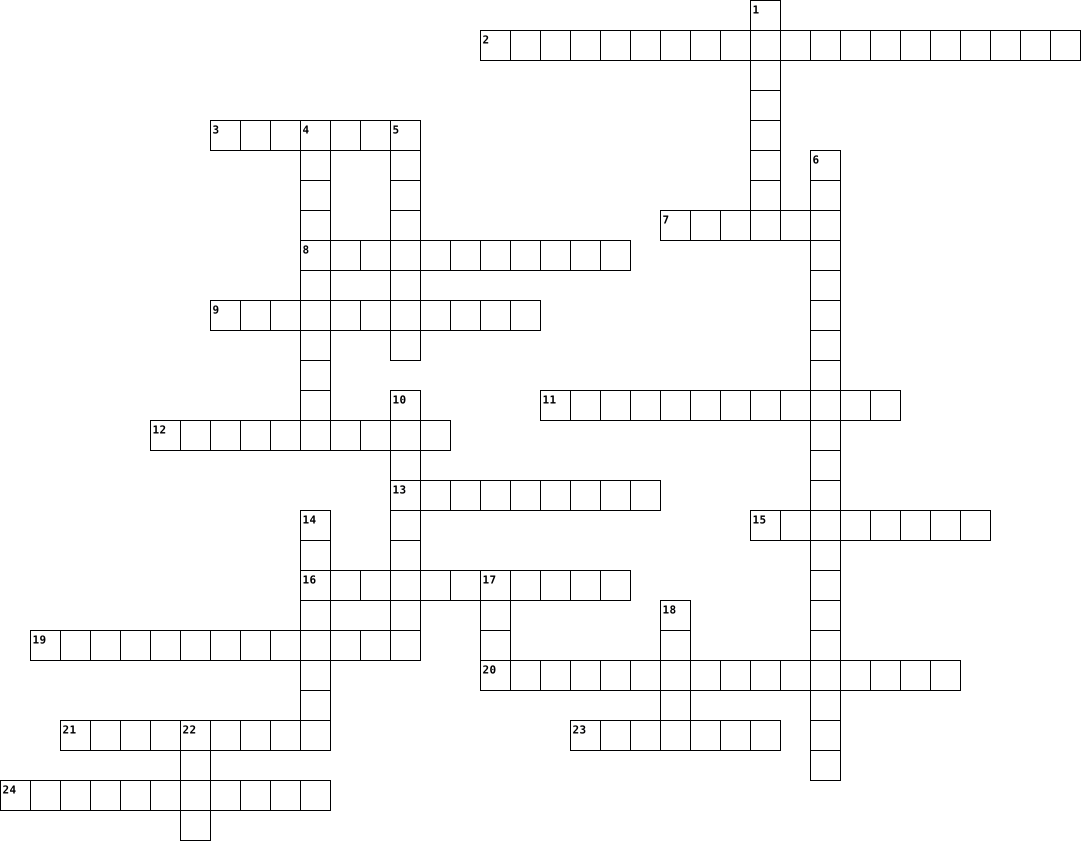
Across
- the point at which exactly half of the acid in the buffer solution has reacted with the titrant.
- have a neutral electric charge
- the positively charged particles which are present in the nucleus of an atom
- any chemical reaction that absorbs heat from its environment.
- a gas in which the particles (a) do not attract or repel one another and (b) take up no space (have no volume).
- the outermost shell of the atom
- a chemical reaction that releases energy by light or heat.
- gain of electron
- the point during a titration when an indicator shows that the amount of reactant necessary for a complete reaction has been added to a solution.
- when both the reactants and products are present in concentrations which have no further tendency to change with time.
- a reaction that involves the transfer of electrons between chemical species
- point in titration at which the amount of titrant added is just enough to completely neutralize the analyte solution.
- Loss of electron
- a measure of quality of energy
- the process of conversion of a solution into solid by converting the substance into insoluble form or by making the solution a super saturated one
Down
- a substance that increases the rate of a chemical reaction without itself undergoing any permanent chemical change.
- the average kinetic energy of all the atoms or molecules of that substance.
- one whose charge distribution is spherically symmetric when averaged over time
- consists of two substances that differ only by the presence of a proton (H⁺).
- technique where a solution of known concentration is used to determine the concentration of an unknown solution.
- A small particle with a negative charge that is found in all atoms.
- a substance that can accept hydrogen ions in water and can neutralize an acid.
- When things are different at each end
- A chemical that gives off hydrogen ions in water and forms salts by combining with certain metals.
24 Clues: gain of electron • Loss of electron • have a neutral electric charge • a measure of quality of energy • the outermost shell of the atom • When things are different at each end • a chemical reaction that releases energy by light or heat. • any chemical reaction that absorbs heat from its environment. • A small particle with a negative charge that is found in all atoms. • ...
C3 - Chemical Economics 2016-02-17

Across
- A subatomic particle with a positive electric charge.
- Percentage of reactants changed to useful products.
- the heat required to raise the temperature of a particular substance by one degree.
- A substance that increases the rate of a chemical reaction without itself undergoing any permanent chemical change.
- The amount of space on a substance has to react.
- A manufacturing process that runs all the time.
- The idea that the rate of a chemical reaction depends on the frequency of successful collisions.
- A reaction which takes in energy, usually in the form of heat. This is shown by a drop in temperature.
- A reaction which gives out energy, usually in the form of heat. This is shown by a rise in temperature.
- A subatomic particle with no electric charge.
Down
- The centre of an ATOM that contains the PROTON and NEUTRON.
- A manufacturing process that only occurs at certain times.
- The mass of a NUCLEUS of an ATOM.
- The number of particles in a particular space.
- Any compound manufactured for use as a medicinal drug.
- An experiment used to measure how much energy a fuel supplies.
- The smallest particle of a chemical element that can exist.
- How quick or slow a reaction is progressing.
- The force between two atoms that are chemically joined.
- The different physical forms of an element. For example, carbon can appear as graphite, fullerenes, and diamond.
- a technique for the separation of a mixture by passing it in solution or suspension through a medium in which the components move at different rates.
- A comparison between the actual yield of a reaction and the predicted yield, expressed a percentage.
- A subatomic particle with a negative electric charge.
23 Clues: The mass of a NUCLEUS of an ATOM. • How quick or slow a reaction is progressing. • A subatomic particle with no electric charge. • The number of particles in a particular space. • A manufacturing process that runs all the time. • The amount of space on a substance has to react. • Percentage of reactants changed to useful products. • ...
Chapter 10- Explaining reactions 2014-05-15

Across
- What is formed in a chemical reaction.
- Shows the elements in a substance.
- An ion where the electrons are lost.
- A substance composed of a metal and non-metal.
- A bond where electrons are donated.
- An ion where the electrons are gained.
- An ion with more than one element.
- Shared or donated in a chemical bond.
Down
- An ion with one element.
- A substance composed only of non-metals.
- Found on the left side of a chemical reaction.
- Solid formed when a chemical reaction occurs.
- A bond where electrons are shared.
- A mixture of metals.
- A bond which has a sea of electrons.
- An atom that has gained or lost electrons.
16 Clues: A mixture of metals. • An ion with one element. • Shows the elements in a substance. • A bond where electrons are shared. • An ion with more than one element. • A bond where electrons are donated. • An ion where the electrons are lost. • A bond which has a sea of electrons. • Shared or donated in a chemical bond. • What is formed in a chemical reaction. • ...
Fire Behaviour - Chapter 5 2025-10-21

Across
- Transmission or transfer of heat energy from one body to another body at lower temperature
- initiation of combustion by heat but without a spark or flame
- any material that readily yields oxygen or other oxidizing gas, or that readily reacts to promote or initiate combustion of combustible materials.
- a material that will maintain combustion under specified environmental conditions
- Reaction, a Chemical reaction between two or more materials that changes the materials and produces heat
- Ignition, the moment when a mixture of fuel and oxygen encounters an external heat source which sufficient heat or thermal energy to start a combustion reaction.
- Energy, energy possessed by a moving object because of its energy
- Ignition, the initiation of combustion of a material by an internal chemical or biological reaction that has produced sufficient heat to ignite the material
- refer to the amount of additional heat needed to raise the temperature of a substance.
- physical process that changes a liquid into gaseous state
- transfer of heat energy from one body to another through direct contact or an intervening medium, from the point where heat is produced to another location
Down
- the result of exothermic reactions, occuring spontaneously in some materials under certain conditions.
- the chemical decomposition of a solid material by heating
- Energy, stored energy possessed by an object that can be released in the future to perform work once released
- the capacity to perform work; occurs when a force is applied to an object over a distance, or when a substance undergoes a chemical, biological, or physical transformation
- a form of energy associated with the motion of atoms or molecules within a fuel, which is transferred from one body to another as a result of a temperature difference between the bodies, such as from the sun to the earth. It is measured in degrees of temperature.
- chemical process that occurs when a substance combines with an oxidizer such as oxygen in the air
- transfer of heat by the movement of heated fluids or gases, usually in an upward direction
- measure of the average kinetic energy of the particles in a sample of matter, expressed in terms of units or degrees.
- a chemical process of oxidation that occurs at a rate fast enough to produce heat and usually light in the form of either glow or flame
- a rapid oxidation process, is a gas-phase chemical reaction resulting in the evolution of light and heat in varying intensities
- Reaction, a Chemical reaction in which a substance absorbs heat
- point, the temperature at which liquid fuel produces sufficient vapors to support combustion once the fuel ignites
23 Clues: the chemical decomposition of a solid material by heating • physical process that changes a liquid into gaseous state • initiation of combustion by heat but without a spark or flame • Reaction, a Chemical reaction in which a substance absorbs heat • Energy, energy possessed by a moving object because of its energy • ...
AP Chemistry Senior Final Exam 2023-05-09

Across
- bond that requires the sharing of electrons
- how to calculate gram of a product from a reaction
- "particles must collide in order to react"
- how fast a chemical reaction takes to finish
- energy change of a chemical reaction
- the reactant that limits how much product is made
- concentration of an aqueous solution
- strongest of the intermolecular forces
Down
- bond that requires the gaining and losing of electrons
- a reaction that only produced carbon dioxide and water
- positively charged metal atom
- measures acidity; ranges 1-14
- PV=nRT
- shorthand for oxidation and reduction
- "everyone's favorite (equilibrium) organization technique"
- negatively charged nonmetal atom
- forward rate = reverse rate
- the overall chaos of the universe
18 Clues: PV=nRT • forward rate = reverse rate • positively charged metal atom • measures acidity; ranges 1-14 • negatively charged nonmetal atom • the overall chaos of the universe • energy change of a chemical reaction • concentration of an aqueous solution • shorthand for oxidation and reduction • strongest of the intermolecular forces • "particles must collide in order to react" • ...
electrochemistry 2018-10-23

Across
- cell a cell in which a spontaneous chemical reaction produces electrical energy
- in electrolysis, cathode undergo
- cell an electrochemical cell that uses an external electric source for non-spontaneous chemical reaction to occur.
- the reference primary standard electrode is the ... electrode
- to maintain electrical neutrality and allow reaction to occur
- ... electrode do not participate in electrolysis
- branch of chemistry that deals with the chemical action of electricity and the production of electricity by chemical reactions
- agent species being oxidized
Down
- anode is negative and cathode is positive in ... cell
- the standard electrode for hydrogen is arbitrarily assigned a potential of
- substance allow electric current to pass through them
- process of using electrical energy to cause a non spontaneous redox reaction
- process of layering a metal onto a surface in an electrolytic cell
- another name for electrode potential
- the component of electrolysis cell are wire, beaker, electrode, electrolyte and ...
- between zinc and copper which one will be oxidized
16 Clues: agent species being oxidized • in electrolysis, cathode undergo • another name for electrode potential • ... electrode do not participate in electrolysis • between zinc and copper which one will be oxidized • anode is negative and cathode is positive in ... cell • substance allow electric current to pass through them • ...
Chemistry of Life 2023-09-06

Across
- the ability to do work
- the addition of mass to an organism and the formation of new cells
- the process of natural change that takes place during the life of an organism
- a characteristic that helps a living thing survive and reproduce in a given environment
- the basic units of the structure and function of living things
- A chemical reaction that absorbs energy
- water molecules tend to stick together
- the bonding of a water molecule to another substance
Down
- a substance that forms as a result of a chemical reaction
- a possible answer to a scientific question
- the process by which living things give rise to offspring
- When organisms need other organisms in order to survive
- A substance that starts a chemical reaction
- A chemical reaction that releases energy
- the total of all the biochemical reactions occurring in a cell or organism
- a broad explanation for events that is widely accepted as true
16 Clues: the ability to do work • water molecules tend to stick together • A chemical reaction that absorbs energy • A chemical reaction that releases energy • a possible answer to a scientific question • A substance that starts a chemical reaction • the bonding of a water molecule to another substance • When organisms need other organisms in order to survive • ...
balancing reactions 2025-10-29

Across
- A number placed in front of a chemical formula in a balanced equation to indicate the relative number of moles of each reactant and product.
- Substances produced as a result of a chemical reaction.
- The reactant that remains after the limiting reactant is completely consumed in a chemical reaction.
- The reactant that is completely consumed in a chemical reaction and determines the maximum amount of product that can be formed.
Down
- The amount of product obtained in a chemical reaction.
- The principle that matter cannot be created or destroyed in a chemical reaction; the total mass of the reactants equals the total mass of the products.
- The basic building block of matter, consisting of protons, neutrons, and electrons.
- Substances that undergo change in a chemical reaction.
- The process of adjusting the number of reactants and products in a chemical equation to ensure the number of atoms of each element is equal on both sides of the equation.
- A symbolic representation of a chemical reaction using chemical formulas and symbols.
10 Clues: The amount of product obtained in a chemical reaction. • Substances that undergo change in a chemical reaction. • Substances produced as a result of a chemical reaction. • The basic building block of matter, consisting of protons, neutrons, and electrons. • A symbolic representation of a chemical reaction using chemical formulas and symbols. • ...
Chemical equations and reactions 2024-05-02

Across
- reaction involving the process of oxidation & reduction
- oxide used to white wash a wash
- formed when iron reacts with moisture and oxygen commonly knows as hydrated iron oxide
- process in which silver gets corroded
- a reaction in which acid and bases react to form salt and water
- left hand side of chemical reaction
- a condition in which aerial oxidation of unsaturated fats and oil present in food gives it an unpleasant flavor and odour
- reaction in which heat is absorbed
- reaction in which an element gains oxygen/loses hydrogen/loses electrons
Down
- reaction in which heat is released
- a process in which a given element loses oxygen/gains hydrogen/gains electorns
- a reaction in which ions of an element interchange
- equation in which the elements on the LHS= elements on RHS
- a reaction is which 2 or more elements combine to form a compound
- right hand side of a chemical equation
- reaction in which compound breaks to give 2/more elements
16 Clues: oxide used to white wash a wash • reaction in which heat is released • reaction in which heat is absorbed • left hand side of chemical reaction • process in which silver gets corroded • right hand side of a chemical equation • a reaction in which ions of an element interchange • reaction involving the process of oxidation & reduction • ...
Chemical Reactions 2024-05-13

Across
- A common component found in antacids, such as milk of magnesia
- Common table salt
- A chemical reaction that takes place between an oxidizing substance and a reducing substance.
- Also known as hydrogen oxide
- Process of applying a protective layer of zinc on steel or iron to prevent rusting
- A substance that increases the rate of a chemical reaction without being consumed in the process.
Down
- A reaction that absorbs heat energy
- A highly corrosive mineral acid used in the production of fertilizers and explosives.
- A precious metal valued for its lustre and is used in making jewellery
- A greenish-yellow gas used in water treatment and as a disinfectant.
- A reddish brown metal used in electrical wiring and
- A reaction that releases heat energy
- A reddish-brown metal used in flame retardants and pharmaceuticals
- Found in bananas and has chemical symbol K
- Insoluble solid that emerges from a liquid solution
- Has chemical symbol Pb
16 Clues: Common table salt • Has chemical symbol Pb • Also known as hydrogen oxide • A reaction that absorbs heat energy • A reaction that releases heat energy • Found in bananas and has chemical symbol K • A reddish brown metal used in electrical wiring and • Insoluble solid that emerges from a liquid solution • A common component found in antacids, such as milk of magnesia • ...
CROSSWORD PUZZLE FOR ALCOHOLS, THIOLS AND ETHERS 2022-11-02

Across
- class of organic compounds that contain an oxygen between two alkyl groups
- type of chemistry that studies the compounds of carbon
- difference in arrangement of electrons for benzene structures
- type of bond polarity where two elements on right side (both nonmetals) of periodic table
- covalent bonds occur between two?
- unsymmetrical addition reaction that refers to the addition of water
- an atom or group of atoms attached to a chain (or ring) of carbon atoms
- the distribution of electrical charge over the atoms joined by the bond
- group of atoms with characteristic chemical behavior
- type of geometric diastereomer that has the functional group at the same side of double bonds
- type of reaction wherein the carbon skeleton of a molecule is rearranged to give a structural isomer of the original molecule.
- double bond between carbon atoms
- molecules with the same molecular formula but have different structures
- what is the principle element of organic compounds?
- for an element to become stable, it must have eight electrons
Down
- state of an atom with four electrons available for covalent chemical bonding in its valence
- for an element to become stable, it must have eight electrons
- type of chemical reaction where atoms or groups of atoms are added to each carbon atom of multiple bonds
- organic compound with a hydroxyl (OH) functional group on an aliphatic carbon atom
- reaction in which the functional group of one chemical compound is substituted by another group
- type of organic compound whose molecules contain a benzene ring
- alkanes that contain a ring of three or more carbons
- number of electrons carbon has
- type of geometric diastereomer that has functional groups on opposite sides of double bonds
- single bond between carbon atoms
- triple bond between carbon atoms
- type of chemical reaction in which a pair of atoms or groups of atoms are removed from a molecule
- class of organic chemical compounds containing a sulfur atom in place of the oxygen atom
28 Clues: number of electrons carbon has • single bond between carbon atoms • triple bond between carbon atoms • double bond between carbon atoms • covalent bonds occur between two? • what is the principle element of organic compounds? • alkanes that contain a ring of three or more carbons • group of atoms with characteristic chemical behavior • ...
MOD 9 VOCAB 2023-05-02

Across
- the heat energy given out when one mole of a substance burns completely in oxygen.
- the energy stored in the chemical bonds of a substance
- a branch of chemistry that qualitatively and quantitatively describes the energy changes that occur during chemical reactions
- the quantity of heat required to raise the temperature of one gram of a substance by one Celsius degree
- a system whose reactants, products, or both are in more than one phase
- A change in one of the variables that describe a system at equilibrium produces a shift in the position of the equilibrium that counteracts the effect of this change
- the amount of energy needed to warm 1 g of H2O by 1°C
- energy cannot be created nor destroyed
- power derived from the utilization of physical or chemical resources
- everything around the reaction
- a reaction in which the conversion of reactants to products and the conversion of products to reactants occur simultaneously.
- the amount of energy needed to change one mole of a substance from the solid phase to the liquid phase at constant temperature and pressure
Down
- the value of its reaction quotient at chemical equilibrium
- thermal energy
- one in which all species are present in the same phase
- the amount of energy (enthalpy) that must be added to a liquid substance to transform a quantity of that substance into a gas.
- a device used to measure the heat flow of a chemical reaction or physical change
- an energy-like property or state function
- an ion that is already contained in the solution
- unit of work or energy in the International System of Units (SI); it is equal to the work done by a force of one newton acting through one metre
- a collection of objects (or smaller systems) that can be identified
- condition in the course of a reversible chemical reaction in which no net change in the amounts of reactants and products occurs.
22 Clues: thermal energy • everything around the reaction • energy cannot be created nor destroyed • an energy-like property or state function • an ion that is already contained in the solution • the amount of energy needed to warm 1 g of H2O by 1°C • the energy stored in the chemical bonds of a substance • one in which all species are present in the same phase • ...
biology final review2 2024-12-13

Across
- The substances formed as a result of a chemical reaction.
- A substance made up of only one type of atom.
- The starting substances in a chemical reaction.
- A negatively charged particle that orbits the nucleus of an atom.
- Molecules that have a partial positive and negative charge due to uneven sharing of electrons.
- A type of bond where electrons are transferred from one atom to another, creating charged ions.
- A scale that measures the acidity or basicity of a solution.
- The specific region of an enzyme where the substrate binds.
- A neutral particle in the nucleus of an atom.
- An atom or molecule with a charge due to the loss or gain of electrons.
- The substance that is dissolved in a solvent.
- A weak bond between a hydrogen atom and an electronegative atom (like oxygen or nitrogen).
- Biological catalysts that speed up chemical reactions in living organisms.
- The smallest unit of matter, consisting of protons, neutrons, and electrons.
- The central part of an atom, containing protons and neutrons.
- A process in which substances are transformed into new substances.
- A substance that dissolves other substances (e.g., water).
Down
- An enzyme that breaks down proteins.
- The energy required to start a chemical reaction.
- An enzyme that breaks down fats (lipids).
- An enzyme that breaks down alcohols, such as ethanol.
- A homogeneous mixture of solute and solvent.
- A substance formed by the chemical combination of two or more elements.
- Weak attractive forces between molecules due to temporary dipoles.
- A positively charged particle in the nucleus of an atom.
- The reactants in an enzyme-catalyzed reaction.
- An enzyme that breaks down starches into sugars.
- A bond formed by the sharing of electrons between atoms.
- Atoms of the same element with a different number of neutrons.
- Two or more atoms bonded together.
- A substance that speeds up a chemical reaction without being consumed.
31 Clues: Two or more atoms bonded together. • An enzyme that breaks down proteins. • An enzyme that breaks down fats (lipids). • A homogeneous mixture of solute and solvent. • A substance made up of only one type of atom. • A neutral particle in the nucleus of an atom. • The substance that is dissolved in a solvent. • The reactants in an enzyme-catalyzed reaction. • ...
Chemical and Physical Changes Review! 2024-12-09

Across
- A change to matter that does not change the chemical composition of the matter
- A type of reaction that releases heat. (Gets colder)
- maintain (a quantity such as energy or mass) at a constant overall total.
- of Mass States that matter cannot be created or destroyed; it can only change form
- A solid that forms from a solution during a chemical reaction.
- The process where a solid turns directly into a gas without becoming a liquid.
- The process of a solid turning into a liquid.
- The process of matter changing states between solid, liquid, or gas
- when certain things or factors or conditions lead to alteration in course of action
- A physical change where a substance mixes with a solvent to form a solution.
- The process of a liquid turning into a solid.
Down
- is a characteristic of a substance that can only be observed during a chemical reaction
- A physical property is a characteristic of matter that can be observed and measured without changing the chemical identity
- A substance that is dissolved in a solvent
- The process of a gas turning into a liquid.
- The process of a liquid turning into a gas
- A type of reaction that absorbs heat.(Gets hotter)
- The process of elements interacting with one another to form new substances
- A change to matter that does change the chemical composition of the matter.
- A substance that dissolves a solute to form a solution
20 Clues: A substance that is dissolved in a solvent • The process of a liquid turning into a gas • The process of a gas turning into a liquid. • The process of a solid turning into a liquid. • The process of a liquid turning into a solid. • A type of reaction that absorbs heat.(Gets hotter) • A type of reaction that releases heat. (Gets colder) • ...
Chemical Reactions 2022-11-15

Across
- a substance that speeds up a chemical reaction
- substances that result from a chemical reaction
- absorb heat energy
- a process that produces a chemical change
- how fast a reaction occurs after it has started
Down
- substances that exist before a reaction
- release heat energy
- the amount of substance present in a certain volume
- a substance that slows down a chemical reaction
- proteins that speed up cell reactions
10 Clues: absorb heat energy • release heat energy • proteins that speed up cell reactions • substances that exist before a reaction • a process that produces a chemical change • a substance that speeds up a chemical reaction • substances that result from a chemical reaction • a substance that slows down a chemical reaction • how fast a reaction occurs after it has started • ...
Vocab 2024-11-06

Across
- Is a substance that is formed as the result of a chemical reaction.
- A type of lettering form written lower than the things around it. In chemical formulas the number of atoms in a molecule is written in this manner
- of reaction: The speed at which reactants are converted in products
- A substance that increases the rate of a chemical reaction without itself undergoing any permanent chemical change.
- A substance produced by a living organism that acts as a catalyst to bring about a specific biochemical reaction
- reaction: A process in which one or more substances, the reactants, are converted to one or more different substances called the products
Down
- reaction: A chemical reaction that releases energy in the form of light or heat
- A substance that slows down or prevents a particular chemical reaction or other process, or that reduces the activity of a particular reactant, catalyst, or enzyme.
- A substance that takes part in and undergoes change during a reaction
- reaction: Are those which absorb energy from the surroundings and result in a net decrease in temperature
- of Conservation of Mass: for any system closed to all transfers of matter and energy, the mass of the system must remain constant over time, as the system's mass cannot change, so quantity cannot be added or removed.
11 Clues: Is a substance that is formed as the result of a chemical reaction. • of reaction: The speed at which reactants are converted in products • A substance that takes part in and undergoes change during a reaction • reaction: A chemical reaction that releases energy in the form of light or heat • ...
science crossword 2025-02-05

Across
- enter
- the starting substances in a chemical reaction
- an attraction between atoms
- light
- let go
- exit
Down
- energy that comes from light
- absorption
- a result of a chemical reaction
- any substance that has a defined composition
- take in
- molecule
- A system of knowledge about the physical, chemical, and biological universe
- the amount of matter in an object
14 Clues: exit • enter • light • let go • take in • molecule • absorption • an attraction between atoms • energy that comes from light • a result of a chemical reaction • the amount of matter in an object • any substance that has a defined composition • the starting substances in a chemical reaction • A system of knowledge about the physical, chemical, and biological universe
science crossword 2025-02-05

Across
- take in
- a result of a chemical reaction
- let go
- the amount of matter in an object
- any substance that has a defined composition
- exit
- light
Down
- absorption
- molecule
- enter
- A system of knowledge about the physical, chemical, and biological universe
- energy that comes from light
- an attraction between atoms
- the starting substances in a chemical reaction
14 Clues: exit • enter • light • let go • take in • molecule • absorption • an attraction between atoms • energy that comes from light • a result of a chemical reaction • the amount of matter in an object • any substance that has a defined composition • the starting substances in a chemical reaction • A system of knowledge about the physical, chemical, and biological universe
Crossword 2024-04-28

Across
- Substances that change the speed of a reaction without causing permanent changes.
- The study of energy changes that accompany chemical transformations in matter.
- ________ is the study of the energy changes that accompany all processes, whether chemical or physical.
- A polysaccharide that does not provide the body with energy or nutrients.
- A ________ equation is a statement of the chemical change and the energy change that accompanies the change.
- Complex molecules made up of long chains of amino acids which are compounds of carbon, hydrogen, oxygen, and nitrogen.
- Chemical and physical changes that occur with the absorption of energy are ________ processes.
- ________ is the enthalpy shift that takes place when one mole of a compound is created from its standard state constituents.
- An ________ reaction is characterized by a negative ∆U.
- Measure of thermal energy in a system per unit temperature that cannot be used to perform beneficial work.
Down
- The setup used to determine energy change during a reaction.
- ________ rate is dependent on several factors, namely, nature of reactants, temperature, and concentration.
- It is the total heat absorbed in a process at constant pressure if only pressure-volume work is done.
- The symbol w represents the ________ performed by the system or on the system.
- Time required to decrease the reactant concentration to one-half of the initial value.
- Increase in ________ increases reaction rates.
- Hormone that moves glucose from the blood stream into the cells.
- The ________ theory explains the effects of temperature and concentration on reaction rate.
- Energy required to raise the temperature of one gram of a substance by one degree Celsius is known as its heat capacity.
- A substance's constant volume heat capacity is sometimes referred to as its ______ heat capacity.
20 Clues: Increase in ________ increases reaction rates. • An ________ reaction is characterized by a negative ∆U. • The setup used to determine energy change during a reaction. • Hormone that moves glucose from the blood stream into the cells. • A polysaccharide that does not provide the body with energy or nutrients. • ...
Chapter 9 Chemistry 2022-04-25

Across
- preventing or correcting acidity
- mass of an atom of a chemical element in atomic mass units
- a numerical or constant quantity placed before and multiplying the variable in an algebraic equation
- a very important fertilizer and starting material for other fertilizers
- a substance that is made from a reaction
- the quantity of a product obtained from the complete conversion of the limiting reactant in a chemical reaction
- give way to arguments, demands, or pressure
- the relationship between the relative quantities of substances taking part in a reaction
- a compound of a particular organic base with hydrochloride acid
- to render something ineffective or harmless
- a substance that takes part in and undergoes change during a reaction
- calculation of things in great quantities
- the amount or number of a material or immaterial thing
- a conversion factor between compounds in a chemical reaction that derived from the coefficients of the compound in balanced equation
Down
- a crystalline compound with cooling minty taste and odor, found in peppermint and other natural oils
- a colorless, odorless toxic flammable gas formed by incomplete combustion of carbon
- an equation in which the number of atoms is equal on both sides
- compounds made up of ions that form charged particles
- the percent ratio of actual yield to the theoretical yield
- a flammable hydrocarbon gas of the alkaline series
- a standard scientific unit for measuring large quantities of very small entities
- the mass in grams of 1 mole of the substance
- a reactant in a chemical reaction that determined the amount of product that is formed
- pertaining to, or the nature of a scheme
- a compound with the formula Li3N
25 Clues: preventing or correcting acidity • a compound with the formula Li3N • a substance that is made from a reaction • pertaining to, or the nature of a scheme • calculation of things in great quantities • give way to arguments, demands, or pressure • to render something ineffective or harmless • the mass in grams of 1 mole of the substance • ...
Chemistry Crossword 2015-11-17

Across
- positively charged particle in the nucleus of an atom
- element that has both metallic and non-metallic properties
- vertical column of elements in the periodic table of elements
- group 2 elements in the periodic table
- no additional material is allowed to enter or leave
- abbreviation of atomic mass
- a chemical reaction that absorbs heat energy
- neutral particle in the nucleus of an atom
- most stable and unattractive elements
Down
- when two or more materials react and crate new materials
- the most reactive metal on the table of elements
- when a material changes from one state to another
- the sum of the number of protons and neutrons in an atom
- slow chemical change that occurs when oxygen in the air reacts with a metal
- a chemical reaction that takes place in the cells in your body
- vertical column of elements in the periodic table
- combination of symbols that represent a compound
- group 17 elements in the periodic table
- a chemical reaction that occurs when oxygen reacts with a substance to form a new substance and give off energy
- group one in the periodic table
- dull, brittle element that does not conduct electricity
- a chemical reaction that releases heat energy
- horizontal row of elements in the periodic table
- shiny, malleable, ductile element that conducts electricity
- invisible negatively charged particle that orbits the nucleus of an atom
25 Clues: abbreviation of atomic mass • group one in the periodic table • most stable and unattractive elements • group 2 elements in the periodic table • group 17 elements in the periodic table • neutral particle in the nucleus of an atom • a chemical reaction that absorbs heat energy • a chemical reaction that releases heat energy • ...
Science Times crossword puzzles 2023-08-31

Across
- Law: The principle that equal volumes of gases, at the same temperature and pressure, contain the same number of particles (moles).
- titration: A laboratory technique used to determine the concentration of an acid or base solution by reacting it with a solution of known concentration.
- The time required for half of the radioactive nuclei in a sample to undergo radioactive decay.
- dissociation constant (Ka): A measure of the strength of an acid in solution, defined as the ratio of the concentration of the dissociated ions to the concentration of the undissociated acid.
- energy: The minimum energy required for a chemical reaction to occur and for reactant molecules to transform into products.
- equation: An equation that relates the rate constant of a reaction to the temperature and activation energy.
- Law: The principle that the total enthalpy change of a chemical reaction is independent of the pathway taken, as long as the initial and final conditions are the same.
- The repeating pattern of chemical and physical properties of elements based on their atomic number.
- The ability of an atom to attract shared electrons in a chemical bond.
- gas law: The equation that describes the behavior of an ideal gas: PV = nRT, where P is pressure, V is volume, n is the number of moles, R is the ideal gas constant, and T is temperature.
Down
- (redox) reaction: A chemical reaction involving the transfer of electrons from one species (reducing agent) to another (oxidizing agent).
- product constant (Ksp): The equilibrium constant for the dissolution of a sparingly soluble compound into its constituent ions in a solution.
- The process of using an electric current to drive a non-spontaneous chemical reaction, usually the decomposition of a compound into its constituent elements.
- decay: The process in which an unstable atomic nucleus undergoes spontaneous radioactive decay, emitting particles or electromagnetic radiation.
- free energy: A thermodynamic property that measures the maximum amount of reversible work that can be performed by a system at constant temperature and pressure.
- energy: The amount of energy required to remove an electron from an atom or ion in the gas phase.
- Law: The principle that at constant temperature, the volume of a gas is inversely proportional to its pressure (P1V1 = P2V2).
- equilibrium: The state in a reversible chemical reaction where the forward and reverse reactions occur at equal rates, resulting in no net change in reactant and product concentrations.
- radius: The size of an atom, typically measured as the distance between the nucleus and the outermost electron shell.
- mass: The mass of one mole of a substance, often expressed in grams per mole (g/mol).
20 Clues: The ability of an atom to attract shared electrons in a chemical bond. • mass: The mass of one mole of a substance, often expressed in grams per mole (g/mol). • The time required for half of the radioactive nuclei in a sample to undergo radioactive decay. • energy: The amount of energy required to remove an electron from an atom or ion in the gas phase. • ...
02 vocabulary choice board 2021-10-11

Across
- process or result of oxidizing or being oxidized.
- (a substance) to be deposited in solid form from a solution.
- substance, ordinarily a liquid, in which other materials dissolve to form a solution.
- minor component in a solution, dissolved in the solvent.
- up or consisting of two or more existing parts or elements.
- action or fact of making a specified thing smaller or less in amount, degree, or size.
- reaction-a process that involves rearrangement of the molecular or ionic structure of a substance, as opposed to a change in physical form or a nuclear reaction.
- chemical equation-a chemical equation in which there are equal numbers of each type of atom on each side of the equation.
- a substance that is present at the end of a chemical reaction
- of conservation of mass-that in a chemical reaction mass is neither created nor destroyed.
- mixture-a mixture in which the composition is uniform throughout the mixture.
- mixture- a mixture in which the composition is not uniform throughout the mixture
- equation- a representation of a chemical reaction using symbols of the elements to indicate the amount of substance.
- in which heat has to be supplied to the system from the surroundings.
- are numbers that come after a symbol and below.
Down
- change-A change in matter which does not alter the chemical properties of the matter.
- of the factors of a product considered in relation to a specific factor especially
- substance that takes part in and undergoes change during a reaction.
- to which a substance dissolves in a solvent to make a solution .
- by or formed with evolution of heat.
- group of atoms bonded together, representing the smallest fundamental unit of a chemical compound
- change-when one chemical substance is transformed into one or more different substances
- any substance that increases the rate of a reaction without itself being consumed.
- substance made by mixing other substances together.
- the process where water vapor becomes liquid.
25 Clues: by or formed with evolution of heat. • the process where water vapor becomes liquid. • are numbers that come after a symbol and below. • process or result of oxidizing or being oxidized. • substance made by mixing other substances together. • minor component in a solution, dissolved in the solvent. • up or consisting of two or more existing parts or elements. • ...
chemistry 1 2019-03-18

Across
- multiples of ten
- special type of oil used in hair conditioners water resistant lubricants for the skin and nail polish dryers
- the substance that dissolves the solute and makes it a solution
- the substance that is dissolved in a solution
- unstable physical mixtures of undissolved particles in a liquid
- a substance that adds hydrogen to a chemical compound or subtracts oxygen from the compound
- substance that releases oxygen
- compounds that contain carbon and evaporate easily
- alcohols that evaporate easily
- a stable physical mixture of two or more substances
- characteristics that can be determined without a chemical reaction and do not cause a chemical change in the substance
- subatomic particles with a positive charge
- a chemical reaction in which the oxidizing agent is reduced and the reducing agent is oxidized
- a physical combination of matter in any proportion
- any substance that occupies spaces spaces and has mass
- water droplets emulsified in oil
- the concentration of surface active agents
Down
- the measure of the acidity an alkalinity of a substance
- a chemical combination of two or more atoms in definite proportions
- a change in form of physical properties of a substance without a chemical reaction or the creation of a new substance
- a colorless liquid or white crystals with a strong unpleasant odor that is used in permanent waving solutions
- liquids that are mutually soluble meaning that they can be mixed together to form stable solutions
- oil droplets emulsified in water
- the study of substances that contain the element carbon
- the quantity of hydrogen ions
- a chemical combination of matter in definite proportions
- the three different physical forms of matter
- a chemical reaction that combines a substance with oxygen to produce an oxide
- subatomic particles with no charge
29 Clues: multiples of ten • the quantity of hydrogen ions • substance that releases oxygen • alcohols that evaporate easily • oil droplets emulsified in water • water droplets emulsified in oil • subatomic particles with no charge • subatomic particles with a positive charge • the concentration of surface active agents • the three different physical forms of matter • ...
Chemistry Crossword 2015-11-19

Across
- a slow chemical reaction that occurs when oxygen reacts with a substance to form a new substance and gives off energy
- the amount of mass in a given volume of a substance
- a substance that can be pounded or rolled into sheets
- change that results when two or more substances react to create a different substance
- energy stored in chemicals and released when chemical react
- a combination of pure substances
- change of state from a liquid to a solid
- made up of only one kind of matter and has a unique set of properties that sets it apart from any other kind of matter
- change in appearance or state of a substance that does not change the composition
- a substance's ability to resist being scratched
- property that describes the physical appearance and composition of a substance
- when a substance is at the temperature at which its liquid phase changes to the gas phase
- a chemical change, which releases heat energy
Down
- an experiment in which all reactants and all products of a chemical reaction all accounted for
- any solid that can be stretched into a long wire
- a chemical reaction that takes place in the cells in your body
- a chemical change, which absorbs heat energy
- when a substance is at the temperature at which it changes from a solid to a liquid
- the shape of a substances's crystals can help identify it
- chemical combination of two or more elements in a specific ratio
- the ability of a substance to conduct electricity or heat
- an experiment in which one or more products of a chemical reaction can escape
- a material that cannot be broken down into any simpler substance
- the ability of a substance to be dissolved in another
24 Clues: a combination of pure substances • change of state from a liquid to a solid • a chemical change, which absorbs heat energy • a chemical change, which releases heat energy • a substance's ability to resist being scratched • any solid that can be stretched into a long wire • the amount of mass in a given volume of a substance • ...
unit 5 2021-10-27

Across
- oxide What product is formed when magnesium reacts with oxygen?
- Burning is a chemical reaction in which a substance combines with ____
- Does the temperature of an endothermic reaction increase or decrease?
- Reaction that has gained oxygen
- A reaction that gives out heat energy
- What product is formed when carbon reacts with oxygen?
- Does the temperature of an exothermic reaction increase or decrease?
Down
- Another word for burning
- A reaction that absorbs heat energy
- What can we see when a reaction has taken place?
- What happens to the atoms of the reactants?
- What product is formed when magnesium reacts with hydrochloric acid other than magnesium chloride?
- What is the chemical energy turned into when coal is burned?
- Is melting ice an endothermic process or reaction?
- What is needed for combustion to occur other than starting energy and oxygen?
15 Clues: Another word for burning • Reaction that has gained oxygen • A reaction that absorbs heat energy • A reaction that gives out heat energy • What happens to the atoms of the reactants? • What can we see when a reaction has taken place? • Is melting ice an endothermic process or reaction? • What product is formed when carbon reacts with oxygen? • ...
Endothermic vs Exothermic 2026-01-28

Across
- Measure of how hot or cold something is
- Substances that start a chemical reaction
- That increases reaction rate but is not consumed
- Substances formed by a chemical reaction
- Principle that matter cannot be created or destroyed
- Reaction that releases heat
Down
- Reaction that absorbs heat
- Speeds up a chemical reaction
- Power or heat involved in reactions
- A connection between atoms
10 Clues: Reaction that absorbs heat • A connection between atoms • Reaction that releases heat • Speeds up a chemical reaction • Power or heat involved in reactions • Measure of how hot or cold something is • Substances formed by a chemical reaction • Substances that start a chemical reaction • That increases reaction rate but is not consumed • ...
Chemical Reactions and Equations 2024-05-14

Across
- during a double displacement reaction, _____ are exchanged
- a magnesium ribbon burns in _____ colour
- most reactive metal
- reaction where light causes the breakdown of a subtance
- common name of calcium hydroxide
- a substance that undergoes a chemical change in a reaction
- 2Mg+O2 = 2MgO is a _______ reaction
Down
- substance that speeds up a chemical reaction
- a substance which turns from green to white when heated
- an insoluble solid formed during a double displacement reaction
- CaO + H20 is a ______ reaction (exothermic/endothermic)
- gas evolved when an acid reacts with a metal
- brown gas produced during the decomposition of lead nitrate
13 Clues: most reactive metal • common name of calcium hydroxide • 2Mg+O2 = 2MgO is a _______ reaction • a magnesium ribbon burns in _____ colour • substance that speeds up a chemical reaction • gas evolved when an acid reacts with a metal • a substance which turns from green to white when heated • CaO + H20 is a ______ reaction (exothermic/endothermic) • ...
Chemical Reaction Crossword #2 2021-12-01

Across
- there are five types of chemical ________.
- explosive reaction.
- type of replacement element takes the place of another element (MR. STEAL YOUR GIRL).
- type of energy released during an exothermic reaction.
- Explosive energy.
Down
- reaction that starts with two or more reactants to create one new product.
- are switched in a double replacement reaction.
- it’s like a breakup! (from video)
- for a chemical reaction to occur we need this.
- takes in energy.
- brings down swelling through endothermic reaction.
- there are these in reactants and products.
- one of two products of a combustion reaction.
13 Clues: takes in energy. • Explosive energy. • explosive reaction. • it’s like a breakup! (from video) • there are five types of chemical ________. • there are these in reactants and products. • one of two products of a combustion reaction. • are switched in a double replacement reaction. • for a chemical reaction to occur we need this. • ...
Chapter 6: Basic Concepts and Kinetics of Enzymes 2024-09-25

Across
- a chemical species that has the highest free energy and lowest concentration of those on the pathway from a substrate to a product
- when there is no net change in the concentration of products and reactants and delta G is zero, a system is said to be at
- type of reaction in which the free energy is positive
- type of enzyme that cleaves molecules by the addition of water
- a form of energy capable of doing work under conditions of constant temperature and pressure
- type of reaction in which the free energy is negative
- enzyme that moves functional groups within a molecule
- accelerates rate of reaction
- enzyme without its cofactor
- type of enzyme that catalyzes the joining of two molecules by forming new chemical bonds, typically with the hydrolysis of ATP
- specific region of enzyme where substrates bind
- type of enzyme that transfers functional groups from one molecule to another
Down
- enzymes that catalyze oxidation-reduction reactions
- catalytically active enzyme
- proposes that an enzyme's active site is precisely shaped to fit a specific substrate
- reactant in an enzymatic reaction
- an enzyme cannot alter the laws of _______ and therefore cannot alter the equilibrium of a chemical reaction
- tightly bound coenzymes
- non-protein chemical compound or metallic ion that is required for an enzyme's activity as a catalyst
- type of cofactor that is not a coenzyme
- a spontaneous reaction takes place only if delta G is _____
- the modification of the shape of an active site in an enzyme after the substrate has been bound
- enzyme that adds atoms or functional groups to a double bond or removes them from double bonds
- type of cofactor that is a small organic molecule, derived from vitamins
24 Clues: tightly bound coenzymes • catalytically active enzyme • enzyme without its cofactor • accelerates rate of reaction • reactant in an enzymatic reaction • type of cofactor that is not a coenzyme • specific region of enzyme where substrates bind • enzymes that catalyze oxidation-reduction reactions • type of reaction in which the free energy is positive • ...
Chapter 6 Metabolism Vocab 2024-03-08

Across
- A reaction that requires energy to be absorbed in order for it to take place.
- The minimum amount of extra energy required by a reacting molecule to get converted into a product.
- A series of connected chemical reactions that feed one another.
- A biological molecule consisting of one adenine, one sugar, and two phosphates.
- The substances which participate in a chemical reaction.
- The source of energy for use and storage at the cellular level.
- A non- protein chemical compound that is bound to a protein and is required for the protein's biological activity.
- The energy associated with objects in motion.
- End substances after a biological process has occurred.
- Catalytically active RNA molecules or RNA–protein complexes, in which solely the RNA provides catalytic activity.
- Any chemical reaction in which the oxidation number of a molecule, atom, or ion changes by gaining or losing an electron.
- A substance that works with an enzyme to initiate or aid the function of the enzyme.
- The stored energy that can be used to do work.
- Model proposing that the binding of a substrate or some other molecule to an enzyme causes a change in the shape of the enzyme so as to enhance or inhibit its activity.
Down
- Reactions that have a negative change in free energy and consequently release free energy.
- A chemical reaction having a common intermediate in which energy is transferred from one side of the reaction to the other.
- A region especially of a biologically active protein where catalytic activity takes place and whose shape permits the binding only of a specific reactant molecule.
- The ability to do work.
- A measure of energy that is available to do work.
- Two fundamental concepts govern energy as it relates to living organisms.
- When a molecule binds an enzyme and prevents it from carrying out a chemical reaction.
- The breakdown of complex molecules.
- A measure of randomness or disorder in a system.
- The chemical reactions in the body's cells that change food into energy.
- Organic molecules that are essential to an organism in small quantities for proper metabolic function.
- The set of metabolic pathways that construct macromolecules like DNA or RNA from smaller units.
- A biological catalyst and is almost always a protein.
27 Clues: The ability to do work. • The breakdown of complex molecules. • The energy associated with objects in motion. • The stored energy that can be used to do work. • A measure of randomness or disorder in a system. • A measure of energy that is available to do work. • A biological catalyst and is almost always a protein. • ...
Chemistry Revision Crossword 2015-11-20

Across
- A substance that is made in a chemical reaction
- A substance made up of atoms of two or more elements strongly joined together
- A reaction which absorbs energy in the form of heat from the surroundings
- The gas which turns limewater cloudy
- The gaining of oxygen by a substance
- Changes of State are an example of which type of reaction?
Down
- A starting substance in a chemical reaction.
- Thermal ________ is the production of smaller substances when a metal carbonate is heated
- A quantity which is conserved in chemical reactions
- Most fuels we use, including candle wax, are these types of molecules
- A chemical reaction in which a substance reacts quickly with oxygen and gives out light and heat
- A reaction which transfers energy in the form of heat to the surroundings
12 Clues: The gas which turns limewater cloudy • The gaining of oxygen by a substance • A starting substance in a chemical reaction. • A substance that is made in a chemical reaction • A quantity which is conserved in chemical reactions • Changes of State are an example of which type of reaction? • Most fuels we use, including candle wax, are these types of molecules • ...
AP Chemistry Vocabulary 2 2024-03-25

Across
- This law states that a compound always contains the same elements in the same proportions by mass
- A thermodynamic quantity representing the maximum amount of reversible work that can be performed by a thermodynamic system at constant temperature and pressure.
- The mass of one mole of a substance, expressed in grams per mole
- The individual steps in a complex chemical reaction.
- This principle predicts how a system at equilibrium responds to changes in temperature, pressure, or concentration
- Substances that repel water molecules are described as
- This law states that the total enthalpy change in a reaction is independent of the pathway taken
- A chemical reaction that absorbs energy from its surroundings, resulting in an increase in Gibbs Free Energy.
- The energy an object possesses due to its motion
- Atoms of the same element with different numbers of neutrons
- Weak intermolecular forces resulting from temporary shifts in electron density
- A combination of two or more substances that are not chemically bonded
- The energy required to remove an electron from a gaseous atom or ion
- A chemical formula that shows the simplest whole number ratio of atoms in a compound.
- The type of bonding found in metals, where electrons are delocalized
- he individual reactions that occur at the electrodes of an electrochemical cell.
- A term describing the rate of a reaction that is dependent on the concentration of only one reactant.
- The state in which opposing forces or processes are balanced, often referring to chemical reactions.
- Liquids that are not soluble in each other are termed
- An atom or molecule with a net electric charge due to the loss or gain of one or more electrons
- A chemical reaction that releases energy to its surroundings, resulting in a decrease in Gibbs Free Energy
- Diagrams that represent the arrangement of valence electrons in a molecule
- The reactant that limits the amount of product formed in a chemical reaction
- The branch of chemistry that deals with the study of the relationship between electricity and chemical reactions.
- A process or reaction that absorbs heat from its surroundings.
- The amount of heat required to convert one mole of a substance from solid to liquid
- A reactant that is not fully consumed in a chemical reaction.
- A chemical equation that shows only the ions involved in a chemical reaction
- Substances that are attracted to water molecules are described as
- A theory explaining the behavior of gases based on the motion of their particles
- Relating to phenomena on a large scale, visible to the naked eye
- Forces of attraction between atoms or molecules in close proximity
- The charge assigned to an atom in a molecule or ion based on the assumption that electrons in a chemical bond are shared equally between atoms.
Down
- The tendency of an atom to attract electrons towards itself in a chemical bond.
- Subatomic particles that orbit the nucleus of an atom and carry a negative charge.
- A type of intermolecular force that occurs between hydrogen atoms and other atoms
- The point in a titration at which the amount of titrant added is stoichiometrically equivalent to the amount of analyte present.
- The number of occurrences of a repeating event per unit of time.
- Liquids that are capable of being mixed together in any proportion
- The percentage of a compound's total mass that is contributed by a specific element
- The distribution of electrons within an atom or molecule.
- The distribution of velocities among particles in a gas
- The numerical value representing the ratio of product concentrations to reactant concentrations in a chemical equilibrium.
- The amount of heat required to convert one mole of a substance from liquid to gas
- The process of forming new atomic orbitals from a combination of atomic orbitals
- Alloy formed by adding atoms of a different size to the spaces between the atoms of the main metal
- The total heat content of a system at constant pressure.
- A principle stating that the amount of a substance deposited or liberated during electrolysis is directly proportional to the quantity of electricity passed through the electrolyte.
- The property of a material that allows it to be hammered or rolled into sheets
- The rate at which reactants are consumed in a chemical reaction.
- A mixture with uniform composition and properties throughout is termed as
- A technique used to determine the mass and composition of molecules
- The distance from the nucleus to the outermost electron in an ion
- The volume occupied by one mole of a substance at a given temperature and pressure
- Waves that consist of oscillating electric and magnetic fields and are responsible for phenomena such as light and radio waves.
- The time required for the concentration of a reactant to decrease to half of its initial value.
- A theoretical gas that follows the ideal gas law under all conditions of temperature and pressure
- A method of chemical analysis based on the measurement of mass.
- A type of cell that uses electrical energy to drive a non-spontaneous chemical reaction.
- The control exerted over a reaction rate due to the speed of the reaction steps
- A mixture with non-uniform composition and properties is termed as
- A process or reaction that releases heat into its surroundings.
- The type of bond formed between a metal and a non-metal, involving the transfer of electrons
- The study of the forces between electrically charged objects.
- A device that generates electrical energy from chemical reactions.
- The ion formed by the association of a hydrogen ion with a water molecule:
- The study of reaction rates and mechanisms
- A measure of the randomness or disorder in a system.
68 Clues: The study of reaction rates and mechanisms • The energy an object possesses due to its motion • The individual steps in a complex chemical reaction. • A measure of the randomness or disorder in a system. • Liquids that are not soluble in each other are termed • Substances that repel water molecules are described as • ...
Thermochemistry 2022-05-24

Across
- The value of q required to return a system to the given temperature at the completion of a reaction of Reaction
- change in enthalpy for a reaction at a given temperature and pressure
- quantity of heat needed to raise the temperature of the sample of substance by 1°C
- kinetic and potential energies of the particles making up a substance
- An extensive property of a substance that can be used to obtain the heat absorbed or evolved in a chemical reaction
- The SI unit of energy
- A non-SI unit of energy; 1 cal=4.184 J
- The energy an object has by virtue of its position in a field of force
- A chemical reaction or a physical change in which heat is evolved (q is negative)
Down
- energy that flows into or out of a system because of a difference in temperature between a thermodynamic system and its surroundings
- sum of the enthalpy changes for the individual steps
- quantity of heat needed to raise the temperature of 1 g of a substance by 1°C at constant pressure
- device used to measure the amount of heat absorbed or evolved in a physical or chemical change
- energy required by a system to change volume against the constant pressure of the atmosphere
- the ability to do work.
- The energy associated with an object by virtue of its motion
- The standard thermodynamic conditions chosen for substances
- Energy may be converted from one form to another but total quantity of energy remains constant
- property of a system that depends on only its present state
- chemical reaction or a physical change in which heat is absorbed (q is positive)
20 Clues: The SI unit of energy • the ability to do work. • A non-SI unit of energy; 1 cal=4.184 J • sum of the enthalpy changes for the individual steps • The standard thermodynamic conditions chosen for substances • property of a system that depends on only its present state • The energy associated with an object by virtue of its motion • ...
chemistry crossword 2017-11-07

Across
- positively charged particle in the nucleus of an atom
- system an experiment in which all reactants and all products of a chemical reaction are accounted for
- reactions reaction that takes place when two or more substances react to form new substances
- reaction that occurs when oxygen reacts with a substance to form a new substance and give off energy
- compound pure substance formed when at least one metal and one non-metal combine
- substance that helps a chemical reaction to proceed more quickly
- element that has both metallic and non-metallic properties
- atom that has become electrically charged because it has lost or gained electrons; a positive ion is an atom that has lost one or more electrons;a negative ion is an atom that has gained one or more electrons
- catalyst involved in chemical reactions in living things
- neutral particle in the nucleus of an atom
- number the sum of the number of protons and neutrons in an atom
- number number of protons in the nucleus of one atom of an element
Down
- the smallest part of an element that is representative of that element; a neutral particle made up of a nucleus containing protons and neutrons, and in which the number of electrons equals the number of protons
- ability of a substance to conduct electricity or heat
- compound pure substance formed when non-metals combine
- table table in which the elements are organized by their physical and chemical properties
- dull, brittle element that does not conduct electricity
- group 17 elements in the periodic table;the most reactive non-metals
- metals group 1 elements in the periodic table, not including hydrogen; the most reactive of the metals
- system an experiment in which one or more products of a chemical reaction can escape
- monoxide (CO(g))colourless, odourless gas;produced by incomplete combustion of chemicals containing carbon (e.g. hydrocarbons); major source: motor vehicles
21 Clues: neutral particle in the nucleus of an atom • ability of a substance to conduct electricity or heat • positively charged particle in the nucleus of an atom • compound pure substance formed when non-metals combine • dull, brittle element that does not conduct electricity • catalyst involved in chemical reactions in living things • ...
Second Semester Final Review 2015-05-15

Across
- A region in an atom where there is a high probability of finding electrons.
- Elements are arranged by increasing atomic number and by changes in properties
- Transfer of thermal energy by collisions of particles (CONTACT)
- The average kinetic energy of the particles of a substance
- Negatively charged particle that moves around the nucleus of the atom
- A chemical equation that has the same number of atoms of each element on both sides of the equation.
- Transfer of thermal energy by electromagnetic waves
- The minimum amount of energy needed to start a reaction
- The transfer of energy from a higher temperature to a lower temperature
- Atoms of the same element that have different numbers of neutrons
- Transfer of thermal energy in a fluid from one place to another
- Energy The sum of the kinetic and potential energy of the particles in an object
- A chemical reaction in which energy is released.
Down
- Substance that speeds up a chemical reaction without being permanently changed itself
- The energy required to raise the temperature of 1 gram of a substance by 1 degree
- The sum of the number of protons and neutrons in the nucleus of an atom
- An electron that is found in the outermost shell of an atom and that determines the atom’s chemical properties.
- The number of protons in an atom’s nucleus
- A chemical reaction in which energy is absorbed.
- Atomic particle with no charge (neutral) that is part of the atom’s nucleus
- Vertical columns in the periodic table
- A substance that slows down a chemical reaction
- Element or compound that cannot be broken down into simpler components and maintain the properties of the original substance
- Energy Energy a moving object has because of its motion
- Atoms of the same element that have a different number of electrons
25 Clues: Vertical columns in the periodic table • The number of protons in an atom’s nucleus • A substance that slows down a chemical reaction • A chemical reaction in which energy is absorbed. • A chemical reaction in which energy is released. • Transfer of thermal energy by electromagnetic waves • The minimum amount of energy needed to start a reaction • ...
Puzzle 2024-10-31

Across
- Energy related to heat transfer in a reaction
- Substance that undergoes change in a chemical reaction
- Reaction that releases energy into its surroundings
- Organelle in plant cells where photosynthesis takes place
- Reaction that absorbs energy from its surroundings
- Law of Conservation of _______ ____ _______
- Molecule used by cells to store and transfer energy
Down
- Gas taken in by plants during photosynthesis
- Process by which cells produce energy from glucose
- Liquid required for photosynthesis and many biological processes
- Sugar produced by plants during photosynthesis
- Organelle responsible for energy production in cells
- Process by which plants make food using sunlight
- The result of a chemical reaction
- Process that changes substances into different substances
- Gas released by plants during photosynthesis
- Form of energy used by plants to perform photosynthesis
17 Clues: The result of a chemical reaction • Law of Conservation of _______ ____ _______ • Gas taken in by plants during photosynthesis • Gas released by plants during photosynthesis • Energy related to heat transfer in a reaction • Sugar produced by plants during photosynthesis • Process by which plants make food using sunlight • ...
Chemistry Ch. 11 Crossword 2023-04-26

Across
- is a chemical change in which an element or a compound reacts with oxygen, often producing energy in the form of heat and light.
- is a substance that speeds up the reaction but is not used up in the reaction.
- is a chemical equation that does not indicate the relative amounts of the reactants and products.
- is a chemical change in which two or more substances react to form a single new substance.
- is a chemical change in which one element replaces a second element in a compound.
- small whole numbers that are placed in front of the formulas in an equation in order to balance it
- a chemical change involving an exchange of positive ions between two compounds.
Down
- an equation that shows dissolved ionic compounds as dissociated free ions.
- is a chemical change in which a single compound breaks down into two or more simpler products.
- is a representation of a chemical reaction
- An ion that appears on both sides of an equation and is not directly involved in the reaction
- each side of the equation has the same number of atoms of each element and mass is conserved.
- lists metals in order of decreasing reactivity.
- is an equation for a reaction in solution that shows only those particles that are directly involved in the chemical change.
14 Clues: is a representation of a chemical reaction • lists metals in order of decreasing reactivity. • an equation that shows dissolved ionic compounds as dissociated free ions. • is a substance that speeds up the reaction but is not used up in the reaction. • a chemical change involving an exchange of positive ions between two compounds. • ...
Science Review 2024-06-14

Across
- material goes into chemical reaction
- homozygous alleles
- material produced in photosynthesis
- can't make its own food
- research measures
- is water or oil more dense
- Dominant alleles
- material go into photosynthesis
- heterozygous alleles
Down
- recessive alleles
- Element
- manmade, not found in nature
- Shows chemical reaction changed
- makes its own food
- what you control
- Source of Energy in a Food Web
- modified in nature
- Food Web arrows represent?
- Compound
19 Clues: Element • Compound • what you control • Dominant alleles • recessive alleles • research measures • makes its own food • homozygous alleles • modified in nature • heterozygous alleles • can't make its own food • is water or oil more dense • Food Web arrows represent? • manmade, not found in nature • Source of Energy in a Food Web • Shows chemical reaction changed • material go into photosynthesis • ...
Chemistry 2014-11-06
Across
- when they have metallic and non-metallic properties
- slow chemical change
- new materials produced by the reaction
- characteristics that can be used to describe a substance
- when two non-metals combine
- when no additional materials can enter or leave
- absorbs heat
- the ability of a substance to conduct electricity or heat
- chemical reactions that occur when oxygen reacts with a substance to form a new substance
- Group 17 elements are called
- when two or more elements combine
- when a metal and non-metal form an aqueous solution of
Down
- shiny, malleable, and ductile
- when a non-metal and metal combine
- solid or gas
- when the product of the reaction can escape
- when ions can form when certain atoms of elements combine
- compound have a chemical name and a
- materials at the start of a reaction are called
- horizontal rows in the periodic table of elements
- has the same mass as a proton
- releases heat
- vertical columns on the periodic table
- when gas turns into a solid
- catalyst involved in chemical reactions in living things
25 Clues: solid or gas • absorbs heat • releases heat • slow chemical change • when two non-metals combine • when gas turns into a solid • Group 17 elements are called • shiny, malleable, and ductile • has the same mass as a proton • when two or more elements combine • when a non-metal and metal combine • compound have a chemical name and a • new materials produced by the reaction • ...
chemistry 1 2019-03-18

Across
- a chemical combination of two or more atoms in definite proportions
- a colorless liquid or white crystals with a strong unpleasant odor that is used in permanent waving solutions
- characteristics that can be determined without a chemical reaction and do not cause a chemical change in the substance
- any substance that occupies spaces spaces and has mass
- multiples of ten
- the study of substances that contain the element carbon
- liquids that are mutually soluble meaning that they can be mixed together to form stable solutions
- a physical combination of matter in any proportion
- subatomic particles with a positive charge
- oil droplets emulsified in water
- a chemical reaction in which the oxidizing agent is reduced and the reducing agent is oxidized
- the measure of the acidity an alkalinity of a substance
- a substance that adds hydrogen to a chemical compound or subtracts oxygen from the compound
- a stable physical mixture of two or more substances
Down
- unstable physical mixtures of undissolved particles in a liquid
- compounds that contain carbon and evaporate easily
- the substance that dissolves the solute and makes it a solution
- a change in form of physical properties of a substance without a chemical reaction or the creation of a new substance
- substance that releases oxygen
- water droplets emulsified in oil
- the substance that is dissolved in a solution
- alcohols that evaporate easily
- a chemical combination of matter in definite proportions
- the three different physical forms of matter
- subatomic particles with no charge
- the quantity of hydrogen ions
- a chemical reaction that combines a substance with oxygen to produce an oxide
- special type of oil used in hair conditioners water resistant lubricants for the skin and nail polish dryers
- the concentration of surface active agents
29 Clues: multiples of ten • the quantity of hydrogen ions • substance that releases oxygen • alcohols that evaporate easily • water droplets emulsified in oil • oil droplets emulsified in water • subatomic particles with no charge • subatomic particles with a positive charge • the concentration of surface active agents • the three different physical forms of matter • ...
chemistry 1 2019-03-18

Across
- a stable physical mixture of two or more substances
- the substance that dissolves the solute and makes it a solution
- the quantity of hydrogen ions
- alcohols that evaporate easily
- subatomic particles with a positive charge
- oil droplets emulsified in water
- the three different physical forms of matter
- a chemical combination of matter in definite proportions
- a colorless liquid or white crystals with a strong unpleasant odor that is used in permanent waving solutions
- water droplets emulsified in oil
- the substance that is dissolved in a solution
- multiples of ten
- any substance that occupies spaces spaces and has mass
- a chemical reaction that combines a substance with oxygen to produce an oxide
Down
- unstable physical mixtures of undissolved particles in a liquid
- characteristics that can be determined without a chemical reaction and do not cause a chemical change in the substance
- compounds that contain carbon and evaporate easily
- liquids that are mutually soluble meaning that they can be mixed together to form stable solutions
- a chemical combination of two or more atoms in definite proportions
- a chemical reaction in which the oxidizing agent is reduced and the reducing agent is oxidized
- a physical combination of matter in any proportion
- substance that releases oxygen
- special type of oil used in hair conditioners water resistant lubricants for the skin and nail polish dryers
- subatomic particles with no charge
- a change in form of physical properties of a substance without a chemical reaction or the creation of a new substance
- the study of substances that contain the element carbon
- the measure of the acidity an alkalinity of a substance
- the concentration of surface active agents
- a substance that adds hydrogen to a chemical compound or subtracts oxygen from the compound
29 Clues: multiples of ten • the quantity of hydrogen ions • alcohols that evaporate easily • substance that releases oxygen • oil droplets emulsified in water • water droplets emulsified in oil • subatomic particles with no charge • subatomic particles with a positive charge • the concentration of surface active agents • the three different physical forms of matter • ...
Science Cross word 2021-09-12

Across
- the space that a substance or 3D shape occupies or contains.
- a pure substance consisting only of atoms.
- the gravitational force on a object.
- a material made up of two or more different substances.
- a change to the physical properties of a substance.
- the smallest unit of ordinary matter that forms a chemical element.
- the process of oxidizing.
- substances that are free from any kind of mixture and contain only one kind of particle.
- any of a material's properties that becomes visible during a chemical reaction.
- any substance that has mass and takes up space.
- a material's amenability to drawing.
- the capability of being shaped or extended by hammering, forging, etc.
- when a substance combines with another to form a new substance.
- a chemical substance composed of many identical molecules.
- a mixture in which particles are suspended throughout another substance.
- a mixture in which the composition is uniform throughout the mixture.
Down
- a mixture in which the composition is not uniform throughout the mixture.
- in a chemical reaction mass is neither created nor destroyed.
- a heterogeneous mixture of a fluid that contains solid particles.
- group of two or more atoms held together by chemical bonds.
- a closed system that usually absorbs thermal energy from its surroundings.
- the giving off of bubbles.
- a substances mass per unit volume.
- the amount of matter in an object.
- a characteristic of matter that is not associated with a change in its chemical composition.
- the tendency of a substance to burn.
- the time in for which a chemical substance undergoes a chemical reaction.
- a process or reaction that releases energy usually in the form of heat, but also in a form of light, electricity, or sound.
- a special type of homogeneous mixture composed of two or more substances.
- to be deposited in solid form from a solution.
30 Clues: the process of oxidizing. • the giving off of bubbles. • a substances mass per unit volume. • the amount of matter in an object. • the gravitational force on a object. • the tendency of a substance to burn. • a material's amenability to drawing. • a pure substance consisting only of atoms. • to be deposited in solid form from a solution. • ...
cosmetology 2023-12-15

Across
- basic unit of matter
- a chemical combo of matter in fixed proportions
- stable, uniform physical mixture of 2 or more substances in a solvent
- determined with a chemical reaction, iron rusting, wood burning
- chemical combo if 2 or more atoms in definite proportions
- simplest form of matter
- chemical combo of the same element
Down
- change in chemical composition or makeup of a substance
- determined without a chemical reaction, color, odor, weight
- physical combo of matter in fixed proportions
- form changed without becoming new substance
- substance which dissolves another substance to form a solution with no chemical change
- dissolved substance in a solution
- occupies space and has mass
- chemical compounds of 2 or more atoms of different elements, in fixed proportions
15 Clues: basic unit of matter • simplest form of matter • occupies space and has mass • dissolved substance in a solution • chemical combo of the same element • form changed without becoming new substance • physical combo of matter in fixed proportions • a chemical combo of matter in fixed proportions • change in chemical composition or makeup of a substance • ...
Chemical Equations and Reactions 2023-11-08

Across
- in a balanced chemical equation are the whole numbers placed in front of the chemical formulas to ensure that the equation obeys the law of conservation of mass. They represent the relative quantities of the reactants and products in the reaction.
- in the context of a chemical reaction refers to the amount of product(s) obtained in a reaction. It can be expressed as a percentage or a ratio of the actual amount obtained compared to the theoretical maximum amount.
- This term is used to describe a substance that is dissolved in water, forming a solution. In chemical equations, it is denoted by "(aq)" after the chemical formula to indicate that the substance is in solution.
- the substances that participate in a chemical reaction, and they are shown on the left-hand side of a balanced chemical equation.
- states that in a closed system, mass is conserved, meaning that the total mass of the reactants is equal to the total mass of the products in a chemical reaction. This law is fundamental in chemistry and underlies the concept of balanced chemical equations.
- This term represents a substance in its liquid state. In chemical equations, it is denoted by "(l)" after the chemical formula to indicate that the substance is a liquid.
Down
- is a process in which one or more substances (reactants) are converted into different substances (products) by rearranging their atoms. Chemical reactions can involve the breaking and forming of chemical bonds.
- is a representation of a chemical reaction that shows the same number of atoms of each element on both the reactant and product sides. It obeys the law of conservation of mass.
- This term represents a substance in its gaseous state. In chemical equations, it is denoted by "(g)" after the chemical formula to indicate that the substance is a gas.
- is a form of energy that can be released or absorbed during a chemical reaction. Some reactions are exothermic, releasing heat, while others are endothermic, absorbing heat.
- This term represents a substance in its solid state. In chemical equations, it is denoted by "(s)" after the chemical formula to indicate that the substance is a solid.
- the substances formed as a result of a chemical reaction. They are shown on the right-hand side of a balanced chemical equation.
12 Clues: the substances formed as a result of a chemical reaction. They are shown on the right-hand side of a balanced chemical equation. • the substances that participate in a chemical reaction, and they are shown on the left-hand side of a balanced chemical equation. • ...
General Chemistry 2 Chapter 1 2025-02-16

Across
- The proess of a solid dissolving in a liquid.
- The study of energy changes during chemical reactions.
- A process in which an element loses electrons.
- The energy required to raise the temperature of one gram of a substance by one degree Celsius.
- The spontaneous movement of solvent molecules through a semi-permeable membrane
- A substance that speeds up a chemical reaction without being consumed.
- The negatively charged subatomic particle.
- The process by which molecules spread from an area of higher concentration to an area of lower
- A negatively charged ion.
- The attraction between molecules of the same substance.
- A liquid's resistance to flow
- The study of the rates of chemical reactions.
- The temperature at which a liquid turns into a gas.
- The change in concentration of reactants or products over time in a reaction.
- The pressure exerted by a vapor in equilibrium with its liquid.
- A homogeneous mixture of two or more substances.
Down
- . A type of bond that forms between hydrogen and highly electronegative elements like oxygen or
- The ability of a substance to dissolve in a solvent
- A chemical bond involving the sharing of electron pairs between atoms.
- The number of moles of solute per liter of solution
- The amount of energy required to remove an electron from an atom.
- A reaction that releases heat to its surroundings.
- The smallest unit of an element that retains its chemical properties.
- The phase change from solid directly to gas.
- The part of a chemical reaction that is not used up.
- A reaction that absorbs heat from its surroundings.
- The temperature at which a liquid turns into a solid.
- The sum of protons and neutrons in an atom.
- The amount of solute dissolved in a given quantity of solvent.
- The measure of the disorder of a system.
30 Clues: A negatively charged ion. • A liquid's resistance to flow • The measure of the disorder of a system. • The negatively charged subatomic particle. • The sum of protons and neutrons in an atom. • The phase change from solid directly to gas. • The proess of a solid dissolving in a liquid. • The study of the rates of chemical reactions. • ...
Chemical Reactions Unit 2025-03-21

Across
- When this chemical property changes, you might see a color change
- Made of two or more atoms
- Water (H2O) and Salt (NaCl), but not Oxygen (O2)
- What you combine during a chemical reaction
- If you mix these with other elements, nothing happens
- These subatomic particles have no mass
- Every element has a different one
- The law of conservation of mass says that these need to be equal in the reactants and products
- These must change during a chemical reaction
Down
- When this physical property changes, you might see chunks form
- What you have after a chemical reaction occurs
- Elements found in the top right side of the periodic table
- Elements that conduct electricity
- Very reactive elements with one valence electron
- You find this by adding the protons and neutrons
- Toxic, smelly elements that are highly reactive
- Oxygen (O2) and Hydrogen (H2), but not methane (CH4)
17 Clues: Made of two or more atoms • Elements that conduct electricity • Every element has a different one • These subatomic particles have no mass • What you combine during a chemical reaction • These must change during a chemical reaction • What you have after a chemical reaction occurs • Toxic, smelly elements that are highly reactive • ...
Chemistry 1 2026-02-12

Across
- these are made of bonded atoms
- atoms of the same element that have different numbers of neutrons
- the outer shell electrons that are used for chemical bonds
- the molecules that are created after a chemical reaction
- a negatively charged subatomic particle
- a subatomic particle with no charge
- a building block of every substance
- the sum of protons and neutrons in an atom
- positively charged subatomic particle
Down
- arranged horizontally these signify atoms that add electrons to the same shell
- consists of the protons and neutrons in an atom
- the number of protons in an atom
- the description of a chemical reaction
- the molecules that are combined to create a chemical reaction
- atoms that have the same number of protons
- an atom that has gained or lost at least one electron
- arranged vertically these atoms have similar properties
17 Clues: these are made of bonded atoms • the number of protons in an atom • a subatomic particle with no charge • a building block of every substance • positively charged subatomic particle • the description of a chemical reaction • a negatively charged subatomic particle • atoms that have the same number of protons • the sum of protons and neutrons in an atom • ...
ENVIRONMENTAL SCIENCE TOPIC 1-3 2025-07-21

Across
- Substance formed as a result of a chemical reaction.
- Scientific study of energy and its transformations.
- Energy stored due to position or arrangement.
- Type of biochemical reaction that builds complex molecules.
- Earth’s water system including rivers and oceans.
- Cycle involving an essential element found in proteins and needed by plants for growth.
- layer of gases surrounding Earth.
- Metabolic process where cells use oxygen and release carbon dioxide.
- Anything that has mass and occupies space.
- Energy required to initiate a chemical reaction.
- Study of atmospheric phenomena and weather.
- Molecule that speeds up chemical reactions in living organisms
- Field focusing on chemical processes in nature.
- Ability to do work
Down
- Outer solid part of the Earth.
- Increase in this causes more strain on natural resources.
- Sum of all chemical processes in the body.
- Washing away of soluble materials by water.
- Type of energy carried by light or electromagnetic waves.
- Study of Earth’s physical structure and substance.
- Study of relationships between organisms and environment.
- Place where life exists.
- Pollution from chemicals and human waste harms this water source.
- When water flows over land because it can’t be absorbed.
- Substance made of two or more elements.
- Process by which substances are changed into different substances.
- Pure substance made of one kind of atom.
- Smallest unit of an element
- Breaking down of rocks and minerals on Earth’s surface.
- Energy of motion
30 Clues: Energy of motion • Ability to do work • Place where life exists. • Smallest unit of an element • Outer solid part of the Earth. • layer of gases surrounding Earth. • Substance made of two or more elements. • Pure substance made of one kind of atom. • Sum of all chemical processes in the body. • Anything that has mass and occupies space. • ...
Scince word stuff 2014-11-06

Across
- Change from a solid to a liquid
- Negative charges
- consists of protons and neutrons
- Ability to dissolve
- Change from a gas to liquid
- Help speed up the reaction rate
- Number of protons
- Amount of mass in a given volume
- Made up of one kind of matter and has a unique set of properties
- Organic catalyst
- Materials created by the reaction
- Materials that start the reaction
- Cloudy mixture in which tiny particles of one substance are held with another
Down
- Can be pounded or rolled into sheets
- Two or more elements combine chemically
- Different substances that make something up and it is not visible
- Slow chemical reaction that decomposes or eats away metal
- chemical reaction that reacts to oxygen and gives off energy and heat
- Ability to _______ electricity and heat
- Groups of atoms acting as one
- Absorbs heat
- Horizontal row in a periodic table
- Releases heat
- Positive charges
- No charges
25 Clues: No charges • Absorbs heat • Releases heat • Negative charges • Organic catalyst • Positive charges • Number of protons • Ability to dissolve • Change from a gas to liquid • Groups of atoms acting as one • Change from a solid to a liquid • Help speed up the reaction rate • consists of protons and neutrons • Amount of mass in a given volume • Materials created by the reaction • ...
Photosynthesis and Cellular Respiration-Kyla Hackman 2019-11-25

Across
- a series of enzyme assisted chemical reactions that produces a three carbon sugar
- input of CR and output of photosynthesis
- fluid portion of the chloroplast; outside of the thylakoids
- the spot where cellular respiration occurs
- a biochemical pathway that breaks down acetyl CoA, producing CO2, hydrogen atoms, and ATP
- the output of CR and input of photosynthesis
- transfers electrons from one molecule to the next
- conversion of light energy to chemical energy to form organic compounds
- a series of chemical reactions in which the product of one reaction is consumed in the next reaction
- Alcohol convert to pyruvic acid
- a flattened membrane sac inside the chloroplast, used to convert light energy into chemical enegy
Down
- biochemical pathway of 6 carbon molecules of glucose is oxidized to produce two three carbon molecules of pyruvic acid
- input of cellular respiration and output of photosynthesis
- a reaction of photosynthesis that uses light energy to make ATP and NADPH
- where photosynthesis happens
- complex process in which cells make ATP by breaking down organic compounds
- the combination of glycolysis and these additional pathways which regenerate NAD+
- process that requires oxygen
- energy produced by cellular respiration
- anaerobic process that does not require oxygen
- output of CR and input of photosynthesis
- the transfer of one atom from NADH and the addition of one free proton to pyruvic acid
22 Clues: where photosynthesis happens • process that requires oxygen • Alcohol convert to pyruvic acid • energy produced by cellular respiration • input of CR and output of photosynthesis • output of CR and input of photosynthesis • the spot where cellular respiration occurs • the output of CR and input of photosynthesis • anaerobic process that does not require oxygen • ...
ENVIRONMENTAL SCIENCE 2025-07-21

Across
- When water flows over land because it can’t be absorbed.
- Pollution from chemicals and human waste harms this water source.
- Smallest unit of an element.
- Substance made of two or more elements.
- Earth’s water system including rivers and oceans.
- Energy required to initiate a chemical reaction.
- Sum of all chemical processes in the body.
- layer of gases surrounding Earth.
- Pure substance made of one kind of atom.
- Process by which substances are changed into different substances.
- Energy of motion.
- Substance formed as a result of a chemical reaction.
- Breaking down of rocks and minerals on Earth’s surface.
- Scientific study of energy and its transformations.
- Field focusing on chemical processes in nature.
- Study of atmospheric phenomena and weather.
- Study of Earth’s physical structure and substance.
Down
- Increase in this causes more strain on natural resources.
- Metabolic process where cells use oxygen and release carbon dioxide
- Metabolic process where cells use oxygen and release carbon dioxide.
- Type of biochemical reaction that builds complex molecules.
- Energy stored due to position or arrangement.
- Study of relationships between organisms and environment.
- Place where life exists.
- Type of energy carried by light or electromagnetic waves.
- Molecule that speeds up chemical reactions in living organisms
- Washing away of soluble materials by water.
- Anything that has mass and occupies space.
- Ability to do work.
- Outer solid part of the Earth.
- Cycle involving an essential element found in proteins and needed by plants for growth.
31 Clues: Energy of motion. • Ability to do work. • Place where life exists. • Smallest unit of an element. • Outer solid part of the Earth. • layer of gases surrounding Earth. • Substance made of two or more elements. • Pure substance made of one kind of atom. • Sum of all chemical processes in the body. • Anything that has mass and occupies space. • ...
ENVIRONMENTAL SCIENCE 2025-07-21

Across
- Energy stored due to position or arrangement.
- Cycle involving an essential element found in proteins and needed by plants for growth.
- Substance made of two or more elements.
- Type of energy carried by light or electromagnetic waves.
- Molecule that speeds up chemical reactions in living organisms
- Sum of all chemical processes in the body.
- Type of biochemical reaction that builds complex molecules.
- Anything that has mass and occupies space.
- Scientific study of energy and its transformations.
- Increase in this causes more strain on natural resources.
- Outer solid part of the Earth.
- When water flows over land because it can’t be absorbed.
Down
- Energy of motion.
- Pollution from chemicals and human waste harms this water source.
- Field focusing on chemical processes in nature.
- Ability to do work.
- Place where life exists.
- Breaking down of rocks and minerals on Earth’s surface.
- Smallest unit of an element.
- Washing away of soluble materials by water.
- Metabolic process where cells use oxygen and release carbon dioxide.
- Process by which substances are changed into different substances.
- Study of Earth’s physical structure and substance.
- layer of gases surrounding Earth.
- Earth’s water system including rivers and oceans.
- Energy required to initiate a chemical reaction.
- Study of relationships between organisms and environment.
- Study of atmospheric phenomena and weather.
- Metabolic process where cells use oxygen and release carbon dioxide
- Pure substance made of one kind of atom.
- Substance formed as a result of a chemical reaction.
31 Clues: Energy of motion. • Ability to do work. • Place where life exists. • Smallest unit of an element. • Outer solid part of the Earth. • layer of gases surrounding Earth. • Substance made of two or more elements. • Pure substance made of one kind of atom. • Sum of all chemical processes in the body. • Anything that has mass and occupies space. • ...
Tatum G 4.1.3 2024-02-07

Across
- if the enzymes shape changes significantly and can no longer function
- something you breathe in everyday to stay alive
- very little hydrogen
- molecule that's used by all living organisms
- adds water molecules
- breaks down lactose
- percentage of hydrogen ions in a solution
- specifically shaped area of the enzyme
- after a chemical reaction occurs
- an enzyme that is released by the cells of the stomach
- the name of what an enzyme typically ends in
Down
- large bio-molecules
- removes water molecules
- shape of the enzyme fits the substrate
- lots of hydrogen
- enzymes control this aspect of a chemical reaction
- chemical reactions done by living organisms
- protein molecules that act as biological catalysts
- a toxic chemical that is produced in many organisms
- the substance the enzyme acts on
- when the substrate is changed
- an enzyme that is present in saliva
- can block active sites
- degree or intensity of heat present
- an enzyme that helps digest food
- reaction energy lowered by enzymes
26 Clues: lots of hydrogen • large bio-molecules • breaks down lactose • very little hydrogen • adds water molecules • can block active sites • removes water molecules • when the substrate is changed • the substance the enzyme acts on • an enzyme that helps digest food • after a chemical reaction occurs • reaction energy lowered by enzymes • an enzyme that is present in saliva • ...