
chemical reaction Crossword Puzzles
Pages 184-201 2015-01-09

Across
- The study of matter.
- A change in matter that produces one or more substances.
- The top of page 186 has changes happening to a __.
- Substances you have after a reaction is complete.
- A reaction in which energy is absorbed.
- Substances you have at the beginning of a chemical reaction.
- The little numbers in a formula.
- A chemical __ is a short, easy way to show a chemical reaction.
- A chemical change occurs when __ break and new __ form.
Down
- A property that is a characteristic of a substance that can be observed without changing the substance into another substance.
- The leaves on page 188 are turning green because of a reaction making __.
- A reaction that releases energy.
- On page 197, a __ is decaying.
- The two liquids on page 188 are reacting making a __.
- A system that matter can enter or escape from.
- The big number that is placed in front of a chemical formula.
- The bubbles on page 189 are made out of __.
- The conservation of __ states matter is not created or destroyed in a chemical reaction.
- Anything that has mass and takes up space.
- The arrow in a chemical reaction means this.
- A system that matter cannot enter or leave from.
21 Clues: The study of matter. • On page 197, a __ is decaying. • A reaction that releases energy. • The little numbers in a formula. • A reaction in which energy is absorbed. • Anything that has mass and takes up space. • The bubbles on page 189 are made out of __. • The arrow in a chemical reaction means this. • A system that matter can enter or escape from. • ...
Chemistry 2020-04-21

Across
- One or more substances dissolved in a solution
- Ion Ion that does not participate in a reaction
- Equation A statement using chemical formula prescribed the identities and relative amounts of reactants and products involved in a chemical reaction
- Reaction a chemical reaction that occurs when a substance reacts with oxygen, releasing energy in the form of heat or light
- Solution contains one or more substances called solutes dissolved in water
- A solid produced during a chemical reaction in a solution
- Reaction The process by which the atoms of one or more substances are rearranged to form different substances; occurrence can be indicated by changes in temp. color, odor, and physical state
- Replacement Reaction a chemical reaction that occurs when the atoms of one elements replaces the atoms of another element in a compound
- Replacement Reaction A chemical reaction that involves the exchange of ions between two compounds and produces either a precipitate, a gas or water
- The substance dissolves to form a solution; the most plentiful substance in the solution
Down
- Reaction a chemical reaction that occurs when a single compound breaks down into two or more elements or new compounds
- Reaction A chemical reaction in which two or more substances react to yield a single product
- the starting substance in a chemical reaction
- A substance formed during a chemical reaction
- Ionic Equation An ionic equation that shows all the particles in a solution as they realistically exist
- In a chemical reaction the number written in front of a reactant or product; in a balanced equation describes the lowest whole number ratio of the amounts of all reactants and products
- Equation An ionic equation that includes only particles that participate in the reaction
17 Clues: A substance formed during a chemical reaction • One or more substances dissolved in a solution • the starting substance in a chemical reaction • Ion Ion that does not participate in a reaction • A solid produced during a chemical reaction in a solution • Solution contains one or more substances called solutes dissolved in water • ...
Lillian Shooter, Jan. 10, PS211, Vocabulary 7 2024-01-10

Across
- Two compounds swap cations or anions with each other
- States that during a chemical reaction, no energy is created or destroyed but only changed from one form to another
- Reactions that release heat
- The gaining of electrons during a chemical reaction
- The number placed in front of a chemical formula within a chemical equation
- One element in a compound is replaced by another element
- States that we need three things to happen before reactants will react
- The energy needed to get a chemical reaction started
- The reactants form products, but the products can also react together to re-form the original reactants.
- The mass of one mole of a substance
- Any instance in which electrons are lost
- Substances combine to produce these
- A process that changes a substance into one or more different substances
Down
- States that any chemical system in equilibrium will adjust its equilibrium state in such a way as to reduce the effect of any changes made to the system.
- Substances that enter into a chemical reaction
- A combination of chemical formulas and symbols that model a chemical reaction
- A reaction that absorbs more energy than it releases
- Slow the rate of a reaction by reducing the effectiveness of catalysts
- A single reactant breaks down into two or more products, the opposite of a synthesis reaction.
- The speed of a reaction
- Occurs when the forward and reverse reactions change
- A substance that helps a reaction happen faster but is not used up in the reaction
- Combine two or more reactants into a single, more complex product
- A substance, usually called a fuel, reacts with oxygen
- A defined quantity of items
25 Clues: The speed of a reaction • Reactions that release heat • A defined quantity of items • The mass of one mole of a substance • Substances combine to produce these • Any instance in which electrons are lost • Substances that enter into a chemical reaction • The gaining of electrons during a chemical reaction • Two compounds swap cations or anions with each other • ...
Chapter 7 Vocab 2025-03-25

Across
- combine two or more reactants into a single, more complex product
- slow the rate of a reaction be reducing the effectiveness of catalysts
- one element in a compound is replaced by another element
- when elements, especially metals, react with oxygen
- a combination of chemical formulas and symbols that models a chemical reaction
- states that we need three things to happen before reactants will react
- two compounds swap cations or anions with each other
- states that any chemical system in equilibrium will adjust its equilibrium state in such a way as to reduce the effect of any changes made to the system
- a substance that helps a reaction happen faster but is not used up in the reaction
- states that during a chemical reaction no energy is created or destroyed, but only changed from one form to another
Down
- the energy needed to get a chemical reaction started
- a process that changes a substance into one or more different substances
- the number placed in front of a chemical formula within a chemical equation
- speed of a reaction
- the substances that reactants combine to produce
- a defined quantity of items
- occurs when the forward and reverse reactions each happen at the same rate
- the substances that enter into a chemical reaction
- the mass of one mole of a substance
- when a single reactant bond breaks down into two or more products
- a reaction that is able to be reversed or reverted
- when a substance, usually a fuel, reacts with oxygen
- a reaction that absorbs more energy than it releases
- reactions that release energy as heat
- the gaining of electrons during a chemical reaction
25 Clues: speed of a reaction • a defined quantity of items • the mass of one mole of a substance • reactions that release energy as heat • the substances that reactants combine to produce • the substances that enter into a chemical reaction • a reaction that is able to be reversed or reverted • when elements, especially metals, react with oxygen • ...
Vocabulary for Reactions 2022-02-10

Across
- a positively charged ion; formed when one or more electrons are removed from an atom
- ions made up of more than one atom
- bond the electrostatic force that holds oppositely charged particles together in an ionic compound
- a statement that used chemical formulas to show the identities and relative amounts of the substances involved in a chemical reaction
- a solid produced during a chemical reaction in a solution
- compound that contains ionic bonds
- a chemical reaction that occurs when a single compound breaks down into two or more elements or new compounds
- a chemical reaction in which heat is released to the surroundings
Down
- a rearrangement of the atoms in one or more substances to form different substances
- the number written in front of the chemical formulas in a balanced chemical equation; coefficients indicate the relative numbers of reactants and products in the reaction
- a negatively charged ion; formed when one or more electrons are added to an atom
- forms when two or more atoms bond covalently
- a replacement reaction in which the atoms of one element replace the atoms of another element in a compound
- the force that holds two atoms together
- a chemical reaction in which oxygen combines with a substance and releases energy in the form of heat and light
- the starting substances in a chemical reaction
- A type of covalent bond between atoms that differ in electronegativity. The shared electrons are pulled closer to the more electronegative atom, making it slightly negative and the other atom slightly positive.
- A reaction that ABSORBS energy in the form of heat
- a chemical reaction in which two or more substances react to yield a single product
- the substances that are formed by the chemical change
- a replacement reaction in which ions are exchanged between two compounds
21 Clues: ions made up of more than one atom • compound that contains ionic bonds • the force that holds two atoms together • forms when two or more atoms bond covalently • the starting substances in a chemical reaction • A reaction that ABSORBS energy in the form of heat • the substances that are formed by the chemical change • ...
Chemical Reactions 2021-04-15

Across
- mass cannot be created or destroyed in ordinary chemical and physical changes
- the process by which one or more substances change to produce one or more different substances
- the oxidation reaction of an organic compound, in which heat is released
- rate the rate at which a chemical reaction takes place; measured by the rate of formation of the product or the rate of disappearance of the reactants
- a substance that forms in a chemical reaction
- a reaction in which two or more substances combine to form a new compound
Down
- a reaction in which one element or radical takes the place of another element or radical in a compound
- a representation of a chemical reaction that uses symbols to show the relationship between the reactants and the products
- the energy released when a chemical compound reacts to produce new compounds
- a chemical reaction in which heat is released to the surroundings
- a substance or molecule that participates in a chemical reaction
- This happens when the reactant ion changes places to form a new product.
- a substance that changes the rate of a chemical reaction without being consumed or changed significantly
- a chemical reaction that requires heat
- a reaction in which a single compound breaks down to form two or more simpler substances
- a solid that is produced as a result of a chemical reaction in solution
- a small whole number that appears as a factor in front of a formula in a chemical equation
17 Clues: a chemical reaction that requires heat • a substance that forms in a chemical reaction • a substance or molecule that participates in a chemical reaction • a chemical reaction in which heat is released to the surroundings • a solid that is produced as a result of a chemical reaction in solution • ...
Chemical Reactions 2013-12-11

Across
- Ions that do not participate in the reaction
- A chemical reaction in which a compund breaks down into two or more elements or new compunds
- The substances that you start with
- One or more substances dissolved in a solution
- A statement that uses chemical formulas to show the identies and relative amouts of the substances involved in a chemical reaction
- A chemical reaction that involves an exchange of iion between two compounds
- The number written in front of a reactant or product
- A solution in which the solvent is water
- A chemical reaction where oxygen combines with a substance and releases heat and light energy
- The substance that dissolves a solute to form a solution
- A uniform mixture that might contain solids, liquids, or gases
- A solid produced during a chemical reaction in a solution
Down
- The substances formed during a chemical reaction
- A chemical reaction in which the atoms of one element replace the atoms of another element in a compound
- An element that is a solid at room temperature, conducts electricity, and is generally shiny
- When atoms of one or more substances are rearranged to form different substances
- A process in which a substance is changed into a new substance
- An ionic equation that shows all of the particles in a solution as they exist
- An ionic equation that includes only the particles that participate in the reaction
- A chemical reaction where two substances react to form a single product
20 Clues: The substances that you start with • A solution in which the solvent is water • Ions that do not participate in the reaction • One or more substances dissolved in a solution • The substances formed during a chemical reaction • The number written in front of a reactant or product • The substance that dissolves a solute to form a solution • ...
Alex Zheng 413 2024-02-07

Across
- Active site is changed and can no longer bind
- Breaks down fats
- A reactant
- Area where the enzyme and substrate bind
- Something that prevents or interferes with a chemical reaction
- something that speeds up chemical reactions
- Polymer of amino acids
- Measures how acidic or basic a substance is
- Breaks down hydrogen peroxide into oxygen and water
- Breaks down lactose
- A type of reaction that involves the breakdown of a large molecule
- A reaction that involves building polymer
- Monomer that lactose breaks down into
Down
- Breaks down starch in human saliva
- Type of protein
- Something that takes part in a chemical reaction
- Measures the intensity of heat in an area
- The chemical name for sugar
- Chemical reaction that turns food into energy
- Makes up enzymes and proteins
- The amount of energy required to get a reaction
- Breaks down proteins
- Present in saliva and breaks down maltose
- Similar to glucose and also a part of lactose
- Result of a chemical reaction
25 Clues: A reactant • Type of protein • Breaks down fats • Breaks down lactose • Breaks down proteins • Polymer of amino acids • The chemical name for sugar • Makes up enzymes and proteins • Result of a chemical reaction • Breaks down starch in human saliva • Monomer that lactose breaks down into • Area where the enzyme and substrate bind • Measures the intensity of heat in an area • ...
Alex's crossword puzzle 2 2015-11-30

Across
- /4
- acid /HCl
- yield / the ratio of the actual yield to the theoretical yield times 100.
- reaction / A+BX>AX+B
- series / list of elements organized according to the ease of undergoing a chemical reaction.
- /5
- reaction / chemical reaction which the products re-form the original reactants.
- / energy absorbed or released as heat in a chemical change.
- reactant / the reactant that limitis the amount the other reaction can use.
- /HI
- reactant / the substance that is not used up completely in a reaction.
Down
- acid / H2SO4
- / Cl2(g)+2KBr(aq)>
- reaction / AX>A+X
- / the study of the transfers of energy as heat that accompany chemical reactions.
- reaction / AX+BY>AY+BX
- yields / measured amount of a product obtained from a reaction.
- / a measure of the lenetic energy of the particles in a sample of matter.
- equation / represented with formulas.
- acid /HClO4
- /2
- /3
- yield / the maximum amount of product that can be produced.
- acid / HBr
- reaction / A+X>AX
- / 1
26 Clues: /4 • /2 • /3 • /5 • / 1 • /HI • acid /HCl • acid / HBr • acid /HClO4 • acid / H2SO4 • reaction / AX>A+X • reaction / A+X>AX • / Cl2(g)+2KBr(aq)> • reaction / A+BX>AX+B • reaction / AX+BY>AY+BX • equation / represented with formulas. • yield / the maximum amount of product that can be produced. • / energy absorbed or released as heat in a chemical change. • ...
Chemical Reactions 2022-01-06

Across
- a chemical reaction that requires thermal energy in order to proceed
- substance used to speed up a chemical reaction
- two or more substances combine to form another substance
- SI unit for quantity of a substance that equals 6.022 X 10(23)
- a shorthand method to describe a chemical reaction
- thermal energy is given off during a chemical reaction
- when the positive ion of one compound replaces the positive ion of another to create 2 new compounds
- chemical reactions that release energy
- a state of balance, in which forward and reverse processes occur at equal rates
- represent the number of units of each substance taking part in a reaction
- the chemical reaction in which one element replaces another element
- states that ions, atoms, and moles must collide in order to react
Down
- the rate at which reaction turn into products
- an insoluble compound that comes out of a solution during a chemical reaction
- to gain electrons
- energy absorbed during a chemical reaction usually in the form of thermal energy, light or electricity
- when a substance reacts with oxygen to produce energy in the form of heat or light
- when when substance breaks down to form or decomposes into 2 or more substances
- loss of electrons
- substances used to slow down chemical reactions
- when an equation has the same of of atoms of an element on each side of the arrow
- the mass in grams of 1 mole of a substance
- the new substances produced in a chemical reaction
- a change in which one or more substances change into new substance(s)
- the starting substances that react
25 Clues: to gain electrons • loss of electrons • the starting substances that react • chemical reactions that release energy • the mass in grams of 1 mole of a substance • the rate at which reaction turn into products • substance used to speed up a chemical reaction • substances used to slow down chemical reactions • a shorthand method to describe a chemical reaction • ...
Chemical reactions 2024-06-07

Across
- The colour of a Sodium ion in a flame test
- one of the five observations that shows a chemical reaction has happened
- the name for a solid that forms in a chemical reaction
- The colour of a Lithium ion in a flame test
- The colour of a Calcium ion in a flame test
- the colour of a Copper ion in a flame test
- The colour of a Barium ion in a flame test
- this evidence shows that a gas is being produced
- the chemical that start a chemical reaction
- the molten metal made at 2500C from the thermite reaction
Down
- a chemical reaction that can go forwards and backwards
- has the formula CO2
- this is a chemical reaction where oxygen is added
- Lithium Sodium and Potassium all belong to this reactive group of metals
- a gas that is added to swimming pools to kill viruses and bacteria
- the gas that makes a squeeky pop when it is set alight
- the name for a reaction that gets colder
- this is another name for burning
- the chemicals that are made in a chemical reaction
- the name for a reaction that gets hotter
- the colour of a Potassium ion in a flame test
21 Clues: has the formula CO2 • this is another name for burning • the name for a reaction that gets colder • the name for a reaction that gets hotter • The colour of a Sodium ion in a flame test • the colour of a Copper ion in a flame test • The colour of a Barium ion in a flame test • The colour of a Lithium ion in a flame test • The colour of a Calcium ion in a flame test • ...
Vocab 5 2023-11-09

Across
- The process or effect of simplifying a single chemical entity into two or more fragments
- Matter cannot be created nor destroyed the same # and type of atoms must be present after the chemical reaction
- A representation of a chemical reaction using symbols of the element to indicate the amount of a substance
- A compound of hydrogen and carbon
- Simplest form of the equation/reaction
- A chemical process in which a substance reacts rapidly w/ oxygen and gives off heat
- Ion that contains more than one atom
- Process that leads to the chemical transformation of one set of chemical substance to another
Down
- Tells us the number of atoms of each element in a compound
- Number that comes after a symbol and below
- Indicates that the reaction goes from the reactants to products
- Substances formed due to chemical substances
- Number in front of the formula
- Positive or negative charge of an ion depends on e- configuration and # of valence e-
- A reaction in which one element replaces a similar element in a compound
- A substance that takes part in and undergoes change during a reaction
- The construction of complex chemical compounds from simpler ones
- An equation for a chemical reaction in which the # of atoms for each element in the reaction and the total charge are the same for both the reactants and the products
- Set of rules to generate systematic names for compounds
- A chemical reaction where two reactant iconic compounds exchange with the same ions
20 Clues: Number in front of the formula • A compound of hydrogen and carbon • Ion that contains more than one atom • Simplest form of the equation/reaction • Number that comes after a symbol and below • Substances formed due to chemical substances • Set of rules to generate systematic names for compounds • Tells us the number of atoms of each element in a compound • ...
Chem - Reactions and Stoich Vocab 2021-10-01

Across
- a small whole number that appears in front of a formula in a chemical equation
- a representation, with symbols and formulas, and coefficients of what is happening in a chemical reaction
- the decomposition of a substance by an electric current (259)
- a reaction in which the ions of two compounds exchange places in an aqueous solution to form two new compounds
- a solid that is produced as a result of a chemical reaction in solution and that separates from the solution
- a reaction in which a single compound produces two or more simpler substances
- the measured amount of a product obtained from a reaction (293)
- a reaction in which two or more substances combine to form a new compound
- the substance that is not used up completely in a reaction (288)
Down
- a list of elements organized according to the ease with which the elements undergo certain chemical reactions - 265
- the reactant that limits the amounts of the other reactants that can combine—and the amount of product that can form—in a chemical reaction (288)
- calculations involving a chemical equation, mass, or Liters and moles
- a reaction in which one element replaces a similar element in a compound
- a conversion factor that relates the amounts in moles of any two substances involved in a chemical reaction (276)
- the ratio of the actual yield to the theoretical yield, multiplied by 100 (293)
- the maximum amount of product that can be produced from a given amount of reactant (293)
- chemicals produced in a chemical reaction
- a reaction in which a substance combines with oxygen, releasing a large amount of energy in the form of light and heat
- chemicals combined to react in a chemical reaction
19 Clues: chemicals produced in a chemical reaction • chemicals combined to react in a chemical reaction • the decomposition of a substance by an electric current (259) • the measured amount of a product obtained from a reaction (293) • the substance that is not used up completely in a reaction (288) • calculations involving a chemical equation, mass, or Liters and moles • ...
Combustion and chemical reactions 2024-02-13

Across
- Substances formed as a result of a chemical reaction.
- Change: A transformation in which one or more substances are converted into different substances with new properties.
- Visible, glowing gas produced during combustion.
- Combustion: Combustion in which the supply of oxygen is limited, resulting in the formation of partially burned products.
- Substances that undergo a chemical reaction.
- The initiation of combustion or the point at which a substance starts to burn.
- Equation: A symbolic representation of a chemical reaction, showing the reactants and products.
- The process of a substance combining with oxygen, often accompanied by the release of heat.
- Reaction: A type of chemical reaction where two or more substances combine to form a new, more complex substance.
- Reaction: A type of chemical reaction where a single substance breaks down into two or more simpler substances.
- A substance that undergoes combustion to produce heat or energy.
- Absorbing heat during a chemical reaction.
Down
- A substance that speeds up a chemical reaction without being consumed in the process.
- The process of burning, usually involving the combination of a substance with oxygen.
- Releasing heat during a chemical reaction.
- Reaction: A process where substances are transformed into new substances with different properties.
- The gain of electrons by a substance during a chemical reaction.
- Capable of undergoing combustion; flammable.
- Combustion: Combustion in which a sufficient supply of oxygen is available, leading to the formation of complete combustion products.
- A chemical element essential for combustion, supporting the burning of materials.
20 Clues: Releasing heat during a chemical reaction. • Absorbing heat during a chemical reaction. • Substances that undergo a chemical reaction. • Capable of undergoing combustion; flammable. • Visible, glowing gas produced during combustion. • Substances formed as a result of a chemical reaction. • The gain of electrons by a substance during a chemical reaction. • ...
CHEMISTRY REVIEW 2025-03-18

Across
- – The process of coating metal, usually steel or iron, with a layer of zinc to prevent rusting.
- Composition Reactions – Reactions where two or more substances combine to form one new compound.
- - A metal used to protect iron rusting.
- – The substances formed as a result of a chemical reaction.
- Reaction – A process where substances change into new substances with different properties.
- – A chemical used to kill or control unwanted plants (weeds).
- – A substance that has a pH above 7 and produces hydroxide ions (OH⁻) in water.
- – A reaction that absorbs heat energy.
- – A solid that forms from a chemical reaction in a solution.
- Reaction – A chemical reaction where a substance burns in oxygen, releasing heat and light.
Down
- Change – A change in a substance’s form or appearance without altering its chemical composition.
- – A type of pesticide specifically used to kill insects.
- Dioxide - A gas responsible for acid rain, along with Nitrogen Oxides.
- – A method used to remove pollutants from industrial exhaust gases using liquid sprays or filters.
- – A large molecule made of repeating smaller units called monomers.
- Material – A man-made substance created through chemical processes.
- Reaction – A chemical reaction between an acid and a base that produces water and a salt.
- Decomposition Reactions – Reactions where one compound breaks down into two or more simpler substances.
- – A substance that has a pH below 7 and produces hydrogen ions (H⁺) in water.
- – A substance used to eliminate or control pests.
- – A reaction that releases heat energy.
- – A mixture of two or more metals or a metal and another element.
- – The starting substances in a chemical reaction.
23 Clues: – A reaction that absorbs heat energy. • - A metal used to protect iron rusting. • – A reaction that releases heat energy. • – A substance used to eliminate or control pests. • – The starting substances in a chemical reaction. • – A type of pesticide specifically used to kill insects. • – The substances formed as a result of a chemical reaction. • ...
Chemical Energetics 2025-03-18

Across
- The process of releasing energy when atoms form new chemical bonds (exothermic).
- The substances formed after a chemical reaction has taken place.
- The starting substances in a chemical reaction that undergo change.
- Chemical bonds that require less energy to break, such as Van der Waals forces in gases.
- The minimum energy required for reactants to collide and start a reaction.
- A process where reactants rearrange their atoms to form new products with different properties.
- The movement of thermal energy from a hotter region to a cooler one during a reaction.
- The energy change when one mole of a compound is formed from its elements.
- The process where a system takes in energy from its surroundings (as in endothermic reactions).
Down
- A chemical reaction where a substance reacts with oxygen, releasing heat and light.
- The study of heat changes in chemical reactions.
- A reaction that releases heat energy into the surroundings, making them warmer (ΔH is negative).
- The amount of energy required to break one mole of a chemical bond in a gaseous state.
- A reaction that absorbs heat energy from the surroundings, making them colder (ΔH is positive).
- A diagram that shows the energy changes during the course of a reaction, including activation energy.
- A graphical representation showing how energy changes throughout a chemical reaction.
- Chemical bonds that require a large amount of energy to break, such as covalent bonds in diamond.
- The overall heat energy change in a chemical reaction, represented by ΔH.
- The process where a system gives off energy to its surroundings (as in exothermic reactions).
- The process of absorbing energy to separate atoms in a molecule (endothermic).
20 Clues: The study of heat changes in chemical reactions. • The substances formed after a chemical reaction has taken place. • The starting substances in a chemical reaction that undergo change. • The overall heat energy change in a chemical reaction, represented by ΔH. • The minimum energy required for reactants to collide and start a reaction. • ...
Chapter 3 Chemical reactions 2026-01-06

Across
- a chemical reaction in which substances react with oxygen to form oxides.
- a change in which atoms are rearranged to create new substances.
- a possible source of danger.
- some fuels are form over millions of years, and will one day run out.
- a chemical reaction in which a substance reacts quickly with oxygen and gives out light and heat.
- a substance that is made in a chemical reaction.
- in a chemical reaction the total mass of reactants is equal to the total mass of products.
- substance that speed up a reaction without being used up.
- chemical formulae represent the reactants and products. The equation shows how atoms are rearranged, and gives the relative amounts of reactants and products.
- it transfers energy to the surroundings.
Down
- a chemical reaction in which a compound breaks down due to the action of heat.
- a way of representing a chemical reaction simply. The reactants are on the left of an arrow, and the products are on the right. The arrow means to make.
- a variable that can only have whole-number value.
- a material that burns to transfer useful energy.
- a starting substance in a chemical reaction.
- the chance of damage or injury from hazard.
- decomposition a chemical reaction where a substance breaks down due to the action of heat.
- a change that is reversible, in which new substances are not made.
- a fuel made from the remains of animals and plants that died millions of years ago. It includes coal, oil and natural gas.
- it transfers energy from the surroundings.
- a type of chemical reaction in which the products can react to form the original reactants and vice versa.
21 Clues: a possible source of danger. • it transfers energy to the surroundings. • it transfers energy from the surroundings. • the chance of damage or injury from hazard. • a starting substance in a chemical reaction. • a material that burns to transfer useful energy. • a substance that is made in a chemical reaction. • a variable that can only have whole-number value. • ...
Chem Review 4/24 2023-04-23

Across
- Found on the periodic table. The mass of 1 mole of a substance.
- A chemical substance that is present at the start of a chemical reaction
- C2H3O2 -1
- Comes from the coefficients of a balanced chemical equation. The ratio in which two substances will react in a chemical reaction.
- SO4 -2
- (s)
- NO3 -1
- A substance reacts with oxygen
- A _______ change in a chemical that does NOT involve a change in the identity of the chemical
Down
- PO4 -3
- (g)
- AB + CD --> AD + CB
- A + BC --> B + AC
- OH -1
- Equal to 6.022 x 10 ^ 23 things
- Law of _____ of mass. Matter is neither created nor destroyed in a chemical reaction
- (aq)
- NH4 +1
- a chemical substance that forms in a chemical reaction
- A+B-->AB
- A______ change that changes one set of chemicals into another set of chemicals (aka a chemical reaction)
- CO3 -2
- AB--->A+B
- (l)
- Measured in grams (g). A measure of the amount of matter in an object.
25 Clues: (g) • (s) • (l) • (aq) • OH -1 • PO4 -3 • SO4 -2 • NH4 +1 • CO3 -2 • NO3 -1 • A+B-->AB • C2H3O2 -1 • AB--->A+B • A + BC --> B + AC • AB + CD --> AD + CB • A substance reacts with oxygen • Equal to 6.022 x 10 ^ 23 things • a chemical substance that forms in a chemical reaction • Found on the periodic table. The mass of 1 mole of a substance. • ...
Combustion and chemical reactions 2024-02-13

Across
- Reaction: A type of chemical reaction where two or more substances combine to form a new, more complex substance.
- A chemical element essential for combustion, supporting the burning of materials.
- Visible, glowing gas produced during combustion.
- Substances formed as a result of a chemical reaction.
- The initiation of combustion or the point at which a substance starts to burn.
- Substances that undergo a chemical reaction.
- Absorbing heat during a chemical reaction.
- The process of burning, usually involving the combination of a substance with oxygen.
Down
- Capable of undergoing combustion; flammable.
- Releasing heat during a chemical reaction.
- Combustion: Combustion in which a sufficient supply of oxygen is available, leading to the formation of complete combustion products.
- The gain of electrons by a substance during a chemical reaction.
- The process of a substance combining with oxygen, often accompanied by the release of heat.
- Reaction: A type of chemical reaction where a single substance breaks down into two or more simpler substances.
- A substance that undergoes combustion to produce heat or energy.
- Combustion: Combustion in which the supply of oxygen is limited, resulting in the formation of partially burned products.
- A substance that speeds up a chemical reaction without being consumed in the process.
- Change: A transformation in which one or more substances are converted into different substances with new properties.
- Reaction: A process where substances are transformed into new substances with different properties.
- Equation: A symbolic representation of a chemical reaction, showing the reactants and products.
20 Clues: Releasing heat during a chemical reaction. • Absorbing heat during a chemical reaction. • Capable of undergoing combustion; flammable. • Substances that undergo a chemical reaction. • Visible, glowing gas produced during combustion. • Substances formed as a result of a chemical reaction. • The gain of electrons by a substance during a chemical reaction. • ...
CHEM CROSSWORD 2014-11-12

Across
- example of compound
- created from a baking soda and vinegar reaction
- anything on the periodic table
- an example of a slow chemical reaction
- solids ________ into liquids
- help speed up a reaction
- created the modern periodic table
- pure substances formed as a result of attraction via ions
- heating up a reaction
- indivisible
- a compound made from 2 non metals
- made of many substances
Down
- one
- type of pure substance
- carbon can make this
- a reaction that changes state
- made of one type of matter
- one or more products can escape
- takes up space
- an example of a fast chemical reaction
- speed up the break down of food
- an experiment where all the reactants are accounted for
- type of reaction that produces a gas, heat, or odor
- found on the right of a chemical word equation
- found on the left of a chemical word equation
25 Clues: one • indivisible • takes up space • example of compound • carbon can make this • heating up a reaction • type of pure substance • made of many substances • help speed up a reaction • made of one type of matter • solids ________ into liquids • a reaction that changes state • anything on the periodic table • one or more products can escape • speed up the break down of food • ...
AP CHEMISTRY_UNIT 5_KINETICS 2024-12-16

Across
- A reaction that involves the simultaneous collision of three molecules.
- A catalyst that exists in a different phase than the reactants.
- The amount of a substance in a given volume.
- A species that is formed and consumed during the reaction process.
- A diagram showing the energy changes during a chemical reaction.
- An equation that links the reaction rate with the concentrations of reactants.
- The energy that must be overcome for a reaction to proceed.
- A high-energy state during a chemical reaction where bonds are breaking and forming.
- The sum of the powers of the concentration terms in the rate law.
- The number of molecules that participate in an elementary reaction.
- The process of increasing the rate of a reaction by adding a catalyst.
- The reactant on which an enzyme works.
- A highly reactive species with an unpaired electron.
- A reaction whose rate depends on the concentration of one reactant.
- A catalyst that exists in the same phase as the reactants.
- A reaction whose rate depends on the concentrations of two reactants or the square of one reactant's concentration.
- A factor in the Arrhenius equation representing the frequency of collisions.
- A reaction whose rate is independent of the concentration of reactants.
- The speed at which a chemical reaction occurs.
- A diagram showing the energy changes during each step of a multi-step reaction.
- A reaction that involves a single molecule.
- A state where the rates of the forward and reverse reactions are equal.
- Diagram A graph that shows the potential energy of a system as a function of the reaction coordinate.
Down
- The region of an enzyme where substrate molecules bind and undergo a chemical reaction.
- A reaction that occurs in multiple steps.
- The study of the rates of chemical reactions.
- The sequence of elementary reactions that lead to product formation.
- Law An equation that relates the concentration of a reactant to time.
- The slowest step in a reaction mechanism that determines the overall reaction rate.
- An equation that shows the dependence of the reaction rate on temperature.
- The effect of temperature on the rate of a chemical reaction.
- Theory stating that particles must collide to react.
- A reaction that occurs in a single step.
- A collision that results in a chemical reaction.
- The time required for the concentration of a reactant to decrease by half.
- The minimum energy required to start a chemical reaction.
- A reaction that involves the collision of two molecules.
- The sum of the exponents of the concentration terms in the rate law.
- A proportionality constant in the rate law equation.
- A substance that speeds up a chemical reaction without being consumed.
- The temporary, high-energy arrangement of atoms that forms during a chemical reaction.
- An assumption that the concentration of reaction intermediates remains constant throughout the reaction.
- A substance that increases the activity of a catalyst.
- A biological catalyst that speeds up biochemical reactions.
- A substance that decreases the rate of a chemical reaction.
- The detailed steps of a reaction mechanism.
- A reaction in which the products of one step initiate further reactions.
- The series of steps by which reactants transform into products.
48 Clues: The reactant on which an enzyme works. • A reaction that occurs in a single step. • A reaction that occurs in multiple steps. • The detailed steps of a reaction mechanism. • A reaction that involves a single molecule. • The amount of a substance in a given volume. • The study of the rates of chemical reactions. • The speed at which a chemical reaction occurs. • ...
IGCSE - Topic 3 - Stoichiometry 2023-11-30

Across
- The calculation of reactants and products in chemical reactions based on balanced chemical equations.
- The volume of gases involved in a chemical reaction, often measured under the same conditions of temperature and pressure.
- The simplest whole number ratio of elements in a compound.
- The ratio of the actual yield to the theoretical yield, expressed as a percentage.
- The reactant that is completely consumed in a chemical reaction, limiting the amount of product formed.
- The principle stating that mass is neither created nor destroyed in a chemical reaction.
- The amount of product obtained in a chemical reaction.
- The SI unit for amount of substance, representing Avogadro's number of entities (atoms, molecules, ions).
- The amount of product obtained from a chemical reaction under real experimental conditions.
- A substance formed as a result of a chemical reaction.
Down
- A type of chemical reaction where a substance reacts with oxygen, producing heat and usually light.
- The maximum amount of product that can be formed in a chemical reaction, calculated from stoichiometric calculations.
- Number The number of entities (atoms, molecules, ions) in one mole, approximately 6.022×10²³
- A substance that undergoes a chemical change in a reaction.
- Mass The mass of one mole of a substance, expressed in grams per mole (g/mol).
- The reactant that is not completely consumed in a chemical reaction.
- The ratio of moles of one substance to moles of another substance in a balanced chemical equation.
- The actual number of each type of atom in a molecule.
18 Clues: The actual number of each type of atom in a molecule. • The amount of product obtained in a chemical reaction. • A substance formed as a result of a chemical reaction. • The simplest whole number ratio of elements in a compound. • A substance that undergoes a chemical change in a reaction. • The reactant that is not completely consumed in a chemical reaction. • ...
Chemistry Vocabulary 2015-06-12

Across
- A compound that taste bitter, has a slippery texture, corrodes tissue, and turns red litmus paper blue
- A type of reaction in which one compound breaks down into two or more simpler compounds or elements
- An equation that uses chemical symbols to represent reactants and products in a chemical reaction
- An atom or a group of atoms that has an electrical charge, either positive or negative
- A change in matter that produces new substances with new properties
- A type of chemical reaction in which one element takes the place of another element in a compound
- Non-toxic base that is used to neutralize stomach acid; relieves the pain of excess stomach acid (acid reflux or heartburn)
- Represents a chemical reaction using coefficients (numbers in front of the reactants and products) that tell you how much of the reactants are used and how much of the products are made
- Reduced in concentration be being mixed with a liquid, such as water
Down
- A type of chemical reaction in which the metal ions of two different compounds exchange places
- A chemical reaction in which two or more reactants combine to produce a new product
- A substance that changes colour when added to an acid or a base
- During a chemical reaction. The total mass and number of atoms of the reactants equal to total mass and number of atoms of the products
- A chemical reaction between an acid and a base that “neutralizes” their acidic and basic properties
- Uses words instead of chemical formulas to describe what happens to reactants and products during a chemical reaction
- A scale from 0 to 14 that describes how acidic or basic a substance is
- New substances produced in a chemical reaction
- A compound that taste sour, corrodes metals and tissue, and turns blue litmus paper red
- Substances that react together in a chemical reaction
- A group of letters and subscript numbers that represent the make-up of a chemical compound
20 Clues: New substances produced in a chemical reaction • Substances that react together in a chemical reaction • A substance that changes colour when added to an acid or a base • A change in matter that produces new substances with new properties • Reduced in concentration be being mixed with a liquid, such as water • ...
Module 19 Vocabulary 2023-01-26

Across
- states that atoms, ions, and molecules must colloid in order to react
- a reaction in which two or more substances combine to form another substance
- a state in which forward and reverse reactions occur at the same rate.
- an insoluble compound that comes out of a solution
- the rate at which reactants change into products
- reaction that requires more energy to break bonds than is released when new ones are formed
- a substance that speeds up a chemical reaction without being permanently changed itself
- reaction that gives off thermal energy
- a reaction that occurs when a substance reacts with oxygen to produce energy in the form of heat and light
Down
- a way to describe a chemical reaction using chemical formulas and other symbols
- a chemical reaction in which one element replaces another element in the compound
- the starting substances that react in a chemical reaction
- a chemical equation with the same number of atoms of each element on both sides of the arrow
- the amount of substance that contains 6.02 x10²³ particles of that substance
- a reaction in which one substance breaks down, or decomposes, into two or more substances
- loss of electrons
- substance used to slow down the rates of chemical reactions or prevent a reaction from happening at all
- chemical reactions that release energy
- a reaction that can occur in both the forward and reverse directions
- a change in which one or more substances are converted into new substances
- a reaction in which the positive ion of one compound replaces the positive ion of another compound resulting in two new compounds
- _________'s principle states that if a stress is applied to a system at equilibrium the equilibrium shifts in the direction that opposes the stress
- When the energy needed to keep a reaction going is in the form of thermal energy, the reaction is called an _____ _______.
- the mass in grams of one mole of a substance
- the substances produced in a chemical reaction
- gain of electrons
- represent the number of units of each substance taking part in a reaction
27 Clues: loss of electrons • gain of electrons • chemical reactions that release energy • reaction that gives off thermal energy • the mass in grams of one mole of a substance • the substances produced in a chemical reaction • the rate at which reactants change into products • an insoluble compound that comes out of a solution • ...
Chemistry Crossword 2015-11-13

Across
- invisible negatively charged particle that orbits the nucleus of an atom
- substance that helps a chemical reaction to proceed more quickly
- an experiment which one or more products of a chemical reaction can escape
- chemical reaction that release energy
- pure substance formed when non-metal combine
- new substance produced in a chemical reaction between reactants
- substance that reacts with another substance or substances in a chemical reaction to create new substances with different properties
- atom that has become electrically charged because it has lost or gained electrons
- group of atoms joined by covalent bonds
- slow chemical change that occurs when oxygen in the air reacts with a metal
- positively charged particle in the nucleus of an atom
- the smallest part of an element that is representative of that element
- chemical reaction that absorbs energy
Down
- process in which molecules move from an area of high concentration to one of lower concentration
- chemical reaction that occurs when oxygen reacts with a substance to form the other substance
- number of protons in the nucleus of one atom of an element
- an experiment in which all reactants and all products of a chemical reaction are accounted for
- pure substance formed when at least one metal and one non-metal combine
- change of state from a liquid to gas
- mass of one atom of an element calculated form the total number of protons, neutrons, and electrons of that atom
- a table in which the elements are organized by their physical and chemical properties
- characteristic that describes a particular substance
- neutral particle in the nucleus of an atom
- a neutral substance is neither an acid nor a base
- catalyst involved in chemical reaction in living things
25 Clues: change of state from a liquid to gas • chemical reaction that release energy • chemical reaction that absorbs energy • group of atoms joined by covalent bonds • neutral particle in the nucleus of an atom • pure substance formed when non-metal combine • a neutral substance is neither an acid nor a base • characteristic that describes a particular substance • ...
Chem Ch. 8 Vocab 2022-05-05

Across
- the ratio between the amounts in moles of any two compounds involved in a chemical reaction
- a substance that takes part in and undergoes change during a reaction
- a chemical reaction in which one element is replaced by another in a compound
- any chemical reaction that absorbs heat from its environment
- a group of atoms behaving as a unit in a number of compounds
- a chemical reaction in which one element is replaced by another in a compound
- a type of chemical reaction that involves a transfer of electrons between two species
- process of increasing the rate of a chemical reaction by adding a substance
- the substance on which an enzyme acts
- the artificial execution of chemical reactions to obtain one or several products
- proteins that help speed up metabolism, or the chemical reactions in our bodies
- rapid chemical combination of a substance with oxygen, involving the production of heat and light
Down
- the symbolic representation of a chemical reaction in the form of symbols and formulae
- a process that involves rearrangement of the molecular or ionic structure of a substance, as opposed to a change in physical form or a nuclear reaction
- reaction for which the overall standard enthalpy change ΔH⚬ is negative
- the species formed from chemical reactions
- a technique that uses direct electric current to drive an otherwise non-spontaneous chemical reaction
- a reaction in which a compound breaks down into two or more simpler substances
18 Clues: the substance on which an enzyme acts • the species formed from chemical reactions • any chemical reaction that absorbs heat from its environment • a group of atoms behaving as a unit in a number of compounds • a substance that takes part in and undergoes change during a reaction • reaction for which the overall standard enthalpy change ΔH⚬ is negative • ...
Chemistry Vocabulary 2015-06-15

Across
- A compound that taste sour, corrodes metals and tissue, and turns blue litmus paper red
- A group of letters and subscript numbers that represent the make-up of a chemical compound
- A change in matter that produces new substances with new properties
- A compound that taste bitter, has a slippery texture, corrodes tissue, and turns red litmus paper blue
- A type of chemical reaction in which the metal ions of two different compounds exchange places
- An equation that uses chemical symbols to represent reactants and products in a chemical reaction
- Non-toxic base that is used to neutralize stomach acid; relieves the pain of excess stomach acid (acid reflux or heartburn)
- A substance that changes colour when added to an acid or a base
- A type of reaction in which one compound breaks down into two or more simpler compounds or elements
Down
- A type of chemical reaction in which one element takes the place of another element in a compound
- Represents a chemical reaction using coefficients (numbers in front of the reactants and products) that tell you how much of the reactants are used and how much of the products are made
- Substances that react together in a chemical reaction
- New substances produced in a chemical reaction
- A chemical reaction in which two or more reactants combine to produce a new product
- An atom or a group of atoms that has an electrical charge, either positive or negative
- A scale from 0 to 14 that describes how acidic or basic a substance is
- Reduced in concentration be being mixed with a liquid, such as water
- of mass During a chemical reaction. The total mass and number of atoms of the reactants equal to total mass and number of atoms of the products
- A chemical reaction between an acid and a base that “neutralizes” their acidic and basic properties
- Uses words instead of chemical formulas to describe what happens to reactants and products during a chemical reaction
20 Clues: New substances produced in a chemical reaction • Substances that react together in a chemical reaction • A substance that changes colour when added to an acid or a base • A change in matter that produces new substances with new properties • Reduced in concentration be being mixed with a liquid, such as water • ...
Chemistry Vocabulary 2015-06-16

Across
- A compound that taste sour, corrodes metals and tissue, and turns blue litmus paper red
- Substances that react together in a chemical reaction
- A compound that taste bitter, has a slippery texture, corrodes tissue, and turns red litmus paper blue
- A scale from 0 to 14 that describes how acidic or basic a substance is
- A type of chemical reaction in which the metal ions of two different compounds exchange places
- An atom or a group of atoms that has an electrical charge, either positive or negative
- A chemical reaction in which two or more reactants combine to produce a new product
- New substances produced in a chemical reaction
- A group of letters and subscript numbers that represent the make-up of a chemical compound
- Uses words instead of chemical formulas to describe what happens to reactants and products during a chemical reaction
- A change in matter that produces new substances with new properties
Down
- A type of chemical reaction in which one element takes the place of another element in a compound
- A substance that changes colour when added to an acid or a base
- A type of reaction in which one compound breaks down into two or more simpler compounds or elements
- Represents a chemical reaction using coefficients (numbers in front of the reactants and products) that tell you how much of the reactants are used and how much of the products are made
- During a chemical reaction. The total mass and number of atoms of the reactants equal to total mass and number of atoms of the products
- An equation that uses chemical symbols to represent reactants and products in a chemical reaction
- A chemical reaction between an acid and a base that “neutralizes” their acidic and basic properties
- Reduced in concentration be being mixed with a liquid, such as water
- Non-toxic base that is used to neutralize stomach acid; relieves the pain of excess stomach acid (acid reflux or heartburn)
20 Clues: New substances produced in a chemical reaction • Substances that react together in a chemical reaction • A substance that changes colour when added to an acid or a base • A change in matter that produces new substances with new properties • Reduced in concentration be being mixed with a liquid, such as water • ...
Reactions and Equations 2023-04-04

Across
- AB+C->CO2+H2O
- indicated by a (g) in a chemical reaction
- indicated by an (s) in a chemical reaction
- mass cannot be created nor destroyed
- big number in front
- process that leads to the chemical transformation
- indicated by an (l) in a chemical reaction
- A+B->AB
- solution in which the solvent is water
- starting substance(s) in reaction
Down
- two elements are replaced
- the equation is equal on both sides
- small number behind
- positive ion
- AB→A+B
- BrINClHOF
- substance formed in chemical change
- one element is replaced
- negative ion
19 Clues: AB→A+B • A+B->AB • BrINClHOF • positive ion • negative ion • AB+C->CO2+H2O • small number behind • big number in front • one element is replaced • two elements are replaced • starting substance(s) in reaction • the equation is equal on both sides • substance formed in chemical change • mass cannot be created nor destroyed • solution in which the solvent is water • ...
Chemical Equations 2014-01-27

Across
- Decrease in oxidation state.
- Shows information about the atoms in a certain compound.
- Formed during chemical reactions.
- A method to lead a non-spontaneous chemical reaction.
- Where atoms have their oxidation state changed.
- Symbolic showing of a chemical reaction
- An equation that states two items are equal.
- A process that makes one set of chemical substances to another.
- An element or compound that loses an electron in a redox chemical reaction.
- Contains 2 different chemical elements.
- A number that is below the "baseline" mainly in a formula.
- The element or compound in a redox reaction that accepts electrons.
- Just a number.
- To make both sides of an equation equal.
- Ionic compounds that result from the neutralization reaction of an acid and a base.
Down
- A way to show a chemical reaction in words.
- The total energy of an isolated system cannot change.
- Consists of a single type of atom distinguished by its atomic number.
- A solution where the solvent is water.
- The result of adding two parts of your equation.
- Postive or negative for an atom.
- Where one reactant replaces another.
- A chemical property that describes the tendency of an atom.
- At the start of a chemical reaction.
- Insoluble solid that emerges from a liquid solution.
25 Clues: Just a number. • Decrease in oxidation state. • Postive or negative for an atom. • Formed during chemical reactions. • Where one reactant replaces another. • At the start of a chemical reaction. • A solution where the solvent is water. • Symbolic showing of a chemical reaction • Contains 2 different chemical elements. • To make both sides of an equation equal. • ...
Chemical Reactions 2022-12-06

Across
- the substances produced by the chemical reaction
- states that the total mass of the reactants before a chemical reaction is the same as the total mass of the products after the chemical reaction
- a small number placed after an element symbols that tells how many of that element
- the connections between atoms that makes molecules and compounds
- the symbol Ag represents this element
- the symbol Cu represents this element
- what bonds do during a chemical reaction
- a process in which atoms of one or more substances rearrange to form one or more new substances
- the symbol W represents this element
Down
- the symbol O represents this element
- the symbol K represents this element
- a description of a reaction using element symbols and chemical formulas
- a number placed in front of an element symbol or chemical formula in an equation
- the symbol H represents this element
- a solid forms from the mixture of two liquids
- what atoms do during a chemical reaction
- the symbol Sn represents this element
- the starting substances in a chemical reaction
- the symbol C represents this element
19 Clues: the symbol O represents this element • the symbol K represents this element • the symbol H represents this element • the symbol C represents this element • the symbol W represents this element • the symbol Sn represents this element • the symbol Ag represents this element • the symbol Cu represents this element • what atoms do during a chemical reaction • ...
julio menjivar crossword 2017-02-27

Across
- replacement-, is a type of chemical reaction where two compounds react, and the positive ions (cation) and the negative ions (anion) of the two reactants switch places, forming two new compounds or products.
- compound-s a chemical compound that contains exactly two different elements.
- or breakdown is the separation of a chemical compound into elements or simpler compounds.
- replacement-is a type of chemical reaction where an element reacts with a compound and takes the place of another element in that compound. ... Here, A replaces B in the compound BC.
- ion- s a charged chemical species (ion) composed of two or more atoms covalently bonded or of a metal complex that can be considered to be acting as a single unit.
- s the amount of product obtained in a chemical reaction. [1] The absolute yield can be given as the weight in grams or in moles (molar yield).
- a substance that takes part in and undergoes change during a reaction.
- direct combination reaction is one of the most common types of chemical reactions.
- Reduction Definition. A half-reaction in which a chemical species decreases its oxidation number, usually by gaining electrons. The other half of the reaction involves oxidation, in which electrons are lost. Together, reduction and oxidation form redox reactions
- consisting of two atoms.
Down
- substance to be deposited in solid form from a solution.
- give the number of molecules involved in the reaction.
- decomposition produced by passing an electric current through a liquid or solution containing ions.
- is a chemical reaction chemical that occurs between a fuel and an oxidizing agent that produces energy, usually in the form of heat and light.
- equation-A chemical equation is the symbolic representation of a chemical reaction in the form of symbols and formulae, wherein the reactant entities are given on the left-hand side and the product entities on the right-hand side.
- Products are the species formed from chemical reactions.
- is a substance that speeds up a chemical reaction, but is not consumed by the reaction; hence a catalyst can be recovered chemically unchanged at the end of the reaction it has been used to speed up, or catalyze.
- process or result of oxidizing or being oxidized.
- is a solution in which the solvent is water. It is usually shown in chemical equations by appending (aq) to the relevant chemical formula. ... The word aqueous means pertaining to, related to, similar to, or dissolved in water.
19 Clues: consisting of two atoms. • process or result of oxidizing or being oxidized. • give the number of molecules involved in the reaction. • substance to be deposited in solid form from a solution. • Products are the species formed from chemical reactions. • a substance that takes part in and undergoes change during a reaction. • ...
Physical Science Ch 7 Test Review 2025-12-12

Across
- what element must be present for a combustion reaction to occur
- a reaction is balanced if the total number of each element is __ on both sides
- we use a thermometer to measure this chemical change indicator
- how many reactants does a decomposition reaction start with
- what type of value is a mole?
- any reaction in which electrons are lost
- the mass of one mole of a substance
- the type of reaction where one element gains and one loses electrons
- which chemical reactions does the replacement of one cation with the cation in a chemical compound
Down
- a visual evidence of gas from a chemical change
- the unit of molar mass
- a chemical reaction that combines two molecules into one new product
- any reaction in which electrons are gained
- the solid that forms after a chemical change
- a chemical ____ models the a chemical reaction using symbols
- the coefficient in front of a molecule represents the number of ___.
- the replacement reaction where both cation and anions are switched in the reaction
17 Clues: the unit of molar mass • what type of value is a mole? • the mass of one mole of a substance • any reaction in which electrons are lost • any reaction in which electrons are gained • the solid that forms after a chemical change • a visual evidence of gas from a chemical change • how many reactants does a decomposition reaction start with • ...
Chemical reations & Material Creation 2026-05-05

Across
- Required to break and form bonds
- dioxide Gas produced from vinegar and baking soda
- Small molecules that form polymers
- Tiny particles that rearrange during reactions
- Building material formed through reactions
- Substance formed when iron reacts with oxygen
- Material made from chemical reactions
- Product of hydrogen and oxygen combining
- Reaction where one element swaps with another
- Substances formed after a reaction
- Reaction where substances combine
- Created using chemical reactions
- A process that changes substances into new ones
- A visible change during some reactions
Down
- Clues that show a reaction has occurred
- Reaction where a substance breaks apart
- Long chains of repeating molecules
- Element involved in making water
- Reaction that absorbs energy
- Alloy made from iron and carbon
- Mixtures of metals for strength
- Starting substances in a chemical reaction
- Can increase or decrease during reactions
- Gas involved in rusting and many reactions
- Process where plants use chemical reactions
- One sign of a chemical reaction (bubbles or fizzing)
- Reaction that releases energy
- A new substance that may form from liquids
- Energy sometimes released in reactions
- Metal used in replacement reaction examples
30 Clues: Reaction that absorbs energy • Reaction that releases energy • Alloy made from iron and carbon • Mixtures of metals for strength • Element involved in making water • Required to break and form bonds • Created using chemical reactions • Reaction where substances combine • Long chains of repeating molecules • Small molecules that form polymers • Substances formed after a reaction • ...
Chemical Reaction Vocab 2019-01-15

Across
- chemical reaction that occurs when a single compound breaks down into two or more elements or compounds
- the substance dissolved in a solution
- a solid produced during a chemical reaction in a solution
- process by which the atoms of one or more substances are rearranged to make new substances
- an ionic equation that includes only the particles that participate in the reaction
- starting substance in a chemical reaction
- chemical reaction in which two or more substances react to produce a single product
- ion that does not participate in a reaction
- chemical reaction that involves an exchange of ions between two compounds
Down
- chemical reaction that occurs when a substance reacts with oxygen, releasing energy in the form of heat, light, and light
- a homogeneous mixture that contains one or more substances dissolved in water
- chemical reaction that occurs when the atoms of element replace the atoms of another element in the compound
- ionic equation that shows all the particles in a solution as they realistically resist
- representation of a chemical reaction using identities and relative amounts of the reactants and products involved
- number written in front of a reactant or product
- the substance that does the dissolving
- substance formed by a chemical reaction
17 Clues: the substance dissolved in a solution • the substance that does the dissolving • substance formed by a chemical reaction • starting substance in a chemical reaction • ion that does not participate in a reaction • number written in front of a reactant or product • a solid produced during a chemical reaction in a solution • ...
Chemical reaction Review 2022-04-29

Across
- A substance's ability to mix into another substance.
- A solid formed when two liquids mix.
- Change were a new substance is created.
- Process where a substance or substances change into one or more new substances.
- Final substance at the end of a reaction.
- Form of matter liquid,solid,gas.
- Goals and desires of a solution.
- Process that absorbs energy
- A system that doesn't allow matter or energy to escape.
Down
- a System where it allows matter or energy to escape.
- Something that limits the solution to a problem.
- Saved
- Early example of a product that shows how the final product will work.
- A chemical substance that enters a reaction.
- Process that expells energy.
- Scientific principle that says matter is not created nor destroyed in a chemical reaction.
- energy.
17 Clues: Saved • energy. • Process that absorbs energy • Process that expells energy. • Form of matter liquid,solid,gas. • Goals and desires of a solution. • A solid formed when two liquids mix. • Change were a new substance is created. • Final substance at the end of a reaction. • A chemical substance that enters a reaction. • Something that limits the solution to a problem. • ...
Unit B Science Vocabulary 2015-11-19

Across
- A cloudy mixture
- invisible negatively charged particle that orbits the nucleus of an atom
- An experiment in which one or more products of a chemical reaction can escape
- substance made of only one kind of matter
- Chemical reaction that releases energy
- heterogeneous mixture
- change in the appearance or state of a substance
- slow chemical change that occurs when oxygen in the air reacts with a metal
- Description of a solid that can be stretched into a long wire
- ability of a substance to conduct electricity
- new substance produced in a chemical reaction between reactants
- Chemical reaction that occurs when oxygen reacts with a substance to form a new substance and give off energy
- neutral particle in the nucleus of an atom
- Substance that helps a chemical reaction to proceed more quickly
- Vertical column of elements in the periodic table
Down
- shiny, malleable, ductile, element that conducts electricity
- An experiment in which all reactants and all products of a chemical reaction are accounted for
- pure substance formed when non-matals combine
- dull, brittle, element that does not conduct electricity
- horizontal row of elements in the periodic table
- Catalyst involved in chemical reactions in living things
- a reaction that takes place when two or more substances react to form new substances
- substance that reacts with another substance or substances in a chemical reaction to create new substances with different properties
- Chemical reaction that absorbs energy
- respiration Chemical reacton that takes place in cells (reacts with oxygen to produce energy)
- compound that dissolves in water to form a solution with a PH higher than 7
26 Clues: A cloudy mixture • heterogeneous mixture • Chemical reaction that absorbs energy • Chemical reaction that releases energy • substance made of only one kind of matter • neutral particle in the nucleus of an atom • pure substance formed when non-matals combine • ability of a substance to conduct electricity • horizontal row of elements in the periodic table • ...
Chemical Reaction- SJ 2022-02-23

Across
- a group of atoms joined together in a particular way
- system: the body system that transports molecules to and from all cells of the body
- a category of large molecules that perform important functions inside living things
- argument: a claim supported by evidence
- oxygen atoms
- the ability to make things move or change
- a molecule that organisms can use to release energy, and that is made of carbon, hydrogen,
- the process of making clear how your evidence supports your claim
- a proposed answer to a question about the natural world
- reaction, a process in which atoms rearrange to form new substances
- a molecule that organisms get from the air or water around them and use to release energy
Down
- respiration: the chemical reaction between oxygen and glucose that releases energy into cells
- information about the natural world that is used to support or go against (refute) a claim
- a set of interacting parts forming a complex whole
- acids: molecules that are the building blocks of proteins
- dioxide, a molecule made of carbon and oxygen atoms
- system: the body system that takes in food and breaks it down
- a type of energy storage molecule made of many glucose molecules connected together
18 Clues: oxygen atoms • argument: a claim supported by evidence • the ability to make things move or change • a set of interacting parts forming a complex whole • dioxide, a molecule made of carbon and oxygen atoms • a group of atoms joined together in a particular way • a proposed answer to a question about the natural world • ...
Kinetics Crossword 2022-08-07

Across
- the unit of energy that enthalpy is measured in
- the steps required to take place for a completed multi-step reaction
- the slowest step in a multi-step chemical reaction
- one of the scientists to discover the kinetic energy distribution curve
- the sum of the orders of all the reactants in the rate law
- the amount of particles in a given area
- one of the scientists to discover the kinetic energy distribution curve
- the speed in which a chemical reaction takes place
- states that in order for a chemical reaction to occur particles must collide
- the phase of matter that typically reacts the fastest
- the minimum amount of energy required for a chemical reaction to occur
- reactions that take place in just one step
- these speed up chemical reactions without being used up themselves
- the type of bond that typically reacts quicker
Down
- crushing a solid into smaller particles works to speed up reaction because it increases the substances __________ _________
- particles that are produced in one step of a reaction mechanism but are used in a further step
- the sum of all the steps in a reaction mechanism
- the heat content contained by the particles in a system
- an expression that relates the rate of a reaction to the concentration of the reactants
- a reaction in which the enthalpy change is negative
- a reaction in which the enthalpy change is positive
- the order (in the rate law) given to a reactant that doesn’t affect reaction rate at all
- the order (in the rate law) given to a reactant that changes proportionally to a reaction rate
- natural catalysts that occur in our bodies
- in order for a chemical reaction to take place particles must collide with the correct __________ and with enough energy
- these slow down chemical reactions
26 Clues: these slow down chemical reactions • the amount of particles in a given area • natural catalysts that occur in our bodies • reactions that take place in just one step • the type of bond that typically reacts quicker • the unit of energy that enthalpy is measured in • the sum of all the steps in a reaction mechanism • the slowest step in a multi-step chemical reaction • ...
Chemistry extra credit 2022-02-04

Across
- reaction, a reaction in which products are produced from reactants and it goes from left to right in a reversible reaction.
- of reaction, The speed at which a chemical reaction takes place.
- a substance that is capable of stopping a chemical reaction
- reaction, a chemical reaction that absorbs heat
- area, the amount of space of a surface
- The amount of heat content in a system
- Something that increases the rate of a chemical reaction without itself undergoing any permanent change.
- intermediate, Any chemical substance produced during the conversion of some reactant to a product
- reaction, a chemical reaction that releases heat
Down
- the movement of one or more component of a mixture to provide better contact
- The degree of heat present in an object
- energy, The minimum amount of energy it takes to put something through a chemical reaction
- kinetics, the branch of physical chemistry that is concerned with understanding the rates of chemical reactions
- reaction, a reaction in which the conversion of reactants to products and the conversion of products to reactants occur simultaneously.
- coordinate diagram, A diagram showing the free energy changes in a chemical process.
- law, the energy change in an overall chemical reaction is equal to the sum of the energy changes in the individual reactions comprising it
16 Clues: area, the amount of space of a surface • The amount of heat content in a system • The degree of heat present in an object • reaction, a chemical reaction that absorbs heat • reaction, a chemical reaction that releases heat • a substance that is capable of stopping a chemical reaction • of reaction, The speed at which a chemical reaction takes place. • ...
Types of chemical reactions - noel sajan 2024-05-19

Across
- The substance that speeds up a chemical reaction without being consumed.
- The substance that slows down or prevents a chemical reaction.
- single reactant breaks down to give simpler products
- the process where a substance burns in the presence of Oxygen
- single product formed from two or more reactants
- The law stating mass is neither created nor destroyed in a chemical reaction.
- substance gains oxygen during a reaction
- substance loses oxygen during a reaction
Down
- used for whitewashing walls
- the energy required to bind a substrate to an active site
- used in the manufacture of cement
- any reaction that produces a precipitate
- a chemical reaction in which a chemical compound is broken down by photons
- reaction that releases energy by heat
- The number placed in front of a chemical formula to balance a chemical equation.
- when fats are oxidized , their smell and taste changes
- causes damage to cars bodies, bridges, iron railings, ships
- Symbol for the gas evolved in many reactions.
18 Clues: used for whitewashing walls • used in the manufacture of cement • reaction that releases energy by heat • any reaction that produces a precipitate • substance gains oxygen during a reaction • substance loses oxygen during a reaction • Symbol for the gas evolved in many reactions. • single product formed from two or more reactants • ...
Chemical Equations 2014-01-27

Across
- Consists of a single type of atom distinguished by its atomic number.
- Decrease in oxidation state.
- Just a number.
- A way to show a chemical reaction in words.
- Shows information about the atoms in a certain compound.
- Postive or negative for an atom.
- Where one reactant replaces another.
- At the start of a chemical reaction.
- A method to lead a non-spontaneous chemical reaction.
- Symbolic showing of a chemical reaction
- A solution where the solvent is water.
- Where atoms have their oxidation state changed.
- The result of adding two parts of your equation.
- A chemical property that describes the tendency of an atom.
Down
- Insoluble solid that emerges from a liquid solution.
- An element or compound that loses an electron in a redox chemical reaction.
- To make both sides of an equation equal.
- Contains 2 different chemical elements.
- The total energy of an isolated system cannot change.
- The element or compound in a redox reaction that accepts electrons.
- An equation that states two items are equal.
- A process that makes one set of chemical substances to another.
- Formed during chemical reactions.
- Ionic compounds that result from the neutralization reaction of an acid and a base.
- A number that is below the "baseline" mainly in a formula.
25 Clues: Just a number. • Decrease in oxidation state. • Postive or negative for an atom. • Formed during chemical reactions. • Where one reactant replaces another. • At the start of a chemical reaction. • A solution where the solvent is water. • Contains 2 different chemical elements. • Symbolic showing of a chemical reaction • To make both sides of an equation equal. • ...
Unit 5 Vocabulary 2023-11-15

Across
- a reaction in which one element or radical takes the place of another element or radical in a compound
- the relative number of moles of the substances required to produce a given amount of product in a chemical reaction
- the energy released when a chemical compound reacts to produce new compounds
- an atom or a group of atoms that has one unpaired electron
- a chemical reaction that requires energy input
- a chemical reaction in which energy is released to the surroundings as heat
- a substance or molecule that participates in a chemical reaction
- any chemical change in which one species is oxidized(loses electrons) and another species is reduced(gains electrons); also called redox reaction
Down
- a molecule, either protein or RNA, that acts as a catalyst in biochemical reactions
- a substance that changes the rate of a chemical reaction without being consumed or changed
- a reaction in which a gas, solid precipitate, or a molecular compound forms from the apparent exchange of atoms or ions between two compounds
- a part, substance, or element that lies beneath and supports another part, substance, or element; the reactant in reactions catalyzed by enzymes
- a reaction in which two or more substances combine to form a new compound
- a reaction in which a single compound breaks down to form two or more simpler substances
- a substance that forms in a chemical reaction
- the oxidation reaction of an organic compound, in which heat is released
- a state of balance in which the rate of a forward reaction equals the rate of the reverse reaction and the concentrations of products and reactants remain unchanged
- a representation of a chemical reaction that uses symbols to show the relationship between the reactants and the products
18 Clues: a substance that forms in a chemical reaction • a chemical reaction that requires energy input • an atom or a group of atoms that has one unpaired electron • a substance or molecule that participates in a chemical reaction • the oxidation reaction of an organic compound, in which heat is released • ...
Vocab chap. 6+7 2023-11-02

Across
- energy the energy stored in chemical bonds
- a mixture of two or more elements, at least one of which is a metal, that has the characteristic properties of a metal
- bond the attraction between a metal cation and the shared electrons that surround it
- replacement reaction a chemical reaction in which one element takes the place of another element in a compound
- bond the force that holds atoms or ions together as a unit
- an ion with a negative charge
- new substances formed as a result of a chemical reaction
- numbers that appear before a formula in a chemical equation to show the relative proportions of each reactant and product
- replacement reaction a chemical reaction in which two compounds exchange positive ions and form new compounds
Down
- bond a chemical bond in which two atoms share a pair of valence electrons
- reaction a chemical reaction in which a compound breaks down into two or more simpler substances
- a substance that undergoes change in a chemical reaction
- formula notation that shows what elements a compound contains and the ratio of the atoms or ions of these elements in the compound
- dot diagram a diagram of an atom, ion or molecule in which each dot represents a valence electron
- a neutral group of atoms that are joined together by one or more covalent bonds
- an ion with a positive charge
- bond the force that holds cations and anions together
- reaction a chemical reaction in which two or more substances react to form a single substance
- equation a representation of a chemical reaction in which the reactants and products are expressed as formulas
- an atom or group of atoms that has a positive or negative charge
20 Clues: an ion with a positive charge • an ion with a negative charge • energy the energy stored in chemical bonds • bond the force that holds cations and anions together • a substance that undergoes change in a chemical reaction • new substances formed as a result of a chemical reaction • bond the force that holds atoms or ions together as a unit • ...
jacobseguras 2017-03-01

Across
- a substance that increases the rate of a chemical reaction
- amount of product obtained
- a substance deposited in solid form from a solution.
- Equation symbol of presenting a chemical reaction
- the result of being reduced
- Ion amount of product obtained
- chemical decomposing
- the process of oxidizing
- Compound contains exactly two different elements
- Replacement takes the place of another element in that compound
Down
- changes during an reaction
- Replacement ype of chemical reaction where two compounds react
- containing water
- process of rotting
- that reaction that occurs between a fuel and an oxidizing agent
- consisting of two atoms
- A number or symbol multiplied with a variable
- two or more chemical species combine
- substance produced during a process
19 Clues: containing water • process of rotting • chemical decomposing • consisting of two atoms • the process of oxidizing • changes during an reaction • amount of product obtained • the result of being reduced • Ion amount of product obtained • substance produced during a process • two or more chemical species combine • A number or symbol multiplied with a variable • ...
Puzzle 03: Chemical Reactions 2025-09-08

Across
- – Speed of a chemical reaction.
- – Process where plants make sugar using sunlight.
- – Substance that speeds up a reaction.
- – Minimum energy required to start a reaction.
- – Acid + base reaction.
- – Reaction that breaks a compound apart.
- – Combined oxidation and reduction reaction.
- – Reaction where two compounds exchange partners.
- – Reaction that releases heat.
- – Burning reaction with oxygen.
- – Substance that slows a reaction.
- – Substance formed from a chemical reaction.
- – Reaction where one element replaces another.
- – Reaction that combines substances into one.
- – Step-by-step pathway of a reaction.
- – Reaction that cannot be undone.
- – Calculating reactant and product ratios.
- – Reaction that absorbs heat.
Down
- – Reaction producing alcohol or acids.
- – Process where electrons are lost.
- – Reaction forming a solid from solution.
- – Slow reaction destroying metals.
- – Process where electrons are gained.
- – Starting material in a chemical reaction.
- – Making both sides of a reaction equal.
- – A process where substances change into new ones.
- – Reaction that can go both ways.
- – Balance between forward and reverse reactions.
- – Decomposition by electric current.
- – Study of reaction rates.
30 Clues: – Acid + base reaction. • – Study of reaction rates. • – Reaction that absorbs heat. • – Reaction that releases heat. • – Speed of a chemical reaction. • – Burning reaction with oxygen. • – Reaction that can go both ways. • – Reaction that cannot be undone. • – Slow reaction destroying metals. • – Substance that slows a reaction. • – Process where electrons are lost. • ...
vocab puzzle 2023-01-06

Across
- a reaction in which one element is substituted for another
- a chemical reaction in which energy is expelled
- Energy stored in the bonds of chemical compounds
- the substance created in a reaction
- reactions in which the positive and negative ions of two ionic compounds exchange places
- symbolic representations of chemical reactions
- reactions that occur when two different atoms or molecules interact to form a different molecule or compound
Down
- a reaction in which a compound breaks down into two or more simpler substances
- a chemical reaction that involves a transfer of electrons between two species.
- the ratio between the mass and the amount of substance
- chemical reactions in which the reactants absorb heat energy from the surroundings
- a unit of measurement that chemists use to find number of something small like single attoms
- the substance that changes in a reaction
- a type of chemical reaction in which a compound and an oxidant is reacted to produce heat or fire
- a number placed in front of a chemical symbol or formula
15 Clues: the substance created in a reaction • the substance that changes in a reaction • symbolic representations of chemical reactions • a chemical reaction in which energy is expelled • Energy stored in the bonds of chemical compounds • the ratio between the mass and the amount of substance • a number placed in front of a chemical symbol or formula • ...
Enzymes and Biochemical Processes 2023-10-09

Across
- In a exothermic reaction, there is _____ energy in the products than the reactants.
- Type of reaction where energy is released
- The specific location on an enzyme where a reactant attaches is known as the _______ site.
- Building larger molecules from smaller ones
- What macromolecule makes up enzymes?
- The breaking and forming of bonds between different substances during chemical changes is a ________ reaction
- Type of energy that is stored during photosynthesis as sugar
- Substances that speed up reactions without being permanently altered
- The consumption of energy
- Substances that are changed during a chemical reaction
- Another name for reactants
- Exothermic reaction done in cells where energy is released in the form of light or heat
Down
- Endothermic reaction done by plants to absorb energy
- Type of reaction where energy is absorbed
- All of the chemical reactions within each cell of an organism.
- The amount of energy needed to make a chemical reaction start is the ___________ energy.
- The release of energy
- Substances that are made by a chemical reaction
- Enzymes are not _________ changed in a chemical reaction and can be used over and over again.
- In a endothermic reaction, there is _____ energy in the products than the reactants.
- Enzymes bind to these in order to break or form new bonds to create products
- Breaking down larger molecules into simpler compounds
22 Clues: The release of energy • The consumption of energy • Another name for reactants • What macromolecule makes up enzymes? • Type of reaction where energy is absorbed • Type of reaction where energy is released • Building larger molecules from smaller ones • Substances that are made by a chemical reaction • Endothermic reaction done by plants to absorb energy • ...
Chemistry 2015-06-16

Across
- new substances produced in a chemical reaction
- base indicator a substance that changes color when added to an acid or base
- of conservation of mass during a chemical reaction, the total mass and number of atoms of the reactants equal the total mass and number of atoms of the products
- reaction a chemical reaction in which two or more reactants combine to produce a new product
- reaction a change in matter that produces new substances with new properties.
- displacement reaction a type of chemical reaction in which the metal ions of two different compounds exchange places.
- reaction a chemical reaction between an acid and a base that “neutralizes” their acidic and basic properties
- reduced in concentration by being mixed with a liquid, such as water
Down
- substances that react together in a chemical reaction
- reaction a type of reaction in which one compound breaks down into two or more simpler compounds or elements
- displacement reaction a type of chemical reaction in which one element takes the place of another element in a compound.
- scale a scale from 0 to 14 that describes how acidic or basic a substance is
- an atom or molecule in which the total number of electrons is not equal to the total number of protons, giving the atom or molecule a net positive or negative electrical charge.
- a compound that tastes bitter, has a slippery texture, corrodes tissue, and turns red litmus paper blue.
- a compound that tastes sour, corrodes metals and tissue, and turns blue litmus paper red
- chemical equation represents a chemical reaction using coefficients (numbers in front of the reactants and products) that tell you how much of the reactants are used and how much of the products are made
- equation uses words instead of chemical formulas to describe what happens to reactants and products during a chemical reaction
- non-toxic base that is used to neutralize stomach acid; relieves the pain of excess stomach acid (acid reflux or heartburn)
18 Clues: new substances produced in a chemical reaction • substances that react together in a chemical reaction • reduced in concentration by being mixed with a liquid, such as water • base indicator a substance that changes color when added to an acid or base • scale a scale from 0 to 14 that describes how acidic or basic a substance is • ...
CHEMISTRY CROSSWORD 2017-11-13

Across
- atoms that has become electrically charged because it either lost or gained electrons.
- a chemical reaction to create new substances
- substance that helps speeds up a chemical reaction.
- dull,brittle element that does not conduct electricity.
- chemical change that releases heat
- group 17 in the periodic table, the most reactive non-metals
- takes place when two or more substances combine to form new substances.
- RESPIRATION a chemical reaction that takes place in the cells of our bodies
- often liquid or gas at room temperature.
- mass of one atom of an element calculated from the total number of protons.
- a slow chemical change that occurs when oxygen in the air reacts with a metal.
Down
- a new substance produced in a chemical reaction between reactants.
- catalyst involved in chemical reactions in living things
- can be in between metals and non-metals
- a substance that reacts with another substance in a chemical reaction to create a new substance with different products or properties.
- an experiment when one or more products of a chemical reaction can escape.
- change in appearance or state of substance that does not change composition.
- chemical change that absorbs heat
- results from a chemical reaction
- substance made of only one kind of matter, which has
- different properties.
- an experiment where all reactants and products of a chemical reaction are accounted for.
- GASES group 18 elements in the periodic table, the most stable and non reactive elements
- solids at room temperature.
- invisible negatively charged particle that orbits the nucleus of an atoms.
- a chemical reaction that occurs when oxygen reacts with a substance to form a new substance and gives off energy.
- unique set of properties.
- element that has both metallic and non-metallic properties
28 Clues: different properties. • unique set of properties. • solids at room temperature. • results from a chemical reaction • chemical change that absorbs heat • chemical change that releases heat • can be in between metals and non-metals • often liquid or gas at room temperature. • a chemical reaction to create new substances • substance that helps speeds up a chemical reaction. • ...
Joshua Lopez Crossword 2017-02-27

Across
- Equation symbol of presenting a chemical reaction
- changes during an reaction
- Replacement type of chemical reaction where two compounds react
- the result of being reduced
- A number or symbol multiplied with a variable
- chemical decomposing
- Compound contains exactly two different elements
- a substance deposited in solid form from a solution.
- Replacement takes the place of another element in that compound
Down
- consisting of two atoms
- a substance that increases the rate of a chemical reaction
- containing water
- that reaction that occurs between a fuel and an oxidizing agent
- process of rotting
- atomic Ion amount of product obtained
- two or more chemical species combine
- the process of oxidizing
- substance produced during a process
- amount of product obtained
19 Clues: containing water • process of rotting • chemical decomposing • consisting of two atoms • the process of oxidizing • changes during an reaction • amount of product obtained • the result of being reduced • substance produced during a process • two or more chemical species combine • atomic Ion amount of product obtained • A number or symbol multiplied with a variable • ...
UNIT 3_CHEMICAL REACTIONS 2024-12-16

Across
- Intermolecular forces between polar molecules.
- A reaction that absorbs energy.
- A covalent bond in which electrons are not shared equally.
- A reaction in which one element replaces another in a compound.
- A strong type of dipole-dipole attraction between molecules with hydrogen bonded to a highly electronegative atom.
- A table of the chemical elements arranged by atomic number.
- The reactant that determines the amount of product formed.
- The ratio of the actual yield to the theoretical yield, multiplied by 100.
- An ion composed of two or more atoms covalently bonded.
- The three-dimensional arrangement of atoms in a molecule.
- The loss of electrons in a chemical reaction.
- A number in front of a chemical formula in an equation.
- A number written slightly below the line in a chemical formula.
- A reaction in which two or more substances combine to form a single product.
- A substance that undergoes change in a chemical reaction.
- A chemical bond formed by the transfer of electrons from one atom to another.
- Weak intermolecular forces due to temporary dipoles in molecules.
- The International Union of Pure and Applied Chemistry, responsible for standardizing chemical nomenclature.
- Two or more atoms bonded together.
- A reactant that remains after the reaction is complete.
- The maximum amount of product that can be produced from a given amount of reactants.
- A reaction in which a single compound breaks down into two or more simpler substances.
- The mass of one mole of a substance.
- A reaction involving the transfer of electrons.
Down
- A compound composed of two different elements.
- A covalent bond in which electrons are shared equally.
- reaction in which the positive ions of two compounds exchange places.
- A diagram showing the bonding between atoms and the lone pairs of electrons in a molecule.
- Describes a chemical equation with the same number of each type of atom on both sides.
- A symbolic representation of a chemical reaction.
- The gain of electrons in a chemical reaction.
- The systematic method of naming chemical compounds.
- A chemical bond formed by the sharing of electron pairs between atoms.
- The calculation of reactants and products in chemical reactions.
- The measured amount of a product obtained from a reaction.
- A model used to predict the geometry of molecules based on the repulsion between electron pairs.
- The smallest unit of an element.
- The number of atoms or molecules in one mole of a substance.
- The amount of product obtained in a chemical reaction.
- A substance formed as a result of a chemical reaction.
40 Clues: A reaction that absorbs energy. • The smallest unit of an element. • Two or more atoms bonded together. • The mass of one mole of a substance. • The gain of electrons in a chemical reaction. • The loss of electrons in a chemical reaction. • A compound composed of two different elements. • Intermolecular forces between polar molecules. • ...
Science Vocab #7 2024-01-10

Across
- A number placed in front of a chemical formula within a chemical equation that shows how many units of a reactant or product are needed to balance the chemical equation
- The mass of one mole of a substance
- A substance that enters into a chemical reaction
- A combination of chemical formulas and symbols that models a chemical reaction
- A gain of electrons in a chemical reaction
- A loss of electrons in a chemical reaction
- A chemical reaction in which a single reactant breaks down into two or more products
Down
- A chemical reaction in which one element in a compound is replaced by an other element, also known as a single displacement reaction
- A substance that is formed during a chemical reaction
- A chemical reaction in which two compounds swap cations or anions with each other; also known as a double displacement reaction
- An exothermic chemical reaction in which a fuel reacts with oxygen
- A process that rearranges the atoms in one or more substances into one or more new substances
- SI fundamental unit for the quantity of matter in a substance
- A chemical in which two or more reactants combine into a single, more complex product
14 Clues: The mass of one mole of a substance • A gain of electrons in a chemical reaction • A loss of electrons in a chemical reaction • A substance that enters into a chemical reaction • A substance that is formed during a chemical reaction • SI fundamental unit for the quantity of matter in a substance • An exothermic chemical reaction in which a fuel reacts with oxygen • ...
Micheal Jansen 2017-02-27

Across
- of or containing water, typically as a solvent or medium.
- the process or result of oxidizing or being oxidized.
- A substance that changes in a reaction
- as a molecular ion, is a charged chemical species (ion) composed of two or more atoms covalently bonded or of a metal complex that can be considered to be acting as a single unit.
- replacement A single-displacement reaction, also known as a single-replacement reaction, is a type of chemical reaction where an element reacts with a compound and takes the place of another element in that compound.
- a numerical or constant quantity placed before and multiplying the variable in an algebraic expression
- n chemistry, yield, also referred to as reaction yield, is the amount of product obtained in a chemical reaction. [1] The absolute yield can be given as the weight in grams or in moles
- the process of burning something.
- a substance that increases the rate of a chemical reaction without itself undergoing any permanent chemical change.
- two atoms
- Compound A binary compound is a chemical compound that contains exactly two different elements.
Down
- a thing that is made smaller or less in size or amount, in particular.
- the state or process of rotting; decay
- chemical decomposition produced by passing an electric current through a liquid or solution containing ions.
- done, made, or acting suddenly or without careful consideration.
- Replacement A double displacement reaction, also known as a double replacement reaction or metathesis, is a type of chemical reaction where two compounds react, and the positive ions (cation) and the negative ions (anion) of the two reactants switch places, forming two new compounds or products.
- he combination of ideas to form a theory or system.
- article or substance that is manufactured or refined for sale.
- Reaction A chemical equation is the symbolic representation of a chemical reaction
19 Clues: two atoms • the process of burning something. • the state or process of rotting; decay • A substance that changes in a reaction • he combination of ideas to form a theory or system. • the process or result of oxidizing or being oxidized. • of or containing water, typically as a solvent or medium. • article or substance that is manufactured or refined for sale. • ...
Physical Science Chapter 7 Vocabulary 2023-12-05

Across
- This is a type of reaction in which two compounds appear to exchange ions
- The products and reactants of a chemical reaction contain the same types of __________
- Chemical reactions always involve changes in __________
- Energy that is stored in the form of chemical bonds
- A substance that forms in a chemical reaction
- This is a type of reaction in which at least one reactant is oxygen and at least one product will contain atoms of oxygen
- A __________ equation uses symbols to represent a chemical reaction and shows the relationship between the reactants and products of a reaction
- This is a type of chemical reaction in which energy is released to the surroundings as heat
Down
- This is a type of reaction in which substances are broken apart
- When the number of atoms of each element on the right side of the equation matches the number of atoms of each element on the left side, the chemical equation is said to be ____________
- In all chemical reactions, _______ remains the same
- A number that shows the relative amount of a compound in a reaction
- This is a type of chemical reaction in which more energy is needed to break the bonds in the reactants than is given off by forming bonds in the products
- This is a type of reaction in which the atoms of one element appear to move into a compound and atoms of the other element appear to move out
- A substance that participates in a chemical reaction
- Using _________ models is a way which can be used to show how the atoms are rearranged during the reaction
- This is a type of reaction in which multiple substances combine to form a new compound
- A _______ equation is a way to show the full name of the products and reactants
18 Clues: A substance that forms in a chemical reaction • In all chemical reactions, _______ remains the same • Energy that is stored in the form of chemical bonds • A substance that participates in a chemical reaction • Chemical reactions always involve changes in __________ • This is a type of reaction in which substances are broken apart • ...
Crossword Matthew 2017-02-27

Across
- substance produced during a process
- the process of oxidizing
- Replacement takes the place of another element in that compound
- process of rotting
- Ion amount of product obtained
- amount of product obtained
- two or more chemical species combine
- Equation symbol of presenting a chemical reaction
- a substance that increases the rate of a chemical reaction
- Replacement type of chemical reaction where two compounds react
Down
- the result of being reduced
- A number or symbol multiplied with a variable
- a substance deposited in solid form from a solution.
- that reaction that occurs between a fuel and an oxidizing agent
- Compound contains exactly two different elements
- chemical decomposing
- consisting of two atoms
- changes during an reaction
- containing water
19 Clues: containing water • process of rotting • chemical decomposing • consisting of two atoms • the process of oxidizing • amount of product obtained • changes during an reaction • the result of being reduced • Ion amount of product obtained • substance produced during a process • two or more chemical species combine • A number or symbol multiplied with a variable • ...
Ch 6&7 vocab 2024-04-02

Across
- force that holds cations and anions together
- force that holds atoms/ions together as a unit
- chemical reaction where 2 compounds exchange positive ions and form new compounds
- neutral group of atoms joined together by 1+ covalent bonds
- attraction between metal cation and shared electrons that surround it
- new substances formed as a result of a chemical reaction
- chemical bond where 2 atoms share a pair of valence electrons
- atom of group of atoms that has a positive or negative charge
- substance that undergoes change in chemical reaction
- ion with negative charge
- energy stored in chemical bonds
- chemical reaction where 2+ substances react to form a single substance
Down
- notation that shows what elements a compound contains + ratio of atoms/ions in compound
- chemical reaction where compound breaks down into 2+ simpler substances
- chemical reaction where 1 element takes place of another element in a compound
- numbers that appear before a formula in a chemical equation to show relative proportions of each reactant and product
- representation of a chemical reaction in which reactants and products are expressed as formulas
- diagram of atom, ion, or molecule. Each dot represents a valence electron
- ion with positive charge
- mixture of 2+ elements, at least one of which is a metal, that has characteristic properties of a metal.
20 Clues: ion with positive charge • ion with negative charge • energy stored in chemical bonds • force that holds cations and anions together • force that holds atoms/ions together as a unit • substance that undergoes change in chemical reaction • new substances formed as a result of a chemical reaction • neutral group of atoms joined together by 1+ covalent bonds • ...
chemical reaction 2022-12-12

Across
- a chemical substance formed as a result of a chemical reaction
- when the appearance of the substance changes but does not create a new substance
- when substances sit next to each other but do not chemically combine
- the process in which one or more substances changes into a new substance
- the process of substances changing states from a solid to a liquid to a gas
Down
- when energy is absorbed
- the things you can describe about a substance the color, smell, texture, or shape
- when energy is released
- when you collect data about the substances before and after they are combined
- when the atoms form a new substance or break apart
- the substances at the start of a chemical reaction
11 Clues: when energy is absorbed • when energy is released • when the atoms form a new substance or break apart • the substances at the start of a chemical reaction • a chemical substance formed as a result of a chemical reaction • when substances sit next to each other but do not chemically combine • the process in which one or more substances changes into a new substance • ...
Science Vocabulary Unit 1-2 2025-09-08

Across
- A chemical reaction which absorbs energy
- Substance that goes into a chemical reaction
- To notice something using any of the 5 senses
- Reaction Chemicals interacting to form new chemicals
- Substance that is made during a chemical reaction
- Data Data using numbers
- Pure Substance made of only one kind of atom
- Everything outside of the system
Down
- The smallest particle of an element
- An observable event
- A conclusion made by using observations and prior knowledge
- A chemical reaction which releases energy
- Data Data using descriptions
- The ability to do work
- Two or more atoms joined together
- Specific part of the world focused on during a chemical reaction
- Anything that has mass and takes up space
17 Clues: An observable event • The ability to do work • Data Data using numbers • Everything outside of the system • Two or more atoms joined together • The smallest particle of an element • Data Data using descriptions • A chemical reaction which absorbs energy • A chemical reaction which releases energy • Anything that has mass and takes up space • ...
Honors Chemistry Crossword puzzle 2024-01-24

Across
- energy needed to undergo chemical reaction
- 2 reactants, 1 product
- cannot be created nor destroyed
- number before formula
- right of chemical equation
- positive and negative ions
- multiple atoms
- five
- rearrangement of compounds
- four
- acid and base react together
- three
- attraction between atoms
- produces heat
Down
- 1 reactant, 2 products
- number of atoms in compound
- to be made
- one element takes the place of another element
- one
- left of chemical equation
- chemical reaction of electrons between 2 species
- reaction between two compounds
- nonmetals sharing electrons
- two
- speeds up chemical reaction
- to be broken
- hydrogen atoms + carbon atoms
- process of making something equivalent
- produces
- eight
30 Clues: one • two • five • four • eight • three • produces • to be made • to be broken • produces heat • multiple atoms • number before formula • 1 reactant, 2 products • 2 reactants, 1 product • attraction between atoms • left of chemical equation • right of chemical equation • positive and negative ions • rearrangement of compounds • number of atoms in compound • nonmetals sharing electrons • ...
Conservation of Mass 2024-11-03

Across
- small number to the right of chemical symbols that tells the number of atoms of each element
- group of atoms bonded together
- the chemical ______ is the process by which one or more substances react to produce one or more different substances
- Matter is neither created nor destroyed during a chemical reaction; atoms are rearranged
- big number in front of a chemical formula; identifies the number of molecules
- anything that has mass and takes up space
- a substance made up of one type of atom that cannot be broken down into simpler substances
- an equation where the number of atoms on the left side equal the number of atoms on the right side of the equation
- starting substances in a chemical reaction that react with one another
Down
- a substance that changes the rate of a chemical reaction (speeds up a chemical reaction)
- a substance that is formed as the result of a chemical reaction
- one or two letters that represent an element
- a chemical ________representation of a chemical reaction the uses symbols to show the relationship between reactants and products
- to save or hold; start and end with the same amount
- a chemical ________ is a combination of chemical symbols (letters) and numbers to represent a substance
- a substance made up of atoms of two or more different elements chemically combined
- amount of matter in an object
- basic unit of all matter; smallest particle of an element
- to make or produce; represented as an arrow in a chemical equation
- force of attraction that holds atoms together in a molecule
20 Clues: amount of matter in an object • group of atoms bonded together • anything that has mass and takes up space • one or two letters that represent an element • to save or hold; start and end with the same amount • basic unit of all matter; smallest particle of an element • force of attraction that holds atoms together in a molecule • ...
Samantha Crespo 2020-01-17

Across
- Chemical Reaction- is a chemical reaction where the reactants form products that, in turn, react together to give the reactants back
- is defined as the change in the concentration of a reactant or a product over the change in time
- process of burning something
- the property of matter which reflects the quantity of energy of motion of the component particles
- Electron-s an outer shell electron that is associated with an atom
- any chemical reaction that involves the moving of electrons.
- substance that takes part in and undergoes change during a reaction
- thermodynamic function that describes the randomness and disorder of molecules based on the number of different arrangements
Down
- is a force exerted by the substance per unit area on another substance
- is a solution that can resist pH change upon the addition of an acidic or basic components
- Replacement Reaction-is a chemical reaction in which one element replaces an/other element in a compound
- a thermodynamic property of a system
- a substance that decreases the rate of, or prevents, a chemical reaction
- combination of ideas to form a theory or system.
- a substance that is formed as the result of a chemical reaction
- Chatelier's Principle-the principle that if a system in chemical equilibrium is subjected to a disturbance it tends to change in a way that opposes this disturbance
- to the amount of a substance per defined space
- Complex- is the structure that results in the maximum energy point along the reaction path
- Area- is the measure of how much exposed area a solid object has, expressed in square units
- is a type of chemical reaction in which one reactant yields two or more products
- is a chemical property referring to the ability for a given substance, the solute, to dissolve in a solvent
- Energy-he minimum quantity of energy which the reacting species must possess in order to undergo a specified reaction
- is a substance that speeds up a chemical reaction, but is not consumed by the reaction
23 Clues: process of burning something • a thermodynamic property of a system • to the amount of a substance per defined space • combination of ideas to form a theory or system. • any chemical reaction that involves the moving of electrons. • a substance that is formed as the result of a chemical reaction • Electron-s an outer shell electron that is associated with an atom • ...
Lecture 6 2022-09-26

Across
- ********* group; -(OPO3)^2-
- ******** group;RCOR
- ***** group; -NH2
- compounds containg ONLY carbon and hydrogen
- ********** reaction; reaction involving the addition of water
- the material(s) resulting from a chemical reaction
- ******** group; -COOH
- ****** group; -CH3
- ********** group; groups directly involved in chemical reactions
Down
- *********** reaction; reaction involving the removal of water
- a giant molecule formed by the joining of smaller molecules
- ******** reaction; making and breaking of bonds
- ******** group; -OH
- ********** group; -SH
- the subunit that serves as the building block of polymers
- ******* compounds; compounds containing carbon
- the starting mterial in a chemical reaction
- a long molecule consisting of many similar or identical monomers
18 Clues: ***** group; -NH2 • ****** group; -CH3 • ******** group; -OH • ******** group;RCOR • ********** group; -SH • ******** group; -COOH • ********* group; -(OPO3)^2- • compounds containg ONLY carbon and hydrogen • the starting mterial in a chemical reaction • ******* compounds; compounds containing carbon • ******** reaction; making and breaking of bonds • ...
Chapter 6 2013-11-12

Across
- a reaction in which two or more substances combine to form a new compound
- equilibrium state of balance in which the rate of a forward reaction equals the rate of the reverse reaction
- reaction in which one element or radical takes the place of another element or radical in a compound
- reaction in which an electric current is used to produce a chemical reaction
- a chemical reaction that requires heat
- the oxidation reaction of an organic compound, heat is released
- an organic group that has one or more electrons available for bonding
- representation of a chemical reaction that uses symbols to show the relationship between the reactants and the products
- substance that lies beneath and supports another part
Down
- reaction in which a gas, a solid precipitate or a molecular compound forms from the apparent exchange of atoms or ions between two compounds
- any chemical change in which one species is oxidized and another species is reduced
- a substance that forms in a chemical reaction
- a substance or molecule that participates in a chemical reaction
- relative number of moles of the substances required to produce a given amount of product in a chemical reaction
- substance that changes the rate of a chemical reaction without being consumed or charged significantly
- the energy released when a chemical compound reacts to produce new compounds
16 Clues: a chemical reaction that requires heat • a substance that forms in a chemical reaction • substance that lies beneath and supports another part • the oxidation reaction of an organic compound, heat is released • a substance or molecule that participates in a chemical reaction • an organic group that has one or more electrons available for bonding • ...
Science vocab 2020-02-05

Across
- change that changes the substance
- the amount of a substance in a given volume
- things that help reactions occur at body temperature
- where matter can't enter or leave
- a chemical change that releases energy
- new substance in a chemical change
- a way to show a chemical reaction
- a reaction that occurs when compounds break down into simpler products
- a chemical change that absorbs energy
- when two or more things combine to make a more complex substance
Down
- substance that undergoes a chemical change
- something that decreases the rate of a chemical change
- something that increases reaction rate by lowering activation energy
- the rule that mass cannot be created or destroyed during chemical change
- the minimum amount of energy needed to start a chemical reaction
- where matter can enter or escape to surroundings
- a number placed before a chemical formula in a equation
- when a element replaces another in a compund
- change that does not change substance
- a solid that forms from liquid during a chemical reaction
20 Clues: change that changes the substance • where matter can't enter or leave • a way to show a chemical reaction • new substance in a chemical change • change that does not change substance • a chemical change that absorbs energy • a chemical change that releases energy • substance that undergoes a chemical change • the amount of a substance in a given volume • ...
Science Rulez 2024-12-20

Across
- to separate things into its parts or similar compounds
- a chemical element that lacks metal qualities
- the species formed from a chemical reaction
- a substance with high electrical conductivity
- a subatomic particle with a positive electrical charge
- any change in matter not affecting it chemical structure
- the starting materials in a reaction that undergo a chemical change to form a product
- the combination of ideas to form a theory or system
- impulse for which a chemical substance undergoes a chemical reaction
- equating things together
- array of the chemical elements organized in rows and columns
Down
- process leading to chemical change
- a chemical reaction in which one element replaces another in a compound
- occur when parts of two ionic compounds are exchanged making two new compounds
- a single replacement reaction replaces one element for another in a compound
- absorbs energy
- releases energy
- mass per unit of volume
- occur when pairs of electrons are shared by atoms
- type of linkage formed from the electrostatic attraction between oppositely charged ions in a chemical compound
20 Clues: absorbs energy • releases energy • mass per unit of volume • equating things together • process leading to chemical change • the species formed from a chemical reaction • a chemical element that lacks metal qualities • a substance with high electrical conductivity • occur when pairs of electrons are shared by atoms • the combination of ideas to form a theory or system • ...
Chemical Reactions Challenge 2024-05-06

Across
- A number placed in front of a chemical formula to balance a chemical equation.
- A chemical equation in which the number of each type of atom is the same on both sides of the equation.
- A reaction that absorbs heat from its surroundings.
- A chemical reaction in which two or more substances combine to form a new compound.
- A number written below and to the right of a chemical symbol in a formula.
- The principle that mass is neither created nor destroyed in a chemical reaction.
- A statement that describes the behavior of matter in a given situation.
- A reaction that releases heat to its surroundings.
Down
- Substances present at the start of a chemical reaction.
- A chemical reaction in which a single compound breaks down into two or more simpler substances.
- The measure of the amount of matter in an object.
- Substance that speeds up a chemical reaction without being consumed.
- Equation: Representation of a chemical reaction using symbols and formulas.
- Energy required to start a chemical reaction.
- Substances formed as a result of a chemical reaction.
15 Clues: Energy required to start a chemical reaction. • The measure of the amount of matter in an object. • A reaction that releases heat to its surroundings. • A reaction that absorbs heat from its surroundings. • Substances formed as a result of a chemical reaction. • Substances present at the start of a chemical reaction. • ...
Chemical reactions 2023-11-07

Across
- is the minimum amount of energy needed to start a chemical reaction
- the cells in your body contain thousands of biological catalysts called that help these reactions occur at body temperature
- increases the reaction rate by lowering the activation energy needed
- a material used to decrease the rate of chemical reaction is an
- is a solid that forms from liquids during a chemical reaction
- matter can enter from or leave
- matter does not enter or leave
- a change in matter that produces one or more new substances or a chemical reaction
- more energy is required to break the bonds of the reactants then is released by the formation of the products
- this principle states that during a chemical reaction matter is not created or destroyed.
- a reaction occurs when compounds break down into simpler products.
- is a number placed in front of a chemical formula in an equation
Down
- the energy released as the products form is greater than the energy required to break the bonds of the reactants
- substances that undergo the chemical changes are called.
- is the amount of a substance in a given volume
- is any change that alters the from or appearance of a substance but does not change it into another substance.
- if two elements in different compounds trade places the reaction is called
- in chemistry when two or more elements or compounds combine to make a more complex substance the reaction is classified as.
- is a way to show a chemical reaction using symbols instead of words.
- the new substances that form are the.
20 Clues: matter can enter from or leave • matter does not enter or leave • the new substances that form are the. • is the amount of a substance in a given volume • substances that undergo the chemical changes are called. • is a solid that forms from liquids during a chemical reaction • a material used to decrease the rate of chemical reaction is an • ...
CH 7 Chemical Reactions 2020-11-13

Across
- speeds up or slows down a reaction but does not change by the reaction
- biological catalysts
- slows down reactions
- Reaction type where Each reactant switches partners
- Reaction that releases energy in the form of heat or light
- what you end with in a chemical reaction
- Reaction type where one reactant switches to bond with the other
- what you start with in a chemical reaction
- Reaction type that breaks a substance apart
- a state in which a reversible chemical reaction is proceeding in both directions equally
Down
- energy stored in the form of chemical bonds
- Reaction – reactants form to combine a new substance
- substances that accepted electrons
- atom or group of atoms that has one unpaired electron
- where a reactant fits on an enzyme
- reaction type where Oxygen is a reactant with another substance forming CO2 and water
- Reaction that absorbs energy in the form of heat or light
- reactant that is catalyzed
- substances that gave up electrons
19 Clues: biological catalysts • slows down reactions • reactant that is catalyzed • substances that gave up electrons • substances that accepted electrons • where a reactant fits on an enzyme • what you end with in a chemical reaction • what you start with in a chemical reaction • energy stored in the form of chemical bonds • Reaction type that breaks a substance apart • ...
Chemical Reaction Check In 2025-02-28

Across
- Substances that undergo a chemical change in a reaction (9).
- Representation of a chemical reaction using element symbols (6, 8).
- Common table salt formed from sodium and chlorine (6, 8).
- Chemical formula for carbon dioxide (3).
- Element with the chemical symbol H2 (8).
- Measurement system for acidity and alkalinity (2, 5).
- Combination of substances that are not chemically bonded (6).
- Reaction that releases heat to surroundings (10).
- Common strong acid with the formula HCl (12, 4).
- Metal that rusts when exposed to oxygen and water (4).
- Representation of a chemical reaction using full chemical names (4, 8).
- Element found in all living things (6).
- Pure substance made of only one type of atom (7).
- Positively charged subatomic particle found in the nucleus (6).
Down
- Reaction that forms an insoluble solid from two solutions (12).
- Smallest unit of matter that retains an element's properties (4).
- Organized arrangement of elements by atomic number (8, 5).
- Element essential for combustion and respiration (6).
- Substance formed when two or more elements chemically combine (8).
- Chemical formula for hydrochloric acid (3).
- Negatively charged particle orbiting an atom’s nucleus (8).
- Substances formed as a result of a chemical reaction (8).
- The name for the table that arranges elements (8).
- Chemical formula for table salt (4).
- Chemical formula for water (3).
- Reaction involving oxygen that releases heat and light (10).
- Element with the chemical symbol Cu (6).
- Neutral subatomic particle found in the nucleus (7).
- Element with the chemical symbol Zn (4).
- Symbol used in a word equation to show a reaction occurring (5).
30 Clues: Chemical formula for water (3). • Chemical formula for table salt (4). • Element found in all living things (6). • Chemical formula for carbon dioxide (3). • Element with the chemical symbol H2 (8). • Element with the chemical symbol Cu (6). • Element with the chemical symbol Zn (4). • Chemical formula for hydrochloric acid (3). • ...
Abeka Physical Science Ch. 15 2022-05-05

Across
- States that every chemical reaction causes a decrease in usable energy and an increase in entropy.
- The scale that indirectly represents oxonium concentration using powers of 10 is the ____ scale.
- Have one or more double bonds between carbon atoms.
- How many Cl₂ molecules are needed to balance the following chemical equation? 6Na + __Cl₂ → 6NaCl
- Contain the functional group -COOH.
- Any ionic compound that does not contain a hydrogen ion or hydroxide ion.
- This element forms more chemical compounds than all other elements combined.
- A substance that alters the rate of a chemical reaction without being permanently changed by the reaction.
- A lipid which is liquid at room temperature and contains double bonds between carbon atoms.
- Produces electricity from a chemical reaction and cannot be run in reverse.
- A reaction in which electrons are transferred between atoms.
- The type of chemical reaction in which a compound breaks down.
- Produces a chemical reaction from electricity and cannot be run in reverse.
- One or more hydrogen atoms are replaced by -OH groups.
- The kinetic energy necessary for molecules to chemically react.
Down
- Relates the energy gained by a system to the energy lost by its surroundings.
- Special proteins that initiate or regulate chemical reactions.
- The general term for a chain of simple sugars.
- The general term for a huge organic molecule composed of many smaller molecules linked together.
- A reaction in which a strong acid reacts with a strong base to produce water and a salt.
- The new substances produced by a chemical reaction.
- Type of bond that links amino acids into proteins.
- States that when a system at equilibrium is disturbed, the system will react to partially offset the disturbance.
- Produces electricity from chemical reactants continually replenished from an outside source.
- A number that indicates how many molecules or formula units of a substance are involved in a chemical reaction.
- A chemical substance that forms hydroxide ions when dissolved in water.
- Have a cyclic structure with delocalized electrons.
- An atom that loses an electron in a reaction.
28 Clues: Contain the functional group -COOH. • An atom that loses an electron in a reaction. • The general term for a chain of simple sugars. • Type of bond that links amino acids into proteins. • The new substances produced by a chemical reaction. • Have one or more double bonds between carbon atoms. • Have a cyclic structure with delocalized electrons. • ...
Unit 3 Vocabulary Review Activity 2025-10-20

Across
- a small number or symbol placed bleow and to the right of a chemical symbol.
- is the study of the quantitative relationships between reactants and products in a chemical reaction.
- Avogadrosnumber
- a chemical reaction that occurs when a hydrocarbon fuel reacts with oxygen to produce carbon dioxide and water.
- a numberical value placed in front of a chemical formula
- an insoluble solid that emerges from a liquid solution.
- a chemical reaction where one element replaces another from a compound.
- the simplest whole number ratio of the atoms in a compound.
- a chemical reaction where two ionic compounds exchange ions to form two new compounds.
- the true or actual ratio of the atoms in a compound.
- the type of chemical reaction to where chemical compounds are formed from simpler substances.
- is a starting material in a chemical reactions that is consumbed to form products.
Down
- a chemical reaction in which one reactant breaks down into two or more products.
- the reactant that is present in a greater amount than necessary to completely react with the limiting reactant.
- as the substance that is formed as a result of a chemical reaction.
- a process that involves rearrangement of the molecular or ionic structure of a substance.
- percentage by mass of each element in a compound.
- is the substance that is completely consumed during a chemical reaction.
18 Clues: Avogadrosnumber • percentage by mass of each element in a compound. • the true or actual ratio of the atoms in a compound. • an insoluble solid that emerges from a liquid solution. • a numberical value placed in front of a chemical formula • the simplest whole number ratio of the atoms in a compound. • ...
Reactions types 2016-10-23
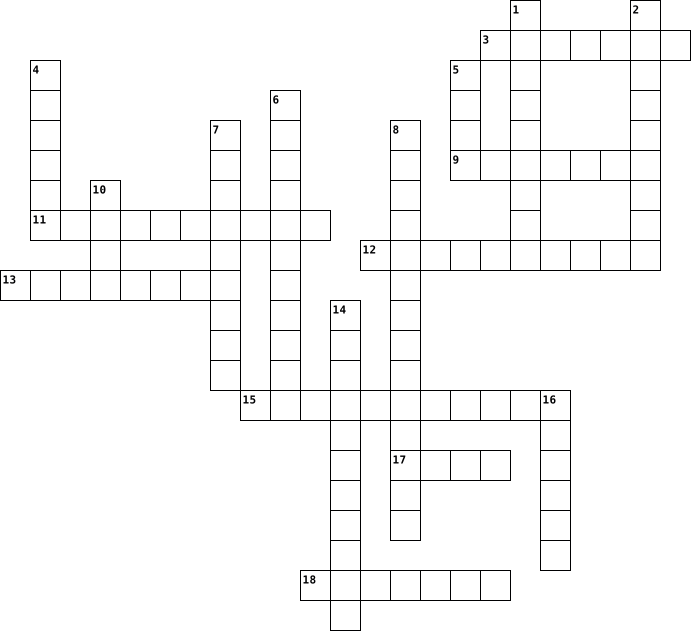
Across
- respiration uses oxygen to release energy stored in glucose
- single-celled organisms that live in water. they are an important store of carbon or carbon sink
- a chemical reaction that releases energy
- a rapid reaction with oxygen that releases energy in the form of heat and/or light
- chemicals produced in a chemical reaction
- a chemical reaction the absorbs energy
- the term commonly used for sodium chloride
- a type of sugar produced by photosynthesis
Down
- chemicals that take part in a chemical reaction
- a process in which chemicals move, caused by different concentrations of the chemical
- a biological catalyst that speeds up a reaction
- rain rain that has acids such as nitric acid and sulfuric acid dissolved in it
- a chemical reaction in which glucose is broken down, releasing energy for use by the plant or animal
- the breakdown of metals due to their reaction with other chemicals
- endothermic reaction that takes place in green plants
- equation simple written description of what is happening in a reaction
- a green chemical found in the chloroplasts of green plants, needed t carry out photosynthesis
- sink a term used to describe materials that store carbon in their structures
18 Clues: a chemical reaction the absorbs energy • a chemical reaction that releases energy • chemicals produced in a chemical reaction • the term commonly used for sodium chloride • a type of sugar produced by photosynthesis • chemicals that take part in a chemical reaction • a biological catalyst that speeds up a reaction • endothermic reaction that takes place in green plants • ...
Physical Science 8.1 Review 2015-04-15

Across
- this type of reaction occurs when a compound breaks down to form different substances
- substances that produce hydroxide anions in a water solution; slippery; have a bitter taste
- to break apart
- this type of chemical reaction occurs when an element in a compound is replaced by another element
- substances that produce hydronium ions when dissolved in water; have a sour taste
- chemical change resulting from a collision between atoms or molecules
- chemical formulas cannot be _______to balance an equation
- reactants are located on the_______side of an equation
- according to the law of conservation of_____, the total mass of the reactants is equal to the total mass of the products
- a chemical reaction that releases thermal energy
- the number before each molecular formula
Down
- this type of reaction occurs when two compounds exchange atoms or ions
- new substances produced by a reaction
- any ionic compound that does not contain H or OH
- an expression that uses chemical symbols to represent a chemical reaction
- substances that are neither acids nor bases
- this type of reaction occurs when two or more substances combine to form a third substance
- a reaction that absorbs thermal energy
- a chemical equation that has the same number of each type of atom on each side of the arrow is said to be__________
- products are located on the________side of an equation
- original substances that undergo a chemical reaction
21 Clues: to break apart • new substances produced by a reaction • a reaction that absorbs thermal energy • the number before each molecular formula • substances that are neither acids nor bases • any ionic compound that does not contain H or OH • a chemical reaction that releases thermal energy • original substances that undergo a chemical reaction • ...
Chemistry Ch. 8 Vocab Crossword 2025-11-03

Across
- a reaction in which a compound breaks down(decompose) into two or more simpler compounds or substances
- a reaction in which two reactants AB and CD react to form products AD and BC
- a reaction in which one element replaces another element in a compound
- a reaction in which two or more substances combine to give another substance
- a substance produced in the course of a chemical reaction by the transformation of one or more reactants
- an insoluble solid that forms in a precipitation reaction when two or more aqueous solutionsare mixed
- the reaction between an H3O+ ion supplied by an acid and an OH- ion supplied by a base. A hydronium ion and a hydroxide ion react with each other to give two molecules of water
- a substance that increases the concentration of H+ ions in an aqueous solution
- a notation for showing what takes place in a chemical reaction. Th chemical formulas of all reactants are written on the left side of the arrow, and thee chemical formulas of the products are written on the right side
- a chemical reaction in which all reactants are gases
Down
- an equation that shows all the ions, bth those that take part in the reaction and the spectator ions
- a reaction in which an insoluble solid (the precipitate) forms when two or more aqueous solutions are mixed
- the process by which either the molecules of a covalent compound or the cations and anions bound in the lattice of an ionic compound break up into individual cations and anions
- a process in which two or more reactants are transformed into one or more products through the breaking of chemical bonds in the reactant mmolecules and the formation of new cemical bonds in the product molecules
- an ion present in the vessel in which a chemical reaction takes place that does not take part in the reaction
- a starting material for a chemical reaction; a substance that enters into the reaction and is tranformed into one or more product substances
- a substance that increases the concentration of OH- ions in an aqueous solution
- the reaction of any substance with oxygen (O2)
- an equation that shows the reactants and products of the reaction, but not the spectator ions
- the work of planning, performing, and perfecting the preparation of a chemical compound
20 Clues: the reaction of any substance with oxygen (O2) • a chemical reaction in which all reactants are gases • a reaction in which one element replaces another element in a compound • a reaction in which two reactants AB and CD react to form products AD and BC • a reaction in which two or more substances combine to give another substance • ...
CHEMICAL REACTIONS 2020-04-28

Across
- _______reaction: a process in which one or more substances, the reactants, are converted to one or more different substances
- The chemicals that are present before a chemical reaction takes place. They react together to produce new chemical compounds
- Water, made up of water
- A reaction in which a compound is broken down into simpler compounds or elements
- a chemical reaction that occurs between a fuel and an oxidizing agent that produces energy
- ________Replacement: Also known as a metathesis reaction. A reaction in which two reactants trade partners
- ______equation: Method of writing the essential features of a chemical reaction using chemical symbol
- ________ series: an empirical, calculated, and structurally analytical progression of a series of metals, arranged by their "reactivity" from highest to lowest.
- ________Replacement: A reaction in which one component of a compound is replaced by a new component
- an element that doesn't have the characteristics of metal
- any of a class of substances characterized by high electrical and thermal conductivity as well as by malleability, ductility, and high reflectivity of light
Down
- any substance composed of identical molecules consisting of atoms of two or more chemical elements
- Equations: A description of a chemical reaction that gives the chemical formulas of the reactants and the products of the reaction
- one of the three principal states of matter, whose most obvious physical properties is retention of volume and its conformation to the shape of its container
- A molecule that is produced in a chemical reaction
- the construction of complex chemical compounds from simpler ones
- made up of two or more atoms that are chemically bonded together
- A substance that speeds up a chemical reaction without participating in it either as a reactant or product. Catalysts are thus not consumed in the reaction
- one of the three basic states of matter, forms from liquid or gas because the energy of atoms decreases when the atoms take up a relatively ordered structure
- A number used to indicate the presence of more than one unit of a chemical species in a chemical equation
- a substance whose atoms all have the same number of protons
- one of the three fundamental states of matter that appears to have no structure at all
22 Clues: Water, made up of water • A molecule that is produced in a chemical reaction • an element that doesn't have the characteristics of metal • a substance whose atoms all have the same number of protons • the construction of complex chemical compounds from simpler ones • made up of two or more atoms that are chemically bonded together • ...
Chemical Reactions And Equations 2024-05-14

Across
- A chemical reaction in which two compounds exchange ions and form two new compounds
- The number written in front of a chemical formula in a balanced equation
- A process in which one or more substances react to form new substances with different properties.
- A substance that undergoes change in a chemical reaction
- Eating up of metals as a result of their exposure to air, moisture and other gases in the atmosphere
- The process of breaking down a substance using electricity
- Reactions in which insoluble salts are formed
- The substance that is added to a solution to bring about a chemical reaction
- The chemical reaction that involves the transfer of electrons between two substances
- Process which involves gain of oxygen or loss of hydrogen
- A chemical reaction in which heat is released
- The oxidation of oils or fats in food resulting in bad taste and smell
- A chemical reaction in which a single compound breaks down into two or more simpler substances
Down
- The type of reaction in which two or more substances combine to form a single substance
- Process which involves gain of hydrogen or loss of oxygen
- The chemical reaction that absorbs heat from its surroundings
- The type of reaction in which oxygen combines with another substance to produce heat and light
- A substance that is formed as a result of a chemical reaction
18 Clues: Reactions in which insoluble salts are formed • A chemical reaction in which heat is released • A substance that undergoes change in a chemical reaction • Process which involves gain of hydrogen or loss of oxygen • Process which involves gain of oxygen or loss of hydrogen • The process of breaking down a substance using electricity • ...
crossword puzzle assignment 2017-02-27

Across
- Two atoms
- Change during reaction
- A half-reaction in which a chemical species decreases its oxidation number
- Formed as a result of a chemical reaction
- symbolic representation of a chemical reaction
- element reacts with a compound and takes the place of another element
- To produce and provide
- Fuel and oxidizing agent produce energy
- having oxygen atoms
Down
- Increases the rate of a chemical reaction
- two compounds react and both of the switch places
- A compound that contains two different elements
- chemical decomposition produced by passing an electric current through a liquid or solution
- cause forming from a solid solution
- separation of a chemical compound into elements
- numbers in front of the formula
- A charged chemical species
- Water
- Two or more compounds combines to form a more complex product
19 Clues: Water • Two atoms • having oxygen atoms • Change during reaction • To produce and provide • A charged chemical species • numbers in front of the formula • cause forming from a solid solution • Fuel and oxidizing agent produce energy • Increases the rate of a chemical reaction • Formed as a result of a chemical reaction • symbolic representation of a chemical reaction • ...
Chemical Reactions Challenge 2024-05-06

Across
- A number placed in front of a chemical formula to balance a chemical equation.
- A chemical equation in which the number of each type of atom is the same on both sides of the equation.
- A reaction that absorbs heat from its surroundings.
- A chemical reaction in which two or more substances combine to form a new compound.
- A number written below and to the right of a chemical symbol in a formula.
- The principle that mass is neither created nor destroyed in a chemical reaction.
- A statement that describes the behavior of matter in a given situation.
- A reaction that releases heat to its surroundings.
Down
- Substances present at the start of a chemical reaction.
- A chemical reaction in which a single compound breaks down into two or more simpler substances.
- The measure of the amount of matter in an object.
- Substance that speeds up a chemical reaction without being consumed.
- Equation: Representation of a chemical reaction using symbols and formulas.
- Energy required to start a chemical reaction.
- Substances formed as a result of a chemical reaction.
15 Clues: Energy required to start a chemical reaction. • The measure of the amount of matter in an object. • A reaction that releases heat to its surroundings. • A reaction that absorbs heat from its surroundings. • Substances formed as a result of a chemical reaction. • Substances present at the start of a chemical reaction. • ...
Chemical Reactions Vocabulary Test 2014-12-03

Across
- A substance with a high quantity of H+ ions that tastes sour, reacts with metals and carbonates, turns blue litmus paper red
- A chemical change in which a substance combines with oxygen, as when iron oxidizes forming rust
- The process in which substances undergo chemical changes that result in the formation of new substances
- The measurement of how acidic or basic a substance is on a scale of 0 (very acidic) to 14 (very basic)
- A reaction that releases energy in the form of heat (ex. Burning)
- A substance with a high quantity of OH- ions that tastes bitter, feels slippery, and turns red litmus paper blue
- A chemical reaction that breaks down compounds into simpler products
- A substance that enters into a chemical reaction
- A system in which not matter is allowed to enter or leave
- A solid that forms from a solution during a chemical reaction
- The minimum amount of energy needed to get a chemical reaction started
- The principle stating that matter is not created or destroyed during a chemical reaction
Down
- The study of the properties of matter and how matter changes
- A substance formed as a result of a chemical reaction
- A material that decreased the rate of a reaction
- A reaction that absorbs energy in the form of heat (ex. Baking soda and vinegar)
- A reaction in which one element replaces another in a compound or when two elements in different compounds trade places
- A system in which mater can enter from or escape to the surroundings
- A material that increases the rate of a reaction by lowering the activation energy
- A biological catalyst that lowers the activation energy of reactions in cells
- A chemical reaction in which two or more simple substances combine to form a new, more complex substance
21 Clues: A material that decreased the rate of a reaction • A substance that enters into a chemical reaction • A substance formed as a result of a chemical reaction • A system in which not matter is allowed to enter or leave • The study of the properties of matter and how matter changes • A solid that forms from a solution during a chemical reaction • ...
Rates and Types of Chemical Reactions 2025-09-12

Across
- When a more reactive element pushes out a less reactive one from a compound.
- Reaction where one compound breaks down into simpler substances.
- How quickly reactants turn into products.
- Sometimes released in a reaction, observed as bubbling or fizzing.
- Reaction between acid and base to form salt and water.
- Reaction where two compounds swap parts to form two new compounds.
- When particles must bump into each other to react.
- A chemical reaction written using words, e.g. hydrogen + oxygen → water.
- Increasing this by crushing a solid speeds up a reaction.
- Smallest particle of an element.
- Substances formed after a chemical reaction.
- Reaction where two or more substances combine to form a new compound.
- The type of energy particles gain when heated.
- Mass is neither created nor destroyed in a chemical reaction.
- Shows the ratio of atoms in a molecule or compound.
- A substance that speeds up a reaction without being used up.
- energy Minimum energy needed for a reaction to start.
- Has the same number of atoms of each element on both sides.
Down
- Two or more atoms bonded together.
- Tiny entities that collide to make chemical reactions happen.
- When one element replaces another in a compound.
- Pure substance made of one type of atom.
- Reaction that forms an insoluble solid in solution.
- Reaction of a substance with oxygen, often releasing heat and light.
- Raising this gives particles more energy and increases reaction speed.
- A reaction written using chemical symbols and formulas.
- More particles per volume leads to faster reactions.
- Small number in a chemical formula showing how many atoms are present.
- Number placed before a formula to balance an equation.
- Increasing this in gases pushes particles closer, making reactions faster.
- Two or more different atoms bonded together.
- Combination of substances not chemically bonded.
- Starting substances in a chemical reaction.
33 Clues: Smallest particle of an element. • Two or more atoms bonded together. • Pure substance made of one type of atom. • How quickly reactants turn into products. • Starting substances in a chemical reaction. • Substances formed after a chemical reaction. • Two or more different atoms bonded together. • The type of energy particles gain when heated. • ...
Chemical Reaction Crossword 2025-01-29

Across
- The term for when a chemical reaction gains energy due to the products being in a higher energy state
- The process of a hydrocarbon reacting with oxygen to produce carbon dioxide and water
- The amount of mols of H2 that would be needed for the following chemical reaction ? H2 + 1 N2 -> 2 NH3
- The molecular weight of 3 mols of the molecule HCN (Hydrogen isocyanide)
- The molecular weight, rounded, of one mol of H2O (Water)
- The process of reactant atoms rearranging and forming new molecular products
- The term for what is made after a chemical reaction has proceeded
- The amount of mols of Na that would be needed for the following chemical reaction ? Na + 1 Cl2 -> 2 NaCl
Down
- The molecular weight of 2 mols of HF (Hydrofluoric acid)
- The state in which the amount of each atom that started the chemical reaction are also present in the products
- The process/reaction of a singular molecule breaking down into multiple smaller parts
- The atomic weight, rounded up, of one oxygen atom
- The process/reaction of atoms or molecules coming together to form one larger molecule
- The amount of mols of O2 that would be needed for the following chemical reaction ? O2 + 2 H2 -> 2 H2O
- The numeric classifier for 6.02 x 10^23 of something
- The term for the atoms and molecules that are present before the chemical reaction proceeds
- The term for when a chemical reaction looses energy due to the products being in a lower energy state
17 Clues: The atomic weight, rounded up, of one oxygen atom • The numeric classifier for 6.02 x 10^23 of something • The molecular weight of 2 mols of HF (Hydrofluoric acid) • The molecular weight, rounded, of one mol of H2O (Water) • The term for what is made after a chemical reaction has proceeded • The molecular weight of 3 mols of the molecule HCN (Hydrogen isocyanide) • ...
Stoichiometry 2023-10-18

Across
- - Maximum amount of product calculated from stoichiometry.
- - Reactant that is entirely consumed in a chemical reaction.
- - Mass of one mole of a substance.
- - Reaction of a substance with oxygen.
- - Formula showing the actual number of atoms of each element in a compound.
- - Ratio of moles of reactants and products in a chemical equation.
- - Substances entering a chemical reaction.
- - Unit for measuring the amount of substance.
- - Fundamental unit of matter.
- - Number in front of a chemical formula in a balanced equation.
- - Substances formed in a chemical reaction.
- - Combination of substances to form a new one.
- - Mass percentage in a chemical compound.
- - The study of quantitative relationships in chemical reactions.
- - When the equation has the same number of atoms on both sides.
Down
- - Solid formed in a chemical reaction.
- - Actual amount of product obtained in a reaction.
- - Homogeneous mixture of solute and solvent.
- - Ratio of moles of substances in a chemical equation.
- - Redox reaction in which an element is both oxidized and reduced.
- - Ideal conditions involve 22.4 L/mol at STP.
- - Formula showing the simplest whole-number ratio of elements in a compound.
- - Number of atoms or molecules in one mole of substance.
- - Reactant that remains after a reaction has reached completion.
- - Stoichiometric factor used in volume-to-volume conversions.
- - Breaking a compound into simpler substances.
- - Stoichiometric factor used in mass-to-mass conversions.
- - Process in which substances transform into new substances.
- - Combination of substances not chemically bonded.
29 Clues: - Fundamental unit of matter. • - Mass of one mole of a substance. • - Solid formed in a chemical reaction. • - Reaction of a substance with oxygen. • - Mass percentage in a chemical compound. • - Substances entering a chemical reaction. • - Substances formed in a chemical reaction. • - Homogeneous mixture of solute and solvent. • ...
Brian Varela 2017-02-27

Across
- Change during reaction
- having oxygen atoms
- A compound that contains two different elements
- element reacts with a compound and takes the place of another element
- symbolic representation of a chemical reaction
- separation of a chemical compound into elements
- A half-reaction in which a chemical species decreases its oxidation number
- Fuel and oxidizing agent produce energy
- Formed as a result of a chemical reaction
- Two atoms
Down
- chemical decomposition produced by passing an electric current through a liquid or solution
- Increases the rate of a chemical reaction
- cause forming from a solid solution
- two compounds react and both of the switch places
- A charged chemical species
- To produce and provide
- Water
- numbers in front of the formula
- Two or more compounds combines to form a more complex product
19 Clues: Water • Two atoms • having oxygen atoms • Change during reaction • To produce and provide • A charged chemical species • numbers in front of the formula • cause forming from a solid solution • Fuel and oxidizing agent produce energy • Increases the rate of a chemical reaction • Formed as a result of a chemical reaction • symbolic representation of a chemical reaction • ...
Stoichiometry 2024-04-02

Across
- S.T.P.
- the mass of one mole of a substance, depends on the substance's composition
- number used to balance elements of a chemical reaction, represents moles of that substance
- the ratio of coefficients from two substances in a chemical reaction
- compounds to the left of the arrow in a chemical reaction
- a hydrocarbon burns in oxygen to produce water and carbon dioxide
- name of the scientist who discovered one mole equally 6.022 x 10^23 representative particles
- two compounds switch with each other
- the reactant that is consumed first in a reaction
- the arrow of a chemical reaction, what is produced by a chemical reaction
- the mathematical change from one unit to another using a conversion factor
- how much product or yield we actually create in the reaction
Down
- a measure of the percentage off of what we should have made due to error
- representative unit of chemistry, serves as a bridge between measured units
- the number of liters of gas for one mole of a gas at S.T.P
- one product is formed
- compounds to the right of the arrow in a chemical reaction
- how much product or yield we should create from a reaction, the maximum amount
- one element switches with another
- one reactant is used
- chemical formula in smallest whole-number ratios
- chemical formula as the compound exists
- a measure of actual yield over theoretical yield x 100, the percentage of how much we make to how much we should have made
- a substance used to accelerate a reaction, but is not consumed by the reaction
24 Clues: S.T.P. • one reactant is used • one product is formed • one element switches with another • two compounds switch with each other • chemical formula as the compound exists • chemical formula in smallest whole-number ratios • the reactant that is consumed first in a reaction • compounds to the left of the arrow in a chemical reaction • ...
Vocab terms 2024-04-02

Across
- - a representation of a chemical reaction in which the reactants and products are expressed as formulas
- - a mixture of two or more elements, at least one of which is a metal, that has the characteristic properties of a metal
- reaction - a chemical reaction in which two compounds exchange positive ions and form new compounds
- - the force that holds atoms or ions together as a unit
- - a chemical bond in which two atoms share a pair of valence electrons
- - notation that shows what elements a compound contains and the ratio of the atoms or ions of these elements in the compound
- - an atom or group of atoms that has a positive or negative charge
- - an ion with a positive charge
- - a substance that undergoes change in a chemical reaction
- - new substances formed as a result of a chemical reaction
- - a chemical reaction in which two or more substances react to form a single substance
Down
- reaction - a chemical reaction in which one element takes the place of another element in a compound
- - an ion with a negative charge
- - the force that holds cations and anions together
- - a neutral group of atoms that are joined together by one or more covalent bonds
- - numbers that appear before a formula in a chemical equation to show the relative proportions of each reactant and product
- - a chemical reaction in which a compound breaks down into two or more simpler substances
- - the energy stored in chemical bonds
- - the attraction between a metal cation and the shared electrons that surround it
- - a diagram of an atom, ion or molecule in which each dot represents a valence electron
20 Clues: - an ion with a negative charge • - an ion with a positive charge • - the energy stored in chemical bonds • - the force that holds cations and anions together • - the force that holds atoms or ions together as a unit • - a substance that undergoes change in a chemical reaction • - new substances formed as a result of a chemical reaction • ...
Christopher Heath- Chapter 7 Vocab 2024-01-02

Across
- a chemical reaction that releases energy to its surroundings
- a chemical reaction that absorbs energy from its surroundings
- a chemical reaction in which two or more substances react to form a single substance
- an amount of a substance that contains approximately 6.02 X 10^23 particles of the substance
- a chemical reaction in which two compounds exchange positive ions and form two new compounds
- the mass of one mole of a substance
- the energy stored in chemical bonds
Down
- a chemical reaction in which a compound breaks down into two or more simpler substances
- a chemical reaction in which a substance reacts rapidly with oxygen, often producing heat and light
- a chemical reaction in which one element takes the place of another element in a compound
- numbers that appear before a formula in a chemical equation to show the relative proportions of each reactant and product
- A chemical reaction in which electrons are transferred from one reactant to another
- a substance that undergoes change in a chemical reaction
- new substances formed as a result of a chemical reaction
- a representation of a chemical reaction in which the reactants and products are expressed as formulas
15 Clues: the mass of one mole of a substance • the energy stored in chemical bonds • a substance that undergoes change in a chemical reaction • new substances formed as a result of a chemical reaction • a chemical reaction that releases energy to its surroundings • a chemical reaction that absorbs energy from its surroundings • ...
Chemistry Crossword Puzzle Maya 3B 2022-02-04

Across
- sum of internal energy
- the area of the chemical substances used in a chemical reaction
- relate the free energy changes that occur during the progress of chemical processes
- the speed at which a chemical reaction occurs
- a chemical mixture that improves contact
- conversion of reactants to products and the conversion of products to reactants occur simultaneously
- any chemical reaction that absorbs heat from its environment
- the substance produced during conversion from reactant to product
Down
- change in enthalpy for a chemical reaction is equal to the sum of the enthalpy changes for each step
- the heat or coldness of an item
- the release of energy
- products are produced from reactants going from left to right in a reversible reaction
- substance that increases chemical reaction rate
- branch of physical chemistry that is concerned with understanding the rates
- substance that slows down a chemical or corrosion reaction
- minimum amount of energy to get a chemical reaction
16 Clues: the release of energy • sum of internal energy • the heat or coldness of an item • a chemical mixture that improves contact • the speed at which a chemical reaction occurs • substance that increases chemical reaction rate • minimum amount of energy to get a chemical reaction • substance that slows down a chemical or corrosion reaction • ...
Chemistry Bonus Point Crossword 2026-04-22

Across
- a compound/element combined with oxygen to form an oxide and sometimes water (H2O)
- the ability of a substance to combine with or change into one or more other substances
- a property of this term is that it tastes sour
- the reaction type for the balanced chemical reaction Mg + H2O --> MgO + H2
- 2 or more reactants combined to make the product
- a device used to measure the energy absorbed or released as heat in a chemical reaction
- a substance that speeds up a chemical reaction without itself undergoing any chemical change
- liquids undergo ________ to form solids
- a standard scientific unit for measuring large quantities of very small entities
Down
- the pressure of an individual gas when in a mixture of gases
- the volume of a gas is inversely proportional to the pressure if temperature is held consitant
- the change in heat of the products from the reactants
- the ________ of water at 100 degrees Celsius is at sea level
- the number in front of F2 in the balanced chemical reaction Sn + F2 --> SnF4
- substances undergoing change in a chemical reaction
- new substances produced in a chemical reaction
- a solid produced during a chemical reaction
- PV=nRT
- non-zero digits within the given measurement or reporting resolution are significant
- the number of sig figs in the number 569700
20 Clues: PV=nRT • liquids undergo ________ to form solids • a solid produced during a chemical reaction • the number of sig figs in the number 569700 • new substances produced in a chemical reaction • a property of this term is that it tastes sour • 2 or more reactants combined to make the product • substances undergoing change in a chemical reaction • ...
Chemistry Unit 5 Vocabulary 2025-12-18

Across
- reaction with oxygen that releases energy
- substances formed in a chemical reaction
- substance that speeds up a reaction without being used up
- starting substances in a chemical reaction
- positively charged ion
- numbers placed in front of formulas in an equation
- amount of exposed area of a substance
- adjusting an equation so atoms are equal on both sides
- representation of a chemical reaction using symbols
Down
- reaction where one compound breaks into simpler substances
- reaction where substances combine into one product
- how easily a substance undergoes a chemical reaction
- small numbers showing atoms in a formula
- negatively charged ion
- amount of substance in a given volume
- notation showing the types and numbers of atoms
- energy of motion of particles
- measure of average kinetic energy of particles
- process of making an equation follow conservation of mass
- amount of matter in an object
20 Clues: negatively charged ion • positively charged ion • energy of motion of particles • amount of matter in an object • amount of substance in a given volume • amount of exposed area of a substance • substances formed in a chemical reaction • small numbers showing atoms in a formula • reaction with oxygen that releases energy • starting substances in a chemical reaction • ...
Blistery 2013-03-11

Across
- rule/a chemical rule of thumb that states that atoms of low (<20) atomic number tend to combine in such a way that they each have eight electrons in their valence shells, giving them the same electronic configuration as a noble gas
- a chemical element with symbol H and atomic number 1
- reactant or product in a particular reaction is intuitively defined as how fast or slow a reaction takes place
- the separation of a chemical compound into elements or simpler compounds
- solving/consists in using generic or ad hoc methods, in an orderly manner, for finding solutions to problems
- chemical reaction in which an acid and a base react to form a salt
- change in rate of a chemical reaction due to the participation of a substance called a catalyst. Unlike other reagents that participate in the chemical reaction, a catalyst is not consumed by the reaction itself
- charge/having a surplus of electrons; having a lower electric potential
- formation of a solid in a solution or inside another solid during a chemical reaction or by diffusion in a solid.
- process or reaction in which the system absorbs energy from its surroundings in the form of heat
- charge/having a deficiency of electrons; having a higher electric potential
- substance participating in a chemical reaction, especially a directly reacting substance present at the initiation of the reaction.
- characterized by structural rigidity and resistance to changes of shape or volume
Down
- to the quantity of matter in an object. More specifically, inertial mass is a quantitative measure of an object's resistance to acceleration.
- reaction in which two or more substances combine to produce a single substance is known as combination, or synthesis reaction
- chemical compound with the chemical formula H2O
- of it are oxygen,carbon dioxide and noble gases
- as the pattern to solve a chemical problem
- table/ is a table of the chemical elements in which the elements are arranged by order of atomic number in such a way that the periodic properties of the elements are made clear
- unit of measurement used in chemistry to express amounts of a chemical substance, defined as the amount of any substance that contains as many elementary entities as there are atoms
- inorganic chemical, is a salt of phosphoric acid. In organic chemistry, a phosphate, or organophosphate, is an ester of phosphoric acid
- chemical reaction that releases energy in the form of light or heat
- branch of chemistry that deals with the relative quantities of reactants and products in chemical reactions
- during chemical reactions as reagents are consumed
- indirectly observed quantity which comes in many forms, such as kinetic energy, potential energy, radiant energy
- the sequence of exothermic chemical reactions between a fuel and an oxidant accompanied by the production of heat and conversion of chemical species
- physical quantity that is a measure of hotness and coldness on a numerical scale
- equation/the symbolic representation of a chemical reaction where the reactant entities are given on the left hand side and the product entities on the right hand side.
- serves as the proving of an chemical change
- is the only state with a definite volume but no fixed shape
30 Clues: as the pattern to solve a chemical problem • serves as the proving of an chemical change • chemical compound with the chemical formula H2O • of it are oxygen,carbon dioxide and noble gases • during chemical reactions as reagents are consumed • a chemical element with symbol H and atomic number 1 • is the only state with a definite volume but no fixed shape • ...
Science Vocab 2 2023-09-27

Across
- the law that states that energy cannot be created or destroyed but only transferred between objects or transformed; also known as the first law of thermodynamics
- a reaction in which the products can react together to re-form the original reactants
- a loss of electrons in a chemical reaction
- an exothermic chemical reaction in which a fuel reacts with oxygen
- a chemical reaction in which two compounds swap cations or anions with each other; also known as a double-replacement reaction
- a chemical reaction in which one element in a compound is replaced by another element; also known as a single-displacement reaction
- a substance that slows the rate of a reaction by reducing the effectiveness of catalysts
- a chemical reaction that releases more thermal energy than it absorbs
- the state that occurs when forward and reverse reactions each happen at the same rate
- the principle that state that a chemically system in equilibrium will adjust its equilibrium position in such a way as to reduce the effect of any changes made to the system
Down
- a chemical reaction in which a single reactant breaks down into two or more products
- the model that states that for a reaction to occur, the reactant particles must collide with each other, with the proper alignment, and with enough energy
- a chemical reaction that absorbs more thermal energy than it releases
- a gain of electrons in a chemical reaction
- the minimum energy needed for a chemical reaction to occur
- a substance that helps a reaction happen faster but is not used up in the reaction
- the speed of a reaction
17 Clues: the speed of a reaction • a gain of electrons in a chemical reaction • a loss of electrons in a chemical reaction • the minimum energy needed for a chemical reaction to occur • an exothermic chemical reaction in which a fuel reacts with oxygen • a chemical reaction that absorbs more thermal energy than it releases • ...
CHEMICAL REACTIONS 2021-12-22

Across
- states that atoms are not created or destroyed during a chemical reaction, they just rearrange
- when a chemical reaction absorbs energy
- describes how chemicals hit each other to cause a reaction
- the minimum energy needed to start a reaction
- the large numbers written in front of a formula to balance a chemical equation
- a chemical that temporarily reacts to lower the activation energy so the reaction is faster
- the higher the value, the faster the molecules move causing harder and more frequent collisions resulting in a faster reaction
- describes how much chemical is present in a certain volume
Down
- stating hydrogen + oxygen yields water
- phase indicated in an equation by(l)
- using element symbols and compound formulas to describe a chemical reaction
- when a chemical reaction releases energy
- phase indicated in an equation by(s)
- the study of reaction rates
- the materials that form from a reaction
- the substances at the start of a reaction
16 Clues: the study of reaction rates • phase indicated in an equation by(l) • phase indicated in an equation by(s) • stating hydrogen + oxygen yields water • when a chemical reaction absorbs energy • the materials that form from a reaction • when a chemical reaction releases energy • the substances at the start of a reaction • the minimum energy needed to start a reaction • ...
Ch. 2 Chemical Reactions 2014-10-29

Across
- The amount of one material in a certain volume of another material.
- A system in which matter can enter from or escape to the surroundings.
- A reaction that absorbs energy in the form of heat.
- The minimum amount of energy needed to get a chemical reaction started.
- A biological catalyst that lowers the activation energy of reactions in cells.
- The study of the properties of matter and how matter changes.
- A rapid reaction between oxygen and fuel that results in fire.
- Anything that has mass and occupies space.
- A number in front of a chemical formula in an equation that indicates how many molecules or atoms of each reactant and product are involved in a reaction.
- A chemical reaction that breaks down compounds into simpler products.
Down
- A reaction in which one element replaces another in a compound or when two elements in different compounds trade places.
- A chemical reaction in which two or more simple substances combine to form a new, more complex substance.
- A short, easy way to show a chemical reaction, using symbols.
- A substance that enters into a chemical reaction.
- A substance formed as a result of a chemical reaction.
- A characteristic of a substance that can be observed without changing the substance into another substance.
- A solid that forms from a solution during a chemical reaction.
- A reaction that releases energy in the form of heat.
- A characteristic of a substance that describes its ability to change into different substances.
- The process in which substances undergo chemical changes that result in the formation of new substances.
- A material that decreases the rate of a reaction.
- A change that alters the form or appearance of a material but does not make the material into another substance.
- A system in which no matter is allowed to enter or leave.
- A material that releases energy when it burns.
- A material that increases the rate of a reaction by lowering the activation energy.
25 Clues: Anything that has mass and occupies space. • A material that releases energy when it burns. • A substance that enters into a chemical reaction. • A material that decreases the rate of a reaction. • A reaction that absorbs energy in the form of heat. • A reaction that releases energy in the form of heat. • A substance formed as a result of a chemical reaction. • ...
Chemical Reactions 2013-04-04

Across
- method used for balancing equation
- number that represents the number of units of each substance taking part in a reaction
- reaction that releases energy from the reactants to its surroundings
- substance used to slow down a chemical reaction
- insoluble compound that comes out of solution during a double-displacement reaction
- first step in MINOH method
- a reaction in which energy is absorbed by reactants from the surroundings is called an _______
- in a _________, the positive ion of one compoundreplaces the positive ion of the other to form two new compounds
- a change in the chemical composition of a substance
- matter is neither created nor destroyed, but conserved during chemical changes
- gain of electrons
Down
- used to describe the loss of electrons
- when one element replaces another element in a compound, it is called a ________
- substance that speeds up a chemical reactions without being permanently changed itself
- an atom that loses or gains one or more electron
- chemical equations need to be__________
- (s)
- (g)
- the new substance that is formed in a chemical reaction
- (l)
- the substance that reacts in a chemical reaction
21 Clues: (s) • (g) • (l) • gain of electrons • first step in MINOH method • method used for balancing equation • used to describe the loss of electrons • chemical equations need to be__________ • substance used to slow down a chemical reaction • an atom that loses or gains one or more electron • the substance that reacts in a chemical reaction • ...
CHEMISTRY VOCABULARY 2021-04-05

Across
- positively charged ion
- chemical reaction that occurs with help of electric current
- A substance that cannot be broken down into simpler chemical substances by ordinary chemical means
- A condition when the reactants and products of a chemical equation have the same number of atoms of all elements present
- The process of an ionic compound separating into ions
- The minor component of a solution
- group of atoms(same or different) combined chemically
- when two or more elements combine chemically
- charged particle
- negatively charged ion
- solid insoluble product
- The major component of a solution
Down
- Mixture of solute and solvent
- substance taking part in the reaction
- the substance that alters the rate of reaction without participating in the reaction
- substances dissolved in water
- substance formed as a result of chemical reaction
- when gases are released in an equation this term is generally used
- substance mixed with large amount of water
- The connection between two atoms in a molecule
- A concise way of representing a chemical reaction
- factors necessary for chemical reaction to occur
- substance mixed with very less water
- when one solid substance is formed over other
24 Clues: charged particle • positively charged ion • negatively charged ion • solid insoluble product • Mixture of solute and solvent • substances dissolved in water • The minor component of a solution • The major component of a solution • substance mixed with very less water • substance taking part in the reaction • substance mixed with large amount of water • ...
Chapter 2: Chemistry of Life 2023-08-27

Across
- chemical bond formed when two atoms share one or more pairs of electrons
- chemical reaction that requires a new input of energy
- a mixture of substances that is the same throughout
- substance formed by a chemical reaction
- the substance that is present in the greater amount and that dissolves another substance
- substance that decreases activation energy and increases reaction rate in a chemical reaction
- molecule composed of carbon, hydrogen, and oxygen; includes sugars and starches
- a solutions acidity, or hydrogen ion concentration
- protein that catalyzes chemical reactions for organisms
- condition in which reactants and products of a chemical reaction are formed at the same rate
- molecule that makes up proteins
- a compound that releases a proton when it dissolves in water
- amount of energy needed to break a bond between two particular atoms
- large, carbon-based molecule formed by monomers
- two or more atoms held together by covalent bonds
- energy input necessary to initiate a chemical reaction
- polymer composed of amino acids linked by peptide bonds
Down
- chemical bond formed through the electrical force between oppositely charged ions
- the attraction among molecules of a substance
- chemical reaction that yields a net release of energy in the form of heat
- hydrocarbon chain often bonded to glycerol in a lipid
- a substance that dissolves in a solvent
- process by which substances change into different substances through the breaking and forming of chemical bonds
- polymer of nucleotides
- a compound that removes protons from a solution
- a substance made of atoms of different elements
- the attraction among molecules of different substances
- substance that is changed by a chemical reaction
- molecular subunit of a polymer
- nonpolar molecule composed of carbon, hydrogen, and oxygen; includes fats and oils
- an atom that has gained or lost one or more electrons
- reactant in a chemical reaction upon which an enzyme acts
- one particular type of atom
- attraction between a slightly positive hydrogen atom and a slightly negative atom
- the smallest basic unit of matter
35 Clues: polymer of nucleotides • one particular type of atom • molecular subunit of a polymer • molecule that makes up proteins • the smallest basic unit of matter • a substance that dissolves in a solvent • substance formed by a chemical reaction • the attraction among molecules of a substance • a compound that removes protons from a solution • ...
Ch. 8 Chemical Reactions Vocab 2022-05-05

Across
- When energy is transferred to surroundings
- Process that leads to chemical transformation
- A reaction between substances
- A form of matter
- Involves a transfer of electrons between two species
- Reaction where reactant ions change places
- Chemical species breaking into smaller parts
- Substance that changes in a chemical reaction
Down
- When heat is absorbed from its surroundings
- A protein that speeds up chemical reactions
- Reaction where one element is substituted for another
- Molecule that contains at least one unpaired electron
- A representation using symbols
- When two different atoms interact, forming a different compound
- Substance that increases the rate of a reaction
- Substances produced at the end of the reaction
- process by which electric currents are used
- A conversion factor between compounds in a chemical reaction
18 Clues: A form of matter • A reaction between substances • A representation using symbols • When energy is transferred to surroundings • Reaction where reactant ions change places • A protein that speeds up chemical reactions • process by which electric currents are used • When heat is absorbed from its surroundings • Chemical species breaking into smaller parts • ...
Ch. 8 Chemical Reactions Vocab 2022-05-05

Across
- When energy is transferred to surroundings
- Process that leads to chemical transformation
- A reaction between substances
- A form of matter
- Involves a transfer of electrons between two species
- Reaction where reactant ions change places
- Chemical species breaking into smaller parts
- Substance that changes in a chemical reaction
Down
- When heat is absorbed from its surroundings
- A protein that speeds up chemical reactions
- Reaction where one element is substituted for another
- Molecule that contains at least one unpaired electron
- A representation using symbols
- When two different atoms interact, forming a different compound
- Substance that increases the rate of a reaction
- Substances produced at the end of the reaction
- Process by which electric currents are used
- A conversion factor between compounds in a chemical reaction
18 Clues: A form of matter • A reaction between substances • A representation using symbols • When energy is transferred to surroundings • Reaction where reactant ions change places • A protein that speeds up chemical reactions • Process by which electric currents are used • When heat is absorbed from its surroundings • Chemical species breaking into smaller parts • ...
Chemical Reactions and Equations 2024-05-14

Across
- Mass is neither created nor destroyed in a chemical reaction.
- A chemical reaction in which acid and a base react with an equivalent quantity of each other.
- Ability of a substance to undergo chemical reactions.
- Resulting substance(s) from a chemical reaction.
- A type of decomposition reaction in which the activation energy for decomposition is provided in the form of electrical energy.
- Reaction between a substance and oxygen resulting in heat and light.
- Type of decomposition reaction in which the reactant is broken down to its constituents by absorbing energy from photons.
Down
- Substance that undergoes change in a chemical reaction.
- Equation where the number of atoms of each element is the same on both sides.
- A decomposition reaction carried out by heating.
- Solid formed from a chemical reaction in a liquid solution.
- A reaction that releases heat to its surroundings.
- Representation of a chemical reaction using symbols and formulas.
- A reaction that absorbs heat from its surroundings.
- Substance that speeds up a chemical reaction without being consumed.
15 Clues: A decomposition reaction carried out by heating. • Resulting substance(s) from a chemical reaction. • A reaction that releases heat to its surroundings. • A reaction that absorbs heat from its surroundings. • Ability of a substance to undergo chemical reactions. • Substance that undergoes change in a chemical reaction. • ...