
chemical reaction Crossword Puzzles
Bonding Vocab 2023-01-19

Across
- A description of a reaction using element symbols and chemical formulas.
- Bond between a metal and a nonmetal, the attraction between positively and negatively charged ions in an ionic bond.
- A substance that slows a chemical reaction.
- Bond between metals.
- A chemical reaction that absorbs thermal energy.
- A substance created by a chemical reaction.
- The minimum amount of energy needed to start (activate) a chemical reaction.
Down
- The outermost electron of an atom that participates in chemical bonding.
- Speeds up a reaction.
- A number placed in front of an element symbol or chemical formula in an equation.
- A chemical bond between metal/nonmetal formed when two atoms share one or more pairs of valence electrons.
- A chemical reaction that releases thermal energy.
- two or more atoms that are held together by covalent bonds and act as a unit.
- An atom that is no longer neutral because it has lost or gained a valence electron.
- A process in which atoms of one or more substances rearrange to form one or more new substances.
- A starting substance in a chemical reaction.
16 Clues: Bond between metals. • Speeds up a reaction. • A substance that slows a chemical reaction. • A substance created by a chemical reaction. • A starting substance in a chemical reaction. • A chemical reaction that absorbs thermal energy. • A chemical reaction that releases thermal energy. • The outermost electron of an atom that participates in chemical bonding. • ...
awesome chemistry 2022-05-05

Across
- the substance on which an enzyme acts
- a substance that increases the rate of a chemical reaction without itself undergoing any permanent chemical change.
- a biological catalyst and is almost always a protein.
- a reaction in which a compound breaks down into two or more simpler substances
- the ratio between the amounts in moles of any two compounds involved in a chemical reaction.
- reaction for which the overall standard enthalpy change ΔH⚬ is negative
- are the species formed from chemical reactions
- eactions that occur when two different atoms or molecules interact to form a different molecule or compound.
- a type of chemical reaction that involves a transfer of electrons between two species.
- a reaction in which one element is substituted for another element in a compound
Down
- a type of chemical reaction in which the reactant ions exchange places to form new products
- a process that involves rearrangement of the molecular or ionic structure of a substance, as opposed to a change in physical form or a nuclear reaction.
- a substance that takes part in and undergoes change during a reaction.
- a hair removal treatment
- process in which one or more substances, also called reactants, are converted to one or more different substances, known as products.
- any chemical reaction that absorbs heat from its environment.
- the process of burning something.
- a representation of a chemical reaction using symbols of the elements to indicate the amount of substance, usually in moles, of each reactant and product.
18 Clues: a hair removal treatment • the process of burning something. • the substance on which an enzyme acts • are the species formed from chemical reactions • a biological catalyst and is almost always a protein. • any chemical reaction that absorbs heat from its environment. • a substance that takes part in and undergoes change during a reaction. • ...
Chapter 2 2022-03-18

Across
- A short, easy way to show a chemical reaction, using symbols
- The amount of one material in a certain volume of another material
- A system in which no matter is allowed to enter or leave
- A characteristic of a substance that can be observed without changing the substance into another substance
- A reaction that absorbs energy in the form of heat
- A substance that enters into a chemical reaction
- A material that releases energy when it burns
- A material that decreases the rate of a reaction
Down
- A reaction that releases energy in form of heat
- The minimum amount of energy needed to get a chemical reaction started
- The principle stating that matter is not created or destroyed during a chemical reaction
- A characteristic of of a substance that describes its ability to change into different substances
- The process in which substances undergo chemical changes that result in the formation of new substances
- A solid that forms from a solution during a chemical reaction
- The study of properties of matter and how matter changes
- A rapid reaction between oxygen and fuel that results in fire
- A substance formed as a result of a chemical reaction
- A biological catalyst that lowers the activation energy of reactions in cells
- A change that alters the form or appearance of a material but does not make the material into another substance
- Anything that has mass and occupies space
- A material that increases the rate of a reaction by lowering the activation energy
21 Clues: Anything that has mass and occupies space • A material that releases energy when it burns • A reaction that releases energy in form of heat • A substance that enters into a chemical reaction • A material that decreases the rate of a reaction • A reaction that absorbs energy in the form of heat • A substance formed as a result of a chemical reaction • ...
Chemical Reactions and Equations 2024-05-28

Across
- When two or more reactants combine with each other to form a new product
- A reaction that releases energy in the form of light or heat
- Coating of zinc over the surface of iron or steel to prevent against rusting
- A reaction in which a more reactive element displaces a less reactive element from its compound
- A reaction in which heat is absorbed from the surroundings
- deterioration of metals by the reaction of water and oxygen with the formation of an oxide layer on the metal surface
- A substance that undergoes change in a chemical reaction
- The spoiling of food caused by the oxidation of fats and oils present in it
- A substance(chemical) which slows down oxidation
- Reactions in which oxidation and reduction take place together
- A process in which a chemical substance changes because of the addition of oxygen
Down
- A chemical reaction in which two compounds exchange positive ions and form two new compounds
- A substance which reduces other substances but oxidises itself
- Equations with simply the chemical formulas of the products and reactants, no mention of state, and no atom balancing on either side of the equation
- Hydrated ferric oxide
- A type of decomposition reaction in which the reactant will break down in presence of sunlight
- A reaction in which a compound breaks down into two or more simpler substances
- The reaction in which decomposition occurs by applying electricity
- Substance that speeds up a chemical reaction
- The insoluble solid which settles down after the completion of the chemical reaction
20 Clues: Hydrated ferric oxide • Substance that speeds up a chemical reaction • A substance(chemical) which slows down oxidation • A substance that undergoes change in a chemical reaction • A reaction in which heat is absorbed from the surroundings • A reaction that releases energy in the form of light or heat • A substance which reduces other substances but oxidises itself • ...
Energy Flow Concept 1 2021-12-06

Across
- proteins that speed up biochemical reactions by lowering the activation energy.
- ______ a bond requires energy to be absorbed.
- reactions breaking and forming of bonds between different substances during chemical changes.
- _____ a bond allows energy to be released.
- substances that are made by a chemical reaction
- increasing temperature increases the rate of the reaction
- they speed up reactions, they are called catalysts substances that speed up reactions without being permanently altered
- + 6O2 🡪 6CO2 + 6H2O Cellular Respiration denaturation Enzyme’s active site gets deformed and loses its specific shape
- chemical reactions in each cell of organisms
- (like enzymes) speed up reactions
- build larger molecules from smaller ones
- Inhibitor slows down reaction
Down
- energy the amount of energy needed to make a chemical reaction start
- releases energy
- absorbs energy
- break down larger molecules into simpler compounds
- (substrate) substances that are changed during a chemical reaction
- how acidic a solution is
- Concentration the higher the amount of substrate, the faster the reaction
- + 6H2O 🡪 C6H12O6 + 6O2 Photosynthesis
20 Clues: absorbs energy • releases energy • how acidic a solution is • Inhibitor slows down reaction • (like enzymes) speed up reactions • + 6H2O 🡪 C6H12O6 + 6O2 Photosynthesis • build larger molecules from smaller ones • _____ a bond allows energy to be released. • chemical reactions in each cell of organisms • ______ a bond requires energy to be absorbed. • ...
Energy Transfer Crossword 2024-02-06

Across
- Heat is transferred through a heated fluid
- Point When objects change from a liquid to a solid
- Substances that participate in a chemical reaction
- When objects change from a solid to a liquid
- Allows heat energy to move through them efficiently
- Formed by the complete transfer of valence electrons
- Symbolic representation of a chemical reaction
- Used to keep heat in or out
- Measure of average kinetic energy of the particles in an object
Down
- Melting, freezing, vaporization, condensation, sublimation, and deposition
- Minimum energy needed to cause a process to occur
- In a chemical reaction mass is not created or destroyed
- Heat transfers through direct touch
- 0 degrees Kelvin, -273.15 degrees Celsius, -460 degrees Fahrenheit
- Electron pairs known as "shared pairs" or "bonding pairs"
- What is formed at the end of a chemical reaction
- A chemical reaction that absorbs heat from its environment
- A chemical reaction that releases energy through light or heat
- "Electromagnetic waves"
- Flow of energy from warm to cool places
20 Clues: "Electromagnetic waves" • Used to keep heat in or out • Heat transfers through direct touch • Flow of energy from warm to cool places • Heat is transferred through a heated fluid • When objects change from a solid to a liquid • Symbolic representation of a chemical reaction • What is formed at the end of a chemical reaction • ...
Chemical reactions 2023-11-15

Across
- the cells in your body that contain thousands of biological catalysts
- a way to show a chemical reaction using symbols
- matter can enter or escape from its surroundings
- the minimum amount of energy needed to start a chemical reaction
- when matter during a chemical reaction matter is not created or destroyed
- the new substances that form from a chemical change
- when two elements in compounds swap places
- when two or more elements or compounds combine to make a more complex substance
Down
- any change that alters the form or appearance of any substance but does not change it into another substance
- a change in matter that produces one or more substances
- a number placed in front in a chemical formula in an equation
- a material used to decrease the rate of a chemical reaction
- matter cannot leave or enter
- the substance that undergoes the chemical changes
- a reaction that absorbs heat and feels cold
- when a complex substance breaks down into simpler products
- the amount of a substance in a given volume
- increases the rate by lowering the activation energy needed
- a solid that forms from liquids during a chemical reaction
- a reaction that releases heat and feels hot
20 Clues: matter cannot leave or enter • when two elements in compounds swap places • a reaction that absorbs heat and feels cold • the amount of a substance in a given volume • a reaction that releases heat and feels hot • a way to show a chemical reaction using symbols • matter can enter or escape from its surroundings • the substance that undergoes the chemical changes • ...
Jimmy's Puzzle 2022-03-18

Across
- A substance that enters into a chemical reaction
- A solid that forms from a solution during a chemical reaction
- A characteristic of of a substance that describes its ability to change into different substances
- A short, easy way to show a chemical reaction, using symbols
- A material that decreases the rate of a reaction
- Anything that has mass and occupies space
- The principle stating that matter is not created or destroyed during a chemical reaction
- A rapid reaction between oxygen and fuel that results in fire
- A characteristic of a substance that can be observed without changing the substance into another substance
- A material that releases energy when it burns
- A reaction that absorbs energy in the form of heat
Down
- The minimum amount of energy needed to get a chemical reaction started
- A substance formed as a result of a chemical reaction
- The amount of one material in a certain volume of another material
- A system in which no matter is allowed to enter or leave
- A material that increases the rate of a reaction by lowering the activation energy
- A reaction that releases energy in form of heat
- A change that alters the form or appearance of a material but does not make the material into another substance
- A biological catalyst that lowers the activation energy of reactions in cells
- The process in which substances undergo chemical changes that result in the formation of new substances
- The study of properties of matter and how matter changes
21 Clues: Anything that has mass and occupies space • A material that releases energy when it burns • A reaction that releases energy in form of heat • A substance that enters into a chemical reaction • A material that decreases the rate of a reaction • A reaction that absorbs energy in the form of heat • A substance formed as a result of a chemical reaction • ...
Chemical Reactions and Equations 2024-05-06

Across
- The insoluble solid which settles down after the completion of the chemical reaction
- A reaction that releases energy in the form of light or heat
- A reaction in which heat is absorbed from the surroundings
- A substance which reduces other substances but oxidises itself
- When two or more reactants combine with each other to form a new product
- A chemical reaction in which two compounds exchange positive ions and form two new compounds
- A substance(chemical) which slows down oxidation
- Substance that speeds up a chemical reaction
- Hydrated ferric oxide
Down
- A reaction in which a compound breaks down into two or more simpler substances
- A type of decomposition reaction in which the reactant will break down in presence of sunlight
- The reaction in which decomposition occurs by applying electricity
- The spoiling of food caused by the oxidation of fats and oils present in it
- A process in which a chemical substance changes because of the addition of oxygen
- A substance that undergoes change in a chemical reaction
- deterioration of metals by the reaction of water and oxygen with the formation of an oxide layer on the metal surface
- Reactions in which oxidation and reduction take place together
- Equations with simply the chemical formulas of the products and reactants, no mention of state, and no atom balancing on either side of the equation
- A reaction in which a more reactive element displaces a less reactive element from its compound
- Coating of zinc over the surface of iron or steel to prevent against rusting
20 Clues: Hydrated ferric oxide • Substance that speeds up a chemical reaction • A substance(chemical) which slows down oxidation • A substance that undergoes change in a chemical reaction • A reaction in which heat is absorbed from the surroundings • A reaction that releases energy in the form of light or heat • Reactions in which oxidation and reduction take place together • ...
ADMS Chemical Reactions Review 2024-01-10

Across
- ion that gained electrons to get a full valence shell
- this principle states that during a chemical reaction matter cannot be created nor destroyed
- anything that has space and takes up mass
- a substance used to speed up a reaction that doesn't get consumed
- a number placed in fron of a chemical formula in an equation
- most reactive nonmetal family
- biological catalysts that help reactions in the cells in your body
- a change in a substance that produces new, atomically different substances
- a substance used to decrease the rate of a chemical reaction, making it slower
- measurement of how much of a substance is dissolved in a solution
- measurement of average kinetic energy of particles
- melting and cutting are examples of this type of change
- substances wherein their chemical bonds are broken and their atoms are rearranged during a chemical reaction
Down
- a way to show a chemical reaction using letters numbers and symbols
- minimum amount of energy required to start a chemical reaction
- ion that released electrons to get a full valence shell
- bond that requires atoms to share electrons
- solid that forms from a chemical reaction between two liquids
- this principle states that reactants must hit each other at the right angle and speed to react
- particles (atoms and molecules) will share or transfer electrons to fill this orbital
- bond that occurs between a metal and a nonmetal
- group on the Periodic Table with elements that have one valence electron
- new substances with new properties that are created during a chemical reaction
23 Clues: most reactive nonmetal family • anything that has space and takes up mass • bond that requires atoms to share electrons • bond that occurs between a metal and a nonmetal • measurement of average kinetic energy of particles • ion that gained electrons to get a full valence shell • ion that released electrons to get a full valence shell • ...
Chapter 7 Vocabulary Ps2ll 2025-03-25

Across
- Reaction - A process that rearranges atoms in one or more substances
- reaction - Chemical reaction single reactant breaks down into two or more products
- - An exothermic chemical reaction fuel reacts with oxygen
- - A loss of electrons in chemical reaction
- equation - A combination of Chemical Formula
- replacement reaction - Chemical reaction in which one element compound is replaced by another element
- - Substance formed during a chemical reaction
Down
- - Number placed in front of the chemical formula
- reaction - Chemical reaction Two or more reactants combine
- - A substance that enters into a chemical reaction
- replacement reaction - Two compounds swap cations or anions
- - A gain of electrons in chemical reaction
- - SI fundamental unit forthe quantity of matter
- Mass - The mass of one mole of a substance
14 Clues: Mass - The mass of one mole of a substance • - A gain of electrons in chemical reaction • - A loss of electrons in chemical reaction • equation - A combination of Chemical Formula • - Substance formed during a chemical reaction • - Number placed in front of the chemical formula • - SI fundamental unit forthe quantity of matter • ...
alyssa martinez 2020-01-16

Across
- AREA- The surface area is simply the area of all of the outside surfaces of a three-dimensional object.
- CHEMICAL REATION- A reversible reaction is a reaction where the reactants form products react together to give the reactants back.
- is any chemical reaction that involves the moving of electrons.
- the exertion of force upon a surface by an object, fluid, etc.
- the breakdown of a single entity into two or more fragments.
- ENERGY- It is defined as the least possible amount of energy (minimum) which is required to start a reaction or the amount of energy available in a chemical system for a reaction to take place.
- a chemical property referring to the ability for a given substance, the solute, to dissolve in a solvent.
- ELECTRON- an electron of an atom, located in the outermost shell (valence shell) of the atom, that can be transferred to or shared with another atom.
- is a chemical reaction that occurs between a fuel and an oxidizing agent that produces energy, usually in the form of heat and light.
- REPLACEMENT REACTION- is a type of chemical reaction where an element reacts with a compound and takes the place of another element in that compound.
- is equal to the system's internal energy plus the product of its pressure and volume
Down
- a measure of the warmth or coldness of an object or substance with reference to some standard value
- a solution that can resist pH change upon the addition of an acidic or basic components.
- a substance that speeds up a chemical reaction
- measure of the amount of dissolved substance contained per unit of volume.
- a substance obtained from another substance through chemical change.
- any substance that undergoes a chemical change in a given reaction.
- is the artificial execution of useful chemical reactions to obtain one or several products.
- is a substance that decreases the rate of, or prevents, a chemical reaction.
- CHATELIER'S PRINCIPLE- the principle that if a system in chemical equilibrium is subjected to a disturbance it tends to change in a way that opposes this disturbance.
- COMPLEX- is the structure that results in the maximum energy point along the reaction path.
- The reaction rate or rate of reaction is the speed at which reactants are converted into products.
- a function of thermodynamic variables, as temperature, pressure, or composition, that is a measure of the energy that is not available for work during a thermodynamic process.
23 Clues: a substance that speeds up a chemical reaction • the breakdown of a single entity into two or more fragments. • the exertion of force upon a surface by an object, fluid, etc. • is any chemical reaction that involves the moving of electrons. • any substance that undergoes a chemical change in a given reaction. • ...
Chemical Reaction 2016-10-06

Across
- chemicals that take part in a chemical reaction
- occurs when oxygen is limited it produces carbon and carbon monoxide but doesn't release as much heat or light as complete combustion
- releases energy
- an endothermic reaction that takes place in green plants and uses energy from sunlight
- the break down of metals due to their reaction with other chemicals
Down
- occurs when there is plenty of oxygen and produces carbon dioxide and water vapour
- a simple sugar formed in photosynthesis
- chemicals produced in a chemical reaction
- a reaction that uses oxygen to release energy stored in glucose
- absorbs energy
- written description of what is happening in a reaction
11 Clues: absorbs energy • releases energy • a simple sugar formed in photosynthesis • chemicals produced in a chemical reaction • chemicals that take part in a chemical reaction • written description of what is happening in a reaction • a reaction that uses oxygen to release energy stored in glucose • the break down of metals due to their reaction with other chemicals • ...
Chemical Reaction 2021-12-21

Across
- Matter can't be neither created nor destroyed in a chemical reaction
- Numbertelling how many molecules of a substance are involved in a chemical reaction
- One or two letters used to represent an element
- Appearance of a solid when two liquids mix
- A change in matter that produces new substances
Down
- Reactions give off energy/heat
- Substances present before a reaction
- Reactions absorb energy/heat
- Substances present after a reaction
- Uses symbols and formulas to show reactions
- Numbers telling how many atoms are in a molecule or the ratio of elements in a compound
11 Clues: Reactions absorb energy/heat • Reactions give off energy/heat • Substances present after a reaction • Substances present before a reaction • Appearance of a solid when two liquids mix • Uses symbols and formulas to show reactions • One or two letters used to represent an element • A change in matter that produces new substances • ...
Chemical Reaction 2019-04-22

Across
- reaction/ process during which chemical bonds between atoms are broken and new ones are formed. Producing one or more different substances.
- substance that initiates or accelerates a chemical reaction without itself being affected.
- chemical change in which a substance combines with oxygen, as when iron oxidizes, forming rust.
- Reaction/ chemical reaction in which two or more reactants combine to produce a single product.
- Reaction/ Energy is released.
- Reaction/ Reaction in which a single compound breaks down to form two or more simpler substances.
Down
- starting materials in a chemical reaction.
- Reaction/ Energy is absorbed.
- Reaction/ chemical reaction that occurs when a substance reacts with oxygen, releasing energy in the form of heat and light.
- material that decreases the rate of a reaction.
- the new substances that are formed in a chemical reaction.
11 Clues: Reaction/ Energy is absorbed. • Reaction/ Energy is released. • starting materials in a chemical reaction. • material that decreases the rate of a reaction. • the new substances that are formed in a chemical reaction. • substance that initiates or accelerates a chemical reaction without itself being affected. • ...
reactions 2021-10-26

Across
- one of the distinct forms in which matter can exist.
- a chemical process involving the exchange of bonds between two reacting chemical species which results in the creation of products with similar or identical bonding affiliations.
- a process that involves rearrangement of the molecular or ionic structure of a substance, as opposed to a change in physical form or a nuclear reaction.
- the artificial execution of useful chemical reactions to obtain one or several products
- a type of ordering system for elements
- predict the chemical reactions that will take place when two chemicals are combined.
- a "reaction for which the overall standard enthalpy change ΔH⚬ is negative."
- a substance that takes part in and undergoes change during a reaction.
- molecules composed of only two atoms, of the same or different chemical elements.
- a measure of the quantity of moles of a product formed in relation to the reactant consumed, obtained in a chemical reaction, usually expressed as a percentage.
- mass in an isolated system is neither created nor destroyed by chemical reactions or physical transformations.
- a conversion factor between compounds in a chemical reaction
- the process of transforming a dissolved substance into an insoluble solid from a super-saturated solution.
Down
- the symbolic representation of a chemical reaction in the form of symbols and formulae
- a constant term related to the properties of a product.
- any process with an increase in the enthalpy H of the system
- a chemical reaction in which one element is replaced by another in a compound.
- the ability of a solid, liquid, or gaseous chemical substance
- the species formed from chemical reactions.
- a chemical reaction between substances, usually including oxygen
- a substance (solid) that will not dissolve in a solvent even after mixing
- the process or effect of simplifying a single chemical entity into two or more fragments.
22 Clues: a type of ordering system for elements • the species formed from chemical reactions. • one of the distinct forms in which matter can exist. • a constant term related to the properties of a product. • any process with an increase in the enthalpy H of the system • a conversion factor between compounds in a chemical reaction • ...
Chemistry Terms 2025-05-07

Across
- The smallest unit of an element that retains the properties of that element.
- A change that affects the form of a substance, but not its chemical composition.
- A solid that forms and settles out of a liquid mixture during a chemical reaction.
- A substance that is formed as the result of a chemical reaction.
- A visible change in color that can indicate a chemical reaction has taken place.
- The act of maintaining or preserving something; in science, it often refers to the conservation of mass or energy.
- A state of matter where particles move freely and fill any container they're in; often produced in chemical reactions.
- A material that is chemically different from the substances from which it was formed.
- A change that cannot be undone, such as most chemical changes.
- The formation of gas bubbles, which can indicate a chemical change is occurring.
- The amount of matter in an object, usually measured in grams or kilograms.
Down
- An increase or decrease in heat energy, often observed during a chemical reaction.
- The process of a liquid turning into a gas; a physical change.
- Initials of the principle stating that mass is neither created nor destroyed in a chemical reaction.
- A chemical reaction in which a substance reacts with oxygen and releases energy in the form of heat and light.
- The capacity to do work or cause physical change; can be released or absorbed during chemical reactions.
- A change that results in the formation of one or more new substances with new chemical properties.
- The process of a solid turning into a liquid; a physical change.
- A process in which substances interact to form new substances.
- A substance that takes part in and undergoes change during a chemical reaction.
- A change that can be undone or returned to the original state.
21 Clues: The process of a liquid turning into a gas; a physical change. • A process in which substances interact to form new substances. • A change that can be undone or returned to the original state. • A change that cannot be undone, such as most chemical changes. • A substance that is formed as the result of a chemical reaction. • ...
Unit 2 Vocabulary 2023-12-20

Across
- - a protein molecule that regulates chemical reactions in living things
- - when something like metal or stone is broken down overtime
- - uncharged particle
- - passing an electric current through a chemical compound to decompose it
- - negatively charged particle
- - positively charged particle
- - a substance that burns and causes damage to tissue that is living
- - a chemical reaction where heat is released into the surroundings
- - the substances that go into a chemical reaction
Down
- - made up of two or more elements but is still a pure substance
- - a close cluster of atoms
- - a chemical reactions where a substance reacts rapidly with oxygen and gives off heat
- - substance that slows down a chemical reactions or stops it
- - made of on type of particle and is a pure substance
- - in a chemical reaction, a substance that speeds up the process without the substance being used up
- Change - a change happens but no new substance is produced
- - the study of properties and matter and how it changes
- Change - a change happens and a new chemical substance is formed
- - a chemical reaction where heat is taken from the surroundings
- - a product of the chemical reaction of iron, oxygen, and moisture
20 Clues: - uncharged particle • - a close cluster of atoms • - negatively charged particle • - positively charged particle • - the substances that go into a chemical reaction • - made of on type of particle and is a pure substance • - the study of properties and matter and how it changes • Change - a change happens but no new substance is produced • ...
Types of Reactions 2026-05-07

Across
- New Substance formed
- Melting,freezing,boiling
- Third Wheel
- Can increase or decrease in a chemical reaction
- Carbohydrate reacts with O2 to make CO2 and H2O
- No new substance formed
- Double date
- Divorce
- Burning wood
Down
- When a chemical reaction causes a transition in color
- Another name for gas production in a chemical reaction
- A chemical reaction cannot go back to how it was before
- Physically changing water into gas through boiling
- Wedding
- Rusting of iron
- Formation of a solid from a liquid
- Double replacement reactions which makes water
17 Clues: Wedding • Divorce • Third Wheel • Double date • Burning wood • Rusting of iron • New Substance formed • No new substance formed • Melting,freezing,boiling • Formation of a solid from a liquid • Double replacement reactions which makes water • Can increase or decrease in a chemical reaction • Carbohydrate reacts with O2 to make CO2 and H2O • ...
Unit 9 Cross Word Puzzle : Lolah Slagg 2024-04-21

Across
- the amount of space occupied by a sample of matter.
- the value does not change provided you stick to the units provided.
- The substances which participate in a chemical reaction
- a physical quantity that quantitatively expresses the attribute of hotness or coldness
- a substance that speeds up a chemical reaction, or lowers the temperature or pressure needed to start one.
- any substance that has a defined composition.
- a state in which the rate of the forward reaction equals the rate of the backward reaction.
- Chemical reactions that gain energy
- refers to the amount of a substance in a defined space.
- A theory states that for a chemical reaction to occur, the reacting particles must collide with one another.
Down
- Chemical reactions that release energy
- The amount of force on an object/thing (per unit area)
- a solution in which the solvent is water
- a mixture with a non-uniform composition
- things formed from chemical reactions (reactants reacting)
- a principle of chemistry used to predict the effect of a change in conditions on chemical equilibrium.
- a process in which one or more substances, also called reactants, are converted to one or more different substances, known as products
- a substance that is in a gaseous, or vaporous, state of matter
- a group of atoms bonded together (smallest unit)
- The study of chemical reaction rates
20 Clues: Chemical reactions that gain energy • The study of chemical reaction rates • Chemical reactions that release energy • a solution in which the solvent is water • a mixture with a non-uniform composition • any substance that has a defined composition. • a group of atoms bonded together (smallest unit) • the amount of space occupied by a sample of matter. • ...
Jimmy's Puzzle 2022-03-18

Across
- A substance that enters into a chemical reaction
- A solid that forms from a solution during a chemical reaction
- A characteristic of of a substance that describes its ability to change into different substances
- A short, easy way to show a chemical reaction, using symbols
- A material that decreases the rate of a reaction
- Anything that has mass and occupies space
- The principle stating that matter is not created or destroyed during a chemical reaction
- A rapid reaction between oxygen and fuel that results in fire
- A characteristic of a substance that can be observed without changing the substance into another substance
- A material that releases energy when it burns
- A reaction that absorbs energy in the form of heat
Down
- The minimum amount of energy needed to get a chemical reaction started
- A substance formed as a result of a chemical reaction
- The amount of one material in a certain volume of another material
- A system in which no matter is allowed to enter or leave
- A material that increases the rate of a reaction by lowering the activation energy
- A reaction that releases energy in form of heat
- A change that alters the form or appearance of a material but does not make the material into another substance
- A biological catalyst that lowers the activation energy of reactions in cells
- The process in which substances undergo chemical changes that result in the formation of new substances
- The study of properties of matter and how matter changes
21 Clues: Anything that has mass and occupies space • A material that releases energy when it burns • A reaction that releases energy in form of heat • A substance that enters into a chemical reaction • A material that decreases the rate of a reaction • A reaction that absorbs energy in the form of heat • A substance formed as a result of a chemical reaction • ...
Chemical Reactions 2015-02-03

Across
- a material that increases the rate of a reaction
- a reaction that gives off heat or energy
- reaction where substances join together
- two compounds break apart and trade elements
- an element and compound split and rejoin
- minimum amount of energy to start a chemical reaction
- reaction where substances break apart
- chemical reaction between acids and bases
- a reaction that takes in heat or energy
- the substances that go into a chemical reaction
Down
- a number in front of a chemical compound that indicates how many molecules of the compound there are
- value that is used to express acidity or basicity of a compound
- energy cannot be created or destroyed
- the substances that are at the end of a chemical reaction
- a solid that forms from a solution during a chemical reaction
- a material that decreases the rate of a reaction
16 Clues: energy cannot be created or destroyed • reaction where substances break apart • reaction where substances join together • a reaction that takes in heat or energy • a reaction that gives off heat or energy • an element and compound split and rejoin • chemical reaction between acids and bases • two compounds break apart and trade elements • ...
PS Chapter 7- Chemical Reactions 2017-02-21

Across
- A process in which more energy is released than is required to break bonds in the initial reactants of a chemical reaction.
- The relative number of moles of the substances required to produce a given amount of product in a chemical reaction.
- A representation of a chemical reaction in which the reactants and products are expressed as formulas.
- a reaction in which the ions of two compounds exchange places in an aqueous solution to form two new compounds; AX+BY→AY+BX
- A reaction in which a substance reacts rapidly with oxygen, often producing heat and light as well as CO₂ and H₂O.
- The original substances in a chemical reaction.
- a reaction in which a single compound breaks down to form two or more simpler substances.
- A substance that speeds a chemical reaction by lowering the activation energy of the reaction.
- The energy stored within the bonds of different substances.
Down
- A substance that is formed by a chemical reaction.
- A reaction when one reactant loses electrons, and another reactant gains them.
- A reaction in which two or more substances react to form a single substance.
- The reactant in an enzyme-catalyzed reaction; what the enzyme causes to react.
- a reaction in which one element or radical takes the place of another element or radical in a compound.
- radical an atom or group of atoms with an unpaired electron.
- a biological molecule that acts as a catalyst; most commonly a protein but there are also RNA catalysts.
- The state in which the rates of the forward and reverse chemical reactions are equal.
- A reaction that requires more energy to be started.
18 Clues: The original substances in a chemical reaction. • A substance that is formed by a chemical reaction. • A reaction that requires more energy to be started. • The energy stored within the bonds of different substances. • radical an atom or group of atoms with an unpaired electron. • A reaction in which two or more substances react to form a single substance. • ...
Unit 3 Test Review 2022-02-08

Across
- The transfer of kinetic energy from one substance to another
- A transfer of heat through liquid or gas
- Shows the number of atoms in a molecule
- The substances that are produced at the end of a reaction
- Chemical _______ are used to show different molecules
- Chemical _______ are used to show different chemical reactions
- A transfer of heat through solid objects
- The Substances that mix or interact at the beginning of a reaction
- A chemical reaction that absorbs energy
Down
- A chemical reaction that releases energy
- Shows the number of molecules in a chemical equation
- A transfer of heat through waves, not particles
- The average amount of kinetic energy particles have
- A chemical equation that has equal atoms on both sides of the equation
- Chemical _______ are used to show different elements
- When two or more substances mix and create a new substance
- A substance that increases the rate of a chemical reaction
17 Clues: Shows the number of atoms in a molecule • A chemical reaction that absorbs energy • A chemical reaction that releases energy • A transfer of heat through liquid or gas • A transfer of heat through solid objects • A transfer of heat through waves, not particles • The average amount of kinetic energy particles have • Shows the number of molecules in a chemical equation • ...
Physical Science Unit 8 Vocab 2023-08-10

Across
- a chemical reaction in which two compounds exchange positive ions and form two new compounds
- a neutral group of atoms that are joined together by one or more covalent bonds
- the rate at which reactants change into products over time
- a covalently bonded group of atoms that has a positive or negative charge and acts as a unit
- a diagram of an atom, ion or molecule in which each dot represents a valence electron
- an amount of a substance that contains approximately 6.02 x 10²³ particles of a substance
- an ion with a positive charge
- a covalent bond in which electrons are not shared equally
- a mixture of two or more elements, at least one of which is a metal, that has the characteristic properties of a metal
- the force that holds cation and anions together
- numbers that appear before a formula in a chemical equation to show the relation proportions of each reactant and product
- the mass of one mole of a substance
- an atom or group of atoms that has a positive or negative charge
- a chemical reaction in which the conversion of reactants into products and the conversion of products into reactants happens at the same time
- a representation of a chemical reaction in which the reactants and products are expressed as formulas
- a substance that undergoes change in a physical reaction
Down
- notation that shows what elements a compound contains and the ratio of the atoms or ions of these elements in the compound
- a chemical reaction in which a substance reacts rapidly with oxygen, often producing heat and light
- chemical reaction in which a compound and an element exchange positive ions and form a new compound and lone element
- the energy stored in chemical bonds
- a chemical bond in which two atoms share a pair of valence electrons
- the attraction between a metal cation and the shared electrons that surround it
- new substances formed as a result of a chemical reaction
- a chemical reaction that absorbs energy to its surroundings
- an ion with a negative charge
- a chemical reaction that releases energy to its surroundings
- a chemical reaction in which one substance is oxidized (loses electrons) and one substance is reduced (gains electrons)
- a chemical reaction in which a compound breaks down into tow or more simpler substances
- a chemical reaction in which two or more substances react to form a single substance
- the force that holds atoms or ions together as a unit
- a state in which the forward and reverse paths of a physical or chemical change take place at the same rate
- solids whose particles are arranged in a lattice structure
- a substance that affects the rate of a chemical reaction without being used up in the reaction
33 Clues: an ion with a negative charge • an ion with a positive charge • the energy stored in chemical bonds • the mass of one mole of a substance • the force that holds cation and anions together • the force that holds atoms or ions together as a unit • new substances formed as a result of a chemical reaction • a substance that undergoes change in a physical reaction • ...
Chemical Reactions 2024-12-06

Across
- During an exothermic reaction, the temperature gets _______________________.
- Type of reaction that breaks bonds.
- When you mix liquids and a solid forms (the name of that solid).
- The starting materials in a chemical equation.
- Anything that has mass and takes up space.
- During endothermic and exothermic reactions, energy is either absorbed or released in the form of _____________.
- Chemical ______________: process where substances change into new substances.
- _____________ Change: Going from a solid to a liquid.
- During an endothermic reaction, the temperature gets _______________________.
- The arrow in a chemical equation means ___________________.
Down
- A chemical ___________________________ represents a chemical reaction.
- ______________ Change: a change in matter that creates a brand new substance.
- Holds atoms together to form molecules.
- When salt is formed, it is a completely new substance with ___________________ properties.
- ___________ Change: a change in matter that DOES NOT change what the substance is.
- Type of reaction that makes bonds.
- The ending materials in a chemical equation.
- Exothermic reactions ____________________ energy.
- Endothermic reactions ___________________ energy.
19 Clues: Type of reaction that makes bonds. • Type of reaction that breaks bonds. • Holds atoms together to form molecules. • Anything that has mass and takes up space. • The ending materials in a chemical equation. • The starting materials in a chemical equation. • Exothermic reactions ____________________ energy. • Endothermic reactions ___________________ energy. • ...
Chapter 7 Vocabulary 2025-03-25

Across
- Reaction - A process that rearranges atoms in one or more substances
- reaction - Chemical reaction single reactant breaks down into two or more products
- - An exothermic chemical reaction fuel reacts with oxygen
- - A loss of electrons in chemical reaction
- equation - A combination of Chemical Formula
- replacement reaction - Chemical reaction in which one element compound is replaced by another element
- - Substance formed during a chemical reaction
Down
- - Number placed in front of the chemical formula
- reaction - Chemical reaction Two or more reactants combine
- - A substance that enters into a chemical reaction
- replacement reaction - Two compounds swap cations or anions
- - A gain of electrons in chemical reaction
- - SI fundamental unit forthe quantity of matter
- Mass - The mass of one mole of a substance
14 Clues: Mass - The mass of one mole of a substance • - A gain of electrons in chemical reaction • - A loss of electrons in chemical reaction • equation - A combination of Chemical Formula • - Substance formed during a chemical reaction • - Number placed in front of the chemical formula • - SI fundamental unit forthe quantity of matter • ...
Chemical Reactions and The Law of Conservation of Mass 2025-05-07

Across
- A substance that speeds up a chemical reaction without being consumed.
- The process of ensuring that the number of atoms is the same on both sides of a chemical equation.
- A reaction that absorbs energy from its surroundings.
- A number placed in front of a compound or element in a chemical equation to balance it.
- A symbolic representation of a chemical reaction showing the reactants and products.
- The new substances formed as a result of a chemical reaction.
- This law states that mass is neither created nor destroyed in a chemical reaction.
Down
- The substances that undergo a chemical change in a reaction.
- A reaction that releases energy, usually in the form of heat.
- The minimum energy required for a chemical reaction to occur.
- A type of chemical reaction where a single compound breaks down into two or more simpler substances.
- The calculation of reactants and products in a chemical reaction.
- A group of atoms bonded together.
- A reaction where a substance combines with oxygen, often releasing energy in the form of heat and light.
- A type of chemical reaction where two or more substances combine to form a new compound.
15 Clues: A group of atoms bonded together. • A reaction that absorbs energy from its surroundings. • The substances that undergo a chemical change in a reaction. • A reaction that releases energy, usually in the form of heat. • The minimum energy required for a chemical reaction to occur. • The new substances formed as a result of a chemical reaction. • ...
chemistey crossword 2026-04-27

Across
- reaction – When substances change into new substances.
- – A positively charged ion (loses electrons).
- – Using electricity to break a compound apart.
- – A reaction that absorbs energy.
- – A base that dissolves in water.
- – A reaction where something burns in oxygen.
- – When yeast breaks down sugar to make alcohol.
- – A sour chemical that reacts with bases to make salt and water.
Down
- – A reaction where one compound breaks into simpler substances.
- – A reaction between an acid and a base.
- – A substance that speeds up a reaction without being used up.
- – A reaction that releases energy, usually heat.
- – When a metal slowly wears away due to a chemical reaction.
- – An enzyme in saliva that breaks starch into sugar.
- energy – The minimum energy needed to start a reaction.
- – A substance that changes colour in acids or bases.
- – A solution where water is the solvent.
- – A molecule made of two atoms.
- – A bitter chemical that reacts with acids to make salt and water.
- – A negatively charged ion (gains electrons).
20 Clues: – A molecule made of two atoms. • – A reaction that absorbs energy. • – A base that dissolves in water. • – A reaction between an acid and a base. • – A solution where water is the solvent. • – A positively charged ion (loses electrons). • – A reaction where something burns in oxygen. • – A negatively charged ion (gains electrons). • ...
Chemical Reactions Check In 2025-02-28

Across
- Organized arrangement of elements by atomic number (8, 5).
- Chemical formula for table salt (4).
- Element essential for combustion and respiration (6).
- Substances formed as a result of a chemical reaction (8).
- Neutral subatomic particle found in the nucleus (7).
- Common table salt formed from sodium and chlorine (6, 8).
- Symbol used in a word equation to show a reaction occurring (5).
- Element with the chemical symbol H2 (8).
- Reaction that releases heat to surroundings (10).
- Measurement system for acidity and alkalinity (2, 5).
- Substances that undergo a chemical change in a reaction (9).
- Element with the chemical symbol Zn (4).
- Combination of substances that are not chemically bonded (6).
- Compound with the chemical formula CO2 (6, 7).
- Reaction involving oxygen that releases heat and light (10).
- Substance formed when two or more elements chemically combine (8).
Down
- Representation of a chemical reaction using element symbols (6, 8).
- Common strong acid with the formula HCl (12, 4).
- Positively charged subatomic particle found in the nucleus (6).
- Reaction that forms an insoluble solid from two solutions (12).
- The name for the table that arranges elements (8).
- Compound with the chemical formula HCl (12, 4).
- Compound with the chemical formula H2O (5).
- Representation of a chemical reaction using full chemical names (4, 8).
- Element with the chemical symbol Cu (6).
- Element found in all living things (6).
- Metal that rusts when exposed to oxygen and water (4).
- Pure substance made of only one type of atom (7).
- Negatively charged particle orbiting an atom’s nucleus (8).
- Smallest unit of matter that retains an element's properties (4).
30 Clues: Chemical formula for table salt (4). • Element found in all living things (6). • Element with the chemical symbol H2 (8). • Element with the chemical symbol Cu (6). • Element with the chemical symbol Zn (4). • Compound with the chemical formula H2O (5). • Compound with the chemical formula CO2 (6, 7). • Compound with the chemical formula HCl (12, 4). • ...
Made in the Stars 2013-11-23

Across
- The speed of a reaction is known as the ____ of a reaction
- The only non-metal that can conduct
- Sulphide The product of a reaction between lead and sulphur
- Only metals can _______ electricity
- A ___________ change is a sign of a chemical reaction
- A chemical we add to increase the rate of a reaction
- Increasing the temperature will ________the rate of a reaction
- A ______ change is a sign of a chemical reaction
Down
- Used instead of an = sign in word equations
- size Decreasing the ____________ will increase the rate of a reaction
- A method of extracting elements
- Chemical that comes out of a chemical reaction
- What is element 92
- Chemical that goes into a chemical reaction
- The only element that is liquid at room temperature
15 Clues: What is element 92 • A method of extracting elements • The only non-metal that can conduct • Only metals can _______ electricity • Used instead of an = sign in word equations • Chemical that goes into a chemical reaction • Chemical that comes out of a chemical reaction • A ______ change is a sign of a chemical reaction • The only element that is liquid at room temperature • ...
Chapter 3.4 Review 2021-10-29

Across
- the number that is placed in front of a chemical formula
- describes how fast a reaction occurs
- the process in which atoms are rearranged to produce new substances
- more reactants in a given volume
- uses chemical symbols and numbers to represent a given substance
- states that matter is neither created nor destroyed in ordinary physical and chemical changes
- energy released to the surroundings, reation mixtures often feel warm
- numbers written below and to the right of a chemical symbol
- an arrow that points from reactants to the products
- substances that participate in a chemical reaction
Down
- particles move faster when this is higher which allows for more particle collision and a higher rate of reaction
- an expression that uses symbols to show the relationship between the starting substances and the substances that are produced by a chemical reaction
- states that energy cannot be created or destroyed, energy can change form
- what you would do to a chemical equation in order to ensure that the reactants and products contain the same number of atoms of each
- substances formed in a reaction
- a solid that can be formed during a chemical reaction, a sign that a chemical reaction has occurred
- requires an input of energy, energy taken in from surroundings, reactions mixtures often feel cold
- subsatnce that changes the rate of a chemical reaction without being used up or changed very much
- to increase this, you can crush or grind solids
19 Clues: substances formed in a reaction • more reactants in a given volume • describes how fast a reaction occurs • to increase this, you can crush or grind solids • substances that participate in a chemical reaction • an arrow that points from reactants to the products • the number that is placed in front of a chemical formula • ...
Physical Science Unit 7 Crossword 2021-12-15

Across
- A substance that increases the rate of a chemical reaction
- A reaction involving an acid and a base
- A chemical reaction with one substance switching from another substance
- A mixture with substances evenly distributed
- More than the maximum amount of a solute that can dissolve in a solvent
- A chemical reaction with two substances switching from one substance to another
- A substance that produces hydroxide ions
- The amount of time it takes for half a nuclear sample to decay
- A substance that produces hydrogen or hydronium ions
- A chemical reaction with two substances combining to make a large particle
- Describes how well a substance dissolves into a solution.
- The breakdown of an unstable atom into a more stable atom
- The substance that does the dissolving
- Nuclear decay that produces a helium atom
Down
- A chemical reaction with a hydrocarbon and oxygen producing water and carbon dioxide
- Nuclear decay that produces a burst of energy
- Compounds produced in a reaction
- The maximum amount of a solute that can dissolve in a solvent
- Less than the maximum amount of a solute that can dissolve in a solvent
- The breaking of a large atom into two or more smaller atoms
- The written expression of a chemical reaction
- The substance dissolved into a solution
- Nuclear decay that produces an electron
- A chemical reaction with a large particle that breaks down into two smaller substances
- A reaction that absorbs energy from the environment
- Compounds undergoing reaction
- The combination of two or more smaller atoms into one larger atom
- A reaction that releases energy to the environment
28 Clues: Compounds undergoing reaction • Compounds produced in a reaction • The substance that does the dissolving • A reaction involving an acid and a base • The substance dissolved into a solution • Nuclear decay that produces an electron • A substance that produces hydroxide ions • Nuclear decay that produces a helium atom • A mixture with substances evenly distributed • ...
Chemistry Crossword 2014-11-04

Across
- an experiment in which all reactant and all product of a chemical reaction are accounted for.
- mass of one atom in an element
- group 2 on the periodic table
- a slow chemical change when oxygen reacts with metal
- metal+non-metal
- Non-reversible
- natural gases
- a new substance produced in a chemical reaction between reactant
- non-metal+non metal
Down
- chemical which absorbs heat is
- a chemical reaction that takes place in the cell of your body
- substance that helps chemical reaction to proceed more quickly
- cloudy mixture
- number of protons in the nucleus of one of an element
- Reversible
- a substance that react's with other substance to create a new substance with a different properties
- the smallest part of an element that is representative of the element
- ability of a substance to conduct electricty or heat
- chemical which release heat energy is
- very reactive material
- chemical reaction that occurs when oxygen reacts with other substance which gives of energy
- neutral particle
- negative charges
- positive charges
24 Clues: Reversible • natural gases • cloudy mixture • Non-reversible • metal+non-metal • neutral particle • negative charges • positive charges • non-metal+non metal • very reactive material • group 2 on the periodic table • chemical which absorbs heat is • mass of one atom in an element • chemical which release heat energy is • a slow chemical change when oxygen reacts with metal • ...
Chemistry Crossword 2015-12-01

Across
- chemical combination of two or more elements in a specific ratio
- group 17 elements in the periodic table
- change that results when two or more substances react to create a different substance or substances
- group one elements in the periodic table not including hydrogen
- a solution in which water is the solvent
- mass of one atom of an element
- chemical reaction that absorbs energy
- catalyst involved in chemical reactions in living things
- chemical reaction that releases energy
- the smallest part of an element that is representative of that element
- number of protons in the nucleus of one atom of an element
- measure of atomic mass
Down
- a reaction that takes place when two or more substances react to form new substances
- group two elements in the periodic table
- invisible negatively charged particle that orbits the nucleus of an atom
- substance that helps a chemical reaction
- pure substance that cannot be broken down into other substances
- combination of symbols that represent a compound
18 Clues: measure of atomic mass • mass of one atom of an element • chemical reaction that absorbs energy • chemical reaction that releases energy • group 17 elements in the periodic table • group two elements in the periodic table • a solution in which water is the solvent • substance that helps a chemical reaction • combination of symbols that represent a compound • ...
Reaction Quest: A Chemistry Crossword 2025-05-01

Across
- → A reaction where a substance burns in oxygen to release heat and light
- → An insoluble solid formed during a double displacement reaction
- → A reaction between an acid and a base forming salt and water
- → A chemical equation with equal numbers of atoms on both sides
- → Gain of electrons or loss of oxygen in a chemical reaction
- → The gradual destruction of metals by chemical reactions with the environment
- → A substance that speeds up a chemical reaction without being consumed
- → A reaction where a single compound breaks down into simpler substances
Down
- → A reaction where a more reactive element replaces a less reactive one
- → The starting substances in a chemical reaction
- → The substances formed after a chemical reaction
- → A reaction that absorbs heat from its surroundings
- → The specific corrosion of iron forming reddish-brown flakes
- → A reaction that releases heat to its surroundings
- → Loss of electrons or gain of oxygen in a chemical reaction
15 Clues: → The starting substances in a chemical reaction • → The substances formed after a chemical reaction • → A reaction that releases heat to its surroundings • → A reaction that absorbs heat from its surroundings • → Gain of electrons or loss of oxygen in a chemical reaction • → Loss of electrons or gain of oxygen in a chemical reaction • ...
chapter 2 2022-03-18

Across
- a reaction that absorbs energy in the form of heat
- a solid that forms from a solution during a chemical reaction
- a material that decreases the rate of reaction
- anything that has mas and occupies space
- a short easy way to show a chemical reaction
- a substance that enters into a chemical reaction
- a characteristic of a substance that can be observed without changing the substance into another substance
- a system in which matter can enter from or escape to the surroundings
- a substance formed as a result of chemical reaction
- a biological catalyst that lowers the activation energy of reactions in cells
- a change that alters the form or appearance of a material but does not make the material into another substance
- the study of matter and how matter changes
Down
- a rapid reaction between oxygen and fuel that results in fire
- a reaction that releases energy in the form of heat
- the minimum amount of energy needed to get a chemical reaction started
- a characteristic of a substance that describes the ability to change into different substances
- the principal stating that matter is not created or destroyed during a chemical reaction
- a reaction in which one element replaces another in a compound or when two elements in different compounds trade places
- the amount of one material in a certain volume of another material
- a material that increases the rate of reaction by lowering the activation energy
- a system in which no matter is allowed to enter or leave
- a material that releases energy when it burns
- a number infront of a chemical formula in an equation
23 Clues: anything that has mas and occupies space • the study of matter and how matter changes • a short easy way to show a chemical reaction • a material that releases energy when it burns • a material that decreases the rate of reaction • a substance that enters into a chemical reaction • a reaction that absorbs energy in the form of heat • ...
Test 7 2023-06-02

Across
- substance present at the start of a chemical reaction
- combination, decomposition, single replacement, double replacement, combustion
- a solid that forms and settles out from a chemical reaction in an aqueous solution
- H O N F Cl Br I
- + or - number assigned to an atom to indicate its degree of oxidation or reduction
- process that involves the loss of electrons and an increase in the oxidation number
- a substance resulting from a chemical reaction
- substance that slows down or prevents a chemical reaction
- → ↔ ↑ ↓ Δ (s) (l) (g) (cr) (aq)
Down
- process in which bonds in reactants break and form new bonds in the products
- increasing surface area usually increases rate
- a substance that speeds up a reaction without being used up in the reaction
- chemical reaction showing only the particles directly involved in chemical change
- increasing T usually increases rate
- equation showing either oxidation or reduction from a redox reaction
- process that involves the gain of electrons and a decrease in the oxidation number
- increasing concentration usually increases rate
- speed at which a reaction takes place
- a list of elements in order of decreasing reactivity
19 Clues: H O N F Cl Br I • → ↔ ↑ ↓ Δ (s) (l) (g) (cr) (aq) • increasing T usually increases rate • speed at which a reaction takes place • increasing surface area usually increases rate • a substance resulting from a chemical reaction • increasing concentration usually increases rate • a list of elements in order of decreasing reactivity • ...
Reaction Quest: A Chemistry Crossword by Risham 10S 2025-05-01

Across
- → A reaction where a substance burns in oxygen to release heat and light
- → An insoluble solid formed during a double displacement reaction
- → A reaction between an acid and a base forming salt and water
- → A chemical equation with equal numbers of atoms on both sides
- → Gain of electrons or loss of oxygen in a chemical reaction
- → The gradual destruction of metals by chemical reactions with the environment
- → A substance that speeds up a chemical reaction without being consumed
- → A reaction where a single compound breaks down into simpler substances
Down
- → A reaction where a more reactive element replaces a less reactive one
- → The starting substances in a chemical reaction
- → The substances formed after a chemical reaction
- → A reaction that absorbs heat from its surroundings
- → The specific corrosion of iron forming reddish-brown flakes
- → A reaction that releases heat to its surroundings
- → Loss of electrons or gain of oxygen in a chemical reaction
15 Clues: → The starting substances in a chemical reaction • → The substances formed after a chemical reaction • → A reaction that releases heat to its surroundings • → A reaction that absorbs heat from its surroundings • → Gain of electrons or loss of oxygen in a chemical reaction • → Loss of electrons or gain of oxygen in a chemical reaction • ...
Types of reactions 2025-04-27

Across
- : Adjusting coefficients to conserve mass in a chemical equation
- : Reaction where a single compound breaks into simpler substances
- : Reaction where two or more substances combine to form a product
- : Reaction involving both oxidation and reduction
- : Process where a substance gains oxygen
- : Charged particles formed by gain or loss of electrons
- : Reaction that forms an insoluble solid from two solutions
- : Slow destruction of metals by chemical reaction with environment
- : Substance that speeds up a chemical reaction without being consumed
Down
- : Reaction that absorbs heat energy
- : Solid formed in a solution during a chemical reaction
- : Reaction where one element replaces another in a compound
- : Reaction where two compounds exchange ions to form two new compounds
- : A representation of a chemical reaction using symbols
- : Reaction that releases heat energy
- : Solution where water is the solvent
16 Clues: : Reaction that absorbs heat energy • : Reaction that releases heat energy • : Solution where water is the solvent • : Process where a substance gains oxygen • : Reaction involving both oxidation and reduction • : Solid formed in a solution during a chemical reaction • : A representation of a chemical reaction using symbols • ...
Chemistry Vocabulary & Balancing Equations Crossword 2017-11-15

Across
- C8H18+O2>CO2+H2O
- ionic equation, an equation for a reaction in solution showing only those particles that are directly involved in the chemical change
- AlBr3+K2SO4>KBr+Al2(SO4)3
- C3H8+O2>CO2+H2O
- a substance that increases the rate of reaction by lowering the activation-energy barrier; the catalyst is not used up in the reaction
- equation, an expression representing a chemical formula; the formulas of the reactants(on the left) are connected with an arrow by the formulas for the products(on the right)
- equation, a chemical equation that does not indicate the relative amounts of reactants and products
- reaction, a chemical change in which one element replaces a second element in a compound; also called a displacement reaction
- reaction, a chemical change in which two or more substances react to form a single new substance; also known as a synthesis reaction
Down
- reaction, a chemical change in which an element or a compound reacts with oxygen which often produces energy in the form of light and heat
- Pb+H3PO4>H2+Pb3(PO4)2
- reaction, a chemical change that involves an exchange of positive ions between two compounds
- NO2>O2+N2
- NaBr+Ca(OH)2>CaBr2 +NaOH
- series, a list of elements in order of decreasing activity
- a small whole number that appears in front of a formula in a balanced chemical equation
- reaction, a chemical change in which a single compound is broken down into two or more simpler products
- ionic equation, an equation that shows dissolved ionic compounds as dissociated free ions
- ion, an ion that appears on both sides of an equation and is not directly involved in the reaction
- equation, a chemical equation in which the mass is conserved; each side of the equation has the same number of atoms of each element
20 Clues: NO2>O2+N2 • C3H8+O2>CO2+H2O • C8H18+O2>CO2+H2O • Pb+H3PO4>H2+Pb3(PO4)2 • NaBr+Ca(OH)2>CaBr2 +NaOH • AlBr3+K2SO4>KBr+Al2(SO4)3 • series, a list of elements in order of decreasing activity • a small whole number that appears in front of a formula in a balanced chemical equation • ionic equation, an equation that shows dissolved ionic compounds as dissociated free ions • ...
Jayda Dzawo 2020-01-17

Across
- of the component particles.
- a solution that can resist pH change upon the addition of an acidic
- Energy the minimum quantity of energy which the reacting species must possess
- Complex the structure that results in the maximum energy point along the reaction path.
- he speed at which reactants are converted into products
- a measure of the energy dispersal in the system.
- Area the area of all of the outside surfaces of a three-dimensional object.
- basic components.
- the amount of a substance per defined space.
- a substance obrained from another substance through chemical change
- a force exerted by the substance per unit area on another substance
- replacement Reaction a type of chemical reaction where an element reacts
- when two or more chemicals combine and form a more complex
- a chemical property referring to the ability for a given substance, the solute,
- order to undergo a specified reaction.
- a substance that takes part in and undergoes change during a reaction.
Down
- turn, react together to give the reactants back
- the loss of electrons during a reaction by a molecule, atom or ion
- a substance that speeds up a chemical reaction, but is not consumed by the reaction
- a substance that decreases the rate of, or prevents, a chemical
- the process of burning something
- the property of matter which reflects the quantity of energy of
- Electron an outer shell electron that is associated with an atom,
- a compound and takes the place of another element in that compound
- type of chemical reaction in which a single compound breaks
- Chaterliers Principle an observation about chemical equilibria of reactions
- dissolve in a solvent.
- into two or more elements or new compounds.
- Chemical Reaction chemical reaction where the reactants form products that,
- a thermodynamic property of a system
- that can participate in the formation of a chemical bond if the outer shell is not closed
31 Clues: basic components. • dissolve in a solvent. • of the component particles. • the process of burning something • a thermodynamic property of a system • order to undergo a specified reaction. • into two or more elements or new compounds. • the amount of a substance per defined space. • turn, react together to give the reactants back • ...
TYPES OF CHEMICAL REACTIONS 2024-04-30

Across
- an insoluble solid that emerges from a liquid solution
- Reactions in which one compound decomposes in two or more compounds or elements
- a substance that increases the rate of a chemical reaction without itself undergoing any permanent chemical change.
- Reactions in which ions are exchanged between two reactants forming new compounds
- Substances which take part in a chemical reaction
- Iron when reacts with oxygen and moisture
- The reaction in which an acid reacts with a base to form salt and water by an exchange of ions
- Representation of chemical reaction using symbols and formulae of the substances
- The decomposition of a substance on heating is known as Thermal Decomposition.
- Reactions in which two or more reactants combine to form one product
- Reaction in which heat energy is absorbed
Down
- Reactions in which a compound decomposes because of sunlight
- New substance formed after a chemical reaction
- The chemical reactions in which a more reactive element displaces a less reactive element from a compound
- The reaction in which oxidation and reduction both take place simultaneously
- The transformation of chemical substance into another chemical substance
- Reaction that produces energy
- Reactions in which compounds decompose into simpler compounds because of passing of electricity
18 Clues: Reaction that produces energy • Iron when reacts with oxygen and moisture • Reaction in which heat energy is absorbed • New substance formed after a chemical reaction • Substances which take part in a chemical reaction • an insoluble solid that emerges from a liquid solution • Reactions in which a compound decomposes because of sunlight • ...
Chemistry Vocabulary 2018-11-27

Across
- a chemical equation that does not indicate the relative amounts of reactants and products
- a chemical change in which an element or a compound reacts with oxygen, often producing energy in form of heart and light
- a substance produced in a chemical reaction
- a reaction in which the conversion of reactants into products and the conversion of products into reactants occur simultaneously
- a chemical change in which one element replaces a second element in a compound
- a type of solution where water acts as a solvent
- the symbolic representations of chemical reaction in the form of symbols and formula
- a chemical change in which a single compound is broken down into two or more simpler products
- a substance that speeds up a chemical reaction but is not consumed by the reaction; remains unchanged
Down
- a chemical change that involves an exchange of positive ions between two compounds
- an ion that is not directly involved in a chemical reaction; an ion that does not change oxidation number or composition during a reaction
- when the number of atoms involved in the reactant side is equal to the number of atoms on the product side
- a small whole number that appears in front of a formula in a balanced chemical equation
- a chemical change in which two or more substances react to form a single new substance
- the amount of product obtained in a chemical reaction
- an equation for a reaction in solution showing only those articles that are directly involved in the chemical change
- a substance present at the start of a reaction
17 Clues: a substance produced in a chemical reaction • a substance present at the start of a reaction • a type of solution where water acts as a solvent • the amount of product obtained in a chemical reaction • a chemical change in which one element replaces a second element in a compound • a chemical change that involves an exchange of positive ions between two compounds • ...
Chapter 3.4 Review 2021-10-29

Across
- substances that participate in a chemical reaction
- an arrow that points from reactants to the products
- states that matter is neither created nor destroyed in ordinary physical and chemical changes
- numbers written below and to the right of a chemical symbol
- energy released to the surroundings, reation mixtures often feel warm
- what you would do to a chemical equation in order to ensure that the reactants and products contain the same number of atoms of each
- particles move faster when this is higher which allows for more particle collision and a higher rate of reaction
- substances formed in a reaction
- the number that is placed in front of a chemical formula
- an expression that uses symbols to show the relationship between the starting substances and the substances that are produced by a chemical reaction
Down
- a solid that can be formed during a chemical reaction, a sign that a chemical reaction has occurred
- requires an input of energy, energy taken in from surroundings, reactions mixtures often feel cold
- states that energy cannot be created or destroyed, energy can change form
- the process in which atoms are rearranged to produce new substances
- to increase this, you can crush or grind solids
- more reactants in a given volume
- describes how fast a reaction occurs
- uses chemical symbols and numbers to represent a given substance
- subsatnce that changes the rate of a chemical reaction without being used up or changed very much
19 Clues: substances formed in a reaction • more reactants in a given volume • describes how fast a reaction occurs • to increase this, you can crush or grind solids • substances that participate in a chemical reaction • an arrow that points from reactants to the products • the number that is placed in front of a chemical formula • ...
chemical reactions 2016-10-23

Across
- a term used to describe materials that store carbon in their structures
- a green chemical found in the chloroplasts of green plants, needed to carry out photosynthesis
- a chemical reaction that absorbs energy
- rain that has acids such as nitric acid and sulphuric acid dissolved in it
- a reaction that uses oxygen to release energy stored in glucose
- a simple sugar formed by photosynthesis and used in respiration
- endothermic reaction that takes place in green plants
- a rapid reaction with oxygen that releases energy in the form of heat and/or light
- a process in which chemicals move, caused by different concentrations of the chemical
Down
- chemicals that take part in a chemical reaction
- combustion that occurs when there is plenty of oxygen. it produces carbon dioxide and water vapour
- the breakdown of metals due to their reaction with other chemicals
- simple written description of what is happening in a reaction
- a chemical reaction in which glucose is broken down, releasing energy for use by animal or plant
- a chemical reaction that releases energy
- chemicals produced in a chemical reaction
- a biological catalyst that speeds up a reaction
17 Clues: a chemical reaction that absorbs energy • a chemical reaction that releases energy • chemicals produced in a chemical reaction • chemicals that take part in a chemical reaction • a biological catalyst that speeds up a reaction • endothermic reaction that takes place in green plants • simple written description of what is happening in a reaction • ...
chapter 19 chemical reactions 2024-02-02

Across
- a chemical reaction in which one substance breaks down, or decomposes, into two or more substances.
- a reaction in which the energy released is in the form of heat (thermal energy).
- a change in which one or more substances are converted into new substances while energy is released or absorbed. Ex: combustion, growth, corrosion
- an insoluble compound that comes out of solution during a double-displacement reaction.
- number that represents the number of units of each chemical taking part in a reaction. Ex: 4NaCl (4 is the coefficient, meaning 4 units of NaCl)
- the new chemicals present after a reaction. Ex: ashes + smoke
- the chemicals present before a reaction. Ex: firewood + O2
Down
- a chemical reaction in which the positive ion of one compound replaces the positive ion of the other to form two new compounds. Ex: precipitate formation (aka double-replacement)
- a chemical reaction in which one element replaces another element in a compound. (aka single-replacement reaction)
- a reaction that occurs when a substance (fuel) reacts with oxygen to release energy in the form of heat and light. Ex: fire wood burning, explosions
- a way to describe a chemical reaction using chemical formulas and other symbols. Ex: Na + Cl NaCl
- a chemical reaction that absorbs energy primarily in the form of heat. SEE p.596
- representation of what elements a compound contains and the exact number of the atoms of each element in a unit of that compound. Ex: H2O
- a chemical reaction in which two or more substances combine to form another substance. Ex: photosynthesis; a metal combines with O2 to form rust
- substance that is used to slow down a chemical reaction. Ex: Food preservative; paint preventing corrosion
- a substance is dissolved in water
- means ‘written below’; written after a chemical symbol to tell how many atoms of that element are in a unit of that compound.
- substance that speeds up a chemical reaction without being permanently changed itself. SEE p.601 Ex: enzymes in saliva
18 Clues: a substance is dissolved in water • the chemicals present before a reaction. Ex: firewood + O2 • the new chemicals present after a reaction. Ex: ashes + smoke • a reaction in which the energy released is in the form of heat (thermal energy). • a chemical reaction that absorbs energy primarily in the form of heat. SEE p.596 • ...
Biomolecules 2022-02-03

Across
- chemical substance that is present at the start of a chemical reaction
- Protein that speeds up chemical reactions
- Biomolecule that stores genetic info
- Example of a protein
- Monomer for a protein
- Monomer for a nucleic acid
- substance produced in a chemical reaction
- Example of Carbohydrate
- biomolecule composed of amino acids joined together by peptide bonds
- minimum amount of energy needed to start a chemical reaction
- Anyway an enzyme is changed to no longer function
Down
- Biomolecule that provides quick energy
- Method in which a enzyme could be denatured
- One building block in a biomolecule
- Example of Lipid
- The building blocks that make up all life
- Example of Nucleic acid
- substance on which an enzyme acts during a chemical reaction.
- part of the enzyme where the substrate will bind and the reaction will take place.
- Biomolecule that provides long term energy
20 Clues: Example of Lipid • Example of a protein • Monomer for a protein • Example of Nucleic acid • Example of Carbohydrate • Monomer for a nucleic acid • One building block in a biomolecule • Biomolecule that stores genetic info • Biomolecule that provides quick energy • The building blocks that make up all life • Protein that speeds up chemical reactions • ...
Ch 6&7 vocab 2023-11-09

Across
- energy the energy stored in chemical bonds
- reaction a chemical reaction in which two or more substances react to form a single substance
- a mixture of two or more elements, at least one of which is a metal, that has the characteristic properties of a metal
- bond the force that holds cations and anions together
- bond the attraction between a metal cation and the shared electrons that surround it
- reaction a chemical reaction in which one element takes the place of another element in a compound
- an ion with a positive charge
- formula notation that shows what elements a compound contains and the ratio of the atoms or ions of these elements in the compound
- dot diagram a diagram of an atom, ion or molecule in which each dot represents a valence electron
- reaction a chemical reaction in which a compound breaks down into two or more simpler substances
- new substances formed as a result of a chemical reaction
- numbers that appear before a formula in a chemical equation to show the relative proportions of each reactant and product
Down
- reaction a chemical reaction in which two compounds exchange positive ions and form new compounds
- bond the force that holds atoms or ions together as a unit
- an atom or group of atoms that has a positive or negative charge
- bond a chemical bond in which two atoms share a pair of valence electrons
- a substance that undergoes change in a chemical reaction
- an ion with a negative charge
- a neutral group of atoms that are joined together by one or more covalent bonds
- equation a representation of a chemical reaction in which the reactants and products are expressed as formulas
20 Clues: an ion with a positive charge • an ion with a negative charge • energy the energy stored in chemical bonds • bond the force that holds cations and anions together • a substance that undergoes change in a chemical reaction • new substances formed as a result of a chemical reaction • bond the force that holds atoms or ions together as a unit • ...
Chemical Reactions Review 2022-04-29

Across
- Energy that produces heat.
- What is left after a chemical reaction.
- A reaction that happens in an environment where the reactants can not get out.
- A model
- Gaining a material back using a chemical reaction.
- A change that happens on a molecular scale
- A limit that prevents something from happening
- States that no mass is gained or lost in a reaction
- A reaction that happens in an environment where the reactants can get out.
- When a solid object disappears in liquid.
Down
- When one or more substance makes a new substance
- Solids, liquids, and gasses are all _______ of matter.
- A reaction that produces heat.
- A reaction that absorbs heat.
- Something you are supposed to meet
- What is mixed in a chemical reaction that makes the reaction react.
- When a new solid form in a chemical reaction.
- When something is kept constant in a reaction.
18 Clues: A model • Energy that produces heat. • A reaction that absorbs heat. • A reaction that produces heat. • Something you are supposed to meet • What is left after a chemical reaction. • When a solid object disappears in liquid. • A change that happens on a molecular scale • When a new solid form in a chemical reaction. • When something is kept constant in a reaction. • ...
Crossword Puzzle 2023-05-03

Across
- Represents a chemical reaction using the names of the substances involved.
- Equal to mass divided by volume.
- Is one in which two different compounds exchange positive ions and form a new compound.
- A number placed in front of a formula to balance a chemical equation.
- A substance that increases the rate of a chemical reaction without going through chemical change.
- the construction of complex chemical compounds from simpler ones.
- A chemical reaction that releases energy to its surroundings.
- a detailed examination of anything complex in order to understand it.
- The process that releases heat.
Down
- to bring back or return something.
- Breaking a single chemical entity into two or more pieces.
- Is a reaction in which one element takes place of another element in the compound.
- The substance that is present at the end of a chemical reaction.
- The substance that takes part in and undergoes change during a reaction
- A unit of measurement chemists use.
- The distance from the surface to the bottom.
- A substance that has no fixed shape.
- An upward force exerted by a fluid.
- to take place of.
- The school where Mr.Terras teaches.
- A mechanical upward force.
21 Clues: to take place of. • A mechanical upward force. • The process that releases heat. • Equal to mass divided by volume. • to bring back or return something. • A unit of measurement chemists use. • An upward force exerted by a fluid. • The school where Mr.Terras teaches. • A substance that has no fixed shape. • The distance from the surface to the bottom. • ...
chemistry 2023-04-25

Across
- (Hint: Gain of electrons during a chemical reaction)
- (Hint: Process of forming ions from atoms or molecules)
- (Hint: Having a pH value less than 7)
- (Hint: Study of interaction between matter and electromagnetic radiation)
- (Hint: Process of measuring the concentration of a substance in a solution)
- (Hint: Calculation of quantities in chemical reactions)
- (Hint: Substance formed as a result of a chemical reaction)
- (Hint: Substance that conducts electricity when dissolved in water)
- (Hint: Large molecule made up of repeating units)
- (Hint: Measure of how much solute can dissolve in a given solvent)
- (Hint: Substance that undergoes a chemical change in a reaction)
- (Hint: Type of chemical bond involving the sharing of electrons)
Down
- (Hint: Substance that speeds up a chemical reaction without being consumed)
- (Hint: State of balance in a chemical reaction)
- (Hint: Variant of an element with different numbers of neutrons)
- (Hint: Loss of electrons during a chemical reaction)
- (Hint: Having a pH value greater than 7)
- (Hint: Process of changing from a gas to a liquid)
- (Hint: Process of changing from a solid directly to a gas without going through a liquid phase)
- (Hint: Based on observation or experience rather than theory)
20 Clues: (Hint: Having a pH value less than 7) • (Hint: Having a pH value greater than 7) • (Hint: State of balance in a chemical reaction) • (Hint: Large molecule made up of repeating units) • (Hint: Process of changing from a gas to a liquid) • (Hint: Gain of electrons during a chemical reaction) • (Hint: Loss of electrons during a chemical reaction) • ...
States of Matter 2022-01-05

Across
- the type of change that changes matter identity
- mixed with baking soda to create a gas
- can change matter between phases
- anything that has mass and volume
- when a solid becomes a liquid
- chemical reaction that occurs on old food
- type of change that occurs when a pencil breaks
- occurs when a gas becomes a liquid
- chemical reaction that occurs in an oven
- state of matter with definite volume, not shape
- chemical reaction when iron gets wet
Down
- chemical reaction when food mixes with acid
- the property of matter that describes how it smells
- the property of matter that describes light
- occurs when a liquid becomes a gas
- state of matter that contains quickest particles
- when a liquid becomes a solid
- chemical reaction when silver gets old
- how much space matter takes up
- state of matter with definite shape and volume
20 Clues: when a solid becomes a liquid • when a liquid becomes a solid • how much space matter takes up • can change matter between phases • anything that has mass and volume • occurs when a liquid becomes a gas • occurs when a gas becomes a liquid • chemical reaction when iron gets wet • mixed with baking soda to create a gas • chemical reaction when silver gets old • ...
Types of reactions 2025-04-27

Across
- : Adjusting coefficients to conserve mass in a chemical equation
- : Reaction where a single compound breaks into simpler substances
- : Reaction where two or more substances combine to form a product
- : Reaction involving both oxidation and reduction
- : Process where a substance gains oxygen
- : Charged particles formed by gain or loss of electrons
- : Reaction that forms an insoluble solid from two solutions
- : Slow destruction of metals by chemical reaction with environment
- : Substance that speeds up a chemical reaction without being consumed
Down
- : Reaction that absorbs heat energy
- : Solid formed in a solution during a chemical reaction
- : Reaction where one element replaces another in a compound
- : Reaction where two compounds exchange ions to form two new compounds
- : A representation of a chemical reaction using symbols
- : Reaction that releases heat energy
- : Solution where water is the solvent
16 Clues: : Reaction that absorbs heat energy • : Reaction that releases heat energy • : Solution where water is the solvent • : Process where a substance gains oxygen • : Reaction involving both oxidation and reduction • : Solid formed in a solution during a chemical reaction • : A representation of a chemical reaction using symbols • ...
Enzymes and Biochemical Reactions 2026-01-05

Across
- substances that speed up reactions without being permanently altered
- break down larger molecules into simpler compounds
- the amount of energy needed to make a chemical reaction start
- when an enzyme’s active site gets deformed and loses its specific shape
- the breaking and forming of bonds between different substances during chemical changes
Down
- when the substrate connects, the bind tightens
- substances that are made by a chemical reaction
- example of an endothermic reaction
- example of an exothermic reaction
- proteins that speed up biochemical reactions by lowering the activation energy
- another word for reactant
- substances that are changed during a chemical reaction
- all of the chemical reactions within each cell of an organism
- chemical reaction that releases energy
- builds larger molecules from smaller ones
- chemical reaction that absorbs energy
- a place on an enzyme that fits only one substrate
17 Clues: another word for reactant • example of an exothermic reaction • example of an endothermic reaction • chemical reaction that absorbs energy • chemical reaction that releases energy • builds larger molecules from smaller ones • when the substrate connects, the bind tightens • substances that are made by a chemical reaction • a place on an enzyme that fits only one substrate • ...
Chemistry 2025-04-29

Across
- Matter changes
- Chemical, releases heat
- Substance is transformed
- Space occupied by an object
- Combined, new
- More than one atom
- Hot & Cold
- Atoms forced together
- Observed, measured
- Formed after chemical reaction
- Stuff, takes up space
- Elements don't chemically combine
Down
- Capacity of doing work
- Properties & Change in matter
- Combined molecules
- Speeds up chemical reaction
- Can't be broken down
- Energy transferred
- Can change from reaction
- Attractive force between substance
- Chemical, absorbs heat
- Smallest unit of matter
- Matter of an object
- Materials that undergo change
24 Clues: Hot & Cold • Combined, new • Matter changes • Combined molecules • Energy transferred • More than one atom • Observed, measured • Matter of an object • Can't be broken down • Atoms forced together • Stuff, takes up space • Capacity of doing work • Chemical, absorbs heat • Chemical, releases heat • Smallest unit of matter • Substance is transformed • Can change from reaction • ...
Physical Science 2022-05-26
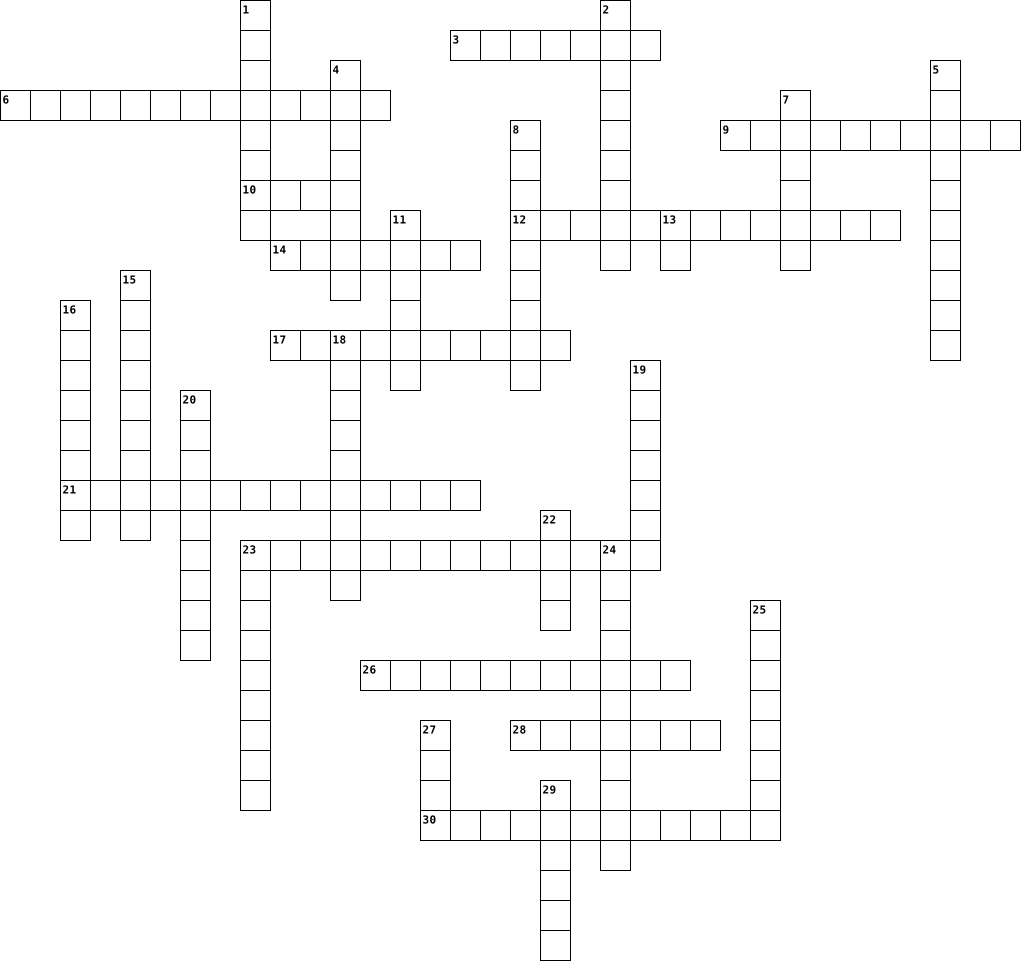
Across
- in a solution, the dissolving material or the material in greater abundance
- the actual amount of solute dissolved in a given amount of solution
- a ____ reaction is a chemical reaction that releases more thermal energy than it absorbs, gives off heat.
- an ionic compound formed by a combination of cations and anions
- a _____ reaction is a chemical reaction in which a single reactant breaks down into two or more products
- a substance that is formed during a chemical reaction
- a heterogenous mixture of a fluid and large particles that will settle out over time
- a double-replacement reaction between an acid and a base that produces a salt and a water.
- a solution that contains more than the maximum amount of a solute that it can normally hold at a given temperature
- a solution that contains less than the maximum amount of solute that it could hold at a given temperature
- a ____ solution is a water-based solution
- the physical separation of the ions in a solid ionic compound by the action of a solvent
Down
- a substance that helps a reaction happen faster but is not used up in the reaction
- a substance that slows the rate of a reaction by reducing the effectiveness of catalysts.
- a mixture with a uniform appearance throughout
- an exothermic chemical reaction in which a fuel reacts with oxygen
- in a solution, the dissolved material or the material in lesser abundance
- a loss of electrons in a chemical reaction
- a weak acid or base in solution that resists changes in pH when a moderate amount of either an acid or base is added.
- a unitless number between 0 and 14 that tells how acidic or basic a substance is
- H3O+
- a substance that enters into a chemical reaction
- a solution that contains the maximum amount of solute that it can hold at a given temperature.
- a heterogenous mixture in which the dispersed particles will not settle out.
- OH-
- a substance that produces hydroxide ions in an aqueous solution
- a ____ reaction is a chemical reaction in which two or more reactants combine into a single, more complex product.
- a ____ reaction is a chemical reaction that absorbs more thermal energy than it releases, makes things cold.
- a chemical ______ is the process that rearranges the atoms in one or more substances into one or more new substances
- a substance that produces hydrogen ions in an aqueous solution
- a _____-replacement reaction is a chemical reaction in which two compounds swap cations or anions with each other.
31 Clues: OH- • H3O+ • a ____ solution is a water-based solution • a loss of electrons in a chemical reaction • a mixture with a uniform appearance throughout • a substance that enters into a chemical reaction • a substance that is formed during a chemical reaction • a substance that produces hydrogen ions in an aqueous solution • ...
Reactions Crossword 2025-03-25

Across
- A substance made of two or more atoms chemically joined together.
- When observing a chemical reaction, you might feel the chemicals change in temperature.
- A change in which atoms are rearranged to create a new substance.
- When a chemical reaction occurs, energy is transferred to or from the surroundings.
- A chemical reaction in which a compound breaks down into simpler parts.
- A possible source of danger.
- A change which transfers energy from the surroundings.
- The starting substances in a chemical reaction.
Down
- Changes of state and dissolving are physical changes.
- Something used to speed up a chemical reaction.
- A change which transfers energy to the surroundings.
- A chemical reaction with oxygen that gives out light and heat.
- Type of reaction in which you cannot get back the substances you started with.
- Protective equipment worn in a lab.
- The resulting substances in a chemical reaction.
- A chemical formula shows how many atoms of each elements are in a compound.
16 Clues: A possible source of danger. • Protective equipment worn in a lab. • Something used to speed up a chemical reaction. • The starting substances in a chemical reaction. • The resulting substances in a chemical reaction. • A change which transfers energy to the surroundings. • Changes of state and dissolving are physical changes. • ...
Reactions Crossword 2025-03-25

Across
- A substance made of two or more atoms chemically joined together.
- A change which transfers energy to the surroundings.
- When observing a chemical reaction, you might feel the chemicals change in temperature.
- A chemical formula shows how many atoms of each elements are in a compound.
- A change which transfers energy from the surroundings.
- The starting substances in a chemical reaction.
- Something used to speed up a chemical reaction.
- Protective equipment worn in a lab.
- Type of reaction in which you cannot get back the substances you started with.
Down
- A chemical reaction in which a compound breaks down into simpler parts.
- A chemical reaction with oxygen that gives out light and heat.
- The resulting substances in a chemical reaction.
- A possible source of danger.
- When a chemical reaction occurs, energy is transferred to or from the surroundings.
- A change in which atoms are rearranged to create a new substance.
- Changes of state and dissolving are physical changes.
16 Clues: A possible source of danger. • Protective equipment worn in a lab. • The starting substances in a chemical reaction. • Something used to speed up a chemical reaction. • The resulting substances in a chemical reaction. • A change which transfers energy to the surroundings. • Changes of state and dissolving are physical changes. • ...
Chemistry U3 P1: Reactions 2021-10-21

Across
- A molecule consisting of two atoms
- A starting material in a chemical reaction
- a conversion factor that relates the amounts in moles of any two substances involved in a chemical reaction
- both sides of the equation have the same number of atoms of each element
- A solid that forms from a solution during a chemical reaction.
- use the types of replacements given the reactants. Then predict the products.
- the annual rate of return on a bond if the bond were held to maturity
- a reaction in which two or more substances combine to form a new compound
- a solid that readily dissolves in water
- a chemical reaction that occurs when a substance reacts with oxygen, releasing energy in the form of heat and light
- a reaction in which a single compound breaks down to form two or more simpler substances
- a chemical change that involves an exchange of positive ions between two compounds
Down
- Matter is not created nor destroyed in any chemical or physical change
- A reaction that releases energy in the form of heat
- A reaction that ABSORBS energy in the form of heat
- a solid that dissolves to such a small degree that it is not detectable to the naked eye
- a chemical change in which one element replaces a second element in a compound
- a list of elements organized according to the ease with which the elements undergo certain chemical reactions
- A number in front of a chemical formula in an equation that indicates how many molecules or atoms of each reactant and product are involved in a reaction.
- the process by which one or more substances change to produce one or more different substances
- The elements or compounds produced by a chemical reaction.
- solid, liquid, gas
22 Clues: solid, liquid, gas • A molecule consisting of two atoms • a solid that readily dissolves in water • A starting material in a chemical reaction • A reaction that ABSORBS energy in the form of heat • A reaction that releases energy in the form of heat • The elements or compounds produced by a chemical reaction. • ...
Chemistry Review (Pt. 2) 2013-05-28

Across
- A ________ is a substance that initiates or accelerates a chemical reaction without itself being affected
- “_____" describes bonds that have an uneven distribution of charge
- The ________ reactant is a reactant that is totally consumed during a chemical reaction, limits the extent of the reaction, and determines the amount of product
- ___ ionic equations include only those compounds and ions that undergo a chemical change in a reaction in an aqueous solution
- A chemical compound whose simplest units are molecules is a _________ compound
- _____________ is the study of quantitative relationships between the amounts of reactants used and products formed by chemical reaction; is based on the law of conservation of mass
- ____________ are whole numbers that appear in front of a formula in a chemical equation
- A neutral group of atoms that are held together by covalent bonds is called a ________
- ________ bonding is the result from the sharing of electron pairs between two atoms
- ________ molecules only contain two atoms
- A ______-replacement reaction is a chemical change in which one element replaces a second element in a compound
- _____ mass is the mass in grams of 1 mol of a substance
- _________ number is the number of particles in 1 mole of a pure substance
- A ________ bond is a mutual electrical attraction between the nuclei and valance electrons of different atoms that binds the atoms together
Down
- The list of elements organized according to the ease with which the elements undergo certain chemical reactions is called the ________ series
- A ________ equation is a chemical equation in which mass is conserved; each side of the equation has the same number of atoms of each element
- A chemical change in which two or more substances react to form a single new substance is considered a ___________ reaction
- A single bond is a covalent bond produced by the _______ of one pair of electrons between two atoms
- Chemical bonding that results from electrical attraction between large number of cations and anions is called _____ bonding
- ___________ yield is the amount of product that could form during a reaction calculated from a balanced chemical equation; it represents the maximum amount of product that could be formed from a given amount of reactant
- A _____________ reaction is the separation of a substance into two or more substances that may differ from each other and from the original substance
- A combustion reaction is the _________ reaction of an organic compound, in which heat is released
- The law of ____________ of mass states that mass is neither created nor destroyed during ordinary chemical reactions or physical changes.
- A ________ equation is a chemical equation that does not indicate the relative amounts of the reactants and products
- ________ ionic equation is an equation that shows dissolved ionic compounds as dissociated free ions
- A ______-replacement reaction is a chemical reaction between two compounds where the positive ion of one compound is exchanged with the positive ion of another compound
- The mole ratio is the ratio between the numbers of moles of any two of the __________ in a balanced chemical equation
- The chemical _______ indicates the relative numbers of atoms of each kind in a chemical compound by using atomic symbols and numerical subscripts
- The molecular formula shows the types and numbers of _____ combined in a single molecule of a molecular compound
- ______ yield is the amount of product actually produced when the chemical reaction is carried out in an experiment
30 Clues: ________ molecules only contain two atoms • _____ mass is the mass in grams of 1 mol of a substance • “_____" describes bonds that have an uneven distribution of charge • _________ number is the number of particles in 1 mole of a pure substance • A chemical compound whose simplest units are molecules is a _________ compound • ...
Types of reactions 2020-05-12

Across
- Substances that react together to form products.
- A type of decomposition reaction using heat.
- A change where no new substances are formed.
- Reaction where a fuel reacts with Oxygen producing thermal energy.
- A type of combustion where there is insufficient Oxygen.
- A gas produced during incomplete combustion.
- Black particulates produced during incomplete combustion.
- Substances formed in a chemical reaction.
- A gas produced during complete combustion.
Down
- This is the minimum amount of energy needed to start a reaction.
- In theory this is always conserved in a chemical reaction.
- Reaction giving out thermal energy to the surroundings.
- A substance used to release thermal energy when reacted with Oxygen.
- A change where new substances are formed.
- A chemical used to speed up chemical reactions.
- Reaction taking in thermal energy from the surroundings.
- A gas needed for a combustion reaction.
- A type of energy resource that is not running out.
18 Clues: A gas needed for a combustion reaction. • A change where new substances are formed. • Substances formed in a chemical reaction. • A gas produced during complete combustion. • A type of decomposition reaction using heat. • A change where no new substances are formed. • A gas produced during incomplete combustion. • A chemical used to speed up chemical reactions. • ...
Chemical Reactions Crossword 2023-03-09

Across
- a reaction in which electrons are transferred from one reactant to another
- a representation of a chemical reaction in which reactants and products are expressed as formulas
- a reaction in which a compound breaks down into two or more simpler substances (AB --> A + B)
- + CD --> AD + BC)
- a reaction in which the conversion of reactants into products and the conversion of products into reactants can happen simultaneously
- the substances that undergo change in a chemical reaction (the starting materials of a reaction)
- the rate at which reactants change into reactants change into rpoducts
- a chemical reaction that releases energy into its surroundings
Down
- a reaction in which a substance reacts rapidly with oxygen, often producing heat and light
- a reaction in which two different compounds exchange positive ions and form 2 new compounds
- a reaction in which one element take the place of an other element in a compound (A + BC --> AC + B)
- the numbers that appear before a formula in a chemical equation to show the relative proportions of each reactant to the product
- a state in which the forward and reverse paths of change take place at the same rate
- the energy stored in the chemical bonds of a substance
- a chemical reaction that absorbs energy from its surroundings
- the new substances that are formed as a result of a chemical reaction
- a reaction in which 2 more more substances react to form a single substance (A + B --> AB)
- a substance that affects the reaction rate without being used in the reaction
18 Clues: + CD --> AD + BC) • the energy stored in the chemical bonds of a substance • a chemical reaction that absorbs energy from its surroundings • a chemical reaction that releases energy into its surroundings • the new substances that are formed as a result of a chemical reaction • the rate at which reactants change into reactants change into rpoducts • ...
Metabolic processes 2016-11-24

Across
- the reduced form of the coenzyme nicotinamide adenine dinucleotide.
- standard quantity equal to approximately 6.022 x 10^23.
- reaction: a chemical reaction in which energy is released , leaving the products with less chemical potential energy than the reactants.
- state: a temporary condition during a chemical in which the bonds in the reactants are breaking and the bonds in the products forming.
- energy : the energy of motion
- Law of Thermodynamics: in every energy transfer or conversion, some of the useful energy in the system becomes unusable and increases the entropy of the universe.
- transfer of a phosphate group, usually from ATP to another molecule.
- pathway:a pathway where energy is released and complex molecules are broken down into simple molecules.
- change : a change that will once begun continue on its own under a given set of conditions, does not require a continuous supply of energy.
- reaction : a chemical reaction in which energy is absorbed giving the products more chemical potential energy than the reactants.
- coupling :the transer of energy from one reaction to another in order to drive the second reaction.
Down
- energy: the minimum amount of energy that is required to break a particular type of bond, measured in KJ per Mol of bonds.
- pathway: a pathway in which energy is supplied to build complex molecules from simple molecules.
- Law of Thermodynamics :principle that states that energy can be transferred or transformed but it cannot be created or destroyed.
- energy :Gibbs free energy.
- sum of all chemical reactions in a cell or organism.
- reaction: a chemical reaction that absorbs free energy.
- an enzyme that oxidizes a substrate and transfers hydrogen ions to an acceptor.
- cycle: the cyclic and ongoing breakdown and re-synthesis of ATP.
- energy:the minimum amount of energy that chemical reactants must absorb to start a reaction.
- : a measurement of disorder in a system.
- energy : stored energy
- reaction : a chemical reaction that releases free energy.
23 Clues: energy : stored energy • energy :Gibbs free energy. • energy : the energy of motion • : a measurement of disorder in a system. • sum of all chemical reactions in a cell or organism. • reaction: a chemical reaction that absorbs free energy. • standard quantity equal to approximately 6.022 x 10^23. • reaction : a chemical reaction that releases free energy. • ...
Unit 7.4 to 7.6 2021-03-17

Across
- A chemical _____ has symbols and numbers that tell the scientist which atoms are present and exactly how many in a substance.
- The substances present before a reaction takes place.
- The chemical combination of a metal and a nonmetal
- the reaction between an acid and a base, the chemical combination is acid + base --> salt + water
- A chemical _____ is the representation of a chemical reaction in words or symbols, this shows the scientist what happens over time during a chemical change.
- A substance that increases the hydroxide ions in a solution
- A chemical reaction that releases energy by light or heat
- A composition of two or more substances that are not chemically combined
- A mixture of 2 or more substances that are the same throughout
Down
- The name for the substance that is dissolved in a solution
- The substances formed as a result of a chemical reaction.
- the law of _____ of mass states: matter can neither be created nor destroyed in a chemical reaction.
- A substance that increases the number of hydronium ions in a solution
- What is known as the universal solvent?
- The amount of substance (solute) dissolved in a given volume of solution (solvent)
- A chemical reaction that absorbs energy, usually in the form of heat
- The substance that dissolves the solute
- A chemical _____ is the process by which atoms are rearranged chemically to form new substances, chemical bonds can be broken, formed, or both.
18 Clues: What is known as the universal solvent? • The substance that dissolves the solute • The chemical combination of a metal and a nonmetal • The substances present before a reaction takes place. • The substances formed as a result of a chemical reaction. • A chemical reaction that releases energy by light or heat • ...
Chemistry Revision 2024-06-17

Across
- a type of reaction which involves a metal bonding with oxygen
- the chemicals that go into a chemical reaction
- a type of reaction which involves a fuel and oxygen (redox)
- a type of reaction which brings oxygen into the cells in our body
- a solid crystalline product of acid base chemical reactions
- a chemical reaction that produces energy (heat)
- negatively charged particles which orbit around the nucleus of atoms
- A negatively charged atom (ion)
- particles that make up atoms that have no charge
Down
- positively charged particle that make up atoms
- the chemicals that are produced by a chemical reaction
- a substance which needs more protons (receiver)
- a chemical reaction that requires energy
- a substance which has spare protons (donor)
- the law that states matter and energy cannot be created or destroyed in a chemical reaction
- A positively charged atom (ion)
- atoms that have an abnormal number of neutrons
17 Clues: A positively charged atom (ion) • A negatively charged atom (ion) • a chemical reaction that requires energy • a substance which has spare protons (donor) • positively charged particle that make up atoms • the chemicals that go into a chemical reaction • atoms that have an abnormal number of neutrons • a substance which needs more protons (receiver) • ...
Chapter 5 vocabulary 2020-02-06

Across
- system, A system in which no matter is allowed to enter or leave
- A solid in which the atoms arranged in a pattern that repeats again and again
- A reaction in which one element replaces another in a compound or when two elements in different compounds trade places
- A chemical reaction in which two or more simple substances combine to form a new more complex substances
- A chemical reaction that breaks down compounds into simpler products
- A solid that forms a solution during a chemical reaction
- conservation mass, the principle that the total amount of matter is neither created nor destroyed during any chemical or physical change
- reaction, A reaction that releases energy usually in the form of heat
- equation, A short easy way shows a chemical reaction using symbols.
Down
- change, A change in which one or more substances combine or break apart to new substance.
- change, A change that alters the form or appearance of material but does not make the material into another substance
- A Substance that enters into a chemical reaction
- A number in front of a chemical formula in an equation that indicates how many molecules or atoms of each reactant and product are involved in a reaction
- reaction, A reaction that absorbs energy
- The amount of one material in a certain volume of another material
- A substance formed as a result of a chemical reaction
- energy, The minimum amount of energy needed to start a chemical reaction
- system, A system in which can enter from or escape to the surroundings
18 Clues: reaction, A reaction that absorbs energy • A Substance that enters into a chemical reaction • A substance formed as a result of a chemical reaction • A solid that forms a solution during a chemical reaction • system, A system in which no matter is allowed to enter or leave • The amount of one material in a certain volume of another material • ...
Exothermic and Endothermic reactions 2020-12-18

Across
- A forming of water vapor in clouds.
- Energy is stored in the bonds of chemical compounds.
- The type of reaction in exothermic reaction.
- Reaction between magnesium and chlorine gas.
- During reaction of potassium chloride,what solvent in the reaction?
- What reaction when heat evolved?
- Potassium,water and hydrogen mixed together, what is the reaction?
- How much energy stores in the products?
- Chemical formula Na2SO3.
- A substance combines with oxygen.
- Air like substances that can move around freely and flow.
- Another term used for burning.
Down
- What temperature becomes when energy is taken from the environment?
- Energy that is released to the environment.
- How energy do the surroundings?
- When the surroundings vibrate more and more, what energy is given?
- Related to exothermic reaction, reaction between fuel and oxidant.
- A reaction between copper wire and sulfur.
- During reaction of sodium chloride, what solute in the reaction?
- Reaction between sodium carbonate and chloride.
- Another process in endothermic reaction?
- Including in exothermic reaction.
- What is the chemical reaction in which energy is taken in?
- Reaction when temperature increases.
- Symbolic representation of a chemical reaction in the form of symbols and formulae.
- A reaction includes base and acid react to form water and salt.
- Energy including in Endothermic reaction.
- Reaction between carbon and oxygen.
- Matter that has properties and composition.
- Weak organic acid that has molecular formula.
30 Clues: Chemical formula Na2SO3. • Another term used for burning. • How energy do the surroundings? • What reaction when heat evolved? • Including in exothermic reaction. • A substance combines with oxygen. • A forming of water vapor in clouds. • Reaction between carbon and oxygen. • Reaction when temperature increases. • How much energy stores in the products? • ...
Exothermic and Endothermic reactions 2021-08-29

Across
- Reaction between carbon and oxygen.
- Reaction between sodium carbonate and chloride.
- Matter that has properties and composition.
- During reaction of sodium chloride, what solute in the reaction?
- A reaction includes base and acid react to form water and salt.
- Energy is stored in the bonds of chemical compounds.
- Including in exothermic reaction.
- Energy that is released to the environment.
- When iron rusts, it combines with oxygen from the air.
- Related to exothermic reaction, reaction between fuel and oxidant.
- During reaction of potassium chloride,what solvent in the reaction?
- What is the chemical reaction in which energy is taken in?
- Symbolic representation of a chemical reaction in the form of symbols and formulae.
- Another term used for burning.
- How energy do the surroundings?
- The type of reaction in exothermic reaction.
- A reaction between copper wire and sulfur.
- Reaction between magnesium and chlorine gas.
- Weak organic acid that has molecular formula.
- How much energy stores in the products?
Down
- A substance combines with oxygen.
- When the surroundings vibrate more and more, what energy is given?
- What reaction when heat evolved?
- Another process in endothermic reaction?
- Energy including in Endothermic reaction.
- What temperature becomes when energy is taken from the environment?
- Reaction when temperature increases.
- Potassium,water and hydrogen mixed together, what is the reaction?
- A forming of water vapor in clouds.
- Air like substances that can move around freely and flow.
- Chemical formula Na2SO3.
31 Clues: Chemical formula Na2SO3. • Another term used for burning. • How energy do the surroundings? • What reaction when heat evolved? • A substance combines with oxygen. • Including in exothermic reaction. • Reaction between carbon and oxygen. • A forming of water vapor in clouds. • Reaction when temperature increases. • How much energy stores in the products? • ...
Science Vocabulary 2017-09-04

Across
- Synthesis chemical reaction in which water is formed when two molecules are
- Energy energy input necessary to initiate a chemical reaction.
- sometimes sulfur.
- monomer that forms DNA and has a phosphate group, a sugar and a nitrogen-
- large organic molecule; also referred as biomolecule-molecule produced or used my living organisms.
- Acid molecule that makes up proteins; composed of carbon, hydrogen, oxygen, nitrogen
- polymer composed of amino acids linked by peptide bonds; folds into a particular
- large carbon-based molecule formed by monomers.
- nonpolar molecule composed of carbon, hydrogen, and oxygen; includes fats and oils.
- depending on bonds between amino acids.
Down
- reactant in a chemical reaction upon which an enzyme acts.
- substance formed by a chemical reaction.
- and forming of chemical bonds.
- carbohydrate monomer made of only one sugar molecule.
- base.
- Bond Attraction between atoms that creates chemical substances containing two or
- into two products.
- Acid polymer of nucleotides, the genetic material of organisms.
- molecular subunit of a polymer
- protein that catalyzes chemical reactions for organisms.
- chemical reaction in which a water molecule is broken and one molecule is broken
- substance that is changed by a chemical reaction.
- substance in which solutes dissolve and that is present in greatest concentration in a solution.
- molecule composed of carbon, hydrogen and oxygen; includes sugars and
- atoms.
- substance that decreases activation energy and increases reaction rate in a chemical
- substance that dissolves in a solvent and is present at a lower concentration than the solvent.
27 Clues: base. • atoms. • sometimes sulfur. • into two products. • and forming of chemical bonds. • molecular subunit of a polymer • depending on bonds between amino acids. • substance formed by a chemical reaction. • large carbon-based molecule formed by monomers. • substance that is changed by a chemical reaction. • carbohydrate monomer made of only one sugar molecule. • ...
Chemical Reactions 2022-03-15

Across
- a reaction that releases energy, causing the new substance to get warmer
- when you eat lunch and your food is digesting, this is a _____________ change
- to change the order or position of something
- a chemical reaction can happen with only a ___________ reactant, or many.
- During a chemical reaction, ________ do not change from one type to another
- a starting substance that is part of a chemical reaction
- an ending substance that is made during a chemical reaction
- during a chemical reaction, atoms cannot be created or ____________
- the temperature at which a substance changes from the liquid phase to the gase phase
- something that is mde of all the same atoms or groups of atoms
- a reaction that takes in energy, causing the new substance to get cooler
Down
- different substances have different ______________
- one or more starting substances (reactants) change into one or more different substances (_________)
- a group of atoms joined together in a partiular way
- things that are too small or too large to see can be studied with these
- When _________ burn they release energy
- something that can be observed about a substance, such as color, smell, or boiling point
- a process in which atoms rearrange to form new substances
- during a chemical reaction, all of the atoms that make up the ________________ rearrange to form the products.
- groups of atoms _________ to make up a substance
- tiny pieces that all matter is made of
- when you sharpen a pencil, it is a _________ change
- the temperature at which a substance changes from a solid phas to the liquid phase
- Burning is a type of ___________ reaction.
- during a chemical reaction, atoms ____________ be created or destroyed
- atoms _________________ to form different groups of atoms(molecules) during a chemical reaction
26 Clues: tiny pieces that all matter is made of • When _________ burn they release energy • Burning is a type of ___________ reaction. • to change the order or position of something • groups of atoms _________ to make up a substance • different substances have different ______________ • a group of atoms joined together in a partiular way • ...
Chapter 8 Vocab 2022-05-05

Across
- the ratio between the amounts in moles of any two compounds involved in a chemical reaction
- a reaction in which the positive and negative ions of two ionic compounds exchange places to form two new compounds.
- process by which electric current is passed through a substance to effect a chemical change.
- relating to or affecting the fundamental nature of something; far-reaching or thorough.
- a substance that increases the rate of a chemical reaction without itself undergoing any permanent chemical change.
- process that involves rearrangement of the molecular or ionic structure of a substance, as opposed to a change in physical form or a nuclear reaction.
- the symbolic representation of a chemical reaction in the form of symbols and formulae
- a substance that takes part in and undergoes change during a reaction.
- high temperature exo thermic reaction
- any chemical reaction that absorbs heat from the environment
Down
- a reaction in which a compound breaks down into two or more simpler substances.
- chemical reaction in which one element is replaced by another in a compound.
- a type of chemical reaction that involves a transfer of electrons between two species.
- a thing or person that is the result of an action or process.
- reactions that release heat
- a biological catalyst and is almost always a protein
- reactions that occur when two different atoms or molecules interact to form a different molecule or compound.
- an underlying substance or layer.
18 Clues: reactions that release heat • an underlying substance or layer. • high temperature exo thermic reaction • a biological catalyst and is almost always a protein • any chemical reaction that absorbs heat from the environment • a thing or person that is the result of an action or process. • a substance that takes part in and undergoes change during a reaction. • ...
PS 3.2.2 & 3.2.2 2023-12-04

Across
- For chemical reactions to take place, the reacting molecule must do this with enough force to break intermolecular bonds.
- This states that mass is neither created nor destroyed.
- These are inhibitors used to prevent spoilage of food.
- Chemical reactions frequently take place in a series of simple steps called this.
- Chemists balance equations using this in front of the formulas of the reactants and products to balance equations.
- This is the slowest pathway along a reaction pathway.
- A description using chemical symbols and formulas to show the reactants and products in a chemical reaction.
- A substance that increases the reaction rate without being permanently changed.
- An equation in which the number of atoms of each element on the reactant side is equal to the number of atoms on the product side.
- In chemical equations this state is represented by a L.
Down
- For chemical reactions to take place, after intermolecular bonds have been broken, these types of atoms must be in the right position to bond with each other.
- A measure of the change in concentration of the reactants over a period of time.
- Lowering this will decrease a reaction rate while increasing it will increase a reaction rate.
- A substance that slows down or stops a chemical reaction.
- For a chemical reaction to be accurate, it must contain the correct _______________ of the reactants and products.
- In chemical equations if a substance can be dissolved in water it is called this a represented by the letters aq.
- A higher level of this in reactants will typically increase a reaction because there is more reactant to react.
- In chemical equations this state is represented by a letter s.
- area Increasing this, which is done by crushing a reactant into smaller pieces, will increase the reaction rate.
- For a chemical equation to be valuable, it must represent the known facts about a reaction. All reactants and products must be this...
- In chemical equations this state is represented by a g.
21 Clues: This is the slowest pathway along a reaction pathway. • These are inhibitors used to prevent spoilage of food. • This states that mass is neither created nor destroyed. • In chemical equations this state is represented by a g. • In chemical equations this state is represented by a L. • A substance that slows down or stops a chemical reaction. • ...
Ch. 6 Vocabulary Review 2023-01-17

Across
- a disease where there is too much sugar in the blood
- the type of energy that deals with motion
- an enzyme that digests fats
- the area on an enzyme where a substrate fits
- a chemical that helps a chemical reaction without being consumed during the reaction
- a molecule formed when phosphate is removed from ATP
- the process of adding phosphorus to a molecule
- the amount of energy in food
- the sugar that is broken down for energy in cells
- the chemicals produced or left over after a chemical reaction
- the reactant an enzyme bonds with
Down
- an enzyme that digests proteins
- the energy needed to start a chemical reaction
- the process of adding water to break apart chemical bonds
- all the chemical reactions that take place in a cell
- a catalyst produced only in living things
- the chemicals that start a chemical reaction
- an energy rich molecule
- liquid in the mouth that contains enzymes
- the type of energy when something is at rest
20 Clues: an energy rich molecule • an enzyme that digests fats • the amount of energy in food • an enzyme that digests proteins • the reactant an enzyme bonds with • the type of energy that deals with motion • a catalyst produced only in living things • liquid in the mouth that contains enzymes • the chemicals that start a chemical reaction • ...
Chemical Reactions Vocab 2017-01-12

Across
- a substance that takes part in and undergoes change during a reactionsinglereplacement a type of chemical reaction where an element reacts with a compound and takes the place of another element in that compound
- a chemical equation that does not indicate the relative amounts of the reactants and products.
- is a new material formed in a chemical reaction
- a multiplier or factor that measures some property
- chemical equation for a reaction which lists only those species participating in the reaction
- a chemical reaction where the reactants form products that, in turn, react together to give the reactants back.
- when the number of the atoms involved in the reactants side is equal to the number of atoms in the products side
Down
- is a useful guide for predicting the products of metal displacement reactions
- the solvent is water.
- the amount of product obtained in a chemical reaction
- a reaction where two or more elements or compounds (reactants) combine to form a single compound
- a single compound breaks down into two or more elements or new compounds
- exists in the same form on both the reactant and product sides of a chemical reaction
- a type of chemical reaction where two compounds react, and the positive ions (cation) and the negative ions (anion) of the two reactants switch places, forming two new compounds or products
- symbolic representation of a chemical reaction in the form of symbols and formulae, wherein the reactant entities are given on the left-hand side and the product entities on the right-hand side.
- a substance that increases the rate of a chemical reaction without itself undergoing any permanent chemical change
- (commonly known as burning ) is an exothermic reaction in which something reacts with oxygen.
17 Clues: the solvent is water. • is a new material formed in a chemical reaction • a multiplier or factor that measures some property • the amount of product obtained in a chemical reaction • a single compound breaks down into two or more elements or new compounds • is a useful guide for predicting the products of metal displacement reactions • ...
Chapter 10 Vocab 2013-01-16

Across
- A chemical reaction in which two or more substances react to yield a single product.
- An ionic equation that shows all the particles in a solution as they realistically exist.
- A chemical reaction that occurs when a substance reacts with oxygen, releasing energy in the form of heat and light.
- A chemical reaction that occurs when the atoms of one element replace the atoms of another element in a compound.
- The process by which the atoms of one or more substances are rearranged to form different substances; occurrence can be indicated by changes in temperature, color, odor and physical state.
- A solution in which the solvent is water.
- A substance dissolved in a solution.
- An ionic equation that includes only the particles that participate in the reaction.
Down
- An ion that does not participate in a reaction and usually is not shown in an ionic expression.
- A solid produced during a chemical reaction in a solution.
- A chemical reaction that occurs when a single compound breaks down into two or more elements or new compounds.
- A chemical reaction that involves the exchange of positive ions between two compounds and produces either a precipitate, a gas or water.
- The substance that dissolves a solute to form a solution.
- In the chemical equation, the number of written in from of a reactant or product; it tells the smallest number of particles of the substance involved in the reaction.
- A statement using chemical formulas to describe the identities and relative amounts of the reactants and products involved in the chemical reaction.
- The starting substance in a chemical reaction.
- A substance formed during a chemical reaction.
17 Clues: A substance dissolved in a solution. • A solution in which the solvent is water. • The starting substance in a chemical reaction. • A substance formed during a chemical reaction. • The substance that dissolves a solute to form a solution. • A solid produced during a chemical reaction in a solution. • ...
Unit 2 Review 2025-09-17

Across
- molecules that contain carbon, hydrogen, oxygen, nitrogen, and sometimes sulfur
- a chemical reaction releases more energy than it absorbs
- change substances into different substances by breaking and forming chemical bonds
- when the products and reactants are at the same concentration
- polymers that are made up of monomers called nucleotides
- molecules made of carbon, hydrogen, and oxygen
- substances changes during a chemical reaction
- substances made by a chemical reaction
Down
- chains of carbon atoms bonded to hydrogen atoms
- large molecule made of several parts
- a chemical reaction absorbs more energy that it releases
- catalysts for chemical reactions in living things
- the amount of energy that will break a bond between two atoms
- nonpolar molecules that include fats, oils, and cholesterols
- a polymer made of monomers called amino acids
- increases the rate of the chemical reaction
- the amount of energy that needs to be absorbed for a chemical reaction to start
- specific reactants that an enzyme acts on
18 Clues: large molecule made of several parts • substances made by a chemical reaction • specific reactants that an enzyme acts on • increases the rate of the chemical reaction • a polymer made of monomers called amino acids • substances changes during a chemical reaction • molecules made of carbon, hydrogen, and oxygen • chains of carbon atoms bonded to hydrogen atoms • ...
chapter 8 2023-03-09

Across
- ,an acid that completely dissociates to H ions in solution
- ,a reaction that forms water when an acid is mixed with a base
- ,a substance that produces hydroxide ions in a solution
- ,a reaction in which a solid forms and separates from the solution as a solid
- ,a chemical equation showing the complete forms of all reactants and products
- ,a chemical reaction in which a compound if formed from simpler materials
- ,a base that completely dissociates to produce OH ions in a solution
- ,the solid that forms in a precipitation state
- ,occurs when a compound is broken down into simpler substances
- ,a chemical reaction involving oxygen as one of the reactants that produce enough heat so it results in flames
- ,a solid that readily dissolves in water
- ,a substance that produces hydrogen ions in solution; a proton donor
Down
- ,a chemical reaction involving the transfer of electrons
- ,a reaction in which ions in two compounds exchange places forming 2 new compounds
- ,chemical equation for a reaction in solution showing only those components that are directly involved in the reaction
- ,a chemical equation for a reaction in solution representing all strong electrolytes
- ,a reaction in which one element replaces another element in a compound
- ,ions presented in solution that do not participate directly in a reaction
- ,ionic compound
- ,a solid that dissolves in a much smaller degree that is not detectable to the human eye
20 Clues: ,ionic compound • ,a solid that readily dissolves in water • ,the solid that forms in a precipitation state • ,a substance that produces hydroxide ions in a solution • ,a chemical reaction involving the transfer of electrons • ,an acid that completely dissociates to H ions in solution • ,a reaction that forms water when an acid is mixed with a base • ...
KS3 Chemical Reactions Crossword 2024-07-15

Across
- A reaction that transfers energy to the surroundings.(10)
- A physical change from one state of matter to another. For example, when a solid changes to a liquid.(6,2,5)
- A substance that increases the rate of a chemical reaction.(8)
- The average kinetic energy of the particles in a substance, measured in degrees Celsius (°C).(11)
- A substance that is formed in a chemical reaction.(7)
- A force that holds atoms together in molecules.(8,4)
- An equation that uses only the names of the reactants and products to model a chemical reaction.(4,8)
- A reaction in which the products can react to produce the original reactants. Represented by: A + B ⇌ C + D.(10,8)
- A process that involves rearrangement of atoms to produce new substances.(8,8)
- No atoms are lost or made during a chemical reaction so the mass of the products equals the mass of the reactants.(12,2,4)
- A reaction that takes in energy from the surroundings.(11)
- The loss of electrons from a substance or the gain of oxygen by a substance.(9)
Down
- When bubbles are observed due to the production of a gas in a chemical reaction.(13)
- A substance made of more than one atom held together by covalent bonds.(8)
- The smallest part of an element that can exist.(4)
- Stores energy in a chemical store which it can release as heat.(4)
- A reaction in which a single reactant breaks down when heated, forming two or more products.(7,13)
- A reaction between a substance and oxygen in the air. The scientific word for burning.(10)
- A substance that takes part in a chemical reaction.(8)
- To mix a solute with a solvent to form a solution.(8)
- A measure of how quickly a reactant is used up or a product is formed in a chemical reaction.(4,2,8)
21 Clues: The smallest part of an element that can exist.(4) • A force that holds atoms together in molecules.(8,4) • A substance that is formed in a chemical reaction.(7) • To mix a solute with a solvent to form a solution.(8) • A substance that takes part in a chemical reaction.(8) • A reaction that transfers energy to the surroundings.(10) • ...
Exothermic and Endothermic reactions 2020-12-18

Across
- Potassium,water and hydrogen mixed together, what is the reaction?
- When the surroundings vibrate more and more, what energy is given?
- Energy is stored in the bonds of chemical compounds.
- The type of reaction in exothermic reaction.
- Symbolic representation of a chemical reaction in the form of symbols and formulae.
- What temperature becomes when energy is taken from the environment?
- During reaction of sodium chloride, what solute in the reaction?
- When iron rusts, it combines with oxygen from the air.
- What reaction when heat evolved?
- A reaction includes base and acid react to form water and salt.
- Chemical formula Na2SO3.
- Energy that is released to the environment.
- Air like substances that can move around freely and flow.
Down
- Reaction between carbon and oxygen.
- Reaction between sodium carbonate and chloride.
- Matter that has properties and composition.
- Related to exothermic reaction, reaction between fuel and oxidant.
- A substance combines with oxygen.
- Reaction when temperature increases.
- What is the chemical reaction in which energy is taken in?
- Another term used for burning.
- A forming of water vapor in clouds.
- A reaction between copper wire and sulfur.
- Weak organic acid that has molecular formula.
- Energy including in Endothermic reaction.
- How energy do the surroundings?
- Including in exothermic reaction.
- Another process in endothermic reaction?
- Reaction between magnesium and chlorine gas.
- How much energy stores in the products?
- During reaction of potassium chloride,what solvent in the reaction?
31 Clues: Chemical formula Na2SO3. • Another term used for burning. • How energy do the surroundings? • What reaction when heat evolved? • A substance combines with oxygen. • Including in exothermic reaction. • Reaction between carbon and oxygen. • A forming of water vapor in clouds. • Reaction when temperature increases. • How much energy stores in the products? • ...
Exothermic and Endothermic reactions 2020-12-18

Across
- Reaction between carbon and oxygen.
- Reaction between sodium carbonate and chloride.
- Matter that has properties and composition.
- During reaction of sodium chloride, what solute in the reaction?
- A reaction includes base and acid react to form water and salt.
- Energy is stored in the bonds of chemical compounds.
- Including in exothermic reaction.
- Energy that is released to the environment.
- When iron rusts, it combines with oxygen from the air.
- Related to exothermic reaction, reaction between fuel and oxidant.
- During reaction of potassium chloride,what solvent in the reaction?
- What is the chemical reaction in which energy is taken in?
- Symbolic representation of a chemical reaction in the form of symbols and formulae.
- Another term used for burning.
- How energy do the surroundings?
- The type of reaction in exothermic reaction.
- A reaction between copper wire and sulfur.
- Reaction between magnesium and chlorine gas.
- Weak organic acid that has molecular formula.
- How much energy stores in the products?
Down
- A substance combines with oxygen.
- When the surroundings vibrate more and more, what energy is given?
- What reaction when heat evolved?
- Another process in endothermic reaction?
- Energy including in Endothermic reaction.
- What temperature becomes when energy is taken from the environment?
- Reaction when temperature increases.
- Potassium,water and hydrogen mixed together, what is the reaction?
- A forming of water vapor in clouds.
- Air like substances that can move around freely and flow.
- Chemical formula Na2SO3.
31 Clues: Chemical formula Na2SO3. • Another term used for burning. • How energy do the surroundings? • What reaction when heat evolved? • A substance combines with oxygen. • Including in exothermic reaction. • Reaction between carbon and oxygen. • A forming of water vapor in clouds. • Reaction when temperature increases. • How much energy stores in the products? • ...
Chapter 10 Vocab 2013-01-16

Across
- A solid produced during a chemical reaction in a solution.
- A substance dissolved in a solution.
- A chemical reaction that occurs when a single compound breaks down into two or more elements or new compounds.
- The process by which the atoms of one or more substances are rearranged to form different substances; occurrence can be indicated by changes in temperature, color, odor and physical state.
- In the chemical equation, the number of written in from of a reactant or product; it tells the smallest number of particles of the substance involved in the reaction.
- A chemical reaction that occurs when the atoms of one element replace the atoms of another element in a compound.
- A statement using chemical formulas to describe the identities and relative amounts of the reactants and products involved in the chemical reaction.
- The substance that dissolves a solute to form a solution.
Down
- A chemical reaction in which two or more substances react to yield a single product.
- An ionic equation that includes only the particles that participate in the reaction.
- A chemical reaction that involves the exchange of positive ions between two compounds and produces either a precipitate, a gas or water.
- An ion that does not participate in a reaction and usually is not shown in an ionic expression.
- An ionic equation that shows all the particles in a solution as they realistically exist.
- A chemical reaction that occurs when a substance reacts with oxygen, releasing energy in the form of heat and light.
- The starting substance in a chemical reaction.
- A substance formed during a chemical reaction.
- A solution in which the solvent is water.
17 Clues: A substance dissolved in a solution. • A solution in which the solvent is water. • The starting substance in a chemical reaction. • A substance formed during a chemical reaction. • The substance that dissolves a solute to form a solution. • A solid produced during a chemical reaction in a solution. • ...
Vocab Words 2023-03-08

Across
- an oxidation–reduction reaction that involves
- a chemical reaction in which a compound is formed from simpler materials
- occurs when an electron relocates from an atom or molecule to another such chemical entity
- a mathematical relationship or rule expressed in symbols
- ions present in solution that do not participate directly in a reaction
- a chemical reaction in which two molecules of hydrogen combine with one molecule of oxygen
- an acid that completely dissociates (ionizes) to produce ions in solution
- a substance that takes part in and undergoes change during a reaction.
- a reaction in which a solid forms and separates from the solution as a solid
- a chemical equation for a reaction in solution showing only those components that are directly involved in the reaction
- a base that completely dissociates to produce ions in solution
- a solid that readily dissolves in water
- a reaction in which ions in two compounds exchange places, forming two new compounds
- occurs when a compound is broken down into simpler substances
- a substance that is present at the end of a chemical reaction
- a chemical reaction involving the transfer of electrons
- a reaction that forms water when an acid is mixed with a base
Down
- a substance that produces hydroxide ions in solution; a proton acceptor
- a reaction in which one element replaces another element in a compound
- a process that involves rearrangement of the molecular or ionic structure of a substance
- a chemical showing the complete forms of all reactants and products
- a substance that dissolves in water, dissociating completely into ions
- a compound that increases the H+ ion concentration in an aqueous solution
- a substance that produces hydrogen ions in aqueous solution; a proton donor
- an ionic compound
- a chemical equation for a reaction in solution representing all strong electrolytes
- the solid that forms in a precipitation reaction
- a chemical compound that neutralizes or effervesces with acids and turns litmus blue
- a compound that increases the OH− ion concentration in aqueous solution
- a solid that dissolves to such a small degree that it is not detectable to the naked eye
30 Clues: an ionic compound • a solid that readily dissolves in water • an oxidation–reduction reaction that involves • the solid that forms in a precipitation reaction • a chemical reaction involving the transfer of electrons • a mathematical relationship or rule expressed in symbols • occurs when a compound is broken down into simpler substances • ...
Chemistry Crossword Puzzle 2021-10-14

Across
- a change that alters the form or appearance of a substance but doe not convert the mater into a new substance
- a combination of symbols that represent the elements in a compound
- the relationship between mass and volume of an object
- a change in matter that forms one or more new substances
- a way to show chemical reactions using element symbols instead of words
- anything that has mass and takes up space
- a substance that consists of two or more pure elements, compounds or both that are in the same place but NOT chemically combined
- the force that holds atoms together
- a substance that cannot be broken down into any other substances by chemical or physical means
- the amount of space that matter occupies
- Reaction occur when chemical bonds are made or broken and new bonds form making new substances
- a particle made of tow or more atoms chemically bonded together
- a type of chemical reaction when one element replaces another in a compound or when two elements in different compounds trade places
- a type of chemical reaction when two or more substances combine to make a more complex substance
- a type of chemical reaction when chemical bonds break compounds into simpler substances
Down
- a type of chemical reaction that absorbs energy from its environment
- the materials or substances at the beginning of a chemical reaction
- a solid that forms from solution during a chemical reaction
- a one or two letter set of characters used to identify an element
- numbers in a chemical formula that show the number of atoms of an element in that molecule or the ratio of elements in a compound
- the law that states that matter cannot be created or destroyed only transformed
- a biological catalyst in cells
- the amount of one material in a given volume of another material
- the minimum amount of energy needed to start a chemical reaction
- the materials or substances that results from a chemical reaction
- the measurement of how much matter in an object
- the number placed in front of a chemical formula in a chemical equation
- a material used to decrease the rate of a chemical reaction
- a type of chemical reaction that releases energy in the form of heat
- the measure of energy in the environment
- the measure of the force of gravity on an object
- a material that increases the rate of a reaction by lowering the activation energy
- the smallest particle of an element
- a substance made of two or more elements chemically combined in a specific ratio or proportion
- a well mixed mixture
- the study of the properties of matter and how the matter changes
36 Clues: a well mixed mixture • a biological catalyst in cells • the force that holds atoms together • the smallest particle of an element • the measure of energy in the environment • the amount of space that matter occupies • anything that has mass and takes up space • the measurement of how much matter in an object • the measure of the force of gravity on an object • ...
Autumn Roe Chapter 13 2016-10-12

Across
- Description of a solution in which the hydronium ion concentration is equal to the hydroxide ion concentration.
- The reacting substances in a chemical reaction.
- A rapid exothermic oxidation reduction reaction between a material and a molecular oxygen.
- Description of a substance that can behave as either an acid or a base.
- A measure of the acidity of a solution; equal to the negative logarithm of the hydronium ion concentration.
- equation A representation of a chemical reaction in which reactants are written to the left of an arrow that points toward the products on the right
- Description of a chemical reaction in which there is a net absorption of energy.
- energy The minimum energy required in order for a chemical reaction to proceed.
- Any substance that increases the rate of a chemical reaction without itself being consumed by the reaction.
Down
- The deterioration of a metal, typically caused by atmospheric oxygen.
- ion A polyatomic ion made by adding a proton to a water molecule.
- A reaction between an acid and a base.
- ion A polyatomic ion made by removing a proton from a water molecule.
- The process by which a reactant gains one or more electrons.
- Description of a chemical reaction in which there is a net release of energy.
- A substance that accepts hydrogen ions.
- energy The amount of energy required to pull two bonded atoms apart
- description of a solution in which the hydroxide ion concentration is higher than the hydronium ion.
- The new materials formed in a chemical reaction.
- The process by which a reactant loses one or more electrons.
- A substance that donates hydrogen ions.
21 Clues: A reaction between an acid and a base. • A substance that accepts hydrogen ions. • A substance that donates hydrogen ions. • The reacting substances in a chemical reaction. • The new materials formed in a chemical reaction. • The process by which a reactant gains one or more electrons. • The process by which a reactant loses one or more electrons. • ...
Science Vocabulary 2017-09-04

Across
- molecular subunit of a polymer
- Bond Attraction between atoms that creates chemical substances containing two or
- base.
- Synthesis chemical reaction in which water is formed when two molecules are
- chemical reaction in which a water molecule is broken and one molecule is broken
- carbohydrate monomer made of only one sugar molecule.
- large carbon-based molecule formed by monomers.
- depending on bonds between amino acids.
- atoms.
- monomer that forms DNA and has a phosphate group, a sugar and a nitrogen-
- substance that decreases activation energy and increases reaction rate in a chemical
- protein that catalyzes chemical reactions for organisms.
- Acid molecule that makes up proteins; composed of carbon, hydrogen, oxygen, nitrogen
- substance that dissolves in a solvent and is present at a lower concentration than the solvent.
Down
- substance formed by a chemical reaction.
- substance in which solutes dissolve and that is present in greatest concentration in a solution.
- and forming of chemical bonds.
- Acid polymer of nucleotides, the genetic material of organisms.
- Energy energy input necessary to initiate a chemical reaction.
- polymer composed of amino acids linked by peptide bonds; folds into a particular
- molecule composed of carbon, hydrogen and oxygen; includes sugars and
- sometimes sulfur.
- large organic molecule; also referred as biomolecule-molecule produced or used my living organisms.
- nonpolar molecule composed of carbon, hydrogen, and oxygen; includes fats and oils.
- reactant in a chemical reaction upon which an enzyme acts.
- substance that is changed by a chemical reaction.
- into two products.
27 Clues: base. • atoms. • sometimes sulfur. • into two products. • molecular subunit of a polymer • and forming of chemical bonds. • depending on bonds between amino acids. • substance formed by a chemical reaction. • large carbon-based molecule formed by monomers. • substance that is changed by a chemical reaction. • carbohydrate monomer made of only one sugar molecule. • ...
Reactions Vocab 2020-09-14

Across
- a process in which one or more substances are changed into one or more different substances
- a solid material that is formed in a chemical reaction that separates from the solution
- a reaction that takes place with so little energy added to start the reaction that it seems as if no activation energy is needed
- energy needed to start a chemical reaction
- a reaction in which a compound breaks down
- a reaction in which compounds exchange ions
- a reaction in which two or more substances combine to form a new compound
- a substance that changes the rate of a chemical reaction
- a shorthand method used by scientists to show the changes that take place in a chemical equation
Down
- the substances formed in a reaction
- a reaction that gives off energy
- a whole number placed in front of an element or compound
- a reaction that absorbs energy
- a reaction that takes place when one element replaces another forming a new compound
- the starting substances in a chemical reaction
- catalysts that slow down chemical reactions
16 Clues: a reaction that absorbs energy • a reaction that gives off energy • the substances formed in a reaction • energy needed to start a chemical reaction • a reaction in which a compound breaks down • a reaction in which compounds exchange ions • catalysts that slow down chemical reactions • the starting substances in a chemical reaction • ...
8th grade Topic 9 chemical reactions 2024-12-08

Across
- the measure of how much solute can dissolve in a solvent at a given temperature
- if a solution is _________ then it is able to dissolve more solute at a given temp
- a chemical reaction occurs when existing chemical ___ are broken and new ones may be made
- type of reaction that gives off energy
- a mixture where particles can be seen and separated by settling or filtration.
- in this type of reaction, one complex compound will break down into simpler ones
- this number in front of a compound in a chemical equation tells you how many molecules of that compound there are
- a compound that speeds up a chemical reaction without itself being consumed
- all the atoms of each element reacting in a chemical equation must ___ the number of atoms that are being produced.
- crushing or breaking something up will increase the __ __ of the substance and allow more surfaces for the reaction to take place
- this type of reaction takes simple things and combines them to make them more complex
- ___ energy is the minimum amount of energy needed for a reaction to take place
- these are examples of synthetic foods- they are added too food to make them last longer
- a mixture that you can see the separate parts
- separating a mixture by heating so that the part that has a lower boiling point will evaporate first, then it is collected while the gas cools and condenses
- increasing this will cause particles to move faster and will increase the reaction rate, lowering it will decrease the rate
- you can put chemical inhibitors called ___ onto food to keep them from decaying
- this small number following an element’s symbol in a chemical equation tells you how many atoms of that element are present in the reaction
- the Law of ___ __ ___ states matter cannot be created nor destroyed, only changed
- in this type of reaction, positive ions of both compound switch places
- a mixture that is the same throughout
- the things that are produced in a chemical reaction
- the scattering of light as it passes through a colloid is called the ___ __
- when determining if something will dissolve something else it is helpful to remember the phrase “___ ____ ____”
Down
- a compound that prevents or slows down a chemical reaction
- the arrow in a chemical equation means this word
- type of reaction that absorbs energy as it happens
- the amount of __ in a given volume is concentration
- these/this is any compound that is reacting, it is on the left side of the arrow in a chemical equation
- a mixture containing small undissolved particles that do not settle out- they can scatter light.
- a solid may form when 2 liquids react, it is called this, a ___
- what gets dissolved in a solution
- what does the dissolving In a solution
- long chains of molecules made of repeating units called monomers - examples are plastics and wool
- if a solution is _______ then it contains more solute than a saturated one. Solution is unstable and may form crystals
- a ___ change occurs when a new substance is created
- a chemical ___ shows the number of chemicals and how they react to form now substances
- in this type of reaction, one substance changes places with another
- if chemicals change ___, it may indicate a chemical reaction has taken place
- material made by humans and are not natural are called __________
- in this type of reaction system, the reaction is contained, matter cannot enter or exit
- if this (tiny bubbles) are produced during a reaction, it may indicate a chemical reaction
- salt and water are considered ___ ___ because they have fixed chemical compositions
- a ___ change is one in which the appearance of the matter changes, it does not change what it is
- Material made up of 2 or more substances that can be separated by physical means
- if a solution is __________ then contains all the solute it can at a given temp
- in this type of chemical reaction system, the environment can influence the reaction, or matter can enter and escape from the reaction
- adding water or another solvent to a solution will ____ the mixture and could slow down the reaction
- these are catalysts in our body that speed up chemical reactions
49 Clues: what gets dissolved in a solution • a mixture that is the same throughout • type of reaction that gives off energy • what does the dissolving In a solution • a mixture that you can see the separate parts • the arrow in a chemical equation means this word • type of reaction that absorbs energy as it happens • the amount of __ in a given volume is concentration • ...
8th Chemical Reactions Topic 9 2025-11-29

Across
- the things that are produced in a chemical reaction
- these/this is any compound that is reacting, it is on the left side of the arrow in a chemical equation
- a mixture that you can see the separate parts
- type of reaction that gives off energy
- a ___ change is one in which the appearance of the matter changes, it does not change what it is
- a chemical reaction occurs when existing chemical ___ are broken and new ones may be made
- this small number following an element’s symbol in a chemical equation tells you how many atoms of that element are present in the reaction
- type of reaction that absorbs energy as it happens
- the measure of how much solute can dissolve in a solvent at a given temperature
- all the atoms of each element reacting in a chemical equation must ___ the number of atoms that are being produced.
- in this type of reaction, one substance changes places with another
- if this (tiny bubbles) are produced during a reaction, it may indicate a chemical reaction
- this type of reaction takes simple things and combines them to make them more complex
- separating a mixture by heating so that the part that has a lower boiling point will evaporate first, then it is collected while the gas cools and condenses
- what gets dissolved in a solution
- what does the dissolving In a solution
- these are catalysts in our body that speed up chemical reactions
- in this type of reaction, one complex compound will break down into simpler ones
- this number in front of a compound in a chemical equation tells you how many molecules of that compound there are
- salt and water are considered ___ ___ because they have fixed chemical compositions
- increasing this will cause particles to move faster and will increase the reaction rate, lowering it will decrease the rate
- the Law of ___ __ ___ states matter cannot be created nor destroyed, only changed
- a chemical ___ shows the number of chemicals and how they react to form now substances
- long chains of molecules made of repeating units called monomers - examples are plastics and wool
- material made by humans and are not natural are called __________
- in this type of reaction system, the reaction is contained, matter cannot enter or exit
- a mixture where particles can be seen and separated by settling or filtration.
Down
- crushing or breaking something up will increase the __ __ of the substance and allow more surfaces for the reaction to take place
- if a solution is _______ then it contains more solute than a saturated one. Solution is unstable and may form crystals
- these are examples of synthetic foods- they are added too food to make them last longer
- a compound that prevents or slows down a chemical reaction
- when determining if something will dissolve something else it is helpful to remember the phrase “___ ____ ____”
- in this type of reaction, positive ions of both compound switch places
- if a solution is _________ then it is able to dissolve more solute at a given temp
- a compound that speeds up a chemical reaction without itself being consumed
- ___ energy is the minimum amount of energy needed for a reaction to take place
- a ___ change occurs when a new substance is created
- if a solution is __________ then contains all the solute it can at a given temp
- a mixture containing small undissolved particles that do not settle out- they can scatter light.
- adding water or another solvent to a solution will ____ the mixture and could slow down the reaction
- a solid may form when 2 liquids react, it is called this, a ___
- the scattering of light as it passes through a colloid is called the ___ __
- if chemicals change ___, it may indicate a chemical reaction has taken place
- a mixture that is the same throughout
- Material made up of 2 or more substances that can be separated by physical means
- in this type of chemical reaction system, the environment can influence the reaction, or matter can enter and escape from the reaction
- you can put chemical inhibitors called ___ onto food to keep them from decaying
- the arrow in a chemical equation means this word
- the amount of __ in a given volume is concentration
49 Clues: what gets dissolved in a solution • a mixture that is the same throughout • type of reaction that gives off energy • what does the dissolving In a solution • a mixture that you can see the separate parts • the arrow in a chemical equation means this word • type of reaction that absorbs energy as it happens • the things that are produced in a chemical reaction • ...
Chapter 4 Vocab 2022-11-18

Across
- When two or more elements or compounds combine to make a more complex substance.
- When one element replaces another element in a compound, or if two elements in different compounds trade places.
- The biological catalysts in your body that help some chemical reactions occur at body temperature.
- Something that increases the reaction rate by lowering the activation energy needed.
- A change in matter that produces one or more new substances.
- A way to show a chemical reaction, using symbols instead of words.
- A reaction that occurs when compounds break down into simpler products.
- A solid that forms from liquids during a chemical reaction.
- The principle that states that during a chemical reaction matter is not created nor destroyed.
Down
- A number placed in front of a chemical formula in an equation.
- The minimum amount of energy needed to start a chemical reaction.
- A material used to decrease the rate of a chemical reaction.
- When the energy released as the products form is greater than the energy required to break the bonds of the reactants.
- Substance that undergo chemical changes.
- The amount of a substance in a given volume.
- Any change that alters the form or appearance of a substance but does not change it into another substance.
- When more energy is required to break the bonds of the reactants than is released by the formation of the products.
- When matter can enter from or escape to the surroundings.
- The new substances that form in a chemical reaction.
- Somewhere that matter does not enter or leave.
20 Clues: Substance that undergo chemical changes. • The amount of a substance in a given volume. • Somewhere that matter does not enter or leave. • The new substances that form in a chemical reaction. • When matter can enter from or escape to the surroundings. • A solid that forms from liquids during a chemical reaction. • ...
Chapter 10 Vocab 2013-01-16

Across
- A chemical reaction in which two or more substances react to yield a single product.
- A solid produced during a chemical reaction in a solution.
- A substance formed during a chemical reaction.
- A statement using chemical formulas to describe the identities and relative amounts of the reactants and products involved in the chemical reaction.
- A chemical reaction that occurs when a single compound breaks down into two or more elements or new compounds.
- A chemical reaction that involves the exchange of positive ions between two compounds and produces either a precipitate, a gas or water.
- The substance that dissolves a solute to form a solution.
- In the chemical equation, the number of written in from of a reactant or product; it tells the smallest number of particles of the substance involved in the reaction.
- A substance dissolved in a solution.
- The process by which the atoms of one or more substances are rearranged to form different substances; occurrence can be indicated by changes in temperature, color, odor and physical state.
Down
- A chemical reaction that occurs when the atoms of one element replace the atoms of another element in a compound.
- The starting substance in a chemical reaction.
- A solution in which the solvent is water.
- An ion that does not participate in a reaction and usually is not shown in an ionic expression.
- An ionic equation that shows all the particles in a solution as they realistically exist.
- An ionic equation that includes only the particles that participate in the reaction.
- A chemical reaction that occurs when a substance reacts with oxygen, releasing energy in the form of heat and light.
17 Clues: A substance dissolved in a solution. • A solution in which the solvent is water. • The starting substance in a chemical reaction. • A substance formed during a chemical reaction. • The substance that dissolves a solute to form a solution. • A solid produced during a chemical reaction in a solution. • ...
Science vocab chap 7 2024-01-10

Across
- a combination of chemical formulas and symbols that models a chemical reaction.
- a chemical reaction in which a single reactant breaks down into two or more products
- SI fundamental unit for the quantity of matter in a substance; a count equal to 6.022 x 10
- a substance that enters into a chemical reaction
- a loss of electrons in a chemical reaction
Down
- A chemical reaction in which one element in a compound is replaced by another element; also known as a single-displacement reaction
- A chemical reaction in which two compounds swap cations or anions with each other; also known as double displacement reaction
- a gain of electrons in a chemical reaction
- a chemical reaction in which two or more reactants combine into a single, more complex product
- a substance that is formed during a chemical reaction
- the mass of one mole in a substance
- a process that changes a substance into one or more different substances.
- an exothermic chemical reaction in which a fuel reacts with oxygen
- a number placed in front of a chemical formula within a chemical equation that shows how many units of a reactant or product are needed to balance the chemical equation
14 Clues: the mass of one mole in a substance • a gain of electrons in a chemical reaction • a loss of electrons in a chemical reaction • a substance that enters into a chemical reaction • a substance that is formed during a chemical reaction • an exothermic chemical reaction in which a fuel reacts with oxygen • ...
Science Vocab (chapter 7) 2024-01-10

Across
- An exothermic chemical reaction in which a fuel reacts with oxygen
- A chemical reaction in which one element in a compound is replaced by another element; also known as a single displacement reaction
- A loss of electrons in a chemical reaction
- The mass of one mole of a substance
- A substance that enters into a chemical reaction
Down
- A chemical reaction in which two compounds swap cations or anions with each other; also known as a double-displacement reaction
- A chemical reaction in which two or more reactants combine into a single, more complex product
- A combination of chemical formulas and symbols that models a chemical reaction
- A chemical reaction in which a single reactant breaks down into two or more products
- A process that rearranges the atoms in one or more substances into one or more new substances
- A gain of electrons in a chemical reaction
- SI fundamental unit for the quantity of matter in a substance; a count equal to 6.022x10²³
- A number placed in front of a chemical formula within a chemical equation that shows how many units of a reactant or product are needed to balance the chemical equation
- A substance that is formed during a chemical reaction
14 Clues: The mass of one mole of a substance • A gain of electrons in a chemical reaction • A loss of electrons in a chemical reaction • A substance that enters into a chemical reaction • A substance that is formed during a chemical reaction • An exothermic chemical reaction in which a fuel reacts with oxygen • ...
Chapter 10 Vocab 2013-01-16

Across
- A chemical reaction that occurs when the atoms of one element replace the atoms of another element in a compound.
- The substance that dissolves a solute to form a solution.
- A substance formed during a chemical reaction.
- The starting substance in a chemical reaction.
- A statement using chemical formulas to describe the identities and relative amounts of the reactants and products involved in the chemical reaction.
- A chemical reaction that occurs when a substance reacts with oxygen, releasing energy in the form of heat and light.
- A substance dissolved in a solution.
- A solution in which the solvent is water.
- ionic equation that shows all the particles in a solution as they realistically exist.
Down
- A chemical reaction in which two or more substances react to yield a single product.
- An ionic equation that includes only the particles that participate in the reaction.
- A chemical reaction that occurs when a single compound breaks down into two or more elements or new compounds.
- A chemical reaction that involves the exchange of positive ions between two compounds and produces either a precipitate, a gas or water.
- A solid produced during a chemical reaction in a solution.
- The process by which the atoms of one or more substances are rearranged to form different substances; occurrence can be indicated by changes in temperature, color, odor and physical state.
- An ion that does not participate in a reaction and usually is not shown in an ionic expression.
- In the chemical equation, the number of written in from of a reactant or product; it tells the smallest number of particles of the substance involved in the reaction.
17 Clues: A substance dissolved in a solution. • A solution in which the solvent is water. • A substance formed during a chemical reaction. • The starting substance in a chemical reaction. • The substance that dissolves a solute to form a solution. • A solid produced during a chemical reaction in a solution. • ...
Physical Science 8.1 Review 2015-04-15

Across
- ______displacement is a type of reaction that occurs when two compounds exchange atoms or ions
- a chemical equation that has the same number of each type of atom on each side of the arrow is said to be__________
- chemical change resulting from a collision between atoms or molecules
- substances that produce hydroxide anions in a water solution; slippery; have a bitter taste
- the number before each molecular formula
- according to the law of conservation of_____, the total mass of the reactants is equal to the total mass of the products
- _____displacement is a type of reaction that occurs when an element in a compound is replaced by another element
- original substances that undergo a chemical reaction
Down
- this type of reaction occurs when two or more substances combine to form a third substance
- a chemical reaction that releases thermal energy
- a reaction that absorbs thermal energy
- this type of reaction occurs when a compound breaks down to form different substances
- to break apart
- reactants are located on the_______side of an equation
- an expression that uses chemical symbols to represent a chemical reaction
- chemical formulas cannot be _______to balance an equation
- substances that are neither acids nor bases
- substances that produce hydronium ions when dissolved in water; have a sour taste
- new substances produced by a reaction
- products are located on the________side of an equation
- any ionic compound that does not contain H or OH
21 Clues: to break apart • new substances produced by a reaction • a reaction that absorbs thermal energy • the number before each molecular formula • substances that are neither acids nor bases • a chemical reaction that releases thermal energy • any ionic compound that does not contain H or OH • original substances that undergo a chemical reaction • ...
Unit 7 VMO 2025-03-07

Across
- States that mass of all substances present before a chemical change equals the mass of all substances remaining after the change
- chemical reaction in which on element replaces another element in a compound
- Any characteristic of a substance such as flammability that can be observed that produces a new substance
- atom of an element that has a specific number of neutrons
- attraction formed between atoms when they share electrons.
- the force of attraction between the opposite charges of the ions in an ionic compound.
- is a neutral particle that forms as a result of electrons sharing among atoms.
- A type of chemical reaction that occurs when a substance reacts with the oxygen to produce energy in the form of heat and light
- when an atom loses electrons and becomes a positively charged Ion.
- is a charged particle that has either more or fewer electrons than protons.
- Any characteristic of a material such as size or shape that can be observed without changing the identity of the substances stays the same
- Shorthand Method used to describe chemical reactions.
Down
- Positively or negatively charged covalently bonded group of atoms
- chemical reaction in which one or more substances changed into a new substance
- in a chemical reaction is the substance that reacts.
- reaction in which two iconic compounds in a solution are combined can be produce a precipitate, water, or gas
- chemical reaction in which one substance breaks down into new substances
- is a chemical equation that only shows the chemical formulas of the reactants and the products involved in a reaction.
- chemical reaction in which two or more substances combine to form a different substance
- the new substance after a chemical reaction
- Substance in which the atoms of two or more elements are combined in fixed proportion
- When an atom gains electrons to become a negatively charged Ion
22 Clues: the new substance after a chemical reaction • in a chemical reaction is the substance that reacts. • Shorthand Method used to describe chemical reactions. • atom of an element that has a specific number of neutrons • attraction formed between atoms when they share electrons. • When an atom gains electrons to become a negatively charged Ion • ...
Ch. 8 Vocab 2022-05-03

Across
- a type of chemical reaction that involves a transfer of electrons between two species.
- reaction in which the positive and negative ions of two ionic compounds exchange places to form two new compounds.
- a reaction in which a compound breaks down into two or more simpler substances.
- chemical reaction in which one element is replaced by another in a compound.
- any substance that increases the rate of a reaction without itself being consumed.
- molecule that contains at least one unpaired electron.
- chemical reactions that release energy.
Down
- reactions that occur when two different atoms or molecules interact to form a different molecule or compound.
- a technique that uses direct electric current to drive an otherwise non-spontaneous chemical reaction.
- a process that involves rearrangement of the molecular or ionic structure of a substance, as opposed to a change in physical form or a nuclear reaction.
- the process of burning something.
- the symbolic representation of a chemical reaction in the form of symbols and formulae.
- a substance that takes part in and undergoes change during a reaction.
- an article or substance that is manufactured or refined for sale.
- a biological catalyst and is almost always a protein.
- the substance on which an enzyme acts.
- chemical reaction that absorbs energy from the environment.
- ratio between the amounts in moles of any two compounds involved in a chemical reaction.
18 Clues: the process of burning something. • the substance on which an enzyme acts. • chemical reactions that release energy. • a biological catalyst and is almost always a protein. • molecule that contains at least one unpaired electron. • chemical reaction that absorbs energy from the environment. • an article or substance that is manufactured or refined for sale. • ...
Chapter 2 study guide 2022-03-18

Across
- reaction A reaction that release energy in the form of heat is called an exothermic reaction
- system In an open system matter can enter from or escape to the surroundings
- A material used to decrease the rate of a reaction is an inhibitor
- The cells in our body containing biochemical catalysts
- It breaks down compounds into simpler products
- equation A chemical equation is short and easy way to to show chemical reactions using symbols instead of words
- The substance you have at the beginning are called reactants
- A solid that forms from solution during a chemical reaction is called precipitate
- A catalyst is a material that increases the rate of a reaction by lowering the activation energy.
- In chemistry when two or more elements or compounds combine to make a more complex substance .
- When one element replaces another in a compound or when two elements in different compounds trade places.
- of mass It means that during a chemical reaction matter is not created or destroyed.
- system In a closed system matter is not allowed to enter or leave
Down
- A coefficient is the number placed in front of a chemical formula in an equation.
- property A physical property is a characteristic of a substance that can be observed without changing the substance into another substance.
- reaction A change in matter that produces one or more substances is a chemical change or chemical change.
- Is the amount of a substance in a given volume
- When the reaction is complete you have new substances called the products
- reaction An endothermic reaction is a reaction in which energy is absorbed
- Is a rapid reaction between oxygen and a substance called a fuel.
- is anything that has mass and takes up space.
- change A physical change is any change that alters the form or appearance of a substance but does not make the substance into another substance.
- energy Is the minimum amount of energy needed to start a chemical reaction
- The study of matter and how matter changes is called chemistry
- A fuel is a material that releases energy when it burns
- property A chemical property is a characteristics of a substance that describes its ability to change into another substance
26 Clues: is anything that has mass and takes up space. • It breaks down compounds into simpler products • Is the amount of a substance in a given volume • The cells in our body containing biochemical catalysts • A fuel is a material that releases energy when it burns • The substance you have at the beginning are called reactants • ...
Physical and Chemical Properties and Changes 2024-01-17

Across
- Physical property of metals that allows them to change shape
- Indication of a gas being produced in a chemical reaction
- When animals release energy by breaking down glucose
- Bleaching hair is a chemical change as indicated by a change in
- Example of wood or paper burning
- Energy is released in a chemical reaction
- Produced by the oxidation of iron
- Example of a physical change to paper
- Bubbles indicate the release of this in a chemical reaction
- Physical changes can usually be "undone"
- Solid formed when lemon juice and milk combine
- Yeast was used to speed up the chemical reaction
- Chemical property of how easy a substance can burn
Down
- Energy is absorbed in a chemical reaction
- When hydrogen peroxide breaks down to water and oxygen
- When plants absorb sunlight to make food
- Chemical changes cannot be "undone"
- Physical change of ice turning to a liquid
- Changes the composition of a substance
- Change that does not change composition
- Physical change of water turning to a gas
- Release of energy in chemical reactions
- Physical property of metals to be drawn into thin wires
- Anything that has mass and volume
24 Clues: Example of wood or paper burning • Produced by the oxidation of iron • Anything that has mass and volume • Chemical changes cannot be "undone" • Example of a physical change to paper • Changes the composition of a substance • Change that does not change composition • Release of energy in chemical reactions • When plants absorb sunlight to make food • ...
year 9 chemical reactions 2024-10-27

Across
- The basic unit of a chemical element
- Substance produced at the end of a chemical reaction
- Process by which plants convert sunlight into chemical energy
- Process involving the breaking and forming of bonds to create new substances
- Reaction between an acid and a base to form water and salt
- Simple sugar that is an important energy source in organisms
- Substance with a sour taste and a pH less than 7
- Substance with a bitter taste and slippery feel with a pH greater than 7
- Chemical reaction that typically involves burning and releases energy
Down
- Substance that starts a chemical reaction
- Representation of a chemical reaction using symbols and formulas
- Law stating that matter cannot be created or destroyed in a chemical reaction
- Scale that measures the acidity or alkalinity of a solution
- Group of atoms bonded together
- Substance that changes color to show the presence of an acid or base
- Cellular process that converts food into energy
- of Conservation of Mass States that mass remains constant during a chemical reaction
17 Clues: Group of atoms bonded together • The basic unit of a chemical element • Substance that starts a chemical reaction • Cellular process that converts food into energy • Substance with a sour taste and a pH less than 7 • Substance produced at the end of a chemical reaction • Reaction between an acid and a base to form water and salt • ...