
chemical reaction Crossword Puzzles
Chapter 13 Chemical Reactions By: Kessa Mounts 2018-02-27

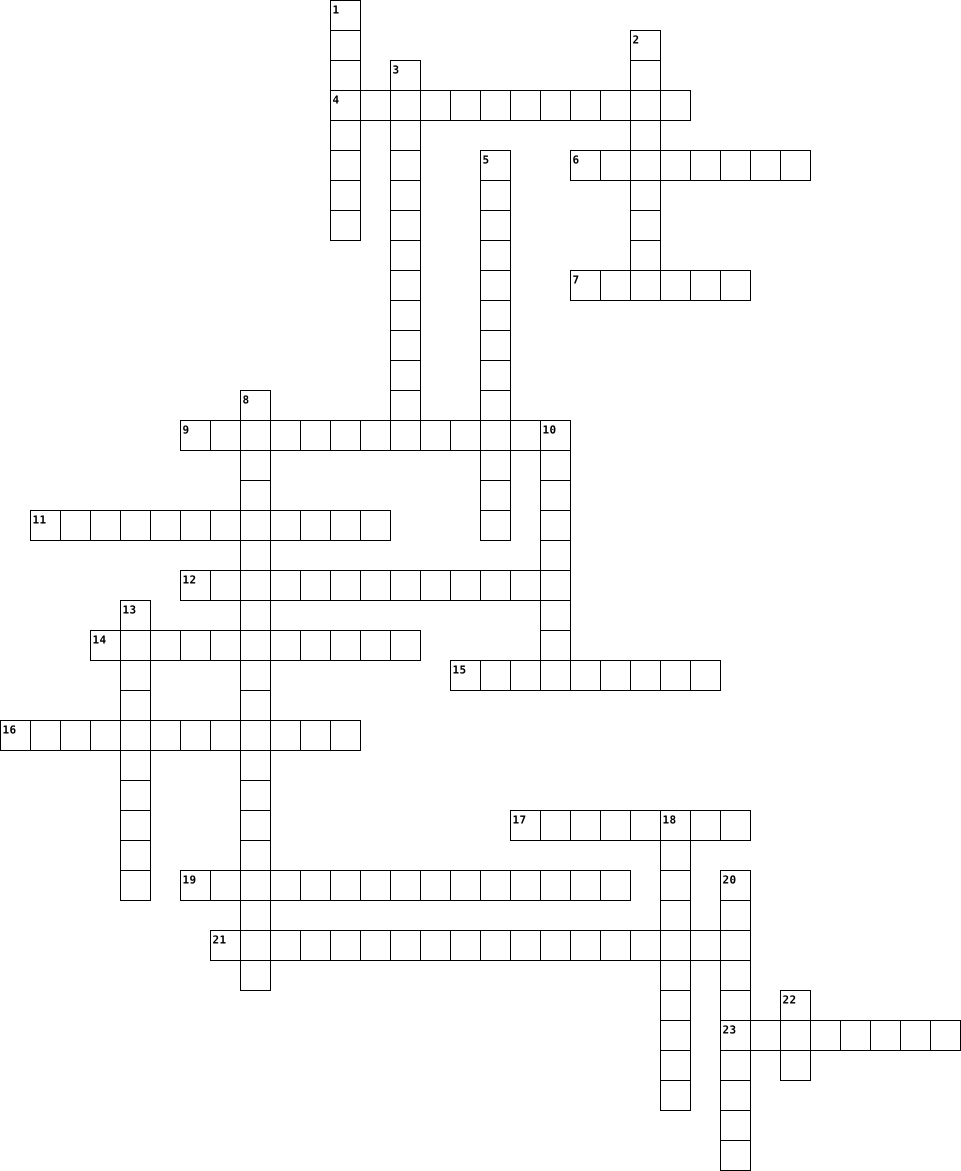
Across
- Ion/ When water behaves as an acid.
- rates/ The reaction that is dependent on the collisions among molecules.
- Reaction/ There is a net absorption of energy.
- Reaction/ One or more new compounds are formed as a result of the rearrangement of atoms.
- Energy/ A bond of energy.
Down
- Reaction/ Net release of energy.
- When reaction and it's reverse act at is the same rate.
- / Is a substance that lowers the activation energy of a chemical reaction.
- Chatelier's Principle/ If changed, the equilibrium shifts to oppose change, until new equilibrium is reached.
- of mass conservation/ No atoms are gained or lost during any reaction.
10 Clues: Energy/ A bond of energy. • Reaction/ Net release of energy. • Ion/ When water behaves as an acid. • Reaction/ There is a net absorption of energy. • When reaction and it's reverse act at is the same rate. • of mass conservation/ No atoms are gained or lost during any reaction. • rates/ The reaction that is dependent on the collisions among molecules. • ...
Generation Genius Chemical Reactions Crossword 2022-08-26

Across
- - Substances that are combined to form products in a chemical reaction.
- scientist - A scientist who uses chemical reactions to make new materials.
- - The result of substances being combined in a chemical reaction.
- engineer - A scientist who uses chemical reactions to solve problems.
- - Characteristics of matter that can be used to identify substances.
- - A chemical that makes a chemical reaction happen faster.
Down
- - The smallest particle of matter made up of protons, neutrons, and electrons.
- - More than one atom combined to form a substance (e.g., oxygen – O2).
- change - A change in state of matter where no new substance is formed.
- change - Chemicals combining to cause new substances to be formed.
10 Clues: - A chemical that makes a chemical reaction happen faster. • - The result of substances being combined in a chemical reaction. • change - Chemicals combining to cause new substances to be formed. • - Characteristics of matter that can be used to identify substances. • engineer - A scientist who uses chemical reactions to solve problems. • ...
Chemical Reactions 2024-08-04

Across
- Product formed from the reaction between hydrochloric acid and sodium hydroxide.
- Solid formed in some chemical reactions.
- Base that reacts with hydrochloric acid.
- Reactant in the reaction forming barium sulphate.
Down
- Product formed from the reaction between quicklime and water.
- White precipitate formed in a reaction with barium chloride.
- Type of chemical equation where atoms are equal on both sides.
- Substance involved in a reaction with water characterized by a temperature change.
- Reactant that reacts with sodium hydroxide to form sodium chloride and water.
- Characteristic of the reaction between quicklime and water.
10 Clues: Solid formed in some chemical reactions. • Base that reacts with hydrochloric acid. • Reactant in the reaction forming barium sulphate. • Characteristic of the reaction between quicklime and water. • White precipitate formed in a reaction with barium chloride. • Product formed from the reaction between quicklime and water. • ...
Pick 1 crossword puzzle 2022-09-18

Across
- a carboxylic acid consisting of a hydrocarbon chain and a terminal carboxyl group
- proteins that act as biological catalysts by accelerating chemical reactions
- a substance that increases the rate of a chemical reaction
- soluble carbohydrates, many of which are used in food.
- a molecule that binds to an enzyme and blocks its activity
- organic compounds that are fatty acids or their derivatives and are insoluble in water but soluble in organic solvents
- a region on an enzyme that binds to a protein or other substance during a reaction
- chemical element with the symbol H and atomic number 1
- chemical element with the symbol O and atomic number 8
Down
- organic compounds that contain both amino and carboxylic acid
- nonmetallic element of Group 15 [Va] of the periodic table
- the main sugar found in your blood
- energy which the reacting species must possess in order to undergo a specified reaction.
- a naturally occurring, extremely complex substance that consists of amino acid
- a class of natural or synthetic substances composed of very large molecules, called macromolecules
15 Clues: the main sugar found in your blood • soluble carbohydrates, many of which are used in food. • chemical element with the symbol H and atomic number 1 • chemical element with the symbol O and atomic number 8 • nonmetallic element of Group 15 [Va] of the periodic table • a substance that increases the rate of a chemical reaction • ...
Intro to Chemistry Ch5 - Chemical Reactions 2025-05-30

Across
- - the amount of mass in a given volume
- – when one element replaces another element in a compound or if 2 elements in different compounds trade places
- - a solid that forms from liquids during a chemical reaction
- - more energy is released as the product forms than is required to break the bonds of the reactants.
- – when 2 or more elements or compounds combine to make a more complex substance. Decomposition – when compounds break down into simpler substances.
- - biological catalysts that help reactions necessary for life occur at body temperature
- - the study of the properties of matter and how matter changes
- - a way to show a chemical reaction, using symbols instead of words
Down
- - where matter can enter from or escape to the surroundings
- - the new substances that form
- - more energy is required to break the bonds of the reactants than is released by the formation of the products.
- - a substance made of two or more elements chemically combined in a specific ratio
- - the substances that undergo the chemical change
- - where matter does not enter or leave
- - during a chemical reaction, matter is not created or destroyed
15 Clues: - the new substances that form • - the amount of mass in a given volume • - where matter does not enter or leave • - the substances that undergo the chemical change • - where matter can enter from or escape to the surroundings • - a solid that forms from liquids during a chemical reaction • - the study of the properties of matter and how matter changes • ...
Reactions 2025-03-02

Across
- The deterioration of a metal due to a chemical reaction.
- The process of a substance gaining oxygen
- a chemical change that occurs when one or more substances are converted into new substances
- A reaction where a more reactive element displaces a less reactive element.
Down
- A reaction involving the transfer of electrons'
- A reaction where ions are exchanged between two reactants, forming a precipitate.
- A reaction where two or more reactants combine to form a single product.
- A reaction where a single reactant breaks down into simpler products
- The spoilage of food due to oxidation
- A substance that gets reduced gains this
10 Clues: The spoilage of food due to oxidation • A substance that gets reduced gains this • The process of a substance gaining oxygen • A reaction involving the transfer of electrons' • The deterioration of a metal due to a chemical reaction. • A reaction where a single reactant breaks down into simpler products • ...
2.5 - Enzymes 2016-11-06

Across
- A disaccharide (C12H22O11) found in milk that may be hydrolysed to yield glucose and galactose.
- Decomposition of a chemical compound by reaction with water.
- Three words. What is formed when substrate and enzyme bind together
- When an enzyme joins two monomers together to build up a polymer it is this kind of a reaction
Down
- all of an organism's chemical processes.
- Two words. The specific portion of an enzyme that attaches to the substrate.
- Two words. A measure of the ability of an enzyme to catalyse a specific reaction.
- The increased rate of reaction by an enzyme or other catalyst
- A class of proteins that catalyses chemical reactions.
- The substance on which an enzyme works.
- a structural change in a protein that alters its three-dimensional shape and causes the loss of its biological properties.
- The fact that each enzyme only binds to one substrate molecule is an example of enzyme.......
- An enzyme found in the blood, and in most living cells, that catalyses the decomposition of hydrogen peroxide into water and oxygen.
- By binding to the substrate and then changing shape, the enzyme is able to ............... the bonds in the substrate(s) causing a reaction to happen at a lower temperature
- The enzyme responsible for catalysing the split of lactose into galactose and glucose.
15 Clues: The substance on which an enzyme works. • all of an organism's chemical processes. • A class of proteins that catalyses chemical reactions. • Decomposition of a chemical compound by reaction with water. • The increased rate of reaction by an enzyme or other catalyst • Three words. What is formed when substrate and enzyme bind together • ...
Types of Chemical reactions 2024-05-19

Across
- term used to define a system that involves water
- One element takes place with another element in the compound
- Oxygen combines with a compound to form carbon dioxide and water. These reactions are exothermic, meaning they give off heat.
- thing that is composed of two or more separate elements; a mixture.
- oxidation-reduction reactions where reactants undergo changes in oxidation states
- Chemical equations make use of symbols to represent factors such as the direction of the reaction and the physical states of the reacting entities.
Down
- The opposite of a combination reaction – a complex molecule breaks down to make simpler ones.
- Two solutions of soluble salts are mixed resulting in an insoluble solid
- a type of reaction where part of of one reactant is replaced by part of another reactant
- Two or more compounds combine to form one compound
- typically followed by physical signs that are readily detected
- substance that can be dissolved in water
- an equation for a chemical reaction in which the number of atoms for each element in the reaction and the total charge are the same for both the reactants and the products
- refers to a simple substance that cannot be broken down into smaller parts or changed into another substance
- An acid and a base react with each other
15 Clues: substance that can be dissolved in water • An acid and a base react with each other • term used to define a system that involves water • Two or more compounds combine to form one compound • One element takes place with another element in the compound • typically followed by physical signs that are readily detected • ...
Unit 1 Vocabulary Crossword Puzzle 2022-12-07

Across
- site A site where molecules switch the enzymes
- A naturally occurring compound made up of C H O
- A nonpolar hydrophobic molecule made up of C H O
- Molecules sit in the active side an prohibit the entry to substrate
- A substance that increases the rate of a chemical reaction without itself undergoing any permanent chemical change
- The building blocks of polypeptide and proteins
- Atoms in the same element that differ in number of neutrons
- The minimum amount of energy that is required to activate atoms or molecules to a condition in which they can undergo chemical transformation or physical transport
- A pure substance that consists of 1 type of atom
- A molecule needed for the human body to function properly, made up of Amino acids
- site Pockets in the folds on enzyme surface where the substrate goes
- A material between 2 elements that are physically mixed together but not chemically bonded
- Attraction of molecules of different substances
- Mixture in where all components are evenly distributed
- Tendency of water to rise a little due to Cohesion and surface tension
- A substance made of 2 or more different elements in known proportions
- A chemical reaction that dispurses heat to surroundings
- A substance on which an enzyme acts
- The chemical changes that take place in a cell or organism
- Viruses that infect and replicate only in bacterial cells
- Tending to repel water molecules
- An enzyme binds to allosteric site and change shape of the active site to where the substrate will not fit
- A chemical reaction accompanied by the absorption of heat
Down
- The substance dissolving the solute
- Any chemical reaction in which a molecule of water breaks one or more chemical bonds
- A type of dipole-dipole attraction between molecules
- A substance produced by a living organism which acts as a catalyst to bring about a specific biochemical reaction.
- A substance consisting of a large number of similar units bonded together
- Tending to bond with water molecules
- A material that gets dissolved in a solvent
- The source of energy for use and storage at a molecular level
- All chemical or enzymatic reactions involved in the breakdown or non/organic materials
- The creation of larger molecules from smaller monomers where a water molecule is released
- A bond that takes an electron
- The process where genetic material is directly taken up and incorporated by a cell through its cell membrane
- A bond that shares an electron
- Attraction of molecules of the same substance
- The basic unit of matter
- An organic molecule consisting nitrogenous bases Adenine, Guarini, Thymine, Cytosine, and Uracil
- A chain of nucleotides that store genetic information
- A mixture of liquid and non dissolved material
- Two nucleotides that pair together to form the structure of DNA.
- The process of the body utilizing energy released by catabolism to synthesize complex molecules
- A molecule that can be bonded to other identical molecules to form a polymer
44 Clues: The basic unit of matter • A bond that takes an electron • A bond that shares an electron • Tending to repel water molecules • The substance dissolving the solute • A substance on which an enzyme acts • Tending to bond with water molecules • A material that gets dissolved in a solvent • Attraction of molecules of the same substance • ...
Chemistry Crossword 2016-04-04

Across
- A mutual group of atoms that are held together by covalent bonds.
- 1
- A single Compound undergoes a reaction that produces 2 or more simpler substances.
- 6
- Uneven distribution of charge.
- Moles x's Molar mass of element
- volume/amount of substance
- HNO3
- The amount of a substance that contains as many particles as there are atoms.
- Ability of a substance to be Hammered or beaten.
- Assigned to the atoms composing the compound or ion.
- Mass relationships between reactants and products in a chemical reaction.
- A small whole number that appears in front of a formula in a chemical equation.
- Symbols for the elements combined in a compound with subscripts showing the smallest whole number mole-ratio
- Measured amount of a product obtained from a reaction.
- 3
- Smallest Particle of an element.
- Compounds composed of 2 different elements.
- HCLO3
- A solid that is produced as a result of a chemical reaction in solution and that seperates from the solution.
- Mutual electrical attraction between the nuclei and valance electrons of different atoms that bond atoms together.
- Polyatomic ions that contain oxygen.
- The ratio of the actual yield to the theoretical yield, Multiplied by 100.
- A Specific portionof matter in a given region of space that has been selected for study during an experiment and observation.
Down
- The decomposition of a substance by an electric current.
- Bonding between large numbers of cations and anions.
- Elements of Group 17 of the periodic table.
- Mass relationships of elements in compounds.
- Represents, with symbols and formulas, the indentities and relative amounts of reactants and products in a chemical Reaction.
- 4
- Something that has magnitude, size, or amount.
- Number of protons in the nucleus of each atom of that element.
- HCLO4
- HCl
- Sum of average atomic masses of all the atoms represented in its formula.
- Conversion factor that relates the amounts in moles of any 2 substances involved in a chemical reaction.
- Substances that combine with oxygen, releasing a large amount of energy in the form of light and heat.
- Sharing of electron pairs between 2 atoms.
- Combination of SI base units.
- Logical Approach to solving problems by observing and collecting data.
- Moles x's 6.02x10^23
- Testable statement.
- Elements of group 1 of the periodic table.
- Substance that is not used up completely in a reaction.
- H2SO4
- Arrangement of elements in order of their atomic numbers so that elements with similar proporties fall in the same cloumn, or group.
- 14 elements with atomic numbers 58-71.
- Naming system of binary ionic compounds involving the combining of the names of the compounds positive and negative ions.
- Explanation of how phenomena occur and how data or events are related.
- Physical and Chemical Proporties of their elements are periodic functions of their atomic number.
- 2
- 14 Elements with atomic numbers from 90-103.
- Mass/Volume=
- Atoms of the same element that have different masses.
54 Clues: 1 • 4 • 6 • 3 • 2 • HCl • HNO3 • HCLO4 • H2SO4 • HCLO3 • Mass/Volume= • Testable statement. • Moles x's 6.02x10^23 • volume/amount of substance • Combination of SI base units. • Uneven distribution of charge. • Moles x's Molar mass of element • Smallest Particle of an element. • Polyatomic ions that contain oxygen. • 14 elements with atomic numbers 58-71. • Sharing of electron pairs between 2 atoms. • ...
Basic Chemistry 2024-09-10

Across
- Substances composed of two or more physically mixed components(29)
- A reactant that gains electrons is said to be?(36)
- H20(34)
- Hold electrons or electron pairs (26)
- Slight negative and Slightly positive(34)
- The atom that gains electron(32)
- Not transparent (24)
- A bond between atoms formed by complete transfer(32)
- When this increases kinetic energy is increased(37)
- Relating to break down(36)
- Neutrally charged(27)
- Energy used to move matter(24)
- Equal to atomic weight(29)
- This reaction is energy absorbing(37)
- Comprises of solvent and solutes(29)
- Positively charged(27)
- This is stored energy(24)
- Energy in waves(24)
- CH4(33)
- transparent(24)
- Elements with the same amount of protons but different amount of neutrons(26)
- Results from a Reaction(35)
- Also called emulsions, are heterogeneous mixtures(30)
- Sand and water is an example of this(30)
Down
- A reactant that looses electrons is said to be?(36)
- This reaction releases energy(37)
- putting matter into motion(24)
- Negatively charged (27)
- The bond formed when electrons are shared between atoms(32)
- Atomic symbol K(26)
- Substances that increases the rate of a reaction(38)
- Two or more atoms of the same element chemically bonded(28)
- Equal sharing of electrons(34)
- Substance that undergoes change(35)
- 65.0 body mass(26)
- Isotopes that undergo radioactivity(28)
- This reaction occurs when a molecule is broken down into smaller molecules(36)
- The smallest particle of an element (25)
- The atom that looses electron(32)
- this energy is stored in bonds of chemical substance(24)
- Occurs from the movement of charged particles(24)
- this is energy in action(24)
- Invisible gas(24)
- Atomic symbol Na(26)
- Occupies space and has mass (24)
- This reaction involves both synthesis and decomposition reaction(36)
- Formed from the binding of different kind of atoms(26)
- This reaction involves the combination of an atom or molecule to for a complex molecule(36)
- C6H12O6(36)
- A unique substance that cannot be broken down by normal chemical method(25)
- shells Also referred to as energy level(31)
51 Clues: H20(34) • CH4(33) • C6H12O6(36) • transparent(24) • Invisible gas(24) • 65.0 body mass(26) • Atomic symbol K(26) • Energy in waves(24) • Not transparent (24) • Atomic symbol Na(26) • Neutrally charged(27) • Positively charged(27) • Negatively charged (27) • This is stored energy(24) • Relating to break down(36) • Equal to atomic weight(29) • Results from a Reaction(35) • ...
Types of Chemical reactions 2024-05-19

Across
- term used to define a system that involves water
- One element takes place with another element in the compound
- Oxygen combines with a compound to form carbon dioxide and water. These reactions are exothermic, meaning they give off heat.
- thing that is composed of two or more separate elements; a mixture.
- oxidation-reduction reactions where reactants undergo changes in oxidation states
- Chemical equations make use of symbols to represent factors such as the direction of the reaction and the physical states of the reacting entities.
Down
- The opposite of a combination reaction – a complex molecule breaks down to make simpler ones.
- Two solutions of soluble salts are mixed resulting in an insoluble solid
- a type of reaction where part of of one reactant is replaced by part of another reactant
- Two or more compounds combine to form one compound
- typically followed by physical signs that are readily detected
- substance that can be dissolved in water
- an equation for a chemical reaction in which the number of atoms for each element in the reaction and the total charge are the same for both the reactants and the products
- refers to a simple substance that cannot be broken down into smaller parts or changed into another substance
- An acid and a base react with each other
15 Clues: substance that can be dissolved in water • An acid and a base react with each other • term used to define a system that involves water • Two or more compounds combine to form one compound • One element takes place with another element in the compound • typically followed by physical signs that are readily detected • ...
Chapter 19 2015-05-19

Across
- a chemical reaction in which two or more molecules combine to make water or another molecule
- an organic compound formed only by carbon and hydrogen linked by single bonds
- reaction in which one or more atoms replace another atom or group in a molecule
- portion of a molecule that is active in a chemical reaction. It also determines the properties of many
- benzene is considered one to be in this class of organic compounds
- one of two or more compounds that have the same chemical composition but different structures
Down
- a hydrocarbon that has available valence bonds, usually from double or triple bonds with carbon
- a large molecule that is formed by more than five monomers
- a hydrocarbon characterized by a straight or branched carbon chain that contains only single bonds
- reaction in which a simple molecule, water or ammonia, is removed and a new compound is made
- reaction in which an atom or molecule is added to an unsaturated molecule
- a hydrocarbon that contains one or more triple bonds
- a hydrocarbon that contains one or more double bonds
- an organic compound composed only of carbon and hydrogen
14 Clues: a hydrocarbon that contains one or more triple bonds • a hydrocarbon that contains one or more double bonds • an organic compound composed only of carbon and hydrogen • a large molecule that is formed by more than five monomers • benzene is considered one to be in this class of organic compounds • ...
Matter and energy review 2017-09-25

Across
- any characteristic of matter that does not depend on the amount of substance present
- a combination of 2 or more substances that are not chemically combined
- study of transfers of energy as heat
- study of matter
- data that is characteristics
- matter stays the same but the appearance change
- property that characteristics that can be determined only by changing a substance type
- ammount of energy required to raise the temperature
- a sample of matter either a single element or a single compound that has definite chemical and physical properties
- Something that has a uniform structure throughout
- energy transferd between samples of matter
Down
- chemical reaction that releases energy by light or heat
- change of identity of matter
- Bubbles, absorbed/released energy, color change, odor
- a substance made up of 2 or more different elements joined by chemical bonds that form a new substance
- reaction which energy is absorbed
- Property that can be observed or measured without changing the identity of matter
- anything that has mass and takes up space
- any change characteristic of matter that depends on the amount of matter being measured
- compose of dissimilar components
- data that is measured
- energy absorbed/released as heat in a chemical or physical change
- a substance that cannot be separated or broken down into simpler substances by chemical means
23 Clues: study of matter • data that is measured • change of identity of matter • data that is characteristics • compose of dissimilar components • reaction which energy is absorbed • study of transfers of energy as heat • anything that has mass and takes up space • energy transferd between samples of matter • matter stays the same but the appearance change • ...
Chapter 5 - Chemistry 2024-11-06

Across
- substance consisting of one type of atom
- fatty acids, oils, waxes
- a force that holds atoms in a molecule together
- amount of enery to start a chemical reaction
- force of attraction between hydrogen atoms
- biological catalyst such as a protein
- molecules that help increase the rate of a chemical reaction
- chemical molecule where the charge is distributed unevenly, has an electrical charge
- consists of a sugar, phophate and a nitrogen base
- type of chemical bond where electrons are transferred between atoms
- complex carb that consists of highly branched chains of glucose
- organic compounds where sugar is an example
- uniform mixture of a solute completely dissolved in a solvent
- a molecule that is made up of many monomers
Down
- a molecule that is a subunit of a larger molecule
- simple sugar that works as a monomer
- substance that accepts hydrogen ions
- nucleic acid that carries heredity information
- an atom that has a different number of protons and electrons
- chemical molecule where the charge is distributed evenly, no charge
- small organic compound that is the building blocks of proteins
- storage of sugar for plants
- substance that releases hydrogen ions
- type of chemical bond where electrons are shared
- an element that has the same number of protons but a different number of neutrons
- complex carbohydrate that is sugar storage
26 Clues: fatty acids, oils, waxes • storage of sugar for plants • simple sugar that works as a monomer • substance that accepts hydrogen ions • biological catalyst such as a protein • substance that releases hydrogen ions • substance consisting of one type of atom • force of attraction between hydrogen atoms • complex carbohydrate that is sugar storage • ...
vocab words P2 science 2026-02-23

Across
- form new substances (products) with different properties
- breaking down food into nutrients for energy, growth
- absorbs thermal energy (heat)
- intangible service/digital item
- location or gravity, unlike weight
Down
- reaction illustrating the transformation while obeying the conservation
- It sustains the biosphere, providing oxygen for respiration and forming the base of the food
- release of heat. reaction
- change during a reaction
- respiration transfer chemical energy from nutrients to power cellular activities
10 Clues: change during a reaction • release of heat. reaction • absorbs thermal energy (heat) • intangible service/digital item • location or gravity, unlike weight • breaking down food into nutrients for energy, growth • form new substances (products) with different properties • reaction illustrating the transformation while obeying the conservation • ...
Woodson's matter crossword 2024-05-15

Across
- the amount of matter within a object
- a form of energy
- the branch of science that deals with the properties
- the amount of space the object takes up
- to give off heat
- the ability to do work
- a characteristic of a substance that can be observed or measured without changing the identity of the substance
- a substance made from two or more different elements
- a attraction between atoms
Down
- two or more atoms
- the basic building block of matter
- something that has weight
- a combination of two or more substances
- the starting materials in a reaction that undergo a chemical change to form a product.
- the measure of hotness or coldness expressed
- action or property of molecules adhering to one another due to mutual attraction
- a substance that is present at the end of a chemical reaction
- a change when two or more things combine
18 Clues: a form of energy • to give off heat • two or more atoms • the ability to do work • something that has weight • a attraction between atoms • the basic building block of matter • the amount of matter within a object • a combination of two or more substances • the amount of space the object takes up • a change when two or more things combine • ...
Physical and Chemical Reactions 2022-01-05

Across
- Type of process where the initial product is not changed or destroyed
- Heat energy enters the chemical reaction
- The color of an object is a _____ property.
- A chemical ________ is when a new product is formed at the end.
- Flammability is a kind of ________ property.
Down
- Another word for characteristic or attribute of a substance
- Heat energy exits the chemical reaction
- Forms when mixing vinegar and baking soda, creating a fuzz.
- Is a solid that forms during some chemical reactions
- You use one or more of your ________ to describe the properties of a substance.
10 Clues: Heat energy exits the chemical reaction • Heat energy enters the chemical reaction • The color of an object is a _____ property. • Flammability is a kind of ________ property. • Is a solid that forms during some chemical reactions • Another word for characteristic or attribute of a substance • Forms when mixing vinegar and baking soda, creating a fuzz. • ...
Challenge It! Chemical Equations Crosswords 2022-10-06

Across
- Substances that are produced after a chemical equation.
- An equation that shows that no mass was created or destroyed from a reaction.
- States that mass cannot be created or destroyed, only rearranged.
- Both sides of a balanced equation must have the same number of ___.
Down
- An equation that has a different number of atoms on each side.
- A chemical ___ shows how a reaction turns reactants into new products.
- Is located at the center of a chemical equation and indicates that a chemical reaction is occurring.
- Substances that exist before a chemical equation.
- The substance that is being studied.
- Anything that has mass and takes up space.
10 Clues: The substance that is being studied. • Anything that has mass and takes up space. • Substances that exist before a chemical equation. • Substances that are produced after a chemical equation. • An equation that has a different number of atoms on each side. • States that mass cannot be created or destroyed, only rearranged. • ...
7.2 Chemical Reaction & Energy 2023-10-25

Across
- What our design cannot or should not do
- A systematic series of investigations planned to answer specific questions
- Energy flows from the surroundings into the rxn system
- A physical model built to try out and test
- Entities like people, groups or things that are impacted by design decisions
- The possible changes that happen (some unplanned) as a result of making a planned change
Down
- What our design needs to meet to be considered successful
- A characteristic of a substance that doesn’t change
- Energy flows from the reaction system to the surroundings
- The work we do to make our solution the best or ideal
- When one decision directly affects another decision, and you can’t do both things
11 Clues: What our design cannot or should not do • A physical model built to try out and test • A characteristic of a substance that doesn’t change • The work we do to make our solution the best or ideal • Energy flows from the surroundings into the rxn system • What our design needs to meet to be considered successful • ...
Chem cross word puzzle Elise Rothke 2022-03-08

Across
- chemical unit, be it atoms, molecules, ions.
- a pure single form of matter
- small portion of matter.
- Mass of one mole of a substance.
- any substance that can not be decomposed into a simpler substance.
- that results from the sharing of an electron pair between two atoms.
Down
- the reactant in a chemical reaction with a greater amount
- chemical reaction using symbols of the elements to indicate the amount of substance, usually in moles, of each reactant and product.
- proportions and of the conservation of mass and energy to chemical activity
- a substance that is present at the start of a chemical reaction
10 Clues: small portion of matter. • a pure single form of matter • Mass of one mole of a substance. • chemical unit, be it atoms, molecules, ions. • the reactant in a chemical reaction with a greater amount • a substance that is present at the start of a chemical reaction • any substance that can not be decomposed into a simpler substance. • ...
Biology Basics 2022-04-16

Across
- What is a model that assumes an enzyme and substrate have a rigid interaction with each other, where a substrate fits in a key-like fashion to its lock, the enzyme, turning on the reaction?
- What is a substance consisting of atoms which all have the same number of protons?
- What is the sticking together of alike molecules, such as water molecules being attracted to another water molecule?
- What are proteins that act as catalysts within living cells?
- What is a substance capable of initiating or speeding up a chemical reaction?
- What are acids consisting of either one or two long chains of repeating units called nucleotides, which consist of a nitrogen base attached to a sugar phosphate?
- What is a molecule composed of polymers of amino acids joined together by peptide bonds?
- What is the smallest particle in a chemical element or compound that has the chemical properties of that element or compound?
- What is a chemical bond formed by the sharing of one or more electrons, especially pairs of electrons, between atoms?
- What is a large complex molecule, such as nucleic acids, proteins, carbohydrates, and lipids, with relatively large molecular weight?
- What is a measure of the hydrogen ion concentration of a solution?
- What is a weak chemical bond between an electronegative atom, such as fluorine, oxygen, or nitrogen, and a hydrogen atom bound to another electronegative atom?
- What is the force of attraction between unlike molecules, or the attraction between the surfaces of contacting bodies?
- What is a part of DNA that controls physical characteristics and growth
Down
- What are molecular compounds made from just three elements: carbon, hydrogen and oxygen?
- What is one of two or more versions of a gene?
- What are large molecules composed of many similar smaller molecules linked together?
- What is a chemical bond formed between two ions with opposite charges?
- What is the basic unit of a chemical element?
- What is a chemical reaction in which two molecules combine to form a larger molecule with the elimination of a small molecule?
- What is a series of sweet-tasting, crystalline carbohydrates, especially a simple sugar or a chain of two or more simple sugars?
- What is a chemical reaction that builds up molecules by losing water molecules?
- What are the building blocks of all biological proteins?
- What is an organic molecule of biological origin that is insoluble in water and soluble in non-polar solvents?
- What is a molecule that can combine with others of the same kind to form a polymer?
25 Clues: What is the basic unit of a chemical element? • What is one of two or more versions of a gene? • What are the building blocks of all biological proteins? • What are proteins that act as catalysts within living cells? • What is a measure of the hydrogen ion concentration of a solution? • What is a chemical bond formed between two ions with opposite charges? • ...
Chapter 8 Chemistry Crossword 2021-02-16

Across
- reaction / A ______ _______ is also known as a composition reaction.
- / To balance numbers of atoms, add ______ where necessary.
- reaction / A _______ _________ is indicated by writing two arrows pointing in opposite directions.
- and formulas for the reactants and products.
- reaction / A ____________ _________ is the opposite of a synthesis reaction.
- / One of the compounds formed in a double-displacement reaction is usually a ____________.
- series / The order in which the elements are listed in an _________ _________ are usually determined by single-displacement reactions.
- reactions / In some _______-______ ________, one of the products is an insoluble gas that bubbles out of the mixture. Combustion reaction / A candle supplies heat to the hydrogen and oxygen in a balloon, triggering an explosive _______ ________.
Down
- reactions / Many _____-________ take place in an aqueous solution.
- / Oxides of the less-active metals, decompose into their elements when heated, which is called _____________.
- equation / Represents the facts and shows the correct
- equation / A _____ _________ has only qualitative (descriptive) meaning.
- equation / Chemical Reactions are described by ______.
13 Clues: and formulas for the reactants and products. • equation / Represents the facts and shows the correct • equation / Chemical Reactions are described by ______. • / To balance numbers of atoms, add ______ where necessary. • reactions / Many _____-________ take place in an aqueous solution. • ...
ACIDS AND BASES 2017-10-30

Across
- The reaction between an acid and a base
- A natural indicator (3,7)
- The pH of a neutral solution
- An acid that is put on chips
- A chemical with a pH higher than 7
- Another product of a neutralisation reaction
- A base that is soluble in water
- Something that has a pH of 7 is said to be...
- A common base "metal ______"
- A common alkali "metal ________ "
Down
- The pH of the strongest base
- An indicator used to test the strength of an acid or a base
- This gas is produced when acids react with metal carbonates (6,7)
- A product of a neutralisation reaction
- The colour universal indicator turns with a neutral solution
- A chemical with a pH lower than 7
- The colour a strong acid will turn universal indicator
- The scale used to measure the strength of an acid or base
18 Clues: A natural indicator (3,7) • The pH of the strongest base • The pH of a neutral solution • An acid that is put on chips • A common base "metal ______" • A base that is soluble in water • A chemical with a pH lower than 7 • A common alkali "metal ________ " • A chemical with a pH higher than 7 • A product of a neutralisation reaction • The reaction between an acid and a base • ...
Woodson's matter crossword 2024-05-15

Across
- the amount of matter within a object
- a form of energy
- the branch of science that deals with the properties
- the amount of space the object takes up
- to give off heat
- the ability to do work
- a characteristic of a substance that can be observed or measured without changing the identity of the substance
- a substance made from two or more different elements
- a attraction between atoms
Down
- two or more atoms
- the basic building block of matter
- something that has weight
- a combination of two or more substances
- the starting materials in a reaction that undergo a chemical change to form a product.
- the measure of hotness or coldness expressed
- action or property of molecules adhering to one another due to mutual attraction
- a substance that is present at the end of a chemical reaction
- a change when two or more things combine
18 Clues: a form of energy • to give off heat • two or more atoms • the ability to do work • something that has weight • a attraction between atoms • the basic building block of matter • the amount of matter within a object • a combination of two or more substances • the amount of space the object takes up • a change when two or more things combine • ...
Proteins 2025-06-09

Across
- Another name for an enzyme
- The best temperature or pH for enzyme activity
- Enzyme that breaks down starch into sugars
- The part of the enzyme that binds the substrate
- Model showing how enzymes and substrates fit together
- Reaction where smaller molecules are built into a larger one
- A protein that carries chemical messages around the body
- The molecule an enzyme acts upon
- The substance produced after an enzyme reaction
Down
- Enzymes only work with one type of substrate
- A protein that helps fight infection
- Reaction where a large molecule is broken into smaller ones
- Protein on a cell membrane that detects signals
- A factor that affects enzyme shape and function
- A protein that speeds up chemical reactions
- When enzymes lose their shape due to heat or pH
- Enzyme that works in the stomach to break down proteins
- A factor that affects enzyme activity
18 Clues: Another name for an enzyme • The molecule an enzyme acts upon • A protein that helps fight infection • A factor that affects enzyme activity • Enzyme that breaks down starch into sugars • A protein that speeds up chemical reactions • Enzymes only work with one type of substrate • The best temperature or pH for enzyme activity • ...
Just Say No! 2014-06-26

Across
- particle with no charge, found in the nucleus of an atom
- the SI unit of force
- elements that are poor conductors of heat and electricity, are brittle, have a low melting point, and usually gain electrons in a chemical reaction
- Acid found in DNA and RNA
- chemical reaction between an acid and a base to produce a salt and water
- ten to the negative ninth power
- the central part of an atom that contains the protons and the neutrons
- opposite of "like dissolves like", has symmetrical geometry
- ionic equation no spectator ions allowed!
- a hydrocarbon that is an excellent fuel and has the general formula Cn H2n+2
- making full valence shells (2)
- a large nucleus is split into two smaller nuclei(2)
- a saturated nine carbon compound
Down
- process by which atoms lose electrons
- also known as scientific law, expresses generally observed behavior(2)
- group of elements with a full valence shell of electrons(2)
- the physical state of elements or compounds that are taking part in a chemical reaction(3)
- when solute particles move from a concentrated solution to a dilute one
- element with 10 protons
- (-COOH) (2)
- A chemical element that makes up about four-fifths of the atmosphere of the Earth
- where electrons are to be found
- atomic number 8
- 1865, the periodic pattern of the law of octaves
- form the basic structural unit of nucleic acids such as DNA.
25 Clues: (-COOH) (2) • atomic number 8 • the SI unit of force • element with 10 protons • Acid found in DNA and RNA • making full valence shells (2) • ten to the negative ninth power • where electrons are to be found • a saturated nine carbon compound • process by which atoms lose electrons • ionic equation no spectator ions allowed! • 1865, the periodic pattern of the law of octaves • ...
Macromolecules 2025-09-04

Across
- made of a glycerol "head" and 2 fatty acid chains (these make up the cell membrane)
- Of all the CHOMP elements, this one is unique to nucleic acids
- this element is the backbone of all organic molecules
- created in the nucleus of cells and contains genetic information
- type of fatty acid typically found in animal fats and contains a single bond
- type of protein that speeds up the reaction rate
- lipid monomer that is polar and hydrophilic
- type of chemical bond where electrons are either lost or gained
- macromolecule that can be used as a long-term energy store
- A chemical reaction that bonds monomers into polymers by removing water.
- lipid monomer that is non-polar and hydrophobic
Down
- A chemical reaction that breaks down polymers into monomers by adding water.
- 2 monosaccharides combine to form a
- the monomer of nucleic acids
- type of bond that forms between polar molecules
- the 5 most common elements of macromolecules
- bond that forms between two amino acids
- polymer of proteins
- a class or carbon-containing molecules that are found in living things
- type of fatty acid typically found in plant fats and contains a double bond
- type of chemical bond where electrons are shared
- Deoxyribonucleic acid, the molecule that contains the genetic blueprint of organisms.
- monomer of carbohydrates
- subatomic particle that bonds with other atoms and has a negative charge
- macromolecule that can be used as a quick energy source
25 Clues: polymer of proteins • monomer of carbohydrates • the monomer of nucleic acids • 2 monosaccharides combine to form a • bond that forms between two amino acids • lipid monomer that is polar and hydrophilic • the 5 most common elements of macromolecules • type of bond that forms between polar molecules • lipid monomer that is non-polar and hydrophobic • ...
Kaylee, Dominic, Aharon 2014-09-11

Across
- Amount of space a substance takes up
- to a chemical change that is accompanied by a liberation of heat
- the heat in calories required to raise the temperature of one gram of a substance one degree Celsius
- Every living thing must have
- the measure of heat
- solid, liquid, gas, and plasma
- no actual shape usually wet
- the same
- stating that energy cannot be created or destroyed
- form of energy
- measuring by the quantity
- a substance made up of chemical elements
Down
- amount of something in description
- group of atoms bonded together
- everything that has mass that takes up space
- different
- one of the basic substances that are made of atoms
- formed by a chemical result
- to form (something) by combining separate things
- energy associated with motion
- substance that changes during a reaction
- the substance bubbles or makes a reaction with change
- a usually reversible change in the physical properties of a substance
- a portion of matter consisting of two or more components
- the thing that forms physical objects and occupies space
- a sample of matter with both definite and constant composition with distinct chemical properties.
- a substance with no fixed shape
- firm or hard
- the act of water turning into a gas being absorbed
- to a chemical change that is accompanied by an absorption of heat
- basic unit of a chemical element
31 Clues: the same • different • firm or hard • form of energy • the measure of heat • measuring by the quantity • formed by a chemical result • no actual shape usually wet • Every living thing must have • energy associated with motion • group of atoms bonded together • solid, liquid, gas, and plasma • a substance with no fixed shape • basic unit of a chemical element • ...
Chemistry 2016-08-12
Across
- that has definite shape and volume
- Reaction/a process in which one or more substance are changed into others
- of State/physical process where matter moves from one state to another
- study of composition, structure and properties of matter and the changes matter undergoes
- substance that has definite composition or is used or produced in a chemical process
- on the periodic table
- on the periodic table
- property/ a property that does not change when you take away some of the sample
- of elements with similar characteristics
- Change/changes affecting the form of a chemical substance but not its chemical composition
- that has mass and takes up space
- change during a reaction
- basic unit of a chemical element
Down
- measure of how much matter is in an object
- substance compositing of atoms which all have the same number of protons
- that has neither definite shape or definite volume (free electrical charges causes this to be electrically conductive)
- that has definite volume but takes the shape of its container
- are intermediate of nonmetal and metal
- Property/a property that changes when the size of the sample changes
- conductors of heat and electricity (malleable, ductile and shiny)
- substance formed when two or more chemical elements are chemically bonded together
- that has neither definite shape or definite volume
- metal/poor conductors of heat and electricity (not malleable or ductile)
23 Clues: on the periodic table • on the periodic table • change during a reaction • that has mass and takes up space • basic unit of a chemical element • that has definite shape and volume • are intermediate of nonmetal and metal • of elements with similar characteristics • measure of how much matter is in an object • that has neither definite shape or definite volume • ...
Science 2026-01-13

Across
- the heat change after a chemical reaction
- the type of change where energy/heat is absorbed more than released
- the change in how the outside looks after chemical change
- a form of energy that can be exerted from a chemical reaction
Down
- when a material forms a new substance
- the bubbles or fizzing during a chemical reaction
- the type of change where energy/heat is released more than absorbed
- the solid result of a chemical reaction
8 Clues: when a material forms a new substance • the solid result of a chemical reaction • the heat change after a chemical reaction • the bubbles or fizzing during a chemical reaction • the change in how the outside looks after chemical change • a form of energy that can be exerted from a chemical reaction • ...
Science vocab 2024-10-16

Across
- chemical reaction symbols.
- a substance or molecule that participates in a chemical reaction
- formed by a change in a solution
- without a change in chemical properties
- state of mass of new substances.
Down
- substances change to new substances
- two or more substances combined
- formed in chemical reaction
8 Clues: chemical reaction symbols. • formed in chemical reaction • two or more substances combined • formed by a change in a solution • state of mass of new substances. • substances change to new substances • without a change in chemical properties • a substance or molecule that participates in a chemical reaction
Biochemistry Vocabulary Review 2016-05-18

Across
- Biological macromolecules have a backbone composed of long chains of this elelment.
- When two similar molecules stick together, this is called _______.
- Located on the right side of a chemical equation.
- The "universal" solvent necessary for life.
- Located on the left side of a chemical equation.
- A neutral subatomic particle that is located in the nucleus.
- A negatively charged particle.
- This type of chemical reaction requires energy.
- A charged particle.
- A subatomic particle that orbits the nucleus and has a negative charge.
- A substance that results from the combination of two or more elements.
Down
- A column in the periodic table is referred to as a _______.
- Atoms are most stable when their _______ shells are complete.
- When two different molecules stick together, this is called _______.
- A row in the periodic table is called a _______.
- Water has high surface tension due to these types of binds.
- A group of two or more atoms that share electrons in a chemical bond.
- Atoms of the same element, but with different atomic masses.
- A subatomic particle located in the nucleus. It has a positive charge.
- This type of chemical reaction releases energy.
- The smallest unit of a chemical element.
- In _______ bonds, atoms of opposite charges are attracted to each other.
- In this type of bond, atoms may equally or unequally share electrons.
- A positively charged particle.
24 Clues: A charged particle. • A negatively charged particle. • A positively charged particle. • The smallest unit of a chemical element. • The "universal" solvent necessary for life. • This type of chemical reaction releases energy. • This type of chemical reaction requires energy. • A row in the periodic table is called a _______. • ...
Term One 2019-04-02

Across
- Used when writing chemical equations
- The name given to the plates that make up the crust
- A metal that bonds with carbon and oxygen. Also known as marble
- The symbol for lithium
- The variable that is measured when carrying out an experiment
- Protons and neutrons combined
- A type of plate interaction where one plate moves under another
- A type of compound that forms when a positive ion and a negative ion combine in a reaction
- Frozen carbon dioxide
- Part of an experiment where you analyse what worked and what could be improved on
- The center of the Earth
- Types of circular currents that occur when hot molten rises, cools, falls causing the crust to move
- Evidence of plant and animal matter preserved in rocks
Down
- Colour of light given off when magnesium reacts with oxygen
- A feature that might appear near plate boundaries
- The type of table used to show all the elements that exist
- A process where rocks are broken down by physical or chemical means
- Evidence of a gas produced during a chemical reaction
- The number of protons in an atom
- A positive subatomic particle found inside the nucleus of atoms
- Another word for a chemical that is added in a reaction
- Negative subatomic particles that orbit the nucleus of atoms
- An atom that has lost or gained electrons
- A neutral subatomic particle found inside the nucleus of atoms
- One example of a state of matter
25 Clues: Frozen carbon dioxide • The symbol for lithium • The center of the Earth • Protons and neutrons combined • The number of protons in an atom • One example of a state of matter • Used when writing chemical equations • An atom that has lost or gained electrons • A feature that might appear near plate boundaries • The name given to the plates that make up the crust • ...
Unit B - Chemistry Crosswords - Meg & Ella 9D 2018-11-12

Across
- new substance produced in a chemical reaction between reactants
- Are results from a chemical reaction
- formed when at least one metal and nonmetal combines
- anything on the periodic table and made up of only one type of atom
- when two nonmetals combine
- absorbs heat
- metals most reactive metals especially in air and water and moving down the column the element get more reactive
- the most stable and reactive and can make new substances sometimes
- substance that's at the start of the reaction
- uses words to define a compound
- is the average mass of an element in atomic mass units
- when oxygen reacts with a substance to form a new substance and gives off energy
- an atom or group of atoms that has become electrically charged
- 7 Rows go to metals to non-metals and the atomic number increase by 1
- most reactive non-metals and can be used to form new and helpful substances
Down
- uses symbols and numbers to represent a compound
- represents the number of atoms
- two or more substances combine to form new substances
- tells you the number of protons and electrons
- 18 colums and is similar in chemical properties
- releases heat
- made up of one type of matter and has unique set of characteristic
- anything that has mass and occupies space
- can be in between metals and non-metals
- slow chemical change, when oxygen in the air reacts with metal. The metal is decomposed
25 Clues: absorbs heat • releases heat • when two nonmetals combine • represents the number of atoms • uses words to define a compound • Are results from a chemical reaction • can be in between metals and non-metals • anything that has mass and occupies space • tells you the number of protons and electrons • substance that's at the start of the reaction • ...
Using Qualitative Analysis to Sort 11 Substances 2025-02-04

Across
- An indicator that causes a basic substance or solution to turn pink.
- The solution component present in the lower amount.
- A scale used to specify the acidity or basicity of a solution.
- Incapable of being dissolved in a liquid.
- A homogeneous mixture of two or more substances where one substance is dissolved in another.
- A solution containing iodine, alcohol and water that is used as a disinfectant and for chemical testing.
- When talking about or describing chemical reactions, this refers to the formation of gas bubbles during the reaction.
- ___ solutions have a pH less than 7.
- A substance that changes color based on the pH level of a solution.
- A ___ is a process in which substances interact to form new substances; observable through changes like color, temperature, or gas formation.
- Capable of being dissolved in a liquid.
Down
- The processes of boiling and then condensing water to remove impurities and minerals.
- A solid that forms from a liquid solution during a chemical reaction.
- ___ analysis refers to determining what substances are present in a sample.
- The solution component present in the greatest amount.
- A laboratory tool used for transferring small amounts of liquid.
- ___ solutions have a pH greater than 7.
- Common gases evolved during chemical reaction include hydrogen, ___, and oxygen.
- ___ analysis refers to determining how much of a substance is present in a sample.
- Solutions that have a pH of 7.
20 Clues: Solutions that have a pH of 7. • ___ solutions have a pH less than 7. • ___ solutions have a pH greater than 7. • Capable of being dissolved in a liquid. • Incapable of being dissolved in a liquid. • The solution component present in the lower amount. • The solution component present in the greatest amount. • ...
Photosynthesis and Cellular respiration 2024-10-02

Across
- this process is a type of respiration without oxygen done by bacteria and yeast.
- the compound that is necessary for almost plenty of metabolic processes.
- the organelle in charge of the photosynthesis process
- Adenosine triphosphate
- the most abundant gas found in the atmosphere.
- The first part before a chemical reaction begins, the ingredients.
- the global effect in which the planet increases its temperature due the accumulation of combustion gases.
- green pigment that makes plants green
- The pore found in leaves that allows the gasseous exchange.
- the organelle with the function of creating chemical energy also called the power house of the cell
Down
- the metabolic process in which sunlight will be transformed into chemical energy.
- The metabolic process in which sugar and oxygen will be transformed into energy.
- the chemical name for the compound sugar.
- The compund obtained at the end of cellular respiration.
- the last part after the chemical reaction. what was obtained.
- the gas required for cellular respiration.
16 Clues: Adenosine triphosphate • green pigment that makes plants green • the chemical name for the compound sugar. • the gas required for cellular respiration. • the most abundant gas found in the atmosphere. • the organelle in charge of the photosynthesis process • The compund obtained at the end of cellular respiration. • ...
Biology - Chapter 6: Chemistry in Biology – Vocabulary 2016-09-06

Across
- measure of the concentration of hydrogen ions (H+) in a solution
- biological catalysts that speed up the rate of chemical reactions in biological processes
- positively charged particle
- pure substance that cannot be broken down into other substances by physical or chemical means
- large molecule formed by joining smaller organic molecules together
- compound made of small carbon compounds called amino acids
- attractive force between positive & negative regions that hold molecules together
- substance that releases hydroxide ions (OH-) when dissolved in water
- negatively charged particle
- electrical attraction between 2 oppositely charged atoms or groups of atoms
- building block of matter
- substance that is dissolved in the solvent
- a homogenous mixture formed when a substance is dissolved in another substance
- substance that releases hydrogen ions (H+) when dissolved in water
- center of the atom, where neutrons & protons are located
- substance that lowers the activation energy needed to start a chemical reaction
- chemical bond that forms when electrons are shared
- molecule made mostly of carbon and hydrogen that make up fats, oils, & waxes
- subunit of nucleic acid formed from a sugar, a phosphate, & a nitrogenous base
Down
- substance in which another substance is dissolved
- atom of the same element that have different numbers of neutrons
- particle that has no charge
- substances formed during a chemical reaction, shown on the right side of a chemical equation
- molecule made from repeating units of identical or nearly identical compounds called monomers
- compound composed of carbon, hydrogen, & oxygen in a ratio of 1 oxygen and 2 hydrogen atoms for each carbon atom
- weak interaction involving a hydrogen atom & a fluorine, oxygen, or nitrogen atom
- minimum amount of energy needed for reactants to form products in a chemical reaction
- molecules that have an unequal distribution of charges
- process by which atoms or groups of atoms in substances are reorganized into different substances
- reactant that binds to an enzyme
- starting substances in a chemical reaction, shown on the left side of a chemical equation
- small compounds that are made of carbon, nitrogen, oxygen, hydrogen, & sometimes sulfur
- pure substance formed when 2 or more different elements combine
- complex macromolecule that stores and transmits genetic information
- combination of 2 or more substances in which each substance retains its individual characteristics and properties
- compound in which the atoms are held together by covalent bonds
- specific location where a substrate binds on an enzyme
- mixture that can react with acids or bases to keep pH within a particular range
- atom that has lost or gained one or more electrons
39 Clues: building block of matter • particle that has no charge • positively charged particle • negatively charged particle • reactant that binds to an enzyme • substance that is dissolved in the solvent • substance in which another substance is dissolved • chemical bond that forms when electrons are shared • atom that has lost or gained one or more electrons • ...
Holt Chemistry Ch 1 Vocabulary 2020-10-18

Across
- property of matter that describes an ability to participate in chemical reactions
- something that has magnitude, size, or amount
- substance made up of atoms of two or more elements bonded chemically
- one or more substances produce one or more different substances
- measure of the gravitational force exerted on an object
- the identities of substances change
- substance formed in a chemical reaction
- neither fixed volume nor fixed shape
- anything that has mass and takes up space
- sample of matter that has definite chemical and physical properties
Down
- characteristic of a substance that does not involve a chemical change
- combination of two or more substances that are not chemically combined
- the identity of a substance doesn't change
- ratio that is derived from the equality of two different units and that can be used to convert from one unit to the other
- ratio of the mass of a substance to the volume of the substance
- fixed volume but not a fixed shape
- measure of the size of a body or region in three-dimensional space
- fixed volume and shape
- uniform structure or composition throughout
- smallest unit of a substance that keeps all of the physical and chemical properties of that substance
- substance that participates in a chemical reaction
- smallest unit of an element that maintains its properties
- dissimilar components
- measure of the amount of matter in an object
- substance that cannot be separated or broken down into simpler substances by chemical means
- substance that has a defined composition
- quantity adopted as a standard of measurement
27 Clues: dissimilar components • fixed volume and shape • fixed volume but not a fixed shape • the identities of substances change • neither fixed volume nor fixed shape • substance formed in a chemical reaction • substance that has a defined composition • anything that has mass and takes up space • the identity of a substance doesn't change • ...
Science 2021-10-04

Across
- everything has the be the same
- chunks in liquid
- reaction arrow
- bending paper
- big number
- 2H2+O2
- protons
- two or more atoms
- substances formed after the reaction
- shows a support
Down
- heat pack
- little number that tells the atoms protons
- compounds
- presented by chemical symbol
- scientific equation
- new substance is made
- ice pack
17 Clues: 2H2+O2 • protons • ice pack • heat pack • compounds • big number • bending paper • reaction arrow • shows a support • chunks in liquid • two or more atoms • scientific equation • new substance is made • presented by chemical symbol • everything has the be the same • substances formed after the reaction • little number that tells the atoms protons
The Law of Conservation of Mass Crossword 2021-03-18

Across
- something that yields a chemical equation
- smallest unit of matter
- symbols that show a chemical compound
- amount of matter in an object
- particular matter with different properties
Down
- the substances before a chemical reaction
- the substances after a chemical reaction
- anything that takes up space
- chemical equation has same amount on each side
9 Clues: smallest unit of matter • anything that takes up space • amount of matter in an object • symbols that show a chemical compound • the substances after a chemical reaction • the substances before a chemical reaction • something that yields a chemical equation • particular matter with different properties • chemical equation has same amount on each side
Unit 3 Chemical Reactions & Matter 2023-01-21

Across
- solid breaks apart into particles in a liquid
- substances we start with in a chemical reaction
- average of a set of numbers
- no matter can get in or out of the system
- made of one type of material throughout
- when a material can dissolve in another substance
- question you want to investigate
- characteristic of substance that doesn't change
- how a substance interacts with fire
- when a material can't dissolve in a substance
Down
- substances that we have after a chemical reaction
- what you want to change or test
- reaction the way atoms can rearrange to make a molecule
- unit rate that is a ratio of mass to volume
- matter can get in or out of the system
- what you are going to measure
- a blend of two or more substances
17 Clues: average of a set of numbers • what you are going to measure • what you want to change or test • question you want to investigate • a blend of two or more substances • how a substance interacts with fire • matter can get in or out of the system • made of one type of material throughout • no matter can get in or out of the system • unit rate that is a ratio of mass to volume • ...
Balancing Chemical Reactions 2021-09-14

Across
- reaction when two or more substances make a new one
- of Conservation Starting mass of reactants products
- The big numbers before the chemicals
- What the arrow means
- The chemical reaction before the arrow
Down
- The little numbers below the line
- form the little letter in parenthesis
- The physical substance that takes up space
- Equation Uses chemical formulas and symbols
- The chemical reaction after the arrow
10 Clues: What the arrow means • The little numbers below the line • The big numbers before the chemicals • form the little letter in parenthesis • The chemical reaction after the arrow • The chemical reaction before the arrow • The physical substance that takes up space • Equation Uses chemical formulas and symbols • reaction when two or more substances make a new one • ...
Crossword Puzzle 2023-04-12

Across
- Law of ____ of energy is the total energy in a system that remains constant, although it may be converted from one form to another.
- the process when the system is gaining
- If the _____ Area of a reactant is increased: more particles are exposed to the other reactant.
- ____ law states that the enthalpy change of a reaction is independent of the pathway taken as long as the initial and final states are the same
- ____ Energy is the name for the minimum amount of kinetic energy that two particles must have in order to react with each other and is a key concept in Collision Theory.
- What is the name for the reaction mechanism in which a single reactant molecule is involved in the rate-determining step of the reaction, and the reaction rate is proportional to the concentration of the reactant raised to the power of one?
- is the process when the system is releasing
Down
- What is the name for the catalyst that increases the rate of a chemical reaction by lowering the activation energy barrier, and is not consumed in the reaction?
- The relation between heat, work, temperature, and energy
- ____ Frequency is the name for the process by which reactant particles come into contact with each other and is a necessary step in the chemical reaction.
- _____ Rate is the term for the rate at which a reactant is consumed or a product is formed during a chemical reaction and is typically expressed in units of mol/L*s.
- This reaction involves the collision of two particles
- What is the name for the state in which the rate of the forward reaction is equal to the rate of the reverse reaction, and is characterized by a constant concentration of reactants and products?
- What is the thermodynamic quantity that represents the total heat content of a system at constant pressure, and takes into account the internal energy of the system and any work done by the system on its surroundings?
- An increase in_____ will raise the average kinetic energy of the reactant molecules.
15 Clues: the process when the system is gaining • is the process when the system is releasing • This reaction involves the collision of two particles • The relation between heat, work, temperature, and energy • An increase in_____ will raise the average kinetic energy of the reactant molecules. • ...
Chemical Reactions 2021-02-04

Across
- letters and numbers showing the types and number of atoms that repeat to make up a substance
- the temperature at which a substance changes from the solid phase to the liquid phase
- something that can be observed about a substance, such as color, smell, or boiling point
- the tiny pieces that all matter—all the stuff in the world—is made of
- an ending substance that is made during a chemical reaction
- able to cause damage
- an object, diagram, or computer program that helps us understand something by making it simpler or easier to see
- a process in which atoms rearrange to form new substances
- the relative size of things
Down
- a starting substance that is part of a chemical reaction
- to change the order or position of something
- a structure formed by repeating groups of atoms that link together in a large network
- something that is made of all the same atoms or groups of atoms
- a group of atoms joined together in a particular way
- a substance that is added to soil to help plants grow
- the temperature at which a substance changes from the liquid phase to the gas phase
16 Clues: able to cause damage • the relative size of things • to change the order or position of something • a group of atoms joined together in a particular way • a substance that is added to soil to help plants grow • a starting substance that is part of a chemical reaction • a process in which atoms rearrange to form new substances • ...
Chemical reactions 2021-02-04

Across
- letters and numbers showing the types and number of atoms that repeat to make up a substance
- the temperature at which a substance changes from the solid phase to the liquid phase
- something that can be observed about a substance, such as color, smell, or boiling point
- the tiny pieces that all matter—all the stuff in the world—is made of
- an ending substance that is made during a chemical reaction
- able to cause damage
- an object, diagram, or computer program that helps us understand something by making it simpler or easier to see
- a process in which atoms rearrange to form new substances
- the relative size of things
Down
- a starting substance that is part of a chemical reaction
- to change the order or position of something
- a structure formed by repeating groups of atoms that link together in a large network
- something that is made of all the same atoms or groups of atoms
- a group of atoms joined together in a particular way
- a substance that is added to soil to help plants grow
- the temperature at which a substance changes from the liquid phase to the gas phase
16 Clues: able to cause damage • the relative size of things • to change the order or position of something • a group of atoms joined together in a particular way • a substance that is added to soil to help plants grow • a starting substance that is part of a chemical reaction • a process in which atoms rearrange to form new substances • ...
Chemical Reactions 2021-02-04

Across
- letters and numbers showing the types and number of atoms that repeat to make up a substance
- the temperature at which a substance changes from the solid phase to the liquid phase
- something that can be observed about a substance, such as color, smell, or boiling point
- the tiny pieces that all matter—all the stuff in the world—is made of
- an ending substance that is made during a chemical reaction
- able to cause damage
- an object, diagram, or computer program that helps us understand something by making it simpler or easier to see
- a process in which atoms rearrange to form new substances
- the relative size of things
Down
- a starting substance that is part of a chemical reaction
- to change the order or position of something
- a structure formed by repeating groups of atoms that link together in a large network
- something that is made of all the same atoms or groups of atoms
- a group of atoms joined together in a particular way
- a substance that is added to soil to help plants grow
- the temperature at which a substance changes from the liquid phase to the gas phase
16 Clues: able to cause damage • the relative size of things • to change the order or position of something • a group of atoms joined together in a particular way • a substance that is added to soil to help plants grow • a starting substance that is part of a chemical reaction • a process in which atoms rearrange to form new substances • ...
Chemical Reactions 2021-02-04

Across
- letters and numbers showing the types and number of atoms that repeat to make up a substance
- the temperature at which a substance changes from the solid phase to the liquid phase
- something that can be observed about a substance, such as color, smell, or boiling point
- the tiny pieces that all matter—all the stuff in the world—is made of
- an ending substance that is made during a chemical reaction
- able to cause damage
- an object, diagram, or computer program that helps us understand something by making it simpler or easier to see
- a process in which atoms rearrange to form new substances
- the relative size of things
Down
- a starting substance that is part of a chemical reaction
- to change the order or position of something
- a structure formed by repeating groups of atoms that link together in a large network
- something that is made of all the same atoms or groups of atoms
- a group of atoms joined together in a particular way
- a substance that is added to soil to help plants grow
- the temperature at which a substance changes from the liquid phase to the gas phase
16 Clues: able to cause damage • the relative size of things • to change the order or position of something • a group of atoms joined together in a particular way • a substance that is added to soil to help plants grow • a starting substance that is part of a chemical reaction • a process in which atoms rearrange to form new substances • ...
Chemical Reactions 2021-02-04

Across
- to change the order or position of something
- the temperature at which a substance changes from the liquid phase to the gas phase
- a group of atoms joined together in a particular way
- a structure formed by repeating groups of atoms that link together in a large network
- an object, diagram, or computer program that helps us understand something by making it simpler or easier to see
- able to cause damage
- an ending substance that is made during a chemical reaction
Down
- a starting substance that is part of a chemical reaction
- a process in which atoms rearrange to form new substances
- the tiny pieces that all matter—all the stuff in the world—is made of
- the temperature at which a substance changes from the solid phase to the liquid phase
- a substance that is added to soil to help plants grow
- something that is made of all the same atoms or groups of atoms
- the relative size of things
- something that can be observed about a substance, such as color, smell, or boiling point
- letters and numbers showing the types and number of atoms that repeat to make up a substance
16 Clues: able to cause damage • the relative size of things • to change the order or position of something • a group of atoms joined together in a particular way • a substance that is added to soil to help plants grow • a starting substance that is part of a chemical reaction • a process in which atoms rearrange to form new substances • ...
Chemical reactions glossary 2021-02-04

Across
- an ending substance that is made during a chemical reaction
- the temperature at which a substance changes from the solid phase to the liquid phase
- a substance that is added to soil to help plants grow
- something that is made of all the same atoms or groups of atoms
- a process in which atoms rearrange to form new substances
- something that can be observed about a substance, such as color, smell, or boiling point
- able to cause damage
- the temperature at which a substance changes from the liquid phase to the gas phase
- the tiny pieces that all matter—all the stuff in the world—is made of
- a group of atoms joined together in a particular way
Down
- a starting substance that is part of a chemical reaction
- a structure formed by repeating groups of atoms that link together in a large network
- to change the order or position of something
- the relative size of things
- letters and numbers showing the types and number of atoms that repeat to make up a substance
- an object, diagram, or computer program that helps us understand something by making it simpler or easier to see
16 Clues: able to cause damage • the relative size of things • to change the order or position of something • a group of atoms joined together in a particular way • a substance that is added to soil to help plants grow • a starting substance that is part of a chemical reaction • a process in which atoms rearrange to form new substances • ...
Chemical Reactions 2021-02-04

Across
- able to cause damage
- letters and numbers showing the types and number of atoms that repeat to make up a substance
- an ending substance that is made during a chemical reaction
- the temperature at which a substance changes from the solid phase to the liquid phase
- a substance that is added to soil to help plants grow
- an object, diagram, or computer program that helps us understand something by making it simpler or easier to see
- something that can be observed about a substance, such as color, smell, or boiling point
Down
- something that is made of all the same atoms or groups of atoms
- the temperature at which a substance changes from the liquid phase to the gas phase
- a starting substance that is part of a chemical reaction
- a structure formed by repeating groups of atoms that link together in a large network
- a group of atoms joined together in a particular way
- to change the order or position of something
- a process in which atoms rearrange to form new substances
- the relative size of things
- the tiny pieces that all matter—all the stuff in the world—is made of
16 Clues: able to cause damage • the relative size of things • to change the order or position of something • a group of atoms joined together in a particular way • a substance that is added to soil to help plants grow • a starting substance that is part of a chemical reaction • a process in which atoms rearrange to form new substances • ...
Chemical Reactions 2021-02-04

Across
- something that can be observed about a substance, such as color, smell, or boiling point
- the relative size of things
- the temperature at which a substance changes from the solid phase to the liquid phase
- a substance that is added to soil to help plants grow
- the tiny pieces that all matter—all the stuff in the world—is made of
- to change the order or position of something
- a starting substance that is part of a chemical reaction
Down
- a process in which atoms rearrange to form new substances
- a structure formed by repeating groups of atoms that link together in a large network
- something that is made of all the same atoms or groups of atoms
- able to cause damage
- the temperature at which a substance changes from the liquid phase to the gas phase
- a group of atoms joined together in a particular way
- an ending substance that is made during a chemical reaction
- letters and numbers showing the types and number of atoms that repeat to make up a substance
- an object, diagram, or computer program that helps us understand something by making it simpler or easier to see
16 Clues: able to cause damage • the relative size of things • to change the order or position of something • a group of atoms joined together in a particular way • a substance that is added to soil to help plants grow • a starting substance that is part of a chemical reaction • a process in which atoms rearrange to form new substances • ...
Chemical Reactions 2021-02-04

Across
- able to cause damage
- a group of atoms joined together in a particular way
- to change the order or position of something
- the temperature at which a substance changes from the solid phase to the liquid phase
- a process in which atoms rearrange to form new substances
- a starting substance that is part of a chemical reaction
- something that can be observed about a substance, such as color, smell, or boiling point
Down
- a structure formed by repeating groups of atoms that link together in a large network
- the relative size of things
- letters and numbers showing the types and number of atoms that repeat to make up a substance
- something that is made of all the same atoms or groups of atoms
- an object, diagram, or computer program that helps us understand something by making it simpler or easier to see
- the temperature at which a substance changes from the liquid phase to the gas phase
- an ending substance that is made during a chemical reaction
- a substance that is added to soil to help plants grow
- the tiny pieces that all matter—all the stuff in the world—is made of
16 Clues: able to cause damage • the relative size of things • to change the order or position of something • a group of atoms joined together in a particular way • a substance that is added to soil to help plants grow • a starting substance that is part of a chemical reaction • a process in which atoms rearrange to form new substances • ...
Chemical Reactions 2021-02-04

Across
- letters and numbers showing the types and number of atoms that repeat to make up a substance
- the temperature at which a substance changes from the solid phase to the liquid phase
- something that can be observed about a substance, such as color, smell, or boiling point
- the tiny pieces that all matter—all the stuff in the world—is made of
- an ending substance that is made during a chemical reaction
- able to cause damage
- an object, diagram, or computer program that helps us understand something by making it simpler or easier to see
- a process in which atoms rearrange to form new substances
- the relative size of things
Down
- a starting substance that is part of a chemical reaction
- to change the order or position of something
- a structure formed by repeating groups of atoms that link together in a large network
- something that is made of all the same atoms or groups of atoms
- a group of atoms joined together in a particular way
- a substance that is added to soil to help plants grow
- the temperature at which a substance changes from the liquid phase to the gas phase
16 Clues: able to cause damage • the relative size of things • to change the order or position of something • a group of atoms joined together in a particular way • a substance that is added to soil to help plants grow • a starting substance that is part of a chemical reaction • a process in which atoms rearrange to form new substances • ...
Chemical Reactions 2021-02-04

Across
- letters and numbers showing the types and number of atoms that repeat to make up a substance
- the temperature at which a substance changes from the solid phase to the liquid phase
- something that can be observed about a substance, such as color, smell, or boiling point
- the tiny pieces that all matter—all the stuff in the world—is made of
- an ending substance that is made during a chemical reaction
- able to cause damage
- an object, diagram, or computer program that helps us understand something by making it simpler or easier to see
- a process in which atoms rearrange to form new substances
- the relative size of things
Down
- a starting substance that is part of a chemical reaction
- to change the order or position of something
- a structure formed by repeating groups of atoms that link together in a large network
- something that is made of all the same atoms or groups of atoms
- a group of atoms joined together in a particular way
- a substance that is added to soil to help plants grow
- the temperature at which a substance changes from the liquid phase to the gas phase
16 Clues: able to cause damage • the relative size of things • to change the order or position of something • a group of atoms joined together in a particular way • a substance that is added to soil to help plants grow • a starting substance that is part of a chemical reaction • a process in which atoms rearrange to form new substances • ...
Chemical Reactions 2021-02-04

Across
- letters and numbers showing the types and number of atoms that repeat to make up a substance
- the temperature at which a substance changes from the solid phase to the liquid phase
- something that can be observed about a substance, such as color, smell, or boiling point
- the tiny pieces that all matter—all the stuff in the world—is made of
- an ending substance that is made during a chemical reaction
- able to cause damage
- an object, diagram, or computer program that helps us understand something by making it simpler or easier to see
- a process in which atoms rearrange to form new substances
- the relative size of things
Down
- a starting substance that is part of a chemical reaction
- to change the order or position of something
- a structure formed by repeating groups of atoms that link together in a large network
- something that is made of all the same atoms or groups of atoms
- a group of atoms joined together in a particular way
- a substance that is added to soil to help plants grow
- the temperature at which a substance changes from the liquid phase to the gas phase
16 Clues: able to cause damage • the relative size of things • to change the order or position of something • a group of atoms joined together in a particular way • a substance that is added to soil to help plants grow • a starting substance that is part of a chemical reaction • a process in which atoms rearrange to form new substances • ...
Chemical Reactions 2021-02-04

Across
- letters and numbers showing the types and number of atoms that repeat to make up a substance
- the temperature at which a substance changes from the solid phase to the liquid phase
- something that can be observed about a substance, such as color, smell, or boiling point
- the tiny pieces that all matter—all the stuff in the world—is made of
- an ending substance that is made during a chemical reaction
- able to cause damage
- an object, diagram, or computer program that helps us understand something by making it simpler or easier to see
- a process in which atoms rearrange to form new substances
- the relative size of things
Down
- a starting substance that is part of a chemical reaction
- to change the order or position of something
- a structure formed by repeating groups of atoms that link together in a large network
- something that is made of all the same atoms or groups of atoms
- a group of atoms joined together in a particular way
- a substance that is added to soil to help plants grow
- the temperature at which a substance changes from the liquid phase to the gas phase
16 Clues: able to cause damage • the relative size of things • to change the order or position of something • a group of atoms joined together in a particular way • a substance that is added to soil to help plants grow • a starting substance that is part of a chemical reaction • a process in which atoms rearrange to form new substances • ...
Chemical reactions 2021-02-04

Across
- letters and numbers showing the types and number of atoms that repeat to make up a substance
- a structure formed by repeating groups of atoms that link together in a large network
- able to cause damage
- a starting substance that is part of a chemical reaction
- the temperature at which a substance changes from the solid phase to the liquid phase
- an ending substance that is made during a chemical reaction
- something that can be observed about a substance, such as color, smell, or boiling point
Down
- a process in which atoms rearrange to form new substances
- a substance that is added to soil to help plants grow
- the relative size of things
- a group of atoms joined together in a particular way
- something that is made of all the same atoms or groups of atoms
- the temperature at which a substance changes from the liquid phase to the gas phase
- tiny pieces that all matter—all the stuff in the world—is made of
- an object, diagram, or computer program that helps us understand something by making it simpler or easier to see
- to change the order or position of something
16 Clues: able to cause damage • the relative size of things • to change the order or position of something • a group of atoms joined together in a particular way • a substance that is added to soil to help plants grow • a starting substance that is part of a chemical reaction • a process in which atoms rearrange to form new substances • ...
Chapter 2 Chemistry Vocabulary 2020-09-09

Across
- The starting substance in a chemical reaction
- Matter that has its own definite shape and volume, is in-compressible, and expands slightly when heated
- Vertical column on the periodic table that can also be called a family
- A measure of space that is taken up, or occupied
- A horizontal row of elements in the modern periodic table
- matter that conforms to the shape of its container, fills the containers entire volume, and is easily compressed
- Can be used to physically separate most homogeneous mixtures
- A pure substance that cant be broken down physically or chemically
- Matter that has a definite composition and is also known as a chemical
Down
- A uniform mixture that can contain solids, liquids, or gases; also called a homogeneous mixture
- A technique that uses a porous barrier to separate a solid from a liquid
- A substance formed during a chemical reaction
- A solid produced during a chemical reaction in a solution
- A gaseous state of a substance- liquid or solid at room temp
- A measure that reflects the amount of matter
- Form of matter that flows, has constant volume, and takes the shape of its container
16 Clues: A measure that reflects the amount of matter • The starting substance in a chemical reaction • A substance formed during a chemical reaction • A measure of space that is taken up, or occupied • A solid produced during a chemical reaction in a solution • A horizontal row of elements in the modern periodic table • ...
chem 2022-05-17

Across
- The type of chemical bonding that involves the electrostatic attraction between oppositely charged ions, or between two atoms with sharply different electronegative.
- very simplified representation of the valence shell electrons in a molecule. It is used to show how the electrons are arranged around individual atoms in a molecule.
- the type of chemichal bond that is formed when a shared pair of electrons are not shared equally. Their electronegativity can be from 0.0-0.3
- (of a metal or other material) is able to be hammered or pressed permanently out of shape without breaking or cracking.
- measure of the bond strength of a chemical bond, and is the amount of energy needed to break the atoms involved in a molecular bond into free atoms.
- primarily electrostatic force of attraction between a hydrogen atom that is covalently bound to a more electronegative atom or group
- is the branch of science that deals with the properties, composition, and structure of elements and compounds, how they can change, and the energy that is released or absorbed when they change.
- a chemical bond in which two pairs of electrons are shared between two atoms.
- the physical substance in general, as distinct from mind and spirit; (in physics) that which occupies space and possesses rest mass, especially as distinct from energy.
- the arrangement of atoms, molecules, or ions of a crystal in the form of a space lattice.
- a group of atoms bonded together, representing the smallest fundamental unit of a chemical compound that can take part in a chemical reaction.
- A product is a substance that is present at the end of a chemical reaction
- able to be deformed without losing toughness; pliable, not brittle.
- Negatively charged Ion
Down
- a chemical bond that involves the sharing of electron pairs between atoms.
- a compound or substance that has been purified or prepared, especially artificially.
- the chemical formula of an ionic compound that lists the ions in the lowest ratio that equals a neutral electrical charge.
- positively charged ion
- a measure of an atom's ability to attract the shared electrons of a covalent bond to itself.
- mathematical function describing the location and wave-like behavior of an electron in an atom.
- also known as a molecular ion, is a covalently bonded set of two or more atoms, or of a metal complex, that can be considered to behave as a single unit and that has a net charge that is not zero.
- a chemical bond that involves the sharing of electron pairs between atoms.
- the concept of mixing two atomic orbitals to give rise to a new type of hybridized orbitals.
- a chemical bond in which one pair of electrons is shared between two atoms.
- the type of chemical bond that is formed when electrons are shared equally between two atoms. Their electronegativity can be from 0.3-1.7
- the basic building block of chemistry.
- a chemical substance composed of many identical molecules (or molecular entities) composed of atoms from more than one element held together by chemical bonds.
- the real physical matter of which a person or thing consists and which has a tangible, solid presence.
- representation of the valence electrons of an atom that uses dots around the symbol of the element.
- formula
- A chemical reaction happens when one or more chemicals are changed into one or more other chemicals
31 Clues: formula • positively charged ion • Negatively charged Ion • the basic building block of chemistry. • able to be deformed without losing toughness; pliable, not brittle. • a chemical bond that involves the sharing of electron pairs between atoms. • a chemical bond that involves the sharing of electron pairs between atoms. • ...
3.3 and 3.4 Menu Assignment 2023-04-24

Across
- A process that absorbs heat
- Is in the lithosphere and is divided into plates
- Anything that has mass and takes up space
- The thing that undergoes a change during a reaction
- Chemical reactions in the body that produce energy from food
Down
- A process that releases heat
- Symbols and chemical formulas written to represent a reaction
- The thing that is produced during a reaction
- Physical and chemical characteristics
- A measure of how much matter is in a substance
10 Clues: A process that absorbs heat • A process that releases heat • Physical and chemical characteristics • Anything that has mass and takes up space • The thing that is produced during a reaction • A measure of how much matter is in a substance • Is in the lithosphere and is divided into plates • The thing that undergoes a change during a reaction • ...
let's get chemical 2026-01-14

Across
- keeping something the same
- how new substances are made
- atoms are _____ during a chemical reaction
Down
- a quick way to show the atoms that make up a molecule
- how atoms are made into new substances
- get kicked around during a chemical reaction
- a substance made from rearranging the atoms of other substances
- a group of atoms joined together in a particular way
- the source of atoms for a chemical reaction
- this is different for every substance
10 Clues: keeping something the same • how new substances are made • this is different for every substance • how atoms are made into new substances • atoms are _____ during a chemical reaction • the source of atoms for a chemical reaction • get kicked around during a chemical reaction • a group of atoms joined together in a particular way • ...
Cool Cat 2022-01-19

Across
- atom that has lost or gained one or more electrons
- starting substances
- pure substance formed when two or more different elements combine.
- building blocks of matter
- biological catalyst that speed up the rate of chemical reactions
- located at the center of the atom.
- pure substance that cannot be broken
- substance that lowers the activation energy needed to start a chemical reaction
Down
- reactants that bind to the enzymes
- stome of the same element that have different numbers of neutrons
- negatively charged particles
- substances forming during the reaction
- chemical bond that forms when electrons are shared
- positively charged atoms
- compound in which the atoms are held together by covalent bonds
15 Clues: starting substances • positively charged atoms • building blocks of matter • negatively charged particles • reactants that bind to the enzymes • located at the center of the atom. • pure substance that cannot be broken • substances forming during the reaction • atom that has lost or gained one or more electrons • chemical bond that forms when electrons are shared • ...
Cool Cat 2022-01-19

Across
- atom that has lost or gained one or more electrons
- starting substances
- pure substance formed when two or more different elements combine.
- building blocks of matter
- biological catalyst that speed up the rate of chemical reactions
- located at the center of the atom.
- pure substance that cannot be broken
- substance that lowers the activation energy needed to start a chemical reaction
Down
- reactants that bind to the enzymes
- stome of the same element that have different numbers of neutrons
- negatively charged particles
- substances forming during the reaction
- chemical bond that forms when electrons are shared
- positively charged atoms
- compound in which the atoms are held together by covalent bonds
15 Clues: starting substances • positively charged atoms • building blocks of matter • negatively charged particles • reactants that bind to the enzymes • located at the center of the atom. • pure substance that cannot be broken • substances forming during the reaction • atom that has lost or gained one or more electrons • chemical bond that forms when electrons are shared • ...
chemical reactions 2021-02-04

Across
- letters and numbers showing the types and number of atoms that repeat to make up a substance
- something that can be observed about a substance, such as color, smell, or boiling point
- a starting substance that is part of a chemical reaction
- the temperature at which a substance changes from the liquid phase to the gas phase
- the relative size of things
- able to cause damage
- a process in which atoms rearrange to form new substances
- the tiny pieces that all matter—all the stuff in the world—is made of
- to change the order or position of something
Down
- a substance that is added to soil to help plants grow
- a structure formed by repeating groups of atoms that link together in a large network
- the temperature at which a substance changes from the solid phase to the liquid phase
- an ending substance that is made during a chemical reaction
- something that is made of all the same atoms or groups of atoms
- an object, diagram, or computer program that helps us understand something by making it simpler or easier to see
- a group of atoms joined together in a particular way
16 Clues: able to cause damage • the relative size of things • to change the order or position of something • a group of atoms joined together in a particular way • a substance that is added to soil to help plants grow • a starting substance that is part of a chemical reaction • a process in which atoms rearrange to form new substances • ...
Chemical Reactions 2021-02-04

Across
- letters and numbers showing the types and number of atoms that repeat to make up a substance
- the temperature at which a substance changes from the solid phase to the liquid phase
- something that can be observed about a substance, such as color, smell, or boiling point
- the tiny pieces that all matter—all the stuff in the world—is made of
- an ending substance that is made during a chemical reaction
- able to cause damage
- an object, diagram, or computer program that helps us understand something by making it simpler or easier to see
- a process in which atoms rearrange to form new substances
- the relative size of things
Down
- a starting substance that is part of a chemical reaction
- to change the order or position of something
- a structure formed by repeating groups of atoms that link together in a large network
- something that is made of all the same atoms or groups of atoms
- a group of atoms joined together in a particular way
- a substance that is added to soil to help plants grow
- the temperature at which a substance changes from the liquid phase to the gas phase
16 Clues: able to cause damage • the relative size of things • to change the order or position of something • a group of atoms joined together in a particular way • a substance that is added to soil to help plants grow • a starting substance that is part of a chemical reaction • a process in which atoms rearrange to form new substances • ...
Chemical Reactions Glossary 2021-02-04

Across
- the temperature at which a substance changes from the liquid phase to the gas phase
- to change the order or position of something
- the temperature at which a substance changes from the solid phase to the liquid phase
- a substance that is added to soil to help plants grow
- an ending substance that is made during a chemical reaction
- a starting substance that is part of a chemical reaction
- able to cause damage
- an object, diagram, or computer program that helps us understand something by making it simpler or easier to see
Down
- a structure formed by repeating groups of atoms that link together in a large network
- something that is made of all the same atoms or groups of atoms
- letters and numbers showing the types and number of atoms that repeat to make up a substance
- something that can be observed about a substance, such as color, smell, or boiling point
- a process in which atoms rearrange to form new substances
- a group of atoms joined together in a particular way
- the relative size of things
- the tiny pieces that all matter—all the stuff in the world—is made of
16 Clues: able to cause damage • the relative size of things • to change the order or position of something • a group of atoms joined together in a particular way • a substance that is added to soil to help plants grow • a starting substance that is part of a chemical reaction • a process in which atoms rearrange to form new substances • ...
Chemical Reactions 2021-02-04

Across
- letters and numbers showing the types and number of atoms that repeat to make up a substance
- the temperature at which a substance changes from the solid phase to the liquid phase
- something that can be observed about a substance, such as color, smell, or boiling point
- the tiny pieces that all matter—all the stuff in the world—is made of
- an ending substance that is made during a chemical reaction
- able to cause damage
- an object, diagram, or computer program that helps us understand something by making it simpler or easier to see
- a process in which atoms rearrange to form new substances
- the relative size of things
Down
- a starting substance that is part of a chemical reaction
- to change the order or position of something
- a structure formed by repeating groups of atoms that link together in a large network
- something that is made of all the same atoms or groups of atoms
- a group of atoms joined together in a particular way
- a substance that is added to soil to help plants grow
- the temperature at which a substance changes from the liquid phase to the gas phase
16 Clues: able to cause damage • the relative size of things • to change the order or position of something • a group of atoms joined together in a particular way • a substance that is added to soil to help plants grow • a starting substance that is part of a chemical reaction • a process in which atoms rearrange to form new substances • ...
Chemical Reactions 2021-02-04

Across
- an object, diagram, or computer program that helps us understand something by making it simpler or easier to see
- a process in which atoms rearrange to form new substances
- the tiny pieces that all matter—all the stuff in the world—is made of
- a group of atoms joined together in a particular way
- to change the order or position of something
- a substance that is added to soil to help plants grow
- the temperature at which a substance changes from the solid phase to the liquid phase
Down
- the temperature at which a substance changes from the liquid phase to the gas phase
- something that is made of all the same atoms or groups of atoms
- a structure formed by repeating groups of atoms that link together in a large network
- an ending substance that is made during a chemical reaction
- letters and numbers showing the types and number of atoms that repeat to make up a substance
- the relative size of things
- something that can be observed about a substance, such as color, smell, or boiling point
- able to cause damage
- a starting substance that is part of a chemical reaction
16 Clues: able to cause damage • the relative size of things • to change the order or position of something • a group of atoms joined together in a particular way • a substance that is added to soil to help plants grow • a starting substance that is part of a chemical reaction • a process in which atoms rearrange to form new substances • ...
Chemical Reactions 2021-02-04

Across
- letters and numbers showing the types and number of atoms that repeat to make up a substance
- the temperature at which a substance changes from the solid phase to the liquid phase
- something that can be observed about a substance, such as color, smell, or boiling point
- the tiny pieces that all matter—all the stuff in the world—is made of
- an ending substance that is made during a chemical reaction
- able to cause damage
- an object, diagram, or computer program that helps us understand something by making it simpler or easier to see
- a process in which atoms rearrange to form new substances
- the relative size of things
Down
- a starting substance that is part of a chemical reaction
- to change the order or position of something
- a structure formed by repeating groups of atoms that link together in a large network
- something that is made of all the same atoms or groups of atoms
- a group of atoms joined together in a particular way
- a substance that is added to soil to help plants grow
- the temperature at which a substance changes from the liquid phase to the gas phase
16 Clues: able to cause damage • the relative size of things • to change the order or position of something • a group of atoms joined together in a particular way • a substance that is added to soil to help plants grow • a starting substance that is part of a chemical reaction • a process in which atoms rearrange to form new substances • ...
Chemical Reactions 2021-02-04

Across
- letters and numbers showing the types and number of atoms that repeat to make up a substance
- the temperature at which a substance changes from the solid phase to the liquid phase
- something that can be observed about a substance, such as color, smell, or boiling point
- the tiny pieces that all matter—all the stuff in the world is made of
- an ending substance that is made during a chemical reaction
- able to cause damage
- an object, diagram, or computer program that helps us understand something by making it simpler or easier to see
- a process in which atoms rearrange to form new substances
- the relative size of things
Down
- a starting substance that is part of a chemical reaction
- to change the order or position of something
- a structure formed by repeating groups of atoms that link together in a large network
- something that is made of all the same atoms or groups of atoms
- a group of atoms joined together in a particular way
- a substance that is added to soil to help plants grow
- the temperature at which a substance changes from the liquid phase to the gas phase
16 Clues: able to cause damage • the relative size of things • to change the order or position of something • a group of atoms joined together in a particular way • a substance that is added to soil to help plants grow • a starting substance that is part of a chemical reaction • a process in which atoms rearrange to form new substances • ...
Chemical Reactions 2021-02-04

Across
- an ending substance that is made during a chemical reaction
- a group of atoms joined together in a particular way
- a substance that is added to soil to help plants grow
- the relative size of things
- the temperature at which a substance changes from the solid phase to the liquid phase
- able to cause damage
- a structure formed by repeating groups of atoms that link together in a large network
Down
- the tiny pieces that all matter—all the stuff in the world—is made of
- a process in which atoms rearrange to form new substances
- to change the order or position of something
- a starting substance that is part of a chemical reaction
- something that is made of all the same atoms or groups of atoms
- letters and numbers showing the types and number of atoms that repeat to make up a substance
- an object, diagram, or computer program that helps us understand something by making it simpler or easier to see
- the temperature at which a substance changes from the liquid phase to the gas phase
- something that can be observed about a substance, such as color, smell, or boiling point
16 Clues: able to cause damage • the relative size of things • to change the order or position of something • a group of atoms joined together in a particular way • a substance that is added to soil to help plants grow • a starting substance that is part of a chemical reaction • a process in which atoms rearrange to form new substances • ...
Chemical reactions 2021-02-04

Across
- the relative size of things
- a starting substance that is part of a chemical reaction
- something that is made of all the same atoms or groups of atoms
- a substance that is added to soil to help plants grow
- an object, diagram, or computer program that helps us understand something by making it simpler or easier to see
- to change the order or position of something
- the tiny pieces that all matter—all the stuff in the world—is made of
- a group of atoms joined together in a particular way
Down
- the temperature at which a substance changes from the solid phase to the liquid phase
- letters and numbers showing the types and number of atoms that repeat to make up a substance
- structure a structure formed by repeating groups of atoms that link together in a large network
- able to cause damage
- the temperature at which a substance changes from the liquid phase to the gas phase
- a process in which atoms rearrange to form new substances
- something that can be observed about a substance, such as color, smell, or boiling point
- an ending substance that is made during a chemical reaction
16 Clues: able to cause damage • the relative size of things • to change the order or position of something • a group of atoms joined together in a particular way • a substance that is added to soil to help plants grow • a starting substance that is part of a chemical reaction • a process in which atoms rearrange to form new substances • ...
Chemical reactions glossary 2021-02-04

Across
- letters and numbers showing the types and number of atoms that repeat to make up a substance
- the temperature at which a substance changes from the solid phase to the liquid phase
- something that can be observed about a substance, such as color, smell, or boiling point
- the tiny pieces that all matter—all the stuff in the world—is made of
- an ending substance that is made during a chemical reaction
- able to cause damage
- an object, diagram, or computer program that helps us understand something by making it simpler or easier to see
- a process in which atoms rearrange to form new substances
- the relative size of things
Down
- a starting substance that is part of a chemical reaction
- to change the order or position of something
- a structure formed by repeating groups of atoms that link together in a large network
- something that is made of all the same atoms or groups of atoms
- a group of atoms joined together in a particular way
- a substance that is added to soil to help plants grow
- the temperature at which a substance changes from the liquid phase to the gas phase
16 Clues: able to cause damage • the relative size of things • to change the order or position of something • a group of atoms joined together in a particular way • a substance that is added to soil to help plants grow • a starting substance that is part of a chemical reaction • a process in which atoms rearrange to form new substances • ...
Chemical Reactions 2021-02-04

Across
- letters and numbers showing the types and number of atoms that repeat to make up a substance
- the temperature at which a substance changes from the solid phase to the liquid phase
- something that can be observed about a substance, such as color, smell, or boiling point
- the tiny pieces that all matter—all the stuff in the world—is made of
- an ending substance that is made during a chemical reaction
- able to cause damage
- an object, diagram, or computer program that helps us understand something by making it simpler or easier to see
- a process in which atoms rearrange to form new substances
- the relative size of things
Down
- a starting substance that is part of a chemical reaction
- to change the order or position of something
- a structure formed by repeating groups of atoms that link together in a large network
- something that is made of all the same atoms or groups of atoms
- a group of atoms joined together in a particular way
- a substance that is added to soil to help plants grow
- the temperature at which a substance changes from the liquid phase to the gas phase
16 Clues: able to cause damage • the relative size of things • to change the order or position of something • a group of atoms joined together in a particular way • a substance that is added to soil to help plants grow • a starting substance that is part of a chemical reaction • a process in which atoms rearrange to form new substances • ...
Chemical Reactions 2021-03-18

Across
- letters and numbers showing the types and number of atoms that repeat to make up a substance
- the temperature at which a substance changes from the solid phase to the liquid phase
- something that can be observed about a substance, such as color, smell, or boiling point
- the tiny pieces that all matter—all the stuff in the world—is made of
- an ending substance that is made during a chemical reaction
- able to cause damage
- an object, diagram, or computer program that helps us understand something by making it simpler or easier to see
- a process in which atoms rearrange to form new substances
- the relative size of things
Down
- a starting substance that is part of a chemical reaction
- to change the order or position of something
- a structure formed by repeating groups of atoms that link together in a large network
- something that is made of all the same atoms or groups of atoms
- a group of atoms joined together in a particular way
- a substance that is added to soil to help plants grow
- the temperature at which a substance changes from the liquid phase to the gas phase
16 Clues: able to cause damage • the relative size of things • to change the order or position of something • a group of atoms joined together in a particular way • a substance that is added to soil to help plants grow • a starting substance that is part of a chemical reaction • a process in which atoms rearrange to form new substances • ...
Chemical Reactions 2018-06-04

Across
- a molecule that contains a pair of atoms
- ice to water
- pure substance made of a singular atoms
- a strong smell from gas
- long line of molecules made by simple repetitive units
- similar to a particle but cant be destroyed or broken
- chemical which speeds up the chemical reaction
- a molecule that contains 2 or more same atoms
- a substance that can make a chemical reaction happen faster
- when substances move they have to touch eachother
- the damage caused to something by the enviroment
- molecule that contains 2 or more different atoms bonded together
- 1 atom
- two objects stay together
- two atoms formed togethre become a...
- to transform into a gas
Down
- 3 dimensional arrangement in particles
- same outcome as chemical change
- group of two or more atoms paired together
- vertical columns in a periodic table
- On the left side of an arrow
- Water does this when it has hit 100 degrees celsius
- how many substances are in a volume
- Part of the 3 states of matter solid, liquid and ....
- Ice to dry ice
- Write side of a chemical equations
- easily changed due to normal room temperatures
- when water vapour turns to water
- the horizontal rows of periodic table
- table- elements put into a table by their chemical properties
30 Clues: 1 atom • ice to water • Ice to dry ice • a strong smell from gas • to transform into a gas • two objects stay together • On the left side of an arrow • same outcome as chemical change • when water vapour turns to water • Write side of a chemical equations • how many substances are in a volume • vertical columns in a periodic table • two atoms formed togethre become a... • ...
Unit 2, Lesson 1 (p. 90-95) and Class Notes 2021-01-29

Across
- This is a type of protein that speeds up chemical reactions.
- The smallest unit of matter.
- This is a type of chemical bond where atoms are losing and gaining electrons.
- This is a type of organic compound that is the main energy source for living things.
- The resulting substance(s) as a result of a chemical reaction.
- This word means "single sugar."
- This is a type of chemical bond where atoms are sharing electrons.
- This is the number of electrons the second energy level holds.
- This is a type of organic compound that includes fats, oils, waxes, and steroids.
Down
- When an atom loses an electron, this is the type of charge it gains.
- Atoms will undergo chemical reactions to become ___.
- 2H2O has ___ hydrogen atoms and 2 oxygens.
- Made up of two or more atoms.
- This element is the basis of most molecules that make up all living organisms.
- Substances made up of two or more different elements.
- When an atom gains an electron, this is the type of charge it gains.
- The initial substances in a chemical reaction
- CO2, carbon dioxide has one carbon and __ oxygens.
- This word means "many sugars."
- This is the type of organic compounds that are made up of amino acids.
- acids This is the type of organic compounds that includes DNA and RNA.
21 Clues: The smallest unit of matter. • Made up of two or more atoms. • This word means "many sugars." • This word means "single sugar." • 2H2O has ___ hydrogen atoms and 2 oxygens. • The initial substances in a chemical reaction • CO2, carbon dioxide has one carbon and __ oxygens. • Atoms will undergo chemical reactions to become ___. • ...
Ch 1 Key Terms 2022-07-26

Across
- property of matter that describes an ability to participate in chemical reactions
- something that has magnitude, size, or amount
- substance made up of atoms of two or more elements bonded chemically
- one or more substances produce one or more different substances
- measure of the gravitational force exerted on an object
- the identities of substances change
- substance formed in a chemical reaction
- neither fixed volume nor fixed shape
- anything that has mass and takes up space
- sample of matter that has definite chemical and physical properties
Down
- characteristic of a substance that does not involve a chemical change
- combination of two or more substances that are not chemically combined
- the identity of a substance doesn't change
- ratio that is derived from the equality of two different units and that can be used to convert from one unit to the other
- ratio of the mass of a substance to the volume of the substance
- fixed volume but not a fixed shape
- measure of the size of a body or region in three-dimensional space
- fixed volume and shape
- uniform structure or composition throughout
- smallest unit of a substance that keeps all of the physical and chemical properties of that substance
- substance that participates in a chemical reaction
- smallest unit of an element that maintains its properties
- dissimilar components
- measure of the amount of matter in an object
- substance that cannot be separated or broken down into simpler substances by chemical means
- substance that has a defined composition
- quantity adopted as a standard of measurement
27 Clues: dissimilar components • fixed volume and shape • fixed volume but not a fixed shape • the identities of substances change • neither fixed volume nor fixed shape • substance formed in a chemical reaction • substance that has a defined composition • anything that has mass and takes up space • the identity of a substance doesn't change • ...
Chemical Reactions and Enzymes 2023-10-19

Across
- Enzymes can only catalyze one substrate. They are _________.
- Reactants involved in a chemical reaction produce a _______.
- Enzymes ________ the activation energy so chemical reactions can happen faster and at lower temperature.
- This enzyme speeds up the breakdown of lactose into monosaccharides.
- The chemical reactions in the body that change food to energy.
- Chemical reactions occur when chemical ______ are broken or formed.
Down
- Enzymes _______ up chemical reactions that take place inside the cell.
- Organic molecules that act as catalysts.
- Chemical reactions are important to the growth, development, and _______ of the cell.
- A substance that will make a chemical reaction take place more rapidly and at a lower temperature.
- Enzymes are ______ that act as biological catalysts.
11 Clues: Organic molecules that act as catalysts. • Enzymes are ______ that act as biological catalysts. • Enzymes can only catalyze one substrate. They are _________. • Reactants involved in a chemical reaction produce a _______. • The chemical reactions in the body that change food to energy. • Chemical reactions occur when chemical ______ are broken or formed. • ...
Chemical Reactions 2023-10-24

Across
- Helps all chemical reactions in the body happen faster
- The chemical breakdown of food using enzymes
- A carbonated drink
- A powder used in baking, cleaning, and toothpaste
Down
- The chemical reaction that gives us energy when we breathe
- Mint candies
- A sour liquid used in cooking or pickling (acetic acid)
- The chemical process that changes food into energy and allows living organisms to live
- The chemical reaction that uses water to breakdown food
- fake
10 Clues: fake • Mint candies • A carbonated drink • The chemical breakdown of food using enzymes • A powder used in baking, cleaning, and toothpaste • Helps all chemical reactions in the body happen faster • A sour liquid used in cooking or pickling (acetic acid) • The chemical reaction that uses water to breakdown food • The chemical reaction that gives us energy when we breathe • ...
Unit 6B Vocabulary 2017-04-06

Across
- Is the symbolic representation of a chemical reaction in the form of symbols and formulas.
- the results of a chemical reaction.
- Is a lasting attraction between atoms that enables the formation of chemical compounds.
- A way of expressing information about the proportions of atoms that constitute a particular chemical compound, using a single line of chemical element symbols, numbers, and sometimes also other symbols.
- A substance the takes part in a chemical reaction.
Down
- An electron in an outer shell of an atom that can participate in forming chemical bonds with other atoms.
- the law says mass can't be created or destroy only change into different form of mass.
- A group of elements in the periodic table. They are all in the first column of the periodic table. They are extremely reactive.
- A group of chemical elements with similar properties. Under standard conditions, they are all odorless, colorless, monatomic gases with very low chemical reactivity.
- Occur when objects or substances undergo a change that changes the physical form of a composition but not the chemical composition.
- Occur when a substance combines with another to form a new substance.
11 Clues: the results of a chemical reaction. • A substance the takes part in a chemical reaction. • Occur when a substance combines with another to form a new substance. • the law says mass can't be created or destroy only change into different form of mass. • Is a lasting attraction between atoms that enables the formation of chemical compounds. • ...
3.3 and 3.4 Menu Assignment 2023-04-24

Across
- A process that absorbs heat
- Is in the lithosphere and is divided into plates
- Anything that has mass and takes up space
- The thing that undergoes a change during a reaction
- Chemical reactions in the body that produce energy from food
Down
- A process that releases heat
- Symbols and chemical formulas written to represent a reaction
- The thing that is produced during a reaction
- Physical and chemical characteristics
- A measure of how much matter is in a substance
10 Clues: A process that absorbs heat • A process that releases heat • Physical and chemical characteristics • Anything that has mass and takes up space • The thing that is produced during a reaction • A measure of how much matter is in a substance • Is in the lithosphere and is divided into plates • The thing that undergoes a change during a reaction • ...
Molecular Mysteries 2024-09-16

Across
- The substance that is dissolved in a solvent to form a solution
- The number that represents the number of atoms of each element in a molecule
- When two or more substances combine to form a single product
- It often appears cloudy or forms at the bottom of a solution
- A reaction in which an acid reacts with a base to form salt and water
Down
- The symbol that separates reactants from products in a chemical equation
- A substance that participates in a chemical reaction and is not consumed in the process
- A type of chemical reaction in which one element or ion in a compound is replaced by another element or ion
- A chemical reaction involving the gain of electrons by a substance
- A type of reaction where a single reactant breaks down into two or more products
10 Clues: When two or more substances combine to form a single product • It often appears cloudy or forms at the bottom of a solution • The substance that is dissolved in a solvent to form a solution • A chemical reaction involving the gain of electrons by a substance • A reaction in which an acid reacts with a base to form salt and water • ...
Enzymes 2023-09-22

Across
- A substance that changes the rate of a chemical reaction without being used up or changed
- Substance that is formed by reaction
- Catalysts that speed up a chemical reaction by lowering the activation energy
- Changes the shape of enzymes
- Substance that participates in reaction
- Breaks apart
Down
- Energy Energy that must be added to cause molecules to react
- Enzymes are not ______ up
- Too high denatures the enzyme
- Puts together
10 Clues: Breaks apart • Puts together • Enzymes are not ______ up • Changes the shape of enzymes • Too high denatures the enzyme • Substance that is formed by reaction • Substance that participates in reaction • Energy Energy that must be added to cause molecules to react • Catalysts that speed up a chemical reaction by lowering the activation energy • ...
Ch 2.4 Vocab Crossword 2025-10-03

Across
- The energy that is needed to get a reaction started
- a process that changes, or transforms, one set of chemicals into another by changing the chemical bonds that join atoms in compounds.
- Proteins that act as biological catalysts, speeding up chemical reactions that take place in cells.
Down
- The site on the enzyme to which the reactant/substrate bind
- a substance that speeds up the rate of a chemical reaction.
- The reactants of an enzyme-catalyzed reaction
- The elements or compounds produced by a chemical reaction
- The elements or compounds that enter into a chemical reaction
8 Clues: The reactants of an enzyme-catalyzed reaction • The energy that is needed to get a reaction started • The elements or compounds produced by a chemical reaction • The site on the enzyme to which the reactant/substrate bind • a substance that speeds up the rate of a chemical reaction. • The elements or compounds that enter into a chemical reaction • ...
redox reaction 2023-11-13

Across
- used to indicate the oxidation number of an element in the formula of a compound (2 word)
- an decrease in oxidation number of an atom or ion during a reaction
- a chemical reaction in which a substance reacts with oxygen - the reaction is exothermic
Down
- positive ions always flows to
- oxidised organic material - bad smell
- the chemical reaction by which biological cells realease the energy stored in glucose use by the cell or the body; the reaction is exothermic and produces carbon dioxide and water as the chemical by-products
- name of a reaction where there is no transfer oxygen are now included
- an increase in oxidation number of an atom or ion during a reaction
- when metals and alloys are chemically attacked by oxygen, water or any other substance found in their immediate environment
- negative ions always flows to
10 Clues: positive ions always flows to • negative ions always flows to • oxidised organic material - bad smell • an decrease in oxidation number of an atom or ion during a reaction • an increase in oxidation number of an atom or ion during a reaction • name of a reaction where there is no transfer oxygen are now included • ...
Science Crossword 2017-02-27

Across
- __is a measure of the concentration of hydronium ions
- ____________solutions react faster
- _______acids and bases do not ionize completely in water
- a large________ _____ speeds up reactions
- The reaction where there is a net release of energy
- A______is a chemical that accepts a hydrogen ion
- An_______is a chemical that donates a hydrogen ion
- _______acids and bases ionize completely in water
- The___of a number is simply the power to which 10 is raised
Down
- Not all collisions lead to ______
- Most reactions go faster at higher________
- The reaction where there is a net absorption of energy
- Hydronium ions, H3O+, the solutions is________
- Hyroxide ions, OH-, the solution is______
- ____________ change the rate of chemical reactions
15 Clues: Not all collisions lead to ______ • ____________solutions react faster • Hyroxide ions, OH-, the solution is______ • a large________ _____ speeds up reactions • Most reactions go faster at higher________ • Hydronium ions, H3O+, the solutions is________ • A______is a chemical that accepts a hydrogen ion • _______acids and bases ionize completely in water • ...
Chemical Reactions 2021-06-11

Across
- a factor that measures some property.
- substance produced during a natural/ chemical
- multiple reactants combine make 1
- one element is substituted for another
- a process, rearrangement of chemicals
Down
- a compound breaks into simple sub.
- a compound and an oxidant make heat
- cause to be deposited in solid form
- the exchange of bonds between 2
- substance that takes part in change
10 Clues: the exchange of bonds between 2 • multiple reactants combine make 1 • a compound breaks into simple sub. • a compound and an oxidant make heat • cause to be deposited in solid form • substance that takes part in change • a factor that measures some property. • a process, rearrangement of chemicals • one element is substituted for another • ...
Neutralization Reactions 2021-07-16

Across
- a process that leads to the chemical transformation of one set of chemical substances to another.
- a chemical species that donates protons or hydrogen ions and/or accepts electrons.
- a chemical compound consisting of an ionic assembly of cations and anions.
- ion the nucleus of a hydrogen atom separated from its accompanying electron.
- hydroxide an inorganic compound with the formula NaOH
- a substance composed of the chemical elements hydrogen and oxygen and existing in gaseous, liquid, and solid states
- chemical reaction in which acid and a base react quantitatively with each other
Down
- ion a nitrogen oxoanion formed by loss of a proton from nitric acid
- a nonmetallic chemical element with atomic number 6
- ion it helps the body keep fluids in a normal balance
- a substance that enters into and is altered in the course of a chemical reaction.
- scale measures whether there is more hydronium or hydroxide in a solution
- the process or effect of simplifying a single chemical entity into two or more fragments.
- also known as hydroxonium
- any substance that in water solution is slippery to the touch, tastes bitter, changes the colour of indicators
15 Clues: also known as hydroxonium • a nonmetallic chemical element with atomic number 6 • hydroxide an inorganic compound with the formula NaOH • ion it helps the body keep fluids in a normal balance • ion a nitrogen oxoanion formed by loss of a proton from nitric acid • a chemical compound consisting of an ionic assembly of cations and anions. • ...
Final Vocab Spring Semester 2025 Investigations 5 & 6 2025-05-05

Across
- 1 mol of gas at STP and is 22.4 L/mol for any ideal gas.
- 6.02 x 10²³ representative particles of a substance.
- A chemical change in which an element or a compound reacts with oxygen.
- Contains a large amount of solute.
- The ratio of the volumes of solute to solution.
- A chemical change in which two or more substances react to form a single new substance.
- The species present in a substance, usually atoms, molecules, or formula units.
- The speed at which reactants become products.
- Reactions that absorb net energy from the surroundings.
- A measure of the amount of solute that is dissolved in a given quantity of solvent.
- Substances present after a reaction.
- The energy stored in the chemical bonds of a substance.
- A chemical change involving an exchange of positive ions between two compounds.
- The number of moles of solute dissolved in 1 liter of solution.
- The ratio of the mass of a substance to its volume.
- Same as its experimentally-determined empirical formula, or it is a simple whole number multiple of its empirical formula.
- A compound contains its component elements in a fixed ratio by mass.
- The lowest whole-number ratio of the atoms or moles of elements in a compound.
- The ratio of the masses of the solute and solution.
- A chemical equation that does not indicate the relative amounts of the reactants and products.
- A compound composed of hydrogen and carbon.
- 6.02 x 10²³
- Lists the relative reactivities of elements within groups, such as metals and halogens.
- A solution with a small amount of a solute.
Down
- The percent by mass of each element in the compound.
- The mass of 1 mol of a substance expressed in units of g/mol.
- A chemical change in which one element replaces a second element in a compound.
- Bonds are broken when molecules collide with enough energy.
- For a typical chemical reaction, energy is neither created nor destroyed.
- Substances present before a reaction.
- Any sample of a compound will be made up of the same elements in the same ratio.
- A chemical change in which a single compound breaks down into two or more products.
- Reactions that release net energy into the surroundings.
- For a typical chemical reaction, the mass of the products is always equal to the mass of the reactants.
- Any two samples of gas with an equal number of particles will have the same volume when they are held at the same pressure and temperature.
- The numbers in front of terms used to balance and equation so it obeys the las of conservation of mass.
36 Clues: 6.02 x 10²³ • Contains a large amount of solute. • Substances present after a reaction. • Substances present before a reaction. • A compound composed of hydrogen and carbon. • A solution with a small amount of a solute. • The speed at which reactants become products. • The ratio of the volumes of solute to solution. • The ratio of the mass of a substance to its volume. • ...
Thermochemistry Vocab 2016-03-21

Across
- Energy transferred between samples of matter due to different temperatures
- The energy needed to raise the temperature of 1 gram of water through 1ºC
- The study of energy that changes in chemical reactions and changes of state
- Releases heat
- A form of potential energy that can be absorbed or released during a chemical reaction
- The amount of energy as heat required to change 1 mol of substance from solid to liquid
- Absorbs heat
- Energy of a body system in relation to the motion of the particles in the system
- The total amount of energy remains constant in a system; energy is neither created nor destroyed
- The measure of energy in a thermodynamic reaction
Down
- A device used to measure the energy as heat absorbed/released in a chemical/physical change
- The amount of energy as heat required to evaporate 1 mol of a liquid at constant pressure and temperature
- The energy released as heat by the complete combustion of a specific amount of a substance at a given pressure or volume
- Energy of a body system based on its configuration
- The average kinetic energy of particles in a sample of matter
- The amount of energy released/absorbed as heat in a chemical reaction
- The amount of heat required to raise a substance of 1K or 1ºC at constant pressure
- The science of measuring the amount of heat
- The SI unit of heat and other forms of energy
- The capacity to do work
20 Clues: Absorbs heat • Releases heat • The capacity to do work • The science of measuring the amount of heat • The SI unit of heat and other forms of energy • The measure of energy in a thermodynamic reaction • Energy of a body system based on its configuration • The average kinetic energy of particles in a sample of matter • ...
SCIENCE 2018-11-21

Across
- the new substance created in a chemical reaction
- a chemical combination of two or more elements in a specific ratio
- numerical prefix for three
- numerical prefix for five
- a kind of change when a material changes state, (or appearance), but does not change composition. This process is reversible.
- smallest particle of matter with a negative charge
- can be made into thin strands of wire
- vertical groups of elements with similar properties
- an atom that has become electrically charged because it has either gained or lost electrons
- can be easily separated
- a substance that helps speed up the rate of reaction between reactants
- pure substance
- smallest particle of matter with a neutral charge
- an organic catalyst
Down
- numerical prefix for four
- numerical prefix for one
- an element that has metallic and non-metallic properties
- a kind of change where the reactants either create or turn into a new substance. This process is not reversible.
- a chemical reaction that occurs when oxygen reacts to another substance to create a new one
- pounded or rolled into sheets
- numerical prefix for two
- can not be separated easily
- smallest particle of matter with a positive charge
- the most reactive non-metals
- the smartest part of an element that is representative of that element, a neutral particle made up of protons, neutrons and electrons
- the positively charged centre of an atom, made up of neutrons and protons
26 Clues: pure substance • an organic catalyst • can be easily separated • numerical prefix for one • numerical prefix for two • numerical prefix for four • numerical prefix for five • numerical prefix for three • can not be separated easily • the most reactive non-metals • pounded or rolled into sheets • can be made into thin strands of wire • the new substance created in a chemical reaction • ...
Classifying Matter 1 2013-09-22

Across
- a blend of two or more pure substances
- the amount of matter in a sample
- characteristic that is observed by changing a substance’s compositoon
- formed during a chemical reaction, on the right side of the arrow
- another name for a homogenous mixture
- form of matter that has definite shape and volume
- form of matter that has a definite volume but takes the shape of its container
- form of matter that has an indefinite volume and takes the shape of its container
- used up during a chemical reaction, on the left side of the arrow
- change the does change the composition of a substance
- the amount of space occupied by matter
- a substance that contains two or more elements chemical bonded together
- used to represent elements
Down
- used to represent the type and number of elements in a compound
- characteristic that can be observed without changing the substance’s compositoon
- mixture with a non-uniform composition, can see different parts
- characteristics used to describe matter
- change that does NOT change the composition of a substance
- anything that has mass and volume
- matter that has a uniform and definite composition, either an element or a compound
- shows how substance change during a chemical reaction
- another word for the state of matter
- simplest form of matter that has a unique set of properties, found on the periodic table
- mixture with a uniform composition, looks the same throughout
24 Clues: used to represent elements • the amount of matter in a sample • anything that has mass and volume • another word for the state of matter • another name for a homogenous mixture • a blend of two or more pure substances • the amount of space occupied by matter • characteristics used to describe matter • form of matter that has definite shape and volume • ...
Term One 2019-04-02
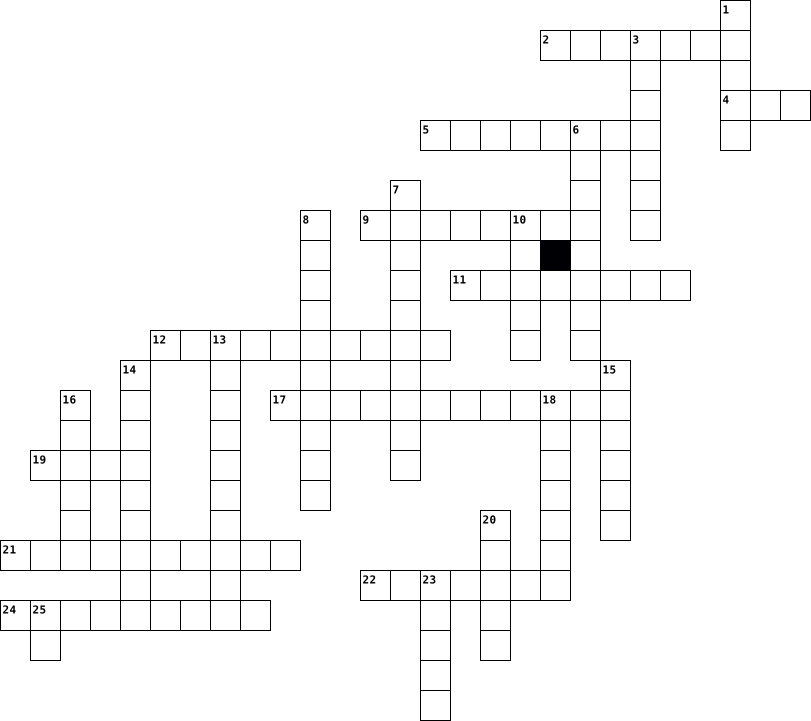
Across
- A feature that might appear near plate boundaries
- An atom that has lost or gained electrons
- The name given to the plates that make up the crust
- Another word for a chemical that is added in a reaction
- The type of table used to show all the elements that exist
- Protons and neutrons combined
- The number of protons in an atom
- The center of the Earth
- Types of circular currents that occur when hot molten rises, cools, falls causing the crust to move
- Evidence of plant and animal matter preserved in rocks
- Negative subatomic particles that orbit the nucleus of atoms
Down
- A type of compound that forms when a positive ion and a negative ion combine in a reaction
- A metal that bonds with carbon and oxygen. Also known as marble
- A neutral subatomic particle found inside the nucleus of atoms
- A process where rocks are broken down by physical or chemical means
- Part of an experiment where you analyse what worked and what could be improved on
- Used when writing chemical equations
- A type of plate interaction where one plate moves under another
- The variable that is measured when carrying out an experiment
- Frozen carbon dioxide
- A positive subatomic particle found inside the nucleus of atoms
- Evidence of a gas produced during a chemical reaction
- Colour of light given off when magnesium reacts with oxygen
- One example of a state of matter
- The symbol for lithium
25 Clues: Frozen carbon dioxide • The symbol for lithium • The center of the Earth • Protons and neutrons combined • The number of protons in an atom • One example of a state of matter • Used when writing chemical equations • An atom that has lost or gained electrons • A feature that might appear near plate boundaries • The name given to the plates that make up the crust • ...
Biochemistry Vocabulary Review 2016-05-18

Across
- When two different molecules stick together, this is called _______.
- Located on the right side of a chemical equation.
- A column in the periodic table is referred to as a _______.
- A row in the periodic table is called a _______.
- A subatomic particle located in the nucleus. It has a positive charge.
- This type of chemical reaction requires energy.
- Atoms are most stable when their _______ shells are complete.
- A substance that results from the combination of two or more elements.
- A subatomic particle that orbits the nucleus and has a negative charge.
- A negatively charged particle.
- A positively charged particle.
- The "universal" solvent necessary for life.
- When two similar molecules stick together, this is called _______.
Down
- Atoms of the same element, but with different atomic masses.
- Biological macromolecules have a backbone composed of long chains of this elelment.
- The smallest unit of a chemical element.
- A group of two or more atoms that share electrons in a chemical bond.
- This type of chemical reaction releases energy.
- Located on the left side of a chemical equation.
- Water has high surface tension due to these types of binds.
- In this type of bond, atoms may equally or unequally share electrons.
- A charged particle.
- A neutral subatomic particle that is located in the nucleus.
- In _______ bonds, atoms of opposite charges are attracted to each other.
24 Clues: A charged particle. • A negatively charged particle. • A positively charged particle. • The smallest unit of a chemical element. • The "universal" solvent necessary for life. • This type of chemical reaction releases energy. • This type of chemical reaction requires energy. • A row in the periodic table is called a _______. • ...
Plasma-Enabled Process with Single-Atom Catalysts for Sustainable Plastic Waste Transformation 2024-11-14

Across
- NOUN: The ability/quality to withstand wear/pressure withouth being damaged.
- NOUN: The process of decay.
- NOUN: The process of thermal decomposition at high temperatures.
- NOUN: A material having particles or constituents of nanoscale dimensions.
- NOUN: A substance that increases the rate of a chemical reaction (while being the same after the reaction).
- NOUN: A chemical used to support a large-scale chemical reaction. Also known as: A raw material or unprocessed material (biomass).
- NOUN: XXXXXXXXX-Plastics are made from several different types of plastic layered together.
Down
- NOUN: A group of materials (synthetic or semi-synthetic organic compounds), that may be shaped when soft and then hardened to retain the given shape.
- NOUN: A general process in which molecules seperate into other things, e.g. atoms, ions, or radicals.
- VERB: To reuse something in a way that creates a higher quality or value than the original.
- ADJECTIVE: Meant to be disposed of right after use—often, in mere minutes.
- NOUN: The amount of obtained product in a chemical reaction.
12 Clues: NOUN: The process of decay. • NOUN: The amount of obtained product in a chemical reaction. • NOUN: The process of thermal decomposition at high temperatures. • ADJECTIVE: Meant to be disposed of right after use—often, in mere minutes. • NOUN: A material having particles or constituents of nanoscale dimensions. • ...
Just Say No! 2014-06-26

Across
- A chemical element that makes up about four-fifths of the atmosphere of the Earth
- particle with no charge, found in the nucleus of an atom
- also known as scientific law, expresses generally observed behavior(2)
- chemical reaction between an acid and a base to produce a salt and water
- (-COOH)
- the central part of an atom that contains the protons and the neutrons
- ten to the negative ninth power
- a large nucleus is split into two smaller nuclei(2)
- a saturated nine carbon compound
- process by which atoms lose electrons
- element with 10 protons
Down
- A hydrocarbon that makes a great fuel with this general formula Cn H2n+2
- Where the electrons are most likely to be found
- elements that are poor conductors of heat and electricity, are brittle, have a low melting point, and usually gain electrons in a chemical reaction
- ionic equation no spectator ions allowed!
- the physical state of elements or compounds that are taking part in a chemical reaction(3)
- 1865, the periodic pattern of the law of octaves
- making full outer valence shells (2)
- group of elements with a full valence shell of electrons(2)
- Acid found in DNA and RNA
- When solute particles dissolve from a concentrated solution to a dilute one
- form the basic structural unit of nucleic acids such as DNA.
- opposite of "like dissolves like", has symmetrical geometry
- the SI unit of force
- atomic number 8
25 Clues: (-COOH) • atomic number 8 • the SI unit of force • element with 10 protons • Acid found in DNA and RNA • ten to the negative ninth power • a saturated nine carbon compound • making full outer valence shells (2) • process by which atoms lose electrons • ionic equation no spectator ions allowed! • Where the electrons are most likely to be found • ...
Term One 2019-04-02
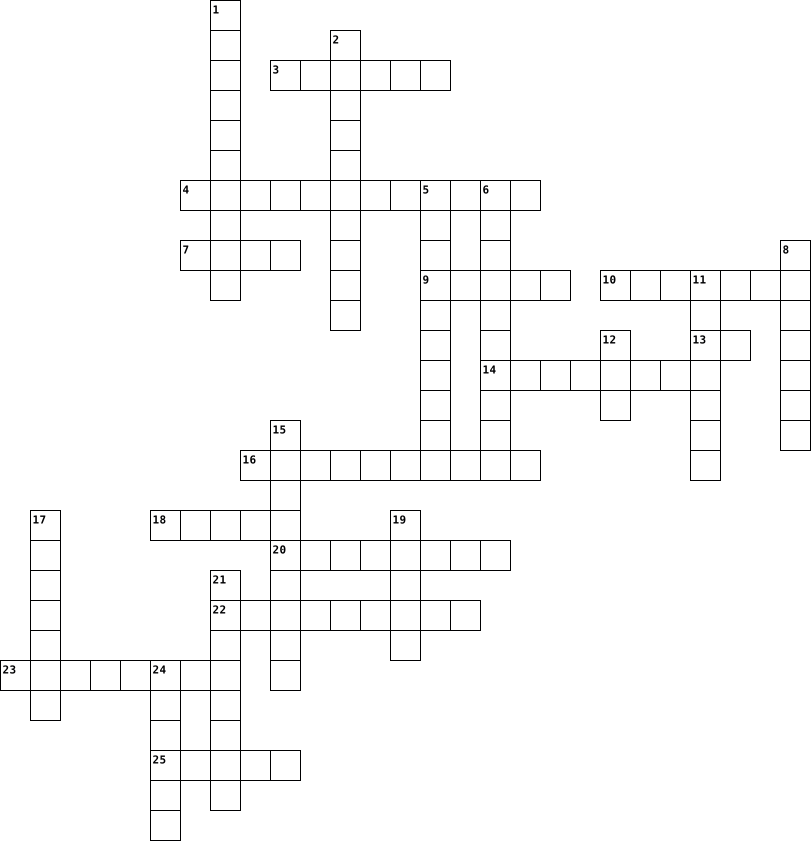
Across
- A positive subatomic particle found inside the nucleus of atoms
- The number of protons in an atom
- The center of the Earth
- One example of a state of matter
- A feature that might appear near plate boundaries
- The symbol for lithium
- The name given to the plates that make up the crust
- A process where rocks are broken down by physical or chemical means
- Colour of light given off when magnesium reacts with oxygen
- A neutral subatomic particle found inside the nucleus of atoms
- Negative subatomic particles that orbit the nucleus of atoms
- The type of table used to show all the elements that exist
- A type of compound that forms when a positive ion and a negative ion combine in a reaction
Down
- A type of plate interaction where one plate moves under another
- Types of circular currents that occur when hot molten rises, cools, falls causing the crust to move
- Protons and neutrons combined
- Part of an experiment where you analyse what worked and what could be improved on
- Evidence of plant and animal matter preserved in rocks
- A metal that bonds with carbon and oxygen. Also known as marble
- An atom that has lost or gained electrons
- The variable that is measured when carrying out an experiment
- Evidence of a gas produced during a chemical reaction
- Used when writing chemical equations
- Another word for a chemical that is added in a reaction
- Frozen carbon dioxide
25 Clues: Frozen carbon dioxide • The symbol for lithium • The center of the Earth • Protons and neutrons combined • The number of protons in an atom • One example of a state of matter • Used when writing chemical equations • An atom that has lost or gained electrons • A feature that might appear near plate boundaries • The name given to the plates that make up the crust • ...
Term One 2019-03-30
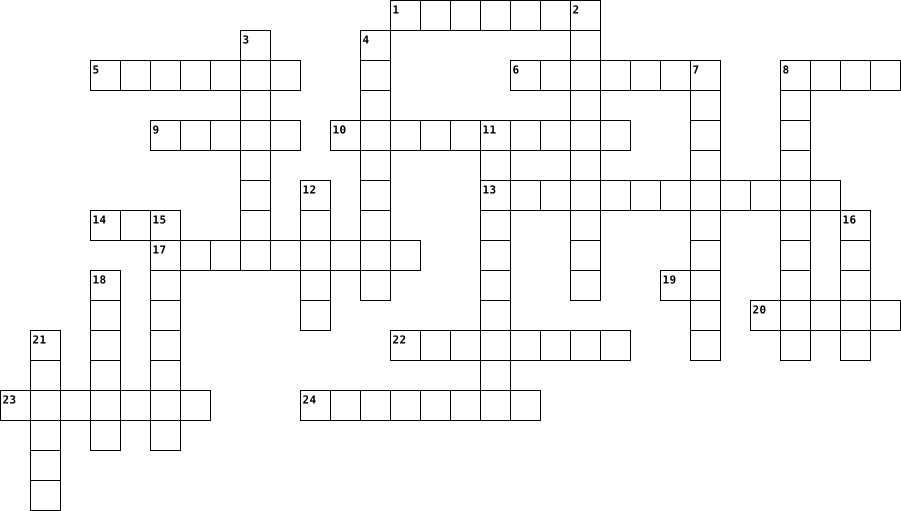
Across
- A metal that bonds with carbon and oxygen. Also known as marble
- Evidence of a gas produced during a chemical reaction
- Evidence of plant and animal matter preserved in rocks
- The center of the Earth
- Colour of light given off when magnesium reacts with oxygen
- A process where rocks are broken down by physical or chemical means
- The number of protons in an atom
- An atom that has lost or gained electrons
- Negative subatomic particles that orbit the nucleus of atoms
- The symbol for lithium
- One example of a state of matter
- The type of table used to show all the elements that exist
- A feature that might appear near plate boundaries
- Another word for a chemical that is added in a reaction
Down
- Protons and neutrons combined
- The name given to the plates that make up the crust
- The variable that is measured when carrying out an experiment
- A type of plate interaction where one plate moves under another
- Types of circular currents that occur when hot molten rises, cools, falls causing the crust to move
- Part of an experiment where you analyse what worked and what could be improved on
- Used when writing chemical equations
- A neutral subatomic particle found inside the nucleus of atoms
- A type of compound that forms when a positive ion and a negative ion combine in a reaction
- Frozen carbon dioxide
- A positive subatomic particle found inside the nucleus of atoms
25 Clues: Frozen carbon dioxide • The symbol for lithium • The center of the Earth • Protons and neutrons combined • The number of protons in an atom • One example of a state of matter • Used when writing chemical equations • An atom that has lost or gained electrons • A feature that might appear near plate boundaries • The name given to the plates that make up the crust • ...