
chemical reaction Crossword Puzzles
Photosynthesis 2025-01-10

Across
- – An element that cycles through living and nonliving parts of the ecosystem.
- Reaction – The process of breaking down and rearranging molecules to form new ones.
- Wall – The rigid layer that surrounds plant cells.
- – The part of the plant that captures sunlight for photosynthesis.
- Dioxide – A gas absorbed by plants during photosynthesis.
- – An organism that must consume other organisms for energy.
- – The powerhouse of the cell, where energy is released from glucose.
- – Small openings on the underside of leaves that allow gases to enter and exit.
- – Something that cycles through living and nonliving parts of an ecosystem.
- – An organism that produces its own food, like plants.
- – The substances that start a chemical reaction, like water and carbon dioxide.
- – The part of the plant that absorbs water and nutrients from the soil.
- – The main source of energy for photosynthesis.
- – A community of living and nonliving things interacting in an environment.
Down
- – The sugar molecule produced by photosynthesis.
- – The substances formed at the end of a chemical reaction, like glucose and oxygen.
- – A gas released by plants during photosynthesis.
- – The organelle in plant cells where photosynthesis occurs.
- – The pigment in plants that captures light energy.
- – An essential molecule plants absorb through their roots for photosynthesis.
- – The part of a plant cell where photosynthesis happens.
- Energy – The energy from the sun used in photosynthesis.
- – What plants produce and store during photosynthesis.
- – An organism that makes its own food through photosynthesis.
- – The process plants use to convert sunlight into chemical energy.
25 Clues: – The main source of energy for photosynthesis. • – The sugar molecule produced by photosynthesis. • – A gas released by plants during photosynthesis. • – The pigment in plants that captures light energy. • – What plants produce and store during photosynthesis. • – An organism that produces its own food, like plants. • ...
Hello 2022-09-06

Across
- * Energy is the energy in the nucleus of the atom.
- Where life operates.
- * Energy is often measured in calories.
- Is anything that takes up space and has mass.
- Provides energy to cells.
- The protective blanket of gases surrounding the Earth.
- Electrical energy is generally expressed in * hours.
- Helps cells keep their shape.
- The act of noting or detecting phenomenon by the senses.
- The study of the interactions between life and its physical environment.
- A suggested explanation based on evidence that can be tested by observation or experimentation.
- James * Joule
- The * energy of an object is the energy that it possesses due to its motion.
- Stores energy and forms cell membranes.
- The energy needed to start a chemical reaction is called * energy.
Down
- It is needed by all life forms.
- A solution with a pH higher than 7.
- Is the ability to do work.
- The sum of all the biochemical reactions in an organism.
- A solution with a pH lower than 7.
- Is the unit of power.
- Thermal or * Energy
- A substance that starts a chemical reaction.
- "Energy cannot be * or destroyed.
- Is the rate at which energy is used.
- Is done when force is applied to an object over a distance.
- A substance that forms as a result of a chemical reaction.
- Is the study of Energy.
- A chemical substance may be either an * or a compound.
- the concentration of hydronium ions in a solution.
30 Clues: James * Joule • Thermal or * Energy • Where life operates. • Is the unit of power. • Is the study of Energy. • Provides energy to cells. • Is the ability to do work. • Helps cells keep their shape. • It is needed by all life forms. • "Energy cannot be * or destroyed. • A solution with a pH lower than 7. • A solution with a pH higher than 7. • Is the rate at which energy is used. • ...
HAZWOPER 2015-08-12

Across
- State of being open and vulnerable to a hazardous chemical by inhalation, ingestion, skin contact, absorption, or any other course; includes potential exposure
- Incapable of being dissolved in a liquid
- Pounds per square inch
- An element or a compound produced by chemical reaction
- A chemical which can cause cancer is called a:
- American national Standard Institute
- All respirators must be approved by:
- Occupational Safety and Health Administration
- Toxic Means:
- The gaseous form of a solid or liquid as it evaporates
Down
- The procedure used to carry an electrical charge to ground through a conductive path.
- Chemical reaction with the release of energy
- The organization that tests and approves chemical protective clothing is:
- The removal of hazardous substances from employees and their equipment to preclude the foreseeable adverse health effects
- The minimum temperature at which a liquid will give off enough flammable vapor to ignite if a source of ignition is introduced
- Which abbreviation does not represent a government agency concerned with hazardous substances affecting the environment or workplace health and safety?
- Which radiation rays are considered the most hazardous to humans?
- Material Safety Data Sheet
- The governmental organization responsible for transportation of hazardous materials is:
- The National Fire Protection Association (NFPA) labels use 4 colors to distinguish certain types of hazards. Which of the following is not one of these colors?
- A substance, usually a liquid, in which other substances are dissolved
21 Clues: Toxic Means: • Pounds per square inch • Material Safety Data Sheet • American national Standard Institute • All respirators must be approved by: • Incapable of being dissolved in a liquid • Chemical reaction with the release of energy • Occupational Safety and Health Administration • A chemical which can cause cancer is called a: • ...
Biochemistry Vocabulary Review 2016-05-18

Across
- A subatomic particle located in the nucleus. It has a positive charge.
- A row in the periodic table is called a _______.
- Located on the right side of a chemical equation.
- A group of two or more atoms that share electrons in a chemical bond.
- When two different molecules stick together, this is called _______.
- A charged particle.
- Biological macromolecules have a backbone composed of long chains of this elelment.
- A subatomic particle that orbits the nucleus and has a negative charge.
- In _______ bonds, atoms of opposite charges are attracted to each other.
- This type of chemical reaction requires energy.
- A negatively charged particle.
- Atoms of the same element, but with different atomic masses.
Down
- A column in the periodic table is referred to as a _______.
- Water has high surface tension due to these types of binds.
- In this type of bond, atoms may equally or unequally share electrons.
- A substance that results from the combination of two or more elements.
- A neutral subatomic particle that is located in the nucleus.
- The "universal" solvent necessary for life.
- When two similar molecules stick together, this is called _______.
- This type of chemical reaction releases energy.
- Atoms are most stable when their _______ shells are complete.
- Located on the left side of a chemical equation.
- A positively charged particle.
- The smallest unit of a chemical element.
24 Clues: A charged particle. • A positively charged particle. • A negatively charged particle. • The smallest unit of a chemical element. • The "universal" solvent necessary for life. • This type of chemical reaction releases energy. • This type of chemical reaction requires energy. • A row in the periodic table is called a _______. • ...
vocab 6B philips 2017-04-04

Across
- when one substance combines with another substance creating a new substance.
- first column extreamly reactive
- A chemical equation is the symbolic representation of a chemical reaction in the form of symbols and formulas.
- odorless, colorless, low chemical reactivity
- the result of a chemical reaction.
- attraction between atoms
Down
- any system closed to all transfers of matter and energy, the mass of the system must remain constant over time, as system mass cannot change quantity if it is not added or removed.
- when objects or substances undergo a change that changes the physical form of a composition but not the chemical composition.
- electron in the outer shell of the atom
- symbols, such as parentheses, dashes, brackets, commas and plus and minus signs.
- a substance that takes part in and undergoes change during a reaction.
11 Clues: attraction between atoms • first column extreamly reactive • the result of a chemical reaction. • electron in the outer shell of the atom • odorless, colorless, low chemical reactivity • a substance that takes part in and undergoes change during a reaction. • when one substance combines with another substance creating a new substance. • ...
CH. 2 Vocab 2022-12-07

Across
- Nonpolar molecule that include fats, oils, and cholesterol.
- Catalyst for chemical reactions in living things.
- A large molecule made of many monomers bonded together.
- Substance that is changed in a chemical reaction.
- Substance made of different atoms bonded together.
- A single subunit in a complete molecule.
- An atom that has gained or lost an electron.
- PH of 1-6, compound that releases a proton (H+) when it dissolves in water.
- Bond that forms through the electrical force between two oppositely charged ions.
- PH 8-14, compound that remove protons (H+) from a solution
- The attraction among molecules of a substance.
- Substance that decreases that activation energy needed to start a chemical reaction.
- _______ energy is the amount of energy that will break a bond between two atoms.
Down
- Substance that is present in greater amount and dissolves that other substance.
- One particular type of atom.
- A polymer made of monomers called Amino Acids.
- Sugars (Glucose) and starches: Composed of carbon, hydrogen, and oxygen.
- The attractions among molecules of a different substance.
- Bond that forms when atoms share a pair of electrons.
- A mixture of substance that is the same through-out.
- Substance made by a chemical reaction.
- _______ Acids are polymers made up of monomers called nucleotides.
- Two or more atoms held together by covalent bonds.
- Smallest basic unit of matter.
- The substance that dissolves in a solute.
25 Clues: One particular type of atom. • Smallest basic unit of matter. • Substance made by a chemical reaction. • A single subunit in a complete molecule. • The substance that dissolves in a solute. • An atom that has gained or lost an electron. • A polymer made of monomers called Amino Acids. • The attraction among molecules of a substance. • ...
Unit 8 - Gas Laws - Lolah Slagg 2024-03-20

Across
- equal to 6.02214076 × 10 to the 23 power.
- a unit of measurement usedfor measuring large quantities of very small things like atoms
- a group of atoms bonded together
- the physical force exerted on an object.
- a measure of the amount of matter in an object
- a gas phase at a temperature where the same substance can also exist in the liquid or solid state
- characteristic of a substance that is observed during a reaction in which the chemical composition is changed.
- to put forth effort in order to release energy or a substance.
- when a binary compound decomposes into its elements
- a chemical element; it has symbol H and atomic number 1.
- states that the total pressure of a mixture of gases is equal to the sum of the partial pressures of the component gas
Down
- theory used to predict the rates of chemical reactions, particularly for gases
- one of the three fundamental states of matter
- the amount of space occupied by a sample of matter
- a chemical reaction, the conversion of molecule A to molecule B
- the study of reaction rates and how they are affected.
- he relationship between the mass of the substance and how much space it takes up (volume)
- Is made of the layers of gases surrounding a (our) planet
- a scientific instrument used to measure atmospheric pressure
- the amount of energy that is transferred from one system to its surroundings
20 Clues: a group of atoms bonded together • the physical force exerted on an object. • equal to 6.02214076 × 10 to the 23 power. • one of the three fundamental states of matter • a measure of the amount of matter in an object • the amount of space occupied by a sample of matter • when a binary compound decomposes into its elements • ...
Qualitative Sorting of 11 Unknowns (Handout 3-6) 2025-02-07

Across
- ___ solutions have a pH greater than 7.
- Common gases evolved during chemical reaction include hydrogen, ___, and oxygen.
- ___ analysis refers to determining how much of a substance is present in a sample.
- Capable of being dissolved in a liquid.
- The solution component present in the lower amount.
- The processes of boiling and then condensing water to remove impurities and minerals.
- A solid that forms from a liquid solution during a chemical reaction.
- ___ solutions have a pH less than 7.
- A substance that changes color based on the pH level of a solution.
- An indicator that causes a basic substance or solution to turn pink.
- A homogeneous mixture of two or more substances where one substance is dissolved in another.
Down
- Incapable of being dissolved in a liquid.
- A ___ is a process in which substances interact to form new substances; observable through changes like color, temperature, or gas formation.
- ___ analysis refers to determining what substances are present in a sample.
- The solution component present in the greatest amount.
- Solutions that have a pH of 7.
- A scale used to specify the acidity or basicity of a solution.
- A solution containing iodine, alcohol and water that is used as a disinfectant and for chemical testing.
- A laboratory tool used for transferring small amounts of liquid.
- When talking about or describing chemical reactions, this refers to the formation of gas bubbles during the reaction.
20 Clues: Solutions that have a pH of 7. • ___ solutions have a pH less than 7. • ___ solutions have a pH greater than 7. • Capable of being dissolved in a liquid. • Incapable of being dissolved in a liquid. • The solution component present in the lower amount. • The solution component present in the greatest amount. • ...
Chemistry Vocabulary Crossword 2025-04-09

Across
- Two or more different types of atoms (elements) chemically combined
- An expression that shows the elements in a compound with their subscripts. Example CH4
- The negative subatomic particle.
- A type of matter that has the same composition throughout; matter with a particular chemical makeup.
- A characteristic of matter that can be observed or measured without changing the identity of the substance. For example, mass or state of matter.
- A type of matter in which the individual substances are NOT evenly mixed together. Example: pizza
- A process that changes substances into new substances.
- The substances present before a chemical reaction occurs.
- A substance that is made of only one kind of atom.
- The substances formed during a chemical reaction.
Down
- Matter (mass) cannot be created or destroyed, it can only be rearranged.
- Two or more atoms joined together.
- A characteristic of matter that can be observed only as it changes to a different type of matter. For example: burning.
- A symbolic representation of a chemical reaction. Example 2H2+ O2 + --> 2H2O
- A small particle that is the building block of matter.
- The neutral subatomic particle.
- A change in only the physical properties of a substance. Does not result in a new substance.
- A type of mixture in which the individual substances are evenly mixed together. Example: milk
- A one or two letter abbreviation for an element name.
- The positive subatomic particle.
- Anything that has mass and takes up space (volume).
21 Clues: The neutral subatomic particle. • The negative subatomic particle. • The positive subatomic particle. • Two or more atoms joined together. • The substances formed during a chemical reaction. • A substance that is made of only one kind of atom. • Anything that has mass and takes up space (volume). • A one or two letter abbreviation for an element name. • ...
Biology vocab crossword puzzle 2025-05-06

Across
- Produces energy-storing molecules
- Maintaining ideal conditions
- Captures light energy and turns it into chemical energy
- Absorbs most wavelengths of light except for green
- What you start with
- Multiple monomers linked together
- # of times/average/how often
- The result of a substance
- Bonds- Weak attractions between the notrogenous bases of the DNA strands
- Organic molecules that are important for all living things
- Fighting for resources
- Chemical reaction thaat requires the presence of oxygen
- Chemical reaction that does not require the presence of oxygen
- To live
- The simplest molecule that a biomolecule can be broken down into
- Speeds up a chemical reaction
Down
- New species evolves
- Has a original strand and a new strand
- Rate- How fast/ slow organisms have babies
- The process by which DNA makes copies of itself
- Carries the genetic blueprint of all living organisms
- Too many species or resources available
- What something does or why it is important
- DNA sequence that codes for specific proteins
- What something looks like
- Dogma- Describes flow genetic information within a biological system
- Change in characteristic
- Structure in the cell that contains DNA
- Organism that uses sun and stored energhy for it´s own nutrients
- Similar to DNA but it is single stranded
30 Clues: To live • New species evolves • What you start with • Fighting for resources • Change in characteristic • The result of a substance • What something looks like • Maintaining ideal conditions • # of times/average/how often • Speeds up a chemical reaction • Produces energy-storing molecules • Multiple monomers linked together • Has a original strand and a new strand • ...
Routt Chemistry 11 - 21 2023-09-26

Across
- Symbols used to show the atomic make up of a molecule
- an average atomic mass based on numbers of an element’s isotopes found in nature
- a heavier unstable element that breaks down (decays) to a lighter more stable element
Down
- the total number of protons plus neutrons in an atom
- the process of radioisotope decay
- sentence used to show the reactants and products of a chemical reaction
- chemicals at the beginning of the chemical reaction
- Small particles formed when atoms form chemical bonds
- chemicals formed at the end of a chemical reaction
- an atom with an unusual number of neutrons
- A charged atom (an atom having an unequal number of protons and neutrons)
11 Clues: the process of radioisotope decay • an atom with an unusual number of neutrons • chemicals formed at the end of a chemical reaction • chemicals at the beginning of the chemical reaction • the total number of protons plus neutrons in an atom • Symbols used to show the atomic make up of a molecule • Small particles formed when atoms form chemical bonds • ...
Chapter 6 Vocab: Chemistry in Biology 2016-09-05

Across
- molecule made mostly of carbon and hydrogen that make up fats, oils, & waxes
- compound made of small carbon compounds called amino acids
- starting substances in a chemical reaction, shown on the left side of a chemical equation
- biological catalysts that speed up the rate of chemical reactions in biological processes
- compound composed of carbon, hydrogen, & oxygen in a ratio of 1 oxygen and 2 hydrogen atoms for each carbon atom
- mixture that can react with acids or bases to keep pH within a particular range
- pure substance formed when 2 or more different elements combine
- substance that lowers the activation energy needed to start a chemical reaction
- electrical attraction between 2 oppositely charged atoms or groups of atoms
- a homogenous mixture formed when a substance is dissolved in another substance
- large molecule formed by joining smaller organic molecules together
- process by which atoms or groups of atoms in substances are reorganized into different substances
- compound in which the atoms are held together by covalent bonds
- substance that releases hydrogen ions (H+) when dissolved in water
- specific location where a substrate binds on an enzyme
- atom of the same element that have different numbers of neutrons
- atom that has lost or gained one or more electrons
Down
- molecule made from repeating units of identical or nearly identical compounds called monomers
- pure substance that cannot be broken down into other substances by physical or chemical means
- building block of matter
- substances formed during a chemical reaction, shown on the right side of a chemical equation
- center of the atom, where neutrons & protons are located
- attractive force between positive & negative regions that hold molecules together
- reactant that binds to an enzyme
- minimum amount of energy needed for reactants to form products in a chemical reaction
- weak interaction involving a hydrogen atom & a fluorine, oxygen, or nitrogen atom
- positively charged particle
- measure of the concentration of hydrogen ions (H+) in a solution
- molecules that have an unequal distribution of charges
- chemical bond that forms when electrons are shared
- substance that releases hydroxide ions (OH-) when dissolved in water
- combination of 2 or more substances in which each substance retains its individual characteristics and properties
- small compounds that are made of carbon, nitrogen, oxygen, hydrogen, & sometimes sulfur
- complex macromolecule that stores and transmits genetic information
- subunit of nucleic acid formed from a sugar, a phosphate, & a nitrogenous base
- negatively charged particle
- substance in which another substance is dissolved
- particle that has no charge
- substance that is dissolved in the solvent
39 Clues: building block of matter • positively charged particle • negatively charged particle • particle that has no charge • reactant that binds to an enzyme • substance that is dissolved in the solvent • substance in which another substance is dissolved • chemical bond that forms when electrons are shared • atom that has lost or gained one or more electrons • ...
Chemical Change 2015-08-07

Across
- equation C + 02 -> CO2 (example)
- Reaction requiring oxygen
- Carbon + hydrogen compound
- reaction An acid plus a base is a _____ _____.
- Ethanol is a ______.
Down
- Bitter and slippery
- Universal _____.
- equation An equation must be _____.
- Living organisms use _____ to survive.
- Sodium Chloride
- H20 is ______.
- reaction An _____ _____ releases energy.
- A small amount of _____ is used in some fuels.
- pH<7
14 Clues: pH<7 • H20 is ______. • Sodium Chloride • Universal _____. • Bitter and slippery • Ethanol is a ______. • Reaction requiring oxygen • Carbon + hydrogen compound • equation C + 02 -> CO2 (example) • equation An equation must be _____. • Living organisms use _____ to survive. • reaction An _____ _____ releases energy. • reaction An acid plus a base is a _____ _____. • ...
Photosynthesis and Cellular Respiration Vocabulary 2017-01-18

Across
- things that are produced by chemical reactions.
- Means "without air." Processes that produce ATP in the absence of oxygen.
- Process that produces ATP in the absence of oxygen.
- An organism that is not able to make its own food and must consume other organisms.
- The things that are reacting with one another in a chemical reaction.
- The maintenance of a balanced internal environment.
- An organelle in cells of leaves of plants where photosynthesis takes place.
- The ability to do work or cause change.
- An organisms that makes its own food; a food producer.
- Respiration The ATP releasing process in which glucose sugar is broken down in to carbon dioxide and water.
- Means "in air." Oxygen requiring process that produces ATP.
Down
- Equation A diagram that uses chemical formulas, numbers, and other symbols to describe what happens in a chemical reaction.
- The sum of all the chemical processes that take place in an organisms.
- A chemical substance formed when the atoms of one or more elements are bonded together.
- The biochemical process carried out by plants and certain other organisms that possess chlorophyll whereby sunlight is trapped, and carbon dioxide and water react to form energy-rich glucose and oxygen.
- organelle whose primary function is to convert glucose into ATP that can be used as energy.
- The chemical compound used by cells as a source of readily available energy.
- The light-trapping molecule found in plants and other food producers upon which photosynthesis depends.
- in which chemical bonds are broken, rearranged and reformed.
- The smallest particle of an element.
- The sugar that is created by photosynthesis.
21 Clues: The smallest particle of an element. • The ability to do work or cause change. • The sugar that is created by photosynthesis. • things that are produced by chemical reactions. • Process that produces ATP in the absence of oxygen. • The maintenance of a balanced internal environment. • An organisms that makes its own food; a food producer. • ...
Balancing Chemical Equations 2021-10-27

Across
- Hydrochloric Acid Formula
- used to show charge on transition metals
- substances before chemical equation
- same amount of atoms as before a equation
Down
- H2SO4
- when two non-metals are bonded together
- substances after a chemical reaction
- shows a chemical reaction occurred
- anything that has mass and takes up space
- HC2H3O2
10 Clues: H2SO4 • HC2H3O2 • Hydrochloric Acid Formula • shows a chemical reaction occurred • substances before chemical equation • substances after a chemical reaction • when two non-metals are bonded together • used to show charge on transition metals • anything that has mass and takes up space • same amount of atoms as before a equation
Unit 3 Vocabulary Review 2022-11-30

Across
- sugar used in cellular respiration
- energy produced in cellular respiration
- beginning elements in a chemical reaction
- the breakdown of sugar
Down
- process that produces glucose and oxygen
- end results in a chemical reaction
- chemical breakdown of sugar by yeast
- sugar produced from Krebs cycle
- short for the electron transport chain
- adenosine di-phosphate
10 Clues: the breakdown of sugar • adenosine di-phosphate • sugar produced from Krebs cycle • end results in a chemical reaction • sugar used in cellular respiration • chemical breakdown of sugar by yeast • short for the electron transport chain • energy produced in cellular respiration • process that produces glucose and oxygen • beginning elements in a chemical reaction
Unit 1 crossword puzzle 2024-09-16

Across
- a homogenous mixture in which one substance dissolves another
- property ~ can be observed without changing the identity of the substance
- ~ the measure of the amount of matter in an object
- ~subtance or molecule that participates in a chemical reaction
- smallest unit of an element that maintains the properties of that element
- anything that takes up space
- reactions the process by which one or more substances change
- substance formed in a chemical change or reaction
Down
- change does not involve a change of identity of a substance
- indefinite volume and shape
- definite volume but indefinite shape
- pure substance that contains one kind of atom
- substance composed of dissimilar components not well mixed
- combination of pure substances that are not chemically combined
- substance ~have has definite chemical and physical properties
15 Clues: indefinite volume and shape • anything that takes up space • definite volume but indefinite shape • pure substance that contains one kind of atom • substance formed in a chemical change or reaction • ~ the measure of the amount of matter in an object • substance composed of dissimilar components not well mixed • ...
kyndra 2021-12-02

Across
- type of equations.
- new colors appear when this happens to a substance.
- This is also known as activation energy
- reading left to right,Balance one element at a time.
Down
- substance that lowers the activation energy of a chemical reaction.
- This reaction has a net absorption of energy.
- This reaction has a net release of energy
- how quickly the concentration reactantans decreases and how quickly the concentration products increase.
- type of chemical reaction
- A way reaction rates are affected.
10 Clues: type of equations. • type of chemical reaction • A way reaction rates are affected. • This is also known as activation energy • This reaction has a net release of energy • This reaction has a net absorption of energy. • new colors appear when this happens to a substance. • reading left to right,Balance one element at a time. • ...
Chemical Reactions 2021-02-04

Across
- letters and numbers showing the types and number of atoms that repeat to make up a substance
- the temperature at which a substance changes from the solid phase to the liquid phase
- something that can be observed about a substance, such as colour, smell, or boiling point
- the tiny pieces that all matter—all the stuff in the world—is made of
- an ending substance that is made during a chemical reaction
- able to cause damage
- an object, diagram, or computer program that helps us understand something by making it simpler or easier to see
- a process in which atoms rearrange to form new substances
- the relative size of things
Down
- a starting substance that is part of a chemical reaction
- to change the order or position of something
- a structure formed by repeating groups of atoms that link together in a large network
- something that is made of all the same atoms or groups of atoms
- a group of atoms joined together in a particular way
- a substance that is added to soil to help plants grow
- the temperature at which a substance changes from the liquid phase to the gas phase
16 Clues: able to cause damage • the relative size of things • to change the order or position of something • a group of atoms joined together in a particular way • a substance that is added to soil to help plants grow • a starting substance that is part of a chemical reaction • a process in which atoms rearrange to form new substances • ...
Chemical Reactions 2021-02-04

Across
- able to cause damage
- a group of atoms joined together in a particular way
- a substance that is added to soil to help plants grow
- the temperature at which a substance changes from the liquid phase to the gas phase
- a process in which atoms rearrange to form new substances
- a starting substance that is part of a chemical reaction
- an ending substance that is made during a chemical reaction
Down
- the relative size of things
- to change the order or position of something
- something that is made of all the same atoms or groups of atoms
- an object, diagram, or computer program that helps us understand something by making it simpler or easier to see
- something that can be observed about a substance, such as color, smell, or boiling point
- letters and numbers showing the types and number of atoms that repeat to make up a substance
- a structure formed by repeating groups of atoms that link together in a large network
- the temperature at which a substance changes from the solid phase to the liquid phase
- the tiny pieces that all matter—all the stuff in the world—is made of
16 Clues: able to cause damage • the relative size of things • to change the order or position of something • a group of atoms joined together in a particular way • a substance that is added to soil to help plants grow • a starting substance that is part of a chemical reaction • a process in which atoms rearrange to form new substances • ...
Chemical Reactions 2021-02-04

Across
- something that is made of all the same atoms or groups of atoms
- to change the order or position of something
- letters and numbers showing the types and number of atoms that repeat to make up a substance
- the temperature at which a substance changes from the liquid phase to the gas phase
- an ending substance that is made during a chemical reaction
- a group of atoms joined together in a particular way
- the tiny pieces that all matter—all the stuff in the world—is made of
- something that can be observed about a substance, such as color, smell, or boiling point
Down
- able to cause damage
- the temperature at which a substance changes from the solid phase to the liquid phase
- the relative size of things
- a process in which atoms rearrange to form new substances
- a structure formed by repeating groups of atoms that link together in a large network
- an object, diagram, or computer program that helps us understand something by making it simpler or easier to see
- a starting substance that is part of a chemical reaction
- a substance that is added to soil to help plants grow
16 Clues: able to cause damage • the relative size of things • to change the order or position of something • a group of atoms joined together in a particular way • a substance that is added to soil to help plants grow • a starting substance that is part of a chemical reaction • a process in which atoms rearrange to form new substances • ...
Chemical Reactions 2021-02-04

Across
- the tiny pieces that all matter—all the stuff in the world—is made of
- an object, diagram, or computer program that helps us understand something by making it simpler or easier to see
- a group of atoms joined together in a particular way
- the relative size of things
- able to cause damage
- something that is made of all the same atoms or groups of atoms
- to change the order or position of something
- a process in which atoms rearrange to form new substances
- the temperature at which a substance changes from the solid phase to the liquid phase
- a substance that is added to soil to help plants grow
Down
- a structure formed by repeating groups of atoms that link together in a large network
- an ending substance that is made during a chemical reaction
- a starting substance that is part of a chemical reaction
- the temperature at which a substance changes from the liquid phase to the gas phase
- something that can be observed about a substance, such as color, smell, or boiling point
- letters and numbers showing the types and number of atoms that repeat to make up a substance
16 Clues: able to cause damage • the relative size of things • to change the order or position of something • a group of atoms joined together in a particular way • a substance that is added to soil to help plants grow • a starting substance that is part of a chemical reaction • a process in which atoms rearrange to form new substances • ...
Chemical Reactions 2021-02-04

Across
- letters and numbers showing the types and number of atoms that repeat to make up a substance
- the temperature at which a substance changes from the solid phase to the liquid phase
- something that can be observed about a substance, such as color, smell, or boiling point
- the tiny pieces that all matter—all the stuff in the world—is made of
- an ending substance that is made during a chemical reaction
- able to cause damage
- an object, diagram, or computer program that helps us understand something by making it simpler or easier to see
- a process in which atoms rearrange to form new substances
- the relative size of things
Down
- a starting substance that is part of a chemical reaction
- to change the order or position of something
- a structure formed by repeating groups of atoms that link together in a large network
- something that is made of all the same atoms or groups of atoms
- a group of atoms joined together in a particular way
- a substance that is added to soil to help plants grow
- the temperature at which a substance changes from the liquid phase to the gas phase
16 Clues: able to cause damage • the relative size of things • to change the order or position of something • a group of atoms joined together in a particular way • a substance that is added to soil to help plants grow • a starting substance that is part of a chemical reaction • a process in which atoms rearrange to form new substances • ...
Chemical Reactions 2021-02-04

Across
- letters and numbers showing the types and number of atoms that repeat to make up a substance
- the temperature at which a substance changes from the solid phase to the liquid phase
- something that can be observed about a substance, such as color, smell, or boiling point
- the tiny pieces that all matter—all the stuff in the world—is made of
- an ending substance that is made during a chemical reaction
- able to cause damage
- an object, diagram, or computer program that helps us understand something by making it simpler or easier to see
- a process in which atoms rearrange to form new substances
- the relative size of things
Down
- a starting substance that is part of a chemical reaction
- to change the order or position of something
- a structure formed by repeating groups of atoms that link together in a large network
- something that is made of all the same atoms or groups of atoms
- a group of atoms joined together in a particular way
- a substance that is added to soil to help plants grow
- the temperature at which a substance changes from the liquid phase to the gas phase
16 Clues: able to cause damage • the relative size of things • to change the order or position of something • a group of atoms joined together in a particular way • a substance that is added to soil to help plants grow • a starting substance that is part of a chemical reaction • a process in which atoms rearrange to form new substances • ...
Chemical Reactions 2021-02-04

Across
- letters and numbers showing the types and number of atoms that repeat to make up a substance
- the temperature at which a substance changes from the solid phase to the liquid phase
- something that can be observed about a substance, such as color, smell, or boiling point
- the tiny pieces that all matter—all the stuff in the world—is made of
- an ending substance that is made during a chemical reaction
- able to cause damage
- an object, diagram, or computer program that helps us understand something by making it simpler or easier to see
- a process in which atoms rearrange to form new substances
- the relative size of things
Down
- a starting substance that is part of a chemical reaction
- to change the order or position of something
- a structure formed by repeating groups of atoms that link together in a large network
- something that is made of all the same atoms or groups of atoms
- a group of atoms joined together in a particular way
- a substance that is added to soil to help plants grow
- the temperature at which a substance changes from the liquid phase to the gas phase
16 Clues: able to cause damage • the relative size of things • to change the order or position of something • a group of atoms joined together in a particular way • a substance that is added to soil to help plants grow • a starting substance that is part of a chemical reaction • a process in which atoms rearrange to form new substances • ...
Chemical Reactions 2021-02-04

Across
- the temperature at which a substance changes from the solid phase to the liquid phase
- letters and numbers showing the types and number of atoms that repeat to make up a substance
- a starting substance that is part of a chemical reaction
- a structure formed by repeating groups of atoms that link together in a large network
- a process in which atoms rearrange to form new substances
- to change the order or position of something
- the tiny pieces that all matter—all the stuff in the world—is made of
- a substance that is added to soil to help plants grow
Down
- the temperature at which a substance changes from the liquid phase to the gas phase
- a group of atoms joined together in a particular way
- an ending substance that is made during a chemical reaction
- an object, diagram, or computer program that helps us understand something by making it simpler or easier to see
- able to cause damage
- something that is made of all the same atoms or groups of atoms
- something that can be observed about a substance, such as color, smell, or boiling point
- the relative size of things
16 Clues: able to cause damage • the relative size of things • to change the order or position of something • a group of atoms joined together in a particular way • a substance that is added to soil to help plants grow • a starting substance that is part of a chemical reaction • a process in which atoms rearrange to form new substances • ...
Chemical Reactions 2021-02-04

Across
- to change the order or position of something
- the temperature at which a substance changes from the liquid phase to the gas phase
- a group of atoms joined together in a particular way
- a structure formed by repeating groups of atoms that link together in a large network
- an object, diagram, or computer program that helps us understand something by making it simpler or easier to see
- able to cause damage
- an ending substance that is made during a chemical reaction
Down
- a starting substance that is part of a chemical reaction
- a process in which atoms rearrange to form new substances
- the tiny pieces that all matter—all the stuff in the world—is made of
- the temperature at which a substance changes from the solid phase to the liquid phase
- a substance that is added to soil to help plants grow
- something that is made of all the same atoms or groups of atoms
- the relative size of things
- something that can be observed about a substance, such as color, smell, or boiling point
- letters and numbers showing the types and number of atoms that repeat to make up a substance
16 Clues: able to cause damage • the relative size of things • to change the order or position of something • a group of atoms joined together in a particular way • a substance that is added to soil to help plants grow • a starting substance that is part of a chemical reaction • a process in which atoms rearrange to form new substances • ...
Chemical Reactions 2021-02-04

Across
- the temperature at which a substance changes from the liquid phase to the gas phase
- to change the order or position of something
- the temperature at which a substance changes from the solid phase to the liquid phase
- a substance that is added to soil to help plants grow
- an ending substance that is made during a chemical reaction
- a starting substance that is part of a chemical reaction
- able to cause damage
- an object, diagram, or computer program that helps us understand something by making it simpler or easier to see
Down
- a structure formed by repeating groups of atoms that link together in a large network
- something that is made of all the same atoms or groups of atoms
- letters and numbers showing the types and number of atoms that repeat to make up a substance
- something that can be observed about a substance, such as color, smell, or boiling point
- a process in which atoms rearrange to form new substances
- a group of atoms joined together in a particular way
- the relative size of things
- the tiny pieces that all matter—all the stuff in the world—is made of
16 Clues: able to cause damage • the relative size of things • to change the order or position of something • a group of atoms joined together in a particular way • a substance that is added to soil to help plants grow • a starting substance that is part of a chemical reaction • a process in which atoms rearrange to form new substances • ...
Chemical Reactions 2021-02-04

Across
- to change the order or position of something
- something that is made of all the same atoms or groups of atoms
- the temperature at which a substance changes from the solid phase to the liquid phase
- letters and numbers showing the types and number of atoms that repeat to make up a substance
- a substance that is added to soil to help plants grow
- a process in which atoms rearrange to form new substances
- an ending substance that is made during a chemical reaction
- something that can be observed about a substance, such as color, smell, or boiling point
Down
- a starting substance that is part of a chemical reaction
- the temperature at which a substance changes from the liquid phase to the gas phase
- the tiny pieces that all matter—all the stuff in the world—is made of
- a group of atoms joined together in a particular way
- the relative size of things
- a structure formed by repeating groups of atoms that link together in a large network
- an object, diagram, or computer program that helps us understand something by making it simpler or easier to see
- able to cause damage
16 Clues: able to cause damage • the relative size of things • to change the order or position of something • a group of atoms joined together in a particular way • a substance that is added to soil to help plants grow • a starting substance that is part of a chemical reaction • a process in which atoms rearrange to form new substances • ...
Chemical Reactions 2021-02-04

Across
- Letters and numbers showing the types and number of atoms that repeat to make up a substance.
- The temperature at which a substance changes from the solid phase to the liquid phase.
- Something that can be observed about a substance, such as color, smell, or boiling point.
- The tiny pieces that all matter—all the stuff in the world—is made of.
- An ending substance that is made during a chemical reaction.
- Able to cause damage.
- An object, diagram, or computer program that helps us understand something by making it simpler or easier to see.
- A process in which atoms rearrange to form new substances.
- The relative size of things.
Down
- A starting substance that is part of a chemical reaction.
- To change the order or position of something.
- A structure formed by repeating groups of atoms that link together in a large network.
- Something that is made of all the same atoms or groups of atoms.
- A group of atoms joined together in a particular way.
- A substance that is added to soil to help plants grow.
- The temperature at which a substance changes from the liquid phase to the gas phase.
16 Clues: Able to cause damage. • The relative size of things. • To change the order or position of something. • A group of atoms joined together in a particular way. • A substance that is added to soil to help plants grow. • A starting substance that is part of a chemical reaction. • A process in which atoms rearrange to form new substances. • ...
Chemical Reactions 2021-02-04

Across
- letters and numbers showing the types and number of atoms that repeat to make up a substance
- the temperature at which a substance changes from the solid phase to the liquid phase
- something that can be observed about a substance, such as color, smell, or boiling point
- tiny pieces that all matter—all the stuff in the world—is made of
- an ending substance that is made during a chemical reaction
- able to cause damage
- an object, diagram, or computer program that helps us understand something by making it simpler or easier to see
- a process in which atoms rearrange to form new substances
- the relative size of things
Down
- a starting substance that is part of a chemical reaction
- to change the order or position of something
- a structure formed by repeating groups of atoms that link together in a large network
- something that is made of all the same atoms or groups of atoms
- a group of atoms joined together in a particular way
- a substance that is added to soil to help plants grow
- the temperature at which a substance changes from the liquid phase to the gas phase
16 Clues: able to cause damage • the relative size of things • to change the order or position of something • a group of atoms joined together in a particular way • a substance that is added to soil to help plants grow • a starting substance that is part of a chemical reaction • a process in which atoms rearrange to form new substances • ...
Chemical Reactions 2021-02-04

Across
- letters and numbers showing the types and number of atoms that repeat to make up a substance
- the temperature at which a substance changes from the solid phase to the liquid phase
- something that can be observed about a substance, such as color, smell, or boiling point
- the tiny pieces that all matter all the stuff in the world is made of
- an ending substance that is made during a chemical reaction
- able to cause damage
- an object, diagram, or computer program that helps us understand something by making it simpler or easier to see
- a process in which atoms rearrange to form new substances
- the relative size of things
Down
- starting substance that is part of a chemical reaction
- change the order or position of something
- a structure formed by repeating groups of atoms that link together in a large network
- something that is made of all the same atoms or groups of atoms
- a roup of atoms joined together in a particular way
- a substance that is added to soil to help plants grow
- the temperature at which a substance changes from the liquid phase to the gas phase
16 Clues: able to cause damage • the relative size of things • change the order or position of something • a roup of atoms joined together in a particular way • a substance that is added to soil to help plants grow • starting substance that is part of a chemical reaction • a process in which atoms rearrange to form new substances • ...
Chemical Reactions 2021-02-04

Across
- a group of atoms joined together in a particular way
- a process in which atoms rearrange to form new substances
- something that is made of all the same atoms or groups of atoms
- an ending substance that is made during a chemical reaction
- a structure formed by repeating groups of atoms that link together in a large network
- letters and numbers showing the types and number of atoms that repeat to make up a substance
- able to cause damage
- a starting substance that is part of a chemical reaction
Down
- the tiny pieces that all matter—all the stuff in the world—is made of
- the temperature at which a substance changes from the liquid phase to the gas phase
- the relative size of things
- a substance that is added to soil to help plants grow
- an object, diagram, or computer program that helps us understand something by making it simpler or easier to see
- to change the order or position of something
- something that can be observed about a substance, such as color, smell, or boiling point
- the temperature at which a substance changes from the solid phase to the liquid phase
16 Clues: able to cause damage • the relative size of things • to change the order or position of something • a group of atoms joined together in a particular way • a substance that is added to soil to help plants grow • a starting substance that is part of a chemical reaction • a process in which atoms rearrange to form new substances • ...
Chemical Reactions 2021-02-04

Across
- letters and numbers showing the types and number of atoms that repeat to make up a substance
- the temperature at which a substance changes from the solid phase to the liquid phase
- something that can be observed about a substance, such as color, smell, or boiling point
- the tiny pieces that all matter—all the stuff in the world—is made of
- an ending substance that is made during a chemical reaction
- able to cause damage
- an object, diagram, or computer program that helps us understand something by making it simpler or easier to see
- a process in which atoms rearrange to form new substances
- the relative size of things
Down
- a starting substance that is part of a chemical reaction
- to change the order or position of something
- a structure formed by repeating groups of atoms that link together in a large network
- something that is made of all the same atoms or groups of atoms
- a group of atoms joined together in a particular way
- a substance that is added to soil to help plants grow
- the temperature at which a substance changes from the liquid phase to the gas phase
16 Clues: able to cause damage • the relative size of things • to change the order or position of something • a group of atoms joined together in a particular way • a substance that is added to soil to help plants grow • a starting substance that is part of a chemical reaction • a process in which atoms rearrange to form new substances • ...
Chemical reactions 2021-02-04

Across
- to change the order or position of something
- the temperature at which a substance changes from the liquid phase to the gas phase
- a group of atoms joined together in a particular way
- a structure formed by repeating groups of atoms that link together in a large network
- an object, diagram, or computer program that helps us understand something by making it simpler or easier to see
- able to cause damage
- an ending substance that is made during a chemical reaction
Down
- a starting substance that is part of a chemical reaction
- a process in which atoms rearrange to form new substances
- the tiny pieces that all matter—all the stuff in the world—is made of
- the temperature at which a substance changes from the solid phase to the liquid phase
- a substance that is added to soil to help plants grow
- something that is made of all the same atoms or groups of atoms
- the relative size of things
- something that can be observed about a substance, such as color, smell, or boiling point
- letters and numbers showing the types and number of atoms that repeat to make up a substance
16 Clues: able to cause damage • the relative size of things • to change the order or position of something • a group of atoms joined together in a particular way • a substance that is added to soil to help plants grow • a starting substance that is part of a chemical reaction • a process in which atoms rearrange to form new substances • ...
Chemical Reactions 2021-02-04

Across
- the tiny pieces that all matter—all the stuff in the world—is made of
- something that is made of all the same atoms or groups of atoms
- a group of atoms joined together in a particular way
- a process in which atoms rearrange to form new substances
- the temperature at which a substance changes from the liquid phase to the gas phase
- something that can be observed about a substance, such as color, smell, or boiling point
- to change the order or position of something
Down
- letters and numbers showing the types and number of atoms that repeat to make up a substance
- a substance that is added to soil to help plants grow
- a starting substance that is part of a chemical reaction
- the temperature at which a substance changes from the solid phase to the liquid phase
- a structure formed by repeating groups of atoms that link together in a large network
- able to cause damage
- an ending substance that is made during a chemical reaction
- the relative size of things
- an object, diagram, or computer program that helps us understand something by making it simpler or easier to see
16 Clues: able to cause damage • the relative size of things • to change the order or position of something • a group of atoms joined together in a particular way • a substance that is added to soil to help plants grow • a starting substance that is part of a chemical reaction • a process in which atoms rearrange to form new substances • ...
Chapter 13 Jack Prystash 2017-10-11

Across
- A substance that accepts hydrogen ions.
- A measure of the acidity of a solution.
- A reaction between an acid and a base
- The deterioration of a metal
- The process by which a reactant gains one or more electrons
Down
- The minimum energy required in order for a chemical reaction to proceed.
- Description of a substance that can behave as either an acid or a base
- The new materials formed in a chemical reaction.
- Description of a chemical reaction in which there is a net absorption of energy
- The process by which a reactant loses one or more electrons
10 Clues: The deterioration of a metal • A reaction between an acid and a base • A substance that accepts hydrogen ions. • A measure of the acidity of a solution. • The new materials formed in a chemical reaction. • The process by which a reactant loses one or more electrons • The process by which a reactant gains one or more electrons • ...
Chapter 13 Jack Prystash 2017-10-11

Across
- The process by which a reactant gains one or more electrons
- The process by which a reactant loses one or more electrons
- The minimum energy required in order for a chemical reaction to proceed.
- Description of a chemical reaction in which there is a net absorption of energy
- The new materials formed in a chemical reaction.
Down
- The deterioration of a metal
- A substance that accepts hydrogen ions.
- A reaction between an acid and a base
- Description of a substance that can behave as either an acid or a base
- A measure of the acidity of a solution.
10 Clues: The deterioration of a metal • A reaction between an acid and a base • A substance that accepts hydrogen ions. • A measure of the acidity of a solution. • The new materials formed in a chemical reaction. • The process by which a reactant gains one or more electrons • The process by which a reactant loses one or more electrons • ...
Chapter 2 Extra Credit 2024-09-23

Across
- The ability to do work
- A susbtance when dissolved in water produces H+ ions
- A substance when dissolved in water produces OH-,Cl-, or F- ions
- The net movement of particles from a higher concentration to a lower concentration
- Basic unit of a chemical element
- A bond that is formed by the sharing of electrons
- What we end with in a chemical equation
- A substance that lowers the energy needed to begin a reaction
Down
- A molecule or substance that slows down or prevents a chemical reaction from occuring
- A change in matter that does not alter the chemical identity
- Substance that cannot be broken down into smaller parts
- What we begin with in a chemical equation
- A bond that is formed by the transferring of electrons
- Anything that takes up space and has mass
14 Clues: The ability to do work • Basic unit of a chemical element • What we end with in a chemical equation • What we begin with in a chemical equation • Anything that takes up space and has mass • A bond that is formed by the sharing of electrons • A susbtance when dissolved in water produces H+ ions • A bond that is formed by the transferring of electrons • ...
Year 12 A-Level Chemistry 2025-06-09

Across
- A state that can be reached in reversible reactions.
- A substance that is an electron donator.
- The energy required for a reaction to be initiated.
- A positive carbon atom within an organic molecule.
- When a substance has the same molecular formula but a different arrangement of atoms in space.
- A substance that can be made from the nucleophilic substitution of a halogenoalkane with ammonia.
- A solution which resists changes in pH when small amounts of acids or bases are added.
- A word to describe an acid that can donate two H+ ions.
- The power of an atom to attract the bonded pair of electrons in a covalent bond
- A substance that can be made from the complete oxidation of a primary alcohol.
- A substance that is an electron acceptor.
- The part of an organic compound that its name is derived from.
Down
- A substance that can be made from the partial oxidation of a primary alcohol.
- The reaction of alkanes with halogens under UV light.
- The type of chemistry associated with carbon containing substances.
- a substance made during a chemical reaction that then undergoes further reaction to create the product.
- The word for the illustration of a chemical reaction showing the movement of pairs of electrons.
- A substance that can be made from the FRS of alkanes with halogens.
- An unsaturated hydrocarbon
- A reaction where an alkane is converted to an alkene.
- The reaction of an alkene with bromine.
- A substance that can be made from the nucleophilic substitution of a halogenoalkane with KCN.
- A substance that can be made from the oxidation of a secondary alcohol.
23 Clues: An unsaturated hydrocarbon • The reaction of an alkene with bromine. • A substance that is an electron donator. • A substance that is an electron acceptor. • A positive carbon atom within an organic molecule. • The energy required for a reaction to be initiated. • A state that can be reached in reversible reactions. • ...
Chemical Reactions 2024-09-20

Across
- Anything that has mass and occupies space, including solids, liquids, and gases.
- Substances formed as a result of a chemical reaction, existing after the reaction has taken place.
- A measure of the amount of matter in an object, typically measured in grams or kilograms.
- A representation of a chemical reaction that shows equal numbers of each type of atom on both sides, illustrating the conservation of mass.
- A physical system that does not exchange matter with its surroundings, allowing for the conservation of mass during reactions.
Down
- Antoine Lavoisier, a French chemist known as the "Father of Modern Chemistry," who established the law of conservation of mass in the late 18th century.
- A process in which reactants are transformed into products through the rearrangement of atoms.
- The principle of maintaining a quantity in a closed system; in this context, it refers to mass not being created or destroyed in a chemical reaction.
- The branch of chemistry that deals with the quantitative relationships of the reactants and products in chemical reactions.
- Substances that undergo a chemical change in a reaction, present before the reaction occurs.
10 Clues: Anything that has mass and occupies space, including solids, liquids, and gases. • A measure of the amount of matter in an object, typically measured in grams or kilograms. • Substances that undergo a chemical change in a reaction, present before the reaction occurs. • ...
Chemical Reactions 2021-02-04

Across
- letters and numbers showing the types and number of atoms that repeat to make up a substance
- the temperature at which a substance changes from the solid phase to the liquid phase
- something that can be observed about a substance, such as color, smell, or boiling point
- the tiny pieces that all matter—all the stuff in the world—is made of
- an ending substance that is made during a chemical reaction
- able to cause damage
- an object, diagram, or computer program that helps us understand something by making it simpler or easier to see
- a process in which atoms rearrange to form new substances
- the relative size of things
Down
- a starting substance that is part of a chemical reaction
- to change the order or position of something
- a structure formed by repeating groups of atoms that link together in a large network
- something that is made of all the same atoms or groups of atoms
- a group of atoms joined together in a particular way
- a substance that is added to soil to help plants grow
- the temperature at which a substance changes from the liquid phase to the gas phase
16 Clues: able to cause damage • the relative size of things • to change the order or position of something • a group of atoms joined together in a particular way • a substance that is added to soil to help plants grow • a starting substance that is part of a chemical reaction • a process in which atoms rearrange to form new substances • ...
Science Vocabulary 2021-02-04

Across
- letters and numbers showing the types and number of atoms that repeat to make up a substance
- the temperature at which a substance changes from the solid phase to the liquid phase
- something that can be observed about a substance, such as color, smell, or boiling point
- the tiny pieces that all matter—all the stuff in the world—is made of
- an ending substance that is made during a chemical reaction
- able to cause damage
- an object, diagram, or computer program that helps us understand something by making it simpler or easier to see
- a process in which atoms rearrange to form new substances
- the relative size of things
Down
- a starting substance that is part of a chemical reaction
- to change the order or position of something
- a structure formed by repeating groups of atoms that link together in a large network
- something that is made of all the same atoms or groups of atoms
- a group of atoms joined together in a particular way
- a substance that is added to soil to help plants grow
- the temperature at which a substance changes from the liquid phase to the gas phase
16 Clues: able to cause damage • the relative size of things • to change the order or position of something • a group of atoms joined together in a particular way • a substance that is added to soil to help plants grow • a starting substance that is part of a chemical reaction • a process in which atoms rearrange to form new substances • ...
Chemical Reactions 2021-02-04

Across
- letters and numbers showing the types and number of atoms that repeat to make up a substance
- the temperature at which a substance changes from the solid phase to the liquid phase
- something that can be observed about a substance, such as color, smell, or boiling point
- the tiny pieces that all matter—all the stuff in the world—is made of
- an ending substance that is made during a chemical reaction
- able to cause damage
- an object, diagram, or computer program that helps us understand something by making it simpler or easier to see
- a process in which atoms rearrange to form new substances
- the relative size of things
Down
- a starting substance that is part of a chemical reaction
- to change the order or position of something
- a structure formed by repeating groups of atoms that link together in a large network
- something that is made of all the same atoms or groups of atoms
- a group of atoms joined together in a particular way
- a substance that is added to soil to help plants grow
- the temperature at which a substance changes from the liquid phase to the gas phase
16 Clues: able to cause damage • the relative size of things • to change the order or position of something • a group of atoms joined together in a particular way • a substance that is added to soil to help plants grow • a starting substance that is part of a chemical reaction • a process in which atoms rearrange to form new substances • ...
Chemical Reactions Glossary 2021-02-04

Across
- the temperature at which a substance changes from the liquid phase to the gas phase
- to change the order or position of something
- the temperature at which a substance changes from the solid phase to the liquid phase
- a substance that is added to soil to help plants grow
- an ending substance that is made during a chemical reaction
- a starting substance that is part of a chemical reaction
- able to cause damage
- an object, diagram, or computer program that helps us understand something by making it simpler or easier to see
Down
- a structure formed by repeating groups of atoms that link together in a large network
- something that is made of all the same atoms or groups of atoms
- letters and numbers showing the types and number of atoms that repeat to make up a substance
- something that can be observed about a substance, such as color, smell, or boiling point
- a process in which atoms rearrange to form new substances
- a group of atoms joined together in a particular way
- the relative size of things
- the tiny pieces that all matter—all the stuff in the world—is made of
16 Clues: able to cause damage • the relative size of things • to change the order or position of something • a group of atoms joined together in a particular way • a substance that is added to soil to help plants grow • a starting substance that is part of a chemical reaction • a process in which atoms rearrange to form new substances • ...
Chemical Reactions 2021-02-04

Across
- letters and numbers showing the types and number of atoms that repeat to make up a substance
- the temperature at which a substance changes from the solid phase to the liquid phase
- something that can be observed about a substance, such as color, smell, or boiling point
- the tiny pieces that all matter—all the stuff in the world—is made of
- an ending substance that is made during a chemical reaction
- able to cause damage
- an object, diagram, or computer program that helps us understand something by making it simpler or easier to see
- a process in which atoms rearrange to form new substances
- the relative size of things
Down
- a starting substance that is part of a chemical reaction
- to change the order or position of something
- a structure formed by repeating groups of atoms that link together in a large network
- something that is made of all the same atoms or groups of atoms
- a group of atoms joined together in a particular way
- a substance that is added to soil to help plants grow
- the temperature at which a substance changes from the liquid phase to the gas phase
16 Clues: able to cause damage • the relative size of things • to change the order or position of something • a group of atoms joined together in a particular way • a substance that is added to soil to help plants grow • a starting substance that is part of a chemical reaction • a process in which atoms rearrange to form new substances • ...
Chemical Reactions 2021-02-04

Across
- something that can be observed about a substance, such as color, smell, or boiling point
- the relative size of things
- the temperature at which a substance changes from the solid phase to the liquid phase
- an object, diagram, or computer program that helps us understand something by making it simpler or easier to see
- a substance that is added to soil to help plants grow
- the tiny pieces that all matter—all the stuff in the world—is made of
- to change the order or position of something
- a starting substance that is part of a chemical reaction
Down
- a process in which atoms rearrange to form new substances
- a structure formed by repeating groups of atoms that link together in a large network
- something that is made of all the same atoms or groups of atoms
- able to cause damage
- the temperature at which a substance changes from the liquid phase to the gas phase
- a group of atoms joined together in a particular way
- an ending substance that is made during a chemical reaction
- letters and numbers showing the types and number of atoms that repeat to make up a substance
16 Clues: able to cause damage • the relative size of things • to change the order or position of something • a group of atoms joined together in a particular way • a substance that is added to soil to help plants grow • a starting substance that is part of a chemical reaction • a process in which atoms rearrange to form new substances • ...
Chemical Reaction's 2021-02-04

Across
- something that can be observed about a substance, such as color, smell, or boiling point
- the relative size of things
- the temperature at which a substance changes from the solid phase to the liquid phase
- a substance that is added to soil to help plants grow
- an object, diagram, or computer program that helps us understand something by making it simpler or easier to see
- the tiny pieces that all matter—all the stuff in the world—is made of
- to change the order or position of something
- a starting substance that is part of a chemical reaction
Down
- a process in which atoms rearrange to form new substances
- a structure formed by repeating groups of atoms that link together in a large network
- something that is made of all the same atoms or groups of atoms
- able to cause damage
- the temperature at which a substance changes from the liquid phase to the gas phase
- a group of atoms joined together in a particular way
- an ending substance that is made during a chemical reaction
- letters and numbers showing the types and number of atoms that repeat to make up a substance
16 Clues: able to cause damage • the relative size of things • to change the order or position of something • a group of atoms joined together in a particular way • a substance that is added to soil to help plants grow • a starting substance that is part of a chemical reaction • a process in which atoms rearrange to form new substances • ...
Chemical Reactions 2021-02-04

Across
- letters and numbers showing the types and number of atoms that repeat to make up a substance
- the temperature at which a substance changes from the solid phase to the liquid phase
- something that can be observed about a substance, such as color, smell, or boiling point
- the tiny pieces that all matter—all the stuff in the world—is made of
- an ending substance that is made during a chemical reaction
- able to cause damage
- an object, diagram, or computer program that helps us understand something by making it simpler or easier to see
- a process in which atoms rearrange to form new substances
- the relative size of things
Down
- a starting substance that is part of a chemical reaction
- to change the order or position of something
- a structure formed by repeating groups of atoms that link together in a large network
- something that is made of all the same atoms or groups of atoms
- a group of atoms joined together in a particular way
- a substance that is added to soil to help plants grow
- the temperature at which a substance changes from the liquid phase to the gas phase
16 Clues: able to cause damage • the relative size of things • to change the order or position of something • a group of atoms joined together in a particular way • a substance that is added to soil to help plants grow • a starting substance that is part of a chemical reaction • a process in which atoms rearrange to form new substances • ...
Chemical Reactions 2021-02-04

Across
- the temperature at which a substance changes from the liquid phase to the gas phase
- to change the order or position of something
- the temperature at which a substance changes from the solid phase to the liquid phase
- a substance that is added to soil to help plants grow
- an ending substance that is made during a chemical reaction
- a starting substance that is part of a chemical reaction
- able to cause damage
- an object, diagram, or computer program that helps us understand something by making it simpler or easier to see
Down
- a structure formed by repeating groups of atoms that link together in a large network
- something that is made of all the same atoms or groups of atoms
- letters and numbers showing the types and number of atoms that repeat to make up a substance
- something that can be observed about a substance, such as color, smell, or boiling point
- a process in which atoms rearrange to form new substances
- a group of atoms joined together in a particular way
- the relative size of things
- the tiny pieces that all matter—all the stuff in the world—is made of
16 Clues: able to cause damage • the relative size of things • to change the order or position of something • a group of atoms joined together in a particular way • a substance that is added to soil to help plants grow • a starting substance that is part of a chemical reaction • a process in which atoms rearrange to form new substances • ...
Chapter 13 Crossword 2020-10-16

Across
- the minimum energy required to overcome the initial breaking of bonds in reactants.
- in an _________ reaction there is a net release of energy.
- an _____ is a chemical that donates a hydrogen ion, H+.
- a _______ is a substance that lowers the activation energy of a chemical reaction, which allows for the reaction to proceed at a faster rate.
- a _____ is a chemical that accepts a hydrogen ion, H+.
Down
- ______ can behave as an acid or a base.
- in an _________ reaction there is a net absorption of energy.
- when reaction and it’s reverse act at the same rate.
- ______ acids and bases do not ionize completely in water.
- ______ acids and bases ionize completely in water.
10 Clues: ______ can behave as an acid or a base. • ______ acids and bases ionize completely in water. • when reaction and it’s reverse act at the same rate. • a _____ is a chemical that accepts a hydrogen ion, H+. • an _____ is a chemical that donates a hydrogen ion, H+. • ______ acids and bases do not ionize completely in water. • ...
Photosynthesis 2024-10-04

Across
- The second reactant of the photosynthesis reaction
- The primary photosynthetic pigment
- Where photosynthesis takes place
- Stacks of Thylakoids
- Chlorophyll can convert light energy into _________ energy
- The energy source of the photosynthesis reaction
- Transports water from roots to leaves
Down
- Carbon Dioxide enters through tiny holes called ______
- Organisms that make their own food
- The first product of the photosynthesis reaction
- Absorbs light energy in the chloroplast
- Another photosynthetic pigment; absorbs all colors except orange
- Using light energy to make sugars
- The second product of the photosynthesis reaction
- The first reactant of the photosynthesis reaction
15 Clues: Stacks of Thylakoids • Where photosynthesis takes place • Using light energy to make sugars • Organisms that make their own food • The primary photosynthetic pigment • Transports water from roots to leaves • Absorbs light energy in the chloroplast • The first product of the photosynthesis reaction • The energy source of the photosynthesis reaction • ...
Vocab Unit 6 2022-11-17

Across
- type of protein that make the chemical reaction faster
- chemical that transform into other substances that is cause by chemical reaction
- Change in physical
- a response to rise of the body temperature
- keep balance inside the body
Down
- warm energy
- when two chemical combines and cannot be reverse/undo
- chemical that released into blood of the endocrine system
- cells broken down from carbohydrates energy source
- from inside to body that got push out
10 Clues: warm energy • Change in physical • keep balance inside the body • from inside to body that got push out • a response to rise of the body temperature • cells broken down from carbohydrates energy source • when two chemical combines and cannot be reverse/undo • type of protein that make the chemical reaction faster • chemical that released into blood of the endocrine system • ...
Biology Project 2025-04-29

Across
- Releases energy by breaking down glucose and other foods in the presence of oxygen. Must know the formula:
- A restricted region of an enzyme molecule which binds to the substrate.
- (pop!)
- Substances found in all living things that are necessary for biological processes.
- a large molecule made up of monomers that are joined together.
- The minimum amount of energy required for a chemical reaction to occur
- The substance an enzyme acts on. They may be broken apart or put together.
- the process of making something, such as a new molecule or protein.
- of an enzyme by temperature or other factors.
- A molecule that has all the genetic information for an organism. Includes directions for development, growth and reproduction of the organism. Fatty Acid: An organic compound that is a major component of lipids and a building block for the fat in the body.
Down
- occurs within a cell or between cells that regulates cell function. Dehydration synthesis: A chemical reaction that joins two or more molecules together to form a larger molecule while also removing water. Occurs when monomers bond together to make polymers creating biomolecules.
- Another name for a biomolecule.Needed by all living things.
- Make a reaction start faster
- Proteins that act as a catalyst to accelerate a reaction. They are NOT permanently changed in the process, so they are reusable. The work with specific substrates. Their name end in -ASE
- Uses the energy of the sun to synthesize (make) organic compounds (sugars) from inorganic compounds (CO2 and water).
- Fat tissues that help keep an organism warm Macromolecule: Another name for a biomolecule. Needed by all living things. Monomer: A molecule that can be bonded to another identical molecule. The smallest part of a biomolecule.
- A molecule that can be bonded to another identical molecule. The smallest part of a biomolecule.
- When a cell is damaged beyond repair, it destroys
- A substance that is present at the start of a chemical reaction and is altered during the reaction. What is put together to make something new.
- An organic compound that is a major component of lipids and a building block for the fat in the body.
- the end result of a biological or chemical process, what was made or created.
21 Clues: (pop!) • Make a reaction start faster • of an enzyme by temperature or other factors. • When a cell is damaged beyond repair, it destroys • Another name for a biomolecule.Needed by all living things. • a large molecule made up of monomers that are joined together. • the process of making something, such as a new molecule or protein. • ...
2.2 Chemical Change 2019-11-05

Across
- type of change that makes one or more new substances
- substances that undergo a chemical change
- type of reaction that releases heat
- type of reaction that absorbs energy
Down
- substance that is made by a chemical change
- Thing that lowers the amount of energy needed to start a reaction.
- The higher the ____________ the faster the atoms move
- change that does not make a new substance
- More _________ area allows for faster reactions.
- example of a physical change
10 Clues: example of a physical change • type of reaction that releases heat • type of reaction that absorbs energy • change that does not make a new substance • substances that undergo a chemical change • substance that is made by a chemical change • More _________ area allows for faster reactions. • type of change that makes one or more new substances • ...
Biochemistry Vocabulary Review 2021-11-22

Across
- the smallest unit of most compounds that displays all the properties of that compound
- a substance formed by the chemical combination of two or more elements in definite proportions
- negatively charged particle; located in the space surrounding the nucleus
- a solution with a pH less than 7
- a solution with a pH greater than 7
- the force of attraction between different kinds of molecules
- fats, oils and waxes
- basic unit of matter
- type of protein that speeds up chemical reactions in living things
Down
- a type of mixture in which all the components are evenly distributed
- a pure substance that consists entirely of one type of atom
- sugars and starches
- polymer built from amino acids
- the energy that is needed to get a chemical reaction started
- the attraction between molecules of the same substance
- a substance that speeds up the rate of a chemical reaction
16 Clues: sugars and starches • fats, oils and waxes • basic unit of matter • polymer built from amino acids • a solution with a pH less than 7 • a solution with a pH greater than 7 • the attraction between molecules of the same substance • a substance that speeds up the rate of a chemical reaction • a pure substance that consists entirely of one type of atom • ...
Chemistry and Energy 2023-04-11

Across
- Refers to the heat content of a system.
- _______ is a measure of energy and is represented by a J.
- Δ this symbol means ________.
- Amount of energy needed for a reaction to progress.
- Graphs that show the potential energy of a system as a reaction progresses.
- When atoms lose electrons.
- ΔH is _______ in exothermic reactions.
- In an endothermic reaction, the energy of the reactants is ________ than the energy of the products.
- _______ energy: The energy stored in the bonds of a substance.
- To calculate the enthalpy of a reaction, you take the ____ of the enthalpy of the products and subtract it from the sum of the enthalpy of the reactants.
- The flow of electrons.
- ΔH is _______ in endothermic reactions.
- The half cell of a battery where atoms are oxidized.
- In an exothermic reaction, the energy of the reactants is _______ than the energy of the products.
Down
- Reactions or processes that absorb energy from the surroundings.
- In-between of the reactants and products. Has high energy and is unstable.
- Energy is _________ when bonds form.
- This law states that matter cannot be created or destroyed, it can only be transferred or transformed.
- Reactions or processes that release energy to the surroundings.
- Batteries convert chemical potential energy into _______ energy.
- ΔH is always ________ for combustion reactions.
- When ions gain electrons.
- The half cell of a battery where ions are reduced.
- Energy is _________ when bonds break.
24 Clues: The flow of electrons. • When ions gain electrons. • When atoms lose electrons. • Δ this symbol means ________. • Energy is _________ when bonds form. • Energy is _________ when bonds break. • ΔH is _______ in exothermic reactions. • Refers to the heat content of a system. • ΔH is _______ in endothermic reactions. • ΔH is always ________ for combustion reactions. • ...
2.2 Chemical Change 2019-11-05

Across
- type of change that makes one or more new substances
- substances that undergo a chemical change
- type of reaction that releases heat
- type of reaction that absorbs energy
Down
- substance that is made by a chemical change
- Thing that lowers the amount of energy needed to start a reaction.
- The higher the ____________ the faster the atoms move
- change that does not make a new substance
- More _________ area allows for faster reactions.
- example of a physical change
10 Clues: example of a physical change • type of reaction that releases heat • type of reaction that absorbs energy • change that does not make a new substance • substances that undergo a chemical change • substance that is made by a chemical change • More _________ area allows for faster reactions. • type of change that makes one or more new substances • ...
science crossword by Keren and Caitlin 2013-09-20

Across
- what chemical makes the leaf green
- chemical produced in a chemical reaction.they are written on the right hand side of the arrow?
- A substance that releases hydrogen ions into an aqueous solution
- is a base that disolves in water?
- Bases turn litmus paper?
- A substance mix with water it called?
- If the particles have a large surface area, the reaction is?
- Acids taste?
- bases have a ___________ taste
Down
- were does photosynthesis occur in plants?
- what is NOT considered a acid or base?
- The top layer of the leaf is called?
- Acids contain_________ions
- acids turn Litmus paper?
- The breakdown of metal due to their reaction with other chemicals?
15 Clues: Acids taste? • acids turn Litmus paper? • Bases turn litmus paper? • Acids contain_________ions • bases have a ___________ taste • is a base that disolves in water? • what chemical makes the leaf green • The top layer of the leaf is called? • A substance mix with water it called? • what is NOT considered a acid or base? • were does photosynthesis occur in plants? • ...
Chemical Reactions 2021-02-04

Across
- a group of atoms joined together in a particular way
- the temperature at which a substance changes from the solid phase to the liquid phase
- a process in which atoms rearrange to form new substances
- to change the order or position of something
- the tiny pieces that all matter—all the stuff in the world—is made of
Down
- the temperature at which a substance changes from the liquid phase to the gas phase
- a starting substance that is part of a chemical reaction
- able to cause damage
- a structure formed by repeating groups of atoms that link together in a large network
- something that is made of all the same atoms or groups of atoms
- a substance that is added to soil to help plants grow
- letters and numbers showing the types and number of atoms that repeat to make up a substance
- an object, diagram, or computer program that helps us understand something by making it simpler or easier to see
- the relative size of things
- an ending substance that is made during a chemical reaction
- something that can be observed about a substance, such as color, smell, or boiling point
16 Clues: able to cause damage • the relative size of things • to change the order or position of something • a group of atoms joined together in a particular way • a substance that is added to soil to help plants grow • a starting substance that is part of a chemical reaction • a process in which atoms rearrange to form new substances • ...
Chemical Reactions 2021-02-04

Across
- letters and numbers showing the types and number of atoms that repeat to make up a substance
- an ending substance that is made during a chemical reaction
- the tiny pieces that all matter—all the stuff in the world—is made of
- a process in which atoms rearrange to form new substances
- able to cause damage
- something that is made of all the same atoms or groups of atoms
- a substance that is added to soil to help plants grow
- to change the order or position of something
- the temperature at which a substance changes from the liquid phase to the gas phase
Down
- an object, diagram, or computer program that helps us understand something by making it simpler or easier to see
- the relative size of things
- a structure formed by repeating groups of atoms that link together in a large network
- the temperature at which a substance changes from the solid phase to the liquid phase
- a group of atoms joined together in a particular way
- a starting substance that is part of a chemical reaction
- something that can be observed about a substance, such as color, smell, or boiling point
16 Clues: able to cause damage • the relative size of things • to change the order or position of something • a group of atoms joined together in a particular way • a substance that is added to soil to help plants grow • a starting substance that is part of a chemical reaction • a process in which atoms rearrange to form new substances • ...
Chemical Reactions 2021-02-04

Across
- letters and numbers showing the types and number of atoms that repeat to make up a substance
- the temperature at which a substance changes from the solid phase to the liquid phase
- something that can be observed about a substance, such as color, smell, or boiling point
- the tiny pieces that all matter—all the stuff in the world—is made of
- an ending substance that is made during a chemical reaction
- able to cause damage
- an object, diagram, or computer program that helps us understand something by making it simpler or easier to see
- a process in which atoms rearrange to form new substances
- the relative size of things
Down
- a starting substance that is part of a chemical reaction
- to change the order or position of something
- a structure formed by repeating groups of atoms that link together in a large network
- something that is made of all the same atoms or groups of atoms
- a group of atoms joined together in a particular way
- a substance that is added to soil to help plants grow
- the temperature at which a substance changes from the liquid phase to the gas phase
16 Clues: able to cause damage • the relative size of things • to change the order or position of something • a group of atoms joined together in a particular way • a substance that is added to soil to help plants grow • a starting substance that is part of a chemical reaction • a process in which atoms rearrange to form new substances • ...
Chemical Reactions 2021-02-04

Across
- something that is made of all the same atoms or groups of atoms
- letters and numbers showing the types and number of atoms that repeat to make up a substance
- a structure formed by repeating groups of atoms that link together in a large network
- a process in which atoms rearrange to form new substances
- the temperature at which a substance changes from the solid phase to the liquid phase
- an ending substance that is made during a chemical reaction
Down
- the relative size of things
- able to cause damage
- a group of atoms joined together in a particular way
- the temperature at which a substance changes from the liquid phase to the gas phase
- a substance that is added to soil to help plants grow
- to change the order or position of something
- an object, diagram, or computer program that helps us understand something by making it simpler or easier to see
- a starting substance that is part of a chemical reaction
- the tiny pieces that all matter—all the stuff in the world—is made of
- something that can be observed about a substance, such as color, smell, or boiling point
16 Clues: able to cause damage • the relative size of things • to change the order or position of something • a group of atoms joined together in a particular way • a substance that is added to soil to help plants grow • a starting substance that is part of a chemical reaction • a process in which atoms rearrange to form new substances • ...
Chemical Reactions 2021-02-04

Across
- letters and numbers showing the types and number of atoms that repeat to make up a substance
- the temperature at which a substance changes from the solid phase to the liquid phase
- something that can be observed about a substance, such as color, smell, or boiling point
- the tiny pieces that all matter—all the stuff in the world—is made of
- an ending substance that is made during a chemical reaction
- able to cause damage
- an object, diagram, or computer program that helps us understand something by making it simpler or easier to see
- a process in which atoms rearrange to form new substances
- the relative size of things
Down
- a starting substance that is part of a chemical reaction
- to change the order or position of something
- a structure formed by repeating groups of atoms that link together in a large network
- something that is made of all the same atoms or groups of atoms
- a group of atoms joined together in a particular way
- a substance that is added to soil to help plants grow
- the temperature at which a substance changes from the liquid phase to the gas phase
16 Clues: able to cause damage • the relative size of things • to change the order or position of something • a group of atoms joined together in a particular way • a substance that is added to soil to help plants grow • a starting substance that is part of a chemical reaction • a process in which atoms rearrange to form new substances • ...
Chemical Reactions 2021-02-04

Across
- letters and numbers showing the types and number of atoms that repeat to make up a substance
- the temperature at which a substance changes from the solid phase to the liquid phase
- something that can be observed about a substance, such as color, smell, or boiling point
- the tiny pieces that all matter—all the stuff in the world—is made of
- an ending substance that is made during a chemical reaction
- able to cause damage
- an object, diagram, or computer program that helps us understand something by making it simpler or easier to see
- a process in which atoms rearrange to form new substances
- the relative size of things
Down
- a starting substance that is part of a chemical reaction
- to change the order or position of something
- a structure formed by repeating groups of atoms that link together in a large network
- something that is made of all the same atoms or groups of atoms
- a group of atoms joined together in a particular way
- a substance that is added to soil to help plants grow
- the temperature at which a substance changes from the liquid phase to the gas phase
16 Clues: able to cause damage • the relative size of things • to change the order or position of something • a group of atoms joined together in a particular way • a substance that is added to soil to help plants grow • a starting substance that is part of a chemical reaction • a process in which atoms rearrange to form new substances • ...
Chemical Reactions 2021-02-04

Across
- letters and numbers showing the types and number of atoms that repeat to make up a substance
- a group of atoms joined together in a particular way
- a process in which atoms rearrange to form new substances
- the tiny pieces that all matter—all the stuff in the world—is made of
- a structure formed by repeating groups of atoms that link together in a large network
Down
- an ending substance that is made during a chemical reaction
- the relative size of things
- the temperature at which a substance changes from the liquid phase to the gas phase
- a substance that is added to soil to help plants grow
- to change the order or position of something
- something that can be observed about a substance, such as color, smell, or boiling point
- a starting substance that is part of a chemical reaction
- able to cause damage
- the temperature at which a substance changes from the solid phase to the liquid phase
- something that is made of all the same atoms or groups of atoms
- an object, diagram, or computer program that helps us understand something by making it simpler or easier to see
16 Clues: able to cause damage • the relative size of things • to change the order or position of something • a group of atoms joined together in a particular way • a substance that is added to soil to help plants grow • a starting substance that is part of a chemical reaction • a process in which atoms rearrange to form new substances • ...
properties of matter 2026-01-15

Across
- disorder
- substance changes
- high energy
- tension- liquid
- a gas
- low energy
- order
- resistance to flow
- high energy
- mass/volume
- disolvable
- matter that can be observed
- reaction
Down
- one or more physical properties
- mass and volume
- one or more substance change
- able to be made into wire
- medium energy
- loss of hydrogen
- resistance to flow
20 Clues: a gas • order • disorder • reaction • low energy • disolvable • high energy • high energy • mass/volume • medium energy • mass and volume • tension- liquid • loss of hydrogen • substance changes • resistance to flow • resistance to flow • able to be made into wire • matter that can be observed • one or more substance change • one or more physical properties
Dylan Hickerson Chapter 13 2017-10-11

Across
- description of a solution in which the hydronium ion concentration is equal to the hydroxide ion concentration
- a measure of the acidity of a solution; equal to the negative logarithm of the hydronium ion concentration
- the process by which a reactant loses one or more electrons
- description of a chemical reaction in which there is a net absorption of energy
- description in which the hydroxide ion concentration is higher than the hydronium ion concentration; also sometimes called alkaline
Down
- any substance that increases the rate of a chemical reaction without itself being consumed by the reaction
- description of a chemical reaction in which there is a net release of energy
- the new materials formed in a chemical reaction
- description of a solution in which the hydronium ion concentration is higher that the hydroxide ion concentration
- a substance that accepts hydrogen ions
10 Clues: a substance that accepts hydrogen ions • the new materials formed in a chemical reaction • the process by which a reactant loses one or more electrons • description of a chemical reaction in which there is a net release of energy • description of a chemical reaction in which there is a net absorption of energy • ...
photosynthesis 2021-10-19

Across
- substance or compound added to a system to cause a chemical reaction
- is the powerhouse of the cell
- the process by which organisms combine oxygen with foodstuff molecules
- a process that leads to the chemical transformation
- green pigment found in plants
- colorless and non-flammable gas at normal temperature and pressure
- is a process used by plants,organisms
Down
- an electrically neutral group of two or more atoms
- specialized structures that perform various jobs inside cells
- the smallest unit
- an organic compound
- the biogeochemical cycle by which carbon is exchanged among the biosphere, pedosphere, geosphere, hydrosphere, and atmosphere of the Earth
- the outcome
- O.2
- a simple sugar
15 Clues: O.2 • the outcome • a simple sugar • the smallest unit • an organic compound • is the powerhouse of the cell • green pigment found in plants • is a process used by plants,organisms • an electrically neutral group of two or more atoms • a process that leads to the chemical transformation • specialized structures that perform various jobs inside cells • ...
chem 2022-05-17

Across
- very simplified representation of the valence shell electrons in a molecule. It is used to show how the electrons are arranged around individual atoms in a molecule.
- the chemical formula of an ionic compound that lists the ions in the lowest ratio that equals a neutral electrical charge.
- primarily electrostatic force of attraction between a hydrogen atom that is covalently bound to a more electronegative atom or group
- the physical substance in general, as distinct from mind and spirit; (in physics) that which occupies space and possesses rest mass, especially as distinct from energy.
- also known as a molecular ion, is a covalently bonded set of two or more atoms, or of a metal complex, that can be considered to behave as a single unit and that has a net charge that is not zero.
- the arrangement of atoms, molecules, or ions of a crystal in the form of a space lattice.
- is the branch of science that deals with the properties, composition, and structure of elements and compounds, how they can change, and the energy that is released or absorbed when they change.
- the real physical matter of which a person or thing consists and which has a tangible, solid presence.
- the substance that is present at the end of a chemical reaction
- a chemical bond that involves the sharing of electron pairs between atoms.
- a chemical bond in which two pairs of electrons are shared between two atoms.
- the basic building block of chemistry.
- the type of chemichal bond that is formed when a shared pair of electrons are not shared equally. Their electronegativity can be from 0.0-0.3
- a group of atoms bonded together, representing the smallest fundamental unit of a chemical compound that can take part in a chemical reaction.
- the concept of mixing two atomic orbitals to give rise to a new type of hybridized orbitals.
- a chemical substance composed of many identical molecules (or molecular entities) composed of atoms from more than one element held together by chemical bonds.
Down
- representation of the valence electrons of an atom that uses dots around the symbol of the element.
- a compound or substance that has been purified or prepared, especially artificially.
- able to be deformed without losing toughness; pliable, not brittle.
- The type of chemical bonding that involves the electrostatic attraction between oppositely charged ions, or between two atoms with sharply different electronegative.
- a chemical bond that involves the sharing of electron pairs between atoms.
- measure of the bond strength of a chemical bond, and is the amount of energy needed to break the atoms involved in a molecular bond into free atoms.
- a chemical bond in which one pair of electrons is shared between two atoms.
- mathematical function describing the location and wave-like behavior of an electron in an atom.
- positively charged ion
- shows how the atoms making up a compound are arranged within the molecule.
- a measure of an atom's ability to attract the shared electrons of a covalent bond to itself.
- the type of chemical bond that is formed when electrons are shared equally between two atoms. Their electronegativity can be from 0.3-1.7
- Negatively charged Ion
- A chemical reaction happens when one or more chemicals are changed into one or more other chemicals
- (of a metal or other material) is able to be hammered or pressed permanently out of shape without breaking or cracking.
31 Clues: positively charged ion • Negatively charged Ion • the basic building block of chemistry. • the substance that is present at the end of a chemical reaction • able to be deformed without losing toughness; pliable, not brittle. • a chemical bond that involves the sharing of electron pairs between atoms. • ...
Microbiology Ch.2 2022-08-23

Across
- a positively charged ion
- stores chemical energy for various cellular activities
- compounds that help keep the pH from drastically changing
- bonds dehydration synthesis bonds that link amino acids
- "ROH" chemical name
- "-COOH" chemical name
- the primary function of carbohydrates is ____
- bonds very weak bonds; occurs when a hydrogen atom in one molecule is attracted to the electrostatic atom in another molecule
- "-PO4" chemical name
- bonds attraction between atoms based on opposite charges
- positively charged particles located in the nucleus of an atom
- Elements that make up the majority of living organisms
- synthesis reaction in which a monomer becomes a polymer via the release of a water
- What type of reaction is A + B ----> AB?
- particles neutrons, protons & electrons
- substances that when dissociated, will give off many OH- ions
- 2 or more atoms, joined together
- "RC=OH" chemical name
- electrons electrons found in the outer-most shell of an atom
- structure the overall 3-D structure of a polypeptide
- "ROR" chemical name
- the smallest unit of matter that enters into chemical reactions
- atoms with the same atomic number but with different numbers of neutrons
- a negatively charged ion
- angles describes the shape of a compound or atom
- organic molecules that contain carbon, hydrogen, and nitrogen (and somtimes sulfur); they are the essential ingredient to cell structure and function
- number the number of protons
- uncharged charged particles located in the nucleus of an atom
- "-CH3" chemical name
- an isotope with the same number of protons (6), but 8 neutrons
- water insoluble molecules that provide the structure of cell membranes and energy storage
Down
- acids the monomers of proteins
- structure the shape of 2 or more polypeptide chains in their folded shape
- acids DNA and RNA
- pathways of decomposition reactions in living organisms
- "-NH2" chemical name
- "RC=OR" chemical name
- group the group of elements attached to the carbon skeleton in an organic molecule that is primarily responsible for the chemical properties of that compound
- What type of reaction is AB + CD ---> AD + BC?
- organic compounds that include sugars and starches
- -log10[H+]
- weight Number of protons plus the number of neutrons
- substances that dissociate in water into cations and anions, neither of which are H+ or OH-
- charged atom(s)
- "-SH" chemical name
- weight the sum of the weights of all the atoms in a molecule
- bonds a chemical bond formed when electrons are shared between atoms
- compounds with the same chemical formula but different structures or arrangements
- a unit of measurement used in laboratories, describes the molecular weight of a substance expressed in grams
- What type of reaction is AB -----> A + B?
- shells clouds of electrons located outside the nucleus of an atom
- negatively charged particles located outside the nucleus of an atom
- skeleton the chain of carbon atoms in an organic molecule
- the study of interactions between atoms and molecules
- structure the shapes of polypeptide helices or pleats
- substances that when dissociated, will give off many H+ ions
- structure sequence of amino acids
- "RCOOR" chemical name
- pathways of synthesis reactions in living organisms
- molecules containing 4 interconnected carbon rings that act to separate fatty acid chains and prevent packing that would harden plasma membranes at low temperatures
- a combination of 2 or more different types of atoms
61 Clues: -log10[H+] • charged atom(s) • acids DNA and RNA • "ROH" chemical name • "-SH" chemical name • "ROR" chemical name • "-NH2" chemical name • "-PO4" chemical name • "-CH3" chemical name • "RC=OR" chemical name • "-COOH" chemical name • "RC=OH" chemical name • "RCOOR" chemical name • a positively charged ion • a negatively charged ion • number the number of protons • acids the monomers of proteins • ...
Science Vocabulary 2021-09-13

Across
- mass of a unit volume of a material substance
- The smallest particle of a substance that has all of the physical and chemical properties of that substance
- a measure of how easily a substance bursts into flame
- The force with which a body is attracted to Earth
- A change in matter which does not alter the chemical properties of the matter
- when two or more substances are combined, but they are not combined chemically
- a gelatinous or mucinous substance found in tissues
Down
- occurs when a substance combines with another to form a new substance.
- a process in which an electron is removed from a molecule during a chemical reaction
- the amount of matter or substance that makes up an object
- the quality or state of being ductile
- the simplest chemical substance that cannot be broken down during a chemical reaction.
- a substance formed when two or more chemical elements are chemically bonded together
- a substance that has inertia and occupies physical space.
- a particle of matter that uniquely defines a chemical element.
15 Clues: the quality or state of being ductile • mass of a unit volume of a material substance • The force with which a body is attracted to Earth • a gelatinous or mucinous substance found in tissues • a measure of how easily a substance bursts into flame • the amount of matter or substance that makes up an object • a substance that has inertia and occupies physical space. • ...
Chemical Bonding 2022-03-30

Across
- the combining power of an element, especially as measured by the number of hydrogen atoms it can displace or combine with.
- make (someone or something) different; alter or modify.
- relating to or denoting chemical bonds formed by the sharing of electrons between atoms.
- the positively charged central core of an atom, consisting of protons and neutrons and containing nearly all its mass.
- a subatomic particle of about the same mass as a proton but without an electric charge, present in all atomic nuclei except those of ordinary hydrogen.
- a strong force of attraction holding atoms together in a molecule or crystal, resulting from the sharing or transfer of electrons.
- the basic unit of a chemical element.
- (of a reaction or process) accompanied by the release of heat.
- a stable subatomic particle occurring in all atomic nuclei, with a positive electric charge equal in magnitude to that of an electron, but of opposite sign.
- a group of atoms bonded together, representing the smallest fundamental unit of a chemical compound that can take part in a chemical reaction.
- a compound or substance that has been purified or prepared, especially artificially.
Down
- freely transfer the possession of (something) to (someone
- a stable subatomic particle with a charge of negative electricity, found in all atoms and acting as the primary carrier of electricity in solids.
- an amount of something gained or acquired from one source
- a mathematical relationship or rule expressed in symbols.
- (of a reaction or process) accompanied by or requiring the absorption of heat.
- have a portion of (something) with another or others.
- farthest from the center.
- relating to, composed of, or using ions.
- an orbit followed by electrons around an atom's nucleus.
20 Clues: farthest from the center. • the basic unit of a chemical element. • relating to, composed of, or using ions. • have a portion of (something) with another or others. • make (someone or something) different; alter or modify. • an orbit followed by electrons around an atom's nucleus. • freely transfer the possession of (something) to (someone • ...
Chemistry Crossword 2017-11-13

Across
- a pure substance that cannot be broken down into other substances, substance made up of one atom
- invisible negatively charged particle that orbits the nucleus of an atom
- Mass of one element
- pure substance formed when at least one metal and one non-metal
- shiny,malleable,ductile metallic and nonmetallic properties
- combination of 2 pure substances
- a reaction that takes place when 2 or more substances react to form a new substance
- chemical combination of 2 or more elements in specific ratio
- The amount of mass given in a volume
- made up 2 elements in the periodic table; their reactivity is not as strong as alkali metals
- slow chemical change that occurs when oxygen in the air reacts with metal
- anything that has a mass and occupies space
- group 17 elements in the periodic table the most reactive non-metals
Down
- group of atoms joined by covenant bonds
- atom that has become electrically charged when it gains or loses energy
- chemical reaction that occurs when oxygen reacts with a substance to form a new substance and give off energy or heat
- energy of charged particles;transferred when electrons travel from place to
- pure substances formed with 2 non metals
- compound that dissolves in water to form a solution with a Hp lower that 7
- 2 or more substances that react with each other to create a new substance
- catalyst involved in chemical reactions in living things
- orbit of electrons around the nucleus of an atom
- an experiment in which all reactants and all products of a chemical reaction are accounted for
- most reactive metals
- the smallest part of an element that representative of that element, contains a Nucleus, Protons and Electrons
25 Clues: Mass of one element • most reactive metals • combination of 2 pure substances • The amount of mass given in a volume • group of atoms joined by covenant bonds • pure substances formed with 2 non metals • anything that has a mass and occupies space • orbit of electrons around the nucleus of an atom • catalyst involved in chemical reactions in living things • ...
Physical Science - Chemistry 2015-05-28

Across
- two or more substances physically combined
- a substance that enters into a chemical reaction
- a negatively charged particle in an atom
- a reaction in which elements in different compounds trade places
- solids with particles not arranged in a pattern
- going directly from a solid to a gas
- name of group 1 metals
- a mixture of a metal and another element
- a compound that consists of positive and negative ions
- a single type of matter that is pure
- the number before a chemical formula in an equation
- the measure of the amount matter in an object
- an atom with the same number of protons and a different number of neutrons
- a chemical bond formed by sharing electrons
- ionic compound formed in a reaction between n acid and a base
Down
- the basic particle of a compound
- a substance that produces hydroxide ions in water
- the attraction that holds two atoms together
- a substance made of two or more elements combined
- a class of elements that are shiny
- type of change that forms new substances
- going directly from a liquid to a gas
- solids with particles arranged in patterns
- an element with some properties of both metals and nonmetals
- an electrically charged atom
- the study of matter
- the number in a chemical formula showing the ratio of atoms in a compounds
- symbols that show the type and number of atoms in a compound
- an element without the properties of a metal
- an element in group 17
- the basic particle of an element
- a substance that produces hydrogen ions in water
32 Clues: the study of matter • name of group 1 metals • an element in group 17 • an electrically charged atom • the basic particle of a compound • the basic particle of an element • a class of elements that are shiny • going directly from a solid to a gas • a single type of matter that is pure • going directly from a liquid to a gas • a negatively charged particle in an atom • ...
Chapter 3 vocab #1 2014-11-18

Across
- The process by which a gas, liquid, or solid is dispersed homogeneously in a gas, liquid, or solid without chemical change.
- the substance or substances of which any physical object consists or is composed
- composed of two or more parts, elements, or ingredients
- when water gradually decomposes into hydrogen and oxygen under great heat
- any substance or mixture of compounds that, added to a solution, is capable of neutralizing both acids and bases without appreciably changing the original acidity or alkalinity of the solution.
- one of a quantized series of states in which matter may exist, each having constant energy and separated from others in the series by finite quantities of energy.
- When chemical bonds are rearranged.
- A solution in which the maximum amount of solvent has been dissolved.
- a positively charged elementary particle that is a fundamental constituent of all atomic nuclei.
- an elementary particle that is a fundamental constituent of matter, having a negative charge
- Most matter on Earth is made up of this.
- The ability to work or cause change.
- an elementary particle having no charge, mass slightly greater than that of a proton.
Down
- Loses one or more electrons, becoming more positive in charge.
- a substance that causes or accelerates a chemical reaction without itself being affected.
- are a type of chemical reaction that involves a transfer of electrons between two species.
- a solution or mixture in which water is the solvent.
- the electrostatic bond between two ions formed through the transfer of one or more electrons.
- having a pH value of less than 7.
- Net release of free energy.
- can form two different structures.
- any substance that undergoes a chemical change in a given reaction.
22 Clues: Net release of free energy. • having a pH value of less than 7. • can form two different structures. • When chemical bonds are rearranged. • The ability to work or cause change. • Most matter on Earth is made up of this. • a solution or mixture in which water is the solvent. • composed of two or more parts, elements, or ingredients • ...
Bonus Crossword 2021-11-19

Across
- 6.02214076 × 10^23
- The quantity of a product received from a chemical reaction
- is the reactant that gets consumed first in a chemical reaction and therefore limits how much product can be formed
Down
- the ratio bettween the amount of moles of two compunds in a chemical reaction
- the amount of a product if the reaction was 100% efficient
- quantity of moles of a product formed in relation to the reactant consumed, obtained in a chemical reaction
- the relationship bettween the reactants and products before, during, and after a chemical reaction.
- a reactant present in an amount in excess of that required to combine with all of the limiting reactant
8 Clues: 6.02214076 × 10^23 • the amount of a product if the reaction was 100% efficient • The quantity of a product received from a chemical reaction • the ratio bettween the amount of moles of two compunds in a chemical reaction • the relationship bettween the reactants and products before, during, and after a chemical reaction. • ...
Science Vocab 2021-09-20

Across
- a tabular display of the chemical elements.
- a particular kind of matter with uniform properties.
- Volume is the amount of 3D space a substance or object occupies.
- the number of a chemical element in the periodic system
- a small portion of matter.
- a notation of one or two letters representing a chemical element.
- happens when we squash something to make it smaller.
- a name that unambiguously defines a chemical.
- a process that involves rearrangement of the molecular or ionic structure of a substance, as opposed to a change in physical form or a nuclear reaction.
Down
- The name of a chemical compound that shows the names of each of its elements or subcompounds.
- one of the three basic states of matter, the others being solid and gas.
- the spatial dilation of a material that occurs upon changes in its composition.
- physical substance in general, as distinct from mind and spirit; (in physics) that which occupies space and possesses rest mass, especially as distinct from energy.
- one of the three basic states of matter, the others being liquid and solid.
- any substance that cannot be decomposed into simpler substances by ordinary chemical processes.
- one of the three basic states of matter, the others being liquid and gas.
- Mass is a measure of the amount of matter in an object.
- a set of chemical symbols showing the elements present in a compound and their relative proportions, and in some cases the structure of the compound.
18 Clues: a small portion of matter. • a tabular display of the chemical elements. • a name that unambiguously defines a chemical. • a particular kind of matter with uniform properties. • happens when we squash something to make it smaller. • the number of a chemical element in the periodic system • Mass is a measure of the amount of matter in an object. • ...
Chemistry Vocabulary 2026-04-02

Across
- a letter abbreviation of an element name; always starts with a capital letter
- consists of multiple different substances that are not evenly distributed so each sample of the mixture may have different proportions of components
- describes a chemical reaction by showing how many atoms in the reactants are rearranged to form new substances in the products
- the smallest particle of matter that has distinct properties because of its nucleus which contains protons and neutrons and an electron cloud
- the chemical process by which plants (and some bacteria) produce their own food energy using the energy from sunlight to convert carbon dioxide and water into oxygen and glucose (food)
- substance (same throughout) that is made up of two or more different elements bonded together. For example H20 all water molecules are made the same
- the starting materials found in a chemical equation(left side) that will react together
- a set of chemical symbols (letters) and subscripts (numbers) showing which elements are bonded together to from a compound
- during a reaction a new substance is made when the atoms of the original substance are rearranged to make something new (evidence:precipitate, energy change, gas, and sometimes color)
- a pure substance (same throughout) that is made up of one type of atom
- the small number behind the element indicates the number of atoms for that element. For example, in the compound H20 there are 2 atoms of Hydrogen
Down
- the big number in front of a formula that indicates how many molecule groups
- a chart of all the known elements on Earth organized based on the physical and chemical properties of each
- change in form or appearance but not chemical make-up
- mass stays the same during a reaction. The total mass of the reactants is equal to the total mass of the products(the type and number of atoms stay the same) because matter is not created or destroyed just rearranged
- a substance is evenly distributed (or dissolved) within a liquid, gas, or solid
- substance formed as a result of a chemical reaction (right side)
- group of atoms bonded together composed of a single element or a single compound. All compounds are molecules but not all molecules are compounds
- consists of multiple different substances that are evenly distributed so each sample of the mixture will have the same proportion of components
19 Clues: change in form or appearance but not chemical make-up • substance formed as a result of a chemical reaction (right side) • a pure substance (same throughout) that is made up of one type of atom • the big number in front of a formula that indicates how many molecule groups • a letter abbreviation of an element name; always starts with a capital letter • ...
Chemical Reactions 2021-09-17

Across
- I am a type of chemical reaction that releases more energy than I absorb.
- I am the substance that go into a chemical reaction.
- I am the amount of energy that needs to be absorbed for a chemical reaction to start.
Down
- I take place when chemical bonds between atoms are shaped or broken. I make substances different by breaking and shaping chemical bonds.
- I am the amount of energy required to break a link between two atoms.
- I am the substance that is produced by a chemical reaction.
- I am a type of chemical reaction that absorbs more energy than I release.
- I am reached when both the reactants and products are made at the same rate.
8 Clues: I am the substance that go into a chemical reaction. • I am the substance that is produced by a chemical reaction. • I am the amount of energy required to break a link between two atoms. • I am a type of chemical reaction that absorbs more energy than I release. • I am a type of chemical reaction that releases more energy than I absorb. • ...
Chemical Reactions 2.4 2021-09-17

Across
- I am a type of chemical reaction that releases more energy than I absorb.
- I am the substance that go into a chemical reaction.
- I am reached when both the reactants and products are made at the same rate.
- I am the amount of energy that needs to be absorbed for a chemical reaction to start.
- I am a type of chemical reaction that absorbs more energy than I release.
Down
- I take place when chemical bonds between atoms are shaped or broken. I make substances different by breaking and shaping chemical bonds.
- I am the substance that is produced by a chemical reaction.
- I am the amount of energy required to break a link between two atoms.
8 Clues: I am the substance that go into a chemical reaction. • I am the substance that is produced by a chemical reaction. • I am the amount of energy required to break a link between two atoms. • I am a type of chemical reaction that releases more energy than I absorb. • I am a type of chemical reaction that absorbs more energy than I release. • ...
Year 8 2023-07-18

Across
- greenhouse gase
- it is either taken in or given out during a chemical reaction
- elements joined together
- reaction when there is less oxygen
- colour of the flame when it's an Incomplete combustion
Down
- the end results in a chemical reaction
- starting chemicals in a reaction
- residue left behind due to Incomplete combustion
- reaction when there is excessive amount of oxygen
9 Clues: greenhouse gase • elements joined together • starting chemicals in a reaction • reaction when there is less oxygen • the end results in a chemical reaction • residue left behind due to Incomplete combustion • reaction when there is excessive amount of oxygen • colour of the flame when it's an Incomplete combustion • ...
PBA Vocabulary Review 2022-11-01

Across
- Tells you the number and kinds of atoms/elements in one molecule of a substance
- the current state of a substance
- anything that has mass and takes up space
- Starting substances in a chemical reaction.
- a phase of matter that has definite volume but no definite shape. Loosely bonded particles in liquid can flow over and around one another.
- A substance made of two or more atoms/particles.
- a physical change from one phase (solid or liquid or gas) to another without changing the substance.
- A single particle of one element (Made of electrons, protons and neutrons.)
- Tells you what the substance is made of
- The small number that comes AFTER an element symbol. Tells you how many atoms/particles of that element there are.
- The temperature at which a liquid changes to a solid.
- Substance that cannot be broken into simpler substances by chemical or physical properties
- Substances created in a chemical reaction
Down
- The change of phase from gas to liquid
- a phase of matter that has definite volume and definite shape. The particles of a solid are tightly bonded and cannot move around.
- A scientific law stating that no matter is created or destroyed during a chemical reaction.
- the type of energy an object has because of its motion.
- To change phase from liquid to gas
- The temperature at which a liquid changes to a gas.
- a phase of matter that has no definite shape or volume. Particles of gas fly independently through space.
- The big number that comes BEFORE a chemical formula. Tells you how many molecules of a substance there are.
- The temperature at which a solid changes to a liquid.
22 Clues: the current state of a substance • To change phase from liquid to gas • The change of phase from gas to liquid • Tells you what the substance is made of • anything that has mass and takes up space • Substances created in a chemical reaction • Starting substances in a chemical reaction. • A substance made of two or more atoms/particles. • ...
Physical Science - Chemistry 2015-05-28

Across
- two or more substances physically combined
- a substance that enters into a chemical reaction
- a negatively charged particle in an atom
- a reaction in which elements in different compounds trade places
- solids with particles not arranged in a pattern
- going directly from a solid to a gas
- name of group 1 metals
- a mixture of a metal and another element
- a compound that consists of positive and negative ions
- a single type of matter that is pure
- the number before a chemical formula in an equation
- the measure of the amount matter in an object
- an atom with the same number of protons and a different number of neutrons
- a chemical bond formed by sharing electrons
- ionic compound formed in a reaction between n acid and a base
Down
- the basic particle of a compound
- a substance that produces hydroxide ions in water
- the attraction that holds two atoms together
- a substance made of two or more elements combined
- a class of elements that are shiny
- type of change that forms new substances
- going directly from a liquid to a gas
- solids with particles arranged in patterns
- an element with some properties of both metals and nonmetals
- an electrically charged atom
- the study of matter
- the number in a chemical formula showing the ratio of atoms in a compounds
- symbols that show the type and number of atoms in a compound
- an element without the properties of a metal
- an element in group 17
- the basic particle of an element
- a substance that produces hydrogen ions in water
32 Clues: the study of matter • name of group 1 metals • an element in group 17 • an electrically charged atom • the basic particle of a compound • the basic particle of an element • a class of elements that are shiny • going directly from a solid to a gas • a single type of matter that is pure • going directly from a liquid to a gas • a negatively charged particle in an atom • ...
Chapter 2 crossword- Elizabeth 2018-10-01

Across
- a quantity obtained
- a part or aspect of something abstract, especially one that is essential or characteristic.
- a compound consisting of a nucleoside linked to a phosphate group. Nucleotides form the basic structural unit of nucleic acids such as DNA.
- a thermodynamic quantity representing the unavailability of a system's thermal energy for conversion into mechanical work
- changes affecting the form of a chemical substance
- a substance produced by a living organism that acts as a catalyst to bring about a specific biochemical reaction.
- any of a large group of organic compounds occurring in foods and living tissues
- join or be joined by a chemical bond.
- any of the class of soluble, crystalline, typically sweet-tasting carbohydrates found in living tissues and exemplified by glucose and sucrose.
Down
- a substance that increases the rate of a chemical reaction without itself undergoing any permanent chemical change.
- the basic unit of a chemical element.
- when a substance combines with another to form a new substance
- the degree or intensity of heat present in a substance or object
- the sticking together of particles of the same substance.
- any of a class of organic compounds that are fatty acids or their derivatives and are insoluble in water but soluble in organic solvents
- the strength and vitality required for sustained physical or mental activity.
- a simple organic compound containing both a carboxyl (—COOH) and an amino (—NH2) group.
- the action or process of adhering to a surface or object.
- a thing that is composed of two or more separate elements; a mixture.
- a substance that takes part in and undergoes change during a reaction.
20 Clues: a quantity obtained • the basic unit of a chemical element. • join or be joined by a chemical bond. • changes affecting the form of a chemical substance • the sticking together of particles of the same substance. • the action or process of adhering to a surface or object. • when a substance combines with another to form a new substance • ...
Matter Vocab 2024-05-23

Across
- the measure of hotness or coldness expressed in terms of any of several scales, including Fahrenheit and Celsius
- a substance that changes the rate of a chemical reaction but is itself unchanged at the end of the process
- A basic part of a whole
- a characteristic of a substance that can be observed or measured without changing the identity of the substance
- any item or service you sell to serve a customer's need or want
- substance made up of different elements joined together by a chemical bond.
- the act or process of sticking together tightly
- The smallest particle of a substance that has all of the physical and chemical properties of that substance.
- issued by governments and corporations when they want to raise money
- the release of heat
- the form of energy that is transferred between systems or objects with different temperatures
- a combination of two or more pure substances in which each pure substance retains its individual chemical properties
- a science that deals with the composition, structure, and properties of substances and with the changes that they go through
Down
- a characteristic of a particular substance that can be observed in a chemical reaction
- a change in properties such as texture, shape, or state,
- the amount of space occupied by any three-dimensional solid
- The smallest part of a substance that cannot be broken down chemically
- an action taken in response to something
- a change of materials into another, new materials with different properties and one or more than one new substances are formed
- the quantity of matter within a given object
- taking place or being formed by absorbing heat
- anything that takes up space and can be weighed
- the ability to do work
23 Clues: the release of heat • the ability to do work • A basic part of a whole • an action taken in response to something • the quantity of matter within a given object • taking place or being formed by absorbing heat • the act or process of sticking together tightly • anything that takes up space and can be weighed • a change in properties such as texture, shape, or state, • ...
Chemical bonds 2022-10-24

Across
- Equations The symbolic representation of a chemical reaction in the form of symbols and chemical formulas
- Replacement The element chlorine reacts with an aqueous solution of sodium bromide to produce aqueous sodium chloride and elemental bromine.
- A bond that only occurs between metals that are tightly packed because they are sharing their electrons.
- A weak bond between atoms
- The left side of a chemical equation, chemicals being added to each other
Down
- the interatomic linkage that results from the sharing of an electron pair between two atoms.
- type of linkage formed from the between oppositely charged ions in a chemical compound.
- Outermost shell of electrons.
- A number placed before and multiplying the chemical to even out the products and reactants.
- The substance found at the end of a chemical equation.
- forms in a double-replacement reaction when the cations from one of the reactants combine with the anions from the other reactant to form an insoluble ionic compound.
- is a reaction in which the positive and negative ions of two ionic compounds exchange places to form two new compounds.
12 Clues: A weak bond between atoms • Outermost shell of electrons. • The substance found at the end of a chemical equation. • The left side of a chemical equation, chemicals being added to each other • type of linkage formed from the between oppositely charged ions in a chemical compound. • ...
Unit 4: Solutions Chemistry 2021-11-02

Across
- "gain of electrons"
- chemical reactions where electrons are transferred between compounds
- means that the compound will dissolve in solution.
- compound that is being dissolved.
- solid that is formed in the product of a precipitation reaction.
- a reaction that forms a solid from two aqueous reactants.
- dissolves the solute.
Down
- the concentration of a solution. Found by taking the moles of solute and dividing it by the liters of solution.
- ions that are not involved in making the precipitate in a precipitation reaction.
- a number assigned to an element in chemical combination which represents the number of electrons lost (or gained, if the number is negative), by an atom of that element in the compound.
- proton acceptor
- also called a titration, involves an acid reacting with a base to make water and a salt.
- means "loss of electrons"
- compounds that dissolve into ions.
- compounds consisting of hydrogen bonded to an anion. These are proton donors.
- chemical equation that only uses the ions that were used to form the precipitate and the precipitate itself.
- lowering the concentration of an acid by adding water.
17 Clues: proton acceptor • "gain of electrons" • dissolves the solute. • means "loss of electrons" • compound that is being dissolved. • compounds that dissolve into ions. • means that the compound will dissolve in solution. • lowering the concentration of an acid by adding water. • a reaction that forms a solid from two aqueous reactants. • ...
Chemistry Quiz 2 2024-04-03

Across
- cows and rice add …. Gas to the atmosphere
- a gas ….. is used to collect measure gas in an experiment
- chemicals that go into a chemical reaction
- makes a squeaky pop when put next to a lit 🔥 splint
- a chemical reaction where the outside environment gets cold afterwards
- when you add two clear solutions together a solid salt is formed
- millions of years ago ……….. caused an atmosphere with mostly carbon dioxide
- in fractional distillation of hydrocarbons, the hydrocarbons with the ….. boiling points condense and form liquids at the bottom of the fractioning tank where it is hottest
- bigger molecules have stronger ……. between them and need higher temperatures to break them (like Velcro)
- form covalent bonds sharing an electron between two of the same element
- discovered electrons and made the plum pudding model
- grew on earth and photosynthesised which added oxygen to the atmosphere
- a solid and a base => a salt and ……….
Down
- biological catalysts
- way of measuring reaction rate when a solid is formed in the reaction
- carbon dioxide turns …. Water cloudy
- ……….. dioxide causes acid rain
- discovered atoms have a central positively charged nucleus which makes up most of the atoms mass
- method of breaking big hydrocarbons into smaller ones
- alkaline metals become …… reactive as you go down the periodic table
- ignites a glowing splint
- discovered electron shells
- a hydrocarbon used as fuel in many forms of transport
- number of electrons halogens have on outside shell
- soot particles are very harmful for people with …..
- this substances put together for a particular use eg paint alloys
- how a line on a graph measuring reaction rate over time looks when a reaction stops happening
- a ….. gradient shows a faster reaction rate
28 Clues: biological catalysts • ignites a glowing splint • discovered electron shells • ……….. dioxide causes acid rain • carbon dioxide turns …. Water cloudy • a solid and a base => a salt and ………. • chemicals that go into a chemical reaction • a ….. gradient shows a faster reaction rate • cows and rice add …. Gas to the atmosphere • ...
Chemical and Physical Properties 2021-10-22

Across
- A physical body and a measure of its resistance to acceleration when a net force is applied.Physical
- The ability to transfer heat, electricity, or sound. Physical
- The property of a material that fractures when subjected to stress but has a little tendency to deform before rupture. Physical
- Manner of union of the particles of a certain appearance.Physical
- The property of a metal's ability to be distorted below compression.Physical
- Mass divided by volume.Physical
- Similar in process with corrosion. Chemical
- Converts a metal into rusted forms. Chemical
- The ability of a material to be drawn or plastically deformed without fracture. Physical
- The ability which that a substance dissolves. Chemical
- Temperature at which the solids turns into a liquid form. Physical
- Bitterness, saltiness, sourness, astringentes, sweetness, pungentness, and umaminess. Chemical
- An upward force from a fluid that is opposite in weight. Physical
Down
- The form of an object. Physical
- One of the four distinct forms. Physical
- The smell that an object has. Physical
- The scale used to specify the acidity or basicity of a solution. Physical
- An overall release of energy.Chemical
- Any property that is measurable, whose value describes a state of a physical system.
- The measure of hotness or coldness. Physical
- A material's properties that becomes evident during, or after, a chemical reaction.
- The measurement of a fluid's resistance to flow. Physical
- The temperature at which a liquid boils. Physical
- Determined by calculating the length, width, and height of the occupied space by an object.Physical
- How easy it is for a object to ignited. Chemical
- The chemical reaction between a fuel and oxygen. Chemical
26 Clues: The form of an object. Physical • Mass divided by volume.Physical • An overall release of energy.Chemical • The smell that an object has. Physical • One of the four distinct forms. Physical • Similar in process with corrosion. Chemical • The measure of hotness or coldness. Physical • Converts a metal into rusted forms. Chemical • ...
Equil. Preview AP Chem 2024-01-11

Across
- Law of mass ___ states that when a reaction has reached equilibrium at a given temperature, the reaction quotient is constant
- A change in a reaction system that affect the rates at which the reaction(s) occur)
- A molecule/ion that acts as a Lewis base
- ___ covalent bonds occur when one atom supplies both electrons for the bond
- State in which the forward and reverse of a reaction occur at equal rates
- A response in a system to a stress
- ___ constant describes equilibrium for the synthesis of a chemical species from its components
- The equilibrium constant can be expressed using pressure or ___
- The two types of stresses are changes in concentration or ___
- This type of chemistry discusses reactions forming coordinate covalent bonds
- ___ equilibria involves the simultaneous establishment of multiple reactions reaching equilibrium when the reactions share one or more reactants/products
Down
- Type of equilibrium where only one phase is involved
- Type of equilibrium where two or more different phases are involved
- Ion consisting of central item and ligands
- Le ___'s principle states that a system under stress will shift to retain equilibrium
- ___ constant describes equilibrium for the decomposition of a chemical species into its components
- Function describing the relative amounts of reactants and products in a system
- When a reaction can both move reactants to products, and move products to reactants, it is ___
18 Clues: A response in a system to a stress • A molecule/ion that acts as a Lewis base • Ion consisting of central item and ligands • Type of equilibrium where only one phase is involved • The two types of stresses are changes in concentration or ___ • The equilibrium constant can be expressed using pressure or ___ • ...
chemical properties of matter 2024-10-01

Across
- property, a property that needs a chemical reaction to be observed
- a testing agent
- to have a chemical reaction
- pH of 7
- pH less than 7
- scale to measure acid or base
Down
- temperature at which a substance can burn
- able to easily burst into flame
- pH more than 7
- poisonous or venomous
10 Clues: pH of 7 • pH more than 7 • pH less than 7 • a testing agent • poisonous or venomous • to have a chemical reaction • scale to measure acid or base • able to easily burst into flame • temperature at which a substance can burn • property, a property that needs a chemical reaction to be observed
Chapter 13 Jack Prystash 2017-10-11

Across
- A substance that accepts hydrogen ions.
- A measure of the acidity of a solution.
- A reaction between an acid and a base
- The deterioration of a metal
- The process by which a reactant gains one or more electrons
Down
- The minimum energy required in order for a chemical reaction to proceed.
- Description of a substance that can behave as either an acid or a base
- The new materials formed in a chemical reaction.
- Description of a chemical reaction in which there is a net absorption of energy
- The process by which a reactant loses one or more electrons
10 Clues: The deterioration of a metal • A reaction between an acid and a base • A substance that accepts hydrogen ions. • A measure of the acidity of a solution. • The new materials formed in a chemical reaction. • The process by which a reactant loses one or more electrons • The process by which a reactant gains one or more electrons • ...
Chapter 13 Jack Prystash 2017-10-11

Across
- A substance that accepts hydrogen ions.
- A measure of the acidity of a solution.
- A reaction between an acid and a base
- The deterioration of a metal
- The process by which a reactant gains one or more electrons
Down
- The minimum energy required in order for a chemical reaction to proceed.
- Description of a substance that can behave as either an acid or a base
- The new materials formed in a chemical reaction.
- Description of a chemical reaction in which there is a net absorption of energy
- The process by which a reactant loses one or more electrons
10 Clues: The deterioration of a metal • A reaction between an acid and a base • A substance that accepts hydrogen ions. • A measure of the acidity of a solution. • The new materials formed in a chemical reaction. • The process by which a reactant loses one or more electrons • The process by which a reactant gains one or more electrons • ...
Chapter 13 Jack Prystash 2017-10-11

Across
- A substance that accepts hydrogen ions.
- A measure of the acidity of a solution.
- A reaction between an acid and a base
- The deterioration of a metal
- The process by which a reactant gains one or more electrons
Down
- The minimum energy required in order for a chemical reaction to proceed.
- Description of a substance that can behave as either an acid or a base
- The new materials formed in a chemical reaction.
- Description of a chemical reaction in which there is a net absorption of energy
- The process by which a reactant loses one or more electrons
10 Clues: The deterioration of a metal • A reaction between an acid and a base • A substance that accepts hydrogen ions. • A measure of the acidity of a solution. • The new materials formed in a chemical reaction. • The process by which a reactant loses one or more electrons • The process by which a reactant gains one or more electrons • ...
Chapter 13 Jack Prystash 2017-10-11

Across
- A substance that accepts hydrogen ions.
- A measure of the acidity of a solution.
- A reaction between an acid and a base
- The deterioration of a metal
- The process by which a reactant gains one or more electrons
Down
- The minimum energy required in order for a chemical reaction to proceed.
- Description of a substance that can behave as either an acid or a base
- The new materials formed in a chemical reaction.
- Description of a chemical reaction in which there is a net absorption of energy
- The process by which a reactant loses one or more electrons
10 Clues: The deterioration of a metal • A reaction between an acid and a base • A substance that accepts hydrogen ions. • A measure of the acidity of a solution. • The new materials formed in a chemical reaction. • The process by which a reactant loses one or more electrons • The process by which a reactant gains one or more electrons • ...
Unit 9 crossword puzzle 2024-04-24
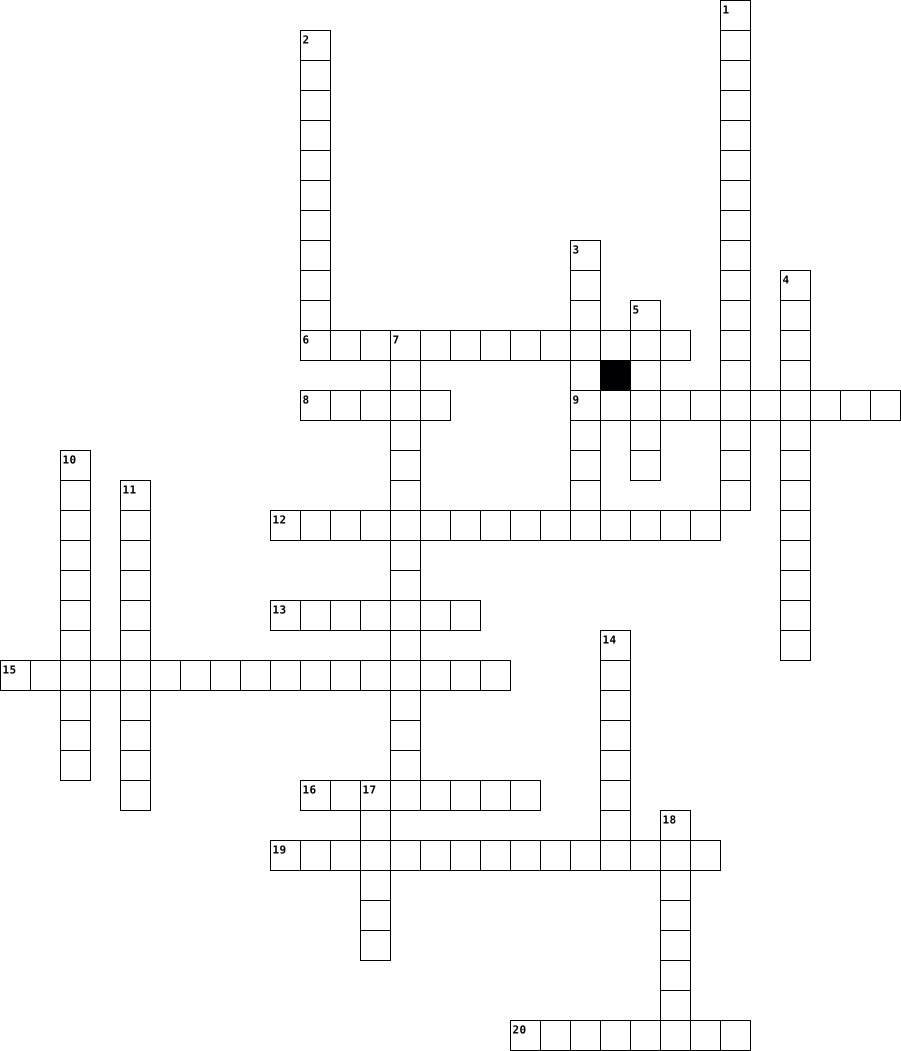
Across
- the amount of a substance in a defined space
- a measure of how much reactant is consumed, or how much product is produced, by the reaction in a given amount of time
- a state in which opposing forces or influences are balanced
- when the reactants move toward the products
- when chemicals move against each other
- the rate of change of free energy of a thermodynamic system with respect to the change in the number of atoms or molecules of the species that are added to the system
- the force of all the gas particles
- when the products move toward the reactants
- a substance that speeds up a chemical reaction, or lowers the temperature or pressure needed to start one, without itself being consumed during the reaction
Down
- a process in which one or more substances, also called reactants, are converted to one or more different substances, known as products
- when the reaction is cold
- when the reaction releases heat
- different, not alike
- the amount of space occupied by a sample of matter
- understanding the rates of chemical reactions
- a measure of the average kinetic energy of the atoms or molecules in the system
- the same
- when the reactants and products shift equally
- the capacity to supply heat or do work
- a measure of concentration in terms of the moles
20 Clues: the same • different, not alike • when the reaction is cold • when the reaction releases heat • the force of all the gas particles • when chemicals move against each other • the capacity to supply heat or do work • when the reactants move toward the products • when the products move toward the reactants • the amount of a substance in a defined space • ...
Science Vocab 2023-11-16

Across
- the process in which glucose is broken down to produce energy
- The basic unit of all plants
- the substance that takes part in and undergoes change during a reaction
- the process in which organism’s use sunlight to synthesize food
- H2O
- membrane-bound cell organelles that generate most of the chemical energy needed to power the cell's biochemical reactions
- O2
- The basic unit of all animals
Down
- C6 H12 O6
- the community or group of living organisms that live in and interact with each other
- an usually flattened green outgrowth from the stem of a vascular plan
- the process by which cells derive energy from glucose
- a pigment that gives plants their green color
- a tiny pore in a plant leaf surrounded by a pair of guard cells
- the chemical substances which are formed due to a chemical reaction between two or more chemical substances
- CO2
16 Clues: O2 • H2O • CO2 • C6 H12 O6 • The basic unit of all plants • The basic unit of all animals • a pigment that gives plants their green color • the process by which cells derive energy from glucose • the process in which glucose is broken down to produce energy • a tiny pore in a plant leaf surrounded by a pair of guard cells • ...
Chapter 13 Jack Prystash 2017-10-11

Across
- A substance that accepts hydrogen ions.
- A measure of the acidity of a solution.
- A reaction between an acid and a base
- The deterioration of a metal
- The process by which a reactant gains one or more electrons
Down
- The minimum energy required in order for a chemical reaction to proceed.
- Description of a substance that can behave as either an acid or a base
- The new materials formed in a chemical reaction.
- Description of a chemical reaction in which there is a net absorption of energy
- The process by which a reactant loses one or more electrons
10 Clues: The deterioration of a metal • A reaction between an acid and a base • A substance that accepts hydrogen ions. • A measure of the acidity of a solution. • The new materials formed in a chemical reaction. • The process by which a reactant loses one or more electrons • The process by which a reactant gains one or more electrons • ...
Unit 3 Vocab 2017-02-19

Across
- a new material formed in a chemical reaction.
- a solution in which the solvent is water.
- a multiplier or factor that measures a property.
- to cause a substance to be deposited in solid form from a solution.
- a substance that undergoes change during a reaction.
Down
- the minimum quantity of energy that the reacting species must possess in order to undergo a specified reaction.
- a liquid mixture where the solute is dissolved in the solvent.
- the component in a solution that is dissolved in the solvent.
- the speed at which a chemical reaction proceeds.
- a type of chemical reaction in which two or more simple substances combine to form a complex product.
10 Clues: a solution in which the solvent is water. • a new material formed in a chemical reaction. • the speed at which a chemical reaction proceeds. • a multiplier or factor that measures a property. • a substance that undergoes change during a reaction. • the component in a solution that is dissolved in the solvent. • ...