
chemical reaction Crossword Puzzles
3.2 Key Terms 2021-04-26

Across
- Change of Formation, the energy change that takes place when 1 mole of a compound is formed from its constituent elements in their standard state, under standard conditions
- Change of Reaction, the energy change associated with a given reaction
- Equilibrium, exists in a closed system when the rate of the forward reaction is equal to the rate of the reverse reaction
- Distribution, the distribution of energies of molecules at a particular temperature, often shown as a graph
- Bond Enthalpy, the mean energy needed for 1 mole of a given type of gaseous bonds to undergo homolytic fission
- Chateliers Principle, when a system in dynamic equilibrium is subjected to a change, the position of equilibrium will shift to minimise the change
- a diagram of a reaction that allows you to compare the enthalpy of the reactants with the products
- Change of Neutralisation, the energy change associated with the formation of 1 mole of water from a neutralisation reaction, under standard conditions
- the energy change that takes place when 1 mole of a substance is completely combusted, under standard conditions
- a catalyst used in a reaction which is in the same phase as the reactant
Down
- of Reaction, the change in concentration of a reactant or product in a given time
- a reaction in which the enthalpy of the products is smaller than the enthalpy of the reactants (9)
- Energy, the minimum energy required to start a reaction by breaking bonds in the reactants
- a reaction in which the enthalpy of the products is greater than the enthalpy of the reactants (10)
- Law, states that the enthalpy change in a chemical reaction is independent of the route it takes
- a catalyst used in a reaction which is in a different phase to the reactants
- the quantitative study of energy change in a chemical reaction
- Heat Capacity, the energy required to raise 1g of a substance by 1K
- Constant, gives the position of where equilibrium lays, by giving the ratio between products and reactants
19 Clues: the quantitative study of energy change in a chemical reaction • Heat Capacity, the energy required to raise 1g of a substance by 1K • Change of Reaction, the energy change associated with a given reaction • a catalyst used in a reaction which is in the same phase as the reactant • a catalyst used in a reaction which is in a different phase to the reactants • ...
Unit 4 Vocabulary 2019-04-04

Across
- A chemical formula that shows the number and kinds of atoms in a molecule
- The calculation of quantities in chemical reactions
- A method of writing or displaying numbers in terms of a decimal number between 1 and 10 multiplied by a power of 10.
- Matter is not created nor destroyed in any chemical or physical change (must balance reaction equations to show this)
- A reactant that is totally consumed during a chemical reaction, limits the extent of the reaction, and determines the amount of product.
- a conversion factor from the coefficients of a balanced chemical equation
- A measurement of how much solute exists within a certain volume of solvent
Down
- the percent by mass of each element in a compound
- unit of concentration: moles of solute/liters of solution
- a technique of problem-solving that uses the units that are part of a measurement to help solve the problem
- the percent by mass of a component of a mixture or of a given element in a compound
- a chemical formula showing the smallest whole number ratio of elements in a compound rather than the total number of atoms
- mass of one mole of a substance (units g/mol)
13 Clues: mass of one mole of a substance (units g/mol) • the percent by mass of each element in a compound • The calculation of quantities in chemical reactions • unit of concentration: moles of solute/liters of solution • A chemical formula that shows the number and kinds of atoms in a molecule • a conversion factor from the coefficients of a balanced chemical equation • ...
Chemical Reactions and Equations 2024-05-12

Across
- Substances that take part in a chemical reaction.
- A more reactive metal displaces a less reactive metal from its salt solution.
- Oxidation and Reduction of reactants taking place simultaneously.
- Decomposition by passage of electric current.
- Substances formed during a chemical reaction.
- Slow Oxidation of Fats and Oils, resulting in foul odour and taste.
- Energy is released along with formation of products.
- Process in which the original substance loses its nature and identity to form new substance(s) with different properties.
Down
- Decomposition in the presence of sunlight.
- Energy in the form of heat, light or electricity is absorbed to break down the reactants.
- Single reactant breaks down to give simpler products.
- Denotes that the reactant or product is present as a solution in water.
- Deterioration of a metal caused by the action of substances like moisture and acids in its surroundings.
- Mutually exchanged during a double displacement reaction.
- Decomposition by heating.
- Several reactants combine to form a single product.
16 Clues: Decomposition by heating. • Decomposition in the presence of sunlight. • Decomposition by passage of electric current. • Substances formed during a chemical reaction. • Substances that take part in a chemical reaction. • Several reactants combine to form a single product. • Energy is released along with formation of products. • ...
Chapter 13 Crossword Lyndi Williamson 2019-10-06

Across
- The amount of energy required to pull the bonded atoms apart
- Type of reaction when there is a net release of energy
- Type of reaction when there is a net absorption of energy
- The minimum energy required to overcome the initial breaking of bonds in reactants
- A chemical that accepts a hydrogen ion
Down
- One or more new compounds are formed as a result of the rearrangement of atoms
- How quickly we can turn the reactive side into the product side
- A chemical that donates a hydrogen ion
- A substance that lowers the activation energy of a chemical reaction, which allows for the reaction to proceed at a faster rate
- When reaction and its reverse act at the same rate
10 Clues: A chemical that donates a hydrogen ion • A chemical that accepts a hydrogen ion • When reaction and its reverse act at the same rate • Type of reaction when there is a net release of energy • Type of reaction when there is a net absorption of energy • The amount of energy required to pull the bonded atoms apart • ...
Chem Unit 2 Vocab 2023-10-19

Across
- The amount of matter does not change during a chemical reaction, only that the atoms are rearranged to form new substances. This is evidenced in a balanced chemical equation.
- Smallest particle in a chemical element or compound that has the chemical properties of that element.
- a negatively charged subatomic particle found outside of the nucleus of the atom
- pure substances that are composed of two or more types of elements that are chemically combined
- Mixture is not uniform throughout, the component substances can be visibly distinguished
Down
- a subatomic particle with no charge (neutral) found in the nucleus of the atom.
- a positive subatomic particle found in the nucleus of an atom.
- new substances formed in a chemical reaction and that they are located on the right side of the arrow in a chemical equation.
- Simplest form of a pure substance that cannot be broken into anything else by physical or chemical means.
- Mixture is uniform throughout, the substances are evenly mixed and cannot be visibly distinguished
- substances broken apart or combined in a chemical reaction and that they are located on the left side of the arrow in a chemical equation
- physical combinations of two or more different substances that retain their own individual properties and are combined physically (mixed together)
12 Clues: a positive subatomic particle found in the nucleus of an atom. • a subatomic particle with no charge (neutral) found in the nucleus of the atom. • a negatively charged subatomic particle found outside of the nucleus of the atom • Mixture is not uniform throughout, the component substances can be visibly distinguished • ...
Vocab 2 2023-10-02

Across
- The amount of matter does not change during a chemical reaction, only that the atoms are rearranged to form new substances. This is evidenced in a balanced chemical equation
- Smallest particle in a chemical element or compound that has the chemical properties of that element
- pure substances that are composed of two or more types of elements that are chemically combined
- a negatively charged subatomic particle found outside of the nucleus of the atom
- physical combinations of two or more different substances that retain their own individual properties and are combined physically (mixed together)
Down
- a subatomic particle with no charge (neutral) found in the nucleus of the atom
- is uniform throughout, the substances are evenly mixed and cannot be visibly distinguished
- a positive subatomic particle found in the nucleus of an atom
- new substances formed in a chemical reaction and that they are located on the right side of the arrow in a chemical equation
- Simplest form of a pure substance that cannot be broken into anything else by physical or chemical means
- is not uniform throughout, the component substances can be visibly distinguished
- substances broken apart or combined in a chemical reaction and that they are located on the left side of the arrow in a chemical equation
12 Clues: a positive subatomic particle found in the nucleus of an atom • a subatomic particle with no charge (neutral) found in the nucleus of the atom • is not uniform throughout, the component substances can be visibly distinguished • a negatively charged subatomic particle found outside of the nucleus of the atom • ...
vocab 2 2023-10-02

Across
- is not uniform throughout, the component substances can be visibly distinguished
- substances broken apart or combined in a chemical reaction and that they are located on the left side of the arrow in a chemical equation
- physical combinations of two or more different substances that retain their own individual properties and are combined physically (mixed together)
- of mass - The amount of matter does not change during a chemical reaction, only that the atoms are rearranged to form new substances. This is evidenced in a balanced chemical equation.
- Smallest particle in a chemical element or compound that has the chemical properties of that element.
- pure substances that are composed of two or more types of elements that are chemically combined
Down
- is uniform throughout, the substances are evenly mixed and cannot be visibly distinguished
- a negatively charged subatomic particle found outside of the nucleus of the atom
- a positive subatomic particle found in the nucleus of an atom.
- new substances formed in a chemical reaction and that they are located on the right side of the arrow in a chemical equation.
- a subatomic particle with no charge (neutral) found in the nucleus of the atom.
- Simplest form of a pure substance that cannot be broken into anything else by physical or chemical means.
12 Clues: a positive subatomic particle found in the nucleus of an atom. • is not uniform throughout, the component substances can be visibly distinguished • a negatively charged subatomic particle found outside of the nucleus of the atom • a subatomic particle with no charge (neutral) found in the nucleus of the atom. • ...
Chemistry U2 Vocab 2023-10-02

Across
- Mixture is not uniform throughout, the component substances can be visibly distinguished
- of conservation of mass The amount of matter does not change during a chemical reaction, only that the atoms are rearranged to form new substances. This is evidenced in a balanced chemical equation.
- pure substances that are composed of two or more types of elements that are chemically combined
- new substances formed in a chemical reaction and that they are located on the right side of the arrow in a chemical equation.
- substances broken apart or combined in a chemical reaction and that they are located on the left side of the arrow in a chemical equation
- physical combinations of two or more different substances that retain their own individual properties and are combined physically (mixed together)
Down
- Simplest form of a pure substance that cannot be broken into anything else by physical or chemical means.
- a negatively charged subatomic particle found outside of the nucleus of the atom
- Smallest particle in a chemical element or compound that has the chemical properties of that element.
- Mixture is uniform throughout, the substances are evenly mixed and cannot be visibly distinguished
- a subatomic particle with no charge (neutral) found in the nucleus of the atom.
- a positive subatomic particle found in the nucleus of an atom.
12 Clues: a positive subatomic particle found in the nucleus of an atom. • a negatively charged subatomic particle found outside of the nucleus of the atom • a subatomic particle with no charge (neutral) found in the nucleus of the atom. • Mixture is not uniform throughout, the component substances can be visibly distinguished • ...
Unit 2 Dalton Johns 2023-04-04

Across
- makes up the cell membrane
- when combined it makes organs
- special proteins
- water loving
- in all living things molecules combined into
- occurs when cells spend ATP to move molecules
- method of moving across the membrane that doesn't use ATP
- allows certain molecules in or out of the cell
Down
- naturally moves clustered molecules
- what comes out of a chemical reaction
- tissue is combined to make
- combined atoms make
- basic units of life
- water fearing
- required for reactions of the metabolism
- a region on enzymes called the
- the start of a chemical reaction
- all things are made up of
- when proteins unfold or break down
- made up of organs
- diffusion of water across membrane
- the organ system an
22 Clues: water loving • water fearing • special proteins • made up of organs • combined atoms make • basic units of life • the organ system an • all things are made up of • makes up the cell membrane • tissue is combined to make • when combined it makes organs • a region on enzymes called the • the start of a chemical reaction • when proteins unfold or break down • ...
Unit 2 Puzzle 2023-10-04

Across
- all living things on earth
- oxygen is present
- site of steps 2 and 3 of aerobic cellular respiration
- substances created during a chemical reaction
- all the water on the earth
- all the gases surrounding earth
- type of organism that can make its own food
- organelle, site of photosynthesis
- two types, second step of anaerobic respiration
Down
- adenosine diphosphate
- type of organism that must eat other organisms
- all rocks/soil on earth
- anything with mass and takes up space
- types of organism that breaks down biotic compounds, recycler
- first step of aerobic respiration
- substances at the beginning of a chemical reaction
- process of using light energy to move glucose
- nutrient, used in proteins and nucleic acids
- adenosine triphosphate
- pigment in chloroplasts
20 Clues: oxygen is present • adenosine diphosphate • adenosine triphosphate • all rocks/soil on earth • pigment in chloroplasts • all living things on earth • all the water on the earth • all the gases surrounding earth • first step of aerobic respiration • organelle, site of photosynthesis • anything with mass and takes up space • type of organism that can make its own food • ...
Química 2023-11-19

Across
- Mixture of liquids that has a constant composition and a constant boiling point.
- base: Chemical reaction between an acid and a base that results in the formation of water and a salt.
- aspirator: Device used to aspirate liquids from a pipette.
- A substance that releases hydrogen ions in aqueous solution and has a pH less than 7.
- coat: Garment worn in laboratories to protect clothing and skin.
- bond: Type of chemical bond that forms between atoms with significant differences in electronegativity, resulting in the transfer of electrons and the formation of charged ions.
- Description of the properties and characteristics of a substance without precise numerical measurement.
- Process in which a gas turns into liquid by losing heat.
- Process in which molecules or ions adhere to the surface of a solid.
- Substance that has a limited capacity to ionize or dissociate in aqueous solution.
- Instrument used to measure precise volumes of liquids in the laboratory.
- Homogeneous mixture of two or more substances, where one is dispersed in the other at a molecular level.
- Material that allows the passage of electricity or heat.
- Chemical reaction in which a molecule decomposes into two different products.
- Process in which a compound separates into ions when dissolved in a solvent.
- Substance that can cause damage or destruction to other materials.
- Atom in a molecule that donates a pair of electrons in a chemical reaction.
Down
- Substance that accepts hydrogen ions in aqueous solution and has a pH greater than 7.
- Process in which the skin or any other material flakes off in thin layers.
- Molecule formed by the bonding of a metal ion and ligands.
- Method of separating liquid substances by evaporation and subsequent condensation of their components.
- Container used for the crystallization of a substance.
- atom: Atom in a molecule that donates a pair of electrons in a chemical reaction.
- Instrument used to measure the mass of an object.
- atom: Atom in a molecule that is bonded to several other atoms.
- Process in which a solid forms from an oversaturated solution.
- Material that does not allow easy passage of electricity or heat.
- Backless chair used in laboratories.
- pump: Device used to create vacuum by removing air from a closed space.
- Chemical bond between a metal ion and ligands.
30 Clues: Backless chair used in laboratories. • Chemical bond between a metal ion and ligands. • Instrument used to measure the mass of an object. • Container used for the crystallization of a substance. • Process in which a gas turns into liquid by losing heat. • Material that allows the passage of electricity or heat. • ...
Chemical Reactions 2024-04-29

Across
- Process where atoms are rearranged into new molecules to form a new substance (2 words)
- When two or more atoms are connected
- Number telling how many of a molecule are in the reaction
- Characteristics only observed by changing the arrangement of atoms in the substance (2 words)
- Substances that go into a chemical reaction
- Characteristics observed without changing the type of atoms in the substance (2 words)
- Chemical equations must be ________ with the same number of each atom on both sides of the equation
- The Law of ________ of Matter states that matter cannot be created or destroyed
- Substances that exist at the end of the reaction
Down
- Number telling how many of each atom is in a molecule
- Two or more atoms of different elements bonded together
- Two or more non-metal atoms bonded together
- Characteristics of a substance
- Everything that has mass and takes up space
- One or more letters representing an element (2 words)
- Drawn between the reactants and products showing the direction of the reaction
16 Clues: Characteristics of a substance • When two or more atoms are connected • Two or more non-metal atoms bonded together • Everything that has mass and takes up space • Substances that go into a chemical reaction • Substances that exist at the end of the reaction • Number telling how many of each atom is in a molecule • One or more letters representing an element (2 words) • ...
Materials Science Crossword 2020-12-16

Across
- If a material absorbs a lot of water, you can say it is ....................
- Mixing bicarbonate of soda with vinegar is a .............reaction and gas is produced.
- When water turns into water vapour it.........
- A chemical reaction is .................
- Small grains of sugar dissolve .......... than large grains of sugar.
Down
- This kind of reaction is reversible.
- Salt and sugar are ...............in water.
- This material can be rigid or flexible.
- Sugar .............. in water.
- Burning is a ..........reaction.
- water vapour is a kind of ......
- When you only change one variable an experiment is ......
- When ice turns to water it ......
13 Clues: Sugar .............. in water. • Burning is a ..........reaction. • water vapour is a kind of ...... • When ice turns to water it ...... • This kind of reaction is reversible. • This material can be rigid or flexible. • A chemical reaction is ................. • Salt and sugar are ...............in water. • When water turns into water vapour it......... • ...
Materials Science Crossword 2020-12-16

Across
- If a material absorbs a lot of water, it is an ............... material.
- Mixing bicarbonate of soda with vinegar is a .............reaction and gas is produced.
- When water turns into water vapour it.........
- A chemical reaction is .................
- Small grains of sugar dissolve .......... than large grains of sugar.
Down
- This kind of reaction is reversible.
- Salt and sugar are ...............in water.
- This material can be rigid or flexible.
- Sugar .............. in water.
- Burning is a ..........reaction.
- water vapour is a kind of ......
- When you only change one variable an experiment is ......
- When ice turns to water it ......
13 Clues: Sugar .............. in water. • Burning is a ..........reaction. • water vapour is a kind of ...... • When ice turns to water it ...... • This kind of reaction is reversible. • This material can be rigid or flexible. • A chemical reaction is ................. • Salt and sugar are ...............in water. • When water turns into water vapour it......... • ...
Chem Vocab Unit 6 2015-11-02

Across
- an equation representing only the substances which react in a chemical reaction
- when two substances come together chemically to make one
- a reaction resulting water and CO2
- when the reactants don't change
- the rate at which a solid dissolves
- when one substance chemically separates into two
- dissolved in water
- the ability for a substance to dissolve in an solute
- a chemical reaction where two substances transfer electrons
Down
- when one compound is replaced by part of another
- matter can not be created or destroyed
- two compounds exchange ions
12 Clues: dissolved in water • two compounds exchange ions • when the reactants don't change • a reaction resulting water and CO2 • the rate at which a solid dissolves • matter can not be created or destroyed • when one compound is replaced by part of another • when one substance chemically separates into two • the ability for a substance to dissolve in an solute • ...
Unit 2 Vocab 2023-02-16

Across
- - attraction between molecules of the same substance
- - a compound that produces hydroxide ions (OH-) in solution; a solution with a pH of more than 7
- - mixture of water and nondissolved material
- - molecules composed of many monomers; makes up macromolecules
- - dissolving substance in a solution
- - pure substance that consists entirely of one type of atom
- - negatively charged particle; located in the space surrounding the nucleus
- - elements or compounds produced by a chemical reaction
- - smallest unit of most compounds that displays all the properties of that compound
- - subunit of which nucleic acids are composed; made up of a 5-carbon sugar, a phosphate group, and a nitrogenous base
- - elements or compounds that enter into a chemical reaction
- - a compound that forms hydrogen ions (H+) in solution; a solution with a pH of less than 7
Down
- - the center of an atom, which contains the protons and neutrons
- - compound made up of carbon, hydrogen, and oxygen atoms; type of nutrient that is the major source of energy for the body
- - force of attraction between different kinds of molecules
- - macromolecule that contains carbon, hydrogen, oxygen and nitrogen; needed by the body for growth and repair
- - reactant of an enzyme-catalyzed reaction
- - one of several forms of a single element, which contains the same number of protons but different numbers of neutrons
- - protein catalyst that speeds up the rate of specific biological reactions
- - substance that is dissolved in a solution
- - small chemical unit that makes up a polymer
- - the basic unit of matter
- - substance formed by the chemical combination of two or more elements in definite proportions
- - a compound that prevents sharp, sudden changes in pH
- - material composed of two or more elements or compounds that are physically mixed together but not chemically combined
- - type of mixture in which all the components are evenly distributed
- - substance that speeds up the rate of a chemical reaction
- - macromolecule made mostly from carbon and hydrogen atoms; includes fats, oils, and waxes
28 Clues: - the basic unit of matter • - dissolving substance in a solution • - reactant of an enzyme-catalyzed reaction • - substance that is dissolved in a solution • - mixture of water and nondissolved material • - small chemical unit that makes up a polymer • - attraction between molecules of the same substance • - a compound that prevents sharp, sudden changes in pH • ...
Science Whiz 2023-04-27

Across
- A physical method used to separate mixtures
- The small (offset) number that tells the number of atoms of an element in each molecule
- A mixture of larger particles that are visible and will separate out
- Which type of bond is described as electrons in a matrix of positively charged atoms
- What is the Universal Solvent
- Metals are elements that will _____ electrons
- Which type of electron occupies the outermost energy level or shell of an atom?
- An atom that has a positive or negative electrical charge
- Substance (2words) what does a chemical change always result in
- The number in front of the molecules symbol which indicates the number of molecules of a substance
- The largest amount of a solute that can dissolve in a certain amount of solvent
- A homogeneous mixture of larger particles that remain suspended but form lumpy or fluffy masses when vinegar is added
- The solubility of a solute is the largest amount of solute that can dissolve in a certain quantity of ____
- A metal such as copper or silver is transferred from one surface to another using electric current
- An atom with a positive charge
Down
- An atom with a negative charge
- A solid that forms as a result of a chemical reaction when two solutions are mixed.
- The periodic table is organized so that atoms of elements with the same number of valence electrons are in _____
- Are broken in existing molecules or compounds
- Nonmetals are elements that will _____ electrons
- Which type of bond is responsible for the attraction of one water molecule to another
- Homogeneous mixture formed when substances dissolve
- The result ( new substance)from a chemical reaction
- Are bonds within a molecule, that hold the molecule together
- What compounds are formed from two nonmetals
- A reaction of a substance with oxygen to form an oxide with heat and light (fire) also burning
- Electric current is passed through a substance to effect a chemical change
- How many valence electrons do most elements want?
- The original substance in a chemical reaction either disappears or diminishes
- Dissolved in the solvent
30 Clues: Dissolved in the solvent • What is the Universal Solvent • An atom with a negative charge • An atom with a positive charge • A physical method used to separate mixtures • What compounds are formed from two nonmetals • Are broken in existing molecules or compounds • Metals are elements that will _____ electrons • Nonmetals are elements that will _____ electrons • ...
chemical reactions Casandra McCullough Burkholder science 2017-10-03

Across
- a substance that lowers the activation of energy of a chemical reaction, which allows for the reaction to proceed at a faster rate
- bond energy is also known as this.
- in this reaction, there is a net release of energy.
- law that states no atoms are gained or lost during any reaction
- how quickly the concentration of the reactants decreases and how quickly the concentration of products increases
Down
- in this reaction, there is a net absorption of the energy.
- is a chemical that donates a hydrogen ion
- __ may collide without enough force to break the bonds
- during __ one or more new compounds are formed as a result of the rearrangement of atoms
- is a chemical that accepts a hydrogen ion
10 Clues: bond energy is also known as this. • is a chemical that donates a hydrogen ion • is a chemical that accepts a hydrogen ion • in this reaction, there is a net release of energy. • __ may collide without enough force to break the bonds • in this reaction, there is a net absorption of the energy. • law that states no atoms are gained or lost during any reaction • ...
Chemistry 5.02 2022-05-28

Across
- has a pH of 7
- element found in all acids
- used to check pH level, indicator
- ions found in a alkali solution
- chemical symbol K
- pH above 7
- bond which consists of sharing electrons
- high concentration in a solution
- main topic key word
- chemical symbol NH
Down
- pH less than 7
- a mixture
- color acid becomes on the pH scale
- ions found in a acid solution
- color alkali becomes on the pH scale
- low concentration in a solution
- word used when something happens in a experiment
- way to know if it is a alkali solution
- bond which includes electrostatic attraction
- chemical symbol Na
- chemical symbol Ca
21 Clues: a mixture • pH above 7 • has a pH of 7 • pH less than 7 • chemical symbol K • chemical symbol Na • chemical symbol Ca • chemical symbol NH • main topic key word • element found in all acids • ions found in a acid solution • ions found in a alkali solution • low concentration in a solution • high concentration in a solution • used to check pH level, indicator • ...
Thermochemistry 2022-05-24

Across
- device used to measure heat
- sum of kinetic and potential energy
- the quantity of heat needed to raise the temperature
- the SI unit of energy
- the change in enthalpy
- non SI unit of energy
- standard thermodynamics
- a system that depends on its present state
- a chemical or physical reaction were heat is involved
- a chemical or physical reaction were heat is absorbed
- energy that flows with difference of temperature
Down
- an extensive property of a substance
- the quantity of heat needed to raise constant pressure
- energy associated with an object's movement
- the energy required by a system to change
- the potential to move matter
- the value of q
- the stablest form
- two more distinct forms of energy
- the energy an object has by position
20 Clues: the value of q • the stablest form • the SI unit of energy • non SI unit of energy • the change in enthalpy • standard thermodynamics • device used to measure heat • the potential to move matter • two more distinct forms of energy • sum of kinetic and potential energy • the energy an object has by position • an extensive property of a substance • ...
UNIT 2 2022-09-29

Across
- sphere of earth, all the gases surrounding earth
- process of using light energy to make glucose
- second step of aerobic respiration
- describes a situation in which oxygen is present
- substances at the beginning of a chemical reaction
- sphere of earth, all living things on earth
- adenosine triphosphate
- first step of aerobic respiration
- pigment in chloroplast
- substances created during a chemical reaction
Down
- second step of photosynthesis
- first step of photosynthesis
- process of breaking down glucose to make ATP
- sphere of earth, all soil and rocks
- adenosine phosphate
- anything that has mass and takes up space
- second step of anaerobic respiration
- organelle-site of photosynthesis
- nutrient used in phosphates of nucleic acids
- sphere of earth, all water on earth
20 Clues: adenosine phosphate • adenosine triphosphate • pigment in chloroplast • first step of photosynthesis • second step of photosynthesis • organelle-site of photosynthesis • first step of aerobic respiration • second step of aerobic respiration • sphere of earth, all soil and rocks • sphere of earth, all water on earth • second step of anaerobic respiration • ...
Administration of Medication 2013-08-16

Across
- inherited bleeding disorder caused by a clotting deficiency
- part of label with prescription symbol
- serious allergic reaction
- shows on label, name and dose of drug
- chemical used in treatment or diagnosis of disease
- sealed glass container holding single dose
- fluids, medications or nutrients into vein
- part of label showing doses and directions
- whole blood through the veins
Down
- chemical used to treat disease
- indicates what to put on medication label
- quantity of drug given at one time
- restricted drugs subject for abuse
- physician order to pharmacist
- substance capable of causing allergic reaction
- Nutrients entered to the GI through a tube
- closed glass container with rubber stopper
- an area of hardened tissue
- small raised area on skin
- medication through injection
20 Clues: serious allergic reaction • small raised area on skin • an area of hardened tissue • medication through injection • physician order to pharmacist • whole blood through the veins • chemical used to treat disease • quantity of drug given at one time • restricted drugs subject for abuse • shows on label, name and dose of drug • part of label with prescription symbol • ...
Station Labs Crossword 2022-10-18

Across
- type of energy used in photosynthesis
- the process by which plants make their food
- what plants create during photosynthesis
- a substance that changes during a chemical reaction
Down
- what plants use during photosynthesis (gas)
- organelle which contains chlorophyll
- type of reaction in photosynthesis
- the finished portion of a chemical reaction
- what plants release after photosynthesis
- where the plant absorbs sunlight
10 Clues: where the plant absorbs sunlight • type of reaction in photosynthesis • organelle which contains chlorophyll • type of energy used in photosynthesis • what plants release after photosynthesis • what plants create during photosynthesis • what plants use during photosynthesis (gas) • the process by which plants make their food • the finished portion of a chemical reaction • ...
Science vocab 2014-11-09

Across
- The smallest compound of an element which can normally exist by itself and still have that properties of that element.
- An ion with a positive electric charge. An atom which has lost one or more electrons.
- A solid which forms and settles into a solution.
- compound A compound made up of ions.
- The substances that change as a result of a chemical change.
- A substance containing two or more elements which have been chemically combined.
- compound A compound made up of molecules; the molecules consist of atoms that are linked by sharing electrons.
- A charged particle;an atom or group of atoms which has lost or gained electrons.
Down
- A way of describing the composition of a substance,using symbols and numbers.
- reaction A reaction that absorbs energy in the from of heat
- The substances formed as a result of a chemical change.
- energy The energy needed for a reaction to occur.
- reaction An energy that releases energy in the form of heat.
- An ion with a negative electric charge. An atom which has gained one or more electrons.
- The way chemists write down chemical reactions,using the symbols and formula of the chemicals taking part.
15 Clues: compound A compound made up of ions. • A solid which forms and settles into a solution. • energy The energy needed for a reaction to occur. • The substances formed as a result of a chemical change. • reaction A reaction that absorbs energy in the from of heat • reaction An energy that releases energy in the form of heat. • ...
Atoms: The Building Block Of Matter 2018-11-26

Across
- a radioactive form of an element.
- a substance that takes part in and undergoes change during a reaction.
- when two elements combine in more than one proportion to form two or more compounds the weights of one element that combine with a given weight of the other element are in the ratios of small whole numbers.
- a strong attractive force between nucleons in the atomic nucleus that holds the nucleus together.
- plum pudding model
- a distinct kind of atom or nucleus characterized by a specific number of protons and neutrons.
- a coherent, typically large body of matter with no definite shape.
Down
- law of constant composition states that a given chemical compound always contains its component elements in fixed ratio (by mass) and does not depend on its source and method of preparation.
- a beam of electrons emitted from the cathode of a high-vacuum tube.
- a stable subatomic particle occurring in all atomic nuclei, with a positive electric charge equal in magnitude to that of an electron, but of opposite sign.
- the total number of protons and neutrons in a nucleus.
- a subatomic particle of about the same mass as a proton but without an electric charge, present in all atomic nuclei except those of ordinary hydrogen.
- the number of protons in the nucleus of an atom, which determines the chemical properties of an element and its place in the periodic table.
- "father of modern science".
- a stable subatomic particle with a charge of negative electricity, found in all atoms and acting as the primary carrier of electricity in solids.
- occupies space and possesses rest mass, especially as distinct from energy.
- the basic unit of a chemical element.
- a substance that is formed as the result of a chemical reaction.
- reaction/ process that involves rearrangement of the molecular or ionic structure of a substance, as opposed to a change in physical form or a nuclear reaction.
- the theory that matter consists of indivisible particles called atoms and that atoms of a given element are all identical and can neither be created nor destroyed.
20 Clues: plum pudding model • "father of modern science". • a radioactive form of an element. • the basic unit of a chemical element. • the total number of protons and neutrons in a nucleus. • a substance that is formed as the result of a chemical reaction. • a coherent, typically large body of matter with no definite shape. • ...
Mole and Stoichiometry Crossword 2022-05-20

Across
- standard sets of conditions for experimental measurements to be established to allow comparisons to be made between different sets of data.
- 6.02214076 x 10^23 of some chemical unit.
- a reactant present in an amount in excess of that required to combine with all of the limiting reactants.
- the relationship between the relative quantities of substances taking part in a reaction or forming a compound.
- the concentration of a solution measured as the number of moles of solute per liter of solution.
- 6.02214 x 10^23 mol^-1
- the maximum amount of product that could be formed from the given amounts of reactants.
- the amount of a substance dissolved in a certain mass of solvent.
- the amount of product that is actually formed when the reaction is carried in the laboratory.
- an arithmetical multiplier for converting a quantity expressed in one set of units into an equivalent expressed in another.
Down
- tells you by mass what percent of each element is present in a compound.
- the percent ratio of actual yield to the theoretical yield.
- the reactant that gets consumed first in a chemical reaction and therefore limits how much product can be formed.
- a conversion factor between compounds in a chemical reaction that is derived from the coefficients of the compounds in a balanced equation.
- the smallest unit in which a substance naturally exists.
- the volume of 1 mole of a substance.
- the simplest whole number ratio of atoms present in a compound.
- the mass of a sample of a chemical compound divided by the amount of substance in that sample, measured in moles.
18 Clues: 6.02214 x 10^23 mol^-1 • the volume of 1 mole of a substance. • 6.02214076 x 10^23 of some chemical unit. • the smallest unit in which a substance naturally exists. • the percent ratio of actual yield to the theoretical yield. • the simplest whole number ratio of atoms present in a compound. • the amount of a substance dissolved in a certain mass of solvent. • ...
Endo/Exo 2023-12-01

Across
- Needed to break bonds
- absorbes heat
- When two or more elements mix together
Down
- A source of energy
- a substance that takes part in and undergoes change during a reaction
- Joined by a chemical reaction
- A process in which a chemical substance changes because of the addition of oxygen
- releases heat
- Substance reacts with oxygen and gives off heat
- To separate
10 Clues: To separate • absorbes heat • releases heat • A source of energy • Needed to break bonds • Joined by a chemical reaction • When two or more elements mix together • Substance reacts with oxygen and gives off heat • a substance that takes part in and undergoes change during a reaction • A process in which a chemical substance changes because of the addition of oxygen
Science Vocab 2 2023-10-02

Across
- Simplest form of a pure substance that cannot be broken into anything else by physical or chemical means.
- - a negatively charged subatomic particle found outside of the nucleus of the atom
- - physical combinations of two or more different substances that retain their own individual properties and are combined physically (mixed together)
- - a subatomic particle with no charge (neutral) found in the nucleus of the atom.
- of conservation of mass - The amount of matter does not change during a chemical reaction, only that the atoms are rearranged to form new substances. This is evidenced in a balanced chemical equation.
- - pure substances that are composed of two or more types of elements that are chemically combined
- Mixture - is uniform throughout, the substances are evenly mixed and cannot be visibly distinguished
Down
- Mixture - is not uniform throughout, the component substances can be visibly distinguished
- - new substances formed in a chemical reaction and that they are located on the right side of the arrow in a chemical equation.
- - substances broken apart or combined in a chemical reaction and that they are located on the left side of the arrow in a chemical equation
- - a positive subatomic particle found in the nucleus of an atom.
- Smallest particle in a chemical element or compound that has the chemical properties of that element.
12 Clues: - a positive subatomic particle found in the nucleus of an atom. • - a negatively charged subatomic particle found outside of the nucleus of the atom • - a subatomic particle with no charge (neutral) found in the nucleus of the atom. • Mixture - is not uniform throughout, the component substances can be visibly distinguished • ...
Reactions & Enzymes 2024-02-05

Across
- reactant of an enzyme-catalyzed reaction
- substance that speeds up a chemical reaction
- process that changes one set of chemicals into another set
- elements or compounds that are produced by a chemical reaction
- protein catalyst
Down
- energy needed to start a chemical reaction
- elements or compounds that enter into a chemical reaction
7 Clues: protein catalyst • reactant of an enzyme-catalyzed reaction • energy needed to start a chemical reaction • substance that speeds up a chemical reaction • elements or compounds that enter into a chemical reaction • process that changes one set of chemicals into another set • elements or compounds that are produced by a chemical reaction
Chemistry 2013-04-09

Across
- a devicie used to measure energy changes accompnying chemical and physical changes by observing temperature alterations
- energy of mass resulting from its motion
- going from a particular set of reactions to a particular set of products
- the amount of energy required to elevate the temperature of one gram of a substance one degree Celsius
- a property of a system equal to E+PV
- threshold energy that must be overcome to produce a chemical reaction
- the energy required to vaporize one mole of a liquid at a pressure of one atmosphere
Down
- a plot of temperature versus time for a substance where energy is added at a constant rate
- refers to a reaction where energy flows out the system
- change in enthalpy of a chemical reaction that occurs at a constant pressure
- energy due to position or composition
- the enthalpy change that occurs to melt a solid at its melting point
- refers to a reaction where energy flows into the system
- The measure, on any of several scales, of the average kinetic energy of the molecules in a sample of material
14 Clues: a property of a system equal to E+PV • energy due to position or composition • energy of mass resulting from its motion • refers to a reaction where energy flows out the system • refers to a reaction where energy flows into the system • the enthalpy change that occurs to melt a solid at its melting point • ...
Julie 2.1 vocab 2021-10-27

Across
- reaction that gives off thermal energy
- as substance present before a chemical reaction
- absorbs heat energy
- process that changes substances
Down
- process that changes substance into new substance
- formed during a chemical reaction
- matter that does not effect its chemical composition
- solid,liquid,gas
8 Clues: solid,liquid,gas • absorbs heat energy • process that changes substances • formed during a chemical reaction • reaction that gives off thermal energy • as substance present before a chemical reaction • process that changes substance into new substance • matter that does not effect its chemical composition
Menu project Ethan King 2023-03-30

Across
- reaction to sunlight
- reaction to touch
- multi pull elements
- element used to fill bloons
- reaction to water
- system in body that digests food
- letter found on periodic table
Down
- graph that shows all elements
- a change that is chemical
- element used in pools
- a change that is physical
- Start of digestive system
- element you inhale
13 Clues: reaction to touch • reaction to water • element you inhale • multi pull elements • reaction to sunlight • element used in pools • a change that is chemical • a change that is physical • Start of digestive system • element used to fill bloons • graph that shows all elements • letter found on periodic table • system in body that digests food
Chemical Change Study Guide 2013-02-27

Across
- When our lava lamps stop bubbling, we can add more of this to make it go again.
- There are this many carbon atoms on each side of the following chemical equation: 2C4H10 + 13O2 ------> 8CO2 + 10H2O.
- The two reactants in our candle burning experiment were methane and __________.
- We represent chemical reactions with __________ equations.
- True or false: the reaction in the cold water bath will produce less product than the reaction in the hot water bath.
- In our lava lamp experiment, alka seltzer reacted with this to form bubbles.
Down
- There is an equal number of atoms on each side of the equation to achieve this.
- In a chemical reaction, bonds in the reactants are broken and the atoms rearrange to form new _________.
- If you place a cover over a burning candle, the flame will go out because you have taken away one of the __________.
- The _________ of matter states that atoms can neither be created nor destroyed.
- In our hot water/cold water bath solutions, calcium carbonate reacted with this to form bubbles.
- Change of state from a liquid to a gas is an example of this kind of change.
- Reactions at higher temperature have more of this.
- Increasing temperature increases the ________ of the reaction.
14 Clues: Reactions at higher temperature have more of this. • We represent chemical reactions with __________ equations. • Increasing temperature increases the ________ of the reaction. • Change of state from a liquid to a gas is an example of this kind of change. • In our lava lamp experiment, alka seltzer reacted with this to form bubbles. • ...
Stoichiometry 2022-05-12

Across
- (yield) the mass of a product actually obtained from the reaction
- a reactant present in an amount in excess of that required to combine with all of the limiting reactant
- the mass in grams of one mole of a substance
- is a conversion factor between compounds in a chemical reaction, that is derived from the coefficients of the compounds in a balanced equation
- standard temperature and pressure
- a standard scientific unit for measuring large quantities of very small entities such as atoms, molecules, or other specified particles.
- a number used to change one set of units to another, by multiplying or dividing
- (yield) the ratio of the actual yield to the theoretical yield
Down
- (yield) the maximum amount of product that could be formed from the given amounts of reactants
- the measure of the quantitative relationship between the products and reactants of a given chemical reaction in terms of their relative ratios of mass or volume
- the mass in grams of one mole of a substance
- 6.02214076 × 10²³
- a chemical formula showing the simplest ratio of elements in a compound rather than the total number of atoms in the molecule
- the reactant that gets consumed first in a chemical reaction and therefore limits how much product can be formed
- ________ composition tells you by mass what percent of each element is present in a compound
- he moles of a solute per liters of a solution.
16 Clues: 6.02214076 × 10²³ • standard temperature and pressure • the mass in grams of one mole of a substance • the mass in grams of one mole of a substance • he moles of a solute per liters of a solution. • (yield) the ratio of the actual yield to the theoretical yield • (yield) the mass of a product actually obtained from the reaction • ...
TTS Metabolisme Xenobiotik Kelompok 3 2026-02-10

Across
- The process of causing DNA changes that can lead to cell dysfunction or cancer.
- Ongoing monitoring for drug side effects and safety problems in real-world use.
- An enzyme that adds oxygen to a chemical to make it easier to process or remove.
- An unhealthy shift in gut microbes that can change how toxins and drugs are handled.
- Recycling of chemicals between the liver and the intestine, which can prolong drug effects.
- A Phase I reaction that removes an alkyl part of a molecule, changing its activity and clearance.
- A chemical that becomes cancer-causing only after the body activates it.
Down
- A reaction that uses water to split a chemical into smaller, often more removable parts.
- Using gene-expression and omics data to understand how toxins affect the body.
- A family of proteins that helps the body break down many drugs and chemicals.
- A Phase I reaction that can create a highly reactive epoxide that may be harmful to cells.
- Very tiny particles that can enter tissues easily and may have unique toxicity risks.
- A Phase I reaction that adds a hydroxyl group, often making a chemical less fat-soluble.
- A natural waste pigment that can build up if detox pathways are impaired.
14 Clues: A chemical that becomes cancer-causing only after the body activates it. • A natural waste pigment that can build up if detox pathways are impaired. • A family of proteins that helps the body break down many drugs and chemicals. • Using gene-expression and omics data to understand how toxins affect the body. • ...
Thermochemistry Vocabulary 2022-12-14

Across
- the branch of chemistry concerned with the quantities of heat evolved or absorbed during chemical reactions.
- the energy possessed by a body by virtue of its position relative to others, stresses within itself, electric charge, and other factors.
- used to measure amounts of heat transferred to or from a substance
- (of a reaction or process) accompanied by the release of heat.
- the energy stored in the chemical bonds of a substance.
- the transfer of kinetic energy from one medium or object to another, or from an energy source to a medium or object.
- The joule is the unit of energy in the International System of Units.
- the strength and vitality required for sustained physical or mental activity.
- an apparatus for measuring the amount of heat involved in a chemical reaction or other process.
- unit of energy equivalent to the heat energy needed to raise the temperature of 1 gram of water by 1 °C (now often defined as equal to 4.1868 joules).
- enthalpy change when 1 mole of a substance burns (combines vigorously with oxygen) under standard state conditions
Down
- that energy can neither be created nor destroyed - only converted from one form of energy to another.
- the heat absorbed by one mole of that substance as it is converted from a solid to a liquid
- the change in the enthalpy of a chemical reaction that occurs at a constant pressure
- energy which a body possesses by virtue of being in motion.
- the heat absorbed by one mole of that substance
- the degree or intensity of heat present in a substance or object, especially as expressed according to a comparative scale and shown by a thermometer or perceived by touch.
- (of a reaction or process) accompanied by or requiring the absorption of heat.
- the heat required to raise the temperature of the unit mass of a given substance by a given amount (usually one degree).
- the change in enthalpy associated with a particular chemical process.
20 Clues: the heat absorbed by one mole of that substance • the energy stored in the chemical bonds of a substance. • energy which a body possesses by virtue of being in motion. • (of a reaction or process) accompanied by the release of heat. • used to measure amounts of heat transferred to or from a substance • ...
VOCABULARY 2024-10-23

Across
- REACTION- ANY CHEMICAL REACTIONS THAT ABSORBS HEAT FROM ITS ENVIRONMENT
- THE PROCESS WHICH SOLUTES ARE PASSED THROUGH THE CONCENTRATION
- FIT- THE ENZYMES SHAPE AND COMFIRMATION CHANGING OVER TIME IN RESPONSE TO SUBSTRATE BINDING
- RESPIRATION- A PROCESS ON WHICH OXYGEN I USED TO MAKE ENERGY FROM CARBOHYDRATES
- PROCESS OF ADDING A CATALYST TO FACILITATE A REACTION
- NET MOVEMENT OF WATER ACROSSS A SEMIPERMEABLE MEMBRANE
- A SUBSTANCE THAT IS DISSOLVED IN A SOLVENT TO CREATE A SOLUTION
- AN EXTERNA SOLUTION THAT HAS THE SAME SOLUTE CONCENTRATION AND WATER CONCENTRATION
- A HOMOGENEOUS MIXTURE OF ONE OR MORE SOLUTES DISSOLVED IN A SOLVENT
- ENERGY- the minimum energy required to cause a process (such as a chemical reaction) to occur.AEROBIC
- THE PROCESS BY WHICH GREEN PLANTS AND OTHER ORGANISM TRANSFORM LIGHT ENERGY INTO CHEMICAL ENERGY
- PROCESS OF CAPTURING SUBSTANCE OR PARTICLE FROM OUTSIDE THE CELL BY ENGULFING WITH THE CELL
- TRANSPORT- AGAINST A CONCENTRATION GRADIENT THAT REQUIRES CHEMICAL ENERGY
Down
- OF ENERGY- ENERGY CAN NEITHER BE CREATED NOR BE DESTROYED
- TRANSPORT- A TYPE OF MEMEBRANE TRANSPORT THAT DOES NOTREQUIRE ENERGY TO MOVE SUBSTANCES ACROSS CELL MEMEBRANE
- REACTION- CHEMICAL REACTIONS THAT RELEASE ENERGY FROM THE CHEMICALS INTO THE SURROUNDINGS
- PUMP- A PROTEIN EMBEDDED IN THE CELL MEMBRANE THAT ACTIVELY TRANSPORTS SODIUM IONS OUT OF THE CELL
- THE PROPERTY MEMBRANE THAT ALLOWS CERTAIN MOLECULES TO PASS THROUGH WHILE BLOCKING OTHERS
- DIFFUSION- THE PASSIVE MOVEMENT OF MOLECULES ALONG THE CONCENTRATION GRADIENT
- THE BASIC BUILDING BLOCKS OF ALL LIVING THINGS
- AND KEY- ENZYME'S ACTIVE SITE AND THE SHAPE OF THE SUBSTRATE MOLECULE ARE COMPLEMENTARY ONE ANOTHER
- A SOLUTION THAT HAS A LOWER CONCENTRATION OF SOLUTE COMPARED THE CELL
- COMPOSED WHOLLY PROTEIN
- OF MATTER- THE FUNDAMENTAL PRINCIPLE THAT MATTER CANNOT BE CREATED OR DESTROYED
- THE SOURCE OF ENERGY FOR USE AND STORAGE AT THE CELLULAR LEVEL
- SOLUTION THAT HAS A LOWER CONCENTRATION OF SOLUTE COMPARED TO THE CELL
- REFLECTING TO INVOLVING, OR REQUIRING AN ABSENCE OF FREE OXYGEN
- OCCURING IN THE PRESENCE OF OXYGEN OR REQUIRING OXYGEN TO LIVE
- TRANSPORT- AGAINST A CONCENTRATION GRADIENT THAT REQUIRES CHEMICAL ENERGY
29 Clues: COMPOSED WHOLLY PROTEIN • THE BASIC BUILDING BLOCKS OF ALL LIVING THINGS • PROCESS OF ADDING A CATALYST TO FACILITATE A REACTION • NET MOVEMENT OF WATER ACROSSS A SEMIPERMEABLE MEMBRANE • OF ENERGY- ENERGY CAN NEITHER BE CREATED NOR BE DESTROYED • THE PROCESS WHICH SOLUTES ARE PASSED THROUGH THE CONCENTRATION • ...
~ Chemistry Crossword ~ 2015-11-19

Across
- they react when exposed to air and water but their reactivity is not as strong as that of the alkali metals.
- Are shiny, malleable, ductile and are good conductors
- Takes place when 2 or more substances combine to form new substances.
- Identifies which elements, and how much of each, are in the compound.
- Chemical reaction that absorbs heat energy
- found in many different types of animal and plant cells, speeds up the breakdown of hydrogen peroxide into harmless oxygen and water.
- is the slow chemical change that occurs when oxygen in the air reacts with a metal
- The new materials produced by the reaction
- Meaning to go and wonder
- have both metallic and non-metallic properties.
- Means below
- without these, many reactions would require much higher temperatures- a situation that would be deadly to the human body.
- common example of corrosion- associated with certain metals (;metal gates, car bumpers etc)
Down
- most reactive metals
- Most reactive non-metals
- Are pure substances formed as a result of the attraction between particles of opposite charges
- sodium bicarbonate
- Horizontal row
- meaning 5
- Is measured by atomic mass unit
- They can be solids, liquids, or gases at room temperature, insulators and or poor conductors of electricity
- are substances that help a reaction proceed faster
- The materials at the start of a reacttion
- Most stable elements
- is a chemical reaction that occurs when oxygen reacts with a substance to form a new substance and give off energy.
25 Clues: meaning 5 • Means below • Horizontal row • sodium bicarbonate • most reactive metals • Most stable elements • Most reactive non-metals • Meaning to go and wonder • Is measured by atomic mass unit • The materials at the start of a reacttion • Chemical reaction that absorbs heat energy • The new materials produced by the reaction • have both metallic and non-metallic properties. • ...
Regents CODE Vocabulary Stoichiometry 2023-03-08

Across
- a reactant that limits the amount of product produced in a chemical reaction
- a formula with the lowest whole-number ratio of elements in a compound
- shows the combination of elements in a molecule or compound
- a group of two or more elements
- when more of a reactant is present than is needed for a reaction
- elements that are usually shiny and conduct electricity well
- the difference between the actual yield and theoretical yield of an experiment, expressed as a percent %
- the mass of one mole of any element or compound
- an ion with an excess positive charge
- elements found along the stairstep that share some properties of both metals and nonmetals
Down
- elements that are usually dull and may be liquids or gas, do not conduct electricity well
- the unit used to measure the mass of individual atoms
- a measure of the ratios of elements in a molecule or compound
- the number of particles in a mole, 6.022X10^23
- a measure of the amount of matter in an object
- an organic group of two or more elements (generally non-metals)
- an ion with an excess negative charge
- the SI unit for the number of particles
- matter is not created nor destroyed, it only changes form
- the amount of product that should be produced by a chemical reaction
- the number of moles of a substance dissolved in 1L of solution (or water)
- the actual amount of a product that is produced by a chemical reaction taking in margin of error
22 Clues: a group of two or more elements • an ion with an excess negative charge • an ion with an excess positive charge • the SI unit for the number of particles • the number of particles in a mole, 6.022X10^23 • a measure of the amount of matter in an object • the mass of one mole of any element or compound • the unit used to measure the mass of individual atoms • ...
CHEMICAL REACTIONS/POTENTIAL & KINETIC ENERGY 2023-04-21

Across
- transfer of thermal energy through waves
- a chemical that makes a chemical reaction happen faster
- substances that are combined to form products
- energy of motion
- the smallest particle of matter
- the degree of compactness of a substance
Down
- transfer of thermal energy through circulation of fluids
- more than 1 atom combined to form a substance
- the result of substances being combined in a chemical reaction
- liquid, solid & gas are the 3 states of
- energy stored in an object due to position
- transfer of thermal energy through direct contact
- what makes stuff happen
13 Clues: energy of motion • what makes stuff happen • the smallest particle of matter • liquid, solid & gas are the 3 states of • transfer of thermal energy through waves • the degree of compactness of a substance • energy stored in an object due to position • more than 1 atom combined to form a substance • substances that are combined to form products • ...
Biology suckz!! (_ _;) 2025-04-11

Across
- organelle where photosynthesis takes place
- type of respiration that does not require oxygen
- a simple sugar that is an important energy source in living organisms
- the process of making energy from sunlight
- type of respiration that requires oxygen
- an organism that gets energy from consuming others
- substances that start a chemical reaction
- the powerhouse of the cell
Down
- substances that are formed from a chemical reaction
- linked chemical processes where energy from one drives another
- process that releases energy by breaking down glucose
- an organism with the ability to create its own food
- an energy currency
13 Clues: an energy currency • the powerhouse of the cell • type of respiration that requires oxygen • substances that start a chemical reaction • organelle where photosynthesis takes place • the process of making energy from sunlight • type of respiration that does not require oxygen • an organism that gets energy from consuming others • ...
Biology suckz!! (_ _;) 2025-04-11

Across
- the powerhouse of the cell
- organelle where photosynthesis takes place
- a simple sugar that is an important energy source in living organisms
- substances that start a chemical reaction
- linked chemical processes where energy from one drives another
- type of respiration that requires oxygen
- substances that are formed from a chemical reaction
- an organism that gets energy from consuming others
Down
- an organism with the ability to create its own food
- process that releases energy by breaking down glucose
- an energy currency
- the process of making energy from sunlight
- type of respiration that does not require oxygen
13 Clues: an energy currency • the powerhouse of the cell • type of respiration that requires oxygen • substances that start a chemical reaction • the process of making energy from sunlight • organelle where photosynthesis takes place • type of respiration that does not require oxygen • an organism that gets energy from consuming others • ...
Science Chp 5 2025-02-18

Across
- the ending materials in a chemical reaction
- whenever bonds between atoms and molecules are created or destroyed
- the reaction happens by itself
- when two or more molecules combine with each other to make a new molecule
Down
- when one atom kicks another atom out of a molecule
- the creation of a solid from a solution during a chemical reaction
- when a molecule decomposes, or breaks apart, into two or more molecules
- when one atom trades places with another atom
- the starting materials in a chemical reaction
9 Clues: the reaction happens by itself • the ending materials in a chemical reaction • when one atom trades places with another atom • the starting materials in a chemical reaction • when one atom kicks another atom out of a molecule • the creation of a solid from a solution during a chemical reaction • whenever bonds between atoms and molecules are created or destroyed • ...
Crossword Thermochemistry 2022-12-13

Across
- energy the energy associated with an object by virtue of its motion.
- energy the energy an object has by virtue of its position in a field of force.
- the study of chemical reactions and the energy changes that involve heat.
- the potential or capacity to move matter.
- the heat content of a system at constant pressure.
- heat of fusion the heat absorbed by one mole of substance as it is converted from a solid to a liquid.
- the quantity of energy needed to raise the temperature of 1 gram of water by 1'c.
- potential energy the energy stored in the chemical bonds of a substance.
Down
- of reaction the change in enthalpy for a reaction at a given temperature and pressure. enthalpy of combustion the heat energy given out when one mole of a substance burns completely in oxygen.
- the energy that flows into or out of a system because of a difference in temperature. temperature the degree or intensity of heat present in a substance or object.
- is used to measure amounts of heat transferred to or from a substance.
- heat the amount of head needed to increase the temperature of 1g of a substance. calorimeter the an insulated device used to measure the absorption.
- heat of vaporization the heat absorbed by one mole of substance as it is converted from a liquid to a gas.
- a chemical reaction or physical change in which heat is absorbed.
- the SI unit of energy, 4.184 J equal one calorie.
- a chemical reaction or physical change in which heat is evolved.
- of conservation of energy energy may be converted from one form to another but total quantity of energy remains constant.
17 Clues: the potential or capacity to move matter. • the SI unit of energy, 4.184 J equal one calorie. • the heat content of a system at constant pressure. • a chemical reaction or physical change in which heat is evolved. • a chemical reaction or physical change in which heat is absorbed. • is used to measure amounts of heat transferred to or from a substance. • ...
67 2026-03-03

Across
- energy
- The metabolism of a cell is the sum of all the chemical reactions occurring in that cell. The chemical reactions manage the amount of energy and materials that are available to that cell.
- is one that absorbs free energy from the surroundings. have products with more stored energy than the reactants of the reaction are typically anabolic reactions.
- are referred to as substrates in a catalysed reaction
- required To start any reaction
- describes the active site as having a set shape. The substrate molecules fit perfectly into active site, like a key in a lock. Once in the active site, the chemical reaction can take place
Down
- is the process of breaking down large molecules into smaller ones. As the bonds break, free energy is released. For example, breaking a polysaccharide, such as starch, into monosaccharide monomers is a catabolic reaction.
- Organic molecules such as vitamins and NAD+
- enzyme activity describes a flexible active site that changes shape, or conforms, to the substrate as they bond together.
- inhibit the activity of enzymes. That is, they reduce or stop the enzyme from functioning. Reducing enzyme activity also reduces the reaction rate.
- is the process of making large molecules from smaller ones. Free energy is absorbed from the surroundings to build new chemical bonds. For example, building a polypeptide from amino acids
- is one that has a net release of free energy.have reactants with more stored energy than the products of the reaction are typically catabolic reactions.
12 Clues: energy • required To start any reaction • Organic molecules such as vitamins and NAD+ • are referred to as substrates in a catalysed reaction • enzyme activity describes a flexible active site that changes shape, or conforms, to the substrate as they bond together. • ...
Macromolecules 2023-08-20

Across
- a polysaccharide that is formed to store extra glucose in the body
- the type of bond that links amino acids together
- two different molecules that have the same chemical formula and different structures/shapes
- fear of water
- the "tail" of lipids
- breaking down complex molecule through a chemical reaction that adds water
Down
- pH > 7
- made of amino acids
- the "backbone" of lipids
- the type of "healthy" fat
- a chemical reaction in which molecules combine by removing water
- organic molecules that contain only carbon, hydrogen, and oxygen
- the way that enzymes and substrates fit together
13 Clues: pH > 7 • fear of water • made of amino acids • the "tail" of lipids • the "backbone" of lipids • the type of "healthy" fat • the type of bond that links amino acids together • the way that enzymes and substrates fit together • a chemical reaction in which molecules combine by removing water • organic molecules that contain only carbon, hydrogen, and oxygen • ...
Chapter 2 Science Kaylie Parola 2015-09-16

Across
- frozen as ice
- equation
- a substance used in a reaction
- a liquid becomes a gas
- a solid changes directly into a gas
- a silvery metal
Down
- the same chemical properties
- a substance made by a reaction
- a gas becomes a liquid
- can not be created or destroyed
- in the air
11 Clues: equation • in the air • frozen as ice • a silvery metal • a gas becomes a liquid • a liquid becomes a gas • the same chemical properties • a substance made by a reaction • a substance used in a reaction • can not be created or destroyed • a solid changes directly into a gas
Pharmacology - actions and excretions terminology 2016-04-06

Across
- Protein molecule which a chemical/drug binds to
- Enzymes that catalyse many oxidation reactions
- Circulation of drugs through the bile and intestine
- A substance which occurs naturally in the body
- A substance that increases the velocity of a chemical reaction
- How the body interacts with a drug i.e. how the drug is absorbed, distributed, metabolised and excreted
- Drug that binds to the receptor of a cell and blocks an action.
- Describing how strongly a drug binds to a receptor.
- Dissociation of a substance in solution into ions (charged particles)
- Phase I reaction. Substance is combined with oxygen, or hydrogen atoms are removed. Overall increased positive charge.
Down
- Product of metabolism
- Indicates the ability of a drug to produce a response
- Drug that binds to a receptor of a cell and triggers a response by the cell
- Phase I reaction. The addition of hydrogen atoms; gain of electrons. Overall increased negative charge.
- The study of actions of drugs on the body
- Act or process of elimination of waste matter
- Physical and chemical processes by which living organism is made up (anabolism) and by which large molecules are broken down into smaller molecules (catabolism).
- A substance which comes from outside of the body
- Readily absorbing moisture. Strong polar groups that readily interact with water. ‘Water loving’
- substances that become ions in solution and acquire the capacity to conduct electricity
- Phase II reaction. The joining of a toxic substance with a natural substance of the body to form a detoxified product for elimination from the body
21 Clues: Product of metabolism • The study of actions of drugs on the body • Act or process of elimination of waste matter • Enzymes that catalyse many oxidation reactions • A substance which occurs naturally in the body • Protein molecule which a chemical/drug binds to • A substance which comes from outside of the body • Circulation of drugs through the bile and intestine • ...
Word Wall Words Crossword 2023-12-05

Across
- usually includes a scientific explanation/comes after evidence
- To break apart by electricity
- a type of reaction that forms new substances
- the starting substances of a chemical reaction
Down
- a reaction that releases heat
- 2 or more pieces of data/second part of scientific explanation
- the substance(s)formed from a chemical reaction
- usually answers a question/first sentence
8 Clues: a reaction that releases heat • To break apart by electricity • usually answers a question/first sentence • a type of reaction that forms new substances • the starting substances of a chemical reaction • the substance(s)formed from a chemical reaction • usually includes a scientific explanation/comes after evidence • ...
Science Trilogy 2021-05-24

Across
- type of chemical reaction where a compound breaks down into two or more products
- fish used in medical research
- flightless bird
- the study of chemical things
- also known as aquatic chicken
Down
- an element or compound produced as a result of a chemical reaction.
- scientific name when metal rusts or apples go brown
- separation of solids using special paper and a solvent
- a liquid that allows substances to dissolve in it.
- the study of living things
- fish with pink flesh farmed in Scotland
- common name of sodium chloride
- yellow thing in the sky
13 Clues: flightless bird • yellow thing in the sky • the study of living things • the study of chemical things • fish used in medical research • also known as aquatic chicken • common name of sodium chloride • fish with pink flesh farmed in Scotland • a liquid that allows substances to dissolve in it. • scientific name when metal rusts or apples go brown • ...
Paige, Nuclear Chemistry, 3 2025-05-06

Across
- A radioactive isotope of hydrogen.
- 2 or more light nuclei combine to make a heavier nucleus.
- Substance(s) formed as a result of a chemical reaction.
- Decay that produces 2 protons and neutrons.
- Decay that produces energy.
- Decay that has a negative charge.
- 1 of 2 or more species of atoms of a chemical element.
Down
- A heavy atom splitting into 2 or more smaller nuclei.
- A stable isotope of hydrogen, known as "heavy hydrogen".
- The antiparticle to an electron.
- Starting materials that undergo a chemical reaction.
- What you flip in a book.
- Decay that has a positive charge.
13 Clues: What you flip in a book. • Decay that produces energy. • The antiparticle to an electron. • Decay that has a negative charge. • Decay that has a positive charge. • A radioactive isotope of hydrogen. • Decay that produces 2 protons and neutrons. • Starting materials that undergo a chemical reaction. • A heavy atom splitting into 2 or more smaller nuclei. • ...
Enzymes 2021-12-01

Across
- the building blocks of proteins [and enzymes] are ________
- an enzyme that breaks down lipids
- enzymes lower the activation ________ required to have a chemical reaction occur
- a protein produced by a LIVING organism that acts as a catalyst
- to break down
- enzymes are this type of macromolecule
- if ________ get too high an enzyme will denature and no longer function
- if enzymes are very cold or exposed to low pH overall reaction rate will ________
- to make
- as substrate _______ increases,enzyme efficiency and reaction rate will eventually reach a steady maximum
- the site on an enzyme where the substrate binds
- an enzyme used to break down lactose; a sugar found in milk
- enzymes work best with _______ conditions; like neutral pH, 37C, and high substrate concentration
- a substance that increases reaction rate without being used up
- a measure of how acidic or basic a substance is; generally ranging from 0 to 14
- a type of reaction in which substances are combined through releasing water (H2O)
Down
- enzymes aid in ________; without them eating food would be very difficult
- this is the name of the enzyme and substrate combined
- the rearrangement of chemical components from original reactants into new products
- enzymes are extremely ________, meaning that they only bind to one type of substrate
- when an enzyme breaks down due to non-ideal conditions, such as very high temperatures
- the substance upon which an enzyme acts
- an enzyme that breaks down starches
- the ________ of reaction is how fast a reaction occurs over time
- an enzyme that is found in the stomach which is used to digest food; it doesn't end in "ase"
- enzymes are ________, meaning that they can be used over and over again
- a type of reaction in which water (H2O) is used to break down a substance
27 Clues: to make • to break down • an enzyme that breaks down lipids • an enzyme that breaks down starches • enzymes are this type of macromolecule • the substance upon which an enzyme acts • the site on an enzyme where the substrate binds • this is the name of the enzyme and substrate combined • the building blocks of proteins [and enzymes] are ________ • ...
Chemical Reactions 2024-05-06

Across
- When two or more elements or compounds combine to make more complex substances
- is a characteristic of a substance that can be observed without changing the substance into another substance
- a reaction in which energy is absorbed.
- where matter can enter from or escape to the surroundings.
- is the amount of a substance in a given volume.
- a change in matter that produces one or more new substances
- is the minimum amount of energy needed to start a chemical reaction.
- a process called ____ breaks down compounds into simpler products.
Down
- A characteristic of a substance that describes its ability to change into other substances
- any change that alters the form or appearance of a substance but that does not make the substance into another substance
- where matter is not allowed to enter or leave.
- a short easy way to show a chemical reaction using symbols instead of words
- A solid that forms from solution during a chemical reaction
13 Clues: a reaction in which energy is absorbed. • where matter is not allowed to enter or leave. • is the amount of a substance in a given volume. • where matter can enter from or escape to the surroundings. • a change in matter that produces one or more new substances • A solid that forms from solution during a chemical reaction • ...
Ch 6&7 2024-04-11

Across
- - a chemical bond in which two atoms share a pair of valence electrons
- - a diagram of an atom, ion or molecule in which each dot represents a valence electron
- - notation that shows what elements a compound contains and the ratio of the atoms or ions of these elements in the compound
- - the energy stored in chemical bonds
- - a neutral group of atoms that are joined together by one or more covalent bonds
- - an atom or group of atoms that has a positive or negative charge
- - a substance that undergoes change in a chemical reaction
- - the force that holds cations and anions together
Down
- - a mixture of two or more elements, at least one of which is a metal, that has the characteristic properties of a metal
- - a representation of a chemical reaction in which the reactants and products are expressed as formulas
- - the force that holds atoms or ions together as a unit
- - new substances formed as a result of a chemical reaction
- - the attraction between a metal cation and the shared electrons that surround it
13 Clues: - the energy stored in chemical bonds • - the force that holds cations and anions together • - the force that holds atoms or ions together as a unit • - new substances formed as a result of a chemical reaction • - a substance that undergoes change in a chemical reaction • - an atom or group of atoms that has a positive or negative charge • ...
Vocab ch 6&7 2023-05-19

Across
- - a representation of a chemical reaction in which the reactants and products are expressed as formulas
- - the force that holds atoms or ions together as a unit
- - a mixture of two or more elements, at least one of which is a metal, that has the characteristic properties of a metal
- an atom or group of atoms that has a positive or negative charge
- - the energy stored in chemical bonds
- - the attraction between a metal cation and the shared electrons that surround it
- - a neutral group of atoms that are joined together by one or more covalent bonds
- - new substances formed as a result of a chemical reaction
Down
- - a substance that undergoes change in a chemical reaction
- - notation that shows what elements a compound contains and the ratio of the atoms or ions of these elements in the compound
- - the force that holds cations and anions together
- - a chemical bond in which two atoms share a pair of valence electrons
- a diagram of an atom, ion or molecule in which each dot represents a valence electron
13 Clues: - the energy stored in chemical bonds • - the force that holds cations and anions together • - the force that holds atoms or ions together as a unit • - a substance that undergoes change in a chemical reaction • - new substances formed as a result of a chemical reaction • an atom or group of atoms that has a positive or negative charge • ...
livng things 2024-08-29

Across
- the most common chemical in cells
- a change in the environment that causes a reaction
- the ability of a living thing to maintain a stable internal environment despite changes in its external environment
- made of multiple cells
- chemical that helps provide cells with energy
- a trait or quality that helps identify a living thing
- scientist who showed that flies do not come from meat
- production of offspring
Down
- any living thing
- mistaken belief that living things can come from non-living sources
- made of a single cell
- a reaction to a change in the environment
- a living thing that eats other living things for food
- chemical instructions in cells
- a living thing that uses the sun's energy to make its food
- the basic unit of life
16 Clues: any living thing • made of a single cell • made of multiple cells • the basic unit of life • production of offspring • chemical instructions in cells • the most common chemical in cells • a reaction to a change in the environment • chemical that helps provide cells with energy • a change in the environment that causes a reaction • ...
INTRODUCTION TO CHEMISTRY 2026-01-22

Across
- Harmful or excessive use of substances.
- Using heat to cause chemical changes in food.
- Using chemicals to remove dirt and grease.
- Anything that has mass and takes up space.
- A chemical reaction where iron reacts with air and water.
- A change where no new substance is formed.
- Everything around us that chemistry helps protect.
- A process where substances change to form new substances.
Down
- Chemicals used to cure or prevent diseases.
- The change of a solid into a liquid by heating.
- When someone cannot stop using a harmful substance.
- Substances that affect how the body or brain works.
- The condition of the body and mind.
- The science that studies matter and how it changes.
- When something becomes different from before.
- A change where a new substance is made.
16 Clues: The condition of the body and mind. • Harmful or excessive use of substances. • A change where a new substance is made. • Using chemicals to remove dirt and grease. • Anything that has mass and takes up space. • A change where no new substance is formed. • Chemicals used to cure or prevent diseases. • Using heat to cause chemical changes in food. • ...
"Oren Chemistry Quarterly Review" 2022-03-21

Across
- A substance made when others are mixed together.
- A metal that is made up of two or more metallic substances.
- The ability to dissolve.
- A process that changes the phase of the of the subject.
- The reaction after the reactant caused the reaction.
- the ingredients to a substance.
- A substance that dissolves into another substance.
Down
- How much of a substance is dissolved.
- A substance that causes the reaction.
- a chemical substance.
- A form that doesn't usually change, usually found in the form of a gas.
- The ability to dissolve other substances.
- A substance, which may be liquid or solid.
- Mass the mass of a chemical element
14 Clues: a chemical substance. • The ability to dissolve. • the ingredients to a substance. • Mass the mass of a chemical element • How much of a substance is dissolved. • A substance that causes the reaction. • The ability to dissolve other substances. • A substance, which may be liquid or solid. • A substance made when others are mixed together. • ...
Chapter 13 Crossword Lyndi Williamson 2019-10-06

Across
- One or more new compounds are formed as a result of the rearrangement of atoms
- How quickly we can turn the reactive side into the product side
- A chemical that accepts a hydrogen ion
- When reaction and its reverse act at the same rate
- The amount of energy required to pull the bonded atoms apart
Down
- A substance that lowers the activation energy of a chemical reaction, which allows for the reaction to proceed at a faster rate
- The minimum energy required to overcome the initial breaking of bonds in reactants
- Type of reaction when there is a net release of energy
- Type of reaction when there is a net absorption of energy
- A chemical that donates a hydrogen ion
10 Clues: A chemical that accepts a hydrogen ion • A chemical that donates a hydrogen ion • When reaction and its reverse act at the same rate • Type of reaction when there is a net release of energy • Type of reaction when there is a net absorption of energy • The amount of energy required to pull the bonded atoms apart • ...
Chapter 3 Vocab #1 2022-11-21

Across
- to break apart
- a change that produces one or more new substances with new chemical properties
- an atom that has either a positive or a negative charge
- a number in a formula that tells the number of atoms of an element in a compound
- tells the kinds of atoms and how many of each kind are in a compound
Down
- to keep the number of atoms the same on both sides of the equation
- a mixture in which one substance is dissolved in another
- a substance that is altered in a chemical reaction
- a combination of one or more substances in which no reaction takes place
- a number placed before a formula in a chemical equation
- a substance that is formed in a chemical reaction
11 Clues: to break apart • a substance that is formed in a chemical reaction • a substance that is altered in a chemical reaction • an atom that has either a positive or a negative charge • a number placed before a formula in a chemical equation • a mixture in which one substance is dissolved in another • to keep the number of atoms the same on both sides of the equation • ...
Chemistry Unit 2 Vocab 2023-10-19

Across
- the amount of matter does not change during a chemical reaction, only the atoms are rearranged to form new substances. This is evidenced in a balanced chemical equation
- is not uniform throughout,the component substance can be visibly distinguished
- is uniform throughout,the substances are evenly mixed and cannot be visibly distinguished
- a subatomic particle with no change found in the nucleus of a atom
Down
- a negatively charged subatomic particle found outside of the nucleus of the atom
- new substances formed in a chemical reaction and that they are located on the right side of the arrow in a chemical equation
- pure substances that are composed of two or more types of elements that are chemically combined
- a positive subatomic particle found in the nucleus of a atom
- physical combinations of two or more different substances that retain their own individual properties and are combined physically
- simplest form of a pure substance that cannot be broken into anything else by physical or chemical means
- substances broken apart or combined in a chemical reaction and that they are located on the left side of the arrow in a chemical equation
- the smallest particle in a chemical element or compound that has the chemical properties of that element
12 Clues: a positive subatomic particle found in the nucleus of a atom • a subatomic particle with no change found in the nucleus of a atom • is not uniform throughout,the component substance can be visibly distinguished • a negatively charged subatomic particle found outside of the nucleus of the atom • ...
Chapter 6&7 2023-03-30

Across
- a chemical bond in which two atoms share a pair of valence electrons
- a diagram of an atom, ion or molecule in which each dot represents a valence electron
- notation that shows what elements a compound contains and the ratio of the atoms or ions of these elements in the compound
- the energy stored in chemical bonds
- a neutral group of atoms that are joined together by one or more covalent bond
- an atom or group of atoms that has a positive or negative charge
- a substance that undergoes change in a chemical reaction
- the force that holds cations and anions together
Down
- a mixture of two or more elements at least one of which is a metal that has the characteristics properties of a metal
- a representation of a chemical reaction in which the reactants and products are expressed as formulas
- the force that holds atoms or ions together as a unit
- new substances formed as a result of a chemical reaction
- the attraction between a metal cation and the shared electrons that surround it
13 Clues: the energy stored in chemical bonds • the force that holds cations and anions together • the force that holds atoms or ions together as a unit • new substances formed as a result of a chemical reaction • a substance that undergoes change in a chemical reaction • an atom or group of atoms that has a positive or negative charge • ...
Chapter 6&7. Chiara Philpot 2022-11-14

Across
- a chemical bond in which two atoms share a pair of valence electrons
- a representation of a chemical reaction in which the reactants and products are expressed as formulas
- notation that shows what elements a compound contains and the ratio of the atoms or ions of these elements in the compound
- a mixture of two or more elements, at least one of which is a metal, that has the characteristic properties of a metal
- new substances formed as a result of a chemical reaction
- a diagram of an atom, ion or molecule in which each dot represents a valence electron
- a substance that undergoes change in a chemical reaction
- the force that holds cations and anions together
Down
- the force that holds atoms or ions together as a unit
- a neutral group of atoms that are joined together by one or more covalent bonds
- the energy stored in chemical bonds
- the attraction between a metal cation and the shared electrons that surround it
- an atom or group of atoms that has a positive or negative charge
13 Clues: the energy stored in chemical bonds • the force that holds cations and anions together • the force that holds atoms or ions together as a unit • new substances formed as a result of a chemical reaction • a substance that undergoes change in a chemical reaction • an atom or group of atoms that has a positive or negative charge • ...
Stoichiometry 2021-10-28

Across
- whole number multiple of the EF
- weight in amu of all atoms in a compound
- compares TY to actual yield
- separates reactants from products
- conversionofamount of1 compoundto another
- thing made in chemical reaction
- crystal that has water trapped inside
- map containing things equal to a mole
- made a theory that lead to law of conversion
- amount of product that should be produced
- recipe for making chemical reaction
Down
- make up is 22.4L
- 6.022x10E23 representative particles
- determines max # of product formed
- lowest whole number ratio of parts in a compound
- considered founder of modern chem
- reactant that's left over
- standard temperature and pressure
- can be macro or micro (ratio)
- symbol is NA
- talking generically about mass of 1 mole
21 Clues: symbol is NA • make up is 22.4L • reactant that's left over • compares TY to actual yield • can be macro or micro (ratio) • whole number multiple of the EF • thing made in chemical reaction • considered founder of modern chem • separates reactants from products • standard temperature and pressure • determines max # of product formed • recipe for making chemical reaction • ...
Chem Time! 2022-05-12

Across
- molecule that donates protons
- discovered electron configuration
- placement of electron in an atom
- chemical group made up of group 1
- substance that undergoes change in reaction
- properties that depend upon concentration of solute molecules
- no charge
- something capable of being mixed
- how quickly a strong or weak base ionizes
Down
- ability of a subtszzance to form a solution
- unit solving the coumpounds in a reaction
- field of study that deals with elements and compounds
- any of the seven chemical elements in group 18
- negative charge in an atom
- dissolves in the solvent
- homogenous mixture
- donates protons
- adding an acid to a base slowly
- measure of acids and bases of a solution
- number of moles of solute dissolved in a solution
20 Clues: no charge • donates protons • homogenous mixture • dissolves in the solvent • negative charge in an atom • molecule that donates protons • adding an acid to a base slowly • placement of electron in an atom • something capable of being mixed • discovered electron configuration • chemical group made up of group 1 • measure of acids and bases of a solution • ...
Review 1 2023-01-31

Across
- columns with same number of valence electrons
- electrons that determine reactivity
- after the yield sign in a chemical reaction
- spinning
- units in grams or kilograms
- forces that accelerate or have motion
- tides that happen during the new moon and full moon
- boundaries that slide past each other
- speed and direction
- forces that are at rest or constant
- positive found inside the nucleus
Down
- a change in velocity
- distance and time
- to go around
- negative found outside the nucleus
- no charge found inside the nucleus
- rows with same energy levels
- good insulators brittle
- found at the beginning of a chemical reaction
- boundaries that separate
- boundaries that collide
- tides that happen during the quarter moons
- good conductors lustrous malleable
23 Clues: spinning • to go around • distance and time • speed and direction • a change in velocity • good insulators brittle • boundaries that collide • boundaries that separate • units in grams or kilograms • rows with same energy levels • positive found inside the nucleus • negative found outside the nucleus • no charge found inside the nucleus • good conductors lustrous malleable • ...
Unit 2 Ryan Pleiman 2023-04-06

Across
- Multiple molecules put together.
- To hate water.
- When only some molecules can come in.
- The result of a chemical reaction.
- When many cells are put together.
- The movement of a gas.
- Proteins that speed up your Metabolism.
- The movement of water.
- The transport of proteins using ATP.
- A living thing made of organ systems
- Atoms combine to form these.
- The basic unit of all life.
Down
- Where the substrate binds to the enzyme.
- A system of organs.
- The amount of energy needed to start a chemical reaction.
- Transport of proteins without using ATP.
- reactant molecules.
- To love water.
- When the activation site's form is changed.
- The smallest building block of matter.
- The cell membrane is made of these.
- Tissues are put together.
22 Clues: To hate water. • To love water. • A system of organs. • reactant molecules. • The movement of a gas. • The movement of water. • Tissues are put together. • The basic unit of all life. • Atoms combine to form these. • Multiple molecules put together. • When many cells are put together. • The result of a chemical reaction. • The cell membrane is made of these. • ...
Chemistry Unit Crossword Puzzle ~ Chloe Mellody 2017-02-08

Across
- letters defining an element
- billions of these make up our bodies
- valence electrons determine this
- positive charge
- group of one type of atom
- number of neutrons
- outermost ring of atoms
- horizontal grouping
- periodic table of elements
- vertical grouping
- neutral charge
- does not give off heat
- does not bond with other elements
- elements received from a chemical reaction
Down
- matter cannot be created or destroyed
- brittle, not malleable
- elements put in to a chemical reaction
- mixture of one or more substance
- gives off heat
- metallic/shiny, solid (with the exception of mercury)
- group of atoms creating an element
- may not be a solid, not shiny
- contains neutrons
- negative charge
- where electrons are found
25 Clues: gives off heat • neutral charge • positive charge • negative charge • contains neutrons • vertical grouping • number of neutrons • horizontal grouping • brittle, not malleable • does not give off heat • outermost ring of atoms • group of one type of atom • where electrons are found • periodic table of elements • letters defining an element • may not be a solid, not shiny • ...
AP Chemistry Crossword Puzzle 2022-05-26

Across
- Another word that can be used for salt
- Relating of one chemical substance to another using a balanced chemical reaction
- Metalloid in Group 13
- First artificially made element
- Atomic mass of 16.00
- Number of cycles of light that pass a point in a second
- There are two elements in which row of the periodic table?
- Most electronegative element
- A species with an overall negative charge
- Known as the densest natural element
Down
- Elements with features between metals and nonmetals
- What type of metal is gold?
- Most conductive element
- Strongest intermolecular force
- Has the highest electron affinity
- Mass/Volume
- Second heaviest noble gas
- A state where opposing forces are balanced
- Speeds up a reaction
- This can be found in milk
20 Clues: Mass/Volume • Atomic mass of 16.00 • Speeds up a reaction • Metalloid in Group 13 • Most conductive element • Second heaviest noble gas • This can be found in milk • What type of metal is gold? • Most electronegative element • Strongest intermolecular force • First artificially made element • Has the highest electron affinity • Known as the densest natural element • ...
unit 2 vocab choice board 2024-09-20

Across
- pigment in chloroplast
- 2nd step of aerobic respiration, pyruvate is broken down
- forms backbone of all macromolecules in living things
- site of steps 2 and 3 of aerobic cellular respiration
- substance created during chemical reaction
- oxygen isn't present
- adenosine diphosphate
- substance at beginning of chemical reaction
- site of photosynthesis
- used in proteins and nucleic acids
- oxygen is present
Down
- process of breaking down glucose to make atp
- used in phosphates of nucleic acids
- 2nd step of anaerobic respiration, 2 types
- able to make own food
- first step in aerobic respiration, makes pyruvate
- first step of photosynthesis, split h20 and make atp and nadh
- anything that takes up space
- process of using light energy to make glucose
- adenosine triphosphate
20 Clues: oxygen is present • oxygen isn't present • able to make own food • adenosine diphosphate • pigment in chloroplast • adenosine triphosphate • site of photosynthesis • anything that takes up space • used in proteins and nucleic acids • used in phosphates of nucleic acids • 2nd step of anaerobic respiration, 2 types • substance created during chemical reaction • ...
Aerobic Respiration 2024-10-10

Across
- the movement of molecules into and out of a cell
- a by-product of aerobic respiration
- breathe in
- a sugar used by cells in aerobic respiration
- carries oxyen in red blood cells
- air sacs in the lungs
- where aerobic respiration occurs in cells
- breathe out
- chemicals used in a chemical reaction
- heart beat
- the smallest unit of life
Down
- chemicals produced in a chemical reaction
- gas used in aerobic respiration
- breaks down large food molecules
- by product of aerobic respiration
- in air
- transfers energy from plants and animals
- gas exhaled on breathing
- carbon dioxide dissolves in this fluid in blood
- vessels carrying blood around the body
- carries oxygen around the body
- movement of blood around the body
22 Clues: in air • breathe in • heart beat • breathe out • air sacs in the lungs • gas exhaled on breathing • the smallest unit of life • carries oxygen around the body • gas used in aerobic respiration • breaks down large food molecules • carries oxyen in red blood cells • by product of aerobic respiration • movement of blood around the body • a by-product of aerobic respiration • ...
Redox reactions 2024-02-22

Across
- Short for "reduction-oxidation," a type of chemical reaction involving the transfer of electrons between species.
- The hypothetical charge that an atom would have if all bonds were completely ionic.
- The electrode at which oxidation occurs in an electrochemical cell.
- The gain of electrons by a chemical species during a reaction.
Down
- Either the oxidation or reduction part of a redox reaction, shown separately.
- The loss of electrons by a chemical species during a reaction.
- A substance that causes another substance to be reduced while itself being oxidized.
- A substance that causes another substance to be oxidized while itself being reduced.
- The process of using electrical energy to drive a non-spontaneous redox reaction.
- The electrode at which reduction occurs in an electrochemical cell.
10 Clues: The loss of electrons by a chemical species during a reaction. • The gain of electrons by a chemical species during a reaction. • The electrode at which reduction occurs in an electrochemical cell. • The electrode at which oxidation occurs in an electrochemical cell. • Either the oxidation or reduction part of a redox reaction, shown separately. • ...
Raegan Radel Chapter 13 2021-03-03

Across
- scale that ranges between 1-14 and shows how acidic or basic something is
- measures acids and bases of substances
- when a reaction and it’s reverse act is the same rate
- type of process that is bond-breaking
- how quickly the concentration of reactants decreases and how quickly the concentration of the products increases
- which chemical reaction is A+B➡AB
Down
- the minimum amount of energy to break the bonds in reactants
- substance that lowers the activation energy of a chemical reaction
- when one or more new compounds are formed by rearranging atoms
- what type of chemical reaction has oxides in it?
10 Clues: which chemical reaction is A+B➡AB • type of process that is bond-breaking • measures acids and bases of substances • what type of chemical reaction has oxides in it? • when a reaction and it’s reverse act is the same rate • the minimum amount of energy to break the bonds in reactants • when one or more new compounds are formed by rearranging atoms • ...
Conner S Mr Burkholder Physical Science 2019-03-08

Across
- The process by which a reactant loses one or more electrons.
- A substance that donates hydrogen ions.
- Description of a substance that can behave as either sn acid or a base
- A polyatomic ion made by adding a proton(hydrogen ion) to a water molecule.
Down
- A reaction between an acid and a base
- The new materials formed in a chemical reaction
- Energy The minimum energy in order for a chemical reaction to proceed
- Description of a chemical reaction in which there is a net release of energy
- The process by which a reactant gains one or more electrons.
- A substance that accepts hydrogen ions
10 Clues: A reaction between an acid and a base • A substance that accepts hydrogen ions • A substance that donates hydrogen ions. • The new materials formed in a chemical reaction • The process by which a reactant gains one or more electrons. • The process by which a reactant loses one or more electrons. • Energy The minimum energy in order for a chemical reaction to proceed • ...
Chemistry Unit 2 Vocab 2023-10-02

Across
- Mixture is not uniform throughout, the component substances can be visibly distinguished
- of conservation of mass The amount of matter does not change during a chemical reaction, only that the atoms are rearranged to form new substances. This is evidenced in a balanced chemical equation.
- pure substances that are composed of two or more types of elements that are chemically combined
- new substances formed in a chemical reaction and that they are located on the right side of the arrow in a chemical equation.
- substances broken apart or combined in a chemical reaction and that they are located on the left side of the arrow in a chemical equation
- physical combinations of two or more different substances that retain their own individual properties and are combined physically (mixed together)
Down
- Simplest form of a pure substance that cannot be broken into anything else by physical or chemical means.
- a negatively charged subatomic particle found outside of the nucleus of the atom
- Smallest particle in a chemical element or compound that has the chemical properties of that element.
- Mixture is uniform throughout, the substances are evenly mixed and cannot be visibly distinguished
- a subatomic particle with no charge (neutral) found in the nucleus of the atom.
- a positive subatomic particle found in the nucleus of an atom.
12 Clues: a positive subatomic particle found in the nucleus of an atom. • a negatively charged subatomic particle found outside of the nucleus of the atom • a subatomic particle with no charge (neutral) found in the nucleus of the atom. • Mixture is not uniform throughout, the component substances can be visibly distinguished • ...
Chemistry Vocabulary 2 2023-10-17

Across
- - pure substances that are composed of two or more types of elements that are chemically combined
- Simplest form of a pure substance that cannot be broken into anything else by physical or chemical means.
- - a negatively charged subatomic particle found outside of the nucleus of the atom
- - a positive subatomic particle found in the nucleus of an atom.
- - The amount of matter does not change during a chemical reaction, only that the atoms are rearranged to form new substances. This is evidenced in a balanced chemical equation.
Down
- - is uniform throughout, the substances are evenly mixed and cannot be visibly distinguished
- - is not uniform throughout, the component substances can be visibly distinguished
- - physical combinations of two or more different substances that retain their own individual properties and are combined physically (mixed together)
- - substances broken apart or combined in a chemical reaction and that they are located on the left side of the arrow in a chemical equation
- - a subatomic particle with no charge (neutral) found in the nucleus of the atom.
- - new substances formed in a chemical reaction and that they are located on the right side of the arrow in a chemical equation.
- - Smallest particle in a chemical element or compound that has the chemical properties of that element.
12 Clues: - a positive subatomic particle found in the nucleus of an atom. • - is not uniform throughout, the component substances can be visibly distinguished • - a subatomic particle with no charge (neutral) found in the nucleus of the atom. • - a negatively charged subatomic particle found outside of the nucleus of the atom • ...
11 - Stoichiometry v2021-03-25 2021-03-25

Across
- The actual number of atoms in a molecule
- The average mass of all isotopes of an element
- A letter or number written below the line.
- Water that is chemically bonded into a crystal structure
Down
- The mass of a product that a chemical reaction makes in real life. It is usually less than the theoretical yield, for a number of reasons
- Dissolved in water to form a solution. Shown as (aq) in chemical equations.
- The reacting substance that is completely used up in a chemical reaction and which determines how much product is made.
- The maximum possible mass of a product that a chemical reaction can make. It is calculated using molar ratios.
- The amount of substance that contains the same number of particles as there are atoms in 12 g of carbon-12 (contains the Avogadro's constant 6.0 ×10²³ number of particles).
- A way of writing out what happens in a chemical reaction.
10 Clues: The actual number of atoms in a molecule • A letter or number written below the line. • The average mass of all isotopes of an element • Water that is chemically bonded into a crystal structure • A way of writing out what happens in a chemical reaction. • Dissolved in water to form a solution. Shown as (aq) in chemical equations. • ...
Properties of Matter 2024-04-16

Across
- pure chemical substances that are made up of one type of atom.
- matter of any form that cannot be broken down into separate elements by physical means but can be broken down using chemical changes.
- the amount of space that an object or substance occupies.
- the physical property that describes the temperature at which a solid will become a liquid.
- the physical property that describes how tightly matter is put together.
- made of two or more substances that are not combined chemically.
- the chemical property of how easily a substance will set on fire.
- a process where two or more substances combine chemically in some way to form one or more other substances.
- the chemical property of the capacity of an atom or molecule to go through a chemical reaction with another atom or molecule.
Down
- a pure chemical substance that is made up of two or more different elements.
- has no definite shape and takes the shape of their container.
- a solid that is formed by a chemical reaction.
- have a definite shape and volume.
- the smallest unit of matter that defines the chemical element.
- gas that is charged, conducts electricity easily, and is found in stars.
- the physical property that describes the temperature at which a substance will change from a liquid to a gas.
- made up of two or more atoms joined together chemically.
- anything that has mass and occupies space.
- the state of matter that has a definite volume but no fixed shape.
19 Clues: have a definite shape and volume. • anything that has mass and occupies space. • a solid that is formed by a chemical reaction. • made up of two or more atoms joined together chemically. • the amount of space that an object or substance occupies. • has no definite shape and takes the shape of their container. • ...
Stoichiometry 2021-10-28

Across
- whole number multiple of the EF
- weight in amu of all atoms in a compound
- compares TY to actual yield
- separates reactants from products
- conversionofamount of1 compoundto another
- thing made in chemical reaction
- crystal that has water trapped inside
- map containing things equal to a mole
- made a theory that lead to law of conversion
- amount of product that should be produced
- recipe for making chemical reaction
Down
- make up is 22.4L
- 6.022x10E23 representative particles
- determines max # of product formed
- lowest whole number ratio of parts in a compound
- considered founder of modern chem
- reactant that's left over
- standard temperature and pressure
- can be macro or micro (ratio)
- symbol is NA
- talking generically about mass of 1 mole
21 Clues: symbol is NA • make up is 22.4L • reactant that's left over • compares TY to actual yield • can be macro or micro (ratio) • whole number multiple of the EF • thing made in chemical reaction • considered founder of modern chem • separates reactants from products • standard temperature and pressure • determines max # of product formed • recipe for making chemical reaction • ...
Unit B 2014-11-03

Across
- found on right side of equation
- releases heat
- an organic catalyst
- one or two products can escape
- when non-metals combine they produce a pure substance called_________.
- mass number minus atomic number
- pure substances formed as a result of attraction between particles of opposite charges
- uses words to identify compound
- from solid to gas
- average mass of an element
Down
- fast chemical reaction
- from liquid to gas
- from solid to liquid
- from liquid to solid
- found on left side of equation
- from solid to gas
- pounded or rolled into sheets
- uses symbols and numbers
- also tells the amount of protons
- non-reversible
- reversible
- stretched into a long wire
- from gas to liquid
- absorbs heat
- slow chemical reaction
- anything that occupies space
26 Clues: reversible • absorbs heat • releases heat • non-reversible • from solid to gas • from solid to gas • from liquid to gas • from gas to liquid • an organic catalyst • from solid to liquid • from liquid to solid • fast chemical reaction • slow chemical reaction • uses symbols and numbers • stretched into a long wire • average mass of an element • anything that occupies space • ...
Unit 2 crossword 2022-09-28

Across
- first step of photosynthesis
- sphere of all earth all gases surrounding earth
- organelle site of photosynthesis
- second step of photosynthesis
- third step of aerobic respiration
- substances created during a chemical reaction made from reactants
- sphere of earth all living things on earth
- a situation when oxygen is not present
Down
- pigment in chloroplasts used to trap light energy
- first step of aerobic respiration
- substances at the beginning of a chemical reaction
- second step of anaerobic respiration
- process of using light energy to make glucose
- nutrient used in phosphate on nucleic acids
- second step of aerobic respiration
- type of organism that makes its own food
- adenosine triphosphate
- adenosine diphosphate
- of all earth all of the water on earth
- describes a situation when oxygen is present
20 Clues: adenosine diphosphate • adenosine triphosphate • first step of photosynthesis • second step of photosynthesis • organelle site of photosynthesis • first step of aerobic respiration • third step of aerobic respiration • second step of aerobic respiration • second step of anaerobic respiration • of all earth all of the water on earth • a situation when oxygen is not present • ...
Cells and Respiration 2021-08-04

Across
- trees breathe this in
- a special sugar
- you can use this on a telescope to see through
- we see tiny, tiny things using this
- the 'generator' of a cell
- jelly like substance in a cell
- structures within a living cell
- another word for power
- a platform on a microscope
- the sun gives this to us
Down
- the 'vacuum' for the cell
- a thin layer surrounding the cell
- the brain of a cell
- the basic building block for all living things
- a chemical reaction that occurs in all living things
- we keep hydrated with this
- a chemical reaction that turns waste into air
- the organelle which photosynthesis occurs
- a protective layer of some cells
- we breathe this in
20 Clues: a special sugar • we breathe this in • the brain of a cell • trees breathe this in • another word for power • the sun gives this to us • the 'vacuum' for the cell • the 'generator' of a cell • we keep hydrated with this • a platform on a microscope • jelly like substance in a cell • structures within a living cell • a protective layer of some cells • a thin layer surrounding the cell • ...
Enzymes and Macromolecules 2024-10-29

Across
- This speeds up chemical reactions
- the output of a reaction
- enzymes ________ up a chemical reaction
- the lipid that makes up cell membranes
- most common elements in macromolecules
- DNA is found in this part of a eukaryote
- the hydrogen peroxide was this
- serve as insulation
- the enzyme that breaks done hydrogen peroxide
- this type of nucleic acid is found in the nucleus
- enzymes work like a lock and ____________
Down
- proteins are made of these
- this organelle makes enzymes
- these cells have hemoglobin to carry oxygen
- carbohydrates give ______ term energy
- the type of cell without a nucleus
- made of amino acids
- the protein that controls blood sugar
- words that end in this are sugars
- table sugar
- words that end in this are enzymes
21 Clues: table sugar • made of amino acids • serve as insulation • the output of a reaction • proteins are made of these • this organelle makes enzymes • the hydrogen peroxide was this • This speeds up chemical reactions • words that end in this are sugars • the type of cell without a nucleus • words that end in this are enzymes • carbohydrates give ______ term energy • ...
AEROBIC RESPIRATION 2024-10-09

Across
- where aerobic respiration occurs in cells
- carries oxygen around the body in blood
- heart beat
- the movement of molecules into and out of a cell
- a by-product of aerobic respiration
- by-product of aerobic respiration
- gas exhaled on breathing
- breathe in
- air sacs in the lungs
- a sugar used by cells in aerobic respiration
- movement of blood around the body
Down
- carries oxygen in red blood cells
- transfers energy from plants and animals
- the smallest unit of life
- chemicals used in a chemical reaction
- breaks down large food molecules
- gas used in aerobic respiration
- breath out
- carbon dioxide dissolves in this fluid in blood
- in air
- vessels carrying blood around the body
- chemicals produced in a chemical reaction
22 Clues: in air • heart beat • breath out • breathe in • air sacs in the lungs • gas exhaled on breathing • the smallest unit of life • gas used in aerobic respiration • breaks down large food molecules • carries oxygen in red blood cells • by-product of aerobic respiration • movement of blood around the body • a by-product of aerobic respiration • chemicals used in a chemical reaction • ...
Jacob Poeppelman Unit 2 2025-03-24

Across
- a living thing in the environment
- using energy to transfer proteins
- energy needed to start a chemical reaction
- diffusion with water
- the split up and changed pieces of the substrate
- high to low concentration
- a group of atoms
- what goes into the enzyme
- only letting certain molecules in and out
- makes up all living things
Down
- hates water
- moving molecules across the membrane without energy
- loves water
- They speed up the chemical reaction
- when a enzyme gets disrupted so it can't do its job
- a bunch or organs working together
- a molecule with one head and two tails
- a group of tissues
- makes up everything
- a group of molecules
- Where the substrate enters the enzyme
- a group of cells
22 Clues: hates water • loves water • a group of cells • a group of atoms • a group of tissues • makes up everything • diffusion with water • a group of molecules • high to low concentration • what goes into the enzyme • makes up all living things • a living thing in the environment • using energy to transfer proteins • a bunch or organs working together • They speed up the chemical reaction • ...
Art Integrated Project- Guneet Kaur 2021-10-08

Across
- This type of isomerism arises in compounds having the same chemical formula but different orientations of the atoms belonging to the molecule in three-dimensional space
- Atoms with same mass number but have different atomic number
- A radioactive element which is the last member of the halogen family
- A type of chemical bond that involves the sharing of electron pairs between atoms
- The type of reaction when one reactant breaks down into two or more products
- The concept of mixing atomic orbitals to form new hybrid orbitals
- Compounds made up of carbon & hydrogen
Down
- Process in which an electric current forces a nonspontaneous reaction to occur
- A substance that speeds up a chemical reaction, but is not consumed by the reaction
- The scientist who discovered protons
- The addition of hydrogen to an alkene or alkyne in presence of a catalyst to form a saturated hydrocarbon, alkane is called ___________
- The energy required to convert one mole of an ionic solid into gaseous ionic constituents
- Reactions which involve change in oxidation number of the interacting species
- An element which is used in making fluorescent bulbs and found in group 18
- We find this metal in the majority of our phone batteries
15 Clues: The scientist who discovered protons • Compounds made up of carbon & hydrogen • We find this metal in the majority of our phone batteries • Atoms with same mass number but have different atomic number • The concept of mixing atomic orbitals to form new hybrid orbitals • A radioactive element which is the last member of the halogen family • ...
Science Stuff 2022-05-11

Across
- Change of one or more substances into other substances
- A change in matter in which the substances that make up the matter change into other substances with different chemical and physical properties
- A starting substance in a chemical reaction
- A lasting attraction between atoms, ions or molecules that enables the formation of chemical compounds
- A number placed in front of an element symbol or chemical formula in an equation
- Changes affecting the form of a chemical substance, but not its chemical composition
Down
- Accompanied by the release of heat
- A group of chemical symbols and numbers that represent the elements and the number of atoms of each element that make up a compound
- Accompanied by or requiring the absorption of heat
- A chemical bond that involves the sharing of electron pairs between atoms
- An atom or molecule with a net electric charge due to the loss or gain of one or more electrons
- A substance produced by a chemical reaction
- A type of chemical bonding that involves the electrostatic attraction between oppositely charged ions
13 Clues: Accompanied by the release of heat • A starting substance in a chemical reaction • A substance produced by a chemical reaction • Accompanied by or requiring the absorption of heat • Change of one or more substances into other substances • A chemical bond that involves the sharing of electron pairs between atoms • ...
photosynthesis 2024-05-06

Across
- what makes plants green?
- energy energy that comes from the sun is ______
- is photosynthesis a chemical or physical reaction?
- _________ lets gases in and out of the leaf
- plants use the light energy reaction called
Down
- photosynthesis means put together + _________
- where the food making reaction takes place
- sugar and oxygen are _________
- _________ distributes water to the plant
- carbon dioxide and water are ________
10 Clues: what makes plants green? • sugar and oxygen are _________ • carbon dioxide and water are ________ • _________ distributes water to the plant • where the food making reaction takes place • _________ lets gases in and out of the leaf • plants use the light energy reaction called • photosynthesis means put together + _________ • ...
Photosynthesis and Cellular Respiration 2019-11-25

Across
- - provides energy
- - humans need to breathe
- - oxygen
- - tasteless, transparent fluid
- a chemical compound
- - an organelle found in numbers
- - simple sugar
- - colorless fluid
- Pathway - a series of enzyme-mediated reactions
- - the action of breathing
- Dioxide - a colorless gas
- Acid - sore muscles
Down
- - plants to synthesize foods
- - flatten sacs
- - chemical breakdown of a substance
- Cycle - series of chemical reactions
- Transport Chain - transporters embedded in the mitochondria
- - photosynthesis takes place
- - doesn't need oxygen
- Dependent Reaction - use light energy to make two molecules
- - the breakdown of glucose by the enzyme
21 Clues: - oxygen • - flatten sacs • - simple sugar • - provides energy • - colorless fluid • a chemical compound • Acid - sore muscles • - doesn't need oxygen • - humans need to breathe • - the action of breathing • Dioxide - a colorless gas • - plants to synthesize foods • - photosynthesis takes place • - tasteless, transparent fluid • - an organelle found in numbers • ...
Chemistry Unit 2 Vocab 2023-10-19

Across
- the amount of matter does not change during a chemical reaction, only the atoms are rearranged to form new substances. This is evidenced in a balanced chemical equation
- is not uniform throughout,the component substance can be visibly distinguished
- is uniform throughout,the substances are evenly mixed and cannot be visibly distinguished
- a subatomic particle with no change found in the nucleus of a atom
Down
- a negatively charged subatomic particle found outside of the nucleus of the atom
- new substances formed in a chemical reaction and that they are located on the right side of the arrow in a chemical equation
- pure substances that are composed of two or more types of elements that are chemically combined
- a positive subatomic particle found in the nucleus of a atom
- physical combinations of two or more different substances that retain their own individual properties and are combined physically
- simplest form of a pure substance that cannot be broken into anything else by physical or chemical means
- substances broken apart or combined in a chemical reaction and that they are located on the left side of the arrow in a chemical equation
- the smallest particle in a chemical element or compound that has the chemical properties of that element
12 Clues: a positive subatomic particle found in the nucleus of a atom • a subatomic particle with no change found in the nucleus of a atom • is not uniform throughout,the component substance can be visibly distinguished • a negatively charged subatomic particle found outside of the nucleus of the atom • ...
chemistry vocab 2023-10-20

Across
- - substances broken apart or combined in a chemical reaction and that they are located on the left side of the arrow in a chemical equation
- - a negatively charged subatomic particle found outside of the nucleus of the atom
- - is not uniform throughout, the component substances can be visibly distinguished
- - a positive subatomic particle found in the nucleus of an atom.
- - pure substances that are composed of two or more types of elements that are chemically combined
- Smallest particle in a chemical element or compound that has the chemical properties of that element.
Down
- - The amount of matter does not change during a chemical reaction, only that the atoms are rearranged to form new substances. This is evidenced in a balanced chemical equation.
- - physical combinations of two or more different substances that retain their own individual properties and are combined physically (mixed together)
- - a subatomic particle with no charge (neutral) found in the nucleus of the atom.
- Mixture - is uniform throughout, the substances are evenly mixed and cannot be visibly distinguished
- Simplest form of a pure substance that cannot be broken into anything else by physical or chemical means.
- - new substances formed in a chemical reaction and that they are located on the right side of the arrow in a chemical equation.
12 Clues: - a positive subatomic particle found in the nucleus of an atom. • - a subatomic particle with no charge (neutral) found in the nucleus of the atom. • - a negatively charged subatomic particle found outside of the nucleus of the atom • - is not uniform throughout, the component substances can be visibly distinguished • ...
Module 8 Vocab 2019-01-04

Across
- fraction a unit of concentration
- vs basic solution acidic solutions are any solution that has a higher concentration of hydrogen ions than water and basic solutions that have a lower concentration of hydrogen ions than water
- a substance microscopically dispersed evenly throughout another substance
- property properties of solutions that depend on the ratio of the number of solute particles to the number of solvent molecules in a solution
- vs inhibitor inhibitor is a substance that decreases the rate of and a substance that increases the rate of a chemical reaction
- rate the speed at which a chemical reaction proceeds
- able to be dissolved
- vs molality the ratio of solute in a solution to either solvent or total solution
- pressure the pressure exerted by a vapor in thermodynamic equilibrium with its phases at a given temperature in a closed system
- Acid and Base conjugate acids contain one more H atom and one more + charge than the base that formed it and conjugate bases contain one less H atom and one more - charge than the acid that formed it
- vs pOH pOH is a measure of the alkalinity of a solution while pH is a measure of hydrogen ion concentration
- vs weak base a weak base is a base that does not ionize fully in an aqueous solution and a strong base is fully ionic
- incapable of being dissolved
- vs unsaturated solution unsaturated is when the solvent dissolves more solute than is present and supersaturated has more solute than the maximum that can be dissolved at that temperature
- point the point at which the indicator changes colour in a colourimetric titration
Down
- point depression the decrease of the freezing point of a solvent on addition of a non-volatile solute
- energy the minimum amount of energy required to initiate a reaction
- point elevation the boiling point of a liquid will be higher when another compound is added
- to dissolve in a solvent
- Reaction a chemical reaction in which an acid and a base react quantitatively with each other
- a common laboratory method of quantitative chemical analysis
- solution a solution that contains more of the dissolved material than could be dissolved by the solvent under normal circumstances
- able to be mixed to form a solution
- property where two substances are not capable of combining to form a homogeneous mixture
- point the point at which chemically equivalent quantities of bases and acids have been mixed
- a molecule or ion that can react both as an acid and as a base
- theory used to predict the rates of chemical reactions
27 Clues: able to be dissolved • to dissolve in a solvent • incapable of being dissolved • fraction a unit of concentration • able to be mixed to form a solution • rate the speed at which a chemical reaction proceeds • theory used to predict the rates of chemical reactions • a common laboratory method of quantitative chemical analysis • ...
Chemistry 2024-09-05

Across
- Weak acids or bases that can react with strong acids or bases to prevent sharp, sudden changes in pH.
- Substance that speeds up the rate of chemical reactions without being consumed by the reaction
- Any compound that releases H+ ions into the solution
- Small chemical unit that makes up a polymer
- Acids: Macromolecule containing hydrogen, oxygen, nitrogen, carbon, and phosphorous
- Holds together atoms in a compound
- Energy needed to get a reaction started
- indicate the concentration of H+ ions in a solution
- Atoms of the same element that differ in the number of neutrons they contain
- The basic unit of matter
- Compound with an amino group on one end and a carboxyl group on the other end
- Type of mixture in which all the components are evenly distributed
- The center of the atom, formed of protons and neutrons
- Attraction between molecules of the same substance
- Sharing of electrons
- The elements or compounds produced by a chemical reaction
- The substance that dissolves the solute
- Material composed of two or more elements or compounds that are physically mixed together but not chemically combined
- Elements or compounds that engage in a chemical reaction
- Subunit of which nucleic acids are composed; made up of 5-carbon sugar, a phosphate group, and a nitrogenous base
Down
- Compound made of carbon, hydrogen, and oxygen atoms; major source of energy to the body
- reactant of the enzyme-catalyzed reaction
- Slight attraction that develops between oppositely charged regions of nearby molecules
- Mixtures of water and nondissolved material
- The attraction between a hydrogen atom with a partial positive charge and another atom with a partial negative charge
- Formed when one or more electrons are transferred
- Attraction between molecules of different substances
- Protein catalysts that speeds up the rate of a specific biological reaction
- Macromolecules that are made mostly from carbon and hydrogen atoms; includes fats, oils, and waxes. not soluble in water
- macromolecule that contains carbon, hydrogen, oxygen, and nitrogen; needed by the body Mor growth and repair
- The amount of energy needed to raise its temperature by making its molecules move faster
- A process that changes, or transforms, one set of compounds into another
- Pure substance that consists entirely of one type of atom
- Negatively and positively charged atoms
- A compound that produces OH- ions in a solution
- Substance formed by the chemical combination of two or more elements in definite proportions
- Molecule composed of many monomers; makes up a macromolecule
- The substance that is dissolved
- Structure that results when atoms joined together by a covalent bond
- Negatively charged particle
40 Clues: Sharing of electrons • The basic unit of matter • Negatively charged particle • The substance that is dissolved • Holds together atoms in a compound • Energy needed to get a reaction started • Negatively and positively charged atoms • The substance that dissolves the solute • reactant of the enzyme-catalyzed reaction • Mixtures of water and nondissolved material • ...
Chemistry 2024-09-05

Across
- Attraction between molecules of the same substance
- A process that changes, or transforms, one set of compounds into another
- Small chemical unit that makes up a polymer
- The amount of energy needed to raise its temperature by making its molecules move faster
- Mixtures of water and nondissolved material
- A compound that produces OH- ions in a solution
- The center of the atom, formed of protons and neutrons
- Formed when one or more electrons are transferred
- The substance that dissolves the solute
- The basic unit of matter
- Molecule composed of many monomers; makes up a macromolecule
- Protein catalysts that speeds up the rate of a specific biological reaction
- Subunit of which nucleic acids are composed; made up of 5-carbon sugar, a phosphate group, and a nitrogenous base
- Structure that results when atoms joined together by a covalent bond
- The attraction between a hydrogen atom with a partial positive charge and another atom with a partial negative charge
- Weak acids or bases that can react with strong acids or bases to prevent sharp, sudden changes in pH.
- Pure substance that consists entirely of one type of atom
- Material composed of two or more elements or compounds that are physically mixed together but not chemically combined
- Elements or compounds that engage in a chemical reaction
- Slight attraction that develops between oppositely charged regions of nearby molecules
Down
- Compound with an amino group on one end and a carboxyl group on the other end
- reactant of the enzyme-catalyzed reaction
- Negatively charged particle
- The substance that is dissolved
- Sharing of electrons
- Substance that speeds up the rate of chemical reactions without being consumed by the reaction
- Negatively and positively charged atoms
- Substance formed by the chemical combination of two or more elements in definite proportions
- Energy needed to get a reaction started
- indicate the concentration of H+ ions in a solution
- Atoms of the same element that differ in the number of neutrons they contain
- Compound made of carbon, hydrogen, and oxygen atoms; major source of energy to the body
- Holds together atoms in a compound
- Attraction between molecules of different substances
- Macromolecules that are made mostly from carbon and hydrogen atoms; includes fats, oils, and waxes. not soluble in water
- Macromolecule containing hydrogen, oxygen, nitrogen, carbon, and phosphorous
- Type of mixture in which all the components are evenly distributed
- macromolecule that contains carbon, hydrogen, oxygen, and nitrogen; needed by the body Mor growth and repair
- The elements or compounds produced by a chemical reaction
- Any compound that releases H+ ions into the solution
40 Clues: Sharing of electrons • The basic unit of matter • Negatively charged particle • The substance that is dissolved • Holds together atoms in a compound • Negatively and positively charged atoms • Energy needed to get a reaction started • The substance that dissolves the solute • reactant of the enzyme-catalyzed reaction • Small chemical unit that makes up a polymer • ...
Michael Leonard 2019-06-12

Across
- A substance that takes part in or undergoes change during a reaction
- A multiplier or factor that measures some property
- Covalent bonds are between 2 or more nonmetals
- Surrounded by one or more negatively charged particles called electrons
- posotively charged
- A replacement of an element with a different element
- Species formed from chemical reactions
- A chemical solution
- of mass Any system closed to all transfers of matter and energy
- Substance that dissolves a solute
- Ionic bonds are between a metal and a nonmetal
Down
- The process of burning something
- solution Solvent is in water
- forces that hold atoms together to form compounds
- negatively charged
- Positive ions and negative ions of two reactants switch planes
- diagrams Diagrams that show the bonding between atoms of a molecule
- Symbolic representation of a chemical reaction in the form of symbols and formulae
- hotels offer single double and suite rooms
- Smallest unit of matter
- The state or process of rotting
- electrons move in delimited orbit or energy level
- Shows a shorthanded representation of a molecule’s bonding
- Purposeful execution of chemical reactions to obtain a product
- Lasting attraction between atoms
25 Clues: negatively charged • posotively charged • A chemical solution • Smallest unit of matter • solution Solvent is in water • The state or process of rotting • The process of burning something • Lasting attraction between atoms • Substance that dissolves a solute • Species formed from chemical reactions • hotels offer single double and suite rooms • ...
Matter 2023-09-21
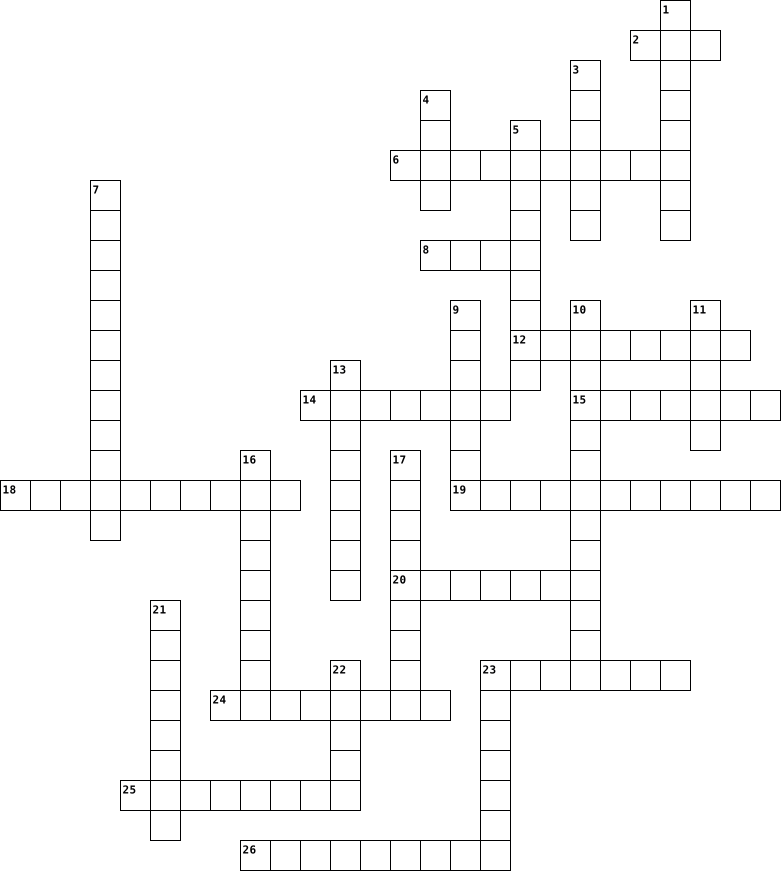
Across
- oxygen is this at room temperature
- conducts electricity
- has an orange color due to a chemical reaction
- property that can be observed when the substance changes into a new substance
- physical property that describes the temp at which a liquid turns to a gas
- all one type of atom
- bursts into flames when exposed to air
- evenly mixed mixture
- 2 or more substances physically combined
- how tightly packed molecules or atoms are in a substance
- 1 proton
- a physical property that iron has
- able to be made into thin sheets
Down
- a physical property of diamonds
- has mass and takes up space
- made up of protons, neutrons and electrons
- element or compound
- a physical change when a gas turns to a liquid
- a chemical reaction silver undergoes
- clumpy mixture
- a compound we drink
- made up of 2 or more elements chemically combined in a fixed ratio
- the thickness of liquids
- able to burn in the presence of oxygen
- property that can be observed without changing the substance
- chemical property of causing harm when ingested
- able to be drawn into wires
27 Clues: 1 proton • clumpy mixture • element or compound • a compound we drink • conducts electricity • all one type of atom • evenly mixed mixture • the thickness of liquids • has mass and takes up space • able to be drawn into wires • a physical property of diamonds • able to be made into thin sheets • a physical property that iron has • oxygen is this at room temperature • ...
Plants and Animals Vocabularly 2025-02-13

Across
- carries water from roots to leaves
- sac in which offspring develop
- process of converting glucose to energy without oxygen
- any process without oxygen
- any process with oxygen
- carried sugar from leaves to rest of plant
- a type of reproduction where only one parent is needed
- produced its own body heat
- mammals that lay eggs
- opening in a leaf that allows for gas exchange
- organelle that contains chlorophyll
Down
- chemical reaction that converts glucose to energy
- name of the gland that produces milk
- a type of reproduction that requires two parents
- name of the family for rodents
- name of the family for bats
- group of plants characterized by seeds without a protective container
- a group of plants characterized by flower parts in groups of four or five
- chemical that collects light to begin photosynthesis
- mammals that have a pouch
- a group of plants characterized by flower parts in groups of three
- chemical energy that drives cell operations
- Chemical reaction that converts carbon dioxide and water to sugar
- the group of flowering plants where the seed in contained in a container, or fruit
- part of the chloroplast where light dependent reactions occur
25 Clues: mammals that lay eggs • any process with oxygen • mammals that have a pouch • any process without oxygen • produced its own body heat • name of the family for bats • sac in which offspring develop • name of the family for rodents • carries water from roots to leaves • organelle that contains chlorophyll • name of the gland that produces milk • ...
Chemistry 2023-11-01

Across
- Substances capable of donating protons (H⁺ ions), typically characterized by a low pH, a sour taste, and the ability to turn litmus paper red.
- The specific arrangement and types of elements or substances that make up a material, mixture, or compound.
- A rapid chemical reaction between a fuel and oxygen, resulting in the release of heat, light, and the formation of carbon dioxide and water.
- Pertaining to the properties and characteristics of individual building blocks of matter.
- Mathematical representations of chemical reactions, showing the reactants and products involved.
- A measure of the amount of substance in an object, often expressed in units such as grams or kilograms.
- The forces that hold together two or more atoms, creating compounds or molecules.
- A substance that combines more than one metal or mixes a metal with other non-metallic elements.
- Alterations in the physical or chemical properties of substances, which can be classified as physical (no change in composition) or chemical (involving a change in composition).
- The smallest units of compounds, formed when two or more atoms bond together.
- Another state of matter, with a fixed volume but no fixed shape, where particles flow and are loosely packed.
- The gradual degradation of materials, often metals, due to chemical reactions with their environment, resulting in the formation of compounds on the material's surface.
- The new substances resulting from a chemical reaction, formed from the transformation of reactants.
- A substance whos atoms all have the same number of protons
Down
- The property of a material, particularly metals, that allows them to be drawn into thin wires without breaking.
- Positively charged subatomic particles found in an atom's nucleus, contributing to its atomic number.
- The state of matter with a definite shape and volume, where particles are closely packed and have limited mobility.
- A distinct compound or substance
- The substances that initiate a chemical reaction, undergoing transformation into products.
- The biological process by which plants and certain microorganisms convert carbon dioxide and water into energy-rich molecules (glucose) and oxygen using sunlight.
- A combination of different substances physically mixed together, without a chemical bond, which can be homogeneous or heterogeneous.
- The fundamental building blocks of matter, consisting of a nucleus with protons and neutrons, orbited by electrons.
- Subatomic particles with no electric charge, located in an atom's nucleus, contributing to its mass.
- A homogeneous mixture of one or more substances (solutes) dissolved in a solvent, often with uniform properties.
- One of the states of matter, characterized by particles with high energy and random motion, taking the shape of their container.
- A process that leads to the chemical transformation of one set of chemical substances into another.
- The reddish-brown substance formed on the surface of iron or steel when exposed to oxygen and moisture, primarily composed of iron oxide.
- The quality of being shiny and reflective, often associated with materials like metals.
- A category of elements known for their electrical conductivity, malleability, and often lustrous appearance.
29 Clues: A distinct compound or substance • A substance whos atoms all have the same number of protons • The smallest units of compounds, formed when two or more atoms bond together. • The forces that hold together two or more atoms, creating compounds or molecules. • The quality of being shiny and reflective, often associated with materials like metals. • ...
Unit 2 - Words to Know 2024-10-15

Across
- macromolecule that contains carbon, hydrogen, oxygen, and nitrogen; needed by the body for growth and repair and to make up enzymes
- large compound formed from combinations of many monomers
- protein that acts as a biological catalyst
- element or compound produced by a chemical reaction
- smallest unit of most compounds
- acid macromolecule containing hydrogen, oxygen, nitrogen, carbon, and phosphorus
- compound that forms hydrogen ions (H+) in solution
- substance consisting entirely of one type of atom
Down
- compound made up of carbon,hydrogen,and oxygen atoms; major source of energy for the human body
- compound that forms hydroxide ions (OH-) in solution
- macromolecule made mainly from carbon and hydrogen atoms; includes fats,oils, and waxes
- elements or compounds that enter into a chemical reaction
- reactant of an enzyme-catalyzed reaction
- small unit that can join with other small units to form polymers
- substance formed by the chemical combination of two or more elements in definite proportions
15 Clues: smallest unit of most compounds • reactant of an enzyme-catalyzed reaction • protein that acts as a biological catalyst • substance consisting entirely of one type of atom • compound that forms hydrogen ions (H+) in solution • element or compound produced by a chemical reaction • compound that forms hydroxide ions (OH-) in solution • ...
Chemical Reactions 2020-12-17

Across
- A mixture containing small, undissolved particles that do not settle out.
- Substances together in the same place but their atoms are not chemically bonded.
- A change in which one or more substances combine to form new substances.
- A substance that enters into a chemical reaction.
- When one substance completely disappears into another substance to form a solution.
Down
- A mixture in which particles can be seen and easily separated by settling or filtration.
- A substance formed as a result of a chemical reaction.
- A reaction that absorbs energy
- The law that the total amount of matter remains the same, regardless of any chemical or physical change.
- A change that alters the form or appearance of a material but does not make it into a new substance.
- A mixture containing a solvent and at least one solute that has the same properties throughout.
- A reaction that releases energy, usually in the form of heat.
12 Clues: A reaction that absorbs energy • A substance that enters into a chemical reaction. • A substance formed as a result of a chemical reaction. • A reaction that releases energy, usually in the form of heat. • A change in which one or more substances combine to form new substances. • A mixture containing small, undissolved particles that do not settle out. • ...