
chemical reaction Crossword Puzzles
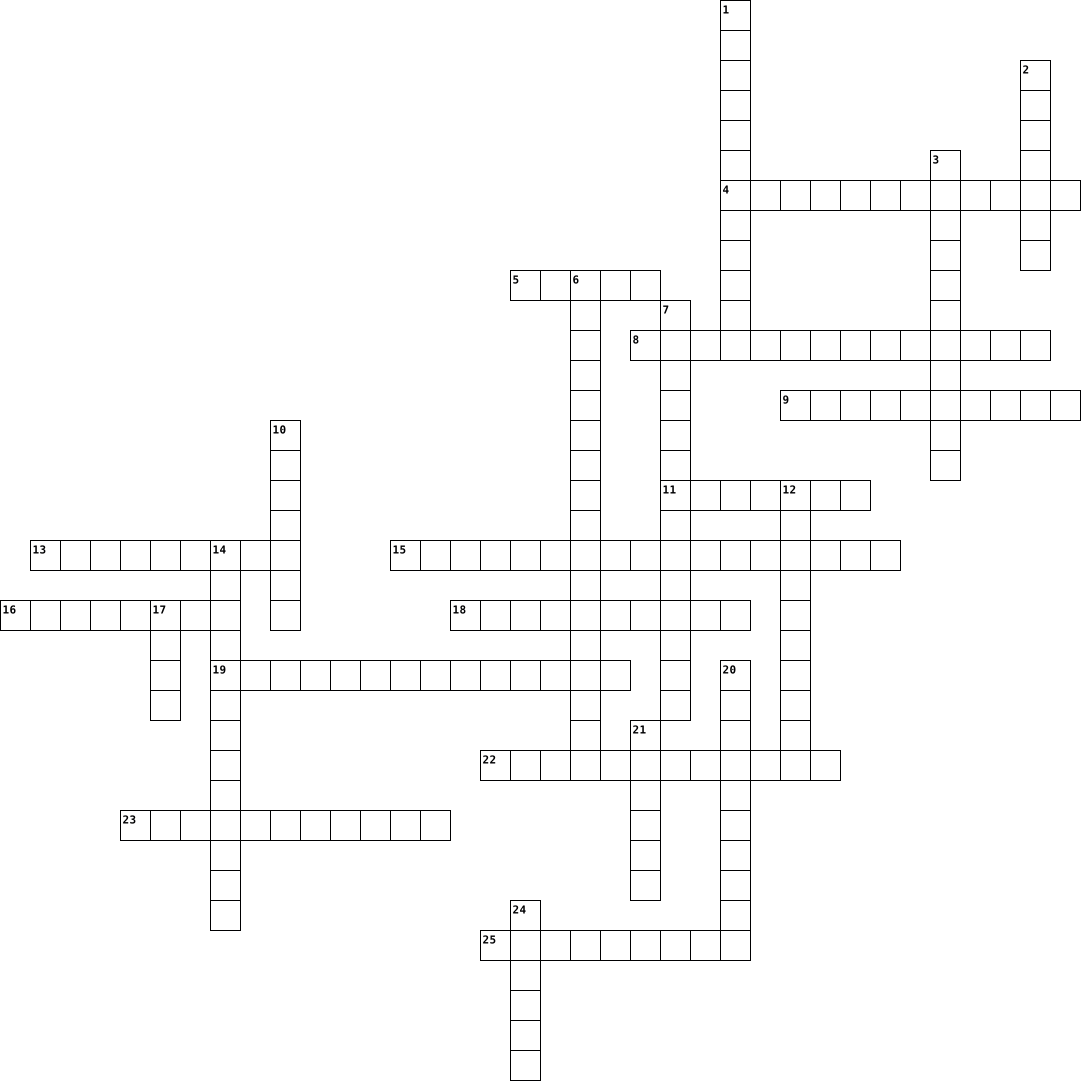
Photosynthesis Crossword Puzzle 2025-11-14

Across
- this gas is a product
- something that absorbs and reflects light (colors)
- the name for something that goes into a chemical reaction
- the name for something that comes out of a chemical reaction
- the main pigment responsible for photosynthesis
- the process of converting light energy into chemical energy
- this is where the carbon needed for photosynthesis comes from
- this carbohydrate is the main product
- this gas is a reactant
Down
- this law states that matter cannot be created or destroyed, but only changed and rearranged
- organism that must eat (consume) something else to get energy
- these structures are responsible for absorbing water from soil
- another word for "reactant"
- an organism that absorbs more carbon dioxide that it releases
- this type of energy is required for photosynthesis
- these organs hold chloroplasts and are responsible for most photosynthesis in the plant
- this liquid is a reactant
- plants and algae release this gas as a product
- organism that can make their own food
- another word for "product"
20 Clues: this gas is a product • this gas is a reactant • this liquid is a reactant • another word for "product" • another word for "reactant" • organism that can make their own food • this carbohydrate is the main product • plants and algae release this gas as a product • the main pigment responsible for photosynthesis • something that absorbs and reflects light (colors) • ...
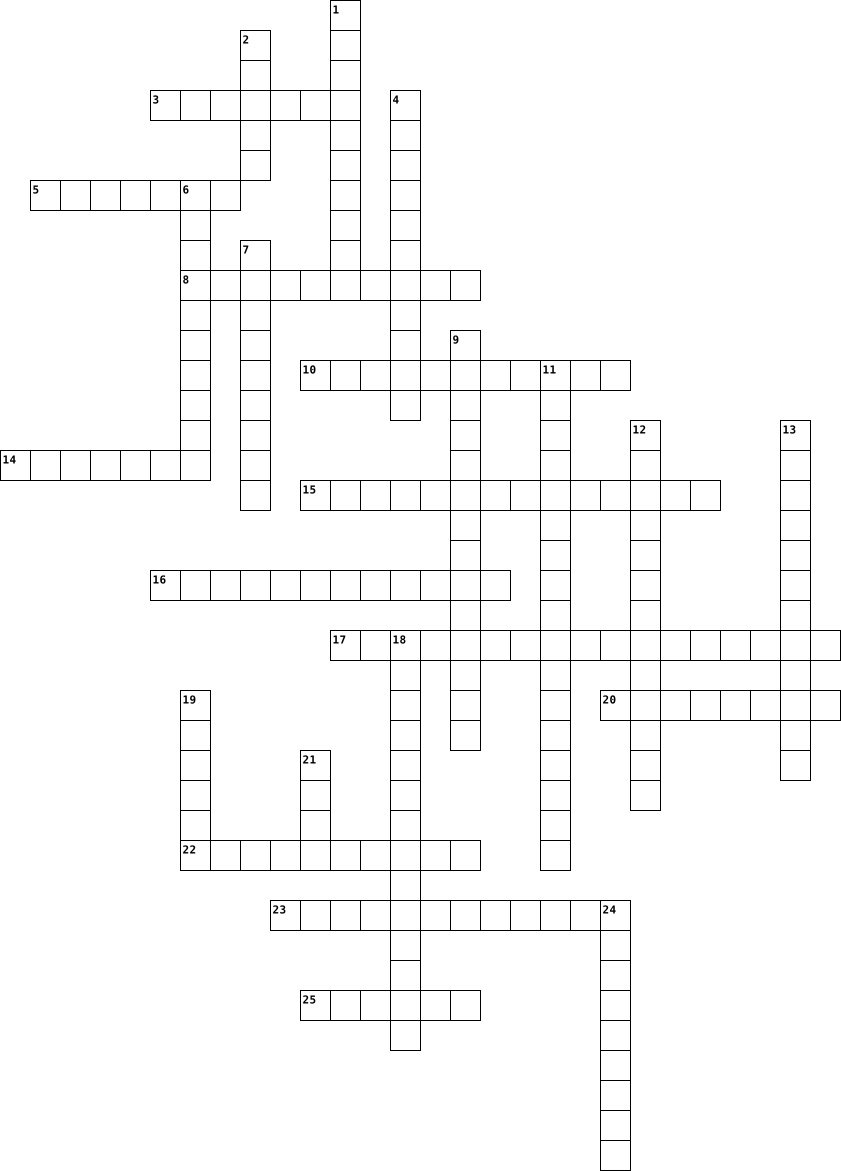
Matter & Energy Crossword Puzzle 2023-10-10

Across
- instrument used to determine if a reaction is endothermic or exothermic
- a reaction that absorbs heat energy and feels cold to the touch
Down
- a reaction that releases heat energy and feels hot to the touch.
- method, like temperature, to determine energy change in a reaction.
- shift in a chemical reaction from reactants to products.
- reaction in chemical ice packs, feels cold when activated
- rapid heat and light release, e.g., lighting a candle.
- type of change where the substance that it is does change.
- energy that is transferred as a result of temperature difference.
- type of change where the substance's physical properties change, but not its composition.
10 Clues: rapid heat and light release, e.g., lighting a candle. • shift in a chemical reaction from reactants to products. • reaction in chemical ice packs, feels cold when activated • type of change where the substance that it is does change. • a reaction that absorbs heat energy and feels cold to the touch • ...
Chapter 7 vocabulary 2021-12-06

Across
- its absorbs the heat energy.
- is the amount of substance in the volume
- thinsg that form as a reslut of the reaction accures
- a process that makes chemical change
- its absorbs the heat of the energy.
Down
- it lets chemists know at a glace the reactants
- its the amount of the energy in something
- Things that are there before the reaction begins
- its lets you know how fast a reaction is after it started
- things that slow down a chemical reaction
10 Clues: its absorbs the heat energy. • its absorbs the heat of the energy. • a process that makes chemical change • is the amount of substance in the volume • its the amount of the energy in something • things that slow down a chemical reaction • it lets chemists know at a glace the reactants • Things that are there before the reaction begins • ...
Its all about Heat!! 2021-02-01

Across
- Unlike Conduction and convection no particles are involved
- How hot something is
- during a chemical reaction often this will change
- Objects can either heat up or .... down
Down
- The smaller the particle size the ....... the reaction
- Liquids and gasses transfer heat through
- higher the concentration of acid, the ...... the reaction.
- this is sometimes given off when a chemical reaction takes place
- how much thermal energy something has
- The transfer of heat energy through a material without the material moving
10 Clues: How hot something is • how much thermal energy something has • Objects can either heat up or .... down • Liquids and gasses transfer heat through • during a chemical reaction often this will change • The smaller the particle size the ....... the reaction • higher the concentration of acid, the ...... the reaction. • ...
Chemical Kinetics Crossword Puzzle 2022-07-21

Across
- Wood burning
- Product molecules break away
- Often determined by the concentration of some, all, or none of the reactants present, and determines which reaction order the reaction falls into.
- Material that can increase the rate of chemical reactions.
- theory Qualitative explanation for chemical reactions and their rates of occurrence.
Down
- Measurement which helps scientists understand the kinetics of a reaction
- Involves the use of a catalyst in a different phase from the reactants.
- Catalysis Same physical state as the reactants
- Iron rusting
- Speed of a reaction
- Relationship between the concentrations of reactants and their various reaction rates
11 Clues: Wood burning • Iron rusting • Speed of a reaction • Product molecules break away • Catalysis Same physical state as the reactants • Material that can increase the rate of chemical reactions. • Involves the use of a catalyst in a different phase from the reactants. • Measurement which helps scientists understand the kinetics of a reaction • ...
Science crossword 2014-11-06

Across
- a table in which all elements are found
- a system in which the products cannot escape
- a pure substance that is formed from at least one metal and one non-metal
- a reaction the absorbs heat [energy]
- chemicals that when combined create products
- chemical reaction in cells
- a chemical reaction that occurs with oxygen that releases energy
- a slow reaction with oxygen and metal react together
- change in state, solid to liquid.
- the change in state from solid to gas and gas to solid.
Down
- the mass of a single atom of an element
- a pure substance that cannot be broken down
- properties that describes appearance and composition
- a reaction that releases heat[energy]
- a system used around the world to ensure safety in a workplace
- anything that has a mass and occupies a space.
- the result of two or more reactants combining
- an invisible part of an atom that has a negative charge.
- a compound made from two or more non-metals
- when two or more substances come together to create a new substance
- a law that states that matter can not be destroyed or created
- change in appearance or state that does not effect the composition
- the number of electron/protons in an single atom of a element
- the positively charged part in the nucleus.
- an atom that becomes negatively or positively charged through the loss or gain of electrons
25 Clues: chemical reaction in cells • change in state, solid to liquid. • a reaction the absorbs heat [energy] • a reaction that releases heat[energy] • the mass of a single atom of an element • a table in which all elements are found • a compound made from two or more non-metals • the positively charged part in the nucleus. • a pure substance that cannot be broken down • ...
Enzymes 4.1.3 2024-02-07

Across
- What are enzymes made out of?
- A molecule that is able to bind to the enzyme and block the substrate.
- A specifically shaped area of the enzyme that fits around the substrate.
- The type of activities enzymes activate.
- The percentage of hydrogen ions in a solution.
- Pancreatic amylase breaks down _____.
- The most important factor in determining specificity.
- A substance that increases the rate of a chemical reaction.
- The name of a hypothesis that helps explain enzyme function.
- The biological molecule that the enzyme will work on.
- An enzyme can become ________ if it is exposed to extreme highs or lows of temperature or acidity.
- What the substrate becomes after the enzyme lets go.
Down
- Enzymes are _______.
- The catalyst _________ the rate of the reaction.
- An _______ pH or temperature is the pH or temperature that the enzyme performs best at.
- The act of taking away water in order to bind molecules.
- __________ can change the shape of an enzyme.
- A reaction that BREAKS the substrate.
- Since enzymes are made of proteins, they are technically made of ______.
- A reaction that BUILDS the substrate.
- As enzyme _________, the rate of reaction increases then plateaus.
- Protein molecules that act as biological catalysts.
- The act of adding water in order to break apart molecules.
- The substrate has to ____ the active site in order to form a bond.
- Three letters that MANY enzymes end with.
25 Clues: Enzymes are _______. • What are enzymes made out of? • A reaction that BREAKS the substrate. • A reaction that BUILDS the substrate. • Pancreatic amylase breaks down _____. • The type of activities enzymes activate. • Three letters that MANY enzymes end with. • __________ can change the shape of an enzyme. • The percentage of hydrogen ions in a solution. • ...
Enzymes 4.1.3 2024-02-07

Across
- A reaction that BUILDS the substrate.
- The most important factor in determining specificity.
- The act of adding water in order to break apart molecules.
- The percentage of hydrogen ions in a solution.
- Pancreatic amylase breaks down _____.
- Three letters that MANY enzymes end with.
- A molecule that is able to bind to the enzyme and block the substrate.
- The substrate has to ____ the active site in order to form a bond.
- An enzyme can become ________ if it is exposed to extreme highs or lows of temperature or acidity.
- As enzyme _________ increases, the rate of reaction increases then plateaus.
- A substance that increases the rate of a chemical reaction.
- A reaction that BREAKS the substrate.
Down
- A specifically shaped area of the enzyme that fits around the substrate.
- Since enzymes are made of proteins, they are technically made of ______.
- The act of taking away water in order to bind molecules.
- What are enzymes made out of?
- An _______ pH or temperature is the pH or temperature that the enzyme performs best at.
- The catalyst _________ the rate of the reaction.
- What the substrate becomes after the enzyme lets go.
- Protein molecules that act as biological catalysts.
- The biological molecule that the enzyme will work on.
- Enzymes are _______.
- The type of activities enzymes activate.
- The name of a hypothesis that helps explain enzyme function.
- __________ can change the shape of an enzyme.
25 Clues: Enzymes are _______. • What are enzymes made out of? • A reaction that BUILDS the substrate. • Pancreatic amylase breaks down _____. • A reaction that BREAKS the substrate. • The type of activities enzymes activate. • Three letters that MANY enzymes end with. • __________ can change the shape of an enzyme. • The percentage of hydrogen ions in a solution. • ...
Chapter 13. Maddy Adamczewski 2021-03-04

Across
- the weakest bond
- when the equation is not equal
- the strongest bond
- a chemical that accepts a hydrogen ion, H+.
- not the weakest but not the strongest bond
- no atoms are gained or lost during any reaction
Down
- a chemical that donates a hydrogen ion, H+
- when the equation is equal
- is the minimum energy required to overcome the initial breaking of bonds in reactants
- a substance that lowers the activation energy of a chemical reaction, which allows for the reaction to proceed at a faster rate
10 Clues: the weakest bond • the strongest bond • when the equation is equal • when the equation is not equal • a chemical that donates a hydrogen ion, H+ • not the weakest but not the strongest bond • a chemical that accepts a hydrogen ion, H+. • no atoms are gained or lost during any reaction • is the minimum energy required to overcome the initial breaking of bonds in reactants • ...
Biology 2023-08-30

Across
- It provides the reducing power that drives numerous anabolic reactions,light
- a naturally occurring nucleoside which is present in various forms in all cells of the bodyphotosynthesis
- an organism that is able to form nutritional organic substances from simple inorganic substances such as carbon dioxide.
- each of a number of flattened sacs inside a chloroplast, bounded by pigmented membranes on which the light reactions of photosynthesis take place, and arranged in stacks or granastroma
- In chemical thermodynamics, an endergonic reaction is a chemical reaction in which the standard change in free energy is positive, and an additional driving force is needed to perform this reaction.
Down
- a chemical element with an atomic number of 8 (it has eight protons in its nucleus).
- a natural substance that produces color in animals and plants, such as of skin, hair, and leaveschlorophyll,
- an oxide containing two atoms of oxygen in its molecule or empirical formula.glucose
- Water is an inorganic compound with the chemical formula H₂O. It is a transparent, tasteless, odorless, and nearly colorless chemical substance,carbon
- A chemical reaction is a process that leads to the chemical transformation of one set of chemical substances to anotherCalvincycle
10 Clues: It provides the reducing power that drives numerous anabolic reactions,light • a chemical element with an atomic number of 8 (it has eight protons in its nucleus). • an oxide containing two atoms of oxygen in its molecule or empirical formula.glucose • a naturally occurring nucleoside which is present in various forms in all cells of the bodyphotosynthesis • ...
Chemical and Physical Changes 2024-04-29

Across
- produced by reactions of atoms
- when one matter changes from one to another
- the amount of space something occupies
- anything that takes up space
- the temperature at which a substance changes state from solid to liquid at atmospheric pressure
Down
- a characteristic of a particular substance that can be observed in a chemical reaction
- the degree of hotness or coldness
- a substance at the end of a chemical reaction
- an action performed or a feeling experienced in response to a situation or event
- the temperature below which a liquid turns into a solid
10 Clues: anything that takes up space • produced by reactions of atoms • the degree of hotness or coldness • the amount of space something occupies • when one matter changes from one to another • a substance at the end of a chemical reaction • the temperature below which a liquid turns into a solid • ...
Chemistry 2025-01-30

Across
- The rate of a chemical reaction increases at ______ temperatures
- Materials made from chemical reactions
- The law of _____ proportions says that the compounds in an equation have a fixed ratio
- Chemical reactions happen in a ____ system
- How long it takes for reactions to happen
- The theory of how effective collisions happen
Down
- The original materials in a reaction
- How dense the reactants are. An increase in this increases reactions
- For a reaction to happen the energy must be...
- When there is the same number of atoms on both sides of an equation
10 Clues: The original materials in a reaction • Materials made from chemical reactions • How long it takes for reactions to happen • Chemical reactions happen in a ____ system • The theory of how effective collisions happen • For a reaction to happen the energy must be... • The rate of a chemical reaction increases at ______ temperatures • ...
Balancing Equations Vocab 2021-12-10

Across
- equation: shows no mass damaged
- cant be changed in equation
- makes up everything
- of mass: mass only changes form
- can be changed in equation
Down
- equation: rarely happens
- basic unit of matter
- after a chemical reaction
- before a chemical reaction
- did fruit experiment
10 Clues: makes up everything • basic unit of matter • did fruit experiment • equation: rarely happens • after a chemical reaction • before a chemical reaction • can be changed in equation • cant be changed in equation • equation: shows no mass damaged • of mass: mass only changes form
ENZYMES 2020-02-21

Across
- is the site, region, of an enzyme that binds the substrate
- the abbreviation used for enzyme nomenclature
- enzymes are very _______ for their substrate
- enzymes have an optimal conditions for activity such as _______
- organic cofactors
- helper molecule that assist enzymes in their action
- the ending of enzymes
Down
- cofactors+coenzymes+apoenzymes
- is one of the mechanism used to regulate enzymes
- proteins that lower the energy barrier of reactions
- inorganic cofactors
- substance upon which an enzyme acts on in a chemical reaction
- inactive enzyme without cofactor
- a possible co-factors for some enzymes
- the ending of digestive enzymes
- chemical composition of enzyme
- synonym of speed up a biological reaction
17 Clues: organic cofactors • inorganic cofactors • the ending of enzymes • cofactors+coenzymes+apoenzymes • chemical composition of enzyme • the ending of digestive enzymes • inactive enzyme without cofactor • a possible co-factors for some enzymes • synonym of speed up a biological reaction • enzymes are very _______ for their substrate • the abbreviation used for enzyme nomenclature • ...
Olivia Bonaminio Chapter 13 Crossword 2021-12-02

Across
- what measures the concentration of hydrogen atoms in a substance
- type of reaction that involves oxygen
- when a reaction and its reverse act at the same time
- water would not be considered basic or acidic, it would be considered
- this can be added to something to increase the reaction speed so less activation energy is needed
Down
- by adding a catalyst to a reaction, less of this is needed
- what type of reaction has an absorption of energy
- what type of reaction has a releasing of energy
- what is a chemical that donates a hydrogen ion
- what is a chemical that accepts a hydrogen ion
10 Clues: type of reaction that involves oxygen • what is a chemical that donates a hydrogen ion • what is a chemical that accepts a hydrogen ion • what type of reaction has a releasing of energy • what type of reaction has an absorption of energy • when a reaction and its reverse act at the same time • by adding a catalyst to a reaction, less of this is needed • ...
Chemical Changes 2022-03-18

Across
- a system in which no matter is allowed to enter or leave
- a material that releases energy when it burns
- a biological catalyst that lowers the activation energy of reactions in cells
- the minimum of energy needed to get a chemical reaction started
- a rapid reaction between oxygen and fuel that results in the fire
- the amount of one material in a certain volume
Down
- a material that increases the rate of a reaction by lowering the activation energy
- a reaction that releases energy in the form of heat
- a material that decreases that rate of a reaction
- a substance that enters into a chemical reaction
10 Clues: a material that releases energy when it burns • the amount of one material in a certain volume • a substance that enters into a chemical reaction • a material that decreases that rate of a reaction • a reaction that releases energy in the form of heat • a system in which no matter is allowed to enter or leave • ...
Chapter 13 Crossword - Brooklyn McCracken 2019-10-08

Across
- On the scale 1-10 what is above 7?
- the same as bond energy
- On a scale of 1-10 what is under 7?
- In an endothermic reaction there is a net absorption energy
- A + B-C → A-C + B.
Down
- Activation energy, Ea, is the minimum energy required to overcome the initial breaking of bonds in reactants. a substance that lowers the
- type of chemical reaction where two compounds react, and the positive ions (cation) and the negative ions (anion) of the two reactants switch places
- activation energy of a chemical reaction, which allows for the reaction to proceed at a faster rate
- During a chemical reaction, one or more new compounds are formed as a result of the rearrangement of atoms
- On a scale of 1-10 what is 7?
10 Clues: A + B-C → A-C + B. • the same as bond energy • On a scale of 1-10 what is 7? • On the scale 1-10 what is above 7? • On a scale of 1-10 what is under 7? • In an endothermic reaction there is a net absorption energy • activation energy of a chemical reaction, which allows for the reaction to proceed at a faster rate • ...
Josie Blanchard Chapter 13 2020-03-01

Across
- if changed, the equilibrium shifts to oppose change, until new equilibrium is reached
- reaction where there is a net release of energy
- chemical that accepts a hydrogen ion
Down
- also known as bond energy
- how quickly the concentration of reactants decreases and the concentration of products increases
- no atoms are gained or lost during any reaction
- chemical that donates a hydrogen ion
- when reactions and their reverse act at the same rate
- reaction where there is a net absorption of energy
- things that change the rate of chemical reactions
10 Clues: also known as bond energy • chemical that donates a hydrogen ion • chemical that accepts a hydrogen ion • no atoms are gained or lost during any reaction • reaction where there is a net release of energy • things that change the rate of chemical reactions • reaction where there is a net absorption of energy • when reactions and their reverse act at the same rate • ...
Chapter 13 Crossword Mason Emmitt 2020-10-05

Across
- there is a net absorption of energy.
- a chemical that donates a hydrogen ion
- Also known as bond energy.
- if changed, the equilibrium shifts to oppose change, until new equilibrium is reached.
- a net release of energy.
Down
- No atoms are gained or lost during any reaction.
- one or more new compounds are formed as a result of the rearrangement of atoms.
- when reaction and it’s reverse act at the same rate.
- a chemical that accepts a hydrogen ion
- a substance that lowers the activation energy of a chemical reaction.
10 Clues: a net release of energy. • Also known as bond energy. • there is a net absorption of energy. • a chemical that donates a hydrogen ion • a chemical that accepts a hydrogen ion • No atoms are gained or lost during any reaction. • when reaction and it’s reverse act at the same rate. • a substance that lowers the activation energy of a chemical reaction. • ...
Rebekah Van Wormer chapter 13 2021-03-01

Across
- bond energy is also known as this
- In this reaction there is a net absorption of energy
- This can be a base or an acid
- This doesn´t ionize completely in water
- This dose ionize completely in water
Down
- In this reaction there is a net release of energy
- is a chemical that accepts a hydrogen ion
- is a substance that lowers the activation energy of a chemical energy
- is a chemical that donates a hydrogen ion
- is when a reaction and its reverse act at the same rate
10 Clues: This can be a base or an acid • bond energy is also known as this • This dose ionize completely in water • This doesn´t ionize completely in water • is a chemical that accepts a hydrogen ion • is a chemical that donates a hydrogen ion • In this reaction there is a net release of energy • In this reaction there is a net absorption of energy • ...
Science 2024-07-12

Across
- The smallest unit everything is made of
- Study of living things
- chemical reaction that releases energy from glucose and oxygen
- A glowing split will relight in this gas
- Site of Respiration
- the flame used to light a Bunsen burner
- green pigment in plants
- _____- store of energy meaning moving
Down
- Head of science
- Cell ________. Allows substances to move in and out of cells
- Number of piece of safety equipment
- =distance/time
- Chemical reaction using light, glucose and carbon dioxide,
- ________ water, used to test for carbon dioxide
- The mat placed on the bench under a Bunsen burner
15 Clues: =distance/time • Head of science • Site of Respiration • Study of living things • green pigment in plants • Number of piece of safety equipment • _____- store of energy meaning moving • The smallest unit everything is made of • the flame used to light a Bunsen burner • A glowing split will relight in this gas • ________ water, used to test for carbon dioxide • ...
G5A Science Final Review - Spring 2025 2025-06-03

Across
- The starting ingredients in a chemical reaction.
- How many bases taste.
- A force that slows things down when they rub together.
- Bases release these special particles in water(OH-).
- When a reaction makes bubbles or a new smell.
- A flat, sloping surface, like a ramp.
- Acids release these special particles in water (H+).
- Forces that are not equal, causing an object to change its motion.
- The new things made in a chemical reaction.
- Forces that are equal and opposite, so an object keeps its current motion.
- The force of gravity pulling an object down.
- A solid that forms from a liquid in a chemical reaction.
- The force that pushes an airplane or rocket forward.
- A sign of a chemical reaction when something looks different, like what bleach can do to clothing.
- A simple machine like a doorknob or a car tire.
- A gas made when some acids react with metals.
- When an acid and a base mix to make water and a salt.
- A wheel with a rope used for lifting things.
- When a metal like silver slowly gets dull or dark.
- How bases often feel to the touch.
- When a reaction gives off heat or light.
- Formed when H+ ions mix with water.
- When you push something, that's the ______ force.
Down
- Changes that make a brand new substance, like rust.
- The force that pushes back when you apply an action force.
- A simple machine like a seesaw or a crowbar.
- Substances that can carry electricity when dissolved in water.
- The rule that says energy cannot be made or lost, only changed.
- An inclined plane wrapped around a cylinder, used to hold things.
- The rule that says matter isn't made or lost in a reaction.
- Energy that is stored and ready to be used.
- These often feel soapy and taste bitter.
- These taste sour and can turn litmus paper red.
- The force that pushes back against something moving through air.
- Bases turn red litmus paper this color.
- Changes like melting or freezing; no new stuff is made.
- Done when a force makes an object move a distance.
- The upward force that helps an airplane fly.
- Energy an object has because it is moving.
- Acids turn blue litmus paper this color.
- A simple machine used to split things, like an axe.
- How acids like lemon juice taste.
- The unit used to measure force (N).
- A push or a pull.
- The unit used to measure work or energy (J).
45 Clues: A push or a pull. • How many bases taste. • How acids like lemon juice taste. • How bases often feel to the touch. • The unit used to measure force (N). • Formed when H+ ions mix with water. • A flat, sloping surface, like a ramp. • Bases turn red litmus paper this color. • These often feel soapy and taste bitter. • Acids turn blue litmus paper this color. • ...
7.1 Chemical Reactions and Matter 2025-08-23

Across
- When a solid dissolves in a liquid, the solid breaks apart into particles too small to see and it mixes completely in the liquid.
- Change A change from one state (solid, liquid, or gas) to another without a change in chemical composition.
- A chemical substance that is present at the start of a chemical reaction.
- The process by which one or more substances change to produce one or more different substances.
- Describes a material that does not dissolve in something else.
- A characteristic of a substance that does not change.
- Describes a material that can dissolve in a particular substance.
- A blend of two or more substances, each of which retains its chemical identity.
Down
- A material's ability to burn in the presence of oxygen.
- Made of one type of material throughout.
- Mass per unit volume.
- This is the best class in Piper Middle School
- Smallest particle of an element.
- of Matter A physical property that describes matter as a solid, liquid, or gas.
- A substance produced in a chemical reaction.
- A group of atoms bonded together.
16 Clues: Mass per unit volume. • Smallest particle of an element. • A group of atoms bonded together. • Made of one type of material throughout. • A substance produced in a chemical reaction. • This is the best class in Piper Middle School • A characteristic of a substance that does not change. • A material's ability to burn in the presence of oxygen. • ...
7 2025-02-22

Across
- Solid formed in a solution
- Group 18 gases
- Measure of disorder
- Releases heat
- Group 1 metals
- Number of particles in a mole
- Quantitative relationship in reactions
- Biological catalyst
- Horizontal row in periodic table
- Study of reaction rates
- Absorbs heat
- Gain of electrons
Down
- Study of energy changes
- Vertical column in periodic table
- Metals in the center of the table
- Oxidation-reduction reaction
- Splitting of a compound by electricity
- Unit of chemical amount
- Group 17 elements
- Free energy in a system
- Group 2 metals
- Table organizing elements
- Loss of electrons
- Balance in a reaction
- Law of heat summation
25 Clues: Absorbs heat • Releases heat • Group 18 gases • Group 1 metals • Group 2 metals • Group 17 elements • Loss of electrons • Gain of electrons • Measure of disorder • Biological catalyst • Balance in a reaction • Law of heat summation • Study of energy changes • Unit of chemical amount • Free energy in a system • Study of reaction rates • Table organizing elements • Solid formed in a solution • ...
Nuclear Reactions, Rate of Reactions & Endo/Exothermic Reactions 2023-04-26

Across
- Decreasing the space for the same number of particles = More Collisions & Greater Chance of a Reaction
- Nuclear Reactions Release ______ Energy Than Chemical Reactions
- Related to Heat
- Reactants have Less Energy than the Products, Temperature Decreases, Thermal Energy is Absorbed
- Each time a nucleus splits, it releases more neutrons, which can go on and cause more reactions to occur and will continue to happen.
- The time that it takes half the nuclei in a sample to decay
- Means Out
- How can the surface area of a solid be increased
- Means In
- Any reaction involving a solid takes place where
Down
- Lowers the Activation Energy
- How can Radioactivity be detected
- The splitting of a nucleus into smaller nuclei and the release of energy
- Increasing Contact Points = More Collisions & Greater Chance of a Reaction
- More Particles in the Same Space = More Collisions & Greater Chance of a Reaction
- Two smaller nuclei created when a nucleus splits
- Occurs when a stable isotope is struck by a neutron
- Reactants have More Energy than the Product, Temperature Increases, Thermal Energy is Released
- Increasing Energy = Particles move Faster = More Collisions & Greater Chance of a Reaction
- An example of an Endothermic Reaction
- Process Happens in the Sun’s Core
- An example of an Exothermic Reaction
- Smaller nuclei join together to form larger nuclei and energy is released
23 Clues: Means In • Means Out • Related to Heat • Lowers the Activation Energy • How can Radioactivity be detected • Process Happens in the Sun’s Core • An example of an Exothermic Reaction • An example of an Endothermic Reaction • Two smaller nuclei created when a nucleus splits • How can the surface area of a solid be increased • Any reaction involving a solid takes place where • ...
Carbohydrates - Schmole 2022-10-25

Across
- food storage of animals
- the basic unit of carbohydrates
- cell walls of plants
- used in place of substances such as milk fat
- reduces crystallization during freezing
- texture enhancer, thickener
- sugar
Down
- consist of two sugar molecules chemically bonded together
- consist of many (3 or more) sugar molecules chemically bonded together
- the invert chemical breakdown of a disaccharide into its two separate monosaccharides
- Maillard Reaction
- the chemical reaction between sugars and amino acids to produce color (browning) , aromas, and flavors
- improve palatability, flavor enhancer
- food storage of plants
- starch and fibers
15 Clues: sugar • Maillard Reaction • starch and fibers • cell walls of plants • food storage of plants • food storage of animals • texture enhancer, thickener • the basic unit of carbohydrates • improve palatability, flavor enhancer • reduces crystallization during freezing • used in place of substances such as milk fat • consist of two sugar molecules chemically bonded together • ...
Chemical Vocab 2018-02-05

Across
- / More than one type of atom combined
- / Potential to change and ability to react
- / Are not reactive because of their filled outside valance shell
- / Anything that has mass and volume
- / Looks like one substance
- / 2 or more substances that are physically combined
- / Groups of elements that have common characteristics
Down
- / no new substance is formed
- / the new substance that is formed in a chemical reaction
- / a new substance is formed
- / Observable and can be measured
- / Visibly different substances
- / Made of one type of atom
- / substance in a chemical reaction that undergoes a change
- / 2 or more atoms
15 Clues: / 2 or more atoms • / Made of one type of atom • / Looks like one substance • / a new substance is formed • / no new substance is formed • / Visibly different substances • / Observable and can be measured • / Anything that has mass and volume • / More than one type of atom combined • / Potential to change and ability to react • ...
Biomolcules & Enzymes 2023-09-12

Across
- How many components make up a nucleotide (2 words)
- Cellulose, Glucose, Starch, Glycogen
- speeds up a chemical reaction
- Is what is produced from a chemical reaction with an enzyme and substrate
- enzymes are very ________ ?
Down
- Which Biomolecule stores genetic information? (two words)
- True or False An enzyme is specialized and reusable
- when the enzyme and substrate have combined it forms a what? (3 words)
- can denature an enzyme (3 words)
- Enzymes, Insulin, and hemoglobin
- Multiple monomers joined together
- What the substrate binds to (2 words)
- How many biomolecules are there?
- Single building block, one molecule
- Phospholipid, Steroids
15 Clues: Phospholipid, Steroids • enzymes are very ________ ? • speeds up a chemical reaction • can denature an enzyme (3 words) • Enzymes, Insulin, and hemoglobin • How many biomolecules are there? • Multiple monomers joined together • Single building block, one molecule • Cellulose, Glucose, Starch, Glycogen • What the substrate binds to (2 words) • ...
Matter & Energy 2023-09-21

Across
- Where chemical energy is stored in molceules
- Fuel molecules react with these molecules
- A molecule made of only Hydrogen & Carbon atoms
- Which molecule is CO2
- When burned, wood matter changes into
- Which molecule is C2H5OH
- Anything that will react with oxygen and burn
- Ethanol has this but water does not
Down
- A water molecule has two of these
- ______ energy is movement energy
- The molecules produced in a chemical reaction
- Another word for "burning"
- The smallest unit of matter
- The molecules you need for a reaction to occur
- Gold, silver, and Oxygen are all types of?
15 Clues: Which molecule is CO2 • Which molecule is C2H5OH • Another word for "burning" • The smallest unit of matter • ______ energy is movement energy • A water molecule has two of these • Ethanol has this but water does not • When burned, wood matter changes into • Fuel molecules react with these molecules • Gold, silver, and Oxygen are all types of? • ...
Matter and Energy - Chemical Equations 2015-04-14

Across
- The atoms in a molecule are not alike
- A number placed in front of a chemical symbol or formula during balancing of the equation
- The process by which one or more substances changes to produce one or more different substances
- A substance that takes part in and undergoes change during a reaction, found to the left of an arrow in a chemical equation
Down
- Formed when atoms are chemically joined together
- Chemical symbols and subscript numbers put together to represent the type and number of atoms present in a particular substance
- A chemical reaction in which both sides of the equation contain equivalent numbers of atoms
- Shows the number of atoms of each element in a chemical formula
- All the atoms in a molecule are alike
- Substance produced during a chemical reaction and found to the right of an arrow in a chemical equation
10 Clues: The atoms in a molecule are not alike • All the atoms in a molecule are alike • Formed when atoms are chemically joined together • Shows the number of atoms of each element in a chemical formula • A number placed in front of a chemical symbol or formula during balancing of the equation • ...
Science Vocab 2023-12-07

Across
- The substances which participate in a chemical reaction
- he processes by which chemicals interact to form new chemicals with different compositions
- measure of a fluid's resistance to flow
- what level a substance dissolves in a solvent
- it dissolves in certain chemicals
- A substance that cannot be broken down into simpler substances by chemical means
Down
- a substance that is present at the finish of a chemical reaction
- how quickly a specific material is capable of catching fire and burning
- how dense an object is
- a compound made up of two or more chemical components that are not chemically linked
- it doesn't dissolve
- when a substance is broken down by another
- when matter changes to from one state to another
13 Clues: it doesn't dissolve • how dense an object is • it dissolves in certain chemicals • measure of a fluid's resistance to flow • when a substance is broken down by another • what level a substance dissolves in a solvent • when matter changes to from one state to another • The substances which participate in a chemical reaction • ...
Physical and chemicals 2025-04-15

Across
- A solid that forms when two liquids react (chemical change).
- A physical change where a liquid turns to a gas (example: water boiling into steam).
- A physical change where a solid becomes a liquid (example: ice melting).
- A chemical change where something reacts with oxygen and gives off heat or light.
- Anything that has mass and takes up space.
- Change A change in a substance that does not change what it is (example: cutting paper, melting ice).
- Change A clue that a chemical change might have happened.
- A physical change where gas becomes liquid (example: water droplets on a cold glass).
- A chemical change where a metal changes color (example: silver turning black).
- Formation When bubbles form during a reaction, it may be a chemical change.
Down
- A physical change where a liquid becomes a solid (example: water freezing into ice).
- A chemical change where iron reacts with oxygen to form rust.
- When one or more substances change into something new.
- A physical change where a liquid becomes a gas at the surface.
- Change A change that forms a new substance with different properties (example: rusting iron, burning wood).
15 Clues: Anything that has mass and takes up space. • When one or more substances change into something new. • Change A clue that a chemical change might have happened. • A solid that forms when two liquids react (chemical change). • A chemical change where iron reacts with oxygen to form rust. • A physical change where a liquid becomes a gas at the surface. • ...
ChemWords 2024-05-07

Across
- : A chemical reaction involving the rapid combination of a substance with oxygen, releasing heat and light.
- : A process of separating a mixture of liquids based on their different boiling points.
- : The smallest unit of an element that retains its properties.
- : A pure substance that cannot be broken down into simpler substances by chemical means.
Down
- : The minimum energy required for a chemical reaction to occur and initiate the breaking of bonds.
- : A substance composed of two or more different elements chemically bonded together.
- : A compound that releases hydrogen ions in water, with a pH less than 7.
- : A substance that increases the rate of a chemical reaction without being consumed.
- : A compound that accepts hydrogen ions in water, with a pH greater than 7.
- :The combining capacity of an atom, determined by the number of electrons in its outermost shell.
- Bond : A chemical bond formed by the sharing of electrons between atoms.
11 Clues: : The smallest unit of an element that retains its properties. • Bond : A chemical bond formed by the sharing of electrons between atoms. • : A compound that releases hydrogen ions in water, with a pH less than 7. • : A compound that accepts hydrogen ions in water, with a pH greater than 7. • ...
AP CHEMISTRY_UNIT 6_THERMODYNAMICS 2024-12-16

Across
- The heat required to convert a solid directly into a gas.
- The movement of thermal energy from one place to another.
- The phase change from liquid to gas.
- The temperature at which a solid becomes a liquid.
- The temperature at which a liquid becomes a gas.
- A graph showing the energy changes during a reaction.
- A graph showing the potential energy changes during a reaction.
- The amount of heat required to raise the temperature of one gram of a substance by one degree Celsius.
- A reaction that releases heat.
- Heat transfer through electromagnetic waves.
- The physical state of a substance under standard conditions.
- Everything outside the system in a thermodynamic process.
- The minimum energy required to start a chemical reaction.
- The heat change when one mole of a substance is formed from its elements.
- The total energy contained within a system.
- The heat released during the combustion of a substance.
- A measure of a material's ability to conduct heat.
- The total enthalpy change of a reaction is the same, no matter how many steps it takes.
- The heat change when one mole of a compound is formed from its elements.
- The phase change from solid to liquid.
- An instrument used to measure heat changes.
- A transition between solid, liquid, and gas.
- Heat transfer through direct contact.
- The phase change from solid to gas without passing through the liquid phase.
- Heat transfer by the movement of fluids.
- The energy required to break a chemical bond.
- A graph showing the enthalpy changes during a reaction.
Down
- A chemical equation that includes the enthalpy change.
- The amount of heat required to raise the temperature of a substance.
- A process that releases heat.
- The heat change when one mole of a substance is burned in excess oxygen.
- The SI unit of energy.
- The heat change at constant pressure.
- The state in which two objects in contact have no net heat flow.
- The heat change when a solute dissolves in a solvent.
- A property that depends only on the state of the system, not the path taken.
- A diagram showing the progress of a reaction.
- The heat required to convert a solid into a liquid.
- A unit of heat energy, equivalent to 4.184 joules.
- The heat required to convert a liquid into a gas.
- A process that absorbs heat.
- The total heat content of a system.
- The part of the universe being studied in a thermodynamic process.
- The phase change from gas to solid without passing through the liquid phase.
- Energy cannot be created or destroyed, only transformed.
- A diagram representing the application of Hess's law to calculate enthalpy changes.
- A reaction that absorbs heat.
- The measurement of heat changes.
- The phase change from gas to liquid.
- The heat change during a chemical reaction.
50 Clues: The SI unit of energy. • A process that absorbs heat. • A process that releases heat. • A reaction that absorbs heat. • A reaction that releases heat. • The measurement of heat changes. • The total heat content of a system. • The phase change from liquid to gas. • The phase change from gas to liquid. • The heat change at constant pressure. • ...
Extension activity-lane sutton 2023-01-30

Across
- a representation of a chemical reaction using symbols of the elements to indicate the amount of substance, usually in moles, of each reactant and product.
- equation for a chemical reaction in which the number of atoms for each element in the reaction and the total charge is the same for both the reactants and the products
- a word, letter, number, or symbol written or printed just below another word, letter, number, or symbol, usually in a smaller size
Down
- -a number or an alphabet that is multiplied by a variable of a single term or the terms of a polynomial.
- defines a product's goals, attributes, and overall direction.
- measure of a chemical reaction's efficiency, as a ratio of moles of product to moles of reactant.
- the reactant or product side is not level in coefficients
- substances that start a chemical reaction
- of conservation mass- in a chemical reaction mass is neither created nor destroyed.
9 Clues: substances that start a chemical reaction • the reactant or product side is not level in coefficients • defines a product's goals, attributes, and overall direction. • of conservation mass- in a chemical reaction mass is neither created nor destroyed. • measure of a chemical reaction's efficiency, as a ratio of moles of product to moles of reactant. • ...
43 2025-11-30

Across
- Graph showing energy interactions
- Study of chemical reactions involving light
- Step sustaining chain reaction
- Addition of hydrogen to unsaturated bonds
- Emission of light after excitation
- Used to detect conjugated systems
- Reaction adding halogen atoms
- Decomposition by light
- Step forming radicals
- Area under NMR peak showing quantity
Down
- Introducing nitro group to aromatic ring
- Part of molecule absorbing light
- Step ending radical reaction
- NMR peak position indicator
- Used to identify functional groups
- Study of interaction with light
- Detects carbon environment in molecule
- Splitting of NMR peaks by neighbors
- Cleavage of alkenes using ozone
- Detects hydrogen environment in molecule
- Species with unpaired electron
21 Clues: Step forming radicals • Decomposition by light • NMR peak position indicator • Step ending radical reaction • Reaction adding halogen atoms • Step sustaining chain reaction • Species with unpaired electron • Study of interaction with light • Cleavage of alkenes using ozone • Part of molecule absorbing light • Graph showing energy interactions • Used to detect conjugated systems • ...
Chemistry 2017-11-08
Across
- the number of protons in the nucleus of an atom
- workplace hazardous materials information system
- change in appearance or state
- when a gas changes to a solid
- the mixture of magic and chemistry
- can eat away or corrode
- when non-metal combine
- mixture of two or more pure substances that look like one substance
- the mass of all protons and neutrons in an atom
- ability to conduct electricity or heat
- made up of one type of matter
- chemical reaction that absorbs heat energy
- substances in a reaction
Down
- contaminated material that is a threat to humans and health
- the center of an atom
- when a solid changes to a gas
- mixture in which the different substances are visible
- when a new substance is formed and non-reversible
- pure substance that cannot broken down any further
- chemical reaction that releases heat energy
- a compound of a metal and non-metal
- electrically charged atoms
- can be in between metals and non-metals
- shiniest of a substances,
- the horizontal rows on the periodic table
25 Clues: the center of an atom • when non-metal combine • can eat away or corrode • substances in a reaction • shiniest of a substances, • electrically charged atoms • when a solid changes to a gas • change in appearance or state • when a gas changes to a solid • made up of one type of matter • the mixture of magic and chemistry • a compound of a metal and non-metal • ...
Chemistry 2017-11-08
Across
- pure substance that cannot broken down any further
- the mixture of magic and chemistry
- the mass of all protons and neutrons in an atom
- chemical reaction that absorbs heat energy
- the center of an atom
- when a new substance is formed and non-reversible
- made up of one type of matter
- mixture in which the different substances are visible
- mixture of two or more pure substances that look like one substance
- when a gas changes to a solid
- the number of protons in the nucleus of an atom
- shiniest of a substances,
Down
- chemical reaction that releases heat energy
- workplace hazardous materials information system
- when a solid changes to a gas
- can be in between metals and non-metals
- can eat away or corrode
- change in appearance or state
- when non-metal combine
- a compound of a metal and non-metal
- contaminated material that is a threat to humans and health
- ability to conduct electricity or heat
- the horizontal rows on the periodic table
- electrically charged atoms
- substances in a reaction
25 Clues: the center of an atom • when non-metal combine • can eat away or corrode • substances in a reaction • shiniest of a substances, • electrically charged atoms • when a solid changes to a gas • change in appearance or state • made up of one type of matter • when a gas changes to a solid • the mixture of magic and chemistry • a compound of a metal and non-metal • ...
Biomolecules 2013-09-26

Across
- carbon has 4 electrons available to _____with other elements
- the building blocks of proteins
- a type of protein that speeds up chemical reactions in our bodies
- as the concentration of a substrate increases the reaction rate of an enzyme-controlled reaction ____
- sugars are __________
- an example of a lipid
- Carbs have 2 atoms of this element for each carbon atom
- the covalent bond that attaches amino acids to form protein polymers
- Compounds with same formula but different 3-D structures
- biomolecule that repels water
Down
- large molecule formed when many smaller molecules bond into a long chain
- nucleic acids are made of the subunits
- a pH that is either acidic or basic will denature an enzyme and cause reaction rates to ____
- is made of protein
- when temperature or pH cause an enzyme to deform and lose effectiveness
- element found in Nucleic acids but not the other biomolecules
- the chemical symbols of the 3 elements found in all biomolecules
- cell structure that is made of lipids
- large organic molecules
- an example of a nucleic acid, carries an organisms genetic code
20 Clues: is made of protein • sugars are __________ • an example of a lipid • large organic molecules • biomolecule that repels water • the building blocks of proteins • cell structure that is made of lipids • nucleic acids are made of the subunits • Carbs have 2 atoms of this element for each carbon atom • Compounds with same formula but different 3-D structures • ...
Chemistry Crossword 2015-11-17

Across
- Materials at the start of a reaction.
- The most reactive non metals.
- Substances formed as a result of the attraction between particles of opposite charges.
- Materials produced by a reaction.
- The smallest part of an element.
- Catalyst involved in chemical reactions in living things.
- Most reactive metals.
- Positively charged particles.
- Neutral particle
- An atom that has become electrically charged.
- Element that has both metallic and non metallic properties.
- Slow chemical change that occurs when air reacts with metal.
Down
- A pure substance that cannot be broken down any further.
- Heat being given off
- When non metals combine.
- Absorption of heat.
- Takes place when two or more substances combine to form a new substance.
- Substances that help a reaction proceed faster.
- Gas to solid.
- Anything that has mass and occupies space.
- Negatively charged particle in an atom.
- Solid to a gas.
- Most stable and unreactive element.
- Positively charged centre of an atom.
- The amount of mass in a given volume of a substance.
25 Clues: Gas to solid. • Solid to a gas. • Neutral particle • Absorption of heat. • Heat being given off • Most reactive metals. • When non metals combine. • The most reactive non metals. • Positively charged particles. • The smallest part of an element. • Materials produced by a reaction. • Most stable and unreactive element. • Materials at the start of a reaction. • ...
Chemistry Crossword 2015-11-17

Across
- Positively charged particles.
- Neutral particle
- When non metals combine.
- Materials at the start of a reaction.
- Takes place when two or more substances combine to form a new substance.
- Materials produced by a reaction.
- Gas to solid.
- Most stable and unreactive element.
- Solid to a gas.
- The amount of mass in a given volume of a substance.
- The smallest part of an element.
Down
- Anything that has mass and occupies space.
- Heat being given off
- Most reactive metals.
- The most reactive non metals.
- Element that has both metallic and non metallic properties.
- Slow chemical change that occurs when air reacts with metal.
- Substances formed as a result of the attraction between particles of opposite charges.
- Negatively charged particle in an atom.
- Positively charged centre of an atom.
- Absorption of heat.
- A pure substance that cannot be broken down any further.
- An atom that has become electrically charged.
- Catalyst involved in chemical reactions in living things.
- Substances that help a reaction proceed faster.
25 Clues: Gas to solid. • Solid to a gas. • Neutral particle • Absorption of heat. • Heat being given off • Most reactive metals. • When non metals combine. • Positively charged particles. • The most reactive non metals. • The smallest part of an element. • Materials produced by a reaction. • Most stable and unreactive element. • Materials at the start of a reaction. • ...
Chemistry Crossword 2016-02-10

Across
- regions of space outside nucleus
- creator of Periodic Table
- properties between a metal and non metal
- very outer electrons
- element compounds that are in solutions that form hydroxides
- absorbs energy
- smallest part of an element
- mass of an atom of a chemical element
- positively charged center of an atom, very high density
- any gas in Group O
- composed of two or more separate elements
- a row of elements
Down
- matter can be changed from one form to another
- a part or aspect of something abstract
- a thin coating of gold, silver, or other metals
- same number of protons and electrons
- no characteristics of a metal and able to conduct heat
- move around nucleus and has a negative charge
- releases energy
- a substance that takes part in and changes in a reaction
- found in nucleus and has a positive charge
- in the nucleus and has no electric charge
- a group of atoms bonded together
- abbreviation or short representation of an element
- the result of a chemical reaction
- a column of elements
26 Clues: absorbs energy • releases energy • a row of elements • any gas in Group O • very outer electrons • a column of elements • creator of Periodic Table • smallest part of an element • regions of space outside nucleus • a group of atoms bonded together • the result of a chemical reaction • same number of protons and electrons • mass of an atom of a chemical element • ...
Chemical Basis of Life 2023-02-17

Across
- Elements or compounds produced by a chemical reaction.
- Force of attraction between different kinds of molecules.
- Elements or compounds that enter into a chemical reaction
- A compound that produces hydroxide ions (OH-) in solution
- A compound that prevents sharp, sudden changes in pH
- The basic unit of matter
- Pure substance that consists entirely of one type of atom
- Compounds made of carbon, hydrogen, & oxygen atoms
- Dissolving substance in a solution
- Negatively charged particle
- Macromolecule that contains carbon, hydrogen, oxygen, & nitrogen
Down
- Compound with an amino group on one end and a carboxyl group on the other end
- Material that is composed of two or more elements or compounds that are physically mixed together but not chemically combined
- One of several forms of a single element. Contains the same # of protons but the different # of neutrons.
- Type of mixture in which all the components are evenly distributed
- Reactant of an enzyme-catalyzed reaction
- Mixture of water and nondissolved material
- Attraction between molecules of the same substance
- The center of an atom.
- Macromolecules made mostly from carbon & hydrogen atoms-fats, oils, & waxes.
20 Clues: The center of an atom. • The basic unit of matter • Negatively charged particle • Dissolving substance in a solution • Reactant of an enzyme-catalyzed reaction • Mixture of water and nondissolved material • Attraction between molecules of the same substance • Compounds made of carbon, hydrogen, & oxygen atoms • A compound that prevents sharp, sudden changes in pH • ...
Matter Vocab Puzzle 2024-05-16

Across
- substances at the beginning of a chemical reaction
- something that is made of 2 or more elements
- one that puts out heat
- changes in matter that don't change what the matter is
- how a substance can change
- a chemical substance that cannot be broken down into other substances
- a large body of matter with no definite shape
- what you get at the end of a reaction
- the ability to do things
- how a substance can be observed
- a combination of 2 or more substances that aren't together
Down
- an attraction between atoms
- changes in matter that do change what the matter is
- when a substance is transferred into a different substance
- the amount of space something takes up
- the study of the make up of all things
- a group of atoms bonded together
- one that absorbs or uses heat energy
- the small building blocks of everything
- the amount of heat in something
- something that has mass or take up space
- the attraction of molecules for other molecules of the same kind
- a form of energy
23 Clues: a form of energy • one that puts out heat • the ability to do things • how a substance can change • an attraction between atoms • the amount of heat in something • how a substance can be observed • a group of atoms bonded together • one that absorbs or uses heat energy • what you get at the end of a reaction • the amount of space something takes up • ...
Chemistry 1 Review Crossword Puzzle 2022-05-26

Across
- Element with the largest radius.
- Property that can be observed without changing the composition of a material.
- Loss of electrons.
- Pressure and volume are ___________ proportional.
- Atoms of the same element with different numbers of neutrons.
- tiny, central, dense, positively charged core of an atom.
- Group 17 elements.
- Minimum energy for a reaction to occur.
- Reaction that happens in the sun.
- Type of covalent bond where electrons are shared unequally.
- Prefix for 4.
Down
- Energy is released.
- Chemical formula that shows the lowest ratio of atoms.
- Reaction rates at equilibrium are ________.
- Substance that dissolves to make a solution.
- substance that can be changed into simpler substances by chemical means.
- Weakest intermolecular force.
- Metric base unit of mass.
- Subatomic particle with a mass of 1 and a charge of 0.
- Variable that is deliberately changed by the experimenter.
- Elements in the same _________ have similar properties
- Positively charged ion.
- Group 1 elements are ________ metals.
- Less than the maximum amount of solute dissolved.
- Proton donor.
25 Clues: Proton donor. • Prefix for 4. • Loss of electrons. • Group 17 elements. • Energy is released. • Positively charged ion. • Metric base unit of mass. • Weakest intermolecular force. • Element with the largest radius. • Reaction that happens in the sun. • Group 1 elements are ________ metals. • Minimum energy for a reaction to occur. • Reaction rates at equilibrium are ________. • ...
Y9 Key Words So Far 2025-11-13

Across
- One repeating unit
- A circuit with one loop
- Removing oxygen in a chemical reaction
- A wet material evaporated in an oven to form a hard material
- The 'food' plants make
- The unit of current
- The centre of an atom
- The process of plants making their own food
- Removing pure metal from how it is found
- Word to describe the noble gases meaning unreactive
- Different materials combined to create a better material e.g. fibreglass
- How metals are found in nature
Down
- Measures voltage in a circuit
- Name for the group 7 elements
- The reaction of one metal taking another metals place
- A circuit with multiple loops
- Adding oxygen in a chemical reaction
- Columns on the periodic table
- The word to describe 'free' electrons
- The force that causes static electricity
- The unit of voltage
- Measures current in a circuit
- Rows on the periodic table
- Where photosynthesis takes place in a cell
- Negatively charged particle in an atom
- Monomers joined together in a long chain
- Where photosynthesis takes place in a plant
27 Clues: One repeating unit • The unit of voltage • The unit of current • The centre of an atom • The 'food' plants make • A circuit with one loop • Rows on the periodic table • Measures voltage in a circuit • Name for the group 7 elements • A circuit with multiple loops • Columns on the periodic table • Measures current in a circuit • How metals are found in nature • ...
Haircolor 2020-12-18

Across
- this solution soften and swells hair and tastes bitter
- when lightening hair what do you need to consider
- definite chemical and physical properties
- middle layer, oxidative color penetrates this layer
- this layer of the hair does not get colored
- this haircolor is temporary, no chemicalmixing or reaction occurs
- visible line or band
- provides the color to natural hair
- they retain their chemical and physical properties to form matter
- what occupies space
- this reaction assists in the development of color on the hair
- has a positive charge
- this solution contracts and hardens the hair and tastes sour
- first time haircolor
- this connects to from a compound of stability
Down
- known as uncolored dye precursors
- what test is given to check for allergic reaction to a product
- technical term for grey hair
- simplest form, can not be broken down any more
- hair color that has metals in it
- has neutral charge
- used in place of ammonia because they create less odor
- has negative charge
- color that deposits
24 Clues: has neutral charge • has negative charge • what occupies space • color that deposits • visible line or band • first time haircolor • has a positive charge • technical term for grey hair • hair color that has metals in it • known as uncolored dye precursors • provides the color to natural hair • definite chemical and physical properties • this layer of the hair does not get colored • ...
Chemistry Classifying Matter Name ___________ 2017-09-21

Across
- It takes a chemical ___ to change a compound
- Helpful way to visualize atoms and compounds
- Solid, liquid and gas are ___ states
- A pure substance with 2 or more bonded elements
- Solids that form as a result of a reaction fall to the bottom
- Pure substances made of only one unique type of atom
- A process of boiling and condensing liquids to purify them
- A high energy state of matter that gives off light
- Any substance that is not a pure substance
- A mixture that will form layers as particles settle
- Mixtures that have visible components such as trail mix
- If a substance is dissolved in water it creates a ___
Down
- Color changes, odor changes and bubbles are ___ of a reaction
- Law of Definite ___
- The change from a liquid into a gas
- A chemical connection between atoms
- Particles are so small in chemistry they are called ___
- A device to spin mixtures and create layers by density
- A homogeneous mixture of metals
- The most basic particle of matter
- Elements or compounds are ___ substances
- Mixture that exhibits the Tyndall effect
22 Clues: Law of Definite ___ • A homogeneous mixture of metals • The most basic particle of matter • The change from a liquid into a gas • A chemical connection between atoms • Solid, liquid and gas are ___ states • Elements or compounds are ___ substances • Mixture that exhibits the Tyndall effect • Any substance that is not a pure substance • ...
Chemistry Crossword 2018-06-08

Across
- chemical reaction that releases heat energy
- mixture in which the different substances are visible
- when a new substance is formed and non-reversible
- can be in between metals and non-metals
- the number of protons in the nucleus of an atom
- mixture of two or more pure substances that look like one substance
- can eat away or corrode
- contaminated material that is a threat to humans and health
- substances in a reaction
- chemical reaction that absorbs heat energy
Down
- pure substance that cannot broken down any further
- workplace hazardous materials information system
- change in appearance or state
- ability to conduct electricity or heat
- the mass of all protons and neutrons in an atom
- when a solid changes to a gas
- when non-metal combine
- the mixture of magic and chemistry
- when a gas changes to a solid
- shiniest of a substances,
- electrically charged atoms
- made up of one type of matter
- the center of an atom
- the horizontal rows on the periodic table
- a compound of a metal and non-metal
25 Clues: the center of an atom • when non-metal combine • can eat away or corrode • substances in a reaction • shiniest of a substances, • electrically charged atoms • change in appearance or state • when a solid changes to a gas • when a gas changes to a solid • made up of one type of matter • the mixture of magic and chemistry • a compound of a metal and non-metal • ...
The Chemical Level Of Organization 2023-08-27

Across
- Solution containing a weak acid or a weak base
- number Sum of protons and neutrons in the nucleus of an atom
- Two or more atoms covalently bonded together
- Compound that accepts hydrogen ions
- Homogenous liquid mixture in which solute is dissolved into molecules within a solvent
- Nucleotide essential in energy transfer
- Found in nucleus, has no electrical charge
- One or more substances that enter into the reaction
- Particle with a positive charge
- Increases the rate of a chemical reaction
- Particle with a negative charge orbiting the nucleus
- Atom with a positive charge
Down
- Ribose-containing nucleotide that helped manifest the genetic code as protein
- Liquid mixture in which particles distributed in the liquid settle out over time
- Atom with an overall positive or negative charge
- Occupies space and has mass
- Deoxyribose-containing nucleotide that stores genetic information
- Reactant in an enzymatic reaction
- Atom with a negative charge
- Has no electrical charge
- bond Attraction between a cation and an anion
- Compound that releases hydrogen ions in solution
- Substance that cannot be created or broken down by ordinary chemical means
23 Clues: Has no electrical charge • Occupies space and has mass • Atom with a negative charge • Atom with a positive charge • Particle with a positive charge • Reactant in an enzymatic reaction • Compound that accepts hydrogen ions • Nucleotide essential in energy transfer • Increases the rate of a chemical reaction • Found in nucleus, has no electrical charge • ...
chemisrty 2024-01-25

Across
- what you use when doing an experiment
- CO2
- has a positive charge
- what goes down on the periodic table
- helps speed up a chemical reaction
- negatively charged ion
- has no charge
- positively charged ion
- Mg
- something that is composed of two or more separate elements
- what two things are put together to form a compound
- what's in group 18
- rendering something ineffective or balancing it out
- S
- first element on the periodic table
- the amount of space something takes up
Down
- involves two nonmetals
- a product splitting apart
- has a negative charge
- contains lots of hydrogen and carbon
- a compound that is highly known, probably the most popular (literal name)
- something that cannot be destroyed
- involves a metal and a nonmetal
- a reaction that starts a fire
- the overall weight of something
- what happens when you put two things together
- a compound switching out one or both of the elements for another one
- the act of two elements combining
- an element that we need to live
- protects hands from chemicals
30 Clues: S • Mg • CO2 • has no charge • what's in group 18 • has a positive charge • has a negative charge • involves two nonmetals • negatively charged ion • positively charged ion • a product splitting apart • a reaction that starts a fire • protects hands from chemicals • involves a metal and a nonmetal • the overall weight of something • an element that we need to live • ...
Energy 2026-02-24

Across
- Steps taken in a chemical reaction
- Everything outside the system
- law Enthalpy change depends only on initial and final states
- Amount of heat needed to change temperature of an object
- Starting substances in a reaction
- Energy required to raise 1 g of water by 1°C
- that absorbs heat (positive ΔH)
- Energy proportional to mass and velocity squared
- Energy stored due to position or chemical composition
- SI unit of energy
- Measure of average molecular kinetic energy
- Heat content of a system at constant pressure
Down
- that releases heat (negative ΔH)
- Rapid oxidation producing heat and light
- Total microscopic kinetic and potential energy
- Energy required to raise temperature of 1 g by 1°C
- Measurement of heat flow
- Instrument used to measure heat change
- Energy transfer caused by temperature difference
- of the universe under study
- Capacity to do work or transfer heat
- Energy associated with random particle motion
- transferred by force acting over distance
- Study of heat and energy transfer
- Substances formed in a reaction
25 Clues: SI unit of energy • Measurement of heat flow • of the universe under study • Everything outside the system • that absorbs heat (positive ΔH) • Substances formed in a reaction • that releases heat (negative ΔH) • Starting substances in a reaction • Study of heat and energy transfer • Steps taken in a chemical reaction • Capacity to do work or transfer heat • ...
Maverick Keller Unit 2 2026-03-27

Across
- water fearing
- Multiple organelles combined together
- The basic building block of all ordinary matter
- the passive movement of water molecules across a membrane from a region of higher water concentration, Lower to Higher
- Multiple tissues combined together
- a biological barrier, such as the plasma membrane, that allows certain ions to pass through
- Special proteins that lower the amount of energy required for each reaction
- MultipActivation Energy minimumvationEnergyminimume minumum energy required to inharate a chemical reaction
- the movement of ions and molecules across a cell membrane, Higer to lower
- When an active sites shape is changed
- Multiple cells combined together
Down
- water loving
- Natrual movment of molecules
- A special region formed on every enzyme
- The surface upon which an enzyme acts on
- A compound formed at the end of a biological process or chemical reaction
- Molecules combined together
- When cells spend (ATP) to move molecules accros the membrane
- vital amphipathic lipids forming the structural foundation of all cellular membranes, arranged in a selective bilayer
- atoms that are combined
20 Clues: water loving • water fearing • atoms that are combined • Molecules combined together • Natrual movment of molecules • Multiple cells combined together • Multiple tissues combined together • Multiple organelles combined together • When an active sites shape is changed • A special region formed on every enzyme • The surface upon which an enzyme acts on • ...
11-1 2024-10-27

Across
- No. 1 in the periodic table
- rain or snow
- agent of change
- process that causes rust
- part of Miss Muffet's meal
- winter (in Spanish)
- a chemical that combines two or more elements
Down
- result of a patient look
- fireplace (in Spanish)
- bleaching chemical
- blizzard (in Spanish)
- methods used
- chemical change
13 Clues: rain or snow • methods used • agent of change • chemical change • bleaching chemical • winter (in Spanish) • blizzard (in Spanish) • fireplace (in Spanish) • result of a patient look • process that causes rust • part of Miss Muffet's meal • No. 1 in the periodic table • a chemical that combines two or more elements
Chapter 13 Vocabulary Crossword- Nicole Brand 2016-10-09

Across
- AB+C-> AC+B
- Must be added to break bonds and start a chemical reaction
- A+B-> AB
- AB+ oxygen-> oxides of A and B
- A substance that undergoes a chemical change
Down
- AB+CD->AD+CB
- The energy stored in molecules that can be released during a reaction
- Energy transfers from reactants to surroundings
- AB-> A+B
- Energy transfers to reactants from surroundings
- A substance that is the result of the chemical change
11 Clues: AB-> A+B • A+B-> AB • AB+C-> AC+B • AB+CD->AD+CB • AB+ oxygen-> oxides of A and B • A substance that undergoes a chemical change • Energy transfers from reactants to surroundings • Energy transfers to reactants from surroundings • A substance that is the result of the chemical change • Must be added to break bonds and start a chemical reaction • ...
Science Vocabulary 2024-11-05

Across
- Things that cause chemical reactions
- A product of photosynthesis besides oxygen
- Transports water throughout the plant
- Are why leaves turn green
- Contain chlorophyll inside of them
- An organism that can make its own food/energy
Down
- A chemical reaction with plants involving water, carbon dioxide, and light energy
- ___ cells contain chloroplasts
- A type of reaction where atoms are rearranged
- AN organism that relies on other things that make their own energy
- The aftermath of reactants
11 Clues: Are why leaves turn green • The aftermath of reactants • ___ cells contain chloroplasts • Contain chlorophyll inside of them • Things that cause chemical reactions • Transports water throughout the plant • A product of photosynthesis besides oxygen • A type of reaction where atoms are rearranged • An organism that can make its own food/energy • ...
Chemistry crossword 2023-08-30

Across
- naturally-occurring chemical element found in rock in the earth's crust, including in deposits of coal.
- chemical element with the symbol K and atomic number 19.
- a reaction or process accompanied by the release of heat.
- chemical element with the symbol Mg and atomic number 12.
- a reaction or process accompanied by or requiring the absorption of heat.
- particle that consists of a nucleus of protons and neutrons surrounded by an electromagnetically-bound cloud of electrons.
- chemical element with the symbol Al and atomic number 13
Down
- a cylindrical container with a flat bottom
- a naturally occurring element that is a liquid at room temperature
- not related to, involving, or produced by chemicals.
- a substance that dissolves a solute, resulting in a solution.
- the formation of a chemical bond between two or more atoms, molecules or ions to give rise to a chemical compound.
- highly resistant to chemical attack and has the highest strength to weight ratio of any metal
13 Clues: a cylindrical container with a flat bottom • not related to, involving, or produced by chemicals. • chemical element with the symbol K and atomic number 19. • chemical element with the symbol Al and atomic number 13 • a reaction or process accompanied by the release of heat. • chemical element with the symbol Mg and atomic number 12. • ...
Chemistry Final 2024-05-16

Across
- Substances that are formed as a result of a chemical reaction
- The study of heat changes that occur during chemical and physical changes
- The mass of 1 mole of atoms in grams
- The percent by mass of each element in a compound
- A reaction that releases heat
- What realtionship is Boyle's Law
- What law uses Pressure, Volume,and Temperature
- Liquid that does the dissolving
Down
- A number written in front of a reactant or product of a chemical equation
- Dye which changes color to tell us if a substance is an acid, base, or neutral
- 6.022x10^23
- Volume and Temperature increases
- The accounting, or math, behind chemistry; used to calculate masses, moles, and percents
- pH greater than 7
- A heat tranfer when there is no contact
- The substance that is being dissolved
- Blue litmus paper turns red
17 Clues: 6.022x10^23 • pH greater than 7 • Blue litmus paper turns red • A reaction that releases heat • Liquid that does the dissolving • Volume and Temperature increases • What realtionship is Boyle's Law • The mass of 1 mole of atoms in grams • The substance that is being dissolved • A heat tranfer when there is no contact • What law uses Pressure, Volume,and Temperature • ...
Physical and Chemical Change Vocabulary 2025-09-05

Across
- what the matter is made of
- one of the byproducts of the reaction between Baking Soda and Vinegar
- the amount of matter something has
- gas form of water
- liquid form of water
Down
- a type of chemical property involving fire
- a popular chemical change that makes delicious pastries [usually]
- definite volume, but loosely packed atoms that take the shape of it's container. state of matter.
- the amount of space any three dimensional object has
- definite shape and volume, tightly packed atoms. state of matter.
- reaction caused by fuel REACTING with an oxidant.
- the type of change that does not make a new substance
- the type of change that makes a new substance
- no fixed shape or volume, expands in all directions rapidly. state of matter.
- solid form of water
- anything that has mass and takes up space
- a byproduct/new substance created by baking soda and vinegar, or an object burning.
17 Clues: gas form of water • solid form of water • liquid form of water • what the matter is made of • the amount of matter something has • anything that has mass and takes up space • a type of chemical property involving fire • the type of change that makes a new substance • reaction caused by fuel REACTING with an oxidant. • the amount of space any three dimensional object has • ...
Crossword Puzzle 2025-10-08

Across
- When a new substance is formed
- of gas bubbles
- When substances change color from a reaction
- Chemical reaction changing the shape of something, like liquid
- The temperature changing because of a chemical reaction
Down
- the release of heat
- the absorption of heat
- changes in the exterior only
8 Clues: of gas bubbles • the release of heat • the absorption of heat • changes in the exterior only • When a new substance is formed • When substances change color from a reaction • The temperature changing because of a chemical reaction • Chemical reaction changing the shape of something, like liquid
Stoichiometry Crossword 2022-11-29

Across
- A chemical reaction is a process that leads to the chemical transformation of one set of chemical substances to another.
- A pure substance is a single kind of matter that cannot be separated into other kinds of matter by any physical means
- One mole of a substance is equal to 6.022 × 10²³ units of that substance (such as atoms, molecules, or ions). The number 6.022 × 10²³ is known as Avogadro's number or Avogadro's constant.
- the relationship between the relative quantities of substances taking part in a reaction or forming a compound, typically a ratio of whole integers.
- a formula giving the proportions of the elements present in a compound but not the actual numbers or arrangement of atoms.
- Percent composition tells you by mass what percent of each element is present in a compound.
- A balanced equation is an equation for a chemical reaction in which the number of atoms for each element in the reaction and the total
Down
- refers to the relationship between the quantities of reactants and products before, during, and following chemical reactions
- Molecular formulas give the kind and number of atoms of each element present in the molecular compound.
- a compound, typically a crystalline one, in which water molecules are chemically bound to another compound or an element.
- with a net electrical charge. The charge of an electron is considered to be negative by convention and this charge is equal and opposite to the charge of a proton, which is considered to be positive by convention
- the basic unit of a chemical element.
- an arithmetical multiplier for converting a quantity expressed in one set of units into an equivalent expressed in another
- in chemistry is the empirical formula of any ionic or covalent network solid compound used as an independent entity for stoichiometric calculations.
- The mole, symbol mole, is the unit of amount of substance in the International System of Units.
- In chemistry,... of a chemical compound is defined as the mass of a sample of that compound divided by the amount of substance which is the?
16 Clues: the basic unit of a chemical element. • Percent composition tells you by mass what percent of each element is present in a compound. • The mole, symbol mole, is the unit of amount of substance in the International System of Units. • Molecular formulas give the kind and number of atoms of each element present in the molecular compound. • ...
vocabulary 2023-03-24

Across
- - Starting material in a chemical reaction
- - The substances formed from a reaction
- A change that results in entirely new substances with different properties and one or more than one new substances are formed
- - The amount of matter in an object
- - Two or more substances combine to form one new compound
Down
- -Mass is neither created nor destroyed in chemical and physical changes
- - Element replaces another element that is a part of a compound (products are a new compound and a different element)
- - A single compound breaks down to form two or more simpler substances
- - Ions from two compounds exchange places
- - The symbolic representation of a chemical reaction in the form of symbols and chemical formulas
- - A process in which one or more substances change to make one or more new substances
11 Clues: - The amount of matter in an object • - The substances formed from a reaction • - Ions from two compounds exchange places • - Starting material in a chemical reaction • - Two or more substances combine to form one new compound • - A single compound breaks down to form two or more simpler substances • ...
Unit 2 Science Voabulary 2018-09-08

Across
- A substance that forms as a result of a chemical reaction
- Chemical atoms being held together by a strong force of attraction
- Two or more atoms bonded together, the smallest unit of a chemical compound that can take part in chemical bonding
- A set of chemical symbols showing the elements present in a compound and their relative proportions
- A (usually irreversible) change in a substance that rearranges its atomic structure and therefore it’s chemical and physical properties
- A substance composed of exactly two elements that cannot be simplified by any further means
- The transition of an element from a solid to a gas, without transitioning to a liquid first
- A chemical bond formed between two ions with opposite charges. A chemical bond formed between two ions with opposite charges. Atoms may share
- A substance that takes part in and undergoes change during a reaction.
- point The temperature at which the solid form of an element becomes a liquid.
- A covalent bond in which two atoms share a pair of electrons
Down
- bond Covalent bond between two atoms in which electrons are shared unequally
- A change in a substance that affects its state of matter, but not its chemical makeup
- A number assigned to an element in chemical combination that represents the number of electrons lost (or gained, if the number is negative) by an atom of that element in the compound
- A chemical change that happens when two or more elements combine or rearrange to form a new element
- An atom or group of atoms that has a positive or negative charge as a result of the loss or gain of an electron(s)
- point The temperature at which the vapor pressure of a liquid element equals the pressure surrounding the liquid
- An ion comprised of two or more atoms.
- A hot ionized gas consisting of approximately equal numbers of positively charged ions and negatively charged electrons. Due to its properties being very different from regular gasses, it is sometimes referred to as the fourth state of matter
- A chemical bond that involves the sharing of electron pairs between atoms
20 Clues: An ion comprised of two or more atoms. • A substance that forms as a result of a chemical reaction • A covalent bond in which two atoms share a pair of electrons • Chemical atoms being held together by a strong force of attraction • A substance that takes part in and undergoes change during a reaction. • ...
Chemical bonds 2021-11-08

Across
- an atom with a positive or negative charge due to the gain or loss of an electron
- change in the chemical identity of a substance
- ____ reaction absorbs energy
- the links between atoms in a substance
- groups of atoms held together by chemical bonds
Down
- the chemical makeup of a substance
- transfer electrons
- the basic makeup of an element
- share electrons
- electrons the outermost electrons of an ion
- ____ reaction releases energy, often in the form of heat
11 Clues: share electrons • transfer electrons • ____ reaction absorbs energy • the basic makeup of an element • the chemical makeup of a substance • the links between atoms in a substance • electrons the outermost electrons of an ion • change in the chemical identity of a substance • groups of atoms held together by chemical bonds • ...
MM6 Chemistry Follow-up C 2021-06-04

Across
- lowers activation energy and goes above the arrow on an equation
- changes color with pH
- energy is taken in when the products are formed
- used to make a chemical formula account for electron structures
- will substitute for calcium
- units of moles/L
- reaction type 2 Na + Cl2 --> 2 NaCl
- products are at a lower energy than the reactants
- another name for single replacement
- reaction type 2 H2O --> 2 H2 + O2
Down
- will substitute for chlorine
- HNO2 and HBr
- NaClO
- reaction rate is controlled by making these more frequent and effective
- measure of concentration
- the energy needed to start a reaction
- RbOH and Mg(OH)2
- used to make an equation obey the Law of Conservation of Mass
- units of grams per mole
- cobalt (I) hydroxide
20 Clues: NaClO • HNO2 and HBr • units of moles/L • RbOH and Mg(OH)2 • cobalt (I) hydroxide • changes color with pH • units of grams per mole • measure of concentration • will substitute for calcium • will substitute for chlorine • reaction type 2 H2O --> 2 H2 + O2 • reaction type 2 Na + Cl2 --> 2 NaCl • another name for single replacement • the energy needed to start a reaction • ...
rate of reaction 2012-11-12

Across
- smallest particle in a chemical element
- A higher _________ of a reactant usually increases the reaction rate
- It is produced in the liver, and is found in nearly all animal cells,especially in blood.
- Many chemical reactions occur in living things.These reactions need biological catalysts called
Down
- affects rate of reaction, especially in gases
- A substance participating in a chemical reaction
- when risen molecules bounce around more
- used in industry to control the speed of reactions and to reduce the costs of producing chemicals
- an explosion has a ____ reaction rate
9 Clues: an explosion has a ____ reaction rate • when risen molecules bounce around more • smallest particle in a chemical element • affects rate of reaction, especially in gases • A substance participating in a chemical reaction • A higher _________ of a reactant usually increases the reaction rate • ...
Chemistry Crossword 2013-10-06

Across
- A law stating that at constant temperature the volume of gas is inversely proportional to the pressure.
- Refers to the weight in grams of a substance or solution which supply one reacting unit
- Reactions in which transfer of electrons takes place.
- A homogenous mixture of two or more substances where
- The one in the greater quantity
- Also called synthesis. The reaction in which two or more substance combine
- Reaction in which single substance break down into two or more substance.
- A chemical reaction that absorbs heat.
- determined by the number of electrons the atom will lose, gain, or share
- A device used for temperature measurements.
- Indicator that detects Acid, Base or Neutral
- it is the smallest exact value
- A flask that is very accurate for volume measurement..
- Having the characteristics of an acid and a base.
Down
- Refers to the #- g. equivalent weight per liter.
- The other in less quantity
- These are liquids which can’t be separated, they co-distill one another.
- This is the process of separating liquid mixtures.
- It is the strength of the solution.
- This is the process of separating colors.
- A law stating that matter can neither be created nor destroyed but can be converted from one form to another.
- Refers to the number of moles of solute per kg. of solution
- Reaction that do not involve any change in valence or oxidation state
- Process in which a solid becomes a gas.
- A Change that alters the composition of a substance.
- A physical property of solution that depends quantitatively upon the number of particles of solute present in a solution
- A chemical reaction that release heat at the time of their occurrence
- A type of flame that has an incomplete combustion.
- it is the smallest estimated value
- refers to the Number of mole of solute per liter.
30 Clues: The other in less quantity • it is the smallest exact value • The one in the greater quantity • it is the smallest estimated value • It is the strength of the solution. • A chemical reaction that absorbs heat. • Process in which a solid becomes a gas. • This is the process of separating colors. • A device used for temperature measurements. • ...
Emma Vance's Scientific Cross of the Words-10/4/17 2017-10-04

Across
- Rapid exothermic oxidation-reduction between a material and molecular oxygen.
- One half of an oxidation–reduction reaction, represented by an equation showing electrons as either reactants or products.
- Process by which a reactant loses one or more electrons.
- solution in which the hydronium ion concentration is higher than the hydroxide ion concentration.
- New materials formed in a chemical reaction.
Down
- Description of a chemical reaction in which there is a chance of absorption of energy.
- chemical reaction in which there is a net release of energy.
- deterioration of a metal, typically caused by atmospheric oxygen.
- a ionic compound commonly formed from the reaction between an acid and a base.
- Description of a solution in which the hydroxide ion concentration is higher than the hydronium ion concentration; also sometimes called alkaline.
10 Clues: New materials formed in a chemical reaction. • Process by which a reactant loses one or more electrons. • chemical reaction in which there is a net release of energy. • deterioration of a metal, typically caused by atmospheric oxygen. • Rapid exothermic oxidation-reduction between a material and molecular oxygen. • ...
Chemistry 2023-06-12

Across
- an extremely small amount of a thing or quality
- a supposition or proposed explanation made on the basis of limited evidence as a starting point for further investigation.
- a colorless, odorless reactive gas, the chemical element of atomic number 8 and the life-supporting component of the air.
- an optical instrument used for viewing very small objects, such as mineral samples or animal or plant cells, typically magnified several hundred times
- a substance made by mixing other substances together
- a chemical element or substance required in trace amounts for the normal growth and development of living organisms.
- the strength and vitality required for sustained physical or mental activity
- a chemical substance that neutralizes alkalis, dissolves some metals, and turns litmus red; typically, a corrosive or sour-tasting liquid of this kind.
- a group of atoms bonded together, representing the smallest fundamental unit of a chemical compound that can take part in a chemical reaction
- a dye obtained from certain lichens that is red under acid conditions and blue under alkaline conditions.
- its symbol in the periodic table is "Ti"
- the level of reactivity of a metal.
- a particular kind of matter with uniform properties
- the central and most important part of an object, movement, or group, forming the basis for its activity and growth.
Down
- it contains an adequate amount of all the nutrients required by the body to grow, remain healthy and be disease-free.
- a colorless, odorless, highly flammable gas, the chemical element of atomic number 1
- its symbol in the periodic table is "k"
- is a process in which reactants react chemically and convert into products by chemical transformation
- its symbol in the periodic table is "Al"
- a stable subatomic particle with a charge of negative electricity, found in all atoms and acting as the primary carrier of electricity in solids
- a substance that changes when it is combined with another substance in a chemical reaction
- a scientific procedure undertaken to make a discovery, test a hypothesis, or demonstrate a known fact.
- is the spatial arrangement of atoms in a molecule
- its symbol in the periodic table is "s"
- a substance that can accept hydrogen ions in water and can neutralize an acid.
- is a dimensionless quantity representing the amount of matter in a particle or object.
26 Clues: the level of reactivity of a metal. • its symbol in the periodic table is "k" • its symbol in the periodic table is "s" • its symbol in the periodic table is "Al" • its symbol in the periodic table is "Ti" • an extremely small amount of a thing or quality • is the spatial arrangement of atoms in a molecule • a particular kind of matter with uniform properties • ...
Chemistry Crossword 2013-10-06

Across
- The one in the greater quantity
- A law stating that at constant temperature the volume of gas is inversely proportional to the pressure.
- Reactions in which transfer of electrons takes place.
- refers to the Number of mole of solute per liter.
- Reaction that do not involve any change in valence or oxidation state
- A homogenous mixture of two or more substances where
- This is the process of separating liquid mixtures.
- This is the process of separating colors.
- Having the characteristics of an acid and a base.
- It is the strength of the solution.
- it is the smallest exact value
- A device used for temperature measurements.
- Refers to the #- g. equivalent weight per liter.
- A chemical reaction that absorbs heat.
- it is the smallest estimated value
Down
- Process in which a solid becomes a gas.
- Reaction in which single substance break down into two or more substance.
- A Change that alters the composition of a substance.
- A type of flame that has an incomplete combustion.
- determined by the number of electrons the atom will lose, gain, or share
- Refers to the weight in grams of a substance or solution which supply one reacting unit
- Indicator that detects Acid, Base or Neutral
- Also called synthesis. The reaction in which two or more substance combine
- A law stating that matter can neither be created nor destroyed but can be converted from one form to another.
- A physical property of solution that depends quantitatively upon the number of particles of solute present in a solution
- These are liquids which can’t be separated, they co-distill one another.
- Refers to the number of moles of solute per kg. of solution
- A chemical reaction that release heat at the time of their occurrence
- A flask that is very accurate for volume measurement..
- The other in less quantity
30 Clues: The other in less quantity • it is the smallest exact value • The one in the greater quantity • it is the smallest estimated value • It is the strength of the solution. • A chemical reaction that absorbs heat. • Process in which a solid becomes a gas. • This is the process of separating colors. • A device used for temperature measurements. • ...
The Chemistry of Life 2020-12-03

Across
- element that forms the basis of organic compounds
- solution with a pH less than 7
- heat ____; protects aquatic organisms from drastic temperature changes
- elements or compounds produced in a reaction
- single sugar molecule/monomer
- mixture; components evenly distributed
- chemical combination of 2 or more elements
- individual unit of a polymer
- play many roles; have primary, secondary, tertiary structure
- substance that speeds up rate of a reaction
- protein that acts as biological catalyst
- attraction between molecules of same substance
- van der ______; forces holding molecules together
- negatively charged particle
- main source of energy for living things
- contain glycerol and fatty acid chains
- attraction between molecules of different substances
- positively or negatively charged atom
- may affect activity of enzymes
- a substance in a solution that is dissolved
- at the center of the atom
- type of bond between two water molecules
Down
- atoms of same element, different # of neutrons
- type of reaction that changes one set of chemicals into another
- ___ energy; energy needed to start reaction
- ___ acid; monomer of proteins
- type of bond in which electrons are shared
- composed of more than one monomer
- a lipid with no double bonds in its fatty acid chains
- the substance in which a solute dissolves
- type of carbohydrate that includes starch and cellulose
- 2 or more atoms in covalent compound
- elements or compounds that enter a reaction
- reactants of enzyme-catalyzed reactions
- always absorbed or released in chemical reactions
- weak acid or base that prevents changes in pH
- molecule with uneven distribution of charges
- monomers that make up nucleic acids
- basic unit of matter
- ___ site; where substrates go on an enzyme
- solution with a pH greater than 7
- scale that indicates concentration of H+ ions
- type of bond in which electrons are transferred
- mixture of water and nondissolved material
- consists of one type of atom
45 Clues: basic unit of matter • at the center of the atom • negatively charged particle • individual unit of a polymer • consists of one type of atom • ___ acid; monomer of proteins • single sugar molecule/monomer • solution with a pH less than 7 • may affect activity of enzymes • composed of more than one monomer • solution with a pH greater than 7 • monomers that make up nucleic acids • ...
Chem 101 Crossword 2025-05-30

Across
- — Substance dissolved in a solvent.
- — Substance that accepts protons or donates OH⁻.
- — Atom or molecule with a net charge.
- — Solid that forms from a solution.
- — Molecule with unequal charge distribution.
- — Study of reaction rates and mechanisms.
- — Bond formed by shared electrons.
- — Group of atoms bonded together.
- — Process where substances change into new ones.
- — Balanced state in a reversible reaction.
- — Gain of electrons in a reaction.
- — Study of heat and energy changes.
- — Positively charged subatomic particle.
- — Moles of solute per liter of solution.
- — Smallest unit of an element.
- — Molecule with even charge distribution.
Down
- — Speeds up a reaction without being consumed.
- — Study of interaction of light and matter.
- — Pure substance of one type of atom.
- — Amount of solute in a solution.
- — Bond formed by transfer of electrons.
- — Bonding where electrons are delocalized among atoms.
- — Negatively charged subatomic particle.
- — Substance that donates protons (H⁺ ions).
- — Substance that dissolves another.
- — Calculations based on chemical reaction ratios.
- — Neutral subatomic particle in the nucleus.
- — Atoms with same protons, different neutrons.
- — Substance of two or more elements chemically bonded.
- — Loss of electrons in a reaction.
30 Clues: — Smallest unit of an element. • — Amount of solute in a solution. • — Group of atoms bonded together. • — Bond formed by shared electrons. • — Gain of electrons in a reaction. • — Loss of electrons in a reaction. • — Substance dissolved in a solvent. • — Solid that forms from a solution. • — Substance that dissolves another. • — Study of heat and energy changes. • ...
Vocabulary Station Crossword [Science-301] 2023-10-16
![Vocabulary Station Crossword [Science-301] crossword puzzle](/image/11646516.svg?size=30&stroke_width=1)
Across
- a change that happens/occurs when one or more substances change into a new substance all the way through, including the change of properties in the new substance
- an equation that is used to represent a chemical reaction through symbols of elements to indicate the amount of substance in each product and reactant
- a change of matter from one form to another that does not change any chemical properties, meaning that it is not a chemical change; the opposite of a chemical change
Down
- A reaction that occurs when two or more substances combine together in different ways that may create a new substance, in which the new substance will have new properties
- a law in science that states that the mass of an object,or a collection of an object(s) new changes,no matter how the parts are changed/rearranged
- a molecule or substance that is created in a chemical reaction; the result or final output
- a solid that is created by a change in solution, more commonly caused by chemical reactions
- a substance or molecule that is a participant in a chemical reaction; the ingredients chosen for the experiment [chemical reaction experiment]
8 Clues: a molecule or substance that is created in a chemical reaction; the result or final output • a solid that is created by a change in solution, more commonly caused by chemical reactions • a substance or molecule that is a participant in a chemical reaction; the ingredients chosen for the experiment [chemical reaction experiment] • ...
Science 2023-04-04
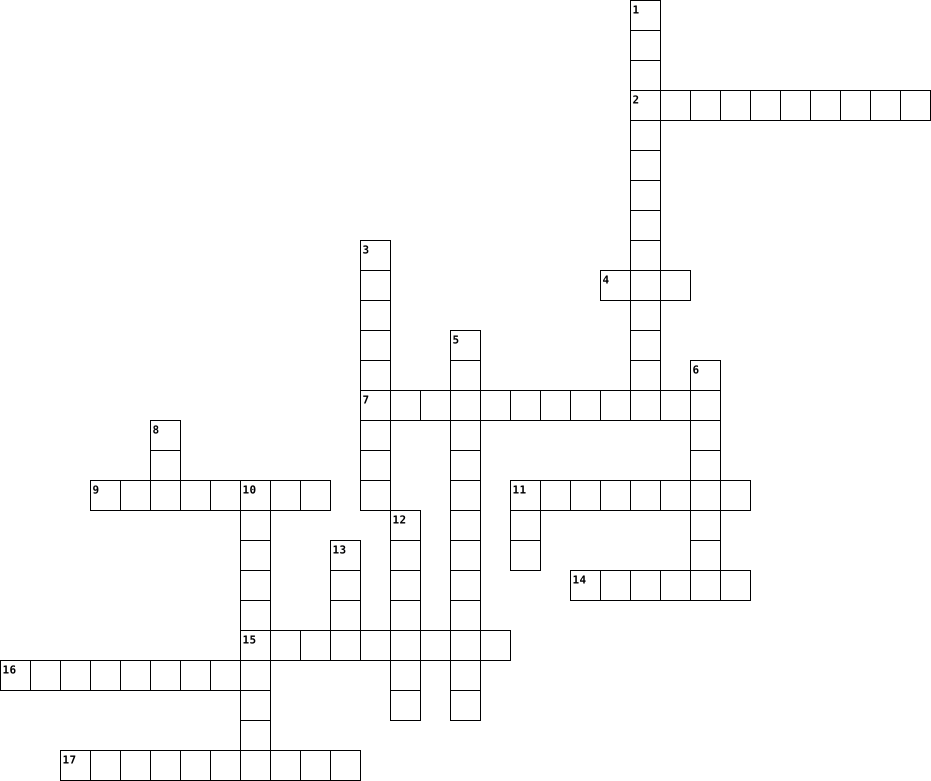
Across
- the big number in front of reactants or products
- of conservation of mass Matter cannot be created nor destroyed
- Single replacment
- The right side of a Chemical Equation
- 2 or more elements
- ----->
- A+B=AB
- the small number that goes after elements
- When a chemical equation is NOT equal on both sides
Down
- Double replacment
- The left side of a Chemical Equation
- AB=A+B
- When a chemical equation is equal on both sides
- Water
- Reaction that always ends with H2O and CO2
- Carbon Dioxide
- a pure substance
- What type of energy does combustion typically need
18 Clues: Water • AB=A+B • -----> • A+B=AB • Carbon Dioxide • a pure substance • Double replacment • Single replacment • 2 or more elements • The left side of a Chemical Equation • The right side of a Chemical Equation • the small number that goes after elements • Reaction that always ends with H2O and CO2 • When a chemical equation is equal on both sides • ...
Science Revision 2020-06-15

Across
- green pigment which makes photosynthesis
- a synonym for circulatory system
- cellular respiration w/ out air
- cellular respiration w/ air
- the "thing" undergoing the chemical reaction
- air sacs in which the human gas exchange happens
Down
- mass mass of a molecule
- concept in chemistry to count small things
- process in which cells make energy
- how plants make their food (glucose)
- enzyme that catalyses the hydrolysis of starch into sugars
- through where does the air travel to lungs?
- speed up chemical reactions
- what is an enzyme?
- the place on an enzyme where the reaction takes place
15 Clues: what is an enzyme? • mass mass of a molecule • speed up chemical reactions • cellular respiration w/ air • cellular respiration w/ out air • a synonym for circulatory system • process in which cells make energy • how plants make their food (glucose) • green pigment which makes photosynthesis • concept in chemistry to count small things • ...
chapter 7 vocab 2024-01-03

Across
- energy stored in bonds of atoms and molecules
- chemical reaction that absorbs heat from its environment
- 1 element is replaced by another in a compound
- decomposition reaction is: AB→A+B
- species formed from chemical reactions.
- Fuel + O2 → CO2 + H2O
- the equation for chemicals in chemistry
- represented by equation:A+B → AB
Down
- transfer of electrons from one species to another
- 2 ionic compounds that exchange anions or cations
- rhymes with vole
- factor that measures some property.
- Reactants → Products + Energy
- mass of one mole of any substance
- substance that takes part in and undergoes change
15 Clues: rhymes with vole • Fuel + O2 → CO2 + H2O • Reactants → Products + Energy • represented by equation:A+B → AB • decomposition reaction is: AB→A+B • mass of one mole of any substance • factor that measures some property. • species formed from chemical reactions. • the equation for chemicals in chemistry • energy stored in bonds of atoms and molecules • ...
Chemical Reaction Vocabulary Words 2024-10-16

Across
- A change that occurs when one or more substances change into entirely new substances with different properties
- States that the mass of an object, or collection of objects new changes, no matter how the parts are rearranged
- A solid formed by a change in a solution, often due to a chemical reaction or change in temperature
Down
- Happens when two or more substances combine in ways that make new substances form that have different properties from the beginning materials
- A substance or molecule that participates in a chemical reaction; the ingredients that you start with
- A change of matter from one form to another without a change in chemical properties; only physical changes
- A representation of a chemical reaction using symbols of the elements to indicate the amount of substance of each reactant and product
- A substance or molecule that is formed in a chemical reaction; the final output
8 Clues: A substance or molecule that is formed in a chemical reaction; the final output • A solid formed by a change in a solution, often due to a chemical reaction or change in temperature • A substance or molecule that participates in a chemical reaction; the ingredients that you start with • ...
Chemistry keywords 2013-04-30

Across
- Substances that cannot be chemically broken down into simpler substances.
- the smallest particle that can exist.
- This causes global warming.
- Two different elements chemically joined.
- 78% of the air is made from ……..
- A group of atoms chemically bound together.
- An atom with electric charge.
- opposite to endothermic
- A reaction between iron, water and oxygen.
Down
- A way of preventing rust by coating steel or Iron in zinc.
- this has three things in it without one there is no reaction.
- One substance meets another substance without a chemical reaction.
- This is a greenhouse gas
- A reaction that takes in energy and makes surroundings cooler.
- We need this to live.
- A rapid reaction that gives out energy.
16 Clues: We need this to live. • opposite to endothermic • This is a greenhouse gas • This causes global warming. • An atom with electric charge. • 78% of the air is made from …….. • the smallest particle that can exist. • A rapid reaction that gives out energy. • Two different elements chemically joined. • A reaction between iron, water and oxygen. • ...
Thermochemistry 2020-03-16

Across
- This is the term used when a liquid goes to a solid.
- The energy found in chemical composition
- The type of process that energy is absorbed in a reaction.
- This type of element has a small specific heat capacity
- A measure of the average kinetic energy of particles
- This is the point where the liquid and gas cannot be distinguished.
- The amount of energy needed to start a reaction.
- The study of energy changes that occur during chemical and physical changes.
- The point that every reaction needs to get past in order for the reaction to occur.
- The total amount of energy transferred from areas of high temperature to areas of low temperature
- If the enthalpy is positive, then heat is on the ________ side.
- The capacity to do work or transfer heat
- During a phase change, temperature stays ______
Down
- The disorder of a system
- This heat of ____ is used when going to or from a solid to liquid
- This is the term used when a gas turns into a solid.
- The energy due to motion
- The precise measurement of heat flow out of a system for chemical and physical processes.
- This is the term used when a gas turns into a liquid.
- The amount of energy needed to raise the temperature of 1 g of a substance by 1C
- This heat of ____ is used when going to from a liquid to gas
- This is the term used when a solid turns into a gas.
- This is where all three phases present at the same time.
- This is the term used when a liquid turns into a gas.
- If the enthalpy is negative, then heat is on the ________ side.
- The heat content of a system
- The type of process that energy is released in a reaction
- This is the term used when a solid goes to a liquid.
28 Clues: The disorder of a system • The energy due to motion • The heat content of a system • The energy found in chemical composition • The capacity to do work or transfer heat • During a phase change, temperature stays ______ • The amount of energy needed to start a reaction. • This is the term used when a gas turns into a solid. • ...
Macromolecules & Enzymes 2023-10-16

Across
- Ending materials in a chemical reaction. and on the right side of the arrow. This is what is produced.
- long-term energy storage; also helps to keep organisms warm
- Compounds that contain carbon
- specialized protein that catalyzes reactions; their names usually end in - ase
- A starting material in a chemical reaction. It goes into a reaction.
- Simple sugar; monomer of a carbohydrate
- A storage polysaccharide in plants consisting entirely of glucose.
- ribonucleic acid
- Energy needed to get a reaction started
- store and transmit hereditary/genetic information
- main source of short term energy
- An extensively branched glucose storage polysaccharide found in the liver and muscle of animals; the animal equivalent of starch.
- Region of an enzyme into which a particular substrate fits.
- monomers of lipids (fats)
- A change in the shape of a protein (such as an enzyme) that can be caused by changes in temperature or pH (among other things).
Down
- The temperature at which the rate of enzymatic activity will be at its peak.
- A temporary complex formed when an enzyme binds to its substrate molecule(s).
- - *the molecule upon which an enzyme acts, and joins the enzyme at the active site. Also called a reactant
- builds and maintains cells
- the process by which one or more substances change to produce one or more different substances
- large compound formed from combinations of many monomers
- monomer of nucleic acids
- model Enzymes are specific. The only work on the substrate that they "fit." Just like a lock has a specific key to open it.
- A complex molecule containing the genetic information that makes up the chromosomes.
- monomer of protein
- the building block of a macromolecule/polymer
- Breaking down of molecules. Happens primarily in the stomach in animals.
- a substance that causes or speeds up a chemical reaction
28 Clues: ribonucleic acid • monomer of protein • monomer of nucleic acids • monomers of lipids (fats) • builds and maintains cells • Compounds that contain carbon • main source of short term energy • Simple sugar; monomer of a carbohydrate • Energy needed to get a reaction started • the building block of a macromolecule/polymer • store and transmit hereditary/genetic information • ...
Unit 2 Science Voabulary 2018-09-08

Across
- An atom or group of atoms that has a positive or negative charge as a result of the loss or gain of an electron(s)
- A chemical bond that involves the sharing of electron pairs between atoms
- A change in a substance that affects its state of matter, but not its chemical makeup
- A chemical change that happens when two or more elements combine or rearrange to form a new element
- A hot ionized gas consisting of approximately equal numbers of positively charged ions and negatively charged electrons. Due to its properties being very different from regular gasses, it is sometimes referred to as the fourth state of matter
- A covalent bond in which two atoms share a pair of electrons
- A number assigned to an element in chemical combination that represents the number of electrons lost (or gained, if the number is negative) by an atom of that element in the compound
- The transition of an element from a solid to a gas, without transitioning to a liquid first
- point The temperature at which the vapor pressure of a liquid element equals the pressure surrounding the liquid
Down
- A substance that forms as a result of a chemical reaction
- point The temperature at which the solid form of an element becomes a liquid.
- A chemical bond formed between two ions with opposite charges. A chemical bond formed between two ions with opposite charges. Atoms may share
- A substance that takes part in and undergoes change during a reaction.
- A (usually irreversible) change in a substance that rearranges its atomic structure and therefore it’s chemical and physical properties
- bond Covalent bond between two atoms in which electrons are shared unequally
- Two or more atoms bonded together, the smallest unit of a chemical compound that can take part in chemical bonding
- A substance composed of exactly two elements that cannot be simplified by any further means
- A set of chemical symbols showing the elements present in a compound and their relative proportions
- An ion comprised of two or more atoms.
- Chemical atoms being held together by a strong force of attraction
20 Clues: An ion comprised of two or more atoms. • A substance that forms as a result of a chemical reaction • A covalent bond in which two atoms share a pair of electrons • Chemical atoms being held together by a strong force of attraction • A substance that takes part in and undergoes change during a reaction. • ...
Asia Gensch - chapter 13 2016-10-12

Across
- if you change anything in the reaction, the equilibrium will change
- heat transfers from surroundings to reactants
- must be added to break bonds
- AB+oxygen-->oxides of A and B
- A+B-->AB
- the pH is higher than 7
- heat transfers from reactants to surroundings
Down
- AB+CD-->AD+CB
- a substance that is the result of the chemical change
- AB+C-->AC+B
- a substance that undergoes a chemical change
- when reaction and its reverse act at the same rate
- AB-->A+B
- forming bonds releases _____
- the pH is below 7
15 Clues: AB-->A+B • A+B-->AB • AB+C-->AC+B • AB+CD-->AD+CB • the pH is below 7 • the pH is higher than 7 • forming bonds releases _____ • must be added to break bonds • AB+oxygen-->oxides of A and B • a substance that undergoes a chemical change • heat transfers from surroundings to reactants • heat transfers from reactants to surroundings • when reaction and its reverse act at the same rate • ...
Chemistry Vocab 2023-10-23

Across
- A change in a substance that does not involve a change in the identity of the substance
- Releases heat into the surroundings causing their temperature to increase.
- A chemical equation in which mass is conserved; each side of the equation has the same number of atoms of each element
- A representation of a chemical reaction that uses symbols to show the relationship between the reactants and the products
- absorbs heat from the surroundings causing their temperature to decrease.
Down
- Characteristics that can be observed or measured without changing the identity of the substance (Melting or boiling points)
- Matter (mass) is not created nor destroyed in any chemical or physical change, but it can be rearranged.
- A substance that forms in a chemical reaction
- Characteristics of a substance that determine how it will react with other substances.
- A chemical substance that is present at the start of a chemical reaction
- The process that causes atoms to rearrange to create a whole new substance.
11 Clues: A substance that forms in a chemical reaction • A chemical substance that is present at the start of a chemical reaction • absorbs heat from the surroundings causing their temperature to decrease. • Releases heat into the surroundings causing their temperature to increase. • The process that causes atoms to rearrange to create a whole new substance. • ...
Chemistry Terms 2025-04-24

Across
- Opposites don't attract
- Gets you pumped up
- Chemical Science
- The smallest thing
- Change Change of structure
- How much matter
- Process of change
- The result
- Warmness
- What the thermometer says
Down
- How much space something takes up
- Property Rate your reactibility 1-10
- Purebred Atoms
- The lighter to the firework
- A thing of things
- Bonded Atoms
- Atom Glue
- Stuff, takes up space
18 Clues: Warmness • Atom Glue • The result • Bonded Atoms • Purebred Atoms • How much matter • Chemical Science • A thing of things • Process of change • Gets you pumped up • The smallest thing • Stuff, takes up space • Opposites don't attract • What the thermometer says • Change Change of structure • The lighter to the firework • How much space something takes up • Property Rate your reactibility 1-10
Photosynthesis 2023-12-18

Across
- Where the light-dependent reaction occurs
- The light-independent reaction is also called the ___ Cycle
- These are stacks of thylakoids found inside chloroplasts
- Cellular energy molecule with 3 phosphate groups
- Cellular process in which solar energy is captured and converted into stored chemical energy
- The reactant of the light-dependent reaction
- The color that chlorophyll cannot absorb
- The product of the light-independent reaction
- Membrane-bound sac or disk of chlorophyll
- Organism that must consume other organisms for food
Down
- A secondary pigment in plant leaves that we only see in Autumn/Fall
- Energy used to start the light-dependent reaction
- Organism that makes its own food
- The reactant of the light-independent reaction
- The ___ mesophyll is the layer of cells in a plant leaf where chloroplasts are found
- Compound that can accept a pair of high energy electrons and transfer them, along with most of their energy, to another molecule
- A light absorbing compound
- Type of electrons that are highly reactive and available to do work
- The fluid inside of chloroplasts - where the light-independent reaction occurs
- The primary pigment found in chloroplasts
20 Clues: A light absorbing compound • Organism that makes its own food • The color that chlorophyll cannot absorb • Where the light-dependent reaction occurs • The primary pigment found in chloroplasts • Membrane-bound sac or disk of chlorophyll • The reactant of the light-dependent reaction • The product of the light-independent reaction • ...
Chemistry Crossword 2015-12-01

Across
- Materials produced by a reaction.
- Substances that help a reaction proceed faster.
- Substances formed as a result of the attraction between particles of opposite charges.
- Heat being given off
- Most stable and unreactive element.
- Most reactive metals.
- The amount of mass in a given volume of a substance.
- Absorption of heat.
- The smallest part of an element.
- Gas to solid.
- Positively charged centre of an atom.
- A pure substance that cannot be broken down any further.
- Neutral particle
Down
- Positively charged particles.
- Slow chemical change that occurs when air reacts with metal.
- When non metals combine.
- Takes place when two or more substances combine to form a new substance.
- An atom that has become electrically charged.
- Materials at the start of a reaction.
- The most reactive non metals.
- Anything that has mass and occupies space.
- Element that has both metallic and non metallic properties.
- Solid to a gas.
- Negatively charged particle in an atom.
- Catalyst involved in chemical reactions in living things.
25 Clues: Gas to solid. • Solid to a gas. • Neutral particle • Absorption of heat. • Heat being given off • Most reactive metals. • When non metals combine. • Positively charged particles. • The most reactive non metals. • The smallest part of an element. • Materials produced by a reaction. • Most stable and unreactive element. • Materials at the start of a reaction. • ...
Chemical Bonding 2018-02-02

Across
- the electrons in the outer energy level of an atom
- a more active element takes the place another element in a compound
- substances you start with
- substances you end up with
- biochemical compounds such as fats and oils
- a reaction in which energy is absorbed
- a chemical compound that is mainly composed of carbon, hydrogen, and possibly other elements
- speeds up a chemical reaction
- a single compound breaks down into its component parts or simpler compounds
Down
- biochemical compounds that consist of one or more chains of amino acids
- only refer to the atom they are behind
- Biochemical Compounds that include DNA and RNA
- any carbon-based compound found in living things
- Ions in two compounds “change partners”
- two or more elements or compounds may combine to form a more complex compound
- apply to the entire compound
- bond where electrons are shared between two nonmetals
- a reaction in which energy is released
- biochemical compounds that include sugars, starches, and celluose
- when a substance reacts with oxygen to produce energy in the form of heat and light
20 Clues: substances you start with • substances you end up with • apply to the entire compound • speeds up a chemical reaction • only refer to the atom they are behind • a reaction in which energy is absorbed • a reaction in which energy is released • Ions in two compounds “change partners” • biochemical compounds such as fats and oils • Biochemical Compounds that include DNA and RNA • ...
Matter and Energy in Ecosystems 2020-04-17

Across
- the part of a cell where photosynthesis happens
- organism gets energy by breaking down dead matter
- a type of energy storage molecule
- reaction between oxygen/glucose releases energy
- tiny pieces that all matter is made of
- living things
- a type of energy storage molecule
- molecule made of carbon and oxygen atoms
- starting substance that is part of a chemical reaction
- a molecule that organisms can use to release energy
Down
- ending substance that is made during a chemical reaction
- a group of atoms joined together in a particular way
- all the living and nonliving things in area
- an organism that needs to eat in order to get energy
- energy storage molecule made of many glucose molecules
- the part of cell where cellular respiration happens
- producers use energy from sunlight to make O2+H2O
- set of interacting parts forming a complex whole
- an organism that can make its own energy storage molecules
- molecule molecule organisms use to release energy
- closed ecosystem made by humans
- the ability to make things move or change
- matter that makes up the nonliving parts of an ecosystem,
23 Clues: living things • closed ecosystem made by humans • a type of energy storage molecule • a type of energy storage molecule • tiny pieces that all matter is made of • molecule made of carbon and oxygen atoms • the ability to make things move or change • all the living and nonliving things in area • the part of a cell where photosynthesis happens • ...
Chemistry Crossword 2018-06-08

Across
- chemical reaction that releases heat energy
- mixture in which the different substances are visible
- when a new substance is formed and non-reversible
- can be in between metals and non-metals
- the number of protons in the nucleus of an atom
- mixture of two or more pure substances that look like one substance
- can eat away or corrode
- contaminated material that is a threat to humans and health
- substances in a reaction
- chemical reaction that absorbs heat energy
Down
- pure substance that cannot broken down any further
- workplace hazardous materials information system
- change in appearance or state
- ability to conduct electricity or heat
- the mass of all protons and neutrons in an atom
- when a solid changes to a gas
- when non-metal combine
- the mixture of magic and chemistry
- when a gas changes to a solid
- shiniest of a substances,
- electrically charged atoms
- made up of one type of matter
- the center of an atom
- the horizontal rows on the periodic table
- a compound of a metal and non-metal
25 Clues: the center of an atom • when non-metal combine • can eat away or corrode • substances in a reaction • shiniest of a substances, • electrically charged atoms • change in appearance or state • when a solid changes to a gas • when a gas changes to a solid • made up of one type of matter • the mixture of magic and chemistry • a compound of a metal and non-metal • ...
Sarai Gutierrez Chapter 13 Crossword 2019-02-25

Across
- One half of an oxidation–reduction reaction, represented by an equation showing electrons as either reactants or products.
- A reaction between an acid and a base.
- The deterioration of a metal, typically caused by atmospheric oxygen.
- Description of a chemical reaction in which there is a net absorption of energy.
- A substance that lowers the activation energy of a chemical reaction, which allows for the reaction to proceed at a faster rate.
Down
- Description of a substance that can behave as either an acid or a base.
- The minimum energy required in order for a chemical reaction to proceed.
- The process by which a reactant loses one or more electrons.
- A polyatomic ion made by adding a proton (hydrogen ion) to a water molecule.
- The amount of energy required to pull two bonded atoms apart, which is the same as the amount of energy released when the two atoms are brought together into a bond.
10 Clues: A reaction between an acid and a base. • The process by which a reactant loses one or more electrons. • The deterioration of a metal, typically caused by atmospheric oxygen. • Description of a substance that can behave as either an acid or a base. • The minimum energy required in order for a chemical reaction to proceed. • ...
Cellular Energeticsy 2021-08-24

Across
- The potential of a chemical substance to undergo a chemical reaction to transform into other substances
- substance occurring in plant or animal tissue and producing a characteristic color
- What happens when the body has no more oxygen
- A chemical element in the air necessary for human survival
- A side effect of fermentation within yeast
- An organism that can make its own food
- A gas necessary for a plant to produce food
- Marked by or promoting metabolic activity concerned with the breakdown of complex molecules
- is radiant light and heat from the Sun
- Main type of sugar in the blood
Down
- Without oxygen
- A substance that takes part in and undergoes change during a reaction
- lungs shrink to allow gasses to diffuse out
- An organism that can not make its own food
- With oxygen
- Membrane-bound cell organelles that generate most of the chemical energy needed to power the cell's biochemical reactions
- transfer of oxygen and production of carbon dioxide and water as end products
- The basis of fluids in living organisms
- Primary carrier of energy in cells
- Process by which plants use sunlight, water, and carbon dioxide to create oxygen and energy in the form of sugar
- lungs expand to allow gasses to diffuse in
- A side effect of fermentation within mammals
22 Clues: With oxygen • Without oxygen • Main type of sugar in the blood • Primary carrier of energy in cells • An organism that can make its own food • is radiant light and heat from the Sun • The basis of fluids in living organisms • An organism that can not make its own food • A side effect of fermentation within yeast • lungs expand to allow gasses to diffuse in • ...
Chapt. 2 vocabulary 2022-12-12

Across
- a biological catalyst and is almost always a protein
- a substance made from two or more different elements that have been chemically joined.
- type of linkage formed from the electrostatic attraction between oppositely charged ions in a chemical compound.
- the substance on which an enzyme can act.
- A structure having an uneven distribution of electron density
- A basic part of a whole.
- The part of the enzyme where the substrate binds
- Atoms with the same number of protons but different numbers of neutrons
- the basic building block of nucleic acids
- chemical substances which participate in chemical reactions and forms new substances
- the building blocks of the fat in our bodies
- is an essential sugar alcohol for many living things.
Down
- The smallest particle of a substance that has all of the physical and chemical properties of that substance.
- something that occurs when chemical bonds between atoms are formed or broken.
- the smaller units from which larger molecules are made
- interaction involving a hydrogen atom located between a pair of other atoms having a high affinity for electrons
- a substance that can be added to a reaction to increase the reaction rate without getting consumed in the process.
- A liquid that is able to dissolve a solid.
- an atom or group of atoms that has an electric charge.
- the sharing of electron pairs between atoms.
20 Clues: A basic part of a whole. • the substance on which an enzyme can act. • the basic building block of nucleic acids • A liquid that is able to dissolve a solid. • the sharing of electron pairs between atoms. • the building blocks of the fat in our bodies • The part of the enzyme where the substrate binds • a biological catalyst and is almost always a protein • ...
chemical reactions 2025-05-01

Across
- what is conserved in all reactions?
- the biggest flame you've ever seen in a demo
- where a more reactive metal displaces a less reactive metal
- what you react together
- sign of a reaction where a gas is formed
Down
- reaction between fuel and oxygen
- reaction that increases in temperature
- product of metal + oxygen
- reaction that takes in energy from it's surroundings
- reaction where no new substances are made
- what colour did the anhydrous copper sulfate turn when water was added?
- reaction where a new substance is made
- sign in the middle of a word equation
13 Clues: what you react together • product of metal + oxygen • reaction between fuel and oxygen • what is conserved in all reactions? • sign in the middle of a word equation • reaction that increases in temperature • reaction where a new substance is made • sign of a reaction where a gas is formed • reaction where no new substances are made • ...
Chemistry 2017-11-08
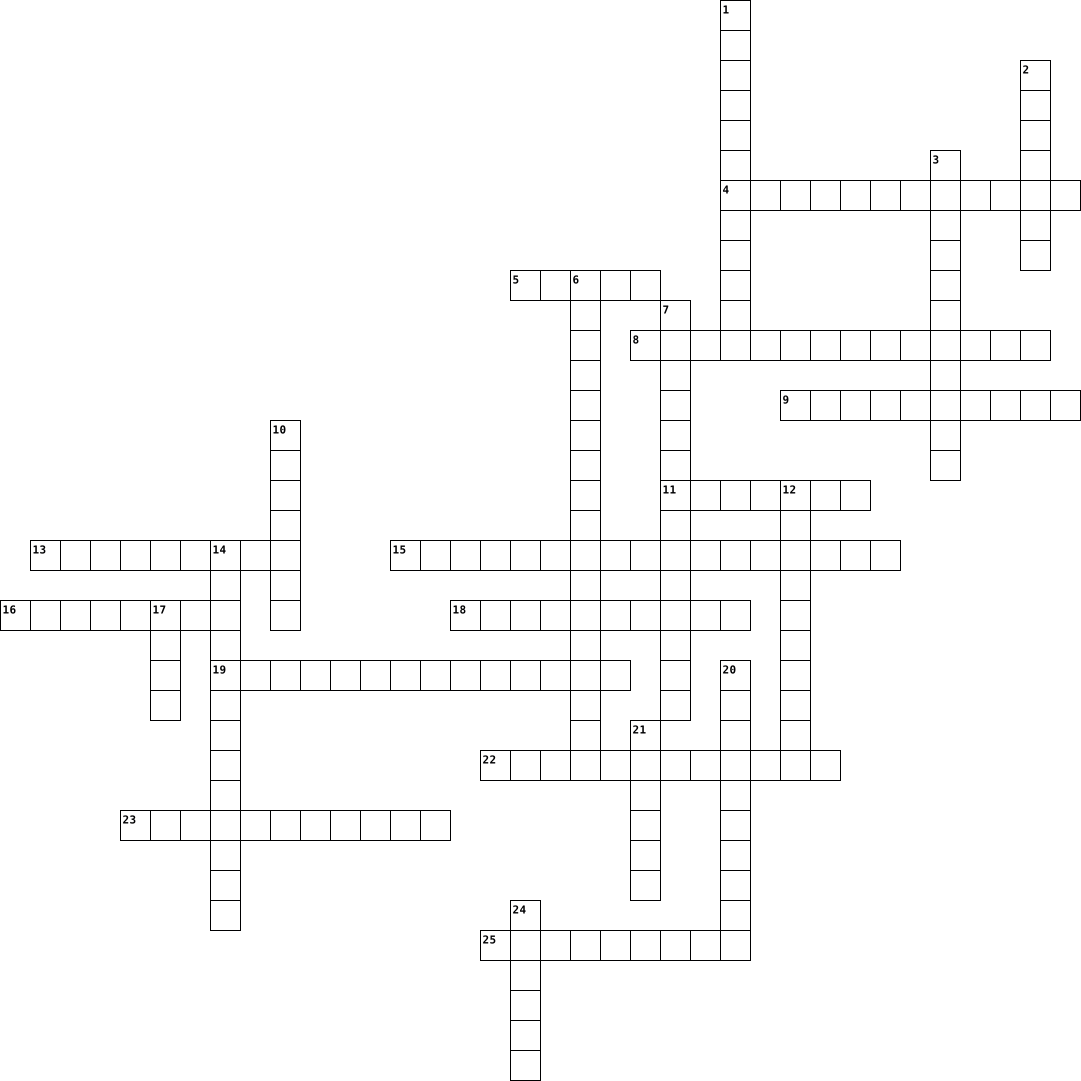
Across
- the number of protons in the nucleus of an atom
- workplace hazardous materials information system
- change in appearance or state
- when a gas changes to a solid
- the mixture of magic and chemistry
- can eat away or corrode
- when non-metal combine
- mixture of two or more pure substances that look like one substance
- the mass of all protons and neutrons in an atom
- ability to conduct electricity or heat
- made up of one type of matter
- chemical reaction that absorbs heat energy
- substances in a reaction
Down
- contaminated material that is a threat to humans and health
- the center of an atom
- when a solid changes to a gas
- mixture in which the different substances are visible
- when a new substance is formed and non-reversible
- pure substance that cannot broken down any further
- chemical reaction that releases heat energy
- a compound of a metal and non-metal
- electrically charged atoms
- can be in between metals and non-metals
- shiniest of a substances,
- the horizontal rows on the periodic table
25 Clues: the center of an atom • when non-metal combine • can eat away or corrode • substances in a reaction • shiniest of a substances, • electrically charged atoms • when a solid changes to a gas • change in appearance or state • when a gas changes to a solid • made up of one type of matter • the mixture of magic and chemistry • a compound of a metal and non-metal • ...
Chemistry Crossword 2018-06-08

Across
- can be in between metals and non-metals
- made up of one type of matter
- workplace hazardous materials information system
- when a new substance is formed and non-reversible
- the mass of all protons and neutrons in an atom
- the center of an atom
- when non-metal combine
- can eat away or corrode
- when a solid changes to a gas
- the mixture of magic and chemistry
- contaminated material that is a threat to humans and health
- electrically charged atoms
Down
- chemical reaction that absorbs heat energy
- change in appearance or state
- mixture in which the different substances are visible
- mixture of two or more pure substances that look like one substance
- chemical reaction that releases heat energy
- pure substance that cannot broken down any further
- the number of protons in the nucleus of an atom
- ability to conduct electricity or heat
- a compound of a metal and non-metal
- shiniest of a substances,
- substances in a reaction
- when a gas changes to a solid
- the horizontal rows on the periodic table
25 Clues: the center of an atom • when non-metal combine • can eat away or corrode • substances in a reaction • shiniest of a substances, • electrically charged atoms • change in appearance or state • made up of one type of matter • when a solid changes to a gas • when a gas changes to a solid • the mixture of magic and chemistry • a compound of a metal and non-metal • ...
math 2022-05-17

Across
- Negatively charged ion
- Vertical column of periodic table
- Resulting substances in a chemical reaction
- Ability of a substance to be beaten into thin sheets
- Logical approach to solving problems
- Three-dimensional region around the nucleus
- Polyatomic ions that have oxygen
- AB → A + B
- Positively charged particle
- Smallest unit of an element
- Mass of a water molecule
- Neutral atoms held by covalent bonds
- Original substances in a chemical reaction
- Compound that has an anion and cation from an acid
- Substance that's not entirely used up in a reaction
Down
- Number of protons of an element
- Positively charged ion
- A + B → AB
- Process that leads to the formation of ions
- Horizontal row of periodic table
- Ability of substance to be stretched into wires
- Charged group of covalently bonded atoms
- Has mass and takes up space
- Identification of the structure of materials
- Compounds containing two elements
- Lowest state of atom
- Research made for additional knowledge
- Atom(s) that have a positive or negative charge
- Study of matter and its changes
- Repeating patterns
30 Clues: A + B → AB • AB → A + B • Repeating patterns • Lowest state of atom • Positively charged ion • Negatively charged ion • Mass of a water molecule • Has mass and takes up space • Positively charged particle • Smallest unit of an element • Number of protons of an element • Study of matter and its changes • Horizontal row of periodic table • Polyatomic ions that have oxygen • ...
Garza_TX_Science 2022-05-20

Across
- tastes excellent with any taco
- organelle only found in plant cells
- formed when 2 or more atoms join chemically
- small column of air violently rotating
- smallest part of an element
- protects astronauts outside the craft
- the most played sport in the world
- organelle that stores water
- reaction that produces oxygen and sugar
- a person trained to be part of a space crew
- where digestion begins
- goes perfect with tostitos
- better than water
- large tropical weather system with high winds
- organelle that produces power
- where objects appear to be weightless
Down
- plant organelle where photosynthesis occurs
- a pure substance
- high quality H2O
- a rising body of water that submerges dry land
- the main organ of the circulatory system
- owned by Elon Musk
- contains the DNA of the cell
- main organ of the skeletal system
- all biotic and abiotic factors in an area
- Layer of gas surrounding a planet
- a very tasty breakfast
- produced from a chemical reaction
- takes part in a chemical reaction
- my favorite animal
30 Clues: a pure substance • high quality H2O • better than water • owned by Elon Musk • my favorite animal • a very tasty breakfast • where digestion begins • goes perfect with tostitos • smallest part of an element • organelle that stores water • contains the DNA of the cell • organelle that produces power • tastes excellent with any taco • main organ of the skeletal system • ...
Metabolism 2025-10-06

Across
- O2
- H2O
- a term for an organism that must obtain glucose by eating other things
- a heterotroph on the food chain
- the organelles where photosynthesis occurs
- kingdom MOST associated with photosynthesis
- the cellular process of creating glucose from carbon dioxide and water with the help of photons (radiant energy)
- the cellular process of taking oxygen and glucose and charging up ATP from it
- the organ tubes that transport glucose around plants
- CO2
- tiny holes in leaves that let gases in and out
Down
- ingoing substances to a reaction
- an autotroph on the food chain
- gather water from the ground for plants
- the organelles where cellular respiration occurs
- a term for any organism that manufactures its own glucose, usually using light energy
- the number of oxygens, carbon dioxides, and waters involved in one reaction of cellular respiration or one run of photosynthesis
- a chemical energy molecule made in photosynthesis
- the chemical energy molecule charged up in cellular respiration
- outgoing substances to a reaction
- C6H12O6 sugar
- the organ tubes that transport water around a plant
22 Clues: O2 • H2O • CO2 • C6H12O6 sugar • an autotroph on the food chain • a heterotroph on the food chain • ingoing substances to a reaction • outgoing substances to a reaction • gather water from the ground for plants • the organelles where photosynthesis occurs • kingdom MOST associated with photosynthesis • tiny holes in leaves that let gases in and out • ...
Jalen Smith 2022-03-08

Across
- study of molar ratios in chemical reactions
- the max amount of product that can be produced based on limiting reactant
- lowest whole number ratio of elements within a compound
- number used to change one set of units to another by multiplying or dividing
- the ratio of the amount of each element to the total amount of individual elements present in the compound multiplied by 100
- conversion factor between compounds in a chemical reaction
Down
- the quantity of a product obtained from the complete conversion of the limiting reactant in a chemical reaction
- the substance that will be used up first in a chemical reaction
- mass of one mole of a substance
- a multiple of an empirical formula
- the percent ratio of actual yield to the theoretical yield
11 Clues: mass of one mole of a substance • a multiple of an empirical formula • study of molar ratios in chemical reactions • lowest whole number ratio of elements within a compound • the percent ratio of actual yield to the theoretical yield • conversion factor between compounds in a chemical reaction • the substance that will be used up first in a chemical reaction • ...
Nuclear Reactions, Rate of Reactions & Endo/Exothermic Reactions 2023-04-26

Across
- More Particles in the Same Space = More Collisions & Greater Chance of a Reaction
- Increasing Contact Points = More Collisions & Greater Chance of a Reaction
- Decreasing the space for the same number of particles = More Collisions & Greater Chance of a Reaction
- Reactants have More Energy than the Product, Temperature Increases, Thermal Energy is Released
- The time that it takes half the nuclei in a sample to decay
- Smaller nuclei join together to form larger nuclei and energy is released
- Each time a nucleus splits, it releases more neutrons, which can go on and cause more reactions to occur and will continue to happen.
- How can Radioactivity be detected
- An example of an Endothermic Reaction
- Lowers the Activation Energy
- Means Out
Down
- Any reaction involving a solid takes place where
- The splitting of a nucleus into smaller nuclei and the release of energy
- Nuclear Reactions Release ______ Energy Than Chemical Reactions
- Two smaller nuclei created when a nucleus splits
- Reactants have Less Energy than the Products, Temperature Decreases, Thermal Energy is Absorbed
- Increasing Energy = Particles move Faster = More Collisions & Greater Chance of a Reaction
- Related to Heat
- Process Happens in the Sun’s Core
- Occurs when a stable isotope is struck by a neutron
- An example of an Exothermic Reaction
- Means In
- How can the surface area of a solid be increased
23 Clues: Means In • Means Out • Related to Heat • Lowers the Activation Energy • Process Happens in the Sun’s Core • How can Radioactivity be detected • An example of an Exothermic Reaction • An example of an Endothermic Reaction • Any reaction involving a solid takes place where • Two smaller nuclei created when a nucleus splits • How can the surface area of a solid be increased • ...