
chemical reaction Crossword Puzzles
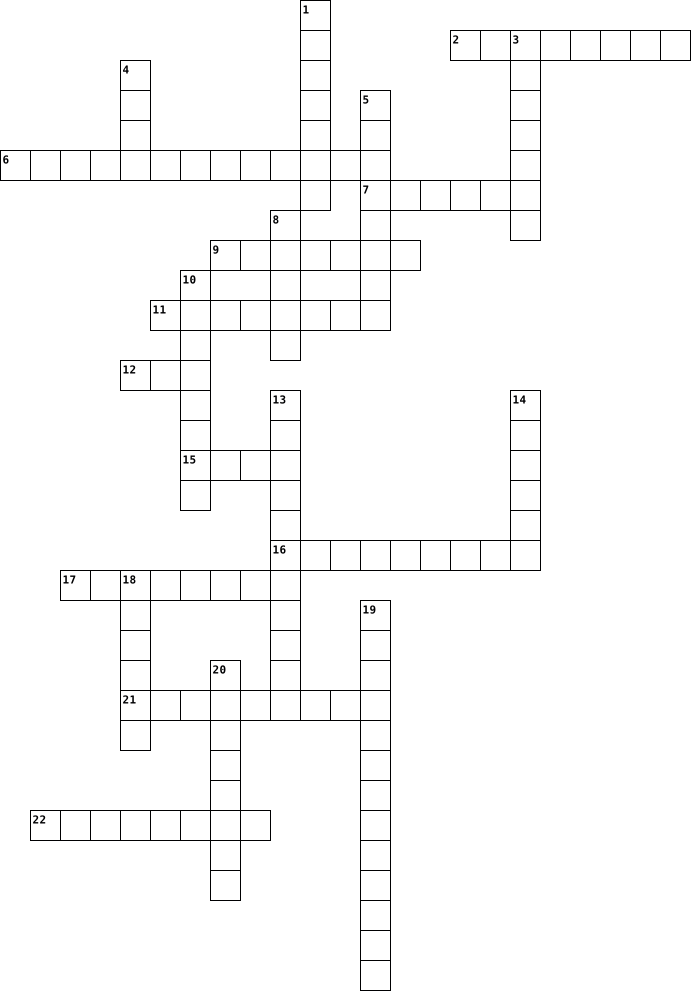
Photophosphorylation 2015-11-29

Across
- assimilation: reaction occurs when plants are not receiving light
- site of photophosphorylation
- major accessory pigment that absorbs wavelengths chlorophyll cannot absorb
- I: excitation of this photosystem's reaction center drive electrons to ferrodoxin and produce NADPH
- harvesting: complex containing chlorophyll associated with other proteins and membrane
- I: type of reaction center in bacteria that passes electrons through a quinone to an iron-sulfur center
- main light absorbing pigment in photophosphorylation
Down
- center: site where light energy is converted to chemical energy
- heterotrophs: these organisms release carbon dioxide
- the capture of solar energy by photosynthetic organisms and its conversion to chemical energy
- type of chlorophyll that transfers light energy to neighboring chlorophyll
- element that occupies the central position in a chlorophyll molecule
12 Clues: site of photophosphorylation • heterotrophs: these organisms release carbon dioxide • main light absorbing pigment in photophosphorylation • center: site where light energy is converted to chemical energy • assimilation: reaction occurs when plants are not receiving light • element that occupies the central position in a chlorophyll molecule • ...
Thermochemistry 2015-05-07

Across
- the science associated with determining the changes in energy of a system by measuring the heat exchanged with the surroundings
- accompanied by the gaining of heat
- a form of potential energy that can be absorbed or released during a chemical reaction
- the heat required to raise the temperature of the unit mass of a given substance by a given amount
- the capacity for vigorous activity
- a thermodynamic quantity equivalent to the total heat content of a system
- the branch of dealing with the relationship between chemical action and heat
- the amount of heat necessary to melt 1.00 moles of a substance at its melting point
- accompanied by the release of heat
- energy released as heat when a compound undergoes complete combustion with oxygen under standard conditions
Down
- the energy of a body or a system with respect to the position of the body or the arrangement of the particles of the system
- the SI unit of energy
- the amount of heat necessary to boil 1.00 mole of a substance at its boiling point
- change in the enthalpy of a chemical reaction that occurs at constant pressure
- the degree or intensity of heat
- an apparatus for measuring the amount of heat involved in a chemical reaction or other process
- the energy needed to raise the temperature of 1g of water through 1*C
- the energy of a body or a system with respect to the motion of the body or of the particles in the system
- the quality of being hot
19 Clues: the SI unit of energy • the quality of being hot • the degree or intensity of heat • accompanied by the gaining of heat • the capacity for vigorous activity • accompanied by the release of heat • the energy needed to raise the temperature of 1g of water through 1*C • a thermodynamic quantity equivalent to the total heat content of a system • ...
Chemical reactions 2024-03-30

Across
- – A ________________ reaction proceeds in one direction only.
- reaction – A _________________ reaction converts products back into reactants.
- – Substances that are formed on the right side of a chemical equation.
- – This type of reaction absorbs heat energy.
Down
- – A ___________________ reaction can proceed in either direction under appropriate conditions.
- – This type of reaction releases heat energy.
- – A ______________ reaction converts reactants into products.
- – Substances on the left side of a chemical equation that undergo a change.
8 Clues: – This type of reaction absorbs heat energy. • – This type of reaction releases heat energy. • – A ________________ reaction proceeds in one direction only. • – A ______________ reaction converts reactants into products. • – Substances that are formed on the right side of a chemical equation. • ...
Chapter 4 Crossword #4 2021-09-20

Across
- a molecule that catalyzes a biochemical reaction
- a molecule on which the enzyme acts
- all the chemical reactions that take place inside cells, including those that use energy and those that release energy
- the process of breaking glucose into two three-carbon molecules with the production of ATP and NADH
- the concept of energy flow through living systems
Down
- the movement of hydrogen ions down their electrochemical gradient across a membrane through ATP synthase to generate ATP
- describes a chemical reaction that results in products that store more chemical potential energy than the reactants
- (also, adenosine triphosphate) the cell’s energy currency
- describes a chemical reaction that results in products with less chemical potential energy than the reactants, plus the release of free energy
- the science of the relationships between heat, energy, and work
10 Clues: a molecule on which the enzyme acts • a molecule that catalyzes a biochemical reaction • the concept of energy flow through living systems • (also, adenosine triphosphate) the cell’s energy currency • the science of the relationships between heat, energy, and work • ...
Vocabulary 2013-10-22

Across
- cycle , process during cellular selection acts on alleles that favor the survival of close relatives
- , organelle composed of numerous membranes that are used to convert solar energy into chemical energy contains
- ,Product of fermentation in many types of cells including human muscle cells.
- dependent reaction , capture energy from sunlight . these reaction take place within across the membrane of the thylakoids
- , bean shaped organelle that supplies energy to the cell and has it own ribosome and DNA
- respiration , release chemical energy from sugars an other carbon based molecules to make ATP when oxygen is present
- , Aaerobic process by which ATP is produced is produced by glycolysis.
Down
- , cells that has a nucleus and other membrain bound organells
- , co2 is prosed that allows breadto rise
- , anaerobic process in which glucose is broken down into two molecules of pyruvate and two net ATP are produced
- , process by which light energy is converted to chemical energy
- ,Process that does not require oxygen to occure.
- reaction , use energy from the light dependent reaction to make sugars
- , is a molecule that transfers energy from the breakdown of food molecules to cell processes
- transport chain series of proteins in the thylakoid and mitochondrial membranes that aid in converting ADP to ATP by transfer electrons.
15 Clues: , co2 is prosed that allows breadto rise • ,Process that does not require oxygen to occure. • , cells that has a nucleus and other membrain bound organells • , process by which light energy is converted to chemical energy • reaction , use energy from the light dependent reaction to make sugars • ...
Physical and Chemical Properties/Changes 2021-10-08

Across
- the standard reaction enthalpy for the formation of the compound from its elements (atoms or molecules) in their most stable reference states at the chosen temperature
- The quality of being toxic or poisonous
- the reaction gave or possible chemical change that results in firey combustion
- The max temperature an object can reach before it boils
- The amount of matter in a substance
- The density of an object; how compact an object is
- How long an object is
- How hot or how cold an object or entity is
- chemical bonding, any of the interactions that account for the association of atoms into molecules, ions, crystals, and other stable species that make up the familiar substances of the everyday world
- The 3D Space of an object
- Depends on how quick or how strong the reaction of an object or entity is
- The property possessed by an object of producing different sensations on the eye as a result of the way the object reflects or emits light.
Down
- The thermodynamic stability of a chemical system
- The total number of electrons that an atom either gains or loses to form a chemical bond with another atom
- the number of atoms or ions immediately surrounding a central atom in a complex or crystal.
- A thin coating containing unoxidized metal which gives an iridescent glaze to ceramics.
- How much an object weighs
- The amount of heat released when an object or entity is added
- how large or small an object or entity is
19 Clues: How long an object is • How much an object weighs • The 3D Space of an object • The amount of matter in a substance • The quality of being toxic or poisonous • how large or small an object or entity is • How hot or how cold an object or entity is • The thermodynamic stability of a chemical system • The density of an object; how compact an object is • ...
Redox 2023-01-26

Across
- a substance that reduces another substance during a redox reaction
- the name given to the process that takes place when metals and alloys are chemically attacked by oxygen
- the chemical reaction by which biological cells release the energy stored in glucose for use by the cell or the body
- loss oxygen/gain electron/reduce of oxidation number
- a reaction involving both reduction and oxidation
Down
- a reaction in which a more reactive metals displace a less reactive one
- a number given to show whether an element has been oxidised or reduced
- a chemical reaction in which a substance reacts with oxygen
- gain oxygen/loss electron/increase of oxidation number
- oxidation number of Cl in Cl2
- oxidation number of S in SO2
11 Clues: oxidation number of S in SO2 • oxidation number of Cl in Cl2 • a reaction involving both reduction and oxidation • loss oxygen/gain electron/reduce of oxidation number • gain oxygen/loss electron/increase of oxidation number • a chemical reaction in which a substance reacts with oxygen • a substance that reduces another substance during a redox reaction • ...
chemical balance 2021-10-14

Across
- Chemical equation correctly shows that no mass was created or destroyed during the reaction
- bonds force of attraction that exists between atoms.
- atom that has lost or gained an electron and therefore carries an electric charge
- of mass Mass is never created or destroyed it just changes forms
Down
- electrons the number of electrons on the outermost energy level of an atom
- group of atoms that are joined together with covalent bonds chemical bond formed when atoms share electrons
- The substances produced after a chemical reaction
- The substances present before a chemical reaction
- positive ion is an atom that has lost electrons, resulting in an overall positive charge
9 Clues: The substances produced after a chemical reaction • The substances present before a chemical reaction • bonds force of attraction that exists between atoms. • of mass Mass is never created or destroyed it just changes forms • electrons the number of electrons on the outermost energy level of an atom • ...
science vocabulary crossword puzzle 2021-10-06

Across
- small numbers next to a symbol
- found on the periodic table
- the opposite of a physical reaction
- a group of atoms
Down
- a kind of matter
- proof of something
- formula of chemicals
- whats made after a chemical reaction
- basic unit of a chemical element
- has the same meaning of stop
10 Clues: a kind of matter • a group of atoms • proof of something • formula of chemicals • found on the periodic table • has the same meaning of stop • small numbers next to a symbol • basic unit of a chemical element • the opposite of a physical reaction • whats made after a chemical reaction
science vocabulary crossword puzzle 2021-10-06

Across
- small numbers next to a symbol
- found on the periodic table
- the opposite of a physical reaction
- a group of atoms
Down
- a kind of matter
- proof of something
- formula of chemicals
- whats made after a chemical reaction
- basic unit of a chemical element
- has the same meaning of stop
10 Clues: a kind of matter • a group of atoms • proof of something • formula of chemicals • found on the periodic table • has the same meaning of stop • small numbers next to a symbol • basic unit of a chemical element • the opposite of a physical reaction • whats made after a chemical reaction
photosynthesis 2024-10-04

Across
- H2O
- natural compound in plants
- tiny openings present on the epidermis on leaves
- dioxide greenhouse gas
- organism that can convert abiotic sources of energy
- solar radiation
- odorless gas
Down
- sugar
- The substances which participate in a chemical reaction
- tissue in plant
- energy kind of kinetic energy
- organelles responsible for photosynthesis
- transform light energy into chemical energy.
- species formed from chemical reactions
- cycle which carbon atoms continually
15 Clues: H2O • sugar • odorless gas • tissue in plant • solar radiation • dioxide greenhouse gas • natural compound in plants • energy kind of kinetic energy • cycle which carbon atoms continually • species formed from chemical reactions • organelles responsible for photosynthesis • transform light energy into chemical energy. • tiny openings present on the epidermis on leaves • ...
Photosynthesis 2022-01-27

Across
- Light+put together
- energy comes from the sun
- Sugar+Oxygen
- The green pigment that absorbs sunlight
- Lets gases in and out of the leaf
Down
- Tubes for water
- They are only found in plant cells
- Are formed into a chemical reaction
- Tubes that carry Sugar
- Substances starts a chemical reaction
10 Clues: Sugar+Oxygen • Tubes for water • Light+put together • Tubes that carry Sugar • energy comes from the sun • Lets gases in and out of the leaf • They are only found in plant cells • Are formed into a chemical reaction • Substances starts a chemical reaction • The green pigment that absorbs sunlight
Fermentation Crossword 2022-09-28

Across
- there are this many carbon atoms on each side of the fermentation chemical equation
- yeast is not an animal, plant or bacteria, but a ___
- what yeast eat
- anything that is dissolved in water, a water base
- another beverage that requires fermentation, nonalcoholic
- there are this many carbon atoms on each side of the fermentation chemical equation
- this is how many sugar molecules you start with in the chemical equation
- this is a product of fermentation
- a fungal infection, not caused by yeast, but common in teens who do sports
- this food product uses fermentation
- this is how many alcohol molecules you end wit in the chemical equation
- the skinny glass tube we use to do our reaction in
- these are the materials we end with in an experiment
- a beverage that requires fermentation, contains alcohol
- the suffix that means sugar
- there are this many hydrogen atoms on each side of the fermentation chemical equation
- the water needed to be ___ to get fermentation to start
Down
- how we measured how much gas is produced in fermentation
- how we captured the gas in fermentation
- another word for sugar
- a product of fermentation
- carbon dixoide makes bubbles, this means it is a ___
- the graduated cylinder got warm yesterday, this indicates a ____ reaction
- this is how many carbon dioxide gas molecules you end with in the chemical equation
- the "O" in our chemical equations is this element
- yeast is one cell big
- a yeast infection common to babies
- the "C" in our chemical equations is this element
- the glass cup looking thing we use to mix things in, carry things, ect.
- the "H" in our chemical equations is this element
- these are the materials we start with in an experiment
- another fungal infection, not caused by yeast, that is spread by close contact
32 Clues: what yeast eat • yeast is one cell big • another word for sugar • a product of fermentation • the suffix that means sugar • this is a product of fermentation • a yeast infection common to babies • this food product uses fermentation • how we captured the gas in fermentation • anything that is dissolved in water, a water base • the "O" in our chemical equations is this element • ...
Year 10 Chemistry 2013-05-26

Across
- A substance that increases the rate of a chemical reaction without itself undergoing any permanent chemical change.
- The mass of an atom expressed in atomic mass units. It is approximately equivalent to the number of protons and neutrons in the atom.
- A table of the chemical elements arranged in order of atomic number.
- Precipitation is the formation of a solid in a solution or inside another solid during a chemical reaction or by diffusion in a solid.
- The degree or intensity of heat present in a substance or object.
- A substance made by mixing other substances together.
- A substance that takes part in and undergoes change during a reaction.
Down
- A minute portion of matter.
- A measure, quantity, or frequency, typically one measured against some other quantity or measure.
- An apparent displacement or difference in the apparent position of an object viewed along two different lines of sight.
- A substance produced during a natural, chemical, or manufacturing process.
- The condition of being protected from or unlikely to cause danger, risk, or injury.
- The continuous physical force exerted on or against an object by something in contact with it.
13 Clues: A minute portion of matter. • A substance made by mixing other substances together. • The degree or intensity of heat present in a substance or object. • A table of the chemical elements arranged in order of atomic number. • A substance that takes part in and undergoes change during a reaction. • ...
Unit 3 Terms 2017-10-21

Across
- A reaction that affects chemical bonds producing new chemicals (2 words)
- A reaction involving transfer of electrons between reactants
- A reaction that produces salt and water
- A reaction between two reactant compounds in which cations switch places, resulting in formation of a solid
- Used to convert mol into liter and liter into mol
Down
- A small fraction of its molecules dissciate into hydrogen ions (2 words)Solute A minor component of a solution
- A fictitious charge on an atom calculated assuming shared electrons completely belong to the more electronegative atom (2 words)
- The amount of product expected when all the limiting reactant has been consumed (2 words)
- Given a balanced chemical equation and quantity of one of the chemicals we calculate quantity of another chemical
- A reaction in which a single reactant yields at least 2 products
10 Clues: A reaction that produces salt and water • Used to convert mol into liter and liter into mol • A reaction involving transfer of electrons between reactants • A reaction in which a single reactant yields at least 2 products • A reaction that affects chemical bonds producing new chemicals (2 words) • ...
Unit 6B Vocab Crossword 2017-04-06

Across
- when a substance combines with another to form a new substance, called synthesis or, alternatively, decomposes into two or more different substances
- when objects or substances undergo a change that changes the physical form of a composition but not the chemical composition
- a lasting attraction between atoms that enables the formation of chemical compound
- An electron in an outer shell of an atom that can participate in forming chemical bonds with other atoms
- any system closed to all transfers of matter and energy, the mass of the system must remain constant over time, as system mass cannot change quantity if it is not added or removed
Down
- a group of elements in the periodic table. They are all in the first column of the periodic table. They are extremely reactive
- a way of expressing information about the proportions of atoms that constitute a particular chemical compound
- the symbolic representation of a chemical reaction in the form of symbols and formulas
- a group of chemical elements with similar properties. Under standard conditions, they are all odorless, colorless, monatomic gases with very low chemical reactivity.
- a substance that takes part in and undergoes change during a reaction
- the result of a chemical reaction
11 Clues: the result of a chemical reaction • a substance that takes part in and undergoes change during a reaction • a lasting attraction between atoms that enables the formation of chemical compound • the symbolic representation of a chemical reaction in the form of symbols and formulas • ...
Changes in Matter Vocabulary 2024-05-17

Across
- an attraction between atoms.
- takes up space and can be weighed
- chemical reactions in which the reactants absorb heat energy from the surroundings to form products.
- raw materials that react with one another and form products.
- the amount of space occupied by a sample of matter.
- a simple substance that cannot be broken down into smaller parts or changed into another substance.
- the processes by which chemicals interact to form new chemicals with different compositions.
- the quantity of matter within a given object.
- the study of matter—what it consists of, what its properties are, and how it changes.
- The smallest part of a substance that cannot be broken down chemically
Down
- The smallest particle of a substance that has all of the physical and chemical properties of that substance.
- The chemical substances which are formed due to a chemical reaction between two or more chemical substances
- a physical combination of two or more substances that aren't chemically joined.
- The ability to do work or cause change
- a substance made from two or more different elements that have been chemically joined.
- a measure of the average kinetic energy of the atoms or molecules in the system
- the release of heat.
- the attraction of molecules for other molecules of the same kind
18 Clues: the release of heat. • an attraction between atoms. • takes up space and can be weighed • The ability to do work or cause change • the quantity of matter within a given object. • the amount of space occupied by a sample of matter. • raw materials that react with one another and form products. • the attraction of molecules for other molecules of the same kind • ...
Aubree's Crossword Puzzle 2024-05-15

Across
- a measure of the amount of matter in an object
- changes that result in a difference in display without changing the composition
- any substance that cannot be decomposed into simpler substances by ordinary
- the amount of space occupied by a sample of matter
- The capacity to supply heat or do work
- Anything that takes up space and has mass
- A group of atoms bonded together (smallest unit)
- the science of the properties, composition, and structure of substances
- happens when one chemical substance is transformed into one or more different substances
- any substance composed of identical molecules consisting of atoms of two or more chemical elements
Down
- Includes color, density, hardness, and melting and boiling points
- a characteristic of a particular substance that can be observed in a chemical reaction
- a measure of the average amount of energy of motion, or kinetic energy
- a substance that takes part in and undergoes change during a reaction
- the action or property of like molecules sticking together
- the amount of energy that is transferred from one system to its surroundings because of a temperature difference
- A process in which one or more substances, the reactants, are converted to one or more
- the basic building block of chemistry
18 Clues: the basic building block of chemistry • The capacity to supply heat or do work • Anything that takes up space and has mass • a measure of the amount of matter in an object • A group of atoms bonded together (smallest unit) • the amount of space occupied by a sample of matter • the action or property of like molecules sticking together • ...
Marc Cruz Camacho B2 02/25/21 Periodic Table of Elements 2021-02-26

Across
- properties that becomes clear during or after a chemical reaction.
- helps indicate elemenets
- Periodic table of
- help scientists to make stuff such as vaccines
- scientist trained the study of chemistry
- vertical column
Down
- chemical reacting
- person who developed the PTOE
- chemical groups
- uses periodic table of elements
- horizontal row
- number of protons in the nucleus
- a abbreviation
- Protons and Neutrons
14 Clues: horizontal row • a abbreviation • chemical groups • vertical column • chemical reacting • Periodic table of • Protons and Neutrons • helps indicate elemenets • person who developed the PTOE • uses periodic table of elements • number of protons in the nucleus • scientist trained the study of chemistry • help scientists to make stuff such as vaccines • ...
Chemical Reactions Crossword #1 2021-12-01

Across
- start your engines!!!
- replacement where there is a switch of two elements.
- the amount of chemical reactions.
- more energy to break bonds in reactants.
- the amount of reactants in decomposition reactions.
Down
- ends with one product.
- two types: Exothermic and Endothermic.
- example of an endothermic reaction.
- the type of compounds in a double replacement reaction.
- this is the end.
- reactions that require energy.
- during combustion reactions the substance reacts quickly.
12 Clues: this is the end. • start your engines!!! • ends with one product. • reactions that require energy. • the amount of chemical reactions. • example of an endothermic reaction. • two types: Exothermic and Endothermic. • more energy to break bonds in reactants. • the amount of reactants in decomposition reactions. • replacement where there is a switch of two elements. • ...
Respiration and Photosynthesis 2024-05-09

Across
- Without oxygen
- Chemical reaction that produces glucose and oxygen
- Liquid needed by plants and animals
- With oxygen
- Simplest sugar molecule
- Unreactive gas expelled from respiration and needed for photosynthesis
Down
- Chemical reaction that produces carbon dioxide and water
- Substance that makes muscles sore after intense exercise
- Pores in leaves where gas exchange happens
- Method the body acquires glucose
- Reactive gas needed for respiration and expelled from photosynthesis
- Method the body acquires oxygen
12 Clues: With oxygen • Without oxygen • Simplest sugar molecule • Method the body acquires oxygen • Method the body acquires glucose • Liquid needed by plants and animals • Pores in leaves where gas exchange happens • Chemical reaction that produces glucose and oxygen • Chemical reaction that produces carbon dioxide and water • Substance that makes muscles sore after intense exercise • ...
Criss-Cross Applesauce 2026-03-19

Across
- a living thing that performs cellular respiration
- reactants release heat energy
- a chemical reaction that happens in mitochondria
- where photosynthesis occurs
- what is made in photosynthesis
- what is put into photosynthesis
Down
- All organisms need a source of food in this form.
- A chemical reaction that happens in a plant organelle
- found in the cell nearly in every organism on earth
- reactants absorb heat energy
- energy
- helps photosynthesis happen
12 Clues: energy • helps photosynthesis happen • where photosynthesis occurs • reactants absorb heat energy • reactants release heat energy • what is made in photosynthesis • what is put into photosynthesis • a chemical reaction that happens in mitochondria • All organisms need a source of food in this form. • a living thing that performs cellular respiration • ...
Thermochemistry 2023-03-29

Across
- The delta (triangle) in ΔT means
- 4.18 is the specific heat of water in ___/gC
- The law of ____ of energy states that energy is not created or destroyed
- The study of heat change in chemical/physical changes
- When two objects reach the same temp
- The capacity to do work or supply heat
Down
- 1.00 is the specific heat of water in ____/gC
- When a reaction requires energy
- Chemical ____ energy is stored in a reaction
- When a reaction gives off energy
- The speed of a molecule ___ when heat is added
- The amount of heat required to raise temp. of 1 g by 1 degree
- The type of energy that flows from warmer to cooler areas
13 Clues: When a reaction requires energy • The delta (triangle) in ΔT means • When a reaction gives off energy • When two objects reach the same temp • The capacity to do work or supply heat • Chemical ____ energy is stored in a reaction • 4.18 is the specific heat of water in ___/gC • 1.00 is the specific heat of water in ____/gC • The speed of a molecule ___ when heat is added • ...
chemistry crossword 2024-07-04

Across
- a table which tells you many elements
- when heat exists a reaction
- when oxygen is added to the reaction
- something that occurs on a chemical reaction
- the smallest molecule
Down
- an irreversible reaction
- compound is chemically___
- fire needs oxygen fuel and ___
- solid turns into liquid
- water turns into a solid
- multiple types of elements
11 Clues: the smallest molecule • solid turns into liquid • an irreversible reaction • water turns into a solid • compound is chemically___ • multiple types of elements • when heat exists a reaction • fire needs oxygen fuel and ___ • when oxygen is added to the reaction • a table which tells you many elements • something that occurs on a chemical reaction
Eva Barahona, Oxidation 2022-01-18

Across
- is a physical quantity that express if is cold or hot
- is a process in wich a substance change for additions of oxygen
- is the symbolic representation of a chemical reaction
- is a result of the chemical process
- series of events where things are changing
- is a change
- a substance that enters into and is altered in the course of a chemical reaction
Down
- is when substance have a transformation to become one or many substances
- as opposed to chemical properties of a substance
- particular way in which matter, fields, and atomic and subatomic particles affect one another
- particular kind of matter with uniform properties
- is the thing that we need to be alive
12 Clues: is a change • is a result of the chemical process • is the thing that we need to be alive • series of events where things are changing • as opposed to chemical properties of a substance • particular kind of matter with uniform properties • is a physical quantity that express if is cold or hot • is the symbolic representation of a chemical reaction • ...
Chemical Reactions Vocabulary 2025-12-16

Across
- A pure substance made of only one kind of atom
- Small number in a formula that shows how many atoms of an element
- A symbolic representation of reactants → products
- Two or more atoms bonded together functioning as a unit
Down
- Number placed before a chemical formula to balance an equation
- Substance formed as a result of a chemical reaction
- A substance present at the start of a chemical reaction
- Combination of element symbols showing a compound’s makeup
- Chart that organizes elements by properties
- Substance made of two or more elements chemically bonded
- Symbol — One- or two-letter shorthand for an element (e.g., H, Na)
- Smallest unit of an element that retains its properties
12 Clues: Chart that organizes elements by properties • A pure substance made of only one kind of atom • A symbolic representation of reactants → products • Substance formed as a result of a chemical reaction • A substance present at the start of a chemical reaction • Smallest unit of an element that retains its properties • ...
Chem 101 2026-03-20

Across
- reaction: something that could be separated by heat, electricity and magnets
- reaction: something that can't be separated by physical methods.
- a liquid that you drink
- stain on the ceiling caused by an experiment
- One type of atom
- takes energy from their surroundings
- A metal that could be used as salt
Down
- an, often obsolete, term for carcinology, which is the scientific study of crustaceans, including crabs, lobsters, shrimp, and woodlice
- 2 or more types of different types of atoms
- A chemical reaction that releases energy to its surroundings
- peroxide. something corrosive to your skin
- something so full it can't take any more
- something you in put in a liquid to make a solution
13 Clues: One type of atom • a liquid that you drink • A metal that could be used as salt • takes energy from their surroundings • something so full it can't take any more • 2 or more types of different types of atoms • peroxide. something corrosive to your skin • stain on the ceiling caused by an experiment • something you in put in a liquid to make a solution • ...
Thermochemistry 2023-04-28

Across
- A substance that takes parts in an undergoes change during a reaction
- Chemical reaction in which heat is given off
- a unit of work or energy in the International System of Units
- The result of the movement of tiny particles called atoms, molecules, or ions in solids, liquids and gases
- A unit for measurement for temperature
- The amount of heat needed to turn 1 gram of liquid into vapor, without a rise in the temperature of the liquid
- The process by which heat is transferred from the hotter end to the colder end of an object
- Heat Energy
- The study of energy changes that occur during chemical reactions and changes in a state
- The species formed form chemical reactions
- The energy required to raise the temperature of 1 gram of a substance by 1 degree Celsius
- Chemical reaction in which heat is absorbed
Down
- The measurement of heat changes
- an energy unit equal to the approximate amounts. F energy required to raise 1 g of water by 1 degree Celsius or about 4.2 joules.
- The energy that comes from a source and travels through space at the speed of light
- The process by which heat is transferred by movement of a heated fluid, such as air or water
- The unit of temperature on the Celsius scale in the International System of Unit
- The quantity of heat necessary to change 1 gram of solid into a liquid without temperature changes
- The energy an object or particle has due to its motion
19 Clues: Heat Energy • The measurement of heat changes • A unit for measurement for temperature • The species formed form chemical reactions • Chemical reaction in which heat is absorbed • Chemical reaction in which heat is given off • The energy an object or particle has due to its motion • a unit of work or energy in the International System of Units • ...
Aryanna Bell 2022-03-08

Across
- mass of one mole of a substance
- (actual/theoretical) x 100
- study of ratios within chemical reactions
- lowest whole # ratio of elements within a compound
Down
- the maximum product that can be produced based on the limiting reactant
- number placed in front of a chemical symbol or formula
- moles to particles
- the substance that will be used up first in a chemical reaction
- multiple of an empirical formula
- a ratio between the number of moles of any 2 substances in a chemical reaction
10 Clues: moles to particles • (actual/theoretical) x 100 • mass of one mole of a substance • multiple of an empirical formula • study of ratios within chemical reactions • lowest whole # ratio of elements within a compound • number placed in front of a chemical symbol or formula • the substance that will be used up first in a chemical reaction • ...
Concepts 1 and 2 Review 2023-12-13

Across
- Forces between different substances
- Covalent bonds cannot conduct ______ when dissolved in water
- How many valence electrons does Oxygen have?
- Ionic bonds can conduct electricity when...
- Potassium Phosphate
- Positively charged
- Most elements are not found by themselves in...
- Water
- Within
- Ammonia
- Compounds made of 2 elements
- Sodium Chloride
Down
- Mg + Br
- ΔEN between 0.5 and 2
- Negatively charged
- Chemical bonds form through...
- Between/Among
- Chemical bonds with other elements are to become...
- When a chemical reaction occurs, atoms...
- ΔEN < 0.5
- Na + Ar
- Ionic bonds _______ electrons
- ΔEN > 2
- Covalent Bonds _____ electrons
24 Clues: Water • Within • Mg + Br • Na + Ar • ΔEN > 2 • Ammonia • ΔEN < 0.5 • Between/Among • Sodium Chloride • Negatively charged • Positively charged • Potassium Phosphate • ΔEN between 0.5 and 2 • Compounds made of 2 elements • Ionic bonds _______ electrons • Chemical bonds form through... • Covalent Bonds _____ electrons • Forces between different substances • When a chemical reaction occurs, atoms... • ...
Chemical Context of life 2025-01-29

Across
- smallest unit of matter
- 3D space where an electron is found majority of time
- final molecules of a chemical reaction
- elements with full valence shell
- substance that cannot be broken down to other substances
- a charged atom or molecule
- starting molecules of a chemical reaction
Down
- positively charged ion
- anything that takes up space
- negatively charged ion
- substance consisting of two or more elements in a fixed ratio
- capacity to cause change
12 Clues: positively charged ion • negatively charged ion • smallest unit of matter • capacity to cause change • a charged atom or molecule • anything that takes up space • elements with full valence shell • final molecules of a chemical reaction • starting molecules of a chemical reaction • 3D space where an electron is found majority of time • ...
Reaction Part 2 2024-06-24

Across
- The law of _____________ of mass
- Mass of reactants must be ______ to the mass of products
- What happens to energy in an endothermic reaction
- Substance that go into a chemical reaction
- When 1 reactant breaks down into 2 products
Down
- When a liquid loses energy and becomes a solid
- What have to collide for a reaction to happen
- A reaction where energy is gained
- Reacting a fuel with oxygen
- A reaction where energy is lost
- What happens to energy in an exothermic reaction
- When a solid gains energy and becomes a liquid
12 Clues: Reacting a fuel with oxygen • A reaction where energy is lost • The law of _____________ of mass • A reaction where energy is gained • Substance that go into a chemical reaction • When 1 reactant breaks down into 2 products • What have to collide for a reaction to happen • When a liquid loses energy and becomes a solid • When a solid gains energy and becomes a liquid • ...
Unit 4 vocab 2023-11-09

Across
- starting materials in a reaction
- sum of the masses of all the atoms contained in the molecule
- reactant ions exchange places
- reactant breaks down into two or more products
- Substance produced by reaction of an acid and bas
- Actual number of atoms of each element in a compound
- substance that is present at the end of a reaction
Down
- one element is substituted for another
- what percent of each element is present
- Chemical reaction in which an acid and a base quantitatively react together
- Substance that can neutralize acid
- Simplest whole number ratio of each type of atom in a compound
- molecules that contain only 2 atoms bonded together
- reaction between fuel and oxygen
- two or more reactants combine to form a single product
- Hydrogen containing substance capable of donating a proton
- Potential of hydrogen
17 Clues: Potential of hydrogen • reactant ions exchange places • starting materials in a reaction • reaction between fuel and oxygen • Substance that can neutralize acid • one element is substituted for another • what percent of each element is present • reactant breaks down into two or more products • Substance produced by reaction of an acid and bas • ...
Chemical Reactions: Fun and Easy Name: Anshul 2024-05-03

Across
- Reaction in which heat is released.
- Speeds up a reaction without being consumed itself.
- Reaction in which a substance looses electrons, or think it as there is an addition of oxygen.
- Deterioration of a metal caused by its reaction with its environment, often involving oxygen and moisture.
- Reaction in which a more reactive element replaces a less reactive element in a compound.
- Reaction in which we mix something clear with another liquid and see a cloudy mixture form with a solid settling at the bottom.
- Reaction in which heat is absorbed.
- Reaction which involves electron transfer between different chemical species in the reactant side.
- Combining two or more elements or compounds to form a new compound.
Down
- Deterioration of fats and oils due to oxidation, causing unpleasant odors and flavors.
- Reaction in which a single compound breaks down into simpler substances.
- Reaction in which two ionic compounds swap ions.
- Reaction in which acid and base react to form a salt and water.
- Helps in neutralizing free radicals and protects molecules from rusting.
- Reaction in which a substance gains electrons, or think it as there is an addition of hydrogen.
- Reaction in which a dull layer forms on silver which makes the silver appear black.
16 Clues: Reaction in which heat is released. • Reaction in which heat is absorbed. • Reaction in which two ionic compounds swap ions. • Speeds up a reaction without being consumed itself. • Reaction in which acid and base react to form a salt and water. • Combining two or more elements or compounds to form a new compound. • ...
Chemistry Chapter 3 2020-11-05

Across
- electron, an electron that is found in the outermost shell of an atom and that determines the atom's chemical property
- the reactant in reactions catalyzed by enzymes
- a substance made up of atoms of two or more different elements joined by chemical bonds
- a group of atoms that are held together by chemical forces
- a class of molecules that includes sugars, starters. And fiber; contains carbon hydrogen and oxygen
- The smallest unit of an element that maintains the chemical properties of that element
- energy, the minimum amount of energy needed to start a chemical reaction
- deoxyribonucleic, acid, that material that contains the instructions for that determines inherited characteristics
- adenosine triphosphate, an organic molecule that acts as the main energy source for cell process
- A substance that cannot be separated or broken down into simpler substances by chemical means
- an atom, radical, or molecule that has gained or lost one or more electrons and has a negative or positive charge
- ribonucleic acid, a natural polymer that is present in all living cells and that plays a role in protein synthesis
- a fat molecule of a molecules that has similar properties including waxes and steroids
- a substance that forms in a chemical reaction
Down
- an organic compound that consists of a sugar, a phosphate and a nitrogenous base
- a chemical species that donates protons or hydrogen ions and/or accepts electrons
- an organic compound that is made of one or more chains of amino acids and that is a principal constituent of all living cells
- a special type of homogeneous mixture composed of two or more substances
- the tendency of some substances to cling to other substances
- the attraction of molecules for other molecules of the same kind
- a substance or molecule that participates in chemical reaction
- a molecule wither protein or RNA, that acts as a catalyst in biochemical reactions
- site, on an enzyme, the site that attaches to a substrate
- acid, an organic compound either RNA or DNA whose molecules are made up of one or two chains of nucleotides and carry genetic information
- any compound that increases the number of hydroxide ions when dissolved in water
- the capacity to do work
- acid, a compound of a class of simple organic compounds that contain a carboxyl and an amino group and that combine to form proteins
27 Clues: the capacity to do work • a substance that forms in a chemical reaction • the reactant in reactions catalyzed by enzymes • site, on an enzyme, the site that attaches to a substrate • a group of atoms that are held together by chemical forces • the tendency of some substances to cling to other substances • ...
Chemical reactions and equations 2022-07-27

Across
- The reactions in which a single compound break down to give two or more simpler substances by means of electricity.
- The reaction in which there is a gain of hydrogen.
- The chemical agent which itself get reduced in a reaction.
- The reaction between aluminium and dilute hydrochloric acid is ------ type of reaction.
- According to electronic theory the process involves loss of electrons.
Down
- The gas released when metals reacts with acids.
- Reactions which are accompanied by fall in temperature.
- When zinc oxide reacts with carbon to give zinc and carbon monoxide,in this reaction carbon act as ------ agent.
- Burning of magnesium ribbon is a------- reaction.
- It is the changes in which new substances are formed.
10 Clues: The gas released when metals reacts with acids. • Burning of magnesium ribbon is a------- reaction. • The reaction in which there is a gain of hydrogen. • It is the changes in which new substances are formed. • Reactions which are accompanied by fall in temperature. • The chemical agent which itself get reduced in a reaction. • ...
MOLAR MASS 2021-11-15

Across
- What is the mass of 9.30 moles of SiH4
- Molar mass of glucose
- How many atoms are in 6.2 moles of aluminum?
- molar mass of salt
- reactants and products is known as?
- the quantitative relationship
- It is a term used to refer to the mass of a mole of any substance.
- the number 6.02x10^23
- Unit that measures quantity of heat
- a chemical equation that has an equal amount of each element on the left and right sides.
Down
- if a number is unknown what will you use?
- molar mas of CaCOH
- molar mass of KCl
- What is the mass of 1 mole of Aluminum Sulfide
- molar mass of K2CO3
- Molar mass of HCl
- molar mass of water
- is the amount of substance of a system which contains as many elementary entities as there are atoms.
- Is the symbolic representation of a chemical reaction in the form of symbols and formulae
- The substances that go into a chemical reaction are called _____
- is a convenient method of expressing the amount of a substance?
21 Clues: molar mass of KCl • Molar mass of HCl • molar mas of CaCOH • molar mass of salt • molar mass of K2CO3 • molar mass of water • Molar mass of glucose • the number 6.02x10^23 • the quantitative relationship • reactants and products is known as? • Unit that measures quantity of heat • What is the mass of 9.30 moles of SiH4 • if a number is unknown what will you use? • ...
Basically Chemistry Stuff 2019-09-29

Across
- molecules attract to different substance
- living organism are made up of cells
- all organisms have proteins found within mRNA strands
- part of metabolism, breaking molecules to smaller molecules
- slightly postive or negatively charge
- physical changes that can be observed during or after chemical reaction
- amount of energy that must be added to liquid substanceto transform a quantity of that substance into a gas.
- the sum of all chemical processes that occur in an organism
- slightly positive hyrgen and slightly negative atom
- water molecules sticking to each other
- oppositely charged ions
Down
- constant/maintenance internally(temp.=cold, body heats)
- no charge
- materials become evident during or after chemical reaction
- amount of heat to be supplied to a given mass of a material to produce a unit change in its temperature.
- moisture carried from plant leaves (evaporation)
- atoms of elements in organisms bonded
- part of metabolism, building molecules
- outer shell of electron
- atoms shar a pair of electrons
- atom, radical, or molecule that has gained or lost one or more electrons and has - or + charge
21 Clues: no charge • outer shell of electron • oppositely charged ions • atoms shar a pair of electrons • living organism are made up of cells • atoms of elements in organisms bonded • slightly postive or negatively charge • part of metabolism, building molecules • water molecules sticking to each other • molecules attract to different substance • ...
science chemical crossword 2014-11-06

Across
- element that doesn't conduct electricity,
- cloudy mixtures in tiny pieces of one substance are held within another.
- new substance produced in a chemical reaction between reactants.
- positive charge in the nucleus of an atom.
- neutral particle in the nucleus of an atom.
- 2 non-metal combined.
- pure substances that cant be broken down in smaller pieces.
- gas to gas.
- chemical combination of two or more elements.
- liquid to solid.
- cloudy mixture in tiny pieces.
- subtance that reacts with other substances in a chemical reaction.
- combination of pure substances.
Down
- compound that whose molecules do not contain carbon.
- solid to gas or gas to liquid
- combination of symbol that represent a compound.
- invisible negative charge particle in the nucleus in a atom.
- only made of one kind of matter
- shiny, malleable, ductile, element that conducts electricity.
- non-reversible
- Reversible
- anything that has mass.
- groups of 18 elements in the periodic table.
- workplace hazardous materials information system.
- solid to liquid.
- liquid to gas.
26 Clues: Reversible • gas to gas. • non-reversible • liquid to gas. • solid to liquid. • liquid to solid. • 2 non-metal combined. • anything that has mass. • solid to gas or gas to liquid • cloudy mixture in tiny pieces. • only made of one kind of matter • combination of pure substances. • element that doesn't conduct electricity, • positive charge in the nucleus of an atom. • ...
Science Unit B 2014-11-03

Across
- studied chemical reactions
- Slow chemical change that occurs when oxygen in the air reacts to metal
- no additional material is allowed to enter or leave
- material is allowed to leave and enter
- organic catalyst
- NaCl
- releases heat
- the 7 rows in the periodic table
- occurs when oxygen reacts with a new substance to form a new substance and give off energy
- book describing the achievements of alchemists
Down
- Workplace Hazardous Materials Information System
- the 18 columns in the periodic table
- hardest material on the Mohs' hardness scale
- substances that help a reaction proceed faster
- experimented with the behavior of gases
- the mass of the reactants always equal the mass of the products
- absorbs heat
- used the word "Atomos"
- 1 electron 1 proton and 0 neutrons
- the last Alkali metal on the Periodic table of elements
- Gas to Solid and vice versa
- a new substance produced in a chemical reaction
- a substance that reacts with another substance or substances to create something new
- "indivisible'
24 Clues: NaCl • absorbs heat • releases heat • "indivisible' • organic catalyst • used the word "Atomos" • studied chemical reactions • Gas to Solid and vice versa • the 7 rows in the periodic table • 1 electron 1 proton and 0 neutrons • the 18 columns in the periodic table • material is allowed to leave and enter • experimented with the behavior of gases • ...
Chemical Reactions: Bath Bombs 2024-02-01

Across
- the new substance that forms in a chemical reaction
- A test in which only one factor (variable) is changed and all other conditions are kept the same.
- the amount of matter in an object
- A combination of two or more substances that are not chemically combined
- A change that occurs when one or more substances change into entirely new substances with different properties.
- smallest parts that make up matter
- something that repeats itself and can be predicted.
- able to dissolve
- a change of matter from one form to another without a change in chemical properties
- characteristics of substances that don't change
- The temperature at which a solid becomes a liquid
- to form a solution by mixing evenly
Down
- how liquids flow differently
- evidence; information gathered from observations
- explains why the evidence supports the claim.
- Anything that has mass and takes up space
- the substances you start with in a chemical reaction.
- Matter is neither created nor destroyed
- A group of atoms bonded together
- the steps taken to investigate a fair test.
- incapable of being dissolved
21 Clues: able to dissolve • how liquids flow differently • incapable of being dissolved • A group of atoms bonded together • the amount of matter in an object • smallest parts that make up matter • to form a solution by mixing evenly • Matter is neither created nor destroyed • Anything that has mass and takes up space • the steps taken to investigate a fair test. • ...
Mini Vocab Project - Olivia Hoff 2022-05-24

Across
- The capacity for doing work.
- A material that is the same through and through.
- The smallest unit of ordinary matter that forms a chemical element.
- A substance that delays, slows, or prevents a chemical reaction.
- SI unit for pressure
- (Law of) ________; states that all things trend towards chaos.
- The percent by mass of each element in a compound.
- A metallic substance composed of two or more elements.
Down
- The simple form of a chemical reaction.
- Radioactive isotopes of an element.
- The minor component in a solution, dissolved in the solvent.
- The quantity of matter in an object
- A positively charged ion.
- Anything that has mass and takes up space.
- The six nonmetal elements that make up group 7 of the periodic table.
- SI base unit for the amount of substance.
- A negatively charged ion.
- A well tested explanation for a broad set of observations.
- The molecules that make up this state of matter are arranged in regular, repeating patterns.
- A group of atoms bonded together.
20 Clues: SI unit for pressure • A positively charged ion. • A negatively charged ion. • The capacity for doing work. • A group of atoms bonded together. • Radioactive isotopes of an element. • The quantity of matter in an object • The simple form of a chemical reaction. • SI base unit for the amount of substance. • Anything that has mass and takes up space. • ...
Conall Miller Unit 2 2025-03-21

Across
- The third lowest level of organization
- Does not like water
- It chooses what goes in and out of the cell
- THe result of an enzyme and a protein
- The fourth highest level of organization
- When molecules naturally move to the lower concentration
- A protein that speeds up chemical reactions
- A type of diffusion that involves water
- Uses energy to transfer stuff in or out of a cell
- The highest level of organization
- The second lowest level of organization
- The Fifth highest level of organization
Down
- The spot pot where an enzyme goes to start a chemical reaction
- The second highest level of organization
- The amount of energy it takes to start a chemical reaction
- Does not use energy when transporting things out of the cell
- The piece that connects to the enzyme
- Likes water
- When a protein has become unuseable or deformed
- The lowest level of organization
- A molecule containing one hydrophilic head and two hydrophobic tails
- The Third highest level of organization
22 Clues: Likes water • Does not like water • The lowest level of organization • The highest level of organization • THe result of an enzyme and a protein • The piece that connects to the enzyme • The third lowest level of organization • A type of diffusion that involves water • The Third highest level of organization • The second lowest level of organization • ...
Vocabulary Crossword 2025-05-14

Across
- Bubbles and popping sounds in chemical reactions.
- A string that lights the firework.
- Reaction When things mix and make something new (2 words)
- What you get after a chemical reaction.Plural)
Down
- A sour liquid like lemon juice or vinegar.
- A kind of air that you can't always see.
- The things you mix in a chemical reaction.
- A big bang that happens fast. It makes noise, light, and heat.
- The building blocks of everything in the world.
- Two or more elements joined together.
10 Clues: A string that lights the firework. • Two or more elements joined together. • A kind of air that you can't always see. • A sour liquid like lemon juice or vinegar. • The things you mix in a chemical reaction. • What you get after a chemical reaction.Plural) • The building blocks of everything in the world. • Bubbles and popping sounds in chemical reactions. • ...
Science Crossword 2014-09-25

Across
- or false? Bases have a pH level below 7.
- is H20 more commonly known as?
- or false? A neutron has no net electric charge.
- is the chemical symbol for which element?
- nucleus:What is the centre of an atom called?
- New Zealand scientist Ernest Rutherford was awarded a Nobel Prize in which field?
- or false? A proton carries a positive charge.
- room temperature, what is the only metal that is in liquid form?
- is the fourth most abundant element in the universe in terms of mass?
- is the chemical symbol for gold?
Down
- orbits the nucleus of an atom?
- (around 1%):What is the third most common gas found in the air we breathe?
- is the name given to substances that are initially involved in a chemical reaction?
- of the same chemical element that have different atomic mass are known as?
- is the first element on the periodic table?
- Fission:A nuclear reaction where the nucleus of an atom splits into smaller parts is known as nuclear fission or nuclear fusion?
- or false? Acids have a pH level below 7.
- sodium hydroxide (NaOH) an acid or base?
- (around 78%):What is the main gas found in the air we breathe?
19 Clues: orbits the nucleus of an atom? • is H20 more commonly known as? • is the chemical symbol for gold? • or false? Bases have a pH level below 7. • or false? Acids have a pH level below 7. • sodium hydroxide (NaOH) an acid or base? • is the chemical symbol for which element? • is the first element on the periodic table? • nucleus:What is the centre of an atom called? • ...
Day 6 Vocab 2022-06-17

Across
- processes in which chemical species break up into simpler parts
- a chemical reaction where two reactant ionic compounds exchange ions to form two new product compounds with the same ions
- a substance that enters into and is altered in the course of a chemical reaction
- the numbers or terms used to balance chemical equations and are placed in front of a chemical symbol or formula
Down
- reactions that occur when two different atoms or molecules interact to form a different molecule or compound
- the species formed from chemical reactions
- a reaction in which one element is substituted for another element in a compound
- a chemical reaction between substances, usually including oxygen and usually accompanied by the generation of heat and light in the form of flame
8 Clues: the species formed from chemical reactions • processes in which chemical species break up into simpler parts • a reaction in which one element is substituted for another element in a compound • a substance that enters into and is altered in the course of a chemical reaction • ...
Photophosphorylation 2015-11-29

Across
- harvesting: complex containing chlorophyll associated with other proteins and membrane
- excitation of this photosystem's reaction center drive electrons through the cytochrome b6f complex
- responsible for reducing NADP+ to NADPH
- photophosphorylation where ATP synthesis is driven by cyclic electron flow through PSI
- center: site where light energy is converted to chemical energy
- ultimate source of electrons passed to NADPH in plants during photosynthesis is water
- main light absorbing pigment in photophosphorylation
- proteins that carry electrons between the two photosystems
- oxidoreductase: transfers electrons from reduced ferredoxin to NADP+
- about the amount of ATP produced in noncyclic photophosphorylation
- about the amount of NADPH produced in noncyclic photophosphorylation
- b6f: complex linking PSI and PSII also responsible for driving protons across the plasma membrane
- for every _____ photons absorbed, one electron is transferred from H2O to NADP+
Down
- element that occupies the central position in a chlorophyll molecule
- dependent: reaction that occurs when plants receive sunlight
- synthase: responsible for driving ATP production
- type of reaction center in bacteria that passes electrons through a quinone to an iron-sulfur center
- splitting: this complex is catalyzed by a manganese and calcium containing protein
- the capture of solar energy by photosynthetic organisms and its conversion to chemical energy
- photophosphorylation that involves both photosystems
- major accessory pigment that absorbs wavelengths chlorophyll cannot absorb
- type of chlorophyll that transfers light energy to neighboring chlorophyll
- after the electron passes through the b6f complex, it goes through this protein
- pumped across thylakoid membrane to create energy through an electrochemical potential
- evolving: this complex is responsible for passing four electrons one at a time to PSII across the thylakoid membrane
- excitation of this photosystem's reaction center drive electrons to ferrodoxin and produce NADPH
- heterotrophs: these organisms release carbon dioxide
- type of reaction center in bacteria that passes electrons through pheophytin to a quinine
- site of photophosphorylation
- more loosely bound plastoquinone
- assimilation: reaction occurs when plants are not receiving light
31 Clues: site of photophosphorylation • more loosely bound plastoquinone • responsible for reducing NADP+ to NADPH • synthase: responsible for driving ATP production • photophosphorylation that involves both photosystems • main light absorbing pigment in photophosphorylation • heterotrophs: these organisms release carbon dioxide • ...
Chemistry Review Crossword Puzzle 2017-05-16

Across
- Hydronium is a ______.
- _______ energy is also called radiant energy
- What are properties of metals and nonmetals, solids, and semi-conductors?
- What's the tendency of a substance to undergo chemical reaction?
- What's in each column?
- Who's the scientist that compared electrons in an atom to planets in the solar system?
- ________are in group 17 and are salt formers.
- What is a quantitative description that includes both a number and a unit?
- What's it called for two or more substances that are combined without chemicals?
- What's it called to go from a solid to a gas?
- A _____ has a definite shape, volume, and melting point.
- what is the SI base unit for temperature?
- What's the ability to do work and make change possible?
- A small, whole number that appears in front of a formula.
- What measures the distance?
- What is a chemical substance of two or more different chemical elements?
- A ________ mixture that can be separated.
- Hydroxide is a _______.
- A _____ reaction is when two or more substances combine.
- _______ bonds are composed of metals and nonmetals
- What are poor conductors, brittle, dull, and gases?
- ________ bonds are made of two nonmetals
- What has a definite volume but no definite shape?
Down
- What's the formation of a positive ion?
- A ________ mixture that cannot easily be separated.
- What are good conductors, shiny, and ductile?
- What's the formation of a negative ion?
- A ______ reaction is a chemical reaction in which the products reform the original reactants.
- The _____rule says atoms will combine to have 8 valence electrons.
- ______ metals are found in group 1.
- A ______ reaction is when a single compound breaks down.
- ______ is when an electron drops from a higher energy level to a lower energy level and emits light.
- What's a substance that cannot be broken down by chemicals?
- What's in each row?
- What's the measure of how close a measurement comes to the actual or true value of whatever is measured?
- The ______ yield is the amount of a product mathematically possible.
- What's the mixing of the particles of 2 substances caused by their random motion?
- What's the measure of how close a series of measurements are to one another?
- a is the symbol for an _____ particle.
- _______ bonds consist of two metals.
40 Clues: What's in each row? • Hydronium is a ______. • What's in each column? • Hydroxide is a _______. • What measures the distance? • ______ metals are found in group 1. • _______ bonds consist of two metals. • a is the symbol for an _____ particle. • What's the formation of a positive ion? • What's the formation of a negative ion? • ________ bonds are made of two nonmetals • ...
Chemistry Crossword 2015-11-13

Across
- Californium Symbol
- Invisible negatively charged particle that orbits the neclues of an atom
- Slow chemical change that occurs when oxygen in the air reacts with metal
- Hydrogen Symbol
- something that resists electricity
- Dull, Brittle element that does not conduct electricity.
- A reaction that takes place when two or more substances form new substances
- Neutral particle in a nucleus of an atom
- Smallest part of a element
- Gas,Solid,Gas
- Combining of pure substance
- Osmium Symbol
- Change of state from solid to liquid
Down
- Vertical column of elements in the periodic table
- The most reactive element
- Most reactive non metal
- Change that results when two or more substances react to create a different substance or substances
- Water's chemical formula
- Number of protons in a nucleus
- Group 1 elements in the periodic table. Not including oxygen
- orbit of electrons around the nucleus of an atom
- A compound made from metal and non-metal
- Change of state from liquid to solid
- An experiment in which is one or more products of a chemical reaction can escape
- Oxygen symbol
25 Clues: Oxygen symbol • Gas,Solid,Gas • Osmium Symbol • Hydrogen Symbol • Californium Symbol • Most reactive non metal • Water's chemical formula • The most reactive element • Smallest part of a element • Combining of pure substance • Number of protons in a nucleus • something that resists electricity • Change of state from liquid to solid • Change of state from solid to liquid • ...
Unit 3: Cellular Energy 2024-02-28

Across
- What ATP becomes when it is used to make something happen
- The main energy molecule of the cell
- What organelle burns sugar to make ATP?
- The part of an enzyme that does the job (two words)
- The waste that we breathe out after cellular respiration (two words)
- A biological catalyst that makes reactions happen faster
- The type of respiration that does not use oxygen
- Anything that makes reactions happen faster
- What is made in a chemical reaction
- A physical (not biological) catalyst
- What an enzyme binds to and works with
- The standard sugar molecule of the cell
Down
- This process creates alcohol or lactic acid
- The enzyme that makes atp (two words)
- The part of an ATP molecule that holds energy
- The first step of cell respiration when sugar breaks in half
- This is an "electron truck" in cell respiration
- What organelle makes sugar from sunlight?
- The type of respiration that uses oxygen
- The chemical(s) you begin with in a chemical reaction
- What do enzymes lower?
21 Clues: What do enzymes lower? • What is made in a chemical reaction • The main energy molecule of the cell • A physical (not biological) catalyst • The enzyme that makes atp (two words) • What an enzyme binds to and works with • What organelle burns sugar to make ATP? • The standard sugar molecule of the cell • The type of respiration that uses oxygen • ...
Macromolecules Vocab Quiz 2024-09-05

Across
- water-loving
- a single unit of a polymer
- key element of DNA, RNA, and ATP
- element found in nucleic acids
- monomer of nucleic acids
- substances that contain carbon-based compounds
- the substance that undergoes the chemical reaction
- molecules made only of C & H
- contains a hydrophilic head and hydrophobic tail
- long-term energy storage
- groups of atoms that are bonded together
- immediate source of energy for cellular respiration; "blood sugar"
Down
- element of life
- process by which polymers are assembled from joining monomers; water is lost
- the elements can be put into any order and still make the same macromolecules
- process of which polymers are broken down into monomers; energy is released
- monomer of proteins
- substances found on the right side of a chemical reaction
- builds cell walls in plants and bacteria
- polymer of carbohydrates
- Macromolecule made of CHO; major source of energy
- most diverse macromolecule in structure and function
- water-soluble carbohydrates
- protein that catalyze the rate of chemical reactions
- stores, transmits, and expresses genetic information
- carbohydrate that stores energy in plants
26 Clues: water-loving • element of life • monomer of proteins • polymer of carbohydrates • monomer of nucleic acids • long-term energy storage • a single unit of a polymer • water-soluble carbohydrates • molecules made only of C & H • element found in nucleic acids • key element of DNA, RNA, and ATP • builds cell walls in plants and bacteria • groups of atoms that are bonded together • ...
Cells, Diffusion, and Respiration Crossword 2025-01-05

Across
- specialised cells used by male animals in reproduction (5,4)
- jellylike filling where chemical reactions take place
- site of aerobic respiration
- needed for movement, reprocution, and growth
- organisms that are made of more than one cell
- type of respiration that does not use oxygen
- stores water, minerals, and sap
- movement of particles from area of high to low concentration
- process by which microorganisms make alcohol
- scientific word for substances that are formed as the result of a chemical reaction
- carry out protein synthesis (make proteins)
- controls cell’s activities and contains genetic information
Down
- smallest unit of life
- site of photosynthesis
- scientific word for substances needed for a chemical reaction to take place
- specialised cell that absorbs water for plants (4,4,4)
- maintains shape of cell (4,4)
- controls what enters and leaves the cell (4,8)
- life process that removes waste products from the body
- Used to remember the seven processes carried out by all living things
- organisms that are made of only one cell
- type of respiration that uses oxygen
22 Clues: smallest unit of life • site of photosynthesis • site of aerobic respiration • maintains shape of cell (4,4) • stores water, minerals, and sap • type of respiration that uses oxygen • organisms that are made of only one cell • carry out protein synthesis (make proteins) • needed for movement, reprocution, and growth • type of respiration that does not use oxygen • ...
vocab crossword 2025-09-04

Across
- membrane-bound cell organelles
- small but critical structures inside of plant cells
- the diffusion of water
- proteins that help speed up metabolism or the chemical reactions in our bodies
- suger molecules
- large biomolecules that play essential poles in all cells and viruses
- the structure in a cell that contains the chromosomes
- chemical compounds in you body that help with some of its functions
- a naturally occurring phenomenon and does not require the call to expend energy to the accomplish the movement
Down
- the cellular machinery responsible for making proteins
- empty space
- a process of reacting monomer molecules together in a chemical reaction
- site, a region of a enzyme where substrate molecules bind and undergo a chem reaction.
- an organelle that acts as the packaging center of the cell
- a molecule that can be bonded to other identical molecules
- the smallest basic unit of life
- the semipermeable membrane surrounding the cytoplasm of a cell
- the protective semi-permeable outer layer of a plant cell
- ll living things
- a molecule made up of amino acids
20 Clues: empty space • suger molecules • ll living things • the diffusion of water • membrane-bound cell organelles • the smallest basic unit of life • a molecule made up of amino acids • small but critical structures inside of plant cells • the structure in a cell that contains the chromosomes • the cellular machinery responsible for making proteins • ...
Matter 2020-07-30
Across
- is a chemical substance composed of many identical molecules composed of atoms from more than one element held together by chemical bonds
- a sample of matter, either a single element or a single compound, that has definite chemical and physical properties
- is anything that has mass and takes up space
- a substance that is formed as the result of a chemical reaction
- property is a substances ability to change into a different substance
- a form of matter that does not have a definite shape or volume
- the smallest component of an element having the chemical properties of the element
- property A property that depends on the extent or size of a system
- a homogeneous mixture of two or more substance uniformly dispersed throughout a single phase
- property A property that does not depend on the amount of matter present, such as pressure, temperature, or density
- change A change of matter from one form to another without a change in chemical properties
Down
- one of a class of substances that cannot be separated into simpler substances by chemical means
- a combination of two or more substances that are not chemically combined
- is the amount of matter in an object
- change the process by which one or more substances change to produce one or more different substances
- the state of matter in which the volume and shape of a substance are fixed
- property is a substance that can be observed without changing into a different substance
- describes something that has a uniform structure or composition throughout
- of state The change of a substance from one physical state to another
- the state of matter that has a definite volume but not a definite shape
- composed of dissimilar components
- a substance that takes part in and undergoes change during a reaction
22 Clues: composed of dissimilar components • is the amount of matter in an object • is anything that has mass and takes up space • a form of matter that does not have a definite shape or volume • a substance that is formed as the result of a chemical reaction • property A property that depends on the extent or size of a system • ...
mod 9 vocab 2023-04-26

Across
- one in which species exist in more than one phase
- states that if a dynamic equilibrium is disturbed by changing the conditions, the position of equilibrium shifts to counteract the change to reestablish an equilibrium
- the amount of energy that is transferred from one system to its surroundings because of a temperature difference
- the study of the heat energy which is associated with chemical reactions and/or phase changes such as melting and boiling
- one in which all species are present in the same phase
- a function of the pressure at which the transformation (vaporization or evaporation) takes place.
- the capacity to supply heat or do work
- the energy stored in the chemical bonds of a substance
- Everything that is not a part of the system
- an apparatus for measuring the amount of heat involved in a chemical reaction or other process
- the heat capacity of a sample of the substance divided by the mass of the sample
- the science of studying networks of interacting molecules
- the amount of energy needed to change one mole of a substance from the solid phase to the liquid phase at constant temperature and pressure
Down
- that energy can neither be created nor destroyed - only converted from one form of energy to another
- condition in the course of a reversible chemical reaction in which no net change in the amounts of reactants and products occurs
- expresses the relationship between products and reactants of a reaction at equilibrium with respect to a specific unit
- An energy unit equal to the approximate amount of energy required to raise one gram of water by one degree Celsius
- the change in enthalpy produced when one mole of the substance is completely burnt in air or oxygen at a given
- used to describe the effect on an equilibrium when one or more species in the reaction is shared with another reaction
- The SI unit of energy, work, and heat
- eaction in which the conversion of reactants to products and the conversion of products to reactants occur simultaneously
- the sum of the internal energy and the product of the pressure and volume of a thermodynamic system
22 Clues: The SI unit of energy, work, and heat • the capacity to supply heat or do work • Everything that is not a part of the system • one in which species exist in more than one phase • one in which all species are present in the same phase • the energy stored in the chemical bonds of a substance • the science of studying networks of interacting molecules • ...
Chemistry Review Crossword Puzzle 2017-05-16

Across
- What's the measure of how close a measurement comes to the actual or true value of whatever is measured?
- A ______ reaction is a chemical reaction in which the products reform the original reactants.
- A _____ has a definite shape, volume, and melting point.
- What are properties of metals and nonmetals, solids, and semi-conductors?
- What is a quantitative description that includes both a number and a unit?
- A ______ reaction is when a single compound breaks down.
- A ________ mixture that cannot easily be separated.
- _______ bonds consist of two metals.
- What's the tendency of a substance to undergo chemical reaction?
- What has a definite volume but no definite shape?
- The ______ yield is the amount of a product mathematically possible.
- What's in each column?
- Hydronium is a ______.
- what is the SI base unit for temperature?
- What are poor conductors, brittle, dull, and gases?
- ________are in group 17 and are salt formers.
- What's a substance that cannot be broken down by chemicals?
- _______ energy is also called radiant energy
- What's the formation of a negative ion?
Down
- Hydroxide is a _______.
- A _____ reaction is when two or more substances combine.
- Who's the scientist that compared electrons in an atom to planets in the solar system?
- What's it called to go from a solid to a gas?
- a is the symbol for an _____ particle.
- ________ bonds are made of two nonmetals
- What's the mixing of the particles of 2 substances caused by their random motion?
- A small, whole number that appears in front of a formula.
- What's in each row?
- A ________ mixture that can be separated.
- What's the ability to do work and make change possible?
- What is a chemical substance of two or more different chemical elements?
- What's the measure of how close a series of measurements are to one another?
- What are good conductors, shiny, and ductile?
- ______ metals are found in group 1.
- What's it called for two or more substances that are combined without chemicals?
- ______ is when an electron drops from a higher energy level to a lower energy level and emits light.
- The _____rule says atoms will combine to have 8 valence electrons.
- What's the formation of a positive ion?
- What measures the distance?
- _______ bonds are composed of metals and nonmetals
40 Clues: What's in each row? • What's in each column? • Hydronium is a ______. • Hydroxide is a _______. • What measures the distance? • ______ metals are found in group 1. • _______ bonds consist of two metals. • a is the symbol for an _____ particle. • What's the formation of a positive ion? • What's the formation of a negative ion? • ________ bonds are made of two nonmetals • ...
Crossword Puzzle Chapter 2 2023-09-20

Across
- The substances which participate in a chemical reaction
- The building block of matter; the smallest possible particle of an element
- An attraction between two atoms as a result of sharing or transferring valence electrons
- a change of materials into another, new materials with different properties and one or more than one new substances are formed
- the passive movement of molecules or particles from an area of higher concentration to an area of lower concentration
- the process where a solute in gaseous, liquid, or solid phase dissolves in a solvent to form a solution
- A substance that can produce hydroxide ions (OH-) or accept hydrogen ions (H+) in solution
- fatty compounds that perform a variety of functions in your body
- The substances formed during a chemical reaction, usually indicated on the right side of a chemical equation
- The tendency of energy to disperse and become less available to do work
- A change in a substance that does not change the identity of the substance
- A measurement of the average speed of the particles within a substance
- An organic compound comprised of the elements carbon, hydrogen, and oxygen
- A naturally occurring catalyst, usually a protein
- The smallest particle of a covalently bonded compound
- molecules that combine to form proteins
Down
- A pure substance made from two or more elements that are chemically combined
- The attraction of particles in one substance for particles in a different substance
- a molecule which represses or prevents another molecule from engaging in a reaction
- The attraction between like particles within polar substances
- A substance that can produce hydrogen ions (H+) in solution
- A substance that changes the rate of a chemical reaction but is not itself used up or affected by the reaction
- A pure substance made of only one kind of atom
- A class of simple organic compounds important in living things as a source of both energy and structure
- The ability to do work
- a molecule in which one end of the molecule is slightly positive, while the other end is slightly negative
- A covalently bonded compound containing the element carbon
- The physical stuff that makes up the universe, anything that occupies space and has mass
- the basic building block of nucleic acids (RNA and DNA)
29 Clues: The ability to do work • molecules that combine to form proteins • A pure substance made of only one kind of atom • A naturally occurring catalyst, usually a protein • The smallest particle of a covalently bonded compound • The substances which participate in a chemical reaction • the basic building block of nucleic acids (RNA and DNA) • ...
Environmental Science Crossword 2023-02-23

Across
- A method for mining natural gas that can cause earthquakes
- the type of nuclear reaction in stars, the nuclei of 2 atoms fuse into 1
- the substances at the beginning of a chemical reaction
- this can lead to soil salinization
- when land starts to sink, usually due to the depletion of an aquifer
- this type of agriculture uses a lot of fossil fuels and water, it also prioritizes higher yields over sustainability
- when dirt, soil or sediment is moved by nature or by human activities
- the solid form of fossil fuels
Down
- chokes fish and aquatic life, is caused by eutrophication
- water can be found underground in one of these
- the gas form of fossil fuels
- this mineral is used in rechargeable batteries. the US only has 1% of the world supply of this mineral
- the substances at the end of the chemical reaction
- the type of nuclear reaction that we use in nuclear power plants, when the nuclei of an atom is split
- the liquid form of fossil fuels
- this spins turbines to generate electricity in nuclear, coal, and gas powered power plants
16 Clues: the gas form of fossil fuels • the solid form of fossil fuels • the liquid form of fossil fuels • this can lead to soil salinization • water can be found underground in one of these • the substances at the end of the chemical reaction • the substances at the beginning of a chemical reaction • chokes fish and aquatic life, is caused by eutrophication • ...
PHYSICAL AND CHEMICAL CHANGES- A RECAP 2025-08-10

Across
- A new substance formed during a chemical reaction.
- A change that cannot be easily undone, like burning paper.
- A chemical change that happens to iron when exposed to oxygen and moisture.
- A type of change where no new substance is formed.
- A chemical change, also known as combustion, that produces heat and light. 🔥
Down
- A type of change that results in one or more new substances.
- The physical change from a solid to a liquid. 🧊➡️💧
- The physical change from a liquid to a solid. 💧➡️🧊
- A change that can be easily undone, like melting ice.
- Changing food using heat, which often causes chemical changes.
- A substance present at the start of a chemical reaction.
11 Clues: The physical change from a solid to a liquid. 🧊➡️💧 • The physical change from a liquid to a solid. 💧➡️🧊 • A new substance formed during a chemical reaction. • A type of change where no new substance is formed. • A change that can be easily undone, like melting ice. • A substance present at the start of a chemical reaction. • ...
CHEMICAL REACTION 2025-04-07

Across
- Large marsupial
- Likes to chase mice
Down
- Has a trunk
- Flying mammal
- Man's best friend
5 Clues: Has a trunk • Flying mammal • Large marsupial • Man's best friend • Likes to chase mice
Matter 2022-09-03
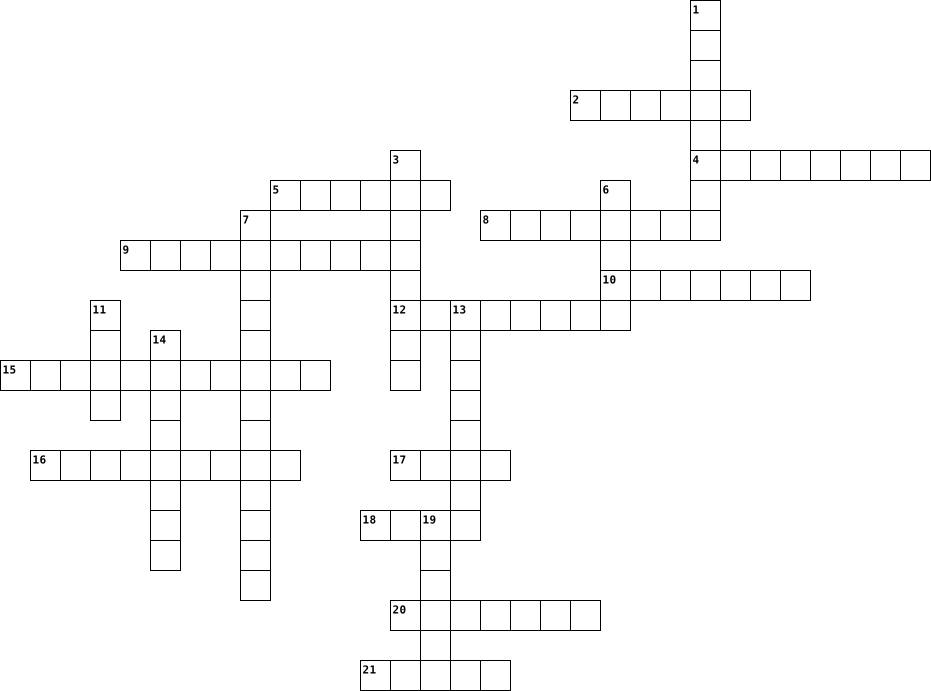
Across
- Matter is anything that has mass and _____.
- Compounds can be separated through _____ methods.
- Mass is different from _____.
- Liquid water being heated to become a gas is an example of a _____ change.
- A compound has different ____ from the individual elements that make it up.
- Simplest form of matter.
- Chemical combination of two or more elements.
- Mixture with no visible boundaries and uniform throughout.
- Homogeneous mixtures are called ______.
- Elements and compounds are examples of _______ substances.
- Quantity of matter that an object contains.
- ___ have fixed volumes but assume the shape of the container.
- ___ do not have fixed volumes nor shapes.
Down
- The conversion of elements into a compound is a __ change.
- Mixtures can be separated through _____ means.
- A pure chemical substances has a ____ chemical composition and properties.
- Mixture with not uniform composition.
- Basic unit of matter.
- Physical combinations of two or more pure substances in variable composition.
- A chemical change is a chemical ____.
- ___ are rigid and have a fixed volume.
21 Clues: Basic unit of matter. • Simplest form of matter. • Mass is different from _____. • Mixture with not uniform composition. • A chemical change is a chemical ____. • ___ are rigid and have a fixed volume. • Homogeneous mixtures are called ______. • ___ do not have fixed volumes nor shapes. • Matter is anything that has mass and _____. • ...
Chemical reaction 2024-07-06

Across
- A reaction in which heat is released along with the formation of the products.
- A type of reaction in which two or more reactants combine to form a single product.
- The colour of ferrous sulphate crystals.
Down
- A type of reaction in which a substance splits into two or more simpler substances.
- A reaction in which energy is absorbed.
5 Clues: A reaction in which energy is absorbed. • The colour of ferrous sulphate crystals. • A reaction in which heat is released along with the formation of the products. • A type of reaction in which a substance splits into two or more simpler substances. • A type of reaction in which two or more reactants combine to form a single product.
Chemical Reaction Crossword 2020-11-10

Across
- combination of multiple substances
- a substance that speeds up a reaction
- a reaction that releases energy
Down
- matter that has specific properties
- a proposed explanation based on an observation
- a protein that speeds up a reaction
- a reaction that requires energy
7 Clues: a reaction that requires energy • a reaction that releases energy • combination of multiple substances • matter that has specific properties • a protein that speeds up a reaction • a substance that speeds up a reaction • a proposed explanation based on an observation
Independent assignment 2023-05-11

Across
- is a substance that is present at the start of a chemical reaction
- a change to a substance that's adding something new
- a change to a substance without adding things new
- The number in front of a equation
Down
- The rearrangement of a molecule of a substance
- is a substance that is present at the end of a chemical reaction
- A small size number on the bottom right of the symbol
- a solid that forms when two liquids combine
- A scale that shows how much acidic or basic something is
- a substance that speeds up a chemical reaction
10 Clues: The number in front of a equation • a solid that forms when two liquids combine • The rearrangement of a molecule of a substance • a substance that speeds up a chemical reaction • a change to a substance without adding things new • a change to a substance that's adding something new • A small size number on the bottom right of the symbol • ...
Find the Vocabulary 2020-04-19

Across
- destroy
- increases organisms chance of survival
- components of a system work together
- order to be present
- a robbery
- security measure
- made during a chemical reaction
- isolation
- outbreak
Down
- worthy of attention
- the action of suppressing something such as an activity or publication
- firmness of purpose
- cramped
- earthquakes and vibrations
- continuously
- earths surface vertically above the focus of an earthquake
- undergoes a change during a reaction
17 Clues: cramped • destroy • outbreak • a robbery • isolation • continuously • security measure • worthy of attention • firmness of purpose • order to be present • earthquakes and vibrations • made during a chemical reaction • components of a system work together • undergoes a change during a reaction • increases organisms chance of survival • earths surface vertically above the focus of an earthquake • ...
Nuclear chemistry 2024-05-07

Across
- atom characterized by the number of protons
- conversion of one chemical element
- high speed electron
- Series of chemical reactions
- positively charged particle
- nuclei combine
- property of some unstable atoms
- radioactive decay
Down
- a reaction that involves change in atom
- nucleus split into smaller nuclei
- disintegration of radioactive substance
- nuclear species of the same chemical element
- basic building block of chemistry
- electromagnetic radiation
- Reduce to half of its initial value
15 Clues: nuclei combine • radioactive decay • high speed electron • electromagnetic radiation • positively charged particle • Series of chemical reactions • property of some unstable atoms • nucleus split into smaller nuclei • basic building block of chemistry • conversion of one chemical element • Reduce to half of its initial value • a reaction that involves change in atom • ...
Unit 5-Lesson 3 and Lesson 4 Crossword 2024-01-16

Across
- you have them in the beginning of a chemical reaction
- The rearrangement of atoms to create one or more new compounds.
- force that makes a body follow a curved path
- you have them at the end of a chemical reaction
- The property of an object to resist change in Motion.
- equal in size and opposite in direction
- Energy is released
- Energy is absorbed
Down
- An object at rest remains at rest, and an object in motion remains in motion
- Directly proportional to net force
- The units used for Force
- applied force in one direction is greater than the force applied in the opposite direction
- for every action there is a reaction in opposite direction
13 Clues: Energy is released • Energy is absorbed • The units used for Force • Directly proportional to net force • equal in size and opposite in direction • force that makes a body follow a curved path • you have them at the end of a chemical reaction • you have them in the beginning of a chemical reaction • The property of an object to resist change in Motion. • ...
Energy Enzymes 2025-02-17

Across
- The energy possessed by an object due to its motion or position relative to other objects
- LAW The law stating energy cannot be created or destroyed
- Reactions that require energy input
- Term for a reaction where products have less free energy than reactants
- An agent that speeds up the rate of a chemical reaction
- The initial energy input to start a reaction
Down
- POTENTIAL Potential energy stored in the electrons of molecules
- A protein catalyst in living cells
- Energy associated with movement
- The unusable energy that increases when energy is transferred
- Releases heat energy
- ENERGY The energy in molecular bonds, a form of potential energy
- A form of electromagnetic radiation visible to the eye
- The ability to promote change or do work
14 Clues: Releases heat energy • Energy associated with movement • A protein catalyst in living cells • Reactions that require energy input • The ability to promote change or do work • The initial energy input to start a reaction • A form of electromagnetic radiation visible to the eye • An agent that speeds up the rate of a chemical reaction • ...
Menu Crossword 2023-03-28

Across
- Multiple elements making a new subtance
- A reaction to the stimuli
- A formula showing all the elements in a new substance
- A internal or external action
- A reaction on the chemical level
- A singular atom
Down
- They make up everything
- A number showing how many atoms of an element there are
- A change in physical form
- A table showing all elements
- A change in chemical form
- A plant reacting to light
12 Clues: A singular atom • They make up everything • A change in physical form • A reaction to the stimuli • A change in chemical form • A plant reacting to light • A table showing all elements • A internal or external action • A reaction on the chemical level • Multiple elements making a new subtance • A formula showing all the elements in a new substance • ...
Types of reactions 2024-05-19

Across
- reaction: A reaction in which a compound is broken down into simpler substances by passing an electric current through it.
- A reaction in which a compound is broken down into simpler substances under the influence of light energy
- reaction: A reaction in which energy is released to the surroundings
- reaction: A reaction where an insoluble product (precipitate) forms when two aqueous solutions are mixed
- reaction: A reaction between an acid and a base, resulting in the formation of salt and water
- reaction: A chemical reaction in which one reactant gains electrons, usually from another reactant.
Down
- reaction: A reaction where two or more reactants combine to form a single product
- reaction: A reaction in which a compound reacts with an acid to produce a salt and water.
- reaction: A reaction in which the ions of two compounds exchange places in an aqueous solution to form two new compounds
- Reaction: The reaction in which both oxidation and reduction occur together
- reaction: A reaction in which energy is absorbed from the surroundings
- reaction: A reaction in which a single compound is broken down into two or more simpler substances.)
- reaction is a type of reaction in which the two or more reactants react together to form an Insoluble solid commonly known as a precipitate
- reaction: A reaction in which a metal displaces another metal from its compound in aqueous solution. (A)
- reaction: A reaction in which a substance reacts rapidly with oxygen, often producing heat and light.
15 Clues: reaction: A reaction in which energy is released to the surroundings • reaction: A reaction in which energy is absorbed from the surroundings • Reaction: The reaction in which both oxidation and reduction occur together • reaction: A reaction where two or more reactants combine to form a single product • ...
Science for stations 2023-10-31

Across
- a reaction between things
- labels that something has turned into another thing
- a scientific law
Down
- a scientific equation
- something that makes a product
- equal
- before a chemical reaction
- the end result
8 Clues: equal • the end result • a scientific law • a scientific equation • a reaction between things • before a chemical reaction • something that makes a product • labels that something has turned into another thing
Biology Bonus Crossword 2023-04-24

Across
- How close a measured value is to an accepted value.
- The change in heat of the products from the reactants.
- The study of how heat is converted to and from other forms of energy and how it affects matter.
- Silver + Hydrochloric Acid-->
- The relationship between the quantities of reactants and products before and after chemical reactions.
- PV=nRT
- Discovered the nucleus of the atom.
- Column 8 on the periodic table.
- Electrons are transferred between atoms, resulting in cations and anions.
- How strongly atoms attract bonding electrons to themselves.
Down
- A substance that speeds up a chemical reaction without itself undergoing any chemical change. They do this by lowering the activation energy of a reaction.
- Zinc + Oxygen-->
- Lithium + Bromine-->
- ___'s Law; V1/T1=V2/T2
- Exactly 6.02 atoms of a substance.
- The number of sig figs in 4.097.
- Microscopic particles dispersed evenly in another substance.
- Mass of one mole of mercury in grams (with the unit).
- Metals tend to ___ electrons.
- Crumbles easily, insulator, non-conductive, dull.
20 Clues: PV=nRT • Zinc + Oxygen--> • Lithium + Bromine--> • ___'s Law; V1/T1=V2/T2 • Silver + Hydrochloric Acid--> • Metals tend to ___ electrons. • Column 8 on the periodic table. • The number of sig figs in 4.097. • Exactly 6.02 atoms of a substance. • Discovered the nucleus of the atom. • Crumbles easily, insulator, non-conductive, dull. • ...
Changes In Matter 2025-04-23

Across
- the force that holds atoms
- the basic building block of chemistry
- the branch of natural science
- it measures how much is inside of something
- it measures how hot or cold something is
- a substance made of one atom
- the amount of space occupied by matter
- matter that does not alter the chemical properties
- two or more chemically bonded together
- it can be observed without changing
- when bonds break and new ones are formed
- a substance that comes in content with another
- a substance to help chemicals go faster
Down
- heat absorbed by surrounding areas
- the end of a chemical reaction
- anything that takes up space and can be weighed
- a chemical made up of more than one element
- a combination of two or more substances
- the capacity to do work
- the amount of energy that is transferred from one system
- a specific characteristic of a substance
- the process of releasing heat
- the attraction of molecules
- a substance that is present to the start
24 Clues: the capacity to do work • the force that holds atoms • the attraction of molecules • a substance made of one atom • the branch of natural science • the process of releasing heat • the end of a chemical reaction • heat absorbed by surrounding areas • it can be observed without changing • the basic building block of chemistry • the amount of space occupied by matter • ...
Biochemistry 2025-05-22

Across
- The tendency of an atom to attract electrons to itself when bonded to another atom
- The type of covalent bond where electrons are shared unequally
- Bond between two nucleotides
- Bond between two amino acids
- Molecules that have the same chemical formulas but different arrangements of atoms
- Chemical reaction that joins monomers
- "___ defines function"
- They store and transmit hereditary information
- Compounds comprised of only nonmetals held together by covalent bonds
- Most structurally sophisticated molecule
- Electrons shared by 2 nonmetals
Down
- Made of C, H, and O in a 1:2:1 ratio
- The water property that causes capillary action
- The most abundant molecule in all organisms
- Comprised of smaller molecules called monomers
- The chemistry of life
- Bond between 2 monosaccharides
- The type of covalent bond where electrons are shared equally
- Bond between a glycerol molecule and a fatty acid
- Chemical reaction that breaks polymers by adding water
- Made of fatty acids and glycerol
- The water property that causes surface tension
- The molecule found in all four main biomolecules
23 Clues: The chemistry of life • "___ defines function" • Bond between two nucleotides • Bond between two amino acids • Bond between 2 monosaccharides • Electrons shared by 2 nonmetals • Made of fatty acids and glycerol • Made of C, H, and O in a 1:2:1 ratio • Chemical reaction that joins monomers • Most structurally sophisticated molecule • The most abundant molecule in all organisms • ...
Mason's chapter 13 crossword 2017-10-11

Across
- The new materials formed in a chemical reaction.
- Description of a chemical reaction in which there is a net release of energy.
- A substance that donates hydrogen ions.
- A polyatomic ion made by removing a proton from a water molecule.
- Description of a substance that can behave as either an acid or a base.
- The process by which a reactant gains one or more electrons.
Down
- a substance that accepts hydrogen ions.
- The deterioration of a metal, typically caused by atmospheric oxygen.
- A polyatomic ion made by adding a proton to a water molecule.
- The reacting substances in a chemical reaction.
10 Clues: a substance that accepts hydrogen ions. • A substance that donates hydrogen ions. • The reacting substances in a chemical reaction. • The new materials formed in a chemical reaction. • The process by which a reactant gains one or more electrons. • A polyatomic ion made by adding a proton to a water molecule. • ...
Amylase Required Practical 2025-11-18

Across
- site – the part of the enzyme that fits the substrate.
- – the best condition for enzyme activity.
- variables – things you keep the same (volumes, concentrations, timing).
- variable – what you measure (time for starch to disappear).
- – a large carbohydrate molecule (substrate for amylase).
- – the molecule an enzyme acts on (here: starch).
- of reaction – how quickly the enzyme breaks down starch.
- variable – what you change (e.g. temperature or pH).
Down
- – the sugar produced when starch is broken down.
- – when the enzyme’s shape changes so it no longer works.
- – the molecule made after the reaction (here: maltose).
- – something that speeds up a reaction without being used up.
- – chemical used to test for starch (blue‑black if starch is present).
- – the enzyme that breaks down starch into maltose.
- – a biological catalyst that speeds up chemical reactions.
15 Clues: – the best condition for enzyme activity. • – the sugar produced when starch is broken down. • – the molecule an enzyme acts on (here: starch). • – the enzyme that breaks down starch into maltose. • variable – what you change (e.g. temperature or pH). • site – the part of the enzyme that fits the substrate. • – the molecule made after the reaction (here: maltose). • ...
Science Holiday Homework 2025-07-06

Across
- A transparent object used to converge or diverge light.
- A mirror or lens that curves inward like a cave.
- Bending of light when it passes from one medium to another.
- The process by which green plants make food using sunlight.
- Removal of waste products from the body.
- Loss of electrons or gain of oxygen in a reaction.
- Loss of water from plant leaves through stomata.
- A reaction where one substance breaks into two or more.
Down
- The point where parallel rays meet after reflection/refraction.
- A chemical equation where atoms are equal on both sides.
- An insoluble solid formed during a reaction in solution.
- The process of breaking down food into simpler forms.
- Substances that undergo a chemical change.
- Breakdown of food to release energy.
- A smooth surface that reflects light.
15 Clues: Breakdown of food to release energy. • A smooth surface that reflects light. • Removal of waste products from the body. • Substances that undergo a chemical change. • A mirror or lens that curves inward like a cave. • Loss of water from plant leaves through stomata. • Loss of electrons or gain of oxygen in a reaction. • ...
Redox Reaction 2020-06-23

Across
- The sum of oxidation states of all the atoms present in the formula of a compound is
- The oxidation number of this chemical element in all compound is always -2 except in fluorine compounds and in peroxides which is -1
- The electrode placed in a solution containing a reducing agent acts as the
- A reaction in which one element displaces another element from its salt solution
- The oxidation number of this chemical element in all compound is +1 except in metal hydrides
- Redox reaction between iron, oxygen and water to form a brown substance (rust) is called
- The oxidation number of this chemical element in all compound is always -1 because it is the most electronegative element
- Daniell cell is one of the example of
Down
- The arrangement of metals according to their tendency to lose electrons to form positive ions is called
- Decrease in the oxidation number
- Redox reaction in which a metal is oxidised spontaneously at room temperature with the release of electrons to form the metal ions
- Displacement reaction between aluminium and iron (III) oxide to produce iron
- The reactant that loses electrons acts as a
- The reactant that accepts electrons acts as a
- Loss of hydrogen and gain oxygen
- One of the example of unreactive metals that do not corrode because they are resistant to oxidation
16 Clues: Decrease in the oxidation number • Loss of hydrogen and gain oxygen • Daniell cell is one of the example of • The reactant that loses electrons acts as a • The reactant that accepts electrons acts as a • The electrode placed in a solution containing a reducing agent acts as the • Displacement reaction between aluminium and iron (III) oxide to produce iron • ...
Chemical Basis of Life 2013-09-13

Across
- Smallest particles of matter
- Positively charged atom found in the nucleus
- Subatomic particle with no charge found in the nucleus
- Mutual attraction between 2 atoms resulting in a redistribution of their outer electrons
- Reaction where simple chemical substances are combined to form complex chemical structures
- The sum of all chemical reactions that occur within the cells
- An example of a polysaccharide that cannot be digested by humans
- Positively charged ion that is formed when a neutral atom loses electrons
- Metal and a non-metal transferring electrons
- The capacity for work
- Makes up everything around us
Down
- The study of life
- Simplest sugar, that transport energy in the blood
- Have the same number of protons, but different number of neutrons
- Compounds that contain the element Carbon are:
- The control centre of an atom
- Negatively charged ion that is formed when a neutral atom loses electrons
- Reaction where complex substances are broken down into simpler substances
- Negatively charged particle outside the nucleus
- Two metals sharing electrons
- Pure substances that cannot be broken down
- Biological unit of all organisms
22 Clues: The study of life • The capacity for work • Smallest particles of matter • Two metals sharing electrons • The control centre of an atom • Makes up everything around us • Biological unit of all organisms • Pure substances that cannot be broken down • Positively charged atom found in the nucleus • Metal and a non-metal transferring electrons • ...
Weathering, Erosion, and Deposition 2023-12-05

Across
- When water freezes in the cracks of rocks, expanding and pushing the rock apart
- The sphere containing all of the gasses on Earth
- The sphere of Earth containing rocks, dirt, land, mountains, etc.
- A type of weathering that occurs when a rock is weakened by a physical force pulling it apart
- The sphere of Earth containing all of the living things (plants and animals)
- The sphere containing all of the water on Earth
- This occurs at the end of erosion when the rock is dropped in a new location
Down
- A type of weathering that occurs when a rock is weakened by a chemical reaction
- When pieces of a rock disintegrate due to a chemical reaction
- Small pieces of rock, dirt, or sand
- A chemical reaction that occurs when iron is exposed to oxygen; rust
- The process of small pieces of rock being moved from one place to another
- The process of scraping something repeatedly to wear it down
- Rainfall that has been made acidic by pollution
14 Clues: Small pieces of rock, dirt, or sand • The sphere containing all of the water on Earth • Rainfall that has been made acidic by pollution • The sphere containing all of the gasses on Earth • The process of scraping something repeatedly to wear it down • When pieces of a rock disintegrate due to a chemical reaction • ...
Science Grade 6 2025-10-10

Across
- of Matter - The form a substance is in: solid, liquid, or gas.
- - How well a substance can dissolve in a liquid.
- - The smallest, basic piece of matter; the building block of everything.
- Reaction - A process where substances change to make new and different substances.
- - A substance made when two or more different elements join together.
- - A quality that describes a substance, like its color, hardness, or if it can burn.
- - How much mass is in a certain volume of a substance; if it feels heavy for its size.
- - A group of two or more atoms connected together.
Down
- Change - A change that creates one or more new substances.
- - The starting materials in a chemical reaction.
- Change - A change in how a substance looks or feels, but no new substance is created.
- - A pure substance made of only one type of atom.
- - A combination of different substances that are not chemically bonded.
- - The new substance(s) created at the end of a chemical reaction.
- of Conservation of Mass - A scientific rule that says matter is not created or destroyed in a reaction.
15 Clues: - The starting materials in a chemical reaction. • - How well a substance can dissolve in a liquid. • - A pure substance made of only one type of atom. • - A group of two or more atoms connected together. • Change - A change that creates one or more new substances. • of Matter - The form a substance is in: solid, liquid, or gas. • ...
Grey Roesti 2021-03-04

Across
- _____ acids and bases do not completely ionize in water
- reduces reactions involve the transfer of an electron
- the rate of a reaction is dependent on the collisions among ______
- in an _______ reaction there is a net absorption of energy
- a base is a chemical that ____ a hydrogen ion
- ______ acids and bases ionize completely ionize in water
Down
- in a ______ reaction there is a net release of energy
- _____ can behave as an acid or base
- an acid is a chemical that _____ a hydrogen ion
- reaction rates are affected by temperature,concentration and ________
10 Clues: _____ can behave as an acid or base • a base is a chemical that ____ a hydrogen ion • an acid is a chemical that _____ a hydrogen ion • in a ______ reaction there is a net release of energy • reduces reactions involve the transfer of an electron • _____ acids and bases do not completely ionize in water • ______ acids and bases ionize completely ionize in water • ...
Chemistry Review Crossword Puzzle 2017-05-16

Across
- What's the formation of a positive ion?
- What's the mixing of the particles of 2 substances caused by their random motion?
- What's a substance that cannot be broken down by chemicals?
- Hydronium is a ______.
- What is a quantitative description that includes both a number and a unit?
- What are poor conductors, brittle, dull, and gases?
- What are properties of metals and nonmetals, solids, and semi-conductors?
- _______ bonds are composed of metals and nonmetals
- ______ is when an electron drops from a higher energy level to a lower energy level and emits light.
- A ________ mixture that can be separated.
- What's the ability to do work and make change possible?
- What's the measure of how close a measurement comes to the actual or true value of whatever is measured?
- A small, whole number that appears in front of a formula.
- _______ energy is also called radiant energy
- What's it called to go from a solid to a gas?
- What is a chemical substance of two or more different chemical elements?
- ________ bonds are made of two nonmetals
- What's in each column?
- _______ bonds consist of two metals.
- Who's the scientist that compared electrons in an atom to planets in the solar system?
Down
- What are good conductors, shiny, and ductile?
- What has a definite volume but no definite shape?
- A ________ mixture that cannot easily be separated.
- A ______ reaction is a chemical reaction in which the products reform the original reactants.
- what is the SI base unit for temperature?
- ________are in group 17 and are salt formers.
- What's the formation of a negative ion?
- Hydroxide is a _______.
- What's the tendency of a substance to undergo chemical reaction?
- A ______ reaction is when a single compound breaks down.
- The ______ yield is the amount of a product mathematically possible.
- A _____ has a definite shape, volume, and melting point.
- a is the symbol for an _____ particle.
- What's it called for two or more substances that are combined without chemicals?
- What's the measure of how close a series of measurements are to one another?
- What's in each row?
- A _____ reaction is when two or more substances combine.
- ______ metals are found in group 1.
- The _____rule says atoms will combine to have 8 valence electrons.
- What measures the distance?
40 Clues: What's in each row? • Hydronium is a ______. • What's in each column? • Hydroxide is a _______. • What measures the distance? • ______ metals are found in group 1. • _______ bonds consist of two metals. • a is the symbol for an _____ particle. • What's the formation of a positive ion? • What's the formation of a negative ion? • ________ bonds are made of two nonmetals • ...
Chemical Equations 2021-10-05

Across
- The ... scale measures how strong an acid or base solution is.
- The end result of the reactants in an experiment
- A substance not completely dissociated in a solution
- C2H5OH, a colourless volatile flammable liquid which is produced by the natural fermentation of sugars; alcohol
- pH indicator made of a solution of several compounds
- a chemical reaction between substances, usually including oxygen and usually accompanied by the generation of heat and light in the form of flame.
- The process of transforming ore into a metal is reversed as the metal is exposed to oxygen and water
- the product of acids and bases are water and... The product of acid and metals are hyrdogen and... the product of acid and carbonate is carbon dioxide, water and...
- A material that is burnt or used as a source of heat or power.
- value-free
- A chemical reaction that gives out heat
- An electron is removed from the nucleus during a chemical reaction.
- an indicator in acid–base titrations, C₂₀H₁₄O₄
- a natural substance that is not replenished with the speed at which it is consumed.
- A substance that changes color in the presence of a base or acid
- Often have a sour taste, ph lower than 7, give away hydrogen ions, conduct electricity when mixed with water, can neutralize bases, react with many metals
Down
- A natural indicator used by the British
- A compound of hydrogen and carbon. When burnt in unlimited are it produces carbon dioxide and water, when burnt in limited air is produces carbon monoxide.
- renewable energy derived from living materials.
- Often have a soapy feeling, ph higher than 7, naturalize acids, when dissolved in water they are called alkanes, have a bitter taste
- one that can be used repeatedly and does not run out because it is naturally replaced.
- the process of the reaction between a base and acid
- completely ionized in a solution
- A chemical reaction that absorbs heat
- Iron metal oxidizes to from ion oxide known as...
- CO2, a product of acid and carbonate
- Many of the molecules are dissolved in the set amount of solution
- A natural indicator that is a root vegetable.
- decreased concentration of a solute in a solution
- The material used in an experiment that creates the product
30 Clues: value-free • completely ionized in a solution • CO2, a product of acid and carbonate • A chemical reaction that absorbs heat • A natural indicator used by the British • A chemical reaction that gives out heat • A natural indicator that is a root vegetable. • an indicator in acid–base titrations, C₂₀H₁₄O₄ • renewable energy derived from living materials. • ...
Chemistry Review Crossword Puzzle 2017-05-06

Across
- What are good conductors, shiny, and ductile?
- What's it called for two or more substances that are combined without chemicals?
- What is a chemical substance of two or more different chemical elements?
- What's the ability to do work and make change possible?
- Hydroxide is a _______.
- A ______ reaction is a chemical reaction in which the products reform the original reactants.
- What are properties of metals and nonmetals, solids, and semi-conductors?
- What has a definite volume but no definite shape?
- a is the symbol for an _____ particle.
- What's in each column?
- What's the formation of a negative ion?
- what is the SI base unit for temperature?
- The _____rule says atoms will combine to have 8 valence electrons.
- What is a quantitative description that includes both a number and a unit?
- ______ is when an electron drops from a higher energy level to a lower energy level and emits light.
- What's it called to go from a solid to a gas?
- What's the formation of a positive ion?
- A ________ mixture that can be separated.
- Who's the scientist that compared electrons in an atom to planets in the solar system?
- A _____ has a definite shape, volume, and melting point.
- What are poor conductors, brittle, dull, and gases?
Down
- What's the measure of how close a measurement comes to the actual or true value of whatever is measured?
- What's the mixing of the particles of 2 substances caused by their random motion?
- ________ bonds are made of two nonmetals
- What measures the distance?
- Hydronium is a ______.
- _______ bonds consist of two metals.
- What's the tendency of a substance to undergo chemical reaction?
- ______ metals are found in group 1.
- A ________ mixture that cannot easily be separated.
- ________are in group 17 and are salt formers.
- A small, whole number that appears in front of a formula.
- What's the measure of how close a series of measurements are to one another?
- _______ energy is also called radiant energy
- What's in each row?
- A _____ reaction is when two or more substances combine.
- The ______ yield is the amount of a product mathematically possible.
- A ______ reaction is when a single compound breaks down.
- What's a substance that cannot be broken down by chemicals?
- _______ bonds are composed of metals and nonmetals
40 Clues: What's in each row? • Hydronium is a ______. • What's in each column? • Hydroxide is a _______. • What measures the distance? • ______ metals are found in group 1. • _______ bonds consist of two metals. • a is the symbol for an _____ particle. • What's the formation of a negative ion? • What's the formation of a positive ion? • ________ bonds are made of two nonmetals • ...
chemistry review 2017-05-14

Across
- What are good conductors, shiny, and ductile?
- What's a substance that cannot be broken down by chemicals?
- What's in each column?
- What's in each row?
- A ________ mixture that cannot easily be separated.
- What's it called for two or more substances that are combined without chemicals?
- What is a quantitative description that includes both a number and a unit?
- _______ energy is also called radiant energy
- ______ metals are found in group 1.
- A small, whole number that appears in front of a formula.
- _______ bonds consist of two metals.
- A ______ reaction is when a single compound breaks down.
- What's the tendency of a substance to undergo chemical reaction?
- What's it called to go from a solid to a gas?
- a is the symbol for an _____ particle.
- What's the ability to do work and make change possible?
- ________ bonds are made of two nonmetals
- what is the SI base unit for temperature?
- A _____ reaction is when two or more substances combine.
- What are poor conductors, brittle, dull, and gases?
- _______ bonds are composed of metals and nonmetals
Down
- A _____ has a definite shape, volume, and melting point.
- What measures the distance?
- ______ is when an electron drops from a higher energy level to a lower energy level and emits light.
- ________are in group 17 and are salt formers.
- The _____rule says atoms will combine to have 8 valence electrons.
- Hydroxide is a _______.
- A ________ mixture that can be separated.
- A ______ reaction is a chemical reaction in which the products reform the original reactants.
- What's the formation of a positive ion?
- The ______ yield is the amount of a product mathematically possible.
- What's the measure of how close a series of measurements are to one another?
- Hydronium is a ______.
- What's the measure of how close a measurement comes to the actual or true value of whatever is measured?
- What's the formation of a negative ion?
- What's the mixing of the particles of 2 substances caused by their random motion?
- What is a chemical substance of two or more different chemical elements?
- What are properties of metals and nonmetals, solids, and semi-conductors?
- What has a definite volume but no definite shape?
- Who's the scientist that compared electrons in an atom to planets in the solar system?
40 Clues: What's in each row? • What's in each column? • Hydronium is a ______. • Hydroxide is a _______. • What measures the distance? • ______ metals are found in group 1. • _______ bonds consist of two metals. • a is the symbol for an _____ particle. • What's the formation of a positive ion? • What's the formation of a negative ion? • ________ bonds are made of two nonmetals • ...
Chemistry Review Crossword Puzzle 2017-05-16

Across
- _______ energy is also called radiant energy
- What's the formation of a positive ion?
- ________are in group 17 and are salt formers.
- ______ is when an electron drops from a higher energy level to a lower energy level and emits light.
- What's the ability to do work and make change possible?
- ______ metals are found in group 1.
- ________ bonds are made of two nonmetals
- What has a definite volume but no definite shape?
- What measures the distance?
- A _____ reaction is when two or more substances combine.
- The _____rule says atoms will combine to have 8 valence electrons.
- A ______ reaction is when a single compound breaks down.
- A ______ reaction is a chemical reaction in which the products reform the original reactants.
- A ________ mixture that cannot easily be separated.
- Hydronium is a ______.
- A _____ has a definite shape, volume, and melting point.
- What is a quantitative description that includes both a number and a unit?
- The ______ yield is the amount of a product mathematically possible.
- What's the measure of how close a series of measurements are to one another?
- What's the tendency of a substance to undergo chemical reaction?
- What's in each column?
Down
- what is the SI base unit for temperature?
- Who's the scientist that compared electrons in an atom to planets in the solar system?
- What's the measure of how close a measurement comes to the actual or true value of whatever is measured?
- What is a chemical substance of two or more different chemical elements?
- What's a substance that cannot be broken down by chemicals?
- Hydroxide is a _______.
- What are good conductors, shiny, and ductile?
- What's the mixing of the particles of 2 substances caused by their random motion?
- What are poor conductors, brittle, dull, and gases?
- _______ bonds are composed of metals and nonmetals
- What's it called for two or more substances that are combined without chemicals?
- A ________ mixture that can be separated.
- What's it called to go from a solid to a gas?
- A small, whole number that appears in front of a formula.
- What are properties of metals and nonmetals, solids, and semi-conductors?
- What's in each row?
- _______ bonds consist of two metals.
- a is the symbol for an _____ particle.
- What's the formation of a negative ion?
40 Clues: What's in each row? • Hydronium is a ______. • What's in each column? • Hydroxide is a _______. • What measures the distance? • ______ metals are found in group 1. • _______ bonds consist of two metals. • a is the symbol for an _____ particle. • What's the formation of a positive ion? • What's the formation of a negative ion? • ________ bonds are made of two nonmetals • ...
Bio 2017-09-21

Across
- Process by which materials enter and leave cells or get moved around in the organism
- Combining simple substances to make more complex substances
- Removal of an organisms metabolic wastes
- Producing new off spring identical to the parents;involves one parent
- Involves activities that control and coordinate an organism
- The breakdown of food materials into simpler forms
- Condition of maintaining a constant internal environment
- Involves all the chemical reaction carried on in an organism
- Chemical substances in food that an organism needs
Down
- How an organism takes materials from the environment and converts them to something it can use
- The study of life
- Increase in size of an organism
- The process of releasing chemical energy from complex reaction
- Involves getting rid of undigested food from the body
- Involves two parents;offspring are not identical to the parent
- Producing new offspring
- Something capable living on its own
- The taking in of food
18 Clues: The study of life • The taking in of food • Producing new offspring • Increase in size of an organism • Something capable living on its own • Removal of an organisms metabolic wastes • The breakdown of food materials into simpler forms • Chemical substances in food that an organism needs • Involves getting rid of undigested food from the body • ...
Nuclear chemistry 2024-05-07

Across
- atom characterized by the number of protons
- conversion of one chemical element
- high speed electron
- Series of chemical reactions
- positively charged particle
- nuclei combine
- property of some unstable atoms
- radioactive decay
Down
- a reaction that involves change in atom
- nucleus split into smaller nuclei
- disintegration of radioactive substance
- nuclear species of the same chemical element
- basic building block of chemistry
- electromagnetic radiation
- Reduce to half of its initial value
15 Clues: nuclei combine • radioactive decay • high speed electron • electromagnetic radiation • positively charged particle • Series of chemical reactions • property of some unstable atoms • nucleus split into smaller nuclei • basic building block of chemistry • conversion of one chemical element • Reduce to half of its initial value • a reaction that involves change in atom • ...
section 4 2021-11-24

Across
- physical substance
- substance that takes part in and undergoes change
- relating to physics or the operation of natural forces generally.
- in physics, the capacity for doing work.
- result
- a group of atoms bonded together, representing the smallest fundamental unit of a chemical compound that can take part in a chemical reaction.
Down
- smallest unit of matter
- a connection between two surfaces or objects that have been joined together, especially by means of an adhesive substance, heat, or pressure.
- a conductor through which electricity enters or leaves an object, substance, or region.
- a transformation
- to alter/modify
- relating to chemicals.
12 Clues: result • to alter/modify • a transformation • physical substance • relating to chemicals. • smallest unit of matter • in physics, the capacity for doing work. • substance that takes part in and undergoes change • relating to physics or the operation of natural forces generally. • a conductor through which electricity enters or leaves an object, substance, or region. • ...
section 4 2021-11-24

Across
- physical substance
- substance that takes part in and undergoes change
- relating to physics or the operation of natural forces generally.
- in physics, the capacity for doing work.
- result
- a group of atoms bonded together, representing the smallest fundamental unit of a chemical compound that can take part in a chemical reaction.
Down
- smallest unit of matter
- a connection between two surfaces or objects that have been joined together, especially by means of an adhesive substance, heat, or pressure.
- a conductor through which electricity enters or leaves an object, substance, or region.
- a transformation
- to alter/modify
- relating to chemicals.
12 Clues: result • to alter/modify • a transformation • physical substance • relating to chemicals. • smallest unit of matter • in physics, the capacity for doing work. • substance that takes part in and undergoes change • relating to physics or the operation of natural forces generally. • a conductor through which electricity enters or leaves an object, substance, or region. • ...
Science Unit B 2014-11-03

Across
- 1 electron 1 proton and 0 neutrons
- a new substance produced in a chemical reaction
- occurs when oxygen reacts with a new substance to form a new substance and give off energy
- the mass of the reactants always equal the mass of the products
- absorbs heat
- organic catalyst
- hardest material on the Mohs' hardness scale
- a substance that reacts with another substance or substances to create something new
Down
- Workplace Hazardous Materials Information System
- used the word "Atomos"
- Slow chemical change that occurs when oxygen in the air reacts to metal
- no additional material is allowed to enter or leave
- Gas to Solid and vice versa
- substances that help a reaction proceed faster
- material is allowed to leave and enter
- studied chemical reactions
- experimented with the behavior of gases
- NaCl
- releases heat
- book describing the achievements of alchemists
- the 7 rows in the periodic table
- "indivisible'
- the last Alkali metal on the Periodic table of elements
- the 18 columns in the periodic table
24 Clues: NaCl • absorbs heat • releases heat • "indivisible' • organic catalyst • used the word "Atomos" • studied chemical reactions • Gas to Solid and vice versa • the 7 rows in the periodic table • 1 electron 1 proton and 0 neutrons • the 18 columns in the periodic table • material is allowed to leave and enter • experimented with the behavior of gases • ...
Matter Vocabulary 2017-06-09

Across
- the center of the atom
- the substances on the right side of the periodic table are _________
- a solution
- have properties of metals and nonmetals
- a solid that forms when 2 liquids react
- part of the atom without a charge
- is made of 1 type of particle
- the more _____________ particles have the faster they move
- 2 atoms bonded together
- the substances on the left of the periodic table are _______
Down
- noble gases do not _______________
- the type of change that changes the identity of a substance
- the number of protons in the element
- the substances that go into a chemical reaction
- a mixture that is the same throughout
- matter cannot be created or ________
- a positively charged part of the atom
- negatively charged part of the atom
- is anything that has mass and takes up space
- organized on the periodic table
- mass/volume=__________
- the___________ on the periodic table share the same properties
- the substances that come out of a chemical reaction
- is made of Protons Neutrons and Electrons
24 Clues: a solution • the center of the atom • mass/volume=__________ • 2 atoms bonded together • is made of 1 type of particle • organized on the periodic table • part of the atom without a charge • noble gases do not _______________ • negatively charged part of the atom • the number of protons in the element • matter cannot be created or ________ • a mixture that is the same throughout • ...
Chapter 2 Crossword-Vivian Befus 2018-10-01

Across
- The tendency of energy to disperse
- The attrition of water molecules for each other
- Pure substance made of only one kind of atom
- Class of organic compounds that serve as the building blocks for the information storage molecules: DNA and RNA
- The substance formed during a chemical reaction
- A measurement of the speed at which particles move
- Changes that don't change matters identity
- Nonpolar molecules
- Basic building blocks of matter
- Organic compounds made of carbones, hydrogens and oxygen
Down
- A naturally occurring catalyst, usually a protein
- A pure substance made of two or more elements chemically combined
- A substance that is present before a chemical reaction
- Attrition of particles in one substance for particles in a different substance
- A change in substances that results in one or more new substances being formed
- The immaterial stuff that gets things done
- A substance that provides a alternate route from reactants to products
- A class of organic compounds that serve as the building blocks of proteins
- Simple carbohydrate
- Stored chemical energy that holds two atoms together
20 Clues: Nonpolar molecules • Simple carbohydrate • Basic building blocks of matter • The tendency of energy to disperse • The immaterial stuff that gets things done • Changes that don't change matters identity • Pure substance made of only one kind of atom • The attrition of water molecules for each other • The substance formed during a chemical reaction • ...
Science Crossword 2023-12-06

Across
- A solid formed from two liquids, evidence of a chemical reaction
- Dull, brittle, poor conductor
- What is produced from a chemical change
- When something changes its composition, becomes a new substance
- Lustrous, malleable, good conductor
- A formula made from listing the elements in a substance, subscripts are used to show number of atoms of an element with the coefficient showing the number of molecules of a substance
- First in the calculator when calculating speed
- Small, located in the electron cloud
- Starting substance before a chemical change
- How to show when something is going fast in a distance\time graph
- Speed + Direction
Down
- Not moving, constant force
- For every action there is an equal and opposite reaction
- Moving, Accelerating
- An object at rest will stay at rest and an object in motion stays in motion unless acted upon by an unbalanced force
- Center of the atom
- Semiconductor
- The amount of time it takes for an object to go a certain distance
- Change in speed or direction
- The more massive something is, the more force is required to move it
20 Clues: Semiconductor • Speed + Direction • Center of the atom • Moving, Accelerating • Not moving, constant force • Change in speed or direction • Dull, brittle, poor conductor • Lustrous, malleable, good conductor • Small, located in the electron cloud • What is produced from a chemical change • Starting substance before a chemical change • First in the calculator when calculating speed • ...
Bonus Griffin LeBlanc 2024-05-01

Across
- For a PH of 7 you need strong acid and strong ____.
- the change in heat of the products from the reactants.
- adding energy is ____.
- a substance that speeds up a chemical reaction without undergoing any chemical change.
- the temperature and pressure at which the solid, liquid and gas forms of a substance coexist.
- the measure of the kinetic energy of particles in a sample of matter.
- substance that donates a proton.
- transition of a substance directly from solid to gas.
- More particles = _____ pressure
- Liquids ____ to form solids.
Down
- a device used to measure the energy absorbed or released as heat in a chemical reaction.
- transition of a substance directly from gas to solid.
- ATM pressure measured with a _____.
- biological catalysts that speed up the rate of reactions in the body
- releasing energy is ___.
- a compound that can act as either an acid or base.
- the total amount of energy.
- the amount of heat to raise 1 gram of substance by 1 degree C.
- substance that accepts a proton.
- Gases ___ to form liquids.
20 Clues: adding energy is ____. • releasing energy is ___. • Gases ___ to form liquids. • the total amount of energy. • Liquids ____ to form solids. • More particles = _____ pressure • substance that accepts a proton. • substance that donates a proton. • ATM pressure measured with a _____. • a compound that can act as either an acid or base. • ...
Unit Two Bio 2025-03-31

Across
- transport diffusion and osmosis are this type of membranet across a membrain
- any living thing
- system
- a uniform mixture of two or more substances
- the lipid tails of a phospholipid have this quality
- atoms combined to form these
- the basic unit of life
- the phosphate head of a phospholipid has this quality
- transport movement across a cell membrane from low to high concentrations
- a protein that speeds up chemical reactions
Down
- the molecule that will be going through a chemical reaction
- movement of molecules from areas of high consentrait to low concentrait
- site the location on an enyme where the substrait binds
- the smallest unit of all matter
- a group of different tissues working together
- movement of water from hight to low consentrations
- energy
- when the active site of an enzyme changes its shape due to high ph
- the cell membrane is made up of these molecules
- solution a type of solution when the solvent is water
- the result of a chemical reaction
- a group of similar cells
- permeable some things can pass through the cell membrane, but not everything
- molecules combined to form these
24 Clues: energy • system • any living thing • the basic unit of life • a group of similar cells • atoms combined to form these • the smallest unit of all matter • molecules combined to form these • the result of a chemical reaction • a uniform mixture of two or more substances • a protein that speeds up chemical reactions • a group of different tissues working together • ...
Digestion: Addison Harris 2025-10-27

Across
- rhythmic movements of muscles
- removes water, potassium, and sodium from the waste
- a storage form of glucose
- the use of nutrients to provide energy
- the blood sugar that is the body's basic fuel
- the churned food that is turned into a thick liquid
- helps to break down food
- helps the body digest and absorb fats
- a gland connected to the small intestine
- a chemical reaction that molecules combine with oxygen
- a special protein that helps a chemical reaction take place
Down
- the part of the digestive tract that connects the mouth and the stomach
- helps you taste food and change carbohydrates into sugars
- a mixture of enzymes made by the pancreas
- the amount of energy needed to raise the temperature of 1 kg of water
- the inner wall of the small intestine has folds covered with billions of tiny projections
- the process by which nutrients move into the bloodstream
- the mechanical and chemical process of breaking down food
- the energy you need to maintain automatic processes
- works with other juices to break down food
20 Clues: helps to break down food • a storage form of glucose • rhythmic movements of muscles • helps the body digest and absorb fats • the use of nutrients to provide energy • a gland connected to the small intestine • a mixture of enzymes made by the pancreas • works with other juices to break down food • the blood sugar that is the body's basic fuel • ...
Science Crossword 2014-09-25

Across
- is the chemical symbol for which element?
- orbits the nucleus of an atom?
- (around 78%):What is the main gas found in the air we breathe?
- sodium hydroxide (NaOH) an acid or base?
- is the fourth most abundant element in the universe in terms of mass?
- is H20 more commonly known as?
- New Zealand scientist Ernest Rutherford was awarded a Nobel Prize in which field?
- is the first element on the periodic table?
- Fission:A nuclear reaction where the nucleus of an atom splits into smaller parts is known as nuclear fission or nuclear fusion?
- or false? An electron carries a positive charge.
- is the chemical symbol for gold?
Down
- or false? Acids have a pH level below 7.
- of the same chemical element that have different atomic mass are known as?
- room temperature, what is the only metal that is in liquid form?
- or false? Bases have a pH level below 7.
- is the name given to substances that are initially involved in a chemical reaction?
- nucleus:What is the centre of an atom called?
- (around 1%):What is the third most common gas found in the air we breathe?
18 Clues: orbits the nucleus of an atom? • is H20 more commonly known as? • is the chemical symbol for gold? • or false? Acids have a pH level below 7. • or false? Bases have a pH level below 7. • sodium hydroxide (NaOH) an acid or base? • is the chemical symbol for which element? • is the first element on the periodic table? • nucleus:What is the centre of an atom called? • ...
biology vocab pt. 2 2022-09-19

Across
- a chemical bond formed between 2 molecules when the carboxyl group of one molecule reacts with the amino group
- hydrophobic biological molecule composed mostly of carbon and hydrogen
- large molecule formed by joining smaller molecules together
- 2 or more atoms of the same element having different numbers of neutrons
- a submit of nucleric acid formed
- reactant to which an enzyme bonds
- substance that speeds up a chemical reaction by reducing the activation energy
- attractive forces between nolecules.
- compound whose atoms are held together by covalent bonds
Down
- complex macromolecule that stores and communicating genetic information
- substance disolved in solvent
- substance formed by a chemical reaction;located on right side of chemical equation
- organic compound containing carbon, hydrogen, and oxygen, in a ratio of one oxygen atom and two hydrogen atoms for every carbon atom
- large molecule formed from smaller repeating units of identical or nearly identical; compounds linked by covalent bodens
- molecule with opposite charged regions
- electrical attraction between two oppositely charged atoms or group of atoms
- substance in which a substance is dissolved
17 Clues: substance disolved in solvent • a submit of nucleric acid formed • reactant to which an enzyme bonds • attractive forces between nolecules. • molecule with opposite charged regions • substance in which a substance is dissolved • compound whose atoms are held together by covalent bonds • large molecule formed by joining smaller molecules together • ...