
chemical reaction Crossword Puzzles
Vocab 2023-11-06

Across
- the force that holds cations and anions together
- the force that holds atoms or ions together as a unit
- a chemical reaction in which two compounds exchange positive ions and form new compounds
- a neutral group of atoms that are joined together by one or more covalent bonds
- the attraction between a metal cation and the shared electrons that surround it
- new substances formed as a result of a chemical reaction
- a chemical bond in which two atoms share a pair of valence electrons
- an atom or group of atoms that has a positive or negative charge
- a substance that undergoes change in a chemical reaction
- an ion with a negative charge
- the energy stored in chemical bonds
- a chemical reaction in which two or more substances react to form a single substance
Down
- notation that shows what elements a compound contains and the ratio of the atoms or ions of these elements in the compound
- a chemical reaction in which a compound breaks down into two or more simpler substances
- a chemical reaction in which one element takes the place of another element in a compound
- numbers that appear before a formula in a chemical equation to show the relative proportions of each reactant and product
- a representation of a chemical reaction in which the reactants and products are expressed as formulas
- a diagram of an atom, ion or molecule in which each dot represents a valence electron
- an ion with a positive charge
- a mixture of two or more elements, at least one of which is a metal, that has the characteristic properties of a metal
20 Clues: an ion with a positive charge • an ion with a negative charge • the energy stored in chemical bonds • the force that holds cations and anions together • the force that holds atoms or ions together as a unit • new substances formed as a result of a chemical reaction • a substance that undergoes change in a chemical reaction • ...
Ch 6&7 2024-04-04

Across
- the attraction between a metal cation and the shared electrons that surround it
- a chemical reaction in which two or more substances react to form a single substance
- a chemical reaction in which one element takes the place of another element in a compound
- a neutral group of atoms that are joined together by one or more covalent bonds
- an atom or group of atoms that has a positive or negative charge
- a mixture of two or more elements, at least one of which is a metal, that has the characteristic properties of a metal
- a diagram of an atom, ion or molecule in which each dot represents a valence electron
- new substances formed as a result of a chemical reaction
- the force that holds atoms or ions together as a unit
- an ion with a negative charge
Down
- an ion with a positive charge
- a chemical reaction in which two compounds exchange positive ions and form new compounds
- the energy stored in chemical bonds
- a chemical bond in which two atoms share a pair of valence electrons
- numbers that appear before a formula in a chemical equation to show the relative proportions of each reactant and product
- notation that shows what elements a compound contains and the ratio of the atoms or ions of these elements in the compound
- a representation of a chemical reaction in which the reactants and products are expressed as formulas
- a substance that undergoes change in a chemical reaction
- a chemical reaction in which a compound breaks down into two or more simpler substances
- the force that holds cations and anions together
20 Clues: an ion with a positive charge • an ion with a negative charge • the energy stored in chemical bonds • the force that holds cations and anions together • the force that holds atoms or ions together as a unit • a substance that undergoes change in a chemical reaction • new substances formed as a result of a chemical reaction • ...
Brandon Glass 2019-06-14

Across
- Atoms that give away or accept electrons from another in order to follow the octet rule
- Atoms or groups of atoms with a charge
- a starting substance in a chemical reaction.
- A reaction that involves an exchange of positive ions between two compounds.
- a group of atoms bonding together, representing the smallest fundamental unit of a chemical compound that can take part in a chemical reaction
- Has negative charged ions
- The symbol that separates the reactants from the products of a chemical reaction is?
- A symbolic representation of a chemical reaction in a form of symbols and formulas
- a whole number that appears before a formula in an equation.
- Has positive charged ions, formed when electrons are lost
- water,mercury,vegetable oil, ethanol.
Down
- A reaction in which a single compound is broken down into simpler substances.
- A reaction in which oxygen reacts with another substance,often producing carbon dioxide and water
- has a definite shape and volume
- A pair of electrons is shared between two atoms
- an equation in which each side has the same number of atoms of each element.
- when the energy level contain a full 8 electrons
- Bonds form to make atoms "happy"
- water turning into mist
- A reaction in which the atoms of one element replace the atoms of a second element
- electrons move in definite "orbit"
- a new substance formed in a chemical reaction.
22 Clues: water turning into mist • Has negative charged ions • has a definite shape and volume • Bonds form to make atoms "happy" • electrons move in definite "orbit" • water,mercury,vegetable oil, ethanol. • Atoms or groups of atoms with a charge • a starting substance in a chemical reaction. • a new substance formed in a chemical reaction. • ...
Bonds & Reactions 2025-02-11

Across
- the least reactive group of elements
- the same thing as a hydrogen ion
- attractive forces between molecules
- the building blocks of matter
- burning; a reaction with O2
- elements with properties in between metals and nonmetals
- A chemical that releases hydrogen ions (H+) when dissolved in water
- a charged atom
- the little numbers within a chemical formula
- the meaning of the delta symbol (triangle) above the arrow
- an atoms outermost electrons
- the bond between a metal atom and a nonmetal atom
- the substances that you produce in a chemical reaction
Down
- ___________ ions are made of more than one atom covalently bonded together
- atoms are not created or _________ during chemical reactions
- the most reactive group of metals
- a substance added to a chemical reaction to increase the reaction rate
- the bond between two nonmetal atoms
- molecules where the charge isn’t spread out equally
- the substances that you start with in a chemical reaction
- the type of reaction where a compound breaks down into simpler substances
- the bond between two metal atoms
- the most reactive group of nonmetals
- the type of reaction where two substances are combined to make a new substance
- the large numbers in front of each formula in a reaction equation
- a group of atoms covalently bonded together
- the diatomic elements
27 Clues: a charged atom • the diatomic elements • burning; a reaction with O2 • an atoms outermost electrons • the building blocks of matter • the same thing as a hydrogen ion • the bond between two metal atoms • the most reactive group of metals • the bond between two nonmetal atoms • attractive forces between molecules • the least reactive group of elements • ...
Y8 Chemical Reactions 2023-10-17

Across
- Not transparent; does not allow light to pass through.
- Harmful or poisonous to living organisms.
- Can be drawn into a wire without breaking.
- Resistant to indentation or scratching.
- Ability to ignite and sustain combustion.
- Prone to chemically reacting with other substances.
- Properties - Characteristics related to appearance and state.
- Initial substances on the left in a chemical equation.
- Represents a chemical reaction using symbols and formulas.
- Shift in heat as a signal of chemical change.
- Speeds up a reaction but is not consumed.
- Easily ignited and capable of burning.
- Capable of bending without breaking.
Down
- Notations for solid, liquid, gas, and aqueous.
- Alteration in hue as a sign of a chemical change.
- Properties - Characteristics related to chemical reactions.
- Chemical reaction involving metal, oxygen, and often water.
- Solid formed in a chemical reaction.
- Solid formed when reactants combine in a solution.
- Capable of causing gradual damage or erosion.
- Allows some light to pass but scatters it.
- Observable signs to identify physical and chemical changes.
- Resulting substances on the right in a chemical equation.
- Can be shaped or molded without breaking.
- A substance that speeds up a chemical reaction.
- Emission of gas as evidence of a chemical change.
- Signifies "reacts to produce."
27 Clues: Signifies "reacts to produce." • Solid formed in a chemical reaction. • Capable of bending without breaking. • Easily ignited and capable of burning. • Resistant to indentation or scratching. • Harmful or poisonous to living organisms. • Ability to ignite and sustain combustion. • Can be shaped or molded without breaking. • Speeds up a reaction but is not consumed. • ...
Types of Chemical Equations 2025-04-24

Across
- A type of chemical reaction that involves both reduction (gain of electrons) and oxidation (loss of electrons).
- A chemical equation where the number of atoms of each element is the same on both the reactant and product sides.
- A chemical equation that shows the chemical formulas of the reactants and products but is not balanced.
- A type of chemical reaction where two or more reactants join together to form a single product.
- A type of chemical reaction where a single compound breaks down into two or more simpler substances.
- The insoluble solid that forms and separates out of a solution during a precipitation reaction.
- A process or reaction that absorbs heat from its surroundings.
- A substance that is formed as a result of a chemical reaction.
- The unpleasant smell and taste that develops in fats and oils when they are exposed to air for a long time.
- The gradual destruction of a material, especially a metal, by chemical or electrochemical reactions with its environment.
Down
- A substance that takes part in and undergoes change during a chemical reaction.
- A type of chemical reaction where a more reactive element takes the place of a less reactive element in a compound.
- A solution in which the solvent is water, often indicated by the symbol "(aq)" after a chemical formula.
- A process or reaction that releases heat to its surroundings.
- A type of double displacement reaction where an insoluble solid forms and separates from the solution.
- A type of chemical reaction where the positive and negative ions of two different ionic compounds exchange places, forming two new compounds.
16 Clues: A process or reaction that releases heat to its surroundings. • A process or reaction that absorbs heat from its surroundings. • A substance that is formed as a result of a chemical reaction. • A substance that takes part in and undergoes change during a chemical reaction. • ...
Chemical Reaction 2025-01-20

Across
- states that reacting particles must collide with enough energy for a reaction to occur
- reaction involving oxidation and reduction
- number given to an element that shows if it has lost or gained electrons
- a substance that speeds up a chemical reaction without being changed in the process
Down
- is a substance that oxidises another substance and itself reduced
- the sum of oxidation numbers in a compound
- measure of how fast a reaction takes place
- chemical reaction where a substance reacts with oxygen
- is a substance that reduces other substance and itself oxidised
- a change in which a new substance is formed
10 Clues: the sum of oxidation numbers in a compound • measure of how fast a reaction takes place • reaction involving oxidation and reduction • a change in which a new substance is formed • chemical reaction where a substance reacts with oxygen • is a substance that reduces other substance and itself oxidised • ...
Christopher Hernandez awesome Chemistry crossword puzzle 2017-02-27

Across
- rapid chemical combination of a substance with oxygen, involving the production of heat and light
- a substance that increases the rate of a chemical reaction without itself undergoing any permanent chemical change
- is a charged chemical species (ion) composed of two or more atoms covalently bonded
- of or containing water, typically as a solvent or medium
- chemical decomposition produced by passing an electric current through a liquid or solution containing ions.
- a type of chemical reaction where an element reacts with a compound and takes the place of another element in that compound.
- a substance produced during a natural, chemical, or manufacturing process
- the process or result of reducing or being reduced
- the amount obtained from a process or reaction relative to the theoretical maximum amount obtainable
- the process or result of oxidizing or being oxidized
Down
- the state or process of rotting; decay
- multiplier or factor that measures some property
- is a type of chemical reaction where two compounds react, and the positive ions (cation) and the negative ions (anion) of the two reactants switch places, forming two new compounds or products
- a substance that takes part in and undergoes change during a reaction
- he symbolic representation of a chemical reaction in the form of symbols
- combination or composition, in particular
- a chemical compound that contains exactly two different elements.
- something happen unexpectely
- consisting of two atoms
19 Clues: consisting of two atoms • something happen unexpectely • the state or process of rotting; decay • combination or composition, in particular • multiplier or factor that measures some property • the process or result of reducing or being reduced • the process or result of oxidizing or being oxidized • of or containing water, typically as a solvent or medium • ...
8th grade topic 9 Chemical Reactions 2024-12-08

Across
- salt and water are considered ___ ___ because they have fixed chemical compositions
- these are catalysts in our body that speed up chemical reactions
- when determining if something will dissolve something else it is helpful to remember the phrase “___ ____ ____”
- this small number following an element’s symbol in a chemical equation tells you how many atoms of that element are present in the reaction
- if a solution is _______ then it contains more solute than a saturated one. Solution is unstable and may form crystals
- type of reaction that absorbs energy as it happens
- what does the dissolving In a solution
- type of reaction that gives off energy
- if this (tiny bubbles) are produced during a reaction, it may indicate a chemical reaction
- a ___ change occurs when a new substance is created
- a solid may form when 2 liquids react, it is called this, a ___
- adding water or another solvent to a solution will ____ the mixture and could slow down the reaction
- material made by humans and are not natural are called __________
- long chains of molecules made of repeating units called monomers - examples are plastics and wool
- Material made up of 2 or more substances that can be separated by physical means
- the scattering of light as it passes through a colloid is called the ___ __
- a compound that prevents or slows down a chemical reaction
- if chemicals change ___, it may indicate a chemical reaction has taken place
- in this type of chemical reaction system, the environment can influence the reaction, or matter can enter and escape from the reaction
- ___ energy is the minimum amount of energy needed for a reaction to take place
- you can put chemical inhibitors called ___ onto food to keep them from decaying
- a compound that speeds up a chemical reaction without itself being consumed
- the amount of __ in a given volume is concentration
- this type of reaction takes simple things and combines them to make them more complex
- this number in front of a compound in a chemical equation tells you how many molecules of that compound there are
- separating a mixture by heating so that the part that has a lower boiling point will evaporate first, then it is collected while the gas cools and condenses
- a chemical reaction occurs when existing chemical ___ are broken and new ones may be made
- all the atoms of each element reacting in a chemical equation must ___ the number of atoms that are being produced.
Down
- if a solution is _________ then it is able to dissolve more solute at a given temp
- a ___ change is one in which the appearance of the matter changes, it does not change what it is
- increasing this will cause particles to move faster and will increase the reaction rate, lowering it will decrease the rate
- in this type of reaction system, the reaction is contained, matter cannot enter or exit
- the measure of how much solute can dissolve in a solvent at a given temperature
- a mixture where particles can be seen and separated by settling or filtration.
- in this type of reaction, positive ions of both compound switch places
- the Law of ___ __ ___ states matter cannot be created nor destroyed, only changed
- crushing or breaking something up will increase the __ __ of the substance and allow more surfaces for the reaction to take place
- these/this is any compound that is reacting, it is on the left side of the arrow in a chemical equation
- these are examples of synthetic foods- they are added too food to make them last longer
- a mixture that is the same throughout
- a chemical ___ shows the number of chemicals and how they react to form now substances
- in this type of reaction, one substance changes places with another
- the things that are produced in a chemical reaction
- a mixture that you can see the separate parts
- a mixture containing small undissolved particles that do not settle out- they may be too small to see, but they can scatter light.
- in this type of reaction, one complex compound will break down into simpler ones
- if a solution is __________ then contains all the solute it can at a given temp
- what gets dissolved in a solution
- the arrow in a chemical equation means this word
49 Clues: what gets dissolved in a solution • a mixture that is the same throughout • what does the dissolving In a solution • type of reaction that gives off energy • a mixture that you can see the separate parts • the arrow in a chemical equation means this word • type of reaction that absorbs energy as it happens • a ___ change occurs when a new substance is created • ...
Reactions and Stoichiometry 2016-06-16

Across
- the rate at which reactants change into products over time
- positive or negative number that indicates how many electrons an atom has gained, lost, or shared to become stable
- the SI unit of amount of substance
- A reaction in which a single compound breaks down to form two or more simpler substances (AB-->A+B)
- a chemical change in which one element replaces a second element in a compound (A+Bx-->Ax+B)
- Proton (H+) acceptor
- An ionic compound made up of a cation from a base and an anion from an acid
- a chemical reaction in which each side of the equation has the same number of atoms of each element
- a chemical compound that increases the concentration of hydrogen ions in an aqueous solution
Down
- a chemical reaction in which one atom gains electrons while one atom loses electrons
- the percent by mass of each element in a compound
- the volume occupied by 1 mole of a gas at STP
- an organic compound consisting of only hydrogen and carbon
- the ratio of the actual yield to the theoretical yield for a chemical reaction
- a measure of how much solute can dissolve in a given solvent at a given temperature
- A substance produced in a chemical reaction
- number of representative particles in a mole, 6.02x10^23
- the principle that states that the total amount of matter is constant during any chemical or physical change, matter is neither created nor destroyed
- A solid that forms from a solution during a chemical reaction
- a chemical substance that is present at the start of a chemical reaction
- a substance that increases the concentration of hydroxide ions in an aqueous solution
21 Clues: Proton (H+) acceptor • the SI unit of amount of substance • A substance produced in a chemical reaction • the volume occupied by 1 mole of a gas at STP • the percent by mass of each element in a compound • number of representative particles in a mole, 6.02x10^23 • an organic compound consisting of only hydrogen and carbon • ...
Ch.11 2023-11-29

Across
- an ion with a negative charge
- a neutral group of atoms that are joined together by one or more covalent bonds
- a mixture of two or more elements, at least one of which is a metal, that has the characteristic properties of a metal
- the attraction between a metal cation and the shared electrons that surround it
- the force that holds cations and anions together
- a substance that undergoes change in a chemical reaction
- a representation of a chemical reaction in which the reactants and products are expressed as formulas
- an ion with a positive charge
- a chemical reaction in which a compound breaks down into two or more simpler substances
- a diagram of an atom, ion or molecule in which each dot represents a valence electron
- a chemical reaction in which one element takes the place of another element in a compound
Down
- a chemical reaction in which two or more substances react to form a single substance
- the energy stored in chemical bonds
- a chemical reaction in which two compounds exchange positive ions and form new compounds
- a chemical bond in which two atoms share a pair of valence electrons
- numbers that appear before a formula in a chemical equation to show the relative proportions of each reactant and product
- the force that holds atoms or ions together as a unit
- notation that shows what elements a compound contains and the ratio of the atoms or ions of these elements in the compound
- new substances formed as a result of a chemical reaction
- an atom or group of atoms that has a positive or negative charge
20 Clues: an ion with a negative charge • an ion with a positive charge • the energy stored in chemical bonds • the force that holds cations and anions together • the force that holds atoms or ions together as a unit • a substance that undergoes change in a chemical reaction • new substances formed as a result of a chemical reaction • ...
CH 6&7 SCHOOLOGY 2023-11-10

Across
- a chemical reaction in which one element takes the place of another element in a compound
- a chemical reaction in which two compounds exchange positive ions and form new compounds
- a chemical reaction in which a compound breaks down into two or more simpler substances
- an ion with a positive charge
- the force that holds atoms or ions together as a unit
- a diagram of an atom, ion or molecule in which each dot represents a valence electron
- a chemical reaction in which two or more substances react to form a single substance
- numbers that appear before a formula in a chemical equation to show the relative proportions of each reactant and product
- a neutral group of atoms that are joined together by one or more covalent bonds
- the energy stored in chemical bonds
- a mixture of two or more elements, at least one of which is a metal, that has the characteristic properties of a metal
Down
- the attraction between a metal cation and the shared electrons that surround it
- the force that holds cations and anions together
- a chemical bond in which two atoms share a pair of valence electrons
- a substance that undergoes change in a chemical reaction
- a representation of a chemical reaction in which the reactants and products are expressed as formulas
- an atom or group of atoms that has a positive or negative charge
- an ion with a negative charge
- new substances formed as a result of a chemical reaction
- notation that shows what elements a compound contains and the ratio of the atoms or ions of these elements in the compound
20 Clues: an ion with a positive charge • an ion with a negative charge • the energy stored in chemical bonds • the force that holds cations and anions together • the force that holds atoms or ions together as a unit • a substance that undergoes change in a chemical reaction • new substances formed as a result of a chemical reaction • ...
Chapter 6 & 7 Vocab 2023-11-03

Across
- - a representation of a chemical reaction in which the reactants and products are expressed as formulas
- - a chemical reaction in which two compounds exchange positive ions and form new compounds
- - the attraction between a metal cation and the shared electrons that surround it
- - the force that holds cations and anions together
- - the force that holds atoms or ions together as a unit
- - numbers that appear before a formula in a chemical equation to show the relative proportions of each reactant and product
- - a chemical reaction in which one element takes the place of another element in a compound
- - new substances formed as a result of a chemical reaction
- - an ion with a positive charge
- - a chemical reaction in which two or more substances react to form a single substance
- - an atom or group of atoms that has a positive or negative charge
Down
- - a chemical bond in which two atoms share a pair of valence electrons
- - notation that shows what elements a compound contains and the ratio of the atoms or ions of these elements in the compound
- - a diagram of an atom, ion or molecule in which each dot represents a valence electron
- - a neutral group of atoms that are joined together by one or more covalent bonds
- - a chemical reaction in which a compound breaks down into two or more simpler substances
- - a mixture of two or more elements, at least one of which is a metal, that has the characteristic properties of a metal
- - a substance that undergoes change in a chemical reaction
- - the energy stored in chemical bonds
- - an ion with a negative charge
20 Clues: - an ion with a negative charge • - an ion with a positive charge • - the energy stored in chemical bonds • - the force that holds cations and anions together • - the force that holds atoms or ions together as a unit • - a substance that undergoes change in a chemical reaction • - new substances formed as a result of a chemical reaction • ...
Ch 6 and 7 Vocab 2023-11-06

Across
- - the force that holds cations and anions together
- - the force that holds atoms or ions together as a unit
- - a chemical reaction in which two compounds exchange positive ions and form new compounds
- - a neutral group of atoms that are joined together by one or more covalent bonds
- - the attraction between a metal cation and the shared electrons that surround it
- - new substances formed as a result of a chemical reaction
- - a chemical bond in which two atoms share a pair of valence electrons
- - an atom or group of atoms that has a positive or negative charge
- - a substance that undergoes change in a chemical reaction
- - an ion with a negative charge
- - the energy stored in chemical bonds
- - a chemical reaction in which two or more substances react to form a single substance
Down
- - notation that shows what elements a compound contains and the ratio of the atoms or ions of these elements in the compound
- - a chemical reaction in which a compound breaks down into two or more simpler substances
- - a chemical reaction in which one element takes the place of another element in a compound
- - numbers that appear before a formula in a chemical equation to show the relative proportions of each reactant and product
- - a representation of a chemical reaction in which the reactants and products are expressed as formulas
- - a diagram of an atom, ion or molecule in which each dot represents a valence electron
- - an ion with a positive charge
- - a mixture of two or more elements, at least one of which is a metal, that has the characteristic properties of a metal
20 Clues: - an ion with a positive charge • - an ion with a negative charge • - the energy stored in chemical bonds • - the force that holds cations and anions together • - the force that holds atoms or ions together as a unit • - new substances formed as a result of a chemical reaction • - a substance that undergoes change in a chemical reaction • ...
Science unit 6/7 Vocab 2024-04-02

Across
- numbers that appear before a formula in a chemical equation to show the relative proportions of each reactant and product
- new substances formed as a result of a chemical reaction
- a chemical bond in which two atoms share a pair of valence electrons
- the force that holds cations and anions together
- the force that holds atoms or ions together as a unit
- a mixture of two or more elements, at least one of which is a metal, that has the characteristic properties of a metal
- a chemical reaction in which two compounds exchange positive ions and form new compounds
- a neutral group of atoms that are joined together by one or more covalent bonds
- an ion with a positive charge
- a representation of a chemical reaction in which the reactants and products are expressed as formulas
- a substance that undergoes change in a chemical reaction
- a chemical reaction in which two or more substances react to form a single substance
Down
- a chemical reaction in which a compound breaks down into two or more simpler substances
- a diagram of an atom, ion or molecule in which each dot represents a valence electron
- notation that shows what elements a compound contains and the ratio of the atoms or ions of these elements in the compound
- a chemical reaction in which one element takes the place of another element in a compound
- the energy stored in chemical bonds
- an ion with a negative charge
- the attraction between a metal cation and the shared electrons that surround it
- an atom or group of atoms that has a positive or negative charge
20 Clues: an ion with a negative charge • an ion with a positive charge • the energy stored in chemical bonds • the force that holds cations and anions together • the force that holds atoms or ions together as a unit • new substances formed as a result of a chemical reaction • a substance that undergoes change in a chemical reaction • ...
Science Vocabulary 6 2023-11-02

Across
- the force that holds cations and anions together
- a chemical reaction in which two compounds exchange positive ions and form new compounds
- a mixture of two or more elements, at least one of which is a metal, that has the characteristic properties of a metal
- an ion with a positive charge
- numbers that appear before a formula in a chemical equation to show the relative proportions of each reactant and product
- a chemical bond in which two atoms share a pair of valence electrons
- a chemical reaction in which two or more substances react to form a single substance
- a chemical reaction in which a compound breaks down into two or more simpler substances
- notation that shows what elements a compound contains and the ratio of the atoms or ions of these elements in the compound
- the force that holds atoms or ions together as a unit
Down
- a representation of a chemical reaction in which the reactants and products are expressed as formulas
- the attraction between a metal cation and the shared electrons that surround it
- a substance that undergoes change in a chemical reaction
- a chemical reaction in which one element takes the place of another element in a compound
- an atom or group of atoms that has a positive or negative charge
- the energy stored in chemical bonds
- a diagram of an atom, ion or molecule in which each dot represents a valence electron
- an ion with a negative charge
- a neutral group of atoms that are joined together by one or more covalent bonds
- new substances formed as a result of a chemical reaction
20 Clues: an ion with a negative charge • an ion with a positive charge • the energy stored in chemical bonds • the force that holds cations and anions together • the force that holds atoms or ions together as a unit • a substance that undergoes change in a chemical reaction • new substances formed as a result of a chemical reaction • ...
Science Vocabulary 6 2023-11-02

Across
- the energy stored in chemical bonds
- a mixture of two or more elements, at least one of which is a metal, that has the characteristic properties of a metal
- an ion with a positive charge
- numbers that appear before a formula in a chemical equation to show the relative proportions of each reactant and product
- the attraction between a metal cation and the shared electrons that surround it
- a chemical reaction in which a compound breaks down into two or more simpler substances
- a chemical bond in which two atoms share a pair of valence electrons
- a neutral group of atoms that are joined together by one or more covalent bonds
- a chemical reaction in which two or more substances react to form a single substance
- a representation of a chemical reaction in which the reactants and products are expressed as formulas
Down
- a chemical reaction in which one element takes the place of another element in a compound
- a diagram of an atom, ion or molecule in which each dot represents a valence electron
- notation that shows what elements a compound contains and the ratio of the atoms or ions of these elements in the compound
- a substance that undergoes change in a chemical reaction
- the force that holds atoms or ions together as a unit
- a chemical reaction in which two compounds exchange positive ions and form new compounds
- an atom or group of atoms that has a positive or negative charge
- new substances formed as a result of a chemical reaction
- the force that holds cations and anions together
- an ion with a negative charge
20 Clues: an ion with a positive charge • an ion with a negative charge • the energy stored in chemical bonds • the force that holds cations and anions together • the force that holds atoms or ions together as a unit • a substance that undergoes change in a chemical reaction • new substances formed as a result of a chemical reaction • ...
Science Vocabulary 6 2023-11-02

Across
- a chemical reaction in which two compounds exchange positive ions and form new compounds
- the force that holds atoms or ions together as a unit
- a chemical reaction in which a compound breaks down into two or more simpler substances
- a chemical bond in which two atoms share a pair of valence electrons
- a substance that undergoes change in a chemical reaction
- a representation of a chemical reaction in which the reactants and products are expressed as formulas
- a diagram of an atom, ion or molecule in which each dot represents a valence electron
Down
- a chemical reaction in which one element takes the place of another element in a compound
- numbers that appear before a formula in a chemical equation to show the relative proportions of each reactant and product
- a neutral group of atoms that are joined together by one or more covalent bonds
- a chemical reaction in which two or more substances react to form a single substance
- the energy stored in chemical bonds
- an atom or group of atoms that has a positive or negative charge
- an ion with a positive charge
- notation that shows what elements a compound contains and the ratio of the atoms or ions of these elements in the compound
- an ion with a negative charge
- new substances formed as a result of a chemical reaction
- a mixture of two or more elements, at least one of which is a metal, that has the characteristic properties of a metal
- the force that holds cations and anions together
- the attraction between a metal cation and the shared electrons that surround it
20 Clues: an ion with a positive charge • an ion with a negative charge • the energy stored in chemical bonds • the force that holds cations and anions together • the force that holds atoms or ions together as a unit • a substance that undergoes change in a chemical reaction • new substances formed as a result of a chemical reaction • ...
Period 4, Henriquez 2017-02-27

Across
- the final chemical reaction
- a ion with 2 or more atoms
- a substance that increases the rate of a chemical reaction without doing any permanent changes
- the numbers placed before the reactants in a chemistry equation
- a solution involving with water
- a product that is broken down into a chemical equation
- a chemical compound containing exactly 2 different elements
- a chemical equation that equals into 1 final product
- an element with a compound that takes another spot of an element in that compound
- the symbols (reactant) are given on the left side before the product
- chemical reaction that involves gaining of electrons
Down
- takes part in and undergoes change during a reaction
- a chemical decomposition produced by passing down a electric current through a liquid
- 2 compounds who switches places with the positive/negative ions
- the process
- 2 atoms
- the amount of product obtained in a chemical reaction
- a cause that deposits in a solid form from a solution
- a rapid chemistry combination of a substance with oxygen, involving the production of heat and light
19 Clues: 2 atoms • the process • a ion with 2 or more atoms • the final chemical reaction • a solution involving with water • takes part in and undergoes change during a reaction • a chemical equation that equals into 1 final product • chemical reaction that involves gaining of electrons • the amount of product obtained in a chemical reaction • ...
Janae Cashman 2017-02-27

Across
- is the amount of product obtained in a chemical reaction.
- of or containing water, typically as a solvent or medium.
- cause (a substance) to be deposited in solid form from a solution.
- chemical decomposition produced by passing an electric current through a liquid or solution containing ions.
- Equation- the symbolic representation of a chemical reaction in the form of symbols and formulae, wherein the reactant entities are given on the left-hand side and the product entities on the right-hand side.
- the process or result of oxidizing or being oxidized.
- rapid chemical combination of a substance with oxygen, involving the production of heat and light.
- a substance that takes part in and undergoes change during a reaction.
- a substance that is formed as the result of a chemical reaction.
Down
- the state or process of rotting; decay.
- the combination of ideas to form a theory or system.
- A half-reaction in which a chemical species decreases its oxidation number, usually by gaining electrons.
- a substance that increases the rate of a chemical reaction without itself undergoing any permanent chemical change.
- consisting of many atoms.
- A number or symbol multiplied with a variable or an unknown quantity in an algebraic term.
- consisting of two atoms.
- Compound- a chemical compound that contains exactly two different elements.
- Replacement- a type of chemical reaction where an element reacts with a compound and takes the place of another element in that compound.
18 Clues: consisting of two atoms. • consisting of many atoms. • the state or process of rotting; decay. • the combination of ideas to form a theory or system. • the process or result of oxidizing or being oxidized. • is the amount of product obtained in a chemical reaction. • of or containing water, typically as a solvent or medium. • ...
Chapter 8 2023-03-19

Across
- a chemical reaction in which a compound is formed from simpler materials
- a reaction in which ions in two compounds exchange places, forming two new compounds
- a chemical reaction involving the transfer of electrons
- an acid that completely dissociates (ionizes) to produce ions in solution
- a base that completely dissociates to produce ions in solution
- an oxidation–reduction reaction that involves
- a chemical equation for a reaction in solution showing only those components that are directly involved in the reaction; strong electrolytes are represented as ions
- a reaction that forms water when an acid is mixed with a base
- a chemical showing the complete form of all reactants and products
- a solid that readily dissolves in water
Down
- an ionic compound
- a chemical equation for a reaction in solution
- a substance that dissolves in water
- a substance that produces hydrogen ions in aqueous solution; a proton donor
- ions present in solution that do not participate directly in a reaction
- a reaction in which one element replaces another element in a compound
- the solid that forms in a precipitation reaction
- occurs when a compound is broken down into simpler substances
- substance or matter in a state in which it will expand freely to fill the whole of a container, having no fixed shape
- a solid that dissolves in a very small degree
- a substance that produces hydroxide ions in solution; a proton acceptor
- firm and stable in shape
22 Clues: an ionic compound • firm and stable in shape • a substance that dissolves in water • a solid that readily dissolves in water • an oxidation–reduction reaction that involves • a solid that dissolves in a very small degree • a chemical equation for a reaction in solution • the solid that forms in a precipitation reaction • ...
8th grade topic 9 Chemical Reactions 2024-12-08

Across
- in this type of reaction system, the reaction is contained, matter cannot enter or exit
- salt and water are considered ___ ___ because they have fixed chemical compositions
- the Law of ___ __ ___ states matter cannot be created nor destroyed, only changed
- a mixture containing small undissolved particles that do not settle out- they may be too small to see, but they can scatter light.
- these are examples of synthetic foods- they are added too food to make them last longer
- you can put chemical inhibitors called ___ onto food to keep them from decaying
- this small number following an element’s symbol in a chemical equation tells you how many atoms of that element are present in the reaction
- this type of reaction takes simple things and combines them to make them more complex
- the measure of how much solute can dissolve in a solvent at a given temperature
- in this type of reaction, positive ions of both compound switch places
- the arrow in a chemical equation means this word
- a chemical ___ shows the number of chemicals and how they react to form now substances
- increasing this will cause particles to move faster and will increase the reaction rate, lowering it will decrease the rate
- these are catalysts in our body that speed up chemical reactions
- if chemicals change ___, it may indicate a chemical reaction has taken place
- these/this is any compound that is reacting, it is on the left side of the arrow in a chemical equation
- Material made up of 2 or more substances that can be separated by physical means
- adding water or another solvent to a solution will ____ the mixture and could slow down the reaction
- type of reaction that absorbs energy as it happens
- if a solution is _______ then it contains more solute than a saturated one. Solution is unstable and may form crystals
- a solid may form when 2 liquids react, it is called this, a ___
- material made by humans and are not natural are called __________
- separating a mixture by heating so that the part that has a lower boiling point will evaporate first, then it is collected while the gas cools and condenses
- if a solution is __________ then contains all the solute it can at a given temp
- this number in front of a compound in a chemical equation tells you how many molecules of that compound there are
- crushing or breaking something up will increase the __ __ of the substance and allow more surfaces for the reaction to take place
Down
- in this type of reaction, one complex compound will break down into simpler ones
- the things that are produced in a chemical reaction
- the scattering of light as it passes through a colloid is called the ___ __
- a mixture that you can see the separate parts
- a mixture where particles can be seen and separated by settling or filtration.
- when determining if something will dissolve something else it is helpful to remember the phrase “___ ____ ____”
- what gets dissolved in a solution
- in this type of reaction, one substance changes places with another
- a ___ change is one in which the appearance of the matter changes, it does not change what it is
- a compound that speeds up a chemical reaction without itself being consumed
- a mixture that is the same throughout
- a chemical reaction occurs when existing chemical ___ are broken and new ones may be made
- a ___ change occurs when a new substance is created
- type of reaction that gives off energy
- long chains of molecules made of repeating units called monomers - examples are plastics and wool
- what does the dissolving In a solution
- the amount of __ in a given volume is concentration
- if this (tiny bubbles) are produced during a reaction, it may indicate a chemical reaction
- in this type of chemical reaction system, the environment can influence the reaction, or matter can enter and escape from the reaction
- ___ energy is the minimum amount of energy needed for a reaction to take place
- if a solution is _________ then it is able to dissolve more solute at a given temp
- all the atoms of each element reacting in a chemical equation must ___ the number of atoms that are being produced.
- a compound that prevents or slows down a chemical reaction
49 Clues: what gets dissolved in a solution • a mixture that is the same throughout • type of reaction that gives off energy • what does the dissolving In a solution • a mixture that you can see the separate parts • the arrow in a chemical equation means this word • type of reaction that absorbs energy as it happens • the things that are produced in a chemical reaction • ...
Types of reaction 2025-04-26

Across
- Substances formed after a chemical reaction.
- A single reactant breaks down into two or more products.
- Gradual destruction of metals by chemical reactions with environment.
- Reaction that absorbs heat energy.
- Starting materials in a chemical reaction.
- Loss of electrons during a reaction.
- Spoilage of food by oxidation of fats and oils.
- Breaking down of a substance using electricity.
- Decomposition reaction caused by heating.
Down
- A more reactive element replaces a less reactive one from a compound.
- Two compounds exchange ions to form new compounds.
- Gain of electrons during a reaction.
- Two or more reactants combine to form a single product.
- A reaction involving both oxidation and reduction.
- Formation of an insoluble solid from two solutions.
- Reaction that releases heat energy.
- Substance that speeds up a chemical reaction without being consumed.
17 Clues: Reaction that absorbs heat energy. • Reaction that releases heat energy. • Gain of electrons during a reaction. • Loss of electrons during a reaction. • Decomposition reaction caused by heating. • Starting materials in a chemical reaction. • Substances formed after a chemical reaction. • Spoilage of food by oxidation of fats and oils. • ...
Midterm review crossword 2020-01-06

Across
- small, negative particles that move around the nucleus.
- 2,8,18,32.
- a state of matter that has no definite shape but has a definite volume.
- the amount of matter in an object.
- a state of matter that has a definite shape and volume.
- a reaction that absorbs energy, example: ice
- the basic particle from which all elements are made.
- an arrangement of elements showing the repeating patterns of their properties.
- a material that increases the rate of a reaction by lowering the activation energy.
- represents the amount of electrons in electron configuration.
- a chemical reaction replaces another in a compound, or when 2 elements trade places.
- the change of state from liquid to gas.
- a chemical reaction when two or more simple substances combine to form a new, more complex substance.
Down
- How hot or cold something is
- small, positive particles found in the nucleus.
- the temperature at which a substance changes from a solid to a liquid.
- a short way to show a chemical reaction using symbols.
- a reaction that releases energy, example: the body
- the ratio of mass of a substance to it volume.
- a chemical reaction that break down compounds into simpler products.
- the attractions between oppositely charged ions.
- anything that has mass and takes up space.
- a chemical bond formed when two atoms share an electron.
- a state of matter that has no definite shape or volume.
24 Clues: 2,8,18,32. • How hot or cold something is • the amount of matter in an object. • the change of state from liquid to gas. • anything that has mass and takes up space. • a reaction that absorbs energy, example: ice • the ratio of mass of a substance to it volume. • small, positive particles found in the nucleus. • the attractions between oppositely charged ions. • ...
Kaylynn's Crossword 2024-05-15

Across
- a chemical compound of 2 or more elements
- a chemical reaction theater absorbs heat energy
- the smallest unit of an element that has property's of an element
- the substance that is formed during a chemical reaction
- a characteristic of a substance that is measurable or observable during a chemical reaction
- a pure substance that cannot be broken down into simpler substances by chemical reactions
- a chemical reaction that gives off heat energy
- the ability of molecules of the same substance to stick together
- a combination of substances that can be physically separated from one another
Down
- a measure of the average kinetic energy of atoms in a system
- the forces that hold atoms together, these may be ionic, covalent or metallic
- a chemical reaction
- the ability to work
- 2 or more atoms joined together
- a change in matter that does not affect its chemical composition
- Amount of matter in an object
- the transfer of thermal energy
- the study of the changes in matter
18 Clues: a chemical reaction • the ability to work • Amount of matter in an object • the transfer of thermal energy • 2 or more atoms joined together • the study of the changes in matter • a chemical compound of 2 or more elements • a chemical reaction that gives off heat energy • a chemical reaction theater absorbs heat energy • ...
The Pure Awesomeness of Chemical Reactions 2021-04-20

Across
- what you call the numbers that go above an element to show its charge
- we do these to equations so matter is neither gained nor lost
- numbers below an element symbol that tells you how many atoms you have. For example, the 2 in H2O.
- this type of chemical reaction would be hot to the touch
- numbers that go in front of a molecule to tell you how many molecules you have
- what number needs to go in front of the Sb to balance this equation _?_Sb + 3O2 → Sb4O6
- these are the new elements or compounds formed *after* the chemical reaction
- this states that matter is never destroyed or created
- shown by the symbol (l) in a chemical equation
- these two letters in a chemical equation show that something is dissolved in water
Down
- when you see these, a new gas is probably being formed, and it’s evidence of a chemical reaction
- the coolest class subject in the universe, along with math
- what number needs to go in front of the H2 to balance this equation N2 + _?_H2 2NH3
- this type of chemical reaction would be cold to the touch
- The *starting* materials in a reaction.
- when there’s a change in this, such as red to blue, it’s evidence of a chemical reaction
- what number needs to go in front of the HgO to balance this equation _?_HgO 2Hg + O2
- shown by the symbol (g) in a chemical equation
- when there’s a change in this, such as hot to cold, it’s evidence of a chemical reaction
- this is the name or Mr. Burnham’s Chihuahua puppy dog, also one of the compounds that you use to make music records
- shown by the symbol (s) in a chemical equation
21 Clues: The *starting* materials in a reaction. • shown by the symbol (g) in a chemical equation • shown by the symbol (s) in a chemical equation • shown by the symbol (l) in a chemical equation • this states that matter is never destroyed or created • this type of chemical reaction would be hot to the touch • this type of chemical reaction would be cold to the touch • ...
Reactions 2021-11-06

Across
- a chemical reaction in which one element replaces another in a compound
- chemical reactions in which the reactants absorb heat energy from the surroundings to form products.
- processes in which chemical species break up into simpler parts
- reactions or processes that release energy
- a ratio of moles of product to moles of reactant
- a chemical reaction between substances, usually including oxygen
- a chemical reaction mass is neither created nor destroyed.
- a constant term related to the properties of a product
- equation has equal numbers of atoms for each element involved in the reaction are represented on the reactant and product sides
Down
- a type of ordering system for elements
- the process by which one or more chemical reactions are performed with the aim of converting a reactant or starting material into a product or multiple products.
- solubility is the ability of a solid, liquid, or gaseous chemical substance
- a substance that is present at the end of a chemical reaction.
- the chemical reactions that will take place when two chemicals are combined
- the formation of an insoluble salt when two solutions containing soluble salts are combined
- occur when parts of two ionic compounds are exchanged, making two new compounds
- a process that involves rearrangement of the molecular or ionic structure of a substance
- a substance that takes part in and undergoes change during a reaction
- contain two atoms that are chemically bonded
- a substance (solid) that will not dissolve in a solvent even after mixing
- one of the ways in which matter can interact with itself to form a homogeneous phase
- conversion factor between compounds in a chemical reaction
22 Clues: a type of ordering system for elements • reactions or processes that release energy • contain two atoms that are chemically bonded • a ratio of moles of product to moles of reactant • a constant term related to the properties of a product • a chemical reaction mass is neither created nor destroyed. • conversion factor between compounds in a chemical reaction • ...
6-7 2023-11-09

Across
- - the force that holds cations and anions together
- - the force that holds atoms or ions together as a unit
- - a chemical reaction in which two compounds exchange positive ions and form new compounds
- - a neutral group of atoms that are joined together by one or more covalent bonds
- - the attraction between a metal cation and the shared electrons that surround it
- - new substances formed as a result of a chemical reaction
- - a chemical bond in which two atoms share a pair of valence electrons
- - an atom or group of atoms that has a positive or negative charge
- - a substance that undergoes change in a chemical reaction
- - an ion with a negative charge
- - the energy stored in chemical bonds
- - a chemical reaction in which two or more substances react to form a single substance
Down
- - notation that shows what elements a compound contains and the ratio of the atoms or ions of these elements in the compound
- - a chemical reaction in which a compound breaks down into two or more simpler substances
- - a chemical reaction in which one element takes the place of another element in a compound
- - numbers that appear before a formula in a chemical equation to show the relative proportions of each reactant and product
- - a representation of a chemical reaction in which the reactants and products are expressed as formulas
- - a diagram of an atom, ion or molecule in which each dot represents a valence electron
- - an ion with a positive charge
- - a mixture of two or more elements, at least one of which is a metal, that has the characteristic properties of a metal
20 Clues: - an ion with a positive charge • - an ion with a negative charge • - the energy stored in chemical bonds • - the force that holds cations and anions together • - the force that holds atoms or ions together as a unit • - new substances formed as a result of a chemical reaction • - a substance that undergoes change in a chemical reaction • ...
VOCAB Ch 6 & 7 2023-11-02

Across
- numbers that appear before a formula in a chemical equation to show the relative proportions of each reactant and product
- new substances formed as a result of a chemical reaction
- a chemical bond in which two atoms share a pair of valence electrons
- the force that holds cations and anions together
- the force that holds atoms or ions together as a unit
- a mixture of two or more elements, at least one of which is a metal, that has the characteristic properties of a metal
- a chemical reaction in which two compounds exchange positive ions and form new compounds
- a neutral group of atoms that are joined together by one or more covalent bonds
- an ion with a positive charge
- a representation of a chemical reaction in which the reactants and products are expressed as formulas
- a substance that undergoes change in a chemical reaction
- a chemical reaction in which two or more substances react to form a single substance
Down
- a chemical reaction in which a compound breaks down into two or more simpler substances
- a diagram of an atom, ion or molecule in which each dot represents a valence electron
- notation that shows what elements a compound contains and the ratio of the atoms or ions of these elements in the compound
- a chemical reaction in which one element takes the place of another element in a compound
- the energy stored in chemical bonds
- ion with a negative charge
- the attraction between a metal cation and the shared electrons that surround it
- an atom or group of atoms that has a positive or negative charge
20 Clues: ion with a negative charge • an ion with a positive charge • the energy stored in chemical bonds • the force that holds cations and anions together • the force that holds atoms or ions together as a unit • new substances formed as a result of a chemical reaction • a substance that undergoes change in a chemical reaction • ...
Chap 6/7 2023-11-02

Across
- numbers that appear before a formula in a chemical equation to show the relative proportions of each reactant and product
- new substances formed as a result of a chemical reaction
- a chemical bond in which two atoms share a pair of valence electrons
- the force that holds cations and anions together
- the force that holds atoms or ions together as a unit
- a mixture of two or more elements, at least one of which is a metal, that has the characteristic properties of a metal
- a chemical reaction in which two compounds exchange positive ions and form new compounds
- a neutral group of atoms that are joined together by one or more covalent bonds
- an ion with a positive charge
- a representation of a chemical reaction in which the reactants and products are expressed as formulas
- a substance that undergoes change in a chemical reaction
- a chemical reaction in which two or more substances react to form a single substance
Down
- a chemical reaction in which a compound breaks down into two or more simpler substances
- a diagram of an atom, ion or molecule in which each dot represents a valence electron
- notation that shows what elements a compound contains and the ratio of the atoms or ions of these elements in the compound
- a chemical reaction in which one element takes the place of another element in a compound
- the energy stored in chemical bonds
- an ion with a negative charge
- the attraction between a metal cation and the shared electrons that surround it
- an atom or group of atoms that has a positive or negative charge
20 Clues: an ion with a negative charge • an ion with a positive charge • the energy stored in chemical bonds • the force that holds cations and anions together • the force that holds atoms or ions together as a unit • new substances formed as a result of a chemical reaction • a substance that undergoes change in a chemical reaction • ...
Ch 6&7 Vocab 2023-11-07

Across
- an ion with a negative charge
- a neutral group of atoms that are joined together by one or more covalent bonds
- a mixture of two or more elements, at least one of which is a metal, that has the characteristic properties of a metal
- the attraction between a metal cation and the shared electrons that surround it
- the force that holds cations and anions together
- a substance that undergoes change in a chemical reaction
- a representation of a chemical reaction in which the reactants and products are expressed as formulas
- an ion with a positive charge
- a chemical reaction in which a compound breaks down into two or more simpler substances
- a diagram of an atom, ion or molecule in which each dot represents a valence electron
- a chemical reaction in which one element takes the place of another element in a compound
Down
- a chemical reaction in which two or more substances react to form a single substance
- the energy stored in chemical bonds
- a chemical reaction in which two compounds exchange positive ions and form new compounds
- a chemical bond in which two atoms share a pair of valence electrons
- numbers that appear before a formula in a chemical equation to show the relative proportions of each reactant and product
- the force that holds atoms or ions together as a unit
- notation that shows what elements a compound contains and the ratio of the atoms or ions of these elements in the compound
- new substances formed as a result of a chemical reaction
- an atom or group of atoms that has a positive or negative charge
20 Clues: an ion with a negative charge • an ion with a positive charge • the energy stored in chemical bonds • the force that holds cations and anions together • the force that holds atoms or ions together as a unit • a substance that undergoes change in a chemical reaction • new substances formed as a result of a chemical reaction • ...
Chapter 6+7 2024-04-02

Across
- - the force that holds cations and anions together
- - the force that holds atoms or ions together as a unit
- - a chemical reaction in which two compounds exchange positive ions and form new compounds
- - a neutral group of atoms that are joined together by one or more covalent bonds
- - the attraction between a metal cation and the shared electrons that surround it
- - new substances formed as a result of a chemical reaction
- - a chemical bond in which two atoms share a pair of valence electrons
- - an atom or group of atoms that has a positive or negative charge
- - a substance that undergoes change in a chemical reaction
- - an ion with a negative charge
- - the energy stored in chemical bonds
- - a chemical reaction in which two or more substances react to form a single substance
Down
- - notation that shows what elements a compound contains and the ratio of the atoms or ions of these elements in the compound
- - a chemical reaction in which a compound breaks down into two or more simpler substances
- - a chemical reaction in which one element takes the place of another element in a compound
- - numbers that appear before a formula in a chemical equation to show the relative proportions of each reactant and product
- - a representation of a chemical reaction in which the reactants and products are expressed as formulas
- - a diagram of an atom, ion or molecule in which each dot represents a valence electron
- - an ion with a positive charge
- - a mixture of two or more elements, at least one of which is a metal, that has the characteristic properties of a metal
20 Clues: - an ion with a positive charge • - an ion with a negative charge • - the energy stored in chemical bonds • - the force that holds cations and anions together • - the force that holds atoms or ions together as a unit • - new substances formed as a result of a chemical reaction • - a substance that undergoes change in a chemical reaction • ...
Chapter 7 Vocab 2023-01-09

Across
- reaction chemical reactions that produce heat
- reaction a type of chemical reaction that involves a transfer of electrons between two species
- reaction reactions that occur when two different atoms or molecules interact to form a different molecule or compound
- reaction a chemical reaction in which one reactant breaks down into two or more products
- a substance that takes part in and undergoes change during a reaction
- energy a type of chemical reaction that involves a transfer of electrons between two species
- a thing or person that is the result of an action or process
- reaction a chemical reaction accompanied by the absorption of heat
- reaction occur when parts of two ionic compounds are exchanged, making two new compounds
- reaction a chemical reaction between substances, usually including oxygen and usually accompanied by the generation of heat and light
Down
- a constant term related to the properties of a product
- equation symbolic representations of chemical reactions in which the reactants and the products are expressed in chemical formulas
- reaction a reaction in which one element is substituted for another element in a compound
- the amount of substance of a system which contains as many elementary entities as there are atoms
- mass the mass of a chemical compound divided by its amount-of-substance measured in moles
15 Clues: reaction chemical reactions that produce heat • a constant term related to the properties of a product • a thing or person that is the result of an action or process • reaction a chemical reaction accompanied by the absorption of heat • a substance that takes part in and undergoes change during a reaction • ...
Key Terms 2022-03-18

Across
- is allowed to enter or leave
- The minimum amount of energy needed.
- Reaction (oxygen&fuel) results in fire.
- How many atoms or molecules are shown
- Changes the physical features only.
- material that increases the rate of reaction
- ability to change into new substance
- C.C that result in a new substance
- Releases energy when it burns.
- decreases the rate of reaction
- A solid that forms from a solution during
- lowers the energy of reaction in cells
Down
- When one element replaces another.
- The result of a chemical reaction
- isn’t created or destroyed
- releases energy in form of heat.
- trait that can be observed
- can enter or escape the system
- that enters into a chemical reaction
- absorbs energy in form of heat.
- A chemical that breaks down
- studies of matter
- amount of one material in another
- 2+ substances combine to form new substance.
- show a chemical reaction with symbols
- Anything that has mass or occupies space.
26 Clues: studies of matter • isn’t created or destroyed • trait that can be observed • A chemical that breaks down • is allowed to enter or leave • can enter or escape the system • Releases energy when it burns. • decreases the rate of reaction • absorbs energy in form of heat. • releases energy in form of heat. • The result of a chemical reaction • amount of one material in another • ...
Chapter 6-7 vocab 2023-11-07

Across
- the force that holds cations and anions together
- the force that holds atoms or ions together as a unit
- a chemical reaction in which two compounds exchange positive ions and form new compounds
- a neutral group of atoms that are joined together by one or more covalent bonds
- the attraction between a metal cation and the shared electrons that surround it
- new substances formed as a result of a chemical reaction
- a chemical bond in which two atoms share a pair of valence electrons
- an atom or group of atoms that has a positive or negative charge
- a substance that undergoes change in a chemical reaction
- an ion with a negative charge
- the energy stored in chemical bonds
- a chemical reaction in which two or more substances react to form a single substance
Down
- notation that shows what elements a compound contains and the ratio of the atoms or ions of these elements in the compound
- a chemical reaction in which a compound breaks down into two or more simpler substances
- a chemical reaction in which one element takes the place of another element in a compound
- numbers that appear before a formula in a chemical equation to show the relative proportions of each reactant and product
- a representation of a chemical reaction in which the reactants and products are expressed as formulas
- a diagram of an atom, ion or molecule in which each dot represents a valence electron
- an ion with a positive charge
- a mixture of two or more elements, at least one of which is a metal, that has the characteristic properties of a metal
20 Clues: an ion with a positive charge • an ion with a negative charge • the energy stored in chemical bonds • the force that holds cations and anions together • the force that holds atoms or ions together as a unit • new substances formed as a result of a chemical reaction • a substance that undergoes change in a chemical reaction • ...
Ch.11 2023-11-29

Across
- an ion with a negative charge
- a neutral group of atoms that are joined together by one or more covalent bonds
- a mixture of two or more elements, at least one of which is a metal, that has the characteristic properties of a metal
- the attraction between a metal cation and the shared electrons that surround it
- the force that holds cations and anions together
- a substance that undergoes change in a chemical reaction
- a representation of a chemical reaction in which the reactants and products are expressed as formulas
- an ion with a positive charge
- a chemical reaction in which a compound breaks down into two or more simpler substances
- a diagram of an atom, ion or molecule in which each dot represents a valence electron
- a chemical reaction in which one element takes the place of another element in a compound
Down
- a chemical reaction in which two or more substances react to form a single substance
- the energy stored in chemical bonds
- a chemical reaction in which two compounds exchange positive ions and form new compounds
- a chemical bond in which two atoms share a pair of valence electrons
- numbers that appear before a formula in a chemical equation to show the relative proportions of each reactant and product
- the force that holds atoms or ions together as a unit
- notation that shows what elements a compound contains and the ratio of the atoms or ions of these elements in the compound
- new substances formed as a result of a chemical reaction
- an atom or group of atoms that has a positive or negative charge
20 Clues: an ion with a negative charge • an ion with a positive charge • the energy stored in chemical bonds • the force that holds cations and anions together • the force that holds atoms or ions together as a unit • a substance that undergoes change in a chemical reaction • new substances formed as a result of a chemical reaction • ...
Chapter 6@7 vocab definitions 2023-11-03

Across
- a chemical reaction in which two compounds exchange positive ions and form new compounds
- the force that holds atoms or ions together as a unit
- a chemical reaction in which a compound breaks down into two or more simpler substances
- a chemical bond in which two atoms share a pair of valence electrons
- a substance that undergoes change in a chemical reaction
- a representation of a chemical reaction in which the reactants and products are expressed as formulas
- a diagram of an atom, ion or molecule in which each dot represents a valence electron
Down
- a chemical reaction in which one element takes the place of another element in a compound
- numbers that appear before a formula in a chemical equation to show the relative proportions of each reactant and product
- a neutral group of atoms that are joined together by one or more covalent bonds
- a chemical reaction in which two or more substances react to form a single substance
- the energy stored in chemical bonds
- an atom or group of atoms that has a positive or negative charge
- an ion with a positive charge
- notation that shows what elements a compound contains and the ratio of the atoms or ions of these elements in the compound
- an ion with a negative charge
- new substances formed as a result of a chemical reaction
- a mixture of two or more elements, at least one of which is a metal, that has the characteristic properties of a metal
- the force that holds cations and anions together
- the attraction between a metal cation and the shared electrons that surround it
20 Clues: an ion with a positive charge • an ion with a negative charge • the energy stored in chemical bonds • the force that holds cations and anions together • the force that holds atoms or ions together as a unit • a substance that undergoes change in a chemical reaction • new substances formed as a result of a chemical reaction • ...
Chapter 6 and 7 vocab 2023-11-06

Across
- -a chemical reaction in which one element takes the place of another element in a compound
- -a chemical reaction in which two compounds exchange positive ions and form new compounds
- -a chemical reaction in which a compound breaks down into two or more simpler substances
- -an ion with a positive charge
- -the force that holds atoms or ions together as a unit
- -a diagram of an atom, ion or molecule in which each dot represents a valence electron
- -a chemical reaction in which two or more substances react to form a single substance
- -numbers that appear before a formula in a chemical equation to show the relative proportions of each reactant and product
- -a neutral group of atoms that are joined together by one or more covalent bonds
- -the energy stored in chemical bonds
- -a mixture of two or more elements, at least one of which is a metal, that has the characteristic properties of a metal
Down
- -the attraction between a metal cation and the shared electrons that surround it
- -the force that holds cations and anions together
- -a chemical bond in which two atoms share a pair of valence electrons
- -a substance that undergoes change in a chemical reaction
- -a representation of a chemical reaction in which the reactants and products are expressed as formulas
- -an atom or group of atoms that has a positive or negative charge
- -an ion with a negative charge
- -new substances formed as a result of a chemical reaction
- -notation that shows what elements a compound contains and the ratio of the atoms or ions of these elements in the compound
20 Clues: -an ion with a positive charge • -an ion with a negative charge • -the energy stored in chemical bonds • -the force that holds cations and anions together • -the force that holds atoms or ions together as a unit • -a substance that undergoes change in a chemical reaction • -new substances formed as a result of a chemical reaction • ...
Ch. 6&7 2023-11-06

Across
- a chemical reaction in which one element takes the place of another element in a compound
- the energy stored in chemical bonds
- the force that holds cations and anions together
- numbers that appear before a formula in a chemical equation to show the relative proportions of each reactant and product
- an atom or group of atoms that has a positive or negative charge
- a mixture of two or more elements, at least one of which is a metal, that has the characteristic properties of a metal
- new substances formed as a result of a chemical reaction
- a chemical reaction in which two compounds exchange positive ions and form new compounds
- a representation of a chemical reaction in which the reactants and products are expressed as formulas
- an ion with negative charge
- the force that holds atoms or ions together as a unit
Down
- a neutral group of atoms that are joined together by one or more covalent bonds
- notation that shows what elements a compound contains and the ratio of the atoms or ions of these elements in the compound
- an ion with a positive charge
- a chemical bond in which two atoms share a pair of valence electrons
- a diagram of an atom, ion or molecule in which each dot represents a valence electron
- a chemical reaction in which a compound breaks down into two or more simpler substances
- the attraction between a metal cation and the shared electrons that surround it
- a chemical reaction in which two or more substances react to form a single substance
- a substance that undergoes change in a chemical reaction
20 Clues: an ion with negative charge • an ion with a positive charge • the energy stored in chemical bonds • the force that holds cations and anions together • the force that holds atoms or ions together as a unit • new substances formed as a result of a chemical reaction • a substance that undergoes change in a chemical reaction • ...
Ch 6+7 2024-04-02

Across
- numbers that appear before a formula in a chemical equation to show the relative proportions of each reactant and product
- new substances formed as a result of a chemical reaction
- a chemical bond in which two atoms share a pair of valence electrons
- the force that holds cations and anions together
- the force that holds atoms or ions together as a unit
- a mixture of two or more elements, at least one of which is a metal, that has the characteristic properties of a metal
- a chemical reaction in which two compounds exchange positive ions and form new compounds
- a neutral group of atoms that are joined together by one or more covalent bonds
- an ion with a positive charge
- a representation of a chemical reaction in which the reactants and products are expressed as formulas
- a substance that undergoes change in a chemical reaction
- a chemical reaction in which two or more substances react to form a single substance
Down
- a chemical reaction in which a compound breaks down into two or more simpler substances
- a diagram of an atom, ion or molecule in which each dot represents a valence electron
- notation that shows what elements a compound contains and the ratio of the atoms or ions of these elements in the compound
- a chemical reaction in which one element takes the place of another element in a compound
- the energy stored in chemical bonds
- an ion with a negative charge
- the attraction between a metal cation and the shared electrons that surround it
- an atom or group of atoms that has a positive or negative charge
20 Clues: an ion with a negative charge • an ion with a positive charge • the energy stored in chemical bonds • the force that holds cations and anions together • the force that holds atoms or ions together as a unit • new substances formed as a result of a chemical reaction • a substance that undergoes change in a chemical reaction • ...
Vocab ch 6 & 7 2024-04-02

Across
- - the force that holds cations and anions together
- - the force that holds atoms or ions together as a unit
- - a chemical reaction in which two compounds exchange positive ions and form new compounds
- - a neutral group of atoms that are joined together by one or more covalent bonds
- - the attraction between a metal cation and the shared electrons that surround it
- - new substances formed as a result of a chemical reaction
- - a chemical bond in which two atoms share a pair of valence electrons
- - an atom or group of atoms that has a positive or negative charge
- - a substance that undergoes change in a chemical reaction
- - an ion with a negative charge
- - the energy stored in chemical bonds
- - a chemical reaction in which two or more substances react to form a single substance
Down
- - notation that shows what elements a compound contains and the ratio of the atoms or ions of these elements in the compound
- - a chemical reaction in which a compound breaks down into two or more simpler substances
- - a chemical reaction in which one element takes the place of another element in a compound
- - numbers that appear before a formula in a chemical equation to show the relative proportions of each reactant and product
- - a representation of a chemical reaction in which the reactants and products are expressed as formulas
- - a diagram of an atom, ion or molecule in which each dot represents a valence electron
- - an ion with a positive charge
- - a mixture of two or more elements, at least one of which is a metal, that has the characteristic properties of a metal
20 Clues: - an ion with a positive charge • - an ion with a negative charge • - the energy stored in chemical bonds • - the force that holds cations and anions together • - the force that holds atoms or ions together as a unit • - new substances formed as a result of a chemical reaction • - a substance that undergoes change in a chemical reaction • ...
Chaps 6-7 Vocab 2024-04-02

Across
- a chemical reaction in which two compounds exchange positive ions and form new compounds
- the force that holds atoms or ions together as a unit
- a chemical reaction in which a compound breaks down into two or more simpler substances
- a chemical bond in which two atoms share a pair of valence electrons
- a substance that undergoes change in a chemical reaction
- a representation of a chemical reaction in which the reactants and products are expressed as formulas
- a diagram of an atom, ion or molecule in which each dot represents a valence electron
Down
- a chemical reaction in which one element takes the place of another element in a compound
- numbers that appear before a formula in a chemical equation to show the relative proportions of each reactant and product
- a neutral group of atoms that are joined together by one or more covalent bonds
- a chemical reaction in which two or more substances react to form a single substance
- the energy stored in chemical bonds
- an atom or group of atoms that has a positive or negative charge
- an ion with a positive charge
- notation that shows what elements a compound contains and the ratio of the atoms or ions of these elements in the compound
- an ion with a negative charge
- new substances formed as a result of a chemical reaction
- a mixture of two or more elements, at least one of which is a metal, that has the characteristic properties of a metal
- the force that holds cations and anions together
- the attraction between a metal cation and the shared electrons that surround it
20 Clues: an ion with a positive charge • an ion with a negative charge • the energy stored in chemical bonds • the force that holds cations and anions together • the force that holds atoms or ions together as a unit • a substance that undergoes change in a chemical reaction • new substances formed as a result of a chemical reaction • ...
Chemistry Unit 5 Vocabulary 2025-12-18

Across
- principle that matter is not created or destroyed
- substance that speeds up a reaction without being used up
- how easily a substance undergoes a chemical reaction
- amount of substance in a given volume
- reaction with oxygen that releases energy
- reaction where one compound breaks into simpler substances
- notation showing the types and numbers of atoms
- reaction where substances combine into one product
Down
- measure of average kinetic energy of particles
- numbers placed in front of formulas in an equation
- small numbers showing how many atoms are present
- explanation of how reactions occur through particle collisions
- energy of motion of particles
- making an equation follow the law of conservation of mass
- starting substances in a chemical reaction
- substances formed in a chemical reaction
- representation of a chemical reaction using symbols
- amount of matter in an object
18 Clues: energy of motion of particles • amount of matter in an object • amount of substance in a given volume • substances formed in a chemical reaction • reaction with oxygen that releases energy • starting substances in a chemical reaction • measure of average kinetic energy of particles • notation showing the types and numbers of atoms • ...
Mario Gomez 2017-02-27

Across
- a substance that increases the rate of a chemical reaction
- symbolic representation of a chemical reaction
- two compounds react
- chemical compound that contains exactly two different elements
- process of rotting or decay
- a thing that is made smaller or less in size or amount
- process of burning something
- action or process of precipitating a substance from a solution
Down
- the process or result of oxidizing or being oxidized
- single-displacement reaction
- change during a reaction
- charged chemical species composed of two or more atoms
- chemical decomposition produced by passing an electric current through a liquid or solution containing ions
- produce or provide
- A number or symbol multiplied with a variable or an unknown quantity
- consists of two atoms
- containing water
- production of chemical compounds
- quantity
19 Clues: quantity • containing water • produce or provide • two compounds react • consists of two atoms • change during a reaction • process of rotting or decay • single-displacement reaction • process of burning something • production of chemical compounds • symbolic representation of a chemical reaction • the process or result of oxidizing or being oxidized • ...
Chemistry Crossword 2015-11-13

Across
- A chemical reaction that releases energy
- An experiment in which one or more products of a chemical reaction can escape
- A substance that helps a chemical reaction to proceed quicker
- The new substance produced by the reactants
- A reaction that takes place when two or more substances react to form new substances
- Change that results when two or more substances react to form a new substance
- group of atoms joined together by covalent bonds
- the smallest part of an element that is representative of that element
- A chemical change that occurs when oxygen in the air reacts with metal
Down
- A substance that reacts with another substance to create new substance with different properties
- number of protons in the nucleus of one atom of an element
- A pure substance that cannot be broken down into other substances
- A table in which the elements are organized by their physical and chemical properties
- The given name for the rows in a Periodic Table
- The given name for the columns in a Periodic Table
- A natural substance that is neither an acid nor a base
- A group of ions that act as one
- A chemical reaction that occurs when oxygen reacts with a substance to form a new substance and give off energy
- A study of chemical reactions which involves electricity
- An experiment in which all of the products of a chemical reaction are sealed and accounted for
- An atom that has become electrically charged by gaining or losing electrons
- A neutral particle in the nucleus of an atom
- Mass of one atom of an element
- A chemical reaction that absorbs heat
- A catalyst that is involved in the chemical reactions in living things
25 Clues: Mass of one atom of an element • A group of ions that act as one • A chemical reaction that absorbs heat • A chemical reaction that releases energy • The new substance produced by the reactants • A neutral particle in the nucleus of an atom • The given name for the rows in a Periodic Table • group of atoms joined together by covalent bonds • ...
Ch.6 and Ch.7 Vocab 2023-11-03

Across
- -numbers that appear before a formula in a chemical equation to show the relative proportions of each reactant and product
- -new substances formed as a result of a chemical reaction
- -a chemical bond in which two atoms share a pair of valence electrons
- -the force that holds cations and anions together
- -the force that holds atoms or ions together as a unit
- -a mixture of two or more elements, at least one of which is a metal, that has the characteristic properties of a metal
- -a chemical reaction in which two compounds exchange positive ions and form new compounds
- -a neutral group of atoms that are joined together by one or more covalent bonds
- -an ion with a positive charge
- -a representation of a chemical reaction in which the reactants and products are expressed as formulas
- -a substance that undergoes change in a chemical reaction
- -a chemical reaction in which two or more substances react to form a single substance
Down
- -a chemical reaction in which a compound breaks down into two or more simpler substances
- -a diagram of an atom, ion or molecule in which each dot represents a valence electron
- -notation that shows what elements a compound contains and the ratio of the atoms or ions of these elements in the compound
- -a chemical reaction in which one element takes the place of another element in a compound
- -the energy stored in chemical bonds
- -an ion with a negative charge
- -the attraction between a metal cation and the shared electrons that surround it
- -an atom or group of atoms that has a positive or negative charge
20 Clues: -an ion with a negative charge • -an ion with a positive charge • -the energy stored in chemical bonds • -the force that holds cations and anions together • -the force that holds atoms or ions together as a unit • -new substances formed as a result of a chemical reaction • -a substance that undergoes change in a chemical reaction • ...
Stoichiometry 2024-02-16

Across
- the mass in grams of one mole of any pure substance
- two or more atoms that covalently bond together
- the number 6.0221367 × 10^23, which is the number of representative particles in a mole
- The ___in a balanced equation represent the number of molecules as well as the number of moles of molecules.
- the amount of product actually produced when a chemical reaction is carried out in an experiment
- a ratio between the numbers of moles of any two substances in a balanced chemical equation
- the SI base unit used to measure the amount of a substance
- six hundred and two sextillion things
- leftover reactant(s) in a chemical reaction
- two things
- the study of quantitative relationships between amounts of reactants used and products formed by a chemical reaction
Down
- the ratio of actual yield to theoretical yield (from stoichiometric calculations) expressed as a percent
- a process in which the atoms of one or more substances are rearranged to form different substances
- The chemicals used in the beginning of a chemical reaction
- in a chemical reaction, the maximum amount of product that can be produced from a given amount of reactant
- twelve things
- This number shows how many atoms are in a chemical formula.
- twenty things
- one hundred and forty four things
- This symbol is pronounced "yields" or "produces" or "turns into"
- All stoichiometric calculations start with ______ based on balanced chemical equations.
- limits the extent of the chemical reaction and so determines the amount of product
- The law of ___ states that matter is neither created nor destroyed
- The chemicals that are formed by the end of a chemical reaction.
24 Clues: two things • twelve things • twenty things • one hundred and forty four things • six hundred and two sextillion things • leftover reactant(s) in a chemical reaction • two or more atoms that covalently bond together • the mass in grams of one mole of any pure substance • The chemicals used in the beginning of a chemical reaction • ...
Chapter 6 & 7 vocabulary crossword :) 2024-04-02

Across
- a representation of a chemical reaction in which the reactants and products are expressed as formulas
- a chemical reaction in which two compounds exchange positive ions and form new compounds
- the attraction between a metal cation and the shared electrons that surround it
- the force that holds cations and anions together
- the force that holds atoms or ions together as a unit
- numbers that appear before a formula in a chemical equation to show the relative proportions of each reactant and product
- a chemical reaction in which one element takes the place of another element in a compound
- new substances formed as a result of a chemical reaction
- an ion with a positive charge
- a chemical reaction in which two or more substances react to form a single substance.
- an atom or group of atoms that has a positive or negative charge
Down
- a chemical bond in which two atoms share a pair of valence electrons
- notation that shows what elements a compound contains and the ratio of the atoms or ions of these elements in the compound
- a diagram of an atom, ion or molecule in which each dot represents a valence electron
- a neutral group of atoms that are joined together by one or more covalent bonds
- a chemical reaction in which a compound breaks down into two or more simpler substances
- a mixture of two or more elements, at least one of which is a metal, that has the characteristic properties of a metal
- a substance that undergoes change in a chemical reaction
- the energy stored in chemical bonds
- an ion with a negative charge
20 Clues: an ion with a negative charge • an ion with a positive charge • the energy stored in chemical bonds • the force that holds cations and anions together • the force that holds atoms or ions together as a unit • a substance that undergoes change in a chemical reaction • new substances formed as a result of a chemical reaction • ...
chemical reactions vocab 2023-03-29

Across
- shorthand method used to describe chemical reactions using chemical formulas and other symbols.
- any characteristic of a substance, such as flammability, that can be observed that produces a new substance
- process in which one or more substances are changed into new substances
- in a chemical reaction, the substance that reacts
- chemical reaction in which one element replaces another element in a compound
- an unbalanced chemical that represents the reactants and products in a chemical reaction
- positively or negatively charged, covalently bonded group of atoms
Down
- reaction in which two ionic compounds in solution are combined can produce a precipitate, water, or a gas
- any characteristic of a material, such as size or shape, that can be observed without changing the identity of the material
- chemical reaction in which two or more substances combine to form a different substance
- a type of chemical reaction that occurs when a substance reacts with oxygen to produce energy in the form of heat and light.
- states that the mass of all substances prevent before a chemical change equals the mass of all the substances remaining after the change
- a neutral particle that forms as a result of electron sharing among atoms
- in a chemical reaction, the new substance or substances formed
- chemical reaction which one substance breaks down into two or more substances
- attraction formed between atoms when they share electrons
- the force of an attraction between the opposite charges of the ions in an ionic compound
17 Clues: in a chemical reaction, the substance that reacts • attraction formed between atoms when they share electrons • in a chemical reaction, the new substance or substances formed • positively or negatively charged, covalently bonded group of atoms • process in which one or more substances are changed into new substances • ...
Samantha Peck 2020-01-16

Across
- - is a substance that increases the rate of a chemical reaction.
- - A substance that is formed as a result of a chemical reaction
- - A reaction occurs when one reactant breaks down into two or more products.
- Area - All of the outside surfaces of a three-dimensional object
- - Is a property of matter which reflects quantity of energy of motion of the component particles
- - A substance that decreases the rate, or prevents a chemical reaction
- turn, react together to give the reactants back.
- Chemical Reaction - Where the reactants form products that,
- - How close the molecules are in accordance to one another
- - The reaction rate or rate of reaction is the speed at which
- - The energy contained in chemical bonds that can be converted into heat.
- - the process or result of oxidizing or being oxidized.
- - A force exerted by the substance per unit area on
- Electron - Is the an electron located on the outer most shell of an atom
- point along the reaction path.
Down
- substance
- - Is two or more chemical species that have combined to form a more complex product.(more reactants than products)
- - the process of burning something.
- - the ability to be dissolved, especially in water.
- - lessen or moderate the impact of (something).
- - Refers to the amount of substance in a certain space
- - Are substances that are present before a chemical reaction
- order to undergo a specified reaction.
- Energy - The minimum quantity of energy which the reacting species must possess
- Chatelier's Principle - if the equilibrium of a system is disturbed by a change in one or more of the determining factors (as temperature, pressure, or concentration) the system tends to adjust itself to a new equilibrium by counteracting as far as possible the effect of the change.
- are converted into products.
- Complex - An activated complex is the structure that results in the maximum
- Replacement Reaction - is a type of chemical reaction where an element reacts with a compound and takes the place of another element in that compound
28 Clues: substance • are converted into products. • point along the reaction path. • - the process of burning something. • order to undergo a specified reaction. • - lessen or moderate the impact of (something). • turn, react together to give the reactants back. • - the ability to be dissolved, especially in water. • - A force exerted by the substance per unit area on • ...
Chemistry Unit 7 Crossword 2024-05-13

Across
- The minimum amount of energy that is required to activate atoms or molecules to a condition in which they can undergo chemical transformation or physical transport.
- A state in which the rate of the forward reaction equals the rate of the backward reaction.
- Used to speed up a reaction.
- Many substances can be formed and then used up during a chemical reaction.
- Concentrations of the reactants and products.
- Of relating to, or resembling water.
- The substance that is dissolving the solute.
- What is formed as a result of adding two or more reactants together.
- In order for a chemical reaction to occur, particles must collide with sufficient energy in the correct orientation.
Down
- Where the exponents n and m in the rate law come from.
- The amount of a substance in any given tissue or liquid.
- Found experimentally and tells how fast a chemical change takes place.
- Mathematical expressions that describe the relationship between the rate of a chemical reaction and the concentration of its reactants.
- The sum of the exponents n and m.
- The number of moles of solute per one liter of solution.
- Works together with the catalyst by interrupting chain reactions.
- A dissolved substance.
- A substance that enters into and is altered in the course of a chemical reaction.
18 Clues: A dissolved substance. • Used to speed up a reaction. • The sum of the exponents n and m. • Of relating to, or resembling water. • The substance that is dissolving the solute. • Concentrations of the reactants and products. • Where the exponents n and m in the rate law come from. • The amount of a substance in any given tissue or liquid. • ...
AP Chemistry - Unit 3 - Medium Preview 2023-10-05

Across
- The gain of electrons in a reaction
- ___ ions are required for the chemical reaction to occur, but are the same within the reactants and products
- The matter that is present before a chemical reaction takes place
- A substance that dissolves in water, yielding hydronium ions
- The amount of product produced in a chemical reaction
- A solution when water is used as the solvent
- The less of electrons in a reaction
- Ratio of solute's ____ to solution's ____ (___-___)
- Type of analysis used to measure vinegar strength
- The complete ___ equation shows all of the dissolved ions results in a reaction
Down
- The amount of something within a particular amount of solution
- Relations between the relative amounts of reactants and products in a reaction
- A ___ reaction from when multiple aqueous solutions react to form precipitates.
- The matter in which other parts of a solution are dissolved into
- Solutions with low concentrations
- The greek letter added over the arrow in a chemical reaction to indicate heating
- A homogeneous mixture
- A substance that dissolves in water, yielding hydroxide ions
- The matter that is yielded after a chemical reaction
- The part of the solution that is dissolved into the solvent
- Adding coefficients to a chemical equation to ensure it follows the law of conservation of mass
- The ability for a substance to be dissolved in a solvent
- Process of adding solvent to decrease concentration of a solute in a solution
- Unit for measuring the concentration of trace solutes in (often aqueous) solutions
- Measure of concentration within a solution
25 Clues: A homogeneous mixture • Solutions with low concentrations • The gain of electrons in a reaction • The less of electrons in a reaction • Measure of concentration within a solution • A solution when water is used as the solvent • Type of analysis used to measure vinegar strength • Ratio of solute's ____ to solution's ____ (___-___) • ...
9F 2025-06-02

Across
- An atom or molecule with a net electric charge due to the loss or gain of electrons.
- A substance that takes part and undergoes change during a reaction.
- Table A chart that organizes elements by their properties and atomic number.
- A gas produced when metals react with acids.
- How easily a substance undergoes a chemical reaction.
- A substance that speeds up a chemical reaction without being consumed.
- A chemical reaction where a substance loses electrons, often involving oxygen.
- The bubbling or fizzing caused by gas released during a reaction.
- A type of element that is typically shiny, malleable, and conducts electricity.
- A vertical column in the periodic table with elements having similar properties.
Down
- The substance formed as a result of a chemical reaction.
- A compound formed when an acid reacts with a base.
- The gradual destruction of metals by chemical reaction with the environment.
- An element that usually lacks metallic properties and is a poor conductor.
- A substance that can neutralize an acid.
- A reaction between an acid and a base producing salt and water.
- A base that dissolves in water and forms hydroxide ions.
- Reaction A reaction where a more reactive element takes the place of a less reactive one.
- The reddish-brown flaky substance formed on iron due to corrosion.
- A negatively charged particle found outside the nucleus of an atom.
- A substance that has a pH less than 7.
- The smallest unit of an element that retains its chemical properties.
- Scale A scale used to measure how acidic or alkaline a solution is.
23 Clues: A substance that has a pH less than 7. • A substance that can neutralize an acid. • A gas produced when metals react with acids. • A compound formed when an acid reacts with a base. • How easily a substance undergoes a chemical reaction. • The substance formed as a result of a chemical reaction. • A base that dissolves in water and forms hydroxide ions. • ...
Chemical reactions 2025-04-19

Across
- a substance that produces an electrically conducting solution when dissolved in water
- a process that uses electrical energy to drive non-spontaneous chemical reaction
- a chemical reaction that occurs naturally without needing external energy
- positive electrode
- negative electrode
- the process of gaining electrons during a reaction
- the substance that produced as a result of a chemical reaction
Down
- reaction that absorbs energy
- a way to represent a chemical reaction using symbols and formulas
- a complex substances breaks down into two or more simpler substances
- two or more simple substances combine to form a complex substance
- reaction that requires an input of energy to occur
- reaction that releases energy
- a chemical reaction the substance that reacts with one another
- the process of losing electrons during a reaction
15 Clues: positive electrode • negative electrode • reaction that absorbs energy • reaction that releases energy • the process of losing electrons during a reaction • reaction that requires an input of energy to occur • the process of gaining electrons during a reaction • a chemical reaction the substance that reacts with one another • ...
Chapter 23 Crossword! 2013-04-12

Across
- chemical equation has the same # of atoms of each element on both sides of the equation
- reaction occurs when a substance reacts with oxygen to produce energy in the form of heat and light
- displacement reaction when one element replaces another element in a compound
- energy minimum amount of energy needed to start a reaction
- reaction when the energy is needed in a form of heat
- displacement reaction the positive ion of 1 compound replaces the positive ion of the other to form 2 new compounds
- new substance produced
- equation way to describe a chemical reaction using chemical formulas and other symbols
Down
- reaction two or more substances combine to form another substance
- reaction occurs when one substance breaks down into 2 or more substances
- substance that speeds up a chemical reaction without being permanently changed itself
- reaction when the energy given off in a reaction is primarily in the form of heat
- substance that reacts
- substances that are used to slow down a chemical reaction
- of reaction the speed at which reactants are consumed and products are produced in a given reaction
15 Clues: substance that reacts • new substance produced • reaction when the energy is needed in a form of heat • substances that are used to slow down a chemical reaction • energy minimum amount of energy needed to start a reaction • reaction two or more substances combine to form another substance • reaction occurs when one substance breaks down into 2 or more substances • ...
Unit 1: Macromolecules 2020-06-28

Across
- the molecules that begin a chemical reaction
- a sequence of smaller units bonded together
- a relatively constant set of conditions
- the area of an enzyme where substrates bond and the reaction occurs
- the monomer of nucleic acid
- the damaging of enzymes by pH or temperature changes until substrates can no longer bond with the enzyme
- to change over time
- the process of taking in materials and using them in chemical reactions to sustain life
- the study of life
- a molecule that provides immediate energy
- a molecule that is used for long term energy storage
- the monomer of protein
Down
- a molecule that stores genetic information
- the molecules that are a result of a chemical reaction
- biological catalysts made of proteins that regulate the speed of needed reactions
- the amount of energy required to begin a chemical reaction
- a signal an organism reacts to
- a molecule that regulates chemical reactions, transports other molecules, and provides structure
- the process of changing a group of molecules into chemically different substances
- the reactants of an enzyme-catalyzed reaction
- a substance that speeds up a chemical reaction without being consumed by the reaction
- a single unit
- to adjust to new conditions
23 Clues: a single unit • the study of life • to change over time • the monomer of protein • the monomer of nucleic acid • to adjust to new conditions • a signal an organism reacts to • a relatively constant set of conditions • a molecule that provides immediate energy • a molecule that stores genetic information • a sequence of smaller units bonded together • ...
Chemical reactions 2026-04-02

Across
- Script used to denote the number of atoms in a compound
- a chemical reaction that energy is released
- A reaction that involves to breaking down of a compound to simpler substances
- a substance that speeds up a reaction
- the amount of solute dissolved in a given amount of solvent
- Law of _____________ of Energy states that energy can neither be created nor destroyed
- a chemical reaction in which energy is absorbed
- substances formed in a chemical reaction
Down
- an increase in it will speed up the particles thus increasing the rate of reaction
- The Law of Conservation of _______, says that Mass can neither be created nor destroyed
- a reaction in which a hydrocarbon is burned
- A reaction in which elements combine to form a compound
- Used in a chemical equation to denote the number of molecules
- a substance that slows down the speed of a reaction
- Starting material in a chemical reaction
- The amount of energy needed to get a reaction started
16 Clues: a substance that speeds up a reaction • Starting material in a chemical reaction • substances formed in a chemical reaction • a reaction in which a hydrocarbon is burned • a chemical reaction that energy is released • a chemical reaction in which energy is absorbed • a substance that slows down the speed of a reaction • ...
science 2025-05-12

Across
- A number in front of a chemical formula that indicates the number of molecules or atoms involved.
- Substances that undergo a chemical change in a reaction.
- The act of ensuring both sides of a chemical equation have the same number of atoms.
- Relating to substances and their properties or reactions.
- A process in which one or more substances are converted into different substances.
Down
- A substance that speeds up a chemical reaction without being consumed.
- A reaction that absorbs heat energy.
- The substances formed as a result of a chemical reaction.
- Principle stating that mass is neither created nor destroyed in a chemical reaction.
- The amount of matter in an object, which is conserved in chemical reactions.
- A reaction that releases heat energy.
- A representation of a chemical reaction using symbols and formulas.
- A scientific principle that describes a consistent relationship in nature.
- The capacity to do work, often involved in chemical reactions
14 Clues: A reaction that absorbs heat energy. • A reaction that releases heat energy. • Substances that undergo a chemical change in a reaction. • The substances formed as a result of a chemical reaction. • Relating to substances and their properties or reactions. • The capacity to do work, often involved in chemical reactions • ...
Chapter 12 Vocabulary 2025-03-10

Across
- the direction of a reversible reaction is favored
- a series of simple reactions that represent the progress of the overall reaction at the molecular level
- Expression used to determine the unknown equilibrium concentrations. It describes the relationship of the products relative to the reactants in a chemical equilibrium system.
- an elementary step in a reaction that involves two particles, either the same species or different, that collide and go on to form products
- chemical law stating that the rate of a reaction is proportional to the concentration of the reacting substances
- shows the energy of reactants and products during the course of a reaction
- value that expresses how far the reaction proceeds before reaching equilibrium. A small number means that equilibrium is towards the reactants side while a large number means that the equilibrium is towards the product side
Down
- the step-by-step sequence of reactions by which the overall chemical change occurs
- A type of biological protein that speeds up a chemical reaction in a living thing
- a high-energy intermediate state of the reactants during a chemical reaction that must be achieved for the reaction to proceed
- A state of balance
- When a change is experienced by a chemical system in equilibrium, the system will adjust to partially offset the change
- the slowest step in a reaction mechanism
- the rate at which reactants change into products over time
- describes a reaction that involves only one particle that goes on to form products
- substance that speeds up the rate of a chemical reaction
- a transitional structure that results from an effective collision and that persists while old bonds are breaking and new bonds are forming
- A system in which no matter is allowed to enter or leave
- Energy needed to get a reaction started
19 Clues: A state of balance • Energy needed to get a reaction started • the slowest step in a reaction mechanism • the direction of a reversible reaction is favored • substance that speeds up the rate of a chemical reaction • A system in which no matter is allowed to enter or leave • the rate at which reactants change into products over time • ...
Unit 4 Vocab 2025-11-21

Across
- a positively charged ions that are formed when an atom loses one or more electrons
- a chemical reaction that absorbs heat from its surroundings
- states that mass cannot be created or destroyed in a chemical reaction
- a substance that undergoes a chemical reaction
- the speed at which a chemical reaction takes place
- a type of chemical bond that forms between two atoms when one atom transfers electrons to another atom
- a force of attraction between atoms that holds them together in a molecule
Down
- a chemical reaction that releases heat energy to its surroundings
- a process in which substances, called reactants, undergo a chemical change to form new substances, called products
- a type of chemical bond that involves the sharing of electrons between atoms
- a type of chemical reaction where two or more substances combine to form a new, more complex substance.
- substances that increase the rate of a chemical reaction without being consumed in the process
- a negatively charged ion
- the system or set of rules used to name or classify things, such as organisms, diseases, drugs, or other scientific concepts
- the process by which organic matter, such as plants, animals, or human bodies, break down into simpler substances
- A substance formed as a result of a chemical reaction
- a concept in chemistry that states that atoms tend to gain, lose, or share electrons in order to achieve a stable electron configuration with eight electrons in their outermost energy level
17 Clues: a negatively charged ion • a substance that undergoes a chemical reaction • the speed at which a chemical reaction takes place • A substance formed as a result of a chemical reaction • a chemical reaction that absorbs heat from its surroundings • a chemical reaction that releases heat energy to its surroundings • ...
Bio Vocab 2 2024-09-17

Across
- A substance that speeds up a chemical reaction without being used up
- A molecule that has a positive and a negative end
- The simplest form of carbohydrate a single sugar molecule
- Phosphate A molecule that provides energy for cellular processes
- A chemical reaction that breaks a compound by adding water
- A sugar or starch used for energy and consisting of carbon, hydrogen, and oxygen
- A carbohydrate composed of long chains of monosaccharides
- Reaction A chemical reaction where two molecules combine releasing water
- energy The energy needed to start a chemical reaction
Down
- Compound A carbon based molecule often including hydrogen and other elements essential life
- A very large molecule like proteins or DNA consisting of many atoms
- Bond A type of chemical bond where atoms share electrons
- Bond A weak bond between bases in a DNA molecules
- A large molecule made from repeating monomers
- A substance formed as a result of a chemical reaction
- a small molecule that can join with others to form a polymer
- A Substance that starts a chemical reaction.
- A molecule made of amino acids, performing various functions in the body
18 Clues: A Substance that starts a chemical reaction. • A large molecule made from repeating monomers • A molecule that has a positive and a negative end • Bond A weak bond between bases in a DNA molecules • A substance formed as a result of a chemical reaction • energy The energy needed to start a chemical reaction • Bond A type of chemical bond where atoms share electrons • ...
Science Crossword 2023-05-02

Across
- A standard scientific unit for measuring
- One
- How far down something can go
- A substance that is present at the end of a chemical reaction
- A Source of Nuclear Energy
- To separate things into simpler compounds
- Releases heat to make things hot
- The formation of a chemical compound through the combination of simpler compounds or elements
- The process of increasing the rate of a chemical reaction by adding a substance known as a
- Undergoes change during a reaction
Down
- Two
- Chemical reaction that absorbs energy
- The substance's mass per unit of volume
- A row of chemical elements
- Where we go for brains
- A constant term
- Upward force exerted by a liquid
- It flows
- How thick a liquid is
- Upward acting force on a wing
20 Clues: Two • One • It flows • A constant term • How thick a liquid is • Where we go for brains • A row of chemical elements • A Source of Nuclear Energy • How far down something can go • Upward acting force on a wing • Releases heat to make things hot • Upward force exerted by a liquid • Undergoes change during a reaction • Chemical reaction that absorbs energy • ...
Chemical Reactions & Formulas 2025-01-23

Across
- Formed when two or more elements are chemically bonded during a chemical reaction.
- A number placed in front of a chemical symbol or formula that represents the number of molecules.
- A reaction that absorbs heat from its surroundings, causing the temperature to decrease.
- The number of atoms of each element in a compound.
- Chemiluminescence is the production of __________ by a chemical reaction.
- During a chemical reaction, formation of gas creates _____________.
- Process by which one or more substances change to produce one or more different substances.
- A combination of symbols and chemical formulas used to describe what happens in a chemical reaction.
Down
- A solid substance that forms and separates from a liquid and often settles to the bottom of a liquid reaction.
- Banana change from green to yellow to brown.
- A substance that undergoes change during a chemical reaction. The starting materials.
- Formed when two or more atoms join together chemically.
- A substance produced during a chemical reaction. The end result of the reaction.
- A number written below and to the right of a chemical symbol that shows the number of a specific type of atom present.
- A reaction that releases heat into its surroundings, causing the temperature to increase.
15 Clues: Banana change from green to yellow to brown. • The number of atoms of each element in a compound. • Formed when two or more atoms join together chemically. • During a chemical reaction, formation of gas creates _____________. • Chemiluminescence is the production of __________ by a chemical reaction. • ...
U5S1 KINETICS & HESS'S LAW 2022-02-04

Across
- the degree or intensity of heat present in a substance or object.
- Chemical kinetics is the description of the rate of a chemical reaction
- the minimum amount of energy needed to begin a chemical reaction
- the energy change in an overall chemical reaction is equal to the sum of the energy
- the speed of the reaction
- Increasing the surface area of a reactant increases the frequency of collisions and increases the reaction rate
- absorbing energy in a reaction
- the movement of one or more components of a mixture to improve contact.
Down
- releasing energy in a reaction
- a substance that increases the rate of a chemical reaction without itself undergoing any permanent chemical change.
- a thermodynamic quantity equivalent to the total heat content of a system. It is equal to the internal energy of the system plus the product of pressure and volume.
- a reaction that, depending on ambient conditions, can proceed in either of two directions
- used to relate the free energy changes that occur during the progress of chemical processes
- Forward reaction is a reaction in which products are produced from reactants and it goes from left to right in a reversible reaction.
- something that keeps a chemical reaction from occuring
15 Clues: the speed of the reaction • releasing energy in a reaction • absorbing energy in a reaction • something that keeps a chemical reaction from occuring • the minimum amount of energy needed to begin a chemical reaction • the degree or intensity of heat present in a substance or object. • Chemical kinetics is the description of the rate of a chemical reaction • ...
Chapter 11 Puzzle 2015-04-28

Across
- used to indicate a reversible reaction (2 wds)
- most decomposition reactions need energy in the form of __, heat, or light
- in __ combustion, the products are carbon dioxide and water
- (aq) means the substance is dissolved in water
- new substances formed in a chemical reaction
- in this type of reaction, an element tries to replace another in a compound (2 wds)
- products have different properties due to the forming and breaking of __
- this list is used in single replacement reactions (2 wds)
- the arrow in an equation is read as “produces or __”
- substance that speeds up a reaction without being used by the reaction
- in __ combustion, the products are carbon monoxide and water
- __ reactions form ONE substance
Down
- (g) means the substance is in the __ state
- formation of a solid from solutions
- in this type of reaction, cations are exchanged in two compounds (2 wds)
- starting substances in a chemical reaction
- products of a chemical reaction have different __ and physical properties
- (s)
- __ reactions break down ONE substance into two or more substances
- balanced equations obey the law of __ of mass
20 Clues: (s) • __ reactions form ONE substance • formation of a solid from solutions • (g) means the substance is in the __ state • starting substances in a chemical reaction • new substances formed in a chemical reaction • balanced equations obey the law of __ of mass • used to indicate a reversible reaction (2 wds) • (aq) means the substance is dissolved in water • ...
Chemical reactions 2024-11-19

Across
- During a chemical reaction, energy may be transferred from e.g. chemical energy to heat, but it is always .....
- The rows in the periodic table are called .....
- A chemical reaction that releases heat is .....
- A substance that is produced during a chemical reaction.
- In a molecule, chemical energy is stored within chemical .....
- The ..... of carbon is twelve.
- This alkali metal can be found in just about every smartphone battery.
- When wood burns, some of the chemical energy in the wood is released as .....
- This element has atomic number seven.
- Elements in group eight have eight ..... electrons.
- The atomic number of an element is determined by the number of its .....
Down
- A chemical reaction that absorbs heat is .....
- Glucose and oxygen may react with carbon dioxide and water during cellular .....
- The law of ..... states that matter cannot be created or destroyed.
- Elements in period two have two electron .....
- The columns in the periodic table are called .....
- A substance that is consumed during a chemical reaction.
- The number of carbon atoms in exactly 12 g of 12C is one .....
- This element has eight protons in its nucleus.
- Elements in group five have five valence .....
- An atom that has lost or gained an electron.
21 Clues: The ..... of carbon is twelve. • This element has atomic number seven. • An atom that has lost or gained an electron. • A chemical reaction that absorbs heat is ..... • Elements in period two have two electron ..... • This element has eight protons in its nucleus. • Elements in group five have five valence ..... • The rows in the periodic table are called ..... • ...
Types of reactions 2024-05-20

Across
- Reaction: chemical reaction that absorbs thermal energy from its surroundings.
- Reaction: A reaction in which two reacting molecules exchange their ions in aqueous solution.
- Reaction: Water molecules split into Hydrogen and Oxygen molecules when electric current is passed through them.
- The decomposition of silver chloride into silver and chlorine.
- 2Na + Cl2 → 2NaCl
- Reaction: The loss of oxygen molecules or the gaining of the Hydrogen molecules in a chemical reaction.
- Reaction: Formation of a single product from two reactants during a chemical reaction.
- Reaction: Calcium carbonate is split into Calcium Oxide and Carbon Dioxide by heating.
Down
- Cu+H2O+CO2+O2→CuCO3⋅Cu(OH)2
- Reaction: chemical reaction in which the oxidation states of a reactant change and that reduction and oxidation occur at the same time in a reaction.
- ZnO + C → Zn + CO
- Reaction: type of decomposition reaction in which the reactant is broken down to its constituents by absorbing energy from photons.
- C + O2 → CO2
- Reaction: A reaction that releases energy in any form (e.g., light, sound, heat).
- Reaction: The gaining of oxygen molecules or the loss of hydrogen molecules in a chemical reaction.
15 Clues: C + O2 → CO2 • 2Na + Cl2 → 2NaCl • ZnO + C → Zn + CO • Cu+H2O+CO2+O2→CuCO3⋅Cu(OH)2 • The decomposition of silver chloride into silver and chlorine. • Reaction: chemical reaction that absorbs thermal energy from its surroundings. • Reaction: A reaction that releases energy in any form (e.g., light, sound, heat). • ...
Chemical Key Words 2018-05-30

Across
- a chain of molecules repeated
- a substance of a chemical reaction
- molecule that has only di-atoms
- from gas to liquid
- to go from ice to water
- the horizontal rows of elements on a periodic table
- the table of grouped elements
- a molecule that contains same bonded atoms
- when metal rusts
- bonded atoms
- a molecule with multiple bonded atoms
- to go straight from a solid to gas vice versa
- to evaporate
Down
- gas that forms from a boiling liquid
- particles arranged in a 3d gridwork pattern
- the end result of a chemical reaction
- a pure substance consisting of one atom
- collision for reaction
- subatomic particles needed to form it
- easy to become a gas
- the production of new chemicals
- when water evaporates
- a dangerous vapour that isn't good to inhale
- a material that makes the tempo of a chemical reaction faster
- a close gathering of substances
- multiple bonded atoms
- a column of elements in the periodic table
- multiple things conjoined
- 1 single atom
- a chemical that speeds up the process of a chemical reaction
30 Clues: bonded atoms • to evaporate • 1 single atom • when metal rusts • from gas to liquid • easy to become a gas • when water evaporates • multiple bonded atoms • collision for reaction • to go from ice to water • multiple things conjoined • a chain of molecules repeated • the table of grouped elements • molecule that has only di-atoms • the production of new chemicals • ...
Savannah VanOstrand- Chapter 13 2016-10-12

Across
- What is the reaction where energy transfers to reactants from surroundings?
- What is the reaction where energy transfers from reactants to surrounding?
- What is a substance that undergoes a chemical change?
- What is a chemical reation where you move more than one element?
- energy What is the energy stored in molecules that can be released during a reaction?
- What is a substance that is the result of a chemical change?
- What is a chemical that donates a hydrogen ion?
- What is a chemical reaction where with carbon dioxide and water on the product side?
Down
- What is a chemical reaction where there is no plus sign on the product side?
- What must be added to break bonds?
- What is a chemical reaction where there is no plus sign on the reactant side?
- What can you change when balancing equations?
- When balancing equations you may not change what?
- What is a chemical reaction where you only move one element?
- What is a chemical that accepts a hydrogen ion?
15 Clues: What must be added to break bonds? • What can you change when balancing equations? • What is a chemical that accepts a hydrogen ion? • What is a chemical that donates a hydrogen ion? • When balancing equations you may not change what? • What is a substance that undergoes a chemical change? • What is a chemical reaction where you only move one element? • ...
Chemistry Crossword 2015-11-19

Across
- Chemical reaction involving oxygen, fuel and heat
- Workplace hazardous materials information system
- Subatomic particle with no electrical charge
- reaction that occurs when two or more substances combine to form a new substance
- number of protons in one atom of an element
- Stands for atomic mass unit
- most reactive metals
- group 18 in the periodic table, the most stable and unreactive elements
Down
- A substance can be rolled into sheets
- substance that electric charge can move through easily
- an experiment in which the products can escape but are still accounted for
- Subatomic particle in the nucleus with positive charge
- combination of symbols that represent a compound
- negatively charged particle around the nucleus of an atom
- Chemical reaction
- Smallest part of an element
- experiment in which all the products are there and accounted for
- Chemical reaction that releases heat
- substance that resists the flow of electrons
- solution in which water is the solvent
- combination of two or more elements
- amount of mass in a given volume of a substance
- low chemical change that occurs when oxygen reacts with metals
- description of a solid that can be stretched into long wires
- A substance that helps to speed up a chemical reaction
25 Clues: Chemical reaction • most reactive metals • Smallest part of an element • Stands for atomic mass unit • combination of two or more elements • Chemical reaction that releases heat • A substance can be rolled into sheets • solution in which water is the solvent • number of protons in one atom of an element • Subatomic particle with no electrical charge • ...
Chemical Reactions and The Law of Conservation of Mass 2025-05-09

Across
- A number that shows how many molecules or atoms are involved in a reaction.
- A reaction that absorbs heat from the surroundings.
- The smallest unit of an element.
- Type of reaction where substances combine to form a more complex compound.
- Equation A shorthand way to show a chemical reaction using symbols.
- Reaction A change in matter that produces one or more new substances.
- A chemical reaction where a compound breaks into simpler substances.
- Visible sign of a chemical change, like bubbling.
- The new substances formed in a chemical reaction.
Down
- A reaction that releases heat.
- of Mass The principle stating that matter is not created or destroyed.
- Energy Energy required to start a chemical reaction.
- A force that holds atoms together in a compound.
- Substances present before a chemical reaction occurs.
- Two or more substances mixed but not chemically combined.
15 Clues: A reaction that releases heat. • The smallest unit of an element. • A force that holds atoms together in a compound. • Visible sign of a chemical change, like bubbling. • The new substances formed in a chemical reaction. • A reaction that absorbs heat from the surroundings. • Energy Energy required to start a chemical reaction. • ...
Chemistry Review 2025-11-16

Across
- Small number after element in a formula
- Change that doesn't rearrange atoms, like cutting
- Particle that determines the element
- Anything that has mass and takes up space
- Shared by atoms in molecules to become stable
- Reaction releasing heat (gets hot)
- Causes matter to change states
- A pure substance, type of atom
- Center of the atom containing neutrons protons
Down
- Number in front of formula telling you how many molecules
- A chemical _________ rearranges atoms to form new substances
- Change that does rearrange atoms, like baking a cake
- smallest uncuttable piece of matter
- Formed from a chemical reaction
- Reaction absorbing heat (gets cold)
- Changes into a product in chemical reaction
- Atoms bonded together such as H2O
- Atoms can become ______ when their electron shell is full
- Conservation of matter states that ______ doesn't change in reaction
19 Clues: Causes matter to change states • A pure substance, type of atom • Formed from a chemical reaction • Atoms bonded together such as H2O • Reaction releasing heat (gets hot) • smallest uncuttable piece of matter • Reaction absorbing heat (gets cold) • Particle that determines the element • Small number after element in a formula • Anything that has mass and takes up space • ...
Chemistry Crossword Puzzle 2025-03-28

Across
- of acidity or basicity of a solution. (pH)
- type of pure substance, consisting of only one kind of atom. (Element)
- used to measure the amount of a substance in chemistry. (Mole)
- of protons in an atom. (Atomic number)
- columns on the periodic table. (Groups)
- of matter with a definite volume but no definite shape. (Liquid)
- that absorbs heat energy. (Endothermic)
- rows on the periodic table. (Periods)
- of chemical bond where electrons are shared. (Covalent)
- charged particle in an atom. (Proton)
- unit of a chemical element that retains its chemical properties. (Atom)
Down
- of reaction where oxygen reacts with a substance, often producing heat and light. (Combustion)
- who developed the modern atomic theory. (Dalton)
- who created the first periodic table. (Mendeleev)
- that speeds up a chemical reaction without being consumed. (Catalyst)
- charged particle of an atom. (Electron)
- needed to start a chemical reaction. (Activation energy)
- of a solid turning directly into a gas. (Sublimation)
- reaction where one element replaces another in a compound. (Single replacement)
- stating that mass is neither created nor destroyed in a chemical reaction. (Conservation)
20 Clues: rows on the periodic table. (Periods) • charged particle in an atom. (Proton) • of protons in an atom. (Atomic number) • charged particle of an atom. (Electron) • columns on the periodic table. (Groups) • that absorbs heat energy. (Endothermic) • of acidity or basicity of a solution. (pH) • who developed the modern atomic theory. (Dalton) • ...
Gavin Theismans crossword 2024-05-15

Across
- the study of matter
- material that has mass and takes up amount of space
- the smallest unit of an element that has the properties of that element
- a pure substance that is formed when two or more different elements combine
- a combination of substances that can be physically separated from one another
- the ability to do work or cause change
- the substances that are formed during a chemical reaction
- a process that changes a substance into a new substance
- a chemical reaction that absorbs heat
- the amount of matter in an object
Down
- substance that increases the rate of a chemical reaction by lowering the amount of energy needed for the reaction to occur
- chemical reaction that gives off heat energy
- the amount if space an object occupies
- two or more atoms joined together
- the substance present before a chemical reaction occurs
- the forces that hold atoms together
- a pure substance that cannot be broken down into simpler substances by chemical reactions
- the ability of molecules of the same substance to stick together
- the transfer of thermal energy
19 Clues: the study of matter • the transfer of thermal energy • two or more atoms joined together • the amount of matter in an object • the forces that hold atoms together • a chemical reaction that absorbs heat • the amount if space an object occupies • the ability to do work or cause change • chemical reaction that gives off heat energy • ...
Science Vocab. 2016-09-15

Across
- two or more different elements chemically combined
- a substance that cannot be broken down
- a chemical reaction that absorbs energy
- Bond the force that holds cations and anions together
- Bond the chemical in which two atoms share a pair of valence electrons
- of mass Principle that the mass of an object or collection of objects never changes
- new substance formed as a result of a chemical reaction
- Replacement a chemical in which one element takes the place of another element in a compound
Down
- Reaction a chemical reaction is the process in which a substance is transformed into a new substance is transformed into a new substance
- a chemical reaction in which a compound breaks down into two or more simpler substances
- a chemical reaction in which two or more substances react to form a single substance
- a substance that undergoes change is a chemical reaction
- Reaction a process in which the structure and energy of an atomic nucleus are changed by interaction with another nucleus
- replacement a chemical reaction in which two compounds exchange positive ions and form two new compounds
- the force that holds atoms or ions together
15 Clues: a substance that cannot be broken down • a chemical reaction that absorbs energy • the force that holds atoms or ions together • two or more different elements chemically combined • Bond the force that holds cations and anions together • new substance formed as a result of a chemical reaction • a substance that undergoes change is a chemical reaction • ...
collision theory 2023-04-24

Across
- These are the new substances formed in a chemical reaction
- These are the chemicals that will react together in a chemical reaction
- A chemical that speeds up a chemical reaction
- H2O is the chemical _____ for water
- this is the side of the chemical equation that you write the products
Down
- breaking up reactant to create more _____ area will speed up a reaction
- a chemical ____ is a written sentence showing a reaction
- energy in this form will increase the rate of a chemical reaction
- catalysts speed up the ___ of a reaction
- which sized container will increase the chances of molecules colliding
- this shape symbolizes the reaction in a written chemical equation
- is adding more or adding less reactant to a chemical reaction going to speed up the reaction
- this is the side of a chemical equation that you write the reactants
13 Clues: H2O is the chemical _____ for water • catalysts speed up the ___ of a reaction • A chemical that speeds up a chemical reaction • a chemical ____ is a written sentence showing a reaction • These are the new substances formed in a chemical reaction • energy in this form will increase the rate of a chemical reaction • ...
SNAPE'S POTIONS CROSSWORD 2025-06-04

Across
- A type of reaction where a new substance is formed by combining two or more elements
- A solid that forms and settles out of a liquid mixture during a chemical reaction
- The measure of hydrogen ion concentration in a solution
- The process of breaking down a compound into simpler substances
- A substance that changes colour when exposed to acids or bases
- A substance that speeds up a chemical reaction without being consumed
- A chemical equation with the same number of atoms of each element on both sides (shows conservation of mass)
- A substance that neutralises an acid
- A reaction between an acid and a base to form a salt and water
- A substance that is present at the start of a chemical reaction and gets changed into something new
- The gradual destruction of metals by chemical reactions
Down
- A reaction between an acid and a metal, producing hydrogen gas
- A reaction where energy is released as heat
- A substance that neutralises an acid
- A reaction where a solid forms from a solution
- A reaction that absorbs heat energy
- A reaction where a substance reacts with oxygen and releases energy, often as heat and light (burning)
- A substance that is made as a result of a chemical reaction
18 Clues: A reaction that absorbs heat energy • A substance that neutralises an acid • A substance that neutralises an acid • A reaction where energy is released as heat • A reaction where a solid forms from a solution • The measure of hydrogen ion concentration in a solution • The gradual destruction of metals by chemical reactions • ...
React and Crack: Types of Chemical Reactions 2024-05-02

Across
- A type of reaction that releases heat energy to its surroundings.
- A chemical equation where the number of atoms of each element is equal on both sides.
- A reaction in which both oxidation and reduction occur simultaneously.
- A reaction in which a single compound breaks down into two or more simpler substances.
- Substances formed as a result of a chemical reaction.
- Another name for a combination reaction where simpler substances combine to form a more complex one.
- A reaction where a more reactive element displaces a less reactive element from its compound.
- Substances that undergo chemical change in a reaction.
- A type of double displacement reaction where an insoluble product (precipitate) is formed.
Down
- Representation of a chemical reaction using symbols and formulae.
- A type of reaction that absorbs heat energy from its surroundings.
- A reaction between an acid and a base, producing salt and water.
- When two or more substances combine to form a single product.
- A substance that speeds up a chemical reaction without being consumed in the process.
- A reaction in which the positive and negative ions of two compounds exchange places to form two new compounds.
- The process of using electrical energy to drive a non-spontaneous chemical reaction.
16 Clues: Substances formed as a result of a chemical reaction. • Substances that undergo chemical change in a reaction. • When two or more substances combine to form a single product. • A reaction between an acid and a base, producing salt and water. • Representation of a chemical reaction using symbols and formulae. • ...
chemistry crossword 2016-02-25

Across
- organic catalyst
- negatively charged particle
- horizontal column of the periodic table of elects
- group 18 on the periodic table of elements
- an experiment which all reactants and all products of a chemical reaction are accounted for
- vertical column of elements on the periodic table
- a reaction that takes place when two or more substances react to form new substances
- description of how a substance interacts with other substances such as acids
- chemical reaction that releases energy
- an element with both metal and non-metal properties
- positively charged particle in the nucleus of an atom
Down
- a solution in which water is the solvent
- chemical combination of two more elements in a specific ratio
- substance made of only one type of matter
- pure substance formed when non-metals mix
- neutral particle the nucleus of an atom
- substance that helps speed up chemical reaction
- chemical reaction that absorbs energy
- change that results when two or more substances react to create a different substance or substances
- a formula of symbols that represent a compound
- an experiment in which one or more products of a chemical reaction can escape
21 Clues: organic catalyst • negatively charged particle • chemical reaction that absorbs energy • chemical reaction that releases energy • neutral particle the nucleus of an atom • a solution in which water is the solvent • substance made of only one type of matter • pure substance formed when non-metals mix • group 18 on the periodic table of elements • ...
Chemical Reactions 2021-12-06

Across
- A substance produced in a chemical reaction
- Basic unit of matter
- The process by which substances change to produce different substances
- Chemical reaction in which heat is absorbed.
- The reactants in a photosynthesis reaction.
Down
- A single kind of matter that is pure and has a specific set of properties.
- Chemical formula for glucose.
- Chemical Reaction in which energy is given off in the form of heat
- A group of atoms bonded together
- change A change in matter that produces one or more new substances
- A substance that decreases the hydrogen ion concentration in a solution.
- Any substance that has a definite composition
- The formula for hydrochloric acid
- A chemical substance that is present at the start of a chemical reaction
- The product of a hydrogen reacting with oxygen.
- Chemical formula for sodium hydroxide
16 Clues: Basic unit of matter • Chemical formula for glucose. • A group of atoms bonded together • The formula for hydrochloric acid • Chemical formula for sodium hydroxide • A substance produced in a chemical reaction • The reactants in a photosynthesis reaction. • Chemical reaction in which heat is absorbed. • Any substance that has a definite composition • ...
Chemistry Crossword 2019-11-08

Across
- 118 elements are organizing into this
- a substance that reacts whit other substances in a chemical reaction
- chemical combination
- a chemical reaction which absorbs heat energy
- an experiment in which all reactants and all products of a chemical reaction are accounted for
- pure substance formed by the combination of metal and a non-metal
- two or more substances in which you can see each substance easily
- an experiment in which one or more production of a chemical reaction can escape
- subatomic particle with a positive electrical charge
- one type of matter
Down
- a new substance produced in a chemical reaction
- subatomic particle with a negative electrical charge
- a change in state or apprentice
- anything on the periodic table
- subatomic particle with no charge
- average mass of an element
- made when you mix substances together
- number of protons an element has
- when two or more substance react to form a new substance
- a combination of symbols that represent a compound and the amount
- in a chemical reaction the total mass of the reactants is equal to the total mass of the porducts
- one or more letters that represent on element
- pure substance formed by the combination of two non-metals
- a chemical change which releases heat energy
- two or more substances that look like one substance
25 Clues: one type of matter • chemical combination • average mass of an element • anything on the periodic table • a change in state or apprentice • number of protons an element has • subatomic particle with no charge • 118 elements are organizing into this • made when you mix substances together • a chemical change which releases heat energy • ...
test review 2016-11-07
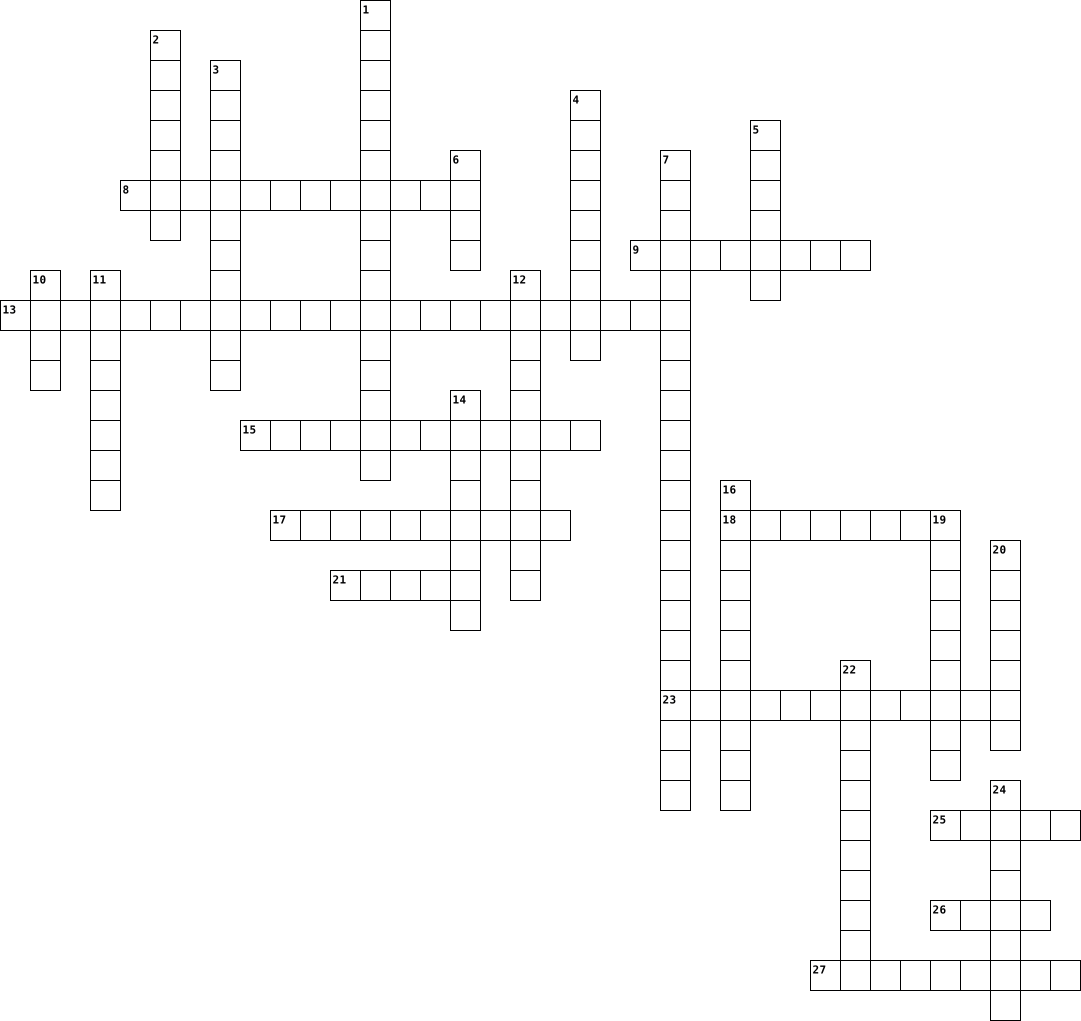
Across
- piece of evidence of a chemical reaction, such as temperature change, odor, light or sound
- sum of all the forces
- The ___ says matter is neither created nor destroyed.
- piece of evidence of a chemical reaction, such as bubbles, foaming, fizzing
- ___ forces cause change in motion.
- the formulas present at the end of a chemical reaction
- a push or pull
- any change in speed or direction
- a column on the periodic table
- one piece of an element
- the formulas present at the beginning of a chemical reaction
Down
- a process where new substances are formed
- one type of atom, also found on the periodic table
- piece of evidence of a chemical reaction, such as clear to blue
- unit for mass
- a row on the periodic table
- Balanced forces have a net force of ___ N.
- unit for acceleration
- amount of matter
- more than one atom combined
- tells the number of molecules
- ___ forces cause no change in motion.
- tool for force
- tells the number of atoms
- unit for force
- piece of evidence of a chemical reaction, such as two liquids producing a solid
- more than one type of atom
27 Clues: unit for mass • tool for force • unit for force • a push or pull • amount of matter • unit for acceleration • sum of all the forces • one piece of an element • tells the number of atoms • more than one type of atom • a row on the periodic table • more than one atom combined • tells the number of molecules • a column on the periodic table • any change in speed or direction • ...
test review 2016-11-07
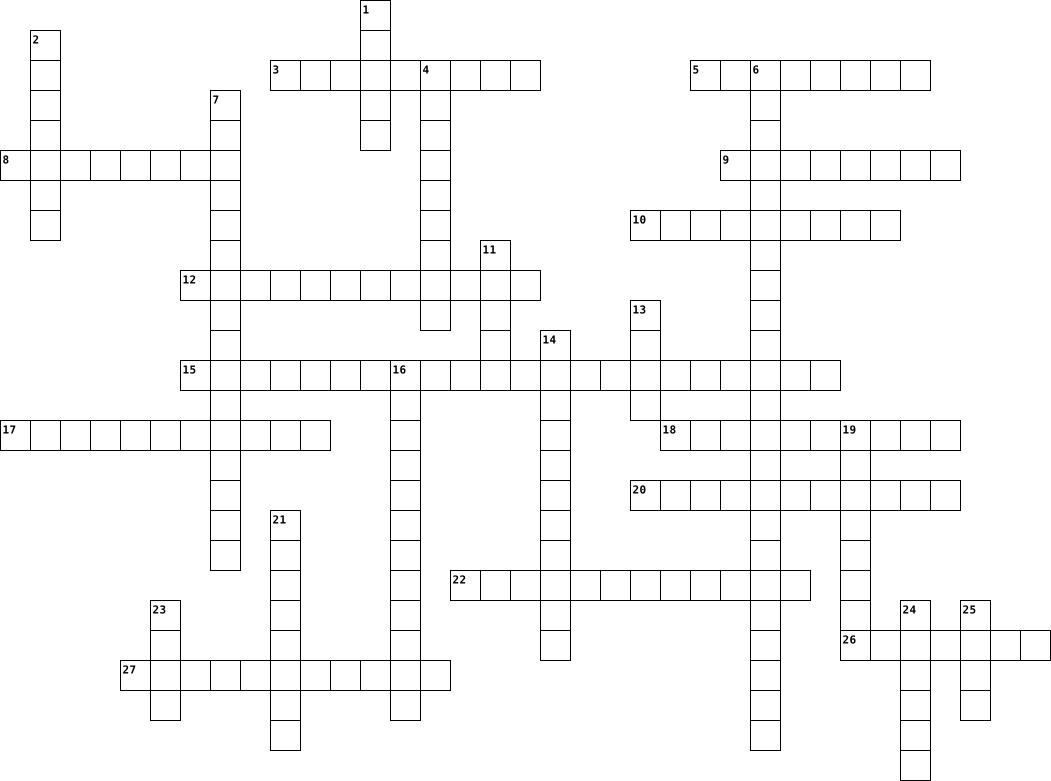
Across
- unit for mass
- ___ forces cause no change in motion.
- more than one atom combined
- more than one type of atom
- tells the number of atoms
- piece of evidence of a chemical reaction, such as bubbles, foaming, fizzing
- unit for acceleration
- tool for force
- ___ forces cause change in motion.
- piece of evidence of a chemical reaction, such as two liquids producing a solid
- any change in speed or direction
- one type of atom, also found on the periodic table
- piece of evidence of a chemical reaction, such as clear to blue
Down
- a column on the periodic table
- unit for force
- the formulas present at the beginning of a chemical reaction
- The ___ says matter is neither created nor destroyed.
- a process where new substances are formed
- a push or pull
- amount of matter
- tells the number of molecules
- piece of evidence of a chemical reaction, such as temperature change, odor, light or sound
- sum of all the forces
- the formulas present at the end of a chemical reaction
- one piece of an element
- a row on the periodic table
- Balanced forces have a net force of ___ N.
27 Clues: unit for mass • unit for force • a push or pull • tool for force • amount of matter • unit for acceleration • sum of all the forces • one piece of an element • tells the number of atoms • more than one type of atom • more than one atom combined • a row on the periodic table • tells the number of molecules • a column on the periodic table • any change in speed or direction • ...
Adrian lujan's Crossword 2017-02-27

Across
- a numerical or constant quantity placed before and multiplying the variable in an algebraic expression
- rapid chemical combination of a substance with oxygen, involving the production of heat and light
- a type of chemical reaction in which two or more simple substances combine to form a more complex product.
- is a charged chemical species (ion) composed of two or more atoms covalently bonded or of a metal complex that can be considered to be acting as a single unit
- the process or result of oxidizing or being oxidized.
- reacts with a compound and takes the place of another element in that compound
- chemical decomposition produced by passing an electric current through a liquid or solution containing ions
- a substance that takes part in and undergoes change during a reaction.
- a substance that is formed as the result of a chemical reaction.
Down
- cause (a substance) to be deposited in solid form from a solution
- the state or process of rotting, decay.
- consisting of two atoms.
- A binary compound is a chemical compound that contains exactly two different elements.
- a type of chemical reaction where two compounds react, and the positive ions (cation) and the negative ions (anion) of the two reactants switch places, forming two new compounds or products
- the symbolic representation of a chemical reaction in the form of symbols and formulae, wherein the reactant entities are given on the left-hand side and the product entities on the right-hand side.
- of or containing water, typically as a solvent or medium
- produce or provide
- a half-reaction in which a chemical species decreases its oxidation number, usually by gaining electrons
- a substance that increases the rate of a chemical reaction without itself undergoing any permanent chemical change.
19 Clues: produce or provide • consisting of two atoms. • the state or process of rotting, decay. • the process or result of oxidizing or being oxidized. • of or containing water, typically as a solvent or medium • a substance that is formed as the result of a chemical reaction. • cause (a substance) to be deposited in solid form from a solution • ...
Reversible Reactions and Equilibrium 2026-03-05

Across
- Any change in concentration, pressure, or temperature that breaks the state of equilibrium in a chemical system.
- The relative concentrations of reactants and products at equilibrium, indicating whether the forward or reverse reaction is favored.
- The rule stating that if a stress (change) is applied to a system at equilibrium, the system will shift its position to counteract the disturbance.
- Reaction A reaction in which two soluble ionic compounds in an aqueous solution form an insoluble solid called a precipitate.
- The specific part of the universe being studied in a chemical reaction (e.g., the chemicals inside a beaker).
- The SI unit used to measure the amount of a substance; one mole contains 6.022 X 10 (23) particles.
- The force exerted by gas particles colliding with the walls of their container; affecting equilibrium only when gases are involved.
- Reaction A reaction that releases energy (heat) to the surroundings; heat is treated as a product.
- The starting substances in a chemical reaction, located on the left side of the arrow.
- A substance that increases the rate of a reaction without being consumed; it helps reach equilibrium faster but does not change the equilibrium position.
- Reaction A reaction that absorbs energy (heat) from the surroundings; heat is treated as a reactant.
- The symbol used in a chemical equation to indicate that the reaction is reversible and can proceed in both directions.
Down
- An insoluble solid that emerges from a liquid solution during a chemical reaction.
- A measure of the average kinetic energy of particles; changing this provides energy to favor either the endothermic or exothermic direction.
- The substances formed as a result of a chemical reaction, located on the right side of the arrow.
- The reaction that proceeds from right to left (products reforming reactants).
- A state of balance in which the rates of the forward and reverse reactions are equal, resulting in no net change in the concentrations of reactants and products.
- The amount of a particular substance in a given volume of solution.
- A chemical reaction in which the conversion of reactants to products and the conversion of products to reactants occur simultaneously.
- The reaction that proceeds from left to right (reactants forming products).
20 Clues: The amount of a particular substance in a given volume of solution. • The reaction that proceeds from left to right (reactants forming products). • The reaction that proceeds from right to left (products reforming reactants). • An insoluble solid that emerges from a liquid solution during a chemical reaction. • ...
Chemical Reactions 2021-12-06

Across
- A substance produced in a chemical reaction
- Basic unit of matter
- The process by which substances change to produce different substances
- Chemical reaction in which heat is absorbed.
- The reactants in a photosynthesis reaction.
Down
- A single kind of matter that is pure and has a specific set of properties.
- Chemical formula for glucose.
- Chemical Reaction in which energy is given off in the form of heat
- A group of atoms bonded together
- change A change in matter that produces one or more new substances
- A substance that decreases the hydrogen ion concentration in a solution.
- Any substance that has a definite composition
- The formula for hydrochloric acid
- A chemical substance that is present at the start of a chemical reaction
- The product of a hydrogen reacting with oxygen.
- Chemical formula for sodium hydroxide
16 Clues: Basic unit of matter • Chemical formula for glucose. • A group of atoms bonded together • The formula for hydrochloric acid • Chemical formula for sodium hydroxide • A substance produced in a chemical reaction • The reactants in a photosynthesis reaction. • Chemical reaction in which heat is absorbed. • Any substance that has a definite composition • ...
Chemical Reactions 2021-12-06

Across
- A substance produced in a chemical reaction
- Basic unit of matter
- The process by which substances change to produce different substances
- Chemical reaction in which heat is absorbed.
- The reactants in a photosynthesis reaction.
Down
- A single kind of matter that is pure and has a specific set of properties.
- Chemical formula for glucose.
- Chemical Reaction in which energy is given off in the form of heat
- A group of atoms bonded together
- change A change in matter that produces one or more new substances
- A substance that decreases the hydrogen ion concentration in a solution.
- Any substance that has a definite composition
- The formula for hydrochloric acid
- A chemical substance that is present at the start of a chemical reaction
- The product of a hydrogen reacting with oxygen.
- Chemical formula for sodium hydroxide
16 Clues: Basic unit of matter • Chemical formula for glucose. • A group of atoms bonded together • The formula for hydrochloric acid • Chemical formula for sodium hydroxide • A substance produced in a chemical reaction • The reactants in a photosynthesis reaction. • Chemical reaction in which heat is absorbed. • Any substance that has a definite composition • ...
Unit 6 Vocabulary PS 2025-09-03

Across
- A substance capable of dissolving one or more other substances.
- To keep the number of atoms the same on both sides of the equation.
- A reaction in which a compound breaks down into two or more simple substances.
- A mixture in which one substance is dissolved by another.
- A reaction in which elements combine to form a compound.
- A reaction in which one element replaces another in a compound.
- A number placed before a formula in a chemical equation.
- A substance that is formed in a chemical reaction.
- A substance that is altered in a chemical reaction.
Down
- A solid that is formed and usually sinks to the bottom of a solution.
- A reaction in which the elements in two compounds are exchanged.
- Matter cannot be created or destroyed in chemical and common physical changes.
- To break apart.
- A statement that uses symbols, formulas, and numbers to stand for a chemical reaction.
- The substance that is dissolved in a solution.
- A chemical change in which elements are combined or rearranged.
- A combination of substances in which no reaction takes place.
17 Clues: To break apart. • The substance that is dissolved in a solution. • A substance that is formed in a chemical reaction. • A substance that is altered in a chemical reaction. • A reaction in which elements combine to form a compound. • A number placed before a formula in a chemical equation. • A mixture in which one substance is dissolved by another. • ...
4665 2024-05-10

Across
- the production of chemical compounds by reaction from simpler materials.
- a chemical equation in which mass is conserved; each side of the equation has the same number of atoms of each element
- Same throughout
- one element replaces another element in a compound
- The part of a solution that gets dissolved
- a chemical reaction where two elements in different compounds trade places
- Break down of a chemical organism
- The heat content of a system at constant pressure
- A solution that doesn't hold as much solute as possible at a given temperature
- something that can be observed about a substance, such as color, smell, or boiling point
- A characteristic of a pure substance that can be observed without changing it into another substance
- A solid that forms from a solution during a chemical reaction.
Down
- A graphical representation of how much solute will dissolve in water at various temperatures
- Water
- Reaction A reaction that ABSORBS energy in the form of heat
- Energy needed to get a reaction started
- The state of matter whose solubility typically decreases with increasing temperature
- A solution that contains a small amount of solute
- The part of a solution that does the dissolving
- Reaction A reaction that releases energy in the form of heat
- A rapid reaction between oxygen and fuel that results in fire
- Chemical agents that selectively speed up chemical reactions without being consumed by the reaction.
- A solution that had a great amount of solute
- A solution that holds as much solute in it as possible at a given temperature.
- A measure of how much solute can dissolve in a given solvent at a given temperature.
- Not the same throughout
- the reaction of an acid and a base to form a neutral solution of water and a salt
- solution A solution that holds more solute than predicted at a given temperature
- A mixture of substances
29 Clues: Water • Same throughout • Not the same throughout • A mixture of substances • Break down of a chemical organism • Energy needed to get a reaction started • The part of a solution that gets dissolved • A solution that had a great amount of solute • The part of a solution that does the dissolving • A solution that contains a small amount of solute • ...
Bio unit 2 vocab 2025-09-26

Across
- reaction in living organisms that builds molecules (requires energy)
- biological catalysts
- a combination of 2 or more elements connected by bonds
- attraction between molecules of the same substance
- mass equal to the total number of protons and neutrons in the nucleus of an atom (based on average mass from isotopes)
- reaction- process that changes, or transforms, one set of chemicals into another set of chemicals
- elements or compounds that enter into a chemical reaction
- positively charged particle found in the nucleus of an atom
- capacity (specific heat) the amount of heat needed to raise the temperature of 1 gram of a substance 1 degree Celsius (°C)
- bond chemical bond formed when one or more electrons are transferred from one atom to another
- substance formed as a result of a chemical reaction
- reactant of an enzyme-catalyzed reaction
Down
- action tendency of water to rise in a thin tube
- reaction a reaction that absorbs energy (absorbs heat)
- symbol one or twoletter abbreviation for a chemical element name
- number the number of protons in the nucleus of an atom, which determines the chemical properties of an element and its place in the periodic table (also equals the number of electrons in an element)
- bonding weak attraction between a hydrogen atom and another atom
- negatively charged particle that orbits the nucleus in the electron cloud
- reactiona reaction that releases energy (gives off heat)
- pure substance that consists entirely of one type of atom
- in a molecule, uneven distribution of electrons (results in (+) and (-) poles) ex. water
- bond type of bond between atoms in which the electrons are shared
- (chemistry definition) the center of an atom, which contains the protons and neutrons
- energy energy that is needed to get a reaction started
- electron electron found in the outermost shell of an atom; helps to determine bonding
- particle found in the nucleus that has no charge
- force of attraction between different kinds of molecules
- reaction in living organisms that breaks down complex molecules (releases energy)
- substance that speeds up the rate of a chemical reaction
- the basic unit of matter
30 Clues: biological catalysts • the basic unit of matter • reactant of an enzyme-catalyzed reaction • action tendency of water to rise in a thin tube • particle found in the nucleus that has no charge • attraction between molecules of the same substance • substance formed as a result of a chemical reaction • a combination of 2 or more elements connected by bonds • ...
Chemical Reactions 2021-12-06

Across
- A substance produced in a chemical reaction
- Basic unit of matter
- The process by which substances change to produce different substances
- Chemical reaction in which heat is absorbed.
- The reactants in a photosynthesis reaction.
Down
- A single kind of matter that is pure and has a specific set of properties.
- Chemical formula for glucose.
- Chemical Reaction in which energy is given off in the form of heat
- A group of atoms bonded together
- change A change in matter that produces one or more new substances
- A substance that decreases the hydrogen ion concentration in a solution.
- Any substance that has a definite composition
- The formula for hydrochloric acid
- A chemical substance that is present at the start of a chemical reaction
- The product of a hydrogen reacting with oxygen.
- Chemical formula for sodium hydroxide
16 Clues: Basic unit of matter • Chemical formula for glucose. • A group of atoms bonded together • The formula for hydrochloric acid • Chemical formula for sodium hydroxide • A substance produced in a chemical reaction • The reactants in a photosynthesis reaction. • Chemical reaction in which heat is absorbed. • Any substance that has a definite composition • ...
Emily Yunker Chapter 13 2016-10-09

Across
- The result of a chemical change.
- A type of chemical reaction that breaks down the compound.
- When a reaction and its inverse act at the same rate.
- States that if changed, the equilibrium to oppose change, until new equilibrium is reached.
- A type of chemical reaction where two variables are switched.
- Energy is transferred to reactants from surroundings.
- A type of chemical reaction that takes two simple reactants to make a product.
- The energy stored in molecules that can be released during a reaction.
- Transfers from reactants to surroundings.
- This changes the rate of chemical reactions.
Down
- A substance that undergoes a chemical change.
- A type of chemical reaction that H2O and CO2 in the product.
- Must be added to break bonds.
- A type of chemical reaction where only one variable is switched.
- Most reactants go faster at this temperature.
15 Clues: Must be added to break bonds. • The result of a chemical change. • Transfers from reactants to surroundings. • This changes the rate of chemical reactions. • A substance that undergoes a chemical change. • Most reactants go faster at this temperature. • When a reaction and its inverse act at the same rate. • Energy is transferred to reactants from surroundings. • ...
Choice Board 2024-02-28

Across
- a substance/material used to decrease the rate of a chemical reaction
- how fast a chemical reaction is
- the minimum amount of energy needed to start a chemical reaction
- a biological substance that acts like a catalyst and speeds chemical reactions up
- a characteristic changes, not what the object is made out of
- the chemical before you do the reaction
- a chemical reaction that absorbs energy
- the transfer of heat through the movement of fluids
Down
- changes what an object is made out of
- a substance that helps a substance resist a pH change
- the chemicals after the reaction is complete
- the process of heat transfer through direct contact between particles of matter
- a chemical reaction that releases energy
- a number place in front of a formula to balance a chemical equation
- he act of combining element to form something new
15 Clues: how fast a chemical reaction is • changes what an object is made out of • the chemical before you do the reaction • a chemical reaction that absorbs energy • a chemical reaction that releases energy • the chemicals after the reaction is complete • he act of combining element to form something new • the transfer of heat through the movement of fluids • ...
Garrett Betz Chapter 13 2016-10-11

Across
- creates oxides in a chemical reaction
- energy transfers from reactants to surrounding
- if changed the equilibrium shifts to oppose change until new equilibrium is reached
- must be added to break bonds
- a substance that undergoes a chemical change
Down
- a substance that is the result of the chemical change
- moves one element in a chemical reaction
- building or creating in a chemical reaction
- energy is transferred to reactants from surroundings
- where reactions and its reverse act at the same rate
- moves two elements in a chemical reaction
- energy the energy stored in molecules that can be released during a reaction
- breaking down in a chemical reaction
- measure of acidity of a solution equal to the negative logarithm of the hydronium ion concentration
- called an alkaline
15 Clues: called an alkaline • must be added to break bonds • breaking down in a chemical reaction • creates oxides in a chemical reaction • moves one element in a chemical reaction • moves two elements in a chemical reaction • building or creating in a chemical reaction • a substance that undergoes a chemical change • energy transfers from reactants to surrounding • ...
Chemical reaction 2021-06-28

Across
- OILRIG
- reverse of combination
- absorption of heat
- law of mass action
- single substance
Down
- heat is evolved
- reactivity of metals
- insoluble
- oxidation reaction
- Nitrogendioxide
10 Clues: OILRIG • insoluble • heat is evolved • Nitrogendioxide • single substance • oxidation reaction • absorption of heat • law of mass action • reactivity of metals • reverse of combination
Chemical Reaction 2024-04-30

Across
- it occurs when two or more compounds combine to form one compound.
- it occurs when saltwater reacts with concrete pillars which contain iron to form Iron chloride
- it occurs when carbonic acid in soft drinks decomposes to give carbon dioxide gas
- it is a type of reaction where part of of one reactant is replaced by part of another reactant
- any liquid or solid water that falls from the atmosphere to the Earth
Down
- it occurs when oxygen combines with a compound to form carbon dioxide and water
- any substance that has a defined composition
- a rearrangement of the atoms or molecules of two or more substances that come into contact with each other, resulting in the formation of one or more new substances
- it is an acid and a base react with each other, generally, the product of this reaction is salt and water
- an example of this is rusting of iron, respiration in humans, and the burning of fuels
10 Clues: any substance that has a defined composition • it occurs when two or more compounds combine to form one compound. • any liquid or solid water that falls from the atmosphere to the Earth • it occurs when oxygen combines with a compound to form carbon dioxide and water • it occurs when carbonic acid in soft drinks decomposes to give carbon dioxide gas • ...
Chemical Reaction 2023-06-26

Across
- a type of chemical reaction that occurs when two reactants exchange cations or anions to yield two new products ...
- occurs when two or more reactants combine to form a single product.
- a chemical reaction in which one reactant breaks down into two or more products.
- occur when chemical bonds between atoms are formed or broken.
- must have oxygen as a reactant.
- Substances that react with one another in a chemical reaction.
Down
- is a reaction in which one element is substituted for another element in a compound.
- any substance that cannot be decomposed into simpler substances by ordinary chemical processes.
- New substances formed in a chemical reaction
- a particle of matter that uniquely defines a chemical element.
10 Clues: must have oxygen as a reactant. • New substances formed in a chemical reaction • occur when chemical bonds between atoms are formed or broken. • a particle of matter that uniquely defines a chemical element. • Substances that react with one another in a chemical reaction. • occurs when two or more reactants combine to form a single product. • ...
Science Centre Review 2024-12-10

Across
- A reaction in which a substance reacts with oxygen, typically producing heat and light.
- A chemical reaction in which a substance reacts with oxygen, releasing energy in the form of heat and light, often producing carbon dioxide and water.
- The process by which a gas turns directly into a solid, bypassing the liquid state.
- The ability of a material to be hammered or pressed into thin sheets without breaking or cracking.
- The tendency of a substance to undergo chemical reactions with other substances.
- A type of reaction or process that absorbs heat from its surroundings.
- Referring to a compound consisting of two elements.
- The ability of a substance to catch fire and burn easily.
- A chemical reaction in which an acid and a base react to form water and a salt, neutralizing each other's properties.
- A group of two or more atoms bonded together, representing the smallest unit of a chemical compound that can exist independently.
Down
- Substances formed as a result of a chemical reaction.
- A substance that can destroy or damage other materials or living tissue through chemical reactions.
- A chemical reaction in which a complex substance breaks down into two or more simpler substances.
- A type of reaction or process that releases heat to its surroundings.
- The gradual destruction of materials, usually metals, through chemical reactions with environmental elements like oxygen or moisture.
- To put a plan, decision, or agreement into effect or action.
- A group of letters added to the beginning of a word to modify its meaning, commonly used in naming chemical compounds.
- A chemical reaction in which two or more simple substances combine to form a more complex substance.
- A symbolic representation of a chemical compound using symbols for the elements and numerical subscripts to indicate the proportions of each element.
- Groups of two or more atoms bonded together that form the smallest unit of a chemical compound.
- respiration The process by which cells convert nutrients, usually glucose, into energy (ATP), using oxygen and releasing carbon dioxide and water.
- Substances that undergo a chemical reaction to form products.
- The ability of a material to be stretched or drawn out into a wire without breaking.
23 Clues: Referring to a compound consisting of two elements. • Substances formed as a result of a chemical reaction. • The ability of a substance to catch fire and burn easily. • To put a plan, decision, or agreement into effect or action. • Substances that undergo a chemical reaction to form products. • ...
The Progress of Chemical Reactions 2026-03-05

Across
- The minimum amount of energy required to initiate a chemical reaction.
- A reaction that releases energy (usually heat) into the surroundings; products have less energy than reactants.
- The specific reactant molecule that an enzyme acts upon.
- The specific region on an enzyme where the substrate binds and the reaction takes place.
- A reaction that occurs through a series of simpler steps known as elementary steps.
- A reaction that occurs in a single event; reactants convert directly to products without intermediates.
- A process in which one or more substances are converted into different substances by breaking and forming chemical bonds.
- The starting substances in a chemical reaction, written on the left side of a chemical equation.
- A theoretical representation of the energy pathway as reactants are transformed into products.
Down
- A high-energy, unstable state during a chemical reaction where old bonds are breaking and new bonds are forming.
- A substance that increases the rate of a chemical reaction by lowering the activation energy without being consumed.
- The sequence of individual steps by which a chemical reaction occurs.
- A reaction that absorbs energy from the surroundings; products have more energy than reactants.
- The substances formed as a result of a chemical reaction, written on the right side of a chemical equation.
- A biological catalyst, usually a protein, that speeds up specific chemical reactions in living organisms.
15 Clues: The specific reactant molecule that an enzyme acts upon. • The sequence of individual steps by which a chemical reaction occurs. • The minimum amount of energy required to initiate a chemical reaction. • A reaction that occurs through a series of simpler steps known as elementary steps. • ...
Chemistry 2022-03-18
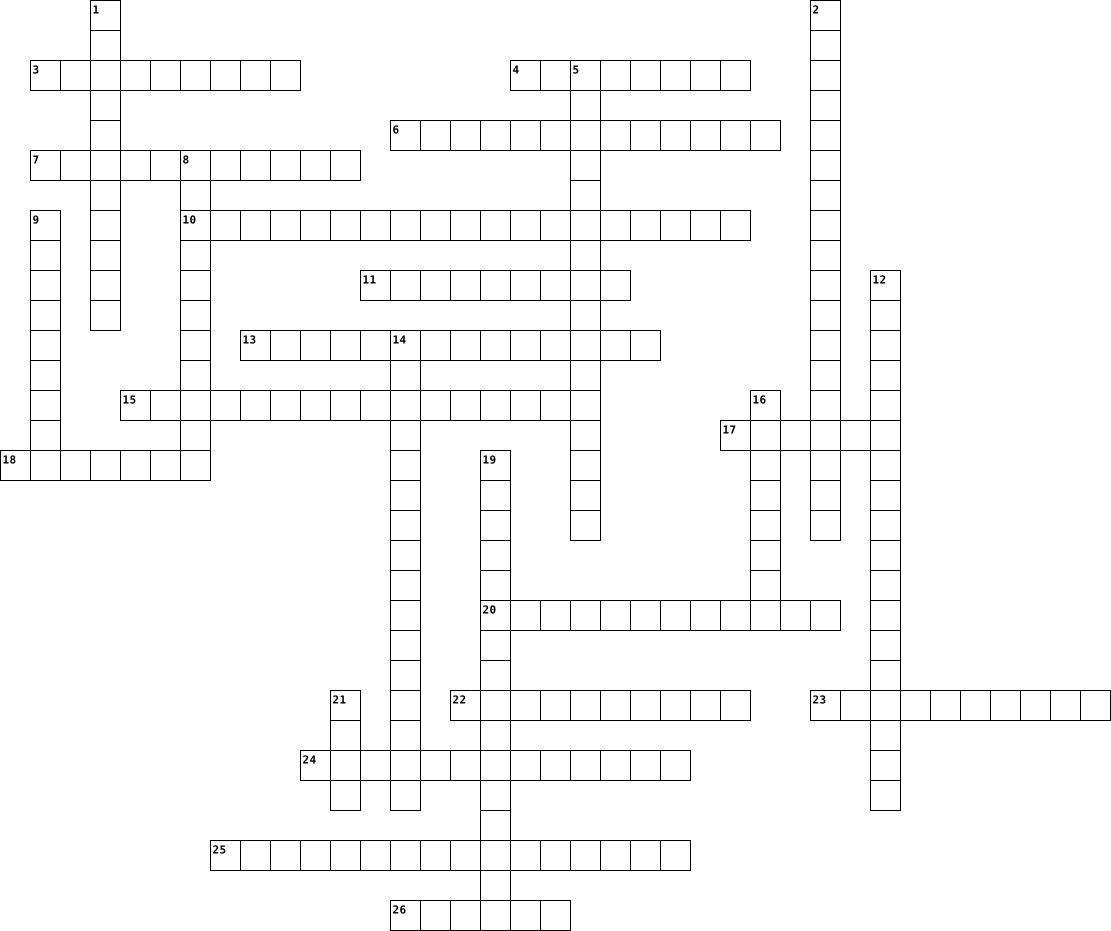
Across
- the study of matter
- the substances you have a the beginning
- the amount of a substance in a given volume
- when on element replaces another in a compound
- a reaction which energy is absorbed
- when two or more elements combined to make more complex substances
- any change the alters the appearance of a substance
- a change in matter that produces one or more substances
- any thing that has mass and takes up space
- new substance after the reaction
- matter is not allowed to enter or leave
- matter can enter from or escape to the surroundings
- a reaction between oxygen and fuel
- breaks down compounds into simpler products
- a characteristic of a substance that can be observed without changing the substance into another substance
- biological catalysts
Down
- a solid that forms from solution during a chemical reaction
- a reaction that releases energy in the form of heat
- minimum amount of energy needed to start a chemical reaction
- a number placed in front of a chemical formula
- used to decrease the rate of reaction
- during a chemical reaction matter is not created of destroyed
- a way to show chemical reactions using symbols
- increases the rate of reaction by lowering the activation energy
- a characteristic of a substance that describes its ability to change into other substances
- releases energy when it buns
26 Clues: the study of matter • biological catalysts • releases energy when it buns • new substance after the reaction • a reaction between oxygen and fuel • a reaction which energy is absorbed • used to decrease the rate of reaction • the substances you have a the beginning • matter is not allowed to enter or leave • any thing that has mass and takes up space • ...