
chemical reaction Crossword Puzzles
Chemical Reaction Glossary 2023-02-02

Across
- the tiny pieces that all matter-all the stuff in the world-is made of.
- reaction a process in which atoms rearrange to form new substances.
- formula letters and numbers showing the types and number of atoms that repeat to make up a substance.
- structure a structure formed by repeating groups of atoms linked together in a large network.
- a group of atoms joined together in a particular way.
- to change the order or position of something.
- something that can be observed about a substance, such as color, smell, or boiling point.
Down
- able to cause damage.
- point the temperature at which a substance changes from the liquid phase to the gas phase.
- something that is made of all the same atoms or groups of atoms.
- a substance that is added to soil to help plants grow.
- a starting substance that is part of a chemical reaction.
- point the temperature at which a substance changes from the solid phase to the liquid phase.
- an object, diagram, or computer program that helps us understand something by making it simpler or easier to see.
- the relative size of things.
- an ending substance that is made during a chemical reaction.
16 Clues: able to cause damage. • the relative size of things. • to change the order or position of something. • a group of atoms joined together in a particular way. • a substance that is added to soil to help plants grow. • a starting substance that is part of a chemical reaction. • an ending substance that is made during a chemical reaction. • ...
Chemical Reaction Vocabulary 2025-11-16

Across
- a group of atoms joined together in a particular way
- the tiny pieces that all matter is made of
- an object diagram or computer program that helps us understand something by making it simpler or easier to see
- an ending substance that is made during a chemical reaction
- the temperature at which a substance changes from the solid phase to the liquid phase
- a process in which atoms rearrange to form new substances
- a substance that is added to soil to help plants grow
- to change the order or position of something
Down
- something that is made of all the same atoms or groups of atoms
- a starting substance that is part of a chemical reaction
- able to cause damage
- the temperature at which a substance changes from the liquid phase to the gas phase
- the relative size of things
- letters and numbers showing the types and number of atoms that repeat to make up a substance
- something that can be observed about a substance, such as color smell or boiling point
15 Clues: able to cause damage • the relative size of things • the tiny pieces that all matter is made of • to change the order or position of something • a group of atoms joined together in a particular way • a substance that is added to soil to help plants grow • a starting substance that is part of a chemical reaction • ...
Chapter 12 Vocabulary crossword 2023-04-06

Across
- the direction of a reversible reaction is favored
- a series of simple reactions that represent the progress of the overall reaction at the molecular level
- A state of balance
- substance that speeds up the rate of a chemical reaction
- chemical law stating that the rate of a reaction is proportional to the concentration of the reacting substances
- a high-energy intermediate state of the reactants during a chemical reaction that must be achieved for the reaction to proceed
- Energy needed to get a reaction started
- the rate at which reactants change into products over time
Down
- A system in which no matter is allowed to enter or leave
- value that expresses how far the reaction proceeds before reaching equilibrium. A small number means that equilibrium is towards the reactants side while a large number means that the equilibrium is towards the product side
- When a change is experienced by a chemical system in equilibrium, the system will adjust to partially offset the change
- Expression used to determine the unknown equilibrium concentrations. It describes the relationship of the products relative to the reactants in a chemical equilibrium system.
- shows the energy of reactants and products during the course of a reaction
- describes a reaction that involves only one particle that goes on to form products
- a transitional structure that results from an effective collision and that persists while old bonds are breaking and new bonds are forming
- A type of biological protein that speeds up a chemical reaction in a living thing
- the step-by-step sequence of reactions by which the overall chemical change occurs
- an elementary step in a reaction that involves two particles, either the same species or different, that collide and go on to form products
18 Clues: A state of balance • Energy needed to get a reaction started • the direction of a reversible reaction is favored • A system in which no matter is allowed to enter or leave • substance that speeds up the rate of a chemical reaction • the rate at which reactants change into products over time • shows the energy of reactants and products during the course of a reaction • ...
Crossword Puzzle 7A and 7B key terms 2024-01-10

Across
- A combination of chemical formulas and symbols that models a chemical reaction.
- A chemical reaction in which a single reactant breaks down into two or more products.
- SI fundamental unit for the quantity of matter in a substance; a count equal to 6.022 x 2023.
- A substance that enters into a chemical reaction.
- A positive or negative number showing the electric charge on an element when it forms a compound.
Down
- A chemical reaction in which one element in a compound is replaced by another element; also known as a single-displacement reaction.
- A chemical reaction in which two compounds swap cations or anions with each other; also know as a double-displacement reaction.
- A gain of electrons in a chemical reaction.
- A chemical reaction in which two or more reactants combine into a single, more complex product.
- A substance that is formed during a chemical reaction.
- The mass of one mole of a substance.
- A process that rearranges the atoms in one or more substances into one or more new substances.
- An exothermic reaction in which a fuel reacts with oxygen.
- A number placed in front of a chemical formula within a chemical equation that shows how many units of a reactant or product are needed to balance the chemical equation.
14 Clues: The mass of one mole of a substance. • A gain of electrons in a chemical reaction. • A substance that enters into a chemical reaction. • A substance that is formed during a chemical reaction. • An exothermic reaction in which a fuel reacts with oxygen. • A combination of chemical formulas and symbols that models a chemical reaction. • ...
Crossword 2024-09-16

Across
- - Hydrocarbon with at least one triple bond, e.g., ethyne.
- - Process in which a substance gains electrons during a reaction.
- - Describes elements that emit radiation due to unstable nuclei.
- - Substance formed as a result of a chemical reaction.
- - A type of chemical reaction where two or more substances combine to form a new compound.
- Bond - Electrostatic attraction between oppositely charged ions.
- - Simple hydrocarbon with the formula CH4, a major component of natural gas.
- - Method used to determine the concentration of a solution.
- - Substance that dissolves a solute to form a solution.
- - Hydrocarbon with single bonds only, e.g., methane or ethane.
- - Measure of how acidic or basic a solution is.
- - Ionic compound formed from the reaction of an acid and a base.
- - Time required for half of the radioactive nuclei in a sample to decay.
- - Technique used to separate mixtures into their individual components.
- Bond - Chemical bond formed by the sharing of electrons between atoms.
- - Hydrocarbon with the formula C2H4, used in the production of plastics.
- - Large molecule made up of repeating subunits called monomers.
- - A chemical process that uses electricity to break down compounds.
Down
- - Reaction between an acid and a base to form water and a salt.
- - Substance that is dissolved in a solvent.
- - Small molecule that can join together with other monomers to form a polymer.
- - Chemical process for hardening rubber.
- - Technique used to measure the interaction of light with matter to determine chemical composition.
- Agent - Substance that gains electrons and is reduced in a redox reaction.
- Acid - Organic compound that serves as the building block of proteins.
- - Solution that resists changes in pH when acids or bases are added.
- - Process in which a substance loses electrons during a reaction.
- - A chemical reaction that involves the burning of a substance in oxygen to produce heat and light.
- - Related to the chemistry of electron transfer processes.
- - Substance that donates protons (H+ ions) in a reaction.
- - Substance that undergoes change during a chemical reaction.
- - Substance that speeds up a chemical reaction without being consumed.
- - A type of reaction where a compound breaks down into simpler substances.
- - Common polymer used in plastic bags and bottles.
- Agent - Substance that loses electrons and is oxidized in a redox reaction.
- - Substance that accepts protons (H+ ions) or donates hydroxide ions (OH-).
- - Solid formed from a chemical reaction in a solution.
- - Organic compound consisting only of hydrogen and carbon.
- - Hydrocarbon with at least one double bond, e.g., ethene.
- - Molecules with the same molecular formula but different structures.
40 Clues: - Chemical process for hardening rubber. • - Substance that is dissolved in a solvent. • - Measure of how acidic or basic a solution is. • - Common polymer used in plastic bags and bottles. • - Substance formed as a result of a chemical reaction. • - Solid formed from a chemical reaction in a solution. • - Substance that dissolves a solute to form a solution. • ...
CrossWord - Chemistry 2021-07-16

Across
- law of __ mass.
- In a chemical reaction ___ are shown to the right of the arrow.
- all mineral acids except __ acid are strong acids.
- What does the symbol (aq) represent in a chemical equation
- We can balance an equation by adding a __ in front of symbols.
- rusting of iron is __ reaction.
- the reaction between an acid and a base is called ___ reaction.
- plaster of paris changes to _ on mixing with water
Down
- acids have __ taste?
- Chemical name of sugarcane?
- white silver chloride changes into ___ colour when exposed to sunlight
- ___ reaction in which two or more substance combine to form a new single substance.
- The phenomenon due to which metal are slowly eaten away by the reaction of air , water and chemical presence in the atmosphere .
- Oxide of which element is used as major ingredient in cement
- The reactions which involve the use of electrical energy for the decomposition of the reactant molecules is called ?
- Respiration is example of _ reaction?
- To protect tooth decay we are advised to brush our teeth regularly . The nature of the toothpaste is ___.
- Dilute acid does not produce carbon dioxide on being treated with
- inventory A tool is used to determine if a chemical reaction is balanced or unbalanced.
- sodium hydroxide turns phenolphthalein solution into __ colour.
20 Clues: law of __ mass. • acids have __ taste? • Chemical name of sugarcane? • rusting of iron is __ reaction. • Respiration is example of _ reaction? • all mineral acids except __ acid are strong acids. • plaster of paris changes to _ on mixing with water • What does the symbol (aq) represent in a chemical equation • Oxide of which element is used as major ingredient in cement • ...
chapter 5 2022-05-05

Across
- the amount of one material in a certain volume of another material
- a number in front of a chemical formula in an equation that indicates how many molecules or atoms of each reactant and product are involved in a reaction
- energy, the minimum amount of energy needed to start a chemical reaction
- a material that decreases the rate of a reaction
- change, any change that alters the form or appearance of a substance but does no change it into another’s substance
- a chemical reaction that breaks down compounds into simpler products
- of Conservation of mass, the principle that the total amount of matter is neither created nor destroyed during any chemical or physical change
- change, a change in matter that produces one or more new substances
Down
- a reaction in which one emmental replaces another in a compound or when two events in different compounds trade places
- reaction, a reaction that absorbs energy
- a material that increases the rate of a reaction by lowering the activation energy
- a chemical reaction in which two or more simple substances combine to form a new (more complex) substance
- a type of protein that speeds up a chemical reaction in a living thing (a biological catalyst that lowers the activation energy of reactions in cells
- substances that undergo the chemical change
- reaction, a reaction that releases energy (usually in the form of heat)
- the new substances that form
16 Clues: the new substances that form • reaction, a reaction that absorbs energy • substances that undergo the chemical change • a material that decreases the rate of a reaction • the amount of one material in a certain volume of another material • change, a change in matter that produces one or more new substances • ...
Chapter 5 2022-05-04

Across
- change, a change in matter that produces one or more new substances
- the amount of one material in a certain volume of another material
- of Conservation of mass, the principle that the total amount of matter is neither created not destroyed during any chemical or physical change
- reaction, a reaction that releases energy (usually in the form of heat)
- reaction, a reaction that absorbs energy
- a reaction in which one emmental replaces another in a compound or when two events in different compounds trade places
- a number in front of a chemical formula in an equation that indicates how many molecules or atoms of each reactant and product are involved in a reaction
- a chemical reaction in which two or more simple substances combine to form a new (more complex) substance
Down
- the new substances that form
- energy, the minimum amount of energy needed to start a chemical reaction
- a material that decreases the rate of a reaction
- a material that increases the rate of a reaction by lowering the activation energy
- a chemical reaction that breaks down compounds into simpler products
- change, any change that alters the form or appearance of a substance but does no change it into another’s substance
- a type of protein that speeds up a chemical reaction in a living thing (a biological catalyst that lowers the activation energy of reactions in cells
- substances that undergo the chemical change
16 Clues: the new substances that form • reaction, a reaction that absorbs energy • substances that undergo the chemical change • a material that decreases the rate of a reaction • the amount of one material in a certain volume of another material • change, a change in matter that produces one or more new substances • ...
Science Vocab chapter 4 2018-10-25

Across
- the new substances that form.
- occurs when compounds break down into simpler products.
- increases the reaction rate by lowering the activation energy needed.
- matter does not enter or leave
- a solid that forms from liquids during a chemical reaction.
- substances that undergo the chemical changes.
- matter can enter from or escape to the surroundings.
- more energy is required to break the bonds of the reactants than is released by the formation of the products.
- any change that alters the form or appearance of a substance but does not change it into another substance.
- A material used to decrease the rate of a chemical reaction is an...
Down
- states that during a chemical reaction matter is not created or destroyed.
- a number placed in front of a chemical formula in an equation.
- A change in matter that produces one or more new substances.
- the minimum amount of energy needed to start a chemical reaction.
- the energy released as the products form is greater than the energy required to break the bonds of the reactants.
- in chemistry when two or more elements or compounds combine to make a more complex substance, the reaction is classified as...
- the cells in your body contain thousands of biological catalysts called...
- a way to show a chemical reaction, using symbols instead of words.
- the amount of a substance in a given volume.
- when one element replaces another element in a compound, or if two elements in different compounds trade places, the reaction is a replacement.
20 Clues: the new substances that form. • matter does not enter or leave • the amount of a substance in a given volume. • substances that undergo the chemical changes. • matter can enter from or escape to the surroundings. • occurs when compounds break down into simpler products. • a solid that forms from liquids during a chemical reaction. • ...
Chemical Reactions 2022-01-06

Across
- substance that undergoes a chemical change
- reaction that absorbs energy
- reaction that makes new substances
- reaction that releases energy
- exchange of ions between two compounds
- shorthand way to show a chemical reaction
Down
- reaction combining 2 elements to make a new, more complex compound
- substances that result from a chemical reaction
- reaction where atoms of one element take the place of another element
- substance that changes the rate of a chemical reaction
- reaction when a compound burns in oxygen
- state where a chemical reaction and its reverse are happening at the same time and rate
- reaction where a compound is broken down to 2 simpler substances
13 Clues: reaction that absorbs energy • reaction that releases energy • reaction that makes new substances • exchange of ions between two compounds • reaction when a compound burns in oxygen • shorthand way to show a chemical reaction • substance that undergoes a chemical change • substances that result from a chemical reaction • ...
Glossary 2016-10-23

Across
- a chemical reaction that releases energy
- a reaction of an acid with a base, forming salt and water
- a rapid reaction with oxygen that releases energy in the form of heat/light
- simple written description of what is happening in a reaction
- a chemical reaction that absorbs energy
- chemicals produced in a chemical reaction. They are written on the right hand side of the arrow
- a chemical reaction that has the same numbers of each atom on both sides of the arrow.
- a way of protecting aluminium from corrosion, by deliberately creating a layer of aluminium oxide over it
- a type of sugar produced by photosynthesis
Down
- a rain that has acids such as nitric acid and sulfuric dissolved in it
- a green chemical found in chloroplasts of green plants, needed to carry out photosynthesis
- Hydrated Iron (III)
- a reaction that uses oxygen to release energy stored in glucose
- single celled organisms that live in water, They are an important store of carbon or carbon sink
- combustion that occurs when there is plenty of oxygen, it produces carbon dioxide and water vapour
- a process in which chemicals move, caused by different concentrations of the chemical
- a biological catalyst that speeds up the reaction
- the breakdown of metals due to their reaction with other chemicals.
18 Clues: Hydrated Iron (III) • a chemical reaction that absorbs energy • a chemical reaction that releases energy • a type of sugar produced by photosynthesis • a biological catalyst that speeds up the reaction • a reaction of an acid with a base, forming salt and water • simple written description of what is happening in a reaction • ...
Chapter 7 vocab 2023-01-03

Across
- - the mass of one mole of a substance
- - substances that undergo change in a chemical reaction
- - a chemical reaction in which a compound breaks down into two or more simpler substances
- - a chemical reaction that absorbs energy from its surroundings
- - the energy stored in chemical bonds
- - an amount of a substance that contains approximately 6.02 x 10²³ particles of the substance
Down
- reaction - a chemical reaction in which two compounds exchange positive ions and form new compounds
- reaction - a chemical reaction in which one element takes the place of another element in a compound
- - a chemical reaction that releases energy to its surroundings
- - new substances formed as a result of a chemical reaction
- - a representation of a chemical reaction in which the reactants and products are expressed as formulas
- - a chemical reaction in which two or more substances react to form a single substance
- - numbers that appear before a formula in a chemical equation to show the relative proportions of each reactant and product
13 Clues: - the mass of one mole of a substance • - the energy stored in chemical bonds • - substances that undergo change in a chemical reaction • - new substances formed as a result of a chemical reaction • - a chemical reaction that releases energy to its surroundings • - a chemical reaction that absorbs energy from its surroundings • ...
Tom's Crossword Puzzle 2016-05-19

Across
- Energy Released during nuclear fission.
- Can be dissolved in water.
- Energy When something moves it produces kinetic energy.
- An electromagnetic wave of high energy and a short wavelength.
- Reaction A chemical reaction that releases energy by light or heat.
- Reaction Reaction in which the systems absorbs the energy from its surroundings.
- Cannot be dissolved in water.
- Substances that are slippery to the touch.
- Allowing light but not shapes to pass through.
- Of Reaction The substances that result from the recombination of atoms.
- Not able to be seen through.
- Variable The variable that is being tested, can be changed by the independent variable.
Down
- An electromotive force expressed in volts.
- Easy to see through, light goes through.
- Invisible rays that are a part of energy that comes from the sun.
- A substance that takes part in change during a reaction.
- Variable The variable that is changed or controlled.
- Substances with chemical properties that dissolve metal.
- Reaction A chemical reaction where a compound and an oxidant is reacted to produce heat and a new product.
- Reaction One atom or compound steals electrons from another atom or compound.
- Of Constant Proportions A chemical compound always contains the same elements combined together in the same proportion by mass.
- Power from a physical or chemical source.
- Waves An electromagnetic wave of frequency that comes from a radio.
23 Clues: Can be dissolved in water. • Not able to be seen through. • Cannot be dissolved in water. • Energy Released during nuclear fission. • Easy to see through, light goes through. • Power from a physical or chemical source. • An electromotive force expressed in volts. • Substances that are slippery to the touch. • Allowing light but not shapes to pass through. • ...
Chemistry Crossword 2017-11-12

Across
- cloudy mixture in which tiny particles of one substance are held within another and particles cannot be separated out from the other substance.
- orbit of electrons around the nucleus of an atom.
- change that results when two or more substances react to create a different substance, the new substance have completely different properties from the original one.
- group 2 elements in the periodic table.
- number of protons in the nucleus of one atom of an element.
- chemical reaction that releases energy.
- measure of atomic mass 1 amu is equal to 1/12th of an atom.
- the smallest part of an element that is representative of that element.
Down
- chemical reaction that absorbs energy.
- principle that matter is not created or destroyed in a chemical reaction, the mass of the products always equals the mass of the reactants.
- an experiment in which all reactants and all products of a chemical reaction are accounted for.
- chemical combination of two or more elements in a specific ratio.
- chemical reaction that takes place in cells.
- chemical reaction that occurs when oxygen reacts with a substance to form a new substance and give off energy.
- slow chemical change that occurs when oxygen in the air reacts with a metal.
- description of how a substance interacts with other substances.
- a reaction that takes place when two or more substances react to form new substances.
- catalyst involved in chemical reaction in living things.
- change of state from a liquid to a gas.
- combination of symbols that represent a compound.
- group 1 elements in the periodic table, not including hydrogen.
- ability of a substance to conduct electricity or heat.
- invisible negatively charged particle that orbits the nucleus of an atom
- pure substance that cannot be broken down into other substances, substance made up of only one type of atom.
- substances that helps a chemical reaction to proceed more quickly.
- mass of one atom of an element calculated from the total number of protons neutrons and electrons.
26 Clues: chemical reaction that absorbs energy. • group 2 elements in the periodic table. • chemical reaction that releases energy. • change of state from a liquid to a gas. • chemical reaction that takes place in cells. • orbit of electrons around the nucleus of an atom. • combination of symbols that represent a compound. • ...
Science Vocab chapter 4 2018-10-25

Across
- the new substances that form.
- a solid that forms from liquids during a chemical reaction.
- A change in matter that produces one or more new substances.
- any change that alters the form or appearance of a substance but does not change it into another substance.
- substances that undergo the chemical changes.
- states that during a chemical reaction matter is not created or destroyed.
- matter does not enter or leave
Down
- when one element replaces another element in a compound, or if two elements in different compounds trade places, the reaction is a replacement.
- a number placed in front of a chemical formula in an equation.
- more energy is required to break the bonds of the reactants than is released by the formation of the products.
- a way to show a chemical reaction, using symbols instead of words.
- the cells in your body contain thousands of biological catalysts called...
- A material used to decrease the rate of a chemical reaction is an...
- the energy released as the products form is greater than the energy required to break the bonds of the reactants.
- the minimum amount of energy needed to start a chemical reaction.
- the amount of a substance in a given volume.
- occurs when compounds break down into simpler products.
- matter can enter from or escape to the surroundings.
- increases the reaction rate by lowering the activation energy needed.
- in chemistry when two or more elements or compounds combine to make a more complex substance, the reaction is classified as...
20 Clues: the new substances that form. • matter does not enter or leave • the amount of a substance in a given volume. • substances that undergo the chemical changes. • matter can enter from or escape to the surroundings. • occurs when compounds break down into simpler products. • a solid that forms from liquids during a chemical reaction. • ...
Tom's Crossword Puzzle 2016-05-19

Across
- Waves An electromagnetic wave of frequency that comes from a radio.
- Not able to be seen through.
- Energy When something moves it produces kinetic energy.
- Cannot be dissolved in water.
- Invisible rays that are a part of energy that comes from the sun.
- Can be dissolved in water.
- Variable The variable that is being tested, can be changed by the independent variable.
- A substance that takes part in change during a reaction.
- Substances with chemical properties that dissolve metal.
- Easy to see through, light goes through.
- Energy Released during nuclear fission.
Down
- Reaction One atom or compound steals electrons from another atom or compound.
- Power from a physical or chemical source.
- An electromotive force expressed in volts.
- Reaction A chemical reaction that releases energy by light or heat.
- Of Reaction The substances that result from the recombination of atoms.
- Of Constant Proportions A chemical compound always contains the same elements combined together in the same proportion by mass.
- Variable The variable that is changed or controlled.
- Allowing light but not shapes to pass through.
- An electromagnetic wave of high energy and a short wavelength.
- Reaction A chemical reaction where a compound and an oxidant is reacted to produce heat and a new product.
- Reaction Reaction in which the systems absorbs the energy from its surroundings.
- Substances that are slippery to the touch.
23 Clues: Can be dissolved in water. • Not able to be seen through. • Cannot be dissolved in water. • Energy Released during nuclear fission. • Easy to see through, light goes through. • Power from a physical or chemical source. • An electromotive force expressed in volts. • Substances that are slippery to the touch. • Allowing light but not shapes to pass through. • ...
Chapter 5 2022-05-04

Across
- a number in front of a chemical formula in an equation that indicates how many molecules or atoms of each reactant and product are involved in a reaction
- a material that decreases the rate of a reaction
- of Conservation of mass, the principle that the total amount of matter is neither created not destroyed during any chemical or physical change
- that undergo the chemical change
- a material that increases the rate of a reaction by lowering the activation energy
- reaction, a reaction that absorbs energy
- a reaction in which one emmental replaces another in a compound or when two events in different compounds trade places
Down
- a chemical reaction that breaks down compounds into simpler products
- the amount of one material in a certain volume of another material
- change/a change in matter that produces one or more new substances
- a chemical reaction in which two or more simple substances combine to form a new (more complex) substance
- the new substances that form
- change/any change that alters the form or appearance of a substance but does no change it into another’s substance
- energy, the minimum amount of energy needed to start a chemical reaction
- a type of protein that speeds up a chemical reaction in a living thing (a biological catalyst that lowers the activation energy of reactions in cells
- reaction, a reaction that releases energy (usually in the form of heat)
16 Clues: the new substances that form • that undergo the chemical change • reaction, a reaction that absorbs energy • a material that decreases the rate of a reaction • the amount of one material in a certain volume of another material • change/a change in matter that produces one or more new substances • a chemical reaction that breaks down compounds into simpler products • ...
Ch 6/7 Vocab 2026-04-24

Across
- a compound that changes color in the presence of an acid or a base
- a well-mixed mixture contain a solvent and at least one solute that has the same properties throughout
- a biological catalyst that lowers the activation energy of reactions in cells
- material that releases energy when it burns
- a substance formed as a result of a chemical reaction
- a solid that forms from a solution during a chemical reaction
- an ionic compound made from the neutralization of an acid with a base
- a rapid reaction between oxygen and fuel that results in fire
- equation, a short, easy way to show a chemical reaction using symbols
- a mixture containing small, undissolved particles that do not settle out
- a reaction of an acid with a base, yielding a solution that is not as acidic or basic as the starting solutions were
- a material that increases the rate of a reaction by lowering the activation energy
- substance that undergoes change in a chemical reaction
- scale, a range of values used to express the concentration of hydrogen ions in a solution
- the amount of one material in a certain volume of another material
- a mixture in which the particles can be seen
- a substance that tastes sour, reacts with metals and carbonates, and turns blue litmus red
- a substance that tastes bitter, feels slippery, and turns litmus paper blue
Down
- of matter, the principle stating that matter is not created or destroyed during a chemical reaction
- the part of a solution that is present in the largest amount and dissolves a solute
- a reaction in which one element replaces another in a compound or when two elements in different compounds trade places
- a number in front of a chemical formula in an equation that indicates how many molecules or atoms of each reactant and product are involved in a reaction
- the way in which acids react with some metals so as to eat away the metal
- the study of properties of matter and how matter changes
- energy, the minimum amount of energy needed to get a chemical reaction started
- a word used to describe a solution with a pH of 7
- anything that has mass and takes up space
- the part f a solution present in a lesser amount and dissolved by the solvent
- a chemical reaction in which two or more simple substances combine to form a new, more complex substance
- chemical reaction that breaks down compounds into simpler products
- a measure of how much solute can dissolve in a solvent at a given temperature
- a material that decreases the rate of a reaction
32 Clues: anything that has mass and takes up space • material that releases energy when it burns • a mixture in which the particles can be seen • a material that decreases the rate of a reaction • a word used to describe a solution with a pH of 7 • a substance formed as a result of a chemical reaction • substance that undergoes change in a chemical reaction • ...
ch-1 2019-10-03

Across
- reaction Reduction + oxidation
- Change in food taste and odour
- displacement reaction Both the rectants displaces the other.
- EQUATION REPRESENTATION OF A REACTION
- Reaction Splitting of reactants into products
- reaction Heat required for reaction
Down
- Parts of a chemical reaction
- reaction Rearrangement of reactants from their actual place.
- reaction of metal with air and water
- chemical equation Reaction with equal number of entities
- reaction Heat released from reaction
- Parts of a chemical reacation
- reaction Two or more reactants combines to form products.
13 Clues: Parts of a chemical reaction • Parts of a chemical reacation • reaction Reduction + oxidation • Change in food taste and odour • reaction Heat required for reaction • reaction of metal with air and water • reaction Heat released from reaction • EQUATION REPRESENTATION OF A REACTION • Reaction Splitting of reactants into products • ...
Chemistry Crossword 2017-11-07

Across
- chemical combination of two or more elements in a specific ratio.
- invisible negatively charged particle that orbits the nucleus of an atom
- chemical reaction that takes place in cells.
- chemical reaction that absorbs energy.
- chemical reaction that occurs when oxygen reacts with a substance to form a new substance and give off energy.
- change of state from a liquid to a gas.
- orbit of electrons around the nucleus of an atom.
- pure substance that cannot be broken down into other substances, substance made up of only one type of atom.
- principle that matter is not created or destroyed in a chemical reaction, the mass of the products always equals the mass of the reactants.
- the smallest part of an element that is representative of that element.
Down
- combination of symbols that represent a compound.
- a reaction that takes place when two or more substances react to form new substances.
- change that results when two or more substances react to create a different substance, the new substance have completely different properties from the original one.
- number of protons in the nucleus of one atom of an element.
- cloudy mixture in which tiny particles of one substance are held within another and particles cannot be separated out from the other substance.
- measure of atomic mass 1 amu is equal to 1/12th of an atom.
- group 2 elements in the periodic table.
- substances that helps a chemical reaction to proceed more quickly.
- chemical reaction that releases energy.
- description of how a substance interacts with other substances.
- catalyst involved in chemical reaction in living things.
- slow chemical change that occurs when oxygen in the air reacts with a metal.
- group 1 elements in the periodic table, not including hydrogen.
- an experiment in which all reactants and all products of a chemical reaction are accounted for.
- ability of a substance to conduct electricity or heat.
- mass of one atom of an element calculated from the total number of protons neutrons and electrons.
26 Clues: chemical reaction that absorbs energy. • group 2 elements in the periodic table. • chemical reaction that releases energy. • change of state from a liquid to a gas. • chemical reaction that takes place in cells. • combination of symbols that represent a compound. • orbit of electrons around the nucleus of an atom. • ...
CR TEST REVIEW 2025-12-15

Across
- Observations that show a reaction occurred
- Thermal energy transferred between objects
- Evidence that substances have changed into new substances
- Substance formed after a chemical reaction
- Evidence involving gas, precipitate, or color change
- Evidence of a chemical reaction involving bubbles
- Solids formed during a reaction in solution
- The part of the universe being studied
- A reaction that absorbs heat energy
- Evidence of a chemical reaction involving a change in color
- Takes in energy during a reaction
- When atoms rearrange, they form these substances
- When atoms rearrange, their connections change
- A change where the substance stays the same
- The smallest unit of an element
- A system where matter cannot enter or leave
- A comparison group in an experiment
- A change where a new substance forms
- A sign of gas formation
- The principle that matter is not created or destroyed
- A system where matter can escape
Down
- A measure of average kinetic energy
- The standard used for comparison in experiments
- Substance present before a chemical reaction
- A reaction that produces new substances
- Gives off energy during a reaction
- The law stating matter is not created or destroyed
- A change where no new substance forms
- Two or more atoms bonded together
- When total mass stays the same before and after a reaction
- A solid that forms when two liquids react
- The ability to cause change or do work
- A reaction that releases heat energy
- A first model of a solution used in engineering
- The amount of matter in an object
- Mixing salt and water without forming a new substance is this type of change
- Anything that has mass and takes up space
37 Clues: A sign of gas formation • The smallest unit of an element • A system where matter can escape • Two or more atoms bonded together • Takes in energy during a reaction • The amount of matter in an object • Gives off energy during a reaction • A measure of average kinetic energy • A reaction that absorbs heat energy • A comparison group in an experiment • ...
STOICHIOMETRY 2015-02-16

Across
- THE STATE OF THE MATTER: SOLID, LIQUID, OR GAS
- IN A CHEMICAL REACTION, THE REACTANT IS THE STARTING CHEMICAL(S). IT APPEARS TO THE RIGHT OF AN ARROW IN AN EQUATION.
- WHEN A CHEMICAL REACTION IS COMPLETED, THIS IS THE AMOUNT OF PRODUCT THAT YOU ACTUALLY MAKE
- A SCIENTIFIC PRINCIPLE THAT STATES THAT MATTER CANNOT BE CREATED NOR DESTROYED
- THE MASS OF AN ATOM EXPRESSED IN AMU
- A PROCESS THAT CONVERTS ONE OR MORE CHEMICALS INTO A DIFFERENT CHEMICAL(S)
- EXTREMELY SMALL; VISIBLE WITH A MICROSCOPE
- A GROUP OF ATOMS BONDED TOGETHER
- THE MASS IN ONE MOLE OF A SUBSTANCE
Down
- VISIBLE TO THE NAKED, OR UNAIDED, EYE
- THE ACTUAL YIELD OF A CHEMICAL REACTION DIVIDED BY THE THEORETICAL YIELD TIMES 100%
- IN A CHEMICAL REACTION, THE PRODUCT IS THE STARTING CHEMICAL(S). IT APPEARS TO THE LEFT OF AN ARROW IN AN EQUATION.
- QUANTITY OF PRODUCT OBTAINED FROM A COMPLETE CONVERSION OF THE LIMITING REAGENT. THIS IS HOW MUCH PRODUCT IS GIVEN IF WE LIVED IN A PERFECT WORLD.
- EQUAL TO 6.023X10^23
- TWO OR MORE FORMS OF THE SAME ELEMENT THAT CONTAIN EQUAL PROTONS BUT DIFFERENT NUMBER OF NEUTRONS
- THE PERCENTAGE BY MASS OF EACH ELEMENT IN A COMPOUND
- THE LIMITING REAGENT IS THE CHEMICAL IN A REACTION THAT DETERMINES HOW FAR A REACTION CAN PROCEED OR HOW MUCH PRODUCT CAN BE MADE
- A REPRESENTATION OF A CHEMICAL REACTION WHERE THE REACTANTS ARE ON THE LEFT OF AN ARROW AND THE PRODUCTS ON THE RIGHT OF AN ARROW
- A MEASUREMENT OF AN AMOUNT OF A SUBSTANCE, ALWAYS EQUAL TO 6.023X10^23
- THE SET PROPORTIONS IN WHICH ELEMENTS OR COMPOUNDS REACT WITH ONE ANOTHER
20 Clues: EQUAL TO 6.023X10^23 • A GROUP OF ATOMS BONDED TOGETHER • THE MASS IN ONE MOLE OF A SUBSTANCE • THE MASS OF AN ATOM EXPRESSED IN AMU • VISIBLE TO THE NAKED, OR UNAIDED, EYE • EXTREMELY SMALL; VISIBLE WITH A MICROSCOPE • THE STATE OF THE MATTER: SOLID, LIQUID, OR GAS • THE PERCENTAGE BY MASS OF EACH ELEMENT IN A COMPOUND • ...
Science Vocab chapter 4 2018-10-25

Across
- system matter can enter from or escape to the surroundings.
- substances that undergo the chemical changes.
- the amount of a substance in a given volume.
- of conservation of mass states that during a chemical reaction matter is not created or destroyed.
- the new substances that form.
- in chemistry when two or more elements or compounds combine to make a more complex substance, the reaction is classified as...
- increases the reaction rate by lowering the activation energy needed.
- when one element replaces another element in a compound, or if two elements in different compounds trade places, the reaction is a replacement.
- a number placed in front of a chemical formula in an equation.
- reaction the energy released as the products form is greater than the energy required to break the bonds of the reactants.
Down
- A material used to decrease the rate of a chemical reaction is an...
- change any change that alters the form or appearance of a substance but does not change it into another substance.
- the cells in your body contain thousands of biological catalysts called...
- reaction more energy is required to break the bonds of the reactants than is released by the formation of the products.
- occurs when compounds break down into simpler products.
- a solid that forms from liquids during a chemical reaction.
- system matter does not enter or leave
- energy the minimum amount of energy needed to start a chemical reaction.
- change A change in matter that produces one or more new substances.
19 Clues: the new substances that form. • system matter does not enter or leave • the amount of a substance in a given volume. • substances that undergo the chemical changes. • occurs when compounds break down into simpler products. • system matter can enter from or escape to the surroundings. • a solid that forms from liquids during a chemical reaction. • ...
Mod 5 vocab 2021-11-13

Across
- high-temperature exothermic redox chemical reaction between a fuel and an oxidant
- a substance produced during a natural, chemical, or manufacturing process.
- the numbers or terms used to balance chemical equations and are placed in front of a chemical symbol or formula
- a substance that takes part in and undergoes change during a reaction.
- is a chemical reaction in which one element is replaced by another in a compound
Down
- reactions that occur when two different atoms or molecules interact to form a different molecule or compound
- replacement reaction is a chemical process involving the exchange of bonds between two reacting chemical species which results in the creation of products with similar or identical bonding affiliations.
- solution solution in which the solvent is water. It is mostly shown in chemical equations by appending to the relevant chemical formula.
- s the process or effect of simplifying a single chemical entity into two or more fragments
- A solvent is a substance that dissolves a solute, resulting in a solution
- ion an ion that does not take part in the chemical reaction
- the process of transforming a dissolved substance into an insoluble solid from a super-saturated solution.
- ionic equation indicates all of the dissociated ions in a chemical reaction.
- the minor component in a solution, dissolved in the solvent.
- A chemical equation is the symbolic representation of a chemical reaction in the form of symbols and formulae, wherein the reactant entities are given on the left-hand side and the product entities on the right
- a process that involves rearrangement of the molecular or ionic structure of a substance, as opposed to a change in physical form or a nuclear reaction a chemical process in which two or more substances act mutually on each other and are changed into different substances, or one substance changes into two or more other substances.
- ionic equation the chemical equation that shows only those elements, compounds, and ions that are directly involved in the chemical reaction
17 Clues: ion an ion that does not take part in the chemical reaction • the minor component in a solution, dissolved in the solvent. • a substance that takes part in and undergoes change during a reaction. • A solvent is a substance that dissolves a solute, resulting in a solution • a substance produced during a natural, chemical, or manufacturing process. • ...
Types Of Reaction 2024-05-11

Across
- A Reaction in which two chemical substances react by exchanging ions to produce two new molecules
- A reaction in which one element is substituted for another element in a compound.
- A substance that donates electrons to another substance in a chemical reaction.
- A reaction in which oxygen atom is added or hydrogen atom is lost.
- Releasing heat energy during a chemical reaction
- A reaction in which a compound breaks down into two or more simpler substances
Down
- A chemical process in which two or more simple elements or compounds combine to form a more complex product
- A chemical reaction which involves addition of hydrogen or removal of oxygen or gain of electron(s)
- Is a process where substances transform into new substances through the breaking and forming of chemical bonds.
- Relating to chemical reactions triggered by light energy.
- A chemical reaction occurring in an aqueous solution where two ionic bonds combine, resulting in the formation of an insoluble salt
- A substance that takes part in and undergoes change during a reaction.
- A substance that donates electrons to another substance in a chemical reaction.
- Absorbing heat energy during a chemical reaction.
- A chemical reaction in which an acid and base which react together to form a salt and water as products.
15 Clues: Releasing heat energy during a chemical reaction • Absorbing heat energy during a chemical reaction. • Relating to chemical reactions triggered by light energy. • A reaction in which oxygen atom is added or hydrogen atom is lost. • A substance that takes part in and undergoes change during a reaction. • ...
CHEMICAL REACTIONS AND EQUATIONS 2022-08-02

Across
- the symbol aq in a chemical equation means
- Gain of oxygen by a substance during a chemical reaction
- Solid that forms from a solution during a chemical reaction
- A destructive chemical process in which metals are oxidized in presence of air and moisture
- Substance formed as a result of a chemical reaction
Down
- Shortest representation of a chemical reaction using chemical formulae.
- Gain of hydrogen by a substance during a chemical reaction
- Reaction that gives out heat energy
- Reaction that absorbs heat energy
- A reaction in which a single product is formed when two or more reactants combine
- A reaction in which Oxidation of fats/oils results into the formation of acids
- Chemical reaction in which a single compound breaks down into two or more elements or compounds
- A reaction in which an element displaces another element from its compound
13 Clues: Reaction that absorbs heat energy • Reaction that gives out heat energy • the symbol aq in a chemical equation means • Substance formed as a result of a chemical reaction • Gain of oxygen by a substance during a chemical reaction • Gain of hydrogen by a substance during a chemical reaction • Solid that forms from a solution during a chemical reaction • ...
Chemical Reactions Vocab 2017-08-03

Across
- a reaction in which one element displaces another in a compound
- an ionic compound that usually remains dissolved in a solution after an acid-base reaction has occurred
- dissolves in solution
- a chemical equation showing all the species as they are actually present in solution
- a reaction that occurs in solution and forms a gas as one of the products
- a reaction in which electrons are transferred from one substance to another
- a solution containing a solute that dissociates into ions; therefore, a solution that conducts electricity well
- a reaction in which simpler substances combine to form more complex substances
- a chemical equation showing the complete, neutral formulas for every compound in a reaction
- ions that do not participate in a reaction; they appear unchanged on both sides of a chemical equation
- a chemical equation in which the numbers of each type of atom on both sides of the equation are equal
- an equation that shows only the species that actually participate in a reaction
- a homogeneous mixture of a substance with water
Down
- a reaction in which two elements or groups of element in two different compounds exchange places to form two new compounds
- a reaction that forms water and typically a salt
- a chemical reaction in which simpler substances combined to form more complex substances
- a reaction in which one element displaces another in a compound
- a reaction that takes place when an acid and a base are mixed; to form water and a salt
- a reaction that forms a solid or precipitate when two aqueous solutions are mixed
- an insoluble product formed through the reaction of two solutions containing soluble compounds
- a reaction in which a complex substance breaks apart to form simpler substances
- a set of empirical rules used to determine whether an ionic compound is soluble
- a reaction in which a substance reacts with oxygen, emitting heat and forming one or more oxygen-containing compounds
- does not dissolve in water
24 Clues: dissolves in solution • does not dissolve in water • a homogeneous mixture of a substance with water • a reaction that forms water and typically a salt • a reaction in which one element displaces another in a compound • a reaction in which one element displaces another in a compound • a reaction that occurs in solution and forms a gas as one of the products • ...
Grade 9 Unit B Vocabulary 2023-10-24

Across
- an atom that has lost electrons
- matter cannot be created or destroyed
- nonmetals in group 17 of the periodic table
- the ability for a material to be rolled into wire or rods
- a chemical reaction involving the burning of a fuel with oxygen
- chemically unreactive
- a type of element that is a good insulator
- a type of element that shares properties between metals and nonmetals
- a negatively charged subatomic particle
- the ability for a material to be hammered into thin sheets
- nonmetal elements found in group 18 of the periodic table
- a chemical reaction that absorbs heat has a reactant
- the chemicals produced in a chemical reaction
- a positively charged subatomic particle
- a chemical reaction between a metal and oxygen
Down
- metals in group two of the periodic table
- starting chemicals in a chemical reaction
- a pure substance made of only one type of molecule
- metals in group one of the periodic table
- an atom that has gained electrons
- a substance that speeds up a chemical reaction
- a table that includes all known elements organized by atomic structure
- a type of element that is good at conducting heat and electricity
- a pure substance made of only one type of atom
- workplace hazardous material information system
- a chemical reaction that releases heat as a product
- something that has mass and takes up space
27 Clues: chemically unreactive • an atom that has lost electrons • an atom that has gained electrons • matter cannot be created or destroyed • a negatively charged subatomic particle • a positively charged subatomic particle • metals in group two of the periodic table • starting chemicals in a chemical reaction • metals in group one of the periodic table • ...
6 Types of Chemical Reactions 2025-11-14

Across
- A chemical reaction where a hydrocarbon and oxygen react.
- A compound that releases hydrogen ions in solution.
- This element reacts with a hydrocarbon in a combustion reaction.
- The name of the compound formed when AlP and N2 react.
- The name of the salt formed when HCl and NaOH react.
- The name given to an ion with a positive charge.
- This group of 7 elements will always occur in pairs when they are not in a compound.
Down
- A chemical reaction where one element in a compound is replaced by a single element.
- In a double replacement reaction, which element would iron replace? FeS + CaO -->
- When sulphur appears as a single element, it isn't in a pair, but a group of __________.
- A chemical reaction where a compound breaks down into individual elements.
- In a single replacement reaction, which element would iodine replace when reacted with KF?
- After you predict the products of a chemical reaction, you must use coefficients to _________ the equation.
- An ionic compound formed when an acid and base react.
- When phosphorous appears as a single element, it isn't in a pair, but a group of ___________.
- A compound that releases hydroxide ions in solution.
- This type of reaction occurs between an acid and a base.
- The name given to an ion with a negative charge.
- A chemical reaction where two elements combine to form a compound.
- This product is formed in both an acid-base reaction and a combustion.
20 Clues: The name given to an ion with a negative charge. • The name given to an ion with a positive charge. • A compound that releases hydrogen ions in solution. • A compound that releases hydroxide ions in solution. • The name of the salt formed when HCl and NaOH react. • An ionic compound formed when an acid and base react. • ...
Chapter 5 Vocabulary 2013-11-05

Across
- the fragments of molecules that have at least one electron available for bonding
- the decomposition of a compound by an electric current
- a substance that is the result of a chemical change
- a substance that changes the rate of chemical reactions without being consumed
- a reaction in which atoms of one element take the place of atoms of another element in a compound
- a reaction that transfers energy from the reactants to the surroundings as heat
- a reaction in which one compound breaks into at least two products
- a reaction in which energy is transferred to the reactants as heat from the surroundings
- the state in which a chemical reaction and its reverse occur at the same time and at the same rate
- a protein that speeds up a specific biochemical reaction
- a reaction of at least two substances that forms a new more complex compound
- a substance that undergoes a chemical change
- an equation that uses chemical formulas and symbols to show the reactants and products in a chemical reaction
Down
- a reaction in which a gas, a solid precipitate, or a molecular compound is formed from the apparent exchange of ions between two compounds
- a reaction in which a compound and oxygen burn
- the energy stored within atoms and molecules that can be released when a substance reacts
- a reaction that occurs when electrons are transferred from one reactant to another
- the specific substance affected by an enzyme
18 Clues: the specific substance affected by an enzyme • a substance that undergoes a chemical change • a reaction in which a compound and oxygen burn • a substance that is the result of a chemical change • the decomposition of a compound by an electric current • a protein that speeds up a specific biochemical reaction • ...
Shai Oliva 2019-06-12

Across
- table A table of chemical elements arranged in order of atomic number
- A substance that conducts electricity when dissolved in water
- Negatively charged ions formed when electrons are gained
- Hg
- ion Nitrate ion (NO3-)
- A whole number that appears before a formula in an equation
- Positively charged ions formed when electrons are lost
- reaction A reaction in which oxygen reacts with another substance, often producing carbon dioxide and water
- 2 atoms of hydrogen and one oxygen
- Atoms or groups of atoms with a charge ( negative or positive)
- replacement reaction A reaction that involves an exchange of positive ions between two compounds
- dot structure Name of structure of dna
Down
- A starting substance in a chemical reaction
- bonding When a pair of electrons is shared between two atoms
- bonds Bonds form to make atoms happy, allow atoms to follow the octet rule, and hold atoms together
- reaction A reaction in which a single compound is broken down into simpler substances
- Ba
- A new substance formed in a chemical reaction
- 1s2 2s2 2p3
- 1s2 2s2 2p6 3s2 3p5
- bonding Atoms give away or accept electrons
- Indicates a substance is dissolved in water
- replacement reaction A reaction in which the atoms of one element replace the atoms of a second element
23 Clues: Ba • Hg • 1s2 2s2 2p3 • 1s2 2s2 2p6 3s2 3p5 • ion Nitrate ion (NO3-) • 2 atoms of hydrogen and one oxygen • dot structure Name of structure of dna • A starting substance in a chemical reaction • bonding Atoms give away or accept electrons • Indicates a substance is dissolved in water • A new substance formed in a chemical reaction • ...
Types of Chemical Reactions 2024-05-11

Across
- A chemical reaction that releases energy in the form of heat
- When two compounds switch partners in a reaction
- The number and types of atoms on both sides of the equation must be equal in this type of reaction
- A reaction in which an acid reacts with a base to produce salt and water
- Residue formed from the reaction between an acid and a base
- A solid formed from a chemical reaction that settles out of a solution
- A type of reaction that absorbs heat from its surroundings
- The outcome of a chemical reaction
- This type of reaction involves the breaking down of a compound into simpler substances
Down
- The foul smell that develops in oils due to exposure to oxygen for a long time
- The gradual destruction of materials, especially metals
- The starting materials in a chemical reaction
- A substance that undergoes a reduction in a chemical reaction
- These minute particles are like the letters of the alphabet
- A type of reaction where a single element replaces another element in a compound
- Splitting compounds using electricity to obtain elements
16 Clues: The outcome of a chemical reaction • The starting materials in a chemical reaction • When two compounds switch partners in a reaction • The gradual destruction of materials, especially metals • Splitting compounds using electricity to obtain elements • A type of reaction that absorbs heat from its surroundings • ...
STOICHIOMETRY 2015-02-16

Across
- TWO OR MORE FORMS OF THE SAME ELEMENT THAT CONTAIN EQUAL PROTONS BUT DIFFERENT NUMBER OF NEUTRONS
- VISIBLE TO THE NAKED, OR UNAIDED, EYE
- THE STATE OF THE MATTER: SOLID, LIQUID, OR GAS
- A REPRESENTATION OF A CHEMICAL REACTION WHERE THE REACTANTS ARE ON THE LEFT OF AN ARROW AND THE PRODUCTS ON THE RIGHT OF AN ARROW
- THE SET PROPORTIONS IN WHICH ELEMENTS OR COMPOUNDS REACT WITH ONE ANOTHER
- WHEN A CHEMICAL REACTION IS COMPLETED, THIS IS THE AMOUNT OF PRODUCT THAT YOU ACTUALLY MAKE
- IN A CHEMICAL REACTION, THE REACTANT IS THE STARTING CHEMICAL(S). IT APPEARS TO THE RIGHT OF AN ARROW IN AN EQUATION.
- IN A CHEMICAL REACTION, THE PRODUCT IS THE STARTING CHEMICAL(S). IT APPEARS TO THE LEFT OF AN ARROW IN AN EQUATION.
- EQUAL TO 6.023X10^23
- THE MASS IN ONE MOLE OF A SUBSTANCE
- THE PERCENTAGE BY MASS OF EACH ELEMENT IN A COMPOUND
- A MEASUREMENT OF AN AMOUNT OF A SUBSTANCE, ALWAYS EQUAL TO 6.023X10^23
- THE ACTUAL YIELD OF A CHEMICAL REACTION DIVIDED BY THE THEORETICAL YIELD TIMES 100%
Down
- EXTREMELY SMALL; VISIBLE WITH A MICROSCOPE
- THE LIMITING REAGENT IS THE CHEMICAL IN A REACTION THAT DETERMINES HOW FAR A REACTION CAN PROCEED OR HOW MUCH PRODUCT CAN BE MADE
- A PROCESS THAT CONVERTS ONE OR MORE CHEMICALS INTO A DIFFERENT CHEMICAL(S)
- A SCIENTIFIC PRINCIPLE THAT STATES THAT MATTER CANNOT BE CREATED NOR DESTROYED
- QUANTITY OF PRODUCT OBTAINED FROM A COMPLETE CONVERSION OF THE LIMITING REAGENT. THIS IS HOW MUCH PRODUCT IS GIVEN IF WE LIVED IN A PERFECT WORLD.
- THE MASS OF AN ATOM EXPRESSED IN AMU
- A GROUP OF ATOMS BONDED TOGETHER
20 Clues: EQUAL TO 6.023X10^23 • A GROUP OF ATOMS BONDED TOGETHER • THE MASS IN ONE MOLE OF A SUBSTANCE • THE MASS OF AN ATOM EXPRESSED IN AMU • VISIBLE TO THE NAKED, OR UNAIDED, EYE • EXTREMELY SMALL; VISIBLE WITH A MICROSCOPE • THE STATE OF THE MATTER: SOLID, LIQUID, OR GAS • THE PERCENTAGE BY MASS OF EACH ELEMENT IN A COMPOUND • ...
Midterm Crossword review 2020-01-06

Across
- How hot or cold something is
- an arrangement of elements showing the repeating patterns of their properties.
- the change of state from liquid to gas.
- a reaction that releases energy, example: the body
- 2,8,18,32.
- a material that increases the rate of a reaction by lowering the activation energy.
- a chemical reaction that break down compounds into simpler products.
- the ratio of mass of a substance to it volume.
- the basic particle from which all elements are made.
- the attractions between oppositely charged ions.
- a chemical reaction when two or more simple substances combine to form a new, more complex substance.
Down
- a short way to show a chemical reaction using symbols.
- a chemical reaction replaces another in a compound, or when 2 elements trade places.
- A small particle that is neutral.
- a state of matter that has no definite shape but has a definite volume.
- the amount of matter in an object.
- a chemical bond formed when two atoms share an electron.
- a reaction that absorbs energy, example: ice
- the temperature at which a substance changes from a solid to a liquid.
- represents the amount of electrons in electron configuration.
- small, positive particles found in the nucleus.
- a state of matter that has a definite shape and volume.
- a state of matter that has no definite shape or volume.
- anything that has mass and takes up space.
- small, negative particles that move around the nucleus.
25 Clues: 2,8,18,32. • How hot or cold something is • A small particle that is neutral. • the amount of matter in an object. • the change of state from liquid to gas. • anything that has mass and takes up space. • a reaction that absorbs energy, example: ice • the ratio of mass of a substance to it volume. • small, positive particles found in the nucleus. • ...
C3.1 Introducing chemical reactions 2021-05-18

Across
- molecule containing two atoms
- when a reactant is present in an amount greater than that needed to react with the other reactant
- a type of reaction in which a precipitate forms
- a type of chemical equation that models the change that happens to one reactant in a reaction
- an ion formed when a group of atoms loses of gains electrons
- a charged particle present in a reaction mixture, but that does not take part in the reaction
- a model for a reaction showing formulae and number of units for all substances involved. The numbers of each atom are the same on both sides of the equation
- an insoluble product in the solid state, formed during a reaction involving solutions
- the number of entities in one mole, equal to the number of atoms in 12.0 g of 12C atoms, 6.02 × 10²³
Down
- a type of chemical equation that models how oppositely charged ions form an ionic compound
- amount of substance that contains the same number of particles (6.02 × 10²³) as there are atoms in 12.0 g of 12C
- the principle that states that the total mass stays the same during a chemical reaction, because atoms are not created or destroyed during a chemical reaction
- a model of a reaction that describes reactants and products using their chemical names
- apparatus in which substances can enter or leave the reaction mixture during a reaction
- letters used to represent the physical state of a substance (g, gas; l, liquid; s, solid; aq, dissolved in water)
- apparatus in which substances cannot enter or leave the reaction mixture during a reaction
- blue paper changes to red in acidic solution, and red paper turns to blue in an alkaline solution
- a description of a compound or an element that uses symbols for atoms, and numbers to show the actual number of atoms of each element in a molecule
- a reactant present in an amount less that that needed to react completely with the other reactant in a chemical reaction
- the mass in grams of one mole of a substance
- describes the relative amounts of each substance involved in a chemical reaction
- alkaline calcium hydroxide solution. It turns cloudy white in the presence of carbon dioxide
22 Clues: molecule containing two atoms • the mass in grams of one mole of a substance • a type of reaction in which a precipitate forms • an ion formed when a group of atoms loses of gains electrons • describes the relative amounts of each substance involved in a chemical reaction • an insoluble product in the solid state, formed during a reaction involving solutions • ...
Types Of Reaction-Crossword Puzzle(M.A) 2024-05-06

Across
- Reaction that absorbs heat from its surroundings.
- Reaction that releases heat to its surroundings.
- Reaction between an acid and a base to form water and a salt.
- Chemical reaction involving the loss of electrons by a substance.
- Type of reaction involving both reduction and oxidation.
- Combination of two or more substances to form a new compound.
- Chemical reaction involving the gain of electrons by a substance.
Down
- Type of reaction where an acid reacts with a base to form salt and water.
- Formation of a solid from a solution during a chemical reaction.
- Reaction where water breaks down a compound into simpler substances.
- Breakdown of a compound into simpler substances.
- Type of replacement reaction involving two reactants.
- Rapid chemical reaction between a fuel and oxygen, often producing heat and light.
- Type of replacement reaction involving one reactant.
- Another term for replacement reaction where one element replaces another in a compound.
- Reaction in which an element replaces another in a compound.
16 Clues: Breakdown of a compound into simpler substances. • Reaction that releases heat to its surroundings. • Reaction that absorbs heat from its surroundings. • Type of replacement reaction involving one reactant. • Type of replacement reaction involving two reactants. • Type of reaction involving both reduction and oxidation. • ...
Chapter 5 lesson 1 2020-03-03

Across
- The new substances that form.
- Increases the reaction rate by lowering the activation energy needed.
- The amount of a substance in a given volume.
- Substances that undergo the chemical changes.
- Any change that alters the form or appearance of a substance but does not change it into another substance
- The energy released as the products form is greater that the energy required to break the bonds of the reactants.
- Matter can enter from or escape to the surroundings.
- Matter does not enter or leave
- A number placed in front of a chemical formula in an equation.
- During a chemical reaction, matter is not created or destroyed.
- When two or more elements or compounds combine to make a more complex substance.
Down
- When one element replaces another element in a compound or if two elements in different compounds trade places.
- A solid that forms from liquids during a chemical reaction.
- energy The minimum amount of energy needed to start a chemical reaction.
- A way to show a chemical reaction, using symbols instead of words.
- More energy is required to break the bonds of the reactants than is released by the formation of the products.
- A change in matter that produces one or more new substances.
- Reaction that occurs when compounds break down into simpler products.
- A material used to decrease the rate of a chemical reaction.
- The cells in your body that contain thousands of biological catalysts.
20 Clues: The new substances that form. • Matter does not enter or leave • The amount of a substance in a given volume. • Substances that undergo the chemical changes. • Matter can enter from or escape to the surroundings. • A solid that forms from liquids during a chemical reaction. • A change in matter that produces one or more new substances. • ...
chapter 5 vocab crossword 2020-03-27

Across
- the amount of a substance in a given volume
- a way to show a chemical reaction but with symbols
- a number placed in front of a chemical formula in an equation
- a material used to decrease the rate of a chemical reaction
- substances that undergo chemical changes
- where matter can enter or escape to the surroundings
- when one element replaces another element in a compound
- new substances that form
- increases the reactiog rate by lowering the activation energy
- a solid that forms liquids during a chemical reaction
- any change that altes the appernce or a substace
Down
- when 2 or more elements combine to make a more complex substace
- states that matter can not be created or destroyed
- energy being absor
- biological catalyst that help these reactions occur at body tempreature
- a reaction occurs when compounds breakdown into simpler
- minimum amount of energy to start a chemical reaction
- energy being released
- a change where one substace becomes a different substance
- where matter can not enter or escape
20 Clues: energy being absor • energy being released • new substances that form • where matter can not enter or escape • substances that undergo chemical changes • the amount of a substance in a given volume • any change that altes the appernce or a substace • states that matter can not be created or destroyed • a way to show a chemical reaction but with symbols • ...
Chem Final Crossword 2019-06-12

Across
- 1s2 2s2 2p3
- Hg
- A substance that conducts electricity when dissolved in water
- replacement reaction A reaction that involves an exchange of positive ions between two compounds
- A whole number that appears before a formula in an equation
- table A table of chemical elements arranged in order of atomic number
- bonding When a pair of electrons is shared between two atoms
- Ba
- Positively charged ions formed when electrons are lost
- 2 atoms of hydrogen and one oxygen
- dot structure Name of structure of dna
Down
- reaction A reaction in which oxygen reacts with another substance, often producing carbon dioxide and water
- bonds Bonds form to make atoms happy, allow atoms to follow the octet rule, and hold atoms together
- Indicates a substance is dissolved in water
- reaction A reaction in which a single compound is broken down into simpler substances
- ion Nitrate ion (NO3-)
- A starting substance in a chemical reaction
- A new substance formed in a chemical reaction
- 1s2 2s2 2p6 3s2 3p5
- bonding Atoms give away or accept electrons
- Negatively charged ions formed when electrons are gained
- replacement reaction A reaction in which the atoms of one element replace the atoms of a second element
- Atoms or groups of atoms with a charge ( negative or positive)
23 Clues: Hg • Ba • 1s2 2s2 2p3 • 1s2 2s2 2p6 3s2 3p5 • ion Nitrate ion (NO3-) • 2 atoms of hydrogen and one oxygen • dot structure Name of structure of dna • Indicates a substance is dissolved in water • A starting substance in a chemical reaction • bonding Atoms give away or accept electrons • A new substance formed in a chemical reaction • ...
Lesson 5 Crossword - Energy (ATP) & Enzymes 2016-05-26

Across
- Initial molecules in a chemical reaction
- Chemical reactions that break down large molecules into small ones
- Type of inhibition where an enzyme's active site is blocked by a molecule
- Initial molecule in a chemical reaction that binds to an enzyme's active site
- Type of regulatory molecule that changes the shape of the enzyme so that it can function
- Type of reaction that requires an input of energy
- Stored energy
- Type of reaction that releases energy
- Organism that uses sunlight to make food
- Organism that eats other organisms
Down
- Organism that breaks down dead material
- _____ pathway, chemical reactions linked in a particular order
- The _____ site is where a substrate binds to an enzyme
- _____ regulation changes the shape of the enzyme
- Energy of movement
- Chemical reactions that build large molecules from small ones
- Macromolecule that functions as a catalyst
- Type of inhibition where the end product of a pathway becomes the inhibitor of the initial enzyme
- Molecules produced in a chemical reaction
- Type of regulatory molecule that changes the shape of the enzyme so that it cannot function
20 Clues: Stored energy • Energy of movement • Organism that eats other organisms • Type of reaction that releases energy • Organism that breaks down dead material • Initial molecules in a chemical reaction • Organism that uses sunlight to make food • Molecules produced in a chemical reaction • Macromolecule that functions as a catalyst • ...
Chapter 18 & 19 Vocab 2016-05-15

Across
- / a measure of the concentration of hydronium ions, H3O+, in a solution
- / the component of a solution that is present in the greatest amount
- effect / the scattering of light by the particles in a colloid
- energy / energy needed to break chemical bonds in the reactants to start a reaction
- / a mixture that contains particles that are greater than 1,000 nanometers
- reactant / a reactant that is not completely used up in a chemical reaction
- / a substance that produces hydroxide ions (OH-) when dissolved in water
- / a mixture of two or more substances that is homogenous at the molecular level
- / a certain length of time after which half the amount of a radioactive element has undergone radioactive decay
- / the reaction of an acid and a base to produce a salt and water
- scale / it goes form 1 to 14 with 1 being very acidic and 14 being very basic
- reaction / an endothermic reaction that occurs when an ionic compound dissolves in water to make an ionic solution
- / describes a chemical reaction that releases more energy than it uses
- / describes a solution with a concentration less than the maximum solubility
- bond / an intermolecular force between the hydrogen on one molecule to an atom on another molecule
- / the moles of solute per liter of solution
- rate / the change in concentration of reactant or products in a chemical reaction over time
- / any component of a solution other than the solvent
- equilibrium / the state at which the rate of the forward reaction equals the rate of the reverse reaction for a chemical reaction
- reactant / a reactant that is used up first in a chemical reaction
Down
- / to separate and disperse a solid into individual particles in the presence of a solvent
- yield / the actual yield of a product in a chemical reaction divided by the predicted yield and multiplied by 100
- fission / a nuclear reaction in which the nuclei of heavier atoms are split to make lighter atoms
- / the ratio of solute to solvent in a solution
- / describes a chemical reaction that uses more energy than it releases
- molecule / a molecule that has a negative and a positive end or pole
- / describes a solution with a concentration greater than the maximum solubility
- / the state of a solution in which the dissolving rate equal the rate at which molecules come out of solution
- rules / a set of rules used to predict whether an ionic compound will be soluble or insoluble in water
- / a molecule added to a chemical reaction that increases the reaction rate without getting used up in the process
- / a molecule that slows down a chemical reaction
- / a mixture that contains evenly distributed particles that are 1 to 1,000 nanometers in size
- molecular theory / the concept that all atoms and molecules exhibit random motion
- / describes a solution that has as much solute as the solvent can dissolve under the conditions
- / when a solute is unable to dissolve in a particular solvent
- / a solution of two or more solids
- polar molecule / a molecule that does not have distinctly-charged poles
- / a substance that produces hydronium ions (H3O+) when dissolved
- percent / the mass of the solute divided by the total mass of the solution multiplied by 100
39 Clues: / a solution of two or more solids • / the moles of solute per liter of solution • / the ratio of solute to solvent in a solution • / a molecule that slows down a chemical reaction • / any component of a solution other than the solvent • / when a solute is unable to dissolve in a particular solvent • effect / the scattering of light by the particles in a colloid • ...
C3.1 Introducing chemical reactions 2021-05-18

Across
- molecule containing two atoms
- when a reactant is present in an amount greater than that needed to react with the other reactant
- a type of reaction in which a precipitate forms
- a type of chemical equation that models the change that happens to one reactant in a reaction
- an ion formed when a group of atoms loses of gains electrons
- a charged particle present in a reaction mixture, but that does not take part in the reaction
- a model for a reaction showing formulae and number of units for all substances involved. The numbers of each atom are the same on both sides of the equation
- an insoluble product in the solid state, formed during a reaction involving solutions
- the number of entities in one mole, equal to the number of atoms in 12.0 g of 12C atoms, 6.02 × 10²³
Down
- a type of chemical equation that models how oppositely charged ions form an ionic compound
- amount of substance that contains the same number of particles (6.02 × 10²³) as there are atoms in 12.0 g of 12C
- the principle that states that the total mass stays the same during a chemical reaction, because atoms are not created or destroyed during a chemical reaction
- a model of a reaction that describes reactants and products using their chemical names
- apparatus in which substances can enter or leave the reaction mixture during a reaction
- letters used to represent the physical state of a substance (g, gas; l, liquid; s, solid; aq, dissolved in water)
- apparatus in which substances cannot enter or leave the reaction mixture during a reaction
- blue paper changes to red in acidic solution, and red paper turns to blue in an alkaline solution
- a description of a compound or an element that uses symbols for atoms, and numbers to show the actual number of atoms of each element in a molecule
- a reactant present in an amount less that that needed to react completely with the other reactant in a chemical reaction
- the mass in grams of one mole of a substance
- describes the relative amounts of each substance involved in a chemical reaction
- alkaline calcium hydroxide solution. It turns cloudy white in the presence of carbon dioxide
22 Clues: molecule containing two atoms • the mass in grams of one mole of a substance • a type of reaction in which a precipitate forms • an ion formed when a group of atoms loses of gains electrons • describes the relative amounts of each substance involved in a chemical reaction • an insoluble product in the solid state, formed during a reaction involving solutions • ...
chapter seventeen 2022-05-16

Across
- a catalyst that exists in the same physical state as the reaction it catalyzes
- The mathematical relationship between the rate of a chemical reaction at a given temperature
- for a reactant describes how the rate is affected by the concentration of that reactant
- Term used to describe an activated complex because the activated complex is as likely to form reactants as it is to form
- a short-lived, unstable arrangement of atoms that may break apart and re-form
- The slowest elementary step in a complex reaction
- a substance that slows down the reaction rate of a chemical reaction or prevents a chemical reaction from happening
- a substance produced in one elementary step of a complex reaction
- states that atoms, ions, and molecules must collide in order to react
- a chemical reaction that consists of two or more elementary steps
Down
- a substance that increases the rate of a chemical reaction by lowering activation energies
- determines the reaction order by comparing the initial rates of a reaction carried out with varying reactant concentrations
- The change in concentration of a reactant or product per unit time
- a catalyst that exists in a different physical state than the reaction it catalyzes
- the rate of decomposition at a specific time
- The complete sequence of elementary steps that make up a complex reaction
- the minimum amount of energy required by reacting particles in order to form the activated complex
- A numerical value that relates reaction rate and concentration of reactant at a specific temperature
18 Clues: the rate of decomposition at a specific time • The slowest elementary step in a complex reaction • a substance produced in one elementary step of a complex reaction • a chemical reaction that consists of two or more elementary steps • The change in concentration of a reactant or product per unit time • ...
chapter seventeen 2022-05-16

Across
- a catalyst that exists in the same physical state as the reaction it catalyzes
- The mathematical relationship between the rate of a chemical reaction at a given temperature
- for a reactant describes how the rate is affected by the concentration of that reactant
- Term used to describe an activated complex because the activated complex is as likely to form reactants as it is to form
- a short-lived, unstable arrangement of atoms that may break apart and re-form
- The slowest elementary step in a complex reaction
- a substance that slows down the reaction rate of a chemical reaction or prevents a chemical reaction from happening
- a substance produced in one elementary step of a complex reaction
- states that atoms, ions, and molecules must collide in order to react
- a chemical reaction that consists of two or more elementary steps
Down
- a substance that increases the rate of a chemical reaction by lowering activation energies
- determines the reaction order by comparing the initial rates of a reaction carried out with varying reactant concentrations
- The change in concentration of a reactant or product per unit time
- a catalyst that exists in a different physical state than the reaction it catalyzes
- the rate of decomposition at a specific time
- The complete sequence of elementary steps that make up a complex reaction
- the minimum amount of energy required by reacting particles in order to form the activated complex
- A numerical value that relates reaction rate and concentration of reactant at a specific temperature
18 Clues: the rate of decomposition at a specific time • The slowest elementary step in a complex reaction • a substance produced in one elementary step of a complex reaction • a chemical reaction that consists of two or more elementary steps • The change in concentration of a reactant or product per unit time • ...
Physical Science Crossword Puzzle 2023-12-11

Across
- a reaction where parts of two ionic compounds are exchanged, making two new compounds
- a reaction in which a compound breaks down into two or more simpler substances
- when a nonmetal and a nonmetal bond it forms a
- the starting materials in a reaction that undergoes a chemical change to form a product
- a reaction in which one element is substituted for another element in a compound
- an atom or group of atoms that carries a positive or negative electric charge
- how much space an object takes up in relation to the amount of mass the object has
- another subatomic particle in the nucleus but with a neutral charge
- a subatomic particle in the nucleus that has a positive charge
Down
- when a nonmetal and a metal bond to form a compound
- this reaction occurs when two or more reactants combine to form a single product
- the subatomic particle that circles the outside of the nucleus with a negative charge
- where elements are found on
- a reaction where a change of materials into another, and new substances are formed
- any chemical reaction that absorbs heat from its surroundings
- a chemical reaction that releases energy by light or heat
- the outcome of a chemical reaction
- a chemical process in which a substance reacts rapidly with oxygen and gives off heat
- poor conductors of electricity and heat, can be found on the right side of the periodic table
- an element that is good at conducting heat and electricity
20 Clues: where elements are found on • the outcome of a chemical reaction • when a nonmetal and a nonmetal bond it forms a • when a nonmetal and a metal bond to form a compound • a chemical reaction that releases energy by light or heat • an element that is good at conducting heat and electricity • any chemical reaction that absorbs heat from its surroundings • ...
Enzymes Vocabulary 2022-10-27

Across
- the amount of energy required to start a chemical reaction
- the part of the enzyme that binds to the substrate molecule
- damage done to a protein
- the suffix for most enzymes
- a chemical reaction that releases heat
- blocks an enzyme from being able to function
- a substance that increases the rate of a chemical reaction without itself undergoing any permanent chemical change.
- the type of macromolecule an enzyme is
Down
- the amount of substrate available for a chemical reaction
- a chemical reaction that absorbs heat
- what is made at the end of a chemical reaction
- the molecule that binds to an enzyme to undergo a chemical change
- turns on an enzyme
- Protein that helps speed up chemical reactions in cells.
14 Clues: turns on an enzyme • damage done to a protein • the suffix for most enzymes • a chemical reaction that absorbs heat • a chemical reaction that releases heat • the type of macromolecule an enzyme is • blocks an enzyme from being able to function • what is made at the end of a chemical reaction • Protein that helps speed up chemical reactions in cells. • ...
chapter seventeen 2022-05-16

Across
- a catalyst that exists in the same physical state as the reaction it catalyzes
- The mathematical relationship between the rate of a chemical reaction at a given temperature
- for a reactant describes how the rate is affected by the concentration of that reactant
- Term used to describe an activated complex because the activated complex is as likely to form reactants as it is to form
- a short-lived, unstable arrangement of atoms that may break apart and re-form
- The slowest elementary step in a complex reaction
- a substance that slows down the reaction rate of a chemical reaction or prevents a chemical reaction from happening
- a substance produced in one elementary step of a complex reaction
- states that atoms, ions, and molecules must collide in order to react
- a chemical reaction that consists of two or more elementary steps
Down
- a substance that increases the rate of a chemical reaction by lowering activation energies
- determines the reaction order by comparing the initial rates of a reaction carried out with varying reactant concentrations
- The change in concentration of a reactant or product per unit time
- a catalyst that exists in a different physical state than the reaction it catalyzes
- the rate of decomposition at a specific time
- The complete sequence of elementary steps that make up a complex reaction
- the minimum amount of energy required by reacting particles in order to form the activated complex
- A numerical value that relates reaction rate and concentration of reactant at a specific temperature
18 Clues: the rate of decomposition at a specific time • The slowest elementary step in a complex reaction • a substance produced in one elementary step of a complex reaction • a chemical reaction that consists of two or more elementary steps • The change in concentration of a reactant or product per unit time • ...
Chemistry crossword 2025-05-06

Across
- the amount of matter
- a substance that increases the rate of reaction
- measures average particle energy
- attraction between like molecules
- what identifies a substance with no change
- result of Chemical reaction
- Atoms connected by a chemical bond
- building block of matter
- bonded elements
Down
- releases heat
- takes up space
- process that changes substances
- combination of multiple substances
- absorbs heat
- the capacity to cause change
- Alters form, not identity
- New substance forms
- Substance consumed in a chemical reaction
18 Clues: absorbs heat • releases heat • takes up space • bonded elements • New substance forms • the amount of matter • building block of matter • Alters form, not identity • result of Chemical reaction • the capacity to cause change • process that changes substances • measures average particle energy • attraction between like molecules • combination of multiple substances • ...
Chemical Reactions 2024-01-26

Across
- What chemical reaction is responsible for burning things?
- If there is no subscript then it is assumed that there are/is ___ atom/atoms of that element in the compound.
- The science of naming elements.
- Helps balance out chemical equations by changing the number of mols.
- A bond between two atoms due to positive and negative charges.
- The least reactive elements on the periodic table that have full valence shells.
- What is characteristic of a combustion reaction?
- A way to decompose water into hydrogen and oxygen gas.
- Shows the number of atoms present in certain compounds or elements.
- Neither created nor destroyed in a chemical reaction.
- When two compounds come together and trade one or more of their elements to each other to create two new compounds.
- Needs to be added for some reactions to occur.
- Speeds up a chemical reaction without being used up.
- When two or more elements join together and become a compound.
- When a compound of two or more elements is broken down into 2 or more elements.
- A substance that dissolves in water.
Down
- Which side of a chemical reaction are the reactants on?
- An equation that follows the law of conservation of mass.
- A chemical equation with the compounds written out.
- Which side of a chemical equation are the products on?
- What is absorbed or given off in a chemical reaction?
- These types of reactions burn and are responsible for when we burn something.
- When an element and a compound come together and rearrange to form a new compound and a new element.
- A specific group of atoms held together by chemical bonds.
- What does the arrow in a chemical equation represent?
- A bond where two or more atoms share their electrons to obtain full octets.
- An element that always occurs in pairs in nature.
- An unbalanced chemical equation.
- The outermost shell of electrons.
- What is characteristic of an acid-base neutralization reaction?
30 Clues: The science of naming elements. • An unbalanced chemical equation. • The outermost shell of electrons. • A substance that dissolves in water. • Needs to be added for some reactions to occur. • What is characteristic of a combustion reaction? • An element that always occurs in pairs in nature. • A chemical equation with the compounds written out. • ...
26 Terms from Chapter 2 2022-03-21

Across
- the amount of substance given volume
- reaction a reaction in which energy is absorbed
- reaction a change in matter that produces one or more new substances
- the cells in your body contain biological catalysts
- a material that increases the rate of a reaction by lowering the activation energy
- when one element replaces another in a compound or when two elements in different compounds trade places
- a number placed in front of a chemical formula in an equation
- anything that has mass and takes up space
- a material that releases energy when it burns
- equation a short easy way to show a chemical reaction using symbols instead of words
Down
- of mass a principal that states that during a chemical reaction, matter is not created or destroyed
- system matter can enter from or escape to the surroundings
- when two or more elements or compounds combine to make a more complex substance
- system matter is not allowed to enter or leave
- the minimum amount of energy needed to start a chemical reaction
- when the reaction is complete
- a material used to decrease the rate of a reaction
- breaks down compounds into simpler products
- property a characteristic of a substance that describes its ability to change into other substances
- property a characteristic of a substance that can be observed without changing the substance into another substance
- the study of matter and how matter changes
- change a change that alters the form or appearance of a substance but that does not make a substance into another substance
- a solid that forms from a solution during a chemical reaction
- the substances you have at the beginning
- a rapid reaction between oxygen and a substance called fuel
- reaction a reaction that releases energy in the form of heat
26 Clues: when the reaction is complete • the amount of substance given volume • the substances you have at the beginning • anything that has mass and takes up space • the study of matter and how matter changes • breaks down compounds into simpler products • a material that releases energy when it burns • system matter is not allowed to enter or leave • ...
Chemical Reactions and Equations 2025-04-28

Across
- The spoilage of food containing fats and oils due to oxidation.
- Substances that undergo chemical change in a reaction.
- A reaction where a single substance breaks down into two or more substances.
- A reaction that absorbs heat energy.
- A reaction where two compounds exchange ions to form new compounds.
- A reaction where two or more substances combine to form one.
- A substance that speeds up a chemical reaction without being consumed.
- Gain of oxygen or loss of hydrogen in a reaction.
Down
- An insoluble solid that forms during a chemical reaction in a solution.
- A reaction where one element replaces another in a compound.
- Loss of oxygen or gain of hydrogen in a reaction.
- The gradual destruction of metals due to reactions with air or moisture.
- Substances formed as a result of a chemical reaction.
- A chemical reaction in which a compound is broken down by light energy.
- A reaction that releases heat energy.
15 Clues: A reaction that absorbs heat energy. • A reaction that releases heat energy. • Loss of oxygen or gain of hydrogen in a reaction. • Gain of oxygen or loss of hydrogen in a reaction. • Substances formed as a result of a chemical reaction. • Substances that undergo chemical change in a reaction. • A reaction where one element replaces another in a compound. • ...
Chemical Reactions Unit 4 Vocab 2024-12-02

Across
- chemical reactions in which the reactants absorb heat energy from the surroundings to form products.
- condition in the course of a reversible chemical reaction in which no net change in the amounts of reactants and products occurs.
- a number assigned to an element in chemical combination which represents the number of electrons lost
- a substance that results from a chemical reaction
- a reaction in which the conversion of reactants to products and the conversion of products to reactants occur simultaneously.
- a chemical reaction where electrons are transferred between atoms, with one atom losing electrons (oxidized) and another atom gaining electrons (reduced)
Down
- gains electrons and is reduced in a chemical reaction
- a chemical reaction that involves the release of energy in the form of heat or light.
- cause (a substance) to be deposited in solid form from a solution.
- loses electrons and is oxidized in a chemical reaction
- a chemical reaction where a substance gains electrons, resulting in a decrease in its oxidation state
- a list of elements in decreasing order of their reactivity
- expresses the relationship between products and reactants of a reaction at equilibrium with respect to a specific unit.
- a substance that takes part in and undergoes change during a reaction.
- a protein that acts as a biological catalyst
15 Clues: a protein that acts as a biological catalyst • a substance that results from a chemical reaction • gains electrons and is reduced in a chemical reaction • loses electrons and is oxidized in a chemical reaction • a list of elements in decreasing order of their reactivity • cause (a substance) to be deposited in solid form from a solution. • ...
Vocabulary 2014-06-05

Across
- Energy that can be transferred due to the molecular movement.
- Heat required to raise the temp.
- When a reaction measures heat.
- Stored energy.
- Energy and mass are related.
- Tells how much heat and work were added or removed to the substance.
- The science of measuring the heat involvement during chemical or physical changes and reactions.
- Measuring the amount of heat involved in a chemical reaction.
- Energy due to motion.
- The study of energy transfer in the form of heat during chemical reactions and physical changes.
Down
- The heat involved during a chemical reaction.
- Amount of energy required to melt a solid into a liquid.
- Energy contained in Chemical bonds of various matter.
- amount of energy required to turn a liquid into a gas (vaporize).
- A measure of molecule movement.
- The heat involved during a combustion reaction
- When a reaction absorbs heat.
- Two units of heated energy.
- SI Unit of work or energy.
- The ability to do work.
20 Clues: Stored energy. • Energy due to motion. • The ability to do work. • SI Unit of work or energy. • Two units of heated energy. • Energy and mass are related. • When a reaction absorbs heat. • When a reaction measures heat. • A measure of molecule movement. • Heat required to raise the temp. • The heat involved during a chemical reaction. • ...
chapter seventeen 2022-05-16

Across
- a catalyst that exists in the same physical state as the reaction it catalyzes
- The mathematical relationship between the rate of a chemical reaction at a given temperature
- for a reactant describes how the rate is affected by the concentration of that reactant
- Term used to describe an activated complex because the activated complex is as likely to form reactants as it is to form
- a short-lived, unstable arrangement of atoms that may break apart and re-form
- The slowest elementary step in a complex reaction
- a substance that slows down the reaction rate of a chemical reaction or prevents a chemical reaction from happening
- a substance produced in one elementary step of a complex reaction
- states that atoms, ions, and molecules must collide in order to react
- a chemical reaction that consists of two or more elementary steps
Down
- a substance that increases the rate of a chemical reaction by lowering activation energies
- determines the reaction order by comparing the initial rates of a reaction carried out with varying reactant concentrations
- The change in concentration of a reactant or product per unit time
- a catalyst that exists in a different physical state than the reaction it catalyzes
- the rate of decomposition at a specific time
- The complete sequence of elementary steps that make up a complex reaction
- the minimum amount of energy required by reacting particles in order to form the activated complex
- A numerical value that relates reaction rate and concentration of reactant at a specific temperature
18 Clues: the rate of decomposition at a specific time • The slowest elementary step in a complex reaction • a substance produced in one elementary step of a complex reaction • a chemical reaction that consists of two or more elementary steps • The change in concentration of a reactant or product per unit time • ...
chapter seventeen 2022-05-16

Across
- a catalyst that exists in the same physical state as the reaction it catalyzes
- The mathematical relationship between the rate of a chemical reaction at a given temperature
- for a reactant describes how the rate is affected by the concentration of that reactant
- Term used to describe an activated complex because the activated complex is as likely to form reactants as it is to form
- a short-lived, unstable arrangement of atoms that may break apart and re-form
- The slowest elementary step in a complex reaction
- a substance that slows down the reaction rate of a chemical reaction or prevents a chemical reaction from happening
- a substance produced in one elementary step of a complex reaction
- states that atoms, ions, and molecules must collide in order to react
- a chemical reaction that consists of two or more elementary steps
Down
- a substance that increases the rate of a chemical reaction by lowering activation energies
- determines the reaction order by comparing the initial rates of a reaction carried out with varying reactant concentrations
- The change in concentration of a reactant or product per unit time
- a catalyst that exists in a different physical state than the reaction it catalyzes
- the rate of decomposition at a specific time
- The complete sequence of elementary steps that make up a complex reaction
- the minimum amount of energy required by reacting particles in order to form the activated complex
- A numerical value that relates reaction rate and concentration of reactant at a specific temperature
18 Clues: the rate of decomposition at a specific time • The slowest elementary step in a complex reaction • a substance produced in one elementary step of a complex reaction • a chemical reaction that consists of two or more elementary steps • The change in concentration of a reactant or product per unit time • ...
Chemistry spelling words 2015-02-02

Across
- capable of being dissolved
- a substance that undergoes a chemical change in any reaction
- a rapid oxidation accompanied by heat and usually light
- substances that cannot be separated into simpler substances by chemical means
- opposite to exothermic
- a chemical reaction in which an acid and a base interact with the formation of a salt
- a pure substance composed of two or more elements
- incapable of being dissolved
- the smallest component of an element..
Down
- a substance obtained from another substance through chemical change
- formed of matter deposited in or by water
- a reaction or process with the release of heat
- the smallest physical unit of an element or compound
- the separation of a substance into basic elements or substances
- a substance produced by or used in a chemical process
- the principal element of anything
- a product of corroding as rust
- the reciprocal action of chemical agents upon each other; chemical change
- a compound usually having a sour taste
- a substance that indicates the presence or concentration of a certain constituent
20 Clues: opposite to exothermic • capable of being dissolved • incapable of being dissolved • a product of corroding as rust • the principal element of anything • a compound usually having a sour taste • the smallest component of an element.. • formed of matter deposited in or by water • a reaction or process with the release of heat • ...
Physical and Chemical Change 2018-05-30

Across
- columns of the periodic table
- substance obtained at the end of a chemical reaction
- rows of element in the periodic table
- a single atom
- table elements in a table according to their chemical properties
- substance made by one type of atom, e.g carbon
- a substance that increases the rate of a chemical reaction without itself undergoing any permanent chemical change
- a substance that is made up of 2 or more atoms
- element
- a solid to a liquid
- a solid into a gas
- a chemical that helps make a chemical reaction
- the damage cause to a metal
- it can turn into a gas
- three-dimensional arrangement of a particle in a pattern
Down
- 2 atoms remain attracted to each other
- chain molecule made of many units
- liquid into a gas
- molecule that contains 2 atom
- amount of substance in a set volume
- reaction produces new chemicals
- liquid turns into gas
- gas turns into a liquid
- 2 or more atoms that are bonded together
- theory particles that collide with each other
- particle that cannot be created, destroyed or broken
- gas that cannot be smelt
- solid or liquid at room temperature
- substance used before the chemical reaction
29 Clues: element • a single atom • liquid into a gas • a solid into a gas • a solid to a liquid • liquid turns into gas • it can turn into a gas • gas turns into a liquid • gas that cannot be smelt • the damage cause to a metal • columns of the periodic table • molecule that contains 2 atom • reaction produces new chemicals • chain molecule made of many units • amount of substance in a set volume • ...
Grade 8 Midterms Crossword Puzzle 2020-01-04

Across
- This type of heterogeneous mixture can separate when allowed to stand
- A type of property of a substance that describes its ability to change into another substance
- A type of reaction that releases heat
- A material which decreases the rate of a chemical reaction
- Anything that has mass and takes up space
- A substance you have at the beginning of a chemical reaction
- A type of reaction that absorbs heat
- This is another type of homogeneous mixture that does not settle out when left standing
- A mixture where there is very little solute
- The amount of a substance in a given volume
- Able to dissolve
Down
- The amount of matter in an object
- The end result of a chemical reaction
- How hot something is
- A type of property of a substance that describes its shape, size or appearance.
- A mixture where the amount of solute has reached the maximum limit
- Increases reaction rate by lowering activation energy
- A mixture where there is a lot of solute
- A type of mixture where the particles are spread evenly
- Unable to dissolve
- A type of mixture where the particles are unevenly spread
- A type of chemical reaction where a compound breaks down into simpler products
- A type of chemical reaction where two or more elements/compounds combine
- This type of homogeneous mixture often appears cloudy
- The measure of the mass of a material in a given volume
25 Clues: Able to dissolve • Unable to dissolve • How hot something is • The amount of matter in an object • A type of reaction that absorbs heat • The end result of a chemical reaction • A type of reaction that releases heat • A mixture where there is a lot of solute • Anything that has mass and takes up space • A mixture where there is very little solute • ...
Unit 5 Chemistry Vocabulary Crossword Puzzle 2023-11-02

Across
- The process of naming chemical compounds with different names so they can be easily identified.
- The artificial execution of chemical reactions to obtain one or several products.
- The process of simplifying a single chemical entity into two or more fragments.
- All ions have this.
- This type of equation is the symbolic representation of a chemical reaction in the form of symbols and chemical formulas.
- This type of equation is the simple form of a chemical reaction.
- A number placed in front of a chemical symbol or formula that shows how many atoms or molecules of the substance are involved in the reaction.
Down
- An equation for a chemical reaction in which the number of atoms for each element in the reaction and the total charge are the same for both the reactants and the products is this type of equation.
- An ion with more than one atom is called this.
- This states how many atoms of a compound are in a substance.
- Any organic chemical made up of only the elements carbon and hydrogen.
- The result of a chemical reaction is called this.
- A substance that undergoes change during a reaction.
- A high-temperature chemical reaction between a fuel and an oxidant.
- This arrow is placed after the reactants.
15 Clues: All ions have this. • This arrow is placed after the reactants. • An ion with more than one atom is called this. • The result of a chemical reaction is called this. • A substance that undergoes change during a reaction. • This states how many atoms of a compound are in a substance. • This type of equation is the simple form of a chemical reaction. • ...
Science 24 - Chemistry 2026-04-21

Across
- A material made by combining two or more metallic elements to give greater strength or resistance to corrosion.
- A chemical reaction in which an acid and a base interact to cancel each other out, forming water and a salt.
- Substances introduced into the environment that have harmful or poisonous effects.
- The starting substances that undergo change during a chemical reaction.
- A specific type of pesticide designed to target and kill unwanted plants or weeds.
- The effect where certain gases trap heat in the Earth's atmosphere.
- Materials made of long, repeating chains of molecules.
Down
- A reaction or process that absorbs heat from its surroundings, causing a drop in temperature.
- The process of applying a protective zinc coating to steel or iron to prevent rusting.
- The gradual destruction of materials, usually metals, by a chemical reaction with their environment.
- A solid that emerges from a liquid solution during a chemical reaction.
- A general term for a chemical substance used to destroy organisms harmful to cultivated plants or animals.
- A reaction or process that releases heat into its surroundings.
- The substances that are formed as a result of a chemical reaction.
- A specific type of pesticide formulated to kill insects.
- A chemical reaction that involves the rapid combination of a fuel with oxygen, producing heat and light.
- A substance made by chemical synthesis, especially to imitate a natural product.
- Canada's national workplace hazard communication standard.
18 Clues: Materials made of long, repeating chains of molecules. • A specific type of pesticide formulated to kill insects. • Canada's national workplace hazard communication standard. • A reaction or process that releases heat into its surroundings. • The substances that are formed as a result of a chemical reaction. • ...
Chemical Reactions and Equation By: Abbas Mustufa 2025-05-01

Across
- | A type of reaction involving both the loss and gain of electrons.
- | An insoluble solid that separates from a liquid solution during a reaction.
- | The starting materials that undergo change in a chemical reaction.
- | A process where a substance loses electrons.
- | A reaction where one element or group replaces another in a compound.
- | A chemical reaction where a single compound breaks down into two or more simpler substances.
- | The process of ensuring that the number of atoms of each element is the same on both sides of a chemical equation.
Down
- | A reaction that absorbs energy from its surroundings, often in the form of heat.
- | A reaction that releases energy in the form of heat.
- | A process where a substance gains electrons.
- | A symbolic representation of a chemical reaction.
- | Describes a substance dissolved in water.
- change | Forms a new substance
- | The substances formed as a result of a chemical reaction.
- | A substance that increases the rate of a reaction without being consumed.
15 Clues: change | Forms a new substance • | Describes a substance dissolved in water. • | A process where a substance gains electrons. • | A process where a substance loses electrons. • | A symbolic representation of a chemical reaction. • | A reaction that releases energy in the form of heat. • | The substances formed as a result of a chemical reaction. • ...
Chemistry 2014-11-04
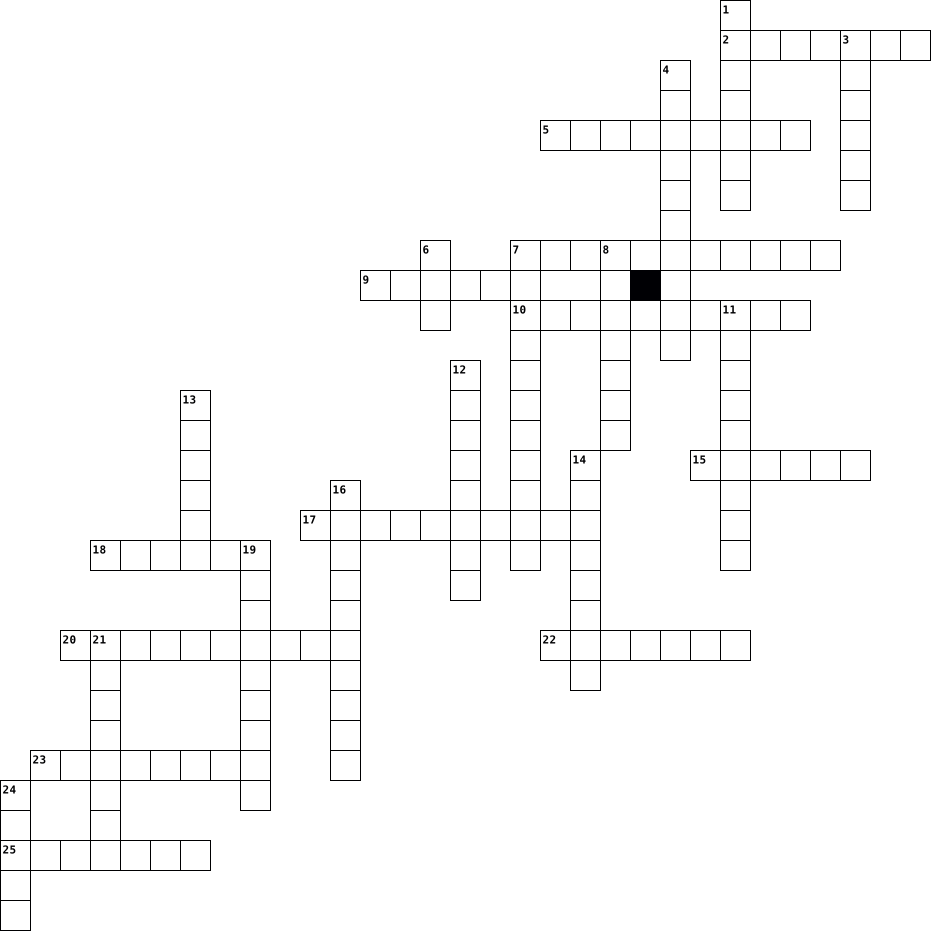
Across
- Substance made up of only
- Oxygen ion air reacts with metal
- Liquid to Gas
- Positively charged particle in the nucleus of an Atom
- Gas to Solid
- Anything that has mass and occupies space
- Ability of a substance to be dissolved in another
- Horizontal row of elements in the periodic table
- characteristics used to describe a substance
- Most reactive non-metal
- Substance that speeds up the chemical reaction
- Made up of one or more substances
Down
- Solid to Liquid
- Organic Catalyst
- Chemical reaction that releases energy
- Electrically charged atom
- Chemical reaction that absorbs energy
- New substance produced in a chemical reaction
- substance that resists flow of electricity
- Liquid to Solid
- Most reactive metal
- Material changes state but not composition
- Chemical reaction, oxygen reacts with a substance
- Solid that can be stretched into a long wire
- A substance that reacts with another substance to create a new substance
- Workplace Hazardous Materials Information System
26 Clues: Gas to Solid • Liquid to Gas • Solid to Liquid • Liquid to Solid • Organic Catalyst • Most reactive metal • Most reactive non-metal • Substance made up of only • Electrically charged atom • Oxygen ion air reacts with metal • Made up of one or more substances • Chemical reaction that absorbs energy • Chemical reaction that releases energy • Anything that has mass and occupies space • ...
Chemical Reactions 2022-05-12

Across
- A characteristic of a substance that describes how it can form a new substance. (chemical________)
- A chemical reaction that requires heat energy in order to proceed. (___________reaction)
- A substance consisting of more than one element. (chemical________)
- A substance that reacts with another substance in a chemical reaction.
- The number before a chemical formula that shows how many molecules are involved in a chemical reaction.
- A substance that slows down a chemical reaction or prevents it from occurring.
- Any change in size, shape, or state of matter in which the identity of the substance remains the same.
Down
- A chemical reaction in which energy is primarily given off in the form of heat. (__________reaction)
- A number written slightly below and to the right of a chemical symbol that shows how many atoms of an element are in a compound.
- A process where substances react with each other and form new substances with other properties. (chemical________)
- A substance formed in a chemical reaction.
- a chemical compound with oxygen.
- A change of one substance into a new substance (chemical_____)
- The loss of electrons from the atoms of a substance.
- A substance that speeds up a chemical reaction without being permanently changed itself.
15 Clues: a chemical compound with oxygen. • A substance formed in a chemical reaction. • The loss of electrons from the atoms of a substance. • A change of one substance into a new substance (chemical_____) • A substance consisting of more than one element. (chemical________) • A substance that reacts with another substance in a chemical reaction. • ...
Cracking the Code: Chemical Reactions & Equations 2024-05-15

Across
- Principle stating mass is neither created nor destroyed in a chemical reaction
- Reaction where ions are exchanged between two compounds
- Reactions in which heat is released along with the formation of products
- Symbolic representation of a chemical reaction
- The new substance formed during the reaction
- Reactions in which energy is absorbed
- Reaction where a single compound breaks down into simpler substances
- Equation with unequal numbers of each atom of each element on both sides
- Decomposition of a substance using electric current
- List of elements ordered by their reactivity
Down
- Gain of oxygen in a reaction
- Equation with equal numbers of each atom of each element on both sides
- The substances that undergo chemical change in the reaction
- Reaction where two or more substances combine to form a single new compound
- Reaction involving oxygen and producing heat and light
- Loss of oxygen in a reaction
- Gradual destruction of metals due to reaction with moisture, acids, etc.
- The solid insoluble substance formed
- Reaction where a more reactive element displaces a lesser reactive metal in a compound
- Formation of iron oxide due to reaction with oxygen and moisture
20 Clues: Gain of oxygen in a reaction • Loss of oxygen in a reaction • The solid insoluble substance formed • Reactions in which energy is absorbed • The new substance formed during the reaction • List of elements ordered by their reactivity • Symbolic representation of a chemical reaction • Decomposition of a substance using electric current • ...
Chemical reaction and equation - Nahush Chaudhari 2025-04-28

Across
- A reaction that absorbs heat energy.
- A reaction where a more reactive element replaces a less reactive one from its compound.
- An insoluble solid formed during a reaction in solution.
- A substance formed after a chemical reaction.
- Spoiling of fats and oils due to oxidation, often leading to a bad smell and taste.
- A reaction where a substance gains oxygen or loses hydrogen.
- A substance that starts a chemical reaction.
Down
- A biological exothermic reaction where glucose is broken down to release energy.
- The slow formation of a reddish-brown coating on iron.
- An unbalanced chemical equation is also called this type of equation.
- A reaction where a single substance breaks down into two or more products.
- A chemical equation where the number of atoms of each element is equal on both sides.
- A reaction that releases heat energy.
- Breaking a compound using electric current.
- A reaction where two or more substances combine to form a single product.
- A reaction where a substance loses oxygen or gains hydrogen.
- A substance that speeds up a reaction without itself being consumed.
- Gradual destruction of metals by reacting with atmospheric substances like oxygen.
18 Clues: A reaction that absorbs heat energy. • A reaction that releases heat energy. • Breaking a compound using electric current. • A substance that starts a chemical reaction. • A substance formed after a chemical reaction. • The slow formation of a reddish-brown coating on iron. • An insoluble solid formed during a reaction in solution. • ...
Caleb Anthony Bagi Chapter 13 Crossword 2016-10-12

Across
- description of a solution in which the hydroxide ion concentration is higher than the hydronium ion concentration
- a rapid exothermic oxidation-reduction reaction between a material and molecular oxygen
- a measure of the acidity of a solution;equal to the negative longathm of the hydronium ion concentration
- description of a solution in which the hydronium ion concentration is higher than than the hydroxide ion concentration
- a description of a chemical reaction in which there is a net absorption of energy
- description of a solution in which the hydronium ion concentration is equal to the hydroxide ion concentration
- the minimum energy required in order for a chemical reaction to proceed
- a description of a chemical reaction in which there is a net release of energy
- the reacting substances in a chemical reaction
Down
- any substance that increases the rate of a chemical reaction without itself being consumed by the reaction
- a representation of a chemical reaction in which reactants are written to the left of an arrow that points toward the products on the right
- the new materials formed in a chemical reaction
- a polyatomic ion made by removing a proton from a water molecule
- a measure of how quickly the concentration of products in a chemical reaction increases or the concentration of reactants decreases
- the amount of energy required to pull two bonded atoms apart
- a substance that donates hydrogen ions
16 Clues: a substance that donates hydrogen ions • the reacting substances in a chemical reaction • the new materials formed in a chemical reaction • the amount of energy required to pull two bonded atoms apart • a polyatomic ion made by removing a proton from a water molecule • the minimum energy required in order for a chemical reaction to proceed • ...
chapter seventeen 2022-05-16

Across
- a catalyst that exists in the same physical state as the reaction it catalyzes
- The mathematical relationship between the rate of a chemical reaction at a given temperature
- for a reactant describes how the rate is affected by the concentration of that reactant
- Term used to describe an activated complex because the activated complex is as likely to form reactants as it is to form
- a short-lived, unstable arrangement of atoms that may break apart and re-form
- The slowest elementary step in a complex reaction
- a substance that slows down the reaction rate of a chemical reaction or prevents a chemical reaction from happening
- a substance produced in one elementary step of a complex reaction
- states that atoms, ions, and molecules must collide in order to react
- a chemical reaction that consists of two or more elementary steps
Down
- a substance that increases the rate of a chemical reaction by lowering activation energies
- determines the reaction order by comparing the initial rates of a reaction carried out with varying reactant concentrations
- The change in concentration of a reactant or product per unit time
- a catalyst that exists in a different physical state than the reaction it catalyzes
- the rate of decomposition at a specific time
- The complete sequence of elementary steps that make up a complex reaction
- the minimum amount of energy required by reacting particles in order to form the activated complex
- A numerical value that relates reaction rate and concentration of reactant at a specific temperature
18 Clues: the rate of decomposition at a specific time • The slowest elementary step in a complex reaction • a substance produced in one elementary step of a complex reaction • a chemical reaction that consists of two or more elementary steps • The change in concentration of a reactant or product per unit time • ...
chapter seventeen 2022-05-16

Across
- a catalyst that exists in the same physical state as the reaction it catalyzes
- The mathematical relationship between the rate of a chemical reaction at a given temperature
- for a reactant describes how the rate is affected by the concentration of that reactant
- Term used to describe an activated complex because the activated complex is as likely to form reactants as it is to form
- a short-lived, unstable arrangement of atoms that may break apart and re-form
- The slowest elementary step in a complex reaction
- a substance that slows down the reaction rate of a chemical reaction or prevents a chemical reaction from happening
- a substance produced in one elementary step of a complex reaction
- states that atoms, ions, and molecules must collide in order to react
- a chemical reaction that consists of two or more elementary steps
Down
- a substance that increases the rate of a chemical reaction by lowering activation energies
- determines the reaction order by comparing the initial rates of a reaction carried out with varying reactant concentrations
- The change in concentration of a reactant or product per unit time
- a catalyst that exists in a different physical state than the reaction it catalyzes
- the rate of decomposition at a specific time
- The complete sequence of elementary steps that make up a complex reaction
- the minimum amount of energy required by reacting particles in order to form the activated complex
- A numerical value that relates reaction rate and concentration of reactant at a specific temperature
18 Clues: the rate of decomposition at a specific time • The slowest elementary step in a complex reaction • a substance produced in one elementary step of a complex reaction • a chemical reaction that consists of two or more elementary steps • The change in concentration of a reactant or product per unit time • ...
Chemistry - Year 10 2020-08-25

Across
- A reaction in which two or more reactants bond together to form a single product
- A reaction in which a substance burns in the presence of oxygen, producing heat and light
- A reaction that consumes heat energy, and so feels cold
- The law of conservation of mass states that _____ cannot be created or destroyed
- A diagram in which the electron configuration is drawn
- The outermost electron shell
- Groups of elements on the periodic table that run horizontally; the number tells you how many electron shells the atoms have
- The type of combustion in which the flame does not have access to enough oxygen; the flame is cool, yellow and ‘dirty’ (it produces solid carbon)
- A reaction that produces heat
- A reaction in which two soluble chemicals produce an insoluble solid
- The energy of movement
- A chemical that speeds up a chemical reaction, without using being used up in the reaction
- The poisonous gas produced by incomplete combustion
- The scientific word for stirring or shaking
- A reaction in which an acid and a base neutralise each other, forming a salt and water
Down
- The scientific word for how many atoms are found in a chemical; if we increase the number of atoms then the rate of the reaction will be increased
- If we decrease the space between ________ , the rate of the chemical reaction will be increased
- The chemicals found on the left-hand side of a chemical equation
- A reaction in which a single reactant breaks down into two or more products
- A way of summarising what happens in a chemical reaction
- The term used to describe how many electrons an element has, and which shells they are found in
- The region in the middle of an atom where the protons and neutrons are found
- A reaction in which oxygen combines with a metal to form a metal oxide; rust is an example
- The chemical reaction that happens in the cells of your body; glucose and oxygen are combined to form carbon dioxide, water and energy
- The solid formed in a precipitation reaction
- Groups of elements on the periodic table that run vertically; the number tells you how many electrons are found in their outermost shells
- The chemicals found on the right-hand side of a chemical equation
- The energy found in chemical bonds
- The number that tells you how many electrons an element has (assuming it isn’t an ion)
- The type of combustion in which the flame has access to plenty of oxygen; the flame is hot, blue, and produces carbon dioxide and water
30 Clues: The energy of movement • The outermost electron shell • A reaction that produces heat • The energy found in chemical bonds • The scientific word for stirring or shaking • The solid formed in a precipitation reaction • The poisonous gas produced by incomplete combustion • A diagram in which the electron configuration is drawn • ...
Unit 5: Reactions and Stoichiometry 2016-06-16

Across
- a chemical compound that increases the concentration of hydrogen ions in an aqueous solution
- the principle that states that the total amount of matter is constant during any chemical or physical change, matter is neither created nor destroyed
- a chemical reaction in which each side of the equation has the same number of atoms of each element
- composition / the percent by mass of each element in a compound
- an organic compound composed only of carbon and hydrogen
- a chemical reaction in which one atom gains electrons while one atom loses electrons
- / An ionic compound made up of a cation from a base and an anion from an acid
Down
- base / Proton (H+) acceptor
- reaction / A reaction in which a single compound breaks down to form two or more simpler substances (AB-->A+B)
- a chemical change in which one element replaces a second element in a compound (A+Bx-->Ax+B)
- a substance that increases the concentration of hydroxide ions in an aqueous solution
- / the SI unit of amount of substance
- the rate at which reactants change into products over time
- number of representative particles in a mole, 6.02x10^23
- A solid that forms from a solution during a chemical reaction
- the volume occupied by 1 mole of a gas at STP
- number / positive or negative number that indicates how many electrons an atom has gained, lost, or shared to become stable
- / A substance produced in a chemical reaction
- a chemical substance that is present at the start of a chemical reaction
19 Clues: base / Proton (H+) acceptor • / the SI unit of amount of substance • the volume occupied by 1 mole of a gas at STP • / A substance produced in a chemical reaction • number of representative particles in a mole, 6.02x10^23 • an organic compound composed only of carbon and hydrogen • the rate at which reactants change into products over time • ...
Chapter 7 and 13 2023-05-09

Across
- representations of chemical reactions
- construction of complex chemical compounds from simpler ones
- number placed in front of a chemical symbol or formula
- chemical reaction in which one reactant breaks down into two or more products
- substance that takes part in and undergoes change during a reaction
- substance that increases the rate of a reaction without itself being consumed
- reactions in which the reactants absorb heat energy from the surroundings to form products
- reaction in which the positive and negative ions
- unit of measurement in the International System of Units
Down
- has no fixed shape, but adapts its surface to the shape of its container
- dimension taken through an object or body of material
- species formed from chemical reactions
- fluid can be either a liquid or a gas.
- for assigning work
- chemical bond between two atoms
- chemical reaction that produces heat (has a negative
- conversion factor between mass and volume
- It is generated by the interaction and contact of a solid body with a fluid
18 Clues: for assigning work • chemical bond between two atoms • representations of chemical reactions • species formed from chemical reactions • fluid can be either a liquid or a gas. • conversion factor between mass and volume • reaction in which the positive and negative ions • chemical reaction that produces heat (has a negative • ...
Chapter Two Vocabulary 2020-09-27

Across
- substance that decreases activation energy and increases reaction rate in a chemical reaction.
- attraction between molecules of different substances.
- energy amount of energy need to break a bond between two particular atoms; or the amount of energy released when a bond forms between two particular atoms.
- acid molecule that makes up proteins; composed of carbon, hydrogen, oxygen, nitrogen, and sometimes sulfur.
- chemical reaction that yields a net release of energy in the form of heat.
- substance formed by a chemical reaction.
- measurement of acidity; related to free hydrogen ion concentration in solution.
- acid hydrocarbon chain often bonded to glycerol in a lipid.
- compound that donates a proton (H+) when dissovled in solution.
- atom that has gained or lost one or more electrons
- bond chemical bond formed through the electrical force between oppositely charged ions.
- protein that catalyzes chemical reactions for organisms.
- two or more atoms held together by covalent bonds; not necessarily a compound.
- substance that dissovles in a solvent and is present at a lower concentration that the solvent.
- condition in which reactants and products of a chemical reaction are formed at the same rate.
- reactant in a chemical reaction upon which an enzyme acts.
- bond chemical bond formed when two atoms share one or more pairs of electrons.
- reaction process by which substances change into different substances through the breaking and forming of chemical bonds.
- large, carbon-based molecule formed by monomers.
Down
- molecule composed of carbon, hydrogen, and oxygen; includes sugars and starches.
- mixture that is consistent throughout; also called a homogenous mixture.
- substance in which solutes dissovled and that is present in greater concentration in a solution.
- substance that is changed by a chemical reaction.
- bond attraction between a slightly positive hydrogen atom and a slightly negative atom.
- substance made of atoms of different elements that are bonded together in a particular ratio.
- energy energy input necessary to initiate a chemical reaction.
- attraction between molecules of the same substance.
- acid polymer of nucleotides; the genetic material of organisms.
- compound that accepts a proton (H+) when dissovled in solution.
- molecular subunit of a polymer.
- chemical reaction that requires a net input of energy.
- substance made of only one type of atom that cannot be broken down by chemical means.
- polymer composed of amino acids linked by peptide bonds folds into a particular structure depending on bonds between amino acids.
- nonpolar molecule composed of carbon, hydrogen, and oxygen; includes fats and oils.
- smalles basic unit of matter.
35 Clues: smalles basic unit of matter. • molecular subunit of a polymer. • substance formed by a chemical reaction. • large, carbon-based molecule formed by monomers. • substance that is changed by a chemical reaction. • atom that has gained or lost one or more electrons • attraction between molecules of the same substance. • ...
Unit 2: Biochemistry Vocab 2022-03-02

Across
- complex substance from amino acids
- pH of more than 7
- DNA
- sugar molecules
- substance on which an enzyme acts
- any of the class of sugars
- regulates the rate of chemical reactions
- macromolecules found in all cells
- molecules that combine to form proteins
- composed of DNA
- energy for a reaction to occur
Down
- organic compounds that are fatty acids
- constant pH
- undergoes change during a reaction
- very large molecules
- a carbohydrate
- linking two consecutive amino acids
- compound that does not have carbon
- glucose
- rearrangement of the molecular or ionic structure
- increases the rate of a chemical reaction
- large class of chemical compounds
- pH of less than 7
- formed from a chemical reaction
24 Clues: DNA • glucose • constant pH • a carbohydrate • sugar molecules • composed of DNA • pH of more than 7 • pH of less than 7 • very large molecules • any of the class of sugars • energy for a reaction to occur • formed from a chemical reaction • substance on which an enzyme acts • large class of chemical compounds • macromolecules found in all cells • undergoes change during a reaction • ...
chemical equations and reactions 2024-05-07

Across
- When a chemical reaction occurs, these are the substances you start with.
- reaction The term for a chemical reaction that absorbs heat from its surroundings.
- reaction A chemical reaction where two or more substances combine to form a single new substance.
- reaction This type of chemical reaction involves the transfer of electrons between reactants.
- equation A representation of a chemical reaction using symbols and formulas.
- displacement This type of chemical reaction involves the exchange of ions between two compounds, resulting in the formation of two new compounds.
- This substance speeds up the rate of a chemical reaction without being consumed in the process.
Down
- reaction A type of chemical reaction where a single compound breaks down into two or more simpler substances
- agent The substance that causes oxidation in a redox reaction.
- reaction This is the term for a chemical reaction that releases heat to its surroundings.
- These are the substances produced by a chemical reaction.
- reaction This process involves the rearrangement of atoms to form new substances.
- of Conservation of Mass The number of atoms of each element must be the same on both sides of this in a balanced chemical equation.
13 Clues: These are the substances produced by a chemical reaction. • When a chemical reaction occurs, these are the substances you start with. • agent The substance that causes oxidation in a redox reaction. • equation A representation of a chemical reaction using symbols and formulas. • ...
Chemical reactio 2026-02-24

Across
- change An endothermic change transfers energy from the surroundings.
- A chemical reaction in which substances react with oxygen to form oxides.
- A material that burns to transfer useful energy.
- of mass In a chemical reaction, the total mass of reactants is equal to the total mass of products. This is conservation of mass. Mass is conserved in chemical reactions and in physical changes.
- A substance that is made in a chemical reaction.
- The chance of damage or injury from hazard.
- A possible source of danger.
- symbol equation In a balanced symbol equation, chemical formulae represent the reactants and products. The equation shows how atoms are rearranged, and gives the relative amounts of reactants and products.
Down
- Some fuels are non-renewable. They form over millions of years, and will one day run out.
- A chemical reaction in which a substance reacts quickly with oxygen and gives out light and heat.
- A chemical reaction in which a compound breaks down to form simpler compounds and/or elements.
- reaction A change in which atoms are rearranged to create new substances.
- change A change that is reversible, in which new substances are not made. Examples of physical changes include changes of state, and dissolving.
- fuel A fuel made from the remains of animals and plants that died millions of years ago. Fossil fuels include coal, oil, and natural gas.
- change An exothermic change transfers energy to the surroundings.
- equation A way of representing a chemical reaction simply. The reactants are on the lefts of an arrow, and the products are on the right. The arrow means reacts to make.
- A variable that can only have whole-number values.
- A starting substance in a chemical reaction.
18 Clues: A possible source of danger. • The chance of damage or injury from hazard. • A starting substance in a chemical reaction. • A material that burns to transfer useful energy. • A substance that is made in a chemical reaction. • A variable that can only have whole-number values. • change An exothermic change transfers energy to the surroundings. • ...
Science 2023-01-09

Across
- reaction a chemical reaction in which a compound breaks down into two or more simpler substances
- equation a representation of a chemical reaction in which the reactants and products are expressed as formulas
- reaction a chemical reaction that releases energy to its surroundings
- mass the mass of one mole of a substance
- reaction a chemical reaction that absorbs energy from its surroundings
- substances that undergo change in a chemical reaction
- numbers that appear before a formula in a chemical equation to show the relative proportions of each reactant and product
Down
- reaction a chemical reaction in which one element takes the place of another element in a compound
- reaction a chemical reaction in which two or more substances react to form a single substance
- reaction a chemical reaction in which two compounds exchange positive ions and form new compounds
- an amount of a substance that contains approximately 6.02 × 10²³ particles of the substance
- new substances formed as a result of a chemical reaction
- energy the energy stored in chemical bonds
13 Clues: mass the mass of one mole of a substance • energy the energy stored in chemical bonds • substances that undergo change in a chemical reaction • new substances formed as a result of a chemical reaction • reaction a chemical reaction that releases energy to its surroundings • reaction a chemical reaction that absorbs energy from its surroundings • ...
Chapter 7 Vocabulary 2023-01-04

Across
- reaction a chemical reaction in which a compound breaks down into two or more simpler substances
- equation a representation of a chemical reaction in which the reactants and products are expressed as formulas
- reaction a chemical reaction that releases energy to its surroundings
- mass the mass of one mole of a substance
- reaction a chemical reaction that absorbs energy from its surroundings
- substances that undergo change in a chemical reaction
- numbers that appear before a formula in a chemical equation to show the relative proportions of each reactant and product
Down
- reaction a chemical reaction in which one element takes the place of another element in a compound
- reaction a chemical reaction in which two or more substances react to form a single substance
- reaction a chemical reaction in which two compounds exchange positive ions and form new compounds
- an amount of a substance that contains approximately 6.02 x 10²³ particles of the substance
- new substances formed as a result of a chemical reaction
- energy the energy stored in chemical bonds
13 Clues: mass the mass of one mole of a substance • energy the energy stored in chemical bonds • substances that undergo change in a chemical reaction • new substances formed as a result of a chemical reaction • reaction a chemical reaction that releases energy to its surroundings • reaction a chemical reaction that absorbs energy from its surroundings • ...
Chapter Two Vocabulary 2020-09-28

Across
- substance that decreases activation energy and increases reaction rate in a chemical reaction.
- attraction between molecules of different substances.
- energy amount of energy needed to break a bond between two particular atoms; or the amount of energy released when a bond forms between two particular atoms.
- acid molecule that makes up proteins; composed of carbon, hydrogen, oxygen, nitrogen, and sometimes sulfur.
- chemical reaction that yields a net release of energy in the form of heat.
- substance formed by a chemical reaction.
- measurement of acidity; related to free hydrogen ion concentration in solution.
- acid hydrocarbon chain often bonded to glycerol in a lipid.
- compound that donates a proton (H+) when dissolved in solution.
- atom that has gained or lost one or more electrons
- bond chemical bond formed through the electrical force between oppositely charged ions.
- protein that catalyzes chemical reactions for organisms.
- two or more atoms held together by covalent bonds; not necessarily a compound.
- substance that dissovles in a solvent and is present at a lower concentration that the solvent.
- condition in which reactants and products of a chemical reaction are formed at the same rate.
- reactant in a chemical reaction upon which an enzyme acts.
- bond chemical bond formed when two atoms share one or more pairs of electrons.
- reaction process by which substances change into different substances through the breaking and forming of chemical bonds.
- large, carbon-based molecule formed by monomers.
Down
- molecule composed of carbon, hydrogen, and oxygen; includes sugars and starches.
- mixture (solvent + solute) that is consistent throughout; also called a homogenous mixture.
- substance in which solutes dissolved and that is present in greater concentration in a solution.
- substance that is changed by a chemical reaction.
- bond attraction between a slightly positive hydrogen atom and a slightly negative atom.
- substance made of atoms of different elements that are bonded together in a particular ratio.
- energy energy input necessary to initiate a chemical reaction.
- attraction between molecules of the same substance.
- acid polymer of nucleotides; the genetic material of organisms.
- compound that accepts a proton (H+) when dissolved in solution.
- molecular subunit of a polymer.
- chemical reaction that requires a net input of energy.
- substance made of only one type of atom that cannot be broken down by chemical means.
- polymer composed of amino acids linked by peptide bonds; folds into a particular structure depending on bonds between amino acids.
- nonpolar molecule composed of carbon, hydrogen, and oxygen; includes fats and oils.
- smallest basic unit of matter.
35 Clues: smallest basic unit of matter. • molecular subunit of a polymer. • substance formed by a chemical reaction. • large, carbon-based molecule formed by monomers. • substance that is changed by a chemical reaction. • atom that has gained or lost one or more electrons • attraction between molecules of the same substance. • ...
Chapter 3.2 2021-10-06

Across
- make up everything
- things you see that you can also touch.
- an action to make something visible
- only physical properties change
- when water reaches 120F.
- depends on mass
- the contents of a balloon
- a rock
- an energy and chemical change/reaction
- substance is different after the change p
- a change is size, state, or form.
- cutting this the mass stays the same
Down
- a chemical reaction in which plants produce sugar and oxygen
- needed to bake foods
- make up atoms
- a French chemist
- water and other drinks
- a light that is lit by snapping a small plastic ban until the chemical reaction reoccurs
- a very hot chemical reaction
- a change of color.
20 Clues: a rock • make up atoms • depends on mass • a French chemist • make up everything • a change of color. • needed to bake foods • water and other drinks • when water reaches 120F. • the contents of a balloon • a very hot chemical reaction • only physical properties change • a change is size, state, or form. • an action to make something visible • cutting this the mass stays the same • ...
Chemical Equations 2026-04-07

Across
- one compound breaks into simpler substances
- when both sides have equal atoms
- releases heat energy
- matter cannot be created or destroyed
- a symbolic way to show a chemical reaction
- symbols like (s), (l), (g), (aq)
- starting substances in a chemical reaction
- reaction with oxygen producing energy
Down
- two or more substances combine
- number in front of a chemical formula
- shows direction of the reaction
- substances formed in a chemical reaction
- number showing atoms in a molecule
- absorbs heat energy
- speeds up a reaction without being used up
15 Clues: absorbs heat energy • releases heat energy • two or more substances combine • shows direction of the reaction • when both sides have equal atoms • symbols like (s), (l), (g), (aq) • number showing atoms in a molecule • number in front of a chemical formula • matter cannot be created or destroyed • reaction with oxygen producing energy • substances formed in a chemical reaction • ...
Types of reactions by sujay yadav 2025-04-23

Across
- – A reaction involving the transfer of electrons between two species.
- – The substances formed as a result of a chemical reaction.
- – The loss of electrons during a reaction.
- – A reaction that releases energy in the form of heat.
- – A hydrocarbon reacts with oxygen to produce carbon dioxide and water.
- – A solid that forms from a solution during a chemical reaction.
- Equation – A symbolic representation of a chemical reaction.
- – A reaction where two or more substances combine to form a single product.
Down
- – A single compound breaks down into two or more simpler substances.
- Replacement – One element replaces another in a compound.
- – A reaction that absorbs energy from its surroundings.
- Replacement – Two compounds exchange ions to form two new compounds.
- – An acid and a base react to form salt and water.
- – A substance that speeds up a reaction without being consumed.
- – The starting substances in a chemical reaction.
15 Clues: – The loss of electrons during a reaction. • – The starting substances in a chemical reaction. • – An acid and a base react to form salt and water. • – A reaction that releases energy in the form of heat. • – A reaction that absorbs energy from its surroundings. • Replacement – One element replaces another in a compound. • ...
Energy Terms Crossword 2024-02-21

Across
- The measure of average kinetic energy within a substance
- The lowest limit of temperature
- Matter transitioning into a different state
- The results of a chemical reaction
- Minimum amount of energy needed to activate molecules or atoms in a chemical reaction
- The materials involved in a chemical reaction
- The transfer of heat through electromagnetic waves
- Mass is neither destroyed nor created in chemical reactions
- Materials that do not allow energy to flow through them
- Thermal energy transferred from one substance to another due to difference in temperature
- A bond between a metal and nonmetal
- Materials that allow energy to flow through them easily
Down
- A way to describe a chemical reaction
- Chemical reactions that release energy
- Chemical reactions that absorbs energy
- The transfer of heat through fluids
- A bond between two nonmetals
- The temperature at which a liquid changes to a solid
- The transfer of heat through direct contact of substances
- The temperature at which a solid turns into a liquid
20 Clues: A bond between two nonmetals • The lowest limit of temperature • The results of a chemical reaction • The transfer of heat through fluids • A bond between a metal and nonmetal • A way to describe a chemical reaction • Chemical reactions that release energy • Chemical reactions that absorbs energy • Matter transitioning into a different state • ...
cross word puzzle 2022-03-22

Across
- " A solid that form's from solution during a chemical reaction."
- The cells in your body contain biological catalysts called ENZYMES."
- "is a amount of a substance in a given volume."
- "When on element replaces another in a compound, or when two elements in different compounds trade places."
- reaction- "is a reaction in which energy is absorbed
- "The study of matter and how matter changes"
- "A material used to decrease the rate of a reaction"
- "In contrast to a synthesis reaction, a process called DECOMPOSITION breaks down compounds into simpler products."
- is a material that releases energy when it burns."
- The substance you have at the beginning"
- "when two or more elements or compounds combine to make more complex substances the process is called synthesis."
- equation-"is a short, easy way to show a chemical reaction, using symbols instead of words."
- reaction-"A reaction that releases energy in the form of heat"
- " a rapid reaction between oxygen and a substance called a fuel.
Down
- "is a number placed in font of chemical formula in an equation."
- property- a Characteristic of substance that describes its ability to change into other substances.
- "is anything that has mass and takes up space."
- system- " matter is not allowed to enter or leave."
- of mass- "during a chemical reaction, matter is not created or destroyed
- a material that increases the rate of reaction by lowering the activation energy."
- reaction- A change in matter that produces one or more new substances.
- "When the reaction is complete, you have new substances"
- system- "matter can enter from or escape to the surrounding."
- change- " is any change that alters the form or appearance of a substance but that does not make the substance into another substance.
- property- A characteristic of a substance that can be observed without changing the substance into another substance.
- energy- "is a minimum amount of energy needed to start a chemical reaction."
26 Clues: The substance you have at the beginning" • "The study of matter and how matter changes" • "is anything that has mass and takes up space." • "is a amount of a substance in a given volume." • is a material that releases energy when it burns." • system- " matter is not allowed to enter or leave." • reaction- "is a reaction in which energy is absorbed • ...
Chemical and Physical reaction worksheet 2022-03-18

Across
- " A solid that form's from solution during a chemical reaction."
- The cells in your body contain biological catalysts called ENZYMES."
- "is a amount of a substance in a given volume."
- "When on element replaces another in a compound, or when two elements in different compounds trade places."
- reaction- "is a reaction in which energy is absorbed
- "The study of matter and how matter changes"
- "A material used to decrease the rate of a reaction"
- "In contrast to a synthesis reaction, a process called DECOMPOSITION breaks down compounds into simpler products."
- is a material that releases energy when it burns."
- The substance you have at the beginning"
- "when two or more elements or compounds combine to make more complex substances the process is called synthesis."
- equation-"is a short, easy way to show a chemical reaction, using symbols instead of words."
- reaction-"A reaction that releases energy in the form of heat"
- " a rapid reaction between oxygen and a substance called a fuel.
Down
- "is a number placed in font of chemical formula in an equation."
- property- a Characteristic of substance that describes its ability to change into other substances.
- "is anything that has mass and takes up space."
- system- " matter is not allowed to enter or leave."
- of mass- "during a chemical reaction, matter is not created or destroyed
- a material that increases the rate of reaction by lowering the activation energy."
- reaction- A change in matter that produces one or more new substances.
- "When the reaction is complete, you have new substances"
- system- "matter can enter from or escape to the surrounding."
- change- " is any change that alters the form or appearance of a substance but that does not make the substance into another substance.
- property- A characteristic of a substance that can be observed without changing the substance into another substance.
- energy- "is a minimum amount of energy needed to start a chemical reaction."
26 Clues: The substance you have at the beginning" • "The study of matter and how matter changes" • "is anything that has mass and takes up space." • "is a amount of a substance in a given volume." • is a material that releases energy when it burns." • system- " matter is not allowed to enter or leave." • reaction- "is a reaction in which energy is absorbed • ...
Vocabulary 2023-01-03

Across
- reaction - a chemical reaction in which a compound breaks down into two or more simpler substances
- equation - a representation of a chemical reaction in which the reactants and products are expressed as formulas
- reaction - a chemical reaction that releases energy to its surroundings
- mass - the mass of one mole of a substance
- reaction - a chemical reaction that absorbs energy from its surroundings
- - substances that undergo change in a chemical reaction
- - numbers that appear before a formula in a chemical equation to show the relative proportions of each reactant and product
Down
- reaction - a chemical reaction in which one element takes the place of another element in a compound
- reaction - a chemical reaction in which two or more substances react to form a single substance
- reaction - a chemical reaction in which two compounds exchange positive ions and form new compounds
- - an amount of a substance that contains approximately 6.02 x 10²³ particles of the substance
- - new substances formed as a result of a chemical reaction
- energy - the energy stored in chemical bonds
13 Clues: mass - the mass of one mole of a substance • energy - the energy stored in chemical bonds • - substances that undergo change in a chemical reaction • - new substances formed as a result of a chemical reaction • reaction - a chemical reaction that releases energy to its surroundings • reaction - a chemical reaction that absorbs energy from its surroundings • ...
Chapter 7 vocabulary 2023-01-03

Across
- reaction a chemical reaction in which a compound breaks down into two or more simpler substances
- equation a representation of a chemical reaction in which the reactants and products are expressed as formulas
- reaction a chemical reaction that releases energy to its surroundings
- mass the mass of one mole of a substance
- reaction a chemical reaction that absorbs energy from its surroundings
- substances that undergo change in a chemical reaction
- numbers that appear before a formula in a chemical equation to show the relative proportions of each reactant and product
Down
- reaction a chemical reaction in which one element takes the place of another element in a compound
- reaction a chemical reaction in which two or more substances react to form a single substance
- reaction a chemical reaction in which two compounds exchange positive ions and form new compounds
- an amount of a substance that contains approximately 6.02 x 10²³ particles of the substance
- new substances formed as a result of a chemical reaction
- energy the energy stored in chemical bonds
13 Clues: mass the mass of one mole of a substance • energy the energy stored in chemical bonds • substances that undergo change in a chemical reaction • new substances formed as a result of a chemical reaction • reaction a chemical reaction that releases energy to its surroundings • reaction a chemical reaction that absorbs energy from its surroundings • ...
Chapter 11 Vocabulary 2015-01-23

Across
- tell in what ratio the substances react or are produced
- the arrow that is represented in a chemical equation
- equations that show only the soluble, strong electrolytes reacting and omit the spectator ions
- when two different compounds each switch parts
- item that increases the rate of a chemical reaction
- a way of using the formulas to indicate the chemicals that were involved in the chemical reaction
Down
- ion that exists as a reactant and a product in a chemical equation
- Series list of substances ranked in order of relative reactions
- reaction in which a compound takes one part of another,and leaves an element by itself
- symbols and amounts of the reactants are separated from those of the products by an equal sign, arrow, or a set of opposing arrows
- is a reaction where two or more elements or compounds combine together to form a single compound
- what is being changed in a chemical equation
- Solution solvent is emerged in water
- reaction in which an compound decomposes into two or more parts
- equal numbers of each type of atom on each side of the equation
- a reaction in which can be reversed
- the end result in a chemical equation
- reaction involving heat always ending with CO2 and H2O
18 Clues: a reaction in which can be reversed • Solution solvent is emerged in water • the end result in a chemical equation • what is being changed in a chemical equation • when two different compounds each switch parts • item that increases the rate of a chemical reaction • the arrow that is represented in a chemical equation • ...
Elizabeth rose torres 2017-02-27

Across
- compound something having two parts.
- like water; watery.
- to give up, as to superior power or authority
- a substance that increases the rate of a chemical reaction without itself undergoing any permanent chemical change.
- a quantity obtained by multiplying quantities together, or from an analogous algebraic operation.
- the removal of hair roots or small blemishes on the skin by the application of heat using an electric current.
- ion , is a charged chemical speciescomposed of two or more atoms covalently bonded or of a metal complex that can be considered to be acting as a single unit
- cause (a substance) to be deposited in solid form from a solution.
- a compound or substance that has been purified or prepared, especially artificially.
- a thing that is made smaller or less in size or amount, in particular.
- the process or result of oxidizing or being oxidized.
- rapid chemical combination of a substance with oxygen, involving the production of heat and light.
Down
- replacement reaction, is a type of chemical reaction where an element reacts with a compound
- consisting of two atoms.
- the production of chemical compounds by reaction from simpler materials.
- the state or process of rotting; decay.
- a quantity obtained by multiplying quantities together, or from an analogous algebraic operation.
- a chemical substance that is present at the start of a chemical
- replacement reaction or metathesis, is a type of chemical reaction where two compounds react,
19 Clues: like water; watery. • consisting of two atoms. • compound something having two parts. • the state or process of rotting; decay. • to give up, as to superior power or authority • the process or result of oxidizing or being oxidized. • a chemical substance that is present at the start of a chemical • cause (a substance) to be deposited in solid form from a solution. • ...
Types of reactions by Sujay Yadav 2025-04-23

Across
- – A reaction involving the transfer of electrons between two species.
- – The substances formed as a result of a chemical reaction.
- – The loss of electrons during a reaction.
- – A reaction that releases energy in the form of heat.
- – A hydrocarbon reacts with oxygen to produce carbon dioxide and water.
- – A solid that forms from a solution during a chemical reaction.
- Equation – A symbolic representation of a chemical reaction.
- – A reaction where two or more substances combine to form a single product.
Down
- – A single compound breaks down into two or more simpler substances.
- Replacement – One element replaces another in a compound.
- – A reaction that absorbs energy from its surroundings.
- Replacement – Two compounds exchange ions to form two new compounds.
- – An acid and a base react to form salt and water.
- – A substance that speeds up a reaction without being consumed.
- – The starting substances in a chemical reaction.
15 Clues: – The loss of electrons during a reaction. • – The starting substances in a chemical reaction. • – An acid and a base react to form salt and water. • – A reaction that releases energy in the form of heat. • – A reaction that absorbs energy from its surroundings. • Replacement – One element replaces another in a compound. • ...
Changes in matter 2025-05-14

Across
- something taking part in an experiment
- a combination of multiple substances
- multiple elements combining chemically
- smallest unit of chemical bond
- stuff, takes up space
- something that speeds up a chemical reaction
- change something changes physically in an experiment
- measuring kinetic energy
- change chemical substances transform into different substances
Down
- a reaction releasing chemicals into surroundings
- extremely small unit of measurement
- reactants absorb heat energy
- substances formed due to reaction between substances
- work, heat generated
- property characteristics of a substance
- to measure the amount of matter in something
- molecule adhering to another
- an action performed
18 Clues: an action performed • work, heat generated • stuff, takes up space • measuring kinetic energy • reactants absorb heat energy • molecule adhering to another • smallest unit of chemical bond • extremely small unit of measurement • a combination of multiple substances • something taking part in an experiment • multiple elements combining chemically • ...
chapter 7: Chemical Reactions review 2021-05-08

Across
- reaction with their environment
- in a chemical reaction, the total mass of the reactants is the same as the total
- a scale that represents the acidity or basicity of a solution; pH < 7 indicates an acid; pH > 7 indicates a base; pH 7 indicates a neutral solution
- indicator a solution that is used to determine the pH(amount of acid or base) of a solution
- reaction a chemical reaction that absorbs energy in the form of heat
- neither an acid nor a base; for example,water
Down
- the gradual destruction of materials by a chemical reaction with their environment
- reaction a chemical reaction that releases energy in the form of heat or light
- the original substances present in a chemical reaction
- a reaction between an acid and a base. A salt and water (a neutral liquid) are the products of this type of reaction
- chemicals that react with a base to produce a salt and water; edible acids taste sour
- a paper containing an indicator that turns red when exposed to an acid and blue when exposed to a base
- bases that dissolve in water
- chemical substances that result from a chemical reaction mass of the products
- a bond that forms between the atoms in a molecule
15 Clues: bases that dissolve in water • reaction with their environment • neither an acid nor a base; for example,water • a bond that forms between the atoms in a molecule • the original substances present in a chemical reaction • reaction a chemical reaction that absorbs energy in the form of heat • ...
CHAPTER 6 VOCABULARY 2013-11-13

Across
- a reaction in which a sing compound breaks down
- any chemical change when species is oxidized and another species is reduced
- a substance that forms in a chemical reaction
- a chemical reaction in which heat is released to the surroundings
- organic group
- the energy released when a chemical compound reacts to produce new compounds
- a chemical reaction that requires heat
Down
- representation of a chemical reaction
- a reaction in which 1 element takes another elements place
- 2 compunds
- the oxidation reaction or an organic compound
- the proses which an electric current is used
- a substance or molecule that participates in a chemical reaction
13 Clues: 2 compunds • organic group • representation of a chemical reaction • a chemical reaction that requires heat • the proses which an electric current is used • the oxidation reaction or an organic compound • a substance that forms in a chemical reaction • a reaction in which a sing compound breaks down • a reaction in which 1 element takes another elements place • ...
Chapter 9 Vocab 2026-04-15

Across
- The number written in front of a reactant or product in a chemical reaction.
- ______ replacement reactions involve the exchange of ions between two compounds.
- A(n) ________ ionic equation is an ionic equation that shows all of the particles in a solution as they exist.
- ______ replacement reactions are where the atoms in one element replace the atoms of another element in a compound.
- _________ ions are not usually shown in ionic equations.
- ___ ionic equations are ionic equations that include only the particles that participate in the reaction.
- The substance that dissolves a solute to form a solution.
- ________ Equation is a statement that uses chemical formulas to show the identities and relative amounts of the substances involved in a chemical reaction.
Down
- Substances formed in a chemical reaction.
- _________ Reaction is a chemical reaction in which two or more substances react to produce a single product.
- _____________ Reaction is a reaction where a single compound breaks down into two or more elements or new compounds.
- ________ Reaction is the process by which the atoms of one or more substances are rearranged to form different substances.
- An _______ solution contains one or more substances called solutes.
- A solid produced during a chemical reaction.
- One or more substances dissolved in a solution.
- __________ Reaction is a reaction where oxygen combines with a substance and releases energy in the form of heat or light.
- The starting substances in a chemical reaction.
17 Clues: Substances formed in a chemical reaction. • A solid produced during a chemical reaction. • One or more substances dissolved in a solution. • The starting substances in a chemical reaction. • _________ ions are not usually shown in ionic equations. • The substance that dissolves a solute to form a solution. • ...
Chapter 7 Vocabulary 2024-01-21

Across
- the number in front of the formula
- reaction reactions that involve the transfer of electrons from one species to another
- reaction redox reaction
- reaction any chemical reaction that absorbs heat from its environment
- a substance that takes part in and undergoes change during a reaction.
- 6.02214076 × 10²³ of some chemical unit
- energy a process that involves the rearrangement of the molecular or ionic structure of a substance
- reaction a chemical reaction that involves the release of energy in the form of heat or light
- reaction occurs when two or more reactants combine to form a single product
Down
- reaction a reaction in which one element is substituted for another element in a compound
- reaction generally occur between substances in an aqueous solution
- formed from a chemical reaction.
- equation a symbolic representation of the molecules that take part in the chemical reactant
- mass the mass in grams of one mole of the compound
- reaction occurs when one reactant breaks down into two or more products
15 Clues: reaction redox reaction • formed from a chemical reaction. • the number in front of the formula • 6.02214076 × 10²³ of some chemical unit • mass the mass in grams of one mole of the compound • reaction generally occur between substances in an aqueous solution • reaction any chemical reaction that absorbs heat from its environment • ...
Unit 4 Cellular Energy Vocab 2025-10-14

Across
- reaction- Reaction that converts light energy into chemical energy.
- reaction- Reaction that takes place within the stroma.
- The natural compound present in green plants that gives them color.
- Respiration- The process of cellular respiration takes place in the presence of oxygen gas to produce energy from food.
- Respiration- Type of respiration through which cells can break down sugars to generate energy in the absence of oxygen.
- A substance produced during a chemical reaction.
- Energy- Energy from the sun that reaches earth as visible light.
- Monosaccharide sugar that is produced in photosynthesis and used during cellular respiration for energy production.
Down
- Flattened sacs inside a chloroplast bounded by pigment membranes on which the light reactions of photosynthesis takes place.
- The primary molecule in which energy is stored in chemical bonds for future use n cellular processes.
- The chemical process of converting light energy into chemical energy
- Reaction- The process by which one or more substances change to produce one or more different substances.
- The anaerobic process of energy production that results in the formation of pyruvic acid from the breakdown of glucose
- Cycle- a chemical reaction occuring in the mitochondria, through which all living cells produce energy in aerobic respiration.
- Energy- Energy stored in the particles that make up food, fuel and other matter.
- Respiration- The chemical process of converting chemical energy (ATP) into an alternative chemical energy (ATP)
- A substance that takes part in and undergoes change during a reaction.
17 Clues: A substance produced during a chemical reaction. • reaction- Reaction that takes place within the stroma. • Energy- Energy from the sun that reaches earth as visible light. • The natural compound present in green plants that gives them color. • The chemical process of converting light energy into chemical energy • ...
Chapter 7 2023-01-03

Across
- reaction - a chemical reaction in which a compound breaks down into two or more simpler substances
- equation - a representation of a chemical reaction in which the reactants and products are expressed as formulas
- reaction - a chemical reaction that releases energy to its surroundings
- mass - the mass of one mole of a substance
- reaction - a chemical reaction that absorbs energy from its surroundings
- - substances that undergo change in a chemical reaction
- - numbers that appear before a formula in a chemical equation to show the relative proportions of each reactant and product
Down
- reaction - a chemical reaction in which one element takes the place of another element in a compound
- reaction - a chemical reaction in which two or more substances react to form a single substance
- reaction - a chemical reaction in which two compounds exchange positive ions and form new compounds
- - an amount of a substance that contains approximately 6.02 x 10²³ particles of the substance
- - new substances formed as a result of a chemical reaction
- energy - the energy stored in chemical bonds
13 Clues: mass - the mass of one mole of a substance • energy - the energy stored in chemical bonds • - substances that undergo change in a chemical reaction • - new substances formed as a result of a chemical reaction • reaction - a chemical reaction that releases energy to its surroundings • reaction - a chemical reaction that absorbs energy from its surroundings • ...
Unit 4 Vocab Test 2025-04-08

Across
- a chemical reaction in which energy is released to the surroundings
- atoms with the same number of protons but different numbers of neutrons
- process in which atoms are rearranged to produce new substances
- an expression that uses symbols to show the relationship between the starting substances and the substances that are produced by a chemical reaction
- substances that participate in a chemical reaction
- a process by which nuclei of small atoms combine to form a new, more massive nucleus
- substances formed in a reaction
Down
- nuclear reaction in which a large unstable nucleus breaks into two smaller nuclei
- nuclear reaction in which an unstable nucleus can give off energy and, sometimes, particles
- a chemical compound that is composed of carbon, hydrogen, and possibly other elements
- neutral organic compound containing carbon, hydrogen, and oxygen
- law that states that matter is neither created nor destroyed
- organic compound that contains only carbon atoms and hydrogen atoms
- a chemical reaction that requires an input of energy
- law that states energy cannot be created or destroyed
- a way to represent a given substance using chemical symbols and numbers
- molecules composed of the same repeating small groups of atoms joking in long chains
- a change that affects the nucleus of an atom
- organic compound that has acidic properties
19 Clues: substances formed in a reaction • organic compound that has acidic properties • a change that affects the nucleus of an atom • substances that participate in a chemical reaction • a chemical reaction that requires an input of energy • law that states energy cannot be created or destroyed • law that states that matter is neither created nor destroyed • ...
Chapter 13 2017-02-26

Across
- a substance that donates hydrogen ions
- a measure of how quickly the concentration of products in a chemical reaction increases or the concentration of reactants decreases
- any substance that increases the rate of a chemical reaction without itself being consumed by the reaction
- matter is neither created nor destroyed during a chemical reaction; atoms are merely rearranged, without any apparent loss or gain of mass, to form new molecules
- the reacting substances in a chemical reaction
- a chemical reaction in which there is a net release of energy
- a polyatomic ion made by adding a proton(hydrogen ion)to a water molecule
- an ionic compound commonly formed from the reaction between an acid and a base
Down
- the amount of energy required to pull two bonded atoms apart, which is the same as the amount of energy released when the two atoms are brought together
- the minimum energy required in order for a chemical reaction to proceed
- a substance that accepts hydrogen ions
- the new materials formed in a chemical reaction
- a representation of a chemical reaction in which reactants are written to the left of an arrow that points toward the products on the right
- a polyatomic ion made by removing a proton(hydrogen ion) to a water molecule
- a chemical reaction in which there is a net absorption of energy
15 Clues: a substance that donates hydrogen ions • a substance that accepts hydrogen ions • the reacting substances in a chemical reaction • the new materials formed in a chemical reaction • a chemical reaction in which there is a net release of energy • a chemical reaction in which there is a net absorption of energy • ...
Ch 7 vocab 2023-01-03

Across
- reaction a chemical reaction in which a compound breaks down into two or more simpler substances
- equation a representation of a chemical reaction in which the reactants and products are expressed as formulas
- reaction a chemical reaction that releases energy to its surroundings
- mass the mass of one mole of a substance
- reaction a chemical reaction that absorbs energy from its surroundings
- substances that undergo change in a chemical reaction
- numbers that appear before a formula in a chemical equation to show the relative proportions of each reactant and product
Down
- reaction a chemical reaction in which one element takes the place of another element in a compound
- reaction a chemical reaction in which two or more substances react to form a single substance
- reaction a chemical reaction in which two compounds exchange positive ions and form new compounds
- an amount of a substance that contains approximately 6.02 x 10²³ particles of the substance
- new substances formed as a result of a chemical reaction
- energy the energy stored in chemical bonds
13 Clues: mass the mass of one mole of a substance • energy the energy stored in chemical bonds • substances that undergo change in a chemical reaction • new substances formed as a result of a chemical reaction • reaction a chemical reaction that releases energy to its surroundings • reaction a chemical reaction that absorbs energy from its surroundings • ...
Atoms 2024-11-18

Across
- Atoms of the same element that have different numbers of neutrons.
- Substances formed as a result of a chemical reaction.
- A chemical reaction that releases energy in the form of heat or light.
- A vertical column in the periodic table with elements that have similar properties.
- A negatively charged subatomic particle that orbits the nucleus.
- Number The number of protons in the nucleus of an atom, determining the element.
- Reaction A process where substances change to form new substances.
- The electrons in the outermost shell of an atom, which determine bonding.
Down
- A chemical bond formed by sharing electrons between atoms.
- A chemical bond formed by the transfer of electrons between atoms.
- Number The total number of protons and neutrons in an atom's nucleus.
- A chemical reaction that absorbs energy during the process.
- A positively charged subatomic particle found in the nucleus of an atom.
- A subatomic particle with no charge, located in the nucleus of an atom.
- Table A chart that organizes elements based on atomic number and properties.
- The smallest unit of matter that retains the properties of an element.
- The dense center of an atom containing protons and neutrons.
- Substances present at the beginning of a chemical reaction.
- of Conservation of Matter States that matter cannot be created or destroyed in a chemical reaction.
- A horizontal row in the periodic table where elements have the same number of electron shells.
20 Clues: Substances formed as a result of a chemical reaction. • A chemical bond formed by sharing electrons between atoms. • A chemical reaction that absorbs energy during the process. • Substances present at the beginning of a chemical reaction. • The dense center of an atom containing protons and neutrons. • ...