
chemical reaction Crossword Puzzles
chemistry unit B 2014-11-06

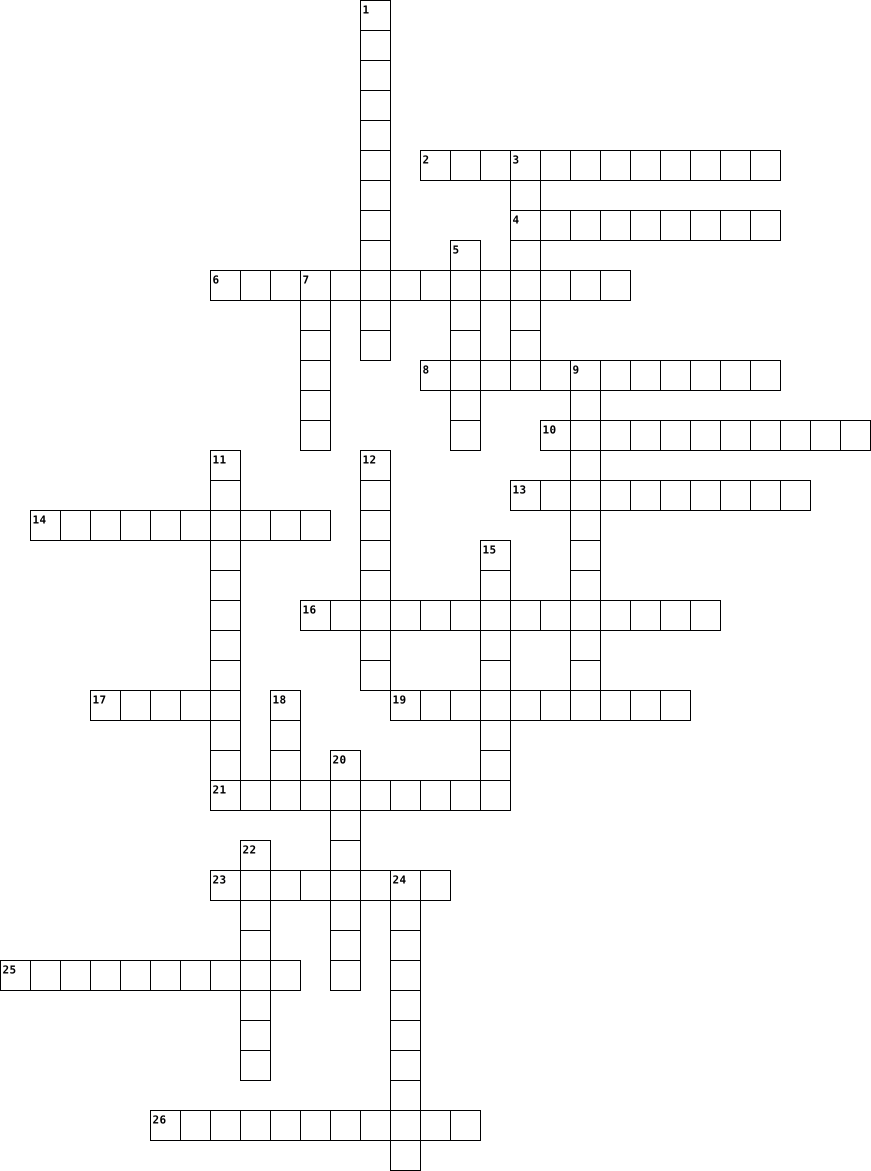
Across
- system - one experiment in which all reactants and all products of a chemical reaction are accounted for
- compound pure substance formed when at least when one metal and non-metal combine
- positive charge
- shiny malleable ductile element that conduct electricity
- chemical reactions that occurs when oxygen reacts with a substance
- element has both metallic and non metal properties
- metals group 1 element in the periodic table
- slow chemical change that occurs when oxygen in the air reacts with a metal
- system experiment in which products can escape a chemical reaction
- -ability to pound into sheets
- workplace hazardous materials information system
- negative charge
- respiration chemical reaction that takes place in a cell
Down
- -horizontal row of elements in the periodic table
- gases -group 18 of the periodic table
- substance that helps a reaction to proceed more quickly
- neutral particle in the nucleus of an atom
- vertical column of elements in the periodic table
- ions groups of atoms acting as one
- compounds pure substance formed when non metals combine
- metal dull brittle element that does not conduct electricity
- anything that has mass and occupies space
- catalyst involved in chemical reaction in living things
- reaction when two or more substances react to form a new substance
- number the sum of the number of protons and neutrons in an atom
25 Clues: positive charge • negative charge • -ability to pound into sheets • ions groups of atoms acting as one • gases -group 18 of the periodic table • neutral particle in the nucleus of an atom • anything that has mass and occupies space • metals group 1 element in the periodic table • workplace hazardous materials information system • ...
Chapter 7 Vocabulary 2024-01-21

Across
- the number in front of the formula
- reaction reactions that involve the transfer of electrons from one species to another
- reaction redox reaction
- reaction any chemical reaction that absorbs heat from its environment
- a substance that takes part in and undergoes change during a reaction.
- 6.02214076 × 10²³ of some chemical unit
- energy a process that involves the rearrangement of the molecular or ionic structure of a substance
- reaction a chemical reaction that involves the release of energy in the form of heat or light
- reaction occurs when two or more reactants combine to form a single product
Down
- reaction a reaction in which one element is substituted for another element in a compound
- reaction generally occur between substances in an aqueous solution
- formed from a chemical reaction.
- equation a symbolic representation of the molecules that take part in the chemical reactant
- mass the mass in grams of one mole of the compound
- reaction occurs when one reactant breaks down into two or more products
15 Clues: reaction redox reaction • formed from a chemical reaction. • the number in front of the formula • 6.02214076 × 10²³ of some chemical unit • mass the mass in grams of one mole of the compound • reaction generally occur between substances in an aqueous solution • reaction any chemical reaction that absorbs heat from its environment • ...
Types of reactions by Sujay yadav 2025-04-23

Across
- – A reaction involving the transfer of electrons between two species.
- – The substances formed as a result of a chemical reaction.
- – The loss of electrons during a reaction.
- – A reaction that releases energy in the form of heat.
- – A hydrocarbon reacts with oxygen to produce carbon dioxide and water.
- – A solid that forms from a solution during a chemical reaction.
- Equation – A symbolic representation of a chemical reaction.
- – A reaction where two or more substances combine to form a single product.
Down
- – A single compound breaks down into two or more simpler substances.
- Replacement – One element replaces another in a compound.
- – A reaction that absorbs energy from its surroundings.
- Replacement – Two compounds exchange ions to form two new compounds.
- – An acid and a base react to form salt and water.
- – A substance that speeds up a reaction without being consumed.
- – The starting substances in a chemical reaction.
15 Clues: – The loss of electrons during a reaction. • – The starting substances in a chemical reaction. • – An acid and a base react to form salt and water. • – A reaction that releases energy in the form of heat. • – A reaction that absorbs energy from its surroundings. • Replacement – One element replaces another in a compound. • ...
Types of reactions by Sujay Yadav 2025-04-23

Across
- – A single compound breaks down into two or more simpler substances.
- – A hydrocarbon reacts with oxygen to produce carbon dioxide and water.
- – An acid and a base react to form salt and water.
- – The starting substances in a chemical reaction.
- – A reaction involving the transfer of electrons between two species.
- – A reaction that releases energy in the form of heat.
- – A reaction that absorbs energy from its surroundings.
- Replacement – One element replaces another in a compound.
- – A substance that speeds up a reaction without being consumed.
Down
- – The substances formed as a result of a chemical reaction.
- Replacement – Two compounds exchange ions to form two new compounds.
- – The loss of electrons during a reaction.
- – A solid that forms from a solution during a chemical reaction.
- – A reaction where two or more substances combine to form a single product.
- Equation – A symbolic representation of a chemical reaction.
15 Clues: – The loss of electrons during a reaction. • – The starting substances in a chemical reaction. • – An acid and a base react to form salt and water. • – A reaction that releases energy in the form of heat. • – A reaction that absorbs energy from its surroundings. • Replacement – One element replaces another in a compound. • ...
Types of Chemical Reactions By Neel Jaswanth 10L 42070 2025-04-27

Across
- A reaction in which one reactant gets oxidised while other gets reduced is called a _______________.
- A substance in a redox chemical reaction that gains or accepts or receives an electron from a reducing agent is called an _________________.
- A reaction in which a single substance decomposes to give two or more substances is called _________________________.
- A chemical reaction in which an element displaces another element from its solution is called ______________________________.
- A reaction in which a single product is formed from two or more reactants is called __________________________.
- A chemical reaction in which two different atoms or group of atoms are mutually exchanged is called a ___________________________.
- When a metal is attacked by substances around it such as moisture, acids etc. It is called ________________.
- An insoluble substance formed along with the formation of a product in a chemical reaction is known as a ___________________.
- Reactions in which energy is absorbed are called ________________________.
- Any reaction that produces a precipitate is known as a __________________.
- What are added to foods containing fats and oils? _______________.
- Decomposition reaction that is carried out by electric current is called ___________________________.
Down
- A substance that speeds up a chemical reaction is called ________________.
- Decomposition reaction that is carried out by light is called ______________________________.
- Reactions in which heat is released along with the formation of products are called ___________________________.
- The gain of oxygen or loss of hydrogen is known as ___________________.
- Decomposition reaction that is carried out by heating is called ________________________________.
- When fats and oils are oxidised they become rancid and their smell and taste change. This is called _____________.
- The loss of oxygen or gain of hydrogen is known as ________________.
- A series of metals based on their reactivity from highest to lowest is called ____________________.
20 Clues: What are added to foods containing fats and oils? _______________. • The loss of oxygen or gain of hydrogen is known as ________________. • The gain of oxygen or loss of hydrogen is known as ___________________. • A substance that speeds up a chemical reaction is called ________________. • ...
Chemistry Crossword 2017-11-07

Across
- slow chemical change that occurs when oxygen in the air reacts with a metal
- number of protons in the nucleus of one atom of an element
- ability of a substance to conduct electricity or heat
- combination of symbols that represent a compound; the formula identifies the elements in the compound and the amount of each element
- a reaction that takes place when two or more substances react to form new substances
- chemical reaction that releases eenergy
- description of how a substance interacts with other substances, such as acids;chemical properties are observable only when a chemical change occurs
- principle that matter is not created or destroyed in a chemical reaction; the mass of the products always equals the mass of the reactants
- metals group 2 elements in the periodic table; their reactivity is not as strong as that of the alkali metals
- chemical reaction that occurs when oxygen reacts with a substance to form a new substance and give off energy
- an experiment in which all reactants and all products of a chemical reaction are accounted for
Down
- substance that helps a chemical reaction to proceed more quickly
- change that results when two or more substances react to create a different substance or substances; the new substances have completely different properties from the original ones
- mass of one atom of an element calculated from the total number of protons,neutrons, and electrons of that atom; measured in atomic mass units (amu)
- catalyst involved in chemical reactions in living things
- chemical reaction that absorbs energy
- vertical column of elements in the periodic table; elements in a family all have similar chemical properties; also called a family
- invisible negatively charged particle that orbits the nucleus of an atom
- measure of atomic mass; 1 amu is equal to 1/12th the mass of a carbon 12 atom
- compound that dissolves in water to form a solution with a pH lower than 7
- (CO(g))colourless, odourless gas;produced by incomplete combustion of chemicals containing carbon (e.g. hydrocarbons); major source: motor vehicles
- chemical combination of two or more elements in a specific ratio
- orbit of electrons around the nucleus of an atom
- group 1 elements in the periodic table, not including hydrogen; the most reactive of the metals
- cloudy mixture in which tiny particles of one substance are held within another and particles cannot be separated out from the other substance
- the smallest part of an element that is representative of that element; a neutral particle made up of a nucleus containing protons and neutrons, and in which the number of electrons equals the number of protons
26 Clues: chemical reaction that absorbs energy • chemical reaction that releases eenergy • orbit of electrons around the nucleus of an atom • ability of a substance to conduct electricity or heat • catalyst involved in chemical reactions in living things • number of protons in the nucleus of one atom of an element • ...
Chemistry 2022-03-18
Across
- " A solid that form's from solution during a chemical reaction."
- The cells in your body contain biological catalysts called ENZYMES."
- "is a amount of a substance in a given volume."
- "When on element replaces another in a compound, or when two elements in different compounds trade places."
- reaction- "is a reaction in which energy is absorbed
- "The study of matter and how matter changes"
- "A material used to decrease the rate of a reaction"
- "In contrast to a synthesis reaction, a process called DECOMPOSITION breaks down compounds into simpler products."
- is a material that releases energy when it burns."
- The substance you have at the beginning"
- "when two or more elements or compounds combine to make more complex substances the process is called synthesis."
- equation-"is a short, easy way to show a chemical reaction, using symbols instead of words."
- reaction-"A reaction that releases energy in the form of heat"
- " a rapid reaction between oxygen and a substance called a fuel.
Down
- "is a number placed in font of chemical formula in an equation."
- property- a Characteristic of substance that describes its ability to change into other substances.
- "is anything that has mass and takes up space."
- system- " matter is not allowed to enter or leave."
- of mass- "during a chemical reaction, matter is not created or destroyed
- a material that increases the rate of reaction by lowering the activation energy."
- reaction- A change in matter that produces one or more new substances.
- "When the reaction is complete, you have new substances"
- system- "matter can enter from or escape to the surrounding."
- change- " is any change that alters the form or appearance of a substance but that does not make the substance into another substance.
- property- A characteristic of a substance that can be observed without changing the substance into another substance.
- energy- "is a minimum amount of energy needed to start a chemical reaction."
26 Clues: The substance you have at the beginning" • "The study of matter and how matter changes" • "is anything that has mass and takes up space." • "is a amount of a substance in a given volume." • is a material that releases energy when it burns." • system- " matter is not allowed to enter or leave." • reaction- "is a reaction in which energy is absorbed • ...
Unit B - Matter and Chemical Change Crossword 2017-11-10

Across
- A change in matter that is non-reversible
- Anything on the periodic table, made of one atom
- A change in matter that is reversible
- Absorbs heat energy
- Occurs when two or more materials react and create new materials
- Releases heat energy
- Total mass of these products is always the same as the total mass of the reactants
- Cloudy mixture that can't be separated
- Is a slow chemical change
- A substance that reacts with a substance
- The speed of a chemical reaction
- An experiment in which one or more products of a chemical reaction can escape
Down
- Mixture of two or more pure substances that looks like one substance
- A new substance created with a chemical reaction
- Anything that has mass and occupies space
- Is a chemical reaction that takes place in the cells in your body
- An atom or a group of atoms that had been electrically charged
- Organic catalysts
- Chemical combination of two or more elements in a specific ratio
- When non-metals combine
- Workplace Hazardous Material Information System (abbreviation)
- Are substances that help a reaction proceed faster
- Is a chemical reaction that occurs when oxygen reacts with a substance to form a new substance and give off energy
- metal + non-metal
- Cloudy mixture that can be separated
25 Clues: Organic catalysts • metal + non-metal • Absorbs heat energy • Releases heat energy • When non-metals combine • Is a slow chemical change • The speed of a chemical reaction • Cloudy mixture that can be separated • A change in matter that is reversible • Cloudy mixture that can't be separated • A substance that reacts with a substance • Anything that has mass and occupies space • ...
Unit B - Matter and Chemical Change Crossword 2017-11-10

Across
- A substance that reacts with a substance
- Mixture of two or more pure substances that looks like one substance
- A new substance created with a chemical reaction
- A change in matter that is reversible
- Releases heat energy
- A change in matter that is non-reversible
- An experiment in which one or more products of a chemical reaction can escape
- Anything on the periodic table, made of one atom
- Organic catalysts
- The speed of a chemical reaction
- Total mass of these products is always the same as the total mass of the reactants
- Workplace Hazardous Material Information System (abbreviation)
- When non-metals combine
- Is a slow chemical change
- Chemical combination of two or more elements in a specific ratio
Down
- Absorbs heat energy
- Cloudy mixture that can be separated
- Is a chemical reaction that takes place in the cells in your body
- Occurs when two or more materials react and create new materials
- Anything that has mass and occupies space
- Are substances that help a reaction proceed faster
- Is a chemical reaction that occurs when oxygen reacts with a substance to form a new substance and give off energy
- An atom or a group of atoms that had been electrically charged
- metal + non-metal
- Cloudy mixture that can't be separated
25 Clues: Organic catalysts • metal + non-metal • Absorbs heat energy • Releases heat energy • When non-metals combine • Is a slow chemical change • The speed of a chemical reaction • Cloudy mixture that can be separated • A change in matter that is reversible • Cloudy mixture that can't be separated • A substance that reacts with a substance • Anything that has mass and occupies space • ...
Unit B - Matter and Chemical Change Crossword 2017-11-09

Across
- Is a slow chemical change
- A change in matter that is non-reversible
- Workplace Hazardous Material Information System (abbreviation)
- Anything that has mass and occupies space
- Total mass of these products is always the same as the total mass of the reactants
- When non-metals combine
- Anything on the periodic table, made of one atom
- A change in matter that is reversible
- The speed of a chemical reaction
- Mixture of two or more pure substances that looks like one substance
- metal + non-metal
- Organic catalysts
- Is a chemical reaction that occurs when oxygen reacts with a substance to form a new substance and give off energy
Down
- Releases heat energy
- An experiment in which one or more products of a chemical reaction can escape
- A substance that reacts with a substance
- An atom or a group of atoms that had been electrically charged
- Is a chemical reaction that takes place in the cells in your body
- Absorbs heat energy
- Occurs when two or more materials react and create new materials
- Are substances that help a reaction proceed faster
- Cloudy mixture that can be separated
- A new substance created with a chemical reaction
- Chemical combination of two or more elements in a specific ratio
- Cloudy mixture that can't be separated
25 Clues: metal + non-metal • Organic catalysts • Absorbs heat energy • Releases heat energy • When non-metals combine • Is a slow chemical change • The speed of a chemical reaction • Cloudy mixture that can be separated • A change in matter that is reversible • Cloudy mixture that can't be separated • A substance that reacts with a substance • A change in matter that is non-reversible • ...
Chemistry Crossword Renze Torres 9B 2018-12-11

Across
- An experiment in which one or more products of a chemical reactions can escape
- A temperature where the solid melts
- This change is reversible
- This change is non reversible
- The process of burning
- A chemical reaction that takes place in cells
- Pure substance formed when at least one metal and non metal combine
- chemical reaction that absorbs energy
- A substance produced by a living organism that acts as a catalyst
- A system easy to see warning symbols on hazardous materials
- chemical reaction that releases energy
- A substance that helps a chemical reaction to proceed more quickly
Down
- Substance made up of one atom
- A substance that changes during a reaction
- law of conservation
- an organic catalyst
- Pure substance when formed when nonmetals combine
- A table in which elements are organized by their physical and chemical properties
- Anything that has mass and occupies space
- An experiment in which all reactants and all products of a chemical reaction are accounted for
- Number of protons in the nucleus of one atom of an element
- A temperature at where the liquid turns into vapour
- An atom that has become electrically charged because it has lost or gained electrons
- Of an element calculated from the total number of protons, neutrons, and electrons of that atom
- The process of corroding metal, stone, or other materials
25 Clues: law of conservation • an organic catalyst • The process of burning • This change is reversible • Substance made up of one atom • This change is non reversible • A temperature where the solid melts • chemical reaction that absorbs energy • chemical reaction that releases energy • Anything that has mass and occupies space • A substance that changes during a reaction • ...
The Chemical Context of Life 2022-09-22

Across
- negative electricity
- breaks down formula
- positive electrons
- atoms attract shared electrons
- electrons share atoms
- an substance that has mass
- species of atoms
- positively charged ion
- attraction between atoms, ions, or molecules
- natural gas
- two or more elements
- outer shell
Down
- undergoes change during a reaction
- a group of atoms bonded together
- sharing electrons between two atoms
- same element different neutrons
- species formed by chemical reactions
- basic unit of a chemical element
- energy stored in chemical bonds
- atom or molecule
- negatively-charged ion
- atoms come close together
- released after chemical reaction
- reversible chemical reaction
- attraction between opposed ions
25 Clues: natural gas • outer shell • atom or molecule • species of atoms • positive electrons • breaks down formula • negative electricity • two or more elements • electrons share atoms • negatively-charged ion • positively charged ion • atoms come close together • an substance that has mass • reversible chemical reaction • atoms attract shared electrons • same element different neutrons • ...
Chapter 7 Vocabulary 2024-01-21

Across
- the number in front of the formula
- reaction reactions that involve the transfer of electrons from one species to another
- reaction redox reaction
- reaction any chemical reaction that absorbs heat from its environment
- a substance that takes part in and undergoes change during a reaction.
- 6.02214076 × 10²³ of some chemical unit
- energy a process that involves the rearrangement of the molecular or ionic structure of a substance
- reaction a chemical reaction that involves the release of energy in the form of heat or light
- reaction occurs when two or more reactants combine to form a single product
Down
- reaction a reaction in which one element is substituted for another element in a compound
- reaction generally occur between substances in an aqueous solution
- formed from a chemical reaction.
- equation a symbolic representation of the molecules that take part in the chemical reactant
- mass the mass in grams of one mole of the compound
- reaction occurs when one reactant breaks down into two or more products
15 Clues: reaction redox reaction • formed from a chemical reaction. • the number in front of the formula • 6.02214076 × 10²³ of some chemical unit • mass the mass in grams of one mole of the compound • reaction generally occur between substances in an aqueous solution • reaction any chemical reaction that absorbs heat from its environment • ...
Chemistry Reactions 2023-07-17

Across
- A reaction that releases energy to its surroundings, often resulting in an increase in temperature.
- determined by the number of electrons it can gain, lose, or share to form chemical bonds with other atoms.
- A reaction that absorbs energy from its surroundings, often resulting in a decrease in temperature.
- The smallest unit of a chemical element that retains its unique properties.
- A substance that changes colour used to detect the presence of specific substances.
- A substance that donates hydrogen ions (H+) or accepts electron pairs in a chemical reaction, typically characterized by a sour taste, the ability to turn litmus paper red, and the ability to react with bases to form salts.
- A chemical reaction between an acid and a base, resulting in the formation of a salt and water, and typically characterized by the neutralization of acidic and basic properties.
- The formation of a solid (precipitate) from a solution due to a chemical reaction between dissolved substances.
- A substance that accepts hydrogen ions (H+) or donates electron pairs in a chemical reaction, typically characterized by a bitter taste, a slippery feel, the ability to turn litmus paper blue, and the ability to react with acids to form salts.
Down
- of Mass The principle that states that the total mass of a closed system remains constant during a chemical reaction or physical change.
- A substance that undergoes a chemical reaction and is consumed or transformed to produce one or more new substances called products.
- A rapid chemical reaction between a fuel (such as a hydrocarbon) and an oxidant (usually oxygen) that produces heat and light.
- Bond A type of chemical bond in which two atoms share one or more pairs of electrons
- Change A process in which one or more substances are transformed into different substances with distinct chemical properties. It usually involves the breaking and formation of chemical bonds.
- A substance that is formed as a result of a chemical reaction.
- change A change in the physical properties of a substance, such as its shape, size, or state, without a change in its chemical composition.
- Bond A type of chemical bond that forms between two atoms when one or more electrons are transferred from one atom to another
17 Clues: A substance that is formed as a result of a chemical reaction. • The smallest unit of a chemical element that retains its unique properties. • A substance that changes colour used to detect the presence of specific substances. • Bond A type of chemical bond in which two atoms share one or more pairs of electrons • ...
Chemical reaction review 2023-03-28

Across
- The law of conservation of mass states the total amount of matter remains the same, regardless of any chemical or physical change.
- reaction when 1 element replaces another element in a compound
- reaction in which energy is released in the form of light or heat
- the act of a compound breaking down into simpler products
- mixture with non-uniform composition. Composition varies from one region to another with at least two phases that remain separate from each other.
- mixture which appears uniform throughout
Down
- a substance formed as a result of a chemical reaction
- reaction in which the reactants absorb heat energy from the surroundings
- refers to a material which is made by humans; involves a chemical reaction between two or more compounds
- type of change that occurs when one chemical substance is transformed into one or more different substances.
- a system which can exchange both energy and matter with its surroundings
- type of change that alters the form or appearance of a substance without changing it into different substances.
- a heterogenous mixture, containing small, undissolved particles that do not separate or settle out if mixture is undisturbed. Ex. milk and paint
- a substance that enters into a chemical reaction
- a mixture with particles that can be seen and easily separated by settling or filtration.
15 Clues: mixture which appears uniform throughout • a substance that enters into a chemical reaction • a substance formed as a result of a chemical reaction • the act of a compound breaking down into simpler products • reaction when 1 element replaces another element in a compound • reaction in which energy is released in the form of light or heat • ...
Chemical Reaction VOcabulary 2025-03-31

Across
- a process in which atoms rearrange to form new substances
- something that is made of all the same atoms or groups of atoms
- to change the order or position of something
- the temperature at which a substance changes from the liquid phase to the gas phase
- the relative size of things
- a substance that is added to soil to help plants grow
Down
- an ending substance that is made during a chemical reaction
- a structure formed by repeating groups of atoms linked together in a large
- a starting substance that is part of a chemical reaction
- point the temperature at which a substance changes from the solid phase to the liquid phase
- able to cause damage
- letters and numbers showing the types and number of atoms that repeat to make up a substance
- an object, diagram, or computer program that helps us understand something by making itsimpler or easier to see
- the tiny pieces that all matter—all the stuff in the world—is made of
- a group of atoms joined together in a particular way
15 Clues: able to cause damage • the relative size of things • to change the order or position of something • a group of atoms joined together in a particular way • a substance that is added to soil to help plants grow • a starting substance that is part of a chemical reaction • a process in which atoms rearrange to form new substances • ...
Stoichiometry 2022-10-21

Across
- denotes amount (number) of a compound, changed during balancing
- (aq) subscript
- a starting substance that undergoes a chemical reaction
- (g) subscript
- atoms are neither created nor destroyed in a chemical reaction
- unbalanced reaction
- a substance needed for the reaction to occur, but not a reactant or product
- reactant that determines the maximum amount of product that can be made
- changing coefficients in a chemical equation to follow Law of Conservation
- the amount of product that should be produced based on limiting reactant
- Δ
Down
- reactant left over after a reaction
- actual yield/theoretical yield * 100
- # of values in an measurement (includes known and estimated values)
- (l) subscript
- denotes # of atoms or state of a compound
- a substance created after a reaction
- conversion of amount of one substance to the amount of another
- (s) subscript
- the amount of product you get after performing the reaction
20 Clues: Δ • (g) subscript • (l) subscript • (s) subscript • (aq) subscript • unbalanced reaction • reactant left over after a reaction • actual yield/theoretical yield * 100 • a substance created after a reaction • denotes # of atoms or state of a compound • a starting substance that undergoes a chemical reaction • the amount of product you get after performing the reaction • ...
Stoichiometry 2022-10-21

Across
- denotes amount (number) of a compound, changed during balancing
- (aq) subscript
- a starting substance that undergoes a chemical reaction
- (g) subscript
- atoms are neither created nor destroyed in a chemical reaction
- unbalanced reaction
- a substance needed for the reaction to occur, but not a reactant or product
- reactant that determines the maximum amount of product that can be made
- changing coefficients in a chemical equation to follow Law of Conservation
- the amount of product that should be produced based on limiting reactant
- Δ
Down
- reactant left over after a reaction
- actual yield/theoretical yield * 100
- # of values in an measurement (includes known and estimated values)
- (l) subscript
- denotes # of atoms or state of a compound
- a substance created after a reaction
- conversion of amount of one substance to the amount of another
- (s) subscript
- the amount of product you get after performing the reaction
20 Clues: Δ • (g) subscript • (l) subscript • (s) subscript • (aq) subscript • unbalanced reaction • reactant left over after a reaction • actual yield/theoretical yield * 100 • a substance created after a reaction • denotes # of atoms or state of a compound • a starting substance that undergoes a chemical reaction • the amount of product you get after performing the reaction • ...
Chemical reactions and Equation 2026-04-17

Across
- substances formed as a result of a chemical reaction
- groups of atoms bonded together acting as a single unit
- a reaction where two or more substances combine to form one product
- a reaction where a substance burns in oxygen producing heat and light
- a process where reactants change into new substances
- compounds formed by sharing electrons between atoms
- substances made of metal atoms bonded together
- a change that does not alter the substance’s chemical identity
- an atom or molecule with a positive or negative charge
- categories of reactions based on how substances change
- a combination of symbols showing the composition of a substance
Down
- a reaction where one element replaces another in a compound
- a change that forms new substances with different properties
- matter cannot be created or destroyed in a reaction
- substances present at the start of a chemical reaction
- a compound formed by the transfer of electrons between atoms
- a symbolic representation of a chemical reaction using formulas
- substances made of two or more elements chemically combined
- a reaction where one compound breaks down into simpler substances
- an electron in the outermost energy level of an atom
20 Clues: substances made of metal atoms bonded together • matter cannot be created or destroyed in a reaction • compounds formed by sharing electrons between atoms • substances formed as a result of a chemical reaction • a process where reactants change into new substances • an electron in the outermost energy level of an atom • ...
Unit B - Matter and Chemical Change - Drew kinney 2017-11-15

Across
- Cloudy mixture that can't be separated
- Cloudy mixture that can be separated
- Releases heat energy
- Occurs when two or more materials react and create new materials
- Chemical combination of two or more elements in a specific ratio
- When non-metals combine
- Total mass of these products is always the same as the total mass of the reactants
- Workplace Hazardous Material Information System (abbreviation)
- Is a chemical reaction that occurs when oxygen reacts with a substance to form a new substance and give off energy
Down
- Is a slow chemical change
- Absorbs heat energy
- Anything on the periodic table, made of one atom
- An experiment in which one or more products of a chemical reaction can escape
- A substance that reacts with a substance
- Mixture of two or more pure substances that looks like one substance
- A change in matter that is reversible
- Is a chemical reaction that takes place in the cells in your body
- Organic catalysts
- A change in matter that is non-reversible
- A new substance created with a chemical reaction
- The speed of a chemical reaction
- metal + non-metal
- An atom or a group of atoms that had been electrically charged
- Are substances that help a reaction proceed faster
- Anything that occupies mass and takes space
25 Clues: Organic catalysts • metal + non-metal • Absorbs heat energy • Releases heat energy • When non-metals combine • Is a slow chemical change • The speed of a chemical reaction • Cloudy mixture that can be separated • A change in matter that is reversible • Cloudy mixture that can't be separated • A substance that reacts with a substance • A change in matter that is non-reversible • ...
Unit B - Matter and Chemical Change Crossword 2017-11-10

Across
- Anything that has mass and occupies space
- Is a chemical reaction that occurs when oxygen reacts with a substance to form a new substance and give off energy
- Is a slow chemical change
- Organic catalysts
- A change in matter that is non-reversible
- When non-metals combine
- Chemical combination of two or more elements in a specific ratio
- An atom or a group of atoms that had been electrically charged
- Cloudy mixture that can't be separated
- Occurs when two or more materials react and create new materials
- A substance that reacts with a substance
- An experiment in which one or more products of a chemical reaction can escape
- Is a chemical reaction that takes place in the cells in your body
- Anything on the periodic table, made of one atom
Down
- Releases heat energy
- Cloudy mixture that can be separated
- metal + non-metal
- The speed of a chemical reaction
- Mixture of two or more pure substances that looks like one substance
- Total mass of these products is always the same as the total mass of the reactants
- A change in matter that is reversible
- A new substance created with a chemical reaction
- Absorbs heat energy
- Workplace Hazardous Material Information System (abbreviation)
- Are substances that help a reaction proceed faster
25 Clues: metal + non-metal • Organic catalysts • Absorbs heat energy • Releases heat energy • When non-metals combine • Is a slow chemical change • The speed of a chemical reaction • Cloudy mixture that can be separated • A change in matter that is reversible • Cloudy mixture that can't be separated • A substance that reacts with a substance • Anything that has mass and occupies space • ...
Unit B - Matter and Chemical Change Crossword 2017-11-10

Across
- Is a chemical reaction that occurs when oxygen reacts with a substance to form a new substance and give off energy
- Cloudy mixture that can be separated
- A change in matter that is non-reversible
- Releases heat energy
- An experiment in which one or more products of a chemical reaction can escape
- When non-metals combine
- Chemical combination of two or more elements in a specific ratio
- An atom or a group of atoms that had been electrically charged
- The speed of a chemical reaction
- Is a chemical reaction that takes place in the cells in your body
- A new substance created with a chemical reaction
- A change in matter that is reversible
- Are substances that help a reaction proceed faster
Down
- Workplace Hazardous Material Information System (abbreviation)
- metal + non-metal
- Mixture of two or more pure substances that looks like one substance
- Occurs when two or more materials react and create new materials
- Absorbs heat energy
- Is a slow chemical change
- Total mass of these products is always the same as the total mass of the reactants
- Organic catalysts
- Anything that has mass and occupies space
- Anything on the periodic table, made of one atom
- A substance that reacts with a substance
- Cloudy mixture that can't be separated
25 Clues: metal + non-metal • Organic catalysts • Absorbs heat energy • Releases heat energy • When non-metals combine • Is a slow chemical change • The speed of a chemical reaction • Cloudy mixture that can be separated • A change in matter that is reversible • Cloudy mixture that can't be separated • A substance that reacts with a substance • A change in matter that is non-reversible • ...
Chemistry Crossword 2014-11-04

Across
- Positively charged particle in the nucleus of an atom
- Chemical reaction that occurs when oxygen reacts with a substance to form a new substance that gives off energy
- A material changes from one state to another
- Chemical reaction that takes place in cells
- Measured by atomic mass unit
- The most reactive of the metals
- Two or more materials react and create a new substance
- Horizontal row of elements in the periodic table
- Invisible negatively charged particle that orbits the nucleus of an atom
- The most stable and unreactive elements
- Catalyst involved in chemical reactions in living things
- Pure substance formed when non metals combine
- Solid liquid gas and plasma
- Slow chemical change that occurs when oxygen in the air reacts with a metal
- Element that has both metallic and non metallic properties
Down
- An experiment in which one or more products of the chemical reaction can escape
- The law that states that matter is not created or destroyed in a chemical reaction
- Combination of symbols that represent a compound
- The fourth state of matter
- Pure substance formed when at least one metal and one non metal combine
- The most reactive non metals
- An experiment where all reactants and products of a chemical reaction are accounted for
- Substances that help a chemical reaction to proceed more quickly
- Vertical column of elements in the periodic table
- Neutral particle in the nucleus of an atom
25 Clues: The fourth state of matter • Solid liquid gas and plasma • Measured by atomic mass unit • The most reactive non metals • The most reactive of the metals • The most stable and unreactive elements • Neutral particle in the nucleus of an atom • Chemical reaction that takes place in cells • A material changes from one state to another • ...
Melanie Sanchez Crossword 2017-02-27

Across
- when a chemical's oxidation decreases
- to be deposited in solid form from a solution
- being combined with oxygen
- chemical decomposition produced by passing an electric current through a liquid
- two are replaced, AB + CD → AD + CB
- reactant on left side and product on right side
- the amount of product obtained in a chemical reaction
- anytime something burns
- new material formed in a chemical reaction
Down
- dissolved in water
- one is replaced, AB + C → AC + B
- a substance that takes part in and undergoes change during a reaction
- combination, A + B → AB
- a chemical compound that contains exactly two different elements
- composed of two or more atoms that are covalently bonded
- a substance that speeds up a chemical reaction
- the number next to the atomic symbol in a chemical equation
- breaking down, AB → A + B
- consisting of two atoms
19 Clues: dissolved in water • combination, A + B → AB • consisting of two atoms • anytime something burns • breaking down, AB → A + B • being combined with oxygen • one is replaced, AB + C → AC + B • two are replaced, AB + CD → AD + CB • when a chemical's oxidation decreases • new material formed in a chemical reaction • to be deposited in solid form from a solution • ...
julia stearns 2019-06-11

Across
- Calcium Oxide
- A number written to the right of a chemical symbol and slightly below it
- In which only valence electrons of a particular element are shown in dots
- Uses chemical symbols to represent the atoms of the elements and their ratios in a chemical compoun
- The compound you have at the beginning of the reaction
- Matter is not created or destroyed
- AB + C= CB + A
- Energy is released
- A substance that initiates or accelerates a chemicla reaction without itslef being affected
- AB= A+B
- Tells how many atoms,molecules, or formula units take part in a reaction
- A chemical reaction that occurs when a substance reacts with oxygen, releasing energy in the form of heat and light
- Two non-metals
- Sodium Fluoride
Down
- AB + CD= AD +BC
- Metal and a non-metal
- Energy is absorbed
- A chemical change in which a substance combines with oxygen, as when iron oxidizes, forming rust
- A + B= AB
- A change in which one or more substances are converted to a new substance
- an outer shell electron that is associated with an atom, and that can participate in the formation of a chemical bond
- An easier way to show a chemical reaction ,with symbols
- Chemical compound for table salt
- The compound you have after the reaction
- Chemical compound for water
- Barium Oxide
- A mutual group of atoms held together by covalent bonds
- Positively charged, electrons are lost
- Atoms or groups of atoms with a charge
- Negatively charged, electrons are gained
30 Clues: AB= A+B • A + B= AB • Barium Oxide • Calcium Oxide • AB + C= CB + A • Two non-metals • AB + CD= AD +BC • Sodium Fluoride • Energy is absorbed • Energy is released • Metal and a non-metal • Chemical compound for water • Chemical compound for table salt • Matter is not created or destroyed • Positively charged, electrons are lost • Atoms or groups of atoms with a charge • ...
SNC 2D1 March Break Review Winter 2025 2025-03-15

Across
- Mass of products must be ______ to the mass of the reactants
- Cutting carrots is an example of this type of change
- Reaction that ends with a single chemical
- Positive ion
- NaOH
- Law of _______ of mass
- The starting chemicals in a chemical reaction
- Dihydrogen monoxide
- BeO
- The third orbit can hold a max of 8
- The ability of a substance to reflect light
- Charged atom
- Chemical with a pH greater than 7
- Positively charged subatomic particles
- Change where a new substance is produced
Down
- CCl4
- LiCl
- N2O3
- The outer orbit
- Reaction that starts with one chemical
- MgSO
- Group of atoms that act as a single ion
22 Clues: BeO • CCl4 • LiCl • N2O3 • NaOH • MgSO • Positive ion • Charged atom • The outer orbit • Dihydrogen monoxide • Law of _______ of mass • Chemical with a pH greater than 7 • The third orbit can hold a max of 8 • Reaction that starts with one chemical • Positively charged subatomic particles • Group of atoms that act as a single ion • Change where a new substance is produced • ...
CHEMICAL EQUATIONS 2025-08-21

Across
- Reaction that absorbs heat from surroundings
- A more reactive element replaces a less reactive one
- A process in which new substances are formed
- A symbolic representation of a chemical reaction
- A group of atoms bonded together
- Evidence of reaction when bubbles or fumes are produced
- An insoluble solid formed in a reaction between solutions
- One substance breaking into two or more simpler ones
Down
- Type of chemical bond between a metallic element and a nonmetallic one
- Two or more substances forming one product
- Substances formed after a chemical reaction
- Making sure atoms are equal on both sides of an equation
- Evidence of reaction related to light
- Reaction that releases heat or light energy
- Substances present before a chemical change
- Gradual damage of metals by air, moisture, or chemicals
16 Clues: A group of atoms bonded together • Evidence of reaction related to light • Two or more substances forming one product • Substances formed after a chemical reaction • Reaction that releases heat or light energy • Substances present before a chemical change • Reaction that absorbs heat from surroundings • A process in which new substances are formed • ...
Chemical changes revision part 2 2018-11-12

Across
- The most reactive metal
- This acids forms chloride salts
- A chemical reaction where the more reactive metal can remove the less reactive mnetal from a compound
- This is the substance that is made in a chemical reaction
- This is the substance you start with in a chemical reaction
- This is a chemical reaction in which oxygen is lost/take away
- The reaction between an acid and an alkali
- The chemical name for burning
- This word can describe dangerous acids
- These feel soapy
Down
- Pure metals have these, they can slide over each other so the metal can bend
- This means metal can be hammered into shape
- This is the name of the salts formed when reacting with Nitric acid
- This is a list of metals in order of how reactive they are
- Sulphuric acid makes salts called...
- This means the metal will not react
- The least reactive metal
- This word can describe dangerous alkalis
- These compounds are formed when metals react with oxygen
- This is a chemical reaction that involves adding oxygen
- A compound found in rocks from which we can extract metals
- This means metals can be drawn into wires
- These give things a sour taste
- A mixture of metals. These are stronger than pure metals/
24 Clues: These feel soapy • The most reactive metal • The least reactive metal • The chemical name for burning • These give things a sour taste • This acids forms chloride salts • This means the metal will not react • Sulphuric acid makes salts called... • This word can describe dangerous acids • This word can describe dangerous alkalis • This means metals can be drawn into wires • ...
Unit 5 Enzymatic Activity 2025-07-03

Across
- The part of the enzyme’s active site where the chemical reaction actually happens.
- The idea that each enzyme only catalyzes one type of chemical reaction.Competitive
- Inhibition where the inhibitor binds to another site on the enzyme and reduces its activity.
- A change in the shape of an enzyme (usually caused by heat or pH) that makes it stop working properly.
- The idea that each enzyme can only bind to a particular substrate.
- Site on an enzyme where a regulator binds, away from the active site.
- All the chemical reactions that happen in the cells of a living organism to keep it alive and functioning.
Down
- The part of the enzyme’s active site where the substrate attaches.
- A substance formed as a result of a chemical reaction.
- The substance that an enzyme acts on during a chemical reaction.
- A protein that speeds up (catalyzes) a chemical reaction in the body without being used up.
- A starting substance in a chemical reaction.
- A process where substances (reactants) are changed into new substances (products).
- The specific part of the enzyme where the substrate binds and the reaction takes place.
- Inhibition where the inhibitor competes with the substrate for the enzyme’s active site.
- A substance that speeds up a chemical reaction without being changed itself — enzymes are biological catalysts.
- Inhibition where the final product of a pathway stops an earlier reaction.
17 Clues: A starting substance in a chemical reaction. • A substance formed as a result of a chemical reaction. • The substance that an enzyme acts on during a chemical reaction. • The part of the enzyme’s active site where the substrate attaches. • The idea that each enzyme can only bind to a particular substrate. • ...
chemistry crossword 2014-11-06

Across
- anything that has mass and occupies space
- number of protons in the nucleus of one atom of an element
- change in the appearance or state of a substance that does not change the composition
- a combination of symbols that represent a compound
- a chemical reaction that takes place in cells
- material that cannot be broken down into any simple substance
- a table in which the elements are organized by their physical and chemical properties
- an experiment in which all reactants and products of a chemical reaction are accounted for
- horizontal row in the periodic table
- cloudy mixture in which tiny particles of one substance are held within another and particles cannot be separated out from the other substances
Down
- chemical reaction that releases energy
- vertical columns in the periodic table
- a reaction that takes place when two or more substances react to form new substances
- pure substance formed when non metals combine
- workplace hazardous materials information system
- positively charged particle in the nucleus of an atom
- substances that help a reaction proceed faster
- chemical reaction that absorbs energy
- change that results when tow or more substance react to create a different substance or substances
- substance made of only one kind of matter, which has a unique set of properties
- an experiment in which one or more products of a chemical reaction can escape
- change of state from a liquid to a gas
- chemical reaction that occurs when oxygen reacts with a substance to form a new substance an give off energy
- when two or more elements combine chemically
- atom that has become electrically charged because it has lost or gained electrons
25 Clues: horizontal row in the periodic table • chemical reaction that absorbs energy • chemical reaction that releases energy • vertical columns in the periodic table • change of state from a liquid to a gas • anything that has mass and occupies space • when two or more elements combine chemically • pure substance formed when non metals combine • ...
Chapter 7 science vocab 2023-01-03

Across
- reactions - a chemical reaction in which a compound breaks down into two or more simpler substances
- equation - a representation of a chemical reaction in which the reactants and products are expressed as formulas
- reaction - a chemical reaction that releases energy to its surroundings
- mass - the mass of one mole of a substance
- reaction - a chemical reaction that absorbs energy from its surroundings
- - substances that undergo change in a chemical reaction
- - numbers that appear before a formula in a chemical equation to show the relative proportions of each reactant and product
Down
- reaction - a chemical reaction in which one element takes the place of another element in a compound
- reaction - a chemical reaction in which two or more substances react to form a single substance
- reaction - a chemical reaction in which two compounds exchange positive ions and form new compounds
- - an amount of a substance that contains approximately 6.02 x 10²³ particles of the substance
- - new substances formed as a result of a chemical reaction
- energy - the energy stored in chemical bond
13 Clues: mass - the mass of one mole of a substance • energy - the energy stored in chemical bond • - substances that undergo change in a chemical reaction • - new substances formed as a result of a chemical reaction • reaction - a chemical reaction that releases energy to its surroundings • reaction - a chemical reaction that absorbs energy from its surroundings • ...
Chemistry crossword (Abhinav.B 10N) 2024-05-02

Across
- An equation depicted as simple form of a chemical reaction
- Common name for dihydrogen oxide
- Condition (other than water) needed for corrosion
- Reaction which takes place when a substance comes in contact with oxygen
- A reaction where a more reactive substance pushes a less reactive one from a compound
- Substance (s)present at the start of a chemical reaction
- A reaction where energy is released
- Another word for oxidation reduction
Down
- An equation where the number of atoms of each type in the reaction is the same on both reactants and product sides
- Process of slow deterioration of metals
- Color of FeSO4
- An equation which is written in basic words
- Common name for iron oxide
- Helps a chemical reaction occur
- Substance(s)present at the end of a chemical reaction
- A reaction where energy is absorbed
16 Clues: Color of FeSO4 • Common name for iron oxide • Helps a chemical reaction occur • Common name for dihydrogen oxide • A reaction where energy is released • A reaction where energy is absorbed • Another word for oxidation reduction • Process of slow deterioration of metals • An equation which is written in basic words • Condition (other than water) needed for corrosion • ...
Melanie Sanchez Crossword 2017-02-27

Across
- being combined with oxygen
- breaking down, AB → A + B
- to be deposited in solid form from a solution
- one is replaced, AB + C → AC + B
- new material formed in a chemical reaction
- reactant on left side and product on right side
- anytime something burns
- composed of two or more atoms that are covalently bonded
- consisting of two atoms
- when a chemical's oxidation decreases
- the amount of product obtained in a chemical reaction
Down
- the number next to the atomic symbol in a chemical equation
- a substance that speeds up a chemical reaction
- two are replaced, AB + CD → AD + CB
- a chemical compound that contains exactly two different elements
- chemical decomposition produced by passing an electric current through a liquid
- combination, A + B → AB
- a substance that takes part in and undergoes change during a reaction
- dissolved in water
19 Clues: dissolved in water • combination, A + B → AB • anytime something burns • consisting of two atoms • breaking down, AB → A + B • being combined with oxygen • one is replaced, AB + C → AC + B • two are replaced, AB + CD → AD + CB • when a chemical's oxidation decreases • new material formed in a chemical reaction • to be deposited in solid form from a solution • ...
Melanie Sanchez Crossword 2017-02-27

Across
- one is replaced, AB + C → AC + B
- to be deposited in solid form from a solution
- being combined with oxygen
- a chemical compound that contains exactly two different elements
- a substance that speeds up a chemical reaction
Down
- when a chemical's oxidation decreases
- anytime something burns
- chemical decomposition produced by passing an electric current through a liquid
- reactant on left side and product on right side
- two are replaced, AB + CD → AD + CB
- new material formed in a chemical reaction
- composed of two or more atoms that are covalently bonded
- combination, A + B → AB
- a substance that takes part in and undergoes change during a reaction
- dissolved in water
- breaking down, AB → A + B
- the number next to the atomic symbol in a chemical equation
- consisting of two atoms
- the amount of product obtained in a chemical reaction
19 Clues: dissolved in water • anytime something burns • combination, A + B → AB • consisting of two atoms • breaking down, AB → A + B • being combined with oxygen • one is replaced, AB + C → AC + B • two are replaced, AB + CD → AD + CB • when a chemical's oxidation decreases • new material formed in a chemical reaction • to be deposited in solid form from a solution • ...
Chemical Reactions 2026-04-30

Across
- Ending material in a reaction
- Starting material in a reaction
- represents a reaction using formulas that does NOT indicate amounts
- Synthesis is also known as a __ reaction
- a precipitate is _ in water
- used to write chemical formula
- another name for a synthesis reaction
- __ are Substances that produce hydroxide ions
- BaCl2 + H2SO4 -> BaSO4 + 2HCl
- Substances that produce hydrogen ions are called __
- dissolved in water
- Single-displacement is when one of reactants is a __ element
- has only one reactant
- an ion that appears but is not directly involved in the reaction
- negatively charged ions
- only shows the ions that are involved in the chemical reaction
Down
- What reaction separates elements?
- names of reactant(s) and product(s) are written
- Double-displacement reaction is also known as __ reaction
- Cu + 2AgNO3 -> Cu(NO3)2 + 2Ag
- ranking of reactivity of metals
- each side of the equation has the same number of atoms for each element
- Ca + O2 -> CaO
- It is usually combustion when __ is a reactant
- Na + Cl2 -> 2NaCl
- Used to balance a chemical equation
- speeds up a reaction, but is not part of the reaction
- shows all dissolved compounds as ions
- Positively charged ions
- has only one product
30 Clues: Ca + O2 -> CaO • Na + Cl2 -> 2NaCl • dissolved in water • has only one product • has only one reactant • Positively charged ions • negatively charged ions • a precipitate is _ in water • Ending material in a reaction • Cu + 2AgNO3 -> Cu(NO3)2 + 2Ag • BaCl2 + H2SO4 -> BaSO4 + 2HCl • used to write chemical formula • Starting material in a reaction • ranking of reactivity of metals • ...
Chemistry 1 terms 2021-11-08

Across
- a solid that is produced as a result of a chemical reaction in solution
- the process by which one or more substances change to produce one or more different substances
- a measure of how hot or cold something is
- a substance that forms into a chemical reaction
- a representation of the recants and products of a chemical reaction by their symbols or formulas
- absorption of heat
- a substance or molecule that participates in a chemical reaction
- changing the ____ can make slower or faster
Down
- a small whole number that appears as a factor in front of a formula in a chemical equation
- the rate at which a chemical reaction takes place
- a chemical reaction in which the products re-form the original reactants
- releasing heat
- an equation in which the reactants and product in a chemical reaction are represented by words
- the amount of a particle substance in a given quantity of a mixture, solution, or ore
- the acceleration of a chemical reaction by a ______
15 Clues: releasing heat • absorption of heat • a measure of how hot or cold something is • changing the ____ can make slower or faster • a substance that forms into a chemical reaction • the rate at which a chemical reaction takes place • the acceleration of a chemical reaction by a ______ • a substance or molecule that participates in a chemical reaction • ...
Chemical Reactions 2024-02-18

Across
- a reaction in which the cationic or the anionic species switch places, creating two new products
- substance that takes part in and undergoes change during a reaction.
- substance that is in a gaseous, or vaporous, state of matter
- quantity of matter within a given object
- particle of matter that uniquely defines a chemical element
- a reaction that occurs when two compounds interact to form one new compound
- single or double replacement reaction in which one product is a solid
- small-sized number on the bottom right of the symbol.
- when a substance reacts with oxygen, forming light and heat in the form of fire
- a reaction that occurs when a compound breaks down into two or more compounds
- chemical bond in which one atom loses valence electrons and gains them from another
- anything that takes up space and can be weighed.
- number in front of the formula.
- negatively charged nonmetal ion
Down
- equations with simply the chemical formulas of the products and reactants
- in a chemical reaction mass is neither created nor destroyed
- describes an approach that is used to name simple ionic and molecular compounds
- positively charged metal ion
- a reaction that occurs when a new compound is formed when one part of a compound is substituted for another part of a compound, creating two new compounds as products.
- symbolic representation of a chemical reaction in the form of symbols and formulae
- a double replacement reaction in which an acid reacts with a base to form water and salt
- chemical bonds formed by the sharing of electrons between atoms.
- an arrow that is placed after the reactant or reactants. and points in the direction of the products
- type of matter with specific properties that make it less rigid than a solid but more rigid than a gas
- solution in which the solvent is water.
- equation where the number of atoms of each type in the reaction is the same on both reactants and product sides
- substance that is present at the end of a chemical reaction.
- represents a chemical reaction using the names of the substances involved
- group of atoms bonded together
- substance which exists in the solid-state,
30 Clues: positively charged metal ion • group of atoms bonded together • number in front of the formula. • negatively charged nonmetal ion • solution in which the solvent is water. • quantity of matter within a given object • substance which exists in the solid-state, • anything that takes up space and can be weighed. • small-sized number on the bottom right of the symbol. • ...
Chapter 7 Vocabulary 2024-01-02

Across
- energy stored in the bonds of chemical compounds
- chemical reaction in which the reactants absorb heat energy from the surroundings to form products
- a substance that takes part in and undergoes change during a reaction
- chemical reaction in which energy is released in the form of light or heat
- chemical reaction that includes a transfer of electrons between two species
- the number in front of the formula - tells how many molecules of a given formula are present
Down
- high-temperature exothermic redox chemical reaction between a fuel and an oxidant that produces oxidized, often gaseous products
- chemical reaction in which one element replaces another in a compound
- chemical reaction in which two ionic compounds are exchanged and form two new components
- chemical process in which simple elements or compounds combine to form a more complex product
- chemical process in which one reactant breaks down into two or more products
- unit of measurement for amount of substance - quantity proportional to the number of elementary entities of a substance
- species formed from chemical reactions
- the ratio between the mass and the amount of substance of any sample of said compound
- reaction rearrangement of the molecular or ionic structure of a substance
15 Clues: species formed from chemical reactions • energy stored in the bonds of chemical compounds • chemical reaction in which one element replaces another in a compound • a substance that takes part in and undergoes change during a reaction • reaction rearrangement of the molecular or ionic structure of a substance • ...
Chapter 7 Vocab 2024-01-02

Across
- direct combination reaction is a type of chemical reaction in which two or more simple substances combine to form a more complex product.
- release energy to their surroundings
- type of chemical reaction that involves a transfer of electrons between two species.
- something made as a result of a chemical reaction.
Down
- the symbolic representation of a chemical reaction in the form of symbols and chemical formulas.
- when a substance reacts with oxygen and releases a huge amount of energy in the form of light and heat.
- a substance that takes part in and undergoes change during a reaction.
- replaces one element for another in a compound.
- a compound is broken into smaller chemical species.
- a convenient way to express amounts of reactants and products of chemical reactions.
- the energy of chemical substances that is released when the substances undergo a chemical reaction and transform into other substances.
- absorbs energy from their surroundings
- the numbers placed before the reactants in a chemical equation
- type of chemical reaction that occurs when two reactants exchange cations or anions to yield two new products.
- the ratio between the mass and the amount of substance (measured in moles) of any sample of said compound.
15 Clues: release energy to their surroundings • absorbs energy from their surroundings • replaces one element for another in a compound. • something made as a result of a chemical reaction. • a compound is broken into smaller chemical species. • the numbers placed before the reactants in a chemical equation • ...
Chapter13 Zachary Ruch 2016-10-13

Across
- A reaction in which two or more substances combine to form a new compound.
- A substance that accepts hydrogens ions.
- A chemical reaction that occurs when a substance reacts with oxygen, releasing energy in the form of heat and light.
- Change that takes place when two or more substances (reactants) interact to form new substances (products).
- A reaction that ABSORBS energy in the form of heat.
- A reaction in which a single compound breaks down to form to or more simpler substance.
- When reaction and its reverse act at the same rate.
Down
- A reaction in which atoms of one element take the place of atoms of another element in a compound.
- A chemical substance that is present at the start of a chemical reaction.
- Raction when two elements or ions move out of one compound and into another-that is, two elements replace one element in two separate compounds.
- The minimum energy required in order for a chemical reaction to proceed.
- A reaction that releases energy in the form of heat.
- A substance produced in a chemical reaction.
- chemical agents that selectively speed up chemical reaction without being consumed by the reaction.
- Descripition of a substance that can behave as either an acid or a base.
15 Clues: A substance that accepts hydrogens ions. • A substance produced in a chemical reaction. • A reaction that ABSORBS energy in the form of heat. • When reaction and its reverse act at the same rate. • A reaction that releases energy in the form of heat. • The minimum energy required in order for a chemical reaction to proceed. • ...
Chemical Reaction Vocabulary Word Puzzle 2023-11-14

Across
- A substance that takes part in and undergoes change during a reaction
- Chemical Equation: is a chemical equation with the same number of atoms of each element on both sides of the arrow
- A substance that slows down or prevents a particular chemical reaction or other process, or that reduces the activity of a particular reactant, catalyst, or enzyme.
- of reaction: The speed at which reactants are converted in products
- Loss of Electrons
- reaction: A chemical reaction that releases energy in the form of light or heat
- reaction: A process in which one or more substances, the reactants, are converted to one or more different substances called the products
- The amount of a substance that contains 6.02 x 10²³ particles of that substance
- Gain of electrons
- is the number in front of the formula, that is related to the properties of the products. For example 2 H2O means there is two molecules of water
- of Conservation of Mass: for any system closed to all transfers of matter and energy, the mass of the system must remain constant over time, as system's mass cannot change, so quantity cannot be added or removed.
Down
- A substance that increases the rate of a chemical reaction without itself undergoing any permanent chemical change.
- A type of lettering form written lower than the things around it. In chemical formulas the number of atoms in a molecule is written in this manner
- a state in which forward and reverse reactions or processes proceed at equal rates
- Is a substance that is formed as the result of a chemical reaction.
- reaction: Are those which absorb energy from the surroundings and result in a net decrease in temperature
- Mass: Mass in grams of one mole of a substance
- Equation: A representation of a chemical reaction using symbols of the elements to indicate the amount of substance, usually in moles, of each reactant and product.
- A substance produced by a living organism that acts as a catalyst to bring about a specific biochemical reaction
19 Clues: Loss of Electrons • Gain of electrons • Mass: Mass in grams of one mole of a substance • Is a substance that is formed as the result of a chemical reaction. • of reaction: The speed at which reactants are converted in products • A substance that takes part in and undergoes change during a reaction • ...
Chemical Reactions Vocabulary Assignment 2023-11-15

Across
- A substance that takes part in and undergoes change during a reaction
- Chemical Equation: is a chemical equation with the same number of atoms of each element on both sides of the arrow
- A substance that slows down or prevents a particular chemical reaction or other process, or that reduces the activity of a particular reactant, catalyst, or enzyme.
- of reaction: The speed at which reactants are converted in products
- Loss of Electrons
- reaction: A chemical reaction that releases energy in the form of light or heat
- reaction: A process in which one or more substances, the reactants, are converted to one or more different substances called the products
- The amount of a substance that contains 6.02 x 10²³ particles of that substance
- Gain of electrons
- is the number in front of the formula, that is related to the properties of the products. For example 2 H2O means there is two molecules of water
- of Conservation of Mass: for any system closed to all transfers of matter and energy, the mass of the system must remain constant over time, as system's mass cannot change, so quantity cannot be added or removed.
Down
- A substance that increases the rate of a chemical reaction without itself undergoing any permanent chemical change.
- A type of lettering form written lower than the things around it. In chemical formulas the number of atoms in a molecule is written in this manner
- a state in which forward and reverse reactions or processes proceed at equal rates
- Is a substance that is formed as the result of a chemical reaction.
- reaction: Are those which absorb energy from the surroundings and result in a net decrease in temperature
- Mass: Mass in grams of one mole of a substance
- Equation: A representation of a chemical reaction using symbols of the elements to indicate the amount of substance, usually in moles, of each reactant and product.
- A substance produced by a living organism that acts as a catalyst to bring about a specific biochemical reaction
19 Clues: Loss of Electrons • Gain of electrons • Mass: Mass in grams of one mole of a substance • Is a substance that is formed as the result of a chemical reaction. • of reaction: The speed at which reactants are converted in products • A substance that takes part in and undergoes change during a reaction • ...
atoms and chemical reaction 2022-12-09

Across
- what is a chemical reaction
- a substance made up of only one type of atom
- a chemical reaction which a compound breaks down into two or more
- the rate at which reactants change into products over time
- the number of protons in a nucleus
- what has a neutral charge
- a chemical reaction in which two or more substances react to form a single substances
- what is a physical change
- new substance formed as a result of a chemical reaction
- what is the smallest unit of an element
Down
- three substances particles in the nucleus
- a chemical reaction in which electrons are transferred from one reactant to another
- what is a substance to be deposited in solid form from a solution
- a molecule made of repeating units formed into long chains
- where is the protons located
- what is located at the center of an atom
- what is located in the electron cloud
- what is located in nucleus and has a positive charge
- a substance that undergoes change in a chemical reaction
- a pure substance that is made up of two or more different types of atoms chemically joined
20 Clues: what has a neutral charge • what is a physical change • what is a chemical reaction • where is the protons located • the number of protons in a nucleus • what is located in the electron cloud • what is the smallest unit of an element • what is located at the center of an atom • three substances particles in the nucleus • a substance made up of only one type of atom • ...
atoms and chemical reaction 2022-12-09

Across
- what is a chemical reaction
- a substance made up of only one type of atom
- a chemical reaction which a compound breaks down into two or more
- the rate at which reactants change into products over time
- the number of protons in a nucleus
- what has a neutral charge
- a chemical reaction in which two or more substances react to form a single substances
- what is a physical change
- new substance formed as a result of a chemical reaction
- what is the smallest unit of an element
Down
- three substances particles in the nucleus
- a chemical reaction in which electrons are transferred from one reactant to another
- what is a substance to be deposited in solid form from a solution
- a molecule made of repeating units formed into long chains
- where is the protons located
- what is located at the center of an atom
- what is located in the electron cloud
- what is located in nucleus and has a positive charge
- a substance that undergoes change in a chemical reaction
- a pure substance that is made up of two or more different types of atoms chemically joined
20 Clues: what has a neutral charge • what is a physical change • what is a chemical reaction • where is the protons located • the number of protons in a nucleus • what is located in the electron cloud • what is the smallest unit of an element • what is located at the center of an atom • three substances particles in the nucleus • a substance made up of only one type of atom • ...
James Puzzle 2020-01-23

Across
- reaction, a process that involves the arrangement of the molecular or ionic structure of a substance
- equation, a symbolic representation of a chemical reaction in symbols
- change, when a substance combines with another to form a new substance
- a substance produced by a living organism which acts as a catalyst to bring about a specific biochemical reaction
- reaction, a chemical reaction that releases energy through light or heat
- a substance that increases the rate of chemical reaction
- a thing that is composed of two different elements
- a mixture that is not evenly mixed
- a stable subatomic particle occering in all atomic nuclei with a positive charge
- a substance that slows down or prevents a particular chemical reaction
- a stable subatomic particle with a negative charge
- mass, a mass of an atom of a chemical element expressed in an atomic mass unity
Down
- change, it affects the form of a chemical substance but not its chemical composition
- that which occupies space and possesses mass
- an element is a substance that is made entirely from one type of atom
- a process that requires or absorbs energy from its surrounding ie heat
- mixture, two or more substances that have been mixed completely
- a substance made by mixing other substances together
- a subatomic particle of about the same mass as a proton but without an electrical charge
- the basic unit of a chemical element
20 Clues: a mixture that is not evenly mixed • the basic unit of a chemical element • that which occupies space and possesses mass • a thing that is composed of two different elements • a stable subatomic particle with a negative charge • a substance made by mixing other substances together • a substance that increases the rate of chemical reaction • ...
THERMAL ENERGY 2024-02-06

Across
- Substances that do not conduct heat well
- he bond formed by the complete transfer of valence electron to attain stability
- materials that allow the transmission of heat
- of Conservation of Mass in a chemical reaction mass is neither created nor destroyed
- a measure of the average kinetic energy of the particles in an object
- the temperature at which a given solid will melt
- the minimum energy required to cause a process (such as a chemical reaction) to occur
- the lowest temperature possible
- the temperature at which a liquid turns into a solid when cooled.
Down
- when heat moves from one object to another object through direct touch
- energy that comes from a source and travels through space at the speed of light
- a chemical bond that involves the sharing of electrons to form electron pairs between atoms
- a chemical reaction that releases energy by light or heat
- a substance that is formed when two or more reactants interact during a chemical reaction
- Energy that is transferred from one body to another as the result of a difference in temperature
- a chemical reaction that releases energy by light or heat
- any chemical reaction that absorbs heat from its environment
- change a physical process in which a substance goes from one phase to another.
- Equation a way to represent a chemical reaction using element symbols
19 Clues: the lowest temperature possible • Substances that do not conduct heat well • materials that allow the transmission of heat • the temperature at which a given solid will melt • a chemical reaction that releases energy by light or heat • a chemical reaction that releases energy by light or heat • any chemical reaction that absorbs heat from its environment • ...
Combustion and Chemical reactions 2025-03-07

Across
- dioxide a gas produced during combustion
- the energy required to start and sustain combustion
- the process of starting a combustion reaction
- reaction a process in which substances change into new
- a rapid combustion that releases large amounts of energy
- a product of combustion, made of two hydrogen atoms and
- gives off heat.
- a gas needed for combustion to happen
- is burned
- change a change that causes a new substance to be formed
- a chemical reaction
- a material used to produce heat or power by burning
- a pure form of matter
- oxygen atom
- a collection of solid, liquid, and gas particles released when a
Down
- a chemical reaction in which a substance reacts with oxygen
- equation a chemical equation that has an equal amount of each
- substance at the beginning of the reaction
- equation representation of chemical reaction using symbols and
- on the left and right sides
- the amount of matter or substance that makes up an object
- capable of being easily ignited and burning quickly
- of conservation of mass mass can neither be created nor destroyed
- and flame
- formulas
- the ability to do work
- two or more atoms that are connected by a chemical bond
- substance at the end of the reaction
- instance of combustion in which fuel is ignited, giving off light,
29 Clues: formulas • and flame • is burned • oxygen atom • gives off heat. • a chemical reaction • a pure form of matter • the ability to do work • on the left and right sides • substance at the end of the reaction • a gas needed for combustion to happen • dioxide a gas produced during combustion • substance at the beginning of the reaction • the process of starting a combustion reaction • ...
Chemical Equations 2024-03-12

Across
- The total energy of an isolated system cannot change.
- At the start of a chemical reaction.
- Postive or negative for an atom.
- Consists of a single type of atom distinguished by its atomic number.
- A number that is below the "baseline" mainly in a formula.
- A process that makes one set of chemical substances to another.
- A solution where the solvent is water.
- A way to show a chemical reaction in words.
- Contains 2 different chemical elements.
Down
- To make both sides of an equation equal.
- a number in front of a formula
- A chemical property that describes the tendency of an atom to attract electrons to itself when forming a chemical bond.
- A method to lead a non-spontaneous chemical reaction.
- Symbolic showing of a chemical reaction
- Ionic compounds that result from the neutralization reaction of an acid and a base.
- Shows information about the atoms in a certain compound.
16 Clues: a number in front of a formula • Postive or negative for an atom. • At the start of a chemical reaction. • A solution where the solvent is water. • Symbolic showing of a chemical reaction • Contains 2 different chemical elements. • To make both sides of an equation equal. • A way to show a chemical reaction in words. • The total energy of an isolated system cannot change. • ...
Kove Hernandez crossword 2017-02-27

Across
- replacement- reacts with a compound and takes the place of another element in that compound
- a substance that is formed as the result of a chemical reaction.
- A half-reaction in which a chemical species decreases its oxidation number, usually by gaining electrons
- type of chemical reaction in which two or more simple substances combine to form a more complex product.
- of two atoms.
- rapid chemical combination of a substance with oxygen, involving the production of heat and light
- chemical decomposition produced by passing an electric current through a liquid or solution containing ions
- process or result of oxidizing or being oxidized.
- of or containing water, typically as a solvent or medium
Down
- equation-the symbolic representation of a chemical reaction in the form of symbols and formulae, wherein the reactant entities are given on the left-hand side and the product entities on the right-hand side.
- cause (a substance) to be deposited in solid form from a solution
- compound- A binary compound is a chemical compound that contains exactly two different elements.
- substance that takes part in and undergoes change during a reaction.
- the state or process of rotting, decay.
- replacement- a type of chemical reaction where two compounds react, and the positive ions (cation) and the negative ions (anion) of the two reactants switch places, forming two new compounds or products
- ion- is a charged chemical species (ion) composed of two or more atoms covalently bonded or of a metal complex that can be considered to be acting as a single unit
- a numerical or constant quantity placed before and multiplying the variable in an algebraic expression
- produce or provide
- a substance that increases the rate of a chemical reaction without itself undergoing any permanent chemical change.
19 Clues: of two atoms. • produce or provide • the state or process of rotting, decay. • process or result of oxidizing or being oxidized. • of or containing water, typically as a solvent or medium • a substance that is formed as the result of a chemical reaction. • cause (a substance) to be deposited in solid form from a solution • ...
8th Grade AMI 3 (PEAK Unit 3 Vocab) 2020-11-09

Across
- lab technique for separating a mixture
- a solid material produced from a chemical reaction
- two or more substances that are not chemically combined
- burning something
- a scale, ranging from 0 to 14, that shows the percentages of Hydrogen Ions that can be either given of or accepted
- technique of heating a liquid to create vapor which is collected when cooled separate from the original liquid
- a large number at the beginning of a chemical formula showing the number of a molecule
Down
- a chemical reaction which absorbs heat energy thereby feeling cooler after the reaction takes place
- a chemical reaction which gives off heat energy thereby feeling warmer after the reaction takes place
- the state in a chemical reaction when the concentrations of reactants and products are equal
- a substance that increases the rate of a chemical reaction without itself undergoing any permanent chemical change
- a reaction in which a compound breaks down into two or more simpler substances
- the small number that is set slightly below the normal line of type showing the number of an element's atoms in a molecule
- when a chemical reaction gives off visible light
- removing solid particles from a liquid
15 Clues: burning something • lab technique for separating a mixture • removing solid particles from a liquid • when a chemical reaction gives off visible light • a solid material produced from a chemical reaction • two or more substances that are not chemically combined • a reaction in which a compound breaks down into two or more simpler substances • ...
science vocab reveiw 2023-12-04

Across
- - chemical reaction that absorbs thermal energy
- - when one compound breaks down and forms two or more substances
- - one element replaces another element in a compound
- - A process in which atoms of one or more substances rearrange to form one or more new substances
- - a substance that increases reaction rate by lowering the activation energy of a reaction
- - a substance that slows, or even stops a chemical reaction
Down
- - states that the total mass of the reactants before a chemical reaction is the same as the total mass of the products after the chemical reaction
- - chemical reaction in which two or more substances combine and form one compound
- - a chemical reaction that releases thermal energy
- - when the negative ions in two compounds switch places, forming two new compounds
- - a description of reaction using element symbols and chemical formulas
- energy - the minimum amount of energy needed to start a chemical reaction
- - a chemical reaction in which a substance combines with oxygen and releases energy
13 Clues: - chemical reaction that absorbs thermal energy • - a chemical reaction that releases thermal energy • - one element replaces another element in a compound • - a substance that slows, or even stops a chemical reaction • - when one compound breaks down and forms two or more substances • - a description of reaction using element symbols and chemical formulas • ...
Chapter 7 2023-01-03

Across
- a representation of a chemical reaction in which the reactants and products are expressed as formulas
- numbers that appear before a formula in a chemical equation to show the relative proportions of each reactant and product
- an amount of a substance that contains approximately 6.02 x 10²³ particles of the substance
- a chemical reaction that absorbs energy from its surroundings
- a chemical reaction that releases energy to its surroundings
- new substances formed as a result of a chemical reaction
- a chemical reaction in which two or more substances react to form a single substance
Down
- the mass of one mole of a substance
- a chemical reaction in which two compounds exchange positive ions and form new compounds
- a chemical reaction in which one element takes the place of another element in a compound
- a chemical reaction in which a compound breaks down into two or more simpler substances
- the energy stored in chemical bonds
- substances that undergo change in a chemical reaction
13 Clues: the mass of one mole of a substance • the energy stored in chemical bonds • substances that undergo change in a chemical reaction • new substances formed as a result of a chemical reaction • a chemical reaction that releases energy to its surroundings • a chemical reaction that absorbs energy from its surroundings • ...
Chapter 8 Chemistry Vocab 2023-03-08

Across
- occurs when a compound is broken down into simpler substances
- a substance that dissolves in water, dissociating completely into ions
- a chemical showing the complete (undissociated) forms of all reactants and products
- a reaction that forms water when an acid is mixed with a base
- the new substance formed by a chemical reaction; it is shown to the right of the reaction arrow
- a substance that produces hydrogen ions in aqueous solution; a proton donor
- a base that completely dissociates to produce ions in solution
- a chemical equation for a reaction in solution showing only those components that are directly involved in the reaction; strong electrolytes are represented as ions
- the solid that forms in a precipitation reaction
- the percent by mass of a component of a mixture or of a given element in a compound
- a solid that readily dissolves in water
- an ionic compound
- a process in which one or more substances are changed into one or more new substances by the reorganization of component atoms
- a chemical equation that has the same number of each type of atom on the product side and the reactant side
- a formula that gives the exact numbers and types of atoms in a molecule of a substance
- an oxidation–reduction reaction that involves
- a small unit of mass equal to
Down
- a chemical reaction in which a compound is formed from simpler materials
- a reaction in which ions in two compounds exchange places, forming two new compounds
- a chemical equation for a reaction in solution representing all strong electrolytes
- the weighted average of the masses of all the isotopes of an element
- a chemical reaction involving the transfer of electrons
- a reaction in which a solid forms and separates from the solution as a solid
- the number of atoms in exactly of pure 12C, equal to
- ions present in solution that do not participate directly in a reaction
- the starting substance of a chemical reaction shown to the left of the reaction arrow
- a formula that gives the simplest whole number ratio of the atoms present in a compound
- a substance that produces hydroxide ions in solution; a proton accepto
- the number equal to the number of carbon atoms in exactly of pure 12C; Avogadro’s number; one mole represents
- (slightly soluble solid) a solid that dissolves to such a small degree that it is not detectable to the naked eye
- an acid that completely dissociates (ionizes) to produce ions in solution
- a representation of chemical reaction using the formulas of the starting substances that react and the new substances that are formed
- the mass in grams of one mole of a compound
33 Clues: an ionic compound • a small unit of mass equal to • a solid that readily dissolves in water • the mass in grams of one mole of a compound • an oxidation–reduction reaction that involves • the solid that forms in a precipitation reaction • the number of atoms in exactly of pure 12C, equal to • a chemical reaction involving the transfer of electrons • ...
Chemical Reactions Vocabulary 2024-02-14

Across
- how easily an element reacts.
- energy is released
- ending materials of a chemical reaction
- a list that shows more active elements on top
- arrow in a chemical reaction
- starting materials of a chemical reaction
- (s)
- symbolic representation of a chemical reaction
Down
- number of molecules
- (aq)
- a charged particle that has either gained or lost an electron
- energy is absorbed
- ability of an element to attract electrons in a molecule
- (g)
- a solid from two aqueous solutions
- (l)
16 Clues: (g) • (s) • (l) • (aq) • energy is absorbed • energy is released • number of molecules • arrow in a chemical reaction • how easily an element reacts. • a solid from two aqueous solutions • ending materials of a chemical reaction • starting materials of a chemical reaction • a list that shows more active elements on top • symbolic representation of a chemical reaction • ...
Chapter 10 section 3 2023-03-16

Across
- when corrosion of metal causes a color change
- A solid that forms from a chemical reaction.
- chemical change sign that can be easily seen with the eye. An example would be bleaching your shirt
- the chemical name of table salt
- also known as rust
- what hydrogen and water make
- the chemicals on the left side of a chemical equation
- compounds have different chemical ____________
- a sign of chemical change in the form of heat or light
- the total mass of the reactants equals the total mass of the products in a reaction
- a chemical reaction that releases energy
Down
- also known as chemical change
- bubbling or foaming can be a sign of this chemical change
- the chemicals on the right side of a chemical equation
- a chemical reaction that requires the energy of the sun to help create sugars
- indicates the number of atoms in a compound such as mon or di.
- Compounds are made from more than one type of ________
- keeps track of which substances are used and in what ratio
18 Clues: also known as rust • what hydrogen and water make • also known as chemical change • the chemical name of table salt • a chemical reaction that releases energy • A solid that forms from a chemical reaction. • when corrosion of metal causes a color change • compounds have different chemical ____________ • the chemicals on the left side of a chemical equation • ...
Mole-Mass Relationship Crossword 2021-11-17

Across
- formula, tells the number of each type of atom.
- yield, the percent of the theoretical yield actually obtained from a chemical reaction.
- if unknown pure compound can be _______, the masses of elements present can be determined.
- a chemical equation tell how many molecules, and thus how many moles, of each reactants are needed and how many of each products are formed.
- equation, an equation in which ions are explicitly shown.
- reagent, is the reactant that runs out first.
- yield, the amount of product actually formed in a reaction.
- formula, represent real three-dimensional objects.
- equation, expression in which symbols are used to represent a chemical reaction.
- number, contains 6.022 x 10²³ formula units.
- weight, the sum of the atomic weights for all the atoms in the molecule or formula unit.
Down
- to obtain the correct ratio of reactant molecules, the reactants must be ______
- formula, the simplest whole-number ratio of moles of each element in the compound.
- yield, the amount of product formed assuming complete reaction of the limiting reagent.
- weight, the average mass of an element’s atoms.
- substances that are present at the end of a chemical reaction.
- formula, identifies the location of chemical bonds between the atoms of a molecule.
- measure of the quantitative relationship between the products and reactants of a given chemical reaction.
- chemical equations, indicate what is happening at the molecular level during a reaction.
- a substance that enters into and is altered in the course of a chemical reaction.
- to mass, conversion that is carried out using molas mass as a conversion factor.
- ratios, coefficients can be put in the form of ______, which act as conversion factors when setting up factor-label calculations.
- is the amount of a substance whose mass in grams is numerically equal to its molecular or formula weight.
- mass, this serves as a conversion factor between numbers of moles and mass.
- weight, is the average mass of a substance’s molecules.
25 Clues: reagent, is the reactant that runs out first. • number, contains 6.022 x 10²³ formula units. • formula, tells the number of each type of atom. • weight, the average mass of an element’s atoms. • formula, represent real three-dimensional objects. • weight, is the average mass of a substance’s molecules. • equation, an equation in which ions are explicitly shown. • ...
Unit 2 Chemistry Review 2023-11-09

Across
- agent, chemical species that reduces another substance by giving away electrons
- point, point at which the reaction has occurred as per the stoichiometric ratio of the balanced equation
- agent, chemical species that oxidises another substance by accepting electrons
- volume of the solution delivered from the burette to reach the end point of a titration
- curved upper surface of liquid
- chemical reaction in which a chemical species loses electrons
- standard, substance used to make a primary standard solution
- number, number assigned to an atom that can be used to determine the movement of electrons in redox reactions
- set of conditions used as a standard for experiments (298 K and 100 kPa)
- solution, solution with a relatively low amount of solute in comparison to the volume of solution
- point, point at which a colour change occurs during titration
- series of metals, organised scale of metals and their cations, ranked according to their strength as reducing and oxidising agents
Down
- gases, molecules that absorb infrared radiation from the s
- process of decreasing concentration of a solution by adding more solvent
- chemical reaction in which a chemical species gains electrons
- one in one million parts of a solution
- solution, solution with a relatively high amount of solute in comparison to the volume of solution
- quantitative technique used to find the concentration and/or amount of substance in a solution
- displacement reaction, redox reaction in which a more reactive metal displaces a less reactive metal’s cation from solution
- titres, three or more titres that fall within approximately 0.1 mL of each other
- capacity, relationship between the heat absorbed by a substance and its temperature change
- reaction, chemical reaction involving the transfer of electrons between chemical species
22 Clues: curved upper surface of liquid • one in one million parts of a solution • gases, molecules that absorb infrared radiation from the s • standard, substance used to make a primary standard solution • chemical reaction in which a chemical species gains electrons • chemical reaction in which a chemical species loses electrons • ...
Science wk 10 2024-06-25

Across
- The process of rusting of iron due to its reaction with oxygen and water. (10 letters)
- A reaction that occurs spontaneously and releases energy. (11 letters)
- The substance that speeds up a reaction by providing an alternative reaction pathway. (9 letters)
- The balanced chemical equation representing a reaction. (10 letters)
- A reaction that absorbs energy from the surroundings. (11 letters)
- A substance that speeds up a chemical reaction without being consumed itself. (9 letters)
- The minimum energy required for a chemical reaction to occur. (10 letters)
- The number of atoms of each element in a molecule. (9 letters)
- REPLACEMENT type of reaction where two compounds exchange ions to form new compounds. (12 letters)
- A reaction in which a single compound breaks down into two or more simpler substances. (13 letters)
- The process of breaking down organic molecules to release energy. (11 letters)
- The process of combining hydrogen and oxygen to produce water. (8 letters)
- The process of combining two or more substances to form a new compound. (12 letters)
Down
- A reaction in which electrons are transferred from one substance to another. (13 letters)
- A reaction that involves the exchange of electrons between reactants. (13 letters)
- A reaction in which a metal displaces another metal from its salt solution. (14 letters)
- A reaction that releases energy, often in the form of heat or light. (14 letters)
- A reaction between an acid and a base, resulting in the formation of water and a salt. (13 letters)
- A reaction that involves the transfer of protons (H+ ions). (12 letters)
- What is the process by which substances are broken down or built up in the body? (10 letters)
- The substance that is dissolved in a solution. (8 letters)
- The process of converting light energy into chemical energy in plants. (9 letters)
- The process of breaking down organic molecules to release energy. (11 letters)
- A reaction in which the reactants and products are in the same physical state (solid, liquid, or gas). (13 letters)
- The study of the rates of chemical reactions. (11 letters)
25 Clues: The substance that is dissolved in a solution. (8 letters) • The study of the rates of chemical reactions. (11 letters) • The number of atoms of each element in a molecule. (9 letters) • A reaction that absorbs energy from the surroundings. (11 letters) • The balanced chemical equation representing a reaction. (10 letters) • ...
Damon 2026-03-05

Across
- replacement reaction Reaction where ions from two compounds exchange places
- bond A force that holds atoms together in a molecule
- Substances present at the start of a chemical reaction
- reaction Reaction in which a compound breaks down into simpler substances
- Number placed in front of a chemical formula to balance an equation
- Positively charged ion
- reaction A process in which substances are changed into new substances
Down
- reaction Reaction in which a substance reacts with oxygen, often producing heat and light
- reaction Reaction in which two or more substances combine to form one product
- ion An ion consisting of only one atom
- replacement reaction Reaction where one element replaces another in a compound
- Negatively charged ion
- Substances formed at the end of a chemical reaction
- number Number showing the charge an atom would have in a compound
- of conservation of mass Principle stating mass cannot be created or destroyed in a chemical reaction
15 Clues: Negatively charged ion • Positively charged ion • ion An ion consisting of only one atom • Substances formed at the end of a chemical reaction • Substances present at the start of a chemical reaction • bond A force that holds atoms together in a molecule • Number placed in front of a chemical formula to balance an equation • ...
Exam Study Guide 2020-01-17

Across
- A positive electric charge.
- The transfer of carbon through the organisms in a food web.
- An exothermic reaction in which something reacts with oxygen.
- The combination of ideas to form a system.
- Components living.
- A chemical reaction where a single reactant breaks down to two or more products
- Chemical reaction that absorbs heat.
- A negatively charged ion.
- Is something that acts like a storage source.
- Respiration A chemical process performed by plants and animals.
- Components nonliving.
Down
- A negative electric charge.
- The waste and remains of once living organisms.
- fuel Comes from the dead remains of ancient plants and animals.
- Ancient plants which have been buried for hundreds of million of years to produce fossil fuels.
- Chemical reaction that releases energy through light or heat.
- A chemical process performed by plants.
- reservoir Is a storage source for carbon.
- Where the electrons are shared equally.
- A positively charged ion.
20 Clues: Components living. • Components nonliving. • A negatively charged ion. • A positively charged ion. • A negative electric charge. • A positive electric charge. • Chemical reaction that absorbs heat. • A chemical process performed by plants. • Where the electrons are shared equally. • reservoir Is a storage source for carbon. • The combination of ideas to form a system. • ...
Crossword Puzzle Biomolecules 2024-05-03

Across
- a substance that enables a chemical reaction to proceed at a usually faster rate
- the minimum energy required to cause a process (such as a chemical reaction) to occur.
- made up of amino acids
- it is essential for digestion
- building block of a larger
- proteins that speed up chemical reactions
- fast source of energy
- the substances that participate in a chemical reaction
- carbon based molecule made of living things
- long-term source of energy
- an element on the periodic
Down
- an enzyme that binds to a protein or other substance during a reaction.
- the building blocks of the fat in our bodies
- acid monomer that makes up proteins
- a base that contains nitrogen
- formed when any smaller molecules bond together
- a molecule that an enzyme reacts with
- examples include DNA and RNA
- a pentose (5-carbon sugar) biological molecule
- products are the species formed from chemical reactions.
20 Clues: fast source of energy • made up of amino acids • building block of a larger • long-term source of energy • an element on the periodic • examples include DNA and RNA • a base that contains nitrogen • it is essential for digestion • acid monomer that makes up proteins • a molecule that an enzyme reacts with • proteins that speed up chemical reactions • ...
Chapter 8 Chemistry Vocab 2023-03-08

Across
- occurs when a compound is broken down into simpler substances
- a substance that dissolves in water, dissociating completely into ions
- a chemical showing the complete (undissociated) forms of all reactants and products
- a reaction that forms water when an acid is mixed with a base
- the new substance formed by a chemical reaction; it is shown to the right of the reaction arrow
- a substance that produces hydrogen ions in aqueous solution; a proton donor
- a base that completely dissociates to produce ions in solution
- a chemical equation for a reaction in solution showing only those components that are directly involved in the reaction; strong electrolytes are represented as ions
- the solid that forms in a precipitation reaction
- the percent by mass of a component of a mixture or of a given element in a compound
- a solid that readily dissolves in water
- an ionic compound
- a process in which one or more substances are changed into one or more new substances by the reorganization of component atoms
- a chemical equation that has the same number of each type of atom on the product side and the reactant side
- a formula that gives the exact numbers and types of atoms in a molecule of a substance
- an oxidation–reduction reaction that involves
- a small unit of mass equal to
Down
- a chemical reaction in which a compound is formed from simpler materials
- a reaction in which ions in two compounds exchange places, forming two new compounds
- a chemical equation for a reaction in solution representing all strong electrolytes
- the weighted average of the masses of all the isotopes of an element
- a chemical reaction involving the transfer of electrons
- a reaction in which a solid forms and separates from the solution as a solid
- the number of atoms in exactly of pure 12C, equal to
- ions present in solution that do not participate directly in a reaction
- the starting substance of a chemical reaction shown to the left of the reaction arrow
- a formula that gives the simplest whole number ratio of the atoms present in a compound
- a substance that produces hydroxide ions in solution; a proton accepto
- the number equal to the number of carbon atoms in exactly of pure 12C; Avogadro’s number; one mole represents
- (slightly soluble solid) a solid that dissolves to such a small degree that it is not detectable to the naked eye
- an acid that completely dissociates (ionizes) to produce ions in solution
- a representation of chemical reaction using the formulas of the starting substances that react and the new substances that are formed
- the mass in grams of one mole of a compound
33 Clues: an ionic compound • a small unit of mass equal to • a solid that readily dissolves in water • the mass in grams of one mole of a compound • an oxidation–reduction reaction that involves • the solid that forms in a precipitation reaction • the number of atoms in exactly of pure 12C, equal to • a chemical reaction involving the transfer of electrons • ...
Enzymes 2022-11-07

Across
- energy the energy needed to give the starting "push" for a chemical reaction
- site the part of the enzyme where the substrate binds
- the elements or compounds that enter into a chemical reaction
- another term used to describe the graph of an endergonic reaction
- enzymes are considered which type of macromolecule?
- the optimum is 37 degrees C
- functions best at a pH of 2 because it's found in the stomach
- molecules that speed up the rate of a reaction by lowering the activation energy
- the enzyme that is responsible for breaking down lactose
Down
- the "key" that fits specifically to one enzyme
- the enzyme that breaks down lipids
- the name of the site on an enzyme other than the active site
- an inhibitor that binds somewhere else on the enzyme and changes the shape of the active site
- another term used to describe the graph of an exergonic reaction
- a chemical reaction that requires an input of energy
- if the temperature increases too much and the protein/enzyme falls apart
- the elements or compounds that are produced from a chemical reaction
- a chemical reaction that releases energy in the form of heat
- an inhibitor that sits in the active site and doesn't allow the substrate to bind
- an enzyme found in the mouth that breaks down carbohydrates
20 Clues: the optimum is 37 degrees C • the enzyme that breaks down lipids • the "key" that fits specifically to one enzyme • enzymes are considered which type of macromolecule? • a chemical reaction that requires an input of energy • site the part of the enzyme where the substrate binds • the enzyme that is responsible for breaking down lactose • ...
Chapter 7 2019-05-26

Across
- A substance that affects the rate of a chemical reaction without being used up in the reaction (215)
- The mass of one mole of a substance (196)
- The energy stored in chemical bonds (206)
- A system releases energy to its surroundings
- Numbers that appear before a formula in a chemical equation (194)
- A chemical reaction in which the reactants and products are expressed as formulas (193)
- A system absorbs energy from its surroundings
- When a compound breaks down into two or more simpler substances (200)
- Electrons are transferred from one reactant to another (204)
- Two or more substances react to form a single substance (200)
- A counting unit to measure amounts of substance since chemical reactions involve large numbers of small particles (195)
Down
- New substances formed as a result of a chemical reaction (192)
- Two compounds exchange positive ions and form two new compounds (203)
- A substance reacts rapidly with oxygen often producing heat and light (204)
- One element takes the place of another element in a compound (202)
- A chemical reaction in which the conversion of reactants into products and the conversion of products into reactants happens at the same time
- A substance that undergoes change in a chemical reaction (192)
- A state in which the forward and reverse paths of a physical or chemical change take place at the same rate (216)
- The rate at which reactants change into products over time (212)
19 Clues: The mass of one mole of a substance (196) • The energy stored in chemical bonds (206) • A system releases energy to its surroundings • A system absorbs energy from its surroundings • Electrons are transferred from one reactant to another (204) • Two or more substances react to form a single substance (200) • ...
Compounds & Chemicals Reactions 2023-08-15

Across
- A chemical compound that changes its colour in presence of an acid or base.
- A galvanic process by which metals deteriorate through oxidation
- Any substance composed of identical molecules consisting of atoms of two or more chemical elements.
- When cations and anions in aqueous solution combine to form an insoluble ionic
- A substance that produces hydrogen (H+) ions when it is added to water.
- A chemical bond that involves the sharing of electrons to form electron pairs between atoms.
- Any substance that in water solution is slippery to the touch, tastes bitter, changes the colour of indicators
- Two or more atoms connected by chemical bonds
- Quantitative measure of the acidity or basicity of aqueous or other liquid solutions.
- A chemical reaction between substances
- Type of linkage formed from the electrostatic attraction between oppositely charged ions in a chemical compound.
- Consists of a central nucleus that is surrounded by one or more negatively charged electrons.
- S(s)+O2(g)→SO2(g)
Down
- HCl + NaOH → NaCl + H2O.
- CaCO3 (s) + heat → CaO (s) + CO2 (g)
- A lasting attraction between atoms or ions that enables the formation of molecules, crystals, and other structures.
- During an _____________, energy is constantly given off, often in the form of heat.
- An ______________ releases heat, causing the temperature of the immediate surroundings to rise.
- Occur when chemical bonds between atoms are formed or broken.
19 Clues: S(s)+O2(g)→SO2(g) • HCl + NaOH → NaCl + H2O. • CaCO3 (s) + heat → CaO (s) + CO2 (g) • A chemical reaction between substances • Two or more atoms connected by chemical bonds • Occur when chemical bonds between atoms are formed or broken. • A galvanic process by which metals deteriorate through oxidation • ...
Chapter 2 2022-10-04

Across
- A reaction that switches places forming a new compound.
- The substances produced by a chemical reaction.
- A reaction that releases thermal energy.
- substance that increase reaction rate by lowering the activation energy.
- A reaction that absorbs energy.
- A chemical reaction that produces carbon dioxide and water.
- A chemical reaction when one compound breaks down into two substances.
- A substance that slows or stops a reaction.
Down
- The small amount of energy needed to start a reaction.
- The starting substances in a chemical reaction.
- A process in which atoms rearrange to form a new substance.
- A catalyst that speeds up a reaction.
- A chemical reaction that has two substances combine to make a compound.
13 Clues: A reaction that absorbs energy. • A catalyst that speeds up a reaction. • A reaction that releases thermal energy. • A substance that slows or stops a reaction. • The starting substances in a chemical reaction. • The substances produced by a chemical reaction. • The small amount of energy needed to start a reaction. • ...
Year 10 Chemistry 2026-05-07

Across
- Reaction where one reactant breaks into multiple products
- Ion made from multiple bonded atoms
- Reaction where two solutions form a precipitate
- Positively charged subatomic particle
- Heat energy
- Diagram showing energy changes during a reaction
- Chemical equation with equal atoms on both sides
- Charge of an ion
- Insoluble solid formed in a reaction
- Reaction that absorbs heat energy
- Law stating matter is not created or destroyed
- Amount of solute particles in a solution
- Positively charged ion
- When particles hit one another
- Theory explaining reactions using particle collisions
- List of metals ordered by reactivity
- Energy required to start a chemical reaction
Down
- Minimum energy needed for successful collisions
- Substance formed during a chemical reaction
- Measure of average heat energy of particles
- Ability of a substance to dissolve in water
- Smallest particle of an element
- Amount of exposed outer area of a substance
- Reaction where a more reactive metal replaces a less reactive metal
- Starting substance in a chemical reaction
- Process of reducing concentration by adding water
- Electrons in the outer shell involved in bonding
- Reaction that releases heat energy
- State symbol for a substance dissolved in water
- Charged particle formed by gaining or losing electrons
- Negatively charged subatomic particle
- Number placed before a formula in an equation
- Speed of a chemical reaction
- Substance that speeds up a reaction without being used up
- Negatively charged ion
- Reaction where multiple reactants form one product
- How often something occurs
37 Clues: Heat energy • Charge of an ion • Negatively charged ion • Positively charged ion • How often something occurs • Speed of a chemical reaction • When particles hit one another • Smallest particle of an element • Reaction that absorbs heat energy • Reaction that releases heat energy • Ion made from multiple bonded atoms • Insoluble solid formed in a reaction • ...
Q3 Review Crossword 2024-05-22

Across
- _________ Yield: The comparison between the theoretical yield and the actual yield to determine lab accuracy
- A solid that is formed during a chemical reaction
- What do we need to do in order to uphold the law of conservation of mass during a chemical equation?
- A chemical reaction that releases more energy than it absorbs
- A + B → AB
- _________ Mass: Used to convert between moles and grams in a stoichiometry problem
- _________ Reactant: There is a left over amount of this reactant at the end of an experiment.
- _________ change is when a substance maintains its physical properties.
- The substance(s) at the beginning of a chemical reaction
- _________ Reactant: The reactant that is used up during a chemical reaction and inhibits the production of more product
- The study of the ratios between reactants and products during a chemical reaction
- This law is only for gases and relates pressure, volume, temperature, and number of moles to one another.
- AB → A + B
Down
- For gases it is measured in K.
- A substance that is dissolved in water
- For gases it is measured in atm.
- _________ Replacement: AB + CD → AD + CB
- For gases it is measured in L.
- Law of _________ of Mass
- A hydrocarbon reacting with oxygen to produce carbon dioxide and water
- _________ Yield: The amount that should be produced during an experiment based on stoichiometry calculations
- _________ Yield: The amount that is produced during a lab experiment
- _________ Replacement: A + BC → AC + B
- _________ change is when a substance reacts and changes into a different substance.
- A chemical reaction that absorbs more energy than it releases
- Numbers added to a chemical equation in order to balance the amount of atoms on either side of the equation.
- The substance(s) at the ending of a chemical reaction
- Mole _________: Used to convert from moles of what we are given to moles of what we want in a stoichiometry problem
- Diatomic Seven
29 Clues: A + B → AB • AB → A + B • Diatomic Seven • Law of _________ of Mass • For gases it is measured in K. • For gases it is measured in L. • For gases it is measured in atm. • A substance that is dissolved in water • _________ Replacement: A + BC → AC + B • _________ Replacement: AB + CD → AD + CB • A solid that is formed during a chemical reaction • ...
Chemical reactions 2024-08-13

Across
- Principle stating that mass in a closed system remains constant, regardless of the processes acting inside the system.
- A chemical reaction that typically involves burning with oxygen and releases energy.
- A property of an acid where the substance can destroy or irreversibly damage another substance by chemical action.
- The color often associated with acids in pH indicators.
- The gradual destruction of materials, usually metals, by chemical reactions with the environment.
- The slow oxidation of iron in the presence of water and oxygen, forming iron oxide.
- A substance that donates hydrogen ions and has a pH less than 7.
- The ion formed when a base dissociates in water.
Down
- A symbolic representation of a chemical reaction using chemical formulas.
- A substance that takes part in and undergoes change during a chemical reaction.
- The taste associated with many bases.
- The reaction between an acid and a base to form water and a salt.
- A simple sugar that is an important energy source in living organisms.
- A type of reaction that absorbs heat from its surroundings.
- The process by which plants use sunlight to synthesize foods from carbon dioxide and water.
- A substance formed as the result of a chemical reaction.
- A ______ equation is a way of representing a chemical reaction using the names of the reactants and products.
17 Clues: The taste associated with many bases. • The ion formed when a base dissociates in water. • The color often associated with acids in pH indicators. • A substance formed as the result of a chemical reaction. • A type of reaction that absorbs heat from its surroundings. • A substance that donates hydrogen ions and has a pH less than 7. • ...
Chemical reactions 2024-08-13

Across
- Principle stating that mass in a closed system remains constant, regardless of the processes acting inside the system.
- A chemical reaction that typically involves burning with oxygen and releases energy.
- A property of an acid where the substance can destroy or irreversibly damage another substance by chemical action.
- The color often associated with acids in pH indicators.
- The gradual destruction of materials, usually metals, by chemical reactions with the environment.
- The slow oxidation of iron in the presence of water and oxygen, forming iron oxide.
- A substance that donates hydrogen ions and has a pH less than 7.
- The ion formed when a base dissociates in water.
Down
- A symbolic representation of a chemical reaction using chemical formulas.
- A substance that takes part in and undergoes change during a chemical reaction.
- The taste associated with many bases.
- The reaction between an acid and a base to form water and a salt.
- A simple sugar that is an important energy source in living organisms.
- A type of reaction that absorbs heat from its surroundings.
- The process by which plants use sunlight to synthesize foods from carbon dioxide and water.
- A substance formed as the result of a chemical reaction.
- A ______ equation is a way of representing a chemical reaction using the names of the reactants and products.
17 Clues: The taste associated with many bases. • The ion formed when a base dissociates in water. • The color often associated with acids in pH indicators. • A substance formed as the result of a chemical reaction. • A type of reaction that absorbs heat from its surroundings. • A substance that donates hydrogen ions and has a pH less than 7. • ...
Chemistry crossword 2015-11-23

Across
- matter that exist as a solid,liquid or gas
- substance that helps a chemical reaction to proceed more quickly
- vertical column of elements in the periodic table
- positively charged part of an atom
- the smallest part of an element that is representative of that element
- an experiment in which all reactants and all the products of a chemical reaction are all accounted for
- chemical reaction that absorbs heat energy
- groups of atoms acting as one
- change in the appearance or state of a substance that does not change the compositions
- compound with a metal and a non metal combined
- positively charged particle in the nucleus of an atom
- group 17 elements in the periodic table
- chemical reaction that releases heat energy
- characteristic that that describes a particular substance
- atom that has become a electrically charged because it has lost or gained electrons
Down
- the materials at the start of the reaction
- invisible negativity charged particle that orbits the nucleus of an atom
- element that has both metallic and non-metallic properties
- the materials produced by the reaction
- change that results when two or more substances react to create a different substance or substances
- slow chemical change that occurs when oxygen in the air reacts with a metal
- an experiment in which one or more products of a chemical reactions can escape
- chemical reaction that occurs when oxygen reacts with a substance to form a new substance and give off energy
- chemical combination of two or more elements in a specific ratio
- table a table in which the element are organized
25 Clues: groups of atoms acting as one • positively charged part of an atom • the materials produced by the reaction • group 17 elements in the periodic table • the materials at the start of the reaction • matter that exist as a solid,liquid or gas • chemical reaction that absorbs heat energy • chemical reaction that releases heat energy • ...
Chemistry Crossword 2018-02-12

Across
- the science that deals with the composition and properties of substances and various elementary forms of matter.
- a property of a physical body and a measure of its resistance to acceleration when a net force is applied.
- a type of reaction in which multiple reactants combine to form a single product.
- a chemical bond that involves the sharing of electron pairs between atoms.
- a type of chemical reaction where two compounds react, and the positive ions (cation) and the negative ions (anion) of the two reactants switch places, forming two new compounds or products.
- the table of elements is called the ______ ____.
- a substance that is formed as the result of a chemical reaction.
- a chemical compound composed of ions held together by electrostatic forces termed ionic bonding.
- 6.022×10^23
- a band of colors, as seen in a rainbow, produced by separation of the components of light by their different degrees of refraction according to wavelength.
- a reaction between any combustible material and an oxidizer to form an oxidized product.
Down
- a substance that takes part in and undergoes change during a reaction.
- the basic unit of an element.
- a type of chemical reaction where an element reacts with a compound and takes the place of another element in that compound.
- a formula giving the number of atoms of each of the elements present in one molecule of a specific compound.
- a chemical property that describes the tendency of an atom to attract a shared pair of electrons towards itself.
- mass/volume.
- _____ is made up of atoms.
- a type of chemical reaction that involves breaking down a compound into smaller compounds or individual elements.
- a substance that cannot be broken down into simpler substances by chemical means.
20 Clues: 6.022×10^23 • mass/volume. • _____ is made up of atoms. • the basic unit of an element. • the table of elements is called the ______ ____. • a substance that is formed as the result of a chemical reaction. • a substance that takes part in and undergoes change during a reaction. • a chemical bond that involves the sharing of electron pairs between atoms. • ...
STOICHIOMETRY 2024-04-01

Across
- Substances formed as a result of a chemical reaction.
- Numbers in front of a formula in a balanced chemical equation that indicate the proportion of molecules or formula units involved in the reaction.
- Substances consumed or altered in a chemical reaction.
- The reactant in a chemical reaction that remains when the reaction stops because the limiting reactant is all used up.
- number The number of units in one mole of any substance, approximately
- A symbolic representation of a chemical reaction, showing the reactants and products and their relative quantities
- A chemical equation where the number of atoms for each element is equal on both sides of the equation.
- The study of the quantitative relationships between the elements in compounds and the reactants and products in chemical reactions.
- The reactant that is completely consumed in a reaction, determining the maximum amount of product that can be formed.
Down
- A process that leads to the transformation of one set of chemical substances to another.
- The unit of amount in chemistry representing Avogadro's number of particles.
- A number in a chemical formula that tells the number of atoms in a molecule or the ratio of elements in a compound.
- The mass of a given substance (chemical element or chemical compound) divided by its amount of substance, measured in grams per mole.
- The ratio between the amounts in moles of any two compounds involved in a chemical reaction.
- The ratio of the masses of substances involved in a reaction.
15 Clues: Substances formed as a result of a chemical reaction. • Substances consumed or altered in a chemical reaction. • The ratio of the masses of substances involved in a reaction. • number The number of units in one mole of any substance, approximately • The unit of amount in chemistry representing Avogadro's number of particles. • ...
science 2022-05-06

Across
- detailed information on how to handle dangerous substances at work
- transformation combining to make a different product
- installed device to remove sulfur and other pollutants
- a reaction that involves two substances to balance it
- human made substance
- man made synthetic materials
- any chemical reaction that absorbs heat
- chemical substance that kills animals or plants
- compounds that trap heat in the atmosphere
- acidic liquids deposited on earth
Down
- any chemical reaction that releases heat
- chemical reaction that produces heat and light
- earths natural process of warming and cooling
- chemical that kills certain plants
- chemical process that breaks down metals
- combined metals formed to make one
16 Clues: human made substance • man made synthetic materials • acidic liquids deposited on earth • chemical that kills certain plants • combined metals formed to make one • any chemical reaction that absorbs heat • any chemical reaction that releases heat • chemical process that breaks down metals • compounds that trap heat in the atmosphere • ...
chemical reactions 2023-04-27

Across
- more energy required to break bonds than is released when new ones are formed
- states atoms, ions, and molecules must collide in order to react
- a change in which one or more substances are converted into new substances
- starting substances in a chemical reaction
- activation energy required is less than that released when new bonds form
- substance that speeds up a chemical reaction without permanently changing itself
- reaction where energy is given off
- mass in grams of one mole of a substance
- an insoluble compound that comes out of solution during this type of reaction
Down
- when the energy needed to keep a reaction going is thermal
- when a substance reacts with oxygen to produce energy as heat and light
- is a state in which forward and reverse reactions or processes proceed at equal rates
- end substances in a chemical reaction
- the rate at which reactants change into products
- two or more substances combine to form another substance
- one or more substance breaks down into two or more substances
- represent the number of units of each substance taking part in a reaction
- way to describe a chemical reaction using chemical formulas and other symbols
- the amount of a substance that contains 6.02 x 10^23
19 Clues: reaction where energy is given off • end substances in a chemical reaction • mass in grams of one mole of a substance • starting substances in a chemical reaction • the rate at which reactants change into products • the amount of a substance that contains 6.02 x 10^23 • two or more substances combine to form another substance • ...
ch 7 vocab 2023-01-04

Across
- substances that undergo change in a chemical reaction
- an amount of a substance that contains approximately 6.02 x 10²³ particles of the substance
- a chemical reaction in which two or more substances react to form a single substance
- numbers that appear before a formula in a chemical equation to show the relative proportions of each reactant and product
- a chemical reaction in which one element takes the place of another element in a compound
- a chemical reaction that absorbs energy from its surroundings
- a chemical reaction that releases energy to its surroundings
Down
- a representation of a chemical reaction in which the reactants and products are expressed as formulas
- the energy stored in chemical bonds
- a chemical reaction in which a compound breaks down into two or more simpler substances
- new substances formed as a result of a chemical reaction
- a chemical reaction in which two compounds exchange positive ions and form new compounds
- the mass of one mole of a substance
13 Clues: the energy stored in chemical bonds • the mass of one mole of a substance • substances that undergo change in a chemical reaction • new substances formed as a result of a chemical reaction • a chemical reaction that releases energy to its surroundings • a chemical reaction that absorbs energy from its surroundings • ...
Chapter 7 vocab 2023-01-04

Across
- - substances that undergo change in a chemical reaction
- - an amount of a substance that contains approximately 6.02 x 10²³ particles of the substance
- - a chemical reaction in which two or more substances react to form a single substance
- - numbers that appear before a formula in a chemical equation to show the relative proportions of each reactant and product
- - a chemical reaction in which one element takes the place of another element in a compound
- - a chemical reaction that absorbs energy from its surroundings
- - a chemical reaction that releases energy to its surroundings
Down
- - a representation of a chemical reaction in which the reactants and products are expressed as formulas
- - the energy stored in chemical bonds
- - a chemical reaction in which a compound breaks down into two or more simpler substances
- - new substances formed as a result of a chemical reaction
- - a chemical reaction in which two compounds exchange positive ions and form new compounds
- - the mass of one mole of a substance
13 Clues: - the energy stored in chemical bonds • - the mass of one mole of a substance • - substances that undergo change in a chemical reaction • - new substances formed as a result of a chemical reaction • - a chemical reaction that releases energy to its surroundings • - a chemical reaction that absorbs energy from its surroundings • ...
Chemical Reaction Vocabulary 2023-01-24

Across
- to change the order of something
- able to cause destruction
- a substance added to plants to help them grow healthily
- made out of a group of atoms
- a subtance cahnging from solid to liquid
- what everything is made out of
- something that can be seen,heard, or smelt about a subtance
- a subtance during a chemical reaction
- letters and numbers showing the types and number of atoms that repeat to make a subtance
Down
- a large group of atoms connected to created to make a structure
- the temperature when a liquid turns to a gas
- atoms rearranging to form a new subtance
- a replica to represent something
- size of something
14 Clues: size of something • able to cause destruction • made out of a group of atoms • what everything is made out of • to change the order of something • a replica to represent something • a subtance during a chemical reaction • atoms rearranging to form a new subtance • a subtance cahnging from solid to liquid • the temperature when a liquid turns to a gas • ...
Chapter 2 2022-10-04

Across
- A chemical reaction that produces carbon dioxide and water.
- A process in which atoms rearrange to form a new substance.
- A reaction that switches places forming a new compound.
- A catalyst that speeds up a reaction.
- substance that increase reaction rate by lowering the activation energy.
- A reaction that releases thermal energy.
Down
- A substance that slows or stops a reaction.
- The starting substances in a chemical reaction.
- A chemical reaction that has two substances combine to make a compound.
- The small amount of energy needed to start a reaction.
- The substances produced by a chemical reaction.
- A reaction that absorbs energy.
- A chemical reaction when one compound breaks down into two substances.
13 Clues: A reaction that absorbs energy. • A catalyst that speeds up a reaction. • A reaction that releases thermal energy. • A substance that slows or stops a reaction. • The starting substances in a chemical reaction. • The substances produced by a chemical reaction. • The small amount of energy needed to start a reaction. • ...
Chemical Reactions 2025-01-13

Across
- the chemical present before a chemical reaction occurs
- the chemicals present after a chemical reaction occurs
- a reaction that releases heat to the surroundings
- a reaction that absorbs heat from the surroundings
- a shorthand that uses chemical symbols and molecular formulas to show what occurs during a chemical reaction
- the addition of oxygen to a chemical substance
- a natural law stating that the same amount of mass is present before and after a chemical reaction
Down
- a type of chemical reaction that involves the combination of oxygen and fuel
- a type of chemical reaction in which two or more substances combine and form one compound
- a type of chemical reaction that involves one chemical compound that breaks into two or more separate compounds or elements
- a type of chemical reaction that involves the exchange of ions in ionic compounds
- the rearrangement of atoms by the breaking and reforming of chemical bonds
12 Clues: the addition of oxygen to a chemical substance • a reaction that releases heat to the surroundings • a reaction that absorbs heat from the surroundings • the chemical present before a chemical reaction occurs • the chemicals present after a chemical reaction occurs • the rearrangement of atoms by the breaking and reforming of chemical bonds • ...
Chapter 7 vocab 2023-01-04

Across
- substances that undergo change in a chemical reaction
- an amount of a substance that contains approximately 6.02 x 10²³ particles of the substance
- a chemical reaction in which two or more substances react to form a single substance
- numbers that appear before a formula in a chemical equation to show the relative proportions of each reactant and product
- a chemical reaction in which one element takes the place of another element in a compound
- a chemical reaction that absorbs energy from its surroundings
- a chemical reaction that releases energy to its surroundings
Down
- a representation of a chemical reaction in which the reactants and products are expressed as formulas
- the energy stored in chemical bonds
- a chemical reaction in which a compound breaks down into two or more simpler substances
- new substances formed as a result of a chemical reaction
- a chemical reaction in which two compounds exchange positive ions and form new compounds
- the mass of one mole of a substance
13 Clues: the energy stored in chemical bonds • the mass of one mole of a substance • substances that undergo change in a chemical reaction • new substances formed as a result of a chemical reaction • a chemical reaction that releases energy to its surroundings • a chemical reaction that absorbs energy from its surroundings • ...
Chapter 7 vocab 2023-01-03

Across
- a representation of a chemical reaction in which the reactants and products are expressed as formulas
- numbers that appear before a formula in a chemical equation to show the relative proportions of each reactant and product
- an amount of a substance that contains approximately 6.02 x 10²³ particles of the substance
- a chemical reaction that absorbs energy from its surroundings
- a chemical reaction that releases energy to its surroundings
- new substances formed as a result of a chemical reaction
- a chemical reaction in which two or more substances react to form a single substance
Down
- the mass of one mole of a substance
- a chemical reaction in which two compounds exchange positive ions and form new compounds
- a chemical reaction in which one element takes the place of another element in a compound
- a chemical reaction in which a compound breaks down into two or more simpler substances
- the energy stored in chemical bonds
- substances that undergo change in a chemical reaction
13 Clues: the mass of one mole of a substance • the energy stored in chemical bonds • substances that undergo change in a chemical reaction • new substances formed as a result of a chemical reaction • a chemical reaction that releases energy to its surroundings • a chemical reaction that absorbs energy from its surroundings • ...
Chapter 7 vocab 2023-01-03

Across
- substances that undergo change in a chemical reaction
- an amount of a substance that contains approximately 6.02 x 10²³ particles of the substance
- a chemical reaction in which two or more substances react to form a single substance
- numbers that appear before a formula in a chemical equation to show the relative proportions of each reactant and product
- a chemical reaction in which one element takes the place of another element in a compound
- a chemical reaction that absorbs energy from its surroundings
- a chemical reaction that releases energy to its surroundings
Down
- a representation of a chemical reaction in which the reactants and products are expressed as formulas
- the energy stored in chemical bonds
- a chemical reaction in which a compound breaks down into two or more simpler substances
- new substances formed as a result of a chemical reaction
- a chemical reaction in which two compounds exchange positive ions and form new compounds
- the mass of one mole of a substance
13 Clues: the energy stored in chemical bonds • the mass of one mole of a substance • substances that undergo change in a chemical reaction • new substances formed as a result of a chemical reaction • a chemical reaction that releases energy to its surroundings • a chemical reaction that absorbs energy from its surroundings • ...
Ch 4 Vocab 2019-10-04

Across
- ion that does not undergo a chemical or physical change during a reaction, but its presence is required to maintain charge neutrality
- substance added to the sample in a titration analysis to permit visual detection of the end point
- quantitative chemical analysis method involving the separation of an analyte from a sample by a physical or chemical process and subsequent mass measurements of the analyte, reaction product, and/or sample
- relationships between the amounts of reactants and products of a chemical reaction
- volume of titrant solution required to react completely with the analyte in a titration analysis; provides a stoichiometric amount of titrant for the sample’s analyte according to the titration reaction
- ratio of coefficients in a balanced chemical equation, used in computations relating amounts of reactants and products
- substance that produces H3O+ when dissolved in water
- reaction that produces one or more insoluble products; when reactants are ionic compounds, sometimes called double-displacement or metathesis
- solution containing a known concentration of substance that will react with the analyte in a
- the extent to which a substance may be dissolved in water, or any solvent
- (also, oxidation state) the charge each atom of an element would have in a compound if the compound were ionic
- amount of product formed in a reaction
- reactant present in an amount greater than required by the reaction stoichiometry
- process in which an element’s oxidation number is increased by loss of electrons
- insoluble product that forms from reaction of soluble reactants
- reaction involving the transfer of a hydrogen ion between reactant species
- symbolic representation of a chemical reaction
- (also, replacement) redox reaction involving the oxidation of an elemental substance by an ionic species
- substance undergoing a chemical or physical change; shown on the left side of the arrow in a chemical
- base that reacts completely when dissolved in water to yield hydroxide ions
- acid that reacts only to a slight extent when dissolved in water to yield hydronium ions
- of relatively high solubility; dissolving to a relatively large extent
- vigorous redox reaction producing significant amounts of energy in the form of heat and, sometimes, light
- reaction between an acid and a base to produce salt and water
- substance that produces OH− when dissolved in water
- an equation that shows whether each reactant loses or gains electrons in a reaction.
Down
- number placed in front of symbols or formulas in a chemical equation to indicate their relative amount
- (also, oxidant) substance that brings about the oxidation of another substance, and in the process becomes reduced
- substance formed by a chemical or physical change; shown on the right side of the arrow in a chemical equation
- the determination of the amount or concentration of a substance in a sample
- of relatively low solubility; dissolving only to a slight extent
- acid that reacts completely when dissolved in water to yield hydronium ions
- measure of the efficiency of a reaction, expressed as a percentage of the theoretical yield
- titration analysis quantitative chemical analysis method that involves measuring the volume of a reactant solution required to completely react with the analyte in a sample
- (also, redox reaction) reaction involving a change in oxidation number for one or more reactant elements
- reactant present in an amount lower than required by the reaction stoichiometry, thus limiting the amount of product generated
- chemical equation in which all reactants and products are represented as neutral substances net ionic equation chemical equation in which only those dissolved ionic reactants and products that undergo a
- gravimetric technique used to determine the elemental composition of a compound via the collection and weighing of its gaseous combustion products
- chemical equation in which all dissolved ionic reactants and products, including spectator ions, are explicitly represented by formulas for their dissociated ions
- ionic compound that can be formed by the reaction of an acid with a base that contains a cation and an anion
- amount of product that may be produced from a given amount of reactant(s) according to the reaction stoichiometry
- device used for the precise delivery of variable liquid volumes, such as in a titration analysis
- measured volume of titrant solution that yields the change in sample solution appearance or other property expected for stoichiometric equivalence (see equivalence point)
- chemical equation with equal numbers of atoms for each element in the reactant and product
- process in which an element’s oxidation number is decreased by gain of electrons
- chemical species of interest
- (also, reductant) substance that brings about the reduction of another substance, and in the process becomes oxidized
- or physical change are represented (excludes spectator ions)
- base that reacts only to a slight extent when dissolved in water to yield hydroxide ions
- than hydroxide or oxide
50 Clues: than hydroxide or oxide • chemical species of interest • amount of product formed in a reaction • symbolic representation of a chemical reaction • substance that produces OH− when dissolved in water • substance that produces H3O+ when dissolved in water • or physical change are represented (excludes spectator ions) • ...
Chemical reactions 2024-08-13

Across
- Principle stating that mass in a closed system remains constant, regardless of the processes acting inside the system.
- A chemical reaction that typically involves burning with oxygen and releases energy.
- A property of an acid where the substance can destroy or irreversibly damage another substance by chemical action.
- The color often associated with acids in pH indicators.
- The gradual destruction of materials, usually metals, by chemical reactions with the environment.
- The slow oxidation of iron in the presence of water and oxygen, forming iron oxide.
- A substance that donates hydrogen ions and has a pH less than 7.
- The ion formed when a base dissociates in water.
Down
- A symbolic representation of a chemical reaction using chemical formulas.
- A substance that takes part in and undergoes change during a chemical reaction.
- The taste associated with many bases.
- The reaction between an acid and a base to form water and a salt.
- A simple sugar that is an important energy source in living organisms.
- A type of reaction that absorbs heat from its surroundings.
- The process by which plants use sunlight to synthesize foods from carbon dioxide and water.
- A substance formed as the result of a chemical reaction.
- A ______ equation is a way of representing a chemical reaction using the names of the reactants and products.
17 Clues: The taste associated with many bases. • The ion formed when a base dissociates in water. • The color often associated with acids in pH indicators. • A substance formed as the result of a chemical reaction. • A type of reaction that absorbs heat from its surroundings. • A substance that donates hydrogen ions and has a pH less than 7. • ...
Chemistry 2024-03-18

Across
- Matter cannot be created or destroyed
- Bonds formed when atoms share electrons
- A short way to show what elements are in a compound and how many of each there are
- Substances that's slow down or stop chemical reactions
- Things that come from nature
- Substances that make chemical reactions happen faster
- Pure substances made up of only one type of atom
- The new substances form the chemical reaction
- 2 or more substances that join together
- A chemical reaction that absorbs heat energy
Down
- Made by people
- A chemical reaction that releases heat energy
- Small numbers written to show how many atoms of each element are in a compound
- Things that make up everything around us
- When substances change into different ones
- Numbers written in front of chemical formulas to balance equations
- Bonds formed by the attraction between positively and negatively charged ions
- The substances you start within a chemical reaction
- Heat Energy
19 Clues: Heat Energy • Made by people • Things that come from nature • Matter cannot be created or destroyed • Bonds formed when atoms share electrons • 2 or more substances that join together • Things that make up everything around us • When substances change into different ones • A chemical reaction that absorbs heat energy • A chemical reaction that releases heat energy • ...
Chemistry. 2018-01-03

Across
- stances that help a reaction proceed faster.
- a natural catalyst
- slow chemical change that occurs when oxygen in the air reacts with a metal.
- WHMIS
- results in the formation of a different substance or substances.
- chemical reaction that occurs when oxygen reacts with a substance to form a new substance and give off energy.
- every element is composed of a particle called a(n)...
- new materials produced by the reaction.
- material that cannot be broken down into any simpler substance
Down
- chemical reaction that absorbs heat energy.
- a particle smaller than an atom
- chemical reaction that releases heat energy.
- a chemical reaction that takes place in the cells in your body.
- positively charged particles
- describes how a substance interacts with other substances such as acids.
- made of only one kind of matter and has a unique set of properties that sets it apart from any other kind of matter.
- neutral particles
17 Clues: WHMIS • neutral particles • a natural catalyst • positively charged particles • a particle smaller than an atom • new materials produced by the reaction. • chemical reaction that absorbs heat energy. • chemical reaction that releases heat energy. • stances that help a reaction proceed faster. • every element is composed of a particle called a(n)... • ...
Enzymes and Energy 2025-10-20

Across
- Energy needed to start a reaction
- An agent that speeds up the rate of a chemical reaction
- A type of chemical reaction that requires an addition of free energy (ΔG > 0)
- Cellular energy molecules (adenine, ribose, 3 phosphates groups)
- type of energy that relates to a ball rolling down a hill
- type of energy that relates to a ball resting on top of a staircase
- Usable energy (G)
- The location in an enzyme where a chemical reaction takes place.
- Breaks down molecules through hydrolysis
- reaction that adds a phosphate group to molecule
Down
- proteins that catalyze/ speed up reactions
- molecule gets larger by gaining electrons
- ____ is the conformational changes that causes substrate to bind more tightly to enzyme
- mechanism prevents the overproduction of a substance
- building of molecules through dehydration
- A type of chemical reaction that releases free energy (ΔG < 0)
- _______ potential energy is contained within covalent bonds in molecules.
17 Clues: Usable energy (G) • Energy needed to start a reaction • Breaks down molecules through hydrolysis • molecule gets larger by gaining electrons • building of molecules through dehydration • proteins that catalyze/ speed up reactions • reaction that adds a phosphate group to molecule • mechanism prevents the overproduction of a substance • ...
Physical science 2023-09-28

Across
- sns
- ab
- sa
- ans
- the substances that undergo change in a chemical reaction (the starting materials of a reaction)
- snds
- reaction ab
- ds
- and
Down
- san
- an
- a representation of a chemical reaction in which reactants and products are expressed as formulas
- an
- ab
- smd
- sjds
- the new substances that are formed as a result of a chemical reaction
17 Clues: an • an • ab • ab • sa • ds • san • sns • smd • ans • and • sjds • snds • reaction ab • the new substances that are formed as a result of a chemical reaction • the substances that undergo change in a chemical reaction (the starting materials of a reaction) • a representation of a chemical reaction in which reactants and products are expressed as formulas
morgans crossword puzzle 2024-05-15

Across
- when two substances combined and create a new one
- the amount of space a object takes up
- the quantity of matter within a given object
- the ability to do work
- a chemical reaction witch are formed due to a chemical reaction
- a form of energy that is transfer between two or more substances with different temp
- the smallest part of a substance
- chemical reaction when they absorb heat energy from there surroundings
Down
- anything that takes up space or can be weighed
- a substance that speeds up a chemical reaction
- a link between atoms and molecules
- a substance made from two or more different elements
- releases heat cause the immediate surroundings to rise
- a substance that cant be broken down
- the starting materials in a reaction that undergo a chemical change
- a material composed of two or more substance
- a substance they can be observed or measured without changing idenity
- the action or property of molecules
18 Clues: the ability to do work • the smallest part of a substance • a link between atoms and molecules • the action or property of molecules • a substance that cant be broken down • the amount of space a object takes up • the quantity of matter within a given object • a material composed of two or more substance • anything that takes up space or can be weighed • ...
Biomolecules and Enzymes 2021-03-24

Across
- monomer of proteins
- breaks down sugars
- where the enzymes will hold the reacting chemicals
- for an enzyme to go through a chemical reaction it needs a ______ substrate
- makes the cell membrane
- what is called when the chemical reaction works the best at a certain temperature?
- storage of genetic information
- the reactants of an enzyme
- when atoms react with each other
- energy storage
- quick energy source
Down
- what the energy is called for the chemical reaction
- monomer of nucleic acid
- what are the finishing results of a chemical reaction called?
- monomers of lipids
- smaller subunits of polymers
- long chains of macromolecules
- what is it called when enzymes speed up reactions?
- what chemical reactions require to start
- breaks down food
- monomer of carbohydrates
- what information does DNA code for?
- makes structure and enzymes
- the process of an enzyme changing its shape
- make sugar for food
25 Clues: energy storage • breaks down food • monomers of lipids • breaks down sugars • monomer of proteins • make sugar for food • quick energy source • monomer of nucleic acid • makes the cell membrane • monomer of carbohydrates • the reactants of an enzyme • makes structure and enzymes • smaller subunits of polymers • long chains of macromolecules • storage of genetic information • ...
Chemical reactions 2024-08-13

Across
- Principle stating that mass in a closed system remains constant, regardless of the processes acting inside the system.
- A chemical reaction that typically involves burning with oxygen and releases energy.
- A property of an acid where the substance can destroy or irreversibly damage another substance by chemical action.
- The color often associated with acids in pH indicators.
- The gradual destruction of materials, usually metals, by chemical reactions with the environment.
- The slow oxidation of iron in the presence of water and oxygen, forming iron oxide.
- A substance that donates hydrogen ions and has a pH less than 7.
- The ion formed when a base dissociates in water.
Down
- A symbolic representation of a chemical reaction using chemical formulas.
- A substance that takes part in and undergoes change during a chemical reaction.
- The taste associated with many bases.
- The reaction between an acid and a base to form water and a salt.
- A simple sugar that is an important energy source in living organisms.
- A type of reaction that absorbs heat from its surroundings.
- The process by which plants use sunlight to synthesize foods from carbon dioxide and water.
- A substance formed as the result of a chemical reaction.
- A ______ equation is a way of representing a chemical reaction using the names of the reactants and products.
17 Clues: The taste associated with many bases. • The ion formed when a base dissociates in water. • The color often associated with acids in pH indicators. • A substance formed as the result of a chemical reaction. • A type of reaction that absorbs heat from its surroundings. • A substance that donates hydrogen ions and has a pH less than 7. • ...
chemical reactions 2019-04-30

Across
- all symbol equations must be this
- used to test for carbon dioxide
- the chemicals made in a reaction
- reaction where heat is transferred to the surroundings
- the mass of reactants always equals the mass of the products
- a fuel made millions of years ago
- change where a chemical changes form but is the same substance
Down
- when iron is oxidised
- speeds up a reaction but is not used up
- decomposition using heat
- in an equation means react to make
- reaction where heat is taken in from the surroundings
- burning
- reaction when a substance is broken down into simpler substances
- will run out one day
- the chemicals used to start a reaction
- a chemical reaction where oxides are made
- change when 2 reactants form a new substance
- burns to release energy
19 Clues: burning • will run out one day • when iron is oxidised • burns to release energy • decomposition using heat • used to test for carbon dioxide • the chemicals made in a reaction • all symbol equations must be this • a fuel made millions of years ago • in an equation means react to make • the chemicals used to start a reaction • speeds up a reaction but is not used up • ...
Mole-Mass Relationship Crossword 2021-11-17

Across
- formula, tells the number of each type of atom.
- yield, the percent of the theoretical yield actually obtained from a chemical reaction.
- if unknown pure compound can be _______, the masses of elements present can be determined.
- a chemical equation tell how many molecules, and thus how many moles, of each reactants are needed and how many of each products are formed.
- equation, an equation in which ions are explicitly shown.
- reagent, is the reactant that runs out first.
- yield, the amount of product actually formed in a reaction.
- formula, represent real three-dimensional objects.
- equation, expression in which symbols are used to represent a chemical reaction.
- number, contains 6.022 x 10²³ formula units.
- weight, the sum of the atomic weights for all the atoms in the molecule or formula unit.
Down
- to obtain the correct ratio of reactant molecules, the reactants must be ______
- formula, the simplest whole-number ratio of moles of each element in the compound.
- yield, the amount of product formed assuming complete reaction of the limiting reagent.
- weight, the average mass of an element’s atoms.
- substances that are present at the end of a chemical reaction.
- formula, identifies the location of chemical bonds between the atoms of a molecule.
- measure of the quantitative relationship between the products and reactants of a given chemical reaction.
- chemical equations, indicate what is happening at the molecular level during a reaction.
- a substance that enters into and is altered in the course of a chemical reaction.
- to mass, conversion that is carried out using molas mass as a conversion factor.
- ratios, coefficients can be put in the form of ______, which act as conversion factors when setting up factor-label calculations.
- is the amount of a substance whose mass in grams is numerically equal to its molecular or formula weight.
- mass, this serves as a conversion factor between numbers of moles and mass.
- weight, is the average mass of a substance’s molecules.
25 Clues: reagent, is the reactant that runs out first. • number, contains 6.022 x 10²³ formula units. • formula, tells the number of each type of atom. • weight, the average mass of an element’s atoms. • formula, represent real three-dimensional objects. • weight, is the average mass of a substance’s molecules. • equation, an equation in which ions are explicitly shown. • ...
chemistry of life 2021-09-15

Across
- molecules composed of many monomers; makes up molecules
- acid macromolecules containing hydrogen, oxygen, nitrogen, carbon, and phosphorus
- pure substance that consists entirely of one type of atom
- negatively charged particle that orbits the nucleus in the electron cloud
- electron electron found in the outermost shell of an atom helps to determine bonding
- small chemical unit that makes up a polymer
- the basic unit of matter
- macromolecule made mostly from carbon and hydrogen atoms includes fats, oils, and waxes
- compound with an amino group on one end and a carboxyl group on the other end
- reaction- a reaction that releases energy
- a large organic molecule made up of many atoms
- mass equal to the total number of protons and neutrons in the nucleus of an atom
- positively charged particle found in the nucleus of an atom
Down
- macromolecule made up of amino acids
- reaction- a reaction that absorbs energy
- symbol one or two-letter abbreviation for a chemical element name
- compound made up of carbon, hydrogen, and oxygen atoms type of nutrient that is the major source of energy for the body
- a combination of 2 or more elements connected by bonds
- reactant of an enzyme-catalyzed reaction
- biological catalysts
- bond type of bond between atoms in which the electrons are shared
- energy- energy that is needed to get a reaction started
- substance formed as a result of a chemical reaction
- particle found in the nucleus that has no charge
- number the number of protons in the nucleus of an atom, which determines the chemical properties of an element and its place in the periodic table (also equals the number of electrons in an element)
- substance that speeds up the rate of a chemical reaction
- elements or compounds that enter into a chemical reaction
27 Clues: biological catalysts • the basic unit of matter • macromolecule made up of amino acids • reaction- a reaction that absorbs energy • reactant of an enzyme-catalyzed reaction • reaction- a reaction that releases energy • small chemical unit that makes up a polymer • a large organic molecule made up of many atoms • particle found in the nucleus that has no charge • ...
CoronaVirus 2020-05-20
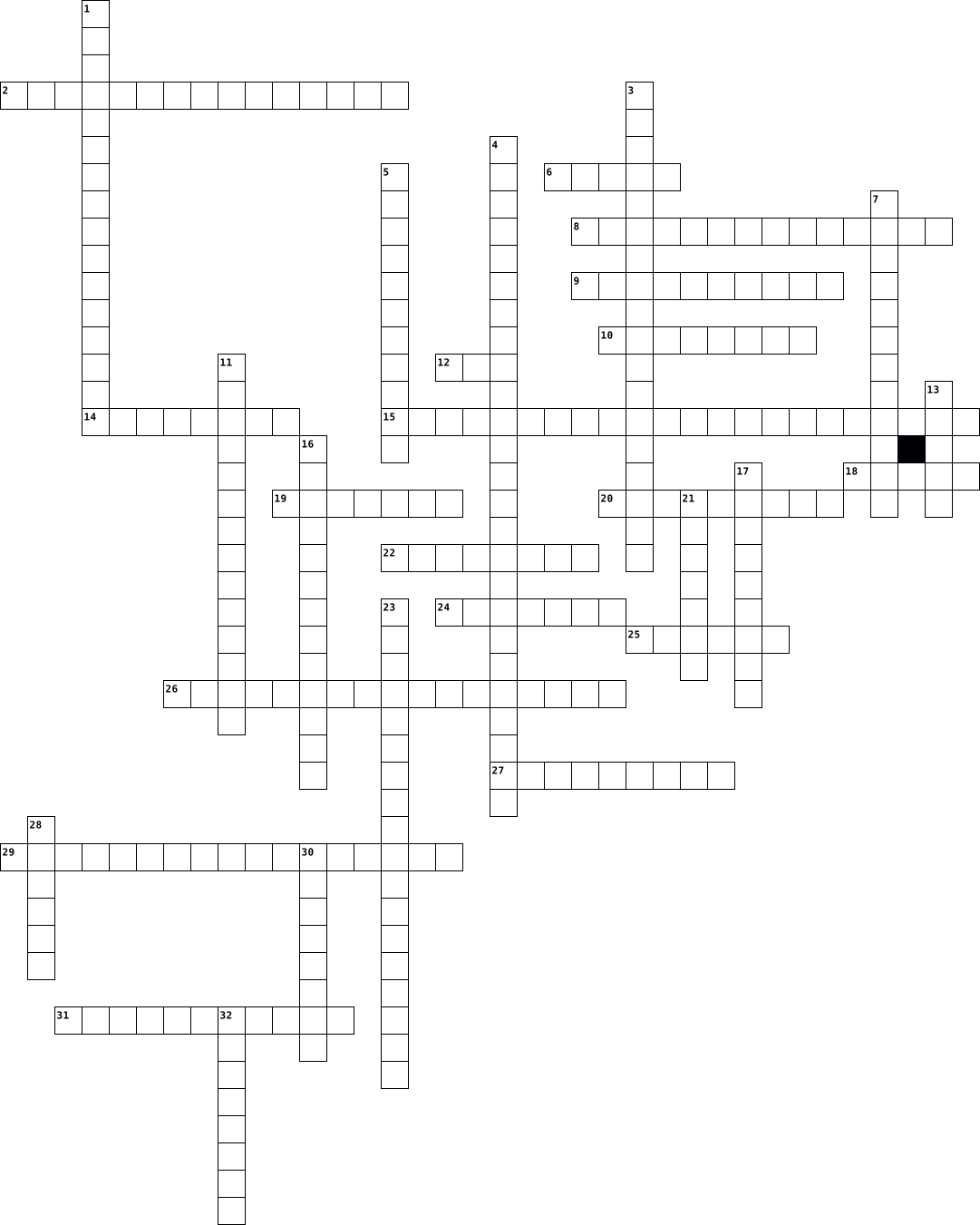
Across
- shows the symbols of the elements in the compound and the ratio of the elements to one another.
- conducts electricity and heat relatively well and are typically malleable or ductile.
- the state or process of rotting; decay.
- the production of chemical compounds by reaction from simpler materials.
- a substance that takes part in and undergoes change during a reaction.
- substance or matter in a state in which it will expand freely to fill the whole of a container, having no fixed shape and no fixed volume .
- an element or substance that is not a metal.
- is a chemical reaction in which an acid and a base react quantitatively with each other.
- firm and stable in shape; not liquid or fluid.
- substances that cannot be chemically interconverted or broken down into simpler substances and are primary constituents of matter.
- consisting of one atom.
- consisting of two atoms.
- a substance produced during a natural, chemical, or manufacturing process.
- replacement, is a type of chemical reaction that occurs when two reactants exchange cations or anions to yield two new products.
- the symbolic representation of a chemical reaction in the form of symbols and formulae
- of a letter figure or symbol) written or printed below the line.
- is a chemical reaction in which one element replaces an/other element in a compound.
- a number in front of a chemical.
Down
- a process that involves rearrangement of the molecular or ionic structure of a substance.
- is an equation for a chemical reaction in which the number of atoms for each element in the reaction and the total charge is the same for both the reactants and the products.
- states that the total number of atoms of reactants must equal the number of atoms of products.
- the process of burning something.
- is a chemical reaction expressed in words rather than chemical formulas.
- is an empirical, calculated, and structurally analytical progression of a series of metals, arranged by their "reactivity" from highest to lowest.
- formed by the electrostatic attraction of oppositely charged ions.
- is a charged chemical composed of two or more atoms covalently bonded or of a metal complex that can be considered to be acting as a single unit.
- relating to or consisting of molecules.
- of or containing water, typically as a solvent or medium.
- reaction where the reactants and products react together to give the reactants back.
- a substance that flows freely but is of constant volume having a consistency like that of water or oil.
- a thing that is composed of two or more separate elements; a mixture.
- a substance that increases the rate of a chemical reaction without itself undergoing any permanent chemical change.
32 Clues: consisting of one atom. • consisting of two atoms. • a number in front of a chemical. • the process of burning something. • the state or process of rotting; decay. • relating to or consisting of molecules. • an element or substance that is not a metal. • firm and stable in shape; not liquid or fluid. • of or containing water, typically as a solvent or medium. • ...
Unit 3 2025-11-13

Across
- | A solution that temporarily contains more than the maximum amount of dissolved solute (more than a saturated solution) at a specific temperature.
- | A process or reaction that releases energy, usually in the form of heat, to the surroundings.
- a homogeneous mixture of two or more substances
- Reaction | A process that involves the rearrangement of the molecular or ionic structure of a substance, as opposed to a change in physical form or a nuclear reaction
- Displacement | A type of chemical reaction where the ions of two compounds exchange places in an aqueous solution to form two new compounds.
- | A solid that is formed in a solution during a chemical reaction. The formation of a precipitate is often indicated by the abbreviation $ (s) $ in a chemical equation.
- Equation | A symbolic representation of a chemical reaction using chemical formulas to represent the reactants and products. The arrow (→) indicates the direction of the reaction.
- Displacement | A type of chemical reaction where one element replaces another element in a compound.
- | A number written slightly below and to the right of a chemical symbol in a formula, indicating the number of atoms of that element in the molecule.
Down
- | A solution that contains the maximum amount of dissolved solute possible under the given conditionsUnsaturated | A solution that contains less than the maximum amount of dissolved solute.
- the substance that is dissolved in another substance (the solvent) to form a solution. It's usually the component present in the smaller amount.
- | A substance that produces hydroxide ions (OH−) when dissolved in water
- | A solution that contains less than the maximum amount of dissolved solute.
- | A type of chemical reaction where a single compound breaks down into two or more simpler substances.
- | A process or reaction that absorbs energy, usually in the form of heat, from the surroundings.
- | A solution containing a relatively large amount of solute per unit volume of solvent.
- | A number placed in front of a chemical formula in a chemical equation to balance the reaction, indicating the relative number of molecules or moles of the substance.
- | A number or symbol written slightly above and to the right of a chemical symbol, usually indicating the charge (oxidation state) of an ion
- | The process where an ionic compound or a molecule separates or breaks apart into smaller ions, atoms, or molecules, usually when dissolved in a solvent like water.
- | A type of chemical reaction where two or more simple substances combine to form a more complex substance.
- | A substance that produces hydrogen ions (H+) when dissolved in water
21 Clues: a homogeneous mixture of two or more substances • | A substance that produces hydrogen ions (H+) when dissolved in water • | A substance that produces hydroxide ions (OH−) when dissolved in water • | A solution that contains less than the maximum amount of dissolved solute. • ...
Chapter 2 2022-10-04

Across
- A reaction that switches places forming a new compound.
- The substances produced by a chemical reaction.
- A reaction that releases thermal energy.
- substance that increase reaction rate by lowering the activation energy.
- A reaction that absorbs energy.
- A chemical reaction that produces carbon dioxide and water.
- A chemical reaction when one compound breaks down into two substances.
- A substance that slows or stops a reaction.
Down
- The small amount of energy needed to start a reaction.
- The starting substances in a chemical reaction.
- A process in which atoms rearrange to form a new substance.
- A catalyst that speeds up a reaction.
- A chemical reaction that has two substances combine to make a compound.
13 Clues: A reaction that absorbs energy. • A catalyst that speeds up a reaction. • A reaction that releases thermal energy. • A substance that slows or stops a reaction. • The starting substances in a chemical reaction. • The substances produced by a chemical reaction. • The small amount of energy needed to start a reaction. • ...
unit 3 Vocabulary 2024-03-12

Across
- Number the number of particles in 1 mole (or mol) of a substance.
- composition tells you by mass what percent of each element is present in a compound.
- reaction a reaction in which a substance reacts with oxygen gas, releasing energy in the form of light and heat.
- reaction the processes by which chemicals interact to form new chemicals with different compositions
- formula a chemical formula showing the simplest ratio of elements in a compound rather than the total number of atoms in the molecule.
- equation the symbolic representation of a chemical reaction in the form of symbols and formula
- of Conservation of Matter The amount of matter stays the same, even when matter changes form.
- mass the mass of one mole of any substance.
- the number that you multiply a variable by
- a solid formed by a change in a solution, often due to a chemical reaction or change in temperature that decreases solubility of a solid.
- replacement reaction a reaction in which one element is substituted for another element in a compound.
Down
- any compound containing water in the form of H2O molecules, usually, but not always, with a definite content of water by weight.
- reaction a chemical process in which two or more simple elements or compounds combine to form a more complex product.
- any item or service you sell to serve a customer's need or want.
- replacement reaction when parts of two ionic compounds are exchanged, making two new compounds.
- formula a formula giving the number of atoms of each of the elements present in one molecule of a specific compound.
- reaction a reaction in which a compound breaks down into two or more simpler substances.
- ratio the ratio between the amounts in moles of any two compounds involved in a balanced chemical reaction.
- The substances which participate in a chemical reaction
- a unit of measurement that is the amount of a pure substance containing the same number of chemical units
20 Clues: the number that you multiply a variable by • The substances which participate in a chemical reaction • any item or service you sell to serve a customer's need or want. • mass the mass of one mole of any substance. • Number the number of particles in 1 mole (or mol) of a substance. • ...
Chemistry 2015-06-15

Across
- displacement- the chemical reactions in which one component each of both the reacting molecules is exchanged to form the products
- reaction- a process that involves rearrangement of the molecular or ionic structure of a substance, as opposed to a change in physical form or a nuclear reaction.
- equation- An expression of equality between two formulas in mathematics
- of conservation mass- the atoms of an object cannot be created or destroyed, but can be moved around and be changed into different particles.
- a chemical reaction in which an acid and a base react quantitatively with each other. In a reaction in water, neutralization results in there being no excess of hydrogen or hydroxide ions present in solution.
- scale- is a measure of how acidic or basic a substance is
- Chemical Equation- represents a chemical reaction using coefficients (numbers in front of reactants and products) that tell how much of the reactants are used and how much of the products are made
- displacement reaction- A single-displacement reaction, also named single-replacement reaction, is a type of oxidation-reduction chemical reaction when an element or ion moves out of one compound and into another - that is, one element is replaced by another in a compound.
- a compound that tastes sour, corrodes metals and tissue, and turns blue litmus paper red.
Down
- make (a liquid) thinner or weaker by adding water or another solvent to it.
- any substance that in water solution is slippery to the touch, tastes bitter, changes the colour of indicators (e.g., turns red litmus paper blue)
- reaction- analysis or breakdown is the separation of a chemical compound into elements or simpler compounds. It is sometimes defined as the exact opposite of a chemical synthesis.
- reaction- is a reaction where two or more elements or compounds
- indicator- a substance that changes colour when added to an acid or base
- non-toxic base that is used to neutralize stomach acid; relieves the pain of excess stomach acid
- reactant-They are the things that are present at the starting point. By convention, the chemical symbols for the reactants are written on the left hand side of the chemical reaction equation. The products are the substances that are formed during the chemical change
- formula- a set of chemical symbols showing the elements present in a compound and their relative proportions, and in some cases the structure of the compound.
- an atom or molecule with a net electric charge due to the loss or gain of one or more electrons.
18 Clues: scale- is a measure of how acidic or basic a substance is • reaction- is a reaction where two or more elements or compounds • equation- An expression of equality between two formulas in mathematics • indicator- a substance that changes colour when added to an acid or base • make (a liquid) thinner or weaker by adding water or another solvent to it. • ...