
chemical reaction Crossword Puzzles
Science Crossword 3 2021-12-14

Across
- A reaction that releases thermal energy and makes stuff hotter.
- A chemical change.
- How hot or cold something is.
- How fast or slow something is.
- The ________ something is, the more kinetic energy it has.
- A reaction that absorbs thermal energy and makes stuff colder.
- Solid to Liquid.
Down
- Energy that is stored up.
- The energy of heat.
- The ________ something is, the more potential energy it has.
- The ________ something is, the more thermal energy it has.
- The energy of movement.
- Liquid to Solid.
- Where potential energy comes from.
- How much work something takes to do.
15 Clues: Liquid to Solid. • Solid to Liquid. • A chemical change. • The energy of heat. • The energy of movement. • Energy that is stored up. • How hot or cold something is. • How fast or slow something is. • Where potential energy comes from. • How much work something takes to do. • The ________ something is, the more thermal energy it has. • ...
What Happens When Fuels Burn? 2022-03-03

Across
- Products must equal to reactants
- When a group of atoms combine
- Chemicals that combines in reaction
- Atoms______ during chemical reaction
- Chemicals produced after a reaction
Down
- smallest particle in Universe
- Proved Law of Conservation
- anything that takes up space
- H2O
- Substance that converts to energy
10 Clues: H2O • Proved Law of Conservation • anything that takes up space • smallest particle in Universe • When a group of atoms combine • Products must equal to reactants • Substance that converts to energy • Chemicals that combines in reaction • Chemicals produced after a reaction • Atoms______ during chemical reaction
Unit 4 Vocabulary Misha P. 2023-11-08

Across
- The mass of one mole of any substance.
- The starting materials in a reaction that undergo a chemical change to form a product.
- The composition that tells you what percent of each element is present in a compound.
- 2 elements become 1 compound.
- 1 compound becomes 2 elements.
- A reaction that balances H+ and OH- ions in a compound, which makes substance neutralized.
- A formula giving the number of atoms of each of the elements present in one molecule of a specific compound.
Down
- The simplest whole-number ration of atoms in a compound.
- A carbon hydrogen compound reacts with oxygen to form water and carbon dioxide.
- 1 element from each compound switch.
- Molecules that must have a subscript of 2.
- A compound that releases OH- ions when dissolved in water.
- A compound that releases H+ ions when dissolved in water.
- A table that shows how acidic an object is.
- Replacing the single element with one of the elements in the compound.
- Are substances that are present at the end of a chemical reaction.
- NaCl
17 Clues: NaCl • 2 elements become 1 compound. • 1 compound becomes 2 elements. • 1 element from each compound switch. • The mass of one mole of any substance. • Molecules that must have a subscript of 2. • A table that shows how acidic an object is. • The simplest whole-number ration of atoms in a compound. • A compound that releases H+ ions when dissolved in water. • ...
Chemical Reactions 2023-06-24

Across
- A change which transfers energy to the surroundings.
- The starting substances in a chemical reaction.
- Type of reaction in which you cannot get back the substances you started with.
- A substance made of two or more atoms chemically joined together.
Down
- A possible source of danger.
- A change which transfers energy from the surroundings.
- A chemical _____ shows how many atoms of each elements are in a compound.
- The resulting substances in a chemical reaction.
8 Clues: A possible source of danger. • The starting substances in a chemical reaction. • The resulting substances in a chemical reaction. • A change which transfers energy to the surroundings. • A change which transfers energy from the surroundings. • A substance made of two or more atoms chemically joined together. • ...
Science Vocabulary 2024-10-16

Across
- Rain is liquid water...
- States that the mass of an object, or collection of objects new changes, no matter how the parts are rearranged
- Participates in a chemical reaction; the ingredients that you start with
Down
- When two or more substances are mixed to created a new substance
- Shreding paper is a example of...
- Representation of a chemical reaction using symbols
- Burning wood is a example of...
- Formed in a chemical reaction; the final output
8 Clues: Rain is liquid water... • Burning wood is a example of... • Shreding paper is a example of... • Formed in a chemical reaction; the final output • Representation of a chemical reaction using symbols • When two or more substances are mixed to created a new substance • Participates in a chemical reaction; the ingredients that you start with • ...
Science Vocabulary 2024-10-16

Across
- Rain is liquid water...
- States that the mass of an object, or collection of objects new changes, no matter how the parts are rearranged
- Participates in a chemical reaction; the ingredients that you start with
Down
- When two or more substances are mixed to created a new substance
- Shreding paper is a example of...
- Representation of a chemical reaction using symbols
- Burning wood is a example of...
- Formed in a chemical reaction; the final output
8 Clues: Rain is liquid water... • Burning wood is a example of... • Shreding paper is a example of... • Formed in a chemical reaction; the final output • Representation of a chemical reaction using symbols • When two or more substances are mixed to created a new substance • Participates in a chemical reaction; the ingredients that you start with • ...
enzyme crossword 2026-03-03

Across
- new substances formed the reaction is completed and is released from the enzyme
- energy-the energy required to start any chemical reactions
- flexible active site that changes shape, or conforms, to the substrate as they bond together.
- - the sum of all chemical reactions occurring in a cells in an organism
- other molecules that inhibits the activity of an enzyme
- process of breaking down large molecules into smaller ones
Down
- - the active site as having a set shape
- organic cofactors
- specific molecules that binds to the active site of enzyme and undergoes chemical reaction
- process of making large molecules from smaller ones
- absorbs free energy from the surroundings
- a net release of free energy
12 Clues: organic cofactors • a net release of free energy • - the active site as having a set shape • absorbs free energy from the surroundings • process of making large molecules from smaller ones • other molecules that inhibits the activity of an enzyme • energy-the energy required to start any chemical reactions • process of breaking down large molecules into smaller ones • ...
Chemistry Crossword 2023-09-14

Across
- A substance that speeds up a chemical reaction without being consumed in the process.
- A substance composed of only one type of atom, characterized by its atomic number.
- The smallest unit of an element, consisting of a nucleus (protons and neutrons) and electrons orbiting the nucleus.
- A substance formed when two or more different elements chemically combine in fixed proportions.
- Formula A representation of a compound's composition using symbols and subscripts to indicate the number of atoms of each element.
- A measure of the acidity or alkalinity of a solution, with values ranging from 0 (acidic) to 14 (basic).
- Bond The force that holds atoms together in compounds; can be covalent or ionic.
- A substance that releases hydrogen ions (H+) in solution, often with a sour taste.
Down
- Equation A symbolic representation of a chemical reaction, showing the reactants and products.
- Table A chart that organizes all known chemical elements based on their atomic number and chemical properties.
- A group of atoms bonded together; the smallest unit of a compound.
- A substance that can accept hydrogen ions (H+) in solution, often with a bitter taste and slippery feel.
- Electrons Electrons in the outermost energy level of an atom, responsible for chemical bonding and reactivity.
- Bond A type of chemical bond formed by the transfer of electrons from one atom to another.
- Reaction The process in which substances (reactants) are transformed into new substances (products) through the breaking and forming of chemical bonds.
15 Clues: A group of atoms bonded together; the smallest unit of a compound. • Bond The force that holds atoms together in compounds; can be covalent or ionic. • A substance composed of only one type of atom, characterized by its atomic number. • A substance that releases hydrogen ions (H+) in solution, often with a sour taste. • ...
Chemical Reactions 2024-12-05

Across
- A particle that gains or loses electrons.
- An element that swaps places with another element that is in a compound.
- Pairing of multiple elements that are chemically bonded.
- Any sort of hydrocarbon that reacts with oxygen and releases heat. Resulting in carbon dioxide and water.
- Numbers in front of chemical blueprints.
- The first elements that go through that endure in a chemical reaction.
- Elements Elements that are automatically given 2 subscripts.
Down
- A pair or more elements that fuse to conceive one product.
- A single reactant that erodes into multiple products.
- A duo of reacting compounds that trade "partners."
- The number/amount of a specific element.
- The result of the reactants, making a chemical reaction.
12 Clues: The number/amount of a specific element. • Numbers in front of chemical blueprints. • A particle that gains or loses electrons. • A duo of reacting compounds that trade "partners." • A single reactant that erodes into multiple products. • Pairing of multiple elements that are chemically bonded. • The result of the reactants, making a chemical reaction. • ...
CHANGES AROUND US 2017-05-24

Across
- New substance formed after chemical reaction
- The original substance
- A new product is formed
- It occurs when there is a chemical change
- Liquid changes to water
Down
- Chlorophyll in plants
- All most all are reversible
- Energy required to start a chemical reaction
8 Clues: Chlorophyll in plants • The original substance • A new product is formed • Liquid changes to water • All most all are reversible • It occurs when there is a chemical change • New substance formed after chemical reaction • Energy required to start a chemical reaction
Ch 13 Maddison Brehmer 2021-11-30

Across
- AB+oxygen --> oxides of A & B + H2O
- most reactions go faster at a ______ temperature
- also known as activation energy
- chemical equations must be ________
- the concentration of products increases
- how quickly the reaction takes place
- in this reaction there is a net release of energy
- in this reaction there is a net absorption of energy
Down
- the amount of energy required to pull two bonded atoms apart
- same rate
- when reaction and it’s reverse act at
- the principle thats states that if changed, the equilibrium shifts to oppose change, until new equilibrium is reached.
- of reactants decreases and how
13 Clues: same rate • of reactants decreases and how • also known as activation energy • AB+oxygen --> oxides of A & B + H2O • chemical equations must be ________ • how quickly the reaction takes place • when reaction and it’s reverse act at • the concentration of products increases • most reactions go faster at a ______ temperature • in this reaction there is a net release of energy • ...
Chapter 6 Biology Puzzle (15 terms) 2022-01-18

Across
- small compounds that are made of carbon, nitrogen, oxygen, hydrogen, and sulfur.
- pure substance formed when 2 or more different elements combine
- the biological catalysts that speed up the rate of chemical reactions in biological processes
- a substance that lowers the activation energy needed to start a chemical reaction
- molecules made from repeating units of identical
- type of macronutrient found in certain foods and drinks
- positively charged particles
- a compound made of small carbon compounds called amino acids
- pure substance that cannot be broken down into other substances
- molecules made mostly of carbon and hydrogen that make up fats, oils, and waxes
Down
- building blocks of matter
- smaller repeating subunits composed of carbon, nitrogen, oxygen, phosphorus, and hydrogen atoms
- the minimum amount of energy needed for reactants to form products in a chemical reaction
- complex macromolecules that store and transmit genetic information
- an electrical attraction between two oppositely charged atoms
- attractions between the molecules
16 Clues: building blocks of matter • positively charged particles • attractions between the molecules • molecules made from repeating units of identical • type of macronutrient found in certain foods and drinks • a compound made of small carbon compounds called amino acids • an electrical attraction between two oppositely charged atoms • ...
Physical Sciences 2024-04-16

Across
- the force of attraction or repulsion that exist between like or unlike poles
- a liquid fossil fuel also known as crude oil
- the ability to do work
- gas a gaseous fossil fuel
- a wak, long-range, attractive force that acts between objects
- force the force created by a magnet
- force a force that involves a physical connection with an object
- a solid fossil fuel that formed from decayed plant material
Down
- energy the energy obtained from moving air
- point the temperature at which a substance changes from a liquid to a gas or vice versa
- the distance an object travels per unit of time
- a substance formed during a chemical reaction
- force the force created by electric charges
- a substance that takes part in a chemical reaction
- a substance taht cannot be broken down into a simpler substance by ordinary chemical means
- a region that contains similar ecosystems and is characterized by certain climatic conditions
16 Clues: the ability to do work • gas a gaseous fossil fuel • force the force created by a magnet • energy the energy obtained from moving air • force the force created by electric charges • a liquid fossil fuel also known as crude oil • a substance formed during a chemical reaction • the distance an object travels per unit of time • ...
Cellular Metabolism - Ch. 4 2022-09-14

Across
- the process of making mRNA from DNA
- larger molecules broken down into smaller ones, releasing energy
- the type of bond that holds amino acids together
- process creating exact copies of DNA
- the specific molecule each enzyme acts upon
- when blood glucose levels are high, the liver turns it into...
- larger molecules constructed from smaller ones, requiring energy
- these molecules transfer info. from nucleus to cytoplasm & ribosomes
- long molecules of DNA and proteins
Down
- 20 different acids represented in the DNA by a triplet code (sequence of 3 nucleotides)
- the type of enzyme that determines the rate of a metabolic pathway
- the acid formed when insufficient oxygen is available to finish the Krebs cycle
- aerobic (using oxygen)catabolism in the citric acid (or Krebs) cycle, happening after glycolysis in the mitochondria, yielding 36 ATP molecules
- the phase of mitosis when the cell's DNA is copied
- a portion of DNA molecule that codes for a specific protein
- When you consume more carbohydrate then what can be stored as glycogen, glucose is used to form ____.
- info. that instructs cells to synthesize proteins
- the 1st reaction in catabolism conducted without oxygen (anaerobic) in the cytoplasm that only yields 2 ATP molecules
- the energy transfer molecule composed of adenine, ribose, 3 phosphates
- alterations in genetic material via substitutions, deletions, additions that often cause serious medical problems
- proteins that promote specific chemical reactions by lowering the activation energy needed to start a chemical reaction, without being consumed in the reaction
- total of all chemical reactions in cells
22 Clues: long molecules of DNA and proteins • the process of making mRNA from DNA • process creating exact copies of DNA • total of all chemical reactions in cells • the specific molecule each enzyme acts upon • the type of bond that holds amino acids together • info. that instructs cells to synthesize proteins • the phase of mitosis when the cell's DNA is copied • ...
Unit 10 Crossword Puzzle Lolah Slagg 2024-05-12

Across
- a molecule or ion capable of either donating a proton, known as a Brønsted–Lowry acid
- is a scale that canmeasure of how acidic/basic water is
- the cationic form of atomic hydrogen, represented with the symbol H⁺
- any hydrogen-containing substance that is capable of donating a proton (hydrogen ion) to another substance
- a state in which the rate of the forward reaction equals the rate of the backward reaction
- A small, positively charged particle of matter found in the atoms of all elements
- the ratio of the moles of a solute to the total liters of a solution
- refers to the amount of a substance in a defined space
- a compound formed by the joining of two or more chemical compounds
- a substance that is in a gaseous, or vaporous, state of matter.
- any atom or group of atoms that bears one or more positive or negative electrical charges
Down
- A compound that can react with bases and acids
- a small portion of matter.
- the process by which an atom or a molecule acquires a negative or positive charge by gaining or losing electrons
- a substance that can accept hydrogen ions in water and can neutralize an acid.
- a group of atoms bonded together, representing the smallest fundamental unit of a chemical compound
- a solution in which the solvent is water
- a type of chemical reaction where an atom, ion, or molecule donates an electron to another atom, ion, or molecule
- A substance that is neither acidic nor alkaline
- A particle with no charge
20 Clues: A particle with no charge • a small portion of matter. • a solution in which the solvent is water • A compound that can react with bases and acids • A substance that is neither acidic nor alkaline • refers to the amount of a substance in a defined space • is a scale that canmeasure of how acidic/basic water is • ...
Unit 10 Crossword Puzzle Lolah Slagg 2024-05-12

Across
- a molecule or ion capable of either donating a proton, known as a Brønsted–Lowry acid
- is a scale that canmeasure of how acidic/basic water is
- the cationic form of atomic hydrogen, represented with the symbol H⁺
- any hydrogen-containing substance that is capable of donating a proton (hydrogen ion) to another substance
- a state in which the rate of the forward reaction equals the rate of the backward reaction
- A small, positively charged particle of matter found in the atoms of all elements
- the ratio of the moles of a solute to the total liters of a solution
- refers to the amount of a substance in a defined space
- a compound formed by the joining of two or more chemical compounds
- a substance that is in a gaseous, or vaporous, state of matter.
- any atom or group of atoms that bears one or more positive or negative electrical charges
Down
- A compound that can react with bases and acids
- a small portion of matter.
- the process by which an atom or a molecule acquires a negative or positive charge by gaining or losing electrons
- a substance that can accept hydrogen ions in water and can neutralize an acid.
- a group of atoms bonded together, representing the smallest fundamental unit of a chemical compound
- a solution in which the solvent is water
- a type of chemical reaction where an atom, ion, or molecule donates an electron to another atom, ion, or molecule
- A substance that is neither acidic nor alkaline
- A particle with no charge
20 Clues: A particle with no charge • a small portion of matter. • a solution in which the solvent is water • A compound that can react with bases and acids • A substance that is neither acidic nor alkaline • refers to the amount of a substance in a defined space • is a scale that canmeasure of how acidic/basic water is • ...
ENZYMES 2018-11-20

Across
- a tropical fruit shaped like an elongated melon, with edible orange flesh and small black seeds.
- Mixture is an aqueous solution consisting of a mixture of a weak acid and its conjugate base, or vice versa.
- an enzyme present in pineapple
- an enzyme that breaks down proteins and peptides.
- an edible bulb with a pungent taste and smell, composed of several concentric layers, used in cooking.
- a water-soluble cleansing agent that combines with impurities and dirt to make them more soluble and differs from soap in not forming a scum with the salts in hard water.
- is used for gene amplification or making multiple copies of DNA
- are used to contain disrupted cells from which DNA is to be obtained
- a threadlike structure of nucleic acids and protein found in the nucleus of most living cells, carrying genetic information in the form of genes.
- an enzyme, found chiefly in saliva and pancreatic fluid, that converts starch and glycogen into simple sugars.
- a substance that increases the rate of a chemical reaction without itself undergoing any permanent chemical change.
- these are specific and reusable
- any chemical compound formed from the reaction of an acid with a base, with all or part of the hydrogen of the acid replaced by a metal or other cation
Down
- Energy the amount of energy needed for a chemical reaction to take place
- a virtually colorless and tasteless water-soluble protein prepared from collagen and used in food preparation as the basis of jellies, in photographic processes, and in glue.
- Sites regions on surfaces of enzymes that fit the substrate
- this thing separates onion cells from each other
- a large juicy tropical fruit consisting of aromatic edible yellow flesh surrounded by a tough segmented skin and topped with a tuft of stiff leaves.
- shows luminuos bands of genes or DNA fragments isolated by electrophoresis which will tell the locationof the isolated genes.
- substance formed from the substrate at the end of the chemical reaction with an enzyme
- substance that an enzyme acts upon
- the main structural protein found in skin and other connective tissues, widely used in purified form for cosmetic surgical treatments.
- any organic compound whose molecule contains one or more hydroxyl groups attached to a carbon atom.
- an enzyme present in papaya
- the disintegration of a cell by rupture of the cell wall or membrane
25 Clues: an enzyme present in papaya • an enzyme present in pineapple • these are specific and reusable • substance that an enzyme acts upon • this thing separates onion cells from each other • an enzyme that breaks down proteins and peptides. • Sites regions on surfaces of enzymes that fit the substrate • is used for gene amplification or making multiple copies of DNA • ...
Chemistry of Life Vocabulary 2022-08-29

Across
- type of mixture that involves a solvent and solute
- substances that are formed as a result of a chemical reaction
- larger molecule made of monomers
- bond, specific bond where a hydrogen atom bonds to an electronegative atom or molecule
- bond, when an atom borrow an electron from another atom to fill its outer shell; the strongest bond
- specific type of organic compound composed of carbon, hydrogen, and oxygen in a ratio of 1:2:1
- Variable, what is deliberately changed or manipulated in an experiment
- Variable, what changes in response to the IV; what is measured
- the smallest unit of an element that retains all the chemical properties of that element
- the most diverse macromolecule in terms of structure and function
- speeds up the chemical reaction
- the attraction between molecules of the same substance
- building blocks (units)
- anything that has mass and takes up space
- chemicals that participate in a chemical reaction
- acid, store, transmit, and express genetic information
- large organic molecules (carbon-containing) that make up all living things
- substance that cannot be broken down into simpler substances and is made up of atoms
- atoms of the same element that have varying numbers of neutrons
- an electronically charged atom
- molecule, unequal distribution of charges; dissolves in water
Down
- polymers of monosaccharides, starch and glycogen
- monomer that is adenine, guanine, thymine, cytosine, or urasil
- substance that is dissolved
- site, where the substrate bonds to the enzyme
- two or more different elements bonded together,
- monomers of simple sugars
- two monosaccharides combined
- insoluble organic compounds that are made up of fatty acids
- substance that when dissolved in water accepts protons increasing the concentration of hydroxide ions; pH greater than 7
- molecule, no separation of charge; no positive or negative poles formed; does not dissolve in water
- positively charged subparticle located in the nucleus of an atom
- molecule that attaches to the enzyme's active site
- scale, used to measure the concentration of hydrogen ions in a solution
- substance that dissolves the solute
- two or more atoms held together by strong chemical bond
- energy, energy that chemicals need to begin a reaction
- bond, when an outer electron is shared between two atoms
- subatomic particle that has no charge located in the nucleus
- negatively charged subparticle located in the outer shells of an atom
- substance that when dissolved in water donates protons increasing the concentration of hydrogen ions; pH less than 7
41 Clues: building blocks (units) • monomers of simple sugars • substance that is dissolved • two monosaccharides combined • an electronically charged atom • speeds up the chemical reaction • larger molecule made of monomers • substance that dissolves the solute • anything that has mass and takes up space • site, where the substrate bonds to the enzyme • ...
Ch 1 +2 Vocab 2023-09-11

Across
- the number of protons in the nucleus of an atom of a given element
- a pure substance that cannot be broken down chemically into any other substances; all atoms of an element have the same atomic number
- A chemical within a cell that binds to an enzyme, altering the enzyme's shape or structure in a way the causes the enzyme to catalyze a reaction
- an explanatory hypothesis for a natural phenomenon that is exceptionally well supported by empirical data
- A general, fact-based understanding of the basics of biology and other sciences, the scientific method, and the social, political, and legal implications of scientific information.
- Observation of one or only a few instances of a phenomenon
- carbohydrates formed by the union of two simple sugars, such as sucrose and lactose
- any condition applied to the subjects of a research study that is not applied to subjects in a control group
- the mass of an atom; the combined mass of the protons, neutrons, and electrons in an atom
- the minimum energy needed to initiate a chemical reaction
- the strength of a bond between two atoms, defined as the energy required to break the bond
- the sequence of amino acids in a polypeptide chain
Down
- a small molecule that forms the head region of a triglyceride fat molecule
- the property of some elements or isotopes of having a nucleus that breaks down spontaneously, releasing tiny, high-speed particles that carry energy
- repelled by water
- the amount of matter in a given sample of a substance
- A tabular display in which all the known chemical elements are arranged in the order of their atomic number and on the basis of other aspects of their atomic structures
- an electrically neutral particle in the atomic nucleus
- the part of an enzyme to which reactants bind and undergo a chemical reaction
- a chemical within a cell that binds to an enzyme's ability to catalyze a reaction
- attracted to water
- a negatively charged particle that moves around the atomic nucleus
- an atom that carries an electrical charge, positive or negative, because it has either lost or gained an electron or electrons from its normal stable configuration
- a positively charged particle in the atomic nucleus
- a particle of matter that cannot be further subdivided without losing its essential properties
- A nitrogen atom bonded to three hydrogen atoms
26 Clues: repelled by water • attracted to water • A nitrogen atom bonded to three hydrogen atoms • the sequence of amino acids in a polypeptide chain • a positively charged particle in the atomic nucleus • the amount of matter in a given sample of a substance • an electrically neutral particle in the atomic nucleus • the minimum energy needed to initiate a chemical reaction • ...
Chemical reactions review 2024-02-14

Across
- The name of the element with the symbol H
- The negative particle around the atom
- One of the first two substances leading to the product
- The 5 ( ) in how we make observations
- The element for the air we breathe
- A reaction in which a substance breaks down into two substances
Down
- A reaction resulting in CO2 and H20
- A reaction in which two substances become one
- How we measure a substance's qualities/characteristics
- The neutral particle in the atom
- The positive particle inside the atom
- The relative size of things
- The end result of a chemical reaction
13 Clues: The relative size of things • The neutral particle in the atom • The element for the air we breathe • A reaction resulting in CO2 and H20 • The positive particle inside the atom • The negative particle around the atom • The end result of a chemical reaction • The 5 ( ) in how we make observations • The name of the element with the symbol H • ...
Alex Selhorst 2025-03-24

Across
- the substances formed as a result of a chemical reaction or process, appearing on the right-hand side of a chemical equation
- the basic unit of a chemical element
- Passive transport is a type of membrane transport that does not require energy to move substances across cell membranes
- a protein that acts as a biological catalyst accelerating chemical reactions within living organisms without being consumed or altered in the process
- a structure composed of different tissues that work together to perform a specific function
- a substance upon which an enzyme acts or a surface or medium on which an organism grows or is attached
- a group of atoms bonded together
- a living individual encompassing any form of life such as a plant animal or microorganism
- the minimum amount of energy required to initiate a chemical reaction or to convert reactants into a transition state
- a membranes ability to allow some substances to pass through while preventing others acting as a gatekeeper for the cells environment
Down
- a type of lipid molecule that forms the primary structural component of cell membranes featuring a hydrophilic head phosphate group and two hydrophobic tails fatty acids
- the movement of molecules or ions across a cell membrane from a region of lower concentration to a region of higher concentration
- a group of organs that work together to perform one or more specific functions
- a subcellular structure that has one or more specific jobs to perform in a cell
- a group of similar cells that work together to perform a specific function
- the specific region of an enzyme where substrate molecules bind and undergo a chemical reaction facilitating catalysis
- a protein or nucleic acid losing its original shape and function often due to factors like heat chemicals or pH changes disrupting the bonds that hold the molecule together
- the passive movement of water molecules across a semipermeable membrane from an area of lower solute concentration
- substances that lack an affinity for water meaning they repel or are insoluble in water and are typically nonpolar
- the movement of molecules from an area of high concentration to an area of low concentration
- a substance or molecule that has a strong affinity for water meaning it readily dissolves in or mixes with water
- the smallest structural and functional unit of an organism
22 Clues: a group of atoms bonded together • the basic unit of a chemical element • the smallest structural and functional unit of an organism • a group of similar cells that work together to perform a specific function • a group of organs that work together to perform one or more specific functions • ...
Form III Chemistry 2013-11-17

Across
- A reaction which releases energy in the form of heat into the surrounding environment is __thermic.
- Haematite is a common example of this (two words)
- The best person at Orkeeswa
- An ___________ collision is a collision which succeeds in producing a chemical reaction
- Added to the blast furnace to 1) produce the reducing agent and 2) burn to produce the necessary heat energy for the process
- Increasing the concentration of Nitrogen in the Haber process shifts the equilibrium to the______
- Increasing the concentration of a ___________ will increase the rate of reaction
- An example of a strong electrolyte
- In the electrolysis of copper sulphate solution copper is discharged in preference to hydrogen because it is _______ in the electrochemical series
- Evaporation of water and photosynthesis are examples of this type of reaction
- A naturally occurring solid material from which a metal or valuable mineral can be extracted
- In a blast furnace this gas reduces iron oxide to give iron and carbon dioxide
- An example of a weak electrolyte
- These migrate to the anode
- The process of obtaining a pure form of metal from their natural ores
- This is mixed with sodium chloride to reduce the melting point of the electrolyte in the Downs cell
- The energy that must be overcome by the reactants in order for a chemical reaction to occur
- One of the raw materials needed for the extraction of iron from iron ore
- The substance introduced at the bottom of a blast furnace (two words)
- The process of industrial production of ammonia
Down
- A product of the electrolysis of dilute NaCl solution
- The number of moles of aluminium which would be deposited after the conduction of 12 Faradays of charge
- When forward and backwards reaction rates are equal
- A reaction in which The reactants have more energy than the products; therefore the products are more stable
- A reversible reaction where forward and backwards reactions take place at the same time
- The positive electrode in an electrolytic cell
- These ions are positive
- Catalyst in the Haber Process
- Increasing the concentration of Nitrogen in the Haber process increases the rate of reaction in the _________ direction
- Another product of the electrolysis of dilute NaCl solution
- In an endothermic reaction delta H is ______
- Increasing the pressure in the Haber process shifts the equilibrium to the ________
- A substance which alters the rate of reaction but remains chemically unchanged
- Increasing the temperature in the Haber process shifts the equilibrium to the ________
- This happens to copper ions at the cathode
- The total energy required to break the bonds is lower than the energy required to form new bonds in an _____thermic reaction.
- We might use AgNO3 as the electrolyte if we wanted to add a layer of this metal to an object
37 Clues: These ions are positive • These migrate to the anode • The best person at Orkeeswa • Catalyst in the Haber Process • An example of a weak electrolyte • An example of a strong electrolyte • This happens to copper ions at the cathode • The positive electrode in an electrolytic cell • In an endothermic reaction delta H is ______ • ...
Chemistry Crossword 2023-05-16

Across
- a _________ change is when no new substance has formed
- ___________________ of mass is a law that says matter cannot be created nor destroyed
- a _________ change is when a new substance is formed
- an unstable isotope that undergoes radioactive decay
Down
- the final substances that are created from a chemical reaction
- have the same number of protons but a different number of neutrons
- a charged particle
- the initial substances that react to cause a chemical reaction
- the smallest particle of a chemical element
9 Clues: a charged particle • the smallest particle of a chemical element • a _________ change is when a new substance is formed • an unstable isotope that undergoes radioactive decay • a _________ change is when no new substance has formed • the final substances that are created from a chemical reaction • the initial substances that react to cause a chemical reaction • ...
Science 2025-06-23

Across
- Excess acid build-up neutraliser
- short hand abbreviations for element names.
- Chemicals that change colour when added to an acid or base
- when the nucleus loses a neutron.
- a feature of certain types of atoms
- the average mass of the atoms in an element
- The opposite of an acid
- a liquid that releases positively charged ions.
- the number of protons in the nucleus of an atom
Down
- the product of two correct substances mixing.
- Water -> Hydrogen + Oxygen. That is a ... Reaction
- an exothermic chemical reaction
- When acid is added to a base.
- PH
- Name of the periodic table developer
- many of naturally occurring elements are :
- Oxygen + Hydrogen -> Water. That is a ... Reaction
- The ........ Table
18 Clues: PH • The ........ Table • The opposite of an acid • When acid is added to a base. • an exothermic chemical reaction • Excess acid build-up neutraliser • when the nucleus loses a neutron. • a feature of certain types of atoms • Name of the periodic table developer • many of naturally occurring elements are : • short hand abbreviations for element names. • ...
Chase cromer 4th period vocabulary 6B 2017-03-23

Across
- vertical column of elements on the Periodic Table that have similar physical and chemical properties.
- states that matter is neither created nor destroyed in ordinary chemical and physical changes.
- A chemical reaction in which heat is released and usually feels warm when the heat is released from the reaction.
- horizontal row of elements on the Periodic Table that have the same number of electron shells.
Down
- elements that have some properties of metals and non-metals and are found along the zigzag on the Periodic Table.
- A chemical reaction that requires an input of energy and usually feels cold when it absorbs heat in the reaction.
- electrons on the outermost energy level of an atom that determine the reactivity of the atom.
- Bond an interaction that holds atoms together.
8 Clues: Bond an interaction that holds atoms together. • electrons on the outermost energy level of an atom that determine the reactivity of the atom. • states that matter is neither created nor destroyed in ordinary chemical and physical changes. • horizontal row of elements on the Periodic Table that have the same number of electron shells. • ...
Grade 9 Science Crossword 2025-10-21

Across
- The sideways and downward movement of the edge of a plate of the earth's crust into the mantle beneath another plate.
- The speed of something in a given direction.
- The rate of change of velocity per unit of time.
- A group of atoms bonded together, representing the smallest fundamental unit of a chemical compound that can take part in a chemical reaction.
- Relating to the structure of the earth's crust and the large-scale processes which take place within it.
- The quantity of motion of a moving body, measured as a product of its mass and velocity.
- A substance that increases the rate of a chemical reaction without itself undergoing any permanent chemical change.
- The envelope of gases surrounding the earth or another planet.
- Each of two or more forms of the same element that contain equal numbers of protons but different numbers of neutrons in their nuclei.
- Relating to or denoting chemical bonds formed by the sharing of electrons between atoms.
- A substance produced by a living organism which acts as a catalyst to bring about a specific biochemical reaction.
Down
- The process by which green plants and some other organisms use sunlight to synthesize foods with the help of chlorophyll pigment.
- A property of matter by which it continues in its existing state of rest or uniform motion in a straight line, unless that state is changed by an external force.
- The process of eroding or being eroded by wind, water, or other natural agents.
- The resistance that one surface or object encounters when moving over another.
- The regions of the surface, atmosphere, and hydrosphere of the earth (or analogous parts of other planets) occupied by living organisms.
- The tendency toward a relatively stable equilibrium between interdependent elements, especially as maintained by physiological processes.
- A biological community of interacting organisms and their physical environment.
- An organelle found in large numbers in most cells, in which the biochemical processes of respiration and energy production occur.
- Relating to, containing, or using ions.
20 Clues: Relating to, containing, or using ions. • The speed of something in a given direction. • The rate of change of velocity per unit of time. • The envelope of gases surrounding the earth or another planet. • The resistance that one surface or object encounters when moving over another. • The process of eroding or being eroded by wind, water, or other natural agents. • ...
PS 8.2 Review 2015-04-21

Across
- an electrochemical cell that produces a chemical reaction through electrolysis
- the process of forming a thin coating of metal on an object by electrolysis
- shorter form of reduction-oxidation
- reactions in which electrons are transferred between atoms are called____
- in an electrochemical cell, oxidation occurs at the_____
- an atom losing electrons is________
- these types of solutions conduct electricity
- this field of chemistry addresses chemical reactions that involve an electric current
- an atom gaining electrons is_______
- in this cell, electricity is produced as a result of chemical reactions within the cell; commonly called batteries
Down
- one of the most widely used types of voltaic cell
- a device designed to produce an electrochemical reaction
- designed to have the reactants continually replenished from an outside source; cell can operate as long as reactants are available
- the solute in an electrolytic solution
- in an electrochemical cell, reduction occurs at the_______
- designed to be recharged with electricity from an outside source
16 Clues: shorter form of reduction-oxidation • an atom losing electrons is________ • an atom gaining electrons is_______ • the solute in an electrolytic solution • these types of solutions conduct electricity • one of the most widely used types of voltaic cell • a device designed to produce an electrochemical reaction • in an electrochemical cell, oxidation occurs at the_____ • ...
Biology Vocab 2025-04-30

Across
- the diffusion of water across a semipermeable membrane
- a molecule made of amino acids, preforming various functions in the body
- tiny openings on leaves that let CO2 in and O2 out
- chemical bond of atoms that share electrons
- movement of substances through the cell membrane without using energy
- a molecule that has a positive and negative end
- a chemical reaction that breaks a compound by adding water
- a substance that speeds up a chemical reaction without being used up
Down
- a small molecule that can join with others to form a polymer
- the building blocks of proteins
- a protein that speeds up biochemical reactions
- a solution with the same concentration of solutes as another solution
- having identical alleles for a particular genes
- an organism that makes its own food through photosynthesis
- the passing of genetic traits from parents to offspring through the transmission of genes
- a sac inside chloroplasts where light reactions occur
16 Clues: the building blocks of proteins • chemical bond of atoms that share electrons • a protein that speeds up biochemical reactions • having identical alleles for a particular genes • a molecule that has a positive and negative end • tiny openings on leaves that let CO2 in and O2 out • a sac inside chloroplasts where light reactions occur • ...
Photosynthesis and Cellular Respiration 2024-10-11

Across
- process that occurs without the presence of oxygen, like fermentation, to produce energy
- source of a plant's biomass
- an anaerobic process that converts sugars into energy, producing alcohol or lactic acid as byproducts
- organelles in plant cells where photosynthesis occurs
- a byproduct of anaerobic respiration in some organisms, causing muscle fatigue and soreness
- a specific type of sugar, a product of photosynthesis
Down
- process that requires oxygen to produce energy
- first step of cellular respiration that creates 2 net ATP
- a substance that takes part in a chemical reaction, undergoing a change
- a molecule formed when ATP loses a phosphate group and releases energy
- a substance formed as a result of a chemical reaction
- gas essential for cellular respiration
- a green pigment found in chloroplasts, essential for photosynthesis as it captures light energy
- cellular organelles responsible for generating energy (ATP)
- stored energy within the bonds of molecules, released during chemical reactions
- a molecule that stores and provides energy for cellular activities
16 Clues: source of a plant's biomass • gas essential for cellular respiration • process that requires oxygen to produce energy • a substance formed as a result of a chemical reaction • organelles in plant cells where photosynthesis occurs • a specific type of sugar, a product of photosynthesis • first step of cellular respiration that creates 2 net ATP • ...
Chemical Changes Crossword 2023-02-15

Across
- Occurs when two or more molecules interact and the molecules change into a new substance
- A chemical reaction between substances, usually including oxygen accompanied by giving off heat and or light.
- When two or more substances join to form new substances with new chemical properties
Down
- An indication of a chemical change when during chemical bonding, energy is released or absorbed making their surroundings hotter or cooler
- Changes the form or appearance of a substance
- An indication of a chemical change when new molecules created in a chemical reaction radiate light differently producing new colors.
- A solid that suddenly appears in a solution and settles to the bottom, collects on another object, or makes the solution cloudy
- Formed when gases produced in a chemical reaction are released
8 Clues: Changes the form or appearance of a substance • Formed when gases produced in a chemical reaction are released • When two or more substances join to form new substances with new chemical properties • Occurs when two or more molecules interact and the molecules change into a new substance • ...
Chemistry Crossword 2015-11-13

Across
- A catalyst involved in chemical reactions in living things
- Group 1 elements in the periodic table, not including hydrogen; the most reactive of the metals
- A pure substance formed when at least one metal and one nonmetal combine
- Ability of a substance to conduct electricity
- A mixture that you can see the different substances clearly/the different substance that make up the substance are visible
- Group 17 elements in the periodic table; the most reactive non-metals
- An experiment in which all reactants and all products of a chemical reaction are accounted for
- An invisible negatively charged particle that orbits the nucleus of an atom
- A chemical reaction that occurs when oxygen reacts violently with a substance to form a new substance and gives off exothermic energy
- A cloudy mixture that the tiny particles of one substance is held within each other, and the particles cannot be separated from each other
- Mass of one atom of an element calculated from the total number of protons, neutrons and electrons of that atom. Measured in amu
- A vertical column of elements in the periodic table
Down
- An atom/group of atoms that has become electrically charged because it has lost/gained electrons
- A pure substance that cannot be broken down into other substances; substance made up of only one type of atom
- A steady flow of charged particles
- A change that results when two or more substances react to create a different substance of unique properties
- The number of protons and electrons in the nucleus of one atom of an element
- Group 2 elements in the periodic table: their reactivity is not as strong as that of an alkali metal
- The smallest part of an element that is representative of that element; a neutral particle made up of a nucleus that contains protons/neutrons and electrons
- A reaction that takes place when two or more substances react to form a new substance of unique properties
- The positively charged centre of an atom that contains protons and neutrons
- Combination of symbols that represent a compound: the formula identities the elements in a compound and the amount of each element
- A material that electricity can move through easily
- Group 18 elements in the Periodic Table of Elements that are the most stable and non reactive non-metal
- A chemical combination of two or more elements in a specific ratio
- substance that helps a chemical reaction to proceed more quickly
26 Clues: A steady flow of charged particles • Ability of a substance to conduct electricity • A material that electricity can move through easily • A vertical column of elements in the periodic table • A catalyst involved in chemical reactions in living things • substance that helps a chemical reaction to proceed more quickly • ...
Chemistry Review 2017-09-25

Across
- 1 kcal
- 1 calorie
- affecting form but not chemical composition of a chemical substance, used to separate mixtures into their component compounds
- depends on the amount of matter; volume, mass, length, weight
- Units for heat
- change in temperature
- bubbles, color change, temperature change, gas, odor change
- The study of the transfers of energy as heat that accompany chemical and physical changes
- Abbreviation for specific heat
- density
Down
- a nutritional energy unit
- characteristic of a substance that can be determined without changing the identities
- the amount of heat lost or gained
- when the substance has changed as a result of a chemical reaction
- not significant digits
- 1000 calories
- significant after a decimal
- unit for specific heat
- chemicalreaction involving the rearrangement of atoms of one or more substance and a change in their chemical properties resulting in at least one new substance
- does not depend on matter present; density, melting point, color, reactivity
20 Clues: 1 kcal • density • 1 calorie • 1000 calories • Units for heat • change in temperature • not significant digits • unit for specific heat • a nutritional energy unit • significant after a decimal • Abbreviation for specific heat • the amount of heat lost or gained • bubbles, color change, temperature change, gas, odor change • depends on the amount of matter; volume, mass, length, weight • ...
Jon Smith 4.1.3 2024-02-07

Across
- Effects how acidic v.s. how basic an enzyme is
- The mechanism by which enzymes connect with substrates
- Enzymes attach themselves to these to speed up reactions
- Amount of energy required to perform reactions
- Most common enzyme found in the stomach
- The most important factor in determining specificity
- Act as Catalysts in Chemical Reactions
- Breaking down of products
- The chemical reactions done by all living organisms
- Slow and speed up enzyme reactions but too much can denature them
- The name of an enzyme typically ends in
- What are enzymes
- Breaking down polymers
Down
- Building polymers
- Finished results of an enzyme reaction
- Building of products
- Enzymes are ______ after chemical reactions
- Is denaturing reversable
- Speeds up chemical reactions
- Block active sites
- Acids What are enzymes made of
- When the enzyme's active site changes shape
- Enzymes control this aspect of chemical reactions
- Site at which a substrate attaches to an enzyme
- What activities enzymes activate
25 Clues: What are enzymes • Building polymers • Block active sites • Building of products • Breaking down polymers • Is denaturing reversable • Breaking down of products • Speeds up chemical reactions • Acids What are enzymes made of • What activities enzymes activate • Finished results of an enzyme reaction • Act as Catalysts in Chemical Reactions • Most common enzyme found in the stomach • ...
Periodic table vocab crosswor 2025-02-22

Across
- what is chemical formula of carbon dioxide
- A positive ion that loses e-
- A non-metal from the periodic table
- What is neither created nor destroyed while a chemical reaction
- A negative ion that gains e-
- A negative charge particle moves around the nucleus
- Horizontal row of the periodic table
- A positive charge particle in a nucleus
- compund a substance formed by a chemical combination of 2 or more element
Down
- Formed when one or more electrons are transferred from another
- what is chemical formula of water
- A metal from the periodic table
- A neutral charge particle in a nucleus
- Formed when electrons are shared
- Vertical row of the periodic table
- num The number of e- gained or lose
- the structure that results when atoms are joined together
- A Matelloid from the periodic table
- num The total number of protons and neutrons in a nucleus
- What is chemicaql formula of Chlorine
20 Clues: A positive ion that loses e- • A negative ion that gains e- • A metal from the periodic table • Formed when electrons are shared • what is chemical formula of water • Vertical row of the periodic table • A non-metal from the periodic table • A Matelloid from the periodic table • Horizontal row of the periodic table • What is chemicaql formula of Chlorine • ...
andrew kellmurray's crossword. 2024-05-15

Across
- a response from doing something
- something made of two or more elements
- the amount of space something takes up
- a substance that cannot be broken down into another substance
- to release heat into the surroundings
- a substance made by mixing another substance
- power from physical or chemical resources
- something increasing the rate of a reaction
- the amount of material something contains
Down
- a group of two or more atoms
- something that undergoes change during a reaction
- the result of something
- a join of something
- the smallest particle in the universe
- two things sticking together
- what a physical product is made of
- a branch of science
- to take in heat from the environment
18 Clues: a join of something • a branch of science • the result of something • a group of two or more atoms • two things sticking together • a response from doing something • what a physical product is made of • to take in heat from the environment • the smallest particle in the universe • to release heat into the surroundings • something made of two or more elements • ...
Chemistry 30 Portfolio 2013-04-11

Across
- gaining heat energy
- how much of each substance are in a reaction
- how hot or cold something is
- the slowest step in a reaction mechanism
- Q=mcdelta-t
Down
- competing influences are balanced
- when reactants hit they cause a substacial chemical reaction
- the mass of an element HNO3=63g
- losing heat energy
- speeds a reaction up but does not effect the concentration
- a relationship in physical chemistry named after Germain Hess
11 Clues: Q=mcdelta-t • losing heat energy • gaining heat energy • how hot or cold something is • the mass of an element HNO3=63g • competing influences are balanced • the slowest step in a reaction mechanism • how much of each substance are in a reaction • speeds a reaction up but does not effect the concentration • when reactants hit they cause a substacial chemical reaction • ...
Chemistry 2014-09-07

Across
- the smallest indivisible part of matter
- this table contains a list of all known elements
- a subatomic particle with a neutral charge
- a group of elements in the periodic table that are good conductors of heat and electricity
- the general name given to the substances at the start of a chemical reaction
- a group of elements in the periodic table that are poor conductors of electricity and heat
- the general name given to a substance that results from a chemical reaction
- a substance containing two or more elements chemically bonded
- the centre of an atom containing protons and neutrons
- a pure substance made of only one type of atom
Down
- a subatomic particle with a positive charge
- anything that takes up space or has mass
- a subatomic particle with a negative charge
- this is characterised by a temperature or colour change, or light
- elements with the characteristics of both metals and non-metals
- a combination of two or more substances that are not chemically bonded
- a group of atoms bonded together of the same or different elements
17 Clues: the smallest indivisible part of matter • anything that takes up space or has mass • a subatomic particle with a neutral charge • a subatomic particle with a positive charge • a subatomic particle with a negative charge • a pure substance made of only one type of atom • this table contains a list of all known elements • ...
Kaeson Macromolecules 2020-11-20

Across
- chemical element with symbol C
- diet with protein and fat and low carbs
- helps regulate blood sugars
- opening in the face where food is taken
- chemical element with symbol H
- mix of fatty acids
- organ that makes enzymes used to digest
- converts starch into simple sugar
- substance that increase a chemical
- food when it leaves the stomach
- fatty acids
- without changing itself
- substance on which enzymes act
Down
- action of chewing food
- small mass of food before swallowing
- made of sugars starches and fibers
- organ where food is digested with acids
- smallest form of matter
- enzymes
- region where substrate molecule bind
- a simple sugar
- macronutrient used to build muscle
22 Clues: enzymes • fatty acids • a simple sugar • mix of fatty acids • action of chewing food • smallest form of matter • without changing itself • helps regulate blood sugars • chemical element with symbol C • chemical element with symbol H • substance on which enzymes act • food when it leaves the stomach • converts starch into simple sugar • made of sugars starches and fibers • ...
Science Vocabulary 2024-10-16

Across
- Rain is liquid water...
- States that the mass of an object, or collection of objects new changes, no matter how the parts are rearranged
- Participates in a chemical reaction; the ingredients that you start with
Down
- When two or more substances are mixed to created a new substance
- Shreding paper is a example of...
- Representation of a chemical reaction using symbols
- Burning wood is a example of...
- Formed in a chemical reaction; the final output
8 Clues: Rain is liquid water... • Burning wood is a example of... • Shreding paper is a example of... • Formed in a chemical reaction; the final output • Representation of a chemical reaction using symbols • When two or more substances are mixed to created a new substance • Participates in a chemical reaction; the ingredients that you start with • ...
Ante Up #5 Properties of Matter 2015-11-02

Across
- The ability of a substance to burn or ignite, causing fire or combustion.
- a chemical or physical property that helps identify and classify substances.
- The ability to be drawn into a wire.
- Properties of matter that can only be observed during a chemical reaction.
- The rate at which a chemical substance tends to undergo a chemical reaction.
- The relationship between the mass of a substance and hoe much space it takes up.
Down
- The ability to be pounded into flat sheets.
- Properties that do not change the physical nature of matter.
- Able to allow electricity to flow through.
- a property referring to the ability for a given substance, the solute, to dissolve in a solvent.
10 Clues: The ability to be drawn into a wire. • Able to allow electricity to flow through. • The ability to be pounded into flat sheets. • Properties that do not change the physical nature of matter. • The ability of a substance to burn or ignite, causing fire or combustion. • Properties of matter that can only be observed during a chemical reaction. • ...
5/5 2023-05-05

Across
- Physical or chemical characteristics of matter use to describbe or identify a substance
- A form of matter that is the same throughout and has specific properties
- Sign that a release of energy occurred during a chemical change
- A change to a substance without forming a new substance such as changing size or state of matter
- Visible change in substance coloration is evidence of a chemical change
Down
- Chemical change creation of a solid inn a liquid or inside another solid during a chemical reaction
- of matter Distinct forms of matter known in everyday experience: solid, liquid, and gas; also referred to as phases
- A change that alters the identity of a substance which results in a new substance or substances with different properties.
- Sign that a new substance is being formed from a chemical change includes bubbles fizzing or odor change
- Increase or decrease of heat energy in a substance may be evidence of a new substance formed during chemical change.
- A property or characteristic of a substance that is observed or measured during a reaction in which the chemical composition or identity of the substance is changed
- Characteristics that can be observed or measured for example color melting point and conductivity
- Anything that has mass and takes up space
13 Clues: Anything that has mass and takes up space • Sign that a release of energy occurred during a chemical change • Visible change in substance coloration is evidence of a chemical change • A form of matter that is the same throughout and has specific properties • Physical or chemical characteristics of matter use to describbe or identify a substance • ...
Chemistry & Chemical Safety 2025-07-24

Across
- unstable physical mixtures of undissolved particles in a liquid (glitter in nail polish)
- releases oxygen
- known as the universal solvent because it has the ability to dissolve more substances than any other solvent
- reaction that requires the absorption of energy or heat from an external source to readily occur
- water-loving
- oil-loving
- chemical combinations of two or more atoms of different elements in definite proportions
- 16 category document that includes safety information about products
- has a pH above 7
- this principle is used to describe how overexposure determines toxicity
- substance that may cause cancer but not always
- means that chemicals should not be mixed or stored near each other
- the separation of an atom molecule into positive and negative ions
- liquids that can easily be mixed together
- (aka: oxidation-reduction) chemical reaction in which oxidation and reduction take place at the same time
- combination of matter in any proportion
- substance that causes or is believed to cause cancer
- ion with a negative electrical charge
Down
- a stable uniform mixture of two or more substances
- reaction that releases energy in the form of heat
- has a neutral pH
- occurs when an acid is mixed with an alkali in equal proportions
- the basic unit of matter; cannot be divided into simpler substances by ordinary chemical means
- only products that contain water can have this
- change in the form or physical properties of a substance
- any substance that occupies space and has mass; exists in the form of a solid, liquid, or gas
- an unstable physical mixture of two or more immiscible substances united with the aid of a binder
- chemical combination of two or more atoms in definite proportions
- has a pH below 7
- an ingredient that brings two normally incompatible materials together and binds them into a uniform mixture
- adds hydrogen to a chemical compound or subtracts oxygen
- liquids that are not capable of being mixed together to form stable solutions
- substances that allow oil and water to mix
- the simplest form of chemical matter that cannot be broken down into a simpler substance without a loss of identity
- ion with a positive electrical charge
35 Clues: oil-loving • water-loving • releases oxygen • has a neutral pH • has a pH above 7 • has a pH below 7 • ion with a positive electrical charge • ion with a negative electrical charge • combination of matter in any proportion • liquids that can easily be mixed together • substances that allow oil and water to mix • only products that contain water can have this • ...
Photosynthesis Vocabulary 2023-10-30

Across
- one or more substances changes to create different substances
- A chemical reaction where plants produce sugar and oxygen
- a sugar produced during photosynthesis
Down
- the movement of carbon through a repeated series of events
- an organelle that is where photosynthesis takes place
- substance that takes part in and changes during a chemical reaction
- substance produced during a chemical reaction
- the ability of a system to do work, required for changes within a system
8 Clues: a sugar produced during photosynthesis • substance produced during a chemical reaction • an organelle that is where photosynthesis takes place • A chemical reaction where plants produce sugar and oxygen • the movement of carbon through a repeated series of events • one or more substances changes to create different substances • ...
Science Vocabulary 2024-10-16

Across
- Rain is liquid water...
- States that the mass of an object, or collection of objects new changes, no matter how the parts are rearranged
- Participates in a chemical reaction; the ingredients that you start with
Down
- When two or more substances are mixed to created a new substance
- Shreding paper is a example of...
- Representation of a chemical reaction using symbols
- Burning wood is a example of...
- Formed in a chemical reaction; the final output
8 Clues: Rain is liquid water... • Burning wood is a example of... • Shreding paper is a example of... • Formed in a chemical reaction; the final output • Representation of a chemical reaction using symbols • When two or more substances are mixed to created a new substance • Participates in a chemical reaction; the ingredients that you start with • ...
Photosynthesis 2023-10-27

Across
- What is needed for a reaction to take place
- Organelles where photosynthesis takes place
- Living things that make their own food
- Distributes water to the plant
Down
- Green pigment in leaves that absorbs sunlight
- Living things that cannot make their own food
- Substance formed after a chemical reaction
- Independent light reaction happens here
- Dependent light reaction happens here
- What is released after photosynthesis
- Energy that plants make in the photosynthesis process
11 Clues: Distributes water to the plant • Dependent light reaction happens here • What is released after photosynthesis • Living things that make their own food • Independent light reaction happens here • Substance formed after a chemical reaction • What is needed for a reaction to take place • Organelles where photosynthesis takes place • ...
Bio Unit 1 Review 2022-12-08

Across
- Double bond carbon (cooking oil)
- A chemical reaction where you're breaking polymers into individual monomers(plus water)
- When two or more atoms are chemically bonded together.
- Multiple amino acids join through covalent peptide bonds.
- Reaction Chemical reaction that releases energy (not without an input of energy)
- Carbon, Hydrogen, Oxygen, Nitrogen
- Single bond carbon (fats, waxes)
- Made of a Phosphate group, Nitrogenous base, and sugar.
- A pH of 7
- Positive, found in the nucleus of an atom.
- Says that the proper substrate will fit into the enzyme that it needs to create the reaction.
- The tendency of water to rise in a thin tube
- The building block of life (has 4 valence electrons)
- Stores all of the genetic information in your body
- Attraction of molecules of the same substance.
- when electrons are shared, usually between a nonmetal and nonmetal.
- Neutral, found in the nucleus of the atom.
- Control the rate of reactions (Enzymes) regulate cell processes, and form cell structure.
- Amino Acid
- sucrose, lactose (Carbohydrates)
- weak acids that can react with strong acids to prevent sudden changes in pH level (homeostasis)
- The total number of protons in an atom
- every reaction increases the entropy of the universe.
- Carbon, Hydrogen, Oxygen (fats)
- single bond carbon(fats, waxes)
- Negative, found in the electron cloud
- When a molecule bonds with the active site and prevents the substrate from entering the site.
- A pH of lower than 7
- when two or more different types of atoms bond together.
Down
- Acids Carbon, hydrogen, Oxygen, Phosphorus, nitrogen(DNA and RNA)
- Can be affected by pH levels, temperature, salinity, and substrate and enzyme concentration.
- fats double bond carbon (cooking oil) Trans fats, created artificially (chemically altered vegetable oil) +1 Heart disease
- starch (Carbohydrates)
- glucose, fructose (Carbohydrates)
- speed up biological reactions enabling your body to block and remove toxins faster as well as react quickly.
- A pure substance that contains only one type of atom.
- Made of sugar and phosphates which forms a sort of armor. The strands are formed with nucleic acids. The nitrogenous bases are hydrogen, nitrogen, phosphorous, carbon, and oxygen.
- Long-term energy, storage, steroids, membranes, waterproof coverings
- a chemical reaction that builds up molecules (lose water)
- Reaction Chemical Reactions that release energy (spontaneous or on their own)
- A pH of higher than 7
- An uneven distribution of electrons.
- When electrons are transferred (usually formed between a nonmetal and metal)
- Shows that there are certain substrates that fit into certain active sites, like a key fit for a certain lock.
- Acid Has a central carbon atom with an amino group and a carboxyl group. They also have the r group which determines the protein shape and function.
- when substrates bond to the enzyme active site and produce products.
- When the molecule bonds with the enzyme changing its shape so the substrate isn't the right shape anymore.
- Polypeptide
- The ability to change matter
- The weighted average of the masses of an element's isotopes.
- Carbon, Hydrogen, Oxygen (sugars)
51 Clues: A pH of 7 • Amino Acid • Polypeptide • A pH of lower than 7 • A pH of higher than 7 • starch (Carbohydrates) • The ability to change matter • Carbon, Hydrogen, Oxygen (fats) • single bond carbon(fats, waxes) • Double bond carbon (cooking oil) • Single bond carbon (fats, waxes) • sucrose, lactose (Carbohydrates) • glucose, fructose (Carbohydrates) • Carbon, Hydrogen, Oxygen (sugars) • ...
Science Vocabulary 2025-10-14

Across
- change that occurs when one or more substances change into entirely new substances
- the mass of an object, or collection of objects new changes, no matter how the parts are rearranged
- substance or molecule that participates in a chemical reaction
Down
- change of matter from one form to another without a change in chemical properties
- substance or molecule that is formed in a chemical reaction
- solid formed by a change in a solution
- representation of a chemical reaction using symbols of the elements
- when two or more substances combine in ways that make new substances
8 Clues: solid formed by a change in a solution • substance or molecule that is formed in a chemical reaction • substance or molecule that participates in a chemical reaction • representation of a chemical reaction using symbols of the elements • when two or more substances combine in ways that make new substances • ...
Chemical Reactions and Photosynthesis 2022-02-03

Across
- C6H12O6 sugar molecule
- tissue responsible for moving water & minerals around plants
- substance(s) present at the beginning of a chemical reaction (what reacts)
- process in chloroplast by which cells use light energy to combine water & carbon dioxide to produce glucose & oxygen
- indicator color that turns yellow in the presence of high amounts of CO2 and blue with low amounts of CO2
- the process by which substance(s) undergo change to produce different substances, not easily reversible
- phase of matter in which a substance has definite shape & volume
- change that occurs when substances change phase or some other way that is reversible
- substance(s) present at the end of a chemical reaction (what is produced)
- change that occurs when one or more substances are changed into entirely new substances with different properties
- the change of matter from one state to another
Down
- tissue responsible for moving glucose/sugar from leaves to other parts of plants
- process in mitochondria by which cells take glucose combined with oxygen to release useful energy & produce carbon dioxide & water
- of Matter matter cannot be created or destroyed
- phase of matter in which a substance has no definite shape or volume
- form of energy associated with the movement of molecules in an object
- phase of matter in which a substance has definite volume but no defined shape
- opening in the surface of a leaf that allows gas exchange
- anything that has mass & takes up space
- chemical reaction that uses electricity to break substances apart
- usable power to do work
21 Clues: C6H12O6 sugar molecule • usable power to do work • anything that has mass & takes up space • the change of matter from one state to another • of Matter matter cannot be created or destroyed • opening in the surface of a leaf that allows gas exchange • tissue responsible for moving water & minerals around plants • ...
4.1.3 Shonye' Smith 2024-02-07

Across
- what is the most important factor in determining specifictiy
- where the enzyme binds to the substrate
- one part
- in order for the structure to bind to the enzyme, it must do what to the active site
- what types of reactions are catalyzed by enzymes
- what is it when enzymes can build or add molecules
- what is one of the most important factors in determining specificity
- after an enzyme catalyzes a reaction, the substrate is now called what
- structure of carbohydrates
- type of reaction that involves the breakdown of a large molecule called a polymer into its building blocks(also known as MONOMERS)
- when the PH is at 14 is it acidic or basic
- what is it when proteins are broken down into smaller polypetide units
- an example of a factor that affects enzymes
- speed up chemical reactions
- many parts
Down
- proteins that speed up chemical reactions by reducing activation energy
- the chemical reactions done by living organisms is known as what
- the enzyme helps what type of reaction occur
- when the active site changes
- Cells have how many enzymes to act as biological catalyst
- what type of molecules are enzymes
- the percentage of Hydrogen ions in a solution
- what is it when the enzymes can break molecules apart
- proteins that are made up of building blocks(monomers) called amino acids. Based on this fact, what are enzymes made of
- what is it called when building large molecules called polymers by joining together building blocks(MONOMERS)
- what would happen to pancreatic amylase in your stomach
26 Clues: one part • many parts • structure of carbohydrates • speed up chemical reactions • when the active site changes • what type of molecules are enzymes • where the enzyme binds to the substrate • when the PH is at 14 is it acidic or basic • an example of a factor that affects enzymes • the enzyme helps what type of reaction occur • the percentage of Hydrogen ions in a solution • ...
Semester 2 Review LS 2024-05-12

Across
- abiotic carbon; made of carbon and oxygen atoms
- the type of matter that makes up nonliving parts of an ecosystem
- an organism that gets energy storage molecules by breaking down dead matter
- the chemical reaction between oxygen and glucose that releases energy into cells
- when a substance goes from gas to liquid
- a group of atoms joined together in a particular way
- all the living and nonliving things interacting in an area
- when a substance goes from liquid to gas
- ending substance made during a chemical reaction
- when two or more species use the same resource, such as food
- starting substance that is part of a chemical reaction
Down
- the process where producers use energy from sunlight to change carbon dioxide and water into oxygen and glucose
- when something becomes different over time
- a molecule that organisms use to release the energy they need to survive (such as glucose)
- a type of atom that makes up carbon dioxide and energy storage molecules
- when something stays mostly the same over time
- process when atoms rearrange to form new substances
- the type of population that is eaten by organisms from another population
- when a substance goes from liquid to solid
- the type of matter that makes up the living and dead organisms in an ecosystem
- where in a cell photosynthesis happens
- the tiny pieces that all matter is made of
- where in a cell cellular respiration happens
- when a substance goes from solid to liquid
- the type of population that eats organisms from another population
25 Clues: where in a cell photosynthesis happens • when a substance goes from gas to liquid • when a substance goes from liquid to gas • when something becomes different over time • when a substance goes from liquid to solid • the tiny pieces that all matter is made of • when a substance goes from solid to liquid • where in a cell cellular respiration happens • ...
Biomolecules Unit 1 review 2022-12-06

Across
- Hi! hows it going
- The force that hold atoms together wihtin a molecule
- Type of lipid that forms liquid fats
- which phosphate group breaks in the release of ATP
- Type of lipid that forms solid fats
- How many types of inhibition are there.
- An example of this biomeolecule is enzymes and Amino Acids
- nonpolar molecules that repel water molecules
- a substance on which an enzyme reacts with during a chemical reaction
- Tendency of water to rise in a tube
- An example of this biomeolecule is DNA and RNA
- Attraction between molecules of the same substance
Down
- dissolving substance in a solution(ex water)
- Acroynym to remember the macromolecules in biomolecules
- how any types of biomolecules are there
- The minimum energy level to perform a chemical reaction
- attraction between molecules of different substances
- Molecules that form ionic or hydrogen bonds with water molecules
- The process in which an enzyme breaks down
- A chemical reaction that builds up molecules by losing water
- The grooves on an enzyme
- The incorrect Ph level can (blank) an enzyme's efficiency
- The process of creating large molecules from small molecules
- The process of breaking large molecules down into small molecules
- A non active site on an enzyme
- the neutral number on the Ph scale
- Proteins that act as biological catlysts
- The process in which our bodies turn Co2 and water in carbonic acid
- A type of biomeolecule that stores energy and has a waterproof covering
29 Clues: Hi! hows it going • The grooves on an enzyme • A non active site on an enzyme • the neutral number on the Ph scale • Type of lipid that forms solid fats • Tendency of water to rise in a tube • how any types of biomolecules are there • How many types of inhibition are there. • Proteins that act as biological catlysts • The process in which an enzyme breaks down • ...
Vocab 6B 2017-03-23

Across
- vertical column of elements on the Periodic Table that have similar physical and chemical properties
- A chemical reaction in which heat is released and usually feels warm when the heat is released from the reaction
- that have some properties of metals and non-metals and are found along the zigzag on the Periodic Table
- A chemical reaction that requires an input of energy and usually feels cold when it absorbs heat in the reaction
- Electron electrons on the outermost energy level of an atom that determine the reactivity of the atom
Down
- states that matter is neither created nor destroyed in ordinary chemical and physical changes
- Bond an interaction that holds atoms together
- horizontal row of elements on the Periodic Table that have the same number of electron shells
8 Clues: Bond an interaction that holds atoms together • states that matter is neither created nor destroyed in ordinary chemical and physical changes • horizontal row of elements on the Periodic Table that have the same number of electron shells • vertical column of elements on the Periodic Table that have similar physical and chemical properties • ...
Advanced Science - Chemistry - First Term 2012-10-30

Across
- what is the name of the process for a liquid changing to a gas?
- the name given when a chemical reaction gives off gas.
- how many elements are liquid state at room temperature?
- a solution that wont dissolve any more solute at that temperature.
- What has taken place when a change of state occurs?
- elements in the same group are similar because they have the same number of outer ---------?
Down
- What is the name of the first group of elements?
- what do the elements gain as you descend the groups?
- The minimum amount of energy particles need to react.
- what is the name given when an enzyme is destroyed by high temperatures.
- a firework display is an example of what kind of reaction?
- what are the horizontal rows in the periodic table called?
- a chemical reaction that takes in energy.
- what side of the periodic table are the metals placed?
14 Clues: a chemical reaction that takes in energy. • What is the name of the first group of elements? • What has taken place when a change of state occurs? • what do the elements gain as you descend the groups? • The minimum amount of energy particles need to react. • the name given when a chemical reaction gives off gas. • ...
Unit 10 Crossword Puzzle Lolah Slagg 2024-05-12

Across
- a molecule or ion capable of either donating a proton, known as a Brønsted–Lowry acid
- is a scale that canmeasure of how acidic/basic water is
- the cationic form of atomic hydrogen, represented with the symbol H⁺
- any hydrogen-containing substance that is capable of donating a proton (hydrogen ion) to another substance
- a state in which the rate of the forward reaction equals the rate of the backward reaction
- A small, positively charged particle of matter found in the atoms of all elements
- the ratio of the moles of a solute to the total liters of a solution
- refers to the amount of a substance in a defined space
- a compound formed by the joining of two or more chemical compounds
- a substance that is in a gaseous, or vaporous, state of matter.
- any atom or group of atoms that bears one or more positive or negative electrical charges
Down
- A compound that can react with bases and acids
- a small portion of matter.
- the process by which an atom or a molecule acquires a negative or positive charge by gaining or losing electrons
- a substance that can accept hydrogen ions in water and can neutralize an acid.
- a group of atoms bonded together, representing the smallest fundamental unit of a chemical compound
- a solution in which the solvent is water
- a type of chemical reaction where an atom, ion, or molecule donates an electron to another atom, ion, or molecule
- A substance that is neither acidic nor alkaline
- A particle with no charge
20 Clues: A particle with no charge • a small portion of matter. • a solution in which the solvent is water • A compound that can react with bases and acids • A substance that is neither acidic nor alkaline • refers to the amount of a substance in a defined space • is a scale that canmeasure of how acidic/basic water is • ...
Chemistry Crossword 2023-04-10

Across
- The basic unit of a chemical element
- A group of elements with low chemical reactivity
- A subatomic particle with a negative charge
- A type of chemical bond where atoms share electrons
- An atom with the same number of protons but a different number of neutrons
- A compound formed by the reaction of an acid with a base
- A solid material that is typically shiny and malleable
- A group of atoms bonded together
- A substance made up of two or more elements
- A chemical element with the symbol H
Down
- A group of soft, highly reactive metals
- A subatomic particle with no charge
- A subatomic particle with a positive charge
- A state of matter that has no fixed shape or volume
- A chemical element with the symbol O
- A pure substance that cannot be broken down into simpler substances
- A substance that can accept hydrogen ions
- A substance that can donate hydrogen ions
- A chemical element with the symbol C
- A state of matter that has a fixed volume but no fixed shape
20 Clues: A group of atoms bonded together • A subatomic particle with no charge • The basic unit of a chemical element • A chemical element with the symbol O • A chemical element with the symbol C • A chemical element with the symbol H • A group of soft, highly reactive metals • A substance that can accept hydrogen ions • A substance that can donate hydrogen ions • ...
Chapters 13&14 2024-02-09

Across
- describes how dispersed a system's energy is
- solute particles become surrounded by solvent molecules
- number of moles of solute dissolved in 1kg solvent
- chemical species that is produced in one step of a reaction mechanism and consumed in a subsequent step
- water loving
- equation relating the rate of reaction to the concentration of reactants
Down
- maximum amount of solute that will dissolve in a given amount of solvent
- substance that increases the rate of a chemical reaction without being consumed
- a substance with a high vapor pressure
- mutually soluble in any proportions
10 Clues: water loving • mutually soluble in any proportions • a substance with a high vapor pressure • describes how dispersed a system's energy is • number of moles of solute dissolved in 1kg solvent • solute particles become surrounded by solvent molecules • maximum amount of solute that will dissolve in a given amount of solvent • ...
Chemical change and physical change 2024-09-14

Across
- The phase change where gas turns directly into a solid.
- The process of turning liquid into vapor.
- A chemical reaction that produces heat and light, often involving fire.
- The reaction of a substance with oxygen, often causing rust.
- When a solid turns into a liquid.
Down
- The solid that forms from a solution during a chemical reaction.
- The process of turning liquid into a solid
- The change of gas into a liquid.
- The process where a substance dissolves in a solvent
- When a solid turns directly into a gas without becoming a liquid.
10 Clues: The change of gas into a liquid. • When a solid turns into a liquid. • The process of turning liquid into vapor. • The process of turning liquid into a solid • The process where a substance dissolves in a solvent • The phase change where gas turns directly into a solid. • The reaction of a substance with oxygen, often causing rust. • ...
Chemistry crossword 2025-10-14

Across
- acid: An organic compound made by the carboxyl group
- addition: Addition reaction sped up by a catalyst
- A group of crystalline
- Measures of how runny a liquid is
- reaction: Chemical reaction that is initiated by the absorption of light
- Coumpund with single bonds between carbon atoms
- Measure of a material’s ability to ignite and burn
Down
- distillation: To separate two or more liquids with different boiling points
- reaction: Two molecules combine, releasing a small molecule like water
- Compound containing double or triple bonds
- Substance react with oxygen to produce heat and liquid
- Raw material used in industrial process
- Seperating petroleum into a group of compounds
- Evaporates easily to form a vapour
- Break down larger molecules into smaller ones
- solution: Solution with water as the solvent
16 Clues: A group of crystalline • Measures of how runny a liquid is • Evaporates easily to form a vapour • Raw material used in industrial process • Compound containing double or triple bonds • solution: Solution with water as the solvent • Break down larger molecules into smaller ones • Seperating petroleum into a group of compounds • ...
chem 2024-05-07

Across
- A process that leads to the chemical transformation of one set of chemical substances to another
- A process that occurs when atoms or groups of atoms lose electrons
- A reaction in which a change to the physical properties of a substance occurs
Down
- A substance that is present at the end of a chemical reaction
- A substance with pH level greater than 7
- A process of an atom or compound gaining one or more electrons
- A substance that is present at the start of a chemical reaction
- A substance with pH level less than 7
8 Clues: A substance with pH level less than 7 • A substance with pH level greater than 7 • A substance that is present at the end of a chemical reaction • A process of an atom or compound gaining one or more electrons • A substance that is present at the start of a chemical reaction • A process that occurs when atoms or groups of atoms lose electrons • ...
MOD 2: HAIRCOLORING 2021-07-15

Across
- also known as redox; is a chemical reaction in which the oxidizing agent(developer)is reduced and the reducing agent (hair color) is oxidized
- also known as compounds; chemical combination of tow or more atoms from different elements
- is a rapid oxidation of a substance; followed by the production of heat and light
- produces yellow to red pigments in the hair
- what is an atom or group of atoms carrying an electric charge
- small compounds; also know as uncolored dye precursor, it is found in permanent hair color
- is a mixture in which small particles of a substance are dispersed throughout a gas or liquid.
- is stable mixtures of two or more substances; can be solids, liquids, gasses or a combination of these
- is the middle layer of the hair; made up of elongated cells containing melanin and keratin
- is used to neutralize acids or raise the PH; may be used in place of ammonia it causes less odor
- two or more atoms chemically joined that retain their chemical and physical properties to form matter
Down
- is a substance that is capable of dissolving another substance
- concentrate hair color used to increase ability of a hair color to neutralize unwanted warmth of color
- produces brown to black pigment in the hair
- is a product used to make another product more intense, vibrant, stronger and purer
- chemical reaction that occurs when oxygen is released from a substance; this reaction assists in the development of color
- have definite chemical and physical properties.
- the inner most layer of hair; composed of round cells; hair missing medulla is fine/fragile
- is a concentrated hair color that when added to another is used to deepen or brighten to create a more vivid look
- suspension of one liquid in a second liquid where the first will not mix
- also known as Reverse Hari color; is the process of returning hair back to its natural state or desired level/color
- is used to equalize the porosity and replace missing pigment in one application
22 Clues: produces brown to black pigment in the hair • produces yellow to red pigments in the hair • have definite chemical and physical properties. • what is an atom or group of atoms carrying an electric charge • is a substance that is capable of dissolving another substance • suspension of one liquid in a second liquid where the first will not mix • ...
Law of Conservation of Mass 2024-12-10

Across
- A substance that is made of one atom and is the same throughout.
- The large number that tell how many molecules are needed of a compound in a chemical formula.
- A type of mixture that is easily separated.
- a homogeneous mixture of two or more substances where the components are evenly distributed at a molecular level.
- Elements on the right side of a chemical equation. (What is made)
- A type of change in which the properties of the substance remain the same.
- A type of reaction that takes in heat. Feels cold.
- A group of symbols that shows the number of elements in a compound.
Down
- A substance that can be dissolved into a solution by a solvent.
- Elements on the left side of the chemical equation (The ingredients.)
- The small number that tell how many atoms are in a chemical formula.
- A type of reaction that gives off heat. Feels hot
- A type of mixture that is evenly spread out and you cannot easily identify the different substance.
- A type of change in which the properties of a substance change creating a substance with new properties.
- The substance in a solution that dissolves the solute.
- Something that is made of two or more things that are not bonded together. Each substance keeps its individual properties.
- A substance that is made of two or more atoms that are bonded together.
17 Clues: A type of mixture that is easily separated. • A type of reaction that gives off heat. Feels hot • A type of reaction that takes in heat. Feels cold. • The substance in a solution that dissolves the solute. • A substance that can be dissolved into a solution by a solvent. • A substance that is made of one atom and is the same throughout. • ...
ACIDS AND BASES 2014-04-10

Across
- acid in vinegar
- acid found in citris fruits
- acid in a car battery
- acid used to make explosives & fertilizer
- bases have this feeling
- acid in the stomach
- this plus a salt are products of an acid/base reaction
- taste of base
- common name for calcium hydroxide
- drain cleaner is ___ hydroxide
Down
- indicator that turns red in acid, blue in base
- taste of acid
- chemical that dissolves metal
- precipitation with pH less than 5.6
- chemical that changes color in acid or base
- ion created by bases in water
- what acids and bases do when mixed together
- ion created by acids in water
- chemical that dissolves organic material
- a hydrogen ion
20 Clues: taste of acid • taste of base • a hydrogen ion • acid in vinegar • acid in the stomach • acid in a car battery • bases have this feeling • acid found in citris fruits • chemical that dissolves metal • ion created by bases in water • ion created by acids in water • drain cleaner is ___ hydroxide • common name for calcium hydroxide • precipitation with pH less than 5.6 • ...
Unit 2 Keegan Yagle 2023-04-04

Across
- the movement of water across a semipermeable membrane
- a the minimum quantity of energy which the reacting cells must posses in order to undergo specific reactions
- what makes up the cell membrane
- the transport of molecules that require use of energy
- any number of organized or specialized structures within a living cell
- proteins that have the ability to bind substrates in their active sites
- a part of the body that preforms specific functions to keep the body alive
- a group or layer of cells that work together to preform a specific action
- a substance produced by a living organism which acts like a catalyst to bring about a specific chemical reaction
- a region on an enzyme that binds to a protein or other substance during their reaction
- a group of Atoms bonded together
Down
- movement of a solute from a region of high electrochemical potential on one side of the cell membrane to a region of lower electrochemical potential on the opposite side
- the basic unit of chemical element
- any living system that functions as a single entity
- water loving
- the substance in which an enzyme can act on
- the breking up of a protein due to chemical reaction, heat,or agitation
- water fearing
- makes up all living organisms,smallest unit that can live
- only allows some substances and molecules pass in or leave
- a group of organs that work together to preform a specific function
- the movement of a substance from an area of high concentration to an area of low concentration
22 Clues: water loving • water fearing • what makes up the cell membrane • a group of Atoms bonded together • the basic unit of chemical element • the substance in which an enzyme can act on • any living system that functions as a single entity • the movement of water across a semipermeable membrane • the transport of molecules that require use of energy • ...
ELECTROPLATING AND PURIFICATION OF METAL 2023-06-28

Across
- provide or contribute
- the transfer of electrons between species in a chemical reaction, where there is a process of gaining electrons or a decrease in the oxidation state by an element.
- the removal of contaminants from something
- allow (a liquid, gas, or other substance) to flow out from where it has been confined.
- a liquid or gel which contains ions and can be decomposed by electrolysis, e.g. that present in a battery
- having qualities or features which arouse interest.
- chemical decomposition produced by passing an electric current through a liquid or solution containing ions.
- not changed
- do not change
- become or cause to become incorporated into a liquid so as to form a solution.
Down
- put or set down (something or someone) in a specific place.
- gather together or acquire an increasing number or quantity of
- a substance that tends to bring about reduction by being oxidized and losing electrons.
- convert (an atom, molecule, or substance) into an ion or ions, typically by removing one or more electrons.
- the loss of electrons during a reaction by a molecule, atom or ion.
- be given with something
- the positively charged electrode by which the electrons leave an electrical device.
- a substance in a redox chemical reaction that gains or "accepts"/"receives" an electron from a reducing agent.
- offering resistance to something or someone
- he negatively charged electrode by which electrons enter an electrical device.
- densely filled or covered with.
- firm and stable in shape; not liquid or fluid.
- of or containing water
- mixed with foreign matter
24 Clues: not changed • do not change • provide or contribute • of or containing water • be given with something • mixed with foreign matter • densely filled or covered with. • the removal of contaminants from something • offering resistance to something or someone • firm and stable in shape; not liquid or fluid. • having qualities or features which arouse interest. • ...
Kessler slides 2025-09-08

Across
- change that cant go back to original state
- 99 % of the time will result in a chemical change
- A solid that forms from a solution during a chemical reaction.
- likely result of chemical change
- metal turns flacky and brittle
Down
- change
- most likely the result of a chemical cha
- burning wood is a chemical change
- most likely result of a chemical change
- change in color could be a chemical change
10 Clues: change • metal turns flacky and brittle • likely result of chemical change • burning wood is a chemical change • most likely result of a chemical change • most likely the result of a chemical cha • change that cant go back to original state • change in color could be a chemical change • 99 % of the time will result in a chemical change • ...
Unit 3 Lesson 3 Crossword: Thermal Energy 2024-01-18

Across
- This type of thermal energy is transferred through electromagnetic waves like the sun.
- This form of energy is transferred in the form of heat.
- A cake baking is an example of energy being ___________
- Thermal energy being transferred is known as ______
- Increasing the ________ of reactants can caused a reaction to occur faster.
- A firework exploding is an example of energy __________
- A _________ reaction can transform thermal energy.
Down
- Raising the ________ increases the rate of a chemical reaction
- This type of thermal energy is transferred through liquids and gases. Example: house heater/AC
- These are materials that bring together reactants.
- A form of energy that an object or a particle has by reason of its motion.
- Iron __________ is an example of thermal energy being released.
- Energy can not be created or destroyed only __________
- This type of thermal energy is transferred between particles.
14 Clues: These are materials that bring together reactants. • A _________ reaction can transform thermal energy. • Thermal energy being transferred is known as ______ • Energy can not be created or destroyed only __________ • This form of energy is transferred in the form of heat. • A cake baking is an example of energy being ___________ • ...
Chapter 13 Crossword William Parquet 2019-10-01

Across
- the amount of energy needed to perform a reaction
- in this reaction the plus sign is on the right
- n this reaction the plus sign is on the left side
- in this reaction there is a net release of energy
- another name for bond energy
- a chemical equation is ________ when there is equal amount of each element or compoud on each side
Down
- in this reaction there is a net gain of energy
- in this reaction one element changes teams
- in this reaction two elements change teams
- in this reaction oxides are made
10 Clues: another name for bond energy • in this reaction oxides are made • in this reaction one element changes teams • in this reaction two elements change teams • in this reaction there is a net gain of energy • in this reaction the plus sign is on the right • the amount of energy needed to perform a reaction • n this reaction the plus sign is on the left side • ...
science vocabulary 2025-10-15

Across
- Water
- Atoms
- Law
Down
- Left
- Change
- Representation
- Right
- After
8 Clues: Law • Left • Water • Right • After • Atoms • Change • Representation
Glossary Crossword: Units 5 and 6 2013-06-13

Across
- the breakdown of a metallic substance due to a chemical reaction with substances in the environment
- how shiny a material is
- occurs when a substance changes to produce a new substance
- a compound produced when iron reacts with oxygen and water in the atmosphere
- a collection of symbols and numbers that represents the number of atoms in a particle of an element or compound
- a plastic made from starch derived from plants
- a particle in which two or more atoms of different non-metal elements are chemically bonded together
- a new substance produced in a chemical reaction
- the ability of a substance to be drawn into wires
- a pure substance made up of two or more different atoms chemically bonded together
- the ability of a substance to catch fire
- a green patina caused by the reaction of copper with air or sea water over a long period of time
- the ability of a substance to transfer heat
- the properties that show how a substance reacts when combined with other substances
- the ability of a substance to bend or be hammered into different shapes
- occurs when the form of a substance changes, but the kind of substance remains the same
- a column down the periodic table
- the properties of substance that can be observed or examined without changing the composition of a substance
- when the chemical make-up of a substance changes, and a new substance or substances are formed
- capable of decomposing by the action of micro-organisms
- a substance made up of different types of particle, physically combined
Down
- a large molecule made up of small repeating subunits chemically bonded together
- a substance used up in a chemical reaction
- the ability of a substance to transfer electricity
- how poisonous a substance is
- a letter (or letters) of the alphabet used to represent an atom of a specific chemical element
- a particle in which two or more atoms of the same non-metal element are chemically bonded together
- s molecule consisting of two atoms
- a row across the periodic table
- a substance made up of the same type of particle
- does not break down
- a characteristic or feature of a substance
- both a philosophy and ancient practice of science; alchemists attempted to turn base elements into precious metals and to create a substance that would provide immortality
- a pure substance made up of only one type of atom; cannot be broken down into a simpler substance
34 Clues: does not break down • how shiny a material is • how poisonous a substance is • a row across the periodic table • a column down the periodic table • s molecule consisting of two atoms • the ability of a substance to catch fire • a substance used up in a chemical reaction • a characteristic or feature of a substance • the ability of a substance to transfer heat • ...
units 5 and 6 2013-06-13

Across
- A green patina caused by the reaction of copper with air or sea water over a long period of time
- A letter/s of the alphabet used to represent an atom of a specific chemical element
- A plastic made from starch derived from plants such as corn and potato
- Does not break down
- A substance used up in a chemical reaction
- The ability of a substance to transfer electricity
- Both a philosophy and ancient practice of science
- A particle in which two or more atoms of the same non-metal element are chemically bonded together
- The properties that show how a substance reacts when combined with other substances
- A pure substance made up of only one type of atom
- A characteristic or a feature of a substance
- How shiny a material is
Down
- A substance made up of different types of particles
- How poisonous a substance is
- The properties of a substance that can be observed or examined without changing the composition of a substance
- A substance made up of the same particles
- A column down the periodic table
- A compound produced when iron reacts with oxygen and water in the atmosphere
- Occurs when a substance changes to produce a new substance
- The breakdown of a metallic substance due to a chemical reaction with substances in the environment, such as oxygen and water
- Capable of decomposing by the action of micro-organisms
- A particle in which two or more atoms of different non-metal elements are chemically bonded together
- A pure substance made up of two or more different atoms chemically bonded together
- A collection of symbols and numbers that represent the the number of atoms in a particle of an element or compound
- A molecule consisting of two atoms
- When the chemical make-up of a substance changes, and a new substance or substances are formed
- The ability of a substance to transfer heat
- The ability of a substance to catch fire
- Occurs when the form of a substance changes, but the kind of substance remains the same
- The ability of a substance to blend or be hammered into a different shape
- The ability of a substance to be drawn into wires
- A row across the periodic table
- A larger molecule made up of small repeating subunits chemically bonded together
- A new substance produced in a chemical reaction
34 Clues: Does not break down • How shiny a material is • How poisonous a substance is • A row across the periodic table • A column down the periodic table • A molecule consisting of two atoms • The ability of a substance to catch fire • A substance made up of the same particles • A substance used up in a chemical reaction • The ability of a substance to transfer heat • ...
Cici's Energy Crossword 2014-02-26

Across
- presence of some symmetry or grouping in a system
- unit of energy, work, or amount of heat
- energy absorbed or delivered by an electrical current
- the minimum amount of energy required to remove an electron from an atom
- use of exothermic nuclear processes to generate heat or electricity
- no presence of some symmetry
- potential energy of a chemical substance to undergo a chemical reaction
- total potential and kinetic energy of an object or matter that results in a temperature
Down
- energy of electromagnetic waves that form radiation
- energy of an object which it possesses due to motion
- nuclear reaction or decay in which a nucleus splits into 2
- is the stored energy
- associated with gravitational force which is involved in work to elevate objects against gravity
- can be use to describe an objects physical system or state
- vibration or disturbance of matter
- mechanical energy stored in the configuration of a material or system as work is preformed
16 Clues: is the stored energy • no presence of some symmetry • vibration or disturbance of matter • unit of energy, work, or amount of heat • presence of some symmetry or grouping in a system • energy of electromagnetic waves that form radiation • energy of an object which it possesses due to motion • energy absorbed or delivered by an electrical current • ...
Photosynthesis and Cellular Respiration 2023-04-17

Across
- The result of a chemical reaction.
- The energy-rich sugar that is a product of photosynthesis and reactant of cellular respiration.
- This form of energy is stored in sugar molecules during photosynthesis. Without it, photosynthesis could not occur.
- The energy molecule of the cell.
- A reactant of photosynthesis, this product of cellular respiration can be seen when you breathe on a window.
- This form of respiration takes place in the cytoplasm in the absence of oxygen.
- The site of photosynthesis.
- Represented by the chemical symbol O2, this molecule is a reactant in cellular respiration.
Down
- The light absorbing molecule that makes all leaves green.
- Atmospheric oxygen levels ______________ due to photosynthesis.
- The site of cellular respiration.
- This cell type cannot perform cellular respiration because they lack membrane-bound organelles.
- This form of respiration takes place in the mitochondria in the presence of oxygen.
- All cells in this group can perform cellular respiration.
- Atmospheric CO2 levels ________________ due to photosynthesis.
- The initial molecules present before a chemical reaction occurs.
16 Clues: The site of photosynthesis. • The energy molecule of the cell. • The site of cellular respiration. • The result of a chemical reaction. • The light absorbing molecule that makes all leaves green. • All cells in this group can perform cellular respiration. • Atmospheric CO2 levels ________________ due to photosynthesis. • ...
WS - Vocabulary Review (Energy) 2023-02-08

Across
- An insulated device used to measure heat transferred in a chemical reaction.
- The amount of energy needed to raise the temperature of 1 g of any substance by 1 C.
- The energy associated with a solid changing to a liquid.
- The energy associated with a liquid changing to a gas.
- A measure of the average kinetic energy in a sample of matter.
- Everything in the universe except the system.
- Heat is absorbed by the system
Down
- A balanced chemical equation that includes the change in enthalpy.
- The type of energy stored in chemical bonds.
- The part of the universe that contains the reaction being studied.
- The flow of energy from a warmer object to a cooler object
- Energy of motion.
- Heat is released from the system
- The amount of energy needed to raise the temperature of 1 g of water by 1 C.
- The SI unit for measuring energy
- The heat content of a system at constant pressure.
16 Clues: Energy of motion. • Heat is absorbed by the system • Heat is released from the system • The SI unit for measuring energy • The type of energy stored in chemical bonds. • Everything in the universe except the system. • The heat content of a system at constant pressure. • The energy associated with a liquid changing to a gas. • ...
Chain Reactions and Stoichiometry 2024-04-09

Across
- An element takes the place of a element in a compound.
- substance resulting from a chemical reaction
- type of reaction that releases thermal energy into the environment in the form of thermal of light energy
- Reactants combine to make a compound
- Hydrogen or a Hydrocarbon burn in Oxygen to produce water, energy, and often CO2
Down
- electrons located in the outer energy level
- type of reaction that absorbs thermal energy from the environment
- Elements in two compounds switch places
- substance that are combined and changed during a chemical reaction
9 Clues: Reactants combine to make a compound • Elements in two compounds switch places • electrons located in the outer energy level • substance resulting from a chemical reaction • An element takes the place of a element in a compound. • type of reaction that absorbs thermal energy from the environment • substance that are combined and changed during a chemical reaction • ...
Melvin 2.1 vocab 2021-10-26

Across
- the substances present before chemical reaction
- absorbs heat energy
- the energy is store in bonds
Down
- a change in matter
- material that has mass
- substances that are formed
- gives off thermal energy
- a chemical reaction
8 Clues: a change in matter • absorbs heat energy • a chemical reaction • material that has mass • gives off thermal energy • substances that are formed • the energy is store in bonds • the substances present before chemical reaction
Chemistry Midterm Review Part 2 2024-12-16

Across
- A combination of two or more substances that are not chemically combined.
- A bond where electrons are shared unequally creating partial charges.
- A group of elements in the periodic table often used in electronics and magnets.
- Substances formed in a chemical reaction.
- An atom or molecule with an electric charge due to gaining or losing electrons.
- The total number of protons and neutrons in an atom.
- A bond where electrons are shared equally between atoms.
- A pair of electrons not involved in bonding but belonging to one atom.
- A weak attraction between a hydrogen atom and another atom often in water molecules.
- A chart that organizes elements by their properties and atomic number.
- Anything that has mass and takes up space.
- The meaningful numbers in a measurement.
- Small numbers in a chemical formula showing the number of atoms of each element.
- A bond formed between a positive ion (cation) and a negative ion (anion).
- A bond where electrons are shared among many metal atoms.
- Substances that start a chemical reaction.
- A characteristic that can be observed without changing the substance (e.g. color density).
- A column on the periodic table where elements have similar properties.
- Matter that has a fixed composition and properties.
Down
- A formula showing the exact number of atoms of each element in a molecule.
- How fast a chemical reaction occurs.
- A row on the periodic table where elements have the same number of energy levels.
- Matter cannot be created or destroyed in a chemical reaction.
- A group of atoms bonded together that act as a single ion.
- Changes that alter the appearance of a substance but not its composition.
- Elements in the middle of the periodic table with varying properties.
- Elements in Group 18 of the periodic table; they are very stable and unreactive.
- A group of atoms bonded together the smallest unit of a compound.
- A positively charged particle in an atom's nucleus.
- Characteristics used to describe matter.
- Electrons in the outermost energy level of an atom important in bonding.
- Atoms of the same element with different numbers of neutrons.
- The energy needed to remove an electron from an atom.
- Elements in Group 17 of the periodic table; they are highly reactive nonmetals.
- Forces between molecules that determine how they interact.
- How consistent or repeatable measurements are.
- The dense central part of an atom that contains protons and neutrons.
37 Clues: How fast a chemical reaction occurs. • Characteristics used to describe matter. • The meaningful numbers in a measurement. • Substances formed in a chemical reaction. • Anything that has mass and takes up space. • Substances that start a chemical reaction. • How consistent or repeatable measurements are. • A positively charged particle in an atom's nucleus. • ...
Periodic table vocab crosswor 2023-05-09

Across
- what is chemical formula of carbon dioxide
- A positive ion that loses e-
- A non-metal from the periodic table
- What is neither created nor destroyed while a chemical reaction
- A negative ion that gains e-
- A negative charge particle moves around the nucleus
- Horizontal row of the periodic table
- A positive charge particle in a nucleus
- compund a substance formed by a chemical combination of 2 or more element
Down
- Formed when one or more electrons are transferred from another
- what is chemical formula of water
- A metal from the periodic table
- A neutral charge particle in a nucleus
- Formed when electrons are shared
- Vertical row of the periodic table
- num The number of e- gained or lose
- the structure that results when atoms are joined together
- A Matelloid from the periodic table
- num The total number of protons and neutrons in a nucleus
- What is chemicaql formula of Chlorine
20 Clues: A positive ion that loses e- • A negative ion that gains e- • A metal from the periodic table • Formed when electrons are shared • what is chemical formula of water • Vertical row of the periodic table • A non-metal from the periodic table • A Matelloid from the periodic table • Horizontal row of the periodic table • What is chemicaql formula of Chlorine • ...
periodic vocabulary 2017-12-11

Across
- contains protons and neutrons
- horizontal rown in a periodic table
- a substance formed as the result of a chemical reaction
- where electrons are when they go around the nucleus of an atom
- the substances that create a product
- good conductor of heat and electricity
- semi-conductors
- the principle that matter cannot be created or destroyed
- a table of the chemical elements arranged in order of atomic number
- total number of protons and neutrons in a nucleus
Down
- a number that goes before the chemical formula
- negative charge particle in an atom
- bad conductors
- tells us the number of atoms of each element in a compound
- outer shell electron that is assoiciated with an atom
- nuetral charged particle in an atom
- the number of protons in the nucleus of an atom, which determines the chemical properties of an element and its place in the periodic table.
- vertical columns in a periodic bubble
- positive charged particle in an atom
- a basic unit of a chemical element
20 Clues: bad conductors • semi-conductors • contains protons and neutrons • a basic unit of a chemical element • negative charge particle in an atom • horizontal rown in a periodic table • nuetral charged particle in an atom • the substances that create a product • positive charged particle in an atom • vertical columns in a periodic bubble • good conductor of heat and electricity • ...
Hannah's Thermochemistry Crossword 2015-04-14

Across
- heat is absorbed
- system+surroundings
- measure of kinetic energy of the particles
- the part of the world being studied
- the rest of the universe that interacts with the system
- potential energy change of a system during a chemical change or physical change
Down
- study of heat changes that occur during a chemical reaction
- heat is released
- the transfer of kinetic energy between objects of different temperature
- power that is translated into motion, overcoming resistance, or effecting physical change; the ability to do work
- heat of reaction is the same whether the reactants are converted to products in a single reaction or a sequence of reactions
11 Clues: heat is absorbed • heat is released • system+surroundings • the part of the world being studied • measure of kinetic energy of the particles • the rest of the universe that interacts with the system • study of heat changes that occur during a chemical reaction • the transfer of kinetic energy between objects of different temperature • ...
Chapter 13 Crossword William Parquet 2019-10-01

Across
- another name for bond energy
- in this reaction two elements change teams
- in this reaction there is a net release of energy
- n this reaction the plus sign is on the left side
- in this reaction the plus sign is on the right
Down
- a chemical equation is ________ when there is equal amount of each element or compoud on each side
- in this reaction one element changes teams
- the amount of energy needed to perform a reaction
- in this reaction oxides are made
- in this reaction there is a net gain of energy
10 Clues: another name for bond energy • in this reaction oxides are made • in this reaction one element changes teams • in this reaction two elements change teams • in this reaction there is a net gain of energy • in this reaction the plus sign is on the right • the amount of energy needed to perform a reaction • in this reaction there is a net release of energy • ...
science 2012-12-12

Across
- something that reacts with other things
- an invisible force in magnets
- chemical reactions are what we did in....
- two elements mixed
- a magnet that can be turned on and off
- gives out heat
- if water cools down it becomes a....
- this makes up over 70% of air
- this attracts some metals
- if water is at room temp it is a .....
Down
- we can use a .... in a reaction
- we breathe this
- make up everything
- if a substance is .......... it emits radiation
- we burn this to get a white powder
- this process breaks bonds in compounds
- two elements chemically bonded
- a single type of atom
- takes in heat
- we can write chemical reactions in a ......
20 Clues: takes in heat • gives out heat • we breathe this • make up everything • two elements mixed • a single type of atom • this attracts some metals • an invisible force in magnets • this makes up over 70% of air • two elements chemically bonded • we can use a .... in a reaction • we burn this to get a white powder • if water cools down it becomes a.... • ...
Chemical Reactions vocabulary 2023-03-15

Across
- an object, diagram, or computer program that helps us understand something by making it simpler or easier to see
- an ending substance that is made during a chemical reaction
- is made of all the same, or groups of the same, atoms
- how relatively big or small something is
- a process in which atoms rearrange to form new substances
- something that can be observed about a substance, such as its color, smell, or boiling point
Down
- a starting substance that is part of a chemical reaction
- to change the order or position of something
- everything is made of...
9 Clues: everything is made of... • how relatively big or small something is • to change the order or position of something • is made of all the same, or groups of the same, atoms • a starting substance that is part of a chemical reaction • a process in which atoms rearrange to form new substances • an ending substance that is made during a chemical reaction • ...
Chemical Change 2022-05-17

Across
- the relative size of things
- something that can be observed about a substance, such as color, smell, or boiling point
- an object, diagram, or computer program that helps us understand something by making it
- a substance that is added to soil to help plants grow
- something that is made of all the same atoms or groups of atoms
- or easier to see
- an ending substance that is made during a chemical reaction
Down
- formula letters and numbers showing the types and number of atoms that repeat to make
- the tiny pieces that all matter—all the stuff in the world—is made of
- able to cause damage
- a substance
- structure: a structure formed by repeating groups of atoms linked together in a large
- point the temperature at which a substance changes from the liquid phase to the gas phase
- to change the order or position of something
- a group of atoms joined together in a particular way
- a starting substance that is part of a chemical reaction
16 Clues: a substance • or easier to see • able to cause damage • the relative size of things • to change the order or position of something • a group of atoms joined together in a particular way • a substance that is added to soil to help plants grow • a starting substance that is part of a chemical reaction • an ending substance that is made during a chemical reaction • ...
science 2012-12-12

Across
- a single type of atom
- this process breaks bonds in compounds
- we can use a .... in a reaction
- if a substance is .......... it emits radiation
- make up everything
- an invisible force in magnets
- we breathe this
- this makes up over 70% of air
- gives out heat
- two elements mixed
- this attracts some metals
- if water cools down it becomes a....
Down
- takes in heat
- chemical reactions are what we did in....
- a magnet that can be turned on and off
- two elements chemically bonded
- we burn this to get a white powder
- we can write chemical reactions in a ......
- if water is at room temp it is a .....
- something that reacts with other things
20 Clues: takes in heat • gives out heat • we breathe this • make up everything • two elements mixed • a single type of atom • this attracts some metals • an invisible force in magnets • this makes up over 70% of air • two elements chemically bonded • we can use a .... in a reaction • we burn this to get a white powder • if water cools down it becomes a.... • ...
science 2012-12-12

Across
- if water cools down it becomes a....
- this process breaks bonds in compounds
- gives out heat
- this makes up over 70% of air
- two elements chemically bonded
- something that reacts with other things
- we can use a .... in a reaction
- we breathe this
- takes in heat
- a single type of atom
- two elements mixed
- an invisible force in magnets
Down
- make up everything
- a magnet that can be turned on and off
- this attracts some metals
- if a substance is .......... it emits radiation
- chemical reactions are what we did in....
- we can write chemical reactions in a ......
- we burn this to get a white powder
- if water is at room temp it is a .....
20 Clues: takes in heat • gives out heat • we breathe this • make up everything • two elements mixed • a single type of atom • this attracts some metals • this makes up over 70% of air • an invisible force in magnets • two elements chemically bonded • we can use a .... in a reaction • we burn this to get a white powder • if water cools down it becomes a.... • ...
Kaeson Macromolecules 2020-11-20

Across
- chemical element with symbol C
- diet with protein and fat and low carbs
- helps regulate blood sugars
- opening in the face where food is taken
- chemical element with symbol H
- mix of fatty acids
- organ that makes enzymes used to digest
- converts starch into simple sugar
- substance that increase a chemical
- food when it leaves the stomach
- fatty acids
- without changing itself
- substance on which enzymes act
Down
- action of chewing food
- small mass of food before swallowing
- made of sugars starches and fibers
- organ where food is digested with acids
- smallest form of matter
- enzymes
- region where substrate molecule bind
- a simple sugar
- macronutrient used to build muscle
22 Clues: enzymes • fatty acids • a simple sugar • mix of fatty acids • action of chewing food • smallest form of matter • without changing itself • helps regulate blood sugars • chemical element with symbol C • chemical element with symbol H • substance on which enzymes act • food when it leaves the stomach • converts starch into simple sugar • made of sugars starches and fibers • ...
Nutrition 2021-10-18
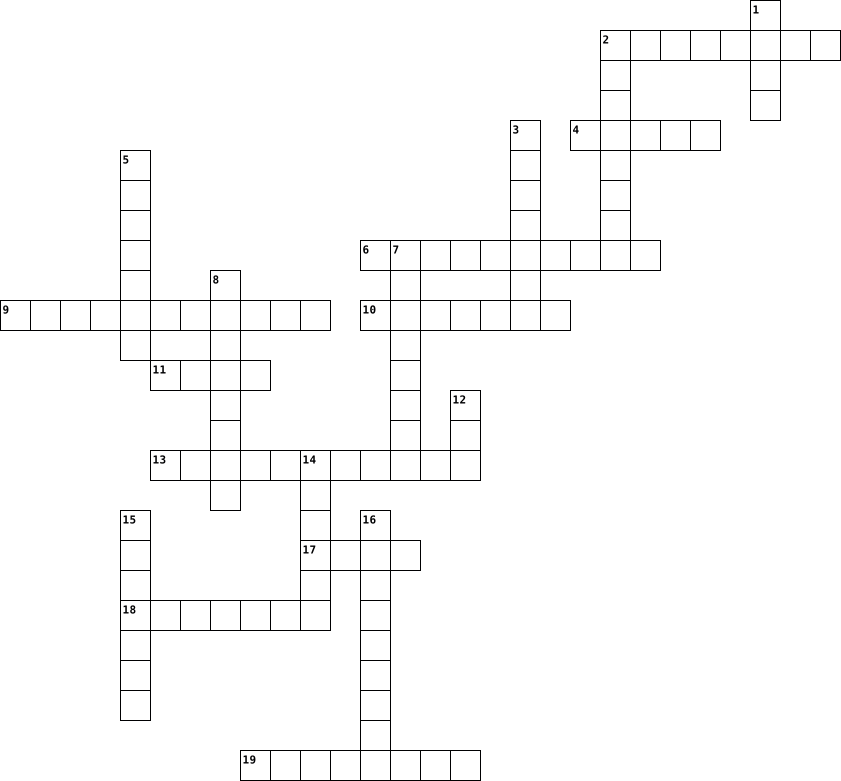
Across
- a type of salt
- we have 206 of them
- chemical reaction that breaks down food
- Something used for growth other than food
- short word for vegetable
- what you eat in a day
- food or other substance for growth
- something needed in blood.
- a soft gray thing used for growth
- type of meat
Down
- white and comes out of cow good for bones
- unit of energy
- Simplest of carbohydrates
- Things your body needs to fight bacteria
- what is it called when you work out?
- scientific name for seafood
- the extra body weight that isn't muscle
- the chemical element of atomic number 11
- white meat
- a chemical needed for your body
20 Clues: white meat • type of meat • a type of salt • unit of energy • we have 206 of them • what you eat in a day • short word for vegetable • Simplest of carbohydrates • something needed in blood. • scientific name for seafood • a chemical needed for your body • a soft gray thing used for growth • food or other substance for growth • what is it called when you work out? • ...
Vocabulary Terms for Matter and Its Properties Crossword Puzzle 2012-09-20

Across
- the state in which a substance has no tendency to flow under moderate stress; resists forces (such as compression) that tend to deform it; and retains a definite size and shape.
- Physical substance in general, as distinct from mind and spirit; (in physics) that which occupies space and possesses rest mass, esp. as distinct from energy.
- The basic unit of a chemical element.
- A fourth state of matter distinct from solid or liquid or gas and present in stars and fusion reactors.
- 1.A process that involves rearrangement of the molecular or ionic structure of a substance, as opposed to a change in physical form or a nuclear reaction.
- A coherent, typically large body of matter with no definite shape.
- A chemical substance formed as a result of a chemical reaction.
- Any property used to characterize matter and energy and their interactions.
- A property used to characterize materials in reactions that change their identity.
- A fluid in the gaseous state having neither independent shape nor volume and being able to expand indefinitely.
- A property that does not depend on the size of the sample. Melting points, boiling points, color, conductivity, and density are examples.
- All of the same or similar kind or nature.
Down
- A change in matter in which no new type of matter is produced; for example, freezing, melting, and boiling
- Chemical species that is formed when two or more atoms join together chemically, with covalent or ionic bonds.
- To change into either a solid, liquid or a gas.
- A property which increases in proportion with the amount of material considered.
- Bonds are broken and new bonds are formed between different atoms.
- A substance that takes part in and undergoes change during a reaction.
- A substance consisting of two or more substances mixed together (not in fixed proportions and not with chemical bonding)
- The state in which a substance exhibits a characteristic readiness to flow with little or no tendency to disperse and relatively high incompressibility.
20 Clues: The basic unit of a chemical element. • All of the same or similar kind or nature. • To change into either a solid, liquid or a gas. • A chemical substance formed as a result of a chemical reaction. • Bonds are broken and new bonds are formed between different atoms. • A coherent, typically large body of matter with no definite shape. • ...
Biochemistry 2022-10-25

Across
- Compounds that form extra hydronium ions when dissolved in water
- The region of an enzyme where substrate molecules bind and undergo a chemical reaction
- The strength and vitality required for sustained physical or mental activity.
- The minimum amount of energy that is required to activate atoms or molecules to a condition in which they can undergo chemical transformation or physical transport
- The surface on which an organism grows or is attached in biology
- A group of atoms held together by covalent bonds
- Another class of biomolecules, which includes fats, phospholipids, steroids, and waxes
- An important “energy molecule” found in all life forms.
- Compounds that form extra hydroxide ions when dissolved in water
- The smallest unit of matter that cannot be broken down by chemical means
- The attraction of particles of the same substance
- A substance made up of atoms that have the same number of protons
- Atom or group of atoms that have an electric charge because it has gained or lost electrons
- A mixture in which ions or molecules of 1 or more substances are evenly distributed in another substance
- The hereditary material in humans and almost all other organisms
Down
- Attraction between particles of different substances
- A molecule made up of amino acids
- A substance that acts as a catalyst in living organisms
- A substance that is formed as the result of a chemical reaction
- Molecules made of sugars (carbon, hydrogen, oxygen, ratio 1:2:1)
- Electrons in the outermost level, or shell
- A long chain of nucleotide units
- A nucleic acid present in all living cells that has structural similarities to DNA
- A molecule made up of three parts: a sugar, a base, and a phosphate group
- The substances which participate in a chemical reaction
- A measure of how acidic or basic a solution is
- A substance that reacts to prevent pH changes in a solution
- A substance made of the bonded atoms of two or more different elements
- Building blocks that link to form proteins
29 Clues: A long chain of nucleotide units • A molecule made up of amino acids • Electrons in the outermost level, or shell • Building blocks that link to form proteins • A measure of how acidic or basic a solution is • A group of atoms held together by covalent bonds • The attraction of particles of the same substance • Attraction between particles of different substances • ...
Dictionary 2024-10-07

Across
- a substance that is unbreakable
- the reaction of separating different elements
- when 2 or more elements combine
- substance(two words) a singular element
- indicates the amount of an atom in a molecule
- a number that represents the amount of molecules
Down
- takes part in chemical reaction, on left side of arrow
- a grouping of atoms bonded together
- the result of chemical reactions
- the amount of matter in an item
- particles used as building blocks
11 Clues: a substance that is unbreakable • when 2 or more elements combine • the amount of matter in an item • the result of chemical reactions • particles used as building blocks • a grouping of atoms bonded together • substance(two words) a singular element • the reaction of separating different elements • indicates the amount of an atom in a molecule • ...
Chemistry of Life Vocabulary 2022-08-29

Across
- speeds up the chemical reaction
- larger molecule made of monomers
- molecule that attaches to the enzyme's active site
- monomer that is adenine, guanine, thymine, cytosine, or urasil
- molecule no separation of charge; no positive or negative poles formed; does not dissolve in water
- bond when an atom borrow an electron from another atom to fill its outer shell; the strongest bond
- the attraction between molecules of the same substance
- energy energy that chemicals need to begin a reaction
- bond specific bond where a hydrogen atom bonds to an electronegative atom or molecule
- an electronically charged atom
- chemicals that participate in a chemical reaction
- substance that when dissolved in water accepts protons increasing the concentration of hydroxide ions; pH greater than 7
- specific type of organic compound composed of carbon, hydrogen, and oxygen in a ratio of 1:2:1
- substance that is dissolved
- acid store, transmit, and express genetic information
- Variable what changes in response to the IV; what is measured
- site where the substrate bonds to the enzyme
- anything that has mass and takes up space
- substances that are formed as a result of a chemical reaction
- two or more atoms held together by strong chemical bond
- two or more different elements bonded together,
Down
- atoms of the same element that have varying numbers of neutrons
- building blocks (units)
- two monosaccharides combined
- substance that when dissolved in water donates protons increasing the concentration of hydrogen ions; pH less than 7
- large organic molecules (carbon-containing) that make up all living things
- molecule unequal distribution of charges; dissolves in water
- the most diverse macromolecule in terms of structure and function
- scale, used to measure the concentration of hydrogen ions in a solution
- substance that cannot be broken down into simpler substances and is made up of atoms
- insoluble organic compounds that are made up of fatty acids
- polymers of monosaccharides, starch and glycogen
- Variable what is deliberately changed or manipulated in an experiment
- bond when an outer electron is shared between two atoms
- the smallest unit of an element that retains all the chemical properties of that element
- negatively charged subparticle located in the outer shells of an atom
- monomers of simple sugars
- positively charged subparticle located in the nucleus of an atom
- subatomic particle that has no charge located in the nucleus
- type of mixture that involves a solvent and solute
- substance that dissolves the solute
41 Clues: building blocks (units) • monomers of simple sugars • substance that is dissolved • two monosaccharides combined • an electronically charged atom • speeds up the chemical reaction • larger molecule made of monomers • substance that dissolves the solute • anything that has mass and takes up space • site where the substrate bonds to the enzyme • ...
Biology Vocabulary 2024-10-22

Across
- A protein in cell membranes that uses energy to move sodium out of the cell and potassium into the cell, maintaining balance.
- The movement of water across a semipermeable membrane from an area of low solute concentration to an area of high solute concentration.
- The energy needed to start a chemical reaction.
- A chemical reaction that absorbs energy, usually in the form of heat.
- A mixture of a solute dissolved in a solvent, resulting in a uniform composition.
- The movement of substances across a cell membrane using energy, usually against a concentration gradient.
- A solution with a higher concentration of solutes compared to another solution.
- The process by which a cell takes in materials by engulfing them in a membrane.
- A special protein that speeds up chemical reactions in living organisms.
- The process of moving substances across a cell membrane with the help of proteins, without using energy.
- The principle that matter cannot be created or destroyed, only rearranged.
- A model of enzyme activity where the enzyme and substrate fit perfectly together.
- The basic unit of life; the smallest part of an organism that can function independently.
- The process by which cells break down sugar to produce energy, using oxygen.
- A solution with the same concentration of solutes as another solution, resulting in no net movement of water.
- The process by which plants use sunlight to convert carbon dioxide and water into food and oxygen.
- The principle that energy cannot be created or destroyed, only changed from one form to another.
Down
- The movement of substances across a cell membrane without using energy, usually from high to low concentration.
- A chemical reaction that releases energy, usually in the form of heat.
- To speed up a chemical reaction, often by using a substance called an enzyme.
- The property of a membrane that allows certain substances to pass through while blocking others.
- A substance that is dissolved in a liquid to form a solution.
- A molecule that stores and provides energy for cellular activities.
- A model explaining how enzymes change shape slightly to fit the substrate better when they bind.
- Referring to processes that require oxygen to occur.
- The movement of particles from an area of high concentration to an area of low concentration until evenly spread.
- Referring to processes that do not require oxygen.
- A solution with a lower concentration of solutes compared to another solution.
28 Clues: The energy needed to start a chemical reaction. • Referring to processes that do not require oxygen. • Referring to processes that require oxygen to occur. • A substance that is dissolved in a liquid to form a solution. • A molecule that stores and provides energy for cellular activities. • A chemical reaction that absorbs energy, usually in the form of heat. • ...
Chemistry Vocab Crossword, Jax Dietrich 2026-03-31

Across
- (same throughout) that is made up of two or more different elements bonded together. For example H20 all water molecules are made the same
- a chart of all known elements on Earth organized based on the physical and chemical properties of each
- change in form or appearance but not chemical make up
- the big number in front of a formula that indicates how many molecules groups
- consists of multiple different substances that are evenly distributed so each sample of the mixture will have the same proportions of components
Down
- a set of chemical symbols (letters) and subscripts (numbers) showing which elements are bonded together to form a molecule
- a letter abbreviation of an element name; always starts with a capital letter
- describes a chemical reaction by showing how atoms in the reactants are rearranged to form a new substances in the product
- substances formed as a result of a chemical equation (Right side)
- During a reaction a new substance is made when the atoms of the original substances are rearranged to make something new (evidence: Precipitate, energy change, gas, and sometimes color)
- the smallest particle of matter that has distinct properties because of its nucleus which contains protons and neutrons and an electron cloud
- the starting materials found in a chemical equation (left side) that will react together
- consists of multiple different substances that are not evenly distributed so each sample of the mixture may have different proportions of components
- a substance is evenly distributed (or dissolved) with a liquid, gas, or solid
- a pure substance (same throughout) that is made up of one type of atom
15 Clues: change in form or appearance but not chemical make up • substances formed as a result of a chemical equation (Right side) • a pure substance (same throughout) that is made up of one type of atom • a letter abbreviation of an element name; always starts with a capital letter • a substance is evenly distributed (or dissolved) with a liquid, gas, or solid • ...
periodic vocabulary 2017-12-11

Across
- the number of protons in the nucleus of an atom, which determines the chemical properties of an element and its place in the periodic table.
- semi-conductors
- the substances that create a product
- a table of the chemical elements arranged in order of atomic number
- a substance formed as the result of a chemical reaction
- horizontal rown in a periodic table
- where electrons are when they go around the nucleus of an atom
- outer shell electron that is assoiciated with an atom
- tells us the number of atoms of each element in a compound
Down
- total number of protons and neutrons in a nucleus
- a number that goes before the chemical formula
- the principle that matter cannot be created or destroyed
- nuetral charged particle in an atom
- a basic unit of a chemical element
- positive charged particle in an atom
- contains protons and neutrons
- vertical columns in a periodic bubble
- good conductor of heat and electricity
- bad conductors
- negative charge particle in an atom
20 Clues: bad conductors • semi-conductors • contains protons and neutrons • a basic unit of a chemical element • nuetral charged particle in an atom • horizontal rown in a periodic table • negative charge particle in an atom • the substances that create a product • positive charged particle in an atom • vertical columns in a periodic bubble • good conductor of heat and electricity • ...
Science 2024-07-26

Across
- Gradual change in species over time.
- Proposed explanation made on the basis of limited evidence.
- Subatomic particle with no electric charge.
- Substance that increases the rate of a chemical reaction.
- Variants of a particular chemical element with different neutron numbers.
- Powerhouse of the cell, where energy production occurs.
- Community of living organisms interacting with their environment.
- Substance that stimulates the immune response to prevent disease.
- Smallest unit of a chemical element.
- Large naturally occurring community of flora and fauna.
Down
- Study of heredity and variation in organisms.
- Force that attracts objects toward each other.
- Protein that speeds up chemical reactions in living organisms.
- Process by which plants make food using sunlight.
- Visible surface of the sun.
- Set of life-sustaining chemical reactions in organisms.
- Instrument for observing distant objects.
- Fundamental particle making up protons and neutrons.
- Combination of two or more atoms bonded together.
- Thread-like structure carrying genetic information.
20 Clues: Visible surface of the sun. • Gradual change in species over time. • Smallest unit of a chemical element. • Instrument for observing distant objects. • Subatomic particle with no electric charge. • Study of heredity and variation in organisms. • Force that attracts objects toward each other. • Process by which plants make food using sunlight. • ...
Chapter 2 2025-09-28

Across
- Elements touching the staircase of the periodic table - they have properties of both metals and non-metals
- Chemical formula for table salt (Sodium Chloride)
- Horizontal Rows of the Periodic Table
- Name of apparatus used to decompose water
- The atomic number for Hydrogen is
- Has the chemical symbol Pb
- Type of chemical reaction when a compound breaks down into elements
- Property of non-metals -Can break or shatter if bent
- the number of atoms in C3H8
Down
- Substance made of one type of atom
- All metals are this state at room temperature except for mercury
- Has the chemical symbol Fe
- The number of elements in KMnO4
- Vertical columns of the periodic table
- Substance made of one type of molecule
- Has the chemical symbol Au
- Anything with mass or volume
- Scientist known as the father of the periodic table
- Is made of two hydrogen atoms bonded to one oxygen atom
- Elements to the left side of the staircase on the periodic table
20 Clues: Has the chemical symbol Fe • Has the chemical symbol Au • Has the chemical symbol Pb • the number of atoms in C3H8 • Anything with mass or volume • The number of elements in KMnO4 • The atomic number for Hydrogen is • Substance made of one type of atom • Horizontal Rows of the Periodic Table • Vertical columns of the periodic table • Substance made of one type of molecule • ...
Allergies/Anaphylaxis 2024-03-04

Across
- a medication used for a patient having an anaphylactic reaction
- number one food allergy in the world
- one way allergens enter the body
- one part of there Triple A approach
- mild allergic reaction
Down
- relieves dyspnea and hypotension
- a severe allergic reaction
- a chemical released by the body due to an allergic reaction
- mild allergic reaction
- a protein that helps destroy specific antigens
- hives or rashes that accompany an allergic reaction
11 Clues: mild allergic reaction • mild allergic reaction • a severe allergic reaction • relieves dyspnea and hypotension • one way allergens enter the body • one part of there Triple A approach • number one food allergy in the world • a protein that helps destroy specific antigens • hives or rashes that accompany an allergic reaction • ...
Assignment 2023-10-03

Across
- chemical element
- covalent
- sharing
- any substance that has a defined composition
- hold molecules together
Down
- 2 or more atoms
- atom rule
- transformation of chemicals
- Ionic
- taking/giving
10 Clues: Ionic • sharing • covalent • atom rule • taking/giving • 2 or more atoms • chemical element • hold molecules together • transformation of chemicals • any substance that has a defined composition
The REALLY BIG Chemistry Crossword Challenge 2020-04-16

Across
- a negative subatomic particle discovered by Thomson
- from gas to liquid
- two or more elements chemically combined
- a crystal that contains attached water molecule
- when the forward and reverse reaction occur at the same rate
- reactions that absorb energy
- element with only one proton in the nucleus
- it goes down as the volume goes up
- ions made up of multiple atoms
- a mixture where the components dissolve in each other
- water is a ________ molecule
- a separation technique that separates substances with different boiling points
- substance shown before the arrow in a chemical equation
- nuclear emission with the greatest penetration power
- Mrs. Torres' favorite compound
- letters that represent an element in the Periodic Table
- it lowers the activation energy required to start a reaction
- formula that shows the simplest ratio of elements in a chemical formula
- from gas to solid
- substance shown after the arrow in a chemical equation
- horizontal arrangement of elements in the periodic table
Down
- when electrons jump to higher energy levels
- from solid to gas
- reactions that release energy
- contains protons and neutrons
- the highest energy electron shell
- from liquid to solid
- combines two light nuclei to form a heavier nucleus
- small number used to state the ratio of elements in a chemical formula
- a nuclear emission containing two protons and two neutrons
- when electrons are at the lowest energy levels available
- a measure of the disorder in a system
- the basic unit of matter
- homogeneous mixture
- a nuclear emission with no mass and a negative charge
- measures the average kinetic energy in a substance
- the energy needed to start a reaction
- the time that it takes for half the atoms in a given sample to decay
- measures concentration
- number used to balance chemical equations
- it goes up as the temperature goes up
- 6.02 x 10^23
- two or more pure substances physically combined
- a large nucleus splits into two smaller nuclei
44 Clues: 6.02 x 10^23 • from solid to gas • from gas to solid • from gas to liquid • homogeneous mixture • from liquid to solid • measures concentration • the basic unit of matter • reactions that absorb energy • water is a ________ molecule • reactions that release energy • contains protons and neutrons • ions made up of multiple atoms • Mrs. Torres' favorite compound • ...
chemical 2024-02-22

Across
- The Symbol of oxygen is 'O' and the formula for oxygen is 'O2'.
- an important heat-trapping gas, also known as a greenhouse gas
- a type of sugar you get from foods you eat, and your body uses it for energy.
- a group of atoms bonded together, representing the smallest fundamental unit of a chemical compound that can take part in a chemical reaction.
- substance that takes part in and undergoes change during a reaction.
- a metabolic pathway that uses glucose to produce adenosine triphosphate (ATP)
- physical substance in general, as distinct from mind and spirit; (in physics) that which occupies space and possesses rest mass, especially as distinct from energy.the structure and properties of matter"
- energy that comes from a source and travels through space at the speed of light
- no matter can ever be created or destroyed
- proteins that help speed up metabolism, or the chemical reactions in our bodies
Down
- chemical reaction, a process in which one or more substances, the reactants, are converted to one or more different substances
- the physical energy resulting from electromagnetic radiation, usually observed as it radiates from a source into the surrounding environment.
- the name of the green pigment that plants use to make food during a process called photosynthesis
- the order of events in an ecosystem, where one living organism eats another organism,
- the process by which green plants and some other organisms use sunlight to synthesize foods from carbon dioxide and water. Photosynthesis in plants generally involves the green pigment chlorophyll and generates oxygen as a byproduct.
- made up of building blocks called amino acids
- the movement of matter between the Earth, the atmosphere, and living thingsautotroph
- chemical element with symbol C and atomic number 6.
- the action of breathing
- an organelle within the cells of plants and certain algae that is the site of photosynthesis
- sugar molecules.
- an organism that is able to form nutritional organic substances from simple inorganic substances such as carbon dioxide.
- the source of energy for use and storage at the cellular level
- an article or substance that is manufactured or refined for sale.
24 Clues: sugar molecules. • the action of breathing • no matter can ever be created or destroyed • made up of building blocks called amino acids • chemical element with symbol C and atomic number 6. • an important heat-trapping gas, also known as a greenhouse gas • the source of energy for use and storage at the cellular level • ...