
chemistry/ Crossword Puzzles
chemistry project 2020-06-11

Across
- a mutual relationship or connection between two or more things.
- relating to the nucleus of an atom.
- a change or difference in condition, amount, or level, typically with certain limits.
- the speed of something in a given direction.
- consistently good in quality or performance; able to be trusted.
- a series of events that are regularly repeated in the same order.
- a supposition or proposed explanation made on the basis of limited evidence
- make an exact copy of; reproduce.
- occurring,found, or done often; prevalent.
- an amount of space between two things.
- Deviation a quantity calculated to indicate the extent.
- the action of dividing or splitting something into two or more parts.
- the degree of compactness of a substance.
Down
- Dioxide a colorless, odorless gas prod used by burning carbon and organic compounds and by respiration.
- the end or finish of an event or process.
- the fundamental unit of length in the metric system, equal to 100 centimetres.
- the process or result of joining two or more things together to form a single entity.
- Bang the repaid expansion of matter form a state of extremely high density and temperature that according to current cosmological theories marked the origin of the universe.
- the effect of one factor depends on the level of an other
- as great high, or intense as possible or permitted.
- a supposition on the basis of limited evidence as a starting point for further investigation.
- acting or done in the same way over time.
- a tool or implement now or originally made of iron.
- a joining or merging of different parts or qualities in which the component elements are individually distinct.
- the distance between successive crests of a wave, especially points in a sound wave or electromagnetic wave.
25 Clues: make an exact copy of; reproduce. • relating to the nucleus of an atom. • an amount of space between two things. • the end or finish of an event or process. • acting or done in the same way over time. • the degree of compactness of a substance. • occurring,found, or done often; prevalent. • the speed of something in a given direction. • ...
Chemistry Crossword 2020-09-02

Across
- electron, The electrons in the outside shell of atoms. They are the furthest from the center and have the most energy
- The property of unstable atoms that emit to nuclear radiation
- Change, A change in which does not change the original substance
- State, When an electron temporarily occupies an energy state greater than its ground state
- Atoms with the same number of protons, but different numbers of neutrons
- Change, A change in which a substance is changed into a different one
- Used to make the same amount of atoms on either side of the arrow to make the equation balanced.
- Indicates the charge of an ion.
- Vertical on the periodic table, the ___________ number indicates the number of valence electrons
- The number of atoms chemically bonded together.
- The ability to be drawn out into long, thin wires
- Made up of 2 or more atoms
- Made up of a single atom
- Atoms that lose or gain electrons to have a full valence shell, therefore giving the atoms a positive or negative charge
Down
- Mass, The average mass of atoms of an element
- What makes a chemical reaction happen?
- State, The state of lowest energy for that electron
- What the matter is made of
- Orbits the nucleus
- Horizontal on the periodic table and indicates the number of shells occupied
- Metals, Groups 3-12 on the periodic table
- Bonding, Chemical bonding that rises from electrostatic force between conduction electrons and positively charged metal ions
- The state that the matter is in (for example: (l), (s), (g), (aq).)
- Symbolic representation of a chemical reaction
- Contains two or more pure substances.
- What does a chemical reaction produce?
- Number, Number of protons in the nucleus of an atom
- How the matter is put together
- The amount of mass packed into matter
29 Clues: Orbits the nucleus • Made up of a single atom • What the matter is made of • Made up of 2 or more atoms • How the matter is put together • Indicates the charge of an ion. • Contains two or more pure substances. • The amount of mass packed into matter • What makes a chemical reaction happen? • What does a chemical reaction produce? • Metals, Groups 3-12 on the periodic table • ...
chemistry crossword 2020-06-11

Across
- in agreement with something
- the act process or accident of varying in condition character or degree
- Used as a container.
- mass of a unit volume of material substance.
- An atom is the smallest constituent unit of ordinary matter that constitutes a chemical element
- A diagram showing the relation between variable quantities.
- haw far something is
- The longest extent of anything as measured from end to end.
- size of an item or product
- two surfaces that are close to the point where they need.
- anything having mass and taking up space
- Slot onto same place.
Down
- an action which is influenced by other action
- a rearrangement of atoms into new substances
- pieces of information
- the degree of loudness or the intensity of a sound
- Introducing Velocity Saving time and money, everyday
- as the form of an object
- the largest value assumed by a real-valued continuous function defined on a closed interval.
- carrying capacity of an aircraft or launch
- usable power such as electricity
- how hot or cold something is
- The distance traveled per unit of time.
- sharp end or tool
- a form of address for a woman
25 Clues: sharp end or tool • Used as a container. • haw far something is • pieces of information • Slot onto same place. • as the form of an object • size of an item or product • in agreement with something • how hot or cold something is • a form of address for a woman • usable power such as electricity • The distance traveled per unit of time. • anything having mass and taking up space • ...
Chemistry Vocab 2020-09-04

Across
- Abbreviations; usually one or two letters from the Latin alphabet.
- A liquid mixture in which the minor component is uniformly distributed within the major compound.
- Any of a material's properties that becomes evident during, or after, a chemical reaction.
- When a substance combines with another to form a new substance.
- The action or process of filtering something.
- A process that involves rearrangement of the molecular or ionic structure of a substance, as opposed to a change in physical form or nuclear reaction.
- A thing that is composed of two or more separate elements; a mixture
- Made up of individual atoms, elemental molecules made from one type of atom, or compound molecules made from various atoms.
- A substance made by mixing other substances together.
- A distinct period or stage in a series of events or a process of change or development.
- A column of elements in the periodic table, there 18 numbered groups.
- A property of physical body, and a measure of its resistance to acceleration when a net force is applied.
- A particular kind of matter with uniform properties.
- Each of more than 100 substances that cannot be chemically interconverted or broken down into simpler substances.
- The action of purifying a liquid by a process of heating and cooling.
- The species formed from chemical reaction.
- Firm and stable in shape; not liquid or fluid.
Down
- A property that is measureable, whose values describes a state of a physical system.
- A table of the chemical elements arranged in order of atomic number, usually in rows so elements with similar atomic structure appear in columns.
- A substance separated from a solution or suspension by chemical or physical change usually as an insoluble or amorphous crystaline solid.
- Changes affecting the form of a chemical substance, but not its chemical composition.
- A solid, liquid, or gaseous mixture that has the same proportions of its components throughout any given sample.
- the horizontal rows on the periodic table; corresponds to the successive occupation of the orbitals in a valence shell of the atom.
- A substance that takes part in and undergoes change during a reaction.
- Physical quantity whose value is proportional to the size or system it describes, or to the quantity of matter in the system.
- Does not depend on the quantity of matter.
- Mass is neither created or destroyed.
- the amount of space that a substance or object occupies, or that is enclosed within a container.
- A nearly incompressible fluid that conforms to the shape of its container, but retains a constant volume.
- A mixture that has components in which proportions vary throughout the sample.
- A substance diffused or suspended in the air, especially one normally liquid or solid.
31 Clues: Mass is neither created or destroyed. • Does not depend on the quantity of matter. • The species formed from chemical reaction. • The action or process of filtering something. • Firm and stable in shape; not liquid or fluid. • A particular kind of matter with uniform properties. • A substance made by mixing other substances together. • ...
Nuclear Chemistry 2020-12-07

Across
- a synthetic element whose atomic number is greater than that of uranium (atomic number 92)
- a device that measures the approximate amount of radiation received in a given period of time by people who work with radiation
- a nuclide produced by the radioactive decay of another nuclide
- a nuclide that contains isotopes that decay and that emit radiation
- an instrument that detects and measures the intensity of radiation by counting the number of electric pulses that pass between the anode and the cathode in a tube filled with gas
- the numbers (2, 8, 20, 28, 50, 82, and 126) that represent the number of particles in an extra stable atomic nucleus that has completed shells of protons and neutrons
- the process by which the approximate age of an object is determined based on the amount of certain radioactive nuclides present
- the transformation of atoms of one element into atoms of another element as a result of a nuclear reaction, such as bombardment with neutrons
- the disintegration of an unstable atomic nucleus into one or more different nuclides, accompanied by the emission of radiation, the nuclear capture or ejection of electrons, or fission
- a positively charged atom that is released in the disintegration of radioactive elements and that consists of two protons and two neutrons
- a radiation-absorbing material that is used to decrease radiation leakage from nuclear reactors
- the time required for half of a sample of a radioactive isotope to break down by radioactive decay to form a daughter isotope
- a reaction that affects the nucleus of an atom
- the difference between the mass of an atom and the sum of the masses of the atoms protons, neutrons, and electrons
- a unit of radiation dose of X rays or gamma rays that is equal to the amount of radiation that will produce 2.58 x 10⁻⁴ of ions per kilogram of air at atmospheric pressure
- a reaction in which the material that starts the reaction is also one of the products and can start another reaction
- a series of radioactive nuclides produced by successive radioactive decay until a stable nuclide is reached
- an instrument that converts scintillating light into an electrical signal for detecting and measuring radiation
- a change in the identity of a nucleus as a result of a change in the number of its protons
- an atom that is identified by the number of protons and neutrons in its nucleus
- a radionuclide that yields a specific daughter nuclide as a later member of a radioactive series
- the high-energy photon emitted by a nucleus during fission and radioactive decay
Down
- a charged electron emitted through certain types of radioactive decay, such as beta decay
- a radioactive material that is added to a substance so that its distribution can be detected later
- waste that contains radioisotopes
- a facility that uses heat from nuclear reactors to produce electrical energy
- a neutron-absorbing rod that helps control a nuclear reaction by limiting the numbers of free neutrons
- the splitting of the nucleus of a large atom into two or more fragments; releases additional neutrons and energy
- the particles that are released from the nucleus during radioactive decay, such as neutrons, electrons, and photons
- a particle that has the same mass and spin as an electron but that has a positive charge
- a model that represents nucleons as existing in different energy levels, or shells, in the nucleus
- the process in which an inner orbital electron is captured by the nucleus of an atom that contains the electron
- the quantity of ionizing radiation that does as much damage to human tissue as 1 roentgen of high-voltage x rays does
- the minimum mass of a fissionable isotope that provides the number of neutrons needed to sustain a chain reaction
- the energy released when a nucleus is formed from nucleons
- a device that uses controlled nuclear reactions to produce energy or nuclides
- the combination of the nuclei of small atoms to form a larger nucleus, releases energy
- a proton or neutron
- a material that slows the velocity of neutrons so that they may be absorbed by the nuclei
39 Clues: a proton or neutron • waste that contains radioisotopes • a reaction that affects the nucleus of an atom • the energy released when a nucleus is formed from nucleons • a nuclide produced by the radioactive decay of another nuclide • a nuclide that contains isotopes that decay and that emit radiation • ...
Nuclear Chemistry 2020-12-15

Across
- a subatomic particle with no charge
- composed of neutrons and protons
- combining nuclei of two atoms to form a heavier atom
- unstable atomic nucleus loses energy by radiation
- The nuclei split into smaller fragments
- number of protons and neutrons in the nucleus of an atom
- measured in rems
- smallest particle of an element
- an electron resulting from the breaking apart of neutrons in an atom
- identical to the Helium nucleus
Down
- positively charged subatomic particle
- amount of time it takes for half of a radioactive element to transform into something else
- negatively charged subatomic particle
- an atom or group of atoms that has a positive or negative charge
- composed with protons and neutrons
- number of protons in the nucleus
- simplest form of matter that has a unique set of properties
- rearrangement of DNA when hit by radiation
- has no mass, can be stopped by several inches of lead (pure energy)
- atoms of the same element with different numbers of neutrons
- occurs when an unhappy nucleus ejects 2 protons and 2 neutrons
21 Clues: measured in rems • smallest particle of an element • identical to the Helium nucleus • composed of neutrons and protons • number of protons in the nucleus • composed with protons and neutrons • a subatomic particle with no charge • positively charged subatomic particle • negatively charged subatomic particle • The nuclei split into smaller fragments • ...
Chemistry Crosswords 2020-12-14

Across
- The physical property of an object that can only be measured under a microscopic level.
- Fixed mass, fixed volume, definite shape
- Dependent of the quantity of matter present
- Measurement of the amount of matter in an object
- Quantitate measurement of how cold or hot an object it
- Independent of the quantity of matter present
- The physical property of an object that can be manipulated on a visible level with naked eye
Down
- A lab equipment that is cylindrical and have a flat bottom
- When an object turns into the liquid state with certain requirements
- The conversion of gas into liquid
- A characteristic of matter that is not associated with a change in its chemical composition
- Fixed mass, fixed volume, Not fixed shape
- The state of liquid or solid turning into the gaseous state
- Anything with mass and volume that takes up space
- one chemical substance is transformed into one or more different substances
- Changed form but substance remains the same
- Unfixed mass, unfixed volume, no definite shape, high energy level
- During a reaction, the chemical composition changed
- The space occupied by an object
- The state where liquid turns into solid due to meeting the requirement of temperature
20 Clues: The space occupied by an object • The conversion of gas into liquid • Fixed mass, fixed volume, definite shape • Fixed mass, fixed volume, Not fixed shape • Dependent of the quantity of matter present • Changed form but substance remains the same • Independent of the quantity of matter present • Measurement of the amount of matter in an object • ...
Chemistry Puzzle 2020-12-02

Across
- I am a member of the nitrogen family with 16 neutrons
- I am the only nonmetal that is liquid at room temperature
- I am an alkali metal used to make fertilizer
- I make up 78% of the atmosphere
- I am the second most abundant element in the Earth's crust and used to make computers
- In addition to copper and cesium, I am a metal that is not silver or gray in color
- I have 2 electrons in the first shell, 8 in the second shell, and 6 in the third shell
- I am a metal in the carbon family in the 5th period
- I am a member of the carbon family and often mistaken for the end of your pencil
- I am a metal that is liquid at room temperature
- I am not really an alkali metal
- I am an alkaline earth metal used to make white fireworks and upset stomach medicine
- I am a metal with 28 electrons
Down
- I am a gas with 8 protons and 8 neutrons
- My atomic mass is 35.453
- I have 20 neutrons and am found in bones and teeth
- I have 26 protons
- If I am present in a compound, it is called an organic compound
- I am a transition metal found inside a new penny
- I am a transition metal with 25 electrons
- My atomic number is 47 and I am used to make photographic films
- I am a soft metal that reacts with water, and I am the most abundant metal in the ocean
- I am a halogen that appears purple or yellow
- I am a gas with a mass number of 18.99 amu
- I am the smallest noble gas
- I am a member of the boron family and the most abundant metal in the Earth's crust
26 Clues: I have 26 protons • My atomic mass is 35.453 • I am the smallest noble gas • I am a metal with 28 electrons • I make up 78% of the atmosphere • I am not really an alkali metal • I am a gas with 8 protons and 8 neutrons • I am a transition metal with 25 electrons • I am a gas with a mass number of 18.99 amu • I am an alkali metal used to make fertilizer • ...
Chemistry crossword 2020-12-18

Across
- a mixture of two or more metals
- a method to separate colors using solubility
- a liquid that other substances will dissolve in
- no more of the solute will dissolve in ... solution
- mixed substances that are not chemically bonded
- there are 118 of them
- acid+alkali=
- evenly spread caused by random movements
- two or more atoms bonded together
- rows in periodic table
Down
- a substance that is dissolved
- squash together
- a new substance made in a reaction
- gas ... is more when higher temperature
- shorthand way of referring to an element
- ... of mass the principle of solution
- a tiny particle of matter
- when gas is changing to liquid
- motion that moves randomly caused by bumps
- a substance that is made of only one type of atom
- columns in periodic table
- a substance that cant' dissolve
22 Clues: acid+alkali= • squash together • there are 118 of them • rows in periodic table • a tiny particle of matter • columns in periodic table • a substance that is dissolved • when gas is changing to liquid • a mixture of two or more metals • a substance that cant' dissolve • two or more atoms bonded together • a new substance made in a reaction • ... of mass the principle of solution • ...
Chemistry Vocabulary 2020-12-14

Across
- the basic unit of a chemical element
- an extremely tiny particle with a positive charge; is in the center of the atom and makes up the nucleus
- the mass of an atom of a chemical element expressed in atomic mass units
- a heterogenous mixture in which some of the particles settle out of the mixture upon standing
- a energy level defined by quantum theory
- a diagram that represents the variation of a variable
- where electrons are likely to be found
- a combination of two or more substances
- a variable that depends on other factors
- a pure substance that is made up of two or more different elements combined by chemical bonds
- a simple way of writing down the locations of all the electrons in an atom
- in the center of the atom with the protons making up the nucleus
- the number of digits in a value
- the energy required to remove an electron from an atom
- electrons in the outermost shell
- a physical substance
- the tendency of an atom to attract an electron to itself
- any of two or more forms of a chemical element
Down
- a positively charged ion
- a model presented by niels bohr and ernest rutherford in 1913
- a row of elements in the periodic table
- a variable that stands alone
- a negatively charged ion
- a process for experimentation that is used to explore observations and answer questions
- the number of protons in the nucleus of an atom
- a type of matter that has definite chemical and physical properties
- a group of atoms bonded together
- physically combined; can be separated
- a negative charge that surrounds the nucleus
- objects, events, ideas, feelings, time periods, or any other types of categories that you are trying to measure
- heterogenous, even though it looks homogenous
- a pure substance that contains of only one kind of atom
- a way of representing atoms or molecules as dots surrounding the element symbols
- a table of chemical elements arranged in order of atomic number
- the central part of the atom; contains protons and neutrons
- fixed distances from the nucleus of an atom where electrons may be found
- the size of a neutral atom
- specific patterns that are presented in the periodic table
- the number of protons minus the number of electrons
- a column of elements in the periodic table
- the chemical element in group 18 of the periodic table
41 Clues: a physical substance • a positively charged ion • a negatively charged ion • the size of a neutral atom • a variable that stands alone • the number of digits in a value • a group of atoms bonded together • electrons in the outermost shell • the basic unit of a chemical element • physically combined; can be separated • where electrons are likely to be found • ...
Organic Chemistry 2021-03-09

Across
- formed when one or more of the hydrogen atoms of ammonia are replaced by an alkyl group.
- Organic Compounds containing only single bonds
- the reaction between an organic acid and an alcohol to produce an ester plus water
- formed when a carbonyl group (-C=O) is found on an interior carbon atom that is attached to two other carbon atoms.
- a molecular formula that can be represented by more than one structural arrangement
- a homologous series of organic compounds whose functional group is a carboxyl group (-COOH)
- homologous series of saturated hydrocarbons that release energy when burned
- organic compounds whose type formula is R-CO-OR.
- contain the carboxylic group (-COOH) but also contain an amine group
- organic compounds that contain only atoms of hydrogen and carbon
- Compounds containing one or more double or triple covalent bonds
- atoms or groups of atoms that replace hydrogen atoms in a hydrocarbon and give the compound distinctive physical and chemical properties
- organic compounds made up of chains of smaller units contently bonded together.
Down
- when an ester reacts with an inorganic base to produce an alcohol and a soap
- homologous series of unsaturated hydrocarbons that contain one triple bond
- each member of this series contains one double covalent bond
- involves the replacement of one or more of the hydrogen atoms in a saturated hydrocarbon with another atom or group
- involve adding one or more atoms at a double or triple bond.
- a chemical process in which yeast cells secrete the enzyme zymase and break the six carbon chain of sugars into carbon dioxide and two carbon fragments of alcohol
- a compound formed by the combination of the two amino acids
- organic compounds in which the carbonyl group is found at the end of the carbon
- formation of these larger polymer molecules is called this in which each individual unit of a polymer is called a monomer.
- series of organic compounds in which two carbon chains are joined together by an oxygen atom bonded between two carbon atoms
- When a halogen replaces a hydrogen atom in an alkane, the compound is called this
- organic compounds in which one or more hydrogen atoms of a hydrocarbon are replaced by an OH- group
25 Clues: Organic Compounds containing only single bonds • organic compounds whose type formula is R-CO-OR. • a compound formed by the combination of the two amino acids • each member of this series contains one double covalent bond • involve adding one or more atoms at a double or triple bond. • organic compounds that contain only atoms of hydrogen and carbon • ...
CARBONYL CHEMISTRY 2021-03-10

Across
- Enol form is preferred over a keto form mostly in cases of _________ hydrogen bonding
- Benzaldehyde in the presence of potassium cyanide undergoes a type of condensation reaction to give this product
- Primary reactant of Benzil-Benzilic Rearrangement.
- Preparation of Phosphorus ylide in wittig reaction involves a SN ___ attack by triphenyl phosphine on an alkyl halide (in words)
- A non aromatic nitrogen containing base used in Knoevenagel Condensation
- A stronger oxidising agent than Pyridinium dichromate (PDC) and more acidic in nature (Pyridinium ___________)
- This ester CANNOT undergo ketonic hydrolysis (common name)
- Common reagent in MPV Reduction is Aluminium __________
- When intra or intermolecular proton exchange takes place in a mechanism, it is called ___________ interconversion (hint: mobile atom is a proton)
Down
- Alcohols and ketones without terminal ________ group cannot undergo haloform reaction
- Benzaldehyde reacts with acetic anhydride in the presence of sodium acetate to give this acid
- Avery well known reagent for Baeyer Villiger oxidation, known to give rapid reaction due to its high electron withdrawing tendency ( name of the peracid)
- Type of addition reaction where a carbanion nucleophile attacks an alpha,beta-unsaturated carbonyl compound: _________ Addition
- The cyclic intermediate in Wittig reaction formed by cyclo addition of the reactants
- General name of the nucleophilic intermediate produced in the first step of aldol condensation
- Acetone + Iodine + Potassium hydroxide ---> pale yellow ppt. Reaction name is _______
- An acid sensitive carbonyl compound will be converted to alkane using this reduction.
- Cannizaro Reaction takes place in the absence of ______ hydrogen in the carbonyl compound
- Cyclohexanone reacts with hydroxylamine in the presence of sulphuric acid to give (common name)
- Mechanism of converting aldol products back to its predecessor aldehyde or ketone: _______ aldol
20 Clues: Primary reactant of Benzil-Benzilic Rearrangement. • Common reagent in MPV Reduction is Aluminium __________ • This ester CANNOT undergo ketonic hydrolysis (common name) • A non aromatic nitrogen containing base used in Knoevenagel Condensation • The cyclic intermediate in Wittig reaction formed by cyclo addition of the reactants • ...
Chemistry Review! 2021-03-12
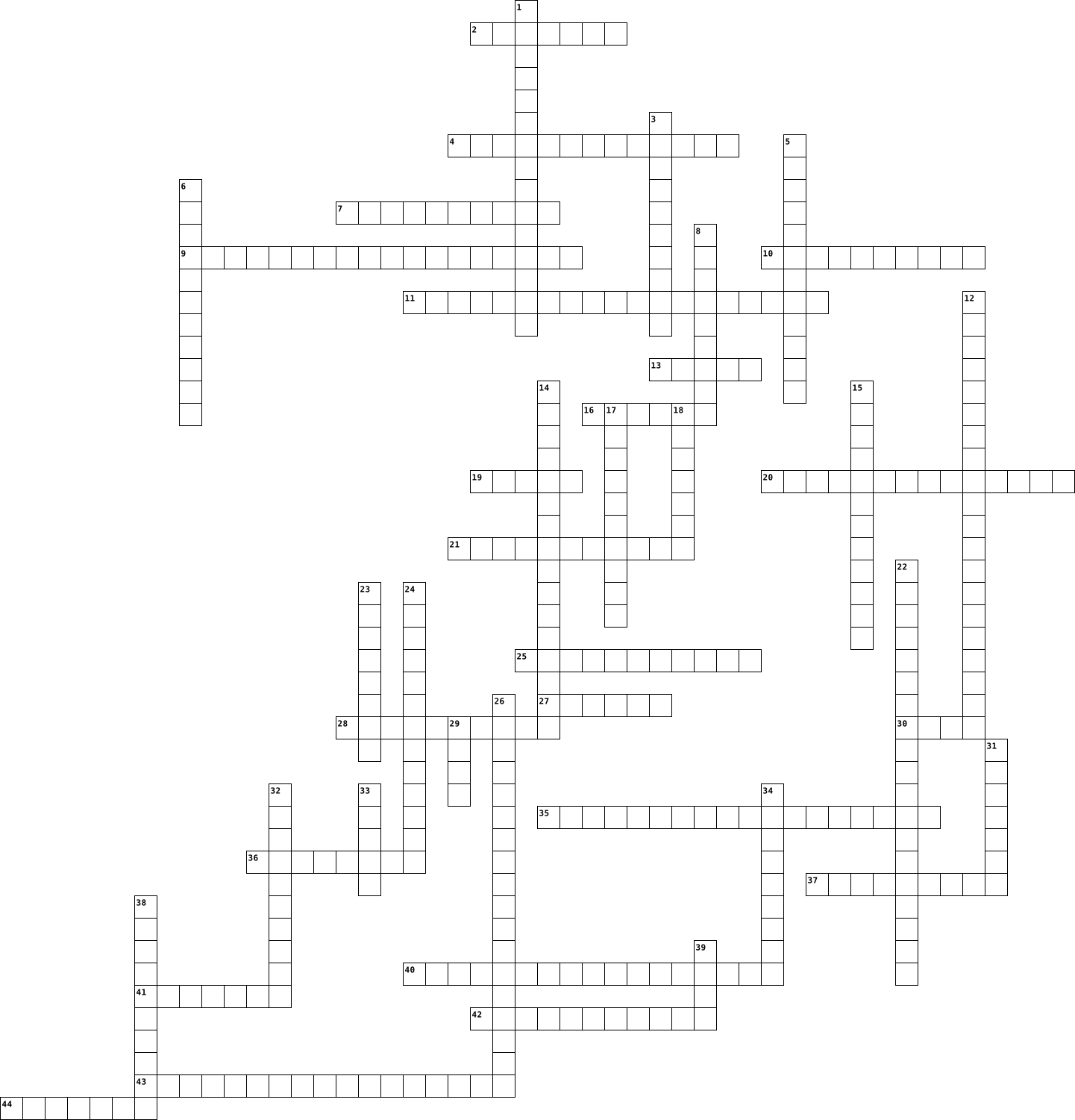
Across
- central atom in CO2
- type of bond formed by sharing of electrons
- "made up" word that lists all the diatomic elements
- type of bond formed when sharing of electrons is unequal
- element with twelve protons
- scientific name of water
- molecular geometry of SH2
- number of needed electrons for chlorine to have a full valence
- number of dots in the Lewis structure for arsenic
- group of atoms bonded tightly together and carry a charge
- represented by two lines in a structural diagram
- name of group 18
- phase of matter with a definite shape and volume
- located to the right of the stepline
- number of electrons for hydrogen to have a full valence
- molecular geometry with 3 atoms and 1 lone pair on the central atom
- group 12 element with possible oxidation states are +1 and +2
- atom with the partial negative charge in OF2
- name of Ca(OH)2
- central atom in OF2
- type of bond present in Cl2
- name of Sr3N2
- compound composed of two types of elements
Down
- electron geometry of CH2O
- energy, amount of energy required to remove an electron
- goal of bonding for each element
- type of bond in CO
- most electronegative atom
- type of bond formed when sharing of electrons is equal
- calculated by subtracting needed and available electrons
- electron geometry with four electron groups around the central atom
- type of bond formed by a complete transfer of electrons
- total number of lone pairs in the molecule CF4
- name of XeF4
- group, atoms + lone pairs
- most reactive metals
- ability of an atom to attract an electron
- number of electrons that make up one covalent bond
- electron geometry of HCN
- electrons that are not bonded and drawn as dots
- number of total bonds in CBr4
- atom with the largest atomic radius
- always form nonpolar bonds
- number of valence electrons in the oxygen group
44 Clues: name of XeF4 • name of Sr3N2 • name of Ca(OH)2 • name of group 18 • type of bond in CO • central atom in CO2 • central atom in OF2 • most reactive metals • scientific name of water • electron geometry of HCN • electron geometry of CH2O • most electronegative atom • molecular geometry of SH2 • group, atoms + lone pairs • always form nonpolar bonds • element with twelve protons • ...
Chemistry Vocabulary 2016-12-01

Across
- The electrical charge of the electron
- The basic building block of most of the matter around us
- A chart of the elements
- The eighteenth family on the periodic table they are non reactive
- Change that results in the formation of a new substance
- Vertical column in the periodic table
- A group of elements that have properties of both metals and nonmetals
- Electrical property that can be either positive or negative
- Measure of an atom's mass that is equal to the number of protons and neutrons in the atom's nucleus
- The process in which bubbles of gas form throughout a liquid and rise to the surface
Down
- The first family on the periodic table they are very reactive
- The second family on the periodic table
- The temperature at which a substance boils
- Force that holds atoms together in molecules
- The positive negatively charged subatomic particle that is located in the nucleus of an atom
- The energy that is stored in chemical bonds
- The neutrally charged subatomic particle that is located inside the nucleus of an atom
- The number of protons in the nucleus of an atom
- The electrical charge of the proton
- Anything that has mass and takes up space
20 Clues: A chart of the elements • The electrical charge of the proton • The electrical charge of the electron • Vertical column in the periodic table • The second family on the periodic table • Anything that has mass and takes up space • The temperature at which a substance boils • The energy that is stored in chemical bonds • Force that holds atoms together in molecules • ...
Chemistry Vocabulary 2016-11-29

Across
- the temperature at which a substance melts
- metallic elements that occupy the largest part of the periodic table
- a model that shows how the electrons circle the nucleus
- the ability of a substance to be hammered or pressed into a shape without breaking
- a substance made by mixing other substances together
- the mass of a chemical element
- a substance that is formed when two or more chemical elements are chemically bonded together
- a subatomic particle with a positive charge
Down
- change that affects the form of a chemical substance but not its chemical composition
- gascous element occupying group 18 of the periodic table
- change that results with the formation of new substances
- the basic unit of life
- elements that have properties of metals and non-metals
- the temperature at which a substance boils
- Table a table that organizes the elements according to their number of protons
- a substance particle with a negative charge
- a subatomic particle that doesn't have a charge
- a part of science that deals with the identifications and properties of matter
- a substance of atoms which have the same number of protons
- a group of atoms that have the same chemical compound
20 Clues: the basic unit of life • the mass of a chemical element • the temperature at which a substance melts • the temperature at which a substance boils • a substance particle with a negative charge • a subatomic particle with a positive charge • a subatomic particle that doesn't have a charge • a substance made by mixing other substances together • ...
Nuclear Chemistry 2017-06-14

Across
- a reactor able to produce more fuel than it uses
- a very fast moving electron that has been emitted from a neutron of an unstable nucleus
- a sample that is massive enough to sustain a chain reaction
- mass greater than critical mass
- the combining of atomic nuclei
- atoms which produce scintillations
- high energy electromagnetic radiation
- protons and neutrons
- same composition of a helium nucleus
- the difference in mass between a nucleus and its component nuclei
- the location of stable nuclei on a graph
- invisible rays emitted when electrons bombard the surface of certain materials
Down
- the splitting of a nucleus into fragments
- the rays and particles emitted by a radioactive source
- isotopes of atoms with unstable nuclei
- Another name for a fusion reaction
- Not massive enough to sustain a chain reaction
- the time required for one half of a radioisotope's nuclei to decay
- the conversion of an atom of one element to an atom of another
- a radioisotope which emits non ionizing radiation and is used to signal the presence of an element
20 Clues: protons and neutrons • the combining of atomic nuclei • mass greater than critical mass • Another name for a fusion reaction • atoms which produce scintillations • same composition of a helium nucleus • high energy electromagnetic radiation • isotopes of atoms with unstable nuclei • the location of stable nuclei on a graph • the splitting of a nucleus into fragments • ...
Chemistry 4 2017-06-21

Across
- The type of digestion that treats effluent in waste water treatment.
- What planet has an atmosphere that resembles the Earth's first atmosphere?
- A human product that can contaminate water sources.
- A process that can carry on indefinitely without affecting future generations.
- The amount of greenhouse gases emitted over the full lifecycle of a product.
- and Algae What two types of organisms were the first to produce oxygen?
- Removal of solids from water
- The process of killing microorganisms in water.
- What greenhouse gas is released by cattle farms?
- The correct term for destruction of forests.
- Which gas burns with a squeaky pop?
Down
- What is bleached by chlorine gas?
- A resource that can be replaced at the same rate it is used.
- What released the gases that made up the Earth's first atmosphere?
- A material that contains only one element or compound.
- The formation of which rock type removed CO₂ from the air?
- Making salt water drinkable.
- The main pollutant from agriculture that can affect rivers.
- What gas made up the majority of the Earth's early atmosphere?
- What process created the oxygen in the atmosphere?
- A product made from an artificial process.
- Water that is drinkable
- What chemical is used to test for Carbon Dioxide?
- The type of digestion that treats solid matter in waste water treatment.
24 Clues: Water that is drinkable • Making salt water drinkable. • Removal of solids from water • What is bleached by chlorine gas? • Which gas burns with a squeaky pop? • A product made from an artificial process. • The correct term for destruction of forests. • The process of killing microorganisms in water. • What greenhouse gas is released by cattle farms? • ...
Chemistry exam 2018-06-07

Across
- Empuje o atracción que se ejerce sobre un objeto... F____
- Ritmo al que cambia la velocidad... A____
- partícula básica de la que todos los elementos están formados... A____
- Instrumento óptico que usa lentes para enfocar la luz para grabar la imagen de un objeto... C____
- Ondas electromagnéticas con longitudes de ondas más cortas... M____
- Poder de atracción o repulsión de los materiales magnéticos... M____
- Estado de la materia que no tiene forma definida, pero si de volumen definido... L____
- química Forma corta y sencilla de mostrar una reacción química usando símbolos... E____Q____
- eléctrico Trayecto completo y continuo a través del cual pueden fluir las cargas eléctricas... C____E____
- medida del espacio entre dos puntos... D____
- Estructura flexible que enfoca la luz que entra al ojo... L____
Down
- auditivo Región estrecha que conecta el exterior del oído humano con el tímpano... C____A____
- Capacidad para realizar un trabajo o producir cambios... E____
- Instrumento con una aguja imantada que puede girar libremente. La aguja siempre gira hacia el norte... B____
- estudio de las propiedades de la materia y de sus cambios... Q____
- Instrumento que permite que los objetos pequeños se vean más grandes... M____
- eléctrico Instrumento que convierte la energía eléctrica en energía mecánica... M____E
- Membrana pequeña, tensa y extendida como la de un tambor... T____
- Evaporación que ocurre en y bajo la superficie del liquido... E____
- Medida de cuanta materia hay en un cuerpo... M____
- Material que atrae hierro o materiales que contienen hierro... I____
- tejido transparente que cubre la parte delantera del ojo... C____
- estado de la materia sin forma ni volumen definidos... G____
- Trasferencia de energía térmica de un cuerpo mas cálido a uno menos cálido... C____
24 Clues: Ritmo al que cambia la velocidad... A____ • medida del espacio entre dos puntos... D____ • Medida de cuanta materia hay en un cuerpo... M____ • Empuje o atracción que se ejerce sobre un objeto... F____ • estado de la materia sin forma ni volumen definidos... G____ • Capacidad para realizar un trabajo o producir cambios... E____ • ...
Chemistry Crossword 2018-06-08

Across
- chemical reaction that releases heat energy
- mixture in which the different substances are visible
- when a new substance is formed and non-reversible
- can be in between metals and non-metals
- the number of protons in the nucleus of an atom
- mixture of two or more pure substances that look like one substance
- can eat away or corrode
- contaminated material that is a threat to humans and health
- substances in a reaction
- chemical reaction that absorbs heat energy
Down
- pure substance that cannot broken down any further
- workplace hazardous materials information system
- change in appearance or state
- ability to conduct electricity or heat
- the mass of all protons and neutrons in an atom
- when a solid changes to a gas
- when non-metal combine
- the mixture of magic and chemistry
- when a gas changes to a solid
- shiniest of a substances,
- electrically charged atoms
- made up of one type of matter
- the center of an atom
- the horizontal rows on the periodic table
- a compound of a metal and non-metal
25 Clues: the center of an atom • when non-metal combine • can eat away or corrode • substances in a reaction • shiniest of a substances, • electrically charged atoms • change in appearance or state • when a solid changes to a gas • when a gas changes to a solid • made up of one type of matter • the mixture of magic and chemistry • a compound of a metal and non-metal • ...
Chemistry Crossword 2018-11-06

Across
- Pure substance formed when at least one metal and one non-metal combine
- French chemist who created a nomenclature for naming compounds
- Number of protons in the nucleus of one atom of an element
- Columns in the periodic table labelled 1-18
- Pure substance formed when non-metals combine
- Rows in the periodic table labelled 1-7
- New materials produced by the reaction
- Substances that help a reaction proceed faster
- Chemical reaction that absorbs heat energy
- Mass of one atom of an element calculated from the total number of protons, neutrons, and electrons of that atom; measured in amu
- Workplace Hazardous Material Information System
Down
- A table in which the elements are organized by their physical and chemical properties
- Solid or gas; solids are dull, brittle elements
- Anything that has mass and occupies space
- Chemical reaction that takes place in the cells in your body
- Below
- Have metallic and non-metallic properties
- Chemical reaction that releases heat energy
- Chemical reaction that occurs when oxygen reacts with a substance to form a new substance and give off energy
- More than two elements combine
- Pure substance that cannot be broken down into other substances; substance only made up of one type of atom
- Materials at the start of a reaction
- Shiny, malleable, and ductile
- Slow chemical change that occurs when oxygen in air reacts with a metal
24 Clues: Below • Shiny, malleable, and ductile • More than two elements combine • Materials at the start of a reaction • New materials produced by the reaction • Rows in the periodic table labelled 1-7 • Anything that has mass and occupies space • Have metallic and non-metallic properties • Chemical reaction that absorbs heat energy • Chemical reaction that releases heat energy • ...
Chemistry crossword 2018-11-07

Across
- a new substance that reacts with another substance or substances in a chemical reaction to create a new substance with different products or properties
- ability to dissolve into another
- when two or more substance react to form a new substance. The new substance has different properties from the original
- the point where a substance boils
- change of state from liquid to solid
- the point where a substance melts
- a cloudy mixture where you can see the different parts
- a mixture where you can see the different parts
- an element is identified by this
- a mixture where you can not see the different parts
- chemical combination of two or more elements
- made up of one type of matter and has a unique set of characteristics
- a new substance produced in a chemical reaction between reactants
- anything that has mass and occupies space
Down
- change of state from liquid to gas
- the shininess of a substance
- when material changes state (or appearance) but not composition
- a cloudy mixture where you can not see the different parts
- when non-metals combine, they produce a new pure substance called this
- change of state from gas to liquid
- change of state from gas to solid
- substance made up of only one type of atom
- pure substances formed as a result of the attraction between particles of opposite charges called ions
- characteristics that can be used to describe a substance
- average weight of an element
25 Clues: the shininess of a substance • average weight of an element • ability to dissolve into another • an element is identified by this • the point where a substance boils • the point where a substance melts • change of state from gas to solid • change of state from liquid to gas • change of state from gas to liquid • change of state from liquid to solid • ...
chemistry 1 2019-03-18

Across
- subatomic particles with a positive charge
- a physical combination of matter in any proportion
- multiples of ten
- the study of substances that contain the element carbon
- substance that releases oxygen
- characteristics that can be determined without a chemical reaction and do not cause a chemical change in the substance
- a stable physical mixture of two or more substances
- a change in form of physical properties of a substance without a chemical reaction or the creation of a new substance
- the substance that is dissolved in a solution
- any substance that occupies spaces spaces and has mass
- subatomic particles with no charge
Down
- liquids that are mutually soluble meaning that they can be mixed together to form stable solutions
- a chemical combination of two or more atoms in definite proportions
- a chemical combination of matter in definite proportions
- alcohols that evaporate easily
- a chemical reaction in which the oxidizing agent is reduced and the reducing agent is oxidized
- a substance that adds hydrogen to a chemical compound or subtracts oxygen from the compound
- a chemical reaction that combines a substance with oxygen to produce an oxide
- the substance that dissolves the solute and makes it a solution
- a colorless liquid or white crystals with a strong unpleasant odor that is used in permanent waving solutions
- special type of oil used in hair conditioners water resistant lubricants for the skin and nail polish dryers
- the quantity of hydrogen ions
- the concentration of surface active agents
- the three different physical forms of matter
- the measure of the acidity an alkalinity of a substance
- unstable physical mixtures of undissolved particles in a liquid
26 Clues: multiples of ten • the quantity of hydrogen ions • alcohols that evaporate easily • substance that releases oxygen • subatomic particles with no charge • subatomic particles with a positive charge • the concentration of surface active agents • the three different physical forms of matter • the substance that is dissolved in a solution • ...
chemistry 2 2019-03-18

Across
- the measure of the acidity an alkalinity of a substance
- special type of oil used in hair conditioners water resistant lubricants for the skin and nail polish dryers
- a physical combination of matter in any proportion
- alcohols that evaporate easily
- a substance that adds hydrogen to a chemical compound or subtracts oxygen from the compound
- a colorless liquid or white crystals with a strong unpleasant odor that is used in permanent waving solutions
- the quantity of hydrogen ions
- a stable physical mixture of two or more substances
- a chemical reaction in which the oxidizing agent is reduced and the reducing agent is oxidized
- the study of substances that contain the element carbon
- substance that releases oxygen
- the three different physical forms of matter
Down
- a change in form of physical properties of a substance without a chemical reaction or the creation of a new substance
- unstable physical mixtures of undissolved particles in a liquid
- a chemical combination of two or more atoms in definite proportions
- a chemical combination of matter in definite proportions
- liquids that are mutually soluble meaning that they can be mixed together to form stable solutions
- the concentration of surface active agents
- the substance that is dissolved in a solution
- characteristics that can be determined without a chemical reaction and do not cause a chemical change in the substance
- the substance that dissolves the solute and makes it a solution
- any substance that occupies spaces spaces and has mass
- subatomic particles with a positive charge
- multiples of ten
- a chemical reaction that combines a substance with oxygen to produce an oxide
- subatomic particles with no charge
26 Clues: multiples of ten • the quantity of hydrogen ions • alcohols that evaporate easily • substance that releases oxygen • subatomic particles with no charge • the concentration of surface active agents • subatomic particles with a positive charge • the three different physical forms of matter • the substance that is dissolved in a solution • ...
chemistry 2 2019-03-18

Across
- the substance that dissolves the solute and makes it a solution
- special type of oil used in hair conditioners water resistant lubricants for the skin and nail polish dryers
- liquids that are mutually soluble meaning that they can be mixed together to form stable solutions
- multiples of ten
- a physical combination of matter in any proportion
- a chemical reaction in which the oxidizing agent is reduced and the reducing agent is oxidized
- subatomic particles with no charge
- the three different physical forms of matter
- the quantity of hydrogen ions
- a stable physical mixture of two or more substances
- the concentration of surface active agents
- any substance that occupies spaces spaces and has mass
Down
- subatomic particles with a positive charge
- a chemical combination of two or more atoms in definite proportions
- a colorless liquid or white crystals with a strong unpleasant odor that is used in permanent waving solutions
- a substance that adds hydrogen to a chemical compound or subtracts oxygen from the compound
- characteristics that can be determined without a chemical reaction and do not cause a chemical change in the substance
- unstable physical mixtures of undissolved particles in a liquid
- the study of substances that contain the element carbon
- alcohols that evaporate easily
- a change in form of physical properties of a substance without a chemical reaction or the creation of a new substance
- substance that releases oxygen
- a chemical combination of matter in definite proportions
- a chemical reaction that combines a substance with oxygen to produce an oxide
- the substance that is dissolved in a solution
- the measure of the acidity an alkalinity of a substance
26 Clues: multiples of ten • the quantity of hydrogen ions • alcohols that evaporate easily • substance that releases oxygen • subatomic particles with no charge • subatomic particles with a positive charge • the concentration of surface active agents • the three different physical forms of matter • the substance that is dissolved in a solution • ...
Chemistry Terms 2017-02-12

Across
- A combination of atoms that link together
- An element that isn’t a metal. Can break easily and can’t conduct electricity or heat
- Cause (a substance) to be deposited in solid form from a solution
- A mark or character used as a conventional representation of a element
- Any of the gaseous elements helium, neon, argon, krypton, xenon, and radon of the periodic table
- The number of protons in the nucleus of an atom, which determines the chemical properties of an element and its place in the periodic table
- Atomic particles found in the nucleus of an atom and carry a positive charge
- A form of matter that may not be further broken down using any chemical means
- Absorption of heat
- A thing that is composed of two or more separate elements; a mixture
- A substance that takes part in and undergoes change during a reaction.
- In each period (horizontal row), the atomic numbers increase from left to right
- Russian chemist and inventor
- Center of an atom
Down
- A substance consisting of atoms which all have the same number of protons
- Release of heat
- Regions of space outside the nucleus of an atom where an electron may exist
- Mass in an object is neither created nor destroyed by chemical reactions or physical transformations
- An element that can conduct electricity and heat. Is malleable and ductile
- A group is a column of elements in the periodic table of the chemical elements
- The mass of an atom of a chemical element
- Electrons in the outermost energy level of an atom
- Nobel Prize-winning research on the structure of atoms
- Substance formed from chemical reactions
- Atomic particles found in the nucleus of an atom and carry no electrical charge
- Atomic particles that move around the nucleus of an atom and carry a negative charge
- An element that has properties of metals and nonmetals
27 Clues: Release of heat • Center of an atom • Absorption of heat • Russian chemist and inventor • Substance formed from chemical reactions • A combination of atoms that link together • The mass of an atom of a chemical element • Electrons in the outermost energy level of an atom • Nobel Prize-winning research on the structure of atoms • ...
Chemistry Clues 2017-02-15

Across
- the colorless fluid part of blood
- something that can hold its shape
- when water sticks to something else
- a thing that is composed of two or more separate elements
- when two substances react to each other
- a substance made by mixing other substances together
- When the surface layer of snow or ice turns into fog or steam without melting
- the negative part to an atom
Down
- something made out of protons,neutrons and electrons
- the quality of something that can be shaped into something else
- water that collects as droplets on a cold surface when humid air is in contact with it
- the process of turning from liquid into vapor
- a substance that flows freely but is of constant volume
- the positive part to an atom
- what everything is made of
- taking volume from something
- adding volume to something
- the glue to an atom
- the ability for water to flow
- when water sticks to water
20 Clues: the glue to an atom • what everything is made of • adding volume to something • when water sticks to water • the positive part to an atom • taking volume from something • the negative part to an atom • the ability for water to flow • the colorless fluid part of blood • something that can hold its shape • when water sticks to something else • when two substances react to each other • ...
Chemistry review 2017-09-25

Across
- A measure of the average kinetic energy or the particles in a sample of matter
- A characteristic of matter that depends on the amount of matter
- The study of the transfer of energy as heat that accompanies chemical reactions and physical changes
- Anything that has mass and takes up space
- A substance made up of atoms of 2 or more different elements joined by chemical bonds that makes a new substance
- A characteristic of matter that does not depend on the amount of matter
- The energy transferred between samples of matter because of a difference in temperature
- Change in the identity or type of matter
- Absorbed/released energy, Bubbles, Color Change, Odor, Formation of a precipitate
- Composed of dissimilar components and is not uniform
- Change in the identity or type of matter stays the same,but the appearance changes
- A combination of 2 or more substances that are not chemically combined
Down
- A sample of matter either a single element or a single compound that has definite chemical and physical properties
- A chemical reaction that causes the absorption of heat
- Describes something that has a uniform structure or composition throughout
- A chemical reaction that causes the release of heat
- The amount of energy required to raise the temperature of one gram of a substance by 1 degree Celsius
- A substance that cannot be broken down into simpler substances by chemical means
- Can be observed or measured without changing the composition of matter
- Any characteristic that can be determined only by changing a substance type or identity
20 Clues: Change in the identity or type of matter • Anything that has mass and takes up space • A chemical reaction that causes the release of heat • Composed of dissimilar components and is not uniform • A chemical reaction that causes the absorption of heat • A characteristic of matter that depends on the amount of matter • ...
TY Chemistry 2017-09-26

Across
- Chemical name for soap.
- Water that contains a lot of Ca and Mg
- Elements have a unique colour of light due to this.
- Element made to investigate the speed of a reaction.
- Factor that affects the speed of a chemical reaction.
- Plastic was made from this protein in milk.
- Famous example of Carbon-14 dating
- Oil used in the making of soap.
- Chemical symbol for table salt.
- Use of elements having a different colour when burnt.
- Green in colour in a flame.
- Crimson in colour in a flame.
Down
- Instrument used to measure acidity of indigestion remedies.
- Process of making soap.
- Added to milk to form plastic.
- Smell of the element made in recent experiment to investigate speed of reaction.
- Acid used to test rocks for hardness.
- Different form of same element.
- Speeds up a reaction.
- Use of carbon isotope.
- Element that causes hardness in water.
- Element that can be found in water but is toxic.
22 Clues: Speeds up a reaction. • Use of carbon isotope. • Process of making soap. • Chemical name for soap. • Green in colour in a flame. • Crimson in colour in a flame. • Added to milk to form plastic. • Different form of same element. • Oil used in the making of soap. • Chemical symbol for table salt. • Famous example of Carbon-14 dating • Acid used to test rocks for hardness. • ...
Chemistry Crossword 2017-03-04

Across
- From the Latin word "cohaerere" meaning "stick or stay together." The action or property of like molecules sticking together, being mutually attractive.
- The temperature at which its vapor pressure is equal to the pressure of the gas above it.
- The pressure exerted by a vapor in thermodynamic equilibrium with its condensed phases at a given temperature in a closed system.
- The ability to form instantaneous dipoles. Determine the dynamical response of a bond system to external fields,and provide insight into a molecule's internal structure.
- Named after the Dutch scientist. Residual attractive or repulsive forces between molecules or atomic groups that do not arise from covalent bonds, nor ionic bonds.
- The temperature and pressure at which solid, liquid, and vapor phases of a particular substance coexist in equilibrium.
- Any force that holds together the atoms making up a molecule or compound.
- Shows how the temperature changes as a substance is heated up at a constant rate.
- The temperature at and above which vapor of the substance cannot be liquefied, no matter how much pressure is applied.
- Another type of bulk property defined as a liquid's resistance to flow.
- The process of chilling a liquid below its freezing point,without it becoming solid.
- A molecule in which a concentration of positive electric charge is separated from a concentration of negative charge.
Down
- The weakest intermolecular force. Sometimes called an induced dipole-induced dipole attraction.
- The electrostatic attraction between two polar groups that occurs when a hydrogen atom covalently bond to a highly electronegative atom such as nitrogen, oxygen or fluorine.
- The pressure exerted by a fluid at equilibrium at a given point within the fluid, due to the force of gravity.
- The most basic and least volume consuming repeating structure of any solid. When it repeats itself, the network is called lattice.
- Forces which mediate interaction between molecules.
- This exists once a reversible reaction ceases to change its ratio of reactants or products, but substances move between the chemicals at an equal rate.
- This is caused by the attraction of the particles in the surface layer by the bulk of the fluid, which tends to minimize surface area.
- The tendency of dissimilar particles or surfaces to cling to one another.
20 Clues: Forces which mediate interaction between molecules. • Another type of bulk property defined as a liquid's resistance to flow. • Any force that holds together the atoms making up a molecule or compound. • The tendency of dissimilar particles or surfaces to cling to one another. • Shows how the temperature changes as a substance is heated up at a constant rate. • ...
Chemistry crossword 2017-11-13

Across
- (in chemistry) vertical column of elements in the periodic table; elements in a family all have similar chemical properties; also called a group.
- change of state from a solid to a liquid.
- group 18 elements in the periodic table;the most stable and unreactive elements.
- change that results when two or more substances react to create a different substance or substances; the new substances have completely different properties from the original ones.
- group 1 elements in the periodic table, not including hydrogen; the most reactive of the metals.
- mass of one atom of an element calculated from the total number of protons,neutrons, and electrons of that atom; measured in atomic mass units .
- amount of mass in a given volume of a substance.
- vertical column of elements in the periodic table; elements in a family all have similarchemical properties; also called a family.
- a material that electric charge can move through easily.
- compound that dissolves in water to form a solution with a pH lower than 7.
Down
- group 17 elements in the periodic table;the most reactive non-metals.
- ability of a substance to conduct electricity or heat.
- energy stored in chemicals and released when chemicals react; a form of potential or stored energy .
- shiny, malleable, ductile element thatconducts electricity.
- colourless, odourless gas;produced by incomplete combustion of chemicals containing carbon (e.g. hydrocarbons); major source: motor vehicles.
- conductor through which electric current enters or leaves a device or material.
- chemical reaction that occurs when oxygen reacts with a substance to form a new substance and give off energy.
- the sum of the number of protonsand neutrons in an atom.
- element that has both metallic and non-metallic properties.
- positively charged centre of an atom;contains protons and neutrons.
- chemical combination of two or more elements in a specific ratio.
- pure substance that cannot be broken down into other substances; substance made up of only one type of atom.
- neutral particle in the nucleus of an atom.
23 Clues: change of state from a solid to a liquid. • neutral particle in the nucleus of an atom. • amount of mass in a given volume of a substance. • ability of a substance to conduct electricity or heat. • the sum of the number of protonsand neutrons in an atom. • a material that electric charge can move through easily. • ...
Chemistry Crossword 2017-11-13

Across
- system of easy-to-see warning symbols on hazardous materials
- neutral particle in the nucleus of an atom
- metals group 1 elements in the periodic table, not including hydrogen; the most reactive of the metals
- mixture mixture in which the different substances that make up the mixture are visible
- substance that reacts with another substance
- change of state from a solid to a liquid
- change of state from a solid to a gas or from a gas to a solid
- number number of protons in the nucleus of one atom of an element
- neutral particle made up of a nucleus containing protons and neutrons
- pure substance that cannot be broken down into other substances
- horizontal row of elements in the periodic table
Down
- anything that has mass and occupies space
- cloudy mixture in which tiny particles of one substance are held within another and particles cannot be separated
- gases group 18 elements in the periodic table
- homogeneous mixture
- mass of a substance that can dissolve in a given amount of solvent to
- dull, brittle element that does not conduct electricity
- element that has both metallic and non-metallic properties
- change change that results when two or more substances react to create a different substance or substances
- amount of mass in a given volume of a substance
- solution solution in which water is the solvent
- positively charged particle in the nucleus of an atom
- vertical column of elements in the periodic table
- substance substance made of only one kind of matter
24 Clues: homogeneous mixture • change of state from a solid to a liquid • anything that has mass and occupies space • neutral particle in the nucleus of an atom • substance that reacts with another substance • gases group 18 elements in the periodic table • amount of mass in a given volume of a substance • solution solution in which water is the solvent • ...
Chemistry crossword 2017-11-13

Across
- change of state from a liquid to a solid.
- slow chemical change that occurs when oxygen in the air reacts with a metal
- element that has both metallic and non-metallic properties
- ratio of the useful energy outpuoman area of higher concentration to one of lower concentration
- group 17 elements in the periodic table;the most reactive non-metals
- chemical reaction that occurs when oxygen reacts with a substance to form a new substance and give off energy
- organic molecules made up of atoms of carbon, hydrogen, and oxygen (e.g., pasta, rice,potatoes, fruits, bread); can form simple molecules,such as sugar, or large, complex molecules, such asstarch, cellulose, and glycogen p. 199carbon monoxide (CO(g))colourless, odourless gas;produced by incomplete combustion of chemicalscontaining carbon (e.g. hydrocarbons); majorsource: motor vehicles p. 227catalyst substance that helps a chemical reactionto proceed more quickly p. 166cellular respiration chemical reaction that takesplace in cells; food (sugar) reacts with oxygen toproduce energy, water, and carbon dioxide p. 160charge separation concentration of like charges inspecific areas of a neutral object, caused by theapproach of a charged object; for example, anegatively charged object brought close to a wall
- ability of a substance to conduct electricity or heat
- mass mass of one atom of an elementcalculated from the total number of protons,neutrons, and electrons of that atom; measured inatomic mass units (amu) atomic mass unit measure of atomic mass; 1 amuis equal to 1/12 ththe mass of a carbon 12 atomp atomic number number of protons in the nucleusof one atom of an element
- dull, brittle element that does not conduct electricity
- invisible negatively charged particle that orbits the nucleus of an atom
Down
- process in which molecules move fr
- electricity) description of an object that has equal amounts of positive and negative charges
- reactions reaction that takes place when two or more substances react to form new substances
- compound that dissolves in water to form a solution with a pH higher than 7
- mixture in which tiny particles ofone substance are held within another andparticles cannot be separated out from the othersubstance
- that has become electrically chargedbecause it has lost or gained electrons; a positiveion is an atom that has lost one or more electrons;a negative ion is an atom that has gained one ormore electrons
- compound that dissolves in water to form a solution with a pH lower than 7
- to the total energy input in a device or system; usually given as a percent
- change of state from a solid to a liquid.
- a material that electric charge can move through easily
- metals group 1 elements in the periodic table, not including hydrogen; the most reactive of the metals alkaline-earth metals group 2 elements in the periodic table; their reactivity is not as strong as that of the alkali metals
- the smallest part of an element that is representative of that element; a neutral particle made up of a nucleus containing protons and neutrons, and in which the number of electrons equals the number of protons
- chemical combination of two or more elements in a specific ratio
- shiny, malleable, ductile element that conducts electricity
- metalsmetals that have a density of 5 orhigher (e.g., copper, zinc, lead, mercury, cadmium,nickel); heavy metals are one type of substancemonitored to determine water quality
26 Clues: process in which molecules move fr • change of state from a liquid to a solid. • change of state from a solid to a liquid. • ability of a substance to conduct electricity or heat • a material that electric charge can move through easily • dull, brittle element that does not conduct electricity • element that has both metallic and non-metallic properties • ...
Chemistry Crosswords 2017-11-15

Across
- chemical combination of two or more elements in a specific ratio
- slow chemical change that occurs when oxygen in the air reacts with a metal
- group 2 elements in the periodic table; their reactivity is not as strong as that of the alkali metals
- invisible negatively charged particle that orbits the nucleus of an atom
- chemical reaction that releases energy
- pure substance formed when at least one metal and one non-metal combine
- group 1 elements in the periodic table, not including hydrogen; the most reactive of the metals
- of energy fundamental principle that energy cannot be created or destroyed
- positively charged centre of an atom;contains protons and neutrons
- number of protons in the nucleus of one atom of an element
- group 17 elements in the periodic table; the most reactive non-metals
Down
- new substance produced in a chemical reaction between reactants
- the smallest part of an element that is representative of that element; a neutral particle made up of a nucleus containing protons and neutrons, and in which the number of electrons equals the number of protons
- mass of one atom of an element calculated from the total number of protons,neutrons, and electrons of that atom; measured in atomic mass units (amu)
- mogeneous mixture; mixture of two or more pure substances that looks like one substance
- change of state from a solid to a gas or from a gas to a solid
- positively charged particle in the nucleus of an atom
- substance that reacts with another substance or substances in a chemical reaction to create new substances with different properties
- chemical reaction that absorbs energy
- pure substance that cannot be broken down into other substances; substance made up of only one type of atom
- table in which the elements are organized by their physical and chemical properties
- pure substance formed when non-metals combine
- group 18 elements in the periodic table;the most stable and unreactive elements
- orbit of electrons around the nucleus of an atom
- atom that has become electrically charged because it has lost or gained electrons; a positive ion is an atom that has lost one or more electrons;a negative ion is an atom that has gained one or more electrons
25 Clues: chemical reaction that absorbs energy • chemical reaction that releases energy • pure substance formed when non-metals combine • orbit of electrons around the nucleus of an atom • positively charged particle in the nucleus of an atom • number of protons in the nucleus of one atom of an element • change of state from a solid to a gas or from a gas to a solid • ...
Chemistry Crossword 2017-11-16

Across
- invisible negatively charged particle that orbits the nucleus of and atom
- chemical change that occurs when oxygen in the air reacts with a metal
- at table in which elements are organized by their physical and chemical properties
- chemical reaction that absorbs energy
- a pure substance formed when two non metals combine
- a pure substance formed when at least on metal and one non metal combine
- chemical reaction that releases energy
- metal the first column of the periodic table excluding hydrogen,that a really reactive in air and water
- workplace hazardous information material system
- can be stretched into wire
- substance that helps a chemical reaction proceed more quickly
- neutral particle in the nucleus of an atom
Down
- catalyst involved in chemical reactions in living things
- Irreversible change
- shininess of a metal
- the degree to which a specified material conducts electricity
- what everything is made up of
- Mass of Reactants= Mass of Products
- number of protons in the nucleus of one atom of an element
- group 18 in periodic table, they are the most stable and nonreactive elements. metalloid element that has both metallic and non metallic properties
- positively charged particle in the nucleus of an atom
- ability to pound and roll into flat sheets
- the mass of an element measured in amu
- horizontal row of elements in the periodic table
24 Clues: Irreversible change • shininess of a metal • can be stretched into wire • what everything is made up of • Mass of Reactants= Mass of Products • chemical reaction that absorbs energy • chemical reaction that releases energy • the mass of an element measured in amu • ...
Chemistry Crossword 2017-11-11

Across
- cloudy mixture in which tiny particles of one substance are held within another and particles cannot be separated out from the other substance
- substance that helps a chemical reaction to proceed more quickly
- the smallest part of an element that is representative of that element
- combination of symbols that represent a compound
- group 1 element in the periodic table, not including hydrogen, the most reactive of the metals
- a solution in which water is the solvent
- invisible negatively charged particle that orbits around the nucleus of the atom
- chemical reaction that takes place in cells
- anything that has mass and takes up space
- positively charged center of an atom; contains protons and neutrons
- description of a substance that can be pounded or rolled into sheets
- change in state from a solid to a gas
- positively charged particle in the nucleus of an atom
- change of state from a solid to a liquid
Down
- a table in which elements are organized by their physical and chemical properties
- pure substance formed when at least one metal and non-metal combine
- mass of one atom of an element calculated from the total number of protons, electrons and neutrons of that atom
- number of protons in the nucleus of one atom of an element
- group 2 elements of the periodic table, their reactivity is not as strong as the alkali metals
- pure substance that cannot be broken down into other substances
- description of how a substance interacts with another substance
- measure of atomic mass
- change that results when 2 or more substances react to create a new substance
- vertical column of elements in the periodic table
- chemical reaction that occurs when oxygen reacts with a substance to form a new substance and give off energy
25 Clues: measure of atomic mass • change in state from a solid to a gas • a solution in which water is the solvent • change of state from a solid to a liquid • anything that has mass and takes up space • chemical reaction that takes place in cells • combination of symbols that represent a compound • vertical column of elements in the periodic table • ...
Chemistry Crossword 2017-11-11

Across
- combination of pure substances
- group 18 elements in the periodic table;the most stable and unreactive elements
- change in the appearance or state of a substance that does not change the composition
- group 17 elements in the periodic table;the most reactive non-metals
- vertical column of elements in the periodic table
- chemical reaction that releases energy
- a table in which the elements are organized by their physical and chemical properties
- chemical reaction that occurs when oxygen reacts with a substance to form a new substance and give off energy
- cloudy mixture in which tiny particles of one substance are held within another and particles cannot be separated out from the other substance
- pure substance formed when at least one metal and one non-metal combine
- cloudy mixture in which tiny particles of one substance are held within another, and the particles can be separated out
- catalyst involved in chemical reactions in living things
Down
- change that results when two or more substances react to create a different substance or substances
- neutral particle in the nucleus of an atom
- heterogeneous mixture;mixture in which the different substances that make up the mixture are visible
- substance made of only one kind of matter, which has a unique set of properties
- chemical reaction that absorbs energy
- substance that strongly resists the flow of electricity
- substance that reacts with another substance or substances in a chemical reaction to create new substances with different properties
- pure substance formed when non-metals combine
- positively charged particle in the nucleus of an atom
- an experiment in which one or more products of a chemical reaction can escape
- substance that helps a chemical reaction to proceed more quickly
- element that has both metallic and non-metallic properties
- description of a substance that can be pounded or rolled into sheets
25 Clues: combination of pure substances • chemical reaction that absorbs energy • chemical reaction that releases energy • neutral particle in the nucleus of an atom • pure substance formed when non-metals combine • vertical column of elements in the periodic table • positively charged particle in the nucleus of an atom • substance that strongly resists the flow of electricity • ...
Chemistry Crossword 2017-11-07

Across
- neutral particle in the nucleus of an atom
- element that has both metallic and non-metallic properties
- catalyst involved in chemical reactions in living things
- cloudy mixture in which tiny particles of one substance are held within another, and the particles can be separated out
- Chemical reaction that occurs when oxygen reacts with a substance to form a new substance and give off energy
- chemical reaction that absorbs energy
- pure substance formed when non-metals combine
- a table in which the elements are organized by their physical and chemical properties
- pure substance formed when at least one metal and one non-metal combine
- substance made of only one kind of matter, which has a unique set of properties
- Change that results when two or more substances react to create a different substance or substances
- an experiment in which one or more products of a chemical reaction can escape
- substance that reacts with another substance or substances in a chemical reaction to create new substances with different properties
Down
- group 18 elements in the periodic table;the most stable and unreactive elements
- group 17 elements in the periodic table;the most reactive non-metals
- cloudy mixture in which tiny particles of one substance are held within another and particles cannot be separated out from the other substance
- positively charged particle in the nucleus of an atom
- vertical column of elements in the periodic table
- heterogeneous mixture;mixture in which the different substances that make up the mixture are visible
- change in the appearance or state of a substance that does not change the composition
- chemical reaction that releases energy
- combination of pure substances
- substance that strongly resists the flow of electricity
- description of a substance that can be pounded or rolled into sheets
- substance that helps a chemical reaction to proceed more quickly
25 Clues: combination of pure substances • chemical reaction that absorbs energy • chemical reaction that releases energy • neutral particle in the nucleus of an atom • pure substance formed when non-metals combine • vertical column of elements in the periodic table • positively charged particle in the nucleus of an atom • substance that strongly resists the flow of electricity • ...
chemistry crossword 2017-11-07

Across
- compound that dissolves in water to form a solution with a pH lower than 7
- principle that matter is not created or destroyed in a chemical reaction; the mass of the products always equals the mass of the reactants
- group 2 elements in the periodic table; their reactivity is not as strong as that of the alkali metals
- measure of atomic mass; 1 amu is equal to 1/12 the mass of a carbon 12 atom
- chemical combination of two or more elements in a specific ratio
- catalyst involved in chemical reactions in living things
- chemical reaction that releases energy
- an experiment in which all reactants and all products of a chemical reaction are accounted for
- slow chemical change that occurs when oxygen in the air reacts with a metal
- number of protons in the nucleus of one atom of an element
Down
- group 1 elements in the periodic table, not including hydrogen; the most reactive of the metals
- description of how a substance interacts with other substances, such as acids;chemical properties are observable only when a chemical change occurs
- colourless, odourless gas;produced by incomplete combustion of chemicals containing carbon (e.g. hydrocarbons); major source: motor vehicles
- the smallest part of an element that is representative of that element; a neutral particle made up of a nucleus containing protons and neutrons, and in which the number of electrons equals the number of protons
- mass mass of one atom of an element calculated from the total number of protons,neutrons, and electrons of that atom; measured in atomic mass units (amu)
- change of state from a gas to a liquid
- ability of a substance to conduct electricity or heat
- a reaction that takes place when two or more substances react to form new substances
- change that results when two or more substances react to create a different substance or substances; the new substances have completely different properties from the original ones
- combination of symbols that represent a compound; the formula identifies the elements in the compound and the amount of each element
- chemical reaction that occurs when oxygen reacts with a substance to form a new substance and give off energy
- cloudy mixture in which tiny particles of one substance are held within another and particles cannot be separated out from the other substance
- change of state from a gas to a solid
23 Clues: change of state from a gas to a solid • change of state from a gas to a liquid • chemical reaction that releases energy • ability of a substance to conduct electricity or heat • catalyst involved in chemical reactions in living things • number of protons in the nucleus of one atom of an element • chemical combination of two or more elements in a specific ratio • ...
Chemistry Crossword 2017-11-08

Across
- To release heat
- number that represents the number of atoms in an element.
- Made from chemical reaction
- ability to pound into sheets
- When oxygen reacts w/ a substance to form a new substance.
- Non-Metal+Non-Metal
- Ability to conduct electricity/heat energy
- Ability to thin into wire.
- Slow chemical change when oxygen reacts with a metal
- To absorb heat
- Starting materials of a reaction
- Mass in given volume
- Shine of substance
Down
- solid to gas
- Cloudy mixture that can be separated
- Chemical change in your body
- gas to solid
- Metal+Non-Metal
- Material made of 2 or more elements
- Ability to dissolve.
- anything that has mass and occupies space
- Letters/Number to indicate what elements are in product
- Pure substance
- organic catalysts
- Substances that helps speed up a reaction
25 Clues: solid to gas • gas to solid • Pure substance • To absorb heat • To release heat • Metal+Non-Metal • organic catalysts • Shine of substance • Non-Metal+Non-Metal • Ability to dissolve. • Mass in given volume • Ability to thin into wire. • Made from chemical reaction • Chemical change in your body • ability to pound into sheets • Starting materials of a reaction • ...
Chemistry Crossword 2017-11-08

Across
- Letters/Number to indicate what elements are in product
- Material made of 2 or more elements
- Made from chemical reaction
- Non-Metal+Non-Metal
- organic catalysts
- gas to solid
- Ability to thin into wire.
- When oxygen reacts w/ a substance to form a new substance.
- Substances that helps speed up a reaction
- Chemical change in your body
- ability to pound into sheets
- Pure substance
Down
- Ability to dissolve.
- Shine of substance
- Slow chemical change when oxygen reacts with a metal
- number that represents the number of atoms in an element.
- anything that has mass and occupies space
- Starting materials of a reaction
- Metal+Non-Metal
- Ability to conduct electricity/heat energy
- To absorb heat
- Cloudy mixture that can be separated
- solid to gas
- To release heat
- Mass in given volume
25 Clues: gas to solid • solid to gas • To absorb heat • Pure substance • Metal+Non-Metal • To release heat • organic catalysts • Shine of substance • Non-Metal+Non-Metal • Ability to dissolve. • Mass in given volume • Ability to thin into wire. • Made from chemical reaction • Chemical change in your body • ability to pound into sheets • Starting materials of a reaction • ...
Chemistry Crossword 2017-11-08

Across
- atom that has become electrically charged because it has lost or gained electrons; a positive ion is an atom that has lost one or more electrons;a negative ion is an atom that has gained one or more electrons
- positively charged particle in the nucleus of an atom
- Substance that help a reaction speed faster
- An experiment in which all reactants and all products of a chemical reaction are accounted for
- substance made of only one kind of matter, which has a unique set of properties
- When two or substances react to make a new substance
- smallest part of an element that is representative of that element; a neutral particle made up of a nucleus containing protons and neutrons, and in which the number of electrons equals the number of protons
- chemical reaction that occurs when oxygen reacts with a substance to form a new substance and give off energy
- group 1 elements in the periodic table, not including hydrogen; the most reactive of the metals
- new substance produced in a chemical reaction between reactants
- neutral particle in the nucleus of an atom
- shiny, malleable, ductile element that conducts electricity
Down
- slow chemical change that occurs when oxygen in the air reacts with a metal
- pure substance formed when at least one metal and one non-metal combine
- An experiment in which one or more products of a chemical reaction can escape
- dull, brittle element that does not conduct electricity
- group 18 elements in the periodic table;the most stable and nonreactive elements
- When a substance state changes, but can be changed back
- group 2 elements in the periodic table; their reactivity is not as strong as that of the alkali metals
- Releases heat energy
- element that has both metallic and non-metallic properties
- positively charged center of an atom;contains protons and neutrons
- Absorbs heat energy
- group 17 elements in the periodic table;the most reactive non-metals
- catalyst involved in chemical reactions in living things
25 Clues: Absorbs heat energy • Releases heat energy • neutral particle in the nucleus of an atom • Substance that help a reaction speed faster • When two or substances react to make a new substance • positively charged particle in the nucleus of an atom • dull, brittle element that does not conduct electricity • When a substance state changes, but can be changed back • ...
cHEMISTRY CROSSWORD 2017-11-08

Across
- change that is irreversible
- substance made up of one type of matter had has unique properties
- a chemical reaction that occurs when oxygen in the air reacts with a substance to form a new substance and gives off energy
- chemical combination of two or more elements in a specific ratio
- system a material system that keeps the reaction just the reaction
- mixture of two or more pure substances that looks like one
- to absorb heat
- change that is reversible
- ability to dissolve
- system a material system in which mass or energy can be lost to or gained
- the weight of a substance
- nonmetal and nonmetal
- the things that are being used for the chemical reaction
Down
- to release heat
- what are made after mixing multiple reactants
- cloudy mixture that cannot be separated
- anything on the periodic table. Made up of one type of element
- a substance that makes a chemical reaction go faster
- it is a slow chemical change that occurs when oxygen decomposes metal
- cloudy mixture that can be separated
- the ability to pound and roll metal into sheets
- metal and nonmetal
- amount of mass in a given volume
23 Clues: to absorb heat • to release heat • metal and nonmetal • ability to dissolve • nonmetal and nonmetal • change that is reversible • the weight of a substance • change that is irreversible • amount of mass in a given volume • cloudy mixture that can be separated • cloudy mixture that cannot be separated • what are made after mixing multiple reactants • ...
Chemistry Crossword 2017-11-09

Across
- description of how a substance interacts with other substances, such as acids;chemical properties are observable only when a chemical change occurs
- combination of symbols that represent a compound; the formula identifies the elements in the compound and the amount of each element
- chemical reaction that releases energy
- group 2 elements in the periodic table; their reactivity is not as strong as that of the alkali metals
- principle that matter is not created or destroyed in a chemical reaction; the mass of the products always equals the mass of the reactants
- the smallest part of an element that is representative of that element; a neutral particle made up of a nucleus containing protons and neutrons, and in which the number of electrons equals the number of protons
- change of state from a gas to a solid
- amount of mass in a given volume of a substance
- reaction that takes place when two or more substances react to form new substances
- number of protons in the nucleus of one atom of an element
- change of state from a gas to a liquid
Down
- chemical reaction that takes place in cells; food (sugar) reacts with oxygen to produce energy, water, and carbon dioxide
- chemical reaction that occurs when oxygen reacts with a substance to form a new substance and give off energy
- substance that helps a chemical reaction to proceed more quickly
- cloudy mixture in which tiny particles of one substance are held within another and particles cannot be separated out from the other substance
- chemical combination of two or more elements in a specific ratio
- mass of one atom of an element calculated from the total number of protons,neutrons, and electrons of that atom; measured in atomic mass units (amu)
- chemical reaction that absorbs energy
- catalyst involved in chemical reactions in living things
- change that results when two or more substances react to create a different substance or substances; the new substances have completely different properties from the original ones
- description of a solid that can be stretched into a long wire
- ability of a substance to conduct electricity or heat
- group 1 elements in the periodic table, not including hydrogen; the most reactive of the metals
- slow chemical change that occurs when oxygen in the air reacts with a metal
24 Clues: chemical reaction that absorbs energy • change of state from a gas to a solid • chemical reaction that releases energy • change of state from a gas to a liquid • amount of mass in a given volume of a substance • ability of a substance to conduct electricity or heat • catalyst involved in chemical reactions in living things • ...
Chemistry Crossword 2017-11-09

Across
- a substance that reacts with another substance to make a product
- most stable elements on the periodic table
- chemical combination of two or more elements
- the centre of an atom
- colourless, odorless gas which is very deadly
- the most reactive metals on the periodic table
- the amount of mass in a given volume of a substance
- a reaction that takes place when 2 different materials combine to make a new one
- the slow reaction that requires oxygen
- an atom electrically charged because it has lost or gained electrons
- anything that has mass and occupies space
Down
- description of an item that can be rolled into thin sheets
- a chemical reaction that is sudden and requires oxygen
- an irreversible change that creates a new substance
- a new substance created when 2 or more reactants react
- dull, brittle element that doesn't conduct electricity
- the mass of one atom of an element
- the most reactive non-metals on the periodic table
- the ability for an element to be turned into a wire
- the building blocks once called "atomos"
- number of protons and electrons in an atom
- symbols that represent a compound
- element with both metallic and non-metal properties
- a neutral particle in a nucleus
- a cloudy mixture which cannot be easily separated
25 Clues: the centre of an atom • a neutral particle in a nucleus • symbols that represent a compound • the mass of one atom of an element • the slow reaction that requires oxygen • the building blocks once called "atomos" • anything that has mass and occupies space • most stable elements on the periodic table • number of protons and electrons in an atom • ...
Chemistry Words 2016-09-26

Across
- Tells how many protons there are in an element
- Table consisting information of all the elements
- Group of electrons revolving around the nucleus
- subatomic particle that revolves around the nucleus and has a negative charge
- Does not retain shape or volume
- Two or more atoms combined and the smallest unit of a chemical compound
- Made of two or more elements chemically bonded
- Subatomic particle in the nucleus with a neutral charge
- Says if there are more protons than electrons in an atom or vice versa
Down
- The electrons that are on the last energy level of an atom
- Unit for measuring Atomic Mass
- Pure substance that cannot be broken down
- The mass of the subatomic particles in an element
- Retains volume but not shape
- Two or more elements and/or compounds physically in the same space but not bonded together
- Holds a certain amount of electrons until it has to go to the next energy level
- Subatomic Particle in the nucleus with a positive charge
- Center part of an atom and contains the protons and neutrons
- Building block of all matter
- Retains shape and volume
20 Clues: Retains shape and volume • Retains volume but not shape • Building block of all matter • Unit for measuring Atomic Mass • Does not retain shape or volume • Pure substance that cannot be broken down • Tells how many protons there are in an element • Made of two or more elements chemically bonded • Group of electrons revolving around the nucleus • ...
Chemistry Crossword 2018-01-19

Across
- change, a new substance
- figures: are used to determine the precision of a measurement
- is a measure of the average kinetic energy of the particles that make up a same of any material
- measurements of the amount of space an object takes up
- compares the mass of an object to it's volume
- is anything that takes up space (volume) and has mass
- are particles with negative charge
- energy, is associated with the movement of the particles
- gas, some attraction, some volume
Down
- change, a change in size, shape / no new substance
- measurements of the amount of matter in an object
- is used to measure temperature
- C=K-273
- cylinder: used to measure the volume of a liquid
- are particles with positive charge
- are particles with no charge
- gas, zero attraction, zero volume
- K=C+ 273
- can be heated, holds various chemical, not for measuring
- stand, base / pole of set-up
20 Clues: C=K-273 • K=C+ 273 • change, a new substance • are particles with no charge • is used to measure temperature • stand, base / pole of set-up • gas, zero attraction, zero volume • gas, some attraction, some volume • are particles with positive charge • are particles with negative charge • compares the mass of an object to it's volume • ...
Chemistry Crossword 2020-10-01

Across
- Same number of electrons and protons
- Smallest unit of matter
- Charge When an atom gives away one electron
- Are responsible for atomic bonding
- of atomic bonding where atoms share electrons
- Reaction Change in the Ionic structure of a substance
- Positively charged and located in the nucleus
- If particles are not bonded they are a
- Solid,liquid or gas
- Shells around the nucleus
- Why the atomic number has a decimal
- Reaction Evaporation, Freezing, and Condensation
- Fourth state of matter
Down
- Can change the state of matter
- React Gases on the far right of the Periodic Table
- Bonding that shares And exchanges electrons
- Elements on the far left on the Periodic Table do this with elements second from right on the Periodic Table
- Flow in electric currents
- These are created when a group of atoms bond together
- Has no charge
- Cannot be broken or changed
- Type of atomic bonding where atoms exchange electrons
- Number equal to a mole of atom
- Very large molecules that make up living plants or animals
- Table Organized by Atomic Number, How Atoms React, and What kind of atom (metal, nonmetal, gas)
- Contains 2 Hydrogen Atoms and 1 Oxygen Atom
26 Clues: Has no charge • Solid,liquid or gas • Fourth state of matter • Smallest unit of matter • Flow in electric currents • Shells around the nucleus • Cannot be broken or changed • Can change the state of matter • Number equal to a mole of atom • Are responsible for atomic bonding • Why the atomic number has a decimal • Same number of electrons and protons • ...
Chemistry Quiz 2020-09-09

Across
- the yield of halogenoalkane that is produced in free radical substitution
- having 8 outer electrons
- the second step in free radical substitution
- the effect of electron donating or withdrawing groups
- a condition where all atoms lie on the same plane
- an acidic gas produced when methane reacts with chlorine under sunlight
- the shape of CH3Cl molecule
- the bond that is broken during initiation of chlorine gas
- the formal charge of a carbon atom in CH3Cl
- the total electrons in CH3 radical
Down
- an intermediate that has only six outer electrons in the carbon atom
- a symmetrical bond breaking
- the first step in free radical substitution
- the characteristic describing free radical substitution
- a chemical process in initiation step
- when radicals combine to produce a molecule
- species that have unpaired electrons
- the phase required to produce free radicals
- total unpaired electrons in NO gas
- the type of light used in homolytic bond fission
- the arrow used to describe radicals
21 Clues: having 8 outer electrons • a symmetrical bond breaking • the shape of CH3Cl molecule • total unpaired electrons in NO gas • the total electrons in CH3 radical • the arrow used to describe radicals • species that have unpaired electrons • a chemical process in initiation step • the first step in free radical substitution • when radicals combine to produce a molecule • ...
Aromatic Chemistry 2020-11-05

Across
- Which rule must be followed in order to achieve aromaticity
- Resonance forms must form valid ____ structures
- What conditions (acidic or basic) are required for pyridine to be produced?
- What is the suffix for a 5-membered heterocyclic ring
- Resonance forms cannot change _____ ?
- Carboxylic acid is a good ____ group, at the ortho/para positions to the leaving group
- In order to achieve aromaticity, you need to have a cyclic system that needs to be fully conjugated and it needs to be ____?
- The movement of a hydrogen atoms tells us we are dealing with what?
- They must be overlapping in order for resonance forms to exist
- When pyrroles react with a strong acid it results in the formation of ____
- A drawback from ortho/para directing effects will require a ____ step
Down
- The more bonds, the more _____ the resonance form
- Name of a very unreactive aromatic imine, that is weakly basic
- Name of reaction with benzene diazonium chloride and HBF4, at 0 degrees celsius, forming fluoro benzene
- Loss of Sp2 hybridisation leads to a molecule not being aromatic due to it not being fully ____
- What is used to interconvert resonance forms?
- An ortho/para product is given when mono-substituted benzene reacts in a ____ reaction
- A ____ transition state gives a faster intermediate formation
- What type of compounds is aromaticity a feature of
- Thiocarbonyls tend to be unstable due to a weak double bond between carbon and which other element?
- Acylation and a Celmensen/Wolff-Kishner creates a ____ product
- In mono-substituted benzene, what position does the deactivating group direct the reaction
- What is the 1,2 arrangement on a benzene ring described as?
- What does resonance involve the movement of?
24 Clues: Resonance forms cannot change _____ ? • What does resonance involve the movement of? • What is used to interconvert resonance forms? • Resonance forms must form valid ____ structures • The more bonds, the more _____ the resonance form • What type of compounds is aromaticity a feature of • What is the suffix for a 5-membered heterocyclic ring • ...
Aromatic Chemistry 2020-11-09

Across
- Which other compound has a similar EAS reactivity to benzene when it comes to aromatic substitution?
- What is the name of the rule which states that for a molecule to be aromatic, the number of electrons it contains must equal 4n + 2?
- What is a positively charged carbon within an organic molecule?
- .....are also known as dynamic isomerism.
- A cyclic system that is fully conjugated is.....
- .....is the overlap of more than two 2p orbitals in a cyclic/acyclic system.
- Mono-substituted benzene reacts to give a meta product in a reaction that is ..... than that seen for substitute upon benzene.
- What class of synthetic organic heterocyclic compound is made when a nitrile and sodium azide react in a 1,3-dipolar cycloaddition reaction?
- What reaction describes the reaction where the diazonium ion reacts with cuprous salts?
- What is the relative rate of meta directing substituents?
- The electrophile that reacts with benzene within the Fredel-crafts acylation reaction with AlCl3 is an?
- What group are de-activating and meta directing groups in nitrobenzene?
- Which imine is very unreactive and is less reactive than benzene in electrophilic aromatic substitution, and more reactive than benzene in nucleophilic aromatic substitution reactions?
Down
- What reaction occurs when pyrroles and bromine react together during electrophilic aromatic substitution?
- The word given to compounds that are formed in a ring structure is called.....
- What substitution is known as the 1,3 disubstituted position on a benzene ring?
- What type of ring aromatic modification reaction gives substitution products when the negative charge can rest on the nitrogen in the intermediate species?
- When pyrroles and strong acids undergo ring modification by electrophilic aromatic substitution what type of compounds are formed?
- What substitution is known as the 1,4 disubstituted position on a benzene ring?
- What substitution is known as the 1,2 disubstituted position on a benzene ring?
- What is the process in which an alkyl group is attached to an organic substrate via addition or substitution?
- What involves only the movement of electrons and never atoms?
- Mono-substituted benzene reacts to give an ortho/para product, in a reaction that is ..... than that seen for substitute upon benzene.
23 Clues: .....are also known as dynamic isomerism. • A cyclic system that is fully conjugated is..... • What is the relative rate of meta directing substituents? • What involves only the movement of electrons and never atoms? • What is a positively charged carbon within an organic molecule? • What group are de-activating and meta directing groups in nitrobenzene? • ...
Aromatic Chemistry 2020-11-09

Across
- What is a positively charged carbon within an organic molecule?
- What is the name of the rule which states that for a molecule to be aromatic, the number of electrons it contains must equal 4n + 2?
- What reaction describes the reaction where the diazonium ion reacts with cuprous salts?
- ..... are also known as dynamic isomerism.
- What substitution is known as the 1,2 disubstituted position on a benzene ring?
- What type of ring aromatic modification reaction gives substitution products when the negative charge can rest on the nitrogen in the intermediate species?
- Which other compound has a similar EAS reactivity to benzene when it comes to aromatic substitution?
- The electrophile that reacts with benzene within the Fredel-crafts acylation reaction with AlCl3 is an?
- A cyclic system that is fully conjugated is .....
- What substitution is known as the 1,3 disubstituted position on a benzene ring?
- Which imine is very unreactive and is less reactive than benzene in electrophilic aromatic substitution, and more reactive than benzene in nucleophilic aromatic substitution reactions?
Down
- What substitution is known as the 1,4 disubstituted position on a benzene ring?
- What involves only the movement of electrons and never atoms?
- ..... is the overlap of more than two 2p orbitals in a cyclic/acyclic system.
- What is the process in which an alkyl group is attached to an organic substrate via addition or substitution?
- What class of synthetic organic heterocyclic compound is made when a nitrile and sodium azide react in a 1,3-dipolar cycloaddition reaction?
- What reaction occurs when pyrroles and bromine react together during electrophilic aromatic substitution?
- The word given to compounds that are formed in a ring structure is called .....
- What is the relative rate of meta directing substituents?
- When pyrroles and strong acids undergo ring modification by electrophilic aromatic substitution what type of compounds are formed?
- Mono-substituted benzene reacts to give a meta product in a reaction that is ..... than that seen for substitute upon benzene.
- Mono-substituted benzene reacts to give an ortho/para product, in a reaction that is ..... than that seen for substitute upon benzene.
- Meta directing substituents are .....groups?
- What group are de-activating and meta directing groups in nitrobenzene?
24 Clues: ..... are also known as dynamic isomerism. • Meta directing substituents are .....groups? • A cyclic system that is fully conjugated is ..... • What is the relative rate of meta directing substituents? • What involves only the movement of electrons and never atoms? • What is a positively charged carbon within an organic molecule? • ...
Chemistry Vocabulary 2020-09-14

Across
- One of the 3 states of matter. The particles move freely in all directions.
- A substance that's exactly 7 on the pH scale (like pure water)
- When a liquid heats up and changes into a gas
- Something that will not dissolve in a solution
- One of the 3 states of matter. The particles slide past each other and take the shape of their container
- A type of mixture in which you can see more than one thing
- The smallest unit of matter. Tiny particles that make up everything in the universe.
- A mixture of two or more substances including at least one solid and one liquid in which solid particles float in the liquid, like muddy water!
- A substance like lemon juice or milk is less than 7 on the pH scale, so it's consider an ________
- More than one substance combined together.
- When you have the rearrangement of atoms to make substances that were not present before. Burning gasoline in a car is an example of this (2 words)
- When you mix two things together and they don't react, or when a substance changes states (2 words)
- The tendency of a substance to stick to other substances
- Able to be dissolved in a solution
Down
- The tendency of a substance to stick to itself
- When a gas cools and turns into a liquid
- A solid that is dissolved into a liquid to make a solution
- The liquid part of a solution
- A mixture made of a solute and solvent that LOOKS like it's made of only a liquid, but isn't
- Something that cannot be changed back to how it was
- Any substance above 7 on the pH scale (like soap or bleach)
- A type of mixture that LOOKS like only one substance, but isn't
- A type of paper used to test pH
- A pure substance that cannot be further broken down.
- One of the 3 states of matter. The particles stay fixed in place and vibrate
- Able to be changed back to the way it was
- All the 'stuff' that makes up the things in the universe. It has mass and occupies space
- The process of using a filter to separate a liquid from solids in a mixture
- The name of the scale used to measure acidity
- The process of heating up a liquid to purify it by separating it from any solutes dissolved in it
30 Clues: The liquid part of a solution • A type of paper used to test pH • Able to be dissolved in a solution • When a gas cools and turns into a liquid • Able to be changed back to the way it was • More than one substance combined together. • When a liquid heats up and changes into a gas • The name of the scale used to measure acidity • ...
chemistry test 2018-04-03

Across
- ipoclorito di sodio
- un elettrone occupa l'orbitale a più bassa energia che può riceverlo, principio di...
- acido cloridrico
- quantità di onde in una certa misura
- particlle dotate di carica negativa, radiazioni...
- acido solforico
- legame che ha il valore dell'EN > 1,8
- coppia di elettroni messa in comune tra due atomi
- deriva dalla capacità degli elementi radioattivi di emettere radiazioni spontaneamente
- regione di spazio attorno al nucleo dove è elevata la possibilità di trovare l'elettrone
- numero di legami che un atomo di quell'elemento forma in un composto
- anidridi+H2O
- i nutroni superano il doppio dei protoni, emanano radiazioni
- quando gli atomi sono uguali e hanno lo stesso valore di elettronegatività
- se sono disponibili più orbitali aventi la stessa energia, gli elettroni si dispongono uno per ciascun orbitale con la stessa direzione di spin, regola di...
- parte positiva di un atomo
Down
- percorso dell'elettrone definito con precisione
- particelle dotate di carica positiva, radiazioni...
- numero di protoni presenti nel nucleo di un atomo
- disposizione degli elettroni negli orbitali di un atomo
- legame che si forma dall'attrazione fra le cariche
- misura della capacità di un atomo di attrarre verso di sé gli elettroni condivisi in un legame covalente
- n,l,m sono...
- corrisponde al numero totale di protoni e di neutroni contenuti nel nucleo di un atomo
- legame che si forma da un metallo + un non metallo
- atomi di uno stesso elemento che hanno lo stesso numero di protoni ma numero differente di neutroni
- spiega il senso di rotazione degli elettroni e ci descrive l'orbitale, numero quantico...
- quando l'atomo è negativamente o positivamente carico
28 Clues: anidridi+H2O • n,l,m sono... • acido solforico • acido cloridrico • ipoclorito di sodio • parte positiva di un atomo • quantità di onde in una certa misura • legame che ha il valore dell'EN > 1,8 • percorso dell'elettrone definito con precisione • numero di protoni presenti nel nucleo di un atomo • coppia di elettroni messa in comune tra due atomi • ...
Chemistry Crossword 2018-11-12

Across
- It is one substance that cannot be separated
- Is a tiny subatomic particle that revolves around a nucleus and has a negative charge
- A table that shows elements and their atomic number and mass, and symbol
- Is the shorthand method of writing elements and compound
- A substance that cannot be divided further
- Two or more substances that can be separated.
- Both elements are non-metals
- Has one metal and one non-metal
- Elements in a vertical row on the periodic table
- Is a subatomic particle that has a positive charge
Down
- Elements in a horizontal row on the periodic table
- Has properties of metals and non-metals
- A grouping of electrons surrounding the nucleus of an atom
- Is a positively charged ion
- It is important to _____ the quantity of reactants and products in an equation
- Process that changes one set of chemicals into another set of chemicals
- A group of atoms that are held together
- Is the representation for an atom
- A solid that forms and settles out of a liquid mixture
- Smallest particle of an element
- A group of two or more elements
- Is a negatively charged ion
- Particles of the nucleus that have no electrical charge
- A particle that is electrically charged (positive or negative)
24 Clues: Is a positively charged ion • Is a negatively charged ion • Both elements are non-metals • Smallest particle of an element • A group of two or more elements • Has one metal and one non-metal • Is the representation for an atom • Has properties of metals and non-metals • A group of atoms that are held together • A substance that cannot be divided further • ...
Chemistry Crossword 2018-11-13

Across
- a solid also can change directly into a gas and vise versa
- The smallest part of an element
- change from solid to liquid
- Place on periodic table showing vertically
- combinations of pure substances the components of a mixture do not combine
- is anything that has mass and occupies space
- how a substance interacts with other substances (acid)
- can't reverse (burning wood) when two or more materials react and create new materials.
- a change from gas to liquid
- pure substance that cannot be broken down into other substances (made up of only one type of atom)
- liquid to a solid
- chemical combination of two or more elements in a specific ratio
- solids, liquid or gas depends on temperature
Down
- appearance from the outside e.g lustre
- Negatively charged particles
- a table in which the elements are organized, by their physical and chemical properties
- workplace hazardous materials information system
- can reverse (e.g melting ice) one in which a material changes from one state to another.
- change from liquid to gas (a;so known as vaporization)
- characteristics of a substance
- substance made up of only one kind of matter, which has a unique set of properties
- Neutral particles
- Place on periodic table showing horizontally
- Nucleus contained positively charged particles
24 Clues: Neutral particles • liquid to a solid • change from solid to liquid • a change from gas to liquid • Negatively charged particles • characteristics of a substance • The smallest part of an element • appearance from the outside e.g lustre • Place on periodic table showing vertically • is anything that has mass and occupies space • Place on periodic table showing horizontally • ...
Chemistry Crossword 2018-11-13

Across
- workplace hazardous materials information system
- Place on periodic table showing horizontally
- combinations of pure substances the components of a mixture do not combine
- Negatively charged particles
- is anything that has mass and occupies space
- homogeneous (sugar in hot coffee)
- Place on periodic table showing vertically
- chemical combination of two or more elements in a specific ratio
- Neutral particles
- Nucleus contained positively charged particles
- a change from gas to liquid
- can't reverse (burning wood) when two or more materials react and create new materials.
- cloudy mixture in which tiny particles of one substance are held within another (tomato juice)
- solids, liquid or gas depends on temperature
- how a substance interacts with other substances (acid)
- characteristics of a substance
- can reverse (e.g melting ice) one in which a material changes from one state to another.
- You can not brake it down into another substance
Down
- change from solid to liquid
- each element is composed of a particle called
- liquid to a solid
- a table in which the elements are organized, by their physical and chemical properties
- substance made up of only one kind of matter, which has a unique set of properties
- a solid also can change directly into a gas and vise versa
- change from liquid to gas (a;so known as vaporization)
- appearance from the outside e.g lustre
- pure substance that cannot be broken down into other substances (made up of only one type of atom)
- is also cloudy mixture, but the particles of the suspended substance are so small that they cannot be easily separated out from the other substance (milk)
28 Clues: liquid to a solid • Neutral particles • change from solid to liquid • a change from gas to liquid • Negatively charged particles • characteristics of a substance • homogeneous (sugar in hot coffee) • appearance from the outside e.g lustre • Place on periodic table showing vertically • Place on periodic table showing horizontally • is anything that has mass and occupies space • ...
Chemistry crossword 2018-11-13

Across
- a chemical combination of two or more elements in a specific ratio
- change in the appearance or state of a substance that does not change the composition
- group 17 elements in the perodic table,the most reactive not metals
- gases group 18 elements in the periodic table,the most stable and interactive elements
- compound pure substance formed when non-metals combine
- substance that reacts with another substances in a chemical reaction to create new substances with different properties
- table a table in which the elements are organized by their physical and chemical properties
- something that has mass and occupies space
- metals group 1 elements in the peroidic table,not including hydrogeon the most reactive of the metals
- combination of pure substances
- compound that dissolves in water to form a solution with a ph lower than 7
- shell orbit of electrons around the nucleus of an atom
Down
- number number of protons in the nucleus of one atom of an element
- cloudy mixture in which tiny particles of one substance are held within another and the particles can be separated out
- compound pure substance formed when at least one metal and one non metal combine
- positively charged particle in the nucleus of an atom
- neutral particle in the nucleus of an atom
- reaction a reaction that takes place when to or more substances react to form a new substance
- chlorine
- group of atoms joined by covalent bonds
- homogenous mixture mixture of two or more pure substances that looks like one substance
- a pure substance that cannot be broken down into other substances,made up of only one type of atom
- cloudy mixture in which tiny particles of one substance are held within another and particles cannot be seperatedout from other substances
23 Clues: chlorine • combination of pure substances • group of atoms joined by covalent bonds • neutral particle in the nucleus of an atom • something that has mass and occupies space • positively charged particle in the nucleus of an atom • compound pure substance formed when non-metals combine • shell orbit of electrons around the nucleus of an atom • ...
Chemistry Crossword 2018-11-18

Across
- The ability to be stretched into a long wire.
- An atom or group of atoms that become electrically charged because of the gain or lose of electrons.
- Anything on the periodic table.
- An experiment, in which all the reactants and all the products are accounted for.
- A substance made up of more than one type of matter that can be separated.
- A chemical reaction that takes place in the cells of your body.
- A chemical change which releases heat.
- A new substance formed in a reaction between substances.
- When oxygen reacts with a metal and the metal begins to decompose.
- A substance formed when a metal and non-metal combine.
- a substance that helps a reaction proceed faster.
- A substance that reacts with another substance to form a new substance.
- A mixture that can be separated.
Down
- A mixture that has two or more substances mixed together.
- An experiment, in which one or more of the products can escape.
- When oxygen reacts with a substance to form a new substance that gives off energy.
- The law that states, in a chemical reaction, the total mass of the reactants, is always the same as the total mass of the products.
- A substance made up of only one type of matter.
- A substance formed when 2 non-metals combine.
- The most reactive non-metal.
- A mixture that cannot be separated.
- A substance that is in between metals and non-metals.
- A chemical change which absorbs heat.
- A mixture that looks like a pure substance.
- A chemical combination of two or more elements.
25 Clues: The most reactive non-metal. • Anything on the periodic table. • A mixture that can be separated. • A mixture that cannot be separated. • A chemical change which absorbs heat. • A chemical change which releases heat. • A mixture that looks like a pure substance. • The ability to be stretched into a long wire. • A substance formed when 2 non-metals combine. • ...
Chemistry Crossword 2018-12-10

Across
- pure substance that cannot be broken down into other substances contains one atom
- substance that speeds up chemical reactions
- Solid, liquid, gas and plasma
- Change of stare from a solid to gas or a gas to a solid
- Change in the appearance or state of a substance that does not change the composition
- Measure of atomic mass
- chemical reaction that produces heat
- ability of a substance to conduct electricity or heat
- a material that electricity or heat can move through easily
- description of a solid that can be stretched into a long wire
- positively charged center of an atom contains protons and nuetrons
- A system of easy-to-use warning symbols for hazardous materials
- chemical combination of two or more substances in a specific ratio
- invisible negatively charged particle that orbits the nucleus of an atom
- Change of state from a liquid to a solid
- Catalyst involved in chemical reactions in living things
Down
- slow chemical change that occurs when oxygen in the air reacts with metal
- Change of state from a liquid to a gas
- chemical reaction that absorbs heat
- group 17 elements in the periodic table least reactive metals
- number of protons in the nucleus equal to electrons
- pure substance formed when at least one ,metal and nonmetal combine
- Amount of mass in a given volume of a substance
- Change of state from a gas to a liquid
- Change of state from solid to a liquid
25 Clues: Measure of atomic mass • Solid, liquid, gas and plasma • chemical reaction that absorbs heat • chemical reaction that produces heat • Change of state from a liquid to a gas • Change of state from a gas to a liquid • Change of state from solid to a liquid • Change of state from a liquid to a solid • substance that speeds up chemical reactions • ...
Chemistry Review 2021-05-25

Across
- percent of a molecule each element takes up
- has no set volume or shape
- a compound that absorbs water molecules
- volume increases as pressure decreases
- pressure increases as temperature increases
- formula that gives the actual number of elements in a compound
- two elements in different molecules switch what places
- volume increases as temperature increases
- a conversion factor relating the number of moles of two substances
- number of atoms in a mole
- arangment of electrons in an atom
- 4 numbers used to locate an electron
- has a set volume and shape
Down
- formula that gives ratio of elements in a compound
- one element switches from one element to another
- yield found from experimenting
- ratio of actual yield to theoretical yield
- force on an object in a unit area
- all moving particles have characteristics of a wave
- using the group 18 elements to shorten the electron configuration
- a reactant combines with oxygen to form water and carbon dioxide
- has a set volume with no set shape
- compounds break down to form simpler products
- list of elements in order from most reactive to least
- two elements combine to form one molecule
25 Clues: number of atoms in a mole • has no set volume or shape • has a set volume and shape • yield found from experimenting • force on an object in a unit area • arangment of electrons in an atom • has a set volume with no set shape • 4 numbers used to locate an electron • volume increases as pressure decreases • a compound that absorbs water molecules • ...
Organic chemistry 2021-05-19

Across
- prefix for 6 carbons
- organic acids are these type of acids
- category with formula CnH2n-2
- building blocks of proteins
- esters contain this element as both a single bond and a double bond
- amines contain this element as their functional group
- suffix for aldehydes
- element found in all organic compounds
- class of compounds that contain -COOH
- class of compounds with -O- in between carbon chains
- alkenes always contain one of these bonds
- class of compounds with C=O on an end carbon
- class of compounds with C=O on an interior carbon
- prefix for 3 carbons
Down
- alcohols with one -OH group
- organic compounds that consist of only C&H
- 3D shape of methane
- class of compounds that contain -OH group
- another name for natural gas
- alcohol with 3 -OH groups
- saturated hydrocarbon series
- both alkenes and alkynes are
- suffix for ketones
- suffix for triple bonds
- melting points of organic compounds are
- class of compounds when a halogen replaces a H
- organic compounds with pleasant fragrances
27 Clues: suffix for ketones • 3D shape of methane • prefix for 6 carbons • suffix for aldehydes • prefix for 3 carbons • suffix for triple bonds • alcohol with 3 -OH groups • alcohols with one -OH group • building blocks of proteins • another name for natural gas • saturated hydrocarbon series • both alkenes and alkynes are • category with formula CnH2n-2 • organic acids are these type of acids • ...
Chemistry Crossword! 2021-04-16

Across
- I'm absolutely, 100%, without a doubt positive!
- Two energy shells; Three valence electrons.
- A model citizen in the world of chemistry.
- These can be changed when balancing equations.
- When the products are a combination of the reactants.
- Electrons in these bonds are free to roam.
- Metals with one valence electron.
- Valence electrons in a Cesium atom.
- If we were all covalent maybe we'd be more willing to...
- They get rearranged in a chemical reaction.
- Mendeleev predicted more would be found.
- When the reactants get broken into smaller particles.
- The type of dots that mean valence electrons.
- A negative ion.
- The heaviest natural element.
- The tiny numbers in a chemical equation.
- The...of an atom is like a fly in a cathedral!
- Most bonds between nonmetals.
Down
- The universe is mostly made of this substance.
- They're organized by # of electron shells.
- Valence electrons hang out here.
- They keep us from falling apart.
- A neutron's charge.
- Sixth group; Third period.
- He, Ne, Ar, Kr, etc...
- Electrons might have more friends if they weren't so...
- the number of protons in an atom.
- Bromine and Mercury.
- It makes up most of an atom's volume, and yours too.
- They're organized by # of valence electrons.
- An equation that obeys the law of conservation.
- Would also feel pretty comfortable in a position above Beryllium.
- Where the heavier elements get cooked up.
- Conservation of mass is a……not just a guideline!
- The sum of an atom's protons and neutrons.
- # of Br ions that will easily bond with Magnesium.
- The boundary between metals and nonmetals.
- A pattern that is repeated over and over, like weeks in a calendar.
- This type of substance is produced in a chemical reaction.
- A positive ion.
- The attraction between two ions.
- Really? Na with Cl? That is so...!
- Nickname for a chemical reaction.
- An "overweight" atom.
44 Clues: A positive ion. • A negative ion. • A neutron's charge. • Bromine and Mercury. • An "overweight" atom. • He, Ne, Ar, Kr, etc... • Sixth group; Third period. • The heaviest natural element. • Most bonds between nonmetals. • Valence electrons hang out here. • They keep us from falling apart. • The attraction between two ions. • the number of protons in an atom. • ...
Medicinal Chemistry 2021-06-10

Across
- the disease driven by the uncontrolled growth of cells
- to separate substances based on how well they evaporate
- substance that neutralizes stomach acid
- type of virus that infects bacteria
- a group of antibiotics
- the class of pain-relieving drugs that are derived from poppies
- fraction of administered dose that reaches the target site
- a substance that improves health by chemically affecting the body
- when the body adapts to the presence of medications and experiences negative effects without it
Down
- an opiate used to treat severe pain and was used in World War I
- A drug used to treat cancer that is derived from Yew Tree leaves
- how easily a substance evaporates
- a solution that can resist changes in pH
- broad term describing how nuclear chemistry is used to treat cancer
- the ability of radioactivity to remove electrons from an atom (two words, no spaces inbetween)
- emission of particles & energy during radioactivity
- amount of drug to maintain level needed for a medicinal effect
- to find something using various techniques
- something used to relieve pain, fever, or inflammation
- the ejection of an alpha particle from a nucleus (two words, no spaces inbetween)
20 Clues: a group of antibiotics • how easily a substance evaporates • type of virus that infects bacteria • substance that neutralizes stomach acid • a solution that can resist changes in pH • to find something using various techniques • emission of particles & energy during radioactivity • the disease driven by the uncontrolled growth of cells • ...
Chemistry world 2021-04-04

Across
- I can convert common metals to something more valuable
- I was discovered by an alchemist when he was experimenting to create the philosophers stone
- You can't break our friendship that easily
- I was discovered in 1985 as the 3rd incarnation of carbon
- colourless acid containing 3 nitrogen atoms
- Inhale me, I make you happy but if you inhale more, that's when I turn uncanny
- I make up the heart of the place you live in
- I don't have friends, but I'll be strong connecting me with myself so many times
- I'm neither electropositive nor electronegative
- I smell like a barn contain hay, but beware i have killed many once upon a time
- I am either used to facilitate a reaction or to detect something through tests
- I have a positive attitude
Down
- I am the king of cuisines
- we are too lazy to interact
- A ferromagnetic substance that forms complexes more than any other element
- I am often used for detecting something in archaeology department
- A ligand that shows variable denticity
- I am a greater absorber of gamma rays
- I won't react but products are formed easily
- I have the potential to increase the dopamine levels in the body
20 Clues: I am the king of cuisines • I have a positive attitude • we are too lazy to interact • I am a greater absorber of gamma rays • A ligand that shows variable denticity • You can't break our friendship that easily • colourless acid containing 3 nitrogen atoms • I won't react but products are formed easily • I make up the heart of the place you live in • ...
Chemistry crossword 2021-07-12

Across
- Fatty foods become rancid due to the process of __
- what type of reaction is represented by digestion in our body
- Oxide of which element is used as major ingredient in cement
- aqueous solution of sodium chloride is known as?
- Equation which doesn't follow the law of conservation of mass
- When Carbon Dioxide passes through lime water it turns lime water?
- plaster of paris changes to ___ on mixing with wate
- hydrogen gas burns with __ sound
- ___agent reduces the other reactant and oxidizes itself
- oxidation of fats and oils which makes the smell and taste bad is known as?
- __ gas is filled in packet of chips to prevent rancidity
Down
- Gas evolved when zinc reacts with dilute HCL
- What does the symbol (aq) represent in a chemical equation
- On heating calcium carbonate turns into calcium __
- we should never change __ of formula
- white silver chloride changes into ___colour when exposed to sunlight
- change in state is ___ reaction
- Respiration is example of _ reaction?
- PH stands for ___in German meaning power
- indicator is a substance whose smell varies depending on whether it is mixed with an acidic or basic solution
- brown flake substance acquires on the surface of iron after long exposure to moisture is ?
- ___Displacement reaction is a chemical reaction in which a more reactive element displaces a less reactive element from its compound
22 Clues: change in state is ___ reaction • hydrogen gas burns with __ sound • we should never change __ of formula • Respiration is example of _ reaction? • PH stands for ___in German meaning power • Gas evolved when zinc reacts with dilute HCL • aqueous solution of sodium chloride is known as? • Fatty foods become rancid due to the process of __ • ...
Chemistry crossword 2021-07-12

Across
- brown flake substance acquires on the surface of iron after long exposure to moisture is ?
- When Carbon Dioxide passes through lime water it turns lime water?
- Fatty foods become rancid due to the process of __
- __ gas is filled in packet of chips to prevent rancidity
- change in state is ___ reaction
- ___agent reduces the other reactant and oxidizes itself
- we should never change __ of formula
- aqueous solution of sodium chloride is known as?
- oxidation of fats and oils which makes the smell and taste bad is known as?
- plaster of paris changes to ___ on mixing with wate
Down
- Equation which doesn't follow the law of conservation of mass
- PH stands for ___in German meaning power
- ___Displacement reaction is a chemical reaction in which a more reactive element displaces a less reactive element from its compound
- On heating calcium carbonate turns into calcium __
- Respiration is example of _ reaction?
- Gas evolved when zinc reacts with dilute HCL
- Oxide of which element is used as major ingredient in cement
- white silver chloride changes into ___colour when exposed to sunlight
- hydrogen gas burns with __ sound
- What does the symbol (aq) represent in a chemical equation
20 Clues: change in state is ___ reaction • hydrogen gas burns with __ sound • we should never change __ of formula • Respiration is example of _ reaction? • PH stands for ___in German meaning power • Gas evolved when zinc reacts with dilute HCL • aqueous solution of sodium chloride is known as? • Fatty foods become rancid due to the process of __ • ...
Chemistry Bonus 2024-05-01

Across
- blood is considered a...
- James Chadwick discovered
- positive ion is a...
- the amount of space an object consumes
- elements that are good conductors
- last column of the periodic table
- same atomic number, different mass number
- elements that gain electrons to become an anion
- the act of removing a solid using a filter
- negation ion is a...
Down
- also known as a man-made element
- paint is considered a...
- discovered the electron
- to describe a shiny object
- An Alakli metal is a...
- cation and anion energy released
- when the energy state of an atom is low
- sugar in water
- when atoms share electrons
- results in a cation and anion
20 Clues: sugar in water • positive ion is a... • negation ion is a... • discovered the electron • An Alakli metal is a... • paint is considered a... • blood is considered a... • James Chadwick discovered • to describe a shiny object • when atoms share electrons • results in a cation and anion • also known as a man-made element • cation and anion energy released • ...
Chemistry Bonus 2024-05-02

Across
- Chadwick discovered the _____
- Atoms are _____ in chemical reactions
- A mixture that is not uniform
- An element that has a mass of 16.00 g/mol
- A substance that dissolves into another substance
- The sharing of electrons
- How close a measured value is to an accepted value
- Atoms of the same element with different numbers of neutrons
- He discovered the electron
Down
- The transition of a substance directly from solid to gas
- A procedure in which the concentration of a solution is determined by comparing it to a solution of known concentration
- Who discovered the nucleus of an atom
- Atoms are______
- How close a series of measurements are to each other
- Two protons and two neutrons called an alpha particle
- An acid that donates more than one proton per molecule
- The concave or convex surface of a liquid
- The mass of an atom given in amu
- The transfer of electrons
- The change in heat of the products from the reactants
20 Clues: Atoms are______ • The sharing of electrons • The transfer of electrons • He discovered the electron • Chadwick discovered the _____ • A mixture that is not uniform • The mass of an atom given in amu • Who discovered the nucleus of an atom • Atoms are _____ in chemical reactions • The concave or convex surface of a liquid • An element that has a mass of 16.00 g/mol • ...
Chemistry Vocabulary 2024-05-03

Across
- a substance that cannot be broken down into simpler substances by chemical means
- mixture a mixture in which substance are not distributed evenly; example: a salad, pepperoni pizza, dirt
- two or more atoms held together by bonds
- particles found inside the nucleus with a positive charge
- measure of the amount of matter in a substance
- a characteristic of a substance that cannot be observed without changing the identity of the substance
- any substance, usually liquid, which is capable of dissolving one or several substances, thus creating a solution
- matter made up of two or more substances that are no joined chemically
- horizontal row on the Periodic Table
- a characteristic of substance that can be observed directly (what you can see, what you can feel, what you smell) or can be measured with a tool without changing the identity of the substance
- particles found inside the nucleus of every atom
Down
- particles with a negative electricity found within all atoms
- a mixture in which substances are evenly distributed; example: a solution, milk, sugar water
- vertical column on the Periodic Table; elements in the column share similar properties; also known as a Family
- a constant term related to the properties of a product
- a pure substance that forms when two or more elements join chemically in a fixed proportion
- number the number of protons in the nucleus of an atom; found in top of element box
- the basic unit of a chemical element
- a character, usually a letter or number, that's printed slightly below and to the side of another character.
- the ability of a substance to be hammered or beaten into thin sheets
20 Clues: the basic unit of a chemical element • horizontal row on the Periodic Table • two or more atoms held together by bonds • measure of the amount of matter in a substance • particles found inside the nucleus of every atom • a constant term related to the properties of a product • particles found inside the nucleus with a positive charge • ...
Chemistry Review 2024-05-30

Across
- Two Monosaccharides bond and form this.
- A pH >7.
- A pH <7.
- Two atoms share electrons to bond together.
- Enzyme attaches to this during a Chemical Rxn.
- Building block for life. It contains two strands of nucleotides.
- One of the products of Cellular Respiration.
- Protein that carries CO2.
- An atom that has lost or gained an electron.
- Special proteins that destroy infectious infiltrators.
Down
- Simple Sugars that are sub-units of Carbohydrates.
- Energy needed to activate a Chemical Rxn.
- Two atoms of separate polar(+,-) charges bond together.
- Multiple Monosaccharides are chained to form this.
- Speeds up a reaction.
- Protein that carries Oxygen.
- A scale of a substance's hydrogen ion concentration.
- A nucleic acid strand that sends messages to create proteins.
- All of the chemical reactions in the body.
- Building block of protein.
20 Clues: A pH >7. • A pH <7. • Speeds up a reaction. • Protein that carries CO2. • Building block of protein. • Protein that carries Oxygen. • Two Monosaccharides bond and form this. • Energy needed to activate a Chemical Rxn. • All of the chemical reactions in the body. • Two atoms share electrons to bond together. • One of the products of Cellular Respiration. • ...
Chemistry vocab 2023-10-02

Across
- change a change of one substance into another substance
- a substance that is present at the beginning of a chemical reaction, takes part in the reaction, and is changed into a new substance
- a group of atoms that are held together by covalent bonds so that they move together
- a substance that is evenly spread throughout. Particles not distinguishable.
- a horizontal row in the periodic table of the elements that have varying properties
- an atom of one element that has a different number of neutrons than another atom of the same element
- a neutral part, located in an atoms nucleus
- an atom of group of atoms that has a positive or negative electric charge, forms by gaining or losing electrons
- a solid substance, that forms as a result of a chemical reaction between chemicals in two liquids
- a vertical column in the periodic table of the elements that have similar properties
- a substance that increases the rate of a chemical reaction, but is not consumed by the reaction
- the number written slightly below into the rate of a chemical symbol that shows how many atoms of an element are in a compound
Down
- a combination of two or more substances that do not combine chemically, but remain the same individual substances
- a substance made up of two or more different types of atoms bonded together
- a substance that cannot be broken down into a simpler substances by ordinary chemical changes
- a negatively charged particle located outside of an atoms nucleus about 2000 times smaller than either a proton or neutron
- of positively charged particle, located in an atoms nucleus
- a substance that is not uniform throughout
- the number before a chemical formula indicating how many molecules are involved in a chemical reaction
- change a usually reversible change in the physical properties of a substance, as size and shape
- number the total number of protons in an atoms nucleus
- a substance formed by a chemical reaction, made by the rearrangement of atoms in bonds and reactants
- mass number the total number of protons and neutrons in an atoms nucleus
23 Clues: a substance that is not uniform throughout • a neutral part, located in an atoms nucleus • number the total number of protons in an atoms nucleus • change a change of one substance into another substance • of positively charged particle, located in an atoms nucleus • mass number the total number of protons and neutrons in an atoms nucleus • ...
chemistry crossword 2023-09-11

Across
- a liquid will change to a gas
- arrangement of all chemical elements each element represent one atom of the given element
- uses a filter to separate solids from liquids
- have no charge located in the nucleus
- negative charge located in the electron cloud
- the sum of the number of protons and neutrons
- atoms that have a small amount of space between them
- positive charge located in the nucleus
- two or more elements chemically combined
- a combination of 2 or more pure substances
- atoms that have a large amount of between them
Down
- mixture is different throughout
- equal to the number of protons in the nucleus
- something that you can see or measure without changing the substance
- technique of heating a liquid to create a vapor
- a measure of mass per unit of volume
- is the separation of a mixture by passing it into solution
- has the same composition throughout
- sample of matter with both definite and composition and distinct chemical properties
- atoms that are close to each other
20 Clues: a liquid will change to a gas • mixture is different throughout • atoms that are close to each other • has the same composition throughout • a measure of mass per unit of volume • have no charge located in the nucleus • positive charge located in the nucleus • two or more elements chemically combined • a combination of 2 or more pure substances • ...
Chemistry revision 2023-09-11

Across
- A piece of equipment used to separate 3 or more liquids
- simplest ratio of atoms in a compound
- Pink to colourless
- Unwanted substance after filtration
- iron oxide is removed when reacted with this
- insoluble solid forms when two soluble solutions are mixed
- Type of force between ions
- colour of copper sulphate crystals
- Rate of forward and backward reaction is the same
- ions that do not change in a reaction
- HNO3
- pH range 8 - 14 and dissolves in water
- Change of state
Down
- Patterns in the periodic table
- Positively charged electrode
- Type of force between molecules
- Unique information in chromatography
- Solid to gas
- This reactant has been used up
- Single layer of graphite
- Lightest subatomic particle
- Clean drinking water
- Number of protons and electrons in an atom
- heat is released from a reaction
- Iron replaces copper
- 6.02 x 10^23
- Type of diagram to show covalent bonding
- Neutron numbers vary
- Substance added to aluminium oxide during electrolysis
- Type of structure for ionic substances
30 Clues: HNO3 • Solid to gas • 6.02 x 10^23 • Change of state • Pink to colourless • Clean drinking water • Iron replaces copper • Neutron numbers vary • Single layer of graphite • Type of force between ions • Lightest subatomic particle • Positively charged electrode • Patterns in the periodic table • This reactant has been used up • Type of force between molecules • heat is released from a reaction • ...
Clinical Chemistry 2023-09-19

Across
- Is the preferred specimen for some tests, such as newborn screening tests.
- Refers to the control values that are far from the main set of values.
- The primary product of hepatic metabolism of cocaine is _____________.
- Hormone that promotes glycolysis, glycogenesis, and lipogenesis
- Trace element found in thyroid hormones
- Elevated urea in the blood
- Creatine kinase is under what enzyme category?
- This is the most widely used quality control chart in the clinical laboratory
- It is a sample of known quantity with several analytes present
- Most abundant hormone of the anterior pituitary gland
Down
- Part of the spectrophotometer that isolates the specific wavelength of interest
- Device used to calibrate the speed of the centrifuge
- Reference method for lipase determination
- An algorithm in which the most recent result of a patient is compared with the previously determined value.
- Other name for prealbumin
- Predominant estrogen in menopausal women
- What anticoagulant is used for cardiopulmonary bypass?
- This type of error which can be observed on a Levey-Jennings chart is formed control values that distribute themselves on one side or either side of the mean for six consecutive days
- Dissociating agent used in the Evelyn-Malloy method for bilirubin
- This condition shows a beta-gamma bridging effect in the serum protein electrophoretic pattern
20 Clues: Other name for prealbumin • Elevated urea in the blood • Trace element found in thyroid hormones • Predominant estrogen in menopausal women • Reference method for lipase determination • Creatine kinase is under what enzyme category? • Device used to calibrate the speed of the centrifuge • Most abundant hormone of the anterior pituitary gland • ...
Chemistry Review 2023-09-14

Across
- neutrally charged subatomic particles
- the number on the PT without decimals, represents the number of protons and atom has
- the group number of the family, "noble gases"
- the name for many connected monomers
- an atom of an element with an altered number of neutrons
- positively charged subatomic particles
- an element that is brittle, non-conductive, and dull
- the group number of the family, "halogens"
- the number on the PT with decimals that is protons and neutrons added together
- the smallest component of matter
Down
- electrons that can be found on the outer most ring of an atom's electron cloud
- an atom of an element with an altered number of electrons
- the group number of the family, "alkali metals"
- an element that is brittle, semi-conductive, and lustrous
- a column on the periodic table
- a row on the periodic table
- the group number of the family, "alkaline earth metals"
- the core of atoms where all the mass can be found
- an element that is malleable, conductive, and lustrous
- negatively charged subatomic particles
20 Clues: a row on the periodic table • a column on the periodic table • the smallest component of matter • the name for many connected monomers • neutrally charged subatomic particles • positively charged subatomic particles • negatively charged subatomic particles • the group number of the family, "halogens" • the group number of the family, "noble gases" • ...
Clinical Chemistry 2023-08-09

Across
- Brian’s favorite sports team
- Analyzer used to rapidly run blood gases
- How close a measurement is to the “true value”
- If a result is out of range for the analyzer, you may need to perform a _____________or program the analyzer to do one
- Special patient preparation done before collecting certain chemistry tests
- Using the wrong ________________when collecting a specimen can lead to inaccurate results
- If you notice a blood sample for chemistry testing is hemolyzed, it needs to be ______________
- Testing run every day to ensure that testing is working properly
- Term used to describe a very cloudy sample caused by high triglycerides
- How “reproducible” a measurement is, ie how close repeat tests are to one another
- Aside from blood, we can also run this type of specimen on the ABL analyzer
- When transporting a specimen, the time to delivery and________________of the sample can affect patient results
- Testing that can be done to detect/identify abnormalities is serum proteins
Down
- Used to measure the variation between data values
- A formula that describes the relationship between concentration and absorbed light
- Troponins need to be run off of a _____________sample
- Another word for the “average” of a set of data
- Term used to describe a specimen that is yellow/orange due to hemoglobin breakdown
- Process that uses known concentrations of analyte to make sure the analyzer is measuring accurately
- A group of tests all ran and reported out together
- Blood, body fluids and __________are all types of specimens we can run on the architect
- A machine used to separate plasma and serum from whole blood
- Hepatitis testing needs to be run off of a ___________sample
- lead testing is run from a ________tube
- When evaluating QC values, we look for the values to be within ______standard deviations
25 Clues: Brian’s favorite sports team • lead testing is run from a ________tube • Analyzer used to rapidly run blood gases • How close a measurement is to the “true value” • Another word for the “average” of a set of data • Used to measure the variation between data values • A group of tests all ran and reported out together • ...
Chemistry- Atoms 2023-08-01

Across
- When an atom bonds with other atoms, either the same type (O2) or a different type (H2O), it’s called a …..
- … ..Number written at top - bigger / number of protons and neutrons
- Row with atomic number increasing row number. Is equal to the number Electron shells in an element
- used to separate an insoluble solid from a liquid. E.g.separating sand from a mixture of sand and water,
- ………. Distillation is used to separate the different liquids from a mixture of liquids. It works because the different liquids have different boiling points.
- Type of bond between metal + non-metals, electrons in outer shell lost from metal atoms, gained by non-metal atoms
- Positive charged fired through this in experiment disproving plum pudding model
- created when atoms of two different elements combine. Eg H2O - different but NOT O2 same
- Discovered electrons have shells
- have the same number of protons, but different numbers of neutrons/ have same atomic number and different mass numbers
- contains atoms with the same atomic number.
- smallest building block of life has nucleus electrons etc
- Column with elements with similar properties
Down
- Discovered the electron / plum pudfing model / ie atoms as spheres of positive charge with electrons dotted around in it like raisins
- worked out atoms have planetary model with nucleus and orbiting electrons
- Type of Bond between non-metal + non-metalPairs of electrons in outer shells shared
- contains two or more different substances that are not chemically joined together. Eg smoothie
- used to get solid crystals from a solution. When the solution is warmed, the solvent evaporates leaving crystals behind. Eg getting salt from a salt solution
- …. Of mass - no mass is lost on gained in a chemical reaction
- used to separate a solvent from a solution. Eg for getting water from sea water
- ….. number written at bottom - smaller / equal to no. Of electrons / also equal to no. Of protons
- Did gold foil experiment to disprove plum pudding model
- Substances Containing only one type element or compound
- Impure substances have boiling and melting points outside those of pure substances
- Negatively charged particle in an atom
25 Clues: Discovered electrons have shells • Negatively charged particle in an atom • contains atoms with the same atomic number. • Column with elements with similar properties • Did gold foil experiment to disprove plum pudding model • Substances Containing only one type element or compound • smallest building block of life has nucleus electrons etc • ...
Chemistry Crossword 2023-11-13

Across
- Helps you breathe
- You use this to move
- Makes up your nerves
- The powerhouse of the cell - converts
- Any of the distinct types of material of which animals or plants are made
- Helps you get rid of waste
- Makes up your blood
- A minute particle consisting of RNA and associated proteins found in large numbers in the cytoplasm of living cells
- Living things that contain only one cell
- The rest of the cell
- What plants are made of
- Your bones system
- A set of things working together as parts of a mechanism
- A microscopic membrane of lipids and proteins which forms the external boundary of the cytoplasm of a cell or encloses a vacuole
- Helps your blood around your body
Down
- Living things that contain more than one cell
- Makes up your muscles
- What fungi are made of
- Helps you get the nutrients from the food you eat
- What animals are made of
- Special cells
- Stores the waste and nutrients
- The brain of the cell
- The study of living things
- A network of membranous tubules within the cytoplasm of a eukaryotic cell the smallest, basic unit of life that is responsible for all of life's processes
- The boundary between the cell inside and outside
- Tools that zooooooooom in on stuff
- Where photosynthesis occurs
- The things that make up living things
- You use this to feel
30 Clues: Special cells • Helps you breathe • Your bones system • Makes up your blood • You use this to move • Makes up your nerves • The rest of the cell • You use this to feel • Makes up your muscles • The brain of the cell • What fungi are made of • What plants are made of • What animals are made of • Helps you get rid of waste • The study of living things • Where photosynthesis occurs • ...
Chemistry Crossword 2023-11-13

Across
- Helps you breathe
- You use this to move
- Makes up your nerves
- The powerhouse of the cell - converts
- Any of the distinct types of material of which animals or plants are made
- Helps you get rid of waste
- Makes up your blood
- A minute particle consisting of RNA and associated proteins found in large numbers in the cytoplasm of living cells
- Living things that contain only one cell
- The rest of the cell
- What plants are made of
- Your bones system
- A set of things working together as parts of a mechanism
- A microscopic membrane of lipids and proteins which forms the external boundary of the cytoplasm of a cell or encloses a vacuole
- Helps your blood around your body
Down
- Living things that contain more than one cell
- Makes up your muscles
- What fungi are made of
- Helps you get the nutrients from the food you eat
- What animals are made of
- Special cells
- Stores the waste and nutrients
- The brain of the cell
- The study of living things
- A network of membranous tubules within the cytoplasm of a eukaryotic cell the smallest, basic unit of life that is responsible for all of life's processes
- The boundary between the cell inside and outside
- Tools that zooooooooom in on stuff
- Where photosynthesis occurs
- The things that make up living things
- You use this to feel
30 Clues: Special cells • Helps you breathe • Your bones system • Makes up your blood • You use this to move • Makes up your nerves • The rest of the cell • You use this to feel • Makes up your muscles • The brain of the cell • What fungi are made of • What plants are made of • What animals are made of • Helps you get rid of waste • The study of living things • Where photosynthesis occurs • ...
Chemistry Vocab 2023-11-28

Across
- Matter that does not have a definite shape but definite volume
- any part of sample with uniform composition and properties
- the simplest form of matter that has a unique set of properties
- A property that depends on the type of matter in a sample
- a one or two letter representation of a element
- mass can neither be created or destroyed
- a substance present at the start of a reaction
- Gaseous state of a substance of a liquid
- A substance that contains two or more elements
- A measure of the amount of matter an object contains
- change A change during which some properties of a material change
- a process that separates a solid from a liquid
Down
- a solid that forms out of a liquid
- matter that has a uniform and definite composition
- matter with a indefinite shape and volume
- Change A change that produces matter with a different composition
- a quality or condition of a substance that can be observed or measured without changing the composition
- a mixture that is not uniform
- property A property that depends on the amount of matter in a sample
- a homogeneous mixture that consists of solutes
- a process used to separate dissolved solids from a liquid
- a mixture that is uniform in composition
- A measure of the space occupied by a sample of matter
- a substance produced in a chemical reaction
- a form of matter that has a definite shape and volume
25 Clues: a mixture that is not uniform • a solid that forms out of a liquid • a mixture that is uniform in composition • mass can neither be created or destroyed • Gaseous state of a substance of a liquid • matter with a indefinite shape and volume • a substance produced in a chemical reaction • a homogeneous mixture that consists of solutes • ...
Chemistry Crossword 2023-11-27

Across
- unit of volume in the metric system, equal to one cubic decimetre
- a measure of the amount of matter in an object
- homogenous mixture of two or more substances in relative amounts that can be varied
- way of describing and predicting the molecular structure within the constraints of three-dimensional (3-D) space
- the measure of hotness or coldness expressed in terms of any of several scales, including Fahrenheit and Celsius
- a solid, dust-like sediment that water, ice, and wind transport and deposit
- the capacity to supply heat or do work
- the measurement of how tightly a material is packed together
- chemically and physically uniform or homogeneous quantity of matter that can be separated
Down
- SI unit of work or energy
- the interaction of rock with mineral solutions (chemicals) to change the composition of rocks
- crystalline solids formed from atoms chemically bonded into an orderly structure
- an ion with negative charge
- how much space an object or substance takes up
- a measure of the heaviness of an object
- an instrument for measuring and sometimes recording the time or amount of something
- substance that is formed as the result of a chemical reaction
- ions that are positively charged
- a naturally occurring chemical compound, usually of crystalline form and abiogenic in origin
- the process where rocks are broken down by natural forces such as wind or water
20 Clues: SI unit of work or energy • an ion with negative charge • ions that are positively charged • the capacity to supply heat or do work • a measure of the heaviness of an object • a measure of the amount of matter in an object • how much space an object or substance takes up • the measurement of how tightly a material is packed together • ...
Chemistry Vocab 2024-05-10

Across
- a crack in the earth's crust
- basin the area drained by a river and its tributaries
- springs etc
- The amount of space something occupies
- The tendency of water molecules to stick to each other
- the area where a freshwater stream or river merges with
- microscopic life form; microorganism; germ
- rock layers
- into a body to produce immunity to the virus
- of water; bottom-dwellers
- column
- Measure of the amount of matter in a substance
- row on periodic table
- free-swimming animals that can move throughout the
Down
- Kingdom composed of heterotrophs; many obtain energy
- the area of land that is drained by a water system
- no longer in existence
- substance prepared from killed or weaken viruses and
- underground bed or layer yielding ground water for wells
- Tiny algae and animals that float in water and are carried
- waves and currents
- organisms that live on the bottom of the ocean or other
- the tendency of water to stick to other substances
- plant, or fungus
- yield the total quantity of crop that the land produces
- water that fills the cracks and spaces in underground soil
- A eukaryotic organism that cannot be classified as an
- nutrients from dead organic matter
28 Clues: column • springs etc • rock layers • plant, or fungus • waves and currents • row on periodic table • no longer in existence • of water; bottom-dwellers • a crack in the earth's crust • nutrients from dead organic matter • The amount of space something occupies • microscopic life form; microorganism; germ • into a body to produce immunity to the virus • ...
Chemistry Vocab 2024-05-10

Across
- a crack in the earth's crust
- basin the area drained by a river and its tributaries
- springs etc
- The amount of space something occupies
- The tendency of water molecules to stick to each other
- the area where a freshwater stream or river merges with
- microscopic life form; microorganism; germ
- rock layers
- into a body to produce immunity to the virus
- of water; bottom-dwellers
- column
- Measure of the amount of matter in a substance
- row on periodic table
- free-swimming animals that can move throughout the
Down
- Kingdom composed of heterotrophs; many obtain energy
- the area of land that is drained by a water system
- no longer in existence
- substance prepared from killed or weaken viruses and
- underground bed or layer yielding ground water for wells
- Tiny algae and animals that float in water and are carried
- waves and currents
- organisms that live on the bottom of the ocean or other
- the tendency of water to stick to other substances
- plant, or fungus
- yield the total quantity of crop that the land produces
- water that fills the cracks and spaces in underground soil
- A eukaryotic organism that cannot be classified as an
- nutrients from dead organic matter
28 Clues: column • springs etc • rock layers • plant, or fungus • waves and currents • row on periodic table • no longer in existence • of water; bottom-dwellers • a crack in the earth's crust • nutrients from dead organic matter • The amount of space something occupies • microscopic life form; microorganism; germ • into a body to produce immunity to the virus • ...
Chemistry Vocabular 2024-05-10

Across
- spots on the ocean floor where hot gases and minerals escape from earth's interior into the water
- free-swimming animals that can move throughout the water column
- the area drained by a river and its tributaries
- Tiny algae and animals that float in water and are carried by waves and currents
- water that fills the cracks and spaces in underground soil and rock layers
- the area of the ocean beyond the edge of the continental shelf. Most diverse organisms live near the surface.
- the movement of deep, cold, and nutrient-rich water to the surface
- The tightness across the surface of water that is caused by the polar molecules pulling on one another
- small river or stream that flows into a large river or stream; a branch of the river
- The amount of energy required to raise the temperature of 1 gram of a substance by 1 degree celcius...amount of heat required to increase the temperature of water
- organisms that live on the bottom of the ocean or other body of water; bottom-dwellers
Down
- The tendency of water molecules to stick to each other.
- term that describes an organism that lives on land
- the area where a freshwater stream or river merges with the ocean. Often a nursery for young.
- the tendency of water to stick to other substances
- The quality of water that makes it able to dissolve more substances than any other solvent can
- A device that determines the distance of an object under water by recording echoes of sound waves
- underground bed or layer yielding ground water for wells and springs etc
- the amount of matter in a given space; mass per unit volume
- an underwater vehicle built of strong materials to resist pressure at depth
- the area of land that is drained by a water system
21 Clues: the area drained by a river and its tributaries • term that describes an organism that lives on land • the tendency of water to stick to other substances • the area of land that is drained by a water system • The tendency of water molecules to stick to each other. • the amount of matter in a given space; mass per unit volume • ...
Chemistry Definitions 2024-05-16

Across
- Different energy levels where electrons orbit the nucleus
- Describes the electron moving around each shell;2,8,8,2
- Smallest part of matter, contains protons neutrons and electrons
- Theory that all matter is made up of matter
- The centre of an atom-contains protons and neutrons
- A substance that contains 2 or more types of atoms
- An atom or group of atoms that carries a positive or negative electric charge as a result of having lost or gained one
- A model of an atom made by Niels bohr
Down
- Negatively charged particles found orbiting the nucleus of an atom
- A substance that contains only 1 type of atom
- The area around the nucleus where the electrons travel
- Positively charged particles in the nucleus of an atom
- Total number of protons in an atom; defines which atom it is
- Vertical column on the periodic table
- Horizontal row on the periodic table
- A table that lists all the elements in order of their atomic number
- Parts that make up an atom
- The mass of an atom; equals the number of protons plus the number of neutrons
- Negatively charged ions.
- Neutral particles in the nucleus of an atom
- Atoms that have the same number of protons and electrons but different numbers of neutrons
- Positively charged ions.
22 Clues: Negatively charged ions. • Positively charged ions. • Parts that make up an atom • Horizontal row on the periodic table • Vertical column on the periodic table • A model of an atom made by Niels bohr • Neutral particles in the nucleus of an atom • Theory that all matter is made up of matter • A substance that contains only 1 type of atom • ...
chemistry bonus 2024-04-29

Across
- mass of an atom
- acts a catalyst
- releases heat
- an atoms give up electrons for another atom
- an element between metals and nonmetals
- nonmetallic element
- positive charged ion
- subtances in a chemical reaction
- chemical element with atomic number 5
- energy stored in bonds
Down
- the unit of work or energy
- solid to the gaseous state
- absorbs heat
- chemical element,lacks material of metal
- chemical element number 7
- volume at a constant temperature
- the mass of the substance
- molecules settle out of solution
- positive electric charge
- negative electric charge
20 Clues: absorbs heat • releases heat • mass of an atom • acts a catalyst • nonmetallic element • positive charged ion • energy stored in bonds • positive electric charge • negative electric charge • chemical element number 7 • the mass of the substance • the unit of work or energy • solid to the gaseous state • volume at a constant temperature • molecules settle out of solution • ...
chemistry bonus 2024-05-08

Across
- substances that cannot dissolve to form a solution
- substances that can be dissolved
- microscopic particles that are dispersed evenly in another substance.
- a characteristic that can be observed or measured without changing the sample's composition
- a solid produced during a chemical reaction
- a mixture that is not uniform
- a mixture containing particles that settle out if left undisturbed
- the raising of the boiling point due to the addition of a solute
Down
- the ability of a substance to combine with or change into one or more other substances
- a colloid between 2 liquids that are immiscible
- a combination of 2 or more pure substances in which
- the lowering of the freezing point due to the addition of a solute
- when solutions of two aqueous compounds are combined
- the pressure exerted in a closed container by liquid particles that have escaped the liquid's surface and entered the gaseous state.
- if more energy is released when particles attract each other, what is the rnx?
- substance that does the dissolving
- what holds the immiscible liquids together in a colloid
- a change in matter in which new materials with new chemical and physical properties are formed
- substance that is dissolved
- when 2 liquids do not mix
20 Clues: when 2 liquids do not mix • substance that is dissolved • a mixture that is not uniform • substances that can be dissolved • substance that does the dissolving • a solid produced during a chemical reaction • a colloid between 2 liquids that are immiscible • substances that cannot dissolve to form a solution • a combination of 2 or more pure substances in which • ...
Chemistry Crosswords 2024-05-08

Across
- A solid formed from a liquid
- A mixture where there is no visible separation between the substances in the mixture
- A property that determines how a substance will react with another substance
- The smallest thing anything can be made of
- A substance made of one type of substance
- The second group of elements
- Physically separating solids from liquids by passing one through a media trapping the other
- An observable property of matter
Down
- A mixture where there is a visible separation between what is in the mixture
- The middle of the periodic table with relatively low reactivity
- The last group on the periodic table that aren't reactive at all
- A pure substance that has no molecular bonds
- The outermost layer of electrons
- The ability to transfer heat or electricity
- The amount of space an object takes
- When oxygen bonds with another atom
- A horizontal row on the periodic table
- A homogeneous mixture between a solvent and a solute
- A combination of two different substances
- Two or more elements that are chemically bonded to each other
20 Clues: A solid formed from a liquid • The second group of elements • The outermost layer of electrons • An observable property of matter • The amount of space an object takes • When oxygen bonds with another atom • A horizontal row on the periodic table • A substance made of one type of substance • A combination of two different substances • ...
Chemistry Crossword 2024-05-08

Across
- The small number under the element;shows the number of that atom there
- A column in the periodic table
- A substance that is made up of only one kind of particle
- A homogenous mixture of 2+ substances
- You cannot see the different ingredients within
- The number of protons in an atom's nucleus
- Something imitating a natural substance; manmade
- Something that can produce salts in chemical reactions and tastes sour
- Something that dissolves other substances
- The process of getting a certain substance from a liquid by evaporation or condensation
- A row in the periodic table
- what is being dissolved in another substance
- Something chemically inactive, it wont react
- How well something can be stretched and flexed
Down
- The number in front of chemical formula that multiplies the subscript
- You can see the different ingredients within
- The ability of something to conduct electricity
- Something that can neutralize acid
- The process or action of filtering something
- The process of reacting with oxygen
20 Clues: A row in the periodic table • A column in the periodic table • Something that can neutralize acid • The process of reacting with oxygen • A homogenous mixture of 2+ substances • Something that dissolves other substances • The number of protons in an atom's nucleus • You can see the different ingredients within • The process or action of filtering something • ...
Chemistry Vocab 2024-05-09

Across
- The tightness across the surface of water that is caused by the polar molecules pulling on one another.
- The tendency of water molecules to stick to each other.
- the tendency of water to stick to other substances.
- A device that determines the distance of an object under water by recording echoes of sound waves.
- The amount of energy required to raise the temperature of 1 gram of a substance by 1 degree celcius also the amount of heat required to increase the temperature of water.
- the amount of matter in a given space; mass per unit volume.
- An underwater vehicle built of strong materials to resist pressure at depth.
- The area of land that is drained by a water system.
- Spots on the ocean floor where hot gases and minerals escape from earth's interior into the water.
- The area of the ocean beyond the edge of the continental shelf. Most diverse organisms live near the surface.
Down
- The movement of deep, cold, and nutrient-rich water to the surface.
- The area drained by a river and its tributaries.
- Small river or stream that flows into a large river or stream; a branch of the river.
- Water that fills the cracks and spaces in underground soil and rock layers.
- The quality of water that makes it able to dissolve more substances than any other solvent can.
- Underground bed or layer yielding ground water for wells and springs etc.
- Tiny algae and animals that float in water and are carried by waves and currents.
- Organisms that live on the bottom of the ocean or other body of water; bottom-dwellers.
- The area where a freshwater stream or river merges with the ocean. Often a nursery for young.
- Free-swimming animals that can move throughout the water column.
20 Clues: The area drained by a river and its tributaries. • the tendency of water to stick to other substances. • The area of land that is drained by a water system. • The tendency of water molecules to stick to each other. • the amount of matter in a given space; mass per unit volume. • Free-swimming animals that can move throughout the water column. • ...
Howard Chemistry 2024-05-07

Across
- A connection between two atoms.
- If there are equal numbers of atoms in the reactants and products, a chemical equation is ________.
- This film depicts the stories of barrier-breaking engineers at NASA during the "Space Race".
- Mr. Howard's birthday is in this month (correct answer should be written in Spanish).
- These are located on the outermost orbital.
- In this type of bond, atoms are completely transferred.
- This type of model of an atoms and includes ALL of the orbitals and electrons.
- How many protons does silver have?
- This many atoms are in carbon dioxide.
Down
- The turtle watches and is this.
- If NOT all of the dipoles cancel out in a molecule, it is _______ (and not the bear).
- This element weighs 27 amu, don't let this clue foil you.
- This type of reaction is the opposite of a combination reaction.
- This is an arrow that points toward the most electronegative atom in a bond.
- This type of change might result in an unexpected color change.
- Welcome to this.
- This event started the universe.
- How many of Mr. Howard's closest friends compete in the annual Day of Champions?
- This many atoms are in 2H2O(O2C3)2.
- The central part of the atom.
- The chair is dead, long live _____ ______.
- The final stage of the biggest stars in the universe.
- The element with the biggest atomic radius.
- The number of titles Mr. Howard has won.
- This musical artist just won in a feud with another rapper.
25 Clues: Welcome to this. • The central part of the atom. • The turtle watches and is this. • A connection between two atoms. • This event started the universe. • How many protons does silver have? • This many atoms are in 2H2O(O2C3)2. • This many atoms are in carbon dioxide. • The number of titles Mr. Howard has won. • The chair is dead, long live _____ ______. • ...
Chemistry Crossword 2024-05-07

Across
- Substance that accepts protons
- State of matter with fixed volume but no fixed shape
- Pungent-smelling compound used in cleaning products
- Lightest and most abundant element
- Metal used in batteries and construction
- Simplest alkane and main component of natural gas
- Disinfectant and bleaching agent
- Metal with high electrical conductivity
- Basic solution with a pH greater than 7
- Inert gas used in balloons
- Common seasoning
Down
- Metalloid used in electronics
- Inert gas abundant in Earth's atmosphere
- Biological catalyst
- Negatively charged subatomic particle
- Simplest ketone used as a solvent
- Basic unit of matter
- Type of bond involving shared electrons
- pH value of pure water
- State of matter with fixed volume and shape
20 Clues: Common seasoning • Biological catalyst • Basic unit of matter • pH value of pure water • Inert gas used in balloons • Metalloid used in electronics • Substance that accepts protons • Disinfectant and bleaching agent • Simplest ketone used as a solvent • Lightest and most abundant element • Negatively charged subatomic particle • Type of bond involving shared electrons • ...
Chemistry Vocabulary 2024-05-08

Across
- The building blocks of our universe
- Used to determind were on the PH scale the acid/base is
- The molecules of each substance break apart and form new molecules
- Changes that impact the physical asspect of the object, yet it remains the same
- The force between molecules that atrract and hold them together
- Different combinations of atoms
- Soulution, all taste sour, feel slippery , contans OH- ions
- The name of the mixture
- Study of matter
- The substance that does the dissolving
- All substances made up of particals
Down
- A prosses by which scientist conduct experiments
- All mater made of atoms
- Atoms or molecules that have more/less elcetrons comparded to protons
- The substances mix but don´t do anything eles
- Soulution, all taste bitter, corrosive to metal, contains H+ ions
- Changes that occour when two substances come together and a chemical reaction takes place
- One substance sinks or floats on the other
- Change to a neurtual substance
- Shows how strong acids/bases are
- The substance that dissolves
21 Clues: Study of matter • All mater made of atoms • The name of the mixture • The substance that dissolves • Change to a neurtual substance • Different combinations of atoms • Shows how strong acids/bases are • The building blocks of our universe • All substances made up of particals • The substance that does the dissolving • One substance sinks or floats on the other • ...
chemistry vocabulary 2024-05-13

Across
- A device that determines the distance of an object under water
- the area where a freshwater stream or river merges with the ocean.
- The tendency of water
- at depth
- free-swimming animals that can move throughout water
- vents spots on the ocean floor where hot gases and minerals escape from earth
- Basin the area drained by a river
- an underwater vehicle built of strong materials to resist
Down
- the movement of deep, cold, and nutrient-rich water
- underground bed or layer yielding ground water
- Heat The amount of energy required to raise the temperature
- Ocean Zone the area of the ocean beyond the edge
- small river or stream that flows into a large river or stream
- the amount of matter in a given space
- water that fills the cracks and spaces in rock layers
- the tendency of water to stick to other substances
- Tension the tightness across the surface of water
- Tiny algae and animals that float in water
- Solvent the quality of water that makes it able to dissolves
- organisms that live on the bottom of the ocean
- the area of land that is drained by a water system
21 Clues: at depth • The tendency of water • Basin the area drained by a river • the amount of matter in a given space • Tiny algae and animals that float in water • underground bed or layer yielding ground water • organisms that live on the bottom of the ocean • Ocean Zone the area of the ocean beyond the edge • Tension the tightness across the surface of water • ...
Chemistry Revision 2024-07-19

Across
- - Center of an atom containing protons and neutrons (7)
- - Elements typically found on the left side of the periodic table (6)
- - Positively charged particles in an atom's nucleus (7)
- - Essential for respiration, atomic number 8 (6)
- - Halogen, used in disinfectants, atomic number 17 (8)
- - Basic units of matter (5)
- - Vertical groups in the periodic table (7)
- - Scientist who created the first periodic table (9)
- - Noble gas with atomic number 2 (6)
- - Negatively charged particle found in shells around the nucleus (8)
- - Basis for organic life, atomic number 6 (6)
- - Alkali metal, atomic number 11 (6)
- - Energy levels where electrons are found (14)
- - Lightest element, atomic number 1 (8)
Down
- - Another term for a vertical column in the periodic table (5)
- - Pure substances consisting of only one type of atom (8)
- - Atoms of the same element with different numbers of neutrons (8)
- - Chart organizing all known elements by atomic number (12)
- - Transition metal, atomic number 26 (4)
- - Number of protons in an atom (12)
- - Alkaline earth metal, important for bones, atomic number 20 (7)
- - Neutral particles found in the nucleus of an atom (8)
- - Scientist who proposed the model of the atom with electrons in shells (4)
- - Noble gas, atomic number 10 (4)
- - Horizontal lines in the periodic table (4)
25 Clues: - Basic units of matter (5) • - Noble gas, atomic number 10 (4) • - Number of protons in an atom (12) • - Noble gas with atomic number 2 (6) • - Alkali metal, atomic number 11 (6) • - Lightest element, atomic number 1 (8) • - Transition metal, atomic number 26 (4) • - Vertical groups in the periodic table (7) • - Horizontal lines in the periodic table (4) • ...
Chemistry Crossword 2024-08-28

Across
- The force of attraction between two similar or different atoms in a molecule.
- _______ energy stored in the nucleus of certain heavy metals such uranium or plutonium.
- The sub-atomic particle which has positive charge.
- An element is termed as __________ if it can exist independently as a single atom.
- A Pure Substance a ________ set of properties.
- The type of mixture in which different constituents are mixed uniformly.
- The number of electrons in an atom of Sodium(Na).
- Calcium atom has ____ shell(s).
- The method of separation the components of a solid-solid mixture in which one solid does not pass through liquid state when heated.
- The insoluble solid material which settles down when a suspension is allowed to stand undisturbed during sedimentation.
Down
- A substance which does not take part in a chemical reaction, but changes the rate of the reaction.
- The clear liquid obtained from a mixture of an insoluble solid and a liquid by the process of filtration.
- If the electrons are accepted by an atom of an element, to have electronic configuration of the nearest noble gas, the valency is said to be _______________.
- An Isotope of Hydrogen which 1 neutron.
- The electrons in the outermost shell of an atom.
- CO stands for Carbon _________.
- The phenomenon due to which certain elements emit highly penetrating radiations spontaneously.
- The outermost shell of an atom cannot have more than _____ electrons.
- A Nitrogen atoms requires 3 _________ to form a Nitride ion.
- Co-60 is a Radio-Isotope of the element ______.
20 Clues: CO stands for Carbon _________. • Calcium atom has ____ shell(s). • An Isotope of Hydrogen which 1 neutron. • A Pure Substance a ________ set of properties. • Co-60 is a Radio-Isotope of the element ______. • The electrons in the outermost shell of an atom. • The number of electrons in an atom of Sodium(Na). • The sub-atomic particle which has positive charge. • ...
Chemistry Crossword 2024-09-05

Across
- the least frequent wavelength
- what block is Helium in on the periodic table
- what is the element that Zn represents
- what state is energy in when it gets to an excited state
- you can only shorten your notation if you put your noble gas in _____
- how should you write the frequency formula in your calculator?
- what block is Zn in?
- a principle in which electrons occupy the lowest energy shells first
- no charge
- to what power is 6.626 to when referring to energy
- if all of sulfur’s exponents add up to 16, what is sulfur’s atomic number?
- negative charge
- the units for frequency
- have a different number of neutrons, but same number of protons
- how many rows are in a periodic table
- what is the lowest point in the wavelength called
- where do electrons “possibly” store themselves?
- electrons have to occupy ____ before they can pair up
- what does E=h*v mean
- positive charge
Down
- what are the subshells (or “blocks”) electrons are grouped into IN ALPHABETICAL ORDER!
- what is the name of h/6.626*10^-34?
- also known as the atomic number
- what does energy emit when it returns back to its original state
- a principle in which electrons can only occupy the same orbital if they have the different spin
- to what power is 3.00 to when referring to the speed of light
- if it is row 4 in the S block, what row is it in the D block?
- ____ model is a model that displays the structure of an atom, but is slightly inaccurate (also used frequently in present day science classrooms)
- what should the number of electrons be equal to?
- how many electrons can fit into one orbital?
- where electrons could POSSIBLY be
- unit for measuring energy
- types of electrons that occupy the outer energy shell
- the most frequent wavelength
- if there are five orbitals, how many electrons can fit (MAXIMUM)
- what is the highest point in the wavelength called
- a section in the periodic table that has 2 rows of 14 elements
- to know the ______ you need to know the frequency
38 Clues: no charge • negative charge • positive charge • what block is Zn in? • what does E=h*v mean • the units for frequency • unit for measuring energy • the most frequent wavelength • the least frequent wavelength • also known as the atomic number • where electrons could POSSIBLY be • what is the name of h/6.626*10^-34? • how many rows are in a periodic table • ...
Chemistry Crossword 2023-01-30

Across
- maximum and perfect amount of solute
- solutions that are compsition an have appearance
- loss of water in hydrate
- relationship between solubility and pressure
- dissolving medium
- graph of solubility
- more solute than it can handle
- what holds the water on the coin in place
Down
- solution where water is the solvent
- rate of dissolved solute
- does not conduct electric energy
- heterogeneous mixture
- process of ions being captured
- heterogeneous mixure that particles settle out
- where water animals cannot live
- a solid compound
- dissolved particles
- amount of solute
- substance that reduce surface tension
- conducts electric current
20 Clues: a solid compound • amount of solute • dissolving medium • graph of solubility • dissolved particles • heterogeneous mixture • rate of dissolved solute • loss of water in hydrate • conducts electric current • process of ions being captured • more solute than it can handle • where water animals cannot live • does not conduct electric energy • solution where water is the solvent • ...
Chemistry Crossword 2023-01-30

Across
- maximum and perfect amount of solute
- solutions that are compsition an have appearance
- loss of water in hydrate
- relationship between solubility and pressure
- dissolving medium
- graph of solubility
- more solute than it can handle
- what holds the water on the coin in place
Down
- solution where water is the solvent
- rate of dissolved solute
- does not conduct electric energy
- heterogeneous mixture
- process of ions being captured
- heterogeneous mixure that particles settle out
- where water animals cannot live
- a solid compound
- dissolved particles
- amount of solute
- substance that reduce surface tension
- conducts electric current
20 Clues: a solid compound • amount of solute • dissolving medium • graph of solubility • dissolved particles • heterogeneous mixture • rate of dissolved solute • loss of water in hydrate • conducts electric current • process of ions being captured • more solute than it can handle • where water animals cannot live • does not conduct electric energy • solution where water is the solvent • ...
Chemistry Review 2023-01-30

Across
- Heterogeneous mixture where particles settle.
- The thing that causes the dissolving.
- Conducts electricity in an aqueous solution.
- HOw much a substances dissolves at a certain temp
- AReas of the ocean with not enough oxygen to sustain life.
- __________ mixtures don't have uniform appearance/composition.
- Heterogeneous mixtures with dispersed particles.
- curve Graphs the solubility.
- Water is the solvent: an _______ solution.
- At a set temperature solubility is proportional to pressure.
- contains the max saturated content
Down
- tension What's responsible for the spherical shape of water drops : _______ tension.
- A substance that reduces surface tension.
- ________ bonds are the strongest intermolecular bonds.
- The pace as which a substance dissolves: ___________ rate.
- A hydrate losing water
- _________ mixtures have uniform appearance/composition.
- A solid, crystalline structure containing water molecules in it's crystal structure.
- Doesn't conduct electricity in an aqueous solution: ___electrolyte.
- More solute than is possible: deposits on a crystal if present.
- The thing that is actually dissolving.
21 Clues: A hydrate losing water • curve Graphs the solubility. • contains the max saturated content • The thing that causes the dissolving. • The thing that is actually dissolving. • A substance that reduces surface tension. • Water is the solvent: an _______ solution. • Conducts electricity in an aqueous solution. • Heterogeneous mixture where particles settle. • ...