
chemistry Crossword Puzzles
CONSUMER CHEMISTRY 2017-01-26

Across
- The first synthetic dye
- Used in cosmetics to absorb moisture but can cause cancer to men and women.
- This means "burnt material".
- The second basic dye discovered.
- The most widely use preservative in cosmetics but it is not listed on the product's ingredients.
- A recommendation of WHO for protection against mosquitoes that does not irritate skin.
- A mordant dye use of ________ to bind dye molecule with fiber.
- The alkaline hydrolysis of fat is called as _________.
- Soduim Hydroxide.
- Used as emulsifying, thickening, suspensing and dispersing agent.
- The largest organ in the human body.
- They are also called skin therapists, specialize in treatments of skin.
- Used to carry active ingredients in transdermal that patches deep inside the skin.
- color of the first cotton dye
- They have been identified as hormone-mimicking chemicals.
- Can be ddictive to skin tissues and has no benefit to them.
Down
- The oldest dye used by humans.
- First alloy that was made by humans.
- Substitute to vegetable dye.
- John Mercer : Mercerzation :: Tennant :_________
- A substance that adds odor to products.
- Used in preference of water as a main ingredient of perfume that dissolves esters readily.
- It clogs the pores and interferes with the skin's ability to eliminate toxins.
- Basically refer to the colored products intended to alter the user's appearance.
- Has a natural insecticide called Pyrethum that terminates insects.
- It is a carcinogen that is the major cause of ovarian cancer.
- Not a true wax but usually added in beeswax in cosmetics.
- This term refers to ceramic pieces that have not been fired.
- A derivative of crude oil.
- A natural mosquito repellent that is 10 times more effective than DEET.
30 Clues: Soduim Hydroxide. • The first synthetic dye • A derivative of crude oil. • Substitute to vegetable dye. • This means "burnt material". • color of the first cotton dye • The oldest dye used by humans. • The second basic dye discovered. • First alloy that was made by humans. • The largest organ in the human body. • A substance that adds odor to products. • ...
GENERAL CHEMISTRY 2023-03-23

Across
- MADE BY CODING CERTAIN MOLTEN MATERIALS IN A WAY THAT PREVENTS THEM FROM CRYSTALLIZING
- SMALLEST PORTION OF A CRYSTAL LATTICE
- THEY ARE IN A CONTINUOUS, RAPID, RANDOM MOTION
- MEASURE OF RESISTANCE OF LIQUID TO FLOW
- ELEMENT THAT HAVE HIGHEST ELECTRONEGATIVITY
- AND REPEATING STRUCTURE OF SOLID
- ORGAN OF THE BODY WITH 90% WATER
- MOLECULAR SHAPE OF WATER MOLECULE
- COLLISION BETWEEN GAS PARTICLES
- FORCES THAT EXIST BETWEEN TWO ATOMS
- THE ABILITY OF THE LIQUID TO FLOW
- PROPONENT OF LONDON DISPERSION FORCES
- CAME FROM A GREEK WORD WHICH MEANS "WITHOUT SHAPE"
Down
- ALL MATTER IN ANY STATE, CONSISTS OF VERY ________
- THE TOTAL THREE-DIMENTIONAL ARRANGEMENT PARTICLE OF A CRYSTAL
- DEFINITE SHAPE AND VOLUME
- FORCES THAT EXIST BETWEEN MOLECULES
- THE ABILITY TO MIX WITH OTHER SUBSTANCE
- WATER LOVING END
- DISTRUPTS THE HYDROGEN BONDS BETWEEN WATER MOLECULES
- THE TENDENCY OF THE LIQUID TO RISE
- HELPS YOU UNDERSTAND THE BEHAVIOR AND PROPERTIES OF THE THREE STATES OF MATTER
- MEANS CHANGE
- MADE UP OF TWO ATOMS OF HYDROGEN AND AN ATOM OF OXYGEN
- HAVE DEFINITE SHAPE, AND TAKE THE SHAPE OF THE CONTAINER
25 Clues: MEANS CHANGE • WATER LOVING END • DEFINITE SHAPE AND VOLUME • COLLISION BETWEEN GAS PARTICLES • AND REPEATING STRUCTURE OF SOLID • ORGAN OF THE BODY WITH 90% WATER • MOLECULAR SHAPE OF WATER MOLECULE • THE ABILITY OF THE LIQUID TO FLOW • THE TENDENCY OF THE LIQUID TO RISE • FORCES THAT EXIST BETWEEN MOLECULES • FORCES THAT EXIST BETWEEN TWO ATOMS • ...
Chemistry Vocabulary 2023-03-15

Across
- the measure of molecules moving
- largest part of a solution
- moles divided by liters
- study of matter
- a solution with pH below 7
- group 1 metal
- charged group of atoms
- group 17
- a solution that holds the maximum solute
Down
- mixing without separation
- smallest part of a solution
- a solution
- when atoms are the same on both sides
- a solution that has had water added
- the charge on atoms
- 2 or more atoms put together
- simplest form of matter
- a charged atom
- a solute and solvent
- how easily a solute dissolves
- a solution with PH above 7
21 Clues: group 17 • a solution • group 1 metal • a charged atom • study of matter • the charge on atoms • a solute and solvent • charged group of atoms • moles divided by liters • simplest form of matter • mixing without separation • largest part of a solution • a solution with pH below 7 • a solution with PH above 7 • smallest part of a solution • 2 or more atoms put together • ...
Chemistry Crossword 2022-09-22

Across
- combination of elements
- proposed explanation based on an observation
- measure of gravity's weight on things
- how much a material can be bent without fracturing
- change that alters the matter chemically
- solid, liquid, gas
- what we see based on how light reflects off of objects
- matter that is uniform
- the amount of space an object takes up
- gaseous from of water
- reacts based on the independent variable
- how well can it take a hit with a hammer
- the current and definite explanation for something works
- becoming liquified by heat
- particles bounce around everywhere
- property depending on the amount of matter present
- particles roll around each other
- substance that can not be chemically broken down any further
- mixture that is not uniform
- the substance that undergoes change in a reaction
Down
- mixture that is uniform
- purifying a liquid by heating and cooling
- variable that is changed
- change that does not affect the matters compostition
- the amount of matter in an object
- (aka homogeneous mixture)
- separating the colors out of something
- what temperature a substance turns to a gas
- substance precipitated from a solution
- and idea that intends to explain something
- property not depending on the amount of matter present
- property describing how close together the matter is
- particles basically do not move
- color, hardness, boiling point
- separating one thing from another
- combination of substances
36 Clues: solid, liquid, gas • gaseous from of water • matter that is uniform • mixture that is uniform • combination of elements • variable that is changed • (aka homogeneous mixture) • combination of substances • becoming liquified by heat • mixture that is not uniform • color, hardness, boiling point • particles basically do not move • particles roll around each other • ...
Organic Chemistry 2022-09-16

Across
- 10-15% pure alcohol is called _______
- A dichloride compound is also commonly called ______ Chloride
- Ethyne with rotten egg smelling gas forms _________
- CFC’s are also called ______
- Acids form salts with alkalies which are similar to a compound G.But unlike G they react with bicarbonates to evolve CO2.Write the organic compound G
- Acetone first reacts with magnesium in the presence of an organic solvent S and then upon hydrolysis it forms pinnacol.Write common name of S
- CHCl3 + O2 in presence of sunlight gives an organic compound.Write that compound
- cyclohexanone reacts with NH2OH to form a compound which on reaction with H3PO4 forms the monomer unit which on polymerisation forms a polymer D.write name of D(without hyphen)
- Number of nitro substituted compounds formed when neo pentane reacts with nitric acid in presence of heat
- number of hydrogen in major product formed when 9-BBN reacts with propyne
- Structure(Eg:Linear) of intermediate formed in esterification of Aliphatic Acid
- Glycol reacts with a cyclohexanone which has CH3CHO as a substituent at 2nd Carbon w.r.t double bond O to form X Which is commonly also commonly called __________
Down
- Colour formed when glucose reacts with phenyl hydrazine
- Since some sweet smelling halogens have low boiling point they are in general also called ________ Halogens (Hint:Characteristic word for low B.Pt)
- Aromatic Acids undergo EAS but not ______ reaction as the lewis acid used gets bonded to carboxyl group
- the catalyst used for polymerisation of HDPE
- Rectified spirit is also called _______ Mixture
- If number of oxygen molecules in para per iodic acid is y.write y+1
- Number of hyper conjugate resonance structures of 1methyl benzene
- Number of moles of HCl lost when excess of benzene reacts with with trichloromethane in presence of anhydrous Aluminium chloride is x.Write [3x^2/8],[.] is GIF
- Polymer of D-glucose used for alcohol product
- Pyridine and chromic anhydride in 2:1 ratio is called ________ reagent
- ________reacts with anhydrous acids(HX)to form a trans halo hydrin
23 Clues: CFC’s are also called ______ • 10-15% pure alcohol is called _______ • the catalyst used for polymerisation of HDPE • Polymer of D-glucose used for alcohol product • Rectified spirit is also called _______ Mixture • Ethyne with rotten egg smelling gas forms _________ • Colour formed when glucose reacts with phenyl hydrazine • ...
Chemistry Crossword 2022-09-20

Across
- electrons located on the outermost energy level
- discovered atom was a solid indivisible mass
- lowest energy level
- 7 valence electrons
- levels electrons located around the nucleus
- group 1 period 4
- atomic symbol Cu
- used math to describe location and energy of an atom
- s=1, p=3, d=5, f=7
- atoms that gained energy in higher energy shells
- SI unit of frequency
- [Ne] 3s^1
- amount of energy required to move one electron to another energy level
Down
- 1s^2 2s^2 2p^3
- described atoms as having a nucleus surrounded by an electron cloud
- atomic number 2
- 35 protons and electrons
- v=C/λ
- separates colors of light
- columns of the periodic table
- quantum of light energy
21 Clues: v=C/λ • [Ne] 3s^1 • 1s^2 2s^2 2p^3 • atomic number 2 • group 1 period 4 • atomic symbol Cu • s=1, p=3, d=5, f=7 • lowest energy level • 7 valence electrons • SI unit of frequency • quantum of light energy • 35 protons and electrons • separates colors of light • columns of the periodic table • levels electrons located around the nucleus • discovered atom was a solid indivisible mass • ...
Chemistry: Matter 2022-08-31

Across
- Anything that has a mass and takes up space
- separating two solids, one is magnetic
- is a measure of the amount of matter an object has
- substances that cannot be separated by physical mean
- smallest unit of an element or compound
- made of only one type of atom
- unit to measure volume
- Separate two liquids with different density or separate liquid from a heavy sediment
- mixture does not look uniform, can see the parts that make up the mixture
Down
- separating a liquid from another liquid, both have different boiling points
- composition is uniform, cannot see the parts that make up the mixture
- Separating components of a liquid mixture based on how fast the parts travel up a special paper
- Separating components of a mixture based on the difference in density
- being dissolved
- is the amount of space an object takes up
- two or more different substances are physically mixed (not chemically combined)
- unit to measure mass
- made of two or more types of atoms
- Separating larger solids from smaller solids using a sieve
- dissolving the solution
- all matter is made up of ____.
- separating a liquid from a solid that has been dissolved
- Separating smaller solids from liquids using filter paper
23 Clues: being dissolved • unit to measure mass • unit to measure volume • dissolving the solution • made of only one type of atom • all matter is made up of ____. • made of two or more types of atoms • separating two solids, one is magnetic • smallest unit of an element or compound • is the amount of space an object takes up • Anything that has a mass and takes up space • ...
Organic Chemistry 2022-08-16

Across
- 2
- 20
- 17
- 23
- 15
- 1
- 9
- 3
- 19
- 24
- 5
- 6
- 26
- 13
- 4
- 10
- 16
Down
- 21
- 18
- 22
- 25
- 11
- 8
- 27
- 12
- 7
- 14
27 Clues: 2 • 1 • 8 • 9 • 3 • 5 • 7 • 6 • 4 • 21 • 20 • 18 • 17 • 23 • 15 • 22 • 25 • 11 • 27 • 19 • 24 • 12 • 14 • 26 • 13 • 10 • 16
Organic Chemistry 2022-08-16

Across
- 2
- 20
- 17
- 23
- 15
- 1
- 9
- 3
- 19
- 24
- 5
- 6
- 26
- 13
- 4
- 10
- 16
Down
- 21
- 18
- 22
- 25
- 11
- 8
- 27
- 12
- 7
- 14
27 Clues: 2 • 1 • 8 • 9 • 3 • 5 • 7 • 6 • 4 • 21 • 20 • 18 • 17 • 23 • 15 • 22 • 25 • 11 • 27 • 19 • 24 • 12 • 14 • 26 • 13 • 10 • 16
chemistry vocab 2022-12-07

Across
- found in the electron cloud
- unit for measuring subatomic particles
- shatters easily
- found on the right side of the table
- can be hammered into a sheet
- positive charge
- holds up to 18 electrons
- holds up to 8 electrons
- only made of one type of atom
Down
- electricity and heat can pass through it
- negative charge
- not shiny
- electricity and heat can not pass through it
- can be pulled into a wire
- holds only 2 electrons
- the smallest part of en element
- have properties of both metals and nonmetals
- found on the left side of the periodic table
- the center part of an atom
- reflects light
20 Clues: not shiny • reflects light • negative charge • shatters easily • positive charge • holds only 2 electrons • holds up to 8 electrons • holds up to 18 electrons • can be pulled into a wire • the center part of an atom • found in the electron cloud • can be hammered into a sheet • only made of one type of atom • the smallest part of en element • found on the right side of the table • ...
Chemistry Crossword 2023-01-30

Across
- maximum and perfect amount of solute
- solutions that are compsition an have appearance
- loss of water in hydrate
- relationship between solubility and pressure
- dissolving medium
- graph of solubility
- more solute than it can handle
- what holds the water on the coin in place
Down
- solution where water is the solvent
- rate of dissolved solute
- does not conduct electric energy
- heterogeneous mixture
- process of ions being captured
- heterogeneous mixure that particles settle out
- where water animals cannot live
- a solid compound
- dissolved particles
- amount of solute
- substance that reduce surface tension
- conducts electric current
20 Clues: a solid compound • amount of solute • dissolving medium • graph of solubility • dissolved particles • heterogeneous mixture • rate of dissolved solute • loss of water in hydrate • conducts electric current • process of ions being captured • more solute than it can handle • where water animals cannot live • does not conduct electric energy • solution where water is the solvent • ...
chemistry crossword 2023-01-30

Across
- heterogeneous mixture containing particles that are spread throughout another substance
- spins around a fixed point
- the energy an object has because of its motion
- a heterogenous mixture from which particles settle out upon stand
- the amount of solute that dissolves in a given quantity
- particles are aranged in a repeating thre dimensional pattern
- changing from liquid to gas.
- contains more solute than it can theoretically hold
- the rate at which a solute dissolves
- shifts from one point to another
Down
- areas in the ocean where the oxygen concentration is so low that animal life suffocates
- consists of networks of atoms held together by covalent bonds
- formed via strong metallic bonds
- forces between the molecules of gas and the container walls
- graph of the solubility as a function of temperature
- lacks an ordered internal structure
- any substance that flows
- consists of molecules that are held together by the relatively weak intermolecular forces
- consists of positively and negatively charged ions held together by ionic bonds
- an object moves rapidly back and forth
- states that at a given temperature solubility of a gas in a liquid is directly proportional to the pressure of the gas above the liquid
21 Clues: any substance that flows • spins around a fixed point • changing from liquid to gas. • formed via strong metallic bonds • shifts from one point to another • lacks an ordered internal structure • the rate at which a solute dissolves • an object moves rapidly back and forth • the energy an object has because of its motion • contains more solute than it can theoretically hold • ...
Chemistry Review 2023-04-19

Across
- releases ions in order to keep half cells neutral
- produces OH- ions in solution
- negatively charged particle
- type of bond with a low melting point and no conductivity
- a measure of the tendency of an atom to attract a bonding pair of electrons
- A substance that breaks up into ions (particles with electrical charges) when it is dissolved in water or body fluids
- different forms of the same element (eg carbon graphite/diamonds)
- a measurement of how much solute per unit of solution
- positivly charged particle
- mass/volume
- produces H+ ions in solution
Down
- Lowers the activation energy of a reaction and provides and alternative pathway
- another way to describe a covalent bond
- randomness
- atoms with the same number of protons but a different number of neutrons
- type of bond with a high melting point and conductivity in a liquid or aqueous state
- reaction which releases energy
- group 17
- Average kinetic energy
- a mixture with water
- reaction which absorbs energy
21 Clues: group 17 • randomness • mass/volume • a mixture with water • Average kinetic energy • positivly charged particle • negatively charged particle • produces H+ ions in solution • produces OH- ions in solution • reaction which absorbs energy • reaction which releases energy • another way to describe a covalent bond • releases ions in order to keep half cells neutral • ...
Chemistry Review 2023-04-17

Across
- a testable statement or prediction
- a set of controlled observations that test a hypothesis
- a judgement based on the information obtained
- a pure substance that cannot be broken down into simpler substances by physical or chemical change
- the amount of mass per unit volume
- a vertical column of elements in the periodic table
- the weighted average mass of the isotopes of that element
- the energy-releasing process by which a gas or vapor becomes a liquid
- the smallest particle of an element that retains all the properties of that element
- the amount of product produced when a chemical reaction is carried out
- negatively charged particle
- atomic mass unit 1/12 of carbon-12
- a solution that contains more hydrogen ions than hydroxide ions
- a heterogeneous mixture of intermediate-sized particles
- space around the nucleus of an atom where the electron is found
- a solution that contains more hydroxide ions than hydrogen ions
- a horizontal row of elements in the periodic table
- a technique used to separate the components of a mixture based upon mass
Down
- positively charged particle
- In a chemical equation, the number written in front to a reactant or product
- neutrally charged particle
- center of the atom where protons and neutrons are formed
- the ion with a negative charge
- the atomic number is the number of protons in an atom
- group 1 elements except for hydrogen
- equal volumes of gasses at the same temperature contain equal number of particles
- Group 17
- a form of matter that flows to conform to the shape of the container
- a bond where electrons are shared
- an ion that has a positive charge
30 Clues: Group 17 • neutrally charged particle • positively charged particle • negatively charged particle • the ion with a negative charge • a bond where electrons are shared • an ion that has a positive charge • a testable statement or prediction • the amount of mass per unit volume • atomic mass unit 1/12 of carbon-12 • group 1 elements except for hydrogen • ...
chemistry crossword 2023-04-17

Across
- amount of additional pressure caused by moved water molecules
- the characteristic of being able to dissolve in a certain solvent
- difference in temp between its freezing point and freezing point of pure solvent
- ratio # moles solute : # moles solute + solvent
- insoluble in each other
- a heterogeneous mixture of intermediate size particles
- diffusion of solvent across semipermeable membrane from high to low concentration
- energy change that occurs during formation process
- soluble in each other
- a mixture containing particles that settle out when undisturbed
- contains more solute than a saturated solution at same temp
- does not dissolve
Down
- dispersed colloid particles are large enough to scatter light
- law (S is directly proportional to P)
- temp. difference between solution boiling point and pure solvent's boiling point
- contains less dissolved solute than a saturated solution\
- process of surrounding solute particles with solvent particles
- a measure of how much solute is dissolved in a solvent/solution
- ratio of # moles solute dissolved in 1 kg or L solvent
- max amount of solute that will dissolve
- physical solution properties affected by # of particles but not identity of dissolved solute particles
- fewer particles entering the gaseous state
- erratic movement of colloid particles
- contains max amount dissolved solute
24 Clues: does not dissolve • soluble in each other • insoluble in each other • contains max amount dissolved solute • law (S is directly proportional to P) • erratic movement of colloid particles • max amount of solute that will dissolve • fewer particles entering the gaseous state • ratio # moles solute : # moles solute + solvent • energy change that occurs during formation process • ...
Chemistry Crossword 2023-04-24

Across
- substances that cannot be dissolved to form a solution
- substance that is dissolved
- a change in matter in which new materials with new chemical and physical properties are formed
- solutions containing more than the maximum amount of solute normally capable of dissolving at a certain temperature
- sharing of electrons by atoms so that all atoms involved achieve a filled valence level
- a mixture containing particles that settle out if left undisturbed
- two compounds exchange ions
- oxygen combines with a substance and releases heat and light
- transfer of electrons between atoms, resulting in cations and anions
Down
- solution that contains the maximum amount of solute
- atoms of one element replace the atoms of another elements in a compound
- Equilibrium dissolving and recrystallizing of solute occur at equal rates
- atoms will gain, lose, or share valence electrons to attain 8 valence electrons
- substance that does the dissolving
- a characteristic that can be observed or measured without changing the samples composition
- substance that can be dissolved
- a mixture that is not uniform
- solution that contains less than the maximum amount of solute
- individual particles cannot be distinguished
- a single compound breaks down into two or more elements or new compounds
20 Clues: substance that is dissolved • two compounds exchange ions • a mixture that is not uniform • substance that can be dissolved • substance that does the dissolving • individual particles cannot be distinguished • solution that contains the maximum amount of solute • substances that cannot be dissolved to form a solution • ...
Chemistry Crossword 2023-04-24

Across
- able to be dissolved
- the horizontal rows of the periodic table
- protons + neutrons
- A + B = AB
- phase change from solid to gas
- AX + B = AB + X
- 273K is the standard for ________
- types of metals that make covalent bonds
- unable to be dissolved
- electrons are transferred between atoms, which makes cations and anions
Down
- discovered by James Chadwick
- the vertical columns of the periodic table
- AB = A+B
- discovered by JJ Thompson
- simplest unit of an ionic compound
- nitrogen, oxygen, and bromine are ____
- how many sig figs is 0.239
- a mixture containing particles that settle out
- microscopic particles that are evenly dispersed
- having 8 valence electrons
20 Clues: AB = A+B • A + B = AB • AX + B = AB + X • protons + neutrons • able to be dissolved • unable to be dissolved • discovered by JJ Thompson • how many sig figs is 0.239 • having 8 valence electrons • discovered by James Chadwick • phase change from solid to gas • 273K is the standard for ________ • simplest unit of an ionic compound • nitrogen, oxygen, and bromine are ____ • ...
Chemistry Bonus 2023-04-25

Across
- brittle, poor conductor, dull
- discovered the elctron
- a reaction that releases heat and warms surroundings
- discovered the nuetron
- discovered the proton and nucleus
- digits of a number used for accuracy starting with the first nonzero digit
- a device used to measure calories
- good conductor, malleable ,ductile,lustrous
- a mixture where individual particles can't be distinguished
- Silicon, Boron, Germanium, Arsenic, Antimony, Tellurium, Astatine, Polonium
- how strongly atoms attract bonding electrons to themselves
Down
- the temperature and pressure where a substance becomes a supercritical fluid
- a reaction that absorbs heat and cools surroundings
- metals tend to ____ electrons in chemical reactions
- phase change from gas to solid
- a mixture that isn't uniform
- standard scientific unit of measurement
- phase change from solid to gas
- nonmetals tend to ____ electrons in chemical reactions
- a mixture containing particles that settle out
20 Clues: discovered the elctron • discovered the nuetron • a mixture that isn't uniform • brittle, poor conductor, dull • phase change from gas to solid • phase change from solid to gas • discovered the proton and nucleus • a device used to measure calories • standard scientific unit of measurement • good conductor, malleable ,ductile,lustrous • ...
Organic Chemistry 2023-04-26

Across
- randomness
- stereoisomeric structures which do not mirror images of one another
- has a hydroxyl group directly bonded to an alkene
- stabilizing interaction that results from the interaction of the electrons in a sigma-bond with an adjacent empty or partially filled p-orbital or a π-orbital to give an extended molecular orbital that increases the stability of the system
- a term that may be applied to any asymmetric object or molecule
- Aldehyde and an Alcohol that is catalytic
- occurs within a molecule
- an equimolar mixture of the two enantiomeric isomers of a compound, equal chance of adding to top or bottom
- rule that whenever it is possible, an elimination reaction will favor the formation of the most stable double bond
- The effect on electron density in one portion of a molecule due to electron-withdrawing or electron-donating groups elsewhere in the molecule
- deprotonated anions of enols
- increase in number of bonds between atoms that are less electronegative
- the addition of the elements of water to a substance
- any effect due to the size of atoms or groups
- interconvert with one another
- reactant that donates electrons to form a new bond
- a reactant that accepts electrons to form a new bond
Down
- neutral dipolar molecule containing a negatively charged atom directly attached to a positively charged heteroatom
- when a lone pair is next to an empty p-orbital
- if a dynamic equilibrium is disturbed by changing the conditions, the position of equilibrium shifts to counteract the change to reestablish an equilibrium
- stability
- a conformation in which substituents on two attached saturated carbon atoms overlap when viewed as a Newman projection
- not chiral. A compound (or object) that is superimposable on its mirror image
- preparation of two pure enantiomers from a single chiral carbon
- occurs between multiple molecules
- a substance that, when added to a reaction mixture, changes the rate of attainment of equilibrium in the system without itself undergoing a permanent chemical change
- carbon atom gains bonds to more electronegative elements
- a set of rules that determines whether a compound is aromatic or not
28 Clues: stability • randomness • occurs within a molecule • deprotonated anions of enols • interconvert with one another • occurs between multiple molecules • Aldehyde and an Alcohol that is catalytic • any effect due to the size of atoms or groups • when a lone pair is next to an empty p-orbital • has a hydroxyl group directly bonded to an alkene • ...
Chemistry Review 2023-05-01

Across
- negative value for H
- positive subatomic particle
- used to quantify the heat flow into or out of a system
- electrons are arranged in a "sea of electrons"
- a chemical geometry with a 180 degree angle
- type of radiation that is pure energy
- the weakest of the intermolecular forces
- unit of pressure
- the capacity to do work
- the rows of the periodic table
- type of chemical reaction in which one product is formed
- 1s2 2s2 2p6 3s2 3p6 4s2 3d6
- gas law that related pressure, volume, temperature, and amount of a gas
- bond between a nonmetal and a nonmetal
- credited for the Atomic Theory of Atoms
- the unit of energy, heat, or work
- type of chemical reaction in which water and carbon dioxide are products
- used to measure volume of a liquid
- most electronegative element
Down
- the bond that holds two molecules together
- first part of the atom to be discovered
- unit of temperature
- electron geometry of methane
- group 1 of the periodic table
- studies the rate at which a chemical reaction occurs
- happens when there are too many protons in the nucleus and neutrons cannot hold them in
- a metal that is a liquid at room temperature
- ionic, covalent, or metallic bond
- a force between H and N,O, or F
- the study of heat released or required by a chemical reaction
- mass divided by volume
- created the "Nuclear" model of the atom, after the gold foil experiment
- a unit to measure concentration
- created the "Plum Pudding" model of the atom
- group 7 on the periodic table
- type of replacement reaction where one element "trades places" with an element in a compound
- Valence shell electron pair repulsion
- result of an electronegativity difference greater than 0.3
- bond between a metal and a nonmetal
- 1s2 2s2 2p6 3s2 3p6 4s2
40 Clues: unit of pressure • unit of temperature • negative value for H • mass divided by volume • the capacity to do work • 1s2 2s2 2p6 3s2 3p6 4s2 • positive subatomic particle • 1s2 2s2 2p6 3s2 3p6 4s2 3d6 • electron geometry of methane • most electronegative element • group 1 of the periodic table • group 7 on the periodic table • the rows of the periodic table • ...
chemistry bonus 2023-05-02

Across
- change of one substance to another
- element composed of one type
- a unit of temp
- sum of number of protons and neutrons
- standards used in gas equations
- a chemical bond formed when two atoms share two electrons
- substances that are made
- energy possessed by the objects motion
Down
- substance that react
- melting and evaporation
- good conducotrs of heat and electricity
- usually gasses or brittle solids at room temp
- change in size, shape, or state
- the vertical columns in the periodic table
- Avogadros number of anything
- force of attraction between opposite charges
- flexible
- can be hammered
- horizontal rows of elements
- freezing and condensation
20 Clues: flexible • a unit of temp • can be hammered • substance that react • melting and evaporation • substances that are made • freezing and condensation • horizontal rows of elements • element composed of one type • Avogadros number of anything • change in size, shape, or state • standards used in gas equations • change of one substance to another • sum of number of protons and neutrons • ...
Chemistry Bonus 2023-05-02

Across
- atoms that do not have eight valance electrons have what kind of potential energy
- what is tended to form covalent bonds
- atoms that have eight valance electrons have what potential energy
- a type of energy that is released from interaction of cation and anions
- a type of bond that shares electrons by atoms so that all atoms involved achieve a filled valence level
- a rule which is atoms will gain, lose, or share valence e to attain 8 valence electrons
- substances that are volatile vaporize easily
- a type of bond that transfers electrons between atoms
- a standard unit that stands for 6.02 x 10^23
- what type of convalent bond is equal to sharing of "e"
- what type of covalent bond is unequal to sharing of a "e"
Down
- positive ion
- what type of mass is the mass of one mole particle
- what is the smallest particle of a covalently bonded compound
- how many valence electrons are needed to be most stable
- negative ion
- what ion compounds are called
- What type of mass is given in amu
- what number is also called 6.02 x 10^23
- all elements exist as this
20 Clues: positive ion • negative ion • all elements exist as this • what ion compounds are called • What type of mass is given in amu • what is tended to form covalent bonds • what number is also called 6.02 x 10^23 • substances that are volatile vaporize easily • a standard unit that stands for 6.02 x 10^23 • what type of mass is the mass of one mole particle • ...
BIO CHEMISTRY 2017-09-07

Across
- it contains an alpha amino group ,an aplha carboxylic acid group
- is a form of IGF-1 a peptide hormone which creation of new muscle cells and stimulates muscles growth.
- it is synthesized from pyruvate employing leucine biosynthesis enzymes in other organisms such as bacteria.
- encoded by codons CGU,CGC,CGA,CGG,AGA,AGG.
- it is a semi-proteinogenic amino acid with the formula H20CCHCH2SH
- Y it is a 36 amino acid neuropeptide that acts as a neurotransmitter in the brain and in the autonomic nervous system in the humans.
- A reaction between asparagine and reducing sugars or other sources of carbonyls produces arcylamide in food when heated to sufficient temperature.
- it increases lean body mass reduced fat increased strength better sleep and improved recovery.
- group of proteins that are involved in polymerization of actin.
- it contains an alpha amino group a carboxylic acid group and an imidazole side chain.
- YY IT IS A SHORT 36 amino acid peptide realease from cells in the ileum and colon in response to feeding.
- it has a single hydrogen atom as it side chain.
- it contains highly elastic protein in connective tissue.
Down
- polypepetide it is secreted by pp cells in the endocrine pancreas predominantly in the head of pancreas.
- regulatory protein found in most tissues of eukaryotic organisms.
- is the iron containing oxygen transport metalloproteins in the red blood cells of all vertebrates.
- acid it is used by almost all living beings in the biosynthesis of proteins.
- it acts like a gehrlin mimetic but unlike GHRP-6.
- it is an injectable peptide drug which van be used to prmote the healing enchance range of motion in cases of injury.
- these are small arginine rich nuclear proteins that replace histones late in the haploid phase of spermatogenesis and are believed essential for sperm head condenstation and DNA stabilization.
- it is a synthetis product specific for taning with libido.
- it turn act as serine protease that converts soluble firinogens in to insoluble strands of fibrin.
- it is a rod shaaped cytoplasmic protein.
- encoded by the codons ACU,ACC,ACA and ACG is an alpha amino acid that is used in the biosynthesis of protiens.
- these proteins are most commonly found in mammalian milk making up 80% of the proteins in cow milk and between 20% and 45% of the proteins in human milk.
- molecular weight 131.17g/mol.
- it is a peptide hormone produced by beta cells of the pancreatic islets.
- these are ubiquitous nature are found in many foods.
- growth hormone {HGH} used by the athelets for turning back body biological clock reducing fat restoring hair growth and color.
29 Clues: molecular weight 131.17g/mol. • it is a rod shaaped cytoplasmic protein. • encoded by codons CGU,CGC,CGA,CGG,AGA,AGG. • it has a single hydrogen atom as it side chain. • it acts like a gehrlin mimetic but unlike GHRP-6. • these are ubiquitous nature are found in many foods. • it contains highly elastic protein in connective tissue. • ...
General Chemistry 2020-02-13

Across
- rarest gas in the atmosphere
- each of two or more different physical forms in which an element can exist.
- its atomic mass is 20.1797 U
- relating to or denoting chemical bonds formed by the sharing of electrons between atoms.
- This is everything around you.
- element whose atomic weight is 145
- symbol for the element praseodymium
- also known as quicksilver, element with the atomic number 80
- symbol for the element Tin
- element with the atomic number 69
Down
- is by far the most abundant element in the Earth's crust.
- symbol for the element Cobalt
- It is named after the American nuclear chemist Glenn T. Seaborg.
- element with the atomic number 5
- symbol for the element Oganesson
- From Ancient Greek: κρυπτός, romanized: kryptos meaning "the hidden one"
- is the smallest constituent unit of ordinary matter that constitutes a chemical element.
- an atom or molecule that has gained or lost one or more of its valence electrons
- element with the atomic number 39
- symbol for the element actinium
- symbol for lithium
21 Clues: symbol for lithium • symbol for the element Tin • rarest gas in the atmosphere • its atomic mass is 20.1797 U • symbol for the element Cobalt • This is everything around you. • symbol for the element actinium • element with the atomic number 5 • symbol for the element Oganesson • element with the atomic number 39 • element with the atomic number 69 • ...
Salas chemistry 2020-05-14

Across
- he supported this theory and added a fifth element.
- relatively uniform in comparison.
- liquid to gas.
- This is something that was forced to mixed, and doesn’t completely mix.
- can be compressed
- tell how hot or cold an object is.
- changing of SOF into a new kind of SOF
- combination of neutron and proton.
- all non-zeroes numbers are ___________.
- ability to flow.
- a column of elements in the periodic table.
- no charge
- resistance to flow.
- negative charge
- Elements that readily forms positive ions (cations) and has metallic bonds.
- suggested that there were only four basic elements.
- the amount of space occupied by a substance.
- Any carbon compound formed exclusively by a living organism.
- gas to solid.
- Trailing zeros in a whole number with no decimal shown are ________.
- brach of science that deals with the identification of substances.
- the most stable state of an atom.
- composed of two or more substances.
- simplest form of matter composed of only one type of atom.
- a Chemical element that exhibits some properties of metals and some non-metals.
Down
- Mixture whose composition varies from one position to another within the sample is considered as heterogenous.
- the fifth element Aristotle added.
- pure substance containing two or more kinds of atom.
- solid to liquid
- solid to gas.
- liquid to solid
- the measurements can never be exact.
- gas to liquid
- he said that "substances had its own seeds"
- cannot be compressed and cannot move freely.
- Is an element that doesn’t have the characteristics of metal
- the quantity of matter in the object.
- a row of chemical elements.
- can move pass one another.
- positive charge
- the substance that is dissolved or scattered substance in which the dispersed phase is spread.
- the process of simplifying a very large number or a very small number.
- a group in the P.T consisting of five chemically related elements.
- anything that occupies space and has mass.
- A chemical compound that lacks carbon-hydrogen bonds.
- Are all odorless, colorless, monotonic gases.
- the ratio of the mass of an object to the volume it occupies.
- he discovered nucleus.
- smallest unit of a matter building block.
- electrons in last shell.
50 Clues: no charge • solid to gas. • gas to liquid • gas to solid. • liquid to gas. • solid to liquid • liquid to solid • negative charge • positive charge • ability to flow. • can be compressed • resistance to flow. • he discovered nucleus. • electrons in last shell. • can move pass one another. • a row of chemical elements. • relatively uniform in comparison. • the most stable state of an atom. • ...
General Chemistry 2020-05-14

Across
- (state of matter) characterized by particles arranged such that their shape and volume are relatively stable.
- the conversion of liquid to gas
- combination of two or more substances
- is a negatively charged subatomic particle
- are ordorless, colorless, monotonic gases.
- Any characteristic that can be determined without changing the substance’s chemical identity.
- the study of chemistry in physics
- are good conductors of heat
- to pass through a sieve so as to separate the coarse from the fine particles
- is the method in which heavier components of the mixture are separated from the lighter substances with the help of wind
- process by which water changes from a liquid to a gas or vapor.
- a homogenous mixture or two or more element
- is a subatomic particle found in the nucleus of every atom
- is a chemical substance that cant be divided or changed into other chemical substances by any ordinary chemical means
- process used to separate solids from liquids or gases using a filter medium that allows the fluid to pass through but not the solid
- a neutral subatomic particle found in the atomic nucleus
- is a particle made up of two or more atoms that are chemically bonded together
- poor thermal conductors
- Any characteristic of matter that depends on the amount of matter being measured.
- chemical element with the symbol O
- A substance made up of two or more elements that are joined together in a fixed ratio.
- is the smallest object that retains the properties of an element
- (state of matter) has a definite volume, it does not have a definite shape.
- the study of chemical processes that occur inside of living organisms
- process in which a gas changes directly to a solid without going through the liquid state
Down
- process through which a substance changes from a liquid to a solid
- the substance that is dissolved or scattered
- the study of the chemistry of life
- Any characteristic of matter that does not depend on the amount of the substance present.
- the study of inorganic compounds
- is anything that has mass and takes up space.
- a method in which two or more components of different sizes are separated from a mixture on the basis of the difference in their sizes.
- Also known as semi-metals .have mostly non-metallic properties.
- the study of the chemistry of matter
- when heat is applied to solid
- process used to separate solids from liquids or gases using a strainer
- of matter) consisting of particles that have neither a defined volume nor defined shape.
- has definite composition, and specific properties.
- something that was forced to be mixed
- does not have a definite composition and is non uniform
- chemical element with the symbol H
- when a solid is converted directly into gas
- occurs when a gas loses energy
- Any characteristic that can be determined only by changing a substance’s molecular structure.
- any material that is not a mixture
- consists of highly charged particles with extremely high kinetic energy.
- is the power to attract
- chemical element with the symbol Cl
- is the study of matter and the chemical reactions between substances.
- chemical element with the symbol Si
50 Clues: poor thermal conductors • is the power to attract • are good conductors of heat • when heat is applied to solid • occurs when a gas loses energy • the conversion of liquid to gas • the study of inorganic compounds • the study of chemistry in physics • the study of the chemistry of life • chemical element with the symbol H • any material that is not a mixture • ...
General Chemistry 2020-05-14

Across
- the study of chemistry in physics
- chemical element with the symbol Au
- A substance made up of two or more elements that are joined together in a fixed ratio.
- is the power to attract
- chemical element with the symbol Ne
- the study of chemical processes that occur inside of living organisms
- process used to separate solids from liquids or gases using a filter medium that allows the fluid to pass through but not the solid
- when heat is applied to solid
- is a subatomic particle found in the nucleus of every atom
- (state of matter) has a definite volume, it does not have a definite shape.
- the study of the chemistry of matter
- is the study of matter and the chemical reactions between substances.
- process in which a gas changes directly to a solid without going through the liquid state
- a method in which two or more components of different sizes are separated from a mixture on the basis of the difference in their sizes.
- to pass through a sieve so as to separate the coarse from the fine particles
- process by which water changes from a liquid to a gas or vapor.
- Any characteristic that can be determined without changing the substance’s chemical identity.
- chemical element with the symbol O
- chemical element with the symbol Si
- poor thermal conductors
- are ordorless, colorless, monotonic gases.
- process through which a substance changes from a liquid to a solid
- consists of highly charged particles with extremely high kinetic energy.
- is a particle made up of two or more atoms that are chemically bonded together
- is a negatively charged subatomic particle
- is a chemical substance that cant be divided or changed into other chemical substances by any ordinary chemical means
- does not have a definite composition and is non uniform
Down
- the conversion of liquid to gas
- occurs when a gas loses energy
- any material that is not a mixture
- the study of the chemistry of life
- is the method in which heavier components of the mixture are separated from the lighter substances with the help of wind
- is anything that has mass and takes up space.
- Also known as semi-metals .have mostly non-metallic properties.
- Any characteristic that can be determined only by changing a substance’s molecular structure.
- has definite composition, and specific properties.
- chemical element with the symbol H
- when a solid is converted directly into gas
- a homogenous mixture of two or more element
- of matter) consisting of particles that have neither a defined volume nor defined shape.
- are good conductors of heat
- the substance that is dissolved or scattered
- process used to separate solids from liquids or gases using a strainer
- Any characteristic of matter that depends on the amount of matter being measured.
- the surname of the chemist who developed periodic table
- a neutral subatomic particle found in the atomic nucleus
- is the smallest object that retains the properties of an element
- (state of matter) characterized by particles arranged such that their shape and volume are relatively stable.
- Any characteristic of matter that does not depend on the amount of the substance present.
- combination of two or more substances
- the study of inorganic compounds
- something that was forced to be mixed
52 Clues: is the power to attract • poor thermal conductors • are good conductors of heat • when heat is applied to solid • occurs when a gas loses energy • the conversion of liquid to gas • the study of inorganic compounds • the study of chemistry in physics • any material that is not a mixture • the study of the chemistry of life • chemical element with the symbol H • ...
General Chemistry 2020-05-14

Across
- process in which a gas changes directly to a solid without going through the liquid state
- are good conductors of heat
- A substance made up of two or more elements that are joined together in a fixed ratio.
- is the study of matter and the chemical reactions between substances.
- poor thermal conductors
- chemical element with the symbol Au
- is anything that has mass and takes up space.
- occurs when a gas loses energy
- the conversion of liquid to gas
- the study of the chemistry of matter
- is a negatively charged subatomic particle
- Any characteristic that can be determined without changing the substance’s chemical identity.
- of matter) consisting of particles that have neither a defined volume nor defined shape.
- has definite composition, and specific properties.
- is the smallest object that retains the properties of an element
- Any characteristic of matter that does not depend on the amount of the substance present.
- the surname of the chemist who developed periodic table
- the substance that is dissolved or scattered
- combination of two or more substances
- a method in which two or more components of different sizes are separated from a mixture on the basis of the difference in their sizes.
- is a subatomic particle found in the nucleus of every atom
- Any characteristic that can be determined only by changing a substance’s molecular structure.
- process through which a substance changes from a liquid to a solid
- is a chemical substance that cant be divided or changed into other chemical substances by any ordinary chemical means
- consists of highly charged particles with extremely high kinetic energy.
- a homogenous mixture of two or more element
- is the method in which heavier components of the mixture are separated from the lighter substances with the help of wind
- the study of chemical processes that occur inside of living organisms
Down
- process used to separate solids from liquids or gases using a strainer
- chemical element with the symbol O
- process by which water changes from a liquid to a gas or vapor.
- a neutral subatomic particle found in the atomic nucleus
- any material that is not a mixture
- chemical element with the symbol Ne
- does not have a definite composition and is non uniform
- the study of the chemistry of life
- the study of chemistry in physics
- (state of matter) has a definite volume, it does not have a definite shape.
- is the power to attract
- is a particle made up of two or more atoms that are chemically bonded together
- Any characteristic of matter that depends on the amount of matter being measured.
- process used to separate solids from liquids or gases using a filter medium that allows the fluid to pass through but not the solid
- when a solid is converted directly into gas
- (state of matter) characterized by particles arranged such that their shape and volume are relatively stable.
- something that was forced to be mixed
- are ordorless, colorless, monotonic gases.
- to pass through a sieve so as to separate the coarse from the fine particles
- the study of inorganic compounds
- Also known as semi-metals .have mostly non-metallic properties.
- when heat is applied to solid
50 Clues: poor thermal conductors • is the power to attract • are good conductors of heat • when heat is applied to solid • occurs when a gas loses energy • the conversion of liquid to gas • the study of inorganic compounds • the study of chemistry in physics • chemical element with the symbol O • any material that is not a mixture • the study of the chemistry of life • ...
General chemistry 2020-04-23

Across
- property also called extrinsic property
- bond in which two atoms share one pair of electrons'
- branch of chemistry that applies physics to the study of chemistry
- zeros used as placeholders in a large number without a decimal point are not significant
- if the number is less than 1, then only the zeros at the end of the number and the zero between nonzero digits are significant
- zeros to the left of the first nonzero digits are not significant
- can be measured and observed without changing the composition of the substance
- for numbers with trailing zero that do not contain a decimal point, the zeros may or may not be significant
- the digits in any measurement that are known with certainty plus one digit which is uncertain
- occur when the internal make-up of the matter stays the same.
- give the number of significant figure of 301 cm
- if the number is greater than 1, then all the zeros written to the right of the decimal point are significant
- all nonzero digits are significant
- process of converting liquid to gas
- process of separating the components of a suspension
- study of inorganic compounds
- composition varies from one position to another
- process of determining the extent of the dimensions, quantity or extent of something
- tells how close a measured value is to the "true" values
- refers to how the values agree closely with one another
- give the number of significant figure of 60.0 min
- process by which a substance changes from the solid phase to the liquid phase
- ability of a substance to react with other substances such as air, water, acid, and base
- ability to scatters a beam or light that passes through it
- process in which a conversion factor written in a form of ratio
Down
- branch of chemistry that studies the structure, properties and reactions of organic compounds
- the separation of a mixture by passing it in solution or suspension
- give the number of significant figure of 2355 mm
- consist of a dispersed phase or the substance that is dissolved or scattered
- in which an ordinary decimal number is expressed as the product of a number between 1 and 10 times 10 raised to a power.
- branch of science concerned with the chemical and physicochemical processes and substances that occur within living organisms.
- substance composed of many identical molecules composed of atoms from more than one element held together by chemical bonds.
- process of separating elemental metals from other particles in a mixture
- process of changing solid to gas
- also called solution
- states that atoms other than hydrogen tend to form bonds until surrounded by eight valence electrons
- composed of two or more substances combined physically
- process of separating a homogeneous mixture composed of two substances with different boiling points.
- property also called as intrinsic property, does not depend on the size of the sample
- aggregate of at least 2 atoms in a definite proportion which bind together using covalent bonds
- studies and uses instruments and methods used to separate, identify, and quantify matter
- occurs when a substance is converted to a new substance
- consist of coarse particles which are visible to the naked eye
- zeros between nonzero digits are significant
- matter that has a definite composition and distinct properties
- give the number of significant figure of 69.4208 ft
- simplest form of matter
- branch of science that deals with the identification of the substances of which matter is composed
- smallest particle of an element
- give the number of significant figure of 0.0580 g
50 Clues: also called solution • simplest form of matter • study of inorganic compounds • smallest particle of an element • process of changing solid to gas • all nonzero digits are significant • process of converting liquid to gas • property also called extrinsic property • zeros between nonzero digits are significant • give the number of significant figure of 301 cm • ...
GENERAL CHEMISTRY 2020-05-01

Across
- also called dissolution
- 1/1000 kilometer
- using selective boiling and condensation
- number of protons in the nucleus of an atom
- atomic number 47
- form strongly acidic compounds with hydrogen from which simple salts can be made.
- 1/1000 kiloliter
- solid to a gas
- two or more different substances
- substance that flows freely but is of constant volume
- Au
- force exerted
- liquid to a solid
- comparing a quantity with a standard unit.
- symbol H.
- same mass as a proton but without an electric charge
- element species of atom
- can also be called semimetals
- gas phase to the liquid phase
- a group of atoms bonded together
- separate a solid from a liquid
- liquid into vapor.
- solidification of atoms
- atomic number 56
- has metallic bonds.
- mass per volume
- atomic number 5
Down
- two or more chemical elements
- study of matter
- organic compound
- binary compound of oxygen with another element
- positive electric charge
- also called significant digits
- no fixed shape and no fixed volume
- atomic number 17
- also the physical basis of sweating.
- how dangerous a chemical
- stable in shape
- any substance that has mass and takes up space
- Kg
- Km
- atomic number 6
- inorganic compound
- ¹/₁₀₀₀ kilogram
- display of the chemical elements
- total number of protons and neutrons
- consisting of protons and neutrons.
- chemical transformation
- solid to a liquid.
- smallest constituent unit of ordinary matter
- atomic number 8
- charge of negative electricity
- has a net electrical charge.
53 Clues: Kg • Km • Au • symbol H. • force exerted • solid to a gas • study of matter • stable in shape • atomic number 6 • ¹/₁₀₀₀ kilogram • atomic number 8 • mass per volume • atomic number 5 • organic compound • 1/1000 kilometer • atomic number 47 • atomic number 17 • 1/1000 kiloliter • atomic number 56 • liquid to a solid • inorganic compound • solid to a liquid. • liquid into vapor. • has metallic bonds. • ...
Chemistry Crossword 2020-04-23

Across
- / The basic SI unit of energy.
- / A chemical reaction that is accompanied by the absorption of heat, or an organism that generates heat to maintain its temperature
- / The change in the state of matter from the gas phase to the liquid phase. It is the reverse of vaporization
- Chadwick / Discovery of the neutron
- / The transfer of energy that results from the difference in temperature between a system and its surroundings.
- / Occurs in the stars. The gaseous state of matter that contains numbers of electrically charged particles
- / The process through which a substance changes from a liquid to a solid. It becomes sufficiently cold
- Formula / stating the simplest ratio of atoms in the molecule
- / A chemical reaction that releases energy through light or heat.
- / Is defined as a phase transition from the liquid state to the gas state, usually occurs when a liquid is heated to a certain point
- / The quantitative property that must be transferred to an object in order to perform work on, or to heat, the object.
Down
- / The transition from the solid phase to the gas phase without passing through an intermediate liquid phase
- / Rigid and possesses a specific shape
- / A process by which a substance changes from the solid phase to the liquid phase
- / The study of the composition, properties, and interactions of matter that is based on observation and experimentation
- Dalton / Revived the atomic Theory 1807
- / The process of a substance in a liquid state changing to a gaseous state due to an increase in temperature and/or pressure.
- Change / The term phase transition is most commonly used to describe transitions between solid, liquid, and gaseous states of matter
- / flows and takes the shape of its container
- / Takes up the shape and volume of its container
20 Clues: / The basic SI unit of energy. • / Rigid and possesses a specific shape • Chadwick / Discovery of the neutron • Dalton / Revived the atomic Theory 1807 • / flows and takes the shape of its container • / Takes up the shape and volume of its container • Formula / stating the simplest ratio of atoms in the molecule • ...
chemistry crossword 2020-12-17

Across
- Ions with more than 1 atom
- synthesis
- 2 opposite charge ions
- CuCl2
- decomposition
- negative charge
- Atomic#-1
- H2O
- AtomicMass-15.99
- mgcl2
- sharing electrons
- no charge
- positive charge
Down
- monoxide N4O
- positive ion
- CH4
- can't be created or destroyed
- A negavtive ion
- Chloride NaCl
- Fe
- Ne
21 Clues: Fe • Ne • CH4 • H2O • CuCl2 • mgcl2 • synthesis • Atomic#-1 • no charge • monoxide N4O • positive ion • decomposition • Chloride NaCl • negative charge • A negavtive ion • positive charge • AtomicMass-15.99 • sharing electrons • 2 opposite charge ions • Ions with more than 1 atom • can't be created or destroyed
Basic Chemistry 2021-01-20

Across
- Anything less than 7 on the PH Scale
- One of the Organic Molecules. Important for structure and metabolism. Contains Nitrogen
- (Starch, Cellulose, Glycogen) Formed from Monosaccharides
- A substance taking part in a chemical reaction.
- Anything above 7 on the PH scale (Alkaline)
- any of a class of sugars whose molecules contain two monosaccharide residues (table sugar)
- The Simplest Sugars (Ex: glucose) Basic units of Carbohydrates
- are the species formed from chemical reactions
- is a process that changes or transforms one type of chemical into another.
- is the generic term for any disaccharides and monosaccharides
- the building block of protein.
- a substance that increases the rate of a chemical reaction without itself undergoing any permanent chemical change
- a molecule that can be bonded to other identical molecules to form a polymer.
- are variants of a particular chemical element which differ in neutron number, but have the same proton count
- the substance on which an enzyme acts
Down
- a complex organic substance present in living cells, especially DNA or RNA. composed of many nucleotide
- Opposite Charged ions are held together by force of electrical attract of oppositely charged ions made by transfer of electrons
- is a polymeric carbohydrate consisting of numerous glucose units joined by glycosidic bonds called polymers
- Helps make sure PH doesn't change
- Loss of water to combine molecules
- The energy needed to initiate a reaction
- any of a class of natural or synthetic substances composed of very large molecules, called macromolecules, that are multiples
- is a chemical reaction in which acid and a base react quantitatively with each other
- formed by sharing of electrons
- One of Four Organic Molecules. Composed of 3 fatty acids and a glycerol molecule
- The building blocks/Monomers for Nucleic Acid
- One of four Organic Molecules. It is our main source of energy
- Adding water to break apart large molecules
- A protein catalyst that increases the rate pf a chemical reaction by lowering activation energy
29 Clues: formed by sharing of electrons • the building block of protein. • Helps make sure PH doesn't change • Loss of water to combine molecules • Anything less than 7 on the PH Scale • the substance on which an enzyme acts • The energy needed to initiate a reaction • Anything above 7 on the PH scale (Alkaline) • Adding water to break apart large molecules • ...
Chemistry crossword 2020-10-18

Across
- Colour, texture, shape, crystals, shiny, dull
- These can be used to separate items that are magnetic from non-magnetic items
- Substances made by combining two or more elements
- These particles have more energy than in a solid and vibrate around and can change places with one another
- Two or more atoms bonded together
- Can the substance burn or explode
- Anything that takes up space and has mass
- If it dissolves in different liquids
- Like a sieve with smaller holes
- Made up of one type of atom, can't be broken down into anything simpler
- The temperature at which a substance boils
- A barrier with holes
- This is a process that can separate a mixture by making it move through another substance like a paper strip.
- Can the substance rust or corrode
- Its ability to let heat pass through it
- The temperature at which a substance freezes
- - reversible
Down
- A material that is composed from a mixture of two pure substances
- Its ability to let electricity pass through it
- - irreversible
- Temporary
- A material that is composed from only one type of particle
- These particles have a large amount of energy and move around quickly in all directions
- Does the substance react quickly or slowly with other chemicals. Explosions have a very fast rate of reaction
- Is it easily scratched, does it crumble
- This exists in one of three states of matter and undergo changes of state to change between them
- Solid, liquid, gas at room temperature
- Permanent
- How heavy it is compared to other substances of the same size
- These particles cannot change places as they are held together very tightly in a regular arrangement
- Smallest part of matter
- Acid (e.g. vinegar), base (e.g. bicarbonate), neutral (e.g. water)
32 Clues: Temporary • Permanent • - reversible • - irreversible • A barrier with holes • Smallest part of matter • Like a sieve with smaller holes • Two or more atoms bonded together • Can the substance burn or explode • Can the substance rust or corrode • If it dissolves in different liquids • Solid, liquid, gas at room temperature • Is it easily scratched, does it crumble • ...
Chemistry Crossword 2020-10-06

Across
- collumns on a periodic table
- negative charge
- the substances after change are called
- where electrons are found (2 words)
- the weight of an element(2 words)
- the smallest unit of matter
- positively charged
- the number before a chemical formula
- shiny and malleable
Down
- electrons in the last shell(2 words)
- the small number in a chemical formula
- a group of atoms
- the substances before change are called
- neutrally charged
- rows on a periodic table
- the formula of an element (2 words)
- used to organize elements(2 words
- levels in the electron cloud (2 words)
- where elements are organized (2 words)
- a pure substance that cannot be broken down
20 Clues: negative charge • a group of atoms • neutrally charged • positively charged • shiny and malleable • rows on a periodic table • the smallest unit of matter • collumns on a periodic table • used to organize elements(2 words • the weight of an element(2 words) • the formula of an element (2 words) • where electrons are found (2 words) • electrons in the last shell(2 words) • ...
Chemistry Terms 2020-10-18

Across
- - a change to the physical properties of a substance
- - a substance that is able to dissolve in another substance
- - a substance involving substances in the same state of matter
- - not able to be dissolved
- - a homogeneous substance consisting of large molecules of one substance dispersed through a second substance
- - a substance involving substances in different states of matter
- - a substance that is firm and stable with closely compact particles
- - a physical substance in general
- - the minor component in a solution, dissolved in the solvent
Down
- - become or cause to become incorporated into a liquid so as to form a solution.
- - a state in which particles are dispersed throughout a fluid
- - a matter of state with no fixed shape and no fixed volume
- - method to separate different colours
- - resulting to or resulting from motion
- - able to be dissolved
- - a liquid mixture in which the solute is uniformly distributed within the solvent
- - a substance that is composed of two or more separate elements
- - a state of matter in which the substance flows freely but is of constant volume
- - a substance that is made entirely from one type of atom
- - a change to the chemical properties of a substance
20 Clues: - able to be dissolved • - not able to be dissolved • - a physical substance in general • - method to separate different colours • - resulting to or resulting from motion • - a change to the physical properties of a substance • - a change to the chemical properties of a substance • - a substance that is made entirely from one type of atom • ...
Chemistry crossword 2020-10-18

Across
- changes - reversible
- point The temperature at which a substance freezes
- substance A material that is composed from only one type of particle
- This is a process that can separate a mixture by making it move through another substance like a paper strip.
- A barrier with holes
- of matter Solid, liquid, gas at room temperature
- of reaction Does the substance react quickly or slowly with other chemicals. Explosions have a very fast rate of reaction
- Can the substance rust or corrode
- These particles have more energy than in a solid and vibrate around and can change places with one another
- Like a sieve with smaller holes
- These can be used to separate items that are magnetic from non-magnetic items
- Made up of one type of atom, can't be broken down into anything simpler
- Is it easily scratched, does it crumble
- Temporary
- This exists in one of three states of matter and undergo changes of state to change between them
Down
- Acid (e.g. vinegar), base (e.g. bicarbonate), neutral (e.g. water)
- Colour, texture, shape, crystals, shiny, dull
- Can the substance burn or explode
- Substances made by combining two or more elements
- Smallest part of matter
- Permanent
- Anything that takes up space and has mass
- conductivity Its ability to let electricity pass through it
- point The temperature at which a substance boils
- conductivity Its ability to let heat pass through it
- If it dissolves in different liquids
- changes - irreversible
- These particles cannot change places as they are held together very tightly in a regular arrangement
- These particles have a large amount of energy and move around quickly in all directions
- How heavy it is compared to other substances of the same size
- Two or more atoms bonded together
- substance A material that is composed from a mixture of two pure substances
32 Clues: Permanent • Temporary • changes - reversible • A barrier with holes • changes - irreversible • Smallest part of matter • Like a sieve with smaller holes • Can the substance burn or explode • Can the substance rust or corrode • Two or more atoms bonded together • If it dissolves in different liquids • Is it easily scratched, does it crumble • Anything that takes up space and has mass • ...
Chemistry Vocab 2020-10-22

Across
- This is when bonds have uneven distribution of charge
- Mutual electrical attraction between atoms that binds the atoms together
- Bonding that cannot be accurately represented by lewis structure
- dot notation When only valence electrons of a atom are shown
- Charged group of covalently bonded atoms
- Metal atoms and sea of electrons bonding
- Simplest collection of atoms
- Indicates the kind, number, and arrangement of bonds
- Energy released when one mole of an ionic crystalline compound is formed by gaseous ions
- Ability to be pulled
- Ability to be hammered into sheets
- Sharing of electron pairs between two atoms
- Electrical attraction between cations and antions that results in chemical bonding
- Multiple covalent bonds
Down
- bond Equally shared bonding electrons result in a balanced distribution of electrical charge
- Shows types and numbers of atoms combined in single molecule of molecular compound
- Relative numbers of atoms using atomic symbols and numerical subscripts
- Chemical compound whose simplest units are molecules
- A neutral group of atoms that are held together by covalent bonds
- Simplified representation of the valence shell electrons in a molecule
- Energy required to break a chemical bond
- Covalent bond where theres two atoms and one pair of electrons
- Compound of positive and negative ions are combined
- bond Unequal attraction for the shared electrons; covalent bond
24 Clues: Ability to be pulled • Multiple covalent bonds • Simplest collection of atoms • Ability to be hammered into sheets • Charged group of covalently bonded atoms • Metal atoms and sea of electrons bonding • Energy required to break a chemical bond • Sharing of electron pairs between two atoms • Compound of positive and negative ions are combined • ...
Advanced Chemistry 2021-03-09

Across
- also called Factor-Label Method or the Unit Factor Method
- a tabular display of the chemical elements
- 6.022 x 10^23
- breathe
- a chemical substance composed of many identical molecules (or molecular entities)
- ammonium
- unit is g/mol
- international decimal system of weights and measures
- basic units of matter
- a process used by plants and other organisms to convert light energy into chemical energy
- the space that a substance or shape occupies or contains
- a way of presenting information about the chemical proportions of atoms
Down
- Physicist known as key to the development of molecular theory
- the percent by mass of each element in a compound
- HCl
- CaCO3
- the amount of atoms
- NaCl
- quantitative measure of inertia and a fundamental property of all matter
- the degree or intensity of heat present in a substance or object
20 Clues: HCl • NaCl • CaCO3 • breathe • ammonium • 6.022 x 10^23 • unit is g/mol • the amount of atoms • basic units of matter • a tabular display of the chemical elements • the percent by mass of each element in a compound • international decimal system of weights and measures • the space that a substance or shape occupies or contains • also called Factor-Label Method or the Unit Factor Method • ...
Organic Chemistry 2021-03-09

Across
- contain the carboxylic group but also contain the amine group
- occurs when an ester reacts with an inorganic base to produce alcohol and a soap
- compound caused when any of the halogens replaces a hydrogen atom in an alkane
- contains one double covalent bond
- involves the replacement of one or more of the hydrogen atoms in a saturated hydrocarbon with another atom or group
- atoms or groups of atoms that replace hydrogen atoms in a hydrocarbon and give the compound distinctive physical and chemical properties
- a compound formed by the combination of the two amino acids
- organic compounds whose type formula is R-CO-OR'
- organic compounds in which the carbonyl group is found on the end carbon
- a chemical process in which yeast cells secrete the enzyme zymase and break the six-carbon chain of sugars into carbon dioxide and two-carbon fragments of alcohol
- the reaction between an organic acid and an alcohol to produce and ester plus water
Down
- the formation of large polymer molecules
- involve adding one or more atoms at a double or triple bond
- a homoofous series of organic compounds whose functional group is a carboxyl group
- organic compounds that contain only atoms of hydrogen and carbon
- organic compounds in which one or more hydrogen atoms of hydrocarbon are replaced by an -OH group
- homologous series of saturated hydrocarbons that release energy when burned
- compounds containing one or more double or triple covalent bonds
- formed when one or more of the hydrogen atoms of ammonia are replaced by an alkyl group
- formed when the carbonyl group is formed on an interior carbon atom that is attached to two other carbon atoms
- a homologous series of unsaturated hydrocarbons that contain one triple bond
- organic compounds containing only single bonds
- compound caused by a molecular formula being represented by more than one structural arrangement
- a series of organic compounds in which two carbon chains are joined together by an oxygen atom bonded between two carbon atoms
- organic compounds made up of chains of smaller units covalently bonded together
25 Clues: contains one double covalent bond • the formation of large polymer molecules • organic compounds containing only single bonds • organic compounds whose type formula is R-CO-OR' • involve adding one or more atoms at a double or triple bond • a compound formed by the combination of the two amino acids • contain the carboxylic group but also contain the amine group • ...
General Chemistry 2021-03-07

Across
- ESTERS
- HYDROCARBON
- ALKANE
- POLYMERS
- ALDEHYDE
- EXCESS
- MOLE RATIO
- COVALENT
- ETHERS
- AMINES
- OCTETRULE
Down
- ELECTRONEGA
- POTASSIUM
- HEPTANE
- IONIC
- LIMITING
- ALKYL
- KETONE
- ACTUAL YIELD
- BUTANE
20 Clues: IONIC • ALKYL • ESTERS • ALKANE • EXCESS • KETONE • ETHERS • AMINES • BUTANE • HEPTANE • POLYMERS • ALDEHYDE • LIMITING • COVALENT • POTASSIUM • OCTETRULE • MOLE RATIO • ELECTRONEGA • HYDROCARBON • ACTUAL YIELD
CARBONYL CHEMISTRY 2021-03-11
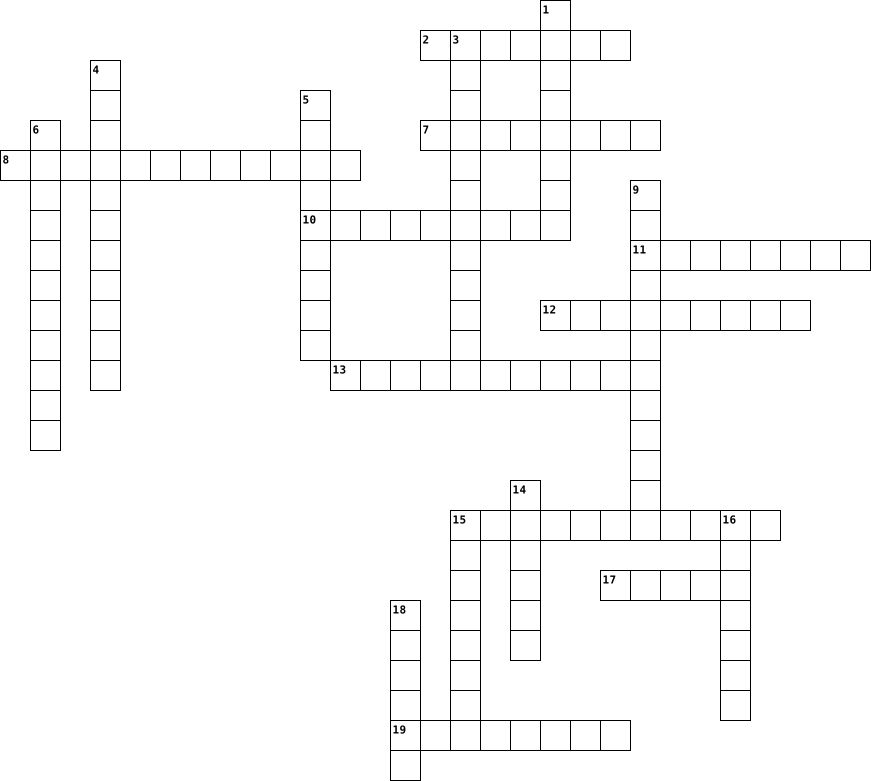
Across
- Which Group 1 metal is usually used as an organometallic reagent? (7 letters)
- What type of alcohol is formed when an ester is reacted with an organometallic reagent or metal hydride? (8 letters)
- The simplest carbonyl compound is? (12 letters)
- What group is formed when two Carboxylic Acids are dehydrated and bond together? (9 letters)
- What type of reactions do Grignard reagents and organometallic reagents perform on carbonyl groups? (8 letters)
- Ketones and aldehydes can both exist as ______ forms. (9 letters)
- Cyanide acts as a _____ when it is attacking carbonyl groups to form a cyanohydrin. (11 letters)
- What molecular shape does the intermediate of a reaction involving Acyl compounds have? (11 letters)
- What is a disadvantage related to the use of diazomethane? (5 letters)
- What factor results in higher boiling points in carbonyl compounds? (8 letters)
Down
- Carbonyl compounds like acetone are usually ______ with water. (8 letters)
- Carbonyl groups reacting with Grignard reagents undergo an _____ reaction. (12 letters)
- What type of reaction is involved in the second part of mechanisms involving Acyl compounds? (11 letters)
- Diols are formed from the ______ of carbonyl compounds. (9 letters)
- What reduces the double bond character of a carbonyl group? (11 letters)
- What chemical compound is used to methylate carboxylic acids? (12 letters)
- Aldehydes are less _____ than ketones. (6 letters)
- What is the shape of carboxylic acids? (8 letters)
- The formation of a hemiacetal is a result of a carbonyl group reacting with an _____. (7 letters)
- What information about the chemical composition of molecules do we gain from IR spectroscopy? (6 letters)
20 Clues: The simplest carbonyl compound is? (12 letters) • Aldehydes are less _____ than ketones. (6 letters) • What is the shape of carboxylic acids? (8 letters) • Ketones and aldehydes can both exist as ______ forms. (9 letters) • Diols are formed from the ______ of carbonyl compounds. (9 letters) • What is a disadvantage related to the use of diazomethane? (5 letters) • ...
Foundational Chemistry 2021-05-03

Across
- Electrical charge of the atom with an equal number of protons and electrons
- This poisonous gas is given the chemical symbol ‘Cl’
- The lightest element on the Periodic Table
- A substance made of only one type of atom
- The name of the ion formed when chlorine gains one electron
- Particles inside the nucleus of an atom that have no charge
- Name for the ‘ingredients’ of a chemical reaction
- Mg2+
- Name of the compound with the formula NaOH
- Name for the substances that are produced in a chemical reaction
- This number, found above an element on the Periodic Table, tells you the number of protons inside that atom
Down
- Positively charged particle in the nucleus of an atom
- This element has an electron arrangement of 2,8
- Negatively charged particle that surrounds the nucleus of an atom
- Number of atoms in a single H2SO4 molecule
- Number of electrons in a sodium atom
- Name of the compound with the formula CaSO4
- This element has an atomic number of 8
- Building block of all matter
- This element is given the chemical symbol ‘K’
- O2-
- The middle of an atom is called this
- The element has an electron arrangement of 2,8,3
- Made of two or more elements chemically combined
- The group number for an element with four electrons in its outer shell
- Used to show the direction of a chemical reaction when writing equations
- Table used to arrange all the known elements
- This element has an atomic number of 6
28 Clues: O2- • Mg2+ • Building block of all matter • Number of electrons in a sodium atom • The middle of an atom is called this • This element has an atomic number of 8 • This element has an atomic number of 6 • A substance made of only one type of atom • Number of atoms in a single H2SO4 molecule • The lightest element on the Periodic Table • Name of the compound with the formula NaOH • ...
Chemistry Crossword 2021-09-20

Across
- Sub-atomic particles with no charge
- A row in the periodic table
- These small units make up all forms of matter including living and non living things.
- Sub-atomic particles with positive charge
- Reactions that release energy
- We cannot live without this gas
- A table in which elements are organised
- The acid that is produced in our stomach
- This has the chemical symbol of Au
- This has the chemical symbol of Mg
- Substance that speeds up a reaction without itself taking part in it
- Lightest elment
- It is equal to the number of protons
Down
- What we get when we add number of protons and neutrons
- Reactions that consume energy
- They are sub-atomic particles having negative charge
- They are made up of two or more types of atoms.
- Increasing ______ will speed up the rate of a chemical reaction
- Reaction type in which things burn
- A change in which new substance is formed
- A column in the periodic table
- These are either positively charged or negative charged
- Things which react are known as _______
23 Clues: Lightest elment • A row in the periodic table • Reactions that consume energy • Reactions that release energy • A column in the periodic table • We cannot live without this gas • Reaction type in which things burn • This has the chemical symbol of Au • This has the chemical symbol of Mg • Sub-atomic particles with no charge • It is equal to the number of protons • ...
Skin & Chemistry 2021-09-23

Across
- astringents
- pricking the skin or tissue with needles
- splotchy freckling of hyperpigmentation
- a halogen element
- removes dead skin cells
- protects skin from UV damage
- treat skin dryness photodamage and acne
- infected tear ducts called styes
- opening of a follicle on the skin surface
- small lumpy cysts eyelids
- first step in skin care
Down
- repelling not absorbing with water
- hydrators for skin
- a biological type
- sharing of electrons to bind together
- flushing rednes of facial skin in adults
- composition structure, properties of matter
- substances used in process of metabolism
- sudden facial redness, blood rushing to skin
- fluid oozing from a healing wound
- inflamed or infected skin condition pimples
- maturation phase of a wound
- liver spots
- seven centers of spiritual power in the body
- related to blood vessels
25 Clues: astringents • liver spots • a biological type • a halogen element • hydrators for skin • removes dead skin cells • first step in skin care • related to blood vessels • small lumpy cysts eyelids • maturation phase of a wound • protects skin from UV damage • infected tear ducts called styes • fluid oozing from a healing wound • repelling not absorbing with water • ...
Chemistry Vocab 2021-09-28

Across
- A ion made of two or more atoms
- Triple bond
- Carbon-Containing
- Gives the probability that an electron will be found in a particular region of the atom
- Formed when one or more electrons are transferred from one atom to another
- Compound composed of 3 elements
- In this compound, the element is always H with the exception of H2O
- Havin a pair of equal and opposite charges
- Electrons on the outermost energy level of an atom
Down
- Diagram showing the valence electrons as paired and unpaired dots
- A compound composed of two elements
- Equal sharing of electrons
- Mono, di, tri, tetra, ect.
- A type of bond formed when electrons are not shared equally
- The tendency to attract electrons to form a chemical bond
- Double bonded carbons
- A measure of the extra positive or negative electrons particles that an object have
- Electrons are shared equally
- A chemical bond formed when two atoms share electrons
- Single bond
20 Clues: Triple bond • Single bond • Carbon-Containing • Double bonded carbons • Equal sharing of electrons • Mono, di, tri, tetra, ect. • Electrons are shared equally • A ion made of two or more atoms • Compound composed of 3 elements • A compound composed of two elements • Havin a pair of equal and opposite charges • Electrons on the outermost energy level of an atom • ...
Organic Chemistry 2021-05-19

Across
- the most important steroid in humans and animals
- monosaccharides that polymerize into sugar based polymers
- polymer formed by esterification reactions
- the simplest type of lipids
- an organic compound that has had one or more hydrogen atoms replaced by an -OH functional group
- compounds with the same molecular formula but in a different arrangement
- a globular protein that transports oxygen and insulin in the blood
- a transparent nearly unbreakable polymer made with repeated carbonate groups
- organic polymers used to build and maintain living cells
Down
- one of the two classifications of proteins with a fairly straight shape
- a group of versatile polymers made with silicon oxygen chains
- defined as the simplest carbohydrate
- synthetic polymers containing the amide functional group
- organic compounds that only contain hydrogen nitrogen and carbon
- aldehydes and ketones that contain hydroxyl groups and compunds derived from aldehydes and ketones
- organic compounds that contain only hydrogen or carbon
- the process where monomers form one polymer molecule
- aliphatic hydrocarbons containing one or more double bonds between carbon atoms
- one of the two classifications of proteins that have a 3d dimensional shape
- an organic compound that contains a carbonyl group bonded to any atom other than hydrogen
20 Clues: the simplest type of lipids • defined as the simplest carbohydrate • polymer formed by esterification reactions • the most important steroid in humans and animals • the process where monomers form one polymer molecule • organic compounds that contain only hydrogen or carbon • synthetic polymers containing the amide functional group • ...
Chemistry Crossword 2021-05-19

Across
- changing the state/phase of matter from a gas to a liquid by removing energy
- particle found in the electron cloud surrounding the nucleus of an atom that has little mass and a negative charge
- table where the different types of atoms are organized according to increasing proton number
- changing the state/phase of matter from a solid to a liquid by adding energy
- a tool used to measure heat (thermal) energy
- the formula for a molecule using element symbols and numbers
- a material found in the environment that can be an animal, plant, or rock
- a measure of heat (thermal) energy
- dihydrogen monoxide
Down
- a state/phase of matter in which the volume does not change but the shape changes
- a material that obtained from natural materials that have been through a chemical process
- particle found in the nucleus of an atom that has mass and a neutral charge
- carbon dioxide
- a substance made when two or more atoms have been chemically joined
- anything that has mass and takes up space
- particle found in the nucleus of an atom that has mass and a positive charge
- a state/phase of matter in which the volume and shape of the substance does not change
- a state/phase of matter in which the volume and shape changes
- changing the state/phase of matter from a liquid to a gas by adding energy
- a kind of reaction that changes natural materials into new products
- the smallest unit of matter
- the center of an atom that has most of the mass and contains protons and neutrons
- a substance made of two or more different elements
23 Clues: carbon dioxide • dihydrogen monoxide • the smallest unit of matter • a measure of heat (thermal) energy • anything that has mass and takes up space • a tool used to measure heat (thermal) energy • a substance made of two or more different elements • the formula for a molecule using element symbols and numbers • a state/phase of matter in which the volume and shape changes • ...
Chemistry - BradenV 2021-05-25

Across
- one mole
- size and energy of electron
- numbers within the quantum system
- space occupied by one mole
- P1/T1=P2/T2
- described by atm
- between
- mass of element/mass of compound
- the math of a chemical equation
- P1V1=P2V2
- ratio of atoms in a compound
- group of elements with a charge on chart
- atoms,ions,molecules
Down
- what is left over
- explains properties of gases
- a gas that has perfect conditions
- an equivalency
- V1/T1=V2/T2
- compares two substances from a balancedequation
- amount of substance in one mole
- Celcius+273
- P1V1/T1=P2V2/T2
- measured by liters
- reactant that runs out first
- within
25 Clues: within • between • one mole • P1V1=P2V2 • V1/T1=V2/T2 • P1/T1=P2/T2 • Celcius+273 • an equivalency • P1V1/T1=P2V2/T2 • described by atm • what is left over • measured by liters • atoms,ions,molecules • space occupied by one mole • size and energy of electron • explains properties of gases • reactant that runs out first • ratio of atoms in a compound • amount of substance in one mole • ...
Chemistry Review 2021-05-25

Across
- arangment of electrons in an atom
- one element switches from one element to another
- formula that gives the actual number of elements in a compound
- number of atoms in a mole
- pressure increases as temperature increases
- volume increases as pressure decreases
- two elements combine to form one molecule
- list of elements in order from most reactive to least
- all moving particles have characteristics of a wave
- compounds break down to form simpler products
- has no set volume or shape
- ratio of actual yield to theoretical yield
- a reactant combines with oxygen to form water and carbon dioxide
Down
- formula that gives ratio of elements in a compound
- two elements in different molecules switch what places
- volume increases as temperature increases
- force on an object in a unit area
- 4 numbers used to locate an electron
- using the group 18 elements to shorten the electron configuration
- a compound that absorbs water molecules
- has a set volume and shape
- percent of a molecule each element takes up
- has a set volume with no set shape
- a conversion factor relating the number of moles of two substances
24 Clues: number of atoms in a mole • has a set volume and shape • has no set volume or shape • arangment of electrons in an atom • force on an object in a unit area • has a set volume with no set shape • 4 numbers used to locate an electron • volume increases as pressure decreases • a compound that absorbs water molecules • volume increases as temperature increases • ...
Medicinal Chemistry 2021-06-10

Across
- amount of drug to maintain level needed for a medicinal effect
- how easily a substance evaporates
- the ejection of an alpha particle from a nucleus (two words, no spaces inbetween)
- to find something using various techniques
- the class of pain-relieving drugs that are derived from poppies
- fraction of administered dose that reaches the target site
- when the body adapts to the presence of medications and experiences negative effects without it
- substance that neutralizes stomach acid
- a substance that improves health by chemically affecting the body
- type of virus that infects bacteria
Down
- emission of particles & energy during radioactivity
- something used to relieve pain, fever, or inflammation
- an opiate used to treat severe pain and was used in World War I
- the disease driven by the uncontrolled growth of cells
- to separate substances based on how well they evaporate
- the ability of radioactivity to remove electrons from an atom (two words, no spaces inbetween)
- a solution that can resist changes in pH
- a group of antibiotics
- broad term describing how nuclear chemistry is used to treat cancer
- A drug used to treat cancer that is derived from Yew Tree leaves
20 Clues: a group of antibiotics • how easily a substance evaporates • type of virus that infects bacteria • substance that neutralizes stomach acid • a solution that can resist changes in pH • to find something using various techniques • emission of particles & energy during radioactivity • something used to relieve pain, fever, or inflammation • ...
Chemistry CROSSWORD 2021-06-10

Across
- The smallest particle of an element?
- A positively charged ion is classified as?
- The group 1 metals are called?
- The group 7 elements are called?
- the number of protons and neutrons in an atom are called?
- atoms of the same element with the same number of protons but with different number of neutrons
- Na
- a substance that is formed when two or more electrons are chemically bonded together
- Br
- What are the horizontal lines called on the table?
Down
- The last name of the creator of the periodic table?
- Li
- O
- The attraction of oppositely charged ions?
- A negatively charged ion is called?
- a combination of two or more substances In which each pure substance retains its individual properties
- The point at which a liquid becomes a gas?
- a pure substance that cannot be broken down into simpler substances
- What are the vertical columns called on the table?
- A particle with no charge found in the nucleus?
20 Clues: O • Li • Na • Br • The group 1 metals are called? • The group 7 elements are called? • A negatively charged ion is called? • The smallest particle of an element? • A positively charged ion is classified as? • The attraction of oppositely charged ions? • The point at which a liquid becomes a gas? • A particle with no charge found in the nucleus? • ...
chemistry crossword 2021-07-13

Across
- brown flake substance acquires on the surface of iron after long exposure to moisture is ?
- When Carbon Dioxide passes through lime water it turns lime water?
- Fatty foods become rancid due to the process of __
- __ gas is filled in packet of chips to prevent rancidity
- change in state is _ reaction
- ___agent reduces the other reactant and oxidizes itself
- we should never change __ of formula
- aqueous solution of sodium chloride is known as?
- oxidation of fats and oils which makes the smell and taste bad is known as?
- plaster of paris changes to _ on mixing with water
Down
- Equation which doesn't follow the law of conservation of mass
- PH stands for ___in German meaning power
- ___Displacement reaction is a chemical reaction in which a more reactive element displaces a less reactive element from its compound
- On heating calcium carbonate turns into calcium __
- Respiration is example of _ reaction?
- Gas evolved when zinc reacts with dilute HCL
- Oxide of which element is used as major ingredient in cement
- white silver chloride changes into ___colour when exposed to sunlight
- hydrogen gas burns with __ sound
- What does the symbol (aq) represent in a chemical equation
20 Clues: change in state is _ reaction • hydrogen gas burns with __ sound • we should never change __ of formula • Respiration is example of _ reaction? • PH stands for ___in German meaning power • Gas evolved when zinc reacts with dilute HCL • aqueous solution of sodium chloride is known as? • Fatty foods become rancid due to the process of __ • ...
Chemistry Revision 2021-10-06

Across
- a metal compound that makes up rocks
- This is how rocks change into other types of rock over time.
- The effect causing global warming
- The middle two sections of the Earth
- Using electricity to separate a compound into its elements.
- formed when a rock undergoes extreme heat or pressure.
- The process of separating a metal from the other elements in a rock.
- The part of Earth's core that is liquid.
- A man-made material made from minerals like clay, cooked at high temperatures.
- When a more reactive metal replaces a weaker metal.
- The breaking of a rock into sediment
Down
- Liquid rock below the Earth's surface
- the mixture of gases surrounding Earth.
- This is how Carbon is transferred from one store to another.
- Formed when lava cools
- a material with small gaps or holes allowing water to seep through.
- Formed by layers of sediment
- Solid part of Earth but can move like a liquid.
- Long-term weather patterns of an area.
- When sediment is placed at the bottom of a sea or lake.
- A rock with enough metal to make it worthwhile extracting.
- Liquid rock above the Earth's surface
- The outer section of the Earth
23 Clues: Formed when lava cools • Formed by layers of sediment • The outer section of the Earth • The effect causing global warming • a metal compound that makes up rocks • The middle two sections of the Earth • The breaking of a rock into sediment • Liquid rock below the Earth's surface • Liquid rock above the Earth's surface • Long-term weather patterns of an area. • ...
Chemistry Vocab 2021-10-07

Across
- a scale used to specify the acidity or basicity
- species formed from chemical reactions
- large group of organic compounds occurring in foods and living tissues
- a biological catalyst
- organic compounds that contain amino and carboxylate functional groups,
- a special type of homogeneous mixture composed of two or more substances
- a chemical bond that involves the sharing of electron pairs between atoms
- a substance that dissolves a solute
- a molecule or ion capable of either donating a proton
- The basic unit of matter
- a stable negatively charged component of an atom.
- a particle, atom or molecule with a net electrical charge.
- a substance or material consisting of very large molecules
- important class of macromolecules found in all cells and viruses.
- the minor component in a solution, dissolved in the solvent.
- a naturally occurring, extremely complex substance that consists of amino acid residues joined by peptide bonds.
- the positively charged central core of an atom
Down
- an underlying substance or layer.
- building blocks, of DNA and RNA
- atoms or small molecules that bond together to form more complex structures
- a substance that takes part in and undergoes change during a reaction.
- the tendency of dissimilar particles or surfaces to cling to one another
- a chemical substance composed of many identical molecules
- substances which react with acids
- molecules that contain hydrocarbons and make up the building blocks of the structure and function of living cells.
- a pure substance consisting only of atoms
- the process of increasing the rate of a chemical reaction
- molecules sticking together
- a type of chemical bonding that involves the electrostatic attraction between oppositely charged ions
- a group of atoms bonded together
- a material made up of two or more different Chemical substance/substances
- an aqueous solution consisting of a mixture of a weak acid and its conjugate base
32 Clues: a biological catalyst • The basic unit of matter • molecules sticking together • building blocks, of DNA and RNA • a group of atoms bonded together • an underlying substance or layer. • substances which react with acids • a substance that dissolves a solute • species formed from chemical reactions • a pure substance consisting only of atoms • ...
CHEMISTRY CROSSWORD 2022-05-12

Across
- si unit of energy
- unit of temoerature
- solids in a liquid are removed
- type of gas on the periodic table
- name of the class
- turns litmus blue
- technique of heating a liquid
- increases the rate of a reaction
- number of protons
- m
- ion thatis positively charged
Down
- two bonding pairs
- turns into a solid
- turns litmus red
- quantity of matter
- dissolves a solvent
- middle of periodic table
- unit of a element
- salt
- solution with a little solute
20 Clues: m • salt • turns litmus red • two bonding pairs • si unit of energy • name of the class • turns litmus blue • unit of a element • number of protons • turns into a solid • quantity of matter • unit of temoerature • dissolves a solvent • middle of periodic table • technique of heating a liquid • solution with a little solute • ion thatis positively charged • solids in a liquid are removed • ...
chemistry crossword 2022-05-10

Across
- A combination of more than one element
- A species with an overall negative charge
- The specific set of principal, angular momentum, and magnetic quantum numbers for an electron.
- A compound that increases the amount of H+ ions in an aqueous solution
- Atoms of the same element that have different numbers of neutrons
- The centre of an atom that contains protons and neutrons
- A physical combination of more than one substance
- the hardest part of chemistry
- A gas law that relates pressure and volume at constant temperature and amount
- neutral subatomic particle
- negatively charged subatomic particle
Down
- An element that exists in various colors and phases, is brittle, and does not conduct electricity or heat well
- Law of physics that states that the total energy of an isolated system does not increase or decrease.
- A species with an overall positive charge
- The number of things equal to the number of atoms in exactly 12 g of carbon-12; equals 6.022×10²³ things
- A compound that increases the amount of OH− ions in an aqueous solution
- are located to the far right of the periodic table and make up the eighteenth column
- the science that deals with the properties, composition, and structure of substances
- the chemical elements in group one of the periodic system
- A gas law that relates volume and temperature at constant pressure and amount
- a positive charged subatomic particle
21 Clues: neutral subatomic particle • the hardest part of chemistry • a positive charged subatomic particle • negatively charged subatomic particle • A combination of more than one element • A species with an overall positive charge • A species with an overall negative charge • A physical combination of more than one substance • ...
CHEMISTRY FINAL 2022-05-17

Across
- known concentration used in a titration
- measure of concentration compares moles
- a charged atom
- any substance that can accept pair electrons
- single bond carbon and hydrogen atoms
- detects the presence of iodine
- atoms gain or lose electrons
- SI derived unit for work, energy, and heat
- what class are you in
- competing influences are balanced
- forms when side by side orbitals overlap
- base that can donate a pair of electrons
- orderly repeated arrangement of cations
- pH greater than 7
- mass of one mole of pure substance
- element or substance not in metal
- xylose
- holds atoms together in molecules
Down
- a fluid state of matter resulting in changed shapes
- effect demonstrated by colloids(light)
- not sugar taste
- rule that electrons fill sublevel by single electron
- movement of ions but not electrons
- resists pH changes when acids or bases are added
- sticky, bitter taste
- an absolute temperature where boing is 373
- explains a phenomenon
- contains at least one double bond
- covalently bonded carbon compound
- formed when the anion and base combine
- movement of solvent or diffusion
- chemical substance consumed in chemical reaction
- a testable explanation
- nonpolar biochemical molecule insoluable in H2O
- study of rates of chem reactions
- movement of thermal energy
- a fluid state of matter
- closely spaced particles
- measure of kinetic energy of all particles
- mixture of metal with another element
- one triple bond
41 Clues: xylose • a charged atom • not sugar taste • one triple bond • pH greater than 7 • sticky, bitter taste • explains a phenomenon • what class are you in • a testable explanation • a fluid state of matter • closely spaced particles • movement of thermal energy • atoms gain or lose electrons • detects the presence of iodine • movement of solvent or diffusion • study of rates of chem reactions • ...
Chemistry Crossword 2022-05-27

Across
- an element with the atomic number of 8
- molarity and parts per million are used to describe this
- the average kinetic energy of the particles in a substance with units in K or °C
- an organic reaction that makes soap
- the process that happens when a solid becomes a liquid
- a positively charged subatomic particle located inside the nucleus
- the process that happens when a gas directly becomes a solid
- a unsaturated hydrocarbon that has a carbon triple bond and is in this homologous series
- energy an object has due to its motion
- every organic molecule has to have this element
- saturated hydrocarbon are in this homologous series
- scientist who shot particles at a piece of gold foil
Down
- the process that happens when a solid directly becomes a gas
- a negatively charged subatomic particle that orbits the nucleus
- an organic reaction that produces alcohol and carbon dioxide
- a neutral subatomic particle located inside the nucleus
- stored energy an object has due to its position
- when heat or energy is absorbed
- when heat or energy is given off
- the process that happens when a gas becomes a liquid
- a measure of force over a unit area with units in kPa or atm
21 Clues: when heat or energy is absorbed • when heat or energy is given off • an organic reaction that makes soap • an element with the atomic number of 8 • energy an object has due to its motion • stored energy an object has due to its position • every organic molecule has to have this element • saturated hydrocarbon are in this homologous series • ...
Organic Chemistry 2022-05-31

Across
- Mass in g mol-1
- Dissolved substance
- Four bonded domains
- Weakest IMF
- The reason for polarity
- Measure of energy change in a reaction
- H+ donor/producer
- ____ oxides are basic
- Bonds between positive ions and sea of e-
- Method of titration for oxygen content in water
- A H+ switch ;)
Down
- Mixing metals in molten state
- Could be either, plays for both teams
- Deposisiton like aerosols
- mol dm-3
- Diatomic elements & symmetrical compounds
- The leftovers
- ____ oxides are acidic
- Two drops will help show pH changes
- Gas law that says P1V1/T1 = P2V2/T2
- -log[H+]
- Acids that don’t fully dissociate
- Deposition like rain, sleet, hail, snow
- OH+ producer / H+ acceptor
24 Clues: mol dm-3 • -log[H+] • Weakest IMF • The leftovers • A H+ switch ;) • Mass in g mol-1 • H+ donor/producer • Dissolved substance • Four bonded domains • ____ oxides are basic • ____ oxides are acidic • The reason for polarity • Deposisiton like aerosols • OH+ producer / H+ acceptor • Mixing metals in molten state • Acids that don’t fully dissociate • Two drops will help show pH changes • ...
Chemistry final 2022-05-31

Across
- common acid
- acid with formula CH3COOH
- a metal breaking down with oxygen
- releases energy
- solar energy
- strange result
- unreactive gas
- bottom of the test tube
- acid + base
- a reaction where one element replaces another in a molecule
- baking soda
- test for carbon dioxide
- ion with more than one atom
- absorbs energy
- period 4 alkali earth
Down
- metal + acid
- a law which shall not be broken
- paper which measures pH
- two or more elements chemically combined
- makes things rust faster
- in a chemical reaction the atoms are......
- a synthetic reaction of life
- left side of a chemical equation
- a molecule is broken to smaller pieces
- made from incomplete combustion
- produced in the decomposition of a carbonate
- can be separated physically
- a type of fuel which is causing global warming
- On the periodic table
- common base
- 3 protons
31 Clues: 3 protons • common acid • acid + base • baking soda • common base • metal + acid • solar energy • strange result • unreactive gas • absorbs energy • releases energy • On the periodic table • period 4 alkali earth • paper which measures pH • bottom of the test tube • test for carbon dioxide • makes things rust faster • acid with formula CH3COOH • can be separated physically • ion with more than one atom • ...
Chemistry Game 2022-05-19

Across
- If two atoms of the same element have different numbers of neutrons, then they are said to be:
- a hydrocarbon that is saturated
- what shape is NH2
- volume is defined as "amount of what"
- what is this equation called? " MiVi = MfVf"
- a hydrocarbon containing one or more triple bond
- The units for volume on the metric system are:
- Identify the following reaction: HCl + NaOH --> NaCl + H2O
- The atomic number is equal to the number of:
- The compound HC2H3O2 is called
- a hydrocarbon containing one or more double bond
- has the same molecular formula but different molecular formula
- If a solid is formed from two aqueous solutions that are mixed, that solid is called:
- Mass is the measure of:
- Na+ is a:
- there are 28 protons in what:
- Identify the type of reaction here: 4Fe (s) + 3 O2 (g) ---> 2Fe2O3
- How many peaks pass a point in a period of time
- Which is more electronegative Magnesium or Sulfur?
Down
- The distance from peak to peak
- what shape is NH3
- what shape is CO
- The name of MgS is:
- Identify the type of reaction here:
- The name of HCI is:
- (s) ---> KCl (s) + O2
- an ionic compound usually has metals and?
- An atom with a charge is:
- The ability of an atom to attract electrons to itself.
- electrons in the outermost ring
- Identify the type of reaction here: H2CO3(aq) + Pb(NO3)2 (aq) --> PbCO3 (s) + HNO3 (aq)
- a thoroughly tested explanation for what is observed
- The distance from the nucleus of an atom to the outer ring.
- The study of matter and energy and the materials of the universe
- what shape is CH2Cl2
35 Clues: Na+ is a: • what shape is CO • what shape is NH3 • what shape is NH2 • The name of MgS is: • The name of HCI is: • what shape is CH2Cl2 • Mass is the measure of: • An atom with a charge is: • there are 28 protons in what: • The distance from peak to peak • (s) ---> KCl (s) + O2 • The compound HC2H3O2 is called • a hydrocarbon that is saturated • electrons in the outermost ring • ...
Chemistry Game 2022-05-19

Across
- Identify the type of reaction here: 4Fe (s) + 3 O2 (g) ---> 2Fe2O3
- The name of HCI is:
- what shape is CO
- there are 28 protons in what:
- Which is more electronegative Magnesium or Sulfur?
- The atomic number is equal to the number of:
- Identify the following reaction: HCl + NaOH --> NaCl + H2O
- a thoroughly tested explanation for what is observed
- Identify the type of reaction here: kclo3(s) ---> KCl (s) + O2
- The study of matter and energy and the materials of the universe
- The distance from the nucleus of an atom to the outer ring.
- If two atoms of the same element have different numbers of neutrons, then they are said to be:
- electrons in the outermost ring
- The compound HC2H3O2 is called
- what shape is CH2Cl2
- an ionic compound usually has metals and?
- How many peaks pass a point in a period of time
- The distance from peak to peak
Down
- The ability of an atom to attract electrons to itself.
- has the same molecular formula but different molecular formula
- what shape is NH3
- what is this equation called? " MiVi = MfVf"
- If a solid is formed from two aqueous solutions that are mixed, that solid is called:
- volume is defined as "amount of what"
- The name of MgS is:
- a hydrocarbon that is saturated
- Mass is the measure of:
- The units for volume on the metric system are:
- Na+ is a:
- An atom with a charge is:
- Identify the type of reaction here: H2CO3(aq) + Pb(NO3)2 (aq) --> PbCO3 (s) + HNO3 (aq)
- what shape is NH2
- a hydrocarbon containing one or more triple bond
- a hydrocarbon containing one or more double bond
34 Clues: Na+ is a: • what shape is CO • what shape is NH3 • what shape is NH2 • The name of HCI is: • The name of MgS is: • what shape is CH2Cl2 • Mass is the measure of: • An atom with a charge is: • there are 28 protons in what: • The compound HC2H3O2 is called • The distance from peak to peak • a hydrocarbon that is saturated • electrons in the outermost ring • ...
Nuclear chemistry 2022-05-18

Across
- determines the chemical properties of an element and its place in the periodic table.
- a nucleus undergoes spontaneous transformation into one or more different nuclei and simultaneously emits radiation
- a distinct kind of atom or nucleus characterized by a specific number of protons and neutrons.
- a nuclear reaction in which a heavy nucleus splits spontaneously or on impact with another particle, with the release of energy.
- a stable subatomic particle occurring in all atomic nuclei, with a positive electric charge equal in magnitude to that of an electron, but of opposite sign.
- a helium nucleus emitted by some radioactive substances originally regarded as a ray.
- a proton or neutron.
- the central and most important part of an object, movement, or group, forming the basis for its activity and growth.
- a stable subatomic particle with a charge of negative electricity
Down
- stability of elements determined by the ratio of the number of neutrons to the number of protons in the nucleus.
- one of two or more species of atoms of a chemical element
- a fast-moving electron emitted by radioactive decay of substances
- a change in the identity or characteristics of an atomic nucleus that results when it is bombarded with an energetic particle, as in fission, fusion, or radioactive decay.
- penetrating electromagnetic radiation of a kind arising from the radioactive decay of atomic nuclei.
- any of a number of subatomic particles carrying a fractional electric charge, postulated as building blocks of the hadrons.
- the mass of an atom of a chemical element expressed in atomic mass units.
- an atom or molecule with a net electric charge due to the loss or gain of one or more electrons.
- a nuclear reaction in which atomic nuclei of low atomic number fuse to form a heavier nucleus with the release of energy.
- the total number of protons and neutrons in a nucleus.
- a subatomic particle of about the same mass as a proton but without an electric charge
20 Clues: a proton or neutron. • the total number of protons and neutrons in a nucleus. • one of two or more species of atoms of a chemical element • a fast-moving electron emitted by radioactive decay of substances • a stable subatomic particle with a charge of negative electricity • the mass of an atom of a chemical element expressed in atomic mass units. • ...
Chemistry Vocabulary 2022-05-24

Across
- Neutral, 0, In Nucleus
- The amount of 3D space substance or object occupies (L x W x H) 2
- Very High temps, atoms lose their electrons 4
- A solid that forms & settles outside of a liquid mixture
- The difference between a measured value & its actual value 7
- Two or more forms of the same element can some Protons different neutrons
- How close or far off a given set of measurements are to each other 5
- How close or dispersed the measurement are to each other 6
- Mass per volume unit D=M/V
Down
- Positive, +1, In Nucleus
- Negative, -1, outside the nucleus
- Matter that cannot be separated into simpler materials. 3
- The size, length, or amount of something
- Degree of hotness or coldness of a substance
- The Quantity of matter in an object 1
- A unit of energy or heat 10
- The basic building block of chemistry 13
- A substance present at the beginning of the reaction
- The quantity of matter in a physical body 9
- Molecules that held firmly & vibrate
20 Clues: Neutral, 0, In Nucleus • Positive, +1, In Nucleus • Mass per volume unit D=M/V • A unit of energy or heat 10 • Negative, -1, outside the nucleus • Molecules that held firmly & vibrate • The Quantity of matter in an object 1 • The size, length, or amount of something • The basic building block of chemistry 13 • The quantity of matter in a physical body 9 • ...
Chemistry: Gases 2022-08-06

Across
- a gas that traps heat within the earth’s atmosphere
- the name for the coldest possible temperature
- a noble gas that makes bright orange light when electricity is passed through it
- the force per unit area caused by collision of gas particles
- developed the first barometer
- the main gas in the earth’s atmosphere
- the pressure unit defined as one Newton of force per square meter
- the unit of pressure we use for tires
- the height that the atmosphere will typically push mercury into a vacuum tube
- the gas law that describes the direct relationship between pressure and temperature
- the second most abundant gas in the earth’s atmosphere
- developed the first suction pump
- a noble gas that is lighter than air
- the meteorological unit of pressure
Down
- discovered that pressure increased as you climb down a mountain
- the temperature scale based on the highest and lowest temperatures in Western Europe
- the pressure unit that equals a value of 1 at sea level
- a gas that protects living things from certain types of UV light
- the temperature scale based on the freezing and boiling point of water
- the gas law that describes the indirect relationship between pressure and volume
- gases that change in concentration over time
- a gas that is lighter than air and explosive
- a device used to measure the pressure of an unknown gas
- the gas law that describes the direct relationship between volume and temperature
- gases that stay relatively the same concentrations over time
25 Clues: developed the first barometer • developed the first suction pump • the meteorological unit of pressure • a noble gas that is lighter than air • the unit of pressure we use for tires • the main gas in the earth’s atmosphere • gases that change in concentration over time • a gas that is lighter than air and explosive • the name for the coldest possible temperature • ...
Chemistry Basics 2022-07-04

Across
- the result of the combination of the synthesis
- the formula of which acid gets poured on to create a violent reaction
- the modification of a neutron
- a row in the periodic table
- the elements being used for a product
- a small series of particles that makes up the universe
- atoms that travel through air signals
- a series of particles included in the atom
- the combination of at least 2 reactants
- a combination of at least 2 elements bonded together
- the stage the burning takes when the substance has been burned
- two parts of an equation with separate elements
- the scientist who discovered the initial atomic theory
Down
- a material with a unique amount of atoms in them
- the measure of attracting electrons
- a column in the periodic table
- the burning of a substance in oxygen
- a scientific formula which can cause a violent reaction when mixed with a base
- a series of elements sorted together in a table
- the particle that guards the atom
20 Clues: a row in the periodic table • the modification of a neutron • a column in the periodic table • the particle that guards the atom • the measure of attracting electrons • the burning of a substance in oxygen • the elements being used for a product • atoms that travel through air signals • the combination of at least 2 reactants • a series of particles included in the atom • ...
Chemistry Quiz 2022-11-01

Across
- Combination of two of more atoms
- the gain of oxygen by a substance during a chemical reaction
- I have the capacity to kill superman
- a substance that speeds up a reaction without itself being consumed
- a solid that forms during a reaction
- used to weigh substances
- a reaction that takes in energy in the form of heat
- group 1 elements
- elements such as hydrogen, nitrogen, and oxygen are called ........
- Hand protection
- Burner
Down
- the element with the lowest atomic mass
- Paper used to measure pH
- a reaction between an acid and base, forming salt and water
- this is the same as the atomic number
- the group 7 elements
- negatively charged ions
- elements are listed on the period table in order of .......... atomic number
- a substance that causes serious burns
- I am the only element in the halide family that is a liquid
- eye protection
- chemical link that holds molecules together
- Cylindrical glass container
23 Clues: Burner • eye protection • Hand protection • group 1 elements • the group 7 elements • negatively charged ions • Paper used to measure pH • used to weigh substances • Cylindrical glass container • Combination of two of more atoms • I have the capacity to kill superman • a solid that forms during a reaction • this is the same as the atomic number • a substance that causes serious burns • ...
ORGANIC CHEMISTRY 2022-11-02

Across
- alkanes that contain a ring of three or more carbons.
- \/\/\/\
- Hydrocarbon with one or more carbon–carbon multiple bonds (double bonds, triple bonds, or both).
- not mirror images with different configurations at 1+ (but not all) equivalent stereocenters.
- originally referred to the primary alcohol ethanol, which is used as a drug and is the main alcohol present in alcoholic drinks.
- class of compounds that contain an ether group—an oxygen atom connected to two alkyl or aryl groups.
- compounds in which one or more atoms of carbon are covalently linked to atoms of other elements, most commonly hydrogen, oxygen, or nitrogen.
- The state of an atom with four electrons available for covalent chemical bonding in its valence.
- Chemical linkage into chains of atoms of the same element, occurring only among the atoms of an element that has a valence of at least two and that forms relatively strong bonds with itself.
- BOND, sharing of electrons between two atoms.
- The existence of two or more different physical forms of achemical element.
- GROUP, Part of an organic molecule responsible for most of its chemical reactions.
- Have same molecular formula and have different structural formula.
- two-dimensional structural representation that depicts the bonding of all atoms in a molecule.
- any substance in which two or more chemical elements (usually other than carbon) are combined, nearly always in definite proportions.
- structural formula arrangement of all bonded carbon atoms without showing the attached hydrogen atoms.
Down
- mirror images with different configurations at all equivalent stereocenters.
- compound derived from an oxoacid in which at least one hydroxyl group is replaced by an alkoxy group, as in the substitution reaction of a carboxylic acid and an alcohol.
- compounds and functional groups that contain a basic nitrogen atom with a lone pair.
- Hydrocarbon with all carbon–carbon bonds are single bonds.
- BOND, type of linkage formed from the electrostatic attraction between oppositely charged ions in a chemical compound.
- makes up over 90% of all chemical compounds.
- a polymer in which two different monomers are present.
- Organic compounds whose carbon skeleton is composed of two or more 5-carbon isoprene structural units
- Structural arrangements of different groupings (a central atom connected with other atoms) in a molecule.
- RULE, for an element to be stable, it must have eight electrons.
- International Union of Pure and Applied Chemistry
- FORMULA, A Lewis structure in which bonded electron pairs in covalent bonds are shown as lines.
- Compound that contains only carbon and hydrogen atoms.
- compound used by insects (and some animals) to transmit a message to other members of the same species.
30 Clues: \/\/\/\ • makes up over 90% of all chemical compounds. • BOND, sharing of electrons between two atoms. • International Union of Pure and Applied Chemistry • alkanes that contain a ring of three or more carbons. • a polymer in which two different monomers are present. • Compound that contains only carbon and hydrogen atoms. • ...
Chemistry puzzle 2022-10-13

Across
- change: A change of one substance into another substance.
- The number written slightly below and to the right of a chemical symbol that shows how many atoms of an element are in a compound.
- A negatively charged particle located outside of an atom’s nucleus about 2000 times smaller than either a proton or neutron.
- A substance that is not uniform throughout.
- A solid substance that forms as a result of a chemical reaction between chemicals in two liquids.
- A neutral particle located in an atom’s nucleus.
- of conservation of mass: A scientific law stating that during a chemical reaction, matter is not created nor destroyed.
- change: A usually reversible change in the physical properties of a substance, as size and shape.
- A substance that is present at the beginning of a chemical reaction, takes part in the reaction, and is changed into a new substance.
- A combination of two or more substances that do not combine chemically, but remain the same individual substances.
Down
- mass number: The total number of protons and neutrons in an atom’s nucleus.
- A group of atoms that are held together by covalent bonds so that they move together.
- An atom of one element that has a different number of neutrons than another atom of the same element.
- A substance that is evenly spread throughout. Particles not distinguishable.
- a vertical column in the periodic table of the elements that have similar properties.
- a horizontal row in the periodic table of the elements that have varying properties.
- A substance made up of two or more different types of atoms bonded together.
- The number before a chemical formula indicating how many molecules are involved in a chemical reaction.
- A substance formed by a chemical reaction; made by the rearrangement of atoms and bonds in reactants.
- An atom of group of atoms that has a positive or negative electric charge; forms by gaining or losing electrons.
- number: The total number of protons in an atom’s nucleus.
- A positively charged particle located in an atom’s nucleus.
- A substance that increases the rate of a chemical reaction but is not consumed by the reaction.
- A substance that cannot be broken down into a simpler substance by ordinary chemical changes.
24 Clues: A substance that is not uniform throughout. • A neutral particle located in an atom’s nucleus. • change: A change of one substance into another substance. • number: The total number of protons in an atom’s nucleus. • A positively charged particle located in an atom’s nucleus. • mass number: The total number of protons and neutrons in an atom’s nucleus. • ...
Chemistry choise 2022-10-25

Across
- the ---- electrons are the one in the outer sheel of an atom
- Element with atomic number 17
- number of valence electrons of the Alkali metals
- group of elements with 7 valence electrons
- what do atoms do with their electrons in ionic bonds
- A complete outer shell
- in order to make it stable you need to --- a reaction
- they make the structure created by Lewis
- First part of a reaction
- Second part of a reaction
- A+B-> AB
- the letters that rapresent an element
- In order to create a combustion you need oxygen, --- and a spark
Down
- AB->A+B
- A covalent bond is always between two non----
- It is formed in a covalent bond
- name of the number of protons of an element
- negative charged particles
- symbol of iron
- positive charged particles
- first of the elements with 6 valence electrons
- neutral particles
22 Clues: AB->A+B • A+B-> AB • symbol of iron • neutral particles • A complete outer shell • First part of a reaction • Second part of a reaction • negative charged particles • positive charged particles • Element with atomic number 17 • It is formed in a covalent bond • the letters that rapresent an element • they make the structure created by Lewis • group of elements with 7 valence electrons • ...
chemistry p1lol 2022-09-09

Across
- alpha particles
- bottom two rows of periodic table
- 6.626*10^-34
- 2nd highest energy wavelength
- colors of rainbow
- bottom of wavelength
- shortest wavelength on electromagnetic spectrum
- radioactive element
- used in atomic bomb
- table of elements
- heaviest stable element
- highest energy visible light
- element 10
- number of electrons allowed in d orbital
- protons in hydrogen
- unit of measuring wavelength
- number of electrons allowed in p orbital
- atomic bomb
- heavies noble gas
- does not decay
- subatomic particle with -1 charge
- significant ____
- harmful light from sun
- element with different number of neutrons
Down
- uncertainty principle
- lowest energy wavelengths
- unit of measuring frequency
- size of wave
- person who performed gold foil experiment
- subatomic particle with no charge
- unit of measuring energy
- single particle of light
- what atoms are mostly made of
- top of wavelength
- area where protons and neutrons are located
- number of electrons allowed in s orbital
- atom with positive or negative charge
- lowest energy visible light
- waves used in kitchen appliance
- total of protons and neutrons combined
- outermost electron shell
- minimum amount of energy that can be gained or lost by an atom
- subatomic particle with +1 charge
- type of element in row 8
- wavelength slightly longer than visible light
45 Clues: element 10 • atomic bomb • 6.626*10^-34 • size of wave • does not decay • alpha particles • significant ____ • colors of rainbow • top of wavelength • table of elements • heavies noble gas • radioactive element • used in atomic bomb • protons in hydrogen • bottom of wavelength • uncertainty principle • harmful light from sun • heaviest stable element • unit of measuring energy • single particle of light • ...
Chemistry Crossword 2022-08-24

Across
- organizes all 118 elements
- tells you the number of protons in an atom
- element with a symbol of Au
- element with a symbol of Sb
- element with a symbol of K
- element with a symbol of Na
- all matter is made of these
- element with a symbol of Cu
- negatively charged particle
- positively charged particle
- charge of a neutron
- the name of the electrons on the outside energy level
- the name of the vertical columns on the periodic table
- the number of valence electrons that hydrogen and lithium have
- element with a symbol of Ag
- the home of the protons and neutrons
- element with a symbol of Pb
Down
- element with a symbol of Hg
- charge of a proton
- group 17, period 4
- element with a symbol of Sn
- group 2, period 3
- neutral particle
- element with a symbol of Fe
- element with more protons than carbon and less electrons than oxygen
- the name of the horizontal rows on the periodic table
- charge of a electron
- the period an element is in tells us how many ____ it has
- where the electrons live
- the combined number of protons and neutrons
30 Clues: neutral particle • group 2, period 3 • charge of a proton • group 17, period 4 • charge of a neutron • charge of a electron • where the electrons live • organizes all 118 elements • element with a symbol of K • element with a symbol of Hg • element with a symbol of Sn • element with a symbol of Au • element with a symbol of Sb • element with a symbol of Fe • element with a symbol of Na • ...
Chemistry: Matter 2022-09-01

Across
- is a measure of the amount of matter an object has
- two or more different substances are physically mixed (not chemically combined)
- Separating components of a liquid mixture based on how fast the parts travel up a special paper
- separating a liquid from another liquid, both have different boiling points
- made of only one type of atom
- unit to measure volume
- Separate two liquids with different density or separate liquid from a heavy sediment
- being dissolved
- Separating smaller solids from liquids using filter paper
- Example of a solvent
- mixture does not look uniform, can see the parts that make up the mixture
- separating two solids, one is magnetic
- substances that cannot be separated by physical mean
- Example of a solute
- is the amount of space an object takes up
Down
- made of two or more types of atoms
- dissolving the solution
- unit to measure mass
- Separating components of a mixture based on the difference in density
- Example of a mixture
- Anything that has a mass and takes up space
- composition is uniform, cannot see the parts that make up the mixture
- smallest unit of an element or compound
- Separating larger solids from smaller solids using a sieve
- all matter is made up of ____.
- separating a liquid from a solid that has been dissolved
26 Clues: being dissolved • Example of a solute • unit to measure mass • Example of a mixture • Example of a solvent • unit to measure volume • dissolving the solution • made of only one type of atom • all matter is made up of ____. • made of two or more types of atoms • separating two solids, one is magnetic • smallest unit of an element or compound • is the amount of space an object takes up • ...
Chemistry Review 2017-02-12

Across
- (on the P.T.): a column of elements
- atomic particles found in the nucleus of atom and carry a positive charge (+)
- is a substance formed when two or more chemical elements are chemically bonded together. Two types of chemical bonds common in compounds are covalent bonds and ionic bonds. The elements in any compound are always present in fixed ratios
- number: that always contains the same number of protons and electrons
- accompanied by the release of heat.
- a substance that takes part in and undergoes change during a reaction
- a chemical reaction that is accompanied by the absorption of heat, or an organism that generates heat to maintain its temperature. A chemical reaction that works only if heat is absorbed is an example of a reaction that would be described as endothermic
- Gas: any of the gaseous elements helium, neon, argon, krypton, xenon, and radon, occupying Group 0 (18) of the periodic table. They were long believed to be totally unreactive but compounds of xenon, krypton, and radon are now known
- Bohr: Danish physicist who proposed a theory for the hydrogen atom based on quantum theory.
- of Conservation of Mass: the number atoms present BEFORE and AFTER a reaction takes place is ALWAYS the same
- hard and solid and shiny, electricity, good conductors of heat, ductile, and malleable
- atomic particles found in the nucleus of atom and has no charge
Down
- a mark or character used as a conventional representation of an object, function, or process, e.g., the letter or letters standing for a chemical element or a character in musical notation.
- Mendeleev: Russian chemist who formulated the Periodic Law
- combination of two or more elements link together
- (on the P.T.): the side of a table
- is a substance that is formed when two or more chemicals react. When a chemical reaction takes place, a new substance is often created from the atoms or molecules of the original substances. There are often multiple products formed in a reaction
- a cause to be deposited in solid form from a solution
- brittle, not malleable or ductile, poor conductors of heat and electricity
- it is the most important part of an object, movement, or group, forming the basis for its activity and growth
- atomic particles that move around the nucleus of an atom and carry a negative charge (-)
- each of the actual or potential patterns of electron density that may be formed in an atom or molecule by one or more electrons, and that can be represented as a wave function
- electron: electrons in the outermost energy level of an atom
- it is a basic unit of a chemical element
- show both properties
- is a substance that is made up of one type of atom
26 Clues: show both properties • (on the P.T.): the side of a table • accompanied by the release of heat. • (on the P.T.): a column of elements • it is a basic unit of a chemical element • combination of two or more elements link together • is a substance that is made up of one type of atom • a cause to be deposited in solid form from a solution • ...
Chemistry Review 2017-02-12

Across
- Ingredients produced after the reaction takes place
- Particles found in nucleus positive charge
- Relating to an orbit
- Composed or mixture of two or more separate elements
- electron Determines atom’s chemical properties, electrons in the outermost energy level
- A substance consisting of atoms which all have the same number of protons, chemically the substances cannot be broken down using chemical methods
- Number atoms present before and after a reaction takes places is always the same
- Share characteristics of metal and non-metal
- Elements that are gasy
- Absorption of heat
- (on the P.T.)Rows down the periodic table
- found in nucleus nucleus, atomic number - atomic mass= neutron
Down
- Russian chemist who developed a periodic table
- First letter is capitalized the second in lower-cased
- (on the P.T.)Rows across the periodic table
- Heat released
- Poor conductors of heat
- move around nucleus negative charge
- number Number of protons and electrons in a atom
- Collection of two or more atoms
- Ingredients present before the reaction
- Center of an atom
- Good conductors of heat
- Basic unit of everything
24 Clues: Heat released • Center of an atom • Absorption of heat • Relating to an orbit • Elements that are gasy • Poor conductors of heat • Good conductors of heat • Basic unit of everything • Collection of two or more atoms • move around nucleus negative charge • Ingredients present before the reaction • (on the P.T.)Rows down the periodic table • Particles found in nucleus positive charge • ...
Chemistry Crossword 2017-02-05

Across
- A substance that can accept of neutralise hydrogen ions.
- A particle that makes up everything.
- A substance that speeds or slows down a reaction without getting involved.
- A positively charged particle.
- The process of decay.
- A compound with chemical properties.
- The result of a chemical reaction.
- The bond of two or more elements.
- A negatively charged ion.
- a substance that is added to cause a chemical reaction,
Down
- Where substances act with each other, or change into a new substance.
- Damage caused to a metal or stone.
- The process of precipitating a substance from a solution.
- A non-charged /neutral particle.
- A positively charged ion.
- A molecule that can donate a proton or accept a pair of electrons in reactions.
- A fast chemical combination of a substance with oxygen.
- Elements that occupy a horizontal row on the periodic table.
- A negatively charged particle.
- The power of combined elements.
- A combination of element symbols.
- A particle that has lost or gained one or more electrons.
- Elements that occupy a column on the periodic table.
23 Clues: The process of decay. • A positively charged ion. • A negatively charged ion. • A positively charged particle. • A negatively charged particle. • The power of combined elements. • A non-charged /neutral particle. • A combination of element symbols. • The bond of two or more elements. • Damage caused to a metal or stone. • The result of a chemical reaction. • ...
Chemistry Review 2017-02-08

Across
- Positive charged atomic particle
- the start of a chemical reaction
- share both traits from metals and nonmetals
- a group of more than one element
- a heated reaction
- shiny good conductor not brittle
- all elements that went into reaction come out of reaction with same number
- the letters that identify the element
- # of electrons in outer shell
- the end result of a chemical reaction
- atomic particle negative charge
- atomic paticle no charge
- metal nonmetal and metalloid _____
Down
- a group of atoms
- horizontal rows of elements with same electron shells
- add up the protons and nuetrons
- a full outer shell
- dull bad conductor brittle
- the creator of the PT
- a pure substance on the PT
- The Building block s of matter
- the number of protons and electrons
- a cold reaction
- the different levels were valence are at
- center of an atom
25 Clues: a cold reaction • a group of atoms • a heated reaction • center of an atom • a full outer shell • the creator of the PT • atomic paticle no charge • dull bad conductor brittle • a pure substance on the PT • # of electrons in outer shell • The Building block s of matter • add up the protons and nuetrons • atomic particle negative charge • Positive charged atomic particle • ...
Chemistry Crossword 2017-02-08

Across
- - carry a negative charge
- number - the number of protons in the nucleus
- (on the P.T.) - a column of elements in the periodic table of the chemical elements
- - a substance that takes part in and undergoes change during a reaction
- - the opposite of "exo"
- - material that is dull, nonmalleable, fragile
- Bohr- suggested that electrons move from one orbital to another
- electron - the outermost shell of an atom
- - a group of atoms bonded together
- - everything is made up of these
- - substance that is formed as the result of a chemical reaction
- - found all over the periodic table
- - a solid material that is typically hard, shiny, malleable, fusible, and ductile, with good electrical and thermal conductivity
Down
- - the space outside the nucleus of an atom where an electron is
- - carry a positive charge
- - to be deposited in solid form from a solution
- Mendeleev - a Russian chemist, developed a periodic table of the chemical elements
- (on the P.T.) - horizontal rows in the periodic table, the same number of electron shells
- - a thing that is composed of two or more separate elements
- - the release of heat
- - properties are intermediate between those of metals and solid nonmetals
- Gas - gaseous
- - the center of an atom
- - carry no electrical charge
- of Conservation of Mass - mass in an isolated system, not destroyed by chemical reactions
- - a mark or character
26 Clues: Gas - gaseous • - the release of heat • - a mark or character • - the opposite of "exo" • - the center of an atom • - carry a positive charge • - carry a negative charge • - carry no electrical charge • - everything is made up of these • - a group of atoms bonded together • - found all over the periodic table • electron - the outermost shell of an atom • ...
Chemistry Vocabulary 2016-12-01

Across
- the electrical charge of the proton
- the eighteenth family on the periodic table they are non reactive
- Vertical column in the periodic table
- the temperature which a substance changes from a solid to a liquid
- the second family on the periodic table
- the process in which bubbles of gas form throughout a liquid and rise to the surface
- anything that has mass and takes up space.
- the energy that is stored in chemical bonds
- electrical property that can be either positive or negative
Down
- the temperature at which a substance boils
- a group of elements that have properties of both metals and nonmetals
- change that results in the formation of a new substance or substances
- a description of a chemical reaction using chemical formulas, subscripts, and coefficients.proton - the positive negatively charged subatomic particle that is located inside the nucleus of an atom
- the electrical charge of the electron
- force that holds atoms together in molecules
- measure of an atom's mass that is equal to the number of protons and neutrons in the atom's nucleusatomic number - the number of protons in the nucleus of an atom
- the first family on the periodic table they are very reactive
- a chart of the elements
- the basic building block of most of the matter around us
- the neutrally charged subatomic particle that is located inside the nucleus of an atom
20 Clues: a chart of the elements • the electrical charge of the proton • the electrical charge of the electron • Vertical column in the periodic table • the second family on the periodic table • the temperature at which a substance boils • anything that has mass and takes up space. • the energy that is stored in chemical bonds • force that holds atoms together in molecules • ...
Chemistry Crossword 2018-02-01

Across
- A material that electric charge can move through easily
- Substance that reacts with another substance or substances in a chemical reaction to create new substances with different properties
- Pure substances formed as a result of the attraction between the particles of opposite charges called ions
- Chemical combination of two or more elements in a specific ratio
- An experiment in which all the reactants and all products of a chemical reaction are accounted for
- Is a chemical reaction that takes place in the cells in your body food (glucose) reacts with oxygen to produce energy, water and carbon dioxide.
- Speed of a chemical reaction
- Number of protons in the nucleus of one atom of an element
- Chemical reaction that occurs when oxygen reacts with a substance to form a new substance and give off energy
- Orbit of electrons around the nucleus of an atom
- Slow chemical change
- Group one elements in the periodic table. Not including hydrogen; the most reactive of the metals.
- Group 2 elements in the periodic table; their reactivity is not a strong as that of the alkali metals
- An experiment in which one or more products of chemical reaction can escape
Down
- Organic catalysts
- Combination of symbols that represent a compound; the formula identifies the elements in the compound and the amount of each element
- in a chemical reaction is always equal to the total mass of the products
- Substances that help a reaction proceed faster
- A reaction that takes place when two or more substances react to form new substances
- Mass of one atom of an element calculated from the total number of protons, neutrons and electrons of that atom; measured in atomic mass units (amu)
- change that results when 2 or more substances react to make a new substance
- Releases heat
- Absorbs heat
- Pure substance that cannot be broken down into other substances; substance made up of only one type of atom
- new substance produced in a chemical reaction between reactants
- Invisible negatively charged particle that orbits the nucleus of an atom
26 Clues: Absorbs heat • Releases heat • Organic catalysts • Slow chemical change • Speed of a chemical reaction • Substances that help a reaction proceed faster • Orbit of electrons around the nucleus of an atom • A material that electric charge can move through easily • Number of protons in the nucleus of one atom of an element • ...
Chemistry Vocab 2018-02-05

Across
- states that regardless of the multiple stages or steps of a reaction, the total enthalpy change for the reaction is the sum of all changes
- power derived from the utilization of physical or chemical resources, especially to provide light and heat
- the process of measuring the amount of heat released or absorbed during a chemical reaction
- the branch of chemistry concerned with the quantities of heat evolved or absorbed during chemical reactions
- the process or result of joining two or more things together to form a single entity
- the energy possessed by a body by virtue of its position relative to others, stresses within itself, electric charge, and other factors
- A unit of energy in the SI system. One joule is 1 kg. m2/s2 which is also 0.2390 calorie
- energy that an object possesses by virtue of being in motion
- a thermodynamic quantity equivalent to the total heat content of a system
- a reaction or process accompanied by the release of heat
- energy stored in the chemical bonds of a substance
Down
- energy cannot be created or destroyed, it can only be transformed from one form to another
- the degree or intensity of heat present in a substance or object
- of a reaction or process accompanied by or requiring the absorption of heat
- a phase transition from the liquid phase to vapor
- an apparatus for measuring the amount of heat involved in a chemical reaction or other process
- the energy needed to raise the temperature of 1 gram of water through 1 °C
- the measure of bond strength in a chemical bond
- a form of energy associated with the movement of atoms and molecules in any material
- heat the heat required to raise the temperature of the unit mass of a given substance by a given amount
20 Clues: the measure of bond strength in a chemical bond • a phase transition from the liquid phase to vapor • energy stored in the chemical bonds of a substance • a reaction or process accompanied by the release of heat • energy that an object possesses by virtue of being in motion • the degree or intensity of heat present in a substance or object • ...
Chemistry Vocab 2018-02-05

Across
- A unit of energy in the SI system. One joule is 1 kg. m2/s2 which is also 0.2390 calorie
- the degree or intensity of heat present in a substance or object
- energy that an object possesses by virtue of being in motion
- a form of energy associated with the movement of atoms and molecules in any material
- power derived from the utilization of physical or chemical resources, especially to provide light and heat
- a thermodynamic quantity equivalent to the total heat content of a system
- energy cannot be created or destroyed, it can only be transformed from one form to another
- a phase transition from the liquid phase to vapor
- the energy possessed by a body by virtue of its position relative to others, stresses within itself, electric charge, and other factors
- the energy needed to raise the temperature of 1 gram of water through 1 °C
- heat the heat required to raise the temperature of the unit mass of a given substance by a given amount
- an apparatus for measuring the amount of heat involved in a chemical reaction or other process
Down
- the process of measuring the amount of heat released or absorbed during a chemical reaction
- the measure of bond strength in a chemical bond
- energy stored in the chemical bonds of a substance
- states that regardless of the multiple stages or steps of a reaction, the total enthalpy change for the reaction is the sum of all changes
- the branch of chemistry concerned with the quantities of heat evolved or absorbed during chemical reactions
- of a reaction or process accompanied by or requiring the absorption of heat
- the process or result of joining two or more things together to form a single entity
- a reaction or process accompanied by the release of heat
20 Clues: the measure of bond strength in a chemical bond • a phase transition from the liquid phase to vapor • energy stored in the chemical bonds of a substance • a reaction or process accompanied by the release of heat • energy that an object possesses by virtue of being in motion • the degree or intensity of heat present in a substance or object • ...
Chemistry Crossword 2017-11-09

Across
- pure substance that cannot be broken down into other substances; substance made up of only one type of atom
- shiny, malleable, ductile element that conducts electricity
- group 1 elements in the periodic table, not including hydrogen; the most reactive of the metals
- group 18 elements in the periodic table;the most stable and unreactive elements
- a reaction that takes place when two or more substances react to form new substances
- description of how a substance interacts with other substances, such as acids;chemical properties are observable only when a chemical change occurs
- pure substance formed when non-metals combine
- catalyst involved in chemical reactions in living things
- atom that has become electrically charged because it has lost or gained electrons; a positive ion is an atom that has lost one or more electrons;a negative ion is an atom that has gained one or more electrons
- the smallest part of an element that is representative of that element; a neutral particle made up of a nucleus containing protons and neutrons, and in which the number of electrons equals the number of protons
- mass of one atom of an element calculated from the total number of protons,neutrons, and electrons of that atom; measured in atomic mass units (amu)
Down
- anything that has mass and occupies space
- combination of symbols that represent a compound; the formula identifies the elements in the compound and the amount of each element
- number of protons in the nucleus of one atom of an element
- group 2 elements in the periodic table; their reactivity is not as strong as that of the alkali metals
- element that has both metallic and non-metallic properties
- change of state from a solid to a liquid
- group of atoms joined by covalent bonds
- orbit of electrons around the nucleus of an atom
- invisible negatively charged particle that orbits the nucleus of an atom
- measure of atomic mass; 1 amu is equal to 1/12th the mass of a carbon 12 atom
- pure substance formed when at least one metal and one non-metal combine
- change that results when two or more substances react to create a different substance or substances; the new substances have completely different properties from the original ones
- neutral particle in the nucleus of an atom
- combination of pure substances; unlike a compound, the components of a mixture do not combine chemically and are not always in the same ratio
25 Clues: group of atoms joined by covalent bonds • change of state from a solid to a liquid • anything that has mass and occupies space • neutral particle in the nucleus of an atom • pure substance formed when non-metals combine • orbit of electrons around the nucleus of an atom • catalyst involved in chemical reactions in living things • ...
Chemistry Crossword 2017-11-08

Across
- atoms or a group of atoms that have been electrically charged
- positive charges
- a new substance produces in a chemical reaction between reactants.
- negative charges
- release heat
- chemical combination of two or more elements in a specific ratio
- results from a chemical reaction
- made up of two or more substance combined
- mixtures are easy to see
- anything on the periodic table
- the experiment is in the open
- characteristics that can be used to describe a substances
Down
- anything that has mass and occupies space
- are pure substance formed as a result of the attraction between particles of opposite charges
- absorbs heat
- two or more substance are combined to form a new substance.
- made up of one type of matter
- the average mass of an element in atomic mass units
- nonmetals combine
- an element is defined by the number of protons
- are subtance that help a reaction rate
- the experiment is closed a bag
- if it a solid or a liquid how it is measured
- a substance that reacts with another substance.
- two or more substance that look like are one
25 Clues: absorbs heat • release heat • positive charges • negative charges • nonmetals combine • mixtures are easy to see • made up of one type of matter • the experiment is in the open • the experiment is closed a bag • anything on the periodic table • results from a chemical reaction • are subtance that help a reaction rate • anything that has mass and occupies space • ...
Chemistry Crossword. 2017-11-08

Across
- mass of one atom of an element calculated from the total number of protons, neutrons, and electrons of that atom
- cloudy mixture in which tiny particles of one substance are held within another and particles cannot be separated out from the other substance\
- positively charged centre of an atom
- property that describes the physical appearance and composition of a substance
- an experiment in which all reactants and all products of a chemical reaction are accounted for
- a reaction that takes place when two or more substances react to form new substances
- group 2 elements in the periodic table
- dull, brittle element that does not conduct electricity
- amount of mass in a given volume of a substance
- group 18 elements in the periodic table
- homogeneous mixture
Down
- description of a solid that can be stretched into a long wire
- chemical reaction that occurs when oxygen reacts with a substance to form a new substance and give off energy
- the smallest part of an element that is representative of that element
- number of protons in the nucleus of one atom of an element
- slow chemical change that occurs when oxygen in the air reacts with metal
- substance that reacts with another substance or substances in a chemical reaction to create a new substances with different properties
- metals group 1 elements in the periodic table
- principle that matter is not created or destroyed in a chemical reaction
- group of atoms acting as one
- change in the appearance or state of a substance that does not change the composition
- changing of state from a solid to a liquid
- chemical combination of two or more elements in a specific ratio
- an experiment in which one or more products of a chemical reaction can escape
- mass of a substance that can dissolve in a given amount of solvent to form a saturated solution at a given temperature
25 Clues: homogeneous mixture • group of atoms acting as one • positively charged centre of an atom • group 2 elements in the periodic table • group 18 elements in the periodic table • changing of state from a solid to a liquid • metals group 1 elements in the periodic table • amount of mass in a given volume of a substance • dull, brittle element that does not conduct electricity • ...
chemistry crossword 2017-11-07

Across
- catalyst involved in chemical reactions in living things
- substance made of only one kind of matter, which has a unique set if properties
- invisible negatively charged particle that orbits around the nucleus of an atom
- change in the appearance or state of a substance that does not change the composition
- descriptions of a substance that can be pounded or rolled into sheets
- chemical reaction that releases energy
- pure substance formed when non-metals combine
- change that results when two or more substances react to create a different substance or substances; the new substances have completely different properties from the original ones
- atoms that have become electrically charged because it has lost or gained electrons
- change of state from solid to a gas or from a gas to a solid
- pure substances formed when at least one metal or non-metal combine
- positively charged particle in the nucleus of an atom
Down
- neutral particle in the nucleus of an atom
- chemical combination of two or more elements in a specific ratio
- anything that has mass and occupies space
- pure substance that cannot be broken down into other substances; a substance made up of only one type of atom
- combination of pure substances; unlike a compound, the components of a mixture do not combine chemically and are not always in the same ratio
- group 18 elements in the periodic table; the most stable and nonreactive elements
- chemical reaction that absorbs energy
- number of protons in the nucleus of one atom of an element
- positively charged that centre of an atom; contains protons and neutrons
- shiny, malleable, ductile element that conducts electricity
- property that describes the physical appearance and composition of a substance
- substance that strongly resists the flow of electricity
- vertical column of elements in the periodic table; elements in a family all have similar chemical properties; also called a family
25 Clues: chemical reaction that absorbs energy • chemical reaction that releases energy • anything that has mass and occupies space • neutral particle in the nucleus of an atom • pure substance formed when non-metals combine • positively charged particle in the nucleus of an atom • substance that strongly resists the flow of electricity • ...
Chemistry Crossword 2017-11-07

Across
- group 17 elements in the periodic table;the most reactive non-metals
- cloudy mixture in which tiny particles of one substance are held within another, and the particles can be separated out
- positively charged particle in the nucleus of an atom
- an experiment in which one or more products of a chemical reaction can escape
- chemical reaction that absorbs energy
- group 18 elements in the periodic table;the most stable and unreactive elements
- chemical reaction that occurs when oxygen reacts with a substance to form a new substance and give off energy
- change in the appearance or state of a substance that does not change the composition
- change that results when two or more substances react to create a different substance or substances
- pure substance formed when non-metals combine
- combination of pure substances
Down
- description of a substance that can be pounded or rolled into sheets
- substance that helps a chemical reaction to proceed more quickly
- substance that strongly resists the flow of electricity
- catalyst involved in chemical reactions in living things
- chemical reaction that releases energy
- pure substance formed when at least one metal and one non-metal combine
- neutral particle in the nucleus of an atom
- a table in which the elements are organized by their physical and chemical properties
- heterogeneous mixture;mixture in which the different substances that make up the mixture are visible
- vertical column of elements in the periodic table
- substance made of only one kind of matter, which has a unique set of properties
- element that has both metallic and non-metallic properties
- substance that reacts with another substance or substances in a chemical reaction to create new substances with different properties
- cloudy mixture in which tiny particles of one substance are held within another and particles cannot be separated out from the other substance
25 Clues: combination of pure substances • chemical reaction that absorbs energy • chemical reaction that releases energy • neutral particle in the nucleus of an atom • pure substance formed when non-metals combine • vertical column of elements in the periodic table • positively charged particle in the nucleus of an atom • substance that strongly resists the flow of electricity • ...
Chemistry Crossword 2017-11-10

Across
- Organic catalyst
- Made up of one type of matter and has a unique set of
- A chemical change, which absorbs heat energy.
- When material change state, but does not change composition
- An experiment kin which all reactants and all products of a chemical
- A pure substance formed when at least one metal and one non-metal
- Greek word for "same kind"
- A substance that reacts with another substance or substance
- Mixture in which the different substance are easy to see.
- Mixtures of two or more pure substance that look like one substance.
- A new substance produced in a chemical reaction between reactant.
- substance to form a new substance and gives off energy.
- A chemical change, which release heat energy.
Down
- are accounted for.
- Cloudy mixture that can be separated.
- chemical reaction to create a new substance with different products
- Greek word for "different kind"
- Hazardous household materials information system
- Is a chemical reaction that occurs when oxygen reacts with
- When two or more substance react to form a new substance(the new substance has new properties)
- An expirement in which one or more products of a chemical reaction can
- properties.
- Cloudy mixture that cannot be separated.
- Made up of two or more substances combined together.
- Workplace hazardous materials information system
25 Clues: properties. • Organic catalyst • are accounted for. • Greek word for "same kind" • Greek word for "different kind" • Cloudy mixture that can be separated. • Cloudy mixture that cannot be separated. • A chemical change, which absorbs heat energy. • A chemical change, which release heat energy. • Hazardous household materials information system • ...
Chemistry Crossword 2018-01-25

Across
- Total number of protons + neutrons.
- Has Hydrogen and Carbon in it.
- Add mass to the atom.
- Do not add mass to the atom
- The elements on the stair line.
- Most reactive.
- Has Calcium and Barium.
- Tells the number of protons.
Down
- the study of the elements
- The group to the right of the Transition Metals and to the left of the Metallloids.
- Atoms will always react until they have a full shell.
- The bottom group of the 2 that is usually under, and do not fit into, the Periodic Table.
- Top group of the 2 that is usually under and do not fit into the Periodic Table.
- an element with an electric charge formed formed loss or gain in electrons.
- thing that holds all of the elements
- Do not react at all.
- Will never change, because it will become a different element.
- Most reactive non-metals.
- The letters of the elements.
- the guy who made the periodic table
20 Clues: Most reactive. • Do not react at all. • Add mass to the atom. • Has Calcium and Barium. • the study of the elements • Most reactive non-metals. • Do not add mass to the atom • The letters of the elements. • Tells the number of protons. • Has Hydrogen and Carbon in it. • The elements on the stair line. • Total number of protons + neutrons. • the guy who made the periodic table • ...
Chemistry Crossword 2018-01-25

Across
- electrons numbers of electrons in the outermost shell.
- elements react and have properties that are similar.
- The basic unit of matter, makes up everything.
- used to separate liquid mixtures
- change does not form a new substance.
- Do not add mass to the atom, has a negative charge.
- All of the elements to the left of the staircase.
- used to separate a liquid to solid mixture.
- An electrically charged element formed from the movement of electrons.
- a positively charged particle.
- composed of two or more compounds physically combined.
Down
- A substance made of two or more elements, chemically combined.
- touching the staircase line, properties of both metals and non-metals.
- everything to the right of the staircase line.
- Pure substances that can not be broken down by chemical means.
- change when a chemical is changed into a new substance chemically.
- Add mass to the atom, have no charge.
- used to separate a solid to solid mixture.
- number Tells you the number of protons.
- rule Atoms will always react until they have a full shell.
20 Clues: a positively charged particle. • used to separate liquid mixtures • change does not form a new substance. • Add mass to the atom, have no charge. • number Tells you the number of protons. • used to separate a solid to solid mixture. • used to separate a liquid to solid mixture. • The basic unit of matter, makes up everything. • ...
Chemistry Crossword 2018-01-24

Across
- Total number of protons + neutrons.
- an atom with an electric charge due to loss or gain of electrons
- thing that holds all of the elements
- The group to the right of the Transition Metals and to the left of the Metallloids.
- the guy who made the periodic table
- Most reactive.
- The bottom group of the 2 that is usually under, and do not fit into, the Periodic Table.
- Most reactive non-metals.
Down
- Will never change, because it will become a different element.
- Tells the number of protons.
- Top group of the 2 that is usually under and do not fit into the Periodic Table.
- Has Calcium and Barium.
- the study of the elements
- The elements on the stair line.
- Has Hydrogen and Carbon in it.
- Do not react at all.
- Atoms will always react when they have a full shell.
- Do not add mass to the atom
- The letters of the elements.
- Add mass to the atom.
20 Clues: Most reactive. • Do not react at all. • Add mass to the atom. • Has Calcium and Barium. • the study of the elements • Most reactive non-metals. • Do not add mass to the atom • Tells the number of protons. • The letters of the elements. • Has Hydrogen and Carbon in it. • The elements on the stair line. • Total number of protons + neutrons. • the guy who made the periodic table • ...
Chemistry Crossword 2018-01-19

Across
- gas some attraction, some volume
- zero attraction, zero volume
- can be heated, holds various chemical, not for measuring
- measurements of the amount of matter in an object
- a new substance
- are particles with positive charge
- is anything that takes up space (volume) and has mass
- is a measure of the average kinetic energy of the particles that make up a same of any material
- enegry is associated with the movement of the particles
Down
- measurements of the amount of space an object takes up
- K=C+ 273
- figures are used to determine the precision of a measurement
- is used to measure temperature
- a change in size, shape / no new substance
- are particles with negative charge
- C=K-273
- cylinder used to measure the volume of a liquid
- compares the mass of an object to it's volume
- are particles with no charge
- stand, base / pole of set-up
20 Clues: C=K-273 • K=C+ 273 • a new substance • zero attraction, zero volume • are particles with no charge • is used to measure temperature • stand, base / pole of set-up • are particles with negative charge • are particles with positive charge • gas some attraction, some volume • a change in size, shape / no new substance • compares the mass of an object to it's volume • ...
Chemistry Crossword 2017-11-13

Across
- A subatomic particle of about the same mass as a proton but without an electric charge, present in all atomic nuclei except those of ordinary hydrogen
- A colorless, odorless, highly flammable gas, the chemical element of atomic number 1
- A solid material that is typically hard, shiny, malleable, fusible, and ductile, with good electrical and thermal conductivity
- The center of an atom
- The medieval forerunner of chemistry, based on the supposed transformation of matter
- Release heat
- A very small size
- A charge with a +
- Absorption of heat
- Where all the elements are found
- A subatomic particle with a charge of negative electricity
- The property possessed by an object of producing different sensations on the eye as a result of the way the object reflects or emits light
- Group 18 of the periodic table.
- Combine or become combined chemically with oxygen.
Down
- A substance that does the reaction
- An element or substance that is not a metal.
- The basic unit of a chemical element
- Lithium, sodium, potassium, rubidium, cesium, and francium are all...
- A charge with a -
- A substance formed when two or more elements
- A substance created in a reaction
- A supposition or a system of ideas intended to explain something, especially one based on general principles independent of the thing to be explained.
- The mass of an atom
- A stable subatomic particle occurring in all atomic nuclei, with a positive electric charge equal in magnitude to that of an electron, but of opposite sign.
- A particle having a non-zero net electrical charge
25 Clues: Release heat • A charge with a - • A very small size • A charge with a + • Absorption of heat • The mass of an atom • The center of an atom • Group 18 of the periodic table. • Where all the elements are found • A substance created in a reaction • A substance that does the reaction • The basic unit of a chemical element • An element or substance that is not a metal. • ...
Chemistry Vocabulary 2017-12-11

Across
- an-atom-can-become-this-when-it-loses-or-gains-more-electrons
- a-subatomic-particle-with-a-positive-charge
- an-element-with-proporties-of-both-metals-and-non-metals
- the-amount-of-space-that-a-substance-or-object-occupies
- a-subatomic-particle-with-a-negative-charge
- the-temperature-at-which-a-given-solid-will-melt-EX:ice
- any-of-the-elements-beryllium-magnesium-calcium-strontium-barium-and-radium
- an-ion-composed-of-two-or-more-atoms-covalently-bonded
- a-type-of-diagram-for-drawing-atoms
- an-element-or-substance-that-is-not-a-metal
- the-temperature-at-which-a-liquid-boils
- any-of-the-gaseous-elements-helium-neon-argon-krypton-xenon-and-radon
- compounds-made-up-of-ions
- any-of-the-elements-fluorine-chlorine-bromine-iodine-and-astatine
- a-group-of-atoms-combined-to-make-a-chemical-compound-that-can-take-part-in-chemical-reactions
- the-periodic-table-lists-these
Down
- another-term-for-polyvalent
- a-letter-figure-or-symbol-written-or-printed-below-the-line
- an-extremely-small-amount-of-a-thing-or-quality
- having-a-valence-of-one
- the-average-weight-of-an-element-EX-Lead-207
- a-molecule-formed-by-covalent-bonds
- iron-gold-silver-copper-and-aluminum-brass-and-steel
- a-large-body-of-matter-EX:cup-dog-phone
- a-numerical-or-constant-quantity-placed-before-and-multiplying-the-variable-in-an-algebraic-expression
- the-number-listed-on-the-top-left-of-an-element
- a-thing-that-is-composed-of-two-or-more-separate-elements
- a-subatomic-particle-the-opposite-of-a-proton
- a-substance-made-b-mixing-other-substances-together
- the-relations-between-states-of-matter-to-particle-movement
30 Clues: having-a-valence-of-one • compounds-made-up-of-ions • another-term-for-polyvalent • the-periodic-table-lists-these • a-molecule-formed-by-covalent-bonds • a-type-of-diagram-for-drawing-atoms • a-large-body-of-matter-EX:cup-dog-phone • the-temperature-at-which-a-liquid-boils • a-subatomic-particle-with-a-positive-charge • a-subatomic-particle-with-a-negative-charge • ...
Chemistry Vocabulary 2017-12-11

Across
- an-element-with-proporties-of-both-metals-and-non-metals
- iron-gold-silver-copper-and-aluminum-brass-and-steel
- a-numerical-or-constant-quantity-placed-before-and-multiplying-the-variable-in-an-algebraic-expression
- an-extremely-small-amount-of-a-thing-or-quality
- the-number-listed-on-the-top-left-of-an-element
- a-substance-made-b-mixing-other-substances-together
- any-of-the-elements-beryllium-magnesium-calcium-strontium-barium-and-radium
- an-atom-can-become-this-when-it-loses-or-gains-more-electrons
- a-type-of-diagram-for-drawing-atoms
- a-subatomic-particle-with-a-positive-charge
- a-letter-figure-or-symbol-written-or-printed-below-the-line
- compounds-made-up-of-ions
- the-amount-of-space-that-a-substance-or-object-occupies
- a-thing-that-is-composed-of-two-or-more-separate-elements
- any-of-the-gaseous-elements-helium-neon-argon-krypton-xenon-and-radon
- any-of-the-elements-fluorine-chlorine-bromine-iodine-and-astatine
- a-subatomic-particle-with-a-negative-charge
Down
- another-term-for-polyvalent
- an-element-or-substance-that-is-not-a-metal
- having-a-valence-of-one
- the-temperature-at-which-a-liquid-boils
- the-average-weight-of-an-element-EX-Lead-207
- an-ion-composed-of-two-or-more-atoms-covalently-bonded
- a-molecule-formed-by-covalent-bonds
- the-temperature-at-which-a-given-solid-will-melt-EX:ice
- the-relations-between-states-of-matter-to-particle-movement
- a-subatomic-particle-the-opposite-of-a-proton
- a-large-body-of-matter-EX:cup-dog-phone
- a-group-of-atoms-combined-to-make-a-chemical-compound-that-can-take-part-in-chemical-reactions
- the-periodic-table-lists-these
30 Clues: having-a-valence-of-one • compounds-made-up-of-ions • another-term-for-polyvalent • the-periodic-table-lists-these • a-molecule-formed-by-covalent-bonds • a-type-of-diagram-for-drawing-atoms • the-temperature-at-which-a-liquid-boils • a-large-body-of-matter-EX:cup-dog-phone • an-element-or-substance-that-is-not-a-metal • a-subatomic-particle-with-a-positive-charge • ...
Chemistry Crossword 2017-12-05

Across
- a reaction that takes place when two or more substances react to for
- the sum of the number of protons and neutrons in an atom
- metals that have a density of 5 or higher (e.g., copper, zinc, lead, mercury, cadmium,nickel); heavy metals are one type of substance monitored to determine water quality
- change that results when two or more substances react to create a different substance or substances; the new substances have completely different properties from the original ones
- ability to do work
- group 2 elements in the periodic table; their reactivity is not as strong as that of the alkali metals.
- group 17 elements in the periodic table;the most reactive non-metals
- combination of symbols that represent a compound; the formula identifies the elements in the compound and the amount of each element
- stance that helps a chemical reaction to proceed more quickly
- chemical combination of two or more elements in a specific ratio
- group 1 elements in the periodic table, not including hydrogen; the most reactive of the metals
- pure substance formed when at least one metal and one non-metal combine
- ability of a substance to conduct electricity or heat
- slow chemical change that occurs when oxygen in the air reacts with a metal
Down
- major source: motor vehicles
- pure substance that cannot be broken down into other substances; substance made up of only one type of atom
- compounds whose molecules do not contain carbon, also included as inorganic compounds are carbon dioxide, carbon monoxide, carbonates, and cyanides
- catalyst involved in chemical reactions in living things
- mass of one atom of an element calculated from the total number of protons,neutrons, and electrons of that atom; measured in atomic mass units (amu)
- chemial reaction that absorbs energy
- description of how a substance interacts with other substances, such as acids;chemical properties are observable only when a chemical change occurs
- an experiment in which all reactants and all products of a chemical reaction are accounted for
- combustion chemical reaction that occurs when oxygen reacts with a substance to form a new substance and give off energy
- (COg) colourless, odourless gas;produced by incomplete combustion of chemicals containing carbon (e.g.
- number of protons in the nucleus of one atom of an element
- atom that has become electrically charged because it has lost or gained electrons; a positive ion is an atom that has lost one or more electrons;a negative ion is an atom that has gained one or more electrons
26 Clues: ability to do work • major source: motor vehicles • chemial reaction that absorbs energy • ability of a substance to conduct electricity or heat • the sum of the number of protons and neutrons in an atom • catalyst involved in chemical reactions in living things • number of protons in the nucleus of one atom of an element • ...
Chemistry Crossword 2018-06-08

Across
- pure substance that cannot broken down any further
- a compound of a metal and non-metal
- made up of one type of matter
- shiniest of a substances,
- ability to conduct electricity or heat
- when non-metal combine
- workplace hazardous materials information system
- chemical reaction that absorbs heat energy
- when a solid changes to a gas
- the number of protons in the nucleus of an atom
- when a gas changes to a solid
Down
- the mixture of magic and chemistry
- the mass of all protons and neutrons in an atom
- the horizontal rows on the periodic table
- the center of an atom
- change in appearance or state
- when a new substance is formed and non-reversible
- mixture in which the different substances are visible
- contaminated material that is a threat to humans and health
- mixture of two or more pure substances that look like one substance
- chemical reaction that releases heat energy
- can be in between metals and non-metals
- electrically charged atoms
- can eat away or corrode
- substances in a reaction
25 Clues: the center of an atom • when non-metal combine • can eat away or corrode • substances in a reaction • shiniest of a substances, • electrically charged atoms • made up of one type of matter • change in appearance or state • when a solid changes to a gas • when a gas changes to a solid • the mixture of magic and chemistry • a compound of a metal and non-metal • ...
Crossword Chemistry 2018-09-06

Across
- เมื่ออยู่ในรูปสารละลายเรียกฟอร์มาลีน
- แนฟทาลีน
- แรงลอนดอน
- กัมมันตภาพรังสี
- สารละลายเข้มข้น
- ซูโครส
- ดุลสมการ
- สูตรโครงสร้าง
- ถ้าขาดทำให้เป็นโรคคอพอก
Down
- สมการเคมี
- ส่วนในล้านส่วน
- กรดเปอร์คลอริก
- การระเหิด
- แรงดึงดูดระหว่างขั้ว
- เรืองเเสง
- การกลายเป็นไอ
- การแพร่
- เป็นสถานะของน้ำ
- ธาตุเเทรนซิชันเลขมวล29
- ตัวละลาย
20 Clues: ซูโครส • การแพร่ • แนฟทาลีน • ตัวละลาย • ดุลสมการ • สมการเคมี • การระเหิด • แรงลอนดอน • เรืองเเสง • การกลายเป็นไอ • สูตรโครงสร้าง • ส่วนในล้านส่วน • กรดเปอร์คลอริก • กัมมันตภาพรังสี • สารละลายเข้มข้น • เป็นสถานะของน้ำ • แรงดึงดูดระหว่างขั้ว • ธาตุเเทรนซิชันเลขมวล29 • ถ้าขาดทำให้เป็นโรคคอพอก • เมื่ออยู่ในรูปสารละลายเรียกฟอร์มาลีน
Chemistry Vocab 2019-06-05

Across
- / A phase of matter with a definite volume and no definite shape
- / A number in a chemical formula that tells the number of atoms in a molecule or the ratio of elements in a compound
- / Unit of measurement for amount of substance in chemistry
- reactant / the substance that controls the quantity of product that can form in a chemical reaction
- Replacement / A + BC --> B + AC
- / Change from a solid directly to a gas without becoming liquid
- / where a liquid cools to a solid
- Point / Temperature at which a liquid changes to a gas -
- Series / A list of elements organized according to the ease with which the elements undergo certain chemical reactions.
- / A chemical reaction that breaks down compounds into simpler products.
- / a force exerted by the substance per unit area on another substance
- / A measure of the average kinetic energy of a substance
- / a unit of measurement used to describe the pressure
- / A phase of matter with a definite volume and a definite shape
- / A starting material in a chemical reaction
- / As the volume of confined gas decreases at a constant temperature, the pressure exerted by the gas___________.
- / anything that has mass and takes up space
- / Change from a solid to a liquid
- g/mol
- Law / Which gas law is involved when a balloon pops after being sat on?
- Law / V1/T1 = V2/T2
- measured amount of a product obtained from a reaction.
Down
- / Heating up the molecules of a gas allow the particles to move......
- yield-
- / Unit of mass equal to 1/12 the mass of one atom of carbon-12
- / unit of measurement used to describe volume in Ideal Gas Law
- Replacement / a chemical reaction where two elements in different compounds trade places
- / A number in front of a chemical formula in an equation that indicates how many molecules or atoms of each reactant and product are involved in a reaction.
- Ratio / a conversion factor that relates the amounts in moles of any two substances involved in a chemical reaction
- / chemistry) the relation between the quantities of substances that take part in a reaction or form a compound (typically a ratio of whole integers
- / A phase of matter with no definite volume and no definite shape
- Law / P1/T1 = P2 /T2
- Mass / The mass of 1 mole of atoms of any element
- Point / The temperature at which solid changes to a liquid
- / Change from a gas to a liquid
- / Change from a liquid to a gas
- yield / the maximum amount of product that can be produced from a given amount of reactant
- / Burning
- / Change from a gas directly to a solid without becoming a liquid. Also known as desublimation.
- pressure / If MORE gas molecules created MORE collisions with the sides of a container, then there will be_____
- yield / the ratio of the actual yield to the theoretical yield expressed as a percent
- Law / P1V1 = P2V2
- / A+B=AB
- reactant / The substance that is not used up completely in a reaction
- / unit of measurement used for temperature
- boils at 100 Celsius
- of conservation of mass Lavoisier / Matter is neither created nor destroyed
47 Clues: g/mol • yield- • / A+B=AB • / Burning • Law / P1V1 = P2V2 • boils at 100 Celsius • Law / V1/T1 = V2/T2 • Law / P1/T1 = P2 /T2 • / Change from a gas to a liquid • / Change from a liquid to a gas • Replacement / A + BC --> B + AC • / where a liquid cools to a solid • / Change from a solid to a liquid • / unit of measurement used for temperature • ...