
chemistry Crossword Puzzles
Frankenstein 2023-11-10

Across
- A greek myth that Victor Frankenstein is a modern version of
- An innocent victim to Victor's crimes; one of the Frankenstein's maids
- Victor's best friend, a 'boy of singular talent and fancy'
- A kind seafaring captain who discovers Victor in the north pole
- Victor's cousin and true love
- A poem that Frankenstein's monster finds while with his cottagers
- A beautiful Genevan mountain Frankenstein visits while trying to forget about his creation
- Victor's interest in college
- A talented young natural philosopher who discovers the key to human life
Down
- The month that, on a dreary night, Victor finishes his task
- What Frankenstein refers to his creation as
- Victor's chemistry teacher at University, who he bonds with
- The old cottager that Frankenstein's monster stays with for much of his life
- Victor's home, a state in Switzerland
- A university that Frankenstein studies chemistry and natural philosophy at
15 Clues: Victor's interest in college • Victor's cousin and true love • Victor's home, a state in Switzerland • What Frankenstein refers to his creation as • Victor's best friend, a 'boy of singular talent and fancy' • The month that, on a dreary night, Victor finishes his task • Victor's chemistry teacher at University, who he bonds with • ...
physical science 2026-05-12

Across
- the study of bacteria, especially in relation to medicine and agriculture
- study of plants and everything about them
- structure and function of living things, such as cells, tissues, organs, and organ systems
- the study of the moon, stars, and other objects in space
- study of cell biology including cell anatomy and physiology
- the study of living things and everything about it
- study of the properties of matter and how matter changes into new substances
- study of hormones and their composition and function
- study of the chemistry In living things which includes metabolism
Down
- study of development of living things before birth
- study of organisms and how they interact with the environment, such as habitats and food web
- study of ticks,mites,and spiders
- a person who studies the different climates
- study of insects
- science study of how humans impact the earth and its resources
15 Clues: study of insects • study of ticks,mites,and spiders • study of plants and everything about them • a person who studies the different climates • study of development of living things before birth • the study of living things and everything about it • study of hormones and their composition and function • the study of the moon, stars, and other objects in space • ...
ologies 1 2026-05-11

Across
- the study of living everything about it.
- study of properties of matter and how matter changes into a new substance
- the study of organisms and how they interact with the enviorment such as habitats and food web
- the study of the development things before birth
- the study of insects.
- structure, and function of living things, such as cells, tissue, organs, and organ systems.
- the study of hormones and their composition functions
Down
- study of ticks, mites, and spiders,
- A person who stuides the diffrent climates.
- the study of plants and eveything about them
- The study of bacteria, especially in relation to medicine and agriculture.
- the study of cell biology including cell anatomy and physiology
- the study of the chemistry in living things and eveything about it.
- The study of the moon, stars, and other objects in space.
- science study of how humans impact the earth and its recources
15 Clues: the study of insects. • study of ticks, mites, and spiders, • the study of living everything about it. • A person who stuides the diffrent climates. • the study of plants and eveything about them • the study of the development things before birth • the study of hormones and their composition functions • The study of the moon, stars, and other objects in space. • ...
Ologies Vocab 2026-05-13

Across
- The study of plants and everything about them
- The study of hormones and their compsitions
- A person who studies the different climates
- The study of the moon, stars, and other objects.
- The study of the properties of matter and how matter changes into new substances
Down
- The study of fossilized plants and animals remains
- The study of fish
- The study of nacteria, especicaly in realation to medicen and agriculture
- The study of the chemistry in living things which includes metabolism
- Structure and function of living things, such as cells, tissues, organs, and organ systems
- The study of organisms and how they intereact with the enviroment
- The study of Ticks, Mites, and Spiders
- The study of living things and everything about them
- The study of cell biology incluidng cell anatomy and physiology
- The study of heredity and inherited trais passed down gerneration to generation
15 Clues: The study of fish • The study of Ticks, Mites, and Spiders • The study of hormones and their compsitions • A person who studies the different climates • The study of plants and everything about them • The study of the moon, stars, and other objects. • The study of fossilized plants and animals remains • The study of living things and everything about them • ...
crossword 1 2026-05-11

Across
- science study of how humans impact the earth and it’s resources
- study of cell biology including cell anatomy and physiology
- study of insects
- study of chemistry in living things which includes metabolism
- a person who studies the different climates
- study of organisms and how they interact with the environment, such as habitats and food web
Down
- the study of bacteria, especially in relation to medicine and agriculture
- the study of the moon, stars, and other objects in space
- study of ticks, mites and spiders
- study of development of living things before birth
- structure and function of living things, such as cells, tissues, organs, and organ systems
- the study of living things and everything about it
- study of hormones and their composition and function
- study of plants and everything about them
- study of properties of matter and how matter changes into new substances
15 Clues: study of insects • study of ticks, mites and spiders • study of plants and everything about them • a person who studies the different climates • study of development of living things before birth • the study of living things and everything about it • study of hormones and their composition and function • the study of the moon, stars, and other objects in space • ...
Ologie Crossword 1 2026-05-11

Across
- study of insects
- a person who studies the different climates
- the study of the moon, stars, and other objects in space
- study of the chemistry in living things which includes metabolism
- the study of living things and everything about it
- science study of how humans impact the earth and its resources
- study of ticks,mites and spiders
- study of organisms and how they interact with the environment, such as habitats and food web
Down
- study of hormones and their composition and function
- study of the properties of matter and how matter changes into new substances
- structure and function of living things, such as cells, tissues, organs, and organ systems
- study of development of living things before birth
- the study of bacteria, especially in relation to medicine and agriculture
- study of plants and everything about them
- study of cell biology including cell anatomy and physiology
15 Clues: study of insects • study of ticks,mites and spiders • study of plants and everything about them • a person who studies the different climates • study of development of living things before birth • the study of living things and everything about it • study of hormones and their composition and function • the study of the moon, stars, and other objects in space • ...
EDUCATION 2017-10-03

Across
- žák (většinou na ZŠ)
- absolvent
- chemie
- semestr (pololetí)
- internátní škola
Down
- tělesná výchova
- základní škola
- předmět
- ředitel školy
- školka
10 Clues: chemie • školka • předmět • absolvent • ředitel školy • základní škola • tělesná výchova • internátní škola • semestr (pololetí) • žák (většinou na ZŠ)
SAT E-List 2026-04-07

Across
- chemistry
- energetic
- expressive
- funeral honor speech
Down
- to trigger
- detailed
- to wipe out
- get away
- thrilled
- a repeated performance
10 Clues: detailed • get away • thrilled • chemistry • energetic • to trigger • expressive • to wipe out • funeral honor speech • a repeated performance
Introduction to Chemistry 2024-10-27

Across
- A commonly used insecticide.
- Joseph Priestly is credited with the discovery of this element.
- Common ______ acts as a preservative in pickles.
- This ancient practice has contributed to the development of modern chemistry.
- The branch of science that deals with the study of composition of substances and how they react with each other.
- The type of chemicals commonly used to kill pests in crops.
Down
- A very common type of fertiliser.
- Chemicals which provide essential nutrients to crops and increase their yield.
- Petrol, diesel, kerosene are examples of ________ products.
- The chemicals which help to cure and prevent diseases.
- A group of chemicals secreted in our body to control various activities.
- Chemicals that protect crops from harmful fungi.
12 Clues: A commonly used insecticide. • A very common type of fertiliser. • Chemicals that protect crops from harmful fungi. • Common ______ acts as a preservative in pickles. • The chemicals which help to cure and prevent diseases. • Petrol, diesel, kerosene are examples of ________ products. • The type of chemicals commonly used to kill pests in crops. • ...
subjects 2016-09-10

Across
- lich sử
- tiếng anh
- âm nhạc
- văn
- sinh học
Down
- mỹ thuật
- vật lý
- thể dục
- địa lý
- toán
10 Clues: văn • toán • vật lý • địa lý • thể dục • lich sử • âm nhạc • mỹ thuật • sinh học • tiếng anh
extra credit cross word 2024-09-12

Across
- The substance that dissolves the solute to form a solution, typically present in a greater amount.
- A group of atoms bonded together, representing the smallest fundamental unit of a chemical compound.
- Energy The minimum energy required to initiate a chemical reaction.
- Reaction A chemical reaction that releases heat to its surroundings, resulting in an increase in temperature of the reaction mixture.
- A measure of concentration, defined as the number of moles of solute per liter of solution.
- A measure of the acidity or basicity of an aqueous solution, ranging from 0 (acidic) to 14 (basic), with 7 being neutral.
- Reaction A chemical reaction that absorbs heat from its surroundings, resulting in a decrease in temperature of the reaction mixture.
- The tendency of an atom to attract electrons in a chemical bond.
- A substance that accepts protons (H⁺ ions) in a chemical reaction and typically has a bitter taste and slippery feel.
- The study of the relations between heat, work, temperature, and energy in chemical processes.
- A substance that increases the rate of a chemical reaction without being consumed or permanently altered by the reaction.
- Reaction A process in which one or more substances (reactants) are transformed into one or more different substances (products).
- A state in a chemical reaction where the rate of the forward reaction equals the rate of the reverse reaction, leading to constant concentrations of reactants and products.
Down
- Reaction A type of chemical reaction in which two or more simple substances combine to form a more complex product.
- Bond A type of chemical bond where two atoms share one or more pairs of electrons.
- Organic compounds consisting entirely of hydrogen and carbon, such as alkanes, alkenes, and alkynes.
- A pure substance consisting of only one type of atom, which cannot be broken down into simpler substances by chemical means.
- Chemistry The branch of chemistry that deals with inorganic compounds, typically those not containing carbon-hydrogen bonds.
- Chemistry The branch of chemistry that studies carbon-containing compounds and their properties, reactions, and synthesis.
- The smallest unit of an element that retains its chemical properties; composed of protons, neutrons, and electrons.
- A substance formed when two or more elements are chemically bonded together in fixed proportions.
- Bond A type of chemical bond formed through the electrostatic attraction between oppositely charged ions.
- Reaction A chemical reaction involving the transfer of electrons between two substances, resulting in changes in oxidation states.
- A tabular arrangement of elements, organized by increasing atomic number and grouped by similar chemical properties.
- The substance that is dissolved in a solvent to form a solution, typically present in a lesser amount.
- Reaction A type of chemical reaction where a single compound breaks down into two or more simpler substances.
- A substance that donates protons (H⁺ ions) in a chemical reaction and typically has a sour taste.
- An atom or molecule that has gained or lost one or more electrons, resulting in a net electric charge.
- Atoms of the same element with the same number of protons but different numbers of neutrons, resulting in different atomic masses.
- The branch of chemistry involving the calculation of reactants and products in chemical reactions.
30 Clues: The tendency of an atom to attract electrons in a chemical bond. • Energy The minimum energy required to initiate a chemical reaction. • Bond A type of chemical bond where two atoms share one or more pairs of electrons. • A measure of concentration, defined as the number of moles of solute per liter of solution. • ...
science 2024-08-20

Across
- STUDY OF LIFE
- ALL AROUND US
- STUDY OF MOTION
- MOTHER _____
- LOCATION OF STARS
- STUDY OF MATTER
Down
- GREEN
- MOVEMENT
- MADE UP
- PARTICLE
- UNIT OF POWER
11 Clues: GREEN • MADE UP • MOVEMENT • PARTICLE • MOTHER _____ • STUDY OF LIFE • ALL AROUND US • UNIT OF POWER • STUDY OF MOTION • STUDY OF MATTER • LOCATION OF STARS
Year 5 week 3 words 2013-07-29

Across
- To change
- Automatic
- A journey
- Space men
- Smell
- Chemicals
- Summer
- Look out the window to see pretty...
Down
- Helps us go get better
- Something moving and airborne
- Quiet
- numbers
- Genre of books or movies
- In the back or front yard
14 Clues: Quiet • Smell • Summer • numbers • To change • Automatic • A journey • Space men • Chemicals • Helps us go get better • Genre of books or movies • In the back or front yard • Something moving and airborne • Look out the window to see pretty...
paige 2022-05-27

Across
- type of my car
- zodiac sign
- first crush
- least favorite class
- my mom’s last name
- middle name
- future career
Down
- favorite sibling
- neighborhood where i live
- favorite show
- birthday month
- current job
12 Clues: zodiac sign • first crush • current job • middle name • favorite show • future career • type of my car • birthday month • favorite sibling • my mom’s last name • least favorite class • neighborhood where i live
Chemistry finale 2021-01-12

Across
- made up of nonmetals only, sharing of electrons, molecule of the same compound are identical and independent of each other, weaker than ionic bonds, lower melting and boiling points made up of a non-metal and a metal, metals lose electrons and non-metals gain electrons
- transfer of electrons
- is the transfer of electrons; binds oppositely
- right side of the stair case and Hydrogen, non-lustrous, brittle, and poor conductors but good insulators, make up covalent bonds
- touch the stair case and have properties of both metals and nonmetals; semiconductors (high temperature or substances added)
- made up of a single atom
- made up of multiply atoms covalently bonded together with an overall positive or negative charge
- having a net zero charge(a neutral compound)
Down
- the smallest repeating pattern within a crystal; lowest whole number ratio of ions and ionic compounds
- involves a sharing of electrons atoms will share in order to reach a stable electron configuration; gain
- (-) are always larger than the neutral atom from which they are made; More electrons repulsion results in less attractive force between the nucleus and energy levels
- chemical formula for an ionic compound arranged in the smallest whole-number ratio
- (+) are always smaller than the neutral atom from which they are made; as electrons are lost there is a lose of energy levels(decreased distance results in more attraction)/
- a neutral group of atoms joined together by covalent bonds
- the force of attraction that holds metals together
- the group of elements that tend to lose electrons; left side of the stair case; lustrous, malleable, ductile, good conductors of heat and electricity
16 Clues: transfer of electrons • made up of a single atom • having a net zero charge(a neutral compound) • is the transfer of electrons; binds oppositely • the force of attraction that holds metals together • a neutral group of atoms joined together by covalent bonds • chemical formula for an ionic compound arranged in the smallest whole-number ratio • ...
Chemistry final 2021-01-12

Across
- involves a sharing of electrons atoms will share in order to reach a stable electron configuration; gain
- right side of the stair case and Hydrogen, non-lustrous, brittle, and poor conductors but good insulators, make up covalent bonds
- chemical formula for an ionic compound arranged in the smallest whole-number ratio
- the group of elements that tend to lose electrons; left side of the stair case; lustrous, malleable, ductile, good conductors of heat and electricity
- (+) are always smaller than the neutral atom from which they are made; as electrons are lost there is a lose of energy levels(decreased distance results in more attraction)/
- made up of multiply atoms covalently bonded together with an overall positive or negative charge
- transfer of electrons
Down
- a neutral group of atoms joined together by covalent bonds
- the force of attraction that holds metals together
- touch the stair case and have properties of both metals and nonmetals; semiconductors (high temperature or substances added)
- the smallest repeating pattern within a crystal; lowest whole number ratio of ions and ionic compounds
- having a net zero charge(a neutral compound)
- made up of a single atom
- made up of nonmetals only, sharing of electrons, molecule of the same compound are identical and independent of each other, weaker than ionic bonds, lower melting and boiling points made up of a non-metal and a metal, metals lose electrons and non-metals gain electrons
- (-) are always larger than the neutral atom from which they are made; More electrons repulsion results in less attractive force between the nucleus and energy levels
- is the transfer of electrons; binds oppositely
16 Clues: transfer of electrons • made up of a single atom • having a net zero charge(a neutral compound) • is the transfer of electrons; binds oppositely • the force of attraction that holds metals together • a neutral group of atoms joined together by covalent bonds • chemical formula for an ionic compound arranged in the smallest whole-number ratio • ...
chemistry vocab 2021-01-12

Across
- electrically neutral group of two or more atoms held together by chemical bonds.
- molecule composed of just one atom and lacking any covalent bonds.
- compounds formed by combinations of ionic compounds.
- chemical compound is simplest positive integer ratio of atoms.
- chemical bond that involves sharing of electron pairs.
- negative charged ion.
- right of the periodic table, don't conduct electricity well.
- type of chemical element which are mixtures of non metals and metals.
Down
- unit lowest whole number ratios.
- 2 or more sets of atoms with a charge of zero.
- a material that can conduct electricity and reacts with heat well.
- type of chemical bond that involves the electrostatic attraction.
- ionic bond that has the complete transfer of valance electrons between atoms.
- solution a chemical which is neither acidic nor basic particle without electrical charge.
- a metal.
- positive charged ion.
16 Clues: a metal. • negative charged ion. • positive charged ion. • unit lowest whole number ratios. • 2 or more sets of atoms with a charge of zero. • compounds formed by combinations of ionic compounds. • chemical bond that involves sharing of electron pairs. • right of the periodic table, don't conduct electricity well. • ...
Chemistry crossword 2020-04-14

Across
- uniform composition and properties throughout
- carbon double or triple bonds
- two substances are not capable of combining to form a homogeneous mixture.
- the amount of a substance in a defined space.
- heterogeneous mixture
- dissolved in a solution
- substance of microscopically
- effect
Down
- is a liquid.
- composed of different constituents or dissimilar components.
- mixture of two or more liquids
- colloidal system
- conducts electricity by changing into ions when melted or dissolved
- fog
- substances are not capable of combining to form a homogeneous mixture.
- homogeneous mixture
16 Clues: fog • effect • is a liquid. • colloidal system • homogeneous mixture • heterogeneous mixture • dissolved in a solution • substance of microscopically • carbon double or triple bonds • mixture of two or more liquids • uniform composition and properties throughout • the amount of a substance in a defined space. • composed of different constituents or dissimilar components. • ...
Chemistry Vocabulary 2020-09-10

Across
- A sample of matter that conforms to the shape of a container in which it is held
- A change that does not affect a material's chemical composition
- Any substance that cannot be decomposed into simpler substances
- A homogeneous mixture of two or more substances in relative amounts
- A state of matter consisting of particles that have neither a defined volume nor defined shape
- Chemical combinations of two or more elements and their properties differ from the properties of their component elements
- A method by which a mixture is separated by distributing its components between two phases. The stationary phase remains fixed in place while the mobile phase carries the components of the mixture through the medium being used
Down
- The process of obtaining the essence or an extract of a substance
- Uniform blend of the composition in each sample of a material
- The process by which a solid forms, where the atoms or molecules are highly organized into a structure known as a crystal
- Not uniform in each sample of a material
- The organized table of all the elements
- A change in a material's chemical composition
- A physical blend of two or more pure substances in any proportion
- A sample of matter that retains its shape and density when not confined
- A material that that normally exists as a liquid or solid under a given set of conditions
16 Clues: The organized table of all the elements • Not uniform in each sample of a material • A change in a material's chemical composition • Uniform blend of the composition in each sample of a material • A change that does not affect a material's chemical composition • Any substance that cannot be decomposed into simpler substances • ...
Chemistry crossword 2020-11-23

Across
- This word is what happens when you chemically fuse two or more elements. For example, when you fuse together sodium and chloride, you get a
- This word means the ability to dissolve in another liquid, like water. For example, food coloring is _________ in water.
- This word is where a metal can be hammered or pressured into a shape that was different from its original form without breaking or cracking. Aluminum is an extremely ___________ material.
- This word measures the amount of matter in an object; how much it weights. For example, when you’re baking a cake and weigh the flour and it shows up as 100 grams, the _________ of the flour in the bowl is 100 grams
- This word is a pure substance (such as copper) that cannot be separated/broken down by chemical/ physical changes. There are 118________ in the periodic table.
- This word exists all around us. If anything has mass or volume, such as paper, it is made out of
- point, This word means at what temperature a solid melts. For example, the _________ ________ of pure silver is 961°C
- When gold is directly extracted from a rock, since the gold only contains one type of particle, therefore the gold is a
Down
- This word is another mixture where the 2 things being mixed (like sugar and water) are evenly distributed. No matter what direction you look at the sugary water, it looks the same since the sugar has dissolved into the water. This mixture is called a
- point, This word means at what temperature a liquid goes from being into a liquid state and evaporating into the air. For example, the __________ __________ of alcohol is 78.37°C
- This word means a material that can catch on fire very easily. An example is gasoline is a very _______________ liquid.
- Change When I break a pencil in half, this is called a ____________ _____________ because the chemical properties of the pencil haven’t changed, it’s still a pencil. Just because the physical properties have changed it doesn't mean the pencil is now no longer a pencil.
- This word means on how well something conducts heat, sound or electricity. For example, heat transferring from a hot burner on the stove into/onto the pot or pan is an example of
- This word is where a mixture, when you view it from different angles, you see a different result every time. For example, chocolate chip cookies. When you bite into a chocolate chip cookie, you’re not going to get the same amount of chocolate chips every bite.
- When you burn any object, the change is irreversible and the change is permanent. Therefore when I burn wood, this change is called a
- When you physically combine two or more different substances, that can be later separated without any chemical changes, such as cereal in milk. This combination is called a
16 Clues: This word exists all around us. If anything has mass or volume, such as paper, it is made out of • This word means a material that can catch on fire very easily. An example is gasoline is a very _______________ liquid. • point, This word means at what temperature a solid melts. For example, the _________ ________ of pure silver is 961°C • ...
Chemistry Crossword 2022-02-18

Across
- If I chopped a log of wood into multiple pieces that would be a ______________.
- Almost all plants require oxygen, water and varying appropriate temperatures to __________.
- Sugars like sucrose and glucose have a high _________ in hot water.
- Iron, Silver, Platinum, etc are all examples of a _____.
- Mercury has a low ____________ of -38.83°C whilst tungsten has a high ___________, 3,422°C.
- You can learn a lot about blood just from thorough ____________, for example, how vibrant the colour of the blood can tell you how long it has been exposed to the elements.
- When Zinc which has one positive ion charge meets oxygen which has one negative charge, the elements will form an _________.
- When wood burns it becomes ash, which is an example of a ___________.
- When Bismuth reaches 271.5°c and starts melting it is now considered in a different _____.
Down
- Most metals like silver, gold, copper etc are all good _________s of electricity as the electric current can flow freely in said metal materials.
- Asbestos is an example of a _________ It can get trapped in the body and cause lung cancer and other diseases.
- Although saltwater conducts electricity, pure water on the other hand can act as an _______--- as it does not conduct electricity.
- The statue of liberty was not always green, but due to __________ over time, the copper exterior turned green.
- There are 20 different types of ___________ that human bodies require, but there are 9 essential_____ that your body cannot produce and can only be obtained through diet, such as valine, lysine, etc.
- turpentine becomes gaseous once it reaches its _________ of 154°C
- Although acetone can be useful, it should be handled with care due to its ______________; it's possible for acetone to ignite at room temperatures.
16 Clues: Iron, Silver, Platinum, etc are all examples of a _____. • turpentine becomes gaseous once it reaches its _________ of 154°C • Sugars like sucrose and glucose have a high _________ in hot water. • When wood burns it becomes ash, which is an example of a ___________. • If I chopped a log of wood into multiple pieces that would be a ______________. • ...
CHEMISTRY QUIZ 2021-07-19

Across
- Color of litmus in bases.
- A substance that releases hydroxide ion into water
- One of the products when you add acid to a base.
- The strength of a base.
- . A solid substance composed of positive and negative ions.
- How bases usually tastes
- A substance that releases hydrogen ions into water
- An atom or molecule with a positive and a negative charge.
- An ion formed when a hydrogen ion combines a water molecule.
Down
- The process of adding acids to bases.
- The strength of an acid .
- Acid found in your stomach
- One of the products of adding an acid to a base
- How acids usually tastes.
- A substance used as an acid-base indicator.
- Scale used to measure acidity and alkalinity
16 Clues: The strength of a base. • How bases usually tastes • The strength of an acid . • How acids usually tastes. • Color of litmus in bases. • Acid found in your stomach • The process of adding acids to bases. • A substance used as an acid-base indicator. • Scale used to measure acidity and alkalinity • One of the products of adding an acid to a base • ...
chemistry project 2021-06-03

Across
- makes up matter
- change of state from liquid to solid state on cooling
- have very less space between them . They are tightly packed
- condensation of gas in extremely low density
- point/the temperature at which a substance must be heated before being evaporated
- they consist of super energetic and super exited particles
- change of state from solid to gas ( ex camphor)
Down
- intermixing of particles of the same state of matter or different
- change of state from gaseous to slid state
- the change of state from gaseous to liquid state
- change of state from solid to liquid
- universal solvent
- /the change of state from liquid to gaseous state
- molecules are loosely packed but have a definite volume
- force / the force of attraction between particles
- movement / the zig-zag movement of a liquid in a solution
16 Clues: makes up matter • universal solvent • change of state from solid to liquid • change of state from gaseous to slid state • condensation of gas in extremely low density • change of state from solid to gas ( ex camphor) • the change of state from gaseous to liquid state • /the change of state from liquid to gaseous state • force / the force of attraction between particles • ...
Chemistry Vocab 2021-12-14

Across
- a subatomic particle
- an atomic orbital is mathematical function matter classical physics and general chemistry
- A pure substance made of only one kind of atom
- symbol A one or two letter representation
- a charged atom
- a model of an atom and a chemical bond
- A group of atoms bonded together
- Electrons on the outermost energy atom
- a source of nuclear energy
Down
- may be thought of as an orbit
- the number of protons in the nucleus of atom
- an positive charged particle
- negatively charged particle
- Atoms of the same element
- mass The average mass of all the isotopes
- Control center of the cell
16 Clues: a charged atom • a subatomic particle • Atoms of the same element • Control center of the cell • a source of nuclear energy • negatively charged particle • an positive charged particle • may be thought of as an orbit • A group of atoms bonded together • a model of an atom and a chemical bond • Electrons on the outermost energy atom • symbol A one or two letter representation • ...
Everyday Chemistry 2022-04-11

Across
- electron configuration for this element is
- useful in batteries since it will release electrons
- Made of 2 or more elements that are chemically combines
- _______ is a strong acid that is used in car batteries
- Negatively charged particles
- Positively charged particles
- Smallest particle of an element
- Nuclear particle with no charge
Down
- Horizontal rows in the periodic table
- _____ rule states when several orbitals are available in a subshell, each orbital gets one electron before the electrons pair up
- The study ofthe behavior of matter and its charges and how it interacts with other matter and energy
- Ni
- Vertical columns in the periodic table, where elements contain similar chemical properties
- ______ Curie first discovered the radioactive elements polonium and radium
- Fe
- Ti
16 Clues: Ni • Fe • Ti • Negatively charged particles • Positively charged particles • Smallest particle of an element • Nuclear particle with no charge • Horizontal rows in the periodic table • electron configuration for this element is • useful in batteries since it will release electrons • _______ is a strong acid that is used in car batteries • ...
Chemistry Crossword 2021-09-14

Across
- a table of the chemical elements arranged in order of atomic number, so that similar atoms appear together
- subatomic particle with no charge
- horizontal row with same number of electron shells
- number of protons plus neutrons
- subatomic particle with a negative charge
- negatively charged ion
- analytical technique that is used to measure the mass-to-charge ratio of ions
- vertical row with same number of valence electrons
Down
- hydrogen isotope with one proton and one neutron
- outside of atom containing electrons
- total distance from an atom's nucleus to the outermost orbital of electron
- center of atom/protons and neutrons
- positively charged ion
- subatomic particle with a positive charge
- smallest unit making up all matter
- atoms with different number of neutrons
16 Clues: positively charged ion • negatively charged ion • number of protons plus neutrons • subatomic particle with no charge • smallest unit making up all matter • center of atom/protons and neutrons • outside of atom containing electrons • atoms with different number of neutrons • subatomic particle with a positive charge • subatomic particle with a negative charge • ...
Chemistry Crossword 2017-04-25

Across
- the amount of space an object takes up
- when an object changes from solid to liquid
- when an object changes from liquid to gas
- the amount of mass in a given volume
- when an object changes from solid straight to gas
- the temperature at which a liquid turns to a solid
- any object with a fixed volume and takes the shape of their container
- the temperature at which liquid changes to a gas
- anything that has a mass and volume
- any object that takes up the maximum space given
- any object that has a definite shape
Down
- when an object changes from gas to liquid
- the temperature at which a solid turns to a liquid
- when an object changes from gas straight to solid
- when an object changes from liquid to solid
- the amount of matter an object contains
16 Clues: anything that has a mass and volume • the amount of mass in a given volume • any object that has a definite shape • the amount of space an object takes up • the amount of matter an object contains • when an object changes from gas to liquid • when an object changes from liquid to gas • when an object changes from solid to liquid • ...
Chemistry Crossword 2018-01-26

Across
- Motion The random motion of particles that you can see with naked eyes, or under microscope
- solute+solvent
- fixed shape and volume (state of matter)
- Two or more atoms joined together
- The smallest particles
- crystallisation you can obtain many solids from their solutions by letting crystals form (separation method)
- An substance, mixed with the substance you want, is called an impurity.
- fixed volume, but its shape changes (state of matter)
Down
- substance that contains more that one substance; the substances are just mixed together, and not chemically combined.
- A substance that dissolves just a little.
- Particles that are atoms or groups of atoms that carry a charge
- The mixing process of particles
- Solid A solid that usually gets more soluble as the temperature rises.
- does not have a fixed shape and volume (state of matter)
- A solution is called ______ when it can dissolve no more solute, at that temperature.
- A substance that has no other substance mixed with it.
16 Clues: solute+solvent • The smallest particles • The mixing process of particles • Two or more atoms joined together • fixed shape and volume (state of matter) • A substance that dissolves just a little. • fixed volume, but its shape changes (state of matter) • A substance that has no other substance mixed with it. • does not have a fixed shape and volume (state of matter) • ...
Chemistry Review 2017-09-26

Across
- symbol for heat
- releases heat
- Doesn't depend on amount of matter being measured
- measure of the average kinetic energy of particles in matter
- two or more different elements chemically bonded together
- amount of energy needed to raise temp. 1 degree Celcius
- mass/ volume
Down
- relating to, measuring, or measured by the quality of something rather than its quantity
- unit of measurement for heat
- relating to, measuring, or measured by the quantity of something rather than its quality
- absorbs heat
- two or more pure substances retain their chemical identity
- flammability is an example of a _______ change
- Takes up space and has mass
- glass breaking is an example of a _______ change
- cannot be broken down by physical or chemical changes
16 Clues: absorbs heat • mass/ volume • releases heat • symbol for heat • Takes up space and has mass • unit of measurement for heat • flammability is an example of a _______ change • glass breaking is an example of a _______ change • Doesn't depend on amount of matter being measured • cannot be broken down by physical or chemical changes • ...
Chemistry Crossword 2019-05-18

Across
- 1 mol anyag oldását kísérő energia-változás
- Sav molekulából proton leadásával képződő anion
- Megadja, hogy mekkora energia kell az ionrács felszakításához, az ionos kötés felbontásához
- Melyik anyag képlete a következő: Na3PO4
- Időegység alatt történő koncentráció-változás
- Bázisból bomlással/protonfelvétellel képződő kation
- Az a folyamat, melynek során a rendszer belső energiája nő, a környezeté pedig csökken
- Olyan anyag, amely gyorsítja a kémiai reakciót, mert csökkenti az aktiválási energiát, de a folyamat végén változatlan formában visszanyerjük
- Olyan anyag, amely más anyagot oxidál, míg maga redukálódik
Down
- A hidrátburok kialakulásának folyamata
- Melyik anyag képlete a következő: H2O2
- Olyan közömbösítés, melynek eredményeként semleges oldatot kapunk
- Zöldessárga, szúrós szagú gáz, amely nagy mennyiségben mérgező
- Olyan vegyület, amely vizes oldatban hidroxid-ionra és kationra bomlik
- Azonos molekulák közti protonátadásból eredő bomlás
- Olyan anyag, amely savként, és bázisként is tud viselkedni
16 Clues: A hidrátburok kialakulásának folyamata • Melyik anyag képlete a következő: H2O2 • Melyik anyag képlete a következő: Na3PO4 • 1 mol anyag oldását kísérő energia-változás • Időegység alatt történő koncentráció-változás • Sav molekulából proton leadásával képződő anion • Bázisból bomlással/protonfelvétellel képződő kation • ...
CHEMISTRY CROSSWORD 2019-05-16

Across
- Megadja, hogy mekkora energia kell az ionrács felszakításához, az ionos kötés felbontásához
- Időegység alatt történő koncentráció-változás
- Azonos molekulák közti protonátadásból eredő bomlás
- A hidrátburok kialakulásának folyamata
- Olyan vegyület, amely vizes oldatban hidroxid-ionra és kationra bomlik
- Olyan anyag, amely más anyagot oxidál, míg maga redukálódik
- Zöldessárga, szúrós szagú gáz, amely nagy mennyiségben mérgező
Down
- Bázisból bomlással/protonfelvétellel képződő kation
- Az a folyamat, amikor a rendszer belső energiája nő, a környezeté pedig csökken
- Olyan közömbösítés, melynek eredményeként semleges oldatot kapunk
- Melyik anyag képlete a következő: H2O2
- Sav molekulából proton leadásával képződő anion
- 1 mol anyag oldását kísérő energia-változás
- Melyik anyag képlete a következő: Na3PO4
- Olyan anyag, amely gyorsítja a kémiai reakciót, mert csökkenti az aktiválási energiát, de a folyamat végén változatlan formában visszanyerjük
- Olyan anyag, amely savként, és bázisként is tud viselkedni
16 Clues: Melyik anyag képlete a következő: H2O2 • A hidrátburok kialakulásának folyamata • Melyik anyag képlete a következő: Na3PO4 • 1 mol anyag oldását kísérő energia-változás • Időegység alatt történő koncentráció-változás • Sav molekulából proton leadásával képződő anion • Bázisból bomlással/protonfelvétellel képződő kation • ...
Cell Chemistry 2013-04-15

Across
- The equation that is C6H12O6
- A carrier protein moves molecules across cell membrane down concentration gradient.
- dioxide Consists of one carbon and two oxygen atoms,produced by combustion
- To synthesis that happens in the chloroplast of a plant cell, light energy is needed
- The movement of substances across the cell membrane without the use of energy
- Water diffuses from regions of higher water concentration to regions of lower water concentration.
- Breaks down protein in the cell
- A process where molecules move from greater molecular concentrations to areas of less molecular concentration; they do this until there is an equal distribution of molecules to all areas.
- The movement of molecules opposite the concentration gradient of a substance and requires ENERGY
Down
- One of the biological molecules that starts with a C
- The monomer of protein
- Allows organisms to release energy stored in chemical bonds of glucose. Both plants and animals perform this.
- A change of a substance into a new one that has a different chemical identity.
- The polymer of amino acids
- To produce carbohydrates by photosynthesis.
- a high energy molecule made up of one adenosine group and three phosphate groups
16 Clues: The monomer of protein • The polymer of amino acids • The equation that is C6H12O6 • Breaks down protein in the cell • To produce carbohydrates by photosynthesis. • One of the biological molecules that starts with a C • dioxide Consists of one carbon and two oxygen atoms,produced by combustion • ...
Chemistry Crossword 2013-09-21

Across
- Steel is very __________, because it can be made into very thin wires.
- Hydrogen Peroxide, or H2O2, is one example of the six million types of __________.
- Hairspray is something that is __________, because it can burn easily.
- Gold is very __________, because it can be bent into different shapes.
- Freezing orange juice is an example of a __________ __________, because it can easily go back to being a liquid.
- Silver becomes a liquid at 961.8°C, because that is its __________ __________.
- Salsa is an example of a __________ __________, because the texture is not the same throughout.
- Ice is an example of something in a solid __________.
Down
- Wood floats on water because it has a lower __________ than water.
- A whole bar of platinum, with no other atoms mixed in, is and example of a __________.
- Salt water is an example of a __________ __________, because the consistency is the same throughout.
- Apple juice is an example of a __________, because the particles are not chemically joined.
- Baking cookies is an example of a __________ __________, because the cookies cannot go back to being a dough.
- Iron becomes a gas at 2890°C, because that is its __________ __________.
- Copper is an example of something with __________, because electricity can move through it easily.
- Potassium is an example of an __________ on the Periodic Table
16 Clues: Ice is an example of something in a solid __________. • Potassium is an example of an __________ on the Periodic Table • Wood floats on water because it has a lower __________ than water. • Steel is very __________, because it can be made into very thin wires. • Hairspray is something that is __________, because it can burn easily. • ...
Chemistry Vocabulary 2013-11-21

Across
- the smallest building blocks of matter
- two parts hydrogen, one part oxygen
- the amount of space something takes up
- more than one of the same element combined
- two or more different elements combined
- an element with similar chemical properties to gold
- neutral particles in the nucleus of an atom
- anything that has mass and takes up space
Down
- we measure this using grams
- an element with similar chemical properties to Potassium
- examples of this are hydgrogen and gold
- negative particles floating around the nucleus of an atom
- positive particles in the nucleus of an atom
- Hg
- He
- Number the number of protons or electrons in an element
16 Clues: Hg • He • we measure this using grams • two parts hydrogen, one part oxygen • the smallest building blocks of matter • the amount of space something takes up • examples of this are hydgrogen and gold • two or more different elements combined • anything that has mass and takes up space • more than one of the same element combined • neutral particles in the nucleus of an atom • ...
Cell Chemistry 2015-11-12

Across
- Made up of two, or more, elements
- The building blocks of proteins
- Organic compound used for cell structure, speeding up chemical reactions (enzymes), or on cell membranes
- Process where cells break down sugar (glucose) to release it's energy
- A protein that speeds up a chemical reaction in a living thing
- Complex carbohydrate made by linking sugars together
- Simplest form of matter OR the building block of matter
- Energy-rich organic compound used to store energy for later use or for insulation or in cell membranes
Down
- Water diffuses through a cell membrane
- Materials move through a cell membrane by using energy
- Small molecules move from an area of high concentration to an area of low concentration
- Simple Carbohydrate (ex.glucose)
- Materials move through a cell membrane WITHOUT using energy
- Energy-rich organic compound, like sugar or starch
- Process where a cell captures energy in sunlight and uses it to make sugar (glucose)
- Organic compound that contains instructions for cells (ex. DNA, RNA)
16 Clues: The building blocks of proteins • Simple Carbohydrate (ex.glucose) • Made up of two, or more, elements • Water diffuses through a cell membrane • Energy-rich organic compound, like sugar or starch • Complex carbohydrate made by linking sugars together • Materials move through a cell membrane by using energy • Simplest form of matter OR the building block of matter • ...
Cell chemistry 2015-11-11

Across
- respiration process where cells break down sugar (glucose) to release its energy
- energy-rich organic compound used to store energy for later use or for insulation or in cell membranes
- complex carbohydrate made by linking sugars together
- process where a cell captures energy in sunlight and uses it to make sugar (glucose)
- a protein that speeds up a chemical reaction in a living thing
- water diffuses through a cell membrane
- transport materials move through a cell membrane by using energy
Down
- acids organic compound that contains instructions for cells (ex: DNA, RNA)
- transport materials move through a cell membrane WITHOUT using energy
- energy-rich organic compound, like sugar or starch
- acids the building blocks of proteins
- small molecules move from an area of high concentration to an area of low concentration
- made up of 2 or more elements
- organic compound used for cell structure, speeding up chemical reactions (enzymes), or on cell membranes
- simplest form of matter OR the building block of matter
- simple carbohydrate (example: glucose)
16 Clues: made up of 2 or more elements • acids the building blocks of proteins • water diffuses through a cell membrane • simple carbohydrate (example: glucose) • energy-rich organic compound, like sugar or starch • complex carbohydrate made by linking sugars together • simplest form of matter OR the building block of matter • ...
Chemistry Vocabulary 2015-12-15

Across
- / symbolized by the U.
- / Law of organization of periodic table.
- / subatomic particle with a positive electric charge.
- / They are very reactive, electropositive, monovalent metals.
- / located to right of the metalloids and to the left of the halogens.
- / tabular arrangement of the chemical elements.
- / They are electrical semiconductors.
- They are reactive nonmetallic elements.
Down
- / a group of atoms bonded together.
- / subatomic particle with no net electric charge.
- / Bond that involves the sharing of electron pairs between atoms.
- / most loosely bound electron of an isolated gaseous atom.
- / the basic unit of a chemical element.
- / a stable subatomic particle with a charge of negative electricity.
- / bond that generates two oppositely charged ions.
- / a solid material good electrical and thermal conductivity.
16 Clues: / symbolized by the U. • They are reactive nonmetallic elements. • / a group of atoms bonded together. • / They are electrical semiconductors. • / Law of organization of periodic table. • / tabular arrangement of the chemical elements. • / the basic unit of a chemical element. • ...
Chemistry Vocabulary 2023-10-16

Across
- atoms joined together chemically
- neutrally/zero charged particles found in the nucleus
- takes the shape of its container and has a fixed volume, atoms flow
- a substance that is made up of only one type of atom
- takes the shape of its container but has no fixed volume, atoms are free to move
- type of energy an object has because of its motion
- positively charged particles in the nucleus
- liquid changing to a solid
- Anything that has volume and mass
- fixed shape and volume, rigid, atoms vibrate
Down
- the basic building block for all matter in the universe
- solid changing to a liquid
- gas changing to a liquid
- negatively charged particle orbiting the nucleus
- liquid changing to a gas
- formed when the atoms in a molecule are different
16 Clues: gas changing to a liquid • liquid changing to a gas • solid changing to a liquid • liquid changing to a solid • atoms joined together chemically • Anything that has volume and mass • positively charged particles in the nucleus • fixed shape and volume, rigid, atoms vibrate • negatively charged particle orbiting the nucleus • formed when the atoms in a molecule are different • ...
Organic Chemistry 2023-02-27

Across
- the process of making alcohol from sugar
- the reaction of hydrogen with an alkene
- an electronic rich species
- combustion;where there is enough oxygen present
- an unsaturated hydrocarbon
- an organic molecule with an -OH functional group
- the first step of a free radical substitution reaction
- the chemical process used to purify alcohols
Down
- an alcohol where the carbon with the -OH is bonded to one other carbon
- a reaction in which a small group of atoms breaks away from a molecule
- a reaction which eliminates water
- the monomer unit in PVC
- the polymer made from the monomer ethene
- the repeating unit in a polymer
- a hydrocarbon extracted from crude oil
- the solid product formed from the incomplete combustion of an alkene
- a renewable source of alcohols
17 Clues: the monomer unit in PVC • an electronic rich species • an unsaturated hydrocarbon • a renewable source of alcohols • the repeating unit in a polymer • a reaction which eliminates water • a hydrocarbon extracted from crude oil • the reaction of hydrogen with an alkene • the process of making alcohol from sugar • the polymer made from the monomer ethene • ...
Chemistry Vocab 2024-04-24

Across
- A phase that does not have a definite shape or volume
- Cloud The area around the nucleus of an atom where the electrons are found
- The action of being moved or moving
- A pattern of gradual change in a condition, output, or process
- Element that shares some properties with metals and some with nonmetals
- A negatively charges ion
- A pattern of gradual change in a condition, output, or process
- Point The temperature at which the liquid becomes a gas.
Down
- An equal amount of charge or particles
- Horizontal row in the periodic table
- A phase that has a definite shape and volume
- Atoms of the same element that have different numbers of neutrons
- The smallest particle of an element that still retains the properties of the element
- A positively charged ion
- The degree to which a specified material conducts electricity
- Horizontal row in the periodic table
- A distinctive form of matter such as a solid, liquid, gas, or plasma
- Vertical row in the periodic table
18 Clues: A positively charged ion • A negatively charges ion • Vertical row in the periodic table • The action of being moved or moving • Horizontal row in the periodic table • Horizontal row in the periodic table • An equal amount of charge or particles • A phase that has a definite shape and volume • A phase that does not have a definite shape or volume • ...
Chemistry Crossword 2024-05-08

Across
- change and acid or base to a neutral substance
- has 1 proton,1 neutron, and 1 electron(its and element on the periodic table)
- paper: paper that indicates how concentrated a acid or base it
- scale: a scale which shows how concentrated and acid or base can be
- method:a process by which scientists conduct experiments
- substances that are made of particles
- taste bitter and feel slippery
- paper:paper that indicates if a substance is and acid or base
Down
- table: list of all of the elements in our universe that are made of particles
- All matter that is made of different atoms
- changes:occur when forces or energy or mixture are created but the substances stays the same
- a very strong scientific prediction with reasons
- changes: occur when 2 substances mix and a chemical reaction takes place
- Bonds: a force holding similar molecules together
- building blocks of our universe
- taste sour and is corrosive
16 Clues: taste sour and is corrosive • taste bitter and feel slippery • building blocks of our universe • substances that are made of particles • All matter that is made of different atoms • change and acid or base to a neutral substance • a very strong scientific prediction with reasons • Bonds: a force holding similar molecules together • ...
HKQ chemistry 2024-07-12

Across
- 分解
- 菌类
- 农药
- 发酵
- 介绍
- 离子
- 原子
Down
- 吸湿的
- 基本
- 溶解度
- 蒸发
- 升华
- 性质
- 沉积
- 化合物
- 中和
16 Clues: 基本 • 分解 • 蒸发 • 升华 • 菌类 • 性质 • 沉积 • 农药 • 发酵 • 中和 • 介绍 • 离子 • 原子 • 吸湿的 • 溶解度 • 化合物
Chemistry Class 2022-06-22

Across
- a chemical change that occurs when two or more substances combine to form a new substance.
- an aggregate of two or more substances that are not chemically united and that exist in no fixed proportion to each other.
- a mixture in which the composition is not uniform throughout the mixture.
- the branch of science that deals with the identification of the substances of which matter is composed
- atoms as a source of nuclear energy.
- an uncharged elementary particle that has a mass nearly equal to that of the proton and is present in all known atomic nuclei except the hydrogen nucleus.
- a subatomic particle found in the nucleus of every atom.
- a homogenous mixture of two or more substances in relative amounts that can be varied continuously up to what is called the limit of solubility.
- process by which an element or compound transitions from its liquid state to its gaseous state below the temperature at which it boils
- a substance made from two or more different elements that have been chemically joined.
- an atom or molecule with a net electric charge due to the loss or gain of one or more electrons.
Down
- the mechanical or physical process used for the separation of one substance from another, such as solids, liquids, and gases, with the aid of an interposing medium (filter).
- physical substance in general, as distinct from mind and spirit; (in physics) that which occupies space and possesses rest mass, especially as distinct from energy.
- a negatively charged subatomic particle.
- process involving the conversion of a liquid into vapour that is subsequently condensed back to liquid form.
- a mixture in which the composition is uniform throughout the mixture.
16 Clues: atoms as a source of nuclear energy. • a negatively charged subatomic particle. • a subatomic particle found in the nucleus of every atom. • a mixture in which the composition is uniform throughout the mixture. • a mixture in which the composition is not uniform throughout the mixture. • ...
Chemistry Crossword 2024-09-11

Across
- the energy required to remove an electron from an atom
- the principle which gives the increasing order of energies of atomic orbitals
- the principle which states that no more than two electrons can be present in a single orbital
- the particle in an atom without any charge
- the scientist who created the first periodic table
- geometry of CCL4
- substance made up of two or more elements in a fixed ratio
- the vertical columns of the periodic table
- the bond formed involving the sharing of electrons
- the horizontal rows of the periodic table
Down
- the bond formed involving the donation of electrons
- the region around the nucleus where an electron is most likely to be found
- the central part of an atom
- the negatively charged particle in an atom
- the measure of an atom’s ability to attract electrons
- the measure of the amount of substance
16 Clues: geometry of CCL4 • the central part of an atom • the measure of the amount of substance • the horizontal rows of the periodic table • the particle in an atom without any charge • the negatively charged particle in an atom • the vertical columns of the periodic table • the scientist who created the first periodic table • the bond formed involving the sharing of electrons • ...
CHEMISTRY Crossword 2025-03-25

Across
- _____ causes blockage in pipes of boiler.
- _____ is a hexadented ligand.
- The method used to obtain pure water using cation exchanger raising and anion exchanger raising.
- Colour of Ca-EBT
- Total number of alkalinity present.
- _____ hardness can be removed by boiling and filtration.
- Determination of alkaline ions by neutralisation titration.
Down
- In _____ pure water is obtained using SPM under external pressure where water molecules travel from high concentration to low concentration.
- _____ Chemistry is the design of chemical products and processes that reduce or eliminate the use or generation of hazardous substances.
- The process of removal of salts, ionic pollutants from seawater.
- _____ hardness cannot be removed by boiling and filtration.
- Number of possible Alkalinity.
- Reverse Osmosis and Electrolysis are called _____ techniques of water purification.
- The determination of amount of calcium & magnesium salt in water using titration is called as Hardness.
- Hard and Strong particles in boiler.
- Colour of EBT
16 Clues: Colour of EBT • Colour of Ca-EBT • _____ is a hexadented ligand. • Number of possible Alkalinity. • Total number of alkalinity present. • Hard and Strong particles in boiler. • _____ causes blockage in pipes of boiler. • _____ hardness can be removed by boiling and filtration. • _____ hardness cannot be removed by boiling and filtration. • ...
Chemistry Tools 2025-04-17

Across
- A tool used to hold equipment in place on a ring stand.
- An instrument used to measure the intensity of light absorbed by a sample.
- A cylindrical container used for mixing, stirring, and heating liquids.
- A tool used to hold and manipulate hot objects.
- stand A stand used to support laboratory equipment.
- An instrument used to measure the mass of substances.
- Protective handwear used to handle chemicals safely.
- A small tool used to dispense drops of liquid.
Down
- A container used for heating substances to very high temperatures.
- A container with a narrow neck used for mixing and heating chemicals.
- A tool used to transfer small amounts of liquid accurately.
- tube A small glass tube used to hold samples for experiments.
- burner A device used to produce a flame for heating substances.
- A graduated glass tube used to dispense precise volumes of liquid during titrations.
- A tool used to pour liquids or powders into containers without spilling.
- An instrument used to measure temperature.
16 Clues: An instrument used to measure temperature. • A small tool used to dispense drops of liquid. • A tool used to hold and manipulate hot objects. • Protective handwear used to handle chemicals safely. • stand A stand used to support laboratory equipment. • An instrument used to measure the mass of substances. • A tool used to hold equipment in place on a ring stand. • ...
chemistry crossword 2024-12-12

Across
- A type of chemical bond involving the sharing of electron pairs.
- A regular arrangement of ions in a solid structure.
- A substance that speeds up a reaction without being consumed.
- A type of covalent bond formed by the sideways overlap of p orbitals.
- A type of reaction that absorbs heat from its surroundings.
- The tendency of an atom to attract a bonding pair of electrons.
- The heat content of a system at constant pressure.
- Weak intermolecular forces arising from temporary dipoles.
Down
- The number of particles in one mole of a substance.
- A state in which the forward and reverse reactions occur at the same rate.
- A weak interaction involving a hydrogen atom bonded to an electronegative atom.
- A rule predicting how a system at equilibrium responds to changes.
- Atoms of the same element with different numbers of neutrons.
- A laboratory technique used to determine the concentration of a solution.
- The process of using electricity to decompose a compound.
- The minimum energy required for a reaction to occur.
16 Clues: The heat content of a system at constant pressure. • The number of particles in one mole of a substance. • A regular arrangement of ions in a solid structure. • The minimum energy required for a reaction to occur. • The process of using electricity to decompose a compound. • Weak intermolecular forces arising from temporary dipoles. • ...
Elective Chemistry 2025-09-04

Across
- The least reactive elements in the periodic table
- Patterns of elements down or across the periodic table.
- The horizontal column of the periodic table
- Elements found in the group 7.
- Negatively charged particle of atom
- Bond that transfers electron
- Neutral charge particle of atom
- Electrical charges atom produced when losing or gaining electrons
- Positively charged particle of atom
Down
- Bond that electrons move freely
- Attraction between two ot more atoms
- Bond that shares electron
- Positively charged ions
- The vertical column in the periodic table
- Ability of atom to form another substance
- Negatively charged ions
16 Clues: Positively charged ions • Negatively charged ions • Bond that shares electron • Bond that transfers electron • Elements found in the group 7. • Bond that electrons move freely • Neutral charge particle of atom • Negatively charged particle of atom • Positively charged particle of atom • Attraction between two ot more atoms • The vertical column in the periodic table • ...
Chemistry revision 2025-08-21

Across
- ion that is formed when an electron is lost
- produced when a metal reacts with an acid
- these elements have full outer shells
- subatomic particle found in the nucleus
- formed from a non metal ion and a metal ion
- found on the left hand side of the arrow in an equation
- negatively charged subatomic particle
- produced when a metal carbonate reacts with an acid .
- different forms of the same element with different numbers of neutrons
Down
- ion that is formed when an electron is gained
- relights a glowing splint.
- bond where electrons are shared between non metals
- all elements in this group have a +1 charge
- found on the right hand side of the arrow in an equation
- protons and neutrons are found here
- forms between a non metal and a metal
16 Clues: relights a glowing splint. • protons and neutrons are found here • these elements have full outer shells • negatively charged subatomic particle • forms between a non metal and a metal • subatomic particle found in the nucleus • produced when a metal reacts with an acid • ion that is formed when an electron is lost • all elements in this group have a +1 charge • ...
Chemistry Crossword 2026-01-08

Across
- Solids are brittle
- Particles seperate and move around
- The study if the composition, structure, and properties of matter.
- The measure of the amount of space that is occupied
- Anything with mass that occupies space
- Particles Vibrate
- Have properties of both metals and non metals
- Energy of motion
Down
- Most solid at room temperature
- Depends on type of matter
- Depends on amount of matter
- Particles of matter are always in what
- the measure of matter
- The capacity to do work or transfer heat
- Particles move around but are still close together
- Measured with a scale and affected by gravity
16 Clues: Energy of motion • Particles Vibrate • Solids are brittle • the measure of matter • Depends on type of matter • Depends on amount of matter • Most solid at room temperature • Particles seperate and move around • Particles of matter are always in what • Anything with mass that occupies space • The capacity to do work or transfer heat • Have properties of both metals and non metals • ...
Clue weekkkkkkk 2026-04-14

Across
- TV crush
- favorite food
- AOE class
- favorite clothing item
- favorite animal
Down
- pet peeve
- favorite supercontinent
- least favorite course
- favorite season
- favorite color
- birth city
11 Clues: TV crush • pet peeve • AOE class • birth city • favorite food • favorite color • favorite season • favorite animal • least favorite course • favorite clothing item • favorite supercontinent
ch says k 2025-10-20

Across
- a group of singers
- 3 or more musical tones played together
- chromium plate as a decorative finish
- the interactions of substances related to chemistry
Down
- complete disorder and confusion
- and expert in chemistry
- the qualities that represent a person
7 Clues: a group of singers • and expert in chemistry • complete disorder and confusion • the qualities that represent a person • chromium plate as a decorative finish • 3 or more musical tones played together • the interactions of substances related to chemistry
Find the subject? 2026-03-19

Across
- Coding
- Forced (Forces) Science :)
- eent, zwee, dräi
- C'est très dificille
- Mozart
Down
- Past Perfect Continous (continue school:( )
- Cell science
- Napoleonic France
- +, -, x, :, 1,00000,
- Painting
- Solubility
11 Clues: Coding • Mozart • Painting • Solubility • Cell science • eent, zwee, dräi • Napoleonic France • +, -, x, :, 1,00000, • C'est très dificille • Forced (Forces) Science :) • Past Perfect Continous (continue school:( )
Nosotros 2025-05-17

Across
- perceived odds
- your cute dots
- first date
- weapon of choice
- tu eres mi __
- mr __
Down
- electricity; chemistry; fireworks
- how we chat
- my __ girlfriend
- music to our ears
- when we learn
- how you look
- first laid eyes
13 Clues: mr __ • first date • how we chat • how you look • when we learn • tu eres mi __ • perceived odds • your cute dots • first laid eyes • my __ girlfriend • weapon of choice • music to our ears • electricity; chemistry; fireworks
chemistry project 2021-06-03

Across
- /the change of state from liquid to gaseous state
- point/the temperature at which a substance must be heated before being evaporated
- change of state from liquid to solid state on cooling
- have very less space between them . They are tightly packed
- they consist of super energetic and super exited particles
- molecules are loosely packed but have a definite volume
- change of state from solid to liquid
- condensation of gas in extremely low density
- movement / the zig-zag movement of a liquid in a solution
- the change of state from gaseous to liquid state
Down
- change of state from solid to gas ( ex camphor)
- change of state from gaseous to slid state
- change of state from gaseous to solid state
- intermixing of particles of the same state of matter or different
- makes up matter
- universal solvent
- force / the force of attraction between particles
17 Clues: makes up matter • universal solvent • change of state from solid to liquid • change of state from gaseous to slid state • change of state from gaseous to solid state • condensation of gas in extremely low density • change of state from solid to gas ( ex camphor) • the change of state from gaseous to liquid state • /the change of state from liquid to gaseous state • ...
Chemistry Review 2022-06-15

Across
- a natural process that converts a refined metal into a more chemically stable oxide
- a process in which one or more substances, the reactants, are converted to one or more different substances, the products
- a chemical process in which a substance reacts rapidly with oxygen and gives off heat
- air pollution control devices that use liquid to remove particulate matter or gases from an industrial exhaust or flue gas stream
- something that threatens people with food and water scarcity, increased flooding, extreme heat, more disease, and economic loss
- kills unwanted plants
- The Workplace Hazardous Materials Information System
- a reaction where an acid reacts with an alkali to form a neutral solution of salt and water.
- synthetic substance composed of very large molecules
Down
- accompanied by or requiring the absorption of heat.
- gases carbon dioxide, methane, nitrous oxide, and water vapor (which all occur naturally), and fluorinated gases (which are synthetic).
- the degree of mixture with base metals
- a textile fiber
- when sulphur dioxide and nitrogen oxide emissions transform into secondary pollutants
- a process or reaction that releases energy from the system to its surroundings
- kills unwanted pests
16 Clues: a textile fiber • kills unwanted pests • kills unwanted plants • the degree of mixture with base metals • accompanied by or requiring the absorption of heat. • The Workplace Hazardous Materials Information System • synthetic substance composed of very large molecules • a process or reaction that releases energy from the system to its surroundings • ...
Chemistry Vocab 2022-06-01

Across
- knowledge that is seen
- something that is changed by different factors
- something that is not affected by anything
- pursuing chemical knowledge for own sake
- the study that focuses on composition of matter
- the study in which rate, energy transfer, and mechanisms that happen when matter goes through change
- the study of processes that take place in living organisms
Down
- study of chemicals with the focus on carbon
- denying or accepting a knull
- study of chemicals that generally doesn’t have carbon
- studies that are made in order for application or solve an issue
- explains phenomnom and uses logic and observations to back it up
- an educated guess
- a subject that can be broken down into more subjects
- defines a phenomenon in a general way
- has mass, takes up space
16 Clues: an educated guess • knowledge that is seen • has mass, takes up space • denying or accepting a knull • defines a phenomenon in a general way • pursuing chemical knowledge for own sake • something that is not affected by anything • study of chemicals with the focus on carbon • something that is changed by different factors • the study that focuses on composition of matter • ...
Classroom Chemistry 2022-12-06

Across
- is the force of attraction between the molecules of a substance.
- type of mixture where one substance is dissolved into another
- happens when the larger crystal of molecules within a solute breaks up in smaller groups or individual molecules.
- Mixture means we can see the two substances separated in the container
- solution When you mix the substance with a liquid you can still see the 2 substances separately.
- Dioxide colourless gas that has a sharp odor and slightly sour taste.
- Tension is a force that is on the surface layer of a liquid.
- Change a usually reversible change in the physical properties of a substance, as size or shape
- Substance made up of two or more substances.
- A pH level of 0-6
Down
- solution When a substance dissolves into another substance
- Solution mixture where the components that make up the mixture are evenly distributed throughout the mixture.
- a pH level of 8-14
- is the substance that is being dissolved into the other substance.
- is the substance that dissolves the other substance.
- Change a usually irreversible chemical reaction involving the rearrangement of the atoms of one or more substances, resulting in the formation of a new substance.
16 Clues: A pH level of 0-6 • a pH level of 8-14 • Substance made up of two or more substances. • is the substance that dissolves the other substance. • solution When a substance dissolves into another substance • type of mixture where one substance is dissolved into another • Tension is a force that is on the surface layer of a liquid. • ...
Organic Chemistry 2019-03-21

Across
- combination of a ketone and an alcohol
- the intermolecular forces that dominate non-polar molecules
- a hydrogen is replaced by a halogen
- contains the -SH group
- has the functional group -COO-
- the simplest aromatic
- saturated hydrocarbon
- contains an oxygen double bonded to a carbon not in a terminal position
Down
- when two molecules have the same formula but different arrangements in space
- contains the -OH functional group
- molecule consisting only of H and C
- cis and trans
- unsaturated hydrocarbon containing a double bonded C
- an example is butanal
- contains a triple bonded C
- contains an oxygen singly bonded to two C
16 Clues: cis and trans • an example is butanal • the simplest aromatic • saturated hydrocarbon • contains the -SH group • contains a triple bonded C • has the functional group -COO- • contains the -OH functional group • molecule consisting only of H and C • a hydrogen is replaced by a halogen • combination of a ketone and an alcohol • contains an oxygen singly bonded to two C • ...
Chemistry final 2021-01-12

Across
- made up of multiply atoms covalently bonded together with an overall positive or negative charge
- involves a sharing of electrons atoms will share in order to reach a stable electron configuration; gain
- the smallest repeating pattern within a crystal; lowest whole number ratio of ions and ionic compounds
- right side of the stair case and Hydrogen, non-lustrous, brittle, and poor conductors but good insulators, make up covalent bonds
- chemical formula for an ionic compound arranged in the smallest whole-number ratio
- touch the stair case and have properties of both metals and nonmetals; semiconductors (high temperature or substances added)
- (-) are always larger than the neutral atom from which they are made; More electrons repulsion results in less attractive force between the nucleus and energy levels
- having a net zero charge(a neutral compound)
Down
- made up of nonmetals only, sharing of electrons, molecule of the same compound are identical and independent of each other, weaker than ionic bonds, lower melting and boiling points made up of a non-metal and a metal, metals lose electrons and non-metals gain electrons
- a neutral group of atoms joined together by covalent bonds
- (+) are always smaller than the neutral atom from which they are made; as electrons are lost there is a lose of energy levels(decreased distance results in more attraction)/
- made up of a single atom
- the force of attraction that holds metals together
- is the transfer of electrons; binds oppositely
- the group of elements that tend to lose electrons; left side of the stair case; lustrous, malleable, ductile, good conductors of heat and electricity
- transfer of electrons
16 Clues: transfer of electrons • made up of a single atom • having a net zero charge(a neutral compound) • is the transfer of electrons; binds oppositely • the force of attraction that holds metals together • a neutral group of atoms joined together by covalent bonds • chemical formula for an ionic compound arranged in the smallest whole-number ratio • ...
chemistry final 2021-01-12

Across
- has more electrons than protons, consequently giving it a negative charge. For an anion to form one or more electrons must be gained which is typically pulled away from other atoms that are weaker.the charge of the ion is indicated after the chemical symbol
- a formula giving the number of atoms of each of the elements present in one molecule of a specific compound.
- the elements on the right of the periodic table. Non-metals can be gases, liquids or solids. Non-metals are dull in color. Non-metals don't conduct electricity well because they are insulators.There is one exception it is graphite which is a non-metal which can conduct electricity.
- empirical formula of a chemical compound is the simplest positive integer ratio of atoms present in a compound.
- a chemical solution which is neither acidic nor basic. Neutral particle, a particle without electrical charge.
- the electrostatic bond between two ions formed through the transfer of one or more electrons.
- is an ion that contains more than one atom. which is different from monatomic ions, which contain only one atom.
- a type of chemical element which has a preponderance of properties in between, or that are a mixture of, those of metals and nonmetals.
Down
- A molecule that is composed of just one atom, and lacking any covalent bonds. The noble gases are all monatomic, when most other gases are at least diatomic
- the empirical formula of any ionic or covalent network solid compound used as an independent entity for stoichiometric calculations. It is the lowest whole number ratio of ions represented in an ionic compound.
- is a material that when freshly prepared or polished,shows a lustrous appearance, and conducts electricity and heat very well. Metals are typically malleable or ductile.
- has more protons than electrons giving it a net positive charge. For a cation to form one or more electrons must be typically pulled away by atoms with a stronger affinity for them. the charge of the ion, is indicated after the chemical symbol
- is a chemical bond that involves the sharing of electron pairs between atoms. These electron pairs are known as shared pairs or bonding pairs, when they share electrons it is known as covalent bonding.
- is an electrically neutral group of two or more atoms held together by chemical bonds. Molecules are distinguished from ions by their lack of electrical charge
- Ionic bonding is a type of chemical bonding that involves the electrostatic attraction between oppositely charged ions, or between two atoms with sharply different electronegativities, and is the primary interaction occurring in ionic compounds.
- a type of chemical bonding that rises from the electrostatic attractive force between conduction electrons and positively charged metal ions. It may be described as the sharing of free electrons among a structure of positively charged ions
16 Clues: the electrostatic bond between two ions formed through the transfer of one or more electrons. • a formula giving the number of atoms of each of the elements present in one molecule of a specific compound. • a chemical solution which is neither acidic nor basic. Neutral particle, a particle without electrical charge. • ...
Food Chemistry 2021-09-13

Across
- acid and alkali to produce water and salt
- to separate inks and dyes
- hydrogen gas extinguish lighted splint with this sound
- used to measure strength of acid/alkaline (0-14)
- used to treat sewage before release
- acid react with alkali to produce this gas
- separation technique based on boiling and condensation
- a pill you eat to neutralise acid in your stomach
Down
- to separate insoluble solid from a mixture
- 2 or more substances combined together
- to prevent nails from rusting
- acid react with metal to produce this gas
- pH 7
- acids taste...
- acids turn blue litmus paper/universal indicator...
- limewater turns... when this gas is present
16 Clues: pH 7 • acids taste... • to separate inks and dyes • to prevent nails from rusting • used to treat sewage before release • 2 or more substances combined together • acid and alkali to produce water and salt • acid react with metal to produce this gas • to separate insoluble solid from a mixture • acid react with alkali to produce this gas • ...
Science-Chemistry 2021-03-09

Across
- two or more atoms chemically joined
- a table of chemical elements
- a row of elements in the periodic table
- a small gas burner used as lab equipment
- a small portion of matter
- anything that occupies space and has mass
Down
- the number of protons in the nucleus of an atom
- number of protons and neutrons in an atomic nucleus
- abbreviations for chemical elements
- a small glass tube used for experiments in science
- substance containing only one type of atom
- a scientific procedure to test something
- the amount of space occupied by a substance
- a column of elements in the periodic table
- the smallest particle of an element
- substance containing two or more different elements
16 Clues: a small portion of matter • a table of chemical elements • abbreviations for chemical elements • two or more atoms chemically joined • the smallest particle of an element • a row of elements in the periodic table • a scientific procedure to test something • a small gas burner used as lab equipment • anything that occupies space and has mass • ...
Chemistry Uses 2021-07-26

Across
- Used to make fishing lines, clothing
- For preserving food
- Used in car batteries
- Fuel for aircraft engines
- Used as chemical feedstock
- Used to make perfumes
- Can be used as packaging for food and drinks
- As fuel for vehicles
Down
- Polymerisation of these makes plastics
- To neutralise acidic soil
- Used for plastic bags, clingfilms
- For making road surfaces
- For making fertilisers
- To provide inert atmosphere in lightbulbs
- To bleach wood pulp
- Removes unpleasant odours from water
16 Clues: For preserving food • To bleach wood pulp • As fuel for vehicles • Used in car batteries • Used to make perfumes • For making fertilisers • For making road surfaces • To neutralise acidic soil • Fuel for aircraft engines • Used as chemical feedstock • Used for plastic bags, clingfilms • Used to make fishing lines, clothing • Removes unpleasant odours from water • ...
Chemistry Uses 2021-07-26

Across
- Used to make perfumes
- Used as chemical feedstock
- For making fertilisers
- To neutralise acidic soil
- Polymerisation of these makes plastics
- As fuel for vehicles
- Used to make fishing lines, clothing
- Can be used as packaging for food and drinks
- Fuel for aircraft engines
Down
- Used in car batteries
- For preserving food
- To provide inert atmosphere in lightbulbs
- Used for plastic bags, clingfilms
- To bleach wood pulp
- For making road surfaces
- Removes unpleasant odours from water
16 Clues: For preserving food • To bleach wood pulp • As fuel for vehicles • Used to make perfumes • Used in car batteries • For making fertilisers • For making road surfaces • To neutralise acidic soil • Fuel for aircraft engines • Used as chemical feedstock • Used for plastic bags, clingfilms • Removes unpleasant odours from water • Used to make fishing lines, clothing • ...
Chemistry Vocab! 2023-03-13

Across
- a barrier to the progression or transmission of any forms of energy through the insulated surfaces
- a system that can freely exchange matter and energy with its surroundings
- Process of flow of electric charge from one body to another
- the result of an imbalance between negative and positive charges in an object
- The repulsive or attractive interaction between any two charged bodies
- a measure of the opposition to current flow in an electrical circuit.
- the tendency of electronegative atoms or groups to attract electrons through sigma bonds
- the process by which heat energy is transmitted through collisions between neighboring atoms or molecules
Down
- noted for his design and construction of high-voltage
- the amount of electrical charge that is flowing through a system or alternately the maximum amount of electrical current that a system is capable of handling safely.
- the arrangement or effect of lights.
- one in which neither reactants nor products can enter or escape, yet which allows energy transfer
- Potential difference between two electrodes; a measure of the chemical potential for a redox reaction to occur
- a continuous flow of charge caused by the motion of electrons
- a complete, closed path through which electric charges flow
- the process of removing the excess charge on an object by means of the transfer of electrons between it and another object of substantial size
16 Clues: the arrangement or effect of lights. • noted for his design and construction of high-voltage • Process of flow of electric charge from one body to another • a complete, closed path through which electric charges flow • a continuous flow of charge caused by the motion of electrons • a measure of the opposition to current flow in an electrical circuit. • ...
S2 Chemistry 2023-05-15

Across
- Dioxide, Gas tested using Lime Water.
- Paper, used to separate solids and liquids.
- Breaks up one unit of alcohol every hour.
- Black liquid that contains petrol diesel and kerosine
- Scientific word for burning
- Odourless and colourless
- Gas relights a burning splint.
- Substance that burns to make fuel.
- Black solid mainly made from carbon.
Down
- Used to count how much alcohol someone has drank
- Gas makes a pop sound when present.
- Substance that can not dissolve in water.
- A mixture made by dissolving a substance in water.
- Any chemical that changes how the body works.
- Fuel made from plants and in alcoholic drinks.
- Substance that can dissolve in water.
16 Clues: Odourless and colourless • Scientific word for burning • Gas relights a burning splint. • Substance that burns to make fuel. • Gas makes a pop sound when present. • Black solid mainly made from carbon. • Dioxide, Gas tested using Lime Water. • Substance that can dissolve in water. • Substance that can not dissolve in water. • Breaks up one unit of alcohol every hour. • ...
Chemistry keywords 2013-04-30

Across
- Substances that cannot be chemically broken down into simpler substances.
- the smallest particle that can exist.
- This causes global warming.
- Two different elements chemically joined.
- 78% of the air is made from ……..
- A group of atoms chemically bound together.
- An atom with electric charge.
- opposite to endothermic
- A reaction between iron, water and oxygen.
Down
- A way of preventing rust by coating steel or Iron in zinc.
- this has three things in it without one there is no reaction.
- One substance meets another substance without a chemical reaction.
- This is a greenhouse gas
- A reaction that takes in energy and makes surroundings cooler.
- We need this to live.
- A rapid reaction that gives out energy.
16 Clues: We need this to live. • opposite to endothermic • This is a greenhouse gas • This causes global warming. • An atom with electric charge. • 78% of the air is made from …….. • the smallest particle that can exist. • A rapid reaction that gives out energy. • Two different elements chemically joined. • A reaction between iron, water and oxygen. • ...
Chemistry Stuff 2013-08-25

Across
- amount of matter in an object
- more than one atom joined together chemically
- Substance that dissolves another
- Solid settles from this
- Contains large amount of solute per litre
- Substance that dissolves
- made up of one type of atom only
- made up of more than one type of atom chemically combined
Down
- Will dissolve
- Contains small amount of solute per litre
- how hot or cold a substance is
- Will not dissolve
- substance containing a mixture of different elements and compound
- mixture of solutes and solvents
- the mass of a known volume of a substance
- substance a substance made up of one thing
16 Clues: Will dissolve • Will not dissolve • Solid settles from this • Substance that dissolves • amount of matter in an object • how hot or cold a substance is • mixture of solutes and solvents • Substance that dissolves another • made up of one type of atom only • Contains small amount of solute per litre • Contains large amount of solute per litre • ...
Chemistry Crossword 2014-02-15

Across
- is calculated in mass over volume and represented in g cm3. For example platinum has a lot of heaviness
- magnesium's ____________ is 650 degrees celcius
- an example of a ________ liquid is ethyl ether
- sulfur and iron is an example of a
- Carbon dioxide gas in water is a substance known as a
- Zinc is able to make plumbing pipes this makes zinc
Down
- The particles in a solid such as diamonds are close together. The particles in a liquid such as lava only have a little room apart. The particles in a gas such as a fire are very far apart, this is known as
- The titanic is made out of iron, it is slowly disintegrating under water due to
- When baking cookies the ingredients react together making it a
- The ice cream on the counter melted, this means he ice cream has gone through a
- gold is a type of pure
- a compound such as C6 H12 O6 is also known as
- oil is not ___________ in water even when mixed or shaken
- One of the many elements such as copper is a
- this element is a gas at room temperature and is known as a state of matter
- this type of medal a low level of ductility
16 Clues: gold is a type of pure • sulfur and iron is an example of a • this type of medal a low level of ductility • One of the many elements such as copper is a • a compound such as C6 H12 O6 is also known as • an example of a ________ liquid is ethyl ether • magnesium's ____________ is 650 degrees celcius • Zinc is able to make plumbing pipes this makes zinc • ...
Chemistry Crossword 2014-02-15

Across
- is calculated in mass over volume and represented in g cm3. For example platinum has a lot of heaviness
- magnesium's ____________ is 650 degrees celcius
- an example of a ________ liquid is ethyl ether
- sulfur and iron is an example of a
- Carbon dioxide gas in water is a substance known as a
- Zinc is able to make plumbing pipes this makes zinc
Down
- The particles in a solid such as diamonds are close together. The particles in a liquid such as lava only have a little room apart. The particles in a gas such as a fire are very far apart, this is known as
- The titanic is made out of iron, it is slowly disintegrating under water due to
- When baking cookies the ingredients react together making it a
- The ice cream on the counter melted, this means he ice cream has gone through a
- gold is a type of pure
- a compound such as C6 H12 O6 is also known as
- oil is not ___________ in water even when mixed or shaken
- One of the many elements such as copper is a
- this element is a gas at room temperature and is known as a state of matter
- this type of medal a low level of ductility
16 Clues: gold is a type of pure • sulfur and iron is an example of a • this type of medal a low level of ductility • One of the many elements such as copper is a • a compound such as C6 H12 O6 is also known as • an example of a ________ liquid is ethyl ether • magnesium's ____________ is 650 degrees celcius • Zinc is able to make plumbing pipes this makes zinc • ...
Chemistry Equipment 2015-08-20

Across
- This is used to help pour liquids into a narrow tube.
- Hold test tubes during an experiment.
- Used to pick hot test tubes.
- Measure out specific volumes of liquid
- This is used to dispense small amounts of chemicals.
Down
- This is used to dispense very specific amounts of liquid.
- Heat up mixtures during an experiment.
- Hold a crucible or an iron ring to be heated by a Bunsen burner.
- This is used to evaporate off liquids from a mixture.
- This is used to dispense solids.
- Used on a ring stand to hold a buret.
- Used to carry out experiments.
- This is used to add water during an experiment.
- Used to close the end of a test tube when needed.
- Used for mixing chemicals when a stirring rod would not work.
- Hold a buret clamp or an iron ring.
16 Clues: Used to pick hot test tubes. • Used to carry out experiments. • This is used to dispense solids. • Hold a buret clamp or an iron ring. • Hold test tubes during an experiment. • Used on a ring stand to hold a buret. • Heat up mixtures during an experiment. • Measure out specific volumes of liquid • This is used to add water during an experiment. • ...
Chemistry Lab 2015-09-22

Across
- Flüssigkeit
- Chemikalien
- Becherglas
- Kalium
- Reagenzglas
- Erlenmeyerkolben
- Thermometer
- Trichter
- Pipette
Down
- Exikkator
- Laborkittel
- Feuerlöscher
- Lösung/Lösungsmittel
- Schlauch
- Natrium
- Flasche
16 Clues: Kalium • Natrium • Flasche • Pipette • Schlauch • Trichter • Exikkator • Becherglas • Flüssigkeit • Laborkittel • Chemikalien • Reagenzglas • Thermometer • Feuerlöscher • Erlenmeyerkolben • Lösung/Lösungsmittel
Chemistry Crossword 2017-02-13

Across
- A house has a large (______) so it takes up a large amount of space.
- The (____) of an object, such as a pillow, will not change, even in water or on another planet.
- When you cook something, such as meat, it is practically permanent and almost impossible to undo. That means that cooking something is a (________ ______).
- POINT Sodium's melts at about 95 degrees Celsius, which means 95 degrees Celsius is Sodium's (_______ _____).
- Ice is the solid (_____) of water, because the particles are extremely close together.
- If you were too look at a bowl of Jell-O or cup or pop you wouldn't be able to see the different substances that make up the mixture. When the particles in a mixture are evenly mixed like that they are called a (___________ _______).
- Cutting bread does not change its chemical bond, so cutting bread is a (________ ______).
- Things like grass, eyes, leather, Etc., all don't have chemical formulas, which means they are (________).
- Iron's (_______ _____) is about 2,800 degrees Celsius. When iron reaches that heat it begins to boil.
- If a bar of gold is 98.999% Pure It's is a 98.999% (____ _________) it is almost impossible for something to be a 100% (____ _________).
Down
- Paper is easy to burn or catch on fire, meaning it has a high (____________).
- Water touching metal can cause a chemical reaction called (_________).
- All matter is made of particles that move differently depending on the amount of energy they have. The Theory that supports this idea is called the (_______ _________ ______).
- There are 118 (________) on the periodic table. They are the only types of atoms in the universe; some examples are Calcium (Ca), Silver (Ag), and Chlorine (Ci).
- A (________) is made up of two or more Elements. Some examples are H2O, NaCi, and Fe3P2.
- Everything from dirt to a shoe, to a couch, to a windmill is (______).
16 Clues: A house has a large (______) so it takes up a large amount of space. • Water touching metal can cause a chemical reaction called (_________). • Everything from dirt to a shoe, to a couch, to a windmill is (______). • Paper is easy to burn or catch on fire, meaning it has a high (____________). • ...
Chemistry Crossword 2017-02-13

Across
- A (________) is made up of two or more Elements. Some examples are H2O, NaCi, and Fe3P2.
- Things like grass, eyes, leather, Etc., all don't have chemical formulas, which means they are (________).
- Cutting bread does not change its chemical bond, so cutting bread is a (________ ______).
- If you were too look at a bowl of Jell-O or cup or pop you wouldn't be able to see the different substances that make up the mixture. When the particles in a mixture are evenly mixed like that they are called a (___________ _______).
- If a bar of gold is 98.999% Pure It's is a 98.999% (____ _________) it is almost impossible for something to be a 100% (____ _________).
- When you cook something, such as meat, it is practically permanent and almost impossible to undo. That means that cooking something is a (________ ______).
- Everything from dirt to a shoe, to a couch, to a windmill is (______).
- Paper is easy to burn or catch on fire, meaning it has a high (____________).
Down
- All matter is made of particles that move differently depending on the amount of energy they have. The Theory that supports this idea is called the (_______ _________ ______).
- Water touching metal can cause a chemical reaction called (_________).
- There are 118 (________) on the periodic table. They are the only types of atoms in the universe; some examples are Calcium (Ca), Silver (Ag), and Chlorine (Ci).
- Ice is the solid (_____) of water, because the particles are extremely close together.
- Sodium's melts at about 95 degrees Celsius, which means 95 degrees Celsius is Sodium's (_______ _____).
- A house has a large (______) so it takes up a large amount of space.
- Iron's (_______ _____) is about 2,800 degrees Celsius. When iron reaches that heat it begins to boil.
- The (____) of an object, such as a pillow, will not change, even in water or on another planet.
16 Clues: A house has a large (______) so it takes up a large amount of space. • Water touching metal can cause a chemical reaction called (_________). • Everything from dirt to a shoe, to a couch, to a windmill is (______). • Paper is easy to burn or catch on fire, meaning it has a high (____________). • ...
Chemistry Terms 2017-08-02

Across
- / the amount of space occupied by a three-dimensional object or region of space
- system / a decimal system of units based on the meter as a unit length, the kilogram as a unit mass, and the second as a unit time
- / a measure of the average kinetic energy of the particles in a sample of matter, expressed in terms of units or degrees designated on a standard scale
- data / data described in terms of some quality or categorization that may be informal or may use ill-defined characteristics such as warmth and flavor
- / a tentative explanation for an observation or scientific problem that can be tested by further investigation.
- figures / All of the numbers in a measurement that are know to be accurate, plus one that is uncertain
- / the act of noting and recording something with instruments
- / a property of matter equal to the measure of an object's resistance to changes in either its speed or direction of its motion
Down
- variable / the observed variable in an experiment or study whose changes are determined by the presence or degree of one or more independent variables
- / a test under controlled conditions that is made to demonstrate a known truth, examine the validity of a hypothesis, or determine the efficacy of something previously untried
- variable / variable whose value is being altered to bring a change in some condition
- / a position reached after consideration of data obtained from an experiment
- data / data described in terms of quantity and in which numerical values are used
- / the measurement of the extent of something along its greatest dimension
- analysis / a technique that involves the study of dimensions of physical quantities
- method / a method of research in which a problem is identified, relevant data are gathered, a hypothesis is formulated from these data, and the hypothesis is empirically tested
16 Clues: / the act of noting and recording something with instruments • / the measurement of the extent of something along its greatest dimension • / a position reached after consideration of data obtained from an experiment • / the amount of space occupied by a three-dimensional object or region of space • ...
Chemistry Vocabulary 2017-11-16

Across
- / the measure of the amount of matter in an object
- / a physical blend of two of more components
- metal / a Group 1A metal
- / mixing of gases
- / matter that has a uniform and definite composition
- / difference between the experimental value and the accepted value
- / tiny central core of an atom composed of protons/electrons
- / an atom/group of atoms with a positive or negative charge
Down
- number / the number of protons in an element
- / anything that has mass and takes up space
- Method / * observe, hypothesis, experiment, theory, scientific law
- / mixtures made of 2 or more elements, at least one of them being a metal
- property / the condition of a substance that can be observed or measured without changing the substance's composition
- / smallest particle of an element
- / measure of the amount of space an object takes up
- / simplest form of matter that has a unique set of properties; they can't be broken down
16 Clues: / mixing of gases • metal / a Group 1A metal • / smallest particle of an element • / anything that has mass and takes up space • / a physical blend of two of more components • number / the number of protons in an element • / the measure of the amount of matter in an object • / measure of the amount of space an object takes up • ...
Chemistry Terms 2018-02-05

Across
- / the measure of the amount of space something takes up
- / mixture where all parts are visible
- / potential to change or react
- / building block of all matter
- / molecule made of 2 or more types of elements
- / state of matter that flows and doesn't have a shape
- / matter with low energy that holds shape
- / anything that has mass and volume
- / matter with high energy that takes shape and volume of container
Down
- / 2 or more substances physically combined
- / mixture where all substances look the same
- / molecule made of one type of atom
- / can be observed or measured
- / 2 or more atoms chemically combined
- / example of a mixture
- / The measure of the amount of matter
16 Clues: / example of a mixture • / building block of all matter • / can be observed or measured • / potential to change or react • / mixture where all parts are visible • / The measure of the amount of matter • / molecule made of one type of atom • / 2 or more atoms chemically combined • / matter with low energy that holds shape • ...
Chemistry terms 2018-02-05

Across
- / positively charged particle in the nucleus of an atom
- / Shape of container
- number / Average amount of mass that the element has
- / A molecule made of one type of atom
- / A mixture of substances that look the same
- / Anything with mass or volume
- / No shape
- / Holds shape
- / Neutrally charged particle in the nucleus of an atom
- / A molecule made of more than one type of atom
Down
- / Two or more chemically combined atoms
- / Two or more physically combined atomsom
- number / Number of protons
- / Negatively charged particle in the nucleus of an atom
- / A mixture of visibly different substances
- / Building block of life
16 Clues: / No shape • / Holds shape • / Shape of container • / Building block of life • number / Number of protons • / Anything with mass or volume • / A molecule made of one type of atom • / Two or more chemically combined atoms • / Two or more physically combined atomsom • / A mixture of visibly different substances • / A mixture of substances that look the same • ...
- chemistry review - 2022-03-21

Across
- wholly directed to one thing; intense.
- of the same or a similar kind or nature
- having assets in excess of liabilities; able to pay one's debts.
- the ability to be dissolved, especially in water.
- make (a liquid) thinner or weaker by adding water or another solvent to it.
Down
- diverse in character or content.
- a substance that takes part in and undergoes change during a reaction.
- mass the mass of an atom of a chemical element expressed in atomic mass units. It is approximately equivalent to the number of protons and neutrons in the atom (the mass number) or to the average number allowing for the relative abundances of different isotopes.
- the minor component in a solution, dissolved in the solvent.
- a substance made by mixing other substances together.
- an article or substance that is manufactured or refined for sale.
- a means of solving a problem or dealing with a difficult situation.
- the lowest part or edge of something, especially the part on which it rests or is supported.
- a metal made by combining two or more metallic elements, especially to give greater strength or resistance to corrosion.
- a chemical substance that neutralizes alkalis, dissolves some metals, and turns litmus red; typically, a corrosive or sour-tasting liquid of this kind.
- a group of atoms bonded together, representing the smallest fundamental unit of a chemical compound that can take part in a chemical reaction.
16 Clues: diverse in character or content. • wholly directed to one thing; intense. • of the same or a similar kind or nature • the ability to be dissolved, especially in water. • a substance made by mixing other substances together. • the minor component in a solution, dissolved in the solvent. • having assets in excess of liabilities; able to pay one's debts. • ...
Chemistry thing 2022-02-23

Across
- dissolves
- characteristic of substance describing how it'll react
- homogenous mixture
- chemical reaction cancelling out acidic/basic properties
- slippery, bitter-tasting substance, changing ph indicators
- liquid reaches freezing point
- solid into gas
- ability to be dissolved
Down
- measurable property
- liquid
- mixture of components
- symbols
- decreasing concentration
- abundance of a consitituent
- gas into liquid
- a molecule capable of donating a proton
16 Clues: liquid • symbols • dissolves • solid into gas • gas into liquid • homogenous mixture • measurable property • mixture of components • ability to be dissolved • decreasing concentration • abundance of a consitituent • liquid reaches freezing point • a molecule capable of donating a proton • characteristic of substance describing how it'll react • ...
chemistry crossword 2022-02-24

Across
- the finished mixture
- to be soluble
- you can see more than one thing
- its neither acid nor base
- when a solid becomes gas
- This has a PH more than 7
- to decrease in solute
- what water does is cold tempatures
- Chemical safety includes symbols
- to increase in solute
Down
- dissolvable in any liquid
- something your able to feel or see
- something your able to smell or see
- the liquid in which something dissolves
- this has a PH less than 7
- when gas becomes liquid
16 Clues: to be soluble • the finished mixture • to decrease in solute • to increase in solute • when gas becomes liquid • when a solid becomes gas • dissolvable in any liquid • its neither acid nor base • this has a PH less than 7 • This has a PH more than 7 • you can see more than one thing • Chemical safety includes symbols • something your able to feel or see • ...
Chemistry Crossword 2022-02-18

Across
- a hot pot of soup can transfer heat to a silver ladle sitting in the pot of soup
- silver only has one type of matter it is a blank blank because it only contains one type of particle
- a chocolate milkshake is a blank blank because it has the same proportions throughout any given example
- a table is blank because it has mass and volume
- hydrogen is a blank because it only has one type of particle and is a pure substance
- fondant is blank because it can be shaped and pressed
- the blank of sodium chloride in water is 36.0 per 100 grams of water
- a fruit smoothie is a blank because it is a substance made from mixing other substances together
- copper turns into a liquid when the blank blank is 1,085 degrees celsius
Down
- to find the blank of a wooden chair I would need to divide the mass and density
- bromine turns into gas at blank blank of 58.8 degrees celsius
- to find the blank of a beer can I would have to divide the mass and volume
- cereal in milk is a blank blank because you may get different amounts of cereal in every scoop
- an average apple has a blank of 100
- hydrogen has a wide range of blank it can ignite easily
- CO2 is a blank because it is made if 2 or more elements joined together.
16 Clues: an average apple has a blank of 100 • a table is blank because it has mass and volume • fondant is blank because it can be shaped and pressed • hydrogen has a wide range of blank it can ignite easily • bromine turns into gas at blank blank of 58.8 degrees celsius • the blank of sodium chloride in water is 36.0 per 100 grams of water • ...
Chemistry Crossword 2022-02-18

Across
- a hot pot of soup can transfer heat to a silver ladle sitting in the pot of soup
- silver only has one type of matter it is a blank blank because it only contains one type of particle
- a chocolate milkshake is a blank blank because it has the same proportions throughout any given example
- a table is blank because it has mass and volume
- hydrogen is a blank because it only has one type of particle and is a pure substance
- fondant is blank because it can be shaped and pressed
- the blank of sodium chloride in water is 36.0 per 100 grams of water
- a fruit smoothie is a blank because it is a substance made from mixing other substances together
- copper turns into a liquid when the blank blank is 1,085 degrees celsius
Down
- to find the blank of a wooden chair I would need to divide the mass and density
- bromine turns into gas at blank blank of 58.8 degrees celsius
- to find the blank of a beer can I would have to divide the mass and volume
- cereal in milk is a blank blank because you may get different amounts of cereal in every scoop
- an average apple has a blank of 100
- hydrogen has a wide range of blank it can ignite easily
- CO2 is a blank because it is made if 2 or more elements joined together.
16 Clues: an average apple has a blank of 100 • a table is blank because it has mass and volume • fondant is blank because it can be shaped and pressed • hydrogen has a wide range of blank it can ignite easily • bromine turns into gas at blank blank of 58.8 degrees celsius • the blank of sodium chloride in water is 36.0 per 100 grams of water • ...
Chemistry Crossword 2022-02-18

Across
- Water, Air, and Saltwater are forms of _______________ __________. Their chemical compositions and physical appearance are constant throughout.
- -When I want to dye my hair, I use bleach. It is made of one sodium atom, one chlorine atom, and one oxygen atom. Because it contains two or more atoms it is a ___________
- The __________ _______ of a solid such as silver is 961.8 °C. This temperature is at which when silver turns from a solid to a liquid.
- The melting of solid sulfur into liquid sulfur is a _________ _________ because although the chemical compositions are the same as before, the state change does cause a color change.
- To find the ________ of iron, you need to divide the mass by the volume of iron.
- When a metal such as Iron corrodes, it is because there is a ___________ ________ in the metal when it contacts moisture alongside oxygen, which causes an oxidization process involving a loss of electrons.
- substance Compounds such as sodium chloride and an element such as sulfur are forms of matter with constant chemical compositions and are inseparable without breaking chemical bonds. These compounds and elements are known as _____ ___________.
Down
- A substance's ability to deform under pressure is a substance's ______________. Examples of a substance as such include gold, iron, aluminum, copper, silver, and lead.
- When stirred into water, different compounds such as sodium chloride have different ____________.
- My sink faucet is made of copper. Despite being beside the window, and receiving plenty of oxygen, it never ___________ because copper contains too little iron.
- Mercury and water are not the only substances capable of existing in three distinct _______ of matter. In fact, all elements, such as mercury, exist in solid, liquid, or gas forms.
- Each substance has a ___________ ___________. This shows the temperature at which a substance goes from liquid to gas. Although every substance has a boiling point, the temperature differs. The transition state for Mercury is 356.7 °C, while the transition state for copper is 2,562 °C. While both mercury and copper are metals, their transition states depend very much on their chemical compositions.
- A material made up of two or more chemical substances that are not chemically combined. Examples would be sugar and salt or sand and water.
- Sliver has the highest _______________ of all metals, ranking at the top with the other metals competing against it. This shows the measure of how fast heat or electricity can pass through a material.
- mixture A banana has potassium, phosphorus, magnesium, and sodium. If you were to peel one, you would find that it does not all look the same because it is a ______________ __________.
- Pure substances that can be seen on the periodic table. These substances cannot be decomposed into simpler substances by normal chemical processes. Examples of such would be Helium, Nitrogen, Boron etc.
16 Clues: To find the ________ of iron, you need to divide the mass by the volume of iron. • When stirred into water, different compounds such as sodium chloride have different ____________. • The __________ _______ of a solid such as silver is 961.8 °C. This temperature is at which when silver turns from a solid to a liquid. • ...
chemistry pw2 2022-01-12

Across
- used for mixing and moving small amounts of solid from place to place
- Used to light a gas burner
- Used to crush solids into powders
- Used for weighing substances or objects, usually in grams
- Used to hold and heat liquids
- Who created the billiard ball model
Down
- what did james chadwick discovered
- Used to measure the volumes of liquids
- Used to measure temperature of solids, liquids, and gases
- flask Used to heat, mix, and store liquids
- Used for accurately measuring and delivering small volumes of liquid
- Used in titrations to measure precisely how much liquid has been delivered
- J. Thomson's atomic model
- Who discovered proton
- Who created the plum pudding model
- Used to pour liquids into any container so they will not lost or spilled
16 Clues: Who discovered proton • J. Thomson's atomic model • Used to light a gas burner • Used to hold and heat liquids • Used to crush solids into powders • what did james chadwick discovered • Who created the plum pudding model • Who created the billiard ball model • Used to measure the volumes of liquids • flask Used to heat, mix, and store liquids • ...
Chemistry Crossword 2022-01-07

Across
- The electron pairs (both shared and unshared) in the outermost energy level try to get as far apart from each other as possible.
- _____ electrons are in the outermost shell of the atom
- the ____ rule says atoms will gain or lose enough electrons to have the same amount of electrons as a noble gas
- Central atom has one unshared pair and is sharing electrons with 3 other atoms
- ______ bonding involves a sharing of electrons
- Central atom has no unshared pairs and is sharing electrons with 4 other atoms
- The chemical formula for a covalently bonded group of atoms is called a ______ formula.
- CO2 is what geometric shape
- a lasting attraction between atoms, ions or molecules that enables the formation of chemical compounds.
- ______ bonding involves a transfer off electrons
Down
- The octet rule says that after losing or gaining electrons an atom will be _____ with a noble gas
- a chemical substance composed of many identical molecules composed of atoms from more than one element held together by chemical bonds.
- The chemical formula for an ionic compound that is arranged in the smallest whole-number ratio
- covalent bonds are a lot ____ than ionic bonds
- CH2O is what geometric shape (hint _____ planar)
- H2O is what geometric shape
16 Clues: CO2 is what geometric shape • H2O is what geometric shape • covalent bonds are a lot ____ than ionic bonds • ______ bonding involves a sharing of electrons • CH2O is what geometric shape (hint _____ planar) • ______ bonding involves a transfer off electrons • _____ electrons are in the outermost shell of the atom • ...
Chemistry Crossword 2022-05-09

Across
- The part of the atom with all of the mass
- This group of metals is the most reactive on the periodic table
- The smallest thing that can still be considered an element
- subatomic particle with no charge located in the nucleus
- Positively charged subatomic particle
- Any two or more atoms bonded together
- What is being dissolved in a solution
- This group is the only nonreactive group
- This type of mixture has visibly different parts and are easy to separate
Down
- Followed by the word Earth, this group of metals is the second most reactive
- This type of mixture all looks the same, but is still able to be separated
- This is group 17 on the periodic table
- Any two or more different atoms bonded together
- Negatively charged subatomic particle
- What is dissolving another a substance in a solution
- The vertical columns on a periodic table that share similar chemical properties
16 Clues: Negatively charged subatomic particle • Positively charged subatomic particle • Any two or more atoms bonded together • What is being dissolved in a solution • This is group 17 on the periodic table • This group is the only nonreactive group • The part of the atom with all of the mass • Any two or more different atoms bonded together • ...
Chemistry Crossword 2023-12-13

Across
- The smallest unit of an element that still retains the properties of that element
- A subatomic particle that contributes to an atom's mass, but not its charge
- A bond in which electrons are transferred
- Electrons in the outermost energy shell of an atom
- A negatively charged subatomic particle
- A bond between non-metals with a small difference in electronegativity
- The distance between peaks of a wave
Down
- Group 17; highly reactive non-metals
- A subatomic particle that determines the identity of an atom
- A measure of how much an atom attracts electrons in a bond
- The electromagnetic radiation with more energy than visible light, but less energy than X-rays
- A measure of how reactive an element is
- How many peaks of waves pass a fixed point in one second
- A negatively charged ion
- The strong nuclear force created by the attraction between these holds the nucleus of an atom together
- An atom that has lost electrons
16 Clues: A negatively charged ion • An atom that has lost electrons • Group 17; highly reactive non-metals • The distance between peaks of a wave • A measure of how reactive an element is • A negatively charged subatomic particle • A bond in which electrons are transferred • Electrons in the outermost energy shell of an atom • ...
Chemistry crossword 2026-02-09

Across
- the oldest known pills
- so dangerous the 19th century experimenter were deemed
- wide spread occurrence in earths crust
- one of the first mental to be used by humans
- highest electrical conductivity
- main component of teeth and bones
- for ly used in self luminous paints for watches
- few elements that is liquid
Down
- it is the first most abundant chemical
- found on the sun before earth
- blood is red
- second most abundant element in the human body
- 24.305u
- table salt
- first metal to be worked by men
- first used as a weapon in World War One
16 Clues: 24.305u • table salt • blood is red • the oldest known pills • few elements that is liquid • found on the sun before earth • highest electrical conductivity • first metal to be worked by men • main component of teeth and bones • it is the first most abundant chemical • wide spread occurrence in earths crust • first used as a weapon in World War One • ...
Basic Chemistry 2024-12-16

Across
- negative charge
- neutral charge
- single units
- when many monomers are linked together
- weak bonds formed between two atoms with slight charges
- commonly referred to as table sugar
- water loving
Down
- 2 or more atoms share electrons
- single units of protein
- charged atoms
- hydrophilic and hydrophobic
- water fearing
- carbon and hydrogen groupings
- monomers that link by covalent bonds
- special covalent bond that forms between amino acids
- positive charge
16 Clues: single units • water loving • charged atoms • water fearing • neutral charge • negative charge • positive charge • single units of protein • hydrophilic and hydrophobic • carbon and hydrogen groupings • 2 or more atoms share electrons • commonly referred to as table sugar • monomers that link by covalent bonds • when many monomers are linked together • ...
Chemistry 1 2025-02-03

Across
- The capacity to do work
- Primary component of cell membranes
- Complete loss of electrons from one atom
- Energy that is in motion
- Positive charge with mass
- Sharing of electrons between atoms (strongest bond)
- Permanent disruption of protein structure
- Attracted forces that hold atoms together
Down
- Energy storage molecules
- The building block of living things
- Energy source for cells
- Unstable isotopes
- Stored energy
- No charge with mass
- Atoms of the same element with different neutrons
- Negative charge with no discernible mass
16 Clues: Stored energy • Unstable isotopes • No charge with mass • The capacity to do work • Energy source for cells • Energy storage molecules • Energy that is in motion • Positive charge with mass • The building block of living things • Primary component of cell membranes • Complete loss of electrons from one atom • Negative charge with no discernible mass • ...
Chemistry Review 2025-02-04

Across
- Three connections between atoms.
- Two single electrons forming a pair.
- Particles that stabilize the neutrons.
- The center of an atom
- Organized by the number of bonds and number of protons.
- Orbit the nucleus and participate in bonding.
- The total weight of all the atoms in a molecule.
- The number of protons in an atom.
Down
- Two connections between atoms.
- A one or two letter abbreviation for an atom.
- Chemical reactions abbreviation.
- Chemical reactions that absorb energy.
- Chemical reactions that release energy.
- Made of two or more atoms.
- The smallest unique particles.
- Positive particles in the nucleus.
16 Clues: The center of an atom • Made of two or more atoms. • Two connections between atoms. • The smallest unique particles. • Three connections between atoms. • Chemical reactions abbreviation. • The number of protons in an atom. • Positive particles in the nucleus. • Two single electrons forming a pair. • Chemical reactions that absorb energy. • Particles that stabilize the neutrons. • ...
Marine Chemistry 2024-08-08

Across
- (of a liquid) be turned into ice or another solid as a result of extreme cold
- water likes to stick to other things
- regulation of fluid balance in an organism's cells
- all of the inorganic dissolved solids in seawater
- the minor component in a solution, dissolved in the solvent.
- a molecule in which one end of the molecule is slightly positive, while the other end is slightly negative
- water which collects as droplets on a cold surface when humid air is in contact with it.
Down
- when a liquid turns into a gas.
- a reduction in the pH of the ocean over an extended period of time, caused primarily by uptake of carbon dioxide (CO2) from the atmosphere
- able to dissolve other substances.
- rain, snow, sleet, or hail that falls to the ground.
- the ability or tendency to float in water or air or some other fluid.
- the mass of the object compared to its volume.
- a liquid mixture in which the minor component (the solute) is uniformly distributed within the major component (the solvent).
- the draining away of water (or substances carried in it) from the surface of an area of land, a building or structure, etc.
- water likes to stick to itself
16 Clues: water likes to stick to itself • when a liquid turns into a gas. • able to dissolve other substances. • water likes to stick to other things • the mass of the object compared to its volume. • all of the inorganic dissolved solids in seawater • regulation of fluid balance in an organism's cells • rain, snow, sleet, or hail that falls to the ground. • ...
Water Chemistry 2024-08-23

Across
- require a greater change in energy to change their temperature
- has a region with a slightly positive charge, and a region with a slightly negative charge
- mixture of substances that is the same substance
- substance that is dissolved
- H2O sticks together
- Higher than pH of 7
- water makes this structure when it forms ice
Down
- measurement of how acidic or basic something is
- When Hydrogen with particle positive charges bond with partial negative charges
- the movement of water through a porous material or narrow space against gravity due to the forces of adhesion, cohesion, and surface tension
- Hydrogen bonds hold H2O molecules together so tightly that the water’s surface acts like a membrane
- these bonds occur when electrons are shared unequally between two atoms, creating regions of positive and negative charge in the molecule. The molecule takes on a triangular shape.
- has no charges
- Lower than pH of 7
- substance that dissolves another substance
- H2O sticks to others
16 Clues: has no charges • Lower than pH of 7 • H2O sticks together • Higher than pH of 7 • H2O sticks to others • substance that is dissolved • substance that dissolves another substance • water makes this structure when it forms ice • measurement of how acidic or basic something is • mixture of substances that is the same substance • ...
Chemistry crossword 2025-10-14

Across
- acid: An organic compound made by the carboxyl group
- addition: Addition reaction sped up by a catalyst
- A group of crystalline
- Measures of how runny a liquid is
- reaction: Chemical reaction that is initiated by the absorption of light
- Coumpund with single bonds between carbon atoms
- Measure of a material’s ability to ignite and burn
Down
- distillation: To separate two or more liquids with different boiling points
- reaction: Two molecules combine, releasing a small molecule like water
- Compound containing double or triple bonds
- Substance react with oxygen to produce heat and liquid
- Raw material used in industrial process
- Seperating petroleum into a group of compounds
- Evaporates easily to form a vapour
- Break down larger molecules into smaller ones
- solution: Solution with water as the solvent
16 Clues: A group of crystalline • Measures of how runny a liquid is • Evaporates easily to form a vapour • Raw material used in industrial process • Compound containing double or triple bonds • solution: Solution with water as the solvent • Break down larger molecules into smaller ones • Seperating petroleum into a group of compounds • ...
Barrientes Chemistry 2025-09-05

Across
- two or more atoms bonded
- ice cream on a hot day
- mass/volume
- 3.4 cm, 200.0 mL, 5.5 g
- the values we manipulate in an experiment
- red, smooth, shiny
- BrINClHOF
- water boiling
Down
- the outdated diagram for drawing atoms
- atoms with all the same number of protons
- air
- smile smile flush flush
- 4, 5
- dry ice does this
- this flows into and out of systems, caused hot & cold
- charged particle
16 Clues: air • 4, 5 • BrINClHOF • mass/volume • water boiling • charged particle • dry ice does this • red, smooth, shiny • ice cream on a hot day • smile smile flush flush • 3.4 cm, 200.0 mL, 5.5 g • two or more atoms bonded • the outdated diagram for drawing atoms • atoms with all the same number of protons • the values we manipulate in an experiment • ...
Chemistry revision 2025-08-21

Across
- ion that is formed when an electron is lost
- produced when a metal reacts with an acid
- these elements have full outer shells
- subatomic particle found in the nucleus
- formed from a non metal ion and a metal ion
- found on the left hand side of the arrow in an equation
- negatively charged subatomic particle
- produced when a metal carbonate reacts with an acid .
- different forms of the same element with different numbers of neutrons
Down
- ion that is formed when an electron is gained
- relights a glowing splint.
- bond where electrons are shared between non metals
- all elements in this group have a +1 charge
- found on the right hand side of the arrow in an equation
- protons and neutrons are found here
- forms between a non metal and a metal
16 Clues: relights a glowing splint. • protons and neutrons are found here • these elements have full outer shells • negatively charged subatomic particle • forms between a non metal and a metal • subatomic particle found in the nucleus • produced when a metal reacts with an acid • ion that is formed when an electron is lost • all elements in this group have a +1 charge • ...
Chemistry Vocab 2015-10-14

Across
- A quantity used to measure the stability of a radioisotope.
- The emission of elementary particles by some atoms when their unstable nuclei disintegrate
- radioactive isotopes of an element.
- force: holds particles together in the atomic nucleus and the force that holds quarks together in elementary particles.
- particle: a helium nucleus emitted by some radioactive substances, originally regarded as a ray.
- is the splitting of a heavy nucleus into lighter nuclei and fusion is the combining of nuclei to form a bigger and heavier nucleus
- Force: The fundamental force that acts between leptons and is involved in the decay of hadrons.
- A Nuclear particle with the mass of an electron but opposite charge.
- either a nuclear reaction or a radioactive decay process in which the nucleus of an atom splits into smaller parts (lighter nuclei).
Down
- is an atomic species characterized by the specific constitution of its nucleus
- is one of the particles that makes up the atomic nucleus.
- The changing of one chemical element into another.
- particle: a fast-moving electron emitted by radioactive decay of substances.
- Energy sent out in the form of particles or waves.
- the production and discharge of something, especially gas or radiation.
- ray: penetrating electromagnetic radiation of a kind arising from the radioactive decay of atomic nuclei.
16 Clues: radioactive isotopes of an element. • The changing of one chemical element into another. • Energy sent out in the form of particles or waves. • is one of the particles that makes up the atomic nucleus. • A quantity used to measure the stability of a radioisotope. • A Nuclear particle with the mass of an electron but opposite charge. • ...
Cell Chemistry 2015-11-11
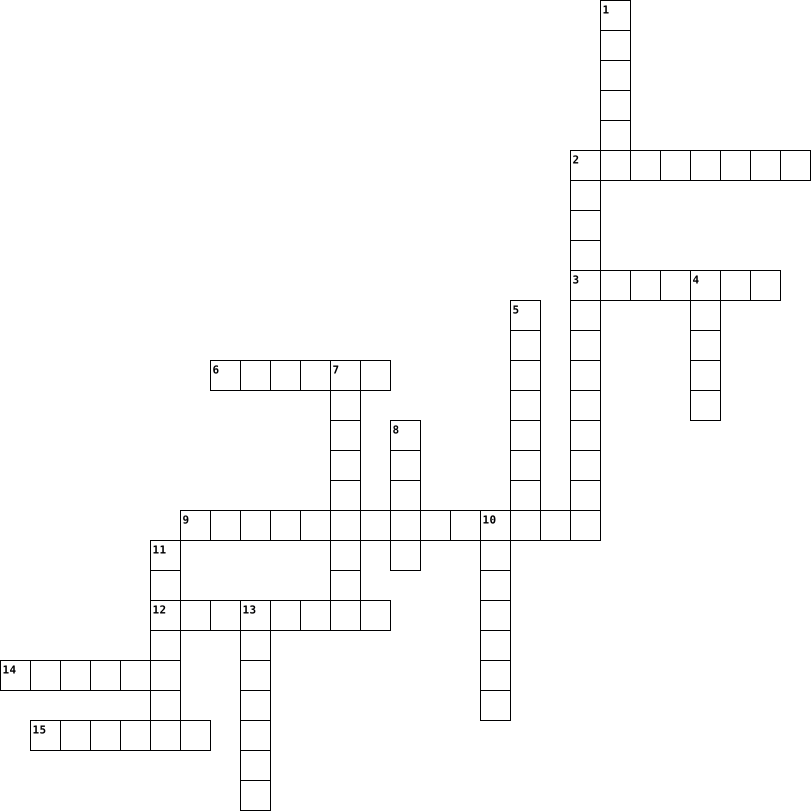
Across
- respiration process where cells break down sugar (glucose) to release its energy
- water diffuses through a cell membrane
- energy-rich organic compound used to store energy for later use or for insulation or in cell membranes
- process where a cell captures energy in sunlight and uses it to make sugar (glucose)
- made up of 2 or more elements
- transport materials move through a cell membrane by using energy
- complex carbohydrate made by linking sugars together
Down
- a protein that speeds up a chemical reaction in a living thing
- energy-rich organic compound, like sugar or starch
- simple carbohydrate (example: glucose)
- organic compound used for cell structure, speeding up chemical reactions (enzymes), or on cell membranes
- small molecules move from an area of high concentration to an area of low concentration
- acids the building blocks of proteins
- simplest form of matter OR the building block of matter
- acids organic compound that contains instructions for cells (ex: DNA, RNA)
- transport materials move through a cell membrane WITHOUT using energy
16 Clues: made up of 2 or more elements • acids the building blocks of proteins • water diffuses through a cell membrane • simple carbohydrate (example: glucose) • energy-rich organic compound, like sugar or starch • complex carbohydrate made by linking sugars together • simplest form of matter OR the building block of matter • ...