
chemistry Crossword Puzzles
Chemistry Vocabulary 2 2017-12-11

Across
- a-letter-figure-or-symbol-written-or-printed-below-the-line
- having-a-valence-of-one
- an-element-with-proporties-of-both-metals-and-non-metals
- any-of-the-elements-fluorine-chlorine-bromine-iodine-and-astatine
- the-average-weight-of-an-element-EX-Lead-207
- the-periodic-table-lists-these
- a-group-of-atoms-combined-to-make-a-chemical-compound-that-can-take-part-in-chemical-reactions
- a-thing-that-is-composed-of-two-or-more-separate-elements
- a-subatomic-particle-the-opposite-of-a-proton
- iron-gold-silver-copper-and-aluminum-brass-and-steel
- the-relations-between-states-of-matter-to-particle-movement
- the-temperature-at-which-a-given-solid-will-melt-EX:ice
- a-substance-made-b-mixing-other-substances-together
- a-large-body-of-matter-EX:cup-dog-phone
- a-subatomic-particle-with-a-positive-charge
- an-ion-composed-of-two-or-more-atoms-covalently-bonded
- a-numerical-or-constant-quantity-placed-before-and-multiplying-the-variable-in-an-algebraic-expression
Down
- the-number-listed-on-the-top-left-of-an-element
- any-of-the-gaseous-elements-helium-neon-argon-krypton-xenon-and-radon
- compounds-made-up-of-ions
- an-atom-can-become-this-when-it-loses-or-gains-more-electrons
- any-of-the-elements-beryllium-magnesium-calcium-strontium-barium-and-radium
- a-molecule-formed-by-covalent-bonds
- an-element-or-substance-that-is-not-a-metal
- the-temperature-at-which-a-liquid-boils
- another-term-for-polyvalent
- a-subatomic-particle-with-a-negative-charge
- an-extremely-small-amount-of-a-thing-or-quality
- a-type-of-diagram-for-drawing-atoms
- the-amount-of-space-that-a-substance-or-object-occupies
30 Clues: having-a-valence-of-one • compounds-made-up-of-ions • another-term-for-polyvalent • the-periodic-table-lists-these • a-molecule-formed-by-covalent-bonds • a-type-of-diagram-for-drawing-atoms • the-temperature-at-which-a-liquid-boils • a-large-body-of-matter-EX:cup-dog-phone • an-element-or-substance-that-is-not-a-metal • a-subatomic-particle-with-a-negative-charge • ...
Chemistry crossword puzzle 2018-04-13

Across
- / A pure substance that cannot be broken down into any other substances by chemical or physical means.
- bond / a weak bond between two molecules resulting from an electrostatic attraction between a proton in one molecule and an electronegative atom in the other.
- / Anything that has mass and takes up space.
- / Has a definite volume but no shape of its own.
- / When a liquid changes to a gas below its surface as well as at the surface.
- Properties / A characteristic of a pure substance that can be observed without changing it into another substance.
- Bond / A force of attraction between two atoms.
- Mixture / A mixture in which pure substances are unevenly distributed throughout the mixture.
- energy/ The energy of electrically charged particles moving from one place to another.
- energy / The total energy of all of the particles in an object.
- / A pure substance made of two or more elements chemically combined in a set ratio.
Down
- / A material that can easily flow
- The ability to do work or cause change.
- change / A change in matter that produces one or more new substances
- Mixture / A mixture in which substances are evenly distributed throughout the mixture.
- / A fluid that can change volume very easily.
- / The basic particle from which all elements are made.
- / Made of two or more substances that are together in the same place but are not chemically combined.
- / A single kind of matter that is pure and has a specific set of properties.
- / A measure of the average of random motion of particles of matter.
- of conservation of matter / The fact that matter is not created or destroyed in any chemical or physical change.
- / Groups of two or more atoms held together by chemical bonds.
- point / The characteristic temperature in which melting occurs.
- / An example of a homogeneous mixture.
- / Has a definite shape and a definite volume.
25 Clues: / A material that can easily flow • The ability to do work or cause change. • / An example of a homogeneous mixture. • / Anything that has mass and takes up space. • / A fluid that can change volume very easily. • / Has a definite shape and a definite volume. • / Has a definite volume but no shape of its own. • Bond / A force of attraction between two atoms. • ...
Chemistry Gas Laws 2022-03-24

Across
- k equals this
- he had a principle
- lawmaker for PV=k
- absolute zero temperature scale
- the amount of substance unit
- lawmaker for P/V=k
- proportion for PxV
- energy for gas particles
- the "P" in STP
Down
- this gas law is nearly perfect
- SI unit for pressure
- a common unit of pressure
- non-SI temperature scale
- many laws govern these
- lawmaker for P/T=k
- the unity for 3 gas laws
- a smaller unit of volume (non-SI)
- proportion for P/V
- common unit of volume (non-SI)
- liquid metal used for pressure
20 Clues: k equals this • the "P" in STP • lawmaker for PV=k • lawmaker for P/T=k • he had a principle • proportion for P/V • lawmaker for P/V=k • proportion for PxV • SI unit for pressure • many laws govern these • non-SI temperature scale • the unity for 3 gas laws • energy for gas particles • a common unit of pressure • the amount of substance unit • this gas law is nearly perfect • ...
Chemistry key terms 2022-03-09

Across
- small group of non-metal atoms
- point in a titration when the indicator changes colour
- a carboxylic acid
- the observation made when a dilute acid reacts with a carbonate
- formed in the engine of a car from the air
- break down of a compound into its elements using electricity
- burns with a red-orange flame
- regular arrangement of particles
- a weak base
- ion that produces a yellow precipitate with acidified silver nitrate
- gain of electrons
- organic compound with the same molecular formula but a different structure
- equipment used to measure out one volume accurately
- reaction in which heat energy is released
Down
- liquid non metal element
- bond breaking
- an indicator that is pink in alkali and colourless in acid
- production of ethanol using sugar and yeast
- a solution of calcium hydroxide
- colour of the precipitate formed when iron II ions react with sodium hydroxide
- gas produced when metals react with acid
- formula which shows just the simplest ratio of atoms
- a saturated hydrocarbon
- substance that provides an alternative route to the products with a lower activation energy
- fraction from crude oil used for road surfacing
- a charged particle
- atom with the same number of protons and a different number of neutrons
- breaking down of a long chain hydrocarbon into smaller alkanes and alkenes
28 Clues: a weak base • bond breaking • a carboxylic acid • gain of electrons • a charged particle • a saturated hydrocarbon • liquid non metal element • burns with a red-orange flame • small group of non-metal atoms • a solution of calcium hydroxide • regular arrangement of particles • gas produced when metals react with acid • reaction in which heat energy is released • ...
Carbonyl Chemistry Crosswork 2022-03-09

Across
- Who is the scientist behind the Fischer Esterification reaction ?
- An organic acid which contains the carboxyl group (-COOH)
- What reduces double bond characters of a carbonyl group
- What physical property can result in a higher boiling point?
- What can destroy the organometallic reagent in a reaction with a carbonyl?
- The measurement of the interaction of infrared radiation with matter by absorption, emission or reflection
- What reacts more readily with alcohols than the same reaction between aldehydes and alcohols
- An addition reaction where in a chemical compound a pi bond is removed from by the creation of two new covalent bonds by the addition of a nucleophile
Down
- Which function group has the structure CHO?
- What type of alcohol is formed from the reaction between formaldehyde and CH3Li ?
- What is the simplest carbonyl compound?
- When an amine is reacted with a carboxylic acid what is produced ?
- Type of compound that differs from acids by having a leaving group in place of the OH functionality
- The addition of a proton to an atom, molecule or ion
- Stronger bonds result in more energy needed to excite the vibration but how does that affect the wavenumber?
- How many resonance forms does diazomethane exist in ?
- how many acyl compounds are there ?
- two drawbacks associated with diazomethane are that it is explosive and can only methylate what is the third ?
- An alcohol in which the hydroxyl group is bonded to the secondary carbon atom
- step 1 of an addition-elimination reaction of an ester from a carboxylic acid can generate a methylating agent and a new ... ?
20 Clues: how many acyl compounds are there ? • What is the simplest carbonyl compound? • Which function group has the structure CHO? • The addition of a proton to an atom, molecule or ion • How many resonance forms does diazomethane exist in ? • What reduces double bond characters of a carbonyl group • An organic acid which contains the carboxyl group (-COOH) • ...
Chemistry of Photographs 2021-12-04

Across
- Compounds used in silver halide photographic processes such as hydroquinone, diaminophenol or amidol.
- The type of image produced by the photochemical reaction of silver halides is amplified in the development process.
- This sodium salt is used to fix photographic images.
- Type of compound that can cause photographs to fade. Sources include untreated wood, paints and varnishes.
- This colour of dye is added to coloured film to make it sensitive to green light.
- Sensitizing agents are usually made of compounds containing this element.
- This photographic process required cellulose nitrate, alcohol, ether and halide salts on glass.
- Dichromate is reduced to this oxidation state in the gum bichromate process.
- Burning of fossil fuels creates these gases that cause photographs to fade by chemical reactions with the silver image.
- Element used in vapour form to produce daguerreotypes.
- When storing photographs, keeps this value low to slow down deterioration, silver oxidation and shifting and fading of colour dyes.
Down
- The most light-sensitive silver halide.
- A silver salt used in photography.
- This layer prevents light from reflecting back into the emulsion layer and causing ghosting.
- Photographic tone formed from the reaction of silver with thiosulfate in acid solution
- A reaction catalyzed by light.
- A compound in the protective layer of photographic film that is formed from the partial hydrolysis of collagen.
- The polymer used as film backing from the 1960s to the present day.
- The type of reaction that converts silver ions to silver metal.
- This type of defect in ionic crystals is required for the photosensitivity of silver halides.
- To produce cyanotypes, complexes containing this metal are required.
21 Clues: A reaction catalyzed by light. • A silver salt used in photography. • The most light-sensitive silver halide. • This sodium salt is used to fix photographic images. • Element used in vapour form to produce daguerreotypes. • The type of reaction that converts silver ions to silver metal. • The polymer used as film backing from the 1960s to the present day. • ...
Alina's Chemistry Crossword 2021-12-09

Across
- has neutral charge
- electricity and heat cannot pass through
- something is able to pull into a wire
- has positive charge
- electricity and heat can pass through
- smallest part of an element
- shatters easily
- speed plus direction
- located in the center of an atom
- not shiny
- (vertical)up and down
Down
- a change in speed, directon, or both
- reactivity equals
- left to right
- the cloud that surronds an atom
- is an insulator
- has prperties of both metals and non metals
- tells how many energy levels
- another word for shiny
- electrons arrange themselves
20 Clues: not shiny • left to right • is an insulator • shatters easily • reactivity equals • has neutral charge • has positive charge • speed plus direction • (vertical)up and down • another word for shiny • smallest part of an element • tells how many energy levels • electrons arrange themselves • the cloud that surronds an atom • located in the center of an atom • ...
Chemistry Lab Equipment 2022-01-18

Across
- L
- I
- P
- E
- O
- J
- H
- M
- A
- K
Down
- C
- D
- N
- G
- R
- Q
- T
- B
- S
- F
20 Clues: C • L • D • I • N • G • R • Q • T • B • P • E • O • S • F • J • H • M • A • K
Chemistry 2nd Performance 2022-01-06

Across
- It is used to measure the volume of liquids.
- Bohr's atomic model.
- A ceramic or metal container in which substances may be melted or subjected to very high temperatures.
- A simple container for stirring, mixing and heating liquids.
- A tube or pipe that is wide at the top and narrow at the bottom, used for guiding liquid or powder into a small opening.
- A flat bottomed vessel with a cylindrical long neck which is used to prepare and hold solutions.
- A cup in which ingredients are crushed or grounded.
- A graduated thing glass tube which is used to do accurate measurements of small amount of liquids.
- An iron tripod placed over a fire.
- John Dalton's atomic model.
- A thin glass tube closed at one end, used to hold small amounts of material.
Down
- Ut is a squeezable bottle with a nozzle, used to rinse various pieces of laboratory equipments.
- A vessel with a spherical body and a cylindrical neck which is most often used when preparing, heating and distillation.
- A flask having a wide base, narrow neck, and conical form which is convenient for swirling liquids by hand.
- A lamp that burns volatile spirits.
- JJ Thomson's atomic model.
- An instrument for measuring and indicating temperature.
- Rutherford's atomic model.
- A glass stirring rod which is used to stir or mix liquids.
- A concave glass disc used in a laboratory to hold material for use in experiments.
- It is used to take small quantities of solid chemicals.
21 Clues: Bohr's atomic model. • JJ Thomson's atomic model. • Rutherford's atomic model. • John Dalton's atomic model. • An iron tripod placed over a fire. • A lamp that burns volatile spirits. • It is used to measure the volume of liquids. • A cup in which ingredients are crushed or grounded. • An instrument for measuring and indicating temperature. • ...
Chemistry Review Crossword 2022-01-03

Across
- occurs when a compound is broken into two simpler products
- Neutrons + Protons
- metals that are found in group 2
- _____ bonds share electrons
- gasses found in group 18
- ____ bonds transfer electrons
- same element with more or less neutrons
Down
- This radiation can only be stopped by large amounts of concrete or lead
- a chemical change in which an element reacts with oxygen and produces Co2 and H2O
- this subatomic particle has a positive charge
- this subatomic particle has a negative charge
- vertical columns on the periodic table
- have a proton to neutron ratio over 3:2
- ____ are a positively charged ion
- metals found in group 3
- organic compounds must include _____
- ____ are a negatively charged ion
- horizontal rows on the periodic table
- ____ is released from alpha radiation
- a subatomic particle with a positive or negative charge
20 Clues: Neutrons + Protons • metals found in group 3 • gasses found in group 18 • _____ bonds share electrons • ____ bonds transfer electrons • metals that are found in group 2 • ____ are a positively charged ion • ____ are a negatively charged ion • organic compounds must include _____ • horizontal rows on the periodic table • ____ is released from alpha radiation • ...
Chemistry Crossword Puzzle 2022-01-03

Across
- It is a squeezable bottle with a nozzle, used to rinse various pieces of laboratory equipment.
- A glass stirring rod which is used to mix
- A flask having a wide base, narrow neck, and conical form which is convenient for swirling liquids by hand.
- An instrument for measuring and indicating temperature.
- A tube or pipe that is wide at the top and narrow at the bottom, used for guiding liquid or powder into a small opening.
- A concave glass disc used in a laboratory to hold material for use in experiments.
- A graduated glass tube with a tap at one end, for delivering accurate volumes of a liquid, especially in titrations.
- A vessel with a spherical body and a cylindrical neck which is most often used when preparing, heating solutions and distillation.
- A ceramic or metal container in which substances may be melted or subjected to very high temperatures.
- He is the owner of the atomic model that was proposed in 1911, based on the Rutherford model of the atom.
Down
- A flat-bottomed vessel with a cylindrical long neck which is used to prepare and hold solutions.
- It is a glass funnel with a tap at the bottom which is used to seperate immiscible liquids.
- A thin glass tube closed at one end, used to hold small amounts of material.
- It is used to measure the volume of liquids.
- A lamp that burns volatile spirits.
- An iron tripod placed over a fire.
- A cup in which ingredients are crushed or grounded.
- It is used to take small quantities of solid chemicals.
- A simple container for stirring, mixing and heating liquids.
- He stated that in the atomic model, most of the atomic mass is concentrated in the nucleus.
20 Clues: An iron tripod placed over a fire. • A lamp that burns volatile spirits. • A glass stirring rod which is used to mix • It is used to measure the volume of liquids. • A cup in which ingredients are crushed or grounded. • It is used to take small quantities of solid chemicals. • An instrument for measuring and indicating temperature. • ...
Chemistry Unit 7 2022-01-26

Across
- horizontal
- Highest point of a wave
- inner most electrons
- are around the nucleus where electron is most likely to be located
- states electrons enter lowest energy level first
- Negatively charged ions
- Height of a wave from its origin
- states orbital holds max 2 e-
- distribution of an e- in an orbital
- Visible light colors/ roygbiv
- 6.626
Down
- Number of waves to pass a point (unit of time)
- ability an atom has to attract covalant bonds to itself
- Distance from crest to crest
- Outermost e-
- when e- occupy orbitals of equal energy levels
- electrons lowest possible energy state
- Positively charged ions
- vertical group
- effective nuclear charge- attractions and repulsions
20 Clues: 6.626 • horizontal • Outermost e- • vertical group • inner most electrons • Highest point of a wave • Negatively charged ions • Positively charged ions • Distance from crest to crest • states orbital holds max 2 e- • Visible light colors/ roygbiv • Height of a wave from its origin • distribution of an e- in an orbital • electrons lowest possible energy state • ...
My Chemistry Puzzle 2022-05-16

Across
- the d-block elements with typical metallic properties and are often referred to as
- a measure of the ability of an atom in a chemical compound to attract electrons from another atom in the compound
- Ce
- the elements of Group 17 of the periodic table
- Fr
- the horizontal columns of the periodic table
- the elements of Group 2 of the periodic table
- a negative ion
- The energy change that occurs when an electron is required by a neutral atom
- Lu
- an atom or group of bonded atoms that has a positive or negative charge
- the physical and chemical properties of the elements are periodic functions of their atomic numbers.
- an arrangement of the elements in order of their atomic numbers so that elements with similar properties fall in the same column, or group.
- the elements of Group 1 of the periodic table
- developed a method that led to the determination of standard relative atomic masses
Down
- Lr
- p-block elements together with the s-block elements
- element 6
- the electrons available to be lost, gained or shared in the formation of chemical compounds
- the vertical columns of the periodic table
- element 30
- Na
- the 14 elements with atomic numbers from 58 (cerium, Ce) to 71 (lutetium, Lu).
- element 7
- the 14 elements with atomic numbers from 90(thorium, Th) to 103 (lawrencium, Lr).
- the energy required to remove one electron from a neutral atom of an element
- element 1
- element 90
- the elements of Group 18 of the periodic table
- a positive ion
30 Clues: Lr • Ce • Na • Fr • Lu • element 6 • element 7 • element 1 • element 30 • element 90 • a negative ion • a positive ion • the vertical columns of the periodic table • the horizontal columns of the periodic table • the elements of Group 2 of the periodic table • the elements of Group 1 of the periodic table • the elements of Group 17 of the periodic table • ...
Chemistry Lab Equipment 2023-08-10

Across
- - smaller than a scoopula. Used for transferring or scraping out solids
- - used for stirring liquids
- - what you MUST wear on lab days, along with close toed shoes
- - a metal stand that can be used with clamps to hold glassware in place during an experiment
- - scoop shaped piece of metal used to transfer small amounts of solids.
- - glass tube used for heating liquids/chemicals
- - equipment used to measure mass
- - a plastic rectangle with wells in it used for microscale reactions
- - an open flame heat source
- - used to filter solids from liquids
- - used to hold a (hot) test tube
- - a heat source that can uniformly heat chemicals WITHOUT an open flame
- - a plastic dropper for transferring small amount of liquid
Down
- - a rubber mitt for protecting hands when picking up very hot or cold glassware
- - used to measure the volume of a liquid. The precise marked lines on the side are called graduations.
- - ______ water, also called “DI”, chemically pure water with ions removed to prevent contamination in reactions. Is NOT the same as tap water
- - used to protect your eyes
- - can be used to cover a beaker to prevent evaporating OR for holding small amounts of solid
- - a squeeze bottle with a nozzle used to rinse lab equipment
- - a cup-like container used for heating or holding chemicals. Is NOT a precise measuring tool because the volume marks are only approximate
- - triangle shaped glass container for mixing or heating chemicals
- - used for holding multiple test tubes
- - round paper used with a funnel to capture solids during filtration
- - tool used to clean test tubes
- - a plastic disposable container for weighing small amounts of solids
25 Clues: - used to protect your eyes • - used for stirring liquids • - an open flame heat source • - tool used to clean test tubes • - equipment used to measure mass • - used to hold a (hot) test tube • - used to filter solids from liquids • - used for holding multiple test tubes • - glass tube used for heating liquids/chemicals • ...
Chemistry in Life 2023-08-20

Across
- anything that has weight and takes up space
- single, positive charge
- sugars with 6-carbon atoms
- organic substance that is soluble in water
- two or more atoms bond together and form a new particle
- contain 2 simple sugar building blocks
- proteins that serve as biological catalysts
- when atoms of different elements combine
- number number of protons in the atom of a particular element
- molecules that contain both carbon and hydrogen atoms
- single, negative charge
Down
- glycerol with 3 fatty acids
- uncharged and electrically neutral
- nucleic acid molecule,consisting of sugar, nitrogenous base and phosphate group
- structural materials,energy sources, hormones, receptors on cell surfaces
- build to cell parts and to supply energy for cellular activity
- basic chemical substance
- tiny invisible particles that make up elements
- measurement unit of hydrogen ion concentration; indicate acid or akaline
- building block of proteins
- atoms that become electrically charged by gaining or losing electrons
- weight number of protons plus number of neutrons
22 Clues: single, positive charge • single, negative charge • basic chemical substance • sugars with 6-carbon atoms • building block of proteins • glycerol with 3 fatty acids • uncharged and electrically neutral • contain 2 simple sugar building blocks • when atoms of different elements combine • organic substance that is soluble in water • anything that has weight and takes up space • ...
Chemistry Unit 2 2023-09-30

Across
- A tiny unit of matter such as an atom. Make up the building blocks of everything.
- Smallest units of a compound that retain the chemical properties of that compound. Made up of atoms bonded together.
- The amount of matter in an object. The total amount of molecules and atoms in an object.
- A subatomic particle found in the nucleus of an atom. No electrical charge, contributes to the mass of the atom.
- A unit used to measure the amount of a substance. Can be compared to saying a dozen =12.
- table Arrangement of chemical elements, organized based on atomic number, electron configuration, and chemical properties.
- A combination of symbols that represent the composition of a compound or molecule. Numbers present in a substance.
- A substance that can't be broken down into simpler substances by chemical means.On the periodic table.
- Used to measure different properties. Can be used by grams, mol, etc.
Down
- A simple representation of an element. It is used to identify or refer to specific elements in chemical formulas and equations.
- composition Way to express the relative amounts of different elements in a compound. Percentage of each element's mass in the total mass of the compound.
- A substance made up of 2 or more elements chemically combined together. Has its own unique properties.
- A subatomic particle found outside the nucleus, with a negative charge.
- Electrical property of an atom or molecule. Can be positive or negative.
- formula The simplest ratio of elements in a compound. Shows the relative number of atoms of each element present in a compound.
- A subatomic particle found in the nucleus, with a positive charge. Contributes to the mass and atomic number of the atom.
- formula Represents the actual number of atoms of each element in a molecule. Exact composition of a compound.
- Basic unit of matter. Made up of protons neutrons and electrons.
- A charged particle that forms when an atom gains or loses electrons. Can be positively or negatively charged.
- A variation of an element with the same number of protons but a different number in neutrons.Different atomic masses but same original element.
20 Clues: Basic unit of matter. Made up of protons neutrons and electrons. • Used to measure different properties. Can be used by grams, mol, etc. • A subatomic particle found outside the nucleus, with a negative charge. • Electrical property of an atom or molecule. Can be positive or negative. • ...
Chemistry Project Crossword 2023-10-01

Across
- An importance use of electrolysis which can be done when the electrodes are not inert.
- Most reactive metal in reactivity series
- Stream of electrons
- Where oxidation occurs
- Liquid which undergoes electrolysis
- Carry current through wires and electrodes (plural)
- Element other than carbon which makes for inert electrodes
- synthetic insulator
- A fuel cell used to produce electricity where the only chemical product is water
Down
- Used over the option of steel in power cables' inside
- Where reduction occurs
- Solid non-metal which conducts electricity
- The charge of an Anode
- An equation which shows the electron transfer at an electrode.
- Loss of electrons in electrolysis
- Gain of electrons in electrolysis
- The type of reaction electrolysis is
- The kind of energy given out in a great deal during the burning of hydrogen in oxygen
- Carry currents in liquid in electrolysis (plural)
- Common acronym for redox
- Least reactive metal in reactivity series
21 Clues: Stream of electrons • synthetic insulator • Where reduction occurs • The charge of an Anode • Where oxidation occurs • Common acronym for redox • Loss of electrons in electrolysis • Gain of electrons in electrolysis • Liquid which undergoes electrolysis • The type of reaction electrolysis is • Most reactive metal in reactivity series • Least reactive metal in reactivity series • ...
1.2 Basic Chemistry 2023-09-05

Across
- the basic unit of matter
- the amount of material an object has
- ions with opposite charges attract and join together
- a molecule in which opposite ends have opposite electric charges
- an atom or particle that has either positive or negative charge
- ions and polar molecules (water loving)
- particle with no charge
- positively charged particle
- a substance that is formed when atoms of two or more elements join together
- a part of atom compose of protons and neutrons
- the number of proton in the atom that identifies the element
Down
- the total number of protons and neutrons
- when two atoms share one or more pairs of electrons
- substance that is formed in a chemical reaction
- nonpolar molecules (water hating)
- elements that differ only in the number of neutrons
- anything that has mass and takes up space
- substance that is used as ingredients
- the smallest of substance that has all the properties of the substance
- negatively charged particle
20 Clues: particle with no charge • the basic unit of matter • positively charged particle • negatively charged particle • nonpolar molecules (water hating) • the amount of material an object has • substance that is used as ingredients • ions and polar molecules (water loving) • the total number of protons and neutrons • anything that has mass and takes up space • ...
Grade 9 Chemistry 2023-11-22

Across
- A type of fuel
- This is formed when charcoal burns
- How many electrons fit in the first shell
- This material can be used instead of glass to measure temperature changes in chemical reactions
- This is formed with the combustion of hydrogen
- An element with the chemical symbol Si
- Rusting is this type of reaction
- This is needed for combustion
- These are found inside the nucleus
- One of the noble gases
- This is where you find electrons
- An element with the chemical symbol Be
- Dissolving this chemical is an endothermic process
- In an exothermic reaction the temperature .........
- Group 1 elements are known as the......
- The chemical name for rust
- He discovered the electron
Down
- This substance added to citric acid is an endothermic reaction
- In an endothermic reaction, the temperature .......
- These atomic particles have no charge
- Group 8 elements are known as .........
- Group 7 elements are known as the........
- A type of fuel
- This is formed when calcium reacts with hydrochloric acid
- He discovered the proton
- These are on the left-hand side of the Periodic Table
- One of the alkali metals
- These are found on the right-hand side of the Periodic Table
- 20% of the air is this gas
- An example of an endothermic process
- How many electrons fit in the second shell
31 Clues: A type of fuel • A type of fuel • One of the noble gases • He discovered the proton • One of the alkali metals • 20% of the air is this gas • The chemical name for rust • He discovered the electron • This is needed for combustion • Rusting is this type of reaction • This is where you find electrons • This is formed when charcoal burns • These are found inside the nucleus • ...
chemistry of life 2023-11-09

Across
- acid- an organic molecule that is half of a glucose molecule with the molecular formula C3H6O3.
- solution- a solution where the concentration of solutes outside a cell is lower than that found inside the cell
- a lipid composed of glycerol and three fatty acids which are bonded together
- acid- long chain of carbon and hydrogen joined together the end of the chain has an acid group (-COOH)
- the process by which plants use chlorophyll to trap sunlight energy and use it to produce carbohydrates
- the movement of molecules from an area of higher concentration to an area of lower concentration
- a three carbon chain molecule containing three hydroxyl (-OH) groups
- solution- a solution where the concentration of solutes outside a cell higher than that found inside cell
- the diffusion of water molecules across a selectively permeable membrane
- the carbohydrate that forms the cell walls of plant cells
- a condition in which all acting influences are balanced resulting in a stable environment
- gradient- a difference in the number of molecules or ions of a substance between adjoining regions without the addition of energy molecules tend to diffuse from the area of higher concentration to the area of lower concentration
Down
- a form of endocytosis in which liquid droplets are engulfed by cells
- a large carbohydrate molecule used by plants to store energy
- nutrients made up of a single sugar molecule or many sugars molecules carbohydrates contain only carbon hydrogen and oxygen
- solution- a solution where the concentration of solute molecules outside a cell is equal to the concentration of solute molecules inside the cell
- synthesis- a series of chemical reactions that allow two molecules to bond by the formation of water molecule
- the form of concentration storage in animals
- the raw materials needed for cell metabolism
- large molecules that are made by joining several separate units such as joining several sugar units to form a starch molecule
- transport- involves the use of cell energy to move materials across a cell membrane against the concentration gradient
- transport- the movement of materials across a cell membrane without the use of energy from the cell
22 Clues: the form of concentration storage in animals • the raw materials needed for cell metabolism • the carbohydrate that forms the cell walls of plant cells • a large carbohydrate molecule used by plants to store energy • a form of endocytosis in which liquid droplets are engulfed by cells • a three carbon chain molecule containing three hydroxyl (-OH) groups • ...
Chapter 2 Chemistry 2023-11-17

Across
- A negatively charged ion
- When the electrons are shared equally between two atoms
- When electrons are unequally shared between two atoms
- Two atomic forms of an element that differ in the amount of neutrons
- The smallest unit of matter
- Two or more atoms covalently bonded
- A substance consisting of 2 or more elements in a fixed ratio
- What organisms are composed of, anything that has mass and takes up space
- The type of bond where a hydrogen atom is covalently bonded to two electronegative atoms
- An atom with positive charge
- The clinging of one substance to another
Down
- The type of electron that is in the electron shell
- A positively charged ion
- A substance that cannot be broken down any further
- When one electron was stripped from its atom and it now has a negativeor positive charge
- An atom with negative charge
- the type of bond that occurs when two atoms are sharing electrons
- An atom with neutral charge
- The outermost layer of an electron
- The capacity to cause change
20 Clues: A negatively charged ion • A positively charged ion • The smallest unit of matter • An atom with neutral charge • An atom with negative charge • The capacity to cause change • An atom with positive charge • The outermost layer of an electron • Two or more atoms covalently bonded • The clinging of one substance to another • The type of electron that is in the electron shell • ...
Cooking with Chemistry 2024-02-13

Across
- Things that you eat are considered _____.
- The ________ reaction is also known as the browning reaction.
- Enhances flavor, balances flavor, tenderizes meat, and masks bitterness.
- Simmering, poaching, and grilling all have one thing in common, they use _____.
- The heating of sugar at a high temperature.
- We had to make a lot of _____________ about different steps of the food that we made.
- water moving through a semi-permeable membrane from an area of high concentration to an area of low concentration.
- Adding mustard to a mixture of oil and water is an __________.
- Starches absorbing water is called __________.
- The air that causes bread, cake, and other baked goods rise when baked in the oven.
- Creates and enhances flavor, speeds up browning process, and emulsifies.
Down
- Water leaving something leaving it very dry and without moisture.
- Yeast consuming sugar and producing co2.
- You can get this from eating raw meat.
- the proses of food dye spreading through water is an example of __________.
- You can get this from eating raw eggs.
- _____ is used for in 3 techniques pickling, fermenting, and caning.
- At the end of the project we had to do a big ___________ in front of about 26 people.
- Adding flavor to a food. (Often spices are used)
- The molecules in emulsifiers have a non-polar end and a _________ end.
20 Clues: You can get this from eating raw meat. • You can get this from eating raw eggs. • Yeast consuming sugar and producing co2. • Things that you eat are considered _____. • The heating of sugar at a high temperature. • Starches absorbing water is called __________. • Adding flavor to a food. (Often spices are used) • ...
vocabulary chemistry angel 2023-12-11

Across
- a chemical bond in which three pairs of electrons are shared between two atoms.
- a combination of chemical symbols and numbers to represent a substance
- a formula that indi-cates the location of the atoms,groups,or ions relative to one another in a molecule and that indi-catesthe number and location of chemical bonds
- a structural formula in which electrons are represented by dots; dot pairs or dashes between two atomic symbols represent pairs in covalent bonds
- a group of atoms that are held together by chemical forces; a molecule is the smallest unit of matter that can exist by itself and retain all of a substance’s chemical properties
- the energy required to break the bonds in 1 mol of a chem-ical compound
- a compound com-posed of ions bound together by electrostatic attraction
- a chemical com-pound whose simplest units are mol-ecules
- a chemical bond that involves the sharing of electrons to form electron pairs between atoms.
- the attractive force that holds atoms or ions together
- type of linkage formed from the electrostatic attraction between oppositely charged ions in a chemical compound.
Down
- when atoms with different electronegativities share electrons in a covalent bond
- the collection of atoms corresponding to an ionic com-pound’s formula such that the molar mass of the compound is the same as the mass of 1 mol of formula units
- a chemical formula that shows the number and kinds of atoms in a molecule, but not the arrangement of the atoms
- an ion made of two or more atoms
- an electron-configuration notation in which only the valence electrons of an atom of the a particular element are shown, indicated by dots placed around the element’s symbol
- the bonding in molecules or ions that cannot be correctly rep-resented by a single Lewis structure
- a type of chemical bond that is formed when electrons are shared equally between two atoms
- a chemical bond in which one pair of electrons is shared between two atoms.
- a chemical bond in which two pairs of electrons are shared between two atoms.
20 Clues: an ion made of two or more atoms • the attractive force that holds atoms or ions together • a chemical com-pound whose simplest units are mol-ecules • a combination of chemical symbols and numbers to represent a substance • the energy required to break the bonds in 1 mol of a chem-ical compound • ...
Environmental Chemistry Review 2023-12-18

Across
- Something that removes harmful chemicals from emisions before they are released
- Chemical used to control insect population growth
- Use of light to break down harmful chemicals
- Ability of a chemical to cause harm
- Something that tells you information about another substance
- Precipitation with a pH less than 7
- When toxins build up in cells
- Chemical used to control weeds
- Alteration of the environment producing harmful conditions
- Material or form of energy that will cause harm
Down
- Use of plants to remove toxins from soil
- The type of toxicity that requires many exposures
- Using living organisms to break down toxic substances
- Increase in populations of algae due to increased levels of nutrients in water system
- Solution With a pH above 7
- Nutrient for energy storage
- A solution that has a pH of less than 7
- When a acid is mixed with a base, this happens
- Organic compound used for short term energy
- Type of toxicity that is toxic after first exposure
- The dose of a toxin that kills half the population
21 Clues: Solution With a pH above 7 • Nutrient for energy storage • When toxins build up in cells • Chemical used to control weeds • Ability of a chemical to cause harm • Precipitation with a pH less than 7 • A solution that has a pH of less than 7 • Use of plants to remove toxins from soil • Organic compound used for short term energy • Use of light to break down harmful chemicals • ...
12.electrical chemistry 2023-11-24

Across
- (n.)another terminology for a battery in electrochemical section
- (adj.)This type of measurement is based on the measurement of electrode potential to determine the concentration
- (abbr.)It acts as the reference of the standard reduction potentials(E) of all other electrodes
- (n.)a high-resistance device which can calculate the voltage
- (n.)an industry that uses electrolysis of saturated sodium chloride solution to produce NaOH,Cl2,H2
- (n.)the property of allowing electricity to go through something.Its magnitude depends on the number of ions
- (n.)it has good electric conductivity and the current leaves or enters it in a cell
- (n.)the synonym of electromotive force
- (adj.)to describe electrodes that are not likely to react in (voltaic/electrolytic)cells
- (v.)to cover a layer of zinc on metal(as a way to prevent corrosion)
- (n.)a unit of the electric charge(q)
- (v.)to make the pH of a solution lower
Down
- (n.)a thing caused by particular-direction movement of a large amount of electrons
- (n.)the region that electrons are escaped from
- (n.)either oxidation or reduction occurs in either anode or cathode
- (adj.)(usually describe rock or metal)melted or made liquid by being heated to very high temperature
- (n.)a substance goes through reduction when redox reaction happens
- (n.)a procedure that electricity is provided through electrolytes to make redox reaction happen
- (n.)the region where reduction reaction happens
- (n.)an oxidation procedure when iron is exposed to air and water
20 Clues: (n.)a unit of the electric charge(q) • (n.)the synonym of electromotive force • (v.)to make the pH of a solution lower • (n.)the region that electrons are escaped from • (n.)the region where reduction reaction happens • (n.)a high-resistance device which can calculate the voltage • (n.)another terminology for a battery in electrochemical section • ...
Fundamentals of Chemistry 2024-01-24

Across
- atom with diff. # neutrons than a. of same elem.
- atom releases energy stablizes nucleus
- grows bigger than atom when it gains electrons.
- very reactive metals, group one
- positively charged particle in nucleus
- the central region of an atom
- particle with no electric charge
- change # of protons the element changes
- groups 3-12
- not reactive elements
- neg. charged particle
- element series 90-103
Down
- elements series 58-71
- horizontal row in periodic table
- element that is good conducter of electricity
- where an electron could be if measured
- the number of protons in nucleus
- an atom that has pos. or neg. electric charge
- element with prop. of both metals and non-metals
- group 17, combine easily w/ other elements
- element that has opposite prop. of metal
- smaller than atom when it loses electrons
- reactive metals than group 1, group 2
- vertical column in periodic table
- atomic mass unit
25 Clues: groups 3-12 • atomic mass unit • elements series 58-71 • not reactive elements • neg. charged particle • element series 90-103 • the central region of an atom • very reactive metals, group one • horizontal row in periodic table • the number of protons in nucleus • particle with no electric charge • vertical column in periodic table • reactive metals than group 1, group 2 • ...
Module 2 Chemistry 2023-09-19

Across
- lipid made from fatty acids with no double bonds between their carbon atoms
- dissolved substance
- process by which living organisms produce larger molecules from smaller ones
- amount of heat energy required to increase the temperature
- chemical with atoms of at least two different elements
- polysaccharide consisting of many glucose molecules stored in plants
- breaking down complex molecules by adding water
- polysaccharide consisting of many glucose molecules stored in animals
- mixture of solutes dissolved in a solvent
- specific reactant acted upon by an enzyme
- formed by the sharing of electrons between two or more atoms
- lipid made from fatty acids that have at least one double bond between their carbon atoms
- anything that has mass and takes up space
- building blocks of DNA and RNA
- process in which the normal shape of a protein is lost
- weak electrical attraction between a partially positive hydrogen atom and a partially negative atom of another molecule
- formed when one or more electrons are transferred from one atom to another
Down
- reaction in which molecules combine by removing water
- attractive force that holds molecules of the same substance together
- "water-fearing"
- two different molecules that have the same chemical formula
- carbohydrate made up of more than 2 monomers
- unequal distribution of charge from electrons
- links amino acids together in a protein
- chemical that results when two or more atoms join together
- positively or negatively charged atoms resulting from the transfer of electrons
- substance in which other substances are dissolved
- area of an enzyme to which a specific substrate fits
- unique number of protons in an atom
- form of an element which contains different number of neutrons
- sum of protons and neutrons in an atom
- attracts water molecules
- energy needed to get reactions started
- attractive force that holds molecules of different substances together
- collection of atoms having the same number of protons
- lipid molecule with four fused carbon rings
36 Clues: "water-fearing" • dissolved substance • attracts water molecules • building blocks of DNA and RNA • unique number of protons in an atom • sum of protons and neutrons in an atom • energy needed to get reactions started • links amino acids together in a protein • mixture of solutes dissolved in a solvent • specific reactant acted upon by an enzyme • ...
chemistry chapter 5 2024-03-07

Across
- A fundamental property of all submicroscopic systems described as the impossibility of knowing both the energy, or momentum, and the exact position of a particle.
- A charged atom or group of atoms with a net negative charge due to the gain of electrons.
- A principle that states that the two electrons in an orbital must have opposite spins.
- The lowest energy level of an electron in the Bohr model.
- A model of atoms proposed by Niels Bohr in which electrons move around the nucleus in well defined orbits.
- A principle that states that electrons will fill the lowest available energy sublevels before any can occupy higher-energy sublevels.
- A charged atom or group of atoms with a net positive charge due to the loss of electrons.
- The orbits or energy levels in atomic models.
- The quantum number that identifies the principal or main energy level of an electron.
- A three-dimensional region representing the most probable position for an electron according to the quantum-mechanical model.
- The current model of the atom in which protons and neutrons are located in the nucleus with electrons in orbitals around the nucleus.
- Any energy state, other than the ground state, resulting from an electron absorbing energy.
- A massless particle of light consisting of a bundle of wave energy.
Down
- The current description of both light and matter as having characteristics of waves and particles simultaneously.
- Divisions of principal energy levels within an atom that are further divided into orbitals.
- The electrons in the outermost energy level of an atom that are the ones most likely to be involved in chemical bonding.
- A measure of the angular moment of an electron in an orbital.
- The arrangement of electrons in an atom of an atom in its ground state.
- The rule stating that electrons fill a sublevel by a single electron occupying each orbital before a second electron can occupy any orbital.
- A notation or diagram used to illustrate the electron configuration of an atom, consisting of horizontal lines , representing the orbitals and labeled by sublevels, and arrows, representing the electrons in that orbital.
- A shorthand method of representing atoms and their valence electrons, consisting of the atom’s chemical symbol with surrounding dots representing its valence electrons.
- A charged atom or group of atoms due to the gain or loss of electrons.
- An abbreviated form of electron configuration consisting of the last noble gasses in the configuration in brackets followed by any additional electron configuration for that element.
- An incomplete spectrum, in the form of a series of coloured lines, that is unique for each element.
24 Clues: The orbits or energy levels in atomic models. • The lowest energy level of an electron in the Bohr model. • A measure of the angular moment of an electron in an orbital. • A massless particle of light consisting of a bundle of wave energy. • A charged atom or group of atoms due to the gain or loss of electrons. • ...
chemistry exam revision 2023-11-01

Across
- group of atoms together
- central/most important part of a substances
- metal: opposite of metal
- drawn into wires
- break easily
- a stable subatomic particle
- bendy
- number: number of protons in atom
- test: test for hydrogen
- number: number of protons and neutrons
- part of something abstract
Down
- a substance from mixing other substances together
- element, metals, non metal
- of electricity: flow of electric charge
- a stable substance with charge of negative electricity
- a subatomic particle
- very small thing
- giving off a reflecting much light
- formed by elements or parts
- hard, shiny, malleable, fusible, ductile solid
20 Clues: bendy • break easily • drawn into wires • very small thing • a subatomic particle • group of atoms together • test: test for hydrogen • metal: opposite of metal • element, metals, non metal • part of something abstract • a stable subatomic particle • formed by elements or parts • number: number of protons in atom • giving off a reflecting much light • number: number of protons and neutrons • ...
Cooking chemistry vocabulary 2024-02-08

Across
- movement of molecules from high concentration to low
- method of cooking that involved moisture and heat
- act of adding something to combine two liquids that don’t mix
- balances out flavor
- achieved above temps of 284
- quickly frying
- change in the structure of protein
- unravels proteins
- adds flavor and aroma
Down
- heat being transferred through objects
- movement of molecules from an area of high concentration to low
- level of ph scale above 7
- method of cooking that involves heated up boiling water
- warms food
- adds texture and flavor
- browning of sugar
- when starch absorbs liquids and burst
- a method of cooking that involves heating in an oven
- level of ph scale below 7
- method of cooking that involves dumping things in boiling oil
20 Clues: warms food • quickly frying • browning of sugar • unravels proteins • balances out flavor • adds flavor and aroma • adds texture and flavor • level of ph scale above 7 • level of ph scale below 7 • achieved above temps of 284 • change in the structure of protein • when starch absorbs liquids and burst • heat being transferred through objects • ...
Chemistry key words 2025-01-26

Across
- Gases – Group 18 elements that are inert under normal conditions.
- – Radioactive elements from atomic numbers 89–103.
- – A division of principal energy levels in an atom.
- Affinity – The energy changes when an atom gains an electron.
- – Positively charged particle in an atom.
- – The electrons in the outermost shell of an atom.
- – Neutral particle in an atom's nucleus.
- – The smallest unit of matter.
- – A vertical column in the periodic table.
- – Rare earth metals from atomic numbers 57–71.
- – A region with a high probability of finding an electron.
- – Nonmetals in Group 17 are known for forming salts.
Down
- Radius – Distance from the nucleus to the outermost electron shell.
- – Atoms with the same number of protons but different neutrons.
- Metals – Highly reactive metals in Group 1 of the periodic table.
- – A measure of an atom's ability to attract electrons.
- Energy – The energy required to remove an electron from an atom.
- – Negatively charged particle in an atom.
- – A phenomenon that reduces the effective nuclear charge felt by outer electrons.
- – A horizontal row in the periodic table.
- – Central part of an atom containing protons and neutrons.
- Metals – Elements in the d-block of the periodic table.
- – Atom or molecule with a net electric charge.
- – The capacity to do work or cause change.
24 Clues: – The smallest unit of matter. • – Neutral particle in an atom's nucleus. • – Negatively charged particle in an atom. • – Positively charged particle in an atom. • – A horizontal row in the periodic table. • – A vertical column in the periodic table. • – The capacity to do work or cause change. • – Atom or molecule with a net electric charge. • ...
Q3 Chemistry Crossword 2025-03-04

Across
- The _two_words_ reaction is when two compounds trade partners, forming a precipitate
- Above this combination of temp and pressure (_two_words_), a substance is too hot to be a liquid, but the pressure is too great for it to become a gas.
- The _two_words_ is shorthand for what happens in a chemical reaction.
- When an atom throws off a piece of itself, transforming into a new element.
- A _____ speeds up a reaction but is not itself consumed
- A _two_words_ give the reactants and products but not has no coefficients
- Gasses create _____ through millions of collisions, every second, with each other or a surface.
- The _two_words_ is a ranking of metals from most to least reactive
- Avogadro’s unit, 6.02 x 10²³ atoms or molecules
- Combustion reactions of hydrocarbons (CxHy) will form carbon dioxide and ______
- _____ Law says that temperature and volume are directly proportional
- The ratio of a reaction is found by looking at the ______ of the reactants and products in the equation
- The _two_words_ of a liquid is the force with which the molecules push against the air
- A _______ reaction starts with a compound and oxygen, and forms two oxides.
- The _two_words_ of a solid is the temperature needed to break the intermolecular forces and cause the particles to begin changing position
- A _two_words_ is a map of the states a substance occupies at different combinations of pressure and temperature
- The _two_words_ of a particle or object is its mass x (velocity)2, it is the ‘energy of movement’
Down
- The _two_words_ of a substance is the combination of temp and pressure at which all three states coexist
- The __two_words_ reaction is when an element kicks out a less reactive element to form a new compound
- A _two_words_ gives the names of the reactants and products instead of their formulas
- The _two_words_ is the temp at which a liquid has a vapor pressure equal to the atmospheric pressure. It changes as the atmospheric pressure changes.
- The time it takes for half of the atoms in a radioactive isotope to decay
- The temperature scale developed to accurately measure kinetic energy
- The ______ in front of a product or reactant tells us their proportions in a reaction.
- The _two_words_ says that all matter is in constant motion, with temperature equal to the average kinetic energy
- Occuring in water
- A mole of any gas at room temperature and sea level (STP) is 22.4 ______
- The SI unit of pressure, 1000 kg per square meter
- The _two_words_ gives the reactants, products, and their proportions.
- A _____ reaction starts with two or three simple reactants and results in a single product
- _____ Law says that pressure and volume are inversely proportional
- When individual molecules of liquid ‘break free’ to become a gas
- A ________ reaction starts with a single compound which breaks apart into two or three simpler products.
- When a solid turns directly into a gas without becoming a liquid
34 Clues: Occuring in water • Avogadro’s unit, 6.02 x 10²³ atoms or molecules • The SI unit of pressure, 1000 kg per square meter • A _____ speeds up a reaction but is not itself consumed • When individual molecules of liquid ‘break free’ to become a gas • When a solid turns directly into a gas without becoming a liquid • ...
Introduction to Chemistry 2025-03-10

Across
- A process in which substances are transformed into new substances.
- The force that holds atoms together in a molecule.
- A neutral particle found in the nucleus of an atom.
- The scientist who discovered the neutron.
- The scientist who discovered the nucleus using the gold foil experiment.
- A chart that organizes all known elements by their properties.
- The scientist who discovered the electron.
- A pure substance made up of only one type of atom.
- The scientist who proposed electrons move in fixed orbits around the nucleus.
- A negatively charged particle that orbits the nucleus.
Down
- Atoms of the same element with different numbers of neutrons.
- The scientist who is known as the "Father of Modern Chemistry."
- A substance made from two or more different elements chemically bonded.
- Two or more atoms bonded together.
- The scientist who proposed the atomic theory in the early 1800s.
- An atom or molecule with a charge due to loss or gain of electrons.
- The scientist who proposed the idea of the mole and Avogadro’s number.
- The central part of an atom containing protons and neutrons.
- A positively charged particle found in the nucleus of an atom.
- The smallest unit of matter that retains the properties of an element.
20 Clues: Two or more atoms bonded together. • The scientist who discovered the neutron. • The scientist who discovered the electron. • The force that holds atoms together in a molecule. • A pure substance made up of only one type of atom. • A neutral particle found in the nucleus of an atom. • A negatively charged particle that orbits the nucleus. • ...
Chemistry Unit 1 2024-10-01

Across
- metric prefix with a value of 0.1
- device used to measure mass
- _____ analysis; the process of cancelling units
- the amount of space a sample occupies
- a fraction made from an equivalence statement used to convert between units
- describes what the number it is written after is measuring
- information gathered as a result of an experiment
- known digits plus one smaller estimated digit
- a prediction of cause and effect that can be tested with an experiment
- type of variable that the scientist changes; the "cause"
- the SI scale for measuring temperature
- a letter representing a characteristic with a value that can change
- the SI base unit for measuring mass
- metric prefix with a value of 0.000 001
- the SI unit for measuring volume
- the SI unit for measuring time
- metric prefix with a value of 0.01
Down
- type of variable changed by another variable; the "effect"
- group of individuals that DO experience the IV
- the amount of matter in a specific volume
- the length of a path between two points
- the amount of matter in a sample
- type of variable that can change the effect, but are given constant values
- glassware used for precisely measuring liquids
- device used to measure short distances
- _____ statement; a math sentence showing how two different units can be equal
- metric prefix with a value of 1000
- paying attention to the world around you
- a procedure to test a hypothesis
- group of individuals in an experiment that DO NOT experience the IV
- metric prefix with a value of 0.001
- opinions and expectations that change the way an experiment is set up or influences the way results are interpreted
- the SI base unit for measuring distance
33 Clues: device used to measure mass • the SI unit for measuring time • the amount of matter in a sample • a procedure to test a hypothesis • the SI unit for measuring volume • metric prefix with a value of 0.1 • metric prefix with a value of 1000 • metric prefix with a value of 0.01 • the SI base unit for measuring mass • metric prefix with a value of 0.001 • ...
Organic Chemistry naming 2024-04-08

Across
- 4 carbon chain with single bonds between carbons
- a hydrocarbon that has 3 carbons and one triple bond
- an alkane with one more carbon than nonane
- an alkene with two carbons
- an alkane with one carbon
- the number of hydrogens that butene has
- a hydrocarbon that has one more carbon than hexane
- the number of hydrogens that ethane has
- an alkane with 18 hydrogens
- an alkene with one less carbon atom than decene
- an alkane with two carbons
- an alkene with 8 carbons
- an alkane with 5 carbons
- a series of hydrocarbons that has single bonds between hydrogens
Down
- an alkene with 6 hydrogens
- the number of hydrogens methane has
- a series of hydrocarbons that has one triple bond between adjacent carbon atoms
- an alkene with 4 carbons
- an alkene with 14 hydrogens
- a hydrocarbon with 3 carbons containing all single bonds
- an alkene with one less carbon than hexene
- a hydrocarbon that has a triple bond and 5 carbons
- a series of hydrocarbons that has one double bond between adjacent carbon atoms
- a hydrocarbon with 6 carbons and 14 hydrogens
- the number of hydrogens that pentene has
- a hydrocarbon that has a triple bond and 4 carbons
- an alkyne with 14 hydrogens
- an alkyne with 7 carbons
- the number of hydrogens that a alkyne has if it has 6 carbons
29 Clues: an alkene with 4 carbons • an alkyne with 7 carbons • an alkene with 8 carbons • an alkane with 5 carbons • an alkane with one carbon • an alkene with 6 hydrogens • an alkene with two carbons • an alkane with two carbons • an alkene with 14 hydrogens • an alkane with 18 hydrogens • an alkyne with 14 hydrogens • the number of hydrogens methane has • ...
Chemistry Module 13 2024-04-16

Across
- a solution that contains more dissolved solute than a saturated solution at the same temperature
- a mixture containing particles that settle out if left undisturbed
- the scattering of light by colloidal particles
- describes two liquids that are soluble in each other in any proportion
- the ratio of the number of moles of solute in solution to the total number of moles of solute and solvent
- the ratio of the number of moles of solute dissolved in one kilogram of solvent
- the number of moles of solute dissolved per liter of solution
- the diffusion of solvent particles across a semipermeable membrane from an area of higher solvent concentration to an area of lower solvent concentration
- the temperature difference between a solution’s freezing point and the freezing point of its pure solvent
- the temperature difference between a solution’s boiling point and a pure solvent’s boiling point
- describes two liquids that can be mixed by separate shortly after mixing
- states that at a given temperature, the solubility (S) of a gas in a liquid is directly proportional to the pressure (P) of the gas above the liquid
Down
- a substance dissolved in a solution
- a measure of how much solute is dissolved in a specific amount of solvent or solution
- a solution in which more solute can be dissolved for a given temperature and pressure
- physical property of solutions that are affected by the number of particles but not the identity of the dissolved solute particles
- the amount of additional pressure caused by water molecules that move back across a membrane into a solution
- the process of surrounding solute particles with solvent particles to form a solution
- random movement of colloid particles resulting from the collision of the particles of the dispersion medium with the dispersed particles
- a mixture containing particles whose diameters range between 1nm and 1000 nm
- the substance that dissolves a solute to form a solution
- the overall energy change that occurs during the solution formation process
- the decrease in vapor pressure caused by the addition of solute particles into a solvent
- a chemical reaction in which more energy is released than is required to break bonds in the initial reactants
- an atom that is electrically charged
25 Clues: a substance dissolved in a solution • an atom that is electrically charged • the scattering of light by colloidal particles • the substance that dissolves a solute to form a solution • the number of moles of solute dissolved per liter of solution • a mixture containing particles that settle out if left undisturbed • ...
Chemistry Unit Vocabulary 2024-04-15

Across
- a combination of two or more things
- information that can be used to support or reject an idea
- a special kind of mixture where you cannot tell the different parts from each other
- a substance that is usually sour, such as vinegar or orange juice
- a pretend version of something that scientists use when the real thing is too big, small, or complicated to work with
- a test used to discover new information about a question
- a name for people in the past who studied the combination of chemicals
- a state of matter, such as water when it is steam
- when one substance mixes with another and it looks like it disappears, such as when sugar mixes into tea
- a very tiny thing, sometimes too small to be seen
- to pay close attention to something
Down
- to combine two or more things
- to create something new, often an object or a way of doing something
- a type of gas that plants sometimes take in and that animals release when they breathe
- a process where one or more substances interact to form a new substance
- different forms of matter that include solid, liquid, and gas
- a type of gas that animals use to breathe and that plants release
- a material that has specific properties
- when something bursts outwards
- anything that takes up space; can be in different forms such as solid, liquid, or gas
- a state of matter, such as water when you can pour it
- something you can observe about an object or material
22 Clues: to combine two or more things • when something bursts outwards • a combination of two or more things • to pay close attention to something • a material that has specific properties • a state of matter, such as water when it is steam • a very tiny thing, sometimes too small to be seen • a state of matter, such as water when you can pour it • ...
Chemistry vocab crossword 2024-09-25

Across
- atoms of the same element that have different number of neutrons
- the quantity of heat required to raise the temperature
- absorption of heat
- the movement of heat going up and cold going down
- the smallest amount of energy that can be emitted or absorbed as electromagnetic radiation
- the releasing of heat
- the study of heat in chemical reactions
- a subatomic particle of about the same mass as a proton but without an electric charge
- lets go of
- a fundamental property of electrons that describes their intrinsic angular momentum
- basic unit of a chemical element
- the degree of disorder or uncertainty in a system
- a subatomic particle with a positive charge
Down
- energy that travels in the form of waves or particles
- the natural agent stimulates sight and makes things visible
- equal in value,amount,function,meaning
- a stable subatomic particle with a charge of negative electricity
- the rate at which something occurs or is repeated over a particular period of time in a given sample
- distance between successive crests of a wave
- a pure substance consisting of only one type of atom
- measurement of energy in a thermodynamic system
- the total number of protons and neutrons in an atoms nucleus
- the process of heat or electricity that passes through something
- being hot or high in temperature
- takes in
25 Clues: takes in • lets go of • absorption of heat • the releasing of heat • being hot or high in temperature • basic unit of a chemical element • equal in value,amount,function,meaning • the study of heat in chemical reactions • a subatomic particle with a positive charge • distance between successive crests of a wave • measurement of energy in a thermodynamic system • ...
Chemistry of Life 2024-05-20

Across
- Polar molecule
- Consists of nucleotides
- Makes proteins
- Helps keep membrane flexible
- Single stranded
- Made up from monomers
- Reaction that results in the loss of water
- Contains genetic code
- Speeds up reactions
- Solid in room temperature
- Attraction of two different molecules
- adenosine triphosphate
- Breakdown of compound due to addition of water
- Long term energy
Down
- Broken down and used for energy
- The main component of the plant wall
- simple sugars with one monomer
- Attraction of molecules of the same kind
- Made up of amino acids
- Becomes a liquid in room temperature
- Cannot mix with water
- A molecule that can interact with water
22 Clues: Polar molecule • Makes proteins • Single stranded • Long term energy • Speeds up reactions • Made up from monomers • Contains genetic code • Cannot mix with water • Made up of amino acids • adenosine triphosphate • Consists of nucleotides • Solid in room temperature • Helps keep membrane flexible • simple sugars with one monomer • Broken down and used for energy • ...
Chemistry Unit 8 2024-06-07

Across
- Composition is uniform throughout the mixture
- An example would be water
- Distribution of electrical charge among the atoms connected by a chemical bond
- the measure of the amount of solute in a amount of solvent or solution
- Amount of substance to create a saturated solution at a specific temp, amount of solvent
- The number of moles of solute in one liter of solution
- Process of molecules surround and interact with solute ions or molecules
- An example would be a rock
- opposite of concentrated
Down
- liquids that aren't soluble in each other
- A separation of ions that occurs when a ionic compound dissolves
- Insoluble solid that emerges from a liquid solution
- Intermediate size particles
- When the particles in a solvent settle out unless constantly being stirred
- Composition is not uniform throughout the mixture
- An example would be air
- A homogeneous mixture that has two or more substances in one phase
- Solution process with water as a solvent
- Exactly on the line
- Capable of being dissolved
20 Clues: Exactly on the line • An example would be air • opposite of concentrated • An example would be water • An example would be a rock • Capable of being dissolved • Intermediate size particles • Solution process with water as a solvent • liquids that aren't soluble in each other • Composition is uniform throughout the mixture • Composition is not uniform throughout the mixture • ...
Chemistry Comes Alive 2024-09-10

Across
- the storage carbohydrate formed by plants (pg.43)
- the substance present on the greatest amount (pg. 29)
- stored energy (pg. 24)
- homogeneous mixtures of components that may be gases, liquids, or solids(pg.29)
- - the study of the chemical composition and reactions of living matter (pg.38)
- chemical bond that involves the sharing of electrons to form electron pairs between atoms (pg.32)
- - proton acceptors; they take up hydrogen ions in detectable amounts. (pg. 39)
- a substance that increases the rate of reaction, but can be recovered, unchanged at the end
- A combination of two or more atoms held together by a chemical bond (pg. 28)
- regions around the nucleus in which a given electron or electron pair is likely to be found. (pg.26)
- the substance present in the smallest amount (pg.29)
- a chemical bond between atoms formed by the transfer of one or more electrons from one atom to the other is (pg.32)
- The tendency of an atom in a molecule to attract the shared pair of electrons towards itself. (pg.34)
- sum of the atomic weights of the elements or compound (pg.29)
- when two or more atoms of the same element are chemically bind together, they form a_____ (pg.28)
- - chainlike molecules made of many similar units (monomers), joined together by dehydration synthesis (pg.42)
- a salt is an electrically neutral chemical compound consisting of cations and anions connected by an ionic bond (pg. 39)
- – the ability to put matter into motion. (pg. 24)
- this type of energy is stored in the bonds of chemical substances (pg.24)
- a group of molecules that contain sugars and starches. (pg. 43)
- unique substances that cannot be broken down into simpler substances by ordinary chemical methods.
- – energy in motion (pg. 24)
- a single chain structure containing 3-7 carbon atoms. (pg.43)
- modified triglycerides. (pg.47)
- substances that conduct an electrical current in solution (pg. 39)
- the type of reaction when energy is released (pg.37)
Down
- – the process of atomic decay (pg. 28)
- heterogenous mixtures with large visible solutes that tend to mix out (pg.30)
- - large arrays of cations and anions held together by ionic bonds(pg.32)
- - polymers of simple sugars linked together by dehydration synthesis
- The substance on which an enzyme act (pg.52)
- The time required for a radioisotope to lose one-half of its activity (pg.28) - 2 words
- the process when atoms or molecules form a larger, more complex molecule (pg.36)
- - a common waste product of protein breakdown in the body (pg.40)
- a substance that releases hydrogen ions in detectable amounts. (pg.39)
- -Radioactive isotopes of an element is called a (pg.28)
- chemical systems that regulate homeostasis of acid base balance. (pg.41)
- with the same number of protons but differing numbers of neutrons.(pg.27)
- structural units of nucleic acids (pg. 53)
- energy directly involved in moving matter (pg.24)
- proteins that act as biological catalysts (pg.51)
- – the type of energy that results from the movement of charged particles. (pg.24)
- Substance composed of two or more component physically intermixed (pg. 29)
- a translucent mixture of tiny particles dispersed in another medium (pg.30)
- the products of energy-absorbing in a reaction (pg.37)
- Solution concentrations are typically designated in terms of percent or (pg.40)
- formed when two monosaccharides are joined by dehydration synthesis (pg.43)
- – the center of an atom containing protons and neutrons (pg.25)
- the storage carbohydrate of animal tissues (pg.43)
- – anything that occupies space and has a mass. (pg. 24)
- - an atom’s outermost energy level (pg.31)
51 Clues: stored energy (pg. 24) • – energy in motion (pg. 24) • modified triglycerides. (pg.47) • – the process of atomic decay (pg. 28) • structural units of nucleic acids (pg. 53) • - an atom’s outermost energy level (pg.31) • The substance on which an enzyme act (pg.52) • the storage carbohydrate formed by plants (pg.43) • energy directly involved in moving matter (pg.24) • ...
Chemistry Combined Crossword 2025-05-24

Across
- This comes out of a solution as a solid.
- Russian chemist who invented the periodic table of the elements.
- This element is measured in millimeters to indicate pressure.
- Substance that does not conduct electricity well.
- Element used in making rechargeable batteries.
- A state of dissolving in water.
- Compounds that dissolve in a solvent are described as this.
- In a titration, this instrument is used to add a solution.
- Describes how close repeated measured values are to each other.
- A procedure that allows you to evaluate a hypothesis.
- The capacity to do work.
- The standard quantities used to specify measurements.
- Element that can extend the shelf-life of food
- A potential explanation for a single or small number of observations.
- A subatomic particle with mass 1 amu and charge 0.
Down
- Element discovered by Marie Curie.
- Inventor of dynamite.
- Compound that dissolves in water and conducts electricity.
- An atom becomes this after losing electrons.
- Study of the relative amounts of substances in balanced chemical reactions.
- The part of a solution that is in lesser amount.
- Person who discovered the law of conservation of mass.
- Element. The main component of fossil fuels.
- A state of matter in which particles move freely, with low density.
- The ionic form of the acid found in vinegar.
- Element crucial for life activities and industrial applications
- The compounds of this element are common air pollutants
- A substance composed of two or more elements in fixed proportions.
28 Clues: Inventor of dynamite. • The capacity to do work. • A state of dissolving in water. • Element discovered by Marie Curie. • This comes out of a solution as a solid. • An atom becomes this after losing electrons. • Element. The main component of fossil fuels. • The ionic form of the acid found in vinegar. • Element used in making rechargeable batteries. • ...
Chemistry Regents Review 2025-05-29

Across
- __ formulas are the most simplified version of a compound.
- Bases contain more __.
- Gamma radiation has a __ penetrating power.
- The average KE of molecules __ as temperature decreases.
- A __ reaction goes from heavy to light.
- __ ends with water and carbon dioxide.
- When a bond is __, energy is absorbed. And when a bond is formed, energy is released.
- __ energy is the energy required to pull off an electron.
- In nature, systems tend to move toward having a __ entropy.
- The Law Conservation of energy states that __ can’t be created nor destroyed but energy can change form
- __ polymerization creates a long polymer and H20.
Down
- In a __ cell, the anode is reduced and the cathode is oxidized.
- Increased concentration causes an __ collision rate.
- __ have a single bond and are unsaturated.
- An atom becomes a __ ion by losing electrons.
- Litmus paper is __ in an acidic solution.
- When the lines are flat on a heating curve, the average KE is remaining the same + the potential energy is __
- The Wave Mechanical Model introduced the idea of neutrons and electrons in __.
- In an __ cell, the anode is oxidized and the cathode is reduced.
- Aluminum cannot be broken down by a chemical change because it is an __
- Air pressure is __ to vapor pressure for a liquid to boil.
- Weak forces are __ w/ a low boiling point and they are in the gas phase.
- An increased temperature leads to __ solubility.
- 40g of KCL in 100g of water at 45 degrees celsius is __.
- As you move __ on the periodic table, the atomic radius decreases and the ionization energy and electronegativity increase.
- An ideal gas has an insignificant volume.
26 Clues: Bases contain more __. • __ ends with water and carbon dioxide. • A __ reaction goes from heavy to light. • Litmus paper is __ in an acidic solution. • An ideal gas has an insignificant volume. • __ have a single bond and are unsaturated. • Gamma radiation has a __ penetrating power. • An atom becomes a __ ion by losing electrons. • ...
Chemistry Final Exam 2025-05-16

Across
- atom's ability to attract electrons
- liquid becomes a solid
- an educated guess
- compound breaks down into 2 or more simpler substance
- element/compound you start with
- electrons in the outermost energy level
- Can be physically separated
- changes the identity of a substance
- gains electrons and becomes negatively charged
- Cannot be physically separated
- Hight KE- particles can separate & move throughout ex: helium
- Positive charge
- neutral charge
Down
- Anything that has mass and can take up space
- elements on the left side are called
- can be seen without changing the identity of the substance
- Low KE-particles can move around but are still close together ex: water
- loses electrons and becomes positively charged
- amount of matter per unit volume
- Negative charge
- type of bond between two nonmetals
- elements on the right side are called
- Very low KE- particles vibrate but can't move around ex: ice
- Gas becomes a liquid
24 Clues: neutral charge • Negative charge • Positive charge • an educated guess • Gas becomes a liquid • liquid becomes a solid • Can be physically separated • Cannot be physically separated • element/compound you start with • amount of matter per unit volume • type of bond between two nonmetals • atom's ability to attract electrons • changes the identity of a substance • ...
Elliana, Chemistry, 3 2025-05-22

Across
- When water turns into gas
- Chemical bond that shares electrons
- How hot or cold something is
- Means two (Hint: Double)
- Donates electrons and accepts protons
- The weight of an atom
- A equation of elements to show a result
- A charged atom or molecule
- When a metal can be forced into another shape without breaking, its called what?
- When a solid becomes a liquid
- Has a positive electric charge in an atom
- A table showing all of the elements
- How easy you can see through an element
- What you put on something when making contact (Hint: Pushing a wall, you are putting what on it?
- Dontates protons and accepts electrons
- A positively charged ion
- How easy something bends without breaking
- How fast a reaction happens
- Has a negitave electric charge in an atom
- When a liquid turns solid because it gets cold
- The result of two or more products combining
- The middle of an atom
- Has a neutral charge in an atom
- Bonded atoms
- Changes the substance or material of the object
Down
- Absorbs or uses heat (hint: Thermic)
- A reaction that causes the nucleus of an atom to split into two or more smaller nuclei
- Scale that ranges 0-14
- Same number of protons different number of neutrons
- Determined by how many protons are in the nucleus
- Releases heat
- Caused by atoms and molecules moving really fast
- When a metal is able to be stretched out into thin wire
- Has a PH greater than 7 on the PH scale
- Means three (Hint: Triangle)
- Means five (Hint: pentagon)
- Horizontal line of elements on the periodic table
- A negitively charged ion
- Vertical line of elements on the periodic table
- When a material shines or reflects light
- A combination of elements that are not chemically bonded
- The electrons located on the outermost shell of an atom
- A type of energy stored in the nucleus of an atom (Hint: Bomb)
- What you need to make a reaction
- Changes the size, color, shape or state of matter of an object
- Has PH less than 7 on the PH scale
- When an element can allow heat or electricity to pass THROUGH it
- How solid something is
- Means four
- Caused by atoms and molecules moving really slow
- A substance made of only one type of atom
- Has a PH of 7
- What takes up space and has mass
53 Clues: Means four • Bonded atoms • Releases heat • Has a PH of 7 • The weight of an atom • The middle of an atom • Scale that ranges 0-14 • How solid something is • Means two (Hint: Double) • A negitively charged ion • A positively charged ion • When water turns into gas • A charged atom or molecule • Means five (Hint: pentagon) • How fast a reaction happens • How hot or cold something is • ...
Chemistry Midterm Vocabulary 2026-01-12

Across
- matter with the same fixed composition and properties
- law in which states in a chemical change- matter is neither created nor destroyed
- a mixture that is the same throughout or homogenous
- A horizontal row in the periodic table
- simplest form of matter
- an observation made with measurement, numerical
- combination of two or more substances in which the basic identity of each substance is not changed
- the force of gravity acting on an objects mass
- smallest unit of matter
- a solid solution containing different metals and sometimes nonmetallic substances
- The space in which there is a high probability of finding an electron
- believed matter had a smallest unit and could not be divided
- the substance that is being dissolved when making a solution
- Weighted average of masses of all naturally occurring
- Tendency to occur at regular intervals
- developed the atomic theory and solid sphere model
Down
- the digits in a number that express accuracy and precision
- chemical combination of two or more different elements in a fixed proportion
- the substance that dissolves the solute when making a solution
- established the law of conservation of mass
- how close multiple measurements are to each other
- the variable that is measured and expected to change
- changed Greek ideology, determined air was a mixture of gas
- The principle that it is impossible to accurately measure both the position and energy of an electron at the same time
- anything that takes up space and has mass
- States that each electron occupies the lowest energy orbital available
- the variable that is changed or controlled by the scientist
- believed matter could be infinitely divided
- the measure of the amount of matter an object contains
- Atoms of an element that are chemically alike but have different masses
- the physical and chemical properties of the elements repeat in a regular pattern when they are arranged in order increasing atomic number
- an observation made without measurement, descriptive
- An electron in the outermost energy level of an atom
- Elements in vertical columns of the periodic table
- the science that investigates and explains the structure and properties of matter
- of an element by their abundance
- how close a measurement is to its true value
- period of 2000 years of qualitative science searching to purify, and perfect metals
- developed the law of definite proportions
39 Clues: simplest form of matter • smallest unit of matter • of an element by their abundance • A horizontal row in the periodic table • Tendency to occur at regular intervals • anything that takes up space and has mass • developed the law of definite proportions • established the law of conservation of mass • believed matter could be infinitely divided • ...
Chemistry Quiz #2 2026-01-16

Across
- gold foil
- poor conductor
- horizontal row
- metal divider
- negative charge
- smallest particle
- reactive nonmetals
- vertical column
- metal-like nonmetal
- electron path
- atom’s center
- very reactive metals
Down
- neutral particle
- conducts electricity
- positive charge
- reactive metals
- electron transfer
- stable gases
- plum pudding
- charged atom
- shared electrons
- planetary model
- billiard ball
23 Clues: gold foil • stable gases • plum pudding • charged atom • metal divider • billiard ball • electron path • atom’s center • poor conductor • horizontal row • positive charge • reactive metals • negative charge • planetary model • vertical column • neutral particle • shared electrons • electron transfer • smallest particle • reactive nonmetals • metal-like nonmetal • conducts electricity • very reactive metals
Chemistry & Chemical Safety 2025-07-24

Across
- unstable physical mixtures of undissolved particles in a liquid (glitter in nail polish)
- releases oxygen
- known as the universal solvent because it has the ability to dissolve more substances than any other solvent
- reaction that requires the absorption of energy or heat from an external source to readily occur
- water-loving
- oil-loving
- chemical combinations of two or more atoms of different elements in definite proportions
- 16 category document that includes safety information about products
- has a pH above 7
- this principle is used to describe how overexposure determines toxicity
- substance that may cause cancer but not always
- means that chemicals should not be mixed or stored near each other
- the separation of an atom molecule into positive and negative ions
- liquids that can easily be mixed together
- (aka: oxidation-reduction) chemical reaction in which oxidation and reduction take place at the same time
- combination of matter in any proportion
- substance that causes or is believed to cause cancer
- ion with a negative electrical charge
Down
- a stable uniform mixture of two or more substances
- reaction that releases energy in the form of heat
- has a neutral pH
- occurs when an acid is mixed with an alkali in equal proportions
- the basic unit of matter; cannot be divided into simpler substances by ordinary chemical means
- only products that contain water can have this
- change in the form or physical properties of a substance
- any substance that occupies space and has mass; exists in the form of a solid, liquid, or gas
- an unstable physical mixture of two or more immiscible substances united with the aid of a binder
- chemical combination of two or more atoms in definite proportions
- has a pH below 7
- an ingredient that brings two normally incompatible materials together and binds them into a uniform mixture
- adds hydrogen to a chemical compound or subtracts oxygen
- liquids that are not capable of being mixed together to form stable solutions
- substances that allow oil and water to mix
- the simplest form of chemical matter that cannot be broken down into a simpler substance without a loss of identity
- ion with a positive electrical charge
35 Clues: oil-loving • water-loving • releases oxygen • has a neutral pH • has a pH above 7 • has a pH below 7 • ion with a positive electrical charge • ion with a negative electrical charge • combination of matter in any proportion • liquids that can easily be mixed together • substances that allow oil and water to mix • only products that contain water can have this • ...
Chemistry Crossword Puzzle 2025-07-29

Across
- A process altering a substance's identity
- Compound containing oxygen and another element
- A state of matter with a definite shape and volume
- Substance made of two or more elements
- A pure substance that cannot be broken down
- Separating solids from liquids with a filter
- Bond formed by electron transfer
- State of matter with high kinetic energy
- Separating liquids by boiling points
- Combination of substances
- Mixture with unevenly distributed components
Down
- Separation technique using solubility
- Turns blue litmus paper red
- No change in chemical composition
- A mixture with a uniform composition
- Reacts with acids
- Property dependent on the amount of substance
- A bond formed by sharing electrons
- Property independent of the amount of substance
- Definite volume, indefinite shape
20 Clues: Reacts with acids • Combination of substances • Turns blue litmus paper red • Bond formed by electron transfer • No change in chemical composition • Definite volume, indefinite shape • A bond formed by sharing electrons • A mixture with a uniform composition • Separating liquids by boiling points • Separation technique using solubility • Substance made of two or more elements • ...
Chemistry Profile : Difficult 2025-07-26

Across
- :Blood sugar (elevated=diabetes mellitus, low levels=collapse, seizures, or coma)
- :(Elevations show pancreatitis or kidney disease
- Cortisol :Hormone measured in test for cushing's disease (Low dose dexamethasone supression test)and Addison's disease(ACTH Stimulation test)
- :Reflects kidney function (Increased = azotemia, caused by kidney, liver, and heart disease, urethral obstruction, shock, and dehydration)
- :(Increases may indicate liver, heart, or skeletal muscle damage)
- :Test helps ID bile duct problems and certain types of anemia. (Elevations indicate liver or hemolytic disease)
- :Deviations can lead to variety of disease(Tumors, Hyperparathyroidism, kidney disease, and low albumin alter calcium)
- :Indicates hydration status and provides info about the liver, kidneys, and infectious diseases.
- :Enzyme that may indicate pancreatitis when elevated
Down
- :(Elevations often associated with kidney disease, hyperthyroidism, and bleeding disorders)
- :Enzyme (When elevated indicates liver disease or corticosteroid excess)
- : Electrolyte lost with vomiting and Addison's disease (Elevations = dehydration)
- :Serum protein that helps evaluate hydration, hemorrhage, and intestinal, liver, and kidney health
- :Blood protein (Often increases with chronic inflammation and certain disease states)
- :(Sensitive indicator of active liver damagebut doesn't indicate the cause
- :Reveals kidney function (Test helps distinguish between kidney and nonkidney causes of elevated BUN)
- :Electrolyte lost with vomiting, diarrhea, and kidney or Addison's disease. (Test helps indicate hydration status)
- :(Elevations may indicate liver damage, cushing's disease, and active bone growth in young pets
- :Thyroid hormone (Decreased levels = Hypothyroidism in dogs, High levels = Hyperthyroidism in cats)
- :(Supplement diagnosis of hypothyroidism, liver disease, cushing's disease and diabetes mellitus)
20 Clues: :(Elevations show pancreatitis or kidney disease • :Enzyme that may indicate pancreatitis when elevated • :(Increases may indicate liver, heart, or skeletal muscle damage) • :Enzyme (When elevated indicates liver disease or corticosteroid excess) • :(Sensitive indicator of active liver damagebut doesn't indicate the cause • ...
Year 10 Chemistry 2026-01-28

Across
- Numeric scale expressing acidity or alkalinity of a solution.
- Strong acid commonly used in industry, known for producing sulphate salts when reacting with metals.
- Acid that only partially ionises in water.
- Substance that changes colour in response to pH.
- CH₄
- Soluble base producing OH⁻ in aqueous solution
- blue litmus turns this colour in acidic solutions.
- 3D repeating structure formed by electrostatic attraction between oppositely charged ions.
- Transition metal used in specialised alloys, known for having the highest natural element density.
- Reactant that is completely consumed first in a chemical reaction, determining the maximum amount of product formed.
- The pH of a neutral solution.
- Common polyatomic anion, NO₃⁻.
- The salt made ammonia reacts with nitric acid.
Down
- Hydrogen gas identification.
- Gaseous covalent compound that forms hydrochloric acid when dissolved in water.
- Gas that is identifiable by its ability to turn limewater milky.
- A positively charged polyatomic ion
- Describes an ion composed of multiple covalently bonded atoms carrying a net charge.
- Whole‑number multiplier used to balance equations.
- Acid reacts with base to form salt and water.
- Reaction type where one element replaces another in a compound
- Species formed when electrons are lost from an atom
- Scientist whose constant defines the number of particles in one mole of a substance, approximately 6.02 × 10²³.
23 Clues: CH₄ • Hydrogen gas identification. • The pH of a neutral solution. • Common polyatomic anion, NO₃⁻. • A positively charged polyatomic ion • Acid that only partially ionises in water. • Acid reacts with base to form salt and water. • Soluble base producing OH⁻ in aqueous solution • The salt made ammonia reacts with nitric acid. • ...
Henry's Chemistry Crossword 2026-02-05

Across
- How compact something is.
- Relating to qualities or adjectives.
- To have significance or be important.
- Most common type of element on the period table.
- The fourth most used metal in the world.
- Type of change that involves atoms and molecules.
- Absorbs heat.
- Famous Marvel superhero with a battery in his chest:'____ man'.
- Opposite of heavy.
- An element used for vitamin gummies.
- A visual realization or mental note.
- Measured using a thermometer.
- Multiplies a variable.
- Synonym of gigantic '____ive'.
Down
- Type of change that involves the states of matter.
- Made up of multiple compounds or/and elements.
- Releases heat.
- Relating to numbers.
- What a gas turns into after it condenses.
- A combination of multiple things; amalgamation.
- Wind, fire, earth, and water.
- A word made up of other words rowboat, racecar, etc.
- Made up of one compund or element.
- A ___ used on graphs to find corellation between two things: '____ of best fit'.
- Group of elements on the periodic table.
- Element used to solder electronics.
- A moral state usually associated with religion.
27 Clues: Absorbs heat. • Releases heat. • Opposite of heavy. • Relating to numbers. • Multiplies a variable. • How compact something is. • Wind, fire, earth, and water. • Measured using a thermometer. • Synonym of gigantic '____ive'. • Made up of one compund or element. • Element used to solder electronics. • Relating to qualities or adjectives. • An element used for vitamin gummies. • ...
chemistry of Life 2026-02-16

Across
- does not like water
- The act of two of the same substances sticking together.
- A nucleoside with a phosphate group attached to the sugar.
- Water is a ____________ solvent.
- large more complex structures made of smaller units
- the basic unit of life
- large sugar molecules
- A lipid which contains a phosphate group and 2 fatty acid tails.Make up the cell membrane.
- Carbohydrates are responsible for _________________ energy.
- anything that has mass and takes up space
- The _____ of a protein is very important for its function.
- The main function of these is long term energy storage
- Solid water floats in liquid water because it is less __________.
- These have no 'main' function because they do so much in the body.
- A simple sugar e.g. glucose or fructose.
Down
- Water is a _____ molecule because of its shape.
- The first thing your body will break down to get energy.
- The act of two different molecules sticking together.
- Water creates surface ____________ because of cohesion.
- Does not dissolve well in water, so it is considered a ____ molecule.
- Small molecule that is a building block to another.
- loves water
- The minor component in a solution, which is dissolved in the solvent.
- the 6 elements necessary for life
- Never broken down as a source of energy.
- A liquid substance capable of dissolving other substances.
- The type of bond between two amino acids in a protein.
- The body will break down proteins as a _______ resort for energy.
- An example of adhesion is ____________ action.
- The base of a nucleotide contains ____________.
- Water has a high ____________________ that allows it to regulate temperatures on Earth.
31 Clues: loves water • does not like water • large sugar molecules • the basic unit of life • Water is a ____________ solvent. • the 6 elements necessary for life • Never broken down as a source of energy. • A simple sugar e.g. glucose or fructose. • anything that has mass and takes up space • An example of adhesion is ____________ action. • ...
Chemistry Bonus Crossword! 2024-05-09

Across
- Smallest particle of an element
- The study of matter and the changes it undergoes
- The study of quantitative relationships between the amounts of reactants used and products formed by a chemical reaction
- A neutral subatomic particle in an atoms nucleus that has a mass nearly equal to that of a proton
- States that the volume of a given amount of gas at a constant temperature varies inversely with the pressure
- Chemical reaction in which a greater amount of energy is required to break the existing bonds in the reactants than is released when the new bonds form in the product molecules
- The chart that organizes all the known elements
- The amount of a substance that contains 6.02x10^23 particles
- The SI unit of heat and energy
- Measure of the amount of matter
- Sub atomic particle in an atoms nucleus that has a positive charge of plus one
Down
- The process by witch a gas or vapor becomes a liquid
- The capacity to do work or produce heat
- Describes the physical behavior of an ideal gas in terms of the temperature, volume, and pressure and number of moles of a gas that are present
- An atom or bonded group of atoms with a positive or negative charge
- Negatively charged fast moving particle
- A form of matter that flows, has constant volume, and takes the shape of it's container
- Chemical reaction that occurs when a single compound breaks down into two or more elements or new compounds
- Chemical reaction in which more energy is released than is required to break bonds in the initial reaction
- Process in which vaporization occurs only at the surface of a liquid
- Ratio that compares the mass to the volume
21 Clues: The SI unit of heat and energy • Smallest particle of an element • Measure of the amount of matter • The capacity to do work or produce heat • Negatively charged fast moving particle • Ratio that compares the mass to the volume • The chart that organizes all the known elements • The study of matter and the changes it undergoes • ...
Chemistry Cross Word 2024-05-13

Across
- a measure of how fast a substance dissolves
- is the universal solvent
- a measure of the acidity and the basicity/alkalinity of a solution in terms of activity of hydrogen
- what is doing the dissolving
- affects solubility
- single phase that's visible is a solid
- any chemical that releases hydroxide ions when dissolved in water
- any chemical that releases hydrogen ions when dissolved in water
- contribute substantial quantities of pollutants into the air
- all partials are evenly throughout
- anything that has mass and takes up space
- a condition that exist when a solution contains more solute than usual at a given temperature
Down
- any solution with a concentration less than that of the same solute and solvent
- not distributed throughout
- single phase that's visible is a liquid
- ionic compound of a metal and nonmetal
- completely dissociated in water
- effects solubility
- does not completely dissolve
- what is being dissolved
- a solution that holds as much as it can at given temp
- when a solvent and solute molecule link together; the solute is surrounded by the solvent
- single phase that's visible is a gas
- process used to seperate the componants of a solution
- the surrounding of the dissociated ions by water molecules when water is the solvent
25 Clues: effects solubility • affects solubility • what is being dissolved • is the universal solvent • not distributed throughout • does not completely dissolve • what is doing the dissolving • completely dissociated in water • all partials are evenly throughout • single phase that's visible is a gas • ionic compound of a metal and nonmetal • single phase that's visible is a solid • ...
Final Project Chemistry 2024-06-03

Across
- A solution contains the maximum amount of dissolved solute
- dissolving medium in a solution
- Solution process with water as the solvent
- Liquids that dissolve freely in one another
- homogeneous mixture of two or more substances in a single phase
- If the particles in a solvent are so large that they settle out unless the mixture is constantly stirred or agitated
- on the line
- amount of substance required to form a saturated solution with a specific amount of solvent at a specified temperature
- An insoluble solid that emerges from a liquid solution
- substance being dissolved in a solution
- measure of the amount of solute in a given amount of solution
Down
- the separation of ions that occurs when an ionic compound dissolves
- when light is scattered by colloidal particles dispersed in a transparent medium
- A solution that contains more dissolved solute than a saturated solution
- being capable of being dissolved
- Liquids that are not soluble in each other
- Opposition of concentrated
- a mixture where throughout the solution the composition is not uniform
- A solution that contains less solute than a saturated solution
- under the line
- Particles that are intermediate in size
- the number of moles of solute in one liter of solution
- composition is uniform throughout the mixture
- above the line
24 Clues: on the line • under the line • above the line • Opposition of concentrated • dissolving medium in a solution • being capable of being dissolved • Particles that are intermediate in size • substance being dissolved in a solution • Liquids that are not soluble in each other • Solution process with water as the solvent • Liquids that dissolve freely in one another • ...
General Chemistry Review 2024-05-28

Across
- Elements in group 18 of the periodic table, generally unreactive due to their stable electron configurations.
- Elements in groups 3-12 on the periodic table, characterized by their variable oxidation states and colorful compounds.
- A measure of the acidity or alkalinity of a solution.
- The process by which a heavy atomic nucleus splits into two or more lighter nuclei.
- A biological catalyst that speeds up chemical reactions in living organisms.
- Bond A type of chemical bond that involves the transfer of electrons from one atom to another.
- A substance that increases the rate of a chemical reaction without undergoing permanent chemical change.
- Repelling, tending not to combine with, or incapable of dissolving in water.
- A large molecule composed of repeating structural units, or monomers.
- Bond A type of chemical bond that involves the sharing of electron pairs between atoms.
- Having an affinity for water, able to dissolve in, mix with, or be wetted by water.
- Two or more atoms chemically bonded together.
- Organic compounds composed solely of hydrogen and carbon atoms.
- A substance that conducts electricity when dissolved in water.
- Compounds with the same molecular formula but different structural arrangements.
- The principle that the volume of a gas is directly proportional to its temperature at constant pressure.
- Group 17 elements on the periodic table, highly reactive nonmetals.
- A reaction that releases heat into its surroundings.
- Electrons in the outermost shell of an atom, involved in chemical bonding.
Down
- The energy required to initiate a chemical reaction.
- The loss of electrons during a reaction by a molecule, atom, or ion.
- A substance that is dissolved in a solvent to form a solution.
- Law The equation of state of a hypothetical gas.
- An insoluble solid that forms from a reaction in a solution.
- The process by which multiple atomic nuclei join together to form a heavier nucleus.
- Group 1 elements on the periodic table, highly reactive and usually stored under oil.
- Atoms of the same element with different numbers of neutrons.
- Table A tabular arrangement of chemical elements, organized by their atomic number, electron configuration, and recurring chemical properties.
- The principle that the pressure of a gas is inversely proportional to its volume at constant temperature.
- The gain of electrons during a reaction by a molecule, atom, or ion.
- Bond A weak bond between two molecules resulting from an electrostatic attraction between a proton in one molecule and an electronegative atom in the other.
- The principle that equal volumes of gases at the same temperature and pressure contain equal numbers of molecules.
- A technique used to determine the concentration of a solution by reacting it with a solution of known concentration.
- A reaction that absorbs heat from its surroundings.
- A chemical reaction in which water breaks down another compound.
- A substance capable of dissolving other substances.
- A solution that resists changes in pH when an acid or base is added to it.
- A mixture of two or more elements, at least one of which is a metal.
- The smallest unit of matter, composed of protons, neutrons, and electrons.
39 Clues: Two or more atoms chemically bonded together. • Law The equation of state of a hypothetical gas. • A reaction that absorbs heat from its surroundings. • A substance capable of dissolving other substances. • The energy required to initiate a chemical reaction. • A reaction that releases heat into its surroundings. • ...
chemistry lock in 2024-06-11

Across
- when an atom gains or loses an electrons and changes the radii
- composition is the same throughout the sample
- reduction cathode, anode oxidation
- the temp at which a substance will change from a liquid to gas
- single compound is broken down to two or more products
- substance being dissolved
- this is the energy that is stored in a substance, and could be released/used but isn't yet.
- liquid to solid
- same protons but different number of neutrons
- rates are equal, concentrations are constant
- definite volume and shape
- gasses/network solids, brittle, high ionization and electronegativites, bad electric and heat conductors, and ions have large radii
- ions of halogens
- attractive forces between the positive end of one polar molecule and the negative end of another polar molecule
- creates a bond and releases heat
- use when melting/freezing
- a bond between a nonmetal and a metal/metalloid and has a difference of 1.7-4.0
- solids dissolved in a liquid that are separated by their boiling point
- a gentle sheen or soft glow, especially that of a partially reflective surface.
- diagnoses cancer
- the cathode is positive and the anode is negative (spontaneous and chemical to electrical)
- Celsius or Kelvin (C or K)
- able to be hammered or pressed permanently out of shape without breaking or cracking.
- are combinations of two or more pure substances that can be separated by physical means
- separating a mixture using two different thing (ink being separated with paper and water)
- a material or device that conducts or transmits heat, electricity, or sound, especially when regarded in terms of its capacity to do this.
- negative particle that is located around the nucleus
- how fast or slow a reaction will occur
- no shape or volume
- when uranium nuclei split apart
- the distance between the nuclei of two adjacent atoms (more electron shells means this is larger)
- a substance that doesn't like to keep its liquid form and separates it molecules quickly
- identify of an element
- a positive particle located in the nucleus
- an electron goes to a higher orbital before filling a lower one
- responsible for the gold foil experiment
- first person to identify basic unit of matter was an “atom:
- something that is smaller than an atom
- acids react with bases and forms water and salt
- The substance the solute is being dissolved in
- this is the energy actively being used. It is a measurement of the molecules moving around. It's basically the same thing as temperature.
- donate H+ ions (remember: two AAs dont go together)
- when electrons are shared equally between the two atoms and has a electronegativity difference of 0.4 or less
- Changing from solid directly to gas
- used when boiling/condensation
- loss of electrons (causes charge to go up)
- more solute can still be dissolved
- used when separating undissolved solids in a liquid
- Bromine, Iodine, Nitrogen, Chlorine, Hydrogen, Oxygen, Fluorine
- when nuclei come together
- solid at room temp, density greater than water, conduct heat and electricity, low ionization and electronegativity, ions have small radii
- holds more solute than the saturation point
- able to be drawn out into a thin wire.
- when a material has uniform composition throughout
Down
- definite volume, but no shape
- exactly 7 pH
- the center of an atom that is a dense core and made of protons and neutrons
- between 7 and 14 on the pH scale
- breaking a bond and inhales heat
- maximum amount of solute has been dissolved for that temperature
- the number of protons an element has
- mass number-atomic number= ?
- the amount of disorder (randomness or chaos) particles are displaying
- the amount of energy required to remove it’s most loosely bound electron
- are composed of two or more elements that are chemically combined in definite proportions by mass
- Two elements in two different compounds switch places, and form two new products
- (symmetrical, nonpolar, asymmetrical, polar)
- change from liquid to gas
- protons+neutrons= ?
- materials that are made up of parts with different chemical and physical properties
- when two or more reactants combine to form a single product
- elements that exist as a element bonded to another atom of itself
- all electrons are filling the lowest orbital level
- oxidation is loss and reduction is gain
- process that releases energy when they occur. The energy is usually released to its surroundings, so the energy is a product
- When one element in a compound is replaced by another element
- the temp at which a substance will change from a solid to a liquid
- high temperature and low pressure
- the amount of energy contained within particles
- mixing an acid and a base/ metal and nonmetal/ acid and a metal
- the anode is positive and the cathode is negative (electrical to chemical)
- Change from solid to liquid
- lowers activation energy and makes an easier pathway for a reaction
- can be homogeneous or heterogeneous
- used for carbon date fossil stuff
- electrons that have more energy
- gas to liquid
- accepts H+ ions
- the measure of hydrogen ion concentration
- treats cancer
- when electrons are shared unequally (0.4-1.6 difference)
- This is the amount of attraction an atom has for electrons. Attraction for electrons is otherwise known as “affinity”
- a neutral particle located in the nucleus
- a small particle formed by covalent bonds
- electrons that have less energy
- home of an electron
- results were that most of the atoms were positively charged, spread out equally, with the occasional electron
- has a difference of 0-1.6 and is usually two nonmetals
- is a homogeneous mixture
- are substances that can not be broken down or decomposed into simpler substances by chemical memes
- between 0 and 7 on the pH scale
- process that requires energy in order to occur. It means energy has been absorbed, so energy would be a reactant
- gaining electrons (causes charge to go down)
- gas directly to solid
- Atmospheres, Kilopascals, millimeters of mercury, torr (atm, kPa, mmHg, torr)
- used for geologic dating
- Liters or Milliliters (L or mL)
107 Clues: exactly 7 pH • gas to liquid • treats cancer • liquid to solid • accepts H+ ions • ions of halogens • diagnoses cancer • no shape or volume • protons+neutrons= ? • home of an electron • gas directly to solid • identify of an element • is a homogeneous mixture • used for geologic dating • change from liquid to gas • substance being dissolved • definite volume and shape • use when melting/freezing • ...
Chemistry Crossword 1 2024-11-20

Across
- solution holding more solute that it should be able to (over-full)
- liquids that don't mix
- changes color based on pH
- electrolyte that doesn't fully ionize in solution
- measure of basicity; -log [OH-]
- heterogeneous mixture that settles
- releases hydrogen ions (starts with H)
- properties that depend on concentration, not identity of solute
- unit for amount of substance
- acts as either acid or base
- solution holding less than the maximum amount of solute (not yet full)
Down
- substance that dissolves
- mol of solute / liters of solution
- proton acceptor (gains H+)
- electrolyte that fully ionizes in solution
- proton donor (loses H+)
- acid + base → salt + water
- releases hydroxide ions (ends with OH)
- insoluble solid product
- measure of acidity; -log [H+]
- heterogeneous mixture that looks homogenized
- substance that does the dissolving
- solution holding the maximum amount of solute (full)
- when dissolved, conducts electricity
- another word for homogeneous mixture
25 Clues: liquids that don't mix • proton donor (loses H+) • insoluble solid product • substance that dissolves • changes color based on pH • proton acceptor (gains H+) • acid + base → salt + water • acts as either acid or base • unit for amount of substance • measure of acidity; -log [H+] • measure of basicity; -log [OH-] • mol of solute / liters of solution • ...
Chemistry Crossword 3 2024-11-20

Across
- reaction with one reactant (A → B + C)
- net energy gained or lost in a reaction, Hprod - Hreac
- starting materials in a reaction (consumed)
- ratio of coefficients in units of moles
- reaction with double compound on both sides (AB + CD → CB + AD)
- reaction like burning (fuel + O2 → CO2 + H2O)
- energy to start reaction
Down
- law that states matter neither created nor destroyed (reactants = products)
- process where heat is given off, Hreac > Hprod
- reaction with compound + element on both sides (AB + C → CB + A)
- end results in a reaction (created)
- reactants must collide to react
- reactant that is left over when reaction stops
- in a reaction, products reform into reactants
- process where heat is taken in, Hprod < Hreac
- opposite changes at equal rates
- reaction with one product (A + B → C)
- reactant that limits amount of product (runs out first)
- an equation with equal amounts of atoms in reactants and products
- speeds up reaction by lowering activation energy
20 Clues: energy to start reaction • reactants must collide to react • opposite changes at equal rates • end results in a reaction (created) • reaction with one product (A + B → C) • reaction with one reactant (A → B + C) • ratio of coefficients in units of moles • starting materials in a reaction (consumed) • in a reaction, products reform into reactants • ...
Chemistry Word Search 2024-05-08

Across
- an elements that can not exist in the world without it being two atoms bonded together
- a unit a measure for liquids that can be used in equations
- a state of matter that does not shape to its container or float around
- the ability that an element can gain an electron or negative charge
- the amount something weights
- the amount of space an object takes up in an area
- a bitter substance that has a pH greater than 7
- the point at which the titration can end and the solution changes colors
- a tool used in chemistry to hold samples and solutions
- a sour substance that has a pH of less than 7
- unit that stands for Avogadro's number
Down
- a state of matter that bends to the shape of its container
- a reaction that occurs and heat is released or leaves the reaction
- an ion that creates a negative charge
- when the outer shell of an element is full and 8 protons are present in it
- a piece of paper that can tell one the pH of a substance
- a state of matter where the particles move freely
- the term for when a person uses a sieve when they want separate solids based on their size
- the outcome
- the center of a cell that holds the protons
- when an object can be easily bent into different shapes
21 Clues: the outcome • the amount something weights • an ion that creates a negative charge • unit that stands for Avogadro's number • the center of a cell that holds the protons • a sour substance that has a pH of less than 7 • a bitter substance that has a pH greater than 7 • a state of matter where the particles move freely • the amount of space an object takes up in an area • ...
Physical Chemistry Crossword 2024-05-02
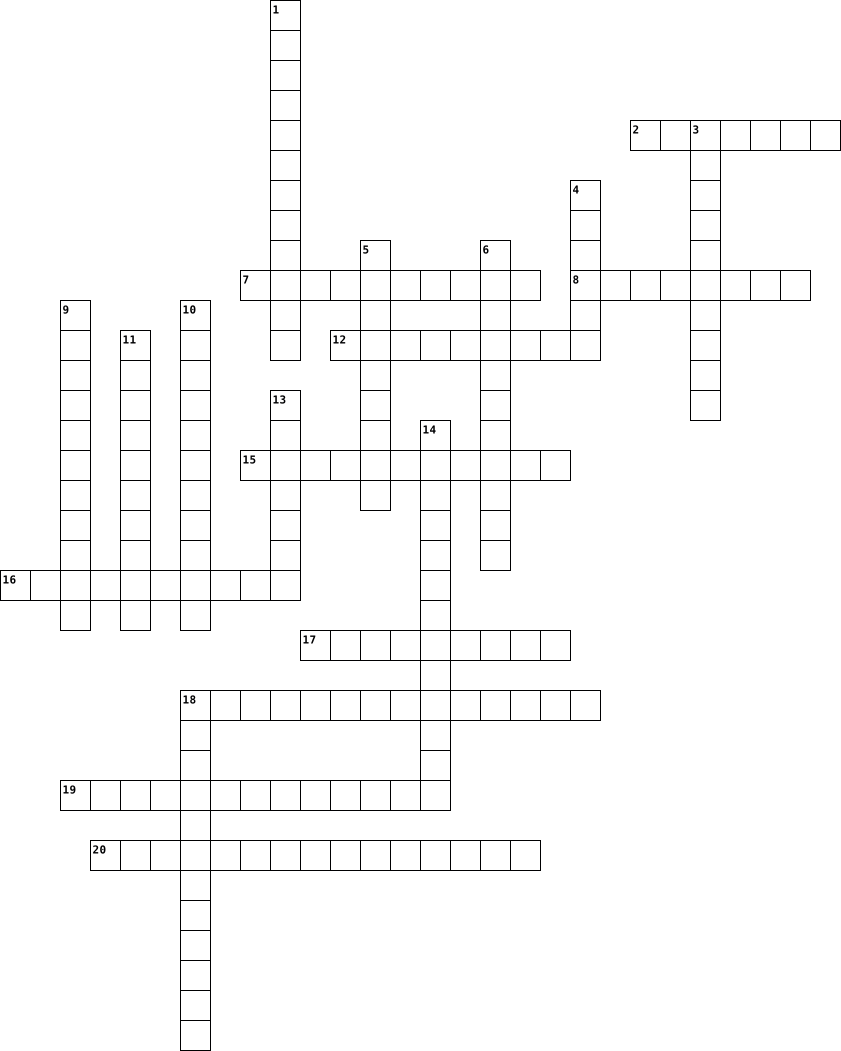
Across
- The probability distribution of molecular states
- This partition function describes the number of accessible states of a system
- This is often described as the disorder of a system
- This branch of chemistry is known for causing mental pain for students
- Dr. Poler's favorite candy that he can't stop dropping jars of
- This partition function describes the number of accessible states of one molecule
- This type of system holds pressure constant
- This form of energy has the highest number of states (partition function)
- This theorem relates degrees of freedom to contributions of energy
- The branch of physical sciences that deal with relations between heat and other forms of energy
Down
- This form of energy has the third highest number of states (partition function)
- This type of system holds volume constant
- This type of matter is the easiest to do calculations and models for
- The total heat content of a system
- This form of energy has the lowest number of states (partition function)
- this type of system holds temperature constant
- This form of energy has the second highest number of states (partition function)
- This type of system holds heat constant
- This is held constant in the universe and isolated systems
- This describes the physical property of a substance needed to increase it by 1 ºC
- A fitting parameter that describes population distribution
21 Clues: The total heat content of a system • This type of system holds heat constant • This type of system holds volume constant • This type of system holds pressure constant • this type of system holds temperature constant • The probability distribution of molecular states • This is often described as the disorder of a system • ...
Physical Chemistry Crossword 2024-05-02

Across
- This is often described as the disorder of a system
- This form of energy has the lowest number of states (partition function)
- This type of matter is the easiest to do calculations and models for
- This type of system holds pressure constant
- Dr. Poler's favorite candy that he can't stop dropping jars of
- this type of system holds temperature constant
- This partition function describes the number of accessible states of a system
- The resistance to flow
- This order of reaction is independent of reactant concentrations
- The probability distribution of molecular states
- This partition function describes the number of accessible states of one molecule
- This form of energy is associated with things in motion
- This branch of chemistry is known for causing mental pain for students
- This is the time it takes for 1/2 a given amount of substance to decay (also a very popular game series started in 1998)
- The energy needed to move against a force
- Students draw many of these types of structures horribly wrong
- The average distance traveled without collisions
Down
- This is held constant in the universe and isolated systems
- This form of energy has the highest number of states (partition function)
- This describes the rate based on the amount of substance used
- This type of system holds heat constant
- This theorem relates degrees of freedom to contributions of energy
- This describes the physical property of a substance needed to increase it by 1 ºC
- This program was used to build and calculate values for molecular properties
- This type of system holds volume constant
- The branch of physical sciences that deal with relations between heat and other forms of energy
- This form of energy has the third highest number of states (partition function)
- A type of process whose system is related to spontaneity
- This type of inhibitor races the substrate to reach the enzyme active site
- The total heat content of a system
- A fitting parameter that describes population distribution
- This form of energy has the second highest number of states (partition function)
32 Clues: The resistance to flow • The total heat content of a system • This type of system holds heat constant • This type of system holds volume constant • The energy needed to move against a force • This type of system holds pressure constant • this type of system holds temperature constant • The probability distribution of molecular states • ...
Chemistry Bonus Crossword 2024-04-26

Across
- A gaseous form of a substance that is normally a liquid or solid
- A solid produced during a chemical reaction
- Mixture that is not uniform
- Transfer of electrons between atoms, resulting in cations and anions
- A neutral particle having equal numbers of p+ and e-
- Numbers that are known with complete certainty.
- Substances that are volatile vaporize easily
- The random movement of gas molecules from an area of higher concentration to an area of lower concentration
- Microscopic particles are dispersed evenly in another substance
- Sum of protons and neutrons
- Discovered electrons while experimenting with a cathode ray tube.
- The mass of one mole of particles
- Solution is heated and the solvent boils off
Down
- Standard unit that stands for 6.02x10^23
- Sharing of electrons by atoms so that all atoms involved achieve a filled valence level
- Solution that contains less than the max. amount of solute
- Solutions containing more than the maximum amount of solute
- Solution in which the solvent is water
- Solution is boiled to separate liquids
- The number of protons in the nucleus.
20 Clues: Mixture that is not uniform • Sum of protons and neutrons • The mass of one mole of particles • The number of protons in the nucleus. • Solution in which the solvent is water • Solution is boiled to separate liquids • Standard unit that stands for 6.02x10^23 • A solid produced during a chemical reaction • Substances that are volatile vaporize easily • ...
Chemistry Crossword Puzzle 2024-05-01

Across
- the length of time it takes for half of the atoms in an isotope to decay
- occurs when an acid and a base react to form a salt and water
- tend to form covalent bonds
- diffusion through a tiny opening
- atoms of the same element
- vertical columns on the periodic table
- a neutral particle having equal numbers of p+ and e-
- donates one proton per molecule
- substances that are volatile vaporize easily
- temperatures measured with a thermometer
- the mass of an atom (amu)
- the concave or convex surface of a liquid
- an atom or group of atoms that has either gained or lost e-
Down
- the random movement of gas molecules from an area of higher concentration to a lower concentration
- is the amount of matter in an object
- a ratio that compares mass and volume
- measured as half the distance between the nuclei of an atoms
- the smallest particle of a covalently bonded compound
- horizontal rows on the periodic table
- time measured with a clock or stopwatch
- negative ion
- length measured with a ruler
- positively charged ion
- ionic compound made up of a cation from a base and an anion from an acid
- is the concentration of a solution
- mass measured with a balance
26 Clues: negative ion • positively charged ion • atoms of the same element • the mass of an atom (amu) • tend to form covalent bonds • length measured with a ruler • mass measured with a balance • donates one proton per molecule • diffusion through a tiny opening • is the concentration of a solution • is the amount of matter in an object • a ratio that compares mass and volume • ...
Holiday Chemistry Crossword 2024-12-19

Across
- Chemical formula for table salt, used in holiday cooking
- The sweet compound found in candy canes
- Gas commonly found in a snow globe's atmosphere
- The process of turning water into ice crystals in winter
- The element responsible for the red color in fireworks
- Green colors in fireworks come from this element
- The most abundant element in a Christmas tree
- The element that gives a yellow glow to fireworks
- The chemical formula for carbon dioxide, released after singing carols
- An element with a name that sounds like part of the word 'Christmas'
- The compound responsible for the 'piney' scent of Christmas trees
- The element that makes up most of the universe and is found in the sun
Down
- The noble gas used in blue holiday lights
- An element used in red holiday lights and signs
- A metallic element used in bells
- A common holiday drink contains this element
- The metallic element that makes candles' wicks burn brightly
- The acid in vinegar, used for baking or holiday cleaning
- A metallic element used in sparklers
- Metal used to make shiny ornaments
- Compound that makes up baking soda, used in holiday cookies
- The sparkly mineral often used in crafting ornaments
- Shiny, gold-colored element used in holiday decorations
23 Clues: A metallic element used in bells • Metal used to make shiny ornaments • A metallic element used in sparklers • The sweet compound found in candy canes • The noble gas used in blue holiday lights • A common holiday drink contains this element • The most abundant element in a Christmas tree • An element used in red holiday lights and signs • ...
Water and Chemistry 2025-01-31

Across
- outer most electrons
- proton + neutrons = _______ ______
- hexagon ice crystals are ___ ______ than liquid, ice floats (2wds)
- type of bond by sharing pair(s) of electrons
- charge of the neutron
- stable because they have a full valance shell (2wds)
- most electronegative element
- majority of elements are _________ (plr)
- symbol used to show direction of polarity for a molecule (2wds)
- water sticking to other things
- lowercase greek letter used to mean slightly positive or negative
- Proton + __________ = mass of element
- charge of the proton
- proton count/how ptable is organized (2wds)
- energy required or released to change substance temperature
- heat of ______________ is the energy required to change from liquid to gas
- slight positive and negative side
- more or fewer electrons
Down
- water sticking to itself
- elements of life
- property of water that causes the beading/bubbling effect
- will form covalent bonds with each other (plr)
- center of the atom
- like charges ____________
- tiny particle that orbits the nucleus
- charge of the electron
- water is the universal __________ because it dissolves many substances
- Determines the element
- desire to gain electrons
- _________ action is the ability of water to "climb" narrow tubes
- does not react
- oil won't mix with water because it is ______
- fundamental force that explains how particles interact
- type of bond between positive and negative particles
- _____ bond weak attraction between this element on the end of polar molecules
- opposite charges ____________
36 Clues: does not react • elements of life • center of the atom • outer most electrons • charge of the proton • charge of the neutron • charge of the electron • Determines the element • more or fewer electrons • water sticking to itself • desire to gain electrons • like charges ____________ • most electronegative element • opposite charges ____________ • water sticking to other things • ...
Introduction to Chemistry 2025-02-03

Across
- A test to learn about science.
- The amount of matter in an object.
- Anything that has mass and takes up space.
- When substances change to form new substances.
- The amount of space something takes up.
- The smallest unit of matter.
- A state of matter with a definite shape and volume.
- Change A change that creates a new substance (e.g., burning wood).
- A type of mixture where one substance dissolves in another.
- A state of matter that takes the shape of its container but has a definite volume.
Down
- How much mass is in a given volume.
- Change A change in appearance, but not in substance (e.g., melting ice).
- A combination of substances that can be separated.
- The ability to do work or cause change.
- The study of matter and how it changes.
- Two or more atoms bonded together.
- A pure substance made of only one kind of atom.
- Table A chart that organizes elements by their properties.
- A substance made of two or more different elements.
- A state of matter that has no definite shape or volume.
20 Clues: The smallest unit of matter. • A test to learn about science. • The amount of matter in an object. • Two or more atoms bonded together. • How much mass is in a given volume. • The ability to do work or cause change. • The study of matter and how it changes. • The amount of space something takes up. • Anything that has mass and takes up space. • ...
Chemistry of Food 2024-12-02

Across
- A leavening agent containing both an acid and a base.
- The feel or consistency of food.
- Brown polymers formed during Maillard and caramelization reactions.
- An ionic compound formed from the neutralization of an acid and a base.
- The browning of sugar under heat, enhancing flavor.
- Substances that accept hydrogen ions or release hydroxide ions.
- Substances that release hydrogen ions in a solut ion.
- A solid that forms from a solution during a chemical reaction.
- Combining ingredients to form a homogenous mixture.
- The process of working dough to develop gluten.
- An ingredient in baking powder.
- A browning reaction that gives cooked food its flavor.
- Another protein in gluten that contributes to dough structure.
- A lab technique to determine the concentration of an unknown solution.
- A mixture of two liquids that usually don’t mix, like oil and water.
- Chemical changes induced by heat.
Down
- One of the proteins in gluten.
- Methods used to prevent food spoilage.
- A reaction where an acid and a base cancel each other out.
- Essential macromolecules that build and repair tissues.
- The chemical breakdown of a substance by bacteria, yeasts, or other microorganisms.
- A common base used in cooking and cleaning.
- The process by which dough expands due to leavening agents.
- The process of making dough rise.
- Substances used to thicken or stabilize mixtures.
- The chemical name for baking soda.
- Pigments that give fruits and vegetables red, purple, or blue colors.
- A solution that resists changes in pH.
- Sugars that can participate in Maillard reactions.
- Preserving food by soaking it in a solution of salt, water, and sometimes vinegar.
- A scale used to measure the acidity or basicity of a solution.
- A substance that helps mix oil and water.
- A protein found in wheat that gives dough elasticity.
33 Clues: One of the proteins in gluten. • An ingredient in baking powder. • The feel or consistency of food. • The process of making dough rise. • Chemical changes induced by heat. • The chemical name for baking soda. • Methods used to prevent food spoilage. • A solution that resists changes in pH. • A substance that helps mix oil and water. • ...
Chemistry Vocab - JS 2025-04-24

Across
- Change, same chemical structure
- Science of atoms and elements
- Space inside something
- Attracting molecules
- The result of mixing reactants
- Mixed with another, change
- From a reaction, irreversible
- Takes up space, weight
- Molecules, atoms, and elements combination
- Measurement, hot and cold
- Combination, can be separated\
- Reaction, release heat
Down
- Something that intensifies a reaction
- Visible form of a substance, characteristic
- A substance that can't be downgraded
- Measure of matter in something
- Result of a reaction
- Characteristic of a changed substance
- Unit of structure, smallest
- To do work
- Energy movement
- Group of bonded atoms
- To connect atoms
- Reaction, absorbs heat
24 Clues: To do work • Energy movement • To connect atoms • Attracting molecules • Result of a reaction • Group of bonded atoms • Space inside something • Reaction, absorbs heat • Takes up space, weight • Reaction, release heat • Measurement, hot and cold • Mixed with another, change • Unit of structure, smallest • Science of atoms and elements • From a reaction, irreversible • ...
Chemistry Unit 1 2024-12-19

Across
- Name of metals found in group 1
- Sub-atomic particle with -1 charge
- Centre of the atom
- Model that suggests the atom is a ball of positive charge with negative electrons embedded
- Charge when an atom gains electrons
- Particles used in scattering experiment to develop the nucelus model
- A substance made up of only one type of atom
- When an atom loses or gains electrons
- Atomic _______ - used to order the periodic table today
- Found on the left side of the periodic table
Down
- Name of elements found in group 7
- Sub-atomic particle with a +1 charge
- Charge when an atom loses electrons
- Surrounding the nucleus where electrons are found
- Arrangement of group 0 element with a full outer shell of electrons
- Sub-atomic particle with 0 charge
- A substance made up of 2 or more atoms chemically joined together
- Atomic _______ - used to order the modern periodic table
- Name of gases found in group 0
- Metals found between group 2 and 3
20 Clues: Centre of the atom • Name of gases found in group 0 • Name of metals found in group 1 • Name of elements found in group 7 • Sub-atomic particle with 0 charge • Sub-atomic particle with -1 charge • Metals found between group 2 and 3 • Charge when an atom loses electrons • Charge when an atom gains electrons • Sub-atomic particle with a +1 charge • ...
Solutions in chemistry 2025-01-14

Across
- Symbol: Ag
- Symbol: F
- Symbol: Cu
- A type of mixture where tbe substances are not dissolved and the composition is uneven.
- A type of mixture where the particles are evenly distributed and it looks uniform.
- A state of matter where a substance flows freely. It conforms to the shape of the container it is in.
- Symbol: Be
- Symbol: N
- Symbol: O
- A state of matter where the molecules are packed together and contain the least amount of kinetic energy. It has a defined shape and volume.
- Symbol: Na
Down
- Symbol: Li
- Symbol: H
- Substance in a mixture that is dissolved and it is present in a lower quantity.
- Symbol: Hg
- Symbol: He
- Substance in higher quantity in a mixture and it is used to dissolve the solute.
- Symbol: K
- A liquid mixture that has a solvent and a solute.
- A state of matter where particles expand freely to fill a container and has no fixed shape or volume.
- Symbol: Au
- Symbol: C
- Symbol: Ne
- Symbol: B
24 Clues: Symbol: H • Symbol: F • Symbol: K • Symbol: C • Symbol: N • Symbol: B • Symbol: O • Symbol: Li • Symbol: Hg • Symbol: He • Symbol: Ag • Symbol: Cu • Symbol: Au • Symbol: Ne • Symbol: Be • Symbol: Na • A liquid mixture that has a solvent and a solute. • Substance in a mixture that is dissolved and it is present in a lower quantity. • ...
Zoology and Chemistry 2025-01-09

Across
- salmon reproductive cell
- an organism that breaks down wastes and dead organisms
- the number of protons found in an element
- the study of matter, energy, space, and time
- what happens when your body goes above 41 degrees c
- a large number of individuals organize into a coordinate motion
- (characteristics of life) animals adjust to different environments
- when your body does not consume enough water
- the gamete of the male salmon
- A life cycle in which creatures are hatched in fresh water, migrate to salt water as adults, and then go back to fresh water in order to reproduce
- what happens when your body goes below 30 degrees c
- a group swimming in the same direction in a coordinated manner
- electrons on the outermost energy level of an atom
- the particles found inside an atom and are responsible for forming the structure of an atom
- when the number of neutrons does not equal the number of protons
- Bringing individual animals together into a group, maintaining the group, and moving the group from place to place
- a scientific procedure undertaken to make a discovery, test a hypothesis, or demonstrate a known fact
- group a group in an experiment which a variable is not being tested
- seasonal movement of animals from one place to another
- when animals slow their activity for the hot, dry summer months
- any group of atoms that are joined together by chemical bonds
- neutral particles
- variable a variable whose value depends on that of another.
- the use of senses to gather information either directly or indirectly
- individuals all move with the same velocity so that they remain together as a group
Down
- (characteristics of life) eating then rid waste
- weak attraction between a hydrogen atom and another atom
- (characteristics of life) plants avoid dangerous organisms and are drawn to good organisms
- positive charged particles
- (characteristics of life) production of new organisms and new cells
- where genes are located
- when organisms reproduce only once during their life
- average weather over a period of time
- (characteristics of life) plants learn to grow and develop in an environment
- a animal that has a external skeleton a segmented body and jointed appendages
- succession type of succession that occurs in an area that was only partially destroyed by disturbances
- succession succession that occurs on surfaces where no soil exists
- the gamete of the female salmon
- (characteristics of life) things that are living are very structured
- observing organisms and plants in their natural habitat
- negatively charged particles
- an element that has gained or lost an electron and therefore has a charge (negative or positive)
- where the river meets the ocean
- the study of elements and their chemical structures, reactions, and interactions
- (characteristics of life) things adapt and change over time to survive
- A state of greatly reduced body activity that occurs during the winter
- carbon, hydrogen, oxygen, nitrogen, phosphorus, sulfur (the primary elements found in biological molecules
- variable a variable that stands alone and isn't changed by the other variables you are trying to measure
- the study of animals
- a person or thing situated away or detached from the main body or system
- the number of protons and neutrons found in an element
- the theory that cells form the fundamental structural and functional units of all living organisms
- where salmon eggs are laid
- the basic unit of matter and defining structure of elements
- a fixed pattern of behavior in animals in response to certain stimuli
- a group of animals coordinate their activities as part of their hunting behavior in order to improve chances of making a kill and feeding
- Hooked jaw that male salmon develop when migrating back to their home stream to spawn
- any type of data that may either agree or disagree with a prediction, so it may either support or disprove a hypothesis
- offspring created when two different organisms mate
59 Clues: neutral particles • the study of animals • where genes are located • salmon reproductive cell • positive charged particles • where salmon eggs are laid • negatively charged particles • the gamete of the male salmon • the gamete of the female salmon • where the river meets the ocean • average weather over a period of time • the number of protons found in an element • ...
Chemistry Cross Word :) 2025-01-24

Across
- an atom with less electrons than protons
- atomic mass unit
- any of the series of fifteen metallic elements from lanthanum to lutetium
- the emission of ionizing radiation caused by the disintegration of a nucleus
- particles with a negative charge
- when an atom has more or less neutrons than protons
- an atom with more electrons than protons
- when a nucleus loses energy due to radiation
- particles with no charge
- center of an atom
- particles with a positive charge
- any of the elements helium, neon, argon, krypton, xenon, and radon,
- when an atom gains or loses an electron
- reactive to water
- a column of elements on the periodic table
Down
- any metals occupying the central block of the PTE, ex:copper
- an element that behaves like both a metal and non metal
- a row of elements on the periodic table
- all possible places for an electron to be
- fifteen radioactive elements from actinium to lawrencium
- an element that is not metal
- any of the elements fluorine, chlorine, bromine, iodine, and astatin
- a material that is malleable and conductes electricity
- the number of protons in an element
- lithium, sodium, potassium, rubidium, cesium, and francium,
25 Clues: atomic mass unit • center of an atom • reactive to water • particles with no charge • an element that is not metal • particles with a negative charge • particles with a positive charge • the number of protons in an element • a row of elements on the periodic table • when an atom gains or loses an electron • an atom with less electrons than protons • ...
Chemistry Extra Credit 2025-03-28

Across
- group 1 on periodic table
- neutral subatomic particle
- A chemical bond formed when two atoms share two
- A bond between atoms or ions that allows molecules to form
- the basic unit of a chemical element.
- negatively charged ion
- able to be hammered or pressed permanently out of shape without breaking or cracking.
- a thing that is composed of two or more separate elements; a mixture.
- positive subatomic particle
Down
- all of the atoms (or ions) are arranged in a regular grid pattern
- dissolved in water
- forms of the same element that contain equal numbers of protons but different numbers of neutrons
- a part or aspect of something abstract, especially one that is essential or characteristic
- group 2 on periodic table
- positively charged ion
- When a compound combines with oxygen gas to form water,
- group 17 on periodic table
- and carbon dioxide
- negative subatomic particle
- group 18 on periodic table
20 Clues: dissolved in water • and carbon dioxide • positively charged ion • negatively charged ion • group 1 on periodic table • group 2 on periodic table • neutral subatomic particle • group 17 on periodic table • group 18 on periodic table • negative subatomic particle • positive subatomic particle • the basic unit of a chemical element. • A chemical bond formed when two atoms share two • ...
Chemistry Vocabulary Final 2025-05-06

Across
- ion that consists of two or more atoms bonded together, which collectively have a net charge
- negatively charged subatomic particle found outside the nucleus
- distance from the nucleus of an ion to the outermost electron after the atom has gained or lost electrons to form an ion
- chemical compound consisting of a hydrogen and a carbon
- the ability of an atom to attract electrons towards itself when it is part of a chemical bond
- deals with quantitative relationships between reactants and products in a chemical reaction; uses a balanced chemical reaction
- chemical bond formed when two nonmetal atoms share electrons in order to achieve a full outer electron shell
- substance in a chemical reaction that is used up first
- pairs of electrons that are shared between two atoms in a chemical bond
- solid that forms and separates from a liquid solution during a chemical reaction
- amount of space an object takes up
- substances that are present at the beginning of a chemical reaction
- refers to the region around a central atom where electrons are likely to be found
- positively charged ion that has lost electrons
- substance made of two or more elements chemically combined in a fixed ratio
- number of protons in the nucleus of an atom
- pure substance made of only one type of atom
- type of chemical reaction in which a compound breaks down into simpler substances
- chemical compound formed when two nonmetal atoms share electrons in order to achieve a full electron shell
- an ionic compound formed with a metal and a nonmetal
- combination of two or more substances physically combined in variable proportions
- refers to the emission and transmission of energy in the form of waves or particles when an atoms nucleus decays
- 6.022x10^23 particles
- process in which reactants are transformed into products through the breaking and forming of chemical bonds
- subatomic particle found in the outermost shell of an atom
- states that atoms tend to gain, lose, or share electrons in order to have a full outer electron shell
- new substances formed from a chemical reaction
- molecule that has a net dipole, meaning there is an uneven distribution of electrons
- force of attraction that holds atoms together in a compound by either transferring or sharing electrons to become more stable
- mixture in which the components are not evenly distributed and composition is not uniform
- measure of the efficiency of a chemical reaction, compares actual and theoretical yield
- total number of protons and neutrons found in the nucleus of an atom
- region of space around the nucleus of an atom where there is a high probability of finding an electron
- the amount of energy required to remove one electron from a neutral atom
- substance in a chemical reaction that is not completely used up when the reaction is finished
- maximum amount of product that can be formed in a chemical reaction, calculated based on the balanced chemical equation and the amount of limiting reactant
- chemical reaction in which one element replaces another in a compound
Down
- measure of a fluids resistance to flow
- the temperature at which a liquid changes to a gas
- diagram that shows a representation of valence electrons of an element or molecules represented by dots
- chemical compound formed by the electrostatic attraction between cations and anions
- chemical reaction in which two or more compounds exchange ions to form two new compounds
- used to convert a quantity from one unit to another without changing its value
- number assigned to an atom that represents its charge in an ionic compound
- conversion factor derived from the coefficients of a balanced equation, showing the ratio of moles between substances
- the distance from the nucleus of an atom to the outermost electron shell
- positively charged subatomic particle found in the nucleus
- a regular, repeating arrangement of atoms, ions, or molecules in a solid
- the arrangement of electrons in their most stable form in an orbital
- same element with different different number of neutrons
- neutrally charged subatomic particle found in the nucleus
- mass of one mole of a substance
- mixture in which the components are evenly distributed and has uniform composition
- building block of all matter
- type of chemical reaction in which two or more simple substances combine to form a complex compound
- type of chemical bond formed when electrons are transferred from one atom to another,resulting in the formation of cations and anions
- chemical reaction that absorbs energy, usually in the form of heat
- Pairs of valence electrons that are not involved in bonding with other atoms
- elements that naturally exist as molecules composed of two identical atoms bonded together because they are more stable in this form than as individual atoms
- used to measure the amount of a substance
- anything that has mass and takes up space
- refers to the percentage by mass of each element in a compound
- atom or molecule with an electric charge because it has gained or lost electrons
- amount of matter in an object
- weighted average of all the masses of all the naturally occurring isotopes on the periodic table
- chemical reaction in which a substance reacts with oxygen to produce carbon dioxide and water
- chemical compound containing at least one oxygen atom
- measured amount of product obtained from a chemical reaction
- chemical reaction that releases energy in the form of heat or light
- family on the periodic table that corresponds to the number of valence electrons
- sum of the atomic masses of all the atoms in a chemical formula, expressed in amu
- horizontal row in the periodic table that corresponds to the number of energy levels
- negatively charged ion that has gained electrons
- measure of how readily an element or compound undergoes a chemical reaction
- molecules that do not have a net dipole, meaning there is an even distribution of charge
75 Clues: 6.022x10^23 particles • building block of all matter • amount of matter in an object • mass of one mole of a substance • amount of space an object takes up • measure of a fluids resistance to flow • used to measure the amount of a substance • anything that has mass and takes up space • number of protons in the nucleus of an atom • pure substance made of only one type of atom • ...
Intro to Chemistry 2024-10-13

Across
- group of atoms bonded together
- whether a substance will burn or not
- smallest particle to make up element
- ability to transfer heat
- how it responds to a substance
- fixed volume and fixed shape
- materials that can be drawn into long wire
- liquid changes to a gas
- suggested explanation for a scientific question
- how much damage a substance will do
- distinguishing characteristics of matter
Down
- variable shape and volume limited to the container
- anything that takes up space
- gas changes to liquid
- definite volume but assumes shape of container
- the study of matter
- materials that can be hammered thin
- data, data in form of numbers from measuring
- data, data in form of words to describe
- amount of matter packed into a given volume
- an atom that has gained or lost electrons
21 Clues: the study of matter • gas changes to liquid • liquid changes to a gas • ability to transfer heat • anything that takes up space • fixed volume and fixed shape • group of atoms bonded together • how it responds to a substance • materials that can be hammered thin • how much damage a substance will do • whether a substance will burn or not • smallest particle to make up element • ...
Chemistry of Life 2024-10-10

Across
- Long chains of carbon and hydrogen joined together
- The use of cell energy to move materials across a cell membrane
- The carbohydrate that forms the cell walls of plant cells
- A form of endocytosis in which solid particles are engulfed by cells
- A three carbon chain molecule containing three hydroxyl groups
- A difference in the number of molecules or ions of a substance between adjoining regions
- An organic molecule that is half of a glucose molecule with the molecular formula C3H6O3
- A solution where the concentration of solute molecules outside a cell is equal to the molecules inside the cell
- The raw materials needed for cell metabolism
- A series of chemical reactions that allow two molecules to bond by the formation of a water molecule
Down
- A solution where the concentration of solutes outside a cell is lower than that found inside the cell
- The basic structural units of nucleic acid
- A solution where the concentration of solutes outside a cell is higher than that found inside the cell
- The diffusion of water molecules across a selectively permeable membrane
- The process by which plants use chlorophyll to trap sunlight energy and use it to produce carbohydrates
- Artificial lipid vesicles
- Nutrients made up of a single sugar molecule or many sugar molecules
- A large carbohydrate molecule used by plants to store energy
- The form of carbohydrate storage in animals
- The loss of electrons from an atom or molecule
- The movement of molecules from an area of high to low concentration
21 Clues: Artificial lipid vesicles • The basic structural units of nucleic acid • The form of carbohydrate storage in animals • The raw materials needed for cell metabolism • The loss of electrons from an atom or molecule • Long chains of carbon and hydrogen joined together • The carbohydrate that forms the cell walls of plant cells • ...
Chemistry is Life 2024-10-06

Across
- biological catalysts
- molecules composed of many monomers; makes up macromolecules
- compound made up of carbon, hydrogen, and oxygen atoms; type of nutrient that is the major source of energy for the body
- reaction a reaction that absorbs energy (absorbs heat)
- reactant of an enzyme-catalyzed reaction
- a large organic molecule made up of many atoms (like proteins)
- energy energy that is needed to get a reaction started
- acid macromolecules containing hydrogen, oxygen, nitrogen, carbon, and phosphorus
- acid compound with an amino group on one end and a carboxyl group on the other end
- substance formed as a result of a chemical reaction
- substance that speeds up the rate of a chemical reaction
Down
- small chemical unit that makes up a polymer
- simple sugar molecule
- subunit of which nucleic acids are composed; made up of a 5-carbon sugar, a phosphate group, and a nitrogenous base
- reaction a reaction that releases energy (gives off heat)
- reaction process that changes, or transforms, one set of chemicals into another set of chemicals
- macromolecule made up of amino acids
- a complex carbohydrate made up of many monosaccharides
- macromolecule made mostly from carbon and hydrogen atoms; includes fats, oils, and waxes
- elements or compounds that enter into a chemical reaction
20 Clues: biological catalysts • simple sugar molecule • macromolecule made up of amino acids • reactant of an enzyme-catalyzed reaction • small chemical unit that makes up a polymer • substance formed as a result of a chemical reaction • reaction a reaction that absorbs energy (absorbs heat) • a complex carbohydrate made up of many monosaccharides • ...
Chemistry Comes Alive 2024-09-12

Across
- Any element or compound that is equal to its atomic weight or molecular weight weighed out in grams.
- The measure of hydrogen ion concentration of a solution (in moles per liter).
- This is a modified simple sugar (a sugar alcohol).
- These are single-chain or single-ring structures containing from three to seven carbon atoms.
- Synthesis The acid group of one amino acid is bonded to the amine group of the next, with the loss of a water molecule.
- A long double stranded polymer -a double chain of nucleotides.
- Substances that increase the rate of a chemical reactions without themselves becoming chemically changed or part of the product.
- These are heterogeneous mixtures, which means that their composition is dissimilar in different areas of the mixture.
- The most abundant and important inorganic compound in living matter.
- These are unique substances that cannot be decomposed into simpler substances by ordinary chemical methods.
- Ion An important base in the body, that is particularly abundant in the blood.
- These have the same molecular formula, their atoms are arranged differently and giving them different chemical properties.
- Structure The sequence of amino acids that forms a polypeptide chain.
- A type of globular proteins that act as biological catalyst.
- These have a sour taste, can react with many metals and burn a hole in your rug.
- Acids Composed of carbon, oxygen hydrogen, nitrogen and phosphorus, are the largest molecules in the body.
- Energy These are energy that travels in waves.
- This has a bitter taste that feels slippery and are proton acceptors, that is they take up hydrogen ions (H+) in detectable amounts.
- Bases This easily dissociates easily in water and quickly ties up H+.
- These have the same number of protons and electrons but differ in the number of neutrons they contain.
- These are diverse lipids chiefly derived from 20-carbon fatty acid (arachidonic acid) found in all membranes.
- These are substances composed of two or more components physically intermixed.
- The capacity to do work or to put matter into motion.
- These are heterogeneous mixtures with large, often visible solutes that tend to settle out.
- Bonds A chemical bond between atoms is formed by the transfer of one or more electrons from one atom to the other.
- This is called the energy of action.
Down
- Structure Two or more polypeptide chains, each with their own tertiary structure combine to form a functional protein.
- A combination of two or more atoms held together by chemical bonds
- Energy The amount of energy needed to break the bonds of the reactants so they can rearrange themselves and become the product.
- Acids These are the building blocks of protein molecules.
- The storage of carbohydrates formed by plants.
- These are polymers of simple sugars linked together by dehydration synthesis.
- A group of molecules that includes sugars and starches.
- These are homogeneous mixtures of components that may be gases, liquids or solids.
- Anything that can occupies space and has mass
- Peptide bonds linking amino acids together are broken when water is added to the bond.
- These are insoluble in water but dissolve readily in other lipids and in organic solvents such as alcohol and ether.
- This mixture has the same composition or makeup throughout.
- Single strands of nucleotides.
- This is found in cell membranes and is the raw material for synthesis of vitamin D, steroid hormones and bile salts.
- A type of energy which results from the movement of charged particles.
- Flat molecules made of four interlocking hydrocarbon rings.
- Living cells are extraordinarily sensitive to even slight changes in the pH of the environment.
- Number An atom is the sum of the masses of its protons and neutrons.
- The process of atomic decay.
- This is formed when two monosaccharides are joined by dehydration synthesis.
- The universal energy compound of body cells.
- This is the substance on which enzymes act.
- The study of chemical composition and reactions of living matter.
- An ionic compound containing cations other than H+ and anions other than the hydroxy ion.
- Reaction This occurs when a molecule is broken down into smaller molecules or its constituent atoms.
51 Clues: The process of atomic decay. • Single strands of nucleotides. • This is called the energy of action. • This is the substance on which enzymes act. • The universal energy compound of body cells. • Anything that can occupies space and has mass • The storage of carbohydrates formed by plants. • Energy These are energy that travels in waves. • ...
Food Chemistry: Energy 2025-10-31

Across
- Which type of energy holds together the nucleus of atoms and is released during nuclear fusion?
- What single word is used to describe conduction?
- What is it called when heat is transferred through density differences?
- Which type of energy is generated by moving electric charges called electrons?
- What is one of the two primary types of energy that deals with energy being stored?
- What is one of the two primary types of energy that deals with moving objects?
- Which type of energy undergoes a transformation through a chemical reaction to transform other chemical substances?
- Which type of energy is created from the vibration of molecules and atoms within substances?
- What single word is used to describe radiation?
- What is it called when energy can never be created nor destroyed, but it can be transformed from one type to another?
Down
- What is it called when heat is transferred by molecular contact?
- Which type of energy is a form of electromagnetic radiation?
- This is a resource that can be renewed easily by physical, chemical, or biological process.
- This is a resource that cannot be renew itself or takes millions of years for its formation.
- Which type of energy is held by an object because of its high position compared to a lower position?
- What single word is used to describe convection?
- What is it called when heat is transferred by wave motion?
- Which type of energy is produced when sound waves move outward from a sound source or a vibrating object?
- Which type of energy involves stretching or squashing?
- Which type of energy is associated with the position and motion of an object?
- The ability to do work is known as what?
- This is how energy moves.
22 Clues: This is how energy moves. • The ability to do work is known as what? • What single word is used to describe radiation? • What single word is used to describe convection? • What single word is used to describe conduction? • Which type of energy involves stretching or squashing? • What is it called when heat is transferred by wave motion? • ...
Chemistry of life 2025-10-31

Across
- Equal concentration of water
- movement of high to low concentration.
- broad flatted,specialized for grinding
- a flap used to close off the trachea
- enters the cell
- Contains digestive enzymes to digest food
- uses energy from the sun to make their own food
- chemical messengers that regulate the body's functions
Down
- even broader,specialized for crushing
- chisel shaped specialized for cutting
- component of a cell wall
- cannot make their own food
- exit the cell
- Cannot make their own food
- single sugar compound found in DNA
- The main source of the body's energy
- more solute outside the cell
- specialized for tearing
- watery fluid use to moisten food and contains enzymes
- more solute inside the cell
- small rounded piece of food
21 Clues: exit the cell • enters the cell • specialized for tearing • component of a cell wall • cannot make their own food • Cannot make their own food • more solute inside the cell • small rounded piece of food • Equal concentration of water • more solute outside the cell • single sugar compound found in DNA • The main source of the body's energy • a flap used to close off the trachea • ...
Soil Chemistry Terminology 2025-09-19

Across
- Positively charged ion such as calcium (Ca²⁺) or magnesium (Mg²⁺)
- Soil particles separating, often caused by excess sodium
- Soil particles clumping together, improving structure for roots
- Tension, Force that holds water molecules together at the surface
- Essential elements such as nitrogen, phosphorus, and potassium needed for plant growth
- Fully decomposed organic matter with high nutrient holding capacity
- Property of water molecules sticking to soil or other surfaces
- Material added to soil to supply nutrients like N, P, and K
Down
- Fine soil particle with high water and nutrient holding ability
- Negatively charged ion such as chloride (Cl⁻) or sulfate (SO₄²⁻)
- Soil, Soil with high sodium levels that destroys soil structure and reduces plant growth
- Soil that is a balanced mixture of sand, silt, and clay
- Exchange Capacity (CEC), Soil’s ability to hold and exchange nutrient cations
- Matter, Decomposed plants and animals that improve soil structure and fertility
- Property of water molecules sticking to each other
- Solution, The water in soil containing dissolved nutrients available for plants
- Amount of salts in soil that makes it harder for plants to absorb water
- Measure of soil acidity or alkalinity that affects nutrient availability and microbial activity
- Medium-sized soil particle with moderate nutrient holding capacity
- Large soil particle with low nutrient and water holding ability
- Property of water molecules that makes them attract to ions and dissolve nutrients
21 Clues: Property of water molecules sticking to each other • Soil that is a balanced mixture of sand, silt, and clay • Soil particles separating, often caused by excess sodium • Material added to soil to supply nutrients like N, P, and K • Property of water molecules sticking to soil or other surfaces • Fine soil particle with high water and nutrient holding ability • ...
Chemistry of Life 2025-12-02

Across
- The components of lipids. (3 words)
- The monomer of proteins. (2 words)
- The chemical that an enzyme acts on.
- The location on an enzyme where it binds to a substrate. (2 words)
- An example of a lipid.
- The chemicals that go into a reaction.
- A macromolecule that includes antibodies.
- An example of a disaccharide.
- An example of a nucleic acid.
- A small unit that can join with others to form a polymer.
- The location on a substrate where it binds to an enzyme. (2 words)
- The six elements most abundant in living organisms.
- A large molecule made of repeating parts.
Down
- Two ways we get necessary elements into our bodies. (2 words)
- Enzymes work by lowering the __________ of a reaction. (2 words)
- The monomer of a carbohydrate.
- The chemicals that come out of a reaction.
- A macromolecule that makes up exoskeletons.
- A function of lipids.
- Chemicals that speed up chemical reactions in biological organisms.
- A very large molecule.
21 Clues: A function of lipids. • An example of a lipid. • A very large molecule. • An example of a disaccharide. • An example of a nucleic acid. • The monomer of a carbohydrate. • The monomer of proteins. (2 words) • The components of lipids. (3 words) • The chemical that an enzyme acts on. • The chemicals that go into a reaction. • A macromolecule that includes antibodies. • ...
Year 8 Chemistry 2025-08-21

Across
- – The smallest unit of an element.
- change – A change where new substances are made.
- point – The temperature at which a solid melts.
- – Elements that are poor conductors and brittle if solid.
- – A state of matter with fixed shape and volume.
- – Two or more substances combined but not chemically bonded.
- – A substance that speeds up a reaction without being used up.
- – When a gas changes back to a liquid.
- – A positively charged particle in an atom.
Down
- change – A change that does not create a new substance.
- – The center of an atom containing protons and neutrons.
- point – The temperature at which a liquid boils.
- – A substance made of two or more elements chemically combined.
- – A state of matter with no fixed shape or volume.
- – Elements that are good conductors of heat and electricity.
- – When a liquid changes to a gas.
- – A state of matter that has a fixed volume but takes the shape of its container.
- table – A chart that organizes all known elements.
- – A process where substances change into new substances.
- – A negatively charged particle orbiting the nucleus.
- – A neutrally charged particle in an atom.
21 Clues: – When a liquid changes to a gas. • – The smallest unit of an element. • – When a gas changes back to a liquid. • – A neutrally charged particle in an atom. • – A positively charged particle in an atom. • point – The temperature at which a solid melts. • point – The temperature at which a liquid boils. • change – A change where new substances are made. • ...
Chemistry reaction mechanisms 2026-04-28

Across
- where a small molecule is removed forming a double bond
- breaking where one electron goes to each atom
- that donates an electron pair
- of electrons or decrease in oxidation state
- a bond using water
- that speeds up a reaction without being used up
- a reaction while preventing loss of reactants
- state during a reaction step
- where one atom or group is replaced by another
Down
- used to separate products based on boiling point
- where radicals combine and the reaction stops
- charged carbon intermediate
- that accepts an electron pair in a reaction
- in radical substitution that sustains the chain reaction
- where atoms add across a double bond
- breaking where both electrons go to one atom
- used to show movement of electron pairs
- energy required for a reaction to occur
- of electrons or increase in oxidation state
- reactive species with an unpaired electron
- step in free radical substitution forming radicals
21 Clues: a bond using water • charged carbon intermediate • state during a reaction step • that donates an electron pair • where atoms add across a double bond • used to show movement of electron pairs • energy required for a reaction to occur • reactive species with an unpaired electron • that accepts an electron pair in a reaction • of electrons or decrease in oxidation state • ...
Chemistry Review Crossword 2026-04-28

Across
- A mixture where substances are evenly distributed.
- The amount of matter in an object.
- The horizontal rows on the periodic table.
- A substance made of two or more elements chemically bonded together.
- The smallest unit of an element that retains its properties.
- Positively charged particles located in the nucleus.
- Negatively charged particles found outside the nucleus.
- The reactants are changed into new substances during this process.
- The vertical columns on the periodic table with similar properties.
- The center of an atom containing protons and neutrons.
Down
- The number of protons in an atom’s nucleus, which determines the element.
- Particles in the nucleus with no charge.
- A chemical bond formed by sharing electrons.
- The law stating matter cannot be created or destroyed.
- The measure of how acidic or basic a substance is.
- A substance with a pH higher than 7.
- The substance dissolved in a solution.
- A chemical bond formed by transferring electrons.
- The substance that dissolves another substance in a solution.
- A substance with a pH lower than 7.
20 Clues: The amount of matter in an object. • A substance with a pH lower than 7. • A substance with a pH higher than 7. • The substance dissolved in a solution. • Particles in the nucleus with no charge. • The horizontal rows on the periodic table. • A chemical bond formed by sharing electrons. • A chemical bond formed by transferring electrons. • ...
Chemistry Terms Crossword 2026-04-29

Across
- A characteristic that can be observed or measured without changing the sample’s composition.
- When an acid and a base react to form a water and a salt.
- Which chemical reaction is; Al2O3→Al+O2 .
- The volume of a gas is inversely proportional to the pressure if the temperature is held constant.
- The ability of a substance to combine with or change into one or more other substances.
- A description of an element’s tendency to undergo chemical reactions.
- Biological catalysts that speed up the rate of reactions in the body.
- A measure of how strongly atoms attract bonding e- to themselves. The higher the number, the greater the attraction for e-.
- A mixture that is not uniform
- The total pressure in a gas mixture is equal to the sum of the partial pressure of the individual gases.
- When one element is traded with another element in a compound.
Down
- When two nonpolar atoms come in close contact, the electrons of one atom repel the electrons of another, creating a temporary dipole.
- Occurs when solutions of two aqueous compounds are combined; the positive and negative ions of each compound exchange places
- How close a measurement's results come to the true value.
- An unstable form of a chemical element that releases radiation as it breaks down and becomes more stable.
- A device used to measure the energy absorbed or released as heat in a chemical reaction.
- A compound/element that combines with O2 to form an oxide + sometimes H2O.
- A substance that speeds up a chemical reaction without itself undergoing any chemical change. They do this by lowering the activation energy of the reaction.
- The reproducibility of a result or measurement.
- The pressure of a given mass of gas is directly proportional with the Kelvin temperature when volume is held constant.
20 Clues: A mixture that is not uniform • Which chemical reaction is; Al2O3→Al+O2 . • The reproducibility of a result or measurement. • How close a measurement's results come to the true value. • When an acid and a base react to form a water and a salt. • When one element is traded with another element in a compound. • ...
chemistry crossword puzzle 2026-05-16

Across
- A reaction that absorbs heat
- A process where plants convert light energy into chemical energy
- The substance that dissolves another substance in a solution
- A reaction that releases heat
- To become dispersed throughout a solvent
- A chemical equation where the number of atoms of each element is the same on both sides
- A change in which substances are transformed into new substances
- A homogeneous mixture where one substance is dissolved in another
- A chemical process involving rapid oxidation, often with fire
- A reaction where one element replaces another in a compound
- The substance formed after a chemical reaction
- The starting substances in a chemical reaction
Down
- A substance that speeds up a chemical reaction
- The process where an element loses electrons
- DISPLACEMENT A reaction where two compounds exchange ions
- A slow chemical process that eats away metal surfaces
- A representation of a chemical reaction using symbols and formulas
- A form of energy often involved in chemical reactions
- The process where an element gains electrons
- A solid that forms from a solution during a chemical reaction
20 Clues: A reaction that absorbs heat • A reaction that releases heat • To become dispersed throughout a solvent • The process where an element loses electrons • The process where an element gains electrons • A substance that speeds up a chemical reaction • The substance formed after a chemical reaction • The starting substances in a chemical reaction • ...
Year 9 Chemistry 2026-06-11

Across
- Clue: Electrons that are free to move throughout a structure and carry an electrical charge or thermal energy.
- Clue: A group of a fixed number of non-metal atoms covalently bonded together (e.g., $\text{H}_2\text{O}$ or $\text{CO}_2$).
- Clue: The type of positively charged particle fired at thin gold foil during Rutherford's famous scattering experiment (_________ particles).
- Clue: Chemical bonding formed by the electrostatic attraction between oppositely charged ions, usually a metal and a non-metal.
- Clue: The term used to describe the outermost electrons or the outermost shell of an atom.
- Clue: The group name for the unreactive, inert gases found in Group 0 (__________ gases).
- Clue: The tiny, dense, positively charged center of an atom that contains the protons and neutrons.
- Clue: A horizontal row of elements in the periodic table; elements in the same row have the same number of electron shells.
- Clue: Chemical bonding found in metals, consisting of a lattice of positive ions surrounded by a sea of delocalised electrons.
- Clue: The Russian scientist who successfully arranged the early periodic table by leaving gaps for undiscovered elements.
- Clue: The group name for the highly reactive, soft metals found in Group 1 (__________ metals).
- Clue: The scientist who adapted Rutherford's nuclear model by suggesting that electrons orbit the nucleus at specific distances (energy levels).
- Clue: A prefix meaning one-billionth ($10^{-9}$), used to describe particles that are only a few hundred atoms in size (_______particles).
- Clue: Chemical bonding formed when non-metal atoms share pairs of electrons to achieve a full outer shell.
- Clue: Small, reactive molecules that join together in long chains to form a polymer.
- Clue: A type of covalent structure where huge numbers of atoms are bonded together in a massive network, like diamond or silicon dioxide.
- Clue: The liquid substance in which a solute dissolves to form a solution (e.g., water in saltwater).
- Clue: A measure of how much of a substance can dissolve in a given volume of a solvent at a specific temperature.
- Clue: The scientist who provided evidence to show the existence of neutrons within the nucleus, about 20 years after the nucleus was first discovered.
- Clue: A single layer of graphite that is exactly one atom thick, incredibly strong, and a great electrical conductor.
- Clue: An allotrope of carbon where each atom forms three covalent bonds in hexagonal layers, leaving one delocalised electron per atom to conduct electricity.
- Clue: A vertical column of elements in the periodic table; elements in the same column have similar chemical properties.
- Clue: An energy level or orbit surrounding the nucleus where electrons are found.
- Clue: A neutral subatomic particle found in the nucleus of an atom, with a relative mass of 1.
- Clue: A giant, regular, three-dimensional repeating arrangement of atoms or ions in a solid crystal structure.
- Clue: A very large molecule made up of many repeating smaller units (monomers) joined together by strong covalent bonds.
- Clue: A substance made of two or more different elements chemically bonded together in fixed proportions.
Down
- Clue: A substance made of only one type of atom that cannot be broken down into simpler substances by chemical means.
- Clue: Molecules of carbon atoms with hollow shapes, based on hexagonal, pentagonal, or heptagonal rings of carbon atoms.
- Clue: Atoms of the same element with the same number of protons but a different number of neutrons.
- Clue: Two or more elements or compounds that are mingled together but not chemically combined.
- Clue: The strong force of attraction between oppositely charged particles (found in ionic and metallic bonding).
- Clue: The number of protons in the nucleus of an atom, which determines its place in the periodic table (__________ number).
- Clue: The early atomic model proposed by J.J. Thomson where the atom was a sphere of positive charge with negative electrons embedded in it (The __________ pudding model).
- Clue: A separation technique used to separate an insoluble solid from a liquid.
- Clue: The group name for the highly reactive non-metals found in Group 7.
- Clue: A property of metals meaning they can be drawn out into long, thin wires.
- Clue: The weak forces between simple covalent molecules that are broken when the substance melts or boils.
- Clue: An atom or molecule with a net electric charge due to the loss or gain of one or more electrons.
- Clue: A specific type of distillation used to separate a mixture of multiple liquids with different boiling points, such as crude oil (___________ distillation).
- Clue: The solid substance that dissolves in a liquid to form a solution (e.g., salt in saltwater).
- Clue: The insoluble solid material that is left behind in the filter paper after filtration.
- Clue: The famous experiment that disproved the Plum Pudding model and proved the nucleus exists (The alpha particle ___________ experiment).
- Clue: A property of metals meaning they can be hammered or rolled into thin sheets because the layers of atoms can slide over one another.
- Clue: A separation technique used to separate a mixture of soluble substances, such as food colorings or inks, based on their solubilities.
- Clue: A separation technique that separates a soluble solid from a liquid, or two liquids with different boiling points, by evaporation and condensation.
- Clue: The collection of metallic elements found in the center block of the periodic table, known for forming colored compounds.
- Clue: Cylindrical fullerenes with very high length-to-diameter ratios, used in nanotechnology, electronics, and materials science.
- Clue: A separation technique used to produce solid crystals from a solution by evaporating the solvent.
- Clue: The total number of protons and neutrons in an atom's nucleus (__________ number).
- Clue: A negatively charged subatomic particle that orbits the nucleus in shells, with a negligible mass.
- Clue: An allotrope of carbon where each atom forms four strong covalent bonds in a rigid tetrahedral structure, making it extremely hard.
- Clue: The liquid that successfully passes through the filter paper during filtration.
- Clue: A mixture of two or more elements, where at least one is a metal, designed to disrupt the regular layers and make it harder than pure metal.
- Clue: The atomic model proposed by Rutherford after the alpha particle scattering experiment, showing a central positive nucleus.
- Clue: The electronic state of an atom that has a full outer shell of electrons, making it unreactive.
- Clue: A positively charged subatomic particle found in the nucleus of an atom, with a relative mass of 1.
57 Clues: Clue: The group name for the highly reactive non-metals found in Group 7. • Clue: A separation technique used to separate an insoluble solid from a liquid. • Clue: A property of metals meaning they can be drawn out into long, thin wires. • Clue: An energy level or orbit surrounding the nucleus where electrons are found. • ...
Intro to Chemistry 2026-06-03

Across
- a substance that decreases the amount of H+ in solution
- a substance that resists changes in pH
- the average weight of an element
- a substance that increases the amount of H+ in solution
- atoms of the same element with variable numbers of neutrons
- a covalent bond where electrons are shared equally
- the gain of electrons of electron sharing
- the loss of electrons or electron sharing
- the outer electron shell
- subatomic particle with a negative charge
- a covalent bond where electrons are shared unequally
- a substance that easily dissolves in water
- water molecules sticking to other water molecules
- the bond between a hydrogen with a partial positive charge and an anion or an atom with a partial negative charge
- the dissolving substance
Down
- water molecules sticking to other surfaces
- unstable isotope that emits radiation
- a substance that gets dissolved
- stored energy due to position or arrangement
- subatomic particle with a positive charge
- an atom that has taken an electron from another atom
- anything that has mass and takes up space
- two or more atoms joined by ionic bonds
- a substance that does not dissolve in water
- the smallest unit of matter that retains the properties of the element
- the energy of motion
- a bond between a cation and an anion
- an atom that has given an electron to another atom
- a bond where electrons are shared
- two or more atoms joined by covalent bonds
- subatomic particle with no charge
31 Clues: the energy of motion • the outer electron shell • the dissolving substance • a substance that gets dissolved • the average weight of an element • a bond where electrons are shared • subatomic particle with no charge • a bond between a cation and an anion • unstable isotope that emits radiation • a substance that resists changes in pH • two or more atoms joined by ionic bonds • ...
5070 Organic Chemistry 2026-08-03

Across
- Name of CH₃COOH.
- Poisonous gas produced during incomplete combustion.
- Process that joins many small molecules into a large molecule.
- Typical smell of esters.
- Process used to produce ethanol from glucose.
- Polymer formed from ethene.
- Process that breaks long-chain hydrocarbons into shorter molecules.
- Type of bond that makes alkenes more reactive than alkanes.
- Reagent used to distinguish alkanes from alkenes.
- Compound with the same molecular formula but a different structural formula.
- Homologous series containing the -OH functional group.
- Compound containing only carbon and hydrogen.
- Gas produced during fermentation.
- Reaction in which atoms are added across a carbon-carbon double bond.
- Product formed when ethene reacts with hydrogen.
Down
- Name of C₃H₆.
- Homologous series containing only single carbon-carbon bonds.
- Compound formed when an alcohol reacts with a carboxylic acid.
- Catalyst used in the hydrogenation of alkenes.
- Name of C₂H₄.
- Name of CH₄.
- Colour change of bromine water when an alkene is present.
- One product of the complete combustion of hydrocarbons.
- acid Homologous series containing the -COOH functional group.
- Name of C₂H₅OH.
- Reaction between an alcohol and a carboxylic acid.
- Homologous series containing at least one carbon-carbon double bond.
- Description of hydrocarbons containing at least one carbon-carbon double bond.
- Reaction that converts an alkene into an alkane.
29 Clues: Name of CH₄. • Name of C₃H₆. • Name of C₂H₄. • Name of C₂H₅OH. • Name of CH₃COOH. • Typical smell of esters. • Polymer formed from ethene. • Gas produced during fermentation. • Process used to produce ethanol from glucose. • Compound containing only carbon and hydrogen. • Catalyst used in the hydrogenation of alkenes. • Reaction that converts an alkene into an alkane. • ...
5070 Organic Chemistry 2026-08-03

Across
- process that breaks long-chain hydrocarbons into shorter molecules
- catalyst used in the hydrogenation of alkenes
- process used to produce ethanol from glucose
- process that joins many small molecules into a giant molecule
- dioxide, gas produced during fermentation
- water, reagent used to distinguish alkanes from alkenes
- acid, name of CH₃COOH
- type of bond that makes alkenes more reactive than alkanes
- description of hydrocarbons containing at least one carbon-carbon double bond
- acid, homologous series containing the -COOH functional group
- polymer formed from ethene
- typical smell of esters
- name of CH₄
- compound containing only carbon and hydrogen
Down
- reaction in which atoms are added across a carbon-carbon double bond
- monoxide, poisonous gas produced during incomplete combustion
- homologous series containing at least one carbon-carbon double bond
- homologous series containing the -OH functional group
- name of CH₃CH₂OH
- homologous series containing only single carbon-carbon bonds
- one product of the complete combustion of hydrocarbons
- compound with the same molecular formula but a different structural formula
- reaction between an alcohol and a carboxylic acid
- reaction that converts an alkene into an alkane
- colour change of bromine water when an alkene is present
- name of CH₂=CH₂
- name of CH₂=CHCH₃
- product formed when ethene reacts with hydrogen
- compound formed when an alcohol reacts with a carboxylic acid
29 Clues: name of CH₄ • name of CH₂=CH₂ • name of CH₃CH₂OH • name of CH₂=CHCH₃ • acid, name of CH₃COOH • typical smell of esters • polymer formed from ethene • dioxide, gas produced during fermentation • process used to produce ethanol from glucose • compound containing only carbon and hydrogen • catalyst used in the hydrogenation of alkenes • reaction that converts an alkene into an alkane • ...
Chemistry key words 2026-07-14

Across
- Pure substance of one atom type
- Unreactive Group 0 element
- Smallest particle of an element
- Substance formed in reaction
- Giant covalent carbon structure
- Contains protons and neutrons
- Chemical decomposition by electricity
- Element not forming positive ions
- Soluble base producing hydroxide ions
- Unsaturated hydrocarbon family
- Loss of electrons
- Burning in oxygen
- Long-chain molecule
- Changes colour with pH
- Measure of acidity
- Substance used in reaction
- Forces holding atoms together
- Breaking long hydrocarbons
- Electron energy level
- Positive particle in nucleus
Down
- Negative particle around nucleus
- Acid and base form salt
- Atom with different neutrons
- Neutral particle in nucleus
- Chemically joined elements
- Produces hydrogen ions
- Single carbon layer
- Bonding by electron transfer
- Reactive Group 1 metal
- Bonding with delocalised electrons
- Compound containing hydrogen and carbon
- Hollow carbon molecule
- Saturated hydrocarbon family
- Particle between 1–100 nm
- Element forming positive ions
- Gain of electrons
- Contains substances not chemically bonded
- Layered carbon conductor
- Mixture containing metals
- Bonding by electron sharing
- Reactive Group 7 element
- Neutralises an acid
42 Clues: Gain of electrons • Loss of electrons • Burning in oxygen • Measure of acidity • Single carbon layer • Long-chain molecule • Neutralises an acid • Electron energy level • Produces hydrogen ions • Reactive Group 1 metal • Hollow carbon molecule • Changes colour with pH • Acid and base form salt • Layered carbon conductor • Reactive Group 7 element • Particle between 1–100 nm • ...
chemistry crossword puzzle 2026-08-16

Across
- alat untuk mengambil cairan secara tetes demi tetes
- bahan kimia yang mudah terbakar harus dijauhkan dari
- alat untuk menuangkan/memindahkan cairan ke wadah lain
- pencegahan kecelakaan di laboratorium merupakan bagian dari..... kerja
- sebelum melakukan praktikum kita harus membaca dan memahami..... kerja
- yang digunakan sebagai penyangga saat pemanasan disebut
- jas untuk melindungi pakaian dan tubuh saat praktikum
- alat untuk mengaduk larutan didalam gelas kimia
- proses perubahan dari zat cair menjadi gas
- alat untuk memanaskan zat atau larutan dalam jumlah kecil
- alat laboratorium untuk menampung dan mencampurkan larutan
- metode pemisahan campuran berdasar perbedaan titik didih
- teknik pemisahan campuran menggunakan kertas saring disebut
- perubahan wujud dari padat menjadi gas
Down
- alat berbentuk silinder untuk mengukur larutan
- alas kaki untuk melindungi kaki saat praktikum
- bahan yang digunakan untuk mempercepat reaksi kimia
- segala sesuatu yang memiliki massa dan menempati ruang
- ilmu yang mempelajari komposisi,struktur,sifat dan perubahan materi
- alat yang digunakan untuk mengukur volume cairan
- alat untuk menimbang massa suatu zat
- cabang ilmu kimia yang mempelajari senyawa karbon
- kacamata untuk melindungi mata ketika praktikum
- bahan kimia yang dapat merusak bahan lain
- bahan kimia yang bisa menyebabkan keracunan memiliki sifat
- salah 1 peran ilmu kimia dalam bidang kesehatan adalah membuat
- proses pemisahan campuran berdasarkan perbedaan ukuran partikel
- tempat untuk melakukan praktikum dan percobaan
- proses memperoleh pengetahuan melalui observasi dan eksperimen disebut metode
- proses perubahan materi yang menghasilkan zat baru
30 Clues: alat untuk menimbang massa suatu zat • perubahan wujud dari padat menjadi gas • bahan kimia yang dapat merusak bahan lain • proses perubahan dari zat cair menjadi gas • alat berbentuk silinder untuk mengukur larutan • alas kaki untuk melindungi kaki saat praktikum • tempat untuk melakukan praktikum dan percobaan • kacamata untuk melindungi mata ketika praktikum • ...
Chemistry of Cleaning 2026-08-19

Across
- Lenght of time a celaning chemical should remain on surface.
- Cleaner that remove oils.
- A diseas causing germ. Transmited form person to person.
- Another term for contact time.
- Process to soak up liquids.
- Information on products that are required in commercial settings.
- Chemical that uses material to scrub and remove soils.
- Chemical action that allows water and oil to mix for cleaning.
- Information supplies by manufacurere regarding chemical product.
- Pathogenic microorganims.
- Common name for quaternary ammonium compound.
- Chemically treated paper to indicate pH level.
- When molecules are attracted to the surface of another substance.
- Artificially produced/not occuring in nature.
- Living things, plant, or animal.
- To completly kill all microorganisms on surfaces.
- Tempeture in wich chemicals igninte or create vapors.
- To make water wetter.
- Any tiny organism or agent, such as a bacterium or virus, that causes disease
Down
- Waste product that can casue harm.
- Scale used for measuring the acidity or alkalinity of substances.
- To kill germs by 99.999%.
- Organization that certifies chemicals as "green" or safe.
- The process of removing unwasted soils.
- Chemical that kill 99.9999% germs
- Equipment that is worn by workers to protect agains hazards.
- Cleaning agent capable of disolving other substances.
- Chemical actin that braks dirt up into smaller particles.
- Single cell living organism.
- A powerfull broad range disinfectant.
- Surface active agent
- To add water to concentrated chemical for correct use.
- Soaps and detergents reduce this in water.
- Celaning methos using water at high temperture to sanitize.
- Chemical that remove minerals.
- US agency that regulates halth and safety for employees.
- Poisonous
- Goverment agency pritect air, water, soild, and other elements.
38 Clues: Poisonous • Surface active agent • To make water wetter. • Cleaner that remove oils. • To kill germs by 99.999%. • Pathogenic microorganims. • Process to soak up liquids. • Single cell living organism. • Another term for contact time. • Chemical that remove minerals. • Living things, plant, or animal. • Chemical that kill 99.9999% germs • Waste product that can casue harm. • ...
uncrossword 2023-02-14

Across
- something that you can't realize
- when you cant understand somebody
- hero in mortal kombat
- scarcely
Down
- doomguy
- learn chemistry
- what you shouldn't do with an opponent
- something not important
- when you can't do something
- work in team
10 Clues: doomguy • scarcely • work in team • learn chemistry • hero in mortal kombat • something not important • when you can't do something • something that you can't realize • when you cant understand somebody • what you shouldn't do with an opponent
Spelling lesson 17 (wh,ch,ph) 2024-04-11

Across
- A kind of doctor.
- A kind of band.
- It is used to hold stuff.
- Experiment.
- What is _________?
- No,_________ in class.
Down
- A picture.
- The wind was ___________ in the trees.
- An animal.
- You can have _________ toy you want.
10 Clues: A picture. • An animal. • Experiment. • A kind of band. • A kind of doctor. • What is _________? • No,_________ in class. • It is used to hold stuff. • You can have _________ toy you want. • The wind was ___________ in the trees.
Kenyon College Quiz Bowl 2025-05-06

Across
- It brings the buzz
- Fitting footwear color for surrender
- Experience rapture, or tossups
- NCA mineral, for Iris
- THE university
- Frankly nostalgic
Down
- Causes Jordan Yellin'
- Tenth in a lineage
- Compounding difficulty?
- Our leader, our compass, our buzzer
10 Clues: THE university • Frankly nostalgic • It brings the buzz • Tenth in a lineage • Causes Jordan Yellin' • NCA mineral, for Iris • Compounding difficulty? • Experience rapture, or tossups • Our leader, our compass, our buzzer • Fitting footwear color for surrender
Chemistry Crossword Puzzle 2016-04-03

Across
- The minimal amount of any physical entity involved in an interaction
- How close a result comes to the true value
- A white crystalline substance that gives seawater its characteristic taste and is used for seasoning
- The process by which an atom or molecule acquires a negative or positive charge
- The chemical formula of Sulfuric acid
- The distance between successive crests of a wave, especially points in a sound or electromagnetic wave
- An atom or molecule with a net electric charge due to loss or gain of one or more electrons
- The Greek prefix for "ten"
- An atom or nucleus having a specific # of protons & neutrons
- A solution of hydrogen fluoride in water
- The chemical formula of Potassium hydroxide
- Colorless fluid part of blood
- A unit of pressure and sometimes used as a reference or standard pressure
- The Greek prefix for "one"
- The Greek prefix for "four"
- The solute state of carbon dioxide in water
- A formula giving the proportions of the elements present in a compound but not the actual numbers or arrangement of atoms
- The # of positive charges or protons in an atoms nucleus
- A chemical reaction in which a single substance is produced from multiple reactants
- A measure of the size of its atoms; typical distance from the center of the nucleus to the boundary of the electrons
- An insoluble solid that emerges from a liquid solution
- A weak bond between 2 molecules resulting from an electrostatic attraction between a proton in one molecule & an electronegative atom in the other
- Mass of a substance divided by its amount of substance
- The chemical formula of Sodium hydroxide
- Principals on which the practice of an activity is based
- Idea or theory that's not proven but leads to more study
- The Greek prefix for "eight"
- The mass of a substance containing the same number of fundamental units as there are atoms
- The Greek prefix for "nine"
- A part of aspect of something abstract
- A small object built to scale that represents another object
- Separation of electric charge leading to a molecule or its chemical groups having an electric dipole or multiple moment
- The sum of the atomic weights of the atom in the empirical formula of the compound
- An odorless, colorless gas that can kill you
Down
- Is a visual representation of a reaction using chemical formulas
- Having a consistency like that of water or oil
- A chemical compound that contains exactly two different elements
- An activity series list metals and other elements in order of their reactivity, with the most reactive elements at the top
- A specified or indefinite number or amount
- The chemical formula of Nitric acid
- A discrete bundle (or quantum)of electromagnetic (or light) energy
- Named after French mathematician, physicist, inventor, writer Blaise Pascal
- When heated in air will decompose to give elemental mercury, a liquid metal, and oxygen gas
- The lowest energy state of an atom or other particle
- The chemical formula of Hydrochloric acid
- Sum of masses of its isotopes x natural abundance
- The percentage of a formula mass represented by each element
- It is quantitatively expressed in symbols as: X + energy -> X + e
- Are the result of a model which combines atomic orbitals on a single atom that lead to a new set of orbitals
- A coherent,typically large body of matter
- A system of names and terms used in a particular field of study or community
- A reaction in which one of the reactants is oxygen, the other reactants is usually hydrocarbon
- A written representation of a chemical reaction, - symbols and amounts of reactants are separated in an equation
- The idea that atomic orbitals fuse to form newly hybridized orbitals, which influences molecular geometry & bonding properties
- A chemical element with the symbol Li
- The basic unit of a chemical element
- A pair of equal and oppositely charged or magnetized poles separated by a distance
- 3 dimensional space occupied by gas, liquid or solid
- Any of the elements fluorine, chlorine, bromine, iodine, and astatine occupying group VIIA (17)
- Is = to 1/12 the mass of carbon-12 atom
- The rate at which something occurs or is repeated over a particular period of time
- Physical substance in general, as distinct from mind & spirit
- What the "10" represents in P4O10.
- A negatively charged ion, one that would be attracted to the anode in electrolysis
- The chemical formula of Calcium
65 Clues: The Greek prefix for "ten" • The Greek prefix for "one" • The Greek prefix for "four" • The Greek prefix for "nine" • The Greek prefix for "eight" • Colorless fluid part of blood • The chemical formula of Calcium • What the "10" represents in P4O10. • The chemical formula of Nitric acid • The basic unit of a chemical element • The chemical formula of Sulfuric acid • ...