
civil war Crossword Puzzles
Civil Rights Crossword Puzzle 2026-02-19

Across
- Landmark decision by U.S. Supreme Court that ruled segregation in school to be unconstitutional
- The separation of people based on differences (racial segregation)
- Peaceful resistance to government strategy that civil rights activists practiced
- Form of protest where groups of people would remain seated for a long period of time in a public place.
- To free any law or practice requiring isolation of a race
- Civil Rights leader that refused to give up her bus seat to a white passenger
- Civil Rights leader that is most famous for his, ‘I Have a Dream’ speech. He received a Nobel Peace Prize in 1964.
- Difficult tests on ability to read and knowledge of government that were facilitated for white children.
- Examples of these laws include the segregation of schools, places, transportation, restrooms, restaurants, and drinking fountains.
Down
- A secret society made after the Civil War that advocates white supremacy; a hate group
- Fair treatment
- The act of refusing to deal with someone to show disapproval
- Rights The rights of personal liberty promised by the Constitution
- Laws and law creation
- The act of treating someone differently because of the color of their skin
15 Clues: Fair treatment • Laws and law creation • To free any law or practice requiring isolation of a race • The act of refusing to deal with someone to show disapproval • The separation of people based on differences (racial segregation) • Rights The rights of personal liberty promised by the Constitution • ...
3, Isabelle-Michayla 2024-03-26

Across
- what the curtain splitting the world was made of
- communism’s opponent
- alliance between the US and western Europe
- The Soviet Union wanted to control this strait
- president during the Cold War
Down
- Truman wanted to ______ communism, couldn’t eradicate it
- wanted to drop nuclear bombs on Korea
- ideology war between Russia and the US
- this war has never made a peace treaty
- had a civil war and power vacuum after Germany left
10 Clues: communism’s opponent • president during the Cold War • wanted to drop nuclear bombs on Korea • ideology war between Russia and the US • this war has never made a peace treaty • alliance between the US and western Europe • The Soviet Union wanted to control this strait • what the curtain splitting the world was made of • had a civil war and power vacuum after Germany left • ...
Historical figures 2024-11-22

Across
- A Notorious leader of the third Reich and he also started World War II and a significant figure in the Holocaust
- One of the Largest Colonial Empires in History.
- A dictator of the USSR, and he also played a significant role in World War II
- the 32nd U.S President who served more than two terms in office, and he was known for his reforms “The New Deal”, and played a crucial role in World War II
- He was a South African Revolutionary and was the first Black President of South Africa
- He was a German theologian who started the Protestant Reformation and wrote the 95 theses
Down
- he was the founder and Ruler of the Mongol Empire(The Largest Land Empire in History)
- He was the main leader of the American Civil Rights movement and was known for his “I have a dream” speech
- He is the Author of Dread Power and a Junior in Great Hearts Irving.
- A former Prime Minister of UK and he was known for leading the Allies to Victory in the Second World War
- He was the First Consul of France and was known for his successful campaigns during the French Revolution
- He is the Father of India and also led a nonviolent revolution in India
- the longest serving
- He was the 1st U.S President, Commander-in-chief of the Continental Army during the American Revolution, and one of the founding fathers of America
- one of the Largest Land Empires in History
- the 16th U.S President who played a significant role in the American Civil War and is one of the greatest leaders in American history
- the founder and the first king of Rome
17 Clues: the longest serving • the founder and the first king of Rome • one of the Largest Land Empires in History • One of the Largest Colonial Empires in History. • He is the Author of Dread Power and a Junior in Great Hearts Irving. • He is the Father of India and also led a nonviolent revolution in India • ...
War in the Aeneid 2025-11-23

Across
- Those killed or hurt by war, often depicted by Vergil with great pathos/sympathy
- The city destined to arise through Aeneas' conquering of Italy
- Madness or passion - a driving force of war
- Site of Octavian's final victory over Mark Antony in 31BCE
- A cowardly warrior who unfairly kills Camilla from afar
- The desire to inflict reciprocal pain
- The absence of conflict, often achieved through conflict itself
- Sympathy for suffering, often depicted intensely by Vergil
- A lack or failure of bravery, NOT an admirable quality
- Primary antagonist driven by furor and killed at the end of the epic
- A deceptive Greek spy in book 2
- Prophetess of apollo who predicts the war in Italy
Down
- Advanced organisation of peoples and culture, spread by war (in the Roman view)
- The 'Peace of Rome', established by Augustus at the start of his reign with the end of civil war
- The heroic desire to win glory through great deeds
- Strength or courage, an admirable heroic quality
- Aeneas' father who instructs Romans to "spare the conquered and war down the proud"
- Rule over many nations, established through warfare
- A young man killed symbolically by his greed for spoils
- Famous Homeric poem with war as its central theme, imitated by Vergil
- Amazonian warrior who dies ignobly
- Physical force intended to hurt or kill, often depicted graphically by Vergil (like Homer before him)
- God whose temple doors symbolised the presence or absence of war
- A feeling of sorrow in response to a loss, e.g. as a result of war
24 Clues: A deceptive Greek spy in book 2 • Amazonian warrior who dies ignobly • The desire to inflict reciprocal pain • Madness or passion - a driving force of war • Strength or courage, an admirable heroic quality • The heroic desire to win glory through great deeds • Prophetess of apollo who predicts the war in Italy • Rule over many nations, established through warfare • ...
The Falcon and the Winter Soldier Characters 2021-04-28

Across
- Captain America's best friend (real name)
- The leader of the Flag Smashers
- The super soldier with the tragic backstory and lives with his son Elijah.
- Walker's close friend who was killed by the Flag Smashers (real name)
- Sam's close friend and who Sam leaves his old wings with
Down
- The name Walker is given by Valentina Allegra de Fontaine at the end of his last scene in the series finally
- Walker's close friend who was killed by the Flag Smashers (hero name)
- Captain America's best friend (hero name)
- SHIELD agent who was deemed a criminal after Captain America: Civil War and now lives in Madripoor
- Super hero with wings (hero name)
- The member of the Dora Milaje that is prominently featured in this series
- Villain of Captain America: Civil War
- Sam's sister
- The new Captain America (real name)
- Super hero with wings (real name)
- The villain Sam stops in the air chase scene from episode 1, was in Captain America: The Winter Soldier
16 Clues: Sam's sister • The leader of the Flag Smashers • Super hero with wings (hero name) • Super hero with wings (real name) • The new Captain America (real name) • Villain of Captain America: Civil War • Captain America's best friend (hero name) • Captain America's best friend (real name) • Sam's close friend and who Sam leaves his old wings with • ...
Innovation And The Rise of Big Business 2025-09-22

Across
- Darwinists The group that believed that the nation would grow strong by allowing its most vigorous members to rise to the top
- A group of people and inventors who own a company
- The U.S. was rapidly growing and _________
- People who build businesses
- enterprise The freedom to run a business for profit with minimal regulations
- U.S. had the ______ railway system in the world
- After the civil war, goods could be made quicker and more ________
Down
- profits corporations one goal
- The area that the post civil war economy still plagued
- crop A crop that can be grown quickly and sold for cash
- faire-policies Laid back government interference
- to riches The motto of the U.S. workforce
- A group of companies that worked together to eliminate competition
- A company that has total control over a product or service
- tariffs Taxes that made imported goods cost more than ones made in the U.S.
- A federal grant giving an inventor the sole right to develop, use, and sell inventions
16 Clues: People who build businesses • profits corporations one goal • The U.S. was rapidly growing and _________ • to riches The motto of the U.S. workforce • U.S. had the ______ railway system in the world • A group of people and inventors who own a company • faire-policies Laid back government interference • The area that the post civil war economy still plagued • ...
Unit 2 Vocabulary Review! 2022-11-07

Across
- Another name for the South during the Civil War
- The refusal to accept or comply with something
- people who wanted to legally end slavery
- Another name for the North during the Civil War
Down
- When one group fo people take away the basic human rights of another group
- War fought between the North & the South over the issue of slavery
- This man was born into slavery and later escaped to freedom. Her wrote his experience as a slave in a narrative.
- Cash crop in the south
8 Clues: Cash crop in the south • people who wanted to legally end slavery • The refusal to accept or comply with something • Another name for the South during the Civil War • Another name for the North during the Civil War • War fought between the North & the South over the issue of slavery • When one group fo people take away the basic human rights of another group • ...
civil war Crossword Puzzle 2023-02-22

Across
- the first battle of the american civil war
- the plan to surround the confederate
- 11 states that allowed slavery
- the guy who freed a lot of slaves with a boat
- how much more things get
- the name of the war
Down
- the first to secede
- people freed from slavey
- fought against confederate
- left the union
- came up with the anaconda plan
- the president
12 Clues: the president • left the union • the first to secede • the name of the war • people freed from slavey • how much more things get • fought against confederate • came up with the anaconda plan • 11 states that allowed slavery • the plan to surround the confederate • the first battle of the american civil war • the guy who freed a lot of slaves with a boat
American Democracy Civil War Peril 2025-08-13

Across
- leader of the Confederacy
- stew they ate at war
- owning humans
- Army biscuits
- to free a group of people
- to get rid of or remove
- the President's first day ceremony
Down
- leader of the Union forces
- a war amongst your own population
- a church where the North was nearly defeated
- not picking a side in a conflict
- forced service in the Army
- our 16th President who freed the slaves
13 Clues: owning humans • Army biscuits • stew they ate at war • to get rid of or remove • leader of the Confederacy • to free a group of people • leader of the Union forces • forced service in the Army • not picking a side in a conflict • a war amongst your own population • the President's first day ceremony • our 16th President who freed the slaves • ...
THE RECONSTRUCTION ERA 2022-12-02

Across
- laws enforcing segregation for afican americans and americans in the south after civil war
- rights granted so all people provide equal treatment under the law.
- agency established at the end of civil war to protect freed afican americans
- change to the constitution ratified in 1878 declaring states can not dent anyone anymore and can not deny anyones right to vote
Down
- A change to constitution ratified in 1865 abolished slavery
- laws passed in 1865 and 1866 to limit the rights and freedom of african americans
- change to the constitution ratified in 1868 granting citizen ship to anyone born in the u.s
- time after civil war when southern states were rebuilt and brought back into the union
8 Clues: A change to constitution ratified in 1865 abolished slavery • rights granted so all people provide equal treatment under the law. • agency established at the end of civil war to protect freed afican americans • laws passed in 1865 and 1866 to limit the rights and freedom of african americans • ...
Reconstruction Era 2022-11-29

Across
- Laws enforcing segregation of blacks and whites after the civil war.
- A change to the constitution,abolishing slavery.
- The period of time after the civil war.
Down
- A change in the constitution ratified in 1868, granting citizenship to anyone born in the United States.
- An agency established by Congress at the end of the Civil War to help freed slaves.
- Laws passed in 1865 and 1866 in the former confederate states to limit African American rights.
- The rights guaranteed by the Constitution to all people, equal treatment under the law.
- A change in the constitution ratified in 1870, declaring that the states cannot deny anyone the right to to vote based on race, or color.
8 Clues: The period of time after the civil war. • A change to the constitution,abolishing slavery. • Laws enforcing segregation of blacks and whites after the civil war. • An agency established by Congress at the end of the Civil War to help freed slaves. • The rights guaranteed by the Constitution to all people, equal treatment under the law. • ...
battle 6 2024-04-29

Across
- Early Civil War battle in Tennessee, known for its surprising ferocity and high casualties.
- Battle in 378 where the Goths defeated the Roman army, leading to the decline of the Roman Empire.
- Ancient battle where Hannibal’s Carthaginian army encircled and destroyed a larger Roman force.
Down
- Civil War battle known for the disastrous charges led by Union General Burnside.
- Decisive battle that established Tokugawa Ieyasu’s control over Japan in 1600.
- First major battle of the American Civil War, also known as Bull Run, shocking both Union and Confederate forces.
- Largest naval battle of WWI, fought between the British Royal Navy and the German Imperial Navy.
- 1944 WWII battle where Allied forces captured this crucial French port from German control.
8 Clues: Decisive battle that established Tokugawa Ieyasu’s control over Japan in 1600. • Civil War battle known for the disastrous charges led by Union General Burnside. • Early Civil War battle in Tennessee, known for its surprising ferocity and high casualties. • 1944 WWII battle where Allied forces captured this crucial French port from German control. • ...
Social Studies Final Review #3 2024-05-15

Across
- :The ____________ was a series of networks and safehouses that guided slaves in their escape to freedom.
- :a government act requiring people to serve in the military.
- :this method of transportation quickly became the standard in the US during the 1850's. Mostly in the north.
- :Pope Gregory XVI in 1839 issued an apostolic letter, __________________ condemning the slave trade.
- :The Potato famine brought many thousands of immigrants to the US from Ireland. Most native born Americans looked at them with suspicion because of their poverty and Catholic faith.
- : An executive order announced Sept 22, 1862. It stated that enslaved people in those states or parts of states still in rebellion as of January 1, 1863, would be declared free.
- :The location where General Lee finally surrendered to General Grant April 9, 1865.
- :_____________ was a book written by author, Harriot Beecher Stowe. It highlighted the evils of slavery and put the south in a vary negative light.
- :is a type of written instruction that presidents use to work their will through the executive branch of government.
Down
- :This was a person that believed that slavery should or would gradually fade away in the US. Most American Catholics held this view.
- :The states of Kentucky, Delaware, Maryland, Missouri and (Later) West Virginia. During the civil war these proslavery states remained in the Union. What were they called?
- :________________ was born a slave in Maryland, but he was taught how to read and write. He was an eloquent speaker and would travel the North giving speeches in the Antislavery movement.
- :The battle of ________ was fought July 1-3, 1863 and was the turning point of the Civil War.
- :The first shots of the civil war were fired at this location.
- :The president of the US during the Civil War 1861-1865
- : The idea that is the settlers themselves would decide whether the territories would admit slavery or not.
- :The first of the Southern State to secede from the Union after the election of 1860.
- :The president of the Confederate States of the America from 1860-1865.
- :The name of the slave that challenged his master in court. His master brough him to a free territory, which he then argued meant that he was now free.
- :The middle class of the south were called ______. They had relatively small farms and only a few if any slaves. Often working the fields the same as their slaves.
- :Looms, powered by ____________. This was an invention of Mr. Lowell and Mr. Appleton. It revolutionized industry and made the Northern cities major industrial centers.
- :This was a person who wished for slavery to be abolished immediatly
22 Clues: :The president of the US during the Civil War 1861-1865 • :a government act requiring people to serve in the military. • :The first shots of the civil war were fired at this location. • :This was a person who wished for slavery to be abolished immediatly • :The president of the Confederate States of the America from 1860-1865. • ...
HIST 18 Quiz 6 Crossword 2025-04-10

Across
- What was one of the reasons Native Americans enlisted in the US Army?
- In 1896, the Supreme Court legalized this practice in Plessy v. Ferguson
- At least for this White Earth Ojibwe boy, the boarding school was a haven of sorts for him that he remembered fondly?
- This was a labor compromise in the South that saw black families rent land from white landowners and surrender a portion of the harvest as rent?
- this was a fee for voting that was meant to drive down African American voting rights
- What was the result of the Dakota Uprising?
- he was an early Civil Rights activist who wrote anti-lynching publications?
- This conflict was caused by death of buffalo herds, the homestead act, and a gold rush
- This institution was conceived to "civilize" Native Americans and prepare them for citizenship
- What was the largest health threat on the Ojibwe reservations?
- Many white officers, such as Nelson Miles, valued Native Americans in the army for their service as?
- In 1862, the 1st and 2nd Cherokee Regiments fought at this battle in the Civil War
- He was a famous Dakota warrior who resisted American officials until surrendering in 1878
- he was an early Civil Rights activist who advocated that Blacks seek jobs instead of political rights
- Natives in the US Army also served as effective ________ between hostile Indians and the frontier Army?
Down
- White settlers killed an estimated 1,000 Yuki Natives at this location in Mendocino County?
- which side did the Cherokees choose in the Civil War?
- this clause said if your grandfather could vote you were exempt any fees or tests to vote
- This was extralegal violence by white mobs and vigilantes that was primarily aimed at African Americans?
- According to Brenda Child, how did many Native American parents respond to the request or demand that their children be sent to boarding schools?
- Brenda Child focuses on this tribal group's experience with the Allotment Era?
- In 1863, Maidu Natives were forcibly marched to a reservation in an event known as?
- this disfranchisement measure tested voters knowledge of the constitution, it often was not fair
- This 1887 legislation broke Native reservations into individual 160 acre allotments
- The Dawes Act was also known as...
- In 1862, this event took place which saw bands of Dakota warriors attack white settlements in Minnesota
- What was one of the reasons Native Americans enlisted in the American Army?
- They were white southern democrats who came back into power after the Civil War
- What was a common complaint of the Ojibwe's during the Allotment process of their land and why it failed?
29 Clues: The Dawes Act was also known as... • What was the result of the Dakota Uprising? • which side did the Cherokees choose in the Civil War? • What was the largest health threat on the Ojibwe reservations? • What was one of the reasons Native Americans enlisted in the US Army? • In 1896, the Supreme Court legalized this practice in Plessy v. Ferguson • ...
US History to World War I - EdPuzzles (01-15) 2022-01-13

Across
- United States first set of government laws
- Connect the Atlantic and Pacific Oceans
- Sharing bathwater was not an uncommon event
- Developed the Hull House in Chicago
- Event that occured after Kansas & Nebraska were given popular soverignty
- Started by the Prophet Muhammad
- Established the 36'30 line to settle the issue of slavery
- American Civil War ends with a surrender here
- American Revolutionary War ends with a surrender here
- Reformer of prisons and asylums
- Andrew Johnson was the first president to experience this
- Possible due to steel skeletons and elevators
- Chinese nationalist fighing to keep foreigners out of China
- Movement started by farmers upset by the way they were treated by the railroads
- Northerns that went south to profit during Reconstruction
- Discovered oil in Texas
- passed by Parliament to limit colonial trade
- Occured as a result of the Battle of the Alamo and other fights; Sam Houston
- First 10 amendments to the US Consititution
- Slave revolt in South Carolina
- 1911 event; 140+ women died; owners found "not guilty"
- Theodore Roosevelt, William Taft, Woodrow Wilson, Eugene Debs
- Issued by Lincoln; freed slaves in rebellion states
- bloodiest battle of the American Revolution
- Born in China; moved to Los Angeles
- Legal working system; similar to slavery
- 1st battle of the American Civil War
Down
- Issued by Lincoln; lasted about 2 minutes
- War for Ohio River Valley
- Southern whites that joined the Republican Party during Reconstruction
- Wisconsin is one of the 5 states in this region
- John Muir would have wanted more established
- Obtained by the US from France in 1803
- Resulted in 5 colonists being killed
- Worked in a textile mill; worked a 48 hour work week and was paid $4
- Wanted gradual equality for African-Americans
- Provided 160 acres of land in the West
- Stretched from California to Nebraska
- 1st English settlement in North America
- Victory for General Washington over the Hessians
- People that wanted to see slavery ended
- Term used to describe the growing differences of regions within the United States
- Assassination by a man that wanted a government job; germs and infection were ignored
- War that gained the US: Guam, Puerto Rico and the Philippines
- Carnegie, Rockefeller, Morgan, Vanderbilt
- Conflict between the US and France during John Adams' administration
- Renaissance figure; used telescope
- Santa Fe, Moromon, Oregon
- Wanted immediate equality for African-Americans
- Organized after the Kansas-Nebraska Act; Lincoln was its first president
- Occured despite the opposition by Queen Lil
- Event that resulted in the death of nearly 400 Ojibwa
- Official ended reconstruction; Hayes becomes president #19
- War that started when General Taylor was sent to the Rio Grande River
- Assassination that occured on April 14, 1865; Ford's Theater
- Jackson, Clayton, McGhie
- Bloodiest battle of the Civil War
- 1st war for the US after the Revolutionary; Jackson becomes a war hero
- Ideas that wanted to make improvements in the lives of Americans during the early 20th century
- Spanish conquer Tenochtitlan
60 Clues: Discovered oil in Texas • Jackson, Clayton, McGhie • War for Ohio River Valley • Santa Fe, Moromon, Oregon • Spanish conquer Tenochtitlan • Slave revolt in South Carolina • Started by the Prophet Muhammad • Reformer of prisons and asylums • Bloodiest battle of the Civil War • Renaissance figure; used telescope • Developed the Hull House in Chicago • ...
African Wars Crossword Angelina 2024-05-20

Across
- Civil War 1991- one of the most lengthy and devastating conflicts in modern African history.
- Sese Seko- Ruler of Congo since 1960s
- Marxist-Leninist military group
- Nyerere- President of Tanzania
- of Lukaya- Largest battle in the Ugandan Wars.
- A political group formed by exiled Ugandans opposed to the rule of Idi Amin.
- Obote- President of Uganda 1996-1971
- Provide medical assistance to civilians during war.
- of Mogadishu- Clash in October 1993
- Diamonds- Referring to diamonds mined in a war zone.
- Congo Crisis of 1960-1965- Overthrow of Patrice Lumumba
- Shibir- An unrestricted license which allowed to kill people in Ethiopia.
- US lead military operation in Somalia.
- Amin- Military dictator considered as one of the most brutal dictators in modern history.
- People of south-eastern Nigeria.
Down
- Ethnic group found in Northern Nigeria.
- Barre- Former president of Somalia
- Haile Mariam- A colonel in charge of Derg.
- Second Congo War - Also known as the Great War of Africa
- of Biafra- Famine
- Anti Amin group.
- Gaddafi- Ruler of Libya and ally of Idi Amin
- Haram- Militant Islamic and jihadist rebel group.
- Kabila- Congolese rebel leader.
- Aid- A way to raise funds to combat the Ethiopian famine
- A group that challenged the Marxist military group.
26 Clues: Anti Amin group. • of Biafra- Famine • Nyerere- President of Tanzania • Marxist-Leninist military group • Kabila- Congolese rebel leader. • People of south-eastern Nigeria. • Barre- Former president of Somalia • of Mogadishu- Clash in October 1993 • Obote- President of Uganda 1996-1971 • Sese Seko- Ruler of Congo since 1960s • US lead military operation in Somalia. • ...
Latino Americans, Asian Americans, & Disability Movement 2017-03-25

Across
- Approximately 17 million stopped purchasing grapes
- Issues focused on were job-training programs and greater financial institutes
- Expanded the Architectural Barriers Act to include employment and transportation
- Paid Poll taxes, fought against segregated schools, and registered Latino voters in an attempt to protect Chicano war veteran's rights
- Formally known as the Asian-American Movement
- One main focus was the rejection to assimilation
- Co-founder of United Farm Workers
- American labor leader and Civil Rights Activist
- Made it so anyone with a concern regarding accessibility may file a complaint
Down
- Formed in 1966 by Cesar Chavez ad Dolores Huerta
- Protested US involvement in Vietnam
- Intended to defend civil rights and promote economic security
- Made it so anyone concern towards discrimination may leally achieve justice
- Founder of APPA, Friends with Bobby Seale and Huey Newton
- Female Civil Rights leader, Worked with Black Liberation Movement
- First organization governed by individuals with a variety of disabilities
16 Clues: Co-founder of United Farm Workers • Protested US involvement in Vietnam • Formally known as the Asian-American Movement • American labor leader and Civil Rights Activist • Formed in 1966 by Cesar Chavez ad Dolores Huerta • One main focus was the rejection to assimilation • Approximately 17 million stopped purchasing grapes • ...
Chapter 16 and 17 2017-04-05

Across
- Fort where the Civil War began
- required men to serve in the military
- party to keep slavery out of western territories
- confederate ship
- where Lee surrendered
- _______v. Sandford
- war between people of the same country
- free
- ________warfare: hit and run
- Battle on July 21, 1861
- charge: failed charge at Gettysburg
- amendment that cannot be changed
- Compromise: kept the # of slave and free states equal
- 54th Massachusetts __________________
- military encirclement and blockade
- where Stonewall Jackson was shot
- legal case
- Uncle ____ Cabin
- one of the most important battles
- slave states that remained with the Union
- rise in prices
- destroy anything that can be used by the enemy
- _______ Nebraska Act
Down
- Union ship
- fugitive ______ ___
- runaway
- hanged for trying to lead a slave revolt
- willing to give up his life for his belief
- rule by the army instead of the elected government
- Emancipation ____________
- northerners who opposed using force
- corpus: right to be charged before being jailed
- Border_______: battled antislavery forces in Kansas
- gun warehouse
- popular__________
- one of the Union's worst defeats
- called for a law to ban slavery in land won from Mex.
- one of the bloodiest encounters of the Civil War
- 23,000 soldiers were killed
- tax on earnings
- remove
- party of Lincoln
- actions against one's country
- Gettysburg_______: by Lincoln
44 Clues: free • remove • runaway • Union ship • legal case • gun warehouse • rise in prices • tax on earnings • confederate ship • party of Lincoln • popular__________ • Uncle ____ Cabin • _______v. Sandford • fugitive ______ ___ • _______ Nebraska Act • where Lee surrendered • Battle on July 21, 1861 • Emancipation ____________ • 23,000 soldiers were killed • ________warfare: hit and run • ...
Finding South Carolina 2023-09-19

Across
- People
- Carolina
- Kings
Down
- war
- town
- Settlers
- Canes
- Roberts
8 Clues: war • town • Canes • Kings • People • Roberts • Settlers • Carolina
Road to the Civil War 2024-02-01

Across
- As a newspaper editor in Alton, Illinois, he died in defense of his right to print antislavery material.
- He was president of the Confederacy during the Civil War.
- He sued for his freedom, and his Supreme Court case became one of the most infamous in U.S. history.
- This state became a battleground over the expansion of slavery. It even had the word "bleeding" attached to it at the time.
- Born Araminta Ross, she escaped enslavement and became a famous conductor on the Underground Railroad.
- This was the secret network to help people escape enslavement.
- This is the name of a state that was between the North and the South during the Civil War.
- This is the name of a person who runs away from legal authority.
- He was an abolitionist who was put to death after raiding the Harpers Ferry arsenal.
- Passed by Congress in 1850, this law provided for the return of people who escaped enslavement.
- He was eleventh president who saw the U.S. expand to the Pacific Ocean.
- This is the name of a storage site for weapons. John Brown and his men raided one oif these at Harpers Ferry.
- This is a type of war between citizens of the same country.
- This was the first state to secede from the United States.
- He was the fourteenth president of the United States.
Down
- Fought from 1846 to 1848, this was a war between the U.S. and Mexico.
- Born in Pennsylvania, he is often considered one of the worst presidents in U.S. history.
- Abolitionist, statesman, orator. He escaped enslavement and became a world-famous speaker.
- This means to formally end ties with a country.
- Born with the first name Isabella, she became an outspoken reformer in the abolitionist and women's rights movements.
- This person defeated Abraham Lincoln in the 1858 Illinois Senate race.
- This was the Illinois city in which Elijah Lovejoy had his printing press.
- This is the name of a person who dies or suffers for a cause.
- She was the author of the antislavery novel, Uncle Tom's Cabin.
- The first shots of the Civil War were fired at this fort in South Carolina.
- Abraham Lincoln was the first president from this political party.
- Born in Kentucky, he became the sixteenth president of the United States.
- This is the name of a person who is against slavery.
28 Clues: This means to formally end ties with a country. • This is the name of a person who is against slavery. • He was the fourteenth president of the United States. • He was president of the Confederacy during the Civil War. • This was the first state to secede from the United States. • This is a type of war between citizens of the same country. • ...
American History Unit 2 Vocab 2026-02-17

Across
- A notherner who moved to the South to try and profit off the unstable, post-war nature.
- Putting an end to a law or a practice. In the case of the 1800's, it refers to the movement to end slavery.
- Founder of the Mormon religion.
- Admitted California into the Union as a free state and gave popular sovereignity to territories.
- A trail that went from Missouri to Santa Fe, New Mexico.
- The period of the Americas that details the events before the Civil War.
- The location where John Brown tried to start a slave revolt.
- A person who helped lead some of the Mormons across the Mormon Trail.
- The right to be held in jail before being sent to trial.
- The rebellion of Texan settlers against the Mexican government.
- When Americans went to California, because gold was found there.
- A law that required US citizens to find and capture runaway slaves and return them to their owners.
- A convention that marked the beginning of the women's rights movement
- The tradition that says that women are made to stay inside the house and take care of matters there.
- Laws passed in the South that placed restrictions on black people.
Down
- Stated that the Dred Scott v. Sandford decision could be negated in US territories if laws that protect slave property aren't passed.
- A war between the USA and Mexico caused by border disputes.
- A failed proposal to ban slavery in new territories gained from Mexico.
- The first black person to serve in the United States Congress, as a senator for Mississippi.
- Ironclad ships that were used during the Civil War. These ships were used in the battle of Hampton Roads.
- The site of the deadliest single-day battle in American history.
- A movement that pushed for the abolishment of alcohol consumption.
- To add or incorporate into something.
- Protecting the rights of native-born people over immigrants.
- When the power of the government goes to the people.
- A set of trails used by the Mormons to get to the Utah Territory.
- The withdrawal of a state or a region from a nation. The opposite of annexing something.
- The idea that it was the American settlers' God-given right to expand westward.
- A route used to get people from the east to the Oregon Territory.
- The period after the Civil War where the Union attempted to reintegrate the South into the nation and make former enslaved people citizens again.
30 Clues: Founder of the Mormon religion. • To add or incorporate into something. • When the power of the government goes to the people. • A trail that went from Missouri to Santa Fe, New Mexico. • The right to be held in jail before being sent to trial. • A war between the USA and Mexico caused by border disputes. • ...
Reconstruction 2015-11-01

Across
- Bill / required states to abolish slavery and pledge themselves to the United States.
- / the year that the Civil Rights Act was passed.
- of Office Act / Bars the President from removing office holders, without Senate approval.
- Theater / Place Lincoln was Shot.
- Wilkes Booth / assassinated President Abe Lincoln.
- Bureau / Coordinates efforts to educate and care for former slaves.
- Inn / The place Lincoln died.
- Codes / Legal codes that deny African Americans the civil rights given to every man at birth.
- S. Grant / elected president in November 1868.
Down
- / Northerners who migrated South after or during the war.
- Plan / another name for the 10% plan.
- Amendment / Abolished Slavery.
- Mudd / The doctor who treated Booth's broken leg
- / First state to rejoin the U.S.
- / Derogatory term for Southern White Republicans.
- Klux Klan / A violent "religious" group that sought out to frighten African American from expressing their want of civil rights.
16 Clues: Inn / The place Lincoln died. • Amendment / Abolished Slavery. • / First state to rejoin the U.S. • Theater / Place Lincoln was Shot. • Plan / another name for the 10% plan. • S. Grant / elected president in November 1868. • / the year that the Civil Rights Act was passed. • Mudd / The doctor who treated Booth's broken leg • ...
Standard 3-5 Crossword 2022-05-19

Across
- Despite attempts to remain __________, the US was provoked into World War 1 by the actions of Germany
- Although the _______ ______ programs helped the economy in the 1930s, it did not end the Great Depression.
- As a reaction to the launch of ________ during the Cold War, the US increased spending on science education and research.
- In this mass movement of African Americans from the South to other regions in the US known as the ______ ______, life was considered ideal in the North with little discrimination and plenty of job opportunities.
- The ________ of the Soviet Union led to the end of the Cold War.
- Excessive borrowing and ______ _____ _______ contributed to the stock market crash in 1929.
- Johnson pushed for civil rights legislation, while his successor ________ limited civil rights legislation.
- During WW1 and WW2, _________ showed support for the war effort by taking jobs in the defense industry usually done by men.
- To limit the number of immigrants that entered the country,the US enacted a _____ policy.
- In reaction to Roe v. Wade, increased drug use and the popularity of televangelists, the US experienced a resurgence in the ______________ movement.
- The passage of the Interstate Commerce Act and the Sherman Antitrust Act were a reaction to the creation of _________ in different industries in the US.
- FDR used “_______ ________” to add judges who leaned in his favor to the Supreme Court.
Down
- Business tycoons in the late 1800s earned the nickname “________ __ _______” due to their large donations of money for the construction of libraries and museums.
- Factors that contribute to __________ in the US: a large unskilled labor force, new technology and innovation and laissez-faire government policies.
- The US didn’t join the _____ __ ____ after WW1 because they wanted to prevent involvement in future international conflicts.
- The US promoted a policy of ____________ towards Native Americans in the late 19th century as an attempt to eradicate native culture in the US.
- As a result of publishing this book by Upton Sinclair, the US was prompted to pass the Meat Inspection Act of 1906
- In the 1950s, _________ promoted the image of the ideal American family.
- During this late 19th century period, very few Americans were very wealthy and many others were very poor.
- The Transcontinental railroad system continued to develop the national economy, making it possible to ship goods from ______ ____ _______.
- The Chicano Movement, American Indian Movement, Women’s Movement and Civil Rights Movement all had a common desire to promote political, social, and economic _________ for minority groups.
- FDR’s “____________ ______ 8802” brought attention to the need for civil rights reform and spurred future actions to promote equality.
22 Clues: The ________ of the Soviet Union led to the end of the Cold War. • In the 1950s, _________ promoted the image of the ideal American family. • FDR used “_______ ________” to add judges who leaned in his favor to the Supreme Court. • To limit the number of immigrants that entered the country,the US enacted a _____ policy. • ...
Unit 2 2026-02-16

Across
- - The bloodiest single-day battle in U.S. history, 12 hours of fighting in Maryland.
- Rush - A mass migration to California for gold being discovered there.
- Trail - The route followed by Mormons led by Brigham Young to settle in Utah.
- Beecher Stowe - Author of Uncle Tom’s Cabin, an anti-slavery novel that increased support for abolition in the North.
- Trail - A major route used by settlers traveling west to Oregon in the mid-1800s.
- Codes - Laws passed in Southern states after the Civil War to restrict the freedom and rights of former slaves.
- Proclamation - Lincoln’s order declaring enslaved people in Confederate states free.
- Movement - A reform movement aimed at reducing or banning alcohol consumption.
- Bureau - A federal agency that helped formerly enslaved people with education, jobs, and legal assistance.
- of 1850 - Meant to ease tensions between North and South, including a stricter Fugitive Slave Act for California being a free state.
- - The Ku Klux Klan, a white supremacist group, intimidated black citizens and terrorized them.
- Plan - The Union’s strategy to defeat the Confederacy by blockading Southern ports and controlling the Mississippi River.
- - A Northerner who moved South during Reconstruction, often viewed negatively by Southerners.
- Amendment - Prohibited denying the right to vote based on race.
- Northern Democrats who opposed the Civil War and wanted peace.
Down
- - The movement to end slavery in the United States.
- - A movement favoring native-born Americans over immigrants.
- Act - An act that allowed settlers in Kansas and Nebraska to decide on slavery through popular sovereignty.
- Sovereignty - The idea that citizens of a territory/state should decide on choices like slavery.
- Brown - A radical American abolitionist, believing God told him to free slaves, fought for abolition through violence.
- Amendment - Granted citizenship to all born in the U.S. and guaranteed equal protection under the law.
- - To acquire new land and make it part of another country like California or Texas
- Destiny - The belief that the United States was destined to expand westward by God.
- Amendment - Amendment that officially abolished slavery in the United States
- - The withdrawal of Southern states from the Union after Lincoln’s election.
- Lincoln - President during the Civil War who worked to preserve the Union and later pushed to end slavery, 16th president.
- Falls Convention -The first women’s rights convention in U.S. history (1848), with activists like Elizabeth Cady Stanton & Susann B. Anthony.
- Tubman - African American woman who helped hundreds of enslaved people escape through the Underground Railroad.
- Movements of the 1800s - A wave of movements seeking social change, including abolition, women’s rights, and temperance.
- Ferry - John Brown’s attack on a federal arsenal in Virginia, which increased tensions before the Civil War.
30 Clues: - The movement to end slavery in the United States. • - A movement favoring native-born Americans over immigrants. • Northern Democrats who opposed the Civil War and wanted peace. • Amendment - Prohibited denying the right to vote based on race. • Rush - A mass migration to California for gold being discovered there. • ...
Vocabulary - Civil War - A 16 Words 2025-02-25

Across
- Douglass A prominent African-American social reformer, abolitionist, orator, writer, and statesman who escaped from slavery and became a leader in the abolitionist movement.
- Refers to individuals or groups deprived of rights, particularly the right to vote or participate fully in societal or political processes.
- A person who has escaped from a place or is in hiding, especially to avoid arrest or persecution.
- The act of formally ending a system, practice, or institution, particularly referring to the movement to end slavery.
- To form or develop an idea or plan in the mind.
- In the context of U.S. history, the northern states during the Civil War that opposed the seceding Confederate states.
- A formally concluded and ratified agreement between states or sovereigns.
Down
- The act of freeing someone from legal, social, or political restrictions; liberation.
- A journey or voyage undertaken by a group of people with a particular purpose, especially that of exploration, research, or war.
- Unjust or prejudicial treatment of individuals based on characteristics such as race, gender, or age.
- The group of 11 Southern states that seceded from the United States in 1860-1861, forming their own government.
- The period after the American Civil War, from 1865 to 1877, during which the Southern states were reorganized and reintegrated into the Union
- Lincoln The 16th President of the United States, best known for leading the country during the Civil War and for his efforts to abolish slavery through the Emancipation Proclamation.
- To formally withdraw from an organization or political entity, such as a state leaving a union.
- The sector of an economy that involves the manufacturing and production of goods or services, often characterized by the use of machinery and skilled labor.
- The process of making changes to something, typically a social, political, or economic institution or practice, with the aim of improvement or correction.
16 Clues: To form or develop an idea or plan in the mind. • A formally concluded and ratified agreement between states or sovereigns. • The act of freeing someone from legal, social, or political restrictions; liberation. • To formally withdraw from an organization or political entity, such as a state leaving a union. • ...
Reconstruction 2021-04-30

Across
- In 1875 the ___ ___ ___ prohibited discrimination in accommodations and transportation
- A violent tactic used by the KKK to terrorize blacks
- Lincoln was assassinated just _____ ____ after the end of the war
- In 1870 the KKK act was passed making it illegal to keep ____ from voting
- The South had to accept a ban on _______
- The legal separation of blacks and whites in public places
- A grandfather _______ only allowed men to vote who had a grandfather that also voted
- KKK members wore _____ ____ & _____ to hide their identities
- Congress was mad at Pres. Johnson for going easy on the South so they ___ him.
- The KKK used violence and ____ to frighten blacks
- The name given to the process of rebuilding the South after the Civil War
- The ____ _____ made slavery illegal in the US
- A confederate state could be ___ to the Union if 10% of voters pledged loyalty to the US
- This gave back men the right to vote
Down
- These laws were designed to limit the freedom of former slaves
- This fee, called a ____ _____, was designed to keep ex-slaves from voting
- Laws that forced the segregation of blacks and whites
- A northerner who went south after the Civil War-Outsiders and opportunists.
- The 14th amendment made anyone _____ or ____ in the US a citizen
- This man assassinated President Lincoln
- A violent tactic used by the KKK to terrorize blacks
- The ______ ______ established schools for former slaves
- This guy became president after Lincoln died
- President Johnson avoided conviction by one ____.
- A violent tactic used by the KKK to terrorize blacks
25 Clues: This gave back men the right to vote • This man assassinated President Lincoln • The South had to accept a ban on _______ • This guy became president after Lincoln died • President Johnson avoided conviction by one ____. • The KKK used violence and ____ to frighten blacks • The ____ _____ made slavery illegal in the US • ...
Influential Photographers 2018-11-07

Across
- known for his pictures of animals in motion
- fashion and portrait photographer
- famous for his images of natural forms, close ups, and landscape photography
- founder of Kodak cameras & film
- took pictures of Dust Bowl & Great Depression for Farm Security Administration
- co-founded the Magnum agency
- well-known for monochromatic, nature and landscape photographer
- took the famous picture of the sailor kissing the nurse in Times Square on V-J Day
- took pictures of Civil War, died broke
- recognized photography as a serious art form
- took picture of the Civil Rights movement
- fantasy-inspired images of babies
- took pictures of the tenement life in NYC
Down
- took pictures of children working in mills for US National Child Labor Committee
- created heliography
- recorded poverty-stricken sharecropper families during the Depression era
- first female photographer permitted to take pictures of Soviet industry, the first female war correspondent, and first female photographer for Life magazine
- discovered that silver nitrate changed color when exposed to light
- famous for photograms
- photo projects worldwide, highlighting poverty and social injustice
- took pictures of the European Jews before WWII
- first African-American photographer for Life and Vogue magazines
- photographed many of the world’s major celebrities
- developed first high quality 35mm camera
- photographer for Vogue magazine known for fashion, still life, and advertising
- photographed the West for Congress
- pioneer of documentary photography
- war photographer
28 Clues: war photographer • created heliography • famous for photograms • co-founded the Magnum agency • founder of Kodak cameras & film • fashion and portrait photographer • fantasy-inspired images of babies • photographed the West for Congress • pioneer of documentary photography • took pictures of Civil War, died broke • developed first high quality 35mm camera • ...
Patriotic Music Vocabulary 2026-03-04

Across
- Forced to work without pay or freedom
- The ability to recover from hardship
- The 1901 oil discovery that transformed the Texas economy
- A religious folk song created by enslaved African Americans
- Notes sung or played together to support the melody
- Confidence and enthusiasm of a group
- Cruel or unfair treatment
- The Northern states during the Civil War
- A continuous attack with weapons
- A traditional song passed down orally
- The main tune of a song
- The act of setting free
- The fort attacked during the War of 1812 that inspired the national anthem
- Loyalty and pride in one’s state
- Traditional stories and beliefs passed down through generations
Down
- The act of gaining freedom
- An organized public objection
- A group of drummers who perform together
- A small high-pitched flute used in military bands
- A settlement ruled by a distant country
- Using images or ideas to represent larger concepts
- The lawmaking body of Great Britain
- Growth of land or territory
- A group of citizen soldiers
- A song meant to encourage and inspire people
- Music with a steady beat designed for walking
- The movement to end slavery
- The Southern states that seceded during the Civil War
- A song of praise or loyalty
- A person who loves and supports their country
- The edge of settled land
- To withdraw from a political union
- The pattern of beats in music
33 Clues: The main tune of a song • The act of setting free • The edge of settled land • Cruel or unfair treatment • The act of gaining freedom • Growth of land or territory • A group of citizen soldiers • The movement to end slavery • A song of praise or loyalty • An organized public objection • The pattern of beats in music • A continuous attack with weapons • ...
Kaitlyn's Civil War Crossword 2017-05-19

Across
- These states wanted to end slavery, and they wanted everyone to have equal rights.
- The 17th president of the United States that took over when Abraham Lincoln was killed.
- These states wanted to secede, and they wanted to make slavery legal.
- This is the first name of the lead general of the Union in the Civil War.
- This is last name of the commander of one of the most important armies in the war. This person also earned the nickname of grey fox.
- This is the last name of a slave who escaped, and was one of the famous conductors of the Underground Railroad.
Down
- The first name of the 16th president of the United States.
- This battle was considered as one of the most important engagement in the Civil War.
- This is the Civil War's first battle.
- An abolitionist that came up with a plan to end slavery, but the plan did not work and he was killed.
10 Clues: This is the Civil War's first battle. • The first name of the 16th president of the United States. • These states wanted to secede, and they wanted to make slavery legal. • This is the first name of the lead general of the Union in the Civil War. • These states wanted to end slavery, and they wanted everyone to have equal rights. • ...
Cold War Crossword 2024-03-19

Across
- In 1949, several countries formed an alliance called _____.
- The Soviet Union did not keep the promises of the _______ Agreement.
- ______ had a civil war after World War II.
- _______ was the first head of the NATO force.
- Germany was divided into ______ sections after World War II.
- After World War II, the United States began a struggle with the _____ Union.
- War The conflict between Western nations and the Soviet Union was called the ______.
- The U.S. policy of ______ helped Turkey and Greece defeat Communist forces.
- Winston Churchill said that an “______ Curtain has descended” across Europe.
- The Soviet Union closed off the German city of _______.
Down
- The United States feared that the Soviet Union wanted world ______.
- _______ developed a policy to contain Communism.
- President Truman ordered a(n) ______ of supplies to Berlin.
- ______ challenged the United States to stop the spread of Communism.
- Secretary of State _______ wanted America to help with the rebuilding of Europe.
15 Clues: ______ had a civil war after World War II. • _______ was the first head of the NATO force. • _______ developed a policy to contain Communism. • The Soviet Union closed off the German city of _______. • In 1949, several countries formed an alliance called _____. • President Truman ordered a(n) ______ of supplies to Berlin. • ...
riffle Vietnam conflict 2022-05-10

Across
- The conflict in Vietnam that developed following World War II can best be described as this type of War.
- South vietnam rebelled against ______
- Which President sent a half a million US combat troops to Vietnam
- What empire was vietnam apart of before war
- What type of republic was south vietnam
- What was the first Asian Nation to fall to Communism?
- Describe the type of military force President Kennedy sent to Vietnam.
- When did the war start
Down
- Who were in control of north vietnam
- A communist rebel group in south vietnam
- The _____ theory if one country fell to communism the others would to
- What did the U.S. send to try and stop communism
- The incident that caused the U.S to wage war
- Who was the leader of the communist Vietnamese resistance movement?
- When was the uss maddox hit
15 Clues: When did the war start • When was the uss maddox hit • Who were in control of north vietnam • South vietnam rebelled against ______ • What type of republic was south vietnam • A communist rebel group in south vietnam • What empire was vietnam apart of before war • The incident that caused the U.S to wage war • What did the U.S. send to try and stop communism • ...
USH- Important People 2021-05-13

Across
- Decorated combat veteran who came back to protest against the Vietnam War, and later became a Senator.
- Sued the Board of Education over school segregation
- Two people convicted of spying for the Russians and stealing Nuclear secrets
- Head of UK during WW2
- Had a Doctrine to encourage Democracies and battle Communism
- Head of North Korea during Vietnam War
- US Prez who didn't think it was his job to do anything about the Great Depression
- An important leader in the Civil Rights movement known for his phrase "By Any Means Necessary"
Down
- An important leader in the Civil Rights movement, known for non-violence
- US President at the end of Vietnam, impeached
- President who wanted to give Americans a New Deal
- Won debates against Nixon by not looking as sweaty
- Gave the Gettysburg Address, saved the Union
- Head of Soviet Union during WW2
- US Senator who controversially hunted down Communists
- Head of communist Cuba
16 Clues: Head of UK during WW2 • Head of communist Cuba • Head of Soviet Union during WW2 • Head of North Korea during Vietnam War • Gave the Gettysburg Address, saved the Union • US President at the end of Vietnam, impeached • President who wanted to give Americans a New Deal • Won debates against Nixon by not looking as sweaty • ...
Unit 5 Part 2 2023-02-27

Across
- This Islamic Dynasty ruled India before the British
- this agreement between China and a neighboring island states that there is only one China
- This is the most important philosophy in China
- this event happened in mainland China after the Chinese Civil War
- this ruler of China defeated the Republic during the Chinese Civil War
- This is what Gandhi was fighting for
- this dynasty was the last imperial dynasty of China
- This occurred after India achieved its independence; many countries were carved out of the former colony
Down
- this river is named after the color of its silt
- this magnificent structure was built during the Sui dynasty
- this river is famous for its role in Hinduism
- this island is southeast of China and claims its independence
- this is the southernmost of two rivers in China
- this magnificent structure was built during the Qin Dynasty
- this Islamic country shares a border with India and was formed after India's independence
- This is the most important religion in India
16 Clues: This is what Gandhi was fighting for • This is the most important religion in India • this river is famous for its role in Hinduism • This is the most important philosophy in China • this river is named after the color of its silt • this is the southernmost of two rivers in China • This Islamic Dynasty ruled India before the British • ...
Unit 4 Vocabulary 2022-01-05

Across
- an official release form punishment for a crime
- using naval ships to prevent shipments of food and supplies into or out of ports
- to cancel
- laws limiting the rights of African Americans passed by Southern governments after the Civil War
- the position that the federal government should not interfere with the states exercising their constitutional powers
- an agreement of a dispute that is reached by both sides giving up something
- a change to the Constitution
- a Republican who believed that Congress should direct Reconstruction
Down
- a formerly enslaved person
- the effort, after the Civil War, to reorganize the seceded states and bring them back into the Union
- focus on interests of one's regions
- June 19th, the date celebrated as the anniversary of Emancipation Day for enslaved people in Texas
- a member of a volunteer committee organized to punish criminals
- a person who wants to stop slavery
- to withdraw from a larger unit one belongs to
- a local law or piece of legislation
16 Clues: to cancel • a formerly enslaved person • a change to the Constitution • a person who wants to stop slavery • focus on interests of one's regions • a local law or piece of legislation • to withdraw from a larger unit one belongs to • an official release form punishment for a crime • a member of a volunteer committee organized to punish criminals • ...
Chapter 6 and 7 Vocab Review 2023-11-09

Across
- African Americans who migrated from the South to the West after the Civil War
- Policy of designating monetary units in terms of their value in gold
- To be absorbed into the main culture of a society
- Government departments and their non elected employees
- Farmers organization formed after the Civil War
Down
- Law that created a civil service system for the federal government in an attempt to hire employees on a merit system rather than a spoils system
- Grant Land designated by the federal government for building schools, roads, or railroads
- People’s Party, formed to advocate for a larger money supply and other economic reforms
- Practice of the political party in power giving jobs and appointments to its supporters, rather than to people based on their qualifications
- Public lands where Native Americans were forced to live by the federal government
- Crop Crop grown for sale
11 Clues: Crop Crop grown for sale • Farmers organization formed after the Civil War • To be absorbed into the main culture of a society • Government departments and their non elected employees • Policy of designating monetary units in terms of their value in gold • African Americans who migrated from the South to the West after the Civil War • ...
People of History 2014-06-03

Across
- The second president of the U.S.A
- pioneer crusader for the women suffrage movement
- Confederate general during the American Civil War
- African American abolitionist
- The First President
- was the seventh president
Down
- Was an american statesmen
- White American abolitionist
- Designer of the Kansas Nebraska Act
- Accompanied Luis and Clark in their expedition
- Was the 16th President
- The third president of the U.S.A
- Mexican leader of the Mexican war of independence
- Commanded the confederate army of norther Virginia
- Invented the cotton gin
15 Clues: The First President • Was the 16th President • Invented the cotton gin • Was an american statesmen • was the seventh president • White American abolitionist • African American abolitionist • The third president of the U.S.A • The second president of the U.S.A • Designer of the Kansas Nebraska Act • Accompanied Luis and Clark in their expedition • ...
People of History 2014-06-03

Across
- The third president of the U.S.A
- Was the 16th President
- was the seventh president
- Confederate general during the American Civil War
- The First President
- African American abolitionist
- pioneer crusader for the women suffrage movement
Down
- The second president of the U.S.A
- Mexican leader of the Mexican war of independence
- Accompanied Luis and Clark in their expedition
- Commanded the confederate army of norther Virginia
- Designer of the Kansas Nebraska Act
- Was an american statesmen
- Invented the cotton gin
14 Clues: The First President • Was the 16th President • Invented the cotton gin • was the seventh president • Was an american statesmen • African American abolitionist • The third president of the U.S.A • The second president of the U.S.A • Designer of the Kansas Nebraska Act • Accompanied Luis and Clark in their expedition • pioneer crusader for the women suffrage movement • ...
Social Studies Vocabulary 2025-09-19

Across
- an organization of people with the same interest
- master of trade
- a short popular saying
- a journey to a religious place
- a student of a follower
- a story with a moral lesson
- war a war between religions of the same country
Down
- a person with absolute power
- deny
- the teachings of Jesus
- the male head of a family
- a form of torture
- a group of people controlled by an emperor
- a bridge like structure to carry water
14 Clues: deny • master of trade • a form of torture • the teachings of Jesus • a short popular saying • a student of a follower • the male head of a family • a story with a moral lesson • a person with absolute power • a journey to a religious place • a bridge like structure to carry water • a group of people controlled by an emperor • war a war between religions of the same country • ...
War and Peace 2023-01-09

Across
- A pacifist who worked for Indian independence
- Someone who follows Judaism
- Someone who refuses to go to war
- A war that is agreed to be fair under international rules
Down
- A pacifist who worked for american civil rights
- The language of the jewish people
- The name of the religion that muslims follow
- Someone who does not engage in violence - for any reason
- A war fought for religious reasons
- A muslim holy war
10 Clues: A muslim holy war • Someone who follows Judaism • Someone who refuses to go to war • The language of the jewish people • A war fought for religious reasons • The name of the religion that muslims follow • A pacifist who worked for Indian independence • A pacifist who worked for american civil rights • Someone who does not engage in violence - for any reason • ...
Social Studies 2023-09-12

Across
- Courthouse where Lee surrendered to Grant, Ending the Civil War
- Campaign A series of battles to capture the Confederate capital at Richmond, Virginia
- Address Which he praised the bravery of Union soliders and renewed his commitment to winning the Civil War
- Tecumseh Sherman Provided a key to victory
Down
- of Gettysburg a key battle that finally turned the tide against the Confederates
- Charge For one mile, the confederates marched slowly up toward Cemetery Ridge
- War destroying civilian and economic resources
- Pickett A general that commanded the largest unit
8 Clues: Tecumseh Sherman Provided a key to victory • War destroying civilian and economic resources • Pickett A general that commanded the largest unit • Courthouse where Lee surrendered to Grant, Ending the Civil War • Charge For one mile, the confederates marched slowly up toward Cemetery Ridge • ...
Civil War Terms 2024-01-06

Across
- what side won the war?
- what did the confederate states need for their economy?
- who was a famous confederate war general?
- where was the war ended?
- what was the first battle between the union and confederates?
- how many American soldiers died in the war? (write the numbers in text form)
Down
- what caused the most deaths in the average battle?
- who was a famous union war general?
- what was the first state to secede from the union?
- what kind of ships were invented during the civil war?
10 Clues: what side won the war? • where was the war ended? • who was a famous union war general? • who was a famous confederate war general? • what caused the most deaths in the average battle? • what was the first state to secede from the union? • what kind of ships were invented during the civil war? • what did the confederate states need for their economy? • ...
US History Unit 11 2017-03-29

Across
- The Confederacy’s National Anthem
- The Union’s National Anthem
- Confederate Calvary general
- The battle with the MOST lives lost
- The FIRST leader of the Union Army
- Union general who ended the war
Down
- Led the “March to the Sea” .
- The founder of the Ku Klux Klan
- The President of the United States
- The Primary Confederate General
- Ordered the south to fire at Ft. Sumter
- The first BIG Union victory (battle)
- The first battle of the Civil War
- The President of the Confederacy
14 Clues: The Union’s National Anthem • Confederate Calvary general • Led the “March to the Sea” . • The founder of the Ku Klux Klan • The Primary Confederate General • Union general who ended the war • The President of the Confederacy • The Confederacy’s National Anthem • The first battle of the Civil War • The President of the United States • The FIRST leader of the Union Army • ...
Civil war by Hudson Mendez 2023-09-18

Across
- cruel leader
- war country fighting itself
- protect something or someone
- being forced to work against your will
- kill an important person
Down
- dissagrement that leads to argument or war
- fight between two forces
- cause pain to someone who hurt your family
- a group of southern states fight the union
- give approval
- inflict pain to someone intensionaly
11 Clues: cruel leader • give approval • fight between two forces • kill an important person • protect something or someone • war country fighting itself • inflict pain to someone intensionaly • being forced to work against your will • dissagrement that leads to argument or war • cause pain to someone who hurt your family • a group of southern states fight the union
Stuarts 2015-03-25

Across
- Gun powder plotter
- Charles was tried for
- Tax introduced by Charles 1st
Down
- Civil War Weapon
- Religion of the plotters
- Famous civil war battle
6 Clues: Civil War Weapon • Gun powder plotter • Charles was tried for • Famous civil war battle • Religion of the plotters • Tax introduced by Charles 1st
civil war 2021-09-30

Across
- also known as the Battle of First Manassas, was the first major battle of the American Civil War.
- who wanted to deport the blacks out of country
- in the United States fought between states supporting the federal union and southern states that voted to secede and form the Confederate States of America
Down
- who won the civil war
- first reaching national prominence for his radical abolitionism and fighting in Bleeding Kansas, he was eventually captured and executed for a failed incitement of a slave rebellion at Harpers Ferry preceding the American Civil War.
- the final major military action in the
- confederate general best known for his service to the Confederate States of America during the American Civil War, during which he was appointed the overall commander of the Confederate States Army
7 Clues: who won the civil war • the final major military action in the • who wanted to deport the blacks out of country • also known as the Battle of First Manassas, was the first major battle of the American Civil War. • ...
UNIT 6 CIVIL WAR VOCABULARY WORDS 2020-02-23

Across
- Volume of money printed increases = Prices increase = loss of value of currency. (money becomes
- the murder of a prominent person, often a political leader or ruler.
- Presidential executive order issued by Abraham Lincoln that declared all slaves within the rebellious states are free. (not border states)
- Union victory in the Mississippi River Valley that split the Confederacy from east to west.
- Confederacy attacked a federal fort in South Carolina officially starting the Civil War in 1861.
Down
- the Unions plan to strangle the South economically and militarily by taking over the Mississippi River and blockading Southern ports.
- (1863), turning point in the Civil War in which the Union defeated the Confederacy, ending hopes for a Confederate victory in the North (Bloodiest battle.)
- Time period after the Civil War (1865- 1877) in which the U.S. government readmitted the Confederate States and tried to fix the South.
- Famous speech made by Abraham Lincoln to honor the soldiers of both sides that died at Gettysburg/ showed dedication to republicanism, equal rights, liberty, and Union.
- Freedom and independence.
10 Clues: Freedom and independence. • the murder of a prominent person, often a political leader or ruler. • Union victory in the Mississippi River Valley that split the Confederacy from east to west. • Volume of money printed increases = Prices increase = loss of value of currency. (money becomes • ...
Unit 2 2026-02-16

Across
- - The bloodiest single-day battle in U.S. history, 12 hours of fighting in Maryland.
- Rush - A mass migration to California for gold being discovered there.
- Trail - The route followed by Mormons led by Brigham Young to settle in Utah.
- Beecher Stowe - Author of Uncle Tom’s Cabin, an anti-slavery novel that increased support for abolition in the North.
- Trail - A major route used by settlers traveling west to Oregon in the mid-1800s.
- Codes - Laws passed in Southern states after the Civil War to restrict the freedom and rights of former slaves.
- Proclamation - Lincoln’s order declaring enslaved people in Confederate states free.
- Movement - A reform movement aimed at reducing or banning alcohol consumption.
- Bureau - A federal agency that helped formerly enslaved people with education, jobs, and legal assistance.
- of 1850 - Meant to ease tensions between North and South, including a stricter Fugitive Slave Act for California being a free state.
- - The Ku Klux Klan, a white supremacist group, intimidated black citizens and terrorized them.
- Plan - The Union’s strategy to defeat the Confederacy by blockading Southern ports and controlling the Mississippi River.
- - A Northerner who moved South during Reconstruction, often viewed negatively by Southerners.
- Amendment - Prohibited denying the right to vote based on race.
- Northern Democrats who opposed the Civil War and wanted peace.
Down
- - The movement to end slavery in the United States.
- - A movement favoring native-born Americans over immigrants.
- Act - An act that allowed settlers in Kansas and Nebraska to decide on slavery through popular sovereignty.
- Sovereignty - The idea that citizens of a territory/state should decide on choices like slavery.
- Brown - A radical American abolitionist, believing God told him to free slaves, fought for abolition through violence.
- Amendment - Granted citizenship to all born in the U.S. and guaranteed equal protection under the law.
- - To acquire new land and make it part of another country like California or Texas
- Destiny - The belief that the United States was destined to expand westward by God.
- Amendment - Amendment that officially abolished slavery in the United States
- - The withdrawal of Southern states from the Union after Lincoln’s election.
- Lincoln - President during the Civil War who worked to preserve the Union and later pushed to end slavery, 16th president.
- Falls Convention -The first women’s rights convention in U.S. history (1848), with activists like Elizabeth Cady Stanton & Susann B. Anthony.
- Tubman - African American woman who helped hundreds of enslaved people escape through the Underground Railroad.
- Movements of the 1800s - A wave of movements seeking social change, including abolition, women’s rights, and temperance.
- Ferry - John Brown’s attack on a federal arsenal in Virginia, which increased tensions before the Civil War.
30 Clues: - The movement to end slavery in the United States. • - A movement favoring native-born Americans over immigrants. • Northern Democrats who opposed the Civil War and wanted peace. • Amendment - Prohibited denying the right to vote based on race. • Rush - A mass migration to California for gold being discovered there. • ...
Reconstruction 2015-11-01

Across
- Mudd / The doctor who treated Booth's broken leg
- S. Grant / elected president in November 1868.
- Amendment / Abolished Slavery.
- / Northerners who migrated South after or during the war.
- / First state to rejoin the U.S.
- Plan / another name for the 10% plan.
Down
- Theater / Place Lincoln was Shot.
- Klux Klan / A violent "religious" group that sought out to frighten African American from expressing their want of civil rights.
- / Derogatory term for Southern White Republicans.
- / the year that the Civil Rights Act was passed.
- of Office Act / Bars the President from removing office holders, without Senate approval.
- Inn / The place Lincoln died.
- Bill / required states to abolish slavery and pledge themselves to the United States.
- Bureau / Coordinates efforts to educate and care for former slaves.
- Codes / Legal codes that deny African Americans the civil rights given to every man at birth.
- Wilkes Booth / assassinated President Abe Lincoln.
16 Clues: Inn / The place Lincoln died. • Amendment / Abolished Slavery. • / First state to rejoin the U.S. • Theater / Place Lincoln was Shot. • Plan / another name for the 10% plan. • S. Grant / elected president in November 1868. • Mudd / The doctor who treated Booth's broken leg • / the year that the Civil Rights Act was passed. • ...
Russia and the Soviet Union 1917-1941 2017-03-28

Across
- The first five year plan focused on the development of this type of industry
- Leader of Russia and the Soviet Union who died in 1924
- Council of People’s Commissars
- Another name for the black vans who took people in the middle of the night
- Central committee member who was purged in the Show Trials in 1938
- Name of the approved soviet art-form socialist …….
- The period in the mid-1930s when Stain persecuted and executed real and imaginary enemies; known as The Great ……
- Purging of the people
- The working class as outlined by Marx
- A worker who was extremely hard working and productive
- Rice farmers/peasants
- Policy adopted by Lenin during the Civil War to ensure Bolshevik victory; War ………
Down
- Industrialisation was to be carried out in three of these five year …..
- The official newspaper of the Bolsheviks and later of the Soviet Union
- New …….. policy
- Abbreviation of the secret police force under Yezhov
- The Russian Parliament; ……….. Assembly
- Leader of the secret police before Yezhov
- The middle class as outlined by Marx
- Prison labour camp
- Name of the industrial city built on the Eastern side of the Ural Mountains
- The revolutionary ideology held by Lenin and Trotsky
- The communist international group
- Name of the secret police used by the Bolsheviks during the Civil War
- Leader of the Red Army
- Member of the Politburo executed in the 1936 Show Trials
- name of the collective farms
27 Clues: New …….. policy • Prison labour camp • Purging of the people • Rice farmers/peasants • Leader of the Red Army • name of the collective farms • Council of People’s Commissars • The communist international group • The middle class as outlined by Marx • The working class as outlined by Marx • The Russian Parliament; ……….. Assembly • Leader of the secret police before Yezhov • ...
Russia and the Soviet Union 1917-1941 2017-03-28

Across
- name of the collective farms
- The official newspaper of the Bolsheviks and later of the Soviet Union
- The working class as outlined by Marx
- Council of People’s Commissars
- Leader of the Red Army
- Leader of Russia and the Soviet Union who died in 1924
- Another name for the black vans who took people in the middle of the night
- The Russian Parliament; ……….. Assembly
- New …….. policy
- Name of the industrial city built on the Eastern side of the Ural Mountains
- Abbreviation of the secret police force under Yezhov
- Member of the Politburo executed in the 1936 Show Trials
- Policy adopted by Lenin during the Civil War to ensure Bolshevik victory; War ………
Down
- Leader of the secret police before Yezhov
- Purging of the people
- Name of the secret police used by the Bolsheviks during the Civil War
- Prison labour camp
- A worker who was extremely hard working and productive
- Name of the approved soviet art-form socialist …….
- Central committee member who was purged in the Show Trials in 1938
- Industrialisation was to be carried out in three of these five year …..
- The communist international group
- The revolutionary ideology held by Lenin and Trotsky
- The period in the mid-1930s when Stain persecuted and executed real and imaginary enemies; known as The Great ……
- Rice farmers/peasants
- The first five year plan focused on the development of this type of industry
- The middle class as outlined by Marx
27 Clues: New …….. policy • Prison labour camp • Purging of the people • Rice farmers/peasants • Leader of the Red Army • name of the collective farms • Council of People’s Commissars • The communist international group • The middle class as outlined by Marx • The working class as outlined by Marx • The Russian Parliament; ……….. Assembly • Leader of the secret police before Yezhov • ...
Review project part 2 2020-09-28

Across
- Citizens of the US can vote (no matter what race or color you are)
- an armed conflict between Mexico and the United States from 1846-1848
- the amendment that states any person born in the United States is a US citizen
- Native American boarding school
- An agreement among the 13 colonies this was America's first constitution
- when a military force surrounds their enemy and cuts off their access to supplies
- the Amendment that ended slavery
- A person who favors the abolition of a practice
- a system where settlers could buy farmland in the west
- The 1,912 mile long railroad that CONNECTED THE EAST-WEST coast of the United States
- the process of understanding information
- Authorized the Federal Government to break up tribal land
- laws that encouraged segregation in the South
- Lincolns proclamation to set slaves free
- Advocates for the abolition of slavery and they wanted to hold the south accountable for the Civil War
Down
- Laws made by Britain that restricted the colonists trading
- A steel making process
- the era in American history that followed the Civil War
- A peace treaty between Mexico and America
- hate group from the south who targeted black people with very harsh violence
- loyalty to your region of the country
- when the people vote
- a designated area of land for Native Americans
- when a military force can use any and all resources to win in a war
24 Clues: when the people vote • A steel making process • Native American boarding school • the Amendment that ended slavery • loyalty to your region of the country • the process of understanding information • Lincolns proclamation to set slaves free • A peace treaty between Mexico and America • laws that encouraged segregation in the South • ...
New South 2019-01-16
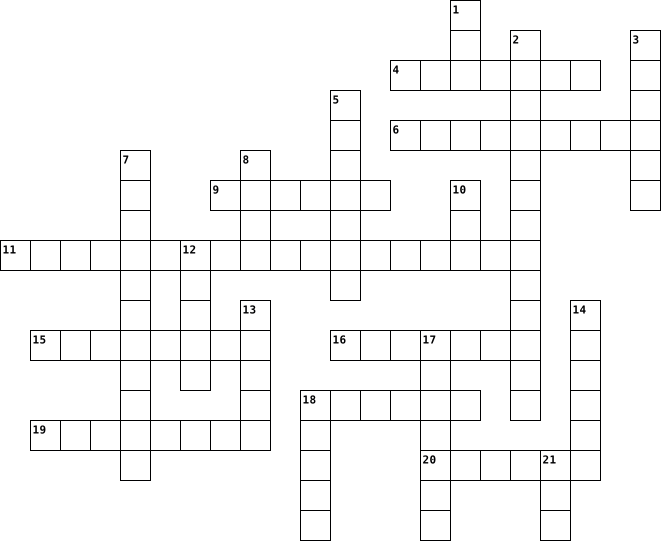
Across
- Suffrage movement supporting women’s right to vote
- Telegraph telegraph sent my Germany to Mexico offering the country the opportunity for an alliance
- T. Washington educator, author, political activist, and orator
- deprive a person the right to vote or rights of citizenship
- but Equal Supreme court ruling the legalized racial segregation if the facilities were equally funded
- Triumvirate 3 powerful Georgia politicians
- DuBois civil rights leader and college professor who fought for the immediate social and political rights for African-Americans
- test disenfranchise method that required voters to pass a reading and writing test in order to vote
- Unit System gave more power to Georgia’s rural counties than the urban ones.
Down
- Crow Laws laws denying African-Americans citizenship rights
- Cotton Exposition series of 3 large events
- Herndon founder of the Atlanta Mutual Life Insurance Company
- Burns Hope wife of John Hope
- clause law that said if a person’s father could vote before the Civil War, they would be able to vote as well
- Hope president of Morehouse and Atlanta University
- Leo Frank Case Jewish pencil factory manager was accused of murdering 13-year-old Mary Phagan
- Free Delivery Act legislation proposed by Georgia Congressman Tom Watson
- Grady managing editor for the Atlanta Journal newspaper
- v. Ferguson court case that established the separate but equal doctrine thus promoting segregation
- Latimer Felton first female U.S. Senator
- War 1 major war primarily between European powers from 1914-1918
- Watson Georgia politician
22 Clues: Watson Georgia politician • Burns Hope wife of John Hope • Latimer Felton first female U.S. Senator • Cotton Exposition series of 3 large events • Triumvirate 3 powerful Georgia politicians • Suffrage movement supporting women’s right to vote • Hope president of Morehouse and Atlanta University • Grady managing editor for the Atlanta Journal newspaper • ...
Communism in Russia 2023-10-16

Across
- When the government takes control of something,ie taking control of all banks and businesses.
- This word means a big social or political change.
- Work.
- The army who were fighting for Russia to go back to the old way of living with a Tsar in power.
- The Sunday when many civilians were killed for protesting outside the Tsar's palace in 1905.
- A war that involves groups of people from the same country.
- The letters NEP stand for ...
- Who ruled over Russia before the 1912 revolution?
- When people are extrememy hungry.
- The leader of the Bolsheviks.
Down
- When the government takes something, like grain, away from ordinary people.
- A political and social system where the government is not involved in the economy and people are responsible for their own welfare.
- A version of communism introduced by Lenin while Russia faced a civil war.
- The army who were fighting for the Bolsheviks in the Russian Civil War after 1917.
- The educated working class.
- The ..... market is where people buy and sell goods illegally.
- A person who eats human flesh.
- Another word for the proletariat or people who live in rural farm areas in Russia.
- A political and social system where the government controls the economy and where resources are shared equally.
- When you have to pay the government a portion of what you earn. The NEP allowed farmers to pay this with grain instead of cash.
20 Clues: Work. • The educated working class. • The letters NEP stand for ... • The leader of the Bolsheviks. • A person who eats human flesh. • When people are extrememy hungry. • This word means a big social or political change. • Who ruled over Russia before the 1912 revolution? • A war that involves groups of people from the same country. • ...
US History since 1877 2024-01-25

Across
- period in which government made changes and groups gained power
- president of the Great Society
- a cultural separation between parents and their children
- executed the assassin of President Kennedy
- must inform suspects of their rights prior to questioning
- president during World War I
- president during the Great Depression and most of World War II
- president that first use the atomic bomb
- civic leader that proposed peaceful confrontation for civil freedom
- could not used evidence obtained illegally
- first artificial satellite put into space by the Russians
- no official prayers in school
- allowed for the purchase of contraceptives
- Russian leader during the Cuban Missile Crisis
- ruling that federal courts had jurisdiction to hear lawsuits seeking to force states to redraw electoral districts
- president of the New Frontier
- location of the landings in Cuba by Cuban Rebels
- a type of blockade used by Kennedy in the Cuban Missile Crisis
Down
- assassin of President Kennedy
- civic leader that proposed violence as a means to confront civil change
- president that improved American Highways
- pushing to the edge of war and then backing down
- right to remain silent
- president that increased national parks and forests
- "one person, one vote"
- an imaginary marker used as a figure to reflect the minimum income required to support a family
- right to an attorney
- cannot force bible reading in public school
- era in which things were "coated" and not as they seem
29 Clues: right to an attorney • right to remain silent • "one person, one vote" • president during World War I • assassin of President Kennedy • no official prayers in school • president of the New Frontier • president of the Great Society • president that first use the atomic bomb • president that improved American Highways • executed the assassin of President Kennedy • ...
Study Guide 2026-02-24

Across
- __ Fall went to prison for his role in Teapot Dome
- American Civil __ Union supported Scope's defense
- __ Amendment allowed women to vote
- Illegal clubs selling alcohol during Prohibition
- Scope's was found __ and fined one hundred dollars
- __ Taylor Ross was first female governor
- Monkey Trial took place in __ Tennessee
- Treaty of __ officially ended World War one
- __ G. Harding died in his office
Down
- __ Darrow famous civil liberties lawyer
- __ Scopes was a high school biology teacher
- Jazz music is famous in __
- nicknamed the __ Trial by the media
- First __ trial broadcast on radio
- __ Management increased productivity
- The __ Act made it illegal to teach evolution
- __ Jennings Bryan three time presidential candidate
- __ called Bryan to stand as a Bible expert
18 Clues: Jazz music is famous in __ • __ G. Harding died in his office • First __ trial broadcast on radio • __ Amendment allowed women to vote • nicknamed the __ Trial by the media • __ Management increased productivity • __ Darrow famous civil liberties lawyer • Monkey Trial took place in __ Tennessee • __ Taylor Ross was first female governor • ...
Age of Realism and Modernism Test 2017-04-27

Across
- The first significant artistic movement of African Americans
- Used clear, direct language to present ordinary everyday events
- "Design"
- Who wrote: "In this state I appeared before my master, humbly entreating him to interpose his authority for my protection."
- Finding beauty in ordinary life and not fooling ourselves that there could be something more
- "To Build a Fire"
- "Love Song of J. Alfred Prufrock"
- Post Civil War change where the country saw an increase in wealth and new status as a world power but produced unsettling social problems
- "Song of Myself"
- Type of writing that looked at the inner workings of the human mind
- Who wrote: "But she saw beyond that bitter moment a long procession of years to come that would belong to her absolutely"
- Breaking from this was a big part of the modernism literary movement
- Literature that captures local vernacular
- Who wrote: "When a piece was fired, a red streak as round as a log flashed low in the heavens, like a monstrous bolt of lightening"
- An artistic movement that represented the struggle many had with the way that new ideas and discoveries challenged their previous lives during a time when tradition didn't seem important anymore
- The problem with WWI
Down
- Who wrote: "The road to Sand Bar...consequently seemed to offer some invitation to the emigrants--lay over a steep mountain range"
- Style of writing to paint local scenes. Contains interesting, eccentric characters, and whimsical humor
- Post Civil War change where people saw land and the potential for farms, ranches, and mines
- Did not want to write to entertain, but rather write to preach or teach readers.
- Post Civil War change when in response to the problems of industrialization, crowded cities, and inequality labor union formed and 'trust busters' broke up corporate monopolies
- Youth culture who no longer felt patriotic, content, or safe
- Anti-slavery activist, abolitionist, and supporter of women's rights and suffrage
- What characteristic of regionalism is contained in the following quote: "'It's agin justice,' said Jim Wheeler, 'to let this yer young man...carry away our money'"?
- Post Civil War change when U.S. population grew from 50 to 76 million by 1914
- Changed his name after hearing someone announcing a water depth of two fathoms
- Man is no longer centered around idealism and intuition, but now the frailty of life and the themes of ordinary life
- Who wrote: "The trouble with him was that he was without imagination. He was quick and alert in the things of life, but only in the things, and not the significances."
- Who wrote: "That man over there says that women need to be helped into carriages, and lifted over ditches, and to have the best place everywhere. Nobody ever helps me...!”
- An important change that sent the world into a tailspin
- Nature is powerful and shows no mercy
- Literature in modernism has what tone?
- "Much of a what of a which of a wind"
33 Clues: "Design" • "Song of Myself" • "To Build a Fire" • The problem with WWI • "Love Song of J. Alfred Prufrock" • Nature is powerful and shows no mercy • "Much of a what of a which of a wind" • Literature in modernism has what tone? • Literature that captures local vernacular • An important change that sent the world into a tailspin • ...
Standard 3-5 Crossword 2022-05-19

Across
- Although the _______ ______ programs helped the economy in the 1930s, it did not end the Great Depression.
- During this late 19th century period, very few Americans were very wealthy and many others were very poor.
- The US promoted a policy of ____________ towards Native Americans in the late 19th century as an attempt to eradicate native culture in the US.
- During WW1 and WW2, _________ showed support for the war effort by taking jobs in the defense industry usually done by men.
- The Chicano Movement, American Indian Movement, Women’s Movement and Civil Rights Movement all had a common desire to promote political, social, and economic _________ for minority groups.
- Despite attempts to remain __________, the US was provoked into World War 1 by the actions of Germany
- As a result of publishing this book by Upton Sinclair, the US was prompted to pass the Meat Inspection Act of 1906
- As a reaction to the launch of ________ during the Cold War, the US increased spending on science education and research.
- Factors that contribute to __________ in the US: a large unskilled labor force, new technology and innovation and laissez-faire government policies.
- Excessive borrowing and ______ _____ _______ contributed to the stock market crash in 1929.
- FDR used “_______ ________” to add judges who leaned in his favor to the Supreme Court.
Down
- The passage of the Interstate Commerce Act and the Sherman Antitrust Act were a reaction to the creation of _________ in different industries in the US.
- In this mass movement of African Americans from the South to other regions in the US known as the ______ ______, life was considered ideal in the North with little discrimination and plenty of job opportunities.
- FDR’s “____________ ______ 8802” brought attention to the need for civil rights reform and spurred future actions to promote equality.
- Business tycoons in the late 1800s earned the nickname “________ __ _______” due to their large donations of money for the construction of libraries and museums.
- The ________ of the Soviet Union led to the end of the Cold War.
- Johnson pushed for civil rights legislation, while his successor ________ limited civil rights legislation.
- The Transcontinental railroad system continued to develop the national economy, making it possible to ship goods from ______ ____ _______.
- To limit the number of immigrants that entered the country,the US enacted a _____ policy.
- In the 1950s, _________ promoted the image of the ideal American family.
- The US didn’t join the _____ __ ____ after WW1 because they wanted to prevent involvement in future international conflicts.
- In reaction to Roe v. Wade, increased drug use and the popularity of televangelists, the US experienced a resurgence in the ______________ movement.
22 Clues: The ________ of the Soviet Union led to the end of the Cold War. • In the 1950s, _________ promoted the image of the ideal American family. • FDR used “_______ ________” to add judges who leaned in his favor to the Supreme Court. • To limit the number of immigrants that entered the country,the US enacted a _____ policy. • ...
Unit 3 Crossword Puzzle 2025-12-01

Across
- A dominant theme, driven by the belief in Manifest Destiny, the Louisiana Purchase, and new transportation methods like canals and railroads.
- A powerful reform impulse centered around the moral and political fight to end slavery
- A widespread social reform effort that sought to limit or ban the consumption of alcohol, driven by religious groups and women's organizations who linked alcohol to social ills.
- raid on Harpers Ferry
- The shift from home production, often employing women and children, fundamentally changed labor into a disciplined, wage-focused environment.
- made commercial water travel reliable and efficient, changing transportation on rivers like the Hudson.
- Declared that all enslaved people in Confederate territory were to be set free.
- While rural life remained dominant for much of the period, the latter part of the era saw a significant shift as people moved to cities for factory jobs.
- commanded the Army of Northern Virginia
- slave turned abolitionist
- declared that European powers should not interfere with the affairs of the Western Hemisphere.
- Formerly enslaved man who led a violent rebellion in Virginia
- The expansion of vast tracks across the country was a monumental innovation, connecting the East and West and fueling the steel industry.
- General Robert E. Lee surrendered the Confederate Army of Northern Virginia, effectively ending the Civil War.
- Emancipation Proclamation
Down
- A Protestant religious revival movement that increased church membership and spurred many social reform efforts, including temperance and abolitionism.
- A philosophical and literary movement, featuring thinkers like Ralph Waldo Emerson and Henry David Thoreau, that emphasized individualism, self-reliance, and a connection with nature.
- 19th-century belief that the United States was divinely destined to expand across the North American continent from the Atlantic to the Pacific Ocean
- Linked the existing eastern U.S. rail network to the Pacific coast, spurring economic growth and national unity
- bloodiest single-day battle in American history, which gave President Lincoln the opportunity to issue the preliminary Emancipation Proclamation.
- Encouraged westward migration by offering public land to settlers for a nominal fee
- Third U.S. President
- Doubled the size of the United States
- President of the Confederate States of America during the Civil War
- Confederate attack on a U.S. fort in Charleston, South Carolina, that marked the beginning of the Civil War.
- commander-in-chief of all Union armies
- The period after the Civil War when the federal government attempted to rebuild the South and integrate formerly enslaved people into society.
- The Seneca Falls Convention in 1848 marked a pivotal moment in the organized fight for women's right to vote and other equal rights.
- March to the sea
- Seventh U.S. President
30 Clues: March to the sea • Third U.S. President • raid on Harpers Ferry • Seventh U.S. President • slave turned abolitionist • Emancipation Proclamation • Doubled the size of the United States • commander-in-chief of all Union armies • commanded the Army of Northern Virginia • Formerly enslaved man who led a violent rebellion in Virginia • ...
Quarterly Review 2024-03-24

Across
- makes up the executive branch
- during the Kennedy administration, this country was caught by the U.S. setting up nuclear missiles from the Soviet Union
- cong, peasant soldiers of South Vietnam that supported the Viet Minh
- poll used to measure the popularity of different issues
- court, makes up the judicial branch
- Nixon was vice president for
- rhee, president of South Korea during the Korean War
- island, where the first Levittown was built
- x, speaker for Nation of Islam that would be assassinated
- of tonkin resolution, policy that gave Johnson complete control over Vietnam conflict in 1964
- scare, era of communist fear in the U.S.
Down
- healthcare for the elderly
- amount of senators per state
- II sung, dictator in North Korea during the Korean War
- industry HUAC first targeted for communists
- makes up the legislative branch
- rock nine, African-American high school students integrating into Central High School
- amendment the Hollywood 10 used as a defense for communist accusations
- student civil rights protest group formed during the sit-ins of 1960
- if China produced $100 billion in goods last year
- people in the 1960s who were anti-war, anti-establishment, and non-conformist
- of pigs, failed invasion of Cuba by the U.S. in 1960
- Republican presidential candidate that lost the 1960 election to JFK
- plan, american program that helped rebuild Europe after WWII
- panthers, militant civil rights group that was started in 1966
25 Clues: healthcare for the elderly • amount of senators per state • Nixon was vice president for • makes up the executive branch • makes up the legislative branch • court, makes up the judicial branch • scare, era of communist fear in the U.S. • industry HUAC first targeted for communists • island, where the first Levittown was built • ...
8th Grade Social Studies Review Puzzle 2025-05-12

Across
- Official changes or additions to a government document
- The study of the earth’s landscapes, people, places, and environments
- A negotiation where each party gives up something to settle a disagreement.
- To formally remove from a union (The United States)
- Something that can be believed or trusted
- The name of the North during the US Civil War
- Charge a public official with a crime (This is the first step to remove someone from office)
- The study of rights and responsibilities of citizens and how the government functions
- Money earned before deductions
- Money taken out of your income like taxes and insurance
- A person that’s the first to do something; they “blaze” the trail for others to follow
- A written plan for the government
- A plan for how you spend your money
Down
- The study of how a societies resources are shared; government and money
- Money paid to the government to pay for public services
- Money earned after deductions
- Money set aside for the future
- Approve
- The act of being set free
- A war between citizens of the same country
- Money Earned
- The practice of owning a person as property; especially for their labor.
- Deny
- The study of past events
- A group of people that have the power to rule in a territory according to the law
- The name of the South during the US Civil War
26 Clues: Deny • Approve • Money Earned • The study of past events • The act of being set free • Money earned after deductions • Money set aside for the future • Money earned before deductions • A written plan for the government • A plan for how you spend your money • Something that can be believed or trusted • A war between citizens of the same country • ...
KARLA FAYE TUCKER 2025-10-21

Across
- refused or not allowed.
- found responsible for doing something wrong or illegal.
- orange vegetables that grow in the ground
- one plus four is...
- earning money by having sexual relations, often considered illegal and dangerous.
- Jesus´ dad
- a pet with four legs, a tail, and "says" Woof Woof
- a person between 13 and 19 years old.
- hurt someone on purpose.
- believing in and following a religion.
- a tool with a heavy metal head used for breaking hard surfaces.
- a punishment where a person is put to death for a serious crime.
- a discussion where people share different opinions.
- the season of the uear that comes after spring
- felt sorry for something done in the past.
Down
- choosing not to be angry at someone who has done something wrong.
- fairness in how people are treated and punished.
- sisters and brothers
- Jesus´ mother
- affected by drugs in a way that changes behavior or thinking.
- to take something that doesn’t belong to you.
- a war fought within a country; in this case, the American Civil War (1861–1865).
- deep regret or guilt for a wrong action.
- having many problems or difficulties.
- the capital of Denmark
- substances that can change how the body or mind works, often illegal and harmful.
- kindness or forgiveness shown to someone who could be punished.
- officially killed as punishment for a crime.
28 Clues: Jesus´ dad • Jesus´ mother • one plus four is... • sisters and brothers • the capital of Denmark • refused or not allowed. • hurt someone on purpose. • having many problems or difficulties. • a person between 13 and 19 years old. • believing in and following a religion. • deep regret or guilt for a wrong action. • orange vegetables that grow in the ground • ...
Vocab 2024-02-08

Across
- to prove or protect
- is a strategy of warfare
- to strengthen
- a death or injury
- a person who is illegally running away
- laws made by states
- a force that slows motion
- a payment made by law enforcers for a turn in
- to leave an organization
- a place were weapons are kept
- enroll in a military
Down
- act that freed all captured slaves in the civil war
- a war that a country fights itself
- a person who dies for there beliefs
- a plan
- a ground of people leaving an organization
- states that had slaves but did not leave the union
- to firmly establish
- a bill made by the union
19 Clues: a plan • to strengthen • a death or injury • to prove or protect • laws made by states • to firmly establish • enroll in a military • is a strategy of warfare • to leave an organization • a bill made by the union • a force that slows motion • a place were weapons are kept • a war that a country fights itself • a person who dies for there beliefs • a person who is illegally running away • ...
Harriet Tubman Crossword 2024-02-21

Across
- First job during civil war
- Nickname while running underground railroad
- Nickname growing up
Down
- Real first name
- Real last name
- Second job during civil war
6 Clues: Real last name • Real first name • Nickname growing up • First job during civil war • Second job during civil war • Nickname while running underground railroad
Civil War Crossword 2017-07-07

Across
- South was called this
- Proclamation/January 1, 1863
- bloodiest battle
- S. Grant/General for the Union
- of Antietam/Bloodiest one day battle in American history
Down
- Lincoln/Delivered the Gettysburg Address
- & deadliest battle of the war
- Davis/President of the Confederacy
- War/1861-1865
- act of freeing
- Atlanta is important
11 Clues: War/1861-1865 • act of freeing • bloodiest battle • Atlanta is important • South was called this • Proclamation/January 1, 1863 • & deadliest battle of the war • S. Grant/General for the Union • Davis/President of the Confederacy • Lincoln/Delivered the Gettysburg Address • of Antietam/Bloodiest one day battle in American history
Civil War Terms 2024-01-06

Across
- how many American soldiers died in the war? (write the numbers in text form)
- what kind of ships were invented during the civil war?
- what was the first battle between the union and confederates?
- what did the confederate states need for their economy?
- where was the war ended?
- who was a famous confederate war general?
Down
- what was the first state to secede from the union?
- who was a famous union war general?
- what caused the most deaths in the average battle?
- what side won the war?
10 Clues: what side won the war? • where was the war ended? • who was a famous union war general? • who was a famous confederate war general? • what was the first state to secede from the union? • what caused the most deaths in the average battle? • what kind of ships were invented during the civil war? • what did the confederate states need for their economy? • ...
Early Exploration Crossword 2017-10-24

Across
- - a type of treasure only found in the new world.
- - person who was of African and European descent.
- of the Indians"
- protected INDIA
- - A country in Spain
- - worker forced to labor for a landlord in order to get rid of debt.
- process of settling among and having control over people in a supervised area
- - member of the highest social class in Spains colonies .
- nation
- a right the Spanish government granted to its American
- A form of natural protection or resistance
- from his brother.
- -person in Spains colonies who is of Native American or European descent.
Down
- war- A war fought between two or more countries in the
- Cortes - He was a spanish conquistador who led an expedition the fall of the aztec empire.
- 'de Las Casas- He was a 16th century Spanish historian he was the first officially summoned
- Exchange- the global exchange of goods,diseases, ideas, plants and animals that began with Columbus exploration to America .
- - person in spains colonies who was an American born descendant with Spanish roots
- Pizarro - an adventurer who fought in the bloody civil war and gained a
- -the people who Columbus first encountered in the WEST Indies .
- - a Spanish explorer who claimed lands in America for Spain in the
- an agreement made between two countries
- privately owned ship by the gov. made to attack other ships
- to demand labor
- - representative who ruled one of Spains provinces in the kings name ,who.
25 Clues: nation • of the Indians" • protected INDIA • to demand labor • from his brother. • - A country in Spain • an agreement made between two countries • A form of natural protection or resistance • - a type of treasure only found in the new world. • - person who was of African and European descent. • war- A war fought between two or more countries in the • ...
Standard 3-5 Crossword 2022-05-19

Across
- The Chicano Movement, American Indian Movement, Women’s Movement and Civil Rights Movement all had a common desire to promote political, social, and economic _________ for minority groups.
- The Transcontinental railroad system continued to develop the national economy, making it possible to ship goods from ______ ____ _______.
- During this late 19th century period, very few Americans were very wealthy and many others were very poor.
- As a result of publishing this book by Upton Sinclair, the US was prompted to pass the Meat Inspection Act of 1906
- Despite attempts to remain __________, the US was provoked into World War 1 by the actions of Germany
- Business tycoons in the late 1800s earned the nickname “________ __ _______” due to their large donations of money for the construction of libraries and museums.
- Johnson pushed for civil rights legislation, while his successor ________ limited civil rights legislation.
- In this mass movement of African Americans from the South to other regions in the US known as the ______ ______, life was considered ideal in the North with little discrimination and plenty of job opportunities.
- Although the _______ ______ programs helped the economy in the 1930s, it did not end the Great Depression.
- The US didn’t join the _____ __ ____ after WW1 because they wanted to prevent involvement in future international conflicts.
- In reaction to Roe v. Wade, increased drug use and the popularity of televangelists, the US experienced a resurgence in the ______________ movement.
- Factors that contribute to __________ in the US: a large unskilled labor force, new technology and innovation and laissez-faire government policies.
Down
- As a reaction to the launch of ________ during the Cold War, the US increased spending on science education and research.
- To limit the number of immigrants that entered the country,the US enacted a _____ policy.
- During WW1 and WW2, _________ showed support for the war effort by taking jobs in the defense industry usually done by men.
- FDR’s “____________ ______ 8802” brought attention to the need for civil rights reform and spurred future actions to promote equality.
- The US promoted a policy of ____________ towards Native Americans in the late 19th century as an attempt to eradicate native culture in the US.
- The ________ of the Soviet Union led to the end of the Cold War.
- FDR used “_______ ________” to add judges who leaned in his favor to the Supreme Court.
- The passage of the Interstate Commerce Act and the Sherman Antitrust Act were a reaction to the creation of _________ in different industries in the US.
- In the 1950s, _________ promoted the image of the ideal American family.
- Excessive borrowing and ______ _____ _______ contributed to the stock market crash in 1929.
22 Clues: The ________ of the Soviet Union led to the end of the Cold War. • In the 1950s, _________ promoted the image of the ideal American family. • FDR used “_______ ________” to add judges who leaned in his favor to the Supreme Court. • To limit the number of immigrants that entered the country,the US enacted a _____ policy. • ...
Civil Rights Crossword Puzzle 2023-05-01

Across
- Landmark decision by U.S. Supreme Court that ruled segregation in school to be unconstitutional
- The separation of people based on differences (racial segregation)
- Peaceful resistance to government strategy that civil rights activists practiced
- Form of protest where groups of people would remain seated for a long period of time in a public place.
- To free any law or practice requiring isolation of a race
- Civil Rights leader that refused to give up her bus seat to a white passenger
- Civil Rights leader that is most famous for his, ‘I Have a Dream’ speech. He received a Nobel Peace Prize in 1964.
- Difficult tests on ability to read and knowledge of government that were facilitated for white children.
- Examples of these laws include the segregation of schools, places, transportation, restrooms, restaurants, and drinking fountains.
Down
- A secret society made after the Civil War that advocates white supremacy; a hate group
- Fair treatment
- The act of refusing to deal with someone to show disapproval
- Rights The rights of personal liberty promised by the Constitution
- Laws and law creation
- The act of treating someone differently because of the color of their skin
15 Clues: Fair treatment • Laws and law creation • To free any law or practice requiring isolation of a race • The act of refusing to deal with someone to show disapproval • The separation of people based on differences (racial segregation) • Rights The rights of personal liberty promised by the Constitution • ...
freedom 2022-03-21

Across
- the author of the declaration of independence
- its the name of this
- something other people don't have
- a northern country on earth
- civil rights activist
Down
- first American president
- if a country is over ______
- president during civil war
- America has a bill on it
9 Clues: its the name of this • civil rights activist • first American president • America has a bill on it • president during civil war • if a country is over ______ • a northern country on earth • something other people don't have • the author of the declaration of independence
US History Midterm Crossword 2024-12-10

Across
- ______ Party in the early 20th century that sought reform in favor of equality
- Network of farmers that worked for political and economic reforms in the late 1800's
- _______ Act 1862 law that gave 160 acres of land to persons willing to live on and cultivate it for 5 years
- Belief by some that certain nations and races were superior to others and therefore destined to rule over them
- Lincoln ___-_____ Plan proposed post Civil War. Wanted to allow Confederated states reentrance into the union when 10% of its citizens pledge loyalty oath to the Union
- POTUS who came into power after Lincoln assassination and began Reconstruction which ultimately failed (LAST NAME)
- Human rights that cannot be taken away, denied, or given up
- Civil Rights advocate, pushed for African Americans to have economic value then strive for equality
- ____-_____ party formed 1848 dedicated to preventing the spread of slavery into western territories
- ________ _______ Service Act created civil service system for FED GOV in attempt to hire employees based on merit rather than spoil system
- _____ Party formed to advocate for more money supply for small business in order to decrease the power and corruption of big business
Down
- _______ ______ Commission First FED agency monitoring business operations, specifically overseeing interstate railroad procedures
- Rights that people are born with and are independent from government or cultural laws
- Period post civil war in which the federal government controlled states that had seceded from the Union
- Acts that made it a federal offense to interfere with a citizens' right to vote
- Group in which fought for women at the state and national level and would eventually gain women right to vote(Abbreviation)
- Bill required 50% of citizens in former Confederate states to pledge to the Union for readmission
17 Clues: Human rights that cannot be taken away, denied, or given up • ______ Party in the early 20th century that sought reform in favor of equality • Acts that made it a federal offense to interfere with a citizens' right to vote • Network of farmers that worked for political and economic reforms in the late 1800's • ...
Civil War Terms 2024-01-06

Across
- how many American soldiers died in the war? (write the numbers in text form)
- where was the war ended?
- who was a famous union war general?
- what was the first battle between the union and confederates?
- who was a famous confederate war general?
- what kind of ships were invented during the civil war?
Down
- what did the confederate states need for their economy?
- what was the first state to secede from the union?
- what caused the most deaths in the average battle?
- what side won the war?
10 Clues: what side won the war? • where was the war ended? • who was a famous union war general? • who was a famous confederate war general? • what was the first state to secede from the union? • what caused the most deaths in the average battle? • what kind of ships were invented during the civil war? • what did the confederate states need for their economy? • ...
APUSH CROSSWORD 2024-05-13

Across
- Want a strong central government; liked Constitution
- A Founding Father of the United States who advocated for a strong central government
- An intellectual movement that stressed the importance of science and reason in the pursuit of truth
- Organizations of workers that formed to promote their interests and protect their rights
- Increasing interconnectedness and interdependence of economies, cultures, and societies on a global scale
- Last name of the women who refused to give up her seat to a white passenger, causing the Montgomery Bus Boycott
- The first permanent English settlement in North America, found in East Virginia
- the period after the Civil War in the United States when the southern states were reorganized and reintegrated into the Union
- Party led by Jackson
- a Baptist minister and major leader of the Civil Rights Movement
Down
- Colonists who supported the British government during the American Revolution
- 16th President of the United States saved the Union during the Civil War and emancipated the slaves
- Programs created by Franklin D Roosevelt
- The amendment that gave women the right to vote
- English dissenters who broke from Church of England
- Laws designed to enforce segregation of blacks from whites
- Were essential to westward expansion because they made it easier to travel to and live in the west
- Political scandal that led to the resignation of President Richard Nixon in 1974
- Corporations that gain complete control of the production of a single good or service
- A system of enforced servitude in which some people are owned by other people
20 Clues: Party led by Jackson • Programs created by Franklin D Roosevelt • The amendment that gave women the right to vote • English dissenters who broke from Church of England • Want a strong central government; liked Constitution • Laws designed to enforce segregation of blacks from whites • a Baptist minister and major leader of the Civil Rights Movement • ...
Reconstruction 2018-12-10

Across
- The man who shot and killed Abraham Lincoln
- Amendment that gave black men the right to vote
- Amendment that abolished slavery in America
- A Northern who moved South to gain advantages from the disorganized situation in the Southern states
- Republican Congressional group that wished to punish the South for secession and to promote the rights of former slaves
- The enforced separation of people based on racial, ethnic, and other differences
- An anti-African-American group that promoted hatred and discrimination in threatening and violent ways
- An agency that provided protection, food, education, and medical supplies
- Reconstruction that was strict, protected former slaves rights, and prevented Confederate leaders from gaining power in the South
- Reconstruction that was lenient on Southern states and wanted them to rejoin quickly
- The President who ended Reconstruction
- Former Union General who became President and worked with Congress on Reconstruction
Down
- Was Lincoln's Vice President, created Presidential Reconstruction, and was impeached for trying to fire government officials
- Amendment that made former slaves citizens and guaranteed equal protection of civil rights
- White Southern Republican who opposed secession and often worked with carpetbaggers
- State and local laws enforcing racial segregation between white and colored
- An era of rebuilding and unifying the nation after the Civil War
- Southern laws that prevented African Americans the right to vote, own guns, or hold certain jobs
- Farming someone else's land while paying a share of crops raised for rent
- The leader of the Radical Republicans
- The President during the Civil War and had the 10% plan
21 Clues: The leader of the Radical Republicans • The President who ended Reconstruction • The man who shot and killed Abraham Lincoln • Amendment that abolished slavery in America • Amendment that gave black men the right to vote • The President during the Civil War and had the 10% plan • An era of rebuilding and unifying the nation after the Civil War • ...
Clara Barton 2025-05-05

Across
- Clara took care of the sick and ___.
- Clara was a famous ___.
- Clara's first job.
- Clara helped during this.
- The color associated with the cross Clara founded.
- Clara worked in makeshift ones during battles.
- Clara was called the "___ of the Battlefield."
Down
- Clara was very ___.
- Clara is considered an American ___.
- Clara loved to ___ others.
- Clara was born in this country.
- Clara's organization provided ___ to those in need.
- Clara's role during the Civil War.
- Clara's last name.
- Clara started a free public one in New Jersey.
15 Clues: Clara's first job. • Clara's last name. • Clara was very ___. • Clara was a famous ___. • Clara helped during this. • Clara loved to ___ others. • Clara was born in this country. • Clara's role during the Civil War. • Clara is considered an American ___. • Clara took care of the sick and ___. • Clara started a free public one in New Jersey. • ...
Civil war and stuff 2025-05-14

Across
- someone who fights to get rid of slavery
- a big battle
- what Lincoln abolished
- He was the president elected before the civil war
- someone fighting in a war
Down
- War fought within the United States
- group of soldiers that fight
- what Lincoln wanted to keep
8 Clues: a big battle • what Lincoln abolished • someone fighting in a war • what Lincoln wanted to keep • group of soldiers that fight • War fought within the United States • someone who fights to get rid of slavery • He was the president elected before the civil war
U.S. History 2021-12-03

Across
- An act to provide food, shelter, clothing, medical services, and land to displaced Southerners
- laws governing the conduct of African Americans
- required that 50 percent of a state's white males take a loyalty oath to be readmitted to the Union.
- a group of politicians who formed a faction within the Republican party
- politician who became the first African American to serve in the U.S. Senate
Down
- a period in American history following the American Civil War
- The seventh President of the US
- The right of citizens of the United States to vote shall not be denied or abridged
- granted citizenship and equal civil and legal rights to African Americans and enslaved
- Northerners who moved to the South after the war
- a pejorative term for a white Southerner who supported the federal plan of Reconstruction
- is the process by which a legislature's lower house brings charges against a civil federal officer, the vice president, or the president
- a legal arrangement with regard to agricultural land in which a landowner allows a tenant to use the land in return for a share of the crops produced on that land
13 Clues: The seventh President of the US • laws governing the conduct of African Americans • Northerners who moved to the South after the war • a period in American history following the American Civil War • a group of politicians who formed a faction within the Republican party • politician who became the first African American to serve in the U.S. Senate • ...
Rosalia 4th hour 2024-04-18

Across
- What was the first CowTown?
- French Settled where?
- What war started 1861?
- 1853 this state got railroads
- Which ethnic Group Settled in Victoria?
- What did cowboys ride on?
- Where did African Americans settle?
- Germans settled where at?
Down
- What ethinic Group settled in Topeka
- Who was president during the Civil War?
- 8,000 ______ got killed per day
- Where did the Swedish settled?
- What invention put Cowboys to an end?
- What did cowboys wear to protect their legs from bushes?
- What protected the Cowboys head from the sun?
- 1861 _____became a state
- This Ethnic group settled in Wilson?
- What war started 1861?
- Who survived of of buffalo?
- Cowboys were ____ Men?
20 Clues: French Settled where? • What war started 1861? • What war started 1861? • Cowboys were ____ Men? • 1861 _____became a state • What did cowboys ride on? • Germans settled where at? • What was the first CowTown? • Who survived of of buffalo? • 1853 this state got railroads • Where did the Swedish settled? • 8,000 ______ got killed per day • Where did African Americans settle? • ...
Presidents 2025-05-13

Across
- Was president for just 1 month
- First African American president.
- Fought in duels
- Loved nature, saved forests, and fought bears!
- Current President of the United States
- Served two nonconsecutive times
- Signed the Civil Rights Act.
- Wrote the Declaration of Independence and expanded American territory
- Led America in World War I.
Down
- Helped build houses for people in need.
- Took over after Lincoln was killed.
- President during the Great Depression.
- Sent men to the moon
- Famous Civil War general, from Ohio.
- President for 4 terms.
- The father of the Constitution
- Freed the slaves and wore a tall hat.
- The only president who never married.
- Dropped the atomic bomb to end WWII.
- Loves ice cream
- 1st president,
21 Clues: 1st president, • Fought in duels • Loves ice cream • Sent men to the moon • President for 4 terms. • Led America in World War I. • Signed the Civil Rights Act. • Was president for just 1 month • The father of the Constitution • Served two nonconsecutive times • First African American president. • Took over after Lincoln was killed. • Famous Civil War general, from Ohio. • ...
social studies 2022-05-17

Across
- colonist who supported the British government
- father of the constitution
- last battle of the American revolutionary war
- Signed in 1776 American colonies officially declared their freedom from Britain
- something gained
- Turning point of the American civil war
- first battle of the American Revolutionary War
- British soldiers accidentally kill 5 citizens while protecting the tax collector
Down
- was one of the best U.S generals and the first president
- "Give me liberty, or give me death"
- to stop using/or buying something in protest
- the American Revolution
- believed in ending slavery
- supported the constitution with no bill of rights
- purchased the Louisiana territory
- African American man and the first death in the American revolution
16 Clues: something gained • the American Revolution • father of the constitution • believed in ending slavery • purchased the Louisiana territory • "Give me liberty, or give me death" • Turning point of the American civil war • to stop using/or buying something in protest • colonist who supported the British government • last battle of the American revolutionary war • ...
crosword ouzzle 2023-05-24

Across
- what did the soldiers write on their free time
- what did soldiers play during there free time
- what do soldiers sleep in
- what was a common drink that soldiers would drink
- who seceded to become a country
- how was fort sumpter destroyed
- what was abe lincoln killed with
- what weapon was used in the battle of fort sumpter
Down
- who killed abe Lincoln
- what type of people fought in the war
- what did abe Lincoln try to stop
- what was the bloodiest battle in history
- what does it mean to so seperate from America
- who won the civil war
- what was one of the sides in the war
- where were the tents located
16 Clues: who won the civil war • who killed abe Lincoln • what do soldiers sleep in • where were the tents located • how was fort sumpter destroyed • who seceded to become a country • what did abe Lincoln try to stop • what was abe lincoln killed with • what was one of the sides in the war • what type of people fought in the war • what was the bloodiest battle in history • ...
Progressive Era 2025-10-31

Across
- Purchased after the Spanish American War
- Reporters of hard hitting news like working conditions and safety
- Time of extreme change in the right direction
- An area of housing for low income and poor families in the city
- Asthmatic with a passion for grand ideas
- Born in the North -- Free -- and graduated from Harvard
- Was killed trying to turn a corner, the world went to war after.
Down
- Not the game, but when you own all of one industry
- The 1900s Jeff Bezos
- Nation of the Sun.
- Leader with a custom tub and 12 porkchops
- The motherland of colonization.
- "The dagger to Japan"
- The OG colonizers
- The era after the Civil War
- Before it was the Soviet Union it was this.
16 Clues: The OG colonizers • Nation of the Sun. • The 1900s Jeff Bezos • "The dagger to Japan" • The era after the Civil War • The motherland of colonization. • Purchased after the Spanish American War • Asthmatic with a passion for grand ideas • Leader with a custom tub and 12 porkchops • Before it was the Soviet Union it was this. • Time of extreme change in the right direction • ...
HS US History: Unit 2 - The Civil War: Lesson 3 2021-12-06

Across
- small town in Virginia, 30 miles from Washington D.C. where the Battle of Bull Run took place
- large-caliber guns used in warfare on land
- Commander of the Union Army at the start of the Civil War
- a disorderly retreat of defeated troops
- system for transmitting messages from a distance along a wire
- small stream located in Manassas, where the first major battle of the Civil War took place
Down
- irregular or unpremeditated fighting, especially between small or outlying parts of armies
- nickname for Confederate soldiers
- a place at which two or more rail routes converge
- General Scott’s plan to slowly suffocate the South and secure Union victory
- soldiers who fought on horseback
- to send a telegram
12 Clues: to send a telegram • soldiers who fought on horseback • nickname for Confederate soldiers • a disorderly retreat of defeated troops • large-caliber guns used in warfare on land • a place at which two or more rail routes converge • Commander of the Union Army at the start of the Civil War • system for transmitting messages from a distance along a wire • ...
montyglaze@gmail.com 2023-12-07

Across
- The North's economy included industry, commerce and
- Main cause of the Civil War
- Sharecropping kept black farmers _____ economically
- Slave states that seceded from the US were called
- For the next 12 years, the rebuilding of the south was called
- Since the South lacked industry,_______, uniforms, and even shoes. Thought the had well trained leaders and soilders, by 1863, the began to wear down
- The United States was called
Down
- After four long years,in 1865, the confederacy surrenderd to union General ____S. Grant
- President who promised to abolish slavery
- In the 1870's African American were denied their right to _____
- The Civil War may have ended, but it did not end_____
- The major crop in the south
12 Clues: Main cause of the Civil War • The major crop in the south • The United States was called • President who promised to abolish slavery • Slave states that seceded from the US were called • The North's economy included industry, commerce and • Sharecropping kept black farmers _____ economically • The Civil War may have ended, but it did not end_____ • ...
Lesson 7/8 Crossword 2025-04-28

Across
- Few countries recognize Taiwan as independent due to fear that China will cut off __________
- After WWII Japan has tended to mix their traditions with modern ___________
- Japan's economy is now built on ________ raw materials and exporting finished goods
- Japan's new constitution after WWII outlawed an overly strong ________
- Aung San Suu Kyi led a ____-___________ fight for human rights in Myanmar
- Japan is currently the world's _______ largest economy only behind the US and China
Down
- The ___________ won the Chinese Civil War
- A military _______ took over Myanmar in 1988
- The Rohingya _____________ are being persecuted by the current Myanmar GOVT
- This country wants full control over Taiwan now
- The nationalists fled to ________ after the Civil War
- Japan can now only use its military forces for its own __________
12 Clues: The ___________ won the Chinese Civil War • A military _______ took over Myanmar in 1988 • This country wants full control over Taiwan now • The nationalists fled to ________ after the Civil War • Japan can now only use its military forces for its own __________ • Japan's new constitution after WWII outlawed an overly strong ________ • ...
Uncle Tom's Cabin Crossword 2025-04-30

Across
- How did Southerners feel about Uncle Tom's Cabin (good or bad)?
- Name of the author of Uncle Tom's Cabin
- Was Uncle Tom's cabin a direct or indirect cause of the Civil War?
- Name of the slave owner who is also the main antagonist of the story
Down
- Large farms in the South that mainly relied on slaves
- A person who seeks to abolish slavery
- How did Northerners feel about Uncle Tom's Cabin (good or bad)?
- Name of the person whom Uncle Tom was based on
- The month in which Uncle Tom's Cabin was published
- The time period right before the Civil War
- Was Uncle Tom's Cabin a bestseller (yes or no)?
- Name of the slave who fled with her son in Uncle Tom's Cabin
12 Clues: A person who seeks to abolish slavery • Name of the author of Uncle Tom's Cabin • The time period right before the Civil War • Name of the person whom Uncle Tom was based on • Was Uncle Tom's Cabin a bestseller (yes or no)? • The month in which Uncle Tom's Cabin was published • Large farms in the South that mainly relied on slaves • ...
Ethan 1st hour 2024-04-24

Across
- they use them to lasso bulls
- they used them so they don't get bit by snakes
- they can kill someone
- most free staters were in lawrence.
- so they don't get hot
- so they are more comfortable on the horse
- in the civil war there are not permitted but she insisted to be in the war
- quantdrail named after a war
- they liked robbing stores and banks
Down
- slavery someone who is not agianst slavery
- drives the people got mad cause of they ruined crops
- brown he was a anti abolinsinist
- people who were on people on the reservation
- so they don't get thorns in them
- someone who against slavery
15 Clues: they can kill someone • so they don't get hot • someone who against slavery • they use them to lasso bulls • quantdrail named after a war • brown he was a anti abolinsinist • so they don't get thorns in them • most free staters were in lawrence. • they liked robbing stores and banks • so they are more comfortable on the horse • slavery someone who is not agianst slavery • ...
Ethan 1st hour 2024-04-24

Across
- they use them to lasso bulls
- they used them so they don't get bit by snakes
- they can kill someone
- most free staters were in lawrence.
- so they don't get hot
- so they are more comfortable on the horse
- in the civil war there are not permitted but she insisted to be in the war
- quantdrail named after a war
- they liked robbing stores and banks
Down
- slavery someone who is not agianst slavery
- drives the people got mad cause of they ruined crops
- brown he was a anti abolinsinist
- people who were on people on the reservation
- so they don't get thorns in them
- someone who against slavery
15 Clues: they can kill someone • so they don't get hot • someone who against slavery • they use them to lasso bulls • quantdrail named after a war • brown he was a anti abolinsinist • so they don't get thorns in them • most free staters were in lawrence. • they liked robbing stores and banks • so they are more comfortable on the horse • slavery someone who is not agianst slavery • ...
Ethan 1st hour 2024-04-24

Across
- they use them to lasso bulls
- they used them so they don't get bit by snakes
- they can kill someone
- most free staters were in lawrence.
- so they don't get hot
- so they are more comfortable on the horse
- in the civil war there are not permitted but she insisted to be in the war
- quantdrail named after a war
- they liked robbing stores and banks
Down
- slavery someone who is not agianst slavery
- drives the people got mad cause of they ruined crops
- brown he was a anti abolinsinist
- people who were on people on the reservation
- so they don't get thorns in them
- someone who against slavery
15 Clues: they can kill someone • so they don't get hot • someone who against slavery • they use them to lasso bulls • quantdrail named after a war • brown he was a anti abolinsinist • so they don't get thorns in them • most free staters were in lawrence. • they liked robbing stores and banks • so they are more comfortable on the horse • slavery someone who is not agianst slavery • ...
Ethan 1st hour 2024-04-24

Across
- they use them to lasso bulls
- they used them so they don't get bit by snakes
- they can kill someone
- most free staters were in lawrence.
- so they don't get hot
- so they are more comfortable on the horse
- in the civil war there are not permitted but she insisted to be in the war
- quantdrail named after a war
- they liked robbing stores and banks
Down
- slavery someone who is not agianst slavery
- drives the people got mad cause of they ruined crops
- brown he was a anti abolinsinist
- people who were on people on the reservation
- so they don't get thorns in them
- someone who against slavery
15 Clues: they can kill someone • so they don't get hot • someone who against slavery • they use them to lasso bulls • quantdrail named after a war • brown he was a anti abolinsinist • so they don't get thorns in them • most free staters were in lawrence. • they liked robbing stores and banks • so they are more comfortable on the horse • slavery someone who is not agianst slavery • ...
Ethan 1st hour 2024-04-24

Across
- they use them to lasso bulls
- they used them so they don't get bit by snakes
- they can kill someone
- most free staters were in lawrence.
- so they don't get hot
- so they are more comfortable on the horse
- in the civil war there are not permitted but she insisted to be in the war
- quantdrail named after a war
- they liked robbing stores and banks
Down
- slavery someone who is not agianst slavery
- drives the people got mad cause of they ruined crops
- brown he was a anti abolinsinist
- people who were on people on the reservation
- so they don't get thorns in them
- someone who against slavery
15 Clues: they can kill someone • so they don't get hot • someone who against slavery • they use them to lasso bulls • quantdrail named after a war • brown he was a anti abolinsinist • so they don't get thorns in them • most free staters were in lawrence. • they liked robbing stores and banks • so they are more comfortable on the horse • slavery someone who is not agianst slavery • ...
Omar Sanchez 2025-05-16

Across
- abolished slavery
- rules/laws put in place to take rights away from blacks
- place where Abraham Lincoln was shot
- states can't stop people from voting based on skin color
- metal ships that change naval fights
- war between south and union over slavery
Down
- south attacks here and starts the civil war
- president jackson moves indians west of the missisipi
- killed Abraham Lincoln
- general sherman burned everything in his path in the south
- turning point in war; north wins
- someone who fights to end slavery
- to leave a country as a whole
- everyone born in the U.S. is a citizen no matter what
- president who ended slavery
15 Clues: abolished slavery • killed Abraham Lincoln • president who ended slavery • to leave a country as a whole • turning point in war; north wins • someone who fights to end slavery • place where Abraham Lincoln was shot • metal ships that change naval fights • war between south and union over slavery • south attacks here and starts the civil war • ...
Unit 9 Puzzle 2023-04-21

Across
- Not wanting to get involved in a war between other powers
- this country was blamed for the war.
- A government that tries to assert total control over the people
- The coalition led by Great Britain, France, the United States, the Soviet Union, and China during World War II.
- They supported slavery during the war
Down
- the treaty that ended WWI
- The place that Japan bombed which made the US join WWI
- A feeling of anger/displeasure towards someone or something
- The coalition led by Germany, Italy, and Japan during World War II.
- They opposed slavery during the Civil War
- A government where the people have power
11 Clues: the treaty that ended WWI • this country was blamed for the war. • They supported slavery during the war • A government where the people have power • They opposed slavery during the Civil War • The place that Japan bombed which made the US join WWI • Not wanting to get involved in a war between other powers • A feeling of anger/displeasure towards someone or something • ...
The Civil War in South Carolina 2023-05-03

Across
- The city that people went to from Charleston because it felt safer
- this is when the government makes people serve in the army
- One day after the Union soldiers entered Columbia, 1/3 of the city was __________ to the ground.
- The American Indians knew they had to pick a side and not remain __________.
- this is the general that wanted to end the war and decided that he needed to destroy the south
- some of the best Civil War spies
Down
- synonym for passing through
- this is a synonym for payback
- African Americans continually petitioned President Lincoln to ________ their enlistment in the Union armies
- This brave African American soldier kept the flag from touching the ground during battle even though he was wounded. He received a Medal of Honor.
- the number of years that the Civil War lasted
11 Clues: synonym for passing through • this is a synonym for payback • some of the best Civil War spies • the number of years that the Civil War lasted • this is when the government makes people serve in the army • The city that people went to from Charleston because it felt safer • The American Indians knew they had to pick a side and not remain __________. • ...
Chapter 6 Crossword 2013-10-29

Across
- staying out of other country's problems
- Pride in one's country.
- Powers Formed from the triple alliance, ottoman empire, Germany, and austro-hungary.
- striped Germany of weapons
- a passenger ship that was sunk by Germans.
- a nationwide panic about communism.
- American civil liberties union, worked to protect peoples rights.
- war industries board, coordinated the production of war materials.
Down
- based on the principle of justice to all people and nationalities.
- information designed to persuade opinion.
- France,Britain,Russia and later Italy.
- government can tax on income.
- kept the US out of the war for a little longer.
- organized series of raids on various radical organizations.
- Countries pledging to defend and protect each other.
15 Clues: Pride in one's country. • striped Germany of weapons • government can tax on income. • a nationwide panic about communism. • France,Britain,Russia and later Italy. • staying out of other country's problems • information designed to persuade opinion. • a passenger ship that was sunk by Germans. • kept the US out of the war for a little longer. • ...
Historical Connections to Government 2022-08-25

Across
- abbreviation for the president's wife
- fancy social studies term meaning the right to vote
- believed people were naturally good
- the 2nd MAIN cause of WWI
- abbreviation for the U.S. leader
- this person is elected by the electoral college
- the 3rd MAIN cause of WWI
- the 1st MAIN cause of WWI
Down
- abbreviation for the 2nd in command in the U.S.
- believed people were nasty and brutish
- era in which government tried to fix societal issues
- the 4th MAIN cause of WWI
- president during the Cold War who was assassinated
- war fought in Asia that was VERY unpopular in the U.S.
- war within the U.S. fought over slavery
15 Clues: the 4th MAIN cause of WWI • the 2nd MAIN cause of WWI • the 3rd MAIN cause of WWI • the 1st MAIN cause of WWI • abbreviation for the U.S. leader • believed people were naturally good • abbreviation for the president's wife • believed people were nasty and brutish • war within the U.S. fought over slavery • abbreviation for the 2nd in command in the U.S. • ...
The American Civil war lenny walter syverson 2024-01-18

Across
- the greek god of song and the sun
- the wife of the greek mythological gods
- the first state to secede
- who is the three headed dog in greek mythology
- the greek goddess of the moon and hunting
- started the war with mexico
- the stuff that captain america's shield
- the inventor of the cotton gin
Down
- the most important battle of the civil war
- the first job that Abe lincoln had in government
- what is the color of a plant
- cut off trading with other countries
- the king of the greek gods
- a war between the north and south because of slavery
- who is the king of the greek gods
- 23rd state to support slavery
16 Clues: the first state to secede • the king of the greek gods • started the war with mexico • what is the color of a plant • 23rd state to support slavery • the inventor of the cotton gin • the greek god of song and the sun • who is the king of the greek gods • cut off trading with other countries • the wife of the greek mythological gods • the stuff that captain america's shield • ...
Ethan 1st hour 2024-04-24

Across
- they use them to lasso bulls
- they used them so they don't get bit by snakes
- they can kill someone
- most free staters were in lawrence.
- so they don't get hot
- so they are more comfortable on the horse
- in the civil war there are not permitted but she insisted to be in the war
- quantdrail named after a war
- they liked robbing stores and banks
Down
- slavery someone who is not agianst slavery
- drives the people got mad cause of they ruined crops
- brown he was a anti abolinsinist
- people who were on people on the reservation
- so they don't get thorns in them
- someone who against slavery
15 Clues: they can kill someone • so they don't get hot • someone who against slavery • they use them to lasso bulls • quantdrail named after a war • brown he was a anti abolinsinist • so they don't get thorns in them • most free staters were in lawrence. • they liked robbing stores and banks • so they are more comfortable on the horse • slavery someone who is not agianst slavery • ...
Ethan 1st hour 2024-04-24

Across
- they use them to lasso bulls
- they used them so they don't get bit by snakes
- they can kill someone
- most free staters were in lawrence.
- so they don't get hot
- so they are more comfortable on the horse
- in the civil war there are not permitted but she insisted to be in the war
- quantdrail named after a war
- they liked robbing stores and banks
Down
- slavery someone who is not agianst slavery
- drives the people got mad cause of they ruined crops
- brown he was a anti abolinsinist
- people who were on people on the reservation
- so they don't get thorns in them
- someone who against slavery
15 Clues: they can kill someone • so they don't get hot • someone who against slavery • they use them to lasso bulls • quantdrail named after a war • brown he was a anti abolinsinist • so they don't get thorns in them • most free staters were in lawrence. • they liked robbing stores and banks • so they are more comfortable on the horse • slavery someone who is not agianst slavery • ...
Ethan 1st hour 2024-04-24

Across
- they use them to lasso bulls
- they used them so they don't get bit by snakes
- they can kill someone
- most free staters were in lawrence.
- so they don't get hot
- so they are more comfortable on the horse
- in the civil war there are not permitted but she insisted to be in the war
- quantdrail named after a war
- they liked robbing stores and banks
Down
- slavery someone who is not agianst slavery
- drives the people got mad cause of they ruined crops
- brown he was a anti abolinsinist
- people who were on people on the reservation
- so they don't get thorns in them
- someone who against slavery
15 Clues: they can kill someone • so they don't get hot • someone who against slavery • they use them to lasso bulls • quantdrail named after a war • brown he was a anti abolinsinist • so they don't get thorns in them • most free staters were in lawrence. • they liked robbing stores and banks • so they are more comfortable on the horse • slavery someone who is not agianst slavery • ...
Ethan 1st hour 2024-04-24

Across
- they use them to lasso bulls
- they used them so they don't get bit by snakes
- they can kill someone
- most free staters were in lawrence.
- so they don't get hot
- so they are more comfortable on the horse
- in the civil war there are not permitted but she insisted to be in the war
- quantdrail named after a war
- they liked robbing stores and banks
Down
- slavery someone who is not agianst slavery
- drives the people got mad cause of they ruined crops
- brown he was a anti abolinsinist
- people who were on people on the reservation
- so they don't get thorns in them
- someone who against slavery
15 Clues: they can kill someone • so they don't get hot • someone who against slavery • they use them to lasso bulls • quantdrail named after a war • brown he was a anti abolinsinist • so they don't get thorns in them • most free staters were in lawrence. • they liked robbing stores and banks • so they are more comfortable on the horse • slavery someone who is not agianst slavery • ...
Previous Page 100 of 100