
civil war Crossword Puzzles
APUSH Period 8 2025-05-15

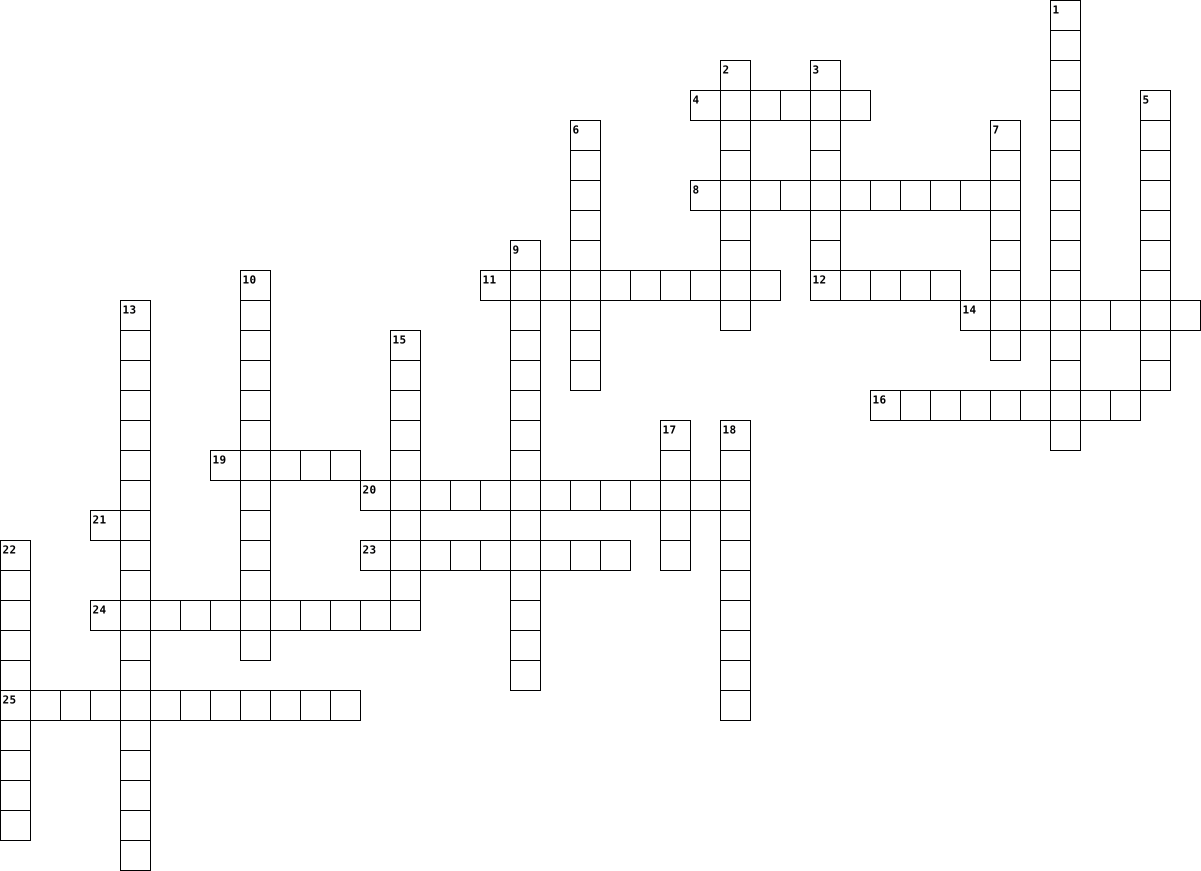
Across
- death of JFK, Malcolm X, MLK JR and RFK
- protested bus segregation
- court case that won equality in schools
- called for labor rights for farmworkers
- President who increased healthcare options
- Civil _____ as a means to protest unfair laws
- way to voice against government laws
- place of Rosa Park's protest against bus laws
- legal or enforced separation of people on race
Down
- communism spread here and caused a split between N and S
- caused many Americans to forcibly join the war
- Event at Kent State college against anti-war protestors
- called for black nationalism
- President who increased educational opportunities
- famous concert in 1969
- battle caused US to rapidly increase soldiers here
- War in Southeast Asia against communist rebels
- President who increased military budget
- sprayed on Vietnamese people and US soldiers
- Famous Civil Rights activists who demanded voting equality
20 Clues: famous concert in 1969 • protested bus segregation • called for black nationalism • way to voice against government laws • death of JFK, Malcolm X, MLK JR and RFK • court case that won equality in schools • called for labor rights for farmworkers • President who increased military budget • President who increased healthcare options • ...
justin noble 5th hour crossword 2013-05-22

Across
- official pardon
- increase in prices and decrease in value in money
- to lengthen in time
- paper money introduced during the civil war
- declared all slaves in confederate states were free
- Northern Democrats who favored peace with the South
- to formally accuse the president of misconduct in office
- presidents role as leader of the military
- Washington, DC theater where Lincoln was shot
- approve
Down
- to prevent from becoming a law
- law that prevents gov't. from holding citizens without formal charges
- white southerner who supported radical reconstruction
- confederate supporter who assassinated Lincoln
- military draft
- failed assult on Union positions on last day at Gettysburg
- city on the Mississippi riversurrounded by union forces
- Civil War Nurse who later founded the American Red Cross
- regiment of African American soldiers that fought at Fort Wagner
- tax on earnings
- confederate general who fought at Gettysburg
- laws that limited the freedom of former slaves
- period after Civil War in which US government attempted to rebuild Southern society and governments
- rights granted to all citizens
- bloody battle in Maryland, ended Lee's invasion
- the act of setting someone free
- remove
27 Clues: remove • approve • military draft • official pardon • tax on earnings • to lengthen in time • to prevent from becoming a law • rights granted to all citizens • the act of setting someone free • presidents role as leader of the military • paper money introduced during the civil war • confederate general who fought at Gettysburg • Washington, DC theater where Lincoln was shot • ...
The Civil War 2022-04-01

Across
- Delaware, Maryland, Kentucky, Missouri and West Virginia.
- Side of the Civil War that fought to prevent the other side from becoming independent.
- Official start of the Civil War.
- General for the Union Army.
- Before he became President, Lincoln was a ______.
- Franklin Pierce made Davis his ______________________.
- A person who was against slavery and tried to do something about it.
- Abraham Lincoln's wife was ________________.
- Abraham Lincoln was born in a _____________.
Down
- Lincoln won a seat in the ________Legislator when he was 25.
- Lincoln ran for the U.S. ________ but didn’t win.
- death, injuries, and people missing in battle.
- Lincoln was a member of the _____________ party.
- Jefferson Davis was appointed as acting senator of ______________.
- First state to secede from the Union.
- Abraham Lincoln was __________ and skinny.
- General for the Confederate States of America
- Davis was elected to a _____________.
- During Lincoln's presidency which was was being fought?
- to leave
- First president of the Confederate States of America
- President during the Civil War and leader of the Union.
- Both President were born in this state.
- Lincoln’s nickname was ________________.
- this is the name of the Courthouse where the Confederate Army officially surrendered.
- Abraham Lincoln was the _________ president.
26 Clues: to leave • General for the Union Army. • Official start of the Civil War. • First state to secede from the Union. • Davis was elected to a _____________. • Both President were born in this state. • Lincoln’s nickname was ________________. • Abraham Lincoln was __________ and skinny. • Abraham Lincoln was the _________ president. • Abraham Lincoln's wife was ________________. • ...
US History 2024-03-19
Across
- Alexander Graham Bell used this to get credit for the telephone
- Founder of US Standard Oil
- Where the first shots of the civil war were fired
- This department store was created in New York City
- The 14th amendments is what made all Americans
- Location of one of the Carnegie factory steel strikes
- A majority of Americans worked on these in the 1880s
- Union military general in the west during the civil war
- Thomas Edison’s electric company abbreviation
- Thomas Jefferson’s first Vice President
- This invention made womens live easier
- Inventor of the lightbulb
Down
- This president was assassinated in 1901
- Many immigrants worked in
- This battle took place in September of 1862
- Federal holiday that celebrates the end of slavery
- famous nickname for the 16th president
- Last name of a major donor in the Pittsburgh area
- Name of the assassin of Lincoln
- The first state to leave the Union
- Founder of AT&T
- This city had the largest slave market
- There are only 14 of these stores left in the US
- Location of the costliest battle in the Civil War
- Infamous Confederate general
25 Clues: Founder of AT&T • Many immigrants worked in • Inventor of the lightbulb • Founder of US Standard Oil • Infamous Confederate general • Name of the assassin of Lincoln • The first state to leave the Union • famous nickname for the 16th president • This city had the largest slave market • This invention made womens live easier • This president was assassinated in 1901 • ...
US History Crossword 2025-05-08

Across
- Northern states and their forces
- Hostile or aggresive action
- A surprise attack, often to destroy supplies or disrupt the enemy
- A medicinal plant used in the civil war
- Plans and movement used in battle
- President of Confederate states
- 16th president of the United States
- Side or position in a battle
- A powerful cannon used in the civil war
- Forcing sailors into military service
- A person forced to work without pay, often in agriculture
- Underground railroad conductor
- An executive order that freed slaves in confederate states
- A new type of bullet that was more deadly and more accurate
Down
- allowed settlers in Kansas and Nebraska to decide the slavery issue for themselves
- A famous attack led by a Confederate general at Gettysburg
- Supreme court case involving slaves
- Fake cannons used to deceive the enemy
- Conflict over slavery in the Kansas territory
- Political party in the south supporting slavery
- Soldiers with colorful uniforms and unique drills
- Union states during the civil war
- term for national government
- Small opening in a cannon for igniting a charge
- Famous battle ending in Union Victory
- term for soldiers from the Northern states
26 Clues: Hostile or aggresive action • Side or position in a battle • term for national government • Underground railroad conductor • President of Confederate states • Northern states and their forces • Plans and movement used in battle • Union states during the civil war • Supreme court case involving slaves • 16th president of the United States • Forcing sailors into military service • ...
A Brother's War 2015-12-14

Across
- a nickname for the confederacy or those against the government
- someone who is against slavery and tries to stop it
- the north side in the civil war
- black people being sold as property
Down
- a large farm in the south where crops like cotton were grown and slaves worked
- a war between northern and southern states
- a type of poem
- the south side in the civil war
- home of the slave owners in The Ballad of the Civil War.
- nickname for the union or north
10 Clues: a type of poem • the south side in the civil war • nickname for the union or north • the north side in the civil war • black people being sold as property • a war between northern and southern states • someone who is against slavery and tries to stop it • home of the slave owners in The Ballad of the Civil War. • ...
Impacts of the Civil War Crossword 2020-12-18

Across
- Lincoln's document stating that this battle was for equality for all men
- When General Sherman set out to capture Atlanta
- The General that captured Atlanta and Savannah while leading the March to the Sea.
- The North's way of stopping the South from getting any supplies
- The president of the Confederacy
- African Americans who were forced to do free labor for the South
- Private citiznes who tried to sail and avoid the blockade to return with supplies from Europe
- The document Lincoln wrote to free all slaves
- Led to the Robert E. Lee's army surrendering into Northern Virginia
- 3 day battle on the Tennessee border that resulted in over 34,000 casualties.
Down
- The president during the Civil War
- Most bloodiest battle in the Civil War; General Robert E. Lee's army was defeated and was one of the turning points of the war
- Prison notorious for mistreating prisoners; 13,000 died
- Confederate General Robert E. Lee’s Army of Northern Virginia against Union and was the culmination of Lee’s attempt to invade the north
- Important Confederate general
- The plan issued to stop the South from getting supplies
- The South Army
- A march from Atlanta to Savannah in which General Sherman captured Savannah
- located in the Charleston Harbor where some of the first shots in the Civil War were fired.
- The North Army
20 Clues: The South Army • The North Army • Important Confederate general • The president of the Confederacy • The president during the Civil War • The document Lincoln wrote to free all slaves • When General Sherman set out to capture Atlanta • Prison notorious for mistreating prisoners; 13,000 died • The plan issued to stop the South from getting supplies • ...
History crossword civil war 2024-05-14

Across
- Terrorists of the civil war
- Civil war's first Urban conflict and first oppossed american river crossing
- first battle of the war were the south opened fire on a ship delevering food
- When a Union general led a campain from nov 15 to dec 21 1864 destroying military and civilian postions.
- poor farmers without slave
- It said all southern slaves are now free
- Robert E Lee defeats Union troops under Major General John Pope
- Attack on General Joseph Johnston's intrenched position
- Gave control of the mississippi to the union
- Opened the door for Sherman's march to the sea won by the union
- Enforced segregation and denied their right to vote
- It was the path slaves took to escape slavery
- It was when people started buildling back what was destroyed
Down
- Marked the start of unification after the war
- Robert E Lee lost and was forced to surrender and never fight against the Union again
- 23000 soldiers died died making it the bloodiest battle of the civil war
- 60000 soldiers were sent by general Sherman on december 1864
- Union strategy proposed by Winfield Scot
- 23000 died and ended the first invasion on the north
- Many Americans looked down on immigrants like they do today
- Escaping slaves
- time Auction The largest sail of slaves in US history
22 Clues: Escaping slaves • poor farmers without slave • Terrorists of the civil war • It said all southern slaves are now free • Union strategy proposed by Winfield Scot • Gave control of the mississippi to the union • Marked the start of unification after the war • It was the path slaves took to escape slavery • Enforced segregation and denied their right to vote • ...
Unit 5A, 5B and 5C Review 2022-05-11

Across
- _____ slave laws were created to return runaway slaves back to the south.
- Last name of man who assassinated Abraham Lincoln.
- First state to secede from the Union.
- Last two words of famous anti slavery book by Harriet Beecher Stowe.
- Deadliest battle in the Civil War.
- Last name of the man who was President of the Confederacy.
- To forgive someone for committing a crime.
- Amendment that freed the enslaved people.
- Name of the plan to defeat the Confederacy created by the North.
Down
- The right to vote.
- Last name of the President of the Union during the war.
- Nickname for people in the north who opposed the Civil War.
- Last name of Union general who marched through the south and burned much of it to the ground.
- Last name of the general of the Confederacy.
- Amendment that gave African Americans citizenship.
- This state faced a lot of fighting and murder over whether slavery would be allowed or not.
- Fort _____ was a Union owned military base that was overtaken by the Confederacy.
- This compromise stated that all states north of the 36'30 parallel would be free.
- Last name of leader of the Underground Railroad.
- Last name of famous Civil War nurse.
- Last name of the general of the Union.
- Amendment that gave African Americans the right to vote.
- Last name of President following Abraham Lincoln.
23 Clues: The right to vote. • Deadliest battle in the Civil War. • Last name of famous Civil War nurse. • First state to secede from the Union. • Last name of the general of the Union. • Amendment that freed the enslaved people. • To forgive someone for committing a crime. • Last name of the general of the Confederacy. • Last name of leader of the Underground Railroad. • ...
REVOLUTION TO CIVIL WAR 2025-08-25

Across
- First 10 amendments guaranteeing individual rights.
- Movement to end slavery in the United States.
- First shots of the Civil War were fired here, 1861.
- Women’s rights convention held in New York, 1848.
- Commander of the Continental Army and later first president.
- Book by Harriet Beecher Stowe that fueled antislavery sentiment.
- Supreme Court case that established judicial review.
- Author of Common Sense who urged independence.
- 1865 event marking end of Civil War (location).
- 1863 battle considered the turning point for the Union in the Civil War.
- System of sharing power between national and state governments.
Down
- 1794 uprising over excise tax on whiskey.
- 1857 Supreme Court decision saying enslaved people were property.
- Invention by Eli Whitney that increased demand for enslaved labor.
- 1860 election winner whose victory led to Southern secession.
- 1823 policy warning European powers against intervening in the Americas.
- Belief that the U.S. had the right to expand west to the Pacific.
- Purchase that doubled the size of the U.S. in 1803.
- The first shots of the American Revolution were fired here (1775).
- 1863 document freeing enslaved people in rebelling states.
- Violent 1859 raid at Harpers Ferry led by abolitionist.
- 1776 document announcing independence from Britain.
- Former enslaved man who became a famous abolitionist speaker and writer.
- American victory in 1777 that convinced France to join the war.
24 Clues: 1794 uprising over excise tax on whiskey. • Movement to end slavery in the United States. • Author of Common Sense who urged independence. • 1865 event marking end of Civil War (location). • Women’s rights convention held in New York, 1848. • First 10 amendments guaranteeing individual rights. • Purchase that doubled the size of the U.S. in 1803. • ...
Unit 2 American History 2026-02-17

Across
- The act of leaving the Union
- The 16th president of the United States
- Founder of the Mormon religion
- To formally accuse a public official
- The rebuilding of the South after the Civil War
- To add territory
- An agency helping former slaves
- Northern Democrats who opposed the war
- A land deal with Mexico
- A major route west
- A rebellion by American settlers in Texas
- Economic changes that improved transportation and industry
- It was the bloodiest single day
- A movement to reduce alcohol consumption
- A Supreme Court case denying citizenship to enslaved people
Down
- The belief that the U.S. should expand westward
- She led the Underground Railroad
- The first women’s rights convention
- A proposal to ban slavery in new territories
- A nurse during the Civil War
- He promoted public schooling; he believed education was essential to democracy
- He published The Liberator
- The group of Southern states that seceded
- A Union strategy to defeat the South
- A movement to end slavery
- The site of John Brown’s raid
- The route taken by Mormons to Utah
- A former enslaved person and abolitionist leader
- A reformer who worked to improve treatment of the mentally ill;she pushed for better hospitals
- Opposition to immigrants
- A term meaning before the Civil War
31 Clues: To add territory • A major route west • A land deal with Mexico • Opposition to immigrants • A movement to end slavery • He published The Liberator • The act of leaving the Union • A nurse during the Civil War • The site of John Brown’s raid • Founder of the Mormon religion • An agency helping former slaves • It was the bloodiest single day • She led the Underground Railroad • ...
Civil War Wrap-Up 2020-03-31

Across
- most NC men were in the army, which caused who to have to work the farms and scrape together meals for families?
- Union General
- Union General William T. _______ led some 60,000 soldiers on a 285-mile march from Atlanta to Savannah, Georgia.
- first battle fought on Northern soil
- theory to not simply destroy military targets---but to break civilian morale and destroy anything that was in the way
- "Proclamation" that declared that all slaves in the states currently engaged in rebellion against the Union “shall be then, thenceforward, and forever free.”
- Southern President
- this battle convinced the Lincoln administration and the North that the Civil War would be a long and costly affair
- Confederate Army required every healthy male between 18 and 35 to spend 3 years in the army
- Northern President
- In which state did they surrender?
- Most important fort Confederate fort; it covered a mile of coastline; located in Wilmington, NC
Down
- Who provided more troops than any other state?
- Civil War "Winner"
- first battle of the Civil War
- Confederate General
- the government created a new tax called the _______ where farmers had to give up portions of their harvest to help supply the troops
- Lincoln's speech; told world that the US would continue to fight, so that everyone could enjoy freedom and equality.
- the purpose of Sherman’s March to the Sea was to frighten Georgia’s civilian population into _______ the Confederate cause.
- NC’s first black regiment was known as the First North Carolina ______ Volunteers
- ships made of iron armor; these were a Civil War invention; they had major advantages over wooden ships
- Lincoln's assassination was completed by who?
22 Clues: Union General • Civil War "Winner" • Southern President • Northern President • Confederate General • first battle of the Civil War • In which state did they surrender? • first battle fought on Northern soil • Lincoln's assassination was completed by who? • Who provided more troops than any other state? • ...
Civil War Crossword 2019-01-15

Across
- 2,000 women in the civil war worked as these
- Battle in the woods won by Union
- Sumter First battle of the American Civil War
- South did this from the Union
- Nickname for Northern currency
- Supervised slaves on plantation
- Executive order that freed slaves
- Believed that slavery should be outlawed
- Confederates won the battle, Jackson lost his arm
- Part of the compromise of 1850 was this ________ Slave Act
- Led a raid on Harper’s Ferry
- Home of Confederate soldiers
- General put in charge of Union armies, 1864
- Economy of the South was based on this
- States that left the Union formed the ______ States of America
- Siege of _______, 1863
- Lee courthouse surrender
- President of the Confederacy
- Home of Union soldiers
- In charge of female nurses for the Union
Down
- Lincoln’s opponent in Illinois Senate election
- Republican candidate 1860
- A main cause of the civil war
- Jackson nickname after First Battle of Bull Run
- First major battle of the Civil War
- State with many battles and a Capital of the Confederacy
- Battle of _______, 1862 confederate victory
- Important new mode of transportation for the North
- Important crop in the South
- Someone who wants to end slavery
- _______ of factories changed the economy of the North
- Names of ironclad ships in famous battle
- Turner Slave who led violent revolt
- Major military leader of the Confederacy
- Woman who helped free hundreds of slaves
- Pennsylvania site of major battle and famous address
- Big battle in Maryland, big win for Union
- Confederate Capital from 1861-1865
- states Slave states that didn’t leave the union
- “Four _______ and seven years ago…”
40 Clues: Siege of _______, 1863 • Home of Union soldiers • Lee courthouse surrender • Republican candidate 1860 • Important crop in the South • Led a raid on Harper’s Ferry • Home of Confederate soldiers • President of the Confederacy • A main cause of the civil war • South did this from the Union • Nickname for Northern currency • Supervised slaves on plantation • ...
Standard 2 Review 2024-11-25

Across
- System in which Andrew Jackson would grant government positions to his loyal supporters
- The U.S. President associated with the idea of Manifest Destiny(Last Name)
- Where the first womens rights convention was held
- North supported this, the south opposed it
- The author of Uncle Tom’s Cabin, a novel that galvanized anti-slavery sentiment (last name)
- period of violent conflict between pro-slavery and anti-slavery forces in the Kansas territory from 1854 to 1861
- The battle that was the bloodiest single day in American history
- First major battle of the Civil War
- The "conductor" of the underground railroad
- The trail used by thousands of pioneers traveling west in the 1840s and 1850s
- The movement to spread American values and institutions across the continent
Down
- The term for the Southern states during the Civil War
- This fort was the sight of the first battle of the Civil War
- Political Party that Lincoln belonged to
- The Supreme Court decision that ruled African Americans could not be citizens and upheld slavery
- The General of the Confederate Army.
- The 1854 act that created two new territories and allowed settlers to decide whether they would allow slavery
- Known as the great compromiser
- The Missouri Compromise brought this state in as a free state
- The speech (address) delivered by Abraham Lincoln that dedicated a battlefield as a national cemetery
- The first state to secede the union.
- The radical abolitionist who led a raid at Harpers Ferry in 1859 (last name)
- The battle where General Lee surrendered to Grant, ending the Civil War.
- The U.S. acquisition of territory from France in 1803, doubling its size
24 Clues: Known as the great compromiser • First major battle of the Civil War • The General of the Confederate Army. • The first state to secede the union. • Political Party that Lincoln belonged to • North supported this, the south opposed it • The "conductor" of the underground railroad • Where the first womens rights convention was held • ...
B4 Final Review 2025 2025-02-11

Across
- Name the fourth reason Texas became involved in the Civil War: states' rights, tariffs, slavery, and _________.
- A national debate of this issue delayed Texas from becoming a state.
- Significant because it was the site of the last Civil War battle.
- In 1845, Dr. Jones attended a ceremony where he lowered the Texas flag and raised the U.S. flag to signal this event.
- Texas joined this side during the Civil War over concerns of the growing number of Free African Americans.
- The 13th Amendment did this to slavery.
- The Battle of Galveston was important because if the ________ were left in control, their forces could easily sweep into Texas if this battle was not won!
- On June 19, 1865, General Gordon Granger issued a proclamation at Galveston declaring that these people were free!
- Ranching, sharecropping, tenant farming and railroad construction came to dominate the state’s economy during ________.
- In 1861, the first shots of the Civil War were _____.
- Major General John B. Magruder expelled Union troops who had a naval blockade on the Texas coast during which battle?
- The Compromise of 1850 helped Texas by paying off _____.
- The 15th Amendment gave Freemen this right.
Down
- Many former slaves became trapped in a cycle of debt as an effect of which system?
- Which Bureau established schools for African American children?
- Sam Houston opposed the secession of Texas on the grounds that the Union and U.S. Constitution were worth _____.
- The Treaty of Guadalupe - ________ resulted in the U.S. acquiring much of the southwestern region.
- Adopted in 1876 and still current to Texas.
- What month of 1854 did the Kansas-Nebraska Act happen?
- The 14th Amendment gave this to freed slaves.
- Which settlers clashed with Texans over the issue of slavery?
- Dispute over territory north of this river was a cause of the U.S. Mexican War.
22 Clues: The 13th Amendment did this to slavery. • Adopted in 1876 and still current to Texas. • The 15th Amendment gave Freemen this right. • The 14th Amendment gave this to freed slaves. • In 1861, the first shots of the Civil War were _____. • What month of 1854 did the Kansas-Nebraska Act happen? • The Compromise of 1850 helped Texas by paying off _____. • ...
Civil War Layered Learning 2026-02-03

Across
- the site of the first major battle of the Civil War.
- the bloodiest single-day battle in American history.
- a Union officer famous for leading a bayonet charge at Gettysburg.
- a Confederate prison camp known for terrible conditions.
- a Union general known as the “Rock of Chickamauga.”
- a Native American Confederate general.
- a U.S. senator who died early in the Civil War while serving in the Union Army.
- the top general of the Confederate Army of Northern Virginia.
- a Confederate general known by the nickname “Stonewall.”
- a famous Confederate charge at the Battle of Gettysburg.
- a Union cavalry general who used aggressive tactics in the Shenandoah Valley.
- served as the president of the Confederate States of America.
- the location where Lee surrendered to Grant.
- a major battle that marked a turning point in the war.
- the president of the United States during most of the Civil War.
- one of Robert E. Lee’s most trusted generals.
Down
- the fort where the first shots of the Civil War were fired.
- a Union general associated with the disastrous Battle of Fredericksburg.
- the Union general who later became president and accepted the Confederate surrender.
- a Confederate ironclad warship also known as the Virginia.
- a Union general known for being overly cautious.
- a Union naval commander who captured New Orleans.
- a major Southern city captured during Sherman’s campaign.
- a Union general defeated at the Battle of Chancellorsville.
- the proclamation that declared enslaved people free in Confederate states.
- a key Confederate city captured by the Union to control the Mississippi River.
- the Union general who led the March to the Sea.
- a Confederate cavalry commander known for his bold raids.
- a major early battle fought in Tennessee.
- the Union’s plan to blockade the South and cut off supplies.
- a Union ironclad warship.
31 Clues: a Union ironclad warship. • a Native American Confederate general. • a major early battle fought in Tennessee. • the location where Lee surrendered to Grant. • one of Robert E. Lee’s most trusted generals. • the Union general who led the March to the Sea. • a Union general known for being overly cautious. • a Union naval commander who captured New Orleans. • ...
Civil War Era 2017-05-24

Across
- This battle split the confederacy in two
- This amendment gave blacks civil rights
- Location of the confederate surrender
- This man killed the president after the confederates surrender
- This man believed black males had to fight in the civil war
- 18th president of the U.s, also a general for Lincoln
- President of the Union
- General that commanded the confederate army
- The "Angel of the Battlefield"
Down
- Principal used to decide if Kansas would be a slave or free state
- First battle of the civil war
- This was the first major battle of the armies in virginia
- This changed the focus of the war to fighting slavery
- This was led by Sherman, necessary to end the war
- This battle had the most casualties of any battle
- General known as "stonewall"
- 2 minute speech in Gettysburg
- He earned a congressional medal of honor after being shot four times and surviving, holding his colors up
- This election had only four candidates running
- President of the Confederacy
- Bloodiest one day battle in American history
- Winfield Scott proposed this plan that would emphasize a union blockade of southern ports
- 2nd general for Lincoln
- She created the "Battle hymn of the republic"
- This man also earned a Congressional Medal of Honor for carrying dispatches during battle
25 Clues: President of the Union • 2nd general for Lincoln • General known as "stonewall" • President of the Confederacy • First battle of the civil war • 2 minute speech in Gettysburg • The "Angel of the Battlefield" • Location of the confederate surrender • This amendment gave blacks civil rights • This battle split the confederacy in two • General that commanded the confederate army • ...
Unit 2 Review 1 2021-09-27

Across
- there was a demand for beef in this area
- the southern army during the civil war.
- when you borrow land and tools and pay the owner back in crops.
- cowboys were more interested in this than skin color.
- Hawk the name of city where the Wright brothers flew the first plane
- made the chisholm trail journey disguised as men.
- when something is created by human beings it is(like the Twin Towers)
- the last name of the man who invented the telephone
- the northern army during the civil war. They won the war.
- gained $20 million independance
- the acronym for the country who gained Puerto Rico
- before the civil war, the northern army relied on this more than slavery.
- African-Americans and this group made up 1/3 of the total of trail hands.
Down
- first name of president who oversaw the take over the Panama Canal
- the last name of the inventor who used peanuts to create many things except peanut butter
- the name of the trail that started in Texas and ended in Kansas
- the last name of the man who his credited with inventing the lightbulb
- is all about larger countries growing stronger by taking over weaker countries that have important resources
- when something originates from nature it is (like a beach or mountain)
- large farms that enslaved African Americans worked on.
20 Clues: gained $20 million independance • the southern army during the civil war. • there was a demand for beef in this area • made the chisholm trail journey disguised as men. • the acronym for the country who gained Puerto Rico • the last name of the man who invented the telephone • cowboys were more interested in this than skin color. • ...
Unit 7 2021-02-08

Across
- Lincoln, 16th President of the USA
- Beauregard, Confederate leader at Fort Sumter
- Runner, Would transport supplies to blockaded city
- The movement to end slavery
- 20 free & 5 border states led by Lincoln
- Edmonds, Most notable women soldier
- Used by both sides to transport soldier & supplies
- Davis, President of the Confederacy
- A confederacy attack submarine
- Sumter, 1st battle of the Civil War
- southern states under a seprate government
Down
- A confederate steamer that got overtaken by its crew
- One of the most successful Blockade Runner of the war
- Anderson, Union Leader at Fort Sumter
- Clem, Youngest soldier of the Civil War
- Plan, Union Stragey made by General Scott
- Royal, Major Union victory
- Bailuo, A union officer who died at Bulls Run
- Smalls, The slave that overtake the Steamplanter
- Douglass, Escaped slave to Abolitionist leader
20 Clues: Royal, Major Union victory • The movement to end slavery • A confederacy attack submarine • Lincoln, 16th President of the USA • Edmonds, Most notable women soldier • Davis, President of the Confederacy • Sumter, 1st battle of the Civil War • Anderson, Union Leader at Fort Sumter • Clem, Youngest soldier of the Civil War • 20 free & 5 border states led by Lincoln • ...
Reconstruction 2024-10-15

Across
- proposed by President Johnson was more generous to the south than the other plans
- an emancipated slave
- the unfair treatment of a group of people compared with another group
- the right to vote
- President Lincoln's plan for reconstruction that readmitted southern states once a percentage of voters swore on oath to the union
- the effort by the federal government to repair damage in the south caused by the civil war and to restore the southern states to the union
- the right to vote not denied by race
- racial segregation was legal as long as the separate facilities were equal for both races
- charge a public official with wrongdoing in office
- approval of an amendment
- the legal requirement that the state must respect all legal rights that are owed to a person
- a formal change to adding or subtracting from the US Constitution
Down
- the official power to make legal decisions and judgments
- a group in government after the civil war that was committed to emancipation of the slaves and later to the equal treatment
- granted citizenship to all those born or naturalized in the US including former slaves
- given to blacks in the south to keep them from being able to vote
- Assassination 16th president of the US was assassinated in Ford's Theater just after the civil war
- abolished slavery
- working a portion of a planters land and receiving a share of the crop as payment
- laws that restricted freedmen's rights
- the separation of the races
- special fee that must be paid before a person can vote
- voter approval implied when a politician wins an election
- a person with certain rights and duties under a government
- proposed by the Radical Republicans, blamed the south and wanted retribution for causing the civil war
- an official governmental forgiveness of a crime
- An insulting nickname for a white southern Republican following the Civil War
- agreement to give Hayes the presidential election in return for removing federal troops from the south...
- system of farming in which a farmer rented land to a farm from a large farm
- the public property and services that a society uses such as roads, buildings, and public supplies
- power of the federal courts to decide if laws are constitutional
- were state and local laws that enforced racial segregation in the Southern United States
- An insulting nickname for a Northern Republican who moved to the South after the Civil War
- a set of rights that are designed to protect individuals from unfair treatment under the law
34 Clues: abolished slavery • the right to vote • an emancipated slave • approval of an amendment • the separation of the races • the right to vote not denied by race • laws that restricted freedmen's rights • an official governmental forgiveness of a crime • charge a public official with wrongdoing in office • special fee that must be paid before a person can vote • ...
Reconstruction Vocab 2025-10-20

Across
- the official power to make legal decisions and judgments
- Reconstruction proposed by the Radical Republicans, blamed the south and wanted retribution for causing the civil war
- power of the federal courts to decide if laws are constitutional
- proposed by President Johnson was more generous to the south than the other plans
- laws that restricted freedmen's rights
- an official governmental forgiveness of a crime
- given to blacks in the south to keep them from being able to vote
- a person with certain rights and duties under a government
- racial segregation was legal as long as the separate facilities were equal for both races
- the effort by the federal government to repair damage in the south caused by the civil war and to restore the southern states to the union
- system of farming in which a farmer rented land to a farm from a large farm
- a group in government after the civil war that was committed to emancipation of the slaves and later to the equal treatment
- the right to vote
- An insulting nickname for a Northern Republican who moved to the South after the Civil War
- the unfair treatment of a group of people compared with another group
- the separation of the races
- were state and local laws that enforced racial segregation in the Southern United States
- granted citizenship to all those born or naturalized in the US including former slaves
- a formal change to adding or subtracting from the US Constitution
- the right to vote not denied by race
Down
- President Lincoln's plan for reconstruction that readmitted southern states once a percentage of voters swore on oath to the union
- charge a public official with wrongdoing in office
- abolished slavery
- the public property and services that a society uses such as roads, buildings, and public supplies
- working a portion of a planters land and receiving a share of the crop as payment
- the legal requirement that the state must respect all legal rights that are owed to a person
- 16th president of the US was assassinated in Ford's Theater just after the civil war
- An insulting nickname for a white southern Republican following the Civil War
- a set of rights that are designed to protect individuals from unfair treatment under the law
- approval of an amendment
- agreement to give Hayes the presidential election in return for removing federal troops from the south...
- an emancipated slave
- special fee that must be paid before a person can vote
- voter approval implied when a politician wins an election
34 Clues: abolished slavery • the right to vote • an emancipated slave • approval of an amendment • the separation of the races • the right to vote not denied by race • laws that restricted freedmen's rights • an official governmental forgiveness of a crime • charge a public official with wrongdoing in office • special fee that must be paid before a person can vote • ...
Post Break Review: USHA 2022-10-11

Across
- Republicans ended Reconstruction in return for putting a Republican president in office
- separation of power between a central government and smaller "state" governments
- African American leader who advocated for an industrial education for AfAmericans and "self help" (as opposed to "changing the system")
- Wants the government to control the means of production
- Southern states leaving the Union before the start of the Civil War
- New system of labor for freed African Americans
- Issued by Abraham Lincoln during the Civil War (only freed slaves in rebelling territory)
- Trying to convert a group of people into the dominant culture
Down
- "The Civil War before the Civil War"
- Made the sale of alcohol illegal in the U.S.
- Secured Union control of the Mississippi River
- This animal was almost driven to extinction due to westward expansion
- movement of people toward and development of urban areas
- Thought the government could help make the world a better place (but not a Socialist)
- Gave African Americans the right to vote (though it was often times ignored)
- Law that kept Chinese immigrants from coming into the United States
- Company that has control over an entire market (another word for "Trust")
- President known for "Trust Busting"
- A tactic used by labor unions to help workers make more money
- Native Americans were forced to endure long march as a result of President Andrew Jackson's policies
- The U.S. would intervene in the Western Hemisphere (North and South America) but leave Europe alone
- Originally put in place to collect money from the "richest of the rich"
- This organization controls the supply of money in the U.S.
- overt favoritism towards Americans
- Freed African Americans would often times face this type of violence
25 Clues: overt favoritism towards Americans • President known for "Trust Busting" • "The Civil War before the Civil War" • Made the sale of alcohol illegal in the U.S. • Secured Union control of the Mississippi River • New system of labor for freed African Americans • Wants the government to control the means of production • ...
Civil War Crossword 2019-01-15

Across
- Big battle in Maryland, big win for Union
- In charge of female nurses for the Union
- “Four _______ and seven years ago…”
- Republican candidate 1860
- General put in charge of Union armies, 1864
- State with many battles and a Capital of the Confederacy
- Supervised slaves on plantation
- Lee courthouse surrender
- First major battle of the Civil War
- States that left the Union formed the ______ States of America
- South did this from the Union
- Someone who wants to end slavery
- states Slave states that didn’t leave the union
- A main cause of the civil war
- Executive order that freed slaves
- Home of Confederate soldiers
- Battle of _______, 1862 confederate victory
- Part of the compromise of 1850 was this ________ Slave Act
- 2,000 women in the civil war worked as these
- Lincoln’s opponent in Illinois Senate election
- Turner Slave who led violent revolt
- Pennsylvania site of major battle and famous address
- Important crop in the South
Down
- Believed that slavery should be outlawed
- _______ of factories changed the economy of the North
- Names of ironclad ships in famous battle
- Important new mode of transportation for the North
- Major military leader of the Confederacy
- Nickname for Northern currency
- Home of Union soldiers
- Jackson nickname after First Battle of Bull Run
- Sumter First battle of the American Civil War
- Confederates won the battle, Jackson lost his arm
- Confederate Capital from 1861-1865
- Battle in the woods won by Union
- Economy of the South was based on this
- President of the Confederacy
- Led a raid on Harper’s Ferry
- Siege of _______, 1863
- Woman who helped free hundreds of slaves
40 Clues: Home of Union soldiers • Siege of _______, 1863 • Lee courthouse surrender • Republican candidate 1860 • Important crop in the South • Home of Confederate soldiers • President of the Confederacy • Led a raid on Harper’s Ferry • South did this from the Union • A main cause of the civil war • Nickname for Northern currency • Supervised slaves on plantation • ...
Module 3 Review 2025-10-07

Across
- The 3 stops of Triangular trade were Europe, ______, and the Americas
- The modern-day name for the former colony of Saint-Domingue, which experienced a revolution in the late 18th century
- The name of the devout Puritan who took control in England following the English Civil War
- During the Enlightenment people would gather in ______ and salons to discuss new ideas
- Supporters of King Charles I during the English Civil War
- Supporters of parliament during the English Civil War
- _______ L’Ouverture; The person who led the Haitian Revolution
- Maximilien ________, the person responsible for the Reign of Terror during the French Revolution
- "Liberty, equality, and Fraternity" was the slogan of the _______ Revolution
- Earning wealth from colonies and bringing that wealth back to benefit the mother country
Down
- Simone Bolivar would go on to lead multiple revolutions in ______ America for independence
- Montesquieu believed the government should be split into ____ branches in order to protect people's liberty
- Famous oath made on a tennis court by members of the Third Estate in France
- Legislative body made up of representatives of the three estates in pre-revolutionary France
- Both the English Civil War and Glorious Revolutions were fought over the idea of an absolute vs. _______ monarchy
- The concept of natural rights was first established by this Enlightenment thinker
- The colony of Saint-Domingue was known primarily for their production of this crop
- This portion of Triangular trade transported enslaved Africans to the Americas
- Fortress in Paris used as a prison; French Revolution began when Parisians stormed it in 1789
- This astronomer supported Copernicus's theory of a sun-centered universe
- The English Bill of Rights states that parliament has superiority over the _______
- This person came to power in France following the Revolution
22 Clues: Supporters of parliament during the English Civil War • Supporters of King Charles I during the English Civil War • This person came to power in France following the Revolution • _______ L’Ouverture; The person who led the Haitian Revolution • The 3 stops of Triangular trade were Europe, ______, and the Americas • ...
Unit 6 Review 2026-02-18

Across
- Government health insurance for the elderly
- Separation of races challenged by civil rights activists
- JFK’s last name
- Last name of the civil rights leader who promoted nonviolence
- Location of MLK’s 1963 “I Have a Dream” speech
- War that escalated greatly in the 1960s
- 1964 law ending segregation in public places
Down
- JFK’s domestic program
- 1962 Cold War confrontation between the U.S. and Soviet Union
- LBJ declared a “War on” this
- 1965 law protecting African American voting rights
- JFK’s death in 1963
- LBJ’s domestic reform program
- Protest tactic where people refused to buy goods or services
- JFK program sending American volunteers overseas
- Government health insurance for low-income Americans
- President who created the Great Society
- Protest where activists sat at lunch counters
18 Clues: JFK’s last name • JFK’s death in 1963 • JFK’s domestic program • LBJ declared a “War on” this • LBJ’s domestic reform program • President who created the Great Society • War that escalated greatly in the 1960s • Government health insurance for the elderly • 1964 law ending segregation in public places • Protest where activists sat at lunch counters • ...
Unit 6 Crossword 2025-11-19

Across
- President of the Confederacy
- Single bloodiest one day battle in the Civil War, Emancipation Proclamation was issued after this battle
- General of the Confederate Army, one of the greatest military leaders of his time
- The Gettysburg ____________, Lincoln encouraged the North to continue fighting until the end of the war
- This form of Reconstruction wanted to punish the South and divided the South into military districts
- The ______________ of 1877 ended Reconstruction by giving Hayes the presidency and removing federal troops from the South
- These were laws designed to subjugate Black people in the South
- The _____________ Proclamation freed the slaves in the "rebellious states" and was issued after Antietam
- Sherman's March to the ___________, used total war tactics to march from Atlanta to Savannah and destroyed everything in his path
- This Amendment gave voting rights to Black men
- Top Union General, future president
- Last Confederate invasion of the North, turning point of the war
Down
- Confederate General, Lee's right hand man, his death was a huge loss for the South
- This Bureau aimed to provide things like food and shelter towards free Blacks, poor whites and Native Americans
- Battle that gave the Union control of the Mississippi and split the South in two
- Lincoln suspended this right to arrest Confederate sympathizers in the border states
- This amendment gave citizenship to Black people and gave them protection under the law
- This Amendment abolished slavery* in the United States
- First battle of the Civil War
- Period after the Civil War where the government attempted to rebuild the South
- This battle destroyed a major Southern railroad hub
- Lincoln's second _____________ address, asked the North to forgive the South and not show malice towards them
22 Clues: President of the Confederacy • First battle of the Civil War • Top Union General, future president • This Amendment gave voting rights to Black men • This battle destroyed a major Southern railroad hub • This Amendment abolished slavery* in the United States • These were laws designed to subjugate Black people in the South • ...
Progressive Era Crossword Puzzle By: Bailey & Gabby 2022-02-08

Across
- He was a civil rights activists who believed in fighting for thier rights
- he and his family bought jekyll island and later founded the jekyll club
- she was the first Ga woman to serve in the US Senate for a day
- he was an african american who went to court for his case which was to be unfair , but the judges ruled it fair as seperate but equal
- he was one out of the three Bourbon triumvrates and he was Governer of Ga during the Civil War
- he was the president of the US and he was will to do something about civil rights
- He was a civil rights activist who believed in seperate but equal
- he built the department store that provided people with what ever they would need
- he created the brumby rocking chair that was a large success for him
- he was a civil war soldier and poet who believed in an agricultural idea
Down
- he was all about rebuilding Ga as an industrial state, and he also came up with the term "New South"
- he was a populist who wanted to support the farmers so he built a postal system that would bring their mail to their doorstep
- He was an african american who was best known for owning a fancy barber shop
- she was the founder of The Girl Scouts of America organization
- he was a writer that supported industry
- He was the inventor of Coco Cola
- he was a georgia dentist and one of the most famous wild west cowboys from Ga
- He was the first black president of Marehouse
- She built her own school on August and was the principle there for 50 yrs.
- He was the 1st African American politician in Ga after the Civil War
- he was an african american abolishionist who came to Ga to work with the Freedman's Bureau to help slaves
21 Clues: He was the inventor of Coco Cola • he was a writer that supported industry • He was the first black president of Marehouse • she was the founder of The Girl Scouts of America organization • she was the first Ga woman to serve in the US Senate for a day • He was a civil rights activist who believed in seperate but equal • ...
U.S Presidents 2024-04-30

Across
- Sixteenth President, issued the Emancipation Proclamation.
- Forty-second President, impeached but not removed from office.
- Fifteenth President, often criticized for his handling of the slavery
- 5th u.s president
- Farther of the constitution
- Ninth President, served the shortest term, died after 31 days.
- founded the University of Virginia.
- Forty-sixth President, oldest person to take presidency.
- Forty-first President, led during the Gulf War.
- Eleventh President, oversaw major territorial expansion.
- Twenty-seventh President, later served as Chief Justice of the Supreme Court.
- Admas onis treaty
- Twenty-ninth President, known for the Teapot Dome scandal.
- Thirty-second President, led the U.S. through the Great Depression and World War II.
- Fourteenth President, served during a divisive time before the Civil War.
- Thirty-fifth President, youngest elected President and faced the Cuban Missile Crisis.
- Forty-fifth President, impeached twice.
- Thirty-fourth President, Supreme Commander of the Allied Expeditionary Force in Europe during World War II.
- Twelfth President, hero of the Mexican-American War.
- Eighteenth President, Union General during the Civil War.
Down
- Thirty-ninth President, brokered the Camp David Accords.
- Twenty-third President, grandson of William Henry Harrison.
- Twenty-eighth President, led the U.S. through World War I.
- Thirty-seventh President, resigned over the Watergate scandal.
- Thirteenth President, signed the Compromise of 1850.
- Thirty-sixth President, signed the Civil Rights Act of 1964.
- Thirty-first President, in office during the Great Depression.
- Seventh President, known for his populism and the Trail of Tears.
- Nineteenth President, ended Reconstruction.
- Twenty-second and Twenty-fourth President, only non-consecutive terms.
- Forty-fourth President, first African-American President.
- Seventeenth President, first to be impeached.
- Forty-third President, led during the September 11 attacks.
- Twenty-first President, passed civil service reform.
- Thirtieth President, known for his "Coolidge Prosperity."
- On the dollar bill
- Twenty-fifth President, led during the Spanish-American War.
- Twenty-sixth President, known for progressive reforms and conservation.
- Ford Thirty-eighth President, pardoned Nixon.
- Eighth President, known as the "Little Magician."
- Tenth President, first to ascend from VP due to death of a President.
- Twentieth President, assassinated in office.
- Second president of the United States
- Fortieth President, known for Reaganomics and ending the Cold War.
- Thirty-third President, ordered the atomic bombings of Hiroshima and Nagasaki.
45 Clues: 5th u.s president • Admas onis treaty • On the dollar bill • Farther of the constitution • founded the University of Virginia. • Second president of the United States • Forty-fifth President, impeached twice. • Nineteenth President, ended Reconstruction. • Twentieth President, assassinated in office. • Seventeenth President, first to be impeached. • ...
Reconstruction 2020-03-02

Across
- Compromise that created severe fugitive slave law
- The time after Revolutionary war, before Civil War
- The plan that required 10 percent take oath
- The plan that included military districts
- war between the Union and the Confederacy
- Ended Slavery
- concerned with regional issues only
- murdered by Creek tribe because he gave their land away
Down
- The compromise that created Maine
- Protected the right to vote
- Made all African Americans citizens
- The South wanted to be less agricultural
- Bigotry toward Jewish people
13 Clues: Ended Slavery • Protected the right to vote • Bigotry toward Jewish people • The compromise that created Maine • Made all African Americans citizens • concerned with regional issues only • The South wanted to be less agricultural • The plan that included military districts • war between the Union and the Confederacy • The plan that required 10 percent take oath • ...
The American Presidents for 1000 Alex 2016-02-15

Across
- Ironically implemented the 16th Amendment (Income Tax); later became Supreme Court Chief Justice (2 words)
- Last President to significantly pay down the debt; economic policy of Laissez Faire (2 words)
- First African American President, Created National Health Care Reform (2 words)
- President during the Spanish-American War, had an Open Door Policy with China (2 words)
- Fourth President not elected. Implemented Civil Service Reform during the beginning of Carnegie Steel (2 words)
- Reconstruction President plagued with scandals; Transcontinental Railroad completed in 1869 (2 words)
- First VP to assume Presidential power; a whig who opposed whig policies - 1st impeachment attempt (2 words)
- First President to die in office; he was only President for 32 days (3 words)
- This Civil War Colonel supported the Sherman AntiTrust Act & Civil Service Reform (2 words)
- Dropped 2 A-bombs on Japan, start of cold war & Korean War (2 words)
- President during the Dred Scott Case; Southern Succession began (2 words)
- Escalated Vietnam, but implemented major civil rights legislation (war on poverty) (2 words)
- President during the Kansas Nebraska Act: intended to keep the peace, resulted in violence (2 words)
- This President had the XYZ Affair and the Quasi War (2 words)
- Two word title of this crossword puzzle
- First union President, credited with ending the cold war (2 words)
- Civil War President and Emancipation Proclamation (2 words)
- This reconstruction President passed the 14th Amendment (Voting & Civil Rights) and purchased Alaska (2 words)
- The Fall of South Vietnam, the rise of Bill Gates and Steve Jobs (2 words)
- Her husband wants to be the first lady (2 words)
- Only two term president to lose the popular vote, bank & housing crisis (2 words)
- Lost the popular vote, but won the electoral college in a compromise that ended Reconstruction (2 words)
- This President signed the Jay Treaty & faced the Whisky Rebellion (2 words)
Down
- This World War I President created the 8hr work week and approved the 18th Amendment (prohibition) (2 words)
- This President was famous for Manifest Destiny and the Mexican-American War (2 words)
- WWII General built Highway System & created NASA (2 words)
- This President implemented the Compromise of 1850; 2nd President not elected (2 words)
- Stock market crash. FDR accused this president of socialism (high taxes and debt) (2 words)
- This Bourbon Democrat was an honest reform conservative during the age of the robber barons (2 words)
- Approved 19th Amendment (Women's Suffrage); Teapot Dome scandal (2 words)
- 2nd President to die in office; President during the California Gold Rush (2 words)
- The only President to have no national debt; went to war against the National Bank (2 words)
- New Deal President of WWII, served twelve years (3 words)
- First President to resign, Neil Armstrong lands on the moon (2 words)
- This President created a doctrine of Isolationist foreign policy and the Missouri Compromise(2 words)
- This President obtained the Louisiana Purchase and commissioned Louis & Clark (2 words)
- President during the War of 1812; Co-author of The Federalist Papers (2 words)
- This President lost the popular vote to Jackson; implemented Clay's American system (3 words)
- Massive Economic growth, created a national health care think tank(2 words)
- Administation plagued by inflation & Iranian hostage crisis, later famous for building houses (2 words)
- This Trust Buster became president because his own party wanted to kick him out of New York (2 words)
- Where are the greatest crosswords (Answer = Bartslist)
- Famous for handling Cuban Missile Crisis and Marilyn Monroe (2 words)
- Second President assassinated; a conservative who stated Lincoln was not worthy of reelection (2 words)
- The Panic of 1837 and a depression made him a one term president (3 words)
45 Clues: Two word title of this crossword puzzle • Her husband wants to be the first lady (2 words) • Where are the greatest crosswords (Answer = Bartslist) • New Deal President of WWII, served twelve years (3 words) • WWII General built Highway System & created NASA (2 words) • Civil War President and Emancipation Proclamation (2 words) • ...
Civil War and Reconstruction 2020-10-12

Across
- __________ are also known as Jim Crow Laws and essentially created and enforced segregation.
- Horace Greeley was the founder of the ______ Party.
- _________ is the time period from 1865-1877 when the US attempted to recover after the Civil War.
- _________ was responsible for the assassination of Abraham Lincoln.
- The _______ Amendment states that all persons born within the U.S. are citizens.
- The ______ Amendment stated that slavery shall no longer exist within the U.S.
- In April 1865, Lee officially surrendered to Grant in ___________, Virginia.
- In 1866 Congress created the _________ in order to send officials into the southern states to assist African-American communities with post-war recovery.
- ________ is the term used when a President is put on trial for a felony.
- _________ was the first and only president of the CSA.
- The Battle of ________ is considered the 'turning point' of the Civil War.
- In 1867 Congress created the ________ Act which stated that a President can not hire/fire anyone without Congressional approval.
- _________ was the military leader for the South during the Civil War.
Down
- During Reconstruction, many individuals in the South were terrorized by the ______.
- ________ is another term for the Draft.
- The ________ stated that southern territories could become states again if 10% of their population took an oath of loyalty to the U.S.
- ________ is defined as the fight to end slavery
- ___________ became President after Lincoln's assassination.
- The Battle of ______ was the bloodiest single day battle in US History.
- During Reconstruction, the US saw its second largest __________ migration (first time was due to the gold rush).
- The ________ is a group of Presidential advisers.
- __________ was US President from 1868-1876.
- During the Civil War, William ________ was responsible for total warfare when he raided through the South.
- The ____ Amendment states that you can not be kept from voting based on your race.
24 Clues: ________ is another term for the Draft. • __________ was US President from 1868-1876. • ________ is defined as the fight to end slavery • The ________ is a group of Presidential advisers. • Horace Greeley was the founder of the ______ Party. • _________ was the first and only president of the CSA. • ___________ became President after Lincoln's assassination. • ...
Government and Politics (pgs 46-57) 2015-02-12

Across
- market economies allow for this type of ownership
- too much of things
- One of the factors that leads to conflicts and civil war
- Form of an economy where people produce just enough to survive
- Economy that allows for private ownership
- Type of war that occurs in one country
- The type of government in Sudan
- 2 house parliament
- lack of food
- the difference between these groups that occurred after colonization has caused many problems in Africa
Down
- A disease that has devastated Africa
- In the country, low population
- Primary religion in Sudan
- A second factor that contributes to Africa's political unrest
- Legislative body with only one house
- Kenya has this type of Democracy
- Only 5% of Kenya's students go here
- Type of government in South Africa
- person fleeing a country to escape war
- Economy where the government owns means of production
- Type of economy where the government owns production
21 Clues: lack of food • too much of things • 2 house parliament • Primary religion in Sudan • In the country, low population • The type of government in Sudan • Kenya has this type of Democracy • Type of government in South Africa • Only 5% of Kenya's students go here • A disease that has devastated Africa • Legislative body with only one house • Type of war that occurs in one country • ...
8th grade history overview 2017-05-21

Across
- reason Jamestown was founded
- first US president
- year of the Boston tea party
- president of the union during the civil war
- first permanent English settlement in the American colonies
- the shot heard round the world
- author of common sense
- Nobel french man who fought with the Americans during the revolution
- last battle of the revolution
- Lincoln's assassin
- doubled the size of the country
- The right to vote
- Lewis and Clark's guide
- trade system that benefits the mother country
- movement against the consumption of alcohol
Down
- year George Washington crossed the Delaware
- year the CA gold rush started
- first treasury secretary
- ship the pilgrims sailed on
- king of England during the revolution
- year Lincoln was elected
- the 7 year war
- who killed Hamilton?
- bloodiest civil war battle
- president on the 2 dollar bill
25 Clues: the 7 year war • The right to vote • first US president • Lincoln's assassin • who killed Hamilton? • author of common sense • Lewis and Clark's guide • first treasury secretary • year Lincoln was elected • bloodiest civil war battle • ship the pilgrims sailed on • reason Jamestown was founded • year of the Boston tea party • year the CA gold rush started • last battle of the revolution • ...
Civil War Crossword 2022-12-14

Across
- The wife of Charles the first
- a war between citizens of the same country.
- Local siege
- The king before Charles
- The new arch bishop of Canterbury
- Roundheads
- Royalist Capital
- What happened to Charles
- a cruel and oppressive ruler
- Battle that ended a siege
- Decisive Roundhead victory
- mounted infantry
- Experienced soldier
- An anti pope religious belief
- Soldiers mounted on horses
Down
- First battle of the civil war
- A long infantry weapon
- Were Charles believed his power came from.
- Parliamentarian leader
- What Charles was placed on.
- A religious belief that supports the pope
- Commander of the new model army
- Royalists
- Parliaments capital
- A rebellion here caused Charles to raise taxes.
- Ranged infantry
- Parliaments new army
- King during the Civil War
- Where there was a rebellion against the Protestant rulers.
- Unpopular Tax
30 Clues: Royalists • Roundheads • Local siege • Unpopular Tax • Ranged infantry • Royalist Capital • mounted infantry • Parliaments capital • Experienced soldier • Parliaments new army • A long infantry weapon • Parliamentarian leader • The king before Charles • What happened to Charles • Battle that ended a siege • King during the Civil War • Decisive Roundhead victory • Soldiers mounted on horses • ...
Presidents 1-18 2022-03-16

Across
- Was a war hero in the Mexican-American War and the 12th president
- Was the 5th U.S. president and died on the 4th of July.
- Famous for being the hero of the Battle of New Orleans and Indian Removal Act.
- This president oversaw the largest territorial expansion in American history
- Was the first president to be impeached.
- Was the 1st president of the United States.
- His nickname was “Little Magician”
- Was the General of the Northern army during the Civil War.
- Wrote the Declaration of Independence.
Down
- Was the first president to be President without being elected.
- First president to memorize inauguration speech instead of reading it
- He was the 15th president and the last president before the Civil War.
- Was the first Vice President of the United States.
- Helped create the “1850 Compromise”
- Wrote the Emancipation Proclamation.
- Was the president during the War of 1812.
- His father was the second president of the U.S.
17 Clues: His nickname was “Little Magician” • Helped create the “1850 Compromise” • Wrote the Emancipation Proclamation. • Wrote the Declaration of Independence. • Was the first president to be impeached. • Was the president during the War of 1812. • Was the 1st president of the United States. • His father was the second president of the U.S. • ...
SS and ELA Project 2023-06-15

Across
- Exit
- Natural Human ____
- Helpers
- Planned
- The Bloodiest Battle of The Civil war
Down
- The 16th President
- The war we fought for our Civil Rights
- The first President
- Infamy
- Outside
10 Clues: Exit • Infamy • Helpers • Planned • Outside • The 16th President • Natural Human ____ • The first President • The Bloodiest Battle of The Civil war • The war we fought for our Civil Rights
Civil War Terms 2024-05-02

Across
- The most popular gun during the civil war
- The name adopted by the Southern states
- People who advocated to end slavery
- The name adopted by the Northern states
- The general of the Union Army
Down
- The president of the South during the civil war
- State and local laws put in place to limit the rights of African Americans
- The battle often considered the turning point of the war
- The president of the USA during the civil war
- The general of the Confederate Army
10 Clues: The general of the Union Army • People who advocated to end slavery • The general of the Confederate Army • The name adopted by the Southern states • The name adopted by the Northern states • The most popular gun during the civil war • The president of the USA during the civil war • The president of the South during the civil war • ...
Impacts of the Civil War Crossword 2020-12-18

Across
- Lincoln's document stating that this battle was for equality for all men
- When General Sherman set out to capture Atlanta
- The General that captured Atlanta and Savannah while leading the March to the Sea.
- The North's way of stopping the South from getting any supplies
- The president of the Confederacy
- African Americans who were forced to do free labor for the South
- Private citiznes who tried to sail and avoid the blockade to return with supplies from Europe
- The document Lincoln wrote to free all slaves
- Led to the Robert E. Lee's army surrendering into Northern Virginia
- 3 day battle on the Tennessee border that resulted in over 34,000 casualties.
Down
- The president during the Civil War
- Most bloodiest battle in the Civil War; General Robert E. Lee's army was defeated and was one of the turning points of the war
- Prison notorious for mistreating prisoners; 13,000 died
- Confederate General Robert E. Lee’s Army of Northern Virginia against Union and was the culmination of Lee’s attempt to invade the north
- Important Confederate general
- The plan issued to stop the South from getting supplies
- The South Army
- A march from Atlanta to Savannah in which General Sherman captured Savannah
- located in the Charleston Harbor where some of the first shots in the Civil War were fired.
- The North Army
20 Clues: The South Army • The North Army • Important Confederate general • The president of the Confederacy • The president during the Civil War • The document Lincoln wrote to free all slaves • When General Sherman set out to capture Atlanta • Prison notorious for mistreating prisoners; 13,000 died • The plan issued to stop the South from getting supplies • ...
Civil War Era 2017-05-24

Across
- Winfield Scott proposed this plan that would emphasize a union blockade of southern ports
- He earned a congressional medal of honor after being shot four times and surviving, holding his colors up
- This man also earned a Congressional Medal of Honor for carrying dispatches during battle
- Bloodiest one day battle in American history
- This battle split the confederacy in two
- 18th president of the U.s, also a general for Lincoln
- The "Angel of the Battlefield"
- Principal used to decide if Kansas would be a slave or free state
- This was the first major battle of the armies in virginia
- Location of the confederate surrender
- General that commanded the confederate army
Down
- This was led by Sherman, necessary to end the war
- This election had only four candidates running
- She created the "Battle hymn of the republic"
- This man believed black males had to fight in the civil war
- This battle had the most casualties of any battle
- President of the Union
- This changed the focus of the war to fighting slavery
- General known as "stonewall"
- President of the Confederacy
- 2nd general for Lincoln
- This amendment gave blacks civil rights
- 2 minute speech in Gettysburg
- First battle of the civil war
- This man killed the president after the confederates surrender
25 Clues: President of the Union • 2nd general for Lincoln • General known as "stonewall" • President of the Confederacy • 2 minute speech in Gettysburg • First battle of the civil war • The "Angel of the Battlefield" • Location of the confederate surrender • This amendment gave blacks civil rights • This battle split the confederacy in two • General that commanded the confederate army • ...
History crossword civil war 2024-05-14

Across
- Terrorists of the civil war
- Civil war's first Urban conflict and first oppossed american river crossing
- first battle of the war were the south opened fire on a ship delevering food
- When a Union general led a campain from nov 15 to dec 21 1864 destroying military and civilian postions.
- poor farmers without slave
- It said all southern slaves are now free
- Robert E Lee defeats Union troops under Major General John Pope
- Attack on General Joseph Johnston's intrenched position
- Gave control of the mississippi to the union
- Opened the door for Sherman's march to the sea won by the union
- Enforced segregation and denied their right to vote
- It was the path slaves took to escape slavery
- It was when people started buildling back what was destroyed
Down
- Marked the start of unification after the war
- Robert E Lee lost and was forced to surrender and never fight against the Union again
- 23000 soldiers died died making it the bloodiest battle of the civil war
- 60000 soldiers were sent by general Sherman on december 1864
- Union strategy proposed by Winfield Scot
- 23000 died and ended the first invasion on the north
- Many Americans looked down on immigrants like they do today
- Escaping slaves
- time Auction The largest sail of slaves in US history
22 Clues: Escaping slaves • poor farmers without slave • Terrorists of the civil war • It said all southern slaves are now free • Union strategy proposed by Winfield Scot • Gave control of the mississippi to the union • Marked the start of unification after the war • It was the path slaves took to escape slavery • Enforced segregation and denied their right to vote • ...
Citizenship 51-75 2017-07-26

Across
- who can vote?
- war fought in the 1800's
- the Southern states were known as the _____
- were taken to America and sold as slaves
- idea of self-government in the first 3 words of the Constitution
- territory the U.S. bought from France in 1803
- current Speaker of the House
- capital if Massachusetts
- when men must register for Selective Service
- Lincoln freed the slaves with the _____ Proclamation
- a state that borders Mexico
- current minority political party
Down
- George Washington was the first _____ of the U.S.
- one of the two longest rivers in the U.S.
- governor of Massachusetts
- author of the Declaration of Independence
- the capital of the U.S.
- is an American territory
- an American Indian tribe
- one of the original 13 states
- the month we celebrate Thanksgiving
- number of years a Representative serves
- the Civil War was also called the War Between the _____
23 Clues: who can vote? • the capital of the U.S. • war fought in the 1800's • is an American territory • an American Indian tribe • capital if Massachusetts • governor of Massachusetts • a state that borders Mexico • current Speaker of the House • one of the original 13 states • current minority political party • the month we celebrate Thanksgiving • number of years a Representative serves • ...
The Crimean War 2012-10-20

Across
- Rear-Admiral Lyons' Flagship
- introduced a series of army reforms
- Civil Service entrance exam
- Unsuccessful Russian attack
- lack of this hindered the British war effort
- contributed to the lack of informed leadership at the top of the British army
- 'purveyor of alcohol'
- 93rd Highlanders at Balaclava
- Commander in Chief during Crimea
- Commander of the Light Brigade
Down
- lack of this hindered the British war effort
- The Times war correspondent
- First war photographer
- established in 1856, embodied a more meritocratic approach in the army
- driving force behind Civil Service reform
- Lucky British-French victory
- Iron Maiden single based on the Charge of the Light Brigade and inspired by Tennyson's poem
- Commander of the Cavalry Division
- destroyed by the winter weather with key supplies on board
- Improved conditions in Crimean hospitals
- 'pious Victorian'
- Key Russian naval base
- Conveyor of vague orders
- The British Army Command
24 Clues: 'pious Victorian' • 'purveyor of alcohol' • First war photographer • Key Russian naval base • Conveyor of vague orders • The British Army Command • The Times war correspondent • Civil Service entrance exam • Unsuccessful Russian attack • Rear-Admiral Lyons' Flagship • Lucky British-French victory • 93rd Highlanders at Balaclava • Commander of the Light Brigade • ...
Daily crossword 2021-12-16

Across
- hate group towards ethnic and religious group
- plan a 3 step plan to defeat confederates
- 16th president during the civil war
- killed a president
- a confederate military leader who was offered a job with union
- freed all slaves in rebellious states
- provides buffer between north & south
- where confederacy fired first shots at union kicking off civil war
- people who don't have freedom
Down
- a new bullet that has more accuracy and did more damage
- finical crisis that triggered an economic depression
- random draw of men to fight in a war
- people who were with the southern confederate
- states governed by the U.S. federal government
- around 300 words 2 minutes
- creator of American red cross
- freed 300 slaves
- a general who was fired because he was so cautious
- outbreaks in new york
- when a state decides to leave a nation
20 Clues: freed 300 slaves • killed a president • outbreaks in new york • around 300 words 2 minutes • creator of American red cross • people who don't have freedom • 16th president during the civil war • random draw of men to fight in a war • freed all slaves in rebellious states • provides buffer between north & south • when a state decides to leave a nation • ...
Civil War Terms 2024-05-16

Across
- Confederate victory in Stafford and Spotsylvania
- Led by General Benjamin Lincoln, forces based in Charleston.
- Proposed by General Winfield Scott
- The Civil War began here
- Union sided men who robbed and murdered people of the Confederacy.
- William T Sherman wanted to neutralize Confederate supply lines here.
- Escaping Slaves
- Robert E Lee surrendered here.
- A system of safe houses and codes to help slaves escape.
- Pride in native status
- Weakened the Confederacy by splitting their forces.
- Largest slave auctions.
- 2 stage battle 1st stage won by the Confederates
Down
- Turning point in the Civil war. This battle had a total of 50,000 casualties.
- Confederate victory in Cobb County.
- Codes used along the underground railroad.
- Issued by Abraham Lincoln
- Military Campaign in Georgia
- A Union victory in Hardin.
- A Union victory against Robert E Lee in Washington county.
- Reorganized the south after the war.
- "Self working farmers"
22 Clues: Escaping Slaves • Pride in native status • "Self working farmers" • Largest slave auctions. • The Civil War began here • Issued by Abraham Lincoln • A Union victory in Hardin. • Military Campaign in Georgia • Robert E Lee surrendered here. • Proposed by General Winfield Scott • Confederate victory in Cobb County. • Reorganized the south after the war. • ...
Social Studies Review 2023-03-02

Across
- ability to control where and how we spend money
- nickname for the north during civil war
- wrote Star Spangled Banner
- amendment 15 gave all men right to vote
- sold louisiana territory
- belief US should stretch east to west
- president of the confederates
- person who comes from another country
- America vs ______ in War of 1812
- connected the east and the west
- leader of the confederate troops
- immigrants who built railroads
- invention made by Eli Whitney
- movement from rural to city
Down
- the rebuilding of the south
- purchased for 15 million
- by lincoln to free slaves
- US president that bought Louisiana
- slavery______because of the cotton gin
- leader of union troops
- location of cities
- helped lewis and clark
- doubled the US in size
- president of the union
- to leave and make your own country
- nickname of the south during the civil war
26 Clues: location of cities • leader of union troops • helped lewis and clark • doubled the US in size • president of the union • purchased for 15 million • sold louisiana territory • by lincoln to free slaves • wrote Star Spangled Banner • the rebuilding of the south • movement from rural to city • president of the confederates • invention made by Eli Whitney • immigrants who built railroads • ...
Civil War Crossword 2023-02-15

Across
- something that blocks ports
- the war between union and confederate
- the turning point of the civil war
- a plan to blockade the south and attack through the mississippi river
- the president during the civil war
- Judging someone based on the color of there skin
- a former slave that escaped on a ship
- a march through the Carolinas
- states who separated from america because of slavery
Down
- the first to announce from the union
- the nickname of the north
- The 1st black regimen raised in the north
- a main general of the union army
- A increase in prices and falling in the purchasing power of money
- Someone who gets resources from those who are blocked
- the general who came up with the Anaconda plan
- served as drummers
- helped make food and served as nurses
- main leader of the confederate army
- former slaves
20 Clues: former slaves • served as drummers • the nickname of the north • something that blocks ports • a march through the Carolinas • a main general of the union army • the turning point of the civil war • the president during the civil war • main leader of the confederate army • the first to announce from the union • the war between union and confederate • ...
Civil War Crossword 2023-02-15

Across
- states who separated from america because of slavery
- a main general of the union army
- Judging someone based on the color of there skin
- served as drummers
- main leader of the confederate army
- the general who came up with the Anaconda plan
- the war between union and confederate
- A increase in prices and falling in the purchasing power of money
- the nickname of the north
- Someone who gets resources from those who are blocked
- a former slave that escaped on a ship
Down
- the first to announce from the union
- a march through the Carolinas
- The 1st black regimen raised in the north
- the president during the civil war
- former slaves
- a plan to blockade the south and attack through the mississippi river
- helped make food and served as nurses
- the turning point of the civil war
- something that blocks ports
20 Clues: former slaves • served as drummers • the nickname of the north • something that blocks ports • a march through the Carolinas • a main general of the union army • the president during the civil war • the turning point of the civil war • main leader of the confederate army • the first to announce from the union • helped make food and served as nurses • ...
Civil War Crossword 2023-04-13

Across
- A large farm in the southern United States
- large-caliber guns
- when southern states chose to leave the United States
- issued by Lincoln
- a person who wanted to end slavery
- a group of states that left the United States
- nickname for the South
- soldier that is wounded or killed during battle
- nickname for the United States paper money
Down
- law that says escaped enslaved people in free states had to be returned to their owners
- murder of a public figure, usually for political reasons
- putting local interests and customs ahead
- name given to the South supporting the Confederates
- "before war"
- states that stayed loyal to the United States government
- a long gun with a smooth bore
- nickname for the Northerners who were against the Civil War
- states that did not leave the Union
- crackers that the Civil War soldiers ate
- the side of an army or military unit
20 Clues: "before war" • issued by Lincoln • large-caliber guns • nickname for the South • a long gun with a smooth bore • a person who wanted to end slavery • states that did not leave the Union • the side of an army or military unit • crackers that the Civil War soldiers ate • putting local interests and customs ahead • A large farm in the southern United States • ...
Civil War Crossword 2023-04-13

Across
- "before war"
- crackers that the Civil War soldiers ate
- nickname for the Northerners who were against the Civil War
- law that says escaped enslaved people in free states had to be returned to their owners
- a long gun with a smooth bore
- issued by Lincoln
- A large farm in the southern United States
- murder of a public figure, usually for political reasons
- nickname for the South
- name given to the South supporting the Confederates
Down
- putting local interests and customs ahead
- states that did not leave the Union
- when southern states chose to leave the United States
- the side of an army or military unit
- soldier that is wounded or killed during battle
- a person who wanted to end slavery
- large-caliber guns
- nickname for the United States paper money
- states that stayed loyal to the United States government
- a group of states that left the United States
20 Clues: "before war" • issued by Lincoln • large-caliber guns • nickname for the South • a long gun with a smooth bore • a person who wanted to end slavery • states that did not leave the Union • the side of an army or military unit • crackers that the Civil War soldiers ate • putting local interests and customs ahead • nickname for the United States paper money • ...
Charles Marcus - Absolute Monarch's of Europe 2024-11-12

Across
- ____ Cromwell established a commonwealth
- Royal family in Austria
- ______ the Terrible
- land owning nobles
- Unlimited power over a kingdom
- began initiating reforms
- P_____
- palace in France
- Ruled over unified spain
- began when Emperor Ferdinand II in forcing the protestants into Catholicism
- Royal family in Germany
- King Charles made his own army for this civil war
- Revolution that made James I flee England
- Modernization of Russia
- Longest lasting Royal family in Russia
Down
- A time period where Charles II restored the English Monarchy
- first royal family in Russia that used the term czar
- overthrew James I
- _____ the Great
- Started a civil war
- where kings believed that God chose them to be king
- expanded the territory of Prussia
- was the secret police
- war that lasted 9 years
- city of music
- limited power of kings
- King of France in lived in the palace of versailles
27 Clues: P_____ • city of music • _____ the Great • palace in France • overthrew James I • land owning nobles • ______ the Terrible • Started a civil war • was the secret police • limited power of kings • Royal family in Austria • war that lasted 9 years • Royal family in Germany • Modernization of Russia • began initiating reforms • Ruled over unified spain • Unlimited power over a kingdom • ...
civil war no spaces 2015-04-27

Across
- / The president of the north
- The south says if your'e ____ your'e a slave
- North was a _ _ _ _ region.
- The north genral who later became a president
- Another word for give up.
- / The president of the south
- / the war we are learning about is /
- Who won the civil war?
Down
- South was a _ _ _ _ _ region.
- Was a freestate when Missouri was a slave state
- /The south wanted ______ to help with plantations.
- Who won the Bull Run?
- This helped black from the south escape to the north
- The first battle in the Civil War(we read a book about it)
- The southerners were called.
- Northerners were called
- Who was called out when they need them to fight?
17 Clues: Who won the Bull Run? • Who won the civil war? • Northerners were called • Another word for give up. • North was a _ _ _ _ region. • / The president of the north • The southerners were called. • / The president of the south • South was a _ _ _ _ _ region. • / the war we are learning about is / • The south says if your'e ____ your'e a slave • ...
Civil War Crossword 2019-01-15

Across
- 2,000 women in the civil war worked as these
- Big battle in Maryland, big win for Union
- “Four _______ and seven years ago…”
- Jackson nickname after First Battle of Bull Run
- State with many battles and a Capital of the Confederacy
- Part of the compromise of 1850 was this ________ Slave Act
- Executive order that freed slaves
- General put in charge of Union armies, 1864
- Pennsylvania site of major battle and famous address
- Battle of _______, 1862 confederate victory
- Important crop in the South
- Sumter First battle of the American Civil War
- Major military leader of the Confederacy
- President of the Confederacy
- Important new mode of transportation for the North
- Nickname for Northern currency
- Battle in the woods won by Union
- Led a raid on Harper’s Ferry
- Lincoln’s opponent in Illinois Senate election
- Woman who helped free hundreds of slaves
Down
- states Slave states that didn’t leave the union
- Supervised slaves on plantation
- _______ of factories changed the economy of the North
- A main cause of the civil war
- Names of ironclad ships in famous battle
- South did this from the Union
- Someone who wants to end slavery
- Economy of the South was based on this
- Lee courthouse surrender
- Confederates won the battle, Jackson lost his arm
- Believed that slavery should be outlawed
- In charge of female nurses for the Union
- Turner Slave who led violent revolt
- Siege of _______, 1863
- Home of Union soldiers
- States that left the Union formed the ______ States of America
- Home of Confederate soldiers
- Republican candidate 1860
- Confederate Capital from 1861-1865
- First major battle of the Civil War
40 Clues: Siege of _______, 1863 • Home of Union soldiers • Lee courthouse surrender • Republican candidate 1860 • Important crop in the South • President of the Confederacy • Home of Confederate soldiers • Led a raid on Harper’s Ferry • A main cause of the civil war • South did this from the Union • Nickname for Northern currency • Supervised slaves on plantation • ...
Civil War Crossword 2019-01-15

Across
- 2,000 women in the civil war worked as these
- Home of Confederate soldiers
- Important crop in the South
- Lincoln’s opponent in Illinois Senate election
- In charge of female nurses for the Union
- Republican candidate 1860
- Confederates won the battle, Jackson lost his arm
- Executive order that freed slaves
- Supervised slaves on plantation
- A main cause of the civil war
- _______ of factories changed the economy of the North
- Battle of _______, 1862 confederate victory
- Siege of _______, 1863
- States that left the Union formed the ______ States of America
- Sumter First battle of the American Civil War
- Confederate Capital from 1861-1865
- Pennsylvania site of major battle and famous address
- Battle in the woods won by Union
Down
- President of the Confederacy
- Jackson nickname after First Battle of Bull Run
- Names of ironclad ships in famous battle
- Part of the compromise of 1850 was this ________ Slave Act
- Big battle in Maryland, big win for Union
- Someone who wants to end slavery
- Lee courthouse surrender
- General put in charge of Union armies, 1864
- State with many battles and a Capital of the Confederacy
- Important new mode of transportation for the North
- First major battle of the Civil War
- Major military leader of the Confederacy
- “Four _______ and seven years ago…”
- Home of Union soldiers
- Economy of the South was based on this
- states Slave states that didn’t leave the union
- Nickname for Northern currency
- South did this from the Union
- Turner Slave who led violent revolt
- Woman who helped free hundreds of slaves
- Believed that slavery should be outlawed
- Led a raid on Harper’s Ferry
40 Clues: Home of Union soldiers • Siege of _______, 1863 • Lee courthouse surrender • Republican candidate 1860 • Important crop in the South • President of the Confederacy • Home of Confederate soldiers • Led a raid on Harper’s Ferry • A main cause of the civil war • South did this from the Union • Nickname for Northern currency • Supervised slaves on plantation • ...
Post Civil War: Reconstruction Era 2023-02-09

Across
- Main focus of southern economy before the Civil War
- year 2nd Black Senator was elected
- Assassinated President Lincoln
- Year Reconstruction ended
- Length of Civil War in years
- How Southerners felt during Reconstruction
- Northern general who destroyed much of Georgia to get Union victory
- civilwargeneralwhobecamepresident
- Main focus of northern economy before the Civil War
- What right did Southerners particularly want to deny formerly enslaved people?
- Nickname for Southerners who supported Reconstruction
- first Black U.S. president
- Supreme Court case that legalized segregation
- What freed people were promised by the federal government to help them get a fresh start after slavery
- Location where South surrendered to the North
Down
- Was Reconstruction considered a success or failure?
- Laws passed to prevent former slaves to travel or lively freely
- Ensures equal protection under the law
- Terrorist group that used violence to keep AfricanAmericans from voting
- Attempt to rebuild South after the Civil War
- Black men get the right to vote
- "______ but_____"
- Test requiring voters be able to read and explain in detail a section of the Constitution
- Northerners who moved to the South for economic opportunity
- Outlawed slavery in the United States
- Southern general
- Plantation land divided into small plots of land to rent to poor whites or freed peopl
- First Black senator, elected in 1870
- Law passed to make sure poor white voters would still be able to vote
- Black regiment who fought at Fort Wagner
- The legal separation of people of different races
- Fee imposed on newly freed people to keep them from voting
32 Clues: Southern general • "______ but_____" • Year Reconstruction ended • first Black U.S. president • Length of Civil War in years • Assassinated President Lincoln • Black men get the right to vote • civilwargeneralwhobecamepresident • year 2nd Black Senator was elected • First Black senator, elected in 1870 • Outlawed slavery in the United States • ...
Civil War Cross word 2017-11-02

Across
- Sovereignty, a system in which the residents vote to decide an issue
- Railroad, A system of routes along which runaway slaves were helped to escape to Canada or safe areas in free states.
- Tax, a tax on earnings
- Northerner who moved to the South after the civil war
- Courthouse, town near Appomattox Virginia where Lee surrendered to Grant on April 9, 1865
- a system in which landowners give farm workers land, seed, and tools in return for part of the crop they raise.
- Barton, founded the Red Cross
- Amendment, Abolished slavery and involuntary solitude.
- Sumter, Fort seized by confederate soldiers.
- Bureau, A federal agency set up to help former slaves after the civil war.
Down
- Address, a famous speech delivered by Abraham Lincoln in November 1863, at the dedication of a national cemetery on the site of the Battle of Gettysburg.
- Amendment, All persons born or naturalized in the United States - including former slaves - citizens of the country and guarantees equal protection of the laws
- Wilkes Booth, Assassinated Abraham Lincoln
- Proclamation, An executive order issued by Abraham Lincoln on January 1, 1863 freeing the slaves in all regions behind confederate lines.
- a white Southerner who joined the republican party after the civil war
- The period of rebuilding that followed the civil war, which the defeated confederate were readmitted to the union.
- Scott, Slave whose owner took him from slave state of Missouri to free territory in Illinois.
- Formed in 1861 by the Southern states after their secession from the union.
- amendment, Prohibits the denial of voting rights to people because of their race or because they have previously been slaves
- The formal withdrawal of a state from the union.
20 Clues: Tax, a tax on earnings • Barton, founded the Red Cross • Wilkes Booth, Assassinated Abraham Lincoln • Sumter, Fort seized by confederate soldiers. • The formal withdrawal of a state from the union. • Northerner who moved to the South after the civil war • Amendment, Abolished slavery and involuntary solitude. • ...
American Civil Rights Movement 2023-12-08

Across
- Requires schools/employers to recruit minorities to correct inequalities
- Era of American history following the Civil War that created the political climate that would eventually lead to the Civil Rights Movement a century later
- Segregation imposed by social condition
- Segregation imposed by law
- Initials of the Civil Rights Activist who garnered international attention for his peaceful approach to ending segregation
- Campaign characterized by mass arrests of black Americans preforming peaceful protests in an attempt to override local jails
- Peaceful movement characterized by black Americans who would calmly sit in segregated restaurants before facing harassment
- A group's refusal to have commercial dealings with some organization in protest against its policies
- Protester and activist famous for refusing to give up her bus seat
Down
- Name of the 1963 march for civil/black rights, and the largest march in American history at the time
- Name of the segregation laws that were deemed constitutional in Plessy v Ferguson
- Name of the Islamic leader who advocated for Black Nationalism
- The Arkansas movement following Brown v Board where black children attempted to attend formerly segregated schools
- Day named after the peaceful Selma to Montgomery march that was violently stunted by police
- Southern interstate buses boarded by activists testing new desegregation laws
- Leader and founder of the Black Panthers
- The major war in the 1940s that temporarily stunted the rising Civil Rights Movement before the end of the war intensified it
- The 1964 project that attempted to increase voter registration among southern black communities
- Los Angeles riots the ensued shortly following the implementation of the Voting Rights Act of 1965
- Supreme court case that ruled segregation as unconstitutional
20 Clues: Segregation imposed by law • Segregation imposed by social condition • Leader and founder of the Black Panthers • Supreme court case that ruled segregation as unconstitutional • Name of the Islamic leader who advocated for Black Nationalism • Protester and activist famous for refusing to give up her bus seat • ...
civil war project 2019-04-30

Across
- The long metal tube on a gun through which a projectile is fired.
- To rush towards the enemy.
- Land within the mainland boundaries of the country that had not yet become a state by 1861.
- A region or area where fighting takes place
- Today called mines, Civil War torpedoes were mostly used by the Confederates.
- A crop such as tobacco or cotton which was grown to be sold for cash
- Also called the Confederacy, the Confederate States of America, or (by Northerners) the Rebel states, the South incorporated the states that seceded from the United States of America to form their own nation.
- A branch of the military using ships to conduct warfare.
- A state of bondage in which African Americans (and some Native Americans) were owned by other people, usually white, and forced to labor on their behalf
- An overwhelming, advancing force that crushes or seems to crush everything in its path.
- Also called the Union or the United States the North was the part of the country that remained loyal to the Federal government during the Civil War.
Down
- Essential to firing a percussion rifle-musket, a cap is a tiny brass shell that holds fulminate of mercury.
- The largest organizational group of soldiers, made up of one or more corps.
- The effort by the North to keep ships from entering or leaving Southern ports.
- A new way of conducting war appeared during the Civil War.
- Someone who does something because they want to, not because they need to.
- This doctrine held the powers of the individual states as greater than the powers of the Federal government.
- Blanket or other bedding rolled up and carried over the shoulder by a soldier.
- A branch of the military mounted on horseback.
- Also called the North or the United States, the Union was the portion of the country that remained loyal to the Federal government during the Civil War.
20 Clues: To rush towards the enemy. • A region or area where fighting takes place • A branch of the military mounted on horseback. • A branch of the military using ships to conduct warfare. • A new way of conducting war appeared during the Civil War. • The long metal tube on a gun through which a projectile is fired. • ...
Major Events of the Civil War 2023-05-15

Across
- Where Lee surrendered his army in 1865
- What Sherman's 98,000 army destroyed for food and supplies
- Battle of Shiloh (1862)
- Where most known battles of the civil war happened
- Was in 1864 and would lead to the end of the war
- A Civil war historian who observed the war
- Who led the Union troops and armies alongside Ulysses S. Grant.
- A confederate general of the Battle of Chancellelorsville
Down
- July 1-4 1863
- Defeated Lee's army
- Robert E Lee's first attempted invasion(over 22,700 dead,etc)
- Who led the vicksburg campaign
- The invasion that included a naval blockade
13 Clues: July 1-4 1863 • Defeated Lee's army • Battle of Shiloh (1862) • Who led the vicksburg campaign • Where Lee surrendered his army in 1865 • A Civil war historian who observed the war • The invasion that included a naval blockade • Was in 1864 and would lead to the end of the war • Where most known battles of the civil war happened • ...
Civil war 2023-03-02

Across
- The year the civil war started
- The tear the civil war ended
- Won the civil war
- The south was known as this during the war
- Citizenship rights
Down
- Allows black men to vote
- The north was also known as this during the war
- Abolished slavery
8 Clues: Abolished slavery • Won the civil war • Citizenship rights • Allows black men to vote • The tear the civil war ended • The year the civil war started • The south was known as this during the war • The north was also known as this during the war
The Crimean War 2012-10-20

Across
- Rear-Admiral Lyons' Flagship
- Commander of the Cavalry Division
- lack of this hindered the British war effort
- Key Russian naval base
- Commander in Chief during Crimea
- Iron Maiden single based on the Charge of the Light Brigade and inspired by Tennyson's poem
- The British Army Command
- The Times war correspondent
- lack of this hindered the British war effort
- established in 1856, embodied a more meritocratic approach in the army
- 93rd Highlanders at Balaclava
- First war photographer
- Lucky British-French victory
- Conveyor of vague orders
- Improved conditions in Crimean hospitals
- driving force behind Civil Service reform
Down
- introduced a series of army reforms
- Civil Service entrance exam
- contributed to the lack of informed leadership at the top of the British army
- Unsuccessful Russian attack
- 'pious Victorian'
- destroyed by the winter weather with key supplies on board
- Commander of the Light Brigade
- 'purveyor of alcohol'
24 Clues: 'pious Victorian' • 'purveyor of alcohol' • Key Russian naval base • First war photographer • The British Army Command • Conveyor of vague orders • Civil Service entrance exam • Unsuccessful Russian attack • The Times war correspondent • Rear-Admiral Lyons' Flagship • Lucky British-French victory • 93rd Highlanders at Balaclava • Commander of the Light Brigade • ...
The Civil War By: Buck Leffingwell 2015-02-17

Across
- the north's plan to surround the south.
- battle that Gen. Thomas Jackson died at.
- southern charge at Gettysburg that led to many casualties.
- main nickname given to the civil war.
- the activity that consumed the least amount of a soldiers time.
- last confederate-held city on the Miss. River
- General Thomas Jackson's nickname.
- union general that captured the Miss. River.
- Sherman's destruction path.
- new technology that made capturing pictures of battle possible.
Down
- the civil war was the first ______ war.
- the ____________ won both battles of Bull Run.
- Lincoln's decree against slavery.
- the actor that killed Abraham Lincoln.
- the recruitment of soldiers.
- switched places with Grant as general in the west.
- way to avoid the draft; hire __________.
- the "spinal column" of America.
- McClellan Lincoln's opponent in the 1864 election.
- side that had more supplies.
20 Clues: Sherman's destruction path. • the recruitment of soldiers. • side that had more supplies. • the "spinal column" of America. • Lincoln's decree against slavery. • General Thomas Jackson's nickname. • main nickname given to the civil war. • the actor that killed Abraham Lincoln. • the civil war was the first ______ war. • the north's plan to surround the south. • ...
The Civil War Shawn Aguon Ordot 2017-02-21

Across
- abraham _______ is the president that announced the emancipation proclamation
- order to bring accused to court
- 3 day battle & turning point of war
- 3 part union strategy to win the civil war
- drafting people into the military
- cottin profits,generals,motivation
- southern states that succeeded & proslavery
- the emancipation proclamation freed the slaves in the south
Down
- commander of MS division
- robert e ___ is the general known for commanding the confederate army
- where lee surrendered in april 1865
- soldiers,factories,foods,railroads
- a statement lincoln gave that freed all slaves in the south
- union victory
- ceremony held to dedicate cemetary in gettysburg
- where the civil war started
- lincoln appoints ulysses s. _____ as commander of all union armies in march 1864
- what the union had
- where the 2nd part of the anaconda plan was achieved
- ________ march was the march to sea that devastated atlanta georgia
20 Clues: union victory • what the union had • commander of MS division • where the civil war started • order to bring accused to court • drafting people into the military • soldiers,factories,foods,railroads • cottin profits,generals,motivation • where lee surrendered in april 1865 • 3 day battle & turning point of war • 3 part union strategy to win the civil war • ...
RECONSTRUCTION 2013-11-12

Across
- The President of Confederates.
- The Confederate states of America, a confederation formed in 1861 by the Southerner states after their separation from the Union.
- The period of rebuilding that followed the Civil War.
- Union General who headed the Union army on the invasion in Western Tennessee.
- A system of routes along which runaway slaves were helped to escape to Canada or to safe areas in the free states.
- Klux Klan A secret organization that used terrorist tactics in an attempt to restore white supremacy in Southern states after the Civil War.
- Dedicated Union army nurse who found the red cross.
- an amendment that prohibits the denial of voting rights to people because of their race or color or because they have previously been slaves.
- Nickname given to Confederate General Thomas J who stood like a stone.
- Lee & Grant met at a private home to arrange the confederate surrender in this very court house.
- Famous speech delivered by Abraham Lincoln in November 1863.
- an amendment that makes all persons born or naturalized in the U.S- including former slaves-citizens of the country and guarantees equal protection of the laws.
- Group of Republicans led by Senator Charles Sumner.
- appointed commander of the military division of Mississippi.
- an amendment that abolished slavery and involuntary servitude.
- the drafting of citizens for military service.
- A Northerner who moved to the South after Civil War.
Down
- A slave whose owner took him from a slave state to a free state and then back, he also appealed Supreme court for his freedom.
- Winner of the Democratic candidate in 1862
- Lincolns successor.
- A system in which the residents vote to decide and issue.
- First bloodshed on the battlefield after Fort Sumter.
- the man who assassinated Abraham Lincoln.
- wrote a novel called "Uncle Tom's Cabin"
- An executive order issued by Abraham Lincoln in 1863 freeing the slaves in all regions behind confederate lines.
- One of the two strongholds on the Mississippi River. Played important role since its location.
- The formal withdrawal of a state from the Union.
- A federal agency set up to help former slaves after the Civil War.
- Republican Congressman, who later on end up as the Union President.
- The Confederates general.
- on an wind in Charleston Harbor.
- Democratic incumbent who had a debate with Abraham Lincoln.
- a system in which landowners give farm workers land, seed and tools in return for a part of the crops they raise.
- Revels The first African American senator.
- Historic site in Northwestern Maryland, scene of major Civil War battle in 1862
- Tax on earning.
- white Southerners who joined the Republican Party after the Civil War.
37 Clues: Tax on earning. • Lincolns successor. • The Confederates general. • The President of Confederates. • on an wind in Charleston Harbor. • wrote a novel called "Uncle Tom's Cabin" • the man who assassinated Abraham Lincoln. • Winner of the Democratic candidate in 1862 • Revels The first African American senator. • the drafting of citizens for military service. • ...
Unit 5--The Civil War 2022-04-19

Across
- AKA Battle of Sharpsburg, McLellan finds Lee's Battle plan. Union keeps South from advancing, bloodiest single day battle in US history. Gives Lincoln confidence to give the Emancipation Proclamation
- Sumter Lincoln is sending unarmed troops to resupply Fort Sumter and says they will not fire unless fired upon. Before they reach the fort, Confederate troops attack and eventually overtake the fort, forcing the US to surrender it to the Confederates. Official start of the Civil War
- 1st major battle of Civil War, and the Confederate's victory. The battle is also known as the first Battle of Manassas. It shattered the North's hopes of winning the war quickly.
- was based on manufacturing and trade
- was based on agriculture/plantations/slave labor
- Causes of the Civil War: The nation was divided on whether slavery should be allowed or not. The North wanted slavery to be illegal, the South wanted slavery to be legal.
- Three day battle, major turning point, most casualties of the war. Lee will not attack in the North again, England & France will not engage in "Cotton Diplomacy"
- Mayor surrenders to Union, after Union ships make their way between forts on both sides of the MS River, but remains loyal to south
- on the defensive/Home field advantage greater food
- Smaller population--only 9 million 1/9 the industrial capacity of the Union
- Causes of the Civil War: Southern States broke away from the Union to form their own country, The Confederate States of America, out of fear of losing the right to own slaves.
- Union surrounds the city (which sits on a hill above the MS River), Grant surrounds and starves them out until they surrender, giving the Union greater control of the MS river
- Cotton Diplomacy=Convince European countries to help them out of fear of losing their cotton source outlast the Union
Down
- Grant surrounds Lee's army and forces them to surrender, Union wins the war
- Union trying to make its way to Richmond, but Confederates hold them out. Stonewall Jackson is accidentally shot by his own troops
- Lincoln dedicates the battlefield, reminds troops of the Declaration of Independence and why they are fighting. Inspiration to keep fighting to defeat the South.
- PGT Beauregard, Stonewall Jackson, A.S. Johnston, Pemberton, Longstreet, Pickett
- Fighting on the offensive--had to invade, conquer, and occupy the south less trained soldiers
- Frees all slaves in Southern states, many African Americans begin fighting for the Union
- McDowell, Pope, McClellan farragut, Burnside, Hooker, Chamberlain, Oates, Sherman
- Union captures Atlanta to cut off railroad, continues marching to Savannah. Practice of "total war" which means destroying resources along the way. Gave North confidence to re-elect Lincoln
- After capturing Fort Henry and Fort Donelson, Grant leads Union troops in TN, while waiting for backup from Ohio army, South attacks. When Ohio forces finally arrive, Union pushes Southern troops back into MS
- Anaconda Plan=surround the South by blockading the Atlantic Coast take control of the Mississippi River capture the Confederate Capital of Richmond, VA
- president of the USA during the Civil War
- Greater population--21 million
- Naval battle with ironclads fighting against each other. Monitor (US) vs. Virginia/Merrimac (CSA), Union victory, allows blockade to continue
- Army was almost equal in size to the union more military officers and military schools
- Lee pushed most of the Union forces out of Virginia (after this, Lee decides to take war into the north)
- president of the CSA during the Civil War
- Commander of the Confederate Army
- Leader of the Union Army
- Causes of the Civil War: When Lincoln is elected in 1860, it was known that he was against slavery. Even though he announced in his inaugural address that he would not try to end slavery, it was too late, the South had already begun to secede.
- industry and manufacturing greater density of railroad control of the Navy/Seas
33 Clues: Leader of the Union Army • Greater population--21 million • Commander of the Confederate Army • was based on manufacturing and trade • president of the USA during the Civil War • president of the CSA during the Civil War • was based on agriculture/plantations/slave labor • on the defensive/Home field advantage greater food • ...
Civil War 2022-02-09

Across
- This fort was the location of the first battle in the civil war. It took place in Charleston, SC
- This was the name of the Union's plan to blockade the South
- This battle was a turning point in the civil war
- This word means to leave and make your own country.
- At the battle of Bull Run, civilians were eating this
Down
- Being more loyal to your region than your country
- The name of the confederate submarine that sunk a ship
- This fort was the place where the 54th Regiment of African American Union Soldiers were heros
- President during the civil war
- Who won the civil war?
10 Clues: Who won the civil war? • President during the civil war • This battle was a turning point in the civil war • Being more loyal to your region than your country • This word means to leave and make your own country. • At the battle of Bull Run, civilians were eating this • The name of the confederate submarine that sunk a ship • ...
history 2022-10-17

Across
- the states that were slave stats and did not leave the union
- a nickname for the south
- a name given to the states that stayed loyal to the united states
- putting the local intrest's an customs ahead of the entire country
- a term used to describe people who- supported the union
- Lincoln stating that the enslaved in the confederate were to be set free
- a soldier that is injured or hurt
- stack a canvas bag that many civil war soldiers use to carry there food
- a slave that was in a free state had to be returned to their owner
- a long gun with a bore that shoulders shot from there shoulder
Down
- Scott decision a decision made by the supreme court saying that slavery could not be outlawed
- A term meaning "before war" the people used to describe white d states
- a nickname for the north and also for the union soldier
- a nickname for the northerners who were against the civil war
- a long blade or knife attached to the end of a musket
- when a person is murdered or killed
- a cracker eaten by civil war soldiers made from 3 ingredients
17 Clues: a nickname for the south • a soldier that is injured or hurt • when a person is murdered or killed • a long blade or knife attached to the end of a musket • a nickname for the north and also for the union soldier • a term used to describe people who- supported the union • the states that were slave stats and did not leave the union • ...
Unit 4 Keywords 2022-10-13

Across
- A derogatory term for an individual from the North who relocated to the South during the Reconstruction period (1865–77), following the American Civil War.
- Was a small civil war in the United States, fought between proslavery and antislavery advocates for control of the new territory of Kansas under the doctrine of popular sovereignty.
- It was an informal, unwritten deal that settled the disputed 1876 U.S. Presidential election, through it Republican Rutherford B. Hayes was awarded the presidency, in return he would remove the remaining federal troops from the South.
- A pejorative term for a white Southerner who supported the federal plan of Reconstruction or who joined with black freedmen and the "carpetbaggers" in support of Republican Party policies.
- Was an important national change in policy over the expansion of slavery into the territories, affirming popular sovereignty over congressional authority.
- The general officers who served in the Confederate Army during the Civil War.
- A individual who resides on a landlord's property. They participate in an agricultural system in which landowners provide their land as well as a portion of the operational capital and management, while tenants contribute their labor as well as differing amounts of capital and management.
- A terroristic white-supremacy hate group that was founded immediately after the Civil War and lasted until the 1870s. It employed terror in pursuit of a white supremacist agenda.
- In U.S. history, the period (1865–77) that followed the American Civil War and during which attempts were made to rectify the injustices of slavery and its political, social, and economic legacy and to solve the problems arising from the readmission to the Union of the 11 states that had seceded from the Union years prior.
- Was a member of one of the United States’ most distinguished acting families of the 19th century and the assassin who killed U.S. President Abraham Lincoln.
- During and after the American Civil War, a member of the Republican Party committed to emancipation of the slaves and later to the equal treatment and enfranchisement of the freed blacks.
- One of the two major political parties in the US, the other being the Democratic Party. During the 19th century it stood against the extension of slavery to the country’s new territories and, ultimately, for slavery’s complete abolition.
- Was a series of seven debates between the Democratic senator Stephen A. Douglas and Republican challenger Abraham Lincoln during the 1858 Illinois senatorial campaign, largely concerning the issue of slavery extension into the territories.
Down
- Order issued by U.S. Pres. Abraham Lincoln on January 1, 1863, that freed the slaves of the Confederate states in rebellion against the Union.
- Numerous laws enacted in the states of the former Confederacy after the American Civil War intended to assure the continuance of white supremacy.
- Was the president of the Confederate States of America throughout its existence during the American Civil War (1861–65).
- A form of tenant farming in which the landowner provided all of the capital and most of the other inputs while the tenants contributed labor.
- Was a law issued by Congress in 1850 (which was repealed in 1864) requiring the seizure and return of runaway slaves who escaped from one state into another or into a federal territory.
- U.S. legislation, and the last of the major Reconstruction decrees, which guaranteed African Americans equal treatment in public transportation and public accommodations and service on juries.
- Was a controversial political doctrine according to which the people of federal territories should decide for themselves whether their territories would enter the Union as free or slave states.
- Was a landmark decision of the United States Supreme Court that held that the United States Constitution was not meant to include American citizenship for people of black African descent, regardless of whether they were enslaved or free, and so the rights and privileges that the Constitution bestows upon American citizens could not apply to them.
- A military strategy proposed by Union General Winfield Scott early in the American Civil War. The plan called for a naval blockade of Confederate ports to prevent the southern states from conducting trade with foreign nations.
- In U.S. history, the withdrawal of 11 slave states from the Union during 1860–61 following the election of Abraham Lincoln as president.
- Fought in Appomattox County, Virginia, it was one of the final battles of the American Civil War.
- Massachusetts infantry unit made up of African Americans that was active during the American Civil War (1861–65). It became famous for its fighting prowess and courage of its members.
- A charge of misconduct made against President Andrew Johnson, whom was the first president of the United States to be charged with misconduct to a certain degree, after which he underwent trial.
- An abolitionist novel, it achieved wide popularity, particularly among white readers in the North, by vividly depicting the experience of slavery.
- During the Reconstruction period, a popular name for the U.S. Bureau of Refugees, Freedmen, and Abandoned Lands, established by Congress to provide practical aid to 4,000,000 newly freed African Americans in their transition from slavery to freedom.
- Was an effort by abolitionist John Brown to initiate a slave revolt in Southern states by taking over the United States arsenal at Harpers Ferry, Virginia.
- Was a series of measures proposed by Kentucky Senator Henry Clay and passed by the United States Congress in an attempt to address many unresolved slavery issues and avert the possibility of Union dissolution.
- The general officers who served in the Union Army during the Civil War.
31 Clues: The general officers who served in the Union Army during the Civil War. • The general officers who served in the Confederate Army during the Civil War. • Fought in Appomattox County, Virginia, it was one of the final battles of the American Civil War. • ...
Abolition, Emancipation, Reconstruction 2025-11-11

Across
- Sets of oppressive laws that applied only to African Americans; laws that sought to create as little change as possible from enslavement to freedom after the 13th Amendment
- Also called “The Confederate States of America,” or “The South” during the Civil War, the 11 states that did secede from the Union and fought against the Union Army in the Civil War for independence
- A movement that sought to end the system of enslavement in America
- The quality of being clever, original, or inventive
- The act of formally withdrawing membership from a political body; the withdrawal of 11 states from the Union in 1860, leading to the Civil War
- A secret network of people who helped enslaved people escape bondage to Canada or northern states
- Persistence in doing something despite difficulty or delay in achieving success
Down
- The Constitutional Amendment that abolished “slavery and involuntary servitude” except as punishment for a crime
- A person who believes in ending enslavement
- Something that is done successfully as the result of effort, courage, or skill
- Gave citizenship (equal protection and rights) to Black Americans
- The period of time that followed the Civil War and Emancipation in which the country stove to reunify; this era was marked by racism, violence, and upheaval
- Prohibited denying Black Americans the right to vote
- People in a state/territory making decisions by popular vote (as opposed to having the government decide for them); majority rules
- A forced work camp that grew crops on a large scale and relied on enslavement for labor
- Also called “The United States of America,” or “The North” during the Civil War, these were the states and governments in America that did not secede
- The Constitutional Amendment that declared enslaved people in America free except as punishment for a crime (the 13th Amendment)
17 Clues: A person who believes in ending enslavement • The quality of being clever, original, or inventive • Prohibited denying Black Americans the right to vote • Gave citizenship (equal protection and rights) to Black Americans • A movement that sought to end the system of enslavement in America • ...
Civil war 2025-02-21

Across
- biscuits they ate during the war
- didn’t want slavery
- what gun did they use
- confederate general
- the moth of the civil war ended
- used it to heal
Down
- union general
- the month of the Civil War
- wanted slavery
- food the Confederate wanted to steal
10 Clues: union general • wanted slavery • used it to heal • didn’t want slavery • confederate general • what gun did they use • the month of the Civil War • the moth of the civil war ended • biscuits they ate during the war • food the Confederate wanted to steal
Civil War Crossword Puzzlw 2013-04-16

Across
- Was fought in Pennsylvania
- Was fought in 1863
- Wanted slavery
- Was fought in 1861
- Was president during Civil War
Down
- Was fought in 1864 to 1865
- Won the Civil War
- Did not want slavery
- Was fought in Mississippi
- Won fort Sumter
- Was fought in 1862
- Was fought in Tennessee
12 Clues: Wanted slavery • Won fort Sumter • Won the Civil War • Was fought in 1863 • Was fought in 1861 • Was fought in 1862 • Did not want slavery • Was fought in Tennessee • Was fought in Mississippi • Was fought in 1864 to 1865 • Was fought in Pennsylvania • Was president during Civil War
Civil rights movement 2024-02-22

Across
- Won't sit at the back of the bus
- Holiday that celebrate the end of slavery
- The first president to be assassinated
- Period right after the Civil War
- A civil rights movement
- "Separate but...
- ______V Board of Education
- Martin Luther ____
Down
- The war of slavery
- Laws that enforced segregation
- George __________
- "I can't breathe
12 Clues: "Separate but... • "I can't breathe • George __________ • The war of slavery • Martin Luther ____ • A civil rights movement • ______V Board of Education • Laws that enforced segregation • Won't sit at the back of the bus • Period right after the Civil War • The first president to be assassinated • Holiday that celebrate the end of slavery
Foreign Countrys' Envolvement with the Civil War - Madeline Wagner 2023-05-21

Across
- Although European powers remained neutral, they still prvided supplies to this side
- The need for this crop was the reason France mainy leaned towards th Confederacy
- Most foreign contries were this in the Civil War
- This country helped the Union because it thought the U.S was a counterbalance to Great Britian
Down
- This continent had the greatest influence on the Civil War
- This Fench leader was desperate to help the Confederate side
- This was something British people recived from family in the U.s, making them stay out of the war
- The most amount of Mexican American soliers fought for this side in the Civil War
- This country fought for both sides of the Civil War
- The main supply given to the South by Europe
10 Clues: The main supply given to the South by Europe • Most foreign contries were this in the Civil War • This country fought for both sides of the Civil War • This continent had the greatest influence on the Civil War • This Fench leader was desperate to help the Confederate side • The need for this crop was the reason France mainy leaned towards th Confederacy • ...
Civil War 2025-05-12

Across
- The name of the group of states that stayed with the United States during the Civil War
- The location on the map where the confederacy was located
- The states that banned slavery in the Civil War, also called the Northern States
- The type of economy that the south had, focuses on growing and selling crops
- Leaving a group of people or things
Down
- When a country fights itself in a war
- The name of the group of states that left the United States during the Civil War
- The type of economy that the north had, focused on making things in factories
- The location on the map where the Union was located
- The states that allowed slavery in the Civil War, also called the Southern States
10 Clues: Leaving a group of people or things • When a country fights itself in a war • The location on the map where the Union was located • The location on the map where the confederacy was located • The type of economy that the south had, focuses on growing and selling crops • The type of economy that the north had, focused on making things in factories • ...
U.S Presidents 2024-04-30

Across
- Sixteenth President, issued the Emancipation Proclamation.
- Forty-second President, impeached but not removed from office.
- Fifteenth President, often criticized for his handling of the slavery
- 5th u.s president
- Farther of the constitution
- Ninth President, served the shortest term, died after 31 days.
- founded the University of Virginia.
- Forty-sixth President, oldest person to take presidency.
- Forty-first President, led during the Gulf War.
- Eleventh President, oversaw major territorial expansion.
- Twenty-seventh President, later served as Chief Justice of the Supreme Court.
- Admas onis treaty
- Twenty-ninth President, known for the Teapot Dome scandal.
- Thirty-second President, led the U.S. through the Great Depression and World War II.
- Fourteenth President, served during a divisive time before the Civil War.
- Thirty-fifth President, youngest elected President and faced the Cuban Missile Crisis.
- Forty-fifth President, impeached twice.
- Thirty-fourth President, Supreme Commander of the Allied Expeditionary Force in Europe during World War II.
- Twelfth President, hero of the Mexican-American War.
- Eighteenth President, Union General during the Civil War.
Down
- Thirty-ninth President, brokered the Camp David Accords.
- Twenty-third President, grandson of William Henry Harrison.
- Twenty-eighth President, led the U.S. through World War I.
- Thirty-seventh President, resigned over the Watergate scandal.
- Thirteenth President, signed the Compromise of 1850.
- Thirty-sixth President, signed the Civil Rights Act of 1964.
- Thirty-first President, in office during the Great Depression.
- Seventh President, known for his populism and the Trail of Tears.
- Nineteenth President, ended Reconstruction.
- Twenty-second and Twenty-fourth President, only non-consecutive terms.
- Forty-fourth President, first African-American President.
- Seventeenth President, first to be impeached.
- Forty-third President, led during the September 11 attacks.
- Twenty-first President, passed civil service reform.
- Thirtieth President, known for his "Coolidge Prosperity."
- On the dollar bill
- Twenty-fifth President, led during the Spanish-American War.
- Twenty-sixth President, known for progressive reforms and conservation.
- Ford Thirty-eighth President, pardoned Nixon.
- Eighth President, known as the "Little Magician."
- Tenth President, first to ascend from VP due to death of a President.
- Twentieth President, assassinated in office.
- Second president of the United States
- Fortieth President, known for Reaganomics and ending the Cold War.
- Thirty-third President, ordered the atomic bombings of Hiroshima and Nagasaki.
45 Clues: 5th u.s president • Admas onis treaty • On the dollar bill • Farther of the constitution • founded the University of Virginia. • Second president of the United States • Forty-fifth President, impeached twice. • Nineteenth President, ended Reconstruction. • Twentieth President, assassinated in office. • Seventeenth President, first to be impeached. • ...
Civil War Crossword 2017-01-13

Across
- An American army officer that helped defeat the Confederate army at Gettysburg in 1863. famous for his "firm justice"
- the battle that took place near a stream called Bull Run
- translates to "people are the rulers"
- A political party during the pre-Civil War period. they did not agree with the extension of slavery into the western states
- describes the series of battles that took place in Georgia during the Civil War
- the place in which the first shots of the Civil War took place
Down
- a term that referred to any citizen in the north that opposed war policy and moved to the south
- a leader of antislavery guerrillas Osawatomie, Kansas in 1855
- a system of routes that allowed slaves to escape to safety in the northern states
- the second battle of the Civil War
- involved a proslavery mob burning a hotel and newspaper office in Lawrence, Kansas. Kansas was announced a free state
11 Clues: the second battle of the Civil War • translates to "people are the rulers" • the battle that took place near a stream called Bull Run • a leader of antislavery guerrillas Osawatomie, Kansas in 1855 • the place in which the first shots of the Civil War took place • describes the series of battles that took place in Georgia during the Civil War • ...
Reconstruction 2014-10-01

Across
- Lincoln was born in a _____.
- Assassinated Lincoln
- To free from bondage
- Rebuilding of the South after the Civil War
- Delivered Gettysburg address
Down
- A Northerner who went to the South after the Civil War to take advantage of the Southerners
- Location where the Civil War Ended
- The legal prohibition and ending of slavery
- Surrendered to Grant at Appomattox
- Fought for the rights of women and African Americans
10 Clues: Assassinated Lincoln • To free from bondage • Lincoln was born in a _____. • Delivered Gettysburg address • Location where the Civil War Ended • Surrendered to Grant at Appomattox • The legal prohibition and ending of slavery • Rebuilding of the South after the Civil War • Fought for the rights of women and African Americans • ...
reconstruction 2023-10-09

Across
- a Radical Republican
- overrode Johnson's Veto of Civil Rights Act
- impeached president
- offered by Lincoln to white southerners
- civil rights leader
- restored the full rights of people of south and supported by democrat
- war hero president
Down
- abolished slavery in the United States
- a champion of political reform
- new industry of the south
- a black Senator
- Secretary of War
- the editor of the Atlanta Constitution
- the first African American Senator
- a single crop grown by farmers
15 Clues: a black Senator • Secretary of War • war hero president • impeached president • civil rights leader • a Radical Republican • new industry of the south • a champion of political reform • a single crop grown by farmers • the first African American Senator • abolished slavery in the United States • the editor of the Atlanta Constitution • offered by Lincoln to white southerners • ...
Killer Angels 2016-02-18

Across
- General of Rebel Army
- Song that is now associated with the death of an important officer
- General of Union Army
- Color of Unions uniform
- The reason for a Civil War
- President of the Confederacy
- Nickname for Union soldiers
- Shot and killed during battle of Gettysburg
- Winner of the Civil War
Down
- Important battle won by Union
- Commander of the Regiment
- Lookout for Confederacy
- What the Union Army was trying to end
- Spy for the Confederacy
- Color of Confederates uniforms
- President of the Union
16 Clues: General of Rebel Army • General of Union Army • President of the Union • Lookout for Confederacy • Color of Unions uniform • Spy for the Confederacy • Winner of the Civil War • Commander of the Regiment • The reason for a Civil War • Nickname for Union soldiers • President of the Confederacy • Important battle won by Union • Color of Confederates uniforms • ...
Civil Rights 2017-05-19

Across
- president pf the confederate union
- what admendment gave all U.S citizens equal protection
- refused to give her seat up to a white passenger
- what amendment gave african american men right to vote
- Chisholm The first african american women elected to the U.S house of representatives
- during civil war, Abraham Lincoln freed all slaves in the confederate office
- The amendment that abolished the poll tax
- the movement to end slavery
- President of the U.S during the civil war
Down
- the separation at race
- what amendment abolished slavery
- group of African Americans students that were integrated into an all white school in 1957
- general in chief of the union army
- wrote the book uncle Tom's cabin that influenced public opinion of the civil war
14 Clues: the separation at race • the movement to end slavery • what amendment abolished slavery • president pf the confederate union • general in chief of the union army • The amendment that abolished the poll tax • President of the U.S during the civil war • refused to give her seat up to a white passenger • what admendment gave all U.S citizens equal protection • ...
Week 1 Vocab 2016-04-28

Across
- the act of cancelling something
- General of the Confederate Army
- The period after the Civil War in which the states formerly part of the Confederacy were brought back into the United States
- General of the Union Army
- Man the undistinguished commoner lacking class or rank
- a league or alliance
- a state of the US in which slavery was illegal
- the fact or process of being set free from legal, social, or political restrictions
Down
- Abolished Slavery in all of the United States
- any of the southern states of the US in which slavery was legal before the Civil War
- the action of annexing something
- the action of assassinating someone
- Devotion to on region rather than a country as a whole
- settle or find a solution to
- any of the slave states that bordered the northern free states during the US Civil War
- obtain by using force or threats
- The act of formally withdrawing from a union
- the action or an act of abolishing a system, practice, or institution
18 Clues: a league or alliance • General of the Union Army • settle or find a solution to • the act of cancelling something • General of the Confederate Army • the action of annexing something • obtain by using force or threats • the action of assassinating someone • The act of formally withdrawing from a union • Abolished Slavery in all of the United States • ...
Unit 5--The Civil War 2022-04-19

Across
- Smaller population--only 9 million 1/9 the industrial capacity of the Union
- Lee pushed most of the Union forces out of Virginia (after this, Lee decides to take war into the north)
- Commander of the Confederate Army
- Fighting on the offensive--had to invade, conquer, and occupy the south less trained soldiers
- McDowell, Pope, McClellan farragut, Burnside, Hooker, Chamberlain, Oates, Sherman
- Union surrounds the city (which sits on a hill above the MS River), Grant surrounds and starves them out until they surrender, giving the Union greater control of the MS river
- Roads Naval battle with ironclads fighting against each other. Monitor (US) vs. Virginia/Merrimac (CSA), Union victory, allows blockade to continue
- Chancellorsville Union trying to make its way to Richmond, but Confederates hold them out. Stonewall Jackson is accidentally shot by his own troops
- was based on manufacturing and trade
- on the defensive/Home field advantage greater food
- industry and manufacturing greater density of railroad control of the Navy/Seas
- Cotton Diplomacy=Convince European countries to help them out of fear of losing their cotton source outlast the Union
- After capturing Fort Henry and Fort Donelson, Grant leads Union troops in TN, while waiting for backup from Ohio army, South attacks. When Ohio forces finally arrive, Union pushes Southern troops back into MS
- president of the CSA during the Civil War
- Causes of the Civil War: Southern States broke away from the Union to form their own country, The Confederate States of America, out of fear of losing the right to own slaves.
- Greater population--21 million
- Three day battle, major turning point, most casualties of the war. Lee will not attack in the North again, England & France will not engage in "Cotton Diplomacy"
- PGT Beauregard, Stonewall Jackson, A.S. Johnston, Pemberton, Longstreet, Pickett
- Army was almost equal in size to the union more military officers and military schools
Down
- 1st major battle of Civil War, and the Confederate's victory. The battle is also known as the first Battle of Manassas. It shattered the North's hopes of winning the war quickly.
- Union captures Atlanta to cut off railroad, continues marching to Savannah. Practice of "total war" which means destroying resources along the way. Gave North confidence to re-elect Lincoln
- Lincoln dedicates the battlefield, reminds troops of the Declaration of Independence and why they are fighting. Inspiration to keep fighting to defeat the South.
- Mayor surrenders to Union, after Union ships make their way between forts on both sides of the MS River, but remains loyal to south
- Causes of the Civil War: The nation was divided on whether slavery should be allowed or not. The North wanted slavery to be illegal, the South wanted slavery to be legal.
- Sumter Lincoln is sending unarmed troops to resupply Fort Sumter and says they will not fire unless fired upon. Before they reach the fort, Confederate troops attack and eventually overtake the fort, forcing the US to surrender it to the Confederates. Official start of the Civil War
- AKA Battle of Sharpsburg, McLellan finds Lee's Battle plan. Union keeps South from advancing, bloodiest single day battle in US history. Gives Lincoln confidence to give the Emancipation Proclamation
- was based on agriculture/plantations/slave labor
- Causes of the Civil War: When Lincoln is elected in 1860, it was known that he was against slavery. Even though he announced in his inaugural address that he would not try to end slavery, it was too late, the South had already begun to secede.
- Anaconda Plan=surround the South by blockading the Atlantic Coast take control of the Mississippi River capture the Confederate Capital of Richmond, VA
- president of the USA during the Civil War
- Frees all slaves in Southern states, many African Americans begin fighting for the Union
- Grant surrounds Lee's army and forces them to surrender, Union wins the war
- Leader of the Union Army
33 Clues: Leader of the Union Army • Greater population--21 million • Commander of the Confederate Army • was based on manufacturing and trade • president of the USA during the Civil War • president of the CSA during the Civil War • was based on agriculture/plantations/slave labor • on the defensive/Home field advantage greater food • ...
Tristans 2023-11-14

Across
- capital of alabama
- era where use was rebuilding
- a group of organisms
- action of withdrawing formally
- was in the civil war
- tax on imported goods
- used to break down cotton
Down
- a person who works in something illegle
- reunited the country during civil war
- an enslaved black man
- community supported agriculture
- when a white man ownes a black man
- joined by an agreement or treaty
- people who believe in abortion
- served as the first and only president of the confederate states
- a man who abolished slavery
16 Clues: capital of alabama • a group of organisms • was in the civil war • an enslaved black man • tax on imported goods • used to break down cotton • a man who abolished slavery • era where use was rebuilding • action of withdrawing formally • people who believe in abortion • community supported agriculture • joined by an agreement or treaty • when a white man ownes a black man • ...
Sectionalism 2025-11-17

Across
- Helped freed slaves with jobs, food, schools.
- Wanted full rights for freed slaves.
- Separation of races.
- Citizenship to all born in U.S.
- loyalty to one’s region.
- Southern states that seceded.
- Southern laws limiting rights of freedmen.
- States – Slave states that stayed in Union.
- Northern states during Civil War.
Down
- Voting rights for African American men.
- Used violence to keep African Americans from rights.
- Proclamation – Freed enslaved people in Confederate states.
- Rebuilding South after Civil War.
- Laws enforcing segregation.
- Ended slavery.
- To break away from a country.
16 Clues: Ended slavery. • Separation of races. • loyalty to one’s region. • Laws enforcing segregation. • To break away from a country. • Southern states that seceded. • Citizenship to all born in U.S. • Rebuilding South after Civil War. • Northern states during Civil War. • Wanted full rights for freed slaves. • Voting rights for African American men. • ...
The Civil War...North vs. South 2014-05-19

Across
- First real battle of the Civil War
- To end
- Probably the most famous abolitionist, "Black Moses"
- He assassinated Abraham Lincoln
- Lee sent 12,500 men to march head on into the Union lines on the 3rd day of Gettysburg in this famous "charge"
- The Civil War began here on April 12, 1861
- Secret paths to help escaped slaves get to the north
- A famous book by Harriet Beecher Stowe telling of the cruelty of slavery
- Skedaddle Mass exodus of Union troops out of Manassas
- The first state to secede from the Union
- What type of economy did the Northern states have?
- The single bloodiest day battle of the Civil War
- Color of the Confederate uniforms
- Known for his stubbornness and unwillingness to give up in a fight, he was responsible for winning Bull Run
- Famous 3-day battle which was the costliest battle of human life of the war
Down
- To leave or break away from
- President of the southern states
- This proclamation from Lincoln freed the slaves
- "Four score and seven years ago..." What speech?
- Someone who wants to abolish slavery
- Where "Our American Cousin" was playing the night of Lincoln's death
- Color of the Union uniforms
- Broke into a gun warehouse to arm slaves to cause a slave rebellion
- Leader of the Confederate troops from Virginia
- This is the place where Confederate forces surrendered to the Union
- This African American earned his freedom only to have it taken from him when his "master" died while they were in the south.
- Another name for the United States during the Civil War
- The name of the new country of the south
- This imaginary line separated the Northern states from the Southern states
- When the needs of one area are more important that the needs of the whole country
- What type of economy did the Southern states have?
- Leader of the Union troops for the second half of the war
- He was elected president in 1860, causing great fear in the south
- He marched to the sea burning and destroying everything, punishing the south
34 Clues: To end • To leave or break away from • Color of the Union uniforms • He assassinated Abraham Lincoln • President of the southern states • Color of the Confederate uniforms • First real battle of the Civil War • Someone who wants to abolish slavery • The name of the new country of the south • The first state to secede from the Union • The Civil War began here on April 12, 1861 • ...
5.2 Civil War 2025-12-11

Across
- Town where Robert E. Lee surrendered to Ulysses S. Grant in 1865
- Lincoln’s 1863 order freeing slaves in Confederate territory
- Southern states leaving the Union after Lincoln’s election
- Site of the first shots of the Civil War in South Carolina
- 1862 battle in Tennessee that helped the Union gain the Mississippi River
- Bloodiest single-day battle of the war, fought in Maryland
Down
- Turning-point 1863 battle fought in Pennsylvania
- Abolitionist who led a failed raid at Harper’s Ferry
- Last name of the man who assassinated Abraham Lincoln
- Era of rebuilding the U.S. after the Civil War
- The new nation formed by the seceded Southern states
- The first major battle of the Civil War fought in Virginia
12 Clues: Era of rebuilding the U.S. after the Civil War • Turning-point 1863 battle fought in Pennsylvania • Abolitionist who led a failed raid at Harper’s Ferry • The new nation formed by the seceded Southern states • Last name of the man who assassinated Abraham Lincoln • The first major battle of the Civil War fought in Virginia • ...
Module 4 Crossword 2022-10-27

Across
- Third stage of the French Revolution
- Maximilien ________, leader of the Committee of Public Safety
- Second stage of the French Revolution
- Popular establishment where people would meet and exchange ideas in the 17th and 18th centuries
- Toussaint L'Ouverture was the leader of the _______ Revolution
- French royal prison stormed by the rebelling third estate on July 14, 1789
- Agreement of the 3rd estate to continue meeting in the king's tennis court until a constitution is created
- Nickname for the supporters of Parliament during the English Civil War
Down
- Leader of the Latin American Revolutions
- Enlightenment thinker who believed people were born with Natural Rights
- Enlightenment thinker who believed people were naturally greedy and evil
- The English Civil War was about Absolute vs.______ monarchy
- First stage of the French Revolution
- An informal gathering of people where ideas can be exchanged
- Oliver ______, leader of England after the English Civil War
- Social class system in France
- Leader who came to power in France after the revolution
- Montesquieu believed the government should be split into ______ branches
18 Clues: Social class system in France • Third stage of the French Revolution • First stage of the French Revolution • Second stage of the French Revolution • Leader of the Latin American Revolutions • Leader who came to power in France after the revolution • The English Civil War was about Absolute vs.______ monarchy • ...
Module 9 Lessons 1-4 2023-01-26

Across
- 15th president
- President of the Confederate States of America
- formed in 1861 by southern states that seceded from the union.
- Nickname given to Kansas Territory because of the violence
- Union fort in Charleston, SC,whose attack started the war
- President during the civil war
- slave who was briefly taken by his owner
- battle that was Union victory
- Famous "Conductor"on the Underground Railroad
Down
- Confederate general real name is Thomas
- 14th president
- location of federal arsenal that John Brown raided
- decision by a state to leave the union
- led a raid that killed five proslavery people
- Three part union strategy to win the Civil War.
- favoring native born people over immigrants
16 Clues: 14th president • 15th president • battle that was Union victory • President during the civil war • decision by a state to leave the union • Confederate general real name is Thomas • slave who was briefly taken by his owner • favoring native born people over immigrants • led a raid that killed five proslavery people • Famous "Conductor"on the Underground Railroad • ...
Unit 5--The Civil War 2022-04-19

Across
- to the Sea Union captures Atlanta to cut off railroad, continues marching to Savannah. Practice of "total war" which means destroying resources along the way. Gave North confidence to re-elect Lincoln
- Commander of the Confederate Army
- Causes of the Civil War: When Lincoln is elected in 1860, it was known that he was against slavery. Even though he announced in his inaugural address that he would not try to end slavery, it was too late, the South had already begun to secede.
- Army was almost equal in size to the union
- Union surrounds the city (which sits on a hill above the MS River), Grant surrounds and starves them out until they surrender, giving the Union greater control of the MS river
- of the Navy/Seas
- was based on manufacturing and trade
- Grant surrounds Lee's army and forces them to surrender, Union wins the war
- trained soldiers
- Lincoln dedicates the battlefield, reminds troops of the Declaration of Independence and why they are fighting. Inspiration to keep fighting to defeat the South.
- industry and manufacturing
- density of railroads
- AKA Battle of Sharpsburg, McLellan finds Lee's Battle plan. Union keeps South from advancing, bloodiest single day battle in US history. Gives Lincoln confidence to give the Emancipation Proclamation
- president of the CSA during the Civil War
- Causes of the Civil War: The nation was divided on whether slavery should be allowed or not. The North wanted slavery to be illegal, the South wanted slavery to be legal.
- 1st major battle of Civil War, and the Confederate's victory. The battle is also known as the first Battle of Manassas. It shattered the North's hopes of winning the war quickly.
- Mayor surrenders to Union, after Union ships make their way between forts on both sides of the MS River, but remains loyal to south
- Fighting on the offensive--had to invade, conquer, and occupy the south
- Smaller population--only 9 million 1/9 the industrial capacity of the Union
- Anaconda Plan=surround the South by blockading the Atlantic Coast take control of the Mississippi River capture the Confederate Capital of Richmond, VA
- Lee pushed most of the Union forces out of Virginia (after this, Lee decides to take war into the north)
- PGT Beauregard, Stonewall Jackson, A.S. Johnston, Pemberton, Longstreet, Pickett
Down
- Greater population--21 million
- was based on agriculture/plantations/slave labor
- Chancellorsville Union trying to make its way to Richmond, but Confederates hold them out. Stonewall Jackson is accidentally shot by his own troops
- Causes of the Civil War: Southern States broke away from the Union to form their own country, The Confederate States of America, out of fear of losing the right to own slaves.
- Three day battle, major turning point, most casualties of the war. Lee will not attack in the North again, England & France will not engage in "Cotton Diplomacy"
- president of the USA during the Civil War
- Frees all slaves in Southern states, many African Americans begin fighting for the Union
- on the defensive/Home field advantage
- McDowell, Pope, McClellan farragut, Burnside, Hooker, Chamberlain, Oates, Sherman
- Sumter Lincoln is sending unarmed troops to resupply Fort Sumter and says they will not fire unless fired upon. Before they reach the fort, Confederate troops attack and eventually overtake the fort, forcing the US to surrender it to the Confederates. Official start of the Civil War
- military officers and military schools
- Roads Naval battle with ironclads fighting against each other. Monitor (US) vs. Virginia/Merrimac (CSA), Union victory, allows blockade to continue
- food
- After capturing Fort Henry and Fort Donelson, Grant leads Union troops in TN, while waiting for backup from Ohio army, South attacks. When Ohio forces finally arrive, Union pushes Southern troops back into MS
- Cotton Diplomacy=Convince European countries to help them out of fear of losing their cotton source outlast the Union
- Leader of the Union Army
38 Clues: food • of the Navy/Seas • trained soldiers • density of railroads • Leader of the Union Army • industry and manufacturing • Greater population--21 million • Commander of the Confederate Army • was based on manufacturing and trade • on the defensive/Home field advantage • military officers and military schools • president of the USA during the Civil War • ...
American History Honors Unit 2 Vocabulary 2022-02-17

Across
- Known for writing Uncle Tom’s Cabin
- The South’s victory in this Civil War battle gave the South a surge of confidence and the North realized the Civil War would not be as easy to win as they previously thought.
- A political party that existed during the Civil War. This political party opposed the expansion of slavery in western territories. Their slogan was "free soil, free speech, free labor, and free men.”
- The idea that the United States was destined to expand their territory to the Pacific Ocean and possibly beyond.
- Supported the idea of popular sovereignty when it came to states and slavery
- American nurse who provided aid in the Civil War and founded the American Red Cross
- In the hopes of a new life, escaping debt, etc., farmers and businessmen would pack up their lives and travel down this trail to settle in the west.
- This abolitionist wrote The Liberator
- Northern citizens who opposed the Civil War and wished to reunite the Union by negotiation with the South.
- Societal standards placed on women in the 19th century. Stated that women should stay at home, cook, clean, and care for the children.
- Movement against alcohol, claimed alcohol was a threat to the success of the nation
- Protects arrested individuals from facing unlawful punishments before trial.
- Pre-Civil War
- The first women’s rights convention.
- This amendment gave African American men the right to vote.
- Granted citizenship to African Americans who had been emancipated after the American Civil War.
Down
- An abolitionist who believed God had called on him to end slavery. He became known as “God’s Angry Man.”
- Referred to as “The Father of Common School,” this reformer led the Common School Movement. This reformer made it possible for every child to receive a basic education that would be paid for by local taxes.
- Transformed American business and global trade, led to economic growth and personal wealth.
- This amendment abolished slavery
- Issued by President AbrahamLincoln Declared all slaves in the states that broke away from the Union (the Confederate states) were free. This did not free all slaves.
- 60 of the town’s prominent citizens were held hostage by Brown and his 21 men who hoped that their slaves would join the raid. However, they did not. Instead, local troops killed some of Brown’s men and captured Brown. Brown was turned over to the state to be tried for treason.
- Party When asked about their political views, they would claim they knew nothing.
- American abolitionist and women's rights activist who was born into slavery but escaped with her infant daughter. She became the first African American woman to win a case against a white man when she went to court to recover her son. She was known for giving speeches about slavery and rights. Her most famous speech was “Ain’t I A Woman?”
- He was a former slave who became a reformer and abolitionist. He published the anti-slavery newspaper, North Star.
- He became the President of the Confederate States. Before the Civil War, he represented Mississippi in the United States Senate and the House of Representatives.
- Founder of Mormonism.
- He was living in a free state when his owner died and tried to become free, but the court ruled that he was not a citizen and could not sue in the federal court
- This prison reform is responsible for establishing over 30 hospitals and abolishing the practice of keeping the mentally ill and disabled in prison.
- A union military strategy proposed by Union General Winfield Scott. The strategy aimed to cut off imports or exports from southern states. The blockade would wrap around the southern states almost like a snake.
30 Clues: Pre-Civil War • Founder of Mormonism. • This amendment abolished slavery • Known for writing Uncle Tom’s Cabin • The first women’s rights convention. • This abolitionist wrote The Liberator • This amendment gave African American men the right to vote. • Supported the idea of popular sovereignty when it came to states and slavery • ...
civil war - sophia ramirez 2024-06-12

Across
- The 18th American president who was also top commander of the Union Armies and led them to victory during the Civil War
- The 16th American president that issued the Emancipation Proclamation on January 1, 1863
- Seventh House speaker and ninth secretary of state (1849-1852). He also arranged the Compromise of 1850
- The battle that initiated the civil war on April 12, 1861
- The act of sealing off a place so no one can leave nor enter
- An alliance formed by countries because of a common interest
- An escapee, usually avoiding unpleasant circumstances
- An enslaved man who unsuccessfully sued Sandford for his freedom, although the U.S Court stated that enslaved people were not citizens of the U.S
- To be formally withdrawn from an alliance
Down
- A person who wants to end slavery
- A War hawk and seventh vice president who supported the Indian Removal Act
- A reshaping of culture and societal norms that can occur over time
- The temporary substitution of military authority for civilian rule
- A person injured or killed in an accident or war
- The US federal legislation that admitted Missouri as a slave state and Maine as a free state in 1820.
- The U.S secretary of state from 1850-1852.
- Misleading information used to promote a political cause.
- Being freed from control, especially in terms of slavery
- A confederate general during the Civil War. Also nicknamed "Granny Lee", "King of Spades", and "Marble Man"
19 Clues: A person who wants to end slavery • To be formally withdrawn from an alliance • The U.S secretary of state from 1850-1852. • A person injured or killed in an accident or war • An escapee, usually avoiding unpleasant circumstances • Being freed from control, especially in terms of slavery • The battle that initiated the civil war on April 12, 1861 • ...
civil war 2022-04-14

Across
- the 17th president of the United States, serving from 1865 to 1869.
- the period after the American Civil War from 1865 to 1877
- an American politician, minister in the African Methodist Episcopal Church, and a college administrator. Born free in North Carolina, he later lived and worked in Ohio, where he voted before the Civil War
- this bill created a framework for Reconstruction and the re-admittance of the Confederate states to the Union
- were laws governing the conduct of African Americans
Down
- from the founding of the Republican Party in 1854 until the end of Reconstruction in the Compromise of 1877
- granted citizenship and equal civil and legal rights to African Americans and enslaved people who had been emancipated after the American Civil War
- opportunistic Northerners who came to the Southern states after the American Civil War, who were perceived to be exploiting the local populace for their own financial, political, and/or social gain.
- a system where the landlord/planter allows a tenant to use the land in exchange for a share of the crop.
- Southerners who supported Reconstruction policies and efforts after the conclusion of the American Civil War
- An Act to establish a Bureau for the Relief
- the process by which a legislative body or other legally constituted tribunal initiates charges against a public official for misconduct
12 Clues: An Act to establish a Bureau for the Relief • were laws governing the conduct of African Americans • the period after the American Civil War from 1865 to 1877 • the 17th president of the United States, serving from 1865 to 1869. • a system where the landlord/planter allows a tenant to use the land in exchange for a share of the crop. • ...
The Civil War 2025-05-21

Across
- Last name of a famous formerly enslaved abolitionist speaker
- A law requiring people to join the army (Subsitutes)
- The time after the war when the South was rebuilt
- Cannons and large guns used in war
- The act of freeing enslaved people
- The southern states that seceded from the U.S
Down
- President of the confederacy
- To block ports to stop goods from coming in or out
- A person who would try to end slavery
- First name of the woman who led many slaves to freedom
- Union general who became president
- Forced labor without pay or freedom
- The northern states during the civil war
- To break away from a group or country
- President of the Union during the Civil War
15 Clues: President of the confederacy • Union general who became president • Cannons and large guns used in war • The act of freeing enslaved people • Forced labor without pay or freedom • A person who would try to end slavery • To break away from a group or country • The northern states during the civil war • President of the Union during the Civil War • ...
Civil War Crossword 2022-08-05

Across
- the three day battle in pennsylvania that was a major win for the union
- the amendment that ended slavey in the united states
- this march to the sea devastated farms and families in georgia
- slaveholding states still in the union like kentucky and maryland
- the _____ proclamation freed enslaved people in all areas that were in rebellion against the united states
- a main cause of the civil war and ended after
- the civil war started here on april 12, 1861
Down
- Lee's greatest victory in the war by surprising union troops at dinnertime
- killed more soldiers than battle - measles and smallpox were rampant
- the leader of the union who later became president
- the _____ (the north) won the civil war
- the court house in virginia where lee surrendered to grant
- the leader of the confederate army
13 Clues: the leader of the confederate army • the _____ (the north) won the civil war • the civil war started here on april 12, 1861 • a main cause of the civil war and ended after • the leader of the union who later became president • the amendment that ended slavey in the united states • the court house in virginia where lee surrendered to grant • ...
Civil War Crossword 2022-08-05

Across
- the three day battle in pennsylvania that was a major win for the union
- the amendment that ended slavey in the united states
- this march to the sea devastated farms and families in georgia
- slaveholding states still in the union like kentucky and maryland
- the _____ proclamation freed enslaved people in all areas that were in rebellion against the united states
- a main cause of the civil war and ended after
- the civil war started here on april 12, 1861
Down
- lee's greatest victory in the war by surprising union troops at dinnertime
- killed more soldiers than battle - measles and smallpox were rampant
- the leader of the union who later became president
- the _____ (the north) won the civil war
- the court house in virginia where lee surrendered to grant
- the leader of the confederate army
13 Clues: the leader of the confederate army • the _____ (the north) won the civil war • the civil war started here on april 12, 1861 • a main cause of the civil war and ended after • the leader of the union who later became president • the amendment that ended slavey in the united states • the court house in virginia where lee surrendered to grant • ...
Drew brinkmeier 2023-03-29

Across
- delaying Federal troops during the 1862 Peninsula Campaign
- was runaway slave on the under ground rail road
- general for the union army
- Southern planter, Democratic politician and hero of the Mexican-America war
- president during the civil war
- Confederate general who led the South's attempt at secession during the Civil War
Down
- Green was clerk of the Texas Supreme Court until the outbreak of the Civil War, when he became a Confederate cavalry leader.
- one of the most rapidly promoted leaders in the Confederate military forces during the Civil War.
- Lubbock was elected lieutenant governor in 1857 and governor in 1861.
- Reagan resigned from the U.S. House of Representatives when Texas declared secession from the United States and joined the Confederate States of America.
10 Clues: general for the union army • president during the civil war • was runaway slave on the under ground rail road • delaying Federal troops during the 1862 Peninsula Campaign • Lubbock was elected lieutenant governor in 1857 and governor in 1861. • Southern planter, Democratic politician and hero of the Mexican-America war • ...
Civil War Battles 2023-04-06

Across
- Bloodiest one day battle
- Battle that ends civil war
- Battle that cut the south into two
- The first battle fought in the civil war
- Last battle fought in Texas
Down
- Document that states all slaves in the south are set free
- Francis Lubbock fought in this civil war battle
- Document written by Lincoln on a train
- Surprise attack on the union ships
- Bloodiest battle fought in Pennsylvania
10 Clues: Bloodiest one day battle • Battle that ends civil war • Last battle fought in Texas • Surprise attack on the union ships • Battle that cut the south into two • Document written by Lincoln on a train • Bloodiest battle fought in Pennsylvania • The first battle fought in the civil war • Francis Lubbock fought in this civil war battle • ...
Civil War Battles 2023-04-06

Across
- Bloodiest one day battle
- Battle that ends civil war
- Battle that cut the south into two
- The first battle fought in the civil war
- Last battle fought in Texas
Down
- Document that states all slaves in the south are set free
- Francis Lubbock fought in this civil war battle
- Document written by Lincoln on a train
- Surprise attack on the union ships
- Bloodiest battle fought in Pennsylvania
10 Clues: Bloodiest one day battle • Battle that ends civil war • Last battle fought in Texas • Surprise attack on the union ships • Battle that cut the south into two • Document written by Lincoln on a train • Bloodiest battle fought in Pennsylvania • The first battle fought in the civil war • Francis Lubbock fought in this civil war battle • ...
Civil War 2024-09-16

Across
- Home of the Deadliest battle in American History.
- Won the First Battle of the Civil War.
- Won the Civil War.
- The first state to leave the Union.
Down
- Major cause of the Civil War.
- Plan by the Union in order to cut off the South's economy.
- President of the Union.
- Commander of the Confederates, Lost in Gettysburg
- President of the Confederacy.
- Commander of the Union, soon to be president.
10 Clues: Won the Civil War. • President of the Union. • Major cause of the Civil War. • President of the Confederacy. • The first state to leave the Union. • Won the First Battle of the Civil War. • Commander of the Union, soon to be president. • Home of the Deadliest battle in American History. • Commander of the Confederates, Lost in Gettysburg • ...
Reconstruction 2023-10-10

Across
- Laws to control black people.
- This man was the civil rights leader.
- This man was a radical republican
- A northener who came down to help the south during reconstructi
- To go against someone in office.
- The process of rebuilding after mass destruction or war.
- To kill a black person.
- These republicans overode president Johnsons veto.
- single crop for big farm
Down
- Secretary of war during the time of reconstruction.
- To cancel a veto
- This Amendment gave all men the right to vote.
- Licoln was shot in this theatre___
- these ships were used in the civil war mainly.
- This was the new industry in the south.
- Ulyses S.___
16 Clues: Ulyses S.___ • To cancel a veto • To kill a black person. • single crop for big farm • Laws to control black people. • To go against someone in office. • This man was a radical republican • Licoln was shot in this theatre___ • This man was the civil rights leader. • This was the new industry in the south. • This Amendment gave all men the right to vote. • ...
Reconstruction 2023-10-10

Across
- Laws to control black people.
- This man was the civil rights leader.
- This man was a radical republican
- A northener who came down to help the south during reconstructi
- To go against someone in office.
- The process of rebuilding after mass destruction or war.
- To kill a black person.
- These republicans overode president Johnsons veto.
- single crop for big farm
Down
- Secretary of war during the time of reconstruction.
- To cancel a veto
- This Amendment gave all men the right to vote.
- Licoln was shot in this theatre___
- these ships were used in the civil war mainly.
- This was the new industry in the south.
- Ulyses S.___
16 Clues: Ulyses S.___ • To cancel a veto • To kill a black person. • single crop for big farm • Laws to control black people. • To go against someone in office. • This man was a radical republican • Licoln was shot in this theatre___ • This man was the civil rights leader. • This was the new industry in the south. • This Amendment gave all men the right to vote. • ...