
divergent Crossword Puzzles
Crossword For Menu (Day 3) 2026-01-13

Across
- an area with a relatively flat surface and high land
- form when large blocks of Earth's crust are uplifted, tilted, or dropped along faults due to tensional forces pulling the crust apart
- an arch-shaped fold in rock layers
- plate boundaries moving apart
- a mountain range formed when two of Earth's tectonic plates collide at a convergent boundary
- plate boundaries moving together
- molten rock (magma) that erupts from a volcano, composed of liquid
- heat transfer through fluid
Down
- energy that moves from one place to another in a form that can be described as waves or particles
- a fold in geological structures where younger rock layers are found nearer to the core of the fold
- a geological process where one tectonic plate slides beneath another and sinks into the Earth's mantle at a convergent boundarya geological process where one tectonic plate slides beneath another and sinks into the Earth's mantle at a convergent boundary
- where tectonic plates slide horizontally past each other
- the edges where Earth's tectonic plates meet
- An area of related cracks
- the geological process where new oceanic crust forms at mid-ocean ridges as tectonic plates pull apart
15 Clues: An area of related cracks • heat transfer through fluid • plate boundaries moving apart • plate boundaries moving together • an arch-shaped fold in rock layers • the edges where Earth's tectonic plates meet • an area with a relatively flat surface and high land • where tectonic plates slide horizontally past each other • ...
Boundary Crustal Features 2022-02-03

Across
- two plates separate from each other
Down
- two plates crash into each other
- two plates that slide past each other
3 Clues: two plates crash into each other • two plates separate from each other • two plates that slide past each other
Ged Miller Plate Tectonics Crossword 2014-11-10

Across
- the process by which plate tectonics produces new oceanic lithosphere at ocean ridges
- a destructive plate margin where oceanic crust is being pushed down into the mantle beneath a second plate
- the permanent magnetization acquired by rock that can be used to determine the location of the magnetic poles at the time it became magnetized
- a boundary in which two plates move together
- a region where the rigid plates are moving apart,typified by the oceanic ridges
- deep faulted structure found along the axes of divergent plate boundaries
Down
- a continuous elevated zone on the floor of all the major ocean basins and varying in width from 1000 to 4000 kilometers
- It involves the oceanic lithosphere sliding down the oceanic ridge under the pull of gravity
- a boundary in which two plates slide past each other without creating or destroying lithosphere
- super continent that 200 million years ago began to break apart and form the present landmasses
10 Clues: a boundary in which two plates move together • deep faulted structure found along the axes of divergent plate boundaries • a region where the rigid plates are moving apart,typified by the oceanic ridges • the process by which plate tectonics produces new oceanic lithosphere at ocean ridges • ...
Ged Miller Plate Tectonics Crossword 2014-11-10

Across
- the permanent magnetization acquired by rock that can be used to determine the location of the magnetic poles at the time it became magnetized
- super continent that 200 million years ago began to break apart and form the present landmasses
- It involves the oceanic lithosphere sliding down the oceanic ridge under the pull of gravity
- a region where the rigid plates are moving apart,typified by the oceanic ridges
- a boundary in which two plates move together
- deep faulted structure found along the axes of divergent plate boundaries
Down
- a continuous elevated zone on the floor of all the major ocean basins and varying in width from 1000 to 4000 kilometers
- a destructive plate margin where oceanic crust is being pushed down into the mantle beneath a second plate
- a boundary in which two plates slide past each other without creating or destroying lithosphere
- the process by which plate tectonics produces new oceanic lithosphere at ocean ridges
10 Clues: a boundary in which two plates move together • deep faulted structure found along the axes of divergent plate boundaries • a region where the rigid plates are moving apart,typified by the oceanic ridges • the process by which plate tectonics produces new oceanic lithosphere at ocean ridges • ...
Thinking 2016-11-22

Across
- It involves prolonged repetition of a variety of consonants and vowel sounds
- barriers They are related to excessive adherence to traditions, expectations, conformity pressures, and stereotypes.
- It is a mental representation of a sensory experience
- thinking It refers to thinking that is required to solve problems which have only one correct answer
- It is form of reasoning that requires four parts A is to B as C is to D with the relation between the first two parts being the same as the relation between the last two
Down
- In this we draw conclusions, form opinions, evaluate events, objects, based on knowledge and available evidences
- It is the ability to produce many ideas for a given task or a problem
- It is based on specific facts and observation, is called inductive reasoning
- It refers to attaining proficiency in communicating through any two languages
- thinking Term given by Edward de Bono to what Guilford termed as divergent thinking
10 Clues: It is a mental representation of a sensory experience • It is the ability to produce many ideas for a given task or a problem • It involves prolonged repetition of a variety of consonants and vowel sounds • It is based on specific facts and observation, is called inductive reasoning • ...
3H Vocabulary List 3 2023-02-16

Across
- The dictator vowed that he would s___ the people's rebellion.
- The two friends worried that their d___ plans for the future would make them grow apart.
- Don't worry about i___ details like the brand of your shoes; it won't make any difference to the people who love you.
- One day, all your hard work will pay off, and you'll live in comfort and p___.
- The fans treated the singer with such a___ that they praised and cheered for her from the audience.
Down
- The novices treated their wise teacher with r___.
- I'm a n___ when it comes to video games; you're really going to have to teach me how to play this.
- My acceptance of your request is c___; first you must complete three tasks.
- Her face always became f___ when she was embarrassed.
- The refugees sought a___ from their dangerous home countries.
10 Clues: The novices treated their wise teacher with r___. • Her face always became f___ when she was embarrassed. • The dictator vowed that he would s___ the people's rebellion. • The refugees sought a___ from their dangerous home countries. • My acceptance of your request is c___; first you must complete three tasks. • ...
Earth Vocab 2026-01-06

Across
- rock Rock that forms when existing rocks change due to heat and/or pressure.
- boundary When two plates separate causing seafloor spreading, creating underwater volcanic chains and rift valleys.
- tectonics The processes that change the surface of the earth through the movement of the lithospheric plates.
- currents Movement of magma in the mantle caused by temperature changes that move the lithospheric plates above.
- when one tectonic plate pushes underneath another into the mantle where it melts.
Down
- boundary where two plates move together to form volcanoes, islands,and other landforms.
- spreading The formation of new areas of oceanic crust at midocean ridges and its movement on either side.
- rock Rock that forms when pebbles,sand,shells, and other pieces are cemented together overtime.
- rock Rock that forms when magma cools on the surface or underground.
- boundary when plates scrape past eachother causing strong earthquakes.
10 Clues: boundary when plates scrape past eachother causing strong earthquakes. • rock Rock that forms when magma cools on the surface or underground. • rock Rock that forms when existing rocks change due to heat and/or pressure. • when one tectonic plate pushes underneath another into the mantle where it melts. • ...
Earthquakes and Volcanoes 2021-12-13

Across
- The ______ thickest layer of the Earth and consists of two layers which are the lithosphere and asthenosphere.
- A rigid layer made up of the uppermost part of the mantle and part of the crust.
- A deep valley where two plates move apart.
- A break or crack in the Earth's lithosphere in which rocks move.
- __________________ cause the plates on the Earth's surface to move.
- Alfred Wegener's theory that all the continents used to be one landmass, and have broken apart since then.
- A plate boundary where two plates move towards each other.
- Theory that the plates on the Earth's surface are in motion, and driven by convection currents.
Down
- An undersea mountain chain where new ocean floor is produced, and it is a divergent plate boundary.
- ______ is a huge landmass that broke apart around 225 million years ago.
- A plate boundary where two plates move away from one another.
- The layer of rock that is the Earth's surface.
- A deep canyon located on the ocean floor.
- A layer consisting of molten iron and nickel that covers the inner core.
- A huge, dense ball of solid material located in the center of the Earth.
15 Clues: A deep canyon located on the ocean floor. • A deep valley where two plates move apart. • The layer of rock that is the Earth's surface. • A plate boundary where two plates move towards each other. • A plate boundary where two plates move away from one another. • A break or crack in the Earth's lithosphere in which rocks move. • ...
Tic Tac Know project 2021-12-13

Across
- Theory that pieces of the Earth's lithosphere are in motion,driven by convection currents in the mantle
- Thickest layer of the Earth; it consists of two layers - the lithosphere and the asthenosphere
- A layer of molten iron and nickel that surrounds the inner core of the Earth
- The process by which oceanic crust sinks beneath a deep-ocean trench and back into the mantle at a convergent plate boundary
- A plate boundary where two plates grind against each other, moving it different directions
- A deep valley where two plates move apart
- The process by which molten material adds new oceanic crust to the ocean floor
- The layer of rock that forms the Earth's outer surface
Down
- A plate boundary where two plates move away from each other
- The undersea mountain mountain chain where new ocean floor is produced; a divergent plate boundary
- A deep canyon on the ocean floor
- German Scientist who developed the Theory of the Continental Drift in 1912.
- a break or crack in the Earth's lithosphere along which rocks move
- Dense ball of solid material at the center of the Earth
- A plate boundary where two plates move toward each other
15 Clues: A deep canyon on the ocean floor • A deep valley where two plates move apart • The layer of rock that forms the Earth's outer surface • Dense ball of solid material at the center of the Earth • A plate boundary where two plates move toward each other • A plate boundary where two plates move away from each other • ...
Evolution 2022-05-13

Across
- Whales and fish are an example of this type of evolution pattern.
- Selecting a mate based upon desired traits.
- This type of evolution pattern is responsible for the hummingbird's long tongue and the cardinal flower's thin tube shaped petals.
- This type of natural selection pattern may quickly gives rise to two new species; both extreme phenotypes are favored by the environment.
- If a species does not genetically adapt to the environment, they may go ___.
- Moths and this animal have evolved in response to one another's adaptations.
- This type of isolation prevent breeding due to the reproductive parts no longer fitting together.
- Galapagos finches are an example of this evolution pattern.
- Type of speciation that occurs as a result of a physical barrier preventing interbreeding of the two populations.
Down
- Could result from a natural disaster dramatically reducing the population size.
- A random change in allele frequencies that occur in small populations.
- Zebra and lion speed increase as a result of this type of evolution pattern.
- Supported by homologous structures, species that have evolved through this pattern share a common ancestor.
- Human birth weight and head size is a result of this type of selection pattern.
- Type of speciation that occurs due to pre-zygotic reproductive isolation modes.
- The result of two species breeding, often sterile.
- Speciation always begins with this.
17 Clues: Speciation always begins with this. • Selecting a mate based upon desired traits. • The result of two species breeding, often sterile. • Galapagos finches are an example of this evolution pattern. • Whales and fish are an example of this type of evolution pattern. • A random change in allele frequencies that occur in small populations. • ...
Tic Tac Know 2021-12-15

Across
- Cause the plates to move; between the lithosphere and the asthenosphere
- Theory that pieces of the Earth's lithosphere are in motion,driven by convection currents in the mantle
- A deep canyon on the ocean floor
- A plate boundary where two plates grind against each other, moving it different directions
Down
- A plate boundary where two plates move away from each other
- The undersea mountain mountain chain where new ocean floor is produced; a divergent plate boundary
- The process by which molten material adds new oceanic crust to the ocean floor
- Alfred Wegener's hypothesis that the continents were once one huge land mass but have since then drifted apart
- A break or crack in the Earth's lithosphere along which rocks move
- A plate boundary where two plates move toward each other
- Dense ball of solid material at the center of the Earth
- Thickest layer of the Earth; it Consists of two layers - the lithosphere and the asthenosphere
- A deep valley where two plates move apart
- name of a landmass that broke apart 225 million years ago
- A layer of molten iron and nickel that surrounds the inner core of the Earth
15 Clues: A deep canyon on the ocean floor • A deep valley where two plates move apart • Dense ball of solid material at the center of the Earth • A plate boundary where two plates move toward each other • name of a landmass that broke apart 225 million years ago • A plate boundary where two plates move away from each other • ...
Plate tectonics 2021-12-10

Across
- What is the name of the boundary where two plates slide past each other?
- What is the name of the plate that is thick, older, and more dense?
- What is the name of the super continent Alfred Wegener discovered?
- What is the name of the rock that is created when sediments get compacted and cemented?
- What is the name of the rock that is created when heat and pressure increase?
- What is the name for the item that is created when a rock goes through weathering and erosion?
- What forms when one oceanic plate and one continental plate collide?
- What is happens when two plates slide past each other?
Down
- What is the name of the boundary where two plates collide?
- What is formed when two continental plates collide?
- What is formed when two oceanic plates pull apart?
- What is the name of the plate that is thin, younger, and less dense?
- What is the name of the rock that is created when magma cools?
- What is the name of the land form that erupts out lava?
- What is the name of the boundary where two plates pull apart?
15 Clues: What is formed when two oceanic plates pull apart? • What is formed when two continental plates collide? • What is happens when two plates slide past each other? • What is the name of the land form that erupts out lava? • What is the name of the boundary where two plates collide? • What is the name of the boundary where two plates pull apart? • ...
Plate Tectonics 2023-12-15

Across
- The process by which oceanic crust sinks beneath a deep-ocean trench and back into the mantle at a convergent plate boundary.
- A plate boundary where two plates move past each other in opposite directions
- Point on Earth's surface directly above an earthquake's focus
- A plate boundary where two plates move toward each other.
- The theory that pieces of Earth's lithosphere are in constant motion, driven by convection currents in the mantle.
- The German meteorologist who developed the theory of Continental drift.
- Stress that stretches rock so that it becomes thinner in the middle.
- The point beneath Earth's surface where rock first breaks under stress and causes an earthquake
- a fracture or zone of fractures between two blocks of rock
Down
- The hypothesis that the continents slowly move across Earth's surface.
- The shaking that results from the movement of rock beneath Earth's surface.
- The movement of a fluid, caused by differences in temperature, that transfers heat from one part of the fluid to another.
- Stress that pushes masses of rock in opposite directions, in a sideways movement.
- A plate boundary where two plates move away from each other.
- Stress that squeezes rock until it folds or breaks
15 Clues: Stress that squeezes rock until it folds or breaks • A plate boundary where two plates move toward each other. • a fracture or zone of fractures between two blocks of rock • A plate boundary where two plates move away from each other. • Point on Earth's surface directly above an earthquake's focus • ...
10.1 Volcanoes & Plate Tectonics Crossword 2023-09-25

Across
- Volcanism at this type of boundary relies on decompression melting
- Long belt of volcanoes that circles much of the Pacific
- Hot mantle rock rises, the pressure lowers, and then melts
- When a mass of very hot rock rises from lower in the mantle
- Chain of islands that is an example of intraplate volcanism
- Higher temperature needed to melt rock
Down
- This gets squeezed out of oceanic crust during subduction and makes the melting point of rock go down
- This type of volcanic arc occurs at convergent plate boundaries and creates volcanoes on land
- When this goes up, the melting point goes up
- This type of volcanism happens in the middle of a plate and is associated with mantle plumes and hot spots
- Volcanism at this type of boundary relies on flux melting and tends to create volcanoes
- When the presence of water causes rock to melt
- This type of volcanic arc occurs at convergent plate boundaries and produces a chain of volcanoes on the ocean floor that rise above the ocean surface
- Localized volcanic region in the middle of a plate due to a mantle plume
- A complex mixture of partly melted rock, dissolved gases, and water
15 Clues: Higher temperature needed to melt rock • When this goes up, the melting point goes up • When the presence of water causes rock to melt • Long belt of volcanoes that circles much of the Pacific • Hot mantle rock rises, the pressure lowers, and then melts • When a mass of very hot rock rises from lower in the mantle • ...
Vocab Words 2024-02-21

Across
- a layer of Earth's atmosphere
- any large igneous body that has congealed from magma underground
- occurs when two tectonic plates move away from each other
- how much space an object or substance takes up in relation to the amount of matter
- the mostly solid bulk of Earth's interior
- a fluid's resistance to flow
- the process that occurs when two tectonic plates meet at convergent boundaries, and one of the plates moves under the other one due to gravity and differences in density
- the movement caused within a fluid by the tendency of hotter and therefore less dense material to rise and colder denser material to sink
Down
- instruments used to record the motion of the ground during an earthquake
- a change in shape or size resulting from applied force (deformation)
- any process that affects the shape, size, or volume of an area of the Earth's crust
- the force applied to a rock and may cause deformation
- the solid outer part of Earth
- the point on the Earth's surface directly above the focus or hypocenter of an earthquake
- the place inside Earth's crust where an earthquake originates
15 Clues: a fluid's resistance to flow • a layer of Earth's atmosphere • the solid outer part of Earth • the mostly solid bulk of Earth's interior • the force applied to a rock and may cause deformation • occurs when two tectonic plates move away from each other • the place inside Earth's crust where an earthquake originates • ...
Mechanisms of change 2019-10-31

Across
- hypothesis proposes that early eukaryotic cells acquired the precursors of mitochondria and chloroplasts by engulfing certain types of bacteria,
- evolution Unrelated species evolve similar traits,
- Change over time,
- traits that improve an individual's ability to survive and reproduce,
- A hypothesis that has been tested with a significant amount of data,
- A trace of an ancient organism that has been preserved in rock,
Down
- evolution evolution of one or more closely related species into different species; resulting inadaptations to different environmental conditions,
- Ability of an animal to look like another more harmful animal,
- Principle principle that states that allele frequencies in a population remain constant unless one or more factors cause those frequencies to change,
- drift A change in the gene pool of a population due to chance,
- Formation of new species,
- structures A structure that is present in an organism but no longer serves its original purpose
- changes in the genetic material,
- selection A natural process resulting in the evolution of organisms best adapted to the environment,
- pool All the genes, including all the different alleles for each gene, that are present in a population at any one time,
15 Clues: Change over time, • Formation of new species, • changes in the genetic material, • evolution Unrelated species evolve similar traits, • Ability of an animal to look like another more harmful animal, • A trace of an ancient organism that has been preserved in rock, • A hypothesis that has been tested with a significant amount of data, • ...
Plate tectonics 2023-01-23

Across
- The process by which molten material adds new oceanic crust to the ocean floor
- The undersea mountain mountain chain where new ocean floor is produced; a divergent plate boundary
- The name of the single landmass that broke apart about 225 million years ago
- a deep canyon on the ocean floor
- A plate boundary where two plates grind against each other, movie it different directions
- A deep valley where two plates move apart
- Alfred Wegener's hypothesis that the continents were once one huge land mass but have since then drifted apart
- Cause the plates to move; between the lithosphere and the asthenosphere
- thickest layer of the Earth; it consists of two layers - the lithosphere and the asthenosphere
- Dense ball of solid material at the center of the Earth
Down
- A plate boundary where two plates move away from each other
- A plate boundary where two plates move toward each other
- A layer of molten iron and nickel that surrounds the inner core of the Earth
- Theory that pieces of the Earth's lithosphere are in motion,driven by convection currents in the mantle
- A deep valley along the ocean floor through which oceanic crust slowly sinks towards the mantle
15 Clues: a deep canyon on the ocean floor • A deep valley where two plates move apart • Dense ball of solid material at the center of the Earth • A plate boundary where two plates move toward each other • A plate boundary where two plates move away from each other • Cause the plates to move; between the lithosphere and the asthenosphere • ...
ch5 earthquakes 2026-01-12

Across
- the emission or transmission of energy as waves or particles through space or matter
- a tectonic plate boundary where two plates move apart
- a localized area of intense activity
- a tectonic plate boundary where two plates slide horizontally past each other
- where two tectonic plates move towards each other
- a super continent that existed around millions of years ago that connected nearly all of the earth landmasses
- hot molten erupted from a volcano
- the remains of a prehistoric animal
Down
- the scientific theory that Earth's continents slowly move across the planet's surface over geological time
- a curved chain of volcanic islands formed at a convergent tectonic plate boundary, where one oceanic plate slides beneath another, creating magma
- an opening on the surface of earth that allows material warmer than its surroundings to escape from its interior
- a long, narrow, and very deep depression on the seafloor
- the Earth's longest mountain chain, an extensive underwater system formed at divergent tectonic plate boundaries where magma rises
- hot fluid within the earth's crust from which lava and other igneous rock is formed on cooling
- a zone around the Pacific ocean known for intense volcanic activity
15 Clues: hot molten erupted from a volcano • the remains of a prehistoric animal • a localized area of intense activity • where two tectonic plates move towards each other • a tectonic plate boundary where two plates move apart • a long, narrow, and very deep depression on the seafloor • a zone around the Pacific ocean known for intense volcanic activity • ...
Vocab Words 2026-01-12

Across
- The process by which oceanic crust sinks beneath a deep-ocean trench and back into the mantle at a convergent plate boundary
- The flow that transfers heat within a fluid
- A plate boundary where two plates move toward each other
- A supercontinent, or single landmass that existed about 300 million years ago in Wegener's theory
- One major belt of volcanoes
- When magma reaches the surface
- The transfer of thermal energy by the movement of a fluid
- The transfer of energy by electromagnetic waves
Down
- A plate boundary where two plates move away from each other
- A plate boundary where two plates move past each other in opposite directions
- A deep valley along the ocean floor beneath with oceanic crust slowly sinks toward the mantle
- The transfer of thermal energy from one particle of matter to another
- An area where magma from deep within the mantle melts through the crust above it
- A mountain that flows in Earth's crust when molten material, or magma, reaches the surface
- The molten mixture of rock-forming substances, gases, and water from the mantle
15 Clues: One major belt of volcanoes • When magma reaches the surface • The flow that transfers heat within a fluid • The transfer of energy by electromagnetic waves • A plate boundary where two plates move toward each other • The transfer of thermal energy by the movement of a fluid • A plate boundary where two plates move away from each other • ...
Plate Tectonics 2012-12-10

Across
- an area created when cooler, denser fluid material sinks and the warmer, less dense fluid material rises to the surface
- the idea that Earth's lithosphere is broken into several large pieces of land that move around Earth's convecting asthenosphere
- occur when plates slide and grind past one another along a fracture in the lithosphere
- the amount of force exerted per unit area of a surface
- an undersea mountain chain where new ocean floor is produced
Down
- a boundary where one denser plate collides and sinks under less dense crust
- enormous moving pieces of the Earth's lithosphere
- a navigational system involving satellites and computers that can determine the latitude and longitude of a receiver on Earth by computing the time difference for signals from different satellites to reach the receiver
- theory that new seafloor is formed at a divergent plate boundary, when magma is forced upward toward the surface at a mid-ocean ridge
- molten rock beneath Earth's surface
10 Clues: molten rock beneath Earth's surface • enormous moving pieces of the Earth's lithosphere • the amount of force exerted per unit area of a surface • an undersea mountain chain where new ocean floor is produced • a boundary where one denser plate collides and sinks under less dense crust • ...
Plate tectonics 2021-03-19

Across
- Instrument used to measure earthquakes.
- A type of boundary that is a fault along a plate boundary where the motion is predominantly horizontal.
- Floats out in the deep sea and is used to detect pressure changed caused by tsunamis.
- a type of boundary where an area on Earth where two or more lithospheric plates collide.
- one plate will bend and slide under the other. This process is called__________
- A layer inside a planetary body bounded below by a core and above by a crust.
Down
- A plate boundary is a linear feature that exists between two tectonic plates that are moving away from each other.
- What this crossword puzzle is about.
- A series of waves in a water body caused by the displacement of a large volume of water.
- The molten or semi-molten natural material from which all igneous rocks are formed.
10 Clues: What this crossword puzzle is about. • Instrument used to measure earthquakes. • A layer inside a planetary body bounded below by a core and above by a crust. • one plate will bend and slide under the other. This process is called__________ • The molten or semi-molten natural material from which all igneous rocks are formed. • ...
Earthquakes 2022-03-10

Across
- An instrument used to detect and record earthquakes
- The shaking of the surface of the Earth resulting from a sudden release of energy in the Earth's lithosphere that creates seismic waves.
- A 1 -10 scale that measures of the strength of earthquakes
- The place where the rupture of the plate boundary that led to the earthquake first happened.
- _____ plates are pieces of Earth's crust and uppermost mantle, together referred to as the lithosphere.
Down
- A _____ boundary occurs when two tectonic plates move away from each other.
- A number, used on the Richter Scale, to quantify the amount of seismic energy released by an earthquake
- The point on the surface of the Earth directly above the hypocenter of an earthquake.
- _____ waves are waves of energy that travel through Earth's layers, and are a result of earthquakes, volcanic eruptions, magma movement, etc.
- Giant waves caused by earthquakes or volcanic eruptions under the sea
10 Clues: An instrument used to detect and record earthquakes • A 1 -10 scale that measures of the strength of earthquakes • Giant waves caused by earthquakes or volcanic eruptions under the sea • A _____ boundary occurs when two tectonic plates move away from each other. • The point on the surface of the Earth directly above the hypocenter of an earthquake. • ...
Changing Earth Crossword 2022-01-04

Across
- this is the outermost solid shell of our planet among a few others.
- this is the process of sediments, soil and rocks are added to a landform or landmass.
- this is the process of rocks being broken down at earths surface.
- these are the tectonic plates that two or more of them will move away from each other.
- this is the process of earth materials being worn away and transported by natural causes like wind,water and river etc.
Down
- this is the fluid layer that lies among the earth's inner core and below its mantle.
- this is the plate boundary that if two or more of them are by eachother they bump and crash into each other, often the cause of earthquakes.
- this is the mostly solid part of earth's interior.
- these are the tectonic plates that two or more move up and down against each other.
- this is the centermost layer of the earth
10 Clues: this is the centermost layer of the earth • this is the mostly solid part of earth's interior. • this is the process of rocks being broken down at earths surface. • this is the outermost solid shell of our planet among a few others. • these are the tectonic plates that two or more move up and down against each other. • ...
JOSHUA ELIZARRARAS 2022-04-28

Across
- the gradual movement of the continents across the earth's surface through geological time.
- a dramatic change of form, appearance, or character.
- (of rock) that has formed from sediment deposited by water or air.
- the earth's crust and many associated phenomena as resulting from the interaction of rigid lithospheric plates which move slowly over the underlying mantle.
- the sideways and downward movement of the edge of a plate of the earth's crust into the mantle beneath another plate.
Down
- tending to be different or develop in different directions.
- denoting or relating to rock that has undergone transformation by heat, pressure, or other natural agencies, e.g. in the folding of strata or the nearby intrusion of igneous rocks.
- the tendency of unrelated animals and plants to evolve superficially similar characteristics under similar environmental conditions.
- matter that settles to the bottom of a liquid; dregs.
- relating to or involving volcanic processes.
10 Clues: relating to or involving volcanic processes. • a dramatic change of form, appearance, or character. • matter that settles to the bottom of a liquid; dregs. • tending to be different or develop in different directions. • (of rock) that has formed from sediment deposited by water or air. • ...
Turbine Control 2022-05-15

Across
- The action of steam in a steam turbine is?
- When the cross-section of a nozzle increases continuously from entrance to exit, it is called as?
- one of the basic job of feed water treatment in boilers is to overcome the problem of
- a device used to increase the temperature of saturated steam without raising its pressure, is called?
- The rate of discharge through the nozzle __________ when the exit pressure is gradually reduced.
- Which coal has the highest calorific value?
- A _________ in a boiler is used to put off fire in the furnace of the boiler when the level of water in the boiler falls to an unsafe limit.
Down
- the expansion of steam, as it flows over the blades in reaction turbine, represents what process?
- An _________ increases the steam raising capacity of a boiler
- A vessel into which the steam is exhausted and condensed after doing work in an engine cylinder or turbine is known as?
10 Clues: The action of steam in a steam turbine is? • Which coal has the highest calorific value? • An _________ increases the steam raising capacity of a boiler • one of the basic job of feed water treatment in boilers is to overcome the problem of • The rate of discharge through the nozzle __________ when the exit pressure is gradually reduced. • ...
Earthquake Vocab 2022-10-02

Across
- An instrument used to detect and record earthquakes
- the shaking of the surface of the Earth resulting from a sudden release of energy in the Earth's lithosphere that creates seismic waves.
- A 1 -10 scale that measures of the strength of earthquakes
- the place where the rupture of the plate boundary that led to the earthquake first happened.
- _____ plates are pieces of Earth's crust and uppermost mantle, together referred to as the lithosphere.
Down
- A _____ boundary occurs when two tectonic plates move away from each other.
- A number, used on the Richter Scale, to quantify the amount of seismic energy released by an earthquake
- the point on the surface of the Earth directly above the hypocenter of an earthquake.
- waves of energy that travel through Earth's layers, and are a result of earthquakes, volcanic eruptions, magma movement, etc.
- Giant waves caused by earthquakes or volcanic eruptions under the sea
10 Clues: An instrument used to detect and record earthquakes • A 1 -10 scale that measures of the strength of earthquakes • Giant waves caused by earthquakes or volcanic eruptions under the sea • A _____ boundary occurs when two tectonic plates move away from each other. • the point on the surface of the Earth directly above the hypocenter of an earthquake. • ...
Science 2023-10-20

Across
- an underwater mountain range made at divergent plate boundaries
- an object, diagram, or computer program that helps us understand something by making it simpler or easier to see
- a document asking engineers to submit a well-supported, formal design descrbing how they would solve a problem
Down
- the size or strength of something, such as an earthquake or tsunami
- when you have to give up one thing in return for another
- the process of sharing scientific arguments, explanations, ideas, or data with an audience
- the process by which rock material moves under Earth's outer layer and into the mantle due to plate motion
- a warning that is generated for a specific area, even though no emergency or disaster occurs in that area
- the place where two plates meet
- A device that detects some important physical quality or quantity about the surrounding environment, and conveys the information to the robot in electronic form.
10 Clues: the place where two plates meet • when you have to give up one thing in return for another • an underwater mountain range made at divergent plate boundaries • the size or strength of something, such as an earthquake or tsunami • the process of sharing scientific arguments, explanations, ideas, or data with an audience • ...
Geosphere Project 2023-10-17

Across
- soft, weak/high plasticity; upper mantle only
- transverse waves are slower and can only travel through solid portions of Earth's interior.
- plates move away from each other, forming oceanic ridges, rift zones/valleys, volcanoes, and/or earthquakes
- continental when 2 continental plates collide, the lithosphere buckles and pushed upward, forming mountain ranges
- push occurs when a newly-formed lithosphere next to a ridge slides down away from the ridge.
Down
- when a continental plate and oceanic plate collide, the oceanic plate subduct because its more dense, forming trenches and volcanic arcs.
- cool, and rigid; includes the crust and upper mantle
- Pull occurs when the sinking of a subducting plate pulls the rest of the plate across the asthenosphere
- Waves. travel along earths surface and cause the most damage at the surface.
- plates move towards each other, forming ocean trenches (at subduction zones), mountains volcanoes, and/or earthquakes
10 Clues: soft, weak/high plasticity; upper mantle only • cool, and rigid; includes the crust and upper mantle • Waves. travel along earths surface and cause the most damage at the surface. • transverse waves are slower and can only travel through solid portions of Earth's interior. • ...
Plate Motion 2024-04-09

Across
- The plate motion may dictate or be dictated by the pattern of mantle convection.
- Earht's outer shell is broken into tectonic plates that move relative to one another.
- The very slow creep of Earth's solid silicate mantle as convection but carry heat from the interior to the planet's surface.
- When two tectonic plates move away from each other.
- This occurs when plates move toward each other and collide.
Down
- The earth's outer crust is composed by tectonic plates that move on a hot flowing mantle layer called asthenosphere.
- They occur where plates are sub-ducting, spreading, slipping, or colliding.
- The New ocean floor is created as the Earth's tectonic plates spread apart.
- Earth's land masses move towards and away from each other at an average blank.
- The long narrow depressions on the seafloor that would form at the boundary of tectonic plates where one plate is pushed or sub-ducts beneath another.
10 Clues: When two tectonic plates move away from each other. • This occurs when plates move toward each other and collide. • They occur where plates are sub-ducting, spreading, slipping, or colliding. • The New ocean floor is created as the Earth's tectonic plates spread apart. • Earth's land masses move towards and away from each other at an average blank. • ...
Plate Motion 2024-04-09

Across
- The plate motion may dictate or be dictated by the pattern of mantle convection.
- Earht's outer shell is broken into tectonic plates that move relative to one another.
- The very slow creep of Earth's solid silicate mantle as convection but carry heat from the interior to the planet's surface.
- When two tectonic plates move away from each other.
- This occurs when plates move toward each other and collide.
Down
- The earth's outer crust is composed by tectonic plates that move on a hot flowing mantle layer called asthenosphere.
- They occur where plates are sub-ducting, spreading, slipping, or colliding.
- The New ocean floor is created as the Earth's tectonic plates spread apart.
- Earth's land masses move towards and away from each other at an average blank.
- The long narrow depressions on the seafloor that would form at the boundary of tectonic plates where one plate is pushed or sub-ducts beneath another.
10 Clues: When two tectonic plates move away from each other. • This occurs when plates move toward each other and collide. • They occur where plates are sub-ducting, spreading, slipping, or colliding. • The New ocean floor is created as the Earth's tectonic plates spread apart. • Earth's land masses move towards and away from each other at an average blank. • ...
Thinking and Problem-Solving Crossword 2025-10-24

Across
- Convergent Thinking versus Divergent Thinking.
- A result of heuristics which is NOT a good indicator of how right you are.
- The inability to see the new use for an object.
- A rule of thumb that generally, but not always, can be used to make a judgement to solve a problem though is prone to errors.
- The tendency to fall into established thought patterns.
Down
- Type of heuristic that judges a situation based on examples of similar situations that initially come to mind
- A rule that guarantees the solution to a problem, often by using a formula that may or may not be impractical.
- The way a problem is presented that can drastically effect the way we view it.
- Type of heuristic that judges a situation based on how similar the aspects are to the prototypes the person holds in their mind.
- Two types of this word: concepts (usually based on prototypes) and images.
10 Clues: Convergent Thinking versus Divergent Thinking. • The inability to see the new use for an object. • The tendency to fall into established thought patterns. • A result of heuristics which is NOT a good indicator of how right you are. • Two types of this word: concepts (usually based on prototypes) and images. • ...
Mrs. Noble's Unit 4 APES Review 2023-12-12

Across
- brings more precipitation but fewer nutrients in the water, occurs more often
- a soil texture ___ is a tool to determine the type of soil based on percentages
- a chain of volcanic islands found on subduction zones
- having small spaces between particles
- layer of the atmosphere containing the ozone layer
- term given to the phenomena that involves earth's winds moving from the poles to the equator in a curving motion
- the ability for a liquid to move through a material
- brings less precipitation but more nutrients in the water, occurs less often
Down
- the term given to layers of soil including O, A, B, C, and bedrock
- where two plates are moving apart
- layer of the atmosphere that holds weather
- where two plates moving in opposite directions are sliding by one another
- a volcano created by the magma from the mantle rises through the lithosphere
- where it rains on the side of the mountain with the ocean and is very dry on the other side of the mountain
- a land area that directs precipitation to a particular creek, stream, or river and eventually to the ocean
- type of plate boundary in which plates are colliding together
- soil moving from one area to another caused by wind or water
17 Clues: where two plates are moving apart • having small spaces between particles • layer of the atmosphere that holds weather • layer of the atmosphere containing the ozone layer • the ability for a liquid to move through a material • a chain of volcanic islands found on subduction zones • soil moving from one area to another caused by wind or water • ...
Tsunami Warning System 2024-10-02

Across
- Plate motion that results in a very strong earthquake and causes _____ motion of the seafloor can cause tsunamis
- Modifications are made to a design based on evaluated results. Designs are modified in order to be tested again. This is called an
- boundaries, where one plate subducts under the other
- Tsunami warning systems rely on data from different types of ____ to generate accurate and timely warnings
- The primary cause of tsunamis is _____
- Engineers read with ____ to understand relevant background information that impacts their work
- define the engineering problem
- Earthquakes are due to movement along the three types of plate boundaries: convergent, divergent, and _____
Down
- earthquakes must be above ____ 7.0 to generate a tsunami.
- Engineers need to understand the problem they are trying to solve so they can design an ___ solution
- Tsunamis cause lots of damage to places on
- Tsunamis are usually caused by _____ under the water
- Scientific ____ is the process of sharing scientific arguments, explanations, ideas, or data with an audience.
- Engineers design physical objects and processes that try to solve ____ problems.
- engineers sometimes use models to ____ their designs.
- research is necessary when solving an engineering problem.
- A tsunami is a type of large, destructive ocean wave caused by a sudden shift in the __.
- every model has...
18 Clues: every model has... • define the engineering problem • The primary cause of tsunamis is _____ • Tsunamis cause lots of damage to places on • Tsunamis are usually caused by _____ under the water • boundaries, where one plate subducts under the other • engineers sometimes use models to ____ their designs. • earthquakes must be above ____ 7.0 to generate a tsunami. • ...
fandom: percy jackson, harry potter, hunger games, maze runner, divergent, 2021-04-14

Across
- abitanti della radura
- schiavi muti a panem
- casa weasley
- sono rossi e numerosi
- cattivo senza naso
- raduraio più vecchio
- migliore amica di tris
- perseguono la pace
- casa di malfoy
- arma di jhoanna mason
- fratello di bianca di angelo
- sono 4 a hogwarts
- lo sono fred e george
- lo è lupin
- presidente di panem
- fazione di tobias
- nome in codici di lupin
- forma animale di minus
- sono 12 a panem
- sono 5 a chicago
- una delle paure di quattro
- autrice saga harry potter
Down
- cognome di luna
- forma della cicatrice di harry
- anni a hogwatrts
- figlia greca di atena
- ragazzo del pane
- nome malatttia maze runner
- soprannome di tobias
- capacità comune a mcgranitt e sirius black
- formula dell'incantesimo che scatena fuoco
- arma contro i dissennatori
- materiale della bacchetta dei doni della morte
- persone senza fazione
- semidio figlio di poseidone
- fazione iniziale di tris
- stilista di katniss
- perseguono il sapere
- nome originario di thomas
- strada dei dursley
- esseri aggressivi del labirinto
- umani senza magia
- aspro professore di pozioni
- arma di katniss
44 Clues: lo è lupin • casa weasley • casa di malfoy • cognome di luna • sono 12 a panem • arma di katniss • anni a hogwatrts • ragazzo del pane • sono 5 a chicago • sono 4 a hogwarts • fazione di tobias • umani senza magia • cattivo senza naso • perseguono la pace • strada dei dursley • stilista di katniss • presidente di panem • schiavi muti a panem • soprannome di tobias • raduraio più vecchio • ...
Science Project CrossWord 2021-12-03

Across
- When two plates rub against each other in different directions.
- A crack in earth's lithosphere.
- The center layer of earth made of a solid dense material that stops energy waves from reaching the other side of earth when tectonic plates shift and cause friction.
- Before earth's crust was divided by shifts in the tectonic plates
- A layer of the matel where plates move on top of.
- The boundary where Two plates collide and one plate slides under the other
- The boundary between two plates moving away from each other.
- Where plate tectonics form
Down
- Pieces of the earth in constant motion that results in energy waves on the earth's crust.
- In this layer of earth plate tectonics form in the lithosphere.
- A scientist who came up with the theory of the continental Drift.
- A valley under water where tectonic plates shift away from each other.
- The result of tectonic plates shifting and causing waves of energy that shakes earth's crust.
- The result on earth's crust when one tectonic plate moves under another at a convergent boundary.
- The layer of earth that is affected by volcanoes and earthquakes.
15 Clues: Where plate tectonics form • A crack in earth's lithosphere. • A layer of the matel where plates move on top of. • The boundary between two plates moving away from each other. • In this layer of earth plate tectonics form in the lithosphere. • When two plates rub against each other in different directions. • ...
Tic Tac Know 2022-01-21

Across
- The name of the single landmass that broke apart about 225 million years ago
- Thickest layer of the Earth; it consists of two layers - the lithosphere and the asthenosphere
- Theory that pieces of the Earth's lithosphere are in motion,driven by convection currents in the mantle
- A layer of molten iron and nickel that surrounds the inner core of the Earth
- A deep valley where two plates move apart
- The process by which molten material adds new oceanic crust to the ocean floor
Down
- A plate boundary where two plates move toward each other
- Cause the plates to move; between the lithosphere and the asthenosphere
- The undersea mountain mountain chain where new ocean floor is produced; a divergent plate boundary
- A deep canyon on the ocean floor
- Alfred Wegener's hypothesis that the continents were once one huge land mass but have since then drifted apart
- A plate boundary where two plates grind against each other, moving it different directions
- Dense ball of solid material at the center of the Earth
- A break or crack in the Earth's lithosphere along which rocks move
- A plate boundary where two plates move away from each other
15 Clues: A deep canyon on the ocean floor • A deep valley where two plates move apart • Dense ball of solid material at the center of the Earth • A plate boundary where two plates move toward each other • A plate boundary where two plates move away from each other • A break or crack in the Earth's lithosphere along which rocks move • ...
Plate Tectonics 2017-10-24

Across
- one of the two plates is descending beneath the other
- a Greek word that means "all the Earth."
- the study of Earth's magnetic field
- boundary places where two tectonic plates are moving apart.
- of plot tectonics which states that Earth's crust and rigid upper mantle are broken into enormous slabs called plates.
- boundary places where two tectonic plates are moving towards each other.
Down
- pull the weight of a subduction plate helps pull the trailing lithosphere into the subduction zone.
- drift proposed that Earth's continents had once been joined as a single landmass.
- boundary a place where two plates slide horizontally past each other.
- push the weight of the uplifted ridge is thought to push and oceanic plate toward the trench formed in the subduction zone.
- spreading states that new ocean crust is formed at ocean ridges and destroyed at deep sea trenches.
- a device that can detect small changes in the magnetic field
- a line on a map that connects point that have the same age
- reversals change in Earth's magnetic field
- valley when continental crust begins to separate, the stretched crust forms a long, narrow depression.
15 Clues: the study of Earth's magnetic field • a Greek word that means "all the Earth." • reversals change in Earth's magnetic field • one of the two plates is descending beneath the other • a line on a map that connects point that have the same age • boundary places where two tectonic plates are moving apart. • a device that can detect small changes in the magnetic field • ...
Evolution 2022-10-18

Across
- evolution of one species in response to another
- animals with bony or cartilaginous backbones
- adjustment in natural or human systems in response to actual or expected climatic stimuli or their effects
- Type of evolution in which two or more species that originate from a common ancestor and become increasingly different over time
- how populations of organisms change over short periods of time, even between one generation and the next
Down
- Scientist who study ancient life by means of the fossil record
- Evolution in different lineages of structures that are similar or ‘analogous’, but that cannot be attributed to the existence of a common ancestor
- Patterns of changes in groups of closely related species over broad periods of geological time
- [?] Radiation is when single species or small group of species evolve into many diverse forms over time
- structure which no longer serves a clear function in the organism that possesses it
- Vertebrate with four true limbs
- Different species emerged over time due to natural selection.
- equilibrium isolated episodes of rapid speciation between long periods of little or no change.
- the preserved remains or impressions of once-living organisms
- similarity due to common ancestry
15 Clues: Vertebrate with four true limbs • similarity due to common ancestry • animals with bony or cartilaginous backbones • evolution of one species in response to another • Different species emerged over time due to natural selection. • the preserved remains or impressions of once-living organisms • Scientist who study ancient life by means of the fossil record • ...
Tectonic Movement 2024-02-20

Across
- The force which causes magma in the mantle to move which then causes crust to move.
- Coal, Oil, and natural gas are all (think what they are made from)???
- What is the term for two plates that are rubbing against each other (Ex: Juan De Fuca and Pacific Plates)
- What forms when two pieces of continental crust converge into each other?
- What is the term for when an oceanic plate sinks under a continental plate?
- What surface feature is formed when two oceanic plates are diverging?
- What is the term for two tectonic plates that are moving away from each other?
- What type of resource is man-made?
- What is the term for two tectonic plates that are moving towards each other?
- What surface feature forms when an oceanic and continental plate converge into each other?
Down
- What type of resource is not able to be replaced in a lifetime?
- The formation of new _________________ caused by convection currents.
- The theory describing the large scale motion of Earth's crust.
- What type of resource can be found in nature and used for economic gain?
- What type of resource can be replaced in a lifetime?
15 Clues: What type of resource is man-made? • What type of resource can be replaced in a lifetime? • The theory describing the large scale motion of Earth's crust. • What type of resource is not able to be replaced in a lifetime? • The formation of new _________________ caused by convection currents. • Coal, Oil, and natural gas are all (think what they are made from)??? • ...
Plate Tectonics 2024-04-15

Across
- Two plates moving past each other in horizontal motion- called a __ boundary.
- A long high sea wave caused by an earthquake, submarine landslide, or other disturbance.
- A large natural elevation of the earth's surface rising abruptly from the surrounding level; a large steep hill.
- Massive slabs of solid rock made up of Earth's lithosphere (crust and upper mantle)
- The theory proposed in 1912 (Wegner's Continental __)
- Produced from the melted rock deep in the subduction zone.
- Two plates colliding together called a __ boundary.
Down
- An act of changing physical location or position or of having this changed.
- A mountain or hill, typically conical, having a crater or vent through which lava, rock fragments, hot vapor, and gas are being or have been erupted from the earth's crust.
- The process, condition, or result of being covered by glaciers or ice sheets.
- The Super-continent on Earth 200 million years ago
- A sudden and violent shaking of the ground, sometimes causing great destruction, as a result of movements within the earth's crust or volcanic action.
- Two plates moving apart is called a __ boundary.
- The motion involved in a transform boundary.
- The title someone who holds while professionally studying plate tectonics
15 Clues: The motion involved in a transform boundary. • Two plates moving apart is called a __ boundary. • The Super-continent on Earth 200 million years ago • Two plates colliding together called a __ boundary. • The theory proposed in 1912 (Wegner's Continental __) • Produced from the melted rock deep in the subduction zone. • ...
Tic Tac Project 2023-01-13

Across
- The process by which molten material adds new oceanic crust to the ocean floor
- A layer of molten iron and nickel that surrounds the inner core of the Earth
- A rigid layer made up of the uppermost part of the mantle and the crust
- The name of the single landmass that broke apart about 225 million years ago
- A soft layer of the mantle on which the lithosphere floats
- Theory that pieces of the Earth's lithosphere are in motion,driven by convection currents in the mantle
- A deep canyon on the ocean floor
- the layer of rock that forms the Earth's outer surface
Down
- Cause the plates to move; between the lithosphere and the asthenosphere
- The undersea mountain mountain chain where new ocean floor is produced; a divergent plate boundary
- A break or crack in the Earth's lithosphere along which rocks move
- German Scientist who developed the Theory of the Continental Drift in 1912.
- Alfred Wegener's hypothesis that the continents were once one huge land mass but have since then drifted apart
- The thickest layer of the Earth
- Dense ball of solid material at the center of he Earth
15 Clues: The thickest layer of the Earth • A deep canyon on the ocean floor • Dense ball of solid material at the center of he Earth • the layer of rock that forms the Earth's outer surface • A soft layer of the mantle on which the lithosphere floats • A break or crack in the Earth's lithosphere along which rocks move • ...
Plate Tectonics 2023-01-05

Across
- a deep canyon on the ocean floor
- name of the single landmass that broke apart about 225 million years ago
- valley, a deep valley where two plates move apart
- a rigid layer made up of the uppermost part of the mantle and the crust
- drift, Alfred Wegener's hypothesis that the continents were once one huge land mass but have since then drifted apart
- currents, cause the plates to move between the lithosphere and the asthenosphere
Down
- Wegener, German Scientist who developed the Theory of the Continental Drift in 1912
- boundary, a plate boundary where two plates move toward each other
- thickest layer of the Earth, consists of two layers-the lithosphere and the asthenosphere
- the layer of rock that forms the Earth's outer surface
- boundary, a plate boundary where two plates move away from each other
- a soft layer of the mantle on which the lithosphere floats
- core, dense ball of solid material at the center of the Earth
- a break or crack in the Earth's lithosphere along which rocks move
- core, layer of molten iron and nickel that surround the inner core of the Earth
15 Clues: a deep canyon on the ocean floor • valley, a deep valley where two plates move apart • the layer of rock that forms the Earth's outer surface • a soft layer of the mantle on which the lithosphere floats • core, dense ball of solid material at the center of the Earth • boundary, a plate boundary where two plates move toward each other • ...
Earth's Spheres 2025-08-29

Across
- plate boundaries magma or molten rock, surges upward to the surface and pushes plates apart creating new crust as it cools.
- plate boundaries when plates collide at convergent plate boundaries one of two events happens.
- made up of all the rock at and below earths surface.
- encompasses all water, salt, fresh, liquid, ice and vapor.
- a change in state from a gas to a liquid.
- water return from the atmosphere to earths surface......such as rain or snow.
- the conversion of a substance from a liquid to a gas.
Down
- an input, and an effect, or output, in the same system, a cyclical process.
- the release of water vapor by plants through their leaves.
- consist of the layers of gases surrounding our planet.
- consist of all the planet's living or once living things and non living parts of the environment with which they interact.
- the hard rock on and just below earths surface the outermost layer of the geosphere.
- are layers of rock and soil that holds groundwater.
- plates as the asthenosphere moves, it drags along large plates of lithosphere.
- plate boundaries when two plates meet they may slip and grind alongside one another forming a......
15 Clues: a change in state from a gas to a liquid. • are layers of rock and soil that holds groundwater. • made up of all the rock at and below earths surface. • the conversion of a substance from a liquid to a gas. • consist of the layers of gases surrounding our planet. • the release of water vapor by plants through their leaves. • ...
Unit 15: America Begins to Heal After the Civil War 2026-02-11

Across
- A fugitive from the law
- A heavy, coarse, closely woven fabric of cotton, hemp, or flax, traditionally used for tents and sails
- To cover with a protective or insulating layer of other material.
- Large or imposing, as in quantity, scope, degree, intensity, or scale
- A room in which photographic materials are processed, either in complete darkness or with a safelight.
- A horizontal beam or bar held up by two pairs of divergent legs and used as a support.
- A flat-based loop or ring hung from either side of a horse's saddle to support the rider's foot in mounting and riding; a stirrup iron
- The act or process of administering, especially the management of a government or large institution.
- Protection or shelter, as from danger or hardship
- The state of being sought after
Down
- To move or carry (goods, for example) from one place to another; convey
- Land that is desolate, barren, or ravaged.
- Something created or done in honor, admiration, or celebration of someone or something
- A phrase expressing the aims or nature of an enterprise, organization, or candidate; a motto.
- To release (a person) from punishment or disfavor for wrongdoing or a fault
15 Clues: A fugitive from the law • The state of being sought after • Land that is desolate, barren, or ravaged. • Protection or shelter, as from danger or hardship • To cover with a protective or insulating layer of other material. • Large or imposing, as in quantity, scope, degree, intensity, or scale • To move or carry (goods, for example) from one place to another; convey • ...
Unit 2 Vocabulary Review 2026-03-31

Across
- the process of breaking down rocks into smaller pieces by physical, chemical, or biological means
- the theory that Earth’s outer layer is divided into plates that move over the mantle
- a type of plate boundary where two plates move away from each other
- the movement of rock and soil from one place to another by wind, water, ice, or gravity
- a type of plate boundary where two plates move toward each other
- the process by which sediments are dropped and settle in a new location
- the layer of gases surrounding Earth that supports life and influences weather
- a natural physical feature on Earth’s surface such as mountains, valleys, and plains
Down
- nonliving components of an environment such as sunlight, water, air, and minerals
- all living organisms on Earth and the environments in which they live
- living components of an ecosystem such as plants, animals, and microorganisms
- the solid part of Earth including rocks, soil, and landforms
- the short-term conditions of the atmosphere including temperature, precipitation, and wind
- all of the water on Earth including oceans, rivers, lakes, and groundwater
- the long-term average pattern of weather in a particular area over many years
15 Clues: the solid part of Earth including rocks, soil, and landforms • a type of plate boundary where two plates move toward each other • a type of plate boundary where two plates move away from each other • all living organisms on Earth and the environments in which they live • the process by which sediments are dropped and settle in a new location • ...
cst review 2013-04-29

Across
- which type of volcano would be the least explosive?
- the surface of plant mercury and moon contain some verylarge craters that are most likely the result of
- the convergence of two continental plate would produce
- what energy resource is made possible by the volcanic activity in California?
- which of the following energy sources is most likely to be abundant in California due to its position on plate boundery?
- a rift valley is evidence of which kind of plate boundary?
- stars begin their life cycle in
- the youngest rocks on the ocean floor are typically located near what feature?
- which planet was formed from the light gases of the outer solar nebula?
Down
- whinch of the following provides evidence for plate tectonics?
- geothermal energy is possible where there is
- the richter scalemeasures which of the following earthquakes characteristics?
- the sun is an average yellow star in the milky way galaxy, which is described as
- the final stage of a star's existence is determined stars will end their lives as
- what is the source of energy for the sun?
- relative cooling rates of igneous intrusive rocks can be estimated by comparing rocks'
- earthquake vibrations are detected, measures, and recorded by instuments called
17 Clues: stars begin their life cycle in • what is the source of energy for the sun? • geothermal energy is possible where there is • which type of volcano would be the least explosive? • the convergence of two continental plate would produce • a rift valley is evidence of which kind of plate boundary? • whinch of the following provides evidence for plate tectonics? • ...
Earth Science 2017-06-22

Across
- plate boundary where two plates move horizontally past each other
- Shape of a volcano formed by less viscous basalt lava that flows easily
- a long, high sea wave caused by an earthquake or other disturbance
- rock that is formed near volcanoes
- plate boundary where two plates meet
- (2words) region where 2 plates move towards each other with the oceanic crust moves below the Continental crust
- Plate boundary where two plates move apart
- the point on the earth's surface vertically above the focus of an earthquake
- who is the Maori god of earthquakes, volcanoes and seasons, the youngest son of Ranginui and Papatūānuku
Down
- The location where the earthquake begins
- the process where rocks are worn away or broken
- a line on a rock surface or the ground that traces a geological fault (2words)
- Rock that is formed under heat and pressure
- a type of mudflow or debris flow composed of a slurry of pyroclastic material, rocky debris, and water. The material flows down from a volcano, typically along a river valley
- rock that is formed through depositing and cementing layers of eroded rocks
- How is an earthquake measured?
- this is when broken rocks and sediments are picked up & moved to another place by ice, water or wind
17 Clues: How is an earthquake measured? • rock that is formed near volcanoes • plate boundary where two plates meet • The location where the earthquake begins • Plate boundary where two plates move apart • Rock that is formed under heat and pressure • the process where rocks are worn away or broken • plate boundary where two plates move horizontally past each other • ...
How Earth Was Made: Iceland 2025-03-24

Across
- When Laki erupted, the rest of the northern hemisphere reported _____ weather
- This and heat combine to create magma on a "monumental scale" under Iceland
- True or False: Iceland represents normal volcanic activity at the Mid-Atlantic Ridge
- Iceland is located on a ___________ boundary
- Giant cracks, _____ the valley floor in Thingvillir plan
- In 1946, what did the US Navy used to discover a network of underwater mountains separated by a giant tear?
- This lies underneath Iceland and is 100 miles wide and 400 miles deep
- This is the term for rock piles deposited at the mouth of a glacier
- Evidence of volcanic activity at the Mid-Atlantic Ridge is hot volcanic ______ billowing into the ocean
- According to Mike Poland, the valley with Thingvillir plan is spreading at the same rate as ________ grow
Down
- Hotspots, like the one under Iceland can also be found under Hawaii and __________.
- This gas was trapped in the white crystals after an eruption.
- These distinctive marks are left on boulder from glacial erosion
- What percent of Iceland is covered in ice all year round?
- These currents tear open the earth's crust allowing magma to seep up and push continents apart
- In 2000, Helkla experienced this type of eruption.
- Surtsey built up over a period of 9.5 ________.
17 Clues: Iceland is located on a ___________ boundary • Surtsey built up over a period of 9.5 ________. • In 2000, Helkla experienced this type of eruption. • Giant cracks, _____ the valley floor in Thingvillir plan • What percent of Iceland is covered in ice all year round? • This gas was trapped in the white crystals after an eruption. • ...
Mechanisms of change 2019-10-31

Across
- structures A structure that is present in an organism but no longer serves its original purpose
- selection A natural process resulting in the evolution of organisms best adapted to the environment,
- changes in the genetic material,
- A hypothesis that has been tested with a significant amount of data,
- evolution evolution of one or more closely related species into different species; resulting inadaptations to different environmental conditions,
- Ability of an animal to look like another more harmful animal,
- Formation of new species,
- Principle principle that states that allele frequencies in a population remain constant unless one or more factors cause those frequencies to change,
- drift A change in the gene pool of a population due to chance,
- Change over time,
Down
- traits that improve an individual's ability to survive and reproduce,
- A trace of an ancient organism that has been preserved in rock,
- hypothesis proposes that early eukaryotic cells acquired the precursors of mitochondria and chloroplasts by engulfing certain types of bacteria,
- evolution Unrelated species evolve similar traits,
- pool All the genes, including all the different alleles for each gene, that are present in a population at any one time,
15 Clues: Change over time, • Formation of new species, • changes in the genetic material, • evolution Unrelated species evolve similar traits, • Ability of an animal to look like another more harmful animal, • A trace of an ancient organism that has been preserved in rock, • A hypothesis that has been tested with a significant amount of data, • ...
Taylor Dunivan 2017-12-18

Across
- spreading=states that new ocean crust is formed at ocean ridges and destroyed at deep sea trenches.
- =the study of Earth's magnetic field
- pull=the weight of a subduction plate helps pull the trailing lithosphere into the subduction zone.
- push=the weight of the uplifted ridge is thought to push and oceanic plate toward the trench formed in the subduction zone.
- drift=proposed that Earth's continents had once been joined as a single landmass.
- boundary=places where two tectonic plates are moving apart.
Down
- of plot tectonics=which states that Earth's crust and rigid upper mantle are broken into enormous slabs called plates.
- valley=when continental crust begins to separate, the stretched crust forms a long, narrow depression.
- of the two plates is descending beneath the other
- boundary=a place where two plates slide horizontally past each other
- Greek word that means "all the Earth."
- a device that can detect small changes in the magnetic field
- line on a map that connects point that have the same age
- boundary=places where two tectonic plates are moving towards each other.
- reversal= a change in Earth's magnetic field
15 Clues: =the study of Earth's magnetic field • Greek word that means "all the Earth." • reversal= a change in Earth's magnetic field • of the two plates is descending beneath the other • line on a map that connects point that have the same age • boundary=places where two tectonic plates are moving apart. • a device that can detect small changes in the magnetic field • ...
Grade 12 Tier 2 Group 3 Words 2023-06-14

Across
- The Senator was a gifted _____, with particular skill in manipulating press and television.
- US stocks had widely _______ performances, with blue chips weakening as many technology issues made gains.
- A debt counsellor who's been helping the family says the lender has shown no _____.
- Nina could never escape the _____ comparisons that people made between her and her twin.
- I thought of framing the letter, but that would be_____.
- Jane was cheered by his _____ and quick eye for the ridiculous - a welcome change from pompous people.
Down
- A _____ predicted that something terrible would happen to the President.
- Harley wasn't prepared for the fame and _____ that came with being a star athlete.
- Hudson became _____ after her husband's death.
- The _____ has a privileged place in ethics; his is the case which stands if every other falls.
- Debbie kept canceling our dates for _____ reasons.
- The air was thick with paranoia as the conversation turned to the _____ question of appearance money.
- George lost his airy office with the view and the original artworks on its _____ walls.
- Yet, on the whole, the rich man remains the natural _____ of the poor.
- Developing countries often try to _____ experiences of developed countries, but this is not always a good idea.
15 Clues: Hudson became _____ after her husband's death. • Debbie kept canceling our dates for _____ reasons. • I thought of framing the letter, but that would be_____. • Yet, on the whole, the rich man remains the natural _____ of the poor. • A _____ predicted that something terrible would happen to the President. • ...
Tic Tac Know 2021-12-15

Across
- Cause the plates to move; between the lithosphere and the asthenosphere
- Theory that pieces of the Earth's lithosphere are in motion,driven by convection currents in the mantle
- A deep canyon on the ocean floor
- A plate boundary where two plates grind against each other, moving it different directions
Down
- A plate boundary where two plates move away from each other
- The undersea mountain mountain chain where new ocean floor is produced; a divergent plate boundary
- The process by which molten material adds new oceanic crust to the ocean floor
- Alfred Wegener's hypothesis that the continents were once one huge land mass but have since then drifted apart
- A break or crack in the Earth's lithosphere along which rocks move
- A plate boundary where two plates move toward each other
- Dense ball of solid material at the center of the Earth
- Thickest layer of the Earth; it Consists of two layers - the lithosphere and the asthenosphere
- A deep valley where two plates move apart
- name of a landmass that broke apart 225 million years ago
- A layer of molten iron and nickel that surrounds the inner core of the Earth
15 Clues: A deep canyon on the ocean floor • A deep valley where two plates move apart • Dense ball of solid material at the center of the Earth • A plate boundary where two plates move toward each other • name of a landmass that broke apart 225 million years ago • A plate boundary where two plates move away from each other • ...
science choice board extra credit 2024-01-18

Across
- The unconsolidated mineral or organic material on the immediate surface of the Earth that serves as a natural medium for the growth of land plants.
- tectonic plates that divide
- tectonic plates that mush against each other
- the original rock from which younger rock or soil is formed.
- cycle is a continuous process by which rocks are created, changed from one form to another, destroyed, and then formed again.
- molten rock ejected by volcanoes in the form of a liquid.
- extremely hot liquid and semi-liquid rock located under Earth's surface.
- tectonic plates that slide against
- the extensive interval of time occupied by the geologic history of Earth
- vibration generated by an earthquake, explosion, or similar energetic source and propagated within the Earth or along its surface.
Down
- a distinct layer of soil, approximately parallel with the land surface, whose properties develop from the combined actions of living organisms and percolating water.
- the breaking down or dissolving of rocks and minerals on the surface of the Earth
- the careful maintenance and upkeep of a natural resource to prevent it from disappearing.
- the extensive interval of time occupied by the geologic history of Earth
- the original rock from which younger rock or soil is formed.
- formed by solidification of magma.
- the rock that is formed through intense heat and preser
17 Clues: tectonic plates that divide • formed by solidification of magma. • tectonic plates that slide against • tectonic plates that mush against each other • the rock that is formed through intense heat and preser • molten rock ejected by volcanoes in the form of a liquid. • the original rock from which younger rock or soil is formed. • ...
Word definitions 2022-11-03

Across
- The Earth’s plates diverging, converging, or transforming.
- The inner most layer of the Earth. Made up of iron and nickel the pressure here is so intense it is a solid sphere
- Two plates pulling away from each other
- Two plates rubbing up against each other
- A hole in the Earth's plates that lets magma escape to the surface
- A dense, fast-moving ash and rock flow.
- Two plates coming/pushing together.
- It is the denser, weaker layer of the mantle. It lies from 100-410km beneath the Earths surface.
Down
- Giant wave formed usually by an underwater earthquake
- They are currents that move a gas or fluid from one place to another with heat and stuff.
- A fluid layer about 2260km thick, mostly iron and nickel
- A sticky or thick liquid
- The outer most layer of the Earth. Rock and soil from 5-70km down.
- The middle most layer of the Earth. It is the bulk of the Earth making up 84% of the Earths weight. Roughly 2900km thick.
- It is the solid outer layer of the Earth bounded by the Asthenosphere on the bottom and the Atmosphere on the top
15 Clues: A sticky or thick liquid • Two plates coming/pushing together. • Two plates pulling away from each other • A dense, fast-moving ash and rock flow. • Two plates rubbing up against each other • Giant wave formed usually by an underwater earthquake • A fluid layer about 2260km thick, mostly iron and nickel • The Earth’s plates diverging, converging, or transforming. • ...
Earthquakes and Volcanoes Crossword 2023-01-06

Across
- A rigid layer made up of the uppermost part of the mantle and the crust
- A plate boundary where two plates move toward each other
- A plate boundary where two plates move away from each other
- Cause the plates to move; between the lithosphere and the asthenosphere
Down
- A plate boundary where two plates grind against each other, moving it different directions
- A layer of molten iron and nickel that surrounds the inner core of the Earth
- A soft layer of the mantle on which the lithosphere floats
- Alfred Wegener's hypothesis that the continents were once one huge land mass but have since then drifted apart
- A break or crack in the Earth's lithosphere along which rocks move
- the layer of rock that forms the Earth's outer surface
- The name of the single landmass that broke apart about 225 million years ago
- The undersea mountain mountain chain where new ocean floor is produced; a divergent plate boundary
- A deep canyon on the ocean floor
- thickest layer of the Earth; it consists of two layers - the lithosphere and the asthenosphere
- Dense ball of solid material at the center of he Earth
15 Clues: A deep canyon on the ocean floor • the layer of rock that forms the Earth's outer surface • Dense ball of solid material at the center of he Earth • A plate boundary where two plates move toward each other • A soft layer of the mantle on which the lithosphere floats • A plate boundary where two plates move away from each other • ...
oeng 2021-12-21

Across
- a layer inside a planetary body bounded below by a core and above by a crust.
- a dish of Italian origin consisting of a usually round, flat base of leavened wheat-based dough topped with tomatoes, cheese, and often various other ingredients, which is then baked at a high temperature, traditionally in a wood-fired oven.
- when two tectonic plates move away from each other
- rocky outer part of the Earth. It is made up of the brittle crust and the top part of the upper mantle.
Down
- a geological process in which the oceanic lithosphere is recycled into the Earth's mantle at convergent boundaries.
- molten or semi-molten natural material from which all
- the innermost geologic layer of planet Earth
- lies above Earth's solid inner core and below its mantle
- a thin shell on the outside of Earth, accounting for less than 1% of Earth's volume.
- an area on Earth where two or more lithospheric plates collide
10 Clues: the innermost geologic layer of planet Earth • when two tectonic plates move away from each other • molten or semi-molten natural material from which all • lies above Earth's solid inner core and below its mantle • an area on Earth where two or more lithospheric plates collide • a layer inside a planetary body bounded below by a core and above by a crust. • ...
Plate Techtonics (Earth Science) 2019-10-25

Across
- plate : a segment of Earth's crust that is able to move.
- current : the transfer of heat energy in liquids and gases from a warmer region to a cooler region
- : the weak, highly viscous, and deformed section of the mantle located below the lithosphere.
- of plate tectonics : a branch of geology that studies how the Earth has moved and changed over time.
Down
- fault boundary : the location where two tectonic plates grind past each other in opposite directions.
- crust : the section of the Earth's lithosphere that underlying the continents.
- : the rocky outer layer of the Earth that consists of the crust and upper mantle.
- boundary : the location where two tectonic plates collide or are moving towards each other.
- boundary : the location where two tectonic plates move apart or away from each other.
- crust : the outermost layer of the Earth's lithosphere that is found in the ocean.
10 Clues: plate : a segment of Earth's crust that is able to move. • crust : the section of the Earth's lithosphere that underlying the continents. • : the rocky outer layer of the Earth that consists of the crust and upper mantle. • crust : the outermost layer of the Earth's lithosphere that is found in the ocean. • ...
Plate boundaries 2014-03-13

Across
- plates it is the plate under the ocean
- plates it is under the continents
- plate boundary it is an area where two plates move away from each other, causing fractures in the lithosphere
- it is the zones of weaknesses in the crust and earthquakes occur repeatly in these areas
Down
- faults areas that do not produce earthquakes
- it is the study of earthquakes and waves they create
- is the lower portion of the upper mantle that is molten and flowing
- plate boundary it is an area where two plates meet or collide with each other
- it is the sudden shaking of the ground caused by the underground rock masses that suddenly shift in position
- plate boundary it is an area where two plates move sideways or slide pass each other, scraping and deforming the edge of the continents without destruction and formation of new crust
10 Clues: plates it is under the continents • plates it is the plate under the ocean • faults areas that do not produce earthquakes • it is the study of earthquakes and waves they create • is the lower portion of the upper mantle that is molten and flowing • plate boundary it is an area where two plates meet or collide with each other • ...
Geosphere Project 2023-10-17
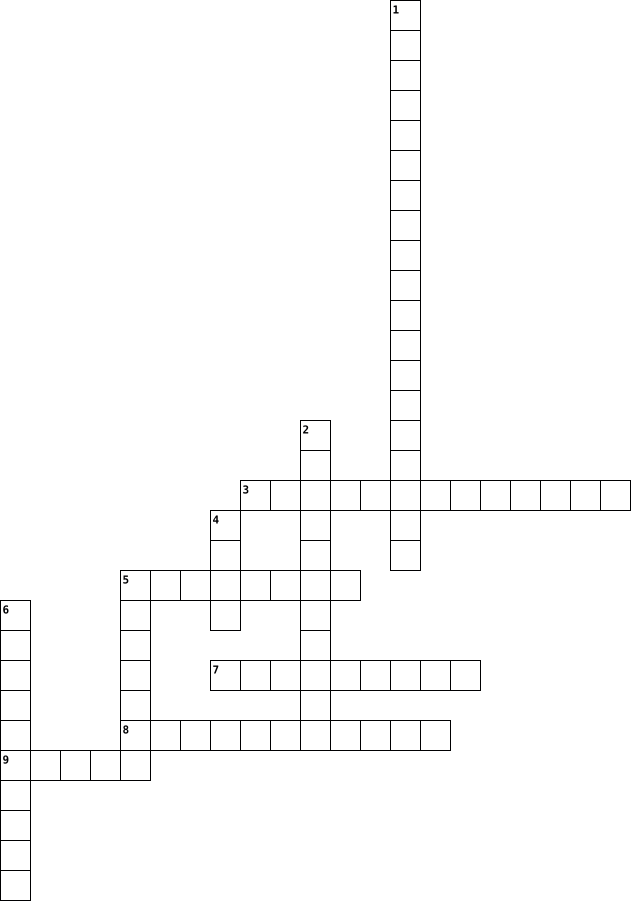
Across
- soft, weak/high plasticity; upper mantle only
- transverse waves are slower and can only travel through solid portions of Earth's interior.
- plates move away from each other, forming oceanic ridges, rift zones/valleys, volcanoes, and/or earthquakes
- continental when 2 continental plates collide, the lithosphere buckles and pushed upward, forming mountain ranges
- push occurs when a newly-formed lithosphere next to a ridge slides down away from the ridge.
Down
- when a continental plate and oceanic plate collide, the oceanic plate subduct because its more dense, forming trenches and volcanic arcs.
- cool, and rigid; includes the crust and upper mantle
- Pull occurs when the sinking of a subducting plate pulls the rest of the plate across the asthenosphere
- Waves. travel along earths surface and cause the most damage at the surface.
- plates move towards each other, forming ocean trenches (at subduction zones), mountains volcanoes, and/or earthquakes
10 Clues: soft, weak/high plasticity; upper mantle only • cool, and rigid; includes the crust and upper mantle • Waves. travel along earths surface and cause the most damage at the surface. • transverse waves are slower and can only travel through solid portions of Earth's interior. • ...
Geosphere Project 2023-10-17

Across
- soft, weak/high plasticity; upper mantle only
- transverse waves are slower and can only travel through solid portions of Earth's interior.
- plates move away from each other, forming oceanic ridges, rift zones/valleys, volcanoes, and/or earthquakes
- continental when 2 continental plates collide, the lithosphere buckles and pushed upward, forming mountain ranges
- push occurs when a newly-formed lithosphere next to a ridge slides down away from the ridge.
Down
- when a continental plate and oceanic plate collide, the oceanic plate subduct because its more dense, forming trenches and volcanic arcs.
- cool, and rigid; includes the crust and upper mantle
- Pull occurs when the sinking of a subducting plate pulls the rest of the plate across the asthenosphere
- Waves. travel along earths surface and cause the most damage at the surface.
- plates move towards each other, forming ocean trenches (at subduction zones), mountains volcanoes, and/or earthquakes
10 Clues: soft, weak/high plasticity; upper mantle only • cool, and rigid; includes the crust and upper mantle • Waves. travel along earths surface and cause the most damage at the surface. • transverse waves are slower and can only travel through solid portions of Earth's interior. • ...
Dylan Truong 2022-04-28

Across
- A rock type that is the change from a rock type to a new rock type through extreme heat and pressure.
- A boundary where lithospheric plates collide.
- A natural material that is broken by weathering and erosion, and transported by wind, water and ice.
- A geological process in which oceanic lithosphere is recycled into the mantle of the Earth at convergent boundaries.
Down
- A rock type that is formed from sediment coming together.
- A theory that proposes that the continents have been drifting apart for millions of years.
- A theory that proposes how the lithosphere of the earth is made up of large plates that have been slowly moving for 3 billion years.
- A boundary where plates slide against and past each other sideways.
- A rock type that is formed from the cooling of magma and solidification.
- A boundary where two plates move away from each other.
10 Clues: A boundary where lithospheric plates collide. • A boundary where two plates move away from each other. • A rock type that is formed from sediment coming together. • A boundary where plates slide against and past each other sideways. • A rock type that is formed from the cooling of magma and solidification. • ...
Dynamic Earth 2025-02-21

Across
- magma that erupts onto Earth's surface.
- name given to a supercontinent that began to break apart approximately 200 million years ago.
- Wegener’s hypothesis that all continents were once connected in a single large landmass that broke apart about 200 million years ago and drifted slowly to their current positions.
- the boundary between two plates that move toward each other.
Down
- the process by which new oceanic crust forms along a mid-ocean ridge and older oceanic crust moves away from the ridge.
- a deep, underwater trough created by one plate subducting under another plate at a convergent plate boundary.
- the boundary between two plates that move away from each other.
- molten rock stored below Earth's surface.
- theory that Earth’s surface is broken into large, rigid pieces that move with respect to each other.
- long, narrow mountain range on the ocean floor; formed by magma at divergent plate boundaries.
10 Clues: magma that erupts onto Earth's surface. • molten rock stored below Earth's surface. • the boundary between two plates that move toward each other. • the boundary between two plates that move away from each other. • name given to a supercontinent that began to break apart approximately 200 million years ago. • ...
Plate Tectonics 2025-05-12

Across
- A geological feature where two tectonic plates move apart from each other
- The theory that the plate tectonics on Earth’s surface always have and always will be moving
- A piece of the lithosphere that moves around on the surface of the mantle
- vibrations that travel through the Earth, carrying energy generated by events like earthquakes, volcanic eruptions, or explosions
- When two plate boundaries converge and one moves underneath the other
Down
- In deep ocean trenches, the lithosphere is pulled down into the mantle and recycled
- A region around the Pacific Ocean where a majority of the world's earthquakes and volcanoes occur
- A region in the mantle where hot magma rises to the surface, creating volcanoes
- A geological feature where two or more lithospheric plates move towards each other and collide
- A type of plate boundary where two tectonic plates slide past each other horizontally
10 Clues: When two plate boundaries converge and one moves underneath the other • A geological feature where two tectonic plates move apart from each other • A piece of the lithosphere that moves around on the surface of the mantle • A region in the mantle where hot magma rises to the surface, creating volcanoes • ...
Plate Tectonics Review 2019-10-17

Across
- These can occur at a transform boundary and are often hotspots for earthquakes (two words)
- _ spreading is the concept that magma rising from the mantle will push plates apart
- This physical layer of the Earth is broken into plates that move above the asthenosphere
- _ currents are the movement of materials based on density. More dense sinks while less dense rises
- This boundary occurs where two plates meet and come together
- The name given to the massive supercontinent
Down
- The remains of dead plants and animals that helped with proving Wegener's theory
- This boundary occurs as two plates move away from one another
- During this process within a subduction zone, the denser oceanic plate slides under the continental and is pulled down by gravity (two words)
- _ drift is the concept that the continents are always moving
- This boundary occurs where two plates move past one another
- A _ zone is where a more dense plate of oceanic crust will slide below a less dense continental plate
- During this process within a subduction zone, magma moves up through the opening and pushes the plates apart (two words)
13 Clues: The name given to the massive supercontinent • This boundary occurs where two plates move past one another • _ drift is the concept that the continents are always moving • This boundary occurs where two plates meet and come together • This boundary occurs as two plates move away from one another • ...
Puzzle #1 2014-08-12

Across
- Jake had a ---- as a fisherman, catching a 50 lb tuna!
- Megan took ---- notes from class and did well on the test.
- She was consumed by ---- and desired to explore every country in the world.
- Sometimes it is difficult to be ---- in the face of arduous challenges.
- In the movie, Divergent, "stiffs" were part of the ---- Faction. They even denied their own vanity, by not looking in the mirror for too long.
- Maya's strange behavior at the trial ---- me. How she acted and what she said did not align.
- The fresh pineapple was ---- in our mouths.
Down
- Sometimes I wonder if I will ever be able to let go of the ---- I feel towards my cruel stepmother.
- She ---- the scene with the remaining thousand dollars.
- It is rare in history to have had ---- rulers, who appealed to the masses and ruled fairly.
- When coming back to their natal homes, people fall into the trap of ---- to their old ways and habits.
- A ---- shift is a fundamental change in approach or underlying assumptions.
- This word's synonyms: forcible, energetic, vigorous
13 Clues: The fresh pineapple was ---- in our mouths. • This word's synonyms: forcible, energetic, vigorous • Jake had a ---- as a fisherman, catching a 50 lb tuna! • She ---- the scene with the remaining thousand dollars. • Megan took ---- notes from class and did well on the test. • Sometimes it is difficult to be ---- in the face of arduous challenges. • ...
Plate Tectonic Crossword Puzzle 2022-01-13

Across
- The region where oceanic plates sink down into the asthenosphere
- A plate boundary where two plates move past each other in opposite directions
- the region where two tectonic plates are in contact
- a block of lithosphere that consists of the crust and the rigid, outermost part of the mantle
- a series of volcanoes formed at a subduction zone
- the idea that continents have moved and are still moving slowly across the Earth's surface
- the theory that the lithosphere is broken up into large plates that move and then rejoin; considered the unifying theory of geology
Down
- A plate boundary where two plates move away from each other
- The shaking that results from the movement of rock beneath Earth's surface.
- A plate boundary where two plates move toward each other
- A break in the earth's crust
- A deep valley that forms where two plates move apart
- A weak spot in the middle of a tectonic plate where magma surfaces; forms a volcano (ex: Hawaii & Yellowstone)
13 Clues: A break in the earth's crust • a series of volcanoes formed at a subduction zone • the region where two tectonic plates are in contact • A deep valley that forms where two plates move apart • A plate boundary where two plates move toward each other • A plate boundary where two plates move away from each other • ...
8S Lessons 5.3-5.5 Vocabulary Crossword 2024-12-11

Across
- A deep valley that forms where two plates move apart
- The theory that pieces of Earth’s lithosphere are in constant motion, driven by convection currents in the mantle
- The process by which molten material adds new oceanic crust to the ocean floor
- A section of the lithosphere that slowly moves over the asthenosphere, carrying pieces of continental and oceanic crust
- A plate boundary where two plates move away from each other
Down
- An undersea mountain chain where new ocean floor is produced
- The process by which oceanic crust sinks beneath a deep-ocean trench and back to the mantle at a convergent plate boundary
- The preserved remains or traces of an organism that lived in the past
- A plate boundary where two plates move toward each other
- A deep valley along the ocean floor beneath which oceanic crust slowly sinks toward the mantle
- The hypothesis that the continents move slowly across earth’s surface
- A plate boundary where two plates move past each other in opposite directions
- The name of the single landmass that began to break apart 200 million years ago and gave rise to today’s continents
13 Clues: A deep valley that forms where two plates move apart • A plate boundary where two plates move toward each other • A plate boundary where two plates move away from each other • An undersea mountain chain where new ocean floor is produced • The preserved remains or traces of an organism that lived in the past • ...
Ged Miller Plate Tectonics Crossword 2014-11-10

Across
- a boundary in which two plates slide past each other without creating or destroying lithosphere
- a destructive plate margin where oceanic crust is being pushed down into the mantle beneath a second plate
- the process by which plate tectonics produces new oceanic lithosphere at ocean ridges
- a continuous elevated zone on the floor of all the major ocean basins and varying in width from 1000 to 4000 kilometers
Down
- the permanent magnetization acquired by rock that can be used to determine the location of the magnetic poles at the time it became magnetized
- a boundary in which two plates move together
- a region where the rigid plates are moving apart,typified by the oceanic ridges
- It involves the oceanic lithosphere sliding down the oceanic ridge under the pull of gravity
- super continent that 200 million years ago began to break apart and form the present landmasses
- deep faulted structure found along the axes of divergent plate boundaries
10 Clues: a boundary in which two plates move together • deep faulted structure found along the axes of divergent plate boundaries • a region where the rigid plates are moving apart,typified by the oceanic ridges • the process by which plate tectonics produces new oceanic lithosphere at ocean ridges • ...
Plate Tectonics Vocabulary 2021-01-26

Across
- a plate boundary where two plates move toward each other.
- the theory that pieces of Earth's lithosphere are in constant motion, driven by convection currents in the mantle.
- a plate boundary where two plates move away from each other.
- the name of the single landmass that broke apart 200 million years ago and gave rise to today's continents.
Down
- a deep valley along the ocean floor beneath which oceanic crust slowly sinks toward the mantle.
- the process by which molten material adds new oceanic crust to the ocean floor.
- the hypothesis that the continents slowly move across earth's surface.
- an undersea mountain chain where new ocean floor is produced.
- the process by which ocean floor sinks beneath a deep-ocean trench and back into the mantle.
- a break or crack in Earth's lithosphere along which the rocks move.
10 Clues: a plate boundary where two plates move toward each other. • a plate boundary where two plates move away from each other. • an undersea mountain chain where new ocean floor is produced. • a break or crack in Earth's lithosphere along which the rocks move. • the hypothesis that the continents slowly move across earth's surface. • ...
Continental Theory 2023-01-30

Across
- a map showing the shape and elevation of the land surface using contour lines
- he created the theory of continental plate and drift
- Alfred Wegner’s explanation of continents slowly moving and changing their positions relative to one another
- this is created by a divergent bounduary
- intervals difference in elevation between any two contour lines on a topographic map
- the shape of the Earth’s surface and the way its physical features are arranged, especially in terms of their positions and elevations
Down
- the outer most layer of the Earth (lithosphere) is divided into contiguous sections (plates) that move relative to each other causing continental drift, seafloor spreading, and the formation of major physical features of the Earth’s surface
- On a topographic map, it is demonstrated by hatched lines, which point inward to the bottom.
- The lines showing or change in elevation on a topographic map
- a path along the Pacific Ocean characterized by active volcanoes and frequent earthquakes
10 Clues: this is created by a divergent bounduary • he created the theory of continental plate and drift • The lines showing or change in elevation on a topographic map • a map showing the shape and elevation of the land surface using contour lines • intervals difference in elevation between any two contour lines on a topographic map • ...
Science 2023-10-20

Across
- an underwater mountain range made at divergent plate boundaries
- an object, diagram, or computer program that helps us understand something by making it simpler or easier to see
- a document asking engineers to submit a well-supported, formal design descrbing how they would solve a problem
Down
- the size or strength of something, such as an earthquake or tsunami
- when you have to give up one thing in return for another
- the process of sharing scientific arguments, explanations, ideas, or data with an audience
- the process by which rock material moves under Earth's outer layer and into the mantle due to plate motion
- a warning that is generated for a specific area, even though no emergency or disaster occurs in that area
- the place where two plates meet
- A device that detects some important physical quality or quantity about the surrounding environment, and conveys the information to the robot in electronic form.
10 Clues: the place where two plates meet • when you have to give up one thing in return for another • an underwater mountain range made at divergent plate boundaries • the size or strength of something, such as an earthquake or tsunami • the process of sharing scientific arguments, explanations, ideas, or data with an audience • ...
Geosphere Project 2023-10-17

Across
- Pull occurs when the sinking of a subducting plate pulls the rest of the plate across the asthenosphere
- push occurs when a newly-formed lithosphere next to a ridge slides down away from the ridge.
- soft, weak/high plasticity; upper mantle only
- transverse waves are slower and can only travel through solid portions of Earth's interior.
- plates move towards each other, forming ocean trenches (at subduction zones), mountains volcanoes, and/or earthquakes
- continental when 2 continental plates collide, the lithosphere buckles and pushed upward, forming mountain ranges
Down
- cool, and rigid; includes the crust and upper mantle
- Waves. travel along earths surface and cause the most damage at the surface.
- plates move away from each other, forming oceanic ridges, rift zones/valleys, volcanoes, and/or earthquakes
- when a continental plate and oceanic plate collide, the oceanic plate subduct because its more dense, forming trenches and volcanic arcs.
10 Clues: soft, weak/high plasticity; upper mantle only • cool, and rigid; includes the crust and upper mantle • Waves. travel along earths surface and cause the most damage at the surface. • transverse waves are slower and can only travel through solid portions of Earth's interior. • ...
Evolution 2025-04-03

Across
- När lika miljöer leder till att arter med olika ursprung utvecklas till att vara lika varandra, som fåglar och insekter
- Organismer som får vara ifred länge, till exempel på öar, och tillslut utevcklas till olika arter
- Arter utvecklas anpassat till varandra, till exempel en antilop utvecklas till att bli snabbare för att undkomma snabba rovdjur
- Hur bra en art är på att få frisk avkomma
Down
- Organ med olika funktion men samma ursprung
- P.g.a t.ex. miljöförändringar gör att egenskaper som inte tidigare varit viktigta blir plötsligt viktiga
- När olika miljöer leder till att arter med samma ursprung utvecklas till att vara olika varnadra
- Organ med samma funktion men olika ursprung
- Något en art kan utöva på en annan art, som tvingar den att utvecklas på ett visst sätt om den vill överleva
- Organ/kroppsdelar som blivit över från evolutionen och som inte längre fyller någon funktion
10 Clues: Hur bra en art är på att få frisk avkomma • Organ med olika funktion men samma ursprung • Organ med samma funktion men olika ursprung • Organ/kroppsdelar som blivit över från evolutionen och som inte längre fyller någon funktion • När olika miljöer leder till att arter med samma ursprung utvecklas till att vara olika varnadra • ...
Michelle Serrano 2022-04-29

Across
- is produced when magma exits and cools above (or very near) the Earth's surface
- the gradual movement of the continents across the earth's surface through geological time.
- is a massive, irregular shaped slab of solid rock generally composed of both continental oceanic litospeered.
- were once igneous or sedimentary rocks, but have been changed (metamorphosed) as a result of intense heat and/or pressure within the Earth's crust.
- matter that settles to the bottom of a liquid; dregs.
- the sideways and downward movement of the edge of a plate of the earth's crust into the mantle beneath another plate.
Down
- are formed from pre-existing rocks or pieces of once-living organisms
- are locations where two plates slide past one another.
- is an area on Earth where two or more lithospheric plates collide
- a linear feature that exists between two tectonic plates that are moving away from each other
10 Clues: matter that settles to the bottom of a liquid; dregs. • are locations where two plates slide past one another. • is an area on Earth where two or more lithospheric plates collide • are formed from pre-existing rocks or pieces of once-living organisms • is produced when magma exits and cools above (or very near) the Earth's surface • ...
We Are Living in a Dystopia 2026-01-14

Across
- First published in January 1932 by a man with a unique name! AH!
- Written by Kiera Cass in 2012, this book features a 'Prince Maxon' who must choose a bride (but its Netflix adaptation reportedly got scrapped!).
- This 1953 book is HOT HOT HOT!
- This dystopian book published in 1985 was made into a TV series that ran for 6 seasons
- This Lois Lowry book was originally published in 1993
- Haymitch's story is told in this 2025 novel by Suzanne Collins.
Down
- The colorful movie based on this 1962 book was directed by Stanley Kubrick
- This twisty-turny movie based on a YA dystopian novel included Dylan O'Brien, Will Poulter, Thomas Brodie-Sangster
- This book penned by an author who died in 2023 was adapted into a movie starring Viggo Mortensen.
- This sequel to Divergent was written by Veronica Roth (the movie starred Shailene Woodley)
10 Clues: This 1953 book is HOT HOT HOT! • This Lois Lowry book was originally published in 1993 • Haymitch's story is told in this 2025 novel by Suzanne Collins. • First published in January 1932 by a man with a unique name! AH! • The colorful movie based on this 1962 book was directed by Stanley Kubrick • ...
Grade 7: Landform Creation 2025-09-22

Across
- Molten rock once it has erupted onto the Earth's surface.
- A crack in the Earth's crust where rock has moved.
- the process of wearing or being worn by long exposure to the atmosphere.
- A mountain or hill, typically conical, having a crater or vent through which lava and ash are or have been erupted.
- The process of moving weathered rock and soil by wind, water, or ice.
- The circular movement of heat in the mantle, thought to be the driving force behind plate tectonics.
Down
- A type of boundary where two tectonic plates move apart from each other, creating new crust. (← →)
- The upper layer of the Earth's mantle, just below the lithosphere, on which the plates float.
- A deep valley with steep sides, often carved by a river over millions of years.
- A type of boundary where two tectonic plates collide, often forming mountains or volcanoes. (→ ←)
10 Clues: A crack in the Earth's crust where rock has moved. • Molten rock once it has erupted onto the Earth's surface. • The process of moving weathered rock and soil by wind, water, or ice. • the process of wearing or being worn by long exposure to the atmosphere. • A deep valley with steep sides, often carved by a river over millions of years. • ...
HANA MASHALI 2021-10-25

Across
- Plate boundaries that move way from each other
- What plate boundary process ends in subduction
Down
- Plate boundaries that collide
- Plate boundaries that slide past each other
4 Clues: Plate boundaries that collide • Plate boundaries that slide past each other • Plate boundaries that move way from each other • What plate boundary process ends in subduction
Oceanography 2021-11-01

Across
- Currents a heat transfer process of flowing fluid that is moving because there is a temperature or density difference within the material.
- the stress that causes plates to be pulled away from each other
- a mound of sediments at the base of the continental slope
- the solid upper layer of the Earth's mantle, is so hot that it behaves plastically and can flow. Convection currents occur here and move the lithospheric plates above.
- created when plates move towards each other
- the stress that causes plates to be pushed towards each other
Down
- the stress that causes plates to slide past each other
- the edge of the continent, comprised of the continental shelf, slope, and rise
- the steep decline from the continental shelf to the ocean floor
- top-most layer of the Earth, composed of both the crust and the portion of the upper mantle that behaves as a brittle, rigid solid.
- created when plates slide past each other
- Boundary created when plates move away from each other
- the gently sloping part of the continent that is underwater
13 Clues: created when plates slide past each other • created when plates move towards each other • the stress that causes plates to slide past each other • Boundary created when plates move away from each other • a mound of sediments at the base of the continental slope • the gently sloping part of the continent that is underwater • ...
Earth Science 2014-10-16

Across
- the two sub-layers of the earth's crust (lithosphere) that move, float, and sometimes fracture and whose interaction causes continental drift, earthquakes, volcanoes, mountains, and oceanic trenches
- Earth's lithosphere (the crust and upper portion of the mantle) is divided into about 12 large plates and several small ones that float on and travel independently over the asthenosphere.
- coming closer together
- the sideways and downward movement of the edge of a plate of the earth's crust into the mantle beneath another plate.
- a long high sea wave caused by an earthquake, submarine landslide, or other disturbance.
- the movement of two oceanic plates away from each other
Down
- parts of the Earth's crust slowly drift atop a liquid core.
- where two tectonic plates meet
- make a thorough or dramatic change in the form, appearance, or character of.
- a long narrow ditch
- a sudden and violent shaking of the ground, sometimes causing great destruction, as a result of movements within the earth's crust or volcanic action.
- tending to be different or develop in different directions.
- running along the Mid-Oceanic Ridge
13 Clues: a long narrow ditch • coming closer together • where two tectonic plates meet • running along the Mid-Oceanic Ridge • the movement of two oceanic plates away from each other • parts of the Earth's crust slowly drift atop a liquid core. • tending to be different or develop in different directions. • ...
plate tectnics trinity tran 2018-12-05

Across
- / any trace of an ancient organism that has been preserved in a rock
- trenches / the name of the canyons that the ocean floor plunges into deep underwater
- / the process by which the ocean floor sinks beneath a deep-ocean trench and back into the mantle
- boundary / a plate boundary where two plates move toward each other
- spreading / the process of mid-ocean ridges continually adding new material to the ocean floor
- / the continents were joined all together creating a supercontinent about 300 million years ago
- valley / a deep valley that forms where two plates move apart
Down
- ridge / an underwater mountain system formed by plate tectonics
- / breaks in earth's crust along which rocks move
- drift / the gradual movement of the continents across the earth's surface through geological time
- boundary / a plate boundary where two plates move away from each other
- boundary a plate boundary where two plates move past each other in opposite directions
- tectonics / the theory that pieces of earth's lithosphere are in constant motion, driven by currents in the mantle
13 Clues: / breaks in earth's crust along which rocks move • valley / a deep valley that forms where two plates move apart • ridge / an underwater mountain system formed by plate tectonics • / any trace of an ancient organism that has been preserved in a rock • boundary / a plate boundary where two plates move toward each other • ...
Plate Tectonics Crossword 2026-04-15

Across
- tectonics, The Theory that lithospheric plates move relative to one another; they can collide, spate or slide past one another.
- boundaries, Plate boundaries where the plates slide past one another.
- boundary, Plate boundary where the plates collide causing mountain ranges or volcanoes along subduction zones.
- spreading, Where seafloor spreads apart at a mid-oceanic ridge during plate tectonic movement.
- is stiff, rigid outer rind of Earth which makes up plates
- Thick layer of Earth below the crust and above the core.
- innermost layer of the Earth, consisting of iron and nickel.
Down
- boundary, Plate boundary where the plates move away from each other, creating mid-ocean ridges.
- zones, Zones along convergent boundaries where one plate descends beneath another plate.
- Part of Earth’s mantle below the lithosphere that behaves in a plastic manner.
- ridges, A high standing rift or spreading zone in an ocean
- volcano, An isolated volcano lying above a plume or hot column of rock in Earth’s mantle.
- A depression found at the bottom of the ocean floor at a subduction zone.
13 Clues: Thick layer of Earth below the crust and above the core. • is stiff, rigid outer rind of Earth which makes up plates • ridges, A high standing rift or spreading zone in an ocean • innermost layer of the Earth, consisting of iron and nickel. • boundaries, Plate boundaries where the plates slide past one another. • ...
Plate Tectonics 2023-12-01

Across
- The supercontinent where all land was once together
- The theory that all of Earth was once together
- a sudden and violent shaking of the ground, sometimes causing great destruction, as a result of movements within the earth's crust or volcanic action
- a lowland region that forms where Earth's tectonic plates move apart, or rift.
- the upper layer of the earth's mantle, below the lithosphere, in which there is relatively low resistance to plastic flow and convection is thought to occur.
- The crashing/colliding of two plate boundaries
- Two plates that slide past each other
- Where two plates slide past each other and cause earthquakes
Down
- when an oceanic plate runs into a continental plate and slides beneath it.
- rigid, rocky outer layer of the Earth, consisting of the crust and the solid outermost layer of the upper mantle/where the plates are located
- Scientist who came up with the Continental Drift Theory
- Created when two continental plates collide
- The theory that says HOW the continents move around
- Created when a Oceanic plate and Continental Plate crash together
- The separation of two plate boundaries
- long, narrow depressions on the seafloor that form at the boundary of tectonic plates where one plate is pushed, or subducts, beneath another.
- a seafloor mountain system formed by plate tectonics
17 Clues: Two plates that slide past each other • The separation of two plate boundaries • Created when two continental plates collide • The theory that all of Earth was once together • The crashing/colliding of two plate boundaries • The supercontinent where all land was once together • The theory that says HOW the continents move around • ...
Plate Motion 2024-10-24

Across
- (2 words)any of the many processes (such as eruptions and lava flows) in which gas, lava,and ash are pushed out on the surface of Earth
- the slow pulling apart of land that is caused by plate movement
- moving apart in different directions
- a sudden shaking of Earth's surface
- the layer of soft, solid rock underneath Earth's plates
- (2 words) Earth’s outermost layer of hard, solid rock that is underneath the soil, vegetation, and water
- (2 words) the place where two plates meet
- (2 words) a diagram that shows what the inside of something looks like
- a feature that forms on the surface of a planet, such as a mountain, channel, or sand dune
- hot liquid rock below the surface of Earth
Down
- moving toward the same place
- one of the very large sections of hard, solid rock that make up Earth’s outer layer
- hot liquid rock on the surface of Earth
- a long, deep indentation in the ocean floor formed when two plates move together
- (3 words)an underwater mountain range formed when two plates move apart
- evidence of life from the past, such as fossilized bones, footprints, or leaf prints
- a natural spring that sends hot water and steam suddenly into the air from a hole in the ground
17 Clues: moving toward the same place • a sudden shaking of Earth's surface • moving apart in different directions • hot liquid rock on the surface of Earth • (2 words) the place where two plates meet • hot liquid rock below the surface of Earth • the layer of soft, solid rock underneath Earth's plates • the slow pulling apart of land that is caused by plate movement • ...
Tsunami Warning System 2024-10-04

Across
- Plate motion that results in a very strong earthquake and causes _____ motion of the seafloor can cause tsunamis
- Modifications are made to a design based on evaluated results. Designs are modified in order to be tested again. This is called an _____.
- boundaries, where one plate subducts under the other
- Tsunami warning systems rely on data from different types of ____ to generate accurate and timely warnings
- The primary cause of tsunamis is
- Engineers read with ____ to understand relevant background information that impacts their work.
- define the engineering problem.
- Earthquakes are due to movement along the three types of plate boundaries: convergent, divergent, and
Down
- Earthquakes must be above ___ 7.0 to generate a tsunami.
- Engineers need to understand the problem they are trying to solve so they can design an ___ solution.
- Tsunamis cause lots of damage to places on ____.
- Tsunamis are usually caused by _____ under the water.
- Scientific ____ is the process of sharing scientific arguments, explanations, ideas, or data with an audience
- Engineers design physical objects and processes that try to solve ____ problems.
- Engineers sometimes use models to ____ their designs
- research is necessary when solving an engineering problem.
- A tsunami is a type of large, destructive ocean wave caused by a sudden shift in the
- Every model has
18 Clues: Every model has • define the engineering problem. • The primary cause of tsunamis is • Tsunamis cause lots of damage to places on ____. • boundaries, where one plate subducts under the other • Engineers sometimes use models to ____ their designs • Tsunamis are usually caused by _____ under the water. • Earthquakes must be above ___ 7.0 to generate a tsunami. • ...
Vocab L3 2024-02-09

Across
- boundary The boundary between tectonic plates that are colliding. Stress compression
- The solid, out layer of Earth that consists of the crust and the rigid upper part of the mantle
- boundary The boundary between tectonic plates that are sliding past each other horizontally Stress-shear
- plate A block of lithosphere that consist of the crust and the rigid, outermost part of the mantle
Down
- The soft layer of the mantle on which the tectonic plates move
- The bending, tilting, and breaking of Earth's crust; the change in the shape of rock in responses to stress
- boundary The boundary between two tectonic plates that are moving away from each other Stress-tension
7 Clues: The soft layer of the mantle on which the tectonic plates move • boundary The boundary between tectonic plates that are colliding. Stress compression • The solid, out layer of Earth that consists of the crust and the rigid upper part of the mantle • plate A block of lithosphere that consist of the crust and the rigid, outermost part of the mantle • ...
5L 2021-04-01

Across
- massive slabs of rock, that connect the surface of the earth made from the crust plus a thin layer of the mantle
- edge of a plate where one plate meets another, where there are many mountains and volcanoes
- a large landmass or area of land
- the study of the physical features and history of earth
- the rising and falling of magma, causing tectonic plates to move
Down
- the center of the planet
- hot rock from below the earth
- tectonic plates the 8 large plates on the surface of earth
- a group of pictures and dates of important events, arranged in the order in which they happened
- a thin layer of rock on the surface of the earth
- when two tectonic plates slide and grind sideways past each other, causing an earthquake
- scientists who study the structure of the earth to figure out its ancient history and how it has changed over time.
- a super continent that existed over 250 million years ago
- when two plates bump or crash into each other
- when two tectonic plates move away from each other
- core hard layer around the inner core
- tectonic plates there are about 7 small plates on the surface of earth
17 Clues: the center of the planet • hot rock from below the earth • a large landmass or area of land • core hard layer around the inner core • when two plates bump or crash into each other • a thin layer of rock on the surface of the earth • when two tectonic plates move away from each other • the study of the physical features and history of earth • ...
Plate Motion CrossWordPuzzle 2023-10-18

Across
- This is the Hard solid/Soft solid rock underneath a plate boundary.
- A long deep indentation in the ocean floor formed when two plates move together.
- This plate boundary happens when One plate sinks under the other.
- An under water mountain range formed when two plates move apart.
- The place where two plates meet.
- Evidence of life from the past, such as fossilized bones, footprints, or leaf prints.
- A sudden shake on earths surface.
- Earths outermost layer of hard, solid rock that is underneath the soil vegetation outer and water layer.
- The sudden pushing out of something. Such as lava from a volcano.
Down
- A diagram that shows what the inside of something looks like.
- Any of the many processes (such as eruptions and lava flows) which gas and lava are pushed out on the surface of Earth.
- Hot liquid rock on the surface of earth.
- The outside or top layer of something.
- One of the very large sections of hard solid rock that make up Earths outer layer.
- Any of Earth’s main continuous areas of land, such as Africa, Asia, and North America.
- This Plate boundary happens when rock gets added on the edges of two plate.
- Something we observe to be similar over and over again.
17 Clues: The place where two plates meet. • A sudden shake on earths surface. • The outside or top layer of something. • Hot liquid rock on the surface of earth. • Something we observe to be similar over and over again. • A diagram that shows what the inside of something looks like. • An under water mountain range formed when two plates move apart. • ...
Chapter 3 - Learning Menu Crossword puzzle 2023-01-04

Across
- a trace of an ancient organism that has been preserved in rock, evidence of the organisms living millions of years ago
- where plates divide or diverge from each other
- breaks in earths crust where rocks have slipped past each other
- the measure of how much mass there is in a given volume of a substance
- heating and cooling of a fluid, changes in the fluids density
- where plates come together
- the theory that the continents were all joined together at one time to form a supercontinent called pangaea
Down
- where two plates slip past each other
- adds more crust to the ocean floor, molten material erupts through this valley
- where the oceanic crust bends downward
- heat transferred through touch
- where pieces of Earth's crust diverge on land, a deep valley called
- the process by which ocean floor sinks beneath a deep ocean trench and back into the mantle
- is an area where material from deep within earths mantle rises through the crust and melts to form magma
- a mountain that forms in earths crust when molten material or magma, reaches the surface
- The transfer of energy that is carried in rays
- heat transfer by the movement of a liquid or fluid
17 Clues: where plates come together • heat transferred through touch • where two plates slip past each other • where the oceanic crust bends downward • where plates divide or diverge from each other • The transfer of energy that is carried in rays • heat transfer by the movement of a liquid or fluid • heating and cooling of a fluid, changes in the fluids density • ...
plate tectonics trinity tran 2018-12-05

Across
- boundary a plate boundary where two plates move past each other in opposite directions
- tectonics / the theory that pieces of earth's lithosphere are in constant motion, driven by currents in the mantle
- / the process by which the ocean floor sinks beneath a deep-ocean trench and back into the mantle
- trenches / the name of the canyons that the ocean floor plunges into deep underwater
- spreading / the process of mid-ocean ridges continually adding new material to the ocean floor
- boundary / a plate boundary where two plates move away from each other
Down
- valley / a deep valley that forms where two plates move apart
- / breaks in earth's crust along which rocks move
- / any trace of an ancient organism that has been preserved in a rock
- ridge / an underwater mountain system formed by plate tectonics
- drift / the gradual movement of the continents across the earth's surface through geological time
- / the continents were joined all together creating a supercontinent about 300 million years ago
- boundary / a plate boundary where two plates move toward each other
13 Clues: / breaks in earth's crust along which rocks move • valley / a deep valley that forms where two plates move apart • ridge / an underwater mountain system formed by plate tectonics • / any trace of an ancient organism that has been preserved in a rock • boundary / a plate boundary where two plates move toward each other • ...
L3 2024-02-09

Across
- A block of the lithosphere that consists of the crust and the rigid, outermost part of the mantle
- The boundary between two tectonic plates that are moving away from each other. Stress-tension
- The soft layer of the mantle on which the tectonic plates move
- The boundary between tectonic plates that are sliding past each other horizontally. Stress-shear
- The bending, tilting, and breaking of Earth's crust; the change in the shape of rock in response to stress
Down
- The boundary between tectonic plates that are colliding. Stress- compression
- The solid, outer layer of Earth that consists of the crust and the rigid upper part of the mantle
7 Clues: The soft layer of the mantle on which the tectonic plates move • The boundary between tectonic plates that are colliding. Stress- compression • The boundary between two tectonic plates that are moving away from each other. Stress-tension • The boundary between tectonic plates that are sliding past each other horizontally. Stress-shear • ...
Tectonic Plates Puzzel 2016-05-16
Across
- Record The Layers of rock deposits laid down by volcanoes or weathering that contain a record of Earth's past history.
- The rigid outer layer of Earth.
- Tectonics The Earth’s lithosphere is composed of seven or eight major plates and many minor plates.
- Plate Earth's rigid outer crust that is broken into moving sections or plates.
- Formation of rock being broken apart.
- Ridge An underwater mountain system formed by plate tectonic movement.
Down
- Boundary A place where two or more tectonic plates move towards each other and collide.
- Drift The gradual movement of the continents across the earth’s surface through geological time.
- Boundaries A place where two tectonic plates move horizontally in either direction.
- Spreading A process that occurs at mid-ocean ridges, where new oceanic crust is formed through volcanic activity and then gradually moves away from the ridge.
- Trenches long narrow depressions on the seafloor, they are the deepest parts of the oceans.
- Striping At spreading centres, this crust is separated into parallel bands of rock by successive waves of emergent magma.
- Boundary A place where two tectonic plates move away from each other.
13 Clues: The rigid outer layer of Earth. • Formation of rock being broken apart. • Boundary A place where two tectonic plates move away from each other. • Ridge An underwater mountain system formed by plate tectonic movement. • Plate Earth's rigid outer crust that is broken into moving sections or plates. • ...
Geology Vocabulary Crossword 2022-11-14

Across
- the process of transporting nutrients from one layer to another where it becomes deposited
- a loose mixture of rock fragments, organic material, water and air that can support the growth of vegetation
- a ____ boundary is between two tectonic plates that are moving away from each other
- the layer of the earth between the crust and the core
- the soft layer of the mantle on which the tectonic plates move
- a ____ boundary is where two tectonic plates are moving toward each other
- the rigid outer part of the earth, consisting of the crust and upper mantle
Down
- the process by which wind, water, or gravity transports soil and sediments from one location to another
- water held underground in the soil or in pores and crevices in rock
- the thin and solid outermost layer of the Earth above the mantle
- the level below which the ground is saturated with water
- a ____ boundary is where two tectonic plates are moving past each other in opposite directions
- the chemical and physical processes that break down rock at Earth's surface
13 Clues: the layer of the earth between the crust and the core • the level below which the ground is saturated with water • the soft layer of the mantle on which the tectonic plates move • the thin and solid outermost layer of the Earth above the mantle • water held underground in the soil or in pores and crevices in rock • ...
Earth's Plates & Layers 2026-03-23

Across
- a type of convergent boundary where the denser plate sinks under the less dense one and creates island arcs and underwater trenches
- a type of plate boundary that moves apart. magma rises to fill the gap. creates rift valleys and mid-ocean ridges.
- a type of boundary that slides horizontally. causes earthquakes
- one plate dives beneath another & creates a volcano
- the crust & upper part of the mantle
Down
- a type of boundary that collides. creates mountains, intense earthquakes, etc.
- a type of convergent boundary where an oceanic plate sinks under a continental plate, creating trenches and volcanic mountain ranges
- the theory that suggests that Earth's lithosphere has plates that are split apart, and they interact with each other, causing global phenomenons
- innermost layer of Earth. Made of metals.
- the outermost layer of the Earth. Made of rock.
- when this occurs to unstable isotopes,it gives energy to the internal Earth
- second outermost layer of Earth. Made of rock, iron, and magnesium
- the solid part of Earth that is made of rocks,minerals, soil, and sediment.
13 Clues: the crust & upper part of the mantle • innermost layer of Earth. Made of metals. • the outermost layer of the Earth. Made of rock. • one plate dives beneath another & creates a volcano • a type of boundary that slides horizontally. causes earthquakes • second outermost layer of Earth. Made of rock, iron, and magnesium • ...
MODULE 8 2026-02-25

Across
- This factor considers currency, country of residence, political climate, etc.
- A criteria that states, Customers in different market segments should be as divergent as possible with other segments.
- Its purpose is to allow a business to move from a broad market to a target market.
- It is like a ruler or a filter used to measure and group people.
- It identifies who your customers are.
- It is helpful to understand and identify customers and market making decisions regarding the market mix.
- Any tangible goods
- Focuses on the individual person or household.
Down
- Answers how the customers interacts with a brand and their specific buying habits.
- Strategic process of dividing a broad target market into smaller and defined sets of customers.
- Its goal is to find the customers who have similar needs that will respond to a marketing mix in a predictable manner.
- Upside The segment that identifies the needs to be large enough , or predicted to grow sufficiently to be profitable.
- A broad market that includes all products or services that satisfy the same basid need or want.
- A market that focuses on particular products that directly compete with each other.
- Used when a company is selling to another company.
15 Clues: Any tangible goods • It identifies who your customers are. • Focuses on the individual person or household. • Used when a company is selling to another company. • It is like a ruler or a filter used to measure and group people. • This factor considers currency, country of residence, political climate, etc. • ...
Unit 4b vocab 2017-01-09

Across
- lines - on a map, a line that connects points of equal elevation above sea level.
- block mountains - mountains formed when rocks move along faults, leaving blocks of crust at different elevations.
- - outermost layer of earths surface, which is rocky and solid;includes the crust and the ridged part of the upper mantle.
- boundary - form where lithospheric platesare moving away from each other
- boundary - formed where two sections of earth's colliding.
- crust - rocky material that makes up the continents; it is less dense and contains a greater amount of lighter colored materials than ocean crust.
- ridges - undersea mountain range that forms when two parts of earths crust are pushing apart
Down
- - the process of which one lithosphere slides under another.
- Mountains - mountains formed by the bending of rocks.
- maps - map that shows the shape and elevation of the land surface contour lines, and shows other land features using symbols
- crust - portion of earths crust that lies beneath the oceans.
- - high above sea level
- boundary - a boundary between two lithospehere are sliding past each other.
13 Clues: - high above sea level • Mountains - mountains formed by the bending of rocks. • boundary - formed where two sections of earth's colliding. • - the process of which one lithosphere slides under another. • crust - portion of earths crust that lies beneath the oceans. • boundary - form where lithospheric platesare moving away from each other • ...
Tectonic Plates 2025-03-04

Across
- zone the area where subduction occurs
- ridge a long chain of mountains extending throughout all the oceans
- outer part of the earth's crust and the mantle
- core inner most layer of the earth
- boundary where plates move together; plate collide and interact producing features including trenches, volcanoes and mountains, destructive plate boundaries as they destroy lithospheric crust
- boundary where plates move apart, most are spreading centers located along the crests of mid-ocean ridges, some spreading centers occur on continents, they are constructive boundaries making new crust
Down
- crust crust found under the oceans
- core the liquid layer of the earth
- crust crust found on land
- spreading the process when new ocean floor forms along Earth’s mid-ocean ridges and slowly moves outward across ocean basins; new oceanic lithosphere is formed and the floor becomes wider
- trench long, steep valleys found at the deepest part of the Earth’s oceans
- tectonics theory Earth’s lithospheric plates move slowly relative to each other, driven by convection currents in the mantle
- valley deep central valley running down the center of a ridge
13 Clues: crust crust found on land • core inner most layer of the earth • crust crust found under the oceans • core the liquid layer of the earth • zone the area where subduction occurs • outer part of the earth's crust and the mantle • valley deep central valley running down the center of a ridge • ridge a long chain of mountains extending throughout all the oceans • ...
U3L2 Vocabulary Crossword 2024-02-12

Across
- the bending, tilting, and braking of earth's crust;the change in the shape of rock in responses to stress.
- boundary the boundary between two tectonic plates that are moving away from each other. stress-tension
- the soft layer of the mantle on which the tectonic plates move.
Down
- the solid, outer layer of earth that consists of the crust and the rigid upper part of the mantle.
- boundary the boundary between tectonic plates that are colliding.stress-compression
- boundary the boundary between tectonic plates that are sliding past each other horizontally.stress-shear
- plate a block of lithosphere that consist of the crust and the rigid, outermost part of the mantle.
7 Clues: the soft layer of the mantle on which the tectonic plates move. • boundary the boundary between tectonic plates that are colliding.stress-compression • the solid, outer layer of earth that consists of the crust and the rigid upper part of the mantle. • plate a block of lithosphere that consist of the crust and the rigid, outermost part of the mantle. • ...
Plate Tectonics 2025-05-12

Across
- Plates A piece of the lithosphere that moves around on the surface of the mantle
- Drift The theory that the plate tectonics on Earth’s surface always have and always will be moving
Down
- When two plate boundaries converge and one moves underneath the other
- plate boundaries A geological feature where two or more lithospheric plates move towards each other and collide
- floor spreading In deep ocean trenches, the lithosphere is pulled down into the mantle and recycled
- plate boundaries a geological feature where two tectonic plates move apart from each other
- spot A region in the mantle where hot magma rises to the surface, creating volcanoes
7 Clues: When two plate boundaries converge and one moves underneath the other • Plates A piece of the lithosphere that moves around on the surface of the mantle • plate boundaries a geological feature where two tectonic plates move apart from each other • ...
Evidence of Crustal Plate Movement 2013-11-24

Across
- When two plates move toward one another they forming a ______ boundary
- Wegener Who was the man that proposed the continents had once been attached to one another, and then drifted apart?
- When plates move they build up _____ which when released creates and earthquake or a volcano along the plate boundary.
Down
- When two plates move away for one another they form a _______ boundary
- How many major plates is the crust of the earth divided into? (Write the number in words)
- There are two most obvious pieces of evidence that the plates are moving. The second is: V__________
- When two plates move alongside each other they form a _____ boundary
- There are two most obvious pieces of evidence that the plates are moving. The first is: E________
8 Clues: When two plates move alongside each other they form a _____ boundary • When two plates move away for one another they form a _______ boundary • When two plates move toward one another they forming a ______ boundary • How many major plates is the crust of the earth divided into? (Write the number in words) • ...
unit 3 L4 by hunter 2024-02-13

Across
- sudden and violent shaking of the ground, sometimes causing great destruction, as a result of movements within the earth's crust or volcanic action.
- The point on the Earth's surface directly above the focus or hypocenter of an earthquake
- focus is point inside the earth where the earthquake started,
Down
- the changing earth's surface caused by tectonic forces that are accumulated in the crust and then cause earthquakes.
- a fracture or zone of fractures between two blocks of rock.
- plate boundary A divergent boundary occurs when two tectonic plates move away from each other.
- rebound what happens to the crustal material on either side of a fault during an earthquake
7 Clues: a fracture or zone of fractures between two blocks of rock. • focus is point inside the earth where the earthquake started, • The point on the Earth's surface directly above the focus or hypocenter of an earthquake • rebound what happens to the crustal material on either side of a fault during an earthquake • ...
Previous Page 100 of 100