
earth day Crossword Puzzles
crossword 2 2022-05-15

Across
- what you can see in the night sky (hint: sometimes shaped like a crescent)
- everything beyond earth
- bright dots in the sky
- the star that tells us day from night
- planet that starts with m
- orbits a star
- the galaxy we live in
Down
- planet that is the most far away from the april the month that earth day is in
- path that the earth takes around the sun
- sun, planets, asteroids, comets, and
- group of stars
- what you can use to look into space
- planet with rings
13 Clues: orbits a star • group of stars • planet with rings • the galaxy we live in • bright dots in the sky • everything beyond earth • planet that starts with m • what you can use to look into space • sun, planets, asteroids, comets, and • the star that tells us day from night • path that the earth takes around the sun • ...
Weather and Climate 2023-12-07

Across
- Average weather patterns for a region
- The layer of gas surrounding a planet that is held in place by gravity
- Directional movements of ocean water;
Down
- Average weather patterns for a particular region
- The study of specific regions of Earth
- The large-scale movement of air around Earth
- Che distance from sea level
- The day-to-day state of the atmosphere
- the distance north or south of the equator, measured in degrees. It helps locate places on Earth and influences climate.
- The spinning of Earth on its axis that causes day and night
10 Clues: Che distance from sea level • Average weather patterns for a region • Directional movements of ocean water; • The study of specific regions of Earth • The day-to-day state of the atmosphere • The large-scale movement of air around Earth • Average weather patterns for a particular region • The spinning of Earth on its axis that causes day and night • ...
Christmas Carol Crossword by Avery Stiller !2-12-22 2022-12-11

Across
- unfriendly person
- an emotional part of a character
- large city
- people who live asking for things
- What God gave us
- Women who cleans
- The first day of beginning the new year
- Heavenly father
- a hymn
- the son of your siblings
- angle or bad spirt
Down
- a big clock on top of a tower
- office employee
- day before Christmas
- a young human
- the kid's parent's sibling
- the day Christ was born
- lived for a long time
- a place where people built things in
- The earth
20 Clues: a hymn • The earth • large city • a young human • office employee • Heavenly father • What God gave us • Women who cleans • unfriendly person • angle or bad spirt • day before Christmas • lived for a long time • the day Christ was born • the son of your siblings • the kid's parent's sibling • a big clock on top of a tower • an emotional part of a character • people who live asking for things • ...
SOCIAL SIENCE 2024-05-14

Across
- We live on this Continent.
- They move around the star.
- The smallest planet is our solar Sysyem.
- They move around a planet.
- They emit light and heat.
- How many ocean in the world?
- Large bodies of salt water on earth.
- It is the last planet of our Solar system.
- The biggest satr in our Solar system.
Down
- How many phases of the Moon are there?
- The biggest planet is our Solar System.
- The Earth moves around the Sun in one...
- A layer ofsurrrounds the earth.
- The red Planet in our solar System.
- We live on this Planet.
- The Earth spins on itself in one...
- They are large extension of land, there are six
- The natural satellite of the Earth.
18 Clues: We live on this Planet. • They emit light and heat. • We live on this Continent. • They move around the star. • They move around a planet. • How many ocean in the world? • A layer ofsurrrounds the earth. • The red Planet in our solar System. • The Earth spins on itself in one... • The natural satellite of the Earth. • Large bodies of salt water on earth. • ...
Crossword 4 2026-04-14

Across
- Which college's basketball team won March Madness?(Shortened)
- Is Western's Science Olympiad team going to states or Regionals April 25th?
- Which retiring teacher coaches baseball?
- Who is starring as Mal in "Descendants"?
- What date did NASA's most recent moon mission return to Earth?
- Which teacher acts as student council's advisor?
- Which day in April is Earth day?
- Is boys' or girls' golf currently going on?
- What day in March was the first day of spring?
Down
- Tennis is coached by which middle school social studies teacher?
- What is the name of the martial artist, actor, and producer that passed away on March 19th?
- What is Western's annual talent showcase called?
- What road is Western's main entrance off of?
- What is the name of the NASA mission that recently sent astronauts orbiting around the moon?
- Which day in May does teacher appreciation week start?
- Which day in April was Western's first home track meet?
16 Clues: Which day in April is Earth day? • Which retiring teacher coaches baseball? • Who is starring as Mal in "Descendants"? • Is boys' or girls' golf currently going on? • What road is Western's main entrance off of? • What day in March was the first day of spring? • What is Western's annual talent showcase called? • Which teacher acts as student council's advisor? • ...
Space Vocabulary 2024-10-08

Across
- The Earth _____________ every day.
- Planet #6
- Not really a planet
- Planet #1
- Planet #4
Down
- Planet #2
- The sun is also a_________
- Every month, the moon_______ the Earth.
- Planet #7
- Planet #5
- Planet #3
- Planet #8
12 Clues: Planet #2 • Planet #7 • Planet #5 • Planet #3 • Planet #8 • Planet #6 • Planet #1 • Planet #4 • Not really a planet • The sun is also a_________ • The Earth _____________ every day. • Every month, the moon_______ the Earth.
Astronomy Project 2024-12-09

Across
- Man who created the laws of motion
- Field of science related to the position of the sun,planets,stars and human space studies
- The force pulling a body towards the center of the Earth
- The amount of space an object takes up
- the natural satellite of the earth
- The change of speed of an object
- Day with the most amount of sunlight
- vibrations that travel through the air or another medium and can be heard
Down
- the distance between successive crests of a wave
- Way The galaxy in which we live
- Day with equal amounts of day and night, marks the start of autumn/fall
- strength or energy as an attribute of physical action or movement
- the star around which the earth orbits
- The point on an elliptical path that is the furthest from the sun
- an optical instrument designed to make distant objects appear nearer
15 Clues: Way The galaxy in which we live • The change of speed of an object • Man who created the laws of motion • the natural satellite of the earth • Day with the most amount of sunlight • The amount of space an object takes up • the star around which the earth orbits • the distance between successive crests of a wave • The force pulling a body towards the center of the Earth • ...
Earth, Moon and Sun! 2020-04-28

Across
- The Earth revolves around the _______
- A moon that is more than half illuminated
- The imaginary line that runs through the middle of the earth horizontally
- Causes the day and night cycle on Earth
- Caused by the tilt of the Earth and it’s revolution around the sun
- The moon phase where the entire illuminated face is visible
- One year on Earth
- The _______ takes 24 hours to rotate on it’s axis
- Describes the moon appearing to grow larger
- The hemisphere we live in!
- Occurs when the hemisphere is tilted away from the sun
Down
- A moon that is half illuminated
- The moon phase where it appears there is no moon
- Occurs when the hemisphere is tilted toward the sun
- The imaginary line that passes through the earth from North to South
- Takes approximately 27 days to revolve around the earth
- Describes the moon appearing to shrink
- The path that the Earth takes to move around the sun
- Earth is _______ to approximately 23.5 degrees
- The _______ of the moon show how the moon appears to change shape over a month
- A moon that is less than half illuminated
21 Clues: One year on Earth • The hemisphere we live in! • A moon that is half illuminated • The Earth revolves around the _______ • Describes the moon appearing to shrink • Causes the day and night cycle on Earth • A moon that is more than half illuminated • A moon that is less than half illuminated • Describes the moon appearing to grow larger • ...
Earth, Moon and Sun! 2020-04-28

Across
- The Earth revolves around the _______
- A moon that is more than half illuminated
- The imaginary line that runs through the middle of the earth horizontally
- Causes the day and night cycle on Earth
- Caused by the tilt of the Earth and it’s revolution around the sun
- The moon phase where the entire illuminated face is visible
- One year on Earth
- The _______ takes 24 hours to rotate on it’s axis
- Describes the moon appearing to grow larger
- The hemisphere we live in!
- Occurs when the hemisphere is tilted away from the sun
Down
- A moon that is half illuminated
- The moon phase where it appears there is no moon
- Occurs when the hemisphere is tilted toward the sun
- The imaginary line that passes through the earth from North to South
- Takes approximately 27 days to revolve around the earth
- Describes the moon appearing to shrink
- The path that the Earth takes to move around the sun
- Earth is _______ to approximately 23.5 degrees
- The _______ of the moon show how the moon appears to change shape over a month
- A moon that is less than half illuminated
21 Clues: One year on Earth • The hemisphere we live in! • A moon that is half illuminated • The Earth revolves around the _______ • Describes the moon appearing to shrink • Causes the day and night cycle on Earth • A moon that is more than half illuminated • A moon that is less than half illuminated • Describes the moon appearing to grow larger • ...
Weather Test Review 2025-04-07

Across
- pressure that leads to clear skies
- all the living things on Earth
- this air mass is warm and dry
- front associated with long periods of rain
- day-to-day conditions of the atmosphere like rain, temps., air pressure
- patterns of atmospheric conditions over a long period of time
- front associated with strong thunderstorms and heavy rain
- all the rocks, minerals, and landforms on Earth
- front associated with light rain and warmer temps.
Down
- all the water on the Earth
- this air mass is cold and wet
- an example of weather with a super low pressure storm that forms over water and moves in a spiral with an "eye" at the center
- an example of weather with super fast moving winds that form a funnel shape
- the layer of all the gases that surround Earth
- this air mass is warm and wet
- this is what cool air does
- this air mass is cold and dry
- pressure that causes air to rise leading to clouds & storms
- this is what warm air does
19 Clues: all the water on the Earth • this is what cool air does • this is what warm air does • this air mass is cold and wet • this air mass is warm and dry • this air mass is warm and wet • this air mass is cold and dry • all the living things on Earth • pressure that leads to clear skies • front associated with long periods of rain • the layer of all the gases that surround Earth • ...
Earth's rotation and revolution 2020-12-17

Across
- amount of time it takes earth to make one revolution
- occurs twice a year and is marked by equal hours of day and night; 12 hours each.
- One full rotation
- An imaginary circle around the middle of the earth, halfway between the North Pole and the South Pole
- Occurs 2 times per year when the Sun reaches its highest or lowest point in the sky at noon. Also marked by the longest or shortest day of the year.
- side of earth facing the sun
- Caused by the revolution of the Earth around the Sun and tilt of the Earth's axis. We experience 4 seasons, Spring, Summer, Fall, and Winter.
- theEarth rotates in this direction.
Down
- The tilted imaginary line that Earth rotates on. It has a tilt of 23 1/2 degrees.
- The path the Earth travels around the sun
- The spinning of the Earth on its axis.
- The nearly circular path of the planets as they orbit
- sunlight that hits Earth's surface straight on; focused and intense
- half of a sphere
- The complete trip that Earth makes around the Sun. This takes one year or 365 and 1/4 days. Along with the tilt of Earth's axis, this trip makes the Earth have seasons.
15 Clues: half of a sphere • One full rotation • side of earth facing the sun • theEarth rotates in this direction. • The spinning of the Earth on its axis. • The path the Earth travels around the sun • amount of time it takes earth to make one revolution • The nearly circular path of the planets as they orbit • sunlight that hits Earth's surface straight on; focused and intense • ...
Earth, Moon and Sun! 2020-04-28

Across
- The moon phase where the entire illuminated face is visible
- Describes the moon appearing to grow larger
- The imaginary line that passes through the earth from North to South
- Describes the moon appearing to shrink
- Caused by the tilt of the Earth and it’s revolution around the sun
- The moon phase where it appears there is no moon
- Causes the day and night cycle on Earth
- A moon that is half illuminated
- Earth is _______ to approximately 23.5 degrees
- The hemisphere we live in!
- Occurs when the hemisphere is tilted away from the sun
Down
- Occurs when the hemisphere is tilted toward the sun
- One year on Earth
- A moon that is more than half illuminated
- The _______ of the moon show how the moon appears to change shape over a month
- A moon that is less than half illuminated
- The Earth revolves around the _______
- Takes approximately 27 days to revolve around the earth
- The path that the Earth takes to move around the sun
- The imaginary line that runs through the middle of the earth horizontally
- The _______ takes 24 hours to rotate on it’s axis
21 Clues: One year on Earth • The hemisphere we live in! • A moon that is half illuminated • The Earth revolves around the _______ • Describes the moon appearing to shrink • Causes the day and night cycle on Earth • A moon that is more than half illuminated • A moon that is less than half illuminated • Describes the moon appearing to grow larger • ...
6yh 2026-03-02

Across
- Top of a volcano
- Layer below crust
- Sea level rise and fall
- Solid Earth material
- Our solar star
- Imaginary Earth line
- Time Earth rotates once
- Water vapor in sky
- Overflowing water
- Molten rock on surface
- Molten rock below Earth
- Center of Earth
- Lean of Earth
- Fossil fuel
- Powder from eruption
- Large moving slab of Earth
- Preserved remains
- Ice from clouds
- Outer layer of Earth
- Water from clouds
- Valuable metal
- Air like substance
- Dirty air
- Earth satellite
- Ocean movement
Down
- Flowing water
- Volcano opening
- Small rock pieces
- Hard natural element
- Small ocean inlet
- Moving air
- Strong weather event
- Low cloud near ground
- Crack in Earths crust
- Large inland water
- Small island
- Fine soil material
- Hot ball in space
- Ocean rock formation
- Path around a star
- High temperature
- Liquid fossil fuel
- Mineral from sea
- Circle around a planet
- Top layer of ground
- Energy from earthquake
- UV blocking layer
- Air from burning
- Frozen rain
- Time Earth orbits sun
50 Clues: Dirty air • Moving air • Fossil fuel • Frozen rain • Small island • Flowing water • Lean of Earth • Our solar star • Valuable metal • Ocean movement • Volcano opening • Center of Earth • Ice from clouds • Earth satellite • Top of a volcano • High temperature • Mineral from sea • Air from burning • Small rock pieces • Layer below crust • Small ocean inlet • Overflowing water • Hot ball in space • Preserved remains • ...
Sun, Earth and Moon Review 2024-05-21

Across
- The portion of the moon that we can see from Earth
- Time it takes for moon's revolution around the Earth
- The object that has the smaller impact on Earth's tides
- Light is increasing from our perspective
- Looking at the sun's ______ in the sky can indicate the time of day
- Moon, sun and Earth are aligned
- Twelve hours of dark and twelve hours of light
- More than half of the part of the moon we see is lit by the sun
- The force all objects with mass exert on other objects with mass
- Time it takes for one rotation on Earth's axis
- Light is decreasing from our perspective
- Tide with small changes, during first or third quarter moon
- When the moon is closest to Earth in it's orbit
Down
- The portion of the moon that is always lit by the sun
- The path an object takes in its revolution around another object
- When the moon is further from Earth in it's orbit
- Less than half of the part of the moon we see is lit by the sun
- The object that has the bigger impact on Earth's tides
- The reason for Earth's seasons
- Tide with large changes, created by alignment of Earth, sun and moon
- The biggest spring tide of the year
- Current created by an incoming tide
- Eclipse that happens during a new moon
- Moon, sun and Earth are at a ninety degree angle
- Time it takes for one revolution of Earth around the sun
- Eclipse that occurs during a full moon
- Current created by an outgoing tide
27 Clues: The reason for Earth's seasons • Moon, sun and Earth are aligned • The biggest spring tide of the year • Current created by an incoming tide • Current created by an outgoing tide • Eclipse that happens during a new moon • Eclipse that occurs during a full moon • Light is increasing from our perspective • Light is decreasing from our perspective • ...
Kwl quiz 2023-12-07

Across
- hung on the cross
- who created the earth
- the man who saved the hurt man
- number of wise men
- father of Jesus
- crucified upside down
- gods first feature to earth
Down
- who betrayed Jesus at the last supper
- mother of Jesus
- the angel that came to Mary
- who split the sea
- what day is the rest day
- the religion of Jesus
13 Clues: mother of Jesus • father of Jesus • hung on the cross • who split the sea • number of wise men • who created the earth • the religion of Jesus • crucified upside down • what day is the rest day • the angel that came to Mary • gods first feature to earth • the man who saved the hurt man • who betrayed Jesus at the last supper
Unit 1 Vocabulary Intro to Earth Science 2025-05-09

Across
- Area that has the same clock time.
- The invisible line that divides the Northern and Southern Hemisphere.
- Scientists who studies outer space and objects in it.
- Study of the Earth's air and weather.
- Scientist who studies the air and weather.
- Scientist who studies the solid parts of the Earth and how they change.
- Known amount used by scientists.
- Study of the Earth's oceans.
- Scientist who studies the oceans.
- Imaginary line that defines the start of a day.
- System of measurement used by scientists.
- Small underwater research vessel.
Down
- Spinning of the Earth.
- Study of the Earth's land, water, air, and outer space.
- Half a sphere.
- One of the seven major land areas of the Earth.
- Point farthest south on the Earth.
- Study of outer space and objects in it.
- Point farthest north on the Earth.
- Study of the solid parts of the Earth.
- Imaginary line through the Earth that connects the North and South Pole.
21 Clues: Half a sphere. • Spinning of the Earth. • Study of the Earth's oceans. • Known amount used by scientists. • Scientist who studies the oceans. • Small underwater research vessel. • Area that has the same clock time. • Point farthest south on the Earth. • Point farthest north on the Earth. • Study of the Earth's air and weather. • Study of the solid parts of the Earth. • ...
Christmas Carol Crossword by Avery Stiller !2-12-22 2022-12-11

Across
- Women who cleans
- the day Christ was born
- lived for a long time
- What God gave us
- a place where people built things in
- angle or bad spirt
- a big clock on top of a tower
- the son of your siblings
- people who live asking for things
Down
- a hymn
- The first day of beginning the new year
- The earth
- large city
- unfriendly person
- day before Christmas
- an emotional part of a character
- a young human
- office employee
- the kid's parent's sibling
- Heavenly father
20 Clues: a hymn • The earth • large city • a young human • office employee • Heavenly father • Women who cleans • What God gave us • unfriendly person • angle or bad spirt • day before Christmas • lived for a long time • the day Christ was born • the son of your siblings • the kid's parent's sibling • a big clock on top of a tower • an emotional part of a character • people who live asking for things • ...
Earth's tilt on its axis 2024-12-09

Across
- how hot or cold something is
- Earth's only natural satellite
- The only known livable planet
- 24 hours
- going around a central object, takes one year
Down
- The top and bottom halves of the earth
- Summer, winter, spring, fall
- spinning in place, causes day and night cyle
- 365 days
- invisible line going through the center of the earth
- The most major natural light source for us
11 Clues: 365 days • 24 hours • how hot or cold something is • The only known livable planet • Summer, winter, spring, fall • Earth's only natural satellite • The top and bottom halves of the earth • The most major natural light source for us • spinning in place, causes day and night cyle • going around a central object, takes one year • ...
Geography Skills 2024-08-22

Across
- the side of the mountain that faces the most wind and rainfall
- the layer of gases that surround the Earth
- areas with official borders
- the point where the sun is directly above the equator
- theory of how the Earth's physical features are created through the movement of plates below the surface
- generally describing a position on Earth
- exact position on Earth
- the rigid outer layer of the Earth
- includes all forms of water on Earth
- height above sea level
- a large, slow-moving mass of ice
- the inconsistent, day-to-day atmospheric conditions for an area
- includes the world's ecosystems, living things
- phenomenon in places north of the Arctic Circle or south of the Antarctic Circle where the sun remains visible at midnight for a 24 hour period.
- the process of breaking down through physical or chemical processes
- the side of a mountain sheltered from the wind, usually dry
Down
- the effect from when a mountain creates a desert-like area on it's leeward side
- the consistent atmospheric conditions for an area
- global positioning system
- an area defined by people's opinions and attitudes
- map with a theme
- the movement of the earth around the sun
- a system used to capture and analyze geographic data
- an area organized around a focal point, with surrounding areas linked by transportation, trade, or communication
- the process of moving rock, soil, or sand by natural forces
- an imaginary line that Earth rotates around
- the phenomenon where certain gases trap heat in the atmosphere
27 Clues: map with a theme • height above sea level • exact position on Earth • global positioning system • areas with official borders • a large, slow-moving mass of ice • the rigid outer layer of the Earth • includes all forms of water on Earth • the movement of the earth around the sun • generally describing a position on Earth • the layer of gases that surround the Earth • ...
In the Beginning 2025-02-02

Across
- Who was in the beginning?
- Who was the first man?
- Was called the lesser light
- What separated the dark?
- On the seventh day God did this?
- God used this to form Adam
- God gave Adam what?
Down
- What has wings?
- The earth was?
- Walked on land
- ruled over the day
- God called the dry land?
- What was name of the first woman?
13 Clues: The earth was? • Walked on land • What has wings? • ruled over the day • God gave Adam what? • Who was the first man? • What separated the dark? • God called the dry land? • Who was in the beginning? • God used this to form Adam • Was called the lesser light • On the seventh day God did this? • What was name of the first woman?
Moon Phases and Tides Vocab Review 2025-04-10

Across
- the orbital motion of a planet or moon around another star or planet
- the difference in height between high and low tide
- periodic rise and fall of sea levels primarily caused by the gravitational pull of the Moon
- a moon phase where more than half but not all of the moon's surface is illuminated appearing as a bulge or hump
- when the moon is in between the Earth and the sun dark side we see the moon as a dark circle
- the phase of the moon when less than half if illuminated appearing as a thin curved slice of light
- tide with a smaller difference between high and low tides occurs on the quarter moons
- different forms that the moon take in its appearance from Earth
- when the Earth is between the sun and moon and all of the moon's surface facing Earth is illuminated
- one complete revolution of the moon around Earth that takes approximately 28-29 days
Down
- when the ocean level is at it's lowest point occurs twice per day
- when the ocean level is at it's highest point occurring twice per day
- more of the illuminated half of the moon can be seen each night, moon seems to grow bigger
- tides with the greatest tidal range occurs on a full and new moon
- a lunar phase where half of the moon is illuminated occuring roughly halfway between the full moon and new moon phases
- when an object spins on it's axis which takes 24 hrs on Earth causing day and night
- less of the illuminated side of the moon can be seen each night moon seems to be shrinking
- a raised area in the ocean caused by the gravitational pull of the moon
18 Clues: the difference in height between high and low tide • different forms that the moon take in its appearance from Earth • when the ocean level is at it's lowest point occurs twice per day • tides with the greatest tidal range occurs on a full and new moon • the orbital motion of a planet or moon around another star or planet • ...
space cross words 2015-05-08

Across
- named after the Godess of love
- space transport
- the red planet
- another name for the moon
- the largest planet
- the dwarf planet
- space rock
- hole the dark spot in outer space
- the planet with rings
- the planet we live on
Down
- they light up the sky at night
- furtherest from the sun
- National Aeronautics and Space Administration
- your bottom
- the second smallest planet
- The moon ...... Earth
- our galaxy
- the final frontier
- it circles earth every day
- 3 2 1 blast off
- from the sun
21 Clues: our galaxy • space rock • your bottom • from the sun • the red planet • space transport • 3 2 1 blast off • the dwarf planet • the largest planet • the final frontier • The moon ...... Earth • the planet with rings • the planet we live on • furtherest from the sun • another name for the moon • the second smallest planet • it circles earth every day • named after the Godess of love • ...
Earth's Seasons Crossword 2026-04-13

Across
- We have _____ years to make up for the extra .25 days every year. We add a day to February.
- The Tropic of __________ is located at 23.5 S latitude.
- "Equal night." When day light hours equal night time hours.
- This season occurs in June, July, and August in the northern hemisphere.
- The imaginary line that goes through the Earth's north and south poles.
- When a body in space turns once on its axis.
- The Tropic of _____ is located at 23.5 N latitude.
Down
- 365.25 days, or the time it takes Earth to travel around the sun.
- The time it takes for Earth to move around the sun. 365.25 days.
- This season occurs in June, July, and August in the southern hemisphere.
- This season occurs in September, October, and November in the northern hemisphere.
- The line of latitude that receives direct sunlight year round.
- 24 hours, or time it takes Earth to make one rotation.
- Occurs when the Earth is tilted towards or away from the sun. Create the longest and shortest daylight hours.
- The region on the globe that consistently receives indirect sunlight and heat.
15 Clues: When a body in space turns once on its axis. • The Tropic of _____ is located at 23.5 N latitude. • 24 hours, or time it takes Earth to make one rotation. • The Tropic of __________ is located at 23.5 S latitude. • "Equal night." When day light hours equal night time hours. • The line of latitude that receives direct sunlight year round. • ...
Season Misconception 2021-11-23

Across
- misconception: the ______ and southern hemisphere constantly have the same season
- longest day of the year
- the coldest season
- each of the two belts of latitude between the torrid zone and the northern and southern frigid zones
- False: the bottom of the earth is the _________
- the vernal equinox happens in the ______
- each of the four divisions that separate the yearly earth calendar
- Spring's equinox
- when the sun's rays are most direct and heat is most common
Down
- when the sun's rays do not hit the earth as hard
- the time or date (twice each year) at which the sun crosses the celestial equator, when day and night are of approximately equal length
- high/low the space (usually measured in degrees) between two intersecting lines or surfaces at or close to the point where they meet.
- the bottom of the earth
- a measurement of temperature or angle
- a single orbit of one object around another or about an axis or center.
- use ____ and longitude to measure coordinates
- shortest day of the year
- a half of the earth, usually as divided into northern and southern halves by the equator, or into western and eastern halves by an imaginary line passing through the poles.
- rays of heat from the sun
- when leaves fall and temperatures cool
- one of the two polar circles and most north of the equator
- the hottest season
- the action of rotating around an axis or center
- the main star in the constellation Ursa Minor
- Autumns equinox
- the time or date (twice each year) at which the sun reaches its maximum or minimum declination, marked by the longest and shortest days (about June 21 and December 22)
26 Clues: Autumns equinox • Spring's equinox • the hottest season • the coldest season • the bottom of the earth • longest day of the year • shortest day of the year • rays of heat from the sun • a measurement of temperature or angle • when leaves fall and temperatures cool • the vernal equinox happens in the ______ • use ____ and longitude to measure coordinates • ...
Creation 2025-08-02

Across
- God created the sun, _____, and stars on the 4th day.
- God told Adam and Eve to be fruitful and _____.
- on the 2nd day, God divided the ___ from the water below.
- in the beginning God created the ___and the earth
- the ___of God moved upon the face of the waters
- on the ______day God created the sea creatures and birds.
Down
- the Apostle John tells us that Jesus was with God in the _______.
- God said, "Let there be _____".
- God created ______in His own image on the 6th day.
- on the 3rd day God also created _______ life.
- on the 3rd day God called the dry land________.
- what God did on the 7th day
12 Clues: what God did on the 7th day • God said, "Let there be _____". • on the 3rd day God also created _______ life. • God told Adam and Eve to be fruitful and _____. • on the 3rd day God called the dry land________. • the ___of God moved upon the face of the waters • in the beginning God created the ___and the earth • God created ______in His own image on the 6th day. • ...
Science (P) Chapter 11 Lesson 1 2014-09-26

Across
- The Sun looks small because it is what?
- At what time in the day is the Sun low in the sky?
- What is a big ball of hot gas?
- What need sunlight to grow?
- The sun warms what kind of animal?
- The Sun looks like it is moving because Earth is what?
Down
- What does the Sun make the day sky?
- What does the Sun light?
- In what kind of sky can you see the Sun?
- At what time in the day is the Sun low in the sky?
- At what time is the Sun above you?
- What is a star?
- What do you living things need from the Sun?
- What can you sometimes see in the day sky?
14 Clues: What is a star? • What does the Sun light? • What need sunlight to grow? • What is a big ball of hot gas? • At what time is the Sun above you? • The sun warms what kind of animal? • What does the Sun make the day sky? • The Sun looks small because it is what? • In what kind of sky can you see the Sun? • What can you sometimes see in the day sky? • ...
Season Misconception 2021-11-24

Across
- the coldest season
- rays of heat from the sun
- the main star in the constellation Ursa Minor
- the hottest season
- each of the four divisions that separate the yearly earth calendar
- use ____ and longitude to measure coordinates
- one of the two
- False: the bottom of the earth is the _________
- the bottom of the earth
- Autumns equinox
- high/low the space (usually measured in degrees) between two intersecting lines or surfaces at or close to the point where they meet.
- Spring's equinox
- each of the two belts of latitude between the torrid zone and the northern and southern frigid zones
Down
- a measurement of temperature or angle
- longest day of the year
- shortest day of the year
- the vernal equinox happens in the ______
- the time or date (twice each year) at which the sun reaches its maximum or minimum declination, marked by the longest and shortest days (about June 21 and December 22)
- when leaves fall and temperatures cool
- a half of the earth, usually as divided into northern and southern halves by the equator, or into western and eastern halves by an imaginary line passing through the poles.
- when the sun's rays do not hit the earth as hard
- the action of rotating around an axis or center
- the time or date (twice each year) at which the sun crosses the celestial equator, when day and night are of approximately equal length
- misconception: the ______ and southern hemisphere constantly have the same season
- a single orbit of one object around another or about an axis or center.
- circles and one most northern of the equator
- when the sun's rays are most direct and heat is most common
27 Clues: one of the two • Autumns equinox • Spring's equinox • the coldest season • the hottest season • longest day of the year • the bottom of the earth • shortest day of the year • rays of heat from the sun • a measurement of temperature or angle • when leaves fall and temperatures cool • the vernal equinox happens in the ______ • circles and one most northern of the equator • ...
The Ivan Rodriguez- Geography Terms w/M&M (McCloud and Murray) 2024-07-19

Across
- A measurement unit of time equal to one complete (360 degree) rotation of the earth which lasts 24 hours
- An insert that is the key or explanation of the symbols on a map or globe
- Land ___ - how high land areas are above sea level
- A measurement of time equal to 1/24 of a day
- Master of both Battleship and Pull Ups
- Area located North of Arctic Circle
- Moving in a circle, as the same direction as the hands on a clock
- A line that separates two or more political units such as states or nations
- ___ Date Line. Longitude 180 degrees east and west. The location of the earth where the date and day change.
- The track of path of the Earth around the Sun.
- The measurement, in degrees, East and West from the Prime Meridian to the International Date Line
- An imaginary circle around the Earth lying midway between the North and South Poles
Down
- An area of land surrounded by water
- A body of (usually) fresh water surrounded by land
- Area located South of Antarctic Circle
- A large part of an ocean that is mostly surrounded by land
- A.M.
- Measures distance in degrees North and South of the Equator
- Half of the Earth
- The four main points on the compass: North, South, East and West
- Usually smaller than a gulf, and larger than a cove
- The larger land masses on the Earth's surface. There are seven (7) of these land masses.
- A unit of measure used to locate places on the perimeter of a circle. Latitude and longitude are measured by these.
23 Clues: A.M. • Half of the Earth • An area of land surrounded by water • Area located North of Arctic Circle • Area located South of Antarctic Circle • Master of both Battleship and Pull Ups • A measurement of time equal to 1/24 of a day • The track of path of the Earth around the Sun. • A body of (usually) fresh water surrounded by land • ...
In the beginning Genesis 1 2023-09-20

Across
- - Dry ground.
- - Day one's creation.
- - For vegetation.
- - Bearing trees.
- - Made in God's image.
- - Fly in the sky.
- - God's dwelling.
Down
- - Darkness.
- - Creator.
- - Luminous in the sky.
- - God's creation.
- - Light source.
- - Nighttime light.
- - Swim in waters.
- - Lighted period.
15 Clues: - Creator. • - Darkness. • - Dry ground. • - Light source. • - Bearing trees. • - For vegetation. • - God's creation. • - Swim in waters. • - Fly in the sky. • - Lighted period. • - God's dwelling. • - Nighttime light. • - Day one's creation. • - Luminous in the sky. • - Made in God's image.
'Tis the Season to Learn About Space 2025-12-02

Across
- Sky – What we see above Earth at night, including stars, the Moon, and planets.
- Moon – When the lit part of the Moon is getting larger each night.
- Planet – A small, rocky planet like Earth, Venus, Mars, or Mercury.
- Quarter – The phase when half of the Moon’s face is lit on the left side.
- The movement of Earth around the Sun that takes about one year.
- The spinning of Earth on its axis that causes day and night.
- Belt – A region beyond Neptune filled with icy objects and dwarf planets.
- – The phase when more than half, but not all, of the Moon’s face is lit.
- The middle of the day when the Sun is highest in the sky and shadows are shortest.
- System – The Sun and all the planets, moons, and other objects that orbit it.
- – The force that pulls objects toward each other.
- of Light: The direction or tilt at which light hits an object.
- – The shape of the lit part of the Moon seen from Earth.
- – A push or pull that can change an object’s motion.
- The direction on Earth toward the South Pole.
- An imaginary line through Earth that it spins around.
- – The curved shape of the Moon when only a thin slice is lit.
- The time of day when the Sun is moving lower in the west and shadows point east.
Down
- Quarter – The phase when half of the Moon’s surface facing Earth is lit and appears on the right side.
- The direction where the Sun sets.
- The path one object takes as it moves around another in space.
- Directions: The four main directions on a compass (north, south, east, and west).
- Cycle – The repeating pattern of Moon phases that lasts about 29 days.
- – A huge ball of hot gases that gives off light and heat.
- – A natural object that orbits a planet.
- Moon – When the lit part of the Moon is getting smaller each night.
- The direction where the Sun rises.
- Moon – The phase when the Moon’s lit side faces away from Earth.
- – A group of stars that forms a pattern in the sky.
- The line where Earth and the sky seem to meet.
- – A large body that orbits a star and does not make its own light.
- The direction on Earth toward the North Pole.
- Rose: A symbol that shows directions on a map.
- Giant – A large planet made mostly of gas (Jupiter, Saturn, Uranus, Neptune).
- Source: An object that gives off light, such as the Sun or a lamp.
- The time when the Sun appears in the sky in the morning.
- A dark shape made when light is blocked by an object.
- The time of day when the Sun is rising and shadows are long and point west.
- The time when the Sun disappears below the horizon in the evening.
- Moon – The phase when the entire face of the Moon is lit.
40 Clues: The direction where the Sun sets. • The direction where the Sun rises. • – A natural object that orbits a planet. • The direction on Earth toward the North Pole. • The direction on Earth toward the South Pole. • The line where Earth and the sky seem to meet. • Rose: A symbol that shows directions on a map. • – The force that pulls objects toward each other. • ...
c 13 2026-01-26

Across
- — WATER FROM THE SKY.
- — VERY HIGH LAND.
- — PART OF A COLORFUL PLANT.
- — OUR HOME PLANET.
- — THE VAST BLUE WATER.
- — WIND AND RAIN.
- — VAST BODY OF SALT WATER.
- — A PIECE OF SOLID EARTH.
- — WARM AND BRIGHT.
- — COLD WHITE PARTICLES.
Down
- — THE LIGHT OF THE EARTH AT NIGHT.
- — ALL LIVING THINGS.
- — PART OF A GREEN PLANT
- — THE STAR OF THE DAY.
- — SMALL HARD STONE.
- — THE FLASH OF ELECTRIC SKY.
- — THE LIQUID FOR LIFE.
- — TALL GREEN PLANT.
- — THE LIGHT OF THE SUN.
- — WHAT WE BREATHE.
- — THE LAND OF TREES.
- — FLURRIES OF WHITE SKY.
- — SPACE FOR CLOUDS.
23 Clues: — WIND AND RAIN. • — VERY HIGH LAND. • — OUR HOME PLANET. • — WHAT WE BREATHE. • — WARM AND BRIGHT. • — SMALL HARD STONE. • — TALL GREEN PLANT. • — SPACE FOR CLOUDS. • — ALL LIVING THINGS. • — THE LAND OF TREES. • — WATER FROM THE SKY. • — THE STAR OF THE DAY. • — THE LIQUID FOR LIFE. • — THE VAST BLUE WATER. • — PART OF A GREEN PLANT • — THE LIGHT OF THE SUN. • — COLD WHITE PARTICLES. • ...
exploring Creation with Physical Science - Module 7 2020-12-08

Across
- the largest cause for wind formation is temperature differences due to uneven _________ energy
- weather _________: a boundary between two air masses
- the point at which the earth is closest to the sun
- Winter _________ is the shortest day of the year
- the way in which the rotation of the earth bends the path of winds
- the Northern Hemisphere is pointed away from the sun at perihelion
- the suffix used when describing wet dark clouds
- after the winter solstice the days begin to get __________
Down
- Two things are responsible for global wind patterns: Coriolis effect and changes in ____________
- __________ tropical airmass would be warm but dry air since it formed over land
- a polar ________ airmass is formed over oceans near the earths poles and would have high humidity
- incoming solar radiation (sunlight) that warms the earth
- a large body of air with relatively uniform pressure, temperature and humidity
- a day in March and September when the amount of day and night both equal 12 hours
- the point at which the earth is farthest from the sun
15 Clues: the suffix used when describing wet dark clouds • Winter _________ is the shortest day of the year • the point at which the earth is closest to the sun • weather _________: a boundary between two air masses • the point at which the earth is farthest from the sun • incoming solar radiation (sunlight) that warms the earth • ...
BACK TO THE BASICS Pt1: THE CREATION GENESIS 1 2013-08-16

Across
- On the third day God brought forth grass, herbs and the tree that yields__
- God made day and night to be signs for seasons, days and__
- In the beginning God created the heavens and the__
- The waters were made to have an abundance of living__
- The__ of God hovered over the face of the waters
- God gave man __ over every living thing that moves on the earth
Down
- __ were made to fly above the earth
- On what day was man made?
- God divided the light from the__
- God called the firmament__
- God instructed every living creature to be fruitful and __
- Man was made in the image of __
12 Clues: On what day was man made? • God called the firmament__ • Man was made in the image of __ • God divided the light from the__ • __ were made to fly above the earth • The__ of God hovered over the face of the waters • In the beginning God created the heavens and the__ • The waters were made to have an abundance of living__ • ...
Bible Crossword 2015-04-01

Across
- The thing god created on the first day.
- Adam was only allowed to eat ____ after God punished him.
- The first man on earth.
- The creature that tricked Eve.
- God took this out of Adam to help make Eve.
- God created aprons made of ____ for Adam and Eve to wear.
- The first woman on earth.
Down
- The place where god lives.
- The first story in the bible.
- God created ____ in his image.
- What god did on the 7th day.
- The planet that god created in 7 days.
- God planted the ____ of the knowledge of good and evil in his garden.
- The creator of all.
- Where is god's garden located.
15 Clues: The creator of all. • The first man on earth. • The first woman on earth. • The place where god lives. • What god did on the 7th day. • The first story in the bible. • God created ____ in his image. • The creature that tricked Eve. • Where is god's garden located. • The planet that god created in 7 days. • The thing god created on the first day. • ...
Earth Day and Recycling 2026-04-21

Across
- To separate items into groups
- Recycled into a lower-value product
- The place where families put recyclables for pickup
- Dirty food or wrong materials mixed into recycling
- A plastic material type
Down
- The environmental holiday celebrated each year on April 22
- Plastic #2 used for milk jugs and detergent bottles
- The main material discussed in the reading
- Last name of the senator who helped start Earth Day
- A materials recovery facility where recyclables are sorted
- To make used material into something new
- Another word for Earth
- Tied together before shipping to another company
- Plastic #1 used for many drink bottles
- The month when Earth Day is celebrated
15 Clues: Another word for Earth • A plastic material type • To separate items into groups • Recycled into a lower-value product • Plastic #1 used for many drink bottles • The month when Earth Day is celebrated • To make used material into something new • The main material discussed in the reading • Tied together before shipping to another company • ...
Astronomy Crossword 2025-02-04

Across
- roughly 55% of the uppermost layer of earth is this
- horizontal positon (east, west) relative to a spherical surface
- a half of earth (northern, eastern, etc.)
- the wobble of earth's axis, responsible for subtle changes of the night sky over time
- longest day in northern hemisphere, shortest day in southern hemisphere
- path at which an object revolves around another
- occurs in September; day and night lengths in Northern & Southern Hemispheres are equal
Down
- line that defines the latitudinal center on earth
- the speed (and direction) at which an object can escape the gravity of a large mass
- innermost layer believed to be made of solid iron and nickel
- smallest and uppermost layer of the earth
- a deviation in angle from the vertical (earth's is 23.5)
12 Clues: smallest and uppermost layer of the earth • a half of earth (northern, eastern, etc.) • path at which an object revolves around another • line that defines the latitudinal center on earth • roughly 55% of the uppermost layer of earth is this • a deviation in angle from the vertical (earth's is 23.5) • innermost layer believed to be made of solid iron and nickel • ...
The Sun 2026-02-25

Across
- The Earth rotates c___________, from West to East.
- The heat from the Sun turns water into water v_____.
- To help find directions without a compass, spread open your ______.
- This part of your body creates vitamin D from direct sunlight.
- To use a compass, you should hold it flat in your p_____.
- The Sun lets us do this clearly.
- A tool that shows us directions.
- The needle on a compass always points to this direction.
- The time when the Sun can't be seen.
- The time of day when the Sun is in the West is called a________.
- Without the Sun, the Earth would be very, very ______.
- The Earth r_______ on its own axis.
- The time when we can see the Sun shining brightly is called d______.
- The first word to help remember directions: _____ Eat Slimy Worms.
- If you face North, this hand points to the West.
- If you are facing North, this direction is behind you.
- The Sun sets in this direction every evening.
- The time when the Sun first appears in the East is called s_______.
- Tiny water droplets join together in the sky to form c______.
- The time when the Sun goes down in the West is called s_______.
Down
- The imaginary line that the Earth rotates around.
- If you face North, this hand points to the East.
- The Sun is very important to all ______ things on Earth.
- The heat from the Sun e_________ water, turning it into water vapor.
- The time of day when the Sun is in the East is called m________.
- Without the Sun, we will be in total ______.
- The part of the compass that spins and always points North.
- When clouds get heavy, water falls back to the Earth as r____.
- The Earth's axis is an imag_______ line that passes through it.
- Light energy from the Sun can be changed into electrical energy using a ______ panel.
- The Sun gives energy to these living things so they can make food.
- The Sun gives out light and h____ energy.
- The part of Earth that is hi______ from the Sun experiences night.
- Water vapor goes high in the sky, cools, and turns into tiny water d________.
- A compass has f___ main direction points.
- The part of the Earth that is exposed to the Sun experiences this.
- The Sun rises from this direction every morning.
- The Sun gives us _______ so the Earth is not a dark place.
- The Sun is our main source of e_____.
- We can use the Sun to dry these outside after we wash them.
- People can use the heat from the Sun to dry grains and f____.
- One complete rotation of the Earth takes twenty-four of these.
- Heat from the Sun helps to keep our Earth w_____.
- The third word to help remember directions: Never Eat _____ Worms.
- The big star shining brightly in the daytime sky.
- The Sun shines brightly in the s___ during the day.
46 Clues: The Sun lets us do this clearly. • A tool that shows us directions. • The Earth r_______ on its own axis. • The time when the Sun can't be seen. • The Sun is our main source of e_____. • The Sun gives out light and h____ energy. • A compass has f___ main direction points. • Without the Sun, we will be in total ______. • The Sun sets in this direction every evening. • ...
Earth day 2021-04-22

Across
- Its a planet that's third planet in solar system.
- Its a thing that is being when earth was made.
- the richest person.
- Its a gas that harm earth.
Down
- They are egg given animal.
- They are responsible for pollution are cutting.
- they are most important living being .
7 Clues: the richest person. • They are egg given animal. • Its a gas that harm earth. • they are most important living being . • Its a thing that is being when earth was made. • They are responsible for pollution are cutting. • Its a planet that's third planet in solar system.
Earth Day 2024-03-20

Across
- put paper and plastic in the recycling bin
- the planet that we live on
- animals live and survive
Down
- long-term warming of the planet's overall temperature
- to reuse something
- things that need batteries, things like ipads and computers
- The weather everyday
7 Clues: to reuse something • The weather everyday • animals live and survive • the planet that we live on • put paper and plastic in the recycling bin • long-term warming of the planet's overall temperature • things that need batteries, things like ipads and computers
Earth Day 2025-04-22

Across
- we drink out of it
- someone who created the world
- we have to pick up
- we have to
Down
- something that a water bottle is made out of
- we need to help the
- we have to do it to cans
7 Clues: we have to • we drink out of it • we have to pick up • we need to help the • we have to do it to cans • someone who created the world • something that a water bottle is made out of
Earth Day Puzzle 2024-04-22

Across
- The natural satellite of the Earth.
- The process of using less and making things last longer to reduce waste.
- A popular activity on Earth Day where people clean up litter in their communities.
- The day dedicated to celebrating and protecting the Earth.
- These green plants help to produce oxygen.
- Our planet's nickname starts with "B" and ends with "ue."
- A symbol of Earth Day that is often represented by a green and blue sphere.
Down
- These creatures are often harmed by pollution in our oceans.
- A large body of salt water that covers most of the Earth's surface.
- The layer of gases surrounding the Earth.
10 Clues: The natural satellite of the Earth. • The layer of gases surrounding the Earth. • These green plants help to produce oxygen. • Our planet's nickname starts with "B" and ends with "ue." • The day dedicated to celebrating and protecting the Earth. • These creatures are often harmed by pollution in our oceans. • ...
Earth and Universe 2020-12-08

Across
- Millions of stars forming part of the galaxy
- Imaginary line that connects the North and South Pole
- Sphere in the middle of the Earth
- The space outside of Earth, has 5 layers
- Four furthest planets to the sun, made with gas
- A big star in the center of the solar system
- Imaginary line that dives Earth into the North and South Hemisphere
- Represents the Earth in a way that is physically accurate because it is round
- Earth spins on its axis and takes 24 hours (day and night) to do this
Down
- Eight planets orbiting around the sun in space
- Earth orbits around the sun and takes one year to do this
- All the layers of rock and mineral inside the Earth
- The planet we live in
- All the layers of water on Earth, has three different states
- Earth's outermost layer, made with tectonic plates
- Four closest planets to the sun, made with rocks and metal
- Represents Earth on a flat surface
- The Earth's only natural satellite, rotation and revolution lasts 28 days
- Middle layer of the Earth, very hot and creates magma
19 Clues: The planet we live in • Sphere in the middle of the Earth • Represents Earth on a flat surface • The space outside of Earth, has 5 layers • Millions of stars forming part of the galaxy • A big star in the center of the solar system • Eight planets orbiting around the sun in space • Four furthest planets to the sun, made with gas • ...
Seasons Crossword 2020-03-30

Across
- LONGEST DAY OF THE YEAR
- 365.25 DAYS
- AN OBJECT SPINNING ON ITS AXIS
- AUSTRALIA IS IN THE ___________ HEMISPHERE
- COMES BEFORE WINTER IN THE SOUTHERN HEMISPHERE
- 24 HOURS
- AN OBJECT ORBITING ANOTHER OBJECT
- SHORTEST DAY OF THE YEAR
Down
- FIRST DAY OF SPRING
- IF IT'S ________ IN THE NORTHERN HEMISPHERE, IT'S FALL IN THE SOUTHERN HEMISPHERE
- WHEN HOUSTON IS FACING AWAY FROM THE SUN, IT'S ________
- FIRST DAY OF FALL
- THE HEMISPHERE WHERE YOU LIVE
- 23.5 DEGREES
- IMAGINARY LINE THAT RUNS THROUGH EARTH
- PATH AN OBJECT REVOLVES AROUND ANOTHER OBJECT
16 Clues: 24 HOURS • 365.25 DAYS • 23.5 DEGREES • FIRST DAY OF FALL • FIRST DAY OF SPRING • LONGEST DAY OF THE YEAR • SHORTEST DAY OF THE YEAR • THE HEMISPHERE WHERE YOU LIVE • AN OBJECT SPINNING ON ITS AXIS • AN OBJECT ORBITING ANOTHER OBJECT • IMAGINARY LINE THAT RUNS THROUGH EARTH • AUSTRALIA IS IN THE ___________ HEMISPHERE • PATH AN OBJECT REVOLVES AROUND ANOTHER OBJECT • ...
Earth Day 2023-03-15

Across
- has a plan
- Closer to 100% carbon
- It takes guts to erase our
- Daisy the robot disassembles
Down
- Good for you. Good for the
- One less
- The proof is in the products
7 Clues: One less • has a plan • Closer to 100% carbon • Good for you. Good for the • It takes guts to erase our • The proof is in the products • Daisy the robot disassembles
earth day 2023-05-16

Across
- חשמל
- אנרגיה
- לזהם
Down
- מפעל
- להשתתף
- ממשלה
- חוק
7 Clues: חוק • מפעל • חשמל • לזהם • ממשלה • להשתתף • אנרגיה
Earth Day 2022-04-20

Across
- Change
- clean
- soil
Down
- Planting
- bad
- cleaning
- insects
7 Clues: bad • soil • clean • Change • insects • Planting • cleaning
earth day 2024-04-15

Across
- an everyday item that can pollute the planet
- This takes 500 years to decompose
- our planet
Down
- What we aim to save on earth day
- an item that decomposes in 20000 years
- Reuse, Reduce, _______
- Something you pick up on earth day
7 Clues: our planet • Reuse, Reduce, _______ • What we aim to save on earth day • This takes 500 years to decompose • Something you pick up on earth day • an item that decomposes in 20000 years • an everyday item that can pollute the planet
earth day 2024-05-21

Across
- Power
- City
- Harvesting
- Day
Down
- Riding
- Species
- Forest
7 Clues: Day • City • Power • Riding • Forest • Species • Harvesting
earth day 2025-04-22

Across
- is a way to not just get rid of and it could be used over and over again
- help the environment
- is the color that represents the land
- is something we throw away
Down
- is the color that represents water on the earth
- helps the grass that's on the earth grow
- is the planet we live on
7 Clues: help the environment • is the planet we live on • is something we throw away • is the color that represents the land • helps the grass that's on the earth grow • is the color that represents water on the earth • is a way to not just get rid of and it could be used over and over again
Gensis Chapter 1 2023-12-25

Across
- Which day was the two great lights to rule the day and night created?
- Fruit tree that yields fruit according to its ___
- The earth was without ___
- Which day was man created?
- Let Us make man in Our ____
- What was the body of water gathered below the firmament called?
- The animals created on the sixth day
- The number of days God took to create the world
- God created this on the first day
- Which day did God caused dry land to appear?
- And God blessed them, saying, “Be fruitful and ____
Down
- The greater light God made to rule the day
- Which other lights did God create in addition to the two great lights on the fourth day?
- Which day did God create winged birds?
- God created this on the second day
- The creatures created to fill the waters on the fifth day
- And God saw that it was ___
- The animals created to roam the earth on the sixth day
- God called the darkness ___
- The first man created in God's image
20 Clues: The earth was without ___ • Which day was man created? • Let Us make man in Our ____ • And God saw that it was ___ • God called the darkness ___ • God created this on the first day • God created this on the second day • The animals created on the sixth day • The first man created in God's image • Which day did God create winged birds? • ...
Tides 2024-09-13

Across
- These type of tides occur when the sun and moon are at right angles to each other.
- of tide that has two high and two low tides a day.
- type of tides occur when the sun. moon, and earth are in alignment.
- When the Earth circles closest to the sun, it is in a position it is called _____________.
- bulge,The egg-shaped water envelop that surrounds the Earth is known as a _____________________
- celestial body has the greatest gravitational effect on the earth
- The force that cause the water of the ocean shifts away from the center of rotation is known as _______________________
- In these type of daily tides there is a higher high tide, a lower high tide, a higher low tide and a lower low tide.
- zone that is submerged under high tide and exposed to air at low tide
- an attraction between two masses is known as the _____________________
- we compare a tide to a wave, the high tide would be the ______________
- periodic rise and fall of the sea surface.
Down
- the moon circles closest to the Earth, it is in a position it is called ______________
- zone that never is submerged but does get splashed by waves or ocean spray
- of tide that has one high and low tide each day.
- tides occur how often every month
- ,The point of Earth closest to the moon is called the ______________________
- The point furthest from the moon is called the ______________________
- we compare a tide to a wave, the tidal range would be the ______________
- of tide that has two high tides and two low tides each tidal day, but the heights of the two high tides and low tides are not equal.
- we compare a tide to a wave, the low tide would be the ______________
- A tide can be seen as a global-scale _______________
- range,The difference between the high tide and the low tide in one day.
23 Clues: tides occur how often every month • periodic rise and fall of the sea surface. • of tide that has one high and low tide each day. • of tide that has two high and two low tides a day. • A tide can be seen as a global-scale _______________ • celestial body has the greatest gravitational effect on the earth • ...
Earth day 2022-04-25

Across
- shine bright
- plants, trees are part of
- reuse,reduce and……
- we have vegetable, držíte and other………in our garden
Down
- dogs and birds are types of
- together we can………the earth
- we live on planet called……
- we need to take care and……our earth
8 Clues: shine bright • reuse,reduce and…… • plants, trees are part of • we live on planet called…… • dogs and birds are types of • together we can………the earth • we need to take care and……our earth • we have vegetable, držíte and other………in our garden
Earth day 2021-06-21

Across
- something that is dirty
- we breathe it
- what you throw away
Down
- a lot of water covering the land
- it comes from electricity
- strong destructive winds
- Earth is a planet
7 Clues: we breathe it • Earth is a planet • what you throw away • something that is dirty • strong destructive winds • it comes from electricity • a lot of water covering the land
Earth Day 2024-03-20

Across
- put paper and plastic in the recycling bin
- the planet that we live on
- animals live and survive
Down
- long-term warming of the planet's overall temperature
- to reuse something
- things that need batteries, things like ipads and computers
- The weather everyday
7 Clues: to reuse something • The weather everyday • animals live and survive • the planet that we live on • put paper and plastic in the recycling bin • long-term warming of the planet's overall temperature • things that need batteries, things like ipads and computers
Earth day 2025-04-23

Across
- a planet we live on
- to make our work easier
- when weahter changes
- where animals live
Down
- throwing out plasic
- when there is a lot of smoke coming out
- something you can use again
7 Clues: where animals live • throwing out plasic • a planet we live on • when weahter changes • to make our work easier • something you can use again • when there is a lot of smoke coming out
Earth Day 2026-04-09

Across
- Material made from sand; can be recycled
- Plant that gives us oxygen
- Turning Waste into something new
Down
- Opposite of thow away; use again
- Reusable Shopping acessory
- Type of energy from the sun
- To use less
7 Clues: To use less • Reusable Shopping acessory • Plant that gives us oxygen • Type of energy from the sun • Opposite of thow away; use again • Turning Waste into something new • Material made from sand; can be recycled
Earth day 2026-04-17

Across
- look after wildlife
- sitting on eggs to help them hatch
- started to appear
Down
- breaking out of an egg
- started something going
- watches the pattern of something
- on the lookout
7 Clues: on the lookout • started to appear • look after wildlife • breaking out of an egg • started something going • watches the pattern of something • sitting on eggs to help them hatch
earth day/secretly seal day??????????????? 2026-04-16

Across
- I HATE THIS BUG but has a home
- good and SCARY BOO BOO
- a biiiig stick
- from answer 6
- a aquatic animal
- cool guy
- cool guys friend but cool
Down
- seal an aquatic animal but earth
- SHwishh it blows thru the air
- a food for plant
- a user
- hot
12 Clues: hot • a user • cool guy • from answer 6 • a biiiig stick • a food for plant • a aquatic animal • good and SCARY BOO BOO • cool guys friend but cool • SHwishh it blows thru the air • I HATE THIS BUG but has a home • seal an aquatic animal but earth
April Woes Crossword 2021-04-01

Across
- president George ___ inaugurated April 13,1789
- pagan goddess of fertility and spring
- Nasa spacecraft named ____13 spacecraft launched
- Easter has become synonymous with what animal
- german tradition of the Easter Hare
- the ___ vaccine was declared safe in 1955
- Easter, ____ Friday day Jesus Christ died
- ___ appreciation day parade
- Greek goddess of Love that April is named for
- country founded in 753 BC
Down
- President Abraham ___ assassinated in 1865
- celebration of the resurrection of Jesus Christ
- April 10th is National ____ day
- Easter ____ eggs
- April 22 is ___ Day
- animal ____ at Walt Disney World opened 1998
- the ____ war began April 19, 1975
- Pleasure cruise ship that sank by iceberg
- ____ ears
- April 26th is national _____ day
20 Clues: ____ ears • Easter ____ eggs • April 22 is ___ Day • country founded in 753 BC • ___ appreciation day parade • April 10th is National ____ day • April 26th is national _____ day • the ____ war began April 19, 1975 • german tradition of the Easter Hare • pagan goddess of fertility and spring • Pleasure cruise ship that sank by iceberg • the ___ vaccine was declared safe in 1955 • ...
Earth and Universe 2020-12-08

Across
- Represents the Earth in a way that is physically accurate because it is round
- The space outside of Earth, has 5 layers
- the Earth's only natural satellite, rotation and revolution lasts 28 days
- Imaginary line that connects the North and South Pole
- Middle layer of the Earth, very hot and creates magma
- A big star in the center of the solar system
- Imaginary line that dives Earth into the North and South Hemisphere
- Four closest planets to the sun, made with rocks and metal
Down
- All the layers of water on Earth, has three different states
- Earth orbits around the sun and takes one year to do this
- Four furthest planets to the sun, made with gas
- Earth spins on its axis and takes 24 hours (day and night) to do this
- Sphere in the middle of the Earth
- The planet we live in
- Earth's outermost layer, made with tectonic plates
- Eight planets orbiting around the sun in space
- Represents Earth on a flat surface
- all the layers of rock and mineral inside the Earth
- Millions of stars forming part of the galaxy
19 Clues: The planet we live in • Sphere in the middle of the Earth • Represents Earth on a flat surface • The space outside of Earth, has 5 layers • A big star in the center of the solar system • Millions of stars forming part of the galaxy • Eight planets orbiting around the sun in space • Four furthest planets to the sun, made with gas • ...
Earth Day 2022-03-18

Across
- The Paris Agreement that aimed to achieve a goal of keeping global warming below 2° C, was opened for signature on 22 April 2016 (Earth Day) in a ceremony, in this city.
- The fashion industry is responsible for over 8% of total greenhouse gas emissions. _ Fashion refers ta clothing supply chain that is ecologically and socially responsible.
- The Australian bushfires that started to show in late 2019-2020,were deemed as one of the biggest natural disasters. They were also known as the Black _
Down
- Waste segregation can begin at home by separating the household waste into the two basic categories: _ and _
- This u.s. Senator invented Erath Day in 1969.
- It has been noticed that parts of Antarctica are turning green due to climate change and this the bloom of _ _ (2 words)
- These migratory pests can eat as much food is around the amount 35,000 people can eat.They feed on crops and have the power to destroy crops within seconds.What are they called?
7 Clues: This u.s. Senator invented Erath Day in 1969. • Waste segregation can begin at home by separating the household waste into the two basic categories: _ and _ • It has been noticed that parts of Antarctica are turning green due to climate change and this the bloom of _ _ (2 words) • ...
Earth Day 2016-04-22

Across
- stop___
- earth is the 3rd___
- re-using
- animals are becoming____
Down
- take care your______
- grow from the ground
- the thing who give us oxygen
7 Clues: stop___ • re-using • earth is the 3rd___ • take care your______ • grow from the ground • animals are becoming____ • the thing who give us oxygen
Earth Day 2023-03-15

Across
- Good for you. Good for the ...
- Daisy the robot disassembles
- The proof is in the
- One less
Down
- It takes guts to erase our
- ... has a plan
- Closer to 100% carbon
7 Clues: One less • ... has a plan • The proof is in the • Closer to 100% carbon • It takes guts to erase our • Daisy the robot disassembles • Good for you. Good for the ...
Earth Day 2021-04-24

Across
- offering one’s services.
- Place in a ground so it can grow.
- protect an environmentally from harm.
- An annual event to support for environmental protection.
Down
- make or become better.
- make difference.
- the action of making something clean.
7 Clues: make difference. • make or become better. • offering one’s services. • Place in a ground so it can grow. • protect an environmentally from harm. • the action of making something clean. • An annual event to support for environmental protection.
Earth Day 2021-04-14

Across
- the process of replanting an area with trees.
- wild animals collectively; the native fauna (and sometimes flora) of a region.
- a colourless, transparent, odourless liquid that forms the seas, lakes, rivers, and rain and is the basis of the fluids of living organisms.
Down
- the surroundings or conditions in which a person, animal, or plant lives or operates.
- the phenomena of the physical world collectively, including plants, animals, the landscape, and other features and products of the earth, as opposed to humans or human creations.
- the weather conditions prevailing in an area in general or over a long period.
- the invisible gaseous substance surrounding the earth, a mixture mainly of oxygen and nitrogen.
7 Clues: the process of replanting an area with trees. • the weather conditions prevailing in an area in general or over a long period. • wild animals collectively; the native fauna (and sometimes flora) of a region. • the surroundings or conditions in which a person, animal, or plant lives or operates. • ...
Earth Day 2021-04-29

Across
- to process at item such as water bottles in order to regain materials for human use
- the act of preserving, guarding or protecting
- founder of Earth Day
Down
- activity coordinator for Earth day
- first celebrated on April 22, 1970
- the study of relationships of organisms to their environment
- your world, surroundings, and source of life and health
7 Clues: founder of Earth Day • activity coordinator for Earth day • first celebrated on April 22, 1970 • the act of preserving, guarding or protecting • your world, surroundings, and source of life and health • the study of relationships of organisms to their environment • to process at item such as water bottles in order to regain materials for human use
Spring Crossword (March 2023) 2023-03-10

Across
- Sport most identified with Spring's arrival.
- Flying one of these is connected with Sprig arrival.
- To begin to grow.
- First month of Spring.
- Caterpillars become these.
- Springtime festival treated as Labor Day in some countries.
- May __________ .
- April 22 = _______ Day.
- April 1 = April ______ Day.
- Second Sunday of May = _________ Day.
Down
- Sometime seen after a rainstorm, marked by its colorful presentation.
- Popular outdoor accessory during Spring month to prevent becoming wet.
- People often suffer from these as Spring progresses.
- Last Monday of May = _________ Day.
- Second month of Spring.
- Third month of Spring.
- Besides Autumn, Spring celebrates this astronomical event.
- To produce flowers.
- April _________ .
- To emerge from an egg, pupa, or chrysalis.
20 Clues: May __________ . • To begin to grow. • April _________ . • To produce flowers. • Third month of Spring. • First month of Spring. • Second month of Spring. • April 22 = _______ Day. • Caterpillars become these. • April 1 = April ______ Day. • Last Monday of May = _________ Day. • Second Sunday of May = _________ Day. • To emerge from an egg, pupa, or chrysalis. • ...
Enviornmental movement - History 50's/60's 2022-12-08

Across
- Created in 1969
- Was in Ny and we see it around here every once in a while.
- This can be referenced with peacful Protesting.
- Henry David Thoreau made this book
- Who created Earth day
- One of the most important groups that promoted earth day
Down
- One person that made a key philisophical contribution
- One thing that had health conditions
- One of the most important oil spills
- Where did earth day start
10 Clues: Created in 1969 • Who created Earth day • Where did earth day start • Henry David Thoreau made this book • One thing that had health conditions • One of the most important oil spills • This can be referenced with peacful Protesting. • One person that made a key philisophical contribution • One of the most important groups that promoted earth day • ...
Crossword Puzzle # 2 2022-05-15

Across
- Exercise is to the body what__________ is to the mind
- The golden state
- To be, or not to be
- Downward dog
- Was not built in a day
- Prickly
- Carries oxygen throughout the body
- Tends to repeat itself
- Bendy
- April 15th
- Ultimate expression of affection
- God would never flood the earth again
- Worth six points in football
- Happiest place on earth
Down
- Largest organ in the body
- Commander in Chief
- By happen chance
- Where golf was born
- What time is spelled the same forwards and backwards?
- Last meal of the day
- They wrote a play about me
- Organism in the body that is both good and bad
- Unaware
- Largest land mammal
- Favoritism
25 Clues: Bendy • Prickly • Unaware • April 15th • Favoritism • Downward dog • By happen chance • The golden state • Commander in Chief • Where golf was born • To be, or not to be • Largest land mammal • Last meal of the day • Was not built in a day • Tends to repeat itself • Happiest place on earth • Largest organ in the body • They wrote a play about me • Worth six points in football • ...
Genesis Chapter 1 2022-07-21

Across
- Covers over 2/3 of the earth
- Another word for fortunate
- God made man in His own _______.
- Land dwelling creatures made on the sixth day
- Who made the world and everything in it?
- The greater light God made to rule the day
Down
- Another word for "make"
- Vegetation made on the third day
- What God called the sky
- Winged creatures made on the third daay
- A large body of water
- The planet we live on
- The lesser light God made to rule the night
13 Clues: A large body of water • The planet we live on • Another word for "make" • What God called the sky • Another word for fortunate • Covers over 2/3 of the earth • Vegetation made on the third day • God made man in His own _______. • Winged creatures made on the third daay • Who made the world and everything in it? • The greater light God made to rule the day • ...
Days of the Week and Planets of the Solar System 2021-01-10

Across
- the fifth planet from the sun
- the eighth planet from the sun
- the sixth day of the week
- the sixth planet from the sun
- the fifth day of the week
- the third day of the week
- the seventh planet from the sun
Down
- the fourth day of the week
- the ninth planet from the sun
- the second planet from the sun
- the first day of the week
- the fourth planet from the sun
- the seventh day of the week
- the second day of the week
- the first planet from the sun
- the third planet from the sun
16 Clues: the first day of the week • the sixth day of the week • the fifth day of the week • the third day of the week • the fourth day of the week • the second day of the week • the seventh day of the week • the fifth planet from the sun • the ninth planet from the sun • the sixth planet from the sun • the first planet from the sun • the third planet from the sun • ...
solar system 2023-02-09
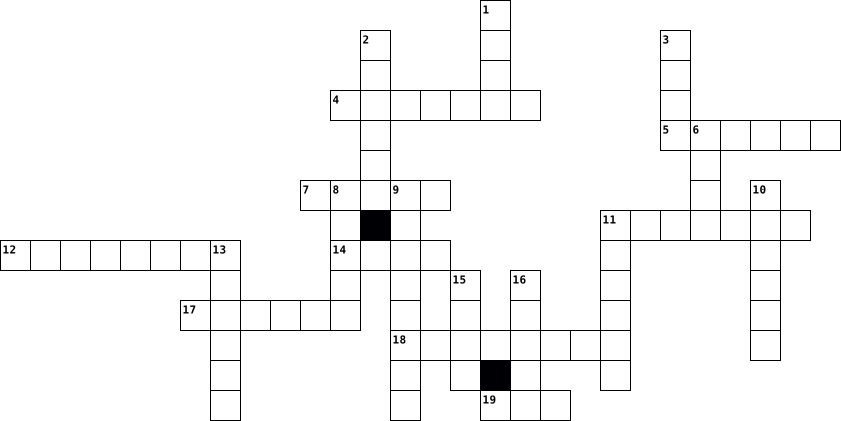
Across
- Day time is the_____in summer and the shortest in winter and spring and fall have the same number of daylight hours
- Stars shine by giving off ______ that spreads in different directions.
- We have weight depending on how much____of gravity is on us
- As the moon moves around the earth the sunlight and that's why we have different moon phases
- In the winter the sun is more______so the shadows point more north.
- What color are hot stars?
- The moon_____always has one side dark and one side light.
- The to sun from the earth is not the cause of the seasons.
- What color are cold stars
Down
- As the earth rotates around on it's_____it takes 24 hours which makes the day and night.
- the sun is brighter than other stars because it's ____.
- The moon changes_______depending on how much light from the sun is blocked out from the earth.
- At______an object's shadow is shortest but as the sun moves the sun makes the shadows get longer.
- The sun has a gravity that gravity is keeps the earth in the ____ of the sun's.
- What is the GD mascot
- Gravity pulls us to the _____ of the earth's
- Seasons are by indirect or direct sunlight.
- Different parts of the earth are______to the sun during different when one side is closer it’s summer.
- Shawdos in the summer point to the east and .
- There are 6 time zones in the USA each time zone is based on the of the sun.
20 Clues: What is the GD mascot • What color are hot stars? • What color are cold stars • Gravity pulls us to the _____ of the earth's • Seasons are by indirect or direct sunlight. • Shawdos in the summer point to the east and . • the sun is brighter than other stars because it's ____. • The moon_____always has one side dark and one side light. • ...
Creation Crossword 2025-03-02

Across
- The book of the Bible where the creation story is detailed.
- The cunning creature in Eden, who tempts eve in Genesis 3.
- Creatures of the water, created on the fifth day to inhabit the seas.
- The seventh day, when God rested, sanctifying it.
- The central figure who initiates and oversees creation.
- The land and foundational element shaped during creation.
- Celestial bodies made alongside the sun and moon.
- Also created on the fourth day to govern the night.
- Created on the fourth day to govern the day.
- Eve, formed from Adam’s rib in Genesis 2.
Down
- Domesticated animals, made on the sixth day as part of land creatures.
- Separated from the land, established on the third day.
- Created on the first day, symbolizing the beginning of order.
- The expanse or sky, formed on the second day.
- Creatures of the air, created on the fifth day to fill the skies.
- Paired with day, established in the first act of creation.
- Wild animals, created on the sixth day alongside cattle and man.
- The sequential periods (six days) during which creation unfolds.
- Eden, the paradise where Adam and Eve first dwelt.
- Humanity, created in God’s image on the sixth day.
20 Clues: Eve, formed from Adam’s rib in Genesis 2. • Created on the fourth day to govern the day. • The expanse or sky, formed on the second day. • The seventh day, when God rested, sanctifying it. • Celestial bodies made alongside the sun and moon. • Eden, the paradise where Adam and Eve first dwelt. • Humanity, created in God’s image on the sixth day. • ...
Earth Science 2024-03-21

Across
- The day to day condition of the atmosphere.
- major storms with very strong winds that form over warm ocean water and are caused by global weather patterns
- This system brings cool, dry air.
- a current in the atmosphere located over North America that moves West to East; it changes position from North or South seasonally
- Half of a sphere; the Earth is divided into the Northern Hemisphere and the Southern Hemisphere by the equator.
- The weight of air pressing against Earth.
- information collected
- a convection current where air flows from sea to land during the day
- These clouds bring rain
- The amount of moisture in the air.
- moves across great distances above the Earth; these wind patterns are stable and predictable; examples include Polar Easterlies, Prevailing Westerlies, and Trade Winds
- winds that blow West to East toward the poles in both hemispheres between 30° and 60° latitudes
- Middle clouds, partly cloudy skies, mild temperatures, look like fluffy cotton balls possible precipitation
- Low clouds, looks like a flat blanket, arranged in layers, cloudy skies, usually gray in color, cool temperatures, good chance for precipitation (50% or higher)
- The orbit of Earth around the Sun in an elliptical path, taking approximately 365 days (1 year). It determines the length of a year.
- The spin of Earth on its axis, completing one full rotation in approximately 24 hours (1 day). It causes day and night.
- a convection current where air flows from land to sea during the night
Down
- The point where the ocean meets the land, assigned zero elevation. It serves as a reference point for measuring elevation.
- A tool used to measure the weather.
- The tilt of Earth's axis at 23.5°, which is the main reason for the change in seasons throughout the year.
- the gathering of information
- High clouds, clear skies, warm temperatures, no precipitation, formed from ice crystals, called thin, wispy or stringy
- Distinct periods of the year characterized by changes in weather and daylight hours: summer, autumn (fall), winter, and spring.
- Unusually warm surface water temperatures in the Pacific Ocean that is caused by weak directional trade winds.
- A scientist who studies the weather.
- an imaginary line around the middle of the Earth; assigned 0° latitude
- The height of a location above sea level, which affects temperature and climate.
- Patch of land that has become a desert because of mountains blocking rainy weather.
- how hot or cold it is
- Storm clouds that form in all layers of the atmosphere, strong winds, heavy precipitation. Dark in color.
- The distance north or south of the equator, measured in degrees.
- Unusually cold surface water temperatures found in the Pacific Ocean that is caused by strong easterly trade winds.
- This system brings precipitation, warmer temperatures and moist air.
- An imaginary vertical line through the middle of the Earth between the North and South Poles. Earth rotates around its axis, causing the cycle of day and night.
- a warm water surface current in the Atlantic Ocean that moves from the southern tip of Florida up the east coast and then across the Atlantic.
- constant movement
36 Clues: constant movement • how hot or cold it is • information collected • These clouds bring rain • the gathering of information • This system brings cool, dry air. • The amount of moisture in the air. • A tool used to measure the weather. • A scientist who studies the weather. • The weight of air pressing against Earth. • The day to day condition of the atmosphere. • ...
Earth and the solar system 2022-06-22

Across
- Number of continents
- Who created the world
- Smallest continent
- Hottest planet
- Planet closest to the sun
- July 1st 1867
- Coldest planet
- Number of planets
- Coldest continent
- 365 Days
Down
- Independence day
- planet farther from the sun
- Covers 71% of the earth
- torus-shaped region
- Largest planet
- Before continents broke apart
- A dwarf planet
- Largest continent
- Planets orbit around it
19 Clues: 365 Days • July 1st 1867 • Hottest planet • Largest planet • A dwarf planet • Coldest planet • Independence day • Largest continent • Number of planets • Coldest continent • Smallest continent • torus-shaped region • Number of continents • Who created the world • Covers 71% of the earth • Planets orbit around it • Planet closest to the sun • planet farther from the sun • Before continents broke apart
Dis Donc 7 Unité 3 Lernziel 1 2021-03-07

Across
- habiter
- langue
- nuit
- couter
- chambre
- monde
- premier
- chaud
- jour
- froid
Down
- need
- apprendre
- legume
- mois
- troisieme
- viande
16 Clues: need • mois • nuit • jour • monde • chaud • froid • langue • legume • couter • viande • habiter • chambre • premier • apprendre • troisieme
astronomy 2025-02-03

Across
- Part of the mantle where rocks flow
- Half of the Earth
- Earth’s rigid outer layer
- Earth’s 23.5-degree feature
- Separation of layers in a planet
- Imaginary lines running east to west
- Imaginary lines running north to south
- Elliptical path in space
Down
- Opposite of perihelion
- earths outer most layer
- Movement of a planet around a star
- Earth layer named after a Croatian scientist
- Imaginary line around the Earth
- Layer between Earth's crust and core
- Causes day and night on Earth
- Wobbling motion of Earth's axis
- Heavy element formed in supernovae
17 Clues: Half of the Earth • Opposite of perihelion • earths outer most layer • Elliptical path in space • Earth’s rigid outer layer • Earth’s 23.5-degree feature • Causes day and night on Earth • Imaginary line around the Earth • Wobbling motion of Earth's axis • Separation of layers in a planet • Movement of a planet around a star • Heavy element formed in supernovae • ...
random 2025-10-07

Across
- The capital city of France.
- A person who teaches students.
- The natural satellite of Earth.
- What you use to write on paper.
- The place where you can borrow books
- The animal that says “meow.”
- The main language spoken in Japan.
- The opposite of “cold.”
- The device you use to talk to someone far away.
- The largest animal in the ocean.
- A person who studies at school.
Down
- A person who flies an airplane.
- The season after summer.
- The opposite of “big.”
- The day that comes after Friday.
- The planet we live on.
- The color of the sky on a clear day
- Frozen water
- A fruit that keeps the doctor away.
- A place where students study.
20 Clues: Frozen water • The opposite of “big.” • The planet we live on. • The opposite of “cold.” • The season after summer. • The capital city of France. • The animal that says “meow.” • A place where students study. • A person who teaches students. • A person who flies an airplane. • The natural satellite of Earth. • What you use to write on paper. • A person who studies at school. • ...
random 2025-10-08

Across
- The capital city of France.
- A person who teaches students.
- The natural satellite of Earth.
- What you use to write on paper.
- The place where you can borrow books.
- The animal that says “meow.”
- The main language spoken in Japan.
- The opposite of “cold.”
- The device you use to talk to someone far away.
- The largest animal in the ocean.
- A pet that barks
Down
- A person who flies an airplane.
- The season after summer.
- The opposite of “big.”
- The day that comes after Friday.
- The planet we live on.
- The color of the sky on a clear day
- Frozen water.
- A fruit that keeps the doctor away.
- where students learn
20 Clues: Frozen water. • A pet that barks • where students learn • The opposite of “big.” • The planet we live on. • The opposite of “cold.” • The season after summer. • The capital city of France. • The animal that says “meow.” • A person who teaches students. • A person who flies an airplane. • The natural satellite of Earth. • What you use to write on paper. • The day that comes after Friday. • ...
science word find 2013-10-29

Across
- also known as light of day
- around the north pole
- over a period of time
- appears to increase in size
- caused by gravitation
- different times
- a movement in a circle on a central axis
- the rise and fall of sea levels
- dividing the earth into northern and southern
- gives us light at night
- least difference between high and low water
Down
- the planet we live on
- half of the planet
- appears to decrease in size
- gives us light during the day
- an imanginary line
- Earths southmost content
- a sloping position
- marked by changes of weather
- warmest of the four temperate seasons
- to move in a circle around an axis or centre
21 Clues: different times • half of the planet • an imanginary line • a sloping position • the planet we live on • around the north pole • over a period of time • caused by gravitation • gives us light at night • Earths southmost content • also known as light of day • appears to decrease in size • appears to increase in size • marked by changes of weather • gives us light during the day • ...
Crossword Puzzle #2 2022-05-15

Across
- Exercise is to the body what__________ is to the mind
- The golden state
- To be, or not to be
- Downward dog
- Was not built in a day
- Prickly
- Carries oxygen throughout the body
- Tends to repeat itself
- Bendy
- April 15th
- Ultimate expression of affection
- God would never flood the earth again
- Worth six points in football
- Happiest place on earth
Down
- Largest organ in the body
- Commander in Chief
- By happen chance
- Where golf was born
- What time is spelled the same forwards and backwards?
- Last meal of the day
- They wrote a play about me
- Organism in the body that is both good and bad
- Unaware
- Largest land mammal
- Favoritism
25 Clues: Bendy • Prickly • Unaware • April 15th • Favoritism • Downward dog • By happen chance • The golden state • Commander in Chief • Where golf was born • To be, or not to be • Largest land mammal • Last meal of the day • Was not built in a day • Tends to repeat itself • Happiest place on earth • Largest organ in the body • They wrote a play about me • Worth six points in football • ...
random 2025-10-08

Across
- The capital city of France.
- A person who teaches students.
- The natural satellite of Earth.
- What you use to write on paper.
- The place where you can borrow books
- The animal that says “meow.”
- The main language spoken in Japan.
- The opposite of “cold.”
- The device you use to talk to someone far away.
- The largest animal in the ocean.
- A pet that barks.
Down
- A person who flies an airplane.
- The season after summer.
- The opposite of “big.”
- The day that comes after Friday
- The planet we live on.
- The color of the sky on a clear day.
- Frozen water.
- A fruit that keeps the doctor away.
- where students learn
20 Clues: Frozen water. • A pet that barks. • where students learn • The opposite of “big.” • The planet we live on. • The opposite of “cold.” • The season after summer. • The capital city of France. • The animal that says “meow.” • A person who teaches students. • A person who flies an airplane. • The day that comes after Friday • The natural satellite of Earth. • What you use to write on paper. • ...
Patterns of Earth and Sky 1 2021-04-08

Across
- How long it takes Earth to orbit the Sun
- Spring, summer, winter, and fall
- Person who studies stars, planets, galaxies
- to move in a circle around another object
- A group of stars that form a picture
- An illustration that shows how something works
Down
- The shape of Earth
- The distance light travels in a year
- Someone who travels into outer space
- The star closest to Earth
- How long it takes for Earth to rotate on its axis
- The planet we live on
- Something that orbits the Earth
- system The sun, moon, and planets that orbit the sun.
- The distance across a circle
- Measurements recorded in a science experiment
16 Clues: The shape of Earth • The planet we live on • The star closest to Earth • The distance across a circle • Something that orbits the Earth • Spring, summer, winter, and fall • The distance light travels in a year • Someone who travels into outer space • A group of stars that form a picture • How long it takes Earth to orbit the Sun • to move in a circle around another object • ...
Earth's Rotation & Sun and Shadows 2023-02-16

Across
- Objects you can't see through are called____
- The sun's path is higher in the ____ and lower in the ______.
- When the sun is very high in the sky, shadows will be ___.
- The sun moves across the sky from ___ to ___.
- On June 21st, the sun is very _____.
- Shadows give you information about the ____.
- In North America, the position of the noon sun gets higher in the sky from __________ 21 to _____ 21.
- When a shadow points north, the time is about _____.
- A ____ is the dark area behind an opaque object.
- The dark side of the earth is known as____.
Down
- The position of the noon sun gets lower in the sky each day between _____ 21 to ______ 21.
- The sun's position changes all day from sunrise to ________.
- The sun's position changes from _______ to _______.
- What spins like a top or rotates?
- The ______ does not move across the sky, though it appears to.
- The sun's position changes from season to season, which causes the ______ of shadows to change.
- The sunny side of earth is known as?
17 Clues: What spins like a top or rotates? • On June 21st, the sun is very _____. • The sunny side of earth is known as? • The dark side of the earth is known as____. • Objects you can't see through are called____ • Shadows give you information about the ____. • The sun moves across the sky from ___ to ___. • A ____ is the dark area behind an opaque object. • ...
My day 2020-03-15
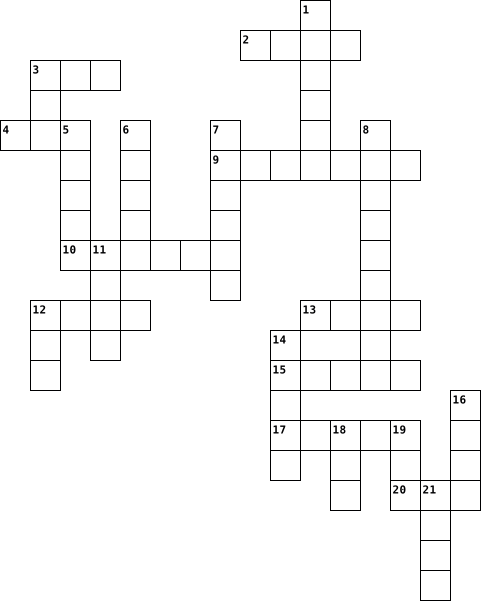
Across
- cztery
- sześć
- dziesięć
- biblioteka
- dwanaście
- ciemny
- grać
- ziemia
- osiem
- jeden
Down
- kolacja
- ona
- noc
- trzy
- jedenaście
- śniadanie
- pracować
- dzień
- siedem
- pięć
- up wstawać
- dwa
- dziewięć
23 Clues: ona • noc • dwa • trzy • grać • pięć • sześć • dzień • osiem • jeden • cztery • ciemny • siedem • ziemia • kolacja • dziesięć • pracować • dziewięć • śniadanie • dwanaście • jedenaście • biblioteka • up wstawać
Greek For All Lesson 4 2025-12-21

Across
- earth
- heart
- love
- life
- commandment
- parable
- day
- soul
Down
- writing
- church
- glory
- sin
- beginning
- voice
- hour
- disciple
16 Clues: sin • day • love • hour • life • soul • earth • heart • glory • voice • church • writing • parable • disciple • beginning • commandment
World Environment Day 2024-05-24

Across
- Dirty water of Industry
- Use the material again
- Protect the earth from harmful UV rays
- country will host the World Environment Day 2024
- Releasing Impurities into Environment
- waste that has ability to decompose naturally called
- Source of natural energy
- The method of storing rain water
- The process by which the plants make their food
Down
- One of the Global Issue
- Helps to sequestrate carbon dioxide
- All the physical surroundings on Earth
- Environment day celebrated in month of
- generating waste in less quantity
- species of tree that is recently banned in India
- Green House Gas
- Type of Fuel
- Cutting Forest for other purpose
- Things which have no further use
- Waste that is not biodegradable
20 Clues: Type of Fuel • Green House Gas • Use the material again • One of the Global Issue • Dirty water of Industry • Source of natural energy • Waste that is not biodegradable • Cutting Forest for other purpose • Things which have no further use • The method of storing rain water • generating waste in less quantity • Helps to sequestrate carbon dioxide • ...
Science ch11 2023-04-14

Across
- calendar that started in 622AD
- telescope created by Newton
- telephone engineer
- most important instrument used by astronomers
- small lens of a refracting telescope
- coordinated universal time
- a day that is one rotation of the earth relative to the stars
- dark lines where color is absorbed
- kalendae
- comes from an ancient word that means moon
- the most basic unit of time
Down
- spectrum produced by a spectroscope
- 24 hour time keeping
- object on a celestial sphere crosses an observers meridian
- computer controlled mirrors
- large lens of a refracting telescope
- based on the amount of time the earth was created
- calendar named for Pope Gregory
- level of detail
- Januarius
- equal night
21 Clues: kalendae • Januarius • equal night • level of detail • telephone engineer • 24 hour time keeping • coordinated universal time • telescope created by Newton • computer controlled mirrors • the most basic unit of time • calendar that started in 622AD • calendar named for Pope Gregory • dark lines where color is absorbed • spectrum produced by a spectroscope • ...
Goober NW 2026-01-21

Across
- A day based on the motion of stars
- When a planet goes around its star
- Discontinuity between the crust and mantle
- A gas layer surrounding planets
- The velocity required to escape a planet's gravity
- The tilt of a planet
- Layers separating by density
Down
- When a planet wobbles on it's axis
- When day and night are equal in spring
- A day based on movement of the sun in the sky
- What stops Earth from being fried by Solar rays?
- When a planet is closest from it's star
- When a planet is furthest from it's star
- The path planets take around stars
- The innermost layer of the Earth
- A layer containing part of the crust and part of the mantle
16 Clues: The tilt of a planet • Layers separating by density • A gas layer surrounding planets • The innermost layer of the Earth • When a planet wobbles on it's axis • A day based on the motion of stars • When a planet goes around its star • The path planets take around stars • When day and night are equal in spring • When a planet is closest from it's star • ...
Earth and the solar system 2022-06-22

Across
- Number of continents
- Who created the world
- Smallest continent
- Hottest planet
- Planet closest to the sun
- July 1st 1867
- Coldest planet
- Number of planets
- Coldest continent
- where we live on
Down
- Independence day
- planet farther from the sun
- Covers 71% of the earth
- torus-shaped region
- Largest planet
- Before continents broke apart
- A dwarf planet
- Largest continent
- Planets orbit around it
19 Clues: July 1st 1867 • Hottest planet • Largest planet • A dwarf planet • Coldest planet • Independence day • where we live on • Largest continent • Number of planets • Coldest continent • Smallest continent • torus-shaped region • Number of continents • Who created the world • Covers 71% of the earth • Planets orbit around it • Planet closest to the sun • planet farther from the sun • ...
science 2016-10-19

Across
- 1st layer of earth
- wind that is located along the equator
- wind blowing steadily toward the equator
- winds from the west toward the east
- a wind that occurs in a small area
- a breeze that happens at night
- layer of earth that contains the ozone layer
- blanket of gas around earth
- a breeze that happens in the day
Down
- wind that extend from the poles
- fast flowing currents
- part of the thermosphere
- the effect why the winds curve
- wind patterns
- protects us from meteors
- very hot layer of earth
- movement of air
17 Clues: wind patterns • movement of air • 1st layer of earth • fast flowing currents • very hot layer of earth • part of the thermosphere • protects us from meteors • blanket of gas around earth • the effect why the winds curve • a breeze that happens at night • wind that extend from the poles • a breeze that happens in the day • a wind that occurs in a small area • ...
earth day 2021-03-19

Across
- while you are brushing your teeth, turn off the faucet so you don't waste
- everything in the earth that is not made by people. The animals, plants, mountains and oceans are all part of
- bring cloth bags to the grocery store than can be reused again and again, instead of using _____ bags that will be thrown out.
Down
- Let's not litter and keep our parks_____
- instead of driving, walking or ride your bike, you can ____ energy
- Glass or plastic containers that have a narrow neck and usually holds liquid
- the 3R's : Reduce, Recycle and
7 Clues: the 3R's : Reduce, Recycle and • Let's not litter and keep our parks_____ • instead of driving, walking or ride your bike, you can ____ energy • while you are brushing your teeth, turn off the faucet so you don't waste • Glass or plastic containers that have a narrow neck and usually holds liquid • ...
Earth Day 2023-04-26

Across
- What is the theme of World Earth Day 2023?
- Which planet in our solar system has the most moons?
- Which day is celebrated as World Earth Day?
- What is the name of the largest volcano in our solar system, located on Mars?
Down
- Who proposed the idea of Earth Day first?
- Renewable source of Energy
- In which country was the first environment school established?
7 Clues: Renewable source of Energy • Who proposed the idea of Earth Day first? • What is the theme of World Earth Day 2023? • Which day is celebrated as World Earth Day? • Which planet in our solar system has the most moons? • In which country was the first environment school established? • What is the name of the largest volcano in our solar system, located on Mars?
Earth Day 2025-04-21

Across
- 1995 movie in which the main character tries to avoid 'hamming' it up
- Middle of Canada's finest?
- Like the beaches in Hudson
- "We'll always have _____"
Down
- Something that might be rock-hard in Quebec, but just plain rock in Perth
- A wish to the solver of this puzzle on this very special day
- A Pure Woman
7 Clues: A Pure Woman • "We'll always have _____" • Middle of Canada's finest? • Like the beaches in Hudson • A wish to the solver of this puzzle on this very special day • 1995 movie in which the main character tries to avoid 'hamming' it up • Something that might be rock-hard in Quebec, but just plain rock in Perth
Earth Day 2022-04-20

Across
- Change
- clean
- soil
Down
- Planting
- bad
- cleaning
- insects
7 Clues: bad • soil • clean • Change • insects • Planting • cleaning
Earth day 2026-04-21

Across
- household waste that decays nayurally
- reduce reuse
- cutting os trees
Down
- rain mixed harmful gases
- place full of trees
- instead of plastic
- plant more
7 Clues: plant more • reduce reuse • cutting os trees • instead of plastic • place full of trees • rain mixed harmful gases • household waste that decays nayurally
Dia de los muerto 2023-11-09

Across
- All Souls’ Day
- represents the element of fire
- all saints day
- represents a good memory
- represents the passing of spirits
- fruit in spanish
- day of the dead but in spanish
- marigolds and other flowers on an offrenda
- fruita in English
- where day of the dead is celebrated
- one of the groups of people who created day of the dead
- calavera in English
- represents the element of earth in an offrenda
- candles in spanish
- Made with sugar flowers
Down
- spanish people who came to Mexico
- represents the element of wind
- flowers on an offrenda
- pan de meurto in English
- the day were people make offrenda’s and offerings to lost loved ones
- water in Spanish
- November 2nd
- what is made on the day of the dead
- represents the element of water
- a skull(in spanish)
- November 1st
26 Clues: November 2nd • November 1st • All Souls’ Day • all saints day • fruit in spanish • water in Spanish • fruita in English • candles in spanish • a skull(in spanish) • calavera in English • flowers on an offrenda • Made with sugar flowers • pan de meurto in English • represents a good memory • represents the element of wind • represents the element of fire • day of the dead but in spanish • ...
🔭 Earth, Moon, & Sun Crossword Puzzle 2025-12-08

Across
- The motion of an object spinning on its axis.
- The sun is an average-sized_________.
- The side of the Earth facing away from the sun experiences this.
- The side of the Earth facing toward the sun experiences this.
- The phase of the moon when it appears fully sunlit.
- Earth's spinning motion that causes day and night.
Down
- The smallest object when comparing the Earth, Moon, and Sun.
- This object is made of burning, glowing gas and helium.
- The Moon's gravitational pull causes these.
- The Earth's tilted ____ and its revolution cause the seasons.
- When the Earth, Moon, and Sun are in a straight line, the tidal range is the ____.
- It takes the Earth this many hours to complete one rotation.
- The phase of the moon when it appears fully in shadow.
13 Clues: The sun is an average-sized_________. • The Moon's gravitational pull causes these. • The motion of an object spinning on its axis. • Earth's spinning motion that causes day and night. • The phase of the moon when it appears fully sunlit. • The phase of the moon when it appears fully in shadow. • This object is made of burning, glowing gas and helium. • ...
Reading Comprehension 3 Level 3 Vocabulary & Spelling 2013-01-14

Across
- wish, expect
- a store that sells food
- day somebody is born; anniversary of something’s beginning
- gift
- the fourth day of a week
- a dead person who seems to be alive
- the second day of a week
- vacation; legal day off work
- the sixth day of a week
- the fifth day of a week
- a woody plant with branches
- a mixture of raw vegetables
Down
- to create a hole by removing earth or dirt
- a style of clothes
- pigment; colored liquid for art
- most liked
- meat from a pig thigh; type of pork
- group
- the third day of a week
- a place to store or keep money
- a building for medical care
- body support made of bones
- group of paper sheets
- a tool used for painting; a tool used for combing hair
- a tool for digging; a scoop with a long handle
25 Clues: gift • group • most liked • wish, expect • a style of clothes • group of paper sheets • a store that sells food • the third day of a week • the sixth day of a week • the fifth day of a week • the fourth day of a week • the second day of a week • body support made of bones • a building for medical care • a woody plant with branches • a mixture of raw vegetables • vacation; legal day off work • ...
Earth Day Crossword Puzzle 2024-04-16

Across
- Threatened by extinction
- A form of energy derived from the sun
- There is hole in the ________________ layer
- Do not waste this, we all need it
- Where our garbage goes
- Third planet from the sun
- Farmer’s ____________: good place to buy food straight from the grower
- Pine, Oak, Walnut, for example
- Living things need clean ________ to breathe
Down
- When people gather to drive in one car
- To use over again
- To reclaim or reuse old materials in order new products
- Animals’ home
- Safe place for endangered animals
- Planting these helps create co2
15 Clues: Animals’ home • To use over again • Where our garbage goes • Threatened by extinction • Third planet from the sun • Pine, Oak, Walnut, for example • Planting these helps create co2 • Do not waste this, we all need it • Safe place for endangered animals • A form of energy derived from the sun • When people gather to drive in one car • There is hole in the ________________ layer • ...