
earth day Crossword Puzzles
Earth Science 2021-09-24

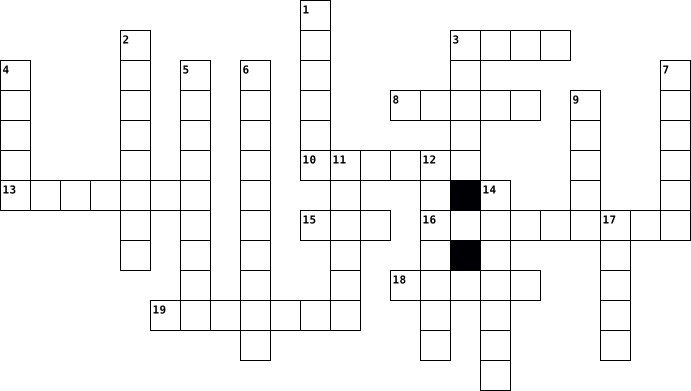
Across
- The study of composition, structure, properties and reactions to matter
- straight line between two points
- is a way of writing very large or small numbers
- a system of knowledge and methods used to solve problems
- the study of the universe and beyond
- the study of living things
Down
- the use of knowledge to solve problems.
- gauge of how accurate a measurement is
- the study of the origin, history, and structure of earth
- the study of matter and energy and their interactions
- a theory that is used to solve somthing
- international system of units
- measures the how hot or cold something is
- angle of incline or decline
- visual representation of something
15 Clues: the study of living things • angle of incline or decline • international system of units • straight line between two points • visual representation of something • the study of the universe and beyond • gauge of how accurate a measurement is • the use of knowledge to solve problems. • a theory that is used to solve somthing • measures the how hot or cold something is • ...
Earth Science 2021-09-22

Across
- is the use of knowledge to solve practical
- the amount of space that a substance or object occupies
- is the study of matter and energy and the interactions between the two through forces and motion.
- an instrument for measuring and indicating temperature
- the study of living organisms
- the study of the universe beyond Earth.
- a supposition or proposed explanation made on the basis of limited evidence as a starting point for further investigation.
Down
- the quality, condition, or fact of being exact and accurate.
- is the study of the composition, structure, properties, and reactions of matter.
- the degree of compactness of a substance.
- is a system of knowledge and the methods you use to find that knowledge.
- is the study of the origin,history, structure, and systems of Earth.
- the measurement or extent of something from end to end
- quantitative measure of inertia
- a small but exact copy of a thing
15 Clues: the study of living organisms • quantitative measure of inertia • a small but exact copy of a thing • the study of the universe beyond Earth. • the degree of compactness of a substance. • is the use of knowledge to solve practical • an instrument for measuring and indicating temperature • the measurement or extent of something from end to end • ...
Earth Systems 2021-09-10

Across
- colder water and more salt results in higher ____
- Earth's rocky sphere
- the passage of carbon through the spheres
- The ability to cause change
- The cold cycle that affects the US most during winter
- This hydrospheric phenomenon is most affected by the Coriolis Effect
- Anything that has mass and volume is this
- Earth's liquid sphere
- The part of the North Atlantic Gyres that brings warm weather to western Europe
Down
- the life zone of Earth
- controlled by the thermohaline gardient
- what causes gyres
- the frozen part of Earth's waters
- the gaseous envelope of Earth
- The hot cycle that affects the US most during winter
15 Clues: what causes gyres • Earth's rocky sphere • Earth's liquid sphere • the life zone of Earth • The ability to cause change • the gaseous envelope of Earth • the frozen part of Earth's waters • controlled by the thermohaline gardient • the passage of carbon through the spheres • Anything that has mass and volume is this • colder water and more salt results in higher ____ • ...
Sophie's Earth 2021-10-14

Across
- To grow, or develop opposite ways.
- Coming together.
- To break apart.
- Squeezing together.
- The upper layer of the earth's mantle, below the lithosphere.
- To change, or turn into
- Can deform but not lose toughness.
- a layer of silicate rock between the crust and the outer core.
Down
- A fluid layer about 2,400 km thick.
- the innermost geologic layer of the planet Earth.
- The rigid outer part of the earth, consisting of the crust and upper mantle.
- Earth's lightest, most buoyant rock layer
- Energy building up.
- To be fragile.
- A long narrow ditch.
15 Clues: To be fragile. • To break apart. • Coming together. • Energy building up. • Squeezing together. • A long narrow ditch. • To change, or turn into • To grow, or develop opposite ways. • Can deform but not lose toughness. • A fluid layer about 2,400 km thick. • Earth's lightest, most buoyant rock layer • the innermost geologic layer of the planet Earth. • ...
Earth Layers 2021-10-18

Across
- Made of liquid nickel and iron
- In the oceanic crust
- Made of molten and rocks
- Heat causing rocks to rise and fall
- Thinnest layer
- Way geologists use to study the layers
- Farthest to the mantle of the crust
- Pressurized into a ball
Down
- The cause of earthquakes during to much movement
- Closest to mantle of the crust
- About the size of Pluto
- Reason things don't float
- Reason things sink
- Reason we can't explore oceans fully
- In the continental crust
15 Clues: Thinnest layer • Reason things sink • In the oceanic crust • About the size of Pluto • Pressurized into a ball • Made of molten and rocks • In the continental crust • Reason things don't float • Made of liquid nickel and iron • Closest to mantle of the crust • Heat causing rocks to rise and fall • Farthest to the mantle of the crust • Reason we can't explore oceans fully • ...
Earth Science 2022-04-05

Across
- branch of biology that deals with the relations of organisms to one another and to their physical surroundings.
- Energy is the capacity for doing work. It may exist in potential, kinetic, thermal, electrical, chemical, nuclear, or other forms.
- The six-step model in which a scientist uses to evaluate something: 1. asking a question 2. Background research 3. Constructing a hypothesis 4. Test hypothesis 5. analysis 6. Conclusion
- Convection is the rising motion of warmer areas of a liquid or gas, and the sinking motion of cooler areas of liquid or gas, sometimes forming a complete cycle.
- The rock cycle is a concept used to explain how the three basic rock types are related and how Earth processes, over geologic time, change a rock from one type into another.
- They are unable to create their own energy, so they eat other organisms.
- In meteorology, precipitation is any product of the condensation of atmospheric water vapor that falls under gravitational pull from clouds.
Down
- The responsibility we possess to preserve natural resources and protect ecosystems.
- Evaporation is the process by which water changes from a liquid to a gas or vapor.
- Make their own food most likely plants.
- In biology, an identification key, taxonomic key, or biological key is a printed or computer-aided device that aids the identification of biological entities, such as plants, animals, fossils, microorganisms, and pollen grains.
- The father products travel the more fuel which is consumed. Which contributes to climate change and global warming.
- A group of interacting species living in the same area.
- A renewable resource is one that can be used repeatedly and does not run out because it is naturally replaced.
- Upwelling is an oceanographic phenomenon that involves wind-driven motion of dense, cooler, and usually nutrient-rich water from deep water towards the ocean surface.
15 Clues: Make their own food most likely plants. • A group of interacting species living in the same area. • They are unable to create their own energy, so they eat other organisms. • Evaporation is the process by which water changes from a liquid to a gas or vapor. • The responsibility we possess to preserve natural resources and protect ecosystems. • ...
Earth Quakes 2022-03-29

Across
- many different waves that form an earthquake
- a country in Asia that has the most quakes
- when the tectonic plates hit they...
- plates series of plates beneath the earth
- when earthquakes happen may erupt and...
- the ground shakes this is called...
- usually when they happen things fall in
- things that occur after and earthquake
Down
- They can explode because earthquakes trigger
- the earth does this when the plates hit
- most earthquakes are small you can feel them
- big waves created after earthquakes
- rain forests and south eastern island
- south central European country tourist place
- biggest Earthquake ever recorded
15 Clues: biggest Earthquake ever recorded • big waves created after earthquakes • the ground shakes this is called... • when the tectonic plates hit they... • rain forests and south eastern island • things that occur after and earthquake • the earth does this when the plates hit • usually when they happen things fall in • when earthquakes happen may erupt and... • ...
warming earth 2022-05-02

Across
- A deciduous forest is a bio-me dominated by deciduous trees which lose their leaves seasonally.
- the variety of life in the hard world or in a particular habitat or ecosystem.
- the process by which green plants and some other organisms use sunlight to synthesize foods from carbon dioxide and water. Photosynthesis in plants generally involves the green pigment chlorophyll and generates oxygen as a byproduct.
- (of electromagnetic radiation) having a wavelength just greater than that of the red end of the visible light spectrum but less than that of microwaves. Infrared radiation has a wavelength from about 800 nm to 1 mm, and is emitted particularly by heated objects.
- physical substance in general, as distinct from mind and spirit; (in physics) that which occupies space and possesses rest mass, especially as distinct from energy.
- a green pigment, present in all green plants and in cyanobacteria, responsible for the absorption of light to provide energy for photosynthesis. Its molecule contains a magnesium atom held in a porphyritic ring.
Down
- the arrangement of the natural and artificial physical features of an area.
- a colorless, odorless, highly flammable gas, the chemical element of atomic number 1.
- structure and properties of matter"
- the process or result of joining two more things together to form a single entity.
- the strength and vitality required for sustained physical or mental activity.
- energy radiant energy emitted by the sun
- a vast, flat, treeless Arctic region of Europe, Asia, and North America in which the subsoil is permanently frozen.
- the star around which the earth orbits.
- the envelop of gases surrounding the earth or another planet.
15 Clues: structure and properties of matter" • the star around which the earth orbits. • energy radiant energy emitted by the sun • the envelop of gases surrounding the earth or another planet. • the arrangement of the natural and artificial physical features of an area. • the strength and vitality required for sustained physical or mental activity. • ...
warming earth 2022-05-02

Across
- A deciduous forest is a bio-me dominated by deciduous trees which lose their leaves seasonally.
- the variety of life in the hard world or in a particular habitat or ecosystem.
- the process by which green plants and some other organisms use sunlight to synthesize foods from carbon dioxide and water. Photosynthesis in plants generally involves the green pigment chlorophyll and generates oxygen as a byproduct.
- (of electromagnetic radiation) having a wavelength just greater than that of the red end of the visible light spectrum but less than that of microwaves. Infrared radiation has a wavelength from about 800 nm to 1 mm, and is emitted particularly by heated objects.
- physical substance in general, as distinct from mind and spirit; (in physics) that which occupies space and possesses rest mass, especially as distinct from energy.
- a green pigment, present in all green plants and in cyanobacteria, responsible for the absorption of light to provide energy for photosynthesis. Its molecule contains a magnesium atom held in a porphyritic ring.
Down
- the arrangement of the natural and artificial physical features of an area.
- a colorless, odorless, highly flammable gas, the chemical element of atomic number 1.
- structure and properties of matter"
- the process or result of joining two more things together to form a single entity.
- the strength and vitality required for sustained physical or mental activity.
- energy radiant energy emitted by the sun
- a vast, flat, treeless Arctic region of Europe, Asia, and North America in which the subsoil is permanently frozen.
- the star around which the earth orbits.
- the envelop of gases surrounding the earth or another planet.
15 Clues: structure and properties of matter" • the star around which the earth orbits. • energy radiant energy emitted by the sun • the envelop of gases surrounding the earth or another planet. • the arrangement of the natural and artificial physical features of an area. • the strength and vitality required for sustained physical or mental activity. • ...
warming earth 2022-05-02

Across
- A deciduous forest is a bio-me dominated by deciduous trees which lose their leaves seasonally.
- the variety of life in the hard world or in a particular habitat or ecosystem.
- the process by which green plants and some other organisms use sunlight to synthesize foods from carbon dioxide and water. Photosynthesis in plants generally involves the green pigment chlorophyll and generates oxygen as a byproduct.
- (of electromagnetic radiation) having a wavelength just greater than that of the red end of the visible light spectrum but less than that of microwaves. Infrared radiation has a wavelength from about 800 nm to 1 mm, and is emitted particularly by heated objects.
- physical substance in general, as distinct from mind and spirit; (in physics) that which occupies space and possesses rest mass, especially as distinct from energy.
- a green pigment, present in all green plants and in cyanobacteria, responsible for the absorption of light to provide energy for photosynthesis. Its molecule contains a magnesium atom held in a porphyritic ring.
Down
- the arrangement of the natural and artificial physical features of an area.
- a colorless, odorless, highly flammable gas, the chemical element of atomic number 1.
- structure and properties of matter"
- the process or result of joining two more things together to form a single entity.
- the strength and vitality required for sustained physical or mental activity.
- energy radiant energy emitted by the sun
- a vast, flat, treeless Arctic region of Europe, Asia, and North America in which the subsoil is permanently frozen.
- the star around which the earth orbits.
- the envelop of gases surrounding the earth or another planet.
15 Clues: structure and properties of matter" • the star around which the earth orbits. • energy radiant energy emitted by the sun • the envelop of gases surrounding the earth or another planet. • the arrangement of the natural and artificial physical features of an area. • the strength and vitality required for sustained physical or mental activity. • ...
Dynamic Earth 2022-01-31

Across
- contains the ozone layer
- holes deep into the ground to reach a reservoir
- between the troposphere and the stratosphere
- ability of a material to let water pass
- organisms each dependent as a source of food
- a chemical in atmosphere necessary for organisms
- rocklayer that stores/allows flow of groundwater
- weather occurs here
Down
- sinking land due to excessive use of groundwater
- degree of types of people or animals are found
- layer before the exosphere
- biological community of interacting organisms
- in between the Mesosphere and the Thermosphere
- liquid water to gaseous water
- plants using sun to create energy
15 Clues: weather occurs here • contains the ozone layer • layer before the exosphere • liquid water to gaseous water • plants using sun to create energy • ability of a material to let water pass • between the troposphere and the stratosphere • organisms each dependent as a source of food • biological community of interacting organisms • degree of types of people or animals are found • ...
Dynamic Earth 2022-01-27

Across
- Supercontinent
- This place rocks!
- Rain, sleet, and snow
- What we breathe in
- What happens when plates collide
- CO2,CH4,N2O
- The underground layer that stores water
Down
- The continuous movement of water on earth
- Both on Earth and on pizza
- Made up of different gases
- Liquid to gas
- Gaseous layer that shouldn't be depleted
- Gas to liquid
- Where all life lives
- Where meteors burn up
15 Clues: CO2,CH4,N2O • Liquid to gas • Gas to liquid • Supercontinent • This place rocks! • What we breathe in • Where all life lives • Rain, sleet, and snow • Where meteors burn up • Both on Earth and on pizza • Made up of different gases • What happens when plates collide • The underground layer that stores water • Gaseous layer that shouldn't be depleted • ...
Earth Science 2023-08-22

Across
- Dropping of sediment in a new location
- Cold solid that can cause erosion
- Extremely hot land form, dry with sand
- Colorful landform created from skeletons underwater
- Movement of sediment
- Landform that has magma, erupts lava
- Landform made by sand being moved by the wind and dropped making hills
Down
- Clear liquid that can cause erosion
- Created when rocks underground collided, Tall
- Rocks and sediment moved and dropped by a glacier
- Hawaii is a type of landform called
- Breaking of Rock
- Force that breaks down landforms
- Force that builds up landforms
- Landform located at mouth of river; "Veins"
15 Clues: Breaking of Rock • Movement of sediment • Force that builds up landforms • Force that breaks down landforms • Cold solid that can cause erosion • Clear liquid that can cause erosion • Hawaii is a type of landform called • Landform that has magma, erupts lava • Dropping of sediment in a new location • Extremely hot land form, dry with sand • ...
earth science 2024-02-14

Across
- what lies between Earth's dense, super-heated core and its thin outer layer, the crust
- The mineral make up of a rock
- the second most outer most layer of the earth
- minerals made of silicate groups that form rocks
- the thickest layer of the mantle
- last layer of the earth
- the outer most layer of the earth
- 2,900-5,150 km below the surface
Down
- When rocks disintegrate or break up without experiencing any change in their chemical composition
- high concentration of ozone that is found in the stratosphere
- the boundary zone between Earth's crust and the mantle
- the very hot very dense center of our planet
- hot magma sent though vents
- the speed that the silicate grows
- third planet closest to the sun
15 Clues: last layer of the earth • hot magma sent though vents • The mineral make up of a rock • third planet closest to the sun • the thickest layer of the mantle • 2,900-5,150 km below the surface • the speed that the silicate grows • the outer most layer of the earth • the very hot very dense center of our planet • the second most outer most layer of the earth • ...
Earth science 2023-10-26

Across
- to keep to something longer
- enough
- the whole air in the planet
- statement or conclusion of some academic stuff
- some kinds of lives live in the land
- extinction
- to replace
- decide to do
- some very tiny life
- the market goal or target
Down
- take care of the environment
- activated something
- to disturb or stop
- suffer hunger
- die or extinct
15 Clues: enough • extinction • to replace • decide to do • suffer hunger • die or extinct • to disturb or stop • activated something • some very tiny life • the market goal or target • to keep to something longer • the whole air in the planet • take care of the environment • some kinds of lives live in the land • statement or conclusion of some academic stuff
Earth Systems 2020-05-25

Across
- The atmospheric layer lying between the troposphere and the mesosphere
- Middle of something
- third planet in our solar system
- Regular sequence
- Something that occupies space
- rock from outer space
- Water storage place
Down
- How green plants use sunlight
- Air around the Earth
- Earth's liquid and frozen surface waters, groundwater and atmospheric water vapor
- Zone of life
- heat transfer method
- Most of Earth's volume
- It gets decorated for Christmas
- Small objects that are hard small and dense
15 Clues: Zone of life • Regular sequence • Middle of something • Water storage place • Air around the Earth • heat transfer method • rock from outer space • Most of Earth's volume • How green plants use sunlight • Something that occupies space • It gets decorated for Christmas • third planet in our solar system • Small objects that are hard small and dense • ...
earth 3 2024-05-17

Across
- Ground that remains frozen for at least two consecutive years
- A fragment of rock or metal from space that has landed on Earth
- The point on the Earth's surface directly above the focus of an earthquake
- The bottom of the ocean
- The scale used to measure the magnitude of earthquakes
- Layers of rock
Down
- Relating to the heat produced within the Earth
- A natural or artificial lake used to store water
- The supercontinent that existed during the late Paleozoic and early Mesozoic eras
- Relating to the structure or movement of the Earth's crust
- A landform at the mouth of a river where it fans out into several branches before entering a larger body of water
- The process by which one tectonic plate moves under another
- The location within the Earth where an earthquake originates
- A type of landscape formed by the dissolution of soluble rocks such as limestone
- A deep gorge typically one with a river flowing through it
15 Clues: Layers of rock • The bottom of the ocean • Relating to the heat produced within the Earth • A natural or artificial lake used to store water • The scale used to measure the magnitude of earthquakes • Relating to the structure or movement of the Earth's crust • A deep gorge typically one with a river flowing through it • ...
Earth Month 2024-04-24

Across
- The introduction of harmful materials into the environment
- Warming the long-term warming of the planet's overall temperature
- The physical world and everything in it; not made by the people
- To convert waste into reusable material
- To use something again, especially for a different purpose
- Waste material that is no longer needed or wanted
Down
- Natural or artificial substance that improves plant growth and productiveness
- A living thing that grows in soil and has a stem, leaves, and roots
- To make something smaller or use less of it
- A synthetic material; one of the main pollution for marine life and ecosystems
- A huge body of saltwater that covers about 71 percent of Earth's surface
- Waster material that is discarded improperly
- A biological community of interacting organisms and their physical environment
- Tall woody plants with a single main stem or trunk and many branches
- The planet on which we live
15 Clues: The planet on which we live • To convert waste into reusable material • To make something smaller or use less of it • Waster material that is discarded improperly • Waste material that is no longer needed or wanted • The introduction of harmful materials into the environment • To use something again, especially for a different purpose • ...
earth process 2024-05-30

Across
- split
- decomposes rocks
- dissolves
- inclination
- thickness
- settling down
- friction and impact
- chemically
Down
- reaction
- physical
- removal
- disintegration
- breakdown
- attracts
- heavier
15 Clues: split • removal • heavier • reaction • physical • attracts • dissolves • breakdown • thickness • chemically • inclination • settling down • disintegration • decomposes rocks • friction and impact
Restless Earth 2025-04-07

Across
- tectonic plates move towards eachother
- sudden events that lead to mass extinction
- formed after weathering and erosion
- large rigid pieces of the Earth's lithosphere
- extinction events that occur over a long time
- tectonic plates move away from eachother
- includes the crust and upper part of the mantle and is divided into tectonic plates
- formed as a result of high temperature and pressure
Down
- located between mantle and outer core
- A group of the same species in an area
- hot materials rise cold materials sink it drives tectonic plates
- tectonic plates slide past eachother
- instrument used to measure seismic waves
- The semifluid layer of the mantle
- rock formed when lava cools/ hardens
15 Clues: The semifluid layer of the mantle • formed after weathering and erosion • tectonic plates slide past eachother • rock formed when lava cools/ hardens • located between mantle and outer core • tectonic plates move towards eachother • A group of the same species in an area • instrument used to measure seismic waves • tectonic plates move away from eachother • ...
Earth Science 2025-05-14

Across
- Study of the Earth and its structure and composition
- process by which crystals from in a mineral or rock
- all the water on Earth
- type of rock that forms from magma or lava
- plates move away from each other
- outermost layer of Earth’s system, where weather occurs compose of mostly N and O
- The Earth itself; composed of three layers
Down
- refers to the total amount of energy released during an earthquake
- Point on the Earth’s surface directly above where the rock first broke or moved to start an earthquake
- The soft layer of the mantle on which the lithosphere floats
- type of rock that forms from great heat and pressure
- The strong, lower part of the mantle between the asthenosphere and the outer core
- all the living things on Earth
- layer of the Earth that is divided into plates
- fastest seismic my wave that can travel through liquids and solids
15 Clues: all the water on Earth • all the living things on Earth • plates move away from each other • type of rock that forms from magma or lava • The Earth itself; composed of three layers • layer of the Earth that is divided into plates • process by which crystals from in a mineral or rock • Study of the Earth and its structure and composition • ...
Earth Science 2025-05-13

Across
- Reservoirs containing molten rock beneath the surface of a volcano
- The force per unit area that increases with the Earth's depth
- The layer of Earth divided into plates
- The Earth itself
- Type of igneous rock formed inside of the Earth
Down
- Type of rock formed from intense heat and pressure
- The process of breaking down rocks and materials on Earth's surface caused by wind, rain, and other natural forces
- Molten rock at or above Earth's surface
- Composed of 3 parts; The middle layer of Earth
- A solid, inorganic element or compound that makes up rocks
- The study of Earth
- The continuous process on the surface and inside Earth that transforms rocks from one kind to another
- Type of rock formed from sediments
- Type of rock formed from cooled magma or lava
- The measure of the kinetic energy of particles within a substance that increases with Earth's depth
15 Clues: The Earth itself • The study of Earth • Type of rock formed from sediments • The layer of Earth divided into plates • Molten rock at or above Earth's surface • Type of rock formed from cooled magma or lava • Composed of 3 parts; The middle layer of Earth • Type of igneous rock formed inside of the Earth • Type of rock formed from intense heat and pressure • ...
earth science 2023-05-07

Across
- a system of winds around a central region of low air pressure
- a device that measures wind speed and direction
- the warming of the oceans surface above average sea surface temps
- the transfer heat energy through space by magnetic waves
- an instrument that measures air pressure
- the force exerted on a surface by the air above it
- the fraction of total radiation that is reflected back by the surface
- the natural movement of air and other gases relative to earths surface
Down
- a line connecting points of equal temperature
- any solid particles suspended in the atmosphere
- a wind from the direction that is predominant at a particular place or season
- a molecule of oxygen containing three oxygen atoms
- a measure of the average kinetic energy of individual atoms or molecules
- large scale circulation of winds around a central region of high air pressure
- a seasonal prevailing wind in the south and southeast of Asia
15 Clues: an instrument that measures air pressure • a line connecting points of equal temperature • any solid particles suspended in the atmosphere • a device that measures wind speed and direction • a molecule of oxygen containing three oxygen atoms • the force exerted on a surface by the air above it • the transfer heat energy through space by magnetic waves • ...
Earth Science 2024-11-06

Across
- Heat measurement
- Visible manifestation of the process of rock formation
- Minimum melting temperature
- Solidification of magma form's
- Magma formation process
- Magma's mass/volume ratio
- Ejects ash and larger fragments of pyroclastic material
Down
- Results lava fountain and lava flow
- Process causing the magma to melt as pressure drops
- Magma's flow resistance
- Gases trapped in magma
- Melting temperature reducer
- Magma process seperating minerals
- Substance's molecular structure
- Molten rock beath Earth’s surface
15 Clues: Heat measurement • Gases trapped in magma • Magma's flow resistance • Magma formation process • Magma's mass/volume ratio • Minimum melting temperature • Melting temperature reducer • Solidification of magma form's • Substance's molecular structure • Magma process seperating minerals • Molten rock beath Earth’s surface • Results lava fountain and lava flow • ...
Earth Science 2024-11-06

Across
- Heat measurement
- Visible manifestation of the process of rock formation
- Minimum melting temperature
- Solidification of magma form's
- Magma formation process
- Magma's mass/volume ratio
- Ejects ash and larger fragments of pyroclastic material
Down
- Results lava fountain and lava flow
- Process causing the magma to melt as pressure drops
- Magma's flow resistance
- Gases trapped in magma
- Melting temperature reducer
- Magma process seperating minerals
- Substance's molecular structure
- Molten rock beath Earth’s surface
15 Clues: Heat measurement • Gases trapped in magma • Magma's flow resistance • Magma formation process • Magma's mass/volume ratio • Minimum melting temperature • Melting temperature reducer • Solidification of magma form's • Substance's molecular structure • Magma process seperating minerals • Molten rock beath Earth’s surface • Results lava fountain and lava flow • ...
Planet Earth 2025-09-16

Across
- planeta
- biodegradável
- reduzir
- luzes
- meio ambiente
- desligar
- poupar
Down
- lixo
- reciclar
- terra
- reutilizar
- separar
- água
- energia
- árvores
15 Clues: lixo • água • terra • luzes • poupar • planeta • separar • reduzir • energia • árvores • reciclar • desligar • reutilizar • biodegradável • meio ambiente
Earth / Weather 2026-01-06

Across
- – a hard, solid part of the Earth
- – dirt that helps plants grow
- – how hot or cold something is
- – to find how much or how many
- – weather with lots of sunshine
- – a liquid found in rivers, lakes, and oceans
- – the solid part of Earth
- – weather with falling water from clouds
Down
- – to watch carefully
- – weather with many clouds
- – one part of the year with certain weather
- – the planet we live on
- – strong weather with wind, rain, or thunder
- – what the air is like outside
- – weather with moving air
15 Clues: – to watch carefully • – the planet we live on • – weather with moving air • – the solid part of Earth • – weather with many clouds • – dirt that helps plants grow • – how hot or cold something is • – to find how much or how many • – what the air is like outside • – weather with lots of sunshine • – a hard, solid part of the Earth • – weather with falling water from clouds • ...
everything earth 2025-12-27

Across
- amount of satellites orbiting earth
- the greater London areas most popular railway
- name of sun earth orbits
- earths human population
- capital of Canada
- earths twin
- USA city named after English town in Lincolnshire
Down
- largest city in svalbard
- where was the compass invented
- capital of Zimbabwe
- amount of independent countries
- largest ocean on earth
- number of continents
- worlds smallest country
- boot shaped European country
15 Clues: earths twin • capital of Canada • capital of Zimbabwe • number of continents • largest ocean on earth • worlds smallest country • earths human population • largest city in svalbard • name of sun earth orbits • boot shaped European country • where was the compass invented • amount of independent countries • amount of satellites orbiting earth • ...
The 7 Days 2024-06-22

Across
- God said "Let them be for signs, and for _______, and for days, and years." (Genesis 1:14)
- God made the _______ and divided the waters. (Genesis 1:7)
- On the seventh day God ended his work and he _______ from all his work. (Genesis 2:2)
- God said "Let the earth bring forth _______, the herb yielding seed." (Genesis 1:11)
- God made two great lights; he made the _______ also. (Genesis 1:16)
Down
- God called the dry land _______. (Genesis 1:10)
- God said unto them, "Be fruitful, and multiply, and replenish the earth, and have _______ over the fish of the sea." (Genesis 1:28)
- God said "Let there be _______." (Genesis 1:3)
- God said, "Let us make _______ in our image, after our likeness." (Genesis 1:26)
- God called the gathering together of the waters _______. (Genesis 1:10)
- God created great whales, and every living _______ that moveth. (Genesis 1:21)
11 Clues: God said "Let there be _______." (Genesis 1:3) • God called the dry land _______. (Genesis 1:10) • God made the _______ and divided the waters. (Genesis 1:7) • God made two great lights; he made the _______ also. (Genesis 1:16) • God called the gathering together of the waters _______. (Genesis 1:10) • ...
Moon, Eclipses, Tides 2022-02-16

Across
- Dates during the Earth's revolution around the sun when day/night are approximately equal (12 hours each). Official start of spring and fall.
- The partial or total blocking of one object in space by another
- to spin on an axis
- Imaginary line that runs from North Pole to South Pole
- the curved sickle shape of the waxing or waning moon.
- Dates during the Earth's revolution around the sun when the North Pole / South Pole are tilted directly at the sun. Longest/shortest days of the year depending on which hemisphere is tilted towards/away
- a tide just after a new or full moon, when there is the greatest difference between high and low water.
- describes phases following a new moon, as more of the Moon's lighted side becomes visible
- moon phase when the entire side facing Earth is illuminated.
Down
- a tide just after the first or third quarters of the moon when there is the least difference between high and low water.
- The moon is a quarter of the way around the Earth. You can see the right half of the moon.
- to move around another object
- an eclipse in which the moon appears darkened as it passes into the earth's shadow.
- Left half of the disk is illuminated, and the cycle is in the waning phase.
- The periodic rise and fall of the level of water in the ocean
- becoming less bright, intense, or strong
- Moon phase that occurs when the Moon is between Earth and the Sun, at which point the Moon cannot be seen because its lighted half is facing the Sun and its dark side faces Earth.
- Moon phase in which more than half of the Moon appears to be illuminated.
18 Clues: to spin on an axis • to move around another object • becoming less bright, intense, or strong • the curved sickle shape of the waxing or waning moon. • Imaginary line that runs from North Pole to South Pole • moon phase when the entire side facing Earth is illuminated. • The periodic rise and fall of the level of water in the ocean • ...
The 7 Days 2024-06-22

Across
- God said "Let them be for signs, and for _______, and for days, and years." (Genesis 1:14)
- God made the _______ and divided the waters. (Genesis 1:7)
- On the seventh day God ended his work and he _______ from all his work. (Genesis 2:2)
- God said "Let the earth bring forth _______, the herb yielding seed." (Genesis 1:11)
- God made two great lights; he made the _______ also. (Genesis 1:16)
Down
- God called the dry land _______. (Genesis 1:10)
- God said unto them, "Be fruitful, and multiply, and replenish the earth, and have _______ over the fish of the sea." (Genesis 1:28)
- God said "Let there be _______." (Genesis 1:3)
- God said, "Let us make _______ in our image, after our likeness." (Genesis 1:26)
- God called the gathering together of the waters _______. (Genesis 1:10)
- God created great whales, and every living _______ that moveth. (Genesis 1:21)
11 Clues: God said "Let there be _______." (Genesis 1:3) • God called the dry land _______. (Genesis 1:10) • God made the _______ and divided the waters. (Genesis 1:7) • God made two great lights; he made the _______ also. (Genesis 1:16) • God called the gathering together of the waters _______. (Genesis 1:10) • ...
On the Map Crossword 2024-04-08

Across
- A model of Earth
- The imaginary line that connects the North Pole to the South Pole
- The imaginary line around the middle of the earth
- Half of Earth
- A large area of water on Earth
- A hill of sand formed by the wind
- A low area between hills or Mountains
- The planet that we live on
- Something that shows where places are located
- Cities and towns are built on this
Down
- Most of the Earth is covered in it
- A map shows the land and water on this layer of Earth
- A large body of water with land all around it
- A large area of land on Earth
- A stream of fresh water that flows into a lake or ocean
- A lake made by people to store water
- A tool used to know which way to go
- A massive, raised area of land
- A rounded, raised are of land
- An area of land covered by Water
20 Clues: Half of Earth • A model of Earth • The planet that we live on • A large area of land on Earth • A rounded, raised are of land • A massive, raised area of land • A large area of water on Earth • An area of land covered by Water • A hill of sand formed by the wind • Most of the Earth is covered in it • Cities and towns are built on this • A tool used to know which way to go • ...
biology 2023-10-02

Across
- Substances created during a chemical reaction
- Type of organism that must eat other organism that must eat other organisms to obtain energy.
- Describes a situation in which oxygen is present
- Third step of aerobic respirations
- Type of oganism that breaks down biotic compound into abiotic compunds, recyclers
- Process of using light energy to make glucose
- Sphere of earth, all living things on earth
- Anything that has mass and takes up space
- organelle, site of steps 2 and 3 aerobic cellular respiration
- Sphere of earth, all the water on earth
Down
- Type of organism that is able to make its own food
- Sphere of earth, all the gases surrounding earth
- Describes a situation in which oxygen is not present
- Second step of respiration
- Sphere of earth, all the rocks and soil on earth
- Organelle, site of photosynthesis
- Pigment in chloroplasts used to trap light energy during photsynthesis
- Second step of Aerobic respiration
- First step of Aerobic Respiration
- Substances at the beginning of a chemical reaction
20 Clues: Second step of respiration • Organelle, site of photosynthesis • First step of Aerobic Respiration • Third step of aerobic respirations • Second step of Aerobic respiration • Sphere of earth, all the water on earth • Anything that has mass and takes up space • Sphere of earth, all living things on earth • Substances created during a chemical reaction • ...
PD3 2025-11-16

Across
- First actinide element
- Rare earth used in lasers
- Precious metal used in jewelry and catalysts
- High melting point metal in filaments
- Rare earth in magnets and lasers
- Heaviest lanthanide element
- Corrosion-resistant metal in electronics
- Toxic metal formerly used in electronics
- Extremely rare, highly radioactive alkali metal
- Low-toxicity heavy metal with rainbow crystals
- Rare earth used in magnets
- Radioactive rare earth element
- Radioactive alkaline earth discovered by Curie
Down
- Rare earth used in lasers and alloys
- Metal in nuclear reactor control rods
- Rare earth used in MRI contrast
- Fluorescent material in screens
- Heavy, soft metal, symbol Pb
- Rare metal in superalloys
- Shiny yellow metal, symbol Au
- Radioactive noble gas
- Very hard, corrosion-resistant metal
- Rare, radioactive halogen
- Only metal liquid at room temperature
- Green phosphor in displays
- Radioactive metalloid discovered by Curie
- Least abundant lanthanide
- Densest naturally occurring element
- Pinkish rare earth in fiber optics
29 Clues: Radioactive noble gas • First actinide element • Rare earth used in lasers • Rare metal in superalloys • Rare, radioactive halogen • Least abundant lanthanide • Green phosphor in displays • Rare earth used in magnets • Heaviest lanthanide element • Heavy, soft metal, symbol Pb • Shiny yellow metal, symbol Au • Radioactive rare earth element • Rare earth used in MRI contrast • ...
Unit 6: Earth & Space Systems: Our Place in Space 2024-03-28

Across
- gravitational _____: the attraction that one object has for another object due to the invisible force of gravity
- when a meteor reaches the surface of the Earth
- when a meteoroid enters the Earth’s atmosphere and begins to burn, causing a streak of light in the sky; also known as a falling or shooting star
- the shape (oval) of the planets’ orbits
- an icy object orbiting the Sun; has been described as a “dirty snowball”
- a ball of mostly hydrogen and helium gas that produces its own light through nuclear fusion
- small solid objects made of iron, nickel, stone, or any combination of the three, which orbits the sun; are sometimes called minor planets or planetoids
- one spin of a planet on its axis; causes day and night
Down
- a meteor _____ occurs when the Earth passes through a wave of meteoroids and a great number of meteors fall to the Earth
- a scientific theory based on the idea that the earth is the center of the solar system (incorrect)
- a round ball of rock and/or gas that orbits a star
- a body that revolves around a larger body; can be natural (i.e. moon) or artificial (i.e. man-made)
- a scientific theory based on the idea that the sun is the center of the solar system (correct)
- small bits of rock and dust that orbit the Sun
- one complete orbit around another body
- the curved path that a celestial body follows when revolving around another body
- a mutual physical force attracting two bodies that have mass
- _____ planet: maintains a nearly round shape as planets do, but it cannot move other objects away from its orbital neighborhood.
18 Clues: one complete orbit around another body • the shape (oval) of the planets’ orbits • when a meteor reaches the surface of the Earth • small bits of rock and dust that orbit the Sun • a round ball of rock and/or gas that orbits a star • one spin of a planet on its axis; causes day and night • a mutual physical force attracting two bodies that have mass • ...
Days & Month 2023-10-17
Across
- Easter
- Spring
- Last day of spanish week
- Halloween
- The day after yesterday
- Hump day
- New Years
- Valentines Day
Down
- Fifth day of the week
- Thanksgiving
- Lepurchan Day
- Fourth of July
- Christmas
- Back to school
- Taco ____
- Summer
- Eight month
- First day of Spanish Week
- Best day of the week
- Second day of the spanish week
20 Clues: Easter • Spring • Summer • Hump day • Christmas • Taco ____ • Halloween • New Years • Eight month • Thanksgiving • Lepurchan Day • Fourth of July • Back to school • Valentines Day • Best day of the week • Fifth day of the week • The day after yesterday • Last day of spanish week • First day of Spanish Week • Second day of the spanish week
Recap of Units in Preparation for the TEST 2017-09-05

Across
- Third rock from the sun
- United Nations
- Acronym for World Green Building Council
- The natural agent that stimulates sight and makes things visible
- Heat disperse Thermal exchange
- The ratio of the amount of daylight received in a building simultaneously as that available outdoors
- Where the Earth receives almost all of its thermal energy
- A state of stability or permanence
- Presents an opportunity to introduce daylight into buildings
- Who coined the phrase triple bottom line
- If a population’s ecological-footprint exceeds the region’s bio-capacity
- McDonough and Braungart have warned that we will face a world with…?
- Where do people spend 90 per cent of their time?
- The climate of a larger region or a country
- Refers to the day-to-day temperature and precipitation activities
- Precipitation Thermal exchange
- All phases associated with the life of a product
- Concerns the conditions inside a building
- Winds which blow more often from one direction than another
Down
- Defined as excessive and concentrated light
- Which report was published in 1987, also known as Our Common future
- Biggest cost to company
- Zone Range in which thermal comfort is still experienced
- The branch of biology that deals with the relations of organisms to one another
- World Health Organisation
- Contact Thermal exchange
- Emit Thermal exchange
- Measures the ecological assets
- Affects the health of occupants both physically and mentally
- The localised climate around a building
- Which hemisphere are we?
- A major factor in climatic conditions
- Distance between successive vibrations of each wave of light
- The average weather in a location
34 Clues: United Nations • Emit Thermal exchange • Third rock from the sun • Biggest cost to company • Contact Thermal exchange • Which hemisphere are we? • World Health Organisation • Heat disperse Thermal exchange • Measures the ecological assets • Precipitation Thermal exchange • The average weather in a location • A state of stability or permanence • A major factor in climatic conditions • ...
bio 2 2023-10-16

Across
- z the e, dark layer of the oceans below the photic zone where sunlight does not penetrate and no photosynthesis
- Factor Any living part of the environment with which an organism might interact
- boreal forests
- Group of individuals of the same species that live in the same area
- of organisms different regional climate communities
- A group of similar organisms that can breed and produce fertile offspring
- zone The portion of the marine biome that hallow enough for sunlight to penetrate.
- Effect The process in which certain gases (carbon dioxide, methane, and water vapor) trap sunlight energy in Earth's atmosphere as heat
- material formed from decaying leaves and other organic matter
- Factor Physical, or non-living, factor that shapes an ecosystem
- a layer of permanently frozen subsoil
- Tiny organisms that float in the water
- Scientific study of interactions among organisms and between organisms and their environment
Down
- All of the water (salt and fresh water in the form of liquid, ice, or vapor) above and below Earth's surface and in the atmosphere
- Day-to-day conditions of the atmosphere, including temperature, precipitation, and other factors
- dense leafy covering from tall trees
- Thin layer of gases that surround Earth
- Part of Earth in which life exists including land, water, and air or atmosphere
- Assemblage of different populations that live together in a defined area
- All the organisms that live in a place, together with their nonliving environment
- All of the rock at and below Earth's surface
- In the shade below the canopy, shorter trees and vines form a layer
- Average year-to-year conditions of temperature and precipitation in an area over a long period of time
23 Clues: boreal forests • dense leafy covering from tall trees • a layer of permanently frozen subsoil • Tiny organisms that float in the water • Thin layer of gases that surround Earth • All of the rock at and below Earth's surface • of organisms different regional climate communities • material formed from decaying leaves and other organic matter • ...
The Atmosphere 2014-06-06

Across
- the pattern of weather that occurs in an area over many years
- part of the atmosphere that protects Earth from harmful radiation
- the transfer of energy that occurs when molecules bump into one another
- narrow belts of strong winds
- a layer of air that surrounds the Earth
- a mixture of gases with small amounts of liquids and solids
- the distance north or south of the equator
Down
- a local wind system created during the day
- all the water on Earths surface
- the movement of air from an area of higher pressure to an area of lower pressure
- the transfer of heat by the flow of material
- the energy that is transferred in the form of rays or waves
12 Clues: narrow belts of strong winds • all the water on Earths surface • a layer of air that surrounds the Earth • a local wind system created during the day • the distance north or south of the equator • the transfer of heat by the flow of material • the energy that is transferred in the form of rays or waves • a mixture of gases with small amounts of liquids and solids • ...
Glebe Park 2023-10-23

Across
- A yellow curved fruit
- The Earth is one of these
- A natural, rocky water source
- Blow this up
Down
- One of your five senses
- Opposite to light
- Bird that shows off its pretty feathers
- An animal with no legs
- One a day keeps the doctor away
9 Clues: Blow this up • Opposite to light • A yellow curved fruit • An animal with no legs • One of your five senses • The Earth is one of these • A natural, rocky water source • One a day keeps the doctor away • Bird that shows off its pretty feathers
Layers of the Earth 2024-02-08

Across
- outside the inner core
- what something (specifically the earth) is made up of or composed of or the original layers of the earth
- the tectonic plates move away from eachother
- the mechanical layers of the earth
- the thickest layer of the earth
- the border of a tectonic plate
- created by Alfred Wegner that proposed the idea of plate tectonis
- The thinnest layer of the Earth
- plates move against eachother
Down
- large slabs of rock that moves at 2cm per year
- the older seafloor pushes outwards to make room for the new seafloor
- it's below the lithoshpere and takes up most of the mantle
- the largest mechanical layer of the earth
- plates are moving towards each other
- the innermost layer of the core
- the result of a transform boundary
- high tension
- the uppermost layer of the earth that includes the crust and part of the mantle
- the continents were once pangea and then drifted apart
- the innermost layer of the earth
20 Clues: high tension • outside the inner core • plates move against eachother • the border of a tectonic plate • the innermost layer of the core • the thickest layer of the earth • The thinnest layer of the Earth • the innermost layer of the earth • the result of a transform boundary • the mechanical layers of the earth • plates are moving towards each other • ...
earth science unit 1 2024-08-30

Across
- used to compare the number of one thing to another
- holds the gases around the earth in place
- must be supported by evidence
- observations that are measurable
- the gases around the earth
- an educated testable guess
- middle layer of earth contains most of the mass
- the information you gather from your experiment and observations
- most energy within all earth systems originated here
- without bias
- the study of the atmosphere, including weather patterns
- another word for question
Down
- the thing that responds to your experiment
- an organized objective process to answer a question or solve a problem
- the innermost layer of the earth
- thinnest outermost layer of the earth
- observations that are not measurable
- used to showed percentages
- best graph to show change over time
- studies the universe around the earth
- the solid part of the earth
- all the earth's water from underground to the atmosphere including each part of the water cycle
22 Clues: without bias • another word for question • used to showed percentages • the gases around the earth • an educated testable guess • the solid part of the earth • must be supported by evidence • the innermost layer of the earth • observations that are measurable • best graph to show change over time • observations that are not measurable • thinnest outermost layer of the earth • ...
Earth and space science 2023-10-02

Across
- The layer of our atmosphere that protects us from UV rays
- What planets orbit around
- One _ of a planet is its day
- Earth's is 23 degrees
- One _ is a planet's year
Down
- The _ contains 8 planets and a star
- The force of attraction
- Our star
- Our planet
9 Clues: Our star • Our planet • Earth's is 23 degrees • The force of attraction • One _ is a planet's year • What planets orbit around • One _ of a planet is its day • The _ contains 8 planets and a star • The layer of our atmosphere that protects us from UV rays
Think Spring! 2015-02-03

Across
- A "disease" that happens in the spring when our body's make-up changes due to diets, hormone production and temperature.
- What is the Latin term for the "First day of Spring"?
- What can you stand on its end on the first day of spring?
- Who first proposed Daylight Saving Time in 1784?
Down
- The United States started practicing this in 2005.
- How many hours of daylight and darkness on the first day of Spring?
- What does the earth tilt towards to gain more sunlight in the spring?
- What is a typical spring flower?
- What starts in the southern hemisphere when spring start in the northern hemisphere?
9 Clues: What is a typical spring flower? • Who first proposed Daylight Saving Time in 1784? • The United States started practicing this in 2005. • What is the Latin term for the "First day of Spring"? • What can you stand on its end on the first day of spring? • How many hours of daylight and darkness on the first day of Spring? • ...
Week 25 vocab Logan Begert 2023-02-15

Across
- the equinox on the Earth when the subsolar point appears to leave the Southern Hemisphere
- The time required for the Earth to orbit once around the sun.
- The time required for Earth to rotate once on its axis.
- The motion of a body that travels around another body in space; one complete trip along and orbit.
- the solstice on Earth that occurs annually between 20 and 22 June according to the Gregorian calendar
Down
- the two moments during the year when the path of the Sun in the sky is farthest south
- The spin of a body on its axis.
- moment when the Sun appears to cross the celestial equator, heading southward.
- A division of the year that is characterized by recurring weather conditions, and determined by both Earths tilt relative to the sun and Earth's position in its orbit around the sun.
9 Clues: The spin of a body on its axis. • The time required for Earth to rotate once on its axis. • The time required for the Earth to orbit once around the sun. • moment when the Sun appears to cross the celestial equator, heading southward. • the two moments during the year when the path of the Sun in the sky is farthest south • ...
Unit 3 b vocab 2016-10-31

Across
- the different appearances of the moon from Earth throughout the month.
- the spin of s body on its axis.
- the movement when the sun appears to cross the celestial equator
- the time it takes Earth to orbit the sun once.
Down
- a natural ir artificial body that revolves around a celestial body that is greater in mass.
- a tide of increased range that occurs two times a month at new and full moons.
- a tide of minimum range that occurs during the first and thirdof the moon.
- the point at which the sun is as far north or as far south as the equator.
- a force of attraction between 2 objects due to there masses.
- a division of the year determined by both Earths tilt relative to the sun and position to the sun.
- the time for earth to rotate once on its axis.
11 Clues: the spin of s body on its axis. • the time for earth to rotate once on its axis. • the time it takes Earth to orbit the sun once. • a force of attraction between 2 objects due to there masses. • the movement when the sun appears to cross the celestial equator • the different appearances of the moon from Earth throughout the month. • ...
Unit 3B Science Vocabulary 2016-11-02

Across
- the time required for earth to orbit the sun once
- the point at which the sun is as far north or as far south of the equator as possible
- a tide of minimum range that occurs during the first and third quarters of the moon
- the spin of a body on its axis
- a natural or artificial body that revolves around a celestial body that is greater in mass
- the time it takes for earth to rotate once on its axis
Down
- a division of the year that is characterized by reoccurring weather conditions (determined by the earth's tilt relative to the sun)
- a tide of increased range that occurs two times a month, at the new and full moons
- the different appearances of the moon from earth throughout the month
- the movement when the sun appears to cross the celestial equator
- a force of attraction between two objects because of their mass
11 Clues: the spin of a body on its axis • the time required for earth to orbit the sun once • the time it takes for earth to rotate once on its axis • a force of attraction between two objects because of their mass • the movement when the sun appears to cross the celestial equator • the different appearances of the moon from earth throughout the month • ...
Chapter 5 Vocabulary Review 2023-09-15

Across
- takes the Earth one full day to do
- to spin around
- a lighted part of the moon as it appears from Earth
Down
- takes the Earth one year to do
- to move around another object
- an imaginary line around which the Earth spins
6 Clues: to spin around • to move around another object • takes the Earth one year to do • takes the Earth one full day to do • an imaginary line around which the Earth spins • a lighted part of the moon as it appears from Earth
History of the Leap Year 2024-02-29

Across
- The name for people who are born on a Leap Day
- Group of ancient people who's years were out of sync with the solar year
- The next year in which a leap year will be skipped
- Month that gets an extra day added every 4 years
- Man credited with giving us the blueprint for the leap year
Down
- A calendar who's dates indicate the position of the moon as well as the position of the Earth relative to the sun
- What February 29th is known as
- Group of people who believe it is bad luck to marry on Leap Day
- Church official who commissioned a modern calendar we still use today
- Gender who is allowed to propose on Leap Days
10 Clues: What February 29th is known as • Gender who is allowed to propose on Leap Days • The name for people who are born on a Leap Day • Month that gets an extra day added every 4 years • The next year in which a leap year will be skipped • Man credited with giving us the blueprint for the leap year • Group of people who believe it is bad luck to marry on Leap Day • ...
earth 2021-01-05

Across
- they push and pull
- the origin of an earthquake
- they slide by each other
- are waves caused by explosions on or rocks
- they move towards each other
Down
- can only move through solid rock
- they move away from each other
- are the fastest waves
- are scientists who studied the waves
9 Clues: they push and pull • are the fastest waves • they slide by each other • the origin of an earthquake • they move towards each other • they move away from each other • can only move through solid rock • are scientists who studied the waves • are waves caused by explosions on or rocks
earth 2023-01-30

Across
- getting ruined over time
- to find the size of something big
- hot explosions
- destructive slide
Down
- big shake
- to destroy
- to build
- the extent of an area
- big things getting built up
9 Clues: to build • big shake • to destroy • hot explosions • destructive slide • the extent of an area • getting ruined over time • big things getting built up • to find the size of something big
Earth 2021-10-15

Across
- :Granite is a coarse-grained intrusive igneous rock composed mostly of quartz found on earths contiental crust
- :type of lava
- :earths outermost layer
- :vibrations caused by earthquakes and other tectonic plate movements
Down
- :the heat that causes the rocks to rise and fall
- :a solid ball of metal made up of nickel and iron
- :it's in a molten state and is found between the inner core and mantle
- :largest layer of the earth
- :composed largely of plagioclase with pyroxene and olivine and found in the ocean
9 Clues: :type of lava • :earths outermost layer • :largest layer of the earth • :the heat that causes the rocks to rise and fall • :a solid ball of metal made up of nickel and iron • :vibrations caused by earthquakes and other tectonic plate movements • :it's in a molten state and is found between the inner core and mantle • ...
Earth 2023-12-05

Across
- fuels
- inversion
- warming
- change
Down
- rate
- footprint
- capacity of earth
- house gases
- deposition
9 Clues: rate • fuels • change • warming • inversion • footprint • deposition • house gases • capacity of earth
Earth 2025-04-03

Across
- People plants and ________all live on earth.
- __________is surrounded by air.
- Other areas have large lakes,________and streams.
- We must care for the Earth and its ______resources.
- People use ______to build homes.
- Some areas have rich _______.
Down
- __________ruin the land and put smoke in the air.
- Some areas have oil and ______deep in the Earth.
- ______can crack the land and move buildings.
- Some areas of land have many_______.
10 Clues: Some areas have rich _______. • __________is surrounded by air. • People use ______to build homes. • Some areas of land have many_______. • ______can crack the land and move buildings. • People plants and ________all live on earth. • Some areas have oil and ______deep in the Earth. • __________ruin the land and put smoke in the air. • ...
earth 2024-04-12

Across
- forms after weathering and erosion when sediments compact and cements.
- instruments used to measure and record seismic waves.
- includes the crust and upper part of the mantle, and is divided into tectonic plates.
- hot material rises, cooler materials sink.it drives plate tectonics
- rock formed when lava or magma cools or hardens.
- sudden events that led to a mass extinction.
Down
- extinction events that occur over a longer time period.
- formed as a result of high temperature and pressure deep within earth changing a rock that already existed
- a group of the same species living in the same place.
9 Clues: sudden events that led to a mass extinction. • rock formed when lava or magma cools or hardens. • instruments used to measure and record seismic waves. • a group of the same species living in the same place. • extinction events that occur over a longer time period. • hot material rises, cooler materials sink.it drives plate tectonics • ...
earth 2022-10-21

Across
- earth's crust located under the ocean
- the forth layer
- earth's outermost layer
- the soft layer of mantle
Down
- the earth's crust that primarily
- the uppermost part of the mantle and crust
- a layer of molten
- granite
- the the earth's crust and core
9 Clues: granite • the forth layer • a layer of molten • earth's outermost layer • the soft layer of mantle • the the earth's crust and core • the earth's crust that primarily • earth's crust located under the ocean • the uppermost part of the mantle and crust
earth 2022-12-22

Across
- under the ocean
- a solid ball
- is 280km deep
- thinnest
Down
- is made from electric currents
- its a type of crust
- is the second layer
- is 25 miles deep
- is 440km deep
- is made of melted iron and nickle
10 Clues: thinnest • a solid ball • is 440km deep • is 280km deep • under the ocean • is 25 miles deep • its a type of crust • is the second layer • is made from electric currents • is made of melted iron and nickle
Weathering 2020-12-09

Across
- Tree and plant roots dig deep into small cracks and crevices, as they grow they make the cracks larger and eventually the rock or material breaks into pieces.
- the process by which rocks and earth materials are broken down
- when animals dig in the soil and scratch at rocks and materials causing them to break into smaller pieces.
- A type of chemical weathering, carbonation occurs when carbon dioxide in the air combines with water to form carbonic acid.
- Something that causes weathering, erosion or deposition.
- This is the tendency for minerals to expand and contract based on temperature. Rapid temperature changes such as day/night cycles (heat from the sun), cause rocks to expand and contract. This type of mechanical weathering will result in the break down of the rock or other material.
- rocks, sand, or dirt that has been broken down and possibly moved and deposited in a new location.
- A form of mechanical weathering in which cracks in a rock or other surfaces fill with water, freeze and the water expands causing the cracks to enlarge and eventually break the rock.
- occurs when a living thing like moss or lichen produce an acid. This acid chemically changes the makeup of the rock causing it to break down.
Down
- When rocks and Earth materials break down because of chemical reactions.
- When rocks and earth materials are broken into pieces by physical means
- When a living organisms breaks down rock and Earth materials
- A type of chemical weathering that occurs when a rock or Earth materials chemically combines with water changing the chemical makeup of the rock.
- Rocks and sediment grinding against each other wear away surfaces
- The reaction of rock minerals or metals with oxygen from the air.
15 Clues: Something that causes weathering, erosion or deposition. • When a living organisms breaks down rock and Earth materials • the process by which rocks and earth materials are broken down • Rocks and sediment grinding against each other wear away surfaces • The reaction of rock minerals or metals with oxygen from the air. • ...
Earth and Mars 2022-04-27

Across
- Mars is smaller than ______ with a diameter of 4217 miles.
- mars is home to the tallest ____ in our solar system
- Earth is a _____ planet
- earth has ____ moon
- There is only one natural ____ of the planet Earth
- system The Earth is the densest planet in the ____
- The planet is constantly ____
- the planet moves around the ___
- Earth's ___ isn't uniform
- Earth is the only planet not named after a ___
Down
- earth has an uneven _____ field
- mars has two ___
- Earth is about 4.54 ___ years old.
- the ___ was once believed to be the centre of the universe
- mars is named after a ___
- earth has powerful ____
- ___ is the fourth planet from the sun
17 Clues: mars has two ___ • earth has ____ moon • earth has powerful ____ • Earth is a _____ planet • mars is named after a ___ • Earth's ___ isn't uniform • The planet is constantly ____ • earth has an uneven _____ field • the planet moves around the ___ • Earth is about 4.54 ___ years old. • ___ is the fourth planet from the sun • Earth is the only planet not named after a ___ • ...
Global Systems 2015-04-07

Across
- The average weather of a place and time
- All water on the earth’s surface belongs to the…
- Energy emissions through electromagnetic waves
- The recycling process of carbon through the atmosphere and biosphere
- Electromagnetic radiation emitted from heat
- atmospheric gases like CO2 trapping the sun’s heat
- A radio wave with a longer range and wavelength.
- Gases surrounding earth or any other planet
- Removal of trees resulting in habitat loss
- Extreme warming in one part of Australia
- Able to be remade at a similar or faster rate than it is used
- Gas production and release into the atmosphere
- An element of the periodic table with atomic number 7
Down
- A layer of ice covering a large area for an extended period of time
- The place where living things exist
- The flow of ocean water caused by changes in density
- the process of plants using the sun’s energy for sustenance from water and CO2
- A milder period of climate between two extremes
- Rock, soil or sediment that remains frozen year round
- Water turning into water vapor from exposure to heat
- The way species in an area are linked together in survival
- Natural fuel e.g. gas or coal made from once living organisms
- A mixture of carbon and oxygen in the atmosphere from carbon emmissions
- The solid portion of the earth, the land
- Water vapor changing state back into a liquid
- The day to day atmospheric conditions of an area
- Fuels made from living or once living matter
- A colourless, odourless, flammable gas used in natural gas energy
28 Clues: The place where living things exist • The average weather of a place and time • The solid portion of the earth, the land • Extreme warming in one part of Australia • Removal of trees resulting in habitat loss • Electromagnetic radiation emitted from heat • Gases surrounding earth or any other planet • Fuels made from living or once living matter • ...
Doctrine & Covenants 29:1-26 2021-03-11

Across
- What was spoken by them will be fulfilled.
- When the trump sounds, these will open.
- This is what the righteous will receive.
- These shall eat the flesh of the inhabitants.
- A Hen calls to her chicks and gathers them under her wings to protect them from this.
- Those who hear the Lord’s voice and do not allow this to become hard, will be his people.
- The heaven and earth will be this.
- You are called to gather these.
- Before the great day comes, this will be one of the signs.
- The Lord will burn this type of people so that evil will be removed from the earth.
- This will fall off of them.
- Our hearts should be glad because the Savior is with us.
- When Jesus returns there will be no wickedness during this time frame.
- It is the Father’s will to give us this.
Down
- If we sin, this will come upon us.
- They will stand on the right hand of the Savior.
- Because the wicked will not repent, this will be taken.
- The Savior represents us to the Father.
- He spoke of the abominations that will come to pass.
- The Father will gather His people to prepare for this type of day.
- What did the Savior compare Himself to?
- To be gathered to Jesus Christ for safety you must do this.
- You shall receive what you ask for as long it is done with this.
- This will not be lost.
- To be gathered to Jesus Christ for safety you must also do this.
- When we share the gospel, this is how we will sound.
26 Clues: This will not be lost. • This will fall off of them. • You are called to gather these. • If we sin, this will come upon us. • The heaven and earth will be this. • When the trump sounds, these will open. • The Savior represents us to the Father. • What did the Savior compare Himself to? • This is what the righteous will receive. • It is the Father’s will to give us this. • ...
The Earth, Moon, and Sun 2021-08-27

Across
- the large, dark, flat areas on the moon
- ford when objects from space collided into the moon
- quarter Moon, the eastern side of the moon is lit
- A spinning motion
- a day when Earth’s rotation axis is leaning along Earth’s orbit, neither toward nor away from the sun
- Moon, all of the moon is lit
- phase, during these, less of the Moon’s near side is lit each night
- tides, during the new moon and full moon phases when the moon and sun’s gravity combine and make higher high tides and lower low tides
- eclipse, when the Moon’s shadow appears on Earth’s surface
- phase, during these, more of the Moon’s near side is lit each night
- light colored and full of craters, high elevation on the moons surface
- the central, darker part of a shadow where the light is totally blocked
Down
- quarter Moon, the western side of the moon is lit
- light colored streaks that extend outward from some craters
- a day when Earth’s rotation axis is the most towards or away from the Sun
- the position of the moon or a planet reflecting light as seen from Earth
- axis, the line on which an object rotates
- The motion of one object around another object
- eclipse, when the Moon moves into the Earth’s shadow
- Moon, none of the moon is lit
- the path an object follows as it moves around another object
- the lighter part of a shadow where the light is partially blocked
- tides, , a week after a spring tide the sn earth and moon form a right angle, when this happens the sun’s effect on the tides reduces the moons effect. High tides are lower and low tides are higher
23 Clues: A spinning motion • Moon, all of the moon is lit • Moon, none of the moon is lit • the large, dark, flat areas on the moon • axis, the line on which an object rotates • The motion of one object around another object • quarter Moon, the western side of the moon is lit • quarter Moon, the eastern side of the moon is lit • ford when objects from space collided into the moon • ...
Astronomy, Moon Cycles, Space Cycles 2023-09-28

Across
- Getting Dimmer
- Famous movie franchise set a long long time ago in space, starring Luke Skywalker and Princess Leia
- A large ball of gas in space, made of Helium and Hydrogen gas
- Earth's natural satellite
- It takes around 28 days for the moon to orbit the Earth, this i called a...
- the color of the hottest stars
- Galaxy with no distinct shape
- Spinning on an axis
- Galaxy with a center bulge and distinct spiral arms
- Highest high tides, Lowest low tides. Occurs in a new moon and full moon
- the center of our solar system
- When less than half of the moon is illuminated
- little difference between high and low tides, happens during first and last quarter moon
- When more than half of the moon is illuminated
Down
- Chart comparing a stars luminosity and temperature
- A star's brightness
- Fictional Character who thought he was a space ranger, but in reality he was only a TOY.
- Closest planet to the sun
- Starship Enterprise, Captain Kirk, Spock all star in this Space themed TV show
- Peter Quill's Superhero Alias in Guardians of the Galaxy
- When the sun is pointing towards you, you are experiencing...
- Getting Brighter
- Clouds of dust and gas, where stars are born
- The hottest but dimmest stars
- The Second planet in our solar system
- an object moving around something else
- The slant of the earth on its axis, 23.5 degrees
- A majority of star in the H-R Diagram are plotted along this line (our sun included)
- Galaxy in the shape of an circle or an oval
- In the Fall and Spring there is a day where there is equal hours of day and night.
30 Clues: Getting Dimmer • Getting Brighter • A star's brightness • Spinning on an axis • Closest planet to the sun • Earth's natural satellite • The hottest but dimmest stars • Galaxy with no distinct shape • the color of the hottest stars • the center of our solar system • The Second planet in our solar system • an object moving around something else • ...
cwp-63e230510cdb65e9dfe134ca2bcee8ff5f 2023-03-07

Across
- ... Till heaven and earth pass, one jot or one ___ shall in no wise pass from the law ...
- Heaven and earth shall pass away, but my ___ shall not pass away.
- ... Behold, thy disciples do that which is not lawful to do upon the ___ ___
- Saying, Say ye, His disciples came by night, and ___ him away while we slept.
- And she, being before instructed of her mother, said, Give me here John Baptist’s ___ in a charger.
- But I say unto you, Love your enemies, ___ them that curse you ...
- And if thy ___ ___ offend thee, cut it off, and cast it from thee ...
- For if ye forgive men their ___, your heavenly Father will also forgive you:
- And he saith unto him, Friend, how camest thou in hither not having a wedding garment? And he was ___
- Therefore in the resurrection whose ___ shall she be of the seven?
Down
- ... every ___ ___ that men shall speak, they shall give account thereof in the day of judgment.
- ... For thine is the kingdom, and the power, and the ___, for ever. Amen.
- And they stripped him, and put on him a ___ ___
- Or if he ask a fish, will he give him a ___?
- ... the princes of the Gentiles exercise ___ over them, and they that are great exercise authority upon them.
- For the Son of man is come to ___ that which was lost.
- Woe unto you, scribes and Pharisees, hypocrites! for ye pay tithe of mint and ___ and cummin ...
- ... the morrow shall take thought for the things of itself. ___ unto the day is the evil thereof.
- ... they would have repented long ago in ___ and ashes
- But those things which proceed out of the mouth come forth from the heart; and they ___ the man.
20 Clues: Or if he ask a fish, will he give him a ___? • And they stripped him, and put on him a ___ ___ • For the Son of man is come to ___ that which was lost. • ... they would have repented long ago in ___ and ashes • Heaven and earth shall pass away, but my ___ shall not pass away. • But I say unto you, Love your enemies, ___ them that curse you ... • ...
cwp-63b7b80b579e12ecc28a0fe96b498d26cd 2023-01-12

Across
- He that hath the ___ is the bridegroom ...
- And he ___, and denied not ... I am not the Christ.
- ... We speak that we do know, and ___ that we have seen; and ye receive not our witness.
- Then there arose a question between some of John’s disciples and the Jews about ___
- ... he that is of the earth is earthly, and speaketh of the earth: he that cometh from heaven is ___ ___
- ___ not that I said unto thee, Ye must be born again.
- He that believeth on him is not ___: but he that believeth not is condemned already ...
- Now Philip was of ___, the city of Andrew and Peter.
- And as Moses lifted up the ___ in the wilderness, even so must the Son of man be lifted up:
Down
- For God so loved the world, that he gave his only ___ Son ...
- He said, I am the voice of one ___ in the wilderness ...
- Philip findeth ___, and saith unto him, We have found him, of whom Moses in the law ... did write ...
- Then Jesus ___, and saw them following, and saith unto them, What seek ye?
- He saith unto them, Come and see. They came and saw where he ___, and abode with him that day ...
- ... We have found the Messias, which is, being ___, the Christ.
- ... (and we beheld his glory, the glory as of the only begotten of the Father,) full of ___ and truth.
- And of his ___ have all we received, and grace for grace.
- This is he of whom I said, After me cometh a man which is ___ before me: for he was before me.
- And the third day there was a marriage in ___ of Galilee; and the mother of Jesus was there:
- ... verily, verily, I say unto you, Hereafter ye shall see ___ open, and the angels of God ...
20 Clues: He that hath the ___ is the bridegroom ... • And he ___, and denied not ... I am not the Christ. • Now Philip was of ___, the city of Andrew and Peter. • ___ not that I said unto thee, Ye must be born again. • He said, I am the voice of one ___ in the wilderness ... • And of his ___ have all we received, and grace for grace. • ...
Human GEO crossword 2023-01-18

Across
- Zero degrees longitude, An imaginary line that passed through Greenwich, England. All lines of longitude are measured from this
- changes in the landscape.
- Imaginary vertical lines running from pole to pole on the globe used to measure the distance east and west of the Prime Meridian; also called Meridians.
- Shows major & minor highways, roads, airports,
- Directional marker on a map.
- Imaginary line of latitude located at 23 1⁄2 degrees North.
- Directions on a compass rose that show northeast,northwest,southeast and southwest.
- Shows the physical features on the earth’s surface.
- The imaginary line that divided the world between the Northern and Southern Hemispheres.
- Drawings that show what something is or how something is done.
- Maps that emphasize a single idea about an area.
- Southern most point on the earth 90 degrees south.
- Directional marker that shows,north, south, east and west.
- in the Pacific Ocean.Traveling west of the line, you add a day, traveling east of the line, you subtract a day.
Down
- Uses contour lines instead of colors to
- Line of longitude located at 180
- Northern most point on the earth 90 degrees north.
- Shows the boundaries of countries,continents on a map.
- Imaginary line of latitude located at 23 1⁄2 degrees South.
- Imaginary lines running east and west around the globe, used to measure the distance north and south of the equator in degrees, also called parallels.
- The use of symbols to present information on a map.
- locations and points of interest like parks, campgrounds and monuments.
- Diagram showing the main idea and details of a given subject.
- used to relate distance on a map to real distance
- Explanation of the symbols on a map
25 Clues: changes in the landscape. • Directional marker on a map. • Line of longitude located at 180 • Explanation of the symbols on a map • Uses contour lines instead of colors to • Shows major & minor highways, roads, airports, • Maps that emphasize a single idea about an area. • used to relate distance on a map to real distance • ...
Sloths 2022-04-24

Across
- A __________________ is a very slow-moving mammal that lives in trees.
- Sloths live in the ______________________ layer of the rainforest.
- A sloth, like a human, is a ___________.
- Sloths love to hang upside down. They can do this easily because they have hooked __________________.
- The Spanish name for a sloth is _________________.
- 12,000 years ago, Megatherium roamed Central and South America and was as big as _________________________.
Down
- Sloths have an amazing ________________________ right in their fur!
- A sloth is awake at night and asleep in the day: a sloth is ____________________.
- Sloths mainly eat ___________________________, which also meet all their needs for water.
- Sloths _______________________ for 15-20 hours a day!
- Sloths are the _________________ mammals on Earth.
11 Clues: A sloth, like a human, is a ___________. • Sloths are the _________________ mammals on Earth. • The Spanish name for a sloth is _________________. • Sloths _______________________ for 15-20 hours a day! • Sloths live in the ______________________ layer of the rainforest. • Sloths have an amazing ________________________ right in their fur! • ...
Crossword puzzle for Ryan 2025-06-28

Across
- the first month of the year
- A man is from Netherlands
- Water, earth, fire. Which one is missing?
- first, second, third, fifth.Which one is missing?
- A kind of bag, so that you can carry things on your back
- It's the day of the week that comes after Wednesday and before Friday.
Down
- A computer that is small enough to be carried around
- A food made with two slices of bread (or a roll) filled with ingredients like meat, cheese, veggies, or sauce.
- A female parent
- The first meal of the day
- Some species can change their color to match the environment (like chameleons, which belong to this group).
11 Clues: A female parent • A man is from Netherlands • The first meal of the day • the first month of the year • Water, earth, fire. Which one is missing? • first, second, third, fifth.Which one is missing? • A computer that is small enough to be carried around • A kind of bag, so that you can carry things on your back • ...
The Atmosphere 2014-06-06

Across
- the movement of air from an area of higher pressure to an area of lower pressure
- a mixture of gases with small amounts of liquids and solids
- a local wind system created during the day
- the energy that is transferred in the form of rays or waves
- all the water on Earths surface
- the distance north or south of the equator
- a layer of air that surrounds the Earth
- the transfer of heat by the flow of material
Down
- the pattern of weather that occurs in an area over many years
- narrow belts of strong winds
- part of the atmosphere that protects Earth from harmful radiation
- the transfer of energy that occurs when molecules bump into one another
12 Clues: narrow belts of strong winds • all the water on Earths surface • a layer of air that surrounds the Earth • a local wind system created during the day • the distance north or south of the equator • the transfer of heat by the flow of material • a mixture of gases with small amounts of liquids and solids • the energy that is transferred in the form of rays or waves • ...
Planet 2023-08-20

Across
- A faraway planet with deep oceans and blue color.
- A planet that spins on its side and is bluish-green.
- The planet with beautiful rings made of ice and rocks.
- The closest planet to the Sun, really hot during the day.
- The big star in the sky that gives us light and heat.
Down
- The planet we live on, with land, water, and air.
- The biggest planet in our solar system with stripes.
- A huge group of stars, planets, and space stuff.
- The path planets take when going around the Sun.
- A planet like Earth's sister, but super hot.
- The fourth planet from the Sun, red like rust.
- The thing in the sky at night that goes around Earth.
12 Clues: A planet like Earth's sister, but super hot. • The fourth planet from the Sun, red like rust. • A huge group of stars, planets, and space stuff. • The path planets take when going around the Sun. • A faraway planet with deep oceans and blue color. • The planet we live on, with land, water, and air. • The biggest planet in our solar system with stripes. • ...
Earth, Sun and Moon by Palin and Cassie 2025-07-31

Across
- eclipse, occurs when the earth goes in between the sun and the moon
- the time in the morning when the sun appears
- a vast system of stars stellar remnants interstellar gas dust and dark matter
- the astronomical phenomenon of the moon appearing above the horizon
- a moon or a spacecraft that moves in an orbit around a planet
- one turn of a wheel, engine and etc
- a particular era of time
Down
- the time in the evening when the sun disappears
- to move around a planet or other body in space
- the making of an object by pouring molten metal or other material into a mould
- the planet we live on
- system, the collection of 8 planets and their moons orbit around the sun
12 Clues: the planet we live on • a particular era of time • one turn of a wheel, engine and etc • the time in the morning when the sun appears • to move around a planet or other body in space • the time in the evening when the sun disappears • a moon or a spacecraft that moves in an orbit around a planet • eclipse, occurs when the earth goes in between the sun and the moon • ...
Geologic Time Scale Station Lab 2023-03-22

Across
- - The age of the rock
- - any feature that cuts across a sequence of rocks, is younger than everthing it cuts
- - First sine of life on earth
- - an undisturbed sequence of rocks, the oldest rocks are on the bottom and the youngest are on the top
- - How scientists determine the age of a rock
- - the amount of time it takes for half of a remaining isotope to decay
Down
- - Earth has calmed down and has stablized
- - is any rock or fragments thats included inside antohter rock is older than the rock in which is included
- - Dinosaurs, pangea, continetal drift
- - The decay of a specific isotope
- - our solar system still forming
- - 65.5 million years ago to present day
12 Clues: - The age of the rock • - First sine of life on earth • - our solar system still forming • - The decay of a specific isotope • - Dinosaurs, pangea, continetal drift • - 65.5 million years ago to present day • - Earth has calmed down and has stablized • - How scientists determine the age of a rock • - the amount of time it takes for half of a remaining isotope to decay • ...
Final session! 2025-04-28

Across
- moon-like
- a season when it's hot outside and you don't have school!
- a fun activity where you knock down pins with a heavy ball
- a day in April where you celebrate the earth
- plants that bloom in spring and are all different colors and shapes
- the day of the week that you come here for speech is ___
- bare and no life can grow. the moon's surface is ____.
Down
- a vehicle that allows you to travel long distances by flying
- you are _____ and amazing!
- when you don't throw something in the trash, you ____ it so it can be reused.
- today is our _____ of speech for the semester.
11 Clues: moon-like • you are _____ and amazing! • a day in April where you celebrate the earth • today is our _____ of speech for the semester. • bare and no life can grow. the moon's surface is ____. • the day of the week that you come here for speech is ___ • a season when it's hot outside and you don't have school! • a fun activity where you knock down pins with a heavy ball • ...
Spring 2022-05-10

Across
- Meal eaten outdoors.
- Place where people grow plants.
- Pesky pollinator.
- "Don't forget to stop and smell the _____."
- "April _______ bring May flowers."
- Small bird that eats nectar.
- A weed for your wish.
- Another word for rain boot.
- Insect with symmetrical wings.
- On a windy day, you can fly one.
- Holiday in May that honors military veterans who have passed away.
- "Here comes Peter Cottontail _______ down the bunny trail."
- After storms, children love to jump in these.
- Before sunrise.
- A young plant.
- Famous playwright born in April.
- The _______ sunk on April 15, 1912.
- You'll never forget how to ride it.
- _____ De Mayo, a Mexican holiday.
- A person who grows crops.
Down
- Gold at the end.
- Time to get the duster out for Spring ________.
- Spring has ______.
- A baby frog.
- Glass building for plants.
- Tool that farmers use to break up soil.
- Hook, line, and reel.
- Holiday in April that raises environmental awareness; _____ Day.
- Method of cooking food on a grill.
- Another name for a ladybug.
- Spring ends in this month.
- Wet dirt.
- Shield in the storm.
- A baby bird.
- A bird's home.
- Hanging decoration that makes a tinkling sound in the breeze.
- In spring, many animals, such as bears, come out of ___________.
- Fruit can grow on trees, bushes, or _____.
- Part of a plant that takes water from the soil.
- State animal of New York.
- The color of Spring.
- Spring starts in this month.
- What's for Easter dinner?
- April _____ day, a day of practical jokes.
- Easter's mascot.
45 Clues: Wet dirt. • A baby frog. • A baby bird. • A bird's home. • A young plant. • Before sunrise. • Gold at the end. • Easter's mascot. • Pesky pollinator. • Spring has ______. • Meal eaten outdoors. • Shield in the storm. • The color of Spring. • Hook, line, and reel. • A weed for your wish. • State animal of New York. • What's for Easter dinner? • A person who grows crops. • Glass building for plants. • ...
Calendar 2021-12-02

Across
- How many months are in a year?
- What is the year called where we add a day to the year?
- Who made this puzzle?
- What calendar uses the patterns of the moon?
- What is it called when day and night take equally as long?
- What is it called when Earth makes a full lap around the sun?
Down
- How many days are in a year?
- What was the first calendar?
- What is it called when the sun reaches its minimum or maximum declination?
- What is used to track time?
10 Clues: Who made this puzzle? • What is used to track time? • How many days are in a year? • What was the first calendar? • How many months are in a year? • What calendar uses the patterns of the moon? • What is the year called where we add a day to the year? • What is it called when day and night take equally as long? • ...
Masha's Puzzle :] 2024-03-20
![Masha's Puzzle :] crossword puzzle](/image/13254922.svg?size=30&stroke_width=1)
Across
- the shaking earth
- a foggy or wet day outside
- to follow a rule
- forgivness
Down
- a place to work
- done before other people
- one that hides from something
7 Clues: forgivness • a place to work • to follow a rule • the shaking earth • done before other people • a foggy or wet day outside • one that hides from something
The Atmosphere 2014-06-06

Across
- the movement of air from an area of higher pressure to an area of lower pressure
- part of the atmosphere that protects Earth from harmful radiation
- the transfer of energy that occurs when molecules bump into one another
- a layer of air that surrounds the Earth
- narrow belts of strong winds
- the distance north or south of the equator
- a local wind system created during the day
Down
- the energy that is transferred in the form of rays or waves
- all the water on Earths surface
- the transfer of heat by the flow of material
- a mixture of gases with small amounts of liquids and solids
- the pattern of weather that occurs in an area over many years
12 Clues: narrow belts of strong winds • all the water on Earths surface • a layer of air that surrounds the Earth • the distance north or south of the equator • a local wind system created during the day • the transfer of heat by the flow of material • the energy that is transferred in the form of rays or waves • a mixture of gases with small amounts of liquids and solids • ...
The Atmosphere 2014-06-06

Across
- a mixture of gases with small amounts of liquids and solids
- narrow belts of strong winds
- the distance north or south of the equator
- all the water on Earths surface
- the transfer of heat by the flow of material
- the movement of air from an area of higher pressure to an area of lower pressure
Down
- the pattern of weather that occurs in an area over many years
- part of the atmosphere that protects Earth from harmful radiation
- a layer of air that surrounds the Earth
- the energy that is transferred in the form of rays or waves
- a local wind system created during the day
- the transfer of energy that occurs when molecules bump into one another
12 Clues: narrow belts of strong winds • all the water on Earths surface • a layer of air that surrounds the Earth • a local wind system created during the day • the distance north or south of the equator • the transfer of heat by the flow of material • a mixture of gases with small amounts of liquids and solids • the energy that is transferred in the form of rays or waves • ...
Signs of the Day of Judgement Crossword 2021-09-29

Across
- The Dajjal will claim that he is this
- The place where Isa (as) will appear
- The ground area between Makkah and Medina where people will be swallowed up
- The name of the Angel that will blow the trumpet on the day of judgement
Down
- This will spread across the world and
- Someone from the family of the Prophet SAW that will establish fairness and justice
- The meaning of this word is "Guided one"
- Strange creature that will come out from the earth
- The animal that will be removed from the earth once Isa arrives.
- The propher who will come from Paradise
- Has one eye and the word Kafr between his eyes
- This will occur more frequently and cause bloodshed
12 Clues: The place where Isa (as) will appear • This will spread across the world and • The Dajjal will claim that he is this • The propher who will come from Paradise • The meaning of this word is "Guided one" • Has one eye and the word Kafr between his eyes • Strange creature that will come out from the earth • This will occur more frequently and cause bloodshed • ...
Physical Geography Crossword 2013-10-28

Across
- Expert who studies the history, composition, and structure of Earth's crust.
- Supercontinent that existed 300 million years ago.
- The long-term weather conditions in an area.
- Steep cliff formed by erosion or faulting.
- Narrow strip of land connecting two larger land masses.
- Rock that is formed from cooled lava.
- Valuable substance taken from rocks by mining.
- Major divisions of geologic time.
- The oldest era.
- The centre or point of origin of an earthquake.
- The most recent era.
- When tectonic plates move apart to create volcanoes.
- Debris that is deposited at the mouth of a river.
Down
- Narrow body of water connecting two larger water bodies.
- Elevated flat land.
- The formation of massive ice sheets that extend from each pole to cover the land.
- Rock that has been broken down and recombined with other debris to form a new rock.
- Created by underwater earthquakes.
- Rock that has been exposed to extreme heat and pressure.
- An instrument that measures movement of the earth.
- Large area of Precambrian rock that forms the core of a continent.
- The day-to-day precipitation and temperature in an area.
- Type of currents that are responsible for the movement of tectonic plates.
- Process whereby water is removed from an area by flowing out into lakes and rivers.
- Deposit of glacial debris that resembles a snake.
- Wearing away of Earth' surface followed by the movement to other locations of materials that have worn away.
- Solid rock beneath the soil.
- When tectonic plates move together to create mountains.
- Slow moving mass of ice.
29 Clues: The oldest era. • Elevated flat land. • The most recent era. • Slow moving mass of ice. • Solid rock beneath the soil. • Major divisions of geologic time. • Created by underwater earthquakes. • Rock that is formed from cooled lava. • Steep cliff formed by erosion or faulting. • The long-term weather conditions in an area. • Valuable substance taken from rocks by mining. • ...
B2 2020 Pillai 2020-11-17

Across
- pilots like to fly in this region because of less weather disturbance
- average temperatures and precipitation of an area over a year
- the general day to day conditions of an area
- the heat waves directly falling on a surface and heating it up
- the measure of how much water vapor is in the air
- layers of air that surround Earth
- the most abundant gas in the atmosphere
- layer of the atmosphere in which we live
- the largest man-made greenhouse gas
- water turns into this state of matter when evaporated
- layer a layer embedded in the stratosphere protecting us from UV radiation
- this atmospheric layer has the aurora borealis
- air pressure here is so low in this atmospheric layer that your blood can boil at regular temperature
- the weight of all air pressing down on Earth's surface
- gases that are trapped beneath the atmosphere and warm Earth up
Down
- these rays penetrate DNA and damage our cells
- when the air is full of water
- warm air is ____ than cold air.
- the measure of how hot or cold the air is
- the sinking of cool air and the rising of hot air
- the transfer of heat from one surface to another through an object
- the gas released after photosynthesis is finished
- the area over which an air mass formed/originated
- cold air is ____ than warm air
- the temperature at which the air would be completely saturated
- large body of air with a uniform temperature and moisture content
- a gas produced from the burning of fossil fuels
27 Clues: when the air is full of water • cold air is ____ than warm air • warm air is ____ than cold air. • layers of air that surround Earth • the largest man-made greenhouse gas • the most abundant gas in the atmosphere • layer of the atmosphere in which we live • the measure of how hot or cold the air is • the general day to day conditions of an area • ...
Ch. 3 Vocab 2022-10-17

Across
- of Earth in which life exists, including land, water, and air or atmosphere.
- layer of gases that surround Earth.
- dense, trees covering a forest.
- the sun's heat and light to pass through the atmosphere.
- group of individuals that belong to that same species and live in the same area.
- wetland formed where a river meets the sea.
- seasonal changes.
- of the water-salt and fresh water in the form of liquid, ice, or vapor- above or below Earth's surface and in the atmosphere.
- continents, and the ocean floor, or the rocky layer.
- ecosystem in which water either covers the soil or is resent at least part of the year.
- homes of organisms into roughly ten different regional climate communities.
- of permanently frozen subsoil.
- group of similar organisms that can breed and produce fertile offspring.
Down
- study of nature's "houses," organisms who live in those "houses," and interactions based on energy and nutrients.
- algae.
- the organisms that live in a place, together with their physical environment.
- material formed from decaying leaves and other organic matter.
- or nonliving, factor that shapes an ecosystem.
- sunlight region near the surface in which photosynthesis can occur.
- day-to-day changes in the temperature, sky or precipitation.
- trees under the canopy.
- living part of the environment with which an organism might interact.
- the photic zone.
- forests of coniferous evergreens along the northern edge of the temperature zone.
- assemblage of different populations that live together in a defined area.
25 Clues: algae. • the photic zone. • seasonal changes. • trees under the canopy. • of permanently frozen subsoil. • dense, trees covering a forest. • layer of gases that surround Earth. • wetland formed where a river meets the sea. • or nonliving, factor that shapes an ecosystem. • continents, and the ocean floor, or the rocky layer. • ...
ESL 4 Unit 2 Science Review 2021-05-18

Across
- a really, really big number
- a machine in space that orbits the Earth
- magma after it comes out of the Earth
- lava before it comes out of the Earth
- hot steam energy from the Earth
- the "bubble" of air around the Earth
- one of seven big pieces of land on Earth
- the outer layer of the Earth
- the sound of bright flashes
- a small piece of land with sea all around
Down
- bright flashes we see during a storm
- a storm made of snow
- a rock scientist
- a pattern or picture made of stars
- hot, liquid rock under the crust
- a big group of solar systems
- Way the name of our galaxy
- a generator that uses moving water
- a machine that makes energy
- a fast, small wind storm
20 Clues: a rock scientist • a storm made of snow • a fast, small wind storm • Way the name of our galaxy • a really, really big number • a machine that makes energy • the sound of bright flashes • a big group of solar systems • the outer layer of the Earth • hot steam energy from the Earth • hot, liquid rock under the crust • a pattern or picture made of stars • ...
Crossword Puzzle 2012-09-20

Across
- how it feels to touch
- natural material
- where two rocks move against each other
- naturally occurring formation of earth surface
- of mixture of weathered rock
- the conditions of the air layer that surrounds earth
- part of the earth crust
- top most layer of the soil
- an opening of the earth crust
- a type of soil that is good for plant growth
Down
- a movement of the earth crust
- straight edges, flat sides, regular angles 8
- a bend in the rock
- any trace or remains of once living organisms
- the process by which material from soil
- a naturally solid material
- dark coloured part of the soil
- a thin layer of the earth
- the middle layer of the earth
- used for magma when it breaks through earth's crust
20 Clues: natural material • a bend in the rock • how it feels to touch • part of the earth crust • a thin layer of the earth • a naturally solid material • top most layer of the soil • of mixture of weathered rock • a movement of the earth crust • the middle layer of the earth • an opening of the earth crust • dark coloured part of the soil • where two rocks move against each other • ...
Plate Tectonics 2024-02-08

Across
- the outer part of the core
- the innermost layer of the earth
- the inner part of the core
- first mechanical layer of the earth
- squeezing together
- top layer of the earth
- created the idea of continental drift
- the super-continent that was made up of the continents we know today
- 2nd layer of the earth
- two plates come together
Down
- tectonic plates split apart on the seafloor
- the creator of the theory seafloor spreading
- plates move away from each other
- the slow moving away of the continents
- the plates that make up the crust of the earth
- plates slide past each other
- 3rd mechanical layer of the earth
- Earth's tectonic plates dive back into the mantle
- fracture in the earth's crust
- second mechanical layer of the earth
20 Clues: squeezing together • top layer of the earth • 2nd layer of the earth • two plates come together • the outer part of the core • the inner part of the core • plates slide past each other • fracture in the earth's crust • plates move away from each other • the innermost layer of the earth • 3rd mechanical layer of the earth • first mechanical layer of the earth • ...
crossword sciencevnukala3895@st.cabarrus.k12.nc.us 2024-02-09

Across
- the part we live on
- fracture between the earth's crust
- when the plate goes in the mantul
- when two tectonic plats move past one another
- the region of the earth atmosphere
- the formation of new sea floor crust
- the rigid outer part of the earth
- the center of the earth
- boundaries sea floor spreading ocean get farther appart
- the most solid bulk of the earth interior
- plates of the earth crust
Down
- developed by Hess
- substance consisting of two or more substances mixed
- the inner most of the earth
- is the act of compressing
- the gradual movement of the continets
- properties that involve a reaction
- when two plate come together
- portion of the earth mantle that flows like molten plastic
- the outside of the inner core
20 Clues: developed by Hess • the part we live on • the center of the earth • is the act of compressing • plates of the earth crust • the inner most of the earth • when two plate come together • the outside of the inner core • when the plate goes in the mantul • the rigid outer part of the earth • fracture between the earth's crust • the region of the earth atmosphere • ...
puzzle 2022-04-29

Across
- what is mars known as
- Earth were named after Greek and Roman _________________
- how long would it take to fly to mars
- Earth is only the ______ largest planet in the solar system
- mars two moons are
- Earth is a red________
Down
- what is the Temperature on mars
- The Earth was once believed to be the centre of the
- Earth has a powerful magnetic
- Our atmosphere protects us from incoming ___________
- what is mars named after
- The Earth is the ______ planet in the Solar System.
- Earth is the only planet not named after a
- layers how many layers does the earth have
- Earth is a _______ planet
- how many rings does earth have
16 Clues: mars two moons are • what is mars known as • Earth is a red________ • what is mars named after • Earth is a _______ planet • Earth has a powerful magnetic • how many rings does earth have • what is the Temperature on mars • how long would it take to fly to mars • Earth is the only planet not named after a • layers how many layers does the earth have • ...
geo - nav 2012-12-03

Across
- sea sickness
- under the surfis of of earth
- hollow rock lined with crystals
- baked earth
- travel around the earth
- sailing, ships, and sailors
- region
- study of the earth
- fleet of ships
Down
- big an-of for ships to go threw
- person trained to go into space
- steer a ship
- science of the earth
- alien
- a soviet trained to go into space
- almost completely surrounded by land
- person who studies the regions of the earth
- person who took part of california gold rush
- a raised flat mound of dirt
19 Clues: alien • region • baked earth • sea sickness • steer a ship • fleet of ships • study of the earth • science of the earth • travel around the earth • sailing, ships, and sailors • a raised flat mound of dirt • under the surfis of of earth • big an-of for ships to go threw • person trained to go into space • hollow rock lined with crystals • a soviet trained to go into space • ...
Tectonic Plates 2015-04-08

Across
- A crack in the earth's crust.
- Process in which rock, soil is removed from the surface.
- The gases that surround the earth.
- Outer most surface of the earth.
- What type of plate is under the Ring of Fire?
- When two plates are moving ________ from each other, causing earthquakes.
- Process in which rock are broken down into smaller pieces by the effects of weather.
- Layer in our atmosphere that contains our ozone layer.
- Part of the earth that supports life.
- Sections of the Earth's crust.
- Another name for earth.
- The mantle of the earth is __________ ?
- Scientist that suggested the plates where moving.
- Near a Subduction Zone the plate moves under the crust and is dissolved in the _____?
Down
- Study of the earth.
- The center most part of the earth that is solid.
- Only 21% of the earths atmosphere is made of this gas.
- Theory that the continents were once all together, but over Millions of years have moved/drifted and are still moving at about 1-2 inches per year.
- When plates of the earth move toward each other it produces a ______ Boundary.
- The water on the earth and in the atmosphere.
- What tells the history of the earth and animal placement?
- Deposit of soil.
- Temperature of Earth and __________ as depth increases.
- What is the name of the boundary when two tectonic plates move away from each other?
- The Super Continent that existed 200 Million years ago.
25 Clues: Deposit of soil. • Study of the earth. • Another name for earth. • A crack in the earth's crust. • Sections of the Earth's crust. • Outer most surface of the earth. • The gases that surround the earth. • Part of the earth that supports life. • The mantle of the earth is __________ ? • The water on the earth and in the atmosphere. • What type of plate is under the Ring of Fire? • ...
Earth’s Systems 2020-12-09

Across
- top limit of troposphere
- plants take up water through their roots
- outermost layer of atmosphere
- Earth’s outermost layer
- all the rocks on and in Earth
- movement of water around earth
- large slabs in lithosphere
- crust that makes up continents
- Earth’s innermost layer
- water evaporates through stomata in leaves
- atmospheric layer 85km-500km above Earth
- water without salt in it
- atmospheric layer closest to Earth
- all the water on Earth
- volume of an element compared to volume of other elements
- oxygen and silicon bound together
- atmospheric layer 10km-50km above Earth
- step in water cycle where liquid changes to gas
- water with salt in it
- atmospheric layer 50km-85km above Earth
- pressure exerted by weight of air
- crust that covers ocean floor
- upper part of mantle
Down
- all living things on Earth
- all the air on and surrounding Earth
- water vapor condenses into liquid
- all the ice on Earth
- outer part of the core
- water falls to Earth’s surface
- Earth’s middle layer
- total mass of an element compared to mass of other elements
- lower part of mantle
- top limit of mesosphere
- outermost layer/shell of Earth
- inner part of the core
- how much an element occurs compared to others
- water On Earth’s surface is absorbed into ground
- gas that helps keep Earth warm
- runoff collects in rivers and flows to lakes or oceans
- top limit of stratosphere
40 Clues: all the ice on Earth • Earth’s middle layer • lower part of mantle • upper part of mantle • water with salt in it • outer part of the core • inner part of the core • all the water on Earth • Earth’s outermost layer • top limit of mesosphere • Earth’s innermost layer • top limit of troposphere • water without salt in it • top limit of stratosphere • all living things on Earth • ...
Earth’s Systems 2020-12-09

Across
- movement of water around earth
- Earth’s innermost layer
- plants take up water through their roots
- atmospheric layer closest to Earth
- top limit of troposphere
- all the rocks on and in Earth
- inner part of the core
- large slabs in lithosphere
- oxygen and silicon bound together
- Earth’s outermost layer
- outermost layer of atmosphere
- volume of an element compared to volume of other elements
- Earth’s middle layer
- atmospheric layer 10km-50km above Earth
- outermost layer/shell of Earth
- total mass of an element compared to mass of other elements
- pressure exerted by weight of air
- all the air on and surrounding Earth
- all living things on Earth
- runoff collects in rivers and flows to lakes or oceans
- water vapor condenses into liquid
- atmospheric layer 50km-85km above Earth
- water On Earth’s surface is absorbed into ground
- upper part of mantle
- crust that covers ocean floor
Down
- water with salt in it
- water without salt in it
- all the water on Earth
- crust that makes up continents
- water evaporates through stomata in leaves
- step in water cycle where liquid changes to gas
- water falls to Earth’s surface
- how much an element occurs compared to others
- outer part of the core
- all the ice on Earth
- atmospheric layer 85km-500km above Earth
- top limit of mesosphere
- gas that helps keep Earth warm
- lower part of mantle
- top limit of stratosphere
40 Clues: all the ice on Earth • Earth’s middle layer • lower part of mantle • upper part of mantle • water with salt in it • all the water on Earth • inner part of the core • outer part of the core • Earth’s innermost layer • Earth’s outermost layer • top limit of mesosphere • water without salt in it • top limit of troposphere • top limit of stratosphere • large slabs in lithosphere • ...
Thanksgiving day 2020-11-17

Across
- WHO BEGAN THE TRADITION OF FORGIVING THE TURKEY?
- WHO CELEBRATED THANKSGIVING DAY?
- IN WHAT YEAR DID THE FIRST THANKSGIVING DAY IN CANADA?
- WHERE IS thanksginvig day celebated?
- IN WHAT DAY CELEBRATED THANKSGIVING DAY IN CANADA?
- IN WHAT MONTH IS THE THANKSGIVING DAY IN CANADA?
- IN WHAT MONTH IS THE THANKSGIVING DAY?
- IN WHAT YEAR DID THE FIRST THANKSGIVING DAY?
- THANKSGIVING DAY IS AN AMERICAN..?
- IN WHAT DAY CELEBRATE THANKSGIVING DAY?
- WASHINGTON WHO PROCLAIMED THANKSGIVING DAY?
Down
- WHICH IS A COMMOUN DESSERT IN THANKSGIVING DAY?
- IN WHAT OTHER COUNTRY IS THANKSGIVING DAY CELEBRATED?
- WHAT IS THE MOST FAMOUS FOOD IN THANKSGIVING DAY?
- IN WHICH PART OF THE USA WAS THE FIRST THANKSGIVING CELEBRATED?
- WHAT IS THE MOST FAMOUS PARADE IN THANKSGIVING DAY?
- WHO PROCLAMED THANKSGIVING DAY AS A NATIONAL HOLIDAY?
- when THANKSGIVING DAY WAS PROCLAMED AS A NATIONAL HOLIDAY?
- WHAT SPORT IS PLAYED ON THIS DAY?
19 Clues: WHO CELEBRATED THANKSGIVING DAY? • WHAT SPORT IS PLAYED ON THIS DAY? • THANKSGIVING DAY IS AN AMERICAN..? • WHERE IS thanksginvig day celebated? • IN WHAT MONTH IS THE THANKSGIVING DAY? • IN WHAT DAY CELEBRATE THANKSGIVING DAY? • WASHINGTON WHO PROCLAIMED THANKSGIVING DAY? • IN WHAT YEAR DID THE FIRST THANKSGIVING DAY? • WHICH IS A COMMOUN DESSERT IN THANKSGIVING DAY? • ...
Earth's Motion 2023-11-17

Across
- spinning of the earth
- going around something
Down
- ____ solstice, longest day
- reason why we have seasons
- divides the earth into hemispheres
5 Clues: spinning of the earth • going around something • ____ solstice, longest day • reason why we have seasons • divides the earth into hemispheres
Chapter 1 Vocab 2023-08-18

Across
- the study of Earth and its neighboring planets
- a well tested and widely accepted explanation
- shows elevation of surrounding land
- lines of measurement on Earth that go East and West
- an educated explanation based on observations
- center of the Earth
- includes Earth's layers, rocks and minerals
- the study of the ocean systems
- outermost layer, Earth's surface
- encompasses all water on Earth
Down
- lines of measurement on Earth that go North and South
- the study of rocks and minerals
- gaseous envelope around Earth
- second layer of Earth's interior
- the study of weather patterns
- encompasses all living organisms on Earth
- map that shows elevation levels
- the study of planets, stars, and celestial bodies
- shows difference in elevations
19 Clues: center of the Earth • gaseous envelope around Earth • the study of weather patterns • shows difference in elevations • the study of the ocean systems • encompasses all water on Earth • the study of rocks and minerals • map that shows elevation levels • second layer of Earth's interior • outermost layer, Earth's surface • shows elevation of surrounding land • ...
Complete the crossword: 2016-12-13

Across
- The type of moon that is mostly, but not completely, lit.
- The type of moon that is only partly lit.
- The lighter portion of the shadow in an eclipse.
- The Land of the Midnight Sun happens at the North Pole in the ______.
- There are _____ planets that are visible to the naked eye.
- The distance light will travel in one year.
- Satellites that are not man-made are _______.
Down
- Planets orbit the sun in an _____
- Bits of dust or rock that burn up as they move through the atmosphere
- The inner planets are called _____ planets because they are made of rock.
- The type of eclipse where the Earth casts a shadow on the Moon.
- The Earth takes one ____ to spin on its axis.
12 Clues: Planets orbit the sun in an _____ • The type of moon that is only partly lit. • The distance light will travel in one year. • The Earth takes one ____ to spin on its axis. • Satellites that are not man-made are _______. • The lighter portion of the shadow in an eclipse. • The type of moon that is mostly, but not completely, lit. • ...
The Atmosphere 2014-06-06

Across
- a local wind system created during the day
- a mixture of gases with small amounts of liquids and solids
- all the water on Earths surface
- the energy that is transferred in the form of rays or waves
- a layer of air that surrounds the Earth
- the transfer of heat by the flow of material
Down
- narrow belts of strong winds
- the pattern of weather that occurs in an area over many years
- part of the atmosphere that protects Earth from harmful radiation
- the transfer of energy that occurs when molecules bump into one another
- the distance north or south of the equator
- the movement of air from an area of higher pressure to an area of lower pressure
12 Clues: narrow belts of strong winds • all the water on Earths surface • a layer of air that surrounds the Earth • a local wind system created during the day • the distance north or south of the equator • the transfer of heat by the flow of material • a mixture of gases with small amounts of liquids and solids • the energy that is transferred in the form of rays or waves • ...
The Atmosphere 2014-06-06

Across
- a layer of air that surrounds the Earth
- the transfer of energy that occurs when molecules bump into one another
- the pattern of weather that occurs in an area over many years
- part of the atmosphere that protects Earth from harmful radiation
- narrow belts of strong winds
Down
- the transfer of heat by the flow of material
- a local wind system created during the day
- all the water on Earths surface
- the movement of air from an area of higher pressure to an area of lower pressure
- the energy that is transferred in the form of rays or waves
- a mixture of gases with small amounts of liquids and solids
- the distance north or south of the equator
12 Clues: narrow belts of strong winds • all the water on Earths surface • a layer of air that surrounds the Earth • a local wind system created during the day • the distance north or south of the equator • the transfer of heat by the flow of material • the energy that is transferred in the form of rays or waves • a mixture of gases with small amounts of liquids and solids • ...
Saints Crossword 2023-09-19

Across
- The organized prayer said at All Saints Day, the Easter Vigil, and Ordinations.
- Need two of these to be verified to become a saint.
- A person you can look up to as an example of faith on Earth.
- The Patron Saint of lost things.
- "A person in heaven who lived a virtuous, heroic, and selfless life or suffered martyrdom for the sake of our faith."
Down
- A Saint's ________ day is the day that the Church celebrates and remembers a saint, typically celebrated on the anniversary of their death.
- Hebrews 12:1 "we are surrounded by so great a _____________"
- What the Saints do for us: praying before God on our behalf.
- The Patron Saint of our church.
- The Patron Saint of joy and humor.
10 Clues: The Patron Saint of our church. • The Patron Saint of lost things. • The Patron Saint of joy and humor. • Need two of these to be verified to become a saint. • Hebrews 12:1 "we are surrounded by so great a _____________" • What the Saints do for us: praying before God on our behalf. • A person you can look up to as an example of faith on Earth. • ...
crossword science 2024-02-08

Across
- the part we live on
- fracture between the earth's crust
- when the plate goes in the mantul
- when two tectonic plats move past one another
- the region of the earth atmosphere
- the formation of new sea floor crust
- the rigid outer part of the earth
- the center of the earth
- boundaries sea floor spreading ocean get farther appart
- the most solid bulk of the earth interior
- plates of the earth crust
Down
- developed by Hess
- substance consisting of two or more substances mixed
- the inner most of the earth
- is the act of compressing
- the gradual movement of the continets
- properties that involve a reaction
- when two plate come together
- portion of the earth mantle that flows like molten plastic
- the outside of the inner core
20 Clues: developed by Hess • the part we live on • the center of the earth • is the act of compressing • plates of the earth crust • the inner most of the earth • when two plate come together • the outside of the inner core • when the plate goes in the mantul • the rigid outer part of the earth • fracture between the earth's crust • the region of the earth atmosphere • ...
Charlotte 2021-04-23

Across
- bacteria that lives in the roots ofplants
- nature recycles matter through
- the Earth is mostly made of
- makes up 78% of the atmosphere
- a form used by plants
- causes cloud formation
- rocks, minerals and the ground
- has always been on the Earth
- all living organisms on Earth
- carbon moves from plants to animals
- carbon moves from the air to the plants
- Carbon Dioxide can be
Down
- process where water moves above,on, and below
- water on Earth is
- all water on the Earth
- where most of the nitrogen on Earth is
- water stored under the Earth
- used to fuel cars, power plants, and factories
- a purifying process
- carbon moves from living things to the atmosphere air that surrounds the Earth
20 Clues: water on Earth is • a purifying process • a form used by plants • Carbon Dioxide can be • all water on the Earth • causes cloud formation • the Earth is mostly made of • water stored under the Earth • has always been on the Earth • all living organisms on Earth • nature recycles matter through • makes up 78% of the atmosphere • rocks, minerals and the ground • ...