
enlightenment Crossword Puzzles
Buddhism 2022-11-01

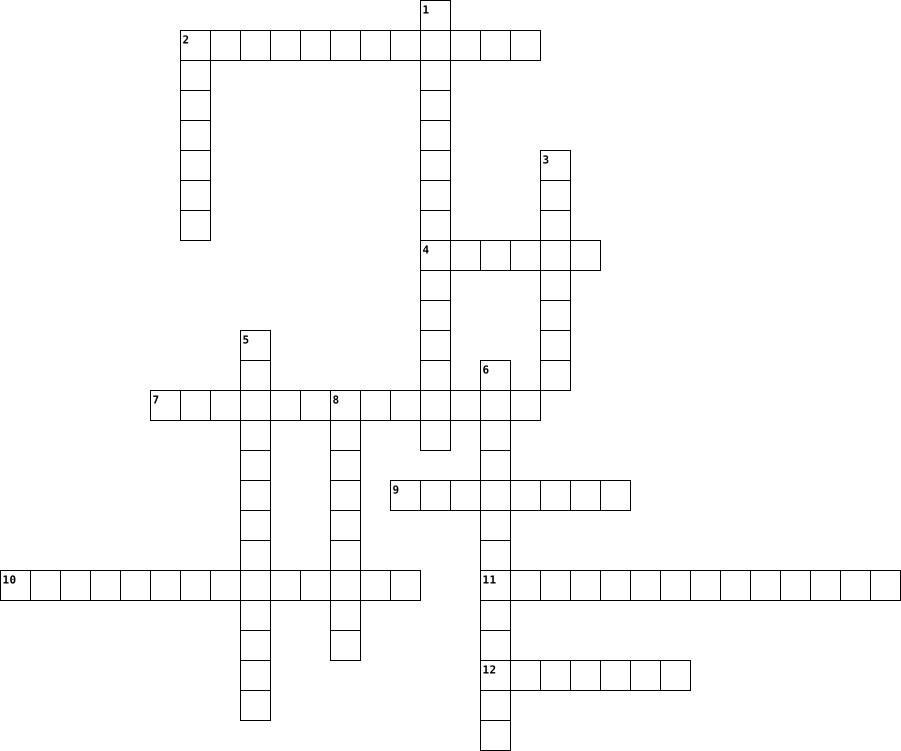
Across
- Tripitaka
- Dont want them giving this to the
- this is the way they eat
- the monks adopted a special diet of tree roots, nuts. Then, they seal themselves alive into pine burial chambers. Then, the Buddhist monks still meditated in their final days in the pine box.
- this group is common in Tibet, China, Taiwan, Japan, Korea, and Mongolia
- the sum of a person's actions in this and previous states of existence, viewed as deciding their fate in future existences.
- think deeply or focus one's mind for a period of time, in silence, for religious or spiritual purposes or as a method of relaxation.
- Siddhartha Gautama
- there is no ___ but there is acient scriptures
- Vihava
- India
- they are more of this than a relgion
Down
- a flower that rises from the muddy water toward the light symbolizes how Buddha achieved Nirvana
- This is common in Sri Lanka, Cambodia, Thailand, Laos, and Burma
- This states that all suffering comes from desire
- is about the Middle Way, which are the steps to achieve enlightenment
- at this time they first mention of the Buddha in Western writing is in the writings of Clement of Alexandria
- the state of undergoing pain, distress, or hardship.
- This is the tree of awakening
- This country introduced buddhism to japan
- It says that it is possible to stop suffering and achieve enlightenment
- do not belive in this coming back to life after death
- Dont belive in this but Christians do belive in this the person is in the underworld
- 360 million
- one person is ____ have to finding enlightenment
- do this on a daily to the monks
- fifth century BCE
27 Clues: India • Vihava • Tripitaka • 360 million • fifth century BCE • Siddhartha Gautama • this is the way they eat • This is the tree of awakening • do this on a daily to the monks • Dont want them giving this to the • they are more of this than a relgion • This country introduced buddhism to japan • there is no ___ but there is acient scriptures • ...
Unit 2 (Renaissance, Reformation, Exploration, Enlightenment, Scientific Revolution) 2026-03-03

Across
- The scientist who help develop the scientific method
- Major city in Italy that reinforced trade, banking, and the Renaissance
- Chinese Explorer who went on seven voyages
- The surgeon who is considered the father of modern surgery
- Mr Campagna's first name
- The ultimate Renaissance Man
- Informal gatherings hosted by women to spread Enlightenment ideas and topics
- This council met multiple times over an 18 year span to discuss Protestant Reforms and the Catholic Church
- Viking from Europe who traveled from Norway to Greenland but ended up in North America
- Very wealthy banking family located in Italy
- Economic theory surrounding a country that exports more than they import
- The scientist who studies the functions of the human heart
- The scientist famous for saying "I think, therefore I am."
- Another word for the Renaissance
Down
- The scientific theory that the earth is the center of the solar system
- The Scientist who believed the sun was the center of the universe
- He led the first expedition to circumnavigate the world
- Ann Boleyn and King Henry VIII's daughter
- The Scientist who used a telescope to observe Jupiter and the moon
- Step #4 in the Scientific Method: Conduct a scientific _______ to test the hypothesis
- An absolute ruler or monarch who agreed with some of the Enlightenment ideas but also used their power to make reform and change
- German writer who wrote the 95 theses
- The astronomer who created instruments to observe the solar system
- Enlightenment thinker who used satire to criticize the French Government and the Catholic Church
- The amount of wives King Henry VIII had
- Emphasis on a person as an individual rather than part of a larger group
26 Clues: Mr Campagna's first name • The ultimate Renaissance Man • Another word for the Renaissance • German writer who wrote the 95 theses • The amount of wives King Henry VIII had • Ann Boleyn and King Henry VIII's daughter • Chinese Explorer who went on seven voyages • Very wealthy banking family located in Italy • The scientist who help develop the scientific method • ...
Fall Semester Final Review 2025-12-12

Across
- : main cause of Native American population decline
- Factors : reasons that attract people to a new place
- : shared religion of major gunpowder empires
- Road : major trade route linking Europe and Asia
- Labor : forced labor used by empires
- Factors : reasons that force people to leave an area
- Reorganization : how regions or populations change over time
- : maritime empire that built trading-post networks
- Change : shift away from mercantilism toward freer markets
- Monarch : ruler with complete political control
- : spread of Asian goods technologies and ideas westward
- Dynasty : Chinese dynasty that legitimized rule with Confucian ideals
- : system where colonies benefit the mother country
- Change : move toward democratic ideas during the Enlightenment
- of Powers : idea that government should be divided into branches
- : empire that admired and adopted European culture
Down
- : practice of stronger nations controlling weaker regions
- Change : greater focus on equality education and questioning authority
- Rights : life liberty and property
- Split : division in Islam over who should lead
- : maritime empire that used direct political control of colonies
- Exchange : movement of plants animals and diseases across hemispheres
- : people who flee to nearby countries for safety
- Adaptation : changes humans make to the environment that can cause harm
- Peninsula : region where Spain and Portugal are located
- : long-held beliefs challenged by Enlightenment thinkers
- Company : business where investors share risks and profits
- System : trade network linking Europe Africa and the Americas
- : cultural region identified by physical and economic traits
- : movement emphasizing reason and individual rights
- Weapons : technology used by land-based empires to expand
- Gs : motivations for exploration god gold and glory
- Tolerance : policy that made the Mughal Empire more flexible
- : empire that rejected European influence due to cultural superiority
34 Clues: Rights : life liberty and property • Labor : forced labor used by empires • : shared religion of major gunpowder empires • Split : division in Islam over who should lead • Monarch : ruler with complete political control • : people who flee to nearby countries for safety • Road : major trade route linking Europe and Asia • ...
Letter to John Adams 2026-05-12

Across
- The “Code of Laws” John Adams was helping draft for the new _____.
- Political outcome being debated while Abigail wrote her letter.
- Abigail compared unchecked male authority to this style of rule.
- John Adams responded partly with humor and mild _____.
- Social system Abigail implicitly challenged in warning men against “unlimited power.”
- Enlightenment concept underpinning natural-rights arguments in the letter.
- Abigail’s critique anticipated later nineteenth-century women’s rights _____ .
- The letter illustrates tensions within Enlightenment universalism and social _____.
- Intellectual movement shaping both revolutionary rhetoric and Abigail’s critique.
- Abigail criticized laws placing excessive power in husbands’ _____.
- Reform movement linked philosophically to expanding human rights discourse.
- Contradiction between revolutionary liberty rhetoric and women’s legal status.
- Political philosopher whose natural-rights ideas echo throughout revolutionary correspondence.
- Abigail warned that arbitrary male authority resembled this.
- Legal condition Abigail feared women would remain under without reform.
- English common-law doctrine erasing married women’s legal identity.
Down
- Emotional and moral perspective emphasized in Abigail’s political writing
- Women lacked this formal political privilege in revolutionary America.
- Historians describe women’s prescribed role using this “_____ sphere” ideology.
- Revolutionary ideal Abigail argued should apply more universally.
- Adams wrote from this continental legislative body in Philadelphia.
- Revolutionary rhetoric often contrasted liberty with this condition of subjugation.
- Abigail’s famous instruction to John: “Remember the _____.”
- Colonial demand complicated by Abigail’s appeal for women’s inclusion in governance.
- Revolutionary-era intellectual and close correspondent of Abigail Adams.
- Abigail Adams’s arguments are often interpreted as proto-_____ thought.
- Phrase completing the revolutionary grievance: “_____ without representation.”
- Abigail suggested women might “foment a _____” if denied representation.
- The correspondence belongs to the broader intellectual history of the American _____.
- Historian Linda Kerber famously analyzed the ideology of “Republican _____.”
30 Clues: John Adams responded partly with humor and mild _____. • Abigail’s famous instruction to John: “Remember the _____.” • Abigail warned that arbitrary male authority resembled this. • Political outcome being debated while Abigail wrote her letter. • Abigail compared unchecked male authority to this style of rule. • ...
The French Revolution TB pgs. 118-136 2016-10-29

Across
- A French port city influenced French national anthem.
- Battle in Belgium that was Napoleon's final defeat.
- Forced closing of ports.
- To step down from power.
- A series of meetings to restore order in Europe.
- A strong feeling of pride and devotion of one's country.
- Bringing back to power the kings that Napoleon had driven out.
Down
- A person or group that advocates for complete political change.
- Machine for beheading people.
- Spanish campaign of hit and run raids against the French.
- The right to vote
- To add or take over ones territory.
- Part of third estate but were educated and embraced Enlightenment ideals.
- Restored order in France
- A new code of laws that embodied Enlightenment principals of equality.
- A period of massive killing during the French revolution.
- The leader of Jacobin radical group and started the Committee of Public Safety.
17 Clues: The right to vote • Restored order in France • Forced closing of ports. • To step down from power. • Machine for beheading people. • To add or take over ones territory. • A series of meetings to restore order in Europe. • Battle in Belgium that was Napoleon's final defeat. • A French port city influenced French national anthem. • ...
Buddhism Beliefs X-Word 2025-07-15

Across
- one of the three marks of existence; Kisa Gotami came to understand this when she went around asking for mustard seeds
- compared to a raft, used to get to the far shore of enlightenment
- a perfected person in Theravada Buddhism
- the place run by amitabha buddha
- 1st noble truth
- liberation or enlightenment
- more traditional type of buddhism with a focus on the monastic life
- more modern type of Buddhism with many denominations
- the Buddha lived this life but found that it did not work because he almost died
Down
- one of the three marks of existence. Cured by understanding the dharma.
- a buddha in mahayana buddhism
- the wheel of life
- dependent arising
- one of the five aggregates. the ability to discern objects
- the five aggregates
- emptiness (a concept in mahayana buddhism, especially zen buddhism)
- there is no soul or permanent self
17 Clues: 1st noble truth • the wheel of life • dependent arising • the five aggregates • liberation or enlightenment • a buddha in mahayana buddhism • the place run by amitabha buddha • there is no soul or permanent self • a perfected person in Theravada Buddhism • more modern type of Buddhism with many denominations • one of the five aggregates. the ability to discern objects • ...
Chapter 18 Crossword Puzzle 2025-05-15

Across
- The 13 British colonies were inspired by enlightenment which led up to this revolution
- A meeting of European powers to restore order after Napoleons defeat
- lower class
- Established the 1st French Revolution
- A French military leader who seized power after the revolution and later became emperor
- King of France who signed the Edict of Tolerance
- The middle class
Down
- Intellectual and cultural movement emphasizing reason,individualism, and human rights
- Court Oath A pledge by National Assembly to create a constitution
- the final defeat of Napoleon
- A political club advocating for radical reforms
- Social class in France
12 Clues: lower class • The middle class • Social class in France • the final defeat of Napoleon • Established the 1st French Revolution • A political club advocating for radical reforms • King of France who signed the Edict of Tolerance • Court Oath A pledge by National Assembly to create a constitution • A meeting of European powers to restore order after Napoleons defeat • ...
Chapter 5 Crossword 2015-12-03

Across
- Restricted access to ideas and information.
- What the Enlightenment thinkers were called.
- Law Rules discovered by reason.
- of Paris The treaty that ended the American Revolution War.
- The principle author of the Declaration of Independence.
- said that we have the freedom of speech.
- Contract An agreement by which the people gave up their freedom for an organized society.
- Sovereignty The principle in which states that all government power comes from the people.
- Act Put taxes on items such as newspapers and pamphlets.
- Republic The kind of government that divided the power between the federal, national, and the states.
- Informal social gatherings at which philosophes exchanged ideas.\
- Came up with the Social Contract.
Down
- Despots Absolute rulers who used their power to bring about political and social change.
- Was the first President.
- Wrote the Leviathan.
- Rights The rights that belong to humans by birth.
- Wrote the Encyclopedias.
- ornate style of art.
- Faire allowed businesses to operate without government interference.
- lighter, elegant, and charming art style.
20 Clues: Wrote the Leviathan. • ornate style of art. • Was the first President. • Wrote the Encyclopedias. • Came up with the Social Contract. • Law Rules discovered by reason. • said that we have the freedom of speech. • lighter, elegant, and charming art style. • Restricted access to ideas and information. • What the Enlightenment thinkers were called. • ...
Buddhism Crossword 2023-05-03

Across
- Buddhism began as an interpretation of this religion
- The doctrine/teaching
- Buddhist teaching that rejects both the pleasures of sensual indulgence and denial of needs, focusing instead on a practical approach to spiritual attainment
- A person who gives up worldly pleasures
- The name for the Buddhist community of monks and nuns
- Right views, right intentions, right conduct, right livelihood, right effort, right mindfulness
- The deva associated with death and temptation. Tempted the Buddha under the bodhi tree during his journey to enlightenment
- Spiritual leader reborn through generations
- Buddhist community of monks and nuns
- The second Passing Sight
Down
- The beatitude that transcends the cycle of reincarnation; the knowledge
- First Mark of Existence; No Self
- Third Mark of Existence; Suffering
- The Buddhas original name, the founder of Buddhism
- Release from surrering and rebirth that brings inner peace: “blowing out”
- Our actions and their consequences
- The third Passing Sight
- Deep, continued thought that focuses the mind on spiritual ideas
- The endless cycle of birh, suffering, death, and rebirth
- Second Mark of Existence;Impermanence
20 Clues: The doctrine/teaching • The third Passing Sight • The second Passing Sight • First Mark of Existence; No Self • Third Mark of Existence; Suffering • Our actions and their consequences • Buddhist community of monks and nuns • Second Mark of Existence;Impermanence • A person who gives up worldly pleasures • Spiritual leader reborn through generations • ...
Unit 9 vocab 2025-01-24

Across
- An economic system in which major industries are owned by workers
- He was a French Enlightenment writer, historian and philosopher.
- He was a French lawyer during the age of Enlightenment.
- Ask questions to perform experiments.
- Making your own business and selling things.
- A meeting which the major European empires negotiated.
- A territory or region where an external group hold power.
- He was an Italian philosopher who discovered the 4 moons of jupiter.
- Improved the steam engine.
- Newton He discovered the 3 laws of motion.
- An english philosopher who is one of the founders of modern political philosophy.
- One of the most famous philosophers during the 17th century.
Down
- Political system with one ruler.
- A political and economic system that seeks to create a classless society
- A building where people worked to rapidly produce products.
- Rural communities turn into cities.
- The sun in the center of the solar system.
- Ruling people outside a country
- A theory that is strong a variance with belfies.
19 Clues: Improved the steam engine. • Ruling people outside a country • Political system with one ruler. • Rural communities turn into cities. • Ask questions to perform experiments. • The sun in the center of the solar system. • Newton He discovered the 3 laws of motion. • Making your own business and selling things. • A theory that is strong a variance with belfies. • ...
Noah Rotkowitz Puzzle 2022-01-04

Across
- What was the cash crop of the southern colonies?
- which colonies dominated the colonial trade?
- What developed along the west coast of Africa?
- While English male Colonists had even more rights than Englishmen in the Mother Country, which groups had their rights severely limited?
- What came from New England ports that was very valuable?
- Among which two groups in the 13 Colonies did the Enlightenment spread best and why?
- An assembly’s power to approve or not approve any taxes the governor asked for was known as the “power of the ______”?
- who were the two slave owners in the Amistad Video?
- What group of colonies was most concerned about education?
- What was the movement that thought scientific methods could be applied into the study of society?
Down
- What religious movement swept across the colonies in the 1730's and 1740's?
- How long was a servants term of service?
- What was implied about the Yankees?
- What was one of the biggest cities in the middle colonies?
- how many slaves died along the way to the Americas.
- what was the Middle colonies known as?
- In what year did the first slaves arrive in Virginia?
- What was the slave exchange crossing the atlantic ocean to the Americas known as?
- How did John Locke believe people could gain knowledge?
- What roles did Africans have in the early years of The English Colonies?
- Among which 2 groups in the 13 Colonies did the Enlightenment spread best and why?
- What did New England desperately need?
- While English male Colonists had even more rights than Englishmen in the Mother Country, which groups had their rights severely limited?
- What did the Navigation Acts do for New England and colonial trade?
- What was one of the biggest cities in the middle colonies?
- What did England pass in the 1650's to regulate laws in New England?
26 Clues: What was implied about the Yankees? • what was the Middle colonies known as? • What did New England desperately need? • How long was a servants term of service? • which colonies dominated the colonial trade? • What developed along the west coast of Africa? • What was the cash crop of the southern colonies? • how many slaves died along the way to the Americas. • ...
Unit 6 SEA Religions 2022-01-31

Across
- the study of the fundamental nature of knowledge, reality, and existence, especially when considered as an academic discipline.
- the rebirth of a soul in a new body.
- a state of selflessness and enlightenment
- when a Buddhist finds the truth about life and stops being reborn because they have reached Nirvana
- popularly known as the Buddha, was an ascetic, a religious leader and teacher who lived in ancient India.
- do unto others as you would have them do unto you
- belief that there is only one God.
- principles concerning the distinction between right and wrong or good and bad behavior.
- an Indian religion and dharma, or way of life. It is the world's third-largest religion, with over 1.2 billion followers,
- a system of thought and behavior originating in ancient China.
Down
- Japanese religion dating from the early 8th century and incorporating the worship of ancestors and nature spirits and a belief in sacred power in both animate and inanimate things.
- belief that every action has a reaction- good with good, bad with bad
- belief in or worship of more than one god.
- a place of perfect peace and happiness, like heaven.
- a person’s attachment to material possessions or desires
- the fact or state of belonging to a social group that has a common national or cultural tradition.
- a group with shared beliefs, texts, and rituals
- traditional Japanese gate most commonly found at the entrance of or within a Shinto shrine, where it symbolically marks the transition from the human realm into the spirit realm
- a divine being/spirit in the Shinto religion.
- followers believe that the human life is one of suffering, and that meditation, spiritual and physical labor, and good behavior are the ways to achieve enlightenment, or nirvana.
20 Clues: belief that there is only one God. • the rebirth of a soul in a new body. • a state of selflessness and enlightenment • belief in or worship of more than one god. • a divine being/spirit in the Shinto religion. • a group with shared beliefs, texts, and rituals • do unto others as you would have them do unto you • a place of perfect peace and happiness, like heaven. • ...
Unit 9 Important Vocabulary 2025-01-27

Across
- French Enlightenment writer, philosopher, satirist, and historian.
- Made significant contributions to science, astronomy, physics, cosmology, mathematics, and philosophy
- key figure in the Scientific Revolution and the Enlightenment that followed, discovered Gravity
- The process of making an area more urban.
- A group of people agree to give up certain rights and accept a central authority in order to protect their other rights
- A policy of extending a country's power and influence through diplomacy or military force
- Scottish Engineer, chemist, and inventor who significantly improved the steam engine, impacting the Industrial Revolution
- A country or area in which another country has power to affect developments although it has no formal authority
- A political and religious doctrine of royal and political legitimacy
- A person who starts a business and is willing to risk loss in order to make money
- A production process that breaks the manufacture of a good into steps that are completed in a pre-defined sequence.
Down
- Meeting at which the major European powers negotiated and formalized claims to territory in Africa
- A founder of modern political philosophy
- Those with an income that is two-thirds to double the median household income
- Introduced the idea of separation of powers.
- An empirical method for acquiring knowledge that has been referred to while doing science since at least the 17th century
- Swiss philosopher, writer, and composer who lived and worked in France during the Enlightenment.
- A cosmological model in which the Sun is assumed to lie at or near a central point
- The Second Treatise of Government
- A building or group of buildings where goods are manufactured or assembled chiefly by machine.
20 Clues: The Second Treatise of Government • A founder of modern political philosophy • The process of making an area more urban. • Introduced the idea of separation of powers. • French Enlightenment writer, philosopher, satirist, and historian. • A political and religious doctrine of royal and political legitimacy • ...
Chocolate Crossword Cake 2022-05-20

Across
- enlightenment/change
- juvenile
- abandoned
- beautiful
- resistant
Down
- barrier
- hypothesis
- scurry
- disaster
- exile
10 Clues: exile • scurry • barrier • disaster • juvenile • abandoned • beautiful • resistant • hypothesis • enlightenment/change
Chocolate Crossword Cake 2022-05-20

Across
- enlightenment/change
- juvenile
- abandoned
- beautiful
- resistant
Down
- barrier
- hypothesis
- scurry
- disaster
- exile
10 Clues: exile • scurry • barrier • disaster • juvenile • abandoned • beautiful • resistant • hypothesis • enlightenment/change
Chocolate Crossword Cake 2022-05-20

Across
- enlightenment/change
- juvenile
- abandoned
- beautiful
- resistant
Down
- barrier
- hypothesis
- scurry
- disaster
- exile
10 Clues: exile • scurry • barrier • disaster • juvenile • abandoned • beautiful • resistant • hypothesis • enlightenment/change
Unit 11 Set A Synonyms 2025-04-10

Across
- supporter
- stench
- recover
- rule
- knowing/aware
Down
- worsen
- terseness
- hinder
- vibrate
- brief
10 Clues: rule • brief • worsen • stench • hinder • recover • vibrate • supporter • terseness • knowing/aware
The French Revolution TB pgs. 118-136 2016-10-29

Across
- Battle in Belgium that was Napoleon's final defeat.
- Part of third estate but were educated and embraced Enlightenment ideals.
- A strong feeling of pride and devotion of one's country.
- A new code of laws that embodied Enlightenment principals of equality.
- A French port city influenced French national anthem.
- Spanish campaign of hit and run raids against the French.
- Forced closing of ports.
Down
- A series of meetings to restore order in Europe.
- To add or take over ones territory.
- A period of massive killing during the French revolution.
- A person or group that advocates for complete political change.
- To step down from power.
- Bringing back to power the kings that Napoleon had driven out.
- The leader of Jacobin radical group and started the Committee of Public Safety.
- Machine for beheading people.
- Restored order in France
- The right to vote
17 Clues: The right to vote • To step down from power. • Restored order in France • Forced closing of ports. • Machine for beheading people. • To add or take over ones territory. • A series of meetings to restore order in Europe. • Battle in Belgium that was Napoleon's final defeat. • A French port city influenced French national anthem. • ...
The French Revolution TB pgs. 118-136 2016-10-29

Across
- A strong feeling of pride and devotion of one's country.
- Spanish campaign of hit and run raids against the French.
- Machine for beheading people.
- To add or take over ones territory.
- A person or group that advocates for complete political change.
- Part of third estate but were educated and embraced Enlightenment ideals.
- Bringing back to power the kings that Napoleon had driven out.
- A period of massive killing during the French revolution.
- A new code of laws that embodied Enlightenment principals of equality.
Down
- The right to vote
- A series of meetings to restore order in Europe.
- A French port city influenced French national anthem.
- The leader of Jacobin radical group and started the Committee of Public Safety.
- To step down from power.
- Restored order in France
- Battle in Belgium that was Napoleon's final defeat.
- Forced closing of ports.
17 Clues: The right to vote • To step down from power. • Restored order in France • Forced closing of ports. • Machine for beheading people. • To add or take over ones territory. • A series of meetings to restore order in Europe. • Battle in Belgium that was Napoleon's final defeat. • A French port city influenced French national anthem. • ...
From Enlightenment to Revolution 2017-07-22

Across
- one of the leaders of the French Revolution
- Ideas of having power divided into three branches separation of powers
- Strong leader to take over in France and restore some power
- time in French Revolution when guillotine is used frequently
- leader of the Haitian Revolution
- writing that includes enlightenment ideas within the writing for creation of new governments
- place where enlightenment ideas were talked about and shared
- area taken over by a strong country and used for resources
- Ideas of freedom of religion and speech
Down
- Madam Deficit
- jail that is broken into by the people starting the French Revolution
- home of Louis XVI and Marie Antoinette
- items Haiti was wanted for
- monarch beheaded with guillotine
- beheading machine used in France
- Believed in natural or basic rights of life, own property and to revolt against unjust rulers
16 Clues: Madam Deficit • items Haiti was wanted for • monarch beheaded with guillotine • leader of the Haitian Revolution • beheading machine used in France • home of Louis XVI and Marie Antoinette • Ideas of freedom of religion and speech • one of the leaders of the French Revolution • area taken over by a strong country and used for resources • ...
Ancient India 2025-05-21

Across
- a title that is given to the person who founded Buddhism
- the four principles of Buddhism
- an ancient language in India
- the name of supreme power
- a journey where Hindus go to holy sites of Hinduism
- a religion in India that spread across the world
- a group in Indian Society
- a way that shows people how to live in balance
- where the roots of Hinduism are found
- an explanation of the importance of living
Down
- one can end suffering and enlightenment for if he follows this path
- a person who gives up pleasures that they own
- the state of being happy and feeling peace
- finding the truth and freedom from freedom
- a idea that everything that exists all generates from one source
- the cycle of birth, death, and rebirth
16 Clues: the name of supreme power • a group in Indian Society • an ancient language in India • the four principles of Buddhism • where the roots of Hinduism are found • the cycle of birth, death, and rebirth • the state of being happy and feeling peace • finding the truth and freedom from freedom • an explanation of the importance of living • ...
The Renassiance 2025-09-29

Across
- wealthy families provided patronage to artists like da vinci.
- the printing press made books cheaper and more common.
- renaissance paintings focused on realism and detail.
- michelangelo sculpted the statue of david.
- michelangelo painted a famous fresco on the sistine chapel ceiling.
- leonardo da vinci is a perfect example of a renaissance man.
- studying human anatomy helped artists paint more realistically.
Down
- renaissance artists were inspired by classical greek and roman styles.
- humanism emphasized the value of people and education.
- artists learned to show depth using perspective.
- leonardo da vinci painted the mona lisa
- artists showed great innovation in their paintings.
- the renaissance was a rebirth of art and learning.
- chiaroscuro is the use of light and shadow in art.
- the period inspired an intellectual enlightenment in europe.
15 Clues: leonardo da vinci painted the mona lisa • michelangelo sculpted the statue of david. • artists learned to show depth using perspective. • the renaissance was a rebirth of art and learning. • chiaroscuro is the use of light and shadow in art. • artists showed great innovation in their paintings. • renaissance paintings focused on realism and detail. • ...
Bodhi Crocodile 2024-04-07

Across
- A rich fabric with a long, soft nap.
- Ginger
- Owner
- Black cat
- Private Investigator
- Our new mascot
- Fedora
Down
- Butcher
- Enlightenment
- Recurring cop
- A cold place to die
- Street smart
- Father
- Mama
14 Clues: Mama • Owner • Ginger • Father • Fedora • Butcher • Black cat • Street smart • Enlightenment • Recurring cop • Our new mascot • A cold place to die • Private Investigator • A rich fabric with a long, soft nap.
Science, Absolutism, and Enlightenment Review 2026-01-12

Across
- female ruler of Russia who used enlightenment policies
- Tudor queen who sent Protestants to be burned at the stake
- type of government where monarch is limited by law
- attempt by Catholics to kill King James I of England
- famous palace built to control the nobility and nature in France
- he was terrible
- first monarch to be killed by their people
- a ruler with total power of their country
- nickname for Louis XIV
Down
- Tudor queen who ruled alone and provided religious freedom
- military dictator of England during their time without a king
- rights to life, liberty, and property
- bloodless transition of power from James II of England to William and Mary
- the right to rule comes from God
- enlightenment thinker who created idea of separation of powers
- guaranteed rights to the people
- Russian czar who Westernized his country
- scientist who created the laws of motion
- created the Heliocentric model that showed the earth revolved around the sun
19 Clues: he was terrible • nickname for Louis XIV • guaranteed rights to the people • the right to rule comes from God • rights to life, liberty, and property • Russian czar who Westernized his country • scientist who created the laws of motion • a ruler with total power of their country • first monarch to be killed by their people • type of government where monarch is limited by law • ...
Enlightenment Crossword 2025-04-17

Across
- The number of videos today
- A political source of traditional authority
- A religious source of traditional authority
- The number of notes today
- The first part of the lesson
Down
- A political movement in Europe
- History teacher
- What people began to use during the Enlightenment
8 Clues: History teacher • The number of notes today • The number of videos today • The first part of the lesson • A political movement in Europe • A political source of traditional authority • A religious source of traditional authority • What people began to use during the Enlightenment
One Piece 2024-08-24

Across
- Race
- Haki Wave
- Blood Transfusion
- Enlightenment
- Meat Enjoyer
- Roger Ally
- Chopper's Poimt
Down
- Skypiean's Earth
- Gorgon
- Enel's Ship
- Marine to Pirate
- Dragon Fruit
12 Clues: Race • Gorgon • Haki Wave • Roger Ally • Enel's Ship • Meat Enjoyer • Dragon Fruit • Enlightenment • Chopper's Poimt • Skypiean's Earth • Marine to Pirate • Blood Transfusion
Enlightenment: Catherine Brady 2024-06-04

Across
- Writer, philosopher, and advocate of women's rights, and education.
- the study of the fundamental nature of knowledge, reality, and existence
- Philosopher and physician,regarded as one of the most influential Enlightenment thinkers and known as the "father of liberalism"
- an intellectual and cultural movement that emphasized reason over superstition and science over blind faith
Down
- historian, and political philosopher, main ideas were branches of government and checks and balances.
- astronomer, physicist and engineer,famous for improving the telescope.
- sitting room private event where things were discussed.
- Enlightenment writer, philosopher,and historian,advocate of freedom of speech, freedom of religion, and separation of church and state.
- main ideas were male female equality, and declaration of rights of women.
- Philosopher, main idea was the social contract theory,considered one of the founders of modern political philosophy.
10 Clues: sitting room private event where things were discussed. • Writer, philosopher, and advocate of women's rights, and education. • astronomer, physicist and engineer,famous for improving the telescope. • the study of the fundamental nature of knowledge, reality, and existence • main ideas were male female equality, and declaration of rights of women. • ...
The Civics And Government Crossword Puzzle 2021-10-05

Across
- Economic Depression
- the divine right of
- all ppl are guaranteed the right to life
- another name for the enlightenment is the age of
Down
- Government debt
- ideas made people question this logic
- is apart of the French Revolution
- believed in government rule with consent
8 Clues: Government debt • Economic Depression • the divine right of • is apart of the French Revolution • ideas made people question this logic • all ppl are guaranteed the right to life • believed in government rule with consent • another name for the enlightenment is the age of
The Civics And Government Crossword Puzzle 2021-10-05

Across
- Economic Depression
- the divine right of
- all ppl are guaranteed the right to life
- another name for the enlightenment is the age of
Down
- Government debt
- ideas made people question this logic
- is apart of the French Revolution
- believed in government rule with consent
8 Clues: Government debt • Economic Depression • the divine right of • is apart of the French Revolution • ideas made people question this logic • all ppl are guaranteed the right to life • believed in government rule with consent • another name for the enlightenment is the age of
History Crossword - Abby Fessler 2014-12-03

Across
- introduction to the US constitution
- delegates of the Constitutional Convention
- placed limits on the power of the monarch
- movement that promoted the idea that knowledge, reason, and science would improve society
- basic rights and freedoms to which all humans are entitled to (life, liberty, and pursuit of happiness
- enforces laws (president and cabinet)
- - interprets laws (supreme court)
- political theory that government is subject to the will of the people (people have power)
- powers shared by state and federal government
- powers not specifically defined in the constitution, shall be entrusted to congress
- influenced the delegates to make the constitution
- first 10 amendments to the constitution, stating fundamental rights of citizens
- - system in which each branch of government has a check on other branches so no one branch has too much power
- an official change or addition to the constitution
- powers that belong only to the state government
- England's law making
Down
- Powers powers that only belong to the national government
- last state to ratify the constitution
- supporters of the constitution and a strong national government
- final and supreme authority of the US SUPREME LAW OF THE LAND
- writer and philosopher enlightenment
- Legislative, executive, judicial
- ninth state to ratify the constitution
- makes laws (house of representatives and senate)
- against ratifying the constitution, feared power of national government
- philosopher of enlightenment
- representation democracy (people elect representatives)
- group of presidential electors
- the sharing of powers between national and state governments
- first state to approve the constitution
- the highest court where the judicial branch exists
- the legislative body of a country or state
32 Clues: England's law making • philosopher of enlightenment • group of presidential electors • Legislative, executive, judicial • - interprets laws (supreme court) • introduction to the US constitution • writer and philosopher enlightenment • last state to ratify the constitution • enforces laws (president and cabinet) • ninth state to ratify the constitution • ...
Module 3 Vocabulary Crossword 2024-09-17

Across
- Massacre event where British soldiers killed five colonists
- John, an Enlightenment philosopher who argued for natural rights and government by consent
- Exclusive control over trade or production, a key grievance against British policies
- Liberty Concept of freedom within a framework of law and order
- of Independence document asserting American independence from Britain
- Charles, a British general who surrendered at Yorktown
- of Alliance agreement between France and the American colonies
- Acts Series of punitive laws passed by Britain after the Boston Tea Party
- and Indian War Conflict between Britain and France over North American territory
- Act British tax on paper goods, sparking colonial protests
- battle where British General Cornwallis surrendered
- Colonists who remained loyal to Britain during the Revolution
- Colonial militia ready to fight at a minute’s notice
- Rights inherent to all people, central to Enlightenment philosophy
- Author of Common Sense and other Revolutionary writings
- George Commander of the Continental Army and first US president
Down
- Virginian orator famous for the phrase "Give me liberty or give me death!"
- Tea Party protest against British taxes on tea
- Sense Pamphlet by Thomas Paine urging independence
- Contract Idea that government derives power from the consent of the governed
- Jefferson Author of the Declaration of Independence
- Intellectual movement emphasizing reason and individual rights
- and Concord First battles of the Revolutionary War in
- War conflict between the American colonies and Britain
- colonists who did not take sides in the Revolutionary War
- Treaty of Paris Ended the Revolutionary War, recognizing American independence
- Treaty of Paris Ended the French and Indian War, ceding territory to Britain
- British general during the early part of the Revolutionary War
- of British law prohibiting settlement west of the Appalachians
- Colonists who supported independence from Britain
- Continental Congress meeting of colonial delegates to address British policies
31 Clues: Tea Party protest against British taxes on tea • Colonists who supported independence from Britain • Sense Pamphlet by Thomas Paine urging independence • battle where British General Cornwallis surrendered • Jefferson Author of the Declaration of Independence • Colonial militia ready to fight at a minute’s notice • ...
Buddhism 2025-12-15

Across
- Thousands of religious texts that Mahayana Buddhists refer to as scripture
- Form of Buddhism that focuses on meditation, aim is to open our "third eye"
- Awakening or enlightenment
- "infinite light", the thought that Buddha created a paradise in heaven for people to concentrate on enlightenment
- Pali Canon, the recitations of Buddha's teachings
- A path that gives Buddhists a solution to rid themselves of suffering
- Enlightened beings
- What Buddhists spend their entire lives trying to rid themselves of
- Buddha's teachings (karma, eightfold path, noble truths etc.)
- "no-self", a way to get rid of selfishness
- Buddhist spiritual leader in Tibet, believed to have been reincarnated fourteen times; promises to delay nirvana until everyone can reach it
- "Intermediate existence", known as the gap between life and death
- Birthplace of Buddha
- The continual cycle of aging, sickness and death
- A chant used to reach enlightenment
- Ignorance, attachment and aversion
Down
- A group of teachings by Buddha about suffering and how to rid yourself of it
- meditative contemplation
- Cycle that Buddhists believe every soul goes through until it reaches nirvana
- Where Buddhism began
- Buddhist term for patience
- law of cause and effect
- Buddhist community
- Founder of Buddhism
- Five different aggregates that hold mankind together
- The standard collection of writings for Theravada Buddhism, mainly composed of the Tripitaka
- Name of Buddha as a prince
- "Way of the Elders", a school of thought in Buddhism
- "Greater Vehicle", other school of thought in Buddhism
- Sacred tree where Buddha meditated under to reach ennlightenment
- End goal of Buddhism, complete nothingness
31 Clues: Buddhist community • Enlightened beings • Founder of Buddhism • Where Buddhism began • Birthplace of Buddha • law of cause and effect • meditative contemplation • Awakening or enlightenment • Buddhist term for patience • Name of Buddha as a prince • Ignorance, attachment and aversion • A chant used to reach enlightenment • End goal of Buddhism, complete nothingness • ...
In A Changing World 2024-04-09

Across
- / In the age of the enlightenment the philosophers would develop the ideas that all can be explained via reason and not _______.
- / The French _____________ saw the mobs of Paris rise up against the King, Church and aristocracy.
- / Though faith is above __________, there can never be any real discrepancy between faith and reason.
- / It rejects or denies the existence of God, _________ is a sin against the virtue of religion.
- / In 1848 he published hsi work "Communist Manifesto"
- / This philosophy main belief was that human reason is the principal source of all knowledge.
- / The time period was called the “Enlightenment” because it was supposed to enlighten the world from the darkness of its religious __________________.
- / issued the encyclical The Syllabus of Errors which condemned many of the ideologies of the Enlightenment.
Down
- / The _______ of Reason rejected the existence of God in any form, instead dedicating itself to the celebration of Enlightenment values such as liberty and rationalism.
- / This philosophy refrains from denying God; instead it postulates the existence of a transcendent being which is incapable of revealing itself, and about which nothing can be said.
- / __________ preached his astronomical theory as fact. He would go so far as to us his theories to speak against scripture. Which resulted in his excommunication.
- / Agnosticism is all too often equivalent to ________ atheism.
- / an ideology by which religious truths are derived and interpreted in accordance with personal religious experience, under the influence of the spirit of the current age.
- / He was a Polish priest that labored to prove the ancient theory of heliocentrism.
- / Faith and Science are both given to us by God, and so do not __________ one another.
- / The Civil Constitution of the Clergy forced all ______________ to swear oaths to the new revolutionary constitution and pledge that their loyalty to the French government and not the Pope.
- / In 16th century the Church was the major sponsor of scientific _____________ in Europe.
- / The Christian that attempts to live a secular life separates their faith from their _____________.
- / As Catholics we believe we need ____________ to help us understand the nature of the world we live in, the process of how we and everything in it have been developed over time.
19 Clues: / In 1848 he published hsi work "Communist Manifesto" • / Agnosticism is all too often equivalent to ________ atheism. • / He was a Polish priest that labored to prove the ancient theory of heliocentrism. • / Faith and Science are both given to us by God, and so do not __________ one another. • ...
The Enlightenment 2023-02-02

Across
- Created a 13 virtue plan for attaining moral perfection.
- He wrote about natural rights.
- This books argues for a social contract.
- Placing importance on humans rather than divine figures.
Down
- The idea of questioning religious and scientific authority.
- The idea that knowledge must come from experience.
- The idea of basing thought on reason and knowledge.
- The Enlightenment was an ______ movement.
- One of the first feminists.
- Enlightenment thinkers criticized this in favor of democracy.
10 Clues: One of the first feminists. • He wrote about natural rights. • This books argues for a social contract. • The Enlightenment was an ______ movement. • The idea that knowledge must come from experience. • The idea of basing thought on reason and knowledge. • Created a 13 virtue plan for attaining moral perfection. • ...
The French Revolution 2016-10-29

Across
- To step down from power.
- Restored order in France
- A strong feeling of pride and devotion of one's country.
- A period of massive killing during the French revolution.
- A series of meetings to restore order in Europe.
- Machine for beheading people.
- Battle in Belgium that was Napoleon's final defeat.
- Part of third estate but were educated and embraced Enlightenment ideals.
Down
- To add or take over ones territory.
- A French port city influenced French national anthem.
- A person or group that advocates for complete political change.
- A new code of laws that embodied Enlightenment principals of equality.
- The right to vote
- The leader of Jacobin radical group and started the Committee of Public Safety.
- Bringing back to power the kings that Napoleon had driven out.
- Spanish campaign of hit and run raids against the French.
- Forced closing of ports.
17 Clues: The right to vote • To step down from power. • Restored order in France • Forced closing of ports. • Machine for beheading people. • To add or take over ones territory. • A series of meetings to restore order in Europe. • Battle in Belgium that was Napoleon's final defeat. • A French port city influenced French national anthem. • ...
The French Revolution TB pgs. 118-136 2016-10-29

Across
- Machine for beheading people.
- Forced closing of ports.
- A new code of laws that embodied Enlightenment principals of equality.
- Spanish campaign of hit and run raids against the French.
- The leader of Jacobin radical group and started the Committee of Public Safety.
- The right to vote
- Restored order in France
- To step down from power.
- A French port city influenced French national anthem.
Down
- A strong feeling of pride and devotion of one's country.
- Part of third estate but were educated and embraced Enlightenment ideals.
- A series of meetings to restore order in Europe.
- A period of massive killing during the French revolution.
- To add or take over ones territory.
- Bringing back to power the kings that Napoleon had driven out.
- Battle in Belgium that was Napoleon's final defeat.
- A person or group that advocates for complete political change.
17 Clues: The right to vote • Forced closing of ports. • Restored order in France • To step down from power. • Machine for beheading people. • To add or take over ones territory. • A series of meetings to restore order in Europe. • Battle in Belgium that was Napoleon's final defeat. • A French port city influenced French national anthem. • ...
Ancient Inda 2022-03-25

Across
- the destroyer
- water source
- the creator
- the enlightened one
- color festival
- science of space
- peace activist
- enlightenment
Down
- tourist site
- the preserver
- the center of the universe
- sacred texts
- city settlement
- achievement
- what goes around comes around
15 Clues: the creator • achievement • tourist site • water source • sacred texts • the destroyer • the preserver • enlightenment • color festival • peace activist • city settlement • science of space • the enlightened one • the center of the universe • what goes around comes around
Revolution and Enlightenment 2016-02-23

Across
- Copernicus universe is heliocentric- sun is at center
- A system which puts the Earth in the center of the universe, and describes other objects from the point of view of the Earth
- Made First encyclopedia of knowledge; attacked religious superstition
- Showed the planetary orbits were egg shaped- Kepler’s First Law
- Enlightenment thinkers were hypocritical because power of men over women was just as wrong as arbitrary power of a monarch over their subjects Enlightenment is based on the ideal of reason in all human beings, which includes women being equal in politics, economics and education
- He was the first European to make regular observations of the heavens using a telescope.
- Believed all people born with a Tabula Rasa- blank mind and people are molded by their experiences
- Is the astronomical model in which the Earth and planets revolve around the Sun at the center of the Solar System
Down
- The Social contract is an agreement between all of society to be governed by the general will of the community, personal freedom
- States that any two bodies in the universe attract each other with a force that is directly proportional to the product of their masses and inversely proportional to the square of the distance between them.
- created 3 types of government- republics, despotism, and monarchies. Separation of Powers: 3 functions of government executive, legislative, and judicial limit and control each other through check and balances
- Wealthy people rooms where middle and upper class guests would discuss philosophy and apply it to life
- wrote the Wealth of Nations describing that a government should keep its hands off the economy, but provide infrastructure and national security this idea is called laissez-faire economics
- Believed punishment should not be brutal
- Thought that the physical world is a giant machine that follows natural laws that can be discovered by investigation through the scientific method. An ideal society would follow these natural laws.
- Made scientific method- systematic procedure for collecting and analyzing data
- Founder of Methodism- anyone can be saved importance of hard work and spiritual contentment
17 Clues: Believed punishment should not be brutal • Copernicus universe is heliocentric- sun is at center • Showed the planetary orbits were egg shaped- Kepler’s First Law • Made First encyclopedia of knowledge; attacked religious superstition • Made scientific method- systematic procedure for collecting and analyzing data • ...
Enlightenment Vocab 2 2023-02-27

Across
- a sudden overthrow of the government
- the middle class, including merchants, industrialists, and professional people
- a popular vote
- (estate #) Clergy, Collected tithe, top 1%, owned 10% of land, didn't pay taille
- to incorporate into an existing political unit, such as a city or country
- military draft
- an annual direct tax, usually on land or property, that provided a regular source of income for the French monarchy
- the right to vote
- to formally give up control of a country or state
- (estate #) Nobility,top 2%, owned ~30% of land, Government & military positions, didn't pay taille
- the principle of people of right because of blood
Down
- includes(-) the military process of burning land and valuable things as they conquer
- when a government pays out more money than it takes in through taxation and other revenues, thus going into debt
- a form of government in which the executive, legislative, and judicial branches limit and control each other through a system of checks and balances
- (includes (-))
- the unique cultural identity of a people based on common language, religion, and national symbols
- a form of government in which the leader is not a king and certain citizens have the right to vote
- (estate #) Peasents, Unskilled workers, Middle Class, owned ~60% of land, 97% of population, paid taille
18 Clues: (includes (-)) • a popular vote • military draft • the right to vote • a sudden overthrow of the government • to formally give up control of a country or state • the principle of people of right because of blood • to incorporate into an existing political unit, such as a city or country • the middle class, including merchants, industrialists, and professional people • ...
US History 2023-01-20
Across
- manifest destiny
- make something official
- process of nullifying
- no longer a slave
- ignore
- deconstruction
- remove from position
Down
- not pro federalists
- trade
- women's
- idea
- alliance
- too much dinero
13 Clues: idea • trade • ignore • women's • alliance • deconstruction • too much dinero • manifest destiny • no longer a slave • not pro federalists • remove from position • process of nullifying • make something official
the french revolution and american revolution crossword puzzle 2021-10-05

Across
- led the colonial forces to victory over the British
- the turning point in the american revoulution
- schools and science
- the final battle in the american revolution
- the battle that started the american revolution
- let them eat cake
- the worlds most influential enlightenment thinkers
- a large blade that would be dropped onto your head and execute you
- collect taxes on glass lead paper tea and paint
- the battle wear the british hassin was defeated
Down
- were all the tea was dumped of the boats
- fought in the battles of Trenton and princeton
- dictator at the end of the revolution
- helped draft the declaration of independence
- he was the french king at the beginning of the revolution
15 Clues: let them eat cake • schools and science • dictator at the end of the revolution • were all the tea was dumped of the boats • the final battle in the american revolution • helped draft the declaration of independence • the turning point in the american revoulution • fought in the battles of Trenton and princeton • the battle that started the american revolution • ...
Crossword Puzzle Social Studies 2023-11-14

Across
- People born to a Spaniard and Native.
- People born in America to Spanish parents.
- A weapon used to execute someone.
- People born to Spaniard and Slave.
- The type of rule where a ruler has absolute power.
- A large business that is recognized as its separate legal entity.
- The belief that the Earth was unique and at the center of God's attention
Down
- People born in Spain and come over to the Americas to rule.
- Gatherings in the homes of wealthy patrons.
- Businesses are privately owned.
- Long-term outcome of scientific development.
- The movement (mass exodus) from rural areas to cities (urban areas).
- the argument stating the Sun, not the Earth, was the center of the universe
- Property is governed by the Government.
- Thinkers of the Enlightenment.
15 Clues: Thinkers of the Enlightenment. • Businesses are privately owned. • A weapon used to execute someone. • People born to Spaniard and Slave. • People born to a Spaniard and Native. • Property is governed by the Government. • People born in America to Spanish parents. • Gatherings in the homes of wealthy patrons. • Long-term outcome of scientific development. • ...
Buddhism 2021-03-08

Across
- Everything in the world changes
- The truth of the origin of suffering
- A group of buddhists who believe that you can gain enlightenment in many ways
- The holy scriptures of Buddhism
- The truth of the cessation of suffering
- A group of buddhists that believe that you have to get your own enlightenment by meditation and help with wise monks
- The rules monks follow
Down
- Everybody suffers at sometime, and a noble truth of the same meaning
- The wheel of dharma
- The rules buddhists follow
- The truth of the path to the cessation of suffering
- Nobody stays the same throughout life
12 Clues: The wheel of dharma • The rules monks follow • The rules buddhists follow • Everything in the world changes • The holy scriptures of Buddhism • The truth of the origin of suffering • Nobody stays the same throughout life • The truth of the cessation of suffering • The truth of the path to the cessation of suffering • ...
One Piece 2024-08-24

Across
- Race
- Haki Wave
- Blood Transfusion
- Enlightenment
- Meat Enjoyer
- Roger Ally
- Chopper's Poimt
Down
- Skypiean's Earth
- Gorgon
- Enel's Ship
- Marine to Pirate
- Dragon Fruit
12 Clues: Race • Gorgon • Haki Wave • Roger Ally • Enel's Ship • Meat Enjoyer • Dragon Fruit • Enlightenment • Chopper's Poimt • Skypiean's Earth • Marine to Pirate • Blood Transfusion
scientifc revolution 2025-04-16

Across
- isaac newton
- compass
- Enlightenment
- year
- ethology
- kuhn robert hooke
Down
- pathology
- gravity
- method
- hessian
10 Clues: year • method • gravity • compass • hessian • ethology • pathology • isaac newton • Enlightenment • kuhn robert hooke
Paul Buchanan 2021-03-02

Across
- wrote Robinson Crusoe
- Believed in an Absolute Monarchy
- wrote pieces of music for King George I
- Woman should not ask permission from husbands
- where a government controls what you can read, do, say, and wear, controlled by an absolute ruler
- government should be divided into 3 parts
- one of the first to coin the phrase enlightenment
Down
- ran a well known Salon
- spread enlightenment ideas by compiling philosophes' beliefs into the encyclopedia
- helped develop music for string quartet
- a child prodigy as a musician
- wrote religious music for organ and choirs
- believed you have to work hard to make more money
- people should revolt if natural rights aren't given by the government
- People should instead vote people out of government instead of revolting
15 Clues: wrote Robinson Crusoe • ran a well known Salon • a child prodigy as a musician • Believed in an Absolute Monarchy • helped develop music for string quartet • wrote pieces of music for King George I • government should be divided into 3 parts • wrote religious music for organ and choirs • Woman should not ask permission from husbands • ...
SIddhartha Puzzle 2024-03-06

Across
- One of the things that become an addiction to Siddhartha
- Who Siddhartha and Govinda originally travel with
- The main character of the story
- When Siddhartha sees stuff in his sleep
- What Siddhartha feels when he wins gambling and drinking
- The place Siddhartha gets laughed at by
- Who Siddhartha experiences intimate relations with
- What Siddhartha wants to acheive
Down
- The location that Siddhartha wants to reach when enlightened
- One of the things that become an addiction to Siddhartha
- A best friend that goes a separate way
- Enlightened man who drives a ferry
- What Siddhartha becomes in his dream about the beach
- The person who employs Siddhartha and makes him rich
- Actions that Siddhartha does not want to commit and will take him off the path of Enlightenment
- The person who does not support Siddhartha Leaving to get enlightened
16 Clues: The main character of the story • What Siddhartha wants to acheive • Enlightened man who drives a ferry • A best friend that goes a separate way • When Siddhartha sees stuff in his sleep • The place Siddhartha gets laughed at by • Who Siddhartha and Govinda originally travel with • Who Siddhartha experiences intimate relations with • ...
Mod 3: Vocab crossword puzzle 2024-09-20

Across
- Sense
- War
- Patrick ordered liberty Yorktown
- contract
- Continental Congress natural rights Treaty of Paris (1783)
- Massacre
- of 176
- Thomas
- Act
- and Concord
Down
- of Independence minutemen Treaty of Alliance
- William Paine Thomas
- and Indian War Neutrals Washington George
- monopoly Treaty of Paris (1763)
- Acts Patriots
- John
- Tea Party
- Charles
18 Clues: War • Act • John • Sense • of 176 • Thomas • Charles • contract • Massacre • Tea Party • and Concord • Acts Patriots • William Paine Thomas • monopoly Treaty of Paris (1763) • Patrick ordered liberty Yorktown • and Indian War Neutrals Washington George • of Independence minutemen Treaty of Alliance • Continental Congress natural rights Treaty of Paris (1783)
AJ 2021-04-19

Across
- one's own nation
- continent
- new thinking
- ideas
- revolution
Down
- jacobins
- french writer
- Prussia's prime leader
- scientist
- general
- revolution
- countries power
12 Clues: ideas • general • jacobins • scientist • continent • revolution • revolution • new thinking • french writer • countries power • one's own nation • Prussia's prime leader
The Enlightenment 2022-03-16

Across
- Championed freedom of thought and religion
- What part of the world did the Enlightenment begin?
- Where did Locke believe a good government got its power from?
- one group of people played the greatest role in the Enlightenment?
- Edited the "Encyclopedia"
Down
- Governmental principle based on just laws and on a government created by and subject to the will of the people.
- Described "perfect" government
- This was used to criticized the government, the Church, and society
- Believed in popular sovereignty
- another group that is more philosophical than 2.
10 Clues: Edited the "Encyclopedia" • Described "perfect" government • Believed in popular sovereignty • Championed freedom of thought and religion • another group that is more philosophical than 2. • What part of the world did the Enlightenment begin? • Where did Locke believe a good government got its power from? • ...
The Enlightenment 2022-01-16

Across
- A French word that means philosopher and thinkers in France were being called that
- was the first collection of the world's knowledge on a variety of subjects such as religion, government, and history.
- a writer and a novelist who supported freedom of religion and deism
- a person who search for wisdom
- became the center of the Enlightenment
Down
- who wrote the social contract (Last name)
- who created a 28 - volume encyclopedia (last name)
- who started the modern effort for equal rights for women (last name)
- philosophes wanted to use ............ to improve society
- religious truth should be subject to the authority of human reason rather than religious knowledge.
10 Clues: a person who search for wisdom • became the center of the Enlightenment • who wrote the social contract (Last name) • who created a 28 - volume encyclopedia (last name) • philosophes wanted to use ............ to improve society • a writer and a novelist who supported freedom of religion and deism • ...
The Enlightenment 2023-09-20

Across
- Thought everyone is natural selfish and cruel
- "King of Capitalism"
- Time Period with scientific thinking and reasoning
- True Democracy(difference of options)
Down
- Idea people were born pure and innocent
- Man who found out about gravity
- Broke king's powers into 3rds
- Man who said power should lie with the people
- Type of absolutism
- Natural Rights, Natural Laws, and Social Contract
10 Clues: Type of absolutism • "King of Capitalism" • Broke king's powers into 3rds • Man who found out about gravity • True Democracy(difference of options) • Idea people were born pure and innocent • Thought everyone is natural selfish and cruel • Man who said power should lie with the people • Natural Rights, Natural Laws, and Social Contract • ...
The Enlightenment 2023-09-29

Across
- When philosophers and writers applied the scientific idea of reason to answer political questions.
- This person brought the ideas of Newton and Locke to France
- Book written by John Locke
Down
- This person believed in the separation of powers
- This person believes people where born evil
- Where people gathered to spread Enlightenment ideals
- This person believed that men and women should be equal
- Editor of the Encyclopedie
- Social Contract Book written by Jean-Jacques Rousseau
- This person inspired the Declaration of Independence
10 Clues: Editor of the Encyclopedie • Book written by John Locke • This person believes people where born evil • This person believed in the separation of powers • Where people gathered to spread Enlightenment ideals • This person inspired the Declaration of Independence • This person believed that men and women should be equal • ...
The Enlightenment 2024-02-22

Across
- developed the idea of natural rights theory
- the father of capitalism
- wrote extensively about the paradox of belief and faith
- literary absurdist; made fun of established social order
Down
- believed that observation was vital to understanding
- known for his categorical imperative; moral universality
- separation of powers
- a proponent of enlightened despotism
- foundational figure of the sciences and mathematics; laws of motion
- founder of calculus; wrote about the problem of evil
10 Clues: separation of powers • the father of capitalism • a proponent of enlightened despotism • developed the idea of natural rights theory • believed that observation was vital to understanding • founder of calculus; wrote about the problem of evil • wrote extensively about the paradox of belief and faith • known for his categorical imperative; moral universality • ...
Enlightenment Crossword 2020-01-15

Across
- Wrote The Two Treatises of Government
- Name of Rousseau's accomplice
- An idea in which the people have the right to choose their ruler; Not absolutism
- Name of the woman who educated and saw after Rousseau after he ran away from home
- Rousseau was born here
- Another name for the Enlightenment Era
Down
- Wrote Du Contrat Social; Heavily influenced musical and political thinking
- Locke was born here
- Name of the university that Locke went to
- Who wrote a book about social contract theory
10 Clues: Locke was born here • Rousseau was born here • Name of Rousseau's accomplice • Wrote The Two Treatises of Government • Another name for the Enlightenment Era • Name of the university that Locke went to • Who wrote a book about social contract theory • Wrote Du Contrat Social; Heavily influenced musical and political thinking • ...
The Enlightenment 2024-05-03

Across
- Thomas Hobbes was the english writer of ______
- This philosopher believed people were naturally wicked
- This french writer wrote about freedom of speech, religious toleration, and separation of church and state
- Jean Jacques Rousseau is the French writer of _____
- Mary Wollstonecraft wrote about the rights for ____
Down
- French writer of On the Spirit of Laws
- Jean Jacques Rousseau believed that you must give up _____ for protection
- John Locke believed that ______ are the source of power
- The english writer of Two Treatises on Government
- Montesquieu believed in a government with _____ of powers
10 Clues: French writer of On the Spirit of Laws • Thomas Hobbes was the english writer of ______ • The english writer of Two Treatises on Government • Jean Jacques Rousseau is the French writer of _____ • Mary Wollstonecraft wrote about the rights for ____ • This philosopher believed people were naturally wicked • John Locke believed that ______ are the source of power • ...
Enlightenment Crossword 2022-12-22

Across
- Believed that people are basically moral and
- power comes from god
- Introduced the free trade and economy similar to our current economy.
- Believed that people were naturally good, but were corrupted by society
- reigned and westernized Russia
Down
- Society places too many limits on peoples’ behavior, some controls are necessary but should be minimal
- Absolute rulers of a country, one man rules the country
- Argued that people are cruel, greedy,and selfish
- The act of ______ in order for the opponent to do your will
- The king of Prussia who leaded a good military
10 Clues: power comes from god • reigned and westernized Russia • Believed that people are basically moral and • The king of Prussia who leaded a good military • Argued that people are cruel, greedy,and selfish • Absolute rulers of a country, one man rules the country • The act of ______ in order for the opponent to do your will • ...
The Enlightenment 2025-05-26

Across
- life liberty and property
- theory of self interest benefiting the economy
- self imposed lack of freedom
Down
- human life before societal influences
- believed laziness and cowardice controlled lives
- believed humans were peaceful in their natural state
- believed self interest was everyone's main motivation
- born with a blank state
- believed in protecting natural rights
- believed in an absolute monarchy
10 Clues: born with a blank state • life liberty and property • self imposed lack of freedom • believed in an absolute monarchy • human life before societal influences • believed in protecting natural rights • theory of self interest benefiting the economy • believed laziness and cowardice controlled lives • believed humans were peaceful in their natural state • ...
Enlightenment puzzle 2023-01-16

Across
- people’s natural rights
- a cause or an explanation
- power’s lawfulness by virtue of being authorized or in accordance with law
- believes in a god who made the world but does not influence human lives
- the thinker that believers in separation of power
- freedom of speech, religion and separation of church and state
- the other name for Enlightenment
Down
- the name for Enlightenment thinkers
- the ways of behaving, thinking and feeling that are shared by most people
- people that believe in Deism
10 Clues: people’s natural rights • a cause or an explanation • people that believe in Deism • the other name for Enlightenment • the name for Enlightenment thinkers • the thinker that believers in separation of power • freedom of speech, religion and separation of church and state • believes in a god who made the world but does not influence human lives • ...
Enlightenment Politics 2024-11-02

Across
- Method of reasoning in which specific observations are used to develop broader generalizations
- Concept referring to the collective will of the people as the legitimate authority of the state
- Idea that a government's power comes from the consent of the governed
- Intellectual movement emphasizing reason, individualism, and skepticism of traditional authority
Down
- Inherent to all humans, such as life, liberty, and property, which cannot be revoked by government
- Power of the mind to think, understand, and form judgments logically
- Method of reasoning from general principles to specific cases
- Belief in a rational God who created the universe but does not intervene in human affairs
- Theroy that knowledge comes primarily from sensory experiences
- Theory that individuals give up certain freedoms to a government in exchange for protection of their rights
10 Clues: Method of reasoning from general principles to specific cases • Theroy that knowledge comes primarily from sensory experiences • Power of the mind to think, understand, and form judgments logically • Idea that a government's power comes from the consent of the governed • Belief in a rational God who created the universe but does not intervene in human affairs • ...
Ap euro unit 4 2023-02-27

Across
- a new innovation after the printing press that made books available to those who could not afford them
- John Locke's concept of the mind as a blank sheet ultimately bombarded by sense impressions that, aided by human reasoning, formulate ideas.
- Enlightenment thinkers envisioned a "republic of science" for the newly freed American colonies; in which idea would be exchanged freely and useful knowledge would improve the life of all citizens.
- French for "philosopher"; applied to all intellectuals during the Enlightenment
- This was the group of economists who believed that the wealth of a nation was derived solely from the value of its land
Down
- statement of Voltaire, calling for the destruction of the Catholic Church, which he believed was the root of evil, means "Destroy the infamous thing!"
- A popular Enlightenment era belief that there is a God, but that God isn't involved in people's lives or in revealing truths to prophets.
- philosophers glorified the collegiality and interdependence of writers within this, what the men and women of enlightenment called the informal international community of
- "I think; therefore, I am."
- Informal social gatherings at which writers, artists, philosophes, and others exchanged ideas
10 Clues: "I think; therefore, I am." • French for "philosopher"; applied to all intellectuals during the Enlightenment • Informal social gatherings at which writers, artists, philosophes, and others exchanged ideas • a new innovation after the printing press that made books available to those who could not afford them • ...
22.1-22.4 Vocabulary Crossword 2024-07-08

Across
- Refers to the idea that the earth & the other planets revolve around the sun
- This is the document written by Thomas Jefferson, based on ideas from Enlightenment philosophers like John Locke, & in which appears an eloquent argument for Natural Rights
- A 17th-century philosopher who criticized absolute monarchy & favored self-governance. Locke’s view: all people are born free & equal, with three natural rights—life, liberty & property
- French political philosopher of the 18th century, who wrote extensively on political liberty & separation of powers
- The author of the Declaration of Independence & proponent of Enlightenment philosophy — especially, those in support of liberty, natural rights, & checks & balances
- The 17th-century scientist who discovered the law of universal gravitation
- A French political philosopher of the 18th century, known for his position on individual freedom & direct democracy
- An 18th-century intellectual movement in which thinkers attempted to apply the principles of reason & scientific method to all aspects of society
- The 16th-century Italian scientist/astronomer who is known for identifying the moons of Jupiter & for being a supporter of Copernicus’ heliocentric theory of the universe
- A major change in European thought, starting in the mid-1500s, in which the study of the natural world began to be characterized by careful observation & the questioning of accepted beliefs
- Measures designed to prevent any one branch of government from dominating the others
Down
- The agreement by which people define & limit their individual rights, thereby creating/developing an organized society or government
- An 18th-century writer & proponent of women’s equality who encouraged women to enter into male-dominated fields of study &/or work
- This serves as the pseudonym for a 18th-century political philosopher, Francois Marie Arouet, who wrote extensively in defense of tolerance, reason, & religious freedom, & attacked prejudice, intolerance, & superstition
- A system of government in which power is divided between central authority & a number of individual states
- This is a French term that translates into English as philosopher, but specifically refers to social critics of the 17th & 18th centuries who believed that one could apply the principles of reason to everyday life. The five concept that serve as its core are: reason, nature, happiness, progress, & liberty
- The first ten amendments to the U.S. Constitution, which protect citizens’ basic rights & freedoms
- Monarchs who reformed their style of rule to reflect Enlightenment influences
- This means New Classical – an artistic style of the late 18th century that is inspired by Greco-Roman art
- In the Middle Ages, the earth-centered view of the universe in which scholars believed that the earth was an immovable object located at the center of the universe
- Ruler of Russia from 1762-1796 - was adored by many Enlightenment philosophers as she ruled absolutely, but planned on reforming Russia
- A scientific procedure for gathering information about the natural world, in which experimentation & observation are used to test hypotheses
- These are social gatherings, or events, during which philosophers, writers, artists, & scientists, & other intellectuals would gather to discuss ideas
- A particular style of art that influenced European art in the 17th & 18th centuries
24 Clues: The 17th-century scientist who discovered the law of universal gravitation • Refers to the idea that the earth & the other planets revolve around the sun • Monarchs who reformed their style of rule to reflect Enlightenment influences • A particular style of art that influenced European art in the 17th & 18th centuries • ...
American Revolution and French Revolution. 2021-10-05

Across
- French prison that was invaded.
- What happened on December, 16th 1773?
- what was the revolution that was involving taxes on the poor people?
- What country used to be controlled by England in North America?
- The king who got his head chopped off by the guillotine.
- when did the french government that exists today start?
Down
- When did the Enlightenment start.
- What country was created on July, 4th, 1776?
- what was the age of reasoning?
- Where did the first attack of the American Revolution happen.
- what was the big problem with the french revolution?
- British general who became the 1st present of the united states.
12 Clues: what was the age of reasoning? • French prison that was invaded. • When did the Enlightenment start. • What happened on December, 16th 1773? • What country was created on July, 4th, 1776? • what was the big problem with the french revolution? • when did the french government that exists today start? • The king who got his head chopped off by the guillotine. • ...
49 2024-08-12

Across
- US-Soviet tension
- Independence movements
- American era
- Roman dominance
- Artistic break
- Medieval science
- British period
- Knight's code
- Atomic project
- Black Death
Down
- Greek stories
- Ancient tales
- British era
- European art
- Michelangelo's ceiling
- Renaissance focus
- Spartacus uprising
- Cultural bloom
- Egyptian tombs
- Reformation
- Greek invention
- Sartre's philosophy
- American music
- French painting
- Enlightenment thinking
25 Clues: British era • Reformation • Black Death • European art • American era • Greek stories • Ancient tales • Knight's code • Cultural bloom • Egyptian tombs • Artistic break • American music • British period • Atomic project • Roman dominance • Greek invention • French painting • Medieval science • US-Soviet tension • Renaissance focus • Spartacus uprising • Sartre's philosophy • Michelangelo's ceiling • ...
Assignment Unit #3 2023-02-27

Across
- Idea that the government should play as small a role as possible in economic affairs.
- I think therefore I am
- The United States came into being during the Age of Enlightenment (circa 1680 to 1800), a period in which writers and thinkers rejected the superstitions of the past. Instead, they emphasized the powers of reason and unbiased inquiry, especially inquiry into the workings of the natural world.
- a new innovation after the printing press that made books available to those who could not afford them
Down
- philosophers glorified the collegiality and interdependence of writers within this, what the men and women of enlightenment called the informal international community of philosophes
- Informal social gatherings at which writers, artists, philosophes, and others exchanged ideas
- blank slate (John Locke)
- This was the group of economists who believed that the wealth of a nation was derived solely from the value of its land
- A popular Enlightenment era belief that there is a God, but that God isn't involved in people's lives or in revealing truths to prophets.
- Absolute ruler who used his or her power to bring about political and social change
- a person who searches for wisdom or enlightenment
- "Crush the infamous thing" meaning bigotry, intolerance and superstition. He assaulted not only the Catholic Church but the whole Christian view of the world. Argued for "natural religion" and "natural morality" holding that belief in God and the difference between good and evil arose fron reason itself.
12 Clues: I think therefore I am • blank slate (John Locke) • a person who searches for wisdom or enlightenment • Absolute ruler who used his or her power to bring about political and social change • Idea that the government should play as small a role as possible in economic affairs. • ...
Buddhism 2023-11-27

Across
- stresses the abrupt awakening of transcendental wisdom, or enlightenment
- The medicine Buddha or the medicine king. He is venerated in much of Mahayana Buddhism because of his powers of healing, both physical and spiritual
- follows the method of quiet sitting and meditation (zazen) as a means of obtaining enlightenment
- sitting meditation
- Meaning multiple ways of worship and supreme worship
- part—together with the Buddha and the dharma (teaching)—of the Threefold
- one of the most important and influential sutras, or sacred scriptures, of Buddhism
- a school of Japanese Pure Land Buddhism founded by Shinran Shonin
- The Buddha of eternal light. Is also known as the Amitayus.
- The final Enlightenment, which puts an end to the cycle of transmigration and leads to Nirvāṇa, or spiritual release
- a symbol for the nature of reality, or sunyata, indicating endless creativity, potency, and skillful activity
Down
- the truth of suffering, the truth of the cause of suffering, the truth of the end of suffering, and the truth of the path that leads to the end of suffering
- a sacred utterance (syllable, word, or verse) that is considered to possess mystical or spiritual efficacy
- Lord who looks down with compassion. Avalokitesvara sits on a lion's throne and is arrayed in jewels.
- the more orthodox, conservative schools of Buddhism
- Right Understanding, Right Intent, Right Speech, Right Action, Right Livelihood, Right Effort, Right Mindfulness, and Right Concentration
- manifestations of the Bodhisattva of Compassion, who chose to reincarnate to serve the people, meaning ocean of wisdom
- Three Baskets
18 Clues: Three Baskets • sitting meditation • the more orthodox, conservative schools of Buddhism • Meaning multiple ways of worship and supreme worship • The Buddha of eternal light. Is also known as the Amitayus. • a school of Japanese Pure Land Buddhism founded by Shinran Shonin • stresses the abrupt awakening of transcendental wisdom, or enlightenment • ...
Pop Quiz 2 2025-09-25

Across
- self-enclosed
- Sensation
- French
- Magic Flute
- Italian
- German
Down
- intellectual
- opera
- Florentine
- Speech-like
10 Clues: opera • French • German • Italian • Sensation • Florentine • Magic Flute • Speech-like • intellectual • self-enclosed
romanticism 2018-10-30

Across
- hero rebellious
- enlightening
- repeat sound
- visually attractive
- story in short stanzas
- attacks religious beliefs
- striking realization
- aliens
- logical and consistent
Down
- combine
- forming a whole
- everywhere
- agreement between opinions
- change someone
- and drang storm and urge
- writers emotion in beautiful way
- very detailed plan
- lover of nature
18 Clues: aliens • combine • everywhere • enlightening • repeat sound • change someone • forming a whole • lover of nature • hero rebellious • very detailed plan • visually attractive • striking realization • story in short stanzas • logical and consistent • and drang storm and urge • attacks religious beliefs • agreement between opinions • writers emotion in beautiful way
romanticism 2018-10-30

Across
- forming a whole
- enlightening
- attacks religious beliefs
- lover of nature
- very detailed plan
- everywhere
- repeat sound
- story in short stanzas
- and drang storm and urge
- striking realization
Down
- aliens
- logical and consistent
- change someone
- visually attractive
- agreement between opinions
- combine
- writers emotion in beautiful way
- hero rebellious
18 Clues: aliens • combine • everywhere • enlightening • repeat sound • change someone • forming a whole • lover of nature • hero rebellious • very detailed plan • visually attractive • striking realization • logical and consistent • story in short stanzas • attacks religious beliefs • and drang storm and urge • agreement between opinions • writers emotion in beautiful way
french revolution 2021-05-07

Across
- enlightenment thinker
- his book was the Social Contract
- is an economic system
- he think power should be divided in The three branches of public power
Down
- people were exgtremly hungry in that time of the year
- in that time god was not that valuable
- the .......... of the 13 colonies
- He got fired and people got mad
- opinions began to be disseminated
9 Clues: enlightenment thinker • is an economic system • He got fired and people got mad • his book was the Social Contract • the .......... of the 13 colonies • opinions began to be disseminated • in that time god was not that valuable • people were exgtremly hungry in that time of the year • he think power should be divided in The three branches of public power
Religion among Religions 2019-07-21
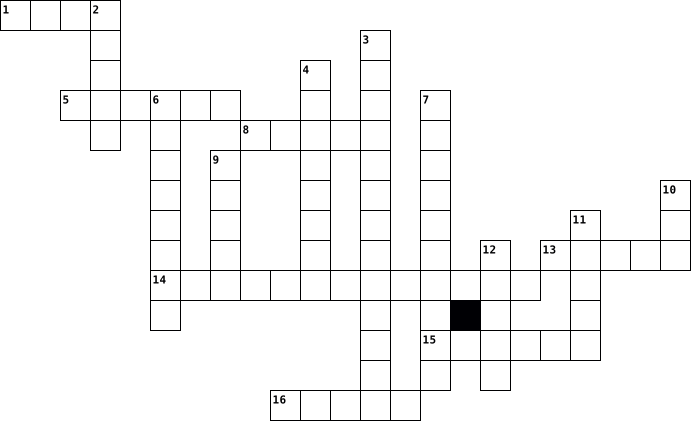
Across
- a priest
- meal for community
- sikh order
- mediation
- after death
- rebirth
- religious community
Down
- a person's soul
- wisdom thought from direct experience
- magnetic attraction
- sikh temple
- supporting absolute principles.
- sage
- one escape from intellectual mind
- consequences for once action
- religious institution
16 Clues: sage • rebirth • a priest • mediation • sikh order • sikh temple • after death • a person's soul • meal for community • magnetic attraction • religious community • religious institution • consequences for once action • supporting absolute principles. • one escape from intellectual mind • wisdom thought from direct experience
Tempest Act 1 Quiz 2024-04-19

Across
- Heavens & Earth
- Overthrow Government
- Supreme Enlightenment
- Reign of Zeus
- Flaky Shaky
- Lacking politeness
- Dumb Jock
Down
- Older Siblings Love
- World War 3
- A turncoat
- A gymnast
- Detective work
- Hat of a prince
- Volunteering
14 Clues: A gymnast • Dumb Jock • A turncoat • World War 3 • Flaky Shaky • Volunteering • Reign of Zeus • Detective work • Heavens & Earth • Hat of a prince • Lacking politeness • Older Siblings Love • Overthrow Government • Supreme Enlightenment
American Revolution Review 2026-02-25

Across
- an ally of the colonists during the war
- the type of government that the Americans formed
- last major battle of the war
- the first official president of the United States
- a document that described how our government would work
- the country that the colonists went to war against
Down
- a time of new ideas about governments
- the name of the treaty that ended the war
- the colonists were angry about being taxed without ____
- the type of government that Enlightenment thinkers liked
- the name of the British king
11 Clues: last major battle of the war • the name of the British king • a time of new ideas about governments • an ally of the colonists during the war • the name of the treaty that ended the war • the type of government that the Americans formed • the first official president of the United States • the country that the colonists went to war against • ...
Buddhism Crossword 2026-01-08

Across
- Where a Buddhist goes after achieving enlightenment and breaking free from suffering and Samsara
- The spiritual teacher of Buddhism who achieved enlightenment and reached Nirvana.
- The belief that your soul is reborn into a different body after death
- Being awakened to the knowledge of everything.
Down
- The idea that everything within life is changing
- The cycle of life, death and rebirth
- The religion that follows the teaching of Buddha
7 Clues: The cycle of life, death and rebirth • Being awakened to the knowledge of everything. • The idea that everything within life is changing • The religion that follows the teaching of Buddha • The belief that your soul is reborn into a different body after death • The spiritual teacher of Buddhism who achieved enlightenment and reached Nirvana. • ...
Gamma Phi Delta 2021-11-04

Across
- represents enlightenment
- Founder
- Quad State asst regional director
- charitable, religious, educational, and scientific
- represents flexibility of ideas
- college where founded
- motto
- Co-founder
- females age 8-12
Down
- collectible
- original name of sorority
- framework
- females age 13 to soph
- Supreme Basileus
- aim
- flower
- female adult auxiliary
- represents sisterhood
- City of headquarters
- represents justice
- represents peace
21 Clues: aim • motto • flower • Founder • framework • Co-founder • collectible • Supreme Basileus • represents peace • females age 8-12 • represents justice • City of headquarters • college where founded • represents sisterhood • females age 13 to soph • female adult auxiliary • represents enlightenment • original name of sorority • represents flexibility of ideas • Quad State asst regional director • ...
Religion among Religions 2019-07-21
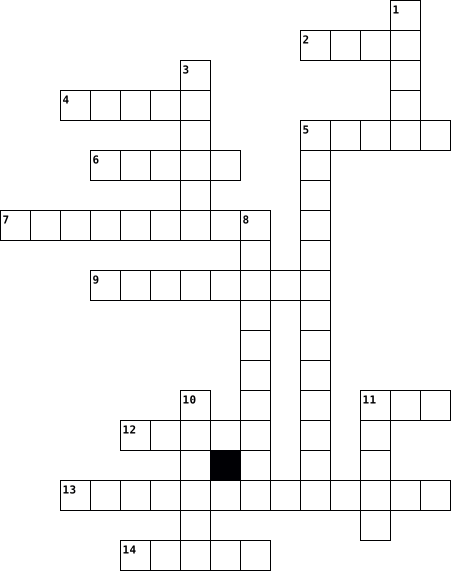
Across
- a priest
- religious institution
- sage
- a person's soul
- sikh temple
- magnetic attraction
- one escape from intellectual mind
- sikh order
- wisdom thought from direct experience
- consequences for once action
Down
- religious community
- rebirth
- after death
- supporting absolute principles.
- meal for community
- mediation
16 Clues: sage • rebirth • a priest • mediation • sikh order • after death • sikh temple • a person's soul • meal for community • religious community • magnetic attraction • religious institution • consequences for once action • supporting absolute principles. • one escape from intellectual mind • wisdom thought from direct experience
S.S crossword Puzzle 2013-01-31

Across
- a philosophe movement, primarily of the 1700s, that was characterized by reliance on reason and experience
- Method/ a method involving careful observation of nature and, some sciences and, controlled experiments
- Bill of Rights/ acts passed by parliment in 1689 guarenteeing certain rights of english people and limititing the power of the monarch
Down
- of Terror/ the period of the French Revolution during which many people were executed for opposing the rtevolution
- a fench thinker of the Enlightenment
- of Reason/ the period of the Enlightenment
- of Independancee/ the document in whwch the United States is announced its independance from Britian
- Rights/rights that belong to all human beingsfrom birth
- terroity settled and ruled by a distant counrty
9 Clues: a fench thinker of the Enlightenment • of Reason/ the period of the Enlightenment • terroity settled and ruled by a distant counrty • Rights/rights that belong to all human beingsfrom birth • of Independancee/ the document in whwch the United States is announced its independance from Britian • ...
7th Bell Work Aug.11th-15th Crossword Puzzle 2025-08-06

Across
- This word means "logical thinking" and was a key tool for Enlightenment thinkers.
- French philosopher known for his witty writings and advocacy for freedom of speech.
- This is the concept that a government's authority comes from an agreement between the government and the people.
- A French philosopher who proposed the idea of separation of powers
- This is a system where government power is divided into different branches
Down
- An English philosopher whose ideas influenced the American Declaration of Independence.
- he period also known as the Age of Reason.
- The three rights John Locke believed people were born with: life, liberty, and ______.
- The Enlightenment encouraged people to challenge this, which was often tied to the monarchy or the church.
9 Clues: he period also known as the Age of Reason. • A French philosopher who proposed the idea of separation of powers • This is a system where government power is divided into different branches • This word means "logical thinking" and was a key tool for Enlightenment thinkers. • French philosopher known for his witty writings and advocacy for freedom of speech. • ...
Xmas at KBR 2024 2024-12-24

Across
- Smile
- Good victory
- Originally made out of clay
- Flower
- New/Fresh
- Charge + insect with a sting
- Part of God
- Protection
- Decorative end of a sari
- Master of the right/correct way
- Boundless
Down
- Teacher
- Lord of Ram
- Music
- Small or young
- Affection or Friendship
- Attained enlightenment
- Embodiment of patience
- Knowledge of Ocean
- Daughter of the mountain
20 Clues: Smile • Music • Flower • Teacher • New/Fresh • Boundless • Protection • Lord of Ram • Part of God • Good victory • Small or young • Knowledge of Ocean • Attained enlightenment • Embodiment of patience • Affection or Friendship • Decorative end of a sari • Daughter of the mountain • Originally made out of clay • Charge + insect with a sting • Master of the right/correct way
Enlightenment Choice Board 2022-03-14

Across
- a European intellectual movement of the late 17th and 18th centuries emphasizing reason and individualism rather than tradition.
- in charge of making laws.
- enforces law
- was a versatile and prolific writer, producing works in almost every literary form
- a principle that supports the freedom of an individual or a community to articulate their opinions and ideas without fear of retaliation
- state of being free within society from oppressive restrictions imposed by authority on one's way of life, behavior, or political views.
- in charge of deciding the meaning of laws
- religion based on the person and teachings of Jesus of Nazareth, or its beliefs and practices
- a form of government in which a single person—usually a king or queen—holds absolute, autocratic power.
- a formal declaration of the legal and civil rights of the citizens of any state, country, federation, etc.
Down
- A system or group of people governing an organized community, generally a state.
- was a French judge, man of letters, historian, and political philosopher. He is the principal source of the theory of separation of powers, which is implemented in many constitutions throughout the world
- 16th-century religious, political, intellectual and cultural upheaval that splintered Catholic Europe
- was an English philosopher and physician, widely regarded as one of the most influential of Enlightenment thinkers
- was a Genevan philosopher, writer, and composer. His political philosophy influenced the progress of the Enlightenment throughout Europe
- a person engaged or learned in philosophy, especially as an academic discipline.
16 Clues: enforces law • in charge of making laws. • in charge of deciding the meaning of laws • A system or group of people governing an organized community, generally a state. • a person engaged or learned in philosophy, especially as an academic discipline. • was a versatile and prolific writer, producing works in almost every literary form • ...
Terms for Enlightenment 2017-05-06

Across
- The holy Name of God, as recited by Sikhs.
- Singing of sacred hymns from Guru Granth Sahib.
- A sudden experience of enlightened awareness.
- Physical embodiment of the divine.
- An incarnation of a deity.
- The individual soul.
- An occupational category.
- Gem The Buddha, the Dharma, and the Sangha.
- Granth The collected writings of Guru Gobind Singh.
Down
- Intuitive knowledge of spiritual realities.
- The first morning prayer of Sikhs, written by Guru Nanak.
- Belief that there is no deity.
- Liberation from mental afflictions, suffering, and rebirth.
- Belief that all life was created by God.
- Impermanence.
- A subtle energy center in the body.
16 Clues: Impermanence. • The individual soul. • An occupational category. • An incarnation of a deity. • Belief that there is no deity. • Physical embodiment of the divine. • A subtle energy center in the body. • Belief that all life was created by God. • The holy Name of God, as recited by Sikhs. • Intuitive knowledge of spiritual realities. • ...
The Enlightenment Era 2023-10-02

Across
- Argued that the free market should be allowed to regulate business activity
- Newton Discovered gravity
- Created the three branches of government
- Believed people were naturally good but were corrupted by the evils of society
- Believed the Sun was in the center of the universe, not the earth
- Fought for women's rights
- Discovered cells and microorganisms (Made the microscope)
Down
- Learned how infection spreads
- Learned about the structure of the human body
- Believed that people were naturally greedy, cruel, and selfish
- Explained elements and chemical compounds
- Wrote against slave trade and religious prejudice
- Learned how blood circulates in the body
- Believed people were naturally reasonable and moral
- Believed the Earth moved in an ellipse around the sun
- Believed the earth rotated around the Sun
16 Clues: Newton Discovered gravity • Fought for women's rights • Learned how infection spreads • Created the three branches of government • Learned how blood circulates in the body • Explained elements and chemical compounds • Believed the earth rotated around the Sun • Learned about the structure of the human body • Wrote against slave trade and religious prejudice • ...
Declaration of Independence 2026-05-11

Across
- Movement focused on science and reason
- Idea that people give up rights for protection
- Philosopher who believed people are born with natural rights
- Philosopher who believed life without government would be “nasty, brutish, and short”
- Use of reason and logic
- Questioning authority and tradition
Down
- Name for Enlightenment writers and philosophers who focused on reason and reform
- Power held by the people
- System where people elect their leaders
- System of laws that applies to everyone equally
- Philosopher known for criticizing government and religion using satire and humor
- Thinker who created the separation of powers
- Writer of the Social Contract who believed government comes from the general will of the people
13 Clues: Use of reason and logic • Power held by the people • Questioning authority and tradition • Movement focused on science and reason • System where people elect their leaders • Thinker who created the separation of powers • Idea that people give up rights for protection • System of laws that applies to everyone equally • ...
Scientific Revolution & Enlightenment 2015-04-13

Across
- this religious organization was against many of the teachings during the Scientific Revolution
- ____________ and Greek scholars both developed scientific ideas that influenced European scholars in the Scientific Revolution
- this period used reason to explain the universe and how it worked
- he improved the telescope
- a time period where reason was used to come up with ideal types of government and economy
- He said that scientists should gather facts by observation and use them to reach conclusions
- He said all people are born with natural rights
- He said the universe can be explained by mechanical laws
Down
- He said government should be divided into branches to create a balance of power
- He challenged traditional beliefs by suggesting that the Earth moved around the sun
- He developed the theory of gravity
- Francis Bacon and Rene Descartes helped develop the scientific method by encouraging logic and reason
- Ptolemy believed in a _________ universe, or an Earth-centered universe, which was accepted for nearly 1500 years
- He said that planets follow an elliptical path around the sun
- Montesquieu wanted this in governments
- this group did not need equality according to Enlightenment thinkers
16 Clues: he improved the telescope • He developed the theory of gravity • Montesquieu wanted this in governments • He said all people are born with natural rights • He said the universe can be explained by mechanical laws • He said that planets follow an elliptical path around the sun • this period used reason to explain the universe and how it worked • ...
Age of Enlightenment 2025-01-16

Across
- Monarchy
- de Montesquieu
- of Powers
- of the Governed
- Despot
- Wollstonecraft
- Contract
Down
- Rights
- of Reason
- Hobbes
- Right
- Rousseau
- Lock
- Revolution
- of Religion
- Will
16 Clues: Lock • Will • Right • Rights • Hobbes • Despot • Monarchy • Rousseau • Contract • of Reason • of Powers • Revolution • of Religion • de Montesquieu • Wollstonecraft • of the Governed
Indian Religions 2019-12-01

Across
- Hindu texts
- the Path Buddists' take
- Goddess of time and death
- the Destroyer
- The Buddha's name
- reincarnation
- priest
- enlightenment
- duties
Down
- the Mother
- many gods
- what you do comes back to you
- elephant God
- three baskets
- social system
15 Clues: priest • duties • many gods • the Mother • Hindu texts • elephant God • the Destroyer • three baskets • reincarnation • enlightenment • social system • The Buddha's name • the Path Buddists' take • Goddess of time and death • what you do comes back to you
Chapter 1 Part 2 By:Isaiah Contreras 2013-08-26

Across
- first written plan for government
- opponent of the constitution
- every 5 slaves counted as 3 people in house of reps
- The idea of each branch of government limiting the other 2
- created two parts of congress, Senate and House
- supporter of the constitution
Down
- enlightenment thinker responsible for separation of powers
- the idea that the government and religion should have no affiliations what so ever
- a plan to govern the people
- enlightenment thinker responsible for social contract
10 Clues: a plan to govern the people • opponent of the constitution • supporter of the constitution • first written plan for government • created two parts of congress, Senate and House • every 5 slaves counted as 3 people in house of reps • enlightenment thinker responsible for social contract • enlightenment thinker responsible for separation of powers • ...
Early Phases of Revolution 2024-02-16

Across
- France was seized by a senseless chaos
- Storming of a Paris prison
- the social and political system of France.
- passed laws and reformed the government.
- New views about power and authority in government.
- clergyman who suggested the idea of 3rd estate reforming themselves.
Down
- well educated and believed strongly in the Enlightenment ideals of liberty and
- a large social class
- Decided to stick with the Medieval rules
- published a declaration of the rights of woman
- pledged to not give up until a new constitution was written.
11 Clues: a large social class • Storming of a Paris prison • France was seized by a senseless chaos • Decided to stick with the Medieval rules • passed laws and reformed the government. • the social and political system of France. • published a declaration of the rights of woman • New views about power and authority in government. • ...
unit 9 study guide 2024-01-30

Across
- Exclusive control area.
- Social contract philosopher.
- Mass production.
- God-given authority.
- Enlightenment writer.
- Africa's partition.
- Social contract theorist.
- Laws of motion.
- Colonial expansion.
- Heliocentric advocate.
Down
- Steam engine inventor.
- Systematic inquiry.
- City growth.
- Industrial production sites.
- Economic tier.
- Sun-centered model.
- Natural rights advocate.
- Separation of powers.
- Mutual agreement governance.
- Business innovator.
20 Clues: City growth. • Economic tier. • Laws of motion. • Mass production. • Systematic inquiry. • Sun-centered model. • Business innovator. • Africa's partition. • Colonial expansion. • God-given authority. • Enlightenment writer. • Separation of powers. • Steam engine inventor. • Heliocentric advocate. • Exclusive control area. • Natural rights advocate. • Social contract theorist. • ...
Age of Revolutions Part 2 & 3 2022-01-11

Across
- the social class of France that included the bourgeoisie (middle class), the urban lower class, and peasants who embraced Enlightenment ideas.
- a uniform system of laws established for France by Napoleon.
- leader that removed Robespierre, put into place expanded rights for French citizens, and expanded France’s power and territory.
- the social class of France that was made up of rich nobles who disagreed with Enlightenment ideas.
- the king of France that was overthrown during the French Revolution.
- the document written to form the government and protect the citizens of the United States
- head writer and author of the Declaration of Independence
- the period from 1793-1794, when Maximilien Robespierre ruled France nearly as a dictator and thousands of political figures and common citizens were executed.
- the site of Napoleon’s final defeat.
Down
- a statement of the reasons for the American colonies’ break with Britain.
- an addition to the United States Constitution that specifically lists and protects the rights of citizens of the United States
- wife of Louis XVI who was disliked for her excessive spending and lack of sympathy for the peasants.
- a document that outlined the basic rights of man that was upheld by Napoleon.
- head writer and author of the Declaration of Independence
- the social class of France that disagreed with Enlightenment ideas and consisted of the clergy and the Roman Catholic Church.
15 Clues: the site of Napoleon’s final defeat. • head writer and author of the Declaration of Independence • head writer and author of the Declaration of Independence • a uniform system of laws established for France by Napoleon. • the king of France that was overthrown during the French Revolution. • ...
unit 9 vocab Shiqi Zhang 2025-01-27

Across
- English philosopher, known for 1651 book Leviathan, and he is one of the founders of modern political philosophy.
- an inventor who built on the stem engine, his work helped the power of the industrial revolution
- french philosopher of the Age of Enlightenment. famous for separation of power in government.
- key figure in scientific revolution and enlightenment, also active as mathematician, physicist, theologian, and author.
- a meeting in 1880s where European countries split Africa without asking them.
- a place that workers manufacture items with machines
- an area where one country has a lot of control or influence over what happens there.
- when everything is owned by the community or government and other people get what they need based on their job.
Down
- an English political philosopher, proponent of limited government.
- the process where more people cities or towns increase growth of those areas.
- key figure in European intellectuals known as Enlightenment, a French Author philosopher published books and pamphlets.
- solves problems using testing and experimentation brings out facts and hypotheses
- a theory that the earth and planets orbit or revolve around the sun.
- a person that believes things that are different from what their religion says.
- is a political system that only one person holds all the power in the country
- someone who has their own business or is the owner of some factory.
- when a country takes over other land to control them and expand their own land.
- a natural philosopher, astronomer, and mathematician "father of modern astronomy", "father or modern physics". revolutionary telescopic discoveries and largest moons of Jupiter.
- when the government or the community owns major industries and resources like factories and helps everyone need.
19 Clues: a place that workers manufacture items with machines • an English political philosopher, proponent of limited government. • someone who has their own business or is the owner of some factory. • a theory that the earth and planets orbit or revolve around the sun. • the process where more people cities or towns increase growth of those areas. • ...
Influences on American Government 2022-02-14

Across
- Intellectual movement started in Western Europe which spread ideas to Europe and colonies via the printing press and faster transportation.
- Established clear limits on monarchs and outlined rights and protections of citizens.
- Life, liberty and property are _________, which every person is born with regardless of status.
- Act that ensured religious tolerance and influenced American religious freedom.
- The execution of a social contract.
- When citizens are ignorant of what is going on in their government.
Down
- Enlightenment thinker who believed that the government needed to be strong and controlling over its people (liked the idea of autocracy).
- Era in which logic and reasoning were stressed and skepticism of ideas was encouraged.
- Enlightenment thinker who believed that no person has naturally given control over others.
- Document that stated that leaders can't have unlimited power and can be checked by their people.
10 Clues: The execution of a social contract. • When citizens are ignorant of what is going on in their government. • Act that ensured religious tolerance and influenced American religious freedom. • Established clear limits on monarchs and outlined rights and protections of citizens. • ...
SOCIAL STUDIES WORDS 2021-05-27

Across
- How-much-members-did-each-aztecs-council-have
- What-where-all-aztecs-leaders.
- The-incas-supreme-god.
- Which-civilization-had-a-mountainous-terrain-incas/aztecs/mayas.
Down
- Was-leonardo-da-vinci-in-the-Renaissance-or-enlightenment.
- what-is-the-second-pillar-of-islam.
- what-is-the-4th-pillar-of-islam.
- Is-there-a-difference-between-renaissance/enlightenment
- Which-civilization-had-there-home-in-a-lake-incas/aztecs/mayas.
- Did-China-Make-Toilet-Paper-Yes/No.
10 Clues: The-incas-supreme-god. • What-where-all-aztecs-leaders. • what-is-the-4th-pillar-of-islam. • what-is-the-second-pillar-of-islam. • Did-China-Make-Toilet-Paper-Yes/No. • How-much-members-did-each-aztecs-council-have • Is-there-a-difference-between-renaissance/enlightenment • Was-leonardo-da-vinci-in-the-Renaissance-or-enlightenment. • ...
The Enlightenment 2024-09-24

Across
- the French word for Enlightenment thinkers
- Wrote Wealth of Nations about economics
- the power of the mind to think, understand, and make sense of the world
- Believed in life, liberty, and property for all
- a period when philosophers applied reason to answer political questions
Down
- Used satire and humor to mock monarchs and the Catholic Church
- Advocated for women's suffrage
- Stated people needed to make a social contract
- Compiled the first Encyclopedia
- Believed in separation of powers
10 Clues: Advocated for women's suffrage • Compiled the first Encyclopedia • Believed in separation of powers • Wrote Wealth of Nations about economics • the French word for Enlightenment thinkers • Stated people needed to make a social contract • Believed in life, liberty, and property for all • Used satire and humor to mock monarchs and the Catholic Church • ...
Unit 5 Key Terms 2024-01-04

Across
- King of France and embodiment of an absolute monarch who famously asserted “I am the state”; Built a grand palace at Versailles that served as a symbol of his unchecked royal authority over France
- Absolute ruler of Spain and primary rival of Elizabeth I - he used his position to militantly defend Catholicism; Marked the height of the Spanish empire and the beginning of its decline among European powers
- German/prussian king; He was highly inspired by Enlightenment philosophy and worked to provide a better life for peasants and better religious tolerance in his country
- French phrase that essentially means to “leave it alone”; When applied to economics - the belief that economies will function best when interference from the government is limited
- Major French philosopher, writer, and activist who was an outspoken critic of the Church and French government; Emphasized the importance of Freedom of speech, religion, and the separation of church and state
- English philosopher who believed that people were born evil and required a strong and absolute leader to which everyone must submit; He thought the role of government was to keep mankind out of the wild and brutal world that we would naturally create on our own
- term often used interchangeably with capitalism and market economies; An economy where buyers and sellers answer essential economic questions such as what should be produced, how it should be produced and who should have access to it
- French philosopher and creator of the 1751 Encyclopedia; His compilation of the work of enlightenment scholars helped spread the ideas across Europe
- Means “blank slate”; Concept used to support the idea that people are born innocent and become what society makes them to be rather than having an essential “human nature” that defines our actions
- Extremely ornate style which commonly uses soft colors, curvy lines and scenes from nature; Common in the architecture and decor of palaces used by absolute monarchs which were designed to emphasize the wealth and power of Europeans elites
- Rule of one in which a leader has total power and individual liberties are usually severely limited if present at all; Oftentimes supported by the claims of divine right
Down
- Enlightenment economist; Advocated for laissez faire economics and leaving a nation’s economy to be regulated by natural law
- Ruled absolutely, but with the interests of their people in mind and with new ideas about how best to govern; Included Catherine and Frederick among others who claimed power not by divine right, but by the social contract
- French term for important thinkers, writers, artists, and politicians that debated and developed enlightenment ideas; Many inspired the foundation for US government, social structure, and economy while driving revolution in their own countries
- Absolute monarch that worked to Westernize Russia; Is largely credited with transforming Russia into a major European power by reforming its economy, culture, and trade relationships with the help of experts recruited from other countries
- Czarina of Russia who was a frequent pen pal of Voltaire with whom she exchanged enlightenment ideas; Her rule marked an increase in access to education, significant patronage of the arts and substantial expansion of territory
- Agreement between the people and the government; The people give up some of their rights/power in exchange for protection of their remaining rights
- French philosopher known for his ideas on separation of powers; He argued that the appropriate government would take into account the size of the country
- Italian philosopher and criminologist who argued against cruel and unusual punishments; He outlined much of what would become due process of law in the United States
- Granted to human beings not by any law, custom or government; Included, according to John Locke, life, liberty and property
- Swiss political philosopher; He argued for direct democracy, abolishment of nobility, and argued that all were equal
- Religious philosophy of many of the framers of the US government and Enlightenment philosophers; God created the universe and left it to run without interference
- Gatherings common in Paris during the Enlightenment period that were often hosted by women; People of different classes could come together to discuss ideas on government, art and society
- English philosopher who believed that people were born neither good nor evil; He believed that people were born with certain inalienable rights that could never be taken away by the government because they were granted by God
24 Clues: Swiss political philosopher; He argued for direct democracy, abolishment of nobility, and argued that all were equal • Granted to human beings not by any law, custom or government; Included, according to John Locke, life, liberty and property • ...
French Revolution 2023-12-01

Across
- France's cross-channel neighbour and most significant imperial rival
- A monarch that has unlimited power over their nation
- A rapid and often violent exchange of political systems
- This particular group carried most of France's taxation burden
- A collective term for members of the Church, such as priests and bishops
- A tax the 3rd Estate gives to the Clergy/ First Estate
- The country France helped revolt against Britain
- King Louis XIV's nickname he gave himself
- The King of France
- A period of intellectual curiosity and discovery beginning in the mid-1600s
Down
- A poor agricultural worker
- The Price of this specific food doubled...
- Capital city of France
- The belief that royal political power emanates from God, '...... right'
- Major conflict that erupted in 1754, the .... Years' War
- A compulsory contribution to the church, usually one-tenth of a family's income
- The class of people in the second Estate
- King Loius XIV famous phrase " I am the ....."
- An Enlightenment theory that suggests the individual surrenders some of his rights in return for the protection of the state, the 'social ........'
19 Clues: The King of France • Capital city of France • A poor agricultural worker • The class of people in the second Estate • King Louis XIV's nickname he gave himself • The Price of this specific food doubled... • King Loius XIV famous phrase " I am the ....." • The country France helped revolt against Britain • A monarch that has unlimited power over their nation • ...
Unit 6 2022-10-31

Across
- the last queen of France before the French Revolution - famous for CAKE
- freed from ignorance and misinformation
- the transition from creating goods by hand to using machines.
- is an individual who takes the risk to start their own business based on an idea they have or a product they have created while assuming most of the risks and reaping most of the rewards of the business.
- Genevan philosopher, writer, and composer
- the idea that states consciously or unconsciously strive towards an equal distribution of power to avoid dominance by one
- the pronouncement and founding document adopted by the Second Continental Congress meeting at Pennsylvania State House in Philadelphia, Pennsylvania, on July 4, 1776.
Down
- a Scottish economist and philosopher who was a pioneer in the thinking of political economy and key figure during the Scottish Enlightenment.
- the political and social system of the Kingdom of France from the Late Middle Ages until 1789
- the separation of power in the government
- the French Enlightenment thinkers usually applied to themselves
- This was a period of huge change in thought and reason
- are resources that are the building blocks of the economy
13 Clues: freed from ignorance and misinformation • the separation of power in the government • Genevan philosopher, writer, and composer • This was a period of huge change in thought and reason • are resources that are the building blocks of the economy • the transition from creating goods by hand to using machines. • ...
Age of Enlightenment 2025-01-17

Across
- Chemist known for his Law, describing the behavior of gases.
- Protestant reformer who emphasized predestination.
- English philosopher who wrote "Leviathan" and supported strong central authority.
- English physician who discovered the circulation of blood.
- The process used by scientists to test hypotheses and conduct experiments.
- French Enlightenment thinker who supported freedom of speech
Down
- English jurist known for his works on common law.
- French Enlightenment thinker who supported freedom of speech.
- French political thinker who proposed the separation of powers.
- Known for defining the laws of motion and universal gravitation.
- American Founding Father and author of the Declaration of Independence.
- Polish astronomer who proposed the heliocentric model.
- English philosopher who introduced the concept of natural rights.
13 Clues: English jurist known for his works on common law. • Protestant reformer who emphasized predestination. • Polish astronomer who proposed the heliocentric model. • English physician who discovered the circulation of blood. • Chemist known for his Law, describing the behavior of gases. • French Enlightenment thinker who supported freedom of speech • ...
StarSeeds 2024-11-22

Across
- Inner sense
- Relating to stars
- Very old
- Relating to the universe
- Knowledge and insight
- Spiritual essence
- Beginning of life
- Spiritual enlightenment
- Earthly being
Down
- Sensitive to spiritual energy
- Extraterrestrial being
- Purposeful task
- Mixed origin
- Celestial body
- Understanding feelings
15 Clues: Very old • Inner sense • Mixed origin • Earthly being • Celestial body • Purposeful task • Relating to stars • Spiritual essence • Beginning of life • Knowledge and insight • Extraterrestrial being • Understanding feelings • Spiritual enlightenment • Relating to the universe • Sensitive to spiritual energy
Age of Enlightenment 2024-12-12

Across
- Culture that was an influence on Enlightenment, practiced direct democracy.
- Culture that was an influence on Enlightenment, practiced Republic democracy.
- Writer of the declaration of independence, strongly influenced by Locke's writings. (Last name)
- Philosophy that the world around us could be explain using reason and logic.
- collected the ideas of the philosophes in a multivolume Encyclopédie. (Last name)
Down
- an intellectual movement that occurred in the 1600s and 1700s, had its roots in earlier trends and ideas.
- philosophy that gained influence during the Renaissance made thinkers value human life and achievements more than they had previous
- King of Prussia, created some reforms based on new ideas, but did not create significant changes. (Last name)
- a British philosopher, wrote about human nature and said that people were born with natural rights such as life, liberty, and property. (last name)
- a German philosopher, wrote that people should use rational thought when making moral decisions. (Last name)
- Writer of the U.S. Constitution heavily influenced by Montesquieu. (Last name)
- Revolution that gave people faith that they could use reason to understand the world around them.
12 Clues: Culture that was an influence on Enlightenment, practiced direct democracy. • Philosophy that the world around us could be explain using reason and logic. • Culture that was an influence on Enlightenment, practiced Republic democracy. • Writer of the U.S. Constitution heavily influenced by Montesquieu. (Last name) • ...