
environment Crossword Puzzles
Biodiversity and the Environment 2025-10-11

Across
- | The complete disappearance of a species from Earth.
- | The surroundings or conditions in which a person, animal, or plant lives.
- | The plant life of a particular region or period.
- | The introduction of harmful substances into the environment.
- | The process by which different kinds of living organisms have developed and diversified from earlier forms.
- | The study of heredity and variation in organisms.
- | The way different organisms rely on each other for survival.
- | The protection and management of natural resources and biodiversity.
- | A large naturally occurring community of flora and fauna occupying a major habitat, e.g. forest or desert.
Down
- | The process by which organisms adjust to their environment to survive.
- | The natural home or environment of an organism.
- | A community of living organisms interacting with their non-living environment.
- | Existing in or caused by nature, not made or caused by humankind.
- | Maintaining something in its original or existing state, especially natural areas.
- and the Environment
- | The animal life of a particular region, habitat, or geological period.
- | A species at risk of becoming extinct.
- | A group of similar organisms capable of breeding and producing fertile offspring.
- | The variety of different species and ecosystems in a specific area.
- | Returning an ecosystem or habitat to its original condition.
- | The average weather conditions of an area over a long period of time.
21 Clues: and the Environment • | A species at risk of becoming extinct. • | The natural home or environment of an organism. • | The plant life of a particular region or period. • | The study of heredity and variation in organisms. • | The complete disappearance of a species from Earth. • | The introduction of harmful substances into the environment. • ...
Introduction to Environmental Change and Management 2021-09-09

Across
- Form of radiation that comes from the sun starting with S
- The natural products that can be used to converted by humans for our use which is one of the S's
- Challenge to the environment created by humans starting with P in the air, on the land, and in the water
- Framework used to help environmental management of Drivers, pressures, State, Impacts and Response
- Community of plants and animals living together
- Greenhouse gas starting with M
- Area that holds the most oxygen, starting with A
- Type of environment starting with R
- Type of environment starting with G
- Processes in the natural environment that absorb our waste
- Non-living component of element of the environment web
- Refers to the removal of trees and other plant life from a forested area
Down
- Greenhouse gas in two words, starting with C and D
- Belief that you are the most important creature on earth
- Type of climactic zone starting with D
- When the land degrades and becomes desert
- deep connection people have to the land that is formed over many generations starting with S
- Beliefs of Aboriginal and Torres Strait Islander peoples starting with D
- This part of the process in the environment starts with the evaporation of water- starting with h
- Another word for farming starting with A
- The shell of the earth is called the what (starting with c)
21 Clues: Greenhouse gas starting with M • Type of environment starting with R • Type of environment starting with G • Type of climactic zone starting with D • Another word for farming starting with A • When the land degrades and becomes desert • Community of plants and animals living together • Area that holds the most oxygen, starting with A • ...
PSY210 Chapter 2 Crossword 2025-05-22

Across
- A study that seeks to discover whether adopted children are more like their adoptive or biological parents
- Seeking out environments that reflect one's own interests and talents
- A complex molecule that contains genetic information
- Units of hereditary information composed of DNA
- A study comparing the behavioral similarity of identical and fraternal twins
- Type of genotype-environment correlation where a child’s characteristics elicit certain types of environments
- A gene whose influence is overridden by a dominant gene
- Perspective that emphasizes adaptation, reproduction, and natural selection in shaping behavior
- Type of genotype-environment correlation where biological parents provide a rearing environment
- Cell division that forms sperm and egg cells
Down
- Environmental influences that are similar for individuals in the same family
- A child's unique experiences, both within and outside the family
- A person's genetic heritage; the actual genetic material
- A gene that overrides the potential influence of another gene
- Traits that are determined by the interaction of many genes
- Darwin’s principle that those best adapted to their environment survive and reproduce
- Observable and measurable characteristics of an individual
- A single cell formed through fertilization
- View emphasizing that development is the result of ongoing, bidirectional interchange between heredity and environment
- Cellular reproduction in which the cell’s nucleus duplicates and divides
- Type of genotype-environment correlation where children seek out environments they find compatible
- Threadlike structures made up of DNA
22 Clues: Threadlike structures made up of DNA • A single cell formed through fertilization • Cell division that forms sperm and egg cells • Units of hereditary information composed of DNA • A complex molecule that contains genetic information • A gene whose influence is overridden by a dominant gene • A person's genetic heritage; the actual genetic material • ...
Chapter 12 Vocabulary 2022-10-20

Across
- a non-living (physical or chemical) component of the environment
- organisms that live on the bottom
- population growth that is constrained by biotic or abiotic factors such as competition or nutrients
- organisms that live in the water column, away from the bottom, including the plankton and nekton
- the bottom below 6,000 m
- the bottom from a depth of approximately 4,000 m to 6,000 m
- the sharing of resources by specialization
- each of the steps in a food chain
- the pelagic environment above the continental shelf
Down
- a living component of an environment
- the pelagic environment beyond the shelf break
- unrestricted population growth where the population grows at a faster rate with each successive generation
- an essential factor whose short supply limits the growth of a population
- the bottom between the shelf break and a depth of approximately 4,000 m
- the maximum population size that can be sustained by the available resources in a given environment
- the study of the interactions between organisms and their environment
- the elimination of one species by another as a result of competition
- the total mass of living organisms
18 Clues: the bottom below 6,000 m • organisms that live on the bottom • each of the steps in a food chain • the total mass of living organisms • a living component of an environment • the sharing of resources by specialization • the pelagic environment beyond the shelf break • the pelagic environment above the continental shelf • ...
Vocab 12 2022-10-24

Across
- Biomass: the total mass of living organism
- pelagic environment beyond the shelf break
- the bottom below 6,000 m
- bottom between that shelf break and a depth of approximately 4,000 m
- :a non-living (physical or chemical) component of the environment
- resource:An essential factor whose short supply limits the growth of a population
- partitioning:the sharing of resources by specialization
- growth:unrestricted population growth where the population grows at a faster rate with each successive generation
Down
- bottom from a depth of approximately 4,000 m to 6,000
- that live in the water column,away from the bottom ,including the plankton and nekton
- organism that lives on the bottom
- level: each of the steps in a food chain
- exclusion:the elimination of one species by another as a result of competition
- capacity:the maximum population size that can be sustained by available resources in a given environment
- the study of the interactions between an organism and their environment
- growth:population growth that is constrained by biotic or abiotic factors such as competition or nutrients
- the pelagic environment above the continental shelf
- a living component of an environment
18 Clues: the bottom below 6,000 m • organism that lives on the bottom • a living component of an environment • level: each of the steps in a food chain • Biomass: the total mass of living organism • pelagic environment beyond the shelf break • the pelagic environment above the continental shelf • bottom from a depth of approximately 4,000 m to 6,000 • ...
Vocab 12 2022-10-24

Across
- Biomass: the total mass of living organism
- pelagic environment beyond the shelf break
- the bottom below 6,000 m
- bottom between that shelf break and a depth of approximately 4,000 m
- :a non-living (physical or chemical) component of the environment
- resource:An essential factor whose short supply limits the growth of a population
- partitioning:the sharing of resources by specialization
- growth:unrestricted population growth where the population grows at a faster rate with each successive generation
Down
- bottom from a depth of approximately 4,000 m to 6,000
- that live in the water column,away from the bottom ,including the plankton and nekton
- organism that lives on the bottom
- level: each of the steps in a food chain
- exclusion:the elimination of one species by another as a result of competition
- capacity:the maximum population size that can be sustained by available resources in a given environment
- the study of the interactions between an organism and their environment
- growth:population growth that is constrained by biotic or abiotic factors such as competition or nutrients
- the pelagic environment above the continental shelf
- a living component of an environment
18 Clues: the bottom below 6,000 m • organism that lives on the bottom • a living component of an environment • level: each of the steps in a food chain • Biomass: the total mass of living organism • pelagic environment beyond the shelf break • the pelagic environment above the continental shelf • bottom from a depth of approximately 4,000 m to 6,000 • ...
Vocab 12 2022-10-24

Across
- Biomass: the total mass of living organism
- pelagic environment beyond the shelf break
- the bottom below 6,000 m
- bottom between that shelf break and a depth of approximately 4,000 m
- :a non-living (physical or chemical) component of the environment
- resource:An essential factor whose short supply limits the growth of a population
- partitioning:the sharing of resources by specialization
- growth:unrestricted population growth where the population grows at a faster rate with each successive generation
Down
- bottom from a depth of approximately 4,000 m to 6,000
- that live in the water column,away from the bottom ,including the plankton and nekton
- organism that lives on the bottom
- level: each of the steps in a food chain
- exclusion:the elimination of one species by another as a result of competition
- capacity:the maximum population size that can be sustained by available resources in a given environment
- the study of the interactions between an organism and their environment
- growth:population growth that is constrained by biotic or abiotic factors such as competition or nutrients
- the pelagic environment above the continental shelf
- a living component of an environment
18 Clues: the bottom below 6,000 m • organism that lives on the bottom • a living component of an environment • level: each of the steps in a food chain • Biomass: the total mass of living organism • pelagic environment beyond the shelf break • the pelagic environment above the continental shelf • bottom from a depth of approximately 4,000 m to 6,000 • ...
Vocab 12 2022-10-24

Across
- Biomass: the total mass of living organism
- pelagic environment beyond the shelf break
- the bottom below 6,000 m
- bottom between that shelf break and a depth of approximately 4,000 m
- :a non-living (physical or chemical) component of the environment
- resource:An essential factor whose short supply limits the growth of a population
- partitioning:the sharing of resources by specialization
- growth:unrestricted population growth where the population grows at a faster rate with each successive generation
Down
- bottom from a depth of approximately 4,000 m to 6,000
- that live in the water column,away from the bottom ,including the plankton and nekton
- organism that lives on the bottom
- level: each of the steps in a food chain
- exclusion:the elimination of one species by another as a result of competition
- capacity:the maximum population size that can be sustained by available resources in a given environment
- the study of the interactions between an organism and their environment
- growth:population growth that is constrained by biotic or abiotic factors such as competition or nutrients
- the pelagic environment above the continental shelf
- a living component of an environment
18 Clues: the bottom below 6,000 m • organism that lives on the bottom • a living component of an environment • level: each of the steps in a food chain • Biomass: the total mass of living organism • pelagic environment beyond the shelf break • the pelagic environment above the continental shelf • bottom from a depth of approximately 4,000 m to 6,000 • ...
Vocab 12 2022-10-24

Across
- Biomass: the total mass of living organism
- pelagic environment beyond the shelf break
- the bottom below 6,000 m
- bottom between that shelf break and a depth of approximately 4,000 m
- :a non-living (physical or chemical) component of the environment
- resource:An essential factor whose short supply limits the growth of a population
- partitioning:the sharing of resources by specialization
- growth:unrestricted population growth where the population grows at a faster rate with each successive generation
Down
- bottom from a depth of approximately 4,000 m to 6,000
- that live in the water column,away from the bottom ,including the plankton and nekton
- organism that lives on the bottom
- level: each of the steps in a food chain
- exclusion:the elimination of one species by another as a result of competition
- capacity:the maximum population size that can be sustained by available resources in a given environment
- the study of the interactions between an organism and their environment
- growth:population growth that is constrained by biotic or abiotic factors such as competition or nutrients
- the pelagic environment above the continental shelf
- a living component of an environment
18 Clues: the bottom below 6,000 m • organism that lives on the bottom • a living component of an environment • level: each of the steps in a food chain • Biomass: the total mass of living organism • pelagic environment beyond the shelf break • the pelagic environment above the continental shelf • bottom from a depth of approximately 4,000 m to 6,000 • ...
Vocab 12 2022-10-24

Across
- Biomass: the total mass of living organism
- pelagic environment beyond the shelf break
- the bottom below 6,000 m
- bottom between that shelf break and a depth of approximately 4,000 m
- :a non-living (physical or chemical) component of the environment
- resource:An essential factor whose short supply limits the growth of a population
- partitioning:the sharing of resources by specialization
- growth:unrestricted population growth where the population grows at a faster rate with each successive generation
Down
- bottom from a depth of approximately 4,000 m to 6,000
- that live in the water column,away from the bottom ,including the plankton and nekton
- organism that lives on the bottom
- level: each of the steps in a food chain
- exclusion:the elimination of one species by another as a result of competition
- capacity:the maximum population size that can be sustained by available resources in a given environment
- the study of the interactions between an organism and their environment
- growth:population growth that is constrained by biotic or abiotic factors such as competition or nutrients
- the pelagic environment above the continental shelf
- a living component of an environment
18 Clues: the bottom below 6,000 m • organism that lives on the bottom • a living component of an environment • level: each of the steps in a food chain • Biomass: the total mass of living organism • pelagic environment beyond the shelf break • the pelagic environment above the continental shelf • bottom from a depth of approximately 4,000 m to 6,000 • ...
Vocab 12 2022-10-24

Across
- Biomass: the total mass of living organism
- pelagic environment beyond the shelf break
- the bottom below 6,000 m
- bottom between that shelf break and a depth of approximately 4,000 m
- :a non-living (physical or chemical) component of the environment
- resource:An essential factor whose short supply limits the growth of a population
- partitioning:the sharing of resources by specialization
- growth:unrestricted population growth where the population grows at a faster rate with each successive generation
Down
- bottom from a depth of approximately 4,000 m to 6,000
- that live in the water column,away from the bottom ,including the plankton and nekton
- organism that lives on the bottom
- level: each of the steps in a food chain
- exclusion:the elimination of one species by another as a result of competition
- capacity:the maximum population size that can be sustained by available resources in a given environment
- the study of the interactions between an organism and their environment
- growth:population growth that is constrained by biotic or abiotic factors such as competition or nutrients
- the pelagic environment above the continental shelf
- a living component of an environment
18 Clues: the bottom below 6,000 m • organism that lives on the bottom • a living component of an environment • level: each of the steps in a food chain • Biomass: the total mass of living organism • pelagic environment beyond the shelf break • the pelagic environment above the continental shelf • bottom from a depth of approximately 4,000 m to 6,000 • ...
Drum's Favorite Fucking 2025-01-02

Across
- intimate relaxed social setting
- lush vineyards beautiful views
- floating intimate experience
- waiting relaxed private setting
- backseat discreet private concealment
- playful active private moment
- elevated romantic evening spot
- luxurious floating private space
- lush greenery natural intimate setting
- romantic intimate sipping wine
- secluded exciting environment
- secluded nature surrounded by trees
- warm tiled private space
- adventurous secluded nature spot
- moving discreet confined space
- cozy rustic secluded getaway
- warm cozy intimate setting
- warm steamy private environment
- hidden romantic green space
- relaxing water setting playful environment
- cramped quick intimate
Down
- discreet spontaneous outdoor fun
- secluded natural romantic spot
- dark intimate space
- busy public spontaneous encounter
- luxurious comfortable private space
- exclusive private musical setting
- rustic romantic private setting
- quiet sophisticated intimate setting
- quiet secluded reading intimate moment
- discreet work environment spontaneous fun
- cozy warm intimate chalet
- discreet active environment spontaneous fun
- secluded public nature spot
- brief intimate moment quick encounter
- romantic sunset beautiful views
- outdoor romantic nature experience
- fun lively private singing
- dark private intimate moment
- deck romantic floating private space
- relaxing private sensual environment
- city skyline stunning views
- secluded breathtaking panoramic views
- secluded luxurious water experience
- romantic night city lights
- romantic sandy shores intimate setting
- warm bubbling water sensual atmosphere
47 Clues: dark intimate space • cramped quick intimate • warm tiled private space • cozy warm intimate chalet • fun lively private singing • warm cozy intimate setting • romantic night city lights • secluded public nature spot • city skyline stunning views • hidden romantic green space • floating intimate experience • dark private intimate moment • cozy rustic secluded getaway • ...
Pollution - U2 AOS1 2026-07-14

Across
- Water transport mechanism for pollutants
- Material discarded after use
- Substance present where it does not naturally occur
- Warm air trapping polluted air near the ground
- Artificial illumination that disrupts ecosystems
- Unable to dissolve in water
- Underground water transporting pollutants
- Natural source of pollution caused by an opening in the Earth's crust
- Pollution caused by excessive sound
- Pollution that reaches the environment after transport
- Toxic liquid heavy metal
- Land pollution affecting soil
- Toxic heavy metal
- Able to dissolve in water
- Salt accumulation in soil
Down
- Movement of pollutants through the environment
- Air pollution affecting the atmosphere
- Water flowing over land carrying pollutants
- Atmospheric process spreading pollutants
- Pollution involving rivers lakes and oceans
- Natural source of air pollution that is common in hot, dry environments
- Harmful substances entering the environment
- Communities of living organisms and their environment
- Pollution source spread across a broad area
- Particles that can carry contaminants
- Harmful substance that causes pollution
- Pollutants formed by chemical reactions in the atmosphere
- Major fuel source that releases pollutants when burned
- Pollution source from a single discharge location
- Spread of pollutants from their source
- Pollutants released directly into the environment
- Pollution released immediately into the environment
- Heavy metal pollutant affecting the nervous system
33 Clues: Toxic heavy metal • Toxic liquid heavy metal • Able to dissolve in water • Salt accumulation in soil • Unable to dissolve in water • Material discarded after use • Land pollution affecting soil • Pollution caused by excessive sound • Particles that can carry contaminants • Air pollution affecting the atmosphere • Spread of pollutants from their source • ...
Human-Environment Interaction 2011-10-05

Across
- a clean source of energy developed from the Earth's interior heat
- animal droppings, old motor oil, and lawn fertilizers can all cause what in water?
- the production of electricity by water creates this type of power
- power derived from the heat and light of the Sun
- this can be processed into gasoline, jet fuel, and heating oil
- when people try to use as little water as possible it is called what?
- resources that can be naturally replaced
- the loss of forest areas
- being rich in resources can help a country develop this
Down
- human actions, such as using oil or water, affect this
- these people want to know how and why people move from place to place
- people living in this type of forest depend on their environment for all of their needs
- the planting of new trees to reverse deforestation
- lead, granite, and limestone are examples of this type of resource
- the movement of ideas or behaviors from on region to another
- resources that can't be replaced naturally after they've been used
- coal, petroleum, and natural gas are examples of this type of fuel
17 Clues: the loss of forest areas • resources that can be naturally replaced • power derived from the heat and light of the Sun • the planting of new trees to reverse deforestation • human actions, such as using oil or water, affect this • being rich in resources can help a country develop this • the movement of ideas or behaviors from on region to another • ...
environment and society 2014-10-06

Across
- destruction of trees
- important in countries near the equator
- harmful substances found in the environment
- natural occurring elements or substances that are found on Earth
- the number of births per 1,000 of a population each year
- a slow warming of the earth caused by the burring of fossil fuels such as oil,coal and gas
- creates winds that range from 75 mph to 300 mph
- Things people use
Down
- are countries with a low standard living and little industry
- winds that blow circular direction over an area of low air pressure
- result of the buildup and discharge of electricity between the ground and cloud
- when small bodies of water rise quickly
- the creations of products
- the number of deaths per 1,000 of a population each year
- shows the things found or produced in an area
- use of tools and skills to make life easier
- when flowing bodies of water such as rivers, streams, and creeks overflow their banks, usually as the result of heavy rainfall
17 Clues: Things people use • destruction of trees • the creations of products • important in countries near the equator • when small bodies of water rise quickly • harmful substances found in the environment • use of tools and skills to make life easier • shows the things found or produced in an area • creates winds that range from 75 mph to 300 mph • ...
Environment and sustainability 2021-02-26

Across
- The first airport in the world to be powered entirely by solar energy is located at...
- China building a dam on this river leading to political rivalry with India and Bangladesh
- A country considered to have the world’s first sustainable bio-fuels economy
- Atmospheric air closer to the ground
- A radioactive element
- Silvicultute is the management of......
- Species are in danger due to human activity called
- Thermal power plant located near Mumbai
Down
- Total greenhouse gas emission expressed as
- Growing these crops helps in improving fertility of the soil
- The world's worst industrial disasters in India at pesticide plant
- Only national park which has lion
- Environmentalist activist and an author
- This state in India has a largest coal reserve
- Indian state which is highest producer of cotton
- In India a well known examples of extinct species
- This gas causes depletion in Ozone layer
17 Clues: A radioactive element • Only national park which has lion • Atmospheric air closer to the ground • Environmentalist activist and an author • Silvicultute is the management of...... • Thermal power plant located near Mumbai • This gas causes depletion in Ozone layer • Total greenhouse gas emission expressed as • This state in India has a largest coal reserve • ...
Environment and sustainability 2021-02-26

Across
- The first airport in the world to be powered entirely by solar energy is located at...
- China building a dam on this river leading to political rivalry with India and Bangladesh
- A country considered to have the world’s first sustainable bio-fuels economy
- Atmospheric air closer to the ground
- A radioactive element
- Silvicultute is the management of......
- Species are in danger due to human activity called
- Thermal power plant located near Mumbai
Down
- Total greenhouse gas emission expressed as
- Growing these crops helps in improving fertility of the soil
- The world's worst industrial disasters in India at pesticide plant
- Only national park which has lion
- Environmentalist activist and an author
- This state in India has a largest coal reserve
- Indian state which is highest producer of cotton
- In India a well known examples of extinct species
- This gas causes depletion in Ozone layer
17 Clues: A radioactive element • Only national park which has lion • Atmospheric air closer to the ground • Environmentalist activist and an author • Silvicultute is the management of...... • Thermal power plant located near Mumbai • This gas causes depletion in Ozone layer • Total greenhouse gas emission expressed as • This state in India has a largest coal reserve • ...
Environment and Technology 2023-09-11

Across
- On a trip
- A machine that does tasks
- Close to extinction
- The area directly outside of earth's atmosphere
- Going under the surface of the water
- A portable telephone
- Unpleasant sound
- An image made with a laser beam
- An electronic device that manipulates information
Down
- Everything that is around us
- What is going to happen
- Waste product
- A celestial body that revolves around a star
- To fix
- The use of knowledge to invent new devise
- To use again
- Harmful materials into the environment
17 Clues: To fix • On a trip • To use again • Waste product • Unpleasant sound • Close to extinction • A portable telephone • What is going to happen • A machine that does tasks • Everything that is around us • An image made with a laser beam • Going under the surface of the water • Harmful materials into the environment • The use of knowledge to invent new devise • ...
Environment Vocab Cross 2022-05-26

Across
- all living things in an area and their influence on each other
- types of plants and animals in an area or the world
- materials that cause little damage to the environment and last a long time
- process of developing industry in a country
- products that decay naturally
- the situation of a species dieing out
- rain containing large amounts of chemicals (2 words)
Down
- the amount of heat on Earth (2 words)
- the increase of CO2 in our atmosphere
- a product that's used once and then thrown out
- the act of cutting down large quantities of trees
- fuel formed from dead animals and/or plants(2 words)
- protection of animals/plants/etc
- products designed to do little to no damage to the environment
- sustance that pollutes the Earth
- gas or heat that is sent out into the atmosphere
- the top layer of something
17 Clues: the top layer of something • products that decay naturally • protection of animals/plants/etc • sustance that pollutes the Earth • the amount of heat on Earth (2 words) • the increase of CO2 in our atmosphere • the situation of a species dieing out • process of developing industry in a country • a product that's used once and then thrown out • ...
World Environment Day 2025-06-22

Across
- Tempat pengolahan limbah disebut instalasi
- Jika semua orang buang sampah ke jalan, maka jalan jadi
- Jika hujan turun terus-menerus, maka tanah akan ...
- Limbah cair biasanya dibuang ke
- Tempat yang sering disebut paru-paru dunia.
- KATA KUNCI
- Proses mengubah sampah menjadi barang berguna.
- Proses mengubah limbah organik menjadi pupuk.
Down
- Organisasi dunia yang peduli lingkungan
- Jika udara kotor, maka masker jadi
- Hari Lingkungan Hidup Sedunia diperingati setiap tanggal
- Proses penyerapan air oleh tanah.
- Zat yang mencemari air dan berbahaya bagi makhluk hidup.
- Energi yang berasal dari angin disebut energi
- Sampah plastik bisa terurai dalam waktu ... Tahun
- Tempat paling bersih di dunia
- Proses penanaman kembali hutan yang gundul.
17 Clues: KATA KUNCI • Tempat paling bersih di dunia • Limbah cair biasanya dibuang ke • Proses penyerapan air oleh tanah. • Jika udara kotor, maka masker jadi • Organisasi dunia yang peduli lingkungan • Tempat pengolahan limbah disebut instalasi • Tempat yang sering disebut paru-paru dunia. • Proses penanaman kembali hutan yang gundul. • Energi yang berasal dari angin disebut energi • ...
HUMANS AND ENVIRONMENT 2026-02-05

Across
- – Human-made tools and machines, like robots.
- – The isolated place where Roz is stranded.
- – The name of the robot who learns how to live in nature.
- – To change behavior in order to live in a new environment.
- – To protect and look after living things and nature.
- – A healthy relationship between humans, technology, and nature.
- – The planet where all living things depend on nature to survive.
- – A group of living beings that support one another.
- – The ability to understand and share the feelings of others.
Down
- – The surroundings where living things exist.
- – A large natural area filled with trees and wildlife.
- – Living creatures that inhabit the island with Roz.
- – The process of becoming different over time.
- – The ability to stay alive in a challenging environment.
- – To gain knowledge through experience and observation.
- – The natural world of plants, animals, and ecosystems.
- – A machine designed to perform tasks, like Roz.
17 Clues: – The isolated place where Roz is stranded. • – The surroundings where living things exist. • – Human-made tools and machines, like robots. • – The process of becoming different over time. • – A machine designed to perform tasks, like Roz. • – Living creatures that inhabit the island with Roz. • – A group of living beings that support one another. • ...
Vocab 12 2022-10-24

Across
- Biomass: the total mass of living organism
- pelagic environment beyond the shelf break
- the bottom below 6,000 m
- bottom between that shelf break and a depth of approximately 4,000 m
- :a non-living (physical or chemical) component of the environment
- resource:An essential factor whose short supply limits the growth of a population
- partitioning:the sharing of resources by specialization
- growth:unrestricted population growth where the population grows at a faster rate with each successive generation
Down
- bottom from a depth of approximately 4,000 m to 6,000
- that live in the water column,away from the bottom ,including the plankton and nekton
- organism that lives on the bottom
- level: each of the steps in a food chain
- exclusion:the elimination of one species by another as a result of competition
- capacity:the maximum population size that can be sustained by available resources in a given environment
- the study of the interactions between an organism and their environment
- growth:population growth that is constrained by biotic or abiotic factors such as competition or nutrients
- the pelagic environment above the continental shelf
- a living component of an environment
18 Clues: the bottom below 6,000 m • organism that lives on the bottom • a living component of an environment • level: each of the steps in a food chain • Biomass: the total mass of living organism • pelagic environment beyond the shelf break • the pelagic environment above the continental shelf • bottom from a depth of approximately 4,000 m to 6,000 • ...
BioSphere Crossword 2017-11-16

Across
- Factor A limited resource in an environment
- An animal that preys of dead animals
- Capacity The Maximum amount of animals an environment can hold.
- A second level consumer
- The cells in which produce energy in respiration
- When both animals benefit
- The changes an animal goes through to survive the biome an organism is located in
- When one organism benefits in the suffering of another.
- The food that animals use
- The Biome or Environment an animals lives in.
- One animal benefits and no harm is done
- species The firsts species to colonies an area
- The amount of animals in a certain environment
- animals migrate north or south
- The extras an plant produces
Down
- The Interactions, Environment, Weather, and Organisms of Earth.
- one's resident country with the intent to settle elsewhere.
- The praying of one animal on the other.
- succession When a species is destroyed from a natural occurrence and another species takes its place
- Makes its own food
- Using Sunlight to create glucose ( food )
- The process of an organism making energy
- When an organism goes under change and changes
- The interactions between organisms in an environment
- Hunts for food
- The different types of organisms that belong to the same animal species
- A 3rd level consumer ( Eats plants and Meat )
- An animal that can produce its own food
28 Clues: Hunts for food • Makes its own food • A second level consumer • When both animals benefit • The food that animals use • The extras an plant produces • animals migrate north or south • An animal that preys of dead animals • The praying of one animal on the other. • One animal benefits and no harm is done • An animal that can produce its own food • ...
Unit 7 Ecology Words To Know 2025-03-21

Across
- The change that gradually occurs to the structure of a species
- A biota that makes food for themselves through eating other creatures
- A biota that makes their own food from themselves
- The study of how biological biota interact with each other
- Producers > Primary Consumers > Secondary Consumers > Tertiary Consumers
- Non-living factors in an environment that influences living biota
- A relationship between two biota that benefit both of them
- A limit at which a biota cannot exceed within an environment
- A classification of a biota
Down
- An association between two biota
- The factors of an environment that give biota a certain capacity
- The amount of biota in a certain area as well as the amount of the same biota in a certain area
- the different populations of biota that inhabit and interact with each other in an area at the same time
- The role a biota plays in their environment
- A relationship between two biota that benefits one but doesn't harm nor benefit the other
- A biota that breaks down dead biota that helps feed other biota
- The assortment of Biota in an environment
- A relationship between two biota that harms one of them and benefits the other
- The biological creatures in an area that interact with each other
- Living factors in an environment that influences living biota
20 Clues: A classification of a biota • An association between two biota • The assortment of Biota in an environment • The role a biota plays in their environment • A biota that makes their own food from themselves • The study of how biological biota interact with each other • A relationship between two biota that benefit both of them • ...
Geography: the beginning 2020-04-26

Across
- legenda
- competenza base
- capire
- pianeta
- osservare
- mondo
- contenuto
- science that studies the connection between human & environment
- terra
- caratteristica / aspetto
- avere bisogno
Down
- cercare / tentare
- semplice
- scala
- ambiente
- scrivere
- cercare
- mappa
- legare
19 Clues: scala • mondo • mappa • terra • capire • legare • legenda • pianeta • cercare • semplice • ambiente • scrivere • osservare • contenuto • avere bisogno • competenza base • cercare / tentare • caratteristica / aspetto • science that studies the connection between human & environment
Vocab 12 2022-10-24

Across
- Biomass: the total mass of living organism
- pelagic environment beyond the shelf break
- the bottom below 6,000 m
- bottom between that shelf break and a depth of approximately 4,000 m
- :a non-living (physical or chemical) component of the environment
- resource:An essential factor whose short supply limits the growth of a population
- partitioning:the sharing of resources by specialization
- growth:unrestricted population growth where the population grows at a faster rate with each successive generation
Down
- bottom from a depth of approximately 4,000 m to 6,000
- that live in the water column,away from the bottom ,including the plankton and nekton
- organism that lives on the bottom
- level: each of the steps in a food chain
- exclusion:the elimination of one species by another as a result of competition
- capacity:the maximum population size that can be sustained by available resources in a given environment
- the study of the interactions between an organism and their environment
- growth:population growth that is constrained by biotic or abiotic factors such as competition or nutrients
- the pelagic environment above the continental shelf
- a living component of an environment
18 Clues: the bottom below 6,000 m • organism that lives on the bottom • a living component of an environment • level: each of the steps in a food chain • Biomass: the total mass of living organism • pelagic environment beyond the shelf break • the pelagic environment above the continental shelf • bottom from a depth of approximately 4,000 m to 6,000 • ...
Vocab 12 2022-10-24

Across
- Biomass: the total mass of living organism
- pelagic environment beyond the shelf break
- the bottom below 6,000 m
- bottom between that shelf break and a depth of approximately 4,000 m
- :a non-living (physical or chemical) component of the environment
- resource:An essential factor whose short supply limits the growth of a population
- partitioning:the sharing of resources by specialization
- growth:unrestricted population growth where the population grows at a faster rate with each successive generation
Down
- bottom from a depth of approximately 4,000 m to 6,000
- that live in the water column,away from the bottom ,including the plankton and nekton
- organism that lives on the bottom
- level: each of the steps in a food chain
- exclusion:the elimination of one species by another as a result of competition
- capacity:the maximum population size that can be sustained by available resources in a given environment
- the study of the interactions between an organism and their environment
- growth:population growth that is constrained by biotic or abiotic factors such as competition or nutrients
- the pelagic environment above the continental shelf
- a living component of an environment
18 Clues: the bottom below 6,000 m • organism that lives on the bottom • a living component of an environment • level: each of the steps in a food chain • Biomass: the total mass of living organism • pelagic environment beyond the shelf break • the pelagic environment above the continental shelf • bottom from a depth of approximately 4,000 m to 6,000 • ...
Vocab 12 2022-10-24

Across
- Biomass: the total mass of living organism
- pelagic environment beyond the shelf break
- the bottom below 6,000 m
- bottom between that shelf break and a depth of approximately 4,000 m
- :a non-living (physical or chemical) component of the environment
- resource:An essential factor whose short supply limits the growth of a population
- partitioning:the sharing of resources by specialization
- growth:unrestricted population growth where the population grows at a faster rate with each successive generation
Down
- bottom from a depth of approximately 4,000 m to 6,000
- that live in the water column,away from the bottom ,including the plankton and nekton
- organism that lives on the bottom
- level: each of the steps in a food chain
- exclusion:the elimination of one species by another as a result of competition
- capacity:the maximum population size that can be sustained by available resources in a given environment
- the study of the interactions between an organism and their environment
- growth:population growth that is constrained by biotic or abiotic factors such as competition or nutrients
- the pelagic environment above the continental shelf
- a living component of an environment
18 Clues: the bottom below 6,000 m • organism that lives on the bottom • a living component of an environment • level: each of the steps in a food chain • Biomass: the total mass of living organism • pelagic environment beyond the shelf break • the pelagic environment above the continental shelf • bottom from a depth of approximately 4,000 m to 6,000 • ...
Vocab Crossword 2025-01-16

Across
- clearing of forests
- the natural environment
- any individual living thing
- maintaining or protecting something from harm
- a vast body of saltwater
- upper layer of Earth's crust
- global sum of all ecosystems
- laws that help protect the environment
- a gas essential for breathing
- management of natural resources
- harmful substances in the environment
- protected areas for wildlife
Down
- chemical found in all living things
- the solid parts of earth
- variety of life forms on earth
- the layer of gases surrounding earth
- fair and just
- caused by human activities
- all water on earth
- produced by living organisms
- tiny plastics found in the ocean
- causes disturbance to natural systems
- relating to the production of goods in a economy
- the movement of goods
- what you're surrounded by
25 Clues: fair and just • all water on earth • clearing of forests • the movement of goods • the natural environment • the solid parts of earth • a vast body of saltwater • what you're surrounded by • caused by human activities • any individual living thing • produced by living organisms • upper layer of Earth's crust • global sum of all ecosystems • protected areas for wildlife • ...
16 carrer cluster 2020-09-23

Across
- managment, and administraion these people have a strong desigher for buisinesses
- and construction these job requiers you to desighn and build
- and audio these people work in the department with technology
- Sales and Service The work environment can be an office, a retail store or the home of the customer
- Services The work environment can be a hospital, a spa or a beauty salon.
- The typical work environment is an office
- Technology, Engineering, and Mathematics he work environment can be a laboratory
- Public Safety, Corrections, and Security Working in Law, Public Safety, Corrections, and Security may be of interest to people who are brave and have a strong desire to protect others.
Down
- Technology The work environment is typically an office. A career in Information Technology may be of interest to people who have a passion for the Internet, including assisting web navigation and fixing security issues.
- Distribution, and Logistics The work environment can be a car repair shop, a train, a bus or an office.
- food and nutrual recorces the work inviroment is mostly outdoors
- A typical work environment is an industrial unit.
- and Tourism The career paths related to bars and restaurants may be of interest to people who love food and don’t mind working long hours standing.
- and training this job helps other people learn
- and Public Administration The work environment is typically a city’s municipal office or a customs office.
- Science The work environment can be a hospital, private clinic, pharmacy retail chain or patients’ homes.
16 Clues: The typical work environment is an office • and training this job helps other people learn • A typical work environment is an industrial unit. • and construction these job requiers you to desighn and build • and audio these people work in the department with technology • food and nutrual recorces the work inviroment is mostly outdoors • ...
Ecology 2024-05-08

Across
- Level of nourishment in a food chain.
- Variety of life forms in a given ecosystem, biome, or planet.
- Animals that consume other animals for energy.
- Animals eating both plants and other animals.
- Protection, preservation, management, or restoration of natural environments and the ecological communities that inhabit them.
- Place where an organism lives and finds everything it needs to survive.
- Biological community of interacting organisms and their physical environment.
- When an organism's traits change to help it survive in its habitat.
- Study of interactions among physical, chemical, and biological components of the environment.
- Rivalry among organisms for resources like food and space.
- Illustrates the flow of energy from producers to consumers in an ecosystem.
- Animals that hunt and consume other animals.
- Signifies the number of individuals (people or animals) in a defined area.
Down
- Animals that only eat plants for energy.
- Interconnected food chains displaying relationships in an ecosystem.
- Maximum number of individuals an environment can sustain without resource depletion.
- They eat dead animals they find, helping to clean up the environment.
- Animals hunted and eaten by other animals.
- Living organisms in an ecosystem or environment.
- Trait changes aiding an organism's survival in its habitat.
- Elements regulating population size like food availability.
- Organisms breaking down dead matter into nutrients.
- Organism's role in its environment, including what it eats and where it lives.
- Total mass of living organisms in a specific area.
24 Clues: Level of nourishment in a food chain. • Animals that only eat plants for energy. • Animals hunted and eaten by other animals. • Animals that hunt and consume other animals. • Animals eating both plants and other animals. • Animals that consume other animals for energy. • Living organisms in an ecosystem or environment. • ...
Unit 3 Bend 1 Biology Bingo 2022-03-18

Across
- organisms that are exposed to certain things that cause a reaction in them for a long period of time that they eventually stop reacting
- a food (insert answer here) is a system of multiple food chains combined
- an animal or organisms automatic/typical reaction or behavior, it is passed genetically
- an animal that hunts other animals for food
- a community of different organisms that live and interact in one environment
- (insert answer here) factors are factors in an environment that are living
- many different organisms with different traits living in on habitat or ecosystem
- consists of fungi and worms that break down dead organisms
- (insert answer here) capacity is the amount of organisms that are able to live and thrive in a specific environment
- when two organisms want/need the same resources
Down
- the natural environment of an organism
- usually plants such as grass that make their own food, other organisms may eat it
- (insert answer here) factors are factors in an environment that are not living
- a (insert answer here) species is a species that other organisms greatly depend on
- organisms that eat other organisms because they can't make their own food
- organic matter that can be converted into energy
- an animal that is hunted for food for another animal
- an (insert answer here) species is a species that does not belong in a certain environment and ultimately can destroy it
- (insert answer here) factors are factors that limit how many organisms can live in one environment (food,competition, amount of organisms)
- a food (insert answer here) is a chain with multiple organisms to show what organism eats what, it also represents energy transfer
20 Clues: the natural environment of an organism • an animal that hunts other animals for food • when two organisms want/need the same resources • organic matter that can be converted into energy • an animal that is hunted for food for another animal • consists of fungi and worms that break down dead organisms • ...
Ecology Study Guide 2020-09-08

Across
- A relationship where both benefit
- How carbon moves in an environmnt
- Non-living parts of an environment
- Show one way energy can be transferred
- Show multiple ways energy can be transferred
- The specific role a species preforms
- Restart the food chain and break down tertiary consumers
- Eats the producer
- When a predator eats prey
- Top of the food chain
- Closed relationship between two organisms
- A relationship between a host/parasite
Down
- How water moves in an environment
- When two organisms fight over food/land
- Organisms that cannot make their own food
- Living parts of an environment
- Bottom of the food chain
- Organisms that can make their own food
- organisms that can breed in a natural environment
- A relationship where one benefits and the other isn't effected
20 Clues: Eats the producer • Top of the food chain • Bottom of the food chain • When a predator eats prey • Living parts of an environment • How water moves in an environment • A relationship where both benefit • How carbon moves in an environmnt • Non-living parts of an environment • The specific role a species preforms • Show one way energy can be transferred • ...
living things 2017-09-18

Across
- / A group of related organisms with similar characteristics
- living / When a group of animals of the same species live together to make hunting and gathering food easier, or as protection from prey.
- / An alteration an organism is born with
- / The act of blending in with the environment as a means of protection from predators.
- / An animal that eats only plants
- / An internal or cellular features of an organism that enable them to survive in their environment features
- / The place where an animal or plant lives
- / The act of moving from one place to another to find food, mate or to seek warmer climates.
- / The act of being active at night rather than during the day, allowing animals to escape hot temperatures, avoid predators or avoid competition for prey.
- / A living thing
- / An animal that eats both plants and animals
- / No longer in existence
Down
- / the physical features of an organism that enable them to survive in their environment.
- / A physical feature that helps to identify an organism
- / An act of suspended existence where animals slow their breathing and heart rate, allow their temperature to drop and stop eating to conserve energy during very cold temperatures.
- / The actions of an organism that enable them to survive in their environment.
- / All of the conditions affecting an organism in a specific area
- / The act of looking or sounding like another animal as a means of protection from predators.
- / An animal that eats only animals
- / Plants, animals and non-living features that interact in an environment
- / To change in response to a particular environment
21 Clues: / A living thing • / No longer in existence • / An animal that eats only plants • / An animal that eats only animals • / An alteration an organism is born with • / The place where an animal or plant lives • / An animal that eats both plants and animals • / To change in response to a particular environment • / A physical feature that helps to identify an organism • ...
Unit 20 Weather and Land 2025-04-20

Across
- ISLAND
- EARTHQUAKE
- SKY
- WATERFALL
- FORECAST
- HAIL
- STREAM
- ROCK
- TORNADO
- MOON
- HUMID
- ENVIRONMENT
- LAND
- VALLEY
Down
- STAR
- DROUGHT
- DESERT
- CLIMATE
- VOLCANO
- OCEAN
- LIGHTNING
- RIVER
- THUNDER
- WAVE
- MOUNTAIN
- HURRICANE
- FLOOD
27 Clues: SKY • STAR • HAIL • ROCK • WAVE • MOON • LAND • OCEAN • RIVER • HUMID • FLOOD • ISLAND • DESERT • STREAM • VALLEY • DROUGHT • CLIMATE • VOLCANO • THUNDER • TORNADO • FORECAST • MOUNTAIN • WATERFALL • LIGHTNING • HURRICANE • EARTHQUAKE • ENVIRONMENT
Vocab 12 2022-10-24

Across
- Biomass: the total mass of living organism
- pelagic environment beyond the shelf break
- the bottom below 6,000 m
- bottom between that shelf break and a depth of approximately 4,000 m
- :a non-living (physical or chemical) component of the environment
- resource:An essential factor whose short supply limits the growth of a population
- partitioning:the sharing of resources by specialization
- growth:unrestricted population growth where the population grows at a faster rate with each successive generation
Down
- bottom from a depth of approximately 4,000 m to 6,000
- that live in the water column,away from the bottom ,including the plankton and nekton
- organism that lives on the bottom
- level: each of the steps in a food chain
- exclusion:the elimination of one species by another as a result of competition
- capacity:the maximum population size that can be sustained by available resources in a given environment
- the study of the interactions between an organism and their environment
- growth:population growth that is constrained by biotic or abiotic factors such as competition or nutrients
- the pelagic environment above the continental shelf
- a living component of an environment
18 Clues: the bottom below 6,000 m • organism that lives on the bottom • a living component of an environment • level: each of the steps in a food chain • Biomass: the total mass of living organism • pelagic environment beyond the shelf break • the pelagic environment above the continental shelf • bottom from a depth of approximately 4,000 m to 6,000 • ...
Vocab 12 2022-10-24

Across
- Biomass: the total mass of living organism
- pelagic environment beyond the shelf break
- the bottom below 6,000 m
- bottom between that shelf break and a depth of approximately 4,000 m
- :a non-living (physical or chemical) component of the environment
- resource:An essential factor whose short supply limits the growth of a population
- partitioning:the sharing of resources by specialization
- growth:unrestricted population growth where the population grows at a faster rate with each successive generation
Down
- bottom from a depth of approximately 4,000 m to 6,000
- that live in the water column,away from the bottom ,including the plankton and nekton
- organism that lives on the bottom
- level: each of the steps in a food chain
- exclusion:the elimination of one species by another as a result of competition
- capacity:the maximum population size that can be sustained by available resources in a given environment
- the study of the interactions between an organism and their environment
- growth:population growth that is constrained by biotic or abiotic factors such as competition or nutrients
- the pelagic environment above the continental shelf
- a living component of an environment
18 Clues: the bottom below 6,000 m • organism that lives on the bottom • a living component of an environment • level: each of the steps in a food chain • Biomass: the total mass of living organism • pelagic environment beyond the shelf break • the pelagic environment above the continental shelf • bottom from a depth of approximately 4,000 m to 6,000 • ...
Vocab 12 2022-10-24

Across
- Biomass: the total mass of living organism
- pelagic environment beyond the shelf break
- the bottom below 6,000 m
- bottom between that shelf break and a depth of approximately 4,000 m
- :a non-living (physical or chemical) component of the environment
- resource:An essential factor whose short supply limits the growth of a population
- partitioning:the sharing of resources by specialization
- growth:unrestricted population growth where the population grows at a faster rate with each successive generation
Down
- bottom from a depth of approximately 4,000 m to 6,000
- that live in the water column,away from the bottom ,including the plankton and nekton
- organism that lives on the bottom
- level: each of the steps in a food chain
- exclusion:the elimination of one species by another as a result of competition
- capacity:the maximum population size that can be sustained by available resources in a given environment
- the study of the interactions between an organism and their environment
- growth:population growth that is constrained by biotic or abiotic factors such as competition or nutrients
- the pelagic environment above the continental shelf
- a living component of an environment
18 Clues: the bottom below 6,000 m • organism that lives on the bottom • a living component of an environment • level: each of the steps in a food chain • Biomass: the total mass of living organism • pelagic environment beyond the shelf break • the pelagic environment above the continental shelf • bottom from a depth of approximately 4,000 m to 6,000 • ...
Ecology 2025-04-27

Across
- type of growth that occurs in an environment with limited resources
- a group of the same type of organism that live together in an area
- an organism's role within its environment
- shows how energy moves from one organism to another
- an animal that eats another animal
- relationship that benefits one organism but hurts another
- increase in the concentration of pollutants as you move up the food chain
- shows all possible feeding relationships
- how carbon returns to the atmosphere from the biosphere
- living things that makes its own food
- a community of organisms that interact with each other and the abiotic factors in their environment
- animals that eat animals that have already died
- close relationship between two organisms of different species
- a single organism
- relationship that benefits both organisms
Down
- the non-living factors that impact the environment
- all the parts of the earth where life exists
- a large area with a distinct climate where organisms coexist
- coming to a country
- the maximum number of organisms that can survive
- living thing that eats other things for food
- all the species that interact in an area
- how carbon dioxide gets from the atmosphere to the biosphere
- leaving a place
- living factors that impact the environment
- animals that eat both plants and animals
- relationship that benefits one organism and the other doesn't care
- the study of how organisms relate to other organisms and the environment
- type of growth that occurs in an environment with unlimited resources
- the prefix bio means
- the animal that gets eaten
- the location where an organism lives
32 Clues: leaving a place • a single organism • coming to a country • the prefix bio means • the animal that gets eaten • an animal that eats another animal • the location where an organism lives • living things that makes its own food • all the species that interact in an area • animals that eat both plants and animals • shows all possible feeding relationships • ...
Physical Environment Review 2022-03-08

Across
- you rotate the crops so you don't have the one type of nutrients taken out of the soil
- the second largest country in the world
- farming along the contour of the land(working with the shape of the land)
- the maximum amount of precipitation is in the winter
- many lakes (Great lakes) and forests
- the higher up you go the colder the climate is
- the day to day characteristics of the atmosphere
- the maximum amount of precipitation is in the summer
- the earth divides into how many layers
- long winding ridges of sand and gravel they are often several kilometers long
Down
- the vegetation type has a deciduous trees and the temperature is not cold but not to warm
- long-term patterns of weather
- is when soil is moved by water wind or gravity
- On the left side of the climate graphs there is the amount of
- flat plains between mountains,jagged coastline,harbours
- on the right side of the climate graphs there is the
- ice and snow that moves across the land shaping and changing the land is called
17 Clues: long-term patterns of weather • many lakes (Great lakes) and forests • the earth divides into how many layers • the second largest country in the world • is when soil is moved by water wind or gravity • the higher up you go the colder the climate is • the day to day characteristics of the atmosphere • the maximum amount of precipitation is in the winter • ...
EARTH'S CHANGING ENVIRONMENT 2014-12-12

Across
- AN INSTRUMENT USED TO AID IN OBSERVATIONS
- SUBSTANCE THAT CAUSES POLLUTION
- WHAT IS LESS DENSE AS A SOLID THAN A LIQUID
- THE CONCEENTRATION OF MATTER IN AN OBJECT
- STUDY OF EARTH AND ITS POSITION IN OUR UNIVERSE
- WHEN PROPERTIES OF THE ENVIRONMENT HAVE BEEN ALTERED
Down
- HARMFUL TO PEOPLE AND OTHER LIFE ON EARTH
- A MEASUREABLE PART OF THE ENVIRONMENT
- AMOUNT IF SPACE AND OBJECT TAKES UP
- A FORM OF MATTER COMMON ON EARTH
- THE AMOUNT OF MATTER IN AN OBJECT
- TYPE IF INFERENCE ABOUT THE CONDITION OF THE ENVIRONMENT
- THE DURATION OF AN EVENT
- THE DISTANCE BETWEN TWO POINTS
- A SENSE WHERE WE GATHER INFORMATION
- WHEN THERE IS A PATTERN TO AN EVENT IN NATURE
- WHEN A CHANGE OCCURS IN A SYSTEM
17 Clues: THE DURATION OF AN EVENT • THE DISTANCE BETWEN TWO POINTS • SUBSTANCE THAT CAUSES POLLUTION • A FORM OF MATTER COMMON ON EARTH • WHEN A CHANGE OCCURS IN A SYSTEM • THE AMOUNT OF MATTER IN AN OBJECT • AMOUNT IF SPACE AND OBJECT TAKES UP • A SENSE WHERE WE GATHER INFORMATION • A MEASUREABLE PART OF THE ENVIRONMENT • HARMFUL TO PEOPLE AND OTHER LIFE ON EARTH • ...
Environment and Society 2014-10-03

Across
- this is found in Australia
- this is found there livestock, citrus fruit, grapes, olives, and manufacturing center
- it is made out of solid, liquid, or gas wastes
- this fruit grows in these countries Greece, Italy, Spain
- this vegetable grows here Ireland, Germany, Greenland
- these coil, oil, or natural gases cause this to happen
- this can effect the amount of rainfall on an area receives
- problems caused by the use of technology
- these cacao, corn, manioc, and cotton grow in mexico
- gases can build up and cause damage
Down
- this is made into toys, tires
- oil, phosphates, and zinc are found in this country
- tools and skills to make life easier
- change the climate due to elevation
- natural, gas, and oil are resources are found in this country
- livestock, rye, oats, and manufacturing
- made into cooking oil
17 Clues: made into cooking oil • this is found in Australia • this is made into toys, tires • change the climate due to elevation • gases can build up and cause damage • tools and skills to make life easier • livestock, rye, oats, and manufacturing • problems caused by the use of technology • it is made out of solid, liquid, or gas wastes • ...
Hydroponics and Environment 2024-04-18

Across
- plants that grow naturally in an area
- how plants get nutrients from the soil
- practices that allow us to grow plants in environmental conditions they are not native to
- term describing the growth of plants according to day length
- when temperatures get out of optimum growing range this is reduced
- one thing all plants need in order to grow
- nutrients needed in large quantities
- hydroponics using fish for nutrients
Down
- movement of water through a permeable membrane
- type of hydroponics system where roots are misted
- material such as sand, gravel, or marbles to support plant roots
- term where hormones stimulate stem growth toward light
- this fills pore space in soil and is essential for plant growth
- amount of water within the plant
- type of hydroponics system where plant roots are immersed in water
- one thing all plants need in order to grow
- nutrients needed in small quantities
- living communities maintained by the climate of a region and characterized by a distinctive type of vegetation
18 Clues: amount of water within the plant • nutrients needed in small quantities • nutrients needed in large quantities • hydroponics using fish for nutrients • plants that grow naturally in an area • how plants get nutrients from the soil • one thing all plants need in order to grow • one thing all plants need in order to grow • movement of water through a permeable membrane • ...
human environment interaction 2025-10-31

Across
- cleaning clothes
- snow moving white stuff that comes from the sky
- red and hot
- putting bottles in a place where they can get reused.
- going on the water
- trees cutting down something with a saw
- throwing something in a dumbster
- exersize where you pedal
- long rides
Down
- 4
- going down a hill with snow
- some thing you grow food from
- orange circle in a ferild
- make things in a factory
- going out to put in miles
- going fast on a dirt bike
- picking corn
17 Clues: 4 • long rides • red and hot • picking corn • cleaning clothes • going on the water • make things in a factory • exersize where you pedal • orange circle in a ferild • going out to put in miles • going fast on a dirt bike • going down a hill with snow • some thing you grow food from • throwing something in a dumbster • trees cutting down something with a saw • ...
Energies and environment 2025-09-28

Across
- Renouvelable
- Chauffage
- Tension
- Stockage
- Tournevis
- Temps-de-charge
- Alimenter
- Puissance
- Eclairage
- Champ-magnétique
Down
- Gazes-à-effet-de-serre
- Eolienne
- Pertes
- Prise-de-courant-murale
- Brancher-une-prise
- Charbon
- Moteur-thermique
17 Clues: Pertes • Tension • Charbon • Eolienne • Stockage • Chauffage • Tournevis • Alimenter • Puissance • Eclairage • Renouvelable • Temps-de-charge • Moteur-thermique • Champ-magnétique • Brancher-une-prise • Gazes-à-effet-de-serre • Prise-de-courant-murale
DEAR DEAR ENVIRONMENT! 2020-06-01

Across
- prediction
- the opposite for hilly or steep
- suddenly
- what you do when a person insults you
- it means that something in unexplained
- the opposite for flood
- disgrace
- to appear all of a sudden
Down
- to rain cats and dogs
- to vanish forever
- a serious murder
- a synonym for use or employ
- reduce
- an expression which means Good luck
- to be Good at gardening
- when it rains there are many
- when you constantly have bad luck
17 Clues: reduce • suddenly • disgrace • prediction • a serious murder • to vanish forever • to rain cats and dogs • the opposite for flood • to be Good at gardening • to appear all of a sudden • a synonym for use or employ • when it rains there are many • the opposite for hilly or steep • when you constantly have bad luck • an expression which means Good luck • what you do when a person insults you • ...
environment and society 2014-10-05

Across
- the creations of products
- the number of births per 1,000 of a population each year
- natural occurring elements or substances that are found on Earth
- are countries with a low standard living and little industry
- winds that blow circular direction over an area of low air pressure
- creates winds that range from 75 mph to 300 mph
- when flowing bodies of water such as rivers, streams, and creeks overflow their banks, usually as the result of heavy rainfall
- use of tools and skills to make life easier
Down
- when small bodies of water rise quickly
- important in countries near the equator
- harmful substances found in the environment
- Things people use
- a slow warming of the earth caused by the burring of fossil fuels such as oil,coal and gas
- destruction of trees
- the number of deaths per 1,000 of a population each year
- shows the things found or produced in an area
- result of the buildup and discharge of electricity between the ground and cloud
17 Clues: Things people use • destruction of trees • the creations of products • when small bodies of water rise quickly • important in countries near the equator • harmful substances found in the environment • use of tools and skills to make life easier • shows the things found or produced in an area • creates winds that range from 75 mph to 300 mph • ...
human environment interaction 2025-10-31

Across
- cleaning clothes
- snow moving white stuff that comes from the sky
- red and hot
- putting bottles in a place where they can get reused.
- going on the water
- trees cutting down something with a saw
- throwing something in a dumbster
- exersize where you pedal
- long rides
Down
- 4
- going down a hill with snow
- some thing you grow food from
- orange circle in a ferild
- make things in a factory
- going out to put in miles
- going fast on a dirt bike
- picking corn
17 Clues: 4 • long rides • red and hot • picking corn • cleaning clothes • going on the water • make things in a factory • exersize where you pedal • orange circle in a ferild • going out to put in miles • going fast on a dirt bike • going down a hill with snow • some thing you grow food from • throwing something in a dumbster • trees cutting down something with a saw • ...
H2 environment BTS 2025-05-05

Across
- beschikbaar
- terugbetaling
- leiding
- gewicht
- doorverkopen
- voorraad
- karton
- vervuiling
- vertraging
Down
- pot
- e-afval
- verminderen
- golf
- elektronica
- schaar
- woordenboek
- leer
17 Clues: pot • golf • leer • schaar • karton • e-afval • leiding • gewicht • voorraad • vervuiling • vertraging • beschikbaar • verminderen • elektronica • woordenboek • doorverkopen • terugbetaling
Weather and Environment 2026-06-24

Across
- very heavy rain that falls suddenly
- large-scale cutting down of forests
- energy or resources that can be naturally replaced
- fuels natural energy sources like coal, oil, and gas
- making you feel calm or relaxed
- to become worse in condition or quality over time
- amount of moisture (water vapor) in the air
Down
- plants grown by farmers for food or use
- cream applied to skin to protect it from the sun
- large slow-moving mass of ice formed from snow
- extremely hot, usually weather or temperature
- the reason for doing something
- long periods with no rain causing water shortages
- overflow of water covering normally dry land
- to put someone or something in danger
- small balls of ice falling from the sky during a storm
- release of gases or smoke into the air
17 Clues: the reason for doing something • making you feel calm or relaxed • very heavy rain that falls suddenly • large-scale cutting down of forests • to put someone or something in danger • release of gases or smoke into the air • plants grown by farmers for food or use • amount of moisture (water vapor) in the air • overflow of water covering normally dry land • ...
Vision and Light 2022-10-30

Across
- something that can change in an investigation
- how an animal gets information about its environment
- the way something is shaped
- reflect in Spanish
- senses in Spanish
- responding to small amounts of information
- to cause light to bounce off a material
- to change information from one form to another
- how strongly something responds to information
Down
- environment in Spanish
- to stay alive
- an animal that is hunted and eaten by other animals
- all the living and nonliving things in an area
- function in Spanish
- the Spanish word for "to stay alive"
- the ability to see
- the structure you use to smell
- a structure that responds to information from the environment
- prey in Spanish
- an animal that hunts and eats other animals
- the structure you use to hear
- what something can do
22 Clues: to stay alive • prey in Spanish • senses in Spanish • the ability to see • reflect in Spanish • function in Spanish • what something can do • environment in Spanish • the way something is shaped • the structure you use to hear • the structure you use to smell • the Spanish word for "to stay alive" • to cause light to bounce off a material • responding to small amounts of information • ...
Erasmus ecology crossword puzzle 2025-10-11

Across
- – natural resources
- - reforestation
- - carbon footprint
- – renewable energy
- – pesticides
- - biodiversity
- - global warming
- –ecosystem
- – second-hand
- - endangered species
Down
- – ozone layer
- – recycle
- - environment
- - waste
- – fossil fuels
- – eco-friendly
- - greenhouse gases
- - habitat
- – pollute
- - sustainable
20 Clues: - waste • – recycle • - habitat • – pollute • –ecosystem • – pesticides • – ozone layer • - environment • – second-hand • - sustainable • – fossil fuels • – eco-friendly • - biodiversity • - reforestation • - global warming • - carbon footprint • - greenhouse gases • – renewable energy • – natural resources • - endangered species
Biology Words 2026-02-24

Across
- How an organism reacts to a change in its surroundings.
- A change in the environment that causes a reaction in an organism.
- The ability of an organism to stay alive in its environment.
- A type of adaptation involving internal processes of an organism.
- Living components of an environment, such as plants and animals.
- A relationship where one organism benefits and the other is harmed.
Down
- Growth responses of plants toward or away from a stimulus.
- A feature that helps an organism survive in its environment.
- A relationship where one organism benefits but the other is unaffected.
- A type of adaptation related to the physical features of an organism.
- A relationship where both organisms benefit.
- When organisms fight for the same limited resources.
- An organism that hunts and eats another organism.
- A type of adaptation involving the actions or activities of an organism.
- The surroundings and conditions in which an organism lives.
- Non-living factors in an environment, such as temperature or water.
16 Clues: A relationship where both organisms benefit. • An organism that hunts and eats another organism. • When organisms fight for the same limited resources. • How an organism reacts to a change in its surroundings. • Growth responses of plants toward or away from a stimulus. • The surroundings and conditions in which an organism lives. • ...
environment and society 2014-10-06

Across
- shows the things found or produced in an area
- are countries with a low standard living and little industry
- natural occurring elements or substances that are found on Earth
- use of tools and skills to make life easier
- Things people use
- destruction of trees
- the number of births per 1,000 of a population each year
- winds that blow circular direction over an area of low air pressure
- when flowing bodies of water such as rivers, streams, and creeks overflow their banks, usually as the result of heavy rainfall
Down
- the creations of products
- result of the buildup and discharge of electricity between the ground and cloud
- harmful substances found in the environment
- when small bodies of water rise quickly
- important in countries near the equator
- a slow warming of the earth caused by the burring of fossil fuels such as oil,coal and gas
- creates winds that range from 75 mph to 300 mph
- the number of deaths per 1,000 of a population each year
17 Clues: Things people use • destruction of trees • the creations of products • when small bodies of water rise quickly • important in countries near the equator • harmful substances found in the environment • use of tools and skills to make life easier • shows the things found or produced in an area • creates winds that range from 75 mph to 300 mph • ...
Environment and Biodiversity 2025-05-28

Across
- a species that influences the survival of many others in an ecosystem
- an environment that provides the things and organism needs to live
- the disappearance of all members of a species from Earth
- a species that could become endangered in the near future
- anything in the environment used by people
- a close relationship between two species that benefits at least one of the species
- a natural resource that is not replaced in a useful time frame
Down
- the number of different species in an area
- an environmental factor that causes a population to decrease
- a resource that is either always available or is naturally replaced in a relatively short time
- the study of the natural processes that occur in the environment and how humans can affect them
- a living part of an organism's habitat
- the role of an organism in its habitat
- all members of one species in a particular area
- a species in danger of becoming extinct in the near future
- a nonliving part of an organism's habitat
- contamination of land, water, or air
17 Clues: contamination of land, water, or air • a living part of an organism's habitat • the role of an organism in its habitat • a nonliving part of an organism's habitat • the number of different species in an area • anything in the environment used by people • all members of one species in a particular area • the disappearance of all members of a species from Earth • ...
Energies and environment 2025-09-28

Across
- Pertes
- Brancher-une-prise
- Temps-de-charge
- Alimenter
- Tournevis
- Renouvelable
- Tension
- Chauffage
- Eolienne
Down
- Champ-magnétique
- Stockage
- Moteur-thermique
- Puissance
- Gazes-à-effet-de-serre
- Charbon
- Prise-de-courant-murale
- Eclairage
17 Clues: Pertes • Charbon • Tension • Stockage • Eolienne • Puissance • Alimenter • Tournevis • Eclairage • Chauffage • Renouvelable • Temps-de-charge • Champ-magnétique • Moteur-thermique • Brancher-une-prise • Gazes-à-effet-de-serre • Prise-de-courant-murale
Controlled Environment Breeding 2026-05-08

Across
- A person who grows crops
- A red fruit often grown indoors
- Gas plants give us to breathe
- Plants need this to make food
- The part of a plant under the soil
- Healthy nutrients found in fruits and vegetables
- Green pigment
- A device that checks temperature or water
Down
- Growing plants without soil
- Underground stem vegetable
- A building where plants grow indoors
- Developing new types of plants
- A process by which plants make food
- A leafy vegetable rich in iron
- A root vegetable good for eyes
- Special lights used in indoor farms
- Fungus that can grow on plants
17 Clues: Green pigment • A person who grows crops • Underground stem vegetable • Growing plants without soil • Gas plants give us to breathe • Plants need this to make food • Developing new types of plants • A leafy vegetable rich in iron • A root vegetable good for eyes • Fungus that can grow on plants • A red fruit often grown indoors • The part of a plant under the soil • ...
Tahan Word Science Crossword Puzzle 2023-03-17

Across
- The amount of people in a certain area
- A NON-living organism that shapes the environment it lives in
- The dependence of 2 or more people on each other
- The area where an animal lives
- The type of environment where the animal lives
- A small group of people
- The atmosphere of planet earth
- The narrowest taxon level
- Something needed to
Down
- A organism that shapes the environment it lives in
- A match of species to an environment
- Relations of one organism to its environment
- The environment in which the animals live in
13 Clues: Something needed to • A small group of people • The narrowest taxon level • The area where an animal lives • The atmosphere of planet earth • A match of species to an environment • The amount of people in a certain area • Relations of one organism to its environment • The environment in which the animals live in • The type of environment where the animal lives • ...
B 2.3 2022-05-27

Across
- serious
- garbage
- container
- everything
- glass
- environment
- paper
- bin
Down
- collections
- metal
- grass
- plastic
- calendar
- profile
- bottle
- recycling
16 Clues: bin • metal • grass • glass • paper • bottle • serious • garbage • plastic • profile • calendar • container • recycling • everything • collections • environment
Biology Vocab 2024-05-01

Across
- Traits or characteristics that help organisms survive and reproduce in their environment.
- The surroundings in which organisms live, including both biotic and abiotic factors.
- All the populations of different species that live and interact in the same area.
- Animals that feed on dead or decaying organic matter.
- The struggle between organisms for limited resources such as food, water, and territory.
- The study of how organisms interact with each other and their environment.
- Animals that eat both plants and animals.
- A group of organisms of the same species living in the same area.
- factors Non-living components of an ecosystem, like water, soil, and sunlight.
- The act of one organism (predator) feeding on another organism (prey).
- web A complex network of interconnected food chains in an ecosystem.
Down
- niche The role and position that an organism has in its environment, including its interactions with other organisms.
- Animals that primarily eat plants.
- Organisms that live on or in another organism (host) and derive nutrients at the host's expense.
- A community of organisms interacting with each other and their physical environment.
- Organisms that break down dead organic matter into simpler substances.
- Animals that primarily eat other animals.
- factors Living components of an ecosystem, such as plants and animals.
- A group of organisms that can interbreed and produce fertile offspring.
- The specific environment in which an organism lives and to which it is adapted.
- The study of living organisms and their interactions with each other and their environment.
- Organisms that produce their own food through photosynthesis or chemosynthesis.
- Organisms that obtain energy by consuming other organisms.
- chain A linear sequence of organisms, each serving as a source of food for the next.
24 Clues: Animals that primarily eat plants. • Animals that primarily eat other animals. • Animals that eat both plants and animals. • Animals that feed on dead or decaying organic matter. • Organisms that obtain energy by consuming other organisms. • A group of organisms of the same species living in the same area. • ...
EARTH'S CHANGING ENVIRONMENT 2014-12-12

Across
- HARMFUL TO PEOPLE AND OTHER LIFE ON EARTH
- STUDY OF EARTH AND ITS POSITION IN THE UNIVERSE
- A MEASUREABLE PART OF THE ENVIRONMENT
- AN INSTRUMENT USED TO AID IN OBSERVATIONS
- A FORM OF MATTER COMMON ON EARTH
- THE DISTANCE BETWEEN TWO POINTS
- WHAT IS LESS DENSE AS A SOLID THAN A LIQUID
- THE CONCENTRATION OF MATTER IN AN OBJECT
- A SENSE WHERE WE GATHER INFORMATION
- THE DURATION OF AN EVENT
Down
- A PATTERN TO AN EVENT IN NATURE
- WHEN PROPERTIES OF THE ENVIRONMENT HAVE BEEN ALTERED
- THE AMOUNT OF SPACE AN OBJECT MAKES UP
- WHEN A CHANGE OCCURS IN A SYSTEM
- TYPE OF INFERENCE ABOUT THE CONDITIONS OF THE ENVIRONMENT
- THE AMOUNT OF MATTER IN AN OBJECT
- SUBSTANCE THAT CAUSES POLLUTION
17 Clues: THE DURATION OF AN EVENT • A PATTERN TO AN EVENT IN NATURE • SUBSTANCE THAT CAUSES POLLUTION • THE DISTANCE BETWEEN TWO POINTS • WHEN A CHANGE OCCURS IN A SYSTEM • A FORM OF MATTER COMMON ON EARTH • THE AMOUNT OF MATTER IN AN OBJECT • A SENSE WHERE WE GATHER INFORMATION • A MEASUREABLE PART OF THE ENVIRONMENT • THE AMOUNT OF SPACE AN OBJECT MAKES UP • ...
French Environment Vocab 2016-05-13

Across
- the oil spills
- the aluminum cans
- the animals
- the paper
- the plastic cans
- the windmills
- a factory
- the nuclear energy
Down
- a hybrid car
- to heat up
- to recycle
- the respiratory problems
- the solar panels
- the pollution
- the wild animal reserves
- an electric car
- the greenhouse effect
17 Clues: the paper • a factory • to heat up • to recycle • the animals • a hybrid car • the pollution • the windmills • the oil spills • an electric car • the solar panels • the plastic cans • the aluminum cans • the nuclear energy • the greenhouse effect • the respiratory problems • the wild animal reserves
Environment Unit Crossword 2024-01-10

Across
- A non-living factor in an environment.
- Organisms that only eat plants.
- Organisms that make their food or energy.
- Organisms that eat both meat and plants.
- An organism that's not native to an area.
- They break down dead organisms, making nutrients for primary consumers.
Down
- Animals that eat primary consumers.
- A pyramid that shows the flow of energy from trophic levels of an ecosystem.
- A living organism.
- An organism that consumes rotting organisms such as meat and plants.
- Animals that eat secondary consumers.
- The order of a sequence in which organisms depend on each other for food.
- Animals that eat plants.
- All of the food chains in an ecosystem.
- Organisms that are hunted by other organisms.
- Organisms that hunt and kill other organisms.
- Organisms that only eat meat.
17 Clues: A living organism. • Animals that eat plants. • Organisms that only eat meat. • Organisms that only eat plants. • Animals that eat primary consumers. • Animals that eat secondary consumers. • A non-living factor in an environment. • All of the food chains in an ecosystem. • Organisms that eat both meat and plants. • Organisms that make their food or energy. • ...
Internal Orgnisational Environment 2026-02-12

Across
- Structure that combines functional departments with projects/teams for flexibility.
- Informal communication channel where gossip and unofficial information may spread.
- An organisational structure with few levels of management and greater teamwork.
- A system that organises people into different levels of authority or seniority within an organisation.
- A relationship in which managers provide specialist advice but have no direct authority over workers.
- Organisational structure formed by social interactions and needs, not shown on formal charts.
- The obligation of an employee or manager to carry out assigned tasks or duties.
- Separation of groups/teams into isolated “towers,” reducing collaboration.
- Obligation to accept consequences of actions and report to a superior.
Down
- The downward transfer of authority and responsibility in an organisation.
- The reporting relationship from the top to the bottom of an organisation.
- Principle stating each worker should receive commands from only one superior.
- A leadership style that focuses on change, innovation, and motivating employees to achieve long-term goals.
- A small production-line team used to suggest improvements, often linked to Japanese teamwork ideas.
- The number of subordinates a manager directly supervises.
- The legitimate right a manager has to give orders and make decisions.
- Leadership style where the leader makes decisions and gives orders (“tell and do”).
17 Clues: The number of subordinates a manager directly supervises. • The legitimate right a manager has to give orders and make decisions. • Obligation to accept consequences of actions and report to a superior. • The downward transfer of authority and responsibility in an organisation. • The reporting relationship from the top to the bottom of an organisation. • ...
Weather and Environment 2026-06-24

Across
- very heavy rain that falls suddenly
- large-scale cutting down of forests
- energy or resources that can be naturally replaced
- fuels natural energy sources like coal, oil, and gas
- making you feel calm or relaxed
- to become worse in condition or quality over time
- amount of moisture (water vapor) in the air
Down
- plants grown by farmers for food or use
- cream applied to skin to protect it from the sun
- large slow-moving mass of ice formed from snow
- extremely hot, usually weather or temperature
- the reason for doing something
- long periods with no rain causing water shortages
- overflow of water covering normally dry land
- to put someone or something in danger
- small balls of ice falling from the sky during a storm
- release of gases or smoke into the air
17 Clues: the reason for doing something • making you feel calm or relaxed • very heavy rain that falls suddenly • large-scale cutting down of forests • to put someone or something in danger • release of gases or smoke into the air • plants grown by farmers for food or use • amount of moisture (water vapor) in the air • overflow of water covering normally dry land • ...
plants 2017-10-26

Across
- slanting
- adaptation
- chlorophyll
- fibrous
- stomata
- evaporates
- ground
- environment
- gravel
- capacity
Down
- transpiration
- granules
- moderate
- prevent
- ability
- fertility
16 Clues: ground • gravel • prevent • fibrous • stomata • ability • slanting • granules • moderate • capacity • fertility • adaptation • evaporates • chlorophyll • environment • transpiration
M5 2023-02-06

Across
- environment
- earthquake
- pollution
- dangerous
- oil spill
- nuclear energy
- tomorrow
- monsoon
Down
- generate electricity
- protect
- solar energy
- fossil fuel
- marinelife
- renewable energy
- tidal power
- dumping waste
- drought
- flood
18 Clues: flood • protect • drought • monsoon • tomorrow • pollution • dangerous • oil spill • earthquake • marinelife • environment • fossil fuel • tidal power • solar energy • dumping waste • nuclear energy • renewable energy • generate electricity
environmental system 2020-10-16

Across
- the weather conditions prevailing in an area in general or over a long period
- a susbstance for destroying insects or other organism harmful to cultivated plants or to animals
- non-native species that spreads from the point of introduction and becomes abundant
- carbon is exchanged among the biosphere, pedosphere, geosphere hydrosphere and atmosphere of the Earth
- a tool that allows the user to determine the identity of items in a natural world
- laying down of sediment carried by wind, water, or ice
- community of plants and animals that have common characteristics for the environment they exist in
- the draining away of water from the surface of an area
- a change or the process of change by which an organism or species becomes better suited to its environment
- the variety of life in the world or in a particular habitat or ecosystem
- practical philosophy that aims to reduce personal and societal environment impact by making positive changed which counteract climate change and other negative environment concerns
- breakdown of rocks at the Earths surface, by the action of rainwater, extremes of temperature, and biological activity
- combined mass of water found on, under, and above the surface of a planet, minor planet or natural satellite
Down
- the series of processes by which nitrogen and its compounds are interconverted in the environment and in living organisms, including nitrogen fixation and decomposition
- any substance that has mass and takes up space by having volume
- biological community of interacting organisms and their physical environment
- the process of eroding or being eroded by wind, water, or other natural agents
- the presence in or introduction into the environment of a substance or thing that has harmful or poisonous affects
- avoidance of the depletion of natural resources in order to maintain an ecological balance
- living organism that shapes an ecosystem
- prevention of wasteful use of a resource
- a system of interlocking and interdependant food chains
- management and modification of natural environment or wilderness into built environment such as settlements and semi-natural habitats
- a species that has been observed in the form of a naturally occurring and self-sustaining population
- non-living physical and chemical composition of nature
25 Clues: living organism that shapes an ecosystem • prevention of wasteful use of a resource • laying down of sediment carried by wind, water, or ice • the draining away of water from the surface of an area • non-living physical and chemical composition of nature • a system of interlocking and interdependant food chains • ...
Plastic pollution 2023-11-05

Across
- Major habitat affected by plastic pollution
- Tiny plastic particles
- Efforts to remove plastic from the environment
- Raising knowledge about plastic pollution
- Single-use plastic items
- Marine animals impacted by plastic pollution
- Affected by plastic pollution
- Environmental problem caused by plastic waste
- Sites for disposing of plastic waste
Down
- Common plastic container
- Often found as litter in the environment
- Synthetic material polluting the environment
- Material that contributes to plastic pollution
- Process to reduce plastic pollution
- Sea creature endangered by plastic debris
15 Clues: Tiny plastic particles • Common plastic container • Single-use plastic items • Affected by plastic pollution • Process to reduce plastic pollution • Sites for disposing of plastic waste • Often found as litter in the environment • Raising knowledge about plastic pollution • Sea creature endangered by plastic debris • Major habitat affected by plastic pollution • ...
Introduction to Environmental Science 2022-01-17

Across
- human centered view with the environment
- study of how the natural world works, how the environment affects us, and how we affect the environment
- resources that are formed much slower than we use them
- resources that can be replenished over short periods of time
- judges actions in terms of their benefit or harm to the environment
- all living and nonliving things with which organisms interact
- a testable idea that attempts to answer a scientific question
- an scientific explanation that applies to a wide range of observations
- gives value to all living things
Down
- a social movement dedicated to protecting the natural world
- nonrenewable resources such as coal, oil, and natural gas
- the application of ethical standards to relationships between humans and their environment
- materials and energy sources found in nature
- a branch of philosophy that involves the study of behavior
- the environmental effects of an individual or population in terms of total land and water use
- can continue at the same rate into the foreseeable future
16 Clues: gives value to all living things • human centered view with the environment • materials and energy sources found in nature • resources that are formed much slower than we use them • nonrenewable resources such as coal, oil, and natural gas • can continue at the same rate into the foreseeable future • a branch of philosophy that involves the study of behavior • ...
Ecosystems 2024-05-08

Across
- All members of a single species in an area at a given time
- An organism that uses the energy of sunlight to make its own food (ex: plants)
- The path that energy and nutrients follow in an ecosystem
- An organism that feeds on and breaks down dead plants and animals
- Eats Secondary consumers
- All living and nonliving things together in their environment
- A type of consumer that only eats plants
- The non-living things in an environment
- Eats Primary consumers
- The living things in an environment
Down
- Eats producers
- A model that shows how the food chains in an ecosystem are connected
- An organism that must eat to get energy
- All the populations of organisms living together in an environment
- A single organism (individual) in an environment
- A type of consumer that eats both plants and meat
- A type of consumer that only eats meat
17 Clues: Eats producers • Eats Primary consumers • Eats Secondary consumers • The living things in an environment • A type of consumer that only eats meat • An organism that must eat to get energy • The non-living things in an environment • A type of consumer that only eats plants • A single organism (individual) in an environment • A type of consumer that eats both plants and meat • ...
Planet Vs Plastic 2024-04-19

Across
- A natural satellite orbiting a planet.
- Capable of being decomposed by bacteria or other living organisms.
- The natural world, as a whole or in a particular geographical area.
- The act of making something free of dirt or pollutants.
- A biological community of interacting organisms and their physical environment.
- A material derived from organic compounds that is harmful to the environment.
- Measures for promoting cleanliness and hygiene.
Down
- Animals living in their natural environment.
- A substance that pollutes the air, water, or soil.
- Areas for the disposal of waste material, often buried underground.
- The introduction of harmful substances into the environment.
- Artificially created areas for dumping solid waste.
- Refuse, especially food waste.
- Waste material, especially domestic refuse.
- Process of converting waste materials into reusable objects.
- Actions aimed at preserving natural resources.
- Measures taken to promote public health and prevent disease transmission.
17 Clues: Refuse, especially food waste. • A natural satellite orbiting a planet. • Waste material, especially domestic refuse. • Animals living in their natural environment. • Actions aimed at preserving natural resources. • Measures for promoting cleanliness and hygiene. • A substance that pollutes the air, water, or soil. • Artificially created areas for dumping solid waste. • ...
MME2 exam 2014-06-03
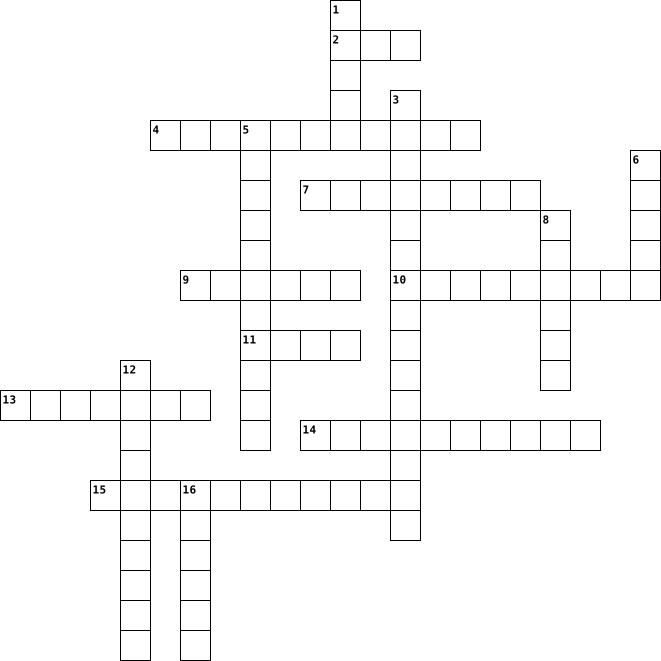
Across
- ink
- power_surge
- resistor
- loosen
- cartridge
- melt
- fragile
- light_bulb
- competition
Down
- wings
- artificial_hand
- environment
- waste
- switch
- disposable
- pounds
16 Clues: ink • melt • wings • waste • switch • loosen • pounds • fragile • resistor • cartridge • disposable • light_bulb • power_surge • environment • competition • artificial_hand
ex1 2022-10-22

Across
- studio
- corridor
- cupboard
- furnished
- carpet
- closet
- radiator
- environment
- aisle
- rental
- cabinet
- wardrobe
- approximately
Down
- airconditioner
- bathroom
- neighborhood
- surroundings
- stereo
- refrigerator
- lobby
- balcony
- dormitory
- proximity
- fridge
- vacuum
- elevator
- heater
- laundry
28 Clues: lobby • aisle • studio • stereo • carpet • closet • fridge • vacuum • heater • rental • balcony • laundry • cabinet • bathroom • corridor • cupboard • radiator • elevator • wardrobe • furnished • dormitory • proximity • environment • neighborhood • surroundings • refrigerator • approximately • airconditioner
Chapter 2 section 1 2025-05-08

Across
- a close organism relationship
- the part of Earth where life exists
- the study of organisms and their environment
- when one benefits, the other is unaffected
- a group of the same species
- the place where an organism lives
- when one organism hunts and eats another
- organisms and their environment
Down
- is a non-living part of the environment, like sunlight, water, or temperature
- is a group of different species in an area
- is a living part of the environment, like plants, animals, or microbes.
- when one organism harms another for benefit
- a relationship where both organisms benefit
- an organism's role in its environment
- a large, similar climate area
15 Clues: a group of the same species • a close organism relationship • a large, similar climate area • organisms and their environment • the place where an organism lives • the part of Earth where life exists • an organism's role in its environment • when one organism hunts and eats another • is a group of different species in an area • when one benefits, the other is unaffected • ...
topic 1 crossword 2020-04-11

Across
- in terms of environments, groups of different species interacting with each other
- term used to describe a range of important resources, processes and benefits that healthy ecosystems provide to humans
- key concept in geography: the ongoing capacity of Earth to maintain all life
- term used to describe the negative effects of invasive species (such as bacteria, parasites and invasive plants and animals) that do harm to an environment
- features, plants and animals that make up water environments such as oceans, freshwater lakes, coral reefs and wetlands
- variety of living organisms (i.e. plants, animals, bacteria and fungi) found in an environment
- key concept in geography: a specific place on Earth and all the things, both animate and inanimate, that are there
- all of the gases that surround the Earth
- removal of trees and other plant life from a forested area, either by cutting down or burning; usually carried out to clear the land for farming
- the outer rocky layer of Earth (i.e. crust)
- complex community made up of living organisms that interact with each other and with their environment
- all of the water on Earth (i.e. in solid, liquid and gaseous forms)
- these are natural products that can be used or converted by humans for use(e.g. wood from trees)
- term used to describe a range of heavy metals, oils, pesticides, industrial chemicals and salts that do harm to the environment
- all living things on Earth (i.e. plants, animals, humans and other organisms)
Down
- change in global or regional climate patterns; in particular, a change apparent from the mid to late 20th century onwards and attributed largely to the increased levels of atmospheric carbon dioxide produced by the use of fossil fuels
- non-living components of an environment, such as temperature, rainfall, humidity, wind speed and direction, sand, clay and rock
- a sense of wellbeing and spiritual connection offered by the environment
- gradual increase in the overall temperature of the Earth’s atmosphere generally attributed to the release of greenhouse gases such as carbon dioxide, CFCs and other pollutants into the atmosphere
- series of processes by which carbon compounds are interconverted in the environment, involving the incorporation of carbon dioxide into living tissue by photosynthesis and its return to the atmosphere through respiration, the decay of dead organisms, and the burning of fossil fuels
- plant, animal or other organism that is not native to an area, and whose introduction has negative effects on its new environment
- key concept in geography: the relationship between all things, both animate and inanimate, and all processes, both natural and human
- living components of an environment, such as the animals, plants, bacteria and fungi
- carbon dioxide released into the atmosphere as a result of burning fossil fuels and gas
- dying out and complete disappearance of a species (e.g. plant or animal)
- processes that take place in the natural environment that absorb waste
26 Clues: all of the gases that surround the Earth • the outer rocky layer of Earth (i.e. crust) • all of the water on Earth (i.e. in solid, liquid and gaseous forms) • processes that take place in the natural environment that absorb waste • a sense of wellbeing and spiritual connection offered by the environment • ...
Homeostasis 2022-02-16

Across
- Conformers are metabolically _____
- The process of maintaining a relatively stable internal environment despite changes in external surroundings.
- No physiological function is constant for very long so we call them _____
- Maintained by both conformers and regulators
- Maintaining a healthy blood sugar level is one example of a
- A disadvantage to conformers is that they restrict living to a ______ external environment
- A advantage to regulators is that they can ____ into environments that change frequently
Down
- A disadvantage to animals that are regulators is that it is metabolically
- Animals that are regulators are called
- Features of an animals internal environment that match the external environment
- Animals that are conformers are
- The internal environment differs from the external environment
- Homeostasis is a _____ process
- One of the conditions maintained by homeostasis in the blood and bodily tissues
- Homeostasis is involved in most systems of a _____
15 Clues: Homeostasis is a _____ process • Animals that are conformers are • Conformers are metabolically _____ • Animals that are regulators are called • Maintained by both conformers and regulators • Homeostasis is involved in most systems of a _____ • Maintaining a healthy blood sugar level is one example of a • The internal environment differs from the external environment • ...
Environment issues in business facilitation 2016-05-12

Across
- To improve an area of land so that it can be used.
- Using methods that do not harm the environment.
- Design to protect the environment or limit damage to the environment.
- Poisonous and harmful to people, animals or the environment.
- Design to cause as little harm as possible to the environment.
- The amount of carbon dioxide a person, organisation, building, etc produces, used as a measure of their affect to the environment.
- To encourage plants to grow or animal to live in an area where they are not usually found.
- The process of damaging the air, water and land with chemicals or other substances.
Down
- The process of changing waste materials such as newspaper and bottles so that they can be used again.
- Activities by a business or other organisation that the organisation is concerned about environment.
- The changes that are thought to be affecting the world's weather so that it is becoming warmer.
- To make something dirty, polluted or poisonous by adding a chemical or waste.
- The process of removing the trees from an area of land.
- A substance can be separated into very small parts by bacteria so that they are not harmful to the environment.
- The act of putting new trees into a place where the original trees have been cut down.
15 Clues: Using methods that do not harm the environment. • To improve an area of land so that it can be used. • The process of removing the trees from an area of land. • Poisonous and harmful to people, animals or the environment. • Design to cause as little harm as possible to the environment. • Design to protect the environment or limit damage to the environment. • ...
Environment issues in business facilitation 2016-05-12

Across
- The process of changing waste materials such as newspaper and bottles so that they can be used again.
- Design to protect the environment or limit damage to the environment.
- To encourage plants to grow or animal to live in an area where they are not usually found.
- The amount of carbon dioxide a person, organisation, building, etc produces, used as a measure of their affect to the environment.
- To make something dirty, polluted or poisonous by adding a chemical or waste.
- Poisonous and harmful to people, animals or the environment.
- Using methods that do not harm the environment.
- Activities by a business or other organisation that the organisation is concerned about environment.
Down
- The act of putting new trees into a place where the original trees have been cut down.
- The changes that are thought to be affecting the world's weather so that it is becoming warmer.
- To improve an area of land so that it can be used.
- A substance can be separated into very small parts by bacteria so that they are not harmful to the environment.
- The process of removing the trees from an area of land.
- Design to cause as little harm as possible to the environment.
- The process of damaging the air, water and land with chemicals or other substances.
15 Clues: Using methods that do not harm the environment. • To improve an area of land so that it can be used. • The process of removing the trees from an area of land. • Poisonous and harmful to people, animals or the environment. • Design to cause as little harm as possible to the environment. • Design to protect the environment or limit damage to the environment. • ...
Unit 5 Investigating Adaptations 2023-01-04

Across
- Organisms that share common characteristics and interbreed
- The process of animals adapting to their environment
- The home or environment of an organism
- The study of the functions of living organisms
- A time of rest or inactivity for animals or plants
- Species have similar characteristic but still different
- Organisms living together
- Choosing parents to breed in order to produce desired offspring
- arrangement in groups or categories
Down
- An animal that has been tamed and kept by humans
- Species change in order to survive in their environment
- The movement of organisms from on environment to another
- The way a species acts
- a tool that can be used to identify organisms or objects in the natural world
- Being able to hide in the environment
- A time when plants do not grow
16 Clues: The way a species acts • Organisms living together • A time when plants do not grow • arrangement in groups or categories • Being able to hide in the environment • The home or environment of an organism • The study of the functions of living organisms • An animal that has been tamed and kept by humans • A time of rest or inactivity for animals or plants • ...
Ecology 2023-09-22

Across
- - Where an organism lives
- - A relationship between two living things
- - A living organism that shapes its environment
- - The study of the relationships between living organisms and their physical environment
- - All of the living and nonliving factors that affect it
- - Nonliving organisms that shapes its environment
- - A large group of ecosystems that share the same climate and have similar types of communities
- - A relationship in which one organism benefits but the other is neither helped nor harmed
- - Earth ´ s living things
- - One organism hunting and eating another animal
- - The close relationship between two or more species
Down
- - Something in the environment that restricts a population
- - Interacting populations in the same area at the same time
- - A single species of organisms that live in the same area
- - A relationship both organisms benefit
- - The conditions an organism can withstand
- - What the organism does in its environment
- - Organisms that are related and have common characteristics
18 Clues: - Where an organism lives • - Earth ´ s living things • - A relationship both organisms benefit • - A relationship between two living things • - The conditions an organism can withstand • - What the organism does in its environment • - A living organism that shapes its environment • - One organism hunting and eating another animal • ...
Ecological footprint 2020-04-08

Across
- another word for materials
- in the environment trees and animals are part of it.
- biotic surroundings
- when you need something it is a _____
- to help or assist
- to decrease an amount
- resources - materials from the environment
- affect on something
- to use a material again
- - to eat or induce something
Down
- something (eg plastic) introduced to the environment that has a harmful effect
- heat energy is a form of ______
- to fail to use materials or not put to good use
- the way someone lives
- making or manufacturing an item or material
- decaying organic matter used for fertilizing
16 Clues: to help or assist • biotic surroundings • affect on something • the way someone lives • to decrease an amount • to use a material again • another word for materials • - to eat or induce something • heat energy is a form of ______ • when you need something it is a _____ • resources - materials from the environment • making or manufacturing an item or material • ...
Environment issues in business facilitation 2016-05-12

Across
- Poisonous and harmful to people, animals or the environment.
- Activities by a business or other organisation that the organisation is concerned about environment.
- To improve an area of land so that it can be used.
- A substance can be separated into very small parts by bacteria so that they are not harmful to the environment.
- The act of putting new trees into a place where the original trees have been cut down.
- To make something dirty, polluted or poisonous by adding a chemical or waste.
- The changes that are thought to be affecting the world's weather so that it is becoming warmer.
- The process of removing the trees from an area of land.
Down
- Design to cause as little harm as possible to the environment.
- Design to protect the environment or limit damage to the environment.
- The amount of carbon dioxide a person, organisation, building, etc produces, used as a measure of their affect to the environment.
- Using methods that do not harm the environment.
- The process of damaging the air, water and land with chemicals or other substances.
- The process of changing waste materials such as newspaper and bottles so that they can be used again.
- To encourage plants to grow or animal to live in an area where they are not usually found.
15 Clues: Using methods that do not harm the environment. • To improve an area of land so that it can be used. • The process of removing the trees from an area of land. • Poisonous and harmful to people, animals or the environment. • Design to cause as little harm as possible to the environment. • Design to protect the environment or limit damage to the environment. • ...
Environment issues in business facilitation 2016-05-12

Across
- Activities by a business or other organisation that the organisation is concerned about environment.
- To improve an area of land so that it can be used.
- To make something dirty, polluted or poisonous by adding a chemical or waste.
- The process of changing waste materials such as newspaper and bottles so that they can be used again.
- The act of putting new trees into a place where the original trees have been cut down.
- A substance can be separated into very small parts by bacteria so that they are not harmful to the environment.
- Poisonous and harmful to people, animals or the environment.
- Design to protect the environment or limit damage to the environment.
Down
- To encourage plants to grow or animal to live in an area where they are not usually found.
- Using methods that do not harm the environment.
- The process of removing the trees from an area of land.
- The amount of carbon dioxide a person, organisation, building, etc produces, used as a measure of their affect to the environment.
- The changes that are thought to be affecting the world's weather so that it is becoming warmer.
- Design to cause as little harm as possible to the environment.
- The process of damaging the air, water and land with chemicals or other substances.
15 Clues: Using methods that do not harm the environment. • To improve an area of land so that it can be used. • The process of removing the trees from an area of land. • Poisonous and harmful to people, animals or the environment. • Design to cause as little harm as possible to the environment. • Design to protect the environment or limit damage to the environment. • ...
Unit A: Ecosystems 2014-06-12

Across
- Organisms that hunt and kill other organisms (prey) for food
- The process of water vapor cooling and returning to a liquid state (clouds)
- Well-suited (to survive in an environment)
- All living things in an environment
- A sequence of feeding relationships that shows the direction of the transfer of energy
- The role or characteristic activity of an organisms in an ecosystem
- A symbiotic relationship in which both organisms benefit
- Organisms that must eat other organism in order to get their energy
- The total mass of living matter in an environment
- that moves off the land into rivers, lakes, and streams
- A symbiotic relationship in which one species benefits and the other is nether harmed nor benefitted
- An interaction between two different organisms living in close proximity to each other that last over time
- Consumers that eat only plants
- A report outlining possible effects of changes to an environment
- The organism that a parasite lives and feeds on
- A method of controlling a pest with its natural predator
- Rain that has high acid concentration – generally strong enough to greatly harm the natural environment
- An organisms that is sensitive enough to show changes in an environment
- An inherited characteristic that helps an organism survive in its environment
- An organism that may be hunted by a predator
- Substances that cause pollution
- study area in an environment
- Resources of nature being renewed at least as quickly as they are being used and wastes being able to break down and be absorbed
- A symbiotic relationship in which organism benefits and the other is harmed
- The total area of land and water needed to supply all of the materials and energy humans use as well as needed to absorb all wastes produced
- The movement of energy in a food chain, which originally comes from the sun and passes from organism to organism
- Organisms that are able to make their own food/energy using energy directly from the sun or other particles (photosynthesis)
- The study of how organisms interact with each other and their environment
Down
- Materials that are found in the environment at levels that are harmful
- of Numbers The number of individual organisms in a food chain needed to transfer enough energy from level to level
- An organism that live on or in another organism (a host) and feeds on it
- Organisms that get their energy from dead or decaying organic matter
- Consumers that eat both plants and animals
- The gradual change and growth of organisms in an area where other organisms were
- The gradual growth of organisms in an area that was previously bare
- Organisms that break down organic matter
- The symbol used to identify the strength of an alkaline or acidic solution
- The build-up of toxins in higher level organisms in the food chain from lower level organisms
- The continuous movement of water in various forms in the environment
- All of the interacting parts of a biological community and its environment
- An organism that was not naturally found in an environment that is now preset
- A method of checking the conditions of an ecosystem by comparing results done at different times
- Materials and products found in nature that we make use of
- The continuous movement of carbon in various forms in the environment
- Consumers that eat only meat
- Information gathered as a starting point for environmental monitoring
- Water that is contained naturally in the Earth’s crust
- A scientist who studies ecology
- A network of interconnected food chains
- The process of water being released into the air as a vapor, by trees
- The place that an organism lives
- The process of water returning to earth from the clouds, in various forms
- The process of liquid water turning into a vapor or gas
- All of the non-living things in an environment
54 Clues: Consumers that eat only meat • study area in an environment • Consumers that eat only plants • A scientist who studies ecology • Substances that cause pollution • The place that an organism lives • All living things in an environment • A network of interconnected food chains • Organisms that break down organic matter • Consumers that eat both plants and animals • ...
Exam Review - Ecology 2014-05-18

Across
- the role that a species plays in its community
- the living parts the environment
- scientific study of the interaction between organisms and their environments
- any biotic or abiotic factor that restricts the existence of organisms in a specific environment
- describes a limiting factor that affects populations that reach a certain size
- the interdependent populations that inhabit a common environment
- when an organism lives in or on another organism
- a group of one species of organisims living in the same place at the same time
- a feeding step in a food web
- symbiotic relationship in which both organisms benefit
Down
- the place that an organism lives
- the autotrophic organisms in an ecosystem
- the nonliving parts of the environment
- describes a limiting factors that affects populations regardless of its size
- all the organisms and abiotic factors in an environment
- their role is to break down dead organisms
- symbiotic relationship, one organism harmed and the other benefits
- the portion of the earth that supports life
- the heterotrophic organisms in an ecosystem
19 Clues: a feeding step in a food web • the place that an organism lives • the living parts the environment • the nonliving parts of the environment • the autotrophic organisms in an ecosystem • their role is to break down dead organisms • the portion of the earth that supports life • the heterotrophic organisms in an ecosystem • the role that a species plays in its community • ...
Everything Counts 2014-09-22

Across
- Dangerous
- Good for the environment
- Able to keep going without using up natural resources
- All over the world
- The world around us
- Save
- Get rid of
- To make something new out of something old
- Use again in a different way
- Have an affect on
Down
- A person who cares deeply about the environment
- A place where we dump rubbish
- Emissions Gas that comes out of things
- Buying
- Make dirty or contaminate
- Make something dirty
- Weather conditions
- A mixture of decaying food scraps
- Produced without chemicals
- Make smaller
- Use less of
21 Clues: Save • Buying • Dangerous • Get rid of • Use less of • Make smaller • Have an affect on • All over the world • Weather conditions • The world around us • Make something dirty • Good for the environment • Make dirty or contaminate • Produced without chemicals • Use again in a different way • A place where we dump rubbish • A mixture of decaying food scraps • Emissions Gas that comes out of things • ...
Animal Adaptations 2020-04-14

Across
- an animal that eats both plants and animals
- an animal that eats only plants
- anything an animal does involving action and/or response to stimulation.
- no longer existing on the Earth.
- a unit of plants, animals, and nonliving components of an environment that interact.
- any body part, behavior, or physiological capability that increases an animal's ability to survive in its environment
Down
- taking care of our environment by wisely managing its resources
- an animal that hunts other animals
- the total surroundings and forces that act upon a living thing.
- a species of plant or animal of which numbers are decreasing at an alarming rate and is threatened with extinction by human-made or natural changes in the environment.
- an animal that eats only animals
- the world's major communities, classified according to the predominant vegetation and characterized by adaptation of organisms to that particular environment.
- ration that blends in with the surrounding environment.
- the place where an animal lives
- v: to hunt and eat other animals. n: an animal eaten by another animal
15 Clues: an animal that eats only plants • the place where an animal lives • an animal that eats only animals • no longer existing on the Earth. • an animal that hunts other animals • an animal that eats both plants and animals • ration that blends in with the surrounding environment. • taking care of our environment by wisely managing its resources • ...
Exam Review - Ecology 2014-05-18

Across
- when an organism lives in or on another organism
- their role is to break down dead organisms
- the interdependent populations that inhabit a common environment
- the nonliving parts of the environment
- a feeding step in a food web
- the autotrophic organisms in an ecosystem
- describes a limiting factor that affects populations that reach a certain size
- symbiotic relationship, one organism harmed and the other benefits
- the role that a species plays in its community
- the heterotrophic organisms in an ecosystem
- symbiotic relationship in which both organisms benefit
- a group of one species of organisims living in the same place at the same time
Down
- all the organisms and abiotic factors in an environment
- the living parts the environment
- the portion of the earth that supports life
- describes a limiting factors that affects populations regardless of its size
- any biotic or abiotic factor that restricts the existence of organisms in a specific environment
- the place that an organism lives
- scientific study of the interaction between organisms and their environments
19 Clues: a feeding step in a food web • the living parts the environment • the place that an organism lives • the nonliving parts of the environment • the autotrophic organisms in an ecosystem • their role is to break down dead organisms • the portion of the earth that supports life • the heterotrophic organisms in an ecosystem • the role that a species plays in its community • ...
Weather and Climate 2024-10-18

Across
- humid and hot environment
- amount of moisture in the air
- warm and wet
- used to measure temperature
- 32 degrees F
- measures air pressure
- measures wind speed
- another word for distance
- distance above sea level
- foggy with light rain
- fair weather clouds
Down
- a mixture of snow and ice
- forested environment with a lot of rain
- weather over a long period of time
- measures humidity
- thunderstorm clouds
- cold and dry
- dry environment
18 Clues: warm and wet • 32 degrees F • cold and dry • dry environment • measures humidity • thunderstorm clouds • measures wind speed • fair weather clouds • measures air pressure • foggy with light rain • distance above sea level • a mixture of snow and ice • humid and hot environment • another word for distance • used to measure temperature • amount of moisture in the air • ...
Animal Vocabulary 2025-04-30

Across
- – Active during the night and asleep during the day.
- – A cold-blooded vertebrate that lives both in water and on land.
- – A method of blending in with the environment to avoid detection.
- – The surrounding conditions in which an organism lives.
- – An area that an animal defends against others of its species.
- – The complete disappearance of a species.
- – An animal that hunts and eats other animals.
- – An animal that feeds on dead or decaying matter.
- – The seasonal movement of animals from one region to another.
Down
- – A cold-blooded vertebrate with scales, such as a snake or lizard.
- – An animal that primarily eats insects.
- – A state of inactivity and metabolic depression in animals during winter.
- – The way an organism acts in response to its environment.
- – An animal that eats only meat.
- – An animal that eats only plants.
- – Living or growing in water.
- – A trait that helps an organism survive in its environment.
- – A community of interacting organisms and their physical environment.
- – A major change in form that occurs as some animals grow.
19 Clues: – Living or growing in water. • – An animal that eats only meat. • – An animal that eats only plants. • – An animal that primarily eats insects. • – The complete disappearance of a species. • – An animal that hunts and eats other animals. • – An animal that feeds on dead or decaying matter. • – Active during the night and asleep during the day. • ...
Brian and Oaks Whats that word?? 2013-05-09

Across
- species in certain area
- Environment that provides organisms home
- One species benefits and the other don’t.
- Living thing
- Resources. Resources that can’t be renew
- Warming heating of earth
- only eats plants
- Eats plants and animals
- fighting over food
- Animal doesn’t exist
- resources resources that can be renewed
- Organism that only eats meat
Down
- 1 Benefits and there is host
- Makes own food through sun light
- When both animals benefits
- Makes own food
- an exertion of such power
- Living part of environment
- moving into a population
- None living part of an environment
20 Clues: Living thing • Makes own food • only eats plants • fighting over food • Animal doesn’t exist • species in certain area • Eats plants and animals • Warming heating of earth • moving into a population • an exertion of such power • When both animals benefits • Living part of environment • 1 Benefits and there is host • Organism that only eats meat • Makes own food through sun light • ...
Science Vocab 2023-09-08

Across
- when things die to help the environment
- space to carry
- a chain / net of the energy of a chain on consumers
- pollution that comes from a singular source
- a species matched to its environment
- study of ecological things
- reef aquarium
- a factor that limits
- race
- a biotic thing that can produce its own food
- when something depends on itself and not a group
- blending in / changing to fit a new environment
- farming crops but too much
- too many people (tokyo)
- harming our world
- when genetics vary
Down
- ecosystem
- pollution that comes from multiple sources
- something that eats to gain energy
- alive
- a larger community with much biodiversity
- non-living
- a larger ecosystem with much biodiversity
- behavior that is taught and not inherited
- diverse living things in an ecosystem
25 Clues: race • alive • ecosystem • non-living • reef aquarium • space to carry • harming our world • when genetics vary • a factor that limits • too many people (tokyo) • study of ecological things • farming crops but too much • something that eats to gain energy • a species matched to its environment • diverse living things in an ecosystem • when things die to help the environment • ...
Species Interactions 2023-03-21

Across
- type of species that actively builds habitats
- group of species in a geographic area
- living organisms in an environment
- output of metabolism for all life (energy metabolism)
- energy with no atoms
- type of species that has a lot of indirect effects on other species
- source of carbon is inorganic
- have C atoms, typically linked in chains, may have H, O, N, S, P
- (+/-) species interaction
- (+/+) species interaction
- gets energy from light
- stored energy
- one organism makes environment more hospitable for another
- biotic and abiotic factors that interact in an environment
- movement energy
Down
- (-/-) species interaction
- (-/0) species interaction
- all chemical reactions
- gets energy from chemicals
- source of carbon is organic
- non-living components in an environment
- type of species that has big impact on ecosystem due to their large numbers
- (+/0) species interaction
- food used to make useable energy
- builds molecules
25 Clues: stored energy • movement energy • builds molecules • energy with no atoms • all chemical reactions • gets energy from light • (-/-) species interaction • (-/0) species interaction • (+/0) species interaction • (+/-) species interaction • (+/+) species interaction • gets energy from chemicals • source of carbon is organic • source of carbon is inorganic • food used to make useable energy • ...
Topic 5 - Skill in sport 2024-04-15

Across
- depends on environment
- small muscle groups
- thinking, decision making
- skills youre born with
- rely on interpretation of environmental stimuli
- throwing ball to throwing javline
- changes in environment
- smaller amounts studied at a time
- batting against pitching machine
- brain and spine
- done in isolation
- concepts used in games
- three on three game to full game
- paced by environment
- practicing specific movement
- large muscle groups
Down
- perception of stimuli and motor response
- response to message
- done with others
- large amounts practiced at a time
- learning to use weaker foot
- paced by performer
- reaction to stimuli
- linking multiple skills
- improve dynamics to start race better
- done near others
- end of one cycle is beginning of next
- clear start and finish
- emphasis on movement
- performed in stable environment
30 Clues: brain and spine • done with others • done near others • done in isolation • paced by performer • response to message • small muscle groups • reaction to stimuli • large muscle groups • emphasis on movement • paced by environment • depends on environment • skills youre born with • changes in environment • clear start and finish • concepts used in games • linking multiple skills • ...
Science Fusion Worksheet (advanced level.) 7 2025-06-08

Across
- It was huge and made of stone.
- There is ice everywhere.
- Animals in cold environment usually have _____ fur to keep warm.
- This is common in environment, and it also provides energy moving from plants to animals.
- It is yellow or white, made by milk.
- Energy that Earth provides us.
- A rainforest is also called "The Earth's ____ ".
- What an object fells like.
- Small bodies of flowing water.
Down
- The _____ water environment included ocean and some mires.
- There is a large space of this in South America.
- They live in deserts.
- One part of what something is like.
- Water in a _____ does not flow.
- There is three of _____ Earth is covered with water.
- Top layer of earth.
- An environment with only grasses and short plants around.
- A hand _____ uses wind to move and makes energy.
- A facility where keeps water in.
- You can use water to _____ a boat.
20 Clues: Top layer of earth. • They live in deserts. • There is ice everywhere. • What an object fells like. • It was huge and made of stone. • Energy that Earth provides us. • Small bodies of flowing water. • Water in a _____ does not flow. • A facility where keeps water in. • You can use water to _____ a boat. • One part of what something is like. • It is yellow or white, made by milk. • ...
Science 2012-08-08

Across
- A biological community of interacting organisms and their physical environment
- The surroundings or conditions in which a person, animal, or plant lives or operates
- Hand
- Group
- The variety of life in the world or in a particular habitat or ecosystem
- A relationship between two organisms living closly together. They both benifit each other
- An association between two organisms in which one benefits and the other derives neither benefit nor harm
- Requiring the absorption of heat
- Organisms living together
Down
- makes, grows
- Non-living chemical and physical factors
- Rubbish collectors
- A process plants do lol
- Breathing
- Having body temperature that varies with the environment
- The natural home or environment of an animal, plant, or other organism
- Two organisms fighting for one apple
- Living things that shape an ecosystem
- People who get stuff
- The preying of one animal on others
20 Clues: Hand • Group • Breathing • makes, grows • Rubbish collectors • People who get stuff • A process plants do lol • Organisms living together • Requiring the absorption of heat • The preying of one animal on others • Two organisms fighting for one apple • Living things that shape an ecosystem • Non-living chemical and physical factors • ...
human impacts on the envirnment 2013-02-27

Across
- people need to put their rubbish in the ____.
- people can _______ the amount of waste by throwing their rubbish on the bin.
- water+sun= a ______.
- the __________ is outside the earth.
- by leaving on the light, its a ______ of electricity.
- people dont _____ the environment by littering.
- darkness in water means that the water is _____.
- An aquatic animal that is affected.
- the dirt and grass is the ___________.
- people are ________ the environment these days.
- The dugong is an ______ animal.
Down
- people are ______ sea turtles when they chuck their plastic bags in the sea.
- the earth circles the ____.
- litter is basically dropped _______.
- people use _____to wash their dishes.
- People cut down_____to build farms.
- by dumping oil in the sea, you are ______ the sea.
- people are destroying the __________.
- trees provide ______ and life for other animal
- too many ______ are hurting the environment.
20 Clues: water+sun= a ______. • the earth circles the ____. • The dugong is an ______ animal. • People cut down_____to build farms. • An aquatic animal that is affected. • litter is basically dropped _______. • the __________ is outside the earth. • people use _____to wash their dishes. • people are destroying the __________. • the dirt and grass is the ___________. • ...
human impacts the environment 2013-02-27

Across
- An aquatic animal that is affected.
- people can _______ the amount of waste by throwing their rubbish on the bin.
- people need to put their rubbish in the ____.
- the __________ is outside the earth.
- by dumping oil in the sea, you are ______ the sea.
- The dugong is an ______ animal.
- trees provide ______ and life for other animal
- People cut down_____to build farms.
Down
- by leaving on the light, its a ______ of electricity.
- the earth circles the ____.
- people are destroying the __________.
- the dirt and grass is the ___________.
- people are ________ the environment these days.
- too many ______ are hurting the environment.
- people are ______ sea turtles when they chuck their plastic bags in the sea.
- water+sun= a ______.
- people use _____to wash their dishes.
- litter is basically dropped _______.
- darkness in water means that the water is _____.
- people dont _____ the environment by littering.
20 Clues: water+sun= a ______. • the earth circles the ____. • The dugong is an ______ animal. • An aquatic animal that is affected. • People cut down_____to build farms. • the __________ is outside the earth. • litter is basically dropped _______. • people are destroying the __________. • people use _____to wash their dishes. • the dirt and grass is the ___________. • ...
Christiana Cesare 2015-04-13

Across
- consumes soft tissues of dead animals
- factors living factors in an environment
- relationship where both species benefits
- the benefited organism parasitism
- consume plants and animals
- consumes algae or plants
- the role of a species in an environment
- when competing species evolve different adaptions
- breaks down remains
- environment in which a species lives
Down
- dead leaves animal feces and other organic debris
- the animal that consumes
- autotrophs use energy from chemicals compounds to make food by chemosynthesis
- consumes animals
- relationship where one benefits and the other is not harmed
- the final step in decomposition
- use energy from sunlight
- nonliving factors in an environment
- relationship where one benefits and the other is harmed
- the study of how living things interact with each other
- the consumed animal
- the harmed animal
- the total mass of organisms at a tropic level
23 Clues: consumes animals • the harmed animal • breaks down remains • the consumed animal • the animal that consumes • use energy from sunlight • consumes algae or plants • consume plants and animals • the final step in decomposition • the benefited organism parasitism • nonliving factors in an environment • environment in which a species lives • consumes soft tissues of dead animals • ...