
environmental economics Crossword Puzzles
Economics 2019-07-28

Across
- Father of economics.
- When the value of domestic currency is tied to the value of another currency.
- When importer and exporters enter into agreements to exchange products at future date at current prices.
- Winning from Lottery, contests etc which are not included in national income.
- Bank which identified that India would grow faster due to its strength in Human Capital Formation.
- Another name for Currency Money.
Down
- Harm or benefits due to activities caused by firm or individual for which they are not penalised
- Another name for Financial Assistance.
- Difference between borrowing rate and lending rate,i.e., profit earned by commercial bank.
- reduction in the value of domestic currency by the government.
10 Clues: Father of economics. • Another name for Currency Money. • Another name for Financial Assistance. • reduction in the value of domestic currency by the government. • When the value of domestic currency is tied to the value of another currency. • Winning from Lottery, contests etc which are not included in national income. • ...
economics 2020-03-13

Across
- Grow vigorously.
- Point where as ad curve intersect.
- Few sellers many buyers.
- Securing against financial loss .
Down
- Unproductive labor.
- A wealthy man.
- Identical product.
- Entire amount of income before any deductions.
- Import/export taxes.
- Is it final? No! But prices will rise because of it .
10 Clues: A wealthy man. • Grow vigorously. • Identical product. • Unproductive labor. • Import/export taxes. • Few sellers many buyers. • Securing against financial loss . • Point where as ad curve intersect. • Entire amount of income before any deductions. • Is it final? No! But prices will rise because of it .
economics 2020-03-13

Across
- Grow vigorously.
- Point where as ad curve intersect.
- Few sellers many buyers.
- Securing against financial loss .
Down
- Unproductive labor.
- A wealthy man.
- Identical product.
- Entire amount of income before any deductions.
- Import/export taxes.
- Is it final? No! But prices will rise because of it .
10 Clues: A wealthy man. • Grow vigorously. • Identical product. • Unproductive labor. • Import/export taxes. • Few sellers many buyers. • Securing against financial loss . • Point where as ad curve intersect. • Entire amount of income before any deductions. • Is it final? No! But prices will rise because of it .
Economics 2024-07-26

Across
- Which free trade agreement is between Mexico, Canada, and the United States?
- Who released The Wealth of Nations in 1776 (last name only)?
- How many basic questions should be asked when deciding an economic system to adopt?
- Who supported a strong and equal central government (last name only)?
- What kind of economy combines self-interest, competition, and profit motive?
- Who makes their decisions without advice from the government?
Down
- What type of economy only produces the amount that they actually need?
- What kind of economy did Adam Smith believe that nations would benefit from?
- What is the other free trade agreement that the United States is involved in?
- What type of economy is mainly controlled by the government?
10 Clues: Who released The Wealth of Nations in 1776 (last name only)? • What type of economy is mainly controlled by the government? • Who makes their decisions without advice from the government? • Who supported a strong and equal central government (last name only)? • What type of economy only produces the amount that they actually need? • ...
economics 2023-02-27

Across
- all the comsumption in the world
- the management of large amounts of money, especially by governments or large companies.
- a recession for an extensive amount of time
- wealth in the form of money or other assets owned by a person or organization or available for a purpose such as starting a company or investing.
Down
- when the economy has a bust for 6 months or more
- when an economy is on the way out of a recession
- too much spending
- when money is lent
- not enough spending
- money owned to someone or a firm
10 Clues: too much spending • when money is lent • not enough spending • all the comsumption in the world • money owned to someone or a firm • a recession for an extensive amount of time • when the economy has a bust for 6 months or more • when an economy is on the way out of a recession • the management of large amounts of money, especially by governments or large companies. • ...
Economics 2023-01-24

Across
- economy A system where supply and demand are used by people to make their own economic choices with minimal government involvement.
- the wealth and resources of a country or region, especially in terms of the production and consumption of goods and services
- bringing (goods or services) into a country from another country
- two or more people or things relying on each other for resources, goods, services, or ideas
- an excess of production
Down
- economy A basic system where the portion of limited resources is primarily influenced by the people’s habits, rituals, or customs.
- sending (goods or services) to another country for sale
- something needed or wanted that is available
- economy A system where central planners (government) make all of the economic decisions attempting to benefit all of its people.
- consumer's desire and willingness to pay a price for a specific good or service
10 Clues: an excess of production • something needed or wanted that is available • sending (goods or services) to another country for sale • bringing (goods or services) into a country from another country • consumer's desire and willingness to pay a price for a specific good or service • ...
economics 2023-03-21

Across
- without social reproduction
- is social science
- resources needed to create a product
- something that is desired
- short supply
Down
- interest rates
- value or benefit
- exchanging something for something else
- number or quantity of goods
- single fsctors
10 Clues: short supply • interest rates • single fsctors • value or benefit • is social science • something that is desired • without social reproduction • number or quantity of goods • resources needed to create a product • exchanging something for something else
economics 2023-03-21

Across
- without social reproduction
- is social science
- resources needed to create a product
- something that is desired
- short supply
Down
- interest rates
- value or benefit
- exchanging something for something else
- number or quantity of goods
- single fsctors
10 Clues: short supply • interest rates • single fsctors • value or benefit • is social science • something that is desired • without social reproduction • number or quantity of goods • resources needed to create a product • exchanging something for something else
economics 2023-03-21

Across
- without social reproduction
- is social science
- resources needed to create a product
- something that is desired
- short supply
Down
- interest rates
- value or benefit
- exchanging something for something else
- number or quantity of goods
- single fsctors
10 Clues: short supply • interest rates • single fsctors • value or benefit • is social science • something that is desired • without social reproduction • number or quantity of goods • resources needed to create a product • exchanging something for something else
economics 2023-03-21

Across
- without social reproduction
- is social science
- resources needed to create a product
- something that is desired
- short supply
Down
- interest rates
- value or benefit
- exchanging something for something else
- number or quantity of goods
- single fsctors
10 Clues: short supply • interest rates • single fsctors • value or benefit • is social science • something that is desired • without social reproduction • number or quantity of goods • resources needed to create a product • exchanging something for something else
economics 2023-03-21

Across
- without social reproduction
- is social science
- resources needed to create a product
- something that is desired
- short supply
Down
- interest rates
- value or benefit
- exchanging something for something else
- number or quantity of goods
- single fsctors
10 Clues: short supply • interest rates • single fsctors • value or benefit • is social science • something that is desired • without social reproduction • number or quantity of goods • resources needed to create a product • exchanging something for something else
economics 2023-03-21

Across
- without social reproduction
- is social science
- resources needed to create a product
- something that is desired
- short supply
Down
- interest rates
- value or benefit
- exchanging something for something else
- number or quantity of goods
- single fsctors
10 Clues: short supply • interest rates • single fsctors • value or benefit • is social science • something that is desired • without social reproduction • number or quantity of goods • resources needed to create a product • exchanging something for something else
economics 2023-03-21

Across
- without social reproduction
- is social science
- resources needed to create a product
- something that is desired
- short supply
Down
- interest rates
- value or benefit
- exchanging something for something else
- number or quantity of goods
- single fsctors
10 Clues: short supply • interest rates • single fsctors • value or benefit • is social science • something that is desired • without social reproduction • number or quantity of goods • resources needed to create a product • exchanging something for something else
economics 2023-03-21

Across
- without social reproduction
- is social science
- resources needed to create a product
- something that is desired
- short supply
Down
- interest rates
- value or benefit
- exchanging something for something else
- number or quantity of goods
- single fsctors
10 Clues: short supply • interest rates • single fsctors • value or benefit • is social science • something that is desired • without social reproduction • number or quantity of goods • resources needed to create a product • exchanging something for something else
economics 2023-03-21

Across
- without social reproduction
- is social science
- resources needed to create a product
- something that is desired
- short supply
Down
- interest rates
- value or benefit
- exchanging something for something else
- number or quantity of goods
- single fsctors
10 Clues: short supply • interest rates • single fsctors • value or benefit • is social science • something that is desired • without social reproduction • number or quantity of goods • resources needed to create a product • exchanging something for something else
economics 2023-03-21

Across
- without social reproduction
- is social science
- resources needed to create a product
- something that is desired
- short supply
Down
- interest rates
- value or benefit
- exchanging something for something else
- number or quantity of goods
- single fsctors
10 Clues: short supply • interest rates • single fsctors • value or benefit • is social science • something that is desired • without social reproduction • number or quantity of goods • resources needed to create a product • exchanging something for something else
economics 2023-03-21

Across
- without social reproduction
- is social science
- resources needed to create a product
- something that is desired
- short supply
Down
- interest rates
- value or benefit
- exchanging something for something else
- number or quantity of goods
- single fsctors
10 Clues: short supply • interest rates • single fsctors • value or benefit • is social science • something that is desired • without social reproduction • number or quantity of goods • resources needed to create a product • exchanging something for something else
Economics 2022-12-12

Across
- human beings are economic agents that make rational decisions based on their needs
- production possibility frontier
- YED
- overconsumed or overproduced
- a negative externality of production
- non-revenue-producing good or service, for self-enjoyment only
Down
- "all other things are equal"
- underconsumed or underproduced goods
- revenue-producing good
- raw material or an agricultural product that can be very hard to replace
10 Clues: YED • revenue-producing good • "all other things are equal" • overconsumed or overproduced • production possibility frontier • underconsumed or underproduced goods • a negative externality of production • non-revenue-producing good or service, for self-enjoyment only • raw material or an agricultural product that can be very hard to replace • ...
Economics 2022-12-12

Across
- scarcity of productive resources
- buyer and seller have unequal amount of information
- production or consumption of a good or service that has an effect on a third party
- goods that provide external benefits
- goods that result in a cost to third parties when consumed by individuals
- tax levied on the income of an individual
Down
- consumption or production of a good cause benefit to a third party
- tax levied on the consumption of goods and services
- government intervention to try to allocate resources efficiently (shifts MSC curve downwards)
- demerit good that causes unpleasant smell
10 Clues: scarcity of productive resources • goods that provide external benefits • demerit good that causes unpleasant smell • tax levied on the income of an individual • buyer and seller have unequal amount of information • tax levied on the consumption of goods and services • consumption or production of a good cause benefit to a third party • ...
Economics 2022-12-14

Across
- A function of central bank: supervises _____ policy
- A function of money: _____ of value
- Responsible for supervising the bank system in domestic economy
- A function of money: _____ of exchange
- Borrowing money to individuals or businesses
Down
- Saving money in a bank account
- A function of commercial bank: keeping money _____
- A function of central bank: _____ of last resort
- A function of central bank: setting _____ rate
- Also known as retail bank
10 Clues: Also known as retail bank • Saving money in a bank account • A function of money: _____ of value • A function of money: _____ of exchange • Borrowing money to individuals or businesses • A function of central bank: setting _____ rate • A function of central bank: _____ of last resort • A function of commercial bank: keeping money _____ • ...
Economics 2022-12-22

Across
- money
- trading stuff for other stuff
- economic system based on how things were done
- making a list of what you have and what you need
- money received
Down
- lots of something
- limited resources
- economic system based on choices
- economic system run by the government
- money spent
10 Clues: money • money spent • money received • lots of something • limited resources • trading stuff for other stuff • economic system based on choices • economic system run by the government • economic system based on how things were done • making a list of what you have and what you need
Economics 2023-08-01

Across
- The economic market that have zero regulations from the government.
- The economic system that that has been done in the past.
- Adam_ was the first economist to believe in free economy
- Which political group has worked to reduce barriers to international trade.
- The economic system that is completely controlled by the government
Down
- Countries put on restrictions on trade because the the country national_.
- Free Markets are completely free- True or False
- Created free trade with Mexico, Canada, and the US
- This is the type of economy that the US has
- Believed that capitalist systems are wrong and his theories were put into the Command Economy
10 Clues: This is the type of economy that the US has • Free Markets are completely free- True or False • Created free trade with Mexico, Canada, and the US • The economic system that that has been done in the past. • Adam_ was the first economist to believe in free economy • The economic market that have zero regulations from the government. • ...
Economics! 2023-07-21

Across
- the exchange or trade of goods and services between different nations.
- an economy in which production, investment, prices, and incomes are determined centrally by a government.
- a German philosopher, economist, and political theorist who co-authored "The Communist Manifesto" and laid the foundation for the theory of Marxism, advocating for the abolition of private property and a classless society.
- an early economist who believed that the free market system was the best way to organize the economy
- a system that combines aspects of both capitalism and socialism
Down
- the branch of knowledge concerned with the production, consumption, and transfer of wealth.
- A trade agreement between the U.S., Mexico, and Canada that reduced or eliminated tariffs on imports and exports between the three participating countries, creating a huge free-trade zone.
- a system where goods production and distribution are driven by time-honored beliefs, customs, culture, and traditions
- the interconnected worldwide economic activities that take place between multiple countries
- economy with limited or no government intervention
10 Clues: economy with limited or no government intervention • a system that combines aspects of both capitalism and socialism • the exchange or trade of goods and services between different nations. • the branch of knowledge concerned with the production, consumption, and transfer of wealth. • ...
Economics 2024-12-17

Across
- The point where the quantity demanded by consumers equals the quantity supplied by producers, resulting in an optimal price and quantity for a good or service.
- _________ refers to the fundamental economic problem that arises because resources (such as time, money, and materials) are limited, but human wants are virtually unlimited.
- the difference between the value of a country's exports and imports. A positive balance (trade surplus) occurs when exports exceed imports, while a negative balance (trade deficit) occurs when imports exceed exports.
- the total value of all goods and services produced within a country's borders over a specified period, typically a year or a quarter.
Down
- ________ the cost of forgoing the next best alternative when making a decision.
- refers to the use of government spending and taxation to influence the economy.
- measures the percentage of the labor force that is unemployed and actively seeking work.
- the rate at which the general level of prices for goods and services rises, eroding purchasing power.
- When the supply of a product, like oranges, is high and demand is low, the price of oranges tends to fall. Conversely, if supply is low and demand is high, the price rises.
- involves the management of a nation's money supply and interest rates by its central bank to influence economic activity.
10 Clues: ________ the cost of forgoing the next best alternative when making a decision. • refers to the use of government spending and taxation to influence the economy. • measures the percentage of the labor force that is unemployed and actively seeking work. • the rate at which the general level of prices for goods and services rises, eroding purchasing power. • ...
Economics 2024-12-19

Across
- representatives of interest of large landowners
- idea that resources are limited
- statement based on facts
- form of economic nationalism, sought to increase the prosperity and power of nation
- cultural movement which sought to develop particular form of nationalist emotion
Down
- considered the behaviour of individual subjects to be the subject of study of economics
- market structure with one buyer and many sellers
- gradual deduction in value of an asset over time
- term used to describe efforts to reduce the share of public spending in GDP
- description of phenomena and laws using algorithms
10 Clues: statement based on facts • idea that resources are limited • representatives of interest of large landowners • market structure with one buyer and many sellers • gradual deduction in value of an asset over time • description of phenomena and laws using algorithms • term used to describe efforts to reduce the share of public spending in GDP • ...
Economics 2025-03-13

Across
- America's principle one is on Wall Street
- A term in 1930 that referred to government policy that sought to balance the budget
- A tax placed on imports to protect a country's domestic industries
- One key result for an economy which descends into a depression
- An economic policy of reducing government spending and salaries of government workers
- An economic policy of fiscally stimulating an economy during a time of depression
- Term used to describe the economic crisis affecting the world in the 1930s
Down
- Term used to describe the economic slow-down in Japan after WWI
- The system which allows the conversion of paper money for a fixed amount of gold
- Value of wages after changes in prices are taken into account
10 Clues: America's principle one is on Wall Street • Value of wages after changes in prices are taken into account • One key result for an economy which descends into a depression • Term used to describe the economic slow-down in Japan after WWI • A tax placed on imports to protect a country's domestic industries • ...
Economics 2025-04-09

Across
- People who desire to stimulate the economy constantly.
- What the analogy was talking about with farmers and water buckets.
- Process where the government borrows money.
- Economists who created the idea of governmental borrowing.
Down
- The ones who are skibidi sigma.
- A problem that arose from government borrowing.
- Who the best presenter was.
- The type of funds the government saw as wasted money.
- Governmental borrowing has short-term benefits but _________ effects.
- The person who helped stimulate the economy.
10 Clues: Who the best presenter was. • The ones who are skibidi sigma. • Process where the government borrows money. • The person who helped stimulate the economy. • A problem that arose from government borrowing. • The type of funds the government saw as wasted money. • People who desire to stimulate the economy constantly. • ...
economics 2025-04-22

Across
- classification of money
- withdraw deposits
- U.S. paper money
- federal reserve system
- pays fixed interest rate
Down
- U.S. government agency
- withdraw funds
- currency derived from gov authority
- measure of money
- money current derived from value its made from
10 Clues: withdraw funds • U.S. paper money • measure of money • withdraw deposits • U.S. government agency • federal reserve system • classification of money • pays fixed interest rate • currency derived from gov authority • money current derived from value its made from
Economics 2025-04-28

Across
- An economy where individuals and businesses answer the three economic questions
- The management of money, banking, investments, and credit
- An economy where the government makes all the decisions (answering the 3 economic questions)
- The money a worker earns in exchange for their labor
- An economy where decisions are based on customs, traditions, and beliefs handed down over generations
- Producing just enough goods for personal use or survival
Down
- A blend of command and market economic elements
- The process of making goods and services
- An economic system where businesses are privately owned
- Trading goods & services without using money
10 Clues: The process of making goods and services • Trading goods & services without using money • A blend of command and market economic elements • The money a worker earns in exchange for their labor • An economic system where businesses are privately owned • Producing just enough goods for personal use or survival • ...
economics 2025-07-20

Across
- arraignments to lower barriers of trade between countries
- the person who is credited for coming up with a state controlled economy
- The person first accredited with coming up with the idea of a free market economy
- an economy where the government has control but not total control
- an individuals ability to answer the three basic economic questions
Down
- economy with no government interference
- Free trade agreement between the countries of North America
- the oldest kind of economy.
- arrangements to increase barriers of free trade between nations
- an economy where the government controls the market
10 Clues: the oldest kind of economy. • economy with no government interference • an economy where the government controls the market • arraignments to lower barriers of trade between countries • Free trade agreement between the countries of North America • arrangements to increase barriers of free trade between nations • ...
Economics 2025-06-05

Across
- The rate at which general prices for goods and services rise over time.
- The desire and ability of consumers to buy goods or services.
- The act of buying, selling, or exchanging goods and services.
- The total amount of a good or service available for purchase.
- A place or system where buyers and sellers exchange goods or services.
Down
- Wealth in the form of money or assets used to start or maintain a business.
- The financial gain after subtracting costs from revenue.
- The cost of borrowing money or the return on investment.
- A compulsory payment to the government to fund public services.
- The total value of all goods and services produced in a country in a year.
10 Clues: The financial gain after subtracting costs from revenue. • The cost of borrowing money or the return on investment. • The desire and ability of consumers to buy goods or services. • The act of buying, selling, or exchanging goods and services. • The total amount of a good or service available for purchase. • ...
economics 2023-04-16

Across
- federal
- unconfident
- BMW
- withdraw
- looks
Down
- unconvertable money
- gold
- backups
- money insurance
- finance
10 Clues: BMW • gold • looks • federal • backups • finance • withdraw • unconfident • money insurance • unconvertable money
ECONOMICS 2023-01-17

Across
- manufactured good used to produce other goods or services
- where all of the factors of production are bought and sold
- food is an example of one
- each worker learns one task very well
Down
- represents the range of production possibilities
- reliance on others to produce goods and services we need
- a fundamental problem in every society
- quality of life
- measures a country's output and economic health
- movement that promoted the rights of buyers
10 Clues: quality of life • food is an example of one • each worker learns one task very well • a fundamental problem in every society • movement that promoted the rights of buyers • measures a country's output and economic health • represents the range of production possibilities • reliance on others to produce goods and services we need • ...
Economics 2025-01-22

Across
- off the act of giving up one thing for another
- line A system in which a product moves from worker to worker
- Each possible use of resource
- the person who runs a business or some part of it
- of production Resources that are used to make goods and services
- The amount of goods and services workers can produce in a given time
Down
- base A large collection of information stored on a computer
- The use of science to create new products
- A problem in which wants are greater than what is available
- when someone starts a new business or improves
10 Clues: Each possible use of resource • The use of science to create new products • when someone starts a new business or improves • the person who runs a business or some part of it • off the act of giving up one thing for another • A problem in which wants are greater than what is available • line A system in which a product moves from worker to worker • ...
Economics 2024-10-15

Across
- Things we may desire but are not essential for survival.
- A stock or supply of money, materials, staff, and other assets that can be drawn on by a person or organization in order to function effectively.
- The quantity of a commodity that producers wish to sell at various prices.
- Cost The loss of other alternatives when one alternative is chosen.
- The quantity of a commodity that consumers wish to buy.
Down
- Refers to the relationship between the buyers and sellers, rather than to any physical location.
- Scarcity A basic economics problem—the gap between limited resources and theoretically limitless wants.
- A person or business that buys or uses goods or services.
- A person or business that makes goods or provides services.
- Things that are essential for human survival.
10 Clues: Things that are essential for human survival. • The quantity of a commodity that consumers wish to buy. • Things we may desire but are not essential for survival. • A person or business that buys or uses goods or services. • A person or business that makes goods or provides services. • Cost The loss of other alternatives when one alternative is chosen. • ...
Economics 2025-11-26

Across
- Ensures the safety of a product and recalls a product if harmful
- A system where private individuals and corporations own the means of production for profit
- An intangible act of process that a consumer is willing to pay for
- Includes wages, social security, and other income received by U.S residents
- The voluntary exchange of goods and services driven by mutual gain
- A measure of the market value of all finished goods and services produced in the country
Down
- Include capital goods, industrial supplies, consumer goods, and weapons
- the rate of which the prices of goods and services rises
- Includes the production of crops, livestock, and agricultural products
- the total amount of money spent on goods and services in a household
10 Clues: the rate of which the prices of goods and services rises • Ensures the safety of a product and recalls a product if harmful • An intangible act of process that a consumer is willing to pay for • The voluntary exchange of goods and services driven by mutual gain • the total amount of money spent on goods and services in a household • ...
Economics 2025-12-06

Across
- the total value of goods and services produced within a country's borders in a specific period
- a situation which the quantity demanded exceeds the quantity supplied
- the study of how societies allocate surface resources
- The market price of a good of service when supply equals demand
- the rate at which the general level of prices for goods and services is rising
Down
- the central bank of the United States
- The cost of the next best alternative use of money, time, or resources
- a period of significant decline in economic activity spread across the economy, lasting more than a few months, normally visible in real GDP, real income employment, industrial production, and wholesale-retail sales
- A measure of the average change over time in the prices paid by urban customers for a basket of consumer goods and services
- the amount of goods and services that are available
10 Clues: the central bank of the United States • the amount of goods and services that are available • the study of how societies allocate surface resources • The market price of a good of service when supply equals demand • a situation which the quantity demanded exceeds the quantity supplied • The cost of the next best alternative use of money, time, or resources • ...
Economics 2026-03-18

Across
- "The science and art of exploring, creating, and delivering value to satisfy the needs of a target market" (Kotler)
- Costs that do not require a cash outlay — e.g. foregone interest on the owner's savings
- When each country specializes in goods with the lowest opportunity cost, both countries gain from this
- American psychologist who created the hierarchy of needs, often depicted as a pyramid
Down
- Costs that require a direct cash outlay — e.g. wages paid to employees
- The increase in total cost from producing one additional unit of output (ΔTC/ΔQ)
- The main goal of any enterprise — maximizing this
- Costs that change as the quantity of output changes — e.g. wages paid to workers
- The market value of all final goods and services produced within a country in a given period
- Costs that do not vary with the quantity of output — e.g. Farmer Jack's payment for land
10 Clues: The main goal of any enterprise — maximizing this • Costs that require a direct cash outlay — e.g. wages paid to employees • The increase in total cost from producing one additional unit of output (ΔTC/ΔQ) • Costs that change as the quantity of output changes — e.g. wages paid to workers • ...
Economics 2026-03-18

Across
- "The science and art of exploring, creating, and delivering value to satisfy the needs of a target market" (Kotler)
- Costs that do not require a cash outlay — e.g. foregone interest on the owner's savings
- When each country specializes in goods with the lowest opportunity cost, both countries gain from this
- American psychologist who created the hierarchy of needs, often depicted as a pyramid
Down
- Costs that require a direct cash outlay — e.g. wages paid to employees
- The increase in total cost from producing one additional unit of output (ΔTC/ΔQ)
- The main goal of any enterprise — maximizing this
- Costs that change as the quantity of output changes — e.g. wages paid to workers
- The market value of all final goods and services produced within a country in a given period
- Costs that do not vary with the quantity of output — e.g. Farmer Jack's payment for land
10 Clues: The main goal of any enterprise — maximizing this • Costs that require a direct cash outlay — e.g. wages paid to employees • The increase in total cost from producing one additional unit of output (ΔTC/ΔQ) • Costs that change as the quantity of output changes — e.g. wages paid to workers • ...
Economics 2026-02-26

Across
- The problem of having unlimited wants and limited resources
- A person who is willing to take risks and make a business, to gain a profit
- Guardianship
- Leadership, Guardianship
- The values of a business or their priorities
Down
- The second best option that you could have picked
- The positioning or anchor of the business
- A man made asset used by a business to produce a good or service
- The origin or reason for being
- Having a definite measurable limit, ending, and or boundary
10 Clues: Guardianship • Leadership, Guardianship • The origin or reason for being • The positioning or anchor of the business • The values of a business or their priorities • The second best option that you could have picked • The problem of having unlimited wants and limited resources • Having a definite measurable limit, ending, and or boundary • ...
Classic Board Games etc. 2021-12-14

Across
- Rodent
- Random Facts
- Bubbled Dice
- Economics
- Four colored pawns
- Pizza
- Up and Down
- Simple Chess
- Settlers
- Lettered Dice
- Career and Money
- Move an army
Down
- Moving Limbs
- Thirteen ailments
- Sunk
- Charades
- 64 Squares
- Sweets
- Dice Game
- In A Row
- Five Hundred Points
- Words
- Topple
- Murder Mystery
24 Clues: Sunk • Pizza • Words • Rodent • Sweets • Topple • Charades • In A Row • Settlers • Economics • Dice Game • 64 Squares • Up and Down • Moving Limbs • Random Facts • Bubbled Dice • Simple Chess • Move an army • Lettered Dice • Murder Mystery • Career and Money • Thirteen ailments • Four colored pawns • Five Hundred Points
Economics Crossword 2016-03-08

Across
- making decisions according to what you feel is best.
- situation that occurs when there is not enough resources to meet human wants
- the benefit received from using one or more units of a good or service.
- things needed for survival
- What system do we use when we are deciding on what product to produce.
- something we do not need
- someone who purchases goods and services.
- the alternative that you give up when you make an economic choice.
- study of how people choose to use scarce resources to satisfy their wants.
- benefits that encourage people to do something.
- work that a person performs for another for payment.
Down
- benefit or satisfaction gained from the use of a good or service
- examining the costsand the expected benefits of a choice is an aid to decision making.
- what you give up by choosing the item that you did.
- someone who produces the goods or services.
- cost of using one or more units of a good or service.
- items used to get satisfaction
17 Clues: something we do not need • things needed for survival • items used to get satisfaction • someone who purchases goods and services. • someone who produces the goods or services. • benefits that encourage people to do something. • what you give up by choosing the item that you did. • making decisions according to what you feel is best. • ...
Macro Economics 2014-02-07

Across
- Who is the new CEO of Microsoft?
- Total output of the economy
- C + I + G + (X - M)= ???
- - Which is the economist on the back of a £20 note?
- The type of unemployment when people are between jobs
- The Index used to measure inflation that doesn't include mortgages
- Policy that uses interest rates
- Black _______ - Stocks Crashed September 16th 1992
Down
- What is the currency of Guatemala? (Don't cheat)
- - Warren Buffet is the CEO and largest shareholder of which company?
- How many economists does it take to change a light bulb?
- What is the currency of Vietnam?
- - Governer of the Bank of England before Mark Carney
- A persistent fall in the prices of goods and services
- Imports > Exports or Government Spending > Tax Revenue
- Policy that uses government spending and taxation
- Money comes into the country, goods/services go out
17 Clues: C + I + G + (X - M)= ??? • Total output of the economy • Policy that uses interest rates • Who is the new CEO of Microsoft? • What is the currency of Vietnam? • What is the currency of Guatemala? (Don't cheat) • Policy that uses government spending and taxation • Black _______ - Stocks Crashed September 16th 1992 • - Which is the economist on the back of a £20 note? • ...
Easy Economics 2014-05-16
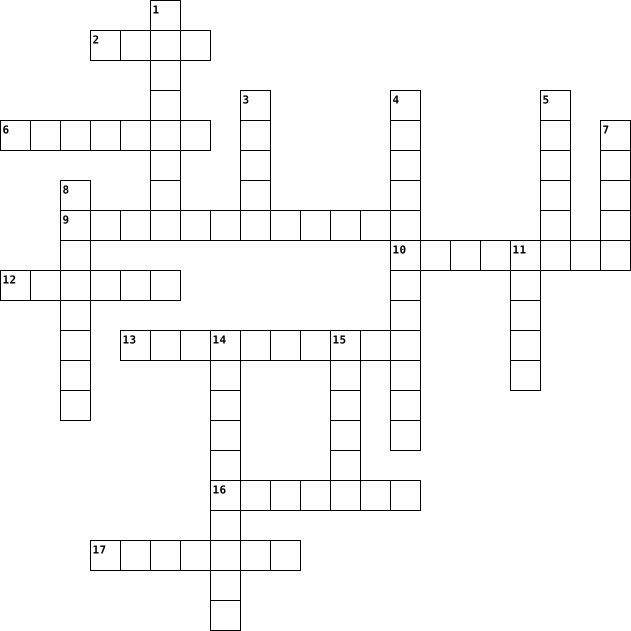
Across
- anything, including service work that is produced through the use of resources.
- the leftover stuff, which is left after the required point is reached.
- a person who works on its own, predicting the risks and benefits of a certain business venture.
- economic activities where raw materials are manufactured, and new goods are made.
- the financial gain of a person or an organization; it is gained when there is more money earned than what is invested.
- goods that have to be with something else; goods that always go together; if the demand for one good rises or falls, the demand for the complement also rises or falls.
- capital one of the factors needed when producing a certain good or service, which works as a form of investment.
- a system that supplies or supports with utilities and wealth
Down
- a person who purchases goods or services
- the action of working in order to produce goods and services.
- the act of sharing the produced goods and services
- the buying of foreign goods and services.
- a type of tool used in trading goods and services, which people set a certain price for every goods or services they produce.
- anything, including stocks of money and staff, that can be used in order for a person or organization to work efficiently
- another word for shares, which is a piece of a certain company. As the company’s value rises, the price for each share of that company rises.
- the act of manufacturing raw materials to produce goods
- the selling of goods to foreign countries.
17 Clues: a person who purchases goods or services • the buying of foreign goods and services. • the selling of goods to foreign countries. • the act of sharing the produced goods and services • the act of manufacturing raw materials to produce goods • a system that supplies or supports with utilities and wealth • the action of working in order to produce goods and services. • ...
Economics Vocab 2021-10-15

Across
- all the natural resources that are used to produce goods and services.
- something that is necessary for survival (such as food and shelter)
- any human-made resource that is used to create other goods and services.
- all the alternatives we give up whenever we choose one course of action over another.
- a cost or benefit that motivates a decision or action by consumers, businesses or other participants in the economy
- The resources we use to produce goods and services are limited.
- of Production The resources used to produce goods and services; also known as production inputs or resources
- Human effort, including both physical and mental effort, used to produce goods and services.
- Cost the most desirable alternative given up as a result of a decision.
Down
- Possibilities Frontier the line on a production possibilities curve that shows the maximum possible output.
- The effort used to coordinate the factors of production--natural resources, labor, physical capital, and human capital--to produce and sell products.
- a measure of the benefit provided by a good or service to an economic agent
- a measure of net worth; that is, it is a measure of how much a person has in savings, investments, real estate and cash, less any debts.
- a term in economics that refers to the total satisfaction received from consuming a good or service
- a transaction in which no physical goods are transferred from the seller to the buyer.
- something that is desired.
- items that satisfy human wants and provide utility, for example, to a consumer making a purchase of a satisfying product.
17 Clues: something that is desired. • The resources we use to produce goods and services are limited. • something that is necessary for survival (such as food and shelter) • all the natural resources that are used to produce goods and services. • Cost the most desirable alternative given up as a result of a decision. • ...
Economics Crossword 2021-10-11

Across
- the financial and opportunity costs consumers pay when searching for a good or service
- a minimum price that an employer can pay a worker for an hour of labor
- describes any price or quantity not at equilibrium
- a system of allocating scarce goods and services using criteria other than price
- a minimum price for a good or service
- A sudden shortage of a good
- a maximum price that can legally be charged for a good or service
- situation in which quantity demanded is greater than quantity supplied; excess demand
- a price ceiling placed on rent
Down
- when quantity demanded is more than quantity supplied
- a market in which goods are sold illegally
- the point at which quantity demanded and quantity supplied are equal
- situation is which quantity supplied is greater than quantity demanded; excess supply
- When quantity supplied is more than quantity demanded
- costs of production that affect people who have no control over how much of a good is produced
- a product that is popular for a short period of time
- the amount of goods a firm has on hand
17 Clues: A sudden shortage of a good • a price ceiling placed on rent • a minimum price for a good or service • the amount of goods a firm has on hand • a market in which goods are sold illegally • describes any price or quantity not at equilibrium • a product that is popular for a short period of time • when quantity demanded is more than quantity supplied • ...
Economics AOS2 2021-10-18

Across
- Policies set by governments to have a budget in equity and control tax rates and levels of spending
- A tax applied on goods and services and not on profits or income
- The type of poverty in which households receive less than average household incomes
- The value to be returned to a company's shareholders
- Goods or services that are unhealthy to consume and undesirable
- The worst level of poverty in which basic life requirements are not met
- The levels of income, wealth, comforts etc. that are provided to a society
Down
- Goods or services that are not bad to consume and are worthy of finance
- The efficiency state of the economy in which production cannot be increased without sacrificing the production of another good or service
- The economic state in which all resources are allocated and used effectively
- A measure of the income inequality in a country's economy
- The efficiency state of the economy in which all resources are allocated such that the maximum marginal benefit is received
- The state of a market being intervened and having some government supervision
- The state of having no job and not being able to earn an income
- Goods or services that are available to all members of the society
- The state of a market not being intervened and regulated by the govenment
- The uneven distribution of wealth and income in the economy
17 Clues: The value to be returned to a company's shareholders • A measure of the income inequality in a country's economy • The uneven distribution of wealth and income in the economy • The state of having no job and not being able to earn an income • Goods or services that are unhealthy to consume and undesirable • ...
Economics Vocabulary 2022-04-07

Across
- Goods and services are produced in better quality, quantity and speed when people focus on producing a few things instead of making everything they want by themselves
- The substance with which you make bread
- board, timber, or wood
- A relationship between countries in which they rely on one another for resources, goods, or services
- Exchange of goods and services
- to settle by discussing
- Arrangement of resources across Earth
- Limited quantities of resources to meet unlimited wants
- An amount that must be paid or spent to buy or obtain something
Down
- Advantages
- Weighing the costs and benefits of alternatives in making an economic decision
- A situation in which a good or service is produced at the lowest possible cost
- Exchange goods without involving money
- A rock that contains a large enough concentration of a mineral making it profitable to mine
- All the things used in producing goods and services
- More of something than is needed
- A block of hard material used in building
17 Clues: Advantages • board, timber, or wood • to settle by discussing • Exchange of goods and services • More of something than is needed • Arrangement of resources across Earth • Exchange goods without involving money • The substance with which you make bread • A block of hard material used in building • All the things used in producing goods and services • ...
Economics Vocabulary 2022-08-19

Across
- transation when 2 parties trade goods
- intangible act paid for buy buyer
- Item bought
- An activity use goods,labor,capital
- Division of resources
- satisfaction from good or service
- objects used in production
- Can live without and can't live without
Down
- assets of a company for production
- A way to exchange goods and services
- seperation of work into different tasks
- focus on one good or service to be best
- increased production of good or service
- how much output from given input
- commodity produced for buyer
- In short supply
- the value of all assets owned by etc.
17 Clues: Item bought • In short supply • Division of resources • objects used in production • commodity produced for buyer • how much output from given input • intangible act paid for buy buyer • satisfaction from good or service • assets of a company for production • An activity use goods,labor,capital • A way to exchange goods and services • transation when 2 parties trade goods • ...
Business/Economics 2023-08-24

Across
- An amount of money you pay to the government
- A person who owns shares
- Money you take that is then owed to another
- the supply and demand for houses
- Money you gain from a business
- An economy is the system for deciding how scarce resources are used
- A rise in prices
- Makes you a part-owner of a company
- Where you can buy things
Down
- A person or group who rules over a country
- A person who owns something
- Two or more people who own something
- Financial assets suddenly lose a large part of there value
- A raise in prices from a loan
- The work of somebody
- Durable produced goods that are used as productive inputs for further production
- Buys thing from businesses
17 Clues: A rise in prices • The work of somebody • A person who owns shares • Where you can buy things • Buys thing from businesses • A person who owns something • A raise in prices from a loan • Money you gain from a business • the supply and demand for houses • Makes you a part-owner of a company • Two or more people who own something • A person or group who rules over a country • ...
Economics Revision 2023-10-30

Across
- Bartering or trading
- of production Land,Labour,Capital,Enterprise
- Things that bring money into the economy
- The money that is being taken out of the economy and is not being reinjected
- Economic decsion making happens through the markets
- Analysis a form of analysis used to compare a series of options using criterion.
- a monetary measure of the market value of all the final goods and services produced in a specific time period by a country or countries.
- have a desire to possess or do (something); wish for.
- wants Scenarios where people want to consume/purchase more and mroe items
- the state of being scarce or in short supply; shortage.
Down
- The general gradual devaluation of money and assets over time
- All activities undertaken for the purpose of the production, distribution and consumption of goods and services in a region or country
- Economic Problem the fundamental challenge facing all societies, which is how to satisfy unlimited wants and needs with limited resources.
- Resources and Businesses are owned by the government
- Things that are necessary for day to day life
- resources recources that are scarce
- Cost the loss of other alternatives when one alternative is chosen.
17 Clues: Bartering or trading • resources recources that are scarce • Things that bring money into the economy • Things that are necessary for day to day life • of production Land,Labour,Capital,Enterprise • Economic decsion making happens through the markets • Resources and Businesses are owned by the government • have a desire to possess or do (something); wish for. • ...
Economics 1 2024-04-02

Across
- to use something to one’s advantage
- to suggest a theory, idea, etc. as a basic principle from which a further idea is formed or developed
- having or showing practical knowledge and experience
- hard to believe because it seems to be illogical
- a way of calculating, judging, or deciding something in a complicated situation
- normal, accepted or used by many people
- to get better, to comeback to a good position after hard times
- strongly and without stopping
- done against someone because he or she has harmed you
Down
- producing good results
- never having happened or existed in the past:
- to deal with (a complicated or difficult task)
- a clear and full explanation of an idea or theory
- to come together or bring people together to support an idea
- innoving thinking of someone or something as better than that person or thing really is
- to experience something bad as a result of actions you have taken
- a small but important detail
17 Clues: producing good results • a small but important detail • strongly and without stopping • to use something to one’s advantage • normal, accepted or used by many people • never having happened or existed in the past: • to deal with (a complicated or difficult task) • hard to believe because it seems to be illogical • a clear and full explanation of an idea or theory • ...
Economics 1 2024-08-13

Across
- a point of rest
- Rise in prices
- - AD less than AS
- planned saving and investment
- - One additional
- Number of times increase the investment results in income
- addition to capital stock
- Willingness to consume
- Function Relation between consumption and income
Down
- independent
- Movement of people from one place to another for jobs
- residual income after consumption
- Use of resources
- increases earning capacity
- difference between loan amount and asset mortgaged
- Convertibility into cash
- drain Migration of skilled personnel
17 Clues: independent • Rise in prices • a point of rest • Use of resources • - One additional • - AD less than AS • Willingness to consume • Convertibility into cash • addition to capital stock • increases earning capacity • planned saving and investment • residual income after consumption • drain Migration of skilled personnel • Function Relation between consumption and income • ...
Economics Crossword 2023-03-03

Across
- the cost added by producing one additional unit of a product or service.
- a tax imposed by a government on goods and services imported from other countries that serves to increase the price and make imports less desirable, or at least less competitive, versus domestic goods and services.
- scarce or in short supply
- a fixed share of something that a person or group is entitled to receive or is bound to contribute.
- unemployment resulting from industrial reorganization, typically due to technological change, rather than fluctuations in supply or demand.
- a condition where the quantity demanded is greater than the quantity supplied at the market price.
- any instrument, agent, etc., employed in the production of goods and services.
- the unemployment which exists in any economy due to people being in the process of moving from one job to another.
- a situation where workers are unemployed at certain times of the year when demand has decreased.
Down
- the state in which market supply and demand balance each other, and as a result prices become stable.
- a graph that shows all of the different combinations of output that can be produced given current resources and technology.
- the loss of potential gain from other alternatives when one alternative is chosen
- the additional benefit arising from a unit increase in a particular activity.
- an association of two or more people as partners.
- someone who owns an unincorporated business by himself or herself
- the amount of an asset or resource that exceeds the portion that's actively utilized.
- a business entity that is owned by its shareholder(s), who elect a board of directors to oversee the organization's activities.
17 Clues: scarce or in short supply • an association of two or more people as partners. • someone who owns an unincorporated business by himself or herself • the cost added by producing one additional unit of a product or service. • the additional benefit arising from a unit increase in a particular activity. • ...
Economics Vocabulary 2026-03-11

Across
- Situation of not having enough resources to satisfy all one’s wants and needs
- _____ resources: Land and all the materials nature provides
- Alternative you face when you decide to do one thing rather than another
- Workers and their abilities
- Cost of the next best use of time or money when choosing to do one thing rather than another
- Work that is done for us
- Risk-taking individuals who start a new business, introduce a new product, or improve method of making something
- Basic requirement for survival
Down
- Factories, tools, and equipment that manufacture goods
- Study of how individuals and nations make choices about ways to use scarce resources to fulfill their needs and wants
- Desire for a good or a service
- factors of _________; Four categories of resources used to produce goods and services: natural resources, capital, labor, and entrepreneurs
- To support or encourage
- Things used to make goods or services
- Alternative, choice
- Things we can touch or hold
- benefit _____________ analysis; Economic decision-making model that divides the total benefits by the total costs
17 Clues: Alternative, choice • To support or encourage • Work that is done for us • Things we can touch or hold • Workers and their abilities • Desire for a good or a service • Basic requirement for survival • Things used to make goods or services • Factories, tools, and equipment that manufacture goods • _____ resources: Land and all the materials nature provides • ...
American Economics 2026-03-05

Across
- The statutory requirement that the Federal Reserve work toward both maximum employment and stable prices [10-12].
- A market where many firms produce similar but not identical products, such as different brands of shoes [24-26].
- The basic resources needed to create goods and services, categorized as land, labor, and capital [13, 14].
- Legislation designed to prevent companies from monopolizing an industry and to restore fair competition, such as the Sherman Antitrust Act (1890) [1, 2].
- An economic system where private companies and the people who run them are in charge of industry and trade [3-5].
- A monetary strategy used to stimulate the economy during a recession by lowering interest rates to promote spending and hiring, though it risks increasing inflation [7, 8, 13].
- The general increase in the price of goods and services over time [10, 11, 16].
- A situation where a single company has exclusive control over a product or service, eliminating competition and often leading to higher prices [1, 23, 24].
- An idealized market where all firms compete directly to offer the lowest prices, and no single producer has the power to influence the price of goods [28, 29].
Down
- The independent central banking system of the United States, established in 1913 to manage monetary policy and provide stability [8, 10, 15].
- Economic policy handled by Congress and the president concerning government spending and taxation to fund programs and stabilize the economy [7, 9].
- The rivalry between producers seeking to "win" consumers for their goods or services, which typically increases quality and lowers costs [5, 6].
- The "price" of borrowing money, typically expressed as a percentage of the amount borrowed [16, 17].
- Actions taken by the Federal Reserve to manage the money supply, interest rates, and the availability of credit [3, 7, 22].
- A monetary strategy used to stabilize the economy during inflation by raising interest rates to suppress spending, which can lead to higher unemployment [7-9].
- An economic system—like that of the U.S.—where private businesses are the main producers, but the government acts as a "referee" by setting rules, maintaining competition, and ensuring stability [18-21].
- A market situation in which just a few large companies dominate the entire industry [27, 28].
17 Clues: The general increase in the price of goods and services over time [10, 11, 16]. • A market situation in which just a few large companies dominate the entire industry [27, 28]. • The "price" of borrowing money, typically expressed as a percentage of the amount borrowed [16, 17]. • ...
Missel;s puzzle 2026-01-16

Across
- the branch of economics that deals with subjective value judgments, opinions, and beliefs about what should happen in an economy
- conomics is all about making choices when resources are limited.
- a kind of compromise that involves giving up something in return for getting something else
- he system of how a country or region produces, distributes, and uses goods and services
Down
- he objective, factual study of "what is" in economics
- the lack of products and/or things that are necessary
- a systematic process to evaluate a project or decision by comparing its total expected costs (financial, time, resources)
- the work that you do for someone or for a cause
- something that you want that makes you do something for it
- the territorie or place where you are going to put your business
10 Clues: the work that you do for someone or for a cause • he objective, factual study of "what is" in economics • the lack of products and/or things that are necessary • something that you want that makes you do something for it • conomics is all about making choices when resources are limited. • the territorie or place where you are going to put your business • ...
The Price of Care 2024-09-11

Across
- people have the resources essential to a healthy life
- the exchange of goods and services takes place
- cost the loss of potential gain
- the coordination and administration of tasks to achieve a goal
- the action of making or manufacturing from components or raw materials
- member of an 18th-century group of French economists
- the action of helping or doing work for someone
- someone who creates and supplies goods or services
- Insufficiency of amount; shortage
- the theory or practice of controlling the supply of money
- people have the resources essential to a healthy life
- anything required for human survival
- refers to the fees and financial obligations
- work, especially hard physical work
- the study of social life, social change, and the social causes
Down
- studies the decisions of individuals and firms
- the situation where two or more parties depend upon each other
- the peak level of performance that uses the least inputs and max output
- detailed examination of the elements or structure of something
- make available to someone; provide
- what the economy "should be" or "ought to be."
- a person who organizes and operates a business or businesses
- people who buy or use goods and services
- have a desire to possess or do
- focuses on the performance of economies
- the consumer's desire and willingness to buy a product or service economics concerned with the creation, consumption, and transfer of wealth
- the physical or financial resources
- concerned with how human societies sustain themselves materially
- when you choose one thing which causes you to have to give up
- concerned with the application of economic theory
30 Clues: have a desire to possess or do • cost the loss of potential gain • Insufficiency of amount; shortage • make available to someone; provide • the physical or financial resources • work, especially hard physical work • anything required for human survival • focuses on the performance of economies • people who buy or use goods and services • ...
Understanding Business Chapter 2 Vocabulary 2023-02-09

Across
- the loss of the best and brightest people to other countries
- all or most factors of production and distribution are privately owned
- price increases are slowing
- some, if not most, basic business should be owned by the government so that profits can be equally distributed among the people.
- economics that looks at the behavior of people and organizations in particular markets
- periodic rises and falls in economies over time
- fed gov'ts effort to keep the economy stable by adjusting taxes or gov spending
- management of the money supply and interest rates by the Federal Reserve Bank
- government largely decides what goods and services will be produced and who will get them
- a situation where prices are declining
- quantity of products that people are willing to buy at diff. prices at a specific time
- market largely determines what goods and services get produced, who gets them, and how
- a severe recession
- economics study that looks at the operation at a whole
Down
- rise in prices of goods and services over time
- large number of sellers produce very similar products that buyers perceive as different.
- degree of competition with a few sellers dominating the market
- Adam Smith
- how society decides what goods and services to produce for consumption
- quantity of products that are sold at different prices at a specific time
- economic and political system where gov. makes almost all economic decisions
- a measure of total sales volume at all stages of production
- total value of final goods and services produced in a country
- two or more consecutive quarters of decline in the GDP
- allocation of resources is made by the market and some by the government
25 Clues: Adam Smith • a severe recession • price increases are slowing • a situation where prices are declining • rise in prices of goods and services over time • periodic rises and falls in economies over time • two or more consecutive quarters of decline in the GDP • economics study that looks at the operation at a whole • ...
Ch. 16 Economics 2023-04-28

Across
- an economic system in which capital assets are privately owned and the prices, production, and distribution of goods are determined by the competition of the free market
- the availability of a good or service creates a demand equal to its value
- Marxist ideal of a classless and stateless utopian society in which all property is commonly owned
- the belief that human beings are social constructs and not unified rational individuals with an objective human nature
- Arabic word meaning either interest or excessive interest
- the collective community of Muslims around the world (translated means "nation")
- the third pillar of Islam, the donation of 2.5% of annual income
- the belief that an individual's financial success is directly proportional to his or her level of enlightenment, or the belief that positive thoughts create wealth
- the study of the management of resources
- economic system advocating either government or communal ownership of the means of production and the distribution of goods and services
- the branch of economics that studies how households and firms buy sell, and allocate resources
- economic requirements that govern the lives of Muslims
- the act of managing and caring for resources that ultimately belong to God
Down
- Marxist's believe this ought to be the economic transitional phase in between capitalism and communism
- econmic system in which the government influences aspects of a market economy in an attempt to improve the public good
- an economy in which economic decisions are freely made by households and firms
- a tax imposed on dhimmis living in Islamic states
- goods used to produce other goods and services
- the branch of economics that studies how large economies function as a whole
- the practice of lending money at an exorbitant rate
- rivalry between two or more companies to offer the best products, at the best price, and with the highest profit margins
21 Clues: the study of the management of resources • goods used to produce other goods and services • a tax imposed on dhimmis living in Islamic states • the practice of lending money at an exorbitant rate • economic requirements that govern the lives of Muslims • Arabic word meaning either interest or excessive interest • ...
Free Enterprise 2016-11-14

Across
- the extra or additional costs or benefits of a decision
- things that people desire to have
- something that encourages or motivates a person to take action
- unable to be felt by touch
- an explanation of how something works, designed to answer a question for which there is no obvious answer
- a means for deciding who gets what portion of the available resources and goods
- anything that satisfies a person's wants or brings satisfaction; also tangible products
- the science that studies the choices of people trying to satisfy their wants in a world of scarcity
- the most highly valued opportunity or alternative forfeited when a choice is made
- a condition in which our wants are greater than the resources available to satisfy them
Down
- the branch of economics that deals with human behavior and choices as they relate to the entire economy
- tasks that people pay others to perform for them
- the special talent that some people have for searching out and taking advantage of new business opportunities and for developing new products and new ways of doing things
- produced goods that can be used as resources for further production
- a situation in which more of one thing necessarily means less of something else
- anything that is used to produce goods or services
- able to be felt by touched
- the branch of economics that deals with human behavior and choices as they relate to relatively small units-an individual, a business firm, or a single market
- the quality of bringing satisfaction or happiness
- the physical and mental talents that people contribute to the production of goods and services; ex. truck driver, accountant, lawyer
20 Clues: unable to be felt by touch • able to be felt by touched • things that people desire to have • tasks that people pay others to perform for them • the quality of bringing satisfaction or happiness • anything that is used to produce goods or services • the extra or additional costs or benefits of a decision • something that encourages or motivates a person to take action • ...
CH. 4 At Every Depth 2024-11-05

Across
- Climate induced deaths of shellfish lead to a significant proportion of a population ____ (no hyphen, 2 words)
- What caused over 75 % of oysters to die off in hatcheries even after filtering pathogens, increased
- First endangered shellfish species in WA
- Indigenous people around the world work with scientist and resource mangers to revitalize traditional practices and increase ____
- An important resource to the Kwakwaka'wakw ____ management
- A gradual change in our accepted norms and expectations for the environment (2words)
- A clam garden
- Elevated levels of CO2 in the ocean
Down
- Neanderthalesis did what in tide pools 165,000 years ago
- Excessive use of something like a natural resource
- Environment providing resources for organisms
- The biggest challenge is getting who to notice, the ____
- One of the greatest environmental and humanitarian challenges is sustainable ____ production
- The federal environmental regulations has ____ the First Nations traditional environmental modification and harvest
- A model for conservation across discipline and culture
15 Clues: A clam garden • Elevated levels of CO2 in the ocean • First endangered shellfish species in WA • Environment providing resources for organisms • Excessive use of something like a natural resource • A model for conservation across discipline and culture • Neanderthalesis did what in tide pools 165,000 years ago • The biggest challenge is getting who to notice, the ____ • ...
Makenna Harper The Economic Way of Thinking 2022-09-21

Across
- to make decisions according to what you believe is the best combination of costs and benefits
- all the resources made and used by many people to produce and distribute goods and services
- economics a way of describing what economic behavior ought to be,not what it actually is
- model simplified representations of complex economic activities, systems,or problems
- economics a way of describing and explaining economics as it is, not as it should be
- term goal what to have in the future
- fund a type of short term goal
- desires that can be satisfied by consuming a good or service
- the possibility of loss
- cost the value of the next best alternative or what you give up by choosing one alternative over another
- the benefit or satisfaction gained from the use of good or service
- term goal something you want to do in the near future
- numerical data or information to see patterns or behavior
- benefits offered to encourage people to act in certain ways
- the condition in which economic resources are being used to produced the maximum amount of goods and services
Down
- cost the cost of using one more unit of a good or service
- a person who makes goods or provides services
- work that one person performs for another payment
- buy something you gain money from
- all the human time,effort,and talent that go into the making of products
- the condition in which economic resources are not being used to their full potential
- things,such as food,clothing,and shelter, that are necessary for survival
- the economic resources needed produce goods and services
- a person who buys goods or services for personal use
- a person who makes goods or provides services
25 Clues: the possibility of loss • fund a type of short term goal • buy something you gain money from • term goal what to have in the future • a person who makes goods or provides services • a person who makes goods or provides services • work that one person performs for another payment • a person who buys goods or services for personal use • ...
Economics 2013-05-05

Across
- papers Barang yanag di perjual belikan dipasar modal
- Keuntungan dari hasil jual beli saham
- Harga obligasi lebih kecil dari nilai nominalnya
- Membuat konsep akta perubahan anggaran dasar
- Institusi penjamin penjualan seluruh surat berharga yang telah laku terjual
- Perjanjian yang peluang keuntungannya terkait dengan kinerja aset lain
Down
- Tanda kepemilikan seseorang atau badan dalam suatu perusahaan
- Institusi yang berwenang untuk menyimpan dan mengatur arus perpindahan surat-surat berharga
- Perusahaan yang menerbitkan saham
- Tahap akhir dari sebuah siklus transaksi dalam proses perdagangan saham
10 Clues: Perusahaan yang menerbitkan saham • Keuntungan dari hasil jual beli saham • Membuat konsep akta perubahan anggaran dasar • Harga obligasi lebih kecil dari nilai nominalnya • papers Barang yanag di perjual belikan dipasar modal • Tanda kepemilikan seseorang atau badan dalam suatu perusahaan • Perjanjian yang peluang keuntungannya terkait dengan kinerja aset lain • ...
Economics 2014-03-10

Across
- A commercial institution that takes deposits and extends loans
- Require; need
- A person whose job is to keep or inspect financial accounts
- The exchange of a commodity for money
Down
- A type of product manufactured by a particular company under a particular name
- The action or process of paying someone or something or of being paid
- The amount of money expected, required, or given in payment for something
- A sum paid for the hire of equipment
- An association of manufacturers or suppliers with the purpose of maintaining prices at a high level and restricting competition
- Money in coins or notes, as distinct from cheques, money orders, or credit
10 Clues: Require; need • A sum paid for the hire of equipment • The exchange of a commodity for money • A person whose job is to keep or inspect financial accounts • A commercial institution that takes deposits and extends loans • The action or process of paying someone or something or of being paid • The amount of money expected, required, or given in payment for something • ...
economics 2014-05-13

Across
- government pays the business
- as price decrease quantity demand increases
- the people who make goods
- the most basic economic problem
- how much is sold at one price
Down
- the total that is bought
- actions or activities that are preformed
- as price increases quantity supply increases
- people who buy goods and services
- physical objects that can be purchased
10 Clues: the total that is bought • the people who make goods • government pays the business • how much is sold at one price • the most basic economic problem • people who buy goods and services • physical objects that can be purchased • actions or activities that are preformed • as price decrease quantity demand increases • as price increases quantity supply increases
Economics 2013-09-20

Across
- To buy resources or goods from other countries
- A person who makes goods.
- number limit on how many items of a particular product can be imported from a certain nation.
- A market in which there are many buyers but one seller.
- A person who buys goods or services
- to sell goods or resources to other countries
Down
- A schedule of how much consumers are willing and able to buy at each possible price during some time period.
- Tax added to the price of goods that are imported
- system The way society organizes the production, consumption, and distribution of goods and services.
- A schedule of how much producers are willing and able to produce and sell at each possible price during a time period.
10 Clues: A person who makes goods. • A person who buys goods or services • to sell goods or resources to other countries • To buy resources or goods from other countries • Tax added to the price of goods that are imported • A market in which there are many buyers but one seller. • number limit on how many items of a particular product can be imported from a certain nation. • ...
Economics 2015-10-14

Across
- When you buy a good or service
- someone who starts up a business by creating a new product or service that someone else wants to buy
- quantity of goods distributed
- ongoing rise in the general level of prices
- limitations in economic resources
- a loan given to someone with intentions of paying it back
Down
- someone who creates and supplies goods or services
- Capitalists earn a return on their efforts by providing three productive inputs
- value of the next highest value of alternative use
- offers protection against the economic impact of an untimely death
10 Clues: quantity of goods distributed • When you buy a good or service • limitations in economic resources • ongoing rise in the general level of prices • someone who creates and supplies goods or services • value of the next highest value of alternative use • a loan given to someone with intentions of paying it back • ...
Economics 2016-08-31

Across
- choices people make
- something you can't live without
- accumulation of assets
- something that lasts less than three years
- makes consumer goods
Down
- made for people
- lack of something
- something that lasts longer than three years
- something you can live without
- price of something useful
10 Clues: made for people • lack of something • choices people make • makes consumer goods • accumulation of assets • price of something useful • something you can live without • something you can't live without • something that lasts less than three years • something that lasts longer than three years
economics 2018-05-07

Across
- a transfer of rights to a piece of property that is usually in return for a loan of money and that is canceled when the loan is paid.
- transfers money into another bank account when a purchase is made
- Person, bank, or some other organization that lends money to another person/bank/other
- the total amount of money in circulation or in existence in a country.
- Card that allows owner to buy goods and services and put on credit
- agency that makes sure deposits are stable in case of bank failures
Down
- money paid regularly to get rid of debt or replace money lent
- economic unit of account based on a fixed quantity of gold
- the original sum of money borrowed in a loan, or put into an investment
- failure to pay interest or principal on a loan or security when due.
10 Clues: economic unit of account based on a fixed quantity of gold • money paid regularly to get rid of debt or replace money lent • transfers money into another bank account when a purchase is made • Card that allows owner to buy goods and services and put on credit • agency that makes sure deposits are stable in case of bank failures • ...
Economics 2021-01-19

Across
- (Resource) Market
- Goods
- Cost
- Resources (Labor)
- Payments
Down
- Resources
- Analysis
- Resources (Land)
- Flow Model
- Market
10 Clues: Cost • Goods • Market • Analysis • Payments • Resources • Flow Model • Resources (Land) • (Resource) Market • Resources (Labor)
Economics 2020-06-16

Across
- overseas countries selling goods/products
- people are more likely to spend money now before prices increases
- affects people on benefits (unemployment benefit or superannuation)
- more difficult to do this as future costs & prices are harder to predict if prices are increasing
- move into higher marginal income tax bracket
Down
- the amount of goods and services which can be purchased by a person’s income
- increased cost of this
- planning ahead to buy assets because it’s difficult to know what prices will be in the future.
- goods/productions being brought into a country
- buying goods/recourses now as you believe the price will rise in the future
10 Clues: increased cost of this • overseas countries selling goods/products • move into higher marginal income tax bracket • goods/productions being brought into a country • people are more likely to spend money now before prices increases • affects people on benefits (unemployment benefit or superannuation) • ...
Economics 2021-01-13

Across
- The people that specialize
- Some countries thing going to someone
- No more bringing outside items
- people that do stuff for you.
- giving a good and getting a different one
- No trade or bringing outside items
Down
- some country's thing coming to you
- Good at a certain thing
- items sold at stores
- taxes on outside goods
10 Clues: items sold at stores • taxes on outside goods • Good at a certain thing • The people that specialize • people that do stuff for you. • No more bringing outside items • some country's thing coming to you • No trade or bringing outside items • Some countries thing going to someone • giving a good and getting a different one
Economics 2021-01-13

Across
- The experience or skills to create goods
- Raw Materials that come from nature
- The person who creates and runs a business
- A tax on certain items being imported
- A item that is not allowed to be exported usually because of Political reasons
- To send goods or services to another country
Down
- The percentage of people of 15 that can read and write
- The max amount of a material that is allowed to be imported
- The action of exchanging resources
- A good or service brought into a country that was made in a different country
10 Clues: The action of exchanging resources • Raw Materials that come from nature • A tax on certain items being imported • The experience or skills to create goods • The person who creates and runs a business • To send goods or services to another country • The percentage of people of 15 that can read and write • The max amount of a material that is allowed to be imported • ...
Economics 2021-01-13

Across
- to send items to another country
- people with new ideas for products and services
- activities provided by people
- items that humans want/need
Down
- to bring in items from another country
- man made materials needed to make goods and services
- taxes placed on imported items
- the skilled workers of a country
- an official ban of trading with another country
- the materials or substance that come from nature
10 Clues: items that humans want/need • activities provided by people • taxes placed on imported items • to send items to another country • the skilled workers of a country • to bring in items from another country • people with new ideas for products and services • an official ban of trading with another country • the materials or substance that come from nature • ...
Economics! 2021-01-13

Across
- ___ is a limitation on the amount of goods imported in a country
- ___ is a ban on trade with a specific country
- ___ is the percentage of people in a given area who can read and write
- ___ are things that are produced to sell for money, and also are made to fix human wants/needs
- ____ includes special talents and skills that people have to help produce things
- ___ is the percentage of wealth and comfort in a given area
Down
- ____ include wood, water, land, etc, are found in nature, and can be used to boost the economy
- ___ are goods/services made by one country that are sent to another for sale
- ___ are goods and services received by one country in exchange with another country for money or other goods/services
- ___ is a tax put on imported goods; usually meant to increase purchases of goods from the country itself
10 Clues: ___ is a ban on trade with a specific country • ___ is the percentage of wealth and comfort in a given area • ___ is a limitation on the amount of goods imported in a country • ___ is the percentage of people in a given area who can read and write • ___ are goods/services made by one country that are sent to another for sale • ...
Economics 2021-01-13

Across
- Your the best at
- What you can give to your community
- Talents or skills people give
- Something you can buy
- Giving goods from your country another
- Giving one thing for another
Down
- Person who sells goods and services
- Resources from the Earth
- Countries that don't make it hard trading
- Bringing in goods from another country
10 Clues: Your the best at • Something you can buy • Resources from the Earth • Giving one thing for another • Talents or skills people give • Person who sells goods and services • What you can give to your community • Bringing in goods from another country • Giving goods from your country another • Countries that don't make it hard trading
Economics 2021-04-26

Across
- A major request for a certain good.
- The state of being in short supply of something.
- economy An economy in which production, prices, and income are determined by the government.
- economy Economic system combining private and public enterprise.
- Another word for money.
- costs The cost of doing one thing over another.
Down
- The wish to possess something.
- A necessity to survive.
- economy An economy in which traditions, customs, and beliefs shape the goods and services.
- economy A system where prices are determined by privately owned businesses.
10 Clues: A necessity to survive. • Another word for money. • The wish to possess something. • A major request for a certain good. • costs The cost of doing one thing over another. • The state of being in short supply of something. • economy Economic system combining private and public enterprise. • economy A system where prices are determined by privately owned businesses. • ...
Economics 2023-08-01

Across
- The type of economy that combines aspects of a free market system and a command system.
- The type of economy in which government officials make all the decisions.
- An organization created in 1995 to help handle disputes and manage free trade agreements.
- The type of economy based on previous practices and customs.
- A free trade agreement between the United States, Canada, and Mexico.
Down
- An early economist who believed in a free market economy and regulation by the "invisible hand" of the market.
- The type of nation that offers greater political freedom, resulting in more economic freedom.
- The type of nation that allows for less political freedom, and therefore, less economic freedom.
- The type of economy in which citizens are able to decide what goods and services are provided, how they are produced, and for whom they are produced.
- A philosopher who supported command economies and created a theory that served as a foundation for this economic system.
10 Clues: The type of economy based on previous practices and customs. • A free trade agreement between the United States, Canada, and Mexico. • The type of economy in which government officials make all the decisions. • The type of economy that combines aspects of a free market system and a command system. • ...
Economics 2023-12-01

Across
- Large marsupial
- Has a trunk
- biggest marine animal
- Most poisonous spider
- Flying mammal
- Likes to chase mice
Down
- smallest bear
- turtle that bites
- biggest bear found in arctic
- Man's best friend
10 Clues: Has a trunk • smallest bear • Flying mammal • Large marsupial • turtle that bites • Man's best friend • Likes to chase mice • biggest marine animal • Most poisonous spider • biggest bear found in arctic
Economics 2024-07-26

Across
- created a free trade zone in Canada, Mexico, and the United States
- Individuals in this economic system are able to decide what goods and services should be produced, how they should be produced, and for whom they are produced.
- an economic system that is centrally controlled by a powerful government
- the national government under both Democratic and Republican leadership have worked to ______ barriers to international trade
- helps administer free trade agreements by handling various disputes and providing a forum for member nations to negotiate.
Down
- an early economist who believed that the free market system was the best way to organize the economy
- supported equality and a strong central government
- In this economy, people often work the same jobs as their parents and grandparents.
- Although free trade is generally positive for the nations involved, but the US government is still set up _____ on trade
- A nation chooses its economic system based on how its society answers the ____ basic economic questions
10 Clues: supported equality and a strong central government • created a free trade zone in Canada, Mexico, and the United States • an economic system that is centrally controlled by a powerful government • In this economy, people often work the same jobs as their parents and grandparents. • ...
Economics 2024-08-07

Across
- What did Karl Marx call the working class?
- What did Karl Marx call the owning class?
- Who published "The Wealth of Nations" in 1776?
- True or False: an absolute Free Market economy can exist.
- This is the international trade agreement between Canada, the U.S., and Mexico.
- What kind of economy is most used today?
Down
- What is French term means "without interfering" referring to the governments interference with the economy?
- What term did Adam Smith coin to describe the influence of competition and self-interest in the economy?
- Which type of economy is asked on customs and traditions?
- Who provided the ideology for a Command Economy?
10 Clues: What kind of economy is most used today? • What did Karl Marx call the owning class? • What did Karl Marx call the working class? • Who published "The Wealth of Nations" in 1776? • Who provided the ideology for a Command Economy? • Which type of economy is asked on customs and traditions? • True or False: an absolute Free Market economy can exist. • ...
Economics 2024-08-30

Across
- the amount of something available for use or purchase
- the study or science on how people use resources to satisfy needs or wants
- a goods or service created for sale or exchange
- money or assets used to start a business
- a compromise between two or more options
- Resources are limited in relation to wants and needs
Down
- the input or resources used in the production of goods and services
- A rivalry where multiple partis strive for the same goal
- the amount or product made to meet customer needs
- all the activities that are involved in the development of a product
10 Clues: money or assets used to start a business • a compromise between two or more options • a goods or service created for sale or exchange • the amount or product made to meet customer needs • Resources are limited in relation to wants and needs • the amount of something available for use or purchase • A rivalry where multiple partis strive for the same goal • ...
Economics 2023-06-29

Across
- Insufficient
- The action of Manufacturing from Raw materials
- Greek word for Family management
- 4-Letter word for Aims
- The medium or method used to achieve an end
Down
- To Share something among others
- The action of using up a resource
- Money received on a regular basis
- the action of spending funds
- The enterprises in a specific region
10 Clues: Insufficient • 4-Letter word for Aims • the action of spending funds • To Share something among others • Greek word for Family management • The action of using up a resource • Money received on a regular basis • The enterprises in a specific region • The medium or method used to achieve an end • The action of Manufacturing from Raw materials
Economics 2023-06-19

Across
- increase
- firm
- multiplication
- money
- stonks
- poor
Down
- rich
- adding
- satisfaction
- bank
10 Clues: rich • firm • bank • poor • money • adding • stonks • increase • satisfaction • multiplication
Economics 2023-02-24

Across
- study of the nation's economy
- combination of losses of any goods
- effort used to coordinate
- money generated from business
- study of choices when there's scarcity
Down
- any pecuniary loss resulting
- Cost what you sacrifice to get something
- study of choices
- An exchange that occurs as a compromise
- financial benefit
10 Clues: study of choices • financial benefit • effort used to coordinate • any pecuniary loss resulting • study of the nation's economy • money generated from business • combination of losses of any goods • study of choices when there's scarcity • An exchange that occurs as a compromise • Cost what you sacrifice to get something
Economics 2023-03-03

Across
- an amount of money available to you because you paid for something earlier
- A request made with power and urge
- using the money to earn more money to use your money to purchase stock in a company
- to make something needed or wanted.
- is money received especially on a regular basis, for work or through investments.
- is the amount of money that you have stored in a specific fund or it can be stored in a wallet.
Down
- is the state of wanting to know or learn about something or someone.
- Are goods that are used in producing other goods rather than being bought by consumers.
- is a system of money in general use in a particular country.
- is an amount of money that you gain when you are paid more for something than it cost you to make, get, or do it.
10 Clues: A request made with power and urge • to make something needed or wanted. • is a system of money in general use in a particular country. • is the state of wanting to know or learn about something or someone. • an amount of money available to you because you paid for something earlier • ...
Economics 2023-04-25

Across
- An economist who thought that capitalist systems promoted inequality and divided society into two different classes: the working class and the owning class
- This President described NAFTA as a bad deal for the American workers and had indicated that his administration would support more restrictive trade policies
- The form of economy that is based on customs and historical precedent
- Early economist who believed that the free market system was the best way to organize the economy
- This organization helps to administer free trade agreements by handling various disputes and providing a forum for member nations to negotiate
- An economic system where consumers have little to no choice in economic decisions and where government officials decide how to answer the three basic economic questions
Down
- Both the Democratic and Republican leadership have worked to reduce barriers to this type of trade over the last few decades
- Individuals in this economic system are able to decide what goods and services should be produced, how they should be produced, and for whom they are produced
- An individual's right to answer the three basic economic questions without interference from the government
- A free trade agreement that has the goal to eliminate free trade barriers, promote fair competition, and increase investment opportunities among the three nations
10 Clues: The form of economy that is based on customs and historical precedent • Early economist who believed that the free market system was the best way to organize the economy • An individual's right to answer the three basic economic questions without interference from the government • ...
economics 2023-03-21

Across
- without social reproduction
- is social science
- resources needed to create a product
- something that is desired
- short supply
Down
- interest rates
- value or benefit
- exchanging something for something else
- number or quantity of goods
- single fsctors
10 Clues: short supply • interest rates • single fsctors • value or benefit • is social science • something that is desired • without social reproduction • number or quantity of goods • resources needed to create a product • exchanging something for something else
economics 2023-03-21

Across
- without social reproduction
- is social science
- resources needed to create a product
- something that is desired
- short supply
Down
- interest rates
- value or benefit
- exchanging something for something else
- number or quantity of goods
- single fsctors
10 Clues: short supply • interest rates • single fsctors • value or benefit • is social science • something that is desired • without social reproduction • number or quantity of goods • resources needed to create a product • exchanging something for something else
economics 2023-03-21

Across
- without social reproduction
- is social science
- resources needed to create a product
- something that is desired
- short supply
Down
- interest rates
- value or benefit
- exchanging something for something else
- number or quantity of goods
- single fsctors
10 Clues: short supply • interest rates • single fsctors • value or benefit • is social science • something that is desired • without social reproduction • number or quantity of goods • resources needed to create a product • exchanging something for something else
economics 2023-03-21

Across
- without social reproduction
- is social science
- resources needed to create a product
- something that is desired
- short supply
Down
- interest rates
- value or benefit
- exchanging something for something else
- number or quantity of goods
- single fsctors
10 Clues: short supply • interest rates • single fsctors • value or benefit • is social science • something that is desired • without social reproduction • number or quantity of goods • resources needed to create a product • exchanging something for something else
economics 2023-03-21

Across
- without social reproduction
- is social science
- resources needed to create a product
- something that is desired
- short supply
Down
- interest rates
- value or benefit
- exchanging something for something else
- number or quantity of goods
- single fsctors
10 Clues: short supply • interest rates • single fsctors • value or benefit • is social science • something that is desired • without social reproduction • number or quantity of goods • resources needed to create a product • exchanging something for something else
economics 2023-03-21

Across
- without social reproduction
- is social science
- resources needed to create a product
- something that is desired
- short supply
Down
- interest rates
- value or benefit
- exchanging something for something else
- number or quantity of goods
- single fsctors
10 Clues: short supply • interest rates • single fsctors • value or benefit • is social science • something that is desired • without social reproduction • number or quantity of goods • resources needed to create a product • exchanging something for something else
economics 2023-03-21

Across
- without social reproduction
- is social science
- resources needed to create a product
- something that is desired
- short supply
Down
- interest rates
- value or benefit
- exchanging something for something else
- number or quantity of goods
- single fsctors
10 Clues: short supply • interest rates • single fsctors • value or benefit • is social science • something that is desired • without social reproduction • number or quantity of goods • resources needed to create a product • exchanging something for something else
economics 2023-03-21

Across
- without social reproduction
- is social science
- resources needed to create a product
- something that is desired
- short supply
Down
- interest rates
- value or benefit
- exchanging something for something else
- number or quantity of goods
- single fsctors
10 Clues: short supply • interest rates • single fsctors • value or benefit • is social science • something that is desired • without social reproduction • number or quantity of goods • resources needed to create a product • exchanging something for something else
economics 2023-03-21

Across
- without social reproduction
- is social science
- resources needed to create a product
- something that is desired
- short supply
Down
- interest rates
- value or benefit
- exchanging something for something else
- number or quantity of goods
- single fsctors
10 Clues: short supply • interest rates • single fsctors • value or benefit • is social science • something that is desired • without social reproduction • number or quantity of goods • resources needed to create a product • exchanging something for something else
economics 2023-03-21

Across
- without social reproduction
- is social science
- resources needed to create a product
- something that is desired
- short supply
Down
- interest rates
- value or benefit
- exchanging something for something else
- number or quantity of goods
- single fsctors
10 Clues: short supply • interest rates • single fsctors • value or benefit • is social science • something that is desired • without social reproduction • number or quantity of goods • resources needed to create a product • exchanging something for something else
economics 2023-03-21

Across
- without social reproduction
- is social science
- resources needed to create a product
- something that is desired
- short supply
Down
- interest rates
- value or benefit
- exchanging something for something else
- number or quantity of goods
- single fsctors
10 Clues: short supply • interest rates • single fsctors • value or benefit • is social science • something that is desired • without social reproduction • number or quantity of goods • resources needed to create a product • exchanging something for something else
economics 2023-03-21

Across
- without social reproduction
- is social science
- resources needed to create a product
- something that is desired
- short supply
Down
- interest rates
- value or benefit
- exchanging something for something else
- number or quantity of goods
- single fsctors
10 Clues: short supply • interest rates • single fsctors • value or benefit • is social science • something that is desired • without social reproduction • number or quantity of goods • resources needed to create a product • exchanging something for something else