
forms of energy Crossword Puzzles
6.1 Vocab 2024-07-09

Across
- The natural and man-made places where water is found.
- The process of water turning from a gas into a liquid
- a group of atoms held together by a bond.
- Height above or below a given location.
- Driver The source of energy that causes water to move (for example gravity).
- Things that if they are not met, the solution is not acceptable.
- of Matter Forms that matter can take on including solid, liquid, and gas.
- System A series of reservoirs that are connected through the movement of water.
- The process that causes a liquid to turn into a gas.
- The process that causes a liquid in plants to be released as a gas.
- Cycle the continuous movement of water between the earth's water reservoirs driven by energy from the sun and gravity.
- the goals we want the solution to meet as much possible
Down
- Water Water located on the surface of the earth such as lakes and streams.
- Water that falls to the ground in the form of rain, snow, sleet, etc.
- When molecules move at a medium speed and slide past each other.
- When molecules move slowly/vibrate and are tightly packed.
- Spacing how close together or far apart molecules/atoms are.
- When water drains down into the ground/soil.
- Water held underground in the soil or in pores and crevices in rock.
- When molecules move fast, far apart and do not touch unless they collide.
- Movement The movement of groundwater, which occurs very slowly.
- Energy The total amount of energy carried by a system's molecules
- Water that drains over the surface of the earth after falling as precipitation.
- An area of higher elevation land that dictates where surface water and groundwater drain.
- The force that pulls things towards the earth.
25 Clues: Height above or below a given location. • a group of atoms held together by a bond. • When water drains down into the ground/soil. • The force that pulls things towards the earth. • The process that causes a liquid to turn into a gas. • The natural and man-made places where water is found. • The process of water turning from a gas into a liquid • ...
6.1 Vocab 2024-07-09

Across
- Water that drains over the surface of the earth after falling as precipitation.
- The force that pulls things towards the earth.
- Water held underground in the soil or in pores and crevices in rock.
- Spacing how close together or far apart molecules/atoms are.
- An area of higher elevation land that dictates where surface water and groundwater drain.
- When molecules move slowly/vibrate and are tightly packed.
- When molecules move at a medium speed and slide past each other.
- The process that causes a liquid in plants to be released as a gas.
- of Matter Forms that matter can take on including solid, liquid, and gas.
- The process that causes a liquid to turn into a gas.
- Cycle the continuous movement of water between the earth's water reservoirs driven by energy from the sun and gravity.
- The natural and man-made places where water is found.
Down
- Things that if they are not met, the solution is not acceptable.
- Height above or below a given location.
- the goals we want the solution to meet as much possible
- The process of water turning from a gas into a liquid
- Water Water located on the surface of the earth such as lakes and streams.
- Energy The total amount of energy carried by a system's molecules
- Water that falls to the ground in the form of rain, snow, sleet, etc.
- When water drains down into the ground/soil.
- When molecules move fast, far apart and do not touch unless they collide.
- Driver The source of energy that causes water to move (for example gravity).
- a group of atoms held together by a bond.
- Movement The movement of groundwater, which occurs very slowly.
- System A series of reservoirs that are connected through the movement of water.
25 Clues: Height above or below a given location. • a group of atoms held together by a bond. • When water drains down into the ground/soil. • The force that pulls things towards the earth. • The process that causes a liquid to turn into a gas. • The process of water turning from a gas into a liquid • The natural and man-made places where water is found. • ...
Chapters 2 & 4 by Jazmin Todd 2018-04-04

Across
- What is due to surface bumps and the stickiness of atoms on surfaces?
- A force that's opposing gravity.
- Kown as the resistance to movement.
- Effects of this are observed easily when being transferred or changing forms.
Down
- The product of the force exerted on an object and the distance it moves.
- The rate at which velocity changes with time.
- The force over a length of time.
- Energy that has the potential to do work.
- A collision in which objects collide without sticking or generating heat.
- The measure of how quickly work is done.
10 Clues: The force over a length of time. • A force that's opposing gravity. • Kown as the resistance to movement. • The measure of how quickly work is done. • Energy that has the potential to do work. • The rate at which velocity changes with time. • What is due to surface bumps and the stickiness of atoms on surfaces? • ...
Unit 5 Food for all Review 2026-05-18

Across
- The largest population size an environment can support over time.
- The movement of nitrogen through the atmosphere, soil, and living organisms.
- An organelle in plant cells where photosynthesis takes place.
- A symbiotic relationship in which one organism benefits while the other is harmed.
- A living part of an ecosystem that affects other organisms.
- Cellular respiration that requires oxygen to release energy from glucose.
- The use of resources in ways that meet current needs without harming future generations.
- The movement of carbon through living organisms and the environment.
- A close relationship between two different species living together.
- Any factor that restricts the size of a population.
- A simple sugar produced during photosynthesis that cells use for energy.
- An organism that breaks down dead organisms and wastes, returning nutrients to the environment.
- A molecule that stores and transfers energy for cell activities.
- An organism that hunts and eats another organism.
- A model that shows how energy moves from one organism to another in an ecosystem.
- The farming practice of growing only one type of crop over a large area.
- A community of organisms and their physical environment interacting together.
- The maintenance of stable internal conditions in an organism.
- An organism that makes its own food and forms the base of a food chain.
- An organism that makes its own food using energy from sunlight or chemicals.
- A symbiotic relationship in which one organism benefits and the other is unaffected.
- The movement and reuse of matter through living and nonliving parts of ecosystems.
- A group of organisms of the same species living in the same area.
- All the different populations living and interacting in an area.
- The process by which plants and some other organisms use sunlight, water, and carbon dioxide to make glucose and oxygen.
Down
- The process cells use to break down glucose to release usable energy in the form of ATP.
- The process in which organisms with beneficial traits are more likely to survive and reproduce.
- Organelles that release energy from food during cellular respiration.
- Differences in DNA among individuals in a population.
- An organism that obtains energy by eating other organisms.
- The position an organism occupies in a food chain or food web.
- An anaerobic process that releases a small amount of energy without oxygen.
- An organism that gets energy by consuming other organisms.
- The variety of living organisms in an ecosystem.
- A nonnative species that spreads rapidly and harms ecosystems.
- The practice of growing crops and raising animals for food and other products.
- An organism that is hunted and eaten by another organism.
- The total mass of living material in a given area or trophic level.
- The movement of energy through an ecosystem from producers to consumers and decomposers.
- A nonliving part of an ecosystem, such as sunlight, water, or temperature.
- The struggle between organisms for limited resources such as food, water, or space.
- The release of energy from food without using oxygen.
- A symbiotic relationship in which both organisms benefit.
- A diagram that shows the amount of available energy at each trophic level.
- A biological process that helps maintain stability by responding to changes in the environment.
- A model showing the many interconnected food chains in an ecosystem.
- An inherited trait that increases an organism’s chance of survival and reproduction.
47 Clues: The variety of living organisms in an ecosystem. • An organism that hunts and eats another organism. • Any factor that restricts the size of a population. • Differences in DNA among individuals in a population. • The release of energy from food without using oxygen. • An organism that is hunted and eaten by another organism. • ...
The first twenty elements. By Samantha 2012-09-06

Across
- discovered by sir William Ramsay
- most reactive of all elements
- used to make special glasses and ceramics
- there is a lot of it in bananas
- a lot of it in cow dairy products
- Raw fueL that stars use to burn energy
- used to keep pools clean
- once known as glucinum
- discovered in 1772
Down
- seventh most reactive of all elements
- has the lowest melting point among all the elements
- produced by heating sand
- the name was created by Antoine Lavoisier
- discovered by boiling urine
- used in thermal pools
- used in pencil lead
- used in cans,foil, etc.
- used as an ignition source
- forms many useful compounds eg. Baking soda
- ingredient in plasma
20 Clues: discovered in 1772 • used in pencil lead • ingredient in plasma • used in thermal pools • once known as glucinum • used in cans,foil, etc. • produced by heating sand • used to keep pools clean • used as an ignition source • discovered by boiling urine • most reactive of all elements • there is a lot of it in bananas • discovered by sir William Ramsay • a lot of it in cow dairy products • ...
The first twenty elements. By Samantha 2012-09-06

Across
- a lot of it in cow dairy products
- seventh most reactive of all elements
- the name was created by Antoine Lavoisier
- forms many useful compounds eg. Baking soda
- used in cans,foil, etc.
- discovered by boiling urine
- has the lowest melting point among all the elements
- most reactive of all elements
- used in pencil lead
- used as an ignition source
Down
- used in thermal pools
- used to keep pools clean
- used to make special glasses and ceramics
- there is a lot of it in bananas
- discovered by sir William Ramsay
- once known as glucinum
- ingredient in plasma
- Raw fueL that stars use to burn energy
- discovered in 1772
- produced by heating sand
20 Clues: discovered in 1772 • used in pencil lead • ingredient in plasma • used in thermal pools • once known as glucinum • used in cans,foil, etc. • used to keep pools clean • produced by heating sand • used as an ignition source • discovered by boiling urine • most reactive of all elements • there is a lot of it in bananas • discovered by sir William Ramsay • a lot of it in cow dairy products • ...
Scientific Concepts 2024-09-12

Across
- The smallest unit of matter.
- A form of energy from charged particles, used to power devices.
- A group of atoms bonded together.
- The process plants use to make food from sunlight, water, and carbon dioxide.
- The process of liquid turning into gas.
- A measure of how hot or cold something is.
- The amount of space that an object or substance occupies.
- The force that pulls objects toward the Earth.
Down
- Anything that has mass and takes up space.
- The force that pulls certain metals toward a magnet.
- A push or pull on an object.
- A force that opposes motion between two surfaces that are in contact.
- The process of gas turning back into a liquid.
- A process in which substances change into different substances.
- The ability to do work or cause change, comes in different forms like kinetic and potential.
15 Clues: A push or pull on an object. • The smallest unit of matter. • A group of atoms bonded together. • The process of liquid turning into gas. • Anything that has mass and takes up space. • A measure of how hot or cold something is. • The process of gas turning back into a liquid. • The force that pulls objects toward the Earth. • ...
DAY 10 2024-06-27

Across
- an animal that feeds on plants
- organisms that make their own food
- relationship between two different species in which one organism is benefited at the expense of the other.
- living
- association between organisms of two different species in which each benfits
- ranges a value of q primary producers to 5
- non-living
Down
- an organism that cannot produce its own food and must eat other plants or animals
- an animal or person that east of both plants and animals
- process by which green plants prepare their own food from carbon dioxide and water by sunlight.
- an association between organisms in which one benefits and the other neither benefits nor harms
- the natural home or environment of a plant, animal or other organisms
- everything around us
- interacting groups of various species in common location
- forms of potential energy that can be used to perform work
15 Clues: living • non-living • everything around us • an animal that feeds on plants • organisms that make their own food • ranges a value of q primary producers to 5 • an animal or person that east of both plants and animals • interacting groups of various species in common location • forms of potential energy that can be used to perform work • ...
business forms 2022-03-15

Across
- öffentlich
- Beispiel
- vorläufig
- Schulden
- Geschäft
- Kammer
- eigene
- beraten
- Partnerschaft
Down
- zwischen
- erkennen
- Übersicht
- Körperschaft
- beschränkt
- einzelne
- haupt
- Gewinn
17 Clues: haupt • Kammer • eigene • Gewinn • beraten • zwischen • erkennen • Beispiel • Schulden • Geschäft • einzelne • Übersicht • vorläufig • öffentlich • beschränkt • Körperschaft • Partnerschaft
Combining forms 2022-02-03

Across
- milk
- red
- breathe or breathing
- white blood cells
- reflected sign
- Plaque/fatty substance
- disease
- life
- small
Down
- fat
- sugar
- twisted
- clusters
- cell
- large
- sleep
- heat
17 Clues: fat • red • milk • cell • heat • life • sugar • large • sleep • small • twisted • disease • clusters • reflected sign • white blood cells • breathe or breathing • Plaque/fatty substance
Cell Organelles 2023-02-20

Across
- – microscopic factories to produce proteins for growth and repair
- – watery jelly filling of a cell
- – holds green chemical used for photosynthesis, where plants use sunlight to form energy
- – storage compartment
- – control centre of cell, containing DNA
- membrane – permeable skin that holds cell together
- – small structures in cells with specific functions
- – get rid of waste
Down
- – where energy is released from food
- – plants do not have a skeleton, so they require strength and structure around cells from the cell wall
- - folded structure that forms pathways that allow materials to move quickly and easily through cell
11 Clues: – get rid of waste • – storage compartment • – watery jelly filling of a cell • – where energy is released from food • – control centre of cell, containing DNA • membrane – permeable skin that holds cell together • – small structures in cells with specific functions • – microscopic factories to produce proteins for growth and repair • ...
nutrient crossword 2023-01-10

Across
- More healthy than saturated b/c do not raise cholesterol levels
- carbohydrates starches such as pasta, grains, cereal, legumes
- fiber passes through our intestines largely intact.
- vitamins dissolved in fat and are stored in the liver
- The body's main source of energy
- essential part of bones, teeth
- Small amounts of fats and cholesterol help keep the body healthy
- usually liquid at room temperature.ex. Corn, sunflower and soybean oils
- THE BODY BREAKS DOWN CARBS INTO A USEABLE ENERGY SOURCE
- Minerals small quantities are required by the body
- Makes up about 60% of your body weight
- key to the functioning of the digestive system and elimination of wastes.Helps food pass through the body.
Down
- vitamins dissolved in water
- veggies (soy, lentils), grains, nuts, and dry beans lack some of the essential amino acids
- forms a gel when mixed with liquid
- fish, meat, poultry, eggs, milk & milk products
- Minerals large quantities are required by the body
- increases cholesterol in the body
- created in an industrial process that adds hydrogen to liquid vegetable oils to make them more solid.
19 Clues: vitamins dissolved in water • essential part of bones, teeth • The body's main source of energy • increases cholesterol in the body • forms a gel when mixed with liquid • Makes up about 60% of your body weight • fish, meat, poultry, eggs, milk & milk products • Minerals large quantities are required by the body • Minerals small quantities are required by the body • ...
7th Grade Science 2025-05-20

Across
- Using food and yard waste to create nutrient-rich soil.
- An organism that makes its own food through photosynthesis.
- The ability to allow heat or electricity to pass through.
- Electricity generated using moving water.
- An organism that eats other organisms.
- Tectonic process that contributes to mineral formation.
- Using resources in a way that meets current and future needs.
- An element that cycles through ecosystems and forms the backbone of life.
- Type of change that doesn’t create a new substance.
- Nonrenewable resource formed from ancient organisms.
- The permanent loss of a species.
- Long-term patterns of temperature and precipitation in an area.
- Organelle in plant cells where photosynthesis happens.
- The part of Earth where life exists.
- Gas produced during photosynthesis and needed for respiration.
- Renewable energy from the Sun.
- Organic material burned for energy (like wood or plant waste).\
- Energy of motion.
- Protecting natural resources for future use.
- Renewable resource that uses moving air to generate electricity.
- A resource that can be replenished naturally over short periods.
- Stored energy based on position or condition.
- Process that converts sunlight into chemical energy in plants.
- Renewable energy from heat within the Earth.
Down
- The living parts of an ecosystem.
- Type of change that produces a new substance.
- Catching fish faster than they can reproduce.
- Movement of soil or rock due to water, wind, or human activity.
- Mass divided by volume.
- A resource that cannot be replaced within a human lifetime.
- The clearing of trees that leads to habitat loss.
- Energy related to the temperature of an object.
- The nonliving parts of an ecosystem (water, sunlight, etc.).
- When organisms fight for the same limited resources.
- A close, long-term relationship between species.
- An animal that hunts other animals for food.
- Breaks down dead organisms and recycles nutrients.
- A greenhouse gas released by burning fossil fuels.
- Protecting natural resources through careful use.
- Reprocessing materials to use again.
- Harmful materials entering the environment.
- When a natural area is changed so much that species can’t live there.
- A rock containing valuable metals or minerals.
- Using resources without depleting them.
- Type of gas that traps heat in Earth’s atmosphere.
- A material’s ability to dissolve in a liquid.
46 Clues: Energy of motion. • Mass divided by volume. • Renewable energy from the Sun. • The permanent loss of a species. • The living parts of an ecosystem. • Reprocessing materials to use again. • The part of Earth where life exists. • An organism that eats other organisms. • Using resources without depleting them. • Electricity generated using moving water. • ...
Plate Tectonics 2019-01-04

Across
- / a section of a lithosphere that slowly moves over the asthenosphere carrying pieces of continental and oceanic crust
- Transfer / the movement of energy from a warmer object to a cooler object
- / a plate boundary where two plates move away from each other
- waves / A vibration that travels through Earth carrying the energy released during an earthquake.
- / transfer of heat by movements of a fluid
- / a plate boundary where two plates move toward each other
- / soft layer of the mantle which the lithosphere floats on.
- / a system that determines the distance of an object underwater by recording echoes of soundwaves
- / a plate boundary where two plates move past each other in opposite directions
Down
- / the layer of rock that forms Earth's outer surface
- / the layer of hot, solid material between Earth's crust and core.
- / the process by which oceanic crust sinks beneath a deep ocean trench and back into mantle
- core / solid part of the core
- / direct transfer of energy through empty space through electromagnetic waves
- / name of the single landmass that broke apart 225 million years ago
- Drift / hypothesis that the continents slowly move across Earth's surface
- / a rigid layer made up of the uppermost part of the mantle and the crust
- Tectonics / the theory that pieces of Earth's lithosphere are in constant motion driven by convection currents in the mantle
- / Amount of force pushing on a surface or area.
- core / this part is the molten part of the Earth's core.
20 Clues: core / solid part of the core • / transfer of heat by movements of a fluid • / Amount of force pushing on a surface or area. • / the layer of rock that forms Earth's outer surface • / a plate boundary where two plates move toward each other • core / this part is the molten part of the Earth's core. • ...
Yr11 IB S2 Exam Revision 2025-10-28

Across
- The number of species in an ecosystem.
- The preparation of soil by mechanical movement of various types, such as digging, stirring, and overturning
- Organisms that feed on dead organic matter
- The variety of life forms, their genes, and ecosystems.
- The EVS belief that human beings are the central or most important entity on the planet
- the top, dark, spongy, organic layer of soil, formed from the decomposition of plant and animal matter
- A zone of the ocean where light does not penetrate.
- The final stage of ecological succession
- An area containing a high proportion of endemic species under threat.
Down
- A sustainable management option to manage fish populations
- The excessive growth of algae due to nutrient enrichment.
- The combined process of water evaporating from land surfaces and transpiring from plants into the atmosphere
- Water that exists beneath the Earth's surface in pore spaces and fractures of soil, sand, and rock
- The amount of biomass produced by autotrophs in a given area and time.
- The worldwide collection of ecosystems interacting with the atmosphere, lithosphere, and hydrosphere
- The international agreement designed to protect endangered species.
- A simplified way of showing how energy moves through an ecosystem
- An approach where inputs, outputs, and energy transfers are all considered.
- The process of wind or water removing topsoil.
- The amount of energy that decreases as it moves through trophic levels
- The area of land where all the water drains into one place
21 Clues: The number of species in an ecosystem. • The final stage of ecological succession • Organisms that feed on dead organic matter • The process of wind or water removing topsoil. • A zone of the ocean where light does not penetrate. • The variety of life forms, their genes, and ecosystems. • The excessive growth of algae due to nutrient enrichment. • ...
Arctic Food Chains 2020-04-21

Across
- animals that eat dead plants and animals
- a living thing, such as mold or mushrooms, that has no leaves, flowers, or roots and lives on plant or animal matter
- life forms that break down dead matter
- the treeless land in the Arctic
- a living thing
- chain a way of order plants and animals in which each one uses or eats the one before it for energy
- the permanent frozen layer of soil beneath the ground's surface
Down
- simple life forms that grow on rock
- small mouse-like animals that live in the tundra
- a large area on the Earth defined by its weather,land and the type of plants and animals that live there
- adjust or change to better survive the conditions of a natural area
- plants that make their own food from the sun, soil, and water
- animals that hunt and eat other animals
- animals that eat plants
14 Clues: a living thing • animals that eat plants • the treeless land in the Arctic • simple life forms that grow on rock • life forms that break down dead matter • animals that hunt and eat other animals • animals that eat dead plants and animals • small mouse-like animals that live in the tundra • plants that make their own food from the sun, soil, and water • ...
Optics Unit Crossword 2016-12-02

Across
- ______ makes everything visible and illuminated
- spot: a_____ is also present when driving
- curved or rounded outward like a soccer ball
- the highest point or level- like a climax
- the name of a famous movie and bestselling book that includes the first six letters of this word
- a dense, white, fibrous membrane that, with the cornea, forms the external covering of the eyeball.
- telephoto____, wide angle_____,
- the removal of energy or particles
- the first four letters rhyme with born
- lens: a fish eye lens is an example of a_______ lens
- broad ______ antibiotics
- of reflection: the angle that a ray of light makes at the point of reflection
- a part of the eye through which light passes to the retina
Down
- ____,____, on the wall...(from snow white)
- related to the word Siri
- relating to the curve, much like that of the interior of a hollow sphere
- _________ are electromagnetic waves of extremely high frequency
- an______ is an aberration of a lens.
- an exertion of to much of this could result in asthma
- to_____ is to meet at a point
- point: rhymes with fecal, and is also called principal focus
- a synonym for largeness or abundance
- Kodak is a type of_______
- a part of the eye that starts with the letter r
- light, a device that produces a strong beam of light by exciting atoms to a higher energy level
25 Clues: related to the word Siri • broad ______ antibiotics • Kodak is a type of_______ • to_____ is to meet at a point • telephoto____, wide angle_____, • the removal of energy or particles • an______ is an aberration of a lens. • a synonym for largeness or abundance • the first four letters rhyme with born • spot: a_____ is also present when driving • ...
Optics Unit Crossword 2016-12-02

Across
- point: rhymes with fecal, and is also called principal focus
- relating to the curve, much like that of the interior of a hollow sphere
- _________ are electromagnetic waves of extremely high frequency
- an exertion of to much of this could result in asthma
- ____,____, on the wall...(from snow white)
- lens: a fish eye lens is an example of a_______ lens
- an______ is an aberration of a lens.
- of reflection: the angle that a ray of light makes at the point of reflection
- a synonym for largeness or abundance
- the name of a famous movie and bestselling book that includes the first six letters of this word
- the first four letters rhyme with born
- a dense, white, fibrous membrane that, with the cornea, forms the external covering of the eyeball.
- a part of the eye through which light passes to the retina
Down
- Kodak is a type of_______
- broad ______ antibiotics
- to_____ is to meet at a point
- ______ makes everything visible and illuminated
- spot: a_____ is also present when driving
- related to the word Siri
- light, a device that produces a strong beam of light by exciting atoms to a higher energy level
- the removal of energy or particles
- curved or rounded outward like a soccer ball
- a part of the eye that starts with the letter r
- the highest point or level- like a climax
- telephoto____, wide angle_____,
25 Clues: broad ______ antibiotics • related to the word Siri • Kodak is a type of_______ • to_____ is to meet at a point • telephoto____, wide angle_____, • the removal of energy or particles • an______ is an aberration of a lens. • a synonym for largeness or abundance • the first four letters rhyme with born • spot: a_____ is also present when driving • ...
General Review 2025-03-18

Across
- Antiparticle emitted during a beta plus decay
- The area under the curve of an F-t graph
- Type of decay where an unstable nucleus emits particles and energy while becoming stable in the process
- Type of collision where part of the kinetic energy is transformed into other forms
- Gradient of the curve of a v-t graph
- Force that always opposes to motion
- Interference pattern that is generated by two sources with a slightly different frquency
- Energy given to charge carriers to flow through a circuit
- Force that applied upon a material it is stretched
- Work done to move a charge through an electrical component
- Point that does not move while an oscillation takes place
- Effect where the frequency of a perceived sound changes if its source is moving
Down
- Restriction of the vibration of light waves to only one direction
- Type of deformation where a material has a permanent deformation
- Non-ohmic component that changes resistance with temperature
- Force that keeps an object moving in a circular path
- Area under the curve of a v-t graph
- Superposition of waves
- Type of wave whose particles move parallel to the direction of propagation
- Condition in which the phase difference of two waves is kept constant with respect to each other
- Type of radiation that is emitted when a nucleus transitions from an excited state to an stable state
- Spreading of waves as they pass through a gap or around an edge
22 Clues: Superposition of waves • Area under the curve of a v-t graph • Force that always opposes to motion • Gradient of the curve of a v-t graph • The area under the curve of an F-t graph • Antiparticle emitted during a beta plus decay • Force that applied upon a material it is stretched • Force that keeps an object moving in a circular path • ...
Physics WP 2023-02-22

Across
- the process by which heat energy is transmitted through collisions between neighboring atoms or molecules
- the flow of energy from a high temperature to a low temperature
- the branch of physical science that deals with the relations between heat and other forms of energy
- a substance material that allows electricity to flow through
Down
- when someone is sick you take their..
- when something is radiating it has..
- the movement caused within a fluid by the tendency of hotter and therefore less dense material to rise
- the quality of being hot
- a substance which does not readily allow the passage of heat or sound
- a substance that is a liquid with no fixed shape
10 Clues: the quality of being hot • when something is radiating it has.. • when someone is sick you take their.. • a substance that is a liquid with no fixed shape • a substance material that allows electricity to flow through • the flow of energy from a high temperature to a low temperature • a substance which does not readily allow the passage of heat or sound • ...
Chapter 6:Heat, Callan Horoszewski 2022-03-22

Across
- units are in degrees,Celsius, Kelvins
- delay the transfer of heat.
- is a measure of the disorder of a system.
- molecules remain in relatively restricted locations.
- heat needed to change the temperature of 1 kilogram of water by 1 degree Celsius.
- total energy of the submicroscopic particles that make up a substance.
Down
- All forms of matter generally expand when heated and contract when cooled.
- Matter is made up of tiny particles that are always in motion.
- Examples: all metals to varying degrees.
- the movement of warmer gases or liquids to cooler surroundings.
- process by which thermal energy is transferred by electromagnetic waves.
11 Clues: delay the transfer of heat. • units are in degrees,Celsius, Kelvins • Examples: all metals to varying degrees. • is a measure of the disorder of a system. • molecules remain in relatively restricted locations. • Matter is made up of tiny particles that are always in motion. • the movement of warmer gases or liquids to cooler surroundings. • ...
Ch 1.1, 1.2, and Ch 2 Crossword Puzzle 2019-09-29

Across
- A suffix for sugar
- A collection of water-soluble vitamines that can be found in liver, yeast, eggs and so on
- Any forms of water that falling back to the earth
- A substance that binds with allosteric site which in terms change the shape of active site
- A type of sugar that is made of galactose and glucose, it can be found in milk
- The amount of energy that is needed to break the bond
- A metabolic pathway that breaks larger molecules into simpler terms(release energy)
- A region that consists of slightly positive and negative charged
- A large region of animals and plants with similar characteristics
- A collection of fat-soluble vitamins that are critical in blood clotting
Down
- A collection of similar cells that carry out particular function
- A substance that blocks the reaction by binding with the active site
- Equally-shared electron, therefore there is no charged region
- A process that loss the water from the plant's leaves
- Organic compounds that consist of four-rings of 17 carbon atoms
- A part of water cycle that flows over the surface
- DNA/RNA sequences that decide the sequences of amino acids in protein
- A type of lipid that is made out of steroid and not soluble in water
- A metabolic pathway that build larger molecules from smaller ones(consume energy)
- A place that stores the water for usage
20 Clues: A suffix for sugar • A place that stores the water for usage • Any forms of water that falling back to the earth • A part of water cycle that flows over the surface • A process that loss the water from the plant's leaves • The amount of energy that is needed to break the bond • Equally-shared electron, therefore there is no charged region • ...
Ecosystem Crossword 2021-05-04

Across
- a not living object/thing
- this a process in which consumers release carbon dioxide into the air
- this is an organism that makes its own food and energy using photosynthesis
- this is an organism that eats producers and/or other consumers to get its food and energy
- this is an organism that breaks down waste into the ground to get its energy
- This is when plants take in light energy, carbon, and water to make glucose and oxygen
- plants accidentally make this during photosynthesis and we breathe it in
- consumers get 10% of this when it eats a plant or another consumer
- this shows many, sometimes all, symbiotic relationships in an ecosystem.
- this is a community where abiotic and biotic things work together
- this is a process in which carbon is released into the atmosphere through burning things
- this is an organism that eats both producers and other animals
- this shows one symbiotic relationship in an ecosystem
- This is the third level of the trophic levels
Down
- this is an organism that only eats producers
- This takes on forms such as ammonia, nitrites, and nitrates in order for animals and plants to use it
- this is the form that carbon is in when it's in the air
- this is an organism that only eats other animals
- this is a group of similar ecosystems
- this is the first trophic level
- this is how much energy an animal gets of another organism when it eats another organism
- this is the second trophic level
- anything that takes up space and weighs something
- this is what consumers drink to live and what producers use to help make glucose and oxygen
- a living thing
- This element is constantly moving through breathing organisms, the ocean, the atmosphere, and more
26 Clues: a living thing • a not living object/thing • this is the first trophic level • this is the second trophic level • this is a group of similar ecosystems • this is an organism that only eats producers • This is the third level of the trophic levels • this is an organism that only eats other animals • anything that takes up space and weighs something • ...
Rock Cycle - Crossword Puzzle - Brynley Coleman 2024-10-02

Across
- The change of its shape.
- Natural forces that change the earth.
- Building up Layers.
- What powers weathering and heat.
- Changing locations.
- Anything that takes up space.
- Breaks down rocks into smaller pieces.
Down
- Layers getting pressed together and form a rock.
- When liquid cools and becomes hard.
- The ability to do work.
- When small rocks are pressed together.
- Rock that forms after being melted.
- Heat and pressure changes this rock.
- Core Middle of the Earth.
14 Clues: Building up Layers. • Changing locations. • The ability to do work. • The change of its shape. • Core Middle of the Earth. • Anything that takes up space. • What powers weathering and heat. • When liquid cools and becomes hard. • Rock that forms after being melted. • Heat and pressure changes this rock. • Natural forces that change the earth. • ...
Ibrahim’s Cell Crossword Puzzle 2024-11-27

Across
- Contains a nucleus
- Protein builders
- It’s called the control center
- Releases energy
- A structure within a cell that performs a specific function
- Controls what goes in and out of the cell
- The transport facility for the cell
Down
- It fills the cell with a thick fluid
- Lacks a nucleus
- Modifies and packages molecules into a vesicle
- Food production structures that contains chlorophyll
- Breaks down cell waste
- The basic unit of all life forms
- A protective layer
14 Clues: Lacks a nucleus • Releases energy • Protein builders • Contains a nucleus • A protective layer • Breaks down cell waste • It’s called the control center • The basic unit of all life forms • The transport facility for the cell • It fills the cell with a thick fluid • Controls what goes in and out of the cell • Modifies and packages molecules into a vesicle • ...
Layers of Earth 2022-09-29

Across
- the movement of matter due to differences in density that are caused by temperature variations; can result in the transfer of energy as heat
- the strong lower part of the mantle
- layer of weak or soft mantle
- the series of processes in which rock forms, changes from one type to another, is destroyed, and forms again by geologic processes
- the outermost, rigid layer of earth; divided into tectonic plates
Down
- a naturally formed, inorganic solid with a crystalline structure
- the central part of Earth below the mantle
- the thin and solid outermost layer of Earth above the mantle
- a liquid layer of earth's core
- the solid, dense center of our planet
- the layer of rock between the Earth’s crust and core
11 Clues: layer of weak or soft mantle • a liquid layer of earth's core • the strong lower part of the mantle • the solid, dense center of our planet • the central part of Earth below the mantle • the layer of rock between the Earth’s crust and core • the thin and solid outermost layer of Earth above the mantle • a naturally formed, inorganic solid with a crystalline structure • ...
Plate Tectonics 2017-02-15

Across
- core-A layer of molten iron and nickel that surrounds the inner core of earth.
- study of planet Earth.
- core-A dense sphere of solid iron and nickel in the earth.
- A great landmass surrounded by oceans.
- The layer of rock that forms earth's outer surface.
- force- A force that slowly wears away mountains and other features on the surface of earth.
- soft layer of the mantle on which the lithosphere floats.
- The layer of hot, solid material between earth's crust and core.
- wave- A vibration that travels though Earth carrying the energy released during and earthquake.
Down
- scientist who studies the forces that make and shape planet Eathe.
- The material that forms Earth's hard suface.
- A usually light-colored rock that is found in continental crust.
- force- A force that builds up mountains and landmass on earth's surfaces.
- rigid layer made up of the uppermost part of the matle and the crust.
- amout of force pushing on a surface or area.
- drack, dense, igneous rock with a fine texture, found in oceainc crust.
16 Clues: study of planet Earth. • A great landmass surrounded by oceans. • The material that forms Earth's hard suface. • amout of force pushing on a surface or area. • The layer of rock that forms earth's outer surface. • soft layer of the mantle on which the lithosphere floats. • core-A dense sphere of solid iron and nickel in the earth. • ...
vault of agra teasure for rafin u got this in the bag 2025-09-24

Across
- Cell engulfing solid particles
- Enzyme breaking down carbohydrates
- Ratio of useful energy output to input
- Different forms of the same element
- Calculation of reactants and products
- Forces between molecules
- Tendency of atom to attract electrons
- Regular arrangement of ions in a solid
- Heat required to raise 1 kg by 1°C
- Shrinking of plant cell due to water loss
- Enzyme breaking down lipids
- Protein transporting oxygen in blood
- Release of substances from cell
- Speeds up reaction without being consumed
- Gain of electrons in a reaction
Down
- Maximum velocity reached by a falling object
- Cell engulfing substances into vesicles
- Reaction with water breaking bonds
- Device measuring temperature difference using metals
- Amplification of oscillations at natural frequency
- Substance acting as acid and base
- Change in frequency due to motion of source/observer
- Spread of electrons over multiple atoms
- Resistance of a fluid to flow
- Movement of ions across a membrane generating ATP
- Principle of overlapping waves
- Loss of electrons in a reaction
- Energy stored in a stretched or compressed object
- trust me its intertia
29 Clues: trust me its intertia • Forces between molecules • Enzyme breaking down lipids • Resistance of a fluid to flow • Cell engulfing solid particles • Principle of overlapping waves • Loss of electrons in a reaction • Release of substances from cell • Gain of electrons in a reaction • Substance acting as acid and base • Reaction with water breaking bonds • ...
Chapter 7- Microbial Biochemistry 2020-10-11

Across
- used for energy storage, membrane structure, hormones, insulation
- small amounts of these are essential to many biochemical functions and also called trace elements
- ______ fatty acids are hydrocarbon chains that only consist of single bonds
- most abundant elements in the cells such as carbon, nitrogen, hydrogen and oxygen
- this type of analysis allows us to identify bacteria via fatty acid analysis by gas chromatography
- a protein + a lipid
- the bond that forms between two amino acids
- branched lipids(terpenoids), that are formed by chemical modifications of the isoprene molecule
- used for energy storage, receptors, food, structural role
- _____ proteins are proteins that have a nonprotein portion
- _____ bridges are bonds between the sulfhydryl functional groups on amino acid side groups
- typically large biomolecules such as polysaccharides, proteins, lipids and nucleic acids
- linear chains of glucose molecules and is a common structural component of cell walls
Down
- the type of bond formed between two monosaccharides between the hydroxyl groups
- one of the possible ways that monomers combine to yield polymers is by ______ synthesis
- branched polysaccharide that is the primary energy storage molecule in animals
- steroids containing an OH group, rigid structures found in cell membranes. example is cholesterol
- _____ fatty acids are hydrocarbon chains that contain at least one double bond
- function as enzymes, receptors, transport, structure
- type of analysis based on the proteins produced under specific growth conditions
- molecules that have chirality and are nonsuperimposable mirror images of each other
- a molecule presenting a hydrophobic portion and a hydrophilic moiety
- unfolded proteins that may no longer be functional
- branched polysaccharide that is the primary energy storage molecule in plants
- another name for carbohydrates
- molecules with the same atomic makeup but different structural arrangement of atoms
26 Clues: a protein + a lipid • another name for carbohydrates • the bond that forms between two amino acids • unfolded proteins that may no longer be functional • function as enzymes, receptors, transport, structure • used for energy storage, receptors, food, structural role • _____ proteins are proteins that have a nonprotein portion • ...
Psych PASS 5 Crossword 2014-04-01

Across
- The conversion of energy into internal signals that are psychologically meaningful.
- Humans are thought to have only five sense, being sight, hearing, taste, smell, and touch. This is false, two others that humans possess are the kinesthetic system and the _____ system.
- The three dimensions of colour: Hue, saturation , and _____.
- Sensory _____ is the tendency of sensory receptors to respond less to stimuli that continue without change.
- The study of how physical stimuli are translated into psychological experience.
- Pain messages are transmitted to the brain via two types of pathways that pass through different areas in the _____.
- Acoustic energy has three important properties: frequency, ____, and Amplitude.
- Each system requires a minimum amount of energy to activate the system.
- Perception is inherently ______.
- - translates outside information into neural activity.
- 5-6.4 million of these are contained in the retina.
Down
- the receptors for smell are olfactory _____.
- Its generally agreed that there are four primary tastes: sweet, sour, bitter, and salty. However, scientists are increasingly recognizing a fifth taste called _____.
- The smallest difference in stimulus intensity that a specific sense can detect.
- _____ theory. Colour is explained by differential activation of three colour receptors in the eye red, green, and blue.
- The disc shaped elastic structure of the eye that focuses light.
- Sound waves grow weaker and travel at a ____ speed over a distance.
- Lightwaves vary in _____, or their height, and in wave length, or the distance between the peaks.
- Sensory _____ each respond to particular forms of energy, or information.
- - the process by which the brain organizes and interprets sensations.
- Refers to the amount of whiteness in colour.
- Produced by vibrations in the air.
- Uses rods and cones.
- A fluid filled, coiled tunnel that contains the receptors for hearing.
24 Clues: Uses rods and cones. • Perception is inherently ______. • Produced by vibrations in the air. • the receptors for smell are olfactory _____. • Refers to the amount of whiteness in colour. • 5-6.4 million of these are contained in the retina. • - translates outside information into neural activity. • The three dimensions of colour: Hue, saturation , and _____. • ...
6.1 Vocab 2024-07-09

Across
- Water Water located on the surface of the earth such as lakes and streams.
- The process that causes a liquid to turn into a gas.
- Water that drains over the surface of the earth after falling as precipitation.
- Water that falls to the ground in the form of rain, snow, sleet, etc.
- The process that causes a liquid in plants to be released as a gas.
- a group of atoms held together by a bond.
- When water drains down into the ground/soil.
- An area of higher elevation land that dictates where surface water and groundwater drain.
- The natural and man-made places where water is found.
- Movement The movement of groundwater, which occurs very slowly.
- of Matter Forms that matter can take on including solid, liquid, and gas.
- When molecules move fast, far apart and do not touch unless they collide.
- Cycle the continuous movement of water between the earth's water reservoirs driven by energy from the sun and gravity.
Down
- the goals we want the solution to meet as much possible
- Height above or below a given location.
- When molecules move slowly/vibrate and are tightly packed.
- The force that pulls things towards the earth.
- The process of water turning from a gas into a liquid
- Energy The total amount of energy carried by a system's molecules
- Things that if they are not met, the solution is not acceptable.
- Water held underground in the soil or in pores and crevices in rock.
- Spacing how close together or far apart molecules/atoms are.
- When molecules move at a medium speed and slide past each other.
- Driver The source of energy that causes water to move (for example gravity).
- System A series of reservoirs that are connected through the movement of water.
25 Clues: Height above or below a given location. • a group of atoms held together by a bond. • When water drains down into the ground/soil. • The force that pulls things towards the earth. • The process that causes a liquid to turn into a gas. • The process of water turning from a gas into a liquid • The natural and man-made places where water is found. • ...
Biogeochemical Cycles 2024-09-17

Across
- a colourless, odourless, tasteless, flammable gaseous substance that is the simplest member of the family of chemical elements.
- the conversion between the solid and the gaseous phases of matter, with no intermediate liquid stage
- a biogeochemical process through which nitrogen is converted into many forms, consecutively passing from the atmosphere to the soil to organism and back into the atmosphere
- A nonmetallic element that is found in the blood, muscles, nerves, bones, and teeth and is a component of adenosine triphosphate
- the process where water vapor becomes liquid
- a chemical element that naturally occurs in all organic compounds and is found in all forms of life
- the process by which nitrate is reduced to nitrogen gas by soil microbes when oxygen is not present
- any liquid or frozen water that forms in the atmosphere and falls to Earth
- the continuous movement of water within the Earth and atmosphere.
Down
- helps organisms grow, reproduce, and turn food into energy
- the process that converts ammonium to nitrate
- describes how carbon moves between the atmosphere, soils, living creatures, the ocean, and human sources
- the process that changes liquid water to gaseous water
- the process of water movement through a plant and its evaporation from aerial parts
- any body of water found on Earth's surface
- water that exists underground in saturated zones beneath the land surface
- a naturally occurring element that is essential for growth and reproduction in both plants and animals
17 Clues: any body of water found on Earth's surface • the process where water vapor becomes liquid • the process that converts ammonium to nitrate • the process that changes liquid water to gaseous water • helps organisms grow, reproduce, and turn food into energy • the continuous movement of water within the Earth and atmosphere. • ...
Aquatic Science CHAPTER 3 vocabulary 2017-12-06

Across
- people who study the movement, distribution, and quality of water
- process of settling
- where the watershed is located
- capable of producing an abundance
- doesn't last long
- wears away
- the bottom of a stream
- basins a region drained by the river next to the coast
Down
- harmful substance invading the environment
- not steady
- widely distributed source of pollution
- a tributary part of a stream that forms its source
- source of energy
- river in brazos county
- an area or ridge of land that separates waters flowing to different rivers
- river in Grimes COunty, next to College Station
- continuous flow
- portion of land drained by a river
- Lake in Bryan
- river or stream that flows into a larger body of water
20 Clues: not steady • wears away • Lake in Bryan • continuous flow • source of energy • doesn't last long • process of settling • river in brazos county • the bottom of a stream • where the watershed is located • capable of producing an abundance • portion of land drained by a river • widely distributed source of pollution • harmful substance invading the environment • ...
crosssword puzzle 2015-04-28

Across
- is the wise use of natural resources
- what is a resource that forms at a rate that's much slower and is consumed
- the careful and responsible management
- what is a material that is used by humans such as air soil minirals plants and animals
Down
- contamination is the atmosphere
- what is water that is able to be drank
- it comes from one specific site
- the removal of trees and other vegetation from an area
- whats a natural resource that humans use to generate energy
- what is waste or other materials that are added to the water
- a tiny particule solid that is suspended in air or water
- is a body of water that usually forms behind a dam
12 Clues: contamination is the atmosphere • it comes from one specific site • is the wise use of natural resources • what is water that is able to be drank • the careful and responsible management • is a body of water that usually forms behind a dam • the removal of trees and other vegetation from an area • a tiny particule solid that is suspended in air or water • ...
Vitamins and Minerals 2015-11-11

Across
- vitamin that is necessary for muscles to work properly
- this mineral is found in whole grains,nuts,and seeds
- Vitamin that turns carbs into energy and produce red blood cells
- helps the body keep a balance of water in the blood and body tissues
- helps red blood cells carry oxygen to all parts of the body
- vitamin that forms collagen
- vitamin that helps blood clot
Down
- mineral that keeps your immune system strong and heal wounds
- mineral found in dairy, meats, and fish
- helps the body make red blood cells
- vitamin made with sunlight
- vitamin that helps prevents eye problems and night blindness
- vitamin found in vegetable oils, nuts, and green leafy vegetables
- develops strong bones and teeth
- Helps body turn food into energy
15 Clues: vitamin made with sunlight • vitamin that forms collagen • vitamin that helps blood clot • develops strong bones and teeth • Helps body turn food into energy • helps the body make red blood cells • mineral found in dairy, meats, and fish • this mineral is found in whole grains,nuts,and seeds • vitamin that is necessary for muscles to work properly • ...
Plate Tectonic 2014-04-01

Across
- Opening where magma flows out.
- To change inform,appearance or structure
- Energy released by an earthquake.
- Super continent.
- surrounds volcano opening.
- when rocks break they move.
- A large stable block of the earth crust forming the nucleus of a continent.
- Move up and down.
- Hot melted rock outside the earth.
- Broad with gentle slopes.
- Above focus.
- Tallest land forms on earth.
- Hot melted rock inside the earth.
Down
- Made from melted rock
- Theory.
- Move back and forth.
- Mid ocean ridge.
- A small area or region with a relatively hot temperature in comparison to its surroundings.
- Sudden plate movement.
- Erups gases,ash, and lava.
- A long narrow ditch
21 Clues: Theory. • Above focus. • Super continent. • Mid ocean ridge. • Move up and down. • A long narrow ditch • Move back and forth. • Made from melted rock • Sudden plate movement. • Broad with gentle slopes. • surrounds volcano opening. • Erups gases,ash, and lava. • when rocks break they move. • Tallest land forms on earth. • Opening where magma flows out. • Energy released by an earthquake. • ...
DRUGS 2020-05-15

Across
- to take a drug incorrectly
- slow down body's function and reactions.
- can cause cirrhosis of the liver.
- to take a drug to get high/not for it's purpose.
- is an example of a hallucinogen.
- cocaine gives burst of energy, then _____ .
- laughing gas is an ___________.
- cigarettes/marijuana and inhalants are _____ drugs.
- drug ___ is to use drug as prescribed.
Down
- distort moods, thoughts and senses.
- stimulants cause ____blood pressure.
- crack cocaine is usually ________.
- change the structure/function of the body and mind.
- speed up the body's function.
- used as a date rape drug
- are prescribed and treat pain.
- treats hyperactive kids and narcolepsy
- codeine stops _________.
- is accepted in moderate forms, like coffee.
- opioids come from the _______ plant.
20 Clues: used as a date rape drug • codeine stops _________. • to take a drug incorrectly • speed up the body's function. • are prescribed and treat pain. • laughing gas is an ___________. • is an example of a hallucinogen. • can cause cirrhosis of the liver. • crack cocaine is usually ________. • distort moods, thoughts and senses. • stimulants cause ____blood pressure. • ...
Electricity 2025-10-21

Across
- an electric _______ surrounds every electric charge and exerts the force that causes objects to repel or attract
- _____ law states the current in a circuit equals the voltage difference divided by the resistance
- a material through which electrons move easily
- the kind of electricity that is the accumulation of excess electrical charge
- _______ difference is related to the force that causes electric charges to flow
- a device that can detect electrical charge
- charging by _______ is the process of transferring charge by touching or rubbing
- is the net movement of electric charges in a single direction
Down
- is the tendency for a material to resist the flow of electrons and to convert electrical energy into other forms
- a material in which electrons do not move easily
- _______ circuit is an electric circuit with only one branch
- electrical _______ is the rate at which electrical energy is converted to another form of energy
- charging by ________ the rearrangement of electrons on a neutral object caused by a nearby charged object
- ________ circuit contains two or more branches for current
- the law of conservation of ______ states that charge can be transferred from object to object
- electric ________ is a closed path that electric current follows
16 Clues: a device that can detect electrical charge • a material through which electrons move easily • a material in which electrons do not move easily • ________ circuit contains two or more branches for current • _______ circuit is an electric circuit with only one branch • is the net movement of electric charges in a single direction • ...
Biodiversity 2024-10-26

Across
- Most numerous vertebrate animals
- Study of interactions among organisms and their environment
- Process that cleanses water
- Natural environment of an organism
- Provides natural services like soil fertility
- Dominated by flowering plants
- Areas with extremely high biodiversity under threat
- Animals without backbones
- Includes plants, fungi, and animals
- Estimated number of species of plants on Earth
- Variety of all forms of life on Earth
- Variety of ecosystems or ecological diversity
- Component of biodiversity that includes genetic diversity
- Source of food and energy, including water and clean air
Down
- Interaction between different organisms living closely
- Microscopic life forms such as bacteria
- Groups of organisms that can reproduce together
- Variety of species in a specific area
- Changes in organisms to survive in their environment
- Process by which organisms make energy
- Species found only in one specific location
- Remains of ancient organisms
- Medicines derived from microorganisms
- Flowering plants that dominate plant species
24 Clues: Animals without backbones • Process that cleanses water • Remains of ancient organisms • Dominated by flowering plants • Most numerous vertebrate animals • Natural environment of an organism • Includes plants, fungi, and animals • Variety of species in a specific area • Medicines derived from microorganisms • Variety of all forms of life on Earth • ...
Biology ch.2 Number 2 2014-11-18

Across
- The central cord of an atom consists of two kinds of particles
- Is the energy in a system that is available for work
- Solid,liquid and Gas is the _________ of matter
- This term refers to a base
- Substance dissolved in the solution
- When an atom or molecule with an electrical charge is called this….
- The number of protons in an atom is called this
- A catalyst, usually a protein, in living system
- Forms two atoms share one or more pairs of electrons
- Reactions that involve a net absorption of free energy are called
- Scale that compares the relative con
- - the ion H3O+, consisting of a protonated water molecule and present in all aqueous acids.
- Any substance that increases the concentration of hydroxide ions when added to a water solution
Down
- Is the quantity of matter an object has
- Combining in ways that cause their atoms to become stable
- In many chemical reactions, the amount of energy needed to start the reaction is called this
- Are pure substance that can’t be broken down chemically into simpler kinds of matter
- The simplest part of a substance that retains all of the properties of the substance and that can exists in a free state
- The reaction in which electrons are transferred between atoms are known as ___________.
- compound formed by a chemical reaction
- A measurement of the amount solute dissolved in a fixed amount of solvent
- Substance in which the solute is dissolved
22 Clues: This term refers to a base • Substance dissolved in the solution • Scale that compares the relative con • compound formed by a chemical reaction • Is the quantity of matter an object has • Substance in which the solute is dissolved • The number of protons in an atom is called this • A catalyst, usually a protein, in living system • ...
Ecology Review 2021-12-08

Across
- non-native species introduced to an area
- process where rocks are broken down into soil
- shallow part of a lake
- space where an organism lives
- layer of gases that surround the Earth
- top consumer is most affected by toxin
- individuals move out of an area
- water in the atmosphere forms clouds
- variety of living things in an ecosystem
Down
- how animals produce atp energy
- deep, cold lake
- role of an organism in it's ecosystem
- eats both plant and animal matter
- process used by plants to produce food
- breaks down dead and decaying matter
- preserving ecosystems for future
- living factors in an ecosystem
- cutting down trees
18 Clues: deep, cold lake • cutting down trees • shallow part of a lake • space where an organism lives • how animals produce atp energy • living factors in an ecosystem • individuals move out of an area • preserving ecosystems for future • eats both plant and animal matter • breaks down dead and decaying matter • water in the atmosphere forms clouds • role of an organism in it's ecosystem • ...
Root Words 2025-02-11

Across
- An adjective for someone who creates
- A large explosion when a star dies
- Term also known as Earth Science
- The study of the earth and rocks
- A person with many strengths/powers
- Using maps and land forms to look at earth
- To move goods from one place to another
- To move vegetation to a different place
- Having too much of something
- The study of social behavior
Down
- The study of fossils
- A big event that defies nature
- When plants use the sun for energy
- A large store
- The study of living things
- To make a duplicate image using light
- To change into another form
- A very fast speed
18 Clues: A large store • A very fast speed • The study of fossils • The study of living things • To change into another form • Having too much of something • The study of social behavior • A big event that defies nature • Term also known as Earth Science • The study of the earth and rocks • When plants use the sun for energy • A large explosion when a star dies • ...
Nutrition and Wellness Vocab Review 2024-12-06

Across
- substances that are important for the body's growth and maintenance
- Focuses on the study and practice of positive emotions, strengths and virtues that make a person thrive
- the transfer of bacteria or other microorganisms to ready-to-eat food, making it unsafe to eat
- needed in small amounts to help regulate body functions, water or fat soluble
- carb that gives you short-term energy because it is broken down quickly
- Arguably the most important nutrient, needing half your body weight in ounces daily
- Building block of protein
- healthy fats, liquid at room temperature
- Last name of the psychologist who created the hierarchy of needs
- food storage system in which you use the oldest food first
- conditions or practices conducive to maintaining health and preventing disease, especially through cleanliness
- stores energy, forms cell membranes, and insulates the body
- a substance added to food to enhance its flavor or appearance or to preserve it.
- Tiny living creature visible only through a microscope
Down
- The study of nutrients and how the body uses them
- hydrogenated plant-based fat
- range, in degrees, in which bacteria grow best
- The French term meaning "To Put in Place" in which you keep your stations organized throughout the cooking process
- carb that provides long-term energy
- building block for the body for growth and repair
- a large kitchen device that gets its energy from electricity or gas
- their main function is to control important chemical reactions and keep bones & teeth strong and blood healthy
- fats solid at room temp and often coming from animal sources
- Our bodies main sources of energy
- Focuses on the study and practice of positive emotions, strengths and virtues that make a person thrive
- Active pursuit of activities choices and lifestyles that lead to a state of holistic health in the six dimensions
- special type of carb that comes from plant sources only, cannot be broken down and aids in digestion
27 Clues: Building block of protein • hydrogenated plant-based fat • Our bodies main sources of energy • carb that provides long-term energy • healthy fats, liquid at room temperature • range, in degrees, in which bacteria grow best • The study of nutrients and how the body uses them • building block for the body for growth and repair • ...
Cellular Respiration Crossword 2015-03-08

Across
- Done by yeast, bacteria, and other microorganisms. It is used to make wine, other alcohols, and to make bread rise.
- Pyruvic acid produced by glycolysis enters the mitochondrion. One of the carbon atoms leaves to form carbon dioxide. The other 2 join to form coenzyme A which forms acetyl-CoA. The 2 carbon acetyl group forms with a 4 carbon group to make a 6 carbon group called citric acid. The citric acid is broken down into a 4 carbon molecule, carbon dioxide is released, and electrons are brought to an electron carrier. The 4 carbon molecule can accept another acetyl group to restart the cycle. Every time the cycle happens a molecule similar to ADP turns into ATP. Five times during the cycle the electrons are accepted by electron carriers which turns NAD+ to NADH and FAD to FADH. The carbon dioxide is released through exhaling. The ATP is used for cellular activities, and the high energy electron carriers are used to make ATP.
- Reactants of fermentation.
- Products of lactic acid fermentation.
- Done by muscles.
- One thousand calories.
- The amount of energy needed to raise the temperature of 1 gram of water 1 degree Celsius.
- The first step of cellular respiration in which a molecule of glucose is broken into 2 molecules of pyruvic acid and a 3-carbon compound. 2 molecules of ATP are used as energy and 4 high energy electrons move to the NAD+. Each NAD+ takes 2 high energy electrons to make NADH which holds the electrons. In this way NAD+ helps move energy from glucose to other parts of the cell.
- Process that requires Oxygen.
- Cells contain a small amount of ATP from cellular respiration. This ATP gives enough energy for running about 50 meters. Muscles then begin to produce ATP through lactic acid fermentation which can last about 90 seconds. At the end of the race, the runner is typically breathing heavily because the lactic acid can only be removed from the body through a process that requires a lot of oxygen. In a longer race, cellular respiration can produce ATP continuously for a longer period of time. However the ATP is released slower, so athletes must pace themselves. The energy is stored in muscle and other tissue and usually last around 20 minutes. After that, molecules such as fat are burned for energy.
Down
- Process that does not require Oxygen.
- The equation of cellular respiration.
- High energy electrons from NADH and FAD2 move across the electron transport chain. The electrons move from one carrier protein to the next. Once the electrons reach the end of the chain, enzymes combine them with hydrogen ions and oxygen to make water. Oxygen is the last electron acceptor of the electron transport chain. Therefore oxygen is needed to get rid of low-energy electrons and hydrogen ions which are the waste products of cellular respiration. When 2 high energy electrons move through the ETC, the energy is used to push Hydrogen ions across the membrane. The side that the hydrogen moves to is positive while the other side is negative. ATP synthase is inside the inner membrane of the mitochondria. THe Hydrogen ions moves through the ATP synthase which then spins. When it rotates, it grabs ADP and turns it into ATP.
- This diagram illustrates the process of...
- Products of alcohol fermentation.
15 Clues: Done by muscles. • One thousand calories. • Reactants of fermentation. • Process that requires Oxygen. • Products of alcohol fermentation. • Process that does not require Oxygen. • The equation of cellular respiration. • Products of lactic acid fermentation. • This diagram illustrates the process of... • ...
Kinetic and Potential Energy 2024-12-10

Across
- energy of motion
- energy due to the position of an object or its shape
- is energy a material stores due to a change in shape.
- compression and elongation are the two main forms of
Down
- energy an object has due to its position relative to Earth's surface.
- energy stored in chemical bonds
6 Clues: energy of motion • energy stored in chemical bonds • energy due to the position of an object or its shape • compression and elongation are the two main forms of • is energy a material stores due to a change in shape. • energy an object has due to its position relative to Earth's surface.
CHEMISTRY FINAL 2022-05-17

Across
- known concentration used in a titration
- measure of concentration compares moles
- a charged atom
- any substance that can accept pair electrons
- single bond carbon and hydrogen atoms
- detects the presence of iodine
- atoms gain or lose electrons
- SI derived unit for work, energy, and heat
- what class are you in
- competing influences are balanced
- forms when side by side orbitals overlap
- base that can donate a pair of electrons
- orderly repeated arrangement of cations
- pH greater than 7
- mass of one mole of pure substance
- element or substance not in metal
- xylose
- holds atoms together in molecules
Down
- a fluid state of matter resulting in changed shapes
- effect demonstrated by colloids(light)
- not sugar taste
- rule that electrons fill sublevel by single electron
- movement of ions but not electrons
- resists pH changes when acids or bases are added
- sticky, bitter taste
- an absolute temperature where boing is 373
- explains a phenomenon
- contains at least one double bond
- covalently bonded carbon compound
- formed when the anion and base combine
- movement of solvent or diffusion
- chemical substance consumed in chemical reaction
- a testable explanation
- nonpolar biochemical molecule insoluable in H2O
- study of rates of chem reactions
- movement of thermal energy
- a fluid state of matter
- closely spaced particles
- measure of kinetic energy of all particles
- mixture of metal with another element
- one triple bond
41 Clues: xylose • a charged atom • not sugar taste • one triple bond • pH greater than 7 • sticky, bitter taste • explains a phenomenon • what class are you in • a testable explanation • a fluid state of matter • closely spaced particles • movement of thermal energy • atoms gain or lose electrons • detects the presence of iodine • movement of solvent or diffusion • study of rates of chem reactions • ...
Ch 1.1, 1.2, and Ch 2 Crossword Puzzle 2019-09-29

Across
- A region that consists of slightly positive and negative charged
- A metabolic pathway that build larger molecules from smaller ones(consume energy)
- A substance that blocks the reaction by binding with the active site
- DNA/RNA sequences that decide the sequences of amino acids in protein
- A collection of water-soluble vitamines that can be found in liver, yeast, eggs and so on
- A type of sugar that is made of galactose and glucose, it can be found in milk
- A large region of animals and plants with similar characteristics
- A place that stores the water for usage
- The amount of energy that is needed to break the bond
- A collection of similar cells that carry out particular function
- A suffix for sugar
Down
- A substance that binds with allosteric site which in terms change the shape of active site
- A metabolic pathway that breaks larger molecules into simpler terms(release energy)
- Equally-shared electron, therefore there is no charged region
- A type of lipid that is made out of steroid and not soluble in water
- A collection of fat-soluble vitamins that are critical in blood clotting
- Any forms of water that falling back to the earth
- A process that loss the water from the plant's leaves
- Organic compounds that consist of four-rings of 17 carbon atoms
- A part of water cycle that flows over the surface
20 Clues: A suffix for sugar • A place that stores the water for usage • Any forms of water that falling back to the earth • A part of water cycle that flows over the surface • A process that loss the water from the plant's leaves • The amount of energy that is needed to break the bond • Equally-shared electron, therefore there is no charged region • ...
Ch 1.1, 1.2, and Ch 2 Crossword Puzzle 2019-09-29

Across
- Organic compounds that consist of four-rings of 17 carbon atoms
- A collection of water-soluble vitamines that can be found in liver, yeast, eggs and so on
- A substance that blocks the reaction by binding with the active site
- A type of lipid that is made out of steroid and not soluble in water
- DNA/RNA sequences that decide the sequences of amino acids in protein
- A collection of similar cells that carry out particular function
- A metabolic pathway that build larger molecules from smaller ones(consume energy)
- A region that consists of slightly positive and negative charged
- A process that loss the water from the plant's leaves
- The amount of energy that is needed to break the bond
Down
- A metabolic pathway that breaks larger molecules into simpler terms(release energy)
- A large region of animals and plants with similar characteristics
- A substance that binds with allosteric site which in terms change the shape of active site
- Any forms of water that falling back to the earth
- A type of sugar that is made of galactose and glucose, it can be found in milk
- A suffix for sugar
- A collection of fat-soluble vitamins that are critical in blood clotting
- A place that stores the water for usage
- Equally-shared electron, therefore there is no charged region
- A part of water cycle that flows over the surface
20 Clues: A suffix for sugar • A place that stores the water for usage • Any forms of water that falling back to the earth • A part of water cycle that flows over the surface • A process that loss the water from the plant's leaves • The amount of energy that is needed to break the bond • Equally-shared electron, therefore there is no charged region • ...
Chemistry of Life Crossword Puzzle 2019-02-06

Across
- compound that produces hydrogen ions in solution
- scale a scale from 0 to 14 reflecting the concentration of hydrogen ions in solution
- attraction between molecules of the same substance
- smallest unit of most compounds
- basic unit of matter
- substance made up of only one kind of atom
- energy energy needed to get a reaction started
- particles with no charge
- element or compound produced by a chemical reaction
- large compound formed from combinations from many monomers
Down
- mixture of water and non-dissolved materials
- bond bond formed by the sharing of electrons between atoms
- positively charged particles
- protein that acts as a biological catalyst
- negatively charged particle; located outside the atomic nucleus
- small unit that can form together with other small units to create a polymer
- compound that forms hydrogen ions in solution
- substance that speeds up the rate of a chemical reaction element/substance made up of only one kind of atom
- atoms of the same element that contain different number of neutrons
- atom or group of atoms that has acquired a positive or negative charge as a result of gaining or losing electrons
20 Clues: basic unit of matter • particles with no charge • positively charged particles • smallest unit of most compounds • protein that acts as a biological catalyst • substance made up of only one kind of atom • mixture of water and non-dissolved materials • compound that forms hydrogen ions in solution • energy energy needed to get a reaction started • ...
Chemistry- bio 2015-09-22

Across
- large number of similar units bonding together.
- living organism in order to maintain life.
- very large number of atoms, such as proteins, acids.
- class of organic compounds that are fatty acids.
- protein- forms hair and finger nails.
- unit of a nucleic acid
- process of breaking down food in the body.
- absorption of heat.
- molecule that decreases activity.
- acids- simple organic compound containing carboxyl.
Down
- scale of 7 is neutral.
- a molecule that can be bonded, into other identical molecules.
- reaction- transformation of one molecule to a different molecule.
- protein- control movement such as proteins help control contraction.
- protein- accelerates the speed of a chemical reaction such as (digestive)
- large group of organic compounds occurring in foods and living tissues.
- energy- quantity of energy that reacts to species.
- release of heat.
- acid- DNA OR RNA
- components of body tissue, such as, hair, nails and antibodies.
- protein- parts of the body used by cells in cellular respiration.
- substance produced by a living organisms that acts like a biochemical reaction.
- bonding- attraction between atoms, that contain two or more.
- protein- regulates the amount of sugar in the blood.
24 Clues: release of heat. • acid- DNA OR RNA • absorption of heat. • scale of 7 is neutral. • unit of a nucleic acid • molecule that decreases activity. • protein- forms hair and finger nails. • living organism in order to maintain life. • process of breaking down food in the body. • large number of similar units bonding together. • class of organic compounds that are fatty acids. • ...
Unit 2 Review 2023-10-30

Across
- material composed of two or more elements or compounds that are physically mixed together but not chemically combined
- elements or compounds produced by a chemical reaction
- one of several forms of a single element, which contains the same number of protons but different numbers of neutrons
- small chemical unit that makes up a polymer
- substance that speeds up the rate of a chemical reaction
- macromolecule that contains carbon, hydrogen, oxygen and nitrogen; needed by the body for growth and repair
- type of mixture in which all the components are evenly distributed
- macromolecule made mostly from carbon and hydrogen atoms; includes fats, oils, and waxes
- force of attraction between different kinds of molecules
- protein catalyst that speeds up the rate of specific biological reactions
- the center of an atom, which contains the protons and neutrons
- compound made up of carbon, hydrogen, and oxygen atoms; type of nutrient that is the major source of energy for the body
- a compound that prevents sharp, sudden changes in pH
- the basic unit of matter
- molecules composed of many monomers; makes up macromolecules
Down
- process that changes, or transforms, one set of chemicals into another set of chemicals
- a compound that forms hydrogen ions (H+) in solution; a solution with a pH of less than 7
- energy that is needed to get a reaction started
- substance that is dissolved in a solution
- mixture of water and nondissolved material
- elements or compounds that enter into a chemical reaction
- dissolving substance in a solution
- reactant of an enzyme-catalyzed reaction
- a compound that produces hydroxide ions (OH-) in solution; a solution with a pH of more than 7
- substance formed by the chemical combination of two or more elements in definite proportions
- pure substance that consists entirely of one type of atom
- attraction between molecules of the same substance
27 Clues: the basic unit of matter • dissolving substance in a solution • reactant of an enzyme-catalyzed reaction • substance that is dissolved in a solution • mixture of water and nondissolved material • small chemical unit that makes up a polymer • energy that is needed to get a reaction started • attraction between molecules of the same substance • ...
The Origin of life on Earth 2024-04-29

Across
- Species sharing genetic similarities with humans
- Advancing through time in terms of adaptation and change
- Simplest forms of life prevalent in Earth's early history
- Key process in early life's energy acquisition using the Sun
- External factors influencing life's evolution
- Starting point for life
- "Blueprint of life'"
Down
- Reproductive method characteristic of some early organisms
- Life's method of perpetuation
- Living entities
- Relating to the building blocks of life, “On a _______ Scale”
- Our planet
- First habitat for life on Earth
- Advanced single-celled organisms, crucial in Earth's evolutionary narrative
- Element crucial in shaping early life on Earth
15 Clues: Our planet • Living entities • "Blueprint of life'" • Starting point for life • Life's method of perpetuation • First habitat for life on Earth • External factors influencing life's evolution • Element crucial in shaping early life on Earth • Species sharing genetic similarities with humans • Advancing through time in terms of adaptation and change • ...
PSSA Review 2024-09-24

Across
- A device used to identify plants and animals.
- The cycle that explains the relationship between the different rock types.
- The process where liquid turns to gas.
- Living things that can create their own form of energy.
- The layers of soil within the ground.
- A living thing that eats other plants/animals to retrieve energy.
- Being able to maintain a specific rate or level.
- The cycle in which nitrogen is converted into several chemical forms.
Down
- The continuous circulation of water in the atmosphere.
- The process of how trade, technology, and services have connected the world.
- A resource that can continually replenish causing an endless supply.
- The balance of humans and other living things.
- A scientific procedure consisting of observations and data to test a hypothesis.
- Hail, sleet, rain, or snow that falls from the clouds.
- A group of people that live together in one place or have the same interests.
15 Clues: The layers of soil within the ground. • The process where liquid turns to gas. • A device used to identify plants and animals. • The balance of humans and other living things. • Being able to maintain a specific rate or level. • The continuous circulation of water in the atmosphere. • Hail, sleet, rain, or snow that falls from the clouds. • ...
VideoGames (LW, Friends and More) 2025-06-18

Across
- The Power LW and EZ have
- Landon's IRL Friend
- What Mia can manipulate as her power
- Mia's Sister
- The Main Character
- What everyone has....
- What all the Villains have (add a dash for a space)
- What Tianna can manipulate as her power
- How many forms Landon has.
- Tianna's Girlfriend/love interest
- The Smart One
Down
- The Shapeshifter
- Has water powers
- Username of the creator of this series
- What Nick can manipulate as his power
- What Sunny can manipulate as her power (add a dash for a space)
- Blue Dude with Daddy Issues
- Landon's favorite videogame character
- LW's Girlfriend/love interest
- Pyromaniac
20 Clues: Pyromaniac • Mia's Sister • The Smart One • The Shapeshifter • Has water powers • The Main Character • Landon's IRL Friend • What everyone has.... • The Power LW and EZ have • How many forms Landon has. • Blue Dude with Daddy Issues • LW's Girlfriend/love interest • Tianna's Girlfriend/love interest • What Mia can manipulate as her power • What Nick can manipulate as his power • ...
Crossword of Transport System 2024-10-31

Across
- Substance that makes cell walls waterproof in root cells.
- Vascular tissue responsible for transporting water from roots to leaves.
- Pores on leaves allowing gas exchange.
- Inner protective cell layer, regulating nutrient flow in roots.
- Cells within leaves, arranged for maximum light absorption.
- Cells with unevenly thickened walls providing flexible support.
- Process where plants lose water through leaves.
- Type of drawing for detailed study at higher magnification.
- Main vein in the leaf that supplies water and nutrients.
- Primary tissue that forms new vascular cells within a bundle.
- Tissue layer in leaves responsible for photosynthesis.
- Specialized root cells that aid in nutrient passage.
- Type of drawing used to observe a specimen at low magnification.
- Secondary tissue that forms new vascular cells between bundles.
- Vascular tissue that transports sugars from leaves to other parts of the plant.
Down
- Thick-walled cells that provide structural support.
- Barrier in roots that prevents unregulated movement of substances.
- Potential energy determining water movement in plant cells.
- The tissue located between the epidermis and vascular bundles.
- Process where liquid changes into vapor at leaf surfaces.
- Tissue system that moves water and nutrients throughout the plant.
- Movement path through cell walls and intercellular spaces.
- Small opening in cell walls allowing water movement between cells.
- Movement of water through a semipermeable membrane.
- Water and nutrient movement path inside living cells.
- Polymer that strengthens cell walls, especially in woody plants.
- Type of plant cells that play a supportive and storage role.
- Force that holds water molecules together.
- Outermost layer of cells, acting as the plant’s skin.
- Outer ring of cells that forms new vascular tissue in roots.
- Force that helps water cling to other surfaces.
31 Clues: Pores on leaves allowing gas exchange. • Force that holds water molecules together. • Process where plants lose water through leaves. • Force that helps water cling to other surfaces. • Thick-walled cells that provide structural support. • Movement of water through a semipermeable membrane. • Specialized root cells that aid in nutrient passage. • ...
Forms of Gov- Clark 2021-09-10

Across
- same as oligarchy
- rule by a few
- government based on the people
- single person holds entire power
- separation of government and religion
- Dictator holds ultimate authority
Down
- monarchy power of monarch is limited by law
- government is headed by one person
- a country is ruled by a person with complete power
- basic principles and laws of a nation, state, or social group
- leader is a prime minister or chancellor
- rules based on religion
- typically through elected representatives
13 Clues: rule by a few • same as oligarchy • rules based on religion • government based on the people • single person holds entire power • Dictator holds ultimate authority • government is headed by one person • separation of government and religion • leader is a prime minister or chancellor • typically through elected representatives • monarchy power of monarch is limited by law • ...
Forms of Government crossword 2017-02-03

Across
- Form of government where one person assumes power
- A document that explains the powers of a government
- One person inherits a throne and rules for life
- Form of government where religion rules the nation
- French king beheaded in the French Revolution
Down
- Soviet Totalitarian dictator
- Nation in Europe that has a limited monarchy
- This british lawmaking body checks the power of the monarchy
- A small group of wealthy or socially prominent citizens control the government
- Puritans held governing decisions at these meetings
- Only English king beheaded in 1649
- Name for the title of the Monarch in Russia
- A small group of military officers who seize power in a nation
13 Clues: Soviet Totalitarian dictator • Only English king beheaded in 1649 • Name for the title of the Monarch in Russia • Nation in Europe that has a limited monarchy • French king beheaded in the French Revolution • One person inherits a throne and rules for life • Form of government where one person assumes power • Form of government where religion rules the nation • ...
Somany Forms of Soma 2022-11-01

Across
- Monthly magazine that premiered "Brewing of Soma" in 1872
- Alternate candidate for soma ingredient
- Similar to Greco-Roman god of medicine; prime candidate for botanical origin of soma
- Chapter 8 Clay objects made in order (no spaces)
- Quaker poet Whittier's middle name
- Soma personified as god of
- Roman counterpart
Down
- Second uplifting quality of soma
- Art teacher in Chapter 8
- Daksa's curse means no
- Verb experienced in a continuous cycle
- In some cases the god Soma was associated with this orb
- Healed illness and also brought
13 Clues: Roman counterpart • Daksa's curse means no • Art teacher in Chapter 8 • Soma personified as god of • Healed illness and also brought • Second uplifting quality of soma • Quaker poet Whittier's middle name • Verb experienced in a continuous cycle • Alternate candidate for soma ingredient • Chapter 8 Clay objects made in order (no spaces) • ...
Biology ch.2 Number 2 2014-11-18

Across
- The central cord of an atom consists of two kinds of particles
- The number of protons in an atom is called this
- Is the energy in a system that is available for work
- Reactions that involve a net absorption of free energy are called
- When an atom or molecule with an electrical charge is called this….
- The simplest part of a substance that retains all of the properties of the substance and that can exists in a free state
- This term refers to a base
- Forms two atoms share one or more pairs of electrons
- Are pure substance that can’t be broken down chemically into simpler kinds of matter
- Substance dissolved in the solution
- - the ion H3O+, consisting of a protonated water molecule and present in all aqueous acids.
Down
- compound formed by a chemical reaction
- A measurement of the amount solute dissolved in a fixed amount of solvent
- Solid,liquid and Gas is the _________ of matter
- The reaction in which electrons are transferred between atoms are known as ___________.
- Scale that compares the relative con
- Substance in which the solute is dissolved
- Combining in ways that cause their atoms to become stable
- In many chemical reactions, the amount of energy needed to start the reaction is called this
- Any substance that increases the concentration of hydroxide ions when added to a water solution
- A catalyst, usually a protein, in living system
- Is the quantity of matter an object has
22 Clues: This term refers to a base • Substance dissolved in the solution • Scale that compares the relative con • compound formed by a chemical reaction • Is the quantity of matter an object has • Substance in which the solute is dissolved • The number of protons in an atom is called this • A catalyst, usually a protein, in living system • ...
Optics Unit Crossword 2016-12-02

Across
- light, a device that produces a strong beam of light by exciting atoms to a higher energy level
- lens: a fish eye lens is an example of a_______ lens
- a part of the eye through which light passes to the retina
- Kodak is a type of_______
- point: rhymes with fecal, and is also called principal focus
- a part of the eye that starts with the letter r
- relating to the curve, much like that of the interior of a hollow sphere
- of reflection: the angle that a ray of light makes at the point of reflection
- broad ______ antibiotics
- an______ is an aberration of a lens.
- the name of a famous movie and bestselling book that includes the first six letters of this word
- the highest point or level- like a climax
Down
- a dense, white, fibrous membrane that, with the cornea, forms the external covering of the eyeball.
- curved or rounded outward like a soccer ball
- related to the word Siri
- _________ are electromagnetic waves of extremely high frequency
- ______ makes everything visible and illuminated
- the removal of energy or particles
- the first four letters rhyme with born
- to_____ is to meet at a point
- a synonym for largeness or abundance
- spot: a_____ is also present when driving
- an exertion of to much of this could result in asthma
- ____,____, on the wall...(from snow white)
- telephoto____, wide angle_____,
25 Clues: related to the word Siri • broad ______ antibiotics • Kodak is a type of_______ • to_____ is to meet at a point • telephoto____, wide angle_____, • the removal of energy or particles • a synonym for largeness or abundance • an______ is an aberration of a lens. • the first four letters rhyme with born • spot: a_____ is also present when driving • ...
Environmental Science 2022-01-20

Across
- very harmful GHG, composed of one carbon and two oxygen atoms
- used in the manufacturing of aerosol sprays, blowing agents, solvents, and refrigerants
- produced without the use of chemical fertilizers or pesticides
- device that harnesses the kinetic energy of some fluid
- dark, organic material that forms in soil when plant and animal matter decays
- a form of energy that harnesses the power of water in motion
- composed of three oxygen atoms
- occurs when an organism absorbs a substance at a rate faster than it can be eliminated
- a type of hazardous waste that can cause cancer
Down
- Invisible rays that are part of the energy that comes from the sun
- this organism enhances soil quality
- Any substance or mixture of substances intended for preventing, destroying, or repelling any pest
- the science of controlling the growth, composition, health, and quality of forests
- air pollution that reduces visibility
- the accumulation of a chemical by an organism from water and food exposure
- a light bulb that emits light as a result of being heated
- a method of tree removal where all trees in an area are removed
- practice of planting different crops sequentially on the same plot of land to improve soil health
- this includes bacteria, viruses, parasites, fertilizers, pesticides
- one that can be used repeatedly and does not run out because it is naturally replaced
- a common heavy metal found in fish
21 Clues: composed of three oxygen atoms • a common heavy metal found in fish • this organism enhances soil quality • air pollution that reduces visibility • a type of hazardous waste that can cause cancer • device that harnesses the kinetic energy of some fluid • a light bulb that emits light as a result of being heated • ...
Crossword Science 3.2 2021-10-06

Across
- Can happen both during a physical and chemical change
- Ice
- Leaves changing
- Evaporation from boiling water
- Lemonade mix mixing into water
- This cannot be created nor destroyed
- Ice melting in the hot sun to water
- _________ sugar into water.
- mix together or put together
- Most chemical changes cannot be________.
- Example of a chemical change and sometimes happens when its too dry in a forest
Down
- States that the total mass is the same before and after a chemical reaction
- A hot physical change
- Changing the shape of clay
- Example of a physical property
- Liquid, solid, gas
- Fireworks
- Made up of many sugar molecules
- A solid that sometimes forms when two liquids combine
- Water
20 Clues: Ice • Water • Fireworks • Leaves changing • Liquid, solid, gas • A hot physical change • Changing the shape of clay • _________ sugar into water. • mix together or put together • Example of a physical property • Evaporation from boiling water • Lemonade mix mixing into water • Made up of many sugar molecules • Ice melting in the hot sun to water • This cannot be created nor destroyed • ...
Appetizer 2024-11-13

Across
- creates magnetic field.
- humans live on it
- When the earth shakes from the release of energy
- under the continents and not dense
- when a plate slides under another.
- when 2 plates seperate
- when 2 plates slide against each other.
- Mountain through which lava comes out
Down
- Crack in the earth
- Caused by convergent boundaries
- beneath the lithosphere
- where 2 plates meet
- under the ocean and dense
- Volcano but the lava comes out from a crack in the earth instead of a hole
- between the crust and the core
- thinnest layer of the earth
- center of the earth
- spot forms volcanos
- formed by divergent boundaries
- when 2 plates collide
20 Clues: humans live on it • Crack in the earth • where 2 plates meet • center of the earth • spot forms volcanos • when 2 plates collide • when 2 plates seperate • beneath the lithosphere • creates magnetic field. • under the ocean and dense • thinnest layer of the earth • between the crust and the core • formed by divergent boundaries • Caused by convergent boundaries • ...
12. Nonrenewable Energy REVIEW 2025-11-13

Across
- turning these off saves energy (p177)
- resources used up faster than they can be replaced (p168)
- the US used far more of this than Western Europe in 2007 (p177)
- petroleum is also called this oil (p170)
- most common nuclear fuel element (p168)
- a fossil fuel can be a solid liquid or this (p169)
- petroleum and natural gas form from the remains of these organisms (p171)
- nonrenewable resources must be used this way (p177)
- coal is used mainly to produce this (p171)
- fossil fuels and nuclear fuel are two main types of these resources (p168)
- coal forms from the remains of ancient these (p172)
- air pollution formed from burning fossil fuels (p175)
- burning coal releases this dioxide causing acid rain (p175)
- type of waste from nuclear fuel (p174)
- fossil fuel burning adds this greenhouse gas (p175)
- released when fossil fuels burn and used to generate electricity (p169)
- natural gas is a mixture of these (p170)
Down
- heat and pressure change buried organisms into natural gas and this (p172)
- nuclear fuel produces a large amount of this energy (p174)
- peat lignite bituminous then this hardest coal (p172)
- natural gas is commonly used for this and cooking (p170)
- fossil fuels are this to find and process (p169)
- layers of this bury organisms to form fossil fuels (p171)
- most US energy in the pie graph comes from these (p168)
- fossil fuels form from organisms that lived this long ago (p168)
- a natural material used to produce this (p168)
- heated from nuclear plants can harm ecosystems (p174)
- petroleum is refined into gasoline diesel and this (p170)
- original source of energy stored in fossil fuels (p169)
- process that splits the nucleus of an atom (p168)
- uranium is used as fuel in nuclear these (p176)
- fossil fuels form from plants and these organisms (p169)
- petroleum and natural gas are removed using these wells (p170)
33 Clues: turning these off saves energy (p177) • type of waste from nuclear fuel (p174) • most common nuclear fuel element (p168) • petroleum is also called this oil (p170) • natural gas is a mixture of these (p170) • coal is used mainly to produce this (p171) • a natural material used to produce this (p168) • uranium is used as fuel in nuclear these (p176) • ...
Food and Nutrition 2014-03-20

Across
- lack of carbohydrates
- contraction of muscles
- include foods from all six Caribbean food groups
- promote healthy growth and development
- also known as vitamin B6
- bleeding sores on gums and tongue
- forms the black pigment in the retina so needed for good vision
- found mainly on seaweeds and seaweed
- causes a deficiency called osteomalacia in children
Down
- has the largest portion in the food group
- everything you eat and drink
- is family to the beans, peas
- source of energy
- maintains healthy skin, teeth and gums
- another word for roughage
- improves digestion and excretion
16 Clues: source of energy • lack of carbohydrates • contraction of muscles • also known as vitamin B6 • another word for roughage • everything you eat and drink • is family to the beans, peas • improves digestion and excretion • bleeding sores on gums and tongue • found mainly on seaweeds and seaweed • promote healthy growth and development • maintains healthy skin, teeth and gums • ...
bobd 2025-08-08

Across
- A natural resource or form of energy that can be used repeatedly and will not run out (e.g., solar, wind, hydro).
- The ability to do work or cause change. It exists in many forms, such as heat, light, motion, and electricity.
- A material that does not allow heat or electricity to flow through it easily (e.g., rubber, plastic, or wood).
- Producing light as a result of being heated (e.g., a traditional light bulb with a glowing filament).
- The passing of energy through a material (e.g., light passing through glass).
Down
- The transfer of energy through waves or particles, especially as heat or light (e.g., sunlight warming your skin).
- When energy (such as light or sound) bounces off a surface (e.g., a mirror reflects light).
- Describes objects that produce their own light (e.g., the sun, a light bulb).
- When energy (such as light or heat) is taken in by a material (e.g., a black shirt absorbs more heat than a white one).
- Energy from the sun that can be used to produce heat or electricity.
10 Clues: Energy from the sun that can be used to produce heat or electricity. • Describes objects that produce their own light (e.g., the sun, a light bulb). • The passing of energy through a material (e.g., light passing through glass). • When energy (such as light or sound) bounces off a surface (e.g., a mirror reflects light). • ...
Forms of Government 2024-04-24
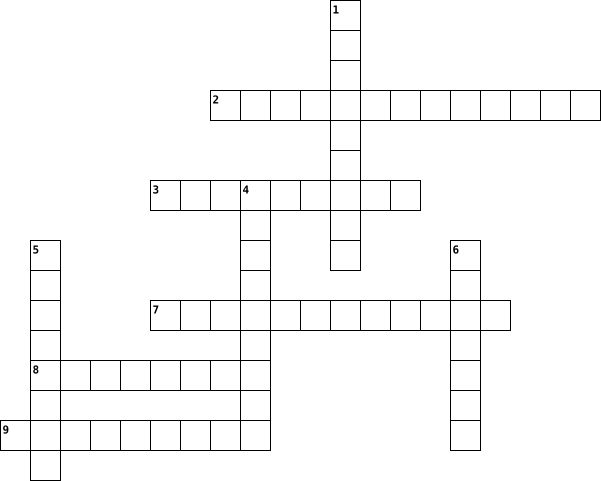
Across
- Strict obedience to authority at the expense of personal freedom
- Ruled by the people, either direct or indirect
- Power centralized one person or group and requires complete subservience to that state
- People hold the power and elect representatives, rule of law is followed
- Religious authority rules and laws are based on religion
Down
- One person holds all the power and all parts of government, usually in a form of dictator or absolute monarch
- A small group of people wealthy people who share the power (or breadsticks iykyk)
- King or Queen based on a bloodline, two forms constitutional and absolute
- The absence of any form of government
9 Clues: The absence of any form of government • Ruled by the people, either direct or indirect • Religious authority rules and laws are based on religion • Strict obedience to authority at the expense of personal freedom • People hold the power and elect representatives, rule of law is followed • King or Queen based on a bloodline, two forms constitutional and absolute • ...
Forms of Quadratic. 2022-09-18

Across
- The x-values of a quadratic.
- The graph stretches as "a" gets __________.
- Transformation that makes graph narrower.
- Transformation that makes the graph wider.
Down
- The shape of quadratics.
- The y-values of a quadratic.
- Max or Min point of a quadratic.
- The word used to describe a quadratic that opens downward.
- Each half of the quadratic displays_______.
9 Clues: The shape of quadratics. • The x-values of a quadratic. • The y-values of a quadratic. • Max or Min point of a quadratic. • Transformation that makes graph narrower. • Transformation that makes the graph wider. • The graph stretches as "a" gets __________. • Each half of the quadratic displays_______. • The word used to describe a quadratic that opens downward.
Cycles of Matter and Energy Flow Crossword 2026-01-14

Across
- Overlapping food chains with different pathways to show the flow of energy in an ecosystem
- A living thing that affects the ecosystem
- An animal that eats other animals
- An organism that must consume other organisms for nutrients
- An organism that transforms energy from the Sun and uses carbon dioxide and water to make food
- The constant movement of water through the land, air, oceans, and living things
- The continuous movement of carbon in and between the abiotic and biotic environments
- The change from a gas state to a liquid state
- An organism that consumes only plants
- A measure of how easily a substance will catch fire
- The process by which nitrogen is converted among various chemical forms as it cycles among the soil, biosphere, lithosphere, and atmosphere
- All the populations of different species in a particular area
- Change of a liquid to a vapor or gas
Down
- A single, linear path showing the flow of energy from the Sun to a producer and through different levels of consumers
- To break down into simpler components or basic elements
- An organism that consumes both animals and plants
- A diagram that shows the total amount of energy contained within each trophic level
- Organisms such as bacteria and fungi that break down the remains of dead plants and animals without need for internal digestion
- Rain, snow, sleet, or hail that falls from clouds in the sky
- The process by which plants lose water (water vapor) through the stomata in their leaves
- A nonliving thing that affects the ecosystem
- A system comprising all the biotic and abiotic factors in an area and all the interactions among them
22 Clues: An animal that eats other animals • Change of a liquid to a vapor or gas • An organism that consumes only plants • A living thing that affects the ecosystem • A nonliving thing that affects the ecosystem • The change from a gas state to a liquid state • An organism that consumes both animals and plants • A measure of how easily a substance will catch fire • ...
World Geography Crossword 2026-01-21

Across
- Saudi Arabia is an ________ monarchy.
- The longest mountain range in the world is the _____.
- Home to Norway and Sweden, the ____________ Peninsula it's rugged terrain, deep fjords, and vast forests.
- A dictatorship is sometime also a _______________. An example would be North Korea.
- Type of map showing political boundaries from the past.
- The largest river in the world by discharge volume in the ______ River.
- Type of plate boundary with two plates moving next to each other. Not away, not towards.
- Type of plate boundary with two plates moving toward each other.
- Iran is a _________.
- ____ infrastructure is the physical network that keeps an industrialized nation operating smoothly.
Down
- ______________ refers to structures, systems, and facilities serving the economy of a business, industry, country, city, town, or area, including the services and facilities necessary for it's economy to function.
- The United Kingdom is a ______________ monarchy.
- The United States of America is a ________.
- Flowing through 10 countries, the ______ River is the second-longest in Europe.
- Type of plate boundary with two plates moving away form each other.
- ____ infrastructure is the non-physical networks that a community provides it's residents.
- Energy __________ focuses on making primary energy sources and secondary energy forms available to meet the needs of society.
- One of Europe's most famous mountain ranges is the ___
- Water __________ provides local water supply through a system of engineered components.
- Type of map. Similar to physical maps. Generally represent a small area with a lot of detail.
20 Clues: Iran is a _________. • Saudi Arabia is an ________ monarchy. • The United States of America is a ________. • The United Kingdom is a ______________ monarchy. • The longest mountain range in the world is the _____. • One of Europe's most famous mountain ranges is the ___ • Type of map showing political boundaries from the past. • ...
Earth Science, Chapter 19 (Part 3) 2025-03-06

Across
- Absolute humidity is measured in units of __________ per cubic meter.
- If the dew point high in the troposphere is -3.0 °C, then pollen grains and dust particles there will act as __________nuclei.
- A _____________ measures atmospheric pressure.
- Freezing rain actually freezes when the raindrop hits a__________ object.
- The scientific study of the atmosphere is called ______________.
- In a cyclone in the Northern Hemisphere winds circulate around it in the________________ direction.
- A ____________cloud never produces rain.
- ___________ is the prefix used when naming mid-altitude cloud types.
- __________ energy harnesses energy from the atmosphere
Down
- The five qualities of weather can all be measured with scientific instruments, have different units of________________, and are part of weather models.
- Wind blows from areas of _______ pressure to areas of low pressure.
- Unlike coal-fired and nuclear power plants, wind __________ produces no adverse effects on the environment surrounding them.
- Frost forms by the process of ______________.
- Sea____________ are caused by land absorbing the sun's energy more rapidly than water does.
- A mountain breeze is an example of a_______ wind.
- The paths that winds follow between cyclones and anticyclones are due to the__________ effect, friction, and the pressure gradient.
16 Clues: A ____________cloud never produces rain. • Frost forms by the process of ______________. • A _____________ measures atmospheric pressure. • A mountain breeze is an example of a_______ wind. • __________ energy harnesses energy from the atmosphere • The scientific study of the atmosphere is called ______________. • ...
Earth Sci Ch. 12 Earth's Atmosphere 2026-01-07

Across
- atmospheric layer directly above the troposphere
- steady winds that flow from west to east between latitudes 30 deg North & 60 deg North
- when sulfur dioxide and nitrogen oxides combine w/ moisture in the atmosphere and form precipitation that has a pH lower than that of normal rainwater
- occurs in the troposphere when temperature increases as altitude increases
- smog air pollution that forms from the interaction between chemicals in the air and sunlight
- wind that blows from the sea to the land due to local temperature and pressure differences
- wind that blows from the land to the sea due to local temperature and pressure differences
- area of the stratosphere w/ a high concentration of ozone
Down
- water in its gaseous form
- atmospheric layer closest to Earth's surface
- thin layer of gases surrounding Earth
- movement of air from areas of high pressure to areas of low pressure
- region w/in the mesosphere and thermosphere that contains ions
- transfer of energy by electromagnetic waves
- near the top of the troposphere is a narrow band of high winds
- easterlies cold winds that blow from the east to the west near the North pole and the South Pole
- contamination of air by harmful substances including gases and smoke
- the transfer of thermal energy by collisions between particles of matter
- steady winds that flow from east to west between 30 deg North latitude & 30 deg South latitude
- transfer of thermal energy by the movement of particles w/in matter
20 Clues: water in its gaseous form • thin layer of gases surrounding Earth • transfer of energy by electromagnetic waves • atmospheric layer closest to Earth's surface • atmospheric layer directly above the troposphere • area of the stratosphere w/ a high concentration of ozone • region w/in the mesosphere and thermosphere that contains ions • ...
Carbohydrates 2026-03-24

Across
- A specialized digestive enzyme responsible for breaking down starches
- Complex carbohydrates that are a long chain of glucose
- A monosaccharide often called "milk sugar"
- A polysaccharide consisting of chains of glucose monomers in plant walls
- A molecule that can be bonded with an identical molecule
- The most basic unit of a carb
- Sugars that are quickly broken down
- A suger whose molecules contain 2 monosaccharides
- What carbs give you
- A complex carb that is usually non-digestible and plant-based
- Primary energy source for the body
Down
- A disaccharide composed of 2 glucose units also called malt sugar.
- A structural unit of carbs referring to sugars
- What is a simple sugar that is an important energy source in living things and a compound in most carbs?
- Usually a protein that speeds up the chemical breakdown of a complex carb
- A natural disaccharide found in dairy
- How many types of carbs?
- A carb with molecules that consist of sugar molecules bonded together
- A monosaccharide and primary carb found in fruits
- A substance that has a large molecular structure consisting of a large number of similar units that can be bonded
- A fibrous substance that forms the exoskeleton of arthropods.
- Consuming lots of carbs
- A substance deposited in body tissues as a store of carbs
- Amount of calories in a carb
- Two or more compounds with the same formula
25 Clues: What carbs give you • Consuming lots of carbs • How many types of carbs? • Amount of calories in a carb • The most basic unit of a carb • Primary energy source for the body • Sugars that are quickly broken down • A natural disaccharide found in dairy • A monosaccharide often called "milk sugar" • Two or more compounds with the same formula • ...
Chapter 2 Vocabulary 2021-09-27

Across
- Factual information collected by scientists.
- Energy associated with motion, such as in flowing water, a speeding car or electricity.
- Anything that has mass and takes up space. Commonly exists as a solid, liquid, or gas.
- Energy stored and potentially available for use.
- Combination of two or more atoms of the same or different elements held together by chemical bonds.
- Capacity to do work.
- Numeric value that indicates the relative acidity or alkalinity of a substance on a scale of 0 to 14, with the neutral point at 7.
- Possible and testable answer to a scientific question or explanation of what scientists have observed in nature.
Down
- Energy generated and measured by heat.
- The basic building block of matter.
- Broad field of study focused on discovering how nature works and using that knowledge to describe what is likely to happen in nature.
- One of two or more forms of a chemical element that have the same atomic number but different mass numbers because they have different numbers of neutrons in their nuclei.
- Type of matter with a unique set of properties that cannot be broken down into simpler substances by chemical means.
- Physical or mathematical representation of a structure or system.
- Well tested and widely accepted description of observations that have been repeated many times in a variety of conditions.
- Atom or group of atoms with one or more positive (+) or negative (-) electrical charges.
- Set of components that function and interact in some regular way.
- Combination of two or more different elements held together in fixed proportions.
- Description of what scientist find happening in nature repeatedly in the same way without known exception.
19 Clues: Capacity to do work. • The basic building block of matter. • Energy generated and measured by heat. • Factual information collected by scientists. • Energy stored and potentially available for use. • Physical or mathematical representation of a structure or system. • Set of components that function and interact in some regular way. • ...
photosynthesis 2023-02-21

Across
- provide the different structures inside the chloroplast for protection
- cell energy
- Function is to trap up light energy and covert it into chemical energy forms, ATP and NADPH.
- cell energy
- another term for light independent reactions
- plant organelle that converts light into plant food
- chemical reactions that convert carbon dioxide and other compounds into glucose.
- C6 H12 O6 + O2
Down
- CO2 + H20 > light
- process in which plants make food
- light dependent reaction that makes ATP and NADPH
- sugar product in photosynthesis
12 Clues: cell energy • cell energy • C6 H12 O6 + O2 • CO2 + H20 > light • sugar product in photosynthesis • process in which plants make food • another term for light independent reactions • light dependent reaction that makes ATP and NADPH • plant organelle that converts light into plant food • provide the different structures inside the chloroplast for protection • ...
Chapter 7 vocab 2021-12-06

Across
- minimum amount of energy needed to start a chemical reaction.
- chemical reaction in which heat energy is absorbed
- a substance that enters into and is altered in the course of a chemical reaction.
- the speed at which a chemical reaction proceeds.
- chemical reaction in which heat energy is released
- a representation of a chemical reaction using symbols of the elements to indicate the amount of substance, usually in moles, of each reactant and product.
Down
- describes how much solute is present
- substance that speeds up a chemical reaction but is not used up itself or permanently charged
- a process in which one or more substances, also called reactants, are converted to one or more different substances, known as products
- a substance that decreases the rate of, or prevents, a chemical reaction.
- substance that forms as a result of a chemical reaction
- catalyst that are large protein molecules
12 Clues: describes how much solute is present • catalyst that are large protein molecules • the speed at which a chemical reaction proceeds. • chemical reaction in which heat energy is absorbed • chemical reaction in which heat energy is released • substance that forms as a result of a chemical reaction • minimum amount of energy needed to start a chemical reaction. • ...
What is in the Air? 2020-12-02

Across
- This is 78% of the earth's atmosphere
- The layer of gases that surrounds a planet or star
- This is 21% of the earth's atmosphere
- A gas in the ATM for which the relative amount stays the same
- An atmospheric gas whose amount changes based on the environment
- This is a variable gas that is increasing in concentration in the ATM
Down
- This traps thermal energy
- This is radiant energy that heats
- This is a process used by plants and algae to make sugar/food out of light, co2, and water
- This is 0.04% of the earth's atmosphere
- This is the most abundant variable gas
- A form of oxygen that forms a thin layer in the stratosphere
- The amount of matter in an object or sample
- This doesn't react easily with other substances
- This is mostly nitrogen, and oxygen with some argon, carbon dioxide, ozone, water vapor, and some other gases
15 Clues: This traps thermal energy • This is radiant energy that heats • This is 78% of the earth's atmosphere • This is 21% of the earth's atmosphere • This is the most abundant variable gas • This is 0.04% of the earth's atmosphere • The amount of matter in an object or sample • This doesn't react easily with other substances • The layer of gases that surrounds a planet or star • ...
science vocabulary 2023-09-14

Across
- It occurs when certain chemicals are brought together.
- A source of salt.
- An oxide of iron produced by the action of water.
- A unit of electrical resistance.
- A common heavy metal
- Very small unit of living matter.
- Functional part of a living body
- Energy, force
- Liquid necessary for most forms of life.
- Men whose field of work is physics.
Down
- Unit of electrical power.
- Scientific work in new fields.
- Carbon monoxide.
- The profession in which we find doctors and nurses, and adjective.
- Where many scientists do their work.
- Do this to extinguish a candle or a small flame
- A new exercise carried out by a scientist.
- Without it, things remain theories.
- Unwanted matter.
- Mr. Nobel created one for physics.
20 Clues: Energy, force • Carbon monoxide. • Unwanted matter. • A source of salt. • A common heavy metal • Unit of electrical power. • Scientific work in new fields. • A unit of electrical resistance. • Functional part of a living body • Very small unit of living matter. • Mr. Nobel created one for physics. • Without it, things remain theories. • Men whose field of work is physics. • ...
Types Of Science 2013-05-03
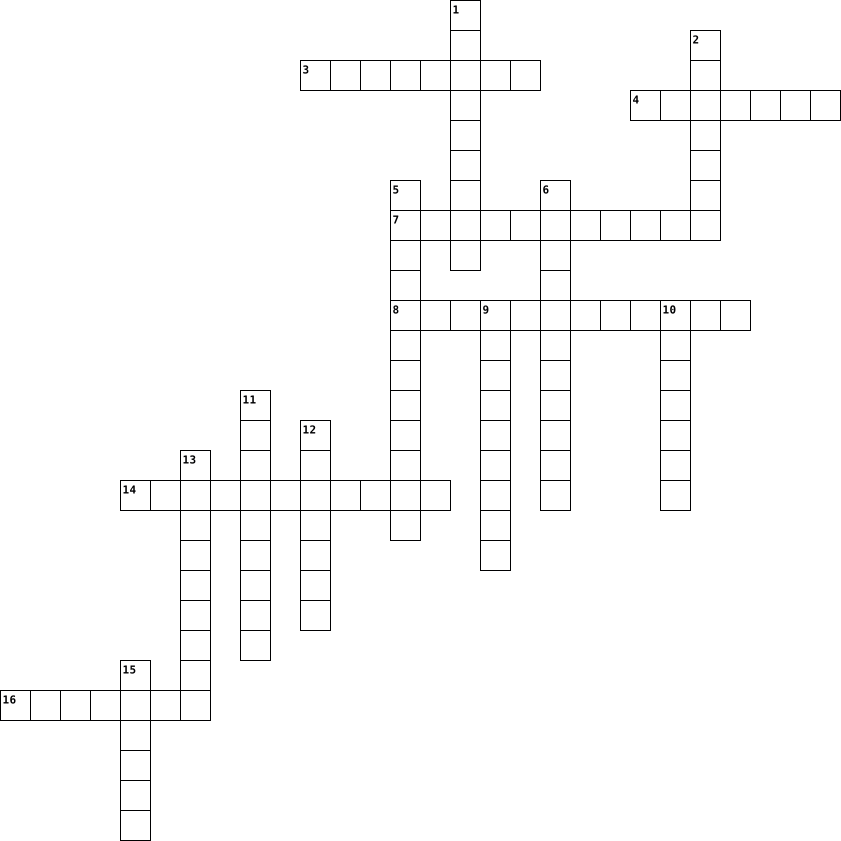
Across
- The science of soil management and the production of field crops.
- The science that deals with the dynamics and physical history of the earth, the rocks of which it is composed, and the physical, chemical, and biological changes that the earth has undergone or is undergoing.
- The scientific study of historic or prehistoric peoples and their cultures by analysis of their artifacts, inscriptions, monuments,and other such remains, especially those that have been excavated.
- The branch of physical geography dealing with the ocean.
- The branch of zoology dealing with fishes.
- The science or branch of biology dealing with animals.
Down
- The branch of physics that deals with sound and sound waves.
- The science of life or living matter in all its forms and phenomena, especially with reference to origin, growth,reproduction, structure, and behavior.
- The science of the forms of life existing in former geologic periods, as represented by their fossils.
- The science dealing with the atmosphere and its phenomena, including weather and climate.
- The science that deals with the material universe beyond the earth's atmosphere.
- The science that deals with matter, energy, motion, and force.
- The science or the study of the origin, nature, and course of diseases.
- The branch of biology dealing with the relations and interactions between organisms and their environment, including other organisms.
- The science that deals with the composition and properties of substances and various elementary forms of matter.
- The science of plants
16 Clues: The science of plants • The branch of zoology dealing with fishes. • The science or branch of biology dealing with animals. • The branch of physical geography dealing with the ocean. • The branch of physics that deals with sound and sound waves. • The science that deals with matter, energy, motion, and force. • ...
Cellular Energy 2022-05-11

Across
- respiration that requires oxygen
- the organic processes ( in a cell or organism ) that are necessary for life.
- (Adenosine triphosphate) main energy source that cells use for most of their work
- series of molecules through which electrons are passed to make ATP
- Process by which plants use the sun’s energy to convert water and carbon dioxide into sugars.
- a monosaccharide sugar that has several forms .
Down
- A molecule that can be converted into ATP through the addition of a phosphate; what it loses a phosphate.
- The process of breaking down food to yield energy.
- series of ATP producing reactions that do not require oxygen
9 Clues: respiration that requires oxygen • a monosaccharide sugar that has several forms . • The process of breaking down food to yield energy. • series of ATP producing reactions that do not require oxygen • series of molecules through which electrons are passed to make ATP • the organic processes ( in a cell or organism ) that are necessary for life. • ...
destiny's puzzle (4A) 2021-04-21

Across
- nitrogen is important to animals by
- water that falls from atmosphere
- living organisms on the planet
- carbon moves from atmosphere to plants
- water 3% is
- carbon moves from living thing to
- form commonly used by plants
- air surrounds earth
- water stored under surface of earth
Down
- water is changed back into liquid water
- all water on earth
- occurs because of heat from sun
- carbon moves from plants to animals
- can be converted into forms usable for plants & animals
- divided into how many spheres?
- plants use water to help make energy
- carbon moves from plants and animals to
- always been present on earth
- what water can become
- 97% is
20 Clues: 97% is • water 3% is • all water on earth • air surrounds earth • what water can become • always been present on earth • form commonly used by plants • divided into how many spheres? • living organisms on the planet • occurs because of heat from sun • water that falls from atmosphere • carbon moves from living thing to • nitrogen is important to animals by • ...
photosynthesis 2023-02-21

Across
- light dependent reaction that makes ATP and NADPH
- chemical reactions that convert carbon dioxide and other compounds into glucose.
- provide the different structures inside the chloroplast for protection
- another term for light independent reactions
- process in which plants make food
- sugar product in photosynthesis
- plant organelle that converts light into plant food
Down
- CO2 + H20 > light
- cell energy
- C6 H12 O6 + O2
- cell energy
- Function is to trap up light energy and covert it into chemical energy forms, ATP and NADPH.
12 Clues: cell energy • cell energy • C6 H12 O6 + O2 • CO2 + H20 > light • sugar product in photosynthesis • process in which plants make food • another term for light independent reactions • light dependent reaction that makes ATP and NADPH • plant organelle that converts light into plant food • provide the different structures inside the chloroplast for protection • ...
6.2 2012-11-07

Across
- a solid formed during a chemical change
- the change of state from liquid to solid
- a process where two liquids or two gases mix due to the motion of their particles
- a change of state where a liquid is heated and changes to a gas within the liquid
- an increase in size
- a change of state from gas to solid
- a mixture where the substances are mixed on the atomic level
- describes a process that absorbs energy from the surroundings
- a decrease in size
- model a simplified representation of solids, liquids and gases
Down
- change a change that does not result in a new substance being produced
- the change of state where a liquid changes to a gas at the surface of the liquid
- a change of state from solid to gas
- the change of state from liquid to solid
- a change of state where a gas is cooled and forms a liquid
- the change of state when a solid is heated and forms a liquid
- change a change that results in a new substance being formed
17 Clues: a decrease in size • an increase in size • a change of state from solid to gas • a change of state from gas to solid • a solid formed during a chemical change • the change of state from liquid to solid • the change of state from liquid to solid • a change of state where a gas is cooled and forms a liquid • a mixture where the substances are mixed on the atomic level • ...
Cell Structure 2021-11-19

Across
- wall, supporting layer around a plant cell
- break down large food particles into smaller ones.
- Having or consisting of many cells.
- nutrients are converted into energy.
- Where proteins are assembled
- bilayer, forms a barrier between the cell and its surroundings.
- A part of the cell containing DNA and RNA
Down
- Reticulum
- stores water and nutrients for the cell
- Apparatus, packages proteins for export by the cell.
- Having or consisting of a single cell.
- fluid portion of the cell outside the nucleus.
- site of photosynthesis
- Cell lacking a nucleus
14 Clues: Reticulum • site of photosynthesis • Cell lacking a nucleus • Where proteins are assembled • Having or consisting of many cells. • nutrients are converted into energy. • Having or consisting of a single cell. • stores water and nutrients for the cell • A part of the cell containing DNA and RNA • wall, supporting layer around a plant cell • ...
Food and Nutrition Basics 2023-12-15

Across
- You can develop this disease if you don't take in enough iron
- True or False? Fiber can reduce cholesterol levels
- One of the benefits of consuming complex carbohydrates is that they release energy at a steady
- Heme iron is found in sources
- The sugar that is present in grains is called
- This macronutrient is the primary source of energy and is found in things like fruits and vegetables
- fiber will not dissolve in water
- High-density Lipoproteins are considered the fats
- What is one disease you can develop from consuming too much fat?
- What state is animal fat in at room temperature?
Down
- Iron plays an essential role in producing this
- This is another term for simple carbohydrates
- True or False? Protein will not be consumed by the body if you don't eat enough carbohydrates
- This macronutrient can help you feel full for longer periods of time
- Since this type of protein doesn't contain all essential amino acids, you need to combine it in order to meet your nutritional needs
- The only carbohydrate that does not provide the body with energy
- Transfats and fats are considered the bad fats
- True or False? Fat helps develop protective layers around nerves
- Carbohydrates come in two forms, simple and
- Food items that contain lots of refined sugar are typically called empty
- How many essential amino acids are there?
21 Clues: fiber will not dissolve in water • Heme iron is found in sources • How many essential amino acids are there? • Carbohydrates come in two forms, simple and • This is another term for simple carbohydrates • The sugar that is present in grains is called • Iron plays an essential role in producing this • Transfats and fats are considered the bad fats • ...
Physics Vocabulary Electric Current 2023-04-05

Across
- An electronic device that allows electron flow in only one direction.
- Circuit-- Devices in which a circuit forms branches, each of which is a separate path for electron flow
- Field: Surrounds every electric charge and exerts the force that causes other electric charges to be attracted or repelled
- A material through which electrons move easily
- A material in which electrons are not able to move easily
- Current (AC): Electric current that repeatedly reverses direction.
- Difference: The force that causes electric charges to flow
- Current (DC): A flow of charge that always flows in one direction.
Down
- Source: An object that provides a potential difference
- Circuit- Devices in a circuit form a single pathway for electron flow
- Current: Net movement of electric charges in a single direction
- The tendency for a material to resist the flow of electrons and to convert electrical energy into other forms
- A complete pathway that allows the flow of electrons
- of Conservation of Charge: Charge can be transferred from object to object, but it cannot be created or destroyed
- The flow of 1 coulomb of charge per second.
15 Clues: The flow of 1 coulomb of charge per second. • A material through which electrons move easily • A complete pathway that allows the flow of electrons • Source: An object that provides a potential difference • A material in which electrons are not able to move easily • Difference: The force that causes electric charges to flow • ...
Crossword 2025-03-12

Across
- An electronic device that allows electron flow in only one direction.
- Circuit-- Devices in which a circuit forms branches, each of which is a separate path for electron flow
- Field: Surrounds every electric charge and exerts the force that causes other electric charges to be attracted or repelled
- A material through which electrons move easily
- A material in which electrons are not able to move easily
- Current (AC): Electric current that repeatedly reverses direction.
- Difference: The force that causes electric charges to flow
- Current (DC): A flow of charge that always flows in one direction.
Down
- Source: An object that provides a potential difference
- Circuit- Devices in a circuit form a single pathway for electron flow
- Current: Net movement of electric charges in a single direction
- The tendency for a material to resist the flow of electrons and to convert electrical energy into other forms
- A complete pathway that allows the flow of electrons
- of Conservation of Charge: Charge can be transferred from object to object, but it cannot be created or destroyed
- The flow of 1 coulomb of charge per second.
15 Clues: The flow of 1 coulomb of charge per second. • A material through which electrons move easily • A complete pathway that allows the flow of electrons • Source: An object that provides a potential difference • A material in which electrons are not able to move easily • Difference: The force that causes electric charges to flow • ...
vocab 2025-03-12

Across
- An electronic device that allows electron flow in only one direction.
- Circuit-- Devices in which a circuit forms branches, each of which is a separate path for electron flow
- Field: Surrounds every electric charge and exerts the force that causes other electric charges to be attracted or repelled
- A material through which electrons move easily
- A material in which electrons are not able to move easily
- Current (AC): Electric current that repeatedly reverses direction.
- Difference: The force that causes electric charges to flow
- Current (DC): A flow of charge that always flows in one direction.
Down
- Source: An object that provides a potential difference
- Circuit- Devices in a circuit form a single pathway for electron flow
- Current: Net movement of electric charges in a single direction
- The tendency for a material to resist the flow of electrons and to convert electrical energy into other forms
- A complete pathway that allows the flow of electrons
- of Conservation of Charge: Charge can be transferred from object to object, but it cannot be created or destroyed
- The flow of 1 coulomb of charge per second.
15 Clues: The flow of 1 coulomb of charge per second. • A material through which electrons move easily • A complete pathway that allows the flow of electrons • Source: An object that provides a potential difference • A material in which electrons are not able to move easily • Difference: The force that causes electric charges to flow • ...
crossword 2025-03-12

Across
- An electronic device that allows electron flow in only one direction.
- Circuit-- Devices in which a circuit forms branches, each of which is a separate path for electron flow
- Field: Surrounds every electric charge and exerts the force that causes other electric charges to be attracted or repelled
- A material through which electrons move easily
- A material in which electrons are not able to move easily
- Current (AC): Electric current that repeatedly reverses direction.
- Difference: The force that causes electric charges to flow
- Current (DC): A flow of charge that always flows in one direction.
Down
- Source: An object that provides a potential difference
- Circuit- Devices in a circuit form a single pathway for electron flow
- Current: Net movement of electric charges in a single direction
- The tendency for a material to resist the flow of electrons and to convert electrical energy into other forms
- A complete pathway that allows the flow of electrons
- of Conservation of Charge: Charge can be transferred from object to object, but it cannot be created or destroyed
- The flow of 1 coulomb of charge per second.
15 Clues: The flow of 1 coulomb of charge per second. • A material through which electrons move easily • A complete pathway that allows the flow of electrons • Source: An object that provides a potential difference • A material in which electrons are not able to move easily • Difference: The force that causes electric charges to flow • ...
javi 2025-03-20

Across
- An electronic device that allows electron flow in only one direction.
- Circuit-- Devices in which a circuit forms branches, each of which is a separate path for electron flow
- Field: Surrounds every electric charge and exerts the force that causes other electric charges to be attracted or repelled
- A material through which electrons move easily
- A material in which electrons are not able to move easily
- Current (AC): Electric current that repeatedly reverses direction.
- Difference: The force that causes electric charges to flow
- Current (DC): A flow of charge that always flows in one direction.
Down
- Source: An object that provides a potential difference
- Circuit- Devices in a circuit form a single pathway for electron flow
- Current: Net movement of electric charges in a single direction
- The tendency for a material to resist the flow of electrons and to convert electrical energy into other forms
- A complete pathway that allows the flow of electrons
- of Conservation of Charge: Charge can be transferred from object to object, but it cannot be created or destroyed
- The flow of 1 coulomb of charge per second.
15 Clues: The flow of 1 coulomb of charge per second. • A material through which electrons move easily • A complete pathway that allows the flow of electrons • Source: An object that provides a potential difference • A material in which electrons are not able to move easily • Difference: The force that causes electric charges to flow • ...
Alexa's Chemistry Bonus Puzzle 2024-05-07

Across
- a neutral particle having equal numbers of protons and electrons
- how close a measured value is to an accepted value
- a way to convert measurements to a different unit.
- atoms of the same element with different amount of neutrons
- how close a series of measurements are to each other
- number of protons in the nucleus
- the measure of kinetic energy in a sample of matter
- study of how heat is converted to and from other forms of energy
- Has a Ph level less than 7
- time it takes for half of the radioactive atoms of a specific radioactive isotope to decay
Down
- the mass of an atom given in amu
- standard unit that stands for 6.02 x 10^23
- the concave surface of a liquid
- positively charged ion
- created the 1st periodic table
- A reaction where heat is absorbed
- A reaction where heat is released
- a ratio that compares the mass of an object to its volume
- atoms that have either gained or lost electrons so that it is no longer electrically neutral
- the change in heat of the products from the reactants
- Has a Ph level higher than 7
21 Clues: positively charged ion • Has a Ph level less than 7 • Has a Ph level higher than 7 • created the 1st periodic table • the concave surface of a liquid • the mass of an atom given in amu • number of protons in the nucleus • A reaction where heat is absorbed • A reaction where heat is released • standard unit that stands for 6.02 x 10^23 • ...
ch. 2 crossword 2 2014-11-18

Across
- the quantity of matter an object has
- the energy in a system that is available for work
- breaking apart of the water molecule into two ions of opposite charge
- reactions in which electrons are transferred between atoms
- is a mixture in which one or more substances are uniformly distributed in another solution
- ion the OH- is known as this
- the amount of energy needed to start the reaction
- pure substances that cannot be broken down chemically into simpler kinds of matter
- a solid liquid or a gas
- a compound formed by a chemical reaction
- it forms when two atoms share one or more pairs of electrons
- the central core of an atom consists kinds of particles name one
Down
- the simplest part of a substance that retains all of the properties of the substance and that can exist in a free state
- chemical substances that neutralize small amounts of either an acid or a base added to a solution
- solution solutions in which water is the solvent
- reactions that involve a net absorption of free energy
- combining in ways that cause their atoms to become stable
- solution no more solute can dissolve
- the number of protons in an atom
- an atom or molecule with an electrical charge
- a catalyst usually a protein in a living system
- the number of hydronium ions in a solution is greater than the number of hydroxide ions
22 Clues: a solid liquid or a gas • the number of protons in an atom • ion the OH- is known as this • the quantity of matter an object has • solution no more solute can dissolve • a compound formed by a chemical reaction • an atom or molecule with an electrical charge • a catalyst usually a protein in a living system • the energy in a system that is available for work • ...
Nutrition and Diets 2023-10-26

Across
- high blood pressure may be caused by an excess amount of fat or salt in the diet.
- is the process in which blood or lymph capillaries pick up the digested nutrients
- unit of measurement of the fuel value of food
- poor nutrition; without adequate food and nutrition
- is a body weight that is 10 to 20 percent greater that the average recommended weight.
- also called a lipid; nutrient that provides the most concentrated form of energy; highest-calorie energy nutrient; overweigh
- BMI over 25
- is the process by which the body breaks down food into smaller parts, changes the food chemically.
- A steroid that forms an essential component of animal cell membranes and acts as a precursor molecule for the synthesis of other biologically important steroids.
- he act of practicing healthy habits on a daily basis to attain better physical and mental health outcomes
- commonly called fats and oils, are organic compounds.
- condition in which bones become porous and break easily.
Down
- the state of poor nutrition; may be caused by poor diet or illness.
- are the basic components of all body cells.
- the major source of readily usable human energy.
- are compounds that inhibit oxidation, a chemical reaction that can produce free radicals.
- form of arteriosclerosis characterized by accumulation of fats or mineral deposits on the inner walls of the arteries
- are organic compounds that are essential to life.
- loss of appetite
- fibrous form of carbohydrate
20 Clues: BMI over 25 • loss of appetite • fibrous form of carbohydrate • are the basic components of all body cells. • unit of measurement of the fuel value of food • the major source of readily usable human energy. • are organic compounds that are essential to life. • poor nutrition; without adequate food and nutrition • commonly called fats and oils, are organic compounds. • ...
Thermal Energy 2024-09-24

Across
- The capacity to do work or produce heat; exists in various forms such as chemical, electrical, mechanical, and thermal.
- A material that resists the flow of heat or electricity, helping to keep energy contained or prevent its transfer.
- A measure of the average kinetic energy of the particles in a system, related to the degree of heat or cold.
- The transfer of heat through a fluid (liquid or gas) caused by molecular motion.
- A state in which all parts of a system are at the same temperature, and no heat energy is transferred between them.
- A material or substance that allows heat or electricity to flow through it easily.
Down
- The process by which heat or electricity is directly transmitted through a substance when there is a difference of temperature or electrical potential.
- The emission or transmission of energy in the form of waves or particles through space or through a material medium.
- Relating to heat; involved in the transfer of heat energy within or between substances.
- The movement of energy from one place to another or from one form to another.
10 Clues: The movement of energy from one place to another or from one form to another. • The transfer of heat through a fluid (liquid or gas) caused by molecular motion. • A material or substance that allows heat or electricity to flow through it easily. • Relating to heat; involved in the transfer of heat energy within or between substances. • ...
Forms 2023-03-20

Across
- Base form of worn
- A thing where you cook
- A thing in your room that you sleep on
- Third form of shake
- Second form of fly
Down
- Place where you sleep
- Second form of seen
- Third form of ride
- Third form of throw
- Base form of laid
10 Clues: Base form of worn • Base form of laid • Third form of ride • Second form of fly • Second form of seen • Third form of throw • Third form of shake • Place where you sleep • A thing where you cook • A thing in your room that you sleep on
Forms 2023-03-20

Across
- Base form of worn
- A thing where you cook
- A thing in your room that you sleep on
- Third form of shake
- Second form of fly
Down
- Place where you sleep
- Second form of seen
- Third form of ride
- Third form of throw
- Base form of laid
10 Clues: Base form of worn • Base form of laid • Third form of ride • Second form of fly • Second form of seen • Third form of throw • Third form of shake • Place where you sleep • A thing where you cook • A thing in your room that you sleep on
Forms 2023-03-20

Across
- Base form of worn
- A thing where you cook
- A thing in your room that you sleep on
- Third form of shake
- Second form of fly
Down
- Place where you sleep
- Second form of seen
- Third form of ride
- Third form of throw
- Base form of laid
10 Clues: Base form of worn • Base form of laid • Third form of ride • Second form of fly • Second form of seen • Third form of throw • Third form of shake • Place where you sleep • A thing where you cook • A thing in your room that you sleep on
Forms 2023-03-20

Across
- Base form of worn
- A thing where you cook
- A thing in your room that you sleep on
- Third form of shake
- Second form of fly
Down
- Place where you sleep
- Second form of seen
- Third form of ride
- Third form of throw
- Base form of laid
10 Clues: Base form of worn • Base form of laid • Third form of ride • Second form of fly • Second form of seen • Third form of throw • Third form of shake • Place where you sleep • A thing where you cook • A thing in your room that you sleep on
Forms 2023-03-20

Across
- Base form of worn
- A thing where you cook
- A thing in your room that you sleep on
- Third form of shake
- Second form of fly
Down
- Place where you sleep
- Second form of seen
- Third form of ride
- Third form of throw
- Base form of laid
10 Clues: Base form of worn • Base form of laid • Third form of ride • Second form of fly • Second form of seen • Third form of throw • Third form of shake • Place where you sleep • A thing where you cook • A thing in your room that you sleep on
Electric current Vocabulary Alexander Paneto 2023-04-05

Across
- An electronic device that allows electron flow in only one direction.
- Circuit-- Devices in which a circuit forms branches, each of which is a separate path for electron flow
- Field: Surrounds every electric charge and exerts the force that causes other electric charges to be attracted or repelled
- A material through which electrons move easily
- A material in which electrons are not able to move easily
- Current (AC): Electric current that repeatedly reverses direction.
- Difference: The force that causes electric charges to flow
- Current (DC): A flow of charge that always flows in one direction.
Down
- Source: An object that provides a potential difference
- Circuit- Devices in a circuit form a single pathway for electron flow
- Current: Net movement of electric charges in a single direction
- The tendency for a material to resist the flow of electrons and to convert electrical energy into other forms
- A complete pathway that allows the flow of electrons
- of Conservation of Charge: Charge can be transferred from object to object, but it cannot be created or destroyed
- The flow of 1 coulomb of charge per second.
15 Clues: The flow of 1 coulomb of charge per second. • A material through which electrons move easily • A complete pathway that allows the flow of electrons • Source: An object that provides a potential difference • A material in which electrons are not able to move easily • Difference: The force that causes electric charges to flow • ...