
forms of energy Crossword Puzzles
Using Natural Resources 2022-05-10

Across
- natural resource that can be replenished by natural processes at least as quickly as it is used
- type of air pollution that is formed when sunlight reacts with waste gases from the burning of fossil fuels
- mixture of gases that forms a layer around Earth
- act of meeting human needs in ways that ensure future generations also will be able to meet their needs
- manufacturing new products out of used products
- part of the environment that supplies a material that is useful or necessary for the survival of living things
- something that has two different components performing essentially the same task
- contamination of the environment with substances that are harmful to life
- natural resource that is being used up faster than it can be replaced by natural processes
Down
- thermal energy from within Earth
- acidic rain or snow that forms when waste gases from automobiles and power plants combine with moisture in the air
- natural resource that will not run out, no matter how much of it people use
- scientific observation that Earth’s average temperature is increasing
- prevents most harmful ultraviolet (UV) radiation from reaching Earth
14 Clues: thermal energy from within Earth • manufacturing new products out of used products • mixture of gases that forms a layer around Earth • prevents most harmful ultraviolet (UV) radiation from reaching Earth • scientific observation that Earth’s average temperature is increasing • contamination of the environment with substances that are harmful to life • ...
Chapter 4.5-4.6, 5, 10 & 6 concepts 2021-10-21

Across
- - The amount of heat transferred between the system and the surroundings is measured experimentally by
- function - depends only on the present state of the system, not on the path the system took to reach that state.
- - relates to the orientation of the orbital in space. For a given value of l, the _______ quantum number can have integral values ranging from -l to l, including 0
- - The process of adding solvent to the solution decreases the concentration of the solute without changing the number of moles of solute in the solution is known as
- - ________ quantum number (n) relates most directly to the size and energy of the orbital indicated by the integers 1, 2, 3, etc.
- - Heat flows from surroundings into the system, the temperature of the beaker & surrounding air-drops is an example of what type of rxn.
- - Enthalpy of ______ (∆Hf) of a substance is the enthalpy change for the reaction in which the substance is formed from its constituent elements.
- - q denotes the heat _______ into or out of a system
- - solution is the number of moles of solute per liter of solution
Down
- changes as two variables are held constant.
- - P1V1 = P2V2 helps determine how the ______ of a gas changes when its
- - ∆H°, is the ______ enthalpy change when all reactants & products are in their ______ states.
- - Heat flows from the system into surroundings, the temperature of the water & surrounding air increases is an example of what type of rxn.
- - is the heat energy that is being absorbed or evolved by a system during the progression of a chemical reaction. The change in this term indicates whether a particular rxn is endothermic or exothermic.
- - The conditions of 273 K (0 °C) & 1 atm are known as
- - Volume is directly proportional to the _______ when pressure and moles of gas are held constant
- - ∆Hf °, of a substance, is the change in enthalpy for the reaction that forms one _____ of the substance from its elements in their standard states.
- Energy - the sum of potential energy and kinetic energy of that system. The change in this term can occur in two ways: heat transfer & work bring done by or on the system.
18 Clues: changes as two variables are held constant. • - q denotes the heat _______ into or out of a system • - The conditions of 273 K (0 °C) & 1 atm are known as • - solution is the number of moles of solute per liter of solution • - P1V1 = P2V2 helps determine how the ______ of a gas changes when its • ...
6.3 Weather and 6.4 Mt. Everest 2024-05-07

Across
- The movement of energy.
- This type of cloud forms during a hailstorm.
- A quick burst of wind speed.
- A rock found inside the earth that is acidic.
- The cause and effect of two events happening.
- Major natural event that causes mountains to move.
- when rain and wind break down rocks.
- how hot or cold something is.
- Underneath the earth's surface that moves and causes the earth's surface to move.
Down
- The size of something.
- The height of landmass.
- Any form of water that falls from the sky.
- Amount of water in the air.
- The height of the air/atmosphere.
- Two things happening at once but does not causes and effect.
- How much "stuff" in a given object/space.
16 Clues: The size of something. • The height of landmass. • The movement of energy. • Amount of water in the air. • A quick burst of wind speed. • how hot or cold something is. • The height of the air/atmosphere. • when rain and wind break down rocks. • How much "stuff" in a given object/space. • Any form of water that falls from the sky. • This type of cloud forms during a hailstorm. • ...
Atmosphere Puzzle 2018-04-24

Across
- Falling of water to Earth
- 2nd layer, ozone is near the bottom of this layer
- "4th" layer, broken up into 2 layers
- Gas to liquid, forms clouds
- 3rd Layer, where Meteors burn up
- Vapor Water as a gas
Down
- Evaporation of water from plants
- Quality Condition of air based on the amount of pollution
- 1st layer, we live in this atmosphere layer
- The product of 3 oxygen molecules, harmful down here helpful up there
- Transfer of thermal energy by liquid (Heat rises cold sinks)
- Smoke and fog together
12 Clues: Vapor Water as a gas • Smoke and fog together • Falling of water to Earth • Gas to liquid, forms clouds • Evaporation of water from plants • 3rd Layer, where Meteors burn up • "4th" layer, broken up into 2 layers • 1st layer, we live in this atmosphere layer • 2nd layer, ozone is near the bottom of this layer • Quality Condition of air based on the amount of pollution • ...
Chapter 24-25 By Baz Rosas 2016-04-25

Across
- diagram of tropic structure
- group of similar ecosystems
- capacity largest population of a species that an environment can support
- growth by a percentage
- 2 species may not occupy same niche in same ecosystem for too long
- each level receives 1/10 of energy from the level below
- combination of exponential and linear
Down
- organism that consume plants
- lowlands near equator with intense sunlight and rainfall
- total quantity of living matter at each tropic level
- rate at which new biomass forms
- ycle cycle depending on predator/prey populations
- meat eaters
- parasite benefits from host
- both species benefit
- the rise and fall of reproduction due to optimal conditions
- nutrititonal relationships among species of an ecosystem
- predator species consumes a prey species
- combination of resources that a species is adapted to exploit
- one organism benefits and other is unaffected
20 Clues: meat eaters • both species benefit • growth by a percentage • diagram of tropic structure • group of similar ecosystems • parasite benefits from host • organism that consume plants • rate at which new biomass forms • combination of exponential and linear • predator species consumes a prey species • one organism benefits and other is unaffected • ...
Crossword Puzzle 2022-03-24

Across
- two or more different atoms/elements that are chemically combined
- ex: Ice
- solid to gas
- the study of matter
- small particle with a negative charge of electricity flow of charge
- amount of atoms in matter
- ex: water
- an atom or molecule with electrical charge
- solid to liquid
- gas to solid
- periodic table of _
- the amount of space an object ocupies
Down
- liquid to solid
- liquid to gas
- smallest unit of matter that forms a chemical element
- gas to liquid
- 4th state of matter
- change transitions between states of matter
- one or more visible boundaries
- no visible boundaries
- the subject taught in this class
- anything that has mass and volume
- two or more substances combined, but not combined chemically
- two or more atoms chemically combined that dont have to be different
- ex: smoke
- the ability to do work or cause change in matter
26 Clues: ex: Ice • ex: water • ex: smoke • solid to gas • gas to solid • liquid to gas • gas to liquid • liquid to solid • solid to liquid • 4th state of matter • the study of matter • periodic table of _ • no visible boundaries • amount of atoms in matter • one or more visible boundaries • the subject taught in this class • anything that has mass and volume • the amount of space an object ocupies • ...
CHEMICAL REACTIONS AND EQUATIONS 2022-08-02

Across
- the symbol aq in a chemical equation means
- Gain of oxygen by a substance during a chemical reaction
- Solid that forms from a solution during a chemical reaction
- A destructive chemical process in which metals are oxidized in presence of air and moisture
- Substance formed as a result of a chemical reaction
Down
- Shortest representation of a chemical reaction using chemical formulae.
- Gain of hydrogen by a substance during a chemical reaction
- Reaction that gives out heat energy
- Reaction that absorbs heat energy
- A reaction in which a single product is formed when two or more reactants combine
- A reaction in which Oxidation of fats/oils results into the formation of acids
- Chemical reaction in which a single compound breaks down into two or more elements or compounds
- A reaction in which an element displaces another element from its compound
13 Clues: Reaction that absorbs heat energy • Reaction that gives out heat energy • the symbol aq in a chemical equation means • Substance formed as a result of a chemical reaction • Gain of oxygen by a substance during a chemical reaction • Gain of hydrogen by a substance during a chemical reaction • Solid that forms from a solution during a chemical reaction • ...
Biomolecules-Proteins Carla Pazmiño 2021-06-01

Across
- Connection that joing
- Biomolecules that provide the body with quick energy
- Large Biomolecules that build and repair tissues
- The gas that we need to survive (life-supporting)
- Protein used by the immune system
- Molecules that are found in living organisms
Down
- Substance, acts as a catalyst, in living
- Monomer of a protein
- Organization of the parts of a system
- Living thing (has an organized structure)
- A gas that forms most of the earth's atmospher
11 Clues: Monomer of a protein • Connection that joing • Protein used by the immune system • Organization of the parts of a system • Substance, acts as a catalyst, in living • Living thing (has an organized structure) • Molecules that are found in living organisms • A gas that forms most of the earth's atmospher • Large Biomolecules that build and repair tissues • ...
Energy Crossword Puzzle Ryan 2014-02-26

Across
- =Fd
- Stretching of a Spring(type of energy)
- Potential Energy caused by the Earth
- Energy of Motion
- Energy acquired by objects upon which work is done
- Energy that results in a temperature
- The Rate at which Work is Done
- Energy of a reaction
- Energy that can be supplied by a circuit
- S.I. Unit of Work
- 9.8 m/sec/sec
Down
- Energy that is stored
- Has the ability to displace an object
- Energy that can be released by Radioactive Decay
- Energy that requires a medium to travel through
- Unit of Power
- Equal to 750 Watts
- Energy needed to remove an electron
- The Capacity to do Work
- Energy of Electromagnetic Waves
20 Clues: =Fd • Unit of Power • 9.8 m/sec/sec • Energy of Motion • S.I. Unit of Work • Equal to 750 Watts • Energy of a reaction • Energy that is stored • The Capacity to do Work • The Rate at which Work is Done • Energy of Electromagnetic Waves • Energy needed to remove an electron • Potential Energy caused by the Earth • Energy that results in a temperature • Has the ability to displace an object • ...
Chemistry Bonus 2026-04-27

Across
- diffusion through a tiny opening
- point where titration changes colors
- transition of a substance from gas to solid
- procedure where a concentration of a solution is determined by comparing it to a solution of a known concentration
- enthalpy change for a reaction carried out in multiple steps is equal to the sum of the enthalpy changes for each individual step
- substance that increases the concentration of hydrogen ions in an aqueous solution
- substance that increases the concentration of hydroxide ions in an aqueous solution
- characteristic that can be observed or measured without changing the sample's composition
- ability of a substance to combine with or change into one or more other substances
- one element trades places with another element
- species produced when a base accepts a hydrogen ion from an acid
Down
- random movement of gas molecules from an area of higher concentration to an area of lower concentration
- one reactant forms several porducts
- transition of a substance from solid to gas
- species that results when an acid donates a hydrogen ion to a base
- point at which moles of H3O+ ion from the acid equal the moles of OH- from the base
- temperature and pressure at which the solid, liquid, and gas forms of a substance coexist
- device used to measure the energy absorbed or released as heat in a chemical reaction
- several reactants form one product
- two elements trade places
20 Clues: two elements trade places • diffusion through a tiny opening • several reactants form one product • one reactant forms several porducts • point where titration changes colors • transition of a substance from solid to gas • transition of a substance from gas to solid • one element trades places with another element • ...
Cranial Bones 2025-11-18

Across
- Openings located posterolateral to the foramen ovale; provides passageway for middle meningeal artery (2)
- Articulate with the mandibular fossa of the temporal bones (2)
- Located lateral to the crista galli; form a portion of the roof of the nasal cavity and the floor of the anterior cranial fossa (2)
- Facial bones that articulates with all other facial bones except the mandible. Forms upper jaw and parts of the hard palate, orbits, and nasal cavity
- Slits in the orbits providing passage of cranial nerves that control eye movements including III, IV, VI, and the opthalmic division of V (3)
- Bone that forms the forehead, superior part of the orbit, and the floor of the anterior cranial fossa
- Tiny holes in the cribriform plates that allow the passage of filaments of a cranial nerve I (2)
- Bone that is commonly called the cheekbones; each forms part of the lateral orbit
- A bridgelike projection that articulates with the zygomatic bone to form an arch(2)
- Rounded projections lateral to the foramen magnum that articulate with the atlas vertebra(2)
- Bone that articulates with all other cranial bones
- Portion on the ramus for muscle attachment (2)
- Bone that contributes to the anterior cranial fossa; forms part of the nasal septum and the nasal cavity (2)
- Suture where the left and right parietal bones meet superiorly in the midline of the cranium
- Inferior projection of the ethmoid bone that forms the superior portion of the nasal septum (2)
- Suture running in the frontal plane, where the parietal bones meet the frontal bone anteriorly
- Located inferior to the zygomatic process on the temporal bone;forms a joint with the mandibular condyle(2)
- Tiny opening between the mastoid and the styloid process through which cranial nerve VII leaves the cranium(2)
- Form part of the floor of the anterior cranial fossa and part of the orbit (2)
- Lower jawbone
- Superior and middle are on the ethmoid bone and improve airflow through the nasal cavity (2)
- Separate the condylar process and the coronoid process (2)
- Superior projection of the ethmoid bone that attaches to the dura mater, helping secure the brain to the skull (2)
- Openings located in the medial part of the greater wing; the maxillary branch of cranial nerve V passes through (2)
- Located on the medial surface of each ramus; passageway for the nerve involved in tooth sensation (2)
- Paired openings on the body of the mandible; transmits blood vessels to the lower lip and the skin of the chin (2)
- Small rectangular bones forming the bridge of the nose
Down
- Canal leading to external ear and eardrum (3)
- Posterior points where the ramus meets the body (2)
- Bone that forms the superior and lateral aspects of the skull
- Needlelike projection that serves as an attachment point for ligaments and muscles of the neck.(2)
- Almost completely closed by cartilage in a living person but forms a jagged opening in dried skulls(2)
- Located on the superior surphase of the sphenoid body, hold the pituitary gland (2)
- Bone that forms the inferolateral aspects of the skull
- Opening medial and superior to the occipital condyle through which cranial nerve XII passes(2)
- Openings located posterolateral to the foramen rotundum; the mandibular division of cranial nerve V passes through (2)
- Openings in the base of the lesser wings: cranial nerve II passes through to serve the eye (2)
- Project inferiorly from the greater wings; attachment site for chewing muscles (2)
- Bone that forms the posterior aspect and most of the base of the skull
- Located posterior to the external acoustic meatus; serves as an attachment point for neck muscles(2)
- Bone that forms the part of the lateral walls of the nasal cavities; improves airflow (3)
- Opening above each orbit allowing blood vessels and nerves to pass (2)
- Thin, blade-shaped bone that forms the inferior nasal septum
- Inferior margin of the maxilla; contains sockets in which the teeth lie (2)
- Bone that forms part of the medial orbit in between the maxilla and ethmoid bones
- Bone that forms posterior portion of the hard palate
- Large opening in the base of the bone, which allows the spinal cord to join with the brain stem(2)
- Project laterally away from the sphenoid body, forming parts of the middle cranial fossa and the orbits (2)
- Vertical extension of the mandible body
- Located where the temporal bone and occipital bone meet. Forms and opening which the cranial nerves IX,X, and XI pass(2)
- Suture where the parietal and temporal bone meet on the lateral aspect of the skull
- Opening through which the internal carotid artery passes into the cranial cavity(2)
- Suture where the parietal bones meet the occipital bone posteriorly
53 Clues: Lower jawbone • Vertical extension of the mandible body • Canal leading to external ear and eardrum (3) • Portion on the ramus for muscle attachment (2) • Bone that articulates with all other cranial bones • Posterior points where the ramus meets the body (2) • Bone that forms posterior portion of the hard palate • Bone that forms the inferolateral aspects of the skull • ...
Chapter 3 2023-01-07

Across
- Dark, fine-grained rock
- Contains all of Earth's water
- thin envelope of gases that forms Earth's outer layer
- Light colored rock that has coarse grains
- middle layer of Earth, very hot but solid
- A group of parts that work together as a whole
- Forces that wear down or destroy landmasses
Down
- uppermost part of the mantle
- part of Earth that contains all living organisms
- Part of Earth that has a metal core, solid middle, and rocky outer layer.
- The outer layer of solid rock where people live on
- Forces that construct or build up mountains
- Produced by earthquakes
- The ability to do work
- Results from force pressing down on an area
15 Clues: The ability to do work • Dark, fine-grained rock • Produced by earthquakes • uppermost part of the mantle • Contains all of Earth's water • Light colored rock that has coarse grains • middle layer of Earth, very hot but solid • Forces that construct or build up mountains • Results from force pressing down on an area • Forces that wear down or destroy landmasses • ...
Kinetic and Potential Energy 2026-05-07

Across
- Fuels like coal, oil, and natural gas.
- Energy from flowing water.
- Energy: Energy possessed by an object due to its motion.
- The process of changing energy from one form to another.
- Energy associated with the temperature of an object.
- The SI unit of power.
- Energy associated with the movement of electric charges.
- Rate of an object changing it's velocity. Units are m/s^2
- Speed and direction of an object.
- Energy from wind.
- The ability to do work or cause change.
- Energy sources that can be replenished naturally, like solar, wind, and hydro power.
- Energy stored in the bonds of molecules.
Down
- The rate at which work is done or energy is transferred.
- Energy from the sun.
- The force exerted on an object that causes it to move a certain distance.
- Energy: Energy stored in an object due to its position or condition.
- The principle that energy cannot be created or destroyed, but can be converted from one form to another.
- Energy associated with the movement of objects.
- Energy sources that are finite and cannot be replenished quickly, like fossil fuels and nuclear energy.
- The movement of energy from one object to another.
- The SI unit of energy.
22 Clues: Energy from wind. • Energy from the sun. • The SI unit of power. • The SI unit of energy. • Energy from flowing water. • Speed and direction of an object. • Fuels like coal, oil, and natural gas. • The ability to do work or cause change. • Energy stored in the bonds of molecules. • Energy associated with the movement of objects. • ...
Spelling Words for Week 09/18/23 2023-09-14

Across
- a receptacle containing electrodes and an electrolyte either for generating electricity
- a core of magnetic material (such as iron) surrounded by a coil of wire through which an electric current is passed to magnetize the core
- a device that has electrical resistance and that is used in an electric circuit for protection, operation, or current control
- a mathematical expression of a particular type
- the relation between two expressions that are not equal
- an assemblage of electronic elements
- being, relating to, or charged with electricity of which the electron is the elementary unit
- something (such as a light, automobile, or train) operated by electricity
- equal in value, amount, function, meaning, etc.
- an arrangement or sequence regularly found in comparable objects
- performance of a practical work or of something involving the practical application of principles or processes
Down
- being, relating to, or charged with electricity
- a collection of symbols that jointly express a quantity
- able or apt to vary : subject to variation or changes
- the state of being related or interrelated
- a statement that the values of two mathematical expressions are equal (indicated by the sign =)
- find a numerical expression or equivalent for (an equation, formula, or function)
- a group of two or more cells connected together to furnish electric current
- a fundamental form of energy observable in positive and negative forms that occurs naturally
- an elementary particle consisting of a charge of negative electricity
20 Clues: an assemblage of electronic elements • the state of being related or interrelated • a mathematical expression of a particular type • being, relating to, or charged with electricity • equal in value, amount, function, meaning, etc. • able or apt to vary : subject to variation or changes • a collection of symbols that jointly express a quantity • ...
Mixed Science Review 2025-05-01

Across
- value that tells the number of protons in an element
- transfer of heat through a medium but without the motion of the medium
- a large cloudlike mass of gas and dust in space that may lead to the formation of a star
- an explanation for some naturally occurring event developed from extensive observation, testing, and reasoning
- a force that resists or opposes motion through direct contact
- small bits of rock and dust that have been carried and deposited in the same location
- organelle that contains green pigments and is responsible for photosynthesis
- total of all pushes or pulls exerted on an object
- type of rock that forms when another rock is subject to intense heat and pressure
- substance that is being dissolved by another substance
Down
- an organism in a food chain that obtains nutrients from other organisms
- process by which rocks are broken into smaller pieces
- the changing in direction of a wave after bouncing off the surface of an object
- kingdom containing eukaryotic, heterotrophs with a cell wall
- a type of plate boundary where two plates are pushed together
- result of unbalanced forces acting on an object
- alternate forms of a gene that an organism may have
- an organism that can produce its own food from inorganic sources
- two or more elements chemically combined to form a new substance
- a type of mechanical energy associated with the motion of an object
20 Clues: result of unbalanced forces acting on an object • total of all pushes or pulls exerted on an object • alternate forms of a gene that an organism may have • value that tells the number of protons in an element • process by which rocks are broken into smaller pieces • substance that is being dissolved by another substance • ...
Carbohydrates 2020-09-06

Across
- Sources of quick fixes for energy, including many monosaccharides and disaccharides
- Medical condition caused by blood glucose levels not being regulated properly by the bod
- The process through which disaccharides and polysaccharides are formed; a compound forms a water molecule which is then extracted
- Organic compounds with the same chemical formula but different atomic structures
- The cell wall of plants
Down
- Simplest form of carbohydrates; single units of sugar
- The process which breaks down disaccharides and polysaccharides; a water molecule is added to a compound to break the bond and form separate molecules
- The process through which plants use sunlight to create energy sources
- Organic compounds which provide the body with energy
9 Clues: The cell wall of plants • Organic compounds which provide the body with energy • Simplest form of carbohydrates; single units of sugar • The process through which plants use sunlight to create energy sources • Organic compounds with the same chemical formula but different atomic structures • ...
vocab 2025-09-12

Across
- an organism deriving its nutritional requirements from complex organic substances
- describes the functional role an organism plays in its ecosystem
- The energy flow of life
- An organism that forms on decaying organic matter
- Living organisms
- an organism that produces its own food from inorganic material
- Who eat plants
Down
- a system of interlocking and interdependent food chains
- Animals that only eat meat
- non living organisms
- Animals that eat the leftovers of dead organisms
- Plants that live off sunlight
- Animals that only eat plant
- Animals that eat plants and meat
- the natural environment where an organism, population, or species lives
15 Clues: Who eat plants • Living organisms • non living organisms • The energy flow of life • Animals that only eat meat • Animals that only eat plant • Plants that live off sunlight • Animals that eat plants and meat • Animals that eat the leftovers of dead organisms • An organism that forms on decaying organic matter • a system of interlocking and interdependent food chains • ...
BIOL 110 Assignment #1 Vocab 2021-11-01

Across
- "Water Loving"
- Type of covalent bond resulting in the unequal sharing of electrons
- Organic molecule in a carbon:hydrogen:oxygen ratio of 1:2:1
- Type of chemical bond resulting from the sharing of electrons
- Initial source of all energy in an ecosystem
- Two or more forms of the same element that have the same number of protons but different numbers of neutrons
- Organic molecule including DNA or RNA
- Reaction where water is added to break a bond
- Subatomic particles with a negative charge
- Taking in/using energy to "do things"
- "Educated Guess", or claim made, using current knowledge, to answer a question
- Reaction where water is removed to form a bond ____________ synthesis
- All of the living and non-living things in a given area
- "Water Hating"
- Organic molecule including fats, oils, and steroids
- Modification that make an organism better suited to its environment
- Type of chemical bond resulting from one atom taking electrons from another atom
Down
- Property of water describing waters ability to bind to itself
- Type of electrons in the outermost shell of an atom
- Subatomic particles with a positive charge
- Property of water describing waters ability to bind to other polar molecules
- Organic molecule consisting of an amino group, a carboxyl group, and an R group
- Subatomic particles with no charge
- Most specific taxonomic level; second word in a scientific name
- Capable of making its own food by photosynthesis
- Group of atoms joined together by chemical bonds
- Must obtain energy by eating other things/ingesting food
- All of the members of a single species in a given area
- "Internal Balance"
- Smallest unit into which matter can be divided chemically
30 Clues: "Water Loving" • "Water Hating" • "Internal Balance" • Subatomic particles with no charge • Organic molecule including DNA or RNA • Taking in/using energy to "do things" • Subatomic particles with a positive charge • Subatomic particles with a negative charge • Initial source of all energy in an ecosystem • Reaction where water is added to break a bond • ...
Forms of Government 2013-10-29

Across
- a form of government in which all eligible citizens participate.
- a form of power structure in which power effectively rests with a small number of people
- when a specific person or enterprise is the only supplier of a good.
- a geographically extensive group of states and peoples united and ruled either by a monarch
Down
- government in which sovereignty is actually or nominally embodied in a single individual
- an autocratic or authoritarian form of government in which a government is ruled by either an individual
- Ruled by a king or queen
- a form of government in which affairs of the state are public matter.
8 Clues: Ruled by a king or queen • a form of government in which all eligible citizens participate. • when a specific person or enterprise is the only supplier of a good. • a form of government in which affairs of the state are public matter. • government in which sovereignty is actually or nominally embodied in a single individual • ...
Forms of corruption 2022-08-05

Across
- the act of imitating products or currency
- making illegal copies of CDs , books ...etc to sell them
- hiding the original source of money
- giving unfair advantages to your family members
Down
- the crime of giving and accepting bribes
- avoiding paying taxes
- employing young people below the legal age of employment
- stealing money from the bank
8 Clues: avoiding paying taxes • stealing money from the bank • hiding the original source of money • the crime of giving and accepting bribes • the act of imitating products or currency • giving unfair advantages to your family members • employing young people below the legal age of employment • making illegal copies of CDs , books ...etc to sell them
Forms of Government 2023-07-19

Across
- Country Ruled by a Single Military Leader
- Citizens vote on laws directly
- Country Ruled by a King/Queen with written limitations
Down
- Country Ruled by a King/Queen with no limitations
- Country Ruled by a few Rich People
- Country Ruled by a Single Leader
- Citizens Vote for Representatives
- Country Ruled by Religious Principles and/or Leaders
8 Clues: Citizens vote on laws directly • Country Ruled by a Single Leader • Citizens Vote for Representatives • Country Ruled by a few Rich People • Country Ruled by a Single Military Leader • Country Ruled by a King/Queen with no limitations • Country Ruled by Religious Principles and/or Leaders • Country Ruled by a King/Queen with written limitations
Forms of Government 2025-11-19

Across
- government that allows people to vote for their leaders
- countries need these to have order
- country ruled by kings and queens
- What is the leader of the US called?
Down
- How does someone become a king or queen? It's ____.
- country with a leader that takes freedom away from the people
- an organization that creates rules, laws, and policies for a country
- people do this to elect a new leader in a democracy
8 Clues: country ruled by kings and queens • countries need these to have order • What is the leader of the US called? • How does someone become a king or queen? It's ____. • people do this to elect a new leader in a democracy • government that allows people to vote for their leaders • country with a leader that takes freedom away from the people • ...
Science 6 It's Only Natural pp. 98-103 2025-11-18

Across
- renewable resource that grows quickly
- a type of fossil fuel
- nonrenewable resource that is formed very slowly such as quartz
- a type of fossil fuel that is mined
- a natural resource that humans use to generate energy
- a resource that forms much more slowly than it is consumed
- a nonrenewable resource formed from the buried remains of plants and animals that lived long ago
Down
- any natural material used by humans
- a natural resource that can be replaced as fast as it is used
- nonrenewable resources that include rocks, minerals, soil, and fossil fuels
- a natural resource that humans use to make objects or consume as food or drink
11 Clues: a type of fossil fuel • any natural material used by humans • a type of fossil fuel that is mined • renewable resource that grows quickly • a natural resource that humans use to generate energy • a resource that forms much more slowly than it is consumed • a natural resource that can be replaced as fast as it is used • ...
Landforms Review 2022-12-14

Across
- causes rocks to be smooth in a river
- this causes the inner core to be solid
- thickest layer made up of a flowing solid
- breaks down land over time
- forms when two plates collide with each other
- changes the rock ex: acid rain
- forms through erosion and compaction
Down
- breaks down rocks but still rocks
- causes the movement of the earth's plates
- combination of items that are spread evenly
- layer that is solid iron and nickel
- forms from heat and pressure
- the most outer layer of the earth
- forms from lava cooling
- combination of things. easily separated
15 Clues: forms from lava cooling • breaks down land over time • forms from heat and pressure • changes the rock ex: acid rain • breaks down rocks but still rocks • the most outer layer of the earth • layer that is solid iron and nickel • causes rocks to be smooth in a river • forms through erosion and compaction • this causes the inner core to be solid • ...
Year 7 End Of Year Revision 2015-05-09

Across
- The part of our respiratory system which leads to the bronchi.
- The type of solution which has a pH between 8-14, sodium hydroxide would be an example of these.
- The piece of equipment we would use to measure the length of a plant.
- These energy forms will never run out.
- The name of the salt produced from a reaction with sodium hydroxide and hydrochloric acid.
- A carbohydrate which provides starch.
- The type of solution which would turn red, orange or yellow when added to universal indicator
- A renewable form of energy that will not work at night-time.
- The energy resource which causes the blades of a wind turbine to spin.
- In this type of material the particles are in ordered rows and are all touching. The particles are not free to move around.
Down
- The force which pushes us down towards the center of the earth.
- Two or more different types of particles which can be easily separated.
- The name of a reaction between an acid and an alkali which produces a salt and water.
- If these types of forces are acting on an object then the object will either remain stationery or travel at a steady speed in the same direction.
- The air sacs found at the end of the bronchioles in each lung.
- The scale used to decide if something is an acid or an alkali.
- Coal, natural gas and oil are examples of these.
- The temperature at which something turns from a solid to a liquid.
- If these types of forces are acting on an object then the object will change speed or direction.
- The gas which passes out of the blood into the alveoli.
20 Clues: A carbohydrate which provides starch. • These energy forms will never run out. • Coal, natural gas and oil are examples of these. • The gas which passes out of the blood into the alveoli. • A renewable form of energy that will not work at night-time. • The part of our respiratory system which leads to the bronchi. • ...
SOURCES OF ENERGY 2013-04-24

Across
- Hydroelectric power factories generate about 19 percent of the world's electric power. Such factories convert the energy of falling ... into electric energy.
- Plants are renewable resources because plants might get cut down, but they can ... back.
- We use forms of ... to operate machinery, to heat and cool our homes and offices, to provide light and to transport people and goods.
- ... power plants use steam from the depths of the earth to run turbines that drive electric generators.
- Hydroelectric power factories cost less to operate than fossil-fuelled ones and do not ... the air.
- The earth contains only a limited supply of ... fuels such as coal, petroleum and natural gas.
Down
- Soil can be considered as a renewable ... because crops can be grown on the same land for years if the soil is cared for properly.
- There are different kinds of natural resources. Some of them are ... and some are non-renewable.
- One day, these limited sources of energy will run out and will not be replaced, so scientists and governments are working to ... other infinite sources of energy such as solar energy or wind power.
- Fossil fuels come from plants and animals that ... millions of years ago.
10 Clues: Fossil fuels come from plants and animals that ... millions of years ago. • Plants are renewable resources because plants might get cut down, but they can ... back. • The earth contains only a limited supply of ... fuels such as coal, petroleum and natural gas. • ...
chemistry of life crossword 2022-10-18

Across
- synthesis - a series of chemical reactions that allow two molecules to bond by the formation of a water molecule.
- motion - the random movement of molecules.
- - nutrients made up of a single sugar molecule or many sugar molecules.
- - a permanent change in a protein's shape due to amino acid bond disruption.
- solution - a solution where the concentration of solutes outside of a cell is higher than that found inside the cell.
- transport system - a series of progressively stronger electron acceptors, with energy release t each step.
- - a three-carbon chain molecule containing three hydroxyl.
- solution - a solution where the concentration of solutes outside a cell is lower than that found inside the cell.
- - the movement of molecules from an area of higher concentration to an area of lower concentration.
Down
- - a process by which a constant internal environment is maintained despite changes in the internal and external environment.
- gradient - a difference in the number of molecules or ions of a substance between adjoining regions.
- respiration - respiration that takes place without oxygen.
- - to disrupt amino acid bonds by physical or chemical means, changing the protein's shape which may or may not be temporary.
- - the form of carbohydrate storage in animals.
- acids - long chains of carbon and hydrogen joined together.
- - the carbohydrate that forms the cell wall of plant cells
- - organisms that use energy, usually light, to synthesize their own food from inorganic compounds.
- transportation - involves the use of the cell energy to move materials across a cell membrane against the concentration gradient.
- - a condition in which all acting influences are balanced, resulting in a stable environment.
- - chemical deposition of a carbohydrate in the absence of oxygen.
20 Clues: motion - the random movement of molecules. • - the form of carbohydrate storage in animals. • respiration - respiration that takes place without oxygen. • - the carbohydrate that forms the cell wall of plant cells • - a three-carbon chain molecule containing three hydroxyl. • acids - long chains of carbon and hydrogen joined together. • ...
Biology Semester Test 2022-12-13

Across
- gradient, difference in concentration from one area to another
- contains chlorophyll and is the place where photosynthesis takes place
- a mixture where a substance (solute) in dissolved in a solvent (water)
- bonding, the force that holds water molecules to each other and other objects.
- Membrane, Maintains homeostasis by controlling what enters and leaves the cell
- a highly condensed (packed) form of DNA
- Cycle, a repeated pattern of growth, DNA duplication, and cell division that occurs in eukaryotic cells
- is any living thing
- energy, the energy needed to start a chemical reaction.
- building up and breaking down of molecules.
- Water Fearing
- Transport, movement into and out of the cell
- organisms that make their own food.
- The process of programmed cell death
- diffusion, is the movement of molecules from a higher concentration to a lower concentration using a protein.
- process in which organisms use energy from sunlight to make the sugar glucose.
- small structures inside a cell that have specific functions
- allows some substances to pass through the cell membrane but not others
Down
- cell division that results in two daughter cells each having the same number and kind of chromosomes as the parent nucleus.
- uncontrolled cell division is known
- is the diffusion of water across a semipermeable membrane
- large molecules that are critically important to all living things.
- the framework for making explanations in the science classroom
- an optical instrument used for viewing very small objects
- factors, are proteins that stimulate cell division.
- molecule is attached to phospholipids or proteins and is used for cell identification
- a pigment that absorbs light energy.
- is stable internal conditions
- the basic unit of life.
- mosaic model, The phospholipid bilayer of the cell membrane
- fluid that surround the thylakoids
- the study of all forms of life.
- Water Loving
- proteins that speed up chemical reactions
- coin-shaped membrane that contains chlorophyll
- substances that are known to cause or lead to cancer
36 Clues: Water Loving • Water Fearing • is any living thing • the basic unit of life. • is stable internal conditions • the study of all forms of life. • fluid that surround the thylakoids • uncontrolled cell division is known • organisms that make their own food. • a pigment that absorbs light energy. • The process of programmed cell death • a highly condensed (packed) form of DNA • ...
wyatts cross word 2022-09-02

Across
- is energy stored in the nucleus of an
- atoms, molecules, substances, and
- is energy stored in the bonds of atoms and molecules It is the energy that holds these particles together. Foods we eat, biomass, petroleum, natural gas, and propane are examples
- electromagnetic energy that
- through the substance in a wave.
- energy that binds the nucleus together.
- in transverse waves. Radiant energy includes visible light x-rays,gamma rays, and radio waves. Solar energy is an example of radiant energy.
- which is often described as heat, is the
- energy in substances—the vibration and movement of atoms and molecules within substances.
- stored chemical energy.
- the movement of objects and
- is an example
Down
- energy stored in objects when they are under temporary strain, such as being
- thermal energy.
- from one place to another. Wind is an example of motion energy.
- the movement of electrons. Electrons moving through a wire are called electricity. Lightning is another example of electrical energy. or squashed.
- is the movement of energy through substances in longitudinal (compression/rarefaction) waves. Sound is produced when a force causes an object or substance to vibrate. The energy is
- energy is stored energy and the energy of position, or gravitational potential
- is the energy of position or place. A rock resting at the top of a hill contains gravitational potential energy
- in motion—the motion of
- of its position.
21 Clues: is an example • thermal energy. • of its position. • in motion—the motion of • stored chemical energy. • electromagnetic energy that • the movement of objects and • through the substance in a wave. • atoms, molecules, substances, and • is energy stored in the nucleus of an • energy that binds the nucleus together. • which is often described as heat, is the • ...
Lesson 3 Vocab 2014-09-21

Across
- presence of another substance
- provides energy for the body
- forms a plant's cell wall
- A simple sugar
Down
- complex carbohydrate
- Solution A chemical indicator that changes color when heated
- is in your muscles and liver
- Solution An indicator that turn color when starch comes into contact
- simplest carbohydrate
9 Clues: A simple sugar • complex carbohydrate • simplest carbohydrate • forms a plant's cell wall • provides energy for the body • is in your muscles and liver • presence of another substance • Solution A chemical indicator that changes color when heated • Solution An indicator that turn color when starch comes into contact
plants 2016-03-07

Across
- comes in different forms i.e. kinetic
- a type of sugar
- when plants generate food
- light from the sun
Down
- a gas released by plants in photosynthesis
- the scientific word for breathing
- absorbed plants in photosynthesis
- the thing responsible for the green colour in plants
- found in spuds
9 Clues: found in spuds • a type of sugar • light from the sun • when plants generate food • the scientific word for breathing • absorbed plants in photosynthesis • comes in different forms i.e. kinetic • a gas released by plants in photosynthesis • the thing responsible for the green colour in plants
Bones of the head, neck and shoulders 2024-12-09

Across
- Forms the bridge of the nose
- Bone of the lower jaw
- Forms the forehead
- from the centre of the chest to the shoulder
- Upper back behind the ribs
- Centre of the chest
Down
- Bones of the upper jaw
- Forms the cheekbone
- Sides and top of the head
- vertebrae Bones of the neck
- Forms the back of the head
- Above and around the ear
- Bone dog the upper arm
13 Clues: Forms the forehead • Forms the cheekbone • Centre of the chest • Bone of the lower jaw • Bones of the upper jaw • Bone dog the upper arm • Above and around the ear • Sides and top of the head • Forms the back of the head • Upper back behind the ribs • vertebrae Bones of the neck • Forms the bridge of the nose • from the centre of the chest to the shoulder
Langlee King 2014-02-24

Across
- Unit of work
- _____ squared times mass times 1/2 equals kinetic energy
- Opposite/hypotenuse
- Work energy ______
- The type of energy that we are studying
- Type of work; energy put into a system
- Gravitational potential energy
- Adjacent/hypotenuse
- Force divided by mass
- How an object gains or loses energy
Down
- The course title
- Non moving energy
- _____ x distance = work
- What is done to save energy
- 1 __ = 750 watts
- Type of work; energy taken out of a system
- Moving energy
- Work per second
- Unit of power
- What we are currently studying
20 Clues: Unit of work • Moving energy • Unit of power • Work per second • The course title • 1 __ = 750 watts • Non moving energy • Work energy ______ • Opposite/hypotenuse • Adjacent/hypotenuse • Force divided by mass • _____ x distance = work • What is done to save energy • Gravitational potential energy • What we are currently studying • How an object gains or loses energy • ...
Weather 2017-04-27
Across
- A violent disturbance in the atmosphere
- Cut off, as in a front where a warm air mass is caught between two cooler air masses
- barometer, An instrument that measures changes in air pressure without using a liquid
- The process by which molecules at the surface of a liquid absorb enough energy to change to a gas
- The amount of water vapor in a given volume of air
- A warm air mass that forms in the tropics and has low air pressure
- breeze, The flow of air from land to a body of water
- A tropical storm that has winds of about 119 kilometers per hour or higher
- A sudden spark, or energy discharge, caused when electrical charges jump between parts of a cloud, between nearby clouds, or between a cloud and the ground
- The change of state from a gas to a liquid
- A cold air mass that forms north of 50 degrees north latitude or south of 50 degrees south latitude and has high air pressure
- A high-pressure center of dry air
- A line on a weather map that joins places that have the same temperature
- An instrument used to measure relative humidity
- barometer, An instrument that measures changes in air pressure, consisting of a glass tube partially filled with mercury, with its open end resting in a dish of mercury
- A swirling center of low air pressure
- breeze, The flow of cooler air from over an ocean or lake toward land
- stream, Bands of high-speed winds about 10 kilometers above Earth’s surface
Down
- The horizontal movement of air from an area of high pressure to an area of low pressure
- A humid air mass that forms over oceans
- An instrument used to measure wind speed
- Elevation above sea level
- The ratio of the mass of substance to its volume
- An instrument used to measure changes in air pressure
- A dry air mass that forms over land
- effect, The effect of Earth’s rotation on the direction of winds and currents
- surge, A “dome” of water that sweeps across the coast where a hurricane lands
- A rapidly whirling, funnel-shaped cloud that reaches down to touch Earth’s surface
- factor, A measure of cooling combining temperature and wind speed
- The distance in degrees north or south of the equator
- Scientists who study the causes of weather and try to predict it
- Winds, Winds that blow steadily from specific directions over long distances
- A small storm often accompanied by heavy precipitation and frequent thunder and lightning
- A line on a weather map that joins places that have the same air pressure
- Pressure, The pressure caused by the weight of a column of air pushing down on an area
- humidity, The percentage of water vapor in the air compared to the maximum amount of water vapor that air can contain at a particular temperature
- Moving away temporarily from an area about to be affected by severe weather
- cycle, The continual movement of water among Earth’s atmosphere, oceans, and land surface through evaporation, condensation, and precipitation
- Winds, Winds that blow over short distances
- The boundary where unlike air masses meet but do not mix
40 Clues: Elevation above sea level • A high-pressure center of dry air • A dry air mass that forms over land • A swirling center of low air pressure • A humid air mass that forms over oceans • A violent disturbance in the atmosphere • An instrument used to measure wind speed • The change of state from a gas to a liquid • Winds, Winds that blow over short distances • ...
Chemical Level of Organisation 2019-03-27

Across
- The protein structure of two or more separate peptide chains joined together
- Unfolding of a protein from changes in temperature and pH
- A type of lipid that forms the cell membrane
- A molecule that is able to form a chain by binding with other molecules
- A type of carbohydrate that contains many sugar molecules
- The complementary base pair Adenine in RNA
- Basic building blocks of life
Down
- A type of fatty acid with no double bonds
- Polymers of small organic molecules joined together
- A biological catalyst
- Biological energy currency
- Water loving
- Formed by elements joining together
- The substance that dissolves in a solution
14 Clues: Water loving • A biological catalyst • Biological energy currency • Basic building blocks of life • Formed by elements joining together • A type of fatty acid with no double bonds • The substance that dissolves in a solution • The complementary base pair Adenine in RNA • A type of lipid that forms the cell membrane • Polymers of small organic molecules joined together • ...
Cells 2013-09-25
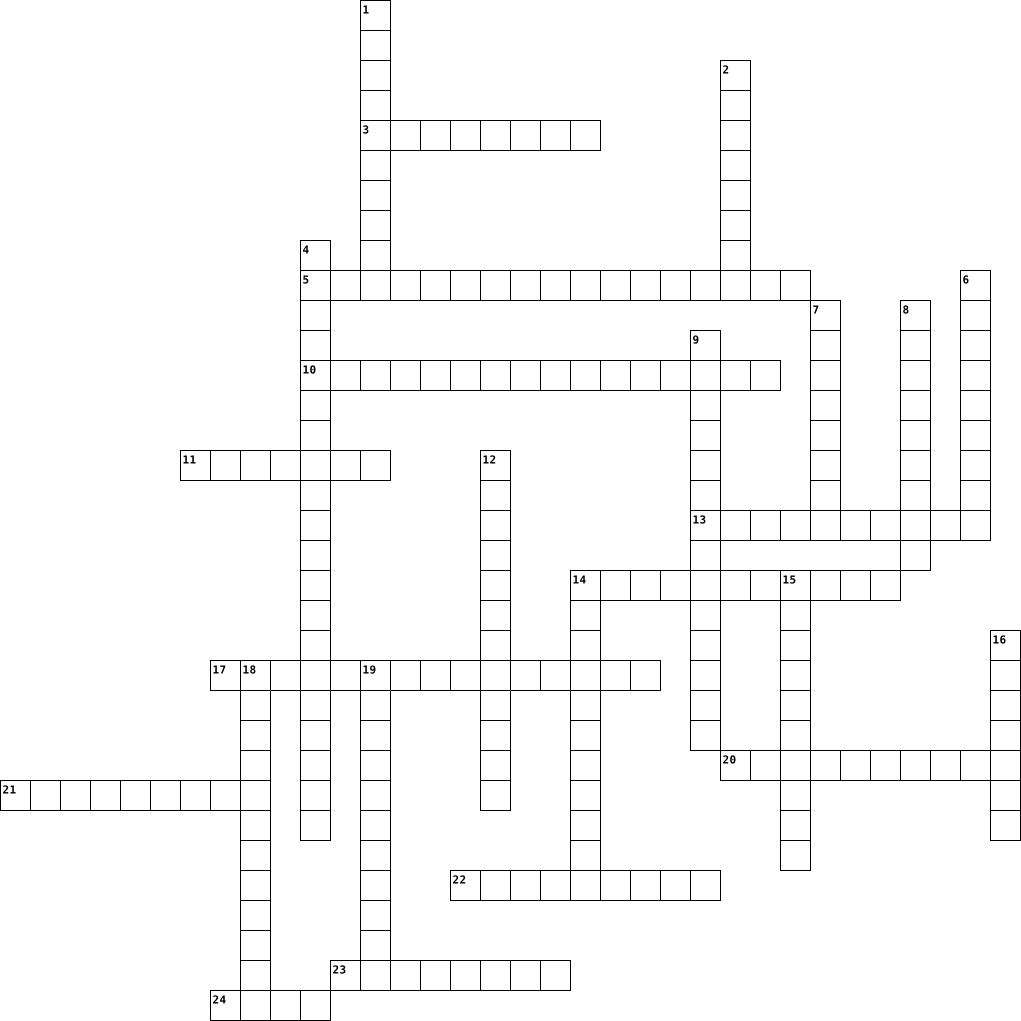
Across
- organelle that links amino acids to form proteins
- composed of a double membrane that acts as a storehouse for most of a cell's DNA
- movement of molecules across the cell membrane without energy input from the cell
- diffusion of water molecules across a semipermeable membrane from an area of higher water concentration to an area of lower water concentration
- cell that does not have a nucleus or other membrane-bound organelles
- hairlike structures that cover some or all of the cell surface and help the organism swim and capture food
- energy requiring movement of molecules across a membrane from a region of lower concentration to a region of higher concentration
- release of substances out of a cell by the fusion of a vesicle with the membrane
- jellylike substance inside cells that contains molecules and in some cells organelles
- solution that has a lower concentration of dissolved particles compared with another solution
- solution that has an equal concentration of dissolved particles compared with another solution
- basic unit of life
Down
- cell that has a nucleus and other membrane-bound organelles
- rigid structure that gives protection, support, and shape to a cell
- interconnected network of thin, folded membranes that produce, process,and distribute proteins
- membrane-bound structure that is specialized to perform a distinct process within a cell
- whiplike structure outside of a cell that is used for movement
- movement of dissolved molecules in a fluid or gas from a region of higher concentration to an region of lower concentration
- stack of flat, membrane-enclosed spaces containing enzymes that process, sort,and deliver proteins
- bean shaped organelle that supplies energy to the cell and has its own ribosomes and DNA
- organelle composed of numerous membranes that are used to convert solar energy into chemical energy; contains chlorophyll
- solution that has a higher concentration of dissolved particles compared with another solution
- organelle that contains enzymes
- double layer of phospholipids that forms a boundary between a cell and the surrounding environment and controls the passage of materials into and out of the cell
- uptake of liquids or large molecules into a cell by inward folding of the cell membrane
25 Clues: basic unit of life • organelle that contains enzymes • organelle that links amino acids to form proteins • cell that has a nucleus and other membrane-bound organelles • whiplike structure outside of a cell that is used for movement • rigid structure that gives protection, support, and shape to a cell • ...
Physics 2025-03-12

Across
- momentum is the product of mass times what?
- a collision in which two objects stick together after colliding
- The expression F x delta t = delta p is called the
- In physics, an elastic material is one in which the … done to deform the material during a collision is equal to the …the material does to return to its original shape
- plural of momentum is?
- momentum of an object is equal to zero when the object is …?
- In fact, any collision that produces …is not elastic; the …signifies a decrease in kinetic energy.
- The product of the … and the time interval during which the force is applied is called the impulse of the force for the time interval.
- a quantity defined as the product of the mass and velocity of an object
- force equals change in momentum divided by …?
- the product of the force and the time over which the force acts on an object
- the what involved in a collision are treated as though they are constant
- What is not conserved in a collision
- what refers to something that always returns to, or keeps, its original shape.
- What is the force applied constantly to an object for a certain time interval will cause a change in the object’s momentum equal to the product of the force and the time interval during which the force acts.
- Momentum has … mass × length/time
- what leads to conservation of momentum
- momentum is a …?
- Force is reduced when the time interval of an impact is
Down
- the law when total initial momentum equals total final momentum
- The total momentum of all objects interacting with one another remains constant regardless of the nature of the forces between the objects in what kind of system?
- the Si unit of momentum is?
- What depends on the impulse momentum theorem
- In what kind of collision is kinetic energy not conserved?
- a collision in which the total momentum and the total kinetic energy are conserved
- The total momentum remains … in any kind of collision.
- When objects deform during a collision kinetic energy turns into what?
- Even in what kind of collision will still result in some decrease in kinetic energy
- event where two or more objects exert forces on each other for a relatively short period of time
- During a collision, some of the work done on what is converted to other forms of energy, such as heat and sound
30 Clues: momentum is a …? • plural of momentum is? • the Si unit of momentum is? • Momentum has … mass × length/time • What is not conserved in a collision • what leads to conservation of momentum • momentum is the product of mass times what? • What depends on the impulse momentum theorem • force equals change in momentum divided by …? • ...
Physics 2025-03-12

Across
- When objects deform during a collision kinetic energy turns into what?
- In physics, an elastic material is one in which the … done to deform the material during a collision is equal to the …the material does to return to its original shape
- The expression F x delta t = delta p is called the
- Even in what kind of collision will still result in some decrease in kinetic energy
- a collision in which two objects stick together after colliding
- The product of the … and the time interval during which the force is applied is called the impulse of the force for the time interval.
- momentum of an object is equal to zero when the object is …?
- During a collision, some of the work done on what is converted to other forms of energy, such as heat and sound
- momentum is a …?
- plural of momentum is?
- event where two or more objects exert forces on each other for a relatively short period of time
- The total momentum remains … in any kind of collision.
- momentum is the product of mass times what?
- In fact, any collision that produces …is not elastic; the …signifies a decrease in kinetic energy.
- the what involved in a collision are treated as though they are constant
- The total momentum of all objects interacting with one another remains constant regardless of the nature of the forces between the objects in what kind of system?
Down
- the product of the force and the time over which the force acts on an object
- force equals change in momentum divided by …?
- the Si unit of momentum is?
- Force is reduced when the time interval of an impact is
- What is not conserved in a collision
- a collision in which the total momentum and the total kinetic energy are conserved
- What depends on the impulse momentum theorem
- a quantity defined as the product of the mass and velocity of an object
- Momentum has … mass × length/time
- What is the force applied constantly to an object for a certain time interval will cause a change in the object’s momentum equal to the product of the force and the time interval during which the force acts.
- In what kind of collision is kinetic energy not conserved?
- the law when total initial momentum equals total final momentum
- what refers to something that always returns to, or keeps, its original shape.
- what leads to conservation of momentum
30 Clues: momentum is a …? • plural of momentum is? • the Si unit of momentum is? • Momentum has … mass × length/time • What is not conserved in a collision • what leads to conservation of momentum • momentum is the product of mass times what? • What depends on the impulse momentum theorem • force equals change in momentum divided by …? • ...
Physics 2025-03-12

Across
- momentum of an object is equal to zero when the object is …?
- momentum is the product of mass times what?
- In fact, any collision that produces …is not elastic; the …signifies a decrease in kinetic energy.
- Momentum has … mass × length/time
- Force is reduced when the time interval of an impact is
- what refers to something that always returns to, or keeps, its original shape.
- event where two or more objects exert forces on each other for a relatively short period of time
- the law when total initial momentum equals total final momentum
- The product of the … and the time interval during which the force is applied is called the impulse of the force for the time interval.
- a collision in which the total momentum and the total kinetic energy are conserved
- momentum is a …?
- plural of momentum is?
- what leads to conservation of momentum
- The total momentum remains … in any kind of collision.
- During a collision, some of the work done on what is converted to other forms of energy, such as heat and sound
- the what involved in a collision are treated as though they are constant
- the product of the force and the time over which the force acts on an object
- a quantity defined as the product of the mass and velocity of an object
- Even in what kind of collision will still result in some decrease in kinetic energy
Down
- In what kind of collision is kinetic energy not conserved?
- the Si unit of momentum is?
- What is not conserved in a collision
- What is the force applied constantly to an object for a certain time interval will cause a change in the object’s momentum equal to the product of the force and the time interval during which the force acts.
- When objects deform during a collision kinetic energy turns into what?
- a collision in which two objects stick together after colliding
- The expression F x delta t = delta p is called the
- The total momentum of all objects interacting with one another remains constant regardless of the nature of the forces between the objects in what kind of system?
- What depends on the impulse momentum theorem
- In physics, an elastic material is one in which the … done to deform the material during a collision is equal to the …the material does to return to its original shape
- force equals change in momentum divided by …?
30 Clues: momentum is a …? • plural of momentum is? • the Si unit of momentum is? • Momentum has … mass × length/time • What is not conserved in a collision • what leads to conservation of momentum • momentum is the product of mass times what? • What depends on the impulse momentum theorem • force equals change in momentum divided by …? • ...
Vitamin Crossword 2016-01-12

Across
- B vitamin that helps turn food into energy; found in milk, yogurt, and cheese; sensitive to light
- Vitamin thought of most during cold and flu season
- Helps prevent brain defects related to the brain and spine
- Formal name for vitamin that is synthesized in part by the sun
- Helps convert food into energy, B vitamin
- Helps release neurotransmitter, acetylcholine; found in milk, eggs, and liver
- Levels of this amino acid may be lowered due to folic acid
- Formal name for vitamin that helps produce collagen
- Formal name for vitamin E
- Necessary in bone and hair health; produced by bacteria in GI tract
- When taking this type of medication, vitamin K consumption must be consistent
Down
- Three forms of vitamin B6 include pyridoxal, pyridoxamine, and this form
- Sources of this pro-vitamin include sweet potatoes, carrots, and pumpkin
- Necessary for absorbing vitamin B12 in stomach
- Formal name for a B vitamin that aids in creating fats, neurotransmitters, and hemoglobin
- Vitamin D helps to regulate levels of calcium and what other mineral in body
- Third form of vitamin A after retinol and retinoic acid
- Activates calcium cascade, essential in blood clotting
- Vitamin that acts as an antioxidant; may help to prevent Alzheimer’s
- Deficiency of this vitamin can cause Pellagra
20 Clues: Formal name for vitamin E • Helps convert food into energy, B vitamin • Deficiency of this vitamin can cause Pellagra • Necessary for absorbing vitamin B12 in stomach • Vitamin thought of most during cold and flu season • Formal name for vitamin that helps produce collagen • Activates calcium cascade, essential in blood clotting • ...
Vitamin Crossword 2016-01-12

Across
- Third form of vitamin A after retinol and retinoic acid
- Necessary for absorbing vitamin B12 in stomach
- Helps convert food into energy, B vitamin
- Formal name for a B vitamin that aids in creating fats, neurotransmitters, and hemoglobin
- Helps release neurotransmitter, acetylcholine; found in milk, eggs, and liver
- Formal name for vitamin that helps produce collagen
- Sources of this pro-vitamin include sweet potatoes, carrots, and pumpkin
- Vitamin thought of most during cold and flu season
Down
- B vitamin that helps turn food into energy; found in milk, yogurt, and cheese; sensitive to light
- Vitamin D helps to regulate levels of calcium and what other mineral in body
- Helps prevent brain defects related to the brain and spine
- Vitamin that acts as an antioxidant; may help to prevent Alzheimer’s
- Activates calcium cascade, essential in blood clotting
- Formal name for vitamin E
- Levels of this amino acid may be lowered due to folic acid
- When taking this type of medication, vitamin K consumption must be consistent
- Necessary in bone and hair health; produced by bacteria in GI tract
- Formal name for vitamin that is synthesized in part by the sun
- Three forms of vitamin B6 include pyridoxal, pyridoxamine, and this form
- Deficiency of this vitamin can cause Pellagra
20 Clues: Formal name for vitamin E • Helps convert food into energy, B vitamin • Deficiency of this vitamin can cause Pellagra • Necessary for absorbing vitamin B12 in stomach • Vitamin thought of most during cold and flu season • Formal name for vitamin that helps produce collagen • Activates calcium cascade, essential in blood clotting • ...
Vitamin Crossword 2016-01-12

Across
- Helps prevent brain defects related to the brain and spine
- B vitamin that helps turn food into energy; found in milk, yogurt, and cheese; sensitive to light
- Levels of this amino acid may be lowered due to folic acid
- Necessary for absorbing vitamin B12 in stomach
- Vitamin that acts as an antioxidant; may help to prevent Alzheimer’s
- Formal name for a B vitamin that aids in creating fats, neurotransmitters, and hemoglobin
- When taking this type of medication, vitamin K consumption must be consistent
- Sources of this pro-vitamin include sweet potatoes, carrots, and pumpkin
- Vitamin D helps to regulate levels of calcium and what other mineral in body
Down
- Three forms of vitamin B6 include pyridoxal, pyridoxamine, and this form
- Helps release neurotransmitter, acetylcholine; found in milk, eggs, and liver
- Formal name for vitamin E
- Activates calcium cascade, essential in blood clotting
- Helps convert food into energy, B vitamin
- Deficiency of this vitamin can cause Pellagra
- Necessary in bone and hair health; produced by bacteria in GI tract
- Third form of vitamin A after retinol and retinoic acid
- Vitamin thought of most during cold and flu season
- Formal name for vitamin that is synthesized in part by the sun
- Formal name for vitamin that helps produce collagen
20 Clues: Formal name for vitamin E • Helps convert food into energy, B vitamin • Deficiency of this vitamin can cause Pellagra • Necessary for absorbing vitamin B12 in stomach • Vitamin thought of most during cold and flu season • Formal name for vitamin that helps produce collagen • Activates calcium cascade, essential in blood clotting • ...
Plate Boundaries 2021-08-19
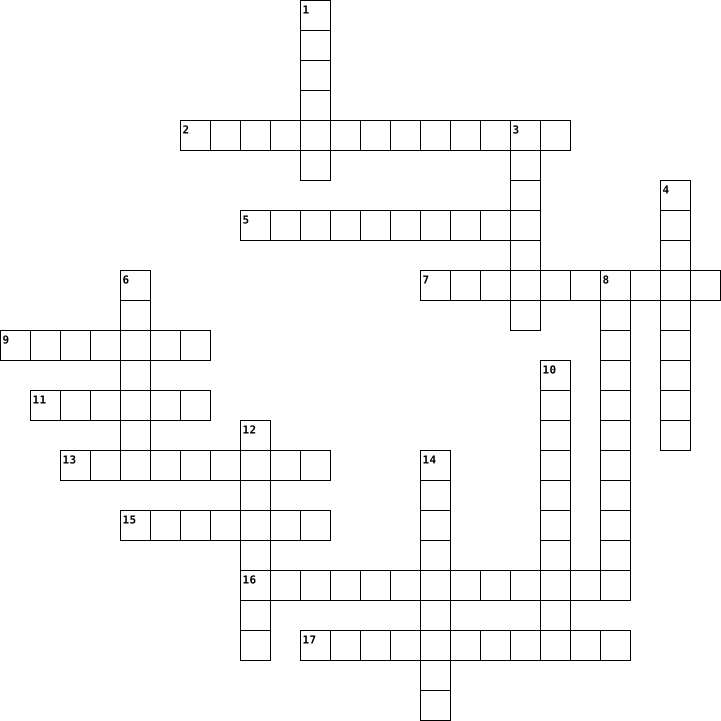
Across
- Forms when two oceanic crusts diverge
- The movement that results when heat is transferred in a fluid
- Forms when two continental crusts diverge
- The crust that underlies ocean basins
- Type of rock found in oceanic crust
- Plate boundaries sliding past each other
- German scientist Developed theory of Plate tectonics
- Hot, malleable semiliquid zone in the upper mantle
- The crust that underlies continents
Down
- Forms when two oceanic crusts collide
- Type of rock found in continental crust
- Plate boundaries moving apart
- Greek for "All the Earth"
- Made up of the crust and a bit of the upper mantle
- Plate boundaries colliding
- Forms when two continental crusts collide
- Plate ___, the process involved in the movement of large plates on the earth’s crust.
17 Clues: Greek for "All the Earth" • Plate boundaries colliding • Plate boundaries moving apart • Type of rock found in oceanic crust • The crust that underlies continents • Forms when two oceanic crusts collide • Forms when two oceanic crusts diverge • The crust that underlies ocean basins • Type of rock found in continental crust • Plate boundaries sliding past each other • ...
Unit 5: nature and environment 2022-01-26

Across
- unusual or special in some way
- the protection of plants and animals
- the amount of money you have available to spend
- forms of energy that are produced using the sun, wind, flowing water.
- related to the sea
- the process of collecting and changing old paper, glass, plastic, etc. so that it can be used again
- any animal of which the female feeds her young on milk from her own body
- too many to count
Down
- during the period of time
- a single person, separate
- an animal or plant close to extinction
- a short trip
- to observe, to supervise
13 Clues: a short trip • too many to count • related to the sea • to observe, to supervise • during the period of time • a single person, separate • unusual or special in some way • the protection of plants and animals • an animal or plant close to extinction • the amount of money you have available to spend • forms of energy that are produced using the sun, wind, flowing water. • ...
Chemical and Physical Reactions of Matter 2021-12-09

Across
- When no new Chemical is created.
- The ability of molecules to transfer energy.
- Everything in the universe is made of this.
- If matter sinks in water it would be ________ than water
- When 2 molecules combined to make something new.
- These molecules are tightly packed together.
- 3/4 of all Elements are in this category.
Down
- The ability of molecules to pass energy.
- Combining 2 or more elements together is called a _________
- The states of matter are Gas, Solid and ________.
- Elements are made of these tiny pieces.
- There are 3 forms of conductivity; Heat, Sound and ______
- These molecules are free flowing and spread far apart.
- Mass/Volume=
14 Clues: Mass/Volume= • When no new Chemical is created. • Elements are made of these tiny pieces. • The ability of molecules to pass energy. • 3/4 of all Elements are in this category. • Everything in the universe is made of this. • The ability of molecules to transfer energy. • These molecules are tightly packed together. • When 2 molecules combined to make something new. • ...
Science Twist on Vocab Chapter 11 2024-05-02

Across
- The upward movement of warm air and the downward movement of cool air form
- Water in the form of a gas
- Winds that blow steadily from specific directions over long distances
- The transfer of heat by the movement of a fluid is called
- A form of energy that can move through the vacuum of space
- The flow of air from land to a body of water forms a
- What envelopes the gases inside of earth due to gravity
- Wind speed can be measured with a(n)
- Has wavelengths that are longer than wavelengths for red light
- The increased cooling that a wind can cause is called the
- Dust-size particles and gases in the atmosphere disperse light in all directions
- Winds that blow over short distances are called
- Extends of 80 kilometers and outward into space
- Consists of a long glass tube that is closed at one end and open at the other
- The direct transfer of energy by ______________ waves is called what
- Thermal energy that is passed from one hot object to another
- Measures the total energy of motion in the particles of a substance
Down
- These gases in turn hold heat in Earth's atmosphere in a process called
- The result of the weight of a column of air pushing on an area
- Extends from the top of the first layer of Earth's atmospheres
- A device that measures temperature
- The condition of Earth's atmosphere at a particular time and space
- The sun gives off ___________________ which is an invisible form of energy with wavelengths that are shorter than wavelengths for violet light
- Extends of 80 kilometers to 400 kilometers
- A local wind that blows from an ocean or lake
- Where we live
- The amount of mass in a given volume of air
- The movement of air parallel to Earth's surface
- Because of the _______ _______ global winds in the Northern Hemisphere gradually turn toward the right
- The middle layer of the atmosphere
- The elevation of a place above sea level
- The transfer of heat between two substances that are in direct contact is called
- Extends from 400 kilometers up to thousands of kilometers
33 Clues: Where we live • Water in the form of a gas • A device that measures temperature • The middle layer of the atmosphere • Wind speed can be measured with a(n) • The elevation of a place above sea level • Extends of 80 kilometers to 400 kilometers • The amount of mass in a given volume of air • A local wind that blows from an ocean or lake • ...
Forms of Government Z. Henley 2020-09-17

Across
- relating to or denoting a confederation.
- denoting attitudes, activities, or other things that have no religious or spiritual basis.
- (of a legislative or deliberative assembly) consisting of people chosen to act and speak on behalf of a wider group.
- forming a single or uniform entity.
- a system of government by one person with absolute power.
- a small group of people having control of a country, organization, or institution.
- relating to a system of government that is centralized and dictatorial and requires complete subservience to the state.
Down
- (in the UK) the highest legislature, consisting of the sovereign, the House of Lords, and the House of Commons.
- having or relating to a system of government in which several states form a unity but remain independent in internal affairs.
- a form of government with a monarch at the head.
- a system of government by the whole population or all the eligible members of a state, typically through elected representatives.
- a body of fundamental principles or established precedents according to which a state or other organization is acknowledged to be governed.
- government by a dictator.
- a state in which supreme power is held by the people and their elected representatives, and which has an elected or nominated president rather than a monarch.
- the highest class in certain societies, especially those holding hereditary titles or offices.
- a system of government in which priests rule in the name of God or a god.
16 Clues: government by a dictator. • forming a single or uniform entity. • relating to or denoting a confederation. • a form of government with a monarch at the head. • a system of government by one person with absolute power. • a system of government in which priests rule in the name of God or a god. • ...
Forms Of Government-Trey Jones 2020-09-17

Across
- relating to or denoting a confederation.
- not subject to or bound by religious rule; not belonging to or living in a monastic or other order.
- (of a legislative or deliberative assembly) consisting of people chosen to act and speak on behalf of a wider group.
- forming a single or uniform entity.
- a system of government by one person with absolute power(not totalitarian or dictatorship).
- a small group of people having control of a country, organization, or institution.
- relating to a system of government that is centralized and dictatorial and requires complete subservience to the state.
Down
- (in the UK) the highest legislature, consisting of the sovereign, the House of Lords, and the House of Commons.
- having or relating to a system of government in which several states form a unity but remain independent in internal affairs.
- usually has a king or queen that is above the law.
- a system of government by the whole population or all the eligible members of a state, typically through elected representatives.
- a body of fundamental principles or established precedents according to which a state or other organization is acknowledged to be governed.
- a country with a leader that has control over literally everything.
- a state in which supreme power is held by the people and their elected representatives, and which has an elected or nominated president rather than a monarch.
- very powerful wealthy and well known people are in control.
- a system of government in which priests rule in the name of God or a god.
16 Clues: forming a single or uniform entity. • relating to or denoting a confederation. • usually has a king or queen that is above the law. • very powerful wealthy and well known people are in control. • a country with a leader that has control over literally everything. • a system of government in which priests rule in the name of God or a god. • ...
Energy Types/Transformations 2023-12-07

Across
- Unit for measurement of energy
- The energy from vibrations in matter
- Energy that is stored
- The energy that comes from gravity
- The energy locked in the nucleus of an atom
- The energy in moving objects
- Something you would make s'mores on
- The change from one energy from to another
- The energy that comes from stretching something like a rubber band
- Something that uses heat energy to toast your bread
Down
- Energy cannot be created or destroyed
- The process of splitting an atom
- The energy of light
- Energy that is exerted
- The energy of moving electrons
- Something that converts light energy into electrical energy
- The energy stored in the bonds of molecules
- Outlet Something you would plug a charger into
- Something you would put in your remote when it dies
- The energy of heat
20 Clues: The energy of heat • The energy of light • Energy that is stored • Energy that is exerted • The energy in moving objects • Unit for measurement of energy • The energy of moving electrons • The process of splitting an atom • The energy that comes from gravity • Something you would make s'mores on • The energy from vibrations in matter • Energy cannot be created or destroyed • ...
Cells 2024-10-29

Across
- location where the cell produces proteins
- provides structural help
- forms a framework for the cell to hold organelles
- provide protection from its cell
- helps the cell divide and form more cells
Down
- holds all of the organelles in place
- takes nutrients to the body
- hair like projections that helps a cell move
- body packs products from the ER for shupemtn within or out the cell
- help transform energy
- storage for materials like food water and waste
- make ribosomes inside the nucleus
- strands of DNA that contain all of genetic infortmation
- controls the cell
- a tail that helps a cell move
15 Clues: controls the cell • help transform energy • provides structural help • takes nutrients to the body • a tail that helps a cell move • provide protection from its cell • make ribosomes inside the nucleus • holds all of the organelles in place • location where the cell produces proteins • helps the cell divide and form more cells • hair like projections that helps a cell move • ...
Topic 1: Intro to Earth's Systems 2022-09-23

Across
- process in which mapmakers determine distances and elevations using instruments and the principles of geometry
- relatively thin layer of gases that form Earth’s outermost layer
- group of parts that work together as a whole
- line that forms the boundary between the land and the ocean or lake
- parts of the Earth that contain living organisms
- portion of the hydrosphere that is frozen, including all the ice and snow on land, plus sea and lake ice
- exact copy of something on a much smaller scale
- form of water that falls from clouds and reaches Earth’s surface as rain, snow, sleet or hail
- portion of the Earth that consists of water in any of its forms, including oceans, glaciers, rivers, lakes, groundwater and water vapor
- change in state from a gas to a liquid
- hole sunk into the ground to reach a supply of water
- ability to do work and cause change
- process by which molecules at the surface of a liquid absorb enough energy to change to a gas
- underground layer of rock or sediment that holds water
Down
- landform made of sediment that is deposited where a river flows into an ocean or lake
- natural stream of water that flows into another body of water, such as an ocean, lake, or another river
- process by which water is lost through plant leaves
- densest parts of the Earth that include the crust, mantle, and core
- continual movement of water among Earth’s atmosphere, oceans, and land surface through evaporation, condensation, and precipitation
- feature on the surface of the Earth, such as a coastline, dune or mountain
- land area that supplies water to a river system
- landform with high elevation and high relief
- series of changes that happen over time and lead to an expected result
- process in which a signal or action triggers another signal or action
- hill of sand piled up by the wind
- shape of the land determined by elevation, relief and landforms
26 Clues: hill of sand piled up by the wind • ability to do work and cause change • change in state from a gas to a liquid • group of parts that work together as a whole • landform with high elevation and high relief • land area that supplies water to a river system • exact copy of something on a much smaller scale • parts of the Earth that contain living organisms • ...
Earth Science Crossword 2024-05-10

Across
- Heat is transformed In waves through the air, such as heat coming from a campfire
- Cycle Series of processes on the surface and inside Earth that slowly changes rocks from one kind to another
- Type of rock that forms from sediments
- Property of minerals that may be used to help in identification, but not as reliable as its streak
- of Fire Area of volcanic and seismic activity that surrounds the Pacific Plate
- A measure of the average energy of motion of the particles of a substance, which increases inside Earth as the depth increases
- Force that pushes on the ends of the rock causing it to get thicker in the middle
- Instrument used to record seismic waves
Down
- Neck Forms as magma hardens inside a pipe
- Force that pulls on the ends of rock causing it to get thinner in the middle
- Hanging wall moves up the dip of the fault
- the study of weather
- Tides occur when the sun and moon are at right angles to each other (produces smaller high and low tides)
- state of the atmosphere
- the act of decreasing or reducing something
15 Clues: the study of weather • state of the atmosphere • Type of rock that forms from sediments • Instrument used to record seismic waves • Neck Forms as magma hardens inside a pipe • Hanging wall moves up the dip of the fault • the act of decreasing or reducing something • Force that pulls on the ends of rock causing it to get thinner in the middle • ...
Kinetic and Potential Energy 2025-03-03

Across
- equivalent for joules
- kinetic energy is ______ energy.
- What language does the word kinetic come from
- Unit for force
- Unit for energy.
- Most influential variable in kinetic energy
- Can be transformed from one form to another
- mgh
- abbreviation for potential energy
- variable with lesser influence on kinetic energy
- The relationship between height and potential energy
Down
- Energy causes _____.
- Energy is neither created or destroyed: The _____ of energy.
- Energy makes _____ possible.
- 9.8
- Number of types of energy
- Potential energy is _______ energy.
- abbreviation for kinetic energy
- Unit for height
- .5mv
- Kinetic energy when object hits ground is _____ (to/than) the potential energy before it is dropped
21 Clues: 9.8 • mgh • .5mv • Unit for force • Unit for height • Unit for energy. • Energy causes _____. • equivalent for joules • Number of types of energy • Energy makes _____ possible. • abbreviation for kinetic energy • kinetic energy is ______ energy. • abbreviation for potential energy • Potential energy is _______ energy. • Most influential variable in kinetic energy • ...
P.E. CROSSWORD 2021-12-02

Across
- exercise, activity that breaks down glucose for energy without using oxygen.
- energy System, It provides energy for low intensity activities that last anywhere from two minutes to a few hours.activity that lasts from ten seconds to two minutes.
- Lactic, provides energy for medium to high intensity
- An uplifted regal type of posture.
- Rome, gave less importance to dancing as the nation grew wealthy and powerful.
- how fast or slow the movements, steady beat, fast or slow.
- It is the smallest unit of form in the whole dance.
- A Lactic, does not create energy for sufficient duration to create a great deal of waste products.
- How large or small movements. The relationship of one movement to another.
- every section of the dance ( beginning, middle, and end ) use different tempos and qualities.
- The opposite of suspended, body falls back on itself.
- Influences, A cultural group provides guidelines regarding acceptable foods, food combinations, eating patterns, and eating behaviors.
- Movements that the body can do and still stay in one place.
- The entertainers now became valuable appendage to the courts of Italy and France.
- FORM, They tell story through connected and progressive sections called episodes.
Down
- refers to acceptable behaviors.
- FORM, combination of different movements, several themes are woven together in choreography to form a complex structure.
- patterns we make as we move across the floor: straight, curved.
- Strong pulses for precise moves.
- How the body uses energy while moving.
- form, Most popular song use this form.
- Influences, Political factors also influence food availability and trends.
- FORM, – these forms contain themes/motif which progress in a specific order.
- Bass, This form is best done in a group working either in contrast to each other or against soloist.
- Movements that take the body from one point to another.
- they used dance to aid education in general as philosophers such as Plato, Aristotle, and Socrates strongly supported this art as an integration of the body and soul.
- consist of a small amount of food or beverage eaten between meals.
27 Clues: refers to acceptable behaviors. • Strong pulses for precise moves. • An uplifted regal type of posture. • How the body uses energy while moving. • form, Most popular song use this form. • It is the smallest unit of form in the whole dance. • Lactic, provides energy for medium to high intensity • The opposite of suspended, body falls back on itself. • ...
DNA Evidence 2022-09-30

Across
- A set of instructions for a specific protein
- Building blocks of DNA
- The component of a nucleotide that contains nitrogen
- The element found only in the nitrogenous bases
- Pyrimidine; forms three hydrogen bonds
- The element found only in the phosphate group
- Large molecules that are essential for life
- Purine; forms three hydrogen bonds
- The sugar found in DNA
- The type of bonds that form between two nitrogenous bases
Down
- Purine; forms two hydrogen bonds
- Passed down from biological relatives
- Twisted ladder; characteristic shape of DNA
- State that A will always bond with T, and C will always bond with G
- A negatively charged molecule found in the cells of all living things
- The entire set of instructions for building an organism
- Part of a nucleotide that contains phosphorous; bonds nucleotides together
- Watson and ___; published a paper describing the three-dimensional structure of DNA as a double helix
- Pyrimidine; forms two hydrogen bonds
19 Clues: Building blocks of DNA • The sugar found in DNA • Purine; forms two hydrogen bonds • Purine; forms three hydrogen bonds • Pyrimidine; forms two hydrogen bonds • Passed down from biological relatives • Pyrimidine; forms three hydrogen bonds • Twisted ladder; characteristic shape of DNA • Large molecules that are essential for life • ...
a 2026-01-15

Across
- the variety of living things in a place.
- the molecule that contains genetic information.
- related to the structure of the body.
- the interaction between organisms in an ecosystem.
- living beings that feed on other organisms.
- single-celled microorganisms.
- the capacity of a living being to perform vital functions.
- a rapid change in biological processes.
- a microscopic agent that infects cells.
Down
- the set of conditions that surround a living being.
- an individual living being.
- working together to achieve a biological goal.
- related to the molecules of life.
- repeated forms in nature.
- the condition that allows growth, reproduction, and response to the environment.
- fungi that decompose organic matter.
- study based on observation and experimentation.
- the science that studies living things.
18 Clues: repeated forms in nature. • an individual living being. • single-celled microorganisms. • related to the molecules of life. • fungi that decompose organic matter. • related to the structure of the body. • the science that studies living things. • a rapid change in biological processes. • a microscopic agent that infects cells. • the variety of living things in a place. • ...
Prototype Unit 3 Word games 2026-01-15

Across
- the variety of living things in a place.
- the molecule that contains genetic information.
- the condition that allows growth, reproduction, and response to the environment.
- study based on observation and experimentation.
- an individual living being.
- fungi that decompose organic matter.
- single-celled microorganisms.
- the science that studies living things.
- related to the structure of the body.
Down
- repeated forms in nature.
- the interaction between organisms in an ecosystem.
- a microscopic agent that infects cells.
- the set of conditions that surround a living being.
- living beings that feed on other organisms.
- working together to achieve a biological goal.
- the capacity of a living being to perform vital functions.
- a rapid change in biological processes.
- related to the molecules of life.
18 Clues: repeated forms in nature. • an individual living being. • single-celled microorganisms. • related to the molecules of life. • fungi that decompose organic matter. • related to the structure of the body. • a microscopic agent that infects cells. • a rapid change in biological processes. • the science that studies living things. • the variety of living things in a place. • ...
Prototype Unit 3 Word games 2026-01-15

Across
- working together to achieve a biological goal.
- single-celled microorganisms.
- the molecule that contains genetic information.
- an individual living being.
- the science that studies living things.
- living beings that feed on other organisms.
- study based on observation and experimentation.
- the set of conditions that surround a living being.
- a rapid change in biological processes.
- fungi that decompose organic matter.
Down
- the variety of living things in a place.
- a microscopic agent that infects cells.
- repeated forms in nature.
- related to the structure of the body.
- the capacity of a living being to perform vital functions.
- the interaction between organisms in an ecosystem.
- related to the molecules of life.
- the condition that allows growth, reproduction, and response to the environment.
18 Clues: repeated forms in nature. • an individual living being. • single-celled microorganisms. • related to the molecules of life. • fungi that decompose organic matter. • related to the structure of the body. • a microscopic agent that infects cells. • the science that studies living things. • a rapid change in biological processes. • the variety of living things in a place. • ...
chemistry of life crossword 2022-10-18

Across
- - nutrients made up of a single sugar molecule or many sugar molecules.
- transport system - a series of progressively stronger electron acceptors, with energy release t each step.
- - the movement of molecules from an area of higher concentration to an area of lower concentration.
- respiration - respiration that takes place without oxygen.
- - to disrupt amino acid bonds by physical or chemical means, changing the protein's shape which may or may not be temporary.
- solution - a solution where the concentration of solutes outside a cell is lower than that found inside the cell.
- - the form of carbohydrate storage in animals.
- - a three-carbon chain molecule containing three hydroxyl.
- - organisms that use energy, usually light, to synthesize their own food from inorganic compounds.
Down
- fermentation - chemical deposition of a carbohydrate in the absence of oxygen.
- motion - the random movement of molecules.
- synthesis - a series of chemical reactions that allow two molecules to bond by the formation of a water molecule.
- - a permanent change in a protein's shape due to amino acid bond disruption.
- solution - a solution where the concentration of solutes outside of a cell is higher than that found inside the cell.
- transportation - involves the use of the cell energy to move materials across a cell membrane against the concentration gradient.
- acids - long chains of carbon and hydrogen joined together.
- - a process by which a constant internal environment is maintained despite changes in the internal and external environment.
- - the carbohydrate that forms the cell wall of plant cells
- gradient - a difference in the number of molecules or ions of a substance between adjoining regions.
- - a condition in which all acting influences are balanced, resulting in a stable environment.
20 Clues: motion - the random movement of molecules. • - the form of carbohydrate storage in animals. • respiration - respiration that takes place without oxygen. • - the carbohydrate that forms the cell wall of plant cells • - a three-carbon chain molecule containing three hydroxyl. • acids - long chains of carbon and hydrogen joined together. • ...
chemistry of life crossword 2022-10-18

Across
- - respiration that takes place without oxygen.
- - the form of carbohydrate storage in animals.
- - long chains of carbon and hydrogen joined together.
- - the random movement of molecules.
- - chemical deposition of a carbohydrate in the absence of oxygen.
- - the movement of molecules from an area of higher concentration to an area of lower concentration.
- - a series of progressively stronger electron acceptors, with energy release t each step.
- - organisms that use energy, usually light, to synthesize their own food from inorganic compounds.
- - a three-carbon chain molecule containing three hydroxyl.
- - a condition in which all acting influences are balanced, resulting in a stable environment.
- - to disrupt amino acid bonds by physical or chemical means, changing the protein's shape which may or may not be temporary.
Down
- - a solution where the concentration of solutes outside of a cell is higher than that found inside the cell.
- - a permanent change in a protein's shape due to amino acid bond disruption.
- - a series of chemical reactions that allow two molecules to bond by the formation of a water molecule.
- - a process by which a constant internal environment is maintained despite changes in the internal and external environment.
- - involves the use of the cell energy to move materials across a cell membrane against the concentration gradient.
- - a solution where the concentration of solutes outside a cell is lower than that found inside the cell.
- - nutrients made up of a single sugar molecule or many sugar molecules.
- - a difference in the number of molecules or ions of a substance between adjoining regions.
- - the carbohydrate that forms the cell wall of plant cells
20 Clues: - the random movement of molecules. • - respiration that takes place without oxygen. • - the form of carbohydrate storage in animals. • - long chains of carbon and hydrogen joined together. • - the carbohydrate that forms the cell wall of plant cells • - a three-carbon chain molecule containing three hydroxyl. • ...
Heat, waves and EMS crossword 2022-06-03

Across
- The release of heat
- One of the forms of energy, related to heat
- The absorption of heat
- A region in a longitudinal wave where the particles are closest together
- SI unit of temperature
- Dolphins and bats use this to locate others and find food
- The movement of heat through water or air or fluid
- The lowest part of a wave
- They help scientists monitor weather conditions
- The distance between identical points (adjacent crests)
- Includes radio rays, electromagnetics rays, and visible rays
- A tool that creates rainbows.
- Transfer of heat through electromagnetic waves
- An instrument that measures temperature
- The maximum displacement the wave undergoes from its mean position
- Waves with the lowest frequency
- Rays used to scan bodies
Down
- Transfer of energy from one molecule to another
- The conversion of gas to a liquid
- The change in direction of a wave passing from one medium to another caused by its change in speed
- The number of waves that pass through a fixed place at a given amount of time
- The unit of measurement that measures how loud something is
- Invisible rays that are part of the energy that comes from the sun
- The highest surface part of a wave
- A wave vibrating at right angles to the direction of its propagation
- The unit unit of frequency in a wave
- The rest position of a traverse wave
- How warm or cold it is
- Waves with the highest frequency
- Rays longer than visible light but shorter than microwaves
30 Clues: The release of heat • The absorption of heat • SI unit of temperature • How warm or cold it is • Rays used to scan bodies • The lowest part of a wave • A tool that creates rainbows. • Waves with the lowest frequency • Waves with the highest frequency • The conversion of gas to a liquid • The highest surface part of a wave • The unit unit of frequency in a wave • ...
Science Terminology 2025-02-09

Across
- a change of state from gas to solid
- the starting substances in chemical reactions
- a form of sugar that is produced during photosynthesis and used in respiration to produce energy
- a process where two liquids or two gases mix due to the motion of their particles
- substances made of lattices or identical molecules with two or more types of atoms
- the smallest building block of matter
- a substance that dissolves another substance
- a chemical reaction that occurs in all living cells. In this reaction, oxygen and glucose are converted into water and carbon dioxide while releasing energy. The energy released can be used by living things to live, grow and move
- the change of state where a liquid changes to a gas at the surface of the liquid
- model a simplified representation of solids, liquids and gases
- substances made up of only one type of atom
- clusters of atoms
- describes liquids that do not mix
Down
- describes elements that consist of one single atoms
- evaporation of solvent from a solution to leave solute behind as crystals
- when a metal reacts with the chemicals in its environment
- a solution in which a substance is dissolved in water
- a solid formed during a chemical change
- a mixture in which one substance is being dissolved in another
- a decrease in size
- any combination of two or more elements and compounds
- a change of state where a gas is cooled and forms a liquid
- describes liquids that can be mix
- the term used to describe the structure of the DNA molecule; consists of two strands twisted into a double spiral
- a change of state from solid to gas
- a substance being dissolved
26 Clues: clusters of atoms • a decrease in size • a substance being dissolved • describes liquids that can be mix • describes liquids that do not mix • a change of state from gas to solid • a change of state from solid to gas • the smallest building block of matter • a solid formed during a chemical change • substances made up of only one type of atom • ...
Science Review 1 2015-01-20

Across
- semi-conductors
- colours produced by excitation of gases in the atmosphere by solar winds entering Earth’s atmosphere
- Shortest and longest days of the year
- Table salt, or sodium chloride, is an example of a _________
- Charging by ______ occurs when two objects with different amounts of electric charge come in contact and electrons move from one object to the other.
- term describes a series of changes in the biotic and abiotic features of an ecosystem that occur over time after a disturbance
- A(n) ___________variable is one that is changed by the investigator
- is the process by which sugar and oxygen are converted into carbon dioxide, water, and energy to provide energy for the cell.
- The process of removing charges from objects by contact with a large, neutral object is called
- name for a new solid that forms when two liquids are mixed
- Any condition that changes or varies the outcome of a scientific inquiry is called a
- A(n) ________species is a non-native species that has a negative impact on the natural environment.
- group of elements reacts violently with water
- group 17 on the periodic table
- Metals combine with ___________ to form ionic compounds
- The day/night cycle on Earth is caused by the Earth’s
- A(n) ________ cannot be broken down into simpler chemical substances by any physical or chemical means
- allows electrons to move easily through it
- type of compound that has identical individual particles
- non-living
- The ________ planets are those found closest to the Sun
Down
- increasing concentrations of toxic substances as you move up the food chain
- The small number that follows the symbol for an element in a chemical formula and shows how many atoms of the element are present is called the
- Describes a variable that changes in response to the deliberate change in another variable
- voltmeter must be wired in ________ to function properly
- unit of measurement for all forms of energy including electrical energy
- group 2 on the periodic table
- When day and night are exactly equal
- ammeter must be wired in ______ to function properly
- A year is equal to one _______ of the Earth
- device to measure resistance
- 1.5 x 10^8 km
- The odour of a substance is a _______ property
- Earth’s ________ is all the places on Earth where living things can exist.
- device to measure current
- gases group 18 on the periodic table
- Astronomers use_______ to measure the distance to stars or other celestial objects outside of the Solar System.
- Any object that exists in space is called a
- Looking down on the North Pole, the planets revolve around the Sun in this direction
- The change in temperature of Earth during the year (seasons) is caused by the Earth’s
- often called a shooting star
- One joule per second
42 Clues: non-living • 1.5 x 10^8 km • semi-conductors • One joule per second • device to measure current • device to measure resistance • often called a shooting star • group 2 on the periodic table • group 17 on the periodic table • When day and night are exactly equal • gases group 18 on the periodic table • Shortest and longest days of the year • allows electrons to move easily through it • ...
Unit C Crossword Jamie Olegario 8S 2017-05-25

Across
- optical device for viewing distant objects ;there are two types:reflecting and refracting telescopes
- piece of transparent material that is thinner in the middle than at the edges; light rays passing through it diverge or spread out
- describes objects that produce light; for example, the sun, light bulb, fire, etc
- angle of incidence of a wave hitting a surface equals the angle of reflection
- reflection reflection that happens when parallel rays hit a rough surface; all rays reflect at different angles
- line perpendicular to a surface (that is, forms a 90˚ angle with the surface)
- angle between the incident ray and the normal
- refers to the whole range of wavelengths of visible and invisible electromagnetic radiation
- device for viewing distant objects;made up of two short refracting telescopes fitted together
- acronym for radio detection and ranging; system that detects reflected microwaves
- curved piece of glass or other transparent material that refracts light in a predictable way
- flat mirror; reflecting surface that has no curvature
- angle between the reflected ray and the normal
- any device that uses light; for example,mirrors,lenses,microscopes,and telescopes
- model used to explain the characteristics and behaviour of light energy; it describes light as energy in the form of waves; the different colours of light have different wavelengths; waves with shorter wavelengths have higher energy than those with longer wavelengths
- CROSSWORD
Down
- bending of light as it travels from one material to another material
- point at which light rays meet, or appear to meet, after being reflected by a mirror, or refracted by a lens
- piece of transparent material that is thicker in the middle than at the edges; light rays passing through it converge or come together
- reflecting surface that bulges out like the back of a spoon; light rays reflected from it diverge (spread out)
- all forms of radiant energy: visible light, infrared radiation,ultraviolet radiation, radio waves, X-rays etc.
- reflection that happens when parallel rays hit a smooth surface; all rays reflect at the same angle
- describes objects that do not produce light but may reflect it (for example, the moon); most objects on earth are non-luminous
- telescope that uses a curved mirror and a lens to form an enlarged image
- brightness of light;amount of light arriving per unit area at a place
- telescope that uses two lenses to form an enlarged image
- describes materials that allow light to pass through with little or no reflection; for example, glass
- ray of light that arrives at a mirror or other substance
- describes materials that allow some light to pass through
- image formed when rays meet at a point; the image can be projected onto a screen
30 Clues: CROSSWORD • angle between the incident ray and the normal • angle between the reflected ray and the normal • flat mirror; reflecting surface that has no curvature • telescope that uses two lenses to form an enlarged image • ray of light that arrives at a mirror or other substance • describes materials that allow some light to pass through • ...
BIOLOGY:CHEMISTRY OF LIFE AND PROTEIN STRUCTURE 2015-01-13

Across
- Less healthy type of fatty acid
- The bonds that only create between cystein amino acid
- The reaction that produces water is call _____ reaction.
- Type of proteins that soluble in water
- More than 2 amino acids linked together.
- Change in pH can cause proteins to___________.
- Enzymes that break out protein
- The difference between each amino acids structure
- Where energy store in animal
Down
- Made of protein such as estogen
- The part where substrate binds
- Tendons,hairs and spiders' webs is example of this.
- Use to test proteins
- Many 3D proteins structures made this.
- Working of enzyme is same like _______ model.
- When 2 peptide bonds linked, it forms ______.
- Common type of the protein structure,have hydrogen bonds
- All enzymes are__________.
- When reactant molecule bind at active site is called enzyme-reactant _______.
- The outer skeleton of shrimp made of this
20 Clues: Use to test proteins • All enzymes are__________. • Where energy store in animal • The part where substrate binds • Enzymes that break out protein • Made of protein such as estogen • Less healthy type of fatty acid • Many 3D proteins structures made this. • Type of proteins that soluble in water • More than 2 amino acids linked together. • ...
BIOLOGY:CHEMISTRY OF LIFE AND PROTEIN STRUCTURE 2015-01-13

Across
- Enzymes that break out protein
- Less healthy type of fatty acid
- Made of protein such as estogen
- Type of proteins that soluble in water
- The bonds that only create between cystein amino acid
- When reactant molecule bind at active site is called enzyme-reactant _______.
- The difference between each amino acids structure
- The reaction that produces water is call _____ reaction.
- Working of enzyme is same like _______ model.
- All enzymes are__________.
- The outer skeleton of shrimp made of this
Down
- Where energy store in animal
- Common type of the protein structure,have hydrogen bonds
- Tendons,hairs and spiders' webs is example of this.
- Use to test proteins
- Change in pH can cause proteins to___________.
- The part where substrate binds
- Many 3D proteins structures made this.
- More than 2 amino acids linked together.
- When 2 peptide bonds linked, it forms ______.
20 Clues: Use to test proteins • All enzymes are__________. • Where energy store in animal • Enzymes that break out protein • The part where substrate binds • Less healthy type of fatty acid • Made of protein such as estogen • Type of proteins that soluble in water • Many 3D proteins structures made this. • More than 2 amino acids linked together. • ...
Unit 7 Spelling 2021-12-07

Across
- a sequence of actions regularly followed
- found in or produced by the sea
- a solution containing salt
- a deep narrow gorge with steep sides
- form of mental image or concept
- mixture of volatile, flammable liquid; petrol
- extreme scarcity of food
- something given for medical treatment or prevention
- having qualities or appearance associated with women
- the lower part of the canal starting at the end of the stomach
Down
- be the decisive factor in
- truly what something is said to be; authentic
- training to obey rules or code for behavior
- inspect in detail
- a woman admired for her courage
- having qualities or appearance associated with men
- an apparatus using or applying mechanical power and having several parts
- a periodical publication containing articles and illustrations
- motor, a machine designed to convert one or more forms of energy
- belief or set of beliefs held/taught by a Church
20 Clues: inspect in detail • extreme scarcity of food • be the decisive factor in • a solution containing salt • found in or produced by the sea • a woman admired for her courage • form of mental image or concept • a deep narrow gorge with steep sides • a sequence of actions regularly followed • training to obey rules or code for behavior • truly what something is said to be; authentic • ...
lipids 2025-09-23

Across
- – Helps mix oil and water
- – “Good” cholesterol
- – Essential fatty acid found in fish
- – Backbone of triglycerides
- acid – Building block of fats
- – Lipid with a phosphate group, forms cell membranes
- fat – Artificially hydrogenated fat
- – “Bad” cholesterol
- – Process that turns oils into solid fats
- – Fat with one double bond
- – Function of triglycerides
Down
- – Fat with at least one double bond
- – Fat with multiple double bonds
- – Organ affected by fat consumption
- – Fat tissue in the body
- – Fruit high in healthy fats
- – Example of monounsaturated fat source
- – Fat or fat-like molecule
- – Main form of fat in the body
- – Type of sterol in animal cells
- – Fat with no double bonds
- – Example of saturated fat source
- E – Fat-soluble vitamin in oils
- – Type of lipid including cholesterol
- – Essential fatty acid found in vegetable oils
25 Clues: – “Bad” cholesterol • – “Good” cholesterol • – Fat tissue in the body • – Helps mix oil and water • – Fat or fat-like molecule • – Fat with no double bonds • – Fat with one double bond • – Backbone of triglycerides • – Function of triglycerides • – Fruit high in healthy fats • acid – Building block of fats • – Main form of fat in the body • E – Fat-soluble vitamin in oils • ...
Science 2025-12-05

Across
- — Heat transfer through fluids (liquid or gas).
- — Speed with direction.
- — A force that opposes motion between surfaces.
- — The amount of mass in a given volume.
- — A change that forms a new substance.
- — The measure of how hot or cold something is.
- — The force that pulls objects toward the Earth.
- — A push or pull on an object.
- — Heat transfer through waves, not touching anything.
Down
- — A change in velocity over time.
- — Heat transfer through direct contact.
- — Matter with no definite shape but definite volume.
- — The amount of space an object occupies.
- — A state of matter with definite shape and volume.
- — The ability to do work.
- — The tendency of an object to resist a change in motion.
- — A state of matter with no definite shape or volume.
- — Anything that has mass and takes up space.
- — The smallest unit of matter.
- — The amount of matter in an object.
20 Clues: — Speed with direction. • — The ability to do work. • — The smallest unit of matter. • — A push or pull on an object. • — A change in velocity over time. • — The amount of matter in an object. • — A change that forms a new substance. • — Heat transfer through direct contact. • — The amount of mass in a given volume. • — The amount of space an object occupies. • ...
P1 Energy 2023-06-15

Across
- Variable that stays the same in an experiment
- found in charged objects
- Variable that is changed in an experiment
- Law of ______ of energy; Energy cannot be created or destroyed, only transferred
- Describes how good an appliance is at transferring energy
- Energy from the centre of the Earth
- Energy found in the centre of an atom
- Fossil fuel associated with oil
- Unit of energy
- Electricity produced from water and dams
- Energy store in an object raised off the ground
- Energy store in a moving object
- _____ Fuel, Energy resource from organisms that died millions of years ago
Down
- Energy resources that can be used again
- Energy resources that cannot be used again
- Original energy source for renewable energy resources
- Energy resource that relies on movement in the atmosphere
- Energy resource that relies on the sun
- The ability to do work
- Fossil fuel from dead trees
- Energy found in hot objects
- Energy store in stretched objects
- Variable that is measured in an experiment
- Energy found in food and batteries
- heat capacity Energy needed to raise the temperature of 1Kg of a substance by 1C
- Unit of power
- Fossil fuel from plankton
- Energy resource from plants
28 Clues: Unit of power • Unit of energy • The ability to do work • found in charged objects • Fossil fuel from plankton • Fossil fuel from dead trees • Energy found in hot objects • Energy resource from plants • Fossil fuel associated with oil • Energy store in a moving object • Energy store in stretched objects • Energy found in food and batteries • Energy from the centre of the Earth • ...
Biochemistry part 2 2012-01-24

Across
- These simple sugar molecules, stored in polysaccharides such as glycogen in animals, are a major energy source for cellular work
- Polysaccharide that is used for storing energy in human muscle and liver cells is?
- Cellulose is an example of this because it is constructed from monosaccharide glucose monomers
- Fat that consists of three fatty acids linked to one glycerol molecule
- Specialized proteins that speed up chemical reactions in cells
- Lipids that form the main structural component of cell membranes are?
- The unraveling or loss of shape of a protein due to altered environmental conditions
- Protein molecule that assists in the proper folding of other proteins
- Compounds that have the same number of atoms of the same numbers of elements but different structures and hence different properties
Down
- Major energy storage compound of plant seeds
- An organic molecule consisting of only carbon and hydrogen
- Polymers of amino acids
- Huge molecules of these three classes- carbohydrates, proteins, and nucleic acids.
- Having an affinity for water
- What is the process by which monomers are linked together to form polymers?
- Compounds that mix poorly, if at all, with water
- Fatty acids are joined to glycerol by these linkages
- Chemical agents that selectively speed up chemical reactions without being consumed by the reaction
- Protein molecules are polymers of these molecules because they consist of one or more polypeptides into specific conformations
- The type of bond that forms to join monomers into monomers is this because they are strongly bonded to each other through the loss of a water molecule
- Having an aversion to water
- A covalent bond joining amino acids together to form a polypeptide
- The subunit that serves as the building block of a polymer
23 Clues: Polymers of amino acids • Having an aversion to water • Having an affinity for water • Major energy storage compound of plant seeds • Compounds that mix poorly, if at all, with water • Fatty acids are joined to glycerol by these linkages • An organic molecule consisting of only carbon and hydrogen • The subunit that serves as the building block of a polymer • ...
Nutrition and Wellness 2016-05-05

Across
- any of a group of organic compounds that are essential for normal growth and nutrition and are required in small quantities in the diet because they cannot be synthesized by the body.
- A soft silvery-white reactive metal found in foods.
- A collective term used to refer to all the monosaccharides and disaccharides.
- not previously known or used; new or different.
- a red protein responsible for transporting oxygen in the blood of vertebrates.
- the colorless fluid part of blood, lymph, or milk, in which corpuscles or fat globules are suspended.
- the natural agent that stimulates sight and makes things visible.
- An energy-yielding nutrient composed of carbon, hydrogen, oxygen, and nitrogen.
- One of the six classes of nutrients that include sugars, starches, and fibers.
- A polysaccharide that is the storage form of energy in plants.
Down
- a basic component of food that nourishes the body.
- each of a pair of organs in the abdominal cavity of mammals, birds, and reptiles, excreting urine.
- a chemical element or substance required in trace amounts for the normal growth and development of living organisms.
- of, relating to, or derived from living matter.
- light from the sun.
- possessing or enjoying good health or a sound and vigorous mentality.
- This unit is used as a measure of the energy released by food as it is digested by the human body.
- A mineral found mainly in the hard part of bones, where it is stored.
- a natural oily or greasy substance occurring in animal bodies, especially when deposited as a layer under the skin or around certain organs.
- a colorless, transparent, odorless, tasteless liquid that forms the seas, lakes, rivers, and rain and is the basis of the fluids of living organisms.
20 Clues: light from the sun. • of, relating to, or derived from living matter. • not previously known or used; new or different. • a basic component of food that nourishes the body. • A soft silvery-white reactive metal found in foods. • A polysaccharide that is the storage form of energy in plants. • the natural agent that stimulates sight and makes things visible. • ...
Chemical Basis of Life 2022-08-31

Across
- The bond that forms between polar molecules.
- The bond that forms when one atom takes an electron from another.
- A "replacement" reaction. Atoms of different molecules trading positions in the other molecule.
- Atoms with the same atomic number but different atomic weights.
- Electrolytes that release hydrogen ions H+.
- Composed of simple sugars.
- The bond that forms when atoms share an electron unequally.
- The resulting materials of a chemical reaction.
- The bond that forms when atoms share an electron.
- The formula that depicts the number of each type of atom in a molecule.
- A reaction of atoms combining into larger molecules.
- Fats, oils, and waxes.
- A reaction of molecules separating into smaller ones.
Down
- A scale indicating how acidic or basic a solution is.
- The starting materials a chemical reaction.
- Substances that release ions in water.
- Substances that combine with hydrogen ions.
- The formula that represents the arrangement of atoms in a molecule.
- Composed of amino acids.
- Acids that RNA and DNA are composed of.
- Atoms that gain or lose an electron(s)
21 Clues: Fats, oils, and waxes. • Composed of amino acids. • Composed of simple sugars. • Substances that release ions in water. • Atoms that gain or lose an electron(s) • Acids that RNA and DNA are composed of. • The starting materials a chemical reaction. • Substances that combine with hydrogen ions. • Electrolytes that release hydrogen ions H+. • ...
Energy crossword 2025-10-22

Across
- The ability to do work
- Energy from wind
- The useful energy output of a system
- Energy that flows through wires
- Device that converts kinetic energy to electrical eLight Energy that travels in waves and can be seen
- The law that states energy cannot be created or destroyed, only transformed.
- Energy that comes from heat
- Energy used to power homes and devices
- Energy from the sun
- Energy of moving objects
- Unit of power equal to 1000 watts
Down
- Energy stored due to an object’s height
- Unwanted energy in a transformation
- The total energy put into a system
- A measure of how well energy is used
- Energy from splitting atoms
- Energy rating label shows this
- Energy stored in stretched or compressed objects
- Energy from moving water
- Energy stored in chemical bonds
20 Clues: Energy from wind • Energy from the sun • The ability to do work • Energy from moving water • Energy of moving objects • Energy from splitting atoms • Energy that comes from heat • Energy rating label shows this • Energy that flows through wires • Energy stored in chemical bonds • Unit of power equal to 1000 watts • The total energy put into a system • ...
Cells and Organelles 2016-10-09

Across
- Semi-fluid substance found inside of cells
- Type of endoplasmic recticulum that has ribosomes on it
- The most reduced compound formed in glycolysis
- Process that plants use to obtain energy
- Organelle responsible for manufacturing proteins
Down
- Found in eukaryotic cells but not in prokaryotic cells
- Responsible for forming the mitotic spindle
- Metabolic process that occurs with the absence of oxygen
- Type of cells that animals and plants have
- The powerhouse of the cell
- Organelle that contains digestive enzymes to break things down
- Process of nuclear division in which two identical daughter cells are produced
- DNA forms a double what
13 Clues: DNA forms a double what • The powerhouse of the cell • Process that plants use to obtain energy • Semi-fluid substance found inside of cells • Type of cells that animals and plants have • Responsible for forming the mitotic spindle • The most reduced compound formed in glycolysis • Organelle responsible for manufacturing proteins • ...
Modalities 2023-04-28

Across
- heating transferred through waves or rays
- the use of cold as a modality
- spray that reduces muscle spasm and increases range of motion
- heating through other forms of energy
- electrodes placed on skin for pain control
- continuous, intermittent, manual, or gravitational weight application
- uses high frequency to heat body tissue
- the use of fluids/water as a modality
Down
- uses electricity to drive medicine into superficial tissue
- the use of heat as a modality
- heating through other forms of energy
- deep penetrating heat source by use of high-frequency sound
- heating indirectly through air or space
- effleurage, petrissage, deep friction, and vibration
14 Clues: the use of cold as a modality • the use of heat as a modality • heating through other forms of energy • heating through other forms of energy • the use of fluids/water as a modality • heating indirectly through air or space • uses high frequency to heat body tissue • heating transferred through waves or rays • electrodes placed on skin for pain control • ...
Bio Course Review Assignment 2021-05-18

Across
- uses amino acids to build up muscle and give energy
- A change in a species to better their chances of survival
- Caused by mutations
- carries info from the DNA,to a ribosome and helps create the protein
- a (permanent) change in the DNA sequence
- when both alleles are used equally in the phenotype
Down
- one of two or more forms of a gene variant
- set of noticeable characteristics in a organism
- segment of DNA that instructs how to make proteins or RNA
- carries the DNA to the cells
- contains your genes
- A Physician
- genetic material of an organism
13 Clues: A Physician • Caused by mutations • contains your genes • carries the DNA to the cells • genetic material of an organism • a (permanent) change in the DNA sequence • one of two or more forms of a gene variant • set of noticeable characteristics in a organism • uses amino acids to build up muscle and give energy • when both alleles are used equally in the phenotype • ...
Savanna, energy, 3rd hour 2024-05-06

Across
- heat within the earth is...
- energy that can be used again
- this form of energy is stored in an object due to it's height
- this form of energy involves moving electrons
- a form of energy that uses chemical bonds
- this form of energy is made from electromagnetic waves
- my first name (it's in the title)
- this is made from a turbine, then this turns into electricity
- a form of energy using heat
- a form of energy that comes from the sun
- the act of splitting two or more things
Down
- this type of energy is stored
- the ability to do work is...
- natural waste that can be burned
- the act of combining two or more things
- a form of energy with movement
- this form of energy creates visible light
- energy that can not be used again
- a form of energy that comes from a nucleus
- a continuous flow of water usually made by a dam
- energy is made through an object's motion
21 Clues: heat within the earth is... • a form of energy using heat • the ability to do work is... • this type of energy is stored • energy that can be used again • a form of energy with movement • natural waste that can be burned • energy that can not be used again • my first name (it's in the title) • the act of combining two or more things • the act of splitting two or more things • ...
Electromagnetism 2021-05-18

Across
- use induction to increase or decrease the voltage of alternating current
- a coil of wire that carries an electric current and therefore produces a magnetic fields
- motor changes electrical energy into mechanical energy
- a fundamental form of energy observable in positive and negative forms that occurs naturally or produced and that is expressed in terms of the movement and interaction of electrons
- when electric currents and magnetic fields interact with each other
- any material capable of attracting iron and producing a magnetic field outside itself
Down
- generators use induction to change mechanical energy into electrical energy
- having an opposite polarity to the charge of an electron and the same polarity as the charge of a proton
- wrapping a solenoid around an iron core makes a
- induction using a magnetic field to create an electric current in a wire
- having the electric charge or voltage less than zero
11 Clues: wrapping a solenoid around an iron core makes a • having the electric charge or voltage less than zero • motor changes electrical energy into mechanical energy • when electric currents and magnetic fields interact with each other • use induction to increase or decrease the voltage of alternating current • ...
Melissa 2014-02-26

Across
- How an object gains or loses energy
- Energy stored in the configuration of a material or physical system as work is performed to distort its volume or shape
- Stored in objects by tension (hair ties)
- Energy due to height of an object
- Another unit of energy besides Joules
- Change in momentum
- When work is done there will be an equal change in energy
- Ability of an object to do work
Down
- The unit of energy
- Total potential/kinetic energy of an object that results in the system of temp.
- Energy of electromagnetic waves
- Energy stored in the bonds of atoms and molecules
- the work of magnetic work
- Rate at which work is done
- A mechanical wave
- energy needed to remove one or more electrons
- The force of gravity acting upon mass
- Energy of motion
- Use of exothermic nuclear processes
- energy absorbed or delivered by an electrical circuit
20 Clues: Energy of motion • A mechanical wave • The unit of energy • Change in momentum • the work of magnetic work • Rate at which work is done • Energy of electromagnetic waves • Ability of an object to do work • Energy due to height of an object • How an object gains or loses energy • Use of exothermic nuclear processes • Another unit of energy besides Joules • ...
8th Science Crossword Puzzle 2020-09-15

Across
- Pure forms are shiny and silvery, Group 2
- Small piece of something
- Energy level showing the distance between an electron and the nucleus
- (+) charge
- Negatively charged space around the nucleus
- Subatomic particle with a positive charge
- Very reactive family in the Periodic Table, Group 1
- Smallest unit of an element
- Center of the atom, filled with protons and neutrons
Down
- Extremely non-reactive, Group 18
- Usually shiny, hard, malleable,good conductors
- (o) charge
- (-) charge
- Subatomic particle with a neutral charge
- Horizontal lanes in the Periodic Table
- Largest family in the Periodic Table
- Partial conductors, share properties of both metals and non-metals
- Usually brittle, not ductile, poor conductors
- Vertical lanes in the Periodic Table
- Subatomic particle with a negative charge
- Very reactive with 1 and 2 groups, Group 17
21 Clues: (o) charge • (-) charge • (+) charge • Small piece of something • Smallest unit of an element • Extremely non-reactive, Group 18 • Largest family in the Periodic Table • Vertical lanes in the Periodic Table • Horizontal lanes in the Periodic Table • Subatomic particle with a neutral charge • Pure forms are shiny and silvery, Group 2 • Subatomic particle with a negative charge • ...
Art Study Guide 2024-04-29

Across
- Same from the center, type of balance
- Colors that are opposite on the color wheel
- Can include vertical, horizontal, or diagonal
- The area in or around an object
- How something feels
- Shapes that are fluid and natural
- Different things, but something in common
- Same thing, different ways
- The type of energy used in moving art
- Same on both side, type of balance
Down
- If handling sharp objects, pass the ______ end.
- Adding white or black to make a color lighter or darker
- Comparing sizes
- Not the same on both sides, type of balance
- Bringing attention to one part
- The first step in making art
- means you have permission to use the art
- Shapes that are rigid and man made
- If things are equal on side/parts
- Three Dimensional
20 Clues: Comparing sizes • Three Dimensional • How something feels • Same thing, different ways • The first step in making art • Bringing attention to one part • The area in or around an object • Shapes that are fluid and natural • If things are equal on side/parts • Shapes that are rigid and man made • Same on both side, type of balance • Same from the center, type of balance • ...
Vocabulary Project 2017-05-08

Across
- A dry air mass that forms over land.
- The process by which molecules at the surface of a liquid absorb enough energy to change into a gas.
- the change of state from a gas to a liquid.
- A humid air mass that forms over oceans.
- Elevation above sea level.
- A swirling center of low air pressure.
- A rapidly whirling, funnel-shaped doud that reaches down to touch Earth's surface.
- A line on a weather map that joins places that have the same air pressure.
- The percentage of water vapor in the air compared to the maximum amount of water vapor that air can contain at a particular temperature.
- Winds that blow over short distances.
- The amount of water vapor in a given volume of air.
- A small storm often accompanied by heavy precipitation and frequent thunder and lightning.
- A tropical storm that has winds of 119 kilometers per hour or higher.
- An instrument that measures changes in air pressure without using a liquid.
- The distance in degrees north or south of the equator.
- The boundary where unlike air masses meet but do not mix.
- An instrument used to measure relative humidity.
- An instrument used to measure changes in air pressure.
- The continual movement of water among Earth's atmosphere, oceans, and land surface through evaporation, condensation, and precipitation.
Down
- Winds that blow steadily from specific directions over long distances.
- A line on a weather map that joins places that have the same temperature.
- A "dome" of water that sweeps across the coast where a hurricane lands.
- Scientists who study the causes of weather and try to predict it.
- The flow of air from a land to a body of water.
- The ratio of the mass of a substance to its volume.
- The effect of the Earth's rotation on the direction of winds and currents.
- A high-pressure center of dry air.
- A cold air mass that forms north of 50 degrees north latitude or south of 50 degrees south latitude and has high air pressure.
- A sudden spark, or energy discharge, caused when electrical charges jump between parts of a cloud, between nearby clouds, or between a cloud and the ground.
- An instrument that measures changes in air pressure, consisting of a glass tube partially filled with mercury, with its open end resting in a dish of mercury.
- Cut off, as in a front where a warm air mass is caught between two cooler air masses.
- The flow of cooler air from over an ocean or lake toward land.
- A huge body of air that has similar temperature, humidity, and air pressure at any given height.
- Bands of high-speed winds about 10 kilometers above Earth's surface.
- The horizontal movement of air from and area of high pressure to an area of lower pressure.
- A measure of cooling combining temperature and wind speed.
- Moving away temporarily from an area about to be affected by severe weather.
- A warm air mass that forms in the tropics and has low air pressure.
- The pressure caused by the weight of a column of air pushing down on an area.
- A violent disturbance in the atmosphere.
- An instrument used to measure wind speed.
41 Clues: Elevation above sea level. • A high-pressure center of dry air. • A dry air mass that forms over land. • Winds that blow over short distances. • A swirling center of low air pressure. • A humid air mass that forms over oceans. • A violent disturbance in the atmosphere. • An instrument used to measure wind speed. • the change of state from a gas to a liquid. • ...
Storm Spotter Vocab 2017-05-08

Across
- a swirling center of low pressure
- winds that blow over short distances
- the horizontal movement of air from an area of high pressure to an area of lower pressure
- a funnel shaped cloud that reaches down to earth’s surface
- the continual movement of the water among Earth’s atmosphere, oceans, and land surface through evaporation, condensation, and precipitation
- the amount of water vapor in a given volume of air
- the flow of cooler air from over an ocean or lake toward land
- a high pressure center of dry air
- the process by which molecules at the surface of a liquid absorb enough energy to change to a gas
- the pressure caused by the weight of a column of air pushing down on an area
- an instrument used to measure relative humidity
- a cold air mass that forms north of 50 north latitude or south of 50 south latitude and has high air pressure
- an instrument that measures changes in air pressure without using a liquid
- a measure of cooling combining temperature and speed
- a dry air mass that forms over land
- the flow of air from land to a body of water
- bands of high speed winds about 10 kilometers above earth’s surface
- a small storm often accompanied by heavy rain and frequent thunder and lightning
- the change of state from a gas to a liquid
- an instrument used to measure changes in air pressure
- a huge body of air that has a similar temperature, humidity, and air pressure at any given height
- elevation above sea level
- a violent disturbance in the atmosphere
- move away temporarily from an area about to be affected by severe weather
Down
- the ratio of the mass of a substance to its volume
- the boundary where unlike air masses meet but do not mix
- winds that blow steadily from specific directions over long distances
- cut off, as in a front where a warm air mass is caught between two cooler air masses
- a sudden spark, or energy discharge, caused when electrical charges jump between parts of a could, nearby clouds, or between a cloud and the ground.
- a warm air mass that forms in the tropics and has low air pressure
- the distance in degrees north or south of the equator
- the effect of the earth’s rotation on the directions of winds
- a dome of water that sweeps across the coast where a hurricane lands
- a scientist who studies the causes of weather and tries to predict it
- an instrument that measures changes in air pressure, consisting of glass tube partially filled with mercury, with its open end resting in a dish of mercury
- the percentage of water vapor in the air compared to the maximum amount of water vapour that the air can contain at a particular temperature
- an instrument used to measure wind speed
- a tropical storm with winds 119 km/h or up
- a humid air mass that forms over oceans
- a line on a weather map that joins places that have the same temperature
- a line on a weather map that joins places that have the same air pressure
41 Clues: elevation above sea level • a swirling center of low pressure • a high pressure center of dry air • a dry air mass that forms over land • winds that blow over short distances • a humid air mass that forms over oceans • a violent disturbance in the atmosphere • an instrument used to measure wind speed • a tropical storm with winds 119 km/h or up • ...
Science 2026-03-12

Across
- : Unit of energy used for measuring electricity consumption
- : Unit used to measure energy or work
- : Rate at which work is done or energy is transferred
- : Energy supplied to a system or device
- : Spread of energy into the surroundings, usually as heat
- : Unit of power equal to one joule per second
- : Change from one form of energy to another
- : Movement of electric charge through a conductor
- : Portion of energy that performs the intended task
- : Ratio of useful output to total input energy
Down
- : Energy produced by a system, useful or wasted
- : Principle stating energy cannot be created or destroyed
- : Flow chart showing energy inputs, outputs, and losses
- : Energy lost to the surroundings, often as heat or sound
- Flow of electric charge used as a form of energy
- : Unit of power equal to one thousand watts
- : Energy transferred when a force moves an object
- : Movement of energy between objects or places
- : Property of matter that causes electrical interactions
- : How well a device converts input energy into useful output
20 Clues: : Unit used to measure energy or work • : Energy supplied to a system or device • : Unit of power equal to one thousand watts • : Change from one form of energy to another • : Unit of power equal to one joule per second • : Movement of energy between objects or places • : Ratio of useful output to total input energy • : Energy produced by a system, useful or wasted • ...
Vitamin Crossword 2016-01-12

Across
- Vitamin thought of most during cold and flu season
- Third form of vitamin A after retinol and retinoic acid
- Activates calcium cascade, essential in blood clotting
- Sources of this pro-vitamin include sweet potatoes, carrots, and pumpkin
- Helps prevent brain defects related to the brain and spine
- Vitamin D helps to regulate levels of calcium and what other mineral in body
- Formal name for vitamin E
- When taking this type of medication, vitamin K consumption must be consistent
- Necessary in bone and hair health; produced by bacteria in GI tract
- Deficiency of this vitamin can cause Pellagra
- B vitamin that helps turn food into energy; found in milk, yogurt, and cheese; sensitive to light
Down
- Vitamin that acts as an antioxidant; may help to prevent Alzheimer’s
- Necessary for absorbing vitamin B12 in stomach
- Formal name for vitamin that is synthesized in part by the sun
- Levels of this amino acid may be lowered due to folic acid
- Helps convert food into energy, B vitamin
- Formal name for vitamin that helps produce collagen
- Formal name for a B vitamin that aids in creating fats, neurotransmitters, and hemoglobin
- Three forms of vitamin B6 include pyridoxal, pyridoxamine, and this form
- Helps release neurotransmitter, acetylcholine; found in milk, eggs, and liver
20 Clues: Formal name for vitamin E • Helps convert food into energy, B vitamin • Deficiency of this vitamin can cause Pellagra • Necessary for absorbing vitamin B12 in stomach • Vitamin thought of most during cold and flu season • Formal name for vitamin that helps produce collagen • Activates calcium cascade, essential in blood clotting • ...
Vitamin Crossword 2016-01-12

Across
- Helps convert food into energy, B vitamin
- Formal name for vitamin that helps produce collagen
- Vitamin D helps to regulate levels of calcium and what other mineral in body
- Levels of this amino acid may be lowered due to folic acid
- Necessary for absorbing vitamin B12 in stomach
- Helps release neurotransmitter, acetylcholine; found in milk, eggs, and liver
- Formal name for a B vitamin that aids in creating fats, neurotransmitters, and hemoglobin
- Third form of vitamin A after retinol and retinoic acid
- Vitamin that acts as an antioxidant; may help to prevent Alzheimer’s
- Activates calcium cascade, essential in blood clotting
- Sources of this pro-vitamin include sweet potatoes, carrots, and pumpkin
Down
- Deficiency of this vitamin can cause Pellagra
- Vitamin thought of most during cold and flu season
- Three forms of vitamin B6 include pyridoxal, pyridoxamine, and this form
- Formal name for vitamin E
- B vitamin that helps turn food into energy; found in milk, yogurt, and cheese; sensitive to light
- Helps prevent brain defects related to the brain and spine
- When taking this type of medication, vitamin K consumption must be consistent
- Formal name for vitamin that is synthesized in part by the sun
- Necessary in bone and hair health; produced by bacteria in GI tract
20 Clues: Formal name for vitamin E • Helps convert food into energy, B vitamin • Deficiency of this vitamin can cause Pellagra • Necessary for absorbing vitamin B12 in stomach • Vitamin thought of most during cold and flu season • Formal name for vitamin that helps produce collagen • Activates calcium cascade, essential in blood clotting • ...
Vitamin Crossword 2016-01-12

Across
- Activates calcium cascade, essential in blood clotting
- B vitamin that helps turn food into energy; found in milk, yogurt, and cheese; sensitive to light
- Helps convert food into energy, B vitamin
- Formal name for a B vitamin that aids in creating fats, neurotransmitters, and hemoglobin
- Levels of this amino acid may be lowered due to folic acid
- Vitamin D helps to regulate levels of calcium and what other mineral in body
- Vitamin thought of most during cold and flu season
- Helps prevent brain defects related to the brain and spine
- Third form of vitamin A after retinol and retinoic acid
- Necessary for absorbing vitamin B12 in stomach
Down
- Helps release neurotransmitter, acetylcholine; found in milk, eggs, and liver
- Three forms of vitamin B6 include pyridoxal, pyridoxamine, and this form
- Deficiency of this vitamin can cause Pellagra
- Sources of this pro-vitamin include sweet potatoes, carrots, and pumpkin
- Formal name for vitamin E
- Formal name for vitamin that helps produce collagen
- Necessary in bone and hair health; produced by bacteria in GI tract
- Vitamin that acts as an antioxidant; may help to prevent Alzheimer’s
- Formal name for vitamin that is synthesized in part by the sun
- When taking this type of medication, vitamin K consumption must be consistent
20 Clues: Formal name for vitamin E • Helps convert food into energy, B vitamin • Deficiency of this vitamin can cause Pellagra • Necessary for absorbing vitamin B12 in stomach • Vitamin thought of most during cold and flu season • Formal name for vitamin that helps produce collagen • Activates calcium cascade, essential in blood clotting • ...
Vitamin Crossword 2016-01-12

Across
- Formal name for vitamin that helps produce collagen
- Formal name for a B vitamin that aids in creating fats, neurotransmitters, and hemoglobin
- Helps prevent brain defects related to the brain and spine
- Vitamin D helps to regulate levels of calcium and what other mineral in body
- Deficiency of this vitamin can cause Pellagra
- Three forms of vitamin B6 include pyridoxal, pyridoxamine, and this form
- Necessary for absorbing vitamin B12 in stomach
- Necessary in bone and hair health; produced by bacteria in GI tract
- Formal name for vitamin that is synthesized in part by the sun
- Vitamin thought of most during cold and flu season
- Sources of this pro-vitamin include sweet potatoes, carrots, and pumpkin
Down
- Formal name for vitamin E
- Helps release neurotransmitter, acetylcholine; found in milk, eggs, and liver
- B vitamin that helps turn food into energy; found in milk, yogurt, and cheese; sensitive to light
- Levels of this amino acid may be lowered due to folic acid
- Helps convert food into energy, B vitamin
- Activates calcium cascade, essential in blood clotting
- Vitamin that acts as an antioxidant; may help to prevent Alzheimer’s
- When taking this type of medication, vitamin K consumption must be consistent
- Third form of vitamin A after retinol and retinoic acid
20 Clues: Formal name for vitamin E • Helps convert food into energy, B vitamin • Deficiency of this vitamin can cause Pellagra • Necessary for absorbing vitamin B12 in stomach • Vitamin thought of most during cold and flu season • Formal name for vitamin that helps produce collagen • Activates calcium cascade, essential in blood clotting • ...
Vitamin Crossword 2016-01-12

Across
- Vitamin that acts as an antioxidant; may help to prevent Alzheimer’s
- Vitamin D helps to regulate levels of calcium and what other mineral in body
- Necessary for absorbing vitamin B12 in stomach
- Formal name for a B vitamin that aids in creating fats, neurotransmitters, and hemoglobin
- Vitamin thought of most during cold and flu season
- Helps prevent brain defects related to the brain and spine
- Deficiency of this vitamin can cause Pellagra
- Levels of this amino acid may be lowered due to folic acid
- Helps release neurotransmitter, acetylcholine; found in milk, eggs, and liver
- Activates calcium cascade, essential in blood clotting
Down
- When taking this type of medication, vitamin K consumption must be consistent
- Third form of vitamin A after retinol and retinoic acid
- Necessary in bone and hair health; produced by bacteria in GI tract
- Formal name for vitamin that is synthesized in part by the sun
- Formal name for vitamin E
- Sources of this pro-vitamin include sweet potatoes, carrots, and pumpkin
- B vitamin that helps turn food into energy; found in milk, yogurt, and cheese; sensitive to light
- Helps convert food into energy, B vitamin
- Three forms of vitamin B6 include pyridoxal, pyridoxamine, and this form
- Formal name for vitamin that helps produce collagen
20 Clues: Formal name for vitamin E • Helps convert food into energy, B vitamin • Deficiency of this vitamin can cause Pellagra • Necessary for absorbing vitamin B12 in stomach • Vitamin thought of most during cold and flu season • Formal name for vitamin that helps produce collagen • Activates calcium cascade, essential in blood clotting • ...
Physics 2025-03-12

Across
- In physics, an elastic material is one in which the … done to deform the material during a collision is equal to the …the material does to return to its original shape
- In what kind of collision is kinetic energy not conserved?
- what refers to something that always returns to, or keeps, its original shape.
- what leads to conservation of momentum
- a quantity defined as the product of the mass and velocity of an object
- The total momentum remains … in any kind of collision.
- a collision in which two objects stick together after colliding
- the law when total initial momentum equals total final momentum
- When objects deform during a collision kinetic energy turns into what?
- What depends on the impulse momentum theorem
- In fact, any collision that produces …is not elastic; the …signifies a decrease in kinetic energy.
- momentum is the product of mass times what?
- What is not conserved in a collision
Down
- the Si unit of momentum is?
- The expression F x delta t = delta p is called the
- event where two or more objects exert forces on each other for a relatively short period of time
- a collision in which the total momentum and the total kinetic energy are conserved
- What is the force applied constantly to an object for a certain time interval will cause a change in the object’s momentum equal to the product of the force and the time interval during which the force acts.
- The total momentum of all objects interacting with one another remains constant regardless of the nature of the forces between the objects in what kind of system?
- the product of the force and the time over which the force acts on an object
- During a collision, some of the work done on what is converted to other forms of energy, such as heat and sound
- force equals change in momentum divided by …?
- The product of the … and the time interval during which the force is applied is called the impulse of the force for the time interval.
- the what involved in a collision are treated as though they are constant
- momentum is a …?
- Even in what kind of collision will still result in some decrease in kinetic energy
- Momentum has … mass × length/time
- momentum of an object is equal to zero when the object is …?
- plural of momentum is?
- Force is reduced when the time interval of an impact is
30 Clues: momentum is a …? • plural of momentum is? • the Si unit of momentum is? • Momentum has … mass × length/time • What is not conserved in a collision • what leads to conservation of momentum • momentum is the product of mass times what? • What depends on the impulse momentum theorem • force equals change in momentum divided by …? • ...
Physics 2025-03-12

Across
- what refers to something that always returns to, or keeps, its original shape.
- the Si unit of momentum is?
- plural of momentum is?
- When objects deform during a collision kinetic energy turns into what?
- Even in what kind of collision will still result in some decrease in kinetic energy
- a quantity defined as the product of the mass and velocity of an object
- During a collision, some of the work done on what is converted to other forms of energy, such as heat and sound
- the product of the force and the time over which the force acts on an object
- What is the force applied constantly to an object for a certain time interval will cause a change in the object’s momentum equal to the product of the force and the time interval during which the force acts.
- What is not conserved in a collision
- The total momentum of all objects interacting with one another remains constant regardless of the nature of the forces between the objects in what kind of system?
- In physics, an elastic material is one in which the … done to deform the material during a collision is equal to the …the material does to return to its original shape
- The product of the … and the time interval during which the force is applied is called the impulse of the force for the time interval.
- the law when total initial momentum equals total final momentum
- momentum of an object is equal to zero when the object is …?
- event where two or more objects exert forces on each other for a relatively short period of time
- Momentum has … mass × length/time
Down
- force equals change in momentum divided by …?
- The expression F x delta t = delta p is called the
- What depends on the impulse momentum theorem
- momentum is a …?
- a collision in which the total momentum and the total kinetic energy are conserved
- In what kind of collision is kinetic energy not conserved?
- The total momentum remains … in any kind of collision.
- the what involved in a collision are treated as though they are constant
- Force is reduced when the time interval of an impact is
- momentum is the product of mass times what?
- In fact, any collision that produces …is not elastic; the …signifies a decrease in kinetic energy.
- a collision in which two objects stick together after colliding
- what leads to conservation of momentum
30 Clues: momentum is a …? • plural of momentum is? • the Si unit of momentum is? • Momentum has … mass × length/time • What is not conserved in a collision • what leads to conservation of momentum • momentum is the product of mass times what? • What depends on the impulse momentum theorem • force equals change in momentum divided by …? • ...
Physics 2025-03-12

Across
- What is the force applied constantly to an object for a certain time interval will cause a change in the object’s momentum equal to the product of the force and the time interval during which the force acts.
- momentum is the product of mass times what?
- the what involved in a collision are treated as though they are constant
- what leads to conservation of momentum
- plural of momentum is?
- what refers to something that always returns to, or keeps, its original shape.
- During a collision, some of the work done on what is converted to other forms of energy, such as heat and sound
- What depends on the impulse momentum theorem
- Force is reduced when the time interval of an impact is
- the Si unit of momentum is?
- What is not conserved in a collision
- In what kind of collision is kinetic energy not conserved?
- the law when total initial momentum equals total final momentum
- a collision in which the total momentum and the total kinetic energy are conserved
- a collision in which two objects stick together after colliding
Down
- force equals change in momentum divided by …?
- The product of the … and the time interval during which the force is applied is called the impulse of the force for the time interval.
- In physics, an elastic material is one in which the … done to deform the material during a collision is equal to the …the material does to return to its original shape
- The total momentum remains … in any kind of collision.
- The expression F x delta t = delta p is called the
- Momentum has … mass × length/time
- Even in what kind of collision will still result in some decrease in kinetic energy
- When objects deform during a collision kinetic energy turns into what?
- event where two or more objects exert forces on each other for a relatively short period of time
- The total momentum of all objects interacting with one another remains constant regardless of the nature of the forces between the objects in what kind of system?
- the product of the force and the time over which the force acts on an object
- a quantity defined as the product of the mass and velocity of an object
- In fact, any collision that produces …is not elastic; the …signifies a decrease in kinetic energy.
- momentum is a …?
- momentum of an object is equal to zero when the object is …?
30 Clues: momentum is a …? • plural of momentum is? • the Si unit of momentum is? • Momentum has … mass × length/time • What is not conserved in a collision • what leads to conservation of momentum • momentum is the product of mass times what? • What depends on the impulse momentum theorem • force equals change in momentum divided by …? • ...
Energy Vocab Crossword 2026-01-07

Across
- energy that is stored as a result of position or shape
- energy associated with electric charge
- the SI unit of work, equal to 1 newton-meter
- energy stored in chemical bonds
- energy stored in atomic nuclei
- potential energy of an object that is stretched or compressed
- energy of motion
- energy that travels through space in the form of waves
- the length of the path between two points
- ability to do work
- rate of doing work
- the ratio of the distance an object moves to the amount of time the object moves
- potential energy that depends upon an object’s height
Down
- energy cannot be created or destroyed
- transfer of energy
- the rate at which velocity changes
- energy associated with the motion and position of everyday objects
- total potential and kinetic energy related to the motion of all the microscopic particles in an object
- process of changing energy from one form to another
- the amount of matter in an object
20 Clues: energy of motion • transfer of energy • ability to do work • rate of doing work • energy stored in atomic nuclei • energy stored in chemical bonds • the amount of matter in an object • the rate at which velocity changes • energy cannot be created or destroyed • energy associated with electric charge • the length of the path between two points • ...
Science Olympiad Timed Practice 2014-11-03

Across
- a plant-like organism that breaks down dead or dying plants
- active at night
- a path that electricity follows
- a group of stars that forms a pattern or picture
- an object that can attract iron and produce a magnetic field
- an adaptation that allows an animal to blend into its surroundings
- the bottom layer of soil, made mostly of solid rock
- all dead; no more left alive on Earth
- a relationship between tow organisms that helps one or both of the organisms
- the property of matter that keeps an object at rest or moving in a straight line
- an organism that makes its own food
- an instrument for measuring air pressure
- a basic unit that measures a force, such as gravity
- a part of a cell that stores water and nutrients
- a nonliving part of an ecosystem
- a basic building block of matter
Down
- the amount of water vapor in the air at any given time
- the energy of motion
- solid waste produced by the body during digestion
- the gel-like substance that fills a cell
- surface landforms of an area
- a common rock-forming mineral with large crystals that can be many different colors
- not allowing light to pass through
- the addition of harmful materials to the environment
- to move from one place to another
- something that slows or stops the flow of energy, such as heat, electricity, or sound
- an area of land that is drained by a series of creeks and rivers
- an opening in Earth's crust through which melted rock, hot gases, rock fragments, and ash reach the surface
- a form of matter that has no definite shape or volume
- a vascular tissue that conducts water and minerals through a plant
- a type of animal that has three main body parts and six legs
- the layer of rock that forms the outer surface of Earth
- to turn on an axis
- another name for a saltwater environment
- the smallest unit of life
- molten rock that reaches Earth's surface
- the molten rock beneath Earth's surface
37 Clues: active at night • the energy of motion • to turn on an axis • surface landforms of an area • the smallest unit of life • a path that electricity follows • to move from one place to another • not allowing light to pass through • an organism that makes its own food • a nonliving part of an ecosystem • ...
Cell Crossword 2021-09-29

Across
- part of the endoplasmic reticulum that is covered with ribosomes; helps in protein folding; creates and packages proteins
- a rigid layer that gives protection, support, and shape to the cell
- part of the endoplasmic reticulum that doesn't contain ribosomes; makes lipids and breaks down drugs and alcohol
- small membrane bound sacs that divide some materials from the rest of the cytoplasm and transport them from place to place in the cell
- filled with a watery fluid that strengthens the cell and helps to support the entire plant
- small region of cytoplasm that produces microtubules and helps with animal cell division
- jelly-like substance that contains dissolved molecular building blocks such as minerals, proteins, ions, and nucleic acids
- site for synthesis, storage, and transportation of melanin
Down
- carries out photosynthesis; converts solar energy into energy rich molecules that the cell can use
- assists in cell division; provides strength to the cell; helps in cell movement, and gives the cell its shape
- controls most of the functions of a eukaryotic cell; surrounded by an envelope that allows things in and out
- used to store water, ions, and food molecules needed by the cell
- consists of closely layered stacks of membrane enclosed spaces that process, sort, and deliver proteins
- forms a boundary between a cell and the outside environment and controls the passage of materials into and out of a cell
- tiny organelles that link amino acids together to form proteins
- supplies energy to the cell by converting food molecules into usable energy
- membrane bound organelles that contain enzymes; defends cells from invading bacteria and viruses; break down damaged or worn out cell parts
17 Clues: site for synthesis, storage, and transportation of melanin • tiny organelles that link amino acids together to form proteins • used to store water, ions, and food molecules needed by the cell • a rigid layer that gives protection, support, and shape to the cell • supplies energy to the cell by converting food molecules into usable energy • ...
Prototype Unit 3 Word games 2026-01-15

Across
- working together to achieve a biological goal.
- single-celled microorganisms.
- the molecule that contains genetic information.
- an individual living being.
- the science that studies living things.
- living beings that feed on other organisms.
- study based on observation and experimentation.
- the set of conditions that surround a living being.
- a rapid change in biological processes.
- fungi that decompose organic matter.
Down
- the variety of living things in a place.
- a microscopic agent that infects cells.
- repeated forms in nature.
- related to the structure of the body.
- the capacity of a living being to perform vital functions.
- the interaction between organisms in an ecosystem.
- related to the molecules of life.
- the condition that allows growth, reproduction, and response to the environment.
18 Clues: repeated forms in nature. • an individual living being. • single-celled microorganisms. • related to the molecules of life. • fungi that decompose organic matter. • related to the structure of the body. • a microscopic agent that infects cells. • the science that studies living things. • a rapid change in biological processes. • the variety of living things in a place. • ...
Science Ecosystems 2021-05-04

Across
- a green pigment responsible for the intake of light
- the process of something breaking down
- it is consists of the same species
- they have been brought to the place by humans
- the process of turning liquid into vapour
- it is a way of estimating the population of something by measuring a certain area
- the spreading of something
- a form of sugar
- flames
- pores in leaves
- the exhalation of water vapour through the stomata of a plant
- land
- living
- non-living
- the main source of energy
- they are the hunters
- too much water
- control a virus is introduced to control population numbers
- it is the process of plants taking in the energy from the sun
- a cell where respiration and energy production occur
- a community of living organisms
- the action of breathing
- moving into a place of residence
- places organisms live
- moving out of a place of residence
Down
- water
- recapture they catch animals and tag them
- air or land, it is bad for the earth
- organisms working together
- not enough water
- then recapture them and see how many of them are tagged
- a liquid that forms into the atmosphere
- it consists of multiple different species
- a living organism eg humans, cats
- one organism benefits and the other isn't affected
- they are the hunted
- different species competing for the same resources food, building materials
- the parasite benefits and the host is harmed
- it cannot be created or destroyed
- living world
- what we breathe in
- 2 organisms regenerating their species
- relationships between two different organisms living things eg humans, rats
- both organisms benefit
44 Clues: land • water • flames • living • non-living • living world • too much water • a form of sugar • pores in leaves • not enough water • what we breathe in • they are the hunted • they are the hunters • places organisms live • both organisms benefit • the action of breathing • the main source of energy • organisms working together • the spreading of something • a community of living organisms • ...
Parts of he body 2021-11-01

Across
- Cheekbone
- The first part of the small intestine
- swallowed and where the process of
- The organ into which food passes after
- Tissue which forms the outside surface of
- Hard growth which forms on the top
- Part of the body with which a person sees
- The upper chambers of 18 across (5)
- A major artery
- The major detoxicating organ
- Main part of the body, without the arms,
- body
- Cell in the nervous system which transmits
- at the end of each finger and toe
- For hearing with
- End part of the leg on which a person
- cold
- Eye socket
- Breathing organs
- Protects the brain
Down
- At the end of your arm
- The back of each joint on a person's hand
- continues
- part of the body to another
- Narrow part of the body below the chest
- A white oily substance in the body, which
- Hinged joint in the arm (5)
- The organ which moves blood around your
- Bundle of fibres which take impulses from
- elsewhere in the body
- It cleans your blood
- An organ which secretes substances which
- above the buttocks
- They carry blood to 11 across (5)
- Joins the femur and the tibia
- Connected to 8 across, funnily enough
- Type of nerve ending or cell
- and head
- It grows on your head (4)
- energy and protects the body
- The throat or neck, major artery
41 Clues: body • cold • and head • Cheekbone • continues • Eye socket • A major artery • For hearing with • Breathing organs • above the buttocks • Protects the brain • It cleans your blood • elsewhere in the body • At the end of your arm • It grows on your head (4) • part of the body to another • Hinged joint in the arm (5) • The major detoxicating organ • Type of nerve ending or cell • ...
Science: Unit 1 Vocab 2025-10-05

Across
- The process by which water is lost through a plant’s leaves
- A line that forms the boundary between land and the ocean or a lake
- The portion of Earth that consists of water in any of its forms, including oceans, glaciers, rivers, lakes, groundwater and water vapor
- The continual movement of water among Earth’s atmosphere, oceans, and land surface through evaporation, condensation, and precipitation
- The land area that supplies water to a river system
- The ability to do work or cause change
- Likes to chase mice
- A process in which mapmakers determine distances and elevations using instruments and the principle of geometry
- A landform made of sediment that is deposited where a river flows into another body ocean or lake
- A landform with high elevation and high relief
- A hill of sand piled up by the wind
Down
- The change in state from a gas to a liquid
- Relatively thin layer of gases that form earth’s outermost layer
- A natural stream of water that flows into another body of water, such as an ocean, lake, or another river
- The parts of Earth that contain living organisms
- Something that helps you understand how things work
- A feature on the surface of Earth, such as coastline, dune, or mountain
- The shape of the land determined by elevation, relief and landforms
- A hole sunk into the ground to reach a supply of water
- An underground layer of rock or sediment that holds water
- A series of actions or operations leading toward a particular result
- Any form of water that falls from clouds and reaches Earth’s surfaces as rain, snow, sleet, or hail
- The densest part of Earth that include the crust, mantle, and core
- The process by which molecules at the surface of a liquid absorb enough energy to change to a gas
- The portion of the hydrosphere that is frozen, including all the ice and snow on land, plus sea and lake
- A group of parts that work together as a whole
26 Clues: Likes to chase mice • A hill of sand piled up by the wind • The ability to do work or cause change • The change in state from a gas to a liquid • A group of parts that work together as a whole • A landform with high elevation and high relief • The parts of Earth that contain living organisms • Something that helps you understand how things work • ...