
forms of energy Crossword Puzzles
The Secret Life of Plants 2020-10-18

Across
- Pollen grows a tube that travels down to the flower's ________.
- A tasty ________ attracts hungry animals that can help the plant scatter its seeds.
- A flower's ________ has a sticky tip called a stigma.
- Before a seed sprouts, the tiny plant inside is called an ________.
- A seed uses its stored food when it ________.
- A seed forms when an egg is joined by ________.
- Each ________ contains a tiny egg.
- ________ hold a plant off the ground.
- Without ________, a baby plant wouldn't have the food energy it needs to grow into the sunlight.
Down
- ________ soak up water from the soil.
- When an insect brushes against the ________, it picks up some of the flower's pollen.
- Water, minerals, and food travel through ________ in a plant's stems.
- ________ are a plant's seed factories.
- A flower's scent and colorful ________ attract insects.
- A delicate plant embryo is protected by a ________.
- A leaf makes food using energy from ________.
- A piece of spinach is called a ________.
17 Clues: Each ________ contains a tiny egg. • ________ soak up water from the soil. • ________ hold a plant off the ground. • ________ are a plant's seed factories. • A piece of spinach is called a ________. • A seed uses its stored food when it ________. • A leaf makes food using energy from ________. • A seed forms when an egg is joined by ________. • ...
Rocks & Minerals 2014-03-03

Across
- A type of metamorphic rock
- A type of sedimentary rock
- A type of metamorphic rock
- Formed from nonliving matter
- Forms when magma cools slowly
- Forms layers one at a time
- A large rock used in buildings
- Rocks with flat mineral grains
- Can change metamorphic rock
- Forms a red, hot mixture of melted minerals and gases
- A type of igneous rock
Down
- Hot, molten rock
- Sedimentary rocks often form in
- Thick, gooey molten rock
- Means "changes in Form"
- Made up of one or more minerals
- Where igneous rocks are formed
- Fine-grain igneous rock
- ___ & weathering causes breakdown
- Hot ___ move through rocks
20 Clues: Hot, molten rock • A type of igneous rock • Means "changes in Form" • Fine-grain igneous rock • Thick, gooey molten rock • A type of metamorphic rock • A type of sedimentary rock • A type of metamorphic rock • Forms layers one at a time • Hot ___ move through rocks • Can change metamorphic rock • Formed from nonliving matter • Forms when magma cools slowly • ...
Weather 2020-05-10

Across
- Type of low cloud that blankets the whole sky
- Air masses have similar humidity, pressure and ?
- Type of front with light rain followed by warm, humid air
- The temperature at which water condenses from air is ? point
- These type of skies are associated with high air pressure
- Step in water cycle where water gains energy/expands
- Temperature is influenced by season, latitude and ?
- Air mass that is dry from land
- Type of front associated with violent storms/tornadoes
- Air mass that is warm from the equator
- Step in water cycle where water loses energy/shrinks
- Clouds need water vapor, cold temperatures and ? to form
Down
- Type of front where warm and cold air are at standstill
- A type of local wind formed by daily convection cycle
- Evaporation from plants
- High air pressure mass next to low air pressure produces ?
- Air mass that is humid from the oceans
- Warm air rises because it is less ?
- Relative ? is how much water vapor air can hold
- As warm air rises and cools the water vapor in it forms ?
- Air mass that is cold from the poles
- Type of high wispy clouds made of ice
- This temperature of air holds less water vapor
- Wind always moves from ? pressure to low pressure
24 Clues: Evaporation from plants • Air mass that is dry from land • Warm air rises because it is less ? • Air mass that is cold from the poles • Type of high wispy clouds made of ice • Air mass that is humid from the oceans • Air mass that is warm from the equator • Type of low cloud that blankets the whole sky • This temperature of air holds less water vapor • ...
Chemistry bonus Crossword 2024-05-01

Across
- The point at which liquid begins to turn into vapor
- The change in heat of the products from the reactants
- Mixture that is not uniform
- Liquids _____ into gas
- Substance that speeds up a chemical reaction without itself undergoing any chemical change
- The way atmospheric pressure is measured
- Removing heat
- Used when the solute is wanted, but not the solvent
- Separate solids by size
- The study of how heat is converted to and from other forms of energy and how it affects matter.
Down
- Characteristics that can be observed or measured without changing the composition
- Mixture where individual particles can not be distinguished
- Solutions that contain less than the maximum amount of solute capable of being dissolved
- principle where under conditions of equal pressure and temperature, equal volumes of all gasses contain the same number of particles
- Taking in heat
- Philosopher from 460 BC that suggested that matter could be broken down into smaller parts yet the smallest part could not be broken
- Solutions in which the solvent is water
- Substances that cannot be dissolved
- Decay When the protons and neutrons in a nucleus rearrange into a lower energy state
- The point on a phase diagram where two phases of a substance become indistinguishable from each other
20 Clues: Removing heat • Taking in heat • Liquids _____ into gas • Separate solids by size • Mixture that is not uniform • Substances that cannot be dissolved • Solutions in which the solvent is water • The way atmospheric pressure is measured • The point at which liquid begins to turn into vapor • Used when the solute is wanted, but not the solvent • ...
Weather 2023-03-02
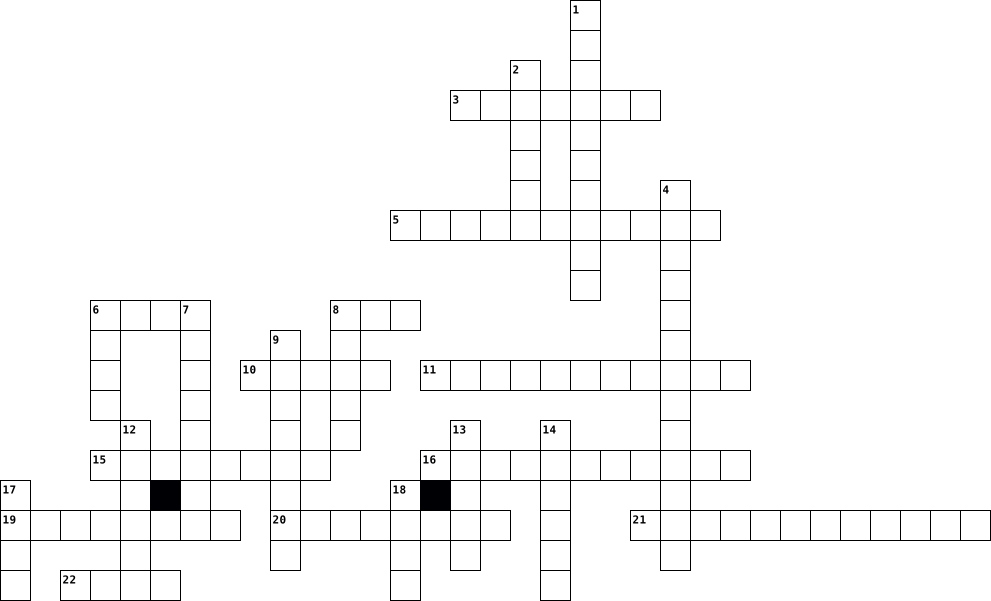
Across
- Type of low cloud that blankets the whole sky
- Air masses have similar humidity, pressure and ?
- Type of front with light rain followed by warm, humid air
- The temperature at which water condenses from air is ? point
- These type of skies are associated with high air pressure
- Step in water cycle where water gains energy/expands
- Temperature is influenced by season, latitude and ?
- Air mass that is dry from land
- Type of front associated with violent storms/tornadoes
- Air mass that is warm from the equator
- Step in water cycle where water loses energy/shrinks
- Clouds need water vapor, cold temperatures and ? to form
Down
- Type of front where warm and cold air are at standstill
- A type of local wind formed by daily convection cycle
- Evaporation from plants
- High air pressure mass next to low air pressure produces ?
- Air mass that is humid from the oceans
- Warm air rises because it is less ?
- Relative ? is how much water vapor air can hold
- As warm air rises and cools the water vapor in it forms ?
- Air mass that is cold from the poles
- Type of high wispy clouds made of ice
- This temperature of air holds less water vapor
- Wind always moves from ? pressure to low pressure
24 Clues: Evaporation from plants • Air mass that is dry from land • Warm air rises because it is less ? • Air mass that is cold from the poles • Type of high wispy clouds made of ice • Air mass that is humid from the oceans • Air mass that is warm from the equator • Type of low cloud that blankets the whole sky • This temperature of air holds less water vapor • ...
macromolecules 2024-09-26

Across
- natural alcohol
- The process that involves capturing heat from its surrounding
- involves the chemical reaction to release energy in the form of heat or light
- A network inside a cell in which proteins and molecules move
- sugar that can't be broken down into simpler sugar
- Vesicle within the cytoplasm of a cell
- When combined this acids form proteins
- This acid is important to cells and viruses
- Surrounds the plant cell
- this forms when two monosaccharides join
- sucrose
- minimum amount of energy required to activate atoms and molcules
Down
- The tail of a bacteria cell
- holds greatest amount of hydrogen atoms it can
- gel-like liquid that fills the inside of a cell
- having carbon double or triple bonds
- organic compounds insoluble in water
- Responsible for making proteins
- after biology process occurs
- helps process proteins that are destined to export the cell
- proteins that speed up metabolism
- such as eggs, nuts, or meat
- Enzymes bind with this
- polymeric carbohydrates
- Involved during photosynthesis
- separates the interior and the outside of a cell
- sugar molecules
- the building blocks of nucleic acids
- most important part of a cell
- What our body breaks food into during digestion
30 Clues: sucrose • natural alcohol • sugar molecules • Enzymes bind with this • polymeric carbohydrates • Surrounds the plant cell • The tail of a bacteria cell • such as eggs, nuts, or meat • after biology process occurs • most important part of a cell • Involved during photosynthesis • Responsible for making proteins • proteins that speed up metabolism • having carbon double or triple bonds • ...
Energy 2021-12-05

Across
- Force exerted on an object that causes it to move, change position or direction.
- Energy caused by an object's vibrations
- Energy in the form of moving waves, rays, or particles.
- Energy caused by the movement of electrons.
- The potential energy caused by a strong nuclear force.
- The potential energy of an object that is stretched or compressed.
- The energy stored in the chemical bonds of a substance.
- A natural resource of energy that can be replaced at the same rate at which the resource is consumed.
- The ability to do work or cause change.
Down
- Energy stored by objects due to their position above Earth's surface.
- The energy an object has due to its motion.
- Stored energy that results from the position, shape or composition of an object.
- Energy cannot be created or destroyed; it may be transformed from one form into another, but the total amount of energy never changes.
- Energy stored in the movement of objects. The faster they move, the more energy is stored.
- An energy resource that cannot be replaced.
- The range of wavelengths or frequencies over which electromagnetic radiation extends.
- The amount of work an object can do because of the object's kinetic and potential energies.
- Energy that comes from the movement of atoms or molecules.
18 Clues: Energy caused by an object's vibrations • The ability to do work or cause change. • The energy an object has due to its motion. • An energy resource that cannot be replaced. • Energy caused by the movement of electrons. • The potential energy caused by a strong nuclear force. • Energy in the form of moving waves, rays, or particles. • ...
Energy 2013-08-08

Across
- A light post uses:
- When energy transforms, the object remains the ____ but the energy changes to a different type.
- Finishing energy of a match that has been turned on apart from light.
- A vibrating drum is an example of which kind of energy.
- Energy of radiant objects such as fire.
- You can't ___ or ___ the amount of energy.
- Defined as the ability to work.
- In a light bulb, electrical energy changes to light energy. This is an example of an energy ___
- Example of kinetic energy.
Down
- A type of energy which starts with G.
- Where energy is obtained from.
- Energy cannot be destroyed or...
- A car moving is an example of...
- Energy does this constantly.
- Chemical pellets that heat liquids.
- The amount of the main type sof energy it's about...
- Example of elastic energy.
- Food, batteries, burning things, are an example of ___ energy.
18 Clues: A light post uses: • Example of elastic energy. • Example of kinetic energy. • Energy does this constantly. • Where energy is obtained from. • Defined as the ability to work. • Energy cannot be destroyed or... • A car moving is an example of... • Chemical pellets that heat liquids. • A type of energy which starts with G. • Energy of radiant objects such as fire. • ...
Energy 2015-05-07

Across
- Transfer of energy that occurs when a force makes an object move
- energy changing from one form to another
- energy form created by other forms of energy
- law that states that energy cannot be created or destroyed
- Energy stored by something that can stretch or compress
- SI unit of energy and work
- energy form, the energy of moving electrons
- Energy stored in chemical bonds
- The energy a moving object has because of its motion
Down
- energy form associated with the electomagnetic spectrum
- energy form ,the total kinetic energy of particles that make up an object
- Energy stored by objects due to their position above Earth's surface
- energy form, caused by an object's vibrations
- energy form that deals with the changes in the nucleus of an atom
- energy form, the energy that is required to bond particles of matter
- energy form, the sum of kinetic and potential energy
- A unit used by nutritionist to measure how much energy you get from various foods
- Stored energy due to position
- How much potential a physical system has to change
19 Clues: SI unit of energy and work • Stored energy due to position • Energy stored in chemical bonds • energy changing from one form to another • energy form created by other forms of energy • energy form, the energy of moving electrons • energy form, caused by an object's vibrations • How much potential a physical system has to change • ...
Energy 2017-09-27

Across
- The transfer of heat through the collision of atoms, by direct contact
- Energy transmitted through EM waves
- Energy stored energy due to position, shape or chemical makeup
- Characteristics of a substance that can be observed or measured without changing the identity of the substance.
- A material that transfers energy easily.
- The heat transfer through electromagnetic waves
- The kinetic energy of a substance's atoms; ________ energy
- The energy of motion
- The ability to do work and cause change
Down
- The change of state from liquid to a solid.
- Describes a substances ability to change into a new substance with different properties.
- Energy that travels as vibrations through a medium
- To change of state from a solid to a liquid.
- The change of state from a gas to a liquid.
- A measure of how hot (or cold) something is: specifically, a measure of the average kinetic energy of the particles in an object.
- Movement of electrons;_________ energy
- Material through which heat or electricity does not easily flow through
- The change of state from a liquid to a gas that occurs at a specific temperature.
18 Clues: The energy of motion • Energy transmitted through EM waves • Movement of electrons;_________ energy • The ability to do work and cause change • A material that transfers energy easily. • The change of state from liquid to a solid. • The change of state from a gas to a liquid. • To change of state from a solid to a liquid. • The heat transfer through electromagnetic waves • ...
Energy 2023-06-11

Across
- Energy store found in magnets
- The law of ____ of energy
- Energy resource that uses dams
- Energy resource that splits apart atoms
- Energy store found in hot objects
- Energy store found in moving objects
- Energy store found in stretched objects
- Energy resource made from plants
- Energy resource that happens once a day
Down
- Energy store found in atoms
- Energy store found in objects above the ground
- Energy store found in batteries and food
- Energy resource that can be used again
- Energy store that makes your hair stand up
- Energy resource that uses heat from the earth
- Energy resource that cannot be used again
- Black liquid dug out from the sea
- Solid, black substance dug out of the ground
- Energy resource that uses large white turbines
19 Clues: The law of ____ of energy • Energy store found in atoms • Energy store found in magnets • Energy resource that uses dams • Energy resource made from plants • Energy store found in hot objects • Black liquid dug out from the sea • Energy store found in moving objects • Energy resource that can be used again • Energy resource that splits apart atoms • ...
energy 2023-06-07

Across
- 효율
- 방사능을 가진
- 풍부한
- 바꾸다 변형시키다
- 부주의한
- 생성하다 발생시키다
- 원자핵의
- 댐
Down
- 공장
- 힘 에너지
- 광산
- 생산하다
- 풍차
- 소모하다
- 조수의
- 권한이 부여된
- 보전하다 아끼다
- 열 가열하다
18 Clues: 댐 • 공장 • 광산 • 풍차 • 효율 • 조수의 • 풍부한 • 생산하다 • 소모하다 • 부주의한 • 원자핵의 • 힘 에너지 • 열 가열하다 • 방사능을 가진 • 권한이 부여된 • 보전하다 아끼다 • 바꾸다 변형시키다 • 생성하다 발생시키다
Energy 2024-05-28

Across
- energy stored for later use
- Strength required for physical and mental activity
- Moving particles
- waves waves that come from an object you listen to stations on
- energy produced by the movement of air
- energy binding particles in the nucleus of an atom
- energy stored when an object is bent
- electric energy that is burnt
- energy from charged electrons in motion
Down
- chemical energy used to hold devices charge
- energy that comes from the sun
- thermal energy that is used to boil liquid
- energy of radio waves
- energy stored in an object because of its height
- energy stored as heat
- energy a body has due to this motion
- transferred by vibrating particles
- energy stored in foods of fuel
- elastic potential energy that is sometimes used the tie up your hair
- sound energy that is used to play music loudly
20 Clues: Moving particles • energy of radio waves • energy stored as heat • energy stored for later use • electric energy that is burnt • energy that comes from the sun • energy stored in foods of fuel • transferred by vibrating particles • energy a body has due to this motion • energy stored when an object is bent • energy produced by the movement of air • ...
Energy 2024-09-19

Across
- changing energy types
- combination of potential and kinetic energy
- its position changes relative to another object
- movement of energy to a different place
- energy stored in the nucleus
- the rate at which work is done
- energy due to compression or stretching
- energy found in the food you eat
- energy of electric charges
Down
- stored energy
- energy due to an object's height
- a unit used to measure energy
- energy of motion
- travels through space in waves
- a push or pull
- exerting a force and motion in the same direction
- the ability to do work
- heat energy
18 Clues: heat energy • stored energy • a push or pull • energy of motion • changing energy types • the ability to do work • energy of electric charges • energy stored in the nucleus • a unit used to measure energy • travels through space in waves • the rate at which work is done • energy due to an object's height • energy found in the food you eat • movement of energy to a different place • ...
ENERGY 2026-03-30

Across
- The air kind is caused by CO₂
- Energy that comes from heat stored beneath the Earth's crust
- It is also known as BLACK GOLD
- Energy possessed due to motion
- Clean energy but too dangerous
- Energy that comes from the Sun
- Element needed for nuclear energy
- A collection of wind turbines located in the same area
- Global warming cause (PLURAL)
Down
- Non-renewable energy sources formed over millions of years from the buried, decomposed remains of prehistoric plants and animals
- A renewable energy that generates electricity by using the kinetic energy of moving water to spin turbines and generators
- Stored energy an object or system possesses due to its position, arrangement, or state
- A renewable form of hydropower that converts the natural, predictable rise and fall of ocean tides
- A renewable energy source derived from organic materials like plants, wood, and waste
- A combustible black or brownish-black sedimentary rock
- The most commonly used natural gas
- Lightest and most abundant element
- You use them to convert sunlight directly into electricity
18 Clues: The air kind is caused by CO₂ • Global warming cause (PLURAL) • It is also known as BLACK GOLD • Energy possessed due to motion • Clean energy but too dangerous • Energy that comes from the Sun • Element needed for nuclear energy • The most commonly used natural gas • Lightest and most abundant element • A combustible black or brownish-black sedimentary rock • ...
Energy 2025-10-14

Across
- rate at which work is done or energy is used
- energy that travels in waves like light or heat
- energy of motion
- energy related to heat and particle motion
- when energy changes from one form to another
- transfer of heat through electromagnetic waves
- energy of moving parts or objects
- when a force moves an object a certain distance
- stored energy due to position or condition
Down
- force that slows motion and produces heat
- energy made by vibrations that travel through matter
- energy transferred between objects due to temperature difference
- – states that energy cannot be created or destroyed
- energy caused by moving electric charges
- energy stored in bonds of atoms and molecules
- transfer of heat through fluids (liquids or gases)
- ability to do work or cause change
- transfer of heat through direct contact
18 Clues: energy of motion • energy of moving parts or objects • ability to do work or cause change • transfer of heat through direct contact • energy caused by moving electric charges • force that slows motion and produces heat • energy related to heat and particle motion • stored energy due to position or condition • rate at which work is done or energy is used • ...
Chapter 8 2021-02-16

Across
- group of organs that work together to perform a specific function
- converts the chemical energy stored in food into compounds that are more convenient for the cell to use
- fundamental concept of biology that states that all living things are composed of cells.
- cell organelle that stores materials such as water salts proteins and carbohydrates
- pressure, pressure that must be applied to prevent osmotic movement across a selectively permeable membrane
- property of biological membranes that allows some substances to pass across it while others cannot
- unicellular organism that lacks a nucleus
- specialized structure that performs cellular functions within a eukaryotic cell
- organism whose cells contain a nucleus
- process by which particles tend to move from an area where they are more concentrated to an area where they are less concentrated
- group of tissues that work together to perform closely related functions
- strong, supporting layer around the cell membrane in some cells
- group of similar cells that perform a particular function
- diffusion of water through a selectively permeable membrane
Down
- the structure that contains the cell's genetic material in the form of DNA
- when the comparing two solutions, the solution with the greater concentration of solution
- when the concentration of two solutions is the same
- when comparing two solutions, the solution with the lesser concentrations of solution
- specific protein to whose shape fits that of a specific molecular messenger
- water channel protein in a cell
- flexible double-layered sheet that makes up the cell membrane and forms a barrier between the cell and its surroundings
- thin flexible barrier that surrounds all cells regulates what enters and leaves the cell
- process of diffusion in which molecules pass across the membrane through cell membrane channels
- gives the cell its shape and internal organization and is involved in movement.
- basic unit of all forms of life
- internal membrane system found in eukaryotic cells
- captures the energy from sunlight and converts it into chemical energy
- fluid portion of the cell outside the nucleus
- organelle in cells that modifies, sorts, and packages proteins and other materials for storage
- cell organelle that breaks down lipids carbohydrates and proteins into small molecules
- cell organelle consisting of RNA and proteins found throughout the cytoplasm in a cell
- relatively constant internal physical and chemical conditions that organisms maintain
32 Clues: water channel protein in a cell • basic unit of all forms of life • organism whose cells contain a nucleus • unicellular organism that lacks a nucleus • fluid portion of the cell outside the nucleus • internal membrane system found in eukaryotic cells • when the concentration of two solutions is the same • group of similar cells that perform a particular function • ...
Chapter 8 2021-02-16

Across
- process of diffusion in which molecules pass across the membrane through cell membrane channels
- the structure that contains the cell's genetic material in the form of DNA
- captures the energy from sunlight and converts it into chemical energy
- organelle in cells that modifies, sorts, and packages proteins and other materials for storage
- cell organelle that stores materials such as water salts proteins and carbohydrates
- specific protein to whose shape fits that of a specific molecular messenger
- property of biological membranes that allows some substances to pass across it while others cannot
- group of similar cells that perform a particular function
- fundamental concept of biology that states that all living things are composed of cells.
- relatively constant internal physical and chemical conditions that organisms maintain
- fluid portion of the cell outside the nucleus
- when comparing two solutions, the solution with the lesser concentrations of solution
- basic unit of all forms of life
- cell organelle that breaks down lipids carbohydrates and proteins into small molecules
- water channel protein in a cell
- specialized structure that performs cellular functions within a eukaryotic cell
- converts the chemical energy stored in food into compounds that are more convenient for the cell to use
Down
- process by which particles tend to move from an area where they are more concentrated to an area where they are less concentrated
- thin flexible barrier that surrounds all cells regulates what enters and leaves the cell
- gives the cell its shape and internal organization and is involved in movement.
- unicellular organism that lacks a nucleus
- group of organs that work together to perform a specific function
- group of tissues that work together to perform closely related functions
- organism whose cells contain a nucleus
- when the concentration of two solutions is the same
- internal membrane system found in eukaryotic cells
- pressure, pressure that must be applied to prevent osmotic movement across a selectively permeable membrane
- flexible double-layered sheet that makes up the cell membrane and forms a barrier between the cell and its surroundings
- when the comparing two solutions, the solution with the greater concentration of solution
- strong, supporting layer around the cell membrane in some cells
- cell organelle consisting of RNA and proteins found throughout the cytoplasm in a cell
- diffusion of water through a selectively permeable membrane
32 Clues: basic unit of all forms of life • water channel protein in a cell • organism whose cells contain a nucleus • unicellular organism that lacks a nucleus • fluid portion of the cell outside the nucleus • internal membrane system found in eukaryotic cells • when the concentration of two solutions is the same • group of similar cells that perform a particular function • ...
Electricity 2026-02-06

Across
- this lets electricity flow through
- makes up electricity
- can be changed into other forms
- a light bulb uses this energy
Down
- a toaster uses this energy
- metal is what this is
- a circuit that is not complete
- does not allow electricity to flow through
8 Clues: makes up electricity • metal is what this is • a toaster uses this energy • a light bulb uses this energy • a circuit that is not complete • can be changed into other forms • this lets electricity flow through • does not allow electricity to flow through
Waves 2019-05-06

Across
- the number of waves produced in a given amount of time
- type of wave that has compression
- type of interference that occurs when two crests meet
- parts of a standing wave that does not move
- wave that forms from a stationary pattern in which positions of the wave are at rest positing
- lowest part of the wave
- waves travel _____________ not matter
- how high above the equilibrium a point moves
- distance between two adjacent crests
- type of interference that occurs when two troughs meet
Down
- result of waves overlapping
- parts of a standing wave that moves a lot
- the highest part of the wave
- oscillations perpendicular to the direction
- something a wave travels through
- measurement of frequency
- greek letter that represents wavelengths
17 Clues: lowest part of the wave • measurement of frequency • result of waves overlapping • the highest part of the wave • something a wave travels through • type of wave that has compression • distance between two adjacent crests • waves travel _____________ not matter • greek letter that represents wavelengths • parts of a standing wave that moves a lot • ...
P.E. CROSSWORD 2021-12-02

Across
- exercise, activity that breaks down glucose for energy without using oxygen.
- energy System, It provides energy for low intensity activities that last anywhere from two minutes to a few hours.activity that lasts from ten seconds to two minutes.
- Lactic, provides energy for medium to high intensity
- An uplifted regal type of posture.
- Rome, gave less importance to dancing as the nation grew wealthy and powerful.
- how fast or slow the movements, steady beat, fast or slow.
- It is the smallest unit of form in the whole dance.
- A Lactic, does not create energy for sufficient duration to create a great deal of waste products.
- How large or small movements. The relationship of one movement to another.
- every section of the dance ( beginning, middle, and end ) use different tempos and qualities.
- The opposite of suspended, body falls back on itself.
- Influences, A cultural group provides guidelines regarding acceptable foods, food combinations, eating patterns, and eating behaviors.
- Movements that the body can do and still stay in one place.
- The entertainers now became valuable appendage to the courts of Italy and France.
- FORM, They tell story through connected and progressive sections called episodes.
Down
- refers to acceptable behaviors.
- FORM, combination of different movements, several themes are woven together in choreography to form a complex structure.
- patterns we make as we move across the floor: straight, curved.
- Strong pulses for precise moves.
- How the body uses energy while moving.
- form, Most popular song use this form.
- Influences, Political factors also influence food availability and trends.
- FORM, – these forms contain themes/motif which progress in a specific order.
- Bass, This form is best done in a group working either in contrast to each other or against soloist.
- Movements that take the body from one point to another.
- they used dance to aid education in general as philosophers such as Plato, Aristotle, and Socrates strongly supported this art as an integration of the body and soul.
- consist of a small amount of food or beverage eaten between meals.
27 Clues: refers to acceptable behaviors. • Strong pulses for precise moves. • An uplifted regal type of posture. • How the body uses energy while moving. • form, Most popular song use this form. • It is the smallest unit of form in the whole dance. • Lactic, provides energy for medium to high intensity • The opposite of suspended, body falls back on itself. • ...
P.E. CROSSWORD 2021-12-02

Across
- exercise, activity that breaks down glucose for energy without using oxygen.
- energy System, It provides energy for low intensity activities that last anywhere from two minutes to a few hours.activity that lasts from ten seconds to two minutes.
- Lactic, provides energy for medium to high intensity
- An uplifted regal type of posture.
- Rome, gave less importance to dancing as the nation grew wealthy and powerful.
- how fast or slow the movements, steady beat, fast or slow.
- It is the smallest unit of form in the whole dance.
- A Lactic, does not create energy for sufficient duration to create a great deal of waste products.
- How large or small movements. The relationship of one movement to another.
- every section of the dance ( beginning, middle, and end ) use different tempos and qualities.
- The opposite of suspended, body falls back on itself.
- Influences, A cultural group provides guidelines regarding acceptable foods, food combinations, eating patterns, and eating behaviors.
- Movements that the body can do and still stay in one place.
- The entertainers now became valuable appendage to the courts of Italy and France.
- FORM, They tell story through connected and progressive sections called episodes.
Down
- refers to acceptable behaviors.
- FORM, combination of different movements, several themes are woven together in choreography to form a complex structure.
- patterns we make as we move across the floor: straight, curved.
- Strong pulses for precise moves.
- How the body uses energy while moving.
- form, Most popular song use this form.
- Influences, Political factors also influence food availability and trends.
- FORM, – these forms contain themes/motif which progress in a specific order.
- Bass, This form is best done in a group working either in contrast to each other or against soloist.
- Movements that take the body from one point to another.
- they used dance to aid education in general as philosophers such as Plato, Aristotle, and Socrates strongly supported this art as an integration of the body and soul.
- consist of a small amount of food or beverage eaten between meals.
27 Clues: refers to acceptable behaviors. • Strong pulses for precise moves. • An uplifted regal type of posture. • How the body uses energy while moving. • form, Most popular song use this form. • It is the smallest unit of form in the whole dance. • Lactic, provides energy for medium to high intensity • The opposite of suspended, body falls back on itself. • ...
P.E. CROSSWORDS 2021-12-02

Across
- exercise, activity that breaks down glucose for energy without using oxygen.
- energy System, It provides energy for low intensity activities that last anywhere from two minutes to a few hours.activity that lasts from ten seconds to two minutes.
- Lactic, provides energy for medium to high intensity
- An uplifted regal type of posture.
- Rome, gave less importance to dancing as the nation grew wealthy and powerful.
- how fast or slow the movements, steady beat, fast or slow.
- It is the smallest unit of form in the whole dance.
- A Lactic, does not create energy for sufficient duration to create a great deal of waste products.
- How large or small movements. The relationship of one movement to another.
- every section of the dance ( beginning, middle, and end ) use different tempos and qualities.
- The opposite of suspended, body falls back on itself.
- Influences, A cultural group provides guidelines regarding acceptable foods, food combinations, eating patterns, and eating behaviors.
- Movements that the body can do and still stay in one place.
- The entertainers now became valuable appendage to the courts of Italy and France.
- FORM, They tell story through connected and progressive sections called episodes.
Down
- refers to acceptable behaviors.
- FORM, combination of different movements, several themes are woven together in choreography to form a complex structure.
- patterns we make as we move across the floor: straight, curved.
- Strong pulses for precise moves.
- How the body uses energy while moving.
- form, Most popular song use this form.
- Influences, Political factors also influence food availability and trends.
- FORM, – these forms contain themes/motif which progress in a specific order.
- Bass, This form is best done in a group working either in contrast to each other or against soloist.
- Movements that take the body from one point to another.
- they used dance to aid education in general as philosophers such as Plato, Aristotle, and Socrates strongly supported this art as an integration of the body and soul.
- consist of a small amount of food or beverage eaten between meals.
27 Clues: refers to acceptable behaviors. • Strong pulses for precise moves. • An uplifted regal type of posture. • How the body uses energy while moving. • form, Most popular song use this form. • It is the smallest unit of form in the whole dance. • Lactic, provides energy for medium to high intensity • The opposite of suspended, body falls back on itself. • ...
Energy Types and Transformations 2023-12-13

Across
- All types of energy originate from the ___ Hint: What shines from Earth?
- What thing can start as chemical energy, but then transform into radiant, thermal, and sound energy Hint: It can burn you
- If you have less of this energy, it gets cold. If you have more, it gets hot. Hint: Starts with T
- Energy of moving electrons Hint: Light
- The change of energy from one form to another Hint: 2 words
- What energy type is used in an atomic bomb? Hint: Starts with N
- Energy at its lowest point is called __________ Hint: It is moving or has moved
- What type of energy is in a traffic light Hint: starts with an R
- Food has what type of energy in it? Hint: Starts with C
- Energy cannot be created or destroyed Hint: 5 words
- The energy from vibrations in matter Hint When I speak I make a ____
Down
- The energy of heat Hint: Hot
- Energy that is stored in the bonds of molecules Hint: A battery has this type of energy
- Energy at its highest point is called _____________ Hint: It is building up at the highest point
- Has two different types of energy, but both are locked in the nucleus of an atom Hint: ____ bomb
- Energy is measured in units called ______ Hint: start with a J
- The energy of motion and position Hint: It starts with a M
- Energy of light or electromagnetic energy Hint: _____ beam
- When you're able to cause change Hint: Mechanical ______
- What form of energy is produced by a musical instrument? Hint: Mucis makes a _____
20 Clues: The energy of heat Hint: Hot • Energy of moving electrons Hint: Light • Energy cannot be created or destroyed Hint: 5 words • Food has what type of energy in it? Hint: Starts with C • When you're able to cause change Hint: Mechanical ______ • The energy of motion and position Hint: It starts with a M • Energy of light or electromagnetic energy Hint: _____ beam • ...
plant cell organelles 2022-11-17

Across
- control center of the cell
- a jellylike fluid inside the cell in which the organelles are suspended
- wall. a structural layer surrounding some types of cells
- apparatus. a system of membranes that modified and packages proteins for export by the cell
- reticulum a cell structure that forms a maze of passageways in which proteins and other materials are carried from one part of the cell to the other
- microscopic channels which traverse the cell walls of plant cells
Down
- an organelle containing digestive enzymes
- plant cell organelles that convent light energy into relatively stable chemical energy via photosynthetic
- cytoplasmic organelles at which proteins are synthesized
- cell organelle that stores materials such as water, salts, proteins and carbohydrates
- powerhouse of the cell
11 Clues: powerhouse of the cell • control center of the cell • an organelle containing digestive enzymes • wall. a structural layer surrounding some types of cells • cytoplasmic organelles at which proteins are synthesized • microscopic channels which traverse the cell walls of plant cells • a jellylike fluid inside the cell in which the organelles are suspended • ...
Unit 6 Vocab 2024-04-16

Across
- a process of petroleum refining, in which a chemical mixture is separated into its other components
- an energy source gathered by individuals for their own immediate needs (sticks, straw, etc)
- an array of flat, movable mirrors
- the increase in the temperature of a body of water
- a form of cellular respiration in which decomposers get their energy from the breakdown of glucose
- the splitting of an atomic nucleus into two smaller fragments
- the spontaneous release of material from the nucleus of radioactive isotopes
- electrical cells that allow the light energy of the sun to be converted into electricity
- a relatively soft coal containing a tar-like substance called bitumen
- a gooey, black, high-sulfur, heavy oil extracted from tar sand then upgraded to synthetic fuel oil
- a type of organic matter that is formed over thousands of years from the partial decomposition of plants
- a soft, brownish-black form of coal that has more carbon than peat, but less carbon than bituminous coal
- a dramatic change in water temperature that can kill organisms
- the amount of solar radiation reaching an area (measured in Watts/sq meter)
Down
- chemicals that cause or promote cancer
- a form of natural gas (mostly methane) found underground in shale rock
- used to store the waste made from separating minerals from rocks
- the production of two useful forms of energy, from the same fuel source
- tax breaks and payments given to companies that work to be more environmentally friendly
- a thick and gooey liquid consisting of hundreds of different combustible hydrocarbons
- any of various volatile, highly flammable liquid hydrocarbon mixtures
- a dense shiny coal that has high carbon content and little volatile matter that burns with a clean flame
- an organic material that can be used as an energy source
- organic compounds made up of hydrogen and carbon atoms
- the procedure of creating fractures in rocks by injecting fluid into cracks to force them open
- Corporate Average Fuel Economy: standards that regulate how far our vehicles must travel on 1 gallon of fuel
- used to describe energy sources that are non-depletable, but are not always available 24/7
- Volatile Organic Compounds: emitted as gases from certain solids or liquids
- fuels such as ethanol or methanol, that are created from the fermentation of plants
- a process in which an electrical current is passed through a compound to release ions
30 Clues: an array of flat, movable mirrors • chemicals that cause or promote cancer • the increase in the temperature of a body of water • organic compounds made up of hydrogen and carbon atoms • an organic material that can be used as an energy source • the splitting of an atomic nucleus into two smaller fragments • ...
Physics Senior Review 2022 2022-05-19

Across
- What kind of forces convert mechanical energy into different forms?
- As the number of branches in a parallel circuit increase, the resistance of the circuit ¬¬-_____
- ____ due to gravity is 9.8m/s^2
- In what shape do the planets orbit around the sun?
- The change in kinetic energy is ____ to the work done on an object
- Rate at which charge moves through a material (I)
- What will impact the amount of air resistance?
- Fossil fuels are considered _______ energy
- Which of Newton’s laws state that an object in motion stays in motion unless acted upon by an outside force?
- Name an example of a conservative force
- The shape of the path of the projectile in projectile motion
- What is the unit of resistance?
- ____ velocity occurs when the force of gravity is equal to the force of air resistance
- Work causes a ¬¬¬¬_____ in energy
- What is one way to generate thermal energy?
- What energy source is best for the environment?
- What variable represents the static coefficient of friction?
- What is free fall, but generally with a horizontal component? (two words)
- In the gravity formula, how does the force change if one of the masses doubles?
- What angle is best for an object to reach the greatest maximum height? (two words)
Down
- What is the charge of an electron?
- ____ force is the inward force required to keep an object moving in a circular path
- Motion in which the only force is the force of gravity
- This kind of friction occurs when objects are in contact and have relative motion (sliding)
- What does one use to move from position to velocity in a velocity-time graph?
- What variable connects the x and y directions in projectile motion?
- Displacement is never larger than _______
- When a magnetic material is close to a magnet, it becomes a magnet itself (two words)
- In a(n) ________ current, the direction of the particles moves back and forth
- at maximum height velocity is ________
- What does the variable k represent? (two words)
- Opposite charges ¬¬¬¬_____
- What kind of circuit breaks into separate pathways for each device?
- What is a quantity with a magnitude and direction?
- Is static or kinetic friction stronger?
- _____ is when a current is placed in a magnetic field, experiencing a force (two words)
- What is the unit of power?
- True or false: different voltage is applied at each device in a parallel circuit
- True or false: the resistance in a series circuit is equal to the sum of the resistance of each device
- Change in energy or work, divided by time
- Normal force is ______ to the surface
- In most situations, ¬¬¬¬_______ cannot be created or destroyed
- In what direction does the direction of a magnetic field point?
43 Clues: Opposite charges ¬¬¬¬_____ • What is the unit of power? • ____ due to gravity is 9.8m/s^2 • What is the unit of resistance? • Work causes a ¬¬¬¬_____ in energy • What is the charge of an electron? • Normal force is ______ to the surface • at maximum height velocity is ________ • Is static or kinetic friction stronger? • Name an example of a conservative force • ...
Work, Circuits, and Energy Transfers crossword puzzle 2016-02-22

Across
- Push or pull
- subatomic particle
- Any movement or change in postion
- object or type of material that allow the flow of electrical current
- Caused by moving electrical charges
- Energy released to make electricity
- Released energy (movement)
- Force applied to an object that moves the object in the same direction as the force
- Comes from heat
- Is a visible light in the electromagnetic
Down
- course along which someone or something moves.
- Stored energy
- Energy in bonds of chemical compounds
- electric force that causes free electrons to move from one atom to another
- Changing one form of energy to another
- combination of both voltage and current
- Is vibrations of matter
- operating by or producing electricity
- flow of electric charge
- the movement of charges
20 Clues: Push or pull • Stored energy • Comes from heat • subatomic particle • Is vibrations of matter • flow of electric charge • the movement of charges • Released energy (movement) • Any movement or change in postion • Caused by moving electrical charges • Energy released to make electricity • Energy in bonds of chemical compounds • operating by or producing electricity • ...
Anatomy Chapter 6 2022-02-24

Across
- Rounded passageway for blood vessels and/or nerves
- a shallow depression
- A meshwork of supporting bundles of fibers, oriented along stress lines and is crossed braced.
- Curved joint surfaces
- Bone is 2/3_____phosphate
- Region of a long bone between the end and the shaft
- The head of a long bone (Articulation, have joint surfaces)
- A cell that produces the fibers and matrix of the bone
- Part of a bone that forms an angle with the rest of the structure
- Bone marrow that stores fats as an energy reserve
- Large with a rough projection
- Projection or bump
- Bone marrow that forms red blood cells.
- The shaft of the long bone
Down
- Dense bone that contains parallel osteon
- Bones that are box-like in appearance, ex. Carpal bones and Tarsal bones
- A cell that dissolves the fibers and matrix of the bone.
- Mature bone cells.
- The breakdown of the mineral matrix of bone
- Microscopic passageways between cells, permits diffusion of nutrients and wastes
- Bone that is small, round and flat, found near joints of the knee and feet.
- a narrow groove
- Bones that are small, flat, irregular shaped, in between the flat bones of the skull
- Bone that consists of an open network of struts and plates
- Bones that are long and slender have a shaft with two ends that are wider than the shaft, ex. humerus
25 Clues: a narrow groove • Mature bone cells. • Projection or bump • a shallow depression • Curved joint surfaces • Bone is 2/3_____phosphate • The shaft of the long bone • Large with a rough projection • Bone marrow that forms red blood cells. • Dense bone that contains parallel osteon • The breakdown of the mineral matrix of bone • Bone marrow that stores fats as an energy reserve • ...
Puzzle 2023-07-17

Across
- The transfer of heat by electromagnetic waves
- The potential difference in charge between two points in an electrical field (V=IR)
- The ratio of the distance traveled by an object to the time required
- The transfer of heat by direct contact
- energy The stored energy in an object that depends on weight and height
- energy The energy of motion
- Heat The quantity of heat needed to increase the temperature per unit mass
- How far out of place an object is
- energy Energy that is released from the nucleus
Down
- energy Energy that is caused by an object's vibrations
- energy Energy that is created by electromagnetic waves
- Energy that comes from a source and travel through space by electromagnetic waves
- energy, Energy that is carried by an electrical current
- energy Energy of motion that depends on speed and mass
- The length of the total movement taken by an object
- energy Energy that is stored in chemical bonds
- The change in direction of a wave passing from one medium to another
- Circuits A single pathway through which electricity can flow
- energy Energy that travels in waves at the speed of light
- speed of sound Speed at which sound waves propagates through different mediums
- energy Energy that is created in the movement of atoms that produces heat.
21 Clues: energy The energy of motion • How far out of place an object is • The transfer of heat by direct contact • The transfer of heat by electromagnetic waves • energy Energy that is stored in chemical bonds • energy Energy that is released from the nucleus • The length of the total movement taken by an object • energy Energy that is caused by an object's vibrations • ...
GLOBAL SYSTEMS 2014-03-29

Across
- Nonreactive gas that forms about 78% of the earth's atmosphere.
- Form of light we cannot see but can feel as heat.
- Circulation in the Pacific which depends upon conjoint effect of temperature and salinity.
- Outer part of earth, consists of crust and upper mantle.
- Layer of ice covering extensive tract of land for a long period of time.
- The trapping of the sun's warmth.
- Period of milder climate between two glacial periods.
- Effects the global climate, warm water in the pacific.
- Colorless, odorless, flammable chemical compound found throughout the earth.
- Our living world.
- All the waters on the earths surface.
Down
- The state of the atmosphere at a given time and place with regards to temperature, moisture, wind velocity.
- The changing of water vapor back into liquid state and forming clouds by using cold temperatures.
- Plants and other organisms convert the suns light to energy.
- A measure of the average temperature, humidity, wind, precipitation and meteorological patterns.
- Gases and other particles released into the atmosphere by burning fuels.
- The clearing of natural trees in forest areas.
- A substance that can be replaced and is of economic value.
- Naturally occurring chemical compound.
- Natural fuel formed millions of years ago from the remains of living organisms e.g coal
- A layer of gases surrounding the Earth
- Parts of the radio spectrum with relatively long wavelengths.
- A energy type derived from renewable plant and animal materials.
- All the living organisms existing together in a particular area .
- Energy that comes from a source which is able to penetrate various materials e.g light, radio microwaves.
- Soil that remains bellow the freezing point of water for two or more years.
26 Clues: Our living world. • The trapping of the sun's warmth. • All the waters on the earths surface. • Naturally occurring chemical compound. • A layer of gases surrounding the Earth • The clearing of natural trees in forest areas. • Form of light we cannot see but can feel as heat. • Period of milder climate between two glacial periods. • ...
crossword 2023-04-11

Across
- force The "unless acted upon by a net force" version is more correct
- energy Heat Energy is the flow of thermal energy between two objects of different temperature whereas the thermal energy
- is the unit of energy in the International System of Units
- of conservation of energy energy conservation is an effort to reduce the amount of energy consumed
- is defined as the rate at which the energy is transferred
- energy electrical energy represents the amount of work done that causes electric current to flow through a circuit.
- velocity is the rate and direction of an object's movement
- energy The main difference is in their wavelength, or the frequency of the waves they produce.
- potential energy energy that is stored in an object or substance.
- Speed is the time rate at which an object is moving along a path
- heat transfer occurs between objects by direct contact
- Work is the transferring of an amount of energy with the help of a force covering a particular distance in a direction
- energy Rotational kinetic energy is created by moving objects, while transnational kinetic energy is caused by objects colliding with one another.
Down
- energy The potential difference between points A and B
- potential energy Gravitational potential energy is energy in an object that is held in a vertical position.
- Energy is what makes change happen and can be transferred form one object to another
- energy Mechanical conversion depends on the amount of potential energy an object has and how much kinetic energy it can produce.
- is the rate of change of velocity
- is the push and pulls action and it results in the change of motion and direction.
- ovens feature heating elements on the top and bottom of the oven cavity.
- Static friction is the friction present between two objects that have no relative motion
- zero the lowest temperature possible
- Newton's Divided Difference Formula
- There are four major types of radiation: alpha, beta, neutrons, and electromagnetic waves such as gamma rays.
- we just subtract the smaller value from the larger one
- energy energy stored in the bonds of atoms and molecules.
- energy Nuclear energy originates from the splitting of uranium atoms – a process called fission.
- To calculate the weight difference, subtract the current weight from the initial weight.
28 Clues: is the rate of change of velocity • Newton's Divided Difference Formula • zero the lowest temperature possible • energy The potential difference between points A and B • we just subtract the smaller value from the larger one • heat transfer occurs between objects by direct contact • is defined as the rate at which the energy is transferred • ...
Biomolecules-Proteins Carla Pazmiño 2021-06-01

Across
- Connection that joing
- Biomolecules that provide the body with quick energy
- Large Biomolecules that build and repair tissues
- The gas that we need to survive (life-supporting)
- Protein used by the immune system
- Molecules that are found in living organisms
Down
- Substance, acts as a catalyst, in living
- Monomer of a protein
- Organization of the parts of a system
- Living thing (has an organized structure)
- A gas that forms most of the earth's atmospher
11 Clues: Monomer of a protein • Connection that joing • Protein used by the immune system • Organization of the parts of a system • Substance, acts as a catalyst, in living • Living thing (has an organized structure) • Molecules that are found in living organisms • A gas that forms most of the earth's atmospher • Large Biomolecules that build and repair tissues • ...
Vocabulary Extension ch 13 2022-02-28

Across
- Produced by advancing fronts
- Extended period of above-average temperatures
- Stored energy in water vapor that is not released to warm the atmosphere until condensation occurs
- Violent downdrafts concentrated in a local area
- Large body of air that takes on the characteristics of the area over which it forms
- Estimates and measures how cold the air feels on the human body
- Extended period of well-below-average rainfall
- When air rises due to unequal heating of the Earth’s surface within an air mass
- Extended period of below-average temperatures
Down
- Assigns a tornado a 'rating' based on estimated wind speeds and related damage
- Channel of partially charged air
- Local air mass thunderstorms that occur because land and water storage and release thermal energy differently
- Occurs when air rises from orographic lifting which involves air moving up a mountain
- Self-sustaining, extremely powerful storms
- Branched channel of positively charged particles
- Violent whirling column of air in contact with the ground
16 Clues: Produced by advancing fronts • Channel of partially charged air • Self-sustaining, extremely powerful storms • Extended period of above-average temperatures • Extended period of below-average temperatures • Extended period of well-below-average rainfall • Violent downdrafts concentrated in a local area • Branched channel of positively charged particles • ...
Informatics (jair) 2024-05-30

Across
- is a wireless networking technology that uses radio waves to provide wireless high-speed Internet access.
- ESTINGUISHER small coloured band indicates the type of fire extinguisher – red for water, white and red for water mist,
- is a common computing acronym that stands for random-access memory.
- allows devices to communicate with each other without cables or wires.
- is an input device that allows a person to enter letters, numbers, and other symbols
- is an input device that allows a person to enter letters, numbers, and other symbols
- is the act of turning out; production: the factory's output of cars; artistic output. the quantity or amount produced, as in a given time: to increase one's daily output. the material produced or yield; product.
- Unshielded twisted pair.
Down
- is an electrical component that limits or regulates the flow of electrical current in an electronic circuit
- refers to the external and internal devices and equipment that enable you to perform major functions such as input, output, storage, communication, processing, and more.
- stands for High-Definition Multimedia Interface
- information fed into a data processing system or computer. c. : power or energy put into a machine or system for storage, conversion in kind, or conversion of characteristics usually with the intent of sizable recovery in the form of output. d. : an amount put in.
- is a set of instructions, data or programs used to operate computers and execute specific tasks.
- is the flow of electrical power or charge. Electricity is both a basic part of nature and one of the most widely used forms of energy.
- refers to the nominal conditions in the atmosphere at sea level
- universal serial bus.
- solid-state drive, is a type of storage device used in computers.
- is a device that stores chemical energy and converts it to electrical energy
18 Clues: universal serial bus. • Unshielded twisted pair. • stands for High-Definition Multimedia Interface • refers to the nominal conditions in the atmosphere at sea level • solid-state drive, is a type of storage device used in computers. • is a common computing acronym that stands for random-access memory. • ...
Chapter 2 Crossword 2015-03-03

Across
- Having a relatively low concentration of hydrogen ions or having a pH greater than 7
- In an atom, the core of protons and neutrons; in a eukaryotic cell, the organelle that contains most of the DNA and directs most of the cell's activities
- A chemical structure composed of one or more atoms
- Amount of energy required for a chemical reaction to start and to continue on its own
- The volume and shape of a substance which is determined by the rate at which the atoms or molecules of the substance move
- The process of breaking chemical bonds, forming new bonds, or both
- A fundamental property of an object generally regarded as equivalent to the amount of matter in the object
Down
- Any substance that increases the concentration of hydroxide ions when added to a water solution
- A reaction that involves a net absorption of free energy
- A numeric range that quantifies the relative concentrations of hydronium ions and hydroxide ions in a solution
- A measurement of the amount of solute dissolved in a fixed amount of solvent
- A bond that forms when two atoms share one or more pairs of electrons
- A reduction-oxidation reaction in which electrons are transferred between atoms
- A catalyst, usually a protein, in living systems
- The energy in a system available for work
- An ion consisting of a protonated water molecule and present in all aqueous acids
- A compound formed by a chemical reaction
- A substance that ordinarily cannot be broken down chemically to form simpler kinds of matter
- An atom or a compound with a net electrical charge
- The number of protons in an atom
20 Clues: The number of protons in an atom • A compound formed by a chemical reaction • The energy in a system available for work • A catalyst, usually a protein, in living systems • A chemical structure composed of one or more atoms • An atom or a compound with a net electrical charge • A reaction that involves a net absorption of free energy • ...
Engineering 2024-01-19

Across
- The branch of science that deals with the fundamental principles of the universe, including matter, energy, motion, and force.
- An instrument for measuring the speed and direction of the wind.
- The application of scientific principles and mathematical methods to design, construct, and operate structures, machines, systems, and processes.
- The resistance encountered when one object rubs against another, slowing down motion.
- Stored energy that an object possesses due to its position, condition, or composition.
- The capacity to do work or produce heat; exist in various forms such as kinetic, potential, thermal, etc.
- Metric unit of mass.
- The rate at which an object changes its velocity over time.
- A systematic procedure carried out to verify, refute, or establish the validity of a hypothesis.
- A unit of time, equal to one sixtieth of a minute.
- A dimension in which events occur in sequence, measured in seconds.
- The product of an object's mass and velocity, indicating its motion and quantity of motion.
Down
- A proportion or ratio expressed as a fraction of 100.
- Relating to motion.
- The speed of an object in a specific direction.
- The force of attraction between masses.
- The change in momentum of an object.
- The natural movement of air, often harnessed for power or studied in meteorology.
- The tendency of an object to resist changes in its motion or state of rest.
- A push or pull exerted on an object.
- A detailed plan or design, typically architectural or engineering, representing the features of a structure or device.
- The amount of matter in an object, measured in kilograms.
- Unit of force in the International System of Units (SI).
23 Clues: Relating to motion. • Metric unit of mass. • The change in momentum of an object. • A push or pull exerted on an object. • The force of attraction between masses. • The speed of an object in a specific direction. • A unit of time, equal to one sixtieth of a minute. • A proportion or ratio expressed as a fraction of 100. • ...
Chemistry of life 2022-10-21

Across
- The form of carbohydrate storage in animals.
- diffusion of water molecules across a selectively permeable membrane.
- basic structural units of nucleic acid. Each unit is composed of a five-carbon sugar, a phosphate, and a nitrogenous base.
- synthesis- A series of chemical reactions that allow two molecules to bond by the formation of a water molecule.
- that use energy, usually light, to synthesize their own food from inorganic compounds.
- process by which an mRNA molecule is built using the sequence of nucleotides in DNA as a template.
- Consists of nutrients made up of a single sugar molecule. Contains only carbon, hydrogen, and oxygen.
- large carbohydrate molecule used by plants to store energy.A large carbohydrate molecule used by plants to store energy.
- lipid composed of glycerol and three fatty acids which are bonded together.
- transport- The movement of materials across a cell membrane without the use of energy from the cell.
Down
- molecules that are made by joining several separate units, such as joining several sugar units to form a starch molecule.
- lipid vesicles.
- form of endocytosis in which solid particles are engulfed by cells.
- carbohydrates that forms the cell walls of plant cells.
- loss of electrons from an atom or molecule.
- three-carbon chain molecule containing three hydroxyl groups.
- movement of molecules from an area of higher concentration to an area of lower concentration.
- main components of cell membranes. They are composed of a phosphate group and two fatty acids attached to the glycerol backbone.
- acids- Long chains of carbon and hydrogen joined together.
- raw materials needed for cell metabolism.
20 Clues: lipid vesicles. • raw materials needed for cell metabolism. • loss of electrons from an atom or molecule. • The form of carbohydrate storage in animals. • carbohydrates that forms the cell walls of plant cells. • acids- Long chains of carbon and hydrogen joined together. • three-carbon chain molecule containing three hydroxyl groups. • ...
Crossword From, Dom 2017-02-06

Across
- A huge hole that is left behind after a volcano collapses.
- of the Muses A place where many examples of the arts and
- layers.
- A significant Egyptian city that was a center of learning.
- An igneous rock layer that forms when magma hardens beneath
- A military machine that threw stones at enemy forces and
- A slab of volcanic rock that forms when magma forces itself across
- surface.
Down
- the crust.
- were stored.
- A culture that combined Greek, Persian, Egyptian, and Indian
- of rock.
- the Great The ruler of a large empire that stretched through
- A mass of rock that forms when a large body of magma cools
- Asia.
- A slab of volcanic rock that forms when magma squeezes between
16 Clues: Asia. • layers. • of rock. • surface. • the crust. • were stored. • of the Muses A place where many examples of the arts and • A military machine that threw stones at enemy forces and • A huge hole that is left behind after a volcano collapses. • A mass of rock that forms when a large body of magma cools • A significant Egyptian city that was a center of learning. • ...
vocabulary :) 2024-01-29

Across
- In plant cells only, they are organelles that produce food. Chlorophyll is a green pigment that makes plants look green and also uses energy from the sun to change water and carbon dioxide into glucose, a simple sugar.
- Plants, algae, fungi and some bacteria have an extra computer layer that is very rigid and tough
- A small structure found inside the nucleus that makes ribosomes and transports them to the cytoplasm.
- This transport requires energy to move a substance into and out of a cell. A transport protein called AdenosineTriphosphate (ATP) binds with the molecule and transports it into the cell using the cell’s energy. (When a molecule moves against its concentration gradient, energy is required.))
- Organelle that contains digestive chemicals that break down food, cell waste, and foreign particles that enter the cell
- Transport proteins on the cell’s membrane transport substances into and out of the cell without energy.
- The movement of things in and out of the cell without the use of energy.
- The cell’s transport organelle, processing and moving materials throughout the cell.
- Protein-making factories in a cell.
- all organisms are made of cell(one or more)
- A protective double membrane surrounding the nucleus that controls the flow of materials in and out of the nucleus.
- Organisms that exist that are composed of a single cell (bacteria, yeast, protozoa, and diatoms).
- the part of a cell that process release energy
Down
- Very simple, single-celled bacteria that do not have a membrane-bound nucleus, mitochondria, or organelles.
- The cell’s powerhouse, releasing energy in food by carrying out a reaction with oxygen.
- Much more complex types of cells (containing a membrane-bound nucleus, mitochondria, and organelles) found in protists, fungi, animals and plants.
- Moving things inside and outside of the cell membrane.
- the basic structure and functional unit of all forms of life
- The movement of molecules from an area of high to low concentration.
- The cell’s “control center”, housing the cell’s chromosomes.
- The cell’s packaging, sorting, and distributing organelle. They sort proteins from the Endoplasmic Reticulum and then distribute them to where they need to go.
- Temporary storage bubbles for the cell, storing food, water, or waste.
- in every cell, there is a layer on the oCellwall plantsell that holds the cell together
- Jelly-like substance in the cell containing all the organelles in the cell
- Cells found in animals.
- A type of diffusion; it is simply the process of water molecules from a higher to a lower concentration through a membrane.
- Organism that is composed of many cells, and many different types of cells that perform different tasks throughout the organism.
- Cells found in plants (with a cell wall, chloroplasts, and a large, central vacuole for storage that takes up a lot of space).
28 Clues: Cells found in animals. • Protein-making factories in a cell. • all organisms are made of cell(one or more) • the part of a cell that process release energy • Moving things inside and outside of the cell membrane. • the basic structure and functional unit of all forms of life • The cell’s “control center”, housing the cell’s chromosomes. • ...
Cell Energy Cycle 2019-08-15

Across
- with the use of oxygen
- a product of cellular respiration, a reactant in photosynthesis
- The process where animals produce carbon dioxide and water
- an energy source for the cell
- when glucose is broken into two pyruvate molecules
Down
- with the absence of oxygen
- the powerhouse of the cell, where cellular respiration happens
- a product of photosynthesis, a reactant in cellular respiration
- Glucose and ATP are forms of this
- Sunlight is an example of this
- where glycolysis happens during cellular respiration
- where plants conduct photosynthesis
- the pigment that makes plants green
- a product of cellular respiration, a reactant in photosynthesis
- The process where plants produce oxygen and sugar
- sugar, a product of photosynthesis, a reactant in cellular respiration
16 Clues: with the use of oxygen • with the absence of oxygen • an energy source for the cell • Sunlight is an example of this • Glucose and ATP are forms of this • where plants conduct photosynthesis • the pigment that makes plants green • The process where plants produce oxygen and sugar • when glucose is broken into two pyruvate molecules • ...
Earth Science Crossword 2022-05-12

Across
- Planet closest to the sun
- 13.8 ______ years ago everything in the known universe was created
- This pulled hydrogen and helium together
- An example of this planet would be Venus
- Surrounds a star, made of gases
- Gas giant
- Formation of solar system from nebula cloud
- These form planets orbiting a star through accretion
Down
- One of Jupiter's moons
- Hubble's Law says they are moving away from each other
- According to Einstein's Theory of General Relativity, when energy slows down this is created
- One of the first elements to form
- The beginning of a nebula
- An example of this planet would be Neptune
- Gravity clumps together and forms this
15 Clues: Gas giant • One of Jupiter's moons • Planet closest to the sun • The beginning of a nebula • Surrounds a star, made of gases • One of the first elements to form • Gravity clumps together and forms this • This pulled hydrogen and helium together • An example of this planet would be Venus • An example of this planet would be Neptune • Formation of solar system from nebula cloud • ...
Maria energy 3 2024-05-03

Across
- energy stored in the bonds of chemical compounds
- energy coming from the currant of water
- energy that is transferred by electromagnetic radiation
- my last name
- the study of the relations between heat, work, temp and energy
- the energy contained within a system that is responsible for its temperature
- energy from natural resources that can only be used once
- thermal energy extracted from the earth
- a device that converts motion based power or fuel based into electric power
- any type of energy generated by the sun
- the sum of potential energy and kinetic energy
- renewable organic material that comes from plants and animals
- the energy an object has because of its motion
Down
- the energy in the nucleus of an atom
- converting the kinetic energy of air in motion into electricity
- energy stored in objects
- the energy stored in an object due to its height above the earth
- the energy held by an object because of its position related to other objects
- energy from natural resources that can be reused
- the process of changing energy from one form to another
- the ability to do work
21 Clues: my last name • the ability to do work • energy stored in objects • the energy in the nucleus of an atom • energy coming from the currant of water • thermal energy extracted from the earth • any type of energy generated by the sun • the sum of potential energy and kinetic energy • the energy an object has because of its motion • ...
Our Future Home 2025-06-25

Across
- what has developed in our homes?
- what was the house humans made during the iron age?
- what were the problems with these homes?
- What was the earliest home?
Down
- How many forms of energy are there?
- what is the unit for energy?
- why have we built our homes we more floors?
7 Clues: What was the earliest home? • what is the unit for energy? • what has developed in our homes? • How many forms of energy are there? • what were the problems with these homes? • why have we built our homes we more floors? • what was the house humans made during the iron age?
Topic 1 - Chemistry of Life (Jamie) 2017-10-01

Across
- dissolved by water
- acidic functional group, found in organic acids, fatty acids and amino acids
- two atoms share electrons
- simple sugar monomers
- molecules with symmetrical structure
- get along with water
- simple organic molecules that forms polymers
- formed between two atoms of different electronegativity
- molecules with symmetrical structure
- the ability of an atom attracting the shared electrons
- -OH, polar functional group: can form hydrogen bond
- removing water to form polymers
- weak electrical attraction between partially positive H and partially negative O/N/H
- glucose polymers, storage of energy, animals
- 1 glycerol+ 3 fatty acids
- glucose polymers, support for plants
- formed by polypeptide chains
Down
- compounds that contain C except CO2, CO, CO3 ions and HCO3 ions
- electrons in the outermost shell
- covalent bond that attach amino acids together
- molecule embedded between phospholipids that helps stabilize cell membranes
- hydrogen bond between water molecules
- different atoms of one element
- CH2 polymers, carboxyl group on one end
- glucose polymers, storage of energy, plants
- formed between two identical atoms
- made by plants, source of quick energy, hydrophilic
- hydrogen bond formed between water molecules and other molecules
- 1 hydrophilic phosphate "head" + 2 hydrophobic fatty acid tails
- adding water to break down polymers into monomers
- many sugar polymers
- any polymer of amino acids
- catalyze biochemical reactions
- basic property, found in amino acids
- all complex biological macromolecules are formed based on skeletons made of carbon chains, with also some other important elements
- dislike water
- oils and fats
37 Clues: dislike water • oils and fats • dissolved by water • many sugar polymers • get along with water • simple sugar monomers • two atoms share electrons • 1 glycerol+ 3 fatty acids • any polymer of amino acids • formed by polypeptide chains • different atoms of one element • catalyze biochemical reactions • removing water to form polymers • electrons in the outermost shell • ...
Unit 1 Review 2025-09-03

Across
- Opposite electric charges _____.
- energy in the nucleus of an atom
- energy due to the vibration of particles
- energy in objects due to motion and position
- heat energy
- energy stored due to charged particles
- light energy
- Like magnetic poles repel each other.
- energy stored due to bending or stretching an object
- stored energy
- force that commonly occurs in energy transformation resulting in heat
- potential energy depends on an object’s _____ and position
Down
- Law stating that energy can’t be created or destroyed.
- energy changing from one form to another
- energy due to movement of electrons
- motion energy
- energy stored due to an object’s position
- kinetic energy depends on an object’s mass and _____.
- energy stored in the bonds of atoms
- energy stored due to magnetic fields
20 Clues: heat energy • light energy • motion energy • stored energy • Opposite electric charges _____. • energy in the nucleus of an atom • energy due to movement of electrons • energy stored in the bonds of atoms • energy stored due to magnetic fields • Like magnetic poles repel each other. • energy stored due to charged particles • energy changing from one form to another • ...
Heat 2021-04-26

Across
- energy energy that all moving objects possess (has more when particles are moving faster and less when particles are moving slower)
- the transfer of thermal energy through a substance or between substances in contact, by the collision of particles
- contraction a decrease in the volume of a substance caused by cooling
- energy radiant energy produced at the sun's outer surface and radiated out into space
- energy the energy contained below Earth's surface
- solar energy system a device that collects radiant energy + converts it to a more useful form of energy
- theory of matter a theory that explains what matter is made of, and how it behaves
- energy energy that travels in the form of electromagnetic waves through empty space; includes visible light, ultraviolet radiation, and infrared radiation
- energy source a source of energy that has been widely used for many years
- rock rock formed from magma that has cooled and solidified
- warming increase in Earth's global temperature due to changes in the atmosphere, enhancing the greenhouse effect
- effect rise in temperature resulting from certain gases in the lower atmosphere trapping radiant energy and warming Earth's surface
- a measure of the average kinetic energy of the particles of a substance
- energy resource a source of energy that can be used indefinitely, without running out
Down
- fuels concentrated sources of chemical energy such as coal, oil, and natural gas
- expansion an increase in the volume of a substance caused by heating
- energy the total kinetic energy and energy of attraction of all the particles in a material
- solar heating heating caused by the passage of radiant energy through the windows of a building
- energy source a source of energy that is not as common as conventional sources
- the transfer of thermal energy from one part of a fluid to another by a circulating current of fast-moving and slower-moving particles
- rock rock that is formed when heat and pressure change existing rock
- a force produced when objects rub against each other
- a liquid fuel, such as ethanol, produced from plant or animal material
- energy resource a source of energy that could eventually be used up
- the transfer of energy from the particles of a warmer object to the particles of a cooler object
- the transfer of radiant energy by means of electromagnetic waves
- gases gases such as water vapor, carbon dioxide, methane, and nitrous oxides that trap energy in Earth's atmosphere
- energy balance the balance between the energy lost by Earth into space and the energy gained by solar radiation trapped by Earth's atmosphere
28 Clues: energy the energy contained below Earth's surface • a force produced when objects rub against each other • rock rock formed from magma that has cooled and solidified • the transfer of radiant energy by means of electromagnetic waves • energy resource a source of energy that could eventually be used up • ...
Topic 1: Intro to Earth's Systems 2022-09-23

Across
- A hill of sand piled up by the wind
- A feature on the surface of the Earth, such as a coastline, dune or mountain
- A line that forms the boundary between the land and the ocean or lake
- A process in which mapmakers determine distances and elevations using instruments and the principles of geometry
- the continual movement of water among Earth’s atmosphere, oceans, and land surface through evaporation, condensation, and precipitation
- an exact copy of something on a much smaller scale
- A landform with high elevation and high relief
- The process by which molecules at the surface of a liquid absorb enough energy to change to a gas
- The parts of the Earth that contain living organisms
- The portion of the hydrosphere that is frozen, including all the ice and snow on land, plus sea and lake ice
- A landform made of sediment that is deposited where a river flows into an ocean or lake
- Any form of water that falls from clouds and reaches Earth’s surface as rain, snow, sleet or hail
Down
- The densest parts of the Earth that include the crust, mantle, and core
- The change in state from a gas to a liquid
- A group of parts that work together as a whole
- The process by which water is lost through plant leaves
- The relatively thin layer of gases that form Earth’s outermost layer
- The portion of the Earth that consists of water in any of its forms, including oceans, glaciers, rivers, lakes, groundwater and water vapor
- An underground layer of rock or sediment that holds water
- The land area that supplies water to a river system
- process in which a signal or action triggers another signal or action
- The shape of the land determined by elevation, relief and landforms
- The ability to do work and cause change
- a hole sunk into the ground to reach a supply of water
- A series of changes that happen over time and lead to an expected result
- a natural stream of water that flows into another body of water, such as an ocean, lake, or another river
26 Clues: A hill of sand piled up by the wind • The ability to do work and cause change • The change in state from a gas to a liquid • A group of parts that work together as a whole • A landform with high elevation and high relief • an exact copy of something on a much smaller scale • The land area that supplies water to a river system • ...
Forms of Retailing 2021-05-07

Across
- A Physical shop
- Established brands sold by another retail business
- Selling with the use of the internet
Down
- Retailer within another retailer
- Can be indoors or outdoors
- Using more that one form of retailing
- A short term retail business
- An established retail business
8 Clues: A Physical shop • Can be indoors or outdoors • A short term retail business • An established retail business • Retailer within another retailer • Selling with the use of the internet • Using more that one form of retailing • Established brands sold by another retail business
Forms of Media 2021-06-08

Across
- official publication of the government
- writes for newspapers, magazines, or news websites
- a magazine or newspaper published at regular intervals
- a set of stories told in pictures
Down
- determines the final content of a text
- folded unstapled sheets containing news
- popularize in releasing some rumors about celebrities
- male newspaper journalist
8 Clues: male newspaper journalist • a set of stories told in pictures • determines the final content of a text • official publication of the government • folded unstapled sheets containing news • writes for newspapers, magazines, or news websites • popularize in releasing some rumors about celebrities • a magazine or newspaper published at regular intervals
Forms of Government 2014-01-13

Across
- government by the few
- government by the people
- government by the nobility
Down
- government by a ranked body; government by priests
- government by civil servants
- government by one individual
- government by none
- government by priests or by religious law
8 Clues: government by none • government by the few • government by the people • government by the nobility • government by civil servants • government by one individual • government by priests or by religious law • government by a ranked body; government by priests
Forms of Government 2023-07-06

Across
- Form of Government that allows no individual freedom and seeks total control of its people by the state.
- A political, philosophical, social, and economic ideology that aims to establish a society based on a socioeconomic order of common ownership of resources.
- The absence of a political system and/or rule of law.
- A political system based upon the undivided sovereignty of a single person.
Down
- A form of government in which one person or small group has absolute power without restriction.
- Government ruled only by the wealthy.
- A system of government by the people.
- A small group of people having control of a country, organization, or institution.
8 Clues: Government ruled only by the wealthy. • A system of government by the people. • The absence of a political system and/or rule of law. • A political system based upon the undivided sovereignty of a single person. • A small group of people having control of a country, organization, or institution. • ...
Forms of government 2026-04-07

Across
- A system where religious leaders have the highest political power.
- A system where people directly elect a president who is both head of state and government.
- A system of government ruled by a king, queen, or royal family.
- A system where people elect representatives, and the leader of the majority becomes head of government is called ___ democracy
Down
- A system where one person or group has total control and citizens have little or no freedom.
- A system where one ruler has complete power and there are no elections is called ____ monarchy
- A system of government where power comes from the people through elections.
- A system where a king or queen shares power with an elected government and follows a constitution is called ___ monarchy
8 Clues: A system of government ruled by a king, queen, or royal family. • A system where religious leaders have the highest political power. • A system of government where power comes from the people through elections. • A system where people directly elect a president who is both head of state and government. • ...
GLOBAL SYSTEMS 2014-03-30

Across
- Period of milder climate between two glacial periods.
- A substance that can be replaced and is of economic value.
- Soil that remains bellow the freezing point of water for two or more years.
- Our living world.
- Circulation in the Pacific which depends upon conjoint effect of temperature and salinity.
- Natural fuel formed millions of years ago from the remains of living organisms e.g coal
- Naturally occurring chemical compound.
- All the living organisms existing together in a particular area .
- A layer of gases surrounding the Earth
- Layer of ice covering extensive tract of land for a long period of time.
- A measure of the average temperature, humidity, wind, precipitation and meteorological patterns.
- Gases and other particles released into the atmosphere by burning fuels.
Down
- Form of light we cannot see but can feel as heat.
- Colorless, odorless, flammable chemical compound found throughout the earth.
- The changing of water vapor back into liquid state and forming clouds by using cold temperatures.
- All the waters on the earths surface.
- effect The trapping of the sun's warmth.
- Plants and other organisms convert the suns light to energy.
- Parts of the radio spectrum with relatively long wavelengths.
- The clearing of natural trees in forest areas.
- Outer part of earth, consists of crust and upper mantle.
- Effects the global climate, warm water in the pacific.
- the process in which carbon is recycled.
- A energy type derived from renewable plant and animal materials.
- Energy that comes from a source which is able to penetrate various materials e.g light, radio microwaves.
- Nonreactive gas that forms about 78% of the earth's atmosphere.
26 Clues: Our living world. • All the waters on the earths surface. • Naturally occurring chemical compound. • A layer of gases surrounding the Earth • effect The trapping of the sun's warmth. • the process in which carbon is recycled. • The clearing of natural trees in forest areas. • Form of light we cannot see but can feel as heat. • ...
Water Cycle Vocabulary 2026-02-20

Across
- the use of water by various users like homes, agriculture, industries, and environmental needs.
- the change of state from a gas to a liquid
- movement of water through the surface of land
- (water below the surface) the precipitation that seeps into the deeper layers of soil and is stored in spaces between or within rocks. This water will slowly flow back into the soil, streams, rivers, and oceans.
- the change of a substance from a liquid to a gas
- the movement of water between oceans, atmosphere, land, and living things.
- body of rock and/or sediment that holds groundwater
- the change of state from a solid to a gas without becoming a liquid
- to make something completely wet; to fill with water
- the primary source of energy for all hydrometeorological processes. Solar energy evaporates water from the water and little from the land.
Down
- the burning of coal, oil, and natural gas to produce energy
- the precipitation (water) that falls on the land and flows into streams, rivers, and lakes. When too much rain falls onto the ground, part of it “runs off” downhill due to gravity.
- Development the process of building urban areas to accommodate growing populations
- the process that carries weathered material to new locations
- plants release water vapor from their leaves
- the contamination of water bodies like lakes, oceans, rivers, and aquifers
- the upper surface of underground water (groundwater)
- the clearing or thinning of trees by humans
- any form of water that falls to the Earth’s surface from the clouds. Rain, snow, sleet, & hail are forms of precipitation.
- movement of water through the soil itself
20 Clues: movement of water through the soil itself • the change of state from a gas to a liquid • the clearing or thinning of trees by humans • plants release water vapor from their leaves • movement of water through the surface of land • the change of a substance from a liquid to a gas • body of rock and/or sediment that holds groundwater • ...
FINAL PROJECT 2021-06-10

Across
- A chromosome is a long DNA molecule with part or all of the genetic material of an organism.
- : the action or process of differentiating.
- acids : are organic compounds that contain amino and carboxyl functional groups.
- :is the male reproductive cell, or gamete, in anisogamous forms of sexual reproduction.
- is a process used by plants and other organisms to convert light energy into
- : is a substance or material consisting of very large molecules, or macromolecules,
- : is the main type of sugar in the blood and is the major source of energy for the body's cells.
- cells: are the body's raw materials — cells from which all other cells with specialized functions are generated
Down
- the main type of sugar in the blood and is the major source of energy for the body's cells.
- are large biomolecules and macromolecules that are comprised of one or more long chains of amino acid residues.
- : an odorless, tasteless white substance occurring widely in plant tissue and obtained chiefly from cereals and potatoes
- cells : are the body's raw materials — cells from which all other cells with specialized functions are generated
- The personality trait was innate in the two men
- :the process of combining the male gamete, or sperm, with the female gamete, or ovum.
- biomass is comprised of plants,crops and even solid waste
- are proteins that control the rate of chemical reactions
- traits : are passed from parents to offspring through DNA.
17 Clues: : the action or process of differentiating. • The personality trait was innate in the two men • biomass is comprised of plants,crops and even solid waste • are proteins that control the rate of chemical reactions • traits : are passed from parents to offspring through DNA. • is a process used by plants and other organisms to convert light energy into • ...
Energy Revision Crossword 2025-01-21

Across
- Store of energy in stretched or squashed objects. (2)
- Materials with low thermal conductivity.
- Example of renewable energy resource.
- Example of non-renewable energy resource.
- the rate of energy transfer.
- Energy cannot be created or ...
- The amount of energy required to increase 1kg of a substance by 1 degree C.(3)
- Store of energy in hot objects.
- Force that generates heat.
- Example of renewable energy resource involving hot rocks.
- Unit of energy.
Down
- Store of energy in objects high off the ground. (2)
- Example of non-renewable energy resource.
- The unit of power
- Store of energy in moving objects.
- Example of non-renewable energy resource.
- Energy lost, usually as heat.
- e.g. Oil that reduces friction.
- Example of renewable energy resource involving a dam.
- The ratio of useful energy output to total energy input for a device.
- 1000 joules.
21 Clues: 1000 joules. • Unit of energy. • The unit of power • Force that generates heat. • the rate of energy transfer. • Energy lost, usually as heat. • e.g. Oil that reduces friction. • Energy cannot be created or ... • Store of energy in hot objects. • Store of energy in moving objects. • Example of renewable energy resource. • Materials with low thermal conductivity. • ...
Performance Task in P.E 2021-11-08

Across
- During exercise,your_____ relies on three besic energy systems:the anaerobic a-lactic system,the anaerobic lactic system,and the aerobic system.
- It is one of the choreographic forms in dance that contain themes or motif which progress in a specific order and they are arranged accordingly.
- It consist of series of movement phrases that are often unrelated but have been brought together to create a single dance with a beginning,a middle,and an end.
- They tell stories through connected and progressive sections.
- The movement phrases are performed in random order and spatial placing.
- It consists of a development or the exploration of the main idea.
- The ancient ______ gave less importance to dancing as the nation grew wealthy and powerful.
- It is a benefit of dance that lowers risk of cardiovascular diseases.
- When you combine one movement with several others,they form a _____.
- It may be fast and enraged blast of energy action,or it could fade away to a gentle and quiet exit that marks the end of a particular story.
- It is usually when a certain phrase or a section of choreography is repeated and it is the main message of the dance.
- It should be clear and maybe in a form of shape,a pose or an exit.
- They must be knowledgeable enough in order for them to give sound evaluation and develop a noble appreciation in any work of art or composition.
- It is also known as binary form and this is common in many folk dances.
- It is a benefit of dance that aids in releasing emotional and physical tension.
- It is a benefit of dance that encourages positive social interaction and interpersonal relationship in a group.
Down
- A choreographic form that is constructed by adding on different movement or dance phrases in every repetition of the main movement theme.
- Movements that the body can do and still stay in one place like bend,stretch,sway,push and pull.
- A _____ dance lifts and transports the audience from their seats during the performance.
- They also used dance to aid education in general as philosophers such as Plato,Aristotle and Socrates strongly supported this art as an integration of the body and soul.
- It is one of the elements of dance that the movements can be done in a high,medium or low level.
- A good dance uses a _____ in which movements are repeated,varied,and developed by manipulating the movement components or elements.
- It is one of the three basic energy system that provides energy for low intensity of activities that last anywhere from two minutes to a few hours.
- The ______ of a dance may come in a form of shape,a pose or an entrance.
- It focuses primarily on an aesthetic or even entertaining experience.
- It is one of the four contrapuntal forms of dance that every section of dance use different tempos and qualities.
- In renaissance,the _______ now became valuable appendage to the courts of italy and france.
- It is a exercise that prompts your body to demand more energy than your aerobic system can produce.
- It attracts and holds the audience's attention.
- It will often assist both the choreographer and the audience when determining this point of development.
30 Clues: It attracts and holds the audience's attention. • They tell stories through connected and progressive sections. • It consists of a development or the exploration of the main idea. • It should be clear and maybe in a form of shape,a pose or an exit. • When you combine one movement with several others,they form a _____. • ...
Long Test 2 2023-10-13

Across
- is extremely efficient, with 90% of the water’s energy converted into electricity.
- implies that the universe started from a point of singularity, then inflated
- what is the outermost layer of the geosphere?
- Type of Rock that forms the compaction and cementation of sediments.
- removal of surface material, typically soil and rock debris, from the Earth's crust
- considered a hypothetical kind of matter that cannot be seen w/ telescope.
- contain by far the largest amount of fresh surface water.
- states that the universe undergoes periods of expansion and contraction
- absorbed and redistributed on the surface of the Earth through ocean circulation.
- which of the earth spheres include the rocks of the crust and mantle, the metallic liquid outer core, and the solid metallic inner core?
- All Earth's life forms collectively make up the?
- Group of Minerals containing Oxygen anion (O2-) combined with one or more metal ions
- Large volumes of loose dirt are exposed to the elements during these procedures, which frequently call for a lot of water, which might make the erosion process worse
- Type of rock that form from exposure to intense heat and/or pressure
- the method by which plant waste is converted to coal.
- international boundaries.
- were created over millions of years from dead plants and animals.
- a device that stores energy
- splitting of heavy atoms into lighter atoms
- a solid that is inorganic that occurs in nature and has a distinct chemical composition and atomic structure.
- defined as a gravitationally-bound system of stars, stellar remnants, interstellar gas & dust, & dark matter.
- To power their vital functions, organisms employ either chemical or light?
- oldest known source of energy
- practice that can greatly increase the rate of erosion in a region.
- consists of two hydrogen and one oxygen atoms bound together to form a simple molecule.
- one of the many galaxies found in the universe
- Naturally-occurring liquid - composed of complex hydrocarbons
- all water found on, under, and over the surface of the earth
Down
- Group of Minerals containing halogen elements combined with one or more elements
- a Greek root which means water.
- assemblage of one or more minerals that is naturally occurring and coherent.
- Group of Minerals containing Sulfur and Oxygen anion (SO4)- combined with other ions
- created from the remains of plants that were in wetlands and nearby woodlands millions of years ago.
- Type of Sedimentary Rock that is formed from evaporation or precipitation of minerals in water
- what influences how rapidly molecules and atoms move?
- Regarded as an extension of Standard Big Bang Theory
- distant regions of space in opposite directions of the sky are so far apart that they could never have been in casual contact w/ each other.
- energy derive from solar radiation – thermal/ electrical energy
- Where doesAbout 10% of the Earth’s freshwater that is neither frozen nor underground is found?
- can be replenished or regenerated on a human time cycle
- Type of rocks that form from the cooling and solidification of lava or magma.
- One of the Recreational Activities that causes Erosion
- says simply that a galaxy's velocity (or as is sometimes plotted, its redshift) is directly proportional to its distance
- Also known as Continuous Creation Theory & Infinite Universe Theory
- Where does Most freshwater is found as ice in the vast glaciers of?
- What is the most obvious property of a mineral?
- It suggests that most of the angular momentum of the system is in the sun.
- is particularly susceptible to erosion if it is exposed or bare.
- used in the development along with upkeep of an organism's body.
- are a helpful "natural unit" for managing water resources, even if they frequently
- The lithosphere is encased in a thin layer of gas called?
51 Clues: international boundaries. • a device that stores energy • oldest known source of energy • a Greek root which means water. • splitting of heavy atoms into lighter atoms • what is the outermost layer of the geosphere? • one of the many galaxies found in the universe • What is the most obvious property of a mineral? • All Earth's life forms collectively make up the? • ...
8S Lessons 3.1-3.2 Vocabulary 2025-09-19

Across
- The portion of Earth that consists of water in any of its forms, including oceans, glaciers, rivers, lakes, groundwater, and water vapor
- The layer of hot, solid material between Earth’s crust and core
- The soft layer of the mantle on which the lithosphere floats
- The ability to do work or cause change
- A rigid layer made up of the uppermost part of the mantle and the crust
- Any natural process that builds up Earth’s surface
Down
- The parts of Earth that contain living organisms
- Any natural process that tears down or wears away Earth’s surface
- A dense sphere of solid iron and nickel at the center of Earth
- Vibrations that travel through Earth carrying energy released during an Earthquake
- The relatively thin layer of gasses that form Earth’s outermost layer
- The densest parts of Earth that include the crust, mantle, and core
- A group of parts that work together as a whole
- A layer of molten iron and nickel that surrounds the inner core of Earth
14 Clues: The ability to do work or cause change • A group of parts that work together as a whole • The parts of Earth that contain living organisms • Any natural process that builds up Earth’s surface • The soft layer of the mantle on which the lithosphere floats • A dense sphere of solid iron and nickel at the center of Earth • ...
Biogeochemical Cycles 2023-10-11

Across
- Law of Conservation of _____________________: Energy is neither created nore destroyed
- An underground formation that contains groundwater
- excessive nutrients in a lake or other body of water causes a dense growth of plant life and death of animal life from lack of oxygen.
- the state or process of rotting; decay which recycles nutrients back into the ecosystem
- cycle __________________ cycle is how water is moved between the different spheres of the Earth.
- scale with values from 0 to 14, used to measure the concentration of H+ ions in a solution; a _________ of 0 to 7 is acidic, a _________ of 7 is neutral, and a _________ of 7 to 14 is basic. (same term is in each blank)
- water changes from liquid to gas and enters the atmosphere
- the water that is beneath Earth's surface
- __________________ cycl is the movement of phosphorus from rocks through the biosphere and hydrosphere and back to rocks.
- nitrogen-fixing ____________________ make atmospheric nitrogen usable for plants
- one molecule of this makes up a water molecule water; byproduct of photsynthesis and used in cellular respiration
- Water changes from a gas to a liquid when it cools in the atmosphere; forms clouds
Down
- Any form of water that falls from clouds and reaches Earth's surface.
- acidification CO2 dissolving in seawater lowers ocean pH
- __________________ cycle is the transfer of nitrogen from the atmosphere to the ocean, to living organisms, and back to the atmosphere
- Plants use the sun's energy to convert water and carbon dioxide into sugars
- two of these make up water molecules
- water that flows over the ground surface rather than soaking into the ground
- __________________ cycle is the movement of carbon from the nonliving environment into living things and back
- Law of Conservation of _________________: Matter is neither created nor destroyed
20 Clues: two of these make up water molecules • the water that is beneath Earth's surface • An underground formation that contains groundwater • acidification CO2 dissolving in seawater lowers ocean pH • water changes from liquid to gas and enters the atmosphere • Any form of water that falls from clouds and reaches Earth's surface. • ...
Tiltle 2026-02-26

Across
- is made from all of the Earth’s water. This water includes water in the air, bodies of water such as rivers, and also ground water.
- the movement of water between oceans,atmosphere, land, and living things.
- the upper surface of underground water (groundwater)
- the process of building urban areas to accommodategrowing populations
- the primary source of energy for all hydrometeorologicalprocesses. Solar energy evaporates water from the water and little fromthe land.
- the clearing or thinning of trees by humans
- body of rock and/or sediment that holds groundwater
- any form of water that falls to the Earth’s surface from theclouds. Rain, snow, sleet, & hail are forms of precipitation.
- movement of water through the surface of land
- the process that carries weathered material to new locations
Down
- movement of water through the soil itself
- the use of water by various users like homes,agriculture, industries, and environmental needs.
- the change of state from a gas to a liquid
- Fuels: the burning of coal, oil, and natural gas to produce energy
- the change of state from a solid to a gas without becoming aliquid
- plants release water vapor from their leaves
- (water below the surface) the precipitation that seeps intothe deeper layers of soil and is stored in spaces between or within rocks.This water will slowly flow back into the soil, streams, rivers, and oceans.
- to make something completely wet; to fill with water
- the change of a substance from a liquid to a gas
- Pollution: the contamination of water bodies like lakes, oceans,rivers, and aquifers
- the precipitation (water) that falls on the land and flows into streams, rivers, and lakes. When too much rain falls onto the ground, part of it “runs off” downhill due to gravity.
21 Clues: movement of water through the soil itself • the change of state from a gas to a liquid • the clearing or thinning of trees by humans • plants release water vapor from their leaves • movement of water through the surface of land • the change of a substance from a liquid to a gas • body of rock and/or sediment that holds groundwater • ...
GLOBAL SYSTEMS 2014-03-29

Across
- Nonreactive gas that forms about 78% of the earth's atmosphere.
- Form of light we cannot see but can feel as heat.
- Circulation in the Pacific which depends upon conjoint effect of temperature and salinity.
- Outer part of earth, consists of crust and upper mantle.
- Layer of ice covering extensive tract of land for a long period of time.
- The trapping of the sun's warmth.
- Period of milder climate between two glacial periods.
- Effects the global climate, warm water in the pacific.
- Colorless, odorless, flammable chemical compound found throughout the earth.
- Our living world.
- All the waters on the earths surface.
Down
- The state of the atmosphere at a given time and place with regards to temperature, moisture, wind velocity.
- The changing of water vapor back into liquid state and forming clouds by using cold temperatures.
- Plants and other organisms convert the suns light to energy.
- A measure of the average temperature, humidity, wind, precipitation and meteorological patterns.
- Gases and other particles released into the atmosphere by burning fuels.
- The clearing of natural trees in forest areas.
- A substance that can be replaced and is of economic value.
- Naturally occurring chemical compound.
- Natural fuel formed millions of years ago from the remains of living organisms e.g coal
- A layer of gases surrounding the Earth
- Parts of the radio spectrum with relatively long wavelengths.
- A energy type derived from renewable plant and animal materials.
- All the living organisms existing together in a particular area .
- Energy that comes from a source which is able to penetrate various materials e.g light, radio microwaves.
- Soil that remains bellow the freezing point of water for two or more years.
26 Clues: Our living world. • The trapping of the sun's warmth. • All the waters on the earths surface. • Naturally occurring chemical compound. • A layer of gases surrounding the Earth • The clearing of natural trees in forest areas. • Form of light we cannot see but can feel as heat. • Period of milder climate between two glacial periods. • ...
Prisha's Water Cycle Crossword Puzzle 2026-02-18

Across
- The change of a substance from a liquid to a gas.
- The clearing or thinning of trees by humans
- The primary source of energy for all hydrometeorological processes. Solar energy evaporates water from the water and little from the land.
- Is made from all of the Earth's water. This water includes water in the air, bodies of water such as rivers, and also ground water.
- Body of rock and/or sediment that holds groundwater
- The process that carries weathered material to new locations.
- Any form of water that falls to Earth's surface from the clouds. Rain, snow, sleet, and hail are forms of precipitation.
- The burning of coal,oil, and natural gas to produce energy.
- To make something completely wet; to fill with water
- Movement of water through the surface of land.
- The change of from a solid to a gas without becoming a liquid
Down
- The change of a substance to a liquid to a gas.
- The upper surface of underground water.
- Plants release water vapor from their leaves.
- The precipitation that seeps into the deeper layers of the soil and is stored in spaces between or within rocks. This water will slowly flow back into the soil,streams,rivers, and oceans.
- Movement of water through soil itself.
- The process of building urban areas to accommodate growing populations.
- The movement of water between oceans, atmosphere, land, and living things.
- The precipitation that falls on the land and flows into streams, rivers, and lakes. When too much rain falls onto the ground, part of it runs off downhill due to gravity.
- The use of water by various users like homes,agriculture,industries, and aquifers.
20 Clues: Movement of water through soil itself. • The upper surface of underground water. • The clearing or thinning of trees by humans • Plants release water vapor from their leaves. • Movement of water through the surface of land. • The change of a substance to a liquid to a gas. • The change of a substance from a liquid to a gas. • ...
Electricity 2026-02-06

Across
- can be changed into other forms
- a circuit that is not complete
- a toaster uses this energy
- a light bulb uses this energy
Down
- this lets electricity flow through
- metal is what this is
- does not allow electricity to flow through
- makes up electricity
8 Clues: makes up electricity • metal is what this is • a toaster uses this energy • a light bulb uses this energy • a circuit that is not complete • can be changed into other forms • this lets electricity flow through • does not allow electricity to flow through
Energy/Heat Transfer Crossword Review 2024-02-12

Across
- The bottom of a wave
- Some energy in every energy transformation is lost as _______.
- Height of a wave
- The top of a wave
- Energy that results from the vibration of particles in all matter
- Energy that travels in electromagnetic waves
- Energy stored in chemical bonds
- Heat transfer through electromagnetic waves
- Energy found in flowing electrons
- The category of energy defined as "stored energy"
- Heat transfer through/within a fluid
- The distance from crest to crest of a wave
- Heat transfer through direct contact
Down
- The number of waves that pass a point in a specific time
- Energy stored in an object due to position, specifically its height above the ground
- Energy stored in the nucleus of an atom
- Energy of motion or position
- Energy stored in an object that is stretched or bent out of shape
- The category of energy defined as "energy of motion"
- The transfer of energy from one system to another due to temperature difference
- The ability to do work or produce heat
- Energy that results from the vibration of particles in a medium; travels in waves
- When a force acts on an object causing it to move
23 Clues: Height of a wave • The top of a wave • The bottom of a wave • Energy of motion or position • Energy stored in chemical bonds • Energy found in flowing electrons • Heat transfer through/within a fluid • Heat transfer through direct contact • The ability to do work or produce heat • Energy stored in the nucleus of an atom • The distance from crest to crest of a wave • ...
States of matter 2021-04-28

Across
- Which state of matter has molecules farther apart?
- What are the 3 states of matter?
- Able to be dissolved
- How many days of school are left (not Weds)
Down
- When different matter forms after adding heat or energy
- Two or more things that can be separated
- Which state of matter has molecules close together?
- Which state of matter has molecules way far apart?
- Groups of atoms are called _____.
- What Mrs. Peyton will buy for algae in fish tank
- What is the smallest particle of matter?
- Two or more things that cannot be separated
- Has mass and takes up space.
13 Clues: Able to be dissolved • Has mass and takes up space. • What are the 3 states of matter? • Groups of atoms are called _____. • Two or more things that can be separated • What is the smallest particle of matter? • Two or more things that cannot be separated • How many days of school are left (not Weds) • What Mrs. Peyton will buy for algae in fish tank • ...
Chapter 22, 23, and 24 Crossword Puzzle by Peter N. 2017-03-02

Across
- a measure of the amount of electrical potential energy an electron flowing in a circuit can gain and is measured in volts
- electric current that changes its direction repeatedly
- complete range of electromagnetic wave frequencies and wavelengths
- device used to increase or decrease the voltage of an alternating current
- a measure of how difficult it is for electrons to flow in a material
- magnet created by wrapping a current-carrying wire around an iron core.
- mechanical wave that causes particles in matter to move back and forth along the direction the wave travels
- distance between one point on a wave and the nearest point moving with the same speed and direction
- mechanical wave that causes particles in matter to move at right angles to the direction the wave travels
- states that the angle the incoming wave makes with the normal to the reflecting surface equals the angle the reflected wave makes with the surface
- disturbance that moves through matter and space and carries energy
- repeated echoes of sound waves
- the flow of electric charge, measured in amperes
- states that the current in a circuit equals the voltage divided by the resistance in the circuit
- closed conducting loop in which electric current can flow continually
- electric currrent that flows only in one direction
- bending of waves around an object
- amount of energy a wave carries past a certain area each second
- device that transforms electrical energy into kinetic energy
Down
- material where electrons can move easily
- light display that occures when charged particles trapped in the magnetosphere collide with Earth's atmosphere above the poles
- surrounds every electric charge and exerts force on other electric charges
- imbalance of electric charge on an object
- waves that cant ravel through matter or empty space
- material where electrons can't move easily
- electromagnetic waves with wavelengths between about 400 billionths and 10 billionths of a meter
- rapid movement of excess charge from one place to another
- number of wavelengths that pass a given point each second
- circuit that has more than one path for electric current to follow
- electromagnetic waves with wavelengths between about one thousandth of a meter and 700 billionths of a meter
- rate at which electrical energy is convertend into other forms of energy
- region of space affected by Earth's magnetic field.
- group of atoms whose fieldspoint at the same direction
- device that uses a magnetic field to turn kinetic energy into electrical energy
- attractive or repulsive force exerted by all charged objects on each other
- circuit that has only one path for electric current to follow
- change in direction of a wave when it changes speed as it travels from one material into another
- human perception of the frequency of sound
- surrounds a magnet and exerts a magnetic force on other magnets
- postively or negatively charged atom
40 Clues: repeated echoes of sound waves • bending of waves around an object • postively or negatively charged atom • material where electrons can move easily • imbalance of electric charge on an object • material where electrons can't move easily • human perception of the frequency of sound • the flow of electric charge, measured in amperes • ...
August 20th Crossword Puzzle 2018-08-20

Across
- When you have more than you need, especially in relation to food.
- The amount of force that presses on an area
- A layer of hot, solid material that is between Earth’s crust and core
- A softer layer of Earth’s interior that forms further below the crust
- A period of time with lack of snow and rain
- Fertile soil that is the result of flooding waters and is great for growing crops.
Down
- Vibrations that carry energy that is released in an earthquake as they travel through Earth.
- A rigid layer that forms near the crust in Earth’s interior
- The region between the Tigris and Euphrates rivers that is located in southwest Asia.
- A climate with very little rainfall and warm temperature
10 Clues: The amount of force that presses on an area • A period of time with lack of snow and rain • A climate with very little rainfall and warm temperature • A rigid layer that forms near the crust in Earth’s interior • When you have more than you need, especially in relation to food. • A layer of hot, solid material that is between Earth’s crust and core • ...
Energy Crossword puzzle 2026-03-10

Across
- energy that is warm of hot
- of energy matter can't be created or destryoed
- the capacity to do work
- an example of this energy would be a nuclear power plant
- that amount of energy put into to something
- how tall an object is
- the sun giving you skin cancer
- energy converted into movement
- an example thermal energy
- elsaticenergygy that could be used
Down
- an example of electromagnetic energy
- energy used to power many things such as a light bulb
- examples of this energy are X-rays and radio waves
- energy that could potentially be used
- the energy of something that is moving
- energy that is stored in chemical bonds
- gravitational potential energy
- the measurement of energy
- example of electrical energy
19 Clues: how tall an object is • the capacity to do work • an example thermal energy • the measurement of energy • energy that is warm of hot • example of electrical energy • gravitational potential energy • the sun giving you skin cancer • energy converted into movement • elsaticenergygy that could be used • an example of electromagnetic energy • energy that could potentially be used • ...
Nuclear Energy 2025-10-30

Across
- The emission of ionizing radiation or particles caused by the spontaneous disintegration of atomic nuclei.
- A fluid circulated through a reactor core to remove heat.
- Process that separates uranium from ore; the product is often called yellowcake.
- Type of plant where nuclear energy is converted into electrical energy.
- A small, solid cylinder of uranium oxide that forms the basic fuel component.
- High-energy electromagnetic radiation emitted during radioactive decay.
- The heavy metal element, naturally occurring, used as the primary fuel in most nuclear reactors.
- Atoms of the same element that have the same number of protons but different numbers of neutrons.
- A type of radioactive decay particle consisting of two protons and two neutrons (a helium nucleus).
- Device rotated by steam in a nuclear power plant to drive an electrical generator.
- The process of increasing the concentration of the fissionable isotope U-235.
- The smallest unit of an element that retains its chemical properties.
- A neutral subatomic particle that initiates the fission process.
- The splitting of an atomic nucleus into two or more smaller nuclei, releasing a large amount of energy.
Down
- A synthetic, highly radioactive element often created in a nuclear reactor and used as fuel.
- Material (like water or graphite) used to slow down fast neutrons to increase the probability of fission.
- A self-sustaining process of nuclear fission reactions.
- The state where a nuclear chain reaction is self-sustaining.
- The central part of a nuclear reactor where the fission reactions take place.
- The time required for half of the radioactive nuclei in a sample to undergo decay.
- The presence of radioactive material in a place where it should not be, often on surfaces or within materials.
- A high-energy, high-speed electron or positron emitted in radioactive decay.
- The process by which an unstable atomic nucleus loses energy by radiation.
- A very common substance used both as a moderator and coolant in many reactors.
- A subatomic particle with a positive electric charge, found in the nucleus.
- The process of combining two lighter atomic nuclei to form a heavier nucleus, releasing energy.
- A device used to initiate and control a sustained nuclear chain reaction.
- Material used to protect personnel and equipment from ionizing radiation.
- A common instrument used for detecting and measuring ionizing radiation (____ counter).
- A unit of equivalent dose used to measure the biological effect of radiation on the human body.
- Spent nuclear fuel and other materials that are highly radioactive and require long-term storage.
- Control ______ are inserted into the reactor core to absorb neutrons and control the reaction rate.
32 Clues: A self-sustaining process of nuclear fission reactions. • A fluid circulated through a reactor core to remove heat. • The state where a nuclear chain reaction is self-sustaining. • A neutral subatomic particle that initiates the fission process. • The smallest unit of an element that retains its chemical properties. • ...
Floral Crossword Puzzle 2025-10-03

Across
- The process of converting nutrients, water, carbon, dioxide and sunlight into food for plants.
- The Japanese style of floral arrangements characterized by their linear forms.
- The brightness or darkness of a hue.
- Cell process in which stored food reserves are converted into useful energy for the plant.
- Floral material that has an “airy” look to create the finishing touch.
- The relationship between the flowers, foliage and container.
- The relationship between the completed arrangement and its location.
- One purpose of foliage is to hide the mechanics in a flower arrangement.
Down
- The impression of the design being stable and self-supported.
- The process of plants losing water through stomata in their leaves.
- The process in which cut flowers and foliages have been tested to extend their freshness.
- This is the geometric shape or line design that forms the outline of the flower arrangement.
- Cutting flower stems properly and providing the appropriate treatment at any stage of the distribution process.
- The tight positioning of flower clusters at the base of an arrangement forming rounded hills.
14 Clues: The brightness or darkness of a hue. • The relationship between the flowers, foliage and container. • The impression of the design being stable and self-supported. • The process of plants losing water through stomata in their leaves. • The relationship between the completed arrangement and its location. • ...
Physics Crossword Maria Felski 2014-02-25

Across
- energy of motion
- ability to do work
- add energy to reuse
- part of the kinetic energy is changed to some other form of energy in the collision
- force x distance
- 750 Watts
- stored energy
- formula for kinetic energy
- formula for potential energy
- no loss of kinetic energy in the collision
- unit of power
Down
- trigonometry function used for work
- unit of force
- when work is done there will be an equal change in energy (W=ΔE)
- unit of work
- a unit of power equal to 1,000 watts
- specific type of energy
- work/time
- the force acts in the direction opposite the objects motion in order to slow it down
- energy that is easily renewed
20 Clues: work/time • 750 Watts • unit of work • unit of force • stored energy • unit of power • energy of motion • force x distance • ability to do work • add energy to reuse • specific type of energy • formula for kinetic energy • formula for potential energy • energy that is easily renewed • trigonometry function used for work • a unit of power equal to 1,000 watts • ...
Isabel & Olivia Chemistry Crossword Puzzle 2022-03-24

Across
- 4th state of matter
- change transitions between states of matter
- two or more atoms chemically combined that dont have to be different
- two or more substances combined, but not combined chemically
- liquid to gas
- liquid to solid
- the amount of space an object ocupies
- gas to solid
- gas to liquid
- amount of atoms in matter
- small particle with a negative charge of electricity flow of charge
- ex: rock
- no visible boundaries
- the study of matter
Down
- ex: smoke
- one or more visible boundaries
- solid to liquid
- periodic table of _
- anything that has mass and volume
- two or more different atoms/elements that are chemically combined
- an atom or molecule with electrical charge
- smallest unit of matter that forms a chemical element
- this class subject
- solid to gas
- ex: water
- the ability to do work or cause change in matter
26 Clues: ex: rock • ex: smoke • ex: water • gas to solid • solid to gas • liquid to gas • gas to liquid • solid to liquid • liquid to solid • this class subject • 4th state of matter • periodic table of _ • the study of matter • no visible boundaries • amount of atoms in matter • one or more visible boundaries • anything that has mass and volume • the amount of space an object ocupies • ...
Chapter 24-25 By Baz Rosas 2016-04-25

Across
- combination of resources that a species is adapted to exploit
- parasite benefits from host
- diagram of tropic structure
- ycle cycle depending on predator/prey populations
- 2 species may not occupy same niche in same ecosystem for too long
- one organism benefits and other is unaffected
- capacity largest population of a species that an environment can support
- organism that consume plants
- predator species consumes a prey species
Down
- both species benefit
- lowlands near equator with intense sunlight and rainfall
- the rise and fall of reproduction due to optimal conditions
- meat eaters
- total quantity of living matter at each tropic level
- growth by a percentage
- each level receives 1/10 of energy from the level below
- nutrititonal relationships among species of an ecosystem
- rate at which new biomass forms
- combination of exponential and linear
- group of similar ecosystems
20 Clues: meat eaters • both species benefit • growth by a percentage • parasite benefits from host • diagram of tropic structure • group of similar ecosystems • organism that consume plants • rate at which new biomass forms • combination of exponential and linear • predator species consumes a prey species • one organism benefits and other is unaffected • ...
rrrr 2024-08-27

Across
- frozen water
- the transition from the solid togas state
- a colorless liquid that forms in oceans
- melted substance
- a metric unit of mass equal to one thousandth of gram
- the amount of space an object occupies
- water which collects when in contact w/H Air
- the strength & vitality required for sustained activity
Down
- point temperature at which a liquid becomes solid
- the process by which one thing absorbs something
- anything that has mass & take up space
- process of turning liquid to vapor
- state of matter that is firm or stale
- a chemical element of atomic number 13
- having no fixed shape & no fixed volume
- a material thing that can be seen or touched
- a physical force extended on or
- point temperature at which a solid becomes liquid
- the degree of compactness of a substance
- a basic unit of a chemical element
20 Clues: frozen water • melted substance • a physical force extended on or • process of turning liquid to vapor • a basic unit of a chemical element • state of matter that is firm or stale • anything that has mass & take up space • a chemical element of atomic number 13 • the amount of space an object occupies • a colorless liquid that forms in oceans • ...
Energy and Types of energy 2023-01-30

Across
- Energy that we can hear
- Energy due to motion of an object
- Energy from flow of electric charge
- Energy of wind is used in wind mills
- Energy stored in an object height or energy of place or position
- Energy that we can see
Down
- energy is renewable source of energy
- Energy of water in dams is used for generation of electricity
- Energy is electromagnetic energy that travels in transverse waves
- Energy is vibration or movement of particle or heat energy
- Solar energy can be called as __ energy
- Energy stored in bonds of atoms and molecules
12 Clues: Energy that we can see • Energy that we can hear • Energy due to motion of an object • Energy from flow of electric charge • energy is renewable source of energy • Energy of wind is used in wind mills • Solar energy can be called as __ energy • Energy stored in bonds of atoms and molecules • Energy is vibration or movement of particle or heat energy • ...
Chemistry Crossword 2022-04-13

Across
- a neutral charge
- abbreviation of an element
- ability to transfer energy
- it is a chemical change in which a new substance is created.
- a positive charge
Down
- equals the number of protons in a specific atom, determines what type of atom you have
- ability to be hammered into thin sheets
- the average mass of dmaifferent forms of the same element
- ability to react with other elements
- ability to reflect light
10 Clues: a neutral charge • a positive charge • ability to reflect light • abbreviation of an element • ability to transfer energy • ability to react with other elements • ability to be hammered into thin sheets • the average mass of dmaifferent forms of the same element • it is a chemical change in which a new substance is created. • ...
Chemistry Crossword 2022-04-13

Across
- a neutral charge
- abbreviation of an element
- ability to transfer energy
- it is a chemical change in which a new substance is created.
- a positive charge
Down
- equals the number of protons in a specific atom, determines what type of atom you have
- ability to be hammered into thin sheets
- the average mass of dmaifferent forms of the same element
- ability to react with other elements
- ability to reflect light
10 Clues: a neutral charge • a positive charge • ability to reflect light • abbreviation of an element • ability to transfer energy • ability to react with other elements • ability to be hammered into thin sheets • the average mass of dmaifferent forms of the same element • it is a chemical change in which a new substance is created. • ...
Therm root 2024-02-06

Across
- branch of physics concerned with the conversion of different forms of energy
- measuring instrument for measuring temperature
- control the temperature with a thermostat
- to judge the value or quality of
- to arrive at a judgement or opinion by evidence
Down
- abnormally high body temperature
- to pick out or select
- subnormal body temperature
- vacuum flask that preserves temperature of hot or cold drinks
- having to do with heat
10 Clues: to pick out or select • having to do with heat • subnormal body temperature • abnormally high body temperature • to judge the value or quality of • control the temperature with a thermostat • measuring instrument for measuring temperature • to arrive at a judgement or opinion by evidence • vacuum flask that preserves temperature of hot or cold drinks • ...
Therm root 2024-02-06

Across
- branch of physics concerned with the conversion of different forms of energy
- measuring instrument for measuring temperature
- control the temperature with a thermostat
- to judge the value or quality of
- to arrive at a judgement or opinion by evidence
Down
- abnormally high body temperature
- to pick out or select
- subnormal body temperature
- vacuum flask that preserves temperature of hot or cold drinks
- having to do with heat
10 Clues: to pick out or select • having to do with heat • subnormal body temperature • abnormally high body temperature • to judge the value or quality of • control the temperature with a thermostat • measuring instrument for measuring temperature • to arrive at a judgement or opinion by evidence • vacuum flask that preserves temperature of hot or cold drinks • ...
Gas - A non-renewable resource 2023-01-21

Across
- Gas is a non-_______________ source of energy.
- The type of resource gas is.
- The controversial process of extracting gas that involves injecting bedrock with water and chemicals.
- Used to transport gas.
Down
- The country with the highest gas reserves.
- The process of removing unwanted chemical impurities from gas.
- Gas forms from decomposing plant and ________ animal matter, combined with heat and pressure below the surface of the Earth.
- The energy the plants originally obtained from the _________ is stored in the gas.
8 Clues: Used to transport gas. • The type of resource gas is. • The country with the highest gas reserves. • Gas is a non-_______________ source of energy. • The process of removing unwanted chemical impurities from gas. • The energy the plants originally obtained from the _________ is stored in the gas. • ...
Chapter 3 2023-01-07

Across
- A group of parts that work together as a whole
- Dark, fine-grained rock
- Forces that wear down or destroy landmasses
- uppermost part of the mantle
- The ability to do work
- thin envelope of gases that forms Earth's outer layer
- Light colored rock that has coarse grains
Down
- Forces that construct or build up mountains
- middle layer of Earth, very hot but solid
- Results from force pressing down on an area
- Contains all of Earth's water
- Produced by earthquakes
- Part of Earth that has a metal core, solid middle, and rocky outer layer.
- The outer layer of solid rock where people live on
- part of Earth that contains all living organisms
15 Clues: The ability to do work • Produced by earthquakes • Dark, fine-grained rock • uppermost part of the mantle • Contains all of Earth's water • middle layer of Earth, very hot but solid • Light colored rock that has coarse grains • Forces that construct or build up mountains • Results from force pressing down on an area • Forces that wear down or destroy landmasses • ...
Energy in our lives 2013-11-27

Across
- Energy that can be sourced all the time
- Moving energy
- Mouse trap racer
- Often occurs during energy conversions
- Often wasted in conversions
- Stored energy
- Port Adelaide football club
- Unit of energy
- Atomic energy
- A push or pull
- Many people in 8JB/DJ are good at producing this energy
Down
- One type of energy to the same type of energy
- A stone on top of a cliff
- A battery has this energy
- Fuels that come from underground
- You can see this because of this energy
- The ability to apply a force
- Changing from one type of energy to another
- The ability to work
- Fossil ....
20 Clues: Fossil .... • Moving energy • Stored energy • Atomic energy • Unit of energy • A push or pull • Mouse trap racer • The ability to work • A stone on top of a cliff • A battery has this energy • Often wasted in conversions • Port Adelaide football club • The ability to apply a force • Fuels that come from underground • Often occurs during energy conversions • ...
Science Vocab Review 2026-05-22

Across
- Makes up the seafloor
- the "powerhouse" of the cell; breaks down food to make energy for the cell
- Each of our body systems are interconnected and dependent on each other
- Gel-like fluid that supports the cell organelles and holds them in place
- Packages and transmits cellular material throughout the cell
- suggests that originally the continents were connected to form Pangea and moved apart.
- The bending of waves as they travel through different mediums.
- The energy of electrons moving in a current
- When a plate sinks into the mantle
- continuous movement of ocean water in a certain direction driven by wind, Earth’s rotation, temperature and salinity differences
- Energy of position that increases with height and mass (stored energy)
- Digestion and waste removal
- Deep and narrow depression on seafloor.
- 60°-90° latitude; least direct solar energy, cold temperatures
- Tool that measures air pressure.
- A substance that carries a wave from one location to another. Can be a solid, liquid, or gas
- Substance with definite shape and closely packed vibrating molecules.
- Makes food (glucose) for PLANT cell
- The energy carried by light waves.
- Substance with spaced out and very fast moving molecules
- supports and protects the body
- When a cold air mass moves in and pushes warm air up. Brings precipitation and possible thunderstorms and or tornadoes.
- Structure found in a cell that helps it carry out cells functions
- When a wave strikes and bounces back toward source
- The energy of moving molecules in an object/substance
- A circular motion of air or water when warm air/water rises and cool air/water sinks
- The average weather of a place over many years
- Earth’s outer shell is divided into several plates that glide over the asthenosphere.
- caused by air of different temperatures moving from areas of high pressure to areas of low pressure
- Line of latitude that separates the northern and southern hemisphere of Earth
- = less dense
- Plates on the ocean bed spread apart, magma rises to form ridges.
- Transfer of thermal energy of moving molecules in a current
- An object that allows heat/electricity to pass through easily (ex: metal)
- Transfer of thermal energy through waves through space
- Huge pieces of Earth’s crust that slowly move and make up lithosphere
- Specialized cells with similar structure that carry out a specific function
- A place where two tectonic plates move toward each other and collide.
- How tightly packed something is.
- Excretes (get rid of) waste
- Transports blood throughout the body.
- Fast-moving river of air high in the atmosphere that helps move weather systems around Earth
- How much water vapor is in the air
- The crust and the rigid layer of the mantle connected to the crust
Down
- Substance with spaced out and very fast moving molecules. Will take the shape of the space they are in.
- Transfer of thermal energy by direct touch
- how much energy a wave has or how tall the wave is
- Breaks down food to use for energy, vitamins and minerals
- Tools that measures how much water vapor is in the air
- Thermal energy moves from hot to cold until they reach equal temperatures
- The control center of the cell
- Works with the skeletal system and helps you to move. Also aids in stability, heat production, digestion, and circulation
- An object that does not allow heat/electricity to pass through easily (ex: rubber)
- Storage space for water, waste, food, and other cellular material
- The transfer of energy from a wave to matter as the wave passes through it.
- Specialized tissues that work together to perform a specific function.
- Controls what goes in and out of the cell
- 0°-30° latitude; receive more direct solar energy, warm temperature region
- The effect of Earth’s rotation that makes wind and ocean currents curve as they travel
- the thick part of Earth’s crust that forms landmasses
- Makes protein for the cell
- Measures how fast the wind is blowing
- A measurement in degrees of how far north of south a place is from the Equator
- The max distance of a wave above resting position.
- Occurs when a boundary between a warm and cold air mass meet and stop, bringing long periods of precipitation and winds.
- Daily conditions of the atmosphere, including:temperature, pressure, humidity, precipitation, and wind
- Waves that travel through a medium
- Saltiness or sea water, important because saltiness and temperature control how ocean water moves around the planet
- A group of organs that work together to perform one or more complex functions
- Outermost layer of the Earth
- = more dense
- Structure found in a cell that helps it carry out cells functions
- An underwater mountain system formed by plate tectonics.
- Surrounds the PLANT cell and maintains shape and structure
- Waves that are produced by vibrating charged particles and do not need a medium
- 30°-60° latitude; less direct solar energy, mild temperature region with seasons
- The boundary between plates sliding past each other
- a type of mechanical wave where particles of matter vibrate through a medium
- Absorbs oxygen and releases carbon dioxide.
- Basic building block of life (structure and function)
- A unit used to measure air pressure
- winds over a region that consistently blow in the same direction and affect climate by moving heat and moisture around the globe
- When a warm air mass moves in and slides over a cold air mass. Brings precipitation, clouds, and sometimes warmer temperature.
- Boundary between plates moving apart. (away from each other)
- A large body of air that takes on the temperature and humidity of the region it forms over. Air moves from high pressure areas to low pressure causing weather.
- the measure of how long a wave moves from one point to another.
- When a wave travels through a medium
- the movement of air from one place to another, usually caused by differences in temperature
- Oscillations that carry energy.
- Helps parts of the body to communicate and controls everything we do
- Energy of motion that increases with speed and mass
- How likely something is to happen
- The number of waves that pass by each second.
- The boundary where two different air masses meet
- The ability to do work
- System of organs and organ systems that carry out functions essential for growth and survival
- The max distance of a wave below resting position.
97 Clues: = more dense • = less dense • Makes up the seafloor • The ability to do work • Makes protein for the cell • Digestion and waste removal • Excretes (get rid of) waste • Outermost layer of the Earth • The control center of the cell • supports and protects the body • Oscillations that carry energy. • Tool that measures air pressure. • How tightly packed something is. • ...
Mechanical Energy 2025-10-10

Across
- The amount of matter in an object.
- The rate at which work is done or energy is transferred.
- Advantage, How much a machine multiplies force or makes work easier.
- Machine, A basic device that changes the direction or magnitude of a force (like a lever or pulley).
- Energy, The total potential and kinetic energy in a system.
- A force that resists motion between two surfaces in contact.
- Energy, Energy due to the motion of particles within a substance.
- Energy, The energy an object has because it is moving.
- A push or a pull that can change an object’s motion.
- The distance an object travels per unit of time.
- System, A system that can exchange both energy and matter with its surroundings.
Down
- A group of interacting parts that move or work together.
- Energy, Stored energy due to the position or condition of an object.
- of Energy, When energy moves from one object to another.
- Potential Energy, Stored energy due to an object’s height and gravity’s pull.
- of Energy, The process of changing one form of energy into another.
- A measure of how much useful energy is converted from one form to another.
- of Conservation of Energy, States that energy cannot be created or destroyed, only transformed.
- Potential Energy, Energy stored in the bonds of chemical compounds.
- The transfer of energy that occurs when a force is applied over a distance.
- Potential Energy, Energy stored when an object is stretched or compressed.
- Point, A location used for comparison to determine if an object is in motion.
- System, A system that doesn’t exchange energy or matter with its surroundings.
- The ability to cause change or do work.
24 Clues: The amount of matter in an object. • The ability to cause change or do work. • The distance an object travels per unit of time. • A push or a pull that can change an object’s motion. • Energy, The energy an object has because it is moving. • A group of interacting parts that move or work together. • The rate at which work is done or energy is transferred. • ...
FINAL PROJECT 2021-06-10

Across
- A chromosome is a long DNA molecule with part or all of the genetic material of an organism.
- : the action or process of differentiating.
- acids : are organic compounds that contain amino and carboxyl functional groups.
- :is the male reproductive cell, or gamete, in anisogamous forms of sexual reproduction.
- is a process used by plants and other organisms to convert light energy into
- : is a substance or material consisting of very large molecules, or macromolecules,
- : is the main type of sugar in the blood and is the major source of energy for the body's cells.
- cells: are the body's raw materials — cells from which all other cells with specialized functions are generated
Down
- the main type of sugar in the blood and is the major source of energy for the body's cells.
- are large biomolecules and macromolecules that are comprised of one or more long chains of amino acid residues.
- : an odorless, tasteless white substance occurring widely in plant tissue and obtained chiefly from cereals and potatoes
- cells : are the body's raw materials — cells from which all other cells with specialized functions are generated
- The personality trait was innate in the two men
- :the process of combining the male gamete, or sperm, with the female gamete, or ovum.
- biomass is comprised of plants,crops and even solid waste
- are proteins that control the rate of chemical reactions
- traits : are passed from parents to offspring through DNA.
17 Clues: : the action or process of differentiating. • The personality trait was innate in the two men • biomass is comprised of plants,crops and even solid waste • are proteins that control the rate of chemical reactions • traits : are passed from parents to offspring through DNA. • is a process used by plants and other organisms to convert light energy into • ...
biology 2021-09-17

Across
- Logical interpretation based on prior knowledge and experience.
- Plants that use the energy of sunlight to produce their own food.
- Organisms that break down chemicals to produce energy.
- Organisms that only eat plants.
- Organisms that are able to make their own food.
- Organisms that eat both plants and meat.
- Shines light through specimen using two lenses.
- A factor that changes in an experiment.
- Living creatures that are too small to see with the naked eye.
- Variable manipulated by the experimenter.
- Organisms that are internally warmed.
- The body of data from experiments and observations.
- Organisms that aren't internally warmed.
- The metric system which is the most widely used system of measurement.
Down
- Group in an experiment that is manipulated.
- An organism producing genetically identical offspring.
- Organisms that only eat meat.
- Observations involving numbers.
- when two parents produce genetically different offspring.
- Variable responding to the manipulated variable.
- Transmits a beam of electrons through a thinly sliced specimen.
- The idea that very simple life forms appeared through chemical reactions.
- Group in an experiment with no manipulation.
- A testable answer to a scientific question.
- Passes a beam of electrons over the surface of a specimen.
- The maintenance of stable internal condition.
- Observations that are not easily counted or measured.
- An abrupt change in DNA of an organism compared to its parents.
- Structures that allow living organisms to sense their condition.
- Chemical reactions in the body's cells that convert food into energy.
- Organisms that use energy and simple chemical building blocks to produce large chemicals.
- Organisms that depend on other organisms for food.
- Description of a natural relationship or principle often expressed in math terms.
- An explanation of something that has been throughly tested and thought out.
34 Clues: Organisms that only eat meat. • Observations involving numbers. • Organisms that only eat plants. • Organisms that are internally warmed. • A factor that changes in an experiment. • Organisms that eat both plants and meat. • Organisms that aren't internally warmed. • Variable manipulated by the experimenter. • Group in an experiment that is manipulated. • ...
biology 2021-09-17

Across
- Logical interpretation based on prior knowledge and experience.
- Plants that use the energy of sunlight to produce their own food.
- Organisms that break down chemicals to produce energy.
- Organisms that only eat plants.
- Organisms that are able to make their own food.
- Organisms that eat both plants and meat.
- Shines light through specimen using two lenses.
- A factor that changes in an experiment.
- Living creatures that are too small to see with the naked eye.
- Variable manipulated by the experimenter.
- Organisms that are internally warmed.
- The body of data from experiments and observations.
- Organisms that aren't internally warmed.
- The metric system which is the most widely used system of measurement.
Down
- Group in an experiment that is manipulated.
- An organism producing genetically identical offspring.
- Organisms that only eat meat.
- Observations involving numbers.
- when two parents produce genetically different offspring.
- Variable responding to the manipulated variable.
- Transmits a beam of electrons through a thinly sliced specimen.
- The idea that very simple life forms appeared through chemical reactions.
- Group in an experiment with no manipulation.
- A testable answer to a scientific question.
- Passes a beam of electrons over the surface of a specimen.
- The maintenance of stable internal condition.
- Observations that are not easily counted or measured.
- An abrupt change in DNA of an organism compared to its parents.
- Structures that allow living organisms to sense their condition.
- Chemical reactions in the body's cells that convert food into energy.
- Organisms that use energy and simple chemical building blocks to produce large chemicals.
- Organisms that depend on other organisms for food.
- Description of a natural relationship or principle often expressed in math terms.
- An explanation of something that has been throughly tested and thought out.
34 Clues: Organisms that only eat meat. • Observations involving numbers. • Organisms that only eat plants. • Organisms that are internally warmed. • A factor that changes in an experiment. • Organisms that eat both plants and meat. • Organisms that aren't internally warmed. • Variable manipulated by the experimenter. • Group in an experiment that is manipulated. • ...
chemistry of life crossword 2022-10-18

Across
- - nutrients made up of a single sugar molecule or many sugar molecules.
- transport system - a series of progressively stronger electron acceptors, with energy release t each step.
- - the movement of molecules from an area of higher concentration to an area of lower concentration.
- respiration - respiration that takes place without oxygen.
- - to disrupt amino acid bonds by physical or chemical means, changing the protein's shape which may or may not be temporary.
- solution - a solution where the concentration of solutes outside a cell is lower than that found inside the cell.
- - the form of carbohydrate storage in animals.
- - a three-carbon chain molecule containing three hydroxyl.
- - organisms that use energy, usually light, to synthesize their own food from inorganic compounds.
Down
- fermentation - chemical deposition of a carbohydrate in the absence of oxygen.
- motion - the random movement of molecules.
- synthesis - a series of chemical reactions that allow two molecules to bond by the formation of a water molecule.
- - a permanent change in a protein's shape due to amino acid bond disruption.
- solution - a solution where the concentration of solutes outside of a cell is higher than that found inside the cell.
- transportation - involves the use of the cell energy to move materials across a cell membrane against the concentration gradient.
- acids - long chains of carbon and hydrogen joined together.
- - a process by which a constant internal environment is maintained despite changes in the internal and external environment.
- - the carbohydrate that forms the cell wall of plant cells
- gradient - a difference in the number of molecules or ions of a substance between adjoining regions.
- - a condition in which all acting influences are balanced, resulting in a stable environment.
20 Clues: motion - the random movement of molecules. • - the form of carbohydrate storage in animals. • respiration - respiration that takes place without oxygen. • - the carbohydrate that forms the cell wall of plant cells • - a three-carbon chain molecule containing three hydroxyl. • acids - long chains of carbon and hydrogen joined together. • ...
chemistry of life crossword 2022-10-18

Across
- - respiration that takes place without oxygen.
- - the form of carbohydrate storage in animals.
- - long chains of carbon and hydrogen joined together.
- - the random movement of molecules.
- - chemical deposition of a carbohydrate in the absence of oxygen.
- - the movement of molecules from an area of higher concentration to an area of lower concentration.
- - a series of progressively stronger electron acceptors, with energy release t each step.
- - organisms that use energy, usually light, to synthesize their own food from inorganic compounds.
- - a three-carbon chain molecule containing three hydroxyl.
- - a condition in which all acting influences are balanced, resulting in a stable environment.
- - to disrupt amino acid bonds by physical or chemical means, changing the protein's shape which may or may not be temporary.
Down
- - a solution where the concentration of solutes outside of a cell is higher than that found inside the cell.
- - a permanent change in a protein's shape due to amino acid bond disruption.
- - a series of chemical reactions that allow two molecules to bond by the formation of a water molecule.
- - a process by which a constant internal environment is maintained despite changes in the internal and external environment.
- - involves the use of the cell energy to move materials across a cell membrane against the concentration gradient.
- - a solution where the concentration of solutes outside a cell is lower than that found inside the cell.
- - nutrients made up of a single sugar molecule or many sugar molecules.
- - a difference in the number of molecules or ions of a substance between adjoining regions.
- - the carbohydrate that forms the cell wall of plant cells
20 Clues: - the random movement of molecules. • - respiration that takes place without oxygen. • - the form of carbohydrate storage in animals. • - long chains of carbon and hydrogen joined together. • - the carbohydrate that forms the cell wall of plant cells • - a three-carbon chain molecule containing three hydroxyl. • ...
chemistry of life crossword 2022-10-18

Across
- - respiration that takes place without oxygen.
- - the form of carbohydrate storage in animals.
- - long chains of carbon and hydrogen joined together.
- - the random movement of molecules.
- - chemical deposition of a carbohydrate in the absence of oxygen.
- - the movement of molecules from an area of higher concentration to an area of lower concentration.
- - a series of progressively stronger electron acceptors, with energy release t each step.
- - organisms that use energy, usually light, to synthesize their own food from inorganic compounds.
- - a three-carbon chain molecule containing three hydroxyl.
- - a condition in which all acting influences are balanced, resulting in a stable environment.
- - to disrupt amino acid bonds by physical or chemical means, changing the protein's shape which may or may not be temporary.
Down
- - a solution where the concentration of solutes outside of a cell is higher than that found inside the cell.
- - a permanent change in a protein's shape due to amino acid bond disruption.
- - a series of chemical reactions that allow two molecules to bond by the formation of a water molecule.
- - a process by which a constant internal environment is maintained despite changes in the internal and external environment.
- - involves the use of the cell energy to move materials across a cell membrane against the concentration gradient.
- - a solution where the concentration of solutes outside a cell is lower than that found inside the cell.
- - nutrients made up of a single sugar molecule or many sugar molecules.
- - a difference in the number of molecules or ions of a substance between adjoining regions.
- - the carbohydrate that forms the cell wall of plant cells
20 Clues: - the random movement of molecules. • - respiration that takes place without oxygen. • - the form of carbohydrate storage in animals. • - long chains of carbon and hydrogen joined together. • - the carbohydrate that forms the cell wall of plant cells • - a three-carbon chain molecule containing three hydroxyl. • ...
Hydroelectric power 2022-06-24

Across
- a cascade of water falling from a height, formed when a river or stream flows over a precipice or steep incline.
- a barrier constructed to hold back water and raise its level, forming a reservoir used to generate electricity or as a water supply.
- an engine or other apparatus which provides power for a machine, building, etc.
- cable carrying electrical power, especially one supported by pylons or poles.
- power derived from the utilization of physical or chemical resources.
- a large natural stream of water flowing in a channel to the sea, a lake, or another river.
Down
- thing that contains great energy or power
- energy from a source that is not depleted when used
- of or relating to production of electricity by waterpower
- liquid, gas, or electricity that move continuously in a current or stream.
- Costing a lot of money
- a mechanical device using suction or pressure to raise or move liquids, compress gases, or force air into inflatable objects such as tyres.
- liquid that forms the seas, lakes, rivers, and rain and is essensial for living organisms.
13 Clues: Costing a lot of money • thing that contains great energy or power • energy from a source that is not depleted when used • of or relating to production of electricity by waterpower • power derived from the utilization of physical or chemical resources. • liquid, gas, or electricity that move continuously in a current or stream. • ...
The Energizer Bunny 2022-01-23

Across
- The standard unit of work or energy
- Energy is equal to mass times the speed of _____ squared
- A type of energy associated with charged particles
- Work done by gravity
- Is neither created nor destroyed
- Energy stored due to an object’s change in shape
- Unit of mass
- A swinging object that demonstrates the transfer of potential energy to kinetic energy
- Objects of interest that can interact with each other
- When an atom’s nucleus changes, it creates this type of energy
- He recognized that mass is a form of energy
Down
- Sum of kinetic and potential energy of objects in a system
- Type of energy that is proportional to an object’s mass
- Fossil fuels are an example of this type of energy
- Type of energy that is stored due to interactions between objects in a system
- The type of motion that a spinning toy is making
- The sum of the potential and kinetic energy of particles in a system
- An impact between two objects
- The capacity for doing work
- Energy transferred between electromagnetic waves
20 Clues: Unit of mass • Work done by gravity • The capacity for doing work • An impact between two objects • Is neither created nor destroyed • The standard unit of work or energy • He recognized that mass is a form of energy • The type of motion that a spinning toy is making • Energy stored due to an object’s change in shape • Energy transferred between electromagnetic waves • ...
Energy Types/Transformations 2023-12-07

Across
- Unit for measurement of energy
- The energy from vibrations in matter
- Energy that is stored
- The energy that comes from gravity
- The energy locked in the nucleus of an atom
- The energy in moving objects
- Something you would make s'mores on
- The change from one energy from to another
- The energy that comes from stretching something like a rubber band
- Something that uses heat energy to toast your bread
Down
- Energy cannot be created or destroyed
- The process of splitting an atom
- The energy of light
- Energy that is exerted
- The energy of moving electrons
- Something that converts light energy into electrical energy
- The energy stored in the bonds of molecules
- Outlet Something you would plug a charger into
- Something you would put in your remote when it dies
- The energy of heat
20 Clues: The energy of heat • The energy of light • Energy that is stored • Energy that is exerted • The energy in moving objects • Unit for measurement of energy • The energy of moving electrons • The process of splitting an atom • The energy that comes from gravity • Something you would make s'mores on • The energy from vibrations in matter • Energy cannot be created or destroyed • ...
Vocab Project 2018-04-16

Across
- The ratio of the mass of a substance to its volume.
- A warm air mass that forms between about 23.5 degree north latitude and 23.5 degree south latitude.
- Bands of high-speed winds about 10 kilometers above Earth’s surface.
- A small storm often accompanied by heavy precipitation and frequent thunder and lightning.
- Moving away temporarily from an area about to be affected by severe weather.
- An instrument that measures changes in air pressure, consisting of a glass tube partially filled with mercury, with its open end resting in a dish of mercury.
- The distance in degrees north or south of the equator.
- The percentage of water vapor in the air compared to the maximum amount of water vapor that the air can contain at a particular temperature.
- A swirling center of low air pressure.
- A dry air mass that forms over land.
- A high-pressure center of dry air.
- A huge body of air that has similar temperature, humidity, and air pressure at any given height.
- An instrument used to measure relative humidity.
- Elevation above sea level.
- A measure of cooling combining temperature and wind speed.
- The amount of water vapor in a given volume of air.
- The boundary where unlike air masses meet but do not mix.
- An instrument used to measure wind speed.
- The flow of air from land to a body of water.
- Winds that blow over short distances.
- The horizontal movement of air from an area of high pressure to an area of low pressure.
- A line on the weather map that joins places that have the same temperature.
- A tropical storm that has winds of about 119 kilometers per hour or higher.
Down
- A “dome” of water the sweeps across the coast where a hurricane lands.
- The process by which molecules at the surface of a liquid absorb enough energy to change into gas.
- Scientists that study the causes of weather and try to predict it.
- A sudden spark, or energy discharge, caused when electrical charges jump between parts of a cloud, between nearby clouds, or between a cloud and the ground.
- An instrument used to measure changes in air pressure.
- The continual movement of water among Earth’s atmosphere, oceans, and Earth’s surface.
- Cut off, as in a front where a warm air mass is caught between two cooler air masses.
- An instrument that measures changes in air pressure without using a liquid.
- A line on the weather map that joins places that have the same air pressure.
- A violent disturbance in the atmosphere.
- The effect of Earth’s rotation on the direction of winds and currents.
- A cold air mass that forms north of the 50 degree north latitude or south of the 50 degree south latitude and has high air pressure.
- The change of state of a gas to a liquid.
- The flow of cooler air from over an ocean or lake toward land.
- The pressure caused by the weight of a column of air pushing down on an area.
- Winds that blow steadily from specific directions over long distances.
- A rapidly spinning column of air that reaches down to touch Earth’s surface.
- A humid air mass that forms over oceans.
41 Clues: Elevation above sea level. • A high-pressure center of dry air. • A dry air mass that forms over land. • Winds that blow over short distances. • A swirling center of low air pressure. • A violent disturbance in the atmosphere. • A humid air mass that forms over oceans. • The change of state of a gas to a liquid. • An instrument used to measure wind speed. • ...
GLOBAL SYSTEMS 2014-03-29

Across
- fuel Natural fuel formed millions of years ago from the remains of living organisms e.g coal
- Form of light we cannot see but can feel as heat.
- effect The trapping of the sun's warmth.
- sheet Layer of ice covering extensive tract of land for a long period of time.
- A energy type derived from renewable plant and animal materials.
- Plants and other organisms convert the suns light to energy.
- The changing of water vapor back into liquid state and forming clouds by using cold temperatures.
- A substance that can be replaced and is of economic value.
- Colorless, odorless, flammable chemical compound found throughout the earth.
- A layer of gases surrounding the Earth
- A measure of the average temperature, humidity, wind, precipitation and meteorological patterns.
- Our living world.
- Nino Effects the global climate, warm water in the pacific.
- Nonreactive gas that forms about 78% of the earth's atmosphere.
Down
- Parts of the radio spectrum with relatively long wavelengths.
- Energy that comes from a source which is able to penetrate various materials e.g light, radio microwaves.
- Soil that remains bellow the freezing point of water for two or more years.
- Gases and other particles released into the atmosphere by burning fuels.
- Period of milder climate between two glacial periods.
- The state of the atmosphere at a given time and place with regards to temperature, moisture, wind velocity.
- All the waters on the earths surface.
- Outer part of earth, consists of crust and upper mantle.
- All the living organisms existing together in a particular area .
- The clearing of natural trees in forest areas.
- Circulation in the Pacific which depends upon conjoint effect of temperature and salinity.
- Dioxide Naturally occurring chemical compound.
26 Clues: Our living world. • All the waters on the earths surface. • A layer of gases surrounding the Earth • effect The trapping of the sun's warmth. • The clearing of natural trees in forest areas. • Dioxide Naturally occurring chemical compound. • Form of light we cannot see but can feel as heat. • Period of milder climate between two glacial periods. • ...
hydrologic/water cycle 2026-02-12

Across
- body of rock and/or sediment that holds groundwater
- plants release water vapor from their leave
- any form of water that falls to the Earth’s surface from the clouds. Rain, snow, sleet, & hail are forms of precipitation.
- the use of water by various users like homes, agriculture, industries, and environmental needs.
- movement of water through the surface of land
- the change of state from a gas to a liquid
- the change of state from a solid to a gas without becoming a liquid
- movement of water through the soil itself
Down
- the process of building urban areas to accommodate growing populations
- the process that carries weathered material to new locations
- the movement of water between oceans, atmosphere, land, and living things.
- the precipitation (water) that falls on the land and flows into streams, rivers, and lakes. When too much rain falls onto the ground, part of it “runs off” downhill due to gravity.
- to make something completely wet; to fill with water
- (water below the surface) the precipitation that seeps into the deeper layers of soil and is stored in spaces between or within rocks. This water will slowly flow back into the soil, streams, rivers, and oceans
- the burning of coal, oil, and natural gas to produce energy
- the contamination of water bodies like lakes, oceans, rivers, and aquifers
- the primary source of energy for all hydrometeorological processes. Solar energy evaporates water from the water and little from the land.
- the change of a substance from a liquid to a gas
- is made from all of the Earth’s water. This water includes water in the air, bodies of water such as rivers, and also ground water.
- the upper surface of underground water (groundwater)
20 Clues: movement of water through the soil itself • the change of state from a gas to a liquid • plants release water vapor from their leave • movement of water through the surface of land • the change of a substance from a liquid to a gas • body of rock and/or sediment that holds groundwater • to make something completely wet; to fill with water • ...
Plants Crossword Puzzle 2025-09-15

Across
- An Internal plant structure that contains chlorophyll
- A green substance in plants that captures energy from the sun
- The process of drawing something in or soaking something up
- The process in which plants use energy from the sun to make food
- A single plant cell that can grow into a new plant
- A tubelike internal plant tissue that transports water and nutrients
Down
- A plant structure that has a specific function
- A tubelike internal plant tissue that transports food made by plants
- A firm, slender, sharp modified leaf
- The material that forms the structures of a living thing
10 Clues: A firm, slender, sharp modified leaf • A plant structure that has a specific function • A single plant cell that can grow into a new plant • An Internal plant structure that contains chlorophyll • The material that forms the structures of a living thing • The process of drawing something in or soaking something up • ...
Using Natural Resources 2022-05-10

Across
- act of meeting human needs in ways that ensure future generations also will be able to meet their needs
- thermal energy from within Earth
- scientific observation that Earth’s average temperature is increasing
- manufacturing new products out of used products
- something that has two different components performing essentially the same task
- prevents most harmful ultraviolet (UV) radiation from reaching Earth
- type of air pollution that is formed when sunlight reacts with waste gases from the burning of fossil fuels
Down
- natural resource that is being used up faster than it can be replaced by natural processes
- mixture of gases that forms a layer around Earth
- natural resource that will not run out, no matter how much of it people use
- contamination of the environment with substances that are harmful to life
- part of the environment that supplies a material that is useful or necessary for the survival of living things
- acidic rain or snow that forms when waste gases from automobiles and power plants combine with moisture in the air
- natural resource that can be replenished by natural processes at least as quickly as it is used
14 Clues: thermal energy from within Earth • manufacturing new products out of used products • mixture of gases that forms a layer around Earth • prevents most harmful ultraviolet (UV) radiation from reaching Earth • scientific observation that Earth’s average temperature is increasing • contamination of the environment with substances that are harmful to life • ...