
matter Crossword Puzzles
crossword puzzle 2014-02-27
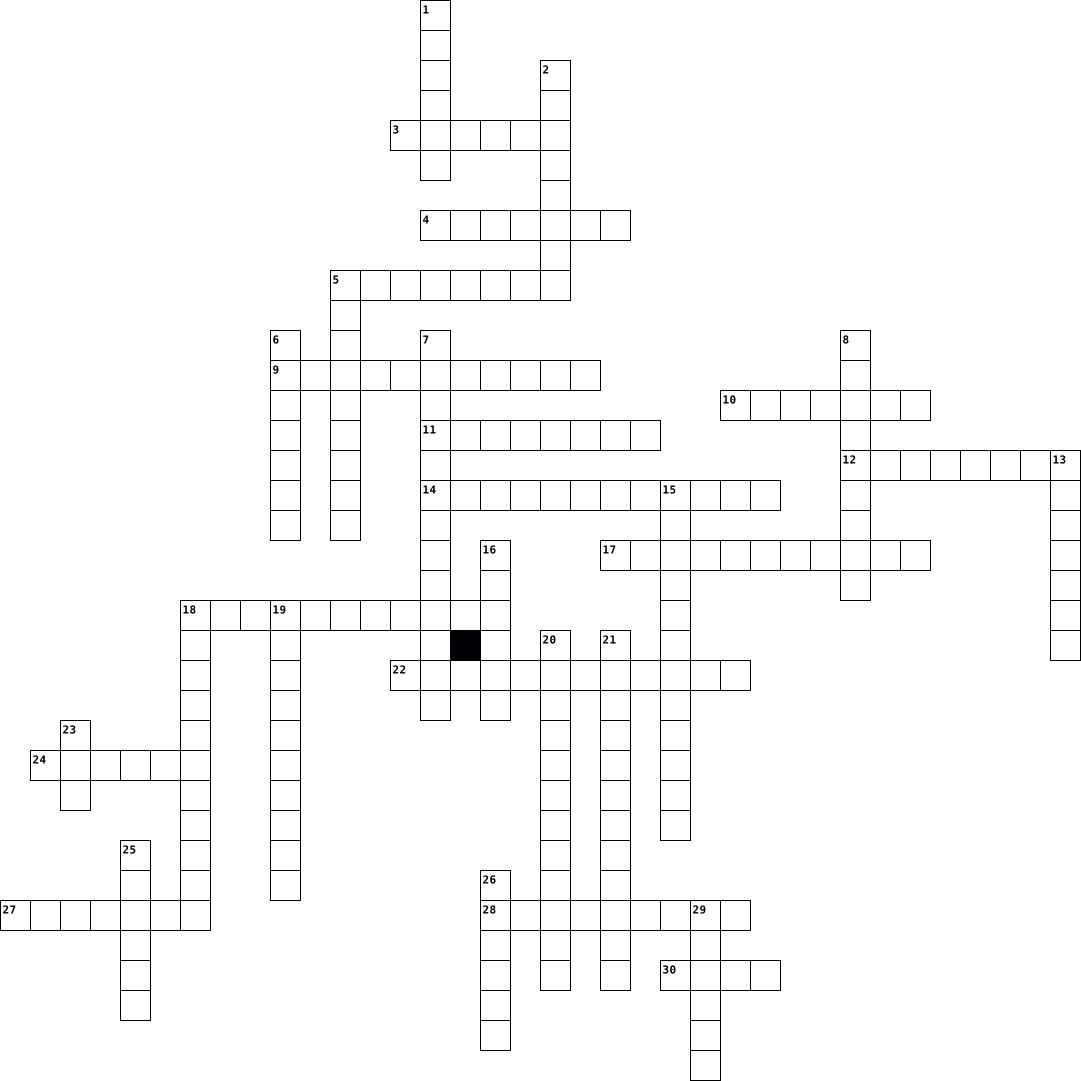
Across
- dissolved phase
- chemistry compounds substances w/c hydrogen
- Greek word "kola"
- components can easily identify
- study of animals
- negative charge
- heredity
- compose of water and ocean
- measurement provide information about the physical structure using the 5 senses
- tell us about the size exert of something with units.
- measurement provide us information on the quantity number and properties.
- planetary model
- earth crust structure
- heavenly bodies
- smallest particle
Down
- positive charge
- basic composition or matter
- study of matter
- study of matter and energy
- mixture particles do not easily settle out.
- chemistry all elements,compounds without carbon and hydrocarbon
- dissolving medium
- chemistry standard amount
- study of plants
- activities of atmosphere
- notation a convenient way of writing or expressing large numbers to small numbers
- molecules,compound elements occurring inside the living org.
- fossils pre-historic geologic era
- Thomson plum pudding
- uncut/invisible
- billiard ball
- is anything that occupy space and has mass
32 Clues: heredity • billiard ball • positive charge • dissolved phase • study of matter • negative charge • study of plants • planetary model • uncut/invisible • heavenly bodies • study of animals • dissolving medium • smallest particle • Greek word "kola" • Thomson plum pudding • earth crust structure • activities of atmosphere • chemistry standard amount • study of matter and energy • ...
Chapter 7/8 science definitions 2012-11-27

Across
- two or more solids in homogenous mixture
- maximum amount a solute can be dissolved in solvent
- different
- substance uniform properties one type of substance
- not able to be dissolved
- solute dissolves into it
- mixture heterogeneous
- liquid to solid
- water to gas
- homogenous mix two or more substances
- gas directly to solid
- thermal energy transfer
- energy inergy from motion
- max amount of solute dissolved in a solvent
- solid to liquid
Down
- point temperature water boils
- gas to liquid
- small parts of matter can't be seen
- contains more solute than normally dissolved
- amount of solute dissolved in a solvent
- solid directly to gas
- water added
- same
- measurement of average kinetic energy
- dissolves in a solvent
- characteristics making something what it is
- Theory of Matter explains behaviour of matter
- combination of two/more different substances
- anything that has mass and takes up space
29 Clues: same • different • water added • water to gas • gas to liquid • liquid to solid • solid to liquid • solid directly to gas • mixture heterogeneous • gas directly to solid • dissolves in a solvent • thermal energy transfer • not able to be dissolved • solute dissolves into it • energy inergy from motion • point temperature water boils • small parts of matter can't be seen • ...
Kaitlyn Pedersen Matter Crossword 2015-03-12

Across
- amount of mass
- a substance that has electricity
- the smallest physical unit of an element and compound
- the act of reducing gas or vapor to liquid form
- amount of matter
- when a substance turns into mass
- a reversible change in properties of a substance; freezing water
- a substance you mix together two different substances, you can not split them apart easily; lemonade
- a group of things combined together and doesn’t change; can sort out
- anything that takes up space and has mass
- when a solid turns into a liquid
- any fluid or any fluids mixed together
Down
- quantity of matter passed off into vapor
- when substances freeze
- turns into a different state
- something that you can not change into another substance
- solid, liquid, and or gas
- a hard substance that is not a liquid
- a substance that can’t be broken down into smaller pieces.
- a substance that is difficult to split apart and is hard to break apart.
- the smallest thing in matter
21 Clues: amount of mass • amount of matter • when substances freeze • solid, liquid, and or gas • turns into a different state • the smallest thing in matter • a substance that has electricity • when a substance turns into mass • when a solid turns into a liquid • a hard substance that is not a liquid • any fluid or any fluids mixed together • quantity of matter passed off into vapor • ...
Matter Zoe,A 2015-03-12

Across
- where the molecules are moving really fast example the sun
- a mixture that cannot be separated easily
- a type of matter made from different elements
- the smallest particle of a substance made of combined atoms
- when something changes chemically
- when water is boiling it is
- a point where a substance is melting
- the point where a substance is about to boil
- the molecules are moving really slow
Down
- the smallest particle of an element
- when something changes physically
- the amount of space matter takes up
- it takes the shape of its container
- the point where a substance is about to freeze
- an amount of matter given in the amount of space
- anything that takes up space and has mass
- solid,liquid,gas,plasma
- the form of water vapor to liquid water
- can't be broken down into simpler substances
- molecules moving fast and space out
- a combination of two or more substances
21 Clues: solid,liquid,gas,plasma • when water is boiling it is • when something changes physically • when something changes chemically • the smallest particle of an element • the amount of space matter takes up • it takes the shape of its container • molecules moving fast and space out • a point where a substance is melting • the molecules are moving really slow • ...
Matter Ethan M. 2015-03-12

Across
- the amount of space in a area
- when a liquid turns into vapor
- point when a solid melts into a liquid
- the opposite of evaporation
- change when you take two or more objects and turn it into a new thing
- change something that changes shape and size but still the same object
- point when you make a liquid into a solid
- two or more things mixed together
- point when a liquid turns into a gas
- like gas but with more electricity
- is weight or a object
Down
- a substance mix together hard to pull apart and usually a liquid
- a liquid hardened
- a group of atoms that chemically combined together
- a solution but with chemicals
- the opposite of condensation
- a solid turning back into a liquid
- Parts that make up matter like aluminum and silicon
- the smallest part of matter
- of Matter gas,liquid,solid,plasma
- Anything that takes up space and has mass
21 Clues: a liquid hardened • is weight or a object • the opposite of evaporation • the smallest part of matter • the opposite of condensation • the amount of space in a area • a solution but with chemicals • when a liquid turns into vapor • two or more things mixed together • of Matter gas,liquid,solid,plasma • a solid turning back into a liquid • like gas but with more electricity • ...
Physical and Chemical Changes 2023-02-11

Across
- 4th state of matter
- Type of mixture where settling happens.
- temperature at which a liquid starts vaporizing.
- type of mixture where particles are distributed evenly throughout.
- State of matter where there is no defined volume to it.
- type of reaction when a paper is burnt.
- ease to catch fire or burn.
- physical change from gas to solid state.
Down
- the amount of mass per volume
- powder formed as the result of chemical reactions.
- flaky coating of iron oxide formed by oxidation and moisture.
- element with properties between metals and non-metals.
- Type of energy that all matter has. Energy of motion.
- upward force exerted by fluids when immersing an object.
- the properties of matter detected by senses.
- the feel or consistency of a substance/surface.
- the result of substances reacting to air.
- decay of a material with heat or age.
- Physical change from solid to liquid.
- the ability to transfer electricity
20 Clues: 4th state of matter • ease to catch fire or burn. • the amount of mass per volume • the ability to transfer electricity • decay of a material with heat or age. • Physical change from solid to liquid. • Type of mixture where settling happens. • type of reaction when a paper is burnt. • physical change from gas to solid state. • the result of substances reacting to air. • ...
waves vocab 2022-12-04

Across
- the bending of a wave around a object
- particles in the medium move back and forth.
- a object vibrates by absorbing energy.
- the number of wavelengths that pass a point each second.
- the size of a disturbance from a wave.
- a matter through which a wave travels.
- the more dense region of a longitudinal wave.
- the distance from one point and a point just like it.
- matter in the medium move back and forth on the same line as the wave.
Down
- waves that can only travel through matter.
- wave created when molecules in the air are pushed together.
- the process of multiple waves overlapping
- the less dense region of a longitudinal wave.
- the amount of time it takes for a wave to pass a point.
- the bending of a wave
- the high point in a transverse wave.
- wave when wavelengths equal
- a repeating disturbance that transfers energy through matter or space.
- the low points in a transverse wave.
- a back and fourth movement
20 Clues: the bending of a wave • a back and fourth movement • wave when wavelengths equal • the high point in a transverse wave. • the low points in a transverse wave. • the bending of a wave around a object • a object vibrates by absorbing energy. • the size of a disturbance from a wave. • a matter through which a wave travels. • the process of multiple waves overlapping • ...
Chemistry Matter Review 2022-09-01

Across
- 2+ substances that are physically mixed
- Charged particles of ions and electrons
- Separating cream from milk
- Smallest unit of element w/ same prop.
- Matter with definite shape and volume
- The amount of space an object takes up
- Separating oil and water
- Anything that has mass and take up space
- Separating two solids, one is magnetic
- What's being dissolved
- Coffee beans & water do this for coffee
- Matter with indefinite shape and volume
- Do this to get salt from salt water
- Substance with 2 or more types of atoms
- Mixture looks uniform (can't see parts)
- Homogeneous mixture with two main parts
Down
- The smallest unit of an element/compound
- What's dissolving the solute
- Used to separate beads from flour
- The ink in a marker does this to work
- Mixture doesn't look uniform (see parts)
- Sep. 2 liquids w/different boil points
- Measures the amount of matter of object
- Substance with 1 type of atom
- Has indefinite shape & definite volume
25 Clues: What's being dissolved • Separating oil and water • Separating cream from milk • What's dissolving the solute • Substance with 1 type of atom • Used to separate beads from flour • Do this to get salt from salt water • Matter with definite shape and volume • The ink in a marker does this to work • Smallest unit of element w/ same prop. • The amount of space an object takes up • ...
The Atom 2023-11-29

Across
- has no charge but has a mass of 1 amu
- smallest unit of matter
- protons plus neutrons
- science that studies matter and its interactions
- atomic mass unit
- In the Bohr model, electrons are placed on......
- element with 28 protons
- same as the number of protons
- always the same number as the protons in a neutral atom
- evidence that comes from inferences because data can't be seen
- simple diagram that show the atom's structure
- a substance that can't be broken down by chemical reactions
Down
- anything that has mass and takes up space
- identifies the element
- force that holds an atom together because opposites attract
- same element but different number of neutrons
- the amount of matter in something
- space surrounding the nucleus where electrons are found
- where all the mass of the atom is
- the amount of space something take up
- 2 or more atoms bonded together
- weighted average of all the different isotopes of an element
22 Clues: atomic mass unit • protons plus neutrons • identifies the element • smallest unit of matter • element with 28 protons • same as the number of protons • 2 or more atoms bonded together • the amount of matter in something • where all the mass of the atom is • has no charge but has a mass of 1 amu • the amount of space something take up • anything that has mass and takes up space • ...
Science words 2026-03-09

Across
- When you put a lot of solute in a volume.
- A process of separating a mechanical mixture by putting the lighter component at the top.
- The substance that does the dissolving.
- A solution with a little solute.
- A type of matter where the particles are freely moving around.
- The fourth state of matter.
- Chemically combined.
- A type of matter where the particles are moving around a bit.
- A mixture where you can see the ingredients.
- Separating a mechanical mixture by a device with small holes.
- 2 things that combine.
- A type of matter where the particles are stuck together.
Down
- A type of mixture where you can take things out physically.
- The process of separating things from a mechanical mixture.
- When a lot of solute can dissolve in the solution.
- 2 kinds of particles that are evenly distributed.
- A substance's ability to dissolve.
- The substance dissolved in something.
- The point where no more can dissolve.
- When no more solute can dissolve in the solution.
20 Clues: Chemically combined. • 2 things that combine. • The fourth state of matter. • A solution with a little solute. • A substance's ability to dissolve. • The substance dissolved in something. • The point where no more can dissolve. • The substance that does the dissolving. • When you put a lot of solute in a volume. • A mixture where you can see the ingredients. • ...
6th grade final crossword 2025-05-13

Across
- – Organism that breaks down dead material.
- – Smallest unit of matter in everything.
- – Anything that has mass and takes space.
- – Organism that eats plants or other animals.
- – Amount of matter in an object.
- – Place where an organism lives and grows.
- – The ability to do work or cause change.
- – Force that pulls objects toward each other.
- – A push or pull on an object.
- – Plants making food using sunlight, water, and air.
- – Gas changing into a liquid.
- – Rain, snow, sleet, or hail falling.
- – Resistance when two surfaces rub together.
Down
- – Breaking down of rocks by nature.
- – Organism that makes its own food.
- – How tightly packed the matter in an object is.
- – Amount of space an object takes up.
- – All living and nonliving things in area.
- – Liquid changing into a gas.
- – Movement of rocks or soil by wind/water.
- – Any living thing, big or small.
- – Process of making new living things.
22 Clues: – Liquid changing into a gas. • – Gas changing into a liquid. • – A push or pull on an object. • – Amount of matter in an object. • – Any living thing, big or small. • – Breaking down of rocks by nature. • – Organism that makes its own food. • – Amount of space an object takes up. • – Rain, snow, sleet, or hail falling. • – Process of making new living things. • ...
Temperature and Matter Vocabulary Crossword 2022-10-07

Across
- state of matter with no shape/flows freely
- takes up space (solid, liquid, or gas)
- Changing from liquid to solid
- state of matter with no fixed shape
- the smallest unit of matter
- A liquid gets hot and begins to bubble
- Changing from a solid to liquid
- continuous physical force being applied
Down
- water changes from gas to liquid
- water changes from liquid to gas
- state of matter with a fixed shape
- the amount of heat present
12 Clues: the amount of heat present • the smallest unit of matter • Changing from liquid to solid • Changing from a solid to liquid • water changes from gas to liquid • water changes from liquid to gas • state of matter with a fixed shape • state of matter with no fixed shape • takes up space (solid, liquid, or gas) • A liquid gets hot and begins to bubble • ...
physical and chemical changes 2022-09-23

Across
- does create a new substance
- does not create a new substance
- when a liquid becomes a solid
- when liquid turns to gas
- gas with a charge
- state of matter that is trying to escape its container and is colliding with sides and each other
- state that is sliding around and takes shape of container
- your hopes, love, and dreams
- of chemical changes include temp change, bubbling, light production, formation of gas
Down
- chopping up an apple
- when a gas turns to liquid
- the gas state of water
- cooking food is this kind of change
- frozen state of water
- the liquid state of water
- state of matter that is only vibrating in place has definite shape and volume
- anything that has mass and takes up space
- when a solid becomes a liquid
18 Clues: gas with a charge • chopping up an apple • frozen state of water • the gas state of water • when liquid turns to gas • the liquid state of water • when a gas turns to liquid • does create a new substance • your hopes, love, and dreams • when a liquid becomes a solid • when a solid becomes a liquid • does not create a new substance • cooking food is this kind of change • ...
Unit 1 Lesson 1 Vocabulary 2023-09-07

Across
- organism that eats only animals
- organism that eats both plants and animals
- organism that gets energy and matter by breaking down dead organisms
- smallest unit of a substance that has the same properties
- organism that eats only plants
- organism that uses energy and matter to make own food
- ability to cause change
Down
- plant food or minerals
- to protect or save a resource or group
- process without a true beginning or end; loops continuously
- substance made of two or more different elements
- organism that gets energy and matter by eating other organisms
- living things cleaning up pollution
- smallest unit of a living organism
- process of a dead organism breaking down
- living or nonliving that has mass and takes up space
- two or more atoms held together by chemical bonds
- most basic substance on Earth
18 Clues: plant food or minerals • ability to cause change • most basic substance on Earth • organism that eats only plants • organism that eats only animals • smallest unit of a living organism • living things cleaning up pollution • to protect or save a resource or group • process of a dead organism breaking down • organism that eats both plants and animals • ...
States of Matter 2021-02-26

Across
- A liquid's resistance to flowing.
- The force of particles against things they bump into
- An example of a crystaline solid
- Water in the solid form.
- A solid arranged in a geometric pattern.
- Massive balls of gas and plasma in the universe
- The most common gas on earth.
- A state of matter with a fixed volume and shape.
- A form of matter with no fixed shape or volume.
- What makes up plasma
- The most common gas in the universe
- Plasma that glows in the sky up north.
Down
- A state of matter with a fixed volume but no fixed shape.
- The force that makes water form droplets.
- A solid arranged in a random pattern.
- A form of matter with no fixed volume nor shape and is made up of ions.
- an example of an amorphus solid
- Water in the gas form.
- A form made of plasma and comes with storms.
- A metal found in liquid form.
20 Clues: What makes up plasma • Water in the gas form. • Water in the solid form. • The most common gas on earth. • A metal found in liquid form. • an example of an amorphus solid • An example of a crystaline solid • A liquid's resistance to flowing. • The most common gas in the universe • A solid arranged in a random pattern. • Plasma that glows in the sky up north. • ...
Chemistry final crossword 2020-06-10

Across
- anything having mass and taking up space
- one of states of matter
- spectrum chemical element or chemical compound
- fusion when two or more nuclei together
- able to be changed
- something becomes a liquid by heat
- bang how the universe began
- when water become a solid
- how far is it from starting cycle to ending cycle
- are dark planet -sized regions that appear on the sun
- one complete performance of a periodic process
- light from the sun
- having a PH of less than 7
Down
- the basic unit of matter
- a rearrangement of atoms into new substances
- lighter elements sometimes have too many neutrons
- mountain or hill which having lava
- matter and space as a whole
- type of rocks
- atoms of same elements having a different mass
- all atoms with more than 82 protons are radioactive
- the relative amount of solute
- table of chemical elements
- microwave type of big bang theory
- send into the air
25 Clues: type of rocks • send into the air • able to be changed • light from the sun • one of states of matter • the basic unit of matter • when water become a solid • table of chemical elements • having a PH of less than 7 • matter and space as a whole • bang how the universe began • the relative amount of solute • microwave type of big bang theory • mountain or hill which having lava • ...
my assignment 2020-10-10

Across
- THE ABILITY TO TRANSFER HEAT AND ELECTRIC ENERGY
- HOW TO MEASURE THE VOLUME OF SOLID BY PLACING IT IN LIQUID
- ONE THAT FALL BETWEEN A INSULATOR AND A CONDUCTOR
- HAS PROPERTIES OF METALS AND NONMETALS
- A MEASURE OF THE SPACE MATTER OCCUPIES
- IF IT CAN BE RESHAPED
- PROPERTY A CHARACTERISTIC THAT IS OBSERVED WITHOUT CHANGE
- A PURE SUBSTANCE
- TABLE OF ELEMENTS AT ABLE WHERE ALL ELEMENTS ARE SORTED
- PUTTING INTO GROUPS
- EASILY BROKEN DOWN\
- ANYTHING THAT HAS VOLUME OR MASS
- METRIC UNIT OF MASS
Down
- ELEMENTS GOOD CONDUCTORS SHINY AND MALLEABLE
- NOT SHINY BAD CONDUCTORS AND BRITTLE
- DOES NOT CONDUCT HEAT OR ELECTRICITY
- A UNIT OF MEASURE FOR LIQUIDS
- DENSITY THE COMPARISON OF SINKING OR FLOATING DENSITY
- ALLOWS FLOW OF ELECTRICITY
- AMOUNT OF MATTER IN A SPACE
- CENTIMETER A METRIC VOLUME EQUAL TO A MILLIMETER
- HOW SHINY A SUBSTANCE IS
- MEASURE OF HOW MUCH MATTER IS IN A THING
23 Clues: A PURE SUBSTANCE • PUTTING INTO GROUPS • EASILY BROKEN DOWN\ • METRIC UNIT OF MASS • IF IT CAN BE RESHAPED • HOW SHINY A SUBSTANCE IS • ALLOWS FLOW OF ELECTRICITY • AMOUNT OF MATTER IN A SPACE • A UNIT OF MEASURE FOR LIQUIDS • ANYTHING THAT HAS VOLUME OR MASS • NOT SHINY BAD CONDUCTORS AND BRITTLE • DOES NOT CONDUCT HEAT OR ELECTRICITY • HAS PROPERTIES OF METALS AND NONMETALS • ...
Science Vocab 2021-12-09

Across
- any process that happens on Earth
- all oragnisms that are the same type in an area
- energy of motion of particles in matter
- resource that can be replaced in a lifetime
- anything with both volume and mass
- resource that cant be replaced
- nonliving factors in an ecosystem
- particles vibrate closer together in substance
- particles move freely at fast speed
- needed by organisms but not infinite
- 2 or more members of same species in habitat
- interaction with oraganisms forsame resource
- energy that is stored in an object
Down
- matter with consistant properies throughout
- energy of motion
- exist with human intervention
- smallest unit of a compound
- basic unit of an element
- energy that is shifted from warm to cool temps
- source from which organisms benefit
- particles move around and slide past eachother
- distinct form of matter
- solid material whose atoms are in pattern
- biotic and abiotic factors that work together
- sum of potential and kinetic energy
- a single living thing
- the living factors in an ecosystem
27 Clues: energy of motion • a single living thing • distinct form of matter • basic unit of an element • smallest unit of a compound • exist with human intervention • resource that cant be replaced • any process that happens on Earth • nonliving factors in an ecosystem • anything with both volume and mass • the living factors in an ecosystem • energy that is stored in an object • ...
Particle Model,,..:) 2017-06-01

Across
- things that make up particles
- How easy a substance is to stretch
- A name for something when you don't want to say a specific
- Very small things that make up things and move a lot
- Smallest particles that make up all matter
- State of matter where particles move over the top of each other
- When a substances spreads though another substance
- When water heats up and turns into gas
- The thickness or gooiness of a substance
- How much mass per volume of a substance
Down
- The ability to scratch something else
- How much force a substance can take
- Scientific model
- The name of a substance that is becoming cold
- How easy it is to compress
- Movement
- A way of explaining a concept
- The name of a substance that is becoming hot
- State of matter where particles are far apart and move around
- It is a name for every thing
20 Clues: Movement • Scientific model • How easy it is to compress • It is a name for every thing • things that make up particles • A way of explaining a concept • How easy a substance is to stretch • How much force a substance can take • The ability to scratch something else • When water heats up and turns into gas • How much mass per volume of a substance • ...
7th Grade 1st Nine Week Review 2022-09-16

Across
- definite volume but no definite shape
- substance results form a chemical reaction
- definite shape and volume
- object will sink or float
- amount of matter in an object
- total mass of the reactants will always equal the mass of the products in a chemical reaction
- anything that takes up space and has mass
- substances undergoing the change in a chemical reaction
- no definite shape or volume
- a chemical reaction takes place and at least one new product is made
Down
- energy cannot easily pass through material
- form that matter exists in
- removing sand from water
- the physical state of matter is an example of
- another term fora characteristic or quality
- removing iron from cereal
- something that is hard to observe
- removing salt from water
- a change in the physical properties of a substance
- separating oil and water
- force of attraction between certain metals
- ability that a substance will dissolve
- separating gravel from sand
- measures how much space matter takes up
- energy can easily pass through material
25 Clues: removing sand from water • removing salt from water • separating oil and water • removing iron from cereal • definite shape and volume • object will sink or float • form that matter exists in • separating gravel from sand • no definite shape or volume • amount of matter in an object • something that is hard to observe • definite volume but no definite shape • ...
Chemistry Matter Review 2022-09-01

Across
- 2+ substances that are physically mixed
- Charged particles of ions and electrons
- Separating cream from milk
- Smallest unit of element w/ same prop.
- Matter with definite shape and volume
- The amount of space an object takes up
- Separating oil and water
- Anything that has mass and take up space
- Separating two solids, one is magnetic
- What's being dissolved
- Coffee beans & water do this for coffee
- Matter with indefinite shape and volume
- Do this to get salt from salt water
- Substance with 2 or more types of atoms
- Mixture looks uniform (can't see parts)
- Homogeneous mixture with two main parts
Down
- The smallest unit of an element/compound
- What's dissolving the solute
- Used to separate beads from flour
- The ink in a marker does this to work
- Mixture doesn't look uniform (see parts)
- Sep. 2 liquids w/different boil points
- Measures the amount of matter of object
- Substance with 1 type of atom
- Has indefinite shape & definite volume
25 Clues: What's being dissolved • Separating oil and water • Separating cream from milk • What's dissolving the solute • Substance with 1 type of atom • Used to separate beads from flour • Do this to get salt from salt water • Matter with definite shape and volume • The ink in a marker does this to work • Smallest unit of element w/ same prop. • The amount of space an object takes up • ...
Chemistry Matter Review 2022-09-01

Across
- 2+ substances that are physically mixed
- Charged particles of ions and electrons
- Separating cream from milk
- Smallest unit of element w/ same prop.
- Matter with definite shape and volume
- The amount of space an object takes up
- Separating oil and water
- Anything that has mass and take up space
- Separating two solids, one is magnetic
- What's being dissolved
- Coffee beans & water do this for coffee
- Matter with indefinite shape and volume
- Do this to get salt from salt water
- Substance with 2 or more types of atoms
- Mixture looks uniform (can't see parts)
- Homogeneous mixture with two main parts
Down
- The smallest unit of an element/compound
- What's dissolving the solute
- Used to separate beads from flour
- The ink in a marker does this to work
- Mixture doesn't look uniform (see parts)
- Sep. 2 liquids w/different boil points
- Measures the amount of matter of object
- Substance with 1 type of atom
- Has indefinite shape & definite volume
25 Clues: What's being dissolved • Separating oil and water • Separating cream from milk • What's dissolving the solute • Substance with 1 type of atom • Used to separate beads from flour • Do this to get salt from salt water • Matter with definite shape and volume • The ink in a marker does this to work • Smallest unit of element w/ same prop. • The amount of space an object takes up • ...
Science: Physical 2024-10-06

Across
- the change from a gas to a liquid
- example material that slows or stops the flow of electricity
- an idea or explanation tested by investigation
- change in state from a liquid to a gas
- a representation of a process or system
- measurements and other observations
- when a material changes into a different material
- state of matter with a definite shape
- substance that is a great conductor allowing electricity to flow easily
- dissolved particles are distributed evenly
Down
- measurement of how resistant a material is to scratching
- ability of one substance to dissolve in another
- force produced that pulls some metals
- state of matter that can take the shape of its container
- anything that has mass and takes up space
- when tiny particles become evenly mixed into a liquid
- observable characteristics of a material
- a type of investigation
- info that comes from analyzing
- a factor in an experiment
- state of matter with no definite shape
- amount of "stuff" in an object
22 Clues: a type of investigation • a factor in an experiment • info that comes from analyzing • amount of "stuff" in an object • the change from a gas to a liquid • measurements and other observations • force produced that pulls some metals • state of matter with a definite shape • change in state from a liquid to a gas • state of matter with no definite shape • ...
Lydia's masterpiece 2025-04-30

Across
- what measures mass
- made up of molecules that have different kinds of atoms
- the building blocks of all matter
- as materials get hotter they what
- fills up its container
- anything that has mass and takes up space how many elements are there
- a measure of the amount of matter in an object
- a formula that contains numbers below the elements
- takes the shape of the container
- a measure of the amount of space an object takes up
- the melting point is also called
Down
- the liquid in a what expands or contracts with changes in tempature
- when heat is absorbed by a solid the molecules move
- as matrials get cooler they what
- an objects ability to float
- scientests use this to mesure force
- the tiny very dense body in the atoms center is called the atomic what
- particles that contain two or more atoms
- solids keep their what
- the three states of matter
20 Clues: what measures mass • fills up its container • solids keep their what • the three states of matter • an objects ability to float • as matrials get cooler they what • takes the shape of the container • the melting point is also called • the building blocks of all matter • as materials get hotter they what • scientests use this to mesure force • ...
Energy in the Atmosphe 2026-03-03

Across
- Change from liquid to solid (8)
- Matter with definite shape and volume (5)
- Decrease in volume when particles slow down (7,11)
- Stored energy due to particle distance (9,6)
- Change from liquid to gas at boiling point (7)
- Average kinetic energy of particles (11)
- Change from liquid to gas (11)
- Tiny pieces that make up matter (9)
- Study of heat (14)
- Change from solid to liquid (7)
- Heat transfer through direct contact (10)
Down
- Matter with definite volume but no definite shape (6)
- Heat transfer through waves (9)
- Total energy of particles in a substance (7,6)
- Movement in all directions at different speeds (6,6)
- Matter with no definite shape or volume (3)
- Change from gas to liquid (12)
- Increase in volume when particles move faster (7,9)
- Heat transfer through movement of fluids (10)
- Motion energy (7,6)
- Movement of particles from high concentration to low concentration (9)
- Energy transferred because of temperature difference (4)
22 Clues: Study of heat (14) • Motion energy (7,6) • Change from gas to liquid (12) • Change from liquid to gas (11) • Change from liquid to solid (8) • Heat transfer through waves (9) • Change from solid to liquid (7) • Tiny pieces that make up matter (9) • Average kinetic energy of particles (11) • Matter with definite shape and volume (5) • Heat transfer through direct contact (10) • ...
Science Vocab 2026-05-15

Across
- slinky
- even amount of newtons on each side
- waves to take pictures of bones
- distance from crest to crest
- mass*velocity
- mass and velocity
- downward pull
- does not require a medium to travel
- ocean waves
- mirror
- the ability of a substance to bend without breaking
- used to cook food
- requires a medium to travel
- the longest of all waves
- steed 3 am
- crash but not elastic
Down
- conductive
- lightest element
- uneven amount of newtons on each side
- inertia
- ballon vs. hair
- passing through and exiting a medium
- sponge
- rocket ship
- the shortest of all waves
- bottom of wave
- fart state of matter
- height of wave
- speed with direction
- top of wave
- sun state of matter
- crash but elastic
- crash
- # of times/sec a wave crosses the x axis
- milkkkk state of matter
- rock state of matter
36 Clues: crash • slinky • sponge • mirror • inertia • conductive • rocket ship • top of wave • ocean waves • mass*velocity • downward pull • bottom of wave • height of wave • ballon vs. hair • lightest element • steed 3 am • mass and velocity • used to cook food • crash but elastic • sun state of matter • fart state of matter • speed with direction • rock state of matter • crash but not elastic • milkkkk state of matter • ...
Science ch2 vocabulary 2024-09-24

Across
- A pure substance that consists of atoms with the same atomic number.
- The relatively fast form of vaporization in which the energy within a liquid creates a higher pressure within within the liquid than the air pressure outside the liquid.
- Anything about a substance that can be observed or easured without altering its chemical composition.
- A particle consisting of two or more atoms covalently bonded together.
- The measure of the amount of matter in an object.
- A model that states that all physical matter exists in the form of particles.
- The change of state from a liquid to a solid.
- The state of matter in which particles vibrate in fixed positions, giving a substance a fixed shape and volume.
- A pure substance consisting of atoms of two or more elements that are chemically combined in a fixed ratio
- A change that alters the chemical composition of a substance.
- The law that states that the masses of chemical substances combine in definite, characteristic integer ratios when forming compounds.
- A gas-like state of matter, formed at very high temperatures, that consists of high-energy irons and free electrons.
- The state of matter in which particles are far apart, move rapidly, and have little interaction with each other.
- The temperature at which a solid turns to a liquid.
- The change of state from a liquid to a gas.
- The building block of all matter; consists of protons, electrons, and neutrons.
- A mixture that has a uniform appearance throughout; also known as a solution, especially of a solid dissolved in a liquid.
- The temperature at which a liquid starts to boil.
- The space enclosed or occupied by an object.
- The mass per unit volume of an object
Down
- The law that states the matter can neither be created nor destroyed, but can only change form.
- The change of state from a solid to a liquid.
- The change in state directly from a gas to a solid without condensing first.
- Any change in matter that does not alter its chemical or nuclear composition.
- A property of a substance the describes how its chemical identity changes in the presence of another substance or under certain conditions.
- The change of state from a gas.
- A material made of only one kind of element or compound.
- The relatively slow form of vaporization in which liquid particles obtain suffitient energy to change to the gaseous state through the random collisions of particles
- A mixture that does not have a uniform appearance since the combined substances are unevenly distributed.
- The force of gravity acting on the matter in an object.
- The state of matter in which particles are close together but ale to move around
- A physical combination of two or more substances in a changeable ratio.
- The change in state directly frim a solid to a gas.
33 Clues: The change of state from a gas. • The mass per unit volume of an object • The change of state from a liquid to a gas. • The space enclosed or occupied by an object. • The change of state from a solid to a liquid. • The change of state from a liquid to a solid. • The measure of the amount of matter in an object. • The temperature at which a liquid starts to boil. • ...
Gayeon Kim 09-24-2024 PS 211 B Chapter 2 Vocabulary 2024-09-24

Across
- The law that states that the masses of chemical substances combine in definite, characteristic integer ratios when forming compounds.
- A model that states that all physical matter exists in the form of particles.
- A pure substance that consists of atoms with the same atomic number.
- A pure substance consisting of atoms of two or more elements that are chemically combined in a fixed ratio
- A gas-like state of matter, formed at very high temperatures, that consists of high-energy irons and free electrons.
- A physical combination of two or more substances in a changeable ratio.
- Any change in matter that does not alter its chemical or nuclear composition.
- A material made of only one kind of element or compound.
- The force of gravity acting on the matter in an object.
- The temperature at which a liquid starts to boil.
- The change of state from a liquid to a gas.
- The relatively fast form of vaporization in which the energy within a liquid creates a higher pressure within within the liquid than the air pressure outside the liquid.
- The change of state from a liquid to a solid.
- Anything about a substance that can be observed or easured without altering its chemical composition.
- A mixture that does not have a uniform appearance since the combined substances are unevenly distributed.
- The mass per unit volume of an object
- The building block of all matter; consists of protons, electrons, and neutrons.
- The change in state directly from a gas to a solid without condensing first.
Down
- The state of matter in which particles are far apart, move rapidly, and have little interaction with each other.
- A mixture that has a uniform appearance throughout; also known as a solution, especially of a solid dissolved in a liquid.
- A change that alters the chemical composition of a substance.
- The relatively slow form of vaporization in which liquid particles obtain suffitient energy to change to the gaseous state through the random collisions of particles
- A particle consisting of two or more atoms covalently bonded together.
- The law that states the matter can neither be created nor destroyed, but can only change form.
- A property of a substance the describes how its chemical identity changes in the presence of another substance or under certain conditions.
- The change in state directly frim a solid to a gas.
- The temperature at which a solid turns to a liquid.
- The change of state from a solid to a liquid.
- The state of matter in which particles are close together but ale to move around
- The measure of the amount of matter in an object.
- The space enclosed or occupied by an object.
- The change of state from a gas.
- The state of matter in which particles vibrate in fixed positions, giving a substance a fixed shape and volume.
33 Clues: The change of state from a gas. • The mass per unit volume of an object • The change of state from a liquid to a gas. • The space enclosed or occupied by an object. • The change of state from a solid to a liquid. • The change of state from a liquid to a solid. • The temperature at which a liquid starts to boil. • The measure of the amount of matter in an object. • ...
Temperature and Matter Vocabulary Crossword 2022-10-07

Across
- state of matter with no shape/flows freely
- takes up space (solid, liquid, or gas)
- Changing from liquid to solid
- state of matter with no fixed shape
- the smallest unit of matter
- A liquid gets hot and begins to bubble
- Changing from a solid to liquid
- continuous physical force being applied
Down
- water changes from gas to liquid
- water changes from liquid to gas
- state of matter with a fixed shape
- the amount of heat present
12 Clues: the amount of heat present • the smallest unit of matter • Changing from liquid to solid • Changing from a solid to liquid • water changes from gas to liquid • water changes from liquid to gas • state of matter with a fixed shape • state of matter with no fixed shape • takes up space (solid, liquid, or gas) • A liquid gets hot and begins to bubble • ...
Temperature and Matter Vocabulary Crossword 2022-10-07

Across
- state of matter with no shape/flows freely
- takes up space (solid, liquid, or gas)
- Changing from liquid to solid
- state of matter with no fixed shape
- the smallest unit of matter
- A liquid gets hot and begins to bubble
- Changing from a solid to liquid
- continuous physical force being applied
Down
- water changes from gas to liquid
- water changes from liquid to gas
- state of matter with a fixed shape
- the amount of heat present
12 Clues: the amount of heat present • the smallest unit of matter • Changing from liquid to solid • Changing from a solid to liquid • water changes from gas to liquid • water changes from liquid to gas • state of matter with a fixed shape • state of matter with no fixed shape • takes up space (solid, liquid, or gas) • A liquid gets hot and begins to bubble • ...
Vocab 2022-01-28

Across
- The amount of space something occupies
- A aspect or a part
- A form of matter that has constant chemical composition
- Particle of matter
- a type of matter
Down
- when components are not chemically bonded together
- different ways
- Property does not change in its chemical composition
- quality of matter
- Texture, mass, color
- A substance
11 Clues: A substance • different ways • a type of matter • quality of matter • A aspect or a part • Particle of matter • Texture, mass, color • The amount of space something occupies • when components are not chemically bonded together • Property does not change in its chemical composition • A form of matter that has constant chemical composition
States of Matter 2023-02-01

Across
- A liquid becoming a solid
- Solid matter becoming a gas
- Matter going from solid to liquid
- In this state, particles are only vibrating
- Particles in gases move _______ than particles in solids
- Solids, liquids, and gases are ______ of matter
- Water boils at ___ _______ degrees Celsius
Down
- The way that particles in solids move.
- Gas becoming a liquid
- The amount of space a sample of matter takes up
- In this state, particles can slide past each other
- Something that has mass and takes up space
- In this state, particles can freely move around their container
13 Clues: Gas becoming a liquid • A liquid becoming a solid • Solid matter becoming a gas • Matter going from solid to liquid • The way that particles in solids move. • Something that has mass and takes up space • Water boils at ___ _______ degrees Celsius • In this state, particles are only vibrating • The amount of space a sample of matter takes up • ...
vocabulary week 2 2025-09-19

Across
- when gas changes to a liquid
- when energy moves from one object to one other
- when matter changes from one state to one other
- a characteristic of matter that can be observed without changing it
- the form matter takes
- the transfer of thermal energy from something warm to something cool
- when matter decreases volume
- when a solid changes to a liquid
Down
- when a liquid turns into a gas
- how hot or cold something is
- when matter increases volume
- when a liquid changes to a solid
- the total energy of partial motion in a stubstance
13 Clues: the form matter takes • how hot or cold something is • when gas changes to a liquid • when matter increases volume • when matter decreases volume • when a liquid turns into a gas • when a liquid changes to a solid • when a solid changes to a liquid • when energy moves from one object to one other • when matter changes from one state to one other • ...
Temperature, Thermal Energy & Heat 2021-08-27

Across
- transfer of thermal energy caused by difference in temperature
- energy of something in motion
- unit used to measure temp in science class
- unit used to measure temp in America
- measure of how fast particles move in a substance
- unit that measures heat
Down
- (property)of matter that is measurable, like temp
- state of matter that oxygen is currently in
- (property)of matter observed in a reaction, like flammability
- state of matter that water is currently in
- energy energy that comes from heat when particles move
- energy that is being stored
- state of matter that your desk is currently in
13 Clues: unit that measures heat • energy that is being stored • energy of something in motion • unit used to measure temp in America • state of matter that water is currently in • unit used to measure temp in science class • state of matter that oxygen is currently in • state of matter that your desk is currently in • (property)of matter that is measurable, like temp • ...
Thermal Energy and States of Matter 2024-06-05

Across
- an opposite process to condensation
- an opposite process to solidification
- group of atoms bonded together
- matter changes from Liquid into Solid (another word other than Freezing)
- exist in the bridges to allow them expand or contract freely
- the fundamental building unit of any matter
- the average Kinetic E. the molecules or atoms have
- an opposite process to melting
Down
- increase in the matter volume due to the increase in heat
- matter changes from Vapor into Liquid
- matter changes from Liquid into Gas (another word other than Evaporation)
- how the glassware is shaped through blowing
- opposite to Expansion
13 Clues: opposite to Expansion • group of atoms bonded together • an opposite process to melting • an opposite process to condensation • an opposite process to solidification • matter changes from Vapor into Liquid • how the glassware is shaped through blowing • the fundamental building unit of any matter • the average Kinetic E. the molecules or atoms have • ...
Science Practice Test Review 2025-09-16

Across
- A way you can describe or sort matter.
- Part of an experiment that changes is the _______ variable.
- Part of an experiment that stays the same is the _______ variable.
- Tiny particles that makes up molecules.
- matter which can fill up space but can easily escape.
- Part of an experiment that is measured to test the results is the ________ variable.
Down
- Matter which keeps its shape.
- A educated guess.
- Tiny particles that makes up matter.
- A collection of facts.
- Looking at something carefully.
- Physical substance that has weight and takes up space.
- The ability to do work.
13 Clues: A educated guess. • A collection of facts. • The ability to do work. • Matter which keeps its shape. • Looking at something carefully. • Tiny particles that makes up matter. • A way you can describe or sort matter. • Tiny particles that makes up molecules. • matter which can fill up space but can easily escape. • Physical substance that has weight and takes up space. • ...
Matter Crossword Puzzle 2023-03-24

Across
- the most common state of matter in the universe
- *blank* expansion of matter states that all matter expands when heated
- gas to solid
- gas to liquid
- has no shape but a defined volume
Down
- no defined shape or volume
- this makes up all matter
- liquid to solid
- *blank* theory of matter states that matter is made of atoms that are constantly moving.
- solid to liquid
- has a defined shape and volume
11 Clues: gas to solid • gas to liquid • liquid to solid • solid to liquid • this makes up all matter • no defined shape or volume • has a defined shape and volume • has no shape but a defined volume • the most common state of matter in the universe • *blank* expansion of matter states that all matter expands when heated • ...
VOCABULARY HEAT 2018-08-16

Across
- energy- energy in the form of heat
- law of thermodynamics- states that energy can only transfer from a higher energy state into a lower energy state and the movement of energy stops when both states are in equilibrium
- A gas-like state of matter in which most of the particles are charged ions, nuclear reactions separate positive electrons from hydrogen and helium atoms
- the study of effects of changes in temperature, pressure, and volume using statistics to analyze the collective motion of their particles
- the state of matter that has a defined shape and volume with molecules that are closely packed and vibrate in place, atoms or molecules are held together by strong bonds, giving the solid a fixed shape and volume
- a measure of the average kinetic energy of the atoms in a system, used to express thermal energy in degrees
- a state of matter with a defined volume but no defined shape and whose molecules roll past each other
- point- the temperature at which a liquid turns into a solid
- point- the temperature at which matter changes from solid to liquid state
Down
- measure of the amount of energy in a physical system that is not available to do work
- the ability to do work or cause change
- matter phase change from solid directly to gas
- a unit of heat energy in the metric system
- heat- amount of heat, expressed in calories, needed to raise one gram of a substance by 1°C
- the process in which matter changes from a liquid to a gas
- the process by which a gas changes into a liquid
- the transfer of thermal energy
- a state of matter without any defined volume or shape in which atoms or molecules move about freely
18 Clues: the transfer of thermal energy • energy- energy in the form of heat • the ability to do work or cause change • a unit of heat energy in the metric system • matter phase change from solid directly to gas • the process by which a gas changes into a liquid • the process in which matter changes from a liquid to a gas • ...
Science Vocab 2 2024-09-24

Across
- the building block of all matter; consists of protons,
- a pure substance that consists of atoms with the same atomic number
- a gas-like state of matter, formed at very high temperatures, that consists of high-energy ions and free electrons
- the change of state from a liquid to a solid
- a material made of only one kind of element or compound
- the state of matter in which particles are close together but able to move around
- the relatively fast form of vaporization in which the energy within a liquid creates higher pressure within the liquid than the air pressure outside the liquid
- a particle consisting of two or more atoms covalently bonded together
- anything about a substance that can be observed or measured without altering its chemical composition
- the mass per unit volume of an object
- the relatively slow form of vaporization in which liquid particles obtain sufficient energy to change to the gaseous state through the random collisions of particles
- The space enclosed or occupied by an object
- a mixture that does not have a uniform appearance since the combined substances are unevenly distributed
- a physical combination of two or more substances in a changeable ratio
- the measure of the amount of matter in an object
- the change in state directly from a gas to a solid without condensating first
- the state of matter in which particles vibrate in fixed positions, giving a substance a fixed shape and volume.
- the change in state directly from a solid to a gas without melting first
- the change of state from a gas to a liquid
Down
- the change of state from a liquid to a gas
- A model that states that all physical matter exists in the form of particles
- anything that has mass and occupies space
- The law that states that the masses of chemical substances combine in definite, characteristic integer ratios when forming compounds.
- the force of gravity acting on the matter in an object
- any change in matter that does not alter its chemical or nuclear composition
- the temperature at which a liquid starts to boil
- the change of state from a solid to a liquid
- the state of matter in which particles are far apart, move rapidly, a have little interaction with each other
- a change that alters the chemical composition of a substance
- a mixture that has a uniform appearance throughout; also known as a solution, especially of a solid dissolved in a liquid.
- a property of a substance that describes how its chemical identity changes in the presence of another substance or under certain conditions
- the temperature at which a solid turns to a liquid
- a pure substance consisting of atoms of two or more elements that are chemically combined in a fixed ratio.
33 Clues: the mass per unit volume of an object • anything that has mass and occupies space • the change of state from a liquid to a gas • the change of state from a gas to a liquid • The space enclosed or occupied by an object • the change of state from a liquid to a solid • the change of state from a solid to a liquid • the temperature at which a liquid starts to boil • ...
Science Review 2026-01-23

Across
- the ability to do work or cause change
- energy of heat
- facts, figures, and other evidence.
- The process of grouping together items that are alike in some way.
- matter that has a definite shape and volume.
- using your 5 senses to gather info.
- observation that deals with numbers.
- energy of motion
Down
- a substance that only contains one type of atom.
- Electromagnetic energy that travels in waves and gives off light.
- observation that deals with characteristics.
- two or more different atoms bonded together.
- smallest unit of matter.
- what you think will happen in the future.
- matter that has a definite volume but not shape.
- anything that has mass and takes up space.
16 Clues: energy of heat • energy of motion • smallest unit of matter. • facts, figures, and other evidence. • using your 5 senses to gather info. • observation that deals with numbers. • the ability to do work or cause change • what you think will happen in the future. • anything that has mass and takes up space. • observation that deals with characteristics. • ...
ADAM ELDER'S PROJECT ON DARK MATTER 2014-02-19

Across
- weakly interacting massive particle of dark matter
- matter composed of atoms with opposite charges
- galaxy that we live in
- basic unit of matter
- there are _____ different states of dark matter
Down
- dark matter is not reactant to _______
- _______ is using a tank of xenon to detect the presence of dark matter
- scientific theory that explains how all mass got here
- hypothesized matter that accounts for 20% of universe
- _______% of universe is dark matter
10 Clues: basic unit of matter • galaxy that we live in • _______% of universe is dark matter • dark matter is not reactant to _______ • matter composed of atoms with opposite charges • there are _____ different states of dark matter • weakly interacting massive particle of dark matter • scientific theory that explains how all mass got here • ...
dark matter 2021-10-05

Across
- the nature of dark matter is _____.
- dark matter does not emit light or ______
- some countries dark matter _____ hidden deep under ground.
- dark matter might not even ____.
- dark matter is __________.
- dark matter _____ galaxies together.
Down
- Roughly 80% of the mass of the _________ is made up of material that scientists cannot directly observe.
- scientist believe that dark matter is some sort of _____ particle.
- dark matter is really ____ to study.
- scientist have suggested many _______ about it.
10 Clues: dark matter is __________. • dark matter might not even ____. • the nature of dark matter is _____. • dark matter is really ____ to study. • dark matter _____ galaxies together. • dark matter does not emit light or ______ • scientist have suggested many _______ about it. • some countries dark matter _____ hidden deep under ground. • ...
Chemistry 2022-11-09

Across
- a column on the periodic table
- smallest particle of matter that retains characteristics of an element
- Water freezing (two words)
- atoms combine to make them
- positively charged particle in a nucleus
- two or more elements chemically combined
- characteristics or traits
- Determines if a substance is a solid or a liquid at room temperature (two words)
- particle orbiting the nucleus of an atom
- the amount of space an object occupies
Down
- new substance is formed (two words)
- Particle in atom with no charge
- a row on the periodic table
- matter that cannot be broken down into simpler substances
- the amount of matter in an object
- matter is not created or destroyed (three words)
16 Clues: characteristics or traits • Water freezing (two words) • atoms combine to make them • a row on the periodic table • a column on the periodic table • Particle in atom with no charge • the amount of matter in an object • new substance is formed (two words) • the amount of space an object occupies • positively charged particle in a nucleus • ...
dark matter 2021-10-05

Across
- the nature of dark matter is _____.
- dark matter does not emit light or ______
- some countries dark matter _____ hidden deep under ground.
- dark matter might not even ____.
- dark matter is __________.
- dark matter _____ galaxies together.
Down
- Roughly 80% of the mass of the _________ is made up of material that scientists cannot directly observe.
- scientist believe that dark matter is some sort of _____ particle.
- dark matter is really ____ to study.
- scientist have suggested many _______ about it.
10 Clues: dark matter is __________. • dark matter might not even ____. • the nature of dark matter is _____. • dark matter is really ____ to study. • dark matter _____ galaxies together. • dark matter does not emit light or ______ • scientist have suggested many _______ about it. • some countries dark matter _____ hidden deep under ground. • ...
If I can't solve this, I need to revise... 2018-01-26

Across
- Air is made up of different types of ______________, such as oxygen and nitrogen
- Yummy Italian food that is called a mechanical mixture
- A mechanical mixture can also be called a ______________ mixture because it is made up of many different substances, each with different appearances and characteristics.
- An educated guess is based on prior knowledge. In Science it is called an ______________
- Rainwater, orange juice, mouthwash and gasoline are all made up of ______________ matter
- Name of the Saint we celebrate in February
- Is anything that takes up space
Down
- Textbooks, pizza, and cars are all made up of ______________ matter
- The prefix "hetero" comes from the Greek word "heteros" which means ______________
- Your Science teacher's last name (can you spell it correctly?)
- Pure substances appear uniform, or ______________ throughout
- ______________ have the same appearance throughout but are made up of two or more substances. These are all homogeneous mixtures
- Matter can be classified by its ______________state: solid, liquid, gas (hint: you do this in Gym class)
- Mixtures can be classified as either solutions or ______________ mixtures
- A ______________ substance is made up of only one type of matter
- A ______________ is made up of two or more different types of matter
16 Clues: Is anything that takes up space • Name of the Saint we celebrate in February • Yummy Italian food that is called a mechanical mixture • Pure substances appear uniform, or ______________ throughout • Your Science teacher's last name (can you spell it correctly?) • A ______________ substance is made up of only one type of matter • ...
Matter Vocabulary Puzzle 2022-09-02

Across
- is the change from a gas into a liquid
- anything that takes up space and has mass.
- describes how firm an object is.
- changes from liquid water to water vapor.
- is the amount of matter something has.
Down
- will take shape of their container.
- is how an object feels to the touch.
- when an a liquid changes to a solid.
- of matter is the forms that matter can take.
- changes from a liquid that turns into vapor.
- a state of matter bounces off one another.
- are made of tightly packed particles.
- when a solid changes to a liquid
13 Clues: describes how firm an object is. • when a solid changes to a liquid • will take shape of their container. • is how an object feels to the touch. • when an a liquid changes to a solid. • are made of tightly packed particles. • is the change from a gas into a liquid • is the amount of matter something has. • changes from liquid water to water vapor. • ...
States of Matter 2023-02-09

Across
- when energy is absorbed
- changing from a gas to liquid
- changing from solid directly to a gas
- matter with definite volume and shape
- matter consisting of free flowing ions
- matter with definite volume but no definite shape
Down
- when energy is released/taken out
- theory related to motion of atoms of matter
- gas changed directly to a solid
- matter with no definite volume or shape
- matter/energy can't be created/destroyed
11 Clues: when energy is absorbed • changing from a gas to liquid • gas changed directly to a solid • when energy is released/taken out • changing from solid directly to a gas • matter with definite volume and shape • matter consisting of free flowing ions • matter with no definite volume or shape • matter/energy can't be created/destroyed • theory related to motion of atoms of matter • ...
Chemistry 2013-11-29

Across
- the water we drink
- when a metal bonds with a non-metal
- when an element may have different number of neutrons
- the energy due to the movement of an object
- when a metal bonds a metal
- the name of a diagram with b starting letter
- different form of an element in the same physical way
- the deegrees in which a substance is
- a state of matter which in particles move in the space they have to move
Down
- the point when a substance boils
- the name of a diagram with L starting letter
- the bond between to metals
- when a non-metal joins a non-metal
- a cloud of electrons
- the point when a substance melts
- a state of matter in which particles move freely
- a state of matter in which particles only vivrate
- when two atoms are joined together
- a strong structure that cause high MP and BP
- the amount of matter in an object
20 Clues: the water we drink • a cloud of electrons • the bond between to metals • when a metal bonds a metal • the point when a substance boils • the point when a substance melts • the amount of matter in an object • when a non-metal joins a non-metal • when two atoms are joined together • when a metal bonds with a non-metal • the deegrees in which a substance is • ...
Changes in Matter 2014-11-18

Across
- what the starting substances are in a reaction
- how particles move in a solid
- reaction that creates a new substance
- matter with particles fixed in position
- there have to be the same number of these on both sides of a chemical equation
- gas changing to a liquid
- liquid changing to a gas all at once
- reaction that releases heat
- liquid changing to gas one layer at a time
- reaction that absorbs heat
Down
- a measure of the kinetic energy of the particles in a substance
- solid changing to liquid
- reaction that makes the substance look different but it's identity remains the same
- the law that says matter cannot be created or destroyed
- matter with particles that are touching but can move around
- matter with particles very far apart and moving fast
- what the ending substances are in a reaction
- how particles move in a liquid
- liquid changing to solid
- an increase or decrease in this can cause a physical or chemical change
20 Clues: solid changing to liquid • gas changing to a liquid • liquid changing to solid • reaction that absorbs heat • reaction that releases heat • how particles move in a solid • how particles move in a liquid • liquid changing to a gas all at once • reaction that creates a new substance • matter with particles fixed in position • liquid changing to gas one layer at a time • ...
Science Unit A 2015-10-07

Across
- cloudy mixture that cannot be separated
- This symbol is a diamond
- only made of one type of matter
- solution in which water is a solvent
- Tiny materials in matter
- what does the dissolving
- a mixture where both substances can be seen
- is everything everything that has mass and consumes space
- This symbol is a triangle
- Can catch on fire easily
- mixture of two or more pure substances
- a solution where where no more solute can be dissolved
- every solution has a saturation point at a given temp
Down
- catches fire when in contact with oxygen
- poison
- a solution where more solute can be dissolved
- Can burn skin and materials
- cloudy mixture that can be separated
- any matter with no fixed shape
- A mixture where both substances cannot be seen
- the maximum of solute that can be dissolved
- like poison,but its long term
- This symbol is a hexagon
- universal solvent
- what dissolves in a solution
25 Clues: poison • universal solvent • This symbol is a diamond • Tiny materials in matter • what does the dissolving • Can catch on fire easily • This symbol is a hexagon • This symbol is a triangle • Can burn skin and materials • what dissolves in a solution • like poison,but its long term • any matter with no fixed shape • only made of one type of matter • solution in which water is a solvent • ...
third PT 2020-02-25

Across
- electrons in the outermost energy level of an atom
- outlined the Law of Conservation of Mass
- visualized that electrons as rotating orbits around the nucleus like planets rotating around the sun
- rows in the Periodic Table
- formed when an atom gains or loses electrons
- anything that has volume and mass
- “atomos”
- the ability of an atom to attract toward itself the electrons in a chemical bond
- properties intermediate between metal and non-metals
- negative ion
- a separation process in which a mixture is passed through a filter
Down
- columns of elements having similar chemical properties
- amount of space occupied by matter
- concluded that an atom was made up of very dense positively charged nucleus
- are the distinguishing characteristics that is used to identify different samples of matter
- proposed the Atomic Theory of Matter
- outlined the Law of Definite Proportions
- Plum Pudding Model
- a separation process used in the experiment to separate naphthalene from salt
- positive ion
20 Clues: “atomos” • positive ion • negative ion • Plum Pudding Model • rows in the Periodic Table • anything that has volume and mass • amount of space occupied by matter • proposed the Atomic Theory of Matter • outlined the Law of Conservation of Mass • outlined the Law of Definite Proportions • formed when an atom gains or loses electrons • ...
Science Crossword 2020-05-07

Across
- a part of something
- can be measured or observed without changing substance
- the energy of mass in motion
- movement of substance from an area of high concentration to an area of low concentration
- water vapour becomes liquid
- transition of substance directly from solid to gas without going liquid state
- firm or compact in substance
- explanation of natural world supported by evidence
- the temperature at which a liquid boils at
- water to ice
Down
- the amount of space occupied by an object
- change of solid to a liquid when heat is applied
- liquid turns to a gas
- a small particle that can't be broken or destroyed
- a body of coherent matter
- How a substance behaves in a chemical reaction
- substance that is not solid or gas and can be poured easily
- the temperature at which matter changes from a solid to a liquid
- a substance that occupies physical space
- a matter that doesn't have a defined shape or volume
20 Clues: water to ice • a part of something • liquid turns to a gas • a body of coherent matter • water vapour becomes liquid • the energy of mass in motion • firm or compact in substance • a substance that occupies physical space • the amount of space occupied by an object • the temperature at which a liquid boils at • How a substance behaves in a chemical reaction • ...
Prep Reading Starter 1 Units 16-18 2020-08-25

Across
- to make water jump
- a sea animal that walks sideways
- square, circle, triangle, heart, rectangle, etc
- what you use to clean
- to order food from a restaurant to take home
- juice, milk, water, coffee, tea, etc
- matter that has a specific shape
- a meal or side dish made from leafy vegetables
- the stuff everything is made of
- matter that is hard to see and can change shape and size
- near your city
- how big or small something is
- a pocket of air
Down
- to stay on the top of water
- to go to the bottom of water
- a table for one person to work at
- water not from a tap
- to put something with something else
- to think about
- to wash your body in a tub
- cooked over fire or on a bbq
- a very big sink
- to see with your eyes
- matter that can move and change shape
24 Clues: to think about • near your city • a very big sink • a pocket of air • to make water jump • water not from a tap • what you use to clean • to see with your eyes • to wash your body in a tub • to stay on the top of water • to go to the bottom of water • cooked over fire or on a bbq • how big or small something is • the stuff everything is made of • a sea animal that walks sideways • ...
Sifhet's Crossword 2022-03-29

Across
- takes shape of container
- theory the theory of matter
- contaminates in the environment and or harm living things
- when the solute is fully dissolved
- mixing two types of matter to make a solution
- substance only one type of particle
- has a definite shape and volume
- anything that takes up space
- the bigger amount in the solution
- mixture a mixture with different parts you can see
Down
- mixing completely with a solvent to solution
- the quality of something
- when you add water to the _____
- can be used to change liquid to a gas
- more than one particle
- the tiny things that make up matter
- a substance that dissolves in amounts of liquid
- the smaller amount in the solution
- deals with numbers
- a mixture that looks pure but has two or more particles
- a substance that will not dissolve even after mixing
- when the solute has not fully been dissolved
- evaporates into the environment
23 Clues: deals with numbers • more than one particle • the quality of something • takes shape of container • theory the theory of matter • anything that takes up space • when you add water to the _____ • evaporates into the environment • has a definite shape and volume • the bigger amount in the solution • when the solute is fully dissolved • the smaller amount in the solution • ...
Divreet's Crossword 2022-03-29

Across
- like gasoline-air mixture in car engine
- the smaller amount in a solution
- added crystal grow
- data which can be measured
- sugar + water into? next-
- metal,silver,copper are metal that can be mixed gold
- matter that contains two or more puresubstances mixed together
- mixture also called hetrogeneaus
- to mix one type of matter into another to form a solution
- data can be observed but not measured
- the bigger amount in a solution
Down
- the theory describes what matter is and how it behaves
- not enough of the solute
- a soloutes that is able to dissolve into a certain solvent
- just the right amount of a solute
- like ethanol (in perfume)
- more solute dissolves
- considered as a liquid
- a substance made up of one type of particle
- a solute that is not able to dissolve into a certain solvent
- anything that takes up space
- also called homogenous
22 Clues: added crystal grow • more solute dissolves • considered as a liquid • also called homogenous • not enough of the solute • like ethanol (in perfume) • sugar + water into? next- • data which can be measured • anything that takes up space • the bigger amount in a solution • the smaller amount in a solution • mixture also called hetrogeneaus • just the right amount of a solute • ...
Classification of Matter 2022-05-26

Across
- pure substances physically combined
- too much solute
- a mixture in which different materials can be easily distinguished
- a chemical process in which light and heat are produced.
- a change in size, shape, or state of matter
- anything that has mass and volume
- a mixture containing two or more gaseous, liquid, or solid substances blended evenly throughout
- A pure substance made of only one kind of atom
Down
- The amount of space something takes up
- a substance made from elements that are chemically combined
- A measure of the amount of matter or material in an object
- less than the max of solute is dissolved
- when oxygen reacts with another substance.
- a type of matter with a fixed composition
- heterogeneous mixture containing a liquid in which visible particles settle
- change of one substance to another
- enough solute to max out the solvent without going over
- Substances that does the dissolving
- substances that gets dissolved
- heterogeneous mixture with large particles that never settle
20 Clues: too much solute • substances that gets dissolved • anything that has mass and volume • change of one substance to another • pure substances physically combined • Substances that does the dissolving • The amount of space something takes up • less than the max of solute is dissolved • a type of matter with a fixed composition • when oxygen reacts with another substance. • ...
Phases of Matter 2025-05-11

Across
- – Force applied over an area
- – Transfer of thermal energy
- – Solid to gas without becoming liquid
- – No fixed shape or volume
- – Measures average kinetic energy
- – Solids with repeating patterns
- – Basic units of matter
- – Slow vaporization at the surface
- – Solids without a regular pattern
- – Liquid to solid
- – Can be squished (like gases)
- – Flows and takes the shape of its container
- – What liquids and gases can do
- – Gas to liquid
Down
- – Solid to liquid
- – A physical state of matter
- – Another word for phase
- – Amount of space matter occupies
- – Gas to solid
- – Anything that has mass and takes up space
- – Related to heat energy
- – Has a definite shape and volume
- – Hot, ionized gas found in stars
- – General term for liquid to gas
- – Lowers temperature, can cause freezing
- – Type of energy due to motion
- – Groups of atoms bonded together
- – Not flexible, like most solids
- – Rapid vaporization of liquid
- – Needed to change states
30 Clues: – Gas to solid • – Gas to liquid • – Solid to liquid • – Liquid to solid • – Basic units of matter • – Another word for phase • – Related to heat energy • – Needed to change states • – No fixed shape or volume • – A physical state of matter • – Force applied over an area • – Transfer of thermal energy • – Type of energy due to motion • – Can be squished (like gases) • ...
Mission: Matter — States and Particles Challenge! 2025-04-21

Across
- Amount of space an object or substance occupies.
- A tiny piece that makes up all matter.
- How much mass is packed into a given volume.
- Force that pulls particles together.
- Measure of how hot or cold something is.
- A hot, charged gas made of ions.
- Gas turning into a liquid.
- Energy of moving particles.
- Solid turning directly into a gas.
- Matter that spreads out to fill a space.
Down
- Matter with a fixed shape and volume.
- Matter that flows and takes the shape of its container.
- Liquid turning into gas from the surface.
- Shaking movement of particles, especially in solids.
- Force that particles apply when they hit container walls.
- Needed to make particles move faster.
- Process where a liquid becomes a solid.
- Gas turning directly into a solid.
- The gaps between particles.
- Process where a solid becomes a liquid.
- A scientific idea used to explain how particles behave.
21 Clues: Gas turning into a liquid. • The gaps between particles. • Energy of moving particles. • A hot, charged gas made of ions. • Gas turning directly into a solid. • Solid turning directly into a gas. • Force that pulls particles together. • Matter with a fixed shape and volume. • Needed to make particles move faster. • A tiny piece that makes up all matter. • ...
Science words 2022-10-16

Across
- an activity involving effort
- the process of plants
- anything that takes up space and can be weighed
- energy that is transferred from one body to another
- a set of things working together as parts of a mechanism or an interconnecting network.
- firm and not a liquid or fluid
- move one place to another
- Stored energy
- Energy of motion
- a minute portion of matter
- a substance or matter in a state in which it will expand freely to fill the whole of a container, having no fixed shape
Down
- heat transferred by liquids like gasses
- a substance that flows freely and isnt solid
- when heat is transferred directly into matter
- Energy in a system that is responsible with its temperature
- the quantity per unit volume, unit area, or unit length
- a degree in heat
- energy is transferred as particles
- the ability to do work
- a material heat, sound , or electricity cant go through
20 Clues: Stored energy • a degree in heat • Energy of motion • the process of plants • the ability to do work • move one place to another • a minute portion of matter • an activity involving effort • firm and not a liquid or fluid • energy is transferred as particles • heat transferred by liquids like gasses • a substance that flows freely and isnt solid • ...
Biology 2022-09-23
Across
- a cycle of matter that contains phosphates and nucleic acids
- an organism that is able to make nutritional substances
- when oxygen is present
- used by all living things to store and release energy
- an organism that cannot make its own food
- a cycle of matter that contains all macromolecules
- what all living things are made out of
- is what comes out of the reactant
- all of the ecosystems combined
- if no anaerobic conditions what occurs
- the energy for the cell,makes ATP
- first step of cellular respiration
- organisms that break down dead or decaying organisms
Down
- when oxygen is not present
- third step of cellular respiration
- located in the thylakoid membranes
- located in the stroma of the chloroplast
- the process where plants use sunlight to make food
- the combined mass of water found on a planet
- is what you use to make the product
- second step of cellular respiration
- a cycle of matter that contains proteins and nucleic acids
22 Clues: when oxygen is present • when oxygen is not present • all of the ecosystems combined • is what comes out of the reactant • the energy for the cell,makes ATP • third step of cellular respiration • located in the thylakoid membranes • first step of cellular respiration • is what you use to make the product • second step of cellular respiration • ...
Chemistry Matter Review 2022-09-01

Across
- 2+ substances that are physically mixed
- Charged particles of ions and electrons
- Separating cream from milk
- Smallest unit of element w/ same prop.
- Matter with definite shape and volume
- The amount of space an object takes up
- Separating oil and water
- Anything that has mass and take up space
- Separating two solids, one is magnetic
- What's being dissolved
- Coffee beans & water do this for coffee
- Matter with indefinite shape and volume
- Do this to get salt from salt water
- Substance with 2 or more types of atoms
- Mixture looks uniform (can't see parts)
- Homogeneous mixture with two main parts
Down
- The smallest unit of an element/compound
- What's dissolving the solute
- Used to separate beads from flour
- The ink in a marker does this to work
- Mixture doesn't look uniform (see parts)
- Sep. 2 liquids w/different boil points
- Measures the amount of matter of object
- Substance with 1 type of atom
- Has indefinite shape & definite volume
25 Clues: What's being dissolved • Separating oil and water • Separating cream from milk • What's dissolving the solute • Substance with 1 type of atom • Used to separate beads from flour • Do this to get salt from salt water • Matter with definite shape and volume • The ink in a marker does this to work • Smallest unit of element w/ same prop. • The amount of space an object takes up • ...
Heat Transfer 2026-01-08

Across
- Object that absorbs heat
- Giving off radiant energy
- State of matter that allows convection
- Type of energy due to motion
- Energy that flows due to a temperature difference
- Measure of average kinetic energy
- Property affecting convection
- Relating to heat
- Material that resists heat flow
- Particle that transfers energy in matter
- Doesn't exist
- Taking in radiant energy
- Type of radiation associated with heat
- Common good heat conductor
- Instrument that measures temperature
- Medium where only radiation transfers heat
Down
- Increase in size when heated
- Heat transfer by fluid motion
- State of matter where conduction dominates
- State of matter with low thermal conductivity
- Circulating flow in convection
- Heat transfer by electromagnetic waves
- Having a higher temperature
- Ability to do work or produce heat
- Origin of heat
- Movement of heat energy
- Substance that can flow (liquid or gas)
- Material that allows heat to flow easily
- Heat transfer through direct contact
- State when temperatures are equal
30 Clues: Doesn't exist • Origin of heat • Relating to heat • Movement of heat energy • Object that absorbs heat • Taking in radiant energy • Giving off radiant energy • Common good heat conductor • Having a higher temperature • Increase in size when heated • Type of energy due to motion • Heat transfer by fluid motion • Property affecting convection • Circulating flow in convection • ...
Study Guide for Chapter 2 2025-10-06

Across
- change that forms a different substance
- when a gas changes to a liquid
- solvent dissolves a certain amount of solute
- the amount of space an object takes up
- all matter made up of small particles called
- a substance that dissolves another substance
- Anything that has mass or volume
- liquids changes into a gas
Down
- a liquid changes to a solids
- a scientific instrument that measures mass
- atoms of different elements combine, the molecules formed are called
- change that does not form a new substance
- measures the amount of matter in a certain volume
- has a definite volume and shape
- a substance that is dissolved
- matter that is made up of only one kind of atom
- two or more substance physically combined
- mixture in which all elements are spread evenly
- has a definite volume but no definite shape
- the amount of material in a substance
- has no definite volume or shape
21 Clues: liquids changes into a gas • a liquid changes to a solids • a substance that is dissolved • when a gas changes to a liquid • has a definite volume and shape • has no definite volume or shape • Anything that has mass or volume • the amount of material in a substance • the amount of space an object takes up • change that forms a different substance • ...
big bang theory crossword puzzle 2026-03-18

Across
- Rapid expansion right after the universe began
- The universe itself or emptiness
- Force involving electric and magnetic fields
- Light shifted toward shorter wavelengths
- Large empty regions in space
- A type of star used to measure distance
- Distance light travels in one year
- Density needed to stop expansion of universe
- fireball Early hot, dense state of the universe
- Four basic interactions in physics
- Device for measuring light intensity
Down
- Period when matter dominated the universe
- Opposite of matter
- Stretching of light to longer wavelengths
- Region of space with extremely strong gravity
- Study of the origin and structure of the universe
- Change in wavelength due to motion
- Unit of temperature in science
- Invisible mass affecting gravity
- Measure of how hot or cold something is
- Process that powers stars
- Method for measuring star distance using angles
- Large system of stars, gas, and dust
- Point of infinite density
- Measured progression of events
25 Clues: Opposite of matter • Process that powers stars • Point of infinite density • Large empty regions in space • Unit of temperature in science • Measured progression of events • The universe itself or emptiness • Invisible mass affecting gravity • Change in wavelength due to motion • Distance light travels in one year • Four basic interactions in physics • ...
The Nature of Matter 2013-09-04

Across
- You can also eat mass.
- Mass is also _____. We are mass.
- A mass of something is a _________ of it.
- Is a quantitative measure that is proportional to the magnitude of the gravitational force.
- Any body having mass has an _____ amount of energy.
- Is everything around you.
- This shows you how to find the mass of an object.
- Mass volume.
- We can also say that ____ and houses are also mass even if we can get inside them.
- Mass could be a large number of _______.
Down
- The SI of mass is the ______.
- The mass of an object is the amount of ________ ________ that it has.
- The mass of an object determines its ______ in the presence of an applied force.
- Is a quantitative measure of an object's resistance to changes in velocity.
- Matter is anything made of _______.
- Matter is anything made of _____.
- Mass of things is large group of them grouped ________.
- Matter Is associated with ______.
- Is the space an object occupies.
- Mass could be liquid, _____ or a gas.
20 Clues: Mass volume. • You can also eat mass. • Is everything around you. • The SI of mass is the ______. • Mass is also _____. We are mass. • Is the space an object occupies. • Matter is anything made of _____. • Matter Is associated with ______. • Matter is anything made of _______. • Mass could be liquid, _____ or a gas. • Mass could be a large number of _______. • ...
3rd Grade Science Vocabulary Challenge! 2014-06-18

Across
- ________________ is the force that pulls you down towards the Earth
- to put into groups based on characteristics
- a tool used to measure temperature
- matter that has a definite shape
- an education guess about what will happen
- A ________________ can show how things in real life work
- source of Energy for all of Earth's cycles and food chains
- when seeds start to grow
- Earth takes 24 hours to ___________________ around 1 time
- amount of space something takes up
Down
- a living thing
- color, shape, size, texture and hardness are examples of ______________ of matter
- when water vapor turns to liquid
- all the living and non-living things around an organism
- numbers or facts
- organisms that need to eat other organisms to survive
- a raised area of flat land
- _________________ "powers" motion or changes to matter
- When you _______________ something you're trying to see how much or how many
- weathering can be caused by wind, _____________, water and ice
- ________________ has mass and takes up space(volume)
21 Clues: a living thing • numbers or facts • when seeds start to grow • a raised area of flat land • when water vapor turns to liquid • matter that has a definite shape • a tool used to measure temperature • amount of space something takes up • an education guess about what will happen • to put into groups based on characteristics • ________________ has mass and takes up space(volume) • ...
Kaitlyn Pedersen Matter Crossword 2015-03-12

Across
- amount of mass
- a substance that has electricity
- the smallest physical unit of an element and compound
- the act of reducing gas or vapor to liquid form
- amount of matter
- when a substance turns into mass
- a reversible change in properties of a substance; freezing water
- a substance you mix together two different substances, you can not split them apart easily; lemonade
- a group of things combined together and doesn’t change; can sort out
- anything that takes up space and has mass
- when a solid turns into a liquid
- any fluid or any fluids mixed together
Down
- quantity of matter passed off into vapor
- when substances freeze
- turns into a different state
- something that you can not change into another substance
- solid, liquid, and or gas
- a hard substance that is not a liquid
- a substance that can’t be broken down into smaller pieces.
- a substance that is difficult to split apart and is hard to break apart.
- the smallest thing in matter
21 Clues: amount of mass • amount of matter • when substances freeze • solid, liquid, and or gas • turns into a different state • the smallest thing in matter • a substance that has electricity • when a substance turns into mass • when a solid turns into a liquid • a hard substance that is not a liquid • any fluid or any fluids mixed together • quantity of matter passed off into vapor • ...
Matter Kennedi Cran 2015-03-09

Across
- of matter Gas, liquid, plasma and Solid
- point when a solid becomes a liquid
- Change something to make it different
- part of the water cycle and has water vapor.
- Has definite shape and volume
- noting that can be broken down
- Things that combine
Down
- is like gas and is the fourth state of matter.
- Something that is a liquid but can't be taken apart
- smallest part of compounds
- has changeable shape and volume
- anything that takes up space and has mass
- water that collects as droplets on a cold surface when theres humid air
- Change did something to it and still the thing it was
- more than two properties in one
- point when a liquid changes into a solid
- How much space it takes up
- point when a liquid gets really hot
- smallest particles of matter made up of protons, neutrons, and electrons
- has definite volume but takes the shape of its container
- How much of something
21 Clues: Things that combine • How much of something • smallest part of compounds • How much space it takes up • Has definite shape and volume • noting that can be broken down • has changeable shape and volume • more than two properties in one • point when a solid becomes a liquid • point when a liquid gets really hot • Change something to make it different • ...
Chapter 2 Key Terms 2021-09-14

Across
- ability to do work
- energy can only change forms
- solid to vapor
- change of appearance
- made of just one kind of particle
- liquid heats, bubbles, turns to vapor
- liquid to vapor
- force that acts on moving object
- space an object occupies
- solidification
- quantity of matter
- liquid to gas below boiling point
- parts can be separated easily
- different forms of matter
- vapor to solid
- variable shape and volume
Down
- change into another substance
- gravitational attraction for a mass
- how fast particles move
- nuclei rearrange to form new atoms
- combination of two or more atoms
- atoms from different elements bond
- particles collide and become charged
- takes up space and has mass
- variable shape but fixed volume
- a push or a pull
- more or fewer electrons than protons
- pure substance with one kind of atom
- bodies attracted to the earth
- fixed shape and volume
- vapor to liquid
- basic unit of matter
- solid to liquid
33 Clues: solid to vapor • solidification • vapor to solid • liquid to vapor • vapor to liquid • solid to liquid • a push or a pull • ability to do work • quantity of matter • change of appearance • basic unit of matter • fixed shape and volume • how fast particles move • space an object occupies • different forms of matter • variable shape and volume • takes up space and has mass • ...
Chapter 2 - Atoms 2021-10-21

Across
- mixture that contains substances that are not mixed evenly
- matter that has definite volume and definite shape
- another name for homogeneous mixture
- amount of mass in a given volume
- pure substance containing only one type of atom
- matter that contains particles that are moving fast and far apart
- positively charged particle in the nucleus of an atom
- bond between elements of opposite charge
- type of matter found mostly in outer space
- area of atom that contains protons and neutrons
Down
- bond in which atoms share electrons
- atoms of the same element with a different number of neutrons
- mixture that contains substances that are mixed evenly
- matter that had definite volume, but no definite shape
- atomic particle that has a negative charge
- smallest particle of an element
- particle in nucleus of an atom that has no charge
- bond in which electrons are free to move from ion to ion
- electrically charged atom
- two or more substances that are chemically bonded together
20 Clues: electrically charged atom • smallest particle of an element • amount of mass in a given volume • bond in which atoms share electrons • another name for homogeneous mixture • bond between elements of opposite charge • atomic particle that has a negative charge • type of matter found mostly in outer space • pure substance containing only one type of atom • ...
Chapter 8 Crossword Puzzle 2022-03-03

Across
- temp. is constant; pressure increases and volume decreases (vise versa)
- amount of matter in an object
- the total potential and kinetic energies in an object
- solid to gas
- mass per unit volume
- amount of space that a sample of matter occupies
- uneven forces acting on the particles on the surface of a liquid
- definite volume; no definite shape
- liquid to solid
- no definite shape or volume
- explanation of how particles in matter behave
- liquids resistant to flow
- anything that takes up space and has mass
Down
- amount of force applied per unit
- pressure is constant; temp increases and volume increases
- measure of the average kinetic energy of all the particles in an object
- the gas state of a substance that is normally a solid or a liquid at room temp.
- gas to liquid
- solid to liquid
- liquid to gas
- gas to solid
- definite shape and volume
- energy in an object due to motion
- vaporization on the surface of a liquid
24 Clues: solid to gas • gas to solid • gas to liquid • liquid to gas • solid to liquid • liquid to solid • mass per unit volume • definite shape and volume • liquids resistant to flow • no definite shape or volume • amount of matter in an object • amount of force applied per unit • energy in an object due to motion • definite volume; no definite shape • vaporization on the surface of a liquid • ...
Q2W2 Review 2020-11-05

Across
- rain snow sleet and hail
- Average weather patterns over a long period of time
- gas changing into a liquid
- Because the Earth is tilted on its axis, Earth is warmer at the equator and colder at the ________
- state of matter consisting of positive and negatively charged particles
- state of matter that takes the shape of its container
- imaginary vertical line around which Earth spins
- Earth's daily spinning on its axis
- energy movement of particles that create heat
- Half a sphere
- Heat transfer through a fluid
Down
- heat transfer through direct contact
- Imaginary horizontal line around the Earth
- heat transfer through waves/rays; no direct contact
- Earth's yearly orbit around the Sun
- state of matter with a definite shape and a definite volume
- liquid turning into a gas
- The path an object takes around a particular point in space
- state of matter with no definite shape or definite volume
- short term state of the atmosphere
20 Clues: Half a sphere • rain snow sleet and hail • liquid turning into a gas • gas changing into a liquid • Heat transfer through a fluid • Earth's daily spinning on its axis • short term state of the atmosphere • Earth's yearly orbit around the Sun • heat transfer through direct contact • Imaginary horizontal line around the Earth • energy movement of particles that create heat • ...
Science words 2022-10-16

Across
- an activity involving effort
- the process of plants
- anything that takes up space and can be weighed
- energy that is transferred from one body to another
- a set of things working together as parts of a mechanism or an interconnecting network.
- firm and not a liquid or fluid
- move one place to another
- Stored energy
- Energy of motion
- a minute portion of matter
- a substance or matter in a state in which it will expand freely to fill the whole of a container, having no fixed shape
Down
- heat transferred by liquids like gasses
- a substance that flows freely and isnt solid
- when heat is transferred directly into matter
- Energy in a system that is responsible with its temperature
- the quantity per unit volume, unit area, or unit length
- a degree in heat
- energy is transferred as particles
- the ability to do work
- a material heat, sound , or electricity cant go through
20 Clues: Stored energy • a degree in heat • Energy of motion • the process of plants • the ability to do work • move one place to another • a minute portion of matter • an activity involving effort • firm and not a liquid or fluid • energy is transferred as particles • heat transferred by liquids like gasses • a substance that flows freely and isnt solid • ...
ATOMS 2023-10-18

Across
- Transferring this can change the phase of matter.
- Characteristics of matter that describe how matter reacts.
- A group of the same atoms chemically bonded together.
- Capitol and Lowercase letters that signify what element is on the periodic table.
- Center of the Atom.
- Particle with no charge.
- Elements are divided into these
- Outermost ring of electrons in an Atom
- A group of compounds, Elements, or Atoms not physically bonded together.
- Positively charged particle in an Atom.
Down
- A mixture that is not evenly distributed.
- A group of different types of atoms bonded together.
- How much physical space an object takes up.
- How much stuff makes up an object.
- Mass divided by volume
- The amount of Electrons/Protons in an Atom
- A mixture that is the same throughout.
- Table with every element categorized by properties.
- Negatively charged particles in an Atom.
- Characteristics of matter that you can observe.
- All elements are made of these.
21 Clues: Center of the Atom. • Mass divided by volume • Particle with no charge. • Elements are divided into these • All elements are made of these. • How much stuff makes up an object. • A mixture that is the same throughout. • Outermost ring of electrons in an Atom • Positively charged particle in an Atom. • Negatively charged particles in an Atom. • ...
Chemistry final crossword 2020-06-10

Across
- anything having mass and taking up space
- one of states of matter
- spectrum chemical element or chemical compound
- fusion when two or more nuclei together
- able to be changed
- something becomes a liquid by heat
- bang how the universe began
- when water become a solid
- how far is it from starting cycle to ending cycle
- are dark planet -sized regions that appear on the sun
- one complete performance of a periodic process
- light from the sun
- having a PH of less than 7
Down
- the basic unit of matter
- a rearrangement of atoms into new substances
- lighter elements sometimes have too many neutrons
- mountain or hill which having lava
- matter and space as a whole
- type of rocks
- atoms of same elements having a different mass
- all atoms with more than 82 protons are radioactive
- the relative amount of solute
- table of chemical elements
- microwave type of big bang theory
- send into the air
25 Clues: type of rocks • send into the air • able to be changed • light from the sun • one of states of matter • the basic unit of matter • when water become a solid • table of chemical elements • having a PH of less than 7 • matter and space as a whole • bang how the universe began • the relative amount of solute • microwave type of big bang theory • mountain or hill which having lava • ...
Chemistry final crossword 2020-06-10

Across
- anything having mass and taking up space
- one of states of matter
- spectrum chemical element or chemical compound
- fusion when two or more nuclei together
- able to be changed
- something becomes a liquid by heat
- bang how the universe began
- when water becomes a solid
- how far is it from starting cycle to ending cycle
- are dark planet-sized regions that appear on the sun
- one complete performance of a periodic process
- light from the sun
- having a PH of less than 7
Down
- the basic unit of matter
- a rearrangement of atoms into new substances
- lighter elements sometimes have too many neutrons
- mountain or hill which having lava
- matter and space as a whole
- type of rocks
- atoms of same elements having a different mass
- all atoms with more than 82 protons are radioactive
- the relative amount of solute
- table of chemical elements
- microwave type of big bang theory
- send into the air
25 Clues: type of rocks • send into the air • able to be changed • light from the sun • one of states of matter • the basic unit of matter • when water becomes a solid • table of chemical elements • having a PH of less than 7 • matter and space as a whole • bang how the universe began • the relative amount of solute • microwave type of big bang theory • mountain or hill which having lava • ...
Chemistry final crossword 2020-06-10

Across
- microwave type of big bang theory
- the basic unit of matter
- mountain or hill which having lava
- matter and space as a whole
- spectrum chemical element or chemical compound
- light from the sun
- anything having mass and taking up space
- a rearrangement of atoms into new substances
- atoms of same elements having a different mass
- table of chemical elements
- having a PH of less than 7
- one of states of matter
- bang how the universe began
Down
- the relative amount of solute
- able to be changed
- how far is it from starting cycle to ending cycle
- fusion when two or more nuclei together
- how far something is
- are dark planet-sized regions that appear on the sun
- one complete performance of a periodic process
- lighter elements sometimes have too many neutrons
- when water becomes a solid
- send into the air
- all atoms with more than 82 protons are radioactive
- something becomes a liquid by heat
- type of rocks
26 Clues: type of rocks • send into the air • able to be changed • light from the sun • how far something is • one of states of matter • the basic unit of matter • when water becomes a solid • table of chemical elements • having a PH of less than 7 • matter and space as a whole • bang how the universe began • the relative amount of solute • microwave type of big bang theory • ...
matter and change 2024-08-14

Across
- particles of matter are always in ________
- is the energy pissed by an object due to its position, composition, or condition
- a measure of the amount of space that is occupied
- many are gasses, solids are brittle, poor conductors of heat and electricity
- a substance that is currently a gas but normally a liquid or a solid at room temp.
- depends on the amount of matter in the sample
- a process that absorbs energy from surroundings
- have very different properties than their component elements
- 2 or more visibly distinct phases
Down
- energy of motion
- depends on the type of matter not the amount
- the only reaction that can separate compounds
- in chemistry potential energy is stored as ______ energy
- beginning substances that start a reaction
- have properties of both metals and non-metals
- 1 visibly distinct phase
- ______ is a measure of the amount of matter
- is absorbed or released
- process that releases energy into the surroundings
- substances that are formed during the reaction
20 Clues: energy of motion • is absorbed or released • 1 visibly distinct phase • 2 or more visibly distinct phases • particles of matter are always in ________ • beginning substances that start a reaction • ______ is a measure of the amount of matter • depends on the type of matter not the amount • the only reaction that can separate compounds • ...
Puzzle 05: States of Matter 2025-09-08

Across
- – Transfer of thermal energy.
- – Increase in volume when heated.
- – Force at the surface of a liquid.
- – Slow vaporization at surface of liquid.
- – Solid without long-range order.
- – Forces between molecules.
- – Liquid becomes solid.
- – Has definite shape and volume.
- – Resistance of a liquid to flow.
- – Ionized gas with high energy.
- – Solid turns directly into gas.
- – Balance between phase changes.
- – Gas becomes liquid.
- – Liquid becomes gas.
- – Solid becomes liquid.
- – Mass per unit volume.
- – Expands to fill any space.
Down
- – Gas turns directly into solid.
- – Measure of average kinetic energy.
- – Force applied per unit area.
- – Energy absorbed or released during phase change.
- – Ability of matter to decrease in volume.
- – Phase change from liquid to gas.
- – Takes shape of its container.
- – Solid with repeating atomic structure.
- – Distinct state of matter.
- – Movement of particles from high to low concentration.
- – Tiny particles that make up matter.
- – Energy of motion.
- – Needed to change state of matter.
30 Clues: – Energy of motion. • – Gas becomes liquid. • – Liquid becomes gas. • – Liquid becomes solid. • – Solid becomes liquid. • – Mass per unit volume. • – Forces between molecules. • – Distinct state of matter. • – Expands to fill any space. • – Transfer of thermal energy. • – Force applied per unit area. • – Takes shape of its container. • – Ionized gas with high energy. • ...
HazMat 2025-10-09

Across
- Property sensed by smell
- Rapid reaction with oxygen producing heat
- Lacking shine or luster
- To stay on the surface of a fluid
- Reflects light well; bright surface
- A substance with a pH greater than 7
- Surface dulling due to chemical reaction
- State of matter with fixed shape and volume
- Smallest unit of an element
- Change from solid to liquid
- Visual property of a substance
- To go below the surface in a fluid
- State of matter with no fixed shape or volume
Down
- Force holding atoms together
- State of matter with fixed volume but no fixed shape
- Atom with a positive or negative charge
- Lose color over time
- Perceived flavor of a substance
- A substance with a pH less than 7
- Resists scratching or denting
- Energy transferred due to temperature difference
- Change from liquid to gas
- Easily shaped or compressed
- Measure of the amount of matter
- Iron oxide formed from oxidation
25 Clues: Lose color over time • Lacking shine or luster • Property sensed by smell • Change from liquid to gas • Easily shaped or compressed • Smallest unit of an element • Change from solid to liquid • Force holding atoms together • Resists scratching or denting • Visual property of a substance • Perceived flavor of a substance • Measure of the amount of matter • ...
Describing, Classifying, and Measuring Matter 2021-09-01

Across
- The basic particle that makes all matter
- the measurement of the amount of matter something has
- the study of matter
- a measure of the mass in a certain volume
- the element represented by the symbol "C"
- the measurement of the amount of space an object takes up
- a substance that cannot be broken down by chemical or physical means
- _________ property is a characteristic of a substance to change into different substances
Down
- the element represented by the symbol "O"
- a group of two or more atoms held together by a bond
- a single kind of matter that is pure
- the measurement of the force of gravity on an object
- _________ property can be observed without changing it into a new substance
- a substance made of two or more different elements
- anything that has mass and takes up space
15 Clues: the study of matter • a single kind of matter that is pure • The basic particle that makes all matter • the element represented by the symbol "O" • a measure of the mass in a certain volume • the element represented by the symbol "C" • anything that has mass and takes up space • a substance made of two or more different elements • ...
Matter and Change by Amelia Burgos 2024-08-14

Across
- Will change the appearance, without changing the composition of the material
- have properties of both Metal and Nonmetals
- energy of motion
- A substance that is made from atoms of two or more elements that are chemically bonded
- most are solids at room temperture and are malleable
- The energy possessed by an object
- Many are gases and solids are brittle
Down
- A measure of the amount of space that is occupied
- depends on the amount of matter in the sample
- A measure of the amount of matter
- depends on the type of matter, not the amount
- a property that can be observed and measured without changing the material's composition
- Anything with mass that occupies space
- The study of the composition structure, and properties of matter and changes it undergoes.
- A process that absorbs energy into the surroundings
15 Clues: energy of motion • A measure of the amount of matter • The energy possessed by an object • Many are gases and solids are brittle • Anything with mass that occupies space • have properties of both Metal and Nonmetals • depends on the amount of matter in the sample • depends on the type of matter, not the amount • A measure of the amount of space that is occupied • ...
Matter and Change 2026-01-08

Across
- Mass cannot be created or destroyed
- Process that absorbs energy from the surroundings
- When one or more substances are changed into new substances
- A property that can be observed and measured without changing the materials composition
- Energy of motion
Down
- Energy possessed by an object due to its position, composition, or condition
- Measure of the amount of space that is occupied
- A substance that is currently a gas, but normally is a liquid or solid at room temperature
- Depends on the type of matter, not the amount present
- Measure of the amount of matter
- Anything with mass that occupies space
- Process that releases energy into the surroundings
- Capacity to do work or transfer heat
- Particles of matter are always in motion
- Depends on the amount of matter in the sample
15 Clues: Energy of motion • Measure of the amount of matter • Mass cannot be created or destroyed • Capacity to do work or transfer heat • Anything with mass that occupies space • Particles of matter are always in motion • Depends on the amount of matter in the sample • Measure of the amount of space that is occupied • Process that absorbs energy from the surroundings • ...
States of Matter 2023-11-20

Across
- frozen water
- state of matter that takes no specific shape
- particles going from liquid to gas
- particles going from liquid to solid
- anything that has mass and takes up space
- state of matter that particles take shape of their container
Down
- state of matter that has a fixed shape
- measured in ˚C or ˚F
- the fourth state of matter
- particles going from solid to liquid
- particles going from gas to liquid
- thermal energy
12 Clues: frozen water • thermal energy • measured in ˚C or ˚F • the fourth state of matter • particles going from gas to liquid • particles going from liquid to gas • particles going from solid to liquid • particles going from liquid to solid • state of matter that has a fixed shape • anything that has mass and takes up space • state of matter that takes no specific shape • ...
Energy and Matter 2023-05-16

Across
- energy that moves objects
- liquid changing to a solid
- matter with no definite volume or shape
- energy transferred from a warm object to a cool object
- anything that has mass and volume
- stored energy
- the energy of motion
- substance made up of 2 or more different atoms
Down
- gas changing to a liquid
- liquid changing to a gas
- amount of energy needed to increase one gram of water
- energy that results from vibrating particles that we can hear
- matter with a definite volume, but no definite shape
- ability to do work or to cause a change
- the force of gravity on an object
- property of matter representing the mass per unit volume
16 Clues: stored energy • the energy of motion • gas changing to a liquid • liquid changing to a gas • energy that moves objects • liquid changing to a solid • the force of gravity on an object • anything that has mass and volume • matter with no definite volume or shape • ability to do work or to cause a change • substance made up of 2 or more different atoms • ...
Lesson 1 - CHEMISTRY AND PHYSICS MATTER 2020-09-13

Across
- anything that takes up space
- how much mass is in a certain volume of matter
- study of energy
- bendable material
- study of matter
- replace matter with another kind of matter
- special features & traits of materials found in the universe
Down
- amount of shine something has
- anything that has volume and mass
- whether or not an object can be made into a wire
- ability of something to float
- can be changed into a different shape without breaking
12 Clues: study of energy • study of matter • bendable material • anything that takes up space • amount of shine something has • ability of something to float • anything that has volume and mass • replace matter with another kind of matter • how much mass is in a certain volume of matter • whether or not an object can be made into a wire • ...
Sound 2024-03-10

Across
- Sound patterns can be loud or soft.
- Playing the flute is __ matter.
- Moving back and forth quickly.
- The sound wave is short and fast.
- We can make music by playing __.
- Playing the piano is __ matter.
Down
- The sound wave is long and slow.
- Sound can vibrate matter like water.
- It's an invisible wave.
- Sound patterns can be high or low.
- Sound can vibrate matter like a drum.
- Sound can vibrate matter like air.
12 Clues: It's an invisible wave. • Moving back and forth quickly. • Playing the flute is __ matter. • Playing the piano is __ matter. • The sound wave is long and slow. • We can make music by playing __. • The sound wave is short and fast. • Sound patterns can be high or low. • Sound can vibrate matter like air. • Sound patterns can be loud or soft. • ...
Science 2023-02-22

Across
- A state of matter that has a constant size but does not have a constant shape
- The amount of matter in something
- A tool used to measure masses very precisely
- A state of matter with a constant shape and size
- A way of measuring how hot or cold something is; measured using either the Farenheit (F) or Celsius (C) scale
- A property that can be observed, measured, or changed without changing the matter itself
- The decimal measuring system based on the meter, liter, and gram as units of length, volume (capacity), and weight or mass
- Any substance that has mass and takes up space
Down
- A container with measured markings used to measure the volume of liquids
- The forms of matter can take, such as solid, liquid, and gas
- A state of matter in which the substance expands to take both the shape and volume of its container
- How much mass a substance has in relation to the amount of space it takes up
- A fore of attraction that causes a magnetic material to move
- The amount of space that a substance or object takes up
- The force over a unit of area caused by the weight of the atmosphere pushing down on Earth
15 Clues: The amount of matter in something • A tool used to measure masses very precisely • Any substance that has mass and takes up space • A state of matter with a constant shape and size • The amount of space that a substance or object takes up • The forms of matter can take, such as solid, liquid, and gas • A fore of attraction that causes a magnetic material to move • ...
States of Matter Crossword Puzzle 2024-12-12

Across
- A state of matter with a definite volume but no definite shape.
- Particles that are far apart.
- A tiny piece of matter that makes up a substance.
- The force exerted on a surface per unit area.
- A state of matter with no definite shape or volume.
- The process of increasing the volume of a substance.
- A physical form of matter, such as solid, liquid, or gas.
- A state of matter with a definite shape and volume.
- A shape that can change depending on the container.
Down
- Particles that are close together.
- The process of reducing the volume of a substance.
- The amount of space that a substance occupies.
- Energy associated with the motion of particles.
- A rapid back-and-forth motion of particles.
- A fixed shape that does not change.
15 Clues: Particles that are far apart. • Particles that are close together. • A fixed shape that does not change. • A rapid back-and-forth motion of particles. • The force exerted on a surface per unit area. • The amount of space that a substance occupies. • Energy associated with the motion of particles. • A tiny piece of matter that makes up a substance. • ...
Healthy Soils, Healthy Apples Crossword Q3 review 2025-10-27

Across
- Soil animals that tunnel through soil, improving aeration and structure.
- Substances plants absorb from soil for growth.
- Māori concept of caring and providing for others through sustainable food production.
- MATTER Material from plants and animals that improves soil health.
- Maintaining soil health and productivity for future generations.
Down
- Tiny organisms that decompose organic material and release nutrients.
- Māori concept describing the connectedness of living things.
- Māori concept of guardianship and care for the land.
- The movement of water through soil pores.
- Dark organic substance formed from decayed matter.
- The ability of soil to supply nutrients for healthy plants.
- How soil particles are arranged, affected by organic matter and humus.
- The amount of air spaces in the soil.
- Nutrients washed out of the soil, reduced by organic matter.
- Decomposed organic matter added to soil to improve fertility.
15 Clues: The amount of air spaces in the soil. • The movement of water through soil pores. • Substances plants absorb from soil for growth. • Dark organic substance formed from decayed matter. • Māori concept of guardianship and care for the land. • The ability of soil to supply nutrients for healthy plants. • Māori concept describing the connectedness of living things. • ...
Matter (phase change) 2022-09-09

Across
- change a change of matter from one form to another without a change in chemical properties
- nucleus An atom s central core containing protons and neutrons
- gas to solid
- liquid, solid, plasma states of matter
- change A change that occurs when one or more substances change into entirely new substances with different properties
- used to measure the volume of a liquid
- of matter solid, liquid, gas, plasma
- positively charged particle
- change a change from one state (solid or liquid or gas) to another without a change in chemical composition
- the change in state from a solid to a
Down
- A group of atoms bonded together
- solid to gas
- Liquid to gas
- A small particle in the nucleus of the atom, with no electrical charge
- Gas to liquid
- negatively charged particle
- a lipped cylindrical glass container for laboratory use
- Amount of space occupied by an object
- the degree of compactness of a substance
- Basic unit of matter
20 Clues: solid to gas • gas to solid • Liquid to gas • Gas to liquid • Basic unit of matter • negatively charged particle • positively charged particle • A group of atoms bonded together • of matter solid, liquid, gas, plasma • Amount of space occupied by an object • the change in state from a solid to a • liquid, solid, plasma states of matter • used to measure the volume of a liquid • ...
Science words 2022-10-16

Across
- an activity involving effort
- the process of plants
- anything that takes up space and can be weighed
- energy that is transferred from one body to another
- a set of things working together as parts of a mechanism or an interconnecting network.
- firm and not a liquid or fluid
- move one place to another
- Stored energy
- Energy of motion
- a minute portion of matter
- a substance or matter in a state in which it will expand freely to fill the whole of a container, having no fixed shape
Down
- heat transferred by liquids like gasses
- a substance that flows freely and isnt solid
- when heat is transferred directly into matter
- Energy in a system that is responsible with its temperature
- the quantity per unit volume, unit area, or unit length
- a degree in heat
- energy is transferred as particles
- the ability to do work
- a material heat, sound , or electricity cant go through
20 Clues: Stored energy • a degree in heat • Energy of motion • the process of plants • the ability to do work • move one place to another • a minute portion of matter • an activity involving effort • firm and not a liquid or fluid • energy is transferred as particles • heat transferred by liquids like gasses • a substance that flows freely and isnt solid • ...
Science words 2022-10-16

Across
- an activity involving effort
- the process of plants
- anything that takes up space and can be weighed
- energy that is transferred from one body to another
- a set of things working together as parts of a mechanism or an interconnecting network.
- firm and not a liquid or fluid
- move one place to another
- Stored energy
- Energy of motion
- a minute portion of matter
- a substance or matter in a state in which it will expand freely to fill the whole of a container, having no fixed shape
Down
- heat transferred by liquids like gasses
- a substance that flows freely and isnt solid
- when heat is transferred directly into matter
- Energy in a system that is responsible with its temperature
- the quantity per unit volume, unit area, or unit length
- a degree in heat
- energy is transferred as particles
- the ability to do work
- a material heat, sound , or electricity cant go through
20 Clues: Stored energy • a degree in heat • Energy of motion • the process of plants • the ability to do work • move one place to another • a minute portion of matter • an activity involving effort • firm and not a liquid or fluid • energy is transferred as particles • heat transferred by liquids like gasses • a substance that flows freely and isnt solid • ...
Chemistry final crossword 2020-06-10

Across
- anything having mass and taking up space
- one of states of matter
- spectrum chemical element or chemical compound
- fusion when two or more nuclei together
- able to be changed
- something becomes a liquid by heat
- bang how the universe began
- when water become a solid
- how far is it from starting cycle to ending cycle
- are dark planet -sized regions that appear on the sun
- one complete performance of a periodic process
- light from the sun
- having a PH of less than 7
Down
- the basic unit of matter
- a rearrangement of atoms into new substances
- lighter elements sometimes have too many neutrons
- mountain or hill which having lava
- matter and space as a whole
- type of rocks
- atoms of same elements having a different mass
- all atoms with more than 82 protons are radioactive
- the relative amount of solute
- table of chemical elements
- microwave type of big bang theory
- send into the air
25 Clues: type of rocks • send into the air • able to be changed • light from the sun • one of states of matter • the basic unit of matter • when water become a solid • table of chemical elements • having a PH of less than 7 • matter and space as a whole • bang how the universe began • the relative amount of solute • microwave type of big bang theory • mountain or hill which having lava • ...
States of Matter and Solutions 2021-09-29

Across
- Solution containing right amount of solute
- Homogenous mixture created through dissolving
- Solution containing more solute
- Change in state from a gas to a liquid
- State of matter with definite volume and shape
- Change from a liquid to a gas within the body
- The substance dissolved in a solution
- State of matter that consists of charged particles
- Transfer of thermal energy
- How much solute can be dissolved
- Change in state from a liquid to a solid
- Measurement of the motion of atoms
Down
- Solution which more solute can be dissolved
- Change in state from a solid to a liquid
- The substance in which a solute is dissolved
- Change in state from a solid to a gas
- State of matter with no definite volume or shape
- Change from a liquid to gas at the surface
- State of matter with definite volume but no shape
- Change in state from a gas to a solid
20 Clues: Transfer of thermal energy • Solution containing more solute • How much solute can be dissolved • Measurement of the motion of atoms • Change in state from a solid to a gas • The substance dissolved in a solution • Change in state from a gas to a solid • Change in state from a gas to a liquid • Change in state from a solid to a liquid • ...
States of Matter and Solutions 2021-09-29

Across
- Homogenous mixture created through dissolving
- Change in state from a gas to a solid
- State of matter with definite volume and shape
- State of matter with no definite volume or shape
- Measurement of the motion of atoms
- Solution containing more solute
- Transfer of thermal energy
- How much solute can be dissolved
- Change in state from a solid to a liquid
- The substance in which a solute is dissolved
- Change in state from a gas to a liquid
Down
- Change from a liquid to a gas within the body
- State of matter with definite volume but no shape
- State of matter that consists of charged particles
- Change in state from a solid to a gas
- Solution containing right amount of solute
- Change in state from a liquid to a solid
- Change from a liquid to gas at the surface
- Solution which more solute can be dissolved
- The substance dissolved in a solution
20 Clues: Transfer of thermal energy • Solution containing more solute • How much solute can be dissolved • Measurement of the motion of atoms • Change in state from a gas to a solid • Change in state from a solid to a gas • The substance dissolved in a solution • Change in state from a gas to a liquid • Change in state from a liquid to a solid • ...
ben anderson 2014-12-08

Across
- left side of equation
- the measurement of how cold or hot an object is
- settles to the bottom
- right side of equation
- 2 or more object that can easily be separated
- are atoms that make up matter
- point the tempature at which a substance boils
- point the tempature at which a substance melts
- when liquids travel up a special piece of paper
- how much gravity exerts on an object
- measures how much space matter takes up
Down
- when you use floating to separate mixtures
- point the tempature at which a substance freezes
- when object disappears
- is the amount of matter in an object
- 2 or more objects that cannot be easily separated
- is a change of state directly from solid to gas
- a permanent change
- the amount of material that dissolves in a liquid
- a slow change from liquid to gas
- a solid formed by two or more solutions
- anything that has mass of volume
22 Clues: a permanent change • left side of equation • settles to the bottom • when object disappears • right side of equation • are atoms that make up matter • a slow change from liquid to gas • anything that has mass of volume • is the amount of matter in an object • how much gravity exerts on an object • a solid formed by two or more solutions • measures how much space matter takes up • ...
Matter Ethan M. 2015-03-10

Across
- is weight or a object
- like gas but with more electricity
- Parts that make up matter like aluminum and silicon
- of Matter gas,liquid,solid,plasma
- a group of atoms that chemically combined together
- the opposite of evaporation
- point when a liquid turns into a gas
- the smallest part of matter
- point when a solid melts into a liquid
Down
- Anything that takes up space and has mass
- change something that changes shape and size but still the same object
- change when you take two or more objects and turn it into a new thing
- two or more things mixed together
- point when you make a liquid into a solid
- the amount of space in a area
- a solution but with chemicals
- the opposite of condensation
- a substance mix together hard to pull apart and usually a liquid
- a solid turning back into a liquid
- a liquid hardened
- when a liquid turns into vapor
21 Clues: a liquid hardened • is weight or a object • the opposite of evaporation • the smallest part of matter • the opposite of condensation • the amount of space in a area • a solution but with chemicals • when a liquid turns into vapor • two or more things mixed together • of Matter gas,liquid,solid,plasma • like gas but with more electricity • a solid turning back into a liquid • ...
Chemistry Vocabulary 2018-02-07

Across
- an arrangement of elements into rows and columbs
- the space occupied by a sample of matter
- a starting substance in a chemical reaction
- A substance that can not be changed into something simpler
- a negatively charged subatomic particle
- negative and a negative or positive and a positive charge
- A mixture that is completely uniform in its composition
- a homogeneous mixture
- the smallest particle of an element
- The ratio of the mass of an object to it volume
- figures all the digits that can be known precisely in a measurement
Down
- a mixture that is not uniform in composition
- a chemical equation in which mass is converted
- matter that has a definite shape and volume
- positive and negative charges
- anything that takes up space and has mass
- A reaction that has to do with fire
- a pair of valence electrons that is not involved in bonding
- atoms of the same element that have the same atomic number
- the amount of matter in an object
20 Clues: a homogeneous mixture • positive and negative charges • the amount of matter in an object • A reaction that has to do with fire • the smallest particle of an element • a negatively charged subatomic particle • the space occupied by a sample of matter • anything that takes up space and has mass • matter that has a definite shape and volume • ...
Bennett's Crossword 2022-03-29

Across
- firm and stable in shape.
- more than one particle.
- a substance in a state of wich it flows freely.
- a minute quantity of a fragment.
- a substance that will not dissolve.
- a substance made up of only one type of particle
- the larger part of a solution
- to mix one type of matter into another to form a solution.
- a mixture that looks like a pure substance.
- the lowest temperature that is theoretically possible.
- capable of being dissolved in a liquid.
- the smaller part of a solution.
- everything is made up of _______.
- every living thing is made up of these __________.
Down
- a mixture with visible differences.
- this solution contains a small amount of the solute and a large amount of the solvent.
- a substance that flows freely.
- the theory of matter.
- more solute can be dissolved.
- too much solute.
- mixing completely with a solvent to form a solution.
- a minute portion of matter.
- contaminates the environment, could harm living things.
23 Clues: too much solute. • the theory of matter. • more than one particle. • firm and stable in shape. • a minute portion of matter. • more solute can be dissolved. • the larger part of a solution • a substance that flows freely. • the smaller part of a solution. • a minute quantity of a fragment. • everything is made up of _______. • a mixture with visible differences. • ...