
matter Crossword Puzzles
matter chapter 3.2 2021-10-06

Across
- wood into chair
- organisms are ______ to light
- ice melting but the density is the same
- when you mix salt and water what happens?
- marshmallows roast
- water
- 1 _____ molecule
- physical material from which something is made or which has discrete existence
- this is happening to ice left at room temperature.
- lemonade
- any of the basic units of matter and energy (such as a molecule, atom, proton, electron, or photon)
- any of various conditions characterized by definite quantities (as of energy, angular momentum, or magnetic moment) in which an atomic system may exist
- the substance of which a physical object is composed
- steamy
Down
- what is a wisk used for?
- an old screw appearance
- the sun has mood swings
- the wood in a fire ____.
- breathing elemental needs
- the screws on the door
- cookies bake
- compact snow
- its _____ outside!
- nucleus, protons and electrons make up this.
- not a liquid nor a gas
- degree of hotness or coldness measured on a definite scale
- molding clay
27 Clues: water • steamy • lemonade • cookies bake • compact snow • molding clay • wood into chair • 1 _____ molecule • its _____ outside! • marshmallows roast • the screws on the door • not a liquid nor a gas • an old screw appearance • the sun has mood swings • what is a wisk used for? • the wood in a fire ____. • breathing elemental needs • organisms are ______ to light • ...
matter chapter 3.2 2021-10-06

Across
- organisms are ______ to light
- ice melting but the density is the same
- not a liquid nor a gas
- the wood in a fire ____.
- its _____ outside!
- cookies bake
- degree of hotness or coldness measured on a definite scale
- steamy
- the screws on the door
- water
- the sun has mood swings
- nucleus, protons and electrons make up this.
- when you mix salt and water what happens?
- any of various conditions characterized by definite quantities (as of energy, angular momentum, or magnetic moment) in which an atomic system may exist
Down
- molding clay
- marshmallows roast
- 1 _____ molecule
- physical material from which something is made or which has discrete existence
- the substance of which a physical object is composed
- what is a wisk used for?
- lemonade
- any of the basic units of matter and energy (such as a molecule, atom, proton, electron, or photon)
- compact snow
- breathing elemental needs
- wood into chair
- this is happening to ice left at room temperature.
- an old screw appearance
27 Clues: water • steamy • lemonade • molding clay • cookies bake • compact snow • wood into chair • 1 _____ molecule • marshmallows roast • its _____ outside! • not a liquid nor a gas • the screws on the door • the sun has mood swings • an old screw appearance • the wood in a fire ____. • what is a wisk used for? • breathing elemental needs • organisms are ______ to light • ...
Matter and Atoms 2021-10-17

Across
- the strength and vitality required for sustained physical or mental activity
- positively charged center of an atom made up of protons and neutrons
- negatively charged, a subatomic particle of relatively low mass located outside the nucleus
- materials ability to allow heat or electricity to flow
- a metric unit of measurement
- a materials ability to burn in the presence of air
- substance ability to dissolve
- how an element reacts to a change
- positively charged, subatomic particle located in the nucleus
- rotting or decomposing
Down
- is the force exerted by magnets when they attract or repel each other
- measure of how close together the particles are
- the identity of an element
- something that causes the deterioration or eating away of metal
- an atom or molecule with a net electric charge due to the loss or gain of one or more electrons
- Color Change
- anything that takes up space and has a mass
- amount of space an object or substance occupies
- the appearance of an elemnt
- is a state in which is thick and sticky but still a semi-liquid consistency
- atoms that contain the same number of protons but different numbers of neutrons
- form of measurement
- smallest particle of an element
- total number of protons and neutrons
- uncharged, subatomic particle located in the nucleus
25 Clues: Color Change • form of measurement • rotting or decomposing • the identity of an element • the appearance of an elemnt • a metric unit of measurement • substance ability to dissolve • smallest particle of an element • how an element reacts to a change • total number of protons and neutrons • anything that takes up space and has a mass • ...
States of matter 2022-05-13

Across
- Ideas that scientists have are called
- amount of 3D space a substance or object occupies.
- design
- liquid to gas
- everything you can see and feel
- particles stay in the same place
- the ways they behave
- The particles are packed together and can vibrate. They stay in place
- water will gradually disappear
- liquid to solid
- 100C boiling
- gas getting cooler
- Particles touch each other can move and can change places.
Down
- best theory to explain how matter behaves uses the idea
- equipment of measuring temperature
- material
- solids are heated
- warm
- The particles are far apart and can move about freely.
- Solid to liquid
- transfer
- solid to gas
- squashed
- when temperature is above 100C
- measure the volume of a liquid
25 Clues: warm • design • material • transfer • squashed • solid to gas • 100C boiling • liquid to gas • Solid to liquid • liquid to solid • solids are heated • gas getting cooler • the ways they behave • when temperature is above 100C • water will gradually disappear • measure the volume of a liquid • everything you can see and feel • particles stay in the same place • equipment of measuring temperature • ...
Ch 3 Matter 2022-06-12

Across
- a characteristic of a substance that cane be observed without changing the identity of the substance
- has a definite volume, but not a definite shape
- liquid changes into a solid
- a substance that is dissolved
- the amount of solute that is dissolved in the solvent
- when atoms of different elements combine
- gas changing into a liquid
- the amount of material in a substance
- anything that mas mass and takes up space
- instrument used to measure mass
- the amount of space an object or a substance takes up
- two or more substances that are physically combined
Down
- has a definite volume and shape
- a mixture in which all the substances are spread evenly throughout
- can be used to find the volume of solid
- measures the amount of matter in a certain volume
- measures the weight of a liquid
- liquid changing into a gas
- has no definite volume or shape
- the ability of a solvent to dissolve a certain amount of solute
- a solid changing into a liquid
- the ability of a solvent to dissolve a certain amount of solute is
- a substance that dissolves another substance
- matter that is made of 1 kind of atom
- all matter is made of this small particle
25 Clues: liquid changing into a gas • gas changing into a liquid • liquid changes into a solid • a substance that is dissolved • a solid changing into a liquid • has a definite volume and shape • measures the weight of a liquid • has no definite volume or shape • instrument used to measure mass • the amount of material in a substance • matter that is made of 1 kind of atom • ...
States of Matter 2022-05-24

Across
- the pressure when a vapor comes in contact with a solid or liquid
- the process of liquid becoming a gas decreasing the amount of particles in the reaction
- the envelope of gases surrounding the panet
- the net movement of particles from a higher concentration to a lower concentration
- allows a substance to resist an external force
- temperature at which water specifically will become a gas
- the state when liquid becomes a solid
- the reaction of the vapor after water boils, the aftermath of boiling water
- the state of being thick and sticky. Usually affects the flow of a liquid.
- force per unit area of surfaces
- a temperature in which a solid will begin to melt or fully melt
- no net loss in kinetic energy after which specific collision
- the existence of a chemical element in two or more forms
Down
- shows the pressure, temperature, and equilibrium
- a property of matter which reflects the quantity of motion in particles
- an intermolecular force that forms a strong, special type of dipole-dipole attraction
- the name of the condition and temperature where a solid, liquid, or gas can exist
- a compound that lowers the surface tension of a substance
- a mixture of non-reacting gases where the total pressure exerted is equal to the sum of the partial pressure of the individual gases
- a mixture in which fine particles of one substance are scattered throughout another.
- the action of molecules settling out of a solution
- the attraction between two molecules
- the temperature in which a liquid becomes a solid
23 Clues: force per unit area of surfaces • the attraction between two molecules • the state when liquid becomes a solid • the envelope of gases surrounding the panet • allows a substance to resist an external force • shows the pressure, temperature, and equilibrium • the temperature in which a liquid becomes a solid • the action of molecules settling out of a solution • ...
Cycles of Matter 2022-10-27

Across
- Rocks (with C) break down and wash into water
- Ammonium converting to nitrates
- Denitrification puts N2 gas back into the ...
- Most abundant gas in the atmosphere
- Organisms most responsible for converting N into different forms
- Producers take up usable N forms through...
- Plants take in CO2 through...
- Geologic structure that can vent CO2 from underground into air
- Combustion is when organic materials are...
- Movement of CO2 between water and air depending on concentrations
Down
- Conversion to ammonia form of N
- The most common GHG emitted by humans
- All organisms release CO2 through...
- Heterotrophs must get their N through...
- This converts N2 gas to a solid form
- Effect that occurs when GHGs trap infrared radiation
- Reservoir for C and N that includes all water on Earth
- Reservoir for C and N that includes all living organisms on Earth
- C and N are released from dead organisms through...
- Type of fuels that are formed from ancient organisms
20 Clues: Plants take in CO2 through... • Conversion to ammonia form of N • Ammonium converting to nitrates • Most abundant gas in the atmosphere • All organisms release CO2 through... • This converts N2 gas to a solid form • The most common GHG emitted by humans • Heterotrophs must get their N through... • Producers take up usable N forms through... • ...
Matter units crossword 2022-11-22

Across
- how an object feels
- chemically combined elements
- Ability to attract
- Ability to deform
- equally distributed
- Capable of being poisonous/deadly
- physically combinded elements
- Ability to be shaped
- Energy Is Absorbed
- substance made up of one atom
- Energy Is Released
- substance that makes another dissolve
Down
- table that holds all elements known
- Ability to catch fire
- Substance That's formed by a chemical change
- positively charged atom
- substance that gets dissolved
- capable of igniting and burning
- neutrally charged atom
- the structure of an object
- unevenly distributed
- negatively charged atom
- Substance that goes through a chemical change
23 Clues: Ability to deform • Ability to attract • Energy Is Absorbed • Energy Is Released • how an object feels • equally distributed • unevenly distributed • Ability to be shaped • Ability to catch fire • neutrally charged atom • positively charged atom • negatively charged atom • the structure of an object • chemically combined elements • substance that gets dissolved • physically combinded elements • ...
Matter and Energy 2023-05-10

Across
- eletriccharge
- families
- Atomic number
- atom
- electron
- base
- groups
- enzyme
- acid
- neutron
- period
- reduction
- alcohol
Down
- chemical formula
- Chemical reaction
- valence electron
- energy levels
- molecule
- cation
- proton
20 Clues: atom • base • acid • groups • enzyme • cation • period • proton • neutron • alcohol • families • electron • molecule • reduction • eletriccharge • Atomic number • energy levels • chemical formula • valence electron • Chemical reaction
Structure Of Matter 2023-05-12

Across
- chemical symbols with subscripts and coefficients that combines
- Center of an atom
- a single substance that has a defined composition
- Smallest particles of an element
- negatively charged particle
- organization tool for each different type of element
- the location outside the nucleus
- shows the number of molecules involved
- shows the number of atoms involved
Down
- number of protons in an atom
- super small particle
- pure substance made up of only one type of atom
- Anything with volume or mass
- positively charged particle
- made when 2 or more atoms join together
- have no charged particle
- 2 or more elements combine
- and atom that has an equal amount of protons and neutron
- average mass of protons and neutrons
- 1-3 letter abbreviation that represents the type of atom
20 Clues: Center of an atom • super small particle • have no charged particle • 2 or more elements combine • positively charged particle • negatively charged particle • number of protons in an atom • Anything with volume or mass • Smallest particles of an element • the location outside the nucleus • shows the number of atoms involved • average mass of protons and neutrons • ...
Matter and Materials 2023-06-06

Across
- A paper used to test the pH of substances.
- Subatomic particles with no charge.
- The third element on the Periodic Table.
- This element, along with chlorine, form table salt.
- A pure substance that is not made up of any other, simpler substances.
- The limited movement of the particles of a solid.
- The smallest unit of matter.
- Substances with a pH of less than 7.
- The name used for all subatomic particles found in the nucleus of an atom.
- The element with an atomic number of 1.
- Metals that can be found in Groups 3-12 on the Periodic Table.
- The filament in an electric light bulb is made from this metal.
- This metal is used to cover metals during the process of galvanising.
- The center of an atom.
Down
- The movement of particles of a gas/liquid from an area where there are many, to an area where there are few.
- The gas that is most common in the atmosphere.
- An acid that contains sulphur.
- This element is the most common element in soil.
- The element with a chemical symbol of Br.
- When a solid changes to a liquid.
- This metal, which is liquid at room temperature, is also known as 'quicksilver'.
- The subatomic particles in an atom with a negative charge.
- When a solid changes phase to a gas.
- The hardest substance on Earth.
- The compound that consists of two atoms of hydrogen and one atom of oxygen.
- Two or more atoms that chemically react with each other.
- The inert gas after which Superman's home planet is named.
- When a liquid changes phase to a gas.
- The common name for the product of iron reacting with oxygen.
- The gas used to fill balloons.
30 Clues: The center of an atom. • The smallest unit of matter. • An acid that contains sulphur. • The gas used to fill balloons. • The hardest substance on Earth. • When a solid changes to a liquid. • Subatomic particles with no charge. • When a solid changes phase to a gas. • Substances with a pH of less than 7. • When a liquid changes phase to a gas. • ...
You Matter Storywalk 2023-06-12

Across
- Ancona's Wine & Liquor
- Prospector Theater
- Toy Chest
- Dimitri's Diner
- Ridgefield Supply
- Ridgefield Library Book Drop
- Ridgefield Library Main Doors
- J Mclaughlin
- Ridgefield Running
- Ridgefield Library Lower Level
Down
- Berkshire Hathaway
- Books on the Common
- Addessi Jewelers
- Deborah Ann's Sweet Shoppe
- Cake Box
- Ridgefield Thrift Shop
- Silver Lining
- Gofer Ice Cream
- Formerly Squash's 389 Main Street
- Rodier Flowers
- Queen B
21 Clues: Queen B • Cake Box • Toy Chest • J Mclaughlin • Silver Lining • Rodier Flowers • Dimitri's Diner • Gofer Ice Cream • Addessi Jewelers • Ridgefield Supply • Berkshire Hathaway • Prospector Theater • Ridgefield Running • Books on the Common • Ancona's Wine & Liquor • Ridgefield Thrift Shop • Deborah Ann's Sweet Shoppe • Ridgefield Library Book Drop • Ridgefield Library Main Doors • ...
Matter Vocabulary Crossword 2023-11-13

Across
- a mixture in which the composition is not uniform throughout the mixture
- Liquid to solid
- any combination of ions or electrons
- The answer to a problem
- Solids have a definite shape and volume
- change of state from a gas to a solid
- In between solid and liquid
- On the Line
- directly from the solid to the gas state
- Above the Line
Down
- changes affecting the form of a chemical substance
- describes how closely packed the particles are in a solid, liquid or gas
- Solid to liquid
- a mixture in which the composition is uniform throughout the mixture
- ordinarily a liquid, in which other materials dissolve to form a solution
- what you do when an army, navy, or marine comes by
- a measure of the amount of matter in a substance or an object
- Air,Fire,Earth,Water
- Point where it Bubbles over
- a particle of matter that uniquely defines a chemical element
20 Clues: On the Line • Above the Line • Liquid to solid • Solid to liquid • Air,Fire,Earth,Water • The answer to a problem • In between solid and liquid • Point where it Bubbles over • any combination of ions or electrons • change of state from a gas to a solid • Solids have a definite shape and volume • directly from the solid to the gas state • ...
Light and Matter 2023-10-24

Across
- All light reflects off this material
- To bounce off
- More important that something else
- Something that is real, but hard to understand
- To go through
- The variable that is measured in an investigation
- Part of the eye that lets light in
- Converts light input into an electrical signal
- About half the light reflects and half transmits through this material
- The variable that is changed in an investigation
- The clear outer covering of the eyeball
- All the variables that remain the same
- The part of the eye that helps focus light toward the retina
- Most light transmits through this material
Down
- Shiny material used to coat glass and make it reflective
- Cannot see through
- Type of energy that travels in straight lines
- The pathway between the eye and the brain
- See through
- The colored ring within your eye
- Type of dance the bear in the basketball video was doing
- To change direction
- A representation used to explain something
23 Clues: See through • To bounce off • To go through • Cannot see through • To change direction • The colored ring within your eye • More important that something else • Part of the eye that lets light in • All light reflects off this material • All the variables that remain the same • The clear outer covering of the eyeball • The pathway between the eye and the brain • ...
States of Matter 2023-11-16

Across
- an example of sublimation
- as temperature decreases, pressure __________
- particles in solid form do this
- the temperature at which a substance changes from a liquid to a solid
- gas to liquid
- the amount of matter in an object
- liquid to gas
- occurs when a solid changes until a liquid
- an example of deposition
- when particles stop moving
- the temperature at which a liquid boils
- liquid takes the shape of its
- the total amount of kinetic energy of all the particles in a substance or object
- has definite shape and volume
- anything that has mass and takes up space
- as temperature increases, pressure __________
Down
- has definite volume but no definite shape
- the amount of space an object takes up
- the temperature in which melting begins
- does not have a definite shape or volume
- how tightly packed objects are
- vaporization at the surface of a liquid only
- gas to solid
- occurs when a liquid turns into a solid
- solid to gas
- particles in liquid have the ability to
- a measure of the average kinetic energy of particles in a substance or object
- measure of the amount of force per unit area
28 Clues: gas to solid • solid to gas • gas to liquid • liquid to gas • an example of deposition • an example of sublimation • when particles stop moving • liquid takes the shape of its • has definite shape and volume • how tightly packed objects are • particles in solid form do this • the amount of matter in an object • the amount of space an object takes up • ...
States Of Matter 2023-09-01

Across
- when water is heated you get ______
- water never keeps it's ______
- the thingy mobobs in side the states of mater
- when water freezes
- in Antarctica it's ________
- decreases by the minute
- when it's winter it's ____
- ice cubes are ______
- When ice gets hot it starts to ____
- when water gets really hot it starts _______
Down
- when its a hot summers day it is _____
- another name for water
- flows like air
- when water gets really cold it starts to ______
- if you saw wood than some of it turns to ______
- liquid turning into a gas
- when ice melts
- when water freezes it will ________
- doesn't stay in one place
- when wind blows it gets a bit ____
20 Clues: flows like air • when ice melts • when water freezes • ice cubes are ______ • another name for water • decreases by the minute • liquid turning into a gas • doesn't stay in one place • when it's winter it's ____ • in Antarctica it's ________ • water never keeps it's ______ • when wind blows it gets a bit ____ • when water is heated you get ______ • when water freezes it will ________ • ...
States of matter 2024-08-10

Across
- anything that has mass and takes up space
- a substance with a definite volume that takes the shape of its container; incompressible
- to increase in volume
- to use pressure to reduce the volume of a substance
- two words: a substance that sublimates at room temperature
- the quantity of matter in a substance
- the things that could be changed in an experiment
- the amount of space that a substance occupies
- two words to describe Democritus' idea about matter
- changing from liquid to solid
Down
- changing from liquid to gas
- volume can be measured in this unit
- the characteristics of a substance
- two words: the gas produced when vinegar is added to sodium bicarbonate
- a substance that takes the shape and volume of its sealed container; compressible
- mass can be measured in this unit
- a substance with a definite shape and volume; incompressible
- changing from solid to gas
- the gas produced when yeast is added to hydrogen peroxide
- liquids and gases do this; solids do not
- two words meaning to change one thing, measure one thing and keep everything else the same
- changing from gas to liquid
- changing from solid to liquid
23 Clues: to increase in volume • changing from solid to gas • changing from liquid to gas • changing from gas to liquid • changing from solid to liquid • changing from liquid to solid • mass can be measured in this unit • the characteristics of a substance • volume can be measured in this unit • the quantity of matter in a substance • liquids and gases do this; solids do not • ...
States of Matter 2024-03-27

Across
- Means "colour" in Greek.
- Particles vibrate faster and push each other apart when thermal energy is added.
- It is made when two or more substances are combined to make something.
- Scientific word for burning.
- Making something less concentrated.
- Changing state from a gas to a liquid.
- Changing state from a liquid to a solid.
- A scientific technique used to separate two or more coloured pigments that are mixed together.
- The substance being dissolved.
- The name for a solid that forms in a liquid during a chemical reaction.
- The space that something takes up.
- Has a definite volume and shape.
- It mixes with oxygen and burns to transfer energy.
- The worst conductor.
- Words or pictures.
- Changing state from a solid to a gas.
- The gradual movement of particles that mix together.
- When an insoluble substance doesn't float or settle at the bottom but it spreads in the water which makes it look cloudy.
- Doesn't have a definite shape but has a definite volume.
- The process of adding energy to something.
- Separating different sized particles out of a mixture.
- What something is called when the solute dissolved in the solvent.
- The process of removing energy from something.
- The liquid that dissolves the solute.
Down
- The smallest particle matter is made out of.
- What everything is made out of.
- The weight of something.
- Particles in a solid vibrate and transfer some of their thermal energy to nearby particles.
- Changing state going from a solid to a liquid.
- How many states of matter are there.
- A liquid that passes through the filter.
- Molecule They are less dense and will go up.
- The best conductor.
- Areas of liquid or gasses with more thermal energy in their particles will rise.
- Changing state from a gas to a solid.
- A measurement of how much solute has been dissolved in the solvent.
- One of the basic subatomic particles.
- It is anything that takes up space and can be weighted.
- It has no shape or volume.
- Substances Is a mixed substance that is not mixed with anything but is fixed.
- Changing state from a liquid to a gas.
- Particles vibrate slower and move closer together when thermal energy is removed.
- Mixture that is made.
- A group of atoms bonded together.
- What something is called when the solute doesn't dissolve in the solvent.
- Molecule They are more dense and will go down.
- It is when you try to mix a solid into a liquid until it disappears.
- Is the amount of something.
48 Clues: Words or pictures. • The best conductor. • The worst conductor. • Mixture that is made. • Means "colour" in Greek. • The weight of something. • It has no shape or volume. • Is the amount of something. • Scientific word for burning. • The substance being dissolved. • What everything is made out of. • Has a definite volume and shape. • A group of atoms bonded together. • ...
Light and Matter 2023-10-17

Across
- most light transmits, a little reflects off of dust/oil
- a group of parts that work together.
- light changing direction
- towards the back of the eye, turns light inputs into electrical signals.
- Fact, event, or circumstance that can be observed. Usually considered extraordinary.
- variable that gets measured in an investigation
- a form of energy
- a model that represents an object in the real world that can help us solve problems.
- tool used to measure light
- to go through
- to bounce off
Down
- variable that gets changed in an investigation
- focuses light into a smaller path
- all light reflects off of this material
- see through
- allows half light to transmit and half light to reflect
- a statement you believe to be true
- impossible to see through, no light can transmit.
- any scientific data that support your claim. Proof.
- unit used to measure light
- the passage way between the eye and brain.
- colored part of your eye
22 Clues: see through • to go through • to bounce off • a form of energy • light changing direction • colored part of your eye • unit used to measure light • tool used to measure light • focuses light into a smaller path • a statement you believe to be true • a group of parts that work together. • all light reflects off of this material • the passage way between the eye and brain. • ...
Matter and Energy 2024-05-02

Across
- Evaporation of water from the stoma of leaves
- Chemical energy molecule used by cells that is produced during cellular respiration
- Organelle found in plant cells that is the site of photosynthesis
- Process in which bacteria that live at hydrothermal vents use chemical energy to produce glucose
- Pigment found in chloroplasts that absorbs light energy and reflects green light
- Process by which light energy is used to convert carbon dioxide and water into glucose and oxygen
- Animals that eat only plants
- Animals that eat both plant and animals
- Process by which bacteria in the soil convert organic nitrogen into atmospheric nitrogen
- Process in which oxygen and glucose are converted into carbon dioxide, water, and ATP energy
- Process by which bacteria that live on roots of legume plants fix atmospheric nitrogen into a form usable by plants
Down
- Organisms that must eat other organisms to gain energy
- Animals that eat dead plant material
- Animals that eat other animals
- Organisms that use photosynthesis or chemosynthesis to produce chemical energy in the form of glucose
- Organisms capable of producing their own food for energy
- Organelle found in plant and animal cells that is the site of cellular respiration
- Plants with root nodules that contain nitrogen fixing bacteria
- The breakdown of organic wastes by various organisms that releases carbon dioxide into the atmosphere
- The burning of fossil fuels and wood which releases carbon dioxide into the atmosphere
20 Clues: Animals that eat only plants • Animals that eat other animals • Animals that eat dead plant material • Animals that eat both plant and animals • Evaporation of water from the stoma of leaves • Organisms that must eat other organisms to gain energy • Organisms capable of producing their own food for energy • Plants with root nodules that contain nitrogen fixing bacteria • ...
States of Matter 2026-03-03

Across
- Mr defined in notes as the sum of relative atomic masses.
- A liquid’s ability to move freely because particles can move past each other.
- What gases can do easily because there is lots of space between particles.
- Forces that must be overcome when a liquid becomes a gas (named explicitly).
- Same temperature value as melting point for a pure substance, but opposite direction.Specific temperature where bubbles form throughout a liquid to become gas.
- What atoms do in a solid while staying in position.
- Crystal used in the liquid diffusion demo (chemical name in notes).
- Property of solids and liquids: same amount of space is kept.
- “Mirror image” graph of a heating curve.
- Describes the particle arrangement in solids (fixed and orderly).
- Particle impacts with container walls that create gas pressure.
- Flat parts of heating/cooling curves where state changes but temperature doesn’t.
- Change of state that happens at the surface over a range of temperatures.
- Theory used to explain particle arrangement, movement, and state changes.
Down
- Factor that speeds up evaporation mentioned alongside warmth of the liquid.
- Gas to liquid on cooling as particles lose energy and group together.
- End-point of diffusion: concentration becomes the same everywhere.
- Movement of particles in all directions with no set path.
- Force per unit area inside a gas container caused by particle impacts.
- Property only solids keep (without a container).
- Relationship: gas volume increases as temperature increases (one word).
- Graph showing temperature changes as heating continues through state changes.
- Typical property of solids mentioned in the notes (mass per unit volume is high).
- White “smoke” solid formed when ammonia gas reacts with hydrogen chloride gas.
- Relationship: when pressure increases, gas volume decreases (one word).
- Diffusion occurs from a region of higher ___ to lower ___.
- The smelly liquid in the “spilt in the corner of a room” diffusion example.
- Specific temperature where a solid becomes a liquid.
- How liquid particles move to allow liquids to take container shape.
- Specific temperature where bubbles form throughout a liquid to become gas.
30 Clues: “Mirror image” graph of a heating curve. • Property only solids keep (without a container). • What atoms do in a solid while staying in position. • Specific temperature where a solid becomes a liquid. • Movement of particles in all directions with no set path. • Mr defined in notes as the sum of relative atomic masses. • ...
Unit 2: Matter 2025-11-18

Across
- mixture a mixture in which substances are evenly distributed throughout the mixture
- point the temperature at which a liquid becomes a gas
- change a change in which energy is absorbed (feels cold)
- a combination of two or more substances that are not chemically combined
- a substance made up of atoms of two or more different elements
- change a change from one state (solid or liquid or gas) to another without a change in chemical composition
- property a property used to characterize materials in reactions that change their identity
- formula a combination of chemical symbols and numbers to represent a substance
- the change of state from a liquid to a solid
- the smallest unit of a substance that keeps all of the physical and chemical properties of that substance
- anything that has mass and takes up space
- the process of liquid changing state into gas
- method of separating a mixture of liquid and solid using filter paper
- a substance that cannot be separated or broken down into simpler substancesby chemical means; all atoms of an element have the same atomic number
- separation of a homogeneous mixture by evaporation of a liquid or by using an ice water bath
- point the temperature and pressure at which a solid becomes a liquid
- A change of state from gas to solid
Down
- the process of a material becoming incorporated uniformly into another, or of two materials mixing together evenly
- mixture A mixture in which different materials can be distinguished easily
- a state of matter having no definite shape but a definite volume
- the change of a substance from a solid to a gas
- the degree of hotness or coldness of a body or environment (corresponding to its kinetic energy)
- substance a sample of matter; either a single element or a single compound, that has definite chemical and physical properties
- the process of changing from a gaseous to a liquid state
- process that separates compounds in a homogeneous liquid using mobile and stationary phases
- of conservation of mass a fundamental principle that matter cannot be created or destroyed
- change a change in which energy is given off (feels hot)
- the smallest unit of an element that maintains the properties of that element
- property a characteristic of a substance that does not involve a chemical change, such as density, color, or hardness
- the process whereby heat changes something from a solid to a liquid
- method of separating a mixture using different boiling points
- state of matter that does not have a definite shape or volume
- a state of matter having definite shape and volume
33 Clues: A change of state from gas to solid • anything that has mass and takes up space • the change of state from a liquid to a solid • the process of liquid changing state into gas • the change of a substance from a solid to a gas • a state of matter having definite shape and volume • point the temperature at which a liquid becomes a gas • ...
Properties of Matter 2024-10-11

Across
- When something is see-through
- Burns easily
- How tightly packed something is
- How something smells
- When something disappears into water
- How easily a substance reacts
- A state that is not solid or gas
- How difficult to scratch a substance is
- Something that is poisonous
- How hot or cold something is
Down
- Red, green, and orange are all examples
- When a solid becomes a liquid
- How well something conducts electricity
- Diamonds and rubies are examples
- When a liquid becomes a gas
- A measurement for the size of a drink
- When a liquid becomes a solid
- How a surface feels to the touch
- Sweet, bitter, sour or salty
- How much something weighs
20 Clues: Burns easily • How something smells • How much something weighs • When a liquid becomes a gas • Something that is poisonous • Sweet, bitter, sour or salty • How hot or cold something is • When something is see-through • When a solid becomes a liquid • When a liquid becomes a solid • How easily a substance reacts • How tightly packed something is • Diamonds and rubies are examples • ...
matter choice board 2024-10-14

Across
- the process through which the physical state of matter changes from the gaseous phase into the liquid phase.
- a type of matter with specific properties that make it less rigid than a solid but more rigid than a gas.
- the amount of space occupied by any three-dimensional solid
- a characteristic of a substance that can be observed or measured without changing the identity of the substance
- A basic part of a whole
- a characteristic of a particular substance that can be observed in a chemical reaction
- a fluid (such as air) that has neither independent shape nor volume but tends to expand indefinitely
- any substance that has mass and takes up space by having volume.
- the smallest unit that retains the properties of an element
- the amount of force exerted per area
- a table of all the elements
Down
- The smallest particle of a substance that has all of the physical and chemical properties of that substance
- the amount or quantity of heaviness or mass; amount a thing weighs.
- a state of matter that retains its shape and density when not confined
- the measure of hotness or coldness expressed in terms of any of several scales, including Fahrenheit and Celsius
- the relationship between the mass of the substance and how much space it takes up (volume)
- a unit of measurement used to measure much heavier objects.
- a pure form of matter
- a science that deals with the composition, structure, and properties of substances and with the transformations that they undergo
- the property of a body that is a measure of its inertia and that is commonly taken as a measure of the amount of material it contains and causes it to have weight in a gravitational field.
20 Clues: a pure form of matter • A basic part of a whole • a table of all the elements • the amount of force exerted per area • the amount of space occupied by any three-dimensional solid • a unit of measurement used to measure much heavier objects. • the smallest unit that retains the properties of an element • any substance that has mass and takes up space by having volume. • ...
States of Matter 2024-11-07

Across
- Information you collect in an experiment, like numbers or observations.
- Test, An experiment where only one thing is changed so that it’s fair.
- A clear liquid that we drink, and it's found in rivers, lakes, and oceans.
- When a solid changes straight into a gas without becoming a liquid first, like dry ice turning into gas.
- A place where scientists do experiments and study things.
- A test done to learn something or find out if an idea is correct.
- An idea or guess you can test to see if it’s right.
- When a solid changes into a liquid because it gets warmer, like ice melting into water.
- What you find out from an experiment or test.
- A type of matter that has its own shape, like a rock or a piece of wood.
- When a gas changes into a liquid because it cools down, like steam turning back into water.
- Something in an experiment that can change, like temperature or time.
Down
- The study of the natural world and how things work.
- A guess about what you think will happen.
- A measure of how hot or cold something is.
- Something that holds other things, like a cup, bottle, or box.
- A type of matter that flows and takes the shape of its container, like water or milk.
- A person who studies science and tries to understand how things work.
- A tool that shows how hot or cold something is.
- A type of matter that spreads out to fill the space it’s in, like air or steam.
- When a liquid changes into a gas because it gets warm, like water turning into steam.
- When a liquid becomes solid because it gets very cold, like water freezing into ice.
- A white substance we use to make food taste better; it’s also found in the ocean.
- The steps or instructions for doing an experiment.
- A way to describe how thick or thin a liquid is.
- When something turns from a liquid into a solid, like water turning into ice.
26 Clues: A guess about what you think will happen. • A measure of how hot or cold something is. • What you find out from an experiment or test. • A tool that shows how hot or cold something is. • A way to describe how thick or thin a liquid is. • The steps or instructions for doing an experiment. • The study of the natural world and how things work. • ...
Properties of Matter 2021-09-26

Across
- Measurement of the amount of H+ a substances releases or removes when dissolved in water
- Number of protons and neutrons in an atom
- Elements which conduct heat and electricity
- Energy within a substance due to the motion of its particles
- Change in matter from a solid directly to a gas
- Bond formed between oppositely charged metal and nonmetal ions
- The flow of thermal energy from hot to cold
- Attraction of water molecules to other polar substances
- Transfer of thermal energy by direct contact
- Elements that behave like metals & non-metals
- Definite volume and definite shape
- Ability of water to dissolve most compounds due to its polar nature
- Pure substance composed of 2 different elements
- Compounds, especially water, that have oppositely charged ends
- Compounds that have a pH of 7
- Positively charged subatomic particle of an atom
- Elements which don't conduct heat & electricity
- Neutrally charged subatomic particle of an atom
- When atoms lose or gain electrons and develop positive or negative charges
- Number on the periodic table that is rounded off to determine the mass number
Down
- Ability to water to absorb a lot of thermal energy before increasing in temperature
- Bond formed when a hydrogen atom on one molecule forms a weak bond with an oxygen or nitrogen atom on another molecule
- Change in matter from a gas directly to a solid
- No definite volume nor shape
- Smallest particle of matter
- Bond formed when metal atoms share a sea of electrons
- Negatively charged subatomic particle of an atom
- Bond formed when nonmetals share electrons
- Transfer of thermal energy through electromagnetic waves
- Compounds capable of conducting electricity when dissolved in water
- Compounds that release H+ when dissolved in water and have a pH below 7
- Compounds that remove H+ from water and have a pH above 7
- Attraction of one water molecule to another water molecule due to the hydrogen bonds
- Number of protons or electrons on table
- Definite volume but no definite shape
- The movement of water up a thin tube due to cohesion and adhesion
- Transfer of thermal energy through the movement of particles within fluids
- Measurement of the motion of particles within a substance
- The ability of water to resist external forces at the surface due to the hydrogen bonds
- Pure substance made of only one type of atom
40 Clues: Smallest particle of matter • No definite volume nor shape • Compounds that have a pH of 7 • Definite volume and definite shape • Definite volume but no definite shape • Number of protons or electrons on table • Number of protons and neutrons in an atom • Bond formed when nonmetals share electrons • Elements which conduct heat and electricity • ...
States of Matter 2025-06-04

Across
- Loose Atoms/Invisible
- How heavy something is
- cold
- Change Reversible (two words)
- made up of lots of atoms
- Matter made up of Photons(Two Words)
- Substance
- hom much of something
- Point Really Cold(two words)
- matter made of quarks(two Words)
- Point Really hot (two words)
Down
- Lightning
- Change Non Reversible(two words)
- smallest thing
- set piece
- Mixing
- Small air _______
- Breathe in
- wet
- hot
- when somethings rotting
21 Clues: wet • hot • cold • Mixing • Lightning • set piece • Substance • Breathe in • smallest thing • Small air _______ • Loose Atoms/Invisible • hom much of something • How heavy something is • when somethings rotting • made up of lots of atoms • Point Really hot (two words) • Point Really Cold(two words) • Change Reversible (two words) • Change Non Reversible(two words) • ...
Phases Of Matter 2025-05-16

Across
- point: the temperature at which a liquid turns into a solid
- state of matter with a fixed shape and volume
- The transition from gas to liquid
- Property: A characteristic that can be observed without changing the identity of the substance
- A combination of two or more substances that are not chemically bonded
- A group of atoms boned together
- point: The temperature at which a solid turns into a solid
- Property: A characteristic that describes how a substance reacts with other substances
- The transition from gas to liquid
- A substance that cannot be broken down into simpler substances by chemical means
- The basic unit of matter
- A state of matter with no fixed shape or volume
- the transition from gas to liquid
- diagram: A graph that shows the conditions under which different phases of matter are stable
- An ionized gas, often found in stars
- A measure of the average kinetic energy of the particles in a substance
- A measure of how much mass is contained in a given volume
Down
- mass per unit volume of a substance
- The amount of space occupied by a substance
- the Transition from solid directly to gas
- A substance formed when two or more elements are chemically combined
- A state of matter with a fixed volume but no fixed shape
- The process of a substance changing from a liquid to a gas
- point: The temperature at which a liquid turns into gas
- The form or out line of a substance
- Transition: The process of changing from one state of matter to another
26 Clues: The basic unit of matter • A group of atoms boned together • The transition from gas to liquid • The transition from gas to liquid • the transition from gas to liquid • mass per unit volume of a substance • The form or out line of a substance • An ionized gas, often found in stars • the Transition from solid directly to gas • The amount of space occupied by a substance • ...
Properties of matter 2025-10-07

Across
- ability to be hammered or pressed without cracking
- poisonous to consume or touch
- ability to be dissolved in water
- ability to light it on fire
- going from a solid to a liquid
- causes metal or stone to break down/rust
- a fluid's resistance to flow
- high numbers on pH scale
- going from a liquid to a gas
Down
- solid, liquid or a gas.
- how shiny the surface of a material is
- low numbers on pH scale
- how much matter is in something
- what a human eye will see when looking at an object
- how long something is
- amount of space a material take up
- ability to withstand damage (like strength)
- how much stuff is packed into a certain space
- giving of radiation or particles
- how/if the material smells
20 Clues: how long something is • solid, liquid or a gas. • low numbers on pH scale • high numbers on pH scale • how/if the material smells • ability to light it on fire • a fluid's resistance to flow • going from a liquid to a gas • poisonous to consume or touch • going from a solid to a liquid • how much matter is in something • ability to be dissolved in water • ...
Properties of Matter 2025-10-09

Across
- changing between solid, liquid and gas is called _______ changes
- made of only one kind of atom
- liquid to gas that happens throughout the substance
- Mixture that looks the same throughout
- Means a substance can be hammered or shaped.
- Shiny
- measure of the average kinetic energy
- expands to fill the container
- removing energy to change a liquid to a solid
- Physical properties can be observed __________ changing the substance
- another clue to a chemical reaction is the production of a _____________
- when a gas cools to form a liquid
- Chemical properties can only be observed by trying to ______ a substance
- solvent in salt water
- A change in _______ is an other chemical change involving smell.
- Fourth phase of matter found in the sun
- solid changing straight to a gas
- Ability to pull into a wire
- Substance that gets dissolved
- liquid changing to a gas
Down
- changing from liquid to gas only at the surface
- Blend of several substance
- means breaks easily
- has a fixed volume and shape
- Substance that does the dissolving
- One clue to a chemical reaction is the production of a ____
- gas changing straight to a solid
- rusting metal is an example of a __________ change
- has mass and takes up space
- solute in salt water
- adding energy to a solid changing it to a liquid
- Mixture with visibly different parts
- cutting wood is an example of a ___________ change
- whether a substance will burn or not
- Chemical combination of 2 or more elements
- Homogenous mixture where one substance dissolves into another
- has a fixed volume but not shape
37 Clues: Shiny • means breaks easily • solute in salt water • solvent in salt water • liquid changing to a gas • Blend of several substance • has mass and takes up space • Ability to pull into a wire • has a fixed volume and shape • made of only one kind of atom • expands to fill the container • Substance that gets dissolved • gas changing straight to a solid • has a fixed volume but not shape • ...
States of Matter 2025-09-19

Across
- Colour of iodine gas
- State where particles move freely and fill the entire container
- The process of keeping ice cream firm
- Colour of Iodine solid
- Unit of temperature
- During change of state the temperature remains _____
- This is another name for deposition, the process of a gas turning directly into a solid
- When a gas changes to a liquid then to a solid, there is a formation of ____ between molecules
- When a solid changes to a liquid then to a gas, there is an increase in ____
- A state of matter with a definite volume but no definite shape
- The process where snow forms a flow into the river
- Substance with particles arranged in a regular pattern
- Unit of time
Down
- This describes the motion of gas particles
- Used to measure time
- The measure of how hot or cold something is
- The process of a liquid rapidly turning into a gas throughout its volume
- Process of solid turning directly into a gas
- A substance that sublimes
- In the water cycle, the process where a puddle of water disappears on a hot day
- On a hot day, a cold class of water appears to be “crying”
- Process of liquid turning into solid
- Type of energy that exists when there is a change of state
- Change of state is this type of change
24 Clues: Unit of time • Unit of temperature • Used to measure time • Colour of iodine gas • Colour of Iodine solid • A substance that sublimes • Process of liquid turning into solid • The process of keeping ice cream firm • Change of state is this type of change • This describes the motion of gas particles • The measure of how hot or cold something is • ...
Types of Matter 2025-10-13

Across
- The name of element Ba
- Substance made up of two or more elements that are chemically combined
- Substance being dissolved
- The symbol for Strontium
- The symbol for Copper
- The symbol for Sodium
- Matter that consists of two or more substances mixed together physically
- The symbol for Nickel
- The symbol for Zinc
- The name of element Pu
- The symbol for Titanium
- Substance that cannot be broken down into simpler substances
- “Least Mixed”, Mixture that is not the same throughout.
- The name of element Am
Down
- The symbol for Lead
- The name of element Kr
- Substance solute is dissolved in
- The name of element Ga
- “Best Mixed”, A type of homogenous mixture where a substance dissolves in another substance
- The name of element Nd
- The name of element Li
- Smallest part of an element
- The name of element Ag
- “Well Mixed”, Contains small particles that can’t be seen individually
- The name of element K
- The symbol for Rubidium
- The symbol for Cadmium
27 Clues: The symbol for Lead • The symbol for Zinc • The symbol for Copper • The symbol for Sodium • The symbol for Nickel • The name of element K • The name of element Kr • The name of element Ba • The name of element Ga • The name of element Nd • The name of element Li • The name of element Ag • The name of element Pu • The name of element Am • The symbol for Cadmium • The symbol for Titanium • ...
Matter Word Hunt 2025-07-22

Across
- A homogeneous mixture where the solute is completely dissolved in the solvent.
- Substances made only of one type of atom and are found in the periodic table.
- The positively charged particle of the nucleus of an atom.
- The amount of matter contained in an object. Uses kilograms, grams, etc.
- A type of bond wherein metal atoms share a "sea of electron".
- Elements that has both metal and non-metal properties.
- The flow of an electric charge through a material. Commonly used to power devices.
- Best conductors of electricity and heat among the element groups.
- A state of matter without fixed shape or volume.
- A state of matter where it is tightly packed together and has a fixed shape and volume.
Down
- The amount of space a substance takes up.
- A property that does not depend on the amount of substance present.
- A mixture where particles don't dissolve and floats in liquid but eventually settles.
- The way an object reflects light in which our eyes perceive as different hues.
- A type of mixture where it is uniform and has the same composition all throughout.
- A state of matter where particles are close together but can still slide past each other. This type of matter has a fix volume and takes it's container's form.
- The substance that dissolves the solute in a solution.
- A mixture where tiny particles are spread throughout a liquid and doesn't settle quickly.
- The negatively charged particle of the nucleus of an atom.
- Two or more atoms joined together, forming the smallest unit of a compound.
20 Clues: The amount of space a substance takes up. • A state of matter without fixed shape or volume. • The substance that dissolves the solute in a solution. • Elements that has both metal and non-metal properties. • The positively charged particle of the nucleus of an atom. • The negatively charged particle of the nucleus of an atom. • ...
Changes in Matter 2025-10-02

Across
- the temperature at which a solid changes to a liquid
- two or more substances that are physically combined
- a solid solution made of two or more elements, including at least one metal
- a homogeneous mixture made from a solute and solvent
- the process of a liquid becoming a gas
- a mixture that is both liquid and gas
- the ability of a solute to dissolve a certain amount of solvent
- a method in which a magnet is used to draw a metal from a mixture
- a way of separating mixtures by hand
- a solution that is holding all the solute that the solvent can dissolve
- a mixture that is not the same throughout
- the process of a liquid becoming a solid
- the temperature at which a liquid changes to a solid
- a method used to separate solids and liquids by density
Down
- the process of a solid changing to a liquid
- a mixture where all the substances are evenly mixed into a single solution
- how much solute is dissolved in a solvent
- a method of separating mixtures by passing the mixture through a filter to split solid from liquid
- a law which states matter cannot be created or destroyed
- a solution with less than the normal amount of solute
- the substance that is dissolved in a solution
- the temperature at which a gas changes to a liquid
- the temperature at which a liquid changes to a gas
- the process of a gas changing to a liquid
- a solution with more than the normal amount of solute
- a change in matter that does not form a new substance
- a sieve or screen is used to separate solids by size
- the substance that dissolves the solute
28 Clues: a way of separating mixtures by hand • a mixture that is both liquid and gas • the process of a liquid becoming a gas • the substance that dissolves the solute • the process of a liquid becoming a solid • how much solute is dissolved in a solvent • the process of a gas changing to a liquid • a mixture that is not the same throughout • ...
Properties of Matter 2025-09-03

Across
- the ability to gain oxygen, lose hydrogen, or gain electrons
- a measurement of the gravitational force of attraction of Earth acting on an object
- the ability to ignite in the presence of a flame
- how shiny a substance is or its reflectivity
- how easily a substance can be scratched
- the property of an object of producing different sensations on the eye as a result of the way it reflects or emits light.
- the ability of a substance to be beaten into thin sheets
- the ability to attract iron
- the smell of a substance, such as musty, sweet, pungent, etc.
- are physical properties of matter that do not depend on the amount of matter found within a substance.
- the amount of matter per unit of volume measured in grams per cubic centimeter
- the ability to allow the flow of thermal energy or electricity
Down
- are physical properties of matter that depend on the amount of matter found within a substance.
- the temperature at which a solid becomes a liquid and at which a liquid becomes a solid, measured in degrees Celsius
- the temperature at which a liquid turns to gas
- characteristics that can be observed or measured without changing the substance.
- the ability of a substance to be drawn into thin wires
- characteristics that can be observed or measured only when atoms rearrange during a chemical change.
- how easily a substance can dissolve in water
- the geometric form of a solid substance
- a measurement of the amount of space a substance occupies
- a measurement of the amount of matter in an object; measured on a balance scale in units of grams
- produces violent bubbles or explodes in the presence of water
23 Clues: the ability to attract iron • how easily a substance can be scratched • the geometric form of a solid substance • how shiny a substance is or its reflectivity • how easily a substance can dissolve in water • the temperature at which a liquid turns to gas • the ability to ignite in the presence of a flame • the ability of a substance to be drawn into thin wires • ...
Properties of Matter 2025-09-10

Across
- crystal form that salt takes in its solid form
- property that describes how easy it is to break or snap
- how much of a substance there is
- element that is very reactive with water
- type of change that results in formation of a new substance and is not reversible
- how much space that substance takes up
- property that decides whether or not something floats
- property where all light passes through the substance
- property where no light passes through the substance
- property that describes its ability to be drawn into a thin wire
- when a substance goes from a liquid to a gas
- property that describes whether or not a substance will catch on fire
Down
- property that describes how shiny or reflective it is
- property where some light passes through the substance
- property that describes how easily it can pour or how thick it is
- property that describes if it is attracted to a magnetic field
- electricity going through a substance
- type of property that describes how substances react with other substances
- type of property that can be observed without changing chemical identity
- property that describes its ability to be bent or hammered into a thin sheet
- when a substance goes from a solid to a liquid
21 Clues: how much of a substance there is • electricity going through a substance • how much space that substance takes up • element that is very reactive with water • when a substance goes from a liquid to a gas • crystal form that salt takes in its solid form • when a substance goes from a solid to a liquid • property where no light passes through the substance • ...
Matter Summary Crossword 2025-11-16

Across
- Compound of hydrogen and oxygen
- Gas essential for respiration
- Reaction where a more reactive element replaces another
- Property, can be drawn into wires
- Substance made of two or more elements chemically bonded
- Combination of substances not chemically bonded
- Used to disinfect water
- Mixture of metal and metal or metal and non metal
- Excellent conductor for wiring
- Property, shiny
Down
- alkali metal + water -> metal ___?__ + hydrogen
- Lightweight metal used in cans
- Group 1 element that produces a purple flame
- Most reactive halogen
- Property, produces a ringing sound when hit
- Elements that are brittle and poor conductor
- Shiny element that conducts electricity
- Group 7 elements, forms salts with metals
- Least reactive halogen
- Group 1 element, reacts vigorously with water
- Used to make steel
21 Clues: Property, shiny • Used to make steel • Most reactive halogen • Least reactive halogen • Used to disinfect water • Gas essential for respiration • Lightweight metal used in cans • Excellent conductor for wiring • Compound of hydrogen and oxygen • Property, can be drawn into wires • Shiny element that conducts electricity • Group 7 elements, forms salts with metals • ...
U11 Rules Matter 2026-05-12

Across
- cars on the road
- to make something happen
- work at home
- a place to play ball games
- something good for you
- what you must follow
- the side of a room
- a loud sound
- to drive a car
- the world around us
- nice to people
- someone you don't know
Down
- to keep safe
- selling things
- the man alone
- everyone gets the same
- to go from one side to the other
- something that hurts you
- bringing something to you
- things you buy
- to look up to someone
- a kind word for someone you love
- what happens because of something
- not to remember
- what you think with
- with no one else
- before the usual time
27 Clues: to keep safe • work at home • a loud sound • the man alone • selling things • things you buy • to drive a car • nice to people • not to remember • cars on the road • with no one else • the side of a room • what you think with • the world around us • what you must follow • to look up to someone • before the usual time • everyone gets the same • something good for you • someone you don't know • ...
Matter and Chemistry 2026-05-13

Across
- The lowest part, fundation, or support of an object
- The electrons located in the outermost electron shell (or energy level) of an atom
- Fluid, melted, and molten
- An atom with an electric charge
- A subatomic particle with a positive electrical charge
- Firm, hard, stable, dense, and substantial
- They occupy the same vertical column (numbered 1–18) on the periodic table.
- A solid that can dissolve in a solvent.
- A state of matter with neither fixed volume nor fixed shape
- Subatomic particles found inside the nucleus of every atom
- Blend, combination, compound, amalgam, and mix
- A chemical bond that involves the sharing of electrons to form electron pairs between atoms
- The total mass of a single atom, primarily determined by summing its protons and neutrons
- Component, constituent, factor, ingredient, part, unit, and feature
- Solid, liquid, gas, plasma, beam, Bose-Einstein condensate (BEC), and thought wave
- They dissolve other substances without changing the chemical composition of the solute.
- Dissolvable, dissoluble, and dispersible
- A subatomic particle that is found in all atoms.
Down
- Used in laboratories to verify the purity of a compound.
- A sour-tasting substance that releases H+ions in water
- Saturation temperature
- Pure substance made of two or more different elements chemically bonded together in a fixed ratio
- Consisting of parts that are diverse, dissimilar, or not alike
- One whose composition is uniform throughout the mixture.
- Something that binds or restrains
- A system for arranging the chemical elements.
- The command and control center of a eukaryotic cell, acting as its "brain"
- The number of protons found in the nucleus of an atom
- of hydrogen
- A horizontal row in the periodic table of elements
- The smallest, fundamental unit of ordinary matter that retains the chemical properties of an element
31 Clues: of hydrogen • Saturation temperature • Fluid, melted, and molten • An atom with an electric charge • Something that binds or restrains • A solid that can dissolve in a solvent. • Dissolvable, dissoluble, and dispersible • Firm, hard, stable, dense, and substantial • A system for arranging the chemical elements. • Blend, combination, compound, amalgam, and mix • ...
Desert 2017-01-21

Across
- a substance that cannot be broken down into any other substances by chemical or physical means
- a change in which energy is released
- solids that have particles that are not arranged in a regular pattern
- when the temperature of a gas at constant pressure is increased,its volume increase. when the temperature of a gas at constant presure is decreased,it volume decrease
- things that have mass and take up space
- the total energy of the motion of all of the particles in an object
- a characteristic of a substance that can be observe
- vaporization that takes place only on the surface of a liquid
- the system that measure the properties of matter
- shows and element in the compound and ratio of atoms
- when the product of two variables is in constant
- an inward fore,or pull among the molecules in a liquid that brings v
- occurs when the surface particles of a solid gan enough energy that they frorm a gas
- has a defenite shape and a definite volume
- a measure of the force of gravity on you
- a change in matter that produces one or more new substances
- a measure of how hot or cold something is
- the temperature in which a liquid boils
- alters the form or appearance of matter but does not trun any substance in the matter into a different substance
- the basic particle from which all elements are made
- when melting occurs at a specific temperature
- the change of state from a liquid to a solid
- the amount of space that matter occupies
- a substance made of two or more elements that are chemically combined in a set ratio
- substance that flow
Down
- vaporlization that takes place both below an at the surface of a liquid
- is a measure of the mass of a material in a given volume
- characteristic of substances that describes its ability to change into different substances
- made of two or more substances that are together in the same place but their atoms are not chemically bonded
- the fact that matter is not created or destroyed in any chemical or physical change
- has a definite volume but no shape of its own
- solids that are made up of crystal
- when a graph of two variables are said to........... to each other
- the amount of matter in an object which does not change with location even if the force of gravity changes
- the energy stored in the chemical bonds between atoms is a form of energy
- has no definite shape or volume
- a change in which energy is absorbed
- when the pressure of a gas at constant temperature is increased,the volume of the gas decreases. when the pressure in decreased, the volume increase
- a force of attraction between two atoms
- the force of gas outward push
- a single kind of matter that is pure
- the in state from a liquid to a gas
- the change in state from a gas to a liquid
- a fluid's resistance to flowing
- a study of matter and how matter changes
- a group of two or more atoms held together by chemical bond
- the change in state from a solid to a liquid
47 Clues: substance that flow • the force of gas outward push • has no definite shape or volume • a fluid's resistance to flowing • solids that are made up of crystal • the in state from a liquid to a gas • a change in which energy is released • a change in which energy is absorbed • a single kind of matter that is pure • things that have mass and take up space • ...
Matter Crossword 2023-08-22

Across
- What you think will happen in an experiment
- A way to test a hypothesis
- Everything in the Universe
- Process used by scientists to learn about the world
- State of matter that you can grab and hold
- Liquid turns into Gas
- State of matter that spreads out and grows to fill the room it's in
Down
- Gas turns into Liquid
- Solid turns into Liquid
- Liquid turns into Solid
- Makes up Matter
- State of matter that flows and is the shape of its container
12 Clues: Makes up Matter • Gas turns into Liquid • Liquid turns into Gas • Solid turns into Liquid • Liquid turns into Solid • A way to test a hypothesis • Everything in the Universe • State of matter that you can grab and hold • What you think will happen in an experiment • Process used by scientists to learn about the world • ...
Science MOY 2025-12-16

Across
- the ability to do work or change something
- the measure of the amount of matter in an object
- a complete and circular path that energy can flow in
- two or more things blended together that does not form a new substance
- State of matter that takes the shape of the container it is in
- two or more things put together that DOES form a new substance
- movement energy
- the ability to sink or float
Down
- State of matter that does not have its own shape
- Anything that takes up space
- a change in position
- a form of energy that deals with electricity
- State of matter that has a shape of its own
- the ability to attract metal
14 Clues: movement energy • a change in position • Anything that takes up space • the ability to attract metal • the ability to sink or float • the ability to do work or change something • State of matter that has a shape of its own • a form of energy that deals with electricity • State of matter that does not have its own shape • the measure of the amount of matter in an object • ...
Joey 2022-11-03

Across
- what a surface looks like
- the amount of space matter takes up
- a form of matter is the same
- a liquid mixture
- size dimension of a single grain
- state, the classification of matter
- a combination of two or more substances
- matter with set volume and shape
Down
- matter with a set volume but no set shape
- how hot or cold something is
- change, a change to a substance
- mater with no set volume and no set shape
- properties, characteristics that can be observed
- the amount of matter in something
- properties, characteristics that can be observed
15 Clues: a liquid mixture • what a surface looks like • how hot or cold something is • a form of matter is the same • change, a change to a substance • size dimension of a single grain • matter with set volume and shape • the amount of matter in something • the amount of space matter takes up • state, the classification of matter • a combination of two or more substances • ...
States & Properties of Matter 2022-10-10

Across
- Water and juice are examples of this
- A type of mixture that is evenly distributed
- A combination of two or more things together
- Substance that can dissolve others into it
- What is being dissolved
- Air is an example of this state of matter
- Anything that has weight and takes up space
Down
- If matter can float or sink
- Characteristics that can be measured
- How much space matter takes up in a container
- The amount of matter something has
- Liquid, gas and solid
12 Clues: Liquid, gas and solid • What is being dissolved • If matter can float or sink • The amount of matter something has • Water and juice are examples of this • Characteristics that can be measured • Air is an example of this state of matter • Substance that can dissolve others into it • Anything that has weight and takes up space • A type of mixture that is evenly distributed • ...
Dark Matter 2021-09-29

Across
- What do we call matter that is not stars or galaxies?
- Recently, scientists have discovered that the expansion of the universe is ____________.
- Do we know if dark matter really exists?
- Do we know more about dark matter or dark energy?
Down
- Many scientists believe dark matter is a combination of ______ matter and undiscovered stuff.
- Dark matter has ______.
- Dark matter ______ be sensed by astronomers.
- Dark matter is known because it affects the ______ of objects around it.
- Dark energy could make up more than ____ of the Universe.
- What other dark thing is causing the universe expansion to accelerate?
10 Clues: Dark matter has ______. • Do we know if dark matter really exists? • Dark matter ______ be sensed by astronomers. • Do we know more about dark matter or dark energy? • What do we call matter that is not stars or galaxies? • Dark energy could make up more than ____ of the Universe. • What other dark thing is causing the universe expansion to accelerate? • ...
Black Hole Close Up 2025-09-08

Across
- no return
- the amount of matter
- Waves that vibrate in all directions
- people who detect activity in space
- an object so massive and dense
- Powerful matter that moves fast like the speed of light
- a force that attracts objects toward one another
Down
- exerts force on moving charged particles
- waves
- break down
- Whirls growing hot that has high speed
- particles of light
- Hot flowing matter made up of charged particles
13 Clues: waves • no return • break down • particles of light • the amount of matter • an object so massive and dense • people who detect activity in space • Waves that vibrate in all directions • Whirls growing hot that has high speed • exerts force on moving charged particles • Hot flowing matter made up of charged particles • a force that attracts objects toward one another • ...
deezz 2023-04-06

Across
- energy that is stored
- a state of matter that adapts to what its on
- two or more elements combined
- the basic unit of a chemical element
- can't be used again
- a firm state of matter
- guess educated
- something you change
- what holds us down
- can be used again
Down
- the space something takes up
- energy that comes from the sun
- what you measure
- the last step to an experiment
- how much something weighs
- earths natural satellite
- energy that is moving
- living things
- nonliving things
- energy that is heat
- on energy changing to another
- a state of matter that we can't see
22 Clues: living things • guess educated • what you measure • nonliving things • can be used again • what holds us down • can't be used again • energy that is heat • something you change • energy that is stored • energy that is moving • a firm state of matter • earths natural satellite • how much something weighs • the space something takes up • two or more elements combined • ...
Astronomy Crossword 2022-12-06

Across
- what enters a black hole
- A type of black hole
- the nature of matter
- A massive explosion
- Our galaxy
- big ball of elements
- A nature of related star
- The nature of the black hole
- The manner of space the black hole has
- what is a black hole theorized to be
- How the black hole is treated
Down
- What is in the center of the universe
- Contains solar systems
- highly magnetized neutron star
- what type of science are black holes
- What is the black hole like
- How the black hole pulls in matter
- the rings of the black hole
- A nature of a star
- what surrounds black holes
20 Clues: Our galaxy • A nature of a star • A massive explosion • A type of black hole • the nature of matter • big ball of elements • Contains solar systems • what enters a black hole • A nature of related star • what surrounds black holes • What is the black hole like • the rings of the black hole • The nature of the black hole • How the black hole is treated • highly magnetized neutron star • ...
Atomic Structure/Periodic Table 2025-12-08

Across
- used for fuel
- neutral,found in nucleus
- a chart that organizes all known chemical elements
- with a positive electric charge in nucleus
- columns on Periodic table
- definite shape and volume
- mass of a single atom
- rows on Periodic table
- anything with mass and volume
- the things on the periodic table
- the electrons in the outermost shell of an atom
Down
- liquid into gas
- negatively charged particles
- building block of all matter
- no definite shape but definite volume
- the number of protons in the nucleus of an atom
- gas changes into liquid
- solid to liquid
- liquid to solid
- state of matter that is like an electrically charged gas
20 Clues: used for fuel • liquid into gas • solid to liquid • liquid to solid • mass of a single atom • rows on Periodic table • gas changes into liquid • neutral,found in nucleus • columns on Periodic table • definite shape and volume • negatively charged particles • building block of all matter • anything with mass and volume • the things on the periodic table • ...
Chemistry 2017-09-25
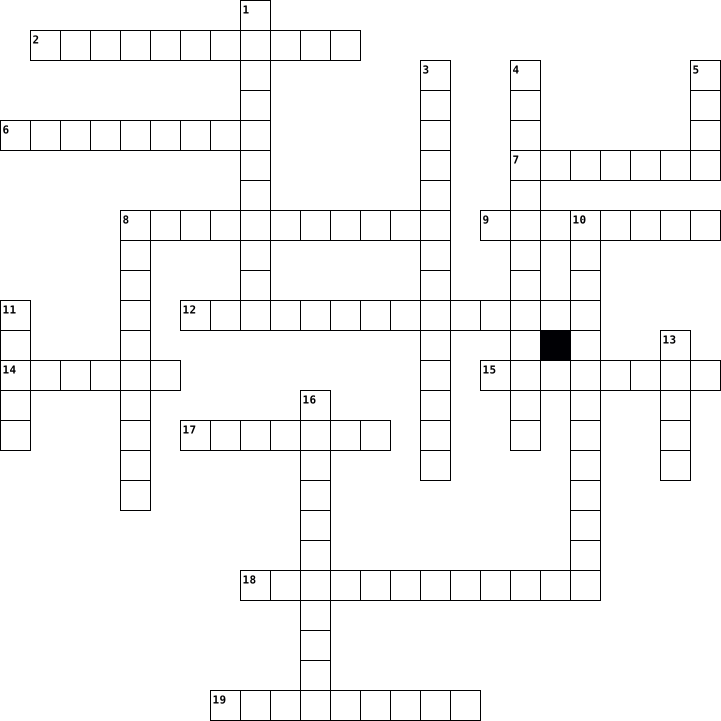
Across
- measurement of heat
- depends on the amount of matter in something ex Mass
- Basic unit of life
- Absorbing heat
- 1 or more elements
- non reversible change
- anything that has mass and takes up space
- mixture of something into a liquid ex saltwater
- Substance made by mixing other substances
- Data with number
- doesn't depend on the amount of matter in something ex color
Down
- amount of heat in something
- Outside change
- combination of 2 or more pure substances
- released in energy transfer
- Releasing heat
- Made of only one type of atom or molecule
- Density problem
- unit of work or energy
- Physical data color feel
20 Clues: Outside change • Absorbing heat • Releasing heat • Density problem • Data with number • Basic unit of life • 1 or more elements • measurement of heat • non reversible change • unit of work or energy • Physical data color feel • amount of heat in something • released in energy transfer • combination of 2 or more pure substances • Made of only one type of atom or molecule • ...
Science Crossword 2014-12-07

Across
- has mass and takes up space
- takes up space
- amount of force put on a surface
- resistance to flow
- Tension causes some liquids to form circles or ovals
- A solid with an orderly and dimensional pattern
- solid to liquid
- change by gain of energy
- solid to gas
- liquid to gas
- change by loss of energy
- A state that don't change volume or shape
Down
- doesn't special have a arrangement
- They make up matter
- measure of how hot or cold something is
- gas to liquid
- an important part of changing states of matter
- A state that doesn't change volume but changes shape
- liquid to solid
- Changes shape and volume
20 Clues: solid to gas • gas to liquid • liquid to gas • takes up space • solid to liquid • liquid to solid • resistance to flow • They make up matter • change by gain of energy • change by loss of energy • Changes shape and volume • has mass and takes up space • amount of force put on a surface • doesn't special have a arrangement • measure of how hot or cold something is • ...
deezz 2023-04-06

Across
- energy that is stored
- a state of matter that adapts to what its on
- two or more elements combined
- the basic unit of a chemical element
- can't be used again
- a firm state of matter
- guess educated
- something you change
- what holds us down
- can be used again
Down
- the space something takes up
- energy that comes from the sun
- what you measure
- the last step to an experiment
- how much something weighs
- earths natural satellite
- energy that is moving
- living things
- nonliving things
- energy that is heat
- on energy changing to another
- a state of matter that we can't see
22 Clues: living things • guess educated • what you measure • nonliving things • can be used again • what holds us down • can't be used again • energy that is heat • something you change • energy that is stored • energy that is moving • a firm state of matter • earths natural satellite • how much something weighs • the space something takes up • two or more elements combined • ...
deezz 2023-04-06

Across
- energy that is stored
- a state of matter that adapts to what its on
- two or more elements combined
- the basic unit of a chemical element
- can't be used again
- a firm state of matter
- guess educated
- something you change
- what holds us down
- can be used again
Down
- the space something takes up
- energy that comes from the sun
- what you measure
- the last step to an experiment
- how much something weighs
- earths natural satellite
- energy that is moving
- living things
- nonliving things
- energy that is heat
- on energy changing to another
- a state of matter that we can't see
22 Clues: living things • guess educated • what you measure • nonliving things • can be used again • what holds us down • can't be used again • energy that is heat • something you change • energy that is stored • energy that is moving • a firm state of matter • earths natural satellite • how much something weighs • the space something takes up • two or more elements combined • ...
deezz 2023-04-06

Across
- energy that is stored
- a state of matter that adapts to what its on
- two or more elements combined
- the basic unit of a chemical element
- can't be used again
- a firm state of matter
- guess educated
- something you change
- what holds us down
- can be used again
Down
- the space something takes up
- energy that comes from the sun
- what you measure
- the last step to an experiment
- how much something weighs
- earths natural satellite
- energy that is moving
- living things
- nonliving things
- energy that is heat
- on energy changing to another
- a state of matter that we can't see
22 Clues: living things • guess educated • what you measure • nonliving things • can be used again • what holds us down • can't be used again • energy that is heat • something you change • energy that is stored • energy that is moving • a firm state of matter • earths natural satellite • how much something weighs • the space something takes up • two or more elements combined • ...
deezz 2023-04-06

Across
- energy that is stored
- a state of matter that adapts to what its on
- two or more elements combined
- the basic unit of a chemical element
- can't be used again
- a firm state of matter
- guess educated
- something you change
- what holds us down
- can be used again
Down
- the space something takes up
- energy that comes from the sun
- what you measure
- the last step to an experiment
- how much something weighs
- earths natural satellite
- energy that is moving
- living things
- nonliving things
- energy that is heat
- on energy changing to another
- a state of matter that we can't see
22 Clues: living things • guess educated • what you measure • nonliving things • can be used again • what holds us down • can't be used again • energy that is heat • something you change • energy that is stored • energy that is moving • a firm state of matter • earths natural satellite • how much something weighs • the space something takes up • two or more elements combined • ...
Chemistry Terminology 🦇bOooOoOO🦇 2022-10-30

Across
- Dihydrogen monoxide
- State of matter where molecules are somewhat bound
- Positively charged, inside the nucleus
- 6.022*10^23
- State of matter where molecules float freely
- Cannot be broken down further by chemical means
- Conducts electricity in a solution
- State of matter where molecules are tightly bound
- Something mixed in water
- Bitter, can erotde
- Negatively charged, orbits around the nucleus
Down
- Where do we find molar masses?
- Sour, can corrode
- Smallest elementary particle
- No charge, inside the nucleus
- Product of a neutralizaiton reaction
- Made of two or more elements
- Amount of substance
18 Clues: 6.022*10^23 • Sour, can corrode • Bitter, can erotde • Dihydrogen monoxide • Amount of substance • Something mixed in water • Smallest elementary particle • Made of two or more elements • No charge, inside the nucleus • Where do we find molar masses? • Conducts electricity in a solution • Product of a neutralizaiton reaction • Positively charged, inside the nucleus • ...
Semester 1 Vocabulary 2025-01-13

Across
- solution made out of metals
- ion with a positive charge
- smallest unit of matter
- elements found in group 17
- separate mixtures based on boiling point
- even throughout
- two or more phases
- horizontal row found in the periodic table
- amount of matter in an object
- ion with a negative charge
Down
- SI unit of mass
- separate mixtures based on particle size
- same element with different mass number
- mass divided by volume
- SI unit of length
- vertical column in the periodic table
- space occupied by matter
- tendency to attract electrons
18 Clues: SI unit of mass • even throughout • SI unit of length • two or more phases • mass divided by volume • smallest unit of matter • space occupied by matter • ion with a positive charge • elements found in group 17 • ion with a negative charge • solution made out of metals • tendency to attract electrons • amount of matter in an object • vertical column in the periodic table • ...
sience 2025-05-16

Across
- what is the flow of energy
- change the change that transforms chemicals
- speeds up chemical reaction
- the ability to work
- result of chemical reaction
- small group of two or more atoms
- what is the natural branch of science
- building block of matter
- the force of two molecules
Down
- change what alters appearence
- what takes up space or weight
- what substances introduce
- how hot or cold something is
- holds atoms together
- two or more substances combined
- the reaction from chemicals
- intreads or transforms
- what is the quantity of matter
18 Clues: the ability to work • holds atoms together • intreads or transforms • building block of matter • what substances introduce • what is the flow of energy • the force of two molecules • speeds up chemical reaction • result of chemical reaction • the reaction from chemicals • how hot or cold something is • change what alters appearence • what takes up space or weight • ...
Does Matter Really Matter 2024-09-09

Across
- the standard unit of mass
- the force that objects exert on each other because of their mass
- method to calculate the volume of a regular object
- anthing that has mass and takes up space
Down
- a unit of volume of a liquid
- the standard scientific unit for weight
- method to calculate the volume of an irregular object
- a measure of how much matter an object is made of
- the amount of space that matter in an object occupies
- the force of gravity on an object
10 Clues: the standard unit of mass • a unit of volume of a liquid • the force of gravity on an object • the standard scientific unit for weight • anthing that has mass and takes up space • a measure of how much matter an object is made of • method to calculate the volume of a regular object • method to calculate the volume of an irregular object • ...
Science Vocab 2020-09-16

Across
- a substance that cannot be made into simpler substances by ordinary means
- a substance made up of two or more elements chemically combined
- a change that produces one or more kinds of matter that are different from those present before the change
- a combination of two or more kinds of matter that can be separated by physical means
- the direct change from a solid to a gas
- phase of matter that doesn't have a definite shape or volume
- the mass per unit volume of a substance
- a hot gas of electrically charged particles
Down
- a number written as the product of a coefficient between 1 and 10 and a power of 10
- phase of matter that has a definite volume but not a definite shape
- the temperature at which a gas changes to a liquid
- has definite shape and a definite volume
- anything has mass and takes up space
- a change in which the appearance of matter changes but its properties and makeup remain the same
- the numbers that a scientist reads and estimates on a scale
15 Clues: anything has mass and takes up space • the direct change from a solid to a gas • the mass per unit volume of a substance • has definite shape and a definite volume • a hot gas of electrically charged particles • the temperature at which a gas changes to a liquid • the numbers that a scientist reads and estimates on a scale • ...
Lab 4 2021-07-14

Across
- In a mixture the components are not uniformly distributed throughout the mixture
- A is comprised of only one type of molecule.
- The measure of gravity’s pull on an object.
- Contain two or more substance that are NOT chemically combined.
- State of matter that has an indefinite shape and volume, hot ionized gas.
- State of matter that has a definite shape and volume, the atoms are packed tightly.
- State of matter that has an indefinite shape and volume, can expand and be compressed.
- The amount of space an object occupies.
Down
- Anything that has mass and takes up space.
- Form at near absolute zero temperatures and have virtually no molecular movement or energy.
- In a mixture the components are uniformly distributed throughout.
- An is comprised of atoms of one substance from the periodic table.
- State of matter that has an indefinite shape, definite volume, the atoms can move over one another.
- The measure of the amount of matter an object contains.
- A substance has a definite composition with distinct chemical properties.
15 Clues: The amount of space an object occupies. • Anything that has mass and takes up space. • The measure of gravity’s pull on an object. • A is comprised of only one type of molecule. • The measure of the amount of matter an object contains. • Contain two or more substance that are NOT chemically combined. • ...
CHEMISTRY 2020-09-24

Across
- A ____ has no definite shape and no definite volume
- Energy is ___ matter
- The fourth state of matter
- ______ consists of several types of matter
- Water and oil are in _____ state
Down
- Liquids don't have definite ______
- There are three _____ of matter
- A table, a student, a pen are all in _____ state
- Everything that has mass and volume
- _______ matter consists of only one type of matter
10 Clues: Energy is ___ matter • The fourth state of matter • There are three _____ of matter • Water and oil are in _____ state • Liquids don't have definite ______ • Everything that has mass and volume • ______ consists of several types of matter • A table, a student, a pen are all in _____ state • _______ matter consists of only one type of matter • ...
States Of Matter 2023-08-06

Across
- has mass and takes up space
- when matter moves from solid to liquid
- the gas form of water
- when matter moves from gas to liquid
- particles are far apart from each other
- matter that has some space between particles
Down
- when water moves from a liquid to a gas
- smallest portion of matter
- when matter moves from liquid to solid
- matter that has tightly packed particles
10 Clues: the gas form of water • smallest portion of matter • has mass and takes up space • when matter moves from gas to liquid • when matter moves from liquid to solid • when matter moves from solid to liquid • when water moves from a liquid to a gas • particles are far apart from each other • matter that has tightly packed particles • matter that has some space between particles
6.2 Thermal Energy 2024-01-12

Across
- When matter changes from gas to solid.
- Sweet tri-color drink.
- A material that absorbs energy.
- Energy that is in motion or moving.
- When matter changes from solid to gas.
Down
- When matter changes from liquid to gas.
- A material that allows heat to move from one object to another.
- Instrument used to measure temperature.
- When matter changes from gas to liquid.
- The transfer of energy.
- How hot or cold something is.
- Matter that is all around us.
12 Clues: Sweet tri-color drink. • The transfer of energy. • How hot or cold something is. • Matter that is all around us. • A material that absorbs energy. • Energy that is in motion or moving. • When matter changes from gas to solid. • When matter changes from solid to gas. • When matter changes from liquid to gas. • Instrument used to measure temperature. • ...
Properties of matter 2023-05-19

Across
- freezing at 32 and boils 212 degrees
- freezing at 0 boil 100 degrees
- can be turned into a liquid
- measured with a thermometer
- move slow when cold fast when hot
- anything that takes up space
- small positively charged particle of matter in atoms
- you can drink it
- can be turned into a solid
Down
- naturally repels water
- related to heat or temperature
- vapor type of matter
- attraction between two dissimilar phases
- negatively charged subatomic particle
- subatomic particles found inside the nucleus
- also called "quick silver"
- smallest part of a substance
- like molecules sticking together
- tends to be attracted to water
19 Clues: you can drink it • vapor type of matter • naturally repels water • also called "quick silver" • can be turned into a solid • can be turned into a liquid • measured with a thermometer • anything that takes up space • smallest part of a substance • related to heat or temperature • freezing at 0 boil 100 degrees • tends to be attracted to water • like molecules sticking together • ...
Chapter 2- Anatomy and physiology 1 2025-08-29

Across
- proton donor
- take place between ions and positively and negatively charge.
- negative charge.
- All matter is composed of________
- atoms that vary in the number of neutrons.
- non-polar covalent bond
- chemical bond between 2 or more atoms
- outermost shell in a atom
- weak attaction and always involved a hydrogen atom.
Down
- chemical bonds between 2 or more elements
- polar covalent bond
- positive charge.
- universal solvent
- have a polar portion and a non-polar portion
- proton aceptor
- All living things consist of this?
- science of stucture and interaction of matter.
- smallest structure of life
18 Clues: proton donor • proton aceptor • positive charge. • negative charge. • universal solvent • polar covalent bond • non-polar covalent bond • outermost shell in a atom • smallest structure of life • All matter is composed of________ • All living things consist of this? • chemical bond between 2 or more atoms • chemical bonds between 2 or more elements • ...
Matter and Atoms 2022-10-13

Across
- anything with mass and volume
- positively charged and is found in the nucleus
- how much space an object takes up
- state of matter with definite volume but no shape
- how much matter is in an object
- negatively charged and found in the outer rings
Down
- neutrally charged and found in the nucleus
- the atomic _________ is equal to the number of
- state of matter with shape and volume
- two or more atoms bonded together
- state of matter with no definite volume or shape
- smallest particle of matter that makes up
12 Clues: anything with mass and volume • how much matter is in an object • two or more atoms bonded together • how much space an object takes up • state of matter with shape and volume • smallest particle of matter that makes up • neutrally charged and found in the nucleus • positively charged and is found in the nucleus • the atomic _________ is equal to the number of • ...
Words to Know 2020-04-24

Across
- matter that has no definite shape or volume
- the scientific study of what matter is made of and how it reacts when it comes into contact with other matter
- a kind of mixture in which one substance dissolves, or seems to disappear, into another substance
- a way to describe matter, such as color, shape, odor, or hardness
- a part of an atom that has a negative electrical charge
- a part of an atom that has no electrical charge
Down
- matter that has a definite shape and volume
- the scientific study of what energy is and how it interacts with matter
- the measure of how much mass something has for its size
- matter that has a definite volume but no definite shape
- a part of an atom that has a positive electrical charge
- a substance that is formed when the atoms of two or more elements join together chemically
- a substance made of two or more elements or compounds that are mixed together but not chemically joined
13 Clues: matter that has no definite shape or volume • matter that has a definite shape and volume • a part of an atom that has no electrical charge • the measure of how much mass something has for its size • matter that has a definite volume but no definite shape • a part of an atom that has a positive electrical charge • ...
Chemistry 2013-11-24

Across
- study of matter
- differentiates substances from each other
- Father of Modern Chemistry
- released in the air after combustion of materials
- need in evidence and support before belief
- matter could be changed from one form to another through the addition or removal of heat and moisture
- earliest metal documented
- composition of the heavens and the stars
Down
- four-element concept of matter
- pure water is hydrogen and oxygen in a ratio of 2:1
- indestructible, uncuttable, unbreakable entity
- resulted to occultism and black magic
- process by which metal is obtained from its ore
- arrangement of particles that make up matter
- dephlogisticated air
15 Clues: study of matter • dephlogisticated air • earliest metal documented • Father of Modern Chemistry • four-element concept of matter • resulted to occultism and black magic • composition of the heavens and the stars • differentiates substances from each other • need in evidence and support before belief • arrangement of particles that make up matter • ...
Chemistry 2013-11-24

Across
- earliest metal documented
- arrangement of particles that make up matter
- composition of the heavens and the stars
- dephlogisticated air
- resulted to occultism and black magic
- study of matter
- need in evidence and support before belief
- Father of Modern Chemistry
- pure water is hydrogen and oxygen in a ratio of 2:1
Down
- differentiates substances from each other
- matter could be changed from one form to another through the addition or removal of heat and moisture
- four-element concept of matter
- indestructible, uncuttable, unbreakable entity
- released in the air after combustion of materials
- process by which metal is obtained from its ore
15 Clues: study of matter • dephlogisticated air • earliest metal documented • Father of Modern Chemistry • four-element concept of matter • resulted to occultism and black magic • composition of the heavens and the stars • differentiates substances from each other • need in evidence and support before belief • arrangement of particles that make up matter • ...
Chapter 1 & 2 Vocab 2023-01-25

Across
- a type of change that doesn't alter chemical properties
- a substance with a fixed chemical composition
- calculated with math
- a property that doesn't depend on the amount of matter
- values are close to the accepted value
- observed through senses
- see diagram 1 on chalkboard
Down
- a type of change that forms new substances
- two or more substances that are not chemically combined
- a property that depends on the amount of matter
- see diagram 2 on chalkboard
- negatively charged particle
- values are close to each other
- see diagram 3 on chalkboard
- smallest quantity of matter that still retains the properties of matter
15 Clues: calculated with math • observed through senses • see diagram 2 on chalkboard • negatively charged particle • see diagram 3 on chalkboard • see diagram 1 on chalkboard • values are close to each other • values are close to the accepted value • a type of change that forms new substances • a substance with a fixed chemical composition • ...
Chapter 1-3 2018-09-11

Across
- an antonym of mass is plenty
- a synonym of compound is composite
- a synonym of accuracy is closeness
- combined units exp. mph or g/mL
- a synonym of exothermic is exit
- an antonym of homogeneous is different
- anything that has mass and takes up space
Down
- blend of two or more different types of matter; not bonded
- an antonym of precision is accuracy
- a synonym of heterogeneous is assorted
- a reaction that absorbs heat
- an antonym of element is whole
- measure of how much matter is in a space
- a synonym of volume is capacity
- smallest unit of matter
15 Clues: smallest unit of matter • an antonym of mass is plenty • a reaction that absorbs heat • an antonym of element is whole • combined units exp. mph or g/mL • a synonym of exothermic is exit • a synonym of volume is capacity • a synonym of compound is composite • a synonym of accuracy is closeness • an antonym of precision is accuracy • a synonym of heterogeneous is assorted • ...
Chapter 2 2023-05-14

Across
- closeness of a measurement to the actual value
- letter(s) that represent an element
- all of the particles in the sample are identical
- quantity of matter in a sample
- separation technique based upon boiling points
- sample with uneven composition (can see different parts)
Down
- observation that is non numerical
- sample with uniform composition (cannot see different parts)
- sample containing only one kind of atom
- mass/volume
- physical blend of two or more pure substances; each retaining their own properties
- anything that has mass and volume
- the study of matter and how that matter interacts
- formed when two or more elements combine chemically
- interval between events
15 Clues: mass/volume • interval between events • quantity of matter in a sample • observation that is non numerical • anything that has mass and volume • letter(s) that represent an element • sample containing only one kind of atom • closeness of a measurement to the actual value • separation technique based upon boiling points • all of the particles in the sample are identical • ...
Chemistry Vocab 2025-01-10

Across
- beginning substances that start a reaction
- mixture where composition isn't uniform
- process that releases energy from surroundings
- matter in which particles can barely move around
- something that can be absorbed and released
Down
- substances that are formed during reaction
- can't be separated by any physical or chemical process
- substance that be gas, liquid, and solid
- process that absorbs energy from surroundings
- measure of amount of space that's occupied
- not easy to reverse
- study of the composition, structure, and properties of matter
- matter in which particles can freely move around
- example of a physical change
- matter in which particles can't move around
15 Clues: not easy to reverse • example of a physical change • mixture where composition isn't uniform • substance that be gas, liquid, and solid • substances that are formed during reaction • beginning substances that start a reaction • measure of amount of space that's occupied • matter in which particles can't move around • something that can be absorbed and released • ...
deezz 2023-04-06

Across
- energy that is stored
- a state of matter that adapts to what its on
- two or more elements combined
- the basic unit of a chemical element
- can't be used again
- a firm state of matter
- guess educated
- something you change
- what holds us down
- can be used again
Down
- the space something takes up
- energy that comes from the sun
- what you measure
- the last step to an experiment
- how much something weighs
- earths natural satellite
- energy that is moving
- living things
- nonliving things
- energy that is heat
- on energy changing to another
- a state of matter that we can't see
22 Clues: living things • guess educated • what you measure • nonliving things • can be used again • what holds us down • can't be used again • energy that is heat • something you change • energy that is stored • energy that is moving • a firm state of matter • earths natural satellite • how much something weighs • the space something takes up • two or more elements combined • ...
deezz 2023-04-06

Across
- energy that is stored
- a state of matter that adapts to what its on
- two or more elements combined
- the basic unit of a chemical element
- can't be used again
- a firm state of matter
- guess educated
- something you change
- what holds us down
- can be used again
Down
- the space something takes up
- energy that comes from the sun
- what you measure
- the last step to an experiment
- how much something weighs
- earths natural satellite
- energy that is moving
- living things
- nonliving things
- energy that is heat
- on energy changing to another
- a state of matter that we can't see
22 Clues: living things • guess educated • what you measure • nonliving things • can be used again • what holds us down • can't be used again • energy that is heat • something you change • energy that is stored • energy that is moving • a firm state of matter • earths natural satellite • how much something weighs • the space something takes up • two or more elements combined • ...
deezz 2023-04-06

Across
- energy that is stored
- a state of matter that adapts to what its on
- two or more elements combined
- the basic unit of a chemical element
- can't be used again
- a firm state of matter
- guess educated
- something you change
- what holds us down
- can be used again
Down
- the space something takes up
- energy that comes from the sun
- what you measure
- the last step to an experiment
- how much something weighs
- earths natural satellite
- energy that is moving
- living things
- nonliving things
- energy that is heat
- on energy changing to another
- a state of matter that we can't see
22 Clues: living things • guess educated • what you measure • nonliving things • can be used again • what holds us down • can't be used again • energy that is heat • something you change • energy that is stored • energy that is moving • a firm state of matter • earths natural satellite • how much something weighs • the space something takes up • two or more elements combined • ...
Science Crossword Puzzle 2018-08-17

Across
- how fast something moves
- amount of space an object takes up
- tiny particles that make up matter
- change in position over time
- can't be broken down into smaller parts
- force of attraction
- object's resistance to changing speed or dirction
- actively watching to gain information
- speed in a specific direction
- ability to cause change
Down
- amount of matter in an object
- a push or a pull
- the place or location of an object
- everything is made of this
- two or more atoms
- how quickly velocity changes
- an educated guess
- scientist made Laws of Motion
- organized procedure to study something
- force that resists motion between two surfaces
20 Clues: a push or a pull • two or more atoms • an educated guess • force of attraction • ability to cause change • how fast something moves • everything is made of this • how quickly velocity changes • change in position over time • amount of matter in an object • scientist made Laws of Motion • speed in a specific direction • the place or location of an object • ...
Chapter 12 Chemistry 2024-12-03

Across
- A chemical combination of two or more atoms.
- Have a definite volume but take the shape of its container.
- The smallest chemical component of an element and are structures that make up the element and have the same properties of that element.
- molecules Molecule containing two or more atoms of the same element in definite (fixed) proportions.
- The science that deals with the composition, structures, and properties of matter and how matter changes under different conditions.
- of matter The three different physical forms of matter (solid, liquid and gas).
- molecules A chemical combination of two or more atoms of different elements in definite proportions.
- Any substance that occupies space and has mass.
Down
- A stable physical mixture of two or more substances in a solvent.
- chemistry Study of substances that do not contain carbon but may contain the element hydrogen.
- Atoms cannot be divided into simpler substances by ordinary _______ means.
- Have a fixed shape and volume.
- Have no volume or shape.
- chemistry The study of substances that contain the element carbon.
- The simplest form of chemical matter.
15 Clues: Have no volume or shape. • Have a fixed shape and volume. • The simplest form of chemical matter. • A chemical combination of two or more atoms. • Any substance that occupies space and has mass. • Have a definite volume but take the shape of its container. • A stable physical mixture of two or more substances in a solvent. • ...
Science 2022-11-22

Across
- Anything that you can observe about an object by using one or more of your senses.
- A mixture that has the same composition throughout because all it's parts are evenly mixed up
- A combination of two or more different substances in which the substances keep their identities
- the point at which matter changes from a liquid to a gas
- A law that states that matter cannot be made or destroyed; however, matter can change into a new form.
- a minute portion of matter.
Down
- a change in which the shape or form or form of the substance changes, but the substance still has the same chemical makeup.
- The temperature at which matter is changed from a liquid to a solid
- change in one or more substance, caused by a reaction, that forms new and different substances
- the nature of something's ingredients or constituents; the way in which a whole or mixture is made up.
- become or cause to become incorporated into a liquid so as to form a solution.
- anything that takes up space
- The temperature at which matter changes from a solid to a liquid
13 Clues: a minute portion of matter. • anything that takes up space • the point at which matter changes from a liquid to a gas • The temperature at which matter changes from a solid to a liquid • The temperature at which matter is changed from a liquid to a solid • become or cause to become incorporated into a liquid so as to form a solution. • ...
MYPsci2 Koko 2024-09-12

Across
- the state a matter expands to occupy whatever volume is available.
- positively charged
- Fe
- two or more substances mixed together physically.
- the state a matter maintains a fixed volume but adapts to the shape of its container.
- cannot conduct electricity or heat very well.
- have no charge
Down
- anything that has mass and takes up space.
- two or more elements chemically combined together.
- negatively charged
- O
- the smallest part of an element that can exist.
- cannot be broken down into simpler form.
- an element that readily forms positive ions and has metallic bonds
- the state in which matter maintains a fixed volume and shape.
15 Clues: O • Fe • have no charge • positively charged • negatively charged • cannot be broken down into simpler form. • anything that has mass and takes up space. • cannot conduct electricity or heat very well. • the smallest part of an element that can exist. • two or more substances mixed together physically. • two or more elements chemically combined together. • ...
Unit A Topic 1 2024-10-05

Across
- a substance where all particles are the same
- state of matter where particles are furthest apart
- property that describes how a substance interacts with others
- solid turning to gas
- liquid turning to gas
- a system of ideas meant to explain something
- liquid turning to solid
- state of matter where particles are close together
Down
- a substance where all particles are different
- gas turning to liquid
- gas turning to solid
- solid turning to liquid
- state of matter where particles move a medium amount
- something that has weight and takes up space
- property that describes how a substance is by itself
15 Clues: gas turning to solid • solid turning to gas • gas turning to liquid • liquid turning to gas • solid turning to liquid • liquid turning to solid • a substance where all particles are the same • something that has weight and takes up space • a system of ideas meant to explain something • a substance where all particles are different • ...
Unit 2 vocab crossword 2023-05-01

Across
- energy that comes from a source
- heat energy transmitted through collisions
- liquid or solid to a gaseous form
- liquid to a solid
- made of particles
- point changes solid to liquid
- solid to a gas
Down
- transfer of kinetic energy from one medium object to another
- a state of matter that can flow and does not have a specific shape
- gas to liquid
- the degree of hotness and coldness
- solid to a liquid
- the ability to work
- a substance that is in a gaseous, vaporous, state of matter
- a state of matter that retains its shape
15 Clues: gas to liquid • solid to a gas • solid to a liquid • liquid to a solid • made of particles • the ability to work • point changes solid to liquid • energy that comes from a source • liquid or solid to a gaseous form • the degree of hotness and coldness • a state of matter that retains its shape • heat energy transmitted through collisions • ...
Solis Liquid Gases 2023-12-06

Across
- process to change gases become liquid
- States of matter has Fixed volume and no fixed shape
- Amount of space occupied by matter
- process to change water to be ice
Down
- process to change ice to be water
- States of matter has no Fixed volume and no fixed shape
- States of matter has Fixed volume and fixed shape
- process to change liquid become gases
- process to steam water liquid to be water vapour
- Amount of matter
- Everything around us
11 Clues: Amount of matter • Everything around us • process to change ice to be water • process to change water to be ice • Amount of space occupied by matter • process to change gases become liquid • process to change liquid become gases • process to steam water liquid to be water vapour • States of matter has Fixed volume and fixed shape • ...
Properties of Matter 2017-07-12

Across
- bitter, sour, sweet, or salty
- ability of matter to emit magnetic energy
- how matter affects our smell
- refers to the amount of space a matter occupies
- how shiny a matter is
- refers to the amount of matter in an object
Down
- how the surface of a substance feel
- ability of matter to resist flow
- ability to be scratched
- how matter affects the eye receptors
10 Clues: how shiny a matter is • ability to be scratched • how matter affects our smell • bitter, sour, sweet, or salty • ability of matter to resist flow • how the surface of a substance feel • how matter affects the eye receptors • ability of matter to emit magnetic energy • refers to the amount of matter in an object • refers to the amount of space a matter occupies
Science 2017-03-29

Across
- point: a physical property that describes the temperature at which a substance will change from a liquid to a gas
- a body of coherent matter, usually of indefinite shape and often of considerable size
- made up or consisting of several parts or elements, in particular.
- change: occur when a substance combines with another to form a new substance
- any combination or blend of different elements, kinds, qualities, etc.
- the relative capacity of an atom, molecule, or radical to undergo a chemical reaction with another atom, molecule, or compound.
- is the chemical property of how easily a substance will set on fire.
- of conservation of energy: a principle of physics that states that, in a closed system, energy cannot be created or destroyed.
- states of matter: One of the principal conditions in which matter exists. Matter is traditionally divided into three states—solid, liquid, and gas. Ice, liquid water, and steam, for example, are three states of matter of the same substance. The electrically neutral condition known as plasma is often considered a fourth state of matter
Down
- Is the amount of space that an object or substance occupies. its a physical property
- the process by which sound waves travel through a medium
- cause (a substance) to be deposited in solid form from a solution.
- point: a physical property that describes the temperature at which a solid will become a liquid
- properties: any property that is measurable, whose value describes a state of a physical system.
- the movement caused within a fluid by the tendency of hotter and therefore less dense material to rise, and colder, denser material to sink under the influence of gravity, which consequently results in transfer of heat
- something that occupies space.
- real physical matter of which a person or thing consists and which has a tangible, solid presence
17 Clues: something that occupies space. • the process by which sound waves travel through a medium • made up or consisting of several parts or elements, in particular. • cause (a substance) to be deposited in solid form from a solution. • is the chemical property of how easily a substance will set on fire. • ...
Chemistry Vocab: The Final Chapter 2022-02-02

Across
- The law that states that mass cannot be created or destroyed in ordinary chemical and physical changes
- A substance that takes part in and undergoes change during a reaction (starting substances in a chemical reaction).
- Simplest form of matter that only consists of a single particle of matter.
- Substances made up of only one type of atom. Some of these exist as atoms and some exist as molecules (2 or more of the same atom bonded together).
- A number that goes on the bottom of an atom that tells us the the number of atoms glued together (or how many atoms to the left of the number you have). You CANNOT change this number when balancing equations...it must stay the same.
- The amount of space an object takes up
- A change of matter from one form to another without a change in chemical properties/identity.
- A substance produced in a chemical reaction
- The state of matter that has a definite volume but not a definite shape
- A measure of the force of gravity on an object
Down
- A change that occurs when one or more substances change into entirely new substances with different properties.
- A number in front of a chemical formula in an equation that indicates how many molecules or atoms of each formula that makes up the chemical equation. This number CAN be changed when balancing equations.
- The amount of matter in an object
- A state of matter with no definite shape or volume
- A state of matter that has a definite shape and a definite volume
- Made up of two or more elements joined together by a chemical bond. They may be atoms of the same type or atoms of a different type.
- How much matter is in a given amount of space.
17 Clues: The amount of matter in an object • The amount of space an object takes up • A substance produced in a chemical reaction • How much matter is in a given amount of space. • A measure of the force of gravity on an object • A state of matter with no definite shape or volume • A state of matter that has a definite shape and a definite volume • ...
States of Matter 2025-06-20

Across
- The ability to do work or cause change. It can exist in different forms, like heat, light, or motion.
- The process where a solid changes directly into a gas without becoming a liquid first.
- The amount of matter in an object. It is usually measured in grams or kilograms.
- The smallest unit of an element that retains the properties of that element. Atoms are the building blocks of matter.
- The process where a liquid changes into a gas, usually when heated.
- To lower the temperature of a substance, often causing it to change from a gas to a liquid or a liquid to a solid.
- A state of matter where the substance has a definite volume but takes the shape of its container. The particles are close but can move around each other.
- of Matter The physical form in which a substance exists, such as solid, liquid, gas, or plasma.
- A measure of how much mass is contained in a given volume. It tells us how tightly packed the particles are in a substance.
Down
- The process where a gas changes directly into a solid without becoming a liquid first.
- The process where a liquid changes into a solid, usually when cooled.
- A state of matter similar to gas, but the particles are charged and can conduct electricity. It's found in stars, including the sun.
- The process where a solid changes into a liquid, usually when heated.
- A state of matter where the substance has no definite shape or volume. The particles are far apart and move freely.
- The process where a gas changes into a liquid, often when cooled.
- A state of matter where the substance has a definite shape and volume. The particles are packed closely together and don't move much.
- A form of energy that causes substances to become warmer. It can change the state of matter.
17 Clues: The process where a gas changes into a liquid, often when cooled. • The process where a liquid changes into a gas, usually when heated. • The process where a liquid changes into a solid, usually when cooled. • The process where a solid changes into a liquid, usually when heated. • The amount of matter in an object. It is usually measured in grams or kilograms. • ...
Dark Matter 2021-09-29

Across
- What do we call matter that is not stars or galaxies?
- Recently, scientists have discovered that the expansion of the universe is ____________.
- Many scientists believe dark matter is a combination of ______ matter and undiscovered stuff.
- Dark matter ______ be sensed by astronomers.
Down
- What other dark thing is causing the universe expansion to accelerate?
- Do we know more about dark matter or dark energy?
- Dark matter is known because it affects the ______ of objects around it.
- Dark matter has ______.
- Dark energy could make up more than ____ of the Universe.
- Do we know if dark matter really exists?
10 Clues: Dark matter has ______. • Do we know if dark matter really exists? • Dark matter ______ be sensed by astronomers. • Do we know more about dark matter or dark energy? • What do we call matter that is not stars or galaxies? • Dark energy could make up more than ____ of the Universe. • What other dark thing is causing the universe expansion to accelerate? • ...
Vocabulary Homework 2017-10-25

Across
- substance used in a chemical reaction
- a state of matter that has a definite volume and a definite shape
- the process of burning
- when one or more substances change into other substances with different chemical properties
- type of change that will be difficult or impossible to undo (P)
- change that can be undone
Down
- a state of matter that has no definite shape but has a a definite volume
- the changing of a substance or kind of matter into a different kind of matter with different properties
- a state of matter with no definite shape or volume
- a change in some properties of matter without forming a different kind of matter
- anything that has mass and occupies space
11 Clues: the process of burning • change that can be undone • substance used in a chemical reaction • anything that has mass and occupies space • a state of matter with no definite shape or volume • type of change that will be difficult or impossible to undo (P) • a state of matter that has a definite volume and a definite shape • ...
Chem 2022-09-01

Across
- the magnetic field.
- a group of atoms bonded together.
- It can be separated out physically.
- the action or state of moving or being moved apart.
- a thing that is composed of two or more separate elements.
- two liquids is allowed to settle, the oil will float on top of the water so the two components may be separated.
- a state of matter that retains its shape and density when not confined.
- used to extract a mixture solid in a liquid.
- an extension of gravity separation.
- Large body of matter with no definite shape.
- a particle of matter that uniquely defines a chemical element.
- a homogeneous mixture of one or more solutes dissolved in a solvent.
- convert from its liquid state to gaseous state. This often requires heat.
- the action or process of filtering something.
Down
- the substances that are used to dissolve the solutes used in the formulation.
- A phase is a separate layer.
- the mixture is dissolved in a substance called the mobile phase, which carries it through a second substance called the stationary phase.
- a sample of matter that conforms to the shape of a container in which it is held and acquires a uniform density inside the container.
- a particular kind of matter with uniform properties.
- a substance whose atoms all have the same number of protons.
- composed of one or more pure substances.
- How much space an object or substance takes up.
- the electrons wander around freely among the nuclei of the atoms.
- a utensil with holes to separate finer particles.
- substance made up of various types of particles.
- takes the shape of its container.
26 Clues: the magnetic field. • A phase is a separate layer. • a group of atoms bonded together. • takes the shape of its container. • It can be separated out physically. • an extension of gravity separation. • composed of one or more pure substances. • used to extract a mixture solid in a liquid. • Large body of matter with no definite shape. • ...
Youssef's Science Crossword Puzzle 2023-04-11

Across
- When hot air rises, allowing cooler air to come in
- the distance covered by an object in a certain time
- the force acting on an object due to gravity
- equal to 0 on the kelvin scale and as of now is just a theory
- a state of matter with no definite shape or volume
- a push or a pull
- the flow of electrical power or charge
- degree of hotness or coldness measured by a thermometer
- energy energy done with movement
- a subatomic particle with negative energy
- a measure of the amount of matter contained in an object
- a subatomic particle with positive energy
- another word for a strong smell
- when kinetic energy transfers to one another by touching eachother
- sum of all forces acting on an object
- the rate of change
Down
- a subatomic particle with no energy
- all matter is made of up of tiny particles which cant be seen called atoms
- 0 degrees Celsius or 32 degrees Fahrenheit
- energy that comes from the sun and causes sunburns
- a group of 2 or more atoms which form the smallest unit into a pure sustance
- anything which takes up space and can be weighed
- composed of one or more pure substances
- a mixture of 2 or more different elements that have been chemically bonded
- the smallest part of a substance which cannon be broken down chemically
- a state of matter which has a fixed shape, mass and volume
- The rate of change of an object in any direction
- 100 degrees Celsius or 212 degrees Fahrenheit
- Energy which comes from the sun
- a state of matter with no definite shape but a definite volume
30 Clues: a push or a pull • the rate of change • another word for a strong smell • Energy which comes from the sun • energy energy done with movement • a subatomic particle with no energy • sum of all forces acting on an object • the flow of electrical power or charge • composed of one or more pure substances • a subatomic particle with negative energy • ...
SS2 2021-06-03

Across
- is a measure of the average energy of random motion of particles of matter
- vaporization takes place at the surface of a liquid
- is a particle that does not carry a charge
- groups of two or more atoms held together by chemical bond
- heat is transferred from one particle of matter to another without the movement of the matter
- is the number of complete waves that pass a given point in a certain amount of time
- is the energy of matter in motion
- states that the angle of incidence equals the angle of reflection
- the electromagnetic waves with the shortest wavelengths and highest frequencies
- the force that two surfaces exert on each other when they rub against each other
- of a substance is its mass per unit volume
- that has mass and takes up space
- of a sound is a description of how high or low the sound seems to a person
- the ability to do work or cause change
Down
- is a particle that carries a negative charge
- when you exert a force on an object that causes the object to move some distance
- is a particle that carries a positive charge
- heat is transferred by the movement of currents within a fluid
- is the transfer of energy by electromagnetic waves
- is the rate at which work is done
- electromagnetic waves that you can see
- a change from the gas state to the liquid state
- is a measure of the amount of matter in an object
- is the basic particle from which all elements are made
- is a material through which charge can flow easily
25 Clues: that has mass and takes up space • is the rate at which work is done • is the energy of matter in motion • electromagnetic waves that you can see • the ability to do work or cause change • is a particle that does not carry a charge • of a substance is its mass per unit volume • is a particle that carries a negative charge • is a particle that carries a positive charge • ...
8th grade semester exam review 2023-12-05

Across
- number of protons in an atom
- bond formed when 2 elements share electrons
- element found in group 17 of the periodic table
- the way a mineral reflects light from its surface (shines)
- gradual wearing away of a metal element
- anything that has mass and takes up space
- a characteristic of a substance that describes its ability to change into different substance
- a change that alters the form or appearance of a material but does not make the material into another substance
- a state of matter with no definite shape but a definite volume
- tiny, negatively charged particle that moves around the outside of the nucleu
- the basic particle from which all elements are made
- atom or group of atoms that has become electrically charged
Down
- one or two letter representation of an element
- measure of the force of gravity on an object
- liquid's resistance to flow
- a substance made of two or more elements chemically combined in a specific way or proportion
- electrons in the highest energy level and involved in chemical reactions
- small particle in the nucleus of an atom with no charge
- elements in the same vertical column of the periodic table
- state of matter that has definite shape and volume
- state of matter with no definite shape or volume
- small, positively charge particles that are found in the nucleus of an atom
- the measurement of how much mass of a substance is contained in a given volume
- the study of the properties and how matter changes
- the measure of ho much matter is in an object
25 Clues: liquid's resistance to flow • number of protons in an atom • gradual wearing away of a metal element • anything that has mass and takes up space • bond formed when 2 elements share electrons • measure of the force of gravity on an object • the measure of ho much matter is in an object • one or two letter representation of an element • ...
Energy Transformations 2025-11-05

Across
- — Heat transfer that happens when particles collide and pass energy directly
- — A system that can exchange mass or energy with its environment.
- — Energy associated with the temperature of a material
- — A measure of the average motion (kinetic energy) of particles in a substance.
- — Energy carried by waves, including visible light and radio waves.
- — Energy released when atomic nuclei split or fuse.
- — To keep the overall amount of a quantity (like energy) unchanged.
- — Heat transfer that occurs when warmer fluid rises and cooler fluid moves in to replace it.
- — The portion of electromagnetic energy that can be detected by human eyes.
- — Energy transfer through electromagnetic waves, with no need for matter.
- — The energy required to raise 1 kilogram of a material by 1 °C.
- — The process of switching from one state of matter to another
- — Energy stored in the bonds between atoms and molecules.
Down
- — Energy stored in an object because of its position or shape.
- — Energy produced by vibrating objects that travels through matter.
- — A state of matter made up of charged particles.
- — The energy something has because it is moving.
- — Energy associated with moving electrons through a conductor.
- — The total of an object's energy due to its motion and position.
- — The change from a solid to a liquid.
- — The change when a liquid becomes a gas throughout the substance.
- — Thermal energy that moves from a hotter object to a cooler one.
- — The change from a liquid to a solid.
- — One of the physical forms matter can take, such as solid, liquid, or gas.
- — A system that does not exchange matter or energy with its surroundings.
- — A material that slows or resists the flow of heat or electric charge.
26 Clues: — The change from a solid to a liquid. • — The change from a liquid to a solid. • — The energy something has because it is moving. • — A state of matter made up of charged particles. • — Energy released when atomic nuclei split or fuse. • — Energy associated with the temperature of a material • — Energy stored in the bonds between atoms and molecules. • ...
Chemistry Vocabulary List 1 2024-10-23

Across
- A factor in an experiment that is kept constant to ensure a fair test.
- Distinct states in which matter can exist, including solid, liquid, gas, and plasma.
- A change that can be undone, allowing the original substance to return.
- A state of matter that has a definite volume but no definite shape, flowing to fit its container.
- A mixture where the components remain distinct and can be easily identified, like a salad.
- A high-energy state of matter where atoms are ionised, found in stars and fluorescent lights.
- Pure substances that cannot be broken down into simpler substances, made up of one type of atom.
- A substance formed from two or more elements chemically bonded together in a fixed ratio.
- A group of two or more atoms bonded together, representing the smallest unit of a compound.
- A state of matter that has no definite volume or shape, expanding to fill its container.
Down
- Anything that has mass and takes up space.
- A change that cannot be undone, resulting in new substances.
- The capacity to work or produce heat, existing in various forms such as kinetic or potential energy.
- A process where substances transform into different substances with new properties.
- A change in a substance's form or appearance without altering its chemical composition.
- A mixture that has a uniform composition throughout, such as saltwater.
- The force exerted per unit area, often affecting the behaviour of gases and liquids.
- The mass of a substance divided by its volume, indicating how compact the matter is.
- Combinations of two or more substances that retain their individual properties and can be separated.
- A homogeneous mixture where one substance (solute) is dissolved in another (solvent).
20 Clues: Anything that has mass and takes up space. • A change that cannot be undone, resulting in new substances. • A factor in an experiment that is kept constant to ensure a fair test. • A change that can be undone, allowing the original substance to return. • A mixture that has a uniform composition throughout, such as saltwater. • ...
SCIENCE PERFORMANCE TASK MATTER 2025-03-06

Across
- property describes a liquid’s resistance to flow?
- ratio of mass to volume called
- property determines how well a material allows heat or electricity to pass through it
- happens to the energy of particles when a substance freezes
- property of matter describes the amount of space an object occupies
- state of matter has neither a definite shape nor a definite volume
- process occurs when a solid turns directly into a gas?
- phase change happens when a liquid turns into a solid?
- process describes a gas changing into a liquid
- term refers to the amount of force exerted per unit area?
- ability of a substance to dissolve in another substance called?
- phase change happens when a liquid turns into a gas?*
Down
- ability of a substance to dissolve in another substance called? Reactivity property describes a substance’s ability to react with other substances?
- change type of change results in the formation of a new substance with different properties
- Is boiling water a physical or chemical change?
- type of mixture has substances evenly distributed
- Is burning wood a physical or chemical change?
- property of matter measures the amount of matter in an object
- Change type of change occurs when a substance changes form but remains the same chemically
- process called when a gas turns directly into a solid
- happens to the energy of particles when a substance melts
- term describes a material’s ability to be hammered or rolled into sheets
- state of matter has a definite shape and volume?
- state of matter has neither a definite shape nor a definite volume
- state of matter takes the shape of its container but has a definite volume
25 Clues: ratio of mass to volume called • Is burning wood a physical or chemical change? • process describes a gas changing into a liquid • Is boiling water a physical or chemical change? • state of matter has a definite shape and volume? • type of mixture has substances evenly distributed • property describes a liquid’s resistance to flow? • ...
Christopher's Crossword 2025-05-16

Across
- matter with a defined volume, but no definite shape that can flow from one place to another
- the process by which a liquid changes into a gas
- region surrounding the nucleus of an atom where electrons are most likely to be found
- movement of thermal energy from a substance at a higher temperature to a substance at a lower temperature
- the process by which a gas changes into a solid
- two or more atoms of the same element that have a different number of neutrons in the nuclei
- element that is malleable, ductile, a good conductor for electricity and generally had a shiny or metallic luster
- matter with a definite shape and volume, has tightly packed particles that move mainly by vibrating
- changes in which the composition of a substance changes
- change of matter from a solid state to a liquid state
- negatively charged particle that exists in an electron cloud formation around an atom nucleus
Down
- the process by which a solid changes directly into a gas
- family of elements in the Periodic Table that have similar physical or chemical properties
- anything that takes up space and has mass
- number of protons in the nucleus of each atom of a given element, the top number on the Periodic Table
- change of matter from a liquid state to a solid state
- matter that does not have a defined shape or volume, particles move at high speeds in all directions
- mass of an object divided by it's volume
- force upward force exerted on an object immersed in a fluid
- substance that cannot be broken down into simpler substances
20 Clues: mass of an object divided by it's volume • anything that takes up space and has mass • the process by which a gas changes into a solid • the process by which a liquid changes into a gas • change of matter from a liquid state to a solid state • change of matter from a solid state to a liquid state • changes in which the composition of a substance changes • ...
Chemical Magic Unit Vocabulary 2026-02-02

Across
- different forms of matter that include solid, liquid, and gas
- a pretend version of something that scientists use when the real thing is too big, small, or complicated to work with
- information that can be used to support or reject an idea
- a combination of two or more things particle a very tiny thing, sometimes too small to be seen
- when something bursts outwards gas a state of matter, such as water when it is steam
- to create something new, often an object or a way of doing something
- a type of gas that plants release and animals breathe in
- when one substance mixes with another and it looks like it disappears, such as when sugar mixes into tea
- to combine two or more things
- anything that takes up space and has weight; can be in different forms such as solid, liquid, or gas
Down
- a material that has specific properties
- a test used to discover new information about a question liquid a state of matter, such as water when you can pour it
- a special kind of mixture where you cannot tell the different parts from each other
- a process where one or more substances form a new substance
- anything that takes up space and has weight; can be in different forms such as solid, liquid, or gas
- a test used to discover new information about a question
- a substance that is usually sour, such as vinegar or orange juice
- a type of gas that plants sometimes take in and that animals release when they breathe
- something you can observe about an object or material
- a state of matter, such as water when you can pour it
- a name for people in the past who studied the combination of chemicals
- a state of matter, such as water when it is steam
22 Clues: to combine two or more things • a material that has specific properties • a state of matter, such as water when it is steam • something you can observe about an object or material • a state of matter, such as water when you can pour it • a test used to discover new information about a question • a type of gas that plants release and animals breathe in • ...
States of Matter 2023-11-01

Across
- the speed gas particles move
- State of matter with definite volume only
- This affects which state matter will be in
- adding heat to a liquid will cause it to
Down
- Two words, Adding/removing this will cause a phase change
- anything that has mass and volume
- liquid particles are able to do this
- Solid particles do this
- the plural form of the state with the highest energy
- removing heat energy will cause a liquid to
- adding heat to a solid will cause it to
- State of matter with no definite shape or volume
- State of matter with definite shape and volume
13 Clues: Solid particles do this • the speed gas particles move • anything that has mass and volume • liquid particles are able to do this • adding heat to a solid will cause it to • adding heat to a liquid will cause it to • State of matter with definite volume only • This affects which state matter will be in • removing heat energy will cause a liquid to • ...