
matter Crossword Puzzles
MATTER AND ITS PROPERTIES 2024-10-07

Across
- The amount of matter in an object.
- Anything that takes up space and has mass.
- The basic unit of a chemical element.
- A group of atoms bonded together.
- When gas turns into a liquid.
- The process where a liquid becomes a solid.
Down
- The amount of mass per unit volume.
- The process of a liquid turning into a gas.
- The process where a solid becomes a liquid.
- The amount of space an object occupies.
- State of matter with a definite volume but no fixed shape.
- A state of matter with a definite shape and volume.
- State of matter without a definite shape or volume.
13 Clues: When gas turns into a liquid. • A group of atoms bonded together. • The amount of matter in an object. • The amount of mass per unit volume. • The basic unit of a chemical element. • The amount of space an object occupies. • Anything that takes up space and has mass. • The process of a liquid turning into a gas. • The process where a solid becomes a liquid. • ...
Intro to Chemistry Quiz (12.09.2022) 2022-12-09

Across
- extremely high energy with no definite shape nor volume
- high energy with definite volume, but no definite shape
- liquid to solid
- elements that look and behave similarly
- the energy found in matter
- liquid to gas
- gas to solid
- anything that takes up space (stuff)
Down
- low energy with definite shape and volume
- plasma to gas
- solid to liquid
- gas to liquid
- electrically charged gas
- solid to gas
- a table of all known elements (categorized in groups and periods)
- gas to plasma
- a 3 part theory about matter
- vertical columns
- horizontal rows
19 Clues: solid to gas • gas to solid • plasma to gas • gas to liquid • gas to plasma • liquid to gas • solid to liquid • liquid to solid • horizontal rows • vertical columns • electrically charged gas • the energy found in matter • a 3 part theory about matter • anything that takes up space (stuff) • elements that look and behave similarly • low energy with definite shape and volume • ...
States of matter 2023-12-04

Across
- Process from solid to gas
- The measure of how thick or runny a substance is
- Anything that has mass and volume
- The type of energy gained by particles when they heat up
- Process from liquid to solid
- State of matter where particles are fixed
- An example of deposition that falls from the sky
- A thick substance is said to be v_______
Down
- These are strong between solid particles and weak between liquid particles
- Process from liquid to gas
- State of matter where particles are touching but able to move
- Process from solid to liquid
- Particles do this when they heat up (move)
- Process from gas to liquid
- How much mass something has for its volume
- Degrees _______, the unit for temperature
- _____ rate, measured in cm/s
- State of matter where particles can be compressed & move freely
18 Clues: Process from solid to gas • Process from liquid to gas • Process from gas to liquid • Process from solid to liquid • Process from liquid to solid • _____ rate, measured in cm/s • Anything that has mass and volume • A thick substance is said to be v_______ • Degrees _______, the unit for temperature • State of matter where particles are fixed • ...
Dark Matter 2021-09-29

Across
- What do we call matter that is not stars or galaxies?
- Recently, scientists have discovered that the expansion of the universe is ____________.
- Many scientists believe dark matter is a combination of ______ matter and undiscovered stuff.
- Dark matter ______ be sensed by astronomers.
Down
- What other dark thing is causing the universe expansion to accelerate?
- Do we know more about dark matter or dark energy?
- Dark matter is known because it affects the ______ of objects around it.
- Dark matter has ______.
- Dark energy could make up more than ____ of the Universe.
- Do we know if dark matter really exists?
10 Clues: Dark matter has ______. • Do we know if dark matter really exists? • Dark matter ______ be sensed by astronomers. • Do we know more about dark matter or dark energy? • What do we call matter that is not stars or galaxies? • Dark energy could make up more than ____ of the Universe. • What other dark thing is causing the universe expansion to accelerate? • ...
Chemistry Crossword 2022-03-21

Across
- Biological catalysts contained in the cells of your body
- A characteristic of a substance that describes its ability to change into other substances
- The principle that states that matter is not created or destroyed during a chemical reaction
- The new substances you have after the reaction is complete
- The minimum amount of energy needed to start a chemical reaction
- A solid that forms from a specific solution
- Matter is not allowed to enter or leave
- A rapid reaction between oxygen and a substance called fuel, the result of which is fire
- A reaction is which energy is absorbed
- Anything that has mass and takes up space
- Burning a marshmallow
- Squishing a marshmallow
- A material that releases energy when it burns
- A characteristic of a substance that can be observed without changing the substance into another substance
- A material used to decrease the rate of a reaction
Down
- The process that breaks down compounds into simpler products
- A short, easy way to show a chemical reaction, using symbols instead of words
- The amount of a substance in a given volume
- The substances you have at the beginning of a chemical equation
- The number placed in front of a chemical formula in an equation
- A reaction that releases energy in the form of heat
- The process where two or more elements or compounds combine to make a more complex substance
- A material that increases the rate of a reaction by lowering the activation energy
- The study of matter and how matter changes
- Matter can enter from or escape to the surroundings
- The process where one element replaces another in a compound, or when two elements in different compounds trade places
26 Clues: Burning a marshmallow • Squishing a marshmallow • A reaction is which energy is absorbed • Matter is not allowed to enter or leave • Anything that has mass and takes up space • The study of matter and how matter changes • The amount of a substance in a given volume • A solid that forms from a specific solution • A material that releases energy when it burns • ...
cross word puzzle 2022-03-22

Across
- " A solid that form's from solution during a chemical reaction."
- The cells in your body contain biological catalysts called ENZYMES."
- "is a amount of a substance in a given volume."
- "When on element replaces another in a compound, or when two elements in different compounds trade places."
- reaction- "is a reaction in which energy is absorbed
- "The study of matter and how matter changes"
- "A material used to decrease the rate of a reaction"
- "In contrast to a synthesis reaction, a process called DECOMPOSITION breaks down compounds into simpler products."
- is a material that releases energy when it burns."
- The substance you have at the beginning"
- "when two or more elements or compounds combine to make more complex substances the process is called synthesis."
- equation-"is a short, easy way to show a chemical reaction, using symbols instead of words."
- reaction-"A reaction that releases energy in the form of heat"
- " a rapid reaction between oxygen and a substance called a fuel.
Down
- "is a number placed in font of chemical formula in an equation."
- property- a Characteristic of substance that describes its ability to change into other substances.
- "is anything that has mass and takes up space."
- system- " matter is not allowed to enter or leave."
- of mass- "during a chemical reaction, matter is not created or destroyed
- a material that increases the rate of reaction by lowering the activation energy."
- reaction- A change in matter that produces one or more new substances.
- "When the reaction is complete, you have new substances"
- system- "matter can enter from or escape to the surrounding."
- change- " is any change that alters the form or appearance of a substance but that does not make the substance into another substance.
- property- A characteristic of a substance that can be observed without changing the substance into another substance.
- energy- "is a minimum amount of energy needed to start a chemical reaction."
26 Clues: The substance you have at the beginning" • "The study of matter and how matter changes" • "is anything that has mass and takes up space." • "is a amount of a substance in a given volume." • is a material that releases energy when it burns." • system- " matter is not allowed to enter or leave." • reaction- "is a reaction in which energy is absorbed • ...
Chemical and Physical reaction worksheet 2022-03-18

Across
- " A solid that form's from solution during a chemical reaction."
- The cells in your body contain biological catalysts called ENZYMES."
- "is a amount of a substance in a given volume."
- "When on element replaces another in a compound, or when two elements in different compounds trade places."
- reaction- "is a reaction in which energy is absorbed
- "The study of matter and how matter changes"
- "A material used to decrease the rate of a reaction"
- "In contrast to a synthesis reaction, a process called DECOMPOSITION breaks down compounds into simpler products."
- is a material that releases energy when it burns."
- The substance you have at the beginning"
- "when two or more elements or compounds combine to make more complex substances the process is called synthesis."
- equation-"is a short, easy way to show a chemical reaction, using symbols instead of words."
- reaction-"A reaction that releases energy in the form of heat"
- " a rapid reaction between oxygen and a substance called a fuel.
Down
- "is a number placed in font of chemical formula in an equation."
- property- a Characteristic of substance that describes its ability to change into other substances.
- "is anything that has mass and takes up space."
- system- " matter is not allowed to enter or leave."
- of mass- "during a chemical reaction, matter is not created or destroyed
- a material that increases the rate of reaction by lowering the activation energy."
- reaction- A change in matter that produces one or more new substances.
- "When the reaction is complete, you have new substances"
- system- "matter can enter from or escape to the surrounding."
- change- " is any change that alters the form or appearance of a substance but that does not make the substance into another substance.
- property- A characteristic of a substance that can be observed without changing the substance into another substance.
- energy- "is a minimum amount of energy needed to start a chemical reaction."
26 Clues: The substance you have at the beginning" • "The study of matter and how matter changes" • "is anything that has mass and takes up space." • "is a amount of a substance in a given volume." • is a material that releases energy when it burns." • system- " matter is not allowed to enter or leave." • reaction- "is a reaction in which energy is absorbed • ...
Physical Science FCAT Review 2016-04-12

Across
- Mixture that is the same throughout.
- State of matter with loosely packed particles that slide past one another.
- Energy of motion.
- Changes with a change in temperature, concentration or pressure.
- Change in matter that does not result in a new substance being formed.
- Tool used to show the types of waves based on their frequencies and wavelengths.
- Two or more substances, not chemically combined.
- State of matter with particles that move freely, rarely bumping.
- Bend in light backwards, towards the source
- Net for not equal to 0, moving.
- An element or compound.
- Energy released from the breaking of chemical bonds.
- Mixture that is not the same throughout.
- State of matter with closely packed particles that are vibrating.
- Time for one wave cycle (wavelength).
- Number of cycles (wavelengths) per second.
- Amount of matter in an object.
Down
- Ability of a substance to transfer heat or electricity.
- Pure substance made of two or more elements.
- Change in matter where chemical bonds are broken and a new substance is formed and it can not be reversed.
- Distance traveled in a given time.
- Distance from trough to trough or crest to crest.
- Gravitational pull on an object.
- Net force of 0, stationary.
- Wave made of a series of crests and troughs.
- Wave made of a series of compressions and rarefactions.
- Pure substance in which all atoms are exactly the same.
- Bend in light after passing through an object.
- Distance from Crest to mid-point.
- Energy in an object based on position.
- Natural movement from high temperature to lower temperature.
- Tool used to organize the elements and determine reactivity.
32 Clues: Energy of motion. • An element or compound. • Net force of 0, stationary. • Amount of matter in an object. • Net for not equal to 0, moving. • Gravitational pull on an object. • Distance from Crest to mid-point. • Distance traveled in a given time. • Mixture that is the same throughout. • Time for one wave cycle (wavelength). • Energy in an object based on position. • ...
Unit 1 Composition of Matter 2023-10-24

Across
- a property that describes how well one substance dissolves in another substance
- on a scale that people can see with their eyes
- a type of extended structure that is made of many smaller, repeating subunits in a chain
- the mass of a single atom
- a shorthand notation of one, two, or three letters that represent the name of the element
- the amount of matter in an object or sample
- a group of two or more atoms that are held together by chemical bonds
- a limitation on the range of possible solutions to a design
- a structure whose subunits occur in a constant ratio and are arranged in a repeating pattern
- a table that lists all of the known elements and groups them into columns by important shared properties
- a characteristic of matter
Down
- the types of elements that make up a substance, as well as the specific ratios of atoms of each kind of element that make it up
- the requirements that must be met for an engineering solution to be successful
- a property that describes the mass of a certain volume of matter
- an individual particle of an element
- a solid structure whose atoms or molecules are arranged in a repeating, three-dimensional pattern
- the specific way in which the bonds and atoms are arranged within the molecules of a substance
- the connection between atoms in more complex particles
- matter that has a constant chemical composition and characteristics
- a unique particle of matter that is a fundamental building block of matter
- a representation of an object which makes important aspects easier to see
21 Clues: the mass of a single atom • a characteristic of matter • an individual particle of an element • the amount of matter in an object or sample • on a scale that people can see with their eyes • the connection between atoms in more complex particles • a limitation on the range of possible solutions to a design • ...
Systems Thinking Vocabulary 2023-11-02

Across
- An entity composed of diverse but interrelated parts that function as a complex whole.
- A temporary disturbance of a system.
- Matter and/or energy are contained within a system.
- Matter and/or energy is lost from a system.
- A self-perpetuating mechanism of change and response to that change.
- If the flux of matter or energy out of a reservoir is greater than the flux in, the reservoir is a source.
- Amplifies the effect of disturbances.
- The length of time a substance remains in a given reservoir.
- Diminishes the effect of disturbances.
- The length of time for a system to return to steady state after being perturbed.
- The rate of matter or energy movement (amount per unit time).
- No change in any component or source/sink in a system as a function of time..
Down
- A persistent disturbance of a system.
- The level or value at which a rapid change in the system state occurs.
- A graphical representation of a system, showing system components and couplings.
- A place where matter or energy resides.
- If the flux of matter or energy into a reservoir is greater than the flux out, the reservoir is a sink.
- A graphical and quantitative representation of a system.
- A set of attributes that characterize the system at a particular time.
- Links between system components.
- Constant movement of material from one reservoir to another.
- Describes whether a system is stable or unstable.
- Individual parts of a system.
- Change in a system as a result of perturbation or forcing.
24 Clues: Individual parts of a system. • Links between system components. • A temporary disturbance of a system. • A persistent disturbance of a system. • Amplifies the effect of disturbances. • Diminishes the effect of disturbances. • A place where matter or energy resides. • Matter and/or energy is lost from a system. • Describes whether a system is stable or unstable. • ...
States of Matter 2 2024-04-04

Across
- the process by which a gas changes to a liquid.
- matter with a definite shape and a definite volume
- the unit used to measure temperature in the United States
- the unit of temperature also used by scientists
- to become smaller
- matter with a definite volume, but no definite shape
- movement in all directions and at different speeds.
- a quality or feature of something
- to come together with direct impact
- a force that brings things together
- from Greek energiaI, means “activity” OR the ability to cause change
- related to heat
- the result of the motion of all the particles, and the distance and attractions between those particles in the system.
- the unit used to measure temperature in countries that use the metric system
- stored energy due to the interactions between objects or particles.
- anything that has mass and takes up space
Down
- to move something from one place to another
- to spread out
- the movement of substances from an area of higher concentration to an area of lower concentration.
- the study of heat.
- the amount of space something fills or takes up
- a decrease in a material’s volume when the temperature is decreased.
- the change in state from a liquid to a gas.
- energy due to motion
- to happen
- an increase in a material’s volume when the temperature is increased.
- a particular stage of, in this case, matter
- the measure of the average kinetic energy of the particles in a material.
- a condition or physical property of matter
- matter with no definite volume and no definite shape
30 Clues: to happen • to spread out • related to heat • to become smaller • the study of heat. • energy due to motion • a quality or feature of something • to come together with direct impact • a force that brings things together • anything that has mass and takes up space • a condition or physical property of matter • to move something from one place to another • ...
Scientific Method and Matter Review 2022-11-21

Across
- state of matter where particles are freely moving; no fixed volume or shape
- prefix meaning 1/1000
- changes from liquid to solid
- tool used to measure mass
- unit without a prefix; goes in the center of our metric chat; examples are meters, liters and grams
- graph that is used to show changes over time
- numerical data (numbers)
- variable that is measured; effect
- changes from liquid to gas
- state of matter where particles are closely moving by eachother; has a fixed volume and takes the shape of the container
- prefix meaning 100
- often referred to as "an educated guess"; a prediction of the outcome of your experiment
- the first step in the Scientific Method
- changes from solid to liquid
- the amount of matter in an object
- graph that is used to show percentages
- changes from solid to gas
- graph that is used to compare data
- prefix meaning 1/100
- changes from gas to liquid
- state of matter where particles are closely-packed; has a fixed volume and shape
- determining what your data means
Down
- descriptive data (letters/literature)
- the way you test your hypothesis
- the amount of space something takes up
- process used by Scientists to ask and answer testable questions
- summarizing your experiment and determining if your hypothesis was correct
- prefix meaning 10
- prefix meaning 1/10
- variable that is changed; cause
- Scientists gather background information in order to make a hypothesis
- the amount of matter in a give space
- tool used to measure volume
- prefix meaning 1000
- tool use to measure length/volume
- anything that has mass and takes up space
36 Clues: prefix meaning 10 • prefix meaning 100 • prefix meaning 1/10 • prefix meaning 1000 • prefix meaning 1/100 • prefix meaning 1/1000 • numerical data (numbers) • tool used to measure mass • changes from solid to gas • changes from liquid to gas • changes from gas to liquid • tool used to measure volume • changes from liquid to solid • changes from solid to liquid • ...
Basic science words crossword 2023-09-25

Across
- amount of matter a substance contains or property of matter that resists acceleration
- easily ignited or capable of sustained combustion.
- state of matter characterized by having neither a defined shape nor defined volume.
- , the number of protons in the nucleus of an atom of an element.
- the element with atomic number 12 and is represented by the symbol Mg
- mass per unit volume.
- a substance containing gas bubbles trapped within a liquid or solid.
- tabular arrangement of elements by increasing atomic number, ordered according to trends in recurring properties.
- reaction, set of chemical reactions in which products become reactants of another reaction
- How hot or cold something is
- point, the lowest temperature a vapor will initiate and sustain combustion.
- ,deoxyribonucleic acd, an organic molecule that codes for proteins.
- a substance that cannot be subdivided using chemical means; identified by the number of protons in its atoms.
Down
- a solute passing into solution, usually a solid going to the liquid phase.
- - a clear breakable solid.
- process by which atoms, ions, or molecules enter a bulk phase.
- unit of mass equal to the mass of one cubic centimeter
- state of matter characterized by having a definite volume but not a definite shape.
- , the lowest possible state at which matter can exist
- element with atomic number 53 and is represented by the symbol I
- stable,negatively charged subatomic particles.
- a general rule that explains a body of scientific observations. Laws are stated in words, but expressed by mathematical equations.
- , ribonucleic acid, a molecule which codes for amino acid sequences
- Does experiments
- phase change of matter from solid to liquid.
25 Clues: Does experiments • mass per unit volume. • - a clear breakable solid. • How hot or cold something is • phase change of matter from solid to liquid. • stable,negatively charged subatomic particles. • easily ignited or capable of sustained combustion. • , the lowest possible state at which matter can exist • unit of mass equal to the mass of one cubic centimeter • ...
SCIENCE PERFORMANCE TASK MATTER 2025-03-06

Across
- phase change happens when a liquid turns into a gas?*
- ability of a substance to dissolve in another substance called?
- state of matter has neither a definite shape nor a definite volume
- Is burning wood a physical or chemical change?
- type of mixture has substances evenly distributed
- happens to the energy of particles when a substance freezes
- Is boiling water a physical or chemical change?
- property of matter measures the amount of matter in an object
- process occurs when a solid turns directly into a gas?
- ratio of mass to volume called
- process called when a gas turns directly into a solid
- ability of a substance to dissolve in another substance called? Reactivity property describes a substance’s ability to react with other substances?
Down
- term describes a material’s ability to be hammered or rolled into sheets
- process describes a gas changing into a liquid
- state of matter has neither a definite shape nor a definite volume
- property of matter describes the amount of space an object occupies
- happens to the energy of particles when a substance melts
- Change type of change occurs when a substance changes form but remains the same chemically
- change type of change results in the formation of a new substance with different properties
- state of matter has a definite shape and volume?
- term refers to the amount of force exerted per unit area?
- property determines how well a material allows heat or electricity to pass through it
- state of matter takes the shape of its container but has a definite volume
- phase change happens when a liquid turns into a solid?
- property describes a liquid’s resistance to flow?
25 Clues: ratio of mass to volume called • process describes a gas changing into a liquid • Is burning wood a physical or chemical change? • Is boiling water a physical or chemical change? • state of matter has a definite shape and volume? • type of mixture has substances evenly distributed • property describes a liquid’s resistance to flow? • ...
Unit 2 Crossword 2025-12-07

Across
- Matter that has a fixed composition and includes only elements or compounds.
- A mixture that is not evenly mixed and has visibly different parts.
- A change that affects only the form of a substance, not its chemical identity.
- A feature that describes how a substance reacts to form new substances; the substance does not change, this just mentions its ability to change.
- A property that does not depend on the amount of matter present.
- A change that produces one or more new substances.
- A state of matter with particles that are far apart and no definite shape or volume (shape and volume fill the container).
- The smallest part of an element that still has the properties of that element.
- The amount of mass divided by volume of a substance.
- A feature that can be observed or measured without changing the substance.
Down
- A mixture that is evenly mixed and looks the same throughout; a synonym is solution.
- A state of matter with a definite shape and volume and tightly packed particles.
- A force that holds atoms together in a compound.
- A property that does depend on the amount of matter present.
- A pure substance made of only one type of atom.
- Two or more atoms chemically bonded; the atoms can be from the same element or different elements.
- A state of matter with a definite volume but no definite shape (shape can change!).
- A pure substance made of two or more different elements that are chemically bonded.
- A combination of substances where no new chemical substance is formed.
- A physical blend of two or more substances that are not chemically combined.
20 Clues: A pure substance made of only one type of atom. • A force that holds atoms together in a compound. • A change that produces one or more new substances. • The amount of mass divided by volume of a substance. • A property that does depend on the amount of matter present. • A property that does not depend on the amount of matter present. • ...
Chemicals in the environment 2026-06-05

Across
- The ability to carry electricity or heat.
- The amount of matter in an object.
- An element that is shiny and conducts heat and electricity.
- A pure substance made of one kind of atom.
- A substance with a low pH that can react with metals.
- A substance made from two or more elements joined together.
- How much solute is mixed into a solution.
- Facts or observations used to support an idea.
- The slow wearing away of metal by chemical reactions.
- The substance that does the dissolving.
- A reaction between an acid and a base.
- property A feature of a substance that can be observed without changing it.
- change A change where no new substance is made.
- A mixture where one substance dissolves in another.
- A starting substance in a chemical reaction.
Down
- Matter with a fixed shape and size.
- An element that does not have metal properties.
- A short form used to represent an element.
- Matter that spreads out to fill a space.
- How a substance behaves during a chemical change.
- Matter that takes the shape of its container.
- Letters and numbers that show the parts of a substance.
- The smallest part of an element.
- The substance that dissolves.
- A substance with a high pH.
- How thick or runny a liquid is.
- chemical reaction where a substance reacts with oxygen and releases energy
- Two or more atoms joined together.
- A substance that changes colour to show pH.
- substance Matter made of only one type of particle.
- scale A scale that measures how acidic or basic something is.
- Anything that has mass and takes up space.
- A mixture where you can see the different parts.
33 Clues: A substance with a high pH. • The substance that dissolves. • How thick or runny a liquid is. • The smallest part of an element. • The amount of matter in an object. • Two or more atoms joined together. • Matter with a fixed shape and size. • A reaction between an acid and a base. • The substance that does the dissolving. • Matter that spreads out to fill a space. • ...
Mixtures and Solutions 2023-01-06

Across
- the liquid that dissolves a solid for a solution
- change of matter from a liquid to a gas
- can be used to separate a mixture
- two or more materials combined
- a state of matter that cannot be seen
- a mixture of one or more substances dissolved in a solvent
- the solid that dissolves in a solution
Down
- a ratio of solute to solvent in a solution
- a measure of matter
- the space that matter takes up or occupies
- fuels burned by humans to create energy and products
- a measure of how heavy matter is
- a solution containing very little solute
13 Clues: a measure of matter • two or more materials combined • a measure of how heavy matter is • can be used to separate a mixture • a state of matter that cannot be seen • the solid that dissolves in a solution • change of matter from a liquid to a gas • a solution containing very little solute • a ratio of solute to solvent in a solution • ...
dark matter 2023-01-13

Across
- dark matter does not give off any kind of _________
- dark matter influences the path of _________ traveling towards earth
- dark matter is thought to be responsible for much of the ____ in the universe
- instruments that are used to find ______ matter cannot find dark matter
- the only way we can tell if dark matter is there is by how it affects things we can see by _______
Down
- dark ______ makes up 26.8% of the known universe
- dark ______ makes up 68.3% of the known universe
- gravitational _______ is of one of the many things that make scientists believe in dark matter
- 15% of the universe is made of _____, the rest is dark matter
- who was dark matter first proposed by?
10 Clues: who was dark matter first proposed by? • dark ______ makes up 26.8% of the known universe • dark ______ makes up 68.3% of the known universe • dark matter does not give off any kind of _________ • 15% of the universe is made of _____, the rest is dark matter • dark matter influences the path of _________ traveling towards earth • ...
The Phases of Matter Crossword 2013-10-09

Across
- what is the name of the very small particle that makes up all matter?
- what is the correct term for the ring of water that is left behind from a cold drink?
- ____ ____ is the term for when atoms get so cold, that the particles stop moving all together.
- ____ in the form of heat is needed to change from 1 phase to another.
- what is the process of a liquid becoming vaporized?
- ____ is when energy in the form of heat is given to atoms and the object can turn into liquid.
- ____ is in 78% of our air.
- ____ is a region located at the center of the atom.
- one phase of matter that is hard to compress, holds a shape, has a certain size, and might be hard.
Down
- ____ is how much there is of an object.
- ____ is the amount of space an object occupies.
- ____ of an element or compound is a phase transition from liquid phase to gas phase.
- ____ can freeze, boil, and evaporate.
- ____ is when energy is taken away from atoms, and the particles move slower.
- the universe is made entirely of ____.
- what is the transition of a substance directly from the solid to the gas phase without passing through an intermediate liquid phase.
- one phase of matter that is easy to compress and its atoms hold the most energy out of the 3 phases.
- what is another term for physical condition or stage of matter?
- one state of matter that exists between the solid phase and gas phase.
19 Clues: ____ is in 78% of our air. • ____ can freeze, boil, and evaporate. • the universe is made entirely of ____. • ____ is how much there is of an object. • ____ is the amount of space an object occupies. • what is the process of a liquid becoming vaporized? • ____ is a region located at the center of the atom. • ...
Chemistry Revision 7Z 2022-12-05

Across
- a minute portion of matter
- the temperature at which a liquid turns into a solid when cooled
- the process of one state of matter changes
- firm and stable in shape; not liquid or fluid
- a particular kind of matter with uniform properties
- a substance that flows freely but is of constant volume, having a consistency like that of water or oil
- to pass or cause to pass directly from the solid to the vapor state
Down
- the temperature at which a liquid boils and the liquid to vapour
- the action or process of liquefying due to heat.
- at or near f point
- turns from liquid into vapour
- the spreading of something more widely
- collects as droplets on a cold surface
- One of the three principal conditions in which matter exists
- a substance or matter in a state in which it will expand freely to fill the whole of a container, having no fixed shape (unlike a solid) and no fixed volume (unlike a liquid)
- at or near b point
- a combination of different things in which the component elements are individually distinct
17 Clues: at or near f point • at or near b point • a minute portion of matter • turns from liquid into vapour • the spreading of something more widely • collects as droplets on a cold surface • the process of one state of matter changes • firm and stable in shape; not liquid or fluid • the action or process of liquefying due to heat. • ...
G3B Week 16 S.S. & Science Crossword Puzzle 2020-11-05

Across
- Doing what is best for everyone.
- Different kinds of matter mixed together is called a _____.
- A change in the way matter looks is called a _____.
- Most types of matter _____ when they freeze, but not water.
- One way to separate a mixture is by _____.
- To change from a solid to a liquid is to _____.
- When one or more kinds of matter are mixed evenly into another kind of matter, you get a _____.
- To change from a liquid to a gas slowly is to _____.
Down
- A group that does not make money from the work that it does
- Someone who chooses to do a job without getting paid.
- A famous woman who was both blind and deaf, and helped many people.
- This person started the American Red Cross.
- The gas state of water is called _____.
- To change from a liquid to a gas at a high temperature is to _____.
- To change from a gas to a liquid is to _____.
- to change from a liquid to a solid is to _____.
- _____ separate mixtures by size.
17 Clues: Doing what is best for everyone. • _____ separate mixtures by size. • The gas state of water is called _____. • One way to separate a mixture is by _____. • This person started the American Red Cross. • To change from a gas to a liquid is to _____. • to change from a liquid to a solid is to _____. • To change from a solid to a liquid is to _____. • ...
Phase Change Vocab Part 1 2023-08-10

Across
- measure of the force of attraction between objects due to gravity
- phase in which matter has a definite shape and volume
- phase in which matter has no definite shape or volume
- the way molecules in a substance move around relative to each other
- amount of matter in an object
- the energy that an object has because it is moving
- matter with no definite shape but with a definite volume
- a measure of how hot or cold something is
- a group of atoms joined together in a particular way
Down
- the scientific data and details that support your claim
- a pull between two molecules that is always the same for a substance
- measurement of how much mass is contained in a given volume of an object; mass per unit volume
- the relative size of things
- matter that consists of two or more substances mixed but not chemically combined
- a statement that answers the question
- to provide evidence that goes against a claim
- a noticeably different form or state of the same substance
17 Clues: the relative size of things • amount of matter in an object • a statement that answers the question • a measure of how hot or cold something is • to provide evidence that goes against a claim • the energy that an object has because it is moving • a group of atoms joined together in a particular way • phase in which matter has a definite shape and volume • ...
Year 8 Chemistry 2024-07-29

Across
- Energy which something possesses by being in motion
- This type of matter does not have a definitive shape or volume
- This type of matter has a fixed shape and volume
- The reverse process of vaporisation
- The physical changes that matter undergoes when transitioning between different states
- Direct transition from a gas to a solid state
- Direct transition from solid to gas without passing through the liquid phase
Down
- Conversion from a liquid to a gas
- A group of atoms bonded together
- The net movement of particles from an area of high to low concentration
- This type of matter has a definitive volume but take the shape of the container they are in
- This happens when particles gain enough energy to break free and become vapor
- Transition from a liquid to a solid
- All matter is composed of tiny __________ that are continually moving and interacting
- The diffusion of solvent particles across a permeable membrane
- Transition from a solid to a liquid
- The smallest particle of a chemical element that can exist
17 Clues: A group of atoms bonded together • Conversion from a liquid to a gas • The reverse process of vaporisation • Transition from a liquid to a solid • Transition from a solid to a liquid • Direct transition from a gas to a solid state • This type of matter has a fixed shape and volume • Energy which something possesses by being in motion • ...
The Kinetic Theory of Matter 2021-03-01

Across
- Net movement caused by Brownian motion called ….
- Energy that pulls particles apart called ……
- Diffusion happens because of the difference in …….
- Diffusion does not happen in ……
- Particles move slowly in …..
- A hot gas called …..
- The molecules in a solid …….. about a fixed position.
- The element of crystal.
- Crystal is an examples of ……… state.
- The random motion of particles is called …..
Down
- …… stays that particles of all matter are in constant motion.
- The molecules in a gas exert ….. forces on each other.
- The arrangement, which is repeated throughout the solid called …...
- Flowing, compressible matter that has no definite volume or shape.
- Matter that has solid and liquid properties called …..
- According to the kinetic theory of matter, the state of a substance is determined by the act of two ….. forces within a substance.
- Crystals of the same substance have the …. shape
- Forces that hold particles together called…..
18 Clues: A hot gas called ….. • The element of crystal. • Particles move slowly in ….. • Diffusion does not happen in …… • Crystal is an examples of ……… state. • Energy that pulls particles apart called …… • The random motion of particles is called ….. • Forces that hold particles together called….. • Net movement caused by Brownian motion called …. • ...
Let's Review 2024-04-25

Across
- When a gas turns into a liquid
- When water gets hot and becomes a gas- it can be invisible but feels hot
- When something is flat without bumps
- To go away
- When it is so cold, a liquid becomes a solid
- When something is bumpy or scratchy
- Things or qualities about matter
- Matter that spreads to fill the space it is in
- To soak up
- Matter that flows and takes the shape of the container it is in
- When it is so warm, a solid becomes a liquid
- To go to the surface
Down
- When something can bend easily or is easy to move
- A way to tell or measure how hot or cold something is
- When water turns into a mist and floats into the air.
- When something is stiff and does not bend easily
- matter that holds its own shape
- To go to the bottom
18 Clues: To go away • To soak up • To go to the bottom • To go to the surface • When a gas turns into a liquid • matter that holds its own shape • Things or qualities about matter • When something is bumpy or scratchy • When something is flat without bumps • When it is so cold, a liquid becomes a solid • When it is so warm, a solid becomes a liquid • ...
Chemistry 2013-11-24

Across
- indestructible, uncuttable, unbreakable entity
- composition of the heavens and the stars
- four-element concept of matter
- matter could be changed from one form to another through the addition or removal of heat and moisture
- released in the air after combustion of materials
- resulted to occultism and black magic
Down
- Father of Modern Chemistry
- study of matter
- process by which metal is obtained from its ore
- need in evidence and support before belief
- pure water is hydrogen and oxygen in a ratio of 2:1
- earliest metal documented
- differentiates substances from each other
- dephlogisticated air
- arrangement of particles that make up matter
15 Clues: study of matter • dephlogisticated air • earliest metal documented • Father of Modern Chemistry • four-element concept of matter • resulted to occultism and black magic • composition of the heavens and the stars • differentiates substances from each other • need in evidence and support before belief • arrangement of particles that make up matter • ...
MYP2sci Momoka 2024-09-12

Across
- solid to gas
- liquid to gas
- two or more elements chemically combined together
- the state a matter expands to occupy whatever volume is available
- the state in which matter maintains a flixed volume and shape
- gas to solid
- liquid to solid
Down
- solid to liquid
- have no charge
- are simplest form of matter that cannot be broken down into simpler form
- are positively charged
- the state a matter maintains a flixed volume but adopts to the shape of its container
- are negatively charged
- the smallest part of an element that can exist
- two or more substances mixed together physically
15 Clues: solid to gas • gas to solid • liquid to gas • have no charge • solid to liquid • liquid to solid • are positively charged • are negatively charged • the smallest part of an element that can exist • two or more substances mixed together physically • two or more elements chemically combined together • the state in which matter maintains a flixed volume and shape • ...
elements, compounds, and mixtures 2026-06-30

Across
- to stay the same.
- a state of matter
- to change a gas to a liquid.
- to change the shape or make it smaller.
- a solid into a liquid as temperature increases.
- A state of matter that occupies the whole container
- to increase in size or volume
- the amount of physical matter in a object.
- to get smaller in size(or volume)
Down
- particles which mix when moved in particles.
- the energy of motion
- To change a liquid into a solid.
- the temperature at which a solid melts.
- something is squeezed so that it is smaller
- anything that has mass and takes up space
15 Clues: to stay the same. • a state of matter • the energy of motion • to change a gas to a liquid. • to increase in size or volume • To change a liquid into a solid. • to get smaller in size(or volume) • the temperature at which a solid melts. • to change the shape or make it smaller. • anything that has mass and takes up space • the amount of physical matter in a object. • ...
Matter and Atoms 2022-10-13

Across
- anything with mass and volume
- positively charged and is found in the nucleus
- how much space an object takes up
- state of matter with definite volume but no shape
- how much matter is in an object
- negatively charged and found in the outer rings
Down
- neutrally charged and found in the nucleus
- the atomic _________ is equal to the number of protons in the nucleus
- state of matter with shape and volume
- two or more atoms bonded together
- state of matter with no definite volume or shape
- smallest particle of matter that makes up
12 Clues: anything with mass and volume • how much matter is in an object • two or more atoms bonded together • how much space an object takes up • state of matter with shape and volume • smallest particle of matter that makes up • neutrally charged and found in the nucleus • positively charged and is found in the nucleus • negatively charged and found in the outer rings • ...
Chemistry 2013-11-24

Across
- differentiates substances from each other
- indestructible, uncuttable, unbreakable entity
- four-element concept of matter
- study of matter
- resulted to occultism and black magic
- process by which metal is obtained from its ore
- pure water is hydrogen and oxygen in a ratio of 2:1
- composition of the heavens and the stars
Down
- need in evidence and support before belief
- arrangement of particles that make up matter
- dephlogisticated air
- matter could be changed from one form to another through the addition or removal of heat and moisture
- released in the air after combustion of materials
- Father of Modern Chemistry
- earliest metal documented
15 Clues: study of matter • dephlogisticated air • earliest metal documented • Father of Modern Chemistry • four-element concept of matter • resulted to occultism and black magic • composition of the heavens and the stars • differentiates substances from each other • need in evidence and support before belief • arrangement of particles that make up matter • ...
Sci.-Properties of Matter Vocab. 2022-04-07

Across
- substance made up of only one type of matter
- the amount of matter making up and object
- a characteristic of matter that can be observed
- number of unit squares that fit inside a surface
- table chart that classifies elements by property
- smallest part of an element
Down
- a measure of how much space matter takes up
- amount of matter in given space
- upward force of a liquid or gas on an object
- anything that has mass and takes up space
- conducts heat, electricity, shiny luster
11 Clues: smallest part of an element • amount of matter in given space • conducts heat, electricity, shiny luster • the amount of matter making up and object • anything that has mass and takes up space • a measure of how much space matter takes up • substance made up of only one type of matter • upward force of a liquid or gas on an object • ...
Molly's Change in Matter Vocabulary Crossword 2024-05-15

Across
- trail mix, seawater, mud, Kool aid
- A characteristic that can be observed during a chemical reaction
- The amount of space something takes
- cannot be broken down into a smaller substance is a pure substance
- Thermal energy being transferred
- two or more atoms put together
- _+_--> CH3COONa+H20+CO2
- Has mass and takes up space
Down
- Doesn't change composition
- Releases heat
- smallest unit of matter
- study of matter
- the ability to do something
- Molecules of the same substance sticking together
- The average kinetic energy of the atoms
- NaHco3+CH3COOH -->_
- Absorbs heat
- Has weight
18 Clues: Has weight • Absorbs heat • Releases heat • study of matter • NaHco3+CH3COOH -->_ • smallest unit of matter • _+_--> CH3COONa+H20+CO2 • Doesn't change composition • the ability to do something • Has mass and takes up space • two or more atoms put together • Thermal energy being transferred • trail mix, seawater, mud, Kool aid • The amount of space something takes • ...
States of Matter 2015-01-02

Across
- Form of energy that usually results in the increase in volume of a substance
- Change in volume that generally results from heating a solid, a liquid, or a gas.
- The change of state from a gas to a liquid
- Evaporation occurring throughout a liquid
- Invisible gas form of water
- Greek who suggested that all matter was made of tiny unseen particles
- The change of state from a liquid to a solid
- The change of state from a solid to a liquid
Down
- Anything that has mass and occupies space
- the amount of matter in an object
- The change of state from a liquid to a gas
- State of matter in which the particles are in fixed positions and do not move with respect to one another.
- Solid form of water
- Movement of a substance from an area of high concentration to an area of low concentration
- the amount of space occupied by an object
- State of matter that can be compressed
16 Clues: Solid form of water • Invisible gas form of water • the amount of matter in an object • State of matter that can be compressed • Anything that has mass and occupies space • Evaporation occurring throughout a liquid • the amount of space occupied by an object • The change of state from a liquid to a gas • The change of state from a gas to a liquid • ...
Properties of Matter Vocab Crossword 2016-03-28

Across
- What all objects are made of
- The thickness of a liquid
- The amount of matter in an object
- A certain type of an element
- The temperature that is the lowest possible temperature, where molecules don't move
- Transfer of thermal energy between substances that are at different temperatures
- A measure of the force of gravity on an object
- A temperature scale with absolute zero at the zero point
Down
- The increase in the volume of matter that occurs when matter is heated
- A temperature scale with the melting point of ice at 0 degrees and the boiling point of water at 100 degrees
- Amount of space an object takes up
- A term used for liquids that are unable to dissolve in one another
- Measure of the average kinetic energy of a substance
- How tightly matter is packed together
- A temperature scale with the melting point of ice at 32 degrees and the boiling point of water at 212 degrees
- To adjust something, to make its settings correct
16 Clues: The thickness of a liquid • What all objects are made of • A certain type of an element • The amount of matter in an object • Amount of space an object takes up • How tightly matter is packed together • A measure of the force of gravity on an object • To adjust something, to make its settings correct • Measure of the average kinetic energy of a substance • ...
Science Matter Vocab 2023-09-20

Across
- Anything that has mass and takes up space
- a state of matter; no definite shape, no definite volume
- Characteristics that can be observed or measured; for example, color, melting point and conducivity
- a way of measuring how hot or cold something is' Measured in Fahrenheit (F) or Celsius (C).
- a container with measured markings used to measure the volume of liquids
- to drop below the surface level of a liquid
- To group together based on similar traits
- The amount of matter in something; measured in grams
- a tool used to measure mass.
Down
- solid, liquid or gas
- The amount of space mater takes up; measured in liters (L), cubic centimeters (cm3) or milliliters (mL)
- a state of matter; Definite volume, no definite shape
- pushing or pulling force produced by a magnet
- a state of matter; definite shape, definite volume
- Unit of measurement-gram (g), centimeter (cm), inch(in), etc.
- To stay on the surface of a liquid without expending energy
16 Clues: solid, liquid or gas • a tool used to measure mass. • Anything that has mass and takes up space • To group together based on similar traits • to drop below the surface level of a liquid • pushing or pulling force produced by a magnet • a state of matter; definite shape, definite volume • The amount of matter in something; measured in grams • ...
What Is Matter Made Of? Vocab 2025-10-21

Across
- To spread out evenly in a liquid
- Physical or chemical characteristics of matter used to describe or identify a substance
- A limited representation of something that can help us understand its structure or how it works
- How hot or cold something is
- To use the senses to examine or inspect
- Anything that has mass and takes up space
- The amount of space matter takes up
- A combination of two or more substances in which each keeps its own properties and both can be easily separated
Down
- Able to be turned the other way around
- A scientific tool used to greatly enlarge the image of small objects
- The smallest unit of a substance
- The heaviness of an object
- Matter with no set volume and no set shape
- A form of matter that is the same throughout and has specific properties
- The size, length, or amount of something, as established by measuring
- A liquid mixture in which one substance is mixed evenly throughout another substance
16 Clues: The heaviness of an object • How hot or cold something is • To spread out evenly in a liquid • The smallest unit of a substance • The amount of space matter takes up • Able to be turned the other way around • To use the senses to examine or inspect • Anything that has mass and takes up space • Matter with no set volume and no set shape • ...
G3B Week 16 S.S. & Science Crossword Puzzle 2020-11-05

Across
- A change in the way matter looks is called a _____.
- Most types of matter _____ when they freeze, but not water.
- Different kinds of matter mixed together is called a _____.
- To change from a liquid to a gas slowly is to _____.
- A famous woman who was both blind and deaf, and helped many people.
- to change from a liquid to a solid is to _____.
- When one or more kinds of matter are mixed evenly into another kind of matter, you get a _____.
- _____ separate mixtures by size.
- Doing what is best for everyone.
Down
- To change from a gas to a liquid is to _____.
- A group that does not make money from the work that it does
- The gas state of water is called _____.
- To change from a solid to a liquid is to _____.
- One way to separate a mixture is by _____.
- This person started the American Red Cross.
- Someone who chooses to do a job without getting paid.
- To change from a liquid to a gas at a high temperature is to _____.
17 Clues: _____ separate mixtures by size. • Doing what is best for everyone. • The gas state of water is called _____. • One way to separate a mixture is by _____. • This person started the American Red Cross. • To change from a gas to a liquid is to _____. • To change from a solid to a liquid is to _____. • to change from a liquid to a solid is to _____. • ...
Earth's spheres 2023-10-26

Across
- the state of matter that has a define volume but not a define shape
- water that is on the surface of the planet, underground, and in the air
- anything that has mass and takes up shape
- the unit used to express power
- any of the almost spherical concentric regions of matter that make up the earth and its atmosphere, as the lithosphere and hydrosphere.
- a mirror that has a flat surface
- a push or pull on an object
- a measure of the gravitational force exerted on and object
- a reflective sound wave
Down
- the region on, above, and below the Earth's surface where life exists
- a force of attraction between objects that is due to their masses
- A basic unit for SI
- a layer of gas and suspended solids extending from the Earth's surface up many thousands of miles
- A form of matter that does not have a define volume or shape.
- the capacity to do work
- a state of matter in which the volume and shape of a substance are fixed
- the SI unit for force
17 Clues: A basic unit for SI • the SI unit for force • the capacity to do work • a reflective sound wave • a push or pull on an object • the unit used to express power • a mirror that has a flat surface • anything that has mass and takes up shape • a measure of the gravitational force exerted on and object • A form of matter that does not have a define volume or shape. • ...
Unit 2 Post Lab Name_______________ 2025-09-24

Across
- There are 118 of these and all of them produce plateaus.
- This is directly related to kinetic energy.
- Anything that has mass and volume.
- The type of substance that ALWAYS forms a plateau on a phase change graph.
- This state of matter can be compressed.
- A flat section on a graph.
- When volume decreases, then ____ increases.
- The unit of measurement that would always be on the X-axis of a phase change graph.
Down
- A type of energy described as energy of motion.
- The particles of solids cannot be compressed because they are already so ____ together.
- This state of matter has its particles flowing relatively easily and takes shape of the container.
- Scientists use this a way to explain natural phenomena in "street terms".
- The reason why the plunger gets "sucked" to the board and why Schroeder can cut a meter stick with his hand.
- Does not form plateaus during any phase changes.
- This decreases when pressure increases.
- This is the most common form of matter in the entire universe.
- This state of matter has the least amount of kinetic energy.
17 Clues: A flat section on a graph. • Anything that has mass and volume. • This state of matter can be compressed. • This decreases when pressure increases. • This is directly related to kinetic energy. • When volume decreases, then ____ increases. • A type of energy described as energy of motion. • Does not form plateaus during any phase changes. • ...
MYPsci2 yuta 2024-09-12

Across
- Solid matter does not change atomsThe tiny particles that matter is made of are heliumThis is a very light gas found in some balloons.
- This liquid is needed by most cars and trucks to run. gasoline
- The amount of space that matter takes up is its
- Matter that has a definite shape and volume is in this state.
- Solid white flakes of water that fall from the sky are known as
Down
- On a warm day, the liquid water in a puddle will and turn into a gas. evaporate
- You might pour this thick, red liquid on a hot dog or hamburger. ketchup When atoms are in this state of matter, they fly around freely. gas
- This is liquid rock that pours out of a volcano. freezes At 32 degrees Fahrenheit, water water vapor Water in the form of a gas is called
- Raindrops are this state of matter. container Liquid matter takes the shape of its
- If you place a solid in a liquid, it will either sink or
- The amount of matter something contains is its
- This is the type of gas that animals' bodies need to stay alive. oxygen
- Water, in solid form is
13 Clues: Water, in solid form is • The amount of matter something contains is its • The amount of space that matter takes up is its • If you place a solid in a liquid, it will either sink or • Matter that has a definite shape and volume is in this state. • This liquid is needed by most cars and trucks to run. gasoline • ...
Unit 1 Matter 2020-09-04

Across
- substance that is made up of a single kind of atom
- anything that has mass and takes up space
- measure of the amount of space an object takes up
- change of matter that occurs when one or more substances change into an entirely new substance with different properties
- change of matter from one form to another without a change in chemical properties
- is a combination of substances that are combined physically, but not chemically
- substance that is made up of more than one kind of atom
- heterogeneous mixtures in which some particles settle out due to gravity
- characteristic that can be observed or measured without changing the identity of the substance
- are the same throughout
Down
- property that describes a substance’s ability to form new substances
- ratio of mass to volume of a substance
- a measure of the amount of matter in an object
- mixtures in which particles are not evenly distributed, but do not settle out
- are not the same throughout
- single particles of matter
- measure of the pull of gravity on an object
- homogeneous mixtures in which one substance dissolves into another
18 Clues: are the same throughout • single particles of matter • are not the same throughout • ratio of mass to volume of a substance • anything that has mass and takes up space • measure of the pull of gravity on an object • a measure of the amount of matter in an object • measure of the amount of space an object takes up • substance that is made up of a single kind of atom • ...
States of Matter Review 2025-09-22

Across
- When a solid changes to a liquid you must ______________ heat.
- The state of matter in which the atoms are packed closely together and cannot move.
- Anything that has volume and mass.
- The state of matter in which the atoms are far apart and can move freely.
- Water is an example of a ____________.
- Liquids take the shape of their _______________.
- The process in which heat is added to a liquid to change it to a gas.
- When you remove heat from a liquid and it turns to a solid.
Down
- Solids have definite volume and definite ________________.
- When you add heat to a solid and it changes to a liquid.
- When a gas cools down and turns into a liquid.
- When a liquid changes to a solid you must _______________ heat.
- This is two or more atoms clustered together, for example: H2O.
- The amount of space that something takes up.
- The amount of matter in something.
- The smallest unit of matter is an _______________.
16 Clues: Anything that has volume and mass. • The amount of matter in something. • Water is an example of a ____________. • The amount of space that something takes up. • When a gas cools down and turns into a liquid. • Liquids take the shape of their _______________. • The smallest unit of matter is an _______________. • When you add heat to a solid and it changes to a liquid. • ...
Properties of Matter 2026-04-30

Across
- A state of matter with no definite shape or volume
- can be compared using sinking and floating
- A state of matter with a definite shape and volume
- A material that allows heat or electric energy to pass through it
- Liquid water changing into water vapor (gas)
- The ability of a substance to dissolve in water
Down
- A state of matter that takes the shape of its container
- A tool or material used to separate solids from liquids in a mixture
- The amount of matter in an object; a measurable physical property
- A mixture where one substance dissolves completely into another
- The amount of space matter takes up; a measurable property
- A material that prevents heat or electric energy from passing through it
- Water vapor changing into liquid water
- A tool with small holes used to separate particles of different sizes
- The property of attraction or repulsion between certain materials and magnets
- A combination of substances that maintain their physical properties
16 Clues: Water vapor changing into liquid water • can be compared using sinking and floating • Liquid water changing into water vapor (gas) • The ability of a substance to dissolve in water • A state of matter with no definite shape or volume • A state of matter with a definite shape and volume • A state of matter that takes the shape of its container • ...
Unit 2 Crossword 2023-05-01

Across
- when a gas turns to liquid
- the condition the matter is in
- the substance that is being dissolved
- a state of matter with a fixed volume
- the temperature where liquid turns to gas
- a state of matter with no fixed shape or volume
- when a solid turns to gas
Down
- the substance that dissolves
- the temperature where solid turns to liquid
- a state of matter with a fixed shape and volume
- when a liquid turns to solid
- when a solid turns to liquid
- when a liquid turns to gas
- the ability for a substance to dissolve
- when a gas turns to solid
15 Clues: when a gas turns to solid • when a solid turns to gas • when a gas turns to liquid • when a liquid turns to gas • the substance that dissolves • when a liquid turns to solid • when a solid turns to liquid • the condition the matter is in • the substance that is being dissolved • a state of matter with a fixed volume • the ability for a substance to dissolve • ...
Particle theory 2017-02-20

Across
- All people need to drink this to live
- It is a gas that we need in the atmosphere
- The 4th state of matter
- Causes particles in a solid vibrate
- Only moves when a force is acting upon it
- What do you call the temperature –273.15
- When a liquid turns into a solid
- Has the weakest bond
- What holds both a solid and a liquid together
Down
- What all of the states are
- When gasses become liquids
- When liquids become gasses
- What all states of matter are made out of
- When a solid turns into a liquid
- Only state of matter that has no bond
15 Clues: Has the weakest bond • The 4th state of matter • What all of the states are • When gasses become liquids • When liquids become gasses • When a solid turns into a liquid • When a liquid turns into a solid • Causes particles in a solid vibrate • All people need to drink this to live • Only state of matter that has no bond • What do you call the temperature –273.15 • ...
Ch1 Chemistry 2024-01-26

Across
- matter that has definite & uniform composition
- data involving no number, only senses
- set of controlled observations that test a hypothesis
- visual, verbal, or math related explanation of data
- systemic approach to solving a problem
- relationship in nature supported by experiments
Down
- judgement based on information obtained
- data involving measurements & numbers
- measure of matter & gravity's effect on an object
- research done to solve a problem
- knowledge gained for the sake of knowing it
- testable statement or prediction, educated guess
- possible explanation, based on observations over time
- study of matter and its changes
- measurement of the amount of matter in something
15 Clues: study of matter and its changes • research done to solve a problem • data involving measurements & numbers • data involving no number, only senses • systemic approach to solving a problem • judgement based on information obtained • knowledge gained for the sake of knowing it • matter that has definite & uniform composition • relationship in nature supported by experiments • ...
Matter and Change Crossword 2024-08-14

Across
- Made from two or more substances.
- Beginning substances that start a reaction.
- Have properties of both metals and non-metals.
- Most are solids at room Temperature.
- Something that has both Mass and Volume.
- Process that releases energy into the surroundings.
Down
- Study of the Composition Structure and properties of matter.
- Pure Substance made of only one kind of Atom.
- A process that absorbs energy from the surroundings.
- Substances that are formed during the reaction.
- Measure of the amount of space that is occupied.
- Matter with constant compososition.
- Smallest unit of an Element.
- Cpacity to do work or transfer heat.
- Measure of the amount of matter.
15 Clues: Smallest unit of an Element. • Measure of the amount of matter. • Made from two or more substances. • Matter with constant compososition. • Most are solids at room Temperature. • Cpacity to do work or transfer heat. • Something that has both Mass and Volume. • Beginning substances that start a reaction. • Pure Substance made of only one kind of Atom. • ...
Unit 2 Test Review 2026-01-11

Across
- An element that is an excellent conductor of heat and electricity, can be hammered into sheets, found on the left side of the Periodic Table.
- Like matter, this cannot be created or destroyed, it can only change form.
- Newton’s law that explains inertia; an object in motion will stay in motion, and an object at rest will stay at rest unless an unbalanced force acts upon it.
- Forces Forces that cause a change in motion.
- The change of state from a gas to a liquid.
- A state of matter where particles move the slowest.
- The ability of living things to make more of their own kind.
- Forces Forces that are equal and opposite, causing no movement.
- Change A change that forms a new substance with different properties.
- The amount of space an object takes up.
- A state of matter with electrically charged particles.
- The smallest whole piece of matter.
- Point The temperature at which a solid becomes a liquid.
- The tendency of an object to resist changes in motion.
- A mixture that is uniformly distributed.
- A state of matter with definite volume but no definite shape.
- Newton’s law that explains how force, mass, and acceleration are related.
- Number The number of protons in an atom’s nucleus.
- The change of state from a liquid to a gas.
- A characteristic of living things where organisms can develop.
- A mixture that is not uniformly distributed.
Down
- How tightly packed matter is; mass divided by volume.
- Two or more substances physically combined but not bonded.
- A push or pull measured in newtons.
- How living things react to stimuli in their environment.
- Mass The number of protons and neutrons in an atom’s nucleus.
- A state of matter with no definite shape or volume.
- An element that is brittle and a poor conductor, found on the right side of the Periodic Table.
- How cells become tissues and tissues become organs and organs become systems.
- Words & Clues (Unit 2 Science)
- A living thing.
- A substance with a pH less than 7.
- The change of state from a liquid to a solid.
- The amount of matter in an object.
- A substance made of two or more elements chemically bonded together.
- A substance with a pH greater than 7.
- Anything that has mass and takes up space.
- A change in speed or direction.
- Newton’s law that explains how for every reaction is there is an equal and opposite reaction.
- A positively charged particle in the nucleus of an atom.
- Scale A tool used to measure force.
- Point The temperature at which a liquid becomes a solid.
- Change A change where the substance stays the same but its form changes.
- The gravitational pull on an object.
44 Clues: A living thing. • Words & Clues (Unit 2 Science) • A change in speed or direction. • A substance with a pH less than 7. • The amount of matter in an object. • A push or pull measured in newtons. • The smallest whole piece of matter. • Scale A tool used to measure force. • The gravitational pull on an object. • A substance with a pH greater than 7. • ...
Whats the matter with Chemistry? 2013-09-13

Across
- phase transition from solid to liquid
- a mixture that is uniform in composition, there is no visible difference in the particles
- phase transition from gas to solid
- a variable that is expressed by a number
- a single molecule or free-floating atom
- a formula that tells us the amount and type of atoms that are bonded together in a molecule
- the amount of matter in an object
- the number written before the chemical formula that tells us the quantity of the molecules
- phase transition from gas to liquid
- the study of matter
- a pure substance which only contains 1 type of element
- a substance where every particle is identical
- phase transition from solid to gas
- a state of matter with definite volume and definite shape
- anything that has volume and takes up space
- a state of matter with definite volume and indefinite shape
Down
- phase transition from liquid to solid
- a method of measuring the volume of an irregularly shaped solid object using water and a graduated cylinder
- the amount of space something takes up
- a state of matter with indefinite volume and indefinite shape
- a mixture that is not uniform in composition, you can visibly see differences in the particles
- an instrument we used in the lab to measure mass
- 2 or more elements bonded together, expressed as a chemical formula
- phase transition from liquid to gas
- the ratio of mass to volume
- the number written in the lower right corner immediately following an elements symbol. It tells us the quantity of that element if it is more than one
- a pure substance which contains 2 or more types of elements
- a substance where there are two or more different types of particles
28 Clues: the study of matter • the ratio of mass to volume • the amount of matter in an object • phase transition from gas to solid • phase transition from solid to gas • phase transition from gas to liquid • phase transition from liquid to gas • phase transition from liquid to solid • phase transition from solid to liquid • the amount of space something takes up • ...
Mixtures Separation Techniques 2023-09-19

Across
- Heating a substance until it turns into vapor, then cooling the vapor until it becomes liquid.
- A method for separating parts of a mixture when one part is either heavier or lighter than the rest.
- A measure of the amount of space that matter occupies.
- A substance that cannot be broken apart by regular chemical reactions.
- A compound consisting of multiple chemical components that are not chemically bonded together.
- Is used for separating seeds from the harvested stalks.
- A kind of matter with certain properties that make it less solid than a solid but more solid than a gas.
- Any material with a definite chemical composition
Down
- Two or more atoms chemically bonded together, forming the smallest unit of a substance that keeps its composition and properties.
- The transformation of a substance from its liquid state to a gaseous state occurs when heat is applied.
- A way to separate substances in a mixture by simply using your hands to pick them out.
- A tiny piece of matter that characterizes a chemical element uniquely.
- Atoms combining to create chemical compounds to make the resulting product stable.
- A technique to separate particles in a mixture by their varying sizes.
- The amount of gravitational force acting on it.
- a substance that is in a gaseous, or vaporous, state of matter.
- A substance composed of multiple chemical elements in a fixed ratio.
- Anything that takes up space and can be weighed.
- The process of separating solid particles from a liquid or gas using a filter that allows the fluid to pass through while trapping the solids.
- A substance that is in the solid state, one of the four fundamental states of matter.
20 Clues: The amount of gravitational force acting on it. • Anything that takes up space and can be weighed. • Any material with a definite chemical composition • A measure of the amount of space that matter occupies. • Is used for separating seeds from the harvested stalks. • a substance that is in a gaseous, or vaporous, state of matter. • ...
REVISION IN CHEMISTRY 2023-09-26

Across
- the substances that passed through the filter paper
- a solid homogenous mixture of two different metals or a metal and a nonmetal
- a technique used to get salt from seawater
- gas turns into solid
- a mixture with two or more visible parts or layers
- a heterogenous mixture that displays Tyndall effect
- a heterogenous mixture that has the largest particle sizes
- the simplest form of matter
- the substance being dissolved
- liquid turns into gas
- the process of breaking down solute
- a common example of a magnetic material
- is used to separate solid + liquid mixture
- is used to separate solids of different sizes
- is anything that has mass and volume
- combination of a solute and a solvent
Down
- a technique used to separate the components of ink
- a technique used to separate liquid-liquid mixture
- a type of solution that reached the maximum amount of dissolved solute
- the substance that didn't pass the filter paper
- is made of two or more substances that are physically combined
- a phase of matter that is compressible
- a phase of matter that has compact particles
- the dissolving substance
- the ability to reduce the volume of something when pressure is applied.
- is used to separate magnetic from non-magnetic materials
- solid turns into liquid
- is made up of two or more different elements that are chemically combined
- liquid turns into solid
- gas turns into liquid
- the scattering of light exhibited by a colloid
- the liquid collected in distillation
- is the space occupied by the matter
- solid turns into gas
- a phase of matter which particles are sliding past one another
35 Clues: gas turns into solid • solid turns into gas • gas turns into liquid • liquid turns into gas • solid turns into liquid • liquid turns into solid • the dissolving substance • the simplest form of matter • the substance being dissolved • is the space occupied by the matter • the process of breaking down solute • the liquid collected in distillation • is anything that has mass and volume • ...
Science Vocabulary 2024-02-14

Across
- a process that separates materials based on the size of their particles
- a homogeneous mixture that is transparent and forms when substances dissolve
- a type of mixture in which the parts of the mixture are noticeably different from one another
- a material’s ability to allow heat or electric charges to flow
- a homogeneous mixture that is opaque
- any characteristic of a material that can be observed or measured without changing the composition of the substance
- substance. matter that always has exactly the same composition; an element or compound
- change that occurs when a substance reacts and forms one or more new substances
- the state of matter in that has a definite volume but not a definite shape
- a material’s ability to burn in the presence of oxygen
- the smallest particle of an element
- a heterogeneous mixture that separates into layers over time
- a reversible physical change that occurs when a substance changes from one state of matter to another
Down
- a type of mixture in which the substances are evenly distributed and it looks like a single substance
- the ability of a solid to be flattened without shattering
- a substance that is made from two or more simpler substances that are chemically combined in a specific ratio
- the state of matter that has a definite shape and definite volume
- a change that occurs when some properties of a material change, but the substances in the material stay the same
- a substance that cannot be broken down into simpler substances
- the state of matter that has neither a definite shape nor a definite volume
- the ability to produce a change in the composition of matter
21 Clues: the smallest particle of an element • a homogeneous mixture that is opaque • a material’s ability to burn in the presence of oxygen • the ability of a solid to be flattened without shattering • a heterogeneous mixture that separates into layers over time • the ability to produce a change in the composition of matter • ...
Elements and Atoms I 2023-08-22

Across
- order Arrangement that is shorter, less rigid, that travel in clusters.
- Can fit easily into metals and non metals.
- This type of matter makes up most of the matter in the universe.
- unit You can find the number of atoms in each element in 1.
- A mixture of components that are in distribution and visible.
- Component that does not disappear when mixed.
- metals Shown on the right side of periodic table.
- The smallest particle that exhibits all properties and characteristics of a compound.
- reaction Can restore a compound to a original condition.
- Component that does disappear when mixed.
- elements or compounds that are physically together.
- order Is a type of arrangement that extends in different directions.
- table A chart that has the elements that have been discovered.
- Elements that are chemically bonded together.
Down
- Types of matter that humans have made contact with and named (periodic table)
- Representatives in chemical shorthand.
- A shortened name to represent it in its chemical shorthand.
- zero The lowest point of temperature.
- A mixture of component that are blended intimately and there components are not individually visible.
- Shown on the left side of periodic table.
- energy Energy above absolute zero.
- Another word for liquids.
- Particles that exhibits properties and characteristics of an element.
- This is a state of matter that has a definite shape and definite volume.
- A list of directions and ingredients to make.
- condition Is a "structure" that particles travel independently.
- A state of matter that has no definite volume nor definite shape.
- A state of matter that has definite volume but not definite shape.
- Another word for homogeneous mixtures.
29 Clues: Another word for liquids. • energy Energy above absolute zero. • zero The lowest point of temperature. • Representatives in chemical shorthand. • Another word for homogeneous mixtures. • Shown on the left side of periodic table. • Component that does disappear when mixed. • Can fit easily into metals and non metals. • Component that does not disappear when mixed. • ...
Systems Thinking Vocabulary 2023-11-02

Across
- A temporary disturbance of a system.
- Links between system components.
- If the flux of matter or energy into a reservoir is greater than the flux out, the reservoir is a sink.
- A set of attributes that characterize the system at a particular time.
- A graphical representation of a system, showing system components and couplings.
- A graphical and quantitative representation of a system.
- A self-perpetuating mechanism of change and response to that change.
- Describes whether a system is stable or unstable.
- The length of time for a system to return to steady state after being perturbed.
- No change in any component or source/sink in a system as a function of time..
- Diminishes the effect of disturbances.
Down
- Change in a system as a result of perturbation or forcing.
- Amplifies the effect of disturbances.
- Matter and/or energy is lost from a system.
- If the flux of matter or energy out of a reservoir is greater than the flux in, the reservoir is a source.
- The level or value at which a rapid change in the system state occurs.
- Matter and/or energy are contained within a system.
- An entity composed of diverse but interrelated parts that function as a complex whole.
- The length of time a substance remains in a given reservoir.
- Individual parts of a system.
- A persistent disturbance of a system.
- Constant movement of material from one reservoir to another.
- The rate of matter or energy movement (amount per unit time).
- A place where matter or energy resides.
24 Clues: Individual parts of a system. • Links between system components. • A temporary disturbance of a system. • Amplifies the effect of disturbances. • A persistent disturbance of a system. • Diminishes the effect of disturbances. • A place where matter or energy resides. • Matter and/or energy is lost from a system. • Describes whether a system is stable or unstable. • ...
Chemistry Vocabulary List 1 2024-10-23

Across
- A factor in an experiment that is kept constant to ensure a fair test.
- Distinct states in which matter can exist, including solid, liquid, gas, and plasma.
- A change that can be undone, allowing the original substance to return.
- A state of matter that has a definite volume but no definite shape, flowing to fit its container.
- A mixture where the components remain distinct and can be easily identified, like a salad.
- A high-energy state of matter where atoms are ionised, found in stars and fluorescent lights.
- Pure substances that cannot be broken down into simpler substances, made up of one type of atom.
- A substance formed from two or more elements chemically bonded together in a fixed ratio.
- A group of two or more atoms bonded together, representing the smallest unit of a compound.
- A state of matter that has no definite volume or shape, expanding to fill its container.
Down
- Anything that has mass and takes up space.
- A change that cannot be undone, resulting in new substances.
- The capacity to work or produce heat, existing in various forms such as kinetic or potential energy.
- A process where substances transform into different substances with new properties.
- A change in a substance's form or appearance without altering its chemical composition.
- A mixture that has a uniform composition throughout, such as saltwater.
- The force exerted per unit area, often affecting the behaviour of gases and liquids.
- The mass of a substance divided by its volume, indicating how compact the matter is.
- Combinations of two or more substances that retain their individual properties and can be separated.
- A homogeneous mixture where one substance (solute) is dissolved in another (solvent).
20 Clues: Anything that has mass and takes up space. • A change that cannot be undone, resulting in new substances. • A factor in an experiment that is kept constant to ensure a fair test. • A change that can be undone, allowing the original substance to return. • A mixture that has a uniform composition throughout, such as saltwater. • ...
Unit 5 crossword 2024-03-13

Across
- The last name of the person who created the law stating decrease in volume leads to increase in pressure
- Liquid turning into a solid
- The change of matter without changing its chemical composition.
- The name for the attraction between the same molecules. Defines boiling point and melting point
- The formation of atoms in a specific orientation
- Solid turning into a gas
- The state of matter defined by fixed position and volume, small spacing, vibrations, and low energy
- The change of matter that changes its chemical composition. Can be seen through color change, light, odor, precipitation, and change in temperature.
- A solid turning into a liquid
- The movement of kinetic energy through molecules via convection or conduction.
Down
- Energy defined by a motion of an object
- Slow conversion of liquid to a gas
- When a substance changes states
- Somewhat fast conversion of liquid to gas
- A gas turning into a liquid
- Gas turning into solid
- The last name of the person who created the law stating increase in temperature with constant pressure leads to increase in volume
- Really fast conversion of liquid to a gas
- The state of matter defined by unfixed position and volume, high spacing, and high energy
- The state of matter defined by fixed volume but unfixed position, medium spacing, some vibration, and medium energy. Has the properties of viscosity.
- The last name of the person who created the law stating increase in temperature with constant volume leads to increase in pressure
- Average kinetic energy of a substance; Calculated by dividing total amount of atoms from thermal energy
- The amount of matter per volume
- The total kinetic energy in a substance
24 Clues: Gas turning into solid • Solid turning into a gas • A gas turning into a liquid • Liquid turning into a solid • A solid turning into a liquid • When a substance changes states • The amount of matter per volume • Slow conversion of liquid to a gas • Energy defined by a motion of an object • The total kinetic energy in a substance • Somewhat fast conversion of liquid to gas • ...
chapter 2 2022-03-18

Across
- a reaction that absorbs energy in the form of heat
- a solid that forms from a solution during a chemical reaction
- a material that decreases the rate of reaction
- anything that has mas and occupies space
- a short easy way to show a chemical reaction
- a substance that enters into a chemical reaction
- a characteristic of a substance that can be observed without changing the substance into another substance
- a system in which matter can enter from or escape to the surroundings
- a substance formed as a result of chemical reaction
- a biological catalyst that lowers the activation energy of reactions in cells
- a change that alters the form or appearance of a material but does not make the material into another substance
- the study of matter and how matter changes
Down
- a rapid reaction between oxygen and fuel that results in fire
- a reaction that releases energy in the form of heat
- the minimum amount of energy needed to get a chemical reaction started
- a characteristic of a substance that describes the ability to change into different substances
- the principal stating that matter is not created or destroyed during a chemical reaction
- a reaction in which one element replaces another in a compound or when two elements in different compounds trade places
- the amount of one material in a certain volume of another material
- a material that increases the rate of reaction by lowering the activation energy
- a system in which no matter is allowed to enter or leave
- a material that releases energy when it burns
- a number infront of a chemical formula in an equation
23 Clues: anything that has mas and occupies space • the study of matter and how matter changes • a short easy way to show a chemical reaction • a material that releases energy when it burns • a material that decreases the rate of reaction • a substance that enters into a chemical reaction • a reaction that absorbs energy in the form of heat • ...
Sicence 2022-03-18

Across
- "When on element replaces another in a compound, or when two elements in different compounds trade places."
- a material that increases the rate of reaction by lowering the activation energy."
- "is anything that has mass and takes up space."
- The cells in your body contain biological catalysts called ENZYMES."
- equation-"is a short, easy way to show a chemical reaction, using symbols instead of words."
- "is a amount of a substance in a given volume."
- system- " matter is not allowed to enter or leave."
- " A solid that form's from solution during a chemical reaction."
- "A material used to decrease the rate of a reaction"
- of mass- "during a chemical reaction, matter is not created or destroyed
- "when two or more elements or compounds combine to make more complex substances the process is called synthesis."
- system- "matter can enter from or escape to the surrounding."
- property- A characteristic of a substance that can be observed without changing the substance into another substance.
- "is a number placed in font of chemical formula in an equation."
Down
- reaction- "is a reaction in which energy is absorbed
- " a rapid reaction between oxygen and a substance called a fuel.
- The substance you have at the beginning"
- change- " is any change that alters the form or appearance of a substance but that does not make the substance into another substance.
- "When the reaction is complete, you have new substances"
- "The study of matter and how matter changes"
- energy- "is a minimum amount of energy needed to start a chemical reaction."
- "In contrast to a synthesis reaction, a process called DECOMPOSITION breaks down compounds into simpler products."
- reaction- A change in matter that produces one or more new substances.
- reaction-"A reaction that releases energy in the form of heat"
- is a material that releases energy when it burns."
- property- a Characteristic of substance that describes its ability to change into other substances.
26 Clues: The substance you have at the beginning" • "The study of matter and how matter changes" • "is anything that has mass and takes up space." • "is a amount of a substance in a given volume." • is a material that releases energy when it burns." • system- " matter is not allowed to enter or leave." • reaction- "is a reaction in which energy is absorbed • ...
EON Unit 1 Review 2023-05-01

Across
- The building blocks of all matter.
- States of matter are changed by adding or removing what type of energy?
- Two or more elements such as H2O or CO2.
- A state of matter in which atoms are arranged in regular repeating patterns.
- Change in state from gas to liquid.
- Change in state from solid to liquid.
- A state of matter in which atoms flow and take on the shape of the container they are in
- Also called levels. This is the area in which electrons orbit the nucleus
Down
- The negatively charged particles n an atom
- Protons and neutrons make up this in an atom
- A state of matter in which molecules fly around at great speed.
- A change in state from solid to a gas without passing through the liquid phase.
- A change in state from gas to solid without passing through the liquid phase.
- Two or more atoms, whether they are the same type of atom (H2) or two different types of atoms (H2O)
- The positively charged particles in an atom
- The neutral particles in an atom
- Change in state from liquid to gas.
- Change in state from liquid to solid .
18 Clues: The neutral particles in an atom • The building blocks of all matter. • Change in state from liquid to gas. • Change in state from gas to liquid. • Change in state from solid to liquid. • Change in state from liquid to solid . • Two or more elements such as H2O or CO2. • The negatively charged particles n an atom • The positively charged particles in an atom • ...
Atoms Vocabulary 2016-10-02

Across
- The basic unit of a chemical element.
- A subatomic particle of about the same mass as a proton but without an electric charge, also found in the nucleus of an atom. Neutral.
- an individual thing or person regarded as single and complete but which can also form an individual component of a larger or more complex whole.
- of or relating to things perceived through the senses as opposed to the mind
- charge the physical property of matter that causes it to experience a force when placed in an electromagnetic field.
- To push back or away by a force. The North Pole of a magnet will repel the North Pole of another magnet.
- Different types of atoms that can bond together to make molecules.
- not mixed or adulterated with any other substance or material.
- The atom’s center, it contains a cluster of protons and neutrons.
- A force of attraction that holds atoms together in a molecule.
Down
- A subatomic particle found in the nucleus of an atom, with a positive electrical charge.
- Theory of Matter States that each type of matter is made of only one type of atom.
- Cannot be divided.
- substance is a form of matter that has constant chemical composition and characteristic properties.
- a particular kind of matter with uniform properties.
- Characteristics of a substance that is observed physically or during a reaction in which the chemical composition or identity of the substance is changed.
- A particle smaller than an atom.
- Any basic units of matter and energy.
- Subatomic particle with a negative charge found in the electron cloud surrounding the nucleus of an atom.
- Luster, color, shape, combustibility.
- A substance made of atoms that are all the same. They are chemically pure substances that cannot be broken down.
21 Clues: Cannot be divided. • A particle smaller than an atom. • The basic unit of a chemical element. • Any basic units of matter and energy. • Luster, color, shape, combustibility. • a particular kind of matter with uniform properties. • not mixed or adulterated with any other substance or material. • A force of attraction that holds atoms together in a molecule. • ...
Chemistry Crossword puzzle by Breya Ledman 2018-02-05

Across
- A mixture that is completely uniform in composition; its components are not readily distinguished
- A stable subatomic particle occurring in all atomic nuclei, with a positive electric charge equal in magnitude to that of an electron, but of opposite sign.
- Can be separated into simpler substance elements or other compounds only by chemical reactions
- One of a class of elements that are not lustrous and are generally poor conductors of heat and electricity
- A measurement that gives definite usually numeric results
- Anything that takes up space and has mass
- The changing of substances to other substances by the breaking of bonds,reactants and the formation bonds in products
- A form of matter that flows,has a fixed volume takes the shape of its container
- The amount of matter that an object contains
Down
- A mixture that is not uniform in composition; its components are readily distinguished
- Matter that has a definite shape and volume
- an atom or molecule with a net electric charge due to the loss or gain of one or more electrons.
- a stable subatomic particle with a charge of negative electricity, found in all atoms and acting as the primary carrier of electricity in solids.
- A substance that cannot be changed into a simpler substance
- a subatomic particle of about the same mass as a proton but without an electric charge, present in all atomic nuclei except those of ordinary hydrogen.
- A measurement that gives descriptive non-numeric results
- The space occupied by a sample of matter
- The ratio of the mass of an object to its volume
- Matter that has no definite shape or volume; it adapts the shape and volume of its container
- A physical blend or 2 or more substances that are not chemically combined
20 Clues: The space occupied by a sample of matter • Anything that takes up space and has mass • Matter that has a definite shape and volume • The amount of matter that an object contains • The ratio of the mass of an object to its volume • A measurement that gives descriptive non-numeric results • A measurement that gives definite usually numeric results • ...
Chemistry 2022-03-18
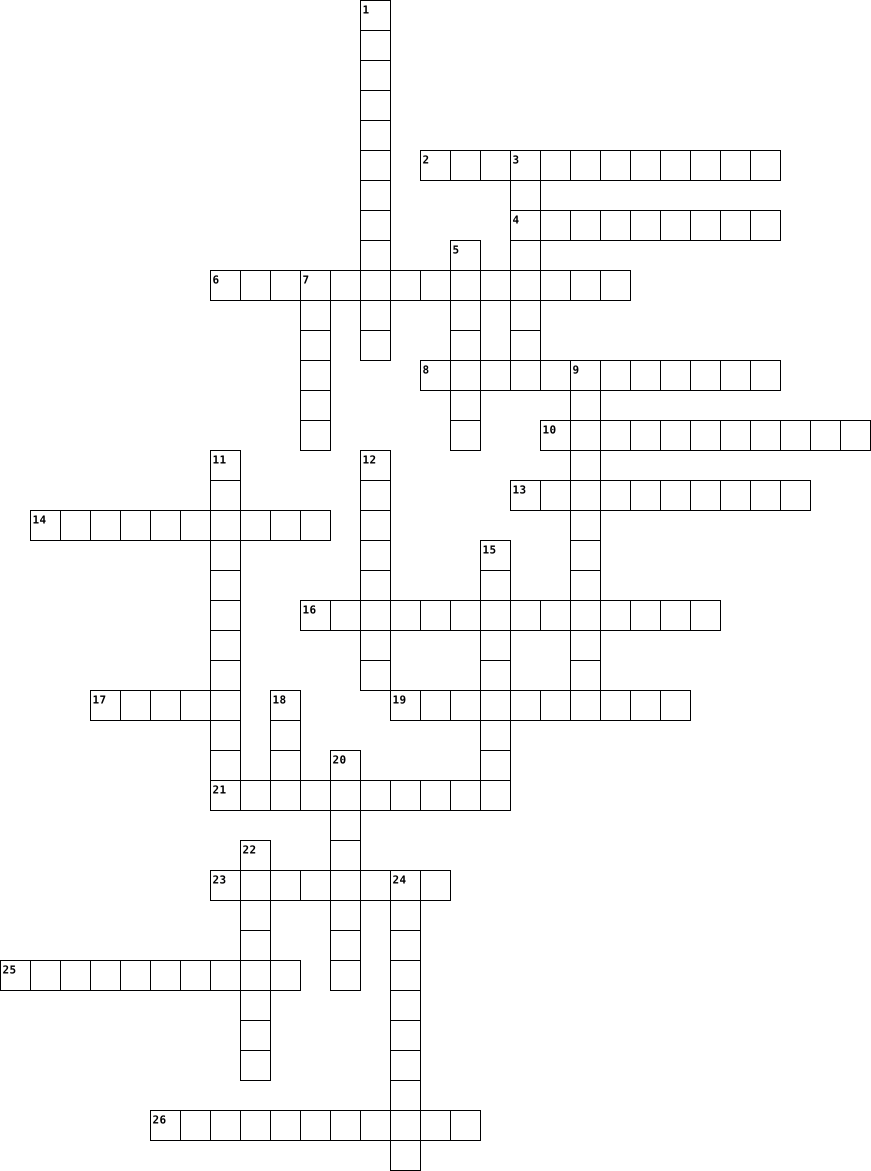
Across
- " A solid that form's from solution during a chemical reaction."
- The cells in your body contain biological catalysts called ENZYMES."
- "is a amount of a substance in a given volume."
- "When on element replaces another in a compound, or when two elements in different compounds trade places."
- reaction- "is a reaction in which energy is absorbed
- "The study of matter and how matter changes"
- "A material used to decrease the rate of a reaction"
- "In contrast to a synthesis reaction, a process called DECOMPOSITION breaks down compounds into simpler products."
- is a material that releases energy when it burns."
- The substance you have at the beginning"
- "when two or more elements or compounds combine to make more complex substances the process is called synthesis."
- equation-"is a short, easy way to show a chemical reaction, using symbols instead of words."
- reaction-"A reaction that releases energy in the form of heat"
- " a rapid reaction between oxygen and a substance called a fuel.
Down
- "is a number placed in font of chemical formula in an equation."
- property- a Characteristic of substance that describes its ability to change into other substances.
- "is anything that has mass and takes up space."
- system- " matter is not allowed to enter or leave."
- of mass- "during a chemical reaction, matter is not created or destroyed
- a material that increases the rate of reaction by lowering the activation energy."
- reaction- A change in matter that produces one or more new substances.
- "When the reaction is complete, you have new substances"
- system- "matter can enter from or escape to the surrounding."
- change- " is any change that alters the form or appearance of a substance but that does not make the substance into another substance.
- property- A characteristic of a substance that can be observed without changing the substance into another substance.
- energy- "is a minimum amount of energy needed to start a chemical reaction."
26 Clues: The substance you have at the beginning" • "The study of matter and how matter changes" • "is anything that has mass and takes up space." • "is a amount of a substance in a given volume." • is a material that releases energy when it burns." • system- " matter is not allowed to enter or leave." • reaction- "is a reaction in which energy is absorbed • ...
Sicence 2022-03-18

Across
- "When on element replaces another in a compound, or when two elements in different compounds trade places."
- a material that increases the rate of reaction by lowering the activation energy."
- "is anything that has mass and takes up space."
- The cells in your body contain biological catalysts called ENZYMES."
- equation-"is a short, easy way to show a chemical reaction, using symbols instead of words."
- "is a amount of a substance in a given volume."
- system- " matter is not allowed to enter or leave."
- " A solid that form's from solution during a chemical reaction."
- "A material used to decrease the rate of a reaction"
- of mass- "during a chemical reaction, matter is not created or destroyed
- "when two or more elements or compounds combine to make more complex substances the process is called synthesis."
- system- "matter can enter from or escape to the surrounding."
- property- A characteristic of a substance that can be observed without changing the substance into another substance.
- "is a number placed in font of chemical formula in an equation."
Down
- reaction- "is a reaction in which energy is absorbed
- " a rapid reaction between oxygen and a substance called a fuel.
- The substance you have at the beginning"
- change- " is any change that alters the form or appearance of a substance but that does not make the substance into another substance.
- "When the reaction is complete, you have new substances"
- "The study of matter and how matter changes"
- energy- "is a minimum amount of energy needed to start a chemical reaction."
- "In contrast to a synthesis reaction, a process called DECOMPOSITION breaks down compounds into simpler products."
- reaction- A change in matter that produces one or more new substances.
- reaction-"A reaction that releases energy in the form of heat"
- is a material that releases energy when it burns."
- property- a Characteristic of substance that describes its ability to change into other substances.
26 Clues: The substance you have at the beginning" • "The study of matter and how matter changes" • "is anything that has mass and takes up space." • "is a amount of a substance in a given volume." • is a material that releases energy when it burns." • system- " matter is not allowed to enter or leave." • reaction- "is a reaction in which energy is absorbed • ...
Chapter 22 science vocab Maxwell_Wohlfeil 2021-12-09

Across
- falling beam of light on a surface
- passing of light through matter
- matter that transmits light but also scatter the light as it passes through
- matter that does not transmit any light
- red, green, blue
- light beam reflect off all the points of the surface at the same angle
- The idea that liht can act aseither particle or waves
- release of light energy by particles of matter that have absorbed energy
- “beyond violet” and have shorter wavelengths and higher frequencies than visible light
- two primary colors are mixed
- “below red” and emitted by the sun
- narrow range of wavelengths that humans can see
- waves combine and have a greater amplitude than individual waves had
- Wave that can travel through space or matter-sonsirs of changing electric and magnetic fields
- two or more waves overlap
- shorter wavelengths and higher frequencies than radio waves
Down
- bending of waves and barriers or openings
- material that give a substance it’s color by absorbing some colors of light and reflecting others
- the emission of energy in the form of EM waves
- occurs when a wave bounces off an object
- waves combine and have a smaller amplitude than individual waves had
- matter through which visible light is easily transmitted
- cover the wide range of waves in the EM spectrum
- light beam reflect in many different angles
- states ankle or incidence is equal to the angle of reflection
- pigments yellow, cyan, magenta
- the entire range of EM waves
- bending of waves as it passes ar an angle from one medium to another
28 Clues: red, green, blue • two or more waves overlap • the entire range of EM waves • two primary colors are mixed • pigments yellow, cyan, magenta • passing of light through matter • falling beam of light on a surface • “below red” and emitted by the sun • matter that does not transmit any light • occurs when a wave bounces off an object • bending of waves and barriers or openings • ...
Vocabulary 2023-09-26

Across
- The idea that all physical matter exists in the form of particles
- the idea of chemical reactions is known as....
- changes that affect the chemicals
- The space occupied by an object
- Building blocks of matter
- changes the appearance of a substance
- The substances are not evenly distributed
- changes from a vapor to a liquid
- solid,liquid,gas,plasma
- anything about a substance that can be observed or measured
- the temperature at which a solid turns to a liquid
Down
- the change from a liqid to a vapor (gas)
- distinct group of two or more atoms bonded together
- When different substances are mixed (could be called a solution)
- a solid that changes to a vapor without melting first
- when a liquid turns into a solid
- The mass of matter contained in a particular volume
- anything that occupies space and has mass
- the change from a solid to a liquid
- describes how a substance changes under certain conditions
- the temperature hat the liquid begins to boil at
- a pure substance consisting of atoms that are chemically combined
- Anything that is not a pure substance
- The measure of gravity acting on the matter of an object.
- The amount of matter in an object
- material made of only one kind of element;not a mixture
- the vapor going straight into a solid without the solid going through the liquid phase
- a very fast process of vaporization (heating up until evaporation)
- a liquid that turns into gas very slowly at any tempurature
- pure substance that consists of atoms with the same atomic number.
30 Clues: solid,liquid,gas,plasma • Building blocks of matter • The space occupied by an object • when a liquid turns into a solid • changes from a vapor to a liquid • changes that affect the chemicals • The amount of matter in an object • the change from a solid to a liquid • Anything that is not a pure substance • changes the appearance of a substance • ...
LEARN WITH FUN 2024-05-13

Across
- It is the process of a solid directly turning into a gas without becoming a liquid first
- It is a type of energy which is associated with the motion of particles in matter
- It is the basic unit of a chemical element consisting of a nucleus surrounded by electrons
- It is the process of a gas turning into a liquid
- A state of matter that has a definite volume but takes the shape of its container
- It is the process of a liquid turning into a gas at any temperature
- It is the smallest unit of a chemical element that retains the properties of that element
- It is a property which measures the degree of hotness or coldness of a substance
Down
- It is a property which measures the amount of matter in an object
- It is the process of a liquid turning into a gas throughout its volume
- It is the process of a liquid turning into a gas at the surface
- It is the gaseous form of a substance that is typically a liquid or solid at room temperature
- It is a property which describes the amount of mass per unit volume of a substance
- A state of matter that has a definite shape and volume
- It is a property that measures the amount of space an object occupies
- It is the process of a liquid turning into a solid
- It is a property which describes the force exerted by a substance per unit area
- It is the fourth state of matter, consisting of ionized gas
- It is the process of a solid turning into a liquid
- A state of matter that has neither a definite shape nor a definite volume
20 Clues: It is the process of a gas turning into a liquid • It is the process of a liquid turning into a solid • It is the process of a solid turning into a liquid • A state of matter that has a definite shape and volume • It is the fourth state of matter, consisting of ionized gas • It is the process of a liquid turning into a gas at the surface • ...
Unit 5 crossword 2024-03-13

Across
- The last name of the person who created the law stating decrease in volume leads to increase in pressure
- Liquid turning into a solid
- The change of matter without changing its chemical composition.
- The name for the attraction between the same molecules. Defines boiling point and melting point
- The formation of atoms in a specific orientation
- Solid turning into a gas
- The state of matter defined by fixed position and volume, small spacing, vibrations, and low energy
- The change of matter that changes its chemical composition. Can be seen through color change, light, odor, precipitation, and change in temperature.
- A solid turning into a liquid
- The movement of kinetic energy through molecules via convection or conduction.
Down
- Energy defined by a motion of an object
- Slow conversion of liquid to a gas
- When a substance changes states
- Somewhat fast conversion of liquid to gas
- A gas turning into a liquid
- Gas turning into solid
- The last name of the person who created the law stating increase in temperature with constant pressure leads to increase in volume
- Really fast conversion of liquid to a gas
- The state of matter defined by unfixed position and volume, high spacing, and high energy
- The state of matter defined by fixed volume but unfixed position, medium spacing, some vibration, and medium energy. Has the properties of viscosity.
- The last name of the person who created the law stating increase in temperature with constant volume leads to increase in pressure
- Average kinetic energy of a substance; Calculated by dividing total amount of atoms from thermal energy
- The amount of matter per volume
- The total kinetic energy in a substance
24 Clues: Gas turning into solid • Solid turning into a gas • A gas turning into a liquid • Liquid turning into a solid • A solid turning into a liquid • When a substance changes states • The amount of matter per volume • Slow conversion of liquid to a gas • Energy defined by a motion of an object • The total kinetic energy in a substance • Somewhat fast conversion of liquid to gas • ...
AOL Review - Physical and Chemical Changes and Properties 2022-12-14

Across
- A liquid's resistance to flowing
- The ability of a substance to be hammered or beaten into thin sheets
- The ability of a material to bounce back after being disturbed
- Chemical Property - How readily a substance combines chemically with other substances.
- Physical Change - The change of state from a gas to a liquid
- the ability to bend without breaking
- A state of matter that consists of free-moving ions and electrons
- A measure of a material's tendency to shatter upon impact.
- the degree of compactness of a substance.
- the ability or tendency to float in water or air or some other fluid.
Down
- A state of matter that has a definite shape and a definite volume
- Chemical Property - the ability of a substance to burn
- a property of matter that describes a substance's ability to participate in chemical reactions
- A change that occurs when one or more substances change into entirely new substances with different properties.
- Physical Change - The change in state from a solid to a liquid
- Anything that has mass and takes up space
- A state of matter that has a definite volume but no definite shape.
- Physical Change - The change of state from a liquid to a solid
- A change in a substance that does not involve a change in the identity of the substance
- A characteristic of a pure substance that can be observed without changing it into another substance
- The resistance of a mineral to being scratched
- A state of matter with no definite shape or volume
- the resistance of a material to breaking under tension
- Physical Change - A change of state from solid to gas
- Physical Change - The change of state from a liquid to a gas
25 Clues: A liquid's resistance to flowing • the ability to bend without breaking • Anything that has mass and takes up space • the degree of compactness of a substance. • The resistance of a mineral to being scratched • A state of matter with no definite shape or volume • Physical Change - A change of state from solid to gas • ...
CR TEST REVIEW 2025-12-15

Across
- Observations that show a reaction occurred
- Thermal energy transferred between objects
- Evidence that substances have changed into new substances
- Substance formed after a chemical reaction
- Evidence involving gas, precipitate, or color change
- Evidence of a chemical reaction involving bubbles
- Solids formed during a reaction in solution
- The part of the universe being studied
- A reaction that absorbs heat energy
- Evidence of a chemical reaction involving a change in color
- Takes in energy during a reaction
- When atoms rearrange, they form these substances
- When atoms rearrange, their connections change
- A change where the substance stays the same
- The smallest unit of an element
- A system where matter cannot enter or leave
- A comparison group in an experiment
- A change where a new substance forms
- A sign of gas formation
- The principle that matter is not created or destroyed
- A system where matter can escape
Down
- A measure of average kinetic energy
- The standard used for comparison in experiments
- Substance present before a chemical reaction
- A reaction that produces new substances
- Gives off energy during a reaction
- The law stating matter is not created or destroyed
- A change where no new substance forms
- Two or more atoms bonded together
- When total mass stays the same before and after a reaction
- A solid that forms when two liquids react
- The ability to cause change or do work
- A reaction that releases heat energy
- A first model of a solution used in engineering
- The amount of matter in an object
- Mixing salt and water without forming a new substance is this type of change
- Anything that has mass and takes up space
37 Clues: A sign of gas formation • The smallest unit of an element • A system where matter can escape • Two or more atoms bonded together • Takes in energy during a reaction • The amount of matter in an object • Gives off energy during a reaction • A measure of average kinetic energy • A reaction that absorbs heat energy • A comparison group in an experiment • ...
Energy and Matter: L2 States of Matter 2025-01-16

Across
- Matter with a definite volume, but no definite shape.
- Matter with no definite volume and no definite shape.
- An organized group of people in a defined territory, such as one of the fifty states in the United States.
- Vaporization that happens on the surface of water.
- The movement of energy from one place or object to another.
- The process in which a gas changes directly to a solid without becoming a liquid.
- A state of matter similar to a gas but consisting of charged particles, found in stars and lightning.
- A force that brings things together.
- The change of state from a gas to a liquid.
- A condition or physical property of matter.
- A measure of mass per unit volume of a substance, which determines whether it will sink or float in another material.
Down
- The temperature at which a solid changes to a liquid.
- A measure of a liquid's resistance to flow.
- The temperature at which boiling occurs in a liquid.
- The temperature at which a liquid changes to a solid.
- A particular stage of, in this case, matter.
- Vaporization that occurs within a liquid.
- A force that acts on the particles at the surface of a liquid, causing them to stick together and form a "skin."
- The total energy of a system that is dependent on the number of particles in the system, the state of the material, and the temperature.
- The process in which a solid changes directly to a gas without passing through the liquid state.
- The force applied per unit area on the surface of an object.
- The change in state of a liquid into a gas. Vaporization is the opposite of condensation.
- Matter with a definite shape and a definite volume.
23 Clues: A force that brings things together. • Vaporization that occurs within a liquid. • A measure of a liquid's resistance to flow. • The change of state from a gas to a liquid. • A condition or physical property of matter. • A particular stage of, in this case, matter. • Vaporization that happens on the surface of water. • ...
The Kinetic Theory of Matter 2021-02-28

Across
- Net movement caused by Brownian motion called ….
- Energy that pulls particles apart called ……
- Diffusion happens because of the difference in …….
- Diffusion does not happen in ……
- Particles move slowly in …..
- A hot gas called …..
- The molecules in a solid …….. about a fixed position.
- The element of crystal.
- Crystal is an examples of ……… state.
- The random motion of particles is called …..
Down
- …… stays that particles of all matter are in constant motion.
- The molecules in a gas exert ….. forces on each other.
- The arrangement, which is repeated throughout the solid called …...
- Flowing, compressible matter that has no definite volume or shape.
- Matter that has solid and liquid properties called …..
- According to the kinetic theory of matter, the state of a substance is determined by the act of two ….. forces within a substance.
- Crystals of the same substance have the …. shape
- Forces that hold particles together called…..
18 Clues: A hot gas called ….. • The element of crystal. • Particles move slowly in ….. • Diffusion does not happen in …… • Crystal is an examples of ……… state. • Energy that pulls particles apart called …… • The random motion of particles is called ….. • Forces that hold particles together called….. • Net movement caused by Brownian motion called …. • ...
Reni's Matter Crossword 2024-05-15

Across
- 2 or more atoms joined together.
- A combination of substances that can be physically separated
- The interaction between 2 or more elements.
- The substances present before a chemical reaction.
- CO2 is a definition of ______.
- A substance formed during a chemical reaction.
- The study of matter and everything in the universe.
- The amount of space an object takes up.
- The average amount of heat in an object.
Down
- Carbon, Hydrogen, & Oxygen are examples of an _______.
- The amount of matter in an object.
- The ability of molecules of the same substance to stick together.
- Everything in the universe is made of this.
- The attraction between 2 or more atoms.
- The transfer of thermal energy in an object .
- The smallest unit of matter.
- Material that speeds up the chemical reaction.
- The ability to do work and cause change is ______.
18 Clues: The smallest unit of matter. • CO2 is a definition of ______. • 2 or more atoms joined together. • The amount of matter in an object. • The attraction between 2 or more atoms. • The amount of space an object takes up. • The average amount of heat in an object. • Everything in the universe is made of this. • The interaction between 2 or more elements. • ...
Nolan's Crossword 2024-05-15

Across
- The measure of heat/hotness or coldness
- A change of materials into another, with different properties
- When the physical properties of matter change
- The form of energy that is moved and transferred from something hot to something cold
- A substance that can't be broken down
- Being formed or taking place by absorbing heat
- The amount of space occupied by something
- Two or more atoms connected by a chemical bond
- A physical substance that takes up space
Down
- The study of matter
- The substance that is formed after a chemical reaction
- A characteristic of a substance that can be observed or measured
- The amount of matter or substance
- The process of sticking together molecules of the same type
- When one or more reactants are converted to products
- When heat is released
- The smallest part of a substance and it can't be reduced down
- The ability to do work
18 Clues: The study of matter • When heat is released • The ability to do work • The amount of matter or substance • A substance that can't be broken down • The measure of heat/hotness or coldness • A physical substance that takes up space • The amount of space occupied by something • When the physical properties of matter change • Being formed or taking place by absorbing heat • ...
Units 1-3 Science Review 2022-10-21

Across
- The ability to dissolve
- Movement energy
- A push or pull
- A state of matter with no shape or volume
- The amount of space an object takes up
- A kind of circuit with only one pathway to the battery
- Stops or slows the movement of electrical and thermal energy
- A state of matter with a definite volume, but not shape
- Light bending as it is transmitted through another medium
- Allows electrical or thermal energy to move through it easily
Down
- A material that allows some light to move through it
- A kind of circuit with multiple pathways to the battery
- What the scientist changes in an experiment
- Light bouncing off a shiny, opaque object
- A state of matter with a definite shape and volume
- Anything that has mass and takes up space
- Energy that travels in vibrations
- When a force is applied and a change happens as a result
18 Clues: A push or pull • Movement energy • The ability to dissolve • Energy that travels in vibrations • The amount of space an object takes up • Light bouncing off a shiny, opaque object • A state of matter with no shape or volume • Anything that has mass and takes up space • What the scientist changes in an experiment • A state of matter with a definite shape and volume • ...
Year 8 Chemistry Revision 2026-01-07

Across
- represented by the symbol C
- another word for burning
- represented by the symbol O
- easily bursts into flames
- something that damages the environment or the organisms that live there
- contains two or more elements chemically bonded together
- a form of energy that can power a light
- smallest particle of matter
- a substance that reacts in a chemical reaction
Down
- a set of two or more atoms joined together
- a state of matter without a fixed shape or volume
- a device used to measure temperature
- a substance that contains a store of chemical or nuclear energy that can be easily transferred
- a state of matter with a fixed shape and volume
- reacting with oxygen
- a state of matter with a fixed volume but no fixed shape
- a substance that is formed in a chemical reaction
- a substance made of only one type of atom
18 Clues: reacting with oxygen • another word for burning • easily bursts into flames • represented by the symbol C • represented by the symbol O • smallest particle of matter • a device used to measure temperature • a form of energy that can power a light • a substance made of only one type of atom • a set of two or more atoms joined together • ...
Matter and Energy Crossword 2017-09-20

Across
- Substance that cannot be broken down into simpler parts and retain properties
- Substance Matter with a fixed composition and definite properties
- ability of a substance to burn
- smallest unit of an element
- firm and stable in shape;not liquid or fluid
- uniform throughout
- the resistance of a fluid to flow
- mass per unit of volume
- the ability to change or move matter
Down
- a substance that flows freely but is of constant volume
- smallest unit of a substance that behaves like the substance
- ability of a substance to combine chemically with another substance
- the study of matter and how it changes
- not uniform throughout
- anything that has mass and takes up space
- substance made of atoms of more than one element bound together
- an airlike fluid substance which expands freely to fill any space available
- combinations of more than one pure substance
18 Clues: uniform throughout • not uniform throughout • mass per unit of volume • smallest unit of an element • ability of a substance to burn • the resistance of a fluid to flow • the ability to change or move matter • the study of matter and how it changes • anything that has mass and takes up space • firm and stable in shape;not liquid or fluid • ...
The Kinetic Theory of Matter 2021-02-28

Across
- Net movement caused by Brownian motion called ….
- Energy that pulls particles apart called ……
- Diffusion happens because of the difference in …….
- Diffusion does not happen in ……
- Particles move slowly in …..
- A hot gas called …..
- The molecules in a solid …….. about a fixed position.
- The element of crystal.
- Crystal is an examples of ……… state.
- The random motion of particles is called …..
Down
- …… stays that particles of all matter are in constant motion.
- The molecules in a gas exert ….. forces on each other.
- The arrangement, which is repeated throughout the solid called …...
- Flowing, compressible matter that has no definite volume or shape.
- Matter that has solid and liquid properties called …..
- According to the kinetic theory of matter, the state of a substance is determined by the act of two ….. forces within a substance.
- Crystals of the same substance have the …. shape
- Forces that hold particles together called…..
18 Clues: A hot gas called ….. • The element of crystal. • Particles move slowly in ….. • Diffusion does not happen in …… • Crystal is an examples of ……… state. • Energy that pulls particles apart called …… • The random motion of particles is called ….. • Forces that hold particles together called….. • Net movement caused by Brownian motion called …. • ...
Language Arts & Science Week 1 2020-03-26

Across
- the temperature a liquid will start to solidify
- a complete mixture of two or more substances
- matter that has a definite shape and volume
- when a liquid turns into a gas or water vapor
- matter that has no definite shape or volume
- anything that takes up space
- unavoidable, bound to happen
- a disease that affects a very large amount of people
Down
- able to be changed, like in math
- when a gas turns into a liquid due to cool temps.
- to gather in a crowd or group
- the temperature a solid will start to become liquid
- features that can be used to describe something
- matter that has no definite shape & has def. volume
- the maximum amount that can be held or contained
- the state of water in its gas form
- a type of material
- the amount of space an object takes up
18 Clues: a type of material • anything that takes up space • unavoidable, bound to happen • to gather in a crowd or group • able to be changed, like in math • the state of water in its gas form • the amount of space an object takes up • matter that has a definite shape and volume • matter that has no definite shape or volume • a complete mixture of two or more substances • ...
General Chemistry Crossword Puzzle 2020-05-30

Across
- a gas loses energy and comes together to form a liquid.
- are more loosely packed than in a solid and are able to flow around each other.
- its "potential" to undergo some chemical change or reaction by virtue of its composition.
- particles have a great deal of space between them and have high kinetic energy.
- conversion of a liquid to a gas and can occur through either evaporation or boiling.
- a substance can be flattened
- much matter in the sample
- study of carbon and its compounds; the study of the chemistry of life.
- a substance that cannot be broken down into simpler ones by chemical changes.
- a solid is converted directly into a gas without going through a liquid phase.
- chemical composition of a substance is altered in a process called a ____.
- solid matter is heated, it eventually changes into a liquid state at the _____.
- that takes up space and has mass is matter.
- many significant figures are there in 3.0800?
- change/results in one or more substances of entirely different composition from the original substances.
- a common abbreviation for significant figures.
- much space the sample takes up
- place without any changes in molecular composition
- branch of science that deals with the identification of the substances of which matter is composed.
- a gas transforms directly into a solid, without going through the liquid phase.
- two or more elements and has chemical and physical properties that are usually different from those of the elements of which it is composed.
- all portions of a material are in the same state, have no visible boundaries, and are uniform throughout, then the material is ____.
- physical property that will change if the amount of matter changes.
- study of matter, and the development of tools to measure properties of matter.
- elements are listed in the _____.
- the liquid matter is heated further it eventually boils or vaporizes into a gas at the ____.
- us what the scale of measurement is.
Down
- study of inorganic compounds, or compounds that don't contain a C-H bond.
- long the sample is
- study of chemical processes that occur inside of living organisms.
- of highly charged particles with extremely high kinetic energy. Stars are essentially superheated balls of ______.
- concept of _____ takes limitation into account.
- be observed or measured without changing the composition of matter
- branch of chemistry that applies physics to the study of chemistry.
- us how many
- shiny the substance looks
- any matter that has a fixed chemical composition and characteristic properties.
- to study quantum mechanics on a macroscopic level.
- use of differences in volatility, a measure of how easily a substance is converted to a gas at a given temperature.
- digits are always significant.
- mixtures are also called ______.
- many significant figures are there in 3.200 x 10^9?
- amount of something and consists of a number and a unit.
- to flow through the substance
- the composition of a material is not completely uniform, then it is _____.
- mixtures based on differences in solubility, a measure of how much solid substance remains dissolved in a given amount of a specified liquid.
- be separated into pure substances, which may be either elements or compounds.
- pigment or shade
- a definite shape, as well as mass and volume, and do not conform to the shape of the container in which they are placed.
- matter is made up of, which are in turn made up of protons, neutrons, and electrons.
50 Clues: us how many • pigment or shade • long the sample is • shiny the substance looks • much matter in the sample • a substance can be flattened • to flow through the substance • digits are always significant. • much space the sample takes up • mixtures are also called ______. • elements are listed in the _____. • us what the scale of measurement is. • ...
Science 8 Puzzle 2017-05-09

Across
- The electrons in the outermost energy shell of an atom
- Rate of change of an object in a specified direction
- Change in the physical state of matter from the gas phase to the solid phase without passing through the liquid phase
- Light reflected in all directions by a rough surface
- The number of wave vibrations produced in one second
- The SI unit of measure for capacity
- Change in the physical state of matter from the liquid phase to the gas phase
- Any material that can flow
- The measure of the average kinetic energy of the particles in a substance
- The SI unit of measure for length
- Change in the physical state of matter from the gas phase to the liquid phase
- The group of elements in the periodic table that are highly reactive nonmetals including flourine, chlorine, bromine, and iodine
- Describes matter that allows some but not all of the light that hits it to pass through
- The amount of time it takes the earth to complete a revolution around the sun
- A device used to measure temperature
- Vaporization of a liquid that occurs only on the surface of the liquid
- the negatively charged particle found outside the nucleus of an atom
- A pure substance composed of two or more elements chemically combined in a fixed proportion
- The force that resists the motion of two surfaces that are touching each other
- The transfer of light energy into an object through which it is passing
- Matter made from two or more elements that are chemically bonded and cannot be separated by physical means
- The general pattern of weather in a particular part of the world over a long period of time
- The study of the structure, properties, and interactions of matter
- The amount of matter in something
- The SI unit of measure for matter
- The measurement of wave frequency equal to vibrations per second
Down
- The process by which water, wind, and ice wear down rocks
- The distance from any point on one wave to a corresponding point on the next wave
- The unit of measure used to describe force
- The change from the solid state to gaseous state without passing through a liquid state
- The measure of the force of gravity on an object
- The maximum height of a wave
- A physical change in which particles of a substance are separated by water particles
- Matter which a wave travels through
- The bending of the path of light when it passes from one medium to another
- The change in an object's speed or direction over time
- Open sections within longitudinal waves
- Describes any matter that allows light to pass through easily
- The ability to do work
- A combination of two or more substances that have not combined chemically and can be separated by physical means
- Substances that are the building blocks of all matter
- When force is used to move an object a distance, measured in joules.
- The transfer of heat from a warmer substance to a cooler substance through direct contact
- The transfer of energy that spreads away from the source (sound, seismic, water)
- The bouncing back of a wave from a surface
- The force of attraction between any two objects
- Matter that has a definite shape and volume
- Mr. Urban's favorite type of joke
- The transfer of energy in the form of electromagnetic waves
- The study of energy, forces, and motion
- elements, usually solid, with a shiny surface, conductivity (electrical and thermal)
- A type of energy that humans can actually see (part of the electromagnetic wave spectrum)
52 Clues: The ability to do work • Any material that can flow • The maximum height of a wave • The SI unit of measure for length • Mr. Urban's favorite type of joke • The amount of matter in something • The SI unit of measure for matter • Matter which a wave travels through • The SI unit of measure for capacity • A device used to measure temperature • ...
Science 8 Puzzle 2017-05-09

Across
- The study of energy, forces, and motion
- A combination of two or more substances that have not combined chemically and can be separated by physical means
- The number of wave vibrations produced in one second
- Vaporization of a liquid that occurs only on the surface of the liquid
- The SI unit of measure for matter
- The group of elements in the periodic table that are highly reactive nonmetals including flourine, chlorine, bromine, and iodine
- Change in the physical state of matter from the gas phase to the solid phase without passing through the liquid phase
- Change in the physical state of matter from the gas phase to the liquid phase
- The force of attraction between any two objects
- The distance from any point on one wave to a corresponding point on the next wave
- Matter that has a definite shape and volume
- Describes any matter that allows light to pass through easily
- The transfer of light energy into an object through which it is passing
- The change from the solid state to gaseous state without passing through a liquid state
- The force that resists the motion of two surfaces that are touching each other
- The transfer of heat from a warmer substance to a cooler substance through direct contact
- Matter which a wave travels through
- The amount of matter in something
- A device used to measure temperature
- The maximum height of a wave
- The ability to do work
- Rate of change of an object in a specified direction
- The SI unit of measure for length
- The transfer of energy in the form of electromagnetic waves
- The bending of the path of light when it passes from one medium to another
- A type of energy that humans can actually see (part of the electromagnetic wave spectrum)
Down
- Matter made from two or more elements that are chemically bonded and cannot be separated by physical means
- Any material that can flow
- The amount of time it takes the earth to complete a revolution around the sun
- Change in the physical state of matter from the liquid phase to the gas phase
- elements, usually solid, with a shiny surface, conductivity (electrical and thermal)
- the negatively charged particle found outside the nucleus of an atom
- The study of the structure, properties, and interactions of matter
- The change in an object's speed or direction over time
- Open sections within longitudinal waves
- The electrons in the outermost energy shell of an atom
- The SI unit of measure for capacity
- Light reflected in all directions by a rough surface
- The measure of the average kinetic energy of the particles in a substance
- The transfer of energy that spreads away from the source (sound, seismic, water)
- The measure of the force of gravity on an object
- A pure substance composed of two or more elements chemically combined in a fixed proportion
- Describes matter that allows some but not all of the light that hits it to pass through
- When force is used to move an object a distance, measured in joules.
- The measurement of wave frequency equal to vibrations per second
- The process by which water, wind, and ice wear down rocks
- Mr. Urban's favorite type of joke
- The bouncing back of a wave from a surface
- Substances that are the building blocks of all matter
- The unit of measure used to describe force
50 Clues: The ability to do work • Any material that can flow • The maximum height of a wave • The SI unit of measure for matter • The amount of matter in something • Mr. Urban's favorite type of joke • The SI unit of measure for length • The SI unit of measure for capacity • Matter which a wave travels through • A device used to measure temperature • ...
Thermal Energy & Heat 2022-02-26

Across
- Transfer of thermal energy by particles moving through a fluid.
- An element that is a good conductor of heat and electricity.
- State of matter that has a fixed volume but not a fixed shape.
- SI scale for measuring temperature in which the freezing point of water is 273 K and the boiling point of water is 373 K.
- Material that is a poor conductor of thermal energy.
- Flow of particles in a fluid that occurs because of differences in temperature and density.
- Energy that is transferred from one object or substance to another because of a difference in temperature between them.
- The ability to do work.
- The measure of the average kinetic energy of the particles in matter; a physical property of matter.
- Transfer of thermal energy between particles of matter that are touching.
Down
- The amount of heat necessary to raise one mass unit of that substance by one temperature unit.
- Material that is a good conductor of thermal energy.
- The total energy of a substance due to the movement or vibrations of particles.
- Process in which a liquid changes to a solid.
- The simplest form of matter that has a unique set of properties.
- The transfer of thermal energy by waves that can travel through air or even through empty space.
- Substance that can flow and take the shape of its container; either liquid or gas.
- Energy that an object has due to its motion.
- State of matter that has neither a fixed volume nor a fixed shape.
19 Clues: The ability to do work. • Energy that an object has due to its motion. • Process in which a liquid changes to a solid. • Material that is a good conductor of thermal energy. • Material that is a poor conductor of thermal energy. • An element that is a good conductor of heat and electricity. • State of matter that has a fixed volume but not a fixed shape. • ...
G3B Week 16 S.S. & Science Crossword Puzzle 2020-11-05

Across
- Different kinds of matter mixed together is called a _____.
- A famous woman who was both blind and deaf, and helped many people.
- To change from a gas to a liquid is to _____.
- Most types of matter _____ when they freeze, but not water.
- to change from a liquid to a solid is to _____.
- When one or more kinds of matter are mixed evenly into another kind of matter, you get a _____.
- The gas state of water is called _____.
- A change in the way matter looks is called a _____.
Down
- Someone who chooses to do a job without getting paid.
- _____ separate mixtures by size.
- To change from a solid to a liquid is to _____.
- One way to separate a mixture is by _____.
- This person started the American Red Cross.
- A group that does not make money from the work that it does
- To change from a liquid to a gas slowly is to _____.
- Doing what is best for everyone.
- To change from a liquid to a gas at a high temperature is to _____.
17 Clues: _____ separate mixtures by size. • Doing what is best for everyone. • The gas state of water is called _____. • One way to separate a mixture is by _____. • This person started the American Red Cross. • To change from a gas to a liquid is to _____. • To change from a solid to a liquid is to _____. • to change from a liquid to a solid is to _____. • ...
G3B Week 16 S.S. & Science Crossword Puzzle 2020-11-05

Across
- Doing what is best for everyone.
- Different kinds of matter mixed together is called a _____.
- A change in the way matter looks is called a _____.
- Most types of matter _____ when they freeze, but not water.
- One way to separate a mixture is by _____.
- To change from a solid to a liquid is to _____.
- When one or more kinds of matter are mixed evenly into another kind of matter, you get a _____.
- To change from a liquid to a gas slowly is to _____.
Down
- A group that does not make money from the work that it does
- Someone who chooses to do a job without getting paid.
- A famous woman who was both blind and deaf, and helped many people.
- This person started the American Red Cross.
- The gas state of water is called _____.
- To change from a liquid to a gas at a high temperature is to _____.
- To change from a gas to a liquid is to _____.
- to change from a liquid to a solid is to _____.
- _____ separate mixtures by size.
17 Clues: Doing what is best for everyone. • _____ separate mixtures by size. • The gas state of water is called _____. • One way to separate a mixture is by _____. • This person started the American Red Cross. • To change from a gas to a liquid is to _____. • to change from a liquid to a solid is to _____. • To change from a solid to a liquid is to _____. • ...
Vocab words 2023-09-13

Across
- The temperature at which a certain substance melts (100 degrees celcius)
- The temperature of which a liquid freezes to become a solid.
- Matter with neither a definite shape nor volume
- The transfer or flow of thermal energy
- Gas changes states to become a liquid
- Temperature at which a substance boils (0 degrees celcius)
- The physical form in which matter exists
- Matter that has a definite shape and volume
Down
- The energy of moving particles
- The point at which condensation occurs
- The process where a scientist asks questions about the natural world and then seeks to answer them
- A change that happens in a liquid where gas bubbles rise to the surface due to heat
- A precise or stated exactly question
- The change of particles at the surface of a liquid rising as a gas
- A state of matter without volume or shape and is found in lightbulbs
- A measure of the average thermal energy of the particles of a substance
- MAtter that has no definite shape, but has definite volume
17 Clues: The energy of moving particles • A precise or stated exactly question • Gas changes states to become a liquid • The point at which condensation occurs • The transfer or flow of thermal energy • The physical form in which matter exists • Matter that has a definite shape and volume • Matter with neither a definite shape nor volume • ...
science vocabulary! Created by: Javon Bowser! 2021-10-12

Across
- positively charged particles
- amount of matter in a substance
- the degree of compactness of a substance
- the number of protons in the nucleus of an atom, which determines the chemical properties of an element and its place in the periodic table
- any substance that cannot be decomposed into simpler substances by ordinary chemical processes
- theory consisting of a positively charged nucleus with electrons revolving around it in any of many possible circular orbits each corresponding to a distinct energy state
- atoms are completely apart in this state of matter
- the central part of an atom that comprises nearly all of the atomic mass and that consists of protons and neutrons
Down
- composed of or resulting from union of separate elements
- atoms are compressed together during this state of matter
- the mass of an atom of a chemical element expressed in atomic mass units
- neutral charged particles
- is often referred to as the Father of the Periodic Table
- negatively changed particles
- cloud molecule a group of electrons circulating around a nucleus/molecule
- atoms are slightly spread out in this state of matter
- a table of chemical elements arranged in order
- basic unit of matter
18 Clues: basic unit of matter • neutral charged particles • positively charged particles • negatively changed particles • amount of matter in a substance • the degree of compactness of a substance • a table of chemical elements arranged in order • atoms are completely apart in this state of matter • atoms are slightly spread out in this state of matter • ...
G3B Week 16 S.S. & Science Crossword Puzzle 2020-11-05

Across
- A change in the way matter looks is called a _____.
- To change from a liquid to a gas slowly is to _____.
- Someone who chooses to do a job without getting paid.
- Different kinds of matter mixed together is called a _____.
- to change from a liquid to a solid is to _____.
- This person started the American Red Cross.
Down
- Doing what is best for everyone.
- Most types of matter _____ when they freeze, but not water.
- To change from a solid to a liquid is to _____.
- To change from a gas to a liquid is to _____.
- The gas state of water is called _____.
- A famous woman who was both blind and deaf, and helped many people.
- One way to separate a mixture is by _____.
- A group that does not make money from the work that it does
- When one or more kinds of matter are mixed evenly into another kind of matter, you get a _____.
- To change from a liquid to a gas at a high temperature is to _____.
- _____ separate mixtures by size.
17 Clues: Doing what is best for everyone. • _____ separate mixtures by size. • The gas state of water is called _____. • One way to separate a mixture is by _____. • This person started the American Red Cross. • To change from a gas to a liquid is to _____. • To change from a solid to a liquid is to _____. • to change from a liquid to a solid is to _____. • ...
Chemistry Ch. 2 "Matter" 2020-09-16

Across
- Change that does not affect the composition of a substance.
- A method for separating the components of a liquid mixture that depends on the different boiling points of the substances.
- A form of matter that has no definite shape or volume at room temperature.
- A single unit of an element or compound; two or more atoms chemically bonded together.
- Characteristic that describes the ability of a substance to change to a different substance (flammability, reactivity,toxicity,oxidation state, etc.)
- Anything that has mass and takes up space(volume).
- A mixture of elements that has metallic properties.
- A mixture that is the same throughout; uniform.
- A form of matter that has a definite shape and volume at room temperature.
Down
- A mixture that has different properties in different regions of the mixture; non-uniform.
- A characteristic of a substance that can change without the substance becoming a different substance (density, boiling, melting, freezing, etc.)
- A single kind of matter that is pure and has a specific set of properties; a single element or compound.
- Change in which a substance becomes a different substance.
- A molecule composed of one kind of atom; cannot be broken into simpler units by chemical reactions.
- The basic unit of matter; a single unit of any element.
- A method for separating the components of a mixture that contains a solid and liquid.
- A substance with variable composition because it consists of 2 or more elements and/or compounds that do not chemically react with one another.
- A substance formed by the chemical combination of two or more elements in definite proportions.
- A homogeneous mixture.
- A form of matter that has no definite shape but definite volume at room temperature.
20 Clues: A homogeneous mixture. • A mixture that is the same throughout; uniform. • Anything that has mass and takes up space(volume). • A mixture of elements that has metallic properties. • The basic unit of matter; a single unit of any element. • Change in which a substance becomes a different substance. • Change that does not affect the composition of a substance. • ...
Unit 1 2021-10-18

Across
- an atom that gains one or more electrons words have a negative charge
- massive positively charged center of the atom made up of protons and neutrons
- mixture; combination of a substance with a composition that is uniform throughout
- uncharged subatomic particles located in the nucleus
- items that contain the same amount number of protons but different numbers of neutrons
- number; the number of protons in the nucleus of the atom
- sure; matter that can be separated into its compounds by physical means
- reflects how close a measurement is to a correct value
- the smallest unit of matter that can enter into a chemical combination
- positively charged subatomic particles located in the nucleus
- state in which matter has neither definite volume and shape
- state of matter that has a definite volume but indefinite shape
- mixture; combination of substance with a composition that varies from point to point
- positively charged atom formed when an atom loses one or more electrons
Down
- a bonded collection of two or more atoms
- substance composed of only one type of atom
- negatively charged subatomic particles of low mass
- reflects how closer to measurements are
- number; the total number of protons and neutrons in an atom
- property; a property That Remains the Same even when sample size change is a special property
- the measurement of the amount of matter
- anything that takes up space and has mass
- Force that gravity exerts on an object
- substance composed of atoms of two or more atoms of the same or different element
- state of matter that has a rigid has definite shape and has a fairly constant of all
25 Clues: Force that gravity exerts on an object • reflects how closer to measurements are • the measurement of the amount of matter • a bonded collection of two or more atoms • anything that takes up space and has mass • substance composed of only one type of atom • negatively charged subatomic particles of low mass • uncharged subatomic particles located in the nucleus • ...
Unit 1 2021-10-18

Across
- an atom that gains one or more electrons words have a negative charge
- massive positively charged center of the atom made up of protons and neutrons
- mixture; combination of a substance with a composition that is uniform throughout
- uncharged subatomic particles located in the nucleus
- items that contain the same amount number of protons but different numbers of neutrons
- number; the number of protons in the nucleus of the atom
- sure; matter that can be separated into its compounds by physical means
- reflects how close a measurement is to a correct value
- the smallest unit of matter that can enter into a chemical combination
- positively charged subatomic particles located in the nucleus
- state in which matter has neither definite volume and shape
- state of matter that has a definite volume but indefinite shape
- mixture; combination of substance with a composition that varies from point to point
- positively charged atom formed when an atom loses one or more electrons
Down
- a bonded collection of two or more atoms
- substance composed of only one type of atom
- negatively charged subatomic particles of low mass
- reflects how closer to measurements are
- number; the total number of protons and neutrons in an atom
- property; a property That Remains the Same even when sample size change is a special property
- the measurement of the amount of matter
- anything that takes up space and has mass
- Force that gravity exerts on an object
- substance composed of atoms of two or more atoms of the same or different element
- state of matter that has a rigid has definite shape and has a fairly constant of all
25 Clues: Force that gravity exerts on an object • reflects how closer to measurements are • the measurement of the amount of matter • a bonded collection of two or more atoms • anything that takes up space and has mass • substance composed of only one type of atom • negatively charged subatomic particles of low mass • uncharged subatomic particles located in the nucleus • ...
States of Matter Vocabulary Review 2023-03-14

Across
- Solid to gas is called ___________.
- Another term for state is ____________.
- The basic "building block" of all matter
- The number of ____________ is the same as the number of protons.
- When particles in a solid or liquid move faster they move slightly further apart. This is called ____________.
- Liquid to solid is called______________.
- The small numbers in a chemical formula, the ____________, tell us how many of each atom are present in a molecule.
- When particles move slower they come closer together. This is called ______________.
- Gas to liquid is called ___________.
- Anything that has mass and takes up space.
- To cause a phase change, you must ________ or remove thermal energy.
- The atomic mass- atomic number tells you the number of _____________ an atom has.
- Particles that a tightly packed but can move past each other are in the __________ state.
- The study of matter and how it changes.
Down
- The large number at the front of a chemical formula, the ___________, tells us how many molecules are present.
- Liquid to gas is called ___________.
- A _______________ is like a recipe for a molecule.
- A visual representation of an atom is called a _______ model.
- How tightly packed particles of matter are determines what ____________ it is.
- The kinetic theory of matter tells us that particles are in ___________ motion.
- Two or more atoms chemically bonded together
- Particles that move freely and have barely any attraction to each other are in the ________ state.
- The atomic number of an element determines how many _________ there are in the atom.
- Particles that are tightly packed and only vibrate are in the __________ state.
- The amount of matter an object is made up of.
- Solid to liquid is called ______________.
26 Clues: Solid to gas is called ___________. • Liquid to gas is called ___________. • Gas to liquid is called ___________. • Another term for state is ____________. • The study of matter and how it changes. • The basic "building block" of all matter • Liquid to solid is called______________. • Solid to liquid is called ______________. • Anything that has mass and takes up space. • ...
Dillon's cross word of science!!! 2013-06-13

Across
- A force that opposes motion between two objects that touch
- return of a wave after striking a surface t
- An action that causes an object to accelerate; equal to the product of an object's mass and acceleration
- The ability to move or change matter; the ability to do work
- energy: The energy that an object possesses because of its motion
- variable: A part of an experiment or set of data that is affected by an event or another variable
- The maximum distance that the medium of a wave is displaced from its resting position
- State of matter that has no definite shape or volume
- The measure of how heavy something is for its size; the state or quality of being dense; mass per unit volume
- Building block of matter, the smallest particle of an element
Down
- Attraction between two objects due to their masses that increases with mass and decreases with distance
- The transfer of thermal energy from one object to another due to a difference in temperature
- The bending of a wave as it moves around an obstacle or passes through an opening
- Process that changes a liquid to a gas at temperatures below the boiling point
- A negatively charged particle located outside the nucleus of an atom
- Any of 118 known substances that make up matter and cannot be separated into simpler substances; also called chemical element
- Substance composed of two or more substances mixed together
- State of matter that has a definite volume but no definite shape
- A body of facts, statistics, or information
- The tendency of matter to resist change to its motion, whether it is moving or at rest
20 Clues: return of a wave after striking a surface t • A body of facts, statistics, or information • State of matter that has no definite shape or volume • A force that opposes motion between two objects that touch • Substance composed of two or more substances mixed together • The ability to move or change matter; the ability to do work • ...
FCAT Bingo Day 1 2014-04-09

Across
- Phase of matter where the molecules are tightly packed and vibrate in place.
- Change over time
- This is the thickest layer of the earth made of molten rock.
- Phase of matter where the molecules has the most amount of energy and the molecules bounce around.
- waves Light waves that can travel through matter and empty space.
- rock Rocks formed through heat and pressure.
- A measure of how much space an object takes up.
- magnitude the brightness of a start as it appears from the earth
- The length of one wave from one point to another point that looks just like it. Ex from crest to crest.
- How many waves pass per second.
- rock Rocks formed through the cooling of magma or lava.
Down
- The change of state from a gas to a liquid
- The highest point on a wave.
- core The layer of the earth with the highest temp, most pressure, and is the most dense.
- core This is the only actual liquid layer of the earth.
- The measure of how fast or slow the molecules in a substance move
- rock Rocks formed through the compacting and cementing of sediments.
- A measure of how much mass per unit of space or volume.
- currents Movement of heat through matter where hot molecules rise and cool molecules fall.
- of conservation of energy Energy is never created or destroyed.
- A word that describes what every object on earth is made out of. Can be a solid, liquid, or gas.
- Phase of matter where molecules are loosely flowing past each other.
- A pure substance that cannot be broken down into a simpler substance
- This is the layer of the earth with the least pressure, lowest temperature, and is the least dense.
24 Clues: Change over time • The highest point on a wave. • How many waves pass per second. • The change of state from a gas to a liquid • rock Rocks formed through heat and pressure. • A measure of how much space an object takes up. • core This is the only actual liquid layer of the earth. • A measure of how much mass per unit of space or volume. • ...
Jakie Jake - Chemical Change 2022-03-18

Across
- - A reaction in which energy is absorbed
- - A material that increases the rate of a reaction by lowing the activation rate
- - Breaks down compounds into simpler products
- - A reaction that releases energy in the form of heat
- - Anything that has mass and takes up space
- - The study of matter and how matter changes
- - In chemistry, when two or more elements or compounds combine to make a more complex substance.
- - Characteristic of a substance that describes it ability to change into other substances
- - A material that releases energy when it burns
- - When one element replaces another in a compound, or when two elements in different compounds trade places
- - The minimum amount of energy needed to start a chemical reaction
Down
- - Any change that alters the form or appearance of a substance but that does not make the substance into another substance
- - Characteristic of a substance that can be observed without changing the substance into another substance
- - A material used to decrease the rate of a reaction
- - Matter is not allowed to enter or leave
- - Easy way to show a chemical reaction, using symbols instead of words
- - The cells in your body (as in all living things) contain biological catalyst
- - A solid that forms from solution during a chemical reaction
- - A principle by the French chemist Antoine Lavoisier in 1774
- - A change in matter that produces one or more new substances.
- - Matter can enter from or escape to the surroundings.
- - rapid reaction between oxygen and a substance called a fuel
- - A number placed in front of a chemical formula in an equation
- - The amount of a substance in a given volume
24 Clues: - A reaction in which energy is absorbed • - Matter is not allowed to enter or leave • - Anything that has mass and takes up space • - The study of matter and how matter changes • - Breaks down compounds into simpler products • - The amount of a substance in a given volume • - A material that releases energy when it burns • ...
SCIENCE PERFORMANCE TASK MATTER 2025-03-06

Across
- phase change happens when a liquid turns into a gas?*
- ability of a substance to dissolve in another substance called?
- state of matter has neither a definite shape nor a definite volume
- Is burning wood a physical or chemical change?
- type of mixture has substances evenly distributed
- happens to the energy of particles when a substance freezes
- Is boiling water a physical or chemical change?
- property of matter measures the amount of matter in an object
- process occurs when a solid turns directly into a gas?
- ratio of mass to volume called
- process called when a gas turns directly into a solid
- ability of a substance to dissolve in another substance called? Reactivity property describes a substance’s ability to react with other substances?
Down
- term describes a material’s ability to be hammered or rolled into sheets
- process describes a gas changing into a liquid
- state of matter has neither a definite shape nor a definite volume
- property of matter describes the amount of space an object occupies
- happens to the energy of particles when a substance melts
- Change type of change occurs when a substance changes form but remains the same chemically
- change type of change results in the formation of a new substance with different properties
- state of matter has a definite shape and volume?
- term refers to the amount of force exerted per unit area?
- property determines how well a material allows heat or electricity to pass through it
- state of matter takes the shape of its container but has a definite volume
- phase change happens when a liquid turns into a solid?
- property describes a liquid’s resistance to flow?
25 Clues: ratio of mass to volume called • process describes a gas changing into a liquid • Is burning wood a physical or chemical change? • Is boiling water a physical or chemical change? • state of matter has a definite shape and volume? • type of mixture has substances evenly distributed • property describes a liquid’s resistance to flow? • ...
Chemistry Vocabulary 2025-03-30

Across
- One or more of the same atoms bonded together. 118 of these on the periodic table.
- Gas to solid
- Positive charge, found in the nucleus. Determines what the element is.
- Change when matter changes it’s appearance but a new substance is not formed.
- Particles are close together, strongly attracted, locked in a pattern, vibrate in place, fixed shape and volume.
- Gas to liquid
- Theory that helps to explain the physical characteristics of matter. All matter is made up of tiny particles that are constantly moving
- Smallest particles that cannot be divided further. Building blocks of matter
- Central region of the atom.
- Liquid to gas
- Solid to liquid
Down
- Mixture with two or more types of particles that you can see or feel.
- Neutral charge, found in the nucleus.
- One element or one compound
- Mixture with two or more types of particles but look like only one.
- Change when the atoms in the matter connect to form a new substance with different characteristics. Irreversible.
- Two or more different elements combined chemically.
- Particles are slightly apart, some attraction, able to slide past, spaces between are larger, indefinite shape, fixed volume.
- Particles are far apart, can move in any direction, weak attraction, no fixed shape, no fixed volume, expand to fill the container, move rapidly in all directions.
- Solid to gas
- Liquid to solid
- Group of atoms bonded together. Can be the same or different atoms.
- Negative charge, found orbiting the nucleus. Determine the chemical properties of elements and how they react.
- Anything that has mass and takes up space
- Two or more elements or compounds that are physically combined
25 Clues: Gas to solid • Solid to gas • Gas to liquid • Liquid to gas • Liquid to solid • Solid to liquid • One element or one compound • Central region of the atom. • Neutral charge, found in the nucleus. • Anything that has mass and takes up space • Two or more different elements combined chemically. • Two or more elements or compounds that are physically combined • ...
5.1.1-5.1.2 Review 2025-05-01

Across
- The total energy of all the moving particles in a substance
- All the energy inside a substance from the movement and arrangement of its particles.
- The energy something has because it is moving.
- Energy from outside a system, like heat or work coming from or going to the surroundings.
- The movement of thermal energy from something warmer to something cooler.
- The different forms matter can take: solid, liquid, or gas.
- The average kinetic energy of the particles in a substance
- A unit used to measure heat energy.
- The temperature scale where water boils at 100° and freezes at 0°
- A state of matter with no fixed shape or volume; particles move freely and spread out.
Down
- 1,000 calories
- The temperature scale where water freezes at 273° and boils at 373°
- The amount of heat needed to change a liquid into a gas without changing its temperature.
- A very small part of matter, like an atom or molecule.
- A theory that says all matter is made of particles that are always moving.
- A unit of energy used in science
- The amount of heat needed to change a solid into a liquid without changing its temperature.
- The temperature scale where water freezes at 32° and boils at 212°
- A state of matter with a fixed shape and volume; particles are packed closely together and vibrate in place.
- The amount of heat needed to raise the temperature of 1 gram of a substance by 1°C.
- A state of matter with a fixed volume but no fixed shape; particles move around each other.
21 Clues: 1,000 calories • A unit of energy used in science • A unit used to measure heat energy. • The energy something has because it is moving. • A very small part of matter, like an atom or molecule. • The average kinetic energy of the particles in a substance • The total energy of all the moving particles in a substance • ...
Chptr. 1/Chptr. 2 Extra Credit 2025-10-13

Across
- the large number at the beginning of our chemical formula that tells us how many of that compound we have
- a property that is proportional to the amount of material we have (mass, length, etc.)
- a form of Matter with no shape but definite volume
- physical and chemical characteristics of matter used to describe or identify a substance
- the same type of atom combined together forms these
- two or more different elements combined together
- a characteristic that can be observed or measured without changing anything on the inside
- substance made up of only one type of atom, element, or molecule
- found on the periodic table/a pure substance that is made up of the same type of atom
- a solid material whose atoms are arranged in a neat and ordered pattern
- a large amount of something
- a subatomic particle with a neutral charge
- a subatomic particle with a positive charge
Down
- the neat and ordered pattern inside of a crystal
- a bulk property that doesn't depend on the amount of material we have (luster, density, shape,etc.)
- finding the volume of an irregular object using a graduated cylinder
- a characteristic that can be observed or measured only when atoms rearrange to forma new substance
- a subatomic particle with a negative charge
- a form of Matter with definite shape and volume
- the smallest units of all matter
- the small number in a chemical formula that tells us how many of that specific element we have in our compound
- a form of Matter with no shape and no definite volume
- anything that has mass and takes up space/ exists all around us, including us!
23 Clues: a large amount of something • the smallest units of all matter • a subatomic particle with a neutral charge • a subatomic particle with a negative charge • a subatomic particle with a positive charge • a form of Matter with definite shape and volume • the neat and ordered pattern inside of a crystal • two or more different elements combined together • ...
Unit B: Matter & Chemical Change 2026-05-26

Across
- change A change that forms a new substance.
- Facts or observations used to support an idea.
- How much solute is mixed into a solution.
- A substance that changes colour to show pH.
- A substance made from two or more elements joined together.
- A substance with a high pH.
- property How a substance behaves during a chemical change.
- A mixture where one substance dissolves in another.
- The smallest part of an element.
- chemical reaction where a substance reacts with oxygen and releases energy
- Matter that takes the shape of its container.
- A reaction between an acid and a base.
- mixture A mixture where you can see the different parts.
- A starting substance in a chemical reaction.
- change A change where no new substance is made.
Down
- Two or more atoms joined together.
- An element that is shiny and conducts heat and electricity.
- The slow wearing away of metal by chemical reactions.
- The substance that dissolves.
- An element that does not have metal properties.
- property A feature of a substance that can be observed without changing it.
- formula Letters and numbers that show the parts of a substance.
- Anything that has mass and takes up space.
- A pure substance made of one kind of atom.
- The amount of matter in an object.
- A short form used to represent an element.
- The ability to carry electricity or heat.
- The substance that does the dissolving.
- A substance with a low pH that can react with metals.
- Matter with a fixed shape and size.
- scale A scale that measures how acidic or basic something is.
- How thick or runny a liquid is.
- Matter that spreads out to fill a space.
- substance Matter made of only one type of particle.
34 Clues: A substance with a high pH. • The substance that dissolves. • How thick or runny a liquid is. • The smallest part of an element. • Two or more atoms joined together. • The amount of matter in an object. • Matter with a fixed shape and size. • A reaction between an acid and a base. • The substance that does the dissolving. • Matter that spreads out to fill a space. • ...
Science Vocabulary 2021-11-10

Across
- anything that has mass and takes up space
- state of matter that has particles so close together that all they can do is vibrate in place
- mass divided by volume
- the element that has an atomic number of 1
- the formula to find this is length x width x height
- the element on the periodic table with an atomic mass of 22.99
- what is mixed together in a chemical reaction
Down
- the amount of matter in an object
- the end result of a chemical reaction
- any substance that tastes sour; they have LOW pH's
- state of matter that has particles very far apart and moving rapidly
- one of the elements used to make water
- the general topic we are currently studying in science
- another word for the substances that get mixed together in chemistry
- state of matter that has particles close together but can "flow" easily
15 Clues: mass divided by volume • the amount of matter in an object • the end result of a chemical reaction • one of the elements used to make water • anything that has mass and takes up space • the element that has an atomic number of 1 • what is mixed together in a chemical reaction • any substance that tastes sour; they have LOW pH's • ...