
moon phases Crossword Puzzles
Science 2023-12-12

Across
- Disasters: These are catastrophic events caused by natural processes of the Earth, such as earthquakes, hurricanes, floods, tornadoes, and volcanic eruptions.
- Fronts are boundaries between air masses with different temperature and humidity characteristics, often leading to weather changes.
- Gravity is the force that attracts objects with mass toward each other. It's what keeps planets in orbit around the sun and holds everything on Earth's surface.
- (Cirrus, Stratus, Cumulus, Cirrostratus): These are different types of clouds with distinct characteristics. Cirrus clouds are wispy and high, stratus clouds are layered and cover the sky, cumulus clouds are fluffy and white, and cirrostratus clouds form high, thin layers.
- Phases: The moon goes through different phases as it orbits the Earth. The main phases include waxing (increasing illumination), waning (decreasing illumination), gibbous (more than half illuminated), full moon (fully illuminated), quarter moon (half illuminated), and half moon (either waxing or waning).
- Cycle: The water cycle is the continuous process of water evaporating from the Earth's surface, forming clouds, precipitating as rain or snow, and then flowing back to the surface through runoff or infiltration.
- Tides are the periodic rising and falling of the Earth's oceans and are primarily influenced by the gravitational pull of the moon and the sun.
Down
- Seasons are caused by the tilt of Earth's axis. As the Earth orbits the sun, different parts of the planet receive varying amounts of sunlight, leading to changes in temperature and weather conditions.
- The equator is an imaginary line around the Earth's middle, equidistant from the North and South Poles. It divides the Earth into the Northern Hemisphere and the Southern Hemisphere.
- Pressure: High-pressure systems are associated with descending air, leading to fair weather and generally clear skies.
- Earth's axis is tilted at an angle of approximately 23.5 degrees relative to its orbit around the sun. This tilt is responsible for the changing seasons.
- Earth's axis is an imaginary line that runs from the North Pole to the South Pole, around which the planet rotates.
- Pressure: Low-pressure systems are associated with rising air, leading to cloud formation and often precipitation.
- Temperature is a measure of the average kinetic energy of molecules in a substance. It plays a crucial role in weather patterns and climate.
- Climate refers to the long-term patterns of temperature, humidity, wind, and precipitation in an area.
15 Clues: Climate refers to the long-term patterns of temperature, humidity, wind, and precipitation in an area. • Pressure: Low-pressure systems are associated with rising air, leading to cloud formation and often precipitation. • Earth's axis is an imaginary line that runs from the North Pole to the South Pole, around which the planet rotates. • ...
Phases of the moon 2014-03-16

Across
- If the amount of the light part of the moon is decreasing (moving towards a new moon) we say it is
- The first man to walk on the moon
- When we can only see a small part of the lit part of the moon we call it a
- If the view of the light oart of the moon is growing (going towards a full moon) we say it is
- The path of the moon moving round the Earth
Down
- the different views of the moon are know as this
- just over 27 days is called a
- when we can see only the lit side of the moon we call it a
- If we can see most of the light part of the moon we call it a
- When we cannot see any moon because the light is shining on the other side we call it a
- The moon does not have its own light source so it is referred to as a
- where the moon gets its light from
12 Clues: just over 27 days is called a • The first man to walk on the moon • where the moon gets its light from • The path of the moon moving round the Earth • the different views of the moon are know as this • when we can see only the lit side of the moon we call it a • If we can see most of the light part of the moon we call it a • ...
First puzzle 2023-11-08

Across
- Hold you to the ground
- You see this at night
- You see this in the morning
- Diffrent types of the moon
Down
- One type of the moon
- Something that orbits the earth
- Control of something going down
- Time change
- Big red ball
9 Clues: Time change • Big red ball • One type of the moon • You see this at night • Hold you to the ground • Diffrent types of the moon • You see this in the morning • Something that orbits the earth • Control of something going down
MOON PHASES BY HANNA HALL 2013-03-20

Across
- BETWEEN THE NEW & 1ST QUARTER IT IS CALLED A _______ MOON
- BASED ON THE 365 1/4 DAYS IT TAKES THE EARTH TO REVOLVE AROUND THE SUN IS CALLED ______
- PHASES OF THE MOON ARE DETERMINED BY AMOUNT OF ________ ON THE SIDE OF THE MOON FACING THE EARTH
- MOON IS SPINNING ON AXIS
- THE ______ OF THE MOON CHANGES AS IT REVOLVES AROUND THE EARTH
Down
- GOING AROUND IN AN ELLIPTICAL COURSE
- FITS IN THE LEFT HAND
- ALL OF THE LIGHTED SIDES FACE THE EARTH IT IS CALLED A ______ MOON
- THE SAME SIDE OF THE MOON ALWAYS FACES THE EARTH B/C IT ROTATES & ________
- FITS IN THE RIGHT HAND
- WHEN MORE THAN 1/2 IS LIT UP IT IS CALLED A ________ MOON
11 Clues: FITS IN THE LEFT HAND • FITS IN THE RIGHT HAND • MOON IS SPINNING ON AXIS • GOING AROUND IN AN ELLIPTICAL COURSE • BETWEEN THE NEW & 1ST QUARTER IT IS CALLED A _______ MOON • WHEN MORE THAN 1/2 IS LIT UP IT IS CALLED A ________ MOON • THE ______ OF THE MOON CHANGES AS IT REVOLVES AROUND THE EARTH • ALL OF THE LIGHTED SIDES FACE THE EARTH IT IS CALLED A ______ MOON • ...
Ashlee's Science Crossword 2018-04-30

Across
- TO CHANGE INTO SOMETHING ELSE
- NONLIVING
- THE HOTTEST PLANET AND THE SECOND CLOSEST TO THE SUN
- THE PROCESS A PLANT GOES THROUGH TO TURN SUNLIGHT INTO ITS OWN FOOD
- A COLLOECTION OF STARS, GAS, AND DUST HELD TOGETHER BY GRAVITY
- AN OBJECT THAT MEASURES AIR PRESSURE
- A TERM MEANING HEAT
- THE THING THAT KEEPS US FROM FLOATING AWAY
- WHEN THE SURFACE WATER SINKS AND THE WATER AT THE BOTTOM RISES WITH LOTS OF NUTRIENTS
- THE SUN IS ONE OF THEM AND IT'S COLOR DETERMINES HOW HOT IT IS
- THE GAS IN OUR ATMOSPHERE THAT HAS THE GREATEST PERCENTAGE
- AN ORGANISM THAT CREATES ITS OWN FOOD OUT OF SUNLIGHT
- A LAYER/LAYERS OF GASES THAT SURROUND ALL PLANETS
- SOMETHING THAT ALLOWS ELECTRICAL ENERGY TO FLOW THOUGH A CURRENT
Down
- DECREASING AND IT HAS TO DO WITH MOON PHASES
- LIVING
- AN ORGANISM THAT GETS ITS ENERGY FROM OTHER DEAD ORGANISMS
- TUNDRA,RAIN FOREST,GRASSLANDS,DESERT,AND DECIDUOUS FOREST
- THE THING THAT EARTH ROTATES AROUND
- THE AMOUNT OF MATTER THAT SOMETHING TAKES UP
- AN OBJECT THAT MEASURES TEMPERATURE
- AMOUNT OF SALT IN A BODY OF WATER
- THE PLANET WITH THE RING AROUND IT
- THE PLANET FARTHEST FROM THE SUN
- INCREASING AND IT HAS TO DO WITH MOON PHASES
- AN OBJECT THAT REVOLVES AROUND THE EARTH
- IT TAKE EARTH A YEAR TO DO THIS
- IT GIVES THE EARTH LIGHT AND HEAT
- THE ABILITY TO DO WORK
- THE PERIODIC RISE AND FALL OF THE WATER LEVEL IN LARGE BODIES OF WATER
30 Clues: LIVING • NONLIVING • A TERM MEANING HEAT • THE ABILITY TO DO WORK • TO CHANGE INTO SOMETHING ELSE • IT TAKE EARTH A YEAR TO DO THIS • THE PLANET FARTHEST FROM THE SUN • AMOUNT OF SALT IN A BODY OF WATER • IT GIVES THE EARTH LIGHT AND HEAT • THE PLANET WITH THE RING AROUND IT • THE THING THAT EARTH ROTATES AROUND • AN OBJECT THAT MEASURES TEMPERATURE • ...
Lunar Cycle 2022-05-06

Across
- Light in Left side of the Moon, decreasing in amount of light, also, coincidentally, a rapper
- The highest point on shore that the ocean reaches (occurs when the sun and moon are in line)
- Sun, new moon, Earth, Full Moon (TOOL used)
- the light is DECREASING from the LEFT; growing smaller, shrinking
- Less than half of the moon is visible from Earth. Light is increasing on the right; first appears like a very thin crescent which thickens over time.
- New Moon, First Quarter, Full Moon, Last Quarter. Major phases of the lunar cycle (TOOL used)
- Half of the moon is visible from Earth; the Moon appears half lit on the left.
- More than half of the moon is visible from Earth. The Moon appears more than half lit on the left; light is decreasing.
- Less than half of the moon is visible from Earth. The light is decreasing on the left; looks like a thick crescent that thins over time.
- a tide just after a new or full moon, when there is the greatest difference between high and low water.
Down
- 7 days after waning crescent, you will find this lunar phase
- Starting phase of the lunar cycle. No reflected light from the Sun is visible; the Moon appears unlit from Earth and it is between the Earth and Sun.
- the lowest point on shore that the ocean reaches (occurs when the sun and moon are not in line)
- More than half of the moon is visible from Earth; the Moon appears more than half lit on the right; shaped like a football or "humped" half circle.
- two weeks after a full moon, you will find this lunar phase
- Half of the moon is visible from Earth; the Moon appears half lit on the right.
- Fully visible (100% illuminated); the Moon appears fully lit and it is between the Earth and Sun.
- a tide just after the first or third quarters of the moon when there is the least difference between high and low water.
- On march 10th we experienced a waning crescent, 14 days later we'll experience this lunar phase
19 Clues: Sun, new moon, Earth, Full Moon (TOOL used) • two weeks after a full moon, you will find this lunar phase • 7 days after waning crescent, you will find this lunar phase • the light is DECREASING from the LEFT; growing smaller, shrinking • Half of the moon is visible from Earth; the Moon appears half lit on the left. • ...
Earth and Space crossword 2024-08-02

Across
- Solar feature
- Type of year when an extra day is added
- Name given to several lunar missions
- Longest and shortest days
- These include full, new and gibbous
- Atmosphere light display caused by solar wind
- Caused by the Moon attracting the Earth's oceans
- Fuel of the sun
- Planet that has several similarities to Earth
Down
- Object found in space
- The eighth planet
- Imaginary line joining the north and south pole
- Largest planet
- closest planet to the sun
- second largest planet in the solar system
- Occurs when the Moon passes into the shadow of the Earth
- At the centre of the solar system
- Time taken for the planet to rotate once
18 Clues: Solar feature • Largest planet • Fuel of the sun • The eighth planet • Object found in space • closest planet to the sun • Longest and shortest days • At the centre of the solar system • These include full, new and gibbous • Name given to several lunar missions • Type of year when an extra day is added • Time taken for the planet to rotate once • ...
Boone - Chapter 1 Lesson 4 Astronomy 2021-11-09

Across
- Moon->Earth->Sun
- The side of the moon that always faces away from the Earth
- Earth->Moon->Sun
- The darkest part of the moon's shadow
Down
- The different shapes of the moon you see from the Earth
- Always faces the Earth
- Happens when an object comes between the sun and a third object
- On the moon it is the same length as a month on Earth
- The light part of the moon's shadow
9 Clues: Moon->Earth->Sun • Earth->Moon->Sun • Always faces the Earth • The light part of the moon's shadow • The darkest part of the moon's shadow • On the moon it is the same length as a month on Earth • The different shapes of the moon you see from the Earth • The side of the moon that always faces away from the Earth • ...
ns crossword topic 15 2024-11-07

Across
- star in the centre of our solar system
- no lit part is visible to people on earth
- large kind of seaweed that grows mostly in cold sea water
- terrestrial planet that we live on
- the tendency of all objects to attract any other objects
- bulge high tide
- of the moon shapes of the lit part of the moon as seen by an observer on earth
- whole lit part of the moon can be seen from earth
Down
- person who travels in space
- zone area of a shoreline that lies between the high tide and the low tide line
- someone who studies rocks
- amount of matter in an object
- predictable daily rise and fall of sea and ocean levels
- tide tide when high tide is extra high and low tide
- body that revolves around a planet
15 Clues: bulge high tide • someone who studies rocks • person who travels in space • amount of matter in an object • terrestrial planet that we live on • body that revolves around a planet • star in the centre of our solar system • no lit part is visible to people on earth • whole lit part of the moon can be seen from earth • predictable daily rise and fall of sea and ocean levels • ...
Tide Crossword 2022-10-26

Across
- high - high tide
- dry land
- having to do with the oceon
- area of beach not based on tide
- the moon phase of a neap tide
Down
- one of the moon phases of a spring tide
- a pattern of oceans water rising and falling from gravitational pull
- moon and earth rotating and effecting eachother
- not to high not to low
- one of the moon phases of a spring tide
10 Clues: dry land • high - high tide • not to high not to low • having to do with the oceon • the moon phase of a neap tide • area of beach not based on tide • one of the moon phases of a spring tide • one of the moon phases of a spring tide • moon and earth rotating and effecting eachother • a pattern of oceans water rising and falling from gravitational pull
nuke 2023-11-08

Across
- the earth ____ the sun
- what are we
- the thing that the earth orbits
- where do we all live
Down
- the thing that is keeping me on the ground
- the moon has ____
- the thing that is close to the earth
- the title
- brand ____
9 Clues: the title • brand ____ • what are we • the moon has ____ • where do we all live • the earth ____ the sun • the thing that the earth orbits • the thing that is close to the earth • the thing that is keeping me on the ground
vocabulary 4.4 2022-02-23

Across
- turns around on axis
- look at the stars through this tool
- stages of the moon
- comes one after another
- particular
Down
- thin broken piece
- the moon is sometimes this shape
- studies the stars
8 Clues: particular • thin broken piece • studies the stars • stages of the moon • turns around on axis • comes one after another • the moon is sometimes this shape • look at the stars through this tool
Lunar Cycle 2023-11-03

Across
- cycle the eight moon phases
- Quarter when the left half of the moon is illuminated.
- Quarter when we can see half of the moon illuminated.
- moon when we can’t see the moon in the sky.
- crescent when the right sliver of the moon is lit up.
- gibbous the stage before full moon.
Down
- moon when a whole side of the moon is lit up.
- gibbous the stage after full moon.
- the spinning of an object
- crescent when the left sliver of the lit up.
10 Clues: the spinning of an object • cycle the eight moon phases • gibbous the stage after full moon. • gibbous the stage before full moon. • moon when we can’t see the moon in the sky. • crescent when the left sliver of the lit up. • moon when a whole side of the moon is lit up. • Quarter when we can see half of the moon illuminated. • ...
Eclipse Crossword Puzzle 2024-04-05

Across
- The hot dim outer atmosphere of the sun
- Crescent, gibbous, full, new, quarter are all different __________ of the moon
- Type of eclipse when only the moon covers the sun partially
- An eclipse of the sun during which moon looks smaller in the sky than the sun, so there is a ring around the dark moon
- When the moon moves in front of the sun or when the earth's shadow falls on the moon
Down
- When the moon moves completely into the Earth's shadow, and the ENTIRE moon is dark. It is called a Total _________ Eclipse.
- A pattern of stars in the sky like Orion
- All of the places on Earth where an eclipse of the sun is seen
- Phase of the moon when the moon is completely lit up
- Type of lunar eclipse when only part of the moon is covered
- The movement of one object around another object
- The phase of the moon when it is completely dark
12 Clues: The hot dim outer atmosphere of the sun • A pattern of stars in the sky like Orion • The movement of one object around another object • The phase of the moon when it is completely dark • Phase of the moon when the moon is completely lit up • Type of eclipse when only the moon covers the sun partially • Type of lunar eclipse when only part of the moon is covered • ...
Tides 2024-01-30

Across
- One of the moon phases that occurs during spring tide
- Main cause of tides
- Related to land
- Tide that occurs when the sun, moon and earth form a 90 degree angle
Down
- The rising and falling of water on the coast
- The zone that is covered during high tide and revealed during low tide
- Tides are sometimes mistakenly thought to be this
- The other moon phase that occurs during spring tide
- Related to the ocean
- Tide that occurs when the sun, moon, and earth form a straight line
10 Clues: Related to land • Main cause of tides • Related to the ocean • The rising and falling of water on the coast • Tides are sometimes mistakenly thought to be this • The other moon phase that occurs during spring tide • One of the moon phases that occurs during spring tide • Tide that occurs when the sun, moon, and earth form a straight line • ...
Moon Phase Trivia 2024-02-24

Across
- A word or “disorder” influenced by the Full Moon used often when people are acting crazy or weird
- The Waxing phase after the First Quarter and before the Full Moon, when more than half of the Moon's face is illuminated.
- The phase when the Moon is between the Earth and the Sun, and its illuminated side is facing away from Earth.
- The phase when the Moon is on the opposite side of the Earth from the Sun, and its face is fully illuminated.
- The “goals” or dreams that are set at the New Moon
- The name of the Eclipse event that happens only at a Full Moon.
Down
- The complete cycle of moon phases, which lasts about 29.5 days.
- The name for when the Moon is moving (growing) towards the Full Moon - from Crescent to Gibbous
- The phase just after the Full Moon, when more than half of the Moon's face is still visible.
- The Waning phase after the Last Quarter when the Moon is “growing” smaller and into a sliver.
- A Full Moon or New Moon that occurs when the Moon is at or near its closest point to Earth.
- The name of the Eclipse event that happens only at a New Moon.
- The Quarter Moon that occurs approximately 7 days from the New Moon
- The Quarter Moon that occurs approximately 7 days after the Full Moon
14 Clues: The “goals” or dreams that are set at the New Moon • The name of the Eclipse event that happens only at a New Moon. • The complete cycle of moon phases, which lasts about 29.5 days. • The name of the Eclipse event that happens only at a Full Moon. • The Quarter Moon that occurs approximately 7 days from the New Moon • ...
Science 2020-11-03

Across
- These tides cause a low tidal range meaning that they have low high tides and high low tides
- The number of tides there are in a day
- The spinning of Earth on its axis
- light on the RIGHT side of the moon
- Occurs during a full moon when the moon is directly behind the Earth
- Occurs during a new moon when the moon passes between Earth and the sun, blocking the sunlight from reaching earth.
Down
- The movement of one object around another object
- The study of the moon, stars and other objects in space
- The amount of time it takes Earth to rotate (spin on its axis) once
- The time it takes for the Earth to complete one revolution around the sun
- Earth has these because its axis is titled as it moves around the sun.
- Light on the RIGHT side of the moon
- Tides that occur during a full or new moon
- the rise and fall of the ocean's water that occur due to the gravitational pull by the moon.
- The different shapes of the moon you see from Earth
15 Clues: The spinning of Earth on its axis • Light on the RIGHT side of the moon • light on the RIGHT side of the moon • The number of tides there are in a day • Tides that occur during a full or new moon • The movement of one object around another object • The different shapes of the moon you see from Earth • The study of the moon, stars and other objects in space • ...
All about the Moon 2020-09-28

Across
- When the moon blocks out the sun it is a __________ eclipse.
- The moon is a natural ____________ of the Earth.
- 29.5 days is a lunar _________.
- It takes the _________ 29.5 days to go round the Earth.
- When the moon goes into the shadow of the earth it is called a _________ eclipse.
Down
- The path the moon follows around the Earth is called its _________.
- The different shapes of the moon are called the _________ of the moon.
- When the moon looks like a complete circle it is called a _________ ________.
- When we cannot see any of the lit up part of the moon its called a ________ _________.
- We can see the moon because it reflects light from the _______.
10 Clues: 29.5 days is a lunar _________. • The moon is a natural ____________ of the Earth. • It takes the _________ 29.5 days to go round the Earth. • When the moon blocks out the sun it is a __________ eclipse. • We can see the moon because it reflects light from the _______. • The path the moon follows around the Earth is called its _________. • ...
Earth and Moon phases 2023-12-15

Across
- What is it called when the Sun crosses the Celestial Equator
- What is it called when Earth is called when the earth is moving around the sun
- When the moon is completely dark and you cannot see it
- Keeps the moon in orbit around the earth
- Takes the Earth this long to complete one revolution around the sun
- Causes tides and waves on the earth
- The imaginary line that the planet spins on
- Happen when the sun earth and the moon form a right angle
- When the moon is fully illuminated and is a perfect circle
Down
- Happen when the sun earth and moon align to make a straight line
- Earth completes one every year
- What causes days and nights
- When there is longer daytime and shorter nights
- Takes the Earth this long to complete one rotation on its axis
14 Clues: What causes days and nights • Earth completes one every year • Causes tides and waves on the earth • Keeps the moon in orbit around the earth • The imaginary line that the planet spins on • When there is longer daytime and shorter nights • When the moon is completely dark and you cannot see it • Happen when the sun earth and the moon form a right angle • ...
Moon Phases and Other 2023-09-13

Across
- This moon phase is more than half illuminated on the right side.
- A regular, repeating path that one object in space takes around another object.
- The _______ moon phase is half illuminated on the left side.
- This moon phase is more than half illuminated on the left side.
- A thin, curved shape that's thicker in the middle and thinner at each end. Also, when LESS THAN half of the moon is illuminated (lit).
- This moon phase is less than half illuminated on the right side.
- This moon phase is halfway lit on the left side.
Down
- This moon phase is fully illumiated.
- to increase in size, extent, or degree. / A moon is ________ when it is illuminated (lit) on the right side.
- This moon phase is fully dark and cannot be seen from Earth.
- The ________ moon phase is half illuminated on the right side.
- This moon phase is halfway lit on the right side.
- to decrease in size, extent, or degree. / A moon is ________ when it is illuminated (lit) on the left side.
- "hunch-back"' a round and bulging shape. / Any time MORE THAN half of the moon is illuminated (lit).
- of or relating to the sky or outer space.
15 Clues: This moon phase is fully illumiated. • of or relating to the sky or outer space. • This moon phase is halfway lit on the left side. • This moon phase is halfway lit on the right side. • This moon phase is fully dark and cannot be seen from Earth. • The _______ moon phase is half illuminated on the left side. • ...
Phases of the Moon 2024-04-03

Across
- The moon _____________ the earth - which means it goes around the earth.
- The full moon is fully ____________ toward the sun.
- Moonlight is actually ___________________ sunlight.
- The moon getting bigger is called ________________.
- waxing happens ______________ waning.
- Waxing crescent happens before waxing ______________.
- _____________ gibbous happens before waning gibbous.
- A lunar month is ___________ than it takes for the moon to orbit the earth.
Down
- The moon getting smaller is called ________________.
- 29.5 days is the length of a ______________ month.
- The moon is a natural ________________ - which means it orbits the earth.
- It takes 27.3 ___________ for the moon to orbit the earth.
- Waning gibbous happens before waning _______________.
- A new moon is _____________ the earth and the sun.
- We can hardly see a ___________ moon.
15 Clues: waxing happens ______________ waning. • We can hardly see a ___________ moon. • 29.5 days is the length of a ______________ month. • A new moon is _____________ the earth and the sun. • The full moon is fully ____________ toward the sun. • Moonlight is actually ___________________ sunlight. • The moon getting bigger is called ________________. • ...
Crossword- Noah Blaney 2016-10-27

Across
- Darkest part of the moon's shadow
- first name of the person who discovered gravity
- inertia and gravity combined to keep Earth going around
- Larger part of the moon's shadow
- push or pull
- an object refusing a change in motion
- different shapes the moon
- imaginary line that passes through Earth's center and the North and south Poles
Down
- amount of matter in an object
- The spinning of Earth on it's axis.
- Eclipse occurs at a full moon,when Earth is directly between the moon and sun.
- attracts all objects towards each other
- when an object in space come between the sun and a third object, it casts a shadow on the object
- measure of the force of gravity on an object
- eclipse when the moon passes directly between Earth and the sun
15 Clues: push or pull • different shapes the moon • amount of matter in an object • Larger part of the moon's shadow • Darkest part of the moon's shadow • The spinning of Earth on it's axis. • an object refusing a change in motion • attracts all objects towards each other • measure of the force of gravity on an object • first name of the person who discovered gravity • ...
Sun, Earth, Moon 2022-08-19

Across
- Point at which the Sun is the highest in the sky and when shadows are the shortest.
- Describes phases following a new moon, as more of the Moo's lighted side becomes visible.
- Any of the dark, irregular spots that usually appear in groups on the surface of the Sun.
- - Elongated, closed curve that describes Earth's yearlong orbit around the Sun.
- Moon phase that occurs when the moon is between Earth and Sun, at which point the moon cannot be seen because its lighted half is facing the Sun and its dark half is facing Earth
- change in appearance of the moon as viewed from Earth, due to the relative positions of the Moon, Earth, and Sun.
- a continuous stream of plasma ejected by the sun, flowing outwardly from the sun's corona.
- when one solar system object passes between the sun and another object, casting a shadow.
- display of light in sky, usually at high latitudes; formed where particles from the sun enter Earth's atmosphere and magnetic fields.
- A curved path that one object takes as it moves around another object.
- phase that occurs when the Moon's entire surface facing Earth reflects lights.
- A round, three-dimensional object whose surface is the same distance from its center from its center at all points.
- daily rise and fall of the oceans, caused mainly by the gravitational pull of the moon.
- when ocean water sinks to its lowest level.
- A smaller body that revolves around a larger body.
- The spinning of an object around a central axis-one complete turn. One rotation of Earth makes one day.
- the darkening of the moon as it passes through Earth's shadow, this will happen during a full moon.
- The surface of the Sun
Down
- The half of the Earth that is South of the equator
- describes phases that occur after a full moon, as the visible lighted side of the moon grows smaller.
- The half of the Earth that is north of the equator.
- the sun's outter atmosphere, it is only visible during a total eclipse and it appears as a pearly white crown.
- Star of the northern hemisphere towards which the axis of the Earth points.
- Imaginary vertical line cutting through the center of Earth, and around which Earth spins.
- The Northern lights
- Radiant energy given off by the sun.
- Twice-yearly point at which the Sun is directly over the equator and the number of daylight and nighttime hours are equal worldwide.
- Twice-yearly point at which the sun reaches its greatest distance north and south of the equator
- The result of different amounts of sunlight falling on a hemisphere at different times of the year.
- when ocean water swells to its highest point.
30 Clues: The Northern lights • The surface of the Sun • Radiant energy given off by the sun. • when ocean water sinks to its lowest level. • when ocean water swells to its highest point. • The half of the Earth that is South of the equator • A smaller body that revolves around a larger body. • The half of the Earth that is north of the equator. • ...
Solar System 2 2021-04-07

Across
- Eclipse, An eclipse where the moon passes directly between the earth and sun
- The lighter portion of the shadow
- A celestial body orbiting the earth or another planet
- When an object in space comes between the sun and a third object it casts a shadow on that object
- The shape of the illuminated portion of the Moon as seen by an observer on Earth
- Tides, A tide when there is the least difference between high and low water
- Eclipse, An eclipse where the moon passes into the Earth’s shadow
Down
- The alternate rising and falling of the sea due to the attraction of the moon and sun
- The darkest portion of the shadow
- A large round pit caused by the impact of a meteoroid
- When the moon appears to get smaller
- When the moon appears to get larger
- Satellite, An artificial body placed in orbit in order to collect information or for communication
- Ring Theory, A planet-sized object collided with Earth and a piece formed the moon
- Tides, A tide that occurs when the difference between high and low tide is greatest
15 Clues: The darkest portion of the shadow • The lighter portion of the shadow • When the moon appears to get larger • When the moon appears to get smaller • A large round pit caused by the impact of a meteoroid • A celestial body orbiting the earth or another planet • Eclipse, An eclipse where the moon passes into the Earth’s shadow • ...
Moon Phases, Seasons and Eclipses 2026-06-01

Across
- The moon phase that can cause a lunar eclipse
- Half of the earth
- Increasing in light, from our perspective
- The part of the Earth that receives the most direct light year-round
- The type of light received during summer
- The moon phase when we see no light
- The time it takes the moon to do a revolution
- The time it takes for Earth to do a revolution
- Tilted at 23.5 degrees for Earth
- How much of the earth is always lit by the sun
- More than half of the part of the moon we see is lit
- One full spin on its axis
Down
- One full lap around the sun
- The moon phase when we see the fully lit half of the moon
- Less than half of the part of the moon we see is lit
- During a waxing moon, this side of the moon is lit
- The result of Earth's tilted axis
- The moon phase that can cause a solar eclipse
- When half of the part of the moon we see is lit
- The type of light received during winter
- During a waning moon, this side of the moon is lit
- The time it takes for Earth to do a rotation
- A chunk of the Earth blasted off by an asteroid
- Decreasing in light, from our perspective
- How much of the moon is always lit by the sun
- Our closest star
26 Clues: Our closest star • Half of the earth • One full spin on its axis • One full lap around the sun • Tilted at 23.5 degrees for Earth • The result of Earth's tilted axis • The moon phase when we see no light • The type of light received during winter • The type of light received during summer • Increasing in light, from our perspective • Decreasing in light, from our perspective • ...
Our Moon 2020-06-27

Across
- What was the moon landing mission named: ______ 11
- What was the name of the Lunar Module used in the moon landind: The ____
- How many moon phases are there
- How many days does the lunar cycle take to complete
Down
- The moon was created by a ______
- How much time did the astronauts spend on the moon: ____ hours
- The moon ____ the earth
- Who landed on the moon with Neil: _______ Buzz
8 Clues: The moon ____ the earth • How many moon phases are there • The moon was created by a ______ • Who landed on the moon with Neil: _______ Buzz • What was the moon landing mission named: ______ 11 • How many days does the lunar cycle take to complete • How much time did the astronauts spend on the moon: ____ hours • ...
Moon, Eclipses, Tides 2022-02-16

Across
- Dates during the Earth's revolution around the sun when day/night are approximately equal (12 hours each). Official start of spring and fall.
- The partial or total blocking of one object in space by another
- to spin on an axis
- Imaginary line that runs from North Pole to South Pole
- the curved sickle shape of the waxing or waning moon.
- Dates during the Earth's revolution around the sun when the North Pole / South Pole are tilted directly at the sun. Longest/shortest days of the year depending on which hemisphere is tilted towards/away
- a tide just after a new or full moon, when there is the greatest difference between high and low water.
- describes phases following a new moon, as more of the Moon's lighted side becomes visible
- moon phase when the entire side facing Earth is illuminated.
Down
- a tide just after the first or third quarters of the moon when there is the least difference between high and low water.
- The moon is a quarter of the way around the Earth. You can see the right half of the moon.
- to move around another object
- an eclipse in which the moon appears darkened as it passes into the earth's shadow.
- Left half of the disk is illuminated, and the cycle is in the waning phase.
- The periodic rise and fall of the level of water in the ocean
- becoming less bright, intense, or strong
- Moon phase that occurs when the Moon is between Earth and the Sun, at which point the Moon cannot be seen because its lighted half is facing the Sun and its dark side faces Earth.
- Moon phase in which more than half of the Moon appears to be illuminated.
18 Clues: to spin on an axis • to move around another object • becoming less bright, intense, or strong • the curved sickle shape of the waxing or waning moon. • Imaginary line that runs from North Pole to South Pole • moon phase when the entire side facing Earth is illuminated. • The periodic rise and fall of the level of water in the ocean • ...
Lunnar eclipse 2025-02-19

Across
- caused by the gravitational pull of the moon.
- movment of a object like earth going around the sun.
- a force that is trying to pull something.
- a object that is spinning.
Down
- when there are different phases of the moon going aorund earth.
- the moon having more than 75 percent of full moon.
- decreasing in size for the moons light.
- a thing that has has the shape of a single curve.
- when the moon is all full and there is no shawdow.
- where there is no light and something is blocking it.
10 Clues: a object that is spinning. • decreasing in size for the moons light. • a force that is trying to pull something. • caused by the gravitational pull of the moon. • a thing that has has the shape of a single curve. • the moon having more than 75 percent of full moon. • when the moon is all full and there is no shawdow. • ...
☆ Astronomy ☆ 2022-05-17

Across
- A device built to observe distant objects by making them appear closer.
- A pattern of stars in the sky.
- An orbiting body made of rock and ice which have one or more tails that point away from the Sun.
- The study of life in the universe,including life on Earth and the possibility of extraterrestrial life.
- A small rocky body orbiting the sun.
- A streak of light in the sky produced by the burning of a meteoroid in Earth's
- The fourth planet from the Sun and is the second smallest planet in the solar
- Smallest planet, closest to the sun.
Down
- A scientist who studies the stars and other objects in the sky.
- All of space and everything in it.
- A natural object that orbits a planet; It's phases are called the lunar phases.
- The spinning motion of a planet about its axis.
- The study of the moon, stars and other objects in space.
- The planet we live on; Third planet from the sun.
- The rise and fall of the level of water in the ocean.
- a round pit on the moon's surface.
16 Clues: A pattern of stars in the sky. • All of space and everything in it. • a round pit on the moon's surface. • A small rocky body orbiting the sun. • Smallest planet, closest to the sun. • The spinning motion of a planet about its axis. • The planet we live on; Third planet from the sun. • The rise and fall of the level of water in the ocean. • ...
moon phases and seasons 2012-09-05

Across
- it's a pole at the botem of the earth
- when the moon is the bright's
- it's a emgiry line in the mittle of the earth called a
- they are the thing's keep the earth on a tilt
- when te night is pich black
- in the solasistem there are 9
Down
- it's when one day it's cold and the next day it's hot it's called
- it is when the earth gose around the sun one a year
- when the moon covers up the sun
- at the top of the earth
- it's like when we have winte it's called
- up the earth
- keep's us from floting away
- it's when like it rain's and the next day it's sunny it's called
14 Clues: up the earth • at the top of the earth • keep's us from floting away • when te night is pich black • when the moon is the bright's • in the solasistem there are 9 • when the moon covers up the sun • it's a pole at the botem of the earth • it's like when we have winte it's called • they are the thing's keep the earth on a tilt • ...
Solar System Crossword 2026-01-28

Across
- – The spinning of Earth on its axis, causing day and night.
- – The movement of Earth as it travels around the Sun.
- – Earth’s natural satellite that orbits Earth and reflects light from the Sun.
- – The planet we live on that rotates on its axis and revolves around the Sun.
- – An imaginary line through Earth from the North Pole to the South Pole that Earth rotates around.
- – The rise and fall of ocean water caused mainly by the gravity of the Moon and the Sun.
- Tide – When ocean water reaches its highest level along the shore.
- Quarter – The phase when half of the Moon appears lit and is decreasing in size.
- Moon – The phase when the entire face of the Moon is visible from Earth.
Down
- – The curved path an object takes as it moves around another object in space.
- – The time when a place on Earth is facing the Sun.
- Quarter – The phase when half of the Moon appears lit and is increasing in size.
- – Changes in weather patterns during the year caused by Earth’s tilt and revolution around the Sun.
- – A star at the center of our solar system that provides light and heat to Earth.
- Moon – The phase when the Moon is between Earth and the Sun and is not visible from Earth.
- of the Moon – The different shapes of the Moon we see from Earth as it orbits Earth.
- – The time when a place on Earth is facing away from the Sun.
- Tilt – The tilt of Earth’s axis, which helps cause the seasons.
- – A force that pulls objects toward each other; it causes tides and keeps planets in orbit.
- Tide – When ocean water reaches its lowest level along the shore.
20 Clues: – The time when a place on Earth is facing the Sun. • – The movement of Earth as it travels around the Sun. • – The spinning of Earth on its axis, causing day and night. • – The time when a place on Earth is facing away from the Sun. • Tilt – The tilt of Earth’s axis, which helps cause the seasons. • ...
Phases of the Moon 2025-04-24

Across
- / A small sliver of the Moon begins to appear after the new moon.
- / Half of the Moon is visible again, but it is now shrinking.
- / The phase when the Moon is between Earth and the Sun and is not visible.
- / More than half of the Moon is visible and still increasing.
- / The Moon begins to shrink after the full moon, but more than half is still visible.
Down
- / The phase when half of the Moon's surface is visible and growing.
- / The repeating pattern of moon phases lasting about 29.5 days.
- / Only a small curved sliver of the Moon remains visible before the new moon.
- / The path the Moon takes as it travels around Earth.
- / The entire face of the Moon is illuminated.
10 Clues: / The entire face of the Moon is illuminated. • / The path the Moon takes as it travels around Earth. • / Half of the Moon is visible again, but it is now shrinking. • / More than half of the Moon is visible and still increasing. • / The repeating pattern of moon phases lasting about 29.5 days. • / A small sliver of the Moon begins to appear after the new moon. • ...
Crossword Assignment 2016-10-27

Across
- the measure of the force of gravity on an object is called
- is also affected by the distance between two objects
- occurs at a full moon when Earth is directly between the sun and moon.
- of the moon is always in the sunlight
- different shapes of the moon that you can see
- the larger part of the shadow is called
Down
- the tendency of an object to resist a change in motion is
- the force of gravity decreases rapidly as distance
- without Earth's gravity the moon would move off in a straight blank
- when an object comes between the sun and a third object it causes
- darkest part of the moons shadow
- a push or a pull
- The more blank and object has the greater its inertia
13 Clues: a push or a pull • darkest part of the moons shadow • of the moon is always in the sunlight • the larger part of the shadow is called • different shapes of the moon that you can see • the force of gravity decreases rapidly as distance • is also affected by the distance between two objects • The more blank and object has the greater its inertia • ...
Moon, Eclipses, Tides 2022-02-16

Across
- tide a tide just after the first or third quarters of the moon when there is the least difference between high and low water.
- time required for Earth to rotate once on its axis
- The moon is a quarter of the way around the Earth. You can see the right half of the moon.
- describes phases following a new moon, as more of the Moon's lighted side becomes visible
- moon phase when the entire side facing Earth is illuminated.
- Imaginary line that runs from North Pole to South Pole
- the curved sickle shape of the waxing or waning moon.
- time required for Earth to revolve around the sun
- The partial or total blocking of one object in space by another
- to move around another object
- Dates during the Earth's revolution around the sun when the North Pole / South Pole are tilted directly at the sun. Longest/shortest days of the year depending on which hemisphere is tilted towards/away
- Moon phase that occurs when the Moon is between Earth and the Sun, at which point the Moon cannot be seen because its lighted half is facing the Sun and its dark side faces Earth.
Down
- a tide just after a new or full moon, when there is the greatest difference between high and low water.
- to spin on an axis
- Moon phase in which more than half of the Moon appears to be illuminated.
- Dates during the Earth's revolution around the sun when day/night are approximately equal (12 hours each). Official start of spring and fall.
- an eclipse in which the moon appears darkened as it passes into the earth's shadow.
- Left half of the disk is illuminated, and the cycle is in the waning phase.
- The periodic rise and fall of the level of water in the ocean
- becoming less bright, intense, or strong
20 Clues: to spin on an axis • to move around another object • becoming less bright, intense, or strong • time required for Earth to revolve around the sun • time required for Earth to rotate once on its axis • the curved sickle shape of the waxing or waning moon. • Imaginary line that runs from North Pole to South Pole • ...
Earth, Moon, and Sun Crossword Puzzle 2023-10-11

Across
- The Earth spinning on its axis.
- The darkest part of a shadow, especially during an eclipse.
- The period during a total solar eclipse when the sun is completely covered.
- The difference in height between high tide and low tide.
- The Earth orbiting around the sun.
- More than half, but not fully, illuminated moon.
- The moon phase when it's getting smaller.
- The point in Earth's orbit when it's closest to the sun.
- The moon phase when the entire moon is visible.
- The shape of the illuminated portion of the moon as seen from Earth.
- The minimum height reached by a falling tide.
- A thin, curved shape of the moon.
- The moon phase where half of the moon is visible.
- Two high tides and two low tides each day.
Down
- The moon phase when half of the moon is visible again.
- When the moon passes between the sun and Earth, blocking the sun.
- The half of the Earth north of the equator.
- The maximum height reached by a rising tide.
- A tide with the greatest difference between high and low tide.
- One high tide and one low tide each day.
- A tidal pattern with two high tides and one low tide, or vice versa.
- When the Earth passes between the sun and moon, casting a shadow on the moon.
- The point in Earth's orbit when it's farthest from the sun.
- The half of the Earth south of the equator.
- The complete set of phases the moon goes through.
- The moon phase when it's getting bigger.
- When the entire sun or moon is blocked during an eclipse.
- A tide with the least difference between high and low tide.
- The outer part of a shadow, less dark than the umbra.
- The longest or shortest day of the year.
- The start of a lunar cycle.
- When only part of the sun or moon is blocked during an eclipse.
- When day and night are approximately equal in length.
33 Clues: The start of a lunar cycle. • The Earth spinning on its axis. • A thin, curved shape of the moon. • The Earth orbiting around the sun. • One high tide and one low tide each day. • The moon phase when it's getting bigger. • The longest or shortest day of the year. • The moon phase when it's getting smaller. • Two high tides and two low tides each day. • ...
Seasons, Moon Phases, and Eclipses 2022-09-22

Across
- month of the winter solstice
- about how many days are there between a new moon and a full moon
- month of the summer solstice
- we can thank the Earth's _____ for the seasons we experience
- the rarest type of solar eclipse to see
- the name for the darkest part of the moon (or Earth's) shadow
- Earth spinning around itself
- an occurrence that puts a small section of the Earth in the Moon's shadow.
- when the southern hemisphere is tilted _____ from the sun, it experiences winter
- an occurrence that puts the moon in the shadow of the Earth?
- Earth going around the sun
- a time when Earth's days are shortest (or longest)
Down
- month of the fall equinox
- this much percent of the moon is always lit by the sun
- lunar eclipses only happen during this moon phase
- a type of solar eclipse that happens when the moon is too far away and so the edges of the sun peeks out from behind the moon
- Earth is closes to the sun in this month
- the type of lunar eclipse where only a part of the moon is in Earth's shadow
- about how many days are required for the Moon to go from on full moon phase to the next full moon phase
- when the northern hemisphere is tilted ______ the sun, it experiences summer
- month of the spring equinox
- solar eclipses only happen during this moon phase
- Earth is farthest from the sun in this month
- a time when Earth's days and nights are equal in length
24 Clues: month of the fall equinox • Earth going around the sun • month of the spring equinox • month of the winter solstice • month of the summer solstice • Earth spinning around itself • the rarest type of solar eclipse to see • Earth is closes to the sun in this month • Earth is farthest from the sun in this month • lunar eclipses only happen during this moon phase • ...
Moon Phases, Eclipses, and Tides 2024-09-11

Across
- A lunar eclipse only happens during a _____ moon.
- A solar eclipse only happens during a ______ moon.
- Tides are mostly caused by the gravitational pull of the
- ______tide occurs when the Sun and the Moon are aligned to combine for the LARGEST tidal range of the highest high tide and the lowest low tide.
- The ________ is the darkest part of the casted shadow.
- The places further from the moon have less of a gravitational pull on the water creating _______ tides.
- The ___________ is the lighter part of the casted shadow.
- The moon is approximately 400 times ________ than the sun.
- are the rise and fall of the levels of the ocean.
- The places closest to the moon have a stronger gravitational pull on the water creating ______ tides.
Down
- You must be in the moon’s shadow to see the ______ eclipse.
- During a ______ eclipse the moon is in Earth’s shadow.
- The moon gets its from the____
- The moon ____________around the Earth.
- During a ______ eclipse the sun’s light is blocked by the moon.
- ______tide is when the tidal range is at its SMALLEST due to the moon and Sun being at a right angle.
- The moon travels in a _______ orbit.
- When the bright part of the moon is getting smaller it is also known as a _____ moon.
- When the bright part of the moon is getting bigger, it is also known as a ______ moon.
- During a lunar eclipse, the moon may appear a _____ color.
- As seen from space, how much of the Moon is lit by the Sun at all times?
21 Clues: The moon gets its from the____ • The moon travels in a _______ orbit. • The moon ____________around the Earth. • A lunar eclipse only happens during a _____ moon. • are the rise and fall of the levels of the ocean. • A solar eclipse only happens during a ______ moon. • During a ______ eclipse the moon is in Earth’s shadow. • ...
Tides 2023-01-13

Across
- areas that deal with dry land.
- When the sun and the moon are in a straight line.
- The portion of the coastline thatgoes through periods of exposure and coverage due to the changing tides.
- rock that orbits earth.
Down
- water being pulled to the side of the earth closest to the Moon.
- the moon phases when a neap tide is present
- having to do with the ocean.
- a force that pulls two things together
- The pattern of ocean water rising and falling.
- when the sun and moon are at a 90 degree angle.
10 Clues: rock that orbits earth. • having to do with the ocean. • areas that deal with dry land. • a force that pulls two things together • the moon phases when a neap tide is present • The pattern of ocean water rising and falling. • when the sun and moon are at a 90 degree angle. • When the sun and the moon are in a straight line. • ...
vocab 2023-12-11

Across
- they are when the water level rises or goes down
- is when the water level in the ocean goes down
- is parts of the year where there is change in climate
- it happens when there is a new moon or a hole moon and there is a big difference between high and low tide
- is when the light we can see on the moon from earth seems to be getting bigger
- is when the water level in the ocean rises
- is the amount of light on the moon we can see from earth
- is the small little sliver of light that is on the moon
- it is half of an object
- is when an object moves in circles
- It is when an object is spinning on it axis
Down
- is a big amount of light on the moon that we can see
- at the beginning and ending of the day it is the tide where there is not a big difference between high and low tide
- is an invisible line that an object rotates on
- is the phases of the moon in a month
- is a force that pulls an object
- is when the light we can see on the moon from earth seems to be getting smaller
- when an object is diagonal and not vertical
18 Clues: it is half of an object • is a force that pulls an object • is when an object moves in circles • is the phases of the moon in a month • is when the water level in the ocean rises • when an object is diagonal and not vertical • It is when an object is spinning on it axis • is an invisible line that an object rotates on • is when the water level in the ocean goes down • ...
vocab 2023-12-11

Across
- they are when the water level rises or goes down
- is when the water level in the ocean goes down
- is parts of the year where there is change in climate
- it happens when there is a new moon or a hole moon and there is a big difference between high and low tide
- is when the light we can see on the moon from earth seems to be getting bigger
- is when the water level in the ocean rises
- is the amount of light on the moon we can see from earth
- is the small little sliver of light that is on the moon
- it is half of an object
- is when an object moves in circles
- It is when an object is spinning on it axis
Down
- is a big amount of light on the moon that we can see
- at the beginning and ending of the day it is the tide where there is not a big difference between high and low tide
- is an invisible line that an object rotates on
- is the phases of the moon in a month
- is a force that pulls an object
- is when the light we can see on the moon from earth seems to be getting smaller
- when an object is diagonal and not vertical
18 Clues: it is half of an object • is a force that pulls an object • is when an object moves in circles • is the phases of the moon in a month • is when the water level in the ocean rises • when an object is diagonal and not vertical • It is when an object is spinning on it axis • is an invisible line that an object rotates on • is when the water level in the ocean goes down • ...
Sims - Chapter 1 Lesson 4 Astronomy 2021-11-09

Across
- The side of the moon that always faces away from Earth
- Moon - Earth - Sun
- side The side of the moon that always faces Earth
Down
- Earth - Moon- Sun
- The different shapes of the moon you see from the Earth
- On the moon it is the same length of a month on Earth
- The dark part of the moon's shadow
- The light part of the moon's shadow
- Happens when an object come between sun and a third object which casts a shadow
9 Clues: Earth - Moon- Sun • Moon - Earth - Sun • The dark part of the moon's shadow • The light part of the moon's shadow • side The side of the moon that always faces Earth • On the moon it is the same length of a month on Earth • The side of the moon that always faces away from Earth • The different shapes of the moon you see from the Earth • ...
8th Grade Unit 8 Test Review 2025-01-09

Across
- If the moon were half the size it is now, the tidal variations on Earth would be _______ than they are now.
- Both the waters closest to the moon AND the waters on the direct opposite of Earth will be at _________ at the same time.
- A person's ______ is higher on Earth than on the moon because the force of gravity is greater on Earth.
- The moon revolves around the sun about once a ______.
- The Earth is closest to the sun in winter, which is strange because it is still our coldest month, this is because the our continent is tilted ______ from the sun and gets less direct sunlight.
- This moon phase follows a full moon.
- This moon is visible when the moon is between the Earth and the Sun. It appears completely shadowed.
- This event occurs when a new moon passes between sun and Earth completely blocking the sun from view.
- Earth's orbit around the sun takes this shape.
- We can see the different shapes of the moon because the light from the sun is ________ off the surface of the moon.
Down
- The sun and moon both impact the tides on Earth, the sun has more mass than the moon but the moon is much closer to Earth so its ______________ is stronger.
- To create a ______ showing the phases of the moon, you must include the Earth, Sun and our moon.
- When the moon is completely in Earth's shadow opposite the sun this event occurs.
- Earth is moving around the sun in an ______, while the moon is in orbit, moving around Earth.
- The difference between a solar and lunar eclipse is the _______ of Earth and the moon.
- This is the season when the land is tilted away from the sun.
- Fishing might be best when the moon is between the sun and Earth (new moon) and the _____ is coming to be highest.
- The sun appears to do this across the sky from east to west each day because Earth is spinning on its axis.
- If Earth's rotation slowed down significantly, a day on Earth would be _______.
- When a hemisphere is pointed away from the sun it is receiving more _______ sunlight.
20 Clues: This moon phase follows a full moon. • Earth's orbit around the sun takes this shape. • The moon revolves around the sun about once a ______. • This is the season when the land is tilted away from the sun. • If Earth's rotation slowed down significantly, a day on Earth would be _______. • ...
Moon, Eclipses, Tides 2022-02-16

Across
- number of tides (high + low) a coastal location experiences daily
- The moon is a quarter of the way around the Earth. You can see the right half of the moon.
- Left half of the disk is illuminated, and the cycle is in the waning phase.
- the curved sickle shape of the waxing or waning moon.
- The partial or total blocking of one object in space by another
- describes phases following a new moon, as more of the Moon's lighted side becomes visible
- Imaginary line that runs from North Pole to South Pole
- a tide just after the first or third quarters of the moon when there is the least difference between high and low water.
- Dates during the Earth's revolution around the sun when day/night are approximately equal (12 hours each). Official start of spring and fall.
Down
- Moon phase in which more than half of the Moon appears to be illuminated.
- to move around another object
- moon phase when the entire side facing Earth is illuminated.
- an eclipse in which the moon appears darkened as it passes into the earth's shadow.
- to spin on an axis
- a tide just after a new or full moon, when there is the greatest difference between high and low water.
- Dates during the Earth's revolution around the sun when the North Pole / South Pole are tilted directly at the sun. Longest/shortest days of the year depending on which hemisphere is tilted towards/away
- Moon phase that occurs when the Moon is between Earth and the Sun, at which point the Moon cannot be seen because its lighted half is facing the Sun and its dark side faces Earth.
- becoming less bright, intense, or strong
- The periodic rise and fall of the level of water in the ocean
- number of hours between a high and low tide
20 Clues: to spin on an axis • to move around another object • becoming less bright, intense, or strong • number of hours between a high and low tide • the curved sickle shape of the waxing or waning moon. • Imaginary line that runs from North Pole to South Pole • moon phase when the entire side facing Earth is illuminated. • ...
Wells Chapter 1 Lesson 4 Astronomy 2021-11-09

Across
- When objects in space come between the sun and a third object
- Darkest part of the moons shadow
- Larger part of the moons shadow
- Different stages of the moon
- Last phase of moon
Down
- when the moon lies between the Earth and the sun
- The moon that is a half
- when earth is between sun and moon
8 Clues: Last phase of moon • The moon that is a half • Different stages of the moon • Larger part of the moons shadow • Darkest part of the moons shadow • when earth is between sun and moon • when the moon lies between the Earth and the sun • When objects in space come between the sun and a third object
Moon vocab 2021-05-06

Across
- movement of an object
- spinning of an object
- change in the appearance of the moon
- an invisible line that an object rotates on.
- caused by the pull of gravity
Down
- beginning of the moon phases
- pulls objects towards each other
- when the earth comes between the sun and the moon causing a complete darkness.
- a regular,repeating path that one object in space takes around another one.
- a little more than half of the moon is lit up on the left side
10 Clues: movement of an object • spinning of an object • beginning of the moon phases • caused by the pull of gravity • pulls objects towards each other • change in the appearance of the moon • an invisible line that an object rotates on. • a little more than half of the moon is lit up on the left side • a regular,repeating path that one object in space takes around another one. • ...
Science Homework Crossword Puzzle 2022-12-11

Across
- - Something that is repeating and can be predicted
- - When the moon blocks sunlight from the Earth
- - Goes through multiple phases, and can block the Earth from sunlight
- - The star that illuminates
- - Can help with scientific research, Can be to scale or not to scale
- - When the Earth blocks sunlight from the Moon
Down
- - Determined by the accuracy of a model, to scale or not to scale
- - The line between the moon that separates the light and dark side
- - The change that the moon takes around once a month.
- - Supports all human and animal life
10 Clues: - The star that illuminates • - Supports all human and animal life • - When the moon blocks sunlight from the Earth • - When the Earth blocks sunlight from the Moon • - Something that is repeating and can be predicted • - The change that the moon takes around once a month. • - Determined by the accuracy of a model, to scale or not to scale • ...
Sun-Moon-Earth Vocab 2 2026-05-01

Across
- Also known as coronal mass ejections; huge bubbbles of gas emitted from the corona
- Occurs when moon turns red during a Lunar Eclipse
- Sudden increases in brightness around sunspots and prominences
- Clouds of gas that make jets and loop back into the corona
- More of moon's near side is lit, New Moon to Full moon
- Season marked by Winter Solstice to Spring Equinox, Nights shorten, Earth tilts to Sun
- Occurs when the two hemispheres of the Earth are equal distance from the sun
- Season marked by Autumnal Equinox to Winter Solstice, Nights longer than day, Earth tits further away from Sun
- Season marked by Summer Solstice to Autumnal Equinox, Days begin to shorten, Earth tilts away from Sun
Down
- Occurs when the hemispheres are closest/furthest away to the Sun
- Evidence that these solar winds are hitting Earth
- Darkest portion of shadow where total solar or lunar eclipse occurs
- Regions of strong magnetic activity cooler than the rest of the photosphere
- Portions of the moon reflecting light as seen from Earth
- Season marked by Spring Equinox to Summer Solstice, Days Longer Than night, Earth Tilts Closer to Sun
- Less of moon's near side is lit, Full Moon to New Moon
- Charged particles coming from the sun
- Solar eclipse when the moon does not fully block out Sun
- Lighter portion of shadow where partial solar or lunar eclipse occurs
19 Clues: Charged particles coming from the sun • Evidence that these solar winds are hitting Earth • Occurs when moon turns red during a Lunar Eclipse • Less of moon's near side is lit, Full Moon to New Moon • More of moon's near side is lit, New Moon to Full moon • Portions of the moon reflecting light as seen from Earth • ...
The Moon 2025-09-29

Across
- Phenomenon when the Moon blocks the Sun
- The force of attraction that causes tides
- Dark plains on the lunar surface
- Rising and falling of the sea
Down
- The natural satellite of the Earth
- We always see the same ___ of the Moon
- The movement the Moon makes around the Earth
- The different stages of the Moon’s light
8 Clues: Rising and falling of the sea • Dark plains on the lunar surface • The natural satellite of the Earth • We always see the same ___ of the Moon • Phenomenon when the Moon blocks the Sun • The different stages of the Moon’s light • The force of attraction that causes tides • The movement the Moon makes around the Earth
Moon Phases and Celestial Events 2024-05-13

Across
- the weight of an object
- pertaining to the moon
- waves over a long period moving though oceans in response to forces from the moon and sun.
- sitting on an axis of 23.5 degrees
- a man made or natural object that travels
- a curved path of a planet or moon, an ellipsis
- a line that a planet aligns with, Earth has a 23.5 degree tilt
- small phase of the moon is still visible in the sky after the new moon
- force that pulls something toward another
- the time of year when planets are tilted closer or further from the sun
- When the moon cycle begins again
- phase of the moon where the moon is getting smaller
Down
- time of the year when days are the longest
- moon When the entire moon is visible
- on object that goes around something in an orbit
- phase of the moon where it is bulging outward, but not full
- pertaining to the sun
- turning on an object's axis
- tide during full or new moons, when tides are larger.
- tide when the high tides are lower and low tides are higher than normal
- time of the year when day and night are of equal length
- phase of the moon where it is getting bigger
- when one heavenly body moves into the shadow of another heavenly body
23 Clues: pertaining to the sun • pertaining to the moon • the weight of an object • turning on an object's axis • When the moon cycle begins again • sitting on an axis of 23.5 degrees • moon When the entire moon is visible • a man made or natural object that travels • force that pulls something toward another • time of the year when days are the longest • ...
Lunar cycle 2021-02-22

Across
- phases of the moon
- circle around another object
- growing
- sliver
Down
- fully illuminated
- shrinking
- dark
- spin
8 Clues: dark • spin • sliver • growing • shrinking • fully illuminated • phases of the moon • circle around another object
#221 Science project 2023-02-15

Across
- What are the seasons not caused by
- Our Mascot
- Which places only have summer and winter and barely any fall and spring
- What keeps the earth in the sun’s orbit
- The moon orbit the earth is in an ___________ way
- By using what can you tell time
- What does the earth do to cause day and night
- Which season has the shortest shadows?
- If where you are it’s night then the sun is shining on the oppisite ____
Down
- The moon is only lite up __________
- Which season has the least daylight
- what pattern does the moon phases follow?
- What tool measures using gravity
- What type of force is gravity
- What side are shadows facing from the sun
- What do stars use to keep gases in ball form
- What place has not many changes in season?
- What is 140,600,000 km away from earth
- The seasons are caused by the earths ____
19 Clues: Our Mascot • What type of force is gravity • By using what can you tell time • What tool measures using gravity • What are the seasons not caused by • The moon is only lite up __________ • Which season has the least daylight • What is 140,600,000 km away from earth • Which season has the shortest shadows? • What keeps the earth in the sun’s orbit • ...
Solar System 2025-06-18

Across
- Earth's movement around the Sun (9 letters)
- The biggest planet in the solar system (7 letters)
- The planet we live on (5 letters)
- An eclipse when the Moon blocks the Sun (5 letters)
- The center of the solar system (3 letters)
Down
- The object that orbits Earth (4 letters)
- Earth's spin on its axis (7 letters)
- The changing shapes of the Moon are called Moon ___ (6 letters
- The planet closest to the Sun (7 letters)
- Earth's rotation causes day and ___ (5 letters)
10 Clues: The planet we live on (5 letters) • Earth's spin on its axis (7 letters) • The object that orbits Earth (4 letters) • The planet closest to the Sun (7 letters) • The center of the solar system (3 letters) • Earth's movement around the Sun (9 letters) • Earth's rotation causes day and ___ (5 letters) • The biggest planet in the solar system (7 letters) • ...
lunar cycle 2022-05-06

Across
- m
- p
- w
- f
- r
Down
- c
- r
- w
- s
- c
10 Clues: c • r • m • w • p • s • c • w • f • r
lunar cycle 2022-05-06

Across
- m
- p
- w
- f
- r
Down
- c
- r
- w
- s
- c
10 Clues: c • r • m • w • p • s • c • w • f • r
Astronomy Review 2024-02-02

Across
- What causes the seasons
- We can determine the universe is expanding by galaxies doing what
- Galaxies move in what speed in red wavelength
- What theory states the Sun is in the center of the solar system
- This law states that galaxies speed is proportional to their distance
- It takes 29.5 days for this to be completed
- What theory states the Earth is in the center of solar system
- What happened 13.7 billion years ago "creating" the universe
- Galaxies move in what speed in a blue wavelength
- Moon appears to be getting bigger
Down
- How we conclude if an object is moving towards or away from a source by its wavelength
- The sun is one big ___
- Earth move at this speed when it is close to the sun
- The imaginary path that the planets orbit around the sun
- When earth complete a full orbit around the sun
- How the moon gets its light
- Earth move at this speed when it is further away from the sun
- If it is summer in the northern hemisphere what season is the southern hemisphere in
- Moon appears to be getting smaller
- What galaxy do we live in
- How many moon phases do we have
21 Clues: The sun is one big ___ • What causes the seasons • What galaxy do we live in • How the moon gets its light • How many moon phases do we have • Moon appears to be getting bigger • Moon appears to be getting smaller • It takes 29.5 days for this to be completed • Galaxies move in what speed in red wavelength • When earth complete a full orbit around the sun • ...
Ramadan 2026-03-08

Across
- the pre dawn meal
- to break the fast
- We do it 5 times a day
- the day after Ramadan that we celebrate
- to not eat
- to ask Allah for things
- not a jew or a Christian
Down
- to give money to the needy
- to stand at night in prayer
- it is sunnah to break your fast with dates and .....
- it is sunnah to break your fast with these
- the first prayer (2 units)
- the person we follow in salah
- the new moon
- the Islamic months are based on its phases
15 Clues: to not eat • the new moon • the pre dawn meal • to break the fast • We do it 5 times a day • to ask Allah for things • not a jew or a Christian • to give money to the needy • the first prayer (2 units) • to stand at night in prayer • the person we follow in salah • the day after Ramadan that we celebrate • it is sunnah to break your fast with these • ...
Science Unit 6, 7, 8 Revew 2021-01-12

Across
- Number of days for the moon cycle
- Most water vapor returns to the Earth's land and oceans through this
- Soil good for growing vegetables
- Tree root breaks apart a rock is an example of this
- Energy that drives the water cycle
- Soil that has large tan pieces and does not hold water
- changes liquid water into water vapor
Down
- This is deposited on the bottom of lakes
- This happens to a puddle of water in the water cycle
- The appearance of the moon changes, due to the _________ revolving around the earth.
- How often do the moon phases appear?
- Movement of soil from one place to another
- This happens because the Earth is always changing its position in relation to the sun
- Soil that holds the most water
14 Clues: Soil that holds the most water • Soil good for growing vegetables • Number of days for the moon cycle • Energy that drives the water cycle • How often do the moon phases appear? • changes liquid water into water vapor • This is deposited on the bottom of lakes • Movement of soil from one place to another • Tree root breaks apart a rock is an example of this • ...
Lunar Cycle 2023-04-12

Across
- There in the ocean and are caused by the pull of gravity
- The phase of the moon in which its whole disk is illuminated.
- A force that tries to pull two objects towards each other
- The phase of the moon when it is in conjunction with the sun and invisible from earth
- The spinning of an object
- the seventh phase in the cycle of phases.
Down
- The movement of an object
- It occur halfway between new moon and full moon.
- cycle The change in the appearance of the moon
- When the moon orbits the Earth, which typically takes 29.5
10 Clues: The movement of an object • The spinning of an object • the seventh phase in the cycle of phases. • It occur halfway between new moon and full moon. • cycle The change in the appearance of the moon • There in the ocean and are caused by the pull of gravity • A force that tries to pull two objects towards each other • ...
Lunar and Solar Eclipses 2026-01-28

Across
- Not a lunar eclipse
- a longer word for total
- When total coverage does not occur, we call it a ________.
- a special kind of partial eclipse, where the Moon is at the furthest point in its orbit from the Earth so it does not completely cover the Sun
- the phase that the moon is in during a solar eclipse.
Down
- the phases the moon goes through
- Not a solar eclipse
- the phase that the moon is in during a lunar eclipse.
- when the Earth covers the Moon or the Moon covers the Earth
- another word for sun
10 Clues: Not a lunar eclipse • Not a solar eclipse • another word for sun • a longer word for total • the phases the moon goes through • the phase that the moon is in during a lunar eclipse. • the phase that the moon is in during a solar eclipse. • When total coverage does not occur, we call it a ________. • when the Earth covers the Moon or the Moon covers the Earth • ...
8th Grade Unit 8 Test Review 2021-03-03

Across
- If the moon were half the size it is now, the tidal variations on Earth would be _______ than they are now.
- Both the waters closest to the moon AND the waters on the direct opposite of Earth will be at _________ at the same time.
- A person's ______ is higher on Earth than on the moon because the force of gravity is greater on Earth.
- The moon revolves around the sun about once a ______.
- The Earth is closest to the sun in winter, which is strange because it is still our coldest month, this is because the our continent is tilted ______ from the sun and gets less direct sunlight.
- This moon phase follows a full moon.
- This moon is visible when the moon is between the Earth and the Sun. It appears completely shadowed.
- This event occurs when a new moon passes between sun and Earth completely blocking the sun from view.
- Earth's orbit around the sun takes this shape.
- We can see the different shapes of the moon because the light from the sun is ________ off the surface of the moon.
Down
- The sun and moon both impact the tides on Earth, the sun has more mass than the moon but the moon is much closer to Earth so its ______________ is stronger.
- To create a ______ showing the phases of the moon, you must include the Earth, Sun and our moon.
- When the moon is completely in Earth's shadow opposite the sun this event occurs.
- Earth is moving around the sun in an ______, while the moon is in orbit, moving around Earth.
- The difference between a solar and lunar eclipse is the _______ of Earth and the moon.
- This is the season when the land is tilted away from the sun.
- Fishing might be best when the moon is between the sun and Earth (new moon) and the _____ is coming to be highest.
- The sun appears to do this across the sky from east to west each day because Earth is spinning on its axis.
- If Earth's rotation slowed down significantly, a day on Earth would be _______.
- When a hemisphere is pointed away from the sun it is receiving more _______ sunlight.
20 Clues: This moon phase follows a full moon. • Earth's orbit around the sun takes this shape. • The moon revolves around the sun about once a ______. • This is the season when the land is tilted away from the sun. • If Earth's rotation slowed down significantly, a day on Earth would be _______. • ...
Space Crossword 2025-02-03

Across
- Planet with 70% water
- A star and the objects that orbit it
- A race between the Soviet Union and America for space exploration
- First man on the moon
- Biggest gas giant
- The Galaxy we live in
- Farthest away from the sun
- The middle of our solar system
- The hottest planet
Down
- Little bits of rock that separate inner and outer planets
- A big burning body of gas
- Planet with the most moons
- Quickest planet to complete a revolution
- These are caused by the Sun's light reflecting off the Moon
- These are caused by the Moon's gravity
- Spins on it's side
16 Clues: Biggest gas giant • Spins on it's side • The hottest planet • Planet with 70% water • First man on the moon • The Galaxy we live in • A big burning body of gas • Planet with the most moons • Farthest away from the sun • The middle of our solar system • A star and the objects that orbit it • These are caused by the Moon's gravity • Quickest planet to complete a revolution • ...
Astronomy 2023-11-20

Across
- something is angled
- Growing Bigger
- the action of rotating around an axis or center.
- The 8 phases of the moon are called ____
- Very far away ball of fire
- when something goes around a planet star are something else
- The positions are SEM
- the sun is a ____
Down
- We live in Earth which is a ______
- when a heavenly body revolves around another
- Force of Nature That Pulls You Down
- When the poles are put very far away from their star
- The positions are SME
- this object reflects light from the sun
- Growing Smaller
- Fall,Summer,Winter,Spring
16 Clues: Growing Bigger • Growing Smaller • the sun is a ____ • something is angled • The positions are SME • The positions are SEM • Fall,Summer,Winter,Spring • Very far away ball of fire • We live in Earth which is a ______ • Force of Nature That Pulls You Down • this object reflects light from the sun • The 8 phases of the moon are called ____ • when a heavenly body revolves around another • ...
SCIENCE Review 2015-04-24

Across
- this ENERGY is stored in food
- tides are created by a___
- these organisms break down dead organisms
- water is ___
- side by side(circuit)
- the tilt of Earth's __ causes seasons
- occurs during the quarter moon phases(tide)
- sun being blocked
- cold water is ___ than warm water
- charges jump from one another
- a __ needs a load, energy source, and wires
Down
- the moon phase that has full light
- energy can be__ into other energy
- the process producers use to make food using sunlight
- if you are living, you are __
- any living thing is called this
- back to back(circuit)
- what organisms use to survive in their environment
- this breeze happens during the day
- direct contact
- sea breeze happens at __
21 Clues: water is ___ • direct contact • sun being blocked • back to back(circuit) • side by side(circuit) • sea breeze happens at __ • tides are created by a___ • this ENERGY is stored in food • if you are living, you are __ • charges jump from one another • any living thing is called this • energy can be__ into other energy • cold water is ___ than warm water • ...
Space 2024-01-26

Across
- last planet
- has 82 moons
- our galaxy
- "comet" flying inside the atmosphere
- no moons
- a dwarf planet
- only planet that can support life
- hottest planet
- has 2 moons
- "comet" flying in space
Down
- larger than 1 million suns
- "comet" that hit Earth's ground
- everything in this orbits the Sun
- has 79 moons
- has 8 phases
- 60 Earths could fit inside
- the Solar System revolves around this
17 Clues: no moons • our galaxy • last planet • has 2 moons • has 82 moons • has 79 moons • has 8 phases • a dwarf planet • hottest planet • "comet" flying in space • larger than 1 million suns • 60 Earths could fit inside • "comet" that hit Earth's ground • everything in this orbits the Sun • only planet that can support life • "comet" flying inside the atmosphere • the Solar System revolves around this
#221 science project 2023-02-14

Across
- What tool measures using gravity
- What pattern does the moon phases follow?
- What keeps the earth in the sun’s orbit
- What type of force is gravity
- Which season has the least daylight
- By using what can you tell time
- What place has not many changes in season?
- What are the seasons not caused by
- What is 140,600,000 km away from earth
- What do stars use to keep gases in ball form
Down
- Which places only have summer and winter and barely any fall and spring
- What side are shadows facing from the sun
- If where you are it’s night then the sun is shining on the oppisite ____
- The seasons are caused by the earths ____
- The moon is only lite up __________
- What does the earth do to cause day and night
- Which season has the shortest shadows?
- The moon orbit the earth is in an ___________ way
18 Clues: What type of force is gravity • By using what can you tell time • What tool measures using gravity • What are the seasons not caused by • Which season has the least daylight • The moon is only lite up __________ • Which season has the shortest shadows? • What is 140,600,000 km away from earth • What keeps the earth in the sun’s orbit • ...
puzzlemania 2021-09-04

Across
- moon cast a shadow?
- Earth's what?
- disguise or contradict?
- American civil war?
- phases lit each night?
- between Earth and sun?
Down
- good judgement?
- moon's light side?
- willingness to fight
- success favorable?
10 Clues: Earth's what? • good judgement? • moon's light side? • success favorable? • moon cast a shadow? • American civil war? • willingness to fight • phases lit each night? • between Earth and sun? • disguise or contradict?
Found 2022-04-07

Across
- Bee brood
- Stand on end feather
- Great ‘New’ northwest European country for a second first date
- Orange styrofoam
- The best way to sleeps
- The safest word
- 3 word answer to 5, 8, 9, 6
- “Marriage Tree”
Down
- Football event with a home run
- 1976 + 1976
- Determination
- I will love you for always
- Barnyard female
- Christmas cheer
- She comes and goes in phases
- Parkway vision
- Latin kiss
17 Clues: Bee brood • Latin kiss • 1976 + 1976 • Determination • Parkway vision • Barnyard female • Christmas cheer • The safest word • “Marriage Tree” • Orange styrofoam • Stand on end feather • The best way to sleeps • I will love you for always • 3 word answer to 5, 8, 9, 6 • She comes and goes in phases • Football event with a home run • Great ‘New’ northwest European country for a second first date
Earth And Space 2017-01-18

Across
- with regard to the sun
- of the four divisions the year marked by particular
- tectonics-the dynamics of plate movement
- Diagram-graph showing the absolute magnitude plotted against the
- an observe on earth
- Systems-the condition of one area at a particular time
- alternate rising and falling of the sea , usually twice in
- each lunar day at a particular place, due to the attraction of
- Phases-the shape of the illuminated portion of the moon as seen
Down
- distribution of parts of features on the surface or
- temperature for a group of stars
- Cycle Of A Star-nebula cloud of gas
- an organ organism
- moon and sun
14 Clues: moon and sun • an organ organism • an observe on earth • with regard to the sun • temperature for a group of stars • Cycle Of A Star-nebula cloud of gas • tectonics-the dynamics of plate movement • distribution of parts of features on the surface or • of the four divisions the year marked by particular • Systems-the condition of one area at a particular time • ...
Moon Phases and Tides 2023-11-22

Across
- During perigree we experience unusually high tides
- The difference in height between the high tide and the low tide
- When the Earth is between the moon and the sun
- When the moon is waxing and is positioned 90degrees with the Earth and sun
- There are two tidal bulges, one due to gravitational pull of the moon, the other caused by __________
- The curved sickle shape of the waxing or waning moon
Down
- When the moon is waning and is positioned 90degrees with the Earth and sun
- The observable illuminated part that is greater than a semicircle but less than a circle
- When the moon is at its closest point in its orbit around earth
- A type of tide with a relatively small difference between high and low tide
- When the moon is between the Earth and the sun
- A type of tide with a relatively large difference between high and low tide
- The force of the moon and sun that pulls ocean water and forms tidal bulges
- When the ________ of the wave reaches a particular location, high tide occurs
14 Clues: When the moon is between the Earth and the sun • When the Earth is between the moon and the sun • During perigree we experience unusually high tides • The curved sickle shape of the waxing or waning moon • When the moon is at its closest point in its orbit around earth • The difference in height between the high tide and the low tide • ...
phases of the moon 2023-04-19

Across
- What does it mean to move around something
- What thing in the atmosphere is white and grey
- What is the second phase of the moon
- What is another word for "spin around"
- Why are there indents on the moon
- Which item in space has an atmosphere made of oxygen and nitrogen and supports life
- How many planets revolve around the sun
- what does the moon revolve around
Down
- How long does one Earth revolution around the sun take
- what's another word for "what something is made of"
- What is the invisible line in the Earth
- what is the third phase of the moon
- How many hours does one earth rotation take
- Which phase has the left half of the moon lit
- Which item in space is an averaged-sized yellow star that is about 1.39 million kilo in diameter
15 Clues: Why are there indents on the moon • what does the moon revolve around • what is the third phase of the moon • What is the second phase of the moon • What is another word for "spin around" • What is the invisible line in the Earth • How many planets revolve around the sun • What does it mean to move around something • How many hours does one earth rotation take • ...
Space Crossword 2024-03-25

Across
- The fifth stage of the moon phases
- The closest planet to the Sun
- A planet that has rings
- A planet made out of iron, nickel and sulfur
- The force that holds objects and humans to the ground
- The planet that spins the opposite direction to most planets
- A line that is made up of lots of stars, rocks, dust and dark matter
- Where we live
- The coldest planet in our Solar System
Down
- When the Earth is precisely between the Sun and Moon
- The 7th planet from the Sun
- The biggest planet of the solar system
- When the Earth passes in between the Sun and Moon.
13 Clues: Where we live • A planet that has rings • The 7th planet from the Sun • The closest planet to the Sun • The fifth stage of the moon phases • The biggest planet of the solar system • The coldest planet in our Solar System • A planet made out of iron, nickel and sulfur • When the Earth passes in between the Sun and Moon. • When the Earth is precisely between the Sun and Moon • ...
Grade 4 Science 2025-11-25

Across
- The kind of rock that the Moon is made of.
- The layer of air all the way around the Earth.
- SYSTEM The large group of planets and the Sun that Earth belongs to.
- MOON This Moon phase is in "complete light" where we see the whole face.
- When we see more and more of the Moon each day after the New Moon.
- The movement of the Earth spinning around its axis, taking 24 hours.
- The word that means "to block out," as in a Solar Eclipse.
- The part of the Moon that is visible when the Sun's light is only falling on it partially.
- A star made mostly of a burning gas called Hydrogen.
- The gas that makes up 21% of Earth's atmosphere.
- The gas that makes up 78% of Earth's atmosphere.
- The largest land masses on Earth.
- ECLIPSE When the Moon passes between the Sun and Earth, blocking the Sun.
Down
- The gas that makes up most of the Sun.
- The movement of an object (like a planet) completing one orbit around the Sun.
- The shape of a planet's orbit, like a flattened circle.
- The name for small land masses surrounded by water.
- A part of the Moon that we see, like a banana shape.
- The pathway a planet or moon takes around a bigger body.
- When we see less and less of the Moon each day after the Full Moon.
- This is what Earth's surface is mostly covered with.
- The shape of the Earth, which is a bumpy, squashed sphere.
- The pattern of how the Moon appears to change shape as it orbits the Earth.
- The Moon does not shine itself, but does this to light from the Sun.
- The biggest object in our Solar System.
- Earth's closest neighbor in space.
- The planet that is the nearest body in space to the Moon.
- An imaginary line from top to bottom around which the Earth spins.
- MOON The Moon phase that is in "complete darkness" and cannot be seen.
29 Clues: The largest land masses on Earth. • Earth's closest neighbor in space. • The gas that makes up most of the Sun. • The biggest object in our Solar System. • The kind of rock that the Moon is made of. • The layer of air all the way around the Earth. • The gas that makes up 21% of Earth's atmosphere. • The gas that makes up 78% of Earth's atmosphere. • ...
Astrophysics 2021-01-28

Across
- Season when hem. is tilted toward sun
- When we see 1/2 of the moon
- speed in a given direction
- What velocity has that speed does not
- The amount of matter in an object
- Type of eclipse occurs during full moon
- The resistance to a change in motion
- Spinning on an axis
- Season when hem. is tilted away from sun
- Moving around another object
- The path earth takes around the sun
- One object blocks the sun from another
- Type of sunlight equator gets
- Law that has action/reaction pairs
- The factors that affect gravity (3)
- When amount of moon we see is increasing
Down
- The darkest part of the shadow
- The phase we can't see from earth (2)
- When we see less than 1/2 of the moon
- What the earth rotates on
- The rate at which velocity changes
- When we see more than 1/2 of the moon
- A force that results in no movement
- A force that results in movement
- A force that pulls objects together
- Caused by the position of moon earth sun
- Type of sunlight in winter
- This causes day and night (3 words)
- Type of eclipse seen during the day
- Law of Inertia
- The effect gravity has on an object
- A push or a pull
- When amount of moon we see is decreasing
33 Clues: Law of Inertia • A push or a pull • Spinning on an axis • What the earth rotates on • speed in a given direction • Type of sunlight in winter • When we see 1/2 of the moon • Moving around another object • Type of sunlight equator gets • The darkest part of the shadow • A force that results in movement • The amount of matter in an object • The rate at which velocity changes • ...
Phases of the moon 2012-11-11

Across
- If the amount of the light part of the moon we see is decreasing (moving towards a new moon)we say it is...
- Just over 27 days is called a..
- Where the moon gets its light from
- The moon does not have it's own light source so it is known as a...
- If we can see most of the light part of the moon we call it a....
Down
- If the view of the light part of the moon is growing (going towards a full moon) we call this...
- The first man to walk on the moon
- How the moon moves around the earth
- When we can see only a small part of the lit part of the moon we call this a...
- When we cannot see the moon because the light is shining on the other side we call this a...
- The different views of the moon are known as this
11 Clues: Just over 27 days is called a.. • The first man to walk on the moon • Where the moon gets its light from • How the moon moves around the earth • The different views of the moon are known as this • If we can see most of the light part of the moon we call it a.... • The moon does not have it's own light source so it is known as a... • ...
Outerspace Puzzle 2021-04-21

Across
- There is none of this in outer space, for it is heat transferring in a liquid or involving a liquid.
- Meteors while still in space.
- Could be solar or lunar, but this is between a pair of planets with one blocking the other.
- Easily comparable to height
- Every planet in the solar system revolves around this giant firey star.
- High low tides. Low high tides.
- Similiar to asteroids, except these have a tail trailing behind it!
- When the sun crosses the celestial equator.
- The line that divides the northern hemisphere from the southern hemisphere.
- Galileo made one of these on his own!
- Helps our planets rotate smoothly.
- The movement of planets.
- Both of these moon phases that take place have the 3rd quarter step between them.
- The Sun is the center, then we go all the way to Neptune. Where are we in?
- Spring, Summer, Autumn ,and Winter
- Spacecraft that explores outer space.
- Easily comparable to width
- Distance from the Earth to the Sun.
- Determined by the distance of the moon from Earth. This is an occurrence in the ocean.
- Orbit of planet when closest to the sun.
- When the moon is furthest from the sun.
Down
- Takes 365 for Earth to do this.
- When the sun is blocked by the moon. You can hurt your eyes by looking at it directly!
- Shadow cast when there is an eclipse.
- When meteoroids finally hit Earth.
- An example of one of these would be Pluto.
- The sun being the center of our solar system
- Celestial sphere's latitude expressed in degrees.
- Pluto is NOT an example of this!
- A collection of stars that paint the most popular images in the sky, such as Big Dipper.
- Sometimes these hit the Earth.
- Projects space waves that carry electromagnetic energy.
- Our Sun is one of these.
- Large planetary embryo that has gone through major melting.
- Almost oval, but not quite an oval.
- Rising up!
- Occur during full moon and new moon.
- Both of these moon phases that take place have the 1st quarter step between them.
- Our planet's 1st or 2nd best friend that helps with our tides and gets to alter them.
- The sun, Earth, and moon all have this. It helps with pulling us together and also with tides.
- Our planets in the solar system go through this circle motion known as ______.
- Related to the center of Earth.
- Minor "planets" in the solar system that float about the sun.
- Shadow or darkness. The dark spot on the sun.
44 Clues: Rising up! • Our Sun is one of these. • The movement of planets. • Easily comparable to width • Easily comparable to height • Meteors while still in space. • Sometimes these hit the Earth. • Takes 365 for Earth to do this. • High low tides. Low high tides. • Related to the center of Earth. • Pluto is NOT an example of this! • When meteoroids finally hit Earth. • ...
The Moon 2012-11-01

Across
- Who said " That's one small step for man and one big leap for mankind"?
- Who was a german astronemer who discovered the laws of orbital motion?
- What is a group of stars that form a shape or pattern?
- About how many days does it take our Moon to go through one full lunar month?
- What is it called when we take an extraterrestrial environment and change to be able to sustain human life?
- What is it called when the moon passes between the sun and Earth creating a shadow on the sun?
- How many Moons does Mars have?
- What was the first successful landing on the Moon?
Down
- What is the most popular/ logical theory on the formation of the Moon?
- Name the number of phases of the Moon passes through each lunar month?
- What is the name of a device that allows us to observe space from Earth?
- What is an unmanned exploratory space creaft designed to transmit information about its envoronment called?
- Whatis the name of the science you learn in your everyday class called?
- What is it called when the sun passes between the Earth and Moon, creating a shadow on the Moon?
- What is the official space agency for the US?
- Does the Moon have a high density or a low density?
- What is a a month measured between successive new Moon?
- What is a vehicle driven by remote control over extraterrestrial terrain called?
18 Clues: How many Moons does Mars have? • What is the official space agency for the US? • What was the first successful landing on the Moon? • Does the Moon have a high density or a low density? • What is a group of stars that form a shape or pattern? • What is a a month measured between successive new Moon? • ...
Tides Puzzle 2024-11-26

Across
- The force that the Moon uses to create the tides
- A piece of Coastline that experiences extreme changes
- The tide that uses the Full and New Moon
- Things that live in the splash zone
- The tide that includes the two Quarter Moons
Down
- Having to do with the Ocean
- Dry land
- The Moon phases getting smaller
- A certain order the planets are in for certain tides
- Water that goes on and off the shore
10 Clues: Dry land • Having to do with the Ocean • The Moon phases getting smaller • Things that live in the splash zone • Water that goes on and off the shore • The tide that uses the Full and New Moon • The tide that includes the two Quarter Moons • The force that the Moon uses to create the tides • A certain order the planets are in for certain tides • ...
Camacho- Chapter 1 Lesson 4 Astronomy 2021-11-09

Across
- The darkest part of moon shadow
- shapes of the moon
- an object between the sun and third object
- The light part of the moon shadow
Down
- When earth is between the moon and sun
- the moon passes directly between the earth and sun
- rock by the earth
7 Clues: rock by the earth • shapes of the moon • The darkest part of moon shadow • The light part of the moon shadow • When earth is between the moon and sun • an object between the sun and third object • the moon passes directly between the earth and sun
Astronomy Chapter 1 Sections 3 and 4 2023-09-20

Across
- The part of the moon's shadow that is less dark than the umbra
- Light colored features on the moon's surface
- A device built to observe distant objects by making them appear closer
- Chunks of rock or dust from space
- Occurs when Earth is directly between the moon and the sun
- A tide with the least difference between consecutive low and high tides
- Occurs when the moon passes directly between Earth and the sun, blocking sunlight from Earth
Down
- The darkest part of the moon's shadow
- The different shapes of the moon you see from Earth
- A tide with the greatest difference between consecutive low and high tides
- Large round pits on the surface of the moon
- When the moon's shadow hits Earth or the Earth's shadow hits the moon
- Dark, flat areas on the moon's surface
- The rise and fall of ocean water that occurs every 12.5 hours or so.
14 Clues: Chunks of rock or dust from space • The darkest part of the moon's shadow • Dark, flat areas on the moon's surface • Large round pits on the surface of the moon • Light colored features on the moon's surface • The different shapes of the moon you see from Earth • Occurs when Earth is directly between the moon and the sun • ...
Astronomy 2014-05-16

Across
- the furthest planet
- most livable planet
- largest gas giant
- a candy bar
- the demoted cartoon puppy
- a vacuum in space with no time
- the sideways planet
- the rusty planet
- center of universe
Down
- an object that orbits a star
- most unlivable planet
- planet with no atmosphere
- said "to infinity and beyond"
- planet with the most jewelry
- goes through phases each month
15 Clues: a candy bar • the rusty planet • largest gas giant • center of universe • the furthest planet • most livable planet • the sideways planet • most unlivable planet • planet with no atmosphere • the demoted cartoon puppy • an object that orbits a star • planet with the most jewelry • said "to infinity and beyond" • a vacuum in space with no time • goes through phases each month
Moon Phases and Eclipses 2023-11-08

Across
- shadow is partially blocking Sun's light
- moon phase between new moon and last quarter
- when more than half the moon is visible
- dark side of the moon is increasing
- eclipse where moon can be seen anywhere it's above the horizon
- moon when it is completely dark
- moon when it is half lit on the right side
Down
- phase that follows waxing gibbous
- darkest shadow blocking all of Sun's light
- only a silver of the moon is visible
- moon phase between full moon and first quarter
- eclipse where moon is between Sun and Earth
- moon when it is half lit on the left side
- the bright side of the moon is increasing
14 Clues: moon when it is completely dark • phase that follows waxing gibbous • dark side of the moon is increasing • only a silver of the moon is visible • when more than half the moon is visible • shadow is partially blocking Sun's light • moon when it is half lit on the left side • the bright side of the moon is increasing • darkest shadow blocking all of Sun's light • ...
Science Chapter 20 vocab 2020-04-27

Across
- The large, dark, flat areas on the moon; formed when lava flowed up the Moon's crust and solidified
- The path an object follows as it moves around another object
- Less of the moon's near side is lit each time
- Is a day when Earth's rotation axis is leaning along Earth's orbit, neither toward nor away from the sun
- When the moon's shadow appears on Earth's surface
Down
- The lighter part of a shadow where light is partially blocked
- More of the moon's near side is lit each side
- The motion of one object around another object
- the line on which an object rotates
- is a day when Earth's rotation axis is the most toward or away from the Sun
- Spinning motion
- The portion of the moon or a planet reflecting light as seen from Earth
12 Clues: Spinning motion • the line on which an object rotates • More of the moon's near side is lit each side • Less of the moon's near side is lit each time • The motion of one object around another object • When the moon's shadow appears on Earth's surface • The path an object follows as it moves around another object • ...
Space Crossword 2024-05-30

Across
- when the Earth, Moon & Sun are in perfect alignment
- force of attraction between objects that is due to their masses
- path of an object as it revolves around another object in space
- all of the large and small objects that orbit the sun (2 words)
- scientist provided first evidence of expanding universe (2 words)
- space and all of the matter and energy in it
- 5.1° (2 words)
- seasons are caused by the Earth’s …
- Sun and Moon gravitational forces partially cancel out, resulting in small tides (2 words)
- Sun and Moon gravitational forces work together, resulting in large tides (2 words)
Down
- collection of stars, gas, and dust that is held together by gravity
- day when the sun crosses the equator
- different apparent shapes of the moon that repeat over 29.5 days
- on average, every planet’s closest planetary neighbor
- day and night are caused by …
- 23.5° (2 words)
- day when the sun is as far north or south of the equator as possible
- universe is getting bigger
- years are caused by …
19 Clues: 5.1° (2 words) • 23.5° (2 words) • years are caused by … • universe is getting bigger • day and night are caused by … • seasons are caused by the Earth’s … • day when the sun crosses the equator • space and all of the matter and energy in it • when the Earth, Moon & Sun are in perfect alignment • on average, every planet’s closest planetary neighbor • ...
Earth Patterns Vocabulary 2023-02-14

Across
- the path that one object in space takes around another object in space
- Moon more than half the moon is illuminated, but less than full
- phases the recurring appearance of the moon determined by the amount of reflected light from the Sun
- one of the four periods of the year - spring, summer, autumn (fall), and winter; each season has different average temperatures, weather conditions, and lengths of daylight
- the imaginary line through the center of the Earth about which it rotates
- the spinning of an object on its axis
Down
- Moon The moon’s illumination is growing or getting larger each night
- one complete orbit made by a planet or satellite around another object
- Moon less than half the moon is illuminated
- Moon The moon’s illumination is dimming, or getting smaller each night
- a dark area or shape produced by an object coming between rays of light and a surface
- a sloping position
12 Clues: a sloping position • the spinning of an object on its axis • Moon less than half the moon is illuminated • Moon more than half the moon is illuminated, but less than full • Moon The moon’s illumination is growing or getting larger each night • the path that one object in space takes around another object in space • ...
Moon (features, phases, and craters) 2023-11-02

Across
- the phase of the Moon that occurs when the Moon is opposite the Sun as seen from Earth
- elevation than the maria
- a structure on the Moon's surface that looks like a canyon or streambed
- some craters
- the ratio of the real size of an object to its modeled size
- the action of one object hitting another; to strike something with force
- getting smaller
- a small or medium-size piece of rock or metal from space
- small, bowl-shaped craters with a fairly uniform blanket of ejecta distributed around the rim
- each different shape of the Moon
- a small, rocky object that orbits the Sun
- the phase that occurs halfway between the new and full Moon
Down
- a crater from a large impact that released magma from beneath the surface
- a crater with central peaks and ejecta thrown out in long rays
- the oldest exposed areas of the Moon's surface, extensively cratered, chemically different, and higher
- the pulverized surface material of the Moon; also known as lunar soil
- the dark surface of cooled magma in a flooded crater
- the phase of the Moon that occurs when the Moon is in the direction of the Sun as seen from Earth
- getting bigger
- the material displaced from the land when a crater is formed
- a narrow beam of light from the Sun or an artificial light source; white lines that extend in all directions
- a chunk of ice, dust, and rock material a few kilometers in size
- a change in land created by an impact
- the phase that occurs halfway between the full and new Moon
24 Clues: some craters • getting bigger • getting smaller • elevation than the maria • each different shape of the Moon • a change in land created by an impact • a small, rocky object that orbits the Sun • the dark surface of cooled magma in a flooded crater • a small or medium-size piece of rock or metal from space • the ratio of the real size of an object to its modeled size • ...
Tides 2025-01-08

Across
- Area that gets changed with movement of tides
- Tide where forces are very extreme causing areas to flood, and the Sun, Moon, and Earth are in a line
- pull that affects tides
- When tides cover less area
Down
- main force affecting tides
- Area mostly filled with water
- Small force on tides, can't hold its oceans down by itself
- Smaller force affecting tides, and changing moon phases
- Tide where the Earth, Moon, and Sun are at a 90 degree angle, and high tides become low and low become high
- When tides cover more area
- Movement of water
11 Clues: Movement of water • pull that affects tides • main force affecting tides • When tides cover more area • When tides cover less area • Area mostly filled with water • Area that gets changed with movement of tides • Smaller force affecting tides, and changing moon phases • Small force on tides, can't hold its oceans down by itself • ...
The Moon / The Sun 2024-06-27

Across
- moon When the whole moon is visible, big, and round.
- The Sun helps _______ make their food and grow.
- Sun A ball of hot gases; living things on Earth would die without it.
- The moon looks like this shape when it is partly lit; like a banana shape
- Changes in the moon.
- The planet you live on.
- year It takes ________ ________ for the Earth to travel around the Sun.
Down
- The sun gives this so we can see.
- The moon ______ reflects light from the Sun.
- _______ make light and heat, but they are so far away from Earth, so we can't feel their heat.
- A group of stars with a name is called a _____.
- The sun also gives this so we can be warm.
12 Clues: Changes in the moon. • The planet you live on. • The sun gives this so we can see. • The sun also gives this so we can be warm. • The moon ______ reflects light from the Sun. • The Sun helps _______ make their food and grow. • A group of stars with a name is called a _____. • moon When the whole moon is visible, big, and round. • ...
SPACE 2014-11-06
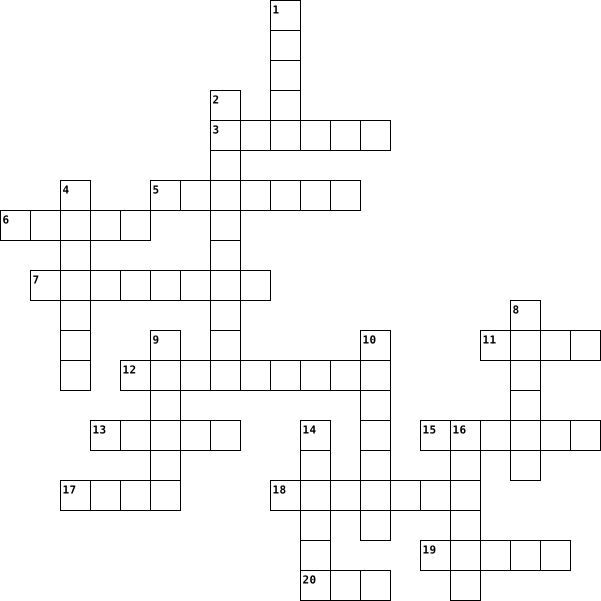
Across
- Has rings around it.
- Clostet planet to the Sun
- Closest planet to Earth.
- What galaxy is Earth in?
- We see it every night.
- What month was neptune discoverd.
- Which planet has land and seas.
- Strike any planet at any point.
- What planet did NASA send the rover to?
- What planet suffers from violent weather?
- What is the sister plane to Earth?
- What is the biggest star in our solar system called?
Down
- How many phases of the moon are they?
- fly to space and explore
- What planet has the big spot?
- how do people get into space?
- parts of rock brocken off.
- What holds us to Earth?
- what planet is known as the cold planet?
- You need it to breathe.
20 Clues: Has rings around it. • We see it every night. • What holds us to Earth? • You need it to breathe. • fly to space and explore • Closest planet to Earth. • What galaxy is Earth in? • Clostet planet to the Sun • parts of rock brocken off. • What planet has the big spot? • how do people get into space? • Which planet has land and seas. • Strike any planet at any point. • ...
Earth, Sun, Moon & Stars Vocabulary 2025-01-08

Across
- The different ways the Moon looks from Earth over about a month. Repeats every month.
- An explanation based on evidence that is not directly observed.
- When the right half of the lit portion of the Moon is visible to us. It comes a week after New Moon.
- The motion of one object around another object.
- When the Moon cannot be seen because we are looking at the unlit half of the Moon.
- One of the twelve periods of time that a year is divided into.
- A natural object that orbits a planet. We often see our Moon in the sky at night.
- The path of an object around a particular point in space.
Down
- A large object in space that is made of gas and produces its own light.
- A pulling force between two objects. It pulls everything down to Earth.
- When we can see the entire lit portion of the Moon.
- When the left half of the lit portion of the Moon is visible to us. It comes a week after Full Moon.
- A medium sized star. Closest star to Earth that provides light and heat energy.
- What one thinks about something or somebody; not necessarily based on facts.
- Information about the natural world gathered through the senses and/or scientific instruments.
- The spinning of an object around an axis or center.
16 Clues: The motion of one object around another object. • When we can see the entire lit portion of the Moon. • The spinning of an object around an axis or center. • The path of an object around a particular point in space. • One of the twelve periods of time that a year is divided into. • An explanation based on evidence that is not directly observed. • ...
Mason Frey's Tides Crossword Puzzle 2023-11-20

Across
- Having to do with or on land.
- The flow of water when a tide is shrinking.
- The flow of water when a tide is growing.
Down
- A place that is in or has to do with water.
- The tide that occurs during the full and new Moon phases.
- The force that makes tides a thing.
- The tide that occurs during the first and third quarter Moon phases.
- The continuing rise and fall of the waves in oceans and seas.
8 Clues: Having to do with or on land. • The force that makes tides a thing. • The flow of water when a tide is growing. • A place that is in or has to do with water. • The flow of water when a tide is shrinking. • The tide that occurs during the full and new Moon phases. • The continuing rise and fall of the waves in oceans and seas. • ...
Carter 2024-02-01

Across
- Different phases of the moon
- Spin on an axis
- 1st in the cycle
- Due to the gravity pull of the moon
- If the light is on the left
Down
- 5th in the cycle
- Spin around an object
- force that tries to push two objects together
- Cause of moonlight
- If the light is on the right
10 Clues: Spin on an axis • 5th in the cycle • 1st in the cycle • Cause of moonlight • Spin around an object • If the light is on the left • Different phases of the moon • If the light is on the right • Due to the gravity pull of the moon • force that tries to push two objects together
Year 7 Science Week 2 Vocabulary Search 2023-09-01

Across
- When the Sun's insides squish together to make light.
- Different shapes on Earth's surface like mountains or plains.
- Where all the living things are on Earth.
- energy Sunshine that we can use for power
- Learning about the rocks and dirt on Earth.
- Anything related to the Sun.
- A shape that looks like a banana slice in the sky.
- The kind of weather a place usually has.
- Big holes on the Moon's surface
- The air around us.
- A dark spot on the Sun.
- Name of the missions when people went to the Moon.
- All the living and non-living things in one place.
- When the ground shakes because of moving rocks.
- flares When the Sun shoots out hot stuff.
Down
- Different shapes of the Moon we see during the month.
- Anything related to the Moon
- The big pieces of land on Earth.
- The Sun, planets, and everything that goes around it.
- Moon dirt and rocks.
- It's what makes things fall back on the Moon, but not as hard as on Earth.
- Flames that shoot off the Sun
- Huge, deep waters on Earth.
- Studying everything about the Moon.
- The Sun's fiery halo during an eclipse
- The Sun's space bubble
- The part of the Sun we can see.
- The big rock we live on.
- Dark, flat areas on the Moon's surface.
- How the Moon's gravity makes the ocean go up and down.
30 Clues: The air around us. • Moon dirt and rocks. • The Sun's space bubble • A dark spot on the Sun. • The big rock we live on. • Huge, deep waters on Earth. • Anything related to the Moon • Anything related to the Sun. • Flames that shoot off the Sun • The part of the Sun we can see. • Big holes on the Moon's surface • The big pieces of land on Earth. • Studying everything about the Moon. • ...
Space part 1 2024-11-05

Across
- The shape an orbit takes
- Celestial event leading to longest and shortest days
- The thing that the Earth spins right round
- The first manmade object to leave the solar system
- Tides you should clam on
- Celestial event leading to equal amounts of day and night
- The Martian who took the most important selfie of all time.
- When one half of our moon is lit up from our perspective
- When an object in space gets blocked from light
- When more than half of our moon is lit up
- When the future is looking brighter… each night… for the moon
- The second person to step on the moon
- One small step for __, one giant leap for mankind
- Tides you should crab on
Down
- This is how we measure a year
- The shape of an object’s orbit
- a pattern of something happening over and over in the same order
- Earth’s ever changing weather and climate caused by its tilt
- Sunlight that is focused in a small space, feels very warm
- When your axis points towards the sun
- This is how we measure a day
- Our moon’s ever changing appearance
- When less than half of our moon is lit up
- 29.5 days is a __ month
- Sunlight that is spread out over a large space, feels cooler
- What separates the hemispheres
- Aldrin, or Lightyear, your choice
- The darkening phase of the moon
- Nothing to do with the moon, just sounds like it. Used to shoot Klingons.
29 Clues: 29.5 days is a __ month • The shape an orbit takes • Tides you should clam on • Tides you should crab on • This is how we measure a day • This is how we measure a year • The shape of an object’s orbit • What separates the hemispheres • The darkening phase of the moon • Aldrin, or Lightyear, your choice • Our moon’s ever changing appearance • When your axis points towards the sun • ...
The Moon / The Sun 2024-06-27

Across
- moon When the whole moon is visible, big, and round.
- The Sun helps _______ make their food and grow.
- Sun A ball of hot gases; living things on Earth would die without it.
- The moon looks like this shape when it is partly lit; like a banana shape
- Changes in the moon.
- The planet you live on.
- year It takes ________ ________ for the Earth to travel around the Sun.
Down
- The sun gives this so we can see.
- The moon ______ reflects light from the Sun.
- _______ make light and heat, but they are so far away from Earth, so we can't feel their heat.
- A group of stars with a name is called a _____.
- The sun also gives this so we can be warm.
12 Clues: Changes in the moon. • The planet you live on. • The sun gives this so we can see. • The sun also gives this so we can be warm. • The moon ______ reflects light from the Sun. • The Sun helps _______ make their food and grow. • A group of stars with a name is called a _____. • moon When the whole moon is visible, big, and round. • ...
Seasons, moon phases and eclipses 2026-03-11

Across
- When the moon appears to be 100% illuminated
- the closest star to Earth
- Unit of measurement for how far North or South an area us
- Another name for the moon
- When the Earth casts a shadow on the moon, turning it red
- Another term for Fall
- When the moon appears to grow larger each night
- The imaginary line that runs laterally across our Earth, dividing it into 2 different hemispheres
- When the moon is less than 50% illuminated from our perspective on Earth
- An object remains unchanged unless pushed or pulled upon by an outside force
- the next one of these that occurs in Hawaii will not be for another 80 years
- When the amount of night and day are equal
Down
- Marks the start of summer or winter, either the longest or shortest day of the year
- Unit of measurement for the height of an area or geological feature
- When the moon is 1/4 of the way through its orbit around Earth
- Tides with the largest tidal range
- This season begins in March
- The coolest season of the year
- the hottest season of they year
- Tides with the smallest tidal range
- The force that keeps things "grounded" on Earth
- The best football team in the NFL
- When the moon appears to grow small each night
- The object that orbits Earth, roughly 250,000 miles away
- When the moon is more than 50% illuminated from our perspective on Earth
- The month Mr. K and Mr. Cheek were both born
26 Clues: Another term for Fall • the closest star to Earth • Another name for the moon • This season begins in March • The coolest season of the year • the hottest season of they year • The best football team in the NFL • Tides with the largest tidal range • Tides with the smallest tidal range • When the amount of night and day are equal • When the moon appears to be 100% illuminated • ...
8th Grade Earth Science 2017-03-07

Across
- The longest electromagnetic wave.
- When a small sliver of the moon is illuminated.
- All of existence.
- Boundary where two plates submerge or collide.
- The upper portion of our Earth, including the mantle and upper crust.
- The imaginary line the Earth is tilted on.
- Highest frequency wave, radioactive.
- One half of the Earth, divided vertically.
- The movement of sediment.
- The remains of an animal or plant.
- Boundary where two plates seperate.
- How the moon looks from Earth based on the location of the moon.
- The explosion that occurs at the death of a large star.
- When the moon gets less illuminated.
- Electromagnetic waves used to see through soft tissues, but not bone.
Down
- When the moon gets more illuminated.
- Boundary where two plates slide against each other.
- When the largest portion of the moon is illuminated.
- The depositing of sediment.
- The middle latitude line, warmest part of the world.
- The destruction of rock by ice, water, or wind.
- Brightness
- The height of a landform on a topographic map.
- The orbit of the Earth and other planets around the Sun.
- A cloud of gas and dust in space.
- Plates Divided section's of Earth's Lithosphere
- An object in space made of burning gas
- Original proposer of the Continental Drift
28 Clues: Brightness • All of existence. • The movement of sediment. • The depositing of sediment. • The longest electromagnetic wave. • A cloud of gas and dust in space. • The remains of an animal or plant. • Boundary where two plates seperate. • When the moon gets more illuminated. • Highest frequency wave, radioactive. • When the moon gets less illuminated. • ...
Space Crossword 2014-05-16

Across
- smallest planet
- rock that in outer space
- rock that enters our atmosphere also known as shooting stars
- second smallest planet
- teal blue planet
- planet farthest from the sun
- the 3rd planet From the sun
- shapes people make from the stars
- gas giant and second largest planet in the solar system
- holds all the planets in place with its gravitational pull
- shortest day of the year
- when the moon covers the suns disk seen from earth
- biggest planet in the solar system
- used to by the ninth planet now a dwarf planet
Down
- rock from space lands on our earth
- second planet from the sun
- the closest planet to the sun
- shape of our earths orbit
- the motion of an object around another object
- has 8 phases
- closets to the sun
- the study of space
- longest day of the year
- when earths shadow falls on the moon
- farthest from the sun
- special not a hot spot on the sun
26 Clues: has 8 phases • smallest planet • teal blue planet • closets to the sun • the study of space • farthest from the sun • second smallest planet • longest day of the year • rock that in outer space • shortest day of the year • shape of our earths orbit • second planet from the sun • the 3rd planet From the sun • planet farthest from the sun • the closest planet to the sun • ...
Space Crossword puzzle 2021-04-29

Across
- The second stage of a stars life cycle
- The natural satellite of Earth
- The brightness of something
- when a star is 100 times its former size
- The phases of the moon
- The actual brightness of a star
- A dead star
- The type of Galaxy that the milky way is
- A fixed luminous point in the night sky that is a large, remote incandescent body like the sun.
Down
- The brightness of a celestial object as it appears from Earth
- when a star starts dying
- The star turns into a different type of nebula
- Travel in a closed path
- A star during the main part of its life
- The star around which the earth orbits
- The hottest color of stars
- The path earth takes around the sun
- The stage that a star begins it's life
- The planet on which we live
- Imaginary line that runs through the center of a planet, moon, or star that it rotates around
20 Clues: A dead star • The phases of the moon • Travel in a closed path • when a star starts dying • The hottest color of stars • The brightness of something • The planet on which we live • The natural satellite of Earth • The actual brightness of a star • The path earth takes around the sun • The second stage of a stars life cycle • The star around which the earth orbits • ...
vocab words for ch 19 section 1,2 and 4 2015-03-02

Across
- one of the different shapes on the moon seen from earth
- anything that has to do with the sun
- occurs when the moon passes between the earth and the sun
- the president who launch an enormous program of space exploration
- an Italian astronomer who made his own telescope
- a force that pulls on the moon and earth toward each other
- is a measurement of distance from the equator expressed in degrees north and south
- means equal night and day
- the path of an object as it revolves around another object in space
- the part of the shadow surrounding the darkest part
- occurs at a full moon when earth is directly between the moon and the sun
- the star that helped the Egyptians predict each year flood
- the movement of one object around another object
- a device built to study distant objects by making them seem closes
- the imaginary line though the middle of earth
Down
- round pits on the moons surface
- occurs around march 21
- occurs when an object comes between the sun and a third object
- anything that has to do with the moon
- the two days of the year when on which the noon sun is directly overhead at 23.5 degrees north or south
- occurs around September 23
- the first to create a calendar
- dark flat areas on the moon
- the darkest part of the moons shadow
- the study of the moon stars and other objects in space
- rise and fall of earths water
26 Clues: occurs around march 21 • means equal night and day • occurs around September 23 • dark flat areas on the moon • rise and fall of earths water • the first to create a calendar • round pits on the moons surface • anything that has to do with the sun • the darkest part of the moons shadow • anything that has to do with the moon • the imaginary line though the middle of earth • ...
anthonie crossword labs 2024-01-22

Across
- when the lit-up part of the Moon grows from 50.1% to 99.9%
- the perfect time to rest and regenerate
- another term for Metonic cycle.
- Half Moon
- the period from January 1 to March 31
Down
- the phase of the moon when it is in conjunction with the sun and invisible from earth, or shortly thereafter
- the first lunar phase after the New Moon
- moon rises later at night than a full moon.
- one of eight lunar phases, in which the entire round illuminated face of the Moon is visible from Earth.
9 Clues: Half Moon • another term for Metonic cycle. • the period from January 1 to March 31 • the perfect time to rest and regenerate • the first lunar phase after the New Moon • moon rises later at night than a full moon. • when the lit-up part of the Moon grows from 50.1% to 99.9% • ...