
moon phases Crossword Puzzles
Phases of the Moon - Science Study Weekly #19 2021-10-25

Across
- More than half of the left side can be seen
- How many phases of the moon are there?
- The right half can be seen
- Has only one moon
- The sun gives off light because of a process
Down
- We see the moon at night because
- Has fourteen moons
- meteor The only thing that can change the surface of the moon if hit
- The moon rotates on this
9 Clues: Has only one moon • Has fourteen moons • The moon rotates on this • The right half can be seen • We see the moon at night because • How many phases of the moon are there? • More than half of the left side can be seen • The sun gives off light because of a process • meteor The only thing that can change the surface of the moon if hit
Space 2022-06-05
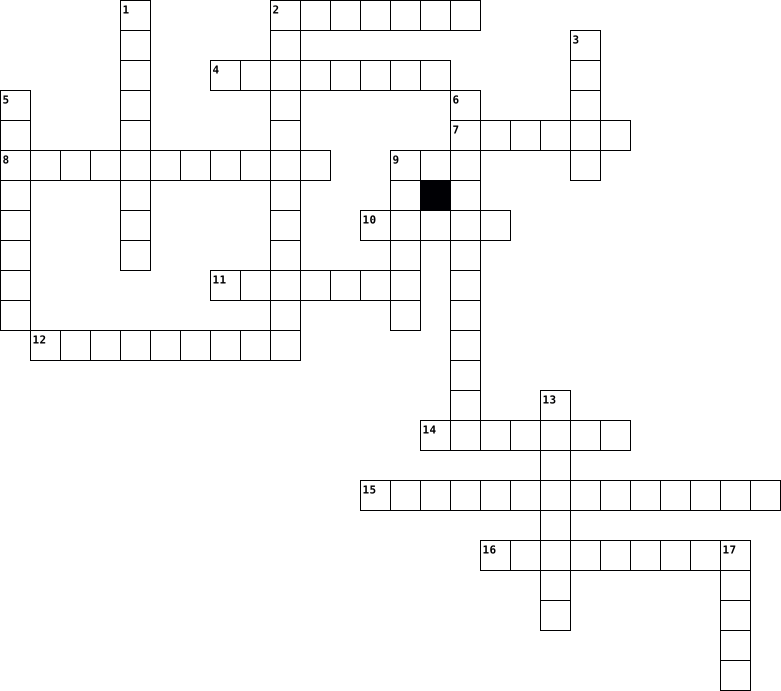
Across
- A constellation in the form of a scorpion and is a horoscope.
- What our galaxy is called.
- Seventh planet from the sun.
- All of our planets and stars make up the.
- The closest star to earth.
- They make up constellations.
- The largest planet and fifth from the sun.
- A endless void that sucks everything into it and can never escape.
- Smallest planet and closest to the sun.
- What the pictures of the stars are called.
- The phases of the moon is called the.
Down
- A space rock that enters the earth's atmosphere.
- When the moon passes between earth and sun it causes this.
- The second planet from the sun.
- A large planet with low densities.
- When the moon moves into the earths shadow it causes this.
- The only planet with rings.
- When the moon appears to be fully illuminated it's called this.
- The only planet that is known to hold life.
19 Clues: What our galaxy is called. • The closest star to earth. • The only planet with rings. • Seventh planet from the sun. • They make up constellations. • The second planet from the sun. • A large planet with low densities. • The phases of the moon is called the. • Smallest planet and closest to the sun. • All of our planets and stars make up the. • ...
moon phases 2024-05-03

Across
- the thing that helps us stay on earth
- cycle cycle of the moon
- the movement
- barely visible moon
Down
- between half way full on
- fully visible moon
- tides are the things moon creates with water
7 Clues: the movement • fully visible moon • barely visible moon • cycle cycle of the moon • between half way full on • the thing that helps us stay on earth • tides are the things moon creates with water
Moon- The Lunar Cycle Moon Phases 2026-01-30

Across
- the phase before the New Moon when only a small sliver of light remains visible.
- the phase when the Moon appears to grow as more of its sunlit side becomes visible.
- the phase after the Full Moon when more than half of the Moon is lit but decreasing.
- the repeating pattern of changes in the Moon’s appearance as it orbits Earth.
- the phase when half of the Moon’s surface appears lit and the Moon is waxing.
- the phase when the Moon is between Earth and the Sun and is not visible from Earth.
- the phase when more than half of the Moon is lit and still growing toward a Full Moon.
Down
- the different shapes of the Moon we see from Earth due to reflected sunlight.
- the phase when the Moon appears to shrink as less of its sunlit side is visible.
- the phase when half of the Moon appears lit and the Moon is waning.
- the phase after the New Moon when a small, growing sliver of light is visible.
- to move in a circular orbit around another object, such as the Moon revolving around Earth.
- the path an object follows as it revolves around another object in space.
- the phase when the entire side of the Moon facing Earth is lit by the Sun.
- a natural satellite that orbits Earth and reflects light from the Sun.
15 Clues: the phase when half of the Moon appears lit and the Moon is waning. • a natural satellite that orbits Earth and reflects light from the Sun. • the path an object follows as it revolves around another object in space. • the phase when the entire side of the Moon facing Earth is lit by the Sun. • ...
Lunar Phases 2023-11-24

Across
- the seventh phase of the cycle of phases
- between a full moon and a half moon
- invisible to the human eye
Down
- the first lunar phase after the new moon
- halfway between a new moon and the full moon
- fully illuminated to earth
- a gradual decrease of the sunlit part of the moon after the full moon
- between a half moon and full moon
8 Clues: fully illuminated to earth • invisible to the human eye • between a half moon and full moon • between a full moon and a half moon • the first lunar phase after the new moon • the seventh phase of the cycle of phases • halfway between a new moon and the full moon • a gradual decrease of the sunlit part of the moon after the full moon
The Sun, Earth and Moon 2018-01-30

Across
- During the new moon the sun and moon what?
- The sun is a huge ball of glowing what?
- Diwali occurs on the night of the what kind of new moon.
- What diagram includes sentences?
- It takes 365 days for the earth to make a full circle around the sun, what is this process called?
- What is the Islamic holy month called?
- Everything orbits the sun in what direction?
- Ramadan begins with the first sighting of the new moon in the what month of the lunar calendar?
- What was the model that originally had Earth at the centre of the solar system?
- The heliocentric was proven to be true by what technology invention?
- First Quarter Moon is also known as what?
- Gibbous refers to the ______?
- What calendar means that dates are determined both by the time of the solar year and also the phase of the moon.
Down
- The waning crescent moon is the last ________ phase.
- The moment a thin sliver piece of the Moon becomes visible is what phase?
- The Chinese New Year is determined by the ______ new moon.
- Waxing means getting ____?
- The Moon does not radiate its own what?
- We divide the lunar month into 4 _______ and 4 intermediate Moon phases
- Earth spins around a imaginary line called ______.
- What is at the centre of the universe?
- Great full moon is another word for what celebration?
- What planet do we live on?
- How many hours does it take for earth to rotate on its axis?
- The Full Moon appears when the Sun and the Moon are aligned on ______ sides of Earth.
- Moon What moon is completely black?
- Rosh Hashanah is what cultures new year?
- The Christian celebration of Easter occurs on what day of the week.
- This word means getting smaller
- What does helio mean?
30 Clues: What does helio mean? • Waxing means getting ____? • What planet do we live on? • Gibbous refers to the ______? • This word means getting smaller • What diagram includes sentences? • Moon What moon is completely black? • What is at the centre of the universe? • What is the Islamic holy month called? • The Moon does not radiate its own what? • ...
Astronomy 2026-01-27

Across
- How would you refer to the four largest planets (3, 6)
- An outer part of the solar system filled with icy objects (4, 5)
- The number of days in a normal year
- The moon causes these in the water (5)
- The process in the core of the sun (6)
Down
- The thing between mars and Jupiter (8, 4)
- Ex-planet (5)
- The force holding the solar system together (7)
- When the moon covers up the sun (5, 7)
- Largest planet (7)
- The moon goes through these (6)
- The moon is made of this (6)
12 Clues: Ex-planet (5) • Largest planet (7) • The moon is made of this (6) • The moon goes through these (6) • The number of days in a normal year • When the moon covers up the sun (5, 7) • The moon causes these in the water (5) • The process in the core of the sun (6) • The thing between mars and Jupiter (8, 4) • The force holding the solar system together (7) • ...
Lunar Cycles Crossword 2022-03-29

Across
- The different appearances of the moon due to the sun shining on different sides of the moon relative to us.
- Phase when we can see all of the lighted part of the moon.
- A fundamental farce of nature that causes anything with mass to move toward each other.
- One cycle of the moon around the Earth.
- Phase when we can see none of the lighted part of the moon.
- The movement of a body around its axis.
Down
- When the light part of the moon is getting smaller.
- The movement of a body around its orbit.
- Phase when we can see half of the lighted part of the moon.
- Bulging of the worlds oceans due to the gravitational pull of the moon and sun.
- Phase when we can only see a sliver of the dark part of the moon.
- Phase when we can only see a sliver of the lighted part of the moon.
- When the light part of the moon is getting bigger.
13 Clues: One cycle of the moon around the Earth. • The movement of a body around its axis. • The movement of a body around its orbit. • When the light part of the moon is getting bigger. • When the light part of the moon is getting smaller. • Phase when we can see all of the lighted part of the moon. • Phase when we can see half of the lighted part of the moon. • ...
Moon Phases Puzzle 2023-04-28

Across
- Moon phase getting bigger; more than 50% visible
- how many days does a moon cycle last?
- What phase comes after a 3rd quarter moon?
Down
- Moon is half lit; getting smaller
- Moon is not visible
- What is the phase 14 days after a waning gibbous
- Moon phase 14 days after a new moon
- How many days between major phases?
8 Clues: Moon is not visible • Moon is half lit; getting smaller • Moon phase 14 days after a new moon • How many days between major phases? • how many days does a moon cycle last? • What phase comes after a 3rd quarter moon? • What is the phase 14 days after a waning gibbous • Moon phase getting bigger; more than 50% visible
Moon phases 2021-02-01

Across
- "I can see the whole moon."
- a moon that is less than half
- losing sunlight
- a moon that is more than half
- gaining sunlight
Down
- 1:You can see all the moon phases in a mounth, 2: The moon spins counterclockwise.
- "I can't see any of the moon."
7 Clues: losing sunlight • gaining sunlight • "I can see the whole moon." • a moon that is less than half • a moon that is more than half • "I can't see any of the moon." • 1:You can see all the moon phases in a mounth, 2: The moon spins counterclockwise.
moon phases 2021-04-23

Across
- moon: sneky moon
- gibbous: it starts to fade
- cresent: a little toenail moon
- quarter: we see one forth of the moon
- quarter: think fractions
Down
- cresent: almost gone
- crescent: here we go again
- gibbous: its so close
- the sun and the moon make these
- moon: its whole
10 Clues: moon: its whole • moon: sneky moon • cresent: almost gone • gibbous: its so close • quarter: think fractions • crescent: here we go again • gibbous: it starts to fade • cresent: a little toenail moon • the sun and the moon make these • quarter: we see one forth of the moon
Moon phases 2021-10-22

Across
- a name for the lunar moon hint starts with b ends with n
- what you see at night instead of the sun
- phase the moon starts its cycle at
- where the moon lives
Down
- what phase is fully illuminated
- what did ancient people use the moon for
- what is the moons favorite food hint it’s like candy rocks
7 Clues: where the moon lives • what phase is fully illuminated • phase the moon starts its cycle at • what did ancient people use the moon for • what you see at night instead of the sun • a name for the lunar moon hint starts with b ends with n • what is the moons favorite food hint it’s like candy rocks
Moon Phases 2026-02-06

Across
- all objects that have weight pull on other objects that pull things toward each other
- the part of the moon that reflects sunlight toward Earth changes that makes the moon look different at different times as the Moon moves around the Earth
- this happens on Earth when the Moon moves into Earth's shadow
Down
- during an eclipse, it is the lighter, spreading part of the shadow
- during an eclipse, it is the darkest part of the shadow
- when one object in space casts a shadow on another object
- a body that moves around a larger body
7 Clues: a body that moves around a larger body • during an eclipse, it is the darkest part of the shadow • when one object in space casts a shadow on another object • this happens on Earth when the Moon moves into Earth's shadow • during an eclipse, it is the lighter, spreading part of the shadow • ...
Tides crossword 2023-01-13

Across
- when the sun earth and moon makes a line
- referring to land
- the force of a mass on a another mass
- one of the moon phases responsible for the spring tide
Down
- one of the moon phase responsible for neap tides
- an area were the ocean level changes throughout the day
- The pattern of falling and rising at a coastline
- referring to ocean
- when the sun earth and moon makes a 90 degree angle
- the planetary body responsible for earths tides.
10 Clues: referring to land • referring to ocean • the force of a mass on a another mass • when the sun earth and moon makes a line • one of the moon phase responsible for neap tides • The pattern of falling and rising at a coastline • the planetary body responsible for earths tides. • when the sun earth and moon makes a 90 degree angle • ...
Phases of the moon 2026-01-15

Across
- A giant star...
- Spinning on an axis
- Gaining light
- Movement of an object around another object
Down
- A toenail shaped phase
- Another word for phases of the moon
- A force that pulls two objects together
- A big grey sphere you see at night
- Losing light
- Waves in the ocean
10 Clues: Losing light • Gaining light • A giant star... • Waves in the ocean • Spinning on an axis • A toenail shaped phase • A big grey sphere you see at night • Another word for phases of the moon • A force that pulls two objects together • Movement of an object around another object
Earth and Space 2025-11-20

Across
- no longer considered a planet
- closest planet to the sun
- the moon goes through lots of these
- space explorer
- the Earth's only natural satellite?
Down
- centre of our solar system
- the sun is the centre of what?
- Bright lights at night
- the red planet
- the blue planet
10 Clues: the red planet • space explorer • the blue planet • Bright lights at night • closest planet to the sun • centre of our solar system • no longer considered a planet • the sun is the centre of what? • the moon goes through lots of these • the Earth's only natural satellite?
Science- Sun phases 2023-11-07

Across
- Type of moon where you see the whole lit half
- the planet we live on
- Phase that is right before and after a full moon
- what word comes before cresent and gibbous when the moon is getting smaller
- Type of moon where you dont see the lit side at all
Down
- the thing that lights up the moon and earth
- the earth and the moon are both one of these
- comes before 1st quarter
- the thing that is lit up by the sun and has phases
- what word comes before cresent and gibbous when the moon is getting bigger
10 Clues: the planet we live on • comes before 1st quarter • the thing that lights up the moon and earth • the earth and the moon are both one of these • Type of moon where you see the whole lit half • Phase that is right before and after a full moon • the thing that is lit up by the sun and has phases • Type of moon where you dont see the lit side at all • ...
Tides crossword 2023-01-13

Across
- when the sun earth and moon makes a line
- referring to land
- the force of a mass on a another mass
- one of the moon phases responsible for the spring tide
Down
- one of the moon phase responsible for neap tides
- an area were the ocean level changes throughout the day
- The pattern of falling and rising at a coastline
- referring to ocean
- when the sun earth and moon makes a 90 degree angle
- the planetary body responsible for earths tides.
10 Clues: referring to land • referring to ocean • the force of a mass on a another mass • when the sun earth and moon makes a line • one of the moon phase responsible for neap tides • The pattern of falling and rising at a coastline • the planetary body responsible for earths tides. • when the sun earth and moon makes a 90 degree angle • ...
lunar phenomenon crossword 2023-11-27

Across
- another term for moon phases
- lightest shadow
- partial effect of an eclipse
- gravitational pull of the moon causes these
- effect tides have that create high tides
Down
- full effect of an eclipse
- strong tide; they spring forward
- what comes up must come down
- super weak tides
- darkest shadow
10 Clues: darkest shadow • lightest shadow • super weak tides • full effect of an eclipse • another term for moon phases • what comes up must come down • partial effect of an eclipse • strong tide; they spring forward • effect tides have that create high tides • gravitational pull of the moon causes these
Science Review Crossword Puzzle 2021-06-07

Across
- these movements cause the shifting of Earth's plates
- another way to say heat
- how high or low a sound is
- the outermost layer of the Earth
- the name of technology developed for space exploration that we adapt and use for everyday life
- Earth's natural satellite
- anything with mass and volume
Down
- Earth is ________ because its in the Goldilocks zone
- the process where all living things use oxygen to break down glucose
- the changing shape of the Moon
- when the moon passes into Earth's shadow
- how loud or soft a noise
- the process plants undergo to create glucose
- the continuous rise and fall of the Earth's oceans / seas
- how much matter an object contains
15 Clues: another way to say heat • how loud or soft a noise • Earth's natural satellite • how high or low a sound is • anything with mass and volume • the changing shape of the Moon • the outermost layer of the Earth • how much matter an object contains • when the moon passes into Earth's shadow • the process plants undergo to create glucose • ...
Density and Moon 2021-12-08

Across
- something we observe to be similar over and over again
- if the density is greater than water it will sink
- the nearly circular path a smaller object travels around a larger object
- to shine light of a certain object
- 1 month
Down
- if the density is less than water it will float
- the amount of mass in a given volume
- New moon, crescent moon, quarter moon, gibbous moon and full moon
- how much matter a object has
- length x width x height
10 Clues: 1 month • length x width x height • how much matter a object has • to shine light of a certain object • the amount of mass in a given volume • if the density is less than water it will float • if the density is greater than water it will sink • something we observe to be similar over and over again • New moon, crescent moon, quarter moon, gibbous moon and full moon • ...
Phases of the Moon Crossword 2024-10-17

Across
- The phase that appears full and bright
- The phase of the moon when it is completely dark
- The phase that appears as a thin crescent
- Side The side of the moon that faces away from the sun
- To gradually become smaller
Down
- The phase that is half illuminated
- Cycle The period of time it takes for the moon to go through all its phases
- The side of the moon that is facing the sun
- To gradually become larger
- The path the moon takes around the Earth
10 Clues: To gradually become larger • To gradually become smaller • The phase that is half illuminated • The phase that appears full and bright • The path the moon takes around the Earth • The phase that appears as a thin crescent • The side of the moon that is facing the sun • The phase of the moon when it is completely dark • ...
Tides crossword 2023-01-13

Across
- when the sun earth and moon makes a line
- referring to land
- the force of a mass on a another mass
- one of the moon phases responsible for the spring tide
Down
- one of the moon phase responsible for neap tides
- an area were the ocean level changes throughout the day
- The pattern of falling and rising at a coastline
- referring to ocean
- when the sun earth and moon makes a 90 degree angle
- the planetary body responsible for earths tides.
10 Clues: referring to land • referring to ocean • the force of a mass on a another mass • when the sun earth and moon makes a line • one of the moon phase responsible for neap tides • The pattern of falling and rising at a coastline • the planetary body responsible for earths tides. • when the sun earth and moon makes a 90 degree angle • ...
Earth and Sun 2017-11-20

Across
- to turn on an axis
- a time in the morning when the sun appears over the horizon
- the measurement of the amount of matter in something
- the phase of the moon when all of the sunlit side of the moon is visible from Earth
- the star in the center of the Solar System
- one of the four planets that are made of gas.
- to reduce in volume by applying pressure
- a huge region beyond the gas giant planets, made up of different sized chunks of matter
- the shape of the moon when it appears to be more than a quarter but not yet full and when it is less than full but not quite a third quarter
- the layer of gases surrounding Earth
- an imaginary line around which a mass, like a planet, rotates
- the phase of the moon when the sunlit side is not visible from earth
Down
- anything that takes up space
- curved shape of the visible part of the moon before and after a new moon
- the force of attraction between masses
- a phase of the moon halfway between a new moon and full moon
- A system of the sun and other objects that orbit the sun
- cycle the four week period during which the moon orbits Earth one time and is visible in all of its phases
- a large, round object orbiting a star
- a mass of ice, rock, and gas orbiting the sun
- the force exerted by an object or fluid on something
- the time between sunrise and sunset
22 Clues: to turn on an axis • anything that takes up space • the time between sunrise and sunset • the layer of gases surrounding Earth • a large, round object orbiting a star • the force of attraction between masses • to reduce in volume by applying pressure • the star in the center of the Solar System • a mass of ice, rock, and gas orbiting the sun • ...
Science Crossword 2023-09-08

Across
- The planet we live on.
- orbit around an object.
- the brightest thing that we know of.
- It pulls objects down to the ground.
- To flip something or move it another way.
- The Phases if the moons name.
Down
- Decrease
- you can see it during night time and has phases
- When the water goes up or down that's called a.
- We are trying to discover we are in it where planets are.
- Increase
11 Clues: Decrease • Increase • The planet we live on. • orbit around an object. • The Phases if the moons name. • the brightest thing that we know of. • It pulls objects down to the ground. • To flip something or move it another way. • you can see it during night time and has phases • When the water goes up or down that's called a. • ...
The Moon 2014-03-02

Across
- An imaginary line or pole that passes through a planet, on which the planet spins
- a Russian astronaut
- Probe machines sent up into space to land on planets or fly past planets and send pictures to earth.
- part of the moon we can't see from earth
- the layers of gases around some planets and moons
- a piece of equipment that allows a person to see distant objects
- a force that causes everything to have weight and move towards the center of the earth
- an object that travels around another object
Down
- a period of time where we see parts of the moon
- a program made to learn more about the moon
- Earth's natural satellite
- the last name of the first man to step on the moon
- a suit containing oxygen and includes adjustable temperatures perfect for space travel
- Fifty-mile wide crater
- ring-shaped flat lands with walls around them
15 Clues: a Russian astronaut • Fifty-mile wide crater • Earth's natural satellite • part of the moon we can't see from earth • a program made to learn more about the moon • an object that travels around another object • ring-shaped flat lands with walls around them • a period of time where we see parts of the moon • the layers of gases around some planets and moons • ...
Relationship of the Moon and the Earth Topic 15 2024-11-07

Across
- amount if matter in an object
- the seventh phase of the moon
- the number of phases the moon goes through
- small rocky bodies that orbit a planet
- when the moon can´t be seen by people on Earth
- when high tide is higher than usual and low tide is lower than usual
- the amount of high tides in a day and low tides in a day
- the tendency of all objects pulling towards other objects towards themselves
Down
- a person who travels in space
- the direction that the moon orbits the earth
- the number of hours between high tide or low tide at the same place.
- when the moon is on the opposite side of the Earth to the Sun
- one of the things that determines the amount of gravity an objects gives off
- the area of a shoreline between high and low tides
- predictable daily rise and fall of sea and ocean levels
15 Clues: a person who travels in space • the seventh phase of the moon • amount if matter in an object • small rocky bodies that orbit a planet • the number of phases the moon goes through • the direction that the moon orbits the earth • when the moon can´t be seen by people on Earth • the area of a shoreline between high and low tides • ...
Eclipse Crossword 2024-04-05

Across
- type of ring that appears right before totality
- type of moon that must be present for a solar eclipse
- type of eclipse where the Moon is too far from Earth to completely cover the Sun
- how many times either a solar or lunar eclipse occurs per year
- maximum phase of a total eclipse during which the Moon's disk completely covers the Sun
- type of eclipse where Earth is positioned precisely between the Moon and Sun
Down
- has an orbit of 29 and a half days
- has an orbit of 365 days
- you must never look ___ at the eclipse
- what happens to the sky during the solar eclipse
- how the Moon's orbit appears in relation to the Earth
- the type of eclipse that is seen when you are not in the shadow
- what the moon does to the light from the sun to create the phases
- type of eclipse where the Moon blocks the Sun
14 Clues: has an orbit of 365 days • has an orbit of 29 and a half days • you must never look ___ at the eclipse • type of eclipse where the Moon blocks the Sun • type of ring that appears right before totality • what happens to the sky during the solar eclipse • type of moon that must be present for a solar eclipse • how the Moon's orbit appears in relation to the Earth • ...
Moon Phases Project 2020-12-15

Across
- The Moon Phase that happens after a Full Moon.
- To Increase In Size.
- What is the First Moon Phase?
- When the Moon is lit up on the right side
- To Decreases In Size.
Down
- When the Moon appears fully illuminated.
- When the Moon is only lit up on the right side.
- What is the the moon phase before new moon?
- The Moon Phase that comes after the First Quarter.
- What is the moon phase after new moon?
10 Clues: To Increase In Size. • To Decreases In Size. • What is the First Moon Phase? • What is the moon phase after new moon? • When the Moon appears fully illuminated. • When the Moon is lit up on the right side • What is the the moon phase before new moon? • The Moon Phase that happens after a Full Moon. • When the Moon is only lit up on the right side. • ...
Moon phases crosswords 2025-09-22

Across
- A force the tries to bring objects down.
- Decreasing in size
- the ocean getting pulled by gravity.
- is the movement of a object.
- is the change in the appearance of the moon.
Down
- The sunlight portion is increasing but less than half can be seen.
- Increasing in size
- The earth moon and sun are in approximate alignment, so can see the whole side of the moon facing earth.
- The moon is at a 90 degree angle with the earth and sun, so we are seeing half on the right side.
- the spinning of an object.
10 Clues: Increasing in size • Decreasing in size • the spinning of an object. • is the movement of a object. • the ocean getting pulled by gravity. • A force the tries to bring objects down. • is the change in the appearance of the moon. • The sunlight portion is increasing but less than half can be seen. • ...
Week 6 2015-10-15

Across
- I judged
- I spent a lot of voyage
- I am after frost
- to become
- I am a builder
- helping
- I fund a starfish
- a object that mouse
- so essay
- poling apart
- I look over
Down
- moon phases
- I built a house
- to trace from a source
- I'm at act
- I one
- I worked in the bed
- moving around the sun
- finds out hos gillette
- I raced to the top of the hill
20 Clues: I one • helping • I judged • so essay • to become • I'm at act • moon phases • I look over • poling apart • I am a builder • I built a house • I am after frost • I fund a starfish • I worked in the bed • a object that mouse • moving around the sun • to trace from a source • finds out hos gillette • I spent a lot of voyage • I raced to the top of the hill
phases of the moon 2021-03-08

Across
- entire circle
- growing
- going around
- Cheshire cat smile
Down
- more than half
- cycle the phases of the moon
- 1st and 3rd quarter
- shrinking
- spinning
- no light
10 Clues: growing • spinning • no light • shrinking • going around • entire circle • more than half • Cheshire cat smile • 1st and 3rd quarter • cycle the phases of the moon
The Moon 2023-04-04

Across
- phase when the moon is 1/4 of the way around the Earth
- Earth's moon is the ___ largest moon orbiting a planet
- moon crater that is more than 85 kilometers wide
- phase of the moon when only a thin sliver of right side of moon is visible
- moon phase when more than half of the moon's left side can be seen
- the moon cannot be seen in this phase
- the moon is ______ than Earth
Down
- the sun _______ light off the moon's surface
- takes 29.5 days for the moon to go through all of these
- caused when asteroids and meteors hit the moon's surface
10 Clues: the moon is ______ than Earth • the moon cannot be seen in this phase • the sun _______ light off the moon's surface • moon crater that is more than 85 kilometers wide • phase when the moon is 1/4 of the way around the Earth • Earth's moon is the ___ largest moon orbiting a planet • takes 29.5 days for the moon to go through all of these • ...
Moon's 2023-11-20

Across
- occurs once a month, rising around 12 AM, and setting around 12 PM, almost instantaneously becoming a Waning Crescent.
- the sixth phase in the cycle of phases
- occurs when the moon is on the same side of Earth as the sun
Down
- this Moon phase appears as a small sliver on the right side
- looks like a half-illuminated circle one side of the moon is illuminated and the other half is shadowed
- The area illuminated on the surface of the Moon during this phase is in the shape of a crescent and the amount of sunlight reflecting off of the Moon is decreasingwaininggibbous
- The sun fully illuminates the side of the moon we can see from the earth
- fourth phase in the cycle of phases
8 Clues: fourth phase in the cycle of phases • the sixth phase in the cycle of phases • this Moon phase appears as a small sliver on the right side • occurs when the moon is on the same side of Earth as the sun • The sun fully illuminates the side of the moon we can see from the earth • ...
Science vocab 2023-11-29

Across
- has eight different phases
- what keeps everything in motion
- happens after full moon
- smallest amount of light on the moon
Down
- what takes 365 days
- what causes day and night
- winter,summer,fall
- high ocean ___
- invisible line in the earth
9 Clues: high ocean ___ • winter,summer,fall • what takes 365 days • happens after full moon • what causes day and night • has eight different phases • invisible line in the earth • what keeps everything in motion • smallest amount of light on the moon
Phases of the Moon 2025-02-14

Across
- The phase when the moon is not visible from Earth because it's between the Earth and the sun.
- The phase before the new moon when only a small part of the moon is illuminated.
- The path that the moon follows as it travels around the Earth.
- The phase after the new moon when a small sliver of the moon starts to become visible.
- The period it takes for the moon to complete one full orbit around the Earth, approximately 29.5 days.
- The term used to describe the moon when it is increasing in illumination.
- The line that separates the illuminated part of the moon from the dark part.
Down
- The phase when the entire face of the moon is illuminated by the sun.
- The phase after the full moon when the illuminated part of the moon is decreasing.
- The phase when the moon is half illuminated and half dark, occurring about three weeks after the new moon.
- The force that pulls the moon towards the Earth, keeping it in orbit.
- The side of the moon that always faces the Earth due to synchronous rotation.
- The phase when the moon is half illuminated and half dark, occurring about a week after the new moon.
- The term used to describe the moon when it is decreasing in illumination.
- The phase when more than half of the moon is illuminated but it is not yet a full moon.
15 Clues: The path that the moon follows as it travels around the Earth. • The phase when the entire face of the moon is illuminated by the sun. • The force that pulls the moon towards the Earth, keeping it in orbit. • The term used to describe the moon when it is decreasing in illumination. • The term used to describe the moon when it is increasing in illumination. • ...
Autumn 2023-10-17
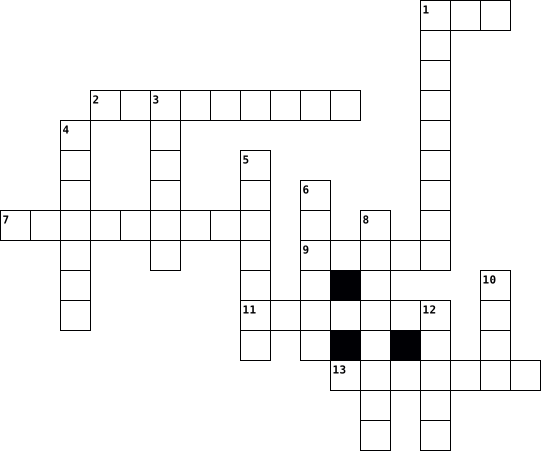
Across
- Is for horses
- Scares birds away
- First month of Fall
- Tree Seed
- Comfy cozy clothing
- Action to make a Jack o' Lantern
Down
- Spookiest holiday
- Another word for Fall
- Favorite fall flavor
- Collecting food
- Orange, yellow, red, & brown
- The name of two different sports
- Goes through phases
- Nevermore
14 Clues: Tree Seed • Nevermore • Is for horses • Collecting food • Spookiest holiday • Scares birds away • First month of Fall • Goes through phases • Comfy cozy clothing • Favorite fall flavor • Another word for Fall • Orange, yellow, red, & brown • The name of two different sports • Action to make a Jack o' Lantern
MOON 2022-02-18

Across
- when almost all of the moon is shown but not all of it.
- when a little bit of light is shown on the moon; after the new moon.
- a pull that joins two objects together.
- the movement of an object
Down
- the spinning of an object
- the phases of the moon
- it travels in straight lines in space and illuminates the moon.
- when all of the moon is seen on earth
- a rocky sphere that rotates around a planet.
9 Clues: the phases of the moon • the spinning of an object • the movement of an object • when all of the moon is seen on earth • a pull that joins two objects together. • a rocky sphere that rotates around a planet. • when almost all of the moon is shown but not all of it. • it travels in straight lines in space and illuminates the moon. • ...
8.7B Moon Phases 2022-10-17

Across
- Light on the left Oval Shape
- Completely dark/no light
- Light on the right Oval shape
- Light only on the right half
- The 3rd planet from the Sun
- Light only on the left half
Down
- Small U shape light on the moon left side
- Completely light up
- Small U shape light on the moon right side
- The center of our solar system
10 Clues: Completely light up • Completely dark/no light • The 3rd planet from the Sun • Light only on the left half • Light on the left Oval Shape • Light only on the right half • Light on the right Oval shape • The center of our solar system • Small U shape light on the moon left side • Small U shape light on the moon right side
Moon phases project 2020-12-15

Across
- It is even more then half of the moon lit up
- it is getting bigger
- A Crescent is a little strip of the moon lit up
- It is getting smaller
Down
- It is when the sun and earth blocks the light
- The moon is not lit up
- Is when only half of the moon is lit up
- It is even even more then half of the moon lit up
- A Gibbous is more then half of the moon lit up
- A full moon is when the whole moon is lit up
10 Clues: it is getting bigger • It is getting smaller • The moon is not lit up • Is when only half of the moon is lit up • It is even more then half of the moon lit up • A full moon is when the whole moon is lit up • It is when the sun and earth blocks the light • A Gibbous is more then half of the moon lit up • A Crescent is a little strip of the moon lit up • ...
The Moon Phases 2021-10-06

Across
- the increasing amount of illumination of the Moon’s face before full moon
- the movement of an object around another object
- Alignments of the Sun, Earth, and Moon
- the spinning of an object like the Earth, on its axis
- the phase of the Moon when the Earth-facing hemisphere is illuminated over less than 50 percent of its area
Down
- the phase of the Moon seen when the Earth-facing hemisphere is illuminated over more than 50 percent of its area
- the decreasing amount of illumination of the Moon’s face after full moon as it moves to new moon
- the pull of gravity on the Earth caused by the moon in the ocean
- the force that tries to pull two objects towards each other
- cycle the change in the appearance of the moon as it makes one full revolution around the Earth
10 Clues: Alignments of the Sun, Earth, and Moon • the movement of an object around another object • the spinning of an object like the Earth, on its axis • the force that tries to pull two objects towards each other • the pull of gravity on the Earth caused by the moon in the ocean • the increasing amount of illumination of the Moon’s face before full moon • ...
Earth, Sun, Moon (Seasons and Moon Phases) 2025-04-08

Across
- This season comes right after winter.
- The same side of the moon always ________ the Earth.
- The path an object follows as it moves around another object
- The shape of the path of the planets as they orbit the sun
- The movement of a planet around the sun is called a ______.
- The motion of a planet spinning on its axis
- When the northern hemisphere is tilted towards the sun, we experience _____.
- When the northern hemisphere is tilted away from the sun, we experience ______.
- The shortest day of the year is in ______ and is called the summer solstice.
- The moon makes one revolution around the Earth about every _____ days.
- Pits on the moon caused by the impact of objects, such as meteors.
Down
- One revolution of Earth around the sun takes about one ____.
- We see the moon because light from the sun ______ off of it.
- The tilt of the Earth's axis and its revolution around the sun cause ___.
- This season comes right after summer.
- The two forces that keep the Earth in orbit are gravity and ____.
- The study of planets, stars, moons, and other celestial objects
- One rotation of the earth on its axis takes about one ____.
- December 21st is the shortest day of the year and is called the winter _____.
19 Clues: This season comes right after winter. • This season comes right after summer. • The motion of a planet spinning on its axis • The same side of the moon always ________ the Earth. • The shape of the path of the planets as they orbit the sun • The movement of a planet around the sun is called a ______. • One rotation of the earth on its axis takes about one ____. • ...
Astronomy- Knowianna 2016-10-27

Across
- the largest part of the moons shadow
- the darkest part of the moons shadow
- appears to move from east to west
- the tendency of an object to resist a change in motion
- states that every object in the universe attracts every other object
- occurs when the moon passes directly between earth and the sun
- moves from west to east
Down
- causes day and night
- causes seasons
- occurs at a full moon when earth is directly between the moon and the sun
- an object that orbits a star
- caused by the motions of the moon around earth
- the path of one object as it revolves around another object in space
- an imaginary line that an object rotates on
14 Clues: causes seasons • causes day and night • moves from west to east • an object that orbits a star • appears to move from east to west • the largest part of the moons shadow • the darkest part of the moons shadow • an imaginary line that an object rotates on • caused by the motions of the moon around earth • the tendency of an object to resist a change in motion • ...
Solar & Lunar Eclipses 2024-10-03

Across
- fainter, outer part of Earth's/Moon's shadow
- type of lunar eclipse where Moon moves into Earth's penumbra shadow
- the number of lunar phases that exist
- how long it takes to complete 1 lunar cycle
- Large marsupial
- another name for a total eclipse where Moon turns red
- term for when Earth, Moon, & Sun are in a straight line
- this type of tide happens twice a month & decreases the size of the tides
- type of solar eclipse where Sun is fully covered by Moon
Down
- type of lunar eclipse where Moon is part in umbra, part in penumbra
- lunar phase during lunar eclipse
- type of solar eclipse where part of Sun is covered
- lunar phase during solar eclipse
- darkest part of Earth's/Moon's shadow
- type of lunar eclipse where Moon is fully in Earth's umbra
- type of solar eclipse where Moon is far away from the Earth & does not fully cover Sun
- this type of tide happens twice a month & increases the size of the tides
17 Clues: Large marsupial • lunar phase during lunar eclipse • lunar phase during solar eclipse • the number of lunar phases that exist • darkest part of Earth's/Moon's shadow • how long it takes to complete 1 lunar cycle • fainter, outer part of Earth's/Moon's shadow • type of solar eclipse where part of Sun is covered • another name for a total eclipse where Moon turns red • ...
Phases of the Moon 2013-02-07

Across
- The series of shape changes that the Moon goes through when it revolves around the Earth is called the ___________________ of the Moon.
- When the Earth is in between the Sun and the Moon, we see a ________ moon.
- We see a quarter moon during the _____________ week of the lunar cycle.
- The side of the Moon that faces ____________ the sun will reflect light.
- The Moon is a _________________ object, because it reflects the Sun's light. It does not produce its own light.
- The Moon is always the same shape, but we cannot always see all of it. Some parts reflect light. Other parts are in a __________________ which makes them look dark.
- It takes the Moon close to one _____________ (or 28-29 days) to make one revolution around the Earth.
- A ______ Moon is the phase of the moon that occurs when the Moon is directly between the Earth and the Sun; it is the start of a new lunar cycle.
Down
- The Moon looks brights because it _______________ light from the Sun.
- This word describes the Moon when it looks like a sliver. It is smaller than a quarter moon, but it is not yet a new moon. It can be waxing or waning.
- We use this word when the Moon looks like it is getting smaller.
- This word describes the Moon when it looks a little bit bigger than a half, but it is not yet full. It can be waxing or waning.
- An object that produces its own light is a _________________ object.
- We use this word wen the Moon looks like it is getting bigger.
- The ______________ orbits the Earth every 28 to 29 days. It is not a planet. We call it a satellite.
15 Clues: We use this word wen the Moon looks like it is getting bigger. • We use this word when the Moon looks like it is getting smaller. • An object that produces its own light is a _________________ object. • The Moon looks brights because it _______________ light from the Sun. • We see a quarter moon during the _____________ week of the lunar cycle. • ...
Anderson Chapter 1 Lesson 4 Astronomy 2021-11-09

Across
- When earth is directly between the mon and the sun
- How many objects do you need to make an eclipse
- When the moon passes directly between earth and the sun
- What happens during an eclipse
Down
- When the moon orbits Earth what happens to Earth, moon, and sun
- The light part of the moon's shadow
- The rare eclipse
- When an object in space comes between the sun and a third object
- A type of eclipse
- The different shapes of the moon
- The darkest part of the moon's shadow
11 Clues: The rare eclipse • A type of eclipse • What happens during an eclipse • The different shapes of the moon • The light part of the moon's shadow • The darkest part of the moon's shadow • How many objects do you need to make an eclipse • When earth is directly between the mon and the sun • When the moon passes directly between earth and the sun • ...
Tides Wyatt Loomis 2022-10-20

Across
- the portion of the coastline that goes through periods of coverage and exposure
- the satellite that orbits the Earth
- tides that occur during 1st and 3rd quarter
- the planet we live on
- the phases of the moon
Down
- dry land
- the pattern of ocean water rising and falling
- has to do with the ocean
- tides that occur during Full Moon and New Moon
9 Clues: dry land • the planet we live on • the phases of the moon • has to do with the ocean • the satellite that orbits the Earth • tides that occur during 1st and 3rd quarter • the pattern of ocean water rising and falling • tides that occur during Full Moon and New Moon • the portion of the coastline that goes through periods of coverage and exposure
Animals Effected By the Moon 2024-11-18

Across
- This animal becomes pee-shy when the full moon Is out.
- This phase of the moon illuminates the night.
- These are affected by the moon's phases.
- This animal normally eats at night but will eat during the day if a full moon is present.
- Turtles This animal uses the moon to plant its eggs.
Down
- This phase is as if the moon isn't there at all.
- This animal digs a deeper hole every full moon for prey.
- Animals that live in these are affected by the tides.
- These animals have been known to glow in blue moonlight.
- This animal communicates mostly under the full moon.
10 Clues: These are affected by the moon's phases. • This phase of the moon illuminates the night. • This phase is as if the moon isn't there at all. • Turtles This animal uses the moon to plant its eggs. • This animal communicates mostly under the full moon. • Animals that live in these are affected by the tides. • This animal becomes pee-shy when the full moon Is out. • ...
LJ - Lunar Cycle 2023-09-22

Across
- after the Waning Gibbous and before the Waning Crescent.
- After the New moon phase, meaning to get bigger.
- Before a Waxing Gibbous and after Waxing Crescent.
- Means to get smaller after the Full Moon.
- Halfway through the phases.
Down
- before the New Moon comes again.
- Before a Full Moon
- The first phase of the moon.
8 Clues: Before a Full Moon • Halfway through the phases. • The first phase of the moon. • before the New Moon comes again. • Means to get smaller after the Full Moon. • After the New moon phase, meaning to get bigger. • Before a Waxing Gibbous and after Waxing Crescent. • after the Waning Gibbous and before the Waning Crescent.
Tides and Moon Phases 2023-03-06

Across
- The area where tides reach.
- moon phases you see during this tide are new and full moon
- The magnetic pull of an object toward another.
Down
- An area where there is less water and more dry land.
- An area where the organisms deal more with water
- moon phases you see during this tide are first and third quarter.
- the cycle of when water falls and rises.
7 Clues: The area where tides reach. • the cycle of when water falls and rises. • The magnetic pull of an object toward another. • An area where the organisms deal more with water • An area where there is less water and more dry land. • moon phases you see during this tide are new and full moon • moon phases you see during this tide are first and third quarter.
Astronomy 2023-03-22

Across
- when Earth moves around the sun
- imaginary line that passes through Earth
- the planet we live on
- when the moon looks almost full
- when the moon looks very thin and curved in the sky
Down
- the four periods with different weather on Earth
- moon's different appearances
- to move around itself
- the Earth's track around the sun
- when the moon is not visible at all
10 Clues: to move around itself • the planet we live on • moon's different appearances • when Earth moves around the sun • when the moon looks almost full • the Earth's track around the sun • when the moon is not visible at all • imaginary line that passes through Earth • the four periods with different weather on Earth • when the moon looks very thin and curved in the sky
The Moon 2020-11-04

Across
- the moon is big and round
- a thin sliver of the moon
- parts of
- the moon is getting smaller
Down
- half of the lighted side of the moon
- one day on the moon
- the moon is getting bigger
7 Clues: parts of • one day on the moon • the moon is big and round • a thin sliver of the moon • the moon is getting bigger • the moon is getting smaller • half of the lighted side of the moon
Moon Phase and Tides Vocab Review 2025-04-10

Across
- Tides with the greatest tidal range, occurs on a full and new moon.
- More of the illuminated (lighted by the sun) half of the moon can be seen each night, it seems to grow bigger.
- When the Earth is between the sun and moon and all of the moon’s surface facing Earth is illuminated.
- A moon phase where more than half, but not all, of the moon's surface is illuminated, appearing as a bulge or hump.
- When the ocean level is at it's lowest point, occurs twice per day.
- When the ocean level is at it's highest point, occurs twice per day.
- Periodic rise and fall of sea levels, primarily caused by the gravitational pull of the Moon.
- When an object spins on it's axis, gives Earth day and night which takes 24 hours.
- A lunar phase where half of the Moon's visible surface is illuminated, occurring roughly halfway between the new moon and full moon phases.
Down
- a raised area in the ocean caused by the gravitational pull of the moon
- The orbital motion of a planet or moon around another star or planet.
- Less of the illuminated side of the moon can be seen each night, seems to be shrinking.
- The moon is between the Earth & the sun, dark side faces Earth, we see the moon as a dark circle.
- The phase of the moon when less than half is visible, appearing as a thin, curved slice of light.
- Different forms that the moon takes in its appearance from earth.
- Tides with a smaller difference between high and low tides, occurs on the quarter moons.
- The difference in height between high and low tides.
- One complete revolution of the moon around Earth that take approximately 28-29 days.
18 Clues: The difference in height between high and low tides. • Different forms that the moon takes in its appearance from earth. • Tides with the greatest tidal range, occurs on a full and new moon. • When the ocean level is at it's lowest point, occurs twice per day. • When the ocean level is at it's highest point, occurs twice per day. • ...
Nā Pō Mahina 2021-01-12

Across
- A period of 10 days.
- The akua that is honored during Kūkahi, Kūlua, Kūkolu, and Kūpau.
- This night is the night of the spirits and will scare the fish away.
- The anahulu of the growing moons.
- This name honors a god, goddess, or spirit.
- The anahulu of the rounding moons.
- Meaning to drip, drop, or pass the time.
- The first of the four full moons which also means egg, fruit, or seed.
- The number of moon phases in one cycle.
- These three nights are great for planting any type of trees or vegetation.
- The Hawaiian word for nothing or unproductive.
Down
- This night was devoted to prayer to the gods.
- The 4th and last full moon. An excellent night for fishing.
- This moon is the last night of the moon cycle.
- The name of this night means hidden or small.
- This night means to blossom and marks the 12th night in honor of Kāne.
- Marriages were held on this night.
- This night was for prayer for rain.
- The first night of each moon cycle.
- The anahulu of the fading, decreasing moons.
- These Kāloa nights honor this akua of the sea.
21 Clues: A period of 10 days. • The anahulu of the growing moons. • Marriages were held on this night. • The anahulu of the rounding moons. • This night was for prayer for rain. • The first night of each moon cycle. • The number of moon phases in one cycle. • Meaning to drip, drop, or pass the time. • This name honors a god, goddess, or spirit. • ...
Astronomy 2025-02-20

Across
- Earth's seasons are caused by_______
- The sun rises in the _______
- The largest of the inner planets
- What phase does the moon have to be during a lunar eclipse?
- Why does the moon have phases?
- During neap tides, tides are_______________
- Why do we have day and night?
- The shortest day of the year is called_________
- Why do we only see one side of the moon?
- When the moon is waning, it appears to be__________
- Our sun is a huge ball of
- The outer planets are called _____giants
Down
- What shape is Earth's orbit around the sun?
- How long does it take for the Earth to revolve around the sun?
- Why do Australia and the United States have opposite seasons?
- Our atmosphere is mostly a mix of what gases?
- Why are total solar eclipses rare?
- Mercury, Venus, Earth, Mars
- What has the strongest influence on the tides and why?
- All of the planets______ around the sun
- What causes the tides?
- Days which have equal hours of daylight/night are called____________
- We have high and low tides every day because______________
- During a solar eclipse we cannot see the
- The sun's radiation from ________ warms our planet
- The four inner planets are______
26 Clues: What causes the tides? • Our sun is a huge ball of • Mercury, Venus, Earth, Mars • The sun rises in the _______ • Why do we have day and night? • Why does the moon have phases? • The largest of the inner planets • The four inner planets are______ • Why are total solar eclipses rare? • Earth's seasons are caused by_______ • All of the planets______ around the sun • ...
The Moon 2014-03-02

Across
- An imaginary line or pole that passes through a planet, on which the planet spins
- a Russian astronaut
- Probe machines sent up into space to land on planets or fly past planets and send pictures to earth.
- part of the moon we can't see from earth
- the layers of gases around some planets and moons
- a piece of equipment that allows a person to see distant objects
- a force that causes everything to have weight and move towards the center of the earth
- an object that travels around another object
Down
- a period of time where we see parts of the moon
- a program made to learn more about the moon
- Earth's natural satellite
- the last name of the first man to step on the moon
- a suit containing oxygen and includes adjustable temperatures perfect for space travel
- Fifty-mile wide crater
- ring-shaped flat lands with walls around them
15 Clues: a Russian astronaut • Fifty-mile wide crater • Earth's natural satellite • part of the moon we can't see from earth • a program made to learn more about the moon • an object that travels around another object • ring-shaped flat lands with walls around them • a period of time where we see parts of the moon • the layers of gases around some planets and moons • ...
Nā Pō Mahina 2021-01-12

Across
- The number of moon phases in one cycle.
- This night was for prayer for rain.
- The 4th and last full moon. An excellent night for fishing.
- The Hawaiian word for mahina.
- The akua that is honored during Kūkahi, Kūlua, Kukolu, and Kūpau.
- This night was devoted to prayer to the gods.
- The name of this night means hidden or small.
- This night means to blossom and marks the 12th night in honor of Kāne.
- The goddess of the moon.
- A period of 10 days.
- This night is believed to be the fullest moon.
Down
- Marriages were held on this night.
- The anahulu of the rounding moons.
- The anahulu of the growing moons.
- This name honors a god, goddess, or spirit.
- This night is the night of the spirits and will scare the fish away.
- This moon is the last night of the moon cycle.
- These Kāloa nights honor this akua of the sea.
- The anahulu of the fading, decreasing moons.
- Meaning to drip, drop, or pass the time.
- The first of the four full moons which also means egg, fruit, or seed.
- The first night of each moon cycle.
- These three nights are great for planting any type of trees or vegetation.
- The Hawaiian word for nothing or unproductive.
24 Clues: A period of 10 days. • The goddess of the moon. • The Hawaiian word for mahina. • The anahulu of the growing moons. • Marriages were held on this night. • The anahulu of the rounding moons. • This night was for prayer for rain. • The first night of each moon cycle. • The number of moon phases in one cycle. • Meaning to drip, drop, or pass the time. • ...
Moon Phases Crossword 2023-02-14

Across
- the zone on the coastline that changes with the tides
- in relation to water and/or the ocean
- Formed when them moon, sun and earth make a L shape
Down
- moon phase of the sun in which all of the moon is illuminated by the sun
- in relation to land and/or the earth
- Formed when the moon, earth and sun for a straight horizontal line
- water that change height based on the moon's position
- a large space rock orbiting earth
- moon phase of the moon where no part of the moon is illuminated by the sun
- the 3rd planet from the sun
10 Clues: the 3rd planet from the sun • a large space rock orbiting earth • in relation to land and/or the earth • in relation to water and/or the ocean • Formed when them moon, sun and earth make a L shape • the zone on the coastline that changes with the tides • water that change height based on the moon's position • ...
8.7B Moon Phases 2022-10-17

Across
- Light on the left Oval Shape
- Completely dark/no light
- Light on the right Oval shape
- Light only on the right half
- The 3rd planet from the Sun
- Light only on the left half
Down
- Small U shape light on the moon left side
- Completely light up
- Small U shape light on the moon right side
- The center of our solar system
10 Clues: Completely light up • Completely dark/no light • The 3rd planet from the Sun • Light only on the left half • Light on the left Oval Shape • Light only on the right half • Light on the right Oval shape • The center of our solar system • Small U shape light on the moon left side • Small U shape light on the moon right side
Moon Phases Crossword 2022-10-20

Across
- All of the moon is visible in this phase
- Less than half of the moon is bright; light is on the right
- Moon is not visible in this phase
- Half of the moon is lit; the light is on the left
- More than half the moon is bright; light is on the right
Down
- How long it takes for a full lunar cycle
- The effect of the moon's gravitational attraction to the ocean
- Half of the moon is lit; the light is on the right
- Less than half the moon is bright; light is on the left
- More than half of the moon is bright; light is on the left
10 Clues: Moon is not visible in this phase • How long it takes for a full lunar cycle • All of the moon is visible in this phase • Half of the moon is lit; the light is on the left • Half of the moon is lit; the light is on the right • Less than half the moon is bright; light is on the left • More than half the moon is bright; light is on the right • ...
moon phases crossword 2022-11-18

Across
- the main phase coming after a full moon and before a new moon
- when you cannot see the moon it is a lunar ___
- when the moon is 'growing'
- a force that tries to pull two objects together
- the movement of an object like Earth around another object
Down
- the spinning of an object on its axis
- when the earth is between the sun and the moon it is a ___ moon
- when the moon is between the sun and the earth it is a ___ moon
- caused by the pull of gravity from the moon
- when the moon is 'shrinking'
10 Clues: when the moon is 'growing' • when the moon is 'shrinking' • the spinning of an object on its axis • caused by the pull of gravity from the moon • when you cannot see the moon it is a lunar ___ • a force that tries to pull two objects together • the movement of an object like Earth around another object • the main phase coming after a full moon and before a new moon • ...
Moon Phases: Review 2025-03-03

Across
- A ________ eclipse occurs when the Earth casts a shadow on the moon.
- The phase when no part of the moon is visible. (Two words)
- The force that keeps the moon in orbit around Earth.
- The phase when the entire face of the moon is visible. (Two words)
- The period of about 29.5 days in which the moon goes through all its phases. (Two words)
- The phase before the full moon when the light is increasing. (Two words)
Down
- The phase after the full moon when the light begins to decrease. (Two words)
- The moon appears to grow larger during the ________ phase.
- The bright light we see from the moon is actually ________ from the Sun.
- The first quarter moon occurs when the moon is a ________ illuminated.
10 Clues: The force that keeps the moon in orbit around Earth. • The phase when no part of the moon is visible. (Two words) • The moon appears to grow larger during the ________ phase. • The phase when the entire face of the moon is visible. (Two words) • A ________ eclipse occurs when the Earth casts a shadow on the moon. • ...
The Earth, Sun, & Moon 2025-06-05

Across
- day of the year the sun reaches its highest or lowest in the sky
- point in a planet's orbit at which it is closest to the sun
- spinning of a planet or other body on its axis
- imaginary line through the center of a planet or other body around which that body spins
- point at which the Moon is closest to Earth.
- tide that is not as high or as low as a normal tide.
- point at which the Moon is farthest from Earth.
- movement of a planet or other body orbiting another body
- center or dark part of a shadow
- time of day when the Sun is highest in the sky
- phase when less than half of the Moon is visible.
- phase when more than half the moon is visible
Down
- outer layer of the Sun's atmosphere.
- tide that is higher or lower than a normal tide.
- day the sun shines directly on the equator
- passing of the Moon between Earth and the Sun.
- point in a planet's orbit at which it is farthest from the sun
- boundary formed where the first and 24th time zones meet
- passing of the Moon through Earth's shadow.
- system whereby all places within a time zone all have the same time
- light, outer part of the shadow
- changes in the shape of the Moon
22 Clues: center or dark part of a shadow • light, outer part of the shadow • changes in the shape of the Moon • outer layer of the Sun's atmosphere. • day the sun shines directly on the equator • passing of the Moon through Earth's shadow. • point at which the Moon is closest to Earth. • phase when more than half the moon is visible • passing of the Moon between Earth and the Sun. • ...
Review moons and history 2022-02-16

Across
- who believed in a geocentric solar system, perfection of the heavens, circular orbits with epicycles.
- Ptolemey first added these to his model of the solar system and planetary motion to accommodate for retrograde motion
- who observed 'mountains' on the moon using his telescope
- this moon phase rises at noon
- what was the key piece of evidence for galileo that the solar system was heliocentric (3words)
- Kepler's second law, the law of equal areas, can be summarized by saying a planet moves fastest in its orbit when it is at
- who believed in a heliocentric solar system, elliptical orbits, and that the heavens weren't perfect.
- the reason tycho believed in a geocentric solar system was because he believed heavily in the perfection of the heavens (true or false)
- What occupation did galileo's daughter have
- which moon phases (waxing or waning) are lit on the left hand side
- this type of solar system means the earth is in the center
- this historical figure was very eccentric, but also made incredible observations of the sky
- Tycho brahe was an odd, rich fellow who had both a psychic dwarf and a drunk _______ as a pet.
- this moon phase is highest in the sky at 3 am
- who believed in a geocentric solar system, other planets had circular orbits around the sun, but the heavens weren't perfect
Down
- this moon phase rises at midnight
- this moon phase is highest in the sky at 3pm
- (True or False) Galileo observed sunspots on the Sun
- this type of solar system means the sun is in the center
- One of the many reason's kepler had a hard time was because his mom went on trial for being a ________
- the planets exhibit this type of motion in our sky, appearing to move backwards over the course of several days.
- who believed in a heliocentric solar system, perfection of the heavens, circular orbits with epicycles
- created three laws to better understand the solar system
- When we looked at the moon phases we saw there were several different shaped moons. What are moons that are shaped like rugby balls (are more than half lit) called.
- Copernicus believed that the solution to the lack of parallax seen by stars is that the stars were (3 words)
- Copernicus included epicycles in his model of the solar system as a fudge factor for his observations (true or false)
- Kepler's first law says that planets orbit in
27 Clues: this moon phase rises at noon • this moon phase rises at midnight • What occupation did galileo's daughter have • this moon phase is highest in the sky at 3pm • Kepler's first law says that planets orbit in • this moon phase is highest in the sky at 3 am • (True or False) Galileo observed sunspots on the Sun • who observed 'mountains' on the moon using his telescope • ...
Review moons and history 2022-02-16

Across
- who believed in a geocentric solar system, perfection of the heavens, circular orbits with epicycles.
- Ptolemey first added these to his model of the solar system and planetary motion to accommodate for retrograde motion
- who observed 'mountains' on the moon using his telescope
- this moon phase rises at noon
- what was the key piece of evidence for galileo that the solar system was heliocentric (3words)
- Kepler's second law, the law of equal areas, can be summarized by saying a planet moves fastest in its orbit when it is at
- who believed in a heliocentric solar system, elliptical orbits, and that the heavens weren't perfect.
- the reason tycho believed in a geocentric solar system was because he believed heavily in the perfection of the heavens (true or false)
- What occupation did galileo's daughter have
- which moon phases (waxing or waning) are lit on the left hand side
- this type of solar system means the earth is in the center
- this historical figure was very eccentric, but also made incredible observations of the sky
- Tycho brahe was an odd, rich fellow who had both a psychic dwarf and a drunk _______ as a pet.
- this moon phase is highest in the sky at 3 am
- who believed in a geocentric solar system, other planets had circular orbits around the sun, but the heavens weren't perfect
Down
- this moon phase rises at midnight
- this moon phase is highest in the sky at 3pm
- (True or False) Galileo observed sunspots on the Sun
- this type of solar system means the sun is in the center
- One of the many reason's kepler had a hard time was because his mom went on trial for being a ________
- the planets exhibit this type of motion in our sky, appearing to move backwards over the course of several days.
- who believed in a heliocentric solar system, perfection of the heavens, circular orbits with epicycles
- created three laws to better understand the solar system
- When we looked at the moon phases we saw there were several different shaped moons. What are moons that are shaped like rugby balls (are more than half lit) called.
- Copernicus believed that the solution to the lack of parallax seen by stars is that the stars were (3 words)
- Copernicus included epicycles in his model of the solar system as a fudge factor for his observations (true or false)
- Kepler's first law says that planets orbit in
27 Clues: this moon phase rises at noon • this moon phase rises at midnight • What occupation did galileo's daughter have • this moon phase is highest in the sky at 3pm • Kepler's first law says that planets orbit in • this moon phase is highest in the sky at 3 am • (True or False) Galileo observed sunspots on the Sun • who observed 'mountains' on the moon using his telescope • ...
6th weeks choice board 2023-05-10

Across
- something that shows what organisms eat in an ecoysystem
- forces that pull things down to earth
- net force measurement unit
- what the earth does to the sun
- the thing that reflects the suns light onto earth
- the closest star to earth
- planet we live on
Down
- change in speed
- how fast something is moving
- what the earth does on its axis
- phases of the moon
- speed and derection
12 Clues: change in speed • planet we live on • phases of the moon • speed and derection • the closest star to earth • net force measurement unit • how fast something is moving • what the earth does to the sun • what the earth does on its axis • forces that pull things down to earth • the thing that reflects the suns light onto earth • ...
Tides 2025-09-03

Across
- Lowest point of tides
- The pull between objects or mass
- A portion of the coastline that goes through periods of coverage and exposure.
- 1st and 3rd quarter moon phases
- Key point that helps with tides
Down
- relating to the dry land
- Area that goes a long period of time without water
- Highest point of ocean waves
- Full Moon and New Moon
- relating to the ocean
10 Clues: Lowest point of tides • relating to the ocean • Full Moon and New Moon • relating to the dry land • Highest point of ocean waves • 1st and 3rd quarter moon phases • Key point that helps with tides • The pull between objects or mass • Area that goes a long period of time without water • A portion of the coastline that goes through periods of coverage and exposure.
Moon Phases Crossword Puzzle 2021-10-24

Across
- A crescent is visible on the moon, and the light is coming from the right side.
- The light starts to decrease starting from the right side.
- Half of the moon is lit (left side).
- When the moon is almost directly between the Sun and the Earth
Down
- When the moon is fully illuminated by the Sun.
- Comes 7 days after the waxing crescent.
- When half of the moon is lit (right side).
- What does the moon reflect that causes the moon phases?
- The moon phase between the third quarter moon and the new moon.
- How many days does it take to go from a third quarter moon to a first quarter moon? (numerical value in words)
10 Clues: Half of the moon is lit (left side). • Comes 7 days after the waxing crescent. • When half of the moon is lit (right side). • When the moon is fully illuminated by the Sun. • What does the moon reflect that causes the moon phases? • The light starts to decrease starting from the right side. • When the moon is almost directly between the Sun and the Earth • ...
Jencarlos Alcauter - Chapter 1 Lesson 4 Astronomy 2021-11-09

Across
- Orbits around the sun
- Opposite of umbra
- The different shapes of the moon you see from the earth
Down
- The cause of phases
- One of the two eclipses
- Opposite of penumbra
6 Clues: Opposite of umbra • The cause of phases • Opposite of penumbra • Orbits around the sun • One of the two eclipses • The different shapes of the moon you see from the earth
Lunar Cycle 2023-04-12

Across
- quarter It occur halfway between new moon and full moon.
- There in the ocean and are caused by the pull of gravity
- cycle When the moon orbits the Earth, which typically takes 29.5
- cycle The change in the appearance of the moon
- The spinning of an object
- moon The phase of the moon when it is in conjunction with the sun and invisible from earth
Down
- A force that tries to pull two objects towards each other
- Moon The phase of the moon in which its whole disk is illuminated.
- The movement of an object
- Quarter the seventh phase in the cycle of phases.
10 Clues: The movement of an object • The spinning of an object • cycle The change in the appearance of the moon • Quarter the seventh phase in the cycle of phases. • quarter It occur halfway between new moon and full moon. • There in the ocean and are caused by the pull of gravity • A force that tries to pull two objects towards each other • ...
space 2020-04-20
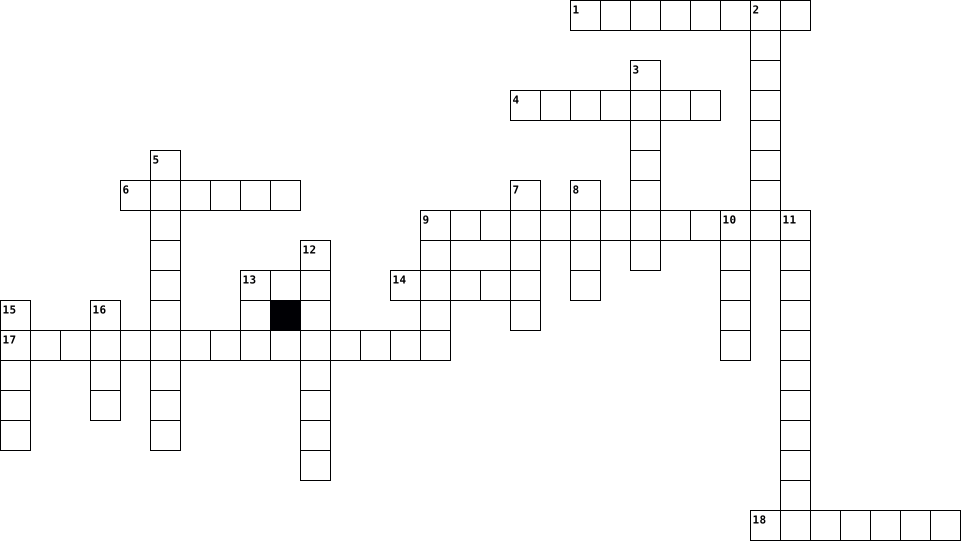
Across
- is the name of our solar system
- measures the distances in coordinates
- this planet has the biggest rings in the universe
- the first space shuttle to land on the moon
- how many dipper constellations do we have
- there are many moon phases
- are caused by the gravitational pull from the earth
- what planet is second in our solar system
Down
- measures the height in coordinates
- the biggest planets in our solar system
- the name for the last 4 planets
- named after the Greek god of the underworld
- how many planets have rings
- the name of the Greek god for mars
- is the hottest planet in our solar system
- the amount of space the sun takes up in our solar system
- the name of the Greek god for Neptune
- there are many equinox's
- what planet has one satellite
- is earths only natural satellite
20 Clues: how many planets have rings • there are many equinox's • there are many moon phases • what planet has one satellite • is the name of our solar system • the name for the last 4 planets • is earths only natural satellite • measures the height in coordinates • the name of the Greek god for mars • measures the distances in coordinates • the name of the Greek god for Neptune • ...
Eclipse Crossword Puzzle 2024-04-05

Across
- All of the places on Earth where an eclipse of the sun is seen
- Type of eclipse when only the moon covers the sun partially
- When the moon moves in front of the sun or when the earth's shadow falls on the moon
- A pattern of stars in the sky like Orion
- When the moon moves completely into the Earth's shadow, and the ENTIRE moon is dark. It is called a Total _________ Eclipse.
- An eclipse of the sun during which moon looks smaller in the sky than the sun, so there is a ring around the dark moon
Down
- When the moon completely cover the Sun in the sky, it is a _________ Solar Eclipse
- Crescent, gibbous, full, new, quarter are all different __________ of the moon
- The movement of one object around another object
- The hot dim outer atmosphere of the sun
- Type of lunar eclipse when only part of the moon is covered
- Phase of the moon when the moon is completely lit up
- The phase of the moon when it is completely dark
13 Clues: The hot dim outer atmosphere of the sun • A pattern of stars in the sky like Orion • The movement of one object around another object • The phase of the moon when it is completely dark • Phase of the moon when the moon is completely lit up • Type of eclipse when only the moon covers the sun partially • Type of lunar eclipse when only part of the moon is covered • ...
Astronomy 2020-10-01

Across
- Spinning on an axis
- Where we live
- Has different phases depending on where it is around the Earth.
- What revolves around the sun
- The idea the earth is the center of everything
- The inner planets
- Too many and too small to be a planet
- Has different phases depending on where it is in space
- The ball of rock and ice flying though the solar system
- The outer planets
Down
- The idea the sun is the center of the solar system
- The force that pulls objects to the ground
- What everything is in
- Where the sun, planets, and smaller rocks are.
- When one object blocks out another.
- A group of stars
- When one object moves around another.
- An idea to explain the universe's creation
- What the sun is
- The center of the solar system
20 Clues: Where we live • What the sun is • A group of stars • The inner planets • The outer planets • Spinning on an axis • What everything is in • What revolves around the sun • The center of the solar system • When one object blocks out another. • When one object moves around another. • Too many and too small to be a planet • The force that pulls objects to the ground • ...
The Moon and Space Exploration 2012-11-02

Across
- Improved the telescope and demonstrated Copernican theory
- A group of stars that form a shape or pattern
- Space station owned by the USA, Russia, Japan, Canada and Europe (abbr.)
- In which the sun is obscured by the moon (2 words)
- Name of the probe that has almost left our solar system
- Second full moon of the month (2 words)
- The Moon's gravitational pull on the Earth causes these
- Missions that put man on the moon
- Process by which a planet is transformed so as to resemble the Earth
- Amount of phases the Moon has
Down
- German astronomer who discovered the laws of orbital motion
- Probes sent to study Mars
- A period of rotation synchronous with that of the Earth's rotation
- tilt A deviation from a vertical or horizontal line, plane, position or direction
- Artificial body placed in orbit around the Earth or another planet
- Canada's space agency (abbr.)
- Unmanned exploratory spacecraft designed to transit information about its environment
- Number of the first mission to put man on the moon
18 Clues: Probes sent to study Mars • Canada's space agency (abbr.) • Amount of phases the Moon has • Missions that put man on the moon • Second full moon of the month (2 words) • A group of stars that form a shape or pattern • In which the sun is obscured by the moon (2 words) • Number of the first mission to put man on the moon • ...
Science Vocabulary (NO SPACES) 2023-12-06

Across
- The force of attraction between two objects.
- To turn in a circular motion around a fixed point
- The rising and falling of the sea.
- The apparent shape of the moon when it is less than half-lighted.
- The imaginary line that passes through the center of an object.
- The four divisions of the year
- A moon that gets more illuminated.
Down
- A tide that has the greatest range between how high it is at high tide and low tide.
- To orbit around a central point
- A period lasting approximately 4 weeks in which the Moon’s phases change.
- When the tide is at its highest altitude.
- A tide that has the least range between how high it is at high tide and low tide.
- A half of a sphere
- When the tide is at its lowest altitude.
- The shape of the sunlit part of the Moon that we see from Earth.
- The apparent shape of the moon when it is more than half-lighted but not full.
- To be slanted or inclined
- A moon that gets dimmer.
18 Clues: A half of a sphere • A moon that gets dimmer. • To be slanted or inclined • The four divisions of the year • To orbit around a central point • The rising and falling of the sea. • A moon that gets more illuminated. • When the tide is at its lowest altitude. • When the tide is at its highest altitude. • The force of attraction between two objects. • ...
Module 11 Lessons 1-2 Vocabulary 2025-03-12

Across
- thanks to the Earth's axial tilt, this season brings the longest days and hottest temperatures, as the Northern Hemisphere is tilted closest to the sun
- the spin of an object around its axis
- one of the halves of Earth
- the path an object follows as it moves around another object
- as the Earth’s axis tilts away from the sun, this season brings the shortest days and coldest temperatures in the Northern Hemisphere
- this month contains the spring equinox in the Northern Hemisphere
- another name for the amount of time it takes Earth to orbit the sun one time
- phases of the Moon during which less of the Moon's near side is lit each night
- due to the Earth's axial tilt, this season brings cooler days and colorful leaves as it shifts the Northern Hemisphere
- when Earth's rotation axis is tilted directly toward or away from the Sun
- phases of the Moon during which more of the Moon's near side is lit each night
Down
- as the Earth’s axis tilts, this season ushers in warmer days and blooming flowers
- when Earth's rotation axis is tilted neither toward nor away from the Sun
- month of the winter solstice
- the line on which an object rotates
- the lit part of the Moon or a planet that can be seen from Earth
- the fall equinox happens in this month (in the Northern Hemisphere)
- the orbit of one object around another object
- month of the summer solstice
19 Clues: one of the halves of Earth • month of the winter solstice • month of the summer solstice • the line on which an object rotates • the spin of an object around its axis • the orbit of one object around another object • the path an object follows as it moves around another object • the lit part of the Moon or a planet that can be seen from Earth • ...
Chapter 12 The Solar System and Beyond 2024-05-13

Across
- During a ___ Eclipse, the Sun is partially/completely blocked by the moon.
- The moon changes appearances as it moves around the Earth.
- During a ___ Eclipse the Moon is blocked by the Earth.
- It takes the Earth 1 year to complete one ____ around the sun
- The circular path Earth takes around the Sun
Down
- The Earth has a 23.5 degree tilt on its ____.
- In the 16th century, this Polish astronomer published a model of the solar system. Putting the Sun in the center.
- A huge ball of gases that gives out its own light
- When the Earth is between the Moon and the Sun, the moon will be completely lit up. We call this a ___ moon.
- Earth
- When the moon is between the Sun and Earth and we cannot see the moon. We call this a ___ moon.
- This non-luminous object reflects the Sun's light
12 Clues: Earth • The circular path Earth takes around the Sun • The Earth has a 23.5 degree tilt on its ____. • A huge ball of gases that gives out its own light • This non-luminous object reflects the Sun's light • During a ___ Eclipse the Moon is blocked by the Earth. • The moon changes appearances as it moves around the Earth. • ...
Astronomy 101 2026-01-30

Across
- The Northern Hemisphere in the summer is tilted _____ the Sun.
- The Northern Hemisphere in winter is tilted _______ from the Sun.
- The Earth ________ around the Sun.
- A waning Moon is _______ light.
- The "Father of Modern Astronomy and Physics"
- The largest planet in the Solar System is _____.
- Lunar soil is called ______.
- Rigel is a blue __________ star.
- Earth's _______ causes day and night.
- The Moon controls the ocean's _______.
- The ______ is the center of the Solar System.
- A ________ is a object in space made of rock.
- The Moon goes through all eight phases in one ____.
- Nebulas are clouds of ________ and gas.
Down
- A _______ is an object is space made of ice.
- The ________ belt separates Mars from Jupiter.
- Betelgeuse is in the constellation _______.
- When the Earth is between the Sun and Moon, Earth's shadow causes a _______ eclipse.
- One ________ Earth's can fit inside the Sun.
- When the Moon is directly between the Earth and Sun it results in a _____ eclipse.
- 6 Trillion miles equals a ________.
- A waxing Moon is _______ light.
- A planet that is outside of the Solar System.
- The Moon's _______ controls ocean tides.
- After a New Moon, light begins to shine on the _____ side forming a crescent.
- The Moon stabilizes the Earth's _______.
- Polaris is the scientific name for the _____ star.
- The first man to claim the Sun was the center of the universe.
- Ptolemy claimed _______ was the center of the universe.
29 Clues: Lunar soil is called ______. • A waning Moon is _______ light. • A waxing Moon is _______ light. • Rigel is a blue __________ star. • The Earth ________ around the Sun. • 6 Trillion miles equals a ________. • Earth's _______ causes day and night. • The Moon controls the ocean's _______. • Nebulas are clouds of ________ and gas. • The Moon's _______ controls ocean tides. • ...
Lunar Cycle 2023-04-12

Across
- quarter It occur halfway between new moon and full moon.
- There in the ocean and are caused by the pull of gravity
- cycle When the moon orbits the Earth, which typically takes 29.5
- cycle The change in the appearance of the moon
- The spinning of an object
- moon The phase of the moon when it is in conjunction with the sun and invisible from earth
Down
- A force that tries to pull two objects towards each other
- Moon The phase of the moon in which its whole disk is illuminated.
- The movement of an object
- Quarter the seventh phase in the cycle of phases.
10 Clues: The movement of an object • The spinning of an object • cycle The change in the appearance of the moon • Quarter the seventh phase in the cycle of phases. • quarter It occur halfway between new moon and full moon. • There in the ocean and are caused by the pull of gravity • A force that tries to pull two objects towards each other • ...
our earth's natural sattellite 2019-02-05

Across
- - beyond the atmosphere
- - first indian satellite
- - an object which revolves around a planet
- armstrong - first person to land on moon
- - the periodic rising and falling of sea and ocean water
Down
- - object is one through which light cannot pass
- - different shapes of the moon visible from the earth
- sharma - india's first man to go into space
- 11 - american space craft successfully landed on the moon
- satellites - man made objects which revolve around the earth
- - blocking of the light of sun or moon by the shadow of another heavenly body
11 Clues: - beyond the atmosphere • - first indian satellite • armstrong - first person to land on moon • - an object which revolves around a planet • sharma - india's first man to go into space • - object is one through which light cannot pass • - different shapes of the moon visible from the earth • - the periodic rising and falling of sea and ocean water • ...
The Moon & Space Exploration 2012-11-02

Across
- Number of the first mission to put man on the moon
- Improved the telescope and demonstrated Copernican theory
- Missions that put man on the moon
- A period of rotation synchronous with that of the Earth's rotation
- In which the sun is obscured by the moon (2 words)
- Probes sent to study Mars
Down
- Process by which a planet is transformed so as to resemble the Earth
- Name of the probe that has almost left our solar system
- The Moon's gravitational pull on the Earth causes these
- German astronomer who discovered the laws of orbital motion
- A group of stars that form a shape or pattern
- Artificial body placed in orbit around the Earth or another planet
- Second full moon of the month (2 words)
- Space station owned by the USA, Russia, Japan, Canada and Europe (abbr.)
- Canada's space agency (abbr.)
- A deviation from a vertical or horizontal line, plane, position or direction
- Unmanned exploratory spacecraft designed to transit information about its environment
- Amount of phases the Moon has
18 Clues: Probes sent to study Mars • Canada's space agency (abbr.) • Amount of phases the Moon has • Missions that put man on the moon • Second full moon of the month (2 words) • A group of stars that form a shape or pattern • Number of the first mission to put man on the moon • In which the sun is obscured by the moon (2 words) • ...
Tides on Earth vocab 2024-11-20

Across
- What the moon does around us
- The changes that we see in the moon
- The part of the coastline that experiences changes in coverage
- The star in the center of our solar system
- The planet that we live on
Down
- A planet that orbits around our planet
- Has to do with dry land
- The ______ of the moon causes tides
- Has to do with the ocean
- The pattern that the water has that is rising and falling
10 Clues: Has to do with dry land • Has to do with the ocean • The planet that we live on • What the moon does around us • The ______ of the moon causes tides • The changes that we see in the moon • A planet that orbits around our planet • The star in the center of our solar system • The pattern that the water has that is rising and falling • ...
Seasons and Tides 2026-04-10

Across
- hottest season of the year
- has the strongest high and low tides
- path around the Sun
- the imaginary line Earth spins on
- a half of the Earth
- relating to the moon
- the _____ of Earth causes day and night
- season when leaves change color (not fall)
- affects tides but less than the moon
- the line that divides Earth into Western and Eastern halves
- recurring pattern of moon phases
- Earth would not have seasons without this
- Earth's yearlong journey around the Sun
- coldest season of the year
- tidal _____ occurs when water is pulled towards the moon
- tidal cycle when the water reaches its minimum height
Down
- moon phase where you would expect to experience a Spring tide
- two days of the year when the sun is farthest north or south
- type of tide with the highest tidal range
- atmospheric conditions that change with the seasons
- the northern and southern hemispheres always have opposite _______
- tidal cycle when the water reaches its maximum height
- slightly deforms the moon
- moon phase occurring during neap tides
- low tide is higher than low tide during spring tide
- difference between high and low tide
- season when flowers bloom
- moon phase where you would expect to experience a Spring tide
- happens when there are equal hours of daylight and darkness or one day
- influenced by the gravitational pull of the moon
- experience the least change in the number of hours per daylight per year
31 Clues: path around the Sun • a half of the Earth • relating to the moon • slightly deforms the moon • season when flowers bloom • hottest season of the year • coldest season of the year • recurring pattern of moon phases • the imaginary line Earth spins on • has the strongest high and low tides • difference between high and low tide • affects tides but less than the moon • ...
Tides Vocab 2023-05-09

Across
- /This thing is caused by phases of a moon
- /I live here
- /The thing that keeps you on earth
- /This type of tide happens at 1st and 3rd quarter moon
- /Having to do with the ocean
- /This type of tide happens and new and full moon
Down
- /This type of tide is changing by going up and down
- /Energy
- /This type of tide is high up and closer to dry land
- /Is this thing made out of cheese?
10 Clues: /Energy • /I live here • /Having to do with the ocean • /The thing that keeps you on earth • /Is this thing made out of cheese? • /This thing is caused by phases of a moon • /This type of tide happens and new and full moon • /This type of tide is changing by going up and down • /This type of tide is high up and closer to dry land • ...
Awesome Groups Crossword Puzzle 2025-05-31

Across
- Used moon phases to crate early calendars
- Neil...
- The rise and fall of Earth's water levels
- Yummy cookie used in todays activity!
- Scientist who used a telescope to study the surface of the moon
- Famous scientist that explained the Moon's gravity and its influence on tides
Down
- Anything with mass has a ... pull
- The science of the universe, celestial objects, etc.
- Earth's natural satellite
- Moon phase at the beginning of every month, can be hard to see!
10 Clues: Neil... • Earth's natural satellite • Anything with mass has a ... pull • Yummy cookie used in todays activity! • Used moon phases to crate early calendars • The rise and fall of Earth's water levels • The science of the universe, celestial objects, etc. • Moon phase at the beginning of every month, can be hard to see! • ...
Earth and Space 2017-08-20

Across
- , Distances in space are sometimes measured using __________ years.
- , A pattern in the stars.
- , There are eight of these in the Solar System.
- , The planet we live on.
- , you can see lots of these on a clear night.
Down
- , The name of our galaxy.
- , When the Moon looks like a complete bright circle of light it is a __________________ Moon.
- , The Earth is part of the ____________ System.
- , small lumps of rock orbiting the Sun.
- , The length of time it takes for the Earth to go around the Sun once.
- , The Moon looks different at different times of the month. The different shapes are called _________________ of the Moon.
- , Our nearest star.
- , A __________ year has 366 days.
13 Clues: , Our nearest star. • , The planet we live on. • , The name of our galaxy. • , A pattern in the stars. • , A __________ year has 366 days. • , small lumps of rock orbiting the Sun. • , you can see lots of these on a clear night. • , The Earth is part of the ____________ System. • , There are eight of these in the Solar System. • ...
Topic 5 pt. 2 2026-03-03

Across
- - The darkest part of a shadow
- - The partial or total blocking of one object in space by another
- Tide - The tide with the least difference between consecutive low and high tides; this happens 1st quarter and 3rd quarter during the moon phases
- Tide - The tide with the greatest distance between consecutive low and high tides; this happens during the new and full moon phases
- - The periodic rise and fall of of the level of water in the ocean
Down
- - Either of the two days of the year on which neither hemisphere is tilted toward or away from the sun
- - One of the different apparent shapes of the moon as seen from Earth
- - To develop an evidence - based idea that can be tested by experimentation or investigation.
- - The part of the shadow surrounding the darkest part.
- - The attractive force between objects; the force that moves objects downhill
- - The tendency of an object to resist a change in motion
11 Clues: - The darkest part of a shadow • - The part of the shadow surrounding the darkest part. • - The tendency of an object to resist a change in motion • - The partial or total blocking of one object in space by another • - The periodic rise and fall of of the level of water in the ocean • - One of the different apparent shapes of the moon as seen from Earth • ...
Topic 5 Pt. 2 2026-03-03

Across
- - One of the different apparent shapes of the moon as seen from Earth
- - The periodic rise and fall of of the level of water in the ocean
- - To develop an evidence - based idea that can be tested by experimentation or investigation.
- - The tide with the greatest distance between consecutive low and high tides; this happens during the new and full moon phases
- - The darkest part of a shadow
- - The attractive force between objects; the force that moves objects downhill
- - The tendency of an object to resist a change in motion
Down
- - The scientific law that states that every object in the universe attracts every other objects
- - The partial or total blocking of one object in space by another
- - The tide with the least difference between consecutive low and high tides; this happens 1st quarter and 3rd quarter during the moon phases
- - The part of the shadow surrounding the darkest part.
- - Either of the two days of the year on which neither hemisphere is tilted toward or away from the sun
12 Clues: - The darkest part of a shadow • - The part of the shadow surrounding the darkest part. • - The tendency of an object to resist a change in motion • - The partial or total blocking of one object in space by another • - The periodic rise and fall of of the level of water in the ocean • - One of the different apparent shapes of the moon as seen from Earth • ...
Astronomy Vocab 2024-10-16

Across
- The partial or total blocking of one object in space by another
- The term lunar means relating to the _____
- The North Star is called _____
- continuous daylight, a time when the sun is visible at midnight during the summer at the north and south pole
- the lighter part of a shadow
- A group of stars that form a pattern in the sky
- A _____eclipse occurs when the moon appears darkened as it passes into the earth's shadow.
- A ____ year is the time it takes the Earth to travel all the way around the Sun
- half of the earth
Down
- The study of the moon, stars, and other objects in space
- A elongated circle, or oval shape, the shape of the planets orbit.
- the period during which the visible surface of the moon increases
- The _______ plane is the plane of Earth's orbit around the Sun
- the very darkest part of the moon's shadow
- the period during which the visible surface of the moon decreases
- The ____ cycle refers to a sequence of phases of the moon as it revolves around the Earth once every 27.3 days.
- The phase of the moon that occurs when it passes between Earth and the Sun and none of the bright side of the moon is visible. The moon appears to be invisible.
- Period in the polar regions in winter when the sun does not rise
18 Clues: half of the earth • the lighter part of a shadow • The North Star is called _____ • The term lunar means relating to the _____ • the very darkest part of the moon's shadow • A group of stars that form a pattern in the sky • The study of the moon, stars, and other objects in space • The _______ plane is the plane of Earth's orbit around the Sun • ...
moon phases crossword 2022-11-18

Across
- the main phase coming after a full moon and before a new moon is a __ quarter
- when you cannot see the moon it is a lunar ___
- when the moon is 'growing'
- a force that tries to pull two objects together
- the movement of an object like Earth around another object
Down
- the spinning of an object on its axis
- when the earth is between the sun and the moon it is a ___ moon
- when the moon is between the sun and the earth it is a ___ moon
- caused by the pull of gravity from the moon
- when the moon is 'shrinking'
10 Clues: when the moon is 'growing' • when the moon is 'shrinking' • the spinning of an object on its axis • caused by the pull of gravity from the moon • when you cannot see the moon it is a lunar ___ • a force that tries to pull two objects together • the movement of an object like Earth around another object • when the earth is between the sun and the moon it is a ___ moon • ...
Moon Phases Crossword 2022-10-20

Across
- When light is hitting half the moon on the left side
- When light is hitting the moon in a sliver on the left side
- When light is hitting more than half of the moon on the right side
- When light is hitting all of the moon
Down
- When light is hitting the moon in a sliver on the right side
- When light is hitting more than half of the moon on the left side
- The gravity an object has and its affect on surrounding objects
- When no light is hitting the moon
- The affect the moons gravity has on earths oceans
- When light is hitting half the moon on the right side
10 Clues: When no light is hitting the moon • When light is hitting all of the moon • The affect the moons gravity has on earths oceans • When light is hitting half the moon on the left side • When light is hitting half the moon on the right side • When light is hitting the moon in a sliver on the left side • When light is hitting the moon in a sliver on the right side • ...
Moon Phases Vocab 2023-02-16

Across
- The movement of and object around another object
- The illuminated part of the moon continuously getting larger
- The curved shape of the waxing or waning moon
- A force that tries to pull two objects together
- Caused by the pull of gravity from the moon
- When the moon is in between the Earth and the Sun
Down
- When the whole face of the moon is illuminated from Earth's perspective
- The changing in the appearance of the moon from Earth's perspective
- The spinning of an object on it's axis
- The illuminated part of the moon continuously getting smaller
10 Clues: The spinning of an object on it's axis • Caused by the pull of gravity from the moon • The curved shape of the waxing or waning moon • A force that tries to pull two objects together • The movement of and object around another object • When the moon is in between the Earth and the Sun • The illuminated part of the moon continuously getting larger • ...
Moon, Eclipses, Tides 2022-02-16

Across
- Moon phase in which more than half of the Moon appears to be illuminated.
- moon phase when the entire side facing Earth is illuminated.
- a tide just after the first or third quarters of the moon when there is the least difference between high and low water.
- to spin on an axis
- number of tides (high + low) a coastal location experiences daily
- Left half of the disk is illuminated, and the cycle is in the waning phase.
- to move around another object
- Dates during the Earth's revolution around the sun when day/night are approximately equal (12 hours each). Official start of spring and fall.
- becoming less bright, intense, or strong
- number of hours between a high and low tide
- The periodic rise and fall of the level of water in the ocean
Down
- eclipse in which the moon temporarily blocks the sun in the daytime sky
- a tide just after a new or full moon, when there is the greatest difference between high and low water.
- The moon is a quarter of the way around the Earth. You can see the right half of the moon.
- The partial or total blocking of one object in space by another
- Dates during the Earth's revolution around the sun when the North Pole / South Pole are tilted directly at the sun. Longest/shortest days of the year depending on which hemisphere is tilted towards/away
- Moon phase that occurs when the Moon is between Earth and the Sun, at which point the Moon cannot be seen because its lighted half is facing the Sun and its dark side faces Earth.
- the curved sickle shape of the waxing or waning moon.
- an eclipse in which the moon appears darkened as it passes into the earth's shadow.
- describes phases following a new moon, as more of the Moon's lighted side becomes visible
- Imaginary line that runs from North Pole to South Pole
21 Clues: to spin on an axis • to move around another object • becoming less bright, intense, or strong • number of hours between a high and low tide • the curved sickle shape of the waxing or waning moon. • Imaginary line that runs from North Pole to South Pole • moon phase when the entire side facing Earth is illuminated. • ...
Earth's Revolution 2024-04-10

Across
- A huge group of single stars, star systems, star clusters, dust, and gas bound together by gravity
- Range The difference between the levels of the ocean between high and low tides
- Darkest shadow of the moon
- Tides Occur when the Sun Earth and Moon are in a straight line. High tides are higher than normal and low tides are lower than normal
- The spinning of Earth on its axis, one full rotation takes 24 hours
- The day when the sun is directly above the equator, twice a year in March and September
- Tide The water level that is lower than the average sea level
- unit (AU) the average distance between the earth and the sun
- Force The difference on the gravitational force of the Sun and Moon across the earth
- 23.5 degrees, causes seasons
- Imaginary vertical line around which Earth spins
- Tide The water level that is higher than the average sea level
Down
- Shape of Earth's orbit, elongated closed curve
- Eclipse When the Earth is directly between the Sun and the Moon, causing a shadow of the Earth to be cast on the Moon
- You see more than one half of the moon
- The study of the moon, stars, and other objects in space
- Lighter shadow of the moon
- Eclipse When the moon is directly between the Earth and the Sun
- You see less of the illuminated side of the moon
- The motion of Earth orbiting the Sun, one full revolution takes 365.25 days
- Phases Different forms that the moon appears to take
- You see more of the illuminated side of the moon
- Occurs when the Earth Sun and Moon are perfectly aligned
- The day the sun reaches it greatest distance north or south of the equator, twice a year in June and December
- Tides Occur when the Sun Earth and Moon are arranged in a right angle. There is less of a difference between high and low tides.
25 Clues: Darkest shadow of the moon • Lighter shadow of the moon • 23.5 degrees, causes seasons • You see more than one half of the moon • Shape of Earth's orbit, elongated closed curve • You see less of the illuminated side of the moon • You see more of the illuminated side of the moon • Imaginary vertical line around which Earth spins • ...
Earth, Moon, and Sun Notebook Check 2022-02-02

Across
- the shape of the illuminated part of the Moon as it appears from Earth (two words)
- object sizes and distances are larger or smaller than in the real world but the same relative to one another (two words)
- to shine light on an object and make it visible
- this does not make its own light
- light travels like this (two words)
Down
- moon phase that looks like less than a half circle
- when Earth blocks sunlight from hitting the Moon (two words)
- something we observe to be similar over and over again
- moon phase the looks like a full circle (two words)
- the relative size of things
- it takes about this long to see the full pattern of moon phases
- the border between light and dark on the Moon
- the nearly circular path a smaller object travels around a larger object
13 Clues: the relative size of things • this does not make its own light • light travels like this (two words) • the border between light and dark on the Moon • to shine light on an object and make it visible • moon phase that looks like less than a half circle • moon phase the looks like a full circle (two words) • something we observe to be similar over and over again • ...
Eclipse Cross-word Puzzle 2024-04-09

Across
- Where the solar eclipse casts it shadow upon
- The moon ____________ the sun.
- Another word for sun
- When the moon goes in front of the sun creating a "ring"
- Light sensitive paper
- Something someone receives from another
- When something is very dark against something that is very light
- A artist who creates art using steel wire
- An artist who uses random objects to cast a shadow of a certain person or thing
- What creates the blue shades of our artwork in class
- Regular paper we put on top of the cyanotype paper
- How the moon has different phases and travels across the sun
Down
- A person or multiple people who create art
- Example: eye wear during the eclipse
- A performer who uses shadows with his hands to perform
- A darker value of when light is being taken away
- What goes in front of the sun during the eclipse
- What happens when you look directly at the sun
18 Clues: Another word for sun • Light sensitive paper • The moon ____________ the sun. • Example: eye wear during the eclipse • Something someone receives from another • A artist who creates art using steel wire • A person or multiple people who create art • Where the solar eclipse casts it shadow upon • What happens when you look directly at the sun • ...
Space 2025-05-13

Across
- Neighbor
- Different types
- Place
- Nice and Warm
- King Royalty
Down
- Robber
- Our home
- Savior
8 Clues: Place • Robber • Savior • Neighbor • Our home • Nice and Warm • King Royalty • Different types
Tides Crossword Puzzle 2025-04-07

Across
- Tides are caused by this.
- Powered by rotation and gravitational pull from the Sun and Moon.
- Dryer areas more towards the coastline.
- This type of tide is formed when the Sun and Moon form a right angle with the Earth.
- ___ tides are the areas between the high tide areas.
Down
- This zone goes through changes of coverage, exposure and temperature.
- Areas that are close to the ocean and usually have more life.
- ______ tides happen during a full Moon or new Moon phase.
- ____ tides happen to the oceans closest and furthest away from the Moon.
- When the Moon is in its ____ Moon and full Moon phases it forms a spring tide.
10 Clues: Tides are caused by this. • Dryer areas more towards the coastline. • ___ tides are the areas between the high tide areas. • ______ tides happen during a full Moon or new Moon phase. • Areas that are close to the ocean and usually have more life. • Powered by rotation and gravitational pull from the Sun and Moon. • ...
Moon/Fossils 2021-09-13

Across
- the moon phase when it’s dark side is toward the Earth
- the moon phase where half of the lighted surface is visible
- the time needed for Earth to complete one rotation (24 hours)
- the moon phase when half of the lighted surface is visible
- the path an object in space takes as it revolves around another object (example: Earth orbits around the sun
- the time when the sun is on the other side of the Earth from you and you can’t see it’s light
- of the twelve parts in which the year is divided into
- a type of fossil that shows activity of an organism, but not the actual remains of the plant or animal itself
- the way something looks
- an angle of the moon to the earth so it appears differently every day
Down
- the moon phase when the moon appears to be completely illuminated
- to move around, or orbit, another object
- the remains or traces of plants and animals that lived long ago
- a type of fossil that shows the impression of an organism
- a mold fossil that has filled in and turned to rock
- an imaginary line through the center of a planet, such as Earth, that the planet spins around
- something that happens in a regular and repeated way
- when the moon is increasing in size
- to make a complete spin on its axis, causing one day
- a natural object that revolves around a planet
- to become different
- when the moon is decreasing in size
22 Clues: to become different • the way something looks • when the moon is increasing in size • when the moon is decreasing in size • to move around, or orbit, another object • a natural object that revolves around a planet • a mold fossil that has filled in and turned to rock • something that happens in a regular and repeated way • ...
Moon Phases Crossword 2022-10-17

Across
- The phase when the light is about to fade away
- The phase when the moon is fully lit
- The phase when the light is JUST starting to fade
- The phase when the light is beginning to grow
Down
- The phase when the moon is half lit on the left
- The phase when the moon is half lit on the right
- To make lighter or brighter
- The act of a celestial body making an orbit around the parent object
- This phase is not able to be seen
- The phase when the moon is almost fully lit
10 Clues: To make lighter or brighter • This phase is not able to be seen • The phase when the moon is fully lit • The phase when the moon is almost fully lit • The phase when the light is beginning to grow • The phase when the light is about to fade away • The phase when the moon is half lit on the left • The phase when the moon is half lit on the right • ...