
moon phases Crossword Puzzles
Jerrell palmer G7 P9 2-1-24 2024-02-01

Across
- scientists use it in a bottle
- season
- something you grow on land
- a place for boats
- a small wave
- we plant on the ground to grow stuff
- part of your body
Down
- toxic liquid
- the line that separates land and sky
- something we breath
- phases of moon
- something you wear on your neck
- is a part of our body related to others
- something you wear in your face
14 Clues: season • toxic liquid • a small wave • phases of moon • a place for boats • part of your body • something we breath • something you grow on land • scientists use it in a bottle • something you wear on your neck • something you wear in your face • the line that separates land and sky • we plant on the ground to grow stuff • is a part of our body related to others
ally 2024-05-21

Across
- - giant wind that takes things away
- sheet -continental-scale masses of ice that rest on land
- - giant wave
- - the thing that shakes the earth
- -water released from clouds in the form of rain, freezing rain, sleet, snow, or hail
- - Only planet in space with volcanoes on it
- gibbous - one of the moon phases between a half moon and full moon
- Glacier -is a glacier that forms in a cirque
Down
- - measures distance east or west of the prime meridian
- -the vertical elevation of an object above a surface (such as sea level or land) of a planet or natural satellit -
- -measures the distance north or south of the equator.
- -eighth and most distant major planet orbiting our Sun
- -The smallest planet in our solar system and nearest to the Sun
- cycle - the cycle of water
- -Compressed layers of snow, debris and dense ice (through thawing and re-freezing
15 Clues: - giant wave • cycle - the cycle of water • - the thing that shakes the earth • - giant wind that takes things away • - Only planet in space with volcanoes on it • Glacier -is a glacier that forms in a cirque • -measures the distance north or south of the equator. • - measures distance east or west of the prime meridian • ...
EARTH AND SPACE 2022-07-20

Across
- _______ hit the ground
- As the distance between two objects in space increases the gravity will __________
- Phases of the moon in which the moon appears to be getting larger are referred to as
- No of seasons on Earth
- makes up the largest percentage of the sun's composition
- axis Changing seasons are caused by
- As the mass of a star increases the gravity will _______
- A cloud of gas and dust in space is called
- The inner planets are also called
Down
- Most comets come from the _____ & Oort Cloud beyond Neptune's orbit
- I am located between Mars and Jupiter
- The closest galaxy to the Milky Way
- Season when the area you live in tilts away from the sun
- Nuclear fusion produces the sun's energy. It fuses hydrogen into ___ atoms
- The______moon shows more than half of the bright side of the moon
15 Clues: _______ hit the ground • No of seasons on Earth • The inner planets are also called • The closest galaxy to the Milky Way • axis Changing seasons are caused by • I am located between Mars and Jupiter • A cloud of gas and dust in space is called • Season when the area you live in tilts away from the sun • makes up the largest percentage of the sun's composition • ...
Khulia Chapter 1 Lesson 4 Astronomy 2021-11-09

Across
- When an object in space comes between the sun and a third object and cast a shadow on that object
- First phase of the moon
- When the moon blocks sunlight from Earth and the moons shadow hitting Earth
- Most likely to see
- The dark part of the moons shadow
Down
- When it´s a full moon and Earth is directly between the moon and sun
- The different shape from the moon you see from Earth
- The light part of the moons shadow
8 Clues: Most likely to see • First phase of the moon • The dark part of the moons shadow • The light part of the moons shadow • The different shape from the moon you see from Earth • When it´s a full moon and Earth is directly between the moon and sun • When the moon blocks sunlight from Earth and the moons shadow hitting Earth • ...
Vocabulary 2021-05-17

Across
- How you get to conferences, get materials when you are at home, and where we find our vocabulary and web math minute (if you are in Math with Ms. Suniga)
- a small thin piece of something cut or split off a larger piece.
- no longer visible; vanish, pass from view or sight; fade
- A plant with long woody stems and long leaves
- living or growing in nature
- One of your reading teachers
- see or pay attention to something; consider or of interest
Down
- Large areas of land where lots of trees grow
- The animal in Disappearing moon who told the other animals about the phases of the moon
- for a certain thing or purpose
- opposite of a full moon; when we see the side of the moon that is not illuminated by the sun. The moon is invisible, then shortly after a very slender crescent
- The new item in our dress code this year
- only half of the moon’s lit up surface is visible from earth
13 Clues: living or growing in nature • One of your reading teachers • for a certain thing or purpose • The new item in our dress code this year • Large areas of land where lots of trees grow • A plant with long woody stems and long leaves • no longer visible; vanish, pass from view or sight; fade • see or pay attention to something; consider or of interest • ...
Week 24 Vocab 2015-02-19

Across
- a line that you can't see but it rotates
- 4 different feelings with the weather patterns trough the year
- A part of an item that is hidden from the sun or moon
- a small part of the moon that is caused from the suns rotation
- a planet tilting on its axis turning to cause day and night
- I happens 2 times a year
- tide happens when the moon has new phases or is full
Down
- a part of the moon that is only half big (turn off)
- water rises really tall then falls this is also called waves
- It has to do with the longest/shortest or when the it gets to its highest point or lowest point days of the year
- tide It happens in the first and third quarter of the year.
- a planet that made it all around the sun in a year
- a part of the moon that is getting bigger to become half big (turn on)
13 Clues: I happens 2 times a year • a line that you can't see but it rotates • a planet that made it all around the sun in a year • a part of the moon that is only half big (turn off) • tide happens when the moon has new phases or is full • A part of an item that is hidden from the sun or moon • tide It happens in the first and third quarter of the year. • ...
Venus 2024-05-02

Across
- Venus' atmosphere mainly consist of _____________.
- Venus is similar to this planet.
- Is Venus a gas or rocky planet.
- The name of ancient Roman goddess of love and beauty and what was Venus named for.
- Venus' most common nickname.
- Venus gets ___ sunrises a year.
- Venus is the _________ object in the sky after the sun and moon.
- Venus has a volcanic crater named _________ for Lewis and Clark’s Native American guide.
Down
- Venus rains ____________.
- Venus smells like __________.
- Venus' is hotter than this planet.
- What kind of planet is Venus?
- Just like the moon Venus also experiences different ______.
- Venus is the _______ in the solar system other than the sun.
- Venus' central core is made of this.
- Venus spins _________.
- Venus has ____ moons.
- A deep canyon called _____ for the Roman goddess of the hunt.
- The second planet from the sun.
19 Clues: Venus has ____ moons. • Venus spins _________. • Venus rains ____________. • Venus' most common nickname. • Venus smells like __________. • What kind of planet is Venus? • Is Venus a gas or rocky planet. • The second planet from the sun. • Venus gets ___ sunrises a year. • Venus is similar to this planet. • Venus' is hotter than this planet. • Venus' central core is made of this. • ...
Space! 2023-06-07
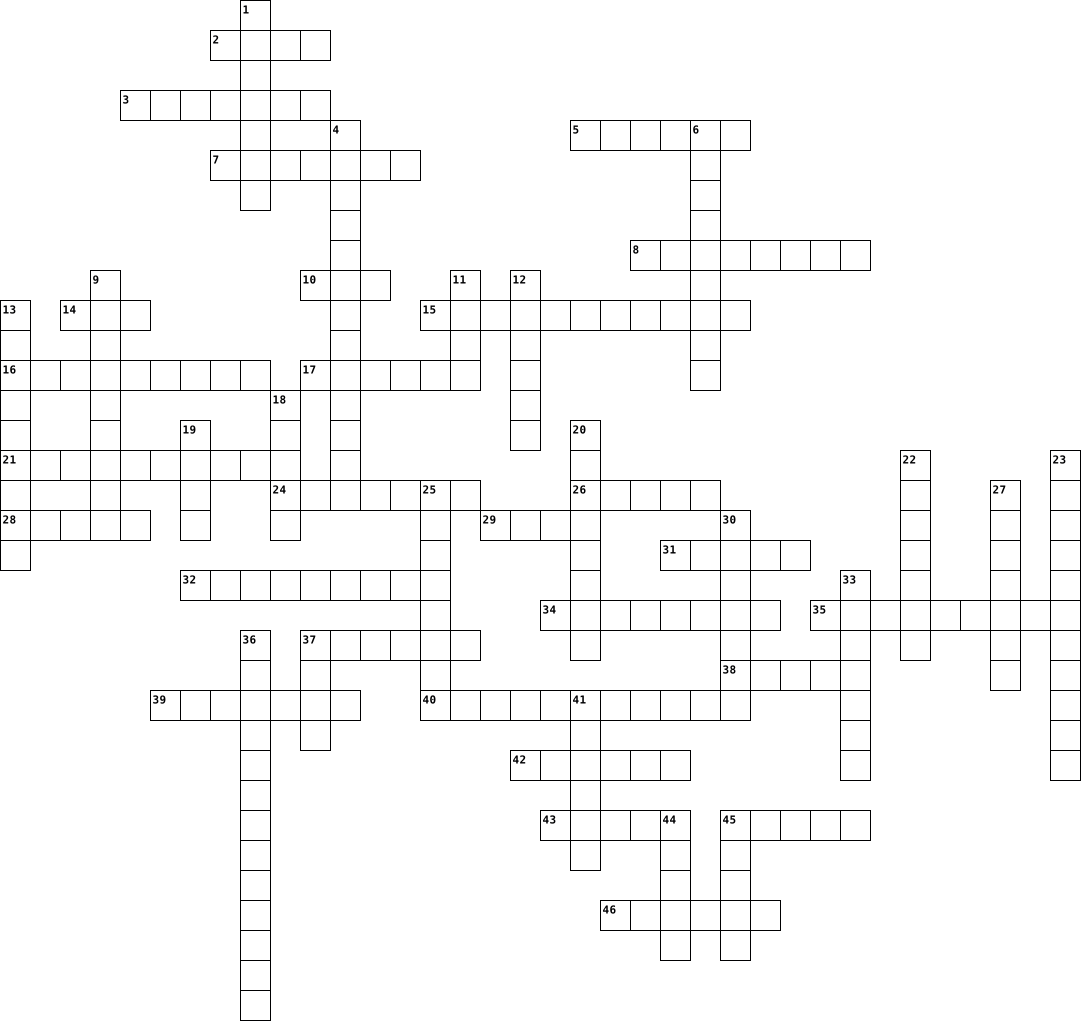
Across
- moon phase where none of the moon is in shadow.
- solar eclipse where some of the Sun is covered.
- a cloud of gas and dust that makes stars.
- caused by the revolution of the Earth.
- spinning on an axis.
- moon phase where the entire moon is in shadow.
- the star at the center of our solar system.
- a region in space with a star and orbiting objects.
- tool used to observe objects in space.
- planet with the most moons and largest rings.
- movement around another object.
- solar eclipse where only a ring of the Sun is visible.
- planet with life and liquid water.
- solar eclipse in which the entire Sun is covered.
- imaginary line that goes through a planet.
- used to be considered a planet until 2006.
- point in space where gravity pulls everything, including light.
- all of space and time, including all the galaxies and everything in them.
- small asteroid or piece of one.
- space rock that has entered Earth's atmosphere.
- the path a planet or moon takes as it revolves.
- the closest planet to the Sun.
- celestial body that does not clear its orbit and orbits a star.
- coldest planet that rotates on its side.
- the hottest planet in out solar system.
- tells you the temperature of a star.
- shapes and appearance of the moon at different times.
Down
- largest planet in the solar system.
- a group or pattern of stars.
- distance light travels in one year.
- an explosion at the end of star's lfie.
- celestial body that orbits a planet.
- huge system of stars, dust, and gas held together by gravity.
- space rock that has hit Earth's surface.
- eclipse in which the Earth blockes the Moon from the Sun.
- a ball of burning gases.
- moon phase where most of the moon is in shadow.
- moon phase where half of the moon is in shadow.
- caused by the rotation of the Earth.
- rocky object usually found in belts.
- moon phase where a small part of the moon is in shadow.
- dark and cool region on the Sun's surface.
- the furthest planet from the Sun.
- reaction in the core of a star that creates energy.
- red planet that is fourth from the Sun.
- celestial body that orbits a star and clears its neighborhood.
- eclipse in which the moon blocks the Sun.
- a frozen object made of ice and dust.
48 Clues: spinning on an axis. • a ball of burning gases. • a group or pattern of stars. • the closest planet to the Sun. • movement around another object. • small asteroid or piece of one. • the furthest planet from the Sun. • planet with life and liquid water. • largest planet in the solar system. • distance light travels in one year. • celestial body that orbits a planet. • ...
Earth is Space 2026-06-02

Across
- The Moon phase when the whole near side visible from Earth is lit by sunlight.
- The change in the Moon’s appearance as the lit part gets larger after a new moon.
- The lighter part of a shadow where only some of the light is blocked.
- An attractive force between two objects that have mass, helping keep planets and moons in orbit.
- A group of objects such as planets, moons and asteroids that revolve around a star.
- The day of the year with the most daylight hours.
- The change in the Moon’s appearance as the lit part gets smaller after a full moon.
- The different shapes seen in a repeated pattern, such as the changing appearance of the Moon.
- An eclipse that occurs when Earth moves between the Sun and the Moon.
- A solar eclipse where the Moon blocks only part of the Sun’s light from reaching Earth.
- An imaginary line from the North Pole to the South Pole that Earth spins around.
- A day when daylight hours and night time hours are approximately equal.
- A very high tide that occurs when there is a new moon or full moon.
- The time between one new moon and the next, lasting about twenty nine and a half days.
Down
- The movement of one object around another object in an orbit.
- All of space, including all matter and energy contained within it.
- The day of the year with the fewest daylight hours.
- The darkest part of a shadow where light is completely blocked by an object.
- A solar eclipse where the Moon blocks all of the Sun’s light from reaching a place on Earth.
- A type of solar eclipse where the Moon blocks the centre of the Sun, leaving a ring of light visible.
- An eclipse that occurs when the Moon moves between Earth and the Sun.
- An oval or egg shape, such as the shape of Earth’s orbit around the Sun.
- The regular rise and fall of ocean water level, usually in a cycle close to twelve and a half hours.
- The curved path of an object moving around a star, planet or moon.
- A weaker tide that occurs when the Sun and Moon are not in line with Earth.
- The turning of an object around its own axis, such as Earth spinning every twenty four hours.
- A body such as a moon that orbits a larger celestial object.
27 Clues: The day of the year with the most daylight hours. • The day of the year with the fewest daylight hours. • A body such as a moon that orbits a larger celestial object. • The movement of one object around another object in an orbit. • All of space, including all matter and energy contained within it. • ...
science crossword puzzle 2024-11-20

Across
- - Caused by the phases of the moon
- -keeps us on the ground
- - has a fixed shape
- - something that causes seasons
- - they are in the states of matter
Down
- - doesn't have a fixed shape
- -a community of interacting particles
- - the thing that measures force
- - the earth goes around the sun
- - static
- - attracts
- - doesn't have a fixed shape
12 Clues: - static • - attracts • - has a fixed shape • -keeps us on the ground • - doesn't have a fixed shape • - doesn't have a fixed shape • - the thing that measures force • - the earth goes around the sun • - something that causes seasons • - Caused by the phases of the moon • - they are in the states of matter • -a community of interacting particles
Hunter Vaculik 2021-05-25

Across
- ture or false- the moon has an atmosphere
- coldest star color
- hottest star color
- how many phases are in the moon
- what happens to a nebula as gravity pressure shrinks it
- is mercury a inner planet or outter planet.
Down
- every second the sun spins, is increases or decreases
- is neptune a inner or outter planet.
- is the sun in our solar system
- what is the nearest star to our planet
10 Clues: coldest star color • hottest star color • is the sun in our solar system • how many phases are in the moon • is neptune a inner or outter planet. • what is the nearest star to our planet • ture or false- the moon has an atmosphere • is mercury a inner planet or outter planet. • every second the sun spins, is increases or decreases • ...
Moon Crossword Puzzle 2020-06-02

Across
- A natural satellite of a planet
- Dark inner cone shaped region of the shadow created by an eclipse.
- Mountainous light colored areas on the moon’s surface
- Dark flat areas on the moon’s surface
- When the Earth passes between the moon and sun casting a shadow on the moon
- Different shapes of the moon’s appearance as it revolves around Earth
- An object that stays in an orbit around a planet
- Chunks of rock or dust from space.
Down
- Larger less dark outer region of the shadow created by an eclipse.
- When the moon passes between the Earth and the Sun casts a shadow on part of the Earth’s surface
- Large round pits on the moon’s surface, Caused by impact of meteroids.
11 Clues: A natural satellite of a planet • Chunks of rock or dust from space. • Dark flat areas on the moon’s surface • An object that stays in an orbit around a planet • Mountainous light colored areas on the moon’s surface • Larger less dark outer region of the shadow created by an eclipse. • Dark inner cone shaped region of the shadow created by an eclipse. • ...
EARTH AND SPACE 2022-07-20

Across
- _______ hit the ground
- As the distance between two objects in space increases the gravity will __________
- Phases of the moon in which the moon appears to be getting larger are referred to as
- No of seasons on Earth
- makes up the largest percentage of the sun's composition
- axis Changing seasons are caused by
- As the mass of a star increases the gravity will _______
- A cloud of gas and dust in space is called
- The inner planets are also called
Down
- Most comets come from the _____ & Oort Cloud beyond Neptune's orbit
- I am located between Mars and Jupiter
- The closest galaxy to the Milky Way
- Season when the area you live in tilts away from the sun
- Nuclear fusion produces the sun's energy. It fuses hydrogen into ___ atoms
- The______moon shows more than half of the bright side of the moon
15 Clues: _______ hit the ground • No of seasons on Earth • The inner planets are also called • The closest galaxy to the Milky Way • axis Changing seasons are caused by • I am located between Mars and Jupiter • A cloud of gas and dust in space is called • Season when the area you live in tilts away from the sun • makes up the largest percentage of the sun's composition • ...
science crossword puzzle 2024-11-20

Across
- - Caused by the phases of the moon
- -keeps us on the ground
- - has a fixed shape
- - something that causes seasons
- - they are in the states of matter
Down
- - doesn't have a fixed shape
- -a community of interacting particles
- - the thing that measures force
- - the earth goes around the sun
- - static
- - attracts
- - doesn't have a fixed shape
12 Clues: - static • - attracts • - has a fixed shape • -keeps us on the ground • - doesn't have a fixed shape • - doesn't have a fixed shape • - the thing that measures force • - the earth goes around the sun • - something that causes seasons • - Caused by the phases of the moon • - they are in the states of matter • -a community of interacting particles
Moon it up! 2024-04-17

Across
- shines bright
- curvy
- color
Down
- light
- landing
- patterns
6 Clues: light • curvy • color • landing • patterns • shines bright
Phases of moon 2024-02-24

Across
- The phase of the moon when it is partially illuminated, but less than half.
- The portion of the moon that is visible from Earth changes as this occurs
- The natural satellite of Earth
- he phase of the moon that occurs when less than half of its face is illuminated
Down
- The phase of the moon that occurs when the moon is completely illuminated from Earth, often associated with celebrations such as Eid
- The gravitational force between two objects, such as the moon and Earth
- The month in which the Islamic calendar is based on the cycles of the moon
- The phase of the moon when it is completely dark from Earth.
8 Clues: The natural satellite of Earth • The phase of the moon when it is completely dark from Earth. • The gravitational force between two objects, such as the moon and Earth • The portion of the moon that is visible from Earth changes as this occurs • The month in which the Islamic calendar is based on the cycles of the moon • ...
Moon Phases Crossword 2023-11-04

Across
- The earth is no longer illuminated by the sun's rays
- It occurs after the third quarter or last quarter
- When the sun is obscured by the moon from the perspective of earth
- The movement of one celestial body as it orbits another
- The force that attracts body towards the center of the earth
Down
- It occurs after the first quarter
- tide, Tide When the moon is at its First quarter or third quarter
- Any object that orbits another celestial body
8 Clues: It occurs after the first quarter • Any object that orbits another celestial body • It occurs after the third quarter or last quarter • The earth is no longer illuminated by the sun's rays • The movement of one celestial body as it orbits another • The force that attracts body towards the center of the earth • ...
Earth in Space 2022-11-30

Across
- The reason why we orbit the sun
- lasts 365 and 1/4 days
- the view of the Moon seen from Earth when the whole of its near side is in sunlight
- reaching a place on Earth
- Changes on thewater level along the coastlines
- the time period between the appearance of one new moon to the next
- the change in the Moon’s appearance between a new moon and the following full moon
- the sun rises from the...
- all of space and the matter and energy contained in it
- The result of the extra 1/4 in a year
- ...experiences summer when the Southern hemisphere is tilted towards the sun
- occurs when the Moon moves between the Earth and the Sun so that all of the Sun’s light to a place on Earth is blocked by the Moon
- the turning of an object about its own axis (between the North and South poles)
- very high tide that occurs when there is a new or full moon
- The sun sets in the...
- brightest object in the night sky
- occurs when the Earth moves between the Sun and the Moon so that some or all of the Moon’s
- The way the Earth orbits around the sun
Down
- occurs when the Moon moves between the Sun and the Earth
- ...the shortest day of the year
- the change in the Moon’s appearance between a full moon and the following new moon
- There is no... on the moon so the surface does not change
- a body such as a moon that orbits another celestial body of a larger size and mass
- number of phases of the moon
- ...holds the longest daylight hours
- The direction which the Earth rotates
- an attractive force between two objects which have mass
- Star at the center of the Solar system
- occurs when the Moon moves between the Earth and the Sun and prevents some of the
- the result of the Earth's tilt
- ...experiences summer when the Northern hemisphere is tilted towards the sun
- does not receive light from the Sun and cannot be seen
- When the Earth spins it creates a bulge at the equator which causes... at the side opposite the moon
- An imaginary line
- days with the same number of daylight hours as night hours
- occurs when the Moon moves between the Earth and the Sun and prevents some or all of the sunlight reaching a place on Earth
- the regular rise and fall of water level
- Third planet from the sun
38 Clues: An imaginary line • lasts 365 and 1/4 days • The sun sets in the... • reaching a place on Earth • the sun rises from the... • Third planet from the sun • number of phases of the moon • the result of the Earth's tilt • ...the shortest day of the year • The reason why we orbit the sun • brightest object in the night sky • ...holds the longest daylight hours • ...
Ocean Motions Review 2019-10-30

Across
- tidal effects caused by the gravity of the moon
- the change of current direction with depth
- current gravity driven currents
- top-most currents caused by the winds
- a current whose properties are determined by salinity and temperature
- daily or twice daily changes in local sea level
- great circling flows found in the great ocean basins
- a higher-than-usual tide occurring at new or full moon
Down
- the movement of warm, oxygenated water from the surface to the abyssal floor
- the deepest and most mysterious of the ocean currents
- global effects caused by a spinning earth
- a current caused by gravity's affect on sediment and muck
- the movement of dense, cold, salty water from the abyssal regions
- a lower-than-usual tide occurring at first or third quarter moon phases
14 Clues: current gravity driven currents • top-most currents caused by the winds • global effects caused by a spinning earth • the change of current direction with depth • tidal effects caused by the gravity of the moon • daily or twice daily changes in local sea level • great circling flows found in the great ocean basins • the deepest and most mysterious of the ocean currents • ...
science words by anmol 2024-02-01

Across
- scientists use it in a bottle
- season
- something you grow on land
- a place for boats
- a small wave
- we plant on the ground to grow stuff
- part of your body
Down
- toxic liquid
- the line that separates land and sky
- something we breath
- phases of moon
- something you wear on your neck
- is a part of our body related to others
- something you wear in your face
14 Clues: season • toxic liquid • a small wave • phases of moon • a place for boats • part of your body • something we breath • something you grow on land • scientists use it in a bottle • something you wear on your neck • something you wear in your face • the line that separates land and sky • we plant on the ground to grow stuff • is a part of our body related to others
crossword by hannah 2026-04-02

Across
- this is mine
- speedy
- clean up leaves
- always makes a hot tub better
- an oysters pride and joy
- never have i ____
- close your lips together, make a hole, and blow
- gas station, as well as Ariel’s chosen top
Down
- goes through many different phases all in one month
- occupation for a man made of hay
- cleans your wax
- a restaurant chain known for its curly fries
- suggested in place of talking
- stop and smell the ___
- music, food, drinks and RSVPs
- color associated with sadness
- join
17 Clues: join • speedy • this is mine • cleans your wax • clean up leaves • never have i ____ • stop and smell the ___ • an oysters pride and joy • suggested in place of talking • music, food, drinks and RSVPs • always makes a hot tub better • color associated with sadness • occupation for a man made of hay • gas station, as well as Ariel’s chosen top • a restaurant chain known for its curly fries • ...
Jerrell palmer G7 P9 2-1-24 2024-02-01

Across
- scientists use it in a bottle
- season
- something you grow on land
- a place for boats
- a small wave
- we plant on the ground to grow stuff
- part of your body
Down
- toxic liquid
- the line that separates land and sky
- something we breath
- phases of moon
- something you wear on your neck
- is a part of our body related to others
- something you wear in your face
14 Clues: season • toxic liquid • a small wave • phases of moon • a place for boats • part of your body • something we breath • something you grow on land • scientists use it in a bottle • something you wear on your neck • something you wear in your face • the line that separates land and sky • we plant on the ground to grow stuff • is a part of our body related to others
kung ; chapter one - lesson four astronomy 2021-11-09

Across
- a shadow that is less dark than umbra
- occurs at a full moon when earth is directly between the moon and the sun
- an object in space comes between the sun and a third object, it casts a shadow on that object
- occurs when the moon passes directly between earth and the sun
Down
- the very darkest part of the moon's shadow
- as the moon orbits earth what happens to earth, moon, and the sun ?
- the two types of solar eclipses
- different shapes of the moon you see from earth
8 Clues: the two types of solar eclipses • a shadow that is less dark than umbra • the very darkest part of the moon's shadow • different shapes of the moon you see from earth • occurs when the moon passes directly between earth and the sun • as the moon orbits earth what happens to earth, moon, and the sun ? • ...
SPACE! 2024-02-05
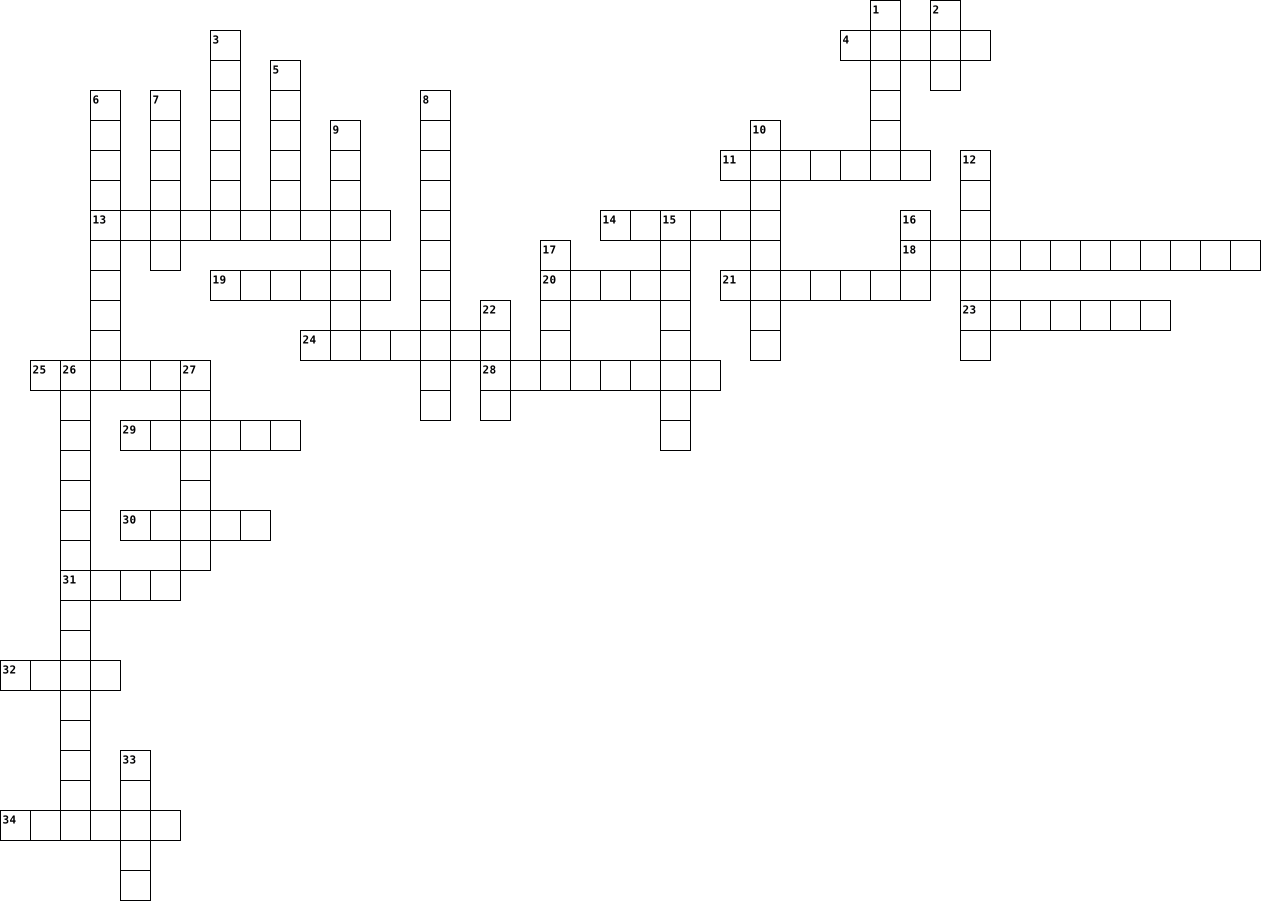
Across
- THE HOTTEST PLANET IN OUR SOLAR SYSTEM
- THE ATTRACTION BETWEEN ANY OBJECTS WITH MASS
- ANOTHER NAME FOR THE MOON PHASES
- THE 7TH PLANET AWAY FROM THE SUN
- THIS MAKES UP THE SPACE BETWEEN MARS & JUPITER
- THE MEASUREMENT OF FORCE IN PHYSICS
- A CIRCULAR OR ELLIPTICAL PATH AROUND A CENTRAL BODY
- THE PLANET CLOSEST TO THE SUN
- THE FIRST PHASE OF THE LUNAR CYCLE
- THE TENDENCY FOR AN OBJECT TO RESIST A CHANGE IN MOTION
- WHEN THE MOON PHASE LIGHT SHRINKS OR GETS SMALLER
- THE CIRCULAR MOTION OF AN OBJECT AROUND ITS OWN AXIS, OR UPON ITSELF
- A CLOUD OF GAS AND DUST
- NO LONGER A TRADITIONAL PLANET
- THE NUMBER OF ATOMS IN AN OBJECT
- DETERMINED BY ONE REVOLUTION OF THE EARTH AROUND THE SUN
- THE PLANET KNOWN FOR IT'S RINGS
Down
- THE MEASUREMENT OF GRAVITY'S EFFECT ON AN OBJECT WITH MASS
- THE MAIN SOURCE OF ENERGY IN OUR SOLAR SYSTEM
- THE BIGGEST PLANET IN OUR SOLAR SYSTEM
- MILLIONS TO BILLIONS OF STARS WITH DUST AND GAS HELD TOGETHER BY GRAVITY
- THE CIRCULAR MOVEMENT OF AN OBJECT AROUND AN EXTERNAL AXIS, OR AROUND ANOTHER BODY
- WHEN THE MOON PHASE GROWS IN LIGHT
- THE NEIGHBORHOOD OF PLANETS AND STAR THAT WE BELONG TO
- WHEN THE MOON PHASE IS FULLY ILLUMINATED
- THE PHASE OF THE MOON ON BOTH SIDES OF A NEW MOON
- THE PLANET HAS A DAY OF 16HRS LONG
- SMALL, ROCKY OBJECTS THAT ORBIT THE SUN
- DETERMINED BY ONE ROTATION OF THE EARTH
- OBJECTS COMPOSED OF ICE AND DUST THAT ORBIT THE SUN
- THE LAST TERRESTRIAL PLANET
- THE DISTANCE FROM THE SUN TO THE EARTH
- THE PHASE OF THE MOON WHERE MORE THAN HALF THE MOON IS ILLUMINATED
- OUR HOME PLANET
34 Clues: OUR HOME PLANET • A CLOUD OF GAS AND DUST • THE LAST TERRESTRIAL PLANET • THE PLANET CLOSEST TO THE SUN • NO LONGER A TRADITIONAL PLANET • THE PLANET KNOWN FOR IT'S RINGS • ANOTHER NAME FOR THE MOON PHASES • THE 7TH PLANET AWAY FROM THE SUN • THE NUMBER OF ATOMS IN AN OBJECT • WHEN THE MOON PHASE GROWS IN LIGHT • THE PLANET HAS A DAY OF 16HRS LONG • ...
Jerrell palmer G7 P9 2-1-24 2024-02-01

Across
- scientists use it in a bottle
- season
- something you grow on land
- a place for boats
- a small wave
- we plant on the ground to grow stuff
- part of your body
Down
- toxic liquid
- the line that separates land and sky
- something we breath
- phases of moon
- something you wear on your neck
- is a part of our body related to others
- something you wear in your face
14 Clues: season • toxic liquid • a small wave • phases of moon • a place for boats • part of your body • something we breath • something you grow on land • scientists use it in a bottle • something you wear on your neck • something you wear in your face • the line that separates land and sky • we plant on the ground to grow stuff • is a part of our body related to others
Jerrell palmer G7 P9 2-1-24 2024-02-01

Across
- scientists use it in a bottle
- season
- something you grow on land
- a place for boats
- a small wave
- we plant on the ground to grow stuff
- part of your body
Down
- toxic liquid
- the line that separates land and sky
- something we breath
- phases of moon
- something you wear on your neck
- is a part of our body related to others
- something you wear in your face
14 Clues: season • toxic liquid • a small wave • phases of moon • a place for boats • part of your body • something we breath • something you grow on land • scientists use it in a bottle • something you wear on your neck • something you wear in your face • the line that separates land and sky • we plant on the ground to grow stuff • is a part of our body related to others
Sabin's science crossword 2024-02-01

Across
- something we breath
- toxic liquid
- a small wave
- a place for boats
- season
- something you wear in your face
- something you grow on land
Down
- something you wear on your neck
- part of your body
- phases of moon
- is a part of our body related to others
- scientists use it in a bottle
- the line that separates land and sky
- we plant on the ground to grow stuff
14 Clues: season • toxic liquid • a small wave • phases of moon • part of your body • a place for boats • something we breath • something you grow on land • scientists use it in a bottle • something you wear on your neck • something you wear in your face • the line that separates land and sky • we plant on the ground to grow stuff • is a part of our body related to others
science words by anmol 2024-02-01

Across
- scientists use it in a bottle
- season
- something you grow on land
- a place for boats
- a small wave
- we plant on the ground to grow stuff
- part of your body
Down
- toxic liquid
- the line that separates land and sky
- something we breath
- phases of moon
- something you wear on your neck
- is a part of our body related to others
- something you wear in your face
14 Clues: season • toxic liquid • a small wave • phases of moon • a place for boats • part of your body • something we breath • something you grow on land • scientists use it in a bottle • something you wear on your neck • something you wear in your face • the line that separates land and sky • we plant on the ground to grow stuff • is a part of our body related to others
Dilan Crossword 2024-02-02

Across
- scientists use it in a bottle
- season
- something you grow on land
- a place for boats
- a small wave
- we plant on the ground to grow stuff
- part of your body
Down
- toxic liquid
- the line that separates land and sky
- something we breath
- phases of moon
- something you wear on your neck
- is a part of our body related to others
- something you wear in your face
14 Clues: season • toxic liquid • a small wave • phases of moon • a place for boats • part of your body • something we breath • something you grow on land • scientists use it in a bottle • something you wear on your neck • something you wear in your face • the line that separates land and sky • we plant on the ground to grow stuff • is a part of our body related to others
Unit 3 Vocab 2023-10-11

Across
- One of the different shapes of the moon as seen from the earth.
- The partially shaded outer region of the shadow during an eclipse.
- The type of eclipse that occurs when the moon appears darkened as it passes into Earth’s shadow.
- A decreasing amount of visible light on the moon’s surface. LIGHT IS ON THE LEFT
- The fully shaded area present during an eclipse.
- The type of eclipse that occurs when the moon passes between the Sun and Earth.
- An increasing amount of visible light on the moons surface. LIGHT IS ON THE RIGHT
Down
- The action of one object moving completely around another in an orbital path.
- An imaginary line that runs through both poles of a planet.
- The partial or total blocking of light of one object (sun or moon) by another.
- The appearance of phases of the Moon as viewed from Earth, as the Moon orbits the Earth.
- The path an object, such as a planet, takes as it revolves around another object.
- the process of turning or spinning on an axis.
13 Clues: the process of turning or spinning on an axis. • The fully shaded area present during an eclipse. • An imaginary line that runs through both poles of a planet. • One of the different shapes of the moon as seen from the earth. • The partially shaded outer region of the shadow during an eclipse. • ...
Vocabulary Review 2024-06-10

Across
- A large system of stars, gas, dust, and dark matter bound together by gravity.
- To receive money in return for work or services.
- To use money to buy goods or services.
- A group of stars that form a recognizable pattern or shape.
- The regular rise and fall of the sea level caused by the gravitational pull of the moon and the sun.
- The process of acquiring knowledge, skills, values, and attitudes.
- Achievement of a goal or desired outcome.
- To keep money instead of spending it, usually to use later.
- A chance or possibility for doing something or achieving a goal.
- The orbital motion of a planet around the sun.
- Coins or banknotes used to buy goods and services or to pay for things.
- A person or company that makes goods or provides services for sale.
Down
- Something that is necessary for survival or to live comfortably.
- The force of attraction between objects due to their mass; it's what causes the moon to affect tides on Earth.
- Relating to geography or the physical features of an area.
- The different appearances of the moon as seen from Earth throughout its orbit, including new moon, first quarter, full moon, and last quarter.
- The ability or right to use or participate in something.
- A person who buys goods or services for personal use.
- Having the same rights, opportunities, or value as others.
- The spinning motion of a planet on its axis, causing day and night.
- Something that you desire but do not necessarily need.
- A place where goods are bought and sold, or the overall demand for a product or service
- The recurring phases of the moon, including new moon, first quarter, full moon, and last quarter.
- A plan for how to spend or save money during a certain period.
- To successfully deal with or overcome a problem or obstacle.
25 Clues: To use money to buy goods or services. • Achievement of a goal or desired outcome. • The orbital motion of a planet around the sun. • To receive money in return for work or services. • A person who buys goods or services for personal use. • Something that you desire but do not necessarily need. • The ability or right to use or participate in something. • ...
The Moon, Earth and the Sun 2025-10-14

Across
- The path the Earth follows around the Sun
- The Moon’s shape seems to change because of this
- The imaginary line Earth spins around
- The natural satellite that orbits Earth
- The movement of Earth around the Sun, taking one year
Down
- When the Moon passes between the Sun and Earth
- The spinning of Earth on its axis, causing day and night
- The bright part of the Moon we see from Earth is lit by this
- The reason Earth has different seasons
9 Clues: The imaginary line Earth spins around • The reason Earth has different seasons • The natural satellite that orbits Earth • The path the Earth follows around the Sun • When the Moon passes between the Sun and Earth • The Moon’s shape seems to change because of this • The movement of Earth around the Sun, taking one year • ...
Moon phases project 2020-12-17

Across
- The phase of the moon in which its whole disk is illuminated
- moon at any time after new moon and before full moon
- phase of the moon when it is in conjunction with the sun and invisible from earth
- is any moon that appears more than half lighted but less than full
Down
- A symbol or emblem used to represent the lunar phase in the first quarter
- The phase of the moon at which the moon as viewed from earth appears to be half illuminated by the sun on its westernmost side
- the moon does not emit its own light
- the illuminated part of the moon phase
8 Clues: the moon does not emit its own light • the illuminated part of the moon phase • moon at any time after new moon and before full moon • The phase of the moon in which its whole disk is illuminated • is any moon that appears more than half lighted but less than full • A symbol or emblem used to represent the lunar phase in the first quarter • ...
Crossword Game With Space Vocabulary 2023-05-22

Across
- The phases where the light of the moon is increasing, making it look bigger.
- A space vehicle that can reach great distances with a special engine.
- When a celestial body makes the action of going around in an orbit or elliptical course.
- Spinning motion of an object about its own axis.
- A rocket-launched spacecraft that is used to make repeated journeys from Earth to Earth orbit and also it is able to land on an unpowered aircraft.
- When the moon orbits Earth but while doing it comes in between the sun and Earth which prevents any sunlight from reaching Earth
- Ocean Surface periodic rise and fall that happens because of the gravitational force between Earth and the Sun/Moon
- Machine sent to space usually orbiting around Earth or other plants to gather information/signal for example it helps scientists to tell the weather.
- Half-shadow area that develops when a light source is partly covered by an object.
- Means relation with the moon or resembling the moon
Down
- It was a special program whose goal was a crewed lunar landing and return to earth
- To see faraway objects astronomers use this tool
- Opposite of the waxing phase.
- Life Life that could exist or do exist on other planets outside of Earth even in another universe
- When a planet's poles are inclined towards or away from the star the planet orbits
- Occurs when the sun, Earth and Moon align or are in a straight line and the moon passes into Earth's shadow.
- When a celestial object or spacecraft goes around stars, moon, planets, or especially periodic elliptical revolution in a curved path.
- Unpiloted device that gathers scientific information and explores space.
- Subsolar point of a planet passes through its own equator.
- A celestial body's appearance changes depending on how much of its disk is lit by the Sun.
- Sunspot dark central part.
21 Clues: Sunspot dark central part. • Opposite of the waxing phase. • To see faraway objects astronomers use this tool • Spinning motion of an object about its own axis. • Means relation with the moon or resembling the moon • Subsolar point of a planet passes through its own equator. • A space vehicle that can reach great distances with a special engine. • ...
Crossword Game With Space Vocabulary 2023-05-22

Across
- The phases where the light of the moon is increasing, making it look bigger.
- A space vehicle that can reach great distances with a special engine.
- When a celestial body makes the action of going around in an orbit or elliptical course.
- Spinning motion of an object about its own axis.
- A rocket-launched spacecraft that is used to make repeated journeys from Earth to Earth orbit and also it is able to land on an unpowered aircraft.
- When the moon orbits Earth but while doing it comes in between the sun and Earth which prevents any sunlight from reaching Earth
- Ocean Surface periodic rise and fall that happens because of the gravitational force between Earth and the Sun/Moon
- Machine sent to space usually orbiting around Earth or other plants to gather information/signal for example it helps scientists to tell the weather.
- Half-shadow area that develops when a light source is partly covered by an object.
- Means relation with the moon or resembling the moon
Down
- It was a special program whose goal was a crewed lunar landing and return to earth
- To see faraway objects astronomers use this tool
- Opposite of the waxing phase.
- Life Life that could exist or do exist on other planets outside of Earth even in another universe
- When a planet's poles are inclined towards or away from the star the planet orbits
- Occurs when the sun, Earth and Moon align or are in a straight line and the moon passes into Earth's shadow.
- When a celestial object or spacecraft goes around stars, moon, planets, or especially periodic elliptical revolution in a curved path.
- Unpiloted device that gathers scientific information and explores space.
- Subsolar point of a planet passes through its own equator.
- A celestial body's appearance changes depending on how much of its disk is lit by the Sun.
- Sunspot dark central part.
21 Clues: Sunspot dark central part. • Opposite of the waxing phase. • To see faraway objects astronomers use this tool • Spinning motion of an object about its own axis. • Means relation with the moon or resembling the moon • Subsolar point of a planet passes through its own equator. • A space vehicle that can reach great distances with a special engine. • ...
Science Final Exam 2025-06-05

Across
- and Longitude
- resources
- cycle
Down
- and Equinox
- cycle
- phases
- processes
7 Clues: cycle • cycle • phases • processes • resources • and Equinox • and Longitude
Joshua Galindo 2023-05-09

Across
- a object speeding up or slowing down
- competing for something
- earth around the earth
- phases of light on the moon
- speed with direction
- makes organ system
- plates of land on earth.
Down
- the time and object reaches a destination
- the pull of planets
- a force from two forces pushing opposite ways
- made up of organs
- the spinning of the earth
12 Clues: made up of organs • makes organ system • the pull of planets • speed with direction • earth around the earth • competing for something • plates of land on earth. • the spinning of the earth • phases of light on the moon • a object speeding up or slowing down • the time and object reaches a destination • a force from two forces pushing opposite ways
G6 Earth & Beyond Crosword 2018-04-09

Across
- What we call the different shapes of the Moon as the size of the reflecting and non-reflecting parts change.
- the path of an object (eg. planet) that moves around a central body (eg. sun)
- The planet closest to the Sun
- The force that causes the planets to orbit the Sun
- The time for one complete orbit.
- Bodies that orbit the earth
- A flattened circle
- Caused by the pull of gravity from both the Sun and the Moon
Down
- When the moon is completely in the Earth's shadow (2 words)
- The biggest planet in the solar system
- What the outer 4 planets of the solar System are made of.
- The sun and all the things which orbit it (2 words)
- Bright streak in the sky produced by a large rock from space burning up in the atmosphere
- Fourth planet from the Sun
- The planet that is bigger than Mars, has rings around it and is full of gas.
- When one body eg. Moon or Earth blocks light from the Sun and puts a shadow on another body
- What is left of a meteor that does not burn up completely in the Earth's atmosphere
- Small space objects that orbit between Mars and Jupiter.
- number of planets in our solar system
19 Clues: A flattened circle • Fourth planet from the Sun • Bodies that orbit the earth • The planet closest to the Sun • The time for one complete orbit. • number of planets in our solar system • The biggest planet in the solar system • The force that causes the planets to orbit the Sun • The sun and all the things which orbit it (2 words) • ...
Our Earth's Natural Satellite 2022-11-11

Across
- different shapes of moon, as visible from the earth
- blocking of the light of sun or moon by the shadow of another heavenly body
- Earth's natural satellite and closest neighbor
- an object through which light cannot pass
- a small body revolving around a planet in space
Down
- a scientific observer of the celestial bodies
- region beyond the atmosphere
- the periodic rising and falling of sea and ocean water
8 Clues: region beyond the atmosphere • an object through which light cannot pass • a scientific observer of the celestial bodies • Earth's natural satellite and closest neighbor • a small body revolving around a planet in space • different shapes of moon, as visible from the earth • the periodic rising and falling of sea and ocean water • ...
G6 Earth & Beyond Crosword 2018-04-09

Across
- What we call the different shapes of the Moon as the size of the reflecting and non-reflecting parts change.
- the path of an object (eg. planet) that moves around a central body (eg. sun)
- The planet closest to the Sun
- The force that causes the planets to orbit the Sun
- The time for one complete orbit.
- Bodies that orbit the earth
- A flattened circle
- Caused by the pull of gravity from both the Sun and the Moon
Down
- When the moon is completely in the Earth's shadow (2 words)
- The biggest planet in the solar system
- What the outer 4 planets of the solar System are made of.
- The sun and all the things which orbit it (2 words)
- Bright streak in the sky produced by a large rock from space burning up in the atmosphere
- Fourth planet from the Sun
- The planet that is bigger than Mars, has rings around it and is full of gas.
- When one body eg. Moon or Earth blocks light from the Sun and puts a shadow on another body
- What is left of a meteor that does not burn up completely in the Earth's atmosphere
- Small space objects that orbit between Mars and Jupiter.
- number of planets in our solar system
19 Clues: A flattened circle • Fourth planet from the Sun • Bodies that orbit the earth • The planet closest to the Sun • The time for one complete orbit. • number of planets in our solar system • The biggest planet in the solar system • The force that causes the planets to orbit the Sun • The sun and all the things which orbit it (2 words) • ...
Crossword Game With Space Vocabulary 2023-05-22

Across
- The phases where the light of the moon is increasing, making it look bigger.
- A space vehicle that can reach great distances with a special engine.
- When a celestial body makes the action of going around in an orbit or elliptical course.
- Spinning motion of an object about its own axis.
- A rocket-launched spacecraft that is used to make repeated journeys from Earth to Earth orbit and also it is able to land on an unpowered aircraft.
- When the moon orbits Earth but while doing it comes in between the sun and Earth which prevents any sunlight from reaching Earth
- Ocean Surface periodic rise and fall that happens because of the gravitational force between Earth and the Sun/Moon
- Machine sent to space usually orbiting around Earth or other plants to gather information/signal for example it helps scientists to tell the weather.
- Half-shadow area that develops when a light source is partly covered by an object.
- Means relation with the moon or resembling the moon
Down
- It was a special program whose goal was a crewed lunar landing and return to earth
- To see faraway objects astronomers use this tool
- Opposite of the waxing phase.
- Life Life that could exist or do exist on other planets outside of Earth even in another universe
- When a planet's poles are inclined towards or away from the star the planet orbits
- Occurs when the sun, Earth and Moon align or are in a straight line and the moon passes into Earth's shadow.
- When a celestial object or spacecraft goes around stars, moon, planets, or especially periodic elliptical revolution in a curved path.
- Unpiloted device that gathers scientific information and explores space.
- Subsolar point of a planet passes through its own equator.
- A celestial body's appearance changes depending on how much of its disk is lit by the Sun.
- Sunspot dark central part.
21 Clues: Sunspot dark central part. • Opposite of the waxing phase. • To see faraway objects astronomers use this tool • Spinning motion of an object about its own axis. • Means relation with the moon or resembling the moon • Subsolar point of a planet passes through its own equator. • A space vehicle that can reach great distances with a special engine. • ...
Crossword Game With Space Vocabulary 2023-05-22

Across
- The phases where the light of the moon is increasing, making it look bigger.
- A space vehicle that can reach great distances with a special engine.
- When a celestial body makes the action of going around in an orbit or elliptical course.
- Spinning motion of an object about its own axis.
- A rocket-launched spacecraft that is used to make repeated journeys from Earth to Earth orbit and also it is able to land on an unpowered aircraft.
- When the moon orbits Earth but while doing it comes in between the sun and Earth which prevents any sunlight from reaching Earth
- Ocean Surface periodic rise and fall that happens because of the gravitational force between Earth and the Sun/Moon
- Machine sent to space usually orbiting around Earth or other plants to gather information/signal for example it helps scientists to tell the weather.
- Half-shadow area that develops when a light source is partly covered by an object.
- Means relation with the moon or resembling the moon
Down
- It was a special program whose goal was a crewed lunar landing and return to earth
- To see faraway objects astronomers use this tool
- Opposite of the waxing phase.
- Life Life that could exist or do exist on other planets outside of Earth even in another universe
- When a planet's poles are inclined towards or away from the star the planet orbits
- Occurs when the sun, Earth and Moon align or are in a straight line and the moon passes into Earth's shadow.
- When a celestial object or spacecraft goes around stars, moon, planets, or especially periodic elliptical revolution in a curved path.
- Unpiloted device that gathers scientific information and explores space.
- Subsolar point of a planet passes through its own equator.
- A celestial body's appearance changes depending on how much of its disk is lit by the Sun.
- Sunspot dark central part.
21 Clues: Sunspot dark central part. • Opposite of the waxing phase. • To see faraway objects astronomers use this tool • Spinning motion of an object about its own axis. • Means relation with the moon or resembling the moon • Subsolar point of a planet passes through its own equator. • A space vehicle that can reach great distances with a special engine. • ...
Tides 2024-04-25

Across
- What gives us night
- The least
- The most
- The planet we are on
- Ocean
- the outline of a coast
Down
- lowest point of a tide
- What keeps us on the ground
- highest point of a tide
- a distinct period or stage in a series of events
10 Clues: Ocean • The most • The least • What gives us night • The planet we are on • lowest point of a tide • the outline of a coast • highest point of a tide • What keeps us on the ground • a distinct period or stage in a series of events
The origins of our Universe 2022-03-29

Across
- Large round pits.
- Occurs when a new moon blocks your view of the sun (2 words)
- The rise and fall of the ocean water that occurs about every 12-1/2 hours.
- When an object in space comes between the sun and a third object, casting a shadow on that object.
- celestial object consisting of ice and dust
- The study of the moon, stars, and other objects in space.
- a rocky body orbiting the sun.
Down
- A push or pull.
- An imaginary line that crosses through the Earth's center and the North and South Poles.
- Spinning of the Earth on its axis.
- The path taken while making a revolution.
- Movement of one object around another.
- The different shapes of the moon you see from earth
13 Clues: A push or pull. • Large round pits. • a rocky body orbiting the sun. • Spinning of the Earth on its axis. • Movement of one object around another. • The path taken while making a revolution. • celestial object consisting of ice and dust • The different shapes of the moon you see from earth • The study of the moon, stars, and other objects in space. • ...
Crossword Puzzle rodney 2025-06-05

Across
- and Longitude
- resources
- Cycle
Down
- processes
- and Equinox
- cycle
- phases
7 Clues: cycle • Cycle • phases • processes • resources • and Equinox • and Longitude
Science chapter 8 2025-11-07

Across
- satilite placed into orbit by humans
- ovalshape
- one complete orbit around the sun
- less dense shadow of an eclipse
- the time it takes for a planet to revolve once around the sun
- model of the universe with earth as its center
- when the earth blocks sunlight from reaching the moon
- full, darkshadow of an eclipse
Down
- object in orbit around another larger object
- model of the universe with earth at its center
- the total or partial obscuring of one celestial
- different shapes of the moon as seen from earth
- relating to the sky or space
- the galaxy in which our solar system is located
- a meteor big enough for a part of it to hit the ground
15 Clues: ovalshape • relating to the sky or space • full, darkshadow of an eclipse • less dense shadow of an eclipse • one complete orbit around the sun • satilite placed into orbit by humans • object in orbit around another larger object • model of the universe with earth at its center • model of the universe with earth as its center • the total or partial obscuring of one celestial • ...
Ember tides puzzle 2024-11-25

Across
- The phases of the ocean caused by the gravitational pull of the moon
- Ocean related things
- Land related things
- The portion of the coastline that goes through periods of coverage and exposure.
- The tide when water is at its greatest elevation
Down
- The cause of tides
- The tide occurring when the moon and the sun are in a straight line
- The tide occurring when the moon and the sun are in a 90 degree angle
- The tide when water is at its lowest elevation
9 Clues: The cause of tides • Land related things • Ocean related things • The tide when water is at its lowest elevation • The tide when water is at its greatest elevation • The tide occurring when the moon and the sun are in a straight line • The phases of the ocean caused by the gravitational pull of the moon • ...
Patterns in the Sky 2025-10-13

Across
- ___________________ is a pattern that happens when the sun seems to rise in the morning.
- The moon moves in a _______________ around the Earth.
- Charlie uses a too to make the stars appear larger and closer in the night sky. This tool is called a ____________________.
Down
- If Vicky draws a moon with all of it colored in, the moon phase is called a _______________ moon.
- One half of the Earth faces away from the sun. It is __________________ there.
- The Earth takes 24 hours to make one spin, or one ____________________.
- The changing shapes of the moon are called moon _______________.
- ___________________ is a pattern that happens when the sun seems to set in the evening.
- One half of Earth faces the __________. It is daytime there.
9 Clues: The moon moves in a _______________ around the Earth. • One half of Earth faces the __________. It is daytime there. • The changing shapes of the moon are called moon _______________. • The Earth takes 24 hours to make one spin, or one ____________________. • One half of the Earth faces away from the sun. It is __________________ there. • ...
Lunar Cycles & Eclipses Crossword 2023-04-30

Across
- Name we give when we see the smallest portion of the moon.
- Moon Phase that occurs when the Earth is between the Moon and the Sun.
- IT takes about 29 __ for the Moon to move through all of its cycles.
- Illuminated portion of the moon is shrinking and on the left-hand side.
Down
- The First ___ Moon is the phases the moon gets after moving one fourth of the way through the orbital path.
- When one celestial body blocks another from sunlight and casts a shadow onto the celestial body.
- Illuminated portion of the moon is growing and on the right-hand side.
- Phase of Moon that is not noticable from Earth.
8 Clues: Phase of Moon that is not noticable from Earth. • Name we give when we see the smallest portion of the moon. • IT takes about 29 __ for the Moon to move through all of its cycles. • Moon Phase that occurs when the Earth is between the Moon and the Sun. • Illuminated portion of the moon is growing and on the right-hand side. • ...
Ch. 14 Puzzle 2022-02-28

Across
- this moon happens when the moon is naear the sun and the moon becomes invisible because the sun makes it impossible
- the ____is a relative theory developed by Albert Eistein and descibed as a distortion of space and time
- 7 days after the new moon is called the _______
- students should have concepts of ______ and use scal drawings to give us a better idea of their sizes
- students should explore the rounds/____ earth s by making inferences on the land around them and the use of the globe
- A time when the earth gets directly between the sun and the moon is called a lunar _____
- the lit part of the moon looks like a fill-in letter c and is called the ___quarter
Down
- students should have concepts of _____s and know that not all stars can be counted
- the moon goes through ____
- concepts of size and ______ should be done seperately, ____ can be taught through play ground scales but is also limited
- the third moon in the phase is called a _____
- A rare occassion is when the moon gets directly between sun and the earth cause and causes a ____ eclipse
12 Clues: the moon goes through ____ • the third moon in the phase is called a _____ • 7 days after the new moon is called the _______ • students should have concepts of _____s and know that not all stars can be counted • the lit part of the moon looks like a fill-in letter c and is called the ___quarter • ...
Ch. 14 Puzzle 2022-02-28

Across
- this moon happens when the moon is naear the sun and the moon becomes invisible because the sun makes it impossible
- the ____is a relative theory developed by Albert Eistein and descibed as a distortion of space and time
- 7 days after the new moon is called the _______
- students should have concepts of ______ and use scal drawings to give us a better idea of their sizes
- students should explore the rounds/____ earth s by making inferences on the land around them and the use of the globe
- A time when the earth gets directly between the sun and the moon is called a lunar _____
- the lit part of the moon looks like a fill-in letter c and is called the ___quarter
Down
- students should have concepts of _____s and know that not all stars can be counted
- the moon goes through ____
- concepts of size and ______ should be done seperately, ____ can be taught through play ground scales but is also limited
- the third moon in the phase is called a _____
- A rare occassion is when the moon gets directly between sun and the earth cause and causes a ____ eclipse
12 Clues: the moon goes through ____ • the third moon in the phase is called a _____ • 7 days after the new moon is called the _______ • students should have concepts of _____s and know that not all stars can be counted • the lit part of the moon looks like a fill-in letter c and is called the ___quarter • ...
Unit 4 Vocabulary 2025-05-09

Across
- – a space rock that is in earth’s atmosphere
- motion – the way something appears to move
- year – the distance light travels in one year (6 trillion miles)
- – a complete pass around the sun
- - stars, dust and gas held together by gravity
- – a large round object in space
Down
- – patterns in the stars
- – the path a revolving object follows
- – meteor that strikes earth’s surface
- – a sphere of hot gas that gives off light and heat
- – a force of attraction, or pull, between any two objects
- – a complete spin on the axis
- phases – apparent shapes of the moon in the sky
- – regular rise and fall of water along the shore
14 Clues: – patterns in the stars • – a complete spin on the axis • – a large round object in space • – a complete pass around the sun • – the path a revolving object follows • – meteor that strikes earth’s surface • motion – the way something appears to move • – a space rock that is in earth’s atmosphere • - stars, dust and gas held together by gravity • ...
Moon Crossword Puzzle 2022-05-09

Across
- a curved path followed by one object moving around another object
- the force that pulls objects towards the center of the planet
- the rise and fall of the sea level caused by the moon
- a large hole caused by an explosion
- a stage in a process of change or development
Down
- to turn around a central fixed point
- able to live on
- connected with the moon
- an object that moves around a larger object in space
- crash into
10 Clues: crash into • able to live on • connected with the moon • a large hole caused by an explosion • to turn around a central fixed point • a stage in a process of change or development • an object that moves around a larger object in space • the rise and fall of the sea level caused by the moon • the force that pulls objects towards the center of the planet • ...
Choice Board Project Crossword Puzzle 2023-10-25

Across
- The time of year when the Earth reaches the equal amount of day and night time.
- A direction that points straight.
- When a clock hand revolves the opposite way.
- The Earth’s natural satellite.
- The Earth's 23.5 ____.
- We have 4 of them per year.
- The planet we live on.
- A very hot glowing ball made of gas in space.
Down
- The Earth revolves on its ____ once every 24 hours.
- A direction that points slanted.
- The Earth makes one _______ per day.
- When the moon only has a small sliver of light.
- The time of year when the Earth reaches its longest and shortest daylight times
- The Earth makes one ________ around the Sun per year.
- Different forms a matter can exist as.
15 Clues: The Earth's 23.5 ____. • The planet we live on. • We have 4 of them per year. • The Earth’s natural satellite. • A direction that points slanted. • A direction that points straight. • The Earth makes one _______ per day. • Different forms a matter can exist as. • When a clock hand revolves the opposite way. • A very hot glowing ball made of gas in space. • ...
Chapter 8 science crossword 2025-11-07

Across
- oval shaped.
- a complete orbit of the sun.
- large planets e.g. Jupiter
- relating to the sky or to space.
- when the moon blocks the sunlight from reaching Earth.
- different shapes of the Moon as seen from Earth.
- the galaxy in which our solar system is located.
Down
- sun is in the center.
- meteor big enough to hit the ground.
- a ball of ice, dust and rocks that orbits the Sun.
- the total or particles obscuring of one celestial body by another.
- full, dark shadow of eclipse.
- the time it takes for a planet to rotate once completely on its axis.
- a scientist who studies stars, planets and other celestial objects.
- imaginary line that runs from the north pole to the south.
15 Clues: oval shaped. • sun is in the center. • large planets e.g. Jupiter • a complete orbit of the sun. • full, dark shadow of eclipse. • relating to the sky or to space. • meteor big enough to hit the ground. • different shapes of the Moon as seen from Earth. • the galaxy in which our solar system is located. • a ball of ice, dust and rocks that orbits the Sun. • ...
The team crossword 2023-09-01

Across
- Connecting places/people (plural)
- No this no work (most cases)
- Friday are for (_)
- Children enjoy watching this
Down
- (_) just a number
- Break from work for fun
- Flying Mammal
- Not a planet anymore
- This has different phases/ Related to tides
9 Clues: Flying Mammal • (_) just a number • Friday are for (_) • Not a planet anymore • Break from work for fun • No this no work (most cases) • Children enjoy watching this • Connecting places/people (plural) • This has different phases/ Related to tides
Motions of our Universe Vocabulary 2025-03-09

Across
- The movement of one celestial body around another, like Earth orbiting the Sun
- Higher high tides and lower low tides that occur during New Moon and Full Moon.
- When the Earth's shadow falls on the Moon, making it appear dark or reddish
- The different shapes of the lit part of the Moon as seen from Earth
- Oval-shaped, describing the slightly non-circular orbit of planets
- When the Moon passes between the Earth and the Sun, blocking some or all of the Sun's light.
- Less extreme tides that happen during First and Last Quarter Moon phases
Down
- The division of the earth into imaginary parts: Northern, Southern, Western, Eastern
- An event where one celestial body partially or fully blocks the light from another celestial body
- An imaginary line that runs through the center of a planet from pole to pole
- Relating to the sky or outer space
- The spinning of a planet or other celestial body on its axis.
- The Sun and all the objects that orbit around it, including planets, moons, asteroids, and comets
- The rise and fall of ocean levels caused mainly by the Moon's gravitational pull
- The path a celestial body takes as it moves around another body in space
15 Clues: Relating to the sky or outer space • The spinning of a planet or other celestial body on its axis. • Oval-shaped, describing the slightly non-circular orbit of planets • The different shapes of the lit part of the Moon as seen from Earth • The path a celestial body takes as it moves around another body in space • ...
Our Earth’s Natural Satellite 2019-01-28

Across
- satellite - A man-made object sent to orbit the earth or another planet.
- - Region beyond the atmosphere.
- - Blocking of the light of the sun or the moon.
- - The different shapes of the moon,as visible from the earth.
Down
- - A small body revolving around a planet in space.
- - The big and round hollows on the moon.
- - The periodic rising and falling of sea and ocean water.
- 11 - The American spacecraft that landed on moon on 21 July,1969.
8 Clues: - Region beyond the atmosphere. • - The big and round hollows on the moon. • - Blocking of the light of the sun or the moon. • - A small body revolving around a planet in space. • - The periodic rising and falling of sea and ocean water. • - The different shapes of the moon,as visible from the earth. • ...
sun, earth, and moon crossword 2024-04-10

Across
- a large, level basalt plain on the surface of the moon, appearing dark by contrast with highland areas.sediment
- the central or most important part of something
- large-scale processes affecting the structure of the earth's crust.
- moving or extending in different directions from a common point
- the rigid outer part of the earth, consisting of the crust and upper mantle.axis
- the action of rotating around an axis or center.
Down
- a nuclear reaction in which atomic nuclei of low atomic number fuse to form a heavier nucleus with the release of energy.convection
- any phase of the moon during the lunar cycle between the new moon and the full mooncrater
- a small body moving in the solar system that would become a meteor if it entered the earth's atmosphere.
- a reddish gaseous layer immediately above the photosphere of the sun or another star.sunspot
- an instance of revolving.eclipse
- natural agent that stimulates sight and makes things visible.
- each of the aspects of the moon or a planet, according to the amount of its illumination, especially the new moon, the first quarter, the full moon, and the last quarterlunar
- the emission of energy as electromagnetic waves or as moving subatomic particles, especially high-energy particles which cause ionization.
- the curved path of a celestial object or spacecraft around a star, planet, or moon
15 Clues: an instance of revolving.eclipse • the central or most important part of something • the action of rotating around an axis or center. • natural agent that stimulates sight and makes things visible. • moving or extending in different directions from a common point • large-scale processes affecting the structure of the earth's crust. • ...
sun, earth, and moon crossword 2024-04-10

Across
- moving or extending in different directions from a common point
- natural agent that stimulates sight and makes things visible.
- large-scale processes affecting the structure of the earth's crust.
- a reddish gaseous layer immediately above the photosphere of the sun or another star.sunspot
- a large, level basalt plain on the surface of the moon, appearing dark by contrast with highland areas.sediment
- the rigid outer part of the earth, consisting of the crust and upper mantle.axis
- an instance of revolving.eclipse
- any phase of the moon during the lunar cycle between the new moon and the full mooncrater
Down
- the action of rotating around an axis or center.
- each of the aspects of the moon or a planet, according to the amount of its illumination, especially the new moon, the first quarter, the full moon, and the last quarterlunar
- a small body moving in the solar system that would become a meteor if it entered the earth's atmosphere.
- the emission of energy as electromagnetic waves or as moving subatomic particles, especially high-energy particles which cause ionization.
- a nuclear reaction in which atomic nuclei of low atomic number fuse to form a heavier nucleus with the release of energy.convection
- the central or most important part of something
- the curved path of a celestial object or spacecraft around a star, planet, or moon
15 Clues: an instance of revolving.eclipse • the central or most important part of something • the action of rotating around an axis or center. • natural agent that stimulates sight and makes things visible. • moving or extending in different directions from a common point • large-scale processes affecting the structure of the earth's crust. • ...
Fetch the words 2026-01-05

Across
- Phases affect magical energy
- Month connected to harvest magic
- Aspect of Hekate as nurturing woman
- Aspect of Hekate as wise woman
- Aspect of Hekate as young woman
- Sacred number of Hekate
- Color of chlorophyll and nature magic
Down
- Poisonous plant with magical properties
- Magical talisman for protection
- Herb for purification
- Herb used in spells and protection
- Number linked to lunar magic
- Refers to Hekate's threefold nature
- Greek goddess of magic and crossroads
- Number representing completion or cycles
15 Clues: Herb for purification • Sacred number of Hekate • Phases affect magical energy • Number linked to lunar magic • Aspect of Hekate as wise woman • Magical talisman for protection • Aspect of Hekate as young woman • Month connected to harvest magic • Herb used in spells and protection • Aspect of Hekate as nurturing woman • Refers to Hekate's threefold nature • ...
Science chapter 8 2025-11-07

Across
- satilite placed into orbit by humans
- ovalshape
- one complete orbit around the sun
- less dense shadow of an eclipse
- the time it takes for a planet to revolve once around the sun
- model of the universe with earth as its center
- when the earth blocks sunlight from reaching the moon
- full, darkshadow of an eclipse
Down
- object in orbit around another larger object
- model of the universe with earth at its center
- the total or partial obscuring of one celestial
- different shapes of the moon as seen from earth
- relating to the sky or space
- the galaxy in which our solar system is located
- a meteor big enough for a part of it to hit the ground
15 Clues: ovalshape • relating to the sky or space • full, darkshadow of an eclipse • less dense shadow of an eclipse • one complete orbit around the sun • satilite placed into orbit by humans • object in orbit around another larger object • model of the universe with earth at its center • model of the universe with earth as its center • the total or partial obscuring of one celestial • ...
Chapter 8 science crossword 2025-11-07

Across
- oval shaped.
- a complete orbit of the sun.
- large planets e.g. Jupiter
- relating to the sky or to space.
- when the moon blocks the sunlight from reaching Earth.
- different shapes of the Moon as seen from Earth.
- the galaxy in which our solar system is located.
Down
- sun is in the center.
- meteor big enough to hit the ground.
- a ball of ice, dust and rocks that orbits the Sun.
- the total or particles obscuring of one celestial body by another.
- full, dark shadow of eclipse.
- the time it takes for a planet to rotate once completely on its axis.
- a scientist who studies stars, planets and other celestial objects.
- imaginary line that runs from the north pole to the south.
15 Clues: oval shaped. • sun is in the center. • large planets e.g. Jupiter • a complete orbit of the sun. • full, dark shadow of eclipse. • relating to the sky or to space. • meteor big enough to hit the ground. • different shapes of the Moon as seen from Earth. • the galaxy in which our solar system is located. • a ball of ice, dust and rocks that orbits the Sun. • ...
Moon Phases Project 2020-12-15

Across
- What is the the moon phase before new moon?
- The Moon Phase that comes after the First Quarter.
- When the Moon is only lit up on the right side.
- When the Moon appears fully illuminated.
Down
- What is the moon phase after new moon?
- When the Moon is lit up on the right side
- The Moon Phase that happens after a Full Moon.
- What is the First Moon Phase?
8 Clues: What is the First Moon Phase? • What is the moon phase after new moon? • When the Moon appears fully illuminated. • When the Moon is lit up on the right side • What is the the moon phase before new moon? • The Moon Phase that happens after a Full Moon. • When the Moon is only lit up on the right side. • The Moon Phase that comes after the First Quarter.
Moon phases project 2020-12-17

Across
- The phase of the moon in which its whole disk is illuminated
- moon at any time after new moon and before full moon
- phase of the moon when it is in conjunction with the sun and invisible from earth
- is any moon that appears more than half lighted but less than full
Down
- A symbol or emblem used to represent the lunar phase in the first quarter
- The phase of the moon at which the moon as viewed from earth appears to be half illuminated by the sun on its westernmost side
- the moon does not emit its own light
- the illuminated part of the moon phase
8 Clues: the moon does not emit its own light • the illuminated part of the moon phase • moon at any time after new moon and before full moon • The phase of the moon in which its whole disk is illuminated • is any moon that appears more than half lighted but less than full • A symbol or emblem used to represent the lunar phase in the first quarter • ...
Moon Phases Crossword 2023-11-04

Across
- Crescent, It occurs after the third quarter or last quarter
- The earth is no longer illuminated by the sun's rays
- Any object that orbits another celestial body
Down
- The movement of one celestial body as it orbits another
- Gibbous, It occurs after the first quarter
- tide, Tide When the moon is at its First quarter or third quarter
- The force that attracts body towards the center of the earth
- Eclipse, When the sun is obscured by the moon from the perspective of earth
8 Clues: Gibbous, It occurs after the first quarter • Any object that orbits another celestial body • The earth is no longer illuminated by the sun's rays • The movement of one celestial body as it orbits another • Crescent, It occurs after the third quarter or last quarter • The force that attracts body towards the center of the earth • ...
Another way around 2022-04-12

Across
- mine In German
- Rats, but smaller
- it has phases which are inspired by the first word of 3 down
- electrical resistance un
- this clue got stolen, but it is the first word of 8 down
- markdown at a store
- piece of paper that give you a small discount
- animal that might lick itself after chasing a laser dot
Down
- curved Pillsbury item
- Victory!
- A regular crossword puzzle, but smaller
- part in a play
- day before Monday
- consume
- this clue is missing
15 Clues: consume • Victory! • mine In German • part in a play • Rats, but smaller • day before Monday • markdown at a store • this clue is missing • curved Pillsbury item • electrical resistance un • A regular crossword puzzle, but smaller • piece of paper that give you a small discount • animal that might lick itself after chasing a laser dot • ...
Science End Of Year Project 2023-05-10

Across
- An object's orbital motion around another object
- The seventh lunar phase
- The first lunar phase
Down
- The third lunar phase
- The fifth lunar phase
- Each of the four major lunar phases is _ days
- An object's spinning motion about its own axis
- These tides occur when the sun and moon are in line
- These tides occur when the sun and moon are at right angles to each other
9 Clues: The third lunar phase • The fifth lunar phase • The first lunar phase • The seventh lunar phase • Each of the four major lunar phases is _ days • An object's spinning motion about its own axis • An object's orbital motion around another object • These tides occur when the sun and moon are in line • These tides occur when the sun and moon are at right angles to each other
Tides Station Puzzle 2022-01-19

Across
- Moon: The other phase of spring tides.
- High and low points of the ocean.
- Quarter: A phase of neap tides.
- Area on a beach affected by the tide.
Down
- Relating to the sea.
- Quarter: Causes neap tides.
- One of the phases of spring tides.
- Dry land.
- Tide: High
- Tide: Low
10 Clues: Dry land. • Tide: Low • Tide: High • Relating to the sea. • Quarter: Causes neap tides. • Quarter: A phase of neap tides. • High and low points of the ocean. • One of the phases of spring tides. • Area on a beach affected by the tide. • Moon: The other phase of spring tides.
Week 6 Vocab. 2016-09-28

Across
- a small body of matter from outer space
- involving many carefully arranged parts
- make larger
- evaluate
- form an opinion or conclusion
- A main beacon for info
- parts of a story before the very end
- become larger
- obtain something
- examine something
- a long journey involving travel
Down
- form an idea of the amount
- information further proving your point
- a detailed analysis
- A suspenseful action a "plot twist"
- a small rocky body orbiting the sun
- the action of traveling
- further improve the quality
- phases of a moon
- A ____ is an icy small Solar System body
20 Clues: evaluate • make larger • become larger • phases of a moon • obtain something • examine something • a detailed analysis • A main beacon for info • the action of traveling • form an idea of the amount • further improve the quality • form an opinion or conclusion • a long journey involving travel • A suspenseful action a "plot twist" • a small rocky body orbiting the sun • ...
NT crossword #2 2023-01-22

Across
- One of the two months the Lunar New Year falls on
- The second full moon in a single month is called a(n) ____ moon
- The Charlotte metropolitan area is the largest in the U.S without a(n) ___
- Zodiac animal that Vietnam will be celebrating in 2023
- How many colors are on a Rubik's cube
- Chinese objects released on during the Lunar New Year
- 2023 is the year of the ____
- Day of the week that the Niner Times print edition releases
- UNC Charlotte dining hall being shut down for renovations in 2023
- How often is there a different Chinese zodiac animal celebrated
- Charlotte's nickname
- Company that makes the "The Last of Us" game series and TV show
Down
- Last name of actor in "The Last of Us" series
- Building that will temporarily hold the UNC Charlotte North Village dining hall
- Who is buried in Van Landingham Glen in the UNC Charlotte Botanical Garden
- Asian country that does not celebrate the Lunar New Year
- How many Chinese zodiac animals are there
- How many phases does the moon have
- Charlotte is the ____ cheese capital of the world
- Name of the light rail connecting UNC Charlotte to Uptown Charlotte
20 Clues: Charlotte's nickname • 2023 is the year of the ____ • How many phases does the moon have • How many colors are on a Rubik's cube • How many Chinese zodiac animals are there • Last name of actor in "The Last of Us" series • One of the two months the Lunar New Year falls on • Charlotte is the ____ cheese capital of the world • ...
Galileo 2023-09-12

Across
- discovered the Milky Way was made up of
- Galileo discovered the Moon has...
- what is Galileo's last name?
- how many years later did the Church admit Galileo was right
- an instrument that could magnify an object up to 8 times its original size
- Jupiter has four of these ...
- dark, appeared to move, and showed how the sun rotates
Down
- discovered this planet had phases like the moon
- known as the father of modern astronomy
- what theory did Galileo disprove
- he was a talented philosopher, astronomer, and what else?
- where was Galileo born in Italy
12 Clues: what is Galileo's last name? • Jupiter has four of these ... • where was Galileo born in Italy • what theory did Galileo disprove • Galileo discovered the Moon has... • known as the father of modern astronomy • discovered the Milky Way was made up of • discovered this planet had phases like the moon • dark, appeared to move, and showed how the sun rotates • ...
The Moon 2017-05-10

Across
- Areas on the Moon that are too high for maria to reach.
- The central, darker part of shadows where light is completely cut off.
- Formed long ago from space materials hitting the Moon and creating indents.
- A sequence of phases the Moon completes each month.
- Occurs when the Earth blocks light from the Sun and casts a shadow onto the Moon.
Down
- The lighter part of a shadow where light is partially blocked. (It surrounds the umbra).
- Occurs when the Moon blocks light from the Sun and casts a shadow onto Earth.
- Earth's natural satellite. Primarily seen at night.
- Formed long ago from lava flowing up through the Moon's crust. Large, dark, and flat.
9 Clues: Earth's natural satellite. Primarily seen at night. • A sequence of phases the Moon completes each month. • Areas on the Moon that are too high for maria to reach. • The central, darker part of shadows where light is completely cut off. • Formed long ago from space materials hitting the Moon and creating indents. • ...
seasons / moon phases crossword puzzle 2023-11-18

Across
- the earths full trip around the sun
- Earwax moon phase
- the rainy season/equinox
- happens once every 24 hours
- gibbous earwax
- the brightest moon phase
- sun overlaping the moon
- a non vertical ray
- moon overlaping the sun
Down
- winning moon phase
- winning gibbous
- no light on the moon at all
- a vertical ray
- the 3rd part of a football game
- the hottest season/solstice
- 25 cents
16 Clues: 25 cents • a vertical ray • gibbous earwax • winning gibbous • Earwax moon phase • winning moon phase • a non vertical ray • sun overlaping the moon • moon overlaping the sun • the rainy season/equinox • the brightest moon phase • no light on the moon at all • happens once every 24 hours • the hottest season/solstice • the 3rd part of a football game • the earths full trip around the sun
Earth & Space Science Book Exploration 2022-08-28

Across
- Lunar Phases = Module 1, Lesson ___
- after claim revision
- Foldables are for _____ taking
- m in STEM
- you will occasionally Read a Scientific _____
- encounter, explain, collect _____
- _________ claim
- s in STEM
- ENGAGE, EXPLORE/EXPLAIN, ELABORATE, _______
- Earth's Motion Around the Sun = Module 1, Lesson ___
- ______-dimensional thinking
- plural of phenomenon
- frequently after investigations
- several lessons are included within each ______
Down
- Eclipses = Module 1, Lesson ___
- end of every lesson, ____ project
- organized group of things that together form a whole
- who is Page _____?
- T in STEM
- number of modules in this book
- Summarize ___!
- E in STEM
- ______ science probes in lesson review
- The Sun-Earth-Moon System = ______ 1
- science _______
25 Clues: m in STEM • T in STEM • s in STEM • E in STEM • Summarize ___! • _________ claim • science _______ • who is Page _____? • after claim revision • plural of phenomenon • ______-dimensional thinking • Foldables are for _____ taking • number of modules in this book • Eclipses = Module 1, Lesson ___ • frequently after investigations • end of every lesson, ____ project • ...
Moon phases review 2021-02-11

Across
- This Moon can be seen after the Last Quarter Moon and before the New Moon.
- First stage of a moons cycle
- also known as last quarter
- This Moon can be seen after the First Quarter Moon, but before the Full Moon
Down
- This Moon can be seen after the Full Moon, but before the Last Quarter Moon.
- This Moon can be seen after the New Moon
- The right half of the Moon appears lighted and the left side of the Moon appears dark.
- The lighted side of the Moon faces the Earth.
8 Clues: also known as last quarter • First stage of a moons cycle • This Moon can be seen after the New Moon • The lighted side of the Moon faces the Earth. • This Moon can be seen after the Last Quarter Moon and before the New Moon. • This Moon can be seen after the Full Moon, but before the Last Quarter Moon. • ...
Moon phases project 2020-12-17

Across
- The phase of the moon in which its whole disk is illuminated
- moon at any time after new moon and before full moon
- phase of the moon when it is in conjunction with the sun and invisible from earth
- is any moon that appears more than half lighted but less than full
Down
- A symbol or emblem used to represent the lunar phase in the first quarter
- The phase of the moon at which the moon as viewed from earth appears to be half illuminated by the sun on its westernmost side
- the moon does not emit its own light
- the illuminated part of the moon phase
8 Clues: the moon does not emit its own light • the illuminated part of the moon phase • moon at any time after new moon and before full moon • The phase of the moon in which its whole disk is illuminated • is any moon that appears more than half lighted but less than full • A symbol or emblem used to represent the lunar phase in the first quarter • ...
Moon Phases Crossword 2021-12-15

Across
- the moon decreases in size each day
- the phase where only a quarter of the moon is seen
- the entire moon is visible
Down
- only one of these orbits the Earth
- the moon increases in size each day
- the phase where the moon is completely dark
- the phase where three quarters of the moon is visible
- the moon orbits this every 29.5 days
8 Clues: the entire moon is visible • only one of these orbits the Earth • the moon decreases in size each day • the moon increases in size each day • the moon orbits this every 29.5 days • the phase where the moon is completely dark • the phase where only a quarter of the moon is seen • the phase where three quarters of the moon is visible
Science Words 2024-05-21

Across
- the last moon phases
- what happens when 2 plates collide
- an organism that catpures and eats others
- top of the food chain
- who made the hubble telescope
- what organ do you use to see?
- our sun is a
Down
- what eats producers
- whats the center of our solar system?
- what classifies stars?
- law of intertia
11 Clues: our sun is a • law of intertia • what eats producers • the last moon phases • top of the food chain • what classifies stars? • who made the hubble telescope • what organ do you use to see? • what happens when 2 plates collide • whats the center of our solar system? • an organism that catpures and eats others
Solar System 2013-02-14

Across
- made up of hot gases
- Rotates around the earth
- the only planet with a visible ring
- how many years does it takes the earth to orbit the sun
Down
- the hottest star in the galaxy
- distance between the sun and earth in km
- changes of the moon shape
- the only planet that holds life
8 Clues: made up of hot gases • Rotates around the earth • changes of the moon shape • the hottest star in the galaxy • the only planet that holds life • the only planet with a visible ring • distance between the sun and earth in km • how many years does it takes the earth to orbit the sun
phases of the moon 2023-04-05

Across
- cycle the change in the appearance of the moon as it makes one full revolution around the earth.
- quarter phase where only the right side is illuminated
- quarter phase where only the left side of the moon is illuminated
- moon phase when the moon is getting less sunlight
Down
- The movement of an object
- moon phase when the moon is getting more light
- the spinning of an object
- ripples in the ocean
- moon phase where the moon as all of the light reflected onto it
- moon were the moon has no light reflected onto it
- a force that tries to pull two object toward each other
11 Clues: ripples in the ocean • The movement of an object • the spinning of an object • moon phase when the moon is getting more light • moon phase when the moon is getting less sunlight • moon were the moon has no light reflected onto it • quarter phase where only the right side is illuminated • a force that tries to pull two object toward each other • ...
Phases of the Moon 2024-11-07

Across
- half way to a full moon
- a sliver of light is growing
- the last sliver of light before complete shadow
- almost full
- No shadows the moon is fully visible
Down
- half way to a new moon
- showing the first shadows after a full moon
- completely in shadow
- the celestial body that orbits Earth
- the celestial body we call home
- the celestial body the moon reflects
11 Clues: almost full • completely in shadow • half way to a new moon • half way to a full moon • a sliver of light is growing • the celestial body we call home • the celestial body that orbits Earth • the celestial body the moon reflects • No shadows the moon is fully visible • showing the first shadows after a full moon • the last sliver of light before complete shadow
Phases of the Moon 2025-09-19

Across
- more than a half-lit Moon but not full.
- completely lit as seen from Earth.
- opposite of waning; lighted portion is increasing.
- lighted area decreasing after full moon.
- spin of the Moon or Earth on its axis.
- thin curved shape; appears just after new or just before new.
Down
- what sunlight does to the Moon.
- the Moon phase when the near side faces away from the Sun.
- short for 'first quarter' (half-lit after waxing).
- path around another object.
- name for shapes like crescent, gibbous, full, etc.
11 Clues: path around another object. • what sunlight does to the Moon. • completely lit as seen from Earth. • spin of the Moon or Earth on its axis. • more than a half-lit Moon but not full. • lighted area decreasing after full moon. • opposite of waning; lighted portion is increasing. • short for 'first quarter' (half-lit after waxing). • ...
Weather Maps and Air Pressure 2023-01-10

Across
- The spinning motion of a planet on its axis
- Crescent Moon moon phase that comes after a new moon and before a first quarter moon; less than half of the moon is lit up on the right side
- Moon moon phase when the entire side facing Earth is illuminated.
- Quarter Moon The phase of the moon when it is one-quarter of the way through its orbit, and we see the right-half of the moon lighted
- Gibbous Moon The moon's phase when the sunlight portion of the moon is more than half on the right side and is getting larger.
- The movement of an object around another object
Down
- Crescent Moon The phase in which the sunlight portion of the moon is less than half on the left side, and is getting smaller
- Gibbous Moon The moon's phase when the sunlight portion is more than half on the left side, but it's getting smaller
- Cycle A sequence of phases of the moon as it revolves around the Earth once every 28 days.
- Last Quarter Moon The phase of the moon when it is three-quarters of the way through its orbit, and we see the left-half of the moon lighted
- Moon A moon that is completely dark because it's unlit side is facing Earth
11 Clues: The spinning motion of a planet on its axis • The movement of an object around another object • Moon moon phase when the entire side facing Earth is illuminated. • Moon A moon that is completely dark because it's unlit side is facing Earth • Cycle A sequence of phases of the moon as it revolves around the Earth once every 28 days. • ...
Space Crossword 2023-05-08

Across
- It is rounded by its own gravity but has not cleared its neighboring region of Space.
- A distinct luminescent part of the interstellar medium.
- A group of stars in the sky.
- Material that makes a belt in space.
- A streak of light in the sky caused by a meteoroid crashing through Earth's atmosphere.
- A set that includes a star and all of the matter that orbits it.
- Compact area in the center of a massive galaxy that is around a supermassive black hole.
- A burning ball of energy.
Down
- An icy rock that lets off gas and dust.
- A Natural Satelite that orbits a planet.
- A place in space where matter and light cannot escape.
- Humans who go into space.
- A mass of material that has gravity.
- An event that occurs when the shadow of a planet or moon falls upon a second body.
- A cycle that Earth's moon goes through.
- The force that pulls objects towards each other.
16 Clues: Humans who go into space. • A burning ball of energy. • A group of stars in the sky. • A mass of material that has gravity. • Material that makes a belt in space. • An icy rock that lets off gas and dust. • A cycle that Earth's moon goes through. • A Natural Satelite that orbits a planet. • The force that pulls objects towards each other. • ...
Tides 2023-11-20

Across
- During this type of tide, there will be 1st and 3rd quarter moon phases
- The continuous pattern of the ocean water decreasing and increasing due to the moon’s gravitational pull and the rotation of the earth.
- When this type of tide is present, there will be new and full moon phases.
- The tidal phase when the tidal current is moving closer to the sea.
- Creates bulges on both sides of the earth, making it so tides can happen.
- The rising tide of an ocean, the opposite of another tide.
Down
- Closer to the ocean, the lower type in the zone.
- Dryer in land, closer to the coastline.
8 Clues: Dryer in land, closer to the coastline. • Closer to the ocean, the lower type in the zone. • The rising tide of an ocean, the opposite of another tide. • The tidal phase when the tidal current is moving closer to the sea. • During this type of tide, there will be 1st and 3rd quarter moon phases • ...
Quarter 1 Reflection Anna Pilholski Crossword 2024-10-25

Across
- What all living organisms need to survive, AKA H2O
- The remains or impressions of ancient organisms
- The name of Earth's moon. Hint: think Harry Potter
- The largest planet in our solar system. It has the most gravity and mass
- The revolution around the sun. It is also known as 365 days
- The third planet from the sun. Hint: what planet do we live on
- The shape of the Milky Way Galaxy
- The highly energetic explosion at the end of a stars life
- The force of attraction between any two with mass. It is always a pull, never a push
Down
- When the sun, moon, and earth are perfectly aligned. They are also known as Lunar and Solar
- Outer planets, AKA gas giants
- There are ___ moon phases
- Dwarf planet. In 2006, it was considered to small to be a planet.
- The rotation around the sun. Also known as 24 hours
- Inner planets, AKA the rocky planets
- Medium sized star at the center of our solar system
16 Clues: There are ___ moon phases • Outer planets, AKA gas giants • The shape of the Milky Way Galaxy • Inner planets, AKA the rocky planets • The remains or impressions of ancient organisms • What all living organisms need to survive, AKA H2O • The name of Earth's moon. Hint: think Harry Potter • The rotation around the sun. Also known as 24 hours • ...
natural phenomena 2021-04-29

Across
- a celestial body that enters the earth's atmosphere and appears to be lit
- natural events in the form of vibrations in the earth's crust
- a condition in which an area is inundated by large amounts of water
- a celestial body that rotates following the earth's rotation
- occurs due to the erosion of the earth's surface due to water, wind and ice
- eclipse is a phenomenon that occurs when the position of the earth is between the sun and the moon
- what appears after the rain that looks beautiful
- water that comes from clouds and forms a crystal ball
Down
- what the sun emits
- I shine like a star and have a long tail and reach into the fog
- aliens whose existence is still questionable
- A large wind that is in the form of a vortex and can cause damage
- violent ocean waves due to an earthquake or volcanic eruption at the bottom of the sea
- erupting is an event that occurs as a result of magma deposition in the bowels of the earth which is pushed out by high pressure gas
- eclipse the sun is suddenly covered by the moon which also rotates around the earth
- I am a celestial body that does not emit heat
- moon one of the phases of the moon in which the moon lies behind the earth in terms of the sun
- I am a celestial body that reflects the sunlight that appears at night
- the process of condensing water vapor in the atmosphere into water droplets heavy enough to fall and usually arrive on land.
- moon Shaped like a large circle which is emptied by a small circle pivoting on one side
- I am powerful and am a ball of gas that gives off heat and light as the center of the solar system
21 Clues: what the sun emits • aliens whose existence is still questionable • I am a celestial body that does not emit heat • what appears after the rain that looks beautiful • water that comes from clouds and forms a crystal ball • a celestial body that rotates following the earth's rotation • natural events in the form of vibrations in the earth's crust • ...
Origin of the Universe 2024-01-05

Across
- consist of stars, planets, and vast clouds of gas and dust, all bound together by gravity.
- the curved path of a celestial object
- having or representing the earth as the center
- the point in the orbit of the moon or a satellite at which it is furthest from the earth.
- The motion of an object around a point, especially around another object or a center of mass
- an elastic wave in the earth produced by an earthquake or other means.
- a small rocky body orbiting the sun
- The different shapes of the Moon that we see at different times of the month are called the ______ of the moon.
- having or representing the sun as the center
- an eclipse in which the moon appears darkened as it passes into the earth's shadow.
Down
- the theory that the solar and stellar systems were developed from a nebula.
- a circle which has been squashed or flattened a bit.
- he branch of science that deals with celestial objects, space, and the physical universe as a whole.
- an eclipse in which the sun is obscured by the moon.
- all of the current and past matter in the Universe came into existence at the same time, roughly 13.8 billion years ago.
- the point in the orbit of the moon or a satellite at which it is nearest to the earth.
- the slow change in the direction of Earth's rotational axis.
- this is the time where Earth was first created
- the action of rotating around an axis or center.
- a celestial object consisting of a nucleus of ice and dust and, when near the sun, a “tail” of gas and dust particles pointing away from the sun.
20 Clues: a small rocky body orbiting the sun • the curved path of a celestial object • having or representing the sun as the center • having or representing the earth as the center • this is the time where Earth was first created • the action of rotating around an axis or center. • a circle which has been squashed or flattened a bit. • ...
Moons & Seasons 2021-06-14

Across
- the time when the part of the moon that we see is getting smaller (but the moon is always the same size)
- Each of the two times of the year when days and nights are of equal length (fall & spring)
- the regular rise and fall of the ocean's surface influenced by the moon's gravity pulling on earth
- Time when the sun's rays are farthest away due to its tilt, causes winter (Dec for N Hemisphere, June for S Hemisphere)
- the angle at which the Sun's rays hit the Earth's surface, creates seasons
- A group of stars that form a pattern in the sky, often made into shapes by people's imaginations
Down
- the time when the part of the moon that we see is getting bigger (but the moon is always the same size)
- An object that revolves around another object in space, can be natural (moons) or man-made (GPS)
- the amount of energy in a light wave (sunlight)
- A moon that is completely dark because it's unlit side is facing Earth
- the different appearances of the moon due to its changing position, happens in predictable cycles
- an imaginary line that passes through a planet at its North and South Poles
- the curved shape of the moon in its first or last quarters
- the way the Earth is slanted, always stays the same
14 Clues: the amount of energy in a light wave (sunlight) • the way the Earth is slanted, always stays the same • the curved shape of the moon in its first or last quarters • A moon that is completely dark because it's unlit side is facing Earth • the angle at which the Sun's rays hit the Earth's surface, creates seasons • ...
Science crossword 2021-12-06

Across
- Completely see through
- The planet furthest from the sun
- The type of energy created when a ball is rolling down a hill.
- The Earth's _______ causes seasons.
- When I place a north side of a magnet against another north side of a magnet.
- The force that pulls us to the ground.
- A little see through
- The part of a circuit that can turn electricity off/on.
- The Earth's ________ causes shadows.
- The only type of energy we can see.
- NOT see through at all
- What the moon is considered
- When I place something in water and it floats.
- When I mix two things together and they can NOT easily be separated.
- The sixth planet
Down
- The Earth's _______ causes it to look like the sun is moving across the sky.
- The type of energy created when a ball is ABOUT to roll down the hill.
- When only a sliver of the moon is lit (about 25%).
- When most of the moon is lit (about 75%).
- The size star the sun is
- When I place a north side of a magnet against a south side of a magnet.
- The type of energy created when moving.
- The moon has no _____________________.
- The sun rises in the _____.
- The type of energy created with heat.
- When I place something in water and it sinks.
- When I mix two things together and they can easily be separated.
- The Earth's _______ causes night and day.
- The force that stops movement.
- Sugar is _____ in water.
- The number of moon phases.
- The type of energy a battery creates.
- The sun sets in the _____.
- The type of energy created from vibrations
- Bowl shaped depression from impact that the moon and Earth both have.
- The type of energy the sun creates.
36 Clues: The sixth planet • A little see through • Completely see through • NOT see through at all • The size star the sun is • Sugar is _____ in water. • The number of moon phases. • The sun sets in the _____. • The sun rises in the _____. • What the moon is considered • The force that stops movement. • The planet furthest from the sun • The Earth's _______ causes seasons. • ...
lesson 49 -53 2016-01-25

Across
- Moon.
- Mad.
- Possessed.
- Line between two non-adjacent corners in a figure of four or more sides.
- bon Beautifully decorated candy.
- Water.
- Blue-green color of water.
- Bound across the forehead, a wreath or crown.
- Plant which turns toward the sun.
- Marks to separate long and short vowel sounds.
- Kindly.
- Telescope for looking at the sun.
- sol” Folk name for the sun.
- System The sun with the objects which revolve around it.
- Time between old and new moon where the moon is invisible.
- A structure for bringing water to where it is needed.
- de lune Moonlight.
- Good looking.
- A pond or tank of water where fish or water plants can live.
- Favor.
- A sun dial.
- Rich find in a gold mine.
- Good.
- A star fish with more than five rays.
Down
- Closest point to the sun in earth’s orbit.
- Moonstruck.
- A cross- section drawing.
- Hardest substance.
- One whose sleep walking is supposedly caused by the moon.
- Measure across.
- Instrument for measuring the diameter of the sun.
- Surf board.
- Instrument showing the phases and motions of the moon.
- Furthest point from the sun in earth’s orbit.
- A layer under the earth where water flows.
- Light gas used in balloons.
- Growing food in water.
- Plentiful good.
- Reward.
- Stopping still of the sun.
- Thorough Knowledge.
- Sun god.
- Of or pertaining to the moon.
- A light portable sunshade.
- 29 ½ days.
- Something extra good.
- humor Fluid in the eye between the lens and cornea.
- A constellation called water carrier.
- Through, between, across.
- Sun.
50 Clues: Mad. • Sun. • Moon. • Good. • Water. • Favor. • Kindly. • Reward. • Sun god. • Possessed. • 29 ½ days. • Moonstruck. • Surf board. • A sun dial. • Good looking. • Measure across. • Plentiful good. • Hardest substance. • de lune Moonlight. • Thorough Knowledge. • Something extra good. • Growing food in water. • A cross- section drawing. • Rich find in a gold mine. • Through, between, across. • Blue-green color of water. • ...
Sun-Earth-Moon Crossword 2025-09-03

Across
- the region that receives the most amount of solar energy
- occur when the sun, earth, and moon are in a line, pulling in the same direction
- cycle the sequence of phases
- the lit part of the moon or planet that can be seen from Earth
- the day when Earth's rotation axis is not leaning towards or away from the sun
- the lighter outer part of a shadow
- the daily rise and fall of sea level
- occur when the sun and moon are 90 degrees from each other, pulling in opposite directions
- a spinning motion around an axis
- when Earth casts a shadow on the moon
- the path an object follows as it moves around another object
- nearest star to Earth
Down
- the material that formed maria when it cooled
- the bulge of ocean water on opposite sides of Earth that causes 2 high tides
- when the moon casts a shadow on Earth
- the day when Earth's rotation axis is most towards or away from the sun
- name of the object that collided with Earth in the GIH
- the large, dark, flat areas on the Moon
- the dark central part of a shadow
- more of the moon's near side is lit each night
- occurs in the sun, nuclei of 2 atoms combine
- less of the moon's near side is lit each night
- the motion of one object around another
- the regions that receive the least amount of solar energy
- the force that keeps the earth and other things in orbit
- the season the hemisphere gets when it tilts towards the sun
26 Clues: nearest star to Earth • cycle the sequence of phases • a spinning motion around an axis • the dark central part of a shadow • the lighter outer part of a shadow • the daily rise and fall of sea level • when the moon casts a shadow on Earth • when Earth casts a shadow on the moon • the large, dark, flat areas on the Moon • the motion of one object around another • ...
Science Homework Kurt Cave 2023-12-06

Across
- Has different phases
- World is tilted on its ______
- Distance from point to point
- Planet closest to the sun
Down
- Longest wavelength
- Sun sets in this direction
- Provides natural light
- Shortest wavelength
8 Clues: Longest wavelength • Shortest wavelength • Has different phases • Provides natural light • Planet closest to the sun • Sun sets in this direction • Distance from point to point • World is tilted on its ______
Mass, Space, and Energy 2024-10-18

Across
- What natural satellite orbits the Earth?
- What powers the planets and provides light and heat to the solar system?
- Which planet is known for its thick, toxic atmosphere?
- What occurs when one celestial body passes through the shadow of another?
- What was the name of the famous NASA mission that landed humans on the moon?
- What is the vast expanse in which all celestial bodies exist?
- What planet do we live on?
- What term describes the places where energy is kept?
- Which planet is famous for its rings?
- What is the force exerted on an object due to gravity?
- Which planet is the largest in our solar system?
Down
- What is the process of moving energy from one object to another?
- Which red planet is fourth from the sun?
- What is a body that orbits a planet or star?
- What causes changes in weather patterns over a year?
- What are the different stages of the moon called?
- What is the upward force acting on an object in a fluid?
- What is the amount of matter in an object?
- What is the capacity to do work called?
- What vehicle is used to travel into space?
20 Clues: What planet do we live on? • Which planet is famous for its rings? • What is the capacity to do work called? • What natural satellite orbits the Earth? • Which red planet is fourth from the sun? • What is the amount of matter in an object? • What vehicle is used to travel into space? • What is a body that orbits a planet or star? • ...
Astronomy study guide 2023-10-17

Across
- this keeps planets in motion around the sun
- named the rocky planet
- the eighth planet from the sun
- _______ are the result of the gravitational pull of the moon and sun on the surface waters of Earth
- The _______ of the Earth causes day and night
- like dirty snowballs
- the seventh planet from the sun
- sometimes called a shooting star
- the sixth plant from the sun
- The _______ of the moon are the result of the position the sun, the moon, and Earth are in relation to each other
Down
- the fifth planet for the sun
- large space rock that orbits the sun
- The _______ of the Earth causes the angle that sunlight hits the surface to vary during the year
- the closest planet to the sun
- these planets are Farther from the sun, very large, and made of gas
- the third planet from the sun
- these planets are Closer to the sun, small, and rocky
- this is the center of out solar system
- the forth planet from the sun
- Invention of the _______ provided powerful and confounding observations that challenged the Earth-centered model
- the second closest planet to the sun
21 Clues: like dirty snowballs • named the rocky planet • the fifth planet for the sun • the sixth plant from the sun • the closest planet to the sun • the third planet from the sun • the forth planet from the sun • the eighth planet from the sun • the seventh planet from the sun • sometimes called a shooting star • large space rock that orbits the sun • the second closest planet to the sun • ...
8th Grade 2nd Semester Extra Credit 2026-05-13

Across
- Tsunami warning sign
- Molten rock below Earth's surface
- 78% of Earth's atmosphere
- Oldest rocks are on the bottom
- Heat transfer from the sun
- Kinetic energy of air molecules
- Most common cause of a tsunami
- Hot spot volcano chain
- 75% of Earth's active volcanoes located here
- Climate that is cold year-round
- Push or pull
- Front represented by a red line with semicircles
- Fossil that shows evidence of past activity
- Seismic waves that cannot travel through liquid
- Temperature at which clouds or fog can form
- Negative particle
Down
- Mountain-like volcano
- Cause of dinosaur extinction
- Moon phases that are decreasing from a full moon
- Lowest layer of the atmosphere
- Eclipse in which Earth's shadow blocks the moon
- Most tsunamis occur here
- All of Earth's water
- Exact, numerical age of a fossil
- Measurement that the is affected by amount of gravity
- Longest unit of geologic time
- Scale to measure earthquakes
- Beginning of fall or spring
- Different amounts of neutrons
- Newton's Law - every action has an equal but opposite reaction
- Hemisphere tilted away from the sun
- Cause of Earth's day & night
- Distance divided by time
33 Clues: Push or pull • Negative particle • Tsunami warning sign • All of Earth's water • Mountain-like volcano • Hot spot volcano chain • Most tsunamis occur here • Distance divided by time • 78% of Earth's atmosphere • Heat transfer from the sun • Beginning of fall or spring • Cause of dinosaur extinction • Scale to measure earthquakes • Cause of Earth's day & night • ...
Fun Mini 2023-02-13

Across
- lengthwise yarn held in a loom
- what you should do with your suit after swimming
- "little" birds line at Trillium
- feline pet
- something you walk on
Down
- closes to prevent drafts
- a nose picks it up
- our bodies are made up of 60% of this ancient element
- nosey
- has phases
10 Clues: nosey • has phases • feline pet • a nose picks it up • something you walk on • closes to prevent drafts • lengthwise yarn held in a loom • "little" birds line at Trillium • what you should do with your suit after swimming • our bodies are made up of 60% of this ancient element
Day to Night Crossword 2024-06-07

Across
- "We should ______________ the lights when we leave a room to save electricity!"
- "She __________ so gracefully, like a ballerina!"
- "The moon has lots of different _____________. My favorite is the full moon!"
- "A __________________ will help you see planets far away!"
- "Who sits ___________________ to the teacher? Not me, I sit in the back!"
- "The sun _____________ brightly it hurts my eyes!"
- "Cats like to ______________ their whole body when they wake up!"
Down
- "You can see lots of things at night because of the bright ____________!"
- "When someone presents, it is important to _____________ them and listen."
- "The ___________ moon looks like a croissant!"
10 Clues: "The ___________ moon looks like a croissant!" • "She __________ so gracefully, like a ballerina!" • "The sun _____________ brightly it hurts my eyes!" • "A __________________ will help you see planets far away!" • "Cats like to ______________ their whole body when they wake up!" • "You can see lots of things at night because of the bright ____________!" • ...
Cyclical Events 2023-02-12

Across
- In this moon phase, all of the moon is illuminated by the sun.
- The constellations that we can see in the Northern Hemisphere change depending on the _____.
- Although the sun is not orbiting the Earth, it looks like it is because of apparent _____.
- The Earth is tilted 23.4 degrees on its ____.
- A group of stars that forms a recognizable pattern.
- The act of orbiting around an object, such as the sun.
- The force that keeps objects in space moving in orbits.
Down
- The point in Earth's orbit in which a hemisphere is tilted most towards or away from the sun.
- The act of spinning, like a basketball might do on your finger.
- This planet has the greatest tilt on its axis.
- At times Earth experiences this when the moon is blocking our view of the sun.
- This cycle, which you may enjoy when visiting the beach, is created by the gravity of the moon.
- This means that the part of the moon that can be viewed from Earth is growing larger.
- The number of hours it takes Earth to rotate, giving us day and night.
- In combination with the Earth's revolution around the sun, this causes us to have seasons.
- This is about the length of time it takes for the moon to go through all of its phases.
- The length of time it takes a planet to complete its orbit depends on its distance from the _____.
17 Clues: The Earth is tilted 23.4 degrees on its ____. • This planet has the greatest tilt on its axis. • A group of stars that forms a recognizable pattern. • The act of orbiting around an object, such as the sun. • The force that keeps objects in space moving in orbits. • In this moon phase, all of the moon is illuminated by the sun. • ...