
moon phases Crossword Puzzles
The Sky and the Earth 2024-11-07

Across
- The moon moves in a ________ around Earth.
- The _______________ of Earth makes the sun seem to move each day and night.
- The sun can ________ living things such as giving us a sunburn.
- You can use a __________________ to see the craters and mountains on the moon.
- You can _____________ the next full moon on a calendar because it takes 29 days for the moon to go through each moon phase.
- ____________ is a pattern that happens when the sun seems to set in the evening.
- If there was no gravity on Earth, you would __________ into space.
- ______________ is a pattern that happens when the sun seems to rise in the morning.
Down
- The sun is the ______________ star to Earth.
- _____________ is a force that pulls objects to the center of Earth.
- In __________, your part of Earth gets the least amount of sunshine. Daylight hours are short.
- The moon takes 29 days to go through all its _____________.
- In real life, when you look at the night sky, the stars are __________________ all over the sky.
- In __________, your part of Earth gets a lot of sunshine. Daylight hours are long.
14 Clues: The moon moves in a ________ around Earth. • The sun is the ______________ star to Earth. • The moon takes 29 days to go through all its _____________. • The sun can ________ living things such as giving us a sunburn. • If there was no gravity on Earth, you would __________ into space. • _____________ is a force that pulls objects to the center of Earth. • ...
Q1 Reflection by Ashleigh Babcock 2025-10-30

Across
- there are a solar and a lunar ________.
- layers of rocks sometimes with intrusions or undisturbed rock
- terrestrial planets
- phases there is a gibbous a new a full and a crescent
- when the moon is between the sun and earth causing a _________________.
- when the earth spins on its axis it is_________.
- Gravity is the _________ force of nature
Down
- the law that says oldest rock layers are on the bottom and youngest are on top
- when the earth orbits the sun it is _____________.
- a_______ fossil is usually a footprint or the outline of a leaf or shell.
- Can be an imprint or a bone and usually encased in stone of rock
- When the northern hemisphere is tilted toward the sun it is what season
- when the moon appears to be getting bigger
- there's four and they are caused by the earth's tilt on its axis
- jovian planets
- holds our universe and all the planets
16 Clues: jovian planets • terrestrial planets • holds our universe and all the planets • there are a solar and a lunar ________. • Gravity is the _________ force of nature • when the moon appears to be getting bigger • when the earth spins on its axis it is_________. • when the earth orbits the sun it is _____________. • phases there is a gibbous a new a full and a crescent • ...
Tides Vocabulary 2022-02-14

Across
- one of the moon phases when a spring tide occurs
- moon phase when neap tides occur (first or third)
- happen when Earth Moon and Sun form a right angle
- occur at tidal bulges
- occur produce higher high tides and lower low tides
Down
- occur between tidal bulges
- force that causes tides
- daily rise and fall of sea level
- one of the moon phases when a spring tide occurs
9 Clues: occur at tidal bulges • force that causes tides • occur between tidal bulges • daily rise and fall of sea level • one of the moon phases when a spring tide occurs • one of the moon phases when a spring tide occurs • moon phase when neap tides occur (first or third) • happen when Earth Moon and Sun form a right angle • occur produce higher high tides and lower low tides
Cycle 10 - Vocabulary 2025-10-28

Across
- turns around
- a tool that makes distant objects seem closer
- stages of growth; shapes of the moon at a particular time
- a number of related things coming one after another
- exact; precise
Down
- a slender, thin piece
- the shape of the moon when you can only see the thin, curved part
- someone who studies the sun, moon, stars, and planets
8 Clues: turns around • exact; precise • a slender, thin piece • a tool that makes distant objects seem closer • a number of related things coming one after another • someone who studies the sun, moon, stars, and planets • stages of growth; shapes of the moon at a particular time • the shape of the moon when you can only see the thin, curved part
Space 2024-04-23

Across
- The red planet
- It's the most common dwarf planet
- The farthest planet from the Sun
- Has rings
- A rotating path a planet takes around the Sun
- The biggest planet
- We live on it
Down
- It protects us
- It has phases
- The ice giant
- We use it to learn about our Atmosphere
- We orbit it
- Closest to the Sun
- The hottest planet
- Giant rocks in a belt
15 Clues: Has rings • We orbit it • It has phases • The ice giant • We live on it • The red planet • It protects us • Closest to the Sun • The hottest planet • The biggest planet • Giant rocks in a belt • The farthest planet from the Sun • It's the most common dwarf planet • We use it to learn about our Atmosphere • A rotating path a planet takes around the Sun
Space and Earth Systems 2025-04-10

Across
- Animals and plants rely on this sphere to breathe.
- What we see of the moon that is illuminated.
- The number of stars in our solar system.
- Most of the Earth's water is found in the form of ________.
- This sphere contains all living things.
- This keeps the Earth orbiting the sun.
- Rivers, lakes, groundwater, and glaciers are all made up of _________.
- The Earth's _______ causes days and nights.
Down
- The sun, Earth, and moon create a ___________.
- The constellations that can be seen year round are called _______ constellations.
- The amount of the moon that is lit up by the sun.
- This sphere helps keep plants from being swept away by streams.
- The closer a star is to earth the _______ it will be.
- This sphere includes rain, snow, and glaciers.
- The Earth's _______ takes 365 days.
15 Clues: The Earth's _______ takes 365 days. • This keeps the Earth orbiting the sun. • This sphere contains all living things. • The number of stars in our solar system. • The Earth's _______ causes days and nights. • What we see of the moon that is illuminated. • The sun, Earth, and moon create a ___________. • This sphere includes rain, snow, and glaciers. • ...
Astronomy Ch 3 Vocab 2023-09-26

Across
- Occurs when moon passes through Earth's shadow and goes dark.
- A thin layer of bright gas on the sun.
- Used to find the angular diameter of any object.
- How long it takes the moon to circle the sky once and return to the same position among the stars.
- The sun's outer atmosphere.
- A complete cycle of lunar phases takes 29.53 days.
- The path swept out by the umbral spot.
- Occurs when the moon moves between Earth and the sun.
- The region of total shadow during an eclipse.
- The bright surface of the sun.
- When a solar eclipse occurs when the moon's angular diameter is too small, and you see a solar eclipse with a ring of light visible around the disk of the moon.
- Eruptions on the solar surface.
- When the moon moves between Earth and the sun, and from your location the moon only covers part of the sun.
- The region of partial shadow during an eclipse.
- The period when the moon is completely in shadow.
Down
- If the moon's orbit carries the full moon too far north or south of the umbra and the moon may only partially enter the umbra.
- This points toward the sun during an eclipse season.
- If the moon's orbit carries it far enough north or south of the umbra, and the moon may pass through only the penumbra and never reach the umbra.
- A period during which the sun is close to a node in the moon's orbit, and this is the only period when an eclipse can occur.
- After one of these, which is 18 years and 11 1/3 days, the pattern of eclipses repeats.
- Just as totality begins or ends, a small part of the photosphere can peek out from behind the moon, and forms a silvery ring of light with a brilliant spot of photosphere gleaming like a diamond.
- When the moon passes through the umbra and no part of the moon remains outside the umbra in partial sunlight of the penumbra.
- An ________ _________ is 346.6 days long.
- When the moon is at its closest point to Earth.
- When the moon moves between Earth and the sun and the moon covers the disk of the sun completely.
- When the moon is at its most distant point from Earth.
- Each month, the moon crosses the ecliptic at two points called ___________.
27 Clues: The sun's outer atmosphere. • The bright surface of the sun. • Eruptions on the solar surface. • A thin layer of bright gas on the sun. • The path swept out by the umbral spot. • An ________ _________ is 346.6 days long. • The region of total shadow during an eclipse. • When the moon is at its closest point to Earth. • The region of partial shadow during an eclipse. • ...
Lunar cycle. 2024-01-16

Across
- The phase in which the moon is half bright on the left side.
- The phase in which the moon is more than half bright and getting smaller.
- The phase in which the moon is the smallest on the left, a crescent shape, the opposite of waxing.
Down
- A fancy way to say the moon phases.
- The phase in which the moon is completely dark.
- The phase in which the moon is getting bigger and showing a crescent shape.
- The phase in which the moon is half bright on the right side.
- The phase in which the moon is its brightest.
- The phase in which the moon is more than half bright, and slowly getting bigger.
9 Clues: A fancy way to say the moon phases. • The phase in which the moon is its brightest. • The phase in which the moon is completely dark. • The phase in which the moon is half bright on the left side. • The phase in which the moon is half bright on the right side. • The phase in which the moon is more than half bright and getting smaller. • ...
MOON, EARTH AND SUN 2017-05-21

Across
- It means "growing" or expanding in illumination.
- A half of the Earth, usually as divided into northern and southern halves by the equator.
- It refers to phases where the moon is more than half illuminated.
- Time taken by the Earth to make one complete turn on its axis.
- The seasons are caused as the Earth's axis is this way. Like this on its axis, the Earth travels in a loop around the Sun each year.
Down
- As the Moon makes its way around the Earth, we see the bright parts of the Moon's surface at different angles. There are 8 of them.
- Time taken by the Earth to complete one orbit around the Sun, Earth rotates about its axis over 365 times; This duration is different for other planets in the solar system.
- They are the rise and fall of sea levels caused by the combined effects of the gravitational forces exerted by the Moon and the Sun and the rotation of the Earth.
- The Lunar one occurs only when the sun, Earth, and moon are aligned exactly.
- It means "shrinking" or decreasing in illumination.
10 Clues: It means "growing" or expanding in illumination. • It means "shrinking" or decreasing in illumination. • Time taken by the Earth to make one complete turn on its axis. • It refers to phases where the moon is more than half illuminated. • The Lunar one occurs only when the sun, Earth, and moon are aligned exactly. • ...
vocab 2016-11-03

Across
- what holds us to the ground
- time required for earth to orbit once around the sun
- tide tide that increases twice a month
- point where sun is as saf north or south as possile
- movement when sun crosses celestial border
Down
- time for earth
- revolves around a celestial body
- phases different looks of moon in one month
- spin on axis
- division of the year
- tide occurs during the first and third quarters of the moon
11 Clues: spin on axis • time for earth • division of the year • what holds us to the ground • revolves around a celestial body • tide tide that increases twice a month • movement when sun crosses celestial border • phases different looks of moon in one month • point where sun is as saf north or south as possile • time required for earth to orbit once around the sun • ...
Cycle 10 - Vocabulary 2025-10-28

Across
- turns around
- a tool that makes distant objects seem closer
- stages of growth; shapes of the moon at a particular time
- a number of related things coming one after another
- exact; precise
Down
- a slender, thin piece
- the shape of the moon when you can only see the thin, curved part
- someone who studies the sun, moon, stars, and planets
8 Clues: turns around • exact; precise • a slender, thin piece • a tool that makes distant objects seem closer • a number of related things coming one after another • someone who studies the sun, moon, stars, and planets • stages of growth; shapes of the moon at a particular time • the shape of the moon when you can only see the thin, curved part
The Solar System 2014-04-07

Across
- orbits the Earth
- a large object that orbits the sun
- group of stars
- system objects that revolve around a star
- path of an object
- different amounts seen
Down
- ball of rock and ice
- a huge system
- everything in space
- makes distant objects larger
- planets that are rocky
- imaginary line through both poles
- planets that are made of gas
- ball of super heated gas
- star in our solar system
15 Clues: a huge system • group of stars • orbits the Earth • path of an object • everything in space • ball of rock and ice • planets that are rocky • different amounts seen • ball of super heated gas • star in our solar system • makes distant objects larger • planets that are made of gas • imaginary line through both poles • a large object that orbits the sun • ...
scientististic words space 2020-04-14

Across
- very close to the sun
- we live on
- an old planet
- controls tide and gravity and has many phases
- produces energy and light
- very very hot
Down
- biggest planet
- farthest from sun
- closest planet to earth
- very very cold
10 Clues: we live on • an old planet • very very hot • biggest planet • very very cold • farthest from sun • very close to the sun • closest planet to earth • produces energy and light • controls tide and gravity and has many phases
Chapter 12 Review 2012-11-01

Across
- Planets outside of our solar system are called ___________
- A small robotic probe that can move on the surface of a planet or moon
- Galaxies with older stars and not much gas and dust
- Who is the astronomer that stated the planets orbit around the sun is elliptical, the different planets move at different speeds, and that the speed of the planet's orbit depends on its distance from the sun
- The closest known exoplanet at this time
- An object that orbits another object in space
Down
- How many phases does the moon have?
- The first to state that the earth was the center of the universe
- A group of stars that forms a shape or pattern
- Galaxies with lots of young stars, gas, and dust
- Our own galaxy is called The ___________
- The idea of making life possible on other planets
- Who was the first to use a telescope to study stars?
- The time it takes the moon to orbit the earth once
- Galaxies with middle aged stars and clouds of gas and dust
- The earth's only natural satellite
- A device used to explore or examine
- Who was the first to prove that the earth wasn't the center of the universe and that the sun, moon, and earth are all round?
18 Clues: The earth's only natural satellite • How many phases does the moon have? • A device used to explore or examine • Our own galaxy is called The ___________ • The closest known exoplanet at this time • An object that orbits another object in space • A group of stars that forms a shape or pattern • Galaxies with lots of young stars, gas, and dust • ...
Macbeth 2022-05-26

Across
- it has eight phases
- the weird night this natural event happened
- not saying the whole truth
- what was on Macbeths hands?
- an uneasy feeling
- floating to Duncan's room
- witching hour
- not occurring normally
Down
- the witches main tactic
- a kind of storm
- the leader of the witches
- the ambitious general
- what happened to the horses
- insight in the next upcoming events
- what the witches did to Macbeth
15 Clues: witching hour • a kind of storm • an uneasy feeling • it has eight phases • the ambitious general • not occurring normally • the witches main tactic • the leader of the witches • floating to Duncan's room • not saying the whole truth • what happened to the horses • what was on Macbeths hands? • what the witches did to Macbeth • insight in the next upcoming events • ...
Science Crossword 2017-03-05

Across
- stage in lunar cycle
- getiing larger
- less than a quarter moon but not full
- causes night and day
- two tectonic plates moving toward eachother
- plate goes below another
- removes and transports sediments from one place to another
- solid layer in the upper mantle
- smallest daily tidal range
- the alternate rising or falling of sea usually twice a day
- process that breaks rocks into smaller pieces
- all space and the matter space contains
- imaginary line through the Earth from the north to south pole
Down
- each of the four divisions of the year
- large grouping of stars
- the slant of Earth's axis
- shape of moon that is greater than a quarter moon
- two tectonic plates that slide by eachother
- two tectonic plates moving away from eachother
- outermost layer of Earth
- the movement cause by hot and cold water
- the arrangement of physical features of an area
- getting smaller
- the locsation of star formation
- a self-luminous celestial body consisting of a mass of gas
25 Clues: getiing larger • getting smaller • stage in lunar cycle • causes night and day • large grouping of stars • outermost layer of Earth • plate goes below another • the slant of Earth's axis • smallest daily tidal range • solid layer in the upper mantle • the locsation of star formation • less than a quarter moon but not full • each of the four divisions of the year • ...
Josiah Osborne Week 31 Vocab 2022-04-11

Across
- An area experiencing a partial eclipse
- A device made for information gathering from space
Down
- The force keeping earth and the moon in orbit
- determined by or resembling the moon
- A shadow that blocks sunlight
- Stages or positions of the moon
- A time period when the sun and the moon aline
7 Clues: A shadow that blocks sunlight • Stages or positions of the moon • determined by or resembling the moon • An area experiencing a partial eclipse • The force keeping earth and the moon in orbit • A time period when the sun and the moon aline • A device made for information gathering from space
History 3rd Miley 2021-12-06

Across
- word for 10 years
- government by religious leaders
- reed plant the grew along the nile
- lived on island
- government by all people
- writing made of sound,pictures,symbols
- the study of fossils
- stars planets and moon phases
- government officials
- ruled the first empire
Down
- word for 100 years
- tomb for pharaohs
- small group of wealthy
- largest and riches city (at the time)
- the study of artifacts
- the _____ code
- lived on land
- the study of human culture
- belief in more then one God
- curcunfics of earth with stick
20 Clues: lived on land • the _____ code • lived on island • word for 10 years • tomb for pharaohs • word for 100 years • the study of fossils • government officials • small group of wealthy • the study of artifacts • ruled the first empire • government by all people • the study of human culture • belief in more then one God • stars planets and moon phases • curcunfics of earth with stick • ...
Science Crossword 2017-03-05

Across
- large grouping of stars
- two tectonic plates that slide by eachother
- getting smaller
- the alternate rising or falling of sea usually twice a day
- outermost layer of Earth
- the movement cause by hot and cold water
- process that breaks rocks into smaller pieces
- causes night and day
- two tectonic plates moving away from eachother
- the locsation of star formation
- removes and transports sediments from one place to another
Down
- each of the four divisions of the year
- a self-luminous celestial body consisting of a mass of gas
- getiing larger
- plate goes below another
- imaginary line through the Earth from the north to south pole
- all space and the matter space contains
- solid layer in the upper mantle
- two tectonic plates moving toward eachother
- the arrangement of physical features of an area
- less than a quarter moon but not full
- the slant of Earth's axis
- shape of moon that is greater than a quarter moon
- stage in lunar cycle
- smallest daily tidal range
25 Clues: getiing larger • getting smaller • causes night and day • stage in lunar cycle • large grouping of stars • plate goes below another • outermost layer of Earth • the slant of Earth's axis • smallest daily tidal range • solid layer in the upper mantle • the locsation of star formation • less than a quarter moon but not full • each of the four divisions of the year • ...
Space Crossword 2026-03-25

Across
- The largest canyon in America.
- Planet named after the Roman god of war because of its red colour.
- Saturn's famous feature.
- Like Lunar, a word that means 'relating to the sun' - _______ power.
- Planet closest to the Sun.
- Someone who's job it is to go into space.
- Where rockets go.
- Something that humans have sent into space which orbits the Earth.
- The gas that we breath on Earth, which astronauts need to take with them.
- Rocky objects in the Solar System that form belts.
- The biggest key on a keyboard, the ______bar.
- What the Sun produces, along with heat.
- Famous space agency that landed on the Moon.
Down
- Planet nearly named George.
- Our galaxy.
- The galaxy closest to the Milky Way.
- What goes on food to make it hotter.
- Surname of the first man to walk on the Moon.
- What people need when a room is too crowded.
- Someone from Mars would be a...
- The shape of a planet.
- The hottest planet in the Solar System.
- The phases of the moon, the _____ cycle.
- An astronaut's vehicle.
- Life on planets other than Earth.
25 Clues: Our galaxy. • Where rockets go. • The shape of a planet. • An astronaut's vehicle. • Saturn's famous feature. • Planet closest to the Sun. • Planet nearly named George. • The largest canyon in America. • Someone from Mars would be a... • Life on planets other than Earth. • The galaxy closest to the Milky Way. • What goes on food to make it hotter. • ...
Ed Boutique 4 2024-07-31

Across
- astronomers study this
- the ______ sun is when the sun stays up all day and night in the arctic summer
- the type of eclipse when the Earth blocks sunlight from reaching the moon
- the planet we live on
- spring, summer, fall, and winter
- patterns that repeat over time
- the type of eclipse when the moon blocks sunlight from reaching the Earth
- when day and night are of equal length
Down
- auroras are also known as the _______ lights
- this object in space goes through phases like new, full, and crescent.
- the agricultural process of gathering ripe crops from the fields
- the way Earth leans that causes seasons
- ________ phenomena is an observable that happens to objects in space
- the longest or shortest day of the year
14 Clues: the planet we live on • astronomers study this • patterns that repeat over time • spring, summer, fall, and winter • when day and night are of equal length • the way Earth leans that causes seasons • the longest or shortest day of the year • auroras are also known as the _______ lights • the agricultural process of gathering ripe crops from the fields • ...
Moon and Inner Planets 2013-12-06

Across
- If we stand on Mercury's surface, the Sun would appear ___ larger.
- The four ___ are a result of Earth's axis of rotation being tilted.
- Mars' smaller irregular moon.
- Soviet spacecraft that survived Venus' dense atmosphere and took a picture of its surface.
- Olympus Mons is a ___ volcano.
- Spacecraft currently orbiting Mercury.
- First mission to Venus that sent information with a flyby.
- ___ observations help study the weather, drought and other phenomena that affects the environment, economy, and society.
- Canyon tha tstretches 4,000 km along the equator of Mars.
- The Earth is not a perfect sphere, but a ___ ___.
- Venus is a rocky planet, known as ___.
- Mars' larger irregular moon.
- Mercury is smaller than Jupiter's moon.
- The surface of Venus has few craters due to the constant ___ reshaping the surface.
- When looking through a telescope, you can see that Venus goes through ____ like the Moon.
Down
- Many cultures focused on Mars' ___ color.
- The moon has a very thin and weak atmosphere, called ___.
- Mars had the largest ___ storms in the solar system.
- From Earth, we always see the same face because the moon is in ____ ____ with Earth.
- Venus has ___ moon or rings.
- NASA's ___ used radar to penetrate the clouds and map most of the planet's surface.
- Mars is described as a '___ ___ ___.'
- Nearly the entire moon is covered by a charcoal-gray, powdery dust and rocky debris called the ___ ___.
- Considered to as "Earth's sister" or "Earth's twin."
- The Earth's ___ includes the crust and upper mantle.
- Earth is the only planet known to harbor ___.
- It is often revered as the ___ or the "Evening Star."
- Earth's atmosphere protects it from incoming ___.
- Impact basins that were filled with lava billion of years ago.
- Mars is about ___ half size of Earth, but twice the size of Moon.
- The smallest and closest planet to the Sun.
31 Clues: Venus has ___ moon or rings. • Mars' larger irregular moon. • Mars' smaller irregular moon. • Olympus Mons is a ___ volcano. • Mars is described as a '___ ___ ___.' • Spacecraft currently orbiting Mercury. • Venus is a rocky planet, known as ___. • Mercury is smaller than Jupiter's moon. • Many cultures focused on Mars' ___ color. • ...
Space Stuff 2023-03-07

Across
- Reason why its warm in the summer
- Abbreviation for lightyear
- Only planet that supports life
- How far a location on Earth is above sea level
- This place causes tides on Earth
- Collection of objects that orbit around a star
- Gravity is an example of this (push or pull)
- Season when there are equal amounts of sunlight in the NH and SH. Between summer and winter.
- This moon phase is when 3/4 of the moon is lit up
- Type of moon that is only a sliver showing. Also a tasty Pilsbury food.
- This moon of Jupiter is an icy world
- Gravity + ________ makes us have orbits
- An essential liquid for life
- __________ + Tilted Axis = seasons
- Imaginary lines that run around the globe. Measure N and S
- How far something is above Earth's surface
- An essential gas that is found on Earth
- Causes day and night
- Number of moon phases
Down
- This happens when the moon is perfectly lined up between the sun and Earth
- Study of space
- Similar to Earth but has LOTS of CO2 in the atmosphere
- What is happening on the side of Earth NOT facing the sun
- Imaginary lines that run from the top to the bottom of the globe. Measure E and W
- This happens twice a year and is when the hemispheres get the most or least amount of daylight
- Decreasing __________ between objects increases gravitational force
- Object in our solar system with the greatest gravitational pull
- Number you use to calculate how big an object should be in a model
- Happens during the summer and spring
- PLANET with the greatest gravitational pull in our solar system
- AU
- Season when the NH of Earth is tilted away from the sun
- Planet closest to the sun
- This moon phase is when you can see the whole moon
34 Clues: AU • Study of space • Causes day and night • Number of moon phases • Planet closest to the sun • Abbreviation for lightyear • An essential liquid for life • Only planet that supports life • This place causes tides on Earth • Reason why its warm in the summer • __________ + Tilted Axis = seasons • Happens during the summer and spring • This moon of Jupiter is an icy world • ...
Unit 3 Vocabulary Review 2021-09-29

Across
- this type of month is the time it takes to complete the cycle of moon phases as seen from Earth
- light on the moon is increasing and the shadow is decreasing
- this force created by the moon causes tides on Earth
- in this type of eclipse, the shadow of Earth falls on the moon
- the highest point of water on our planet as the moon pulls at it
Down
- type of tide when the water is highest
- in this type of tide, the sun's and the moon's pulls reinforce each other
- in this type of tide, the sun and the moon pull at right angles to each other and the resulting tides are lower than usual
- in this type of eclipse, the shadow of the moon falls on part of the Earth
- the light on the moon is decreasing and the shadow is increasing
- this type of month is the time it takes for the moon to complete one orbit around Earth
- the rise and fall of the ocean water that occurs every 12.5 hours
12 Clues: type of tide when the water is highest • this force created by the moon causes tides on Earth • light on the moon is increasing and the shadow is decreasing • in this type of eclipse, the shadow of Earth falls on the moon • the light on the moon is decreasing and the shadow is increasing • the highest point of water on our planet as the moon pulls at it • ...
Waves and Universe 2026-03-30

Across
- Dwarf: The hot, dense remains of a low-to-medium mass star after it has shed its outer layers.
- Class: The categorization of stars based on their spectral characteristics and temperature.
- The two times each year when the Sun reaches its highest or lowest point in the sky at noon.
- Cycle: The roughly 29.5-day period during which the Moon passes through all its phases.
- Tide: A tide with the largest daily tidal range, occurring during the new and full moon phases.
- The two times each year when day and night are of approximately equal length everywhere on Earth.
- The total amount of energy a star emits into space per second.
- An exceptionally large, bright star that has expanded after exhausting its core hydrogen.
- Fusion: The process where light atomic nuclei combine to form heavier ones, releasing vast amounts of energy.
- Galaxy: A galaxy shaped like a rounded or flattened sphere, containing mostly older stars and little gas.
- Tides: The regular rise and fall of sea levels caused by the gravitational pull of the Moon and Sun.
- Diagram: A scatter plot showing the relationship between a star's temperature and its brightness.
Down
- The orbital motion of one object around another, such as Earth around the Sun.
- A massive stellar explosion that occurs at the end of a high-mass star's life.
- The universal force of attraction between all matter.
- Tide: A tide with the smallest daily tidal range, occurring during the first and third quarter moon phases.
- Way Galaxy: The barred spiral galaxy that contains our Sun and solar system.
- Sequence: The major grouping of stars on the H-R diagram that are actively fusing hydrogen in their cores.
- Bang Theory: The scientific model describing the early expansion and origin of the universe.
- Shift: The displacement of light toward longer wavelengths as an object moves away from the observer.
- Tide: The point in the tidal cycle where the water reaches its minimum height on the shore.
- The four divisions of the year resulting from Earth's axial tilt and its orbit around the Sun.
- Tide: The point in the tidal cycle where the water reaches its maximum height on the shore.
- A large cloud of interstellar gas and dust where stars are often born.
- A massive system of stars, stellar remnants, gas, dust, and dark matter bound together by gravity.
- Galaxy: A galaxy with a central bulge and distinct arms that curve outward in a pinwheel shape.
- Galaxy: A galaxy with no specific symmetrical shape or structure.
27 Clues: The universal force of attraction between all matter. • The total amount of energy a star emits into space per second. • Galaxy: A galaxy with no specific symmetrical shape or structure. • A large cloud of interstellar gas and dust where stars are often born. • Way Galaxy: The barred spiral galaxy that contains our Sun and solar system. • ...
uint 7 space review 2023-04-18

Across
- What is the basic astronomical unit based on? the dissonance between the earth and ___
- Unlike the inner planets, the outer planets are NOT rock planets and do not have _ cores.
- Moon phases are the changing appearances of the _______ from the sun.
- The seasons are caused by the direction Earth’s _ ___ is pointed with respect to the sun.
- The yearly orbit of Earth around the Sun is called a _______.
- What is the basic shape of every planet’s orbit? - ___________
- What causes earth's tides. - The pull of the oceans as the earth rotates on its axis.
- A lunar eclipse occurs when Earth is between the moon and the sun, and the Moon moves into the __ of Earth.
- What planet has the most complex ring system? - ______
Down
- What is the largest planet in our solar system? - _________
- Describe a total lunar eclipse. - When the moves into Earth's shadow
- What planet has dark-colored storms and many moons? - ____
- What planet has iron oxide and polar ice caps? - ___ __
- An ___ _ is when the Sun's rays strike Earth directly at the equator
- Moon phase in which none of the lighted surface of the Moon can be seen from Earth is called a _________ .
- This planet has no atmosphere. - _______ ____
- The order of all 8 planets outward from the Sun is mercury venus ___ mars jupiter saturn uranus neptune
- Revolution is the Earth's yearly ______ around the Sun.
- Unlike the outer planets, the inner planets are NOT made up of gass and not all of them have __ __.
- A____ ____ is the turning of Earth on its axis.
20 Clues: This planet has no atmosphere. - _______ ____ • A____ ____ is the turning of Earth on its axis. • What planet has the most complex ring system? - ______ • What planet has iron oxide and polar ice caps? - ___ __ • Revolution is the Earth's yearly ______ around the Sun. • What planet has dark-colored storms and many moons? - ____ • ...
herwehe chapter 1 lesson 4 astronomy 2021-11-09

Across
- dark part of the moon
- earth-moon-sun
- it casts a shadow on the object
Down
- occues when the moon passes directly between earth and the sun
- shapes of the moon
- the light side of the moon
6 Clues: earth-moon-sun • shapes of the moon • dark part of the moon • the light side of the moon • it casts a shadow on the object • occues when the moon passes directly between earth and the sun
S1 NFS June Monthly Test 2022-06-21

Across
- The time when you can see stars
- A time of year
- A tool to help us magnify things in the sky
- To make something look bigger
- The moon's phases last about one ____.
- How hot or cold something is
Down
- A large ball of rock that we can see at night
- A tool to measure temperature
- The season with the fewest hours of daylight
- How the air is outside
- The star we see in the day
- The moon reflects _____ from the sun
- You can see ___ during the day and night
- The season when leaves change color and fall off trees
14 Clues: A time of year • How the air is outside • The star we see in the day • How hot or cold something is • A tool to measure temperature • To make something look bigger • The time when you can see stars • The moon reflects _____ from the sun • The moon's phases last about one ____. • You can see ___ during the day and night • A tool to help us magnify things in the sky • ...
OUR SOLAR SYSTEM 2025-04-04

Across
- the planet once considered the ninth planet
- the planet that rotates on its side
- a vehicle used to travel in space
- the different ways the Moon looks during the month
- the smallest and closest planet to the sun
- the street a planet follows around the sun
Down
- the windiest planet in the solar system
- the only planet known to support life
- What's the biggest planet?
- a rocky object that orbits the sun
- the planet known as the "red planet"
- the star at the center of our solar system
- The planet famous for its beautiful rings
- the force that keeps planets in orbit around the sun
- a natural satellite that orbits the Earth
15 Clues: What's the biggest planet? • a vehicle used to travel in space • a rocky object that orbits the sun • the planet that rotates on its side • the planet known as the "red planet" • the only planet known to support life • the windiest planet in the solar system • The planet famous for its beautiful rings • a natural satellite that orbits the Earth • ...
4/4 2022-03-21

Across
- turns around
- a tool that makes objects seem closer
- shapes of the moon/stages of growth
- number of related things coming one after another
- exact, percise
Down
- a slender thin piece
- The shape of the moon when its thin curved
- an expert who studies the sun and planets
8 Clues: turns around • exact, percise • a slender thin piece • shapes of the moon/stages of growth • a tool that makes objects seem closer • an expert who studies the sun and planets • The shape of the moon when its thin curved • number of related things coming one after another
Astronomy 2025-02-21

Across
- This is the first planet in order of closest to the Sun
- When the moon appears to be shrinking
- The amount of days it takes for Earth to revolve around the Sun
- Tides are unusually strong
- This is the seventh planet
- The way the Sun rises
- This is the fifth planet
- This is the second planet
- Made of gas
Down
- This is the third planet
- The amount of moon phases
- The Sun is a large ball of this.
- A dwarf planet that used to be a planet
- This is the eighth planet
- Equal hours of light and day
- Made of a terrestrial surface
- This is the fourth planet
- Fusion The Sun's heat gets to us through this
- This is the sixth planet
- Tide are unusually weak
- This is covered during a solar eclipse
21 Clues: Made of gas • The way the Sun rises • Tide are unusually weak • This is the third planet • This is the sixth planet • This is the fifth planet • The amount of moon phases • This is the eighth planet • This is the fourth planet • This is the second planet • Tides are unusually strong • This is the seventh planet • Equal hours of light and day • Made of a terrestrial surface • ...
Moon Phases and Seasons 2023-03-13

Across
- When the right side of the moon is light up
- When you can see the hole moon
- When a small part of the moons left side is lite up
- Leaves are growing back
- Warm outside
Down
- Cold outside
- Leaves are falling
- When you can see none of the moon
- When a big part of the moon on the right is lite up
- When a big part of the moon on the left is lite
- When a small part of the moons right side of the moon is lite up
- When half of the right side of the moon is lite up
12 Clues: Cold outside • Warm outside • Leaves are falling • Leaves are growing back • When you can see the hole moon • When you can see none of the moon • When the right side of the moon is light up • When a big part of the moon on the left is lite • When half of the right side of the moon is lite up • When a big part of the moon on the right is lite up • ...
Moon Phases Crossword Puzzle 2023-05-09

Across
- 14 The second week of the moon cycle.
- Any stage of the moon between new and first quarter.
- The light is on the right side. Half lit.
- To circle around something or move in orbit.
- When the moon is fully lit.
- 7 The first week of the moon cycle.
- Light is on the right side. Looks like a croissant.
- 75% percent lit. It is 25% dark on the left.
Down
- Means the moon's illumination is growing.
- Also known as last quarter. The moon is half lit on the left.
- Moon's First Phase. No Light.
- Means the moon's illumination is decreasing.
- Crescent Light is on the left side. It is 38% lit.
- The waxing stage of the moon between half and full.
- Gibbous 75% percent lit. It is 25% light on the left.
15 Clues: When the moon is fully lit. • Moon's First Phase. No Light. • 7 The first week of the moon cycle. • 14 The second week of the moon cycle. • Means the moon's illumination is growing. • The light is on the right side. Half lit. • To circle around something or move in orbit. • Means the moon's illumination is decreasing. • 75% percent lit. It is 25% dark on the left. • ...
Rosson Chapter 1 Lesson 4 Astronomy 2021-11-09

Across
- the very darkest part of the moon's shadow
- the larger part of the shadow
- when an object in space comes between the sun and a third object
- different shapes of the moon
Down
- the moon passes between the earth and the sun
- it happens at a full moon when earth is directly between the moon and the sun
- comes from an old English myth
- hardened rock formed from huge lava flow
8 Clues: different shapes of the moon • the larger part of the shadow • comes from an old English myth • hardened rock formed from huge lava flow • the very darkest part of the moon's shadow • the moon passes between the earth and the sun • when an object in space comes between the sun and a third object • ...
Taylor Chapter 1 lesson 4 Astronomy 2021-11-09

Across
- hardend rock formed from huge lava flow
- when the moon passes between the sun and the earth
- comes from an old english myth
Down
- it happens at a full moon when earth is directly between the moon and the sun
- when the object in space comes between the sun and a third object
- different shapes of the moon
- the very darkest part of the moon's shadow
- the larger part of the shadow
8 Clues: different shapes of the moon • the larger part of the shadow • comes from an old english myth • hardend rock formed from huge lava flow • the very darkest part of the moon's shadow • when the moon passes between the sun and the earth • when the object in space comes between the sun and a third object • ...
Earth, the Moon, and the Sun 2020-10-08

Across
- Earth's motion on its axis
- Another word for orbit
- The imaginary line that goes through the center of Earth
- The four periods into which a year can be divided
- Another word for rotation
Down
- Earth's trip around the sun
- The curved path that Earth follows to travel around the sun
- The changes in the way the moon appears
- The object that orbits Earth
- The largest object in the solar system
10 Clues: Another word for orbit • Another word for rotation • Earth's motion on its axis • Earth's trip around the sun • The object that orbits Earth • The largest object in the solar system • The changes in the way the moon appears • The four periods into which a year can be divided • The imaginary line that goes through the center of Earth • ...
Space 2021-03-29

Across
- The biggest planet.
- This planet is known for its rings.
- The name of the means by which people first got to the moon.
- It's a chocolate bar too.
Down
- The nearest planet to the sun.
- It is not a planet but it's a star.
- National Aeronautics and Space Administration.
- The first human in the space was in(year).
- Can have multiple phases
- The first dog in space.
10 Clues: The biggest planet. • The first dog in space. • Can have multiple phases • It's a chocolate bar too. • The nearest planet to the sun. • This planet is known for its rings. • It is not a planet but it's a star. • The first human in the space was in(year). • National Aeronautics and Space Administration. • The name of the means by which people first got to the moon.
The World Beyond Us 2026-03-25

Across
- What caused the extinction of dinosaurs?
- an object that regularly travels around the Sun
- related to the Sun
- the number of main phases of the Moon
Down
- an egg-shaped path
- the only planet that supports life
- a solar eclipse lasts for a few _________
- a _______ solar eclipse happens when the Sun, our Moon and Earth form a straight line
- Pluto is a __________ planet
- a planet with 50 moons
10 Clues: an egg-shaped path • related to the Sun • a planet with 50 moons • Pluto is a __________ planet • the only planet that supports life • the number of main phases of the Moon • What caused the extinction of dinosaurs? • a solar eclipse lasts for a few _________ • an object that regularly travels around the Sun • ...
The Red moon 2023-08-16

Across
- The little boy took the flower to this celestial body
- The moon has many of these on its surface.
- The moon looks soft red when the flowers bloom
- The moon has no air so it is very _____
Down
- the moon changes its shape in the sky, these are called moon _____
- The earth is often called the _____ planet
- Earth's natural satellite
- The moon's gravity affects Earth's ______
8 Clues: Earth's natural satellite • The moon has no air so it is very _____ • The moon's gravity affects Earth's ______ • The earth is often called the _____ planet • The moon has many of these on its surface. • The moon looks soft red when the flowers bloom • The little boy took the flower to this celestial body • ...
Moon Phase Crossword 2025-10-08

Across
- becoming less bright, intense, or strong
- An object that revolves around another object in space
- Moon phase in which less than half of the Moon appears to be illuminated.
- More than half but less than fully illuminated
- the different shapes of the moon you see from Earth
- the regular rise and fall of the ocean's surface influenced by the moon's gravity pulling on earth
- When one hemisphere is tilted toward the Sun it experiences more direct rays from the Sun that strike Earth at higher angles (closer to 90 degrees) causes warmer temperatures.
- when the sun is on the opposite side of Earth from you
- Occurs when the Moon passes directly between the Sun and Earth and casts a shadow over part of Earth
- describes phases following a new moon, as more of the Moon's lighted side becomes visible
Down
- the blocking of sunlight to the moon that occurs when Earth is directly between the sun and the moon
- When one hemisphere is tilted away from the Sun it experiences indirect rays from the Sun that strike Earth at lower angles cause cooler temperatures.
- the time required for Earth to rotate once on its axis
- The partial or total blocking of one object in space by another
- The tendency of an object to resist a change in motion
- Caused by indirect/direct sunlight and Earth's tilt
16 Clues: becoming less bright, intense, or strong • More than half but less than fully illuminated • the different shapes of the moon you see from Earth • Caused by indirect/direct sunlight and Earth's tilt • the time required for Earth to rotate once on its axis • An object that revolves around another object in space • The tendency of an object to resist a change in motion • ...
Miers-chapter 1 lesson 4 astronomy 2021-11-09

Across
- light side of the moon
- It casts a shadow on an object
Down
- Occurs When the moon passes directly between the earth and the sun
- dark part of the moon
- Earth-moon-sun
- Shapes of the moon
6 Clues: Earth-moon-sun • Shapes of the moon • dark part of the moon • light side of the moon • It casts a shadow on an object • Occurs When the moon passes directly between the earth and the sun
science chapter 8 2025-11-07

Across
- an irregular rocky object in orbit around the sun
- less dense shadow of an eclipse
- satellites placed into orbit by humans
- the time a planet takes to revolve around the sun
- model of the universe with earth at the center
- the different shapes of the moon as seen from earth
- the total or partial covering of one celestial body by another
- the line connecting the north and south poles
Down
- earth like and rocky planets
- full dark shadow of an eclipse
- Jupiter, Saturn, Uranus, and Neptune
- one complete orbit around the sun
- when the moon blocks sunlight from earth
- oval shape
- relating to the sky or space
15 Clues: oval shape • earth like and rocky planets • relating to the sky or space • full dark shadow of an eclipse • less dense shadow of an eclipse • one complete orbit around the sun • Jupiter, Saturn, Uranus, and Neptune • satellites placed into orbit by humans • when the moon blocks sunlight from earth • the line connecting the north and south poles • ...
Patterns on Earth 2024-04-16

Across
- We only see the moon because it does this with the sun's light.
- Most people sleep during this time.
- Earth moves in this way.
- It takes this amount of time for Earth to make one complete revolution around the sun.
- This follows a pattern.
- Most people have this that they repeat over and over.
- The part of Earth that is tilted toward the sun gets this.
Down
- An imaginary line that divides Earth into northern and southern parts.
- The sun rises in this direction.
- Earth moves in this way around the sun.
- As the moon circles the Earth, it goes through these.
- This object circles Earth in a pattern.
- This sun sets in this direction.
- Earth's imaginary line that runs form the North Pole to the South Pole.
14 Clues: This follows a pattern. • Earth moves in this way. • The sun rises in this direction. • This sun sets in this direction. • Most people sleep during this time. • Earth moves in this way around the sun. • This object circles Earth in a pattern. • As the moon circles the Earth, it goes through these. • Most people have this that they repeat over and over. • ...
tides 2021-12-20

Across
- the universe force of attraction acting between all matter
- tides: the part of a tide due to the tidle production force of the sun.
- a type of tide that happens just after the first and third quarters of the lunar cycle
- zone: the area between high tides and low tide mark
- tide: a tide just after a new moon
- tides: the part of terrestrial tide due to the mutual attraction between earth and the moon
Down
- tides: the state of the tide when its at it's highest level
- phases: phase is between a half moon and a full moon
- comes from planet earth
- tides the state of the tide when its at it's lowest level
- tide: a tide after the first or third quarters of the moon when there is least difference between high and low tides
11 Clues: comes from planet earth • tide: a tide just after a new moon • zone: the area between high tides and low tide mark • phases: phase is between a half moon and a full moon • tides the state of the tide when its at it's lowest level • the universe force of attraction acting between all matter • tides: the state of the tide when its at it's highest level • ...
Astronomy 1 2015-02-23

Across
- time when the time is furthest from the equator
- reference line divides E and W hemispheres
- the darkest part of a shadow during an eclipse
- a partial shadow during an eclipse
- the path of an object revolving around another
- motion around a central point or axis
- a narrow, curved shape
- a line around which something rotates
- twice a year of equal daylight and nighttime
- almost over, fading or shrinking
Down
- object or celestial body orbiting around a planet
- times when the sun or moon's light is blocked
- devices used to magnify distant objects
- the cycle of one object moving around another
- stages in a process
- a moon that is between half and full
- longest line of latitude circling the earth
- a closed curve similar to an oval
- The growth part of the moon
- a lean or slant
20 Clues: a lean or slant • stages in a process • a narrow, curved shape • The growth part of the moon • almost over, fading or shrinking • a closed curve similar to an oval • a partial shadow during an eclipse • a moon that is between half and full • motion around a central point or axis • a line around which something rotates • devices used to magnify distant objects • ...
yas 2023-05-10

Across
- what keeps us warm during the day
- system that breaks up food
- table of elements
- phases of the moon
- what it is like outside everyday
- made of other food chains
Down
- what keeps us on the Earth
- tansformation of energy
- energy in motion
- passing energy down a chain
- circulates blood
- energy that is possible
12 Clues: energy in motion • circulates blood • table of elements • phases of the moon • tansformation of energy • energy that is possible • made of other food chains • what keeps us on the Earth • system that breaks up food • passing energy down a chain • what it is like outside everyday • what keeps us warm during the day
Astronomy 2013-06-09

Across
- What is the line in the middle of the Earth?
- Countries further away from the equator are generally
- The shape of the Earth
- What causes daylight/nighttime on the Earth?
- How many phases of the moon is there?
- The Earth rotates on this
Down
- How many hours does a full rotation take of the Earth?
- The Earth has one of these
- What is the path shape that the Earth takes around the sun?
- Four of these occur in the Southern & Northern Hemisphere
- It orbits around the Sun
- The opposite to Summer
12 Clues: The shape of the Earth • The opposite to Summer • It orbits around the Sun • The Earth rotates on this • The Earth has one of these • How many phases of the moon is there? • What is the line in the middle of the Earth? • What causes daylight/nighttime on the Earth? • Countries further away from the equator are generally • ...
Why Does The Moon Change Shape? 2024-02-29

Across
- an expert who studies the sun, moon, stars, and planets
- exact, precise
- turns around
- the shape of the moon when you can only see the thin, curved part
Down
- stages of growth; shapes of the moon at a particular time
- a tool that makes distant objects closer
- a number of related things coming one after the other
- a slender, thin piece
8 Clues: turns around • exact, precise • a slender, thin piece • a tool that makes distant objects closer • a number of related things coming one after the other • an expert who studies the sun, moon, stars, and planets • stages of growth; shapes of the moon at a particular time • the shape of the moon when you can only see the thin, curved part
U4 W4 - Why does the Moon Change Shape? 2022-01-21

Across
- Turns around
- A tool that makes distant objects seem closer
- Stages of growth; shapes of the moon at a particular time
- A number of related things coming one after another
- Exact; precise
Down
- A slender, thin piece
- The shape of the Moon when you can only see the thin, curved part
- An expert who studies the sun, moon, stars, and planets
8 Clues: Turns around • Exact; precise • A slender, thin piece • A tool that makes distant objects seem closer • A number of related things coming one after another • An expert who studies the sun, moon, stars, and planets • Stages of growth; shapes of the moon at a particular time • The shape of the Moon when you can only see the thin, curved part
Solar System and Beyond 2022-05-16

Across
- What percentage of the moon is lit by the Sun?
- A flat two-dimensional plane where a space object is at any point in its orbit.
- Rockets, satellites, probes, space stations, and space shuttles.
- The ability to cause objects to change, move, or work.
- The substances, materials, and processes that make up a system.
- The imaginary line around which an object spins or rotates.
- When the moon passes into Earth's shadow.
- A natural phenomenon that causes objects to be attracted to each other based on each objects mass and the distance between them.
- Any product or process made by engineers.
- The mixture of gases that surrounds a planet
- The different shapes of the moon visible from Earth.
- The extent of a system, separating those components and processes that are part of the system from those that are not
Down
- A collection of stars and their solar systems that are gravitationally bound to one and other.
- What is the angle of Earth's tilt?
- A star and all of the objects that orbit it.
- new moon on oct 9and nov 6, what phase is on Oct 24?
- how long does one cycle of the moon phases take?
- Energy that comes from the sun.
- A group of interacting objects or processes. Every system includes components, interactions, and boundaries.
- When the moon passes between the Earth and the Sun such that the Moon's shadow causes some places on Earth to experience darkness during daytime.
- A curved path that a space object takes around a star, planet, or moon.
- astronomical unit
- studies objects beyond Earth's atmosphere
23 Clues: astronomical unit • Energy that comes from the sun. • What is the angle of Earth's tilt? • When the moon passes into Earth's shadow. • Any product or process made by engineers. • studies objects beyond Earth's atmosphere • A star and all of the objects that orbit it. • The mixture of gases that surrounds a planet • What percentage of the moon is lit by the Sun? • ...
earth and space 2025-05-08

Across
- The place where people get the source of electricity is called...
- ... are rocks that contain materials such as metals.
- This is the scientist who discovered gravity.
- Cars can run on fuels like...
- Gravity pulls objects towards the... of the earth.
- When sun moves in the spacetime, the spacetime will curve. This is called the spacetime... It tells other space objects to move around the sun and it feels like gravity.
- People get materials like coal and ore by...
- The scientist who proved that objects with different masses will fall at the same time onto the ground.
- This force keeps us pulled towards the earth.
- An orbit is a regular, repeating ... that one object takes around another object.
- The moon... around the earth.
- The sun and moon sets in the ...
- ... of the Moon is when its appearance change because of the sunlight.
Down
- The materials that we can find in nature is called natural...
- The shape of earth is... like the shape of a ball.
- As the moon orbits the earth, lights from the sun .... on different parts of the moon, so its appearance will change.
- We got .... for cooking by burning natural gas.
- Every 27-28 days the ... orbits around the earth.
- People extract natural gas and oil by .... into the ground.
- Some natural resources can be found in ... on the earth's surface, underground or underwater.
- oil, natural gas, and coal can be use to generate...
- Oil and... are found in underground rocks from plants and animals remains.
- Oil is used to make...
- The sun and moon rises from the ...
- The black pencil tip is made of ...
25 Clues: Oil is used to make... • Cars can run on fuels like... • The moon... around the earth. • The sun and moon sets in the ... • The sun and moon rises from the ... • The black pencil tip is made of ... • People get materials like coal and ore by... • This is the scientist who discovered gravity. • This force keeps us pulled towards the earth. • ...
Mars and review 2016-03-09

Across
- The seasons on Mars are most like the seasons on this other inner planet.
- These space rocks burn up in Earths atmosphere.
- This planet is named after the Roman God of war.
- The different shades of the moon are known as this.
- Mercury, Venus, Earth and Mars are known as these.
- Mars has a very thin one made of carbon dioxide, nitrogen and argon.
- These huge space rocks created the many craters on the surface of Mars.
- The ice on the poles of Mars are known as these.
- The first inner planet.
- The center of our solar system.
- Mars has the largest known mountain and the largest known what?
- This is found at the North and South poles of Mars.
- How many phases of the moon there are.
Down
- One of Mars moons P_ _ _ _ _
- The largest canyon on Mars surface.
- Planets made of rock are known as this.
- Mars has two of these natural satellites.
- This causes Mars to look red from Earth.
- This planet is named after the Roman goddess of love.
- The largest volcanic mountain on Mars.
- There is evidence on the rocks of Mars that this once existed on its surface.
- One of Mars moons D_ _ _ _ _
- The outer layer of any terrestrial planet is known as this.
- Mars core is made of this.
- The path a planet takes around the sun.
25 Clues: The first inner planet. • Mars core is made of this. • One of Mars moons P_ _ _ _ _ • One of Mars moons D_ _ _ _ _ • The center of our solar system. • The largest canyon on Mars surface. • The largest volcanic mountain on Mars. • How many phases of the moon there are. • Planets made of rock are known as this. • The path a planet takes around the sun. • ...
Tides Lab 2022-01-20

Across
- to do with dry land
- The outline of a coast
- having to do with the ocean
- Zone: The part of the coastline that gets exposed to tides
- tide: The time with the greatest difference between high and low tides
Down
- Changing of the sea/oceans water level
- phases: The different parts of the moon that can be seen as the moon revolves around the earth
- The spinning of a celestial body on its axis
- pull: The pull of celestial bodies
- tide: The time with the least difference between high and low tides
10 Clues: to do with dry land • The outline of a coast • having to do with the ocean • pull: The pull of celestial bodies • Changing of the sea/oceans water level • The spinning of a celestial body on its axis • Zone: The part of the coastline that gets exposed to tides • tide: The time with the least difference between high and low tides • ...
Earth, Moon, and Sun 2024-01-23

Across
- The area north of the equator is called the northern ________________ (234)
- Earth moving around the sun, occurs once each year (233)
- A three-dimensional model of Earth (233)
- The different shapes that the moon appears to have (235)
- Earth's spin, occurs once each day (233)
- The days when Earth is not tilted toward the Sun (234)
- Summer does _____ occur because Earth is closest to the Sun (234)
- A path a moon or planet follows (234)
- The combination of Earth's tilted axis and its revolution around the Sun produces Earth's _______________ (234)
- An imaginary line that runs from North Pole to South Pole (233)
Down
- Occurs when one object in space casts a shadow on another (236)
- Seasons are ________________ in the southern hemisphere (234)
- When Earth casts a shadow on the moon it causes a ________ eclipse (236)
- The time it takes for Earth to make one revolution is one _________ (234)
- The center latitude of Earth (234)
- June 21 and December 21 are called _________________ (234)
- The planet Earth is _______________ at an angle of 23.5 degrees (233)
- Changes in ocean water levels that take place in a regular pattern (237)
- If the moon casts a shadow on Earth it causes a _________ eclipse (236)
- The area south of the equator is called the ______________ hemisphere (234)
20 Clues: The center latitude of Earth (234) • A path a moon or planet follows (234) • A three-dimensional model of Earth (233) • Earth's spin, occurs once each day (233) • The days when Earth is not tilted toward the Sun (234) • Earth moving around the sun, occurs once each year (233) • The different shapes that the moon appears to have (235) • ...
The Universe 2018-10-23

Across
- The burning of the sun is ____ fusion process
- Different views of the moon
- Meteoroid that hits the Earth
- Produces pulses of very high-energy waves
- Extremely accurate clock that measured time at Greenwich
- A ___ cluster consists of 100 000 to 1 millions stars located outside the Milky Way
- The understanding of the beginning of the world
- Mechanical tool for determining latitude
- A ____ star is an extremely dense star made up of neutrons packed very close together
- A ____ star is made of two stars traveling around each other
- Head of a comet
- The moon appears larger from new moon to full moon
Down
- Another name for the North Star
- When a red giant star in unstable, shedding its outer layers
- Meteoroid that burns up completely in Earth's atmosphere
- A shape of a galaxy
- A tool scientists use to break white light into its spectral colours
- Total amount of energy a star gives off per second
- Small planet-like objects traveling between Mars and Jupiter
- When the core of a supergiant star collapses and explodes
- The day with 12 hours of day and 12 hours of night
- Lump of rock-metal trapped by Earth's gravitational field
- A cloud of gases and dust that swirl around in space
23 Clues: Head of a comet • A shape of a galaxy • Different views of the moon • Meteoroid that hits the Earth • Another name for the North Star • Mechanical tool for determining latitude • Produces pulses of very high-energy waves • The burning of the sun is ____ fusion process • The understanding of the beginning of the world • Total amount of energy a star gives off per second • ...
Astronomy Chapter 1 2022-08-17

Across
- internal ability to know something without being taught
- A scientist who studies the planets, stars, and everything else in outer space
- Is made by man and sent in to space to orbit Earth
- I cause the tides
- National Aeronautics and Space Administration
- The first person to use a telescope to see far distances into space, he helped prove Nicolaus Copernicus was correct about the Sun being the center of the solar system
- The number of phases of the moon
- An object in space which orbits around another object
- The study of outer space
- How sailors used the sun, moon, and stars to know which direction to sail
Down
- The center of our solar system
- I travel around the earth and am made by God - you could also call the moon by this name
- Knowledge of
- Star
- someone trained to travel in a spaceship into outer space
- One of the first people to believe that the Sun was the center of the solar system
- Patterns of stars
- How to tell the time from the position of shadows
- is an invisible force which pulls objects together
- Everything that exists everywhere
- The pull that planes and other objects have on each other
- Our galaxy
22 Clues: Star • Our galaxy • Knowledge of • I cause the tides • Patterns of stars • The study of outer space • The center of our solar system • The number of phases of the moon • Everything that exists everywhere • National Aeronautics and Space Administration • How to tell the time from the position of shadows • Is made by man and sent in to space to orbit Earth • ...
Review 2021-12-23

Across
- force of attraction
- it is a star
- related with dry land
- near the sea
Down
- has 8 phases
- similar to waves
- has the same meaning as ocean
- the planet where we live
- something that it is dangerous
- also known as seashore
10 Clues: has 8 phases • it is a star • near the sea • similar to waves • force of attraction • related with dry land • also known as seashore • the planet where we live • has the same meaning as ocean • something that it is dangerous
science crosswords 2025-06-11

Across
- drifting
- method
- phases
Down
- quarter
- cycle
- processes
- cycle
7 Clues: cycle • cycle • method • phases • quarter • drifting • processes
Q1 refections 2025-10-30

Across
- :an object spinning on its axis,
- :moving around another abject
- : They are rock and solid and they don’t have rings
- :The layers of rocks. And the pattern they were laid down in.
Down
- : Don't have a true surface and there is less gravity
- : Earth's tilt is the cause of . And the orbit around the sun is the cause of
- : keeps are planets in orbit around the sun and is what keeps us on the ground
- :Remains or impressions of Ancient organisms, preserved in a rock
- : When the moon blocks the sun or earth blocks the sun from the moon.
- phases: Changes of the moon. The light that reflects off of the moon at different angles is
10 Clues: :moving around another abject • :an object spinning on its axis, • : They are rock and solid and they don’t have rings • : Don't have a true surface and there is less gravity • :The layers of rocks. And the pattern they were laid down in. • :Remains or impressions of Ancient organisms, preserved in a rock • ...
3rd Quarter Earth & Space Vocabulary Project. 2015-02-17

Across
- A Bowl-Shaped Depression Formed By The Impact Of A Meteorite Or Bomb.
- Earth Does This On Its Axis.
- Small Solar System Bodies That Orbit The Sun.
- Eclipse Occurs When Earth's Shadow Falls On The Moon.
- Earth's Orbit Around The Sun Is An Example Of This.
- How Many Moon Phases?
- A Relatively Small Solar System Body That Orbits The Sun.
- Both The Moon And Earth Have This.
- How Many Planets Are In The Solar System?
Down
- Two Times Of The Year When The Sun Crosses The Plane Of The Earth's Equator And Day And Night Are Of Equal Length.
- A Celestial Body Orbiting The Earth Or Another Planet.
- Two Points Throughout The Year, The Tilt Of The Earth’s Axis Reaches Its Maximum Angle Compared To The Sun, And Begins To Move Back The Other Direction.
- The Degree Of Compactness Of A Substance.
- Eclipse Occurs When The Moon Is Directly Between The Sun And Earth, And Cast A Shadow Over A Part Of Earth.
- Earth Does This Around The Sun.
- Cloud Of Gas And Dust In Space.
- How Many Astronomical Unit Is 149,597,871 kilometers?
- How Many Layers Are In The Atmosphere?
18 Clues: How Many Moon Phases? • Earth Does This On Its Axis. • Earth Does This Around The Sun. • Cloud Of Gas And Dust In Space. • Both The Moon And Earth Have This. • How Many Layers Are In The Atmosphere? • The Degree Of Compactness Of A Substance. • How Many Planets Are In The Solar System? • Small Solar System Bodies That Orbit The Sun. • ...
3rd Quarter Earth & Space Vocabulary Project. 2015-02-17

Across
- Cloud Of Gas And Dust In Space.
- Small Solar System Bodies That Orbit The Sun.
- Earth Does This Around The Sun.
- Earth's Orbit Around The Sun Is An Example Of This.
- Both The Moon And Earth Have This.
- A Bowl-Shaped Depression Formed By The Impact Of A Meteorite Or Bomb.
- How Many Moon Phases?
- Two Times Of The Year When The Sun Crosses The Plane Of The Earth's Equator And Day And Night Are Of Equal Length.
- How Many Planets Are In The Solar System?
Down
- Eclipse Occurs When The Moon Is Directly Between The Sun And Earth, And Cast A Shadow Over A Part Of Earth.
- The Degree Of Compactness Of A Substance.
- Eclipse Occurs When Earth's Shadow Falls On The Moon.
- A Celestial Body Orbiting The Earth Or Another Planet.
- How Many Layers Are In The Atmosphere?
- Two Points Throughout The Year, The Tilt Of The Earth’s Axis Reaches Its Maximum Angle Compared To The Sun, And Begins To Move Back The Other Direction.
- Earth Does This On Its Axis.
- A Relatively Small Solar System Body That Orbits The Sun.
- How Many Astronomical Unit Is 149,597,871 kilometers?
18 Clues: How Many Moon Phases? • Earth Does This On Its Axis. • Cloud Of Gas And Dust In Space. • Earth Does This Around The Sun. • Both The Moon And Earth Have This. • How Many Layers Are In The Atmosphere? • The Degree Of Compactness Of A Substance. • How Many Planets Are In The Solar System? • Small Solar System Bodies That Orbit The Sun. • ...
Interrelationships in Earth/Space Systems Crossword 2026-05-06

Across
- A celestial body that is made from rock, dust, gas, and ice that orbits the sun
- Force of attraction between objects that brings them closer together
- Time of day when sunlight hits your side of the earth that you're on
- This space shuttle launched in 1981
- Changes as the Earth's tilted axis orbits the sun
- Occurs when light is blocked by one celestial body blocking the light reflected from another celestial body
- Highest part of an orbit
- When the whole near side of the Moon is illuminated
- An asteroid that hits the Earth
Down
- Movement of an object spinning on its axis
- Last name of man who created the 3 laws of motion
- Caused by gravitational pull of the Moon and the Sun on Earth's bodies of water
- Motion in the orbital path of a celestial body
- Takes the moon 29.5 days to go through all its...
- Amount of matter in an object
- Rocky, metallic object that orbits the sun but is too small to be a planet
- Was once known as a planet, but was changed to a dwarf planet
- When whole near side of the Moon is dark
18 Clues: Highest part of an orbit • Amount of matter in an object • An asteroid that hits the Earth • This space shuttle launched in 1981 • When whole near side of the Moon is dark • Movement of an object spinning on its axis • Motion in the orbital path of a celestial body • Last name of man who created the 3 laws of motion • Takes the moon 29.5 days to go through all its... • ...
5th 6 Weeks Vocab Puzzle 2024-03-15

Across
- the Earth orbiting around the sun.
- the cycle of the traveling of the moon around the Earth.
- caused by the revolution of the Earth.
- an imaginary line going through the Earth marking it's center and tilt.
- a tide when the sun, Earth, and moon are in a line.
- decreasing amount of light on the moon's surface.
- increasing amount of light on the moon's surface.
Down
- rising and falling of the sea level due to the moon and sun's gravity.
- phases where the moon's face has a certain amount of light shown facing the Earth.
- when light bounces off a surface and shows as if it emits its own light.
- a tide when the sun, Earth, and moon are in a 90 degree angle.
- this is what causes the Earth's day and night.
12 Clues: the Earth orbiting around the sun. • caused by the revolution of the Earth. • this is what causes the Earth's day and night. • decreasing amount of light on the moon's surface. • increasing amount of light on the moon's surface. • a tide when the sun, Earth, and moon are in a line. • the cycle of the traveling of the moon around the Earth. • ...
Macbeth 2022-05-26

Across
- what the witches did to Macbeth
- floating to Duncan's room
- not occurring normally
- what happened to the horses
- the leader of the witches
- and lightning/ a kind of storm
- it has eight phases
- an uneasy feeling
Down
- the weird night this natural event happened
- what was on Macbeths hands?
- lie/ not saying the whole truth
- the witches main tactic
- the ambitious general
- insight in the next upcoming events
- am/ witching hour
15 Clues: am/ witching hour • an uneasy feeling • it has eight phases • the ambitious general • not occurring normally • the witches main tactic • floating to Duncan's room • the leader of the witches • what was on Macbeths hands? • what happened to the horses • and lightning/ a kind of storm • what the witches did to Macbeth • lie/ not saying the whole truth • insight in the next upcoming events • ...
Why does the Moon Change Shape? 2022-03-21

Across
- Turns around.
- A tool that makes distant objects seem closer.
- Stages of growth; shapes of the moon at a particular time.
- A number of related things coming one after another.
- Exact or precise.
Down
- A slender thin piece.
- The shape of the moon when you can only dee the thin, curved part.
- An expert who studies the sun, moon, stars and planets.
8 Clues: Turns around. • Exact or precise. • A slender thin piece. • A tool that makes distant objects seem closer. • A number of related things coming one after another. • An expert who studies the sun, moon, stars and planets. • Stages of growth; shapes of the moon at a particular time. • The shape of the moon when you can only dee the thin, curved part.
Solar System Review 2014-03-20

Across
- The sun is a large ball of this.
- They give off heat and light.
- The curved path of a planet around the sun.
- The solar system is made up of the sun and nine __________.
- All the planets are held in orbit by this force.
- The force of gravity between the Earth and the moon causes these.
Down
- Ursa Major is an example of this.
- The imaginary line that goes through the Earth.
- Different views of the moon are called this.
- A small object in orbit around a planet.
10 Clues: They give off heat and light. • The sun is a large ball of this. • Ursa Major is an example of this. • A small object in orbit around a planet. • The curved path of a planet around the sun. • Different views of the moon are called this. • The imaginary line that goes through the Earth. • All the planets are held in orbit by this force. • ...
tides 2021-12-07

Across
- the tides depend on the different phases of this
- the lower areas in the ocean
- when the sun, moon and earth are in a straight line, this creates a
- the force that attracts stuff
- the gravitational pull changes the pattern in the water and makes it rise or fall
Down
- where the tides occur
- the earth rotates around this
- part of the coastline that gets covered and exposed
- when the sun and earth are in a straight line, but the moon is 90 degrees from the earth, this is a
- dry land
10 Clues: dry land • where the tides occur • the lower areas in the ocean • the earth rotates around this • the force that attracts stuff • the tides depend on the different phases of this • part of the coastline that gets covered and exposed • when the sun, moon and earth are in a straight line, this creates a • ...
Tide Lab 2022-01-20

Across
- to do with dry land
- The outline of a coast
- having to do with the ocean
- Zone: The part of the coastline that gets exposed to tides
- tide: The time with the greatest difference between high and low tides
Down
- Changing of the sea/oceans water level
- phases: The different parts of the moon that can be seen as the moon revolves around the earth
- The spinning of a celestial body on its axis
- pull: The pull of celestial bodies
- tide: The time with the least difference between high and low tides
10 Clues: to do with dry land • The outline of a coast • having to do with the ocean • pull: The pull of celestial bodies • Changing of the sea/oceans water level • The spinning of a celestial body on its axis • Zone: The part of the coastline that gets exposed to tides • tide: The time with the least difference between high and low tides • ...
Out Of This World 2013-08-08

Across
- Shuttle a space vehicle which astronauts use to get to space
- a space agency which researches information about the universe
- it seperates the inner and outer planets
- people who learn and explore space
- bits of molecules which fly in space
- the only planet which we can live on
- an unidentified object
- a rocket which reached the moon
- the curved path that a satelite or planet follows around the earth or sun
- Spot an area which is cooler than the other areas on the sun
- a process in which a star gets it's light and energy
- a place where astronauts stay while they are on a mission
- a very light gas with no colour, taste or smell
- the first person to walk on the moon
- a constellation of a lion in space
- a planet which is well known for it's beatiful rings
Down
- shapes in which a moon forms
- planets which are made of gases
- middle sized rocks which fly in space
- light display found in the Artic
- group of meteors that strike a planet
- the passing of the sun below the horizon in the evening, or the time at which this happens
- a comet which passes earth every 75 years
- creatures which come from other planets
- the biggest planet in the solar system
- a moon of Saturn which is the second largest moon
- a group of stars that form a picture
- a natural satelite
- a galaxy made of billions of stars and planets
29 Clues: a natural satelite • an unidentified object • shapes in which a moon forms • planets which are made of gases • a rocket which reached the moon • light display found in the Artic • people who learn and explore space • a constellation of a lion in space • bits of molecules which fly in space • the only planet which we can live on • a group of stars that form a picture • ...
Solar System 2024-04-11
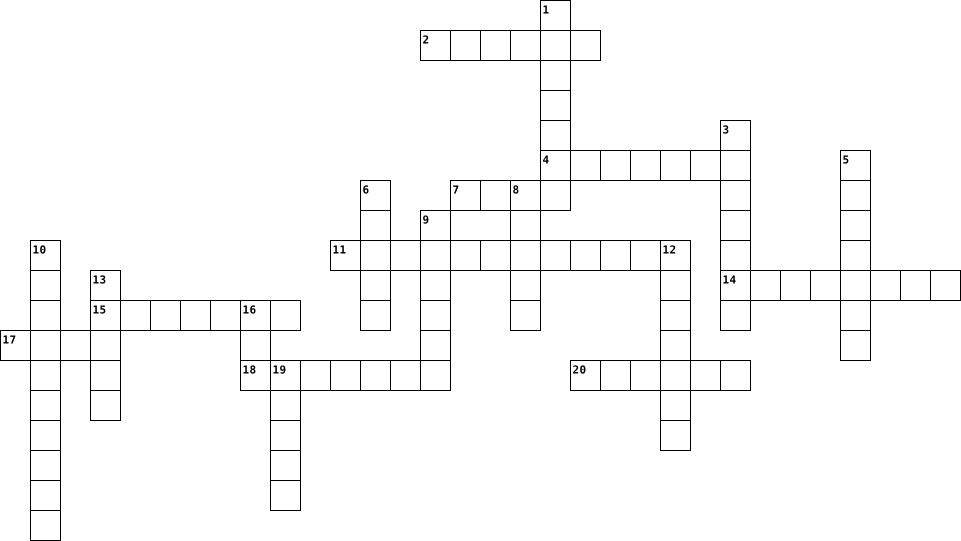
Across
- The outer planets are this.
- This planet has dark-colored storms, and many moons, and is the eighth/farthest planet from the sun.
- This planet has iron oxide, and polar ice caps, and is the fourth planet from the sun.
- This is when the Moon moves completely into Earth's umbra.
- This is the turning of Earth on its axis.
- This is the basic shape of every planet’s orbit.
- This is what causes the Earth's tides.
- Moon phase in which none of the lighted surfaces of the Moon can be seen from Earth is called this.
- This planet is the seventh planet from the sun.
Down
- These are caused by the direction Earth’s rotational axis is pointed with respect to the Sun.
- This planet has no atmosphere and is also the first planet from the sun.
- This planet is the largest planet and the fifth planet from the sun.
- This used to be a planet but now is a dwarf planet.
- The inner planets are this.
- This planet has the most complex ring system and is the sixth planet from the sun.
- The yearly orbit of Earth around the Sun is called this.
- This is when the Sun's rays strike Earth directly at the equator.
- This planet is the second planet from the sun.
- The basic astronomical unit is the distance Earth, the planet the scientists live on is from this place.
- Moon phases are the changing appearances of the Moon from this place and this is the third planet from the sun.
20 Clues: The outer planets are this. • The inner planets are this. • This is what causes the Earth's tides. • This is the turning of Earth on its axis. • This planet is the second planet from the sun. • This planet is the seventh planet from the sun. • This is the basic shape of every planet’s orbit. • This used to be a planet but now is a dwarf planet. • ...
ZS Mid-Autumn Festival Crossword 2022-08-31

Across
- A mythological Chinese archer, husband of the goddess of the Moon
- Light in a transparent protective case
- A pastry made to celebrate the Mid-autumn Festival
- The ______ dance is performed during festive ceremonies, operated by several dancers in a costume
Down
- The Chinese goddess of the Moon
- A _____ calendar is a calendar based on the monthly cycles of the Moon's phases
- Earth's only natural satellite, worshipped during the Mid-autumn Festival
- A social gathering attended by members of a certain group of people who have not seen each other for some time
- The Mid-autumn Festival celebrates the end of autumn _______
- The companion of the goddess of the Moon who lives on the moon is a Jade ______
10 Clues: The Chinese goddess of the Moon • Light in a transparent protective case • A pastry made to celebrate the Mid-autumn Festival • The Mid-autumn Festival celebrates the end of autumn _______ • A mythological Chinese archer, husband of the goddess of the Moon • Earth's only natural satellite, worshipped during the Mid-autumn Festival • ...
Matrix assignment - Crossword 2022-11-28

Across
- my name
- A telescope’s main light-gathering lens or mirror
- The point in the sky that’s directly overhead
- The imaginary north-south line that passes directly overhead (through the zenith).
- A temporary dark blemish on the surface of the Sun that is a planet-size region of gas cooler than its surroundings
- An increase in meteor activity at certain times of the year due to Earth passing through a stream of particles along a comet’s orbit around the Sun
- Denotes an object near a celestial pole that never dips below the horizon as Earth rotates and thus does not rise or set
- Any prominent star pattern that isn’t a whole constellation, such as the Northern Cross or the Big Dipper
- The celestial equivalent of latitude, denoting how far (in degrees) an object in the sky lies north or south of the celestial equator
Down
- The measure of how much an orbit deviates from being circular
- The fraction of the Moon or other body that we see illuminated by sunlight
- The edge of a celestial object’s visible disk
- The time after sunset or before sunrise when the sky is not fully dark. Astronomical twilight ends after sunset (and begins before sunrise) when the Sun is 18° below the horizon.
- A timetable with celestial coordinates that indicates where a planet, comet, or other body moving in relation to background stars will be in the sky
- The changing illumination of the Moon (or other body)over time. The Moon waxes, growing more illuminated, between its new and full phases, and wanes, becoming less illuminated, between its full and new phases
- A supermassive black hole gorging on gas at the center of a distant galaxy
- When the Moon or other body appears more than half, but not fully, illuminated
- The two times each year, near March 20th and September 22nd, when the Sun is directly overhead at noon as seen from Earth’s equator.
- The two times each year, around June 20th and December 21st, when the Sun is farthest north or south in the sky
- A star whose brightness changes over the course of days, weeks, months, or years
20 Clues: my name • The edge of a celestial object’s visible disk • The point in the sky that’s directly overhead • A telescope’s main light-gathering lens or mirror • The measure of how much an orbit deviates from being circular • The fraction of the Moon or other body that we see illuminated by sunlight • ...
Space Vocab Words p4 2016-11-03

Across
- a division of the year by reoccurring weather conditions determined by earths tilt and orbit
- the time Earth needs to rotate once on its axis
- spin on axis
- artificial body that revolves around a planet
- different appearances of the moon
- Phases appearances of the moon from earth throughout the month
Down
- force of attraction between two objects
- the point the sun is either as far north or as far south possible
- occurs two times a month at the new full moons
- minimum range that occurs first and third quarters of moon
- time required for earth to orbit once around the sun
- when sun appears to cross the celestial equator
12 Clues: spin on axis • different appearances of the moon • force of attraction between two objects • artificial body that revolves around a planet • occurs two times a month at the new full moons • the time Earth needs to rotate once on its axis • when sun appears to cross the celestial equator • time required for earth to orbit once around the sun • ...
Out Of This World 2013-08-08

Across
- Shuttle a space vehicle which astronauts use to get to space
- a space agency which researches information about the universe
- it seperates the inner and outer planets
- people who learn and explore space
- bits of molecules which fly in space
- the only planet which we can live on
- an unidentified object
- a rocket which reached the moon
- the curved path that a satelite or planet follows around the earth or sun
- Spot an area which is cooler than the other areas on the sun
- a process in which a star gets it's light and energy
- a place where astronauts stay while they are on a mission
- a very light gas with no colour, taste or smell
- the first person to walk on the moon
- a constellation of a lion in space
- a planet which is well known for it's beatiful rings
Down
- shapes in which a moon forms
- planets which are made of gases
- middle sized rocks which fly in space
- light display found in the Artic
- group of meteors that strike a planet
- the passing of the sun below the horizon in the evening, or the time at which this happens
- a comet which passes earth every 75 years
- creatures which come from other planets
- the biggest planet in the solar system
- a moon of Saturn which is the second largest moon
- a group of stars that form a picture
- a natural satelite
- a galaxy made of billions of stars and planets
29 Clues: a natural satelite • an unidentified object • shapes in which a moon forms • planets which are made of gases • a rocket which reached the moon • light display found in the Artic • people who learn and explore space • a constellation of a lion in space • bits of molecules which fly in space • the only planet which we can live on • a group of stars that form a picture • ...
PHASES OF THE MOON 2023-10-23

Across
- the path of a celestial body (such as a moon or a planet) around a larger celestial
- to brighten with light
- Moon phase in which less than half of the Moon appears to be illuminated
- increasing in size
- to spin on an axis
- Quarter Moon phase in which exactly half of the Moon appears to be illuminated
- a line connecting the North Pole to the South Pole
Down
- to move around a central point
- decreasing in size
- Moon Moon phase in which none of the Moon appears to be illuminated
- Moon phase in which more than half of the Moon appears to be illuminated
- Moon Moon phase in which all of the Moon appears to be illuminated
- Quarter Moon phase in which exactly half of the Moon appears to be illuminated
13 Clues: decreasing in size • increasing in size • to spin on an axis • to brighten with light • to move around a central point • a line connecting the North Pole to the South Pole • Moon Moon phase in which all of the Moon appears to be illuminated • Moon Moon phase in which none of the Moon appears to be illuminated • ...
Phases of the Moon 2023-02-08

Across
- Moon phase in which more that half of the Moon appears to be illuminated
- to spin on an axis
- moon phase in which exactly half of the Moon appears to be illuminated (occurs when the Moon has gone one quarter of the way around the Earth).
- increasing in size (more light)
- moon phase in which all of the Moon appears to be illuminated.
- Moon phase in which none of the Moon appears to be illuminated
Down
- moon phase in which less than half of the Moon appears to be illuminated
- to brighten with light
- the path of a celestial body (such as a moon or a planet) around a larger celestial body
- Moon phase in which exactly half of the Moon appears to be illuminated (occurs when the Moon has gone three quarters of the way around Earth)
- to move around a central point
- decreasing in size (more dark)
12 Clues: to spin on an axis • to brighten with light • to move around a central point • decreasing in size (more dark) • increasing in size (more light) • moon phase in which all of the Moon appears to be illuminated. • Moon phase in which none of the Moon appears to be illuminated • moon phase in which less than half of the Moon appears to be illuminated • ...
Tide Lab 2022-01-20

Across
- to do with dry land
- The outline of a coast
- having to do with the ocean
- Zone: The part of the coastline that gets exposed to tides
- tide: The time with the greatest difference between high and low tides
Down
- Changing of the sea/oceans water level
- phases: The different parts of the moon that can be seen as the moon revolves around the earth
- The spinning of a celestial body on its axis
- pull: The pull of celestial bodies
- tide: The time with the least difference between high and low tides
10 Clues: to do with dry land • The outline of a coast • having to do with the ocean • pull: The pull of celestial bodies • Changing of the sea/oceans water level • The spinning of a celestial body on its axis • Zone: The part of the coastline that gets exposed to tides • tide: The time with the least difference between high and low tides • ...
Earth-Sun-Moon System 2022-03-18

Across
- The portion of illuminated Moon you are able to see changes, these changes are called ______ of the Moon.
- Only ______ of the Moon is illuminated by the Sun.
- During our summer, the Earth is positioned such that the northern hemisphere is tilted ______ the Sun.
- During the other half of the lunar cycle, the illuminated area of the Moon visible on Earth is decreasing; the Moon is said to be ______ .
- The side of the Earth illuminated by the Sun is in ______ .
- Tilting towards the Sun also means that the sunlight in the summer is more ______ than it is during the winter.
Down
- The change from winter to summer is called ______.
- A ______ eclipse occurs when the Earth blocks out the light of the Sun.
- A ______ eclipse occurs when the Moon blocks out the light of the Sun.
- The Earth has seasons because its axis is ______ .
- For half the lunar cycle, the illuminated area of the Moon visible on Earth is increasing; the Moon is said to be ______ .
- The change from summer to winter is called ______.
- During our winter, the Earth is positioned such that the northern hemisphere is tilted ______ the Sun.
13 Clues: The change from winter to summer is called ______. • Only ______ of the Moon is illuminated by the Sun. • The Earth has seasons because its axis is ______ . • The change from summer to winter is called ______. • The side of the Earth illuminated by the Sun is in ______ . • A ______ eclipse occurs when the Moon blocks out the light of the Sun. • ...
Astronomy 2016-10-27

Across
- darkest part of shadow
- when the moon is directly between sun and earth
- one of different shapes of moon as seen from earth
- a measure of the force of gravity on an object
- the part of a shadow surrounding darkest part
- attractive force between objects
- scientific law that states every object in motion will stay in motion and every object at rest will stay at rest
Down
- scientific law that states every object universe attracts every other object
- when the earth is directly between the sun and moon
- blocking of object in space by another
- tendency of object to resist change in motion
- the amount of matter in an object
12 Clues: darkest part of shadow • attractive force between objects • the amount of matter in an object • blocking of object in space by another • tendency of object to resist change in motion • the part of a shadow surrounding darkest part • a measure of the force of gravity on an object • when the moon is directly between sun and earth • ...
The Moon 2023-03-06

Across
- Moon Phase; This is the phase that occurs before a Full Moon
- Moon Phase; This is the phase where the Moon is three quarters through its orbit and is sometimes called a “Half Moon”
- Moon Phase; This is the phase that occurs right before and after a New Moon
Down
- This is another name for a planet’s annual motion from one point and back to it
- Moon Phase; This is the phase that is at the beginning of the Moon’s orbit
- Moon Phase; This is the phase where the Moon is a quarter through its orbit and is sometimes called a “Half Moon”
- Moon Phase; This is the phase when the most sunlight is hitting the Moon, causing it to look ____
- The moon has different ______ based upon where it is in its orbit due to how much sunlight hits the moon
- Moon Phase; This is the phase that occurs after a Full Moon
9 Clues: Moon Phase; This is the phase that occurs after a Full Moon • Moon Phase; This is the phase that occurs before a Full Moon • Moon Phase; This is the phase that is at the beginning of the Moon’s orbit • Moon Phase; This is the phase that occurs right before and after a New Moon • This is another name for a planet’s annual motion from one point and back to it • ...
Macbeth 2022-05-26

Across
- what the witches did to Macbeth
- floating to Duncan's room
- not occurring normally
- what happened to the horses
- the leader of the witches
- and lightning/ a kind of storm
- it has eight phases
- an uneasy feeling
Down
- the weird night this natural event happened
- what was on Macbeths hands?
- lie/ not saying the whole truth
- the witches main tactic
- the ambitious general
- insight in the next upcoming events
- am/ witching hour
15 Clues: am/ witching hour • an uneasy feeling • it has eight phases • the ambitious general • not occurring normally • the witches main tactic • floating to Duncan's room • the leader of the witches • what was on Macbeths hands? • what happened to the horses • and lightning/ a kind of storm • what the witches did to Macbeth • lie/ not saying the whole truth • insight in the next upcoming events • ...
Eclipse 2022-02-15

Across
- Only seen when the moon phases through the Sun's umbra.
- When the Moon's shadow appears on Earth's surface.
- Each object in the __________ creates a shadow as it blocks the path of the Sun's light.
- A solar eclipse occurs when the ____ crosses directly between the sun and the earth.
- Lighter part of a shadow where light is partially blocked.
Down
- Occurs when the Moon moves into Earth's shadow.
- A dark area or shape produced by a body coming between rays of light and a surface.
- Occurs when the moon moves through Earth's umbra.
- Darker part of a shadow where light is totally blocked.
- The star in which the Earth orbits around.
10 Clues: The star in which the Earth orbits around. • Occurs when the Moon moves into Earth's shadow. • Occurs when the moon moves through Earth's umbra. • When the Moon's shadow appears on Earth's surface. • Only seen when the moon phases through the Sun's umbra. • Darker part of a shadow where light is totally blocked. • ...
Moon Phases By Addy Dickerson 2026-05-06

Across
- Half is lit up
- Darkest shadow of the moon
- Different shape of the moon seen from earth
- ______ Off
- Completely Dark
- A Little bit of the moon is lit up
- Lit Up
Down
- The planet we live on
- Moon Energy
- When planets pass each other
- Energy from the sun
- The path of planets
- Lightest shadow of the moon
- Most of the moon is lit up
- ______ On
- Done over and over
- What we see in the sky at night
17 Clues: Lit Up • ______ On • ______ Off • Moon Energy • Half is lit up • Completely Dark • Done over and over • Energy from the sun • The path of planets • The planet we live on • Darkest shadow of the moon • Most of the moon is lit up • Lightest shadow of the moon • When planets pass each other • What we see in the sky at night • A Little bit of the moon is lit up • ...
Midterm side dish 1 2023-12-12

Across
- when it is hot and easy to breathe
- the degree of the air or anything
- natural weather such as volcanoes, hurricanes,tornados,earthquakes,and floods
- the earth is blank at 23 degrees
- are caused by the tilt of the earth or direct or indirect sunlight
Down
- when it is cold and hard to breathe
- are what happen every month by what part of the sun is reflecting off the moon
- the weather in an area for a long time
- the line through the center of the earth
- what are in the sky that hold rain
- the force that attracts something to the center of it
- the thing caused by the gravitational pull of the moon ( think oceans)
- the line around the earth separating the two hemispheres
- when a hot or cold blank fills up an area
- happens when water is in a cycle
15 Clues: happens when water is in a cycle • the earth is blank at 23 degrees • the degree of the air or anything • what are in the sky that hold rain • when it is hot and easy to breathe • when it is cold and hard to breathe • the weather in an area for a long time • the line through the center of the earth • when a hot or cold blank fills up an area • ...
Moon Phase Trivia 2024-02-24

Across
- Cycle The complete cycle of moon phases, which lasts about 29.5 days.
- Quarter The phase when the Moon is at a 90-degree angle with the Sun again, but the opposite side is illuminated compared to the First Quarter.
- Crescent The phase just before the New Moon, when only a small sliver of the Moon is visible.
- Moon The second Full Moon in a calendar month, which occurs about once every 2-3 years.
- Quarter The phase when the Moon is at a 90-degree angle with the Sun and appears half-illuminated from Earth.
- The point in the Moon's orbit when it is farthest from Earth.
- Eclipse A celestial event that occurs when the Earth passes between the Sun and the Moon, casting a shadow on the Moon.
- Gibbous The phase just after the Full Moon, when more than half of the Moon's face is still visible.
Down
- A Full Moon or New Moon that occurs when the Moon is at or near its closest point to Earth.
- Gibbous The phase just before the Full Moon, when more than half of the Moon's face is illuminated.
- The point in the Moon's orbit when it is closest to Earth.
- Eclipse A celestial event that occurs when the the Moon passes between the Sun and the Earth, blocking all or part of the Sun's light from reaching Earth.
- Moon The phase when the Moon is on the opposite side of the Earth from the Sun, and its face is fully illuminated.
- Crescent The phase just after the New Moon, when a small sliver of the Moon is visible in the sky.
- Moon The phase when the Moon is between the Earth and the Sun, and its illuminated side is facing away from Earth.
15 Clues: The point in the Moon's orbit when it is closest to Earth. • The point in the Moon's orbit when it is farthest from Earth. • Cycle The complete cycle of moon phases, which lasts about 29.5 days. • Moon The second Full Moon in a calendar month, which occurs about once every 2-3 years. • ...
Grade 5 Review 1 2021-05-21

Across
- a short well-known saying containing a wise thought
- the moon has different ________
- the sliding of mud or earth off a hill or mountain
- to burst out in sudden explosion
- the moon reflects light from the ___________
Down
- a storm with violent winds in the Caribbean
- a sudden violent shaking of the ground
- a hurricane is a natural __________.
- the opposite of a word
- a word that means exactly or nearly the same as another
10 Clues: the opposite of a word • the moon has different ________ • to burst out in sudden explosion • a hurricane is a natural __________. • a sudden violent shaking of the ground • a storm with violent winds in the Caribbean • the moon reflects light from the ___________ • the sliding of mud or earth off a hill or mountain • a short well-known saying containing a wise thought • ...
Glossary of 8.1234 2025-11-07

Across
- different faces of the moon as seen from earth
- objects in orbit around another larger object
- earth blocks sunlight from reaching the moon
- summer, autumn, winter, spring caused by earth's tilt
Down
- full, dark shadow of a eclipse
- one complete orbit around the sun
- oval shape
- roughly round ball of rock or gas that orbits the sun
- time taken for a planet to go around the sun once
- less dense shadow of an eclipse
10 Clues: oval shape • full, dark shadow of a eclipse • less dense shadow of an eclipse • one complete orbit around the sun • earth blocks sunlight from reaching the moon • objects in orbit around another larger object • different faces of the moon as seen from earth • time taken for a planet to go around the sun once • roughly round ball of rock or gas that orbits the sun • ...
Earth in Space Vocab 2021-01-27

Across
- The phases of the moon, which take 29.5 days to complete
- When the moon is dark and not visible
- One complete orbit around the sun
- The different shapes of the moon as visible from the Earth
Down
- When the moon looks like a completely lighted circle from Earth
- The condition where the Earth spins on its axis for 1 complete turn
- An area of the world where all clocks re set to the same time. There are 24 major time
- The path a planet follows around the sun
- on Earth
9 Clues: on Earth • One complete orbit around the sun • When the moon is dark and not visible • The path a planet follows around the sun • The phases of the moon, which take 29.5 days to complete • The different shapes of the moon as visible from the Earth • When the moon looks like a completely lighted circle from Earth • ...
The Solar System 2014-11-10

Across
- Neptune is four times the size of which planet?
- Which is the largest moon orbiting Saturn?
- How many phases of the moon are there?
- ............ Planets are rocky planets
- The last planet in the solar system
- The gravity on Jupiter is too ............ for humans to live there safely
- The biggest planet in the Solar System
- All the planets in the Solar System orbit the ............
- how many moons does Mars have?
- As solar eclipse is caused when light from the Sun is blocked by the...........
Down
- What would the ice on Mars have to do to enable the planet habitable by humans?
- Which planet is named after the Roman God of the sea?
- Where most dwarf planets are, and where all comets with an orbit of less than 200 years exist
- The shape of an orbit is an .............
- The planet closest to the Sun
- How many gas giants are there in the Solar System?
- Which planet was classified a dwarf planet in 2006?
17 Clues: The planet closest to the Sun • how many moons does Mars have? • The last planet in the solar system • How many phases of the moon are there? • ............ Planets are rocky planets • The biggest planet in the Solar System • The shape of an orbit is an ............. • Which is the largest moon orbiting Saturn? • Neptune is four times the size of which planet? • ...
unit 4 vocab part 1 2024-02-16

Across
- imaginary line of latitude
- to move in a circle around the central axis
- imaginary lines that run east to west
- the force that draws objects together
- the state of the atmosphere at any given time/place
- the longest and shortest days of the year
- every full and new moon when the moon and earth are inline
- the spinning of the earth on its axis
- a natural object that exists outside of earths atmosphere
Down
- a measure of how hot/cold something is
- a period of moderate tides when the moon and the sun are at a right angle
- a measure of intensity of light hitting earths surface
- the path a body follows as it travels to another body in space
- imaginary line that earth rotates on
- When day/night is equal time
- a period of the year characterized by particular conditions of weather and temperature
- long period waves that change in height during the moons phases
17 Clues: imaginary line of latitude • When day/night is equal time • imaginary line that earth rotates on • imaginary lines that run east to west • the force that draws objects together • the spinning of the earth on its axis • a measure of how hot/cold something is • the longest and shortest days of the year • to move in a circle around the central axis • ...
Earth, Sun and Moon 2025-11-20

Across
- Our nearest star and major source of energy
- What we call the planet we live on.
- The spinning of a planet on its axis.
- the different shapes of the Moon that we see
- the general term for the power received from the Sun
- the main component of the Sun (a type of matter)
- The time when our side of Earth is facing the Sun
- The path an object takes around another in space
Down
- the changes in weather caused by the Earth's tilted axis
- the general 3D shape of the Sun, Earth and Moon
- the time when our side of Earth is facing away from the sun
- the slight lean on the Earth's axis
- Earth's natural satellite
- What the Earth spins on to cause day and night
- the type of energy that travels from the sun to earth
- what blocks light to create a dark space
- a massive ball of hot gas that emits light
17 Clues: Earth's natural satellite • the slight lean on the Earth's axis • What we call the planet we live on. • The spinning of a planet on its axis. • what blocks light to create a dark space • a massive ball of hot gas that emits light • Our nearest star and major source of energy • the different shapes of the Moon that we see • What the Earth spins on to cause day and night • ...
Macbeth 2022-05-26

Across
- the leader of the witches
- not occurring normally
- what the witches did to Macbeth
- the witches main tactic
- the ambitious general
- insight in the next upcoming events
Down
- the weird night this natural event happened
- what happened to the horses
- lie not saying the whole truth
- what was on Macbeths hands?
- am witching hour
- it has eight phases
- an uneasy feeling
- and lightning a kind of storm
- floating to Duncan's room
15 Clues: an uneasy feeling • it has eight phases • am witching hour • the ambitious general • not occurring normally • the witches main tactic • the leader of the witches • floating to Duncan's room • what happened to the horses • what was on Macbeths hands? • lie not saying the whole truth • and lightning a kind of storm • what the witches did to Macbeth • ...
Space Vocab 2022-09-21

Across
- when the moon blocks our view of the sun or vice versa
- the path an object takes while it is revolving
- a star and all the planets that orbit it
- a smaller representation of something
- the rise and fall of the sea level due to the gravity of the moon and sun
- the part of the moon that we can see on a given night
- to move around an object
- the imaginary line that something rotates around
- a large group of stars that are connected by gravity
Down
- any human-made object sent into space
- a sequence (set) of events that repeats
- a ratio of the size of an object to the size of a model of that object
- a sloping position
- to spin around a single point
- something that occurs repeatedly and predictably
- the cycle of the moon's phases at it orbits around the Earth
- a part of the year marked by particular weather patterns
- a natural force that pulls two objects towards each other
- the amount of matter (stuff) in an object
19 Clues: a sloping position • to move around an object • to spin around a single point • any human-made object sent into space • a smaller representation of something • a sequence (set) of events that repeats • a star and all the planets that orbit it • the amount of matter (stuff) in an object • the path an object takes while it is revolving • ...
SPACE CROSSWORD 2023-11-14

Across
- The coldest planet
- dioxide A Greenhouse gas
- 4th planet from the sun
- The air we breathe
- Planet with visible rings
- The sun sets in the______
Down
- Covers 70% of the earths surface
- Holds the solar system together
- Earths twin
- Largest star in the solar system
- The largest planet in our solar system
- Our galaxy name
- Planet that goes through 8 phases
- What used to be the 9th planet
- Orbits around the Sun
15 Clues: Earths twin • Our galaxy name • The coldest planet • The air we breathe • Orbits around the Sun • 4th planet from the sun • dioxide A Greenhouse gas • Planet with visible rings • The sun sets in the______ • What used to be the 9th planet • Holds the solar system together • Covers 70% of the earths surface • Largest star in the solar system • Planet that goes through 8 phases • ...
Looking into space 2021-10-25

Across
- People study the stars in these buildings.
- The biggest planet in the solar system.
- A group of stars is called a?
- How many phases does the moon go through?
- The first four planets are known as the ________ planets.
- When the moon moves into the earths shadow it is known as what eclipse.
- The name of the closest galaxy to ours.
- When the moon moves directly between the earth and the sun it is known as what eclipse?
- Balls of gas that give off a large amount of heat and light.
- Uranus's atmosphere is made from this deadly gas.
- The huge expanse that covers everything in the sky and beyond.
Down
- This planet has the most moons.
- The southern cross is the best known constellation in this hemisphere.
- year Distance in space is measured in this unit.
- People who study stars are called?
- Mars is famously known as the _____ planet.
- Venus's atmosphere is made from this.
17 Clues: A group of stars is called a? • This planet has the most moons. • People who study stars are called? • Venus's atmosphere is made from this. • The biggest planet in the solar system. • The name of the closest galaxy to ours. • How many phases does the moon go through? • People study the stars in these buildings. • Mars is famously known as the _____ planet. • ...
Lesson 1 & 2 Review 2025-01-16

Across
- Movement of one object in its orbit around another object in space.
- Force of attraction between two objects
- Amount of matter that an object contains
- September 23 This season starts
- The Earth pulls the ____into orbit.
- Earths revolution causes _________
- Curved path that an object follows as it revolves around another object.
- One factor that affects the force of gravity (not mass)
Down
- Another name for an oval shape
- - December 21 this season starts
- We live in the _______ Hemisphere.
- The spinning of the earth
- The ______ pulls the Earth into orbit.
- This book is used to keep track of weather, sunsets, sunrises, moon phases and other facts.
- The Earth is tilted 23.5 degrees on its ______.
- - March 21 This season starts
- The earth's rotation takes (24 hours)
- June 21 This season starts
18 Clues: The spinning of the earth • June 21 This season starts • - March 21 This season starts • Another name for an oval shape • September 23 This season starts • - December 21 this season starts • We live in the _______ Hemisphere. • Earths revolution causes _________ • The Earth pulls the ____into orbit. • The earth's rotation takes (24 hours) • ...
Science & Social Studies Review 2026-02-25

Across
- The Spanish word for military forts built during colonization
- A word for the Earth spinning on it's axis
- All the mass of water in the sky and on the Earth's surface
- The energy source that powers the water cycle
- An underground area of rock containing water
- Plants and trees releasing water vapor from their leaves
- The moon phase that shows only a sliver of the moon
- Animals releasing water vapor while breathing
- The country that conquered the Aztecs, Mayans, and Incans
Down
- One complete trip of the Earth around the sun
- Water vapor (or gas) turning back into water (or liquid)
- Another word for 365 days
- Rain, snow, sleet, and hail are examples of what?
- The number of moon phases
- What is caused by the earth being tilted on it's axis?
- When on body casts it's shadow on another body in space
- The water cycle phase that describes water being heated and changing into a gas (or water vapor)
- Another name for the sky
- A word that describes the native American Indians
19 Clues: Another name for the sky • Another word for 365 days • The number of moon phases • A word for the Earth spinning on it's axis • An underground area of rock containing water • One complete trip of the Earth around the sun • The energy source that powers the water cycle • Animals releasing water vapor while breathing • Rain, snow, sleet, and hail are examples of what? • ...
Unit 3: Space Vocabulary 2023-01-25

Across
- The time it takes for a photon of light to travel from the sun to Earth. It takes light on the sun about eight minutes and 19 seconds to reach Earth
- The average distance between the earth and the sun (~93,000,000 miles or 150,000,000 kilometers). Astronomers use this measurement within our solar system.
- Any of the varying appearances of the Moon as seen from Earth
- Orbiting objects, which include planets, moons, asteroids, and manmade devices
- Phase of the moon where greater than 50% is illuminated
- When concentration of sunlight is equal in both hemispheres, September 21st, also coincides with the first day of fall in the northern hemisphere
- Action of moving around another object
- A large asteroid belt at the edge of our solar system
- When the concentration of sunlight is greatest in the southern hemisphere, December 21st, also coincides with the first day of winter in the northern hemisphere
- A group of stars forming a recognizable pattern
- Phase of the moon when the entire moon is illuminated
- 23.5 degrees
- Describes phases of the moon when the amount of the moon illuminated is decreasing
- The force that exists between any two objects with mass
- The named times of year determined by changes of concentration of sunlight due to earth’s revolution around the sun
- The flat, disk-shaped space that connects the center of the object being orbited with the center of the orbiting objects
- Large, spherical celestial body that regularly rotates around a star, like the Earth around the sun in our
- Something you can see, touch, or mathematically show to support your claim. Includes results from an experiment, graphs that show your results, observations you recorded, etc.
- An eclipse in which the moon appears darkened as it passes into the earth's shadow
- Phase of the moon where less than 50% is illuminated
- An educated guess
- Phase of the moon when the left half of the moon is illuminated
- Phase of the moon when none of the moon is illuminated
- When the concentration of sunlight is greatest in the northern hemisphere, June 21st, also coincides with the first day of summer in the northern hemisphere
- Something that is believed to be true or possible. It is considered an opinion in science until enough evidence confirms its true
- A star located directly above or below one of Earth’s poles, allowing it to always be seen from one hemisphere of Earth.
Down
- The sun and the planets, asteroids, comets, and other bodies that orbit around it.
- A regular, repeating path that one object takes around another object or center of gravity
- Twice per year when the concentration of sunlight in both hemispheres is the same.
- A theoretical center through an object
- Latitudinal line that divides the southern hemisphere in half
- graph A chart or graph that presents categorical data with rectangular bars with heights or lengths proportional to the values that they represent
- Latitudinal line that divides the earth in half
- When concentration of sunlight is equal in both hemispheres, March 21st, also coincides with the first day of spring in the northern hemisphere
- Relative size of objects compared to one another
- The distance light travels in one year: ~6,000,000,000,000 miles or 9.5,000,000,000,000 kilometers. Astronomers use a different unit to measure distances to objects outside of the solar system.
- Phase of the moon when the right half of the moon is illuminated
- A way to represent a system or object
- Twice per year when the concentration of sunlight in both hemispheres is strongest and/or weakest
- graph A graphical representation of information that changes over a period of time
- Everything, all the energy and matter there is and, according to scientists, it appears to be about 13.8 billion years old.
- The outer rim of an eclipse, less dark than the umbra
- Any object in space, a star, planet, comet, etc.
- Action of spinning around an axis or center
- Latitudinal line that divides the northern hemisphere in half
- An eclipse in which the sun is obscured by the moon
- The darkest part of an eclipse
- Explanation of how or why the evidence supports the claim, can include scientific principles
- Describes phases of the moon when the amount of the moon illuminated is increasing
49 Clues: 23.5 degrees • An educated guess • The darkest part of an eclipse • A way to represent a system or object • A theoretical center through an object • Action of moving around another object • Action of spinning around an axis or center • Latitudinal line that divides the earth in half • A group of stars forming a recognizable pattern • ...
Jerrell palmer G7 P9 2-1-24 2024-02-01

Across
- scientists use it in a bottle
- season
- something you grow on land
- a place for boats
- a small wave
- we plant on the ground to grow stuff
- part of your body
Down
- toxic liquid
- the line that separates land and sky
- something we breath
- phases of moon
- something you wear on your neck
- is a part of our body related to others
- something you wear in your face
14 Clues: season • toxic liquid • a small wave • phases of moon • a place for boats • part of your body • something we breath • something you grow on land • scientists use it in a bottle • something you wear on your neck • something you wear in your face • the line that separates land and sky • we plant on the ground to grow stuff • is a part of our body related to others
Jerrell palmer G7 P9 2-1-24 2024-02-01

Across
- scientists use it in a bottle
- season
- something you grow on land
- a place for boats
- a small wave
- we plant on the ground to grow stuff
- part of your body
Down
- toxic liquid
- the line that separates land and sky
- something we breath
- phases of moon
- something you wear on your neck
- is a part of our body related to others
- something you wear in your face
14 Clues: season • toxic liquid • a small wave • phases of moon • a place for boats • part of your body • something we breath • something you grow on land • scientists use it in a bottle • something you wear on your neck • something you wear in your face • the line that separates land and sky • we plant on the ground to grow stuff • is a part of our body related to others