
moon phases Crossword Puzzles
Tides 2024-05-16

Across
- Changes in sea levels caused by the moon's gravitational pull
- Having to do with the ocean and aquatic life
- The tides that occur whenever the moon, sun and earth line up
- The area on a beach that is sometimes covered by ocean water and sometimes not
- The force of an object or mass of matter in space that pulls other things towards it
Down
- The tides that occur during the first and third quarter moon phases
- Having to do with dry land
7 Clues: Having to do with dry land • Having to do with the ocean and aquatic life • Changes in sea levels caused by the moon's gravitational pull • The tides that occur whenever the moon, sun and earth line up • The tides that occur during the first and third quarter moon phases • The area on a beach that is sometimes covered by ocean water and sometimes not • ...
Tides and Currents 2025-12-06

Across
- _______________ circulation is driven by temperature and salinity
- A _____ tide has low high tides and high low tides
- The regular changes in water level caused by the Sun and Moon's gravity
- The _______ effect is the apparent curving of objects due to the Earth's rotation
- During the first or third ____________ moon phase a neap tide is possible
- One of two moon phases during which a spring tide is possible
Down
- A _____ tide has high high tides and low low tides
- A tidal ______ is a situation where the flow of water from the river into the ocean reverses, and the tide pushes water up the river
- The type of ocean current caused mostly by density
- Tidal __________ is the difference in sea level between low tide and high tide
- One of two moon phases during which a spring tide is possible
- The type of ocean current caused mostly by wind
12 Clues: The type of ocean current caused mostly by wind • A _____ tide has high high tides and low low tides • The type of ocean current caused mostly by density • A _____ tide has low high tides and high low tides • One of two moon phases during which a spring tide is possible • One of two moon phases during which a spring tide is possible • ...
Earth in Space Unit Project Crossword Puzzle! (By: Carlos Cornieles) 2016-10-23

Across
- Chunks of rock and dust from space.
- The study of the moons, stars, and other objects in space.
- Moon's flat areas, hardened rock caused by huge lava flows.
- A device built to look at objects in space, making them closer than they appear.
- A tide with the greatest difference between consecutive and low and high tides.
- When an object in space comes between the sun and a third object, it casts a shadow on that object, causing an eclipse.
- The path taken while making a revolution.
Down
- The different shapes of the moon you see from Earth.
- Occurs when a new moon blocks your view of the sun.
- The very darkest part of the moons shadow, cone shaped.
- Large round pits.
- An imaginary line that passes through the middle of the Earth.
- A tide with the least difference between the low and high tides, occurring twice a month, caused by the sun's pull at the right angles to the moon's pull.
- The rise and fall of the ocean that occurs every 12.5 hours.
- Larger, less dark part of the moons shadow.
15 Clues: Large round pits. • Chunks of rock and dust from space. • The path taken while making a revolution. • Larger, less dark part of the moons shadow. • Occurs when a new moon blocks your view of the sun. • The different shapes of the moon you see from Earth. • The very darkest part of the moons shadow, cone shaped. • ...
Space 2024-03-18

Across
- eclipse
- phases
- eclipse
Down
- shadow
- Way galaxy
5 Clues: shadow • phases • eclipse • eclipse • Way galaxy
Solar and Lunar Eclipse 2023-03-29

Across
- phases
- glasses
Down
- glasses
- of totality
- moon
5 Clues: moon • phases • glasses • glasses • of totality
mesopotamia dillyn and aedonas 2021-12-02

Across
- wedge shapes that form writing
- a city that governs itself and its surrounding territory
- traveled and traded with other people
- extra supplies that lead to civilization
- a pyramid structure with a temple on top
- a territory governed as a political district of a country or empire
- created hammurabi’s code
- fine particles of fertile soil
- a group of merchants traveling together for safety
Down
- the first ruler of the akkadians
- largest and richest city in the world (at the time)
- the belief in many gods
- farming and digging of canals
- land between the rivers
- a large territory or group of territories governed by one ruler
- forced payments to a ruler from conquered people
- the inhabitants of ancient Assyria
- studied star, planet and moon phases and created the sundial
- a person who writes and copied out documents, often a record keeper
19 Clues: the belief in many gods • land between the rivers • created hammurabi’s code • farming and digging of canals • wedge shapes that form writing • fine particles of fertile soil • the first ruler of the akkadians • the inhabitants of ancient Assyria • traveled and traded with other people • extra supplies that lead to civilization • a pyramid structure with a temple on top • ...
Materials Hw 17 2019-11-04

Across
- One solid phase transforms to two other solid phases
- When austenite is cooled by rapid quench this forms
- The amount of deformation in the direction of force over the initial length
- This has a low strength but high ductility
- We describe diamond as this
- A two phases lamellar structure
- When an alloy's composition is to the right of the eutectic point
- Liquid and one solid phase transform to a second solid phase
- A form of pure iron with a BCC structure
Down
- The formation of a very small particle of a new phase
- When austenite is moderately cooled this forms
- Also know as Fe3C
- Cell The smallest
- Pearlite with thin layers
- Pearlite with large grain growth
- Above this curve a material is completely liquid
- When an alloy's composition is to the left of the eutectic point
- Force over Area
- when liquid transforms to two solid phases
19 Clues: Force over Area • Also know as Fe3C • Cell The smallest • Pearlite with thin layers • We describe diamond as this • A two phases lamellar structure • Pearlite with large grain growth • A form of pure iron with a BCC structure • This has a low strength but high ductility • when liquid transforms to two solid phases • When austenite is moderately cooled this forms • ...
Galileo galilei 2022-11-17

Across
- what was his first invention
Down
- what planets moons did he look at
- what planets phases did he look at
- where was he born
- what did galileos observation of the moon reveal
- what did the church make him do
6 Clues: where was he born • what was his first invention • what did the church make him do • what planets moons did he look at • what planets phases did he look at • what did galileos observation of the moon reveal
Galileo Part2 2023-11-17

Across
- hypothesized the sun was at the center of the universe
- a rich person who supports arts and science during the Renaissance
- constellation with 80 stars
- an icy moon of Jupiter, the largest in our solar system
- inventor of the spyglass
- something that curves outward
- The _____________ Messenger, a book written by Galileo about his astral discoveries
Down
- someone who studies the stars
- an important patron family in Italy during Galileo's time
- the planet Galileo observed to have phases
- something that curves inward
- the language of the book written by Galileo
- the title of Cosimo II, a patron to Galileo and head of the Medici family
- Galileo discovered its moons
- the smallest of the 4 moons of Jupiter discovered by Galileo
- old name for a telescope
16 Clues: inventor of the spyglass • old name for a telescope • constellation with 80 stars • something that curves inward • Galileo discovered its moons • someone who studies the stars • something that curves outward • the planet Galileo observed to have phases • the language of the book written by Galileo • hypothesized the sun was at the center of the universe • ...
Unit 5 Earth Moon Sun 2023-12-06

Across
- the darkest part of a shadow
- Earth completes a full revolution around the sun in 365 1/4 days
- this is characterized by a pattern of temperature and other weather trends
- the motion of a body that travels around another body in space
- a force exerted on all objects that have mass, that pulls other objects with mass toward themselves
Down
- phases as the moon revolves around Earth, the portion of the moon that reflects sunlight back to Earth changes, causing the moon's appearance to change
- The time it takes a planet to complete one full rotation on its axis
- an event during which one object in space casts a shadow onto another
- the spinning of a body, such as a planet, on its axis
- a body that orbits a larger body
- the area of sunlight is at a maximum in one hemisphere and at a minimum in the other hemisphere
- sunlight shines equally on the northern and southern hemispheres
- spreading cone of lighter shadow
13 Clues: the darkest part of a shadow • a body that orbits a larger body • spreading cone of lighter shadow • the spinning of a body, such as a planet, on its axis • the motion of a body that travels around another body in space • Earth completes a full revolution around the sun in 365 1/4 days • sunlight shines equally on the northern and southern hemispheres • ...
The Moon and its Phases 2013-01-07

Across
- Cycle Time when moon passes behind the earth, also when Sun, Earth and the Moon make a straight line
- A blank portion or area
- Complete round or series that is repeated
- A curved path way, usually elliptical that is an cycle
Down
- Moon The point where the entire moon reveals
- Moon The point where a quarter of the moon shows
- The different appearance of the moon
- Moon The point where half of the moon reveal instead of the whole
- Moon New moon is beginning or the end of the moon cycle where no moon is showing
- The natural satellite of the Earth
10 Clues: A blank portion or area • The natural satellite of the Earth • The different appearance of the moon • Complete round or series that is repeated • Moon The point where the entire moon reveals • Moon The point where a quarter of the moon shows • A curved path way, usually elliptical that is an cycle • Moon The point where half of the moon reveal instead of the whole • ...
Phases of the moon Crossword 2020-12-15

Across
- The moon is decreasing in size
- An almost full moon is called a _______.
- little light is showing
- A is the ______ letter in the alphabet
Down
- There is a man in the _______.
- The moon is increasing in size
- $0.25 is a __________.
- Today there was a _____ moon
- 1st 2nd __rd
- The cup is _______.
10 Clues: 1st 2nd __rd • The cup is _______. • $0.25 is a __________. • little light is showing • Today there was a _____ moon • There is a man in the _______. • The moon is decreasing in size • The moon is increasing in size • A is the ______ letter in the alphabet • An almost full moon is called a _______.
moon phases by logan yow 2023-02-23

Across
- is a force that tries to pull two objects together
- when a crescent is visible on the moon whenever it is waxing
- the object revolving the earth
- when the earth is between the moon and the sun
Down
- the movement of an object around another object
- the spinning of a object on its axis
- the change in the appearance of the moon as it makes one full revelution around the earth
- waves in the ocean caused by the pull of gravity from the moon
- when the moon is between the earth and the sun
- when a crescent is visible on the moon whenever it is waning
10 Clues: the object revolving the earth • the spinning of a object on its axis • when the moon is between the earth and the sun • when the earth is between the moon and the sun • the movement of an object around another object • is a force that tries to pull two objects together • when a crescent is visible on the moon whenever it is waxing • ...
Moon Phases Project - Elisha-Blessed 2022-10-21

Across
- - A bump/semi-circle (not a full circle)
- - light on the right
- Quarter - After Waning Gibbous
- Moon - When the Moon is fully lit.
- - banana-shaped moon phase
- Moon - When the Moon is fully covered.
Down
- Cycle - Cycle were the Moon revolves around the Earth for 27-30 days.
- Quarter - After Waxing Cresent
- - light on the left
- - When the Moon is 50%
10 Clues: - light on the left • - light on the right • - When the Moon is 50% • - banana-shaped moon phase • Quarter - After Waxing Cresent • Quarter - After Waning Gibbous • Moon - When the Moon is fully lit. • Moon - When the Moon is fully covered. • - A bump/semi-circle (not a full circle) • Cycle - Cycle were the Moon revolves around the Earth for 27-30 days.
Moon 2022-04-30

Across
- Baby food
- Dance for two
- Biscuit that may be placed on computer
- Birthplace of a hurricane
- Cousin of a monkey
- Caesar's "veni"
- Dairy machine
- A bartender may run one
Down
- D'Artagnan's home with a couple of rabbits
- American actor, awarded Oscar for Best Actor in Scent of a Woman in 1993
- Alternative to coffee
- Back in business
- Black Sea port
- Drops in the letter box
- Coating of frost
- A baker might have a hand
16 Clues: Baby food • Dance for two • Dairy machine • Black Sea port • Caesar's "veni" • Back in business • Coating of frost • Cousin of a monkey • Alternative to coffee • Drops in the letter box • A bartender may run one • Birthplace of a hurricane • A baker might have a hand • Biscuit that may be placed on computer • D'Artagnan's home with a couple of rabbits • ...
Phases of the moon 2023-02-24

Across
- The area closest to the ocean.
- When the tides are very high and the moon is either at its full or new phases.
- When the tides don't decrease or increase as much and the moon is at its 1st or last quarter.
- A portion of the coast line where the water courage exposes due to the change of the tides.
Down
- When there is more dry land.
- A cycle where the ocean water rises and falls.
- A force that attracts or pulls something toward itself.
7 Clues: When there is more dry land. • The area closest to the ocean. • A cycle where the ocean water rises and falls. • A force that attracts or pulls something toward itself. • When the tides are very high and the moon is either at its full or new phases. • A portion of the coast line where the water courage exposes due to the change of the tides. • ...
The Moon 2023-05-04

Across
- The moon has?
Down
- The moon is seen at?
- How many phases of the moon?
3 Clues: The moon has? • The moon is seen at? • How many phases of the moon?
moon 2021-04-20

Across
- sideways and downward movement of the edge of a plat of earth's crust into the mantle beneath another
- dark basalt plains on earth's moon
- field, a region around magnetic material or moving electric charge within which the force of magnetism
- layer of consolidated rocky material covering bedrock
- allen belt, two regions of intense radiation partially surrounding the earth
- process of currents rise up to the surface and spread the tectonic plates apart
Down
- ,heavily cratered regions of the moon a large bowl shaped cavity in the moon
- rotation,the result of tidal forces that overtime slow the rotation of the smaller body until it is synchronised with the other
- bulge, the result and deformation of earth and water due to gravitational effects from the moon and sun
- bright streaks of material on the moon
- tides, a period of moderate tides
- break apart or become separated through faulting caused by a plate slipping
- a sudden slip on a fault resulting in the ground shaking
- rays,and highly energetic atomic nucleus or other particle in space at a speed approaching light
- tides, the tides "springing forward"
- narrow depressions on the surface of the moon
16 Clues: tides, a period of moderate tides • dark basalt plains on earth's moon • tides, the tides "springing forward" • bright streaks of material on the moon • narrow depressions on the surface of the moon • layer of consolidated rocky material covering bedrock • a sudden slip on a fault resulting in the ground shaking • ...
History of Astronomy 2013-03-24

Across
- Neil Armstrong and _____ Aldrin were the first men on the moon.
- He observed the moon phases, showing craters, valleys and ridges and he also noted Jupiter's moons
- Modifies Aristotle's geocentric model to include extra circles within the circular orbits.
- Publishes his general ‘Theory of Relativity’.
- Proposed the geocentric model of the Solar System with the Earth at the centre.
- Discovers Uranus.
- Edwin discovers galaxies outside the Milky Way and sows the seed for the Big Bang.
Down
- Man called Gagarin, the first man in space.
- Invented the basic telescope with refracting lenses called the ‘Dutch Spyglass’.
- Isaac used the observations of Tycho Brahe, the elliptical orbits of Johannes Kepler and the heliocentric model confirmed by Galileo Galilee to suggest his Law of Planetary Motions.
- Suggested that planets appear to be travelling in ellipses rather than circular orbits.
- The first satellite is launched.
- Used a device called Tychos’ Quadrant to document many nightly observations and astronomical occurrences including the first supernova in the constellation of Cassiopeia
13 Clues: Discovers Uranus. • The first satellite is launched. • Man called Gagarin, the first man in space. • Publishes his general ‘Theory of Relativity’. • Neil Armstrong and _____ Aldrin were the first men on the moon. • Proposed the geocentric model of the Solar System with the Earth at the centre. • ...
Wonders 4.4 2025-01-21

Across
- meaning it turns around on an axis
- makes distant objects seem larger and nearer
- the different stages of the moon
- a number of similar things coming one after another
- exact or particular
Down
- a thin, often painted piece that has been broken, cut, or torn off
- Is a curve that is wider in the middle and tapered at the end
- studies the stars and planets
8 Clues: exact or particular • studies the stars and planets • the different stages of the moon • meaning it turns around on an axis • makes distant objects seem larger and nearer • a number of similar things coming one after another • Is a curve that is wider in the middle and tapered at the end • a thin, often painted piece that has been broken, cut, or torn off
Jayla, Week 31 Vocabulary 2022-05-09

Across
- phases- The different appearances of the moon from Earth throughout the month
- The outer part of a shadow such as the shadow cast by Earth of the moon in which sunlight is only partially blocked
- An event in which the shadow of one celestial body falls on another
- A force of attraction between objects that is due to their masses
Down
- A natural or artificial body that revolves around a planet
- A shadow that blocks sunlight, such as the conical section in the shadow of the Earth or the moon
6 Clues: A natural or artificial body that revolves around a planet • A force of attraction between objects that is due to their masses • An event in which the shadow of one celestial body falls on another • phases- The different appearances of the moon from Earth throughout the month • ...
The Moon and it's Phases 2022-04-19

Across
- The fifth phase of the moon. In this phase, we can see sunlight reflecting off ALL of the moon’s surface that faces us. In this phase the moon appears round and completely lit up.
- The second phase of the moon. In this phase, we can see sunlight reflecting off only about one quarter of the moon’s surface that faces us.
- The first phase of the moon. In this phase, the moon is completely dark since we can’t see the side that the sun is shining on.
- A series of space flights by the United States from 1961-1972 with a goal of landing a person on the moon. They succeeding in 1969 with Apollo 11.
- The third phase of the moon. In this phase, we can see sunlight reflecting off half of the moon’s surface that faces us.
- The alternate rising and falling of the ocean due to the gravitational pull of the moon.
Down
- The fourth phase of the moon. In this phase, we can see sunlight reflecting off three quarters of the moon’s surface that faces us. It’s not a full moon yet, but it’s getting there.
- A set of things that are connected. The earth, moon and sun are connected because their orbits depend on each other. The earth orbits around the sun and the moon orbits around the earth.
- a natural object that orbits around the Earth.
- A large rocky object found flying through space. They can be just a few feet in diameter to hundreds of miles in diameter!
10 Clues: a natural object that orbits around the Earth. • The alternate rising and falling of the ocean due to the gravitational pull of the moon. • The third phase of the moon. In this phase, we can see sunlight reflecting off half of the moon’s surface that faces us. • ...
moon 2024-04-18

Across
- the second closes planet to the sun
- the fourth planet
- 3 quarters of the moon is in the sky
- our galaxy
- the sun
- the closes planet to the sun
Down
- all the universe combined
- the star in the solar system
- our planet our group of planets
- our group of planets
- our owned planet
- moon that is not visible in the sky
- the moon
- our univerzes
- moon all the moon is visible in the sky
- a group of stars
16 Clues: the sun • the moon • our galaxy • our univerzes • our owned planet • a group of stars • the fourth planet • our group of planets • all the universe combined • the star in the solar system • the closes planet to the sun • our planet our group of planets • the second closes planet to the sun • moon that is not visible in the sky • 3 quarters of the moon is in the sky • ...
Heliocentric Chloe 2020-02-20

Across
- What planet has phases similar to Earth's moon?
- Who invented the telescope?
- What word means sun?
- What approach do we use for scientific questions?
- What shape did Kepler believe the planets moved in?
Down
- Which astronomer in planets going in perfect circles?
- Which of kepler's three Laws states that planets move faster in orbits when closer to the sun?
- What is one of Jupiter's moons Galileo observed?
8 Clues: What word means sun? • Who invented the telescope? • What planet has phases similar to Earth's moon? • What is one of Jupiter's moons Galileo observed? • What approach do we use for scientific questions? • What shape did Kepler believe the planets moved in? • Which astronomer in planets going in perfect circles? • ...
Vocabulary 2022-04-27

Across
- are the different stages of the moon
- make distant objects seem larger and nearer
- is exact or particular
- is turns around on an axis
Down
- studies the stars and plants
- is a curve that is wider in the middle and tapered at the ends
- is a thing, often pointed piece that has been broken, cut, or torn off
- a number of similar things coming one after another
8 Clues: is exact or particular • is turns around on an axis • studies the stars and plants • are the different stages of the moon • make distant objects seem larger and nearer • a number of similar things coming one after another • is a curve that is wider in the middle and tapered at the ends • is a thing, often pointed piece that has been broken, cut, or torn off
Science Vocabulary Terms 2023-08-28

Across
- Science that deals with the earth's physical structures/substances
- A planet not in our solar system
- Our home planet
- Never-ending
- The existence of humans/animals etc.
- When an object turns on its axis
- How it feels outside
- When an object in space blocks another from view
- Whatever enters this will disappear
- Electric
- First planet found using a telescope
- Has 8 planets in it
- Was once a planet in our solar system
- Big bright rock in the night sky
- Process of learning about the natural world through observation & experimentation
- A remarkable, unexplainable event
- Strength or energy
- Gets launched into space
- National Aeronautics & Space Administration
- Also known as a minor planet, are icy, metallic, or rocky
- Scientific prediction
- All of space & everything in it
- There is none of this in space
- What keeps us from floating into space
Down
- Name of a rocket
- Way The galaxy Earth is in
- An idea that can be tested
- To explore
- Heat, cold, rain, snow
- Includes 6 steps
- Billions of stars creates this
- Transfers energy from one location to another
- The name of our moon
- Moon has many of these
- Gas planet
- How heavy something is
- Planet with rings
- Known as the "red" planet
- We have 8 of these in our solar system
- Smallest planet
- Something in the stars
- Where we see stars, moons, & planets
- The study of weather
- There are billions of these
- Livable for species
- A fake planet
- Planet that shares a name of a roman God
- The study of everything in the universe beyond the earth's atmosphere
- The biggest star we see
49 Clues: Electric • To explore • Gas planet • Never-ending • A fake planet • Our home planet • Smallest planet • Name of a rocket • Includes 6 steps • Planet with rings • Strength or energy • Has 8 planets in it • Livable for species • How it feels outside • The name of our moon • The study of weather • Scientific prediction • Heat, cold, rain, snow • Moon has many of these • How heavy something is • ...
Science STAAR 2025 2025-04-10

Across
- The phases after a full moon
- The energy that is motion
- Or balanced force it is when forces are same on each side and an object will not move
- An object with a ___________ density will sink
- The ability to dissolve in to something else
- Is formed at the end of a river where the sediment has been deposited
- 30 or more years
- When a celestial object travels around another celestial object
- Energy that is created from fast moving particles that make up matter
- You can use NICS for this physical property
- Energy that travels in vibrating waves
- Will NOT allow the electricity to pass through
- Rocks that are formed through weathering, deposition, compaction and cementation
Down
- Spinning on its axis
- Not alive and never can be alive
- The amount of matter in an object
- The _______ from the sun is responsible for the revolution of all planets
- When water turns to water vapor
- The moon phase cycle always starts with a ________
- The "building up" of sediments or soil
- We use "old dinos build mega plane homes" to remember the steps in creating these
- All food chains or webs gain their energy from the ___
- The condition of the atmosphere at a specific time and place
- The bending of light
- The breaking down of rocks
- When light bounces off an object and returns in an equal angle
- Organism that gains energy from breaking down other organisms
- When the moon is lit on the right side
- White is a color that will ________ the light
- Through the weathering using __ U-shaped valleys are formed
30 Clues: 30 or more years • Spinning on its axis • The bending of light • The energy that is motion • The breaking down of rocks • The phases after a full moon • When water turns to water vapor • Not alive and never can be alive • The amount of matter in an object • The "building up" of sediments or soil • When the moon is lit on the right side • Energy that travels in vibrating waves • ...
Final Review: Planetary Science 2014-12-03

Across
- A natural satellite that orbits a planet.
- These are also known as "shooting stars'.
- A ______ eclipse occurs when Earth passes exactly between the Moon and the Sun.
- A piece of a meteoroid that hits the ground.
- A ______ planet is an object that orbits the Sun and is big enough to be round, but doesn't clear the neighborhood of objects near its orbit.
- A layer of gases that surround an object held in place by gravity.
- This mission's destination was Jupiter, and it was sent to collect data on the magnetosphere of the planet and to study its moons (see Space Missions).
- Part of the Mars ______ mission's goal was to investigate the structure of Mars' atmosphere, surface meteorology and geology, as well as the form, structure, and elemental composition of rocks and soil (see Space Missions).
- A ______ eclipse occurs when the Moon passes exactly between Earth and the Sun.
- ______ craters often have central peaks and ejecta thrown out in long rays.
- The path and length of time it takes for one object to travel around another.
- On these two days, Earth's axis is tilted neither away from nor toward the Sun.
- Traveling around something is called ______.
- Eratosthenes was the first to accurately estimate the ______ of the Earth.
- To give off.
- A ______ crater is the result of a large impact that releases magma from beneath the surface.
- ______ lines are bright lines show the visible wavelength of emitted light.
- Astronomers calculate that the ______ ______ happened about 13.73 billion years ago. (2 words)
- The different shapes the Moon takes as it orbits the Earth.
- A large, hot ball of gas, made up mostly of hydrogen and helium.
- ______ lines are dark areas that show that the light at certain wavelengths is being absorbed, so it is not seen.
- An enormous collection of tens of millions to hundreds of billions of stars, interstellar gas, and dust.
- A chunk of ice, dust, and rock material a few kilometers in size.
- One ______-year (ly) is the distance light travels in 1 year, at the speed of about 300,000 km/second.
Down
- Colors with longer wavelengths have ______ energy.
- A ______ occurs when either the North or South Pole are "leaning" toward the Sun.
- The ______ Space Telescope's goals are to provide deep and clear views of the universe, from the solar system to extremely remote young galaxies (see Space Missions).
- If a planet passes directly in front of its star, the event is called a ______.
- Earth spins on an imaginary axle called an ______.
- A small or medium-sized piece of rock or metal that orbits the Sun.
- We can use a planet's orbital period and orbit ______ and the temperature of the star to calculate a planet's probable temperature.
- We measure huge distances in the cosmos in ______ units (abbreviated AU).
- A tool used to study the spectrum of colors coming from a light source.
- A ______ Moon is nearly round on the side facing the Sun, with a bulge on the other side.
- Halfway between the full Moon and the new Moon is the ______-quarter Moon.
- A change in the land created by an impact.
- A ______ is a cloud of gas and dust in space between stars.
- This planet has a dense atmosphere of carbon dioxide, with many volcanoes on its surface.
- Planets circling stars outside our solar system are called ______.
- The ______ Belt is a region of the solar system beyond the orbit of Neptune made up of millions of small icy bodies.
- Halfway between the new Moon and the full Moon is the ______-quarter Moon.
- Colors with shorter wavelengths have ______ energy.
- This planet is sometimes called "the Red Planet" because of its oxidized (rusty) soil.
- This planet is the smallest of the gas giant planets, but is still the fourth largest planet in the solar system.
- When the illuminated portion of the Moon grows larger from day to day, the Moon is ______.
- When the illuminated portion of the Moon grows smaller from day to day, the Moon is ______.
- Small bowl-shaped craters with a fairly uniform blanket of ejecta distributed around the rim are ______ craters.
47 Clues: To give off. • A natural satellite that orbits a planet. • These are also known as "shooting stars'. • A change in the land created by an impact. • A piece of a meteoroid that hits the ground. • Traveling around something is called ______. • Colors with longer wavelengths have ______ energy. • Earth spins on an imaginary axle called an ______. • ...
Final Review: Planetary Science 2014-12-03

Across
- Colors with longer wavelengths have ______ energy.
- An enormous collection of tens of millions to hundreds of billions of stars, interstellar gas, and dust.
- The ______ Belt is a region of the solar system beyond the orbit of Neptune made up of millions of small icy bodies.
- This planet is sometimes called "the Red Planet" because of its oxidized (rusty) soil.
- On these two days, Earth's axis is tilted neither away from nor toward the Sun.
- Part of the Mars ______ mission's goal was to investigate the structure of Mars' atmosphere, surface meteorology and geology, as well as the form, structure, and elemental composition of rocks and soil (see Space Missions).
- A piece of a meteoroid that hits the ground.
- The different shapes the Moon takes as it orbits the Earth.
- A ______ eclipse occurs when the Moon passes exactly between Earth and the Sun.
- Traveling around something is called ______.
- Eratosthenes was the first to accurately estimate the ______ of the Earth.
- The ______ Space Telescope's goals are to provide deep and clear views of the universe, from the solar system to extremely remote young galaxies (see Space Missions).
- A ______ crater is the result of a large impact that releases magma from beneath the surface.
- A chunk of ice, dust, and rock material a few kilometers in size.
- We can use a planet's orbital period and orbit ______ and the temperature of the star to calculate a planet's probable temperature.
- ______ lines are dark areas that show that the light at certain wavelengths is being absorbed, so it is not seen.
- A change in the land created by an impact.
- A ______ planet is an object that orbits the Sun and is big enough to be round, but doesn't clear the neighborhood of objects near its orbit.
- A ______ is a cloud of gas and dust in space between stars.
- One ______-year (ly) is the distance light travels in 1 year, at the speed of about 300,000 km/second.
- This planet has a dense atmosphere of carbon dioxide, with many volcanoes on its surface.
Down
- A large, hot ball of gas, made up mostly of hydrogen and helium.
- When the illuminated portion of the Moon grows smaller from day to day, the Moon is ______.
- A ______ eclipse occurs when Earth passes exactly between the Moon and the Sun.
- ______ craters often have central peaks and ejecta thrown out in long rays.
- A ______ Moon is nearly round on the side facing the Sun, with a bulge on the other side.
- Astronomers calculate that the ______ ______ happened about 13.73 billion years ago. (2 words)
- If a planet passes directly in front of its star, the event is called a ______.
- This planet is the smallest of the gas giant planets, but is still the fourth largest planet in the solar system.
- This mission's destination was Jupiter, and it was sent to collect data on the magnetosphere of the planet and to study its moons (see Space Missions).
- Colors with shorter wavelengths have ______ energy.
- A layer of gases that surround an object held in place by gravity.
- A tool used to study the spectrum of colors coming from a light source.
- Halfway between the new Moon and the full Moon is the ______-quarter Moon.
- ______ lines are bright lines show the visible wavelength of emitted light.
- To give off.
- A natural satellite that orbits a planet.
- We measure huge distances in the cosmos in ______ units (abbreviated AU).
- Small bowl-shaped craters with a fairly uniform blanket of ejecta distributed around the rim are ______ craters.
- A ______ occurs when either the North or South Pole are "leaning" toward the Sun.
- A small or medium-sized piece of rock or metal that orbits the Sun.
- These are also known as "shooting stars'.
- Planets circling stars outside our solar system are called ______.
- Halfway between the full Moon and the new Moon is the ______-quarter Moon.
- When the illuminated portion of the Moon grows larger from day to day, the Moon is ______.
- The path and length of time it takes for one object to travel around another.
- Earth spins on an imaginary axle called an ______.
47 Clues: To give off. • A natural satellite that orbits a planet. • These are also known as "shooting stars'. • A change in the land created by an impact. • A piece of a meteoroid that hits the ground. • Traveling around something is called ______. • Colors with longer wavelengths have ______ energy. • Earth spins on an imaginary axle called an ______. • ...
Final Review: Planetary Science 2014-12-03

Across
- A large, hot ball of gas, made up mostly of hydrogen and helium.
- This planet has a dense atmosphere of carbon dioxide, with many volcanoes on its surface.
- ______ craters often have central peaks and ejecta thrown out in long rays.
- This mission's destination was Jupiter, and it was sent to collect data on the magnetosphere of the planet and to study its moons (see Space Missions).
- A ______ eclipse occurs when Earth passes exactly between the Moon and the Sun.
- A tool used to study the spectrum of colors coming from a light source.
- A piece of a meteoroid that hits the ground.
- A ______ crater is the result of a large impact that releases magma from beneath the surface.
- When the illuminated portion of the Moon grows larger from day to day, the Moon is ______.
- A small or medium-sized piece of rock or metal that orbits the Sun.
- Halfway between the new Moon and the full Moon is the ______-quarter Moon.
- Eratosthenes was the first to accurately estimate the ______ of the Earth.
- ______ lines are dark areas that show that the light at certain wavelengths is being absorbed, so it is not seen.
- A natural satellite that orbits a planet.
- A ______ is a cloud of gas and dust in space between stars.
- The different shapes the Moon takes as it orbits the Earth.
- We can use a planet's orbital period and orbit ______ and the temperature of the star to calculate a planet's probable temperature.
- Earth spins on an imaginary axle called an ______.
- One ______-year (ly) is the distance light travels in 1 year, at the speed of about 300,000 km/second.
- These are also known as "shooting stars'.
- The ______ Space Telescope's goals are to provide deep and clear views of the universe, from the solar system to extremely remote young galaxies (see Space Missions).
- An enormous collection of tens of millions to hundreds of billions of stars, interstellar gas, and dust.
- The ______ Belt is a region of the solar system beyond the orbit of Neptune made up of millions of small icy bodies.
Down
- A layer of gases that surround an object held in place by gravity.
- Planets circling stars outside our solar system are called ______.
- If a planet passes directly in front of its star, the event is called a ______.
- A ______ eclipse occurs when the Moon passes exactly between Earth and the Sun.
- This planet is the smallest of the gas giant planets, but is still the fourth largest planet in the solar system.
- We measure huge distances in the cosmos in ______ units (abbreviated AU).
- The path and length of time it takes for one object to travel around another.
- A chunk of ice, dust, and rock material a few kilometers in size.
- Part of the Mars ______ mission's goal was to investigate the structure of Mars' atmosphere, surface meteorology and geology, as well as the form, structure, and elemental composition of rocks and soil (see Space Missions).
- ______ lines are bright lines show the visible wavelength of emitted light.
- Traveling around something is called ______.
- A ______ planet is an object that orbits the Sun and is big enough to be round, but doesn't clear the neighborhood of objects near its orbit.
- A ______ Moon is nearly round on the side facing the Sun, with a bulge on the other side.
- On these two days, Earth's axis is tilted neither away from nor toward the Sun.
- Astronomers calculate that the ______ ______ happened about 13.73 billion years ago. (2 words)
- A ______ occurs when either the North or South Pole are "leaning" toward the Sun.
- When the illuminated portion of the Moon grows smaller from day to day, the Moon is ______.
- This planet is sometimes called "the Red Planet" because of its oxidized (rusty) soil.
- Small bowl-shaped craters with a fairly uniform blanket of ejecta distributed around the rim are ______ craters.
- A change in the land created by an impact.
- Colors with shorter wavelengths have ______ energy.
- Halfway between the full Moon and the new Moon is the ______-quarter Moon.
- Colors with longer wavelengths have ______ energy.
- To give off.
47 Clues: To give off. • A natural satellite that orbits a planet. • These are also known as "shooting stars'. • A change in the land created by an impact. • A piece of a meteoroid that hits the ground. • Traveling around something is called ______. • Earth spins on an imaginary axle called an ______. • Colors with longer wavelengths have ______ energy. • ...
kafoure lessen 1 chapter 4 2021-11-09

Across
- when earth is direclty between the moon and the sun
- diffent shpaps mo paperclips when the moon passes between earth and the sun
Down
- the verry darkist part of moon's shadow
- less dark then the umbra
- when an object comes between the sun and a third object
5 Clues: less dark then the umbra • the verry darkist part of moon's shadow • when earth is direclty between the moon and the sun • when an object comes between the sun and a third object • diffent shpaps mo paperclips when the moon passes between earth and the sun
Science Crossword 2024-10-18

Across
- hardest natural substance on Earth
- the farthest planet from the sun
- Phases the moon go through every 29.5 days
- Part of the cell contains the genetic material
Down
- Process by which plants make their own food using sunlight
- The force that pulls objects toward the center of the Earth
- How do living things change over time?
7 Clues: the farthest planet from the sun • hardest natural substance on Earth • How do living things change over time? • Phases the moon go through every 29.5 days • Part of the cell contains the genetic material • Process by which plants make their own food using sunlight • The force that pulls objects toward the center of the Earth
Earth + Space Vocabulary 2024-02-12

Across
- The path an object, such as a planet, takes as it revolves around another object.
- Each of the four divisions of the year marked by particular weather patterns and daylight hours.
- The reflected light is increasing on the moon's surface, but less than half is visible from Earth.
- The process of turning or spinning on an axis.
- The appearance of phases of the moon as viewed from Earth, as the moon orbits the Earth.
- The type of tide that occurs when ocean water is at its highest level during the day.
- No reflected light from the sun is visible on Earth.
- The type of tide that occurs when ocean water is at its lowest level during the day.
- The partial or total blocking of light of one object (sun or moon) by another.
- Marks the longest day of the year (most sunlight); generally occurs around June 21-22 in the northern hemisphere
- The action of one object moving completely around in an orbital path.
- The rising and falling of the ocean's surface.
- A tide in which the difference between high and low tide is the least.
- The type of eclipse that occurs when the moon passes between the sun and Earth.
- The reflected light is decreasing on the moon's surface, but more than half is still visible from Earth.
- An increasing amount of visible light on the moon's surface.
Down
- Only the right half of the moon is visible from Earth.
- An imaginary line that runs through both poles of a planet.
- The type of eclipse that occurs when the moon appears darkened as it passes into Earth's shadow.
- An imaginary line drawn around Earth that divides it into two halves - the northern hemisphere and southern hemisphere.
- A day that marks equal day and night; generally occurs around March 21-22 in the northern hemisphere.
- Marks the shortest day of the year (least sunlight); generally occurs around December 21-22 in the northern hemisphere.
- The reflected light is decreasing on the moon's surface and less than half is visible from Earth.
- The moon's surface is completely visible from Earth.
- A day that marks equal day and night; generally occurs around September 22-23 in the northern hemisphere.
- Only the left half of the moon is visible from Earth.
- A tide in which the difference between high and low tide is the greatest.
- The reflected light is increasing on the moon's surface and more than half is visible from Earth.
- A decreasing amount of visible light on the moon's surface.
29 Clues: The process of turning or spinning on an axis. • The rising and falling of the ocean's surface. • The moon's surface is completely visible from Earth. • No reflected light from the sun is visible on Earth. • Only the left half of the moon is visible from Earth. • Only the right half of the moon is visible from Earth. • ...
First Marking Period - Math & Science 2021-10-01

Across
- the answer to a multiplication problem
- when light is blocked this forms
- the earth rotates on its invisible...
- liquid water falls from the clouds
- the value of digits moves up ____ times as we move left
Down
- water changes from a liquid to gas
- numbers that are multiplied to get a product
- it takes 29 and 1/2 __________ for the moon to go though it's phases
8 Clues: when light is blocked this forms • water changes from a liquid to gas • liquid water falls from the clouds • the earth rotates on its invisible... • the answer to a multiplication problem • numbers that are multiplied to get a product • the value of digits moves up ____ times as we move left • it takes 29 and 1/2 __________ for the moon to go though it's phases
Kalea's Vocab Choice #3 - Crossword using all words and definitions 2022-02-24

Across
- When something turns around on an axis
- Makes distant objects seem larger and nearer
- Different stages of the moon
- A number of similar things coming one after another
- Exact or particular
Down
- A thin, often pointed piece that has been broken, cut, or torn off
- A curve that is wider in the middle and tapered at the end
- A person who studies the stars and planets
8 Clues: Exact or particular • Different stages of the moon • When something turns around on an axis • A person who studies the stars and planets • Makes distant objects seem larger and nearer • A number of similar things coming one after another • A curve that is wider in the middle and tapered at the end • A thin, often pointed piece that has been broken, cut, or torn off
Vocabulary U4:W4 2023-02-09

Across
- exact or particular
- turns around on an axis
- someone who studies the stars and planets
- a device that makes distant objects seem larger and nearer
Down
- the different stages of the moon
- a curve that is wider in the middle and tapered at the ends
- a thin, often pointed piece that has been broken, cut, or torn off
- a number of similar things coming one after another
8 Clues: exact or particular • turns around on an axis • the different stages of the moon • someone who studies the stars and planets • a number of similar things coming one after another • a device that makes distant objects seem larger and nearer • a curve that is wider in the middle and tapered at the ends • a thin, often pointed piece that has been broken, cut, or torn off
moon 2021-04-20

Across
- ,heavily cratered regions of the moon a large bowl shaped cavity in the moon
- layer of consolidated rocky material covering bedrock
- dark basalt plains on earth's moon
- sideways and downward movement of the edge of a plat of earth's crust into the mantle beneath another
- a sudden slip on a fault resulting in the ground shaking
- rays,and highly energetic atomic nucleus or other particle in space at a speed approaching light
- tides, the tides "springing forward"
Down
- field, a region around magnetic material or moving electric charge within which the force of magnetism
- rotation,the result of tidal forces that overtime slow the rotation of the smaller body until it is synchronised with the other
- tides, a period of moderate tides
- narrow depressions on the surface of the moon
- allen belt, two regions of intense radiation partially surrounding the earth
- break apart or become separated through faulting caused by a plate slipping
- bulge, the result and deformation of earth and water due to gravitational effects from the moon and sun
- process of currents rise up to the surface and spread the tectonic plates apart
- bright streaks of material on the moon
16 Clues: tides, a period of moderate tides • dark basalt plains on earth's moon • tides, the tides "springing forward" • bright streaks of material on the moon • narrow depressions on the surface of the moon • layer of consolidated rocky material covering bedrock • a sudden slip on a fault resulting in the ground shaking • ...
Lunar Phases 2025-11-11

Across
- The phase where exactly half of the Moon's surface is illuminated as seen from Earth; appears right after Waning Gibbous.
- A natural or artificial body that revolves around a planet; the Moon is Earth's.
- The phase that occurs just before the New Moon; a tiny sliver is visible.
- The phase when the Moon is not visible because the sunlit side is facing away from Earth.
- The turning of the Moon on its axis; takes the same time as its revolution.
- The phase when you see the Moon as a complete circle of light; opposite the New Moon.
- The force that keeps the Moon moving around the Earth and causes tides.
- The phase after the Full Moon where less than half of the visible surface is lit.
Down
- The phase when exactly half of the Moon's surface is illuminated as seen from Earth; appears right after Waxing Crescent.
- The phase when the Moon is almost completely full, and the illuminated portion is growing.
- A large, bowl-shaped depression on the surface caused by an impact.
- The elliptical path of an object (like the Moon) around another object (like Earth).
- The rise and fall of ocean water caused by the Moon's gravitational pull.
- The phase visible just after the New Moon; only a small sliver of the right side is lit.
- The period when the Moon's visible illuminated area is increasing.
- The degree or amount of light being reflected by the Moon.
- The time it takes for the Moon to complete one trip around the Earth; about 27.3 days.
- An astronomical event when one celestial body (like the Moon) moves into the shadow of another (like Earth).
18 Clues: The degree or amount of light being reflected by the Moon. • The period when the Moon's visible illuminated area is increasing. • A large, bowl-shaped depression on the surface caused by an impact. • The force that keeps the Moon moving around the Earth and causes tides. • The rise and fall of ocean water caused by the Moon's gravitational pull. • ...
The Earth, Moon, and Sun 2015-04-29

Across
- an instrument used to study far away things such as the moon, stars, and other planets
- the largest part of the moons shadow
- a device that expels gas in one direction to move the opposite direction
- a tide with the lowest difference between the high and low tides
- the imaginary line that passes through Earth; Earth tilts on this
- chunks of rock or dust from space
- the eclipses that occurs when the moon is between the Earth and the sun
- the amount of matter in an object
- the force that propels a rocket forward
- states that objects at rest will stay at rest and objects in motion will stay in motion
- the speed a rocket must achieve to go beyond a planets gravitational pull
- a spacecraft that can carry a crew into space
- the very darkest part of the moons shadow
- the study of all objects in space
- the days when the sun is farthest north or south from the equator
- the tendency of an object to resist a change in motion
- the days when neither hemisphere is tilted toward or away from the sun
Down
- large, round pits in the moon
- the eclipses that occurs when the Earth is between the moon and the sun
- the movement of one object around another
- speed a rocked must achieve to make an orbit around Earth
- an artificial satellite that people can live and work on for long periods of time
- small robots that spaceprobes carry that walk on the surface
- speed in a given direction
- a spacecraft that carries instruments to collect data, it doesn't carry people
- the different shapes of the moon that people can see from Earth
- the curved path of spacecraft around a star, planet, or moon; the Earth does this to the sun.
- an object that revolves around another object in space
- states that every object in the universe attracts every other object
- a push or pull
- this attracts all objects toward each other
- the partial or total blocking of one object in space by another
- a tide with the biggest difference between high and low tides
- the spinning of Earth on its axis
- the force of gravity on an object
- the rise and fall of Earths oceans
- the moons dark, flat areas
37 Clues: a push or pull • speed in a given direction • the moons dark, flat areas • large, round pits in the moon • chunks of rock or dust from space • the amount of matter in an object • the spinning of Earth on its axis • the force of gravity on an object • the study of all objects in space • the rise and fall of Earths oceans • the largest part of the moons shadow • ...
The Earth, Moon, and Sun 2015-04-29

Across
- the different shapes of the moon that people can see from Earth
- an object that revolves around another object in space
- the study of all objects in space
- a device that expels gas in one direction to move the opposite direction
- states that objects at rest will stay at rest and objects in motion will stay in motion
- speed a rocked must achieve to make an orbit around Earth
- chunks of rock or dust from space
- speed in a given direction
- the speed a rocket must achieve to go beyond a planets gravitational pull
- a spacecraft that carries instruments to collect data, it doesn't carry people
- a spacecraft that can carry a crew into space
- the eclipses that occurs when the Earth is between the moon and the sun
- the very darkest part of the moons shadow
- the movement of one object around another
- large, round pits in the moon
- an instrument used to study far away things such as the moon, stars, and other planets
- the partial or total blocking of one object in space by another
- the rise and fall of Earths oceans
- a push or pull
Down
- the imaginary line that passes through Earth; Earth tilts on this
- the force that propels a rocket forward
- the eclipses that occurs when the moon is between the Earth and the sun
- the curved path of spacecraft around a star, planet, or moon; the Earth does this to the sun.
- this attracts all objects toward each other
- the spinning of Earth on its axis
- states that every object in the universe attracts every other object
- an artificial satellite that people can live and work on for long periods of time
- a tide with the biggest difference between high and low tides
- the amount of matter in an object
- the moons dark, flat areas
- small robots that spaceprobes carry that walk on the surface
- the tendency of an object to resist a change in motion
- the force of gravity on an object
- the largest part of the moons shadow
- the days when neither hemisphere is tilted toward or away from the sun
- a tide with the lowest difference between the high and low tides
- the days when the sun is farthest north or south from the equator
37 Clues: a push or pull • the moons dark, flat areas • speed in a given direction • large, round pits in the moon • the study of all objects in space • the spinning of Earth on its axis • chunks of rock or dust from space • the amount of matter in an object • the force of gravity on an object • the rise and fall of Earths oceans • the largest part of the moons shadow • ...
Materials Hw 17 2019-11-04

Across
- When an alloy's composition is to the right of the eutectic point
- When austenite is moderately cooled this forms
- This has a low strength but high ductility
- Pearlite with thin layers
- When an alloy's composition is to the left of the eutectic point
- Liquid and one solid phase transform to a second solid phase
- A two phases lamellar structure
- Above this curve a material is completely liquid
- Also know as Fe3C
- A form of pure iron with a BCC structure
- The amount of deformation in the direction of force over the initial length
Down
- Pearlite with large grain growth
- When austenite is cooled by rapid quench this forms
- The measure of Stress over Strain
- when liquid transforms to two solid phases
- The formation of a very small particle of a new phase
- We describe diamond as this
- One solid phase transforms to two other solid phases
- Cell The smallest repeat entity in a crystal structure
- Force over Area
20 Clues: Force over Area • Also know as Fe3C • Pearlite with thin layers • We describe diamond as this • A two phases lamellar structure • Pearlite with large grain growth • The measure of Stress over Strain • A form of pure iron with a BCC structure • when liquid transforms to two solid phases • This has a low strength but high ductility • When austenite is moderately cooled this forms • ...
Earth and Space Science 2023-12-14

Across
- cycle-It involves the exchange of heat energy, which leads to changes in temperature and moisture levels in the atmosphere, oceans, and land. The water cycle is driven by solar energy and involves several stages including evaporation, transpiration, condensation, precipitation, infiltration, and runoff.
- A front is a weather system that is the boundary separating two different types of air. One type of air is usually denser than the other, with different temperatures and different levels of humidity. This clashing of air types causes weather: rain, snow, cold days, hot days, and windy days.
- The four seasons—spring, summer, fall, and winter—follow one another regularly. Each has its own light, temperature, and weather patterns that repeat yearly. In the Northern Hemisphere, winter generally begins on December 21 or 22. This is the winter solstice, the day of the year with the shortest period of daylight.
- Pressure- Low blood pressure occurs when blood pressure is much lower than normal. This means the heart, brain, and other parts of the body may not get enough blood. Normal blood pressure is mostly between 90/60 mmHg and 120/80 mmHg. The medical word for low blood pressure is hypotension.
- move or cause to move into a sloping position.
- a straight line about which a body or a geometric figure rotates or may be supposed to rotate. the Earth's axis. Or a straight line with respect to which a body or figure is symmetrical.
- an imaginary line drawn around the earth equally distant from both poles, dividing the earth into northern and southern hemispheres and constituting the parallel of latitude 0°.
Down
- Tides are very long-period waves that move through the ocean in response to the forces exerted by the moon and sun. Tides originate in the ocean and progress toward the coastlines where they appear as the regular rise and fall of the sea surface.
- The answer is gravity: an invisible force that pulls objects toward each other. Earth's gravity is what keeps you on the ground and what makes things fall.
- Temperature is the measure of hotness or coldness expressed in terms of any of several scales, including Fahrenheit and Celsius. Temperature indicates the direction in which heat energy will spontaneously flow—i.e., from a hotter body (one at a higher temperature) to a colder body (one at a lower temperature).
- n meteorology, a cloud is an aerosol consisting of a visible mass of miniature liquid droplets, frozen crystals, or other particles suspended in the atmosphere of a planetary body or similar space. Water or various other chemicals may compose the droplets and crystals
- In a broader sense, climate is the state of the components of the climate system, including the atmosphere, hydrosphere, cryosphere, lithosphere and biosphere and the interactions between them.
- Disasters- The hurricane that struck Galveston, Texas, in 1900 remains the deadliest natural disaster in North American history, with some death toll estimates reaching 12,000.
- Pressure- Hypertension (high blood pressure) is when the pressure in your blood vessels is too high (140/90 mmHg or higher). It is common but can be serious if not treated. People with high blood pressure may not feel symptoms.
- phases-In common usage, the four major phases are the new moon, the first quarter, the full moon and the last quarter; the four minor phases are waxing crescent, waxing gibbous, waning gibbous, and waning crescent.
15 Clues: move or cause to move into a sloping position. • The answer is gravity: an invisible force that pulls objects toward each other. Earth's gravity is what keeps you on the ground and what makes things fall. • ...
Earth and Space Science 2023-12-15

Across
- - Tides are very long-period waves that move through the ocean in response to the forces exerted by the moon and sun. Tides originate in the ocean and progress toward the coastlines where they appear as the regular rise and fall of the sea surface.
- - The answer is gravity: an invisible force that pulls objects toward each other. Earth's gravity is what keeps you on the ground and what makes things fall.
- Pressure -Low blood pressure occurs when blood pressure is much lower than normal. This means the heart, brain, and other parts of the body may not get enough blood. Normal blood pressure is mostly between 90/60 mmHg and 120/80 mmHg. The medical word for low blood pressure is hypotension.
- - The four seasons—spring, summer, fall, and winter—follow one another regularly. Each has its own light, temperature, and weather patterns that repeat yearly. In the Northern Hemisphere, winter generally begins on December 21 or 22. This is the winter solstice, the day of the year with the shortest period of daylight.
- - an imaginary line drawn around the earth equally distant from both poles, dividing the earth into northern and southern hemispheres and constituting the parallel of latitude 0°.
- - In a broader sense, climate is the state of the components of the climate system, including the atmosphere, hydrosphere, cryosphere, lithosphere and biosphere and the interactions between them.
Down
- - Temperature is the measure of hotness or coldness expressed in terms of any of several scales, including Fahrenheit and Celsius. Temperature indicates the direction in which heat energy will spontaneously flow—i.e., from a hotter body (one at a higher temperature) to a colder body (one at a lower temperature).
- Pressure - Hypertension (high blood pressure) is when the pressure in your blood vessels is too high (140/90 mmHg or higher). It is common but can be serious if not treated. People with high blood pressure may not feel symptoms.
- - move or cause to move into a sloping position.
- - In meteorology, a cloud is an aerosol consisting of a visible mass of miniature liquid droplets, frozen crystals, or other particles suspended in the atmosphere of a planetary body or similar space. Water or various other chemicals may compose the droplets and crystals
- cycle - It involves the exchange of heat energy, which leads to changes in temperature and moisture levels in the atmosphere, oceans, and land. The water cycle is driven by solar energy and involves several stages including evaporation, transpiration, condensation, precipitation, infiltration, and runoff.
- - a straight line about which a body or a geometric figure rotates or may be supposed to rotate. the Earth's axis. Or a straight line with respect to which a body or figure is symmetrical.
- Disasters -The hurricane that struck Galveston, Texas, in 1900 remains the deadliest natural disaster in North American history, with some death toll estimates reaching 12,000.
- - A front is a weather system that is the boundary separating two different types of air. One type of air is usually denser than the other, with different temperatures and different levels of humidity. This clashing of air types causes weather: rain, snow, cold days, hot days, and windy days.
- phases - In common usage, the four major phases are the new moon, the first quarter, the full moon and the last quarter; the four minor phases are waxing crescent, waxing gibbous, waning gibbous, and waning crescent.
15 Clues: - move or cause to move into a sloping position. • - The answer is gravity: an invisible force that pulls objects toward each other. Earth's gravity is what keeps you on the ground and what makes things fall. • ...
Nayeli-Chapter 1 lesson 4 Astronomy 2021-11-09

Across
- light part of the moon´s shadow is called a-
- Different shapes of the moon you see from the moon-
Down
- dark part of the moon´s shadow is called a-
- position changes- moon orbits Earth what happens tot he earth,moon,and sun?
4 Clues: dark part of the moon´s shadow is called a- • light part of the moon´s shadow is called a- • Different shapes of the moon you see from the moon- • position changes- moon orbits Earth what happens tot he earth,moon,and sun?
Ocean Tides and Moon Phases 2022-03-01

Across
- a curved path followed by a satellite as it revolves around an object.
- the imaginary line that extends from the north pole to the south pole and is the center of earths rotation.
- the attraction of two objects due to gravity.
- When the moon appears to be getting smaller.
Down
- When the moon appears to be getting larger.
- the spinning of a celestial body on its axis.
- the movement of one celestial body around another.
- The moons repeated pattern of movement and changes in appearance due to its position relative to the earth and sun.
- half of a sphere; earth can be divided into northern/southern and eastern/western hemispheres.
- The shape of the lit up area of the moon.
10 Clues: The shape of the lit up area of the moon. • When the moon appears to be getting larger. • When the moon appears to be getting smaller. • the spinning of a celestial body on its axis. • the attraction of two objects due to gravity. • the movement of one celestial body around another. • a curved path followed by a satellite as it revolves around an object. • ...
Tide and moon phases crossword 2022-08-30

Across
- the moon at it’s darkest
- the lowest time of the tide
- the highest time of the tide
- when the moon goes in front of the sun and blocks out light
Down
- the moon when it’s curved
- the moon is the brightest
- the incoming tide
- when the earth goes in front of the moon and makes the moon disappear
- the outgoing tide
- The moon when it’s more than half full
10 Clues: the incoming tide • the outgoing tide • the moon at it’s darkest • the moon when it’s curved • the moon is the brightest • the lowest time of the tide • the highest time of the tide • The moon when it’s more than half full • when the moon goes in front of the sun and blocks out light • when the earth goes in front of the moon and makes the moon disappear
Space Science 2023-03-07

Across
- When all forces are equal and cancel each other.
- When all forces are not equal and do not cancel each other.
- The only star in our solar system.
- Object orbits around another object.
- A very large group of stars and planets.
- It takes the moon 28 days to complete each of these.
Down
- A push or pull that has strength and direction.
- Force that pulls all objects to the center of the Earth.
- Object spins on an axis.
- A burning sphere of gases that gives off light.
- The galaxy that includes our solar system.
- All the things that exist in space.
12 Clues: Object spins on an axis. • The only star in our solar system. • All the things that exist in space. • Object orbits around another object. • A very large group of stars and planets. • The galaxy that includes our solar system. • A push or pull that has strength and direction. • A burning sphere of gases that gives off light. • ...
The Solar System #2 2023-08-29

Across
- a person who is trained to travel and work in space
- a special feature
- an object in space that produces its own heat and light energy
- a group of stars that form a pattern or picture in one area of the sky
- growing larger
- the different shapes of the lit part of the moon
Down
- a tool used to see objects that are far away
- small rocky objects in space that revolve around the sun
- scientists who study the stars, planets, and moons
- information or facts collected by making observations
- the imaginary line around the widest part of a planet
- becoming smaller
12 Clues: growing larger • becoming smaller • a special feature • a tool used to see objects that are far away • the different shapes of the lit part of the moon • scientists who study the stars, planets, and moons • a person who is trained to travel and work in space • information or facts collected by making observations • the imaginary line around the widest part of a planet • ...
Unit 3: Week 4 Spelling 2023-01-02

Across
- The oceanographers had strong _ , or reasons, for seeking research money.
- She was positive that this precise location was the exact _ where she spotted the whales the first
- When sharks compete for food violent _ may erupt.
- Millions of years ago, rushing water carved deep canyons and narrow _ as it rushed to the sea.
- The seaweed _ were the only samples they collected for the research.
- Some sea creatures change color as if they are wearing different _.
- Some algae are made up of many simple_, small units that contain DNA in living things.
- The scientist wanted to _ each piece of data, so she carefully wrote down exactly what each one said.
- Eating poisoned shellfish can cause deadly _ .
- A full moon and other moon _ affect the tides.
Down
- _ and snails are mollusks and are closely related.
- Dolphins and whales are _ because they give birth to live young and produce milk for them.
- The sand _ looked like small rows of mountains.
- The _ , or dangers, of scuba diving increase when a diver swims too deep.
- Some people have _ against seafood, disliking it before they even try it.
- The other scientists agreed that the _ of real whales taught them more than any photo.
- Scientists have had several _ replacing damaged reefs with artificial ones.
- Captivity puts some _, or strains, on dolphins.
18 Clues: Eating poisoned shellfish can cause deadly _ . • A full moon and other moon _ affect the tides. • The sand _ looked like small rows of mountains. • Captivity puts some _, or strains, on dolphins. • When sharks compete for food violent _ may erupt. • _ and snails are mollusks and are closely related. • ...
The Earth, the Sun and the Moon 2023-10-11

Across
- The season which sees lots of animals out and about, as well as mild weather and plants blooming
- The star at the center of our solar system which creates heat and light for the Earth
- The amount of time it takes for the Earth to complete one orbit of the Sun
- A day of the year where the nighttime or daytime is at its longest
- One of four portions of the year with distinct weather patterns, and other characteristics
- A large object which orbits the Earth
- The planet we live on
- The season which sees leaves fall from trees, and the weather begin to cool
Down
- The circular path the Earth takes around the sun
- A day of the year where the length of day and night is equal
- The cycle of the moon is split up into different stages with this name
- The season which sees the most hot weather
- What the Earth is doing to create the cycle of day and night
- The time that the Sun does not shine on a part of the Earth
- The season which sees the coldest weather, and animals hibernate
- The time that the Sun shines on a part of the Earth
16 Clues: The planet we live on • A large object which orbits the Earth • The season which sees the most hot weather • The circular path the Earth takes around the sun • The time that the Sun shines on a part of the Earth • The time that the Sun does not shine on a part of the Earth • A day of the year where the length of day and night is equal • ...
Honors CFE Review 2 2024-04-05

Across
- Landform that forms at convergent boundaries between continental plates
- Zone where the denser plate is pulled into the mantle
- Process that fuels stars
- Ocean current that runs along the coast of Florida depositing warm air
- Shape of the planetary orbits around the Sun
- All of the gases that surround Earth
- Any factor in an experiment that can change
- Process in which solid water becomes water vapor without becoming a liquid first
- Long term weather conditions for a region
- The lit side of the moon is completely turned away from the Earth
- The next stage in the Sun's life cycle
- Boundary in which new seafloor is created
- Distance based on the distance that light travels in a year
- Daily rise and fall of the sea level due to the moon and Sun's gravity
Down
- Refers to a star's brightness; the lower this number, the brighter the star
- Dry air masses that form over land
- Process in which plants convert sunlight energy into chemical energy
- Can be used to determine a star's temperature
- Move air masses around Earth
- Term in lunar phases that refers to the amount of the lit side that is visible to the Earth increasing
- Consists of the rocks, minerals and interior of Earth
- All of the living things on Earth
- Weakest fundamental force
23 Clues: Process that fuels stars • Weakest fundamental force • Move air masses around Earth • All of the living things on Earth • Dry air masses that form over land • All of the gases that surround Earth • The next stage in the Sun's life cycle • Long term weather conditions for a region • Boundary in which new seafloor is created • Any factor in an experiment that can change • ...
Space Travel 2023-01-31

Across
- It is also known as 'The Red Planet.'
- This is an essential part of a machine.
- There are eight of these in our solar system.
- This is a tool we can use to see things that are far away in space.
- This is what we send up into space.
- The International ________ ______________
- This is what an astronaut wears on his body.
Down
- We see different phases of this in our night sky.
- This is what an astronaut wears on his head.
- It is also known as 'The Blue Planet.'
- The force that keeps us from floating away.
- They give off light in our night sky.
- This is a person who travels through space.
13 Clues: This is what we send up into space. • It is also known as 'The Red Planet.' • They give off light in our night sky. • It is also known as 'The Blue Planet.' • This is an essential part of a machine. • The International ________ ______________ • The force that keeps us from floating away. • This is a person who travels through space. • ...
mesopotamia dillyn and aedonas 2021-12-02

Across
- a group of merchants traveling together for safety
- fine particles of fertile soil
- wedge shapes that form writing
- a person who writes and copied out documents, often a record keeper
- a territory governed as a political district of a country or empire
- forced payments to a ruler from conquered people
- land between the rivers
- the inhabitants of ancient Assyria
- traveled and traded with other people
- largest and richest city in the world (at the time)
Down
- a large territory or group of territories governed by one ruler
- extra supplies that lead to civilization
- the belief in many gods
- farming and digging of canals
- the first ruler of the akkadians
- a pyramid structure with a temple on top
- a city that governs itself and its surrounding territory
- studied star, planet and moon phases and created the sundial
18 Clues: the belief in many gods • land between the rivers • farming and digging of canals • fine particles of fertile soil • wedge shapes that form writing • the first ruler of the akkadians • the inhabitants of ancient Assyria • traveled and traded with other people • extra supplies that lead to civilization • a pyramid structure with a temple on top • ...
Revision SA 2 Grade 5 2023-02-13

Across
- changes in the shape of moon
- The first artificial satellite sent by India in 1975
- Amount of water vapour present in the air
- this gas present in air helps in burning
- a disease caused by virus
- a method of preserving food by heating it at a very high temperature
- this layer is present in stratosphere and shield harmful UV rays
Down
- a greenhouse gas
- a process to clean water by keeping it still so that impurities in it settles down
- diseases that can be transmitted to others through air, water or touch
- this has 5 layers and it surrounds the earth
- Iron deficiency disease
- This gas constitute 78% of air
13 Clues: a greenhouse gas • Iron deficiency disease • a disease caused by virus • changes in the shape of moon • This gas constitute 78% of air • this gas present in air helps in burning • Amount of water vapour present in the air • this has 5 layers and it surrounds the earth • The first artificial satellite sent by India in 1975 • ...
Beautiful Vocabulary 2023-05-10

Across
- The quantity of something per unit volume,unit area, or unit length.
- The rate of change of velocity.
- Different phases of the moon.
- The force by which a planet or other body draws objects toward its center.
- Consists of all the food chains in a single ecosystem.
- Shines heat to everyone, and makes plants grow.
- The rate of change of position of an object in any direction.
Down
- The circular motion of an object around its center.
- Graph of stars are plotted against their spectral types.
- The resurrection of modern day science.
- Dryness,heat,sunshine,wind and rain.
- All the forces that act upon an object.
12 Clues: Different phases of the moon. • The rate of change of velocity. • Dryness,heat,sunshine,wind and rain. • The resurrection of modern day science. • All the forces that act upon an object. • Shines heat to everyone, and makes plants grow. • The circular motion of an object around its center. • Consists of all the food chains in a single ecosystem. • ...
Planets and Moons 2024-02-16

Across
- Moon of Makemake
- Outermost planet
- Last terrestrial planet
- We love this dwarf planet
- Haumea’s inner moon
- Hottest planet
- Outermost round moon of Jupiter
- Resupplies Saturn’s E-ring with water-ice
- Closest planet
- Pluto’s largest moon
- Uranus’s 4th largest moon
- 3rd largest dwarf planet
- Dwarf planet in asteroid belt
- Haumea’a outer moon
- Uranus’s largest moon
- Neptune’s largest moon
- Saturn’s 5th largest moon
- Largest moon in the solar system (bigger than Mercury)
- Closest moon to a planet
- Uranus’s smallest round moon
Down
- Our moon
- Planet with clearly visible rings
- Moon of Eris
- Mars’s outer moon
- Uranus’s outermost moon
- Planet on its side
- Saturn’s 4th largest moon
- Saturn’s 2nd largest moon
- Discovery led to Pluto’s demotion
- Uranus’s 3rd largest moon
- Our star
- 2nd round moon of Jupiter
- Egg-shaped dwarf planet
- Hypothetical planet near Sedna
- Smallest round moon
- Farthest recognized dwarf planet
- Planet with life
- Sturn’s 3rd largest moon
- Innermost round moon of Jupiter
- Moon with thick atmosphere (bigger than Mercury)
- Biggest planet
41 Clues: Our moon • Our star • Moon of Eris • Hottest planet • Closest planet • Biggest planet • Moon of Makemake • Outermost planet • Planet with life • Mars’s outer moon • Planet on its side • Haumea’s inner moon • Smallest round moon • Haumea’a outer moon • Pluto’s largest moon • Uranus’s largest moon • Neptune’s largest moon • Last terrestrial planet • Uranus’s outermost moon • Egg-shaped dwarf planet • ...
Science Terms by: Kira Godley 2014-02-17

Across
- of the moon The illuminated portion of the Moon as seen by an observer, usually on Earth
- Everything
- The rate that light travels in one year or 9.4607 × 10¹² km
- The movement of an object in a circular or elliptical course around another or about an axis or center
- A system of millions or billions of stars, together with gas and dust, held together by gravitational attraction
- A celestial body orbiting the earth or another planet
- The spinning of a body on an axis
Down
- A celestial body moving in an orbit around a star
- The star that the earth orbits
- A fixed luminous point in the night sky that is a large, remote incandescent body
- The force that attracts a body towards a physical body having mass
- Anything having to do with space
- system The collection of planets and their moons in orbit around a star, together with smaller bodies
- The curved path of a celestial body around another celestial body
- A small rocky body orbiting the sun
- A celestial object made of a nucleus of ice and dust and, they sometimes form a “tail” of gas and dust particles
16 Clues: Everything • The star that the earth orbits • Anything having to do with space • The spinning of a body on an axis • A small rocky body orbiting the sun • A celestial body moving in an orbit around a star • A celestial body orbiting the earth or another planet • The rate that light travels in one year or 9.4607 × 10¹² km • ...
Galileo Galilei Crossword 2021-11-05

Across
- In the last year of his life, when he was totally blind, Galileo designed an escapement mechanism for a _____ clock called Galileo’s escapement.
- He Did Not Invent The ______
- Who Named A Spacecraft After Him?
- What Was The Theory That States "that The Earth is not the center of the universe" that he believed in.
- He Discovered _____ Of Venus.
Down
- He Was A College _______
- He Discovered ______ And Mountains On The Moon.
- He Discovered _____ In The Milkyway Galaxy.
- He Discovered ____ Orbiting Around Jupiter
- What Was The Leaning Tower That He Dropped 2 Cannon Balls From Called?
10 Clues: He Was A College _______ • He Did Not Invent The ______ • He Discovered _____ Of Venus. • Who Named A Spacecraft After Him? • He Discovered ____ Orbiting Around Jupiter • He Discovered _____ In The Milkyway Galaxy. • He Discovered ______ And Mountains On The Moon. • What Was The Leaning Tower That He Dropped 2 Cannon Balls From Called? • ...
Investigating Australia's Physical Environments 2013-02-05

Across
- Angular distance east or west of the earths surface
- A large body of intrusive igneous rock.
- an object that is or has gone through a structural change
- a substance plants create to protect themselves.
- Convection currents coming from beneath the surface of the earth
- Ancient time of creation known by the Australian aboriginals
- A substance that helps plants grow
- important line of division between two phases
Down
- A lateral half of the earth
- the study of characteristics,orign and develpoment of landforms
- The angular distance north or south of the equator
- Half moon shaped spaced filled with masonry or void
- A type of vegetation that contains hard leaves
- the act of catching water
- an object formed by the deposition of remains.
- the growth habit of eucaliptic species
- A plant adapted for growth under dry conditions.
- Measures Weather on a weather map
18 Clues: the act of catching water • A lateral half of the earth • Measures Weather on a weather map • A substance that helps plants grow • the growth habit of eucaliptic species • A large body of intrusive igneous rock. • important line of division between two phases • A type of vegetation that contains hard leaves • an object formed by the deposition of remains. • ...
sue@platform9.com 2022-02-02

Across
- What will the 2023 new year animal be?
- Chinese New Year ends with this festival.
- The 2021 new year animal.
- Chinese New Year is also called this.
- The dates of celebration follow the phases of what?
Down
- According to myth, these were used to ward off monsters
- The date changes each year based on what calendar?
- What isn't allowed on New Year's day for fear of washing away good luck?
- The phrase “Happy New Year” in Chinese is this.
- Chinese symbol of good fortune.
- What color of envelope is lucky money stashed?
- 2022 is the year of what?
- The monster of legend that attacked villagers at the beginning of the new year.
13 Clues: The 2021 new year animal. • 2022 is the year of what? • Chinese symbol of good fortune. • Chinese New Year is also called this. • What will the 2023 new year animal be? • Chinese New Year ends with this festival. • What color of envelope is lucky money stashed? • The phrase “Happy New Year” in Chinese is this. • The date changes each year based on what calendar? • ...
Science 2018-04-02

Across
- Earth's tilt and revolution around the sun causes ______.
- system A star and all the objects that move around it.
- We can see the stars by using a _______.
- When the Northern Hemisphere is tilted toward the sun, it is ____.
- Mercury, Venus, Earth and Mars are all inner _____.
Down
- Earth spins or rotates on a tilted ______.
- Orion is a _______ that we can see in winter.
- The different shapes of the moon that we see are ______.
- The sun is a medium-sized _____ that gives heat to Earth.
- Day and night happen because Earth ______.
- It takes Earth about 365 days to _____ the sun.
11 Clues: We can see the stars by using a _______. • Earth spins or rotates on a tilted ______. • Day and night happen because Earth ______. • Orion is a _______ that we can see in winter. • It takes Earth about 365 days to _____ the sun. • Mercury, Venus, Earth and Mars are all inner _____. • system A star and all the objects that move around it. • ...
Interviewing and Counseling 2014-11-04

Across
- Kind of reflective statement.
- The first of the three phases of counseling.
- Lawyer distortion during client interview.
- One of the three models of legal counseling.
- To sue or settle?
- A method used to develop the client's story.
- The third of the three phases of counseling.
Down
- An important topic to discuss at initial interview.
- A communication skill.
- The second of the three phases of counseling.
- A method of building rapport.
- Types of questions to ask a client during an interview.
- An interviewing technique.
13 Clues: To sue or settle? • A communication skill. • An interviewing technique. • Kind of reflective statement. • A method of building rapport. • Lawyer distortion during client interview. • The first of the three phases of counseling. • One of the three models of legal counseling. • A method used to develop the client's story. • The third of the three phases of counseling. • ...
Unit 3B Vocabulary 2016-11-29

Across
- Phases the different appearances of the moon from Earth throughout the month
- a force of attraction between two objects due to their masses.
- a natural or artificial body that revolves around a celestial body that is greater in mass.
- the movement when the sun appears to cross the celestial equator.
- Tide a tide of minimum range that occurs during the first and third quarters of the moon.
Down
- Tide a tide of increased range that occurs two times a month, at the new and full moons.
- the spin of a body on its axis.
- the point at which the Sun is as far north or as far south of the equator as possible.
- the time required for Earth to orbit once around the Sun.
- one fourth of a year that has different weather in it’s time
- the time for Earth to rotate once on its axis.
11 Clues: the spin of a body on its axis. • the time for Earth to rotate once on its axis. • the time required for Earth to orbit once around the Sun. • one fourth of a year that has different weather in it’s time • a force of attraction between two objects due to their masses. • the movement when the sun appears to cross the celestial equator. • ...
Science 2018-04-02

Across
- Day and night happen because Earth ______.
- Mercury, Venus, Earth and Mars are all inner _____.
- Orion is a _______ that we can see in winter.
- The different shapes of the moon that we see are ______.
- The sun is a medium-sized _____ that gives heat to Earth.
- Earth's tilt and revolution around the sun causes ______.
- It takes Earth about 365 days to _____ the sun.
Down
- A star and all the objects that move around it.
- We can see the stars by using a _______.
- When the Northern Hemisphere is tilted toward the sun, it is ____.
- Earth spins or rotates on a tilted ______.
11 Clues: We can see the stars by using a _______. • Day and night happen because Earth ______. • Earth spins or rotates on a tilted ______. • Orion is a _______ that we can see in winter. • A star and all the objects that move around it. • It takes Earth about 365 days to _____ the sun. • Mercury, Venus, Earth and Mars are all inner _____. • ...
astronomy puzzle 2023-09-28

Across
- A 'sphere' around earth that the stars and planets are projected upon
- The last star that the big dipper handle curves to
- The angular distance of an object above the horizon
- The angular distance of an object around or parallel to the horizon from a predefined zero point
- The lines going side to side on the celestial sphere, parallel to earth's latitude
- The first star that the big dipper handle curves to
- Twice a year when the sun is farthest south/north from the celestial equator
- The less dark part of a shadow
Down
- The lines going up and down the celestial sphere, parallel to earth's longitude
- The north star
- The name of how long it takes the moon to do one complete orbit around the earth
- The sun's path over the course of a year
- Main star in Leo asterism
- A collection of stars that make a picture
- The darkest part of a shadow
- A section of the celestial sphere filled with asterisms
- A 'belt' around the celestial sphere that the sun can always be found in
- The shape that is traced in the sky by the sun at noon over the course of a year
- The two points that the sun crosses the celestial equator
- The time it take the moon to go through all of it's phases
20 Clues: The north star • Main star in Leo asterism • The darkest part of a shadow • The less dark part of a shadow • The sun's path over the course of a year • A collection of stars that make a picture • The last star that the big dipper handle curves to • The angular distance of an object above the horizon • The first star that the big dipper handle curves to • ...
Crossword 2023-05-27

Across
- intersects the celestial sphere twice during a year at two points called
- An obscuring of light from one celestial body by the passage of another between it and it's source of illumination
- equinox that happens every March 20
- astronomical model in which the earth and planets revolver around the sun
- closed curve for which the sun of the distances from any point
- stars that never seen to go away from the horizon or never set or rise
- the sun revolves 360 degrees a year around on a path on the celestial sphere called
- one of the two fixed points inside an ellipse
- equinox that happens every September 22
- the square of planet orbit and proportional to the sun
- the path of an object that is in revolution
Down
- it serves as navigational aids for travelers and sailors
- he explain what causes the phases of the moon
- a theory or the structure of the solar system, in which the earth is the center of the universe
- it is also called a satellite
- law which follows an elliptical orbit
- postulated that there must be a force of the sun that moves the planet
- he was tasked to figure out the path of Mars
- an ellipse the ratio of the distance between the foci to the major axis
- he proposed a system of fixed spheres
20 Clues: it is also called a satellite • equinox that happens every March 20 • law which follows an elliptical orbit • he proposed a system of fixed spheres • equinox that happens every September 22 • the path of an object that is in revolution • he was tasked to figure out the path of Mars • he explain what causes the phases of the moon • ...
Astronomy 2017-06-13

Across
- a surface that turns inward
- what is the unit that is used to measure the distance between the earth and the sun
- what affects the earths tides
- something in space that orbits around another planet
- when is the earth closest to the sun
- what moves the fastest in the universe\
- how many years did it take for stars to appear after the big bang
- what is the most abundant element in the universe
- what hits our eyes to make it possible to see light
- what is the brightest star in the sky
- what color dwarf will our sun be when it dies
- how may seasons are there
Down
- a group of stars that are seen in a recognizable pattern
- what type of light can humans see
- what holds everything together
- what is the belt between the terrestrial planets and the gas giants
- who discovered gravity
- can you hear in space
- what affects the period of a pendulum
- how many gas planets are there
- rip what is one possible end of the universe
- what do some planets go through when they orbit around the sun
- what is the color of a star if it is moving away from the earth
- what kind of eclipse is it when the moon blocks the sun
24 Clues: can you hear in space • who discovered gravity • how may seasons are there • a surface that turns inward • what affects the earths tides • what holds everything together • how many gas planets are there • what type of light can humans see • when is the earth closest to the sun • what affects the period of a pendulum • what is the brightest star in the sky • ...
Earth science cody 2020-05-27

Across
- dating used for a general time
- index fossils are used for correlation and
- rocks changed because of heat and pressure
- our moon goes through many different
- this type of weathering uses nature and rocks
- earth has major horizons of
- the rector scale measures this
- soil is influenced by five major
- if a rock is dark it has more
- this method is essential for earth science
- caused the craters on the moon
- these rocks form in the earth
- there are over this many properties to a mineral
- says everything started with explosion big
- these units are used to measure many things
Down
- the center of the earthquake
- comes before rock
- a resource that is very precious and needs to be extracted
- is a step in the scientific method
- when minerals scratch something and leave a mark
- your basic sedimentary rock
- will cause how big the explosion of a volcano is
- the major liquid agent of erosion
- a giant volcano formed by a hot spot
- this wave is the final wave to appear
- this rock is formed by many different rocks
- has a major flaw of carbon dating
- the part or aspect of something abstract
- there are this many major plate boundaries
- the blank of the earth helps our atmosphere
- a mine that cant be restored to the original area
- form above two plates colliding
32 Clues: comes before rock • your basic sedimentary rock • earth has major horizons of • the center of the earthquake • if a rock is dark it has more • these rocks form in the earth • dating used for a general time • the rector scale measures this • caused the craters on the moon • form above two plates colliding • soil is influenced by five major • the major liquid agent of erosion • ...
Honors CFE Review 2021-05-08

Across
- Move air masses around Earth
- Any factor in an experiment that can change
- Refers to a star's brightness; the lower this number, the brighter the star
- Process in which plants convert sunlight energy into chemical energy
- All of the living things on Earth
- The next stage in the Sun's life cycle
- Process that fuels stars
- Zone where the denser plate is pulled into the mantle
- The lit side of the moon is completely turned away from the Earth
- Process in which solid water becomes water vapor without becoming a liquid first
- Ocean current that runs along the coast of Florida depositing warm air
Down
- Landform that forms at convergent boundaries between continental plates
- Boundary in which new seafloor is created
- All of the gases that surround Earth
- Distance based on the distance that light travels in a year
- Long term weather conditions for a region
- Dry air masses that form over land
- Shape of the planetary orbits around the Sun
- Can be used to determine a star's temperature
- Term in lunar phases that refers to the amount of the lit side that is visible to the Earth increasing
- Consists of the rocks, minerals and interior of Earth
- Daily rise and fall of the sea level due to the moon and Sun's gravity
- Weakest fundamental force
23 Clues: Process that fuels stars • Weakest fundamental force • Move air masses around Earth • All of the living things on Earth • Dry air masses that form over land • All of the gases that surround Earth • The next stage in the Sun's life cycle • Boundary in which new seafloor is created • Long term weather conditions for a region • Any factor in an experiment that can change • ...
Earth Space EC Crossword 2022-11-02

Across
- the First half of the moon phases
- _______ Laws, determine the shape of an orbit
- object spinning around a central point
- A hydrogen fusing with a hydrogen will give you what element?
- A downward force that pulls objects toward the center
- The center of an atom
- The atomic number is equal to the number of _____
- the shape of an orbit
- Inner planets that are made of rocks or metal
- ________ fusion is how stars create energy and light
- Helium fused with carbon will give you ______
- A technique astronomers use to measure the distance from stars to earth
- The number of protons an iron atom has
- Dark flat planes of the moon
- Substance with atoms that have the SAME number of protons
Down
- The ______ Space Station is a laboratory in space
- Young stars are mostly ______ and helium
- Brightness of stars from Earth
- Smaller planets will have ______ gravity than larger planets
- Outer planets, gas giants
- The hottest stars are what color?
- composition of stars is measure with a _____
- The coolest stars are what color?
- In order for fusion to occur, the temperature must reach ten ___ degrees Celsius
- A light year is the distance light travels in a _____
- Actual brightness of stars
- Model that states the sun as the center of the solar system
27 Clues: The center of an atom • the shape of an orbit • Outer planets, gas giants • Actual brightness of stars • Dark flat planes of the moon • Brightness of stars from Earth • the First half of the moon phases • The hottest stars are what color? • The coolest stars are what color? • object spinning around a central point • The number of protons an iron atom has • ...
Astronomers 2024-05-05

Across
- This ancient astronomer set up a geocentric model of the solar system.
- This Greek astronomer explained eclipses and moon phases.
- This 20th century astronomer determined the universe is expanding.
- This English astronomer explained orbital motion.
- This modern science educator founded the Planetary Society.
- This Scottish astronomer was the first to discover white dwarf stars.
- This German astronomer determined that planets travel in elliptical orbits.
- This American astronomer worked as a human computer at Harvard.
- This Polish astronomer suggested a heliocentric view.
Down
- This Italian astronomer discovered 4 of Jupiter's moons.
- This astrophysicist was from Roanoke, Virginia.
- This English/German astronomer trained his sister in astronomy.
- This American astronomer predicted solar eclipses.
- This German/American physicist suggested a space/time link.
14 Clues: This astrophysicist was from Roanoke, Virginia. • This English astronomer explained orbital motion. • This American astronomer predicted solar eclipses. • This Polish astronomer suggested a heliocentric view. • This Italian astronomer discovered 4 of Jupiter's moons. • This Greek astronomer explained eclipses and moon phases. • ...
Astronomy Crossword 2023-12-12

Across
- Phases Changes in the Moon's position as it revolves around the Earth
- Year Measures the distance to stars and galaxies in space
- Made up of gas, dust, and billions of stars
- Spinning of a planet on its axis
- movement of an object in a circular or elliptic orbit around another object
Down
- Outermost layer of the Sun's atmosphere
- Way The galaxy that we live in
- Chunks of rock that burn up upon entering Earth's atmosphere
- When a space object passes directly between two other objects
- Dark spots in the photosphere
10 Clues: Dark spots in the photosphere • Way The galaxy that we live in • Spinning of a planet on its axis • Outermost layer of the Sun's atmosphere • Made up of gas, dust, and billions of stars • Year Measures the distance to stars and galaxies in space • Chunks of rock that burn up upon entering Earth's atmosphere • ...
Space 2013-01-19
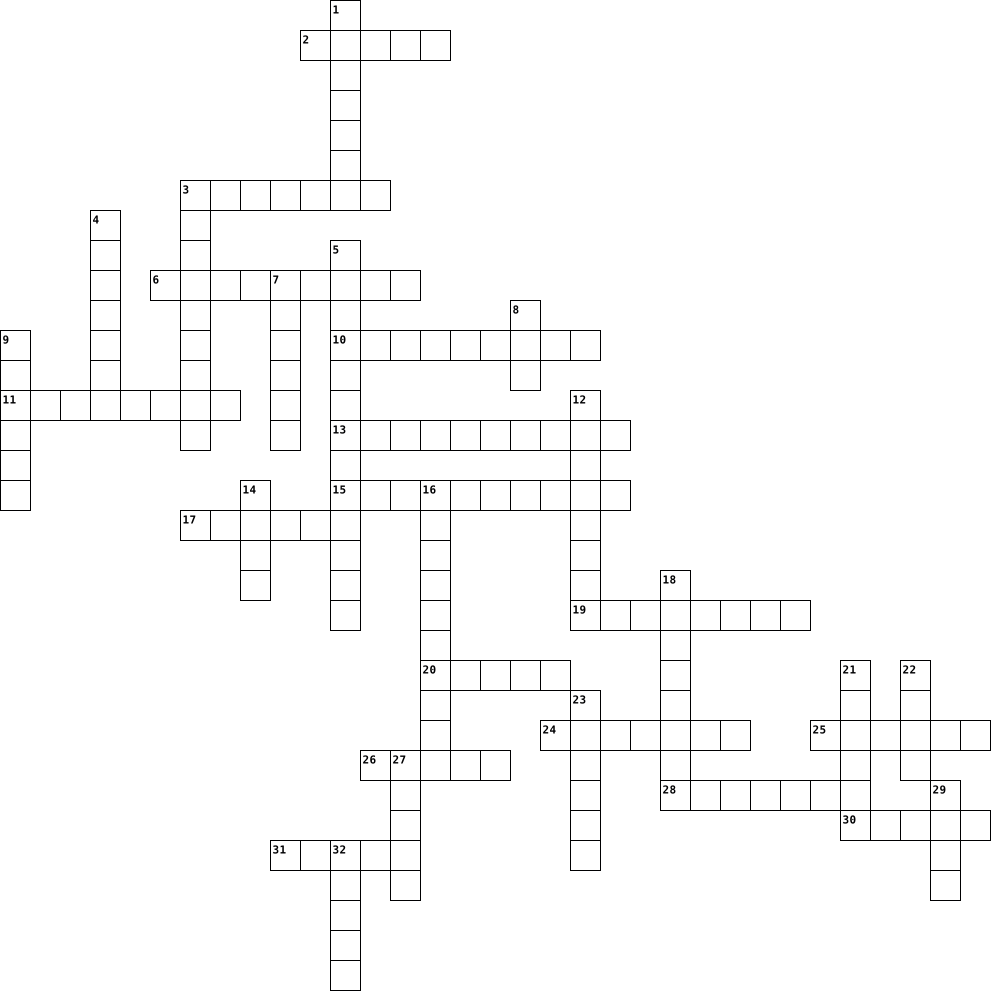
Across
- eclipse when the moon passes into the Earth's shadow.
- closest planet to the sun.
- something you use to get a closer look at distant objects.
- a man-made object that orbits Earth, the moon or other parts of space. (ex; the Moon it the Earths natural satellite.)
- small object that differs in size from a tiny speck, like a grain of sand, to 500km wide. Most asteroids originate in the asteroid belt between Mars and Jupiter.
- the distance that light travels in one year./
- someone that studies astronomy.
- a spherical object that orbits one or more stars, they do not share orbit with any other object.
- the turning of an object around an imaginary axis running through it.
- rising and falling of the water in the ocean.
- farthest planet from the sun.
- a huge group of stars, planets, gas and dust that is held together by gravity.
- second planet from the sun.
- when an object moves infront of another object seen from Earth
- system a group of planets that circle one or more stars.
- comes from the Kuiper Belt and Oort Cloud, composed of rocky material.
Down
- drops of _______.
- a piece of rock moving through space.
- a curve, usually called an oval or an egg shape.
- a group of stars that make an object/shape in the sky.
- a type of car, also a planet though.
- bang theory a show with a character named Sheldon Cooper.
- coldest planet in the solar system.
- something with months, days, and weeks on it.
- also known as a type of chocolate bar.
- the time it takes for an object to orbit another object.
- the location above or below the equator.
- of the moon the monthly changes in the appearance of the moon.
- twinkle, twinkle, little ____.
- something that hits the Earths atmosphere and burns up.
- the planet on which we live.
- energy a form of energy that makes up nearly 3/4 of the universe; has the effect of increasing the expansion of the universe.
- way the galaxy that includes the solar system; looks like a hazy white band in the night sky.
33 Clues: drops of _______. • closest planet to the sun. • second planet from the sun. • the planet on which we live. • farthest planet from the sun. • twinkle, twinkle, little ____. • someone that studies astronomy. • coldest planet in the solar system. • a type of car, also a planet though. • a piece of rock moving through space. • also known as a type of chocolate bar. • ...
Unit 4 Week 4 2019-02-25

Across
- a thin, often pointed piece that has been broken, cut, or torn off
- something exact or particular
- a curve that is wider in the middle and tapered at the ends
- a person who studies the stars and planets
- something that turns around on its axis
Down
- different stages of the moon
- instrument that makes distant objects seem larger and nearer
- a number of similar things coming one after another
8 Clues: different stages of the moon • something exact or particular • something that turns around on its axis • a person who studies the stars and planets • a number of similar things coming one after another • a curve that is wider in the middle and tapered at the ends • instrument that makes distant objects seem larger and nearer • ...
Celestial Bodies 2020-09-14

Across
- We breathe out as a complain
- Outer space is full of it when we have it we fart
- Only one of our eyes close
- Our largest planet, 11 times bigger than Earth
- A planet with many rings and no engagements
Down
- It is there during the day & changes by the season
- Your diaphragm moves fast & your breathing changes
- Space has many of them, our sun is our very own
- We do this when our eyes shut and open
- A celestial body we see at night & changes phases
10 Clues: Only one of our eyes close • We breathe out as a complain • We do this when our eyes shut and open • A planet with many rings and no engagements • Our largest planet, 11 times bigger than Earth • Space has many of them, our sun is our very own • Outer space is full of it when we have it we fart • A celestial body we see at night & changes phases • ...
Week 3 Spelling Words 2020-08-01

Across
- a particular written or musical work OR the way parts of something are put together
- to make a hole in something
- turning around on an axis
- to begin
- an accomplishment or something gained through hard work, courage or skill
- to finish
- the origin or something, the original places
Down
- a person who serves in the army
- to express pain, sadness or unhappy feelings about something
- when a planet, satellite or spaceship moves in a curved path around another body
- in a short length of time
- people who steal things
- to mix together
- stages in a cycle of development or process of change OR the stages of the moon as they change in relation to the Sun
- the power to make something work or be active
15 Clues: to begin • to finish • to mix together • people who steal things • in a short length of time • turning around on an axis • to make a hole in something • a person who serves in the army • the origin or something, the original places • the power to make something work or be active • to express pain, sadness or unhappy feelings about something • ...
science 2016-10-27

Across
- the dark part of a shadow
- the partial or total of one object in space by another
- one of the different apparent shapes of the moon as seen from earth
- they borrowed the Egyptian calendar
- either of the two days of the year on which neither hemisphere
- first calendar that was made
- a measure of the force of gravity on an object
- a calendar we still use today
Down
- pull all objects towards each other
- amount of matter in a object
- either of the days of the year on which the sun reaches its greatest
- a system that organizing times
- the part of shadow surrounding the darkest
- the tendency of an object to resist a change in motion
- an object as it is revolves around another objects in space
15 Clues: the dark part of a shadow • amount of matter in a object • first calendar that was made • a calendar we still use today • a system that organizing times • pull all objects towards each other • they borrowed the Egyptian calendar • the part of shadow surrounding the darkest • a measure of the force of gravity on an object • ...
Words Derived from Mythology (by Nunag) 2021-09-29

Across
- of enormous size, strength, power or scope; huge
- a repitition of sound from a mountain nymph that talked excessively
- a list of events in time from the god of time
- means mortal enemy
Down
- insane and believed to be affected by the phases of the moon (Luna)
- colored part of the eye; goddess of the rainbow
- a breakfast food prepared from grain
- came from the word Hygeia, the goddess of health
- a collection of maps in book form; a titan bearing the sky on his shoulders
- comes from Phobos, which means fear or terror
10 Clues: means mortal enemy • a breakfast food prepared from grain • comes from Phobos, which means fear or terror • a list of events in time from the god of time • colored part of the eye; goddess of the rainbow • of enormous size, strength, power or scope; huge • came from the word Hygeia, the goddess of health • ...
Purepeches 2022-12-08

Across
- the purepeches were part of ___________, the answer commonly is heard with oasis America and aridoamerica.
- common name for the purepeche language.
- Indigenous people group from Mesoamérica.
- animal that represents life and freedom.
- elected by leaders and only one who could start a war.
Down
- time when purepeches’ language was made.
- the social class segregation.
- consisting of 18 months and 20 days and the phases of the moon
- advanced culture that was beaten by the purepeches as their only lost war.
- place where the purepeche language is spoken now.
10 Clues: the social class segregation. • common name for the purepeche language. • time when purepeches’ language was made. • animal that represents life and freedom. • Indigenous people group from Mesoamérica. • place where the purepeche language is spoken now. • elected by leaders and only one who could start a war. • ...
38 - Space Race 2025-04-18

Across
- – Used for training astronauts in realistic mission scenarios.
- – Apollo 13 crew had to improvise a new CO₂ one.
- – Camera brand used to photograph the Moon.
- – Lunar Module Communications system.
- – Russian space agency, successor to Soviet space efforts.
- – Connection that supplied power and data to modules.
- – Rocket process where parts are jettisoned in phases.
- – Lunar module phase that brought astronauts to the Moon’s surface.
Down
- – Title used when speaking to the Flight Director at NASA.
- – First name of the first human in space.
- – Critical component for entering and exiting spacecraft.
- – Still essential — and yes, a different context each time!
- – Radiation belts surrounding Earth, crossed by Apollo craft.
- – Type of module where astronauts lived and controlled flight.
- – Oscillation issue in early Saturn V flights.
15 Clues: – Lunar Module Communications system. • – First name of the first human in space. • – Camera brand used to photograph the Moon. • – Oscillation issue in early Saturn V flights. • – Apollo 13 crew had to improvise a new CO₂ one. • – Connection that supplied power and data to modules. • – Rocket process where parts are jettisoned in phases. • ...
Module 12 Vocabulary 2023-07-27

Across
- the gently sloping accumulation of deposits that forms at the base of the continental slope
- a rhythmic movement that carries energy through space or matter
- the most prominent features of the ocean basins, which run through all of the ocean basins
- the lowest point of a wave
- moves slowly in deep ocean waters and is caused by differences in temperature and salinity of ocean water
- when high tides are higher than normal and low tides are lower than normal during a new or full moon - these moon phases cause the solar tides to enhance lunar tides
- submerged sandbar located in the surf zone of most beaches
- plots of water temperature against depth
- the deepest parts of the ocean basins
- the highest point of a wave
- the flattest parts of the ocean floor
- a current that flows parallel to the shore and is created by water from incoming breakers that spills over the longshore bar
- the shallowest part of a continental margin extending seaward from the shore
- a collapsing wave
- the measure of the amount of dissolved salt in seawater
- area where large rivers empty into the oceans, and where the areas of lowest salinity are often found
- the level of the ocean's surfaces
Down
- the upward motion of ocean water
- the area where edges of continents meet the ocean
- rapidly flowing water currents along the bottom of the sea
- a technique that directs sound waves to the seafloor at an angle so that the sides of underwater hills and other topographic features can be mapped
- submerged basaltic volcanoes that measure more than 1 km high
- long ridges of sand or other sediment that are deposited or shaped by the longshore current and are separated from the mainland
- the periodic rise and fall of sea level
- large, extinct, basaltic volcanoes with flat, submerged tops
- the sloping regions that quickly drop away from continental shelves
- the area in which sediment is deposited along the shore; composed of loose sediments deposited and moved about by waves along the shoreline
- wind-driven movement of ocean water that primarily affects the upper few hundred meters of the ocean
- a transitional layer under the surface layer of water that is characterized by rapidly decreasing temperatures with depth
- when high tides are lower than normal and low tides are higher than normal during first- or third-quarter moons - these moon phases cause solar tides to diminish lunar tides
- the process in which waves advancing toward shore slow when they encounter shallower water, causing the initially straight wave crests to bend towards the headlands
31 Clues: a collapsing wave • the lowest point of a wave • the highest point of a wave • the upward motion of ocean water • the level of the ocean's surfaces • the deepest parts of the ocean basins • the flattest parts of the ocean floor • the periodic rise and fall of sea level • plots of water temperature against depth • the area where edges of continents meet the ocean • ...
Franyelis’s 8.4 vocab 2025-01-10

Across
- light waves from space are bent causing what we see to be slightly different that what is actually there
- An astronomical event where an object cannot be seen because it is blocked by the shadow of another object in front of it
- the change in the direction of light due to a change in the medium
- occurring everyday
- accumulation of particles into a massive object that has a gravitational field
- having to do with the sun
- Regularity in the world
Down
- when energy passes through a medium and is deflected
- The process of change
- to happen once a year
- observing something in a different way
- commonly referred as the North Star
- height above a certain level
- the circular movement of an object around another object
- resembling a moon
15 Clues: resembling a moon • occurring everyday • The process of change • to happen once a year • Regularity in the world • having to do with the sun • height above a certain level • commonly referred as the North Star • observing something in a different way • when energy passes through a medium and is deflected • the circular movement of an object around another object • ...
Phases of the moon 2019-05-28

Across
- first phase of the moon
- when you can see 3/4 of the moon but mirrored
- when you can see 3/4 of the moon but mirrored
- when you can see half of the moon but mirrored
- Half of the moon
Down
- when you can see 3/4 of the moon
- second phase of the moon
- when the entire moon appear
8 Clues: Half of the moon • first phase of the moon • second phase of the moon • when the entire moon appear • when you can see 3/4 of the moon • when you can see 3/4 of the moon but mirrored • when you can see 3/4 of the moon but mirrored • when you can see half of the moon but mirrored
Unit 3 Vocab 2020-09-30

Across
- a planet's motion around the sun; Earth makes one full revolution around the sun once about every 365 days.
- a tide whose difference in high and low water levels is at its minimum due to the fact that the sun, Earth, and moon form a right angle; neap tides occur every 14 to 15 days during the first and last quarters of the moon cycle.
- the pattern of the changing phases of the moon that repeats about once every 29 or 30 days.
- a predictable change in ocean water level due to a change in gravitational pull on Earth's ocean water as the sun, moon, and Earth change positions relative to one another in space.
Down
- an ellipse-shaped path that an object travels along as it circles another object in space due to gravity.
- a tide whose difference in high and low water levels is at its maximum due to the fact that the sun, Earth, and moon form a line; spring tides occur every 14 to 15 days during the new moon and full moon.
- the spinning motion of a planet; Earth makes one full rotation every 24 hours.
- an imaginary line drawn from Earth's North Pole to its South Pole about which Earth rotates.
8 Clues: the spinning motion of a planet; Earth makes one full rotation every 24 hours. • the pattern of the changing phases of the moon that repeats about once every 29 or 30 days. • an imaginary line drawn from Earth's North Pole to its South Pole about which Earth rotates. • ...
Vocab U4W4 2024-02-21

Across
- a curve that is wider in the middle and tapered at the ends.
- a thin often pointed piece that has been broken, cut or torn off
- something that is exact or particular
- makes distant objects seem larger and nearer
- something that turns around on its axis
Down
- different stages of the moon
- a person who studies the stars and planets
- explains facts and information about a topic and includes text features
- a number of similar things coming one after another
9 Clues: different stages of the moon • something that is exact or particular • something that turns around on its axis • a person who studies the stars and planets • makes distant objects seem larger and nearer • a number of similar things coming one after another • a curve that is wider in the middle and tapered at the ends. • ...
Vocabulary Choice #2 Make a Crossword Puzzle with your words 2022-02-24

Across
- To turn around on its axis
- it makes distant objects seem larger and closer
- The different stages of the moon
- a number of similar things coming one after another
- to be exact or particular
Down
- a thin, often pointed piece that has been broken, cut, or torn off
- It is in a curve and is wider in the middle and thinner on the sides.
- A person who studies stars and planets
8 Clues: to be exact or particular • To turn around on its axis • The different stages of the moon • A person who studies stars and planets • it makes distant objects seem larger and closer • a number of similar things coming one after another • a thin, often pointed piece that has been broken, cut, or torn off • ...
Week 9 Spelling and Dictation 2022-12-01

Across
- today the _________ is rainy.
- the ___________ of the moon are the regular changes in its shape as it appears to us on Earth.
- she __________ the clay into a small bowl.
- environment some of the things in our _________________ are land, air, and water.
Down
- The Cube is a 3 ____________ shape.
- A _____________is a short part of a text.
- does a sphere have a __________?
- At the end of an information report, you will find the __________.
8 Clues: today the _________ is rainy. • does a sphere have a __________? • The Cube is a 3 ____________ shape. • A _____________is a short part of a text. • she __________ the clay into a small bowl. • At the end of an information report, you will find the __________. • environment some of the things in our _________________ are land, air, and water. • ...
4U4W4 Crossword 2016-09-05

Across
- the different stages of the moon
- a curve that is wider in the middle and tapered at the end
- someone who studies the stars and planets
- something exact or particular
- a thin, often pointed piece that has been broken, cut, or torn off
Down
- to turn around on an axis
- a tool that makes distant objects seem larger and nearer
- a number of similar things coming one after another
8 Clues: to turn around on an axis • something exact or particular • the different stages of the moon • someone who studies the stars and planets • a number of similar things coming one after another • a tool that makes distant objects seem larger and nearer • a curve that is wider in the middle and tapered at the end • ...
Unit 4 Week 4 Vocabulary Crossword Puzzle 2019-04-02

Across
- a thin, often pointed piece that has been broken, cut, or torn off
- a curve that is wider in the middle and tapered at the ends
- instrument that makes distant objects seem larger and nearer
- different stages of the moon
Down
- a number of similar things coming one after another
- a person who studies the stars and planets
- something that turns around on its axis
- something exact or particular
8 Clues: different stages of the moon • something exact or particular • something that turns around on its axis • a person who studies the stars and planets • a number of similar things coming one after another • a curve that is wider in the middle and tapered at the ends • instrument that makes distant objects seem larger and nearer • ...
moon phases and tides 2023-02-27

Across
- the alternate rising and falling of the sea, usually twice in each lunar day at a particular place, due to the attraction of the moon and sun.
- of, on, or relating to the earth.
- of, found in, or produced by the sea.
Down
- a tide just after a new or full moon, when there is the greatest difference between high and low water.
- of or denoting the area of a seashore which is covered at high tide and uncovered at low tide.
- the force that attracts a body toward the center of the earth, or toward any other physical body having mass.
- a tide just after the first or third quarters of the moon when there is least difference between high and low water.
7 Clues: of, on, or relating to the earth. • of, found in, or produced by the sea. • of or denoting the area of a seashore which is covered at high tide and uncovered at low tide. • a tide just after a new or full moon, when there is the greatest difference between high and low water. • ...
Tides and moon phases 2023-02-24

Across
- it's an zone that has high and low
- A zone that is very low
- It's really high or low
Down
- something that pulls things together
- when it's high or low
- a zone where it is very high
- there is not much of a diff. between the high and low
7 Clues: when it's high or low • A zone that is very low • It's really high or low • a zone where it is very high • it's an zone that has high and low • something that pulls things together • there is not much of a diff. between the high and low
Tides and Moon Phases 2023-02-24

Across
- When the tides don't move that much.
- When the tides are higher than normal.
- When you can't see the moon.
Down
- A sliver of the moon.
- When the moon phase is new or full moon and that is a big tide.
- You can see the inter moon.
- When the tides are lower than normal.
7 Clues: A sliver of the moon. • You can see the inter moon. • When you can't see the moon. • When the tides don't move that much. • When the tides are lower than normal. • When the tides are higher than normal. • When the moon phase is new or full moon and that is a big tide.
lunar cycle 2023-12-13

Across
- goes around the axis
- cause of falling sea levels
Down
- periods of time of the earth
- pulls things back down to earth
- the phases of the moon over the year
5 Clues: goes around the axis • cause of falling sea levels • periods of time of the earth • pulls things back down to earth • the phases of the moon over the year
Matter Ashlee W. 2015-03-11

Across
- one of the states of matter that takes on the shape of the container it’s in, and it has some energy
- one kind of atom that can’t be broken down into something simpler
- one of the states of matter that has little energy
- a change that changes how it looks, but doesn’t make a new substance
- a vapor changing into a liquid as it cools
- the amount of space matter takes up
- when a substance changes phases from a liquid to a gas
- when a substance changes phases from a solid to a liquid
- two or more different elements mixed together to make a new substance
- change a change that forms a new substance with different properties
- anything that has mass or takes up space
Down
- one of the states of matter that has a lot of energy
- a liquid changing to a gas as it gets hot
- the amount of matter in the given amount of space
- when a substance changes phases from liquid goes to a solid
- of matter when matter is in a stage where it’s a solid, liquid, gas, or plasma
- when a substance has dissolved in another think of the lemonade
- one of the states of matter that has a changeable shape and volume, and it has more energy
- two or more parts or elements that are combined
- made of combined atoms
- the smallest particle of an element, and these are the little things in molecules
21 Clues: made of combined atoms • the amount of space matter takes up • anything that has mass or takes up space • a liquid changing to a gas as it gets hot • a vapor changing into a liquid as it cools • two or more parts or elements that are combined • the amount of matter in the given amount of space • one of the states of matter that has little energy • ...
Moon 2021-04-18

Across
- Moon's nearest orbit point
- typically used to describe any of the long, narrow depressions in the surface of the Moon that resemble channels
- Much of the moons landscape
- Relating to a planet's or a moon's track
- Like the moon's landscape and many olives
- the lighter, heavily cratered regions of the Moon, which are generally several kilometers higher than the maria.
- Lunar Terrain
Down
- This is the eclipse when the Moon falls into Earth's shadow
- Moon's slender look
- bright streaks of material that we can see extending radially away from many impact craters
- moon surface
- are large, dark, basaltic plains on Earth's Moon, formed by ancient volcanic eruptions.
- One might study orbiting moon's terrain, in being eclipsed
- This is when one astronomical figure passes behind another astronomical figure
- Moon's farthest point from earth
- This is the Eclipse when the moon passes between the Earth and the Sun
16 Clues: moon surface • Lunar Terrain • Moon's slender look • Moon's nearest orbit point • Much of the moons landscape • Moon's farthest point from earth • Relating to a planet's or a moon's track • Like the moon's landscape and many olives • One might study orbiting moon's terrain, in being eclipsed • This is the eclipse when the Moon falls into Earth's shadow • ...
moon 2023-12-15

Across
- day and nights
- fully lit up moon
- earth moon and sun in a right angle
- light on right getting bigger
- blazing hot star the earth revolves around
- earth moon and sun lit up
Down
- years
- rock that revolves with earth
- very small lit up moon
- angle
- light on left getting smaller
- imaginary line through earth
- no light moon
- very big lit up moon
- planet with water and life
15 Clues: years • angle • no light moon • day and nights • fully lit up moon • very big lit up moon • very small lit up moon • earth moon and sun lit up • planet with water and life • imaginary line through earth • rock that revolves with earth • light on left getting smaller • light on right getting bigger • earth moon and sun in a right angle • blazing hot star the earth revolves around
Tides 2023-02-23

Across
- Portions of a coastline that goes through periods of coverage, and exposure to changing tides.
- A tide that would normally occur with all the moon phases.
- Tides that will occur when in a special phase that is small and not big.
- Ocean Waves that would rise and fall down normally to gravity.
- One of the small tides occurring with the neap when it's 1st and 3rd quarter.
- The higher you progress into the zone the more Terrestial it gets.
Down
- Something that the Moon and sun will pull to make the tides.
- land that has a very complex environment with lots of species that are adapted to the conditions.
- One of the if not the biggest tide of them all.
9 Clues: One of the if not the biggest tide of them all. • A tide that would normally occur with all the moon phases. • Something that the Moon and sun will pull to make the tides. • Ocean Waves that would rise and fall down normally to gravity. • The higher you progress into the zone the more Terrestial it gets. • ...
Moon phases and seasons 2023-02-13

Across
- 75%of the moon
- getting dark
- happens every month and is cold or hot or in between
- how high or low the water is
Down
- what happens to the moon ever so often and is either dark light or in between
- getting bright
- 25% of the moon
7 Clues: getting dark • 75%of the moon • getting bright • 25% of the moon • how high or low the water is • happens every month and is cold or hot or in between • what happens to the moon ever so often and is either dark light or in between
Luna and Venus Alchemy Crossword 2025-11-03

Across
- Symbol associated with Venus
- Venus’s personal motivation is the transformative power of ____ <3
- Roman goddess of love, relationships, passion, pleasure, beauty, charm, and fertility
- Roman goddess of the moon
- Metal associated with Venus
- Mia’s last name
- Greek parallel goddess of Luna *hint: family line*
- Toon’s last name
- Greek parallel goddess of Venus
- Symbol associated with Luna
- Day associated with Venus
Down
- Receptive raw substance in alchemy, associated with Luna
- Luna’s motivation is ____ with Sol in the sacred marriage (coniunctio)
- Alchemists saw Venus as a force of ____ (the union of opposites - similar to Luna)
- Luna’s attributes were adopted into ritual magic/astrology where _____ phases guided timing for alchemical operations and spellwork
- Alchemical process associated with both Luna and Venus
- Day associated with Luna
- Leona’s last name
- Common symbol/motif of Venus referencing her birth from the seafoam *hint: famous painting*
- Metal associated with Luna
- God often paired with Luna
21 Clues: Mia’s last name • Toon’s last name • Leona’s last name • Day associated with Luna • Roman goddess of the moon • Day associated with Venus • Metal associated with Luna • God often paired with Luna • Metal associated with Venus • Symbol associated with Luna • Symbol associated with Venus • Greek parallel goddess of Venus • Greek parallel goddess of Luna *hint: family line* • ...
Seasons of Plenty/Seasons of Want p.26-27 2021-02-25

Across
- a black powder formed when something is burned
- fat from the abdomen of a pig that is rendered and clarified for use in cooking
- kill animals for food
- wildly excited
Down
- planting by the moon’s phases which produces healthier, more vigorous plants and bigger crops
- a sink or basin, typically fixed to a wall or on a pedestal, used for washing one's hands and face
- an item of clothing
- a cover or shell that protects or encloses something
- able to survive outside during winter
9 Clues: wildly excited • an item of clothing • kill animals for food • able to survive outside during winter • a black powder formed when something is burned • a cover or shell that protects or encloses something • fat from the abdomen of a pig that is rendered and clarified for use in cooking • ...