
moon phases Crossword Puzzles
Tides or moon 2025-12-11

Across
- Tides will wash the baby grunion out the sea
- tides dictate their feeding, movement, and ability to stay cool and moist
- sparrow weavers the light of the moon gets them active
Down
- Navigate depends on the phases of the moon
- tides affect the coming and going of ships,sea startssea starts
5 Clues: Navigate depends on the phases of the moon • Tides will wash the baby grunion out the sea • sparrow weavers the light of the moon gets them active • tides affect the coming and going of ships,sea startssea starts • tides dictate their feeding, movement, and ability to stay cool and moist
Unit 3B Vocabulary 2016-11-18

Across
- The time for earth to rotate once on its axis
- A division of the year that is characterized by reoccurring weather conditions and determined by both the Earth’s tilt relative to the sun and the Earth’s position in its orbit around
- A force of attraction between two objects due to their masses
- phases The different appearances of the moon from Earth throughout the month
- A natural or artificial body that revolves around a celestial body that is greater in mass
- The movement when the sun appears to cross the celestial equator
- tide A tide of increased range that occurs two times a month, at the new and full moons
Down
- The time required for Earth to orbit once around the Sun
- The point at which the Sun is as far north or as far south of the equator as possible
- The spin of a body on its axis
- Sun
- tide A tide of minimum range that occurs during the first and third quarters of the moon
12 Clues: Sun • The spin of a body on its axis • The time for earth to rotate once on its axis • The time required for Earth to orbit once around the Sun • A force of attraction between two objects due to their masses • The movement when the sun appears to cross the celestial equator • phases The different appearances of the moon from Earth throughout the month • ...
Earth and Space 2016-03-20

Across
- an object that moves around another larger object in space
- made of rock and metal
- a force that pulls objects toward each other
- Earth does this around the sun once a year
- a group of stars that seems to form a picture in the night sky
- the largest planet in the solar system
- Earths spinning in space
- a ball of rock and frozen gases
Down
- an imaginary line through Earth
- zone the region of space where the temperature range allows life to thrive
- Earth is divided into theses halves
- the path that an object takes around another object in space
- a time of year with a particular type of weather
- the smallest planet in our solar system
- phases a change in the appearance of the moon's shape
- the first person to study the night sky using a telescope
- a large round body that revolves around a star in a clear orbit
17 Clues: made of rock and metal • Earths spinning in space • an imaginary line through Earth • a ball of rock and frozen gases • Earth is divided into theses halves • the largest planet in the solar system • the smallest planet in our solar system • Earth does this around the sun once a year • a force that pulls objects toward each other • ...
Vocab Unit 4 Week 4 2023-02-16

Across
- different stages of the moon
- a curve that is wider in the middle and tapered at the ends
- a Greek philosopher who thought comets looked like stars with hair
- a number of similar things coming one after another
Down
- something that is exact or particular
- rocky debris and fragments that enter Earth's atmosphere (shooting stars)
- a thing often pointed piece that has been broken, cut or torn off
- a person who studies the stars and planets
- when something turns around on an axis
9 Clues: different stages of the moon • something that is exact or particular • when something turns around on an axis • a person who studies the stars and planets • a number of similar things coming one after another • a curve that is wider in the middle and tapered at the ends • a thing often pointed piece that has been broken, cut or torn off • ...
The Life Of A Witch 2013-10-18

Across
- The Wiccan _____ (4 letters)
- Midsummer
- Sabbat beginning with Y
- Tree of power
- We follow its phases throughout the year
- Eggs and spring flowers decorate your altar on this Sabbat
- Horned One
- Five pointed star encased in a circle
- There are 8 in the witches year
- We do these at each Sabbat (6 letters beginning with R)
- Important activity in which you relax and go on a journey through your mind
- Sabbat when the veil between the worlds grows thin
- North, East, West...?
- Ladys tree
Down
- Associated with Water
- Autumn Equinox
- Divination tool
- Lughnasadh - Harvest festival
- Associated with the element of Earth
- Our source of light and heat on this planet
- Maiden, Mother and Crone
- Sabbat associtaed with fire and marriage
- An animal - A witches best friend?
- Associated with the element of Air
- A specialist field in witchcraft concerning herbs
- Bide the ____ law ye must.
- Candlemass
27 Clues: Midsummer • Horned One • Candlemass • Ladys tree • Tree of power • Autumn Equinox • Divination tool • Associated with Water • North, East, West...? • Sabbat beginning with Y • Maiden, Mother and Crone • Bide the ____ law ye must. • The Wiccan _____ (4 letters) • Lughnasadh - Harvest festival • There are 8 in the witches year • An animal - A witches best friend? • ...
Week 6 Vocabulary 2015-10-14

Across
- to appraise or determine
- an object in space that orbits the sun on it's belt
- a secondhand account written after an event has occurred
- to distinguish differences of someone or something
- when a meteoroid has entered the earth's atmosphere
- to criticize or have opinions of someone or something
- to go on an expedition or journey
- an object in space that is made out of rock,ice,and dust and orbits the sun
- to intensify or magnify
- to review something
Down
- a literary plot that leads up to something exciting
- to increase or stretch out
- an object that gives firsthand information
- the part of a plot where the conflict has been resolved
- to refine and improve
- to acquire or assume
- to expand or widen
- to study or research someone or something
- the appearance of phases of the moon as viewed from the earth
- to go on a trek or adventure
20 Clues: to expand or widen • to review something • to acquire or assume • to refine and improve • to intensify or magnify • to appraise or determine • to increase or stretch out • to go on a trek or adventure • to go on an expedition or journey • to study or research someone or something • an object that gives firsthand information • to distinguish differences of someone or something • ...
SS Atlantic Puzzle # 1 2025-04-26

Across
- place to park a boat
- a measure of depth
- a Prospect community
- controlled by phases of the moon
- wooden devise that can move a boat
- large stone to remember the tragedy
- a person who helps other
- a warning signal
- type of boat that rescued survivors
- distance across a ship
- cove road to a great beach
- back of a ship
- a shallow place
- a helping community
- place which bodies are buried
Down
- you can peek through
- front of a ship
- Bay where is the interpretative centre
- a length of rope on a ship
- person to is responsible for a ship
- a measure of ship speed
- a terrible deadly accident
- type of blanket
- cloth ___ was made by a local lady
- pole which one attaches sails
- holds a ship fast
- fabric which can fly in the wind
- makes a sail
- metalshaped to move a ship
- very cold temperature
30 Clues: makes a sail • back of a ship • front of a ship • type of blanket • a shallow place • a warning signal • holds a ship fast • a measure of depth • a helping community • you can peek through • place to park a boat • a Prospect community • very cold temperature • distance across a ship • a measure of ship speed • a person who helps other • a length of rope on a ship • a terrible deadly accident • ...
science vocab crossword 2016-11-03

Across
- the time for Earth to rotate once on its axis
- the time required for Earth to orbit once around the Sun
- the movement when the sun appears to cross the celestial equator
- a force of attraction between two objects due to their masses
- the point at which the Sun is as far north or as far south of the equator as possible
- Phases the different appearances of the moon from Earth throughout the month
- Tide a tide of minimum range that occurs during the first and third quarters of the moon
Down
- a division of the year that is characterized by reoccurring weather conditions and determined by both the Earth’s tilt relative to the sun and the Earth’s position in its orbit around
- a natural or artificial body that revolves around a celestial body that is greater in mass
- Sun
- the spin of a body on its axis
- Tide a tide of increased range that occurs two times a month, at the new and full moons
12 Clues: Sun • the spin of a body on its axis • the time for Earth to rotate once on its axis • the time required for Earth to orbit once around the Sun • a force of attraction between two objects due to their masses • the movement when the sun appears to cross the celestial equator • Phases the different appearances of the moon from Earth throughout the month • ...
Space: Planets, Moons, Stars, and More! 2021-03-31

Across
- all of space and everything in it including starts, planets, galaxies, etc.
- mountains with a hole in the top or side that sometimes sends out rocks, ash, lava, etc., in a sudden explosion
- four periods (spring, summer, autumn, and winter) into which the year is commonly divided
- a heavy type of metal is used to make steel and in many products
- a natural force that tends to cause physical things to move towards each other
- the shape of the part of the moon that is visible at different times during a month
Down
- a device shaped like a long tube that you look through in order to see things that are far away
- smaller than normal size
- not rare; occurring all the time
- known or recognized by very many people
- of or relating to the sun
- the curved path that something (such as a moon or satellite) follows as it goes around something else (such as a planet)
12 Clues: smaller than normal size • of or relating to the sun • not rare; occurring all the time • known or recognized by very many people • a heavy type of metal is used to make steel and in many products • all of space and everything in it including starts, planets, galaxies, etc. • a natural force that tends to cause physical things to move towards each other • ...
space 2016-11-04

Across
- a division of the year that is characterized by reoccurring weather conditions and determined by both the Earth’s tilt relative to the sun and the Earth’s position in its orbit around
- a force of attraction between two objects due to their masses.
- Sun.
- the point at which the Sun is as far north or as far south of the equator as possible.
- Tide- a tide of minimum range that occurs during the first and third quarters of the moon.
Down
- the time for Earth to rotate once on its axis.
- the time required for Earth to orbit once around the Sun.
- Phases- the different appearances of the moon from Earth throughout the month.
- the spin of a body on its axis.
- a natural or artificial body that revolves around a celestial body that is greater in mass.
- Tide- a tide of increased range that occurs two times a month, at the new and full moons.
- the movement when the sun appears to cross the celestial equator.
12 Clues: Sun. • the spin of a body on its axis. • the time for Earth to rotate once on its axis. • the time required for Earth to orbit once around the Sun. • a force of attraction between two objects due to their masses. • the movement when the sun appears to cross the celestial equator. • Phases- the different appearances of the moon from Earth throughout the month. • ...
Unit 3 Vocab By Jett Bonner 2016-11-02

Across
- a force of attraction between two objects due to their masses.
- a division of the year that is characterized by reoccurring weather conditions and determined by both the Earth’s tilt relative to the sun and the Earth’s position in its orbit around
- a natural or artificial body that revolves around a celestial body that is greater in mass.
- the spin of a body on its axis.
- Phases the different appearances of the moon from Earth throughout the month.
- the movement when the sun appears to cross the celestial equator.
- the time required for Earth to orbit once around the Sun.
Down
- the time for Earth to rotate once on its axis.
- Sun.
- the point at which the Sun is as far north or as far south of the equator as possible.
- Tide a tide of increased range that occurs two times a month, at the new and full moons.
- Tide a tide of minimum range that occurs during the first and third quarters of the moon.
12 Clues: Sun. • the spin of a body on its axis. • the time for Earth to rotate once on its axis. • the time required for Earth to orbit once around the Sun. • a force of attraction between two objects due to their masses. • the movement when the sun appears to cross the celestial equator. • Phases the different appearances of the moon from Earth throughout the month. • ...
Vocab 3B By Jett 2016-11-18

Across
- a division of the year that is characterized by reoccurring weather conditions and determined by both the Earth’s tilt relative to the sun and the Earth’s position in its orbit around
- the point at which the Sun is as far north or as far south of the equator as possible.
- Tide a tide of minimum range that occurs during the first and third quarters of the moon.
- the movement when the sun appears to cross the celestial equator.
- a force of attraction between two objects due to their masses.
Down
- Phases the different appearances of the moon from Earth throughout the month.
- the spin of a body on its axis.
- the time required for Earth to orbit once around the Sun.
- a natural or artificial body that revolves around a celestial body that is greater in mass.
- Sun.
- Tide a tide of increased range that occurs two times a month, at the new and full moons.
- the time for Earth to rotate once on its axis
12 Clues: Sun. • the spin of a body on its axis. • the time for Earth to rotate once on its axis • the time required for Earth to orbit once around the Sun. • a force of attraction between two objects due to their masses. • the movement when the sun appears to cross the celestial equator. • Phases the different appearances of the moon from Earth throughout the month. • ...
Big Idea 5 vocabulary 2022-10-24

Across
- phases an indication of the fraction of the moon that is illuminated as seen from Earth.
- A term used to describe the magnetic force exerted by oppositely charged objects or to describe the gravitational force that pulls objects toward each other.
- An object that is found in the solar system, orbits the Sun, and is much smaller than a planet.
- The amount of matter a substance or object has.
- a group of billions of stars, the objects that orbit the stars, gas, and dust.
- Half of Earth.
- A natural object that orbits a planet.
- everything that exists.
Down
- An object made of rock, ice, dust, and gas that revolves around the Sun.
- The path of one object in space around another object
- A large body in space that orbits a star and does not produce its own light.
- system A system of planets and other bodies that orbits a star.
- A large object in space that is made of gas and produces its own light.
- A pattern of stars that form an imaginary picture in the sky
- the imaginary line around which Earth spins as it rotates
- The turning of an object on its axis.
- planet nearly round bodies whose orbits cross the orbits of other bodies.
- The motion of one object around another object.
18 Clues: Half of Earth. • everything that exists. • The turning of an object on its axis. • A natural object that orbits a planet. • The amount of matter a substance or object has. • The motion of one object around another object. • The path of one object in space around another object • the imaginary line around which Earth spins as it rotates • ...
Earth and Sun Review 2024-12-16

Across
- is when water vapor in the air gets cold turned into a liquid to form clouds
- (two words)when one material heats or cools faster than another material
- compressed air pushed with equal force
- oval path around the sun
- is water that comes from the sky in the form of ice, snow, sleet or hail
- energy transfer that happens between particles when they come in contact
- object turns or spins around
- is when liquid water changes into vapor or steam because of heat
Down
- stuff that makes up things
- imaginary shaft an object turns
- earth turning around its axis
- the dark area created by an object that stops light
- weight
- position or arrangement in relation to an object, position or location
- all phases of moon less than a quarter
- confined air forced into smaller space
- amount of water vapor
17 Clues: weight • amount of water vapor • oval path around the sun • stuff that makes up things • object turns or spins around • earth turning around its axis • imaginary shaft an object turns • all phases of moon less than a quarter • compressed air pushed with equal force • confined air forced into smaller space • the dark area created by an object that stops light • ...
vocabulary 2016-11-03

Across
- tide a tide of increased range that occurs two times a month, at the new and full moons.
- the time for Earth to rotate once on its axis.
- the point at which the Sun is as far north or as far south of the equator as possible.
- the spin of a body on its axis.
- a division of the year that is characterized by reoccurring weather conditions and determined by both the Earth’s tilt relative to the sun and the Earth’s position in its orbit around
Down
- phases the different appearances of the moon from Earth throughout the month.
- a force of attraction between two objects due to their masses.
- a natural or artificial body that revolves around a celestial body that is greater in mass.
- the time required for Earth to orbit once around the Sun.
- the movement when the sun appears to cross the celestial equator.
- Sun.
- tide a tide of minimum range that occurs during the first and third quarters of the moon.
12 Clues: Sun. • the spin of a body on its axis. • the time for Earth to rotate once on its axis. • the time required for Earth to orbit once around the Sun. • a force of attraction between two objects due to their masses. • the movement when the sun appears to cross the celestial equator. • phases the different appearances of the moon from Earth throughout the month. • ...
The solar system 2025-12-03

Across
- A natural satellite that orbits a planet.
- A large astronomical body orbiting a star.
- A large, self-luminous ball of gas that generates heat and light through nuclear fusion.
- PLANET A planet that is primarily composed of silicate rocks or metals, like Earth or Mars.
- SYSTEM The gravitationally bound system of the Sun and the objects that orbit it.
Down
- An icy, small Solar System body that, when passing close to the Sun, warms and begins to release gases, a process called outgassing.
- The changes in the visible shape of the Moon, Venus, and Mercury.
- A streak of light in the night sky produced by a small particle of space debris burning up in the Earth's atmosphere.
- A small, rocky body orbiting the Sun, typically found in the main belt between Mars and Jupiter.
- GIANT A large planet composed mainly of hydrogen and helium, such as Jupiter or Saturn.
- An astronomical event that occurs when one celestial body is temporarily hidden by another.
- The star at the centre of the Solar System.
12 Clues: A natural satellite that orbits a planet. • A large astronomical body orbiting a star. • The star at the centre of the Solar System. • The changes in the visible shape of the Moon, Venus, and Mercury. • SYSTEM The gravitationally bound system of the Sun and the objects that orbit it. • ...
Earth and Space 2016-03-20

Across
- Earths spinning in space
- a ball of rock and frozen gases
- the first person to study the night sky using a telescope
- an imaginary line through Earth
- Earth is divided into theses halves
- a large round body that revolves around a star in a clear orbit
- Earth does this around the sun once a year
- zone the region of space where the temperature range allows life to thrive
Down
- the path that an object takes around another object in space
- a group of stars that seems to form a picture in the night sky
- phases a change in the appearance of the moon's shape
- an object that moves around another larger object in space
- the largest planet in the solar system
- the smallest planet in our solar system
- made of rock and metal
- a time of year with a particular type of weather
- a force that pulls objects toward each other
17 Clues: made of rock and metal • Earths spinning in space • a ball of rock and frozen gases • an imaginary line through Earth • Earth is divided into theses halves • the largest planet in the solar system • the smallest planet in our solar system • Earth does this around the sun once a year • a force that pulls objects toward each other • ...
Earth and Space 2016-03-20

Across
- a large round body that revolves around a star in a clear orbit
- phases a change in the appearance of the moon's shape
- Earths spinning in space
- the largest planet in the solar system
- Earth does this around the sun once a year
- made of rock and metal
- a group of stars that seems to form a picture in the night sky
- an object that moves around another larger object in space
Down
- the first person to study the night sky using a telescope
- a ball of rock and frozen gases
- a time of year with a particular type of weather
- the path that an object takes around another object in space
- a force that pulls objects toward each other
- the smallest planet in our solar system
- Earth is divided into theses halves
- zone the region of space where the temperature range allows life to thrive
- an imaginary line through Earth
17 Clues: made of rock and metal • Earths spinning in space • a ball of rock and frozen gases • an imaginary line through Earth • Earth is divided into theses halves • the largest planet in the solar system • the smallest planet in our solar system • Earth does this around the sun once a year • a force that pulls objects toward each other • ...
Scientific Revolution 2024-03-05

Across
- the Earth is the center of the universe
- Galileo used this to observe phases of Venus
- your body & mind are two seperate things
- came up with the heliocentric theory
- Newton's laws of motion set the groundwork for this modern field of science
- the sun is the center of the universe
Down
- Galileo discovered this had craters
- If I do this then this will happen
- for awhile people believed the world was made up of 4 of these
- I think therefore I am
- A few scholars started challenging old assumptions and claims of the church
- Mr. Izatt's Zodiac sign
- this religious denomination threatened Galileo w/ life in prison
- initially all human anatomy was based on these
- the use of all of your senses
- Galileo discovered this planet also had mooons
- came up with the law of gravity
17 Clues: I think therefore I am • Mr. Izatt's Zodiac sign • the use of all of your senses • came up with the law of gravity • If I do this then this will happen • Galileo discovered this had craters • came up with the heliocentric theory • the sun is the center of the universe • the Earth is the center of the universe • your body & mind are two seperate things • ...
Week 6 Vocabulary 2015-10-14

Across
- To Expand Or Widen
- To Criticize Or Have Opinions Of Someone Or Something
- To Intensify Or Magnify
- An Object That Gives Firsthand Information
- To Appraise Or Determine
- An Object In Space That Is Made Out Of Rock,Ice,And Dust And Orbits The Sun
- The Part Of A Plot Where The Conflict Has Been Resolved
- To Acquire Or Assume
- To Refine And Improve
- The Appearance Of Phases Of The Moon As Viewed From The Earth
- To Go On A Trek Or Adventure
Down
- A Secondhand Account Written After An Event Has Occurred
- A Literary Plot That Leads Up To Something Exciting
- To Increase Or Stretch Out
- An Object In Space That Orbits The Sun On It's Belt
- To Go On An Expedition Or Journey
- When A Meteoroid Has Entered The Earth's Atmosphere
- To Review Something
- To Distinguish Differences Of Someone Or Something
- To Study Or Research Someone Or Something
20 Clues: To Expand Or Widen • To Review Something • To Acquire Or Assume • To Refine And Improve • To Intensify Or Magnify • To Appraise Or Determine • To Increase Or Stretch Out • To Go On A Trek Or Adventure • To Go On An Expedition Or Journey • To Study Or Research Someone Or Something • An Object That Gives Firsthand Information • To Distinguish Differences Of Someone Or Something • ...
Electricity and Magnetism 2024-04-23

Across
- force that attracts all objects toward each other
- a body that orbits a planet
- a giant ball of superheated gas (H & He)
- when an object in the sky comes between the sun and a third object
- different shapes of the moon that you see
- pattern or group of stars
- cold mixture of dust and ice with a long tail
- path followed by one object around a second object
- an object that orbits the sun large and rounded
- movement of one object around another
Down
- imaginary line that passes through the center of Earth
- tendency of an object to resist change in motion
- darkest part of an eclipses shadow
- Sun centered universe
- one day per year when the sun appears highest in the sky
- Earth centered universe
- when neither hemisphere is tilted toward the sun
- orbit of a planet that is oval
- spinning of Earth on its axis
- streak of light produced when a meteoroid burns
20 Clues: Sun centered universe • Earth centered universe • pattern or group of stars • a body that orbits a planet • spinning of Earth on its axis • orbit of a planet that is oval • darkest part of an eclipses shadow • movement of one object around another • a giant ball of superheated gas (H & He) • different shapes of the moon that you see • ...
The Sun (Fusion At Work) - Jaxson Muck 2024-11-13

Across
- Scientific Units placed in the Earths orbit to research the Earth and space
- Star at the center of our solar system
- Number describing the age of the Sun
- The study of absorption and emission of light
- Stage of when the sun is directly behind the moon
- Stone structure formed for 1500 years by 3 cultures
- Force atoms have to resist fusion
- Myths of different religions and thoughts of early science
- the ignition of a star
- Waves of energy that come from the Sun
Down
- A stream of subatomic charged particles from the Sun
- Measurement of energy
- Planet that makes up most of the planets' mass in the solar system
- 4 phases of temperature change throughout the year
- Term used to describe how something is able to use solar energy
- Process plants use for energy
- Statement of equality in a substance or process
- Force of atoms that lay in the same polar directions
- The equal negative of an electron
- The God of Life
20 Clues: The God of Life • Measurement of energy • the ignition of a star • Process plants use for energy • Force atoms have to resist fusion • The equal negative of an electron • Number describing the age of the Sun • Star at the center of our solar system • Waves of energy that come from the Sun • The study of absorption and emission of light • ...
Spelling Words /f/ sound 2025-05-20

Across
- I didn’t have ___ money to buy the book.
- There were ___ twenty people at the party.
- The moon goes through different ___ each month.
- The joke was so funny, we couldn’t stop ___.
- Use a ___ to pour the liquid without spilling.
- The hikers prepared for a long ___.
- The bus ___ was $2.50 for the ride.
- He will ___ finish his homework by dinner.
- A basketball is ___ in shape.
- The ___ today is rainy and cold.
- Weather can ___ your mood and energy.
Down
- I’m not sure ___ we’ll go to the park or stay home.
- The signature on the check looked ___.
- This puzzle is ___ than the last one!
- Mom made turkey with ___ for Thanksgiving.
- She won a gold ___ for first place in the race.
- Can you ___ the animal tracks in the snow?
- A ___ has a long neck to reach high leaves.
- The ___ at the zoo had huge ears and a long trunk.
- Snow White was the ___ of them all.
- “Under the weather” is a common ___.
21 Clues: A basketball is ___ in shape. • The ___ today is rainy and cold. • The hikers prepared for a long ___. • The bus ___ was $2.50 for the ride. • Snow White was the ___ of them all. • “Under the weather” is a common ___. • This puzzle is ___ than the last one! • Weather can ___ your mood and energy. • The signature on the check looked ___. • ...
phases of the moon 2023-01-24

Across
- the Moon appears dark from Earth
- the left half of the Moon is illuminated
- starts right after the First Quarter
- the left half of the Moon is illuminated
Down
- Moon is illuminated 1000%
- a small portion is illuminated on the left side
- occurs right after the New Moon
- between full and last quarter Moon (mostly full)
8 Clues: Moon is illuminated 1000% • occurs right after the New Moon • the Moon appears dark from Earth • starts right after the First Quarter • the left half of the Moon is illuminated • the left half of the Moon is illuminated • a small portion is illuminated on the left side • between full and last quarter Moon (mostly full)
Nathan´s 3B Vocab 2016-11-18

Across
- a division of the year that is characterized by reoccurring weather conditions and determined by both the Earth’s tilt relative to the sun and the Earth’s position in its orbit around
- a force of attraction between two objects due to their masses.
- a natural or artificial body that revolves around a celestial body that is greater in mass.
- the movement when the sun appears to cross the celestial equator.
- Tide a tide of increased range that occurs two times a month, at the new and full moons.
Down
- Phases the different appearances of the moon from Earth throughout the month.
- the time required for Earth to orbit once around the Sun.
- the point at which the Sun is as far north or as far south of the equator as possible.
- the time for Earth to rotate once on its axis.
- the spin of a body on its axis.
- Sun.
- Tide a tide of minimum range that occurs during the first and third quarters of the moon.
12 Clues: Sun. • the spin of a body on its axis. • the time for Earth to rotate once on its axis. • the time required for Earth to orbit once around the Sun. • a force of attraction between two objects due to their masses. • the movement when the sun appears to cross the celestial equator. • Phases the different appearances of the moon from Earth throughout the month. • ...
Earth Science chapter 19 and 20 Crossword 2013-03-07

Across
- Jupiter Saturn Uranus Neptune.
- The spinning of Earth on its axis.
- Large round pits on the moons surface.
- The tendency of an object to resist change in motion,
- The trapping of heat in the atmospere.
- a chunk of rock or dust in spaces that comes from comets or asteroids.
- The movement of one object around another.
- Meteoroid that passs through Earth's atmosphere and hit the surface.
- Sun centered model of the solar system developed by Copernicus.
- The imaginary line that passes through Earth's center and the North and South Poles.
- Doughnut shaped region that extends from beyond Neptunes orbit.
- A tide with the greatest difference between consecutive low and high tides.
- When a meteoroid enters Earth's atmosphere and produces a streak of light in the sky.
- The rise and fall of the oceans water
- The amount of matter in an object.
- 23.5 degrees.
- The darkest part of the moon's shadow.
- shape of planetary orbits.
- Dark, flat areas on the moon's surface.
Down
- An array of Radio telescopes located in West Virginia.
- The different shapes of the moon you see from Earth.
- The path that Earth follows.
- The force of gravity on an object.
- Sun Moon Earth
- The force that attracts all objects towards one another.
- Mercury Venus Earth Mars
- Sun Earth Moon
- A tide with the least difference between consecutive low and high tides.
- Rocky objects that are too small and too numerous to be considered full fledged planets.
- A spherical region of comets that surround the solar system.
- Earth centered model of the solar system developed by Ptolemy.
- When an object in space comes between the sun and a third object.
- The larger part of the moon's shadow andis less dark.
- means "equal night"
- when the sun reaches its greatest distance north or south of the equator.
- The study of moon, stars, and other objects in space.
- A "dirty snowball"
37 Clues: 23.5 degrees. • Sun Moon Earth • Sun Earth Moon • A "dirty snowball" • means "equal night" • Mercury Venus Earth Mars • shape of planetary orbits. • The path that Earth follows. • Jupiter Saturn Uranus Neptune. • The force of gravity on an object. • The spinning of Earth on its axis. • The amount of matter in an object. • The rise and fall of the oceans water • ...
Solar Eclipse 2024-04-08

Across
- A recurring sequence or pattern that repeats over time
- A soft, radiant light emitted by an object or substance
- The vast, seemingly infinite expanse that contains all celestial objects
- The layer of gases surrounding a planet or celestial body, held in place by gravity.
- A luminous celestial body made up of hot gases, like our sun
- A group of stars that form a recognizable pattern or shape in the night sky.
- A circular band or loop shape, like Saturn's rings
- The study of celestial objects, space, and the universe
- The planet we live on, known as the "Blue Planet"
- Earth's natural satellite that orbits around it at night
- The path followed by a celestial object around another object
- The period of darkness when the sun is below the horizon
- The expanse above us that contains the sun, moon, stars, and clouds
- Electromagnetic radiation that allows us to see and brightens our world
- A facility equipped with telescopes and instruments for observing celestial objects and phenomena.
Down
- When one celestial body blocks the light from another, like a solar or lunar eclipse
- The different stages or appearances of the moon or a celestial body
- Related to the moon, like lunar phases or lunar landings
- A facility equipped for observing
- A celestial object composed of ice, dust, and gas that develops a bright tail as it approaches the sun.
- The period of light between sunrise and sunset
- A small celestial body that enters Earth's atmosphere and burns up, creating a streak of light in the sky.
- A vast system of stars, gas, and dust held together by gravity
- The star at the center of our solar system that provides light and heat
- Related to the sun or derived from it, like solar energy
- A celestial object composed of ice, dust, and gas that develops a glowing tail
- Incomplete or not whole, as in a partial eclipse
- An optical instrument used for observing distant objects in space
- A dark area caused by an object blocking light from a source
- Complete or whole, as in a total eclipse
30 Clues: A facility equipped for observing • Complete or whole, as in a total eclipse • The period of light between sunrise and sunset • Incomplete or not whole, as in a partial eclipse • The planet we live on, known as the "Blue Planet" • A circular band or loop shape, like Saturn's rings • A recurring sequence or pattern that repeats over time • ...
The Outer Planets And Their Moons 2022-11-02

Across
- The last of the Galilean moons
- Uranus's largest moon
- The fifth planet from the sun
- Farthest known solar planet
- Jupiter's closest galilean moon
- The Solar System's largest moon
- Uranus's fourth largest moon
- Second largest Neptunian moon
- The moon where water was detected beneath it's surface by the Cassini space probe
- Ninth largest moon of the Solar System
- The planet known for it's rings in the Solar System
- Stop pronouncing this planet's name wrong
Down
- The innermost of Uranus's five round moons
- Uranus's outermost major moon
- Saturn's largest moon
- Third largest moon of Neptune
- Saturn's moon which looks like an oval sponge
- 24th of Saturn's 83 known moons
- Third largest moon of Uranus
- It's orbital period around Saturn is only 23 hours
- Neptune's largest moon
- Fifth closest inner moon of Neptune
- Fourth largest moon of Saturn
- Saturn's moon which is somewhat hard to spell
- Jupiter's moon that sounds like a continent on Earth
25 Clues: Saturn's largest moon • Uranus's largest moon • Neptune's largest moon • Farthest known solar planet • Third largest moon of Uranus • Uranus's fourth largest moon • Uranus's outermost major moon • Third largest moon of Neptune • The fifth planet from the sun • Fourth largest moon of Saturn • Second largest Neptunian moon • The last of the Galilean moons • ...
Luner cycle 2023-12-13

Across
- the rotating on the x-axis
Down
- An instant of revolving
- cycle: the eight phases of the moon
- The force that pushes two objects together
- Cause from the moon's gravitational pull.
5 Clues: An instant of revolving • the rotating on the x-axis • cycle: the eight phases of the moon • Cause from the moon's gravitational pull. • The force that pushes two objects together
learn about moon phases 2023-11-20

Across
- the left side is brighter untill the middle of the moon.
- the left is brighter than the right side
- the whole thing is dark.
Down
- the right is brighter.
- half of the moon is bright the rest is dark.
- the whole thing is bright
- the right side is bright.
- half of the moon is bright the rest is dark.
8 Clues: the right is brighter. • the whole thing is dark. • the whole thing is bright • the right side is bright. • the left is brighter than the right side • half of the moon is bright the rest is dark. • half of the moon is bright the rest is dark. • the left side is brighter untill the middle of the moon.
Phases of Moon Vocab 2024-02-09

Across
- Light begins to recede back into a New Moon
- Half the moon can be seen on the right side, Light is getting larger
- Half the moon can be seen on the left side, Light is getting smaller
Down
- Light gets bigger closer to a full moon
- Completely dark, No reflection of light
- More than half of the Moon can be seen
- The entire Moon can be seen, Fully illuminated
7 Clues: More than half of the Moon can be seen • Light gets bigger closer to a full moon • Completely dark, No reflection of light • Light begins to recede back into a New Moon • The entire Moon can be seen, Fully illuminated • Half the moon can be seen on the right side, Light is getting larger • Half the moon can be seen on the left side, Light is getting smaller
moon phases and tides 2023-02-24

Across
- the alternate rising and falling of the sea, usually twice in each lunar day at a particular place, due to the attraction of the moon and sun
- of, on, or relating to the earth
- of, found in, or produced by the sea.
Down
- a tide just after a new or full moon, when there is the greatest difference between high and low water.
- of or denoting the area of a seashore which is covered at high tide and uncovered at low tide.
- the force that attracts a body toward the center of the earth, or toward any other physical body having mass.
- a tide just after the first or third quarters of the moon when there is least difference between high and low
7 Clues: of, on, or relating to the earth • of, found in, or produced by the sea. • of or denoting the area of a seashore which is covered at high tide and uncovered at low tide. • a tide just after a new or full moon, when there is the greatest difference between high and low water. • ...
Strange Words Venusians Use 2022-03-18

Across
- the path that Venus makes as observed from Earth
- when two astronomical objects align themselves together
- an apparent weak illumination of Venus’ dark side
- Venus is placed just to the right of the large cypress tree in this famous painting
- a group of rift zones on the surface of Venus – noted possible hotspot vulcanism location
- visual phenomenon occurring during a transit of Venus ( and Mercury)
- requires 3 things: a conducting liquid, rotation and convection
- a mineral commonly found on the surface of Venus – the result of many volcanoes
Down
- The space probe that mapped the Venusian surface
- all planets ORBIT around the Sun and ROTATE this way – except Venus rotates clockwise
- no natural moons but several trojan asteroids have been discovered around the Venus orbit. Giovanni Cassini reported a moon back in the 17th century – he called it ____.
- almost a thousand of these impact ____ Venus has
- as Venus orbits the sun it displays _____ just as the Moon is observed from Earth to change shape from crescent to gibbous
- aka “coronae” resemble spider webs – features of radial and concentric fractures
- this effect is caused by an intensely thick CO2 atmosphere causing surface temperatures to rise greatly
15 Clues: The space probe that mapped the Venusian surface • the path that Venus makes as observed from Earth • almost a thousand of these impact ____ Venus has • an apparent weak illumination of Venus’ dark side • when two astronomical objects align themselves together • requires 3 things: a conducting liquid, rotation and convection • ...
Nature 2023-07-12

Across
- Caves are natural hollows or underground chambers in the Earth's surface.
- Forests are dense areas with many trees and wildlife. They are full of biodiversity.
- Islands are land masses surrounded by water. They can be small or large in size.
- Lakes are large bodies of water surrounded by land. They can be freshwater or saltwater.
- Flowers are colorful and fragrant. They attract bees and butterflies.
- The sun is a bright and powerful star that provides light and warmth to Earth.
- Oceans are vast bodies of saltwater. They are home to diverse marine life.
- Trees are tall and have branches and leaves. They provide shade and oxygen.
Down
- Waterfalls are cascades of water flowing over rocks. They are visually stunning.
- The moon is Earth's natural satellite. It appears at night and goes through phases.
- Volcanoes are mountains with openings through which lava and gases erupt.
- Rivers are flowing bodies of water. They can be wide or narrow and have currents.
- Beaches are sandy areas along the shoreline where land meets the ocean.
- Deserts are dry and sandy areas with little rainfall. They can be hot or cold.
- Mountains are tall and majestic. They are formed by the Earth's crust.
15 Clues: Flowers are colorful and fragrant. They attract bees and butterflies. • Mountains are tall and majestic. They are formed by the Earth's crust. • Beaches are sandy areas along the shoreline where land meets the ocean. • Caves are natural hollows or underground chambers in the Earth's surface. • ...
Solar System 2023-11-17

Across
- Icy Small Solar System body
- Compound found in molecular clouds (Symbol + number)
- First Martian Period
- Soviet Venus Program
- Disk beyond Pluto
- Comet and Asteriod
- Cloud beyond Heliosphere
- System bound by gravity
- Sun's "gen" by mass
- Pluto Eris Gonggong
- Between Mars and Jupiter
- Abbreviation; Official Astronomy Body
- Abbreviation; Past Neptune
- Sulfuric acid on Venus Water on Earth
- Group that sent the Akatsuki to
- Belt 30 - 50 AU
- Martian Volcanic area
- Nasa Martian Program searches for life
- Maybe on Venus says Phosphine
- ESA and JSA Mission to Mercury
- Planet Criteria; __________ Shape
- zone that is unstable
- Martian Earthquake
- Type of Mercury atmosphere
- 2004 - 2015 Mercury studier
- Venus Photobombs the Sun by crossing in front of it
- The type of cloud where are solar system is from
- House effect on Venus
- A Roman Venus Name
- First to mercury
- Type of collapse that started the formation of the solar system
- Mercury's favorite element
- Boundary between us and interstellar space
- The line after which volatile chemicals can be found, in a picture
- planet criteria; _______ around the sun
- 3 letter abbreviation for theory of how the solar system was created
- Magnetic _________ protect earth from solar winds
- Plural Natural Satellites
- "There's a little black _______ on the Sun today" Feature on the sun
- Dark feautre on Mars, thought to be a sea
- Process that signals the birth of a star
- Phase of moon that we can't see
- Something Mars once had
- Smooth Mercury surfaces
- Failed Stars Giants Jupiter and Saturn
- zone where light travels slowly
- Neptune and Uranus
- Sun Cell
- Type of orbits planets move in
Down
- Objects not affected by planet's gravity
- Where the sun's energy comes from
- Mar's first in 1840
- Type of "pre" star
- Eclipse; Sun Earth Moon
- Sun atmosphere; Color orb
- Type of planets that form in the middle of the solar system
- 300-600 million year old on Venus
- Past Lunar Missions
- Currently Roving Mars
- Eclipse; Sun Moon Earth
- Sun's protective Sphere
- Mercury Venus Earth Mars
- Found in the shadows on the moon
- Small Mars Moon
- Neither a star or its remnant
- Future Lunar Missions
- coldest sphere of the sun
- Moon pulls the ocean
- Hottest part of Sun
- abbreviation; Ejection of the Sun
- What prominences do
- NASA's Venus mapper
- Venus's Continent
- Damage shows up everywhere Moon Venus Mercury
- Greek Mercury Name
- Ancient Lunar Magma Oceans
- Grand Canyon got nothing on this Valles
- Center of System
- Not just the moon has these
- Planet Criteria; ___________ Orbit No Neighbors
- Planet forming process
- Late ______ Bombardment
- Covection __________ produce magnetic field on Earth
- Volatiles like water ammonia and methane
- Type of Core Mars has
- Largest Volcanoes in the Solar System
- Symbols for the 3 elements that primarily make up the 98% of the mass that formed the sun
- Heat source of earth
- Type of world Earth is, 71% water
- Erupting on Venus,
- Do not come closer than Kuiper
- Sun Geyser
- a volatile chemical
- Much Larger than Earth
- This super event caused the formation of our solar system
- Name of object that hit earth
- Protoplanetary __________
- Abbreviation; Theory that something hit the Earth to get the moon
98 Clues: Sun Cell • Sun Geyser • Small Mars Moon • Belt 30 - 50 AU • Center of System • First to mercury • Disk beyond Pluto • Venus's Continent • Type of "pre" star • Comet and Asteriod • Martian Earthquake • Greek Mercury Name • A Roman Venus Name • Erupting on Venus, • Neptune and Uranus • Mar's first in 1840 • Past Lunar Missions • Sun's "gen" by mass • Pluto Eris Gonggong • Hottest part of Sun • ...
moon phases crossword 2023-03-20

Across
- force that pulls two objects together
- caused by gravity from the moon
Down
- moon changes around the earth
- spinning on its own axis
- object moving around another object
5 Clues: spinning on its own axis • moon changes around the earth • caused by gravity from the moon • object moving around another object • force that pulls two objects together
Astronomy, Unit 7 2026-04-30

Across
- the outermost layer of the sun's atmosphere
- The movement of an object around another object.
- the darkest part of a shadow during an eclipse;
- When the tidal range is greatest. (full moon and new moon)
- A less than average tide occurring at the first and third quarters of the moon
- The distance that light travels in one year.
- the lighter portion of shadow during an eclipse (makes partial eclipse)
- the fourth planet from the Sun and is the second smallest planet in the solar system
- the zone of the sun's interior that is between the core and the convective zone and in which energy moves by radiation
- color on an HR diagram of the hottest and brightest stars
- a ball of ice and dust whose orbit is a long, narrow ellipse.
- The explosion of a dying giant or supergiant star.
- The two days of the year on which neither hemisphere is tilted toward or away from the sun.
- The name given to the four outer planets: Jupiter, Saturn, Uranus, and Neptune.
- planet with a distinct bluish-green color, & rotates on an axis nearly parallel to the plane of its orbit
- a round pit on the moon's surface.
- objects that are revolving around the sun that are to small and too numerous to be considered planets.
- Moon phase in which less than half of the Moon appears to be illuminated.
- layer of the sun's atmosphere--the surface of the sun
- A giant structure that contains hundreds of billions of stars.
- a cooler darker spot appearing periodically on the sun's photosphere
- Largest planet, has a giant hurricane
Down
- initial stage of a star's life cycle in which a star fuses hydrogen to make helium and energy
- a graph relating the surface temperatures and absolute brightness of stars
- The middle layer of the sun's atmosphere
- The partial or total blocking of one object by another.
- An imaginary line that passes through Earth's center and the North and South poles, about which Earth rotates.
- has no atmosphere, furthest out, high methane content
- type of eclipse with the blocking of sunlight to the moon that occurs when Earth is directly between the sun and moon.
- type of eclipse with the blocking of sunlight to Earth that occurs when the moon is between the sun and Earth.
- a meteoroid that has hit Earth's surface.
- the period during which the visible surface of the moon decreases
- a streak of light in the sky produced by the burning of a meteoroid in Earth's atmosphere.
- Smallest planet, closest to sun
- The remains of an extremely massive star pulled into a small volume by the force of gravity.
- third planet from the sun
- region around the sun's radiative zone in which moving gases transfer energy
- More than half but less than fully illuminated
- describes phases following a new moon, as more of the Moon's lighted side becomes visible
- the second largest planet and is best known for its ring system, would float in water
- color on an HR diagram of cool and dim stars
- The two days of the year on which the noon sun is directly overhead at either 23.5 degrees South or 23.5 degrees North.
- The spinning motion of a planet about its axis.
- Center of the sun where nuclear fusion is occurring
- broken up lunar rocks; inorganic moon soil
- has a dense atmosphere w/ high temps, sometimes called Earth's twin
46 Clues: third planet from the sun • Smallest planet, closest to sun • a round pit on the moon's surface. • Largest planet, has a giant hurricane • The middle layer of the sun's atmosphere • a meteoroid that has hit Earth's surface. • broken up lunar rocks; inorganic moon soil • the outermost layer of the sun's atmosphere • The distance that light travels in one year. • ...
STAAR QUESTIONS 2 2024-04-09

Across
- 2 days in a year where day is the most & night is the least; vice versa
- phases where the sun illuminates a majority of the moon
- the act of earth orbiting around the sun
- when the water level is moderately higher, happens 2x a day
Down
- final season of the year, mildly cold
- 2nd season of the year, rainy
- 2 days in
- when the water level is moderately lower, happens 2x a day
8 Clues: 2 days in • 2nd season of the year, rainy • final season of the year, mildly cold • the act of earth orbiting around the sun • phases where the sun illuminates a majority of the moon • when the water level is moderately lower, happens 2x a day • when the water level is moderately higher, happens 2x a day • ...
STAAR QUESTIONS 2 2024-04-09

Across
- 2 days in a year where day is the most & night is the least; vice versa
- phases where the sun illuminates a majority of the moon
- the act of earth orbiting around the sun
- when the water level is moderately higher, happens 2x a day
Down
- final season of the year, mildly cold
- 2nd season of the year, rainy
- 2 days in
- when the water level is moderately lower, happens 2x a day
8 Clues: 2 days in • 2nd season of the year, rainy • final season of the year, mildly cold • the act of earth orbiting around the sun • phases where the sun illuminates a majority of the moon • when the water level is moderately lower, happens 2x a day • when the water level is moderately higher, happens 2x a day • ...
STAAR QUESTIONS 2 2024-04-09

Across
- 2 days in a year where day is the most & night is the least; vice versa
- phases where the sun illuminates a majority of the moon
- the act of earth orbiting around the sun
- when the water level is moderately higher, happens 2x a day
Down
- final season of the year, mildly cold
- 2nd season of the year, rainy
- 2 days in
- when the water level is moderately lower, happens 2x a day
8 Clues: 2 days in • 2nd season of the year, rainy • final season of the year, mildly cold • the act of earth orbiting around the sun • phases where the sun illuminates a majority of the moon • when the water level is moderately lower, happens 2x a day • when the water level is moderately higher, happens 2x a day • ...
Moon Phases Vocabulary 2024-12-18

Across
- a moon phase in which the moon’s visible surface is not lit
- a moon phase in which half of the moon’s visible surface is lit
- order
Down
- a moon phase in which the moon’s visible surface is fully lit
- the changing apparent shape of the moon
5 Clues: order • the changing apparent shape of the moon • a moon phase in which the moon’s visible surface is not lit • a moon phase in which the moon’s visible surface is fully lit • a moon phase in which half of the moon’s visible surface is lit
Ch 27 & 28 Vocabulary 2023-12-04

Across
- When the moon is closest to Earth, the moon is at ____________.
- Natural satellites around planets
- The name of the first artificial satellite launched into space
- The inner portion of an eclipse in which sunlight is completely blocked
- A darker area of the moon that is smooth and reflects less light
- Occurs when one celestial body passes through the shadow of another
- A day in which the sun is as far north or as far south of the equator as possible giving us the longest and shortest daylight hours of the year
- A region between the orbits of Mars and Jupiter that contain most asteroids in our solar system
- A small body of ice, rock, and cosmic dust that follows highly elliptical orbits around the sun
- The planet that is sometimes referred to as Earth's twin which also has the highest surface temperature in the solar system
- Planetlike objects that circle stars other than Earth's sun
- Any object that orbits the sun, is round because of its own gravity, has not cleared the region around its orbit, and is not a satellite of another planet
- Another name for the outer planets because they are large planets that have deep, massive atmospheres made mostly of gas
- The largest of the minor bodies in the solar system that are fragments of rock that orbit the sun
- A bowl-shaped depression on the surface of the moon
Down
- A day in which the hours of daylight and darkness are approximately equal everywhere on Earth
- The Red Planet
- A very small body of rock or metal that moves throughout the solar system; most have a diameter of less than 1 mm
- The varying shapes of the moon, lighted by reflected sunlight
- The largest planet in the solar system
- The outer part of the shadow of an eclipse in which sunlight is only partially blocked
- Another name for the inner planets because they are similar to Earth
- Any part of a meteoroid that is left when a meteoroid hits Earth
- The planet which has the solar system's strongest winds and is named after the Roman god of the sea because of its water-like color
- The bright streak of light that is produced when meteoroids begin to burn up after entering Earth's atmosphere
- The least dense planet in the solar system whose distinctive feature are its rings, which are two times the planet's diameter
- The only known planet that has the proper combination of water, temperature, and oxygen to support life
- A region of the solar system that starts just beyond the orbit of Neptune and contains dwarf planets and other small bodies made mostly of ice
- When the moon is farthest from Earth, the moon is at ____________.
- The planet whose distinctive feature is that its axis of rotation is almost parallel to the plane of its orbit
- A body that orbits a larger body
- The planet closest to the sun that has a large daily temperature range due to its slow rotation and absence of a significant atmosphere
32 Clues: The Red Planet • A body that orbits a larger body • Natural satellites around planets • The largest planet in the solar system • A bowl-shaped depression on the surface of the moon • Planetlike objects that circle stars other than Earth's sun • The varying shapes of the moon, lighted by reflected sunlight • The name of the first artificial satellite launched into space • ...
Days & Months 2025-05-28

Across
- Manidoo-Giizisoons (Little Spirit Moon)
- Namebini-Giizis (Sucker Fish Moon)
- Aabitoose (midway)
- Binaakwe-Giizis (Leaves Falling Moon)
- Anami’e-giizhigad (prayer day)
- Niibin
- Zaagibagaa-Giizis (Flower Budding Moon)
- Abitaa-Niibini-Giizis (Half-way through Summer Moon)
- Dagwaagin
- Giziibiigiisaginige-giizhigad (floor washing day)
- Giizhigad
- Moon/Month
Down
- Biboon
- Ode’ imini-Giizis(Strawberry Moon)
- Waatebagaa-Giizis (Leaves Changing Color Moon)
- Gashkadino-Giizis (Freezing Over Moon)
- Niiyo-giizhigad (fourth day)
- Gichi-Manidoo-Giizis (Great Spirit Moon)
- Niizho-giizhigad (second day)
- Naano-giizhigad (fifth day)
- Iskigamizige-Giizis (Sap Boiling Moon)
- Manoominike-Giizis (Wild Rice Moon)
- Nitam-anokii-giizhigad (first working day)
- Onaabani-Giizis (Crust on the Snow Moon)
- Ziigwan
25 Clues: Biboon • Niibin • Ziigwan • Dagwaagin • Giizhigad • Moon/Month • Aabitoose (midway) • Naano-giizhigad (fifth day) • Niiyo-giizhigad (fourth day) • Niizho-giizhigad (second day) • Anami’e-giizhigad (prayer day) • Ode’ imini-Giizis(Strawberry Moon) • Namebini-Giizis (Sucker Fish Moon) • Manoominike-Giizis (Wild Rice Moon) • Binaakwe-Giizis (Leaves Falling Moon) • ...
Moon phases Crossword 2021-10-08

Across
- Gibbouis half-illuminated side
- eclipse sun earth moon
Down
- Gibbouis half-shaded side
- eclipse sun moon earth
- moon illuminated side
- moon all shaded side
6 Clues: moon illuminated side • moon all shaded side • eclipse sun moon earth • eclipse sun earth moon • Gibbouis half-shaded side • Gibbouis half-illuminated side
Intro Astronomy Review 2026-02-23

Across
- stars stars that never set in the sky
- the moon phase that is at its highest point at 6pm
- Believed planets orbited the Sun, but the Sun orbited Earth
- moon phase that looks like the opposite of a crescent moon, with it appearing more than half illuminate on the right side of the moon
- if you are located at fourty two degrees what is the altitude of the sun on the spring equinox at noon(3wrds)
- Model placing Earth at the center of planetary motion
- if you are located at forty two degrees north, then the north star will have an altitude of ___________(3wrds)
- Model where Earth becomes just another planet
- Explained retrograde motion as Earth passing outer planets when orbiting the sun
- Newton's third law says, for every force there is an equal and _______ force
- when looking at star trails, if you were at this location and looked towards the east the star trails would go straight up
- Kepler's first law says that planets orbit in
- Newton's second law says
- the point in an orbit that the planet is closest to the sun
- the time of the year when the sun reaches its highest point in the sky (2wrds)
- if an object is in a stable circular orbit of 4000m/s, and it then goes 7000m/s the object will
- spring tides occur during which two moon phases(3words)
- the moon phase that starts the moon cycle
- the point directly above your head no matter where you are on the earth
- the north has summer when we are tilted towards the sun because we are physically closer to the sun then (true or false)
Down
- only location on earth where there are no circumpolar stars
- the fact that tycho did NOT view this when making his observations made him believe the earth did not move(2wrds)
- In Kepler's laws, he explains that as a planet is closer in its orbit to the sun it will (2wrds)
- Tycho did not believe the heaven's were perfect and unchanging because he observed 2 phenomena, these were (3words, second word is and)
- when looking at star trails, if you were in the northern hemisphere, but looked towards the south you would see star trails moved in this pattern
- galileo observed the orbit of moons around this planet
- Ptolemey had these in his solar system model to explain observed retrograde motion
- if a star rises in the northeast then it will set in the
- Used Tycho’s data to discover elliptical orbits
- the apparent backward motion of a planet in our sky over many days is called (2wrds)
- locations on earth where all the stars are circumpolar
- this type of tide is the largest tides
- Circular motion added to explain retrograde motion in a geocentric model
- galileo viewed this, which became his irrefutable evidence of a heliocentric system (2wrds)
34 Clues: Newton's second law says • stars stars that never set in the sky • this type of tide is the largest tides • the moon phase that starts the moon cycle • Model where Earth becomes just another planet • Kepler's first law says that planets orbit in • Used Tycho’s data to discover elliptical orbits • the moon phase that is at its highest point at 6pm • ...
The Phases of the Moon 2012-11-17

Across
- Light bouncing from the surface
- When most of the moon is visible
- When the moon seems to shrink
Down
- The blocking of light from the moon
- When the moon appears to be growing
- When all the moon is visible
- A small curved slither of the satellite
- When the moon is invisible
- The Earth's natural satellite
9 Clues: When the moon is invisible • When all the moon is visible • The Earth's natural satellite • When the moon seems to shrink • Light bouncing from the surface • When most of the moon is visible • The blocking of light from the moon • When the moon appears to be growing • A small curved slither of the satellite
STAAR QUESTIONS 2 2024-04-09

Across
- 2 days in a year where day is the most & night is the least; vice versa
- phases where the sun illuminates a majority of the moon
- the act of earth orbiting around the sun
- when the water level is moderately higher, happens 2x a day
Down
- final season of the year, mildly cold
- 2nd season of the year, rainy
- 2 days in
- when the water level is moderately lower, happens 2x a day
8 Clues: 2 days in • 2nd season of the year, rainy • final season of the year, mildly cold • the act of earth orbiting around the sun • phases where the sun illuminates a majority of the moon • when the water level is moderately lower, happens 2x a day • when the water level is moderately higher, happens 2x a day • ...
Arkheim Crossword 2021-09-13

Across
- When Diplomacy fails.
- In order to know its depths, you will need to go thought its 5 stages.
- Warlord equipment (No Warlord should go to battle naked).
- They are not Dwarves, they are not Elves, but they are everywhere and we do love to fight them.
- Stolen by thief warlords.
- It shares the sky with the Sun, and is split in four Phases.
Down
- They are the chiefs of your armies.
- Fields on the map that can be conquered and claimed. Some Realms like it medium, others prefer them rare.
- There are four, each more difficult than the previous one.
- Round, shiny, and useful.
- The sexiest Warlord.
11 Clues: The sexiest Warlord. • When Diplomacy fails. • Round, shiny, and useful. • Stolen by thief warlords. • They are the chiefs of your armies. • Warlord equipment (No Warlord should go to battle naked). • There are four, each more difficult than the previous one. • It shares the sky with the Sun, and is split in four Phases. • ...
STAAR QUESTIONS 2 2024-04-09

Across
- 2 days in a year where day is the most & night is the least; vice versa
- phases where the sun illuminates a majority of the moon
- the act of earth orbiting around the sun
- when the water level is moderately higher, happens 2x a day
Down
- final season of the year, mildly cold
- 2nd season of the year, rainy
- 2 days in
- when the water level is moderately lower, happens 2x a day
8 Clues: 2 days in • 2nd season of the year, rainy • final season of the year, mildly cold • the act of earth orbiting around the sun • phases where the sun illuminates a majority of the moon • when the water level is moderately lower, happens 2x a day • when the water level is moderately higher, happens 2x a day • ...
Phases of the Moon Video Crossword 2021-06-02

Across
- The force that pulls objects together.
- It only takes about _______ month(s), for the Moon to orbit the Earth.
- The moon orbits the Earth, just like the Earth orbits the _______.
- It takes Earth about 24 hours or 1 day to spin on its ______.
- Rocks that have fallen from space that cause craters on the Moon.
- It is called a _______ Quarter Moon because the Moon has reached the last or third quarter of its orbit around the Earth.
- A _______ Moon happens when the Earth, the Moon, and the Sun all form a line.
Down
- Besides Earth, the only other place in the Universe that people have visited is the _______.
- A ________ Moon happens when a thin sliver of the Moon is visible.
- A New Moon occurs when the Moon is between the Sun and the _______.
- The first phase of the Moon is called a _____ Moon.
- During a _____ Moon (First Quarter Moon), we can see half the Moon while the other half is in darkness.
12 Clues: The force that pulls objects together. • The first phase of the Moon is called a _____ Moon. • It takes Earth about 24 hours or 1 day to spin on its ______. • Rocks that have fallen from space that cause craters on the Moon. • A ________ Moon happens when a thin sliver of the Moon is visible. • The moon orbits the Earth, just like the Earth orbits the _______. • ...
Solar System 2026-04-24

Across
- Egg Shaped Dwarf Planet
- Closest Planet to Sun
- Home Planet
- 7th Planet from the Sun
- The Famous Rings Planet
- Earth's Natural Satalite
- Pluto's Moon that is almost as big as it
- Eris's Moon
- Moon Discovered by William Herschel
- Gassiest Planet
- Haumea's Moon that starts with an H
- Another Moon Discovered by William Herschel but starts with an E
- Farthest Dwarf Planet from the Sun
- Named After The Goddess of Discord
- Make but it's so nice you have to say it twice
- Mars Smallest Moon
- Jupiter's 2nd Largest Moon
- Nasa's Spacecraft in now in the Oort Cloud
- The Volcanic Moon
- Hottest Planet
Down
- Largest Moon in Solar System
- The most habitable Moon
- Dwarf Planet between Jupiter and Mars
- Jupiter's Icy Moon
- Neptune's Most Prominant Moon
- Dwarf Planet named after a Disney Character
- Mars largest Moon
- Makemake's Moon
- The Star of Our Solar System
- Planet named after a chocolate bar
- Farhest Planet from Sun
- Uranus's smallest round moon
- Haumea's Moon that starts with an N
- Darkest Moon
- The Most Famous Comet
35 Clues: Home Planet • Eris's Moon • Darkest Moon • Hottest Planet • Makemake's Moon • Gassiest Planet • Mars largest Moon • The Volcanic Moon • Jupiter's Icy Moon • Mars Smallest Moon • Closest Planet to Sun • The Most Famous Comet • Egg Shaped Dwarf Planet • The most habitable Moon • 7th Planet from the Sun • The Famous Rings Planet • Farhest Planet from Sun • Earth's Natural Satalite • ...
STAAR QUESTIONS 2 2024-04-09

Across
- 2 days in a year where day is the most & night is the least; vice versa
- phases where the sun illuminates a majority of the moon
- the act of earth orbiting around the sun
- when the water level is moderately higher, happens 2x a day
Down
- final season of the year, mildly cold
- 2nd season of the year, rainy
- 2 days in
- when the water level is moderately lower, happens 2x a day
8 Clues: 2 days in • 2nd season of the year, rainy • final season of the year, mildly cold • the act of earth orbiting around the sun • phases where the sun illuminates a majority of the moon • when the water level is moderately lower, happens 2x a day • when the water level is moderately higher, happens 2x a day • ...
STAAR QUESTIONS 2 2024-04-09

Across
- 2 days in a year where day is the most & night is the least; vice versa
- phases where the sun illuminates a majority of the moon
- the act of earth orbiting around the sun
- when the water level is moderately higher, happens 2x a day
Down
- final season of the year, mildly cold
- 2nd season of the year, rainy
- 2 days in
- when the water level is moderately lower, happens 2x a day
8 Clues: 2 days in • 2nd season of the year, rainy • final season of the year, mildly cold • the act of earth orbiting around the sun • phases where the sun illuminates a majority of the moon • when the water level is moderately lower, happens 2x a day • when the water level is moderately higher, happens 2x a day • ...
STAAR QUESTIONS 2 2024-04-09

Across
- 2 days in a year where day is the most & night is the least; vice versa
- phases where the sun illuminates a majority of the moon
- the act of earth orbiting around the sun
- when the water level is moderately higher, happens 2x a day
Down
- final season of the year, mildly cold
- 2nd season of the year, rainy
- 2 days in
- when the water level is moderately lower, happens 2x a day
8 Clues: 2 days in • 2nd season of the year, rainy • final season of the year, mildly cold • the act of earth orbiting around the sun • phases where the sun illuminates a majority of the moon • when the water level is moderately lower, happens 2x a day • when the water level is moderately higher, happens 2x a day • ...
STAAR QUESTIONS 2 2024-04-09

Across
- 2 days in a year where day is the most & night is the least; vice versa
- phases where the sun illuminates a majority of the moon
- the act of earth orbiting around the sun
- when the water level is moderately higher, happens 2x a day
Down
- final season of the year, mildly cold
- 2nd season of the year, rainy
- 2 days in
- when the water level is moderately lower, happens 2x a day
8 Clues: 2 days in • 2nd season of the year, rainy • final season of the year, mildly cold • the act of earth orbiting around the sun • phases where the sun illuminates a majority of the moon • when the water level is moderately lower, happens 2x a day • when the water level is moderately higher, happens 2x a day • ...
STAAR QUESTIONS 2 2024-04-09

Across
- 2 days in a year where day is the most & night is the least; vice versa
- phases where the sun illuminates a majority of the moon
- the act of earth orbiting around the sun
- when the water level is moderately higher, happens 2x a day
Down
- final season of the year, mildly cold
- 2nd season of the year, rainy
- 2 days in
- when the water level is moderately lower, happens 2x a day
8 Clues: 2 days in • 2nd season of the year, rainy • final season of the year, mildly cold • the act of earth orbiting around the sun • phases where the sun illuminates a majority of the moon • when the water level is moderately lower, happens 2x a day • when the water level is moderately higher, happens 2x a day • ...
STAAR QUESTIONS 2 2024-04-09

Across
- 2 days in a year where day is the most & night is the least; vice versa
- phases where the sun illuminates a majority of the moon
- the act of earth orbiting around the sun
- when the water level is moderately higher, happens 2x a day
Down
- final season of the year, mildly cold
- 2nd season of the year, rainy
- 2 days in
- when the water level is moderately lower, happens 2x a day
8 Clues: 2 days in • 2nd season of the year, rainy • final season of the year, mildly cold • the act of earth orbiting around the sun • phases where the sun illuminates a majority of the moon • when the water level is moderately lower, happens 2x a day • when the water level is moderately higher, happens 2x a day • ...
STAAR QUESTIONS 2 2024-04-09

Across
- 2 days in a year where day is the most & night is the least; vice versa
- phases where the sun illuminates a majority of the moon
- the act of earth orbiting around the sun
- when the water level is moderately higher, happens 2x a day
Down
- final season of the year, mildly cold
- 2nd season of the year, rainy
- 2 days in
- when the water level is moderately lower, happens 2x a day
8 Clues: 2 days in • 2nd season of the year, rainy • final season of the year, mildly cold • the act of earth orbiting around the sun • phases where the sun illuminates a majority of the moon • when the water level is moderately lower, happens 2x a day • when the water level is moderately higher, happens 2x a day • ...
G4 Unit 4 Week 4 2024-03-18

Across
- Something that is exact or particular.
- A tool that makes distant objects seem larger and nearer.
- A person that studies the stars and planets.
- Is a thin, often pointed piece that has been broken, cut or torn off.
Down
- It turns around on an axis.
- It is a curve that is wider in the middle and tapered at the ends.
- Number of similar things coming one after another..
- The different stages of the moon.
8 Clues: It turns around on an axis. • The different stages of the moon. • Something that is exact or particular. • A person that studies the stars and planets. • Number of similar things coming one after another.. • A tool that makes distant objects seem larger and nearer. • It is a curve that is wider in the middle and tapered at the ends. • ...
Mayas Crossword Puzzle 2022-05-13

Across
- The pyramid like structures that they built
- Art that they made out of clay
- the culture that our topic is based on
Down
- the main thing that they made that lasted 400 years
- The sacrificial practice where they would spill the blood to their gods
- The study of the moon phases, and mainly venus at the time
- one of foods that the Mayans ate
- The victim that they would give to the gods
8 Clues: Art that they made out of clay • one of foods that the Mayans ate • the culture that our topic is based on • The pyramid like structures that they built • The victim that they would give to the gods • the main thing that they made that lasted 400 years • The study of the moon phases, and mainly venus at the time • ...
Phases Changes 2024-02-05

Across
- The way molecules in a substance move around relative to each other
- A change in state of matter
- Smallest form of matter
- State of matter with slowest molecules
- Anything that has mass and takes up mass
- When a gas is turned into a liquid
- State of matter with fastest molecules
- State of matter where the atoms move in
Down
- The pull between 2 molecules that is always the same
- a measure of the kinetic energy of molecules
- when a solid turns into a liquid
- When a liquid is turned into a gas
- the energy of moving objects including atoms
- When a liquid is turned into a solid
- A noticeably different form or state of the same substance
- The relative size of things
16 Clues: Smallest form of matter • A change in state of matter • The relative size of things • when a solid turns into a liquid • When a liquid is turned into a gas • When a gas is turned into a liquid • When a liquid is turned into a solid • State of matter with slowest molecules • State of matter with fastest molecules • State of matter where the atoms move in • ...
Earth, Sun, Moon Vocabulary 2024-03-06

Across
- The phase of the moon right after a Waxing Crescent
- When more than half of the moon is visible
- divides the Earth into a Northern and Southern hemisphere
- The black house
- The green house
- the moon revolves around the Earth every _____ days
- The orange house
- When the visible portion of the moon is shrinking
- The phase of the moon right after a Full Moon
- The phase of the moon right after a First Quarter
- The season in the Northern hemisphere when it tilts away from the sun
- The phase of the moon right after a Waxing Gibbous
- The phase of the moon right after a Waning Gibbous
- It takes the moon ______ days to go from a New Moon to a Third Quarter
- The earth completes a full ______ every 365.25 days
- It takes the moon _____ days to go from a New Moon to a First Quarter
- The blue house
- the phase of the moon right after a Third Quarter
Down
- The red house
- The season in the Northern hemisphere when it tilts toward the sun
- The earth completes a full ______ every 24 hours
- This was the first man on the moon.
- When the moon moves infront of the sun, completely blocking it out
- When the visible portion of the moon is growing
- The phase of the moon right after a New Moon
- It takes the moon ______ days to go from a New Moon to a Full Moon
- the Earth has a _____ of 23.5 degrees
- connects the North and South pole
- The name of our moon, also means moon in Spanish
- the phase of the moon right after a Waning Crescent
- The purple house
- When less than half of the moon is visible
- The season after Winter
- The season after Summer
34 Clues: The red house • The blue house • The black house • The green house • The orange house • The purple house • The season after Winter • The season after Summer • connects the North and South pole • This was the first man on the moon. • the Earth has a _____ of 23.5 degrees • When more than half of the moon is visible • When less than half of the moon is visible • ...
Moon Puzzlen 2025-04-14

Across
- In this phase, we could see a tiny edge of the moonlight one or two days after a new moon
- In this phase, we can see the full lighted side of the moon a week after the first quarter moon when the Earth is between the moon and the sun throughout this phase
Down
- In this phase, we could see a tiny edge of the moonlight one or two days after a new moon.
- In this phase, we can see half of the moon's illuminated side about a week after the new moon.
- So when this phases happens, we can’t see the Moon
5 Clues: So when this phases happens, we can’t see the Moon • In this phase, we could see a tiny edge of the moonlight one or two days after a new moon • In this phase, we could see a tiny edge of the moonlight one or two days after a new moon. • In this phase, we can see half of the moon's illuminated side about a week after the new moon. • ...
Moon Puzzlen 2025-04-14

Across
- In this phase, we could see a tiny edge of the moonlight one or two days after a new moon
- In this phase, we can see the full lighted side of the moon a week after the first quarter moon when the Earth is between the moon and the sun throughout this phase
Down
- In this phase, we could see a tiny edge of the moonlight one or two days after a new moon.
- In this phase, we can see half of the moon's illuminated side about a week after the new moon.
- So when this phases happens, we can’t see the Moon
5 Clues: So when this phases happens, we can’t see the Moon • In this phase, we could see a tiny edge of the moonlight one or two days after a new moon • In this phase, we could see a tiny edge of the moonlight one or two days after a new moon. • In this phase, we can see half of the moon's illuminated side about a week after the new moon. • ...
Moon and Plants 2014-12-23

Across
- a large object that moves around a star
- an object that moves around another object in space
- plants that lie between the sun and asteroid belt-Mercury, Venus, earth, mars
- the movement of one object around another space
- the motion of a plant or other object as it turns on its axis
- Different shapes of the moon
Down
- plants that lie on the outer side of the asteroid belt-Jupiter, Saturn, Uranus, Neptune
- the imaginary line that runs through the center of the earth from the North Pole to South Pole
- separates the inner and outer plants
- a plant made out of most gases-the outer plant
- certain path
11 Clues: certain path • Different shapes of the moon • separates the inner and outer plants • a large object that moves around a star • a plant made out of most gases-the outer plant • the movement of one object around another space • an object that moves around another object in space • the motion of a plant or other object as it turns on its axis • ...
Moon and Planets 2014-12-23

Across
- an object that moves around another object in space
- Different shapes of the moon
- the movement of one object around another space
- certain path
- a large object that moves around a star
- the imaginary line that runs through the center of the earth from the North Pole to South Pole
- a plant made out of most gases-the outer plant
Down
- plants that lie between the sun and asteroid belt-Mercury, Venus, earth, mars
- separates the inner and outer plants
- plants that lie on the outer side of the asteroid belt-Jupiter, Saturn, Uranus, Neptune
- the motion of a plant or other object as it turns on its axis
11 Clues: certain path • Different shapes of the moon • separates the inner and outer plants • a large object that moves around a star • a plant made out of most gases-the outer plant • the movement of one object around another space • an object that moves around another object in space • the motion of a plant or other object as it turns on its axis • ...
Sun, Moon, Earth 2022-10-12

Across
- light regions of the moon, highly cratered
- farthest point in the Moon's orbit
- closest point in the Moon's orbit
- moon phase during a lunar eclipse
- a second one was formed after Thea impact
- basalt flows on the moon surface,dark areas
- this side of the moon is 30 miles thicker
- this is from one moon phase to the next
- after a new moon shape of a crescent
- the moon passes thru Earth's shadow
- moon phase during a solar eclipse
Down
- the moon passes in front of the sun
- outer edges of the Moon or Earth's shadow
- sunlight bends around Earth turning the moon orange
- one theory says it was vaporized by hot Earth
- these are first and third, look like half
- darkest part of the Moon or Earth's shadow
- this is the 360 orbit as it is seen in the sky
- left by meteors hitting the moon
- moon phase is not a circle,more oblong
20 Clues: left by meteors hitting the moon • closest point in the Moon's orbit • moon phase during a lunar eclipse • moon phase during a solar eclipse • farthest point in the Moon's orbit • the moon passes in front of the sun • the moon passes thru Earth's shadow • after a new moon shape of a crescent • moon phase is not a circle,more oblong • this is from one moon phase to the next • ...
Day to Night Crossword 2024-05-17

Across
- The star ___________ brightly!
- My brother is the _______ to the door. He is more close than I.
- The part of the Earth that ________ the sun will be warm.
- It is important to ______________ the lights when you leave a room.
Down
- There are many ___________ of the moon, and they are all pretty!
- I like to ___________ when I wake up.
- The ballerina __________ in a circle.
7 Clues: The star ___________ brightly! • I like to ___________ when I wake up. • The ballerina __________ in a circle. • The part of the Earth that ________ the sun will be warm. • My brother is the _______ to the door. He is more close than I. • There are many ___________ of the moon, and they are all pretty! • ...
Celestial Objects! 2021-10-21

Across
- Something that always shines
- Something that orbits another but is never good
Down
- An object that always spins and is always tilted
- There are billions of them
- Something that has phases every month
5 Clues: There are billions of them • Something that always shines • Something that has phases every month • Something that orbits another but is never good • An object that always spins and is always tilted
Scientific Revolution 2023-11-20

Across
- Theories that were accepted by Aristotle
- Time of advancements during for math and science during the 17th century
- The Proven theory that the Sun is the center of the solar system
- Created the belief that the sun was the center of the solar system
- Greek philosopher
- A force that pulls objects closer to the ground
- Invented calculus and "discovered" gravity
Down
- The theory that the Earth is the center of the solar system
- Observations of the mountains on the moon, the moons of Jupiter, the phases of Venus, and the rings of Saturn.
- Created the scientific method
10 Clues: Greek philosopher • Created the scientific method • Theories that were accepted by Aristotle • Invented calculus and "discovered" gravity • A force that pulls objects closer to the ground • The theory that the Earth is the center of the solar system • The Proven theory that the Sun is the center of the solar system • ...
Science Terms 2023-05-16

Across
- solid rock made out of Earth's lithosphere
- a disturbance that transfers energy
- the speed of something in a given direction
- relating to the interrelation of electric currents or fields and magnetic fields.
- having two different alleles of a particular gene or genes.
Down
- f= ma
- one of two or more alternative forms of a gene that arise by mutation and are found at the same place on a chromosome.
- having two identical alleles of a particular gene or genes.
- moving from one place to another
- different shapes of the moon we see at different times of the month
10 Clues: f= ma • moving from one place to another • a disturbance that transfers energy • solid rock made out of Earth's lithosphere • the speed of something in a given direction • having two identical alleles of a particular gene or genes. • having two different alleles of a particular gene or genes. • different shapes of the moon we see at different times of the month • ...
Chant at the Moon Day Crossword 2024-07-11

Across
- the phase of the Moon when it is getting fuller
- "When the Moon hits your eye like a big pizza pie, that's ____."
- Popular wisdom holds that the Moon is made of ___ ___.
- the first human to walk on the Moon
- The Moon is in ____ ____ with the Earth, meaning that the Moon always shows Earth the same face.
- The second full moon in a month is called a ___ ___.
- a Pagan ritual called "___ ___ the Moon"
- The Moon is Earth's only permanent natural _____.
Down
- The moment when the Moon is closest to the Earth is called a ___ ____.
- An earthquake on the Moon is called a _____.
- If the Moon is between the Earth and the Sun in its orbit, then the back side of the Moon is lit up and the side facing the Earth is in darkness; this is called a ___ ____.
- The Moon's orbit around our planet is shaped like a slightly squashed circle known as an ____.
- The full moon of January is often called the ___ Moon.
- these mythological beasts are human during the day but turn into wolves by the light of the Moon
- The first spacecraft to reach the Moon was called ___ ___.
- when the Sun and Moon are aligned on opposite sides of the Earth
- The Moon is smaller than the Earth and therefore has less ____.
- A popular conspiracy theory argues that the moon is ____.
- Japanese folk tradition says that this animal lives in the Moon pounding rice cakes
- The rise and fall of the ___ on Earth is caused by the Moon.
- this bald super villain from a popular kid's movie franchise stole the Moon
21 Clues: the first human to walk on the Moon • a Pagan ritual called "___ ___ the Moon" • An earthquake on the Moon is called a _____. • the phase of the Moon when it is getting fuller • The Moon is Earth's only permanent natural _____. • The second full moon in a month is called a ___ ___. • Popular wisdom holds that the Moon is made of ___ ___. • ...
Solar System 2 2014-12-14

Across
- separates the inner and outer plants
- Different shapes of the moon
- an object that moves around another object in space
- a plant made out of most gases-the outer plant
Down
- certain path
- plants that lie between the sun and asteroid belt-Mercury, Venus, earth, mars
- a large object that moves around a star
- the movement of one object around another space
- plants that lie on the outer side of the asteroid belt-Jupiter, Saturn, Uranus, Neptune
- the motion of a plant or other object as it turns on its axis
- the imaginary line that runs through the center of the earth from the North Pole to South Pole
11 Clues: certain path • Different shapes of the moon • separates the inner and outer plants • a large object that moves around a star • a plant made out of most gases-the outer plant • the movement of one object around another space • an object that moves around another object in space • the motion of a plant or other object as it turns on its axis • ...
Moon and Planets 2014-12-23

Across
- an object that moves around another object in space
- planets that lie between the sun and asteroid belt-Mercury, Venus, earth, mars
- certain path
- a large object that moves around a star
- the movement of one object around another space
- a planet made out of most gases-the outer planet
Down
- planets that lie on the outer side of the asteroid belt-Jupiter, Saturn, Uranus, Neptune
- separates the inner and outer planets
- Different shapes of the moon
- the motion of a planet or other object as it turns on its axis
- the imaginary line that runs through the center of the earth from the North Pole to South Pole
11 Clues: certain path • Different shapes of the moon • separates the inner and outer planets • a large object that moves around a star • the movement of one object around another space • a planet made out of most gases-the outer planet • an object that moves around another object in space • the motion of a planet or other object as it turns on its axis • ...
Chapter One Vocabulary 2026-03-30

Across
- Large round pits.
- The amount of matter in an object.
- Chunks of rock or dust from space.
- An object that orbits the sun, is large enough to have become rounded by its own gravity and has clear the area of its orbit.
- The movement of one object around another.
- The tendency of an object to resist a change in motion.
- A force that attracts all objects toward each other.
- The rise and fall of the oceans water that occurs every 12.5 hours or so.
- Occurs at a full moon when Earth is directly between the moon and the sun.
- A body that orbits a planet.
- When an object in space comes between the sun and a third object, casting a shadow on that object.
- The measure of the force of gravity on an object.
- A giant ball of hot gas, mainly composed of hydrogen and helium.
Down
- Earth's path around the sun which is slightly elongated.
- The imaginary line that passes through Earth's center and the North and South poles.
- Dark, flat areas of hardened rock formed from huge lava flows that occurred 3-4 billion years ago.
- The very darkest part of the moon's shadow that strikes Earth.
- The sun's pull is at right angles to the moon's pull - producing a tide that is the least difference between consecutive low and high tides.
- Occurs when the moon passes directly between Earth and the sun, blocking sunlight from Earth.
- The noon sun is directly overheard at the equator. Means equal night. Day and night are about 12 hours each.
- A long cold mixture of dust and ice that gives up a long trail of light as it approaches the sun.
- The spinning of Earth on its axis. Causes day and night.
- A streak of light produced when a small object burns up entering Earth's atmosphere.
- A pattern or group of stars that people imagined to represent a figure, animal or object.
- The sun appears farthest north of the equator once each year and farthest south once each year. Aligns with shortest and longest day of the year.
- The combined forces of the sun and moon produces a tide with a greatest difference between consecutive low and high tides.
- The different shapes of the moon seen from Earth - caused by the motions of the moon around Earth.
- The less dark, larger part of the moon's shadow that strikes Earth.
- A system of organizing time that defines the beginning, length and divisions of a year.
29 Clues: Large round pits. • A body that orbits a planet. • The amount of matter in an object. • Chunks of rock or dust from space. • The movement of one object around another. • The measure of the force of gravity on an object. • A force that attracts all objects toward each other. • The tendency of an object to resist a change in motion. • ...
Venus 2013-10-21

Across
- Venus is this planets sister
- Venus' atmosphere is _____ times more dense than Earth's
- like the Earth's moon, Venus has these
- the dense clouds on Venus are made up of this substance
- the majority of Venus' atmosphere is made up of this
- this effect causes the harsh weather and temperatures on Venus
- the Venusian surface is covered with these
- Venus was named after the roman goddess of what?
- Venus has this type of rotation motion compared to Earth
Down
- Venus is this type of planet
- this happens when on Earth one can see Venus cross the sun
- Venus does not have this because of its slow rotation
- Venus is sometimes called this because it is so bright in the sky
- Venus is the ______ planet from the sun
- the number of moons orbiting Venus
15 Clues: Venus is this type of planet • Venus is this planets sister • the number of moons orbiting Venus • like the Earth's moon, Venus has these • Venus is the ______ planet from the sun • the Venusian surface is covered with these • Venus was named after the roman goddess of what? • the majority of Venus' atmosphere is made up of this • ...
Holidays Around the World 2025-12-17

Across
- a large empty land with no trees
- how a group of people use a given resource
- a building that is used to house horses and other animals
- a candelabrum used to hold candles in a ceremony
- a place beneath the ground, often used for burial
- a special prayer that takes place over nine days
- changing one language to another to help people communicate
Down
- a miracle, an extraordinary act
- behaviors and beliefs that are shared by a specific group of people
- a number of people following each other moving in the same direction
- to observe in a special way
- to take in water or soak up
- the worth or usefulness of a given idea or object
- relating to the moon and the moon's phases
- a special way that animals survive in different conditions
15 Clues: to observe in a special way • to take in water or soak up • a miracle, an extraordinary act • a large empty land with no trees • how a group of people use a given resource • relating to the moon and the moon's phases • a candelabrum used to hold candles in a ceremony • a special prayer that takes place over nine days • the worth or usefulness of a given idea or object • ...
Moon 2022-08-30

Across
- the line between the lit & unlit part of the moon
- an object in orbit around another object
- getting bigger
- a moon that is less than half but more than new
- a moon that is more than half but less than full
- to move around in a circle
- to move around in a circle around an object
- related to the moon
Down
- shaped like an ellipse - an elongated circle
- to turn on an axis (spin)
- getting smaller
- when half of the part of the moon that illuminated is visible
- when the part of the moon that is illuminated is completely visible from Earth
- when the part of the moon that is illuminated is not visible from Earth
14 Clues: getting bigger • getting smaller • related to the moon • to turn on an axis (spin) • to move around in a circle • an object in orbit around another object • to move around in a circle around an object • shaped like an ellipse - an elongated circle • a moon that is less than half but more than new • a moon that is more than half but less than full • ...
Moon 2023-11-02

Across
- How many degrees is Earth's tilt.
- How long does it take Earth to spin on its axis?
- Appears that a 3/4 of the moon is lit with light on the right side.
- Appears that a quarter of the moon is lit with light on the left side.
- Phase of the moon when it is full.
- Phase of the moon where you see nothing.
Down
- Appears that a 1/2 of the moon is lit with light on the left side.
- Appears that a 3/4 of the moon is lit with light on the left side.
- Highest tides would be during a...?
- How long is a revolution?
- Why do we have seasons?
- What causes tides?
- Two high tides and two low tides occur on Earth every...?
- Appears that a 1/2 of the moon is lit with light on the right side.
- Appears that a quarter of the moon is lit with light on the right side.
15 Clues: What causes tides? • Why do we have seasons? • How long is a revolution? • How many degrees is Earth's tilt. • Phase of the moon when it is full. • Highest tides would be during a...? • Phase of the moon where you see nothing. • How long does it take Earth to spin on its axis? • Two high tides and two low tides occur on Earth every...? • ...
Rside 12.1 science -stars 2015-03-04

Across
- the partially shaded outer region of the shadow cast by an opaque object.
- is a description of the cosmos where Earth is at the orbital center of all celestial bodies.
- sun's light hits the moon, moon = shade to earth
- German mathematician
- the fully shaded inner region of a shadow cast by an opaque object like the moon
- A is a piece of stony or metallic debris which travels in outer space
- is a type of stellar remnant that can result from the gravitational collapse of a massive star after a supernova.
- the begining of a stars life
- someone who study's the universe
- is the matter that exists in the space between the star systems in a galaxy
- An example of a __________is our sun
- bigRocks in the universe
- when you see quater of a moon
- you can see them with your naked eye from earth, they make a constellation
- is the change in frequency of a wave (or other periodic event) for an observer moving relative to its source
- Patterns of the moons movement
- early phases of a star
- is an astronomical event that occurs twice each year as the Sun reaches its highest or lowest excursion relative to the celestial equator on the celestial sphere
Down
- eclipse earth passes between the sun and the moon
- a diagram that shows the life of a star
- spend billions of years fusing hydrogen to helium in their cores
- when you see a whole moon
- Is a constalation
- 23.5 degrees
- is a theory that places the Sun as the center of the universe, and the planets orbiting around it.
- stars in the universe
- _________ go through a similar process to low mass stars in the beginning, except that it all happens much faster
- a well known constalation
- cooler and dimmer stars
- italian astronomer
- hotter and dimmer in lumonosity
- stellar explosion that briefly outshines an entire galaxy,
- the earth _____ rotates around the sun
- is a telescope that uses infrared light to detect celestial bodies
- is a bright streak of light in the sky a shooting star
- a white dwarf that has cooled down to the temperature of the cosmic microwave background, and so is invisible
- Polish astronmer
- Black holes are places where ordinary gravity has become so extreme that it overwhelms all other forces in the Universe. Once inside, nothing can escape a black hole's gravity
- hydroden atoms combine to form a heavier element of helium, this creates an enormous amount of energy
- Greek astronomer
40 Clues: 23.5 degrees • Polish astronmer • Greek astronomer • Is a constalation • italian astronomer • German mathematician • stars in the universe • early phases of a star • cooler and dimmer stars • bigRocks in the universe • when you see a whole moon • a well known constalation • the begining of a stars life • when you see quater of a moon • Patterns of the moons movement • ...
Planets & Moons 2025-01-12

Across
- – Closest planet to the Sun.
- – Moon of Uranus named after a character in The Tempest.
- – Icy moon of Jupiter, believed to have a subsurface ocean.
- – One of Jupiter's outer retrograde moons.
- – Eighth planet from the Sun, known for its deep blue color.
- – One of the largest asteroids in the solar system.
- – Sixth planet from the Sun, known for its rings.
- – Second-largest moon of Saturn.
- – One of the distant moons of Jupiter.
- – Dwarf planet named after a Polynesian god.
- – Moon of Saturn, half dark and half bright.
- – A small, inner moon of Jupiter.
- – A shepherd moon of Neptune.
- – A small inner moon of Neptune.
- – Dwarf planet slightly larger than Pluto.
- – A large, icy moon of Jupiter, heavily cratered.
- – Largest moon in the solar system, orbiting Jupiter.
- – A smaller moon of the dwarf planet Haumea.
- – One of Neptune’s outermost moons.
- – A dark moon of Uranus, discovered in 1851.
- – One of the two small moons of Mars.
- – A small Trojan moon of Saturn.
- – Largest moon of Saturn, with a thick atmosphere.
- – A moon of Uranus named after the King of the Fairies in Shakespeare.
Down
- – Sponge-like moon of Saturn.
- – Largest moon of Pluto.
- – Fourth-largest object in the asteroid belt.
- – Icy moon of Neptune, known for its retrograde orbit.
- – A moon of Saturn with bright ice cliffs.
- – A moon of Saturn that shares its orbit with Epimetheus.
- – Smaller of Mars' two moons.
- – The second planet from the Sun, Earth's twin.
- – Dwarf planet once considered the ninth planet.
- – Small moon of Jupiter located near its rings.
- – A retrograde irregular moon of Jupiter.
- – Distant moon of Neptune with an eccentric orbit.
- – Largest moon of Uranus.
- – A small moon of Neptune, named after a sea nymph.
- – Earth’s natural satellite.
- – Innermost moon of Jupiter.
- – A Trojan moon of Saturn that orbits near Dione.
- – Third planet from the Sun, our home.
- – Moon of Saturn, famous for its icy geysers.
- – The Red Planet.
- – Dwarf planet in the asteroid belt.
- – Moon of Uranus named after a spirit in The Tempest.
- – Volcanic moon of Jupiter, named after a lover of Zeus.
- – A large, irregularly shaped moon of Neptune.
- – Dwarf planet known for its elongated shape.
- – Tiny moon of Saturn, shaped like a ravioli.
50 Clues: – The Red Planet. • – Largest moon of Pluto. • – Largest moon of Uranus. • – Closest planet to the Sun. • – Earth’s natural satellite. • – Innermost moon of Jupiter. • – Sponge-like moon of Saturn. • – Smaller of Mars' two moons. • – A shepherd moon of Neptune. • – Second-largest moon of Saturn. • – A small inner moon of Neptune. • – A small Trojan moon of Saturn. • ...
Chapter 22 2022-03-01

Across
- top of a wave
- driven by winds
- a very weak long surface current
- time it takes for one complete wavelength to pass a given point
- distance that wind blows across open water
- move very slowly beneath the surface, caused by differences in the density of water
- bottom of a wave
- current that form as waves approach beach from an angle
- global winds located in middle latitudes
- gravitational pull of the moon on the earth causes these
- higher high tides and lower low tides, happens twice a month
- vertical distance between crest and trough
- most destructive ocean waves. Also called tidal waves. Caused by earthquakes
Down
- deflection of the earth's winds caused by the earth's rotation
- happens at 1st and 3rd quarter phases of the moon, daily tide range is small
- top of the wave topples to form this
- global winds located just north and south of equator
- water carried onto the beach and then pulled back into deeper water
- water returning to ocean through channels in underwater sandbars, which parallel the beach
- long current that travels from Caribbean and Gulf of Mexico north along the Eastern US and then towards Great Britain
- huge circles of moving water, clockwise in Northern Hemisphere and counterclockwise in Southern Hemisphere
- type of current that is strong and caused by underwater landslides
- a group of long, rolling waves that are the same size
23 Clues: top of a wave • driven by winds • bottom of a wave • a very weak long surface current • top of the wave topples to form this • global winds located in middle latitudes • distance that wind blows across open water • vertical distance between crest and trough • global winds located just north and south of equator • a group of long, rolling waves that are the same size • ...
astronomy ashleigh meadors 2016-10-27

Across
- an imaginary line that passes through a planets center
- an object the orbits a star
- attracts all objects toward each other
- the different shapes of the moon you see from the earth
- one year
- when the sun reaches its greatest distance north or south of the equator
- the amount of matter in an object
Down
- the measure of the force of gravity on an object
- when neither hemisphere is tilted toward or away from the sun
- a ball of hot gas, primarily hydrogen and helium then undergoes nuclear fusion
- a system of organizing time
- A streak of light the sky produced by the burning of a meteoroid in earths atmosphere
- an object that orbits a planet
- one day
- a loose collection of ice and dust that orbits the sun, typically in along narrow orbit.
15 Clues: one day • one year • an object the orbits a star • a system of organizing time • an object that orbits a planet • the amount of matter in an object • attracts all objects toward each other • the measure of the force of gravity on an object • an imaginary line that passes through a planets center • the different shapes of the moon you see from the earth • ...
astronomy ashleigh meadors 2016-10-27

Across
- attracts all objects toward each other
- a ball of hot gas, primarily hydrogen and helium then undergoes nuclear fusion
- a loose collection of ice and dust that orbits the sun, typically in along narrow orbit.
- the amount of matter in an object
- an object that orbits a planet
- one day
- the different shapes of the moon you see from the earth
- when neither hemisphere is tilted toward or away from the sun
- A streak of light the sky produced by the burning of a meteoroid in earths atmosphere
Down
- the measure of the force of gravity on an object
- one year
- an imaginary line that passes through a planets center
- a system of organizing time
- when the sun reaches its greatest distance north or south of the equator
- an object the orbits a star
15 Clues: one day • one year • a system of organizing time • an object the orbits a star • an object that orbits a planet • the amount of matter in an object • attracts all objects toward each other • the measure of the force of gravity on an object • an imaginary line that passes through a planets center • the different shapes of the moon you see from the earth • ...
Mid-Autumn Festival 2021-09-20

Across
- An ornamental traditionally made out of bamboo and coloured paper and comes in various sizes.
- A form of traditional dance in some Asian cultures in which two performers mimic a lion’s movements in a lion costume.
- "I used to stare at the moon to look for the Banyan tree when I was a little girl."
- A line of people carrying lanterns.
Down
- A terrestrial boy who was pulled to the moon by a giant banyan tree.
- A bakery product that come in many different varieties and is given as gift from family to family.
- A calendar that is based on cycles of the moon's phases.
7 Clues: A line of people carrying lanterns. • A calendar that is based on cycles of the moon's phases. • A terrestrial boy who was pulled to the moon by a giant banyan tree. • "I used to stare at the moon to look for the Banyan tree when I was a little girl." • An ornamental traditionally made out of bamboo and coloured paper and comes in various sizes. • ...
Mid-Autumn Festival 2021-09-20

Across
- An ornamental traditionally made out of bamboo and coloured paper and comes in various sizes.
- A form of traditional dance in some Asian cultures in which two performers mimic a lion’s movements in a lion costume.
- "I used to stare at the moon to look for the ... tree when I was a little girl."
- A line of people carrying lanterns.
Down
- A terrestrial boy who was pulled to the moon by a giant banyan tree.
- A bakery product that come in many different varieties and is given as gift from family to family.
- A calendar that is based on cycles of the moon's phases.
7 Clues: A line of people carrying lanterns. • A calendar that is based on cycles of the moon's phases. • A terrestrial boy who was pulled to the moon by a giant banyan tree. • "I used to stare at the moon to look for the ... tree when I was a little girl." • An ornamental traditionally made out of bamboo and coloured paper and comes in various sizes. • ...
Mid-Autumn Festival 2021-09-20

Across
- An ornamental traditionally made out of bamboo and coloured paper and comes in various sizes.
- A form of traditional dance in some Asian cultures in which two performers mimic a lion’s movements in a lion costume.
- "I used to stare at the moon to look for the ... tree when I was a little girl."
- A line of people carrying lanterns.
Down
- A terrestrial boy who was pulled to the moon by a giant banyan tree.
- A bakery product that come in many different varieties and is given as gift from family to family.
- A calendar that is based on cycles of the moon's phases.
7 Clues: A line of people carrying lanterns. • A calendar that is based on cycles of the moon's phases. • A terrestrial boy who was pulled to the moon by a giant banyan tree. • "I used to stare at the moon to look for the ... tree when I was a little girl." • An ornamental traditionally made out of bamboo and coloured paper and comes in various sizes. • ...
Earth moon and sun, system 2023-09-19

Across
- the curved path of a cerastil object or space craft around a star or planet
- an imaginary line about which earth spins on
- phases of the moon
- a fundemental change in politicial organization
- solstice when the sun reaches maximum or minimum amount of daylight
Down
- an obscuring of the light from one celestial body by the passage of another between it and the observer or between it and its source of illumination.
- the actionof rotating around an axis
- winter, spring, summer, fall
- more or cause to move a sloping position
- patterns repaets with some regularity over several year
10 Clues: phases of the moon • winter, spring, summer, fall • the actionof rotating around an axis • more or cause to move a sloping position • an imaginary line about which earth spins on • a fundemental change in politicial organization • patterns repaets with some regularity over several year • solstice when the sun reaches maximum or minimum amount of daylight • ...
PHASES OF THE MOON 2022-01-14

Across
- the study of celestial objects is called_______
- The stars, the planets, the moon, and many other objects in the sky is called____ objects
Down
- Moon shines by Sun's ______light
- The various shapes of the bright part of the moon as seen during a month is called _______ of the moon
4 Clues: Moon shines by Sun's ______light • the study of celestial objects is called_______ • The stars, the planets, the moon, and many other objects in the sky is called____ objects • The various shapes of the bright part of the moon as seen during a month is called _______ of the moon
PHASES OF THE MOON 2022-01-14

Across
- the study of celestial objects is called_______
- The stars, the planets, the moon, and many other objects in the sky is called____ objects
Down
- Moon shines by Sun's ______light
- The various shapes of the bright part of the moon as seen during a month is called _______ of the moon
4 Clues: Moon shines by Sun's ______light • the study of celestial objects is called_______ • The stars, the planets, the moon, and many other objects in the sky is called____ objects • The various shapes of the bright part of the moon as seen during a month is called _______ of the moon
Astronomy Vocabulary 2018-08-23

Across
- the rising and falling of the sea
- phases different appearances of the moon seen from earth
- two or more objects orbiting each other and have a center mass
- A radiant energy that creates electromagnetic energy
Down
- the study of the universe
- the periodic variation of the incline of the axis on a rotating object
- 3 laws that describe the motion of the planets across the sky
- to divide or split somethings into more than two parts
- the action of rotating around an axis
- the result of joining two or more things together to make one thing
10 Clues: the study of the universe • the rising and falling of the sea • the action of rotating around an axis • A radiant energy that creates electromagnetic energy • to divide or split somethings into more than two parts • phases different appearances of the moon seen from earth • 3 laws that describe the motion of the planets across the sky • ...
Scientific Revolution 2023-11-20

Across
- Theories that were accepted by Aristotle
- Time of advancements during for math and science during the 17th century
- The Proven theory that the Sun is the center of the solar system
- Created the belief that the sun was the center of the solar system
- Greek philosopher
- A force that pulls objects closer to the ground
- Invented calculus and "discovered" gravity
Down
- The theory that the Earth is the center of the solar system
- Observations of the mountains on the moon, the moons of Jupiter, the phases of Venus, and the rings of Saturn.
- Created the scientific method
10 Clues: Greek philosopher • Created the scientific method • Theories that were accepted by Aristotle • Invented calculus and "discovered" gravity • A force that pulls objects closer to the ground • The theory that the Earth is the center of the solar system • The Proven theory that the Sun is the center of the solar system • ...
Final Exam Preparations 2024-02-28

Across
- system that removes certain gases and particles from industrial exhaust.
- Instrument that measures the speed of wind.
- time moon orbits the earth and goes through all phases of
- natural ridges formed when water flow causes sediments to drop along river edges.
- a star flaring up many times its original brightness.
Down
- someone who believes that humans are merely passing through the earth.
- 88 zones that astronomers divide the celestial sphere into.
- Energy generated from sunlight and wind.
- Russian spacecraft that allows astronauts to visit the ISS.
- ocean surface currents that move in a circular path.
10 Clues: Energy generated from sunlight and wind. • Instrument that measures the speed of wind. • ocean surface currents that move in a circular path. • a star flaring up many times its original brightness. • time moon orbits the earth and goes through all phases of • 88 zones that astronomers divide the celestial sphere into. • ...
The phases of the Moon 2015-04-26

Across
- We can see the Moon at night because it ........... the Sun's light
- When we cannot see the Moon at all, we call this phase a ........... (2 words) (DO NOT INCLUDE A SPACE)
- The orbit that the Moon takes around the Earth is slightly ........... meaning that at some points in its orbit the Moon is higher than in others
- The Moon takes approximately 28 days to complete 1 ........... of the Earth
Down
- The Moon is Earth's natural .............
- When we can see a completely round Moon, we call this phase a ............ (2 words) (DO NOT INCLUDE A SPACE)
- Sometimes we cannot see the Moon because it is in .........
- When the Moon is appearing to decrease in size we say it is.........
- When the Moon is appearing to increase in size, we say it is..........
9 Clues: The Moon is Earth's natural ............. • Sometimes we cannot see the Moon because it is in ......... • We can see the Moon at night because it ........... the Sun's light • When the Moon is appearing to decrease in size we say it is......... • When the Moon is appearing to increase in size, we say it is.......... • ...
Planets and Moons 2023-04-20
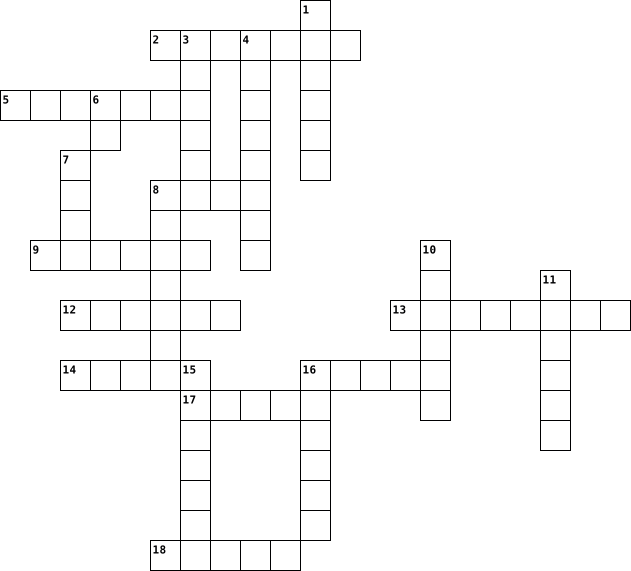
Across
- Smallest of the 8 planets
- Largest of the 8
- Red Planet, Two moons
- Ringed Planet
- Sideways Planet, has lower surface gravity than Earth
- Moon orbits Jupiter, largest moon in the solar system
- Only moon with a thick atmosphere
- Dwarf planet as of 2006
- Densest of the 8 planets
- Hottest of the 8 planets
Down
- Neptune's largest moon
- Moon with a hidden ocean
- Moon is about as large as Mercury
- Most volcanically active body in the solar system
- Moon in Spanish
- Uranus' moon with many dips and cracks
- Pluto's largest moon
- Mars' smaller moon
- Windy and farthest of the planets
- Mars' larger moon
20 Clues: Ringed Planet • Moon in Spanish • Largest of the 8 • Mars' larger moon • Mars' smaller moon • Pluto's largest moon • Red Planet, Two moons • Neptune's largest moon • Dwarf planet as of 2006 • Moon with a hidden ocean • Densest of the 8 planets • Hottest of the 8 planets • Smallest of the 8 planets • Moon is about as large as Mercury • Only moon with a thick atmosphere • ...
Look here III 2023-12-14

Across
- A place to sleep and keep clothes ALL over the floor
- Your horoscope is a reading of your ____ sign
Down
- Shows the phases of the moon
- Opposite of front
- This can open or close
5 Clues: Opposite of front • This can open or close • Shows the phases of the moon • Your horoscope is a reading of your ____ sign • A place to sleep and keep clothes ALL over the floor
Scientific Revolution 2023-11-20

Across
- Theories that were accepted by Aristotle
- Time of advancements during for math and science during the 17th century
- The Proven theory that the Sun is the center of the solar system
- Created the belief that the sun was the center of the solar system
- Greek philosopher
- A force that pulls objects closer to the ground
- Invented calculus and "discovered" gravity
Down
- The theory that the Earth is the center of the solar system
- Observations of the mountains on the moon, the moons of Jupiter, the phases of Venus, and the rings of Saturn.
- Created the scientific method
10 Clues: Greek philosopher • Created the scientific method • Theories that were accepted by Aristotle • Invented calculus and "discovered" gravity • A force that pulls objects closer to the ground • The theory that the Earth is the center of the solar system • The Proven theory that the Sun is the center of the solar system • ...
Final Crossword Puzzle 2021-12-09

Across
- The motion of an object can often be described differently depending on the ___ frame.
- Unbalanced forces cause an object to ___ in the direction of the net force.
- Newton's second law of motion explains the ___ among force, mass, and acceleration.
- Within our solar system are ___ major planets, grouped by proximity to the Sun.
- A ___ is a push or pull that is exerted on an object.
- ___ energy is energy in the form of motion.
- The reason why we have seasons is because the Earth is ___.
- Newton's third law states that for every action, there is an equal and opposite ___.
- Eclipses only occur when all three celestial bodies line up in the same ___.
- During a ___ cycle, we can observe different phases of the moon.
- An __ is an imaginary line about which each planet or moon spins.
Down
- Gravity is always a ___, never a push.
- The planets' orbits are ___, or oval shaped.
- Between Mars and Jupiter lies the ___ belt.
- Before the ____ model, people used to believe in the heliocentric model.
- The two things that affect the strength of the gravitational force between two objects are ____ and distance.
- If all the forces acting on a particular object are balanced, then the net force is ___.
- ___ energy is stored energy.
- ___is a force that pulls every object toward every other object.
- The law of ___ states that energy can be neither created nor destroyed, only transferred from one form or object to another.
20 Clues: ___ energy is stored energy. • Gravity is always a ___, never a push. • Between Mars and Jupiter lies the ___ belt. • ___ energy is energy in the form of motion. • The planets' orbits are ___, or oval shaped. • A ___ is a push or pull that is exerted on an object. • The reason why we have seasons is because the Earth is ___. • ...
Seasons, Moon Phases, Eclipses Vocab 2023-01-20

Across
- A tide just after a new or full moon, when there is the greatest difference between high and low water.
- Takes place when the earth comes between the sun and the full moon and blocks the sun's direct rays from lighting up the moon.
- Each of the four divisions of the year marked by particular weather patterns and daylight hours, resulting from the earth's changing position with regard to the sun.
- The moon's illuminated area is decreasing.
- The time or date (twice each year) at which the sun crosses the celestial equator, when day and night are of approximately equal length.
Down
- Occurs when the moon passes between earth and sun. Blocks earth's view of the sun, totally or partially.
- A tide just after the first or third quarters of the moon when there is the least difference between high and low water.
- Either of the two moments in the year when the sun's apparent path is farthest north or south from earth's equator, the longest and shortest days of the year.
- The moon's illuminated area is increasing.
9 Clues: The moon's illuminated area is decreasing. • The moon's illuminated area is increasing. • A tide just after a new or full moon, when there is the greatest difference between high and low water. • Occurs when the moon passes between earth and sun. Blocks earth's view of the sun, totally or partially. • ...
moon phases 2021-09-28

Across
- moon
- 1st moon phases
Down
- 3rd moon quarter moon
3 Clues: moon • 1st moon phases • 3rd moon quarter moon