
moon phases Crossword Puzzles
Earth, Moon & Sun 2026-06-04

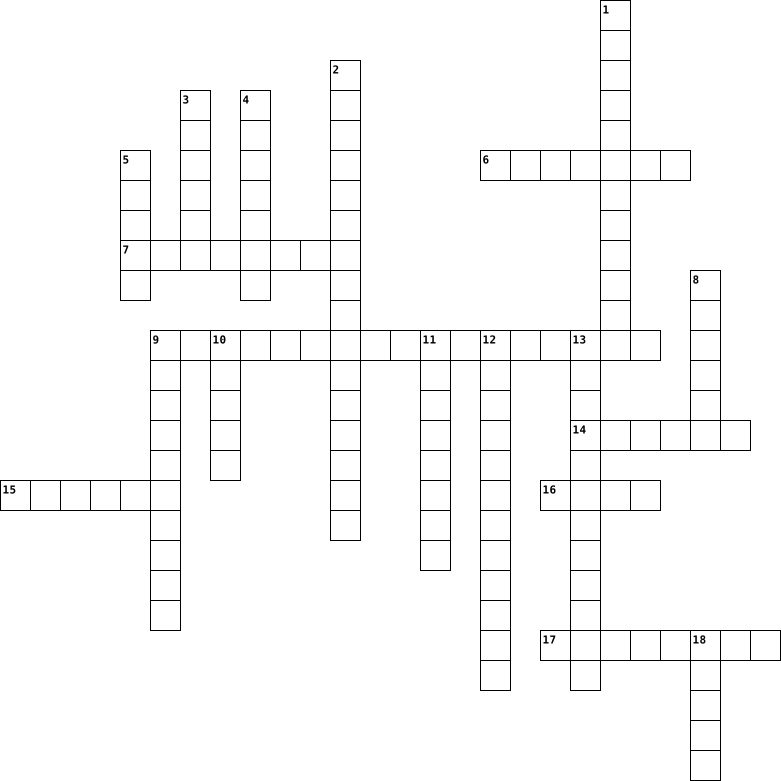
Across
- an eclipse when the moon is completely dark
- a planet outside our solar system
- the nearly circular path a smaller object, like the moon, travels around a larger object, like Earth
- the star that is the main source of light at the cneter of our solar system
- the shape of the illuminated part of the moon as it appears from Earth
- a moon phase that looks like a half-circle from Earth
- to shine light on an object and make it visible
- a moon outside our solar system
- a moon phase in which the moon is not visible from Earth
- a rocky sphere that travels around a planet
- system that includes the sun, the planets that orbit the sun and other objects that orbit the sun
Down
- a moon phase that looks like a full circle
- the amount of time it takes for a planet to complete one orbit around a star or stars
- something we observe to be similar over and over again
- the relative size of things
- a moon phase that looks like less than half a circle from Earth
- a moon phase that looks like more than half a circle from Earth
- the border between light and dark on the moon
- an object,diagram or computer program that helps us understand something
19 Clues: the relative size of things • a moon outside our solar system • a planet outside our solar system • a moon phase that looks like a full circle • an eclipse when the moon is completely dark • a rocky sphere that travels around a planet • the border between light and dark on the moon • to shine light on an object and make it visible • ...
Mid Term Side Dishes 2023-12-13

Across
- phases
- cycle
Down
- disasters
3 Clues: cycle • phases • disasters
The Moon is a Harsh Mistress 2024-01-11

Across
- how they keep safe
- what earth is
- earth
- the form of language
- what used to be earth
- home of the bad guys
- what earth gives to the moon
- author
- what is needed for earthers
- orbiting earth
Down
- transportation
- the name of the moon habitant
- way to say friend in Russian
- title
- video game on moon
- big deal in this book
- the moon to the earth
- Minnie's talking
- the main thing I guess
- writing style
20 Clues: title • earth • author • what earth is • writing style • transportation • orbiting earth • Minnie's talking • how they keep safe • video game on moon • the form of language • home of the bad guys • big deal in this book • what used to be earth • the moon to the earth • the main thing I guess • what is needed for earthers • way to say friend in Russian • what earth gives to the moon • ...
The Moon 2017-11-23

Across
- craters were formed by meteorite impacts
- the surface of the moon is covered with large _________
- shows the same side __________ towards us
- Luna 2 was the first spacecraft to visit the moon
- the ______________ of the moon's surface can vary
- the first ____________ on the moon
- no animals or plants could __________ on the moon
- the moon orbits or _______ the Earth
- the moon rises in the _______
Down
- the gravitational ________ of the moon
- the moon is about 4.5 billion ________ old
- there is no ______________
- American ______________called Neil Armstrong
- the moon __________ the light from the sun
- it does not produce ________ of its own
- it is the ____________ brightest object in the sky
- ______ in the west
17 Clues: ______ in the west • there is no ______________ • the moon rises in the _______ • the first ____________ on the moon • the moon orbits or _______ the Earth • the gravitational ________ of the moon • it does not produce ________ of its own • craters were formed by meteorite impacts • shows the same side __________ towards us • the moon is about 4.5 billion ________ old • ...
Lunar Vocab 2024-10-08

Across
- orbital ___________ is the tilt of a satellite’s orbit relative to the central body
- volcanic rock made from rapidly cooling lava
- The closest point in an object's orbit around the Earth
- the furthest point in an object's orbit around the Sun
- when the moon goes from New to Full Moon
- long lines scored into the moon's surface around impact craters
- phase of the Moon between waning gibbous and waning crescent
- when one celestial object appears to move across another
- less than half the Moon is lit from our perspective
- _________ month is the time between perigee and perigee
- how much an object reflects sunlight
- The furthest point in an object's orbit around the Moon
Down
- this type of month is based on the Moon's position relative to the stars
- The closest point in an object's orbit around the Sun
- phase of the Moon between a waxing crescent and waxing gibbous
- grooves in the Moon's surface that resemble canals or canyons
- type of eclipse that occurs when the Moon blocks light from striking the Earth
- the material that gets shot out during the impact of a meteor
- The farthest point from the Earth in an object's orbit
- the light parts of the moon with mountains and hills
- the path the Sun takes through the sky throughout the year
- large dark areas on the Moon (Latin for sea or ocean) example: tranquility
- The ________ Cycle predicts the occurrence of eclipses every ~18 years
- any object that orbits another celestial object
- when one object blocks the light from the Sun from reaching a second object
- closest point in an object's orbit around the Moon
- more than half the Moon is lit from our perspective
- when the Moon goes from Full to New Moon
- type of eclipse that occurs when the Earth blocks light from striking the Moon
29 Clues: how much an object reflects sunlight • when the moon goes from New to Full Moon • when the Moon goes from Full to New Moon • volcanic rock made from rapidly cooling lava • any object that orbits another celestial object • closest point in an object's orbit around the Moon • less than half the Moon is lit from our perspective • ...
Leilaaaaa's Earth, ☼ and ☽ crossword 2019-10-27

Across
- an eclipse when the sun is obscured by the moon
- the Earth goes around the sun
- when the moon is less than a semicircle
- when the moon first appears
- the object that comes out at night
- a force that keeps you on the ground
- the moon is fully visible
- a large object that makes the Earth warm
- when the moon is greater than a semicircle
Down
- the imaginary line that runs through Earth from the North to South
- only half of the moon is visible
- something travels around another thing
- an eclipse where it is dark
- this causes the Seasons and is approximately 23.5 degrees
- when the moon decreases in size
- when the moon gets bigger
- there are four of these a year
- there are 12 of these in a year
18 Clues: when the moon gets bigger • the moon is fully visible • an eclipse where it is dark • when the moon first appears • the Earth goes around the sun • there are four of these a year • when the moon decreases in size • there are 12 of these in a year • only half of the moon is visible • the object that comes out at night • a force that keeps you on the ground • ...
2.2 Moon, Lunar Cycle, and Eclipses Quiz 2025-02-28

Across
- Two words, when the moon is at it's furthest point in orbit and its shape does not completely cover the Sun.
- Two words, the moon appears to be half lit on the right from the Earth.
- Two words, the moon is three-quarters of the way through its cycle and appears to be half lit on the left.
- Two words, the lighted part of the moon is decreasing on the left and in the form of a crescent roll.
- The total or partial obscuring of a planet, star, or moon by another celestial object.
- Two words, when the moon appears fully lit and the Earth is between the Sun and moon.
- The area of partial shadow surrounding the total shadow cast by the Earth or Moon.
- The large, dark, flat areas on the moon.
Down
- Two words, occurs when the Earth passes between the Moon and the Sun and the Earth's shadow covers the moon.
- Two words, the lighted part is increasing and on the right in the form of a crescent roll.
- Two words, occurs when the moon passes between the Earth and Sun, obscuring Earth's view of the Sun.
- Two words, the moon appears more than half lit on the left and the lighted part is now decreasing.
- Impact sites formed by asteroids and meteoroids.
- Two words, the first phase of the moon when the moon is between the Earth and Sun.
- Two words, the moon appears more than half lit on the right and the light is shaped like a football.
- The light-colored areas older than maria and covered with craters.
- The darkest part of a shadow.
17 Clues: The darkest part of a shadow. • The large, dark, flat areas on the moon. • Impact sites formed by asteroids and meteoroids. • The light-colored areas older than maria and covered with craters. • Two words, the moon appears to be half lit on the right from the Earth. • Two words, the first phase of the moon when the moon is between the Earth and Sun. • ...
13 moons 2021-05-26

Across
- Moon of the humpback salmon-August (even years)
- Moon of children and new beginnings-January
- Moon of the sockeye-July
- Moon of the coho-September
- Moon of blossoming-March
- Moon of howling winds and shaking leaves
- Moon of the bullheads-April
- Moon of gathering seaweed and camas-May
- Moon of the frog-February
Down
- Moon of the salal-August(odd years)
- Moon of the salmonberry-June
- Moon of chums-October
- Moon of putting away paddles
- Moon of the elders-December even years
14 Clues: Moon of chums-October • Moon of the sockeye-July • Moon of blossoming-March • Moon of the frog-February • Moon of the coho-September • Moon of the bullheads-April • Moon of the salmonberry-June • Moon of putting away paddles • Moon of the salal-August(odd years) • Moon of the elders-December even years • Moon of gathering seaweed and camas-May • ...
Science Review 2013-05-24

Across
- The location of an object
- When Light bounces off of objects, it is called reflect
- The process where liquid changes to a gas.
- The water that evaporates is called water vapors.
- The layers of gases surrounding Earth’s Crust. [i.e. The air around you]
- An opaque object completely block light from passing through them
- To bend light
- Water that forms from Water vapor
- The invisible line that Earth tilts on.
- An object that allows energy/electricity to pass through
- Machine A type of machine that can be made using simple objects
- The rubbing together of two objects
Down
- Keeps heat from passing through
- The different cycles that the moon goes through.
- The measure of how hot or cold something is. [i.e. The temperature outside today is a cool 61 degrees Fahrenheit.]
- The path the Earth travels around the sun
- Allows light to pass through
- Various forms of liquid that falls from the Earth’s atmosphere. [i.e. Rain, sleet, snow]
- Allows some light pass through and blocks some light.
- The pulling force between two objects such as you and Earth.
- A force is a push or a pull
21 Clues: To bend light • The location of an object • A force is a push or a pull • Allows light to pass through • Keeps heat from passing through • Water that forms from Water vapor • The rubbing together of two objects • The invisible line that Earth tilts on. • The path the Earth travels around the sun • The process where liquid changes to a gas. • ...
809 Science Crossword 2024-06-21

Across
- Most likley to act a fool
- Most likely to quote Sketch
- Most likely to stare at Mr. Guzman and say nothing
- Liquid rock undergound
- Center of the solar system
- When water turns into a gas
- liquid rock above ground
- Fancy word for rain
- When all of the continents were connected
- Crust under the ocean
- Most likely to be drawing
- Mosy likely to ask "why"
- Most likely to talk about wrestling
- Mixture of different minerals
Down
- Most likely to be a pro drummer
- part of the atmosphere that protects us from skin cancer
- Most likely to call out the answer in science
- Most likely to be out of his seat
- When two of Earth's plates colide you may get a____
- we live on the ______ of the earth
- Most likely to be in the NFL
- Biggest Planet
- Most likely to laugh at Bourama and Damien
- The air we breathe that surrounds Earth
- Moon changes its ______ throughout the month
- Line dividing the North and South
- Most likely to know where an MTA bus is going
- orbits the sun
- These are caused by the moons gravity
29 Clues: Biggest Planet • orbits the sun • Fancy word for rain • Crust under the ocean • Liquid rock undergound • liquid rock above ground • Mosy likely to ask "why" • Most likley to act a fool • Most likely to be drawing • Center of the solar system • Most likely to quote Sketch • When water turns into a gas • Most likely to be in the NFL • Mixture of different minerals • ...
Lunar Vocab 2024-10-08

Across
- the path the Sun takes through the sky throughout the year
- long lines scored into the moon's surface around impact craters
- grooves in the Moon's surface that resemble canals or canyons
- The ________ Cycle predicts the occurrence of eclipses every ~18 years
- the material that gets shot out during the impact of a meteor
- the furthest point in an object's orbit around the Sun
- type of eclipse that occurs when the Moon blocks light from striking the Earth
- The closest point in an object's orbit around the Earth
- closest point in an object's orbit around the Moon
- The furthest point in an object's orbit around the Moon
- when the moon goes from New to Full Moon
- orbital ___________ is the tilt of a satellite’s orbit relative to the central body
- when one celestial object appears to move across another
- any object that orbits another celestial object
- volcanic rock made from rapidly cooling lava
Down
- phase of the Moon between a waxing crescent and waxing gibbous
- more than half the Moon is lit from our perspective
- large dark areas on the Moon (Latin for sea or ocean) example: tranquility
- less than half the Moon is lit from our perspective
- The closest point in an object's orbit around the Sun
- this type of month is based on the Moon's position relative to the stars
- how much an object reflects sunlight
- The farthest point from the Earth in an object's orbit
- _________ month is the time between perigee and perigee
- when one object blocks the light from the Sun from reaching a second object
- type of eclipse that occurs when the Earth blocks light from striking the Moon
- when the Moon goes from Full to New Moon
- phase of the Moon between waning gibbous and waning crescent
- the light parts of the moon with mountains and hills
29 Clues: how much an object reflects sunlight • when the moon goes from New to Full Moon • when the Moon goes from Full to New Moon • volcanic rock made from rapidly cooling lava • any object that orbits another celestial object • closest point in an object's orbit around the Moon • more than half the Moon is lit from our perspective • ...
Chapter Two Crossword Puzzle 2023-10-17

Across
- The phase change that occurs when a gas becomes a liquid.
- A substance changes phases when energy is ___________ into or out of it.
- The lakes on Saturn's moon, Titan, disappeared because they...
- What water becomes when its molecules slow down and crowd together.
- _______ of motion is the ability of molecules in a substance to move, rotate, or vibrate in space.
- The kind of energy a substance has by being in motion.
- When a substance changes without becoming a different substance, the change is...
- The scale where things are big enough for us to see with our eyes.
Down
- If a liquid freezes, freedom of movement will...
- The phase change that occurs when a liquid becomes a gas.
- When a substance changes into a different substance, the change is...
- If a solid melts, freedom of movement will...
12 Clues: If a solid melts, freedom of movement will... • If a liquid freezes, freedom of movement will... • The kind of energy a substance has by being in motion. • The phase change that occurs when a gas becomes a liquid. • The phase change that occurs when a liquid becomes a gas. • The lakes on Saturn's moon, Titan, disappeared because they... • ...
science 2019-12-28

Across
- a group of atoms joined in a particular way
- change flows molecules changes phases
- water that can be any shape
- turns from gas to liquid
- you can see it
- turns from solid to liquid
Down
- when a liquid turns into a solid
- turns to a hard structure
- turns from water to gas
- phase phases that molecules are part of
- Boyle energy by Robert Boyle and talks about gases
- has no shape
12 Clues: has no shape • you can see it • turns from water to gas • turns from gas to liquid • turns to a hard structure • turns from solid to liquid • water that can be any shape • when a liquid turns into a solid • change flows molecules changes phases • phase phases that molecules are part of • a group of atoms joined in a particular way • ...
Crazy Science Mar w3 2021 Crossword Puzzle 2021-03-21

Across
- this represented a star in our experiment
- unlike wandering stars, this produces its own light
- in the first picture of the wandering star, it looked like a disc shape, but in the second picture, it looked like this shape
Down
- when a wandering star changes shape, it is changing ________
- another word for a wandering star
- scientists realized that a _______ from another planet would be too small to see from Earth
6 Clues: another word for a wandering star • this represented a star in our experiment • unlike wandering stars, this produces its own light • when a wandering star changes shape, it is changing ________ • scientists realized that a _______ from another planet would be too small to see from Earth • ...
Sun, Earth and Moon Review 2024-05-21

Across
- The portion of the moon that we can see from Earth
- Time it takes for moon's revolution around the Earth
- The object that has the smaller impact on Earth's tides
- Light is increasing from our perspective
- Looking at the sun's ______ in the sky can indicate the time of day
- Moon, sun and Earth are aligned
- Twelve hours of dark and twelve hours of light
- More than half of the part of the moon we see is lit by the sun
- The force all objects with mass exert on other objects with mass
- Time it takes for one rotation on Earth's axis
- Light is decreasing from our perspective
- Tide with small changes, during first or third quarter moon
- When the moon is closest to Earth in it's orbit
Down
- The portion of the moon that is always lit by the sun
- The path an object takes in its revolution around another object
- When the moon is further from Earth in it's orbit
- Less than half of the part of the moon we see is lit by the sun
- The object that has the bigger impact on Earth's tides
- The reason for Earth's seasons
- Tide with large changes, created by alignment of Earth, sun and moon
- The biggest spring tide of the year
- Current created by an incoming tide
- Eclipse that happens during a new moon
- Moon, sun and Earth are at a ninety degree angle
- Time it takes for one revolution of Earth around the sun
- Eclipse that occurs during a full moon
- Current created by an outgoing tide
27 Clues: The reason for Earth's seasons • Moon, sun and Earth are aligned • The biggest spring tide of the year • Current created by an incoming tide • Current created by an outgoing tide • Eclipse that happens during a new moon • Eclipse that occurs during a full moon • Light is increasing from our perspective • Light is decreasing from our perspective • ...
Mid Term Side Dishes 2023-12-13

Across
- phases
- cycle
Down
- disasters
3 Clues: cycle • phases • disasters
Mid Term Side Dishes 2023-12-13

Across
- phases
- cycle
Down
- disasters
3 Clues: cycle • phases • disasters
CROSSWORD PUZZLE 2025-02-08

Across
- SPHERIOD
- ECLIPSE
Down
- ECLIPSE
- PHASES
4 Clues: PHASES • ECLIPSE • ECLIPSE • SPHERIOD
Muddy Buddies Weekly Newsletter XVI Crossword I 2025-09-12

Across
- third grade word
- fourth grade word
- smallest moon of Pluto
- sticky or slimy
- Second-most eccentric moon
- 6th grade word
- Most Eccentric moon
- moon of pluto with red splotch
- second-smallest moon of Pluto
- third largest object in the scattered disk
Down
- outer-most moon of Pluto
- our group (no spaces)
- second largest object in the scattered disk
- largest object in the scattered disk
- largest "moon" of Pluto
- my (Hank's) lucky number
- peanut
17 Clues: peanut • 6th grade word • sticky or slimy • third grade word • fourth grade word • Most Eccentric moon • our group (no spaces) • smallest moon of Pluto • largest "moon" of Pluto • outer-most moon of Pluto • my (Hank's) lucky number • Second-most eccentric moon • second-smallest moon of Pluto • moon of pluto with red splotch • largest object in the scattered disk • ...
Seasons of Science 2024-05-14

Across
- type of solar eclipse occurs when the moon only blocks a portion of the sun
- gibbous comes after the full moon
- the moon takes about 28 days to complete this around the earth
- the division of the Earth
- quarter comes after the waxing crescent
- quarter comes after the winning gibbous
- lunar eclipses can only occur during this type of moon
- the North Star
- crescent is the final phase of the moon cycle
- during a lunar a eclipse the Earth creates a shadow on
Down
- type of eclipses that occur when the Earth blocks the suns light
- gibbous is the fourth moon in the moon cycle
- solstice shortest day of the year
- each season on Earth is about how many months apart
- the Southern hemisphere experiences Summer while the Northern Hemisphere experiences
- imaginary dividing line seperating Northern and Southern Hemispheres
- eclipse occur when the moon blocks the sun's light
- type of solar eclipse occurs when the moon completely covers the sun
- moon is the 5th phase in the lunar cycle
- crescent moon comes right after the New Moon
- the season in the Northern Hemisphere is the Earth's distance from the sun the longest
21 Clues: the North Star • the division of the Earth • gibbous comes after the full moon • solstice shortest day of the year • quarter comes after the waxing crescent • quarter comes after the winning gibbous • moon is the 5th phase in the lunar cycle • gibbous is the fourth moon in the moon cycle • crescent moon comes right after the New Moon • ...
Phases of matter 2024-01-16

Across
- The constant temperature at which a solid becomes a liquid
- state of matter with definite shape and volume
- phase change during which a solid becomes a vapor without becoming a liquid.
- phase change during which a liquid converts to gaseous state
- a reversible change that occurs when a substance changes from one state of matter to another
- state of matter with neither definite shape nor definite volume
- an explanation of how the particles in gases behave.
- a change during which a system releases energy to its surroundings
- energy that a substance absorbs to become gas from liquid
- energy absorbed when a solid is converted to liquid
Down
- Change of phase from solid to a liquid
- state of matter with definite volume but indefinite shape
- phase change during which a vapor/gas becomes a liquid
- phase change during which a vapor/gas becomes a solid without becoming a liquid.
- 4th state of matter in which atoms have charges
- result of a force distributed in an area
- the pressure caused by the collision of particles in a vapor with the walls of a container.
- point The constant temperature at which a liquid becomes a vapor or gas
- Conversion of a liquid to it’s vapor or gas
- Conversion of a liquid to solid
- a change during which a system absorbs energy from its surroundings
21 Clues: Conversion of a liquid to solid • Change of phase from solid to a liquid • result of a force distributed in an area • Conversion of a liquid to it’s vapor or gas • state of matter with definite shape and volume • 4th state of matter in which atoms have charges • energy absorbed when a solid is converted to liquid • an explanation of how the particles in gases behave. • ...
Phases of Matter 2025-05-11

Across
- – Force applied over an area
- – Transfer of thermal energy
- – Solid to gas without becoming liquid
- – No fixed shape or volume
- – Measures average kinetic energy
- – Solids with repeating patterns
- – Basic units of matter
- – Slow vaporization at the surface
- – Solids without a regular pattern
- – Liquid to solid
- – Can be squished (like gases)
- – Flows and takes the shape of its container
- – What liquids and gases can do
- – Gas to liquid
Down
- – Solid to liquid
- – A physical state of matter
- – Another word for phase
- – Amount of space matter occupies
- – Gas to solid
- – Anything that has mass and takes up space
- – Related to heat energy
- – Has a definite shape and volume
- – Hot, ionized gas found in stars
- – General term for liquid to gas
- – Lowers temperature, can cause freezing
- – Type of energy due to motion
- – Groups of atoms bonded together
- – Not flexible, like most solids
- – Rapid vaporization of liquid
- – Needed to change states
30 Clues: – Gas to solid • – Gas to liquid • – Solid to liquid • – Liquid to solid • – Basic units of matter • – Another word for phase • – Related to heat energy • – Needed to change states • – No fixed shape or volume • – A physical state of matter • – Force applied over an area • – Transfer of thermal energy • – Type of energy due to motion • – Can be squished (like gases) • ...
Phases Crossword Puzzle 2024-03-12

Across
- are viscus and the molecules flow close together
- group of atoms bonded together
- is when the phase of a substance changes but the substance stays the same
- when liquid water is changed into a gaseous state (water vapor)
- when a liquid turns into a gas
- have a fixed volume and the molecules are packed tightly
- a science law that says when pressure is constant, temperature increases, and volume increases
- is the total kinetic energy
- how much motion an object has due to how much energy it has
Down
- the change of state from a solid to a gas without going through the liquid stage
- how much space matter takes up
- is when the molecules of a substance change
- move freely and have more kinetic energy
- when a liquid state changes into a vapor state
- a science law that says when temperature is constant, pressure decreases, and volume increases
- a science law that says when the volume is constatemperatureture increases, and pressure increases
- is the process of a liquid turning into a solid when it gets really cold
- is the process of a liquid turning into gas when heat is applied
- is the average kinetic energy
- is the process of a solid turning into a liquid
20 Clues: is the total kinetic energy • is the average kinetic energy • how much space matter takes up • group of atoms bonded together • when a liquid turns into a gas • move freely and have more kinetic energy • is when the molecules of a substance change • when a liquid state changes into a vapor state • is the process of a solid turning into a liquid • ...
Phases Crossword Puzzle 2024-03-12

Across
- are viscus and the molecules flow close together
- group of atoms bonded together
- is when the phase of a substance changes but the substance stays the same
- when liquid water is changed into a gaseous state (water vapor)
- when a liquid turns into a gas
- have a fixed volume and the molecules are packed tightly
- a science law that says when pressure is constant, temperature increases, and volume increases
- is the total kinetic energy
- how much motion an object has due to how much energy it has
Down
- the change of state from a solid to a gas without going through the liquid stage
- how much space matter takes up
- is when the molecules of a substance change
- move freely and have more kinetic energy
- when a liquid state changes into a vapor state
- a science law that says when temperature is constant, pressure decreases, and volume increases
- a science law that says when the volume is constatemperatureture increases, and pressure increases
- is the process of a liquid turning into a solid when it gets really cold
- is the process of a liquid turning into gas when heat is applied
- is the average kinetic energy
- is the process of a solid turning into a liquid
20 Clues: is the total kinetic energy • is the average kinetic energy • how much space matter takes up • group of atoms bonded together • when a liquid turns into a gas • move freely and have more kinetic energy • is when the molecules of a substance change • when a liquid state changes into a vapor state • is the process of a solid turning into a liquid • ...
Unit Cover Phases 2024-03-12

Across
- The process where a liquid gains energy and changes into a gas
- Change from one state of matter to another
- The average kinetic energy
- Gas changes into a liquid
- The amount of space something takes up
- A group of atoms bonded together.
- Change where physical properties of matter change
- Change from liquid to a gas quickly
- Fixed volume with molecules closely packed and vibrating.
- Fixed volume and can be viscous
- Change from a solid, skipping gas, to a liquid
- Transfer of heat through electromagnetic waves
Down
- Movement of heat through a fluid or gas
- Energy in motion
- The process where a liquid loses energy and changes into a solid
- Change from liquid to gas on a surface
- An electrically conducting medium that is uncommon on earth
- The total kinetic energy
- The ability of a liquid to resist flow
- Free flowing molecules with no fixed volume
- Change where the molecules are rearranged
- A force by which one object attracts another
- Transfer of heat through direct contact
- Heat added to a solid to turn into a liquid
24 Clues: Energy in motion • The total kinetic energy • Gas changes into a liquid • The average kinetic energy • Fixed volume and can be viscous • A group of atoms bonded together. • Change from liquid to a gas quickly • Change from liquid to gas on a surface • The ability of a liquid to resist flow • The amount of space something takes up • Movement of heat through a fluid or gas • ...
Unit Cover - Phases 2024-03-13

Across
- a noticeably different form or state of the same substance
- the energy that an object has because it is moving
- a pull between two molecules that is always the same for a substance
- _____'s Law states that at constant pressure, the volume of a gas is directly proportional to its absolute temperature.
- the process by which a substance transitions directly from a solid to a gas phase without passing through the liquid phase.
- The amount of space occupied by a substance, measured in cubic units, which can vary depending on the state of matter and external conditions such as temperature and pressure.
- the ability to make things move or change
- A state of matter with neither definite shape nor volume, where particles are widely spaced and exhibit rapid, random motion, filling the entire container they occupy.
- a measure of how hot or cold something is
- The transition of matter from one state (solid, liquid, gas, or plasma) to another, typically accompanied by the absorption or release of energy in the form of heat.
- the process by which a solid substance transitions to a liquid state as a result of increased temperature.
- a group of atoms joined together in a particular way
- the process by which a substance transitions directly from a gas to a solid without passing through the liquid phase.
Down
- _____'s Law states that at constant volume, the pressure of a gas is directly proportional to its absolute temperature.
- the way molecules in a substance move around relative to each other
- A change in matter that does not alter its chemical composition, involving a rearrangement of particles or a change in state, such as melting, freezing, boiling, or condensation.
- the rapid vaporization of a liquid when its temperature reaches its boiling point throughout the entire volume
- the total kinetic energy of all the molecules that make up a sample
- A state of matter characterized by a fixed shape and volume, with particles tightly packed in a regular arrangement and exhibiting minimal translational motion.
- A state of matter consisting of highly ionized gas where atoms lose their electrons, resulting in a collection of positively charged ions and free electrons, exhibiting electrical conductivity and responding strongly to electromagnetic fields.
- the conversion of a liquid into a gas phase
- the process by which a substance changes from a liquid state to a solid state due to a decrease in temperature below its freezing point.
- evaporation is the slow conversion of a liquid into a gas phase at the liquid's surface
- A process in which one or more substances are transformed into new substances with different chemical properties, involving the breaking and forming of chemical bonds.
- _____'s Law states that at constant temperature, the pressure of a gas is inversely proportional to its volume.
- A state of matter with a definite volume but no fixed shape, where particles are close together but can move past one another, conforming to the shape of the container they are in.
26 Clues: the ability to make things move or change • a measure of how hot or cold something is • the conversion of a liquid into a gas phase • the energy that an object has because it is moving • a group of atoms joined together in a particular way • a noticeably different form or state of the same substance • ...
Phases Crossword puzzle 2024-03-13

Across
- constantly vibrates and has a fixed volume
- a science law that states when pressure is constant, temperature and volume increases
- change in properties
- molecules flow closely around each other and have a fixed volume but not a fixed shape
- is a continuous physical force exerted on an object
- when molecules have less attraction they have more...
- molecules move freely and have little to no molecular attraction
- the basic building block of chemistry
- when the gaseous phase turns into a liquid state
- the amount of space a substance occupies
- the point at which a solid turns into a liquid
- the energy of motion
Down
- is when a solid turns into a gas without going through the liquid state
- a science law that states when volume is constant, temperature and pressure increases
- the point at which a liquid turns into a solid
- when solid materials are gradually added to each other from the different elements
- is the process in which a liquid state changes into a vapor state
- total kinetic energy
- a science law that states when temperature is constant, pressure decreases and volume increases (vice-versa)
- average kinetic energy
- when a liquid turns to gas
- the point at which a liquid starts to boil
- two or more atoms that are connected
- a change of omaterialral to another
24 Clues: total kinetic energy • change in properties • the energy of motion • average kinetic energy • when a liquid turns to gas • a change of omaterialral to another • two or more atoms that are connected • the basic building block of chemistry • the amount of space a substance occupies • constantly vibrates and has a fixed volume • the point at which a liquid starts to boil • ...
Space 2015-10-09
Across
- hollow or depressions made by impacting meteoroids.
- lunar soil, often referred to as moon dust.
- two high tides and two low tides occur in a day-most common.
- channel in maria formed from open lava channels or lava tubes.
- when the shape of the moon is decreasing, left side of the moon is visible.
- bright streak of material blasted out from impact crater.
- partial blockage of the suns rays during and eclipse.
Down
- when the moon blockage of the suns rays from the earth.
- high tide created on side farthest from the moon.
- when the shape of the moon is growing, right side of the moon is visible.
- ridges long narrow, wrinkly, hilly section in maria.
- complete blockage of the sun's rays during an eclipse.
- bright heavily cratered highlands.
- highest tidal ranges, occurs when the sun, moon, and earth align.
- ancient seas of solidified lava, appear as smooth dark plains.
- lowest tidal ranges, occurs when the sun, moon, and earth are at the right angle.
- when the earth blocks the suns rays from the moon.
- only one high tide and one low tide occur in a day.
- high tide created on side of earth nearest to the moon.
19 Clues: bright heavily cratered highlands. • lunar soil, often referred to as moon dust. • high tide created on side farthest from the moon. • when the earth blocks the suns rays from the moon. • hollow or depressions made by impacting meteoroids. • only one high tide and one low tide occur in a day. • ridges long narrow, wrinkly, hilly section in maria. • ...
Moon Landing 2024-12-03

Across
- Theorized director who allegedly assisted in staging the moon landing
- The lunar module used during the Apollo 11 mission
- The type of surface feature skeptics claim is missing beneath the lunar module in photos
- Location where skeptics allege the moon landing was filmed
- The material conspiracy theorists claim was used to simulate the lunar surface
- First astronaut to walk on the moon, according to official records
- The space agency accused of staging the moon landings
- The natural satellite that is the focus of the landing controversy
- The type of suit worn by astronauts, which some claim would be inadequate for the moon's environment
- The country that was the USA's main competitor in the space race
- The year of the first alleged moon landing
Down
- The second astronaut to walk on the moon
- Theorists point to the absence of this in photos as evidence of a hoax
- The term for the supposed secret group that orchestrated the moon landing hoax
- The decade during which the Apollo moon landings occurred
- Conspiracy theorists claim this object appears to wave, suggesting filming on Earth
- The number of Apollo missions that landed astronauts on the moon
- The NASA program responsible for the moon missions
- Facility often cited as the filming location for the alleged hoax
19 Clues: The second astronaut to walk on the moon • The year of the first alleged moon landing • The lunar module used during the Apollo 11 mission • The NASA program responsible for the moon missions • The space agency accused of staging the moon landings • The decade during which the Apollo moon landings occurred • Location where skeptics allege the moon landing was filmed • ...
Moons 2024-04-08

Across
- Has a huge crater
- A sponge
- Another way to say the moon
- Has what looks like veins
- First moon to have a ring
- Named after a nymph
- First Saturnian moon to have a cold temperature almost like dry ice
- The 2nd biggest moon and has methane rain
- Named after one of the people who discovered Rome
- In the future, this moon of Mars will turn into its ring.
- Has an even bigger crater that almost split it in half
- Is the biggest moon
- God of the rivers
Down
- King of fairies
- Might have a yellow half
- Also the previous one but replaced the ar with a umbr
- 5th largest moon of Jupiter
- the last 3+3 amount of words from the dinosaur "Pterodactyl" and is a moon of Ida, an asteroid
- I ran the (sounds like that)
- Queen of fairies
- Also named after one of the people who discovered Rome
- The yin-yang of the Saturnian moons
- In the future, also this moon of Mars will leave probably into the Asteroid Belt.
- Has craters and is old
- Guardian of the sea
- Has volcanoes
- The movie with a mermaid
- The first alphabetical and smallest moon of Saturn
- Has water
29 Clues: A sponge • Has water • Has volcanoes • King of fairies • Queen of fairies • Has a huge crater • God of the rivers • Named after a nymph • Guardian of the sea • Is the biggest moon • Has craters and is old • Might have a yellow half • The movie with a mermaid • Has what looks like veins • First moon to have a ring • 5th largest moon of Jupiter • Another way to say the moon • ...
Seasons of Science 2024-05-14

Across
- type of solar eclipse occurs when the moon only blocks a portion of the sun
- gibbous comes after the full moon
- the moon takes about 28 days to complete this around the earth
- the division of the Earth
- quarter comes after the waxing crescent
- quarter comes after the winning gibbous
- lunar eclipses can only occur during this type of moon
- the North Star
- crescent is the final phase of the moon cycle
- during a lunar a eclipse the Earth creates a shadow on
Down
- type of eclipses that occur when the Earth blocks the suns light
- gibbous is the fourth moon in the moon cycle
- solstice shortest day of the year
- each season on Earth is about how many months apart
- the Southern hemisphere experiences Summer while the Northern Hemisphere experiences
- imaginary dividing line seperating Northern and Southern Hemispheres
- eclipse occur when the moon blocks the sun's light
- type of solar eclipse occurs when the moon completely covers the sun
- moon is the 5th phase in the lunar cycle
- crescent moon comes right after the New Moon
- the season in the Northern Hemisphere is the Earth's distance from the sun the longest
21 Clues: the North Star • the division of the Earth • gibbous comes after the full moon • solstice shortest day of the year • quarter comes after the waxing crescent • quarter comes after the winning gibbous • moon is the 5th phase in the lunar cycle • gibbous is the fourth moon in the moon cycle • crescent moon comes right after the New Moon • ...
Science Crossword Project 2021-05-20

Across
- a tide just after the first or third quarters of the moon
- when an object is revolving
- large plain on the surface of the moon that appears dark
- the date when the sun reaches its minimum or maximum declination and is the shortest or longest days of the year
- when the sun crosses the celestial equator
- an event where the moon appears darkened because it is in the Earths shadow
- the model that represents the Earth as the middle of the solar system
- the act of rotating around an axis or center
- a tide just after a new or full moon
Down
- the part of the moon that is facing away from earth
- what an object would do without other forces acting on it
- an event where the sun is obscured by the moon
- an artificial body placed in orbit around a planet
- means moon
- the model that represents the sun as the center of the solar system
- the shadow cast by the earth or moon over an area
- the dark central part of a sun spot
- when the moon appears to increase in size
- when the moon appears to decrease in size
- a large bowl shaped cavity in the surface of a planet
20 Clues: means moon • when an object is revolving • the dark central part of a sun spot • a tide just after a new or full moon • when the moon appears to increase in size • when the moon appears to decrease in size • when the sun crosses the celestial equator • the act of rotating around an axis or center • an event where the sun is obscured by the moon • ...
Science Crossword Puzzle #1 2022-01-07

Across
- or easier to see
- the shape of the illuminated part of the Moon as it appears from Earth
- a moon phase in which the Moon is not visible from Earth
- a rocky sphere that travels around a planet
- the sun, the planets that orbit the sun, and other objects that orbit the sun
- the border between light and dark on the Moon
- a moon outside our solar system
- a moon phase that looks like a full circle from Earth
- when the Moon is completely dark
- the relative size of things
- something we observe to be similar over and over again
Down
- an object, diagram, or computer program that helps us understand something by making it
- moon phase that looks like less than half a circle from Earth
- a moon phase that looks like a full circle from Earth
- the nearly circular path a smaller object (like the Moon) travels around a larger object (like Earth)
- a moon phase that looks like a half-circle from Earth
- the amount of time it takes for a planet to complete one orbit around a star or stars
- to shine light on an object and make it visible
- the star that is the main source of light at the center of our solar system
- a planet outside our solar system
20 Clues: or easier to see • the relative size of things • a moon outside our solar system • when the Moon is completely dark • a planet outside our solar system • a rocky sphere that travels around a planet • the border between light and dark on the Moon • to shine light on an object and make it visible • a moon phase that looks like a full circle from Earth • ...
Earth. Moon And Sun System 2022-04-18

Across
- The relative size of things
- eclipse When the Moon is completely dark
- A moon phase that looks like a full circle from Earth
- A moon outside our solar system
- A moon phase that looks like less than half a circle from Earth
- The shape of the illuminated part of the Moon as it appears from Earth
- The star that is the main source of light at the center of our solar system
- Something we observe to be similar over and over again
- A moon phase that looks like more than half a circle from Earth
- A moon phase that looks like a half-circle from Earth
- An object, diagram, or computer program that helps us understand something
Down
- system The sun, the planets that orbit the sun, and other objects that orbit the sun
- A rocky sphere that travels around a plane
- To shine light on an object and make it visible
- The amount of time it takes for a planet to complete one orbit around a star or stars
- A moon phase in which the Moon is not visible from Earth
- A planet outside our solar system
- The nearly circular path a smaller object travels around a larger object
- The border between light and dark on the Moon
19 Clues: The relative size of things • A moon outside our solar system • A planet outside our solar system • eclipse When the Moon is completely dark • A rocky sphere that travels around a plane • The border between light and dark on the Moon • To shine light on an object and make it visible • A moon phase that looks like a full circle from Earth • ...
Earth, Moon and Sun Glossary 2024-02-02

Across
- the shape of an illuminated part of a moon as it appears from Earth
- the relative size of things
- the border between light and dark on the moon
- a moon phase that looks like more than half circle from earth
- the nearly circular path a small object travels around a larger object
- a moon phase that looks less than half a circle from Eart
- a moon phase that looks like half circle from earth
- to shine light on an object and make it visible
Down
- when the moon is completely dark
- the star that is the main source of light at the center of our solar system
- a moon phase that looks like a full circle from
- a Rocky Sphere that travels around a plant
- a moon phase in which the moon is not visible from Earth
- the sun, the planets that orbit the sun, and other objects that orbit the sun
- an object, diagram, or computer program that helps us understand something by making it simpler or easier to see
- something we observed to be similar over and over again
- a moon outside our solar system
- the amount of time it takes for a planet to complete one orbit around a star or stars
- a planet outside our solar system
19 Clues: the relative size of things • a moon outside our solar system • when the moon is completely dark • a planet outside our solar system • a Rocky Sphere that travels around a plant • the border between light and dark on the moon • a moon phase that looks like a full circle from • to shine light on an object and make it visible • ...
biology crossword 2023-04-14

Across
- geneexpression
- deoxyribose
- growP2
- CGAT
- abnormal
- complement
- G
- T
- RR
- superior
- pro
- middle
- inter
- 2cells
Down
- 2helix
- 16square
- C
- ribose
- glucose
- rr
- A
- codons
- RNApolymerase
- telo
- CGAT
- Rr
- phases
- grow
- 4square
- phos
- ana
31 Clues: C • A • G • T • rr • Rr • RR • pro • ana • telo • CGAT • CGAT • grow • phos • inter • 2helix • ribose • growP2 • codons • phases • middle • 2cells • glucose • 4square • 16square • abnormal • superior • complement • deoxyribose • RNApolymerase • geneexpression
birthday 2024-07-26

Across
- a species within the genus canis
- a mythical creature some humans turn into during specific moon phases
- what baby wolves are called and the name of the chicago baseball team
Down
- an attractant natural scent akin to hormones
- a subgenre of speculative erotic fan fiction whose premise is that a dominance hierarchy exists that is divided using titular greek letters
- what a group of wolves is called
6 Clues: a species within the genus canis • what a group of wolves is called • an attractant natural scent akin to hormones • a mythical creature some humans turn into during specific moon phases • what baby wolves are called and the name of the chicago baseball team • ...
Phases & Energy 2025-10-31

Across
- Liquid becomes vapor from the surface
- Gas formed from a liquid below its boiling point
- Measure of how hot or cold something is (related to particle motion)
- To hit or strike together
- Gas turning into a liquid
- To change a liquid to a gas by heating
- Liquid turning into a solid
- Energy of motion of particles or objects
Down
- Change between solid, liquid, and gas (e.g., melting, freezing)
- Total energy of all particles in an object
- Turn into vapor (often by heating)
- Solid turning into a liquid
- Water vapor, often from boiling (visible as mist)
13 Clues: To hit or strike together • Gas turning into a liquid • Solid turning into a liquid • Liquid turning into a solid • Turn into vapor (often by heating) • Liquid becomes vapor from the surface • To change a liquid to a gas by heating • Energy of motion of particles or objects • Total energy of all particles in an object • Gas formed from a liquid below its boiling point • ...
Ayana's Phases 2025-08-27

Across
- dti, grow a garden etc
- supposed to be for children but they're SO CUTE
- not superman and batman
- In your area
- questionable.. but renegade i guess
- you were talking about this show at universal studios
- I CAN FEEL THE RUSH OF ADRENALINE
Down
- i put this in cause why not! (hint: the best channel ever)
- you're a wizard
- you went for her tour twice
- one of your first "book husbands" is from which book?? (hint: its the shortform)
- ice white chocolate mocha
- don't know why you made so many of these on capcut but they slapped
13 Clues: In your area • you're a wizard • dti, grow a garden etc • not superman and batman • ice white chocolate mocha • you went for her tour twice • I CAN FEEL THE RUSH OF ADRENALINE • questionable.. but renegade i guess • supposed to be for children but they're SO CUTE • you were talking about this show at universal studios • i put this in cause why not! (hint: the best channel ever) • ...
LUNAR MYSTERIES 2025-04-28

Across
- Tiny bits covering the moon.
- Where astronauts and rockets go.
- A mark left on the moon’s surface.
- Where you look to see the moon.
- What the moon does at night.
- What astronauts left on the moon.
Down
- The shape of the full moon.
- The vehicle that takes astronauts to the moon.
- What astronauts wear in space.
- A person who walks on the moon.
- What the moon is mostly made of.
- When the moon comes out to play.
- The big shiny thing in the night sky.
- Twinkling lights you see next to the moon.
- What rockets do to reach the moon.
15 Clues: The shape of the full moon. • Tiny bits covering the moon. • What the moon does at night. • What astronauts wear in space. • A person who walks on the moon. • Where you look to see the moon. • Where astronauts and rockets go. • What the moon is mostly made of. • When the moon comes out to play. • What astronauts left on the moon. • A mark left on the moon’s surface. • ...
Space-5th grade 2024-04-15

Across
- circling another object, like the Earth around the Sun
- to spin or turn around a central point, like the Earth around its axis
- a push or a pull
- moon moon phase when the Moon looks like a little less than a full circle
- system all the planets and other objects that orbit around a star
- a tool used to make very distant objects look closer, often used to look at space
- an imaginary line that goes through the North Pole and South Pole of the Earth
- moon moon phase when the Moon looks completely dark
- a tool that tells time by using the changing direction of shadows caused by the Sun's movement across the sky
- a large, round object in the night sky that can reflect the Sun’s light
Down
- a rocky object in outer space
- a large, round object in outer space that orbits a star
- the air that surrounds a planet
- moon moon phase when the Moon looks like a sliver
- a group of stars in the night sky that form a pattern
- an invisible force that pulls any object down, toward the center of a planet, moon, or other object
- moon moon phase when the Moon looks like a circle
17 Clues: a push or a pull • a rocky object in outer space • the air that surrounds a planet • moon moon phase when the Moon looks like a sliver • moon moon phase when the Moon looks like a circle • moon moon phase when the Moon looks completely dark • a group of stars in the night sky that form a pattern • circling another object, like the Earth around the Sun • ...
Lunar Vocab 2025-10-03

Across
- more than half the Moon is lit from our perspective
- glassy material made during impacts
- The furthest point in an object's orbit around the Moon
- phase of the Moon between waning gibbous and waning crescent
- grooves in the Moon's surface that resemble canals or canyons
- how much an object reflects sunlight
- orbital ___________ is the tilt of a satellite’s orbit relative to the central body
- type of eclipse that occurs when the Earth blocks light from striking the Moon
- The farthest point from the Earth in an object's orbit
- the light parts of the moon with mountains and hills
- the moon appears to tilt back and forth
- The ________ Cycle predicts the occurrence of eclipses every ~18 years
- total shadow during an eclipse
- the path the Sun takes through the sky throughout the year
- partial shadow during an eclipse
- when one object blocks the light from the Sun from reaching a second object
- volcanic rock made from rapidly cooling lava
- the furthest point in an object's orbit around the Sun
Down
- phase of the Moon between a waxing crescent and waxing gibbous
- when the Moon goes from Full to New Moon
- The closest point in an object's orbit around the Earth
- long lines scored into the moon's surface around impact craters
- where the moon’s orbit crosses the ecliptic
- The closest point in an object's orbit around the Sun
- type of eclipse that occurs when the Moon blocks light from striking the Earth
- large dark areas on the Moon (Latin for sea or ocean) example: tranquility
- _________ month is the time between perigee and perigee
- when the moon goes from New to Full Moon
- this type of month is based on the Moon's position relative to the stars
- any object that orbits another celestial object
- when one celestial object appears to move across another
- less than half the Moon is lit from our perspective
- closest point in an object's orbit around the Moon
- the material that gets shot out during the impact of a meteor
34 Clues: total shadow during an eclipse • partial shadow during an eclipse • glassy material made during impacts • how much an object reflects sunlight • the moon appears to tilt back and forth • when the Moon goes from Full to New Moon • when the moon goes from New to Full Moon • where the moon’s orbit crosses the ecliptic • volcanic rock made from rapidly cooling lava • ...
Sun, Moon and Earth System Vocab 2025-11-04

Across
- An eclipse event occurs when the ________ of one object is casted on another object.
- Time of day when half of the Earth is pointed towards the Sun.
- The lightest part of a shadow.
- An event that occurs when the Moon is in the shadow of the Earth.
- It takes 24 _______ for the Earth to spin once on its axis.
- Time of the day when half of the Earth is pointed away from the Sun.
- When the portion of the illuminated moon is increasing.
- The time of year when the Sun's energy is most directly on the northern or southern hemisphere.
- The shape of the Earth's orbit.
- Time of the year when the Sun's energy is most directly on the Equator, and there is equal heating in both northern and southern hemisphere.
- Moon phase when the right side of the Moon (from Earth) is illuminated.
- An event that occurs when the Moon's shadow is on the Earth's surface.
- The path an object takes as it revolves around another.
- A natural object that orbits another.
Down
- Moon phase when the left side of the Moon (as seen from Earth) is illuminated.
- The force of attraction between two objects.
- Moon phase when the Earth is between the Moon and Sun. The entire half of the Moon, that can be seen from Earth, is illuminated.
- The darkest part of a shadow.
- An object in space that was not put there by humans.
- Moon phase when the Moon is directly between the Sun and Earth, no part of the Moon can be seen from Earth.
- The spinning of an object around an axis.
- The amount of time it takes for the Earth to orbit the Sun.
- The orbital motion around the Sun, which is caused by the Sun's gravity.
- Point or line on which an object spins
- When the portion of the illuminated moon is decreasing.
- When less than half of the Moon is illuminated (as seen from Earth).
- When more than half of the Moon is illuminated (as seen from Earth).
27 Clues: The darkest part of a shadow. • The lightest part of a shadow. • The shape of the Earth's orbit. • A natural object that orbits another. • Point or line on which an object spins • The spinning of an object around an axis. • The force of attraction between two objects. • An object in space that was not put there by humans. • ...
Astronomy Review Crossword 2026-02-20

Across
- It has a ________rotation
- observers always see the same side of the moon.
- the planets revolve around it.
- of Earth on its axis causes the moon to appear to rise and set.
- from the formation of the solar system – since there is no water and wind, the
- The moon is a natural _________.
- Sun and planets revolve around it.
- This is the outer part of the shadow (partial eclipse).
- surface has not changed significantly since its formation.
- The riles are deep running through the maria.
- The maria are ______areas of smooth region that reflect little sun light – they are
- One moon day equals 27.3 Earth ______.
- It is believed that the moon developed in _____stages.
- Because the rotation and revolution of the moon take the amount of
- Craters are bowl shaped _______that formed from bombardment with matter left
- The _________model of the universe, the Earth is the center of the universe, and
- This occurs when one planetary body passes through the shadow of another.
- ____________is the Scientific study of the Universe.
- The highlands are light areas of sloping surfaces which catch and ______sunlight.
- In the ________ model of the universe, the the Sun is the center of the universe
Down
- The ____of the Moon falls upon the Earth, causing a solar eclipse.
- is when the moon is closest to Earth.
- The Moon has a weak gravity which explains its lack of an__________
- is when the moon is farthest from Earth.
- The moon also spins on its
- The _____is a region on the Earth where the Sun’s light is completely
- by the Moon
- The _______material sank to the center, and the least dense went outwards.
- This occurs when the moon is between the Earth and Sun.
- The orbit of the moon around the Earth forms this
- plains of solidified lava;
- Solar and lunar eclipses occur with almost the same ________.
- The Moon revolves around the Earth in _____days;
- The lunar surface is covered by dust and rocks as a result of being bombarded
34 Clues: by the Moon • It has a ________rotation • The moon also spins on its • plains of solidified lava; • the planets revolve around it. • The moon is a natural _________. • Sun and planets revolve around it. • is when the moon is closest to Earth. • One moon day equals 27.3 Earth ______. • is when the moon is farthest from Earth. • The riles are deep running through the maria. • ...
Earth, Moon, and Sun 2024-02-02

Across
- a moon outside our solar system
- the shape of the illuminated part of the Moon as it appears from Earth
- the relative size of things
- the star that is the main source of light at the center of our solar system
- the border between light and dark on the moon
- a moon phase that looks like a half-circle from Earth
- a moon phase that looks like a full circle from Earth
Down
- a rocky sphere that travels around a planet
- the sun, the planets that orbit the sun, and other objects that orbit the sun
- a planet outside our solar system
- a moon phase that looks like more than a half circle from Earth
- moon a moon phase that looks like less than half a circle from Earth
- to shine light on an object and make it visible
- the amount of time it takes for a planet to complete one orbit around a star or stars
- an object, diagram, or computer program that helps us understand something by making it simpler and easier to see
- something we observe to be similar over and over again
- moon a moon phase in which the Moon is not visible from Earth
- the nearly circular path a smaller object (like the Moon) travels around a larger object (like Earth)
18 Clues: the relative size of things • a moon outside our solar system • a planet outside our solar system • a rocky sphere that travels around a planet • the border between light and dark on the moon • to shine light on an object and make it visible • a moon phase that looks like a half-circle from Earth • a moon phase that looks like a full circle from Earth • ...
Astronomy 2023-10-30

Across
- a body that orbits another of greater mass
- dark areas on the moon
- a small rocky body traveling through space
- a piece of a meteoroid that impacts the Earth
- the only know moon to have its own magnetic field
- latin for moon
- Galilean moon that is densely cratered
- small body of rock, metal and ice
- the largest moon of Saturn
- the moon has lots of these depressions
Down
- a ring of icy bodies beyond Neptune's orbit
- a bright light created by a meteoroid burning up in Earth's atmosphere
- oort cloud
- a natural satellite
- rock fragments fused together from impacts
- a layer of dust and rock that covers lunar surface
- long deep channels in the maria
- one of the Galilean moons with a rock core and liquid water under its icy surface
- fragments of rock located in a band between the orbits of Mars and Jupiter
- igneous rock that make up the maria
- volcanically active moon orbiting Jupiter
21 Clues: oort cloud • latin for moon • a natural satellite • dark areas on the moon • the largest moon of Saturn • long deep channels in the maria • small body of rock, metal and ice • igneous rock that make up the maria • Galilean moon that is densely cratered • the moon has lots of these depressions • volcanically active moon orbiting Jupiter • a body that orbits another of greater mass • ...
The Space Race 2024-05-11

Across
- Glenn, first American to orbit the Earth
- Program that landed astronauts on the Moon
- First artificial satellite launched by the Soviet Union
- Lunar module that landed on the Moon
- Race competition between the US and Soviet Union
- Small step for man, famous words spoken by Armstrong
- Pad 39A at Kennedy Space Center, site of Apollo launches
- Collins, Apollo 11 command module pilot
- Gagarin, first human to orbit the Earth
- Aldrin, second person to walk on the Moon
- Armstrong, first person to walk on the Moon
- Walk, term for astronauts' activities on the lunar surface
Down
- Base, site of the first Moon landing
- John F., president who set the goal of landing on the Moon
- Rover, vehicle used by astronauts on the Moon
- Rocket that launched Apollo missions
- Program that preceded the Apollo missions
- Of Tranquility, region where Apollo 11 landed
- War rivalry that fueled the Space Race
- We have a problem, famous phrase from Apollo 13
20 Clues: Base, site of the first Moon landing • Lunar module that landed on the Moon • Rocket that launched Apollo missions • War rivalry that fueled the Space Race • Collins, Apollo 11 command module pilot • Gagarin, first human to orbit the Earth • Glenn, first American to orbit the Earth • Program that preceded the Apollo missions • Aldrin, second person to walk on the Moon • ...
Sun,Earth,Moon System Vocab 2022-10-26

Across
- Lunar phase where more than 50% of the moon can be seen from Earth
- When the Earth is between the sun and moon, and the Earth casts a shadow on the moon.
- The attractive force between two objects
- Something that is in space, that was not placed there by humans.
- Time of the year when the sun is directly above the equator at noon.
- The phase of the moon when half of the side of the moon that faces Earth, can be seen from Earth, right after the new moon.
- The shape of Earth's orbit
- The closest celestial body to Earth
- When the moon, Earth and sun are positioned at right angles, they cause these types of tides to occur
- The first phase in the lunar cycle
Down
- Lunar phase where less than 50% of the moon can be seen from Earth
- When the moon is between the Earth and the sun, the moon's shadow falls on a portion of the Earth
- The motion of an object around another in space
- When the moon, Earth and sun are positioned in a straight line, these types of tides occur.
- The path an object takes while revolving around another object
- The spin of an object around a point or line
- Phase of the moon when the entire moon looks lit up from Earth
- Time of the year when either the North or South pole is closer to the sun at noon.
- The point or line in which an object rotates
19 Clues: The shape of Earth's orbit • The first phase in the lunar cycle • The closest celestial body to Earth • The attractive force between two objects • The spin of an object around a point or line • The point or line in which an object rotates • The motion of an object around another in space • The path an object takes while revolving around another object • ...
Earth, Sun and Moon Revision Crossword 2019-10-27

Across
- The curved part of a shape of the waxing or waning moon.
- Something that provides light and heat for the earth
- Is any phase of the moon during the lunar cycle between the new moon and the full moon.
- An eclipse in which the sun is obscured by the moon.
- When you can see all the moons brightness
- an imaginary line that goes from the north to the south pole
- It is the first lunar phase
- The curved path of a celestial object or spacecraft round a star, planet, or moon
- Having the illuminated part greater than a semicircle and less than a circle.
Down
- It is a regular, repeating path that one object in space takes around another one.
- The moon appears darkened as it passes into the earth's shadow.
- The force that attracts a body towards the center of the earth, or towards any other physical body having mass.
- Caused by the Earths tilt.
- The moon when half its disk appears illuminated.
- A waning moon is any phase of the moon during the lunar cycle between the full moon and the new moon, Is the first lunar phase
- Each of the twelve named periods into which a year is divided.
- Tilt It causes seasons, 23.5 Degrees
- An object that can be seen at night that moves around the earth.
18 Clues: Caused by the Earths tilt. • It is the first lunar phase • Tilt It causes seasons, 23.5 Degrees • When you can see all the moons brightness • The moon when half its disk appears illuminated. • Something that provides light and heat for the earth • An eclipse in which the sun is obscured by the moon. • The curved part of a shape of the waxing or waning moon. • ...
Ulangan Tata Surya_Allesha 2026-01-22

Across
- Path of the Moon
- Eclipse area
- Earth’s natural satellite
- Covers part of the Sun
- Where eclipse is seen
- Route of the shadow
- Light study
- Eye protection for eclipse
- Moon is nearer
- Eclipse scientists
- What must be protected
- Outer layer of the Sun
- Ending time
- Star at the center of the solar system
- Earth type
- Sun energy
- Straight line position
- Earth movement
- Space viewing tool
- Natural event
Down
- Our home planet
- Reason eclipses are rare
- Covers the whole Sun
- When the Moon blocks the Sun
- Time when eclipse happens
- Temporary no light
- Beginning time
- Darkest part of the shadow
- Moon phase for eclipse
- Ring shaped eclipse
- Shape of annular eclipse
- Dark shape blocking light
- Safe viewing tool
- Moon crossing motion
- Energy from the Sun
- Moon type
- Light reflected by the Moon
- Carefulness
- Study of space
- Not clearly seen
- Lighter part of the shadow
41 Clues: Moon type • Earth type • Sun energy • Light study • Carefulness • Ending time • Eclipse area • Natural event • Beginning time • Moon is nearer • Study of space • Earth movement • Our home planet • Path of the Moon • Not clearly seen • Safe viewing tool • Temporary no light • Eclipse scientists • Space viewing tool • Ring shaped eclipse • Route of the shadow • Energy from the Sun • Covers the whole Sun • ...
Moon 2023-01-01

Across
- How many times bigger is the earth than the moon
- When we see whole disk of the moon
- when the visible part of the moon is getting smaller
- The moon is invisible, except a very thin crescent of light
- When wee almost see all the lighted side of the moon
- When we see the moon like an arc shape
Down
- Time that moon orbit around earth
- when the visible part of the moon is getting bigger
- When the Earth comes between the Moon and the Sun
- Earth's natural satellite
- What are the pits on the moon's surface called? Bowl-shaped landforms
11 Clues: Earth's natural satellite • Time that moon orbit around earth • When we see whole disk of the moon • When we see the moon like an arc shape • How many times bigger is the earth than the moon • When the Earth comes between the Moon and the Sun • when the visible part of the moon is getting bigger • when the visible part of the moon is getting smaller • ...
Moon 2025-11-20

Across
- a bright exploding star
- a streak of light in the atmosphere also know as a shooting star
- the hottest planet in the solar system
- icy body that develops a tail when near the sun
- vehicle used to travel in space
- the center of our solar system
Down
- the curved path of an objects around another in space
- Earth's natural satellite
- the sixth planet from the sun has rings
- the red planet
- the third planet from the sun, has water and life
11 Clues: the red planet • a bright exploding star • Earth's natural satellite • the center of our solar system • vehicle used to travel in space • the hottest planet in the solar system • the sixth planet from the sun has rings • icy body that develops a tail when near the sun • the third planet from the sun, has water and life • the curved path of an objects around another in space • ...
Earth's Moon 2021-05-03

Across
- the time it takes for one rotation to occur
- less than a full circle
- the quarter moon that is waxing
- an object that orbits another object
- the phase where the moon is a sliver of light
- one object moving around another object
- the phase that occurs when the near side is fully lit
- the source of the moon's light
- how the moon appears to observers on Earth
- the amount of moonlight seen from Earth is decreasing
- a natural satellite
Down
- the force that pulls the moon towards Earth
- the darkest part of a shadow
- spinning on an axis
- one object in space casts a shadow on another object
- the number of moons that orbit Earth
- the amount of moonlight seen from Earth is increasing
- the number of Earth days for one rotation of the moon
- the phase when the near side of the moon is dark
19 Clues: spinning on an axis • a natural satellite • less than a full circle • the darkest part of a shadow • the source of the moon's light • the quarter moon that is waxing • an object that orbits another object • the number of moons that orbit Earth • one object moving around another object • how the moon appears to observers on Earth • the force that pulls the moon towards Earth • ...
Earth's Moon 2021-05-03

Across
- the amount of moonlight seen from Earth is decreasing
- the number of moons that orbit Earth
- an object that orbits another object
- the phase that occurs when the near side is fully lit
- the phase when the near side of the moon is dark
- the force that pulls the moon towards Earth
- the darkest part of a shadow
- spinning on an axis
- how the moon appears to observers on Earth
- a natural satellite
Down
- less than a full circle
- the number of Earth days for one rotation of the moon
- the amount of moonlight seen from Earth is increasing
- one object moving around another object
- one object in space casts a shadow on another object
- the source of the moon's light
- the phase where the moon is a sliver of light
- the time it takes for one rotation to occur
- the quarter moon that is waning
19 Clues: spinning on an axis • a natural satellite • less than a full circle • the darkest part of a shadow • the source of the moon's light • the quarter moon that is waning • the number of moons that orbit Earth • an object that orbits another object • one object moving around another object • how the moon appears to observers on Earth • the force that pulls the moon towards Earth • ...
Earth's Moon 2021-05-03

Across
- the amount of moonlight seen from Earth is decreasing
- the number of moons that orbit Earth
- an object that orbits another object
- the phase that occurs when the near side is fully lit
- the phase when the near side of the moon is dark
- the force that pulls the moon towards Earth
- the darkest part of a shadow
- spinning on an axis
- how the moon appears to observers on Earth
- a natural satellite
Down
- less than a full circle
- the number of Earth days for one rotation of the moon
- the amount of moonlight seen from Earth is increasing
- one object moving around another object
- one object in space casts a shadow on another object
- the source of the moon's light
- the phase where the moon is a sliver of light
- the time it takes for one rotation of Earth to occur
- the quarter moon that is waning
19 Clues: spinning on an axis • a natural satellite • less than a full circle • the darkest part of a shadow • the source of the moon's light • the quarter moon that is waning • the number of moons that orbit Earth • an object that orbits another object • one object moving around another object • how the moon appears to observers on Earth • the force that pulls the moon towards Earth • ...
Planets and Dwarf Planets 2021-04-21
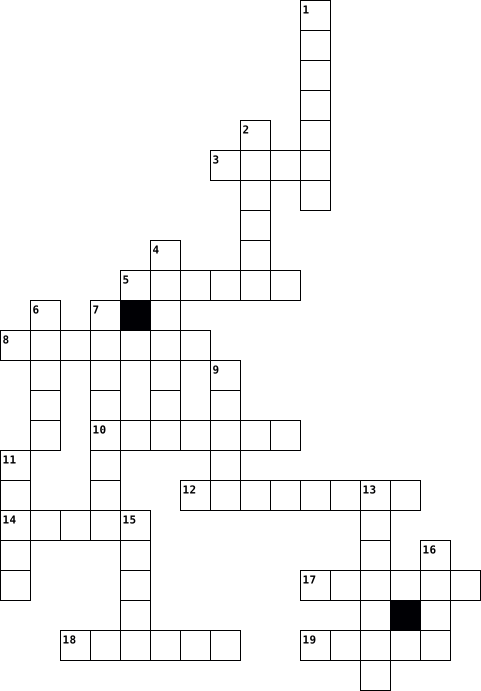
Across
- has 2 moons
- moon named Weywot
- moon named Actaea
- nearest planet to the sun
- moon named Xiangliu
- smallest dwarf planet
- has 53 confirmed & 29 awaiting confirmation moons
- coldest planet in the solar system
- hottest planet in the solar system
Down
- was discovered on 18 June 2002
- moons named Namaka and Hi'iaka
- biggest planet in the solar system
- we are on it
- moon named MK2
- disqualified from being a planet in 2006
- moon named Vanth
- farthest planet from the solar system
- takes 11,400 years to complete an orbit
- has a moon named Dysnomia
19 Clues: has 2 moons • we are on it • moon named MK2 • moon named Vanth • moon named Weywot • moon named Actaea • moon named Xiangliu • smallest dwarf planet • nearest planet to the sun • has a moon named Dysnomia • was discovered on 18 June 2002 • moons named Namaka and Hi'iaka • biggest planet in the solar system • coldest planet in the solar system • hottest planet in the solar system • ...
Grade 1* Review 2012-12-27

Across
- It looks black but it has no color
- The pupil lets ______________ intro your eye.
- The nerves will send ___________________ to the brain.
- He was sitting at the ___________________.
- Owl was ______________ when he couldn't see Moon.
- Medicine is very _________________
- Tiny things that helps us smell
- Owl saw the ___________ of the moon.
- We have 5 _____________ organs
- We use these to hear
- Owl shouted _______________ to Moon. "Good Bye Moon"
- We have taste ______________ on our toungue.
Down
- Moon was hiding behind the ______________
- Owl wears _______________ to bed.
- The smallest moon is called the ____________ moon.
- We touch with our _____________
- I like candy, because candy is very _______________
- We put it around our eyes when we don't want to see
- A lemon is very _______________
- We use these to see
- We use this to smell
- He decided to _____________ a hill.
22 Clues: We use these to see • We use this to smell • We use these to hear • We have 5 _____________ organs • We touch with our _____________ • Tiny things that helps us smell • A lemon is very _______________ • Owl wears _______________ to bed. • It looks black but it has no color • Medicine is very _________________ • He decided to _____________ a hill. • ...
Creative and the Arts 2021-11-30

Across
- public
- assumption
- growth
- melody
- fabric
- shape
Down
- position
- atmosphere
- phases
- research
- receptive
- steered
12 Clues: shape • public • phases • growth • melody • fabric • steered • position • research • receptive • atmosphere • assumption
Space Science 2025-12-21

Across
- An event when the Sun is partially blocked by the Moon
- The period of about two weeks where the illuminated part of the Moon is increasing from a new moon to a full moon
- A name given to the Moon during a lunar eclipse while it is completely in Earth’s shadow
- An event when the Sun partly or completely disappears from view, while the Moon moves between it and the Earth
- An imaginary line drawn around the middle of the Earth, equidistant between the North and South poles
- A model where the Earth was the centre of the universe
- The half of the Earth north of the equator
- The region in a shadow where the light is completely blocked
- The alignment in astronomy of three objects in a straight line
- The region in a shadow where the light is partially blocked
- One complete orbit
- The curved path of a celestial object or spacecraft round a star, planet or moon
- The region around a mass where another object can experience its gravity or pull
- The half of the Earth south of the equator
- The point in the Moon’s orbit when it is furthest from the Earth
- A model with the Sun as the centre of the solar system
Down
- The period of about two weeks where the illuminated part of the Moon is decreasing from a full moon to a new moon
- Occurs when one rotation of an orbiting body takes the same length of time as one orbit
- The bright area of the Moon and its shape when seen from Earth
- An event when a full moon becomes dark as it enters the Earth’s shadow
- A year that happens every four years and has an extra day on 29 February
- The time taken to complete one orbit or revolution
- The point in the Moon’s orbit when the Moon is closest to the Earth
- An event when the Moon blocks the Sun, but the Moon is not at its closest point to Earth, so the outer edge of the Sun is still visible
- An optical instrument for making distant objects appear nearer and larger
- An event when the Sun is completely blocked by the Moon
26 Clues: One complete orbit • The half of the Earth north of the equator • The half of the Earth south of the equator • The time taken to complete one orbit or revolution • An event when the Sun is partially blocked by the Moon • A model where the Earth was the centre of the universe • A model with the Sun as the centre of the solar system • ...
Eclipses 2025-10-16

Across
- The Moon phase needed for a solar eclipse
- The Moon phase needed for a lunar eclipse
- When the Moon passes between the Sun and Earth
- Time when the eclipse is at its peak
- Small bright points of sunlight seen just before totality
- When the Moon blocks a star or planet
- Shadow region where only part of the Sun is blocked
Down
- When part of the Moon or Sun is covered
- Outer lighter part of a shadow
- The tilt of the Moon’s orbit
- The path the Moon takes around Earth
- The plane Earth orbits the Sun on
- A rare alignment of Earth, Moon, and Sun
- A repeating eclipse cycle (~18 years)
- When Earth passes between the Sun and Moon
- When the Moon completely covers the Sun
- The darkest part of a shadow during an eclipse
- The bright ring seen around the Sun during an annular eclipse
18 Clues: The tilt of the Moon’s orbit • Outer lighter part of a shadow • The plane Earth orbits the Sun on • The path the Moon takes around Earth • Time when the eclipse is at its peak • A repeating eclipse cycle (~18 years) • When the Moon blocks a star or planet • When part of the Moon or Sun is covered • When the Moon completely covers the Sun • ...
Solar System Vocabulary 2022-03-02

Across
- To travel in a closed path
- A grouping of gas, dust, and many stars, plus any objects that orbit those stars
- An icy chunk of frozen gases, water, and dust that continually orbits the sun
- An imaginary line that passes through Earth's center
- A huge ball of very hot gases in space
- To spin on an axis
- An imaginary line around Earth equally distant from the North and South Poles
- planet An object that is spherical in shape, orbits the Sun, is not a satellite, and has not cleared the area of its orbit of smaller debris
- Any natural body that revolves around a planet; also known as a "satelite"
- Everything that exists
- The path one body takes in space as it revolves around another body
Down
- orbit The revolving of one object around another in an oval-shaped path; all 8 planets travel in this type of orbit
- A pattern of stars, named after a mythological or religious figure, an object, or an animal
- The force that pulls objects toward one another and keeps objects in orbit
- An object made of frozen gases, rock, ice, and dust that orbits the Sun, found mostly in the region between Mars and Jupiter (asteroid belt)
- A large, round body in space that orbits the Sun; there are 8 in our solar system
- The star at the center of our solar system; medium size star with medium temperature
- phases The changing appearances of the Moon as seen from Earth
- system The Sun, the planets and other objects that orbit the Sun
- A chunk of rock or metal from space that falls through the atmosphere, or layer of gases, surrounding Earth
20 Clues: To spin on an axis • Everything that exists • To travel in a closed path • A huge ball of very hot gases in space • An imaginary line that passes through Earth's center • phases The changing appearances of the Moon as seen from Earth • system The Sun, the planets and other objects that orbit the Sun • The path one body takes in space as it revolves around another body • ...
Oceans 2025-02-27

Across
- The catching of fish at a faster rate than they can reproduce.
- Microscopic floating organisms that live in the water and, like plants, convert sunlight and carbon dioxide into food.
- A shoreline area where freshwater from a river mixes with salt water from the ocean.
- A built-up limestone deposit formed by small ant-sized organisms called corals.
- The measure of the amount of dissolved salt contained in water.
- The periodic rising and falling of the water level of the ocean due to the gravitational pulls of the moon and the sun.
- The vertical movement of deep water up to the surface.
- A system that uses underwater sound waves to measure distance and locate objects.
- An opening in the sea floor from which heated water rises and mixes with the ocean water above.
- The natural environment in which a living gets all that it needs to survive; examples include a desert, a coral reef, and a freshwater lake.
- A narrow stream of water that breaks through sand bars and drains rapidly back into deeper water
Down
- The movement of water from the surface to greater depths.
- A property of matter representing the mass per unit volume.
- The difference in height between high tide and low tide.
- The portion of animals that are caught in a net and then thrown away as unwantedNeaptide A tide of small range occurring during the first- and third-quarter phases of the moon
- A large community of kelp, a type of seaweed that can attach to the ocean floor.
- The narrow ocean margin between the high-tide mark and the low-tide mark.
- current A mass of moving ocean water.
- A wet, swampy area that is often flooded with water.
19 Clues: current A mass of moving ocean water. • A wet, swampy area that is often flooded with water. • The vertical movement of deep water up to the surface. • The difference in height between high tide and low tide. • The movement of water from the surface to greater depths. • A property of matter representing the mass per unit volume. • ...
Phases Crossword Puzzle 2024-03-12

Across
- how attracted molecules are to each other
- a state of matter that has compact molecules that can flow past each other
- a chemical element
- something that has mass and takes up space
- when a phase change occurs but the substance stays the same
- when a liquid turns into gas on the surface
- the energy of motion
- the process in which gas turns to liquid
- a state of matter that has the most kinetic energy
- the process when adding heat that liquid turns to gas
- a state of matter that has the highest density and takes up volume
- a group of atoms bonded together
- the process when a solid turns into a liquid using heat
- when a gas turns to liquid
Down
- how able the molecules are allowed to move around freely
- the temperature that a substance starts to boil
- when a solid turns into gas
- when a phase change occurs but the substance changes
- the average kinetic energy
- consists of plasma,solid,liquid, and gas
- how compact molecules are in a substance
- the process in which a liquid turns to a vapor state
- the temperature that a liquid becomes a solid
- a liquid's ability to resist a flow
- when a gas skips the liquid phase and becomes a solid
- the average kinetic energy in a substance
- a measure of how much space is taken up by a substance
27 Clues: a chemical element • the energy of motion • the average kinetic energy • when a gas turns to liquid • when a solid turns into gas • a group of atoms bonded together • a liquid's ability to resist a flow • consists of plasma,solid,liquid, and gas • how compact molecules are in a substance • the process in which gas turns to liquid • how attracted molecules are to each other • ...
Unit Cover Phases 2024-03-15

Across
- when heat molecules from the substance transfer out
- how much space something takes up
- has a defined shape, molecules vibrate slightly
- liquid turning into gas
- the average kinetic energy of molecules
- doesn't have a defined shape, molecules move around each other
- thermal energy that gets transferred
- how much the molecules of a substance are able to move around
- made up of a group of atoms
- when time changes but temperature does not
- a change that changes the substance's molecules completely
- liquid turning into solid
- liquid turning into gas
Down
- molecule's resistance to separate
- solid skipping liquid phase into gas
- gas turning into liquid
- hot matter found in stars
- gas skipping liquid phase into solid
- doesn't have a shape, molecules move freely
- when the form of an element changes
- all of the kinetic energy in molecules combined
- a change that makes the substance change phases
- solid turning into liquid
- liquid turning into gas on the surface
24 Clues: gas turning into liquid • liquid turning into gas • liquid turning into gas • hot matter found in stars • solid turning into liquid • liquid turning into solid • made up of a group of atoms • molecule's resistance to separate • how much space something takes up • when the form of an element changes • solid skipping liquid phase into gas • gas skipping liquid phase into solid • ...
Phases of Matter 2025-03-06

Across
- 2words: a compound made of bonded carbon and oxygen atoms
- a phase of matter that has definite volume and definite shape. The particles of a solid are tightly bonded and cannot move around
- a particle made of two or more atoms that are held together with strong (covalent) bonds
- the change of phase from gas to liquid (clouds and drops on the side of a cold glass)
- 2words: the temperature at which a liquid changes to a solid; different for each substance
- the smallest particle of an element (all matter is made of this)
- phase of matter that has definite volume but no definite shape. Loosely bonded particles can flow over and around one another
- the smallest piece of a substance that is still that substance (another word for atom/molecule)
- a phase of matter that has no definite shape or volume. Particles fly independently through space
- the ratio of mass and volume in a sample of matter (how much stuff is packed into a space)
- a push or a pull
- 2words: the temperature at which a solid changes to a liquid; different for each substance
- to change phase from liquid to solid
Down
- energy transfer that increases the kinetic energy of a substance’s particles
- the reduction of volume of a sample of matter as a result of cooling
- energy transfer that decreases the kinetic energy of a substance’s particles
- the physical condition of a sample of matter based on the kinetic energy of its particles; common phrases include solid, liquid, and gas. Also called state.
- 2words: energy of motion
- the change of phase from liquid to gas (a puddle drying up)
- an attractive force between atoms (holds them together)
- existing in the gas phase
- 2words: the solid phase of carbon dioxide
- an increase of volume (to get bigger)
- to move rapidly back and forth
- to change phase from solid to liquid
- a defined quantity of space (the size of an object)
26 Clues: a push or a pull • 2words: energy of motion • existing in the gas phase • to move rapidly back and forth • to change phase from solid to liquid • to change phase from liquid to solid • an increase of volume (to get bigger) • 2words: the solid phase of carbon dioxide • a defined quantity of space (the size of an object) • ...
Earth moon and sun Crossword 2025-03-10

Across
- a moon phase that looks like a half a circle from earth
- the sun the planets that orbit the sun and other objects that orbit the sun
- the relative slice of things
- something we observe to be similar over and over again
- a moon phase that looks like a full circle from earth
- a moon outside our solar system
- the shape of the illuminated part of the moon as it appears from the earth
- a moon phase that looks like less than half a circle from earth
- the nearly circular path a smaller object (like the moon) travels around a larger object (like earth)
- to shine light on an object and make it visible
Down
- the amount of time it takes for a planet to complete one orbit around a star or stars
- the star that is the main source of light at the center of our universe
- when the moon is completely dark
- a moon phase that looks like more than a half circle from earth
- a planet outside our solar system
- the border between light and dark on the moon.
- on object,diagram or computer program that helps us understand something by making simpler or easier to see
- moon a moon phase that in which the moon is not visible from earth
18 Clues: the relative slice of things • a moon outside our solar system • when the moon is completely dark • a planet outside our solar system • the border between light and dark on the moon. • to shine light on an object and make it visible • a moon phase that looks like a full circle from earth • something we observe to be similar over and over again • ...
Earth,Moon and Sun 2025-03-10

Across
- a moon phase that looks like a half a circle from earth
- the sun the planets that orbit the sun and other objects that orbit the sun
- the relative slice of things
- something we observe to be similar over and over again
- a moon phase that looks like a full circle from earth
- a moon outside our solar system
- the shape of the illuminated part of the moon as it appears from the earth
- a moon phase that looks like less than half a circle from earth
- the nearly circular path a smaller object (like the moon) travels around a larger object (like earth)
- to shine light on an object and make it visible
Down
- the amount of time it takes for a planet to complete one orbit around a star or stars
- the star that is the main source of light at the center of our universe
- when the moon is completely dark
- a moon phase that looks like more than a half circle from earth
- a planet outside our solar system
- the border between light and dark on the moon.
- on object,diagram or computer program that helps us understand something by making simpler or easier to see
- moon a moon phase that in which the moon is not visible from earth
18 Clues: the relative slice of things • a moon outside our solar system • when the moon is completely dark • a planet outside our solar system • the border between light and dark on the moon. • to shine light on an object and make it visible • a moon phase that looks like a full circle from earth • something we observe to be similar over and over again • ...
Earth, Moon, And Sun Crossword 2025-03-10

Across
- a moon phase that looks like a half a circle from earth
- the sun the planets that orbit the sun and other objects that orbit the sun
- the relative slice of things
- something we observe to be similar over and over again
- a moon phase that looks like a full circle from earth
- a moon outside our solar system
- the shape of the illuminated part of the moon as it appears from the earth
- a moon phase that looks like less than half a circle from earth
- the nearly circular path a smaller object (like the moon) travels around a larger object (like earth)
- to shine light on an object and make it visible
Down
- the amount of time it takes for a planet to complete one orbit around a star or stars
- the star that is the main source of light at the center of our universe
- when the moon is completely dark
- a moon phase that looks like more than a half circle from earth
- a planet outside our solar system
- the border between light and dark on the moon.
- on object,diagram or computer program that helps us understand something by making simpler or easier to see
- moon a moon phase that in which the moon is not visible from earth
18 Clues: the relative slice of things • a moon outside our solar system • when the moon is completely dark • a planet outside our solar system • the border between light and dark on the moon. • to shine light on an object and make it visible • a moon phase that looks like a full circle from earth • something we observe to be similar over and over again • ...
Earth, Moon and Sun 2025-03-10

Across
- a moon phase that looks like a half a circle from earth
- the sun the planets that orbit the sun and other objects that orbit the sun
- the relative slice of things
- something we observe to be similar over and over again
- a moon phase that looks like a full circle from earth
- a moon outside our solar system
- the shape of the illuminated part of the moon as it appears from the earth
- a moon phase that looks like less than half a circle from earth
- the nearly circular path a smaller object (like the moon) travels around a larger object (like earth)
- to shine light on an object and make it visible
Down
- the amount of time it takes for a planet to complete one orbit around a star or stars
- the star that is the main source of light at the center of our universe
- when the moon is completely dark
- a moon phase that looks like more than a half circle from earth
- a planet outside our solar system
- the border between light and dark on the moon.
- on object,diagram or computer program that helps us understand something by making simpler or easier to see
- moon a moon phase that in which the moon is not visible from earth
18 Clues: the relative slice of things • a moon outside our solar system • when the moon is completely dark • a planet outside our solar system • the border between light and dark on the moon. • to shine light on an object and make it visible • a moon phase that looks like a full circle from earth • something we observe to be similar over and over again • ...
Earth/Moon/Sun Glossary 2025-03-11

Across
- A planet outside our solar system.
- The amount of time it takes for a planet to complete one orbit around a star or stars.
- The border between light and dark on the Moon.
- The shape of the illuminated part of the Moon as it appears from Earth.
- A rocky sphere that travels around a planet.
- A moon phase that looks like a full circle from Earth.
- The nearly circular path a smaller object(like the Moon) travels around a larger object (like earth).
- An object, diagram or computer program that helps us understand something by making it simpler or easier to see.
- A moon phase that looks like more than half a circle from Earth.
- the sun, planets that orbit the sun and objects that orbit the sun.
- A moon phase in which the Moon is not visible from earth.
Down
- When the moon is completely dark.
- something we observe to be similar over and over again.
- A moon outside our solar system.
- A moon phase that looks like a half circle from Earth.
- To shine light on an object and make it visible.
- The relative size of things
- A moon phase that looks like less than half a circle from earth.
18 Clues: The relative size of things • A moon outside our solar system. • When the moon is completely dark. • A planet outside our solar system. • A rocky sphere that travels around a planet. • The border between light and dark on the Moon. • To shine light on an object and make it visible. • A moon phase that looks like a half circle from Earth. • ...
5C Crossword #2 2025-02-05

Across
- the Moon phase about one week after the new Moon
- the first Moon phase
- different shapes of the Moon in one month
- when the Sun goes down in the evening
- the moon phase about 3 weeks after the new Moon
- when the Sun goes up in the morning
Down
- the fifth planet from the Sun
- the Moon phase about 2 weeks after the new Moon
- the fourth planet from the Sun
- the sixth planet from the Sun
- the first planet from the Sun
- a ball of rock that moves around a planet
- the second planet from the Sun
- to spin or turn around
- the eighth planet from the Sun
- the third planet from the Sun. The planet that humans live on
- a very large object that moves around a star
- the seventh planet from the Sun
18 Clues: the first Moon phase • to spin or turn around • the fifth planet from the Sun • the sixth planet from the Sun • the first planet from the Sun • the fourth planet from the Sun • the second planet from the Sun • the eighth planet from the Sun • the seventh planet from the Sun • when the Sun goes up in the morning • when the Sun goes down in the evening • ...
Moons of the Solar System 2022-03-22

Across
- the planets without moons
- largest moon of Neptune, orbits in retrograde
- most impacted moon
- the moon of Earth
- smallest of the 5 major satellites of Uranus
- darkest moon
- one of the most eccentrically orbiting moons
- same side always faces the planet
Down
- liquid water ocean under water ice crust, likely has life
- moons of mars
- shepherd moons of Uranus
- brightest moon
- largest moon
- most volcanic moon
- most earth-like moon
- darkest of the 5 major satellites of Uranus
16 Clues: largest moon • darkest moon • moons of mars • brightest moon • the moon of Earth • most volcanic moon • most impacted moon • most earth-like moon • shepherd moons of Uranus • the planets without moons • same side always faces the planet • darkest of the 5 major satellites of Uranus • smallest of the 5 major satellites of Uranus • one of the most eccentrically orbiting moons • ...
NASA and Space 2026-05-26

Across
- Biggest planet in the solar system.
- The 3rd planet from the sun.
- Named after Poseidon.
- The second planet from the sun.
- First woman in space.
- Went to space, then returned 30 years later.
- Greek god Mars is named after.
- Seventh planet.
- Abbreviation of the space station.
- When the moon looses light
- When the moon blocks the sun.
- "One small step for man" sayer.
Down
- The latest mission to the moon.
- First planet in the solar system.
- Takes 365 days to complete.
- The first mission to the moon.
- Name for the moon.
- The first American in space.
- Name for the sun.
- When the sun turns the moon red.
- Famous for its rings.
- First black person in space.
- When the moon gains light.
- Used to be a planet.
24 Clues: Seventh planet. • Name for the sun. • Name for the moon. • Used to be a planet. • Named after Poseidon. • First woman in space. • Famous for its rings. • When the moon looses light • When the moon gains light. • Takes 365 days to complete. • The 3rd planet from the sun. • The first American in space. • First black person in space. • When the moon blocks the sun. • ...
Bodies in our Solar System 2022-05-21

Across
- was hit by an asteroid while developing
- a Galilean moon the size of Mercury
- a Galilean moon with a liquid ocean under its crust
- this planet is covered in iron
- one of the reasons pluto was demoted and has only one moon called MK2
- this seperates the rocky planets from the gas giants
- the largest dwarf planet
- the dwarf planet farthest away from the sun
- the smallest planet in our solar system
- the outermost dust of our solar system and where comets are formed
- mars' bigger moon
- roughly the same size as Earth, but spins the opposite way
Down
- is elliptical in shape since it spins so fast
- Mark Twain was born and died when this passed
- seperates the planets from the dwarf planets
- this trans-Neptunian object has one moon:
- home of the great blue spot
- known for having an unexplainable white dot
- the largest of the Galilean moons
- (look it up)
- has at least seven layers of rings
- the scientific name for our moon
- has a moon so comprable to this body's size, they actually orbit each other
- 1000 of this would fit in the sun
- this moon is under consideration for terraforming
- mars' smaller moon
- the only known habitable planet
- a Galilean moon and the first moon to be discovered after our own
- the brightest object in the sky
29 Clues: (look it up) • mars' bigger moon • mars' smaller moon • the largest dwarf planet • home of the great blue spot • this planet is covered in iron • the only known habitable planet • the brightest object in the sky • the scientific name for our moon • the largest of the Galilean moons • 1000 of this would fit in the sun • has at least seven layers of rings • ...
Unit 6-1 2018-10-12

Across
- n., an imaginary line around which Earth spins or rotates
- n., the force that keeps Earth in an orbit around the Sun
- n., on order of succession, or one thing after another
- n., the Sun and all of the heavenly bodies that orbit it
- adj., not following the normal pattern
- n., fuzzy clouds made of ice, rock, and dust that look like streaks of light in the night sky
- n., a group of stars that form a figure in the sky
- n., a person whose work is, or who studies, astronomy
Down
- n., a large group of stars
- n., everything that exists, including Earth, the planets, the stars, and the Sun
- n., the changing views of the Moon
- n., the degree of coldness or hotness in an environment
- n., the outside parts or outermost layers of something
- n., a complete circle or turn of Earth around the Sun
- v., revolves around in space
- n., small objects that orbit the Sun
- n., a substance, such as air, that can expand to take the shape of the space available
17 Clues: n., a large group of stars • v., revolves around in space • n., the changing views of the Moon • n., small objects that orbit the Sun • adj., not following the normal pattern • n., a group of stars that form a figure in the sky • n., a complete circle or turn of Earth around the Sun • n., a person whose work is, or who studies, astronomy • ...
time,tides and seasons 2013-10-29

Across
- circle one month a year this has full daylight for 24 hrs
- the time between a full moon and new moon
- the time between a new moon and full moon
- each country has its own
- we do circles around it
- the lines going vertically down a map
- something resulting from waves
- the.....of the moon
- the process of turning
- the line that separates the southern and northern hemisphere
- tide weak tides are called
- moon when u cant see the moon
Down
- the Earth.....the sun
- tide higher tides are called
- the earth spins on an
- what keeps us on the ground
- the outside of the earth keeping the oxygen in
- the season at christmas
- the first bit of the coordinate
- the earth is on a 23 degree
20 Clues: the.....of the moon • the Earth.....the sun • the earth spins on an • the process of turning • the season at christmas • we do circles around it • each country has its own • tide weak tides are called • what keeps us on the ground • the earth is on a 23 degree • tide higher tides are called • moon when u cant see the moon • something resulting from waves • ...
Earth, Moon, and Sun 2023-04-28

Across
- a moon phase that looks like less than half a circle from earth
- the border between light and dark on the Moon
- the amount of time it takes for a planet to complete one orbit around a star or stars
- a planet outside our solar system
- something wee observe to be similar over and over again
- a moon phase that looks like a full circle from Earth
- a moon outside our solar system
- the star that is the main source of light at the center of our solar system
- the nearly circular path a smaller object (like the Moon) travels around a larger object (like Earth)
- a moon phase that looks like a half-circle from Earth
Down
- the shape of the illuminated part of the Moon as it appears from Earth
- the state or condition in which there is no apparent force of gravity acting on a body
- to shine light on an object and make it visible
- when the Moon is completely dark
- a moon phase that looks like more than half a circle from Earth
- the sun, the planets that orbit the sun, and other objects that orbit the sun
- a moon phase in which the moon is not visible from Earth
- a rocky sphere that travels around a planet
18 Clues: a moon outside our solar system • when the Moon is completely dark • a planet outside our solar system • a rocky sphere that travels around a planet • the border between light and dark on the Moon • to shine light on an object and make it visible • a moon phase that looks like a full circle from Earth • a moon phase that looks like a half-circle from Earth • ...
Earth moon and sun Crossword 2025-03-10

Across
- a moon phase that looks like a half a circle from earth
- the sun the planets that orbit the sun and other objects that orbit the sun
- the relative slice of things
- something we observe to be similar over and over again
- a moon phase that looks like a full circle from earth
- a moon outside our solar system
- the shape of the illuminated part of the moon as it appears from the earth
- a moon phase that looks like less than half a circle from earth
- the nearly circular path a smaller object (like the moon) travels around a larger object (like earth)
- to shine light on an object and make it visible
Down
- the amount of time it takes for a planet to complete one orbit around a star or stars
- the star that is the main source of light at the center of our universe
- when the moon is completely dark
- a moon phase that looks like more than a half circle from earth
- a planet outside our solar system
- the border between light and dark on the moon.
- on object,diagram or computer program that helps us understand something by making simpler or easier to see
- moon a moon phase that in which the moon is not visible from earth
18 Clues: the relative slice of things • a moon outside our solar system • when the moon is completely dark • a planet outside our solar system • the border between light and dark on the moon. • to shine light on an object and make it visible • a moon phase that looks like a full circle from earth • something we observe to be similar over and over again • ...
Earth Moon Sun Vocabulary 2022-11-30

Across
- a moon phase that more than a half moon.
- A moon phase that looks like a full circle.
- The sun, the planets, and other objects.
- A planet outside of our solar system.
- An object or diagram that helps us understand something.
- When the moon is completely dark.
- A moon phase that is less than a half moon.
- Something that happens over and over.
Down
- Line that divides light and dark on the moon.
- A moon outside of our solar system.
- the path the moon follows around Earth.
- The shape of the illuminated part of the moon.
- To shine a light on something.
- How it takes the Earth to obit the Sun.
- The star in the center of our solar system
- The rocky sphere that orbits the Earth.
16 Clues: To shine a light on something. • When the moon is completely dark. • A moon outside of our solar system. • A planet outside of our solar system. • Something that happens over and over. • the path the moon follows around Earth. • How it takes the Earth to obit the Sun. • The rocky sphere that orbits the Earth. • a moon phase that more than a half moon. • ...
Unit 2 2022-10-14

Across
- the imaginary line that earth rotates around
- the phase of the moon where you see a quarter of the moon lit on the left
- earth going around the sun
- an eclipse when the earth passes between the moon and sun
- the shape of the moon with less than half lit
- the attraction force between all objects
- the tide during the 1st and 3rd quarter moons
- decreasing light
- the shape of the moon with more than half lit
Down
- an eclipse when the moon passes between the earth and sun
- increasing light
- earth spinning
- the moon phase when you can see half of the moon
- the moon phase that looks like there is no moon
- the tide during the new and full moons
- the phase of the moon where you see a quarter of the moon lit on the right
16 Clues: earth spinning • increasing light • decreasing light • earth going around the sun • the tide during the new and full moons • the attraction force between all objects • the imaginary line that earth rotates around • the shape of the moon with less than half lit • the tide during the 1st and 3rd quarter moons • the shape of the moon with more than half lit • ...
Earth - Sun - Moon 2026-04-17

Across
- The side of the Earth closest to the moon and the side opposite the moon will experience a . . .
- Moon phase in image A
- Seasons are caused by the Earth's ______ and its revolution around the sun.
- Season in northern hemisphere in image E
- The Earth's _______ protects Earth from harmful rays from the sun.
- Day and night are caused by Earth's _______ on its axis.
- When the Earth, Sun, and Moon are at right angles to each other, a _____ tide is formed.
- Season in northern hemisphere in image F
- A trip of the Earth around the sun is called a ______.
- Earth is generally the warmest near the ______.
- The equator is warmest because it get the most _____ sunlight.
- One revolution of the Earth around the sun takes about . . .
- The highest high tides would occur during a _____ moon and a new moon.
- The tilt of the Earth and its revolution around the sun causes _____.
Down
- Season in the northern hemisphere in image C
- The side of the Earth that faces away from the sun is experiencing _____.
- What moon phase is not visible from Earth because the side facing Earth is completely shaded?
- Season in the northern hemisphere in image D
- Moon phase in image H
- The light reflected on the moon from the sun AND the moon's location cause us to have . . .
- Moon phase in image B
- The moon's ________ causes tides.
- The Earth's atmosphere is about 80% nitrogen and 20% _____.
- Moon phase in image G
24 Clues: Moon phase in image A • Moon phase in image H • Moon phase in image B • Moon phase in image G • The moon's ________ causes tides. • Season in northern hemisphere in image E • Season in northern hemisphere in image F • Season in the northern hemisphere in image C • Season in the northern hemisphere in image D • Earth is generally the warmest near the ______. • ...
Eclipse Crossword (April 2024) 2024-04-08

Across
- The effect seen just before and just after totality when only a few points of sunlight are visible around the Moon's edge; Baily's _____.
- A ______ eclipse occurs when the Moon passes between the Sun and the Earth.
- The point at which an object is farthest from the Earth.
- A magnetic disturbance on the Sun that appears as a dark botch on its surface.
- The point in which an object is closest to the Sun. Earth reaches this point in January.
- The period during a solar eclipse when the Sun's is completely covered by the Moon or the Moon is in the complete shadow of the Earth.
- A solar eclipse that occurs when the apparent size of the Moon is not large enough to completely cover the sun.
- The part of a shadow, as of the Moon or the Earth, within a source of light, usually the Sun, is only partially blocked.
- The upper atmosphere of the Sun. It appears as a halo around it during a total solar eclipse.
- The point in which an object's orbit is closest to Earth.
Down
- The edge between night and day on the Moon or on a planet. On the Earth, this line moves from east to west.
- A _______ eclipse occurs when the Moon passes through the Earth's shadow, which can only occur when there is a full moon.
- The point at which an object is farthest from the Sun. Earth reaches aphelion every July.
- The ____ of Totality that the Moon's shadow traces on Earth during a total solar eclipse.
- That part of the Moon's shadow that extends beyond the umbra.
- A _____ moon is the complete appearance of the Sun's light on the Moon. A blue moon is simply the appearance of this kind of moon twice within the same month.
- Phase of the Moon when more that half of it appears to be illuminated at night. When the Moon is closer to being Full, it is Waxing; when closer to New, it is Waning.
- A complete shadow, within which a source of light, is completely hidden from view.
- The alignment of celestial bodies so that one is obscured. either partially or totally, the other.
- A _____ moon is the absence of the Sun's light on the Moon, creating a completely dark night sky.
20 Clues: The point at which an object is farthest from the Earth. • The point in which an object's orbit is closest to Earth. • That part of the Moon's shadow that extends beyond the umbra. • A ______ eclipse occurs when the Moon passes between the Sun and the Earth. • A magnetic disturbance on the Sun that appears as a dark botch on its surface. • ...
5th Science Chapter 12 Part 2 2025-04-04

Across
- The launch of this satellite triggered the space race.
- The first American to orbit earth 3 times.
- The first satellite launch by the US.
- The first American in space.
- A condition of the least difference between low and high tides.
- When the moon is larger than a semi-circle but not a complete circle.
- To shrink.
- A solar eclipse always occurs durin gthis moon phase.
- The aircraft that carried the first three men to the moon.
- A large round depression that has been created by the impact of a meteoroid.
- The light-colored high peak on the moon is a mountain called this.
- When the earth and moon are in line with the sun, they occasionally block sunlight from each other. These events are called this.
- A dark flat area on the moon.
- This occurs on the sides of earth that are farthest away from the moon.
Down
- A condition of the greatest difference between low and high tides.
- As the moon revolves around the Earth, it rotates on this.
- When all of the near side of the moon is illuminated.
- Mare is latin for this word.
- The side of the earth that is closest to the moon experiences _______.
- The moon travels this direction around Earth.
- Spring and neap tides occur this many times during a month.
- This type of eclipse occurs when Earth blocks the sun's light from the full moon.
- The first human in space.
- To grow.
- The periodic rising and falling of the surface level of the ocean.
- The abbreviation for the governmental agency, National Aeronautics and Space Administration.
- The shape of the moon indicates what ____ its in.
- This type of eclipse occurs when the moon creates a shadow on earth by blocking some of the sun.
- This was created in 1961 by John F. Kennedy in a effort to place a man on the moon by the end of the decade.
- When the moon is directly between Earth and the sun.
- this is the difference in sea levels between high and low tides.
- The number of hours tides rise and fall for.
- When the moon is a similar shape to the letter C.
- A lunar eclipse always occurs during this moon phase.
34 Clues: To grow. • To shrink. • The first human in space. • Mare is latin for this word. • The first American in space. • A dark flat area on the moon. • The first satellite launch by the US. • The first American to orbit earth 3 times. • The number of hours tides rise and fall for. • The moon travels this direction around Earth. • The shape of the moon indicates what ____ its in. • ...
Astronomy 2021-12-09

Across
- The phase of the Moon after a Full Moon.
- The name of the star in the center of the Solar System.
- The planet that appears to look like the Earth's Moon.
- The phase of the Moon when it appears from Earth to start to be lit up.
- The only planet in the Solar System with flowing, liquid water.
- The phase of the Moon when it appears completely dark from Earth.
- A dwarf planet that is part of the Kuiper Belt.
- The spinning of a planet on it's axis causing day and night.
- The name of the only natural satellite orbiting the Earth.
- The planet that is a gas giant and has the most moons.
- the invisible line that goes through the north and south pole of the Earth.
- The amount of the Moon that is always lit by the Sun's rays.
- The hottest planet.
Down
- The phase of the Moon just before a New Moon.
- The only planet invaded by robots.
- The planet with ice and rock rings.
- The one orbit or full movement of a planet in one year around the Sun.
- The phase of the Moon when it appears from Earth almost completely lit up.
- The planet that is farthest from the Sun in the Solar System.
- The phase of the Moon when it appears completely lit up from Earth.
- The planet that is tilted on it's side.
21 Clues: The hottest planet. • The only planet invaded by robots. • The planet with ice and rock rings. • The planet that is tilted on it's side. • The phase of the Moon after a Full Moon. • The phase of the Moon just before a New Moon. • A dwarf planet that is part of the Kuiper Belt. • The planet that appears to look like the Earth's Moon. • ...
Lunar cycle, tides, and the sun 2023-05-05

Across
- Moon is losing light
- When the tide is at its lowest
- What causes jet winds
- The pull of gravity
- The force pulling towards everything the center of the earth
- The cycle of the moon
- A chemical having the atomic number of 2
- A chemical having the atomic number of 1
- The star in the center of our solar system
- The rise and fall of the ocean
- The stage of life a star is in before it becomes a redgiant
- The light coming from the sun
- Moon is entirely illuminated
- During a full or new moon
- A dark spot on the sun's surface
- One phase before or after the new moon
- Another word for revolution
Down
- 7th phase in the lunar cycle
- 3rd phase in the lunar cycle
- What fills up oceans, rivers, lakes, ect.
- When the tide is at its highest
- A burst of radiation coming from the release of magnetic energy on the sun
- The planet we are living on
- Moon is gaining light
- The opposite of clockwise
- One phase before or after the full moon
- Lighting up
- No light on the moon
- The amount of the moon we can see on any given night
- Earth’s natural satellite that reflects to the sun's light
- The birthplace of stars
- During a 1st or last quarter moon
- Celestial bodies made mostly of hydrogen and helium that produce light
33 Clues: Lighting up • The pull of gravity • Moon is losing light • No light on the moon • What causes jet winds • Moon is gaining light • The cycle of the moon • The birthplace of stars • The opposite of clockwise • During a full or new moon • The planet we are living on • Another word for revolution • 7th phase in the lunar cycle • 3rd phase in the lunar cycle • Moon is entirely illuminated • ...
Sun-Earth-Moon Systems 2022-05-11

Across
- The season that occurs when the hemisphere is tilted toward the sun
- The moon phase that must occur for a lunar eclipse
- The moon phase when light is on the left
- This and the earth's tilted axis cause seasons
- The moon phase when less than half is lit
- Tides that are higher & lower than normal
- The force from the moon & sun that causes tides
- The season that occurs when the hemisphere is tilted away from the sun
- The celestial body that has the greatest effect on the earth's tides
- The name for the days when there is exactly 12 hours of day & 12 hours of night
- the moon phase that must occur for a solar eclipse
Down
- The moon phase when more than half is lit
- When the tides are not as high & low as usual
- The name for the longest & shortest days of the year
- The moon phase when light is on the right
- Eclipse in Sun, Moon, Earth order
- Eclipse in Sun, Earth, Moon order
- This causes day and night
- The number of high & low tides that occur every day
19 Clues: This causes day and night • Eclipse in Sun, Moon, Earth order • Eclipse in Sun, Earth, Moon order • The moon phase when light is on the left • The moon phase when more than half is lit • The moon phase when light is on the right • The moon phase when less than half is lit • Tides that are higher & lower than normal • When the tides are not as high & low as usual • ...
Moon 2021-12-15

Across
- Waning means the amount of light is ____?
- Rise and fall of the ocean's water level
- Movement of an object around another
- Moon phase that comes right before 3rd quarter
- Force that pulls objects together
- When the moon is fully lit
Down
- Moon phase that comes right before 1st quarter
- Waxing means the amount of light is ____?
- When the moon is completely dark
- Change in the appearance of the moon
- Spinning of an object
11 Clues: Spinning of an object • When the moon is fully lit • When the moon is completely dark • Force that pulls objects together • Change in the appearance of the moon • Movement of an object around another • Rise and fall of the ocean's water level • Waxing means the amount of light is ____? • Waning means the amount of light is ____? • ...
Moon 2018-11-30

Across
- порядок
- дружище
- подтверждение
- мука
- решать
- винтовка
Down
- считать
- до тех пор
- в конце концов
- потому что
- желать
11 Clues: мука • желать • решать • считать • порядок • дружище • винтовка • до тех пор • потому что • подтверждение • в конце концов
Unit Cover Phases 2024-03-15

Across
- Ice turns straight into air
- Pressure is high water doesn't boil.
- Water becomes ice when it gets cold.
- Solid liquid and gas together.
- Gas becomes electrically charged.
- Gas turns straight into ice
- Matter changes from one form to another.
- Liquid bubbles when it's really hot.
Down
- Water disappears when the sun is out.
- Liquid turns into solid crystals.
- When things are a solid, liquid, or gas.
- Heat makes things hotter, cold makes things colder.
- Gas doesn't become a gas when pressure drops.
- Clouds are made when air cools.
- Water is as hot as it can get without becoming a vapor.
- Matter changes from solid to liquid or gas.
- Water is as cold as it can get without becoming ice.
- Liquid turns into solid like ice freezing.
- Water disappears into the air when it's hot.
- Water turns into a vapor with heat.
- Ice becomes water when it gets warm.
21 Clues: Ice turns straight into air • Gas turns straight into ice • Solid liquid and gas together. • Clouds are made when air cools. • Liquid turns into solid crystals. • Gas becomes electrically charged. • Water turns into a vapor with heat. • Pressure is high water doesn't boil. • Water becomes ice when it gets cold. • Ice becomes water when it gets warm. • ...
Phases Crossword Puzzle 2024-03-13

Across
- the energy of motion
- when a liquid turns into a gas
- matter in a state that has a fixed volume but not a fixed shape
- average kinetic energy
- a change of materials to another
- the temperature at which a solid turns into a liquid
- a continuous physical force exerted on an object
- the temperature at which a liquid starts to boil
- when molecules have less attraction they have more...
- molecules move freely and have little to none molecular atraction
- when a solid changes into a gas without going through the liquid state
Down
- a change in properties
- the amount of space a substance ocupies
- the temperature at which a liquid turns into a solid
- total kinetic energy
- the process in which a liquid state changes into a vapor state
- the basic building block of chemistry
- two or more atoms connected
- when the gaseous phase turns into the liquid state
- when solid materials are gradually added to each other from the different elements
- constantly vibrates and has a fixed volume
21 Clues: the energy of motion • total kinetic energy • a change in properties • average kinetic energy • two or more atoms connected • when a liquid turns into a gas • a change of materials to another • the basic building block of chemistry • the amount of space a substance ocupies • constantly vibrates and has a fixed volume • a continuous physical force exerted on an object • ...
Phases of Matter 2025-05-11

Across
- – Gas to solid
- – General term for liquid to gas
- – Measures average kinetic energy
- – Amount of space matter occupies
- – When matter increases in volume due to heat.
- – Not flexible, like most solids
- – Groups of atoms bonded together
- – No fixed shape or volume
- – Slow vaporization at the surface
- – Needed to change states
- – Type of energy due to motion
- – Lowers temperature, can cause freezing
- – Solids without a regular pattern
- – Another word for phase
- – Hot, ionized gas found in stars
- – Rapid vaporization of liquid
- – What liquids and gases can do
Down
- – Flows and takes the shape of its container
- – Related to heat energy
- – Has a definite shape and volume
- – Can be squished (like gases)
- – Solids with repeating patterns
- – Solid to liquid
- – A physical state of matter
- – Force applied over an area
- – Liquid to solid
- – Solid to gas without becoming liquid
- – Gas to liquid
- – Anything that has mass and takes up space
- – Basic units of matter
- – Transfer of thermal energy
31 Clues: – Gas to solid • – Gas to liquid • – Solid to liquid • – Liquid to solid • – Basic units of matter • – Related to heat energy • – Another word for phase • – Needed to change states • – No fixed shape or volume • – A physical state of matter • – Force applied over an area • – Transfer of thermal energy • – Can be squished (like gases) • – Type of energy due to motion • ...
Phases Of Matter 2025-05-16

Across
- point: the temperature at which a liquid turns into a solid
- state of matter with a fixed shape and volume
- The transition from gas to liquid
- Property: A characteristic that can be observed without changing the identity of the substance
- A combination of two or more substances that are not chemically bonded
- A group of atoms boned together
- point: The temperature at which a solid turns into a solid
- Property: A characteristic that describes how a substance reacts with other substances
- The transition from gas to liquid
- A substance that cannot be broken down into simpler substances by chemical means
- The basic unit of matter
- A state of matter with no fixed shape or volume
- the transition from gas to liquid
- diagram: A graph that shows the conditions under which different phases of matter are stable
- An ionized gas, often found in stars
- A measure of the average kinetic energy of the particles in a substance
- A measure of how much mass is contained in a given volume
Down
- mass per unit volume of a substance
- The amount of space occupied by a substance
- the Transition from solid directly to gas
- A substance formed when two or more elements are chemically combined
- A state of matter with a fixed volume but no fixed shape
- The process of a substance changing from a liquid to a gas
- point: The temperature at which a liquid turns into gas
- The form or out line of a substance
- Transition: The process of changing from one state of matter to another
26 Clues: The basic unit of matter • A group of atoms boned together • The transition from gas to liquid • The transition from gas to liquid • the transition from gas to liquid • mass per unit volume of a substance • The form or out line of a substance • An ionized gas, often found in stars • the Transition from solid directly to gas • The amount of space occupied by a substance • ...
Earth's Moon 2021-05-03

Across
- the time it takes for one rotation to occur
- less than a full circle
- the quarter moon that is waxing
- an object that orbits another object
- the phase where the moon is a sliver of light
- one object moving around another object
- the phase that occurs when the near side is fully lit
- the source of the moon's light
- how the moon appears to observers on Earth
- the amount of moonlight seen from Earth is decreasing
- a natural satellite
Down
- the force that pulls the moon towards Earth
- the darkest part of a shadow
- spinning on an axis
- one object in space casts a shadow on another object
- the number of moons that orbit Earth
- the amount of moonlight seen from Earth is increasing
- the number of Earth days for one rotation of the moon
- the phase when the near side of the moon is unlit
19 Clues: spinning on an axis • a natural satellite • less than a full circle • the darkest part of a shadow • the source of the moon's light • the quarter moon that is waxing • an object that orbits another object • the number of moons that orbit Earth • one object moving around another object • how the moon appears to observers on Earth • the force that pulls the moon towards Earth • ...
Earth's Moon 2021-05-03

Across
- the time it takes for one rotation to occur
- less than a full circle
- the quarter moon that is waxing
- an object that orbits another object
- the phase where the moon is a sliver of light
- one object moving around another object
- the phase that occurs when the near side is fully lit
- the source of the moon's light
- how the moon appears to observers on Earth
- the amount of moonlight seen from Earth is decreasing
- a natural satellite
Down
- the force that pulls the moon towards Earth
- the darkest part of a shadow
- spinning on an axis
- one object in space casts a shadow on another object
- the number of moons that orbit Earth
- the amount of moonlight seen from Earth is increasing
- the number of Earth days for one rotation of the moon
- the phase when the near side of the moon is unlit
19 Clues: spinning on an axis • a natural satellite • less than a full circle • the darkest part of a shadow • the source of the moon's light • the quarter moon that is waxing • an object that orbits another object • the number of moons that orbit Earth • one object moving around another object • how the moon appears to observers on Earth • the force that pulls the moon towards Earth • ...
Names of the full moons 2024-03-12

Across
- The second new moon in a month
- Northern Native Americans call April's full moon the ____ moon after a species of early blooming wildflower
- a fish found in some North American lakes in August
- The _ Waning __________ moon phase falls between the last quarter and the new moon phases
- ______ finish their lodge and rest for the winter give this November moon its name.
- moon happens in a complete lunar eclipse
- The second full moon in a month is called the _____ moon
- A ________moon occurs when the moon is full and at the perigee.
Down
- _____emerge on buck deer's foreheads around the time of the Buck Moon
- A Waxing _____ occurs when a small portion of the right side of the moon is visible from Earth
- When animals fatten for the winter months the moon is called
- the month of the Cold Moon
- Full Moon that can come in September
- Native _______ and medieval Europeans supposedly named January's full moon after the howling of hungry wolves
- The typically cold, snowy weather of ________ in North America earned this snow moon its name.
- The coming of winter earned December's full moon the name ____ moon.
16 Clues: the month of the Cold Moon • The second new moon in a month • Full Moon that can come in September • moon happens in a complete lunar eclipse • a fish found in some North American lakes in August • The second full moon in a month is called the _____ moon • When animals fatten for the winter months the moon is called • ...
The Moon 2021-09-21

Across
- Lunar comes from the _____ language.
- Program designed to land humans on Moon
- This is when the moon is fully visible.
- The Moon reflecting a semicircle of light.
- The Moon passes between the Earth and Sun
- The natural satellite of the Earth.
- _____ men have walked on the Moon.
- The Moon when it is more than half full
Down
- The smooth flat plains on the moon.
- The gasses surrounding a celestial body.
- When you cannot see the moon at night.
- The Earth's gravity makes our oceans _____.
- The Earth gets between the Sun and the Moon
- A car that explored the moon.
- The first curve of a waxing/waning moon.
15 Clues: A car that explored the moon. • _____ men have walked on the Moon. • The smooth flat plains on the moon. • The natural satellite of the Earth. • Lunar comes from the _____ language. • When you cannot see the moon at night. • Program designed to land humans on Moon • This is when the moon is fully visible. • The Moon when it is more than half full • ...
Science Crossword 2026-05-05

Across
- A Crescent getting bigger
- A Gibbous getting smaller
- A Crescent
- Involving the Moon
- When something blocks the Sun
- Getting smaller
- The half of the moon on the left side
- Repeats over and over again
- The Earth going around the Sun
- A pearl in the sky
Down
- Involving the Sun
- An empty void
- The half of the moon on the right side
- A Gibbous getting bigger
- Getting bigger
- Very close to not being able to see
- One fourth or three fourths
- The planet we live on
- Very close to full, but not quite
- At night, the gigantic thing in the sky
20 Clues: A Crescent • An empty void • Getting bigger • Getting smaller • Involving the Sun • Involving the Moon • A pearl in the sky • The planet we live on • A Gibbous getting bigger • A Crescent getting bigger • A Gibbous getting smaller • One fourth or three fourths • Repeats over and over again • When something blocks the Sun • The Earth going around the Sun • Very close to full, but not quite • ...
Scavenger Hunt - Renewable Energy 2023-01-06

Across
- The life cycle of wind energy, solar energy and energy-storage technologies can be broken down into four phases. What is the second?
- The life cycle of wind energy, solar energy and energy-storage technologies can be broken down into four phases. What is the first?
- What are utility-scale solar installations more commonly called?
- Energy is the _______ of an energy source that is difficult to store.
- What type of energy is the least expensive source of new electricity in canada?
- While solar, wind and energy storage are unique and distinct technologies, they are also _______ _____.
- The life cycle of wind energy, solar energy and energy-storage technologies can be broken down into four phases. What is the third?
- Renewable energy is a natural, ______ resource.
Down
- The life cycle of wind energy, solar energy and energy-storage technologies can be broken down into four phases. What is the fourth?
- Task 1 on Canada's to0do list is to ___________ Canada's electricity production by 2035.
- Two communities in New Brunswick have installed a single wind turbine to feed into their power grids, name one of them.
- The energy storage technology that is the most scalable is?
12 Clues: Renewable energy is a natural, ______ resource. • The energy storage technology that is the most scalable is? • What are utility-scale solar installations more commonly called? • Energy is the _______ of an energy source that is difficult to store. • What type of energy is the least expensive source of new electricity in canada? • ...
Astronomy 2025-03-05

Across
- The hottest of stars are this color.
- A portion of the Earth passes through the shadow cast by the Moon, temporarily blocking sunlight, fully or partially, from reaching that portion of the Earth's surface. (two words combined into one)
- A type of galaxy with an approximately ellipsoidal shape (elongaged circle) . (two words combined into one)
- Our home galaxy. (two words combined into one)
- The changing illumination of the Moon (or other body) over time growing more illuminated, between its new and full phases.
- The coolest of the stars are this color.
- A temporary dark blemish on the surface of the Sun that is a planet-size region of gas cooler than its surroundings.
- The average distance from Earth to the Sun, slightly less than 93 million miles (150 million kilometers). (two words combined into one)
- A measure of a star's absolute brightness. (two words combined into one)
- The distance that light (moving at about 186,000 miles per second) travels in one year, or about 6 trillion miles. (two words combined into one)
- The force of attraction between all objects depending upon their mass and distance.
- The brightness of a star as it appears from the earth. (two words combined into one)
- A unit of length used to express astronomical distances that is equivalent to the distance that an object moving at the speed of light in one year. (two words combined into one)
- Occurs when the sun and moon align with the earth creating a greater tidal range. (two words combined into one)
Down
- Occurs when the sun and moon are at right angles creating a lower tidal range. (two words combined into one)
- Earth centered system.
- A relatively small, icy body that displays extended features when it approaches the Sun.
- An area of the sun where it's energy is trasferred by the process of radiation. (two words combined into one)
- A massive ball of gas that generates prodigious amounts of energy (including light) from nuclear fusion in its hot, dense core.
- The four planets closest to the sun, before the asteroid belt. (two words combined into one)
- A gaseous envelope held in place by the gravity of a planet.
- A huge cloud of gas and dust, solar systems are formed from these.
- A large, gravitationally bound system that may contain hundreds of billions of stars and are categorized according to their visual morphology as elliptical, spiral, or irregular.
- The solid, rocky body that orbits the Earth as its only natural satellite,
- The changing illumination of the Moon (or other body) over time becoming less illuminated, between its full and new phases.
- A vast collection of stars, gas, and dust, typically 10,000 to 100,000 light-years in diameter and containing billions of stars
- The center of the sun where fusion take place generating the suns energy.
- An area of the sun where it's heat energy is transferred by the process of convection. (two words combined into one)
- Sun centered system
29 Clues: Sun centered system • Earth centered system. • The hottest of stars are this color. • The coolest of the stars are this color. • Our home galaxy. (two words combined into one) • A gaseous envelope held in place by the gravity of a planet. • A huge cloud of gas and dust, solar systems are formed from these. • ...
Space Vocabulary 2025-01-11

Across
- A vehicle for driving over rough terrain, especially one driven by remote control over extraterrestrial terrain.
- _______ is a phenomenon in the northernmost and southernmost regions of Earth where night lasts for more than 24 hours
- Any object that astronomers observe in outer space
- _______ are experienced during different times of the year in the northern and southern hemispheres of Earth because these regions are tilted toward the Sun at different times of the year
- The sun when seen at midnight during the summer in either the Arctic or Antarctic Circle
- Happens when the Moon passes between the Sun and Earth, casting a shadow on Earth that either fully or partially blocks the Sun's light
- The collection of eight planets and their moons in orbit around the sun, together with smaller bodies in the form of asteroids, meteoroids, and comets. The planets of the solar system are (in order of distance from the sun) Mercury, Venus, Earth, Mars, Jupiter, Saturn, Uranus, and Neptune
- The time or date (twice each year) at which the sun crosses the celestial equator, when day and night are of approximately equal length (about September 22 and March 20).
- An optical instrument designed to make distant objects appear nearer, containing an arrangement of lenses, or of curved mirrors and lenses, by which rays of light are collected and focused and the resulting image magnified.
- The branch of science that deals with celestial objects, space, and the physical universe as a whole.
- The nature of something's ingredients or constituents; the way in which a whole or mixture is made up.
- A celestial body moving in an elliptical orbit around a star.
Down
- A large artificial satellite used as a long-term base for manned operations in space
- The envelope of gasses surrounding the earth or another planet.
- An astronomical event that occurs when the Moon moves into the Earth's shadow, causing the Moon to be darkened
- The recurring path of an object around another object in space
- A vehicle or device designed for travel or operation outside the earth's atmosphere
- In the northern hemisphere, _______ are referred to as the northern lights (aurora borealis).
- Phases The different shapes of the Moon that we see at different times of the month
- In a way that is repeated many times, always in the same order.
- An unmanned exploratory spacecraft designed to transmit information about its environment.
- The star around which the earth orbits.
- Objects in space that orbit around another larger object. Natural ______ are celestial bodies. Artificial _______ are constructed and put into orbit by humans.
- The time or date (twice each year) at which the sun reaches its maximum or minimum declination, marked by the longest and shortest days (about June 21 and December 22).
24 Clues: The star around which the earth orbits. • Any object that astronomers observe in outer space • A celestial body moving in an elliptical orbit around a star. • The recurring path of an object around another object in space • The envelope of gasses surrounding the earth or another planet. • In a way that is repeated many times, always in the same order. • ...