
moon phases Crossword Puzzles
Phases of Matter 2025-03-07

Across
- Matter in this phase has freely flowing molecules. They have no definite shape or volume. They fill their container.
- Liquids and gases are considered ________ because they have molecules that can move past each other.
- This is the last name of the scientist that determined that as the pressure of a gas increases, its volume decreases.
- The phase change from gas to solid.
- The relationship between temperature and volume, and the relationship between temperature and pressure in a gas is a _________ relationship.
- Carbon dioxide sinks below air because it is more ________ than air.
- The average kinetic energy of molecules moving as a result of thermal energy.
- Vaporization that happens slowly over time.
- The phase change form gas to liquid.
- Vaporization that happens rapidly as a result of a rapid increase in temperature
Down
- Matter in this phase has tightly compacted molecules that vibrate in place.
- The relationship between pressure and volume in a gas is a _______ relationship.
- The phase change from solid to gas.
- The phase change from gas to plasma.
- The thermal energy that causes molecules to move and drives phase changes.
- The phase change from solid to liquid.
- This is the last name of the scientist that determined that as the temperature of a gas increases, its volume increases.
- Matter in this phase is moving so quickly that it has split into positive and negative ions.
- The phase change from liquid to solid.
- The phase change from plasma to gas.
- This is the last name of the scientist that determined that as the temperature of a gas increases, its pressure increases (don't include the hyphen!).
- The phase change from liquid to gas.
- The chemical compound that sublimates at average pressure and temperature on Earth. Its solid form is more commonly known as dry ice.
- Matter in this phase has loose molecules that can move past one another, but not flow freely. They have a definite volume, but take the shape of their container.
24 Clues: The phase change from solid to gas. • The phase change from gas to solid. • The phase change from gas to plasma. • The phase change from plasma to gas. • The phase change from liquid to gas. • The phase change form gas to liquid. • The phase change from solid to liquid. • The phase change from liquid to solid. • Vaporization that happens slowly over time. • ...
Eclipse Crossword 2024-04-05

Across
- Moon that is located in the same direction as the sun
- The darkest part of the moon's shadow
- Max phase of a total eclipse (moon covers the sun)
- Eclipse period that is 6585.32 days long
- Part of the eye damaged by not wearing eclipse glasses
- What happens to temperature during totality
- Apparent diameter of the moon covers all the sun
- Contact when the second diamond ring appears
- Time between second and third contact
Down
- Suns upper atmosphere visible as pearly glow
- Area where people can only see a partial eclipse
- Red middle layer of the sun's atmosphere
- Contact when the moon begins to cover the sum
- Rays of the sum pass thru valleys of the moon
- Another name for an eclipse chaser
- When the moon only covers part of the sun
- The moon does not cover the outer ring of the sun
- Contact when the moon moves away from the sum
- Contact when the first diamond ring vanishes
- How the light intensity appears during totality
20 Clues: Another name for an eclipse chaser • The darkest part of the moon's shadow • Time between second and third contact • Red middle layer of the sun's atmosphere • Eclipse period that is 6585.32 days long • When the moon only covers part of the sun • What happens to temperature during totality • Suns upper atmosphere visible as pearly glow • ...
Crossword 2021-02-22

Across
- He discovered that prism can be used to split white light into it's components.
- First person to see the Rings of Saturn and the Moons of Jupiter with his telescope.
Down
- A kind of lens used to magnify objects.
- Joseph Fraunhofer invented and used it to discover absorption lines of the stars.
- We see phases of this because of reflection from our nearest star.
- - This is why the sky is blue
6 Clues: - This is why the sky is blue • A kind of lens used to magnify objects. • We see phases of this because of reflection from our nearest star. • He discovered that prism can be used to split white light into it's components. • Joseph Fraunhofer invented and used it to discover absorption lines of the stars. • ...
Crossword 2021-02-22

Across
- - This is why the sky is blue
- We see phases of this because of reflection from our nearest star.
- He discovered that prism can be used to split white light into it's components.
Down
- Joseph Fraunhofer invented and used it to discover absorption lines of the stars.
- A kind of lens used to magnify objects.
- First person to see the Rings of Saturn and the Moons of Jupiter with his telescope.
6 Clues: - This is why the sky is blue • A kind of lens used to magnify objects. • We see phases of this because of reflection from our nearest star. • He discovered that prism can be used to split white light into it's components. • Joseph Fraunhofer invented and used it to discover absorption lines of the stars. • ...
Space 2023-02-17

Across
- the right half of the moon is visible
- continuous path an object takes
- Keeps planets in their orbit
- the moon is blocking the sun
- Earth spinning on its axis
- the Earth is blocking the moon
- none of the moon is visible
- the closest point in an orbit to another object
Down
- wrong thinking
- the left half of the moon is visible
- one factor that causes the seasons
- Earth moving around the sun
- the moon is more than half visible but less than a full moon
- the farthest point in an orbit to another object
- the moon is getting more visible
- the moon is getting less visible
16 Clues: wrong thinking • Earth spinning on its axis • Earth moving around the sun • none of the moon is visible • Keeps planets in their orbit • the moon is blocking the sun • the Earth is blocking the moon • continuous path an object takes • the moon is getting more visible • the moon is getting less visible • one factor that causes the seasons • the left half of the moon is visible • ...
Melanie's Sailor Moon 2023-10-30

Across
- Usagi is part of a team of magical girls known as the
- Lita's Name in the Original is
- Sailor Pluto's symbol on her transformation pen looks like a cross between the letters "P" and "L." This is the astrological symbol for what?
- Sailor Moon Musicals are also called
- The Sailor Moon manga first hit the shelves in 1991 in
- Usagi’s birthday
- In the original, Raye smacks Serena across the face after Serena cries over how she hated being a _____
- How many main Sailor Scouts are there?
- Usagi transforms into Sailor Moon using a magical
Down
- Sailor Moon’s love interest
- Creator of Sailor Moon
- Chi Means what?
- Throughout its narrative, Sailor Moon tackles topics such as gender equality, self-acceptance, and the power of standing up against
- The final season, "_______", was never originally dubbed in America due to America losing licensing rights to "Sailor Moon", until the later licensing and release by VIZ Media.
- When Sailor Moon does the "In the name of the moon" speech, Sailor Moon makes the American Sign Language symbol for "_________" with her hands
- Serena's Japanese name Usagi Tsukino which means 'Rabbit of the____'
- In the original, Serena's school was called "_______", not "Crossroads Junior High".
- Mamoru means what?
- Chiba Mamoru means ____ of earth
- The Original Spelling for Raye's name is
20 Clues: Chi Means what? • Usagi’s birthday • Mamoru means what? • Creator of Sailor Moon • Sailor Moon’s love interest • Lita's Name in the Original is • Chiba Mamoru means ____ of earth • Sailor Moon Musicals are also called • How many main Sailor Scouts are there? • The Original Spelling for Raye's name is • Usagi transforms into Sailor Moon using a magical • ...
Planetary Moons 2026-01-20

Across
- moon of Saturn with an atmosphere
- largest of Pluto's moons
- moon of Saturn that looks like the Death Star
- discovered the 4 main moons of Jupiter
- moon of Saturn that is oddly-shaped & colored
- moon of Neptune with retrograde motion
- smaller of Mars' 2 moons
- largest moon in the solar system
- the largest of Uranus's moons
Down
- ice-covered moon of Jupiter with underground ocean
- moon of Jupiter that is heavily cratered
- spacecraft that studied Saturn and its moons
- larger of Mars' 2 moons
- moon of Uranus with wildly varied topography
- moon of Saturn with erupting geysers
- most volcanically active place in the solar system
16 Clues: larger of Mars' 2 moons • largest of Pluto's moons • smaller of Mars' 2 moons • the largest of Uranus's moons • largest moon in the solar system • moon of Saturn with an atmosphere • moon of Saturn with erupting geysers • discovered the 4 main moons of Jupiter • moon of Neptune with retrograde motion • moon of Jupiter that is heavily cratered • ...
Demon Slayer 2020-06-18

Across
- Mist Breathing
- Trainer to Tanjiro, Former Water Breathing
- Final Selection (Second)
- Stone Breathing
- Son to Kagaya
- Eldest Brother to Nezuko, Sun Breathing
- The Woman who made the song 'Gurenge.'
- Water Breathing
- Second youngest brother to Tanjiro and Nezuko
- Demon Sister
- Lower Moon 6
- Upper Moon 3
- Swordsmith for Tanjiro
- Thunder Breathing
- Former Upper Moon 4
- Wind Breathing
- The creator of Demon Slayer
- Second Oldest Brother in the Drum House
- Younger Sister to Tanjiro and Nezuko
- Lower Moon 2
- Demon Slayer Corps
- Giyu's sister
- Love Breathing
- Former Sun Breathing
- Green Assistant
- Boar, Beast Breathing
- Upper Moon 4
- Wife to Kagaya
- Kanao and Tanjiro's Great-Grandson
- Tanjiro and Nezuko's mother
- Pink Assistant
- Upper Moon 1
- Upper Moon 6
- Flower Breathing
- Tengen's Third Wife
- Flame Breathing
- Father of all the Ubuyashiki Family
- Trainer to Zenitsu, Former Thunder Breathing
- Inosuke's mother
- Daughter to Kagaya
- Former Flower Breathing, Sister to Shinobu
- Reincarnation of Kyojuro Rengoku
- Blue Assistant
- Nezuko and Tanjiro's father
- Medic at Butterfly Estate
- Muzan's Demon Assistant (Male)
Down
- Third daughter to Kagaya
- Ancestor to Tanjiro and Nezuko (Male)
- Inosuke's Great-Grandson
- Old Woman
- Former Upper Moon 6 (Sister)
- Youngest Brother to Tanjiro and Nezuko
- Kyojuro's father
- Lower Moon 1
- Baby Ancestor to Tanjiro and Nezuko
- Kyojuro's mother
- Kyojuro Rengoku's younger brother
- Former Upper Moon 6 (Brother)
- Zenitsu and Nezuko's Great-Granddaughter
- Serpent Breathing
- Tamayo's helper
- Zenitsu and Nezuko's Great-Grandson
- Upper Moon 2
- Lower Moon 3
- Demon who helped Tanjiro and Nezuko
- Sound Breathing
- Brother to Sanemi
- Tengen's First Wife
- Tanjiro and Kanao's Great-Grandson
- Lower Moon 5
- Brother to Muichiro Tokito
- Younger Brother to Tanjiro and Nezuko
- Older Brother in the Drum House
- Insect Breathing, sister to Kanae
- Second daughter to Kagaya
- Final Selection (First)
- Trainer at Butterfly Estate
- Upper Moon 5
- Lower Moon 4
- Tengen's Second Wife
- Muzan's Demon Assistant (Female)
- Leader of the Twelve Kizuki
- Swordsmith for Inosuke
- Former Demon Slayer
- Ancestor to Tanjiro and Nezuko (Female)
- Sanemi and Genya's mother
- Former Lower Moon 6
- Sister in the Drum House
- Reincarnation of Tengen Uzui
89 Clues: Old Woman • Lower Moon 1 • Upper Moon 2 • Lower Moon 3 • Demon Sister • Lower Moon 6 • Upper Moon 3 • Lower Moon 2 • Lower Moon 5 • Upper Moon 5 • Lower Moon 4 • Upper Moon 4 • Upper Moon 1 • Upper Moon 6 • Son to Kagaya • Giyu's sister • Mist Breathing • Wind Breathing • Love Breathing • Wife to Kagaya • Pink Assistant • Blue Assistant • Stone Breathing • Water Breathing • Tamayo's helper • Sound Breathing • Green Assistant • ...
Earth's Moon 2014-11-25

Across
- earth's only natural satellite
- moon's point closest to the earth
- the lighted area of the moon decrease in size
- as the moon revolves around earth, sunlight begins to illuminate at the right side
- division between the illuminated and dark part of the earth's moon
- edge of the visible surface of the moon
- in a full moon _____ is between the sun and the moon
- when you can see the left half illuminated
- moon's point farthest from the earth
Down
- small volcanic features of the moon
- Each day the lighted area of the moon gets bigger
- we cannot see the moon because the sun and the moon are lined in one direction
- it when half of the moon appears
- smooth dark areas on the moon
- lunar phase that occurs when the Moon is completely illuminated as seen from the Earth
15 Clues: smooth dark areas on the moon • earth's only natural satellite • it when half of the moon appears • moon's point closest to the earth • small volcanic features of the moon • moon's point farthest from the earth • edge of the visible surface of the moon • when you can see the left half illuminated • the lighted area of the moon decrease in size • ...
Project word puzzle 2023-11-08

Across
- when the moon is around 65% percent visible
- when the moon is about 30% visible
- when the moon is fully visible
- this is the most distant point on an elliptical orbit around Earth
- the phenomenon whereby the moon in total eclipse appears reddish in color as it is illuminated by sunlight filtered and refracted by the earth's atmosphere.
- when the moon is "growing"
- whe the moon is 50% visible near the end of the moon cycle
Down
- a phenomenon whereby the moon appears bluish owing to smoke or dust particles in the atmosphere.
- when the moon is half visible
- a term used for a waning crescent moon.
- when the moon is not visible
- when the moon is "shrinking"
- the orbit of the Moon around the Earth
- he glow caused by sunlight reflected off the earth, especially on the darker portion of a crescent moon.
- distinct period or stage in a series of events or a process of change or development.
15 Clues: when the moon is "growing" • when the moon is not visible • when the moon is "shrinking" • when the moon is half visible • when the moon is fully visible • when the moon is about 30% visible • the orbit of the Moon around the Earth • a term used for a waning crescent moon. • when the moon is around 65% percent visible • ...
Project word puzzle 2023-11-08

Across
- when the moon is around 65% percent visible
- when the moon is about 30% visible
- when the moon is fully visible
- this is the most distant point on an elliptical orbit around Earth
- the phenomenon whereby the moon in total eclipse appears reddish in color as it is illuminated by sunlight filtered and refracted by the earth's atmosphere.
- when the moon is "growing"
- whe the moon is 50% visible near the end of the moon cycle
Down
- a phenomenon whereby the moon appears bluish owing to smoke or dust particles in the atmosphere.
- when the moon is half visible
- a term used for a waning crescent moon.
- when the moon is not visible
- when the moon is "shrinking"
- the orbit of the Moon around the Earth
- he glow caused by sunlight reflected off the earth, especially on the darker portion of a crescent moon.
- distinct period or stage in a series of events or a process of change or development.
15 Clues: when the moon is "growing" • when the moon is not visible • when the moon is "shrinking" • when the moon is half visible • when the moon is fully visible • when the moon is about 30% visible • the orbit of the Moon around the Earth • a term used for a waning crescent moon. • when the moon is around 65% percent visible • ...
moon Phases 2021-09-30

Across
- it is on the right side of the moon
- The moon is not visible
Down
- it's half of the moon but The light on the right side of the moon.
3 Clues: The moon is not visible • it is on the right side of the moon • it's half of the moon but The light on the right side of the moon.
Unit 9 Crossword 2017-02-23

Across
- tides - a tide just after a new or full moon, when there is the greatest difference between high and low water.
- - move or cause to move in a circle around an axis or center.
- solstice - the solstice that marks the onset of summer, at the time of the longest day, about June 21 in the northern hemisphere and December 22 in the southern hemisphere.
- equinox - the equinox in autumn, on about September 22 in the northern hemisphere and March 20 in the southern hemisphere.
- in the opposite direction to the way in which the hands of a clock move around.
- moon – the fifth phase of the moon cycle. The moon’s surface is completely covered with light.
- crescent – a phase of the moon where the light (white part) is on the right and it is taking up 1/4 of the moon’s surface.
- eclipse - an eclipse in which the moon appears darkened as it passes into the earth's shadow. Takes place during a full moon.
- solstice - the solstice that marks the onset of winter, at the time of the shortest day, about December 22 in the northern hemisphere and June 21 in the southern hemisphere.
- quarter moon – The sixth phase of the moon cycle as the light is found on the left. 50% of the moon is covered with light.
Down
- axis - the straight line through all fixed points of a rotating rigid body around which all other points of the body move in circles.
- - a straight central part in a structure to which other parts are connected.
- tide – a state at which the ocean water is at its lowest level.
- equinox - the equinox in spring, on about March 20 in the northern hemisphere and September 22 in the southern hemisphere.
- crescent – a phase of the moon where the light (white part) is on the left and it is taking up 1/4 of the moon’s surface.
- moon – the first phase in the moon cycle. The moon does not reflect light during this phase.
- - move in a circle on a central axis:
- quarter moon – The third phase of the moon cycle as the light is found on the right. The moon’s surface is 50% covered with light.
- tide – a state at which the ocean water is at its highest level.
- tides - a tide just after the first or third quarters of the moon when there is the least difference between high and low water.
20 Clues: - move in a circle on a central axis: • - move or cause to move in a circle around an axis or center. • tide – a state at which the ocean water is at its lowest level. • tide – a state at which the ocean water is at its highest level. • - a straight central part in a structure to which other parts are connected. • ...
Earth, moon and sun glossary Wordsearch 2024-02-02

Across
- the shape of the illuminated part of the moon as it appears from earth
- a moon outside our solar system
- a moon phase that looks like less than half a circle from earth
- when the moon is completely darj
- to shine light on an object and make it visible
- the amount of time it takes for a planet to complete one orbit around a star or stars
- an object, diagram, or computer program that helps us understand something by making it simpler or easier to understand
- the sun, the planets that orbit the sun, and other objects that orbit the sun
- a moon phase in which the moon is not visible from earth
Down
- the border between light and dark on the moon
- a rocky sphere that travels around a planet
- a planet outside our solar system
- a moon phase in which it looks like a half-circle from earth
- a moon phase that looks like a full circle from earth
- a moon phase that looks like a full circle from earth
- something we observe to be similar over and over again
- the nearly circular path a smaller object (like the moon) travels around something much larger (like earth)
- the relative size to things
- the star that is the main source of light at the center of our solar system
19 Clues: the relative size to things • a moon outside our solar system • when the moon is completely darj • a planet outside our solar system • a rocky sphere that travels around a planet • the border between light and dark on the moon • to shine light on an object and make it visible • a moon phase that looks like a full circle from earth • ...
Unit 4 Vocab 2025-03-01

Across
- types of tides caused by new and full moon
- moon phase where moon is illuminated
- height of sun in the sky
- spinning on its axis
- moving around the sun
- axis pointed away from the sun
- type of eclipse in full moon phase
Down
- light bouncing off a surface
- moon phase where moon is invisible
- axis pointed to the sun
- bending of light
- type of eclipse in new moon phase
- North Star
- longest and shortest days
- equal amount of day and night
- types of tides caused by 1st and 3rd quarter moon
16 Clues: North Star • bending of light • spinning on its axis • moving around the sun • axis pointed to the sun • height of sun in the sky • longest and shortest days • light bouncing off a surface • equal amount of day and night • axis pointed away from the sun • type of eclipse in new moon phase • moon phase where moon is invisible • type of eclipse in full moon phase • ...
Crossword 2021-02-22

Across
- Joseph Fraunhofer invented and used it to discover absorption lines of the stars.
- A kind of lens used to magnify objects.
- He discovered that prism can be used to split white light into it's components.
- First person to see the Rings of Saturn and the Moons of Jupiter with his telescope.
Down
- - This is why the sky is blue
- We see phases of this because of reflection from our nearest star.
6 Clues: - This is why the sky is blue • A kind of lens used to magnify objects. • We see phases of this because of reflection from our nearest star. • He discovered that prism can be used to split white light into it's components. • Joseph Fraunhofer invented and used it to discover absorption lines of the stars. • ...
Project word puzzle 2023-11-08

Across
- when the moon is around 65% percent visible
- when the moon is about 30% visible
- when the moon is fully visible
- this is the most distant point on an elliptical orbit around Earth
- the phenomenon whereby the moon in total eclipse appears reddish in color as it is illuminated by sunlight filtered and refracted by the earth's atmosphere.
- when the moon is "growing"
- whe the moon is 50% visible near the end of the moon cycle
Down
- a phenomenon whereby the moon appears bluish owing to smoke or dust particles in the atmosphere.
- when the moon is half visible
- a term used for a waning crescent moon.
- when the moon is not visible
- when the moon is "shrinking"
- the orbit of the Moon around the Earth
- he glow caused by sunlight reflected off the earth, especially on the darker portion of a crescent moon.
- distinct period or stage in a series of events or a process of change or development.
15 Clues: when the moon is "growing" • when the moon is not visible • when the moon is "shrinking" • when the moon is half visible • when the moon is fully visible • when the moon is about 30% visible • the orbit of the Moon around the Earth • a term used for a waning crescent moon. • when the moon is around 65% percent visible • ...
solar system crossword 2015-05-04

Across
- the only planet with life
- Jupiter's moon that is very close to Earth's moon
- the second person to walk on the Moon
- became the first American woman in space aboard the space shuttle
- a program to see if humans could function in space.
- the first mission to land a man on the moon
- a minor space object that has entered the Earth's atmosphere
- a monkey who successfully was sent to space
- about the size of a pebble
- It is the only moon in the entire solar system with a dense atmosphere
- last person to walk on the moon
- has the big red spot
- Jupiter’s volcanic moon
- neptune’s biggest moon
Down
- has over 30 rings
- has 27 moons
- first astronaut in space
- the second smallest planet in our solar system
- NASA's second human spaceflight program
- Earth’s sister planet
- these planets haven’t ¨Cleared their neighborhood¨
- when they hit the surface of a planet or a moon it is considered a ...
- first animal/dog in space
- an animal that was sent into space on 9 March 1961
- named after the roman god of Thieves
- larger than meteoroids
- coldest planet in the solar system
27 Clues: has 27 moons • has over 30 rings • has the big red spot • Earth’s sister planet • larger than meteoroids • neptune’s biggest moon • Jupiter’s volcanic moon • first astronaut in space • the only planet with life • first animal/dog in space • about the size of a pebble • last person to walk on the moon • coldest planet in the solar system • named after the roman god of Thieves • ...
Man on the Moon 2025-05-22

Across
- The vehicle that carried the astronauts to the moon
- The natural force that causes objects with mass to pull toward one another
- Orbits the Earth
- A large celestial body that orbits a star
- The fine particles covering the surface of the Moon
- The name of the Apollo 11 landing site on the Moon
- A large rock or metal object that orbits the Sun
- A small rock from space that burns up as it enters Earth's atmosphere
- The moon is covered with these from meteors
- Last name of the second person to walk on the moon
Down
- An instrument used to observe distant objects in space
- The team in charge of guiding the astronauts
- Name of space program who sent astronauts to the moon
- The Astronaut who stayed in Lunar orbit in the Command Model
- A massive, glowing ball of gas that produces its own light and heat
- The path followed by the spacecraft as it circles a planet or moon
- Last name of the Astronaut who took the first step on the moon
- The measure of how far light travels in one year
- Name of the lunar module used during Apollo 1
- The star at the center of our solar system
20 Clues: Orbits the Earth • A large celestial body that orbits a star • The star at the center of our solar system • The moon is covered with these from meteors • The team in charge of guiding the astronauts • Name of the lunar module used during Apollo 1 • The measure of how far light travels in one year • A large rock or metal object that orbits the Sun • ...
Space Search 2023-03-01

Across
- A gassy planet
- A dwarf planet
- Icy moon of Jupiter
- The hottest planet
- A floating rock in space
- A gassy moon
- Where we live
- A very big moon
Down
- One of Mars's moons
- The planet with the rings
- The star in the center of the solar system
- The biggest asteroid
- The most massive planet
- One of the asteroids in the Asteroid Belt
- Our Planet
- Planet that spins on its side
- The red planet
- The smallest planet
- A volcanic moon of Jupiter
- What is the milky way?
- Our Natural Satellite
21 Clues: Our Planet • A gassy moon • Where we live • A gassy planet • A dwarf planet • The red planet • A very big moon • The hottest planet • One of Mars's moons • Icy moon of Jupiter • The smallest planet • The biggest asteroid • Our Natural Satellite • What is the milky way? • The most massive planet • A floating rock in space • The planet with the rings • A volcanic moon of Jupiter • ...
Qili Sports Day 2024-01-18

Across
- Mother of 4
- Can be mistaken as one of the guys
- The eldest of 3
- Very rare
- Daddy pearl and moon
- The second big boss
- The pearl
- The eldest of 8
- Original Moon TBH
- The youngest of the 8
Down
- The funniest
- The moon
- The eldest of the 4
- Fashion mogul
- The big boss
- Best voice
- Grinch is her second name
- One of the arab princess
- The most flexible child
- Mommy pearl and moon
- Flys to see the OG moon
- The second out of 4
- A known princess
23 Clues: The moon • Very rare • The pearl • Best voice • Mother of 4 • The funniest • The big boss • Fashion mogul • The eldest of 3 • The eldest of 8 • A known princess • Original Moon TBH • The eldest of the 4 • The second big boss • The second out of 4 • Daddy pearl and moon • Mommy pearl and moon • The youngest of the 8 • The most flexible child • Flys to see the OG moon • One of the arab princess • ...
23 2024-08-23

Across
- Moon not visible
- Planet with strong winds
- Scorpion-shaped constellation
- Water-bearer constellation
- Our home planet
- Fish-shaped constellation
- Related to tides
- Red planet
- Swan-shaped constellation
- Maiden constellation
- Less than half moon
- Fully visible moon
Down
- Dragon-shaped constellation
- Largest planet
- Planet with thick atmosphere
- Changing shape of the moon
- Closest planet to the Sun
- Planet with rings
- Sea-goat constellation
- Archer-shaped constellation
- Winged horse constellation
- More than half moon
- Bull-shaped constellation
- Impact mark on a planet
- Planet with tilted axis
25 Clues: Red planet • Largest planet • Our home planet • Moon not visible • Related to tides • Planet with rings • Fully visible moon • More than half moon • Less than half moon • Maiden constellation • Sea-goat constellation • Impact mark on a planet • Planet with tilted axis • Planet with strong winds • Closest planet to the Sun • Bull-shaped constellation • Fish-shaped constellation • ...
Phases of the Moon and CER 2023-04-21

Across
- The moon is a quarter of its way around Earth. It is in its first quarter phase.
- Two weeks have passed since the new moon. We see the entire face of the moon shining.
- Answers the question you are investigating.
- The moon is decreasing in light between a full moon and a last quarter moon.
- A bit of the sunlit side of the moon shows on the right side.
- Moon is almost directly between the sun and Earth (start of cycle).
Down
- A bit of the waning sunlit side of the moon shows on the left side.
- The moon is decreasing in light between a full moon and a last quarter moon.
- The moon is decreasing in light between a full moon and a last quarter moon.
- Explaining why the evidence supports your claim.
- Using research or a scientific investigation to support a claim.
11 Clues: Answers the question you are investigating. • Explaining why the evidence supports your claim. • A bit of the sunlit side of the moon shows on the right side. • Using research or a scientific investigation to support a claim. • A bit of the waning sunlit side of the moon shows on the left side. • Moon is almost directly between the sun and Earth (start of cycle). • ...
Astronomy Crossword Puzzle 2024-01-22

Across
- - growing; describes the moon when the illuminated portion is descreasing.
- - shrinking; describes the moon when the illuminated portion is descreasing.
- - A student of Plato and considered as one of the great philosophers of his time; his earth-centered view dominated for almost 2,000 years.
- - Discovered by Galileo to look at the moon, discover the four satellites of Jupiter, observe supernova, and discover sunspot.
- - Earth does this around the sun once a year.
- - The astronomical model in which the earth and planets revolve around the sun at the center of the solar system.
- - A natural object that orbits a larger object.
- - An imaginary line through earth
- - The figure of the moon that appears as a curve with pointy ends.
- - A Greek philosopher who computed the circumference of the earth and who gave the most accurate size during their time.
- - It claims that the planets moved in a complicated system of circles. This model also became known as the Ptolemic System.
- - Dark region of the Sun due to lower temperature.
- - A moment when the sun's path in the sky is farthest south in the Northern Hemisphere or farthest north in the Southern Hemisphere.
- - a dark (real image) area where light from light source is blocked by an opaque object.
Down
- - He was the greatest Italian scientist of the Renaissance. Due to the telescope, he was able to discover and observe important astronomical facts such as lunar craters, the phases of the Venus, the moon's of Jupiter, sun spots, and the sizes of the stars.
- - Developed and formalized Galileo’s concept of inertia.
- - Are three scientific laws describing the motion of planets around the Sun, by Johannes Kepler.
- - Any theory of the structure of the solar system (or the universe) in which earth is assumed to be at the center of it all.
- - A displacement or difference in the apparent position of an object viewed along two different lines of sight, and is measured by the angle or semi-angle of inclination between those two lines.
- - The perimeter of a circle or ellipse.
- - Justified his Earth-centered model and explained retrograde motion through cycles and epicycles.
- - His accurate measurements of Mars were his greatest contributions to astronomy.
- - The longest day of the year. In the Northern Hemisphere it is in June, while in the Southern Hemisphere it's in December.
- - Developed a heliocentric system where in the orbits were elliptical rather than circular. This advanced the Sun-centered view.
- - They are much noted for their contributions in different fields. They were not only great philosophers but great scientists and mathematicians as well.
- - An obscuring of the light from one celestial body by the passage of another between it and the observer or between it and its source of illumination.
- - It is the shape of the earth and some other planets. It's is like a sphere squashed from the top so the diameter from pole to pole is less than the diameter from equator to equator.
- - It was believed to be in fixed position in the sky. However, when the Greeks traveled to places nearer the equator, like Egypt, they noticed that it is closer to the horizon.
- - Earth’s path in space.
- - A representation of the sun-Earth-moon system.
30 Clues: - Earth’s path in space. • - An imaginary line through earth • - The perimeter of a circle or ellipse. • - Earth does this around the sun once a year. • - A natural object that orbits a larger object. • - A representation of the sun-Earth-moon system. • - Dark region of the Sun due to lower temperature. • - Developed and formalized Galileo’s concept of inertia. • ...
practice 2015-05-05

Across
- has 27 moons
- the second smallest planet in our solar system
- a monkey who successfully was sent to space
- a program to see if humans could function in space.
- when they hit the surface of a planet or a moon it is considered a
- Earth’s sister planet
- the only planet with life
- a minor space object that has entered the Earth's atmosphere
- has the big red spot
- Jupiter’s volcanic moon
- last person to walk on the moon
- these planets haven’t ¨Cleared their neighborhood¨
- became the first American woman in space aboard the space shuttle
- the second person to walk on the Moon
- larger than meteoroids
Down
- first animal/dog in space
- has over 30 rings
- NASA's second human spaceflight program
- the first mission to land a man on the moon
- an animal that was sent into space on 9 March 1961
- about the size of a pebble
- neptune’s largest moon
- named after the roman god of Thieves
- It is the only moon in the entire solar system with a dense atmosphere
- Jupiter's moon that is very close to Earth's moon
- first astronaut in space
- coldest planet in the solar system
27 Clues: has 27 moons • has over 30 rings • has the big red spot • Earth’s sister planet • neptune’s largest moon • larger than meteoroids • Jupiter’s volcanic moon • first astronaut in space • first animal/dog in space • the only planet with life • about the size of a pebble • last person to walk on the moon • coldest planet in the solar system • named after the roman god of Thieves • ...
solar system crossword 2015-05-04

Across
- first animal/dog in space
- first astronaut in space
- named after the roman god of Thieves
- NASA's second human spaceflight program
- when they hit the surface of a planet or a moon it is considered a ...
- about the size of a pebble
- an animal that was sent into space on 9 March 1961
- last person to walk on the moon
- has 27 moons
- neptune’s biggest moon
- a minor space object that has entered the Earth's atmosphere
Down
- these planets haven’t ¨Cleared their neighborhood¨
- became the first American woman in space aboard the space shuttle
- the only planet with life
- has the big red spot
- coldest planet in the solar system
- the first mission to land a man on the moon
- larger than meteoroids
- a program to see if humans could function in space.
- Jupiter’s volcanic moon
- has over 30 rings
- the second person to walk on the Moon
- Jupiter's moon that is very close to Earth's moon
- a monkey who successfully was sent to space
- Earth’s sister planet
- the second smallest planet in our solar system
- It is the only moon in the entire solar system with a dense atmosphere
27 Clues: has 27 moons • has over 30 rings • has the big red spot • Earth’s sister planet • larger than meteoroids • neptune’s biggest moon • Jupiter’s volcanic moon • first astronaut in space • the only planet with life • first animal/dog in space • about the size of a pebble • last person to walk on the moon • coldest planet in the solar system • named after the roman god of Thieves • ...
Solar Systems and Rockets 2023-08-14

Across
- The fifth planet from the Sun
- The season that leaves fall off trees
- A rock layer found between Mars and Jupiter
- The season where new life is generally born
- The only star in our solar system
- The term when a large segment of the moon can be seen
- the planet that we live on
- The eclipse that occurs when the order is Sun -> Moon -> Earth
- The cause of tides
- The term when a small segment of the moon can be seen
Down
- The planet most recently deemed a dwarf planet
- The force that formed the Solar System
- The coolest season
- A gas planet (NOT Jupiter)
- Gravitational pull is caused by distance and what?
- The model that places the Earth at the centre of the Solar System
- The model that places the Sun at the centre of the Solar System
- The warmest season
- The phase of the moon in which the whole moon is seen
- The planet most recently discovered (not a dwarf planet)
- The planet Elon Musk is trying to inhabit
- A planet orbits around a what?
- The eclipse that occurs when the order is Sun -> Earth -> Moon
- Moon The phase of the moon is which none of the moon is seen
24 Clues: The coolest season • The warmest season • The cause of tides • A gas planet (NOT Jupiter) • the planet that we live on • The fifth planet from the Sun • A planet orbits around a what? • The only star in our solar system • The season that leaves fall off trees • The force that formed the Solar System • The planet Elon Musk is trying to inhabit • ...
Moon Day Puzzle 2023-06-26

Across
- Lunar “soil”
- How many people have walked on the Moon
- Dark seas on Moon’s Surface
- When the Moon and Sun are on Opposite sides of the Earth.
- Moon’s Latin name
- The fifth largest ______ in the Solar System
- Number of flags on the moon
- When Earth and the Moon are closest
Down
- The Earth and The Moon are _____ locked
- Twin spacecraft exploring The Moon
- Sea where Apollo 11 landed
- Bright Southern Crater
- What causes mountains on the moon
- Thin atmosphere
- Some think The Moon is made of ______
15 Clues: Lunar “soil” • Thin atmosphere • Moon’s Latin name • Bright Southern Crater • Sea where Apollo 11 landed • Dark seas on Moon’s Surface • Number of flags on the moon • What causes mountains on the moon • Twin spacecraft exploring The Moon • When Earth and the Moon are closest • Some think The Moon is made of ______ • The Earth and The Moon are _____ locked • ...
Space 2025-10-14

Across
- a force that weights down objects
- movever around something in a path
- a object that moves around earth that we see mostly at nighttime in phases
- a giant ball of hot gas that burns and gives off heat and ight
- a large round object in space that follows a path and moves around a star like the sun
- everything that can be seen, touched and sensed above Earth's atmosphere
- a star in the center of the solar system that burns gas and gives off heat and light
- an object that moves around earth and sends messages and pictures to help us learn about space
Down
- A large piece of rock or metal flying inspacee that is left over from the planets
- a tool that makes faraway obects look bigger an closer
- to spin on a center point
- An imaginary line objects in space follow as they move around a larger object
- a person whinto space intospace
- a group of stars, plantes,dust and gas
14 Clues: to spin on a center point • a person whinto space intospace • a force that weights down objects • movever around something in a path • a group of stars, plantes,dust and gas • a tool that makes faraway obects look bigger an closer • a giant ball of hot gas that burns and gives off heat and ight • everything that can be seen, touched and sensed above Earth's atmosphere • ...
Science thingy 2024-12-03

Across
- When the moon is a full circle
- what colour is opposite to white
- When the moon looks like a smily face
- dark black planes on the surface of the earth
- A floating rock in the sky that replaces the sun at night
- a person who is bitten by a were-wolf turns into one once its a full moon
- The only star in our solar system
- The god of light
- the first name of the first person to ever go on the moon
Down
- A rectangle with colours and patterns that represent a county
- when the moon is half a circle
- The name of the holes found on the moon
- the last name of the first person to ever go on the moon
- When theres no gravity
- when the moon gets closer to the Earth water rises this is called
- a period of time where the moon goes in-front of the sun
- A country known for Guns
17 Clues: The god of light • When theres no gravity • A country known for Guns • when the moon is half a circle • When the moon is a full circle • what colour is opposite to white • The only star in our solar system • When the moon looks like a smily face • The name of the holes found on the moon • dark black planes on the surface of the earth • ...
solar system crossword 2015-05-05

Across
- a monkey who successfully was sent to space
- a program to see if humans could function in space.
- neptune’s largest moon
- last person to walk on the moon
- these planets haven’t ¨Cleared their neighborhood¨
- the first mission to land a man on the moon
- became the first American woman in space aboard the space shuttle
- has over 30 rings
- first animal/dog in space
- an animal that was sent into space on 9 March 1961
- Jupiter's moon that is very close to Earth's moon
- about the size of a pebble
- has 27 moons
- It is the only moon in the entire solar system with a dense atmosphere
Down
- has the big red spot
- the second person to walk on the Moon
- when they hit the surface of a planet or a moon it is considered a
- named after the roman god of Thieves
- Earth’s sister planet
- NASA's second human spaceflight program
- coldest planet in the solar system
- first astronaut in space
- larger than meteoroids
- the only planet with life
- the second smallest planet in our solar system
- a minor space object that has entered the Earth's atmosphere
- Jupiter’s volcanic moon
27 Clues: has 27 moons • has over 30 rings • has the big red spot • Earth’s sister planet • neptune’s largest moon • larger than meteoroids • Jupiter’s volcanic moon • first astronaut in space • the only planet with life • first animal/dog in space • about the size of a pebble • last person to walk on the moon • coldest planet in the solar system • named after the roman god of Thieves • ...
solar system crossword 2015-05-05

Across
- an animal that was sent into space on 9 March 1961
- has 27 moons
- first astronaut in space
- last person to walk on the moon
- the second smallest planet in our solar system
- a minor space object that has entered the Earth's atmosphere
- the only planet with life
- NASA's second human spaceflight program
- neptune’s largest moon
- Jupiter’s volcanic moon
- has over 30 rings
Down
- coldest planet in the solar system
- Earth’s sister planet
- the second person to walk on the Moon
- the first mission to land a man on the moon
- became the first American woman in space aboard the space shuttle
- when they hit the surface of a planet or a moon it is considered a
- about the size of a pebble
- a program to see if humans could function in space.
- larger than meteoroids
- these planets haven’t ¨Cleared their neighborhood¨
- Jupiter's moon that is very close to Earth's moon
- a monkey who successfully was sent to space
- named after the roman god of Thieves
- has the big red spot
- It is the only moon in the entire solar system with a dense atmosphere
- first animal/dog in space
27 Clues: has 27 moons • has over 30 rings • has the big red spot • Earth’s sister planet • larger than meteoroids • neptune’s largest moon • Jupiter’s volcanic moon • first astronaut in space • the only planet with life • first animal/dog in space • about the size of a pebble • last person to walk on the moon • coldest planet in the solar system • named after the roman god of Thieves • ...
cité de l'espace 2023-02-20

Across
- name of the meteorite found in Namibia
- qualifying the Moon side we never see
- one of the 2 objects used by Apollo 15 to perform an experiment
- a vegetable (grown in the ISS lab)that the astronauts ate in 2015
- sport played by one of the Apollo14 members on the Moon
- international space station
- particularity of the toothpaste used in the ISS
- quantity that is the same on the Moon and on the Earth
- chemical element responsible for the color of Mars
- method used to grow plants without soil
- name of the dust on the Moon
Down
- result of the gravity on the Earth divided by the one on the Moon
- the farthest planet from the Sun
- Pluto is part of this category of planetes
- the closest planet to the Sun
- fragments of asteroids that reach the Earth
- one of the 2 objects used by Apollo 15 to perform an experiment
- quantity that is not the same on the Moon and on the Earth
- chemical element on the helmets protecting astronauts
- name of the planet that collided with the Earth resulting in the creation of the Moon
- the biggest planet in the solar system
- the best pole to live on the Moon
- where we can find water on the Moon
23 Clues: international space station • name of the dust on the Moon • the closest planet to the Sun • the farthest planet from the Sun • the best pole to live on the Moon • where we can find water on the Moon • name of the meteorite found in Namibia • qualifying the Moon side we never see • the biggest planet in the solar system • method used to grow plants without soil • ...
Earth Moon Sun Review 2020-10-19

Across
- When we pass through a tidal bulge we experience a ______.
- The moon ________ around the earth.
- We can only see a lunar eclipse during the ______ time.
- A ___ is a type of tide created when the Earth, moon and sun make a right angle.
- There are ____ high tides every day.
- The sun is blocked out by the moon.
- We experience a _____ when we are in between tidal bulges.
- The phase of the moon during a lunar eclipse.
- The lighter part of the earth or moon’s shadow.
- There are 2-4 eclipses every _______ .
- The phase of the moon during a solar eclipse.
Down
- The moon's _____ pulls on Earth and creates the tides.
- The earth ___________ on its axis.
- The moon is blocked out by the earth’s shadow.
- The word “solar” means ______ .
- A ____ occurs when the Earth, moon, and sun are lined up creating a large tidal range.
- During a lunar eclipse, the ________ is in between the sun and the moon.
- The darkest part of the earth or moon’s shadow.
- The moon’s _______ is tilted by about 5º.
- We can only see a solar eclipse during the _______ time.
- The word lunar means _______ .
- If high tide was 14 ft and low tide 5 ft, the tidal range would be ___ ft.
22 Clues: The word lunar means _______ . • The word “solar” means ______ . • The earth ___________ on its axis. • The moon ________ around the earth. • The sun is blocked out by the moon. • There are ____ high tides every day. • There are 2-4 eclipses every _______ . • The moon’s _______ is tilted by about 5º. • The phase of the moon during a lunar eclipse. • ...
Astronomy Vocab Crossword Puzzle 2021-05-20

Across
- eclipse, An eclipse in which the sun is covered by the moon
- The one day per year in which the sun appears highest in the sky
- A body that orbits a planet
- tide, A tide with the least difference between low and high tides
- between high and low water
- The tendency of an object to resist change in motion
- The movement of one object around another
- A model that shows Earth as the center
- The darkest part of the shadow where the light from the sun is blocked
- side The lunar hemisphere that always faces away from Earth
- The phase in which the moon's visible surface area is getting
Down
- A model that shows the sun as the center
- A large cavity in the ground or on the surface of a planet/moon
- The moon after New moon and before Full moon
- eclipse, When the moon moves into Earth's shadow
- When night and day are the same length all around Earth
- tide, A tide after a new/full moon when there is the biggest
- A large basalt plain on the surface of the moon
- The shadow where the sun is only a little blocked
- The name of Earth's moon
- The spinning of Earth on its axis
21 Clues: The name of Earth's moon • between high and low water • A body that orbits a planet • The spinning of Earth on its axis • A model that shows Earth as the center • A model that shows the sun as the center • The movement of one object around another • The moon after New moon and before Full moon • A large basalt plain on the surface of the moon • ...
Astronomy Crossword Puzzle 2024-01-22

Across
- - Any theory of the structure of the solar system (or the universe) in which earth is assumed to be at the center of it all.
- - An imaginary line through earth
- - It is the shape of the earth and some other planets. It's is like a sphere squashed from the top so the diameter from pole to pole is less than the diameter from equator to equator.
- - shrinking; describes the moon when the illuminated portion is descreasing.
- - Are three scientific laws describing the motion of planets around the Sun, by Johannes Kepler.
- - Earth’s path in space.
- - A moment when the sun's path in the sky is farthest south in the Northern Hemisphere or farthest north in the Southern Hemisphere.
- - An obscuring of the light from one celestial body by the passage of another between it and the observer or between it and its source of illumination
- - A Greek philosopher who computed the circumference of the earth and who gave the most accurate size during their time.
- - The perimeter of a circle or ellipse.
- - A representation of the sun-Earth-moon system.
- - The astronomical model in which the earth and planets revolve around the sun at the center of the solar system.
Down
- - His accurate measurements of Mars were his greatest contributions to astronomy.
- - The figure of the moon that appears as a curve with pointy ends.
- - Dark region of the Sun due to lower temperature.
- - A natural object that orbits a larger object.
- - The longest day of the year. In the Northern Hemisphere it is in June, while in the Southern Hemisphere it's in December.
- - Developed and formalized Galileo’s concept of inertia.
- - He was the greatest Italian scientist of the Renaissance. Due to the telescope, he was able to discover and observe important astronomical facts such as lunar craters, the phases of the Venus, the moon's of Jupiter, sun spots, and the sizes of the stars.
- - A student of Plato and considered as one of the great philosophers of his time; his earth-centered view dominated for almost 2,000 years.
- - a dark (real image) area where light from light source is blocked by an opaque object.
- - It claims that the planets moved in a complicated system of circles. This model also became known as the Ptolemic System.
- - It was believed to be in fixed position in the sky. However, when the Greeks traveled to places nearer the equator, like Egypt, they noticed that it is closer to the horizon.
- - Discovered by Galileo to look at the moon, discover the four satellites of Jupiter, observe supernova, and discover sunspot.
- - They are much noted for their contributions in different fields. They were not only great philosophers but great scientists and mathematicians as well.
- - growing; describes the moon when the illuminated portion is descreasing.
- - Earth does this around the sun once a year.
- - Developed a heliocentric system where in the orbits were elliptical rather than circular. This advanced the Sun-centered view.
- - Justified his Earth-centered model and explained retrograde motion through cycles and epicycles.
- - A displacement or difference in the apparent position of an object viewed along two different lines of sight, and is measured by the angle or semi-angle of inclination between those two lines.
30 Clues: - Earth’s path in space. • - An imaginary line through earth • - The perimeter of a circle or ellipse. • - Earth does this around the sun once a year. • - A natural object that orbits a larger object. • - A representation of the sun-Earth-moon system. • - Dark region of the Sun due to lower temperature. • - Developed and formalized Galileo’s concept of inertia. • ...
solar system crossword 2015-05-04

Across
- named after the roman god of Thieves
- a monkey who successfully was sent to space
- the second person to walk on the Moon
- when they hit the surface of a planet or a moon it is considered a ...
- first astronaut in space
- Jupiter’s volcanic moon
- about the size of a pebble
- has the big red spot
- last person to walk on the moon
- the only planet with life
- a program to see if humans could function in space.
- It is the only moon in the entire solar system with a dense atmosphere
- coldest planet in the solar system
- has 27 moons
- has over 30 rings
Down
- became the first American woman in space aboard the space shuttle
- a minor space object that has entered the Earth's atmosphere
- an animal that was sent into space on 9 March 1961
- the first mission to land a man on the moon
- these planets haven’t ¨Cleared their neighborhood¨
- NASA's second human spaceflight program
- first animal/dog in space
- Earth’s sister planet
- Jupiter's moon that is very close to Earth's moon
- larger than meteoroids
- neptune’s biggest moon
- the second smallest planet in our solar system
27 Clues: has 27 moons • has over 30 rings • has the big red spot • Earth’s sister planet • larger than meteoroids • neptune’s biggest moon • Jupiter’s volcanic moon • first astronaut in space • first animal/dog in space • the only planet with life • about the size of a pebble • last person to walk on the moon • coldest planet in the solar system • named after the roman god of Thieves • ...
solar system crossword 2015-05-05

Across
- the second smallest planet in our solar system
- these planets haven’t ¨Cleared their neighborhood¨
- coldest planet in the solar system
- an animal that was sent into space on 9 March 1961
- a program to see if humans could function in space.
- Jupiter’s volcanic moon
- about the size of a pebble
- has 27 moons
- Jupiter's moon that is very close to Earth's moon
- last person to walk on the moon
- named after the roman god of Thieves
- the only planet with life
- larger than meteoroids
- It is the only moon in the entire solar system with a dense atmosphere
Down
- a minor space object that has entered the Earth's atmosphere
- has over 30 rings
- first astronaut in space
- first animal/dog in space
- neptune’s largest moon
- NASA's second human spaceflight program
- Earth’s sister planet
- the first mission to land a man on the moon
- has the big red spot
- when they hit the surface of a planet or a moon it is considered a
- the second person to walk on the Moon
- became the first American woman in space aboard the space shuttle
- a monkey who successfully was sent to space
27 Clues: has 27 moons • has over 30 rings • has the big red spot • Earth’s sister planet • neptune’s largest moon • larger than meteoroids • Jupiter’s volcanic moon • first astronaut in space • first animal/dog in space • the only planet with life • about the size of a pebble • last person to walk on the moon • coldest planet in the solar system • named after the roman god of Thieves • ...
Astronomy Vocab Crossword Puzzle 2021-05-20

Across
- A model that shows the sun as the center
- eclipse, An eclipse in which the sun is covered by the moon
- The shadow where the sun is only a little blocked
- The tendency of an object to resist change in motion
- eclipse, When the moon moves into Earth's shadow
- A body that orbits a planet
- tide, A tide with the least difference between low and high tides
- A large cavity in the ground or on the surface of a planet/moon
- A large basalt plain on the surface of the moon
- When night and day are the same length all around Earth
Down
- The movement of one object around another
- The phase in which the moon's visible surface area is getting
- The spinning of Earth on its axis
- The darkest part of the shadow where the light from the sun is blocked
- tide, A tide after a new/full moon when there is the biggest
- The one day per year in which the sun appears highest in the
- between high and low water
- A model that shows Earth as the center
- side, The lunar hemisphere that always faces away from Earth
- The moon after New moon and before Full moon
- The name of Earth's moon
21 Clues: The name of Earth's moon • between high and low water • A body that orbits a planet • The spinning of Earth on its axis • A model that shows Earth as the center • A model that shows the sun as the center • The movement of one object around another • The moon after New moon and before Full moon • A large basalt plain on the surface of the moon • ...
Astronomy Crossword Puzzle 2024-01-22

Across
- - It was believed to be in fixed position in the sky. However, when the Greeks traveled to places nearer the equator, like Egypt, they noticed that it is closer to the horizon.
- - He was the greatest Italian scientist of the Renaissance. Due to the telescope, he was able to discover and observe important astronomical facts such as lunar craters, the phases of the Venus, the moon's of Jupiter, sun spots, and the sizes of the stars.
- - Earth does this around the sun once a year.
- - They are much noted for their contributions in different fields. They were not only great philosophers but great scientists and mathematicians as well.
- - a dark (real image) area where light from light source is blocked by an opaque object.
- - Any theory of the structure of the solar system (or the universe) in which earth is assumed to be at the center of it all.
- - growing; describes the moon when the illuminated portion is descreasing.
- - The perimeter of a circle or ellipse.
- - An imaginary line through earth
- - His accurate measurements of Mars were his greatest contributions to astronomy.
- - A displacement or difference in the apparent position of an object viewed along two different lines of sight, and is measured by the angle or semi-angle of inclination between those two lines.
- - A natural object that orbits a larger object.
- - An obscuring of the light from one celestial body by the passage of another between it and the observer or between it and its source of illumination
- - The astronomical model in which the earth and planets revolve around the sun at the center of the solar system.
- - A moment when the sun's path in the sky is farthest south in the Northern Hemisphere or farthest north in the Southern Hemisphere.
- - The longest day of the year. In the Northern Hemisphere it is in June, while in the Southern Hemisphere it's in December.
- - Are three scientific laws describing the motion of planets around the Sun, by Johannes Kepler.
Down
- - A student of Plato and considered as one of the great philosophers of his time; his earth-centered view dominated for almost 2,000 years.
- - It is the shape of the earth and some other planets. It's is like a sphere squashed from the top so the diameter from pole to pole is less than the diameter from equator to equator.
- - It claims that the planets moved in a complicated system of circles. This model also became known as the Ptolemic System.
- - A representation of the sun-Earth-moon system.
- - Developed and formalized Galileo’s concept of inertia.
- - Earth’s path in space.
- - shrinking; describes the moon when the illuminated portion is descreasing.
- - A Greek philosopher who computed the circumference of the earth and who gave the most accurate size during their time.
- - Discovered by Galileo to look at the moon, discover the four satellites of Jupiter, observe supernova, and discover sunspot.
- - Dark region of the Sun due to lower temperature.
- - Developed a heliocentric system where in the orbits were elliptical rather than circular. This advanced the Sun-centered view.
- - Justified his Earth-centered model and explained retrograde motion through cycles and epicycles.
- - The figure of the moon that appears as a curve with pointy ends.
30 Clues: - Earth’s path in space. • - An imaginary line through earth • - The perimeter of a circle or ellipse. • - Earth does this around the sun once a year. • - A natural object that orbits a larger object. • - A representation of the sun-Earth-moon system. • - Dark region of the Sun due to lower temperature. • - Developed and formalized Galileo’s concept of inertia. • ...
Astronomy Crossword Puzzle 2024-01-22

Across
- - It was believed to be in fixed position in the sky. However, when the Greeks traveled to places nearer the equator, like Egypt, they noticed that it is closer to the horizon.
- - He was the greatest Italian scientist of the Renaissance. Due to the telescope, he was able to discover and observe important astronomical facts such as lunar craters, the phases of the Venus, the moon's of Jupiter, sun spots, and the sizes of the stars.
- - Earth does this around the sun once a year.
- - They are much noted for their contributions in different fields. They were not only great philosophers but great scientists and mathematicians as well.
- - a dark (real image) area where light from light source is blocked by an opaque object.
- - Any theory of the structure of the solar system (or the universe) in which earth is assumed to be at the center of it all.
- - growing; describes the moon when the illuminated portion is descreasing.
- - The perimeter of a circle or ellipse.
- - An imaginary line through earth
- - His accurate measurements of Mars were his greatest contributions to astronomy.
- - A displacement or difference in the apparent position of an object viewed along two different lines of sight, and is measured by the angle or semi-angle of inclination between those two lines.
- - A natural object that orbits a larger object.
- - An obscuring of the light from one celestial body by the passage of another between it and the observer or between it and its source of illumination
- - The astronomical model in which the earth and planets revolve around the sun at the center of the solar system.
- - A moment when the sun's path in the sky is farthest south in the Northern Hemisphere or farthest north in the Southern Hemisphere.
- - The longest day of the year. In the Northern Hemisphere it is in June, while in the Southern Hemisphere it's in December.
- - Are three scientific laws describing the motion of planets around the Sun, by Johannes Kepler.
Down
- - A student of Plato and considered as one of the great philosophers of his time; his earth-centered view dominated for almost 2,000 years.
- - It is the shape of the earth and some other planets. It's is like a sphere squashed from the top so the diameter from pole to pole is less than the diameter from equator to equator.
- - It claims that the planets moved in a complicated system of circles. This model also became known as the Ptolemic System.
- - A representation of the sun-Earth-moon system.
- - Developed and formalized Galileo’s concept of inertia.
- - Earth’s path in space.
- - shrinking; describes the moon when the illuminated portion is descreasing.
- - A Greek philosopher who computed the circumference of the earth and who gave the most accurate size during their time.
- - Discovered by Galileo to look at the moon, discover the four satellites of Jupiter, observe supernova, and discover sunspot.
- - Dark region of the Sun due to lower temperature.
- - Developed a heliocentric system where in the orbits were elliptical rather than circular. This advanced the Sun-centered view.
- - Justified his Earth-centered model and explained retrograde motion through cycles and epicycles.
- - The figure of the moon that appears as a curve with pointy ends.
30 Clues: - Earth’s path in space. • - An imaginary line through earth • - The perimeter of a circle or ellipse. • - Earth does this around the sun once a year. • - A natural object that orbits a larger object. • - A representation of the sun-Earth-moon system. • - Dark region of the Sun due to lower temperature. • - Developed and formalized Galileo’s concept of inertia. • ...
Science extra credit Astronomy 2025-12-22

Across
- The angular distance the Moon or a planet is from the Sun
- The diameter of a telescope’s main lens or mirror — and the scope’s most important attribute. As a rule of thumb, a telescope’s maximum useful magnification is 50 times its aperture in inches
- The celestial equivalent of latitude, denoting how far (in degrees) an object in the sky lies north or south of the celestial equator.
- When the Moon or a planet appears especially close either to another planet or to a bright star.
- Sunlight reflected by Earth that makes the otherwise dark part of the Moon glow faintly. It’s especially obvious during the Moon’s thin crescent phases.
- An event that occurs when the shadow of a planet or moon falls upon a second body. A solar eclipse occurs when the Moon’s shadow falls upon Earth, which we see as the Moon blocking the Sun.
- A type of Newtonian reflector, made popular by amateur astronomer John Dobson, that uses a simple but highly effective wooden mount.
- Any prominent star pattern that isn’t a whole constellation, such as the Northern Cross or the Big Dipper.
- A distinctive pattern of stars used informally to organize a part of the sky.
- A lens that’s placed into the focusing tube to effectively double or triple a telescope’s focal length and, in turn, the magnification of any eyepiece used with it.
- A grid system for locating things in the sky. It’s anchored to the celestial poles (directly above Earth’s north and south poles) and the celestial equator (directly above Earth’s equator). Declination and right ascension are the celestial equivalents of latitude and longitude.
- A concentration of mass so dense that nothing — not even light — can escape its gravitational pull once swallowed up.
- The measure of how much an orbit deviates from being circular.
- The eyes’ transition to night vision, in order to see faint objects.
Down
- Denotes an object near a celestial pole that never dips below the horizon as Earth rotates and thus does not rise or set.
- A telescope with a mirror in the back and a lens in the front.
- A solid body orbiting the Sun that consists of metal and rock. Most are only a few miles in diameter and are found between the orbits of Mars and Jupiter, too small and far away to be seen easily in a small telescope. A few venture closer to the Sun and cross Earth’s orbit.
- The moment when a celestial object crosses the meridian and is thus at its highest above the horizon.
- The average distance from Earth to the Sun, slightly less than 93 million miles
- Traditionally, something that happens rarely or never. More recently, this has come to mean the second full Moon in a single calendar month.
- A “dirty snowball” of ice and rocky debris, typically a few miles across, that orbits the Sun in a long ellipse. When close to the Sun, the warmth evaporates the ice in the nucleus to form a coma (cloud of gas) and a tail.
- Aligning the optical elements of a telescope so that they all point in the proper direction.
- Viewing an object by looking slightly to its side. This technique can help you detect faint objects that are invisible when you stare directly at them.
- Two stars that lie very close to, and are often orbiting, each other
24 Clues: The angular distance the Moon or a planet is from the Sun • A telescope with a mirror in the back and a lens in the front. • The measure of how much an orbit deviates from being circular. • Two stars that lie very close to, and are often orbiting, each other • The eyes’ transition to night vision, in order to see faint objects. • ...
Astronomy 2023-12-05

Across
- The path an object takes around another, often used to describe the path of planets around the Sun.
- The average distance from the Earth to the Sun, approximately 93 million miles (150 million kilometers).
- A region of spacetime exhibiting gravitational acceleration so strong that nothing—no particles or even electromagnetic radiation—can escape from it.
- A Danish astronomer known for his accurate and comprehensive astronomical observations.
- The increase in the illuminated part of the Moon or a planet.
- A celestial object consisting of a nucleus of ice and dust that develops a bright, fuzzy tail when near the Sun.
- A space telescope launched into low Earth orbit, providing clear images of distant galaxies and nebulae.
- A small rocky body that orbits the Sun, typically found in the asteroid belt between Mars and Jupiter.
- A meteoroid that survives its journey through Earth's atmosphere and lands on the Earth's surface.
- An explosive event that occurs during the death throes of a massive star.
- A hypothetical region of space containing a large number of comets, located far beyond the orbit of Pluto.
- The prevailing cosmological model that explains the origin of the universe.
- Pertaining to the sky or the heavens.
- The change in frequency or wavelength of a wave in relation to an observer moving relative to the source of the wave.
- The distance that light travels in one year, approximately 5.88 trillion miles (9.46 trillion kilometers).
- A small rock or particle in space.
- A planet that orbits a star outside our solar system.
- When the Earth passes between the Sun and the Moon, causing the Earth's shadow to fall on the Moon.
- A meteoroid that enters the Earth's atmosphere and burns up due to friction with the air, also known as a shooting star.
- Three laws that describe the motion of planets around the Sun.
- A vast system of stars, gas, and dust bound together by gravity.
- The Moon phase where the entire face is visible from Earth.
- A celestial body that orbits the Sun, is spherical in shape, and has cleared its orbit of other debris.
- More than half but less than fully illuminated Moon or planet.
Down
- A system comprising the Sun and the celestial bodies that orbit it, including planets, moons, and asteroids.
- Rocky planets, including Mercury, Venus, Earth, and Mars.
- The force that attracts objects with mass towards each other.
- Having the Sun at the center, as in the heliocentric model of the solar system.
- A hypothetical form of matter that is believed to make up approximately 85% of the matter in the universe.
- A small, dense remnant of a star that has exhausted the nuclear fuel in its core.
- A large, cool star in the later stages of its life cycle.
- The Moon phase where the side facing Earth is not visible.
- The different appearances of the Moon or a planet as seen from Earth during its orbit.
- An optical instrument that gathers and magnifies light to observe distant objects.
- A cloud of gas and dust in space, often the birthplace of stars.
- Less than half illuminated Moon or planet.
- The decrease in the illuminated part of the Moon or a planet.
- When the Moon passes between the Earth and the Sun, blocking all or part of the Sun's light.
- The process by which two atomic nuclei combine to form a heavier nucleus, releasing energy.
- A group of stars forming a recognizable pattern in the sky.
- The obscuring of one celestial body by another, such as a solar or lunar eclipse.
- Planets composed mostly of gas, including Jupiter and Saturn.
- The scientific study of celestial objects such as stars, planets, and galaxies.
- The apparent shift in the position of an object when viewed from different angles.
- A luminous celestial object consisting of a mass of gas that generates light and heat through nuclear reactions.
- Having the Earth at the center, as in the geocentric model of the solar system.
- A Renaissance mathematician and astronomer who formulated a model of the universe that placed the Sun rather than the Earth at the center.
- An American astronomer who played a crucial role in the development of the Big Bang Theory and the concept of an expanding universe.
48 Clues: A small rock or particle in space. • Pertaining to the sky or the heavens. • Less than half illuminated Moon or planet. • A planet that orbits a star outside our solar system. • Rocky planets, including Mercury, Venus, Earth, and Mars. • A large, cool star in the later stages of its life cycle. • The Moon phase where the side facing Earth is not visible. • ...
Moon Crossword 2021-11-18

Across
- results from a lunar impact
- this eclipse can result in a blood moon
- one quart through its orbit
- an explanation for the formation of the Moon
- the cause of tides
- Earth sees me like this when I am a waning crescent
- a lesser influencer to the tides
- describes the tides when the moon is full
- when Venus blocks light going to the Earth
- the only wavelengths that can make it
Down
- the direction of the Moon's orbit (also, anti- could be a prefix for it in Britain)
- earth's atmosphere to the Moon during an eclipse
- ancient lava flows on the moon made of basalt
- the darkest part of the Moon's shadow
- describes the tides during a quarter moon phase
- the type of eclipse that happens during a new moon
- one reason for the rarity of eclipses
- a month that is 29.5 days. The moon goes more than 360 degrees around the Earth
18 Clues: the cause of tides • results from a lunar impact • one quart through its orbit • a lesser influencer to the tides • the darkest part of the Moon's shadow • one reason for the rarity of eclipses • the only wavelengths that can make it • this eclipse can result in a blood moon • describes the tides when the moon is full • when Venus blocks light going to the Earth • ...
The Moon 2012-11-01

Across
- On average,the lunar eclipse happens every...
- The farthest point from the Earth in the Moon's orbit
- What is the one side that the Moon doesn't show called?
- The closest point to the Earth in the Moon's orbit
- We see the Moon due to...
- Who was the first man in space?
- A large round pit caused by the impact of the meteorid
- An unmanned spacecraft which collects information about objects in space
Down
- What is the name given to the second full moon of a month?
- A shadow falls on an area of Earth when the Moon moves between the Sun and Earth
- How long does an average eclipse last?
- The phase that comes after the First Quarter
- Grooves in the Moon's surface which resemble canals or canyons
- The Earth pases between the Moon and the Sun
- Descriptions and photos of physical characteristics of the Moon
- The phase when the Moon is fully visible
- A physical force that pulls objects together
- Is gravity more stronger on the Moon or the Earth?
18 Clues: We see the Moon due to... • Who was the first man in space? • How long does an average eclipse last? • The phase when the Moon is fully visible • The phase that comes after the First Quarter • The Earth pases between the Moon and the Sun • A physical force that pulls objects together • On average,the lunar eclipse happens every... • ...
The Moon- by:Ami 2013-03-21

Across
- Why does the ____ shine
- The moon has no _____ of its own
- The moon contains far ____ matter
- The moon is about one _______ as wide as the earth
- They formed a huge ring ______ the earth
- There is low _______ on the moon
- Why do we see only one ____ of the moon
- the planet's ______ was massive
- The moon has no ____ of any sort
Down
- The moon's ____ is a hot mass
- The moon is made of several ______
- There is no ______ on the moon to drink
- The moon is _______ than the earth
- The moon's older Latin name is ____
- The moon's _______ distance from earth is 238,900 miles
15 Clues: Why does the ____ shine • The moon's ____ is a hot mass • the planet's ______ was massive • The moon has no _____ of its own • There is low _______ on the moon • The moon has no ____ of any sort • The moon contains far ____ matter • The moon is made of several ______ • The moon is _______ than the earth • The moon's older Latin name is ____ • ...
Science Review: Vocabulary Practice-2 2025-04-17

Across
- representation of a thing or process in nature; used to understand something
- the movement of thermal energy between objects in contact with each other
- the space containing the magnetic force around a magnet or electrical current
- any object that orbits a planet
- one of the basic particles of an atom, has a neutral charge
- the central core of and atom, contains protons and neutrons
- radiation consisting of electromagnetic waves; includes gamma rays, x-rays, ultraviolet radiation, visible light, infrared radiation, microwaves and radio waves
Down
- a type of heat transfer that involves currents in a liquid or gas; movement of cooler fluids to warmer regions
- tectonics theory that earth's crust consist of several large moving regions or plates
- having no charge
- path a planet or comet takes around a star
- lowest level of high tide; occurs twice a month, during the first and third quarter moon phases
- the amount of force in a given area
- one of the basic particles in the nucleus of an atom; has a positive charge
14 Clues: having no charge • any object that orbits a planet • the amount of force in a given area • path a planet or comet takes around a star • one of the basic particles of an atom, has a neutral charge • the central core of and atom, contains protons and neutrons • the movement of thermal energy between objects in contact with each other • ...
Earth and Moon 2013-11-18

Across
- The moon is not as big as earth
- The earth has this but it is frozen on the moon
- The earth has this but not the moon
- The moon provides this for earth
- The moon and earth both have this texture
- These are active on earth but not moon
- The moon gets this way at night much more than earth
Down
- They both do this around other planets
- Not much difference between night and day on earth
- The moon and earth both do this in a day
- The earth is bigger
- They both share this star
- The moon does not have this but earth does
- Earth and moon both have this because of meterorites
- Man put this on the moon
15 Clues: The earth is bigger • Man put this on the moon • They both share this star • The moon is not as big as earth • The moon provides this for earth • The earth has this but not the moon • They both do this around other planets • These are active on earth but not moon • The moon and earth both do this in a day • The moon and earth both have this texture • ...
Crossword astronomy lecture 4 DeGlopper Ova 2024-09-26

Across
- protective eyewear for an eclipse
- a nearly full earth appears in the moons night sky
- the moon rotates exactly once with each orbit
- the full earth illuminates the lunar landscape
- part of the moon passes through umbra
- moon passes through the penumbra
- only occurs at full moon
- occurs when the moon passes between the earth and the sun
- moon passes through umbra
Down
- the earth and the moon cast shadows
- moon goes through phase cycle in 29.5 days
- apparent “wobble” of the moon from earth due to its tilt and shape
- the earth and moon are ,due to the gravitational tugging between the two
- refracted In earths atmosphere
- moon orbits once in 27.3 days
15 Clues: only occurs at full moon • moon passes through umbra • moon orbits once in 27.3 days • refracted In earths atmosphere • moon passes through the penumbra • protective eyewear for an eclipse • the earth and the moon cast shadows • part of the moon passes through umbra • moon goes through phase cycle in 29.5 days • the moon rotates exactly once with each orbit • ...
Thermodynamics and Phases 2023-12-06

Across
- the average kinetic energy of particles
- the transfer of energy
- the phase of matter where particles bounce around freely
- the temperature at which all net particle motion stops
- the study of the movement of heat energy
- changing from solid to gas
- when objects reach the same temperature and heat transfer stops
- changing from gas to solid
- the small bits of a substance
- the phase of matter where particles can slide around easily
Down
- we feel cold when our body ______ heat energy to a colder object
- changing from liquid to gas
- changing from gas to liquid
- the temperature scale that starts from absolute zero
- the temperature scale that starts from the freezing point of water
- the type of energy that temperature measures
- changing from liquid to solid
- changing from solid to liquid
- the phase where particles are vibrating in place
19 Clues: the transfer of energy • changing from solid to gas • changing from gas to solid • changing from liquid to gas • changing from gas to liquid • changing from liquid to solid • changing from solid to liquid • the small bits of a substance • the average kinetic energy of particles • the study of the movement of heat energy • the type of energy that temperature measures • ...
Jorja's Earth, Sun & Moon Crossword 2019-10-27

Across
- a time split into 12 sections of the year
- It stops things from floating in the air
- the moon is seen mostly on the right
- all of it is out
- when the sun is covered by the moon
- a round star that is very hot
- this causes the seasons and is approximately 23.5 degrees
- the moon is almost fully illuminated
- non of the moon is lighted up
Down
- it takes 365 and a quarter days days for the earth to do this
- a natural satellite by any planet that is reflected light from the sun
- the moon is almost fully dark
- half of it disappears
- its orbit is almost circular around the sun
- the imaginary line that runs through earth from the north to south pole
- the moon looks darkened after passing into the earths shadow
- its weather changes into four divisions
- the moon is mostly seen on the left
18 Clues: all of it is out • half of it disappears • the moon is almost fully dark • a round star that is very hot • non of the moon is lighted up • when the sun is covered by the moon • the moon is mostly seen on the left • the moon is seen mostly on the right • the moon is almost fully illuminated • its weather changes into four divisions • It stops things from floating in the air • ...
Hobbit Words 2022-2023 Week 9 2022-06-24

Across
- showing wise judgment
- skillfully and nimbly, using both body and mind well
- to praise highly
- lacking a home; removed from their proper place
- the side of the moon facing away from the earth
- when none of the near side of the moon is lit by the sun
- becoming smaller
- the side of the moon facing earth
- when at least half but not all of the near side of the moon is lit by the sun
Down
- when the full near side of the moon is lit by the sun
- the side of the moon facing away from the sun
- with little room to spare
- extremely hungry
- the side of the moon facing the sun
- loss of hope
- when less than half the near side of the moon is lit by the sun
- growing or getting bigger
- to beg
18 Clues: to beg • loss of hope • extremely hungry • to praise highly • becoming smaller • showing wise judgment • with little room to spare • growing or getting bigger • the side of the moon facing earth • the side of the moon facing the sun • the side of the moon facing away from the sun • lacking a home; removed from their proper place • the side of the moon facing away from the earth • ...
Meiosis 2022-02-09

Across
- Cytokinesis creates two new cells
- Spindle Fibers attach to chromosomes
- The first of the two main phases of Meiosis
- Sister chromatids separate
- Cytokinesis creates 4 new cells
Down
- Chromosomes line up in the middle
- Chromosome pairs separate
- The second of the two main phases of Meiosis
- Spindle Fibers attach to chromatids
- Sister chromatids line up in the middle
10 Clues: Chromosome pairs separate • Sister chromatids separate • Cytokinesis creates 4 new cells • Chromosomes line up in the middle • Cytokinesis creates two new cells • Spindle Fibers attach to chromatids • Spindle Fibers attach to chromosomes • Sister chromatids line up in the middle • The first of the two main phases of Meiosis • The second of the two main phases of Meiosis
Earth Sun & Moon 2023-11-28

Across
- Sequence The Sun is in this phase of its life cycle.
- Earth's natural satellite.
- The shape of the Moon's orbit around Earth.
- Primary light source of the Solar System.
- The process powering the Sun, combining hydrogen atoms.
- Dark, flat areas on the Moon's surface.
- The force keeping the Moon in orbit around the Earth.
- Earth's primary atmosphere gas.
- Moon This phase of the Moon occurs when it is fully illuminated.
- These solar bursts can affect Earth's magnetic field.
Down
- Phenomenon causing the rise and fall of sea levels.
- The Sun's outermost layer.
- Earth's layer where we live.
- The spinning of Earth on its axis.
- Eclipse The phenomenon where the Sun appears to be covered by the Moon.
- This eclipse occurs when the Moon partially blocks the Sun.
- Type of eclipse when the Moon moves into Earth's shadow.
- Moon The Moon's phase when it's not visible from Earth.
18 Clues: The Sun's outermost layer. • Earth's natural satellite. • Earth's layer where we live. • Earth's primary atmosphere gas. • The spinning of Earth on its axis. • Dark, flat areas on the Moon's surface. • Primary light source of the Solar System. • The shape of the Moon's orbit around Earth. • Phenomenon causing the rise and fall of sea levels. • ...
Trans-Neptunian Objects 2022-11-03

Across
- Has a moon named Dysnomia
- Has a moon named Weywot
- Has a moon named Ilmare
- It's permanent number is 541132
- Has a single known moon named Actaea
- It is the fourth largest plutino
- Has a large moon named Vanth
- It's permanent number is 65489
- Has two moons (Hi'iaka and Namaka) and has a ring
Down
- Named after a Hindu deity
- Currently has the longest orbital period of any known large object
- Has a moon named MK2
- It is a contact binary
- Used to be a planet but got demoted in 2006
- The third trans-neptunian object to be discovered
- It's permanent number is 38628
- Has a moon named Xiangliu
- It's permanent number is 19521
18 Clues: Has a moon named MK2 • It is a contact binary • Has a moon named Weywot • Has a moon named Ilmare • Named after a Hindu deity • Has a moon named Dysnomia • Has a moon named Xiangliu • Has a large moon named Vanth • It's permanent number is 38628 • It's permanent number is 65489 • It's permanent number is 19521 • It's permanent number is 541132 • It is the fourth largest plutino • ...
Unit 1 Lesson 1 Vocabulary - Space 2025-01-14

Across
- when the moon passes in front of the outer part of earth's shadow
- phase of the moon that appears completely dark due to the moon being between the sun and earth
- the point on earth where all points viewed from it are southern
- the change in sunlit area of one celestial object as viewed from another
- when the top of a celestial body crests above the horizon
- the north star; as earth rotates other stars appear to spin counterclockwise as this star points due north
- when the moon passes in front of earth's shadow
- when the moon passes in front of the sun blocking out some or all of its light
- the star the earth revolves around and causes daytime and nighttime
- light bouncing off of an object
- when the moon passes in front of the darkest part earth's shadow
- the path taken by the satellite as it travels around earth
- the satellite that orbits our planet
- the hours where the sun does not shine directly on an area
- the semicircular path that celestial bodies appear to travel across the sky
- the imaginary line that runs through the North Pole and South Pole
- phase of the moon that appears mostly light and is getting smaller
- when the top of a celestial body dips below the horizon
- spinning on an axis
- phase of the moon that appears to have a light sliver that is decreasing
- the path taken by our planet as it travels around the sun
Down
- phase of the moon that appears completely light
- when the moon passes in front of the sun and partially covering it making a ring of fire
- when the moon passes in front of the sun blocking out some of the light
- the rocky, terrestrial planet that is third from the sun
- a group of stars in a specific pattern
- when the moon passes in front of part of earth's shadow
- a continuous process
- the line one sees where land and sea meet sky
- the hours when the sun shines directly on an area
- the point on earth where all points viewed from it are northern
- the innermost and darkest region of the shadow
- when the moon passes in front of the sun blocking out the light completely
- when the three celestial bodies (sun, moon, and earth) align
- phase of the moon that appears to have a light sliver that is increasing in size
- the outermost and less dark region of the shadow
- giant spheres of superhot gases; made of hydrogen and helium
- phase of the moon that appears light on the right side
- phase of the moon that appears light on the left side
- phase of the moon that appears mostly light and is getting bigger
- the path that a celestial body takes as it travels around another body in space
41 Clues: spinning on an axis • a continuous process • light bouncing off of an object • the satellite that orbits our planet • a group of stars in a specific pattern • the line one sees where land and sea meet sky • the innermost and darkest region of the shadow • phase of the moon that appears completely light • when the moon passes in front of earth's shadow • ...
dragon moon 2024-12-03

Across
- A place of refuge or rest; a sanctuary.
- A mythical monster traditionally represented as a gigantic reptile having a long tail, sharp claws, scaly skin and often wings
- A tinkling noise; the sound of successive tinks or clinks
- The Chinese word for empire
- That entrances or transports with delight or wonder: as, entrancing music; an entrancing tale.
- Very distant; remote.
- Plural form of jujube.
- The exchange of thoughts and feelings by means of speech or sign language.
- Plural form of mulberry
- being or showing a sign of evil or calamity to come a synonym for ominous
Down
- clear and resonant; sounding as if striking with or against something relatively soft
- Having the power to enchant; charming.
- a time or place of little or no light
- the plural of horizon
- a synonym for beneficial starting with A
- Simple past tense and past participle of manage.
- A wheeled vehicle, especially a four-wheeled horse-drawn passenger vehicle, often of an elegant design.
- Deserted; forsaken.
18 Clues: Deserted; forsaken. • the plural of horizon • Very distant; remote. • Plural form of jujube. • Plural form of mulberry • The Chinese word for empire • a time or place of little or no light • Having the power to enchant; charming. • A place of refuge or rest; a sanctuary. • a synonym for beneficial starting with A • Simple past tense and past participle of manage. • ...
The Moon 2022-03-16

Across
- When the moon appears completely dark.
- The final time we can see half the illuminated side of the moon in 1 cycle.
- The phase in between full moon and last quarter.
- This celestial body has a light and dark side. It also brings forthe the tides.
- Large, dark basaltic plains on Earth's moon formed by ancient atreroid impacts.
- A tide just after the first or third quarters of the moon.
- The movement of an object around a curtain point.
Down
- THe springing forth of the tide durring new and full moon (Also known as King Tide)
- The turning of an orb on it's axis.
- THe last phase of the moon in a full cycle.
- The second phase of the moon in a full cycle.
- The first time we can see half the illuminated side of the moon in 1 cycle.
- The divider between the light and dark sides of the moon.
- The phase between The first quarter and New Moon.
- The phase of the moon where we can see the entire illuminated side.
- A collection of rock and ice found in the solar system. (we live on one)
16 Clues: The turning of an orb on it's axis. • When the moon appears completely dark. • THe last phase of the moon in a full cycle. • The second phase of the moon in a full cycle. • The phase in between full moon and last quarter. • The phase between The first quarter and New Moon. • The movement of an object around a curtain point. • ...
space 2023-12-15

Across
- moon you can't see the moon
- 8 of them in our solar systems
- half the moon is lit up
- less than half the moon is lit up
- over half the moon is lit up
- moon phase is getting smaller
Down
- takes 365 days
- the moon is a factor of this
- moon phase is getting bigger
- the earths rotation causes this
- takes 24 hours
- the earth revolving around the sun causes this
- moon the whole moon is lit up
- what pulls the earth and moon together
14 Clues: takes 365 days • takes 24 hours • half the moon is lit up • moon you can't see the moon • the moon is a factor of this • moon phase is getting bigger • over half the moon is lit up • moon the whole moon is lit up • moon phase is getting smaller • 8 of them in our solar systems • the earths rotation causes this • less than half the moon is lit up • ...
Earth, Moon, Sun Chapter 2 Vocabulary 2026-01-27

Across
- the star that is the main source of light at the center of our solar system
- a moon phase that looks like half a circle from Earth
- an object, diagram, or computer program that helps us understand something by making it simpler or easier to see
- the shape of the illuminated part of the moon as it appears from Earth
- the relative size of things
- a moon phase where the moon is not visible from Earth
- the amount of time it takes for a moon to travel around a planet
- the border between light and dark on the Moon
- to shine light on an object and make it visible
Down
- a moon phase that looks like more than a half circle from Earth
- something we observe to be similar over and over again
- when the Moon is completely dark because the Earth is blocking the Sun's light
- a moon phase that looks like a full circle from the Earth
- a moon phase that looks like less than a half circle from Earth
- the amount of time it takes for a planet to complete one orbit around a star or stars
- a rocky sphere that travels around a planet
- the nearly circular path a smaller object (like the Moon) travels around a larger object (like Earth)
17 Clues: the relative size of things • a rocky sphere that travels around a planet • the border between light and dark on the Moon • to shine light on an object and make it visible • a moon phase that looks like half a circle from Earth • a moon phase where the moon is not visible from Earth • something we observe to be similar over and over again • ...
space vocab 2016-11-02

Across
- Tide a tide of minimum range that occurs during the first a
- the point at which the Sun is as far north or as far south of the equator as
- a natural or artificial body that revolves around a celestial body that is greater in mass.
- Tide a tide of increased range that occurs two times a month, at the new and full moons.
- the time for Earth to rotate once on its axis.
- Phases the different appearances of the moon from Earth throughout the month.
Down
- Sun.
- 11.
- the spin of a body on its axis.
- a division of the year that is characterized by reoccurring weather conditions and determined by both the Earth’s tilt relative to the sun and the Earth’s position in its orbit around
- a force of attraction between two objects due to their masses.
- the time required for Earth to orbit once around the Sun.
12 Clues: 11. • Sun. • the spin of a body on its axis. • the time for Earth to rotate once on its axis. • the time required for Earth to orbit once around the Sun. • Tide a tide of minimum range that occurs during the first a • a force of attraction between two objects due to their masses. • the point at which the Sun is as far north or as far south of the equator as • ...
SpaceWorks Puzzle 15 2021-04-29

Across
- A unit of distance equal to 3.26 light years.
- The point farthest from Earth in the Moon's orbit.
- The change in the colors of an astronomical object caused by its motion away from us.
- Phenomena that occur when the Moon’s light is reflected and refracted off water droplets in the air.
- The branch of astronomy devoted to finding evidence of intelligent life among the stars.
- The closest major galaxy to our own.
Down
- A device that allows astronomers to observe the spectrum of radiation from some source.
- Atmospheric phenomena created by light which is reflected or refracted by ice crystals in the atmosphere.
- The time it takes the Moon to pass through all of its phases.
9 Clues: The closest major galaxy to our own. • A unit of distance equal to 3.26 light years. • The point farthest from Earth in the Moon's orbit. • The time it takes the Moon to pass through all of its phases. • The change in the colors of an astronomical object caused by its motion away from us. • ...
Science Vocab 2023-12-13

Across
- An invisible force that pulls objects toward each other.
- A “invisible line” around which an object spins.
- The greatest height reached as the water rises.
- The Earth circling the sun.
- The angle between the planet’s rotational axis and the orbit axis.
- A tide just after a new or full moon, when there is the greatest difference between high and low water.
- Any phase of the moon during the lunar cycle between the new moon and the full moon.
- A period of moderate tides when the sun and moon are at right angles to each other.
- As the Moon moves around Earth in its orbit, the light reflecting off the side of the Moon creates a sliver of shape.
- Four different types of weather throughout the year.
Down
- The portion of the moon that we can see from Earth on any given night.
- An object spinning on its axis and pace.
- A certain phase of the moon, when it's bulging outward but isn't full.
- The lowest level is reached as the water falls.
- Half of a celestial sphere separated into halves; by the horizon.
- The alternate rising and falling of the sea, usually twice in each lunar day at a particular place, due to the attraction of the moon and sun.
- The representation of the moon's journey around the Earth.
- The act of showing a slow decrease in the portion of illuminated surface, between a full moon and a new moon.
18 Clues: The Earth circling the sun. • An object spinning on its axis and pace. • The greatest height reached as the water rises. • The lowest level is reached as the water falls. • A “invisible line” around which an object spins. • Four different types of weather throughout the year. • An invisible force that pulls objects toward each other. • ...
6th Grade Science Vocab 2023-04-06

Across
- 8th planet
- 6th planet
- 1st planet
- Marks the end of the Solar System
- Star in the Solar System
- Ability to dissolve other substances
- Jax's favorite planet
- 3rd planet
- On form of energy to another
- substance moving up against gravity
- Moon is fully illuminated
- Light is less than half on the left side of moon
- Light is less than half on the right side of moon
- Moon is not clearly visible
Down
- Light is on the left of the moon
- Object moving around another object
- 5th planet
- 2nd planet
- Substance sticking to itself
- Substance sticking to other substances
- Light is on the right of the moon
- Spinning on an axis
- 4th planet
- Separates Mars and Jupiter
24 Clues: 8th planet • 6th planet • 1st planet • 5th planet • 2nd planet • 3rd planet • 4th planet • Spinning on an axis • Jax's favorite planet • Star in the Solar System • Moon is fully illuminated • Separates Mars and Jupiter • Moon is not clearly visible • Substance sticking to itself • On form of energy to another • Light is on the left of the moon • Marks the end of the Solar System • ...
Around the Solar System Vocabulary 2022-10-06

Across
- a tool that makes faraway objects look bigger and closer
- a star in the center of the solar system that burns gas and gives off heat and light
- system a group of objects in space, including the Sun and everything that moves around it
- a group of stars, planets, dust and gas
- shuttle a craft that is reused to carry people into space and back to Earth
- to spin on a center point
- a force that weighs down objects
- an object that moves around Earth and sends messages and pictures to
Down
- an imaginary line objects in space follow as they move around a larger object
- us learn about space
- an object that moves around Earth that we see mostly at nighttime in phases
- to move around something in a circular path
- a giant ball of extremely hot gas that burns and gives off heat and light
- a large piece of rock or metal flying in space that is left over from the planets
- a large round object in space that follows a path and moves around a star like the Sun
- everything that can be seen, touched and sensed above Earth’s atmosphere
- a person who travels into space
17 Clues: us learn about space • to spin on a center point • a person who travels into space • a force that weighs down objects • a group of stars, planets, dust and gas • to move around something in a circular path • a tool that makes faraway objects look bigger and closer • an object that moves around Earth and sends messages and pictures to • ...
Earth, Sun, and Moon 2022-09-07

Across
- any star around which a planetary system revolves
- gibbous s between a half moon and full moon
- a result of Earth's north pole being tilted its farthest away from the sun, and the sun's light aiming directly at southern latitudes
- occurs when one object in space blocks an observer from seeing another object in space.
- a moment in the year when the Sun's apparent path is farthest north or south from Earth's Equator
- moon a moon phase when the moon appears completely illuminated when seen from Earth.
- occurs when the position of the Sun is exactly over the Equator
- an imaginary line an object turns around
- the period between the spring equinox and the summer solstice
- phase any of the varying appearances of the Moon as seen from Earth as different amounts of the lunar disk are illuminated by the Sun.
- a period of the year that is distinguished by special climate conditions.
- a half of the celestial sphere as divided into two halves by the horizon
Down
- when something turns or spins around a point located at its center.
- the object's orbital motion around another object.
- a change in attitude of any portion of the earth's surface whether temporary
- eclipse Earth moves between the sun and the moon, therefore blocking the sun's rays from striking the moon
- moon the shape of the visible part of the moon when it is less than half full
- marks when the Sun crosses over an imaginary extension of the Equator into outer space, travelling north to south
- is a dark area on a bright surface.
- new moon when half of the lit portion of the Moon is visible after the waxing crescent phase
- the longest day of the year when the Earth's North Pole is tilted closest to the sun
21 Clues: is a dark area on a bright surface. • an imaginary line an object turns around • gibbous s between a half moon and full moon • any star around which a planetary system revolves • the object's orbital motion around another object. • the period between the spring equinox and the summer solstice • occurs when the position of the Sun is exactly over the Equator • ...
Moon, Earth and Sun 2025-04-08

Across
- Earth is not tilted toward or away from the Sun. This season comes after summer.
- Type of eclipse which occurs when the Moon passes directly between the Sun and Earth and casts a shadow over part of Earth
- Earth is not tilted toward or away from the Sun. This season comes after winter.
- when the Moon appears to get bigger
- the moon's shape (phase)when less than half of it is illuminated
- in spring and fall when the Earth has equal day and night
- the phase of the moon when Earth is between the moon and sun
- Earths path as it revolves around the sun
- the shape of Earth's orbit
- type of eclipse blocking of sunlight to the moon that occurs when Earth is directly between the sun and the moon
- The Northern Hemisphere of Earth is tilted away from the sun. (season)
- short period of climate change in an area caused by the tilt of Earth's axis as Earth revolves around the sun. (winter, summer, autumn, spring)
- the partial or total blocking of one object in space by another
- The Northern Hemisphere of the Earth is tilted in toward the sun. (season)
Down
- when the Moon appears to get smaller
- In summer and winter when the Earth has the longest day/shortest night or the shortest day/longest night
- this phase of the moon occurs about 7 days after a new moon
- spinning on an axis
- moving around another object in space
- imaginary line that passes through the Earth's center from the North pole to the South pole
- the phase of the moon when the moon is between Earth and sun
- the moon's shape (phase)when more than half is illuminated
22 Clues: spinning on an axis • the shape of Earth's orbit • when the Moon appears to get bigger • when the Moon appears to get smaller • moving around another object in space • Earths path as it revolves around the sun • in spring and fall when the Earth has equal day and night • the moon's shape (phase)when more than half is illuminated • ...
Moon Earth and Sun Crossword 2022-10-06

Across
- The invisible line that earth spins around
- the appearance of the moon becoming larger
- moon changes this every day because of its orbit and reflection
- flat dark planes lower in elevation on the moon
- what causes objects to move on a slope
- the lowest point of a tide
- an event where the sun crosses the celestial equator
- the motion around another object
- occurring when the moon comes in a direct line between the sun and earth
- the curved sickle shape of the moon
- A circle that has been squashed
- the action of light bouncing off of a surface
- the tides with maximum range usually occurring around a new or full moon
Down
- the bottom half of earth
- occurs when the earth comes in a direct line between the sun and moon
- the shadow cast by earth or moon over an area where an eclipse is happening
- the dark central part of a sunspot
- the highest point of a tide
- the bowl shaped dent in an astronomical body usually caused by a collision of another astronomical body
- for the moon to be in a phase where it is larger than a semicircle but smaller than a circle
- the appearance of the moon becoming smaller
- planets do this around a larger mass of gravity
- the top half of earth
- the spinning of a planet
- the moderate waves occurring when the sun and moon are at 90 degree angles
- changes every 3 months and there are 4 of on earth
- an event where earth is most north or south
27 Clues: the top half of earth • the bottom half of earth • the spinning of a planet • the lowest point of a tide • the highest point of a tide • A circle that has been squashed • the motion around another object • the dark central part of a sunspot • the curved sickle shape of the moon • what causes objects to move on a slope • The invisible line that earth spins around • ...
Tide types and moon phases 2023-02-24

Across
- new
- tide
- high tide
- spring tide
Down
- moon
- waxing
- neap tide
7 Clues: new • moon • tide • waxing • neap tide • high tide • spring tide
Moon Phases And Its Relations 2023-04-27

Across
- Gibbous Waxing
- Gravity
- Revelation
Down
- Gibbous Waning
- Rotation
- Moon Full Moon
- Moon New Moon
7 Clues: Gravity • Rotation • Revelation • Moon New Moon • Gibbous Waning • Gibbous Waxing • Moon Full Moon
Moon Cycle Stages 2023-11-01

Across
- he order the cycle goes
- Satelite orbiting the Earth
- First phase of the moon cycle
- Almost completly dark, light on the left
- Before a full moon
- Dark on the right halfway
- Planet we currently live in
- When the Moon blocks the suns light
- Brightest Item in the solar system
- When the moon passes into the earths shadow
Down
- An object that orbits the earth
- Dark on the right first stage
- Light on the right halfway
- First Light on the right
- A meteor that makes it past the earths atmosphere
- All the moon is lit
- Caused by the Moon in the ocean
17 Clues: Before a full moon • All the moon is lit • he order the cycle goes • First Light on the right • Dark on the right halfway • Light on the right halfway • Satelite orbiting the Earth • Planet we currently live in • Dark on the right first stage • First phase of the moon cycle • An object that orbits the earth • Caused by the Moon in the ocean • Brightest Item in the solar system • ...
Davis Chemistry notes week one 2024-08-14

Across
- anything with mass that occupies space
- variable shape variable volume
- a process that absorbs energy from the surroundings
- process that releases energy into the surroundings
- substance that is made from atoms of two or more elements that are chemically bonded
- property of a charistic of a substance
- variable shape fixed volume
- poor conductors of heat and electricity
Down
- lists the elements contained within it
- smallest unit of the element
- 2 or more visibly distinct phases each phase has different properties
- the capacity to do work or transfer heat
- only 1 visibly distinct phases, the phase has the same properties throughout
- energy of motion
- fixed shape fixed volume
- most are solids at room temperature
16 Clues: energy of motion • fixed shape fixed volume • variable shape fixed volume • smallest unit of the element • variable shape variable volume • most are solids at room temperature • lists the elements contained within it • anything with mass that occupies space • property of a charistic of a substance • poor conductors of heat and electricity • ...
Moon-Face 2012-12-18

Across
- type of face the narrator thinks the protagonist has
- a place that the narrator set fire to
- synonym of casualty, used to describe the death of John Claverhouse and Ballona
- animal that John Claverhouse was fond of
- number of years John Claverhouse has lived in his home
- "I just _____ on trout"
- name of the moon-faced man
- adjective used to describe someone who looks on the bright side of things
- the "giant" stick John Claverhouse used to fish, and Ballona went to fetch in the water
- an action John Claverhouse often did that greatly annoyed the narrator
Down
- name of John Claverhouses' dog
- where the narrator sat to spectate what was about to happen
- what name did the narrator find to be ridiculous
- age of the dog the narrator bought
- type of dog that the narrator bought
- trick narrator taught his dog
- name of the narrators dog
- day that John Claverhouse was supposed to be leaving
18 Clues: "I just _____ on trout" • name of the narrators dog • name of the moon-faced man • trick narrator taught his dog • name of John Claverhouses' dog • age of the dog the narrator bought • type of dog that the narrator bought • a place that the narrator set fire to • animal that John Claverhouse was fond of • what name did the narrator find to be ridiculous • ...
The Moon Landing 2022-04-21

Across
- The number of pounds of lunar rock and dust Armstrong and Aldrin brought back with them (include the unit).
- Another item that was left on the moon's surface. It had a message engraved on it.
- How long it took for Apollo 11 to reach the moon's surface
- The first humans to walk on the moon, he was the commander of the Apollo 11 mission
- An american mathematician who's calculations greatly aided in the success of spaceflights
- The second person to set foot on the moon, he was part of the Apollo 11 mission
- The first human in space
- A race between countries to make more advancements in space, particularly sending humans into space.
- The year of the moon landing
- The 36th president of the United States,helped to start the mission to land a human on the moon (first and last name).
Down
- The number of people who have landed on the moon (include the unit).
- When the last mission on the moon was
- The area on the moon where the Eagle landed
- A historic event in which the Neil Armstrong and Edwin Aldrin were the first humans to set foot on the moon
- Stands for International Space Station, is a modular space station in low Earth orbit
- A lunar module that Armstrong and Aldrin rode in to reach the moon
- What Armstrong and Aldrin planted on the surface of the moon (Hint: It is made of polyester)
- A pilot who traveled with Neil Armstrong and Edwin Aldrin to space, before separating from them.
- The specific spaceflight in which the first humans landed on the moon
- Stands for National Aeronautics and Space Administration
- A president who made the "most prehistoric phone call ever made from the White House", 37th president
21 Clues: The first human in space • The year of the moon landing • When the last mission on the moon was • The area on the moon where the Eagle landed • Stands for National Aeronautics and Space Administration • How long it took for Apollo 11 to reach the moon's surface • A lunar module that Armstrong and Aldrin rode in to reach the moon • ...
The Moon Landing (1969) 2025-02-25

Across
- – Mark left on the Moon’s surface
- – Related to the Moon
- – First man on the Moon
- – Astronauts' isolation after return
- – NASA program that landed on the Moon
- – Lunar module name
Down
- – Rocket that launched Apollo 11
- – Apollo 11 command module pilot
- – Moon landing site: _______ Base
- – Second man on the Moon
- – Planted on the Moon by astronauts
- – Weaker force on the Moon than on Earth
- – Start of a rocket launch
- – Organization behind Apollo 11
- – Number of the first Moon-landing mission
15 Clues: – Lunar module name • – Related to the Moon • – First man on the Moon • – Second man on the Moon • – Start of a rocket launch • – Organization behind Apollo 11 • – Rocket that launched Apollo 11 • – Apollo 11 command module pilot • – Mark left on the Moon’s surface • – Moon landing site: _______ Base • – Planted on the Moon by astronauts • – Astronauts' isolation after return • ...
6th Grade Science Vocab 2023-04-06

Across
- 8th planet
- 6th planet
- 1st planet
- Marks the end of the Solar System
- Star in the Solar System
- Ability to dissolve other substances
- Jax's favorite planet
- 3rd planet
- On form of energy to another
- substance moving up against gravity
- Moon is fully illuminated
- Light is less than half on the left side of moon
- Light is less than half on the right side of moon
- Moon is not clearly visible
Down
- Light is on the left of the moon
- Object moving around another object
- 5th planet
- 2nd planet
- Substance sticking to itself
- Substance sticking to other substances
- Light is on the right of the moon
- Spinning on an axis
- 4th planet
- Separates Mars and Jupiter
24 Clues: 8th planet • 6th planet • 1st planet • 5th planet • 2nd planet • 3rd planet • 4th planet • Spinning on an axis • Jax's favorite planet • Star in the Solar System • Moon is fully illuminated • Separates Mars and Jupiter • Moon is not clearly visible • Substance sticking to itself • On form of energy to another • Light is on the left of the moon • Marks the end of the Solar System • ...
Sun, Earth, & Moon - Patterns 2024-02-07

Across
- The Earth's axis is always pointed to this object in space
- The moon ______ around Earth.
- Where the moon casts shadows on Earth, blocking the Sun's light from Earth
- Where the Earth blocks light shinning on the moon
- moon phase before or after a full moon where most of the moon is lit up
- During a solar eclipse the phase of the moon is a _____
Down
- The first day of summer or winter
- The first day of spring or fall
- The Earth's seasons are caused by a 23.5 degree _____
- The Earth rotates around it's own _____
- moon phase before or after a new moon where there is a sliver of light
- The moon is known as a natural _________
- the left side of the moon would be lit up during this "shrinking" phase
- The lighter part of an eclipse shadow where you would observe a partial eclipse
- The darkest part of an eclipse shadow where you would experience a total eclipse
- the right side of the moon would be lit up during this "growing" phase
16 Clues: The moon ______ around Earth. • The first day of spring or fall • The first day of summer or winter • The Earth rotates around it's own _____ • The moon is known as a natural _________ • Where the Earth blocks light shinning on the moon • The Earth's seasons are caused by a 23.5 degree _____ • During a solar eclipse the phase of the moon is a _____ • ...
zuniga chapter 1 lesson 4 astronomy 2021-11-09

Across
- the dark part of the moon's shadow is called a
- lunareclipse eclipse
Down
- the light part of the moon's shadow is called a
- The different shapes of the moon you see from the sun
4 Clues: lunareclipse eclipse • the dark part of the moon's shadow is called a • the light part of the moon's shadow is called a • The different shapes of the moon you see from the sun
Science choice board 2023-05-08

Across
- galaxy with a round, stretched look
- galaxy without a category to fall under
- halfway between full moon and new moon
- between first quarter and full moon
- between full moon and third quarter
- fully lit moon
- formed when a star loses all of its fuel
- giant cloud of gas and dust
Down
- massive main sequence star
- band of stars in Hertzsprung-Russell diagram
- phase right before a new moon
- between new moon and full moon
- galaxy with a twisted look
- moon has no light shining on it
- star with a bigger radius on the Hertzsprung-Russell diagram
15 Clues: fully lit moon • massive main sequence star • galaxy with a twisted look • giant cloud of gas and dust • phase right before a new moon • between new moon and full moon • moon has no light shining on it • galaxy with a round, stretched look • between first quarter and full moon • between full moon and third quarter • halfway between full moon and new moon • ...
Chasse au trésor - Énergie renouvelable 2023-01-13

Across
- Le cycle de vie de l’énergie éolienne, de l’énergie solaire et des technologies de stockage d’énergie peut être divisé en quatre phases. Qu’est-ce que le troisième?
- Quel type d’énergie est la source d’électricité nouvelle la moins chère au Canada?
- Qu’est-ce que les installations solaires à grande échelle sont plus communément appelées?
- Le cycle de vie de l’énergie éolienne, de l’énergie solaire et des technologies de stockage d’énergie peut être divisé en quatre phases. Qu’est-ce que le quatrième?
Down
- La tâche 1 de la liste des tâches du Canada consiste à _______. (On cherche ici seulement un mot)
- Le cycle de vie de l’énergie éolienne, de l’énergie solaire et des technologies de stockage d’énergie peut être divisé en quatre phases. Quel est le premier?
- Bien que l’énergie solaire, éolienne et le stockage d’énergie soient des technologies uniques et distinctes, elles sont également des ____ ________.
- Le stockage d'énergie est la _______ d'une source d'énergie difficile à stocker.
- Le cycle de vie de l’énergie éolienne, de l’énergie solaire et des technologies de stockage d’énergie peut être divisé en quatre phases. Quelle est la seconde?
- L’énergie renouvelable est une ressource naturelle _______.
- Deux communautés du Nouveau-Brunswick ont installé une éolienne pour alimenter leur réseau électrique, nommez l’une d’elles.
- La technologie de stockage d’énergie la plus évolutive est?
12 Clues: L’énergie renouvelable est une ressource naturelle _______. • La technologie de stockage d’énergie la plus évolutive est? • Le stockage d'énergie est la _______ d'une source d'énergie difficile à stocker. • Quel type d’énergie est la source d’électricité nouvelle la moins chère au Canada? • ...
The First Moon Landing 2024-09-20

Across
- American symbol planted on the Moon
- Tranquility ____ where Apollo 11 landed
- Describing things related to the Moon
- Rocket that launched Apollo 11
- Famous first word of Armstrong’s Moon quote
- Astronauts were placed in this post-landing
- Stayed in lunar orbit during Apollo
- NASA mission that landed on the Moon
Down
- First man to walk on the Moon, Neil ____
- City home to NASA’s mission control
- Second man on the Moon, Buzz ____
- Name of the lunar module"
- Organization behind the Moon landing"
- Month of the 1969 Moon landing
- Celestial body landed on in 1969
15 Clues: Name of the lunar module" • Rocket that launched Apollo 11 • Month of the 1969 Moon landing • Celestial body landed on in 1969 • Second man on the Moon, Buzz ____ • American symbol planted on the Moon • City home to NASA’s mission control • Stayed in lunar orbit during Apollo • NASA mission that landed on the Moon • Describing things related to the Moon • ...
Earth-Sun-Moon System 2025-12-02

Across
- The darkest part of a shadow.
- The amount of matter in an object.
- A push or a pull.
- Tide The tide with the greatest difference between consecutive low and high tides.
- The movement of an object around another object.
- The tendency to resist the change in motion.
- The season that occurs when the hemisphere you live in is pointed toward the sun.
- Tide The tide with the least difference between consecutive low and high tides.
- The moon is past 1st or 3rd quarter phase and majority of the moon is illuminated, but not fully.
- The imaginary line that passes through a planet's center and its north and south poles, about which the planet rotates.
- When the moon is past new moon and moving toward full moon.
- Half of the Earth, divided into the Northern and Southern parts.
- When the moon is past full moon and moving toward new moon.
- The attractive force between objects, the force that moves objects downhill.
Down
- The imaginary line around the middle of the Earth that divides it into different hemispheres.
- The moon is past either a new moon or full moon, and only a sliver of moon is seen.
- Either of the two days of the year on which the sun reaches its greatest distance north or south of the equator.
- The partial or total blocking of one object in space by another.
- An oval shape, which may be elongated or nearly circular,; the shape of the planets' orbit.
- Either of the two days of the year on which neither hemisphere is tilted toward or away from the sun.
- The season that begins in March in the Northern Hemisphere and September in the Southern Hemisphere.
- The spinning motion of a planet on its axis.
- The season that has the shortest daylight hours, usually accompanied with cooler weather.
- The part of the shadow that surrounds the darkest part.
- Temperatures begin to gradually decrease, days are becoming shorter, and usually accompanied with leaves changing.
25 Clues: A push or a pull. • The darkest part of a shadow. • The amount of matter in an object. • The tendency to resist the change in motion. • The spinning motion of a planet on its axis. • The movement of an object around another object. • The part of the shadow that surrounds the darkest part. • When the moon is past new moon and moving toward full moon. • ...
Moon Phases, Seasons, and Tides 2023-10-23

Across
- the orbit of the Earth around the sun (1 year)
- certain points in the revolution of the earth around the sun that causes more or less sunlight on our area
- of the Earth 24degrees
Down
- the spinning of the earth on its axis
- the longest and shortest days of the year one is in the summer and one is in the winter
- day and night hours are equal because of our place in the revolution of the planet
- a planet's path around the sun
7 Clues: of the Earth 24degrees • a planet's path around the sun • the spinning of the earth on its axis • the orbit of the Earth around the sun (1 year) • day and night hours are equal because of our place in the revolution of the planet • the longest and shortest days of the year one is in the summer and one is in the winter • ...
Earth, Moon and Sun Glossery 2024-02-05

Across
- an object, diagram, or computer program that helps us understand something by making it simpler
- to shine light on an object and make it visible
- the nearly circular path of a smaller object travels around a larger object
- phase the shape of the illuminated part of the moon as it
- the relative size of things
- a is a moon outside our solar system
- a moon phase looks like more than half a circle from earth
- when the moon is completely dark
- a moon phase in which the moon is not visible
Down
- a moon phase that looks like a half-circle from earth
- the border between light and dark on the moon
- is a moon phase that looks like less than half a circle from Earth
- is a moon phase that looks like more than half a circle from earth
- something we observe to be similar over and over again
- the amount of time it takes for a planet to complete one orbit around or stars
- the star that is the main source of light at the center of our solar system
- a rocky sphere that travels around the planet
- the sun, the planets that orbits the sun, and other objects that orbit the sun
18 Clues: the relative size of things • when the moon is completely dark • a is a moon outside our solar system • the border between light and dark on the moon • a rocky sphere that travels around the planet • a moon phase in which the moon is not visible • to shine light on an object and make it visible • a moon phase that looks like a half-circle from earth • ...
Earth, Moon and Sun Glossery 2024-02-05

Across
- an object, diagram, or computer program that helps us understand something by making it simpler
- to shine light on an object and make it visible
- the nearly circular path of a smaller object travels around a larger object
- phase the shape of the illuminated part of the moon as it
- the relative size of things
- a is a moon outside our solar system
- a moon phase looks like more than half a circle from earth
- when the moon is completely dark
- a moon phase in which the moon is not visible
Down
- a moon phase that looks like a half-circle from earth
- the border between light and dark on the moon
- is a moon phase that looks like less than half a circle from Earth
- is a moon phase that looks like more than half a circle from earth
- something we observe to be similar over and over again
- the amount of time it takes for a planet to complete one orbit around or stars
- the star that is the main source of light at the center of our solar system
- a rocky sphere that travels around the planet
- the sun, the planets that orbits the sun, and other objects that orbit the sun
18 Clues: the relative size of things • when the moon is completely dark • a is a moon outside our solar system • the border between light and dark on the moon • a rocky sphere that travels around the planet • a moon phase in which the moon is not visible • to shine light on an object and make it visible • a moon phase that looks like a half-circle from earth • ...
Earth, Moon and Sun Glossery 2024-02-05

Across
- an object, diagram, or computer program that helps us understand something by making it simpler
- to shine light on an object and make it visible
- the nearly circular path of a smaller object travels around a larger object
- phase the shape of the illuminated part of the moon as it
- the relative size of things
- a is a moon outside our solar system
- a moon phase looks like more than half a circle from earth
- when the moon is completely dark
- a moon phase in which the moon is not visible
Down
- a moon phase that looks like a half-circle from earth
- the border between light and dark on the moon
- is a moon phase that looks like less than half a circle from Earth
- is a moon phase that looks like more than half a circle from earth
- something we observe to be similar over and over again
- the amount of time it takes for a planet to complete one orbit around or stars
- the star that is the main source of light at the center of our solar system
- a rocky sphere that travels around the planet
- the sun, the planets that orbits the sun, and other objects that orbit the sun
18 Clues: the relative size of things • when the moon is completely dark • a is a moon outside our solar system • the border between light and dark on the moon • a rocky sphere that travels around the planet • a moon phase in which the moon is not visible • to shine light on an object and make it visible • a moon phase that looks like a half-circle from earth • ...
Earth, Moon and Sun Glossery 2024-02-05

Across
- an object, diagram, or computer program that helps us understand something by making it simpler
- to shine light on an object and make it visible
- the nearly circular path of a smaller object travels around a larger object
- phase the shape of the illuminated part of the moon as it
- the relative size of things
- a is a moon outside our solar system
- a moon phase looks like more than half a circle from earth
- when the moon is completely dark
- a moon phase in which the moon is not visible
Down
- a moon phase that looks like a half-circle from earth
- the border between light and dark on the moon
- is a moon phase that looks like less than half a circle from Earth
- is a moon phase that looks like more than half a circle from earth
- something we observe to be similar over and over again
- the amount of time it takes for a planet to complete one orbit around or stars
- the star that is the main source of light at the center of our solar system
- a rocky sphere that travels around the planet
- the sun, the planets that orbits the sun, and other objects that orbit the sun
18 Clues: the relative size of things • when the moon is completely dark • a is a moon outside our solar system • the border between light and dark on the moon • a rocky sphere that travels around the planet • a moon phase in which the moon is not visible • to shine light on an object and make it visible • a moon phase that looks like a half-circle from earth • ...
The Moon 2026-01-22

Across
- An eclipse when the Sun looks dark
- How the Earth moves around its axis
- The Sun lights up ____ of the Moon
- An eclipse when the Moon becomes dark
- When the Moon looks bigger each night
- The moon’s _____ relative to the Sun and the Earth
- The direction where the Moon rises
- When the Moon is more than half full
- When we see half of the Moon
Down
- An imaginary line the Earth spins around
- The force that pulls things toward Earth
- Holes on the Moon made by falling rocks
- When the Moon looks smaller each night
- When the Moon looks like a curved shape
- The direction where the Moon sets
15 Clues: When we see half of the Moon • The direction where the Moon sets • An eclipse when the Sun looks dark • The Sun lights up ____ of the Moon • The direction where the Moon rises • How the Earth moves around its axis • When the Moon is more than half full • An eclipse when the Moon becomes dark • When the Moon looks bigger each night • When the Moon looks smaller each night • ...
Earth, Moon and Sun Glossery 2024-02-05

Across
- an object, diagram, or computer program that helps us understand something by making it simpler
- to shine light on an object and make it visible
- the nearly circular path of a smaller object travels around a larger object
- phase the shape of the illuminated part of the moon as it
- the relative size of things
- a is a moon outside our solar system
- a moon phase looks like more than half a circle from earth
- when the moon is completely dark
- a moon phase in which the moon is not visible
Down
- a moon phase that looks like a half-circle from earth
- the border between light and dark on the moon
- is a moon phase that looks like less than half a circle from Earth
- is a moon phase that looks like more than half a circle from earth
- something we observe to be similar over and over again
- the amount of time it takes for a planet to complete one orbit around or stars
- the star that is the main source of light at the center of our solar system
- a rocky sphere that travels around the planet
- the sun, the planets that orbits the sun, and other objects that orbit the sun
18 Clues: the relative size of things • when the moon is completely dark • a is a moon outside our solar system • the border between light and dark on the moon • a rocky sphere that travels around the planet • a moon phase in which the moon is not visible • to shine light on an object and make it visible • a moon phase that looks like a half-circle from earth • ...
Earth, Moon and Sun Glossery 2024-02-05

Across
- an object, diagram, or computer program that helps us understand something by making it simpler
- to shine light on an object and make it visible
- the nearly circular path of a smaller object travels around a larger object
- phase the shape of the illuminated part of the moon as it
- the relative size of things
- a is a moon outside our solar system
- a moon phase looks like more than half a circle from earth
- when the moon is completely dark
- a moon phase in which the moon is not visible
Down
- a moon phase that looks like a half-circle from earth
- the border between light and dark on the moon
- is a moon phase that looks like less than half a circle from Earth
- is a moon phase that looks like more than half a circle from earth
- something we observe to be similar over and over again
- the amount of time it takes for a planet to complete one orbit around or stars
- the star that is the main source of light at the center of our solar system
- a rocky sphere that travels around the planet
- the sun, the planets that orbits the sun, and other objects that orbit the sun
18 Clues: the relative size of things • when the moon is completely dark • a is a moon outside our solar system • the border between light and dark on the moon • a rocky sphere that travels around the planet • a moon phase in which the moon is not visible • to shine light on an object and make it visible • a moon phase that looks like a half-circle from earth • ...
Sun-Earth-Moon System 2022-03-07

Across
- One orbit of the Earth around the Sun
- One orbit of the moon around Earth
- Imaginary vertical line that cuts through the center of Earth around which Earth spins
- Sunlight that shines in a straight path from the source
- The partial or total blocking of light of one celestial object by another
- Describes phase that occur after a full moon as the visible lighted side of the Moon grows smaller
- Earth tilted away from the sun and receiving indirect light
- Earth tilted to the side and receiving equal amounts of light
- Occurs when Earth's shadow falls on the Moon
- Earth tilted towards the sun and receiving direct light
- Two days of the year where there is an equal amount of daylight and darkness (December 21 and June 21)
- Caused by the tilt of Earth's axis as the Earth travel around the Sun
- Thin silver of the moon
- Describes phase following a new moon, as more of the Moon's lighted side becomes visible
Down
- spinning of Earth on its imaginary axis
- Curved path followed by a celestial body as it revolves around an object
- The alternate rising and falling of the sea due to the attraction of the moon and sun
- Occurs when the Moon pauses directly between the Sun and Earth and cast a shadow over part of Earth
- Moon phase that occurs when the Moon is between Earth and the Sun
- Occurs when the Moon pauses directly between the Sun and Earth and cast a shadow over part of Earth
- Moon phase that occurs when all of the Moon's surface facing Earth reflects light
- Scattered sunlight that reaches the Earth’s surface after being dispersed in the atmosphere
- Two days of the year where there is the most daylight or the most darkness (around March 21
- Eight different shapes of the Moon as viewed from Earth during a months’ time
- One rotation of Earth’s axis
25 Clues: Thin silver of the moon • One rotation of Earth’s axis • One orbit of the moon around Earth • One orbit of the Earth around the Sun • spinning of Earth on its imaginary axis • Occurs when Earth's shadow falls on the Moon • Sunlight that shines in a straight path from the source • Earth tilted towards the sun and receiving direct light • ...
Eclipse 2023-04-28

Across
- An object spinning on its own axis
- The inner, darker part of a shadow
- the Moon covers just a part of the Sun's disk
- The outer, lighter part of a shadow
- during the new Moon phase, when the Moon is directly between the Sun and Earth
- Rotates around the earth
- the Moon is blocked: Earth blocks the Sun’s light from reaching the Moon and the Moon is in Earth’s shadow
- Not straight up
- A darkened area, occurs when the suns light is blocked
Down
- A revolution around another object
- during the new Moon phase when the moon fully covers the sun
- the Moon is blocked: Earth blocks the Sun’s light from reaching the Moon and the Moon is partially in earths shadow
- An object spinning around another object
- Juice, but leveled up because of the container
- a celestial object passes in front of another object and blocks some of its light
15 Clues: Not straight up • Rotates around the earth • A revolution around another object • An object spinning on its own axis • The inner, darker part of a shadow • The outer, lighter part of a shadow • An object spinning around another object • the Moon covers just a part of the Sun's disk • Juice, but leveled up because of the container • ...
Earth, Moon and Sun Glossery 2024-02-05

Across
- an object, diagram, or computer program that helps us understand something by making it simpler
- to shine light on an object and make it visible
- the nearly circular path of a smaller object travels around a larger object
- phase the shape of the illuminated part of the moon as it
- the relative size of things
- a is a moon outside our solar system
- a moon phase looks like more than half a circle from earth
- when the moon is completely dark
- a moon phase in which the moon is not visible
Down
- a moon phase that looks like a half-circle from earth
- the border between light and dark on the moon
- is a moon phase that looks like less than half a circle from Earth
- is a moon phase that looks like more than half a circle from earth
- something we observe to be similar over and over again
- the amount of time it takes for a planet to complete one orbit around or stars
- the star that is the main source of light at the center of our solar system
- a rocky sphere that travels around the planet
- the sun, the planets that orbits the sun, and other objects that orbit the sun
18 Clues: the relative size of things • when the moon is completely dark • a is a moon outside our solar system • the border between light and dark on the moon • a rocky sphere that travels around the planet • a moon phase in which the moon is not visible • to shine light on an object and make it visible • a moon phase that looks like a half-circle from earth • ...
Earth, Moon and Sun Glossery 2024-02-05

Across
- an object, diagram, or computer program that helps us understand something by making it simpler
- to shine light on an object and make it visible
- the nearly circular path of a smaller object travels around a larger object
- phase the shape of the illuminated part of the moon as it
- the relative size of things
- a is a moon outside our solar system
- a moon phase looks like more than half a circle from earth
- when the moon is completely dark
- a moon phase in which the moon is not visible
Down
- a moon phase that looks like a half-circle from earth
- the border between light and dark on the moon
- is a moon phase that looks like less than half a circle from Earth
- is a moon phase that looks like more than half a circle from earth
- something we observe to be similar over and over again
- the amount of time it takes for a planet to complete one orbit around or stars
- the star that is the main source of light at the center of our solar system
- a rocky sphere that travels around the planet
- the sun, the planets that orbits the sun, and other objects that orbit the sun
18 Clues: the relative size of things • when the moon is completely dark • a is a moon outside our solar system • the border between light and dark on the moon • a rocky sphere that travels around the planet • a moon phase in which the moon is not visible • to shine light on an object and make it visible • a moon phase that looks like a half-circle from earth • ...
Crossword Review 2019-01-25

Across
- ,Name of Our Galaxy
- ,Earth Centered Model of Solar System
- ,The Moon is almost full with the right side illuminated
- ,Helped Disprove the Geocentric Model
- ,The right side of the Moon begins to show. The Moon is waxing, meaning the part you see is growing larger.
- ,The Moon is three-quarters of the way around Earth with the left side illuminated
- ,Sun Centered Model of Solar System
Down
- ,Another name for an Interstellar Cloud
- ,The Moon is just starting to wane, meaning the part you see is getting smaller. and the light is on the left
- ,The Moon is now halfway around Earth. You can see all of its lighted side.
- ,The lighted side is on the left and has side has almost disappeared. Soon a new Moon will begin the cycle again.
- ,The Moon is a quarter of the way around Earth. This is sometimes called a half Moon.
- ,Average Length of Distance from Sun to Earth
- ,The Opposite of Fusion
- ,The moon is between the Sun and Earth. You can't see the lighted half of the Moon.
- ,Massive Stars die in a brilliant explosion called a
- ,controls a star’s temperature, luminosity and diameter.
17 Clues: ,Name of Our Galaxy • ,The Opposite of Fusion • ,Sun Centered Model of Solar System • ,Earth Centered Model of Solar System • ,Helped Disprove the Geocentric Model • ,Another name for an Interstellar Cloud • ,Average Length of Distance from Sun to Earth • ,Massive Stars die in a brilliant explosion called a • ,controls a star’s temperature, luminosity and diameter. • ...
Test Review Vocab 2021-12-13

Across
- the longest day of the year
- great difference between high and low tide
- a moon that is 0% illuminated
- the layer around earth where debris burns up
- when the moon is reflecting more and more light
- the reason we have seasons is the earths
- about the length of the full lunar cycle
- when we are tilted toward the sun we experience
Down
- a moon that is 100% illuminated
- impacts from meteors and asteroids
- when the moon blocks sunlight to the earth
- when the earth blocks sunlight to the moon
- the circular path an object makes when revolving
- if it is summer in ohio it is ____ in australia
- to spin in a circle
- when the moon is reflecting less and less light
- when there is little difference between tides
- equal day and night length
- the shortest day of the year
- how much of the moon is always lit by the sun
20 Clues: to spin in a circle • equal day and night length • the longest day of the year • the shortest day of the year • a moon that is 0% illuminated • a moon that is 100% illuminated • impacts from meteors and asteroids • the reason we have seasons is the earths • about the length of the full lunar cycle • when the moon blocks sunlight to the earth • ...
cv 2024-09-21

Across
- NASA mission that landed men on the moon.
- Nickname of the second man to walk on the moon.
- A vehicle designed for travel in space.
- Path of a spacecraft around a planet or moon.
- An assigned space journey or task.
- Related to the moon.
- Part of a spacecraft, like the one used in the Apollo missions.
- U.S. space agency responsible for moon missions.
- To send a spacecraft into space.
- Space program that prepared astronauts for Apollo missions.
- A vehicle used to launch into space.
Down
- Role of leading a space mission, like Armstrong on Apollo 11.
- City where NASA’s mission control is located.
- First person to walk on the moon.
- First name of the astronaut who led the Apollo 11 mission.
- The act of touching down on the moon’s surface.
- Headgear worn by astronauts during space travel.
- Second astronaut to walk on the moon.
- Isolation astronauts underwent after returning from space.
- Device used by astronauts to practice missions.
20 Clues: Related to the moon. • To send a spacecraft into space. • First person to walk on the moon. • An assigned space journey or task. • A vehicle used to launch into space. • Second astronaut to walk on the moon. • A vehicle designed for travel in space. • NASA mission that landed men on the moon. • City where NASA’s mission control is located. • ...
Astronomy 2026-05-08

Across
- The Dwarf Planet Closest To The Sun
- Side Spinning Planet
- The Only Known Habitable Place In Our Solar System
- A Planet Known For It's Rings
- Mars's Smallest Moon
- The Most Cratered Object In Our Solar System
- Alternate Name For Earth's Moon
- A Prominently Red Dwarf Planet
- Egg Shaped Dwarf Planet
- The Most Volcanically Active Place In Our Solar System
Down
- The Largest Moon In Our Solar System
- Hottest Planet In Our Solar System And The Second Brightest Object In The Night Sky
- The Largest Planet In Our Solar System
- A Moon Of Jupiter That Is Observed For Possible Existing Life
- Home To The Largest Volcano
- Formally The Ninth Planet In Our Solar System
- A Planet With No Atmosphere
- Death Star Like Moon Belonging To Saturn
- Saturns Largest Moon
- Windiest Planet In Our Solar System
- Moon That Is Eventually Going To Crash Into Mars
- The Dwarf Planet Furthest From The Sun
22 Clues: Side Spinning Planet • Mars's Smallest Moon • Saturns Largest Moon • Egg Shaped Dwarf Planet • Home To The Largest Volcano • A Planet With No Atmosphere • A Planet Known For It's Rings • A Prominently Red Dwarf Planet • Alternate Name For Earth's Moon • The Dwarf Planet Closest To The Sun • Windiest Planet In Our Solar System • The Largest Moon In Our Solar System • ...
venssssssssssssssssssss 2012-09-27

Across
- what makes up 96% of the atmosphere
- called this because of its brightness
- sister planet to....
- majority of the terrain is formed from what natural occurrence
- how many phases does venus have(word)
- how fast are the winds in the clouds
- what did early astronomers though its terrain was
- how long does it take to revolve
- what do clouds contain that is harmful to anything in its way
Down
- which way does venus rotate
- galileo discovered these
- name of highest mountain range
- what is the name of the goddess venus is named after
- how many spacecarts have visited venus (word)
- how long does it take to rotate
15 Clues: sister planet to.... • galileo discovered these • which way does venus rotate • name of highest mountain range • how long does it take to rotate • how long does it take to revolve • what makes up 96% of the atmosphere • how fast are the winds in the clouds • called this because of its brightness • how many phases does venus have(word) • ...
science crossword puzzle 2021-12-14
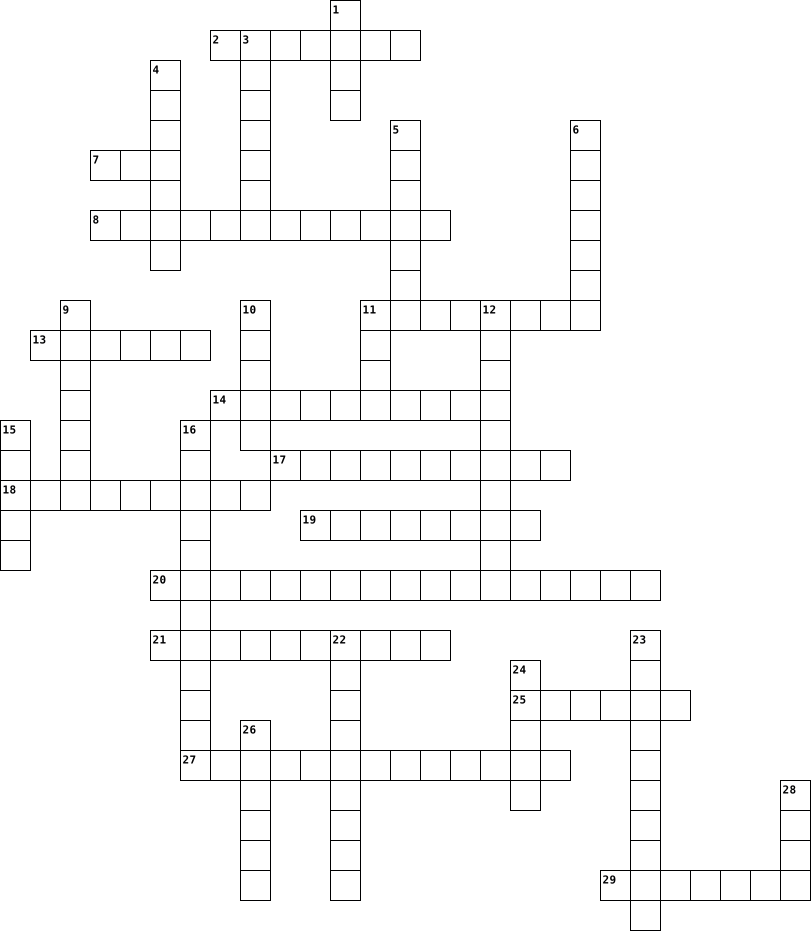
Across
- the force that keeps stuff down
- the middle of the soloar system
- when the sun covers the moon
- always faceing the earth
- device that takes us to space
- jupiters type of planet
- something that shows back
- space explorer
- when you can see all of the moon
- exploring space
- planets angle
- when the planets turn
- where the astronauts go in space
- when theres a new moon
Down
- caused by the moon
- when the planets go around the sun
- smaller
- the darkside of the moon
- when the moon covers the sun
- big rocks that fall from space
- the place with our planets
- A space/rocket administration
- the outside of the sun
- where our planets rotate
- small planets
- helps us see planets
- a person that looks at stars/planets
- what the planets do around the sun
- increasing
- the thing that rotates the earth
30 Clues: smaller • increasing • small planets • planets angle • space explorer • exploring space • caused by the moon • helps us see planets • when the planets turn • the outside of the sun • when theres a new moon • jupiters type of planet • the darkside of the moon • always faceing the earth • where our planets rotate • something that shows back • the place with our planets • when the moon covers the sun • ...