
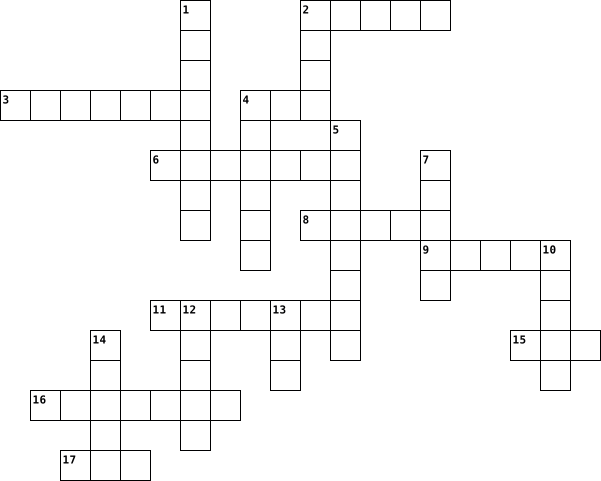
moon phases Crossword Puzzles
Astronomy Vocab 2020-01-13

Across
- A giant star.
- The moon’s majority illumination.
- Natural satellite of earth
- A machine launched in space to collect data, photos and videos.
- The obscuring of light by two celestial bodies.
- The turning of a body
- The change in weather patterns made by the Earth’s position.
- The path of a planet around another object.
- The rising and falling of the sea.
- The space between two lines
Down
- System A collection of eight planets and their moons.
- Having the luminated part more visible than dark.
- A continuous or expanse area that is free.
- moon When we see a whole face of the moon in broad light.
- The sickle shape of the moon.
- An instrument that makes farther things appear further.
- Where we live
- Phase The change in the shape of the light on the moon that we can see.
- The moon’s partial illumination.
- An imaginary line which a body rotates.
- moon No moon is visible to us but it’s just because of the light.
21 Clues: A giant star. • Where we live • The turning of a body • Natural satellite of earth • The space between two lines • The sickle shape of the moon. • The moon’s partial illumination. • The moon’s majority illumination. • The rising and falling of the sea. • An imaginary line which a body rotates. • A continuous or expanse area that is free. • ...
cc 2024-09-21

Across
- Path of a spacecraft around a planet or moon.
- Part of a spacecraft, like the one used in the Apollo missions.
- City where NASA’s mission control is located.
- To send a spacecraft into space.
- First name of the astronaut who led the Apollo 11 mission.
- Related to the moon.
- First person to walk on the moon.
- A vehicle designed for travel in space.
- The act of touching down on the moon’s surface.
- Nickname of the second man to walk on the moon.
Down
- An assigned space journey or task.
- Role of leading a space mission, like Armstrong on Apollo 11.
- Device used by astronauts to practice missions.
- Space program that prepared astronauts for Apollo missions.
- A vehicle used to launch into space.
- U.S. space agency responsible for moon missions.
- Headgear worn by astronauts during space travel.
- NASA mission that landed men on the moon.
- Second astronaut to walk on the moon.
- Isolation astronauts underwent after returning from space.
20 Clues: Related to the moon. • To send a spacecraft into space. • First person to walk on the moon. • An assigned space journey or task. • A vehicle used to launch into space. • Second astronaut to walk on the moon. • A vehicle designed for travel in space. • NASA mission that landed men on the moon. • Path of a spacecraft around a planet or moon. • ...
Space Science Unit Crossword 2023-02-20

Across
- This term takes the earth 1 day or 24 hours to complete and is done by earth spinning on its axis.
- These objects are made of small and large rocks and are found in the space between Mars and Jupiter.
- These are the results we get from earth revolving around the sun.
- This is what the moon gravity gives us.
- The term used when we are starting to see less and less of the moon (Full moon - New moon)
- This is roughly the amount of time it takes for the moon to revolve around the Earth (The actual time is 28 days).
- These planets are larger, have a gaseous surface and are farther from the sun.
- This term takes the Earth 1 year or 365 days to complete and is done so by earth going completely around the sun.
Down
- These objects rotate on their axis, orbit around a star, and are located in the Milky Way Galaxy.
- This is the moon phase that occurs when the moon is between the earth and the sun.
- This is the result we get because of earth rotating on its axis.
- These planets are smaller, have a rocky surface and are closer to the sun.
- The term used when we are starting to see more and more of the moon (New moon - Full moon)
- The name of our home galaxy and where all the night time stars we see are located.
- This is the number of stars we have in our solar system.
- This is the moon phase that occurs when the earth is between the sun and the moon.
- These objects are made of ice and dust and orbit out past Neptune.
- The only star in our solar system and the closest star to earth.
- This is a rock that does not light up. It reflects light from the sun as it revolves around the earth.
19 Clues: This is what the moon gravity gives us. • This is the number of stars we have in our solar system. • This is the result we get because of earth rotating on its axis. • The only star in our solar system and the closest star to earth. • These are the results we get from earth revolving around the sun. • ...
Cardiac Anatomy & Physiology Review 2016-09-11

Across
- Anne, your instructor drives a __?__
- systole has __?__ phases
- major pumping chamber of the heart
- largest artery of the body
- the inferior vena cava receives __?__ blood from lower body
- the artery nicknamed the 'widow maker'
- diastole has __?__ phases
- receives deoxygenated blood returning from the body
- semilunar valve between left ventricle and aorta
- left anterior descending artery supplies most of the __?__ ventricle
Down
- artery that branches off the left main
- This is when the ventricles contract and expel blood
- This is when the ventricles relax and fill with blood
- part of the autonomic nervous system responsible for "putting on the brakes"
- takes oxygenated blood from the lungs to the left atrium
- part of the autonomic nervous system responsible for "stepping on the gas"
- Where the coronary arteries lie
- the only bicuspid valve
18 Clues: the only bicuspid valve • systole has __?__ phases • diastole has __?__ phases • largest artery of the body • Where the coronary arteries lie • major pumping chamber of the heart • Anne, your instructor drives a __?__ • artery that branches off the left main • the artery nicknamed the 'widow maker' • semilunar valve between left ventricle and aorta • ...
Earth, Moon and Sun 2024-02-02

Across
- system the sun, the planets that orbit the sun and other objects that orbit the sun
- something we observe to be similar over and over again
- a moon phase that looks like half a circle from earth
- a moon outside our solar system
- a moon phase that looks like a full circle from earth
- the relative size of things
- a moon phase that looks like less than half a circle from earth
- the nearly circular path a smaller object (like the moon) travels around a lager object (like earth)
- the amount of time it takes for a planet to complete one orbit around the star or stars
Down
- a rocky sphere that travels around a planet
- the shape of the illuminated part of the moon as it appears from earth
- to shine light on an object and make it visible
- a moon phase in which the moon is not visible from earth
- an object, diagram, or computer program that helps us understand something by making it simpler or easier to see
- a moon phase that looks like more than half a circle from earth
- a planet outside our solar system
- the border between light and dark on the moon
- the star that is the main source of light at the center of our solar system
18 Clues: the relative size of things • a moon outside our solar system • a planet outside our solar system • a rocky sphere that travels around a planet • the border between light and dark on the moon • to shine light on an object and make it visible • a moon phase that looks like half a circle from earth • a moon phase that looks like a full circle from earth • ...
cv 2024-09-21

Across
- Second astronaut to walk on the moon.
- An assigned space journey or task.
- A vehicle used to launch into space.
- Isolation astronauts underwent after returning from space.
- NASA mission that landed men on the moon.
- First person to walk on the moon.
- To send a spacecraft into space.
- The act of touching down on the moon’s surface.
- Path of a spacecraft around a planet or moon.
- Related to the moon.
Down
- City where NASA’s mission control is located.
- A vehicle designed for travel in space.
- Part of a spacecraft, like the one used in the Apollo missions.
- First name of the astronaut who led the Apollo 11 mission.
- Nickname of the second man to walk on the moon.
- U.S. space agency responsible for moon missions.
- Role of leading a space mission, like Armstrong on Apollo 11.
- Headgear worn by astronauts during space travel.
- Device used by astronauts to practice missions.
- Space program that prepared astronauts for Apollo missions.
20 Clues: Related to the moon. • To send a spacecraft into space. • First person to walk on the moon. • An assigned space journey or task. • A vehicle used to launch into space. • Second astronaut to walk on the moon. • A vehicle designed for travel in space. • NASA mission that landed men on the moon. • City where NASA’s mission control is located. • ...
Earth, Moon and Sun 2025-02-25

Across
- season when the Earth is in direct sunlight
- phase of moon where you see no light
- amount of high and low tides a day
- the planet where we live
- when an object circle another object
- the tilt of Earth causes these
- 29.5 days
- when an object circles on its axis
- phase of moon where it is shrinking
- phase of moon where most of the left side is lit
Down
- if the southern hemisphere is summer what is the northern hemisphere
- responsible for high and low tides
- these planets have shorter orbit and considered terrestial
- these planets have longer orbits and considered gas planets
- the phase of moon where only a small portion of the right side is lit
- the force that attracts bodies to the center of Earth
- if the northern hemisphere is fall then what is the southern
- phase of moon where it is fully lit
- 23.5 degrees
- Mars atmosphere is made up of mostly
- phase of moon where it is growing
21 Clues: 29.5 days • 23.5 degrees • the planet where we live • the tilt of Earth causes these • phase of moon where it is growing • responsible for high and low tides • amount of high and low tides a day • when an object circles on its axis • phase of moon where it is fully lit • phase of moon where it is shrinking • phase of moon where you see no light • ...
The Space Race 1960 2025-02-12

Across
- – "Powerful rocket series used for Apollo missions."
- – "NASA's program that prepared for Apollo missions."
- – "Soviet spacecraft that carried Gagarin into orbit."
- – "Apollo 11 astronaut who stayed in lunar orbit."
- – "First human in space, a Soviet cosmonaut."
- – "Lunar module that landed on the Moon in 1969."
- – "First U.S. human spaceflight program."
- – "U.S. space agency that led the Apollo program."
- – "City home to NASA's Mission Control Center."
- – "Soviet spacecraft still used today for missions."
- – "Soviet program that sent probes to the Moon."
- – "Historic event performed by Armstrong and Aldrin."
Down
- – "Path followed by spacecraft around a celestial body."
- – "First person to walk on the Moon in 1969."
- – "Relating to the Moon, such as the Apollo landings."
- – "First name of the first man on the Moon."
- – "Second astronaut to walk on the Moon."
- – "NASA's program that sent humans to the Moon."
- – "The universe, often referenced in space exploration."
- – "First artificial satellite launched by the USSR in 1957."
20 Clues: – "Second astronaut to walk on the Moon." • – "First U.S. human spaceflight program." • – "First name of the first man on the Moon." • – "First person to walk on the Moon in 1969." • – "First human in space, a Soviet cosmonaut." • – "City home to NASA's Mission Control Center." • – "NASA's program that sent humans to the Moon." • ...
Science Vocab 2015-02-26

Across
- - when the moon increases from its apparent size and the larger part is lighted up and visible to us.
- eclipse - an eclipse where the moon darkens while it passes by earth’s shadow.
- exploration - a discovery that keeps on going, the exploration of celestiel structures in outer space and always evolving of new technology.
- - a force that keeps masses down on earth such as humans and objects.
- - layers of gas that surround a planet
- - the planet that we live on.
- - a group of solar systems with gas and dust held by gravity.
- moon – the curved banana shape of the waning or waxing moon.
- - in space it is the action of roatating on its axis or the center.
- - the circular path of an object as it it revolves around another object.
- – a body of matter in outer space that orbits a planet.
- - a cool event where the shadow of a object in space falls on top of something.
- moon – the moon when only half of its lighted surface is visible by us.
- tide - the state of a tide when it is at its lowest point.
Down
- - when the moon decreases from its apparent size and the smaller part is lighted up and visible to us.
- - an instance of revolving.
- - a artificial body placed around earth or moon to collect info or for communication.
- tide - the state of a tide when it is at its highest point.
- probe - a surgical instrument for exploring a part of the body.
- - an instrument used to see things far away.
- - the time each year twice, when the sun crosses the celestial equater when the day and night are an
- - the star that the earth orbits around.
- - the four divisions of the year spring, summer, autumn and winter marked odd weather patterns, daylight hours, and the posistion of the sun.
- – a large sphere that revolves around a star
- system - the eight planets and their moons which orbit around the sun.
- moon – the phase of the moon in which its whole disk is lighted up.
- moon – the phase of the moon when it is in conjunction with the sun and invisible to the earth.
27 Clues: - an instance of revolving. • - the planet that we live on. • - layers of gas that surround a planet • - the star that the earth orbits around. • - an instrument used to see things far away. • – a large sphere that revolves around a star • – a body of matter in outer space that orbits a planet. • tide - the state of a tide when it is at its highest point. • ...
Cientistas 2023-04-16

Across
- He created his own telescope and, with it, discovered the satellites of Jupiter, sunspots and the phases of the Moon.
- developed the heliocentric theory
Down
- The first law states that the planets of the solar system revolve around the sun and describe elliptical, approximately circular orbits.
- revealed the príncipes of gravity
- Discover the Theory of General Relative
5 Clues: revealed the príncipes of gravity • developed the heliocentric theory • Discover the Theory of General Relative • He created his own telescope and, with it, discovered the satellites of Jupiter, sunspots and the phases of the Moon. • ...
New Moon 2015-03-09

Across
- Excess
- Agreement
- Genuine
- Toil
- Humanitarian
- Gentle
- Cowardly
- Lenience
- Fallible
- Impulsiveness
Down
- Disturbance
- Dissent
- Bland
- Generous
- Insecure
- Unconquerable
- Harmless
- Lackadaisical
18 Clues: Toil • Bland • Excess • Gentle • Dissent • Genuine • Generous • Insecure • Harmless • Cowardly • Lenience • Fallible • Agreement • Disturbance • Humanitarian • Unconquerable • Lackadaisical • Impulsiveness
moon baboon 2025-04-17

Across
- what province in China are my parents from?
- what book am i reading on the train?
- what other game do i do on a daily besides wordlde?
- who is my favorite haikyuu character?
- which rezero character is my facebook profile pic?
- my favorite type of fish?
- this is a white powder taken orally for bodybuilding
Down
- what animal is my Chinese nickname?
- what type of European countries do i want to go to
- who is my favorite JJBA character?
- which character from haikyuu am I playing in Roblox volleyball?
- what book am i reading at home?
- what is one of my favorite things about you?
- what color is my yoga mat?
- what is the name of the corrupt priest in Frieren?
- my favorite fruit?
- what does the blue bucket of rice in my room work out?
- how much post-it notes on my monitor?
18 Clues: my favorite fruit? • my favorite type of fish? • what color is my yoga mat? • what book am i reading at home? • who is my favorite JJBA character? • what animal is my Chinese nickname? • what book am i reading on the train? • who is my favorite haikyuu character? • how much post-it notes on my monitor? • what province in China are my parents from? • ...
Moon Landing 2024-12-03

Across
- Theorists point to the absence of this in photos as evidence of a hoax
- The decade during which the Apollo moon landings occurred
- The material conspiracy theorists claim was used to simulate the lunar surface
- Aldrin The second astronaut to walk on the moon
- The type of suit worn by astronauts, which some claim would be inadequate for the moon's environment
- The term for the supposed secret group that orchestrated the moon landing hoax
- The type of surface feature skeptics claim is missing beneath the lunar module in photos
- The natural satellite that is the focus of the landing controversy
- Conspiracy theorists claim this object appears to wave, suggesting filming on Earth
Down
- The space agency accused of staging the moon landings
- Location where skeptics allege the moon landing was filmed
- Theorized director who allegedly assisted in staging the moon landing
- The country that was the USA's main competitor in the space race
- Armstrong First astronaut to walk on the moon, according to official records
- 51 Facility often cited as the filming location for the alleged hoax
- The lunar module used during the Apollo 11 mission
- The number of Apollo missions that landed astronauts on the moon
- The NASA program responsible for the moon missions
18 Clues: Aldrin The second astronaut to walk on the moon • The lunar module used during the Apollo 11 mission • The NASA program responsible for the moon missions • The space agency accused of staging the moon landings • The decade during which the Apollo moon landings occurred • Location where skeptics allege the moon landing was filmed • ...
Earth, Moon and Sun 2024-02-02

Across
- system the sun, the planets that orbit the sun and other objects that orbit the sun
- something we observe to be similar over and over again
- a moon phase that looks like half a circle from earth
- a moon outside our solar system
- a moon phase that looks like a full circle from earth
- the relative size of things
- a moon phase that looks like less than half a circle from earth
- the nearly circular path a smaller object (like the moon) travels around a lager object (like earth)
- the amount of time it takes for a planet to complete one orbit around the star or stars
Down
- a rocky sphere that travels around a planet
- the shape of the illuminated part of the moon as it appears from earth
- to shine light on an object and make it visible
- a moon phase in which the moon is not visible from earth
- an object, diagram, or computer program that helps us understand something by making it simpler or easier to see
- a moon phase that looks like more than half a circle from earth
- a planet outside our solar system
- the border between light and dark on the moon
- the star that is the main source of light at the center of our solar system
18 Clues: the relative size of things • a moon outside our solar system • a planet outside our solar system • a rocky sphere that travels around a planet • the border between light and dark on the moon • to shine light on an object and make it visible • a moon phase that looks like half a circle from earth • a moon phase that looks like a full circle from earth • ...
Science Vocab 2015-02-26

Across
- - when the moon increases from its apparent size and the larger part is lighted up and visible to us.
- eclipse - an eclipse where the moon darkens while it passes by earth’s shadow.
- exploration - a discovery that keeps on going, the exploration of celestiel structures in outer space and always evolving of new technology.
- - a force that keeps masses down on earth such as humans and objects.
- - layers of gas that surround a planet
- - the planet that we live on.
- - a group of solar systems with gas and dust held by gravity.
- moon – the curved banana shape of the waning or waxing moon.
- - in space it is the action of roatating on its axis or the center.
- - the circular path of an object as it it revolves around another object.
- – a body of matter in outer space that orbits a planet.
- - a cool event where the shadow of a object in space falls on top of something.
- moon – the moon when only half of its lighted surface is visible by us.
- tide - the state of a tide when it is at its lowest point.
Down
- - when the moon decreases from its apparent size and the smaller part is lighted up and visible to us.
- - an instance of revolving.
- - a artificial body placed around earth or moon to collect info or for communication.
- tide - the state of a tide when it is at its highest point.
- probe - a surgical instrument for exploring a part of the body.
- - an instrument used to see things far away.
- - the time each year twice, when the sun crosses the celestial equater when the day and night are an
- - the star that the earth orbits around.
- - the four divisions of the year spring, summer, autumn and winter marked odd weather patterns, daylight hours, and the posistion of the sun.
- – a large sphere that revolves around a star
- system - the eight planets and their moons which orbit around the sun.
- moon – the phase of the moon in which its whole disk is lighted up.
- moon – the phase of the moon when it is in conjunction with the sun and invisible to the earth.
27 Clues: - an instance of revolving. • - the planet that we live on. • - layers of gas that surround a planet • - the star that the earth orbits around. • - an instrument used to see things far away. • – a large sphere that revolves around a star • – a body of matter in outer space that orbits a planet. • tide - the state of a tide when it is at its highest point. • ...
Earth's Movements 2023-11-16

Across
- rotating on an axis
- an attraction that exerts itself onto other objects
- half of a celestial body
- traveling in a circle while rotating
- the rising and falling of the sea caused by the moon and the sun
- moon's illumination is getting smaller
- the moon's journey around Earth
- four divisions that depend on the time of year
- a tide after a full or new moon where the difference between high and low water is greatest
- the moon's constantly changing illumination visible to Earth
Down
- the state of a tide at its smallest
- the stage of visibility of the moon right before e full moon
- moon's illumination is getting bigger
- small portion of visibility on a moon before or after a new moon
- the state of a tide at its biggest
- a tide after the first or third quarters of the moon when there is least difference in high and low water
- a way an object sits at an angle
- an imaginary line that things rotate on
18 Clues: rotating on an axis • half of a celestial body • the moon's journey around Earth • a way an object sits at an angle • the state of a tide at its biggest • the state of a tide at its smallest • traveling in a circle while rotating • moon's illumination is getting bigger • moon's illumination is getting smaller • an imaginary line that things rotate on • ...
sun, moon, and earth crossword 2023-11-01

Across
- when the light is going away
- the fourth moon phase
- the tide in which the water is low
- the coldest season
- when the moon is out
- the 2nd quarter (think about it!)
- the hottest season
- revolves around the earth in 28 days
Down
- when the sun is out
- the tide in which the water is high up
- the first moon phase
- the earth revolves around this
- when the light is appearing
- the 2nd biggest moon phase
- when you cant see the moon
- the smallest moon phase
16 Clues: the coldest season • the hottest season • when the sun is out • the first moon phase • when the moon is out • the fourth moon phase • the smallest moon phase • the 2nd biggest moon phase • when you cant see the moon • when the light is appearing • when the light is going away • the earth revolves around this • the 2nd quarter (think about it!) • the tide in which the water is low • ...
Earth, Sun, and Moon 2023-03-23

Across
- A latin word for sea
- Four periods throughout the year divided by the equinoxes and solstices
- The tide right after the end of the first or third quarters of the moon where there is the least amount of difference between the low and high water
- The shape of the moon in the Dreamworks production video
- The way the moon is lit by the sun throughout the year
- When something is mirrored across from its original self
- Something turning on its axis
- A tide just after a new or full moon, when there is the biggest difference between high and low water
- A certain phase of the moon when the surface is getting less visible(more moon showing)
- When the Moon passes between the Earth and Sun
- Hemisphere that contains South America, Australia, Antartica, and Uruguay and Paraguay, both from the remaining 1/3 of Africa
- Time or date when the sun crosses the celestial equator marking that day and night are the same amount of time
Down
- Points on the top and bottom of a planet that it rotates on
- A certain phase of the moon (less moon showing)
- When the ocean waves arent getting very high
- When the ocean waves are getting high and washing onto the land
- When the Moon orbits into the Earth's shadow, causing the moon to get darker
- Hemisphere that contains North America, South America, Europe, Asia, and 2/3 of Africa
- A sudden complete change
- The slightly shaded outer area of a shadow cast by something that is opaque
- The fully shaded inner area of a shadow cast by something that is opaque
- Large bowl like indent in the ground usually made by a explosion of something crashing into a planet
- Something in space going around the sun
- A oval shape
- The point where the sun appears to reach the lowest or the highest point in the sky of the year
- A certain phase of the moon where more of the illuminated part of the moon then the non illuminated part
- When something leans slightly
27 Clues: A oval shape • A latin word for sea • A sudden complete change • Something turning on its axis • When something leans slightly • Something in space going around the sun • When the ocean waves arent getting very high • When the Moon passes between the Earth and Sun • A certain phase of the moon (less moon showing) • The way the moon is lit by the sun throughout the year • ...
Earth, Sun, and Moon 2023-03-23

Across
- A latin word for sea
- Four periods throughout the year divided by the equinoxes and solstices
- The tide right after the end of the first or third quarters of the moon where there is the least amount of difference between the low and high water
- The shape of the moon in the Dreamworks production video
- The way the moon is lit by the sun throughout the year
- When something is mirrored across from its original self
- Something turning on its axis
- A tide just after a new or full moon, when there is the biggest difference between high and low water
- A certain phase of the moon when the surface is getting less visible(more moon showing)
- When the Moon passes between the Earth and Sun
- Hemisphere that contains South America, Australia, Antartica, and Uruguay and Paraguay, both from the remaining 1/3 of Africa
- Time or date when the sun crosses the celestial equator marking that day and night are the same amount of time
Down
- Points on the top and bottom of a planet that it rotates on
- A certain phase of the moon (less moon showing)
- When the ocean waves arent getting very high
- When the ocean waves are getting high and washing onto the land
- When the Moon orbits into the Earth's shadow, causing the moon to get darker
- Hemisphere that contains North America, South America, Europe, Asia, and 2/3 of Africa
- A sudden complete change
- The slightly shaded outer area of a shadow cast by something that is opaque
- The fully shaded inner area of a shadow cast by something that is opaque
- Large bowl like indent in the ground usually made by a explosion of something crashing into a planet
- Something in space going around the sun
- A oval shape
- The point where the sun appears to reach the lowest or the highest point in the sky of the year
- A certain phase of the moon where more of the illuminated part of the moon then the non illuminated part
- When something leans slightly
27 Clues: A oval shape • A latin word for sea • A sudden complete change • Something turning on its axis • When something leans slightly • Something in space going around the sun • When the ocean waves arent getting very high • When the Moon passes between the Earth and Sun • A certain phase of the moon (less moon showing) • The way the moon is lit by the sun throughout the year • ...
Earth, Sun, and Moon 2023-03-23

Across
- A latin word for sea
- Four periods throughout the year divided by the equinoxes and solstices
- The tide right after the end of the first or third quarters of the moon where there is the least amount of difference between the low and high water
- The shape of the moon in the Dreamworks production video
- The way the moon is lit by the sun throughout the year
- When something is mirrored across from its original self
- Something turning on its axis
- A tide just after a new or full moon, when there is the biggest difference between high and low water
- A certain phase of the moon when the surface is getting less visible(more moon showing)
- When the Moon passes between the Earth and Sun
- Hemisphere that contains South America, Australia, Antartica, and Uruguay and Paraguay, both from the remaining 1/3 of Africa
- Time or date when the sun crosses the celestial equator marking that day and night are the same amount of time
Down
- Points on the top and bottom of a planet that it rotates on
- A certain phase of the moon (less moon showing)
- When the ocean waves arent getting very high
- When the ocean waves are getting high and washing onto the land
- When the Moon orbits into the Earth's shadow, causing the moon to get darker
- Hemisphere that contains North America, South America, Europe, Asia, and 2/3 of Africa
- A sudden complete change
- The slightly shaded outer area of a shadow cast by something that is opaque
- The fully shaded inner area of a shadow cast by something that is opaque
- Large bowl like indent in the ground usually made by a explosion of something crashing into a planet
- Something in space going around the sun
- A oval shape
- The point where the sun appears to reach the lowest or the highest point in the sky of the year
- A certain phase of the moon where more of the illuminated part of the moon then the non illuminated part
- When something leans slightly
27 Clues: A oval shape • A latin word for sea • A sudden complete change • Something turning on its axis • When something leans slightly • Something in space going around the sun • When the ocean waves arent getting very high • When the Moon passes between the Earth and Sun • A certain phase of the moon (less moon showing) • The way the moon is lit by the sun throughout the year • ...
Earth, Sun, and Moon 2023-03-23

Across
- A latin word for sea
- Four periods throughout the year divided by the equinoxes and solstices
- The tide right after the end of the first or third quarters of the moon where there is the least amount of difference between the low and high water
- The shape of the moon in the Dreamworks production video
- The way the moon is lit by the sun throughout the year
- When something is mirrored across from its original self
- Something turning on its axis
- A tide just after a new or full moon, when there is the biggest difference between high and low water
- A certain phase of the moon when the surface is getting less visible(more moon showing)
- When the Moon passes between the Earth and Sun
- Hemisphere that contains South America, Australia, Antartica, and Uruguay and Paraguay, both from the remaining 1/3 of Africa
- Time or date when the sun crosses the celestial equator marking that day and night are the same amount of time
Down
- Points on the top and bottom of a planet that it rotates on
- A certain phase of the moon (less moon showing)
- When the ocean waves arent getting very high
- When the ocean waves are getting high and washing onto the land
- When the Moon orbits into the Earth's shadow, causing the moon to get darker
- Hemisphere that contains North America, South America, Europe, Asia, and 2/3 of Africa
- A sudden complete change
- The slightly shaded outer area of a shadow cast by something that is opaque
- The fully shaded inner area of a shadow cast by something that is opaque
- Large bowl like indent in the ground usually made by a explosion of something crashing into a planet
- Something in space going around the sun
- A oval shape
- The point where the sun appears to reach the lowest or the highest point in the sky of the year
- A certain phase of the moon where more of the illuminated part of the moon then the non illuminated part
- When something leans slightly
27 Clues: A oval shape • A latin word for sea • A sudden complete change • Something turning on its axis • When something leans slightly • Something in space going around the sun • When the ocean waves arent getting very high • When the Moon passes between the Earth and Sun • A certain phase of the moon (less moon showing) • The way the moon is lit by the sun throughout the year • ...
Unit C Vocabulary 2020-01-17

Across
- Moon phase that occurs when the Moon is between Earth and the Sun, at which point the Moon cannot be seen because its lighted half is facing the Sun and its dark side faces Earth.
- The part of a shadow surrounding the darkest part
- The phase of the moon when it is one-quarter of the way through its orbit, and we see half of the moon lighted
- the different appearances of the moon from Earth throughout the month
- All of the frequencies or wavelengths of electromagnetic radiation
- the darkest part of a shadow during an eclipse.
- the transparent structure behind the pupil that changes shape to help focus images on the retina
- an eclipse in which the sun is obscured by the moon.
- The movement of an object around another object
- Occurs when an object causes a wave to change direction and bend around it
- The bending of a wave as it passes at an angle from one medium to another
- The two days of the year on which neither hemisphere is tilted toward or away from the sun
Down
- Neap tides occur when the moon lies at right angles to a line drawn between the Sun and the Earth.
- The phase of the moon when it is three-quarters of the way through its orbit, and we see half of the moon lighted
- Light is a transverse, electromagnetic wave that can be seen by the typical human. The wave nature of light was first illustrated through experiments on diffraction and interference.
- The partial or total blocking of one object in space by another
- the phase of the moon in which we see the entire moon lighted, and it appears bright and round
- Spring tides occur when the Earth, Sun, and Moon are lined up.
- either of the two times in the year, the summer solstice and the winter solstice, when the sun reaches its highest or lowest point in the sky at noon, marked by the longest and shortest days.
- an eclipse in which the moon appears darkened as it passes into the earth's shadow.
- electromagnetic waves that you can see
- The path an object follows as it moves around another object
- CIRCULAR MOVEMENT AROUND AN AXIS
- an imaginary line about which a body rotates.
24 Clues: CIRCULAR MOVEMENT AROUND AN AXIS • electromagnetic waves that you can see • an imaginary line about which a body rotates. • the darkest part of a shadow during an eclipse. • The movement of an object around another object • The part of a shadow surrounding the darkest part • an eclipse in which the sun is obscured by the moon. • ...
Earth, Sun, and Moon 2023-03-23

Across
- A latin word for sea
- Four periods throughout the year divided by the equinoxes and solstices
- The tide right after the end of the first or third quarters of the moon where there is the least amount of difference between the low and high water
- The shape of the moon in the Dreamworks production video
- The way the moon is lit by the sun throughout the year
- When something is mirrored across from its original self
- Something turning on its axis
- A tide just after a new or full moon, when there is the biggest difference between high and low water
- A certain phase of the moon when the surface is getting less visible(more moon showing)
- When the Moon passes between the Earth and Sun
- Hemisphere that contains South America, Australia, Antartica, and Uruguay and Paraguay, both from the remaining 1/3 of Africa
- Time or date when the sun crosses the celestial equator marking that day and night are the same amount of time
Down
- Points on the top and bottom of a planet that it rotates on
- A certain phase of the moon (less moon showing)
- When the ocean waves arent getting very high
- When the ocean waves are getting high and washing onto the land
- When the Moon orbits into the Earth's shadow, causing the moon to get darker
- Hemisphere that contains North America, South America, Europe, Asia, and 2/3 of Africa
- A sudden complete change
- The slightly shaded outer area of a shadow cast by something that is opaque
- The fully shaded inner area of a shadow cast by something that is opaque
- Large bowl like indent in the ground usually made by a explosion of something crashing into a planet
- Something in space going around the sun
- A oval shape
- The point where the sun appears to reach the lowest or the highest point in the sky of the year
- A certain phase of the moon where more of the illuminated part of the moon then the non illuminated part
- When something leans slightly
27 Clues: A oval shape • A latin word for sea • A sudden complete change • Something turning on its axis • When something leans slightly • Something in space going around the sun • When the ocean waves arent getting very high • When the Moon passes between the Earth and Sun • A certain phase of the moon (less moon showing) • The way the moon is lit by the sun throughout the year • ...
Earth, Sun, and Moon 2023-03-23

Across
- A latin word for sea
- Four periods throughout the year divided by the equinoxes and solstices
- The tide right after the end of the first or third quarters of the moon where there is the least amount of difference between the low and high water
- The shape of the moon in the Dreamworks production video
- The way the moon is lit by the sun throughout the year
- When something is mirrored across from its original self
- Something turning on its axis
- A tide just after a new or full moon, when there is the biggest difference between high and low water
- A certain phase of the moon when the surface is getting less visible(more moon showing)
- When the Moon passes between the Earth and Sun
- Hemisphere that contains South America, Australia, Antartica, and Uruguay and Paraguay, both from the remaining 1/3 of Africa
- Time or date when the sun crosses the celestial equator marking that day and night are the same amount of time
Down
- Points on the top and bottom of a planet that it rotates on
- A certain phase of the moon (less moon showing)
- When the ocean waves arent getting very high
- When the ocean waves are getting high and washing onto the land
- When the Moon orbits into the Earth's shadow, causing the moon to get darker
- Hemisphere that contains North America, South America, Europe, Asia, and 2/3 of Africa
- A sudden complete change
- The slightly shaded outer area of a shadow cast by something that is opaque
- The fully shaded inner area of a shadow cast by something that is opaque
- Large bowl like indent in the ground usually made by a explosion of something crashing into a planet
- Something in space going around the sun
- A oval shape
- The point where the sun appears to reach the lowest or the highest point in the sky of the year
- A certain phase of the moon where more of the illuminated part of the moon then the non illuminated part
- When something leans slightly
27 Clues: A oval shape • A latin word for sea • A sudden complete change • Something turning on its axis • When something leans slightly • Something in space going around the sun • When the ocean waves arent getting very high • When the Moon passes between the Earth and Sun • A certain phase of the moon (less moon showing) • The way the moon is lit by the sun throughout the year • ...
Earth, Sun, and Moon 2023-03-23

Across
- A latin word for sea
- Four periods throughout the year divided by the equinoxes and solstices
- The tide right after the end of the first or third quarters of the moon where there is the least amount of difference between the low and high water
- The shape of the moon in the Dreamworks production video
- The way the moon is lit by the sun throughout the year
- When something is mirrored across from its original self
- Something turning on its axis
- A tide just after a new or full moon, when there is the biggest difference between high and low water
- A certain phase of the moon when the surface is getting less visible(more moon showing)
- When the Moon passes between the Earth and Sun
- Hemisphere that contains South America, Australia, Antartica, and Uruguay and Paraguay, both from the remaining 1/3 of Africa
- Time or date when the sun crosses the celestial equator marking that day and night are the same amount of time
Down
- Points on the top and bottom of a planet that it rotates on
- A certain phase of the moon (less moon showing)
- When the ocean waves arent getting very high
- When the ocean waves are getting high and washing onto the land
- When the Moon orbits into the Earth's shadow, causing the moon to get darker
- Hemisphere that contains North America, South America, Europe, Asia, and 2/3 of Africa
- A sudden complete change
- The slightly shaded outer area of a shadow cast by something that is opaque
- The fully shaded inner area of a shadow cast by something that is opaque
- Large bowl like indent in the ground usually made by a explosion of something crashing into a planet
- Something in space going around the sun
- A oval shape
- The point where the sun appears to reach the lowest or the highest point in the sky of the year
- A certain phase of the moon where more of the illuminated part of the moon then the non illuminated part
- When something leans slightly
27 Clues: A oval shape • A latin word for sea • A sudden complete change • Something turning on its axis • When something leans slightly • Something in space going around the sun • When the ocean waves arent getting very high • When the Moon passes between the Earth and Sun • A certain phase of the moon (less moon showing) • The way the moon is lit by the sun throughout the year • ...
Earth's Movements 2023-11-16

Across
- rotating on an axis
- an attraction that exerts itself onto other objects
- half of a celestial body
- traveling in a circle while rotating
- the rising and falling of the sea caused by the moon and the sun
- moon's illumination is getting smaller
- the moon's journey around Earth
- four divisions that depend on the time of year
- a tide after a full or new moon where the difference between high and low water is greatest
- the moon's constantly changing illumination visible to Earth
Down
- the state of a tide at its smallest
- the stage of visibility of the moon right before e full moon
- moon's illumination is getting bigger
- small portion of visibility on a moon before or after a new moon
- the state of a tide at its biggest
- a tide after the first or third quarters of the moon when there is least difference in high and low water
- a way an object sits at an angle
- an imaginary line that things rotate on
18 Clues: rotating on an axis • half of a celestial body • the moon's journey around Earth • a way an object sits at an angle • the state of a tide at its biggest • the state of a tide at its smallest • traveling in a circle while rotating • moon's illumination is getting bigger • moon's illumination is getting smaller • an imaginary line that things rotate on • ...
Earth, Sun, and Moon 2023-03-23

Across
- A latin word for sea
- Four periods throughout the year divided by the equinoxes and solstices
- The tide right after the end of the first or third quarters of the moon where there is the least amount of difference between the low and high water
- The shape of the moon in the Dreamworks production video
- The way the moon is lit by the sun throughout the year
- When something is mirrored across from its original self
- Something turning on its axis
- A tide just after a new or full moon, when there is the biggest difference between high and low water
- A certain phase of the moon when the surface is getting less visible(more moon showing)
- When the Moon passes between the Earth and Sun
- Hemisphere that contains South America, Australia, Antartica, and Uruguay and Paraguay, both from the remaining 1/3 of Africa
- Time or date when the sun crosses the celestial equator marking that day and night are the same amount of time
Down
- Points on the top and bottom of a planet that it rotates on
- A certain phase of the moon (less moon showing)
- When the ocean waves arent getting very high
- When the ocean waves are getting high and washing onto the land
- When the Moon orbits into the Earth's shadow, causing the moon to get darker
- Hemisphere that contains North America, South America, Europe, Asia, and 2/3 of Africa
- A sudden complete change
- The slightly shaded outer area of a shadow cast by something that is opaque
- The fully shaded inner area of a shadow cast by something that is opaque
- Large bowl like indent in the ground usually made by a explosion of something crashing into a planet
- Something in space going around the sun
- A oval shape
- The point where the sun appears to reach the lowest or the highest point in the sky of the year
- A certain phase of the moon where more of the illuminated part of the moon then the non illuminated part
- When something leans slightly
27 Clues: A oval shape • A latin word for sea • A sudden complete change • Something turning on its axis • When something leans slightly • Something in space going around the sun • When the ocean waves arent getting very high • When the Moon passes between the Earth and Sun • A certain phase of the moon (less moon showing) • The way the moon is lit by the sun throughout the year • ...
CA6 2025-04-03

Across
- a period of the year identified by changes in hours of daylight and weather
- each different shape of the Moon
- signature the segment of the electromagnetic spectrum that the human eye can view. More simply, this range of wavelengths is called visible light.
- a representation of thinking to help others understand your thinking
- the shape of the Moon just after and just before the new Moon phase
- light-colored areas of the Moon with lots of rough mountains and craters
- spinnin on an axis
- line a bright line of a spectrum, indicating the wavelength of emitted light
- a tool used to study the light spectrum of colors coming from a light source
- a pattern of wavelengths that can identify different kinds of light
- a day of the ear when the Sun's rays shine straight down on the equator
- a change in land created by an impact
- an imaginary line about which a body rotates
- eclipse when Earth is exactly between the Moon and the Sun, and the Moon passes throught the Earth's shadow
Down
- getting smaller
- a day of the year when Earth's North Pole is leaning either toward the Sun or away from the Sun
- a Moon shape that is larger that a first or third quarter Moon, but small than a full Moon
- angle he angle between the projection of sun rays and a line due south or north. It is an angle that is measured on the horizontal plane
- Moon the phase that occurs when the Moon if full
- the angular distance east or west from the Earth's equator
- Star the reference star pointed to the Earth's North Pole
- the imaginary line that runs around the middle of the planet, halfway between the North and South pole
- getting bigger
- light wavelengths of electromagnetic radiation that can be seen by the human eye
- Moon the phase of he Moon that occurs when the Moon is in the directions of the Sun as seen from Earth
- the path one object takes to travel around another object (synonym: orbit)
- eclipse when the Moon passes exactly between Earth and the Sun
- the path one object takes to travel around another object (synonym: revolution)
- the angular distance north or south from the Earth's equator
29 Clues: getting bigger • getting smaller • spinnin on an axis • each different shape of the Moon • a change in land created by an impact • an imaginary line about which a body rotates • Moon the phase that occurs when the Moon if full • Star the reference star pointed to the Earth's North Pole • the angular distance east or west from the Earth's equator • ...
Earth Phases 2012-04-10

Across
- spinning of the Earth that causes day and night
- when Moon is between Earth and Sun
- when only half the moon is visible
- result of Earth's rotation
- keeps the Earth revolving around Sun
- medium-sized star
Down
- pattern of stars
- change due to Earth's orbit around the Sun
- when Moon passes through Earth's shadow
- see ___ side of the Moon from Earth
- the Earth rotates _______ so we can't feel it
- North Star
12 Clues: North Star • pattern of stars • medium-sized star • result of Earth's rotation • when Moon is between Earth and Sun • when only half the moon is visible • see ___ side of the Moon from Earth • keeps the Earth revolving around Sun • when Moon passes through Earth's shadow • change due to Earth's orbit around the Sun • the Earth rotates _______ so we can't feel it • ...
Back to the Moon 2025-05-02

Across
- Last man to walk on the Moon, Apollo 17
- Uncrewed Artemis test flight around the Moon
- Proposed long-term lunar habitat
- NASA’s most powerful rocket, stands for Space Launch System
- Planned first crewed Artemis lunar flyby
- Orion spacecraft’s primary contractor
- NASA space center from which Artemis missions launch
- Apollo 16 astronaut, youngest to walk on the Moon
- Acronym for Human Landing System
- Company involved in lunar payload deliveries
- NASA Administrator featured in Artemis discussions
- Company bidding for lunar lander development
Down
- Will land astronauts on the Moon's surface
- NASA's lunar program aiming to return humans to the Moon
- The Moon path where Gateway will operate
- Company contracted to build the lunar lander
- Crew spacecraft for Artemis missions
- CEO of the company building Artemis lunar lander
- Vehicle used to explore the lunar surface
- Trans-Lunar Injection, trajectory phase to Moon
- Lunar-orbiting space station planned to support Moon missions
- NASA’s original lunar landing program
- US government agency leading Moon return efforts
- Alternate name for the planned lunar orbiting station
- NASA’s cost for Artemis exceeds $90 billion
25 Clues: Proposed long-term lunar habitat • Acronym for Human Landing System • Crew spacecraft for Artemis missions • Orion spacecraft’s primary contractor • NASA’s original lunar landing program • Last man to walk on the Moon, Apollo 17 • The Moon path where Gateway will operate • Planned first crewed Artemis lunar flyby • Vehicle used to explore the lunar surface • ...
Our Place in Space 2013-10-29

Across
- the regular rise and fall of the water level f the ocean
- when the earth spins so that the southern hemisphere faces away from the sun leaving us only guided by the light of the moon and stars
- we live in the southern ....
- a line dividing the northern and southern hemispheres
- around the world there are 24 ....
- when the sun shines on earth lighting up the morning signalling a new day
- when the new moon begins to appear, it gets larger everyday
- the full moon is a .... of the moon
- what you see in the sky at night, the only ever see one side of it
- an illuminated ball that makes daytime
Down
- the earth does this around the sun
- a horizontal measurement on a globe
- a vertical measurement on a globe
- a weaker high and low tide
- the prime meridian passes through here
- a very high tide that occurs when there is a new or full moon
- the turning of the earth about its own axis
- the planet we live on
- the moons appearance between a full moon and the following new moon
- the earth rotates on its....
20 Clues: the planet we live on • a weaker high and low tide • we live in the southern .... • the earth rotates on its.... • a vertical measurement on a globe • the earth does this around the sun • around the world there are 24 .... • a horizontal measurement on a globe • the full moon is a .... of the moon • the prime meridian passes through here • an illuminated ball that makes daytime • ...
crossword puzzle anchor activity 2022-05-11

Across
- Sunlight that is highly concentrated or focused; causes summer
- Sunlight that has low concentration or is spread across a large area; causes winter
- the lit-up part of the Moon grows from 50.1% to 99.9%
- occurs when the illumination of the Moon decreases from 49.9% to 0.1%
- a phenomenon whereby the moon appears bluish owing to smoke or dust particles in the atmosphere.
- The ____ is Earth's only natural satellite
- the season after winter and before
- between a half-moon and full moon.
- 90 degrees away from the sun in the sky and is half-illuminated from our point of view
- when the opposite half of the Moon is illuminated compared to the First Quarter.
- the season after summer
- the planet on which we live; the world.
- An imaginary circle around the middle of the earth, halfway between the North Pole and the South Pole
- Earth has seasons because because its axis is tilted as it moves around the sun.
- one half of the earth
- The movement of an object around another object
- an intermediate phase of the Moon, which starts after the New Moon and lasts until the First Quarter
Down
- distance north or south of the Equator, measured in degrees
- A lunar eclipse occurs when the Moon moves into the Earth's shadow.
- is the phenomenon whereby the moon in total eclipse appears reddish in color as it is illuminated by sunlight filtered and refracted by the earth's atmosphere.
- when the earth lies between the sun and the moon so that the moon is visible as a fully illuminated disc
- the hemisphere north of the equator
- An imaginary line that passes through Earth's center and the North and South poles, about which Earth rotates
- A solar eclipse occurs when the Moon passes between Earth and the Sun
- the half of the Earth south of the equator
- The Sun is the star at the center of the Solar System. It is a nearly perfect ball of hot plasma
- the coldest season of the year
- a moon that gets more sunlight on it as the days go by
- the warmest season of the year
- A force of attraction between objects that is due to their masses.
- 23.5 degrees
- the lunar disk is not visible to the unaided eye
- The spinning of Earth on its axis
33 Clues: 23.5 degrees • one half of the earth • the season after summer • the coldest season of the year • the warmest season of the year • The spinning of Earth on its axis • the season after winter and before • between a half-moon and full moon. • the hemisphere north of the equator • the planet on which we live; the world. • The ____ is Earth's only natural satellite • ...
Unit 6 Space Patterns 2026-05-11

Across
- A person who travels to space.
- The moon phase that has the moon in the shape of a banana
- A force that pulls you towards the center of the Earth
- Another word for orbit
- A word that means relating to the sun
- A collection of stars and planets
- A word that means relating to the moon
- A large piece of rock floating in space
- A large mass of gas and plasma that makes light and energy
- The moon phase that has the moon completely lit up
- Something in space that orbits around another object
- The shape of most planets
Down
- A pattern made with stars
- A word that means to be able to live on
- To move around another object
- The moon phase that has the moon mostly it up
- To spin around
- Any planet that is outside of our solar system
- A space object that is too small to be a regular planet but too big to be an asteroid
- An icy and rocky mass that travels in space and forms a "tail" when it gets too close to the sun
20 Clues: To spin around • Another word for orbit • A pattern made with stars • The shape of most planets • To move around another object • A person who travels to space. • A collection of stars and planets • A word that means relating to the sun • A word that means relating to the moon • A word that means to be able to live on • A large piece of rock floating in space • ...
Week 19 - Phases of the Moon 2024-02-13

Across
- the entire left half of the moon can be seen
- MORE than half of the right side of the moon can be seen
- a thin sliver of the moon's right side can be seen
- a dark area or shape made when an object or body blocks light
Down
- the entire side of the moon facing the earth can be seen
- the right half of the moon can be seen
- a thin sliver of the left side can be seen
- more than half of the left side of the moon can be seen
- the moon cannot be seen due to lack of light
9 Clues: the right half of the moon can be seen • a thin sliver of the left side can be seen • the entire left half of the moon can be seen • the moon cannot be seen due to lack of light • a thin sliver of the moon's right side can be seen • more than half of the left side of the moon can be seen • the entire side of the moon facing the earth can be seen • ...
SNT, Rotational Motion, and Moon Phases 2022-09-21

Across
- Baby stars can be found in here.
- Explains Formation of Solar System
- Hop on the quarter merry go round one rotation. Link arms keep up don't fall, this is what we studied spinning round and round y'all!
- Even though I'm purple you cant see me, I'm too high of an Energy.
- A fishing star
Down
- Grab the weights and do-si-do, look at how fast you go.(must take a turn)
- "We proposed the nebular hypothesis."
- "Hey watch out, I'm a circle. Don't squash me, you'll give me____________.
- One star says to another, "Your too close!"
9 Clues: A fishing star • Baby stars can be found in here. • Explains Formation of Solar System • "We proposed the nebular hypothesis." • One star says to another, "Your too close!" • Even though I'm purple you cant see me, I'm too high of an Energy. • Grab the weights and do-si-do, look at how fast you go.(must take a turn) • ...
Space 2022-04-04
Across
- PLURAL OF MARE
- MORE THAN HALF
- WHERE THE LIGHT FROM THE MOON COMES FROM
- FARTHEST PLANET
- THE ECLIPSE THAT WHERE THE MOON BLOCKS THE SUN
- GRADUAL RISE AND FALL OF EARTHS OCEANS
- LARGEST PLANET
- THE FOUR OUTER PLANETS ARE MADE OF THIS
- CLOSEST PLANET TO THE SUN
- PHASE WHERE YOU CAN'T SEE THE MOON
Down
- LESS THAN HALF
- GRAVITY COMES FROM HERE FOR TIDES
- PLANET WITH THE MOST BLING
- THE LIGHTER PART OF THE SHADOW OF AN ECLIPSE
- THIRD PLANET FROM THE SUN
- ECLIPE THE MOON PASSES IN THE EARTHS SHADOW
- THE DARKEST PART OF AN ECLIPSE
- NUMBER OF HIGH AND LOW TIDES IN A DAY
- NUMBER OF LAYERS TO THE MOON
19 Clues: LESS THAN HALF • PLURAL OF MARE • MORE THAN HALF • LARGEST PLANET • FARTHEST PLANET • THIRD PLANET FROM THE SUN • CLOSEST PLANET TO THE SUN • PLANET WITH THE MOST BLING • NUMBER OF LAYERS TO THE MOON • THE DARKEST PART OF AN ECLIPSE • GRAVITY COMES FROM HERE FOR TIDES • PHASE WHERE YOU CAN'T SEE THE MOON • NUMBER OF HIGH AND LOW TIDES IN A DAY • GRADUAL RISE AND FALL OF EARTHS OCEANS • ...
Solar System Extra Credit 2023-05-15

Across
- shape of an ellipse, determined by focal length divided by major axis
- shape of an orbit
- _______ space station
- model of the solar system with the Sun at the center
- planets made up of rock
- widest point of an ellipse
- robots that take samples from other planets
- ______ moon, phase where the moon is completely shadowed
- asteroid sized pre-planets
- object spinning around central point
- _______ disk formation
Down
- model of the solar system with Earth at the center
- objects far apart from one another _________ the gravitational pull
- high mass ________ the gravitational pull
- combined gravitational pull of sun and moon cause a ______ _____ on Earth
- moon becomes darker, after full moon
- object orbiting around another object
- gas giants, outer planets
- Phase of the moon during a lunar eclipse
- planet with the lease gravitational pull from Sun due to distance
- partial or complete obscuring of light
- dark lowlands of the moon
- an object that orbits a bigger object
- Physical barrier between inner and outer planets, made of asteroids
- planet not in our solar system
- planet with the shortest rotation
- force that pulls objects towards its center
- elevated planes of the moon
- _______ theory, theory for the formation of the solar system
- new moon crosses between the sun and Earth
30 Clues: shape of an orbit • _______ space station • _______ disk formation • planets made up of rock • gas giants, outer planets • dark lowlands of the moon • widest point of an ellipse • asteroid sized pre-planets • elevated planes of the moon • planet not in our solar system • planet with the shortest rotation • moon becomes darker, after full moon • object spinning around central point • ...
The Apollo Missions 2023-06-06

Across
- Moon car
- Abbreviation for Lunar Module
- Astronaut
- Abbreviation for Lunar Excursion Module
- Rocket
- Space station
- Module
- Destination
- Astronaut
- Term for walking on the Moon
- Mission control location
- Lunar module name
Down
- Program name
- Takeoff
- Final mission of the program
- Command module name
- Astronaut
- Abbreviation for Command Service Module
- Base site
- First name of a famous astronaut
- Service Propulsion System
- Landing
- Module
- President who announced the program
- First mission to land on the Moon
- Mission with an emergency
- Planted on the Moon
- pace agency
- Nickname of a famous astronaut
- Translunar Injection
30 Clues: Rocket • Module • Module • Takeoff • Landing • Moon car • Astronaut • Base site • Astronaut • Astronaut • Destination • pace agency • Program name • Space station • Lunar module name • Command module name • Planted on the Moon • Translunar Injection • Mission control location • Service Propulsion System • Mission with an emergency • Final mission of the program • Term for walking on the Moon • ...
Simpkins Crossword 2019-10-21

Across
- the recipient of an overrunning refurbishment
- the area of college from which all JCR members are now banned
- bridge; the noise a group of biochemists makes when reading the new AVR proposal
- in which irrelevant table did we place 14th this year?
- this team reached the cuppers final at Iffley last year
- the infamous house party last term that saw several JCR exec members fined
- the new system which allows you to see how much you spend on salad in hall
- who you pay five quid to for your towels to not even be dry
- the place in which humous is served depending on the phases of the moon
- flu; where one finds love island stars
Down
- 'shoes off if you love the ___'
- '_____ ballot' - good luck if you end up on this
- a river; organises blind dates
- the drink controversially not served DTB in the first weeks of term
- Will Hutton's favourite topic
- you will no doubt receive these back four weeks late
- the team that are currently without a home
- the life-giving elixir that can now be found in the library
18 Clues: Will Hutton's favourite topic • a river; organises blind dates • 'shoes off if you love the ___' • flu; where one finds love island stars • the team that are currently without a home • the recipient of an overrunning refurbishment • '_____ ballot' - good luck if you end up on this • you will no doubt receive these back four weeks late • ...
Artemis 2026-04-06

Across
- The group of astronauts on a mission
- NASA’s program to study the Moon in new ways
- Spacecraft used to go from orbit to the Moon’s surface
- To travel around a planet or moon
- The powerful rocket used in the Artemis program
- The U.S. space agency leading the Artemis missions
- The first Artemis mission without astronauts
- A vehicle used to launch into space
- The mission that will carry astronauts around the Moon
- The culture whose stories inspired the names Apollo and Artemis
- New opportunities created by building space technology
- One of the things NASA will study through Artemis
- The planet astronauts return to
- Equipment astronauts will test for future missions
Down
- What NASA hopes to learn more about
- The future destination NASA is preparing for
- The part of the Moon Artemis astronauts will explore
- Artemis was this in ancient stories
- The spacecraft that carries astronauts
- The space station orbiting the Moon
- Early missions are done to make sure systems are safe
- People who travel and work in space
- The mission planned to land astronauts on the Moon
- The earlier Moon missions from 1969
- Nations that will partner with NASA on Artemis
- A resource astronauts will search for on the Moon
- The main place Artemis astronauts will explore
27 Clues: The planet astronauts return to • To travel around a planet or moon • What NASA hopes to learn more about • Artemis was this in ancient stories • The space station orbiting the Moon • People who travel and work in space • A vehicle used to launch into space • The earlier Moon missions from 1969 • The group of astronauts on a mission • The spacecraft that carries astronauts • ...
SolarBalls Crossword 2025-09-28

Across
- Leader of the moons against Planet X
- Heading away from Mars
- Sounds like "salad" in Spanish
- The second densest planet
- Scheduled to crash against Mars in a few million years
- Mute human
- Nearly the same size as Pluto
- Moon killer
- Is hungry and wants to go to McDonald's
- Home to SiBO
- The show's main star
- Space Astronaut Replacement
- Ejected from the early Solar System
- Started the Moon-based Solar System
- Soviet astronaut with a moon base
- Obsessed with entropy
- The first human to go to Mars
- Caused the Grand Tack
- Has his own spinoff channel
- The Death Star
Down
- Ganymede accidentally called her "babe"
- SAR is currently located here
- Former best friend of Planet X
- Mute moon
- The hottest planet
- Only male moon of Uranus
- The reddest celestial body
- Astrodude's Home Planet
- Smells like rotten eggs, counterpart to Caelus
- Astrodude's Boss
- Captured moon that killed Neptune's former moons
- Manipulator behind the Moon Revolution
- Ceres' best friend
- Silly planet; lost his mind
- Her name makes Earth go insane
- Girl with no eyelashes; likes Triton
- Missed the entire Moon Revolution
- Yellow and pukes sulfur
- Moon with a possible ring system
- Named after Earth's tallest known tree
- Married to Astrodude
- Former planet
42 Clues: Mute moon • Mute human • Moon killer • Home to SiBO • Former planet • The Death Star • Astrodude's Boss • The hottest planet • Ceres' best friend • The show's main star • Married to Astrodude • Obsessed with entropy • Caused the Grand Tack • Heading away from Mars • Astrodude's Home Planet • Yellow and pukes sulfur • Only male moon of Uranus • The second densest planet • The reddest celestial body • ...
The Earth and Moon 2012-11-09

Across
- The inner part of the earth and moon are called this. The moon's is much smaller.
- The moon's is about 1/6th that which we feel on earth.
- Both the earth and moon have these which were created by impacts to their surfaces.
- The earth has a significant one while the moon's is less than 100th the strength of earth's.
- These are active on earth while they are no longer active on the moon.
- The earth's is 3,960 miles and the moon's is 1,069 miles.
- The earth has this and the moon does not.
- The moon has similar composition characteristics as the earth but lacks this.
Down
- The earth and moon both do this around the sun.
- This type of rock is found on the moon.
- This layer protects the earth from harmful UV rays. The moon does not have this layer.
- This type of rock is found on the moon and is also called lava rock.
- The earth has a significant one, the moon does not (allows life to exist on earth).
- The earth and moon are both made of this.
- Three-quarters of the earth is covered by this while there is only small frozen amounts on the moon.
- This is called the earth's natural satellite and orbits the earth.
16 Clues: This type of rock is found on the moon. • The earth and moon are both made of this. • The earth has this and the moon does not. • The earth and moon both do this around the sun. • The moon's is about 1/6th that which we feel on earth. • The earth's is 3,960 miles and the moon's is 1,069 miles. • This is called the earth's natural satellite and orbits the earth. • ...
Moon Crossword 2013-01-16

Across
- The middle, dark part of a shadow
- Type of eclipse where the moon falls into Earth's shadow
- Number of degrees that the moon's orbit is tilted
- The first phase in the moon cycle when the moon is between the sun and the Earth, making us unable to see any of it reflected (2 words)
- The lit part of the moon is growing
- The largest difference between high and low tide happens during this (2 words)
- Type of eclipse where the Earth falls in to the moon's shadow
- The smallest difference between high and low tide happens during this (2 words)
- One of these occurs when the moon, Earth and Sun are all in a line and a shadow is cast
Down
- The middle phase of the moon cycle where the entire moon face is illuminated (2 words)
- The lit part of the moon is getting smaller
- Occurs on the side of the Earth that is closest to the moon or opposite it, water level rises to its highest
- Number of days in the moon's full cycle
- Occurs on the sides of the Earth that are not close to the moon, water level drops to its lowest
- The outer, lighter part of a shadow
- Less than half of the moon is lit
- More than half of the moon is lit
17 Clues: The middle, dark part of a shadow • Less than half of the moon is lit • More than half of the moon is lit • The lit part of the moon is growing • The outer, lighter part of a shadow • Number of days in the moon's full cycle • The lit part of the moon is getting smaller • Number of degrees that the moon's orbit is tilted • ...
Earth and Moon Quiz 2025-11-12

Across
- the earth's crust is mostly made of rocky material called ______
- the _________ ____________ is located in the stratosphere and protects us from UV radiation
- the inner most layer of the Earth that is mostly made of iron
- When a moon slows down to the point that only one side faces its planet, it is _____________ __________.
- Earth's early atmosphere was created by _____________, which spewed out methane, ammonia, sulfur, and carbon dioxide
- ______ tides happen when the moon and sun are perpendicular to each other
- when the moon is more than half full
- the dark areas of the moon filled with basalt
- the layer of the atmosphere closest to Earth where weather occurs
- a ________ moon is shrinking in size
Down
- the layer of the atmosphere that protects us from meteors
- ________ _________ belts are belts of radiation trapped around a planet due to its magnetic field
- when the moon is less than half full
- a ________ moon is growing in size
- Earth is 4.6 ________ years old
- When the Earth was young and molten its layers separated by density, a process known as _______
- _______ tides happen when the Moon and Sun are in alignment
- to have a magnetic field, a planet must have a ________ rotational speed
- A ______ __________ causes the highest high tides and lowest low tides
- when a meteor hits the moon at high impact, it may have material that splashes out and creates ______
20 Clues: Earth is 4.6 ________ years old • a ________ moon is growing in size • when the moon is less than half full • when the moon is more than half full • a ________ moon is shrinking in size • the dark areas of the moon filled with basalt • the layer of the atmosphere that protects us from meteors • _______ tides happen when the Moon and Sun are in alignment • ...
Phases of Matter 2024-10-07

Across
- The capacity for doing work; the universe is made of matter and energy. Some of the forms of energy are: motion, heat, light, electricity, sound.
- The basic building blocks of normal matter.
- A phase change involving the addition of energy to a liquid, changing the liquid into a gas. When this happens at a very fast rate it's called boiling.
- A phase change involving the removal of energy (cooling) from a gas, changing the gas into a liquid. Example: water vapor is made visible in the air as a result of cooling warm, moist air.
- A mixture of air and tiny invisible droplets of water suspended in it. Water vapor is present in warm air, such as the air you exhale. When the droplets are slightly larger, they appear opaque-white in the air; this is called steam (hot) or fog (cold).
- A substance that flows, has no definite shape and takes on the shape of its container or makes puddles.
- A substance that holds together to create its own definite shape.
- A state of matter, a classification based on specific properties of substances.
- A phase change involving the removal of energy from a liquid, changing the liquid into a solid.
Down
- A phase change in which a substance changes directly from a solid to a gas due to addition of heat.
- A phase change in which a substance changes directly from a gas to a solid, due to removal of heat.
- A field of science that deals with the composition, properties and interactions of substances (matter.)
- Intrinsic energy of a substance by virtue of the motion of its atoms/molecules.
- Two or more atoms bound together as a unit. Examples are carbon dioxide(CO2),oxygen (O2), and water (H2O), table salt (NaCl).
- A phase change involving the addition of energy (heating) to a solid, changing the solid into a liquid.
- An invisible, odorless gas made of molecules with one atom of carbon and two atoms of oxygen. It becomes a solid (dry ice) at –109°F (–79°C).
- A substance that does not hold together and can expand into the available space.
- Nitrogen gas that has been cooled under pressure to a temperature of –321°F/– 196°C, at which point it turns to liquid.
- Anything that has mass and takes up space. Normally in solid, liquid or gas phase.
19 Clues: The basic building blocks of normal matter. • A substance that holds together to create its own definite shape. • Intrinsic energy of a substance by virtue of the motion of its atoms/molecules. • A state of matter, a classification based on specific properties of substances. • A substance that does not hold together and can expand into the available space. • ...
Cell Cycle Review 2025-01-02

Across
- Humans have 23 pairs of these DNA and protein spiral structures:________
- Individual cells and/or whole organisms go through what cellular process?
- What process do cells grow, replace, and repair?
- This phase has 3 stages (S and G phases) and is the preparatory phase before mitosis occurs. Microtubules organize copied organelles and DNA for division.
- What is a full set of chromosomes called?
- Offspring produced by a single parent is…?
- Also known as the “first gap” and “second gap” phases, these phases occur before mitosis occurs and this is when the cell grows bigger and copies/makes proteins and organelles for mitosis.
Down
- What phase does the chromosomes condense?
- In ___________ the chromosomes line up in the middle.
- In plants, a cell plate forms down the middle of the cell, while in animal cells a cleavage furrow forms during this phase
- In this phase the cell is nearly done dividing, and the nuclear membranes begin to form.
- _______________ are specialized chromosome regions that connect sister chromatids
- These are identical copies of DNA that remain together until they are split during mitosis:
- What is a half set of chromosomes called?
- What kind of cells are diploid?
15 Clues: What kind of cells are diploid? • What phase does the chromosomes condense? • What is a half set of chromosomes called? • What is a full set of chromosomes called? • Offspring produced by a single parent is…? • What process do cells grow, replace, and repair? • In ___________ the chromosomes line up in the middle. • ...
Planetary Science (Unit 4) Vocab 2025-05-05

Across
- the straight, unimpeded path taken by light from an object to an eye (IG)
- weak tides caused by the moon and the sun being at a right angle to each other with respect to the Earth
- the reference star pointed to by Earth’s North Pole (SRB, IG)
- an object’s position relative to other objects (IG)
- traveling around an object(SRB, IG)
- when the Moon passes exactly between Earth and the Sun (SRB, IG)
- some craters (IG)
- an imaginary axle on which a planet spins
- a narrow beam of light from the Sun or an artificial light source; white lines that extend in all directions
- elevation than the maria (IG)
- the imaginary circle around Earth or a celestial object that is everywhere the same distance from the
- the distance measured on Earth's surface east or west of the prime meridian (IG)
- the imaginary line where the sky meets Earth or the ocean (IG)
- the distance above Earth’s surface
- a day of the year when the Sun’s rays shine straight down on the equator (SRB, IG)
- the oldest exposed areas of the Moon's surface, extensively cratered, chemically different, and higher
- the angle at which light passes through the atmosphere; measured from Earth’s surface (IG)
- the path and length of time one object takes to travel around another object (SRB, IG)
- the phase of the Moon that occurs when the Moon is in the direction of the Sun as seen from Earth
- the way a light beam covers a larger area when it hits a surface at an angle (IG)
- round structures of various sizes created by impact
Down
- when Earth is exactly between the Moon and the Sun, and the Moon passes through Earth’s
- the position from which a visual observation is made (IG)
- IG)
- the phase that occurs halfway between the new and full Moon (SRB, IG)
- the shape of the Moon just after and just before the new Moon phase (SRB, IG)
- the vertical distance or height above sea level (IG)
- the collection of objects, distances, and directions used to establish the location of
- the angular distance north or south from Earth’s equator (SRB, IG)
- extreme variation in tides (high high tides and low low ties) caused by the moon and the sun being in alignment
- a Moon shape that is larger than a first or third quarter Moon but smaller than a full Moon (SRB, IG)
- the phase of the Moon that occurs when the Moon is opposite the Sun as seen from Earth (SRB, IG)
- a structure on the Moon's surface that looks like a canyon or streambed (IG)
- (SRB, IG)
- when the illuminated part of the moon is getting smaller (SRB, IG)
- large dark gray or black areas that are fairly smooth on the surface of the moon
- when the illuminated part of the moon is getting bigger (SRB, IG)
- spinning on an axis (SRB, IG)
38 Clues: IG) • (SRB, IG) • some craters (IG) • elevation than the maria (IG) • spinning on an axis (SRB, IG) • the distance above Earth’s surface • traveling around an object(SRB, IG) • an imaginary axle on which a planet spins • an object’s position relative to other objects (IG) • round structures of various sizes created by impact • ...
space 2026-05-08

Across
- I turn around the earth.
- I shine in space.
- All the planet turn around.
- I have 1 moon.
- I can travel astronaut to the moon.
- You can see me shouting across the sky.
- My shape is like a spiral.
- What is the type of saturn ?
- What planet have the biggest rings ?
- Large chunk made of métal float around in space.
Down
- What is the biggest planet ?
- I have 14 moon.
- What is the littlest planet ?
- I have no ring no moon and i am the hottest planet.
- I am the second person have walk on the moon.
- I can watch the moon with ?
- I have 8 planets.
- I am similar to asteroid but they are also made of ice.
- My rings is just have ice.
- This planet is red.
20 Clues: I have 1 moon. • I have 14 moon. • I shine in space. • I have 8 planets. • This planet is red. • I turn around the earth. • My shape is like a spiral. • My rings is just have ice. • All the planet turn around. • I can watch the moon with ? • What is the biggest planet ? • What is the type of saturn ? • What is the littlest planet ? • I can travel astronaut to the moon. • ...
Tides Crossword 2023-02-24

Across
- The constant changing of the earths ocean level by going up and down
- The more exposed and dry part of the ocean
- The area of the beach closer to the ocean
Down
- The period when the earth is passing through the oceans bulges causing high tides
- The part of the coastline that goes through phases of exposure and coverage
- The force of a large planet or moon that attracts other objects to itself
- The period when the earth is not passing through the bulges of our oceans causing low tides
7 Clues: The area of the beach closer to the ocean • The more exposed and dry part of the ocean • The constant changing of the earths ocean level by going up and down • The force of a large planet or moon that attracts other objects to itself • The part of the coastline that goes through phases of exposure and coverage • ...
Clues of Us 2025-09-22

Across
- An archipelago where Mount Fuji meets manga, sushi, and bullet trains.
- Creatures worshipped in ancient Egypt and still convinced they deserve it.
- Anime saga where a rubber-bodied pirate chases the world’s ultimate treasure.
Down
- The only month that doubles as a verb meaning “to walk in step.”
- The month named after the Roman goddess of marriage, falling between May and July.
- MONTHS Roughly the span of time it takes the moon to cycle through its phases… twice.
- Stage name of Abel Tesfaye, whose music lives somewhere between pop, R&B, and late-night neon.
7 Clues: The only month that doubles as a verb meaning “to walk in step.” • An archipelago where Mount Fuji meets manga, sushi, and bullet trains. • Creatures worshipped in ancient Egypt and still convinced they deserve it. • Anime saga where a rubber-bodied pirate chases the world’s ultimate treasure. • ...
Unit #2: Earth's Sky Vocabulary 2025-09-21

Across
- of or relating to the sun
- the center part of a shadow where the light is completely blocked
- the days when the poles of the Earth are at their maximum tilt away or towards the sun resulting in the greatest or least amount of daylight
- type of eclipse in which the entire Sun or Moon is blocked
- when the Moon moves into the Earth’s shadow
- a gradual increase
- a satellite object that revolves around a planet
- ratio between a model's dimensions and the actual object
- the movement of an object around its own center axis.
- the lunar phase when the visible part of the Moon is more than half full
- the lunar phase when the Moon appears invisible; the beginning of the lunar phase
- lunar phase when the visible part of the Moon is less than half full
Down
- representation of an idea, phenomenon, or object in the universe
- type of eclipse in which only part of the Sun or Moon is blocked
- when the Moon passes between the Sun and the Earth
- the four divisions of the year caused by the tilt of the Earth and its orbit around the sun
- the days when the sun is shining directly on the equator resulting in equal parts day and night
- the lunar phase when the Moon appears fully illuminated
- the movement of an object around another object
- a gradual decrease
- an imaginary line running through an object around which it rotates
- of or relating to the Moon
22 Clues: a gradual decrease • a gradual increase • of or relating to the sun • of or relating to the Moon • when the Moon moves into the Earth’s shadow • the movement of an object around another object • a satellite object that revolves around a planet • when the Moon passes between the Sun and the Earth • the movement of an object around its own center axis. • ...
Meteorites, Lunar Phases and Eclipses 2020-05-27

Across
- During a solar eclipse the moon's ____________ falls on Earth.
- The term used to describe any object that orbits around a planet or other celestial body.
- Term meaning that the illuminated part of the moon is expanding.
- The lunar phase that appears after a waxing cresent.
- An event where one celestial body blocks the light from the Sun reaching another celestial body.
- Term referring to when the visible part of the moon is less than half illuminated.
- The type of metal usually found in meteorites.
- Lunar phase where the moon appears as an entire circle in the sky.
- Term meaning that the illuminated part of the moon is shrinking.
Down
- The moon is visible as light from the sun ________ off it.
- The lunar phase that appears before the third quarter.
- Term referring to when the visible part of the moon is more than half illuminated.
- The moon's orbit around Earth is _______________.
- A solid metallic rocky object that survives travelling through Earth's atmosphere to impact on Earth.
- The lunar phase that appears after a new moon.
- The impact site created when a meteorite lands on Earth.
- A term used to describe something related to the moon.
- This causes a meteor to heat up and turns the outer part into a fusion crust.
- A solid metallic rocky object that is travelling through Earth's atmosphere; also known as a shooting star.
- Lunar phase where the moon is not visible from Earth.
- The type of eclipse occurs when the Moon passes between the Sun and Earth.
- The type of eclipse occurs when the Earth passes between the Sun and the Moon.
22 Clues: The lunar phase that appears after a new moon. • The type of metal usually found in meteorites. • The moon's orbit around Earth is _______________. • The lunar phase that appears after a waxing cresent. • Lunar phase where the moon is not visible from Earth. • The lunar phase that appears before the third quarter. • ...
Unit 4 Vocab-Extra Credit 2026-04-30

Across
- a crater with central peaks and ejecta thrown out in long rays
- the pulverized surface material of the Moon; also known as lunar soil
- a crater from a large impact that released magma from beneath the surface
- the shape of the Moon just after and just before the new Moon phase
- the vertical distance or height above sea level
- light-colored areas on the moon with lots of rough mountains and craters
- the angular distance north or south from Earth’s equator
- the phase of the Moon that occurs when the Moon is opposite the Sun as seen from Earth
- spinning on an axis
- a Moon shape that is larger than a first or third quarter Moon but smaller than a full Moon
- the collection of objects, distances, and directions used to tell the location of an object
- the phase that occurs halfway between the new and full Moon
- small, bowl-shaped craters with a fairly uniform blanket of ejecta distributed around the rim
- the angle at which light passes through the atmosphere; measured from Earth’s surface
- the distance measured on Earth's surface east or west of the prime meridian
- an imaginary axle that a planet spins on
- the imaginary line where the sky meets Earth or the ocean
- when the Moon passes exactly between Earth and the Sun
- round structures of various sizes with various details created by an impact
- the action of one object hitting another; to strike an object with force
- the straight, unimpeded path taken by light from an object to an eye
Down
- the phase that occurs halfway between the full and new Moon
- a piece of a meteoroid that hits the ground
- when Earth is exactly between the Moon and the Sun, and the Moon passes through Earth’s
- a chunk of ice, dust, and rock material a few kilometers in size
- the phase of the Moon that occurs when the Moon is in the direction of the Sun from Earth
- the reference star pointed to by Earth’s North Pole
- the position from which a visual observation is made
- traveling around an object
- a day of the year when Earth’s North Pole is leaning either toward the Sun or away from the Sun
- a small or medium-size piece of rock or metal from space
- the material displaced from the land when a crater is formed
- the circle around Earth or a celestial object that is everywhere the same distance from the poles
- the path and length of time one object takes to travel around another object
- white lines that extend in all directions from some craters
- when the moon is getting smaller
- a day of the year when the Sun’s rays shine straight down on the equator
- the way a light beam covers a larger area when it hits a surface at an angle
- a structure on the Moon's surface that looks like a canyon or streambed
- when the moon is getting bigger
- the dark large areas that are fairly smooth on the surface of the moon
- the distance above Earth’s surface
42 Clues: spinning on an axis • traveling around an object • when the moon is getting bigger • when the moon is getting smaller • the distance above Earth’s surface • an imaginary axle that a planet spins on • a piece of a meteoroid that hits the ground • the vertical distance or height above sea level • the reference star pointed to by Earth’s North Pole • ...
Emmanuel Vocabulary Crossword 2026-01-07

Across
- Steep Slope
- Detection System
- Gas Giants
- Moon, Phobos
- Jupiters Big Four
- Moons breakup point
- Mercury Crater
- Second Largest Venus Continent
- Mars Larger Moon
- Hoops, Saturn has it
Down
- Largest Canyon in Solar System
- Rocky Worlds
- Giant
- Light Split
- Largest Moon in Solar System
- Mars Volcano
- Fast Air
- Neptunes Largest Moon
18 Clues: Giant • Fast Air • Gas Giants • Steep Slope • Light Split • Rocky Worlds • Moon, Phobos • Mars Volcano • Mercury Crater • Detection System • Mars Larger Moon • Jupiters Big Four • Moons breakup point • Hoops, Saturn has it • Neptunes Largest Moon • Largest Moon in Solar System • Largest Canyon in Solar System • Second Largest Venus Continent
Science 2013-04-28

Across
- A moon that is getting bigger, more than half is visible.
- A moon that is getting bigger, less than half is visible.
- Another word for more than half.
- a unit of measurement that is longer than a light year.
- Once a meteor makes contact with a planet.
- another name for a moon.
- The fourth planet from the Sun.
- A unit of measurement equal to the distance from the Sun to the Earth.
- The closest planet to the Sun.
- Another word for getting smaller.
- The ________side of the moon always faces the Earth.
- The fifth planet from the Sun.
- The only way to see the other side of the moon is from __________.
Down
- how far light travels in a year. (distance)
- The wind that is released from the Sun.
- A moon that is getting smaller, less than half is visible.
- The center most part of a comet, resembles an asteroid.
- The place between Mars and Jupiter that most asteroids can be found.
- The tail of a comet made of gases.
- the name of our galaxy.
- The Earth is about _______ light seconds from the Sun.
- A piece of rock that is smaller than an asteroid that enters the Earth’s atmosphere.
- A moon that is getting smaller, more than half is visible.
- When the moon is a quarter through its cycle.
- When the entire side of the moon reflecting light is visible.
- Half of the moon is_________ lit.
- Another word for getting bigger.
27 Clues: the name of our galaxy. • another name for a moon. • The closest planet to the Sun. • The fifth planet from the Sun. • The fourth planet from the Sun. • Another word for more than half. • Another word for getting bigger. • Another word for getting smaller. • Half of the moon is_________ lit. • The tail of a comet made of gases. • The wind that is released from the Sun. • ...
Objects in The Solar System 2024-09-18

Across
- The largest moon of Uranus
- Our Star
- Has a water-ice crust
- MW12
- WR106
- Dark and light
- Named after Νησώ
- The Brightest Asteroid
- A moon roughly as big as Mercury
- Half as big as Pluto
- The Biggest Planet
- A very dense atmosphere, even denser than Earths
- Once a Dwarf Planet, Now a Asteroid
- The Ellipse of Dwarf Planets
- The outermost most major moon of Uranus
- The Smallest Planet
- Mini Mars
- Ceres Twin
- The well known Dwarf Planet
- An extreme seasonal cycle
- Beautiful Rings
- The smallest out of Mars Moons
- The most Massive Dwarf Planet
- A substantial magnetic field for a moon
- Our star
- Might have a ocean under its surface
Down
- Our Moon
- KX76
- Rhymes with the largest moon of Jupiter.
- The largest moon of Neptune
- Named after Σαώ
- A tidally locked moon around Saturn
- The Red Planet
- As cold as -230 Celsius
- 1% of the Asteroid Belt
- Likely a remnant of a protoplanet
- Rolling in Space
- Its trailing hemisphere is marked with chasmatas
- Life’s Haven
- Moon of Pizza
- A density of 0.98g/cm^3
- The biggest out of Mars Moons
- UK126
- An ice moon
- Highly Reflective
- Earths Twin
- The Actual Blue Planet
- SB60
- OR10
- Has the most eccentric orbit out of all the moons in the solar system.
- Discovered by “McDonalds”
- Uranus II
52 Clues: KX76 • MW12 • SB60 • OR10 • WR106 • UK126 • Our Moon • Our Star • Our star • Mini Mars • Uranus II • Ceres Twin • An ice moon • Earths Twin • Life’s Haven • Moon of Pizza • The Red Planet • Dark and light • Named after Σαώ • Beautiful Rings • Rolling in Space • Named after Νησώ • Highly Reflective • The Biggest Planet • The Smallest Planet • Half as big as Pluto • Has a water-ice crust • The Brightest Asteroid • ...
Science Crossword 2021-05-21

Across
- Dark plain of lower elevation on the moon
- When the sun blocks light from the sun
- A tide just after the first or third quarters moon
- Related to our sun
- something that spins
- when the moon blocks light from the sun
- Our moon
- When the moon gets smaller
- An object in motion stays in motion unless acted upon by an outside source
- A tide just after a new or full moon
- The sun being the center of the universe
Down
- Orbits something and collects data
- An equal shadow
- relating to our sun
- A partially shaded shadow
- something that orbits something
- having or representing the earth as center
- The time when the sun reaches its maximum or minimum declination
- A large bowl shaped cavity
- The side where less light reaches from the sun
20 Clues: Our moon • An equal shadow • Related to our sun • relating to our sun • something that spins • A partially shaded shadow • A large bowl shaped cavity • When the moon gets smaller • something that orbits something • Orbits something and collects data • A tide just after a new or full moon • When the sun blocks light from the sun • when the moon blocks light from the sun • ...
Jacob Stokes Astronomy 2nd period 2015-02-20

Across
- interior of a planet/moon
- everything in existence
- Used to view far away objects
- lands on an object and gathers data
- what the earth spins on
- grouping of stars
- surface of a planet/moon
- when a shuttle fly's by an object and takes pictures
- our sun is one of these
Down
- when the moon appears to grow smaller
- Mars, Jupiter, Uranus, Etc.
- a crater that was caused by an impact on the surface of the object
- how long it takes for the earth to revolve once on its axis
- grey, orbits earth
- object that drops into planets atmosphere to take data
- when the moon appears to grow larger
- the galaxy we live in
- when a space shuttle goes around a planet
- floating space junk
- the middle of a planet/moon
20 Clues: grouping of stars • grey, orbits earth • floating space junk • the galaxy we live in • everything in existence • what the earth spins on • our sun is one of these • surface of a planet/moon • interior of a planet/moon • Mars, Jupiter, Uranus, Etc. • the middle of a planet/moon • Used to view far away objects • lands on an object and gathers data • when the moon appears to grow larger • ...
PAGE TO STAGE 2021-06-24

Across
- What is ruby moon?
- A paragraph writing structure
- The main female character in Ruby Moon
- What does Ruby Moon carry around with her supposedly
- The theatre style of Ruby Moon
- when you create a set for a scene in a play
Down
- the form of writing that Ruby Moon is written in
- The old army veteran in Ruby Moon
- the last name of the author of Ruby Moon
- The old spinster in Ruby Moon
- The animal that Dulcie pretends to own
- One of the key themes of Ruby Moon
- The main male character in Ruby Moon
- The clown in Ruby Moon
14 Clues: What is ruby moon? • The clown in Ruby Moon • A paragraph writing structure • The old spinster in Ruby Moon • The theatre style of Ruby Moon • The old army veteran in Ruby Moon • One of the key themes of Ruby Moon • The main male character in Ruby Moon • The main female character in Ruby Moon • The animal that Dulcie pretends to own • the last name of the author of Ruby Moon • ...
eclipse-EA 2024-03-25
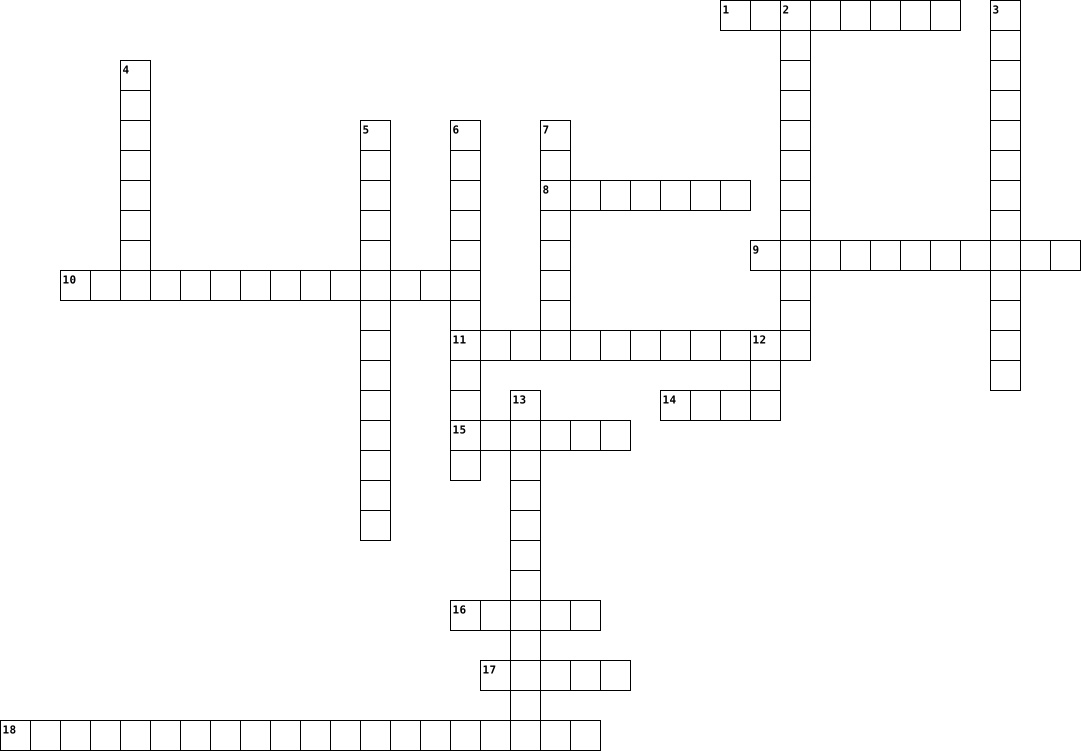
Across
- the area where the people viewing a solar eclipse will see a total eclipse.
- the moon phase during a solar eclipse.
- when the last baily bead is left and creates an image of a ring.
- a partail solar eclipse where the moon is in its furthest state form the earth and therefore can not block out the sun fully.
- when the moon is on the other side of the earth from the sun.
- the moon orbiting around the earth.
- a dark area or shape produced by a body coming between rays of light and a surface.
- the darkest part of the elliptical shadow,
- planet we live.
- the protective gear that you should where while viewing a solar eclipse.
Down
- a solar eclipse where the moon fully blocks out the sun.
- a contraption that lets you view a solar eclipse with no eye gear and is made of cardboard.
- the moon phase during a lunar eclipse.
- a solar eclipse where the moon only partaily blocks out the sun.
- when the moon passes through the sun and the earth.
- the lighter part of the elliptical shadow.
- the star in our solar system.
- when the moon is blocking out the sun but not enough to block out all of the suns ray leaving blobs of light.
18 Clues: planet we live. • the star in our solar system. • the moon orbiting around the earth. • the moon phase during a lunar eclipse. • the moon phase during a solar eclipse. • the lighter part of the elliptical shadow. • the darkest part of the elliptical shadow, • when the moon passes through the sun and the earth. • a solar eclipse where the moon fully blocks out the sun. • ...
Our Satellite 2022-05-04

Across
- the moon phase that occurs when the Earth is between the moon and the sun. The moon will appear at its brightest. The entire disc of the moon will be illuminated.
- to brighten with light
- the moon phase occurring after full moon and before new moon, when half of the illuninated surface is visible from Earth. Also known as the "last quarter."
- a body in outer space that orbits a planet; a natural satellite
- the moon phase occurring after new moon and before full moon, when half of the illuminated surface is visible from earth
- an imaginery line that an object spins or revolves around
- to have gradually larger part of its visible surface illuminated, so that it appears to increase in size
- the curved shape of the moon
- the beginning phase of the moon cycle
Down
- to move around another object along a curved path
- having to do with the moon or moon cycles
- having the observable illuminated part of the moon greater than a semicircle, but less than a full circle
- turning around on an axis; spinning
- (n)the curved path of an object as it revolves around another object (v) to move or travel around in a curved path
- to have a gradually smaller part of its visible surface illuminated, so that it appears to decrease in size
- phase the apparent shape of the illuminated part of the moon that can be seen from Earth
16 Clues: to brighten with light • the curved shape of the moon • turning around on an axis; spinning • the beginning phase of the moon cycle • having to do with the moon or moon cycles • to move around another object along a curved path • an imaginery line that an object spins or revolves around • a body in outer space that orbits a planet; a natural satellite • ...
6th ESS 6.1.1 Vocabulary and Definition 2025-02-19

Across
- – The Moon is mostly lit and continues to grow toward a full moon.
- – The curved path an object follows around another object due to gravity, such as Earth's orbit around the Sun.
- – The spinning of Earth on its axis, which causes day and night (one full rotation takes about 24 hours).
- – Half of the Moon is lit on the left side.
- – The Moon starts decreasing in light after a full moon.
- – A small part of the Moon is lit on the right side and increasing in visibility.
- – more concentrated and warmer
- – The entire face of the Moon is illuminated by the Sun.
Down
- – Half of the Moon is illuminated on the right side.
- – The Moon is between the Earth and Sun, making it invisible from Earth.
- - more spread out and cooler.Phases of the Moon – The changing appearances of the Moon due to the Sun’s light as the Moon orbits Earth.
- – 23.5 degrees, which causes different parts of the planet to receive varying amounts of sunlight, creating seasons.
- – A time of year (summer and winter) when the Sun is at its highest or lowest point in the sky, resulting in the longest or shortest day.
- – A time of year (spring and fall) when day and night are nearly equal because sunlight is directly over the equator.
- – An imaginary line running through Earth from the North Pole to the South Pole; Earth’s tilt on its axis affects seasons.
- – A small sliver of the Moon is visible on the left before returning to a new moon.
- – The movement of Earth around the Sun, taking approximately 365.25 days to complete one orbit.
17 Clues: – more concentrated and warmer • – Half of the Moon is lit on the left side. • – Half of the Moon is illuminated on the right side. • – The Moon starts decreasing in light after a full moon. • – The entire face of the Moon is illuminated by the Sun. • – The Moon is mostly lit and continues to grow toward a full moon. • ...
Tides 2023-02-24

Across
- A pattern of ocean water rising and falling due to the gravitational pull.
- This zone gets higher in the zone coastline deal with more dry land.
- More areas in this zone are lower and closer to the ocean.
Down
- Tides that occur in full and new moon phases and equals super high to remember it.
- A zone that is on the coastline and goes through periods of time and coverage also exposure due to changing tides.
- A force of pulling things together.
- Tides that occur when 1st and 3rd quarter moons and equals weak to remember it.
7 Clues: A force of pulling things together. • More areas in this zone are lower and closer to the ocean. • This zone gets higher in the zone coastline deal with more dry land. • A pattern of ocean water rising and falling due to the gravitational pull. • Tides that occur when 1st and 3rd quarter moons and equals weak to remember it. • ...
13 moons 2025-09-17

Across
- June Moon
- May Moon
- April Moon
- July Moon
- August Moon
- November Moon
Down
- January Moon
- September Moon
- October Moon
- March Moon
- February Moon
- December Moon
12 Clues: May Moon • June Moon • July Moon • March Moon • April Moon • August Moon • January Moon • October Moon • February Moon • December Moon • November Moon • September Moon
The Moon 2025-03-10

Across
- Eclipses _____ Eclipses ,Occur when the moon moves through the earth's shadow
- _____ Eclipses Occur when the new moon passes between the earth and sun
- _____ Moon,Moon phase where the entire face is illuminated, opposite the sun
- _____ Quarter ,Moon phase where the right half of the moon is visible
- _____ Tides Low tides caused by the sun and earth at a 90-degree angle
- Large dark patches on the moon's surface, Latin for seas
- _____ Crescent, Moon phase where the crescent grows after the new moon
- _____ Tides High tides caused by the sun and moon in a straight line
Down
- _____ Missions to land astronauts on the moon and return them safely
- Trenches on the moon's surface caused by lava tunnels collapsing
- _____ Gibbous, Moon phase where about 3/4 of the moon's face is illuminated
- Impact sites on the moon's surface caused by meteorites
- Periodic rise and fall of ocean surface due to moon and sun gravity
- _____ Moon, Moon phase when the moon is between the earth and the sun
- ____ Formation Debris from an impact formed the moon 4.5 billion years ago
15 Clues: Impact sites on the moon's surface caused by meteorites • Large dark patches on the moon's surface, Latin for seas • Trenches on the moon's surface caused by lava tunnels collapsing • Periodic rise and fall of ocean surface due to moon and sun gravity • _____ Missions to land astronauts on the moon and return them safely • ...
Chapter 7 2023-01-26

Across
- when one object passes into the shadow of another object
- a measurement of the amount of matter an object has
- each complete trip of the moon around the earth
- a narrow sliver of the moon's circle shape
- something that involves the moon
- a slightly flattened circle
- the path the moon takes around the earth
- a deep valley or trench that runs across the moon's surface
Down
- identifies how much of the near side of the moon is lit as seen from earth
- when the moon is more than half full but not completely full
- a large, flat area on the surface of the moon
- when the lit part of the moon is getting smaller
- any object that travels around another object in space
- when the lit part of the moon is growing larger
- light-colored streaks formed around craters
- hollowed out place on the moon's surface
- each complete spin of the moon on its axis
17 Clues: a slightly flattened circle • something that involves the moon • hollowed out place on the moon's surface • the path the moon takes around the earth • a narrow sliver of the moon's circle shape • each complete spin of the moon on its axis • light-colored streaks formed around craters • a large, flat area on the surface of the moon • ...
THE MOON! 2024-01-29

Across
- this keeps the moon in orbit around the Earth
- an imaginary line that we use to understand rotation
- the moon is 4.5 _________________yrs. old
- the moon is Earth's only natural _____________
- the side of the moon that we cannot see from Earth
- the moon has no air, very little _____________
- at the center of the moon is a 700km wide _________
- continuous trip around a larger object
Down
- we base our _____________on the moon's orbit
- the moon is 240,000 __________ away
- these once erupted on the moon with lava flows
- these crash into the moons surface regularly
- to turn continuously around on an axis,spin
- a large bowl shaped cavity on the surface
- action of an object forced to hit another object
- the low lands or dark spots we see on the moon
16 Clues: the moon is 240,000 __________ away • continuous trip around a larger object • the moon is 4.5 _________________yrs. old • a large bowl shaped cavity on the surface • to turn continuously around on an axis,spin • we base our _____________on the moon's orbit • these crash into the moons surface regularly • this keeps the moon in orbit around the Earth • ...
jake byrd space crossword 2022-04-26

Across
- moon partially covered by earthshadow
- awesome video game
- sun is completely covered by the moon
- the lighter edge of a shadow
- moon is covered by earth´s shadow
- sun is partially covered by the moon
- earth´s giant satellite
Down
- path around the sun
- moon completely covered by earthshadow
- an object completing one orbit around another
- dark center of a shadow
- sun is covered by the moon
- degree of distance from vertical
- blocking the light of the sun
- spinning on an axis
- darkness cast by an object blocking the light
16 Clues: awesome video game • path around the sun • spinning on an axis • dark center of a shadow • earth´s giant satellite • sun is covered by the moon • the lighter edge of a shadow • blocking the light of the sun • degree of distance from vertical • moon is covered by earth´s shadow • sun is partially covered by the moon • moon partially covered by earthshadow • ...
THE MOON! 2024-01-29

Across
- at the center of the moon is a 700km wide _________
- action of an object forced to hit another object
- to turn continuously around on an axis,spin
- we base our _____________on the moon's orbit
- the moon is 4.5 _________________yrs. old
- the moon is 240,000 __________ away
- a large bowl shaped cavity on the surface
Down
- continuous trip around a larger object
- the moon is Earth's only natural _____________
- these once erupted on the moon with lava flows
- the side of the moon that we cannot see from Earth
- this keeps the moon in orbit around the Earth
- these crash into the moons surface regularly
- the low lands or dark spots we see on the moon
- an imaginary line that we use to understand rotation
- the moon has no air, very little _____________
16 Clues: the moon is 240,000 __________ away • continuous trip around a larger object • the moon is 4.5 _________________yrs. old • a large bowl shaped cavity on the surface • to turn continuously around on an axis,spin • these crash into the moons surface regularly • we base our _____________on the moon's orbit • this keeps the moon in orbit around the Earth • ...
word search 2017-02-26

Across
- the first phase of the moon
- something that errupts
- the third phase of the moon
- the fifth phase of the moon
- the last phase of the moon
- comes after spring
- the fourth phase of the moon
- when the earth shakes
- comes after summer
Down
- a star
- comes after winter
- the seventh phase of the moon
- theres seven of them
- founder of plate tectonics
- comes after fall
- creative after a star explodes
16 Clues: a star • comes after fall • comes after winter • comes after spring • comes after summer • theres seven of them • when the earth shakes • something that errupts • founder of plate tectonics • the last phase of the moon • the first phase of the moon • the third phase of the moon • the fifth phase of the moon • the fourth phase of the moon • the seventh phase of the moon • ...
Earth, Moon & Sun Unit 2021-10-21

Across
- when the Earth's shadow falls on the Moon
- Earth's only natrual sattelite
- the part of the illuminated Moon that we see from Earth
- evidence that meteors have hit the Moon's surface
- the Sun, planets and other objects that orbit the sun
- to make something visible
- the entire lit side of the Moon is facing Earth
- when the Moon's shadow falls on Earth
- time it takes for the Moon to make one orbit
Down
- the Moon's orbit is ___________ which is why eclipses do not happen every month
- the entire dark side of the Moon is facing Earth
- the Sun is mostly made up of this gas
- the line between light and dark on the Moon
- when we see more of the Moon each night
- time it takes for Earth to go around the Sun once
- the result of the Moon's gravity pulling on Earth's oceans
- The only planet that is known to support life
- the star in the center of our solar system
18 Clues: to make something visible • Earth's only natrual sattelite • the Sun is mostly made up of this gas • when the Moon's shadow falls on Earth • when we see more of the Moon each night • when the Earth's shadow falls on the Moon • the star in the center of our solar system • the line between light and dark on the Moon • time it takes for the Moon to make one orbit • ...
Jupiter Crossword 2026-03-03

Across
- Our planet
- 4 Moons
- Spot
- Third largest moon
- Outer layer
- Orbit
- Size
Down
- Second most component
- Main component
- Temperature
- Core
- Distance
- Second largest moon
- Largest Moon
- Forth Moon
- Day
16 Clues: Day • Core • Spot • Size • Orbit • 4 Moons • Distance • Our planet • Forth Moon • Temperature • Outer layer • Largest Moon • Main component • Third largest moon • Second largest moon • Second most component
Science vocab 2023-12-12

Across
- means that the moon is getting bigger.
- How long it takes the moon to revolve around the earth
- Half of a sphere
- a force which tries to pull two objects toward each other.
- The tide when it is at its highest point
- the moon at any stage between the new moon and first quarter and between last quarter and the succeeding new moon when less than half of the illuminated hemisphere is visible.
- Rotating around the center
Down
- The four natural divisions of the year.
- a tide just after a new or full moon, when there is the greatest difference between high and low water.
- A tide just after the quarters of the moon
- Means that the moon is getting smaller
- the alternate rising and falling of the sea, usually twice in each lunar day at a particular place, due to the attraction of the moon and sun.
- A gibbous moon is any moon that appears more than half lighted but less than full
- An imaginary line that planets rotate on.
- A tide that is low
- To make something become in a slope position.
16 Clues: Half of a sphere • A tide that is low • Rotating around the center • means that the moon is getting bigger. • Means that the moon is getting smaller • The four natural divisions of the year. • An imaginary line that planets rotate on. • The tide when it is at its highest point • A tide just after the quarters of the moon • To make something become in a slope position. • ...
Space 2024-09-25

Across
- used to travel to space
- earth only has one
- first man on the moon
- when the moon has no light, it makes a
- planet with visible rings
- hottest star in our solar system
- farthest planet from the sun
- smallest planet
- our twin planet
- we live here
Down
- balls of gas that have what people call a tail
- another name for moon
- people who travel through space
- gas planet
- ice planet
- when the moon passes the sun
- rusty planet
- no longer classified as a planet
- balls made from gas
19 Clues: gas planet • ice planet • rusty planet • we live here • smallest planet • our twin planet • earth only has one • balls made from gas • another name for moon • first man on the moon • used to travel to space • planet with visible rings • when the moon passes the sun • farthest planet from the sun • people who travel through space • no longer classified as a planet • ...
Moons 2023-08-19

Across
- October
- February
- November
- May
- July
- August
Down
- April
- March
- Second Full moon in a Month
- Fattened moon
- September
- June
- January
- Skinny moon
- Second new moon in a month
- December
16 Clues: May • June • July • April • March • August • October • January • February • November • December • September • Skinny moon • Fattened moon • Second new moon in a month • Second Full moon in a Month
Unit 3 Review 2023-12-15

Across
- the months of March, April,and May fall in this season
- this season comes after summer
- when the sea is below sea level
- takes 1 year (365 days)
- when the moon appears to grow smaller
- This event happens on December 21
- when no light on the moon is visible
- occurs when the sun moon and earth are aligned in that order
- this season contains the solstice where the day is the shortest
- the months of June July and August happen in this season
Down
- when the moon appears full
- when the tide is above sea level (happens two times a day)
- when the sun earth and moon make a right triangle this creates
- when the days are the same length in the north and south
- when the moon appears half-full
- when the moon appears to grow bigger
- where the amount of daylight is swapped between the north and south hemispheres
- when most of the moon is visible
18 Clues: takes 1 year (365 days) • when the moon appears full • this season comes after summer • when the sea is below sea level • when the moon appears half-full • when most of the moon is visible • This event happens on December 21 • when the moon appears to grow bigger • when no light on the moon is visible • when the moon appears to grow smaller • ...
Origin of Modern Astronomy Vocab Crossword puzzle 2021-12-07

Across
- motion The apparent motion of the planets when they appear to move backwards (westward) with respect to the stars from the direction that they move ordinarily.
- a long
- (384-322 BC) philospher
- A model of the universe in which Earth is at the center of the revolving planets and stars.
- Nearest point to the earth in the orbit of a heavenly body
- eclipse Occurs when the Moon passes directly between the Sun and Earth and casts a shadow over part of Earth
- A model of the solar system in which Earth and the other planets revolve around the sun
- The place in the Earth's orbit where Earth is farthest away from the sun.
- Isaac Newton Defined the laws of motion and universal gravitation and used them to predict the motion of stars and planets around the sun.
- Study of the universe
- of the moon the progression of changes in the moon's appearance during the month;
- Kepler Assistant to Brahe; used Brahe's data to prove that the earth moved in an elliptical
Down
- eclipse Occurs whenever the Moon passes through the Earth's shadow
- farthest point from the earth in the orbit of a heavenly body
- Ptolemy ancient Greek astronomer that is known for his theory of an earth-centered universe
- CIRCULAR MOVEMENT AROUND AN AXIS
- (276-194) An astronomer that is credited with being the first to establish the size of the Earth
- Nearest point to the sun in the orbit of a heavenly body
- splash marks that radiate outwards from a crater
- A large
- (310?-250? BCE) Greek scientist who first stated that the Earth revolved around the Sun
- A slow motion of Earth's axis that traces out a cone over a period of 26
- The curved path of a celestial object or spacecraft around a star
- A large round pit caused by the impact of a meteoroid.
- Brahe (1546-1601) Established himself as Europe's foremost astronomer of his day; detailed observations of new star of 1572.
- Earth's yearlong elliptical orbit around the sun
- Copernicus (1473-1543) concluded that the sun is the center of our solar system. Heliocentric Theory or Copernicus Theory. He wrote "On the Revolution of Heavenly Spheres"
- Galilei 1564-1642
- regolith a thin. gray layer on the surface of the moon
- unit The average distance between Earth and the sun
- A elongated circle
31 Clues: a long • A large • Galilei 1564-1642 • A elongated circle • Study of the universe • (384-322 BC) philospher • CIRCULAR MOVEMENT AROUND AN AXIS • splash marks that radiate outwards from a crater • Earth's yearlong elliptical orbit around the sun • unit The average distance between Earth and the sun • A large round pit caused by the impact of a meteoroid. • ...
Movement in Space 2022-01-25

Across
- A giant ball of superheated gas, or plasma, composed of hydrogen and helium.
- The Greek philosopher who was one of the first supporters of the geocentric model
- Another name for Earth's orbit around the Sun
- Earth's only natural satellite
- This comet first appeared in 1758 and continues to appear approximately every 75 years.
- A pattern or group of stars that people imagine represents a figure, animal or object.
- Stars are made up of hydrogen and _________.
- During this season will you see the constellation Orion in the western sky
- The word planet means ______________.
- Earth-centered
- Ursa major means ____________.
- Pieces of space rock that hit the Earth's surface
- This astronomer discovered moons around Jupiter, which showed that not everything in the sky travels around Earth.
- Earth's revolution around the Sun causes __________.
- Pieces of rock and/ice that have broken off of asteroids, comets, moons, and planets
- A body that orbits a a planet.
Down
- There are ____ constellations.
- What Aryabhata used to come up with his ideas about how objects moved in space.
- The astronomer who said the moon and planets shine because they reflect light from the Sun.
- Proposed that Earth's rotation and revolution around the sun explained the observed movements of the stars and planets
- Galileo discovered that this planet goes through phases like the moon does, meaning it must orbit the sun, not the Earth.
- Sun-centered
- Another name for a meteor.
- The narrow band in the sky that contains the orbits of all the planets
- In Ptolemy's geocentric model, the planets made small circles called _______ as they moved along their orbits.
- Determined that the orbit of each planet is an ellipse rather than a perfect circle
- An object that orbits the sun, is large enough to have become rounded by its own gravity, and has cleared the area of its orbit of any debris.
- These two planets never appear far from the sun in the sky
- Large, dirty space snowballs that develop a long tail of light as they approach the sun
- An oval shaped orbit of the planets around the sun
- Pieces of space rock that burn up as then move through the Earth's atmosphere.
31 Clues: Sun-centered • Earth-centered • Another name for a meteor. • There are ____ constellations. • Earth's only natural satellite • Ursa major means ____________. • A body that orbits a a planet. • The word planet means ______________. • Stars are made up of hydrogen and _________. • Another name for Earth's orbit around the Sun • Pieces of space rock that hit the Earth's surface • ...
Space 2023-04-27
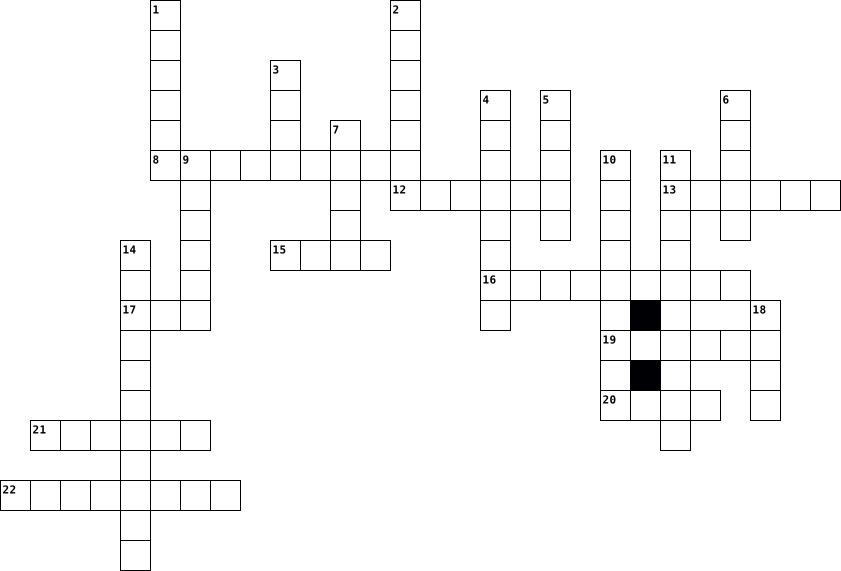
Across
- æghg
- t-10
- no clues from now
- work
- stars
- light
- moon mission
- air
- Sand
- adg
Down
- high voice
- gas giant
- red
- mooo
- a place in space
- QWERTYUIOP
- items now
- gas
- spaceman
- space study
- no
- A moon
22 Clues: no • red • gas • air • adg • mooo • æghg • t-10 • work • Sand • stars • light • A moon • spaceman • gas giant • items now • high voice • QWERTYUIOP • space study • moon mission • a place in space • no clues from now
Moon Landing 2019-02-21

Across
- this is the transportation astronauts take to the moon
- harmful rays in space
- these were not present in the pictures taken from the moon
- these are on the moon because of its uneven surface
- the flag has this on the moon which made it move
- Armstrong first man to walk on the moon
- who went to the moon first
- this was present in the pictures but inst apparent in space
Down
- a place full of stars, planets and black holes
- uniform astronauts wear in space
- the moon has none of this
- these were brought back from the moon and are proof
- people who go to space
- what did the US place on the moon
- the US went here in space first in race with soviet union
15 Clues: harmful rays in space • people who go to space • the moon has none of this • who went to the moon first • uniform astronauts wear in space • what did the US place on the moon • Armstrong first man to walk on the moon • a place full of stars, planets and black holes • the flag has this on the moon which made it move • these were brought back from the moon and are proof • ...
starry night by Hanna D. 2012-06-15

Across
- ________ has no atmusphre.
- earth has ________ moon(s).
- uranus has _________ moon(s).
- jupiter has _______ moon(s).
- mars has _______ moon(s).
- the _____ is the hottset planet.
Down
- _______ has one moon(s).
- it takes _____ days for mercury to go around the sun.
- pluto has ______ rings.
- saturn has _______ moon(s).
- pluto is nolonger a _______.
- neptun has _______ moon(S).
- venus has _______ moon(s).
- mercury is the _______ closest to the sun.
14 Clues: pluto has ______ rings. • _______ has one moon(s). • mars has _______ moon(s). • ________ has no atmusphre. • venus has _______ moon(s). • earth has ________ moon(s). • saturn has _______ moon(s). • neptun has _______ moon(S). • pluto is nolonger a _______. • jupiter has _______ moon(s). • uranus has _________ moon(s). • the _____ is the hottset planet. • ...
Earth Moon Sun Relationship 2024-12-19

Across
- The lighter, outer part of a shadow cast during an eclipse.
- When the illuminated part of the Moon is increasing.
- The path a planet follows around a star.
- When the Moon passes between the Sun and Earth, blocking the Sun's light.
- When only a small sliver of the Moon is visible.
- The darkest part of a shadow cast during an eclipse.
- When the Moon is opposite the Sun relative to Earth, appearing fully illuminated.
- The movement of a planet around a star (like Earth around the Sun) in a set path called an orbit.
- Smallest difference between high and low tides
- The alternate rise and fall of the oceans
Down
- An astronomical event where one celestial body passes in front of another, blocking its light.
- When the Earth passes between the Sun and Moon, casting a shadow on the Moon.
- When more than half but not all of the Moon is visible.
- The different appearances of the Moon as seen from Earth, depending on the portion illuminated by the Sun.
- tides where there are the Largest difference between high and low tides
- The spinning motion of a planet around its axis, causing day and night.
- When the Moon is directly between the Earth and Sun, appearing completely dark.
- When the illuminated part of the Moon is decreasing.
- An imaginary line through the center of a planet, connecting its North and South poles.
19 Clues: The path a planet follows around a star. • The alternate rise and fall of the oceans • Smallest difference between high and low tides • When only a small sliver of the Moon is visible. • When the illuminated part of the Moon is increasing. • The darkest part of a shadow cast during an eclipse. • When the illuminated part of the Moon is decreasing. • ...
Moon Phase Crossword Puzzle 2026-05-07

Across
- sun
- 1/4 or 3/4 of the moon
- moon getting smaller
- bigger part of the moon
- the planet we are on
- repetiteve
- when there is no moon
- thing in the sky
Down
- gravity and inertia = ?
- measured by the moon's revolution
- the total or partial obscuring of one celestial body by another
- moon getting bigger
- smaller part of the moon
- when the moon looks biggest
14 Clues: sun • repetiteve • thing in the sky • moon getting bigger • moon getting smaller • the planet we are on • when there is no moon • 1/4 or 3/4 of the moon • gravity and inertia = ? • bigger part of the moon • smaller part of the moon • when the moon looks biggest • measured by the moon's revolution • the total or partial obscuring of one celestial body by another
Earth in Space 2025-10-15

Across
- one complete orbit around the Sun
- different shapes of the Moon as seen from Earth
- a meteoroid that enters Earth’s atmosphere, usually creating a bright streak across the sky as it burns up; a shooting star
- path a planet takes around a star, or a moon or artificial satellite takes around a planet
- the total or partial obscuring of one celestial body by another
- a meteor big enough for part of it to hit the ground
- full, dark shadow of an eclipse
- model, model of the universe with the Sun at its centre
- the time a planet takes to rotate once completely on its own axis
- system, the Sun and all the planets, satellites, asteroids, comets and other bodies revolving around it
- object in orbit around another larger object
- Way, the galaxy in which our solar system is located
- on Earth, summer, autumn, winter, spring; caused by the tilt of a planet’s axis
- model, model of the universe with Earth at its centre
- Earth-like, rocky. The terrestrial planets are Mercury, Venus, Earth and Mars
- oval shape
- an irregular rocky object in orbit around the Sun between the orbits of Mars and Jupiter
- belt, a group of rocks that orbit the Sun in a band between Mars and Jupiter
- a ball of ice, dust and rock that orbits the Sun in a highly elliptical orbit
Down
- eclipse, when the Earth blocks sunlight from reaching the Moon
- force field, invisible field that causes masses to be attracted to each other
- roughly spherical ball of rock or gas that orbits (moves around) the Sun. They do not generate their own light.
- a small particle or body of rock that orbits the Sun near Earth’s orbit
- satellites, satellites placed into orbit by humans
- less dense shadow of an eclipse
- a scientist who studies the stars, planets and other celestial objects
- planet, a small celestial body that is in orbit around the Sun and is nearly round in shape but with insufficient gravity to sweep its orbit clear of other bodies (which is a criterion of being called a planet)
- the time a planet takes to revolve once around the Sun
- motion, apparent loop-like motion of the planets as seen from Earth
- the line connecting the North Pole with the South Pole. Earth rotates around this axis.
- relating to the sky or to space
- month, the time the Moon takes to complete one orbit of Earth (27.3 days)
- giants, the large planets of the outer solar system: Jupiter, Saturn, Uranus, Neptune
- eclipse, when the Moon blocks sunlight from reaching Earth
- a group of stars which form a recognisable pattern in the night sky
35 Clues: oval shape • less dense shadow of an eclipse • full, dark shadow of an eclipse • relating to the sky or to space • one complete orbit around the Sun • object in orbit around another larger object • different shapes of the Moon as seen from Earth • satellites, satellites placed into orbit by humans • a meteor big enough for part of it to hit the ground • ...
Moon 2023-11-24

Across
- joy
- red fruit
- connection device
- pet
- prolongs your life
Down
- your close person
- height
- very sweet
- Heat
- feelings of two people
10 Clues: joy • pet • Heat • height • red fruit • very sweet • your close person • connection device • prolongs your life • feelings of two people
Moon 2025-05-25

Across
- Native Americans call the April moon this
- Closest to the Autumn equinox
- The 13th Full moon in a calendar year
- The fifth phase
- Also known as the 'cold moon’
- The invisible phase
Down
- A perigean full moon
- Also called the 'green corn moon'
- Native American name for the July lunar moon
- Occurs during a total lunar eclipse
10 Clues: The fifth phase • The invisible phase • A perigean full moon • Closest to the Autumn equinox • Also known as the 'cold moon’ • Also called the 'green corn moon' • Occurs during a total lunar eclipse • The 13th Full moon in a calendar year • Native Americans call the April moon this • Native American name for the July lunar moon
Earth, Moon, and Sun Relationships 2021-03-30

Across
- the position the moon must be in for a lunar eclipse to occur
- When the amount of illumination on the Moon is decreasing
- occurs when the moon is between the earth and sun and appears invisible to us from earth
- an imaginary line that an object spins or rotates around
- the circular path of an object as it revolves around another object
- Earth has seasons because its axis is _________
- the second force that works with gravity to keep the planets in orbit
- a type of tide that occurs when the sun, moon, and Earth are in a straight line producing an extreme tide
- the days are _________ during summer than during winter
Down
- When the amount of illumination on the Moon is increasing
- has the most influence on the high and low tides of the Earth’s oceans
- when the moon passes directly behind the Earth and into its shadow
- a force that exists between any two objects that have mass
- the temporary blockage of sunlight by the Moon as it travels between Earth and the Sun
- one ___________ of earth is equal to one day
- Produced when the sun, moon, and Earth align at a 90° angle producing the smallest rise and fall of tidal levels
- the strength of gravity relies on the mass and _____________ between the objects
- For part of our orbit the northern half of Earth is tilted toward the Sun resulting in ____________
- any moon that appears more than half lighted but less than full
19 Clues: one ___________ of earth is equal to one day • Earth has seasons because its axis is _________ • the days are _________ during summer than during winter • an imaginary line that an object spins or rotates around • When the amount of illumination on the Moon is increasing • When the amount of illumination on the Moon is decreasing • ...
Sun and Moon Vocabulary 2024-03-04

Across
- eclipse blocking of sun's light; occurs during new moon when moon's shadow falls
- part of moon becomes temporarily darkened;moon moves partially into the umbra of earth's shadow
- star in the center of our solar system; Earth and 7 planets revolve around it.
- layer of sun's atmosphere below the corona
- a sphere of hot,glowing gases that releases energy in the form of heat and light
- the entire disk of the full moon is covered by earth's umbra
Down
- loop of gas; comes from sun's surface, linking parts of sunspot regions
- solar eclipse, new moon temporarily blocks part of sun's disk, new moon, earth, and sun aren't completely aligned
- lunar eclipse, barely visible from earth; occurs when new moon moves through the penumbra of earth's shadow
- reaction when hydrogen gas changes to helium gas; releases energy in form of heat and light
- layer of sun's atmosphere below chromosphere; provides sunlight that reaches earth
- blocking of sunlight to moon; during full moon phase
- eclipse visible from inside moon's umbra;sun's entire disk is blocked by new moon
- type of solar eclipse; moon is too far away to cover sun completely;outer edge is seen as a ring
- lighter, outer part of a shadow cone
- relatively darker, cooler area on sun's surface;emits charged particles
- outer layer of Sun's atmosphere; becomes visible during total solar eclipse
- the inner, darker part of a shadow cone
18 Clues: lighter, outer part of a shadow cone • the inner, darker part of a shadow cone • layer of sun's atmosphere below the corona • blocking of sunlight to moon; during full moon phase • the entire disk of the full moon is covered by earth's umbra • loop of gas; comes from sun's surface, linking parts of sunspot regions • ...
school 2025-02-03

Across
- you write with
- y=mx+b
- you write with
- mixing mixtures
- reading passages
- essays
- you write on
- newspaper
- your body
- studies history
Down
- phases
- como te llamas
- military
- triangle theorem
- has multiple sheets of paper
- 1+1xy_5
- you get graded for
- 1+1
- mythology
- sci waves
20 Clues: 1+1 • phases • y=mx+b • essays • 1+1xy_5 • military • newspaper • your body • mythology • sci waves • you write on • como te llamas • you write with • you write with • mixing mixtures • triangle theorem • reading passages • studies history • you get graded for • has multiple sheets of paper
THE 2 PHASES 2019-07-02

Across
- fighting against other people by surprise.
- can be beneficial or harmful to the body.
- a battle that started in 1536 ,between Mapuches and Spaniards.
- he conquered Peru in 1535.
- the capital of the Aztec empire.
- cortes put this name to the aztec empire after he conquered it.
- they infect cells.
- is to invesgatigate an area in wich you have never been before.
- the destroyer of santiago and also was the leader of pinkunches
- they absorb nutrients from living things.
- an area of land commanded by a ruler,state and domain.
- is to domain a territory and it's people.
Down
- Pedro de Valdivia was the person that founded this city.
- the person that paid the conquerors' trip.
- place that spaniards used to defend themselves from possible attacks.
- the first person that tried to conquer Chile.
- the second person that tried to conquer Chile.
- soil in which plants can grow plants.
18 Clues: they infect cells. • he conquered Peru in 1535. • the capital of the Aztec empire. • soil in which plants can grow plants. • can be beneficial or harmful to the body. • they absorb nutrients from living things. • is to domain a territory and it's people. • fighting against other people by surprise. • the person that paid the conquerors' trip. • ...
vocab 2025-11-18

Across
- lunar getting blocked
- solar getting blocked
- Ntype of tide
- something gets blocked in space
- to rotate
- unwhole moon
Down
- whole moon
- Stype of tide
- the 3rd quarter of the moon
- moon controls these
- the phase of something around the earth
- the 1st quarter of the moon
- to revolve
- summer spring winter fall
- goes around the earth
15 Clues: to rotate • whole moon • to revolve • unwhole moon • Stype of tide • Ntype of tide • moon controls these • lunar getting blocked • solar getting blocked • goes around the earth • summer spring winter fall • the 3rd quarter of the moon • the 1st quarter of the moon • something gets blocked in space • the phase of something around the earth
Moon Mouse 2015-09-07

Across
- (2) There was not a lot of _______.
- (4) The astronauts went to the moon in a __________.
- (2) The main character.
- (12) Lots of hair.
- (4) "The spaceship ________ off."
- (8) ________ 122 pushes the button.
- (12) A dairy food product.
- (10) "They would tell this ______ to the world."
- (4) Mouse hid in a _______.
Down
- (10) Someone who many people know.
- (6) The astronauts are looking for moon _________.
- (14) Because mouse is famous, he is a V. ___________. M.
- (4) Keep out of sight.
- (2) Mouse lived in a ________.
- (4) Talking very loudly.
- (14) Something you DONT tell people.
- (10) Where humans live.
17 Clues: (12) Lots of hair. • (4) Keep out of sight. • (2) The main character. • (10) Where humans live. • (4) Talking very loudly. • (12) A dairy food product. • (4) Mouse hid in a _______. • (2) Mouse lived in a ________. • (4) "The spaceship ________ off." • (10) Someone who many people know. • (2) There was not a lot of _______. • (8) ________ 122 pushes the button. • ...
ScienceHW 2023-02-07

Across
- Moon appearing to shrink
- First moon phase with more light on the left than right.
- 2nd phase, less than half on the right side.
- Point when the moon has the most influence on the Earth's water
- Phase with the right half lit.
- When one celestial body blocks the light from another
- Looks like there is no moon.
Down
- Moon is all the way lit.
- Lowest point for all tides
- Between half and full on the right side.
- Last phase before new moon
- Point when the moon has the least influence on the Earth's water
- Highest point for all tides
- Moon phase that is 3/4 done with the cycle
- Moon appearing to grow.
15 Clues: Moon appearing to grow. • Moon is all the way lit. • Moon appearing to shrink • Lowest point for all tides • Last phase before new moon • Highest point for all tides • Looks like there is no moon. • Phase with the right half lit. • Between half and full on the right side. • Moon phase that is 3/4 done with the cycle • 2nd phase, less than half on the right side. • ...
Unit 1 Vocabulary 2024-12-03

Across
- The delicious ____ of the cafeteria cookies consumed the hallways.
- I was feeling ____ this morning, so I dragged my feet while walking to school.
- I was filled with ____ when I saw her new Nike Air Force 1.
- The winter snowstorm was so ____ I had to shovel my path to school.
- She was filled so so much happiness, she called it an ___ moment.
Down
- My mom was so distracted with the TV, she was ____ to the cat climbing the Christmas Tree.
- I felt like my mom ____ me of my favorite snacks when we went to Target.
- My sister was ____ to learn about the different phases of the moon, because she loved Space!
- Mrs. Dilolo seemed ____ when she heard a student was missing from the school bus.
- The pond water was so ____ I couldn't catch any fish.
10 Clues: The pond water was so ____ I couldn't catch any fish. • I was filled with ____ when I saw her new Nike Air Force 1. • She was filled so so much happiness, she called it an ___ moment. • The delicious ____ of the cafeteria cookies consumed the hallways. • The winter snowstorm was so ____ I had to shovel my path to school. • ...
Rocks 2023-04-26

Across
- certain wavelengths of incident light are absorbed
- a gentle sheen or soft glow, especially that of a partly reflective surface
- phases that form by sterical reconfigurations of structural patterns but without fundamental changes in bonding.
- is the resistance of a mineral to scratching
- molten or partially molten rock (magma) that has been expelled from the interior of a terrestrial planet (such as Earth) or a moon onto its surface.
Down
- a type of carbonate sedimentary rock which is the main source of the material lime
- the geological process in which earthen materials are worn away and transported by natural forces such as wind or water.
- one of three main types of rocks
8 Clues: one of three main types of rocks • is the resistance of a mineral to scratching • certain wavelengths of incident light are absorbed • a gentle sheen or soft glow, especially that of a partly reflective surface • a type of carbonate sedimentary rock which is the main source of the material lime • ...
Eclipse 2022-04-25

Across
- the path of a celestial object revolving around a celestial object
- when the Earth covers up the moon from the sun
- a dark area created by something blocking something else
- the moon is covering the Sun with the Earth in the moons shadow
- the darker part of a shadow by the Earth or moon
- Only part of the moon is covering the sun
- a celestial object that revolves around a planet
- the Earth blocks all sunlight from the sun to the moon
- when a celestial object finishes an orbit
- when a celestial object passes over another celestial object blocking its sunlight
Down
- the moon covers up the Sun and its sunlight to the Earth
- going around in a circle
- when something is not straight up and down but angled to the left or right
- lighter part of a shadow from the moon or the Earth
- the Earth blocks some of the sunlight to the moon
- moon
16 Clues: moon • going around in a circle • Only part of the moon is covering the sun • when a celestial object finishes an orbit • when the Earth covers up the moon from the sun • the darker part of a shadow by the Earth or moon • a celestial object that revolves around a planet • the Earth blocks some of the sunlight to the moon • ...
Eclipse 2023-05-10

Across
- the path of a celestial object revolving around a celestial object
- when the Earth covers up the moon from the sun
- a dark area created by something blocking something else
- the moon is covering the Sun with the Earth in the moons shadow
- the darker part of a shadow by the Earth or moon
- Only part of the moon is covering the sun
- a celestial object that revolves around a planet
- the Earth blocks all sunlight from the sun to the moon
- when a celestial object finishes an orbit
- when a celestial object passes over another celestial object blocking its sunlight
Down
- the moon covers up the Sun and its sunlight to the Earth
- going around in a circle
- when something is not straight up and down but angled to the left or right
- lighter part of a shadow from the moon or the Earth
- the Earth blocks some of the sunlight to the moon
- moon
16 Clues: moon • going around in a circle • Only part of the moon is covering the sun • when a celestial object finishes an orbit • when the Earth covers up the moon from the sun • the darker part of a shadow by the Earth or moon • a celestial object that revolves around a planet • the Earth blocks some of the sunlight to the moon • ...
Principles of First Aid 2025-05-02

Across
- The second "P" expressed in the Goals of First Aid
- First Aiders accomplish the goals of first aid by knowing their scope and staying within it (hint: First Aid Made Simple Model, Red)
- The third "P" expressed in the Goals of First Aid
- The first "P" expressed in the Goals of First Aid
- Link 2 in the Chain of Survival, "Fast initiation of High-Performance ___"
- The third of 3 phases a First Aider will move through when responding to a rescue situation
- Link 1 in the Chain of Survival, "Early Recognition and ____ Activation"
- Someone at an emergency scene who suspects injury or illness and provides first aid to achieve the Goal of First Aid
Down
- Link 6 in the Chain of Survival, "_____ from cardiac event"
- What do the Goals of First Aid Promote?
- Link 4 in the Chain of Survival, "Early Primary ___ and Advanced ___ EMS"
- The first of 3 Rescue Elements
- 1 or 2 things that are specific to the treatment of first aid (Eg, Sugar for Diabetics)
- Link 3 in the Chain of Survival, "Quick use of ___, Early Defibrillation"
- The second of 3 phases a First Aider will move through when responding to a rescue situation
- The first of 3 phases a First Aider will move through when responding to a rescue situation
- The second of 3 Rescue Elements
- The third of 3 Rescue Elements
18 Clues: The first of 3 Rescue Elements • The third of 3 Rescue Elements • The second of 3 Rescue Elements • What do the Goals of First Aid Promote? • The third "P" expressed in the Goals of First Aid • The first "P" expressed in the Goals of First Aid • The second "P" expressed in the Goals of First Aid • Link 6 in the Chain of Survival, "_____ from cardiac event" • ...
Planetary Moons 2024-12-10

Across
- moon of Saturn with erupting geysers
- heavily cratered moon of Jupiter
- has the most active volcanoes in the solar system
- larger of Mars' 2 moons
- moon of Saturn with an atmosphere
- spacecraft that discovered Jupiter's rings
- moon of Uranus with interesting geologic activity
- common balance point
Down
- discovered the 4 main moons of Jupiter
- ice-covered moon with possible water underneath
- smaller of Mars' 2 moons
- only moon in the solar system with retrograde motion
- Pluto's largest moon
- spacecraft that studied Saturn and its moons
- the largest moon in the solar system
15 Clues: Pluto's largest moon • common balance point • larger of Mars' 2 moons • smaller of Mars' 2 moons • heavily cratered moon of Jupiter • moon of Saturn with an atmosphere • moon of Saturn with erupting geysers • the largest moon in the solar system • discovered the 4 main moons of Jupiter • spacecraft that discovered Jupiter's rings • spacecraft that studied Saturn and its moons • ...
Space Race 2022-06-01

Across
- First USA Satellite
- First SpaceCraft to go Around the Moon and back (Russian)
- First Space Walk (Russian)
- Series of missions that lead to the moon landing
- First American in orbit
- First Women in Space (Russian)
- Name of an American going to space
- First Satellite in Space (Russian)
- First Soft Landing on the Moon (Russian)
Down
- Second Man On Moon (American)
- Director of NASA
- First Dog in Space (Russian)
- Name of a Russian who has gone to space
- First Man On Moon (American)
- First Human in Space (Russian)
- Name of the rocket that took man to the Moon
- First American Space Walk
- Piolited the control Module during Appollo 11
18 Clues: Director of NASA • First USA Satellite • First American in orbit • First American Space Walk • First Space Walk (Russian) • First Dog in Space (Russian) • First Man On Moon (American) • Second Man On Moon (American) • First Human in Space (Russian) • First Women in Space (Russian) • Name of an American going to space • First Satellite in Space (Russian) • ...