
moon phases Crossword Puzzles
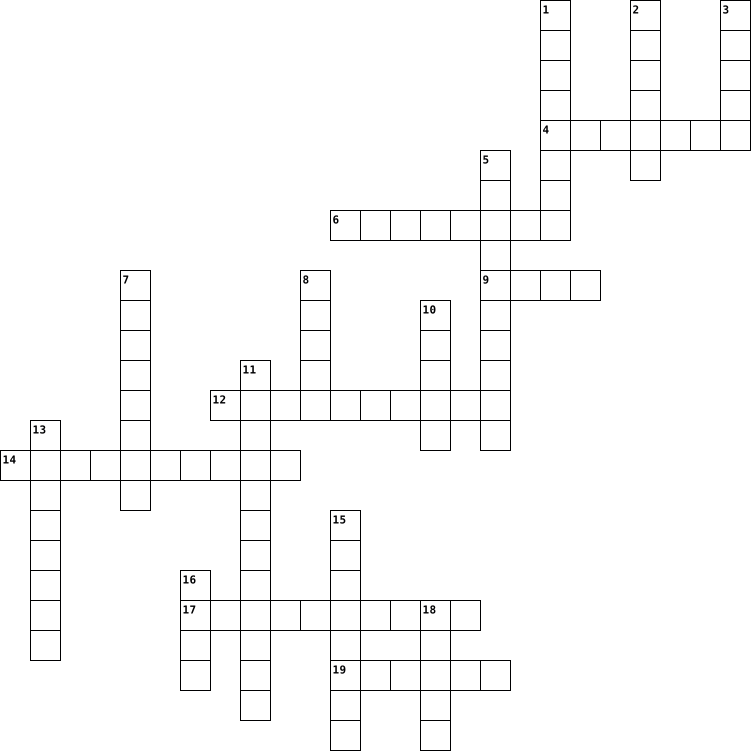
Aries vocab crossword 2026-01-12

Across
- larger inner moon of mars
- the rocky inner planets
- smaller moon of mars
- a system of canyons on mars
- the 4 mountain ranges on mars
- a system for detecting presence
- systems disk like structures of countless small particles
- a massive impact Crater on mercury
Down
- the largest volcano and tallest mountain in the solar system
- minimum distance where a moon can orbit
- disassociation of a compound by light
- planets outer gas Giants of our solar system
- moons jupiters four largest moons
- Neptune's largest moon
- powerful fast moving winds in planets atmosphere
- a very steep blank or slope
- jupiters largest moon
- Saturn's largest moon
18 Clues: smaller moon of mars • jupiters largest moon • Saturn's largest moon • Neptune's largest moon • the rocky inner planets • larger inner moon of mars • a system of canyons on mars • a very steep blank or slope • the 4 mountain ranges on mars • a system for detecting presence • moons jupiters four largest moons • a massive impact Crater on mercury • disassociation of a compound by light • ...
Words Derived from Mythology 2021-09-28

Across
- the logo for Versace is actually a representation of Medusa.
- a reckless impetuous irresponsible person; an insane person;, insane and believed to be affected by the phases of the moon (luna)
- was a Greek warrior famous for his participation in the Trojan War.
- the logo of Starbuck's is a Siren.
- is the science of mental behavior from Psyche.
- mean a government that is run by the wealthy Pluto,god of wealth.
- is a system to improve memory from Mnemosyne,goddess of memory.
- is the Greek goddess of the dawn.
Down
- is an opening in the earth's crust that ejects lava from Vulcan.
- the two-faced god is the Roman god of vigilance and wisdom.
- exceedingly large or extensive as to suggest a giant or mammoth.
- is a sleeplike state from Hypnos, god of sleep.
- is a great Greek mountain said to be the residence of the gods.
- means mortal. if __ was against you in ancient Greece, you must have done something bad to anger her.
- Wheat, oat, and corn from Ceres, goddess of agriculture.
15 Clues: is the Greek goddess of the dawn. • the logo of Starbuck's is a Siren. • is the science of mental behavior from Psyche. • is a sleeplike state from Hypnos, god of sleep. • Wheat, oat, and corn from Ceres, goddess of agriculture. • the two-faced god is the Roman god of vigilance and wisdom. • the logo for Versace is actually a representation of Medusa. • ...
Crossing by Gravitational Minds 2014-12-14

Across
- larger circle where they revolve
- first word of Kepler's second book (1619)
- in the year of the Lord
- Galilei discovered the phases of what planet
- device before the telescope
- his birthday is on Christmas day
- last word of Newton's book where you can find his 3 laws
- small circle where each planet move
- Nova Kepler's book containing his first 2 laws
- made the heliocentric system
- Place where Brahe and Kepler met
- King that gave Tycho the Hven Island
- first report of the books of revolution
- born on Germany to a Jewish family
- fruit that fell on Newton's head
Down
- in 1572, Brahe witnssed an explosion of a star
- Earth and center
- biggest moon of Jupiter discovered by Galilei
- dark patches of the sun
- shape of the path where planets revolve
- the model or system where the sun is the center
- made the 3 laws of planetary motion
- one of the Galilean moons
- elios
- theory where Albert Einstein is popular of
- scientist who lived in Asia minor
- composed of 13 books
- astronomer who didn't appreciate Kepler's work
- Country where Ptolemy flourished
- made the first astronomical observatory with Kepler
30 Clues: elios • Earth and center • composed of 13 books • in the year of the Lord • dark patches of the sun • one of the Galilean moons • device before the telescope • made the heliocentric system • larger circle where they revolve • his birthday is on Christmas day • Place where Brahe and Kepler met • Country where Ptolemy flourished • fruit that fell on Newton's head • ...
Book Crossword Puzzle 2025-06-06

Across
- - How forum users express support
- - Grandmother's moon-shaped charm above the doo
- - Homemade meal Hermès gives him
- – The granddaughter inheriting the café; her name means "dignified."
- – The café’s operations are tied to the moon’s phases.
- – The signature drink that seems to "grant" wishes.
- - The Tokyo district where the nerdy protagonist spends his time; symbolizes his otaku subculture.
- - How he posts on 2channel
- - The decimal system Minjun struggles to learn
- – The creative block a writer-customer overcomes through the shop.
- – The climactic moment when he declares his feelings.
- – The nickname of the love interest, derived from her designer handbag; represents unattainable elegance.
Down
- – A part-time employee finding purpose in the shop; represents youth disillusionment.
- – Train Man’s iconic accessory; symbolizes his geek identity.
- - Old-fashioned ideal he embodies
- - Personalized stamps Yeongju uses
- - The online forum where Train Man anonymously shares his romantic misadventures; drives the plot.
- – The protagonist’s hobby (building model kits);
- - a young person who is obsessed with computers or particular aspects of popular culture to the detriment of their social skills.
- – The act of making coffee, a ritual that bonds characters.
- – The central theme as Train Man overcomes anxiety to pursue love.
- - Social withdrawal condition he overcomes
- – The protagonist who quits her corporate job to open the bookshop.
23 Clues: - How he posts on 2channel • - Homemade meal Hermès gives him • - How forum users express support • - Old-fashioned ideal he embodies • - Personalized stamps Yeongju uses • - Social withdrawal condition he overcomes • - The decimal system Minjun struggles to learn • - Grandmother's moon-shaped charm above the doo • – The protagonist’s hobby (building model kits); • ...
NEW YEAR VOCABULARY 2026-03-02

Across
- A large-scale social gathering marking a significant occasion
- A public celebration characterized by joy and communal participation
- A firm commitment made at the beginning of the year to change or improve one's behavior
- Boisterous and lively enjoyment typical of New Year's Eve gatherings
- A formal public procession celebrating a cultural or national event
- Serious thought or contemplation about the past year
- A long-established custom transmitted across generations
- The exact moment when a new calendar year officially begins
- Relating to a calendar system based on the phases of the moon
- The cultural legacy and inherited traditions of a community
- A ceremonial act of raising a glass in honor of someone or something
Down
- An act of honoring an important event or transition
- A formal event conducted on a special public occasion
- The state of anticipated wealth and success in the coming year
- Explosive pyrotechnic displays traditionally used to mark the arrival of the New Year
- The final measured seconds leading up to midnight on New Year's Eve
- A gathering of family members, especially during major annual celebrations
- A prescribed ceremonial action performed in a symbolic manner
- A feeling of excited expectation about the year ahead
- The process of change from one year or phase to another
20 Clues: An act of honoring an important event or transition • Serious thought or contemplation about the past year • A formal event conducted on a special public occasion • A feeling of excited expectation about the year ahead • The process of change from one year or phase to another • A long-established custom transmitted across generations • ...
Matter and Change (Unit 1) 2026-01-08

Across
- only 1 visibly distinct phases, same properties
- is a pure substance made of only one kind of atom
- process that absorbs energy from the surroundings
- mass cannot be destroyed or created, remains the same
- the energy possessed by an object due to position, composition or condition
- only 1 substance is present
- energy of motion
- the smallest unit of an element
- anything that has both mass and volume
Down
- process that releases energy into the surroundings
- depends on the amount of matter in a sample
- matter with constant composition
- 2 or more visibly distinct phases, have very different properties
- depends on the type of matter
- a substance that is made from atoms of two or more elements
15 Clues: energy of motion • only 1 substance is present • depends on the type of matter • the smallest unit of an element • matter with constant composition • anything that has both mass and volume • depends on the amount of matter in a sample • only 1 visibly distinct phases, same properties • is a pure substance made of only one kind of atom • ...
Vocab 2024-03-06

Across
- The phase when the moon appears like a crescent shape
- The spinning of an object on its axis
- The motion of an object around a point
- The phase when the moon appears like an oval-to-round shape
- The shape of the illuminated portion of the moon as seen by an observer
- One complete orbit made by a planet or satellite around another object
Down
- A series of events that are repeated in the same order consistently
- an invisible line around which an object rotates or spins around another object
- The phase where half of the moon is illuminated
- The phase when the moon is not visible
- One of four periods of the year (spring, summer, autumn/fall, and winter)
- When the moon is getting darker, less visible
- The path that one object in space takes around another object in space
- The phase when the moon appears fully illuminated
- A dark area made from blocking light from reaching a part of the surface
- When the moon is getting brighter, more visible
- the rising and falling of the sea do to the movement of the moon and sun
- a sloping position
18 Clues: a sloping position • The spinning of an object on its axis • The phase when the moon is not visible • The motion of an object around a point • When the moon is getting darker, less visible • The phase where half of the moon is illuminated • When the moon is getting brighter, more visible • The phase when the moon appears fully illuminated • ...
space 2014-08-05
Across
- summer, autumn, winter and spring are
- pulls you down
- year,366 days in a
- motion, the movement of something else of contrary of direct of prograde motion
- model, the earth is in the middle
- satellite, satellite that is man made
- goes around planets
Down
- full moon is a( )of the moon
- its in the ocean and the moon deals with it
- everything is( )your chair is( )
- it can be man made and it is in space
- oval shape orbit
- eclipse, the moon blocks the sun is an
- eclipse, earth blocking the moon
- model, planets revolve around
- days in a
- the moon the sun and earth is in a line
- Monday is a( )of the week
- imaginary line about which a body rotates
19 Clues: days in a • pulls you down • oval shape orbit • year,366 days in a • goes around planets • model, planets revolve around • Monday is a( )of the week • full moon is a( )of the moon • eclipse, earth blocking the moon • model, the earth is in the middle • summer, autumn, winter and spring are • it can be man made and it is in space • satellite, satellite that is man made • ...
Moon 2018-10-13

Across
- This is where we read books
- This is where we learn to swim
- We go here to learn things
- We eat this in the cafeteria
- This is where we draw and paint
Down
- We do this on the playground
- We learn to speak this in English class
- This is where we play
- We read these in the library
- This is where we sing songs
10 Clues: This is where we play • We go here to learn things • This is where we read books • This is where we sing songs • We do this on the playground • We read these in the library • We eat this in the cafeteria • This is where we learn to swim • This is where we draw and paint • We learn to speak this in English class
moon 2025-02-14

Across
- OCCURS twice a year when the moonThe sun is directly overhead the equator
- Planet or Moon spins on its axis
- When the Sun is farthest North or South of the equator.
- Imaginary line joining the North and South
Down
- maginary circle that divides the Earth in 2
- Planet or Moon travels around object in space
- revolves around the Earth......
- Force of attraction between objects
- Leaning of the Earth to 1 side
- Path of an object around a certain point in
10 Clues: Leaning of the Earth to 1 side • revolves around the Earth...... • Planet or Moon spins on its axis • Force of attraction between objects • Imaginary line joining the North and South • maginary circle that divides the Earth in 2 • Path of an object around a certain point in • Planet or Moon travels around object in space • ...
Moon 2025-09-06

Across
- marked by an unvarying pitch or intensity
- behavior toward others; outward manner
- excessively thin
- rhythmic sequence
Down
- wild uproar
- move in waves
- fearful, anxious, unsure
- powerlessness; helplessness
- to stroll; walk in a leisurely way
- dull, lacking color or liveliness
10 Clues: wild uproar • move in waves • excessively thin • rhythmic sequence • fearful, anxious, unsure • powerlessness; helplessness • dull, lacking color or liveliness • to stroll; walk in a leisurely way • behavior toward others; outward manner • marked by an unvarying pitch or intensity
M&S.com Crossword 2014-10-14

Across
- opening
- first step in accreditation
- credibility
- anomaly
- delivered
- not claimed
- a minor change
- short phases of work
Down
- quality management software
- amount of resource
- partly or fully owned
- model store
- to fill
- reward
- action of paying
- IBM product
- issue
- ERP System
- an ETL tool
- british money
20 Clues: issue • reward • opening • to fill • anomaly • delivered • ERP System • model store • credibility • IBM product • not claimed • an ETL tool • british money • a minor change • action of paying • amount of resource • short phases of work • partly or fully owned • quality management software • first step in accreditation
D&D Druid Subclass Features 2025-12-25

Across
- Shepherd: Lv14
- Spores: Lv2
- Moon: Lv6
- Wildfire: Lv14
- Wildfire: Lv2
- Stars: Lv3, Tool
- Land: Lv10
- Moon: Lv3
- Land: Lv14
- Dreams: Lv14
- Stars: Lv6
- Shepherd: Lv10
- Dreams: Lv10
- Wildfire: Lv10
- Shepherd: Lv2, Language Skill
- Spores: Lv6
- Spores: Lv14
- Sea: Lv10
- Sea: Lv3
- Land: Lv3
Down
- Stars: Lv3
- Spores: Lv10
- Stars: Lv14
- Sea: Lv6
- Dreams: Lv6
- Dreams: Lv2
- Moon: Lv10
- Stars: Lv10
- Shepherd: Lv6
- Moon: Lv14
- Wildfire: Lv6
- Land, Moon, Sea, Spores, Wildfire: Lv2/3, 5, 7, & 9
- Shepherd: Lv2
- Land: Lv6
- Sea: Lv14
- Spores: Lv2, Temp HP
36 Clues: Sea: Lv6 • Sea: Lv3 • Moon: Lv6 • Moon: Lv3 • Land: Lv6 • Sea: Lv14 • Sea: Lv10 • Land: Lv3 • Stars: Lv3 • Land: Lv10 • Land: Lv14 • Moon: Lv10 • Stars: Lv6 • Moon: Lv14 • Spores: Lv2 • Stars: Lv14 • Dreams: Lv6 • Dreams: Lv2 • Stars: Lv10 • Spores: Lv6 • Spores: Lv10 • Dreams: Lv14 • Dreams: Lv10 • Spores: Lv14 • Wildfire: Lv2 • Shepherd: Lv6 • Wildfire: Lv6 • Shepherd: Lv2 • Shepherd: Lv14 • Wildfire: Lv14 • Shepherd: Lv10 • ...
Seasons, Moon Phases, and Eclipses Cross Word 2025-02-25

Across
- when the moon is completely covering the sun
- when the moon is in between the Earth and the sun
- when the Earth goes around the sun
- when you are on the part of Earth tilted away from the sun
- when the moon phase is getting bigger (showing more of the moon)
- when the moon phase is getting smaller (showing less of the moon)
- when you are on the part of Earth tilted towards the sun
Down
- when an object spins on its axis
- when the moon looks like a circle
- when the moon covers the sun
- when the Earth's shadow covers the moon
11 Clues: when the moon covers the sun • when an object spins on its axis • when the moon looks like a circle • when the Earth goes around the sun • when the Earth's shadow covers the moon • when the moon is completely covering the sun • when the moon is in between the Earth and the sun • when you are on the part of Earth tilted towards the sun • ...
SCI 6 2026-02-27

Across
- Earths moon
- Minor planets
- Small moon of mars
- Another moon of Mars
- Planet smaller than Earth but larger than Mercury
- The sun is a .
- A Jovian planet is also called a gas
- One of Jupiter’s moon
- Earth’s twin
Down
- Shooting star
- Mars is also called the planet.
- Closest moon to Jupiter
- The substance common to all Jovian Planets
- The blue planet spelled backward
- Center of the solar system
- Another term for a moon
16 Clues: Earths moon • Earth’s twin • Shooting star • Minor planets • The sun is a . • Small moon of mars • Another moon of Mars • One of Jupiter’s moon • Closest moon to Jupiter • Another term for a moon • Center of the solar system • Mars is also called the planet. • The blue planet spelled backward • A Jovian planet is also called a gas • The substance common to all Jovian Planets • ...
Space Race 2019-07-18

Across
- First man on the moon (4,9)
- Where Apollo11 took off from (4,9)
- Machine resembling a human
- Apollo Lunar Module
- First living creature to orbit the earth
- Starship__________
- Ground control to _________(lyric two words)
- Second man on the moon (4,6)
- First artificial Earth Satellite
- constellation(8,5)
- Red planet
Down
- Popular TV Show (3,4,6)
- First Woman in Space (9,10)
- First landing moon base
- Name of first moon landing rocket (name,number)
- Andy Williams song (4,5)
- a small rocky body orbiting the sun
- First space station
- Earth Satellite
- Soviet Cosmonaut (4,8)
- Town in New South Wales
- 1960s Tv Show ____ in Space
- Firework
- Optical device
24 Clues: Firework • Red planet • Optical device • Earth Satellite • Starship__________ • constellation(8,5) • Apollo Lunar Module • First space station • Soviet Cosmonaut (4,8) • Popular TV Show (3,4,6) • First landing moon base • Town in New South Wales • Andy Williams song (4,5) • Machine resembling a human • First Woman in Space (9,10) • First man on the moon (4,9) • 1960s Tv Show ____ in Space • ...
When the Moon Meets the Sun: A Cosmic Collision That Spells Disaster 2024-09-27

Across
- What could Earth experience without the moon controlling the tides?
- What would happen to the moon if it collided with the sun?
- What is the moon compared to trying to headbutt a mountain?
- What would be the result of the moon crashing into the sun?
- What can melt anything, including the moon?
- What kind of cosmic display would occur if the moon hit the sun?
- How would the moon go out if it collided with the sun?
Down
- What event would create a blinding light and heat if the moon collided with the sun?
- What is the moon considered to Earth in terms of tides?
- What would Earth's oceans be in without the moon?
- What would we see if the moon hit the sun?
- What could experience hiccups on Earth if the moon hit the sun?
- What is a beach ball compared to the moon's marble?
- What would the fireworks look like if the moon hit the sun?
- What does the moon help control on Earth?
15 Clues: What does the moon help control on Earth? • What would we see if the moon hit the sun? • What can melt anything, including the moon? • What would Earth's oceans be in without the moon? • What is a beach ball compared to the moon's marble? • How would the moon go out if it collided with the sun? • What is the moon considered to Earth in terms of tides? • ...
Space Vocabulary Words 2023-03-23

Across
- The moon phase in which less than one-half of the Moon appears to be lit on the right side
- The moon phase in which less than one-half of the Moon appears to be lit on the left side
- An imaginary line that Earth rotates around
- The moon phase is when the Moon is halfway to a new moon
- A sequence of events that repeats itself
- The moon phase is when the Moon is halfway to a full moon
- The moon phase in which the Moon appears to have the Sun’s light shining on more than half of the right side of the Moon
Down
- The moon phase in which the Moon appears to have the Sun’s light shining on more than half of the left side of the Moon
- Making a complete spin on an axis 24 hours
- The slant of Earth’s axis
- Making a complete turn around another object 365 days
- The moon phase in which the entire lighted side of the Moon can be seen
- The moon phase in which the lighted side of the Moon cannot be seen
13 Clues: The slant of Earth’s axis • A sequence of events that repeats itself • Making a complete spin on an axis 24 hours • An imaginary line that Earth rotates around • Making a complete turn around another object 365 days • The moon phase is when the Moon is halfway to a new moon • The moon phase is when the Moon is halfway to a full moon • ...
Earth in the Universe 2023-01-25

Across
- type of eclipse where the moon is between earth and sun
- one spin of the earth on its axis
- darkest part of a shadow
- appearing larger
- path that one body follows around another body
- when the shadow of one celestial body falls on another
- appearing smaller
- the time when sun is farthest N or S of equator
- lighter part of a shadow
- something that orbits a planet
Down
- the direction earth rotates
- the phase of the moon after a first quarter
- orbits earth about once a month
- when the sun is directly above the equator
- one complete trip around the sun
- tide at its highest
- different appearances of the moon due to position
- type of eclipse where the earth comes between the sun and moon
- quarter moon phase after a waning gibbous
- an oval or elongated circular path
20 Clues: appearing larger • appearing smaller • tide at its highest • darkest part of a shadow • lighter part of a shadow • the direction earth rotates • something that orbits a planet • orbits earth about once a month • one complete trip around the sun • one spin of the earth on its axis • an oval or elongated circular path • quarter moon phase after a waning gibbous • ...
Science Unit Four 2026-02-23

Across
- The nation Isaac Newton was from
- What month is the Summer solstice in
- What celestial body creates tides
- What month is the Winter solstice
- Our planet
- What is the darkest part of the Earth's shadow
- The opposite of a new moon
- What is the most common measurement of distance between celestial bodies
- The first moon phase
- When the day and night are equal
- How often eclipses happen in a specific place
- The eighth planet
Down
- What caused the universe to start spreading
- The lighter part of the Earth's shadow
- When the Earth blocks the moon
- The man who discovered gravity
- Our galaxy
- When the tides are at their highest
- When the day or night is much longer than the other
- This was once considered a planet
- When the moon blocks the sun
- When the light on the moon is decreasing
22 Clues: Our galaxy • Our planet • The eighth planet • The first moon phase • The opposite of a new moon • When the moon blocks the sun • When the Earth blocks the moon • The man who discovered gravity • The nation Isaac Newton was from • When the day and night are equal • What celestial body creates tides • What month is the Winter solstice • This was once considered a planet • ...
Science Crossword 2024-05-13

Across
- something you get after birth
- Air cooling from a gas to a liquid
- air rising a liquid to a gas
- what you get from your parents
- E in our Melts
- this can not be separated (dissolves)
- is a push or pull
- allows the energy to flow (Chew chew)
- web a series of interconnected food chains
- this is an organism that consumes
- Water falls down as Rain, snow, sleet, hail
- how you observe or learn to do
- an object ability to resist change
- L in our melts
- S in our melts
- has mass and takes up space
- if its closed it flows
- pulls objects back to earth
- The Earth goes around the sun
Down
- plants sweat the water out
- break down dead plants and animals
- how an animal/ plant survive in habitats
- this can easily be separated (jellybeans)
- M in our Melts
- stages in which an organism grows and develops
- the Earth spins on its axis
- if its open is broken
- this is a plant
- chain how energy travels in a chain
- T in our melts
- Stops energy from flowing (woah bro)
- The moon and its 8 phases
- when forces rub together
- is unpredictable and always changes from day to day
34 Clues: M in our Melts • E in our Melts • T in our melts • L in our melts • S in our melts • this is a plant • is a push or pull • if its open is broken • if its closed it flows • when forces rub together • The moon and its 8 phases • plants sweat the water out • the Earth spins on its axis • has mass and takes up space • pulls objects back to earth • air rising a liquid to a gas • ...
Earth and Space Science 2024-04-16

Across
- water located below Earth's surface
- melted rock that is located on Earth's surface
- an area of land drained by a river system
- the moving pieces of Earth's crust
- able to be naturally broken down into harmless substances
- the folding of rock upward due to stress between converging plates
- a small stream that flows into a larger stream
- a rock or sediment layer that holds water and allows water to flow through it
- moving air
- a naturally occuring substance that is made of one or more minerals
Down
- the shapes of the Moon as seen from the Earth
- the process during which water loses heat energy and changes from a gas to a liquid
- the shaking of Earth's surface that occurs when energy stored as pressure in rocks is released quickly
- a break, or crack, in Earth's surface along which movement has occurred
- a mass of ice and snow that moves slowly over Earth's surface
- small pieces weathered rock
- an instrument used to measure air pressure
- rock the rock that forms from layers of sediment are compacted and cemented together
- a large, flowing stream of water that is fed by other, smaller streams
- a low area of land where surface water accumulates
- the rapid movement of sediment downhill
21 Clues: moving air • small pieces weathered rock • the moving pieces of Earth's crust • water located below Earth's surface • the rapid movement of sediment downhill • an area of land drained by a river system • an instrument used to measure air pressure • the shapes of the Moon as seen from the Earth • melted rock that is located on Earth's surface • ...
Apollo Missions 2023-06-23

Across
- Part of the spacecraft that houses the crew
- Part of the spacecraft that remains in orbit
- Force that attracts objects toward each other
- Activity outside the spacecraft
- American space agency
- The exterior of a celestial body
- Landing site of Apollo 11
- The act of traveling to new or unfamiliar places
- Pertaining to the moon
- Person who travels in space
- Apollo 11 astronaut who remained in orbit
- Apollo 11 astronaut
- Apollo program objective
- Vehicle propelled by engines
Down
- Earth's natural satellite
- NASA's Mission Control Center
- The area beyond Earth's atmosphere
- Last name of the first man on the moon
- Last name of the second man on the moon
- Pertaining to the moon
- American space agency
- Lunar module from Apollo 11
- Vehicle that touches down on a planetary body
- Rocket used to launch Apollo missions
- US moon landing program
- Takeoff of a rocket or spacecraft
- First man on the moon
- Planted on the moon during Apollo missions
- Path of a spacecraft around a celestial body
- Study of the natural world
30 Clues: Apollo 11 astronaut • American space agency • American space agency • First man on the moon • Pertaining to the moon • Pertaining to the moon • US moon landing program • Apollo program objective • Earth's natural satellite • Landing site of Apollo 11 • Study of the natural world • Lunar module from Apollo 11 • Person who travels in space • Vehicle propelled by engines • ...
Apollo Missions 2023-06-23

Across
- Part of the spacecraft that houses the crew
- Part of the spacecraft that remains in orbit
- Force that attracts objects toward each other
- Activity outside the spacecraft
- American space agency
- The exterior of a celestial body
- Landing site of Apollo 11
- The act of traveling to new or unfamiliar places
- Pertaining to the moon
- Person who travels in space
- Apollo 11 astronaut who remained in orbit
- Apollo 11 astronaut
- Apollo program objective
- Vehicle propelled by engines
Down
- Earth's natural satellite
- NASA's Mission Control Center
- The area beyond Earth's atmosphere
- Last name of the first man on the moon
- Last name of the second man on the moon
- Pertaining to the moon
- American space agency
- Lunar module from Apollo 11
- Vehicle that touches down on a planetary body
- Rocket used to launch Apollo missions
- US moon landing program
- Takeoff of a rocket or spacecraft
- First man on the moon
- Planted on the moon during Apollo missions
- Path of a spacecraft around a celestial body
- Study of the natural world
30 Clues: Apollo 11 astronaut • American space agency • American space agency • First man on the moon • Pertaining to the moon • Pertaining to the moon • US moon landing program • Apollo program objective • Earth's natural satellite • Landing site of Apollo 11 • Study of the natural world • Lunar module from Apollo 11 • Person who travels in space • Vehicle propelled by engines • ...
Space Race 2025-10-16

Across
- _________ used V2 rocket technology as weapons of war
- the president in office when USA sent man to the moon
- How many men went to the moon on Apollo 11?
- what was the name of the satellite that Russia sent to space
- Buzz Aldrin's mother's maiden name
- first man in space
- name of the first joint mission to space by USA and Soviets
- Valentina Tereshkova said her rocket sounded like ________ when it took off
- first man on the moon
- rocket that sent man to the moon
Down
- the name of the chimpanzee that was sent to space
- first woman in space
- Buzz Aldrin said the moon felt __________
- which president gave Katherine Johnson the Medal of Freedom?
- Valentina didn't tell her _________ where she was going when she went to space
- the president that claimed we would go to the moon by 1969
- movie based on Katherine Johnson
- who calculated the flight path for USA's first mission to space
- who invented the V2 rocket?
- rocket that Valentina Tereshkova rode in
- the first dog sent to space
21 Clues: first man in space • first woman in space • first man on the moon • who invented the V2 rocket? • the first dog sent to space • movie based on Katherine Johnson • rocket that sent man to the moon • Buzz Aldrin's mother's maiden name • rocket that Valentina Tereshkova rode in • Buzz Aldrin said the moon felt __________ • How many men went to the moon on Apollo 11? • ...
Sun, Moon, and Earth System Crossword 2026-05-28

Across
- The tendency of an object to resist changes in motion.
- The season that occurs when a hemisphere is tilted toward the Sun.
- The phase when the Moon appears completely lit.
- The line around the middle of Earth that receives the most direct sunlight.
- The Moon phase after First Quarter and before Full Moon.
- The natural object that orbits Earth.
- The Sun appears to rise in the ________.
- The Moon appears to shrink during this type of phase.
- The shape of most planetary orbits.
- Earth spins on this imaginary line.
- The spinning motion of Earth that causes day and night.
Down
- The phase when the Moon is not visible from Earth.
- Earth takes 365 days to complete one ________ around the Sun.
- The shortest day of the year is called the winter ________.
- The path an object follows around another object.
- The movement of Earth around the Sun.
- The star at the center of our solar system.
- The force that pulls objects toward each other.
- The planet we live on.
- The Moon appears to grow larger during this type of phase.
20 Clues: The planet we live on. • The shape of most planetary orbits. • Earth spins on this imaginary line. • The movement of Earth around the Sun. • The natural object that orbits Earth. • The Sun appears to rise in the ________. • The star at the center of our solar system. • The phase when the Moon appears completely lit. • The force that pulls objects toward each other. • ...
From the Earth to the moon and a Trip Around it crossword 2012-10-04

Across
- / name of cannon
- / the main character
- / what they shot out of
- / the place where the moon is closest to the earth
- / the metal the shot was made of
- / author
- / secretary of group
- / place where Earth and the moon's attraction are equal
- / used to help land on the moon
Down
- / passenger of the shot
- / where they observed for the time of the shot
- / used as explosive to shoot the shot
- / where the shot landed when it came back
- / diamiter of the cannon
- / city where they launched
- / the thinckness in feet of the shots walls
- / state where they launched
- / how long the cannon had to be
- / the group that helped with the project
- / what they also called the moon
- / the place they are trying to reach
- / earths "second" moon
- / the group of people who find the shot
- / the location of the moon when they shot
24 Clues: / author • / name of cannon • / the main character • / secretary of group • / earths "second" moon • / passenger of the shot • / what they shot out of • / diamiter of the cannon • / city where they launched • / state where they launched • / how long the cannon had to be • / used to help land on the moon • / the metal the shot was made of • / what they also called the moon • ...
Apollo Moon Landings 2023-08-23

Across
- Historic mission
- First name of a famous astronaut
- Related to the moon
- Historic event
- Communication center
- Apollo vehicle
- Safe return to Earth
- First manned mission
Down
- Lunar module pilot
- Space agency
- Second man on the moon
- Launch moment
- Lunar module's name
- Lunar lander
- Apollo spacecraft part
- "The Eagle has landed" city
- First man on the moon
- Planted on the moon
- Lunar surface feature
- Landing site's name
20 Clues: Space agency • Lunar lander • Launch moment • Historic event • Apollo vehicle • Historic mission • Lunar module pilot • Lunar module's name • Related to the moon • Planted on the moon • Landing site's name • Communication center • Safe return to Earth • First manned mission • First man on the moon • Lunar surface feature • Second man on the moon • Apollo spacecraft part • "The Eagle has landed" city • ...
Anishinaabemowin - Months ~ Giizisag (moons) 2014-05-13

Across
- January~Spirit Moon
- March~Snow Crust Moon
- June~Blooming Moon
- April~Maple Syrup Moon
- Febuary~Bear Moon
Down
- May~Sucker Moon
- November~Freezing Moon
- December~Little Spirit Moon
- July~Berry Moon
- September~Leave Change Colors Moon
- August~Wild Rice Moon
- October~Falling leaves Moon
12 Clues: May~Sucker Moon • July~Berry Moon • Febuary~Bear Moon • June~Blooming Moon • January~Spirit Moon • March~Snow Crust Moon • August~Wild Rice Moon • November~Freezing Moon • April~Maple Syrup Moon • December~Little Spirit Moon • October~Falling leaves Moon • September~Leave Change Colors Moon
Semester 2 Test - Sun, Earth and Moon 2024-05-08

Across
- Earth’s yearly orbit around the sun, takes about 365 days
- Occurs when the sun is directly above the equator
- When the moon is between the Earth and the Sun, the dark side facing the Earth
- Occurs when only a portion of moon moves into Earth’s umbra
- The spinning of earth on its axis, causes day and night to occur
- Longest day of the year
- Month in which the Fall Equinox occurs
- When all of the moon’s surface facing Earth reflects light from the sun
- The lighter shadow on Earth's surface
- Month in which the Winter Solstice occurs
Down
- When the moon moves directly between the Sun and the Earth
- Different forms that the moon takes in its appearance from earth
- Shortest day of the year
- Occurs after a Full Moon
- Occurs after a New Moon
- Month in which the Summer Solstice occurs
- When Earth's shadow falls on the moon
- The imaginary verticle line the Earth rotates on
- Darkest portion of the moon's shadow
- Month in which the Spring Equinox occurs
20 Clues: Occurs after a New Moon • Longest day of the year • Shortest day of the year • Occurs after a Full Moon • Darkest portion of the moon's shadow • When Earth's shadow falls on the moon • The lighter shadow on Earth's surface • Month in which the Fall Equinox occurs • Month in which the Spring Equinox occurs • Month in which the Summer Solstice occurs • ...
Apollo Missions 2023-06-23

Across
- Part of the spacecraft that houses the crew
- Part of the spacecraft that remains in orbit
- Force that attracts objects toward each other
- Activity outside the spacecraft
- American space agency
- The exterior of a celestial body
- Landing site of Apollo 11
- The act of traveling to new or unfamiliar places
- Pertaining to the moon
- Person who travels in space
- Apollo 11 astronaut who remained in orbit
- Apollo 11 astronaut
- Apollo program objective
- Vehicle propelled by engines
Down
- Earth's natural satellite
- NASA's Mission Control Center
- The area beyond Earth's atmosphere
- Last name of the first man on the moon
- Last name of the second man on the moon
- Pertaining to the moon
- American space agency
- Lunar module from Apollo 11
- Vehicle that touches down on a planetary body
- Rocket used to launch Apollo missions
- US moon landing program
- Takeoff of a rocket or spacecraft
- First man on the moon
- Planted on the moon during Apollo missions
- Path of a spacecraft around a celestial body
- Study of the natural world
30 Clues: Apollo 11 astronaut • American space agency • American space agency • First man on the moon • Pertaining to the moon • Pertaining to the moon • US moon landing program • Apollo program objective • Earth's natural satellite • Landing site of Apollo 11 • Study of the natural world • Lunar module from Apollo 11 • Person who travels in space • Vehicle propelled by engines • ...
GAWAIN 1 2021-11-21

Across
- itinatag ni Cyrus the Great ay nakilala rin sa pangalang Imperyong Achaemenid
- itinatag ito ni Lao Tzu
- kahuli-hulihang dinastiyang umusbong mula sa katutubong Chinese na namuno sa China
- ang Aryan ay nagmula sa salitang Sanskrit na nangangahulugang
- koleksiyon ng 87 iba’t ibang kuwento na ang karamihan ay mga hayop ang pangunahing tauhan
- itinuturing na Panahong Bronze sa China
- salitang Griyego na nangangahulugang ‘pagmamahal’
- sa kanyang pamumuno kinikilalang “Golden Age of Babylon.”
- pagsamba sa maraming diyos
- itinuturing na "carrier of civilizations"
- kinilala bilang simula ng Panahong Klasikal ng China
Down
- ang isang sistema ng pagsulat na gumagamit ng mga simbolo para kumatawan ng mga tunog
- ay relihiyong nakabatay ang mga paniniwala sa propetang Persian at tagapagtatag nitong si Zoroaster
- itinatag ito bilang proteksiyon sa mga dayuhang mananakop
- ang kauna-unahang labí na nahukay na ebidensiya ng sinaunang ugnayan ng India at Pilipinas
- ang itinuturing na nagtatag ng kauna-unahang imperyo sa daigdig
- kauna-unahang babaing naging pangulo sa Pilipinas
- isa sa mga tinaguriang 8 Wonders of the World na ipinatayo ni Shah Jahan bilang libingan o musoleo ng kanyang mahal na asawa
- matatagpuan ang isa sa kauna-unahang pinakamalaking aklatan sa daigdig
- naimbento ng mga Chaldean na alinsunod sa pagbabago sa phases of the moon
20 Clues: itinatag ito ni Lao Tzu • pagsamba sa maraming diyos • itinuturing na Panahong Bronze sa China • itinuturing na "carrier of civilizations" • kauna-unahang babaing naging pangulo sa Pilipinas • salitang Griyego na nangangahulugang ‘pagmamahal’ • kinilala bilang simula ng Panahong Klasikal ng China • itinatag ito bilang proteksiyon sa mga dayuhang mananakop • ...
Ancient History Quarter 1 Review 2023-10-29

Across
- The study of Earth and its people
- Babylonian king who created harsh laws
- Belief in one god
- Akkadian king who conquered Mesopotamia
- A rectangular tiered temple built by the ancient Assyrians and Babylonians
- Desert in Egypt
- "The land between the rivers"
- Group of many different lands under one ruler
- Branches of the Nile River that empty out in the Mediterranean Sea
- People trained in skills or crafts
- Measures distances east and west of the prime meridian (vertical line)
- Belief in many gods
- Groups of traveling merchants
- People who study the stars, planets and phases of the moon
Down
- Watering of crops
- To have more than what you need to survive
- The weather conditions in a place over a long period of time
- Human-made objects
- A line of rulers from one family
- Record keepers
- Waterway that Egyptians relied on
- Wild rapids on the Nile River
- Complex societies
- Remains of early life preserved in the ground
- The Epic of ____ was an epic poem from Mesopotamia
- Ancient Sumerian writing form
- Egyptian kings
- Reed plant that grew along the shores of the Nile
- Old Stone Age
- People who move from place to place
30 Clues: Old Stone Age • Record keepers • Egyptian kings • Desert in Egypt • Watering of crops • Belief in one god • Complex societies • Human-made objects • Belief in many gods • Wild rapids on the Nile River • "The land between the rivers" • Ancient Sumerian writing form • Groups of traveling merchants • A line of rulers from one family • The study of Earth and its people • ...
Chapter 1 2022-11-02

Across
- Building walls, ditches and waterways to to bring water to otherwise dry fields
- A person trained to keep important records
- Group of many different land areas under one ruler
- Chaldean king who rules Mesopotamia from 605BCE-562BCE
- Sumerian writing system
- A young King of Babylon who united Mesopotamia under one set of laws
- Scientists who hunt for evidence of the past buried in the ground
- Complex societies
- Skilled workers who made metal products, cloth or pottery
- Southern Mesopotamia
- a land of fertile valleys situated north near the Tigris River
- Tools and methods to help humans perform tasks
- A hero king from the world's oldest known story
Down
- Groups of traveling merchants
- Taming plants and animals for human use
- Scientists who study how humans developed and related to each other
- People developing skills for different types of jobs
- Weapons, tools, etc used and made by humans
- Traces of plants and animals preserved in rock
- People who study and record the human past
- King of the Akkadians
- People who regularly move from place to place in groups usually in search of food
- people who studies the night sky and mapped the stars, planets and phases of the moon
- "Mountain of God" or "Hill of Heaven"
24 Clues: Complex societies • Southern Mesopotamia • King of the Akkadians • Sumerian writing system • Groups of traveling merchants • "Mountain of God" or "Hill of Heaven" • Taming plants and animals for human use • A person trained to keep important records • People who study and record the human past • Weapons, tools, etc used and made by humans • ...
Unit 1 Vocabulary Review (Lesson 11-21) 2018-09-18

Across
- Ocean water that sinks due to higher density.
- Vertical column of ocean water, divided into different zones according to their depth.
- Regular rising and falling of Earth’s surface waters twice a tidal day; this is the result of the gravitational attraction of the Moon and Sun on Earth.
- Chemical that will react with the pollutant is pumped into the plume to neutralize it.
- Strong surface current that returns to the ocean from the shore.
- Highest water levels during a day; high tides are caused by the gravitational pull of the Moon.
- The difference between the high and low tide in a day.
- Smallest tidal range in a lunar month; this coincides with the first- and third-quarter moons when the Sun and Moon are at 90o relative to each other.
- Diseases that spread through freshwater sources.
- Large tidal range that occurs when the Moon, Sun, and Earth area aligned; this happens at full and new moon phases.
- Total mass of living things in a given region.
- U.S. federal law that set water quality standards.
- Different types of organisms in a given region.
- Correcting a problem.
- Water that is pushed onto a shoreline by a storm.
- Open ocean, where sunlight does not reach the seabed.
- Local surface currents that move along a shoreline in the direction of prevailing winds.
- Highest point of a wave.
Down
- Horizontal distance between two waves; wavelength is measured from crest to crest or trough to trough.
- Apparent deflection of a freely moving object like water or air because of Earth's rotation.
- Light created by organisms from chemical reactions.
- Powerful chemicals used to disperse oil that has been spilled in a body of water.
- Vertical extent of a wave.
- Cold, nutrient-rich water that rises from oceanic depths.
- Resource that is used faster than it can be made.
- Change in the shape of water caused by energy from wind.
- Horizontal movement of ocean water, caused by surface winds.
- Organism that causes disease.
- Microorganisms engineered to consume a contaminant; these organisms are injected into a pollutant plume to consume the toxins.
- Mass per unit volume.
- Measure of the amount of dissolved salt in water; average ocean salinity is 3.5%.
- Zone in the water column deeper than 200 m where sunlight does not penetrate.
- Ocean currents that travel vertically up and down; this water also travels deeper in the ocean.
- Part of the ocean closest to the shore, between low and high tide.
- Water that has been used for washing, flushing, or manufacturing.
- Lowest water levels during a day; these occur when high tide is one-quarter of the way around Earth’s sphere.
- Lowest point of a wave.
- Five seawater loops created by surface ocean currents.
- Part of the ocean where the continental shelf gradually slopes seaward; sunlight can penetrate to the bottom in much of the neritic zone.
- Upper 200 m of the ocean, where sunlight penetrates.
40 Clues: Mass per unit volume. • Correcting a problem. • Lowest point of a wave. • Highest point of a wave. • Vertical extent of a wave. • Organism that causes disease. • Ocean water that sinks due to higher density. • Total mass of living things in a given region. • Different types of organisms in a given region. • Diseases that spread through freshwater sources. • ...
Astronomy 101 Chapter 2 Crossword 2019-01-12

Across
- You can use this “handy” tool to measure angular distances
- This term also means hump-backed
- This constellation contains the star Betelgeuse
- Equal to 60 arcseconds
- Stars that never go below the horizon
- Sun’s apparent path on the sky
- Day of the year with most daylight hours
- Measure of your north-south position on Earth
- Earth’s wobble
Down
- A growing moon is referred to as this
- Occurs when Earth is directly between the Sun and Moon
- Constellations along the ecliptic
- Boundary between Earth and sky
- Region of sky with well defined borders
- Time during which the Moon is entirely covered by the umbra
- Angular size of this object is about 1/2 degree
- A shrinking moon is referred to as this
- Directly overhead
- The Moon is not visible in this phase
- Region where light is partially blocked
20 Clues: Earth’s wobble • Directly overhead • Equal to 60 arcseconds • Boundary between Earth and sky • Sun’s apparent path on the sky • This term also means hump-backed • Constellations along the ecliptic • A growing moon is referred to as this • Stars that never go below the horizon • The Moon is not visible in this phase • Region of sky with well defined borders • ...
Solar System Model 2025-09-12

Across
- Largest moon of Neptune.
- Number of rings Uranus has.
- The only moon know to have an atmosphere.
- Average distance between the Sun and the Earth.
- The Roman God of Agriculture.
- Volcano on Mars.
- Roman God of the Sea.
- Caused by the swirling motion of the Earth's liquid core.
- The surface of the Sun.
- Mercury is rich in this metal.
- One of the largest asteroids in the asteroid belt.
Down
- Objects found past the Kuiper Belt.
- Largest dwarf planet.
- Cause by 23.5 tilt of Earth axis.
- First Uranian moon to be discovered.
- Discovered four main moons of Jupiter.
- Moon likely to collide with Mars.
- Largest Moon in the Solar System.
- Galaxy closest to Milky way is known as a large...
- Venus is also know as...
- Caused by the moon's gravitational pull.
- Moon of Mars.
- Arm Band of the Milky Way in which Solar System is found.
23 Clues: Moon of Mars. • Volcano on Mars. • Largest dwarf planet. • Roman God of the Sea. • The surface of the Sun. • Largest moon of Neptune. • Venus is also know as... • Number of rings Uranus has. • The Roman God of Agriculture. • Mercury is rich in this metal. • Cause by 23.5 tilt of Earth axis. • Moon likely to collide with Mars. • Largest Moon in the Solar System. • ...
Outerspace 2022-06-02

Across
- brightness if everything was the same distance*
- area of partial shadow
- order of objects that makes a new moon+
- area of full shadow
- color of hottest stars
- where most stars fall on the HR diagram*
- color of medium temperature stars
- color of coldest stars
- name of gas cloud from dead stars*
- when earth casts a shadow on the moon*
- result of objects moving away*
- when we see none of the moon*
- most of the moon visible
- the cause of red and blue shift*
- the final stage for most stars*
Down
- most abundant element in universe
- shortest wavelength of visible spectrum*
- the fingerprint of elements*
- perceived brightness from Earth*
- when the moon casts a shadow on earth*
- when we see the whole moon*
- result of objects getting closer*
- describes what happens at the beginning of the universe*
- order of objects that makes a full moon+
- when something casts a shadow on something else
- name of gas cloud that makes stars*
- process that powers stars
- small piece of the moon visible
- a stellar object powered by fusion
- graph of stars brightness and temp+
- above average mass stars
- heaviest element that stars make
- longest wavelength of visible spectrum*
33 Clues: area of full shadow • area of partial shadow • color of hottest stars • color of coldest stars • above average mass stars • most of the moon visible • process that powers stars • when we see the whole moon* • the fingerprint of elements* • when we see none of the moon* • result of objects moving away* • small piece of the moon visible • the final stage for most stars* • ...
Astronomy Week 5 Crossword 2023-09-13

Across
- Two circumpolar constellation share this word
- The Sun always wears _________
- The seasons are due to a silly ____ in our axis
- I have become death
- The line that divides the two hemispheres of the heavens
- The true time it takes to spin back to the same position
- In Florida, we see the constellations of the ______ hemisphere
- She'll never bathe again
- About how many years for each blue moon?
- The first part of the moon's phase after new moon
- Line from North to South pole
- The point the entire sky rotates around
Down
- Super moons are bigger and brighter because they are during _____
- Fatty moon
- The line where the shadow forms on the moon, also a movie
- Irregular motion (planets)
- Who plays Kitty Oppenheimer?
- Almost all orbits in the universe are ______
- Look up!
- Agree or Disagree: I'm cool
- The planets lie along the ______
- The moon rises in the ____
- Stars rise ___ minutes earlier every night
- Cute dreamworks lookin moon
- Famous asterism during hottest months
- SO HAPPY FOR ______!
- Become ___________
- The moon rises ____ minutes later each day
28 Clues: Look up! • Fatty moon • Become ___________ • I have become death • SO HAPPY FOR ______! • She'll never bathe again • Irregular motion (planets) • The moon rises in the ____ • Agree or Disagree: I'm cool • Cute dreamworks lookin moon • Who plays Kitty Oppenheimer? • Line from North to South pole • The Sun always wears _________ • The planets lie along the ______ • ...
Unit Review Crossword Puzzle 2026-02-24

Across
- The darkest phase of the Moon is the ____ Moon.
- Our ball of gas in the sky.
- The type of galaxy that houses our planet.
- The First Letter of all the planets in order.
- The first satellite in space.
- These galaxies are very _______.
- The planet that we live on.
- How long light travels in a year.
Down
- The farthest planet in our solar system.
- Type of eclipses when the earth is between the sun and the moon.
- The type of eclipse you get when the moon is between the Earth and son.
- The season that has the northern hemisphere to the sun.
- The only planet we landed on.
- When the sun is opposite of the northern hemisphere.
- The space station orbiting us.
- Is a single point that is extremely hot and dense.
- When the singularity exploded and made everything.
- The force that pulls objects together.
- This is affected by the moon's gravity and makes them high and low.
- The phase of the moon when the moon is the brightest.
20 Clues: Our ball of gas in the sky. • The planet that we live on. • The only planet we landed on. • The first satellite in space. • The space station orbiting us. • These galaxies are very _______. • How long light travels in a year. • The force that pulls objects together. • The farthest planet in our solar system. • The type of galaxy that houses our planet. • ...
Moon 2015-05-18

Across
- a(n) _____ is the darkest part of the shadow
- when the moon appears to shrink
- the portion of the moon that reflects sunlight back to Earth which changes
- an _____ is an event during which one object in space casts a shadow onto an other
- when the moon apears to be a whole circle
- a force that pulls other objects with mass toward themselves
Down
- when the moon appears to grow
- a body that orbits a larger body
- a(n) _____ is the lighter part of the shadow
- when the moon is not lit at all
10 Clues: when the moon appears to grow • when the moon appears to shrink • when the moon is not lit at all • a body that orbits a larger body • when the moon apears to be a whole circle • a(n) _____ is the darkest part of the shadow • a(n) _____ is the lighter part of the shadow • a force that pulls other objects with mass toward themselves • ...
Moon 2023-09-16

Across
- changes in the height of ocean water that are affected by the moon
- the width or a circle or sphere (globe or 3D circle)
- different stages of how the moon looks in the sky (crescent, half moon, full moon)
- shape of the moon when it is an arc or thing curve
- a very large number (a million million!)
- to move in a circle around something
Down
- when light from the sun is blocked by the moon
- to throw back an image
- to move around something in a repeated pattern
- a spacecraft sent into orbit to gather and send back information
10 Clues: to throw back an image • to move in a circle around something • a very large number (a million million!) • when light from the sun is blocked by the moon • to move around something in a repeated pattern • shape of the moon when it is an arc or thing curve • the width or a circle or sphere (globe or 3D circle) • ...
Moon 2024-02-29

Across
- a natural satellite that revolves around a planet
- a length of time
- the width of a circle or sphere through its middle
- an instrument used to view objects far away
- the circular path of an object as it revolves around another object
Down
- to make something appear larger, usually by using one or more lenses
- one half of a sphere
- a piece of rock or metal from space that strikes Earth's surface
- the apparent shape of the lighted part of the moon that can be seen from Earth
- an imaginary line that divides Earth into Northern and Southern hemispheres
10 Clues: a length of time • one half of a sphere • an instrument used to view objects far away • a natural satellite that revolves around a planet • the width of a circle or sphere through its middle • a piece of rock or metal from space that strikes Earth's surface • the circular path of an object as it revolves around another object • ...
Moon 2024-05-01

Across
- the half way of a new Moon and a full moon
- a full spin around an axis
- the attraction between two objects
- a full way around an object
Down
- when the moon gets smaller
- the half way from a full moon and a new moon
- when the whole moon is visible
- the thing that gives light to all things in our galaxy
- when the moon gets bigger
- the thing that creates the tides on Earth using gravity
10 Clues: when the moon gets bigger • when the moon gets smaller • a full spin around an axis • a full way around an object • when the whole moon is visible • the attraction between two objects • the half way of a new Moon and a full moon • the half way from a full moon and a new moon • the thing that gives light to all things in our galaxy • ...
MOON 2022-12-29

Across
- In greek mythology who is the goddess of moon?
- What is the dark plain surface of lower elavation on the Moon called as?
- what was the first moon rover ?
- what is the theory which states that the moon was formed elsewhere and was captured by the Earth's gravity?
- What is the phenomenon when the moon gets in between the Earth and the Sun?
Down
- India's first mission to study moon is called as?
- A second full moon in a month of a common calendar is called?
- What is the surface layer(Soil) of the moon is?
- What is the tallest mountain on the Moon?
- Who was the first Italian scientist to observe the craters on the moon?
10 Clues: what was the first moon rover ? • What is the tallest mountain on the Moon? • In greek mythology who is the goddess of moon? • What is the surface layer(Soil) of the moon is? • India's first mission to study moon is called as? • A second full moon in a month of a common calendar is called? • Who was the first Italian scientist to observe the craters on the moon? • ...
Earth, Moon, Sun System 2025-03-14

Across
- the movement of the Earth around the sun
- type of light received in the summer that is more intense and brighter
- occurs on the side of Earth facing towards the sun
- when the moon is in Earth's shadow and appears dark or red/orange
- the movement of Earth as it spins on its axis
- phase after a waxing crescent
- the reason for the seasons
- type of light received in the winter that is less intense and less bright
- term used to describe the moon when it appears to be getting larger
Down
- phase that occurs after the third quarter phase
- phase that occurs when the left half of the moon appears lit up from Earth's perspective
- term used to describe the moon when it appears to be getting smaller
- when the sun is obscured by the moon from the perspective of Earth
- term used to describe the moon when a majority of the light side is visible from Earth
- phase that occurs after the first quarter phase
- phase that occurs when the moon is between the Earth and sun
- occurs on the side of the Earth facing away from the sun
- the southern hemisphere experiences this season when tilted away from the sun
- term used to describe the moon when a sliver of the light side is visible from Earth
- the northern hemisphere experiences this season when tilted towards the sun
- phase that occurs when the Earth is between the sun and moon
21 Clues: the reason for the seasons • phase after a waxing crescent • the movement of the Earth around the sun • the movement of Earth as it spins on its axis • phase that occurs after the third quarter phase • phase that occurs after the first quarter phase • occurs on the side of Earth facing towards the sun • occurs on the side of the Earth facing away from the sun • ...
Anthony Glave III 2021-09-03

Across
- Name of the cycle of the moon phases
- more light on moon’s side are lit at night
Down
- less of the moon is visible each night
3 Clues: Name of the cycle of the moon phases • less of the moon is visible each night • more light on moon’s side are lit at night
Earth Science 2016-11-09

Across
- the direction a compass always points toward
- instrument to find directions
- a ball of burning gases that gives off heat and light
- instrument used to magnify objects so they appear closer
- the number of weeks for the Moon to go from a new Moon to a first quarter Moon
- the direction in which Earth rotates
- the phase when the Moon is growing in size
- the phase when the Moon is shrinking in size
Down
- the number of weeks to complete a lunar cycle
- starts that are seen at different seasons of the year
- the dark area where an object has blocked the light
- a predictable pattern the Moon makes over and over
- Earth's natural satellite
- the number of weeks for the Moon to go from a new Moon to a third quarter Moon
- Earth's closest start
15 Clues: Earth's closest start • Earth's natural satellite • instrument to find directions • the direction in which Earth rotates • the phase when the Moon is growing in size • the direction a compass always points toward • the phase when the Moon is shrinking in size • the number of weeks to complete a lunar cycle • a predictable pattern the Moon makes over and over • ...
Earth Space 2021-10-24

Across
- stars with low brightness and high temperature
- equal amount of light
- when an object spins on its axis
- actual brightness of a star
- one of two things that cause seasons
- c shape on a moon
- moon phase where light is a round shape and on the left
- another term for revolution
- giants stars with high brightness and high temperature
- season you experience when the hemisphere receives direct light
- more or less amount of light
- light is on the right
- round shape on a moon
- light is on the left
- brightness seen from earth
Down
- season you experience when you get indirect light and the sun is at its lowest point
- phase where the moon is in between sun and earth
- type of eclipse where the earth casts a shadow on the moon
- direction the moon revolves around earth
- type of light that provides the most amount of heat
- who's gravity has the strongest effect on tides
- when an object goes around another object
- tides with low high tides and high low tides
- star with high brightness and low temperature
- stars with various temperatures and brightness where most stars are located
- phase where the earth is in between the sun and moon
- tides that have the highest high tide and low low tides
- star with medium brightness and temperature red
- type of eclipse where the moon blocks the sun
29 Clues: c shape on a moon • light is on the left • equal amount of light • light is on the right • round shape on a moon • brightness seen from earth • actual brightness of a star • another term for revolution • more or less amount of light • when an object spins on its axis • one of two things that cause seasons • direction the moon revolves around earth • ...
Earth,Sun, and Moon 2022-04-25

Across
- The path of an object as it revolves around another object in space
- the earth tilts on an imaginary pole called an axis
- When less than half of the moon appears to be lit
- the darkest part of a shadow
- when something revolves or goes around something else
- the least difference between the high and low of tides
- an object in our solar system that produces heat, we revolve around the sun
- when the moon is completely lit up
- the part of a shadow that surrounds the darkest part of a shadow
- When less of the moons lighted side becomes visible
- the greatest difference between the high tides and the low tides
Down
- our home planet the moon revolves around it and it revolves around the sun
- the rise and fall of earths water on shores
- when more than half the moon appears to be lit.
- the force that keeps us down on earth and makes everything we throw up come down a big force on tides
- the spinning of a planet on its axis
- The blocking of sunlight to Earth that occurs when the moon is between the sun and Earth.
- a new phase of the moon where you can't see any of it because the cycle has started over
- The partial or total blocking of one object by another.
- when an object is blocking the sun it cast a shadow
- The blocking of sunlight to the moon that occurs when Earth is directly between the sun and moon.
- the object in our solar system that revolves around earth
- the phase when more of the moon is lit up and you can see more of it
23 Clues: the darkest part of a shadow • when the moon is completely lit up • the spinning of a planet on its axis • the rise and fall of earths water on shores • when more than half the moon appears to be lit. • When less than half of the moon appears to be lit • the earth tilts on an imaginary pole called an axis • when an object is blocking the sun it cast a shadow • ...
THE SOLAR SYSTEM 2020-03-16

Across
- Uranus largest moon
- first person to reach space
- the blue planet
- largest moon of Saturn
- Another moon of Mars
- name of our galaxy
- meteoroids that land on earth's surface
- also called as a shooting stars
- the substance common to all Jovian Planet
- a dwarf planet
- a small robot that mars pathfinder brought to the red planet
- name of comet that has been discovered in the year 1973
- this member of solar system are formed from some materials left from the formation of planets
- the beautiful planet
- it is the brightest object you see in the sky at night
Down
- the path a planet takes around the sun
- one of the elements that are present in earth's atmosphere
- the fastest planet
- the red planet
- one of the gaseous planet in solar system
- the largest planet
- the first person to set foot on the moon
- these fragments may formed when asteroids collide with one another
- these are rocky and metallic objects that orbit the sun
- small moon of Mars
- the center of the solar system
- another call for Gas Giants Planet
- one of the Jupiter's moon
- Neptune's largest moon
- it is also called an evening star
30 Clues: the red planet • a dwarf planet • the blue planet • the fastest planet • the largest planet • name of our galaxy • small moon of Mars • Uranus largest moon • Another moon of Mars • the beautiful planet • largest moon of Saturn • Neptune's largest moon • one of the Jupiter's moon • first person to reach space • the center of the solar system • also called as a shooting stars • ...
Motions in our Solar System 2014-04-21

Across
- The earth tilts directly away or toward the sun
- Responsible for day and night
- The wobble of the earth
- Reason for the seasons
- As the moon heads towards its New Moon phase
- When day and night are the same length
- When the moon appears to be getting more full
- Direct shadow
- Explained by Ptolemy's epicycles, better explained by Kepler(2 words)
- Tides are caused by the moon's __________ as well as inertia
- The tide caused when the sun is in line with the moon on either side of the earth
Down
- Orbital shape
- Orbital Radius is measured in ____________ (2 words)
- The imaginary line that the Earth rotates around
- The area of the Earth that sees a partial lunar eclipse is within this type of shadow cast by the moon
- The type of eclipse caused by the shadow of the earth
- When the Moon is perpendicular to the Sun, this tide occurs
- Responsible for the time of year
- The future north star
- The type of eclipse caused by the shadow of the moon
- The current north star
21 Clues: Orbital shape • Direct shadow • The future north star • Reason for the seasons • The current north star • The wobble of the earth • Responsible for day and night • Responsible for the time of year • When day and night are the same length • As the moon heads towards its New Moon phase • When the moon appears to be getting more full • The earth tilts directly away or toward the sun • ...
Chapter 22: The Sun, Moon, and Earth 2024-05-15

Across
- appearance that stars move through sky due to earth's rotation p.546
- largest mare on the moon p. 542
- sudden burst of energy from the sun p. 538
- hydrogen forms helium in this process p. 534
- distance from crest to crest (notes)
- visible surface of the sun p.535
- one-billionth of a meter; used to measure gamma rays p. 532
- sun's atmosphere beyond the photosphere p. 535
- solar fireworks that loop back to the sun p. 535
- outer atomsphere of the sun seen during a solar eclipse p. 535
- bright streak radiating from some craters on moon, especially Tycho p. 542
- the sun is made of this p. 534
- another name for the electromagetic spectrum p. 532
- moon seems to get larger p. 548
- occurs when one celestial body blocks light from sun to another body p. 550
Down
- when moon appears dark p. 548
- cooler, darker regions of sun that correlate with earth's temps. p. 536
- number of crests that pass a given point in a second (notes)
- __ light is felt as heat; starting around 700 nm p. 532
- moon seems to decrease in size p. 548
- elevated mounds on the moon, possible made from extinct volcanoes p. 543
- motion a planet takes when it moves around the sun p. 546
- unit used to measure distance in space p. 531
- when moon is closest to earth in its orbit; super moons occur p. 547
- earth spinning on its axis; takes 24 hrs p. 547
- an astronomical body that revolves around another p. 539
- moon is farthest from earth in orbit p. 547
- valley on the moon p. 543
- depressions on the surface of the moon p. 541
29 Clues: valley on the moon p. 543 • when moon appears dark p. 548 • the sun is made of this p. 534 • largest mare on the moon p. 542 • moon seems to get larger p. 548 • visible surface of the sun p.535 • distance from crest to crest (notes) • moon seems to decrease in size p. 548 • sudden burst of energy from the sun p. 538 • moon is farthest from earth in orbit p. 547 • ...
Vocab Word Wall Crossword Puzzle 2021-12-12

Across
- a celestial body resembling a small planet
- agency responsible for the space program
- a big rock in space heading towards the earth
- when light encounter a discontinuity in the medium through which it is being transmitted
- a rock falls from space to earth
- the rate at which an entity such as a star completes cycles of rotations
- piece of technology that is in space and orbits around earth in 90 minutes
- a person that is exploring space
- an eclipse in which the sun is obscured by the moon
- the biggest star in the earths orbit
- when moon moves into the earths shadow
- before a full moon and after a new moon
Down
- planets that are not sustainable to a human body
- the universal force of attraction acting between all matter
- a big ball of hot gases
- a building or place given over to or equipped for observation of natural phenomena
- is the earths only satellite
- a moon, planet, or machine that orbits a planet or a star
- investigation out of our orbit
- a big airplane that goes into orbit to do space exploration
- a phase of the moon almost finishing its cycle
- the angle between the planet's rotational axis and its orbital axis
- the shadow cast by the earth or moon over an area experiencing a partial eclipse
- phase that is starting the moon phase
- a big camera that can see all the way out of our orbit
- the moon before getting smaller
- cosmetic snow balls of frozen gases, rock, and dust that orbit the sun
- a continuous area or expanse which is free
- a ring that all our planets follow
29 Clues: a big ball of hot gases • is the earths only satellite • investigation out of our orbit • the moon before getting smaller • a rock falls from space to earth • a person that is exploring space • a ring that all our planets follow • the biggest star in the earths orbit • phase that is starting the moon phase • when moon moves into the earths shadow • ...
Unit 5 8th Grade 2023-11-29

Across
- The tilt of the Earth on its axis plays a role in Earths changing ________.
- A 3/4 Moon is also known as a _________.
- ________ tides have the smallest daily tidal range.
- ________ range is the difference between the levels of ocean water at high and low tide.
- When the moon is showing at 1/4 (looks like a fingernail) it is called a ________.
- During a _______ Moon, the Earth, Moon, and sun are aligned in a 90 degree angle.
- A force that pulls other objects with a mass towards themselves.
- During a _______ Eclipse, the when the moon moves through Earth's shadow.
- How long it takes the earth to complete one revolution around the sun.
- An event during which one object in space casts a shadow onto another object.
- During a ______ Moon, the Moon is directly between the sun and the Earth.
- The Gravitational pull of the _______ causes the tides on Earth.
Down
- The spinning of a body, such as a planet, on its axis.
- During a _______ eclipse, the moon passes between the sun and Earth so that the sun is totally or partially obscured.
- When the area of sunlight is at a maximum in one hemisphere and minimum in the other.
- _________ tides have the largest daily tidal range.
- The darkest part of the shadow that is cast by an object during an eclipse.
- Spreading cone of lighter shadow that is cast on an object during an eclipse.
- The motion of a body that travels around another body in space.
- A body that orbits a larger body.
- Daily changes in the level of ocean water.
- The time it takes the earth to complete on rotation on its axis.
- Time on earth that is characterized by a pattern of temperature and weather trends.
- During a ______ Moon, the Earth is directly between the Moon and the sun.
- When the sunlight shines equally on the Northern and Southern hemispheres.
25 Clues: A body that orbits a larger body. • A 3/4 Moon is also known as a _________. • Daily changes in the level of ocean water. • _________ tides have the largest daily tidal range. • ________ tides have the smallest daily tidal range. • The spinning of a body, such as a planet, on its axis. • The motion of a body that travels around another body in space. • ...
Space 2023-05-14
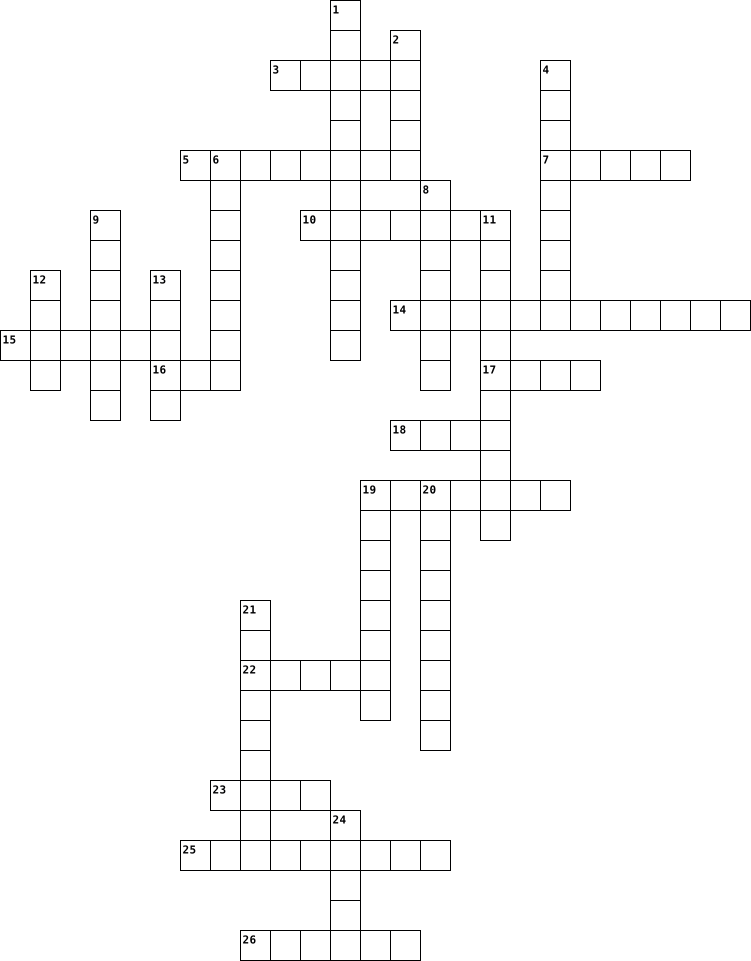
Across
- eclipse the passing of the Moon into the Earth’s shadow
- the figure of the Moon during its first and last quarter, resembling a segment of a ring with pointed ends
- the third planet from the Sun
- the main bodies in space that revolve around the Sun
- the passing of the Moon’s shadow across the Earth
- the faint, white light seen around the Sun during a solar eclipse
- the star at the centre of the Solar System
- hot ball of burning gas that gives off its own heat and light
- an imaginary line around which an object spins
- the main bodies in the solar system that revolve around the Sun
- having to do with the Moon
- the alternate rising and falling of the sea, usually twice in each lunar day at a particular place, due to the attraction of the moon and sun
- the first-quarter or third-quarter phase, when half the visible side of the Moon is illuminated
- a group of stars, gas and dust
Down
- occurs when the Earth passes between the Sun and the Moon
- the path of one object in space around another object
- a smaller object that revolves around a larger object
- the spinning of an object
- the divisions of the year (e.g., spring, summer, autumn, and winter) with particular weather patterns and daylight hours, due to the Earth's changing position relative to the Sun
- a phase of the Moon in which more than half of the side we see is illuminated
- the Sun, the eight planets that orbit it and their moons
- the natural satellite that orbits the Earth
- the shape the Moon appears to be as seen from Earth
- the larger shadow cast by the Moon during a solar eclipse
- the science that deals with the universe beyond Earth’s atmosphere
- to do with object in the sky
- the darker, smaller shadow cast by the Moon during a total solar eclipse
27 Clues: the spinning of an object • having to do with the Moon • to do with object in the sky • the third planet from the Sun • a group of stars, gas and dust • the star at the centre of the Solar System • the natural satellite that orbits the Earth • an imaginary line around which an object spins • the passing of the Moon’s shadow across the Earth • ...
Earth Science Final Crossword 2024-05-21

Across
- when rain, snow, sleet, or hail that falls to the ground
- the phase of the moon where the entire moon is illuminated
- a small body of matter from outer space that hits the earth's surface
- a small rocky body orbiting the sun *hint: ______ belt
- moon phase when the small portion of the Moon is illuminated before or after the new moon
- the movement the weathered material
- when the moon is getting smaller
- Moh's scale measures this from 1-10
- rock formed from sediment grains deposited by water, wind or ice
- rock formed from the cooling and solidification of molten (melted) rock
Down
- the breaking down of rocks and minerals
- resource has a limited supply (ex: natural gas)
- boundary where two or more tectonic plates collide.
- a severe tropical storm with high winds and heavy rain
- an icy, small Solar System body that warms and begins to release gases when passing close to the Sun*(hint: our mascot)
- a small body of matter from outer space that enters the earth's atmosphere
- resource can replenish itself at the rate it is used (ex: sunlight)
- boundary that occurs when two tectonic plates move away from each other
- when the moon is getting larger
- the dropping off of the eroded material
- plate boundary where plates slide sideways past each other
- rotating winds having the appearance of a funnel-shaped cloud
- the phase of the moon when none of the moon is illuminated
23 Clues: when the moon is getting larger • when the moon is getting smaller • the movement the weathered material • Moh's scale measures this from 1-10 • the breaking down of rocks and minerals • the dropping off of the eroded material • resource has a limited supply (ex: natural gas) • boundary where two or more tectonic plates collide. • ...
Sun-Earth-Moon System 2026-03-16

Across
- the phase where the left half of the moon is lit
- the season when the hemisphere is tilted toward the Sun
- the time it takes for an object to rotate around its axis one time
- the lunar phase when the entire face of the moon is lit up
- the movement of an object around another object
- the time it takes for an object to go around another object one time
- a tide created when the Earth, Moon and Sun are in a perpendicular arrangement
- the two times of the year when day and night are of equal length
Down
- a tide caused when the Earth, Moon and Sun are oriented in a straight line
- the period during which the lit part of the moon is increasing
- the thin curved shape of the moon
- the period during which the lit part of the moon is decreasing
- the movement of an object around its axis
- the season when the hemisphere is tilted away from the Sun
- the lunar shape that is more than half but not yet full
- either of two times of the year when the axis is at its greatest tilt
- the imaginary line connecting the north and south poles
- the phase where the right half of the moon is lit
- the path an object takes around another object
- the phase where the moon is between the Earth and Sun, making it invisible
20 Clues: the thin curved shape of the moon • the movement of an object around its axis • the path an object takes around another object • the movement of an object around another object • the phase where the left half of the moon is lit • the phase where the right half of the moon is lit • the season when the hemisphere is tilted toward the Sun • ...
Sun and Moon Show 2024-11-07

Across
- Ya know, that one weird doll that teamed up with Bloodmoon for a little while.
- Became collateral damage during Ruin's purge of the Creators.
- Who started everything?
- Sun's ex-crush.
- The original October takeover.
- Who died in the search for the star?
- Why did Sun and Moon have to hide in a base in the early days?
- The first star we officially met.
- Who was the cause of July 16th?
- Everyone forgets them. :')
- What from Moon created Eclipse?
- THAT day.
- Moon used this to hit Sun, played for laughs but was definitely an early sign of their abusive relationship.
Down
- A minion of the creator.
- Who was once nicknamed "Jigsaw" by Sun and Moon?
- Moon isn't into romance for this reason.
- Was there for Sun after he failed to reassemble Moon's magic?
- October takeover 2.0
- What Eclipse would've once killed for.
- Died from Memory Loss.
- Moon made them to help around the daycare, only existed for an episode before being permanently retired.
- Sun's daughter.
- Made to protect Lunar.
- Went insane trying to bring Solar back.
- Gave Sun and Moon nightmares.
- Moon's best friend.
- Femboy.
- Was the main villain for almost a year before being reformed?
28 Clues: Femboy. • THAT day. • Sun's ex-crush. • Sun's daughter. • Moon's best friend. • October takeover 2.0 • Died from Memory Loss. • Made to protect Lunar. • Who started everything? • A minion of the creator. • Everyone forgets them. :') • Gave Sun and Moon nightmares. • The original October takeover. • Who was the cause of July 16th? • What from Moon created Eclipse? • ...
Astronomy Review Crossword Puzzle 2023-12-01

Across
- when massive stars explode at the end of their life cycle
- stars appear to move around Polaris 15' each hour due to Earths...
- the moon revolves around it
- the direction of its swing changes due to earth's rotation
- also known as a blood moon
- the approximate length of time for the moon to complete one full lunar cycle
- a group of stars in the night sky that make a picture
- the theory that the universe started as a single point
- we have seasons because this is tilted
- takes 23 hours 56 minutes on Earth
Down
- celestial object that causes tides
- a rare celestial event that occurs during a new moon
- takes 365.25 days for Earth
- the phase of the moon when it is in between the earth and sun
- moon phase where we see a white circle in the night sky
- force that causes tides
- the hottest star in your ESRT
- days get _________ between march 1st and may 1st
- the north star
- the biggest and brightest star in your ESRT
20 Clues: the north star • force that causes tides • also known as a blood moon • takes 365.25 days for Earth • the moon revolves around it • the hottest star in your ESRT • celestial object that causes tides • takes 23 hours 56 minutes on Earth • we have seasons because this is tilted • the biggest and brightest star in your ESRT • days get _________ between march 1st and may 1st • ...
Science Vocabulary 2014-05-12

Across
- The moon is one-half illuminated by the sun. (Lit on the left)
- The moon is one-half illuminated by the sun. (Lit on the right)
- Phase of the Moon during which more that half of the disk appears illuminated.
- A grouping of stars that make an imaginary picture in the sky.
- A layer of gases surrounding a planet, moon, or star.
- The Moon when it is completely lit up.
- A gigantic ball of ice and rock that orbits the Sun.
- Twice a year and you have 12 hours of day and 12 of night.
- The point in orbit where a planet is closest to the sun.
- An oval shape.
- The Moon when you cannot see it.
- A dent in the moon made by the impact of a asteroid or a meteoroid.
Down
- The moon is more than one-half illuminated by the sun but not completely illuminated. (Lit on the right)
- A giant ball of hot gas. (Not the sun)
- An imaginary line through the center of rotation of an object.
- When the Moon passes into the shadow of the Earth.
- A small, rocky object in orbit around the Sun.
- A small planet like body in orbit of the sun.
- A large grouping of stars.
- An object that orbits around a planet.
- A chunk of metal or rock, that survives entry through the atmosphere to reach the Earth's surface.
- The point in orbit where a planet is farthest from the sun.
- Gas ball in the center of the universe.
- What revolves around the earth.
- A small piece of rock or dust that burns away in the Earth's atmosphere.
25 Clues: An oval shape. • A large grouping of stars. • What revolves around the earth. • The Moon when you cannot see it. • A giant ball of hot gas. (Not the sun) • An object that orbits around a planet. • The Moon when it is completely lit up. • Gas ball in the center of the universe. • A small planet like body in orbit of the sun. • A small, rocky object in orbit around the Sun. • ...
Solar and Lunar Eclipses 2024-04-04

Across
- Darker and cooler regions on the Sun where magnetic fields are bundled together
- Very faint, shimmering ripples of dark and light moving across the ground,
- the Earth passes between the Sun and the Moon casting a shadow on the Moon
- a loop of plasma from the Sun that can be visible during a total solar eclipse
- the only phase of the Moon when a solar eclipse is possible
- natural satellite of the Sun
- the only phase of the Moon when a lunar eclipse is possible
- during a solar eclipse when the Moon is at the perfect distance to completely cover the Sun
- Caused by sunlight shining through deep valleys on the Moon, look like a series of bright beads popping on and off
- the apparent moment that the Moon first starts to cover the Sun
Down
- the full and darkest part of the shadow created during an eclipse
- The visible surface of the Sun, which consists of a gas layer at a temperature of roughly 5,500° Celsius
- the only star in the Solar System
- the moment between second and third contact when the eclipse appears to make a ring with a bright jewel
- Path of _________ The path along which the Moon's shadow travels across Earth's surface
- the moon passes in front of the Sun and casts a shadow on Earth
- the lighter partial shadow created during an eclipse
- the Sun's atmosphere, only visible during to the eye during an eclipse
- during a solar eclipse when the Moon is at its farthest point from the Earth and does not completely cover the Sun
- natural satellite of the Earth
20 Clues: natural satellite of the Sun • natural satellite of the Earth • the only star in the Solar System • the lighter partial shadow created during an eclipse • the only phase of the Moon when a solar eclipse is possible • the only phase of the Moon when a lunar eclipse is possible • the moon passes in front of the Sun and casts a shadow on Earth • ...
Middle School Science Chapters 1-3 2015-09-22

Across
- darkest part of shadow during an eclipse
- a curved path
- the group that does not contain the independent variable
- for astronauts that are living in space
- phase of Moon that appears as more than half of a circle
- type of telescope that uses lenses
- phase of Moon that appears as less than half of a circle
- data collected using five senses
- the Earth's greatest circumference
- depression left behind from an object striking
- phase of Moon that does not reflect any sunlight toward Earth
- the data collected in an experiment (measurements made)
- draw a conclusion based on an observation
- more Moon is seen each night
- building that keeps a telescope
- Earth rotates around this
- educated possible answer to a problem/question
- an object that revolves around another object
Down
- type of telescope that can be used all the time
- the variable that is being tested (manipulated)
- when the Sun is the greatest distance north or south of the equator
- spinning on axis; causes Sun to appear to rise and set
- the Moon is directly between the Sun and Earth
- a presentation of an object or event used to understand the world
- when an object moves around another object in an elliptical orbit
- type of telescope that uses mirrors
- phase of Moon that appears as exactly half of a circle
- when the Sun is directly above the Earth's equator
- the Earth is directly between the Sun and the Moon
- less Moon is seen each night
- natural satellite of Earth
- phase of Moon that appears as a circle
32 Clues: a curved path • Earth rotates around this • natural satellite of Earth • more Moon is seen each night • less Moon is seen each night • building that keeps a telescope • data collected using five senses • type of telescope that uses lenses • the Earth's greatest circumference • type of telescope that uses mirrors • phase of Moon that appears as a circle • ...
Moon Facts 2015-10-09

Across
- the name for the dark spots of solidified lava
- 7th phase of the moon
- name of the eclipse that happens when the moon goes into the earths umbra
- the type of tides that occur when the moon is either between the sun and the earth or behind the earth and the sun
- the amount of time it takes for the moon to revolve around the earth
- name of the moon phase that occurs when the moon is behind the earth and the sun
- name of the moon phase that occurs when the moon is between the earth and the sun
- the year the first man walked on the moon
Down
- the degree that earth revolves around the earth
- term that means the moons light is getting bigger
- the first person to set foot on the moon
- name of the third phase of the moon
- name of the eclipse that happens when the earth casts its shadow on the earth
- the type of tides that occur when the moon is at a 90 degree angle to the earth and the sun
- the first mission to put a man on the moon
15 Clues: 7th phase of the moon • name of the third phase of the moon • the first person to set foot on the moon • the year the first man walked on the moon • the first mission to put a man on the moon • the name for the dark spots of solidified lava • the degree that earth revolves around the earth • term that means the moons light is getting bigger • ...
Science Crossword #1 2022-05-02

Across
- Moon phase in which more than half of the Moon appears to be illuminated
- the roof of the mouth.
- contains DNA
- name of the first human fossil ever found
- the rigid, porous outer layer of a plant cell.
- Cells in the blood that protect against invading pathogens.
- Moon is decreasing in size.
- the amount of mass in a given volume.
- Moon phase in which none of the Moon appears to be illuminated.
- something that occupies space and has mass.
- a type of vesicle that stores water, nutrients, and other chemicals.
- the path of a celestial body (such as a moon or a planet) around a larger celestial body.
- Moon phase in which less than half of the Moon appears to be illuminated.
- the metric unit of force and weight
- a cell structure that performs a specific function.
- instrument used to measure the weight of objects.
- the best class in school
- the amount of space an object occupies or takes up
- best football team of all time
Down
- instrument used to compare two masses.
- Mr. C's favorite song
- Moon phase in which all of the Moon appears to be illuminated.
- consisting of many cells.
- walking on two legs.
- Moon is increasing in size
- the smallest structural and functional unit of all organisms that is said to be alive.
- The street Linden is on
- the process by which light energy is used to combine water and carbon dioxide to produce glucose and oxygen.
- to change over many generations.
- the downward force of gravity on an object.
- a tiny structure where proteins are synthesized
- consisting of a single cell
- something that can cause a change in motion; a push or a pull.
- the amount of matter in an object.
- the force of attraction between objects in the universe due to their mass.
35 Clues: contains DNA • walking on two legs. • Mr. C's favorite song • the roof of the mouth. • The street Linden is on • the best class in school • consisting of many cells. • Moon is increasing in size • Moon is decreasing in size. • consisting of a single cell • best football team of all time • to change over many generations. • the amount of matter in an object. • ...
Words Derived from Mythology 2021-09-28

Across
- exceedingly large or extensive as to suggest a giant or mammoth.
- Wheat, oat, and corn from Ceres, goddess of agriculture.
- is an opening in the earth's crust that ejects lava from Vulcan.
- the two-faced god is the Roman god of vigilance and wisdom.
- mean a government that is run by the wealthy Pluto,god of wealth.
- is a system to improve memory from Mnemosyne,goddess of memory.
- is the Greek goddess of the dawn.
- the logo of Starbuck's is a Siren.
- is a sleeplike state from Hypnos, god of sleep.
Down
- a reckless impetuous irresponsible person; an insane person;, insane and believed to be affected by the phases of the moon (luna)
- the logo for Versace is actually a representation of Medusa.
- was a Greek warrior famous for his participation in the Trojan War.
- is a great Greek mountain said to be the residence of the gods.
- means mortal. if __ was against you in ancient Greece, you must have done something bad to anger her.
- is the science of mental behavior from Psyche.
15 Clues: is the Greek goddess of the dawn. • the logo of Starbuck's is a Siren. • is the science of mental behavior from Psyche. • is a sleeplike state from Hypnos, god of sleep. • Wheat, oat, and corn from Ceres, goddess of agriculture. • the two-faced god is the Roman god of vigilance and wisdom. • the logo for Versace is actually a representation of Medusa. • ...
White Stars Astronomy 2017-04-10

Across
- revealed as ebb and flow of water on beaches and banks- 2 high and two low each day
- visible moon between quarter moon and full moon- almost full
- visible moon between the new and quarter moons
- study of the stars, ancient study of influence of stars of human life
- constellations on the ecliptic
- path sun appears to travel around the earth, zodiac constellations found here
- one half of the imaginary line that divides the earth in eastern and western hemispheres
- knowledge and laws of the stars, modern science of cosmos
- time it takes for a planet to complete one full orbit around the sun
- moon fully illuminated
- = sun stands, when sun appears to stand still in heavenns; longest day in summer and longest nights in winter
- imaginary points on and line through the earth around which it rotates
- no moon visible
- time it takes for moon to complete one full orbit around the earth
Down
- move around the sun, orbit
- to move around an axis
- surrounding the pole star
- pull of sun on earth, of earth on us, of moon on water on earth
- = half sphere of earth
- highest high tides and lowest low tides due to alignment of sun and moon with earth
- attractive force exerted by anything with mass
- another name for the north star
- lowest low and high tides due to moon and sun being at 90 degrees form each other in relationship to the earth.
- imaginary line the divides northern and southern hemispheres of earth
- time it takes for a planet to rotate on its axis
- = equal night, time when days and night are equal length
- getting smaller, dimmer
- getting bigger, brighter
28 Clues: no moon visible • to move around an axis • = half sphere of earth • moon fully illuminated • getting smaller, dimmer • getting bigger, brighter • surrounding the pole star • move around the sun, orbit • constellations on the ecliptic • another name for the north star • visible moon between the new and quarter moons • attractive force exerted by anything with mass • ...
Seasons, Moon Phase, Eclipses 2025-09-29

Across
- Solstice The day that starts summer, or when the N axis is pointed the most toward the Sun
- The path an object follows as it moves around another object
- 49-1% of the illuminated portion of the Moon is visible
- Eclipse When the Moon’s shadow appears on Earth’s surface.
- The lit part of the Moon or a planet that can be seen from Earth
- Moon 100% of the illuminated portion of the Moon is visible
- The central, darker part of the shadow where light is totally blocked
- Axis The line or center on which an object rotates
- Phase More of the Moon’s near side is lit, growing larger
- 51-99% of the illuminated portion of the Moon is visible
- Eclipse Occurs when the Moon moves into Earth’s shadow
- The motion of one object around another object
Down
- Solstice The day that starts winter, or when the N axis is pointed the most away from the Sun
- Equinox the equinox that starts "Spring"
- The lighter part of a shadow where light is partially blocked
- Equinox the equinox that starts "Fall"
- A spinning motion around an axis or center
- A day when Earth’s rotation axis is the most toward or away from the Sun, with direct sunlight on either the Tropic of Cancer or the Tropic of Capricorn
- Phase Less of the Moon’s near side is lit, getting smaller
- A day when Earth’s rotation axis is leaning along Earth’s orbit, neither toward nor away from the Sun, with direct sunlight on the equator
- Quarter 50% of the illuminated portion of the Moon is visible (right side)
- Quarter 50% of the illuminated portion of the Moon is visible (left side)
- Moon 0% of the illuminated portion of the Moon is visible
23 Clues: Equinox the equinox that starts "Fall" • Equinox the equinox that starts "Spring" • A spinning motion around an axis or center • The motion of one object around another object • Axis The line or center on which an object rotates • Eclipse Occurs when the Moon moves into Earth’s shadow • 49-1% of the illuminated portion of the Moon is visible • ...
Shapes 2023-11-10
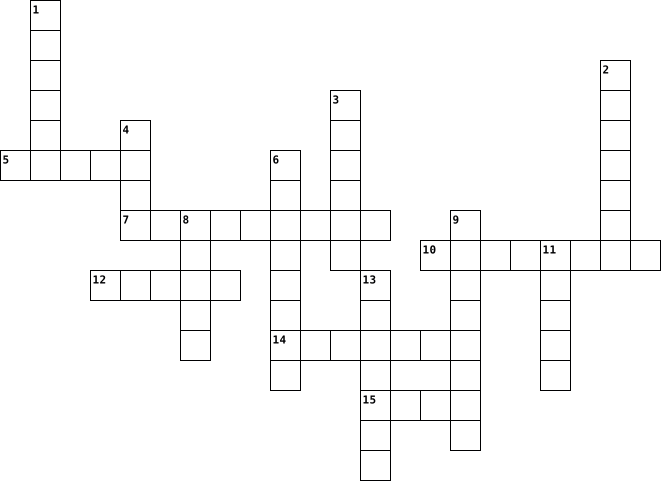
Across
- A symbol or shape that represents love, often seen on valentine cards.
- Similar to a square but with opposite sides of unequal length.
- A curved shape that is less than a full circle, often seen in moon phases.
- A pointed shape with a straight shaft, indicating direction.
- A shape with eight sides and eight angles, often seen in stop signs.
- A stretched-out, rounded shape, like an elongated circle.
Down
- A shape with four equal sides and four right angles, like a box.
- A shape with six sides and six angles, like a beehive cell.
- A round shape with no corners or edges, like the shape of a coin.
- A shape with points radiating from a center, like a celestial body.
- A five-sided shape with five angles, often seen in star patterns.
- An irregular, fluffy shape often seen in the sky, resembling cotton.
- A shape with three sides and three angles, often seen in pyramids.
- A shape with two intersecting lines, often associated with Christianity.
- A shape with four sides of equal length, forming a rhombus.
15 Clues: A stretched-out, rounded shape, like an elongated circle. • A shape with six sides and six angles, like a beehive cell. • A shape with four sides of equal length, forming a rhombus. • A pointed shape with a straight shaft, indicating direction. • Similar to a square but with opposite sides of unequal length. • ...
Constellations 2025-06-01

Across
- A belt of sky with 12 signs; its origin lies in Babylonian astronomy
- Constellation shaped like a bull; featured in both Mesopotamian and Greek mythology
- The Dragon associated with the color green, representing the spring season and the element wood
- Ancient land between the Tigris and Euphrates where some of the first star charts were made
- Type of calendar based on moon phases, widely used in ancient China
- Egyptian concept of the world after death, often linked to stars like Orion
Down
- Tower-like Mesopotamian temple used in part for astronomical observation
- Star groups used by Egyptians to divide the night and track time
- Another name for Ursa Major; known as the Great Wagon or celestial vehicle
- Greek astronomer who cataloged 48 classical constellations
- Greek word for "ordered universe"; often used in astronomy
- Ancient Greek tool used to measure star positions
- Egyptian river whose flood was predicted by the heliacal rising of Sirius
- Collection of ancient stories explaining the origins of constellations
- Timekeeping system based on solar or stellar movements
15 Clues: Ancient Greek tool used to measure star positions • Timekeeping system based on solar or stellar movements • Greek astronomer who cataloged 48 classical constellations • Greek word for "ordered universe"; often used in astronomy • Star groups used by Egyptians to divide the night and track time • Type of calendar based on moon phases, widely used in ancient China • ...
Lunar Cycle 2023-03-10

Across
- Comes from the Latin word "luna" which means "moon"
- The moon is more than half-full but not fully lit up.
- The right side of the moon is illuminated and resembles a smile.
- The dark side of the moon is facing towards the earth.
- The entire side of the moon is completely lit up.
- The entire right half of the moon is illuminated.
- Occurs at New and Full moon.
Down
- The left side of the moon is illuminated and resembles a smile.
- Gibbous More than halfway lit on the left side.
- Earth's shadow falls upon the surface of the moon.
- The entire left half of the moon is illuminated.
- How many days each moon phase lasts.
- Occurs at 1st and 3rd quarter.
- How long it takes for the moon to revolve around the earth.
14 Clues: Occurs at New and Full moon. • Occurs at 1st and 3rd quarter. • How many days each moon phase lasts. • Gibbous More than halfway lit on the left side. • The entire left half of the moon is illuminated. • The entire side of the moon is completely lit up. • The entire right half of the moon is illuminated. • Earth's shadow falls upon the surface of the moon. • ...
Tides and the Moon 2022-05-09

Across
- This tide is also called a king tide that "springs" forth during a new and full moon.
- Moon phase when the whole moon can be seen.
- Number of tides per day
- Moon phase before and after a new moon.
- The lowes of the high tides.
- Monn phase when the moon is not cannot be seen.
- The rising and falling of the ocean.
Down
- Natural Satelite that is closest to the earth.
- Moon phase before and after a full moon.
- Moon phase after a waxing crescent and a waning gibbous.
- Force produced by the moon and sun on the earth.
- The tides are produced by the moon and the...
- Tide will change their ______ because the earth spins on its axis.
- This renewable resource can produce______ as the tide moves in and out.
14 Clues: Number of tides per day • The lowes of the high tides. • The rising and falling of the ocean. • Moon phase before and after a new moon. • Moon phase before and after a full moon. • Moon phase when the whole moon can be seen. • The tides are produced by the moon and the... • Natural Satelite that is closest to the earth. • Monn phase when the moon is not cannot be seen. • ...
sam chapman crossword puzzle 2021-05-21

Across
- Revolution" refers the object's orbital motion around another object. For example, Earth rotates on its own axis, producing the 24-hour day. Earth revolves about the Sun, producing the 365-day year.
- large, bowl-shaped cavity in the ground or on the surface of a planet or the moon, typically one caused by an explosion or the impact of a meteorite or other celestial body.
- A neap tide—seven days after a spring tide—refers to a period of moderate tides when the sun and moon are at right angles to each other.
- A spring tide—popularly known as a "King Tide"—refers to the 'springing forth' of the tide during new and full moon.
- s derived from the Latin umbra, meaning "shadow". It is also the Spanish and Portuguese word for "threshold", and sometimes used as a surname in that language
- an artificial body placed in orbit around the earth or moon or another planet in order to collect information or for communication.
- the time or date (twice each year) at which the sun crosses the celestial equator, when day and night are of approximately equal length (about September 22 and March 20).
- having or representing the sun as the center, as in the accepted astronomical model of the solar system.
- the moon at any time after full moon and before new moon (so called because its illuminated area is decreasing).
Down
- the moon at any time after new moon and before full moon, so called because its illuminated area is increasing
- an eclipse in which the sun is obscured by the moon.
- an eclipse in which the moon appears darkened as it passes into the earth's shadow.
- the action of rotating around an axis or center.
- a property of matter by which it continues in its existing state of rest or uniform motion in a straight line, unless that state is changed by an external force.
- backside of the moon.
- a space of partial illumination (as in an eclipse) between the perfect shadow on all sides and the full light
- having or representing the earth as the center, as in former astronomical systems.
- is used to describe something that is related to the moon. If you like astronomy, you probably enjoy lunar eclipses, when the Earth casts its shadow
- the time or date (twice each year) at which the sun reaches its maximum or minimum declination, marked by the longest and shortest days (about June 21 and December 22).
- a large, level basalt plain on the surface of the moon, appearing dark by contrast with highland areas.
20 Clues: backside of the moon. • the action of rotating around an axis or center. • an eclipse in which the sun is obscured by the moon. • having or representing the earth as the center, as in former astronomical systems. • an eclipse in which the moon appears darkened as it passes into the earth's shadow. • ...
Nature 2024-02-28

Across
- Colorful, fragrant part of a plant that blooms and attracts insects for pollination. Flowers come in various shapes, sizes, and colors.
- Visible mass of water droplets or ice crystals suspended in the atmosphere. Clouds come in various shapes and sizes and play a crucial role in the water cycle and climate.
- Precipitation in the form of water droplets that fall from clouds in the atmosphere. Rain is essential for plant growth, replenishing freshwater sources, and maintaining ecosystems.
- A tall, woody plant with a single main trunk and branches that bear leaves or fruits. Trees provide shade, oxygen, and habitat for animals.
- The atmosphere as seen from the Earth's surface, often characterized by its blue color during the day and stars at night. The sky changes with weather patterns and time of day.
- Vast body of saltwater that covers most of the Earth's surface. Oceans regulate the climate, support diverse ecosystems, and are essential for life on Earth.
- The star at the center of our solar system, which provides light and heat to the Earth. It's essential for photosynthesis and regulates the planet's climate.
- Large natural flow of water that runs through channels in the Earth's surface. Rivers provide habitat for aquatic plants and animals and are important for irrigation and transportation.
Down
- Large landform that rises steeply above its surroundings, typically with a peak or summit. Mountains are formed by tectonic forces and erosion.
- Dense area of trees, plants, and wildlife, covering a large area of land. Forests are important for biodiversity, carbon storage, and providing oxygen.
- Natural movement of air in the Earth's atmosphere, caused by differences in air pressure and temperature. Wind is harnessed for energy production and affects weather patterns.
- Large body of water surrounded by land, with no outlet to the sea. Lakes are formed by geological processes like glaciation or volcanic activity.
- Natural satellite of the Earth, which orbits around it. It's visible at night and goes through different phases, such as full moon, crescent moon, or new moon.
- Arid region characterized by low precipitation and high temperatures, with sparse vegetation and sandy or rocky landscapes. Deserts cover about one-third of the Earth's land surface.
- Coastal area where land meets the sea, typically characterized by sandy or rocky shorelines. Beaches are popular for recreation, relaxation, and habitat for marine life.
15 Clues: Colorful, fragrant part of a plant that blooms and attracts insects for pollination. Flowers come in various shapes, sizes, and colors. • A tall, woody plant with a single main trunk and branches that bear leaves or fruits. Trees provide shade, oxygen, and habitat for animals. • ...
Moon Phases Challenge Project 2026-03-11

Across
- a force that tries to pull two objects towards each other
- the movement of an object, like the Earth, around another object.
- change in the appearance of the Moon as it makes one full revolution around the Earth
Down
- spinning of an object
- caused by the pull of gravity from the Moon
5 Clues: spinning of an object • caused by the pull of gravity from the Moon • a force that tries to pull two objects towards each other • the movement of an object, like the Earth, around another object. • change in the appearance of the Moon as it makes one full revolution around the Earth
Science Vocab 2024-03-10

Across
- moon phase when the Moon looks like a little less than a full circle
- to separate into smaller parts or groups
- a number that you get when you add up a set of numbers and then divide by how many numbers there are in that set
- describes when there is not a lot of visible light; the opposite of bright
- the second planet from the Sun in our solar system
- circling another object, like the Earth around Sun
- an imaginary line that goes through the North Pole and South Pole of the Earth
- the sixth planet from the Sun in our solar system
- the fifth planet from the Sun in our solar system
- a large, round object in outer space that orbits the Sun
- moon moon phase when the Moon looks like a circle
- phase the part of the Moon that we can see on a particular night
- moon moon phase when the Moon looks like a sliver
- a group of stars in the night sky that form a pattern
- an image that helps you understand information
- describes when there is a lot of visible light; the opposite of dim
- moon moon phase when the Moon looks like half of a circle
- the eighth planet from Sun in the solar system
- something that happens again and again and again in a way that can be predicted
- the seventh planet from the Sun in our solar system
- one of four main directions; if you facing north, it is to the left
- the amount of matter an object has
Down
- a rocky object in outer space
- a push or a pull
- one of four main directions; if you are facing north, it is to the right
- the first planet from the Sun in our solar system
- an invisible force that pulls any object down, toward the center of a planet, moon or other object
- the amount of space between two things
- one of four main directions; if you are facing north, it is the direction behind you
- a large, round object in outer space that orbits a star
- the distance around a circle
- to add a number to itself a certain number of times
- a pretend version of something that scientists use when the real thing is too big, small, or complicated to work with
- a tool that tells time by using the changing direction of shadows caused by the Sun’s movement across the sky
- to spin or turn around a central point, like the Earth around its axis
- one of four main directions; when you face north, west is to the left and east is to the right
- the third planet from the Sun in our solar system
- a set of events that repeats in the same order over and over
- the fourth planet from the Sun in our solar system
- moon moon phase when the Moon looks completely dark
- a time of year with specific weather that repeats every year
41 Clues: a push or a pull • the distance around a circle • a rocky object in outer space • the amount of matter an object has • the amount of space between two things • to separate into smaller parts or groups • an image that helps you understand information • the eighth planet from Sun in the solar system • the first planet from the Sun in our solar system • ...
Phases of matter - Crossword 2025-05-08

Across
- When a substance absorbs or loses enough energy it can cause the particles to move more or less.
- The state of matter changes from solid to liquid
- The state of matter changes from liquid to gas
- Definite volume but not a definite shape
- The absorption of heat
- The gas becomes "Ionized" by the freezing of electrons from their atoms
- Solid immediately changes into gas
- The change in phases from plasma to gas
Down
- The conversion of gas or vapor to a liquid
- The change in phases from gas to plasma
- State of matter changes from liquid to solid
- The release of heat
- No definite volume or shape
- The rapid vaporization of liquid
- The direct solidification of a gas or vapor to a solid
- Definite volume and shape
16 Clues: The release of heat • The absorption of heat • Definite volume and shape • No definite volume or shape • The rapid vaporization of liquid • Solid immediately changes into gas • The change in phases from gas to plasma • The change in phases from plasma to gas • Definite volume but not a definite shape • The conversion of gas or vapor to a liquid • ...
Tides 2023-10-25

Across
- occurs when the Earth, Moon, and Sun are at right angles and the tidal range is the lowest
- Spring tides are caused by which moon phase when the Earth is in between the Sun and Moon
- Neap tides are caused by which moon phase that the partial moon is facing towards the sun
- there are _____ high and low tides a day
- occurs when the Earth, Moon, and Sun are aligned and the tidal range in the largest
- Neap tides are caused by which moon phase that the partial moon is facing away from the sun
Down
- caused by the moon and sun
- Spring tides are caused by which moon phase when the Moon is in between the Sun and Earth
- _____ tidal range in neap tides
- _____ tidal range in spring tides
- difference in height between high and low tide
- the _______ pulls on ocean water and causes the oceans to bulge towards the moon
- _____ high tides higher low tides in a neap tides
- the periodic rise and fall of sea level
- _____ high tides lower low tides in a spring tide
15 Clues: caused by the moon and sun • _____ tidal range in neap tides • _____ tidal range in spring tides • the periodic rise and fall of sea level • there are _____ high and low tides a day • difference in height between high and low tide • _____ high tides higher low tides in a neap tides • _____ high tides lower low tides in a spring tide • ...
Alabama Moon Crossword Puzzle 2022-12-02

Across
- The state where the book takes place
- Where Kit was taken to when he was found
- Name of the constable
- Wellington The retired lawyer helping Moon
- A peace officer with limited policing authority, typically in a small town
- Name of Moons best friend
- What Moon is, (running from law enforcement to avoid capture)
Down
- The state where Moon is trying to get to
- Moon The full name of the main character
- Where Moon and his pa stayed in the beginning
- The boys home where Moon and his friends escaped from
- The store owner in Alabama Moon
- What Moon and his dad were being, staying away from someone
- Countryside; barely any people, (farms)o
- The age of Moon
15 Clues: The age of Moon • Name of the constable • Name of Moons best friend • The store owner in Alabama Moon • The state where the book takes place • The state where Moon is trying to get to • Moon The full name of the main character • Where Kit was taken to when he was found • Countryside; barely any people, (farms)o • Wellington The retired lawyer helping Moon • ...
Moon Crossword Puzzle 2022-04-26

Across
- when the moon appears to get smaller each night as it goes from full moon to new moon
- when the moon passes between the Earth and the sun
- when the moon makes one complete circle around the Earth
- The phase of the moon when it appears fully illuminated
- a lowland plain of hardened lava
- an imaginary line which a body rotates
- when the moon appears larger each night as it goes from new moon to full moon
Down
- a loose layer of rock and dust
- when the moon passes directly behind the Earth into its shadow
- are deep channels that run through the Moon's maria
- when the moon is only half visible
- a round solid figure (the shape of the earth)
- - the path an artificial satellite does around another Earth
- the thing that controls our tides
14 Clues: a loose layer of rock and dust • a lowland plain of hardened lava • the thing that controls our tides • when the moon is only half visible • an imaginary line which a body rotates • a round solid figure (the shape of the earth) • when the moon passes between the Earth and the sun • are deep channels that run through the Moon's maria • ...
Lunar Cycle 2023-03-10

Across
- Comes from the Latin word "luna" which means "moon"
- The moon is more than half-full but not fully lit up.
- The right side of the moon is illuminated and resembles a smile.
- The dark side of the moon is facing towards the earth.
- The entire side of the moon is completely lit up.
- The entire right half of the moon is illuminated.
- Occurs at New and Full moon.
Down
- The left side of the moon is illuminated and resembles a smile.
- Gibbous More than halfway lit on the left side.
- Earth's shadow falls upon the surface of the moon.
- The entire left half of the moon is illuminated.
- How many days each moon phase lasts.
- Occurs at 1st and 3rd quarter.
- How long it takes for the moon to revolve around the earth.
14 Clues: Occurs at New and Full moon. • Occurs at 1st and 3rd quarter. • How many days each moon phase lasts. • Gibbous More than halfway lit on the left side. • The entire left half of the moon is illuminated. • The entire side of the moon is completely lit up. • The entire right half of the moon is illuminated. • Earth's shadow falls upon the surface of the moon. • ...
The Sun-Earth-Moon System (pgs. 300-303) 2024-02-27

Across
- Both the Earth and the Moon have this kind of surface.
- Earth contains this while the Moon doesn't.
- A path that one object takes around another in space.
- To move in an orbit.
- The distance from one side of a circle to the other.
- The Sun-Earth-Moon system is held together by this.
- Earth spins 1,600 km/hr here.
- A gas found in the Sun.
- Gravity pull these toward each other.
- Earth's atmosphere additionally contains this element.
Down
- Another gas found in the Sun.
- A space object spins in place like a top.
- The Sun, Earth, and Moon have distinct features called _____ .
- Takes 365 days for Earth to complete one of these.
- Earth's atmosphere contains this.
- Both the Earth and the Moon spin on this.
- The moon takes this long to complete one rotation.
- Earth's gravity pulls on this.
18 Clues: To move in an orbit. • A gas found in the Sun. • Another gas found in the Sun. • Earth spins 1,600 km/hr here. • Earth's gravity pulls on this. • Earth's atmosphere contains this. • Gravity pull these toward each other. • A space object spins in place like a top. • Both the Earth and the Moon spin on this. • Earth contains this while the Moon doesn't. • ...
Words Derived From Mythology 2021-09-30

Across
- to put into a sleep-like state.
- is a collection of maps in book form.
- Goddess of the rainbow; Colored part of the eye.
- a reckless impetuous irresponsible person; an insane person; insane and believed to be affected by the phases of the moon.
- a rainbow-like display of varying and shifting colors.
- is an acoustic device producing a loud often wailing sound as a signal or warning.
- sudden mass fear and anxiety over anticipated events, sudden, and overpowering terror.
- is a list of events in time from Chronos, the god of time.
- so exceedingly large or extensive as to suggest a giant or mammoth; enormous or immense.
Down
- the science concerned with the prevention of illness and maintenance of health; personal care and cleanliness.
- a breakfast food prepared from grain.
- a complicated network of winding passages; a maze.
- means enormous size, strength, power, or scope.
- a person apparently sensitive to things beyond the natural range of perception, sensitive to nonphysical or supernatural forces.
- warlike, fond of fighting; relating to war, the army, or military life.
15 Clues: to put into a sleep-like state. • a breakfast food prepared from grain. • is a collection of maps in book form. • means enormous size, strength, power, or scope. • Goddess of the rainbow; Colored part of the eye. • a complicated network of winding passages; a maze. • a rainbow-like display of varying and shifting colors. • ...
Tides Puzzle 2023-11-02

Across
- When none of the moon is showing
- When all the Moon is visible
- When half of the Moon is showing on the left side
- When the tides are at a high level
- Only occurs during a First or Third Quarter Moon
- Only occurs during a New or Full Moon
- Earth is covered with 71% of ____?
- When the Earth, Moon, and Sun are in a straight line
Down
- The biggest largest object at night
- When the tides are at a low level
- When half of the Moon is showing on the right side
- The closest star to earth
- The level the water is at
- Where we live
- Caused by the force of the sun and moon
15 Clues: Where we live • The closest star to earth • The level the water is at • When all the Moon is visible • When none of the moon is showing • When the tides are at a low level • When the tides are at a high level • Earth is covered with 71% of ____? • The biggest largest object at night • Only occurs during a New or Full Moon • Caused by the force of the sun and moon • ...
Earth vs. Moon 2012-12-01

Across
- This is at the center of both the Earth and the moon.
- Both the Earth and the moon have these because something hit the surface.
- When you look up on Earth you see this instead of black space on the moon.
- volcanoes These are on the moon and once had lava in them.
- The movement of air on the Earth. This does not happen on the moon.
Down
- This is an area on them moon that means seas.
- A layer of gas that surrounds the Earth.
- Both the Earth and moon have this but on the moon it is frozen.
- These are seen when the sun's light reflects off the moon.
- The appearance of the Earth's crust changes when this happens.
- This is the distance around both the Earth and the moon. The Earth's is larger.
- On Earth you can grow crops and other plants by putting seeds in this.
- plates These cause earthquakes.
- Both the Earth and the moon have smaller solid pieces of themselves lying on top of the crust.
- These low, flat lands appear on both the Earth and the moon.
15 Clues: plates These cause earthquakes. • A layer of gas that surrounds the Earth. • This is an area on them moon that means seas. • This is at the center of both the Earth and the moon. • These are seen when the sun's light reflects off the moon. • volcanoes These are on the moon and once had lava in them. • These low, flat lands appear on both the Earth and the moon. • ...
Mid. Sch. Sci. Test Review Lesson #52-57 2020-02-19

Across
- Jupiter, Saturn, Uranus, Neptune are the _____ planets.
- the phase of the moon between a full moon and quarter moon
- A planet cannot make its own _____, but a star does.
- the type of eclipse when the moon is between the earth and the sun
- the phase of the moon between a quarter moon and new moon
- the phase of the moon where almost none of the surface is lit up
- the phase of the moon where half of the surface is lit up
- A lunar eclipse only happens durning a _____ moon.
Down
- Light _____ is artificial light that brightens the sky enough to block out some of the stars.
- Other _____ are larger than the sun.
- The inner planets are also known as the _____ planets.
- A brighter star farther away may appear _____ than a less bright star that is closer.
- the largest planet in our solar system
- the moon appears larger when it is on the horizon, but it is still the same _____ from the earth.
- the type of eclipse when the earth is between the moon and the sun
- the phase of the moon between gibbous and crescent
- the phase of the moon where the entire surface is lit up
17 Clues: Other _____ are larger than the sun. • the largest planet in our solar system • the phase of the moon between gibbous and crescent • A lunar eclipse only happens durning a _____ moon. • A planet cannot make its own _____, but a star does. • The inner planets are also known as the _____ planets. • Jupiter, Saturn, Uranus, Neptune are the _____ planets. • ...
Words Derived from Mythology 2021-09-28

Across
- is a great Greek mountain said to be the residence of the gods.
- is an opening in the earth's crust that ejects lava from Vulcan.
- the logo of Starbuck's is a Siren.
- exceedingly large or extensive as to suggest a giant or mammoth.
- Wheat, oat, and corn from Ceres, goddess of agriculture.
- is the Greek goddess of the dawn.
Down
- the logo for Versace is actually a representation of Medusa.
- is a sleeplike state from Hypnos, god of sleep.
- is a system to improve memory from Mnemosyne,goddess of memory.
- a reckless impetuous irresponsible person; an insane person;, insane and believed to be affected by the phases of the moon (luna)
- the two-faced god is the Roman god of vigilance and wisdom.
- mean a government that is run by the wealthy Pluto,god of wealth.
- is the science of mental behavior from Psyche.
- was a Greek warrior famous for his participation in the Trojan War.
- means mortal. if __ was against you in ancient Greece, you must have done something bad to anger her.
15 Clues: is the Greek goddess of the dawn. • the logo of Starbuck's is a Siren. • is the science of mental behavior from Psyche. • is a sleeplike state from Hypnos, god of sleep. • Wheat, oat, and corn from Ceres, goddess of agriculture. • the two-faced god is the Roman god of vigilance and wisdom. • the logo for Versace is actually a representation of Medusa. • ...
Vocabulary List 12 2024-03-15

Across
- (n) Stuborness; unbending adherence to position/viewpoint; tenacity
- (adj) Having potential danger; hazardous; chancy
- methods by which writers create, reveal, or develop their characters ex. external via speech and action, internal via thoughts and feelings
- (adj) Able to be perceived by senses; noticeable; apparent
- (adj) beyond what is necessary; extra; lavish
- (v) to destroy completely, so as to leave no trace; abolish
- (v) to move with violent agitation; incensed; bristle
- (v) to state or authenticate that something is true, valid or genuine; corroborate
Down
- (v) to go beyond or rise up; surpass; exceed
- the main character, usually perceived as a positive or champion character ex. harry potter
- (adj) tending to whine or complain; disagreeable; critical
- Character who provides striking contrast to another character, points out strengths and weaknesses ex. avatar vs. zuko
- struggle between two opposing forces can be external or internal. ex Man vs. self, man vs. nature
- the character who opposes main character, perceived as an adversary/emeny ex lord voldermont
- (v) to diminish or become less bright, like the moon phases; decline; abate
15 Clues: (v) to go beyond or rise up; surpass; exceed • (adj) beyond what is necessary; extra; lavish • (adj) Having potential danger; hazardous; chancy • (v) to move with violent agitation; incensed; bristle • (adj) tending to whine or complain; disagreeable; critical • (adj) Able to be perceived by senses; noticeable; apparent • ...
Science 2025-01-14

Across
- annually to happen once a year
- the change in the direction of light due to a change in the medium
- Electromagnetic or light waves from from space are bent, causing what we see to be slightly different than what is actually there
- height above a certain level; typically sea level
- when light of energy passes through a medium and it’s deflected
- an astronomical event where an object cannot have because it is blocked by a shadow of another of it.
- having to do with the sun or sunlight
Down
- regularity in the world. Elements are related in a predictable manner
- The force of gravity ;to pull objects with mass towards each other
- in perspective observing or thinking of something in a different viewpoint.
- a star in the constellation Ursa Minor or the “Little bear”
- a distinct period or stage of events, the process change of or development
- diurnally, occurring every day; happening during the day rather than at night.
- determined by or resembling a moon
- is commonly, referred as the North Star.
15 Clues: annually to happen once a year • determined by or resembling a moon • having to do with the sun or sunlight • is commonly, referred as the North Star. • height above a certain level; typically sea level • a star in the constellation Ursa Minor or the “Little bear” • when light of energy passes through a medium and it’s deflected • ...
Solar System Vocabulary 2022-11-14

Across
- more than three fourths
- sun
- surface is not level
- less than one fourth
- longest daylight/shortest daylight
- a visual effect created when light is blocked
- Polaris
- a natural satellite
- 12 hours of daylight/12 hours of darkness
- when the Earth passes exactly between the Sun and the Moon
- getting larger
- getting smaller
Down
- gradual change of appearance of the moon
- when the Moon passes exactly between Earth and the Sun
- moon
- a time of year
- turn on its axis
- travel or orbit around another object
- an imaginary line through the center of a planet
19 Clues: sun • moon • Polaris • a time of year • getting larger • getting smaller • turn on its axis • a natural satellite • surface is not level • less than one fourth • more than three fourths • longest daylight/shortest daylight • travel or orbit around another object • gradual change of appearance of the moon • 12 hours of daylight/12 hours of darkness • ...
Vocabulary Crossword 2021-10-20

Across
- orbiting the sun
- one hemisphere leans towards the sun
- Can be categorized in Terrestrial and Jovian
- Moon between Earth and Sun
- space rock hits earthly ground
- Earth between the Moon and Sun
- to increase
- Earth in its axis
- space rock in Earth's atmosphere
Down
- balls of dust ice
- Equinox after winter
- space rock outside of Earth's atmosphere
- to decrease
- space rock not big enough to be a planet
- less than half of the moon seen
- a piece of rock orbiting a planet
- one hemisphere leans away from the sun
- Equinox after Summer Solstice
- more than half of the moon seen
19 Clues: to decrease • to increase • orbiting the sun • balls of dust ice • Earth in its axis • Equinox after winter • Moon between Earth and Sun • Equinox after Summer Solstice • space rock hits earthly ground • Earth between the Moon and Sun • less than half of the moon seen • more than half of the moon seen • space rock in Earth's atmosphere • a piece of rock orbiting a planet • ...
Earth vs. Moon 2012-12-01

Across
- A layer of gas that surrounds the Earth.
- plates These cause earthquakes.
- The appearance of the Earth's crust changes when this happens.
- These are seen when the sun's light reflects off the moon.
- These low, flat lands appear on both the Earth and the moon.
- volcanoes These are on the moon and once had lava in them.
- This is the distance around both the Earth and the moon. The Earth's is larger.
- Both the Earth and the moon have smaller solid pieces of themselves lying on top of the crust.
Down
- Both the Earth and the moon have these because something hit the surface.
- This is at the center of both the Earth and the moon.
- This is an area on them moon that means seas.
- Both the Earth and moon have this but on the moon it is frozen.
- On Earth you can grow crops and other plants by putting seeds in this.
- When you look up on Earth you see this instead of black space on the moon.
- The movement of air on the Earth. This does not happen on the moon.
15 Clues: plates These cause earthquakes. • A layer of gas that surrounds the Earth. • This is an area on them moon that means seas. • This is at the center of both the Earth and the moon. • These are seen when the sun's light reflects off the moon. • volcanoes These are on the moon and once had lava in them. • These low, flat lands appear on both the Earth and the moon. • ...
Genetics Review 2025-05-07

Across
- allele an allele whose trait always shows up in the organism when the allele is present. The big letter.
- What is the 4th phase of Mitosis
- The study of heredity
- what is the 3rd stage of mitosis
- Phases How many phases are in mitosis?
- The basic unit of life
- What is the 1st stage of Mitosis
- What is the 5th phase of Mitosis
Down
- what is the final stage in mitosis
- the study of heredity
- Whats the 6th stage of Mitosis
- What is the process of cell division
- characteristic What is a phenotype?
- Trait What is a trait that is masked by a dominant trait
- Mendel the father of genetics
- Chromosomes How many chromosomes in each cell?
- What is the 2nd phase of Mitosis
17 Clues: the study of heredity • The study of heredity • The basic unit of life • Whats the 6th stage of Mitosis • Mendel the father of genetics • What is the 4th phase of Mitosis • what is the 3rd stage of mitosis • What is the 1st stage of Mitosis • What is the 2nd phase of Mitosis • What is the 5th phase of Mitosis • what is the final stage in mitosis • ...
Science Project 2024-04-22

Across
- one thing in space revolving around something else
- the moon moves into the earth's shadow, causing us to see earth's shadow from the moon.
- the moon moves completely into the earth's umbra
- spinning in place
- slant
- something in space that orbits things that arent stars
- the moon partly blocks the sun from view
- the moon completely blocks the sun from being seen.
Down
- the moon comes in between the sun and the earth, blocking us from viewing sunlight.
- only part of the moon moves into the earth's umbra
- something in space coming in between another object and the sun
- the inner shadow
- something moving around something else
- electromagnetic waves coming from the sun
- the outer shadow
- a space blocked from receiving most sunlight
16 Clues: slant • the inner shadow • the outer shadow • spinning in place • something moving around something else • the moon partly blocks the sun from view • electromagnetic waves coming from the sun • a space blocked from receiving most sunlight • the moon moves completely into the earth's umbra • only part of the moon moves into the earth's umbra • ...
Earth Moon and Sun Vocab 2023-10-09

Across
- A moon phase that looks like more than half of a circle
- The border between light and dark on the moon
- When the Earth moves completely around the sun creating one year
- The shape of the illuminated part of the Moon that we can see from Earth
- To shine light on an object and make it visible
- A moon phase that looks like half of a circle
- A moon phase that looks like a full circle from Earth
Down
- When the moon passes to the other side of the Earth away from the sun and is completely dark (not a new moon)
- The nearly circular path a smaller object travels around a larger object
- The star that is the main source of light for our solar system
- A rocky sphere that travels around a planet
- When the Earth spins in a circle creating one complete day
- A moon phase that looks like less than half of a circle
- A moon where the moon phase is not visible from Earth
- The relative size of things, Scale
- Something we observe to be similar over and over again
16 Clues: The relative size of things, Scale • A rocky sphere that travels around a planet • The border between light and dark on the moon • A moon phase that looks like half of a circle • To shine light on an object and make it visible • A moon where the moon phase is not visible from Earth • A moon phase that looks like a full circle from Earth • ...
Moon 2021-04-30

Across
- cycle how the moon looks over time
- moving around a object
- quarter half a moon on the right side
- it grows bigger (moon)
- waves accruing to gravity
- moon no moon is shown
Down
- moon all of the moon
- the pulling of two objects together
- quarter half a moon
- on its axis
10 Clues: on its axis • quarter half a moon • moon all of the moon • moon no moon is shown • moving around a object • it grows bigger (moon) • waves accruing to gravity • cycle how the moon looks over time • the pulling of two objects together • quarter half a moon on the right side
Moon 2022-01-26

Across
- deal with dry land
- zone is the portion of the coastline
- tide highest high tides lower low tides
- moon comes after waning crescent
Down
- are the pattern of water rising and falling
- zone above the high tide water line
- flood zone flooded during highest high tides
- tide high low tides low high tides
- is uncovered and covered twice a day
- zone usually covered by water
10 Clues: deal with dry land • zone usually covered by water • moon comes after waning crescent • tide high low tides low high tides • zone above the high tide water line • zone is the portion of the coastline • is uncovered and covered twice a day • tide highest high tides lower low tides • are the pattern of water rising and falling • flood zone flooded during highest high tides
moon 2023-02-03

Across
- they have 2 legs and 2 hands.
- you can put food there.
- they are many planets.
- they are not humans.
- noise.
- is white and gigant.
Down
- the rocket take off of there.
- is a machine that can help you.
- is a thing that can let you go to space.
- 11 / was the first thing to touch de moon.
10 Clues: noise. • they are not humans. • is white and gigant. • they are many planets. • you can put food there. • the rocket take off of there. • they have 2 legs and 2 hands. • is a machine that can help you. • is a thing that can let you go to space. • 11 / was the first thing to touch de moon.
Space Science 2 2020-04-15

Across
- to get smaller, dimmer, or weaker; to near an end
- Gibbous, Slightly dark on the right side, mostly lit on the left.
- crescent, Crescent on the right side, dark on the left.
- An apparent shift in the position of an object when viewed from different locations
- orbit, The moon orbits the earth every 27 days
- moon, moon phase when the entire side facing Earth is illuminated.
- Moon, A moon that is completely dark because it's unlit side is facing Earth
- eclipse, the blocking of sunlight to the moon that occurs when Earth is directly between the sun and the moon
- eclipse, an eclipse in which the sun is obscured by the moon.
- A force that pulls objects toward each other
- an event in which the shadow of one celestial body falls on another
Down
- gibbous, Slightly dark on the left side, mostly lit on the right.
- force, an attractive force that acts between any two objects
- quarter, Lit on the right side, dark on the left.
- Quarter, Moon phase in which the Moon is waning and 1/4 of the Moon can be seen
- any part of a system that has uniform composition and properties
- Crescent, Crescent on the left side, dark on the right.
- increase or grow
18 Clues: increase or grow • A force that pulls objects toward each other • orbit, The moon orbits the earth every 27 days • to get smaller, dimmer, or weaker; to near an end • quarter, Lit on the right side, dark on the left. • Crescent, Crescent on the left side, dark on the right. • crescent, Crescent on the right side, dark on the left. • ...
Vocab 2024-03-06

Across
- The phase when the moon is not visible
- The phase when the moon appears like a crescent-c shape
- The shape of the illuminated portion of the moon seen by an observer
- an invisible line around which an object spins around another object
- The path that one object in space takes around another object
- One of four periods of the year (spring,summer, fall, winter)
- The phase where half of the moon is illuminated
Down
- When the moon is getting darker, less visible
- events that are repeated in the same order consistently
- One complete orbit made by a planet or satellite around another object
- A dark area made by blocking light from reaching a part of the surface
- The phase when the moon appears like an oval/round shape
- The spinning of an object on its axis
- the rising and falling of the sea due to the movements of the moon and the sun
- When the moon is getting brighter, more visible
- The phase when the moon appears fully illuminated
- a sloping position
17 Clues: a sloping position • The spinning of an object on its axis • The phase when the moon is not visible • When the moon is getting darker, less visible • When the moon is getting brighter, more visible • The phase where half of the moon is illuminated • The phase when the moon appears fully illuminated • events that are repeated in the same order consistently • ...