
moon phases Crossword Puzzles
Earth, Moon, and Sun Vocabulary 2023-03-28

Across
- the border between light and dark on the Moon
- the shape of the illuminated part of the Moon as it appears from Earth
- a moon phase that looks like a full circle from Earth
- to shine light on an object and make it visible
- or easier to see
- a moon phase in which the Moon is not visible from Earth
- the nearly circular path a smaller object (like the Moon) travels around a larger object (like Earth)
- a moon phase that looks like more than half a circle from Earth
- a moon phase that looks like less than half a circle from Earth
Down
- when the Moon is completely dark
- the relative size of things
- an object, diagram, or computer program that helps us understand something by making it
- a moon phase that looks like a half-circle from Earth
- the star that is the main source of light at the center of our solar system
- a rocky sphere that travels around a planet
15 Clues: or easier to see • the relative size of things • when the Moon is completely dark • a rocky sphere that travels around a planet • the border between light and dark on the Moon • to shine light on an object and make it visible • a moon phase that looks like a half-circle from Earth • a moon phase that looks like a full circle from Earth • ...
The Moon 2013-11-09

Across
- the point in the horizon diagram that is directly above the observer
- the point in the horizon diagram that is directly below the observer
- the phase of the moon where none of the face of the moon is illuminated
- imaginary line in the sky that runs from north to south
- the phase of the moon where the entire face of the moon is illuminated
- when the percent of the moon illuminated is increasing
- the composition of the moon is this, meaning it has a core, mantle, and crust
- these are the valleys on the lunar surface
Down
- the line that separates day from night on the moon
- less than 50% of the moon is lit
- when the percent of the moon illuminated is decreasing
- more than 50% of the moon is lit
- imaginary line in the sky that runs from east to west
- the edge of the moon
- the darkest part of the lunar landscape
15 Clues: the edge of the moon • less than 50% of the moon is lit • more than 50% of the moon is lit • the darkest part of the lunar landscape • these are the valleys on the lunar surface • the line that separates day from night on the moon • imaginary line in the sky that runs from east to west • when the percent of the moon illuminated is decreasing • ...
Lunar Calendar Super Fun Crossword! 2022-01-06

Across
- the year of the tiger is also considered this
- the number of solar terms that the ancient Chinese devised; considered their fifth greatest invention
- calendar based on the phases of the moon
Down
- to insert something (a day, month) in a calendar
- this calendar is the official one of Taiwan and uses the Gregorian calendar but with a different base year
- the period of time averaging 29 days, 12 hours, 44 minutes, and 2.8 seconds elapsing between two successive new moons
6 Clues: calendar based on the phases of the moon • the year of the tiger is also considered this • to insert something (a day, month) in a calendar • the number of solar terms that the ancient Chinese devised; considered their fifth greatest invention • this calendar is the official one of Taiwan and uses the Gregorian calendar but with a different base year • ...
Moon Tides 2022-02-10

Across
- Animals do this to multiply and increase their numbers
- The pattern the moon follows monthly
- King of the Jungle
- Animals that hunt or scavenge during the night
- Animals that hunt other animals for food
- These animals are marine life that are commonly eaten and can have pearls
Down
- Marine life that is commonly mistaken for plants or rocks
- Animals that are hunted as food for other animals
- Animals that are kept at home by humans
- When the moon is completely dark and not illuminated
- A species of birds that are also predators and happen to be our national animal
- Turtles that mostly live in the water
- Plankton, algae, and fish
- When the is fully illuminated
- Nocturnal birds that have incredible eyesight and are predators
- space body that controls the tides and affects animals
- The level of the water as it rises and falls
17 Clues: King of the Jungle • Plankton, algae, and fish • When the is fully illuminated • The pattern the moon follows monthly • Turtles that mostly live in the water • Animals that are kept at home by humans • Animals that hunt other animals for food • The level of the water as it rises and falls • Animals that hunt or scavenge during the night • ...
Earth, Moon, and Sun Vocabulary 2023-03-28

Across
- a moon phase that looks like a full circle from Earth
- a moon phase that looks like less than half a circle from Earth
- a moon phase that looks like a half-circle from Earth
- the shape of the illuminated part of the Moon as it appears from Earth
- a moon phase in which the Moon is not visible from Earth
- the border between light and dark on the Moon
- the relative size of things
Down
- or easier to see
- to shine light on an object and make it visible
- a moon phase that looks like more than half a circle from Earth
- an object, diagram, or computer program that helps us understand something by making it
- when the Moon is completely dark
- the star that is the main source of light at the center of our solar system
- a rocky sphere that travels around a planet
- the nearly circular path a smaller object (like the Moon) travels around a larger object (like Earth)
15 Clues: or easier to see • the relative size of things • when the Moon is completely dark • a rocky sphere that travels around a planet • the border between light and dark on the Moon • to shine light on an object and make it visible • a moon phase that looks like a full circle from Earth • a moon phase that looks like a half-circle from Earth • ...
Astronomy Crossword :) 2016-05-13

Across
- the alternate rising and falling of the sea due to moon and sun
- eclipse sun blocked by moon
- more than 1/2 full
- A giant planet that is surrounded by three rings of ice particles
- moon completely dark moon
- Largest planet and is considered a "gas giant"
- moon is shrinking (left side lit)
- Medium sized star that provides heat
Down
- Way a structure composed of over 400 billion stars
- Second planet from sun
- sliver of moon
- the force that attracts mass toward the center of the earth
- relating to the moon
- 8th planet and farthest planet from the sun
- moon is growing (right side lit)
15 Clues: sliver of moon • more than 1/2 full • relating to the moon • Second planet from sun • moon completely dark moon • eclipse sun blocked by moon • moon is growing (right side lit) • moon is shrinking (left side lit) • Medium sized star that provides heat • 8th planet and farthest planet from the sun • Largest planet and is considered a "gas giant" • ...
Cruz's Crossword chaos 2025-04-30

Across
- our organ of vision
- the lunar phase where the moon is a full circle
- when the moon moves into earth's shadow
- earths only natural satellite
- light
- a symbol used to represent the lunar phase
- moon a 2nd full moon in 1 month
- the curved part of a celestial object
Down
- when the moon passes between the sun
- an instance of revolving
- having the illuminated part of the moon greater than a semicircle
- shadow or darkness
- the moment of total obcuration of the sun or moon
- a star at the center of the solar system
- the only planet where humans live
15 Clues: light • shadow or darkness • our organ of vision • an instance of revolving • earths only natural satellite • moon a 2nd full moon in 1 month • the only planet where humans live • when the moon passes between the sun • the curved part of a celestial object • when the moon moves into earth's shadow • a star at the center of the solar system • ...
Seasons Moons Tides 2022-02-10

Across
- the season that comes before winter
- the Earth's axis is always tilted towards this
- when the moon appears to be getting larger
- when the phase of the moon is more than 50% but less than 100% illuminated
- the periodic rise and fall of the ocean levels
- the type of tide when there is a quarter moon
- the month of the fall equinox
Down
- when the moon appears to be getting smaller
- the phase of the moon when the moon is farthest from the sun
- the type of tide when there is a full moon
- When the moon is at least 1% and less than 100% illuminated
- season in the southern hemisphere when the north pole is tilted towards the sun
- the object that has the greatest affect on the Earth's tides
- the phase of the moon when the moon is closest to the sun
- season in the Northern hemisphere when the north pole is tilted towards the sun
15 Clues: the month of the fall equinox • the season that comes before winter • the type of tide when there is a full moon • when the moon appears to be getting larger • when the moon appears to be getting smaller • the type of tide when there is a quarter moon • the Earth's axis is always tilted towards this • the periodic rise and fall of the ocean levels • ...
Science Vocab 2023-12-13

Across
- The motion of a object around a point, especially around another object or a center of mass
- Very long- period of waves that move through the ocean and response to the forces exerted by the Moon and Sun
- When water advances to its furthest extent onto the shoreline
- A period of moderate Tides when the Sun and Moon are at right angles to each other
- The small portion of the moon visible and the sky before or after the new moon day
- The shape of moon sunlight proportion as seen from Earth
- An attraction the Earth exerts on an object or the object exerts on the Earth
- An object spinning motion on its own axis
- For the moon to become less and less, or decline
- 1/2 of this sphere, formed by plane that passes through the center of the sphere
Down
- A cycle of 235 synodic, very equal to 19 years
- The springing fourth of the tide during new and full moon
- A center phase of the moon, when it's bulging outward but isn't quite full
- Water level that has dropped as a result of the moon's gravitational pull on the Earth
- A period of the year that is distinguished by special climate conditions
- The angle between an objects rotational axis and its orbital axis
- This is a period of the Moon getting bigger to the Earth's POV
- An invisible line around which an object rotates, or spins
18 Clues: An object spinning motion on its own axis • A cycle of 235 synodic, very equal to 19 years • For the moon to become less and less, or decline • The shape of moon sunlight proportion as seen from Earth • The springing fourth of the tide during new and full moon • An invisible line around which an object rotates, or spins • ...
space 2026-01-27

Across
- Ice giant
- Icy moon
- Mars first and biggest moon
- Our planet
- Luna Saturni, latin for "moon of Saturn"
- Morning star
- Swift planet
Down
- Between 10 billion and 13.6 billion years old
- Dwarf planet
- Ringed planet
- The gas giant
- Mars second moon
- The blue planet
- Distance light travels in one year roughly 6 trillion miles
- Jupiters moon
- Red planet
16 Clues: Icy moon • Ice giant • Our planet • Red planet • Dwarf planet • Morning star • Swift planet • Ringed planet • The gas giant • Jupiters moon • The blue planet • Mars second moon • Mars first and biggest moon • Luna Saturni, latin for "moon of Saturn" • Between 10 billion and 13.6 billion years old • Distance light travels in one year roughly 6 trillion miles
Lamiales the Mint Order 2012-08-19

Across
- a fruit that behaves like a seed
- hair
- fusion of carpels in a compound ovary
- fusion of the stamens onto the corollas
- five parted
- the fruit wall
- the septum formed by late division of carpels
- oil with small molecules that generate scents
- the suffix for an order
- position of mint glands
- bilateral symmetry
- peculiar seeds of Australian scrophs; lack endosperm in the mature seed
- number of nutlets (mericarps) in mints
- the style type of the mints
- 2-lipped
Down
- temporal separation of male and female phases in flowers
- glands head-shaped
- the current family including Myoporum
- the placentation type of the order Lamiales
- fusion of the corolla parts
- non-woody plant
- the position of foliar glands of the Myoporum and its relatives
- spatial separation of male and female phases in flowers
- the mericarp type found in mints
- woody plant smaller than a tree
- a previously recognised Australian family includes the genus Myoporum
26 Clues: hair • 2-lipped • five parted • the fruit wall • non-woody plant • glands head-shaped • bilateral symmetry • the suffix for an order • position of mint glands • fusion of the corolla parts • the style type of the mints • woody plant smaller than a tree • a fruit that behaves like a seed • the mericarp type found in mints • fusion of carpels in a compound ovary • ...
Matter Tasha A. 2015-03-11

Across
- a tiny particle in matter they are also made up of protons,neutrons,and electrons
- hard and firm
- a group of atoms bonded together
- changes alter matter on an atomic level
- point when a solid turns into a liquid
- process of a gas turning onto a liquid
- one of the phases of matter that takes up the most energy
- of matter liquid,gas,solid,and plasma are the three...
- point when a liquid turns into a gas
- anything that takes up space and has mass
- point really hot
Down
- a substance, such as air,that spreads to fill space
- amount of space an object takes up
- contains 2 or more substances that retain their original
- homogeneous mixture in which substances are blended evenly
- 2 or more elements combined equals a...
- Change matter changes size or shape
- substance that can't be broken down into anything simpler
- (amount)
- liquid changes into a vapor or gas
- a wet substance that you can pour
21 Clues: (amount) • hard and firm • point really hot • a group of atoms bonded together • a wet substance that you can pour • amount of space an object takes up • liquid changes into a vapor or gas • Change matter changes size or shape • point when a liquid turns into a gas • point when a solid turns into a liquid • process of a gas turning onto a liquid • ...
Space Race of the 1960s 2024-11-26

Across
- - First human in space (Yuri).
- - Universe or outer space.
- - Relating to the Moon.
- - First artificial satellite.
- - Rocket that powered Apollo.
- - Rocket used in early U.S. missions.
- - First man on the Moon (Armstrong).
Down
- - NASA's two-astronaut missions.
- - Spacecraft launcher.
- - Aldrin’s first name.
- - U.S. space agency.
- - Path around Earth or Moon.
- - Lunar module that landed on the Moon.
- - NASA's Moon program.
- - Destination of Apollo 11.
15 Clues: - U.S. space agency. • - Spacecraft launcher. • - Aldrin’s first name. • - NASA's Moon program. • - Relating to the Moon. • - Universe or outer space. • - Destination of Apollo 11. • - Path around Earth or Moon. • - First artificial satellite. • - Rocket that powered Apollo. • - First human in space (Yuri). • - NASA's two-astronaut missions. • - First man on the Moon (Armstrong). • ...
NASA Apollo Missions 2025-02-27

Across
- – First name of the second moonwalker
- – Destination of Apollo 11
- – Rocket that launched Apollo missions
- – NASA moon mission program
- – First name of the first moonwalker
- – ______ Base, Apollo 11 landing site
- – NASA mission control city
Down
- – Apollo 11 command module
- – ______ Module, part of Apollo spacecraft
- – Lunar module that landed on the moon
- – First person to walk on the moon
- – Second person to walk on the moon
- – Path of Apollo spacecraft around the moon
- – Small spacecraft for crew return
- – U.S. president during the moon landing
15 Clues: – Apollo 11 command module • – Destination of Apollo 11 • – NASA moon mission program • – NASA mission control city • – First person to walk on the moon • – Small spacecraft for crew return • – Second person to walk on the moon • – First name of the first moonwalker • – First name of the second moonwalker • – ______ Base, Apollo 11 landing site • ...
Space 2022-07-21

Across
- partial shadow of eclipse
- type of eclipse, moon between earth and sun
- after a full moon
- summer solstice month
- a round 3-dimensional object
- winter solstice month
- spring equinox month
- shape of earth's orbit
- Sun rises in the ______.
Down
- type of eclipse, earth between moon and sun
- full shadow of eclipse
- after a new moon
- fall equinox month
- earth rotates on this
- the earth ______ around the sun
- time it takes to complete 1 rotation
- center of the moon
17 Clues: after a new moon • after a full moon • fall equinox month • center of the moon • spring equinox month • earth rotates on this • summer solstice month • winter solstice month • full shadow of eclipse • shape of earth's orbit • Sun rises in the ______. • partial shadow of eclipse • a round 3-dimensional object • the earth ______ around the sun • time it takes to complete 1 rotation • ...
Phases of Matter 2023-03-05

Across
- A subatomic particle found in the nucleus of an atom that has a positive charge.
- A phase of matter characterized by having a fixed shape and volume, and particles that are closely packed together
- The smallest unit of an element that retains the chemical properties of that element.
- The process by which a liquid changes into a gas as a result of an increase in temperature.
- The process by which a gas changes directly into a solid without going through the liquid phase, as a result of a decrease in temperature or an increase in pressure.
- Theory A scientific theory that explains the nature and behavior of matter in terms of atoms.
- A phase of matter that has no fixed shape or volume, and particles that are far apart and move freely in all directions.
- The process by which a gas changes into a liquid as a result of a decrease in temperature or an increase in pressure.
Down
- A British chemist who developed the modern atomic theory in the early 19th century, which proposed that all matter is composed of indivisible and indestructible atoms.
- A phase of matter that occurs at high temperatures, where atoms lose their electrons and become ionized, resulting in a mixture of free electrons and positively charged ions.
- The process by which a solid changes directly into a gas without going through the liquid phase, as a result of an increase in temperature or a decrease in pressure.
- A subatomic particle found in the nucleus of an atom that has no charge.
- An ancient Greek philosopher who proposed the concept of the atom as the fundamental unit of matter.
- A phase of matter that has a definite volume but no definite shape, and particles that are close together but free to move around each other.
- The process by which a liquid changes into a solid as a result of a decrease in temperature.
- A subatomic particle found in the electron cloud outside the nucleus of an atom that has a negative charge.
- The process by which a solid changes into a liquid as a result of an increase in temperature.
- Anything that has mass and takes up space is considered as matter.
18 Clues: Anything that has mass and takes up space is considered as matter. • A subatomic particle found in the nucleus of an atom that has no charge. • A subatomic particle found in the nucleus of an atom that has a positive charge. • The smallest unit of an element that retains the chemical properties of that element. • ...
Homework 17 2019-11-06

Across
- α + Fe3C plates/needles
- cooling below a phase transition temperature without the occurence of the transformation (homogeneous nucleation requires this between 8-300 *C)
- 3D array of points coinciding with atom positions
- alloy with a solute composition greater than the eutectoid composition
- compound of two metals that has a distinct chemical formula
- FCC iron
- S1+LS2
- heating above a phase transition temperature without the occurence of the transformation
- 1st stage in transformation
- a form of pure iron with a body-centered cubic crystal structure, occurring in low-carbon steel
- liquid forms to two solid phases
Down
- resistance to deformation
- the ratio of the lateral to axial strains
- BCT phase diffusionless transformation
- an alloy that is placed to the left of the eutectiod point
- a measure of a materials ability to undergo appreciable plastic deformation
- very slowly approaching equilibrium
- α + Fe3C layers + a proeutectoid phase
- solid forms to two other solid phases, S2+S1S3
- Fe3C
- smallest repeat of entities in a crystal structure
21 Clues: Fe3C • S1+LS2 • FCC iron • α + Fe3C plates/needles • resistance to deformation • 1st stage in transformation • liquid forms to two solid phases • very slowly approaching equilibrium • BCT phase diffusionless transformation • α + Fe3C layers + a proeutectoid phase • the ratio of the lateral to axial strains • solid forms to two other solid phases, S2+S1S3 • ...
Chemistry bonus 2023-04-26

Across
- going from a liquid to a solid
- being close to the intended target
- The point at which a substance melts from a solid to a liquid
- The process that plants use to create food for themselves
- Energy is released
- Directly from a solid to a gas
- The group with the highest electronegativities
- Energy is absorbed
- having all result fall in the same area
- the unit for energy
Down
- intake of oxygen, release of carbon dioxide
- The branch of science that deals with substance identification
- Two phases of a substance become indistinguishable
- Directly from a gas to a solid
- Going from a solid to a liquid
- The tendency of an atom to attract the shared pair of electrons
- Any substance at a temperature and pressure above its critical point
- going from a gas to a liquid
- The point a substance exists in three different phases.
- going from liquid to a gas
20 Clues: Energy is released • Energy is absorbed • the unit for energy • going from liquid to a gas • going from a gas to a liquid • going from a liquid to a solid • Directly from a gas to a solid • Going from a solid to a liquid • Directly from a solid to a gas • being close to the intended target • having all result fall in the same area • intake of oxygen, release of carbon dioxide • ...
Around the Solar System 2022-10-25

Across
- everything that can be seen, touched and sensed above Earth’s atmosphere
- an object that moves around Earth that we see mostly at nighttime in phases
- a giant ball of extremely hot gas that burns and gives off heat and light
- us learn about space
- a large piece of rock or metal flying in space that is left over from the planets
- a force that weighs down objects
- an object that moves around Earth and sends messages and pictures to
- a large round object in space that follows a path and moves around a star like the Sun
- an imaginary line objects in space follow as they move around a larger object
- a group of objects in space, including the Sun and everything that moves around it
- to spin on a center point
Down
- to move around something in a circular path
- a star in the center of the solar system that burns gas and gives off heat and light
- a craft that is reused to carry people into space and back to Earth
- a group of stars, planets, dust and gas
- a tool that makes faraway objects look bigger and closer
- a person who travels into space
17 Clues: us learn about space • to spin on a center point • a person who travels into space • a force that weighs down objects • a group of stars, planets, dust and gas • to move around something in a circular path • a tool that makes faraway objects look bigger and closer • a craft that is reused to carry people into space and back to Earth • ...
Matter Hailey P 2015-03-12

Across
- it’s colder than a liquid
- of a solid to a liquid
- anything that takes up space and has mass
- colder than gas
- Liquid to a gas
- warmer than liquid
- has four phases
- changes what it looks like and the form
- this is something in matter that show how much space a thing takes up
- this happens when a gas turns into a liquid
- of matter made of two or more elements
Down
- the word than means that a liquid turns into a gas
- this word means how much matter in the four phases of matter
- changed the look but it’s still the same thing before
- everything is made a matter and it’s called
- smallest part of matter but still has properties of an element
- phase of matter but acts like metal
- different types of materials
- Phase of liquid to a solid
- 2 or 3 atoms chemical joined
- something hard to separate
21 Clues: colder than gas • Liquid to a gas • has four phases • warmer than liquid • of a solid to a liquid • it’s colder than a liquid • Phase of liquid to a solid • something hard to separate • different types of materials • 2 or 3 atoms chemical joined • phase of matter but acts like metal • of matter made of two or more elements • changes what it looks like and the form • ...
Eclipses 2022-04-25

Across
- Earth's is 23.45 degrees
- Path taken by moving object
- One full circle around an object
- Spinning around a point
- The darker, cone part of shadow
- The sun is covered by the moon
- The moon blocks part of the sun
- Examples are: Full, new, quarter
- Dark area, an absence of light
Down
- Chunk of rock orbiting Earth
- The moon completely blocks the sun
- The moon partly in Earth's umbra
- Moon in Earth's shadow
- Moon or Earth shadowed by other
- Round part of shadow, lighter
15 Clues: Moon in Earth's shadow • Spinning around a point • Earth's is 23.45 degrees • Path taken by moving object • Chunk of rock orbiting Earth • Round part of shadow, lighter • The sun is covered by the moon • Dark area, an absence of light • The darker, cone part of shadow • Moon or Earth shadowed by other • The moon blocks part of the sun • The moon partly in Earth's umbra • ...
vocab week6 2015-10-19

Across
- opposite of narrow
- to evaluate
- critique
- complicated
- flying rock
- cycle phases
- source not original
- action wrapping it up
- action almost to core
- to determine
- to emend
Down
- opposite of giving
- like ACE
- orbiting object
- your own opinion
- journey
- source original
- your own thoughts
- to get bigger
- made out of
20 Clues: journey • like ACE • critique • to emend • to evaluate • complicated • flying rock • made out of • cycle phases • to determine • to get bigger • orbiting object • source original • your own opinion • your own thoughts • opposite of giving • opposite of narrow • source not original • action wrapping it up • action almost to core
7th Hour Greek Deities (FA 24) 2024-08-28

Across
- Spouse to "soul" and parent to "pleasure"
- Possesses the Helm of Invisibility
- Associated with volcanoes
- Can induce people into sleep and manipulate their dreams
- The light of the moon
- Often depicted with a laurel crown like you would traditionally see Olympian victors wear
- Symbolized by an Eagle
- Uses rainbows to travel and give messages to the gods
- Goes into the dreams of mortals or presents visions in dreams
- Mischievous son of the god Hermes
- Her mother's mistakes in garment making are the reason we have moon phases
- Ironically, goddess of marriage and families
- Often depicted as blindfolded to weigh out her justice fairly
- A centaur that trains heroes
- Bringer of the dawn
- Ordered to carry the heavens on his shoulders
- Is the cause of winter due to her grief
- Pay him one Greek Obol to catch a ride
- Gives out bags of winds to help adventurers
Down
- Helped her mother deliver her twin brother
- Famous for fighting a python as an infant
- Gave Midas the gift of "golden touch"
- Born in a full set of armor from her father's forehead
- Usually depicted as a virgin goddess of justice, but sometimes is thought to be the mother of Helen of Sparta/Troy
- Also known to be the god of horses and earthquakes
- Oftentimes these 9 goddesses were known to become the lovers and mothers of famous songwriters and poets, inspiring them and gifting mortals with their powers
- Personification of the sun and sided with Cronus in the Titanomachy
- Titaness of light and sight
- Bearer of the fountain/chalice of youth
- Embodiment of fear/panic and son of war
- The winner of the golden apple
- Owner of the Caduceus
- Father of "love"
- Birth, Life, and Death
- Used her torches to try and help find Persephone when she was kidnapped to the underworld
35 Clues: Father of "love" • Bringer of the dawn • The light of the moon • Owner of the Caduceus • Symbolized by an Eagle • Birth, Life, and Death • Associated with volcanoes • Titaness of light and sight • A centaur that trains heroes • The winner of the golden apple • Mischievous son of the god Hermes • Possesses the Helm of Invisibility • Gave Midas the gift of "golden touch" • ...
J808 Revision November 2020 2020-11-18

Across
- Trying to get users to input their credit card numbers into a fake website
- the longest path that the project should take to complete
- Number of phases in the project life cycle
- The repeating of a phase
- Project _______ and Review Technique
- Raw facts and figures
- Time in a project plan that has no tasks assigned
- Must be completed at the end of every phase
Down
- Another name for a spider diagram
- How the phases link together
- True or False data type
- The person who is in overall charge of the project
- Formulae in Excel begin with this sign
- A given point when a task is expected to be started or completed
14 Clues: Raw facts and figures • True or False data type • The repeating of a phase • How the phases link together • Another name for a spider diagram • Project _______ and Review Technique • Formulae in Excel begin with this sign • Number of phases in the project life cycle • Must be completed at the end of every phase • Time in a project plan that has no tasks assigned • ...
Matter Phases 2021-09-21

Across
- when it goes from gas to solid
- to go from solid to gas
- vapor or gas to liquid
- the amount of matter something is made of
- going from solid to liquid
Down
- when a liquid vaporizes
- the amount of space taken up by something
- to melt matter you have to ____ the temperature
- to freeze a substance you need to ____ the temperature
- anything that has mass and occupies space
- when a substance goes from liquid to solid
11 Clues: vapor or gas to liquid • when a liquid vaporizes • to go from solid to gas • going from solid to liquid • when it goes from gas to solid • the amount of space taken up by something • anything that has mass and occupies space • the amount of matter something is made of • when a substance goes from liquid to solid • to melt matter you have to ____ the temperature • ...
Phases Changes 2023-10-03

Across
- water,milk,gasoline
- burning of a candle,rusting of iron.
- melting, boiling, and evaporation.
- a hairdryer, clothes on a line,puddles outside disappearing
- moist air inside house windows,frost
Down
- a foggy mirror,Dew on grass
- dry ice,naphthalene
- ice to water,candles, butter to liquid butter.
- water vapour,oxygen,carbon dioxide
- frozen food,snowfall
- ice,rock, wood
11 Clues: ice,rock, wood • dry ice,naphthalene • water,milk,gasoline • frozen food,snowfall • a foggy mirror,Dew on grass • melting, boiling, and evaporation. • water vapour,oxygen,carbon dioxide • burning of a candle,rusting of iron. • moist air inside house windows,frost • ice to water,candles, butter to liquid butter. • a hairdryer, clothes on a line,puddles outside disappearing
EOY Science Project 2023 Tides, The Sun, and The Lunar Cycle 2023-05-11

Across
- The reason my mom hates the sun
- When the sun/moon are aligned with earth
- Gradually getting larger before the full moon
- The big bright ball in the sky
- Not the season, but the type of tide
- When the moon is all black and the name of a Twilight book
- A spot on the sun that is dark in contrast to the rest of it
- Plural form of laundry detergent
Down
- When the moon is low in the sky and orange
- When the moon is all white
- Just after the first and third quarter moon
- Center of our solar system
- When the moon has a banana looking shape
- Gradually getting smaller after the full moon
- Right before and after the Full Moon
15 Clues: When the moon is all white • Center of our solar system • The big bright ball in the sky • The reason my mom hates the sun • Plural form of laundry detergent • Right before and after the Full Moon • Not the season, but the type of tide • When the sun/moon are aligned with earth • When the moon has a banana looking shape • When the moon is low in the sky and orange • ...
EOY Science Project 2023 Tides, The Sun, and The Lunar Cycle 2023-05-11

Across
- The reason my mom hates the sun
- When the sun/moon are aligned with earth
- Gradually getting larger before the full moon
- The big bright ball in the sky
- Not the season, but the type of tide
- When the moon is all black and the name of a Twilight book
- A spot on the sun that is dark in contrast to the rest of it
- Plural form of laundry detergent
Down
- When the moon is low in the sky and orange
- When the moon is all white
- Just after the first and third quarter moon
- Center of our solar system
- When the moon has a banana looking shape
- Gradually getting smaller after the full moon
- Right before and after the Full Moon
15 Clues: When the moon is all white • Center of our solar system • The big bright ball in the sky • The reason my mom hates the sun • Plural form of laundry detergent • Right before and after the Full Moon • Not the season, but the type of tide • When the sun/moon are aligned with earth • When the moon has a banana looking shape • When the moon is low in the sky and orange • ...
Moon Landing of the 1960s 2023-07-15

Across
- Self-contained unit of a spacecraft.
- Path of a spacecraft around the moon.
- Symbol planted on the moon's surface.
- Last name of the astronaut who took the first step on the moon.
- Adjective relating to the moon.
- Purposeful journey to the moon.
- Lunar module used for the moon landing.
- Launch of the spacecraft from Earth.
Down
- NASA mission series.
- Name of the landing site on the moon.
- Force that keeps objects on the moon's surface.
- Last name of the astronaut who accompanied Armstrong on the moon.
- Famous dance move performed by Michael Jackson and by Neil Armstrong on the moon.
- RACE: Competition between the United States and Soviet Union for space exploration dominance.
- First name of the astronaut who took the first step on the moon.
15 Clues: NASA mission series. • Adjective relating to the moon. • Purposeful journey to the moon. • Self-contained unit of a spacecraft. • Launch of the spacecraft from Earth. • Path of a spacecraft around the moon. • Name of the landing site on the moon. • Symbol planted on the moon's surface. • Lunar module used for the moon landing. • ...
Moonglade 2026-03-05

Across
- a flow of light over a surface
- Something shining
- light from the moon
- brilliant, shining light
- a faint or wavering reflection
- A scene representing the night
- being bathed in nocturnal light
- a lumious track across a water surface
- The soft sheen of reflected light
- shimmering,intense light reflection
Down
- a ray of light from the moon
- Turkish term for the silver path on water
- Swedish term for the road-like moon reflection
- a trail of moonlight on water
- something reflecting of something like water
- The trail of light resembling a ships path
- soft light produced by the moon
- A wavering tremulous light on water
- luminescence originating from the moon
- A soft luster surface
20 Clues: Something shining • light from the moon • A soft luster surface • brilliant, shining light • a ray of light from the moon • a trail of moonlight on water • a flow of light over a surface • a faint or wavering reflection • A scene representing the night • soft light produced by the moon • being bathed in nocturnal light • The soft sheen of reflected light • ...
Properties and Phases 2023-11-06

Across
- substance being dissolved in a solution
- the dissolving medium
- Characteristic of a substance that can be observed or measured.
- solutes that dissolve in water and allows current to flow through easily
- A substance that allows current to flow easily
- when heat is added,the bonds between particles break and a solid will melt.
- A change in the appearance or state of a substance
- When heat is taken away the bonds form between particle and a liquid will freeze
- Measures a material's resistance to flow.
- Measures the kinetic energy of a substance
Down
- does not allow current to flow through
- The maximum amount of solute that has dissolved in a given volume of solvent at a particular temperature and pressure
- The maximum amount of solute that can dissolve in a solvent at a certain temperature.
- Describes how a substance reacts or behaves to alter its composition
- Mass of a substance per unit volume.
- Ability of a solid to act as a conductor or insulator in an electric circuit.
- a substance undergoes a chemical reaction and changes into a new substance.
17 Clues: the dissolving medium • Mass of a substance per unit volume. • does not allow current to flow through • substance being dissolved in a solution • Measures a material's resistance to flow. • Measures the kinetic energy of a substance • A substance that allows current to flow easily • A change in the appearance or state of a substance • ...
Jovian Moons 2020-04-15

Across
- one of the large galilean moons this icey covered moon looks very similar to our own moon in that it is covered with filled in craters. The difference here is that it is melted ices, not rocky lava that fill the craters.
- This small icy moon has constant active cryovolcanoes and is responsible for suppling the material for Saturn's E ring
- The largest moon in the solar system this moon has never had any activity. The only processes that has ever occurred is impact cratering
- This small moons looks like it could be the inspiration for star wars famous Evil space stations
- many of Uranus's moons are named after characters from this famous writer
- The most active object in the solar system, this tiny moon has over 400 active volcanoes.
- this moon has two faces, a light and dark. It is not clear to scientists what the cause is yet
- This moon has a surface that looks like a cantaloupe. In other areas, material ejected from active volcanoes on the surface are pulled by high winds
Down
- the amount of time it takes if you call off of a cliff on miranda to hit the ground
- Just recently this icy ocean covered moon was found to be active with small water geysers shooting up from the surface. Although the surface looks like a patchwork quilt of ice, the moon itself has an iron core surrounded by rocky material.
- Volcanoes that spew ices and water instead of lava and soot.
- a moon that does not form with its planet but is considered captured
- A heavily scarred moon of URANUS with large mountains and cliffs and canyons. These canyons are over twelve times as deep as the grand canyon.
- A small asteroid-esk moon with a surface that looks like a sea-sponge or coral
- This water ice and CO2 ice surface moon is slightly redish in hue. Large old canyons/cracks can be seen on the surface. This moon looks very similar to its sister moon Oberon.
- A moon of saturn with methane lakes dotting its surface and evidence of a methane cycle similar to our water cycle on earth
16 Clues: Volcanoes that spew ices and water instead of lava and soot. • a moon that does not form with its planet but is considered captured • many of Uranus's moons are named after characters from this famous writer • A small asteroid-esk moon with a surface that looks like a sea-sponge or coral • ...
Science Vocab (Earth's Movements) 2023-12-12

Across
- A period of time when high tides are higher and low tides are lower than average.
- A force which tries to pull two objects toward each other.
- A cycle that the Moon goes through (crescent moon, gibbous moon)
- The angle between an object's rotational axis and its orbital axis.
- The shape of the moon's sunlit portion as seen from Earth.
- A period of time when there is the least amount of difference between high and low tides
- Increase in the illumination of the Moon, as seen from the Earth
- Any moon that appears more than half-lighted but less than full.
- We have four every year
Down
- A invisible line around which an object rotates, or spins.
- The circular motion of an object around its center.
- The shape of the visible part of the moon when it is less than half full.
- Half of a sphere
- The action by a celestial body of going around in an orbit or elliptical course.
- The rise and fall of water level in the oceans
- Decrease in the illumination of the Moon, as seen from the Earth
- The tide when the water is at its greatest elevation
- The time when the sea is at its lowest level
18 Clues: Half of a sphere • We have four every year • The time when the sea is at its lowest level • The rise and fall of water level in the oceans • The circular motion of an object around its center. • The tide when the water is at its greatest elevation • A invisible line around which an object rotates, or spins. • A force which tries to pull two objects toward each other. • ...
apollo moon landing 2013-08-19

Across
- the moon is not made of it
- is a smelly planet
- you jump before you...
- we need it to breath
- the lots of it
- very cold
- rockets need them
- its a smaller sun
- its takes off
- we come in peace
- there is none
Down
- rings of fire
- there are 9 of them
- wear a space suit
- is a fly trap
- the moon landing
- is very hot
- we live on it
- the moon has lots of them
- it orbits us
20 Clues: very cold • is very hot • it orbits us • rings of fire • is a fly trap • we live on it • its takes off • there is none • the lots of it • the moon landing • we come in peace • wear a space suit • rockets need them • its a smaller sun • is a smelly planet • there are 9 of them • we need it to breath • you jump before you... • the moon has lots of them • the moon is not made of it
Mitosis 2021-09-01

Across
- there are this many phases of mitosis
- when the cell gets ready to to start mitosis
- mitosis starts with this many cells and turns into 2
- this saying is how you remember the phases of mitosis
- fibers pull apart chromosomes
- there are almost 2 new cells in this phase
- too much mitosis causes this disease
Down
- fibers line up chromosomes in the middle of the cell
- the final stage of mitosis
- chromosomes form and fibers form
- mitosis is this form of reproduction
11 Clues: the final stage of mitosis • fibers pull apart chromosomes • chromosomes form and fibers form • mitosis is this form of reproduction • too much mitosis causes this disease • there are this many phases of mitosis • there are almost 2 new cells in this phase • when the cell gets ready to to start mitosis • fibers line up chromosomes in the middle of the cell • ...
NST Revision Term 4 2017-10-25

Across
- / We are close to the Sun.
- / The giant
- / Day and night
- / Rings of _&_.
- body / object with mass
- / Gas giants
- / flat area
- / Thanks to the tilt, we have...
- / Closest to the sun
- / Takes up atoms
Down
- / 84 earth years, one _year.
- / Keep your feet on the ground.
- / The red planet
- / visible on moon
- / brightest after moon
- / object that orbits a bigger object
- / Piece of rock
- / Moon landing: 20__1969.
- / The Moon ___ light on Earth.
- / 365.25 days
- / Does not move
21 Clues: / The giant • / flat area • / Gas giants • / 365.25 days • / Day and night • / Rings of _&_. • / Piece of rock • / Does not move • / The red planet • / Takes up atoms • / visible on moon • / Closest to the sun • / brightest after moon • body / object with mass • / Moon landing: 20__1969. • / We are close to the Sun. • / 84 earth years, one _year. • / The Moon ___ light on Earth. • ...
phases of the moon 2019-07-02

Across
- all the moon is visible
- the moon is visible
Down
- is not visible
- only a thin curved shape is visible
- half the moon is visible
5 Clues: is not visible • the moon is visible • all the moon is visible • half the moon is visible • only a thin curved shape is visible
Sun, Earth, & Moon System 2023-01-30

Across
- a phase of the moon where half of the left side is lit up
- an imaginary line going through an object that it spins around
- earths only natural satellite
- a phase of the mooon where the entire side of the moon facing the earth is lit up
- a phase of the moon where three quarters of the left side is lit up
- a group of objects that revolve around a single star
- a phase of the moon where three quarters of the right side is lit up
- to bounce off light
Down
- the way an object appears to move across the sky
- a phase of the moon where a sliver of the left side is lit up
- a phase of the moon where the sun is lighting the backside and we cannot see it
- a phase of the moon where only a sliver of the right side is lit up
- when one object moves around a larger object
- a phase of the moon where half of the right side is lit up by
- the central star in our solar system
- the actual path an object is on as it revolves
- to spin on a fixed point
- the only planet in our solar system that can support life
18 Clues: to bounce off light • to spin on a fixed point • earths only natural satellite • the central star in our solar system • when one object moves around a larger object • the actual path an object is on as it revolves • the way an object appears to move across the sky • a group of objects that revolve around a single star • ...
space word chart- Donovan brown 2021-11-01

Across
- A __ is a “dirty snowball” of ice and rocky debris, typically a few miles across, that orbits the Sun in a long ellipse. When close to the Sun, the warmth evaporates the ice in the nucleus to form a coma (cloud of gas) and a tail. Named for their discoverers, comets sometimes make return visits after as little as a few years or as long as tens of thousands of years.
- When the Moon or a planet appears especially close either to another planet or to a bright star.
- A telescope with a mirror in the back and a lens in the front. The most popular designs are the Schmidt-Cassegrain telescope (SCT) and the Maksutov-Cassegrain telescope (commonly called a “Mak”).
- The diameter of a telescope’s main lens or mirror — and the scope’s most important attribute. As a rule of thumb, a telescope’s maximum useful magnification is 50 times its aperture in inches (or twice its ____ in millimeters).
- An event that occurs when the shadow of a planet or moon falls upon a second body. A solar ___ occurs when the Moon’s shadow falls upon Earth, which we see as the Moon blocking the Sun. When Earth’s shadow falls upon the Moon, it causes a lunar ___.
- The path among the stars traced by the Sun throughout the year. The Moon and planets never stray far from the ___.
- A vast collection of stars, gas, and dust, typically 10,000 to 100,000 light-years in diameter and containing billions of stars (from galaxias kuklos, Greek for “circle of milk,” originally used to describe our own Milky Way).___ may be spiral (with one or more spiral-shape arms), elliptical (shaped more like fuzzy footballs with no distinguishing features), or irregular (chaotic appearance).
Down
- Denotes an object near a celestial pole that never dips below the horizon as Earth rotates and thus does not rise or set.
- A type of Newtonian reflector, made popular by amateur astronomer John Dobson, that uses a simple but highly effective wooden mount. Dobs provide more aperture per dollar than any other telescope design.
- Sunlight reflected by Earth that makes the otherwise dark part of the Moon glow faintly. It’s especially obvious during the Moon’s thin crescent phases.
- The edge of a celestial object’s visible disk.
- Aligning the optical elements of a telescope so that they all point in the proper direction. Most reflectors and compound telescopes require occasional __ in order to produce the best possible images.
12 Clues: The edge of a celestial object’s visible disk. • When the Moon or a planet appears especially close either to another planet or to a bright star. • The path among the stars traced by the Sun throughout the year. The Moon and planets never stray far from the ___. • ...
Thirty Years' War 2022-02-24

Across
- When did the war end?
- The action of throwing someone out a window
- Who won the first two phases?
- Meaning "politics over religion"
Down
- Who fought against the catholics?
- The ruler of Bohemia followed a different ___ than his people
- Who got involved in the war during the second phase?
- How many phases were there in the war?
- The father of modern warfare
- Who gained power after the war?
10 Clues: When did the war end? • The father of modern warfare • Who won the first two phases? • Who gained power after the war? • Meaning "politics over religion" • Who fought against the catholics? • How many phases were there in the war? • The action of throwing someone out a window • Who got involved in the war during the second phase? • ...
The Earth-Sun-Moon System 2021-03-22

Across
- to spin around in one place
- is the lightest part of a shadow
- visible fraction of sunlit moon decreases
- the right half of the moon appears fully lit
- shadow appears when celestial body falls on ...
- earth is between the moon and sun
- a thin silver of moon becomes seen & grows
Down
- moon is between Earth and the sun
- the left half of the moon appears fully lit
- change in the sunlit area of one celestial body
- darkest part of a shadow
- sunlit fraction of the moon that is seen
- the course in which something is moving
- sunlit fraction of the moon that diminishes
- path body follows as it travels around another body
15 Clues: darkest part of a shadow • to spin around in one place • is the lightest part of a shadow • moon is between Earth and the sun • earth is between the moon and sun • the course in which something is moving • sunlit fraction of the moon that is seen • visible fraction of sunlit moon decreases • a thin silver of moon becomes seen & grows • ...
Astronomy Crossword Puzzle 2023-09-28

Across
- A map of the sky where stars are projected
- The next bright star found by following the arc of the Big Dipper's handle
- The name of angle measured straight up from the horizon
- The name of when a compass direction is measured as an angle
- The celestial sphere's equivalent to latitude on Earth
- The first bright star found by following the arc of the Big Dipper's handle
- The name of the occurrence when the Sun reaches the southernmost and northernmost points on the ecliptic, also the name for the beginning of winter and summer
- The part of the shadow caused by an eclipse where Earth only blocks some of the sunlight
Down
- The celestial sphere's equivalent to longitude on Earth
- "The North Star," the star always found due north in the night sky and never moves below the horizon
- The length of any cycle of motion measured with respect to the stars, the time it takes for the moon to start and return to one place on the celestial sphere
- The path the sun makes on the celestial sphere
- A bright star which can be found by looking almost straight down from the bottom left star of the cup of the Big Dipper
- The formal name for a pattern of stars
- The part of the shadow caused by an eclipse where all direct sunlight is blocked by Earth
- The informal name for a pattern of stars, also used by astronomers to describe an entire area in the celestial sphere
- The name for the 13 constellations that the sun passes through on the ecliptic
- The path the Sun makes across the sky throughout a year from a consistent time and location
- The name of the occurrence when the ecliptic and celestial equator intersect each other, also the name of the beginning of the autumn and spring season
- The time it takes for one full cycle of phases of the moon
20 Clues: The formal name for a pattern of stars • A map of the sky where stars are projected • The path the sun makes on the celestial sphere • The celestial sphere's equivalent to latitude on Earth • The celestial sphere's equivalent to longitude on Earth • The name of angle measured straight up from the horizon • The time it takes for one full cycle of phases of the moon • ...
Astronomy Crossword 2023-09-16

Across
- The path the sun makes on the celestial sphere
- The length of any cycle of motion measured with respect to the stars, the time it takes for the moon to start and return to one place on the celestial sphere
- The name of the occurrence when the Sun reaches the southernmost and northernmost points on the ecliptic, also the name for the beginning of winter and summer
- The informal name for a pattern of stars, also used by astronomers to describe an entire area in the celestial sphere
- The part of the shadow caused by an eclipse where all direct sunlight is blocked by Earth
- The first bright star found by following the arc of the Big Dipper's handle
- The celestial sphere's equivalent to latitude on Earth
- The part of the shadow caused by an eclipse where Earth only blocks some of the sunlight
- The name of angle measured straight up from the horizon
Down
- The time it takes for one full cycle of phases of the moon
- the celestial sphere's equivalent to longitude on Earth
- A map of the sky where stars are projected
- The name of when a compass direction is measured as an angle
- "The North Star," the star always found due north in the night sky and never moves below the horizon
- The name for the 13 constellations that the sun passes through on the Ecliptic
- The next bright star found by following the arc of the Big Dipper's handle
- The name of when the ecliptic and celestial equator intersect each other, also the name of the beginning of the autumn and spring season
- The path the Sun makes across the sky throughout a year from a consistent time and location
- A bright star which can be found by looking almost straight down from the bottom left star of the cup of the Big Dipper
- The formal name for a pattern of stars
20 Clues: The formal name for a pattern of stars • A map of the sky where stars are projected • The path the sun makes on the celestial sphere • The celestial sphere's equivalent to latitude on Earth • the celestial sphere's equivalent to longitude on Earth • The name of angle measured straight up from the horizon • The time it takes for one full cycle of phases of the moon • ...
Chapter 16 Crossword 2024-04-26

Across
- The process by which the portion of a wave in shallow water slows, causing the wave to bend
- zone The upper part of the ocean into which sunlight penetrates
- Highest tidal range that occurs due to the alignment of the Earth, moon, and sun
- zone The marine life zone that extends from the low-tide line out to the shelf break
- Animal plankton
- Nourishment level in a food chain
- Seafloor sediment of biological origin
- Organisms that move independently of ocean currents by swimming or other means of propulsion
- A layer of water in which there is a rapid change of density with depth
- Seafloor sediment derived from eroded rocks on land
- Biogenous sediment composted of silica-based shells
- The process by which plants use light energy to convert water and carbon dioxide into energy-rich glucose molecules.
- Forms of marine life that live on or in the ocean bottom
- zone The zone between high and low tides
- The distance that the wind has traveled across open water
Down
- Rising of cold water from deep layers to replace warmer surface water that has been moved away
- Lowest tidal range, occurring near the times of the 1st and 3rd quarter phases of the moon
- The apparent deflective force of Earth's rotation
- Algea or bacteria that are most important primary producers in ocean
- Daily change in the elevation of the ocean surface
- Seafloor sediment consisting of minerals that crystallize from seawater
- The production of organic matter from inorganic substances through photo or chemosynthesis
- Thick, common biogenous sediment produced by dissolving calcium carbonate shells
- The accumulation of sediment found along the shore of a lake or an ocean
- Passively drifting organisms that cannot move independently of ocean currents
- The larger circular surface current pattern found in each ocean
26 Clues: Animal plankton • Nourishment level in a food chain • Seafloor sediment of biological origin • zone The zone between high and low tides • The apparent deflective force of Earth's rotation • Daily change in the elevation of the ocean surface • Seafloor sediment derived from eroded rocks on land • Biogenous sediment composted of silica-based shells • ...
CHAPTER 19: THE SOLAR SYSTEM: TEST 2024-04-10

Across
- a model for the formation of the solar system in which the sun and planets condense from a cloud (or nebula) of gas and dust.
- an event in which the shadow of one celestial body falls on another.
- one of the highly dense planets nearest to the sun; Mercury, Venus, Earth, and Mars
- a planetlike body that orbits a star other than the sun.
- The solar system is about _____ years old.
- The fastest moving plant.
- the change in the illuminated area of one celestial body as seen from another celestial body; phases of the moon are caused by the positions of Earth, the sun, and the moon
- This planet is hot, and its atmosphere contains large amounts of sulfuric acid.
- a natural or artificial body that revolves around a celestial body that is greater in mass.
- a small body of ice, rock, and cosmic dust that follows an elliptical orbit and that gives off gas and dust in the form of a tail as it passes close to the sun.
Down
- celestial body that orbits the sun, is round because of its own gravity, but has not cleared its orbital path.
- a planet that has a deep, massive atmosphere, such as Jupiter, Saturn, Uranus, or Neptune
- a large cloud of dust and gas in interstellar space; a region in space where stars are born.
- a celestial body that orbits the sun, is round because of its own gravity, and has cleared the neighborhood around its orbital path
- is a large cloud of dust and gas in space
- the portion of Earth that is water.
- Which outer planet is the largest gas giant?
- a small, rocky object that orbits the sun; most asteroids are located in a band between the orbits of Mars and Jupiter.
- the sun and all of the planets and other bodies that travel around it.
- the only planet we know that sustains life.
20 Clues: The fastest moving plant. • the portion of Earth that is water. • is a large cloud of dust and gas in space • The solar system is about _____ years old. • the only planet we know that sustains life. • Which outer planet is the largest gas giant? • a planetlike body that orbits a star other than the sun. • ...
Science 6 Vocabulary REVIEW 2024-06-13

Across
- a type of print pattern that enters from one side, arches up, and exists the opposite side of the finger
- the force that moves an aircraft through the air
- the fabric that inflates to slow descent
- when the moon becomes more and more visible
- the force that opposes an aircraft's motion through the air
- side to side movement of the planes nose
- to throw back or bounce off
- always the same
- all existing matter and space
- the point where the sun appears to reach its highest or lowest point in the sky
- a type of print pattern that curves up, around and back down then flows out the same side which it entered
- the force that gravity attracts back to the center of the earth
- flattened by pressure, squeezed together
- when phases of the moon get smaller
- a system of millions or billions of stars held together by gravitational pull
- the up and down movement of a plane
- designed to reduce resistance and increase speed or ease of movement
- set of ropes as part of the rigging of a sail or canopy
- a tree bearing cones and needles
- to change or make better for a different purpose
Down
- the force that holds an airplane up in the air
- the thing that you observed has changed
- to move in a circular orbit around
- a type of print pattern that forms a circular pattern
- the motion of moving a plane side to side and wings tilting up and down
- the thing that is changed
- a hinged flight control part on the trailing edge of each wing of an aircraft
- apply a force
- the action of driving or pushing forward
- to produce or give off
- time of year when the day and night are approximately the same length
- a tree that sheds its leaves annually
32 Clues: apply a force • always the same • to produce or give off • the thing that is changed • to throw back or bounce off • all existing matter and space • a tree bearing cones and needles • to move in a circular orbit around • when phases of the moon get smaller • the up and down movement of a plane • a tree that sheds its leaves annually • the thing that you observed has changed • ...
Earth Moon Sun Chpts 1& 2 2025-01-29

Across
- a rocky sphere that travels around a planet
- to shine light on an object and make visible
- the border between light and dark on the moon
- describes moon phase that's less than half; a sliver
- the star that is the main source of light at the center
- related to the moon; this eclipse is when moon is darened
Down
- something we observe to be similar over and over
- describes the moon phase that looks like a full circle
- the relative size of things
- nearly circular path a smaller object travels around a larger object
- describes the moon phase that's more than half a circle
- the amount of time it takes for a planet to complete one orbit
- a diagram or program that helps us understand something by making it simpler
- phase of the moon that looks like a half-circle
- related to the sun
- the phase in which the Moon is not visible from Earth
16 Clues: related to the sun • the relative size of things • a rocky sphere that travels around a planet • to shine light on an object and make visible • the border between light and dark on the moon • phase of the moon that looks like a half-circle • something we observe to be similar over and over • describes moon phase that's less than half; a sliver • ...
The Earth in space 2024-08-20

Across
- the change in the Moon’s appearance between a full moon and the following new moon
- a body such as a moon that orbits another celestial body of a larger size and mass
- occurs when the Moon moves between the Earth and the Sun and prevents some or all of the Sun’s light reaching a place on Earth
- occurs when the Moon moves between the Earth and the Sun so that all of the Sun’s light to a place on Earth is blocked by the Moon
- an attractive force between two objects which have mass
- very high tide that occurs when there is a new or full moon
- days with the same number of daylight hours as night hours
Down
- the change in the Moon’s appearance between a new moon and the following full moon
- the day of the year with the fewest daylight hours
- moon the view of the Moon seen from Earth when the whole of its near side is in sunlight
- the regular rise and fall of water level of the ocean, in a cycle close to twelve and a half hours
- the curved path of a celestial object or spacecraft about a star or planet, for example the path of the Earth around the Sun or the Moon around the Earth
- a weaker high and low tide that occurs when the Sun and the Moon are not in the same line as the Earth
- the turning of an object about its own axis (between the North and South poles)
- all of space and the matter and energy contained in it
- occurs when the Earth moves between the Sun and the Moon so that some or all of the Moon’s surface does not receive light from the Sun and cannot be seen
16 Clues: the day of the year with the fewest daylight hours • all of space and the matter and energy contained in it • an attractive force between two objects which have mass • days with the same number of daylight hours as night hours • very high tide that occurs when there is a new or full moon • ...
Ch1&2EarthMoonSun 2025-02-04

Across
- a rocky sphere that travels around a planet
- to shine light on an object and make visible
- the border between light and dark on the moon
- describes moon phase that's less than half; a sliver
- the star that is the main source of light at the center
- related to the moon; this eclipse is when moon is darkened
Down
- something we observe to be similar over and over again
- describes the moon phase that looks like a full circle
- the relative size of things
- nearly circular path a smaller object travels around a larger object
- describes the moon phase that's more than half a circle
- the amount of time it takes for a planet to complete one orbit
- a diagram or program that helps us understand something by making it simpler
- phase of the moon that looks like a half-circle
- related to the sun
- the phase in which the Moon is not visible from Earth
16 Clues: related to the sun • the relative size of things • a rocky sphere that travels around a planet • to shine light on an object and make visible • the border between light and dark on the moon • phase of the moon that looks like a half-circle • describes moon phase that's less than half; a sliver • the phase in which the Moon is not visible from Earth • ...
Earth, Sun & Moon Revision Crossword 2019-10-27

Across
- bight orange star that provides light for us
- The invisible line in which the Earth rotates on
- When the moon is showing more than a semicircle but less than a full circle
- 12 per year and people's birthdays are in them
- When the moon is in the Earth's shadow from the Sun
- When the moon grows bigger
- Phase of the moon where the whole thing is illuminated
- The waxing first quarter
Down
- 23.5 degress and causes seasons
- It takes 365 days for Earth to complete this rotation around the Sun
- The time when the moon is not visible from Earth
- Phase of the moon where half is visible from Earth
- When the moon is in between both the Earth and the Sun
- 4 per year involves change of temperatures
- The curved path around the Sun which the Earth follows
- The force that keeps you on the ground
- When the moon grows smaller
17 Clues: The waxing first quarter • When the moon grows bigger • When the moon grows smaller • 23.5 degress and causes seasons • The force that keeps you on the ground • 4 per year involves change of temperatures • bight orange star that provides light for us • 12 per year and people's birthdays are in them • The time when the moon is not visible from Earth • ...
Solar System 2025-02-03

Across
- Discovery caused the demotion of Pluto
- Has the fastest winds in the Solar System
- Least dense major moon
- Has the smoothest known surface
- Planet with coldest average temperature
- Planet with the most eccentric orbit
- Most heavily cratered object
- Largest object with a retrograde orbit
- Largest irregular shaped moon
- Edge of solar system
- Potential dwarf planet with a highly elliptical orbit
- One of Saturn’s moons, it’s the smallest spherical body
- Creates ones of Saturn’s rings
- Square shaped moon
- Moon that is half the size of the object it orbits
- Comprised 92% of hydrogen
- Hypothetical planet beyond Neptune
- Planet with the largest magnetic field
Down
- First object to be named an asteroid
- Closest star to the Sun
- Planet with the highest light reflectivity
- Object expected to spiral away from Mars
- Hypothetical moon of Venus
- Only moon with a thick atmosphere
- Least dense planet
- Object with an orbit that crosses paths with Neptune’s
- One of the moons most distant from it’s planet
- Only moon with a significant magnetosphere
- Object expected to be destroyed by Mars
- The most geologically active object
- Second largest moon of Uranus
- Object with wildly varying albedos
- Has four hour long days
- Most dense planet
- Largest moon in the inner solar system
- Hypothetical planet that impacted Earth
- Has the biggest volcano in the Solar System
- Third fastest object in the Solar System
- Also named the “Easter Bunny”
39 Clues: Most dense planet • Least dense planet • Square shaped moon • Edge of solar system • Least dense major moon • Closest star to the Sun • Has four hour long days • Comprised 92% of hydrogen • Hypothetical moon of Venus • Most heavily cratered object • Second largest moon of Uranus • Largest irregular shaped moon • Also named the “Easter Bunny” • Creates ones of Saturn’s rings • ...
FAQ About the Moon 2021-12-10

Across
- Where the moon get its light from?
- the time it takes for the Moon to rotate once on its axis is _____ to the time it takes for the Moon to orbit once around Earth.
- The region of a shadow that is completely shaded is the _____
- Our moon is the Earth’s _____
- when the moon is darkened by moving through the Earth’s shadow, it is called a _____
- An ocean tide of low amplitude occurring at first and third quarter moon (lower high tide, higher low tide) is called the _____
- We see the same side of the moon for an entire
- The portion of a shadow that is only partially shaded is the _____
Down
- An ocean tide of high amplitude that occurs at full and new moon (highest high tide, lowest low tide) is called the _____
- The moon’s gravitational pull is _____ of Earth’s
- When the side furthest from us is fully lit, we call this the
- When the moon is reaching full moon it is
- When the side nearest to us is fully lit, we call this a _____
- The dark part of the moon is called
- it takes the moon 27.3 days to complete a _____.
15 Clues: Our moon is the Earth’s _____ • Where the moon get its light from? • The dark part of the moon is called • When the moon is reaching full moon it is • We see the same side of the moon for an entire • it takes the moon 27.3 days to complete a _____. • The moon’s gravitational pull is _____ of Earth’s • When the side furthest from us is fully lit, we call this the • ...
Astronomy Vocab 2021-05-21

Across
- The tide with the least difference between consecutive low and high tides
- The movement of an object around another object
- A basalt plain on the moon that appears darker
- Either of the two days of the year on which the sun reaches its greatest distance north or south of the equator
- Either of the two days of the year on which neither hemisphere is tilted toward or away from the sun
- When the moon moves into Earth's shadow
- A model of the universe with Earth in the center
- The spinning motion of a planet on its axis
- The tide with the greatest difference between consecutive low and high tides
Down
- The lunar hemisphere that always faces away from Earth
- The tendency of an object to resist a change in motion
- When the moon is directly between the sun and Earth, blocking the view of the sun from Earth
- An object that orbits a planet
- Another word for moon
- A model of the solar system with the planets revolving around the sun
- The part of a shadow surrounding the darkest part
- The darkest part of a shadow
- The moon between new and full moon, when the lit area increases
- The moon between full and new moon, when the lit area decreases
- A large bowl-shaped depression formed by a meteorite
20 Clues: Another word for moon • The darkest part of a shadow • An object that orbits a planet • When the moon moves into Earth's shadow • The spinning motion of a planet on its axis • A basalt plain on the moon that appears darker • The movement of an object around another object • A model of the universe with Earth in the center • ...
Sun Moon and Earth 2023-05-01

Across
- the Moon passes between the Sun and Earth
- an instance of revolving.
- a tide of least range occurring at the first and third quarters of the moon.
- the curved sickle shape of the waxing or waning moon.
- the alternate rising and falling of the sea
- tide, the state of the tide when at its lowest level.
- the force of attraction between everything
- conforms to the shape which it is held
- an imaginary line about which a body rotates.
- an object that orbits a planet
- when the moon has a progressively smaller part of its visible surface illuminated,
- tide, the state of the tide when at its highest level.
- having no fixed shape or volume
- stable in shape
- a minute portion of matter.
Down
- move or cause to move in a circle around an axis or center.
- when the moon passes in th earths shadow
- a three-dimensional representation
- when the lit up side of the moon increases
- a tide just after a new or full moon
- an obscuring of the light from one celestial body
- when a solid becomes a liquid
- having the observable illuminated part greater than a semicircle
- the force that attracts a body toward the center of the earth,
- each of the four divisions of the year
25 Clues: stable in shape • an instance of revolving. • a minute portion of matter. • when a solid becomes a liquid • an object that orbits a planet • having no fixed shape or volume • a three-dimensional representation • a tide just after a new or full moon • conforms to the shape which it is held • each of the four divisions of the year • when the moon passes in th earths shadow • ...
Solar System 2025-03-26

Across
- alternate name for Earth's moon
- William ___________. Discovered Uranus
- Saturn's moon with liquid water geysers
- planet with Olympus Mons
- discovered the four largest moons of Jupiter
- what Io has the most of in the S.S.
- First person to identify the rings of Saturn
- planet with largest core relative to its volume
- dwarf planet that rotates so fast its the shape of an egg
- main chemical in Mars' atmosphere
- Planned NASA probe that will fly on Titan
- Planet tilted on its side
- Largest dwarf planet
- Gonggong is named after one of this culture's gods
- probe that left the S.S. in 2012
- shape of Saturn's polar storm
Down
- only planet with liquid H2O
- moon that was once a dwarf planet
- Gas giant with the great dark spot
- hottest planet in the solar system
- gas giant with large icy rings
- fifth planet from the Sun
- Eris's moon
- Uranus' moons are named after characters from this author's plays
- moon with liquid methane lakes and rivers
- farthest position of an orbiting body from the Sun
- largest moon
- only probe to reach Uranus and Neptune
- belt between mars and jupiter
- probe on it's way to Europa to search for life in its subsurface oceans
- belt beyond Neptune
- Pluto's only moon
- moon of Saturn that is almost entirely made of water-ice
33 Clues: Eris's moon • largest moon • Pluto's only moon • belt beyond Neptune • Largest dwarf planet • planet with Olympus Mons • fifth planet from the Sun • Planet tilted on its side • only planet with liquid H2O • belt between mars and jupiter • shape of Saturn's polar storm • gas giant with large icy rings • alternate name for Earth's moon • probe that left the S.S. in 2012 • ...
Sun, Earth and Moon vocab 2022-04-06

Across
- A natural object that rotates around a planet.
- A force that pulls things together.
- Occurs when Earth’s shadow falls on the Moon.
- The appearance of the illuminated part of the moon seen by someone on Earth.
- When you see more of the illuminated half of the Moon each night.
- A telescope launched into Earth’s orbit in 1990
- Having to do with the moon
- another object
- Occurs when the Sun is directly above Earth’s equator.
- The amount of space between two things.
- When you see less of the illuminated half of the Moon each night.
- The partial or complete obscuring of one celestial body by another
Down
- The way that something looks
- Occurs when the Moon moves directly between the Sun and Earth and casts its shadow on Earth.
- This occurs when all of the Moon’s surface facing Earth reflects light.
- A round, solid, 3D figure
- The day when the Sun reaches its greatest distance north or south of the equator.
- A push or pull in a certain direction.
- To move in a circle around another object
- Occurs when the Moon is between Earth and the Sun.
- The path one object in space takes
- A representation of a structure
- A line a body rotates on
- An instrument used for viewing distant objects
- turning around a center or axis
25 Clues: another object • A line a body rotates on • A round, solid, 3D figure • Having to do with the moon • The way that something looks • A representation of a structure • turning around a center or axis • The path one object in space takes • A force that pulls things together. • A push or pull in a certain direction. • The amount of space between two things. • ...
Phases of Matter 2021-04-04

Across
- Type of science that studies matter and energy
- Tiny particles that make up matter
- Amount of stuff in an object
- The amount of energy an object’s atoms have
- Amount of space an object takes up
- The amount of matter in a given space
- Has a definite volume but no definite shape
- liquid to solid
Down
- Law- as temperature increases, volume increases
- Doesn't have a definite shape/volume, particles broken apart
- gas to liquid
- liquid to gas
- Anything that has mass and volume
- Solid to a liquid
- Law- as pressure increases, volume decreases
- Has a definite shape and volume
- Does NOT have a definite shape or volume
17 Clues: gas to liquid • liquid to gas • liquid to solid • Solid to a liquid • Amount of stuff in an object • Has a definite shape and volume • Anything that has mass and volume • Tiny particles that make up matter • Amount of space an object takes up • The amount of matter in a given space • Does NOT have a definite shape or volume • The amount of energy an object’s atoms have • ...
Phases of Matter 2023-05-01

Across
- Energy that is transferred of from warmer things to cooler things
- State of matter that has a definite shape and definite volume
- Phase change in which a solid is converted directly to a gas
- A type of reaction that releases energy to its surroundings
- Phase change in which a liquid turns into a solid
- A physically distinctive form of matter, like solids, liquids, and gases
- State of matter that does not have a definite volume and shape
- The temperature at which a substance changes from a solid to a liquid
- Phase change in which a liquid turns into a gas
- Phase change in which a gas turns into a liquid
Down
- Phase change in which a gas is converted directly to a solid
- Phase change in which a solid turns into a liquid
- State of matter that has a definite volume but does not have a definite shape State of matter that has a definite shape and definite volume
- Anything that has mass and takes up space
- The temperature at which a substance changes from a liquid to a gas
- Physical change in the state of matter from one state to another
- A type of reaction that absorbs energy from its surroundings
17 Clues: Anything that has mass and takes up space • Phase change in which a liquid turns into a gas • Phase change in which a gas turns into a liquid • Phase change in which a solid turns into a liquid • Phase change in which a liquid turns into a solid • A type of reaction that releases energy to its surroundings • ...
Months of the Year in Ojibway 2013-06-15

Across
- Manidoo-Giizisoons(Little Spirit Moon)
- Abitaa-Niibini-Giizis(Half-way, Summer Moon)
- Zaagibagaa-Giizis(Flower Budding Moon)
- Namebini-Giizis(Sucker Fish Moon)
- Ode'imini-Giizis(Strawberry Moon)
- Binaakwe-Giizis(Leaves Falling Moon)
- Onaabani-Giizis(Crust on the Snow Moon)
Down
- Iskigamizige-Giizis(Sap Boiling Moon)
- Waatebagaa(Leaves Changing Colour Moon)
- Gashkadino-Giizis(Freezing over Moon)
- Manoominike-Giizis(Wild Rice Moon)
- Gichi-Manidoo-Giizis(Great Spirit Moon)
12 Clues: Namebini-Giizis(Sucker Fish Moon) • Ode'imini-Giizis(Strawberry Moon) • Manoominike-Giizis(Wild Rice Moon) • Binaakwe-Giizis(Leaves Falling Moon) • Iskigamizige-Giizis(Sap Boiling Moon) • Gashkadino-Giizis(Freezing over Moon) • Manidoo-Giizisoons(Little Spirit Moon) • Zaagibagaa-Giizis(Flower Budding Moon) • Waatebagaa(Leaves Changing Colour Moon) • ...
Ojibwe Months of the Year 2025-05-21

Across
- Ode'imini-giizis, Strawberry Moon
- Zaagibagaa-giizis, Budding Moon
- Manidoo-giizisoons, Little Spirit Moon
- Iskigamizige-giizis, Maple Sap Boiling Moon
- Gichi-manidoo-giizis, Great Spirit Moon
- Waatebagaa-giizis, Leaves Changing Color Moon
- Aabita-niibino-giizis, Midsummer Moon
Down
- Binaakwi-giizis, Falling Leaves Moon
- Gashkadino-giizis, Freezing Moon
- Onaabani-giizis, Hard Crust on the Snow Moon
- Manoominike-giizis, Harvest Wild Rice Moon
- Namebini-giizis, Sucker Fish Moon
12 Clues: Zaagibagaa-giizis, Budding Moon • Gashkadino-giizis, Freezing Moon • Ode'imini-giizis, Strawberry Moon • Namebini-giizis, Sucker Fish Moon • Binaakwi-giizis, Falling Leaves Moon • Aabita-niibino-giizis, Midsummer Moon • Manidoo-giizisoons, Little Spirit Moon • Gichi-manidoo-giizis, Great Spirit Moon • Manoominike-giizis, Harvest Wild Rice Moon • ...
Astronomy Study Cross Word 2017-05-08

Across
- This moon phase is when the moon is behind the Earth.
- The theory that the universe began with an explosion
- What are the two reasons for the seasons?
- the largest planet in our solar system
- believed in the geocentric theory, and people believed him for 1400 years
- This man believed in the heliocentric theory first
- if this was to suddenly leave, the Earth would get pulled into the sun
- This eclipse happens during the new moon phase
- The shadow in which their is a total solar eclipse
Down
- It takes 28 days for the moon to ____ around the Earth
- Which is the largest: universe, solar system, galaxy
- Causes day and night
- This moon phase is when the moon is between the Earth and Sun.
- This eclipse is when the moon passes behind Earth and is in full moon phase
- This is the idea that the sun is in the middle of our solar system
- When the south pole is tilted toward the sun, it is ___ in the southern hemisphere
- The name of our galaxy
- This "space junk" is on Earth's surface and is made of rock and dust
- This "space junk" is made of ice and dust and orbits the sun with a tail
- the planets closer to the sun travel around it faster or slower
- The moon's light comes from the ____
21 Clues: Causes day and night • The name of our galaxy • The moon's light comes from the ____ • the largest planet in our solar system • What are the two reasons for the seasons? • This eclipse happens during the new moon phase • This man believed in the heliocentric theory first • The shadow in which their is a total solar eclipse • ...
Earth In Space (4A Review) Some answers will repeat!! 2021-11-25

Across
- Seasons are caused by Earth's revolution and ____ on its axis
- Moon phase that occurs when the moon is less than half in light
- Compass direction in which the Sun and stars rise
- Object that blocks the Sun during a solar eclipse
- More common type of eclipse
- Season that usually begins on June 21st in the N.Hemp
- This Earth motion causes us to see different constellations in different months
- This Earth motion causes day and night
- Compass direction in which the Sun and stars set
- Polaris is part of this constellation (2 words no space!)
Down
- Constellation with 2 stars that line up to point to Polaris (2 words no space!)
- Fall usually begins on the 21st of this month (in the N.Hemp)
- We receive 12 hours of daylight and 12 hours of darkness on both _______
- Spring usually begins on the 21st of this month (in the N.Hemp)
- Also known as the North Star
- This Earth motion takes one year
- Moon phase that occurs when the moon is more than half in light
- Season that usually begins on Dec 21st in the N.Hemp
- Moon phase in which the right side is in light (2 words no space!)
- When the Sun shines down from a (higher or lower?) angle, it is hotter.
- Moon phase that occurs during a solar eclipse
- This Earth motion takes 24 hours
- Moon phase that occurs during a lunar eclipse
- Object that blocks the Sun during a lunar eclipse
24 Clues: More common type of eclipse • Also known as the North Star • This Earth motion takes one year • This Earth motion takes 24 hours • This Earth motion causes day and night • Moon phase that occurs during a solar eclipse • Moon phase that occurs during a lunar eclipse • Compass direction in which the Sun and stars set • Compass direction in which the Sun and stars rise • ...
The moon phases and the moon 2021-02-09

Across
- is much smaller than Earth
- moon looks like a banana
- moon when you see all the sunlit side
Down
- moon looks like a circle with a crescent cut out
- is made of rock and iron
- is a thick layer of rock
6 Clues: is a thick layer of rock • moon looks like a banana • is made of rock and iron • is much smaller than Earth • moon when you see all the sunlit side • moon looks like a circle with a crescent cut out
Miss Laaker's Unit One Vocabulary 2020-09-22

Across
- when the tides are the deepest
- to revolve
- happens every 4 years when we add a day to our calendar
- when over half the moon is lit
- a place that is empty of all matter
- to grow bigger
- the lighter part of the shadow cone
- when the moon completely covers the sun creating total darkness
- when the sun in at the highest position in the sky
- the darkest part of a shadow cone
- changes in the ocean levels caused by the gravitational pulls of the Sun and Moon
- factors in an experiment that change; 3 kinds: independent, dependent, and controlled
- an educated guess
- a process of figuring out the answer to a question
- when the Moon comes between the Sun and the Earth
- when the amount of day and night are equal
- another word for the season of Fall
Down
- when the Earth comes between the Sun and Moon
- the dividing line between the light and dark sides on the moon
- when the sun is mostly covered by the moon
- when the tides are the shallowest
- to become smaller
- a natural body that revolves around a planet
- technology invented for space that we use on Earth
- the traditional beliefs, legends, or customs of people
- to spin
- when less than half the moon is lit
- to spread out
28 Clues: to spin • to revolve • to spread out • to grow bigger • to become smaller • an educated guess • when the tides are the deepest • when over half the moon is lit • when the tides are the shallowest • the darkest part of a shadow cone • a place that is empty of all matter • the lighter part of the shadow cone • when less than half the moon is lit • another word for the season of Fall • ...
science crosswords 2021-12-15

Across
- describing the frequency of a sound
- study of space
- it comes out at night
- when the moon is illuminated in a crescent shape
- 7 days after the springtide
- fully shaded region of a shadow
- when the tide is farther out
- the
- when the moon is almost fully illuinated
- turning on the axis
- space station
- Neptune, Uranus ,Jupiter all are these types of planets
- the moon controls this in the ocean
- when astronomers look at the different objects in space
- consistency measured by volume
- solid piece of debris in space
- when the moon passes in front of the sun
- natural body outside the earths atmosphere
Down
- another type of solid debris in space
- when the tide is farther up on the shoreline
- moving in a circular motion around something
- a tide after the new moon or the full moon
- the planets ____ around the sun
- partially shaded outer region of the shadow
- theory that the earth is in the middle and everything orbits it
- theory that the sun is in the middle and everything orbits the sun
- radiowaves and varying density
- the water in the ocean crashing on shore is a what?
- celestial body orbiting the sun
- when the moon falls into the earths shadow
- when the earth tilts
31 Clues: the • space station • study of space • turning on the axis • when the earth tilts • it comes out at night • 7 days after the springtide • when the tide is farther out • radiowaves and varying density • consistency measured by volume • solid piece of debris in space • the planets ____ around the sun • fully shaded region of a shadow • celestial body orbiting the sun • ...
Sun Moon and Earth 2023-05-01

Across
- move or cause to move in a circle around an axis or center.
- the force that attracts a body toward the center of the earth,
- stable in shape
- having the observable illuminated part greater than a semicircle
- when the moon passes in th earths shadow
- an instance of revolving.
- a system of millions or billions of stars
- when the lit up side of the moon increases
- the curved sickle shape of the waxing or waning moon.
- a three-dimensional representation
- the state of the tide when at its highest level.
- having no fixed shape or volume
- a tide of least range occurring at the first and third quarters of the moon.
- an object that orbits a planet
Down
- the force of attraction between everything
- a minute portion of matter.
- a tide just after a new or full moon
- an obscuring of the light from one celestial body
- the alternate rising and falling of the sea
- the Moon passes between the Sun and Earth
- when the moon has a progressively smaller part of its visible surface illuminated,
- the state of the tide when at its lowest level.
- an imaginary line about which a body rotates.
- when a solid becomes a liquid
- each of the four divisions of the year
- conforms to the shape which it is held
26 Clues: stable in shape • an instance of revolving. • a minute portion of matter. • when a solid becomes a liquid • an object that orbits a planet • having no fixed shape or volume • a three-dimensional representation • a tide just after a new or full moon • each of the four divisions of the year • conforms to the shape which it is held • when the moon passes in th earths shadow • ...
Ojibwe months of the year 2024-11-07

Across
- May (Leaf-budding moon)
- April (Maple-syrup moon)
- June (Strawberry moon)
- January (Great spirit moon)
- February (Sturgean moon)
Down
- August (Ricing moon)
- November (Freezing-over moon)
- March(Hard crust on the snow moon)
- December (Little spirit moon)
- September (Leave change color moon)
- October (Leaves falling down moon)
- July (Halfway through summer moon)
12 Clues: August (Ricing moon) • June (Strawberry moon) • May (Leaf-budding moon) • April (Maple-syrup moon) • February (Sturgean moon) • January (Great spirit moon) • November (Freezing-over moon) • December (Little spirit moon) • March(Hard crust on the snow moon) • October (Leaves falling down moon) • July (Halfway through summer moon) • September (Leave change color moon)
Thirty Years' War 2022-02-24

Across
- When did the war end?
- The action of throwing someone out a window
- Who won the first two phases?
- Meaning "politics over religion"
Down
- Who fought against the catholics?
- The ruler of Bohemia followed a different ___ than his people
- Who got involved in the war during the second phase?
- How many phases were there in the war?
- The father of modern warfare
- Who gained power after the war?
10 Clues: When did the war end? • The father of modern warfare • Who won the first two phases? • Who gained power after the war? • Meaning "politics over religion" • Who fought against the catholics? • How many phases were there in the war? • The action of throwing someone out a window • Who got involved in the war during the second phase? • ...
vocab words 2024-09-06

Across
- former times
- flower
- expectation
- unable to breath
- main idea
- type of communication
- new or different
- authors word choice
- -conclusion
- people from the same time
- wanting something
Down
- mute
- not expressed
- dull work
- prolonged cruel
- strongly wish
- words/phases
- foreign
- comprehend
- possible to do something
- member of past generations
- well-forearmed
22 Clues: mute • flower • foreign • dull work • main idea • comprehend • expectation • -conclusion • former times • words/phases • not expressed • strongly wish • well-forearmed • prolonged cruel • unable to breath • new or different • wanting something • authors word choice • type of communication • possible to do something • people from the same time • member of past generations
Earth, Moon, and Sun 2024-12-02

Across
- a moon phase that looks like a full circle from Earth
- when the Moon is completely dark
- moon outside our solar system
- the shape of the illuminated part of the Moon as it appears from Earth
- the border between light and dark on the Moon
- a moon phase where the Moon is not visible from the Earth
- something we observe to be similar over and over againquartermoon a moon phase that looks like half a circle from Earthscale the relative size of things
- the sun, the planets that orbit the sun, and other objects that orbit the sun
- the star that is the main source of light at the center of our solar system
Down
- an object, diagram, or computer program that helps us understand something by making it simpler or easier to see
- the amount of time it takes for a planet to complete one orbit around a star or stars
- to shine light on an object and make it visible
- a planet outside our solar system
- a moon phase that looks like less than a half circle from Earth
- the nearly circular path a smaller object (like the Moon) travels around a larger object (like Earth)
- a rocky sphere that travels around a planet
16 Clues: moon outside our solar system • when the Moon is completely dark • a planet outside our solar system • a rocky sphere that travels around a planet • the border between light and dark on the Moon • to shine light on an object and make it visible • a moon phase that looks like a full circle from Earth • a moon phase where the Moon is not visible from the Earth • ...
Meiosis Review 2022-04-18

Across
- In what phase does synapsis occur?
- During Anaphase, the _____ apparatus guides the chromatids to opposite poles.
- Meiosis II is similar to the process of ______.
- At the end of Meiosis I, _____ daughter cells form.
- At the end of Meiosis II, _____ daughter cells form.
- Structure that attaches sister chromatids to one another.
- In Metaphase I, ______ line up at the metaphase plate.
- In _____ homologous chromosomes pair up; aligned gene by gene.
- Homologous chromosomes separate in ___.
- True or False: Meiosis produces daughter cells that are genetically identical to the parent cell.
- Name of the X-shaped region in a tetrad where crossover happened.
Down
- In _____ sister chromatids arrange at the metaphase plate.
- Does meiosis produce diploid or haploid daughter cells?
- What process refers to the exchange of DNA between non-sister chromatids? (1 word)
- Microtubules attach to the ____ during Metaphase.
- Division in Meiosis I and II occurs in ______ phases. (spell #)
- Acronym to remember the order of phases in Meiosis.
- Group of 4 chromatids.
- What phase is present in Mitosis, but not Meiosis?
- In _____ sister chromatids separate.
20 Clues: Group of 4 chromatids. • In what phase does synapsis occur? • In _____ sister chromatids separate. • Homologous chromosomes separate in ___. • Meiosis II is similar to the process of ______. • Microtubules attach to the ____ during Metaphase. • What phase is present in Mitosis, but not Meiosis? • Acronym to remember the order of phases in Meiosis. • ...
THE MOON by Aalia 6B6 2013-03-21

Across
- __ is the force that attracts objects together
- the light sorce that makes the moon shine
- the holes in by space rocks
- has the moon come closer or farther in th e last year?
- __water
- the small planet that hit the earth
- a rocky ball
Down
- Apollo ___ failed to land on the moon.
- the moon has no__
- is the ___ goddesses name
- the moon is drifting away from us by thirty ____mm every year
- Apollo eight is a ____ creation
- SIXTH weight
- it'll take eighty moons to match the earths mass.
- inside the moon one.surface two.crust three.matle four.___
15 Clues: __water • a rocky ball • SIXTH weight • the moon has no__ • is the ___ goddesses name • the holes in by space rocks • Apollo eight is a ____ creation • the small planet that hit the earth • Apollo ___ failed to land on the moon. • the light sorce that makes the moon shine • __ is the force that attracts objects together • it'll take eighty moons to match the earths mass. • ...
Earth & Space/ Earth, Sun and Moon 2023-12-01

Across
- percentage of sunlight on the planet
- eclipse when the moon cast a shadow on earth
- the first moon
- surface of the moon
- no moon
- uses lens
- phase when it is almost full and after
- very low tides
Down
- uses mirrors
- eclipse when the moon is behind the earth
- entire or all of the moon
- sun's is overhead north or south of the equator
- very high tides
- scientist equipment
- sun's directly overhead the equator
15 Clues: no moon • uses lens • uses mirrors • the first moon • very low tides • very high tides • surface of the moon • scientist equipment • entire or all of the moon • sun's directly overhead the equator • percentage of sunlight on the planet • phase when it is almost full and after • eclipse when the moon is behind the earth • eclipse when the moon cast a shadow on earth • ...
Fricatives, Affricates, Liquids, Glides 2025-06-13

Across
- seventeen
- fairy
- church
- chips
- phases
Down
- water
- religious
- rafter
- leashes
- chef
10 Clues: chef • water • fairy • chips • rafter • church • phases • leashes • religious • seventeen
Planets and Moons of the Solar System! 2025-09-26

Across
- A vast, spherical shell of icy objects that marks the outermost edge of the solar system.
- Ice giant that rotates on its side, with faint rings and 27 discovered moons.
- A Mars-sized planet that collided with early Earth, creating the Moon and giving Earth its axial tilt.
- A hypothetical distant planet beyond Neptune with an extremely wide orbit, possibly 600 AU or more from the Sun.
- A distant zone beyond Neptune containing icy bodies, dwarf planets like Pluto, and comets.
- One of the largest asteroids in the asteroid belt, nearly a dwarf planet.
- An icy moon of Jupiter that may have a subsurface ocean.
- The largest object in the asteroid belt, classified as a dwarf planet.
- Hottest planet with a thick, toxic atmosphere and runaway greenhouse effect.
- A protoplanet that collided with Uranus, causing its extreme 98-degree axial tilt.
- A theorized former planet between Mars and Jupiter whose destruction may have formed the asteroid belt.
- Gas giant known for its spectacular ring system featuring rings A, B, C, D, E, F, and G.
- A tiny moon with two distinct lobes, resembling a peanut. Also likely to be a contact binary and is one of Pluto's five moons.
- Largest moon of Uranus, icy and heavily cratered.
- A hypothetical giant planet thought to reside in the distant Oort Cloud, possibly a cold gas giant.
- The outer boundary of the heliosphere where the solar wind meets interstellar space.
- Earth's only natural satellite, also called the Moon.
- Icy moon of Saturn with water geysers and possible subsurface ocean.
Down
- A heavily cratered moon of Jupiter, ancient and geologically inactive.
- Dwarf planet with icy plains and a heart-shaped region. Also has five moons.
- The star at the center of our solar system, source of light and heat. Normally called the Sun
- Pluto’s largest moon, nearly half its size, forming a double system.
- Jupiter’s largest moon and the biggest moon in the solar system. Also bigger than Mercury.
- Neptune’s largest moon, with geysers and a retrograde orbit.
- The smallest planet and closest to Helios.
- A dark, icy moon of Uranus, covered in craters and mysterious bright ring-shaped features.
- A newly hypothesized dwarf planet that is another suspect of asteroid belt formation.
- The farthest major planet, deep blue and very windy.
- The outermost and largest of Pluto’s small moons, oddly shaped.
- Small moon of Saturn with a huge crater resembling the Death Star. Also smallest spherical object in the solar system.
- A region between Mars and Jupiter filled with rocky bodies, including Ceres, Vesta, and many smaller asteroids.
- A small asteroid with a bright surface and a big impact crater (at least when compared to the asteroid's size).
- Jupiter’s volcanic moon, the most geologically active body in the solar system.
- The bubble-like region of space shaped by the solar wind, enclosing the entire solar system.
- Another name for Earth, the only known planet with life.
- Neptune’s second-largest moon, irregularly shaped and dark.
- The smallest and innermost of Pluto’s moons, with a chaotic rotation.
- Saturn’s largest moon, with thick atmosphere and liquid methane lakes. Also bigger than Mercury.
- The Orange Planet, known for its dusty surface and potential past water.
- A small, irregular moon with a bright, reflective surface. One of Pluto's five moons.
40 Clues: The smallest planet and closest to Helios. • Largest moon of Uranus, icy and heavily cratered. • The farthest major planet, deep blue and very windy. • Earth's only natural satellite, also called the Moon. • An icy moon of Jupiter that may have a subsurface ocean. • Another name for Earth, the only known planet with life. • ...
Phase Changes 2023-03-03

Across
- The smallest units of matter
- One of the 3 phases that has a definite volume, but no definite shape
- The process of a solid turning into a liquid
- One of the 3 phases that has a no definite volume or shape
- The process of a liquid turning into a solid
- One of the 3 phases that has a definite shape and volume
Down
- The process of a solid turning into a gas
- The process of a gas turning into a liquid
8 Clues: The smallest units of matter • The process of a solid turning into a gas • The process of a gas turning into a liquid • The process of a solid turning into a liquid • The process of a liquid turning into a solid • One of the 3 phases that has a definite shape and volume • One of the 3 phases that has a no definite volume or shape • ...
Lunar Crossword 2022-09-15

Across
- Number of astronauts on Gemini missions
- World’s first reusable space vehicle
- First human made object in space
- First human in space
- Freedom 7 rocket
- Mission taking us back to the moon
- First U.S. program to send humans to space
- Ed White’s historic Gemini achievement
- Gemini objective: _____________ and dock
- First astronaut class (2 words)
- EVA : Extra _______ Activity
- Rocket that is taking us back to the moon (3 words)
- First U.S astronaut in space
Down
- Number of nations partnering on ISS
- Reusable spacecraft that was used to build Hubble
- Culture to first use rockets
- Scientist who launched first liquid rocket
- Historical event that pushed us to the moon
- International Space Station (ISS) predecessor
- Rocket that originally took us to the moon
- First U.S astronaut to orbit Earth
- First human on the moon
- Private company that currently brings astronauts to the ISS
- Future cargo spacecraft (two words)
- Capsule on the upcoming SLS launch
- Mission that landed us on the moon
- Soil on the Moon, Mars and asteroids
- First U.S. program to send humans to space
- "That's one small step for man, one giant leap for _______"
29 Clues: Freedom 7 rocket • First human in space • First human on the moon • Culture to first use rockets • EVA : Extra _______ Activity • First U.S astronaut in space • First astronaut class (2 words) • First human made object in space • First U.S astronaut to orbit Earth • Mission taking us back to the moon • Capsule on the upcoming SLS launch • Mission that landed us on the moon • ...
Space 3 Review 2024-03-21

Across
- if the North Pole is tilted toward the sun, days are ____
- is day we add extra every four years in February
- one hemisphere has more daylight than another
- the ____ of the earth is 23.5 degrees
- when tides are lower than average sea level
- is the difference between high and low tide
- eclipse in which the earth moves between the sun and moon
- when tides are higher than average sea level
- tides change about every ____ hours
- more than half the moon showing
- are characterized by a pattern of temperature and other weather patterns
Down
- What force affects earth’s tides most?
- one full ______= 365.25 days
- the moon appears to be getting bigger
- when one object orbits another body in space
- the ____ of earth &_____ of suns rays causes the earth to have seasons
- both hemispheres have same amount of daylight
- the moon appears to be getting smaller
- the different appearances of the moon as seen from earth
- eclipse in which the moon moves between earth and sun
- when one object in space casts a shadow on another
- there are about _____ tidal changes in a day
22 Clues: one full ______= 365.25 days • more than half the moon showing • tides change about every ____ hours • the moon appears to be getting bigger • the ____ of the earth is 23.5 degrees • What force affects earth’s tides most? • the moon appears to be getting smaller • when tides are lower than average sea level • is the difference between high and low tide • ...
Earth & Space/ Earth, Sun and Moon 2023-12-01

Across
- percentage of sunlight on the planet
- eclipse when the moon cast a shadow on earth
- the first moon
- surface of the moon
- no moon
- uses lens
- phase when it is almost full and after
- very low tides
Down
- uses mirrors
- eclipse when the moon is behind the earth
- entire or all of the moon
- sun's is overhead north or south of the equator
- very high tides
- scientist equipment
- sun's directly overhead the equator
15 Clues: no moon • uses lens • uses mirrors • the first moon • very low tides • very high tides • surface of the moon • scientist equipment • entire or all of the moon • sun's directly overhead the equator • percentage of sunlight on the planet • phase when it is almost full and after • eclipse when the moon is behind the earth • eclipse when the moon cast a shadow on earth • ...
Science Crossword 2022-04-27

Across
- the moon turns red when the earth moves between it and the sun
- something is leaning when doing this
- something revolves around another thing
- this happens when the moon moves in between the earth and the sun or the earth moves between the moon and the sun
- it is now safe to look at the sun
- this giant hunk of rock floats around the earth
- the giant ball of plasma in the center of our solar system
- The lighter shadow of the moon or earth
- the darkness that blocks light
- this happens every 365.25 days
Down
- the sun is now a crescent
- the moon blocks out the sun, creepy
- the moon is a crescent, but it is a full moon
- The dark shadow of the moon or earth
- something spins on an axis
15 Clues: the sun is now a crescent • something spins on an axis • the darkness that blocks light • this happens every 365.25 days • it is now safe to look at the sun • the moon blocks out the sun, creepy • something is leaning when doing this • The dark shadow of the moon or earth • something revolves around another thing • The lighter shadow of the moon or earth • ...
Astronomy - Planets, moon phase, eclipses 2022-10-30

Across
- all points on a circle are equal distance from the center
- earth's natural satellite
- slightly odd shaped circle
- sun is in moon's shadow
- moon gets brighter
- small rock planets close to the Sun
- earth, moon and sun are at right angles
Down
- small, rocky surface orbiting the Sun
- earth, moon and sun are in a line
- a group of stars that form a pattern or outline representing an animal, shape, mythological figure
- moon's illumination increases and decreases
- moon is in earth's shadow
- moon gets dimmer
- spin or turn
- objects within a system that orbit the Sun
- Giant gas planet w/ a large mass and far from Sun
- revolve
17 Clues: revolve • spin or turn • moon gets dimmer • moon gets brighter • sun is in moon's shadow • moon is in earth's shadow • earth's natural satellite • slightly odd shaped circle • earth, moon and sun are in a line • small rock planets close to the Sun • small, rocky surface orbiting the Sun • earth, moon and sun are at right angles • objects within a system that orbit the Sun • ...
Earth & Space/ Earth, Sun and Moon 2023-12-01

Across
- percentage of sunlight on the planet
- eclipse when the moon cast a shadow on earth
- the first moon
- surface of the moon
- no moon
- uses lens
- phase when it is almost full and after
- very low tides
Down
- uses mirrors
- eclipse when the moon is behind the earth
- entire or all of the moon
- sun's is overhead north or south of the equator
- very high tides
- scientist equipment
- sun's directly overhead the equator
15 Clues: no moon • uses lens • uses mirrors • the first moon • very low tides • very high tides • surface of the moon • scientist equipment • entire or all of the moon • sun's directly overhead the equator • percentage of sunlight on the planet • phase when it is almost full and after • eclipse when the moon is behind the earth • eclipse when the moon cast a shadow on earth • ...
Earth & Space/ Earth, Sun and Moon 2023-12-01

Across
- percentage of sunlight on the planet
- eclipse when the moon cast a shadow on earth
- the first moon
- surface of the moon
- no moon
- uses lens
- phase when it is almost full and after
- very low tides
Down
- uses mirrors
- eclipse when the moon is behind the earth
- entire or all of the moon
- sun's is overhead north or south of the equator
- very high tides
- scientist equipment
- sun's directly overhead the equator
15 Clues: no moon • uses lens • uses mirrors • the first moon • very low tides • very high tides • surface of the moon • scientist equipment • entire or all of the moon • sun's directly overhead the equator • percentage of sunlight on the planet • phase when it is almost full and after • eclipse when the moon is behind the earth • eclipse when the moon cast a shadow on earth • ...
Earth and Space 2025-11-05

Across
- winter,spring,summer,fall
- begining phase of moon
- full,cresent,lunar
- earths axis is 23.5
- full 360
- gravitational pull of moon
- spin
- when the moons shadow covers the sun
Down
- the phase where the Moon is one-quarter
- bright thing in sky
- sun reaches highest or lowest point
- solar, lunar
- When the Earth's shadow falls on the moon
- a half-illuminated phase of the moon
- day and night are equal
15 Clues: spin • full 360 • solar, lunar • full,cresent,lunar • bright thing in sky • earths axis is 23.5 • begining phase of moon • day and night are equal • winter,spring,summer,fall • gravitational pull of moon • sun reaches highest or lowest point • a half-illuminated phase of the moon • when the moons shadow covers the sun • the phase where the Moon is one-quarter • ...
Cosmology Crossword Quiz 2021-03-06

Across
- This saturn moon known for have a big crater.
- In 2006 he was demoted to dwarf planets.
- The closest star system to our solar system - ----- --------, they also most popular triple star system.
- Holes that eat the stars, even the light can't escape then, no one know what going on center, maybe the singularity, or what? This no one knows, so this things are most weirdest on the universe.
- This satelite known for discovering the most darkest planet, ---- 2b.
- One of fundamental blocks in our universe.
- The most volcanic moon in the solar system.
- This star system with an 6 stars! 2 of them are massive stars, and 4 of them is red dwarfs.
- The most darkest moon in the Uranus system, and also discovered same time as Ariel, and with with familar names.
- Hole that eat object and then from its other side ejects object into other side.
- This satelite known for discovering so many planets, that no one or other satelite didn't reach that number.
- Only a dwarf planet that has rings.
- The most brightest moon in Uranus system, also discovered in the same time as Umbriel, and with the familar names.
- This satelite known for discovring a planet that in 10 million years will be engulfed by his host star.
- Only moon with atmoshpere.
- The most largest moon in solar system.
- Binary brown dwarf system, they are closest-known brown dwarfs to Sun.
- In future this mars moon will collide with mars giving a rings to mars.
Down
- Star that have planet that actually not exists, in 2020 was found that --------- b don't exists, it was just two comets colliding and that light reached Earth.
- This saturn moon hypothested that she has rings.
- The most luminous, biggest, and brightest stars in our universe.
- This planet over 4.5 billon years ago collided with Earth, forming the moon.
- This moon dominates almost all neptune's moons.
- 55 ------ e, the fake diamond planet.
- This is a nova but bigger, this happening cause a red supergiant stars exhausting hydrogen in their core, of that that can form a neutron star or a black hole.
- The most coldest planet in the solar system, also used for funny joke name.
- This dwarf a failed star that a very dissapointing to their moms (stars).
- This moon is a most youngest moon in our solar system.
- In 1969 this spaceship landed in the moon, the moon of the Earth.
- A smallest inner neptune moon.
- Hypothetical sisters and counterparts/opposites of black holes, objects can't fly into it, but when black holes eat objects, objects are getting ejected from this hole, if this theory real, that's mean that there's no singularity and black holes are not killers.
- This planet is covered with just an water, that explains why its named Water World.
32 Clues: Only moon with atmoshpere. • A smallest inner neptune moon. • Only a dwarf planet that has rings. • 55 ------ e, the fake diamond planet. • The most largest moon in solar system. • In 2006 he was demoted to dwarf planets. • One of fundamental blocks in our universe. • The most volcanic moon in the solar system. • This saturn moon known for have a big crater. • ...
Earth, Moon and Sun unit 2024-01-24

Across
- the moon at any stage between new moon and first quarter and between the last quarter and the succeeding new moon when less than half of the illuminated hemisphere is visible.
- a path described by one body in its revolution about another.
- an imaginary line about which a body rotates.
- the apparent shape of the Moon's directly sunlit portion as viewed from the Earth.
- move or cause to move into a sloping position.
- half of the Earth south of the equator.
- a regular oval shape, traced by a point moving in a plane so that the sum of its distances from two other points.
- Meaning “of the sea,” in Latin.
- the time or date (twice each year) at which the sun reaches its maximum or minimum declination, marked by the longest and shortest days (about June 21 and December 22).
- a tide of greater-than-average range around the times of new moon and full moon.
- the partially shaded outer region of the shadow cast by an opaque object.
- half of the Earth north of the equator.
- the action of rotating around an axis or centre.
- the time or date (twice each year) at which the sun crosses the celestial equator when day and night are of approximately equal length (about September 22 and March 20).
- to have a progressively smaller part of its visible surface illuminated, so that it appears to decrease in size.
Down
- an eclipse in which the moon appears darkened as it passes into the earth's shadow.
- the throwing back by a body or surface of light, heat, or sound without absorbing it.
- an eclipse in which the sun is obscured by the moon.
- the state of the tide when at its highest level.
- a certain phase of the moon, when it's bulging outward but isn't quite full.
- a bowl-shaped depression formed by the impact of a meteorite or bomb.
- either of the two tides that occur at the first or last quarter of the moon when the tide-generating forces of the sun and moon oppose each other and produce the smallest rise and fall in tidal level.
- the state of the tide when at its lowest level.
- the fully shaded inner region of a shadow cast by an opaque object, especially the area on the earth or moon experiencing the total phase of an eclipse.
- any phase of the moon during the lunar cycle between the new moon and the full moon.
- a period of time during the year.
- a sudden, radical, or complete change.
27 Clues: Meaning “of the sea,” in Latin. • a period of time during the year. • a sudden, radical, or complete change. • half of the Earth south of the equator. • half of the Earth north of the equator. • an imaginary line about which a body rotates. • move or cause to move into a sloping position. • the state of the tide when at its lowest level. • ...
Kerbal Space Program Questions 2026-05-15

Across
- The First planet from kerbol
- A Captured astroid around the hotest planet
- The Name of the star
- The Only body that "Doesn't Exist" in game
- The Hotest planet in the kerbol system
- The Moon that forms a binary system around the Red Planet
- The One in the main four to get scared easy
- The First moon of Kerbin
- The First female kerbal
- The Red planet
- The Home of the kraken
Down
- The Only gas planet in the Kerbol system
- The Only body that kerbals can breathe on other than Kerbin
- The Moon that looks like Pollen
- The Leader of the main four
- The Name of the home planet
- The Moon that is made of "Mint Ice Cream"
- The Furthest Planet in stock KSP
- The Engineer of the main four
- The Moon with the first few letters of the main four
- The biggest moon to exist in the system
21 Clues: The Red planet • The Name of the star • The Home of the kraken • The First female kerbal • The First moon of Kerbin • The Leader of the main four • The Name of the home planet • The First planet from kerbol • The Engineer of the main four • The Moon that looks like Pollen • The Furthest Planet in stock KSP • The Hotest planet in the kerbol system • ...
Chapter 19 Review Crossword 2013-05-12

Across
- What makes up 99% of the mass in our solar system
- A blue gas giant that is tilted more than 90 degrees on its axis
- The outer planets are known as the _____ ______
- The inner planets are also known as the _______ planets
- Cluster of rocky objects orbiting the sun-- divides the inner and outer planets
- Any object in orbit around a large body, like the moon
- The "greenhouse effect" on this planet causes it to have extremely high temperatures
- The sun and all of the objects orbiting it make up the ________ ________
- Largest planet in our solar system
- Any object that orbits the sun or other star
Down
- Moon phase that follows a full moon
- A __________ crescent moon is seen soon after a new moon
- When the moon is between the sun and Earth
- When the Earth is between the sun and moon
- This layer of gas surrounding Earth traps in some heat and protects us from harmful radiation and space debris
- Changes in the water levels on Earth due to the moon (and sun's) gravitational pull
- Closest planet to the sun
- All of the water on earth makes up what is called the ___________;
- This planet is still forming and gives off more energy than it receives from the sun. (It also has rings!)
19 Clues: Closest planet to the sun • Largest planet in our solar system • Moon phase that follows a full moon • When the moon is between the sun and Earth • When the Earth is between the sun and moon • Any object that orbits the sun or other star • The outer planets are known as the _____ ______ • What makes up 99% of the mass in our solar system • ...
Astronomy Unit Exam 2024-02-12

Across
- space rock that orbits the sun
- the theory that explains how our moon was formed
- the force that governs all movement in the universe
- the largest planet
- top layer of the sun
- the greater the ________ the weaker the gravitational force
- space rock that hits the Earth's surface
- how many stars are in our solar system
- smallest planet closest to the sun
- process of a star making energy where hydrogen is turned into helium
- space rock that burns up completely in our atmosphere
Down
- moon phase when the sun, Earth and moon make an L shape
- movement of Earth on its axis
- first day of winter (December 20-23)
- the distance between the Earth and the sun
- moon is between the sun and the Earth and the moon's shadow falls on the Earth
- center of the sun
- first day of spring (March 20-23)
- movement of planets around the sun
- Earth is between sun and moon and sun's light not reaching the moon
20 Clues: center of the sun • the largest planet • top layer of the sun • movement of Earth on its axis • space rock that orbits the sun • first day of spring (March 20-23) • smallest planet closest to the sun • movement of planets around the sun • first day of winter (December 20-23) • how many stars are in our solar system • space rock that hits the Earth's surface • ...
FULL MOON 2023-01-17

Across
- a ... moon is the brightest moon from earth in the lunar cycle
- the ... month averages about 29.53 days
- the moment between two points of time
- something lit by bright light
- the trajectory that celestial bodies travel around other celestial bodies
- a dark area or shape produced by a body coming between rays of light and a surface
- the new month in the lunar calendar starts on the ... moon
- the full moon usually occurs on the
Down
- the ... calendar is based on the monthly cycle of the moon phase
- an obscuring of the light from one celestial body by the passage of another between it and the observer or between it and its source of illumination
- antonym of the moon
- where do living things live?
- on average a lunar month is ... days
- the size of the angle that can be formed on a flat plane
- earth's natural satellite
- lunar eclipse usually occur every ... months
16 Clues: antonym of the moon • earth's natural satellite • where do living things live? • something lit by bright light • the full moon usually occurs on the • on average a lunar month is ... days • the moment between two points of time • the ... month averages about 29.53 days • lunar eclipse usually occur every ... months • the size of the angle that can be formed on a flat plane • ...
Moon 101 2023-01-10

Across
- diameter
- asteroids
- craters
- moon
- accumulated
- crash
- debris
- satellite
Down
- phase
- planet
- mission
- comets
- solar system
- calendar
- formed
- orbit
16 Clues: moon • phase • orbit • crash • planet • comets • formed • debris • mission • craters • diameter • calendar • asteroids • satellite • accumulated • solar system
MOON & TIDE 2021-03-25

Across
- How many high and low tides are there a day
- The main source of life in our solar system is created by the
- This layer of the Earth is the thickest
- This layer of the earth is the thinnest
- There is normally a full moon every
- When the sun is shining on the backside of the moon you will see this moon phase
- 365 days is a direct result of the earth making a full orbit
- caused by the Moon's gravity
- How many total tides are there each day
Down
- If it is summer in the southern hemisphere, what season would occur in the northern hemisphere
- A shadow will be its longest during this time
- The tilt of the Earth's axis helps to create
- It takes this long for the Earth to make a revolution in its orbit around the sun
- This satellite of the Earth does not have an atmosphere like the Earth
- If the Earth was not tilted on a axis, the Earth would experience mostly this season
- When the side of the Earth is facing away from the sun this occurs.
16 Clues: caused by the Moon's gravity • There is normally a full moon every • This layer of the Earth is the thickest • This layer of the earth is the thinnest • How many total tides are there each day • How many high and low tides are there a day • The tilt of the Earth's axis helps to create • A shadow will be its longest during this time • ...
Moon Rising 2023-10-01

Across
- The Rainwing and Nightwing's queen
- Moon is a _________
- Qibli is a ________
- Winter, Qibli, and Moon are all part of the ____ Winglet
- The Mudwing in the Jade Winglet before he runs away with Sora to keep her safe
- Winter is a _______
- In the prophecy: Jade Mountain will fall beneath _______ ___ ___
Down
- The dragon Qibli and Winter both like
- The Skywing in the Jade Winglet before he dies
- The Nightwing communicating with Moon in her mind
- Winter's Aunt
- Kinkajou is a ________
- Turtle is a _______
- Moon can read _____
- The target for the murders and the one who killed Crane
- The Queen Qibli supports most
16 Clues: Winter's Aunt • Moon is a _________ • Qibli is a ________ • Turtle is a _______ • Moon can read _____ • Winter is a _______ • Kinkajou is a ________ • The Queen Qibli supports most • The Rainwing and Nightwing's queen • The dragon Qibli and Winter both like • The Skywing in the Jade Winglet before he dies • The Nightwing communicating with Moon in her mind • ...
Nā Pō Mahina 2021-01-12

Across
- This moon is the last night of the moon cycle.
- The first of the four full moons which also means egg, fruit, or seed.
- This night is the night of the spirits and will scare the fish away.
- These three nights are great for planting any type of trees or vegetation.
- The Hawaiian word for nothing or unproductive.
- The Hawaiian word for moon.
- These Kāloa nights honor this akua of the sea.
- Meaning to drip, drop, or pass the time.
- The akua that is honored during Kūkahi, Kūlua, Kukolu, and Kūpau.
- The first night of each moon cycle.
Down
- The goddess of the moon.
- This name honors a god, goddess, or spirit.
- Marriages were held on this night.
- The 4th and last full moon. An excellent night for fishing.
- The name of this night means hidden or small.
- This night means to blossom and marks the 12th night in honor of Kāne.
- This night was for prayer for rain.
- This night was devoted to prayer to the gods.
- This night is believed to be the fullest moon.
19 Clues: The goddess of the moon. • The Hawaiian word for moon. • Marriages were held on this night. • This night was for prayer for rain. • The first night of each moon cycle. • Meaning to drip, drop, or pass the time. • This name honors a god, goddess, or spirit. • The name of this night means hidden or small. • This night was devoted to prayer to the gods. • ...
Exploring Our Moon 2025-03-12

Across
- the Moon is shaped like an imperfect _______
- the Moon is a natural ________
- both Earth & the Moon are moving around the Sun
- the sun always illuminates ____ of the Moon
- the Moon appears to be ______ because of the reflected sunlight
- the Moon's gravity helps stabilize our _______
- the Moon rotates on it's ______
Down
- an _______ makes the moon look larger at the horizon
- it takes one _____ for the Moon to orbit Earth
- our ocean _____ would not be the same without our Moon
- people on different sides of the ______ see the Moon at different angles
- the Moon does not make it's own _____
- the Moon's _______ has a weaker pull than Earth's
13 Clues: the Moon is a natural ________ • the Moon rotates on it's ______ • the Moon does not make it's own _____ • the sun always illuminates ____ of the Moon • the Moon is shaped like an imperfect _______ • it takes one _____ for the Moon to orbit Earth • the Moon's gravity helps stabilize our _______ • both Earth & the Moon are moving around the Sun • ...
Space Vocabulary 2023-01-13

Across
- a huge, bright ball of burning gas that is held together by gravity
- a burning object made of metal and rock in the Earth's atmoshere
- a mettallic, rocky object that has made contact with earth's surface
- The portion of the Moon that we can see from Earth on any given night is called the ___
- the largest planet in the solar system
- a natural satellite of the earth
- a real or imaginary line on which something spins
- an object orbiting a star that is large enough to be rounded in shape due to its own gravity
- a galaxy that is in the shape of a pinwheel (Milky Way)
- the phase of the moon when you do not see the moon
- when a planet or moon turns all the way around or spins on its axis one time
- is the center of our solar system and makes up 99.8 percent of the mass of the entire solar system
- a galaxy with no predefined shape
- complete or partial hiding of the Sun caused by the Moon's passing between the Sun and the Earth OR a darkening of the Moon caused by its entering the shadow of the earth
Down
- all the objects that orbit around the Sun
- the smallest planet in our solar system and nearest to the Sun
- an object made up of rock, dust, ice, and frozen gases that orbits the Sun
- the larger, lighter shadow created during a solar eclipse
- when a planet or moon travels once around an object
- during a total lunar eclipse, the moon looks this colour
- third planet from the sun
- when you are seeing more and more of the moon
- small rock or piece of debris in our solar system
- the small, very dark shadow created during a solar eclipse
- is made up of everything that exists, including planets, stars, galaxies and all forms of matter and energy
- has a spectacular ring system, with seven rings
- small solar system bodies made of rock and metal which orbit the sun
- when you are seeing less and less of the moon
- the phase of the moon when you see the entire moon
- the rising and falling of the surface of the ocean caused twice daily by the attraction of the sun and the moon
- the planet rotates east to west and is unique in that it rotates on its side
31 Clues: third planet from the sun • a natural satellite of the earth • a galaxy with no predefined shape • the largest planet in the solar system • all the objects that orbit around the Sun • when you are seeing more and more of the moon • when you are seeing less and less of the moon • has a spectacular ring system, with seven rings • ...
Earth,Moon and the Sun 2025-03-11

Across
- the shape of the illuminated part of the moon which is visual from the Earth
- which we see appears to be similar again and again
- size of an object
- a moons phase where it looks like a full circle
- a moon phase which looks more than a half circle from Earth
- a star which is the main source of light at the center of the solar system
- a moon that has phase where we can see half of a circle from the Earth
- a path of a planet
- a phase which we cannot see the moon from the Earth
- the line between the light and the dark source
Down
- a rocky planet which travels around the planets
- a planet which is not there in the solar system
- when the moon is fully covered by a dark color
- to shine the light on an object to make it visible
- a moon phase that looks like less than half a circle from Earth.
- an object or a computer program which is easier to see and use
- group of planets orbiting a star
- a moon outside our solar system
- the amount of time which it takes a planet to complete one orbit around a star or stars
19 Clues: size of an object • a path of a planet • a moon outside our solar system • group of planets orbiting a star • when the moon is fully covered by a dark color • the line between the light and the dark source • a rocky planet which travels around the planets • a planet which is not there in the solar system • a moons phase where it looks like a full circle • ...
Y7 Revision Crossword 2023-10-26

Across
- What tide occurs when a location moves through Earth’s tidal bulges?
- What is the term used to describe the moon becoming more lit up by the sun during the lunar cycle?
- What tide occurs when the Earth, Moon and Sun are in a straight line?
- What is the shape of Earth’s orbit around the sun?
- What type of Solar eclipse can be seen inside the Umbra?
- What is the name of the lunar phase when the moon appears to be in half shadow, with the light side on the right?
- What phenomenon is caused by the moon and sun affecting the waters of Earth?
- What is the name of the lunar phase when the moon appears to be in complete shadow?
- What force is generated by the Moon and Sun to pull the waters of Earth?
- What occurs every 4 years to realign our calendar with the position of the Earth around the sun?
- Name for movement of the Earth from West to East?
- What is the term used to describe the moon apparently becoming more covered in shadow during the lunar cycle?
- What is the name of the lunar phase when the moon appears to be completely lit up?
Down
- What season occurs after Summer?
- What is the name of the lunar phase when the moon appears to be in half shadow, with the light side on the left?
- What season occurs in the Southern Hemisphere when it is tilted away from the sun?
- What is the name of the area with intense shadow during an eclipse?
- Name for movement of the Earth around the Sun?
- What tide occurs when a location moves away from Earth’s tidal bulges?
- What type of Solar eclipse can be seen inside the Penumbra?
- What is the term for a moon that is only partly visible to us on Earth during the lunar cycle?
- What season occurs in the Southern Hemisphere when it is tilted towards the sun?
- What type of eclipse occurs when the Earth moves between the Moon and the Sun?
- What tide occurs when the Moon and Sun pull on Earth’s waters at right angles to one another?
- How many tidal bulges form on Earth because of the Moon’s gravity?
- What type of eclipse occurs when the moon moves between the Earth and the Sun?
- What season occurs after Winter?
- What is the term for a moon that is nearly all visible to us on Earth during the lunar cycle?
- What type of assessment do you have this term?
29 Clues: What season occurs after Summer? • What season occurs after Winter? • Name for movement of the Earth around the Sun? • What type of assessment do you have this term? • Name for movement of the Earth from West to East? • What is the shape of Earth’s orbit around the sun? • What type of Solar eclipse can be seen inside the Umbra? • ...
pscience 2024-03-22

Across
- The invisible phase of the moon.
- Small, solid, rocky bodies that orbit close to Earth.
- Sunlight shines equally on the northern and southern hemispheres.
- The darkest part of Earth.
- The area of sunlight is at a maximum in one hemisphere and a minimum in the other hemisphere.
- When half of the moon is illuminated by the sun.
Down
- When a shadow makes the sun or the moon seem to grow dark.
- When you can only see half of the moon.
- Patterns of temperature changes and other weather trends over the course of a year.
- The phase that only shows a tiny part of the moon.
- A phase of the moon between a full moon and a half moon.
- Dark spots on the surface of the moon.
- The area illuminated by the moon that looks like a crescent.
- When the moon is entirely illuminated by the sun.
14 Clues: The darkest part of Earth. • The invisible phase of the moon. • Dark spots on the surface of the moon. • When you can only see half of the moon. • When half of the moon is illuminated by the sun. • When the moon is entirely illuminated by the sun. • The phase that only shows a tiny part of the moon. • Small, solid, rocky bodies that orbit close to Earth. • ...
Space 2022-03-25
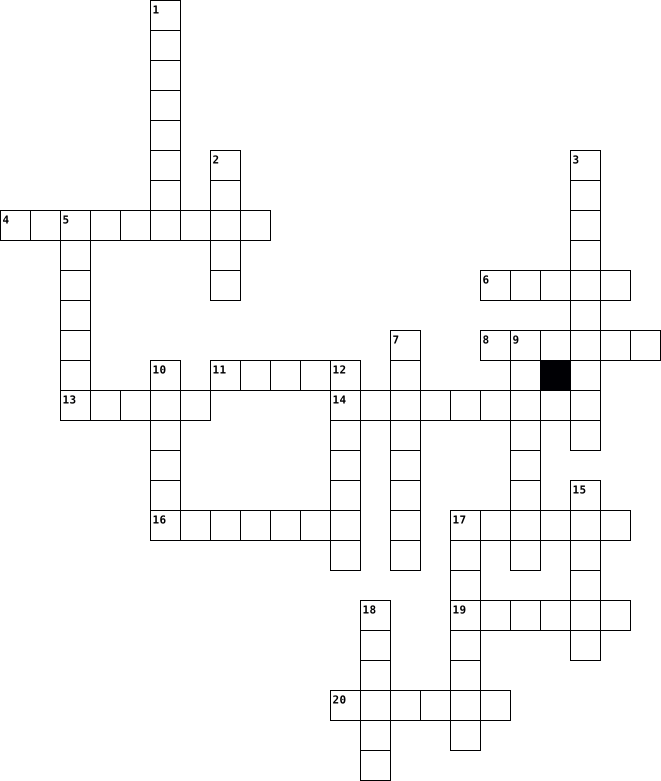
Across
- Our universe is currently doing this.
- giant, dusty snowballs.
- Astronomer who first discovered universe was expanding.
- NASA's main topic of interest.
- This type if eclipse occurs when the moon lines up between the earth and sun.
- Astronomers study these types of objects.
- When more than half a moon is visible.
- This is evidence to support the Big Bang theory.
- This season occurs in Ireland when the Europe is tilted towards the sun.
- When the moon appears to be getting smaller.
Down
- Large rocky bodies.
- This type of eclipse occurs when the sun lines up between the earth and moon.
- Region where many comets are located
- Pluto is not one of these.
- The name of our galaxy.
- A collection of galaxies.
- When the moon appears to be getting bigger.
- When the sun, and earth align.
- Occurs in Australia when Ireland is tilted towards the sun.
- When less than half a moon is visible.
- A collection of planetary systems.
21 Clues: Large rocky bodies. • giant, dusty snowballs. • The name of our galaxy. • A collection of galaxies. • Pluto is not one of these. • NASA's main topic of interest. • When the sun, and earth align. • A collection of planetary systems. • Region where many comets are located • Our universe is currently doing this. • When more than half a moon is visible. • ...