
moon phases Crossword Puzzles
Planets, Moons, and other Space Things 2023-04-24

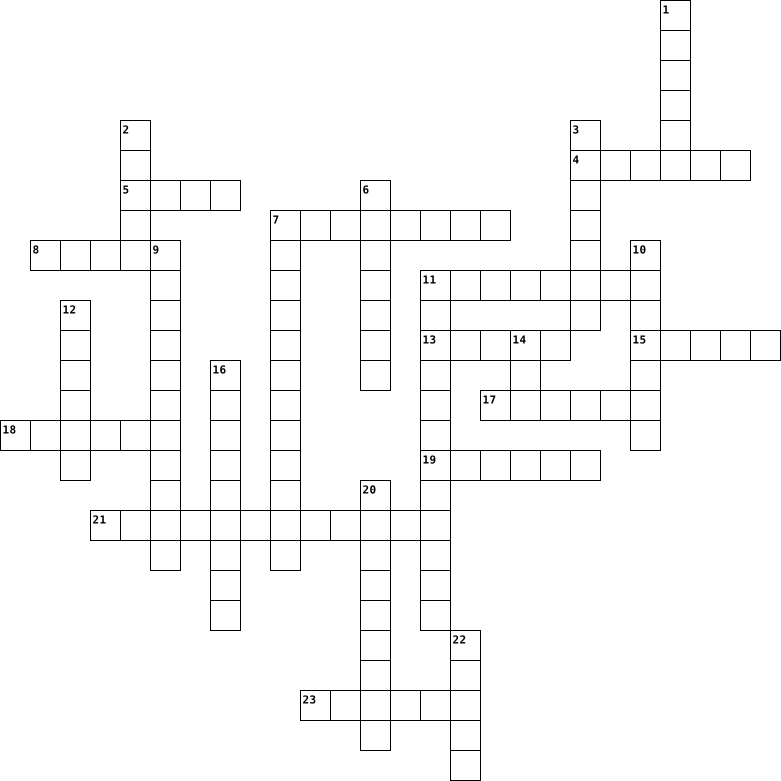
Across
- a ball of ice and rock
- the storm on Jupiter that has lasted 100's of years
- a large moon with an atmosphere
- the farthest planet
- this planet has a day that lasts 2/3 of a year
- a very ong canyon on Mars
- a moon of Jupiter that is heavily cratered
- what lies just beyond the solar system
- home
- a moon that is very smooth, maybe an ocean
Down
- the largest moon in the Solar System
- one of these killed off the dinosaurs
- the largest planet
- the brightest star 2 words
- this group includes Jupiter,Saturn,Uranus&Neptune
- planet with rings
- Venus has 92 times the______ of Earth
- the hottest planet
- where Elon Musk wants us to go
- the gas that gives some gas giants their color
- the molecule that allows life on Earth
- a former planet
- a volcanically active moon of Jupiter
- the largest moon of Neptune, has nitrogen geysers
- this planet has a 90 degree tilt
25 Clues: home • a former planet • planet with rings • the largest planet • the hottest planet • the farthest planet • a ball of ice and rock • a very ong canyon on Mars • the brightest star 2 words • where Elon Musk wants us to go • a large moon with an atmosphere • this planet has a 90 degree tilt • the largest moon in the Solar System • one of these killed off the dinosaurs • ...
Astronomy 2026-02-28

Across
- Moon that orbits Neptune "backwards"
- dwarf planet beyond the orbit of Neptune
- moon of Jupiter with lots of volcanoes
- when a planet spins on its axis
- phase of the Moon that is mostly but not quite full
- coldest planet
- dwarf planet in the asteroid belt
- rises about 50 minutes later every night
- moon of Saturn that is larger than Mercury
- simplest and most common element in the universe
- how long it takes Earth to travel around the Sun
- Phobos and Deimos orbit this planet
- largest inner planet
Down
- hottest planet
- when a planet goes around the Sun
- star in the sky that appears to move the least
- type of eclipse when the Moon blocks the Sun during the day
- larger than all the other planets combined
- the season in Australia in July
- The Milky Way is one of these.
- largest object in the solar system
- everything there is
22 Clues: hottest planet • coldest planet • everything there is • largest inner planet • The Milky Way is one of these. • the season in Australia in July • when a planet spins on its axis • when a planet goes around the Sun • dwarf planet in the asteroid belt • largest object in the solar system • Phobos and Deimos orbit this planet • Moon that orbits Neptune "backwards" • ...
Quarter 3 Extra Credit 2026-03-03

Across
- Sun, Earth, moon
- Shows the feeding relationships among organisms in an ecosystem
- A consumer that gets energy from breaking down remains of organisms
- A consumer that eats both plants and animals
- The most important abiotic factor
- Sun, moon, Earth
- The lighter part of a shadow
- A nonliving part of the environment
- A consumer that only eats plants
Down
- A living part of the environment
- An organism that eats other organisms
- The process plants use to make glucose and oxygen from carbon dioxide, water, and sunlight
- When the moon starts to shrink towards a new moon
- An organism that uses energy from the sun to make its own food
- A factor that prevents the growth of an organism or population in an ecosystem
- The darkest part of a shadow
- The motion of a body as it travels around another in space
- When the moon grows towards a full moon
- A consumer that eats other animals
- A community of organisms and their nonliving environment
20 Clues: Sun, Earth, moon • Sun, moon, Earth • The darkest part of a shadow • The lighter part of a shadow • A living part of the environment • A consumer that only eats plants • The most important abiotic factor • A consumer that eats other animals • A nonliving part of the environment • An organism that eats other organisms • When the moon grows towards a full moon • ...
Apollo Moon Missions 2023-07-04

Across
- - Module of the spacecraft that remained in orbit around the moon.
- - Term used to describe each individual Apollo space exploration.
- - Last name of the astronaut who joined Neil Armstrong on the moon.
- - Symbol planted by the astronauts on the lunar surface.
- - Name of the command module used in the Apollo missions.
- - Term for walking on the surface of the moon.
Down
- - Final phase of the Apollo missions when the spacecraft touched down on the moon.
- - Part of the spacecraft that landed on the moon.
- - First name of the astronaut who took the first steps on the moon.
- - NASA's space program that aimed to land astronauts on the moon.
- - Acronym for the United States' space agency that organized the Apollo missions.
- - Vehicle used to launch the Apollo missions.
- - Relating to the moon.
- - Nickname of the astronaut who accompanied Neil Armstrong on the moon.
- - Name of the lunar module that landed on the moon during Apollo 11.
15 Clues: - Relating to the moon. • - Vehicle used to launch the Apollo missions. • - Term for walking on the surface of the moon. • - Part of the spacecraft that landed on the moon. • - Symbol planted by the astronauts on the lunar surface. • - Name of the command module used in the Apollo missions. • - NASA's space program that aimed to land astronauts on the moon. • ...
Unit 2: The Earth-Moon System Review 2023-10-16

Across
- one side of the Moon faces the Earth always because the Moon is tidally ________
- a _________ month is the time it takes the moon to return to the same position in our sky relative to the stars
- this type of eclipse is called a "ring of fire" eclipse
- when an object is on the opposite side of the sky from another
- the closest point in an object's orbit around the Sun
- the stuff that gets thrown out during an asteroid impact
- less of the moon is lit every night
- lunar _____ are where the Moon's orbit around the Earth intersection the ecliptic, the plane of the Earth's orbit around the Sun
- only a sliver of the moon is lit
- the furthest point in an object's orbit around the Sun
- more than half the moon is light
- the "full shadow" part of an eclipse
- moon blocks light from hitting the earth in a _____ eclipse
- an _____________ month is the time it takes the moon to go from perigee to perigee
- the large dark areas on the moon once thought to be oceans but are now known to be cooled lava fields
Down
- when an object is right next to another in the sky
- more of the moon is lit every night
- the closest point in an object's orbit around the Earth
- long straight lines that go outward from impact craters
- when the Sun's tidal force on the Earth adds to the Moon's tidal force on the Earth a ________ tide occurs
- the top layer of any astronomical body
- the furthest point in an object's orbit around the Earth
- when the Sun's tidal force on the Earth subtracts from the Moon's tidal force on the Earth a ________ tide occurs
- how "non circular" an elliptical orbit is
- the "partial shadow" of an eclipse
- the _______ limit is the innermost distance a self gravitating body can orbit without getting torn apart by tidal forces
- how reflective an object is
- half of the moon is light
- tidal force on an object is the difference in the force of ________ on the near side of an object and the far side of an object
- a ___________ month is the time it takes the moon to orbit the Earth, node to node
- earth blocks light from hitting the moon in a _____ eclipse
31 Clues: half of the moon is light • how reflective an object is • only a sliver of the moon is lit • more than half the moon is light • the "partial shadow" of an eclipse • more of the moon is lit every night • less of the moon is lit every night • the "full shadow" part of an eclipse • the top layer of any astronomical body • how "non circular" an elliptical orbit is • ...
Chapter 3 Vocabulary Review 2025-02-12

Across
- Curved path that an object follows as it revolves around another object
- September 21
- Piece of rock that hits the surface of a planet or moon after traveling through space.
- Amount of matter that an object contains
- Movement of one object in its orbit around another object in space.
- March 21
- Phase of the moon when he moon is between the sun and the earth
- Passing of the moon through the earths shadow
Down
- Force of attraction between any two objects.
- Low, flat plains on the moon's surface that appear as dark areas.
- Phase of the moon when the earth is between the sun and the moon
- Instrument that collects light, making faint objects easier to see and enlarging distant objects
- December 21
- An oval shape
- Regular rising and falling of the earth's major bodies of water
- Passing of the moon between the earth and the sun
- Circular low area surrounded by a rim, usually caused by an object hitting the ground
- June 21
18 Clues: June 21 • March 21 • December 21 • September 21 • An oval shape • Amount of matter that an object contains • Force of attraction between any two objects. • Passing of the moon through the earths shadow • Passing of the moon between the earth and the sun • Regular rising and falling of the earth's major bodies of water • ...
The Sky 2025-01-23

Across
- The longest and shortest days of the year
- A planet's natural satellite
- The rotation of the earth on its axis
- The shifting of the earth's axis over a long period of time
- When the sun is blocked by the moon
- The earth's travel around the sun
Down
- The moon as it gets smaller
- The second layer of the atmosphere
- A star's natural satellite
- Days of the year in spring and autumn which have equal day and night lengths
- Relating to the moon
- The edge of your view
- The gases and particles surrounding the earth
- The moon as it gets larger
- The fullest phase of the moon that is not a full moon
- Relating to the sun
16 Clues: Relating to the sun • Relating to the moon • The edge of your view • A star's natural satellite • The moon as it gets larger • The moon as it gets smaller • A planet's natural satellite • The earth's travel around the sun • The second layer of the atmosphere • When the sun is blocked by the moon • The rotation of the earth on its axis • The longest and shortest days of the year • ...
Apollo 11: Man Walks On The Moon 2021-09-23

Across
- This artifact left behind on the Moon reads: "Here men from the planet Earth first set foot on the moon—July 1969 A.D.—We came in peace for all mankind."
- Landing site of Apollo 11 on the Moon.
- French for the relaxation of strained relations.
- Third crew member that circled the Moon aboard Apollo 11.
- First person to walk on the Moon.
- Nickname for Edwin Aldrin
- President that promised a man on the moon by the end of the decade and had a Space Center named after him in Florida.
Down
- Race Competition between two Cold War adversaries, the Soviet Union and the United States of America, to achieve superior spaceflight capability.
- Because the Moon doesn’t have any weather, these might last 1,000 years.
- Second person to walk on the Moon.
- The name of the lunar excursion module
- Planted on the Moon as proof that Americans were first to walk on the Moon.
- Naval Carrier that scooped up the capsule in the Pacific Ocean.
- President during the landing of Apollo 11.
- Booster Rocket that propelled Apollo 11 beyond Earth’s orbit.
- Apollo mission number on July 16, 1969
16 Clues: Nickname for Edwin Aldrin • First person to walk on the Moon. • Second person to walk on the Moon. • The name of the lunar excursion module • Landing site of Apollo 11 on the Moon. • Apollo mission number on July 16, 1969 • President during the landing of Apollo 11. • French for the relaxation of strained relations. • ...
Earth, Moon, and Sun Vocabulary test 2026-03-03

Across
- a rocky sphere that travels around a planet
- a moon phase that looks like more than half a circle from Earth
- the nearly circular path a smaller object travels around a larger object
- when the Moon is completely dark
- a moon phase that looks like less than half a circle from Earth
- a moon phase that looks like a full circle from Earth
- the shape of the illuminated part of the Moon as it appears from Earth
- the amount of tie it takes for a planet to complete one orbit around a star or stars
Down
- the border between light and dark on the Moon
- an object, diagram, or computer program that helps us understand something by making it simpler or easier to see
- a moon phase in which the Moon is not visible from Earth
- a moon phase that looks like a half-circle from Earth
- to shine light on an object and make it visible
- the relative size of things
- the star that is the main source of light at the center of our solar system
- the sun, the planets that orbit the sun, and other objects that orbit the sun
16 Clues: the relative size of things • when the Moon is completely dark • a rocky sphere that travels around a planet • the border between light and dark on the Moon • to shine light on an object and make it visible • a moon phase that looks like a half-circle from Earth • a moon phase that looks like a full circle from Earth • ...
Earth In the Universe Vocab 2022-04-29

Across
- Large space telescope able to see farther than any other telescope
- Jupiter, Saturn, Uranus, & Neptune. Called Gas Giants.
- Mostly dark on the right side, slightly lit on the left.
- moon phase when the entire side facing Earth is illuminated.
- An imaginary line that passes through Earth's center and the North and South poles
- light on the left; more than half of the moon is visible from Earth
- a spacecraft that can carry a crew into space
- Small, rocky planets that orbit closest to the sun including Mercury, Venus, Earth, & Mars
- A device built to observe distant objects by making them appear closer
- The movement of an object around another object
- The moon is a quarter of the way around the Earth. You can see the right half of the moon.
- daily rise and fall of Earth's waters on its coastlines
- The path of an object as it revolves around another object in space
- A moon that is completely dark because it's unlit side is facing Earth
- The left half of the moon is illuminated.
- The partial or total blocking of one object in space by another
Down
- the half of the Earth south of the equator
- is a lit up crescent on the right
- the hemisphere north of the equator
- a device that expels gas in one direction to move in the opposite direction
- (of the moon) the period during which the visible surface of the moon decreases
- a spacecraft that gathers data without a crew
- an eclipse in which the moon appears darkened as it passes into the earth's shadow.
- (of the moon) the period during which the visible surface of the moon increases
- Time when the Sun is farthest from the equator.
- a large artificial satellite on which people can live and work for long periods
- Two times a year when the sun is directly above the equator and days and nights are of equal length
- A force of attraction between objects that is due to their masses.
- The spinning of Earth on its axis
- Occurs when the Moon passes directly between the Sun and Earth and casts a shadow over part of Earth
- Slightly dark on the left side, mostly lit on the right.
31 Clues: is a lit up crescent on the right • The spinning of Earth on its axis • the hemisphere north of the equator • The left half of the moon is illuminated. • the half of the Earth south of the equator • a spacecraft that gathers data without a crew • a spacecraft that can carry a crew into space • Time when the Sun is farthest from the equator. • ...
Moon Phase Crossword 2012-11-29

Across
- The type of tides that occur during new and full moons
- Means growing or getting larger
- Means more than half of the moon is lit
- Phase when the moon completes 1/4 of its cycle
- Spinning on an axis
- Means less than half of the moon is lit
- Phase when the moon is on the opposite side of the Earth than the Sun
- The type of tides that have the lowest tidal range
- The force that pulls all objects towards one another
Down
- The original source of light for the moon
- The movement around another object in an orbit
- Phase when the moon completes 3/4 of its cycle
- A dent in the surface of the moon
- Gravity depends on distance and ______
- Phase when the moon is between the Sun and Earth
- Means shrinking or getting smaller
16 Clues: Spinning on an axis • Means growing or getting larger • A dent in the surface of the moon • Means shrinking or getting smaller • Gravity depends on distance and ______ • Means more than half of the moon is lit • Means less than half of the moon is lit • The original source of light for the moon • Phase when the moon completes 1/4 of its cycle • ...
The Planets and Moons 2024-02-27

Across
- Asteroid dwarf
- Largest moon
- Giant gas
- Ice moon
- Blue planet
- Dwarf planet
- A Jupiter moon
Down
- Morning star
- Sideways planet
- Ringed planet
- Swift messenger
- Dwarf world
- Volcanic moon
- Blue marble
- Red Planet
15 Clues: Ice moon • Giant gas • Red Planet • Dwarf world • Blue marble • Blue planet • Morning star • Largest moon • Dwarf planet • Ringed planet • Volcanic moon • Asteroid dwarf • A Jupiter moon • Sideways planet • Swift messenger
Giving Moon 2024-11-14

Across
- 10am tour venue
- Nickname no one calls sean
- hurricane snack
- only official gooseneck merch sold
- tour manager
- what is needed A$AP
- but can he ___?
- seans jewish mentor
- cutest fan
Down
- Tiago with animal instincts
- lead singers cat
- army drummer
- Nickname Everyone call sean
- Who needs a daily check?
- sancho's bass inlays
- iowa city venue
16 Clues: cutest fan • army drummer • tour manager • 10am tour venue • hurricane snack • but can he ___? • iowa city venue • lead singers cat • what is needed A$AP • seans jewish mentor • sancho's bass inlays • Who needs a daily check? • Nickname no one calls sean • Tiago with animal instincts • Nickname Everyone call sean • only official gooseneck merch sold
Blood Moon 2025-03-12

Across
- What it it called when a punishment comes from a strong position?
- What element rules Jupiter?
- What rules the 12th house?
- Strength is doing what is right, despite your....?
- What does life put in front of us?
- The two ways of exerting one's strength are pulling up and...?
- advice does the Goddess give us? Strong
- What do you lead with?
- If you are not able to be in control of yourself, you cannot be in control of what?
Down
- What do we need to put into place?
- What is the full moon in March called?
- Strength is shown by what?
- When a person feels threatened it's not real strength but is?
- When Mercury is retrograded remain..?
- Discipline over power creates?
- You should never cast when...?
16 Clues: What do you lead with? • Strength is shown by what? • What rules the 12th house? • What element rules Jupiter? • Discipline over power creates? • You should never cast when...? • What do we need to put into place? • What does life put in front of us? • When Mercury is retrograded remain..? • What is the full moon in March called? • advice does the Goddess give us? Strong • ...
Worm Moon 2025-03-14

Across
- Latin word for spring
- The larger _____ goes first
- Preparing for the arrival of kits in March (genus)
- Traverse an esker, explore a drumlin, and climb a moraine
- I'm sorry for talking too much
- Shadow within a shadow (solar eclipse)
- Leaving the south in March in return to their iceless lakes (genus)
Down
- Take the high road under a jealous moon
- The smell of spring
- Moss piglet
- 12 hours of light
- yellow flowers that signal the arrival of spring
- Watching my whole world change
- immature form of an insect
- The Queen of 3 Oaks
- Too many buzzer beaters in March can lead to _____
16 Clues: Moss piglet • 12 hours of light • The smell of spring • The Queen of 3 Oaks • Latin word for spring • immature form of an insect • The larger _____ goes first • Watching my whole world change • I'm sorry for talking too much • Shadow within a shadow (solar eclipse) • Take the high road under a jealous moon • yellow flowers that signal the arrival of spring • ...
Earth and Moon 2014-10-21

Across
- hundred sixty-five it takes the Earth three hundred sixty-five days to complete one full orbit
- the Earth is less dense than the moon
- the moon has 1/4 of the diameter of the Earth and much less mass
- the Earth and moon both orbit larger bodies
- Earth has oxygen witch helps us live
- the moons gravitational pull is 1/6 of the Earths pull
- the Earth is a planet
- the moon orbits around the Earth
Down
- it takes the moon twenty-eight to thirty-one days to complete a full orbit
- the Earth obits around the sun
- The moon is smaller compared to the Earth
- the moon has no living life
- the moon is a satellite
- the Earth and moon are both made out of rock bodies
14 Clues: the Earth is a planet • the moon is a satellite • the moon has no living life • the Earth obits around the sun • the moon orbits around the Earth • Earth has oxygen witch helps us live • the Earth is less dense than the moon • The moon is smaller compared to the Earth • the Earth and moon both orbit larger bodies • the Earth and moon are both made out of rock bodies • ...
Astronomy Concepts 2014-03-03

Across
- A ___ eclipse when a celestial object completely blocks out the light from another celestial body from reaching another place
- "When the lights on the left its ___"
- The fully shaded inner region of a shadow cast by an opaque object
- The time or date (twice each year) at which the sun crosses the celestial equator, when day and night are of equal length
- A ___ eclipse when a celestial object partially blocks out the light from another celestial body from reaching another place
- When the sun reaches its highest or lowest point in the sky at noon, marked by the longest and shortest days
- The North and South ___.
- The path of ___ is the path of the moon't umbra across the earth
- The closest star to Earth
- A ___ tide is when there's the greatest amount of difference between the highest high and lowest low tides
- The phase of the moon when you can't see any light.
- The ___ Hemisphere is the upper half of the globe.
- What orbits the Earth
- The phase of the moon when seen it's mostly covered in light.
Down
- What we live on
- When the moon it at its farthest point from Earth
- The force that attracts a body toward the center of the earth
- A ___ eclipse when the Earth block sunlight from reaching the moon
- The Milky Way ___ is where the solar system is located in.
- The Orion ___ is only seen in the winter in the northern hemisphere
- The phase of the moon when there's a sliver of light seen.
- "When the lights on the right its ___"
- The phase of the moon when the moon is behind Earth.
- The ___ Hemisphere is the lower half of the globe.
- The phase of the moon when the Sun, Earth, and Moon create a right angle.
- The partially shaded outer region of the shadow cast by an opaque object
- A ___ tide is when there's the least amount of difference between the highest high and lowest low tides
- What occurs when a celestial object blocks the light from another celestial object from reaching another place.
- When the moon is at its closest point from Earth
- A ___ eclipse when the moon blocks out light from the sun from reaching Earth
30 Clues: What we live on • What orbits the Earth • The North and South ___. • The closest star to Earth • "When the lights on the left its ___" • "When the lights on the right its ___" • When the moon is at its closest point from Earth • When the moon it at its farthest point from Earth • The ___ Hemisphere is the lower half of the globe. • ...
Science Fluency- Space 2024-04-28

Across
- Are bodies of rock that orbit planets
- are billions of stars, dust and gas held together by gravity. Ours is called the Milky Way.
- inner planet with no atmosphere, no moon, no rings hot, and it takes 87 days to revolve/orbit the sun.
- outer planet with an atmosphere, 13 moons, rings, cold temperature and it takes 60,190 days to orbit the sun.
- outer planet with an atmosphere, 53 moons, rings, cold temperature and it takes 10,759 days to orbit the sun.
- moon phase where the moon appears dark. Happens after a 3rd quarter moon.
- inner planet with an atmosphere, 1 moon, no rings, mild temperature and it takes 365 days to revolve/orbit the sun.
- Is the center of our universe and the closest star to Earth.
- inner planet with an atmosphere, 2 moons, no rings, mild temperature and it takes 686 days to orbit/revolve the sun.
- outer planet with an atmosphere, 50 moons no rings, cold temperature and it takes 4,332 days to orbit the sun.
- moon phase where the light is on the right. Happens after a new moon.
- inner planet with an atmosphere, no moons, no rings, hot temperature and it takes 224 days to revolve/orbit the sun.
Down
- When an object spins on its axis. It takes the Earth 24 hours to spin on its axis.
- When one object moves around another. It takes 365 days for Earth to move around the sun.
- are large cold, planets made of mostly gas and are the farthest away from the sun.
- are the small dense planets with rocky surfaces. They are the planets that are closest to the sun.
- are dust particles, frozen water and frozen gases that orbit the sun
- outer planet with an atmosphere, 21 moons, rings, cold temperature and it takes 30,684 days to orbit the sun.
- moon phase that looks fully lit. It happens after a 1st quarter moon.
- The largest bodies orbiting the sun.
- small bodies of rock and metal that orbit the sun
- moon phase where the light is on the left. Happens after a full moon.
- Is everything in existence (galaxies, solar systems and planets)
23 Clues: The largest bodies orbiting the sun. • Are bodies of rock that orbit planets • small bodies of rock and metal that orbit the sun • Is the center of our universe and the closest star to Earth. • Is everything in existence (galaxies, solar systems and planets) • are dust particles, frozen water and frozen gases that orbit the sun • ...
The Solar System 2015-01-20
Across
- the sideways planet
- the red planet
- solid rock like mass
- dwarf planet
- moon with a magnetic field
- home sweet home
- saturns largest moon
- jupiter like planets
- the larger martian moon
- galilean moon with an atmosphere
- closest planets to the sun
- most visible rings
Down
- moon of pluto
- dirty snowball
- largest planet in our solar system
- smallest of terrestrial planets
- separates the inner planets from the outer planets
- the largest shield volcano in the solar system
- the great dark spot is on this planet
- violent storm on jupiter
- shooting star
- trans neptunian object
- rock or icy fragment travelling in space
- meteoroid that strikes the earths surface
- atmosphere contains thick clouds of sulfuric acid
25 Clues: dwarf planet • moon of pluto • shooting star • dirty snowball • the red planet • home sweet home • most visible rings • the sideways planet • solid rock like mass • saturns largest moon • jupiter like planets • trans neptunian object • the larger martian moon • violent storm on jupiter • moon with a magnetic field • closest planets to the sun • smallest of terrestrial planets • ...
the moon by prianshu 2013-03-21

Across
- the______ side of the moon is cooler
- is the core of the moon____
- no liquid form of____
- the moon has no___
- the moon is_____ then the earth
- the planet that hit the earth and made the moon____
Down
- the colour of the moon___
- the moon is made of layers___
- the moon is ___ then the earth
- what attracts the moon to the earth____
- the moon shines because of the____
- the moon has no life___
- the moon has no____
13 Clues: the moon has no___ • the moon has no____ • no liquid form of____ • the moon has no life___ • the colour of the moon___ • is the core of the moon____ • the moon is made of layers___ • the moon is ___ then the earth • the moon is_____ then the earth • the moon shines because of the____ • the______ side of the moon is cooler • what attracts the moon to the earth____ • ...
Earth Science Unit Vocabulary Crossword 2021-02-08

Across
- The 90 degree angle smallest difference between high and low tides.
- Boundaries go toward each other.
- Boundaries go away from each other.
- Happens about March 20th.
- The axle is not pointed towards or away from the Sun - equal sunligtht in both hemispheres, equal legnth days.
- The North Hemisphere axis is not pointed towards or away from the sun - equal sunlight in both hemispheres.
- The first phase of the moon as is appears unlit from Earth.
- Beach and environment exposed, organisms have adapted to long periods with limited water.
- The moon is 3 quarters of the way through it's cycle from Earth it appears to be half lit on the left.
- The change in appearance of the Moon as it makes on full revolution around the Earth.
- From Earth the moon is fully lit the Earth is between the sun and the moon.
- The North Hemisphere is tilted toward the sun. Most direct sunlight, longer days, shorter nights, North Pole constant daylight.
- From Earth the moon appears to be more than half lit on the right - the light is shaped like a football.
- The lighted part of the moon as seen from Earth is increasing the light on the right is new and bright.
Down
- The lighted part of the moon as seen from Earth is decreasing on the left.
- Moon, Earth and Sun are all lined up.
- The North Hemisphere is tilted away from the Sun, most indirect sunlight, shorter days, longer nights, South Pole has constant daylight.
- Environment becomes flooded with ocean water, organisms have adapted.
- Day and Night are equal at the equator.
- The moon is one quarter of the way through the cycle from the Earth it appears to be half lit on the right.
- From the Earth the moon appears to be4 more than half lit on the left - the lighted part is now decreasing.
- Boundaries slide past each other.
- Happens about September 22nd
- Th longest and shortest days of the year - the sun reaches it's highest or lowest points.
24 Clues: Happens about March 20th. • Happens about September 22nd • Boundaries go toward each other. • Boundaries slide past each other. • Boundaries go away from each other. • Moon, Earth and Sun are all lined up. • Day and Night are equal at the equator. • The first phase of the moon as is appears unlit from Earth. • ...
Moon Facts 2021-09-07

Across
- Last name of the first man who walked on the moon
- The moon has ______, valleys and old volcanoes.
- Something that spins around something
- The moon has _________ that cause the moon to shake
- The side of the moon we can see
- The moon causes the tides in the ________
- You would weigh ______ on the moon
Down
- The moon is Earth's only natural ________.
- The moon has no ________.
- It takes about 28 days for the moon to _______ around Earth.
- The moon is moving ______ from Earth.
- The side of the moon we cannot see
- The ______ is what gives the moon its light.
13 Clues: The moon has no ________. • The side of the moon we can see • The side of the moon we cannot see • You would weigh ______ on the moon • Something that spins around something • The moon is moving ______ from Earth. • The moon causes the tides in the ________ • The moon is Earth's only natural ________. • The ______ is what gives the moon its light. • ...
Space 2024-11-27

Across
- the second biggest moon in our solar system
- the closest planet to our solar system
- the biggest moon in our solar system
- what our moon is
- smallest gas giant in our solar system
- what protects the earth from the sun
- Has 79 moons
- a piece of asteroid that survives the earth's atmosphere
- a star
- the biggest space company
Down
- has the most rings in our solar system
- spins in the opposite direction as other planets
- a planet mostly made of rock and metal
- has a huge temperature change
- a dwarf planet
- where moons come from
- Is a gas giant and ice giant
- a rock that enters the earth's atmosphere
- a natural satellite
- smallest moon in our solar system
20 Clues: a star • Has 79 moons • a dwarf planet • what our moon is • a natural satellite • where moons come from • the biggest space company • Is a gas giant and ice giant • has a huge temperature change • smallest moon in our solar system • the biggest moon in our solar system • what protects the earth from the sun • has the most rings in our solar system • ...
Planetary Puzzle 2024-02-26

Across
- Volcanic moon of Jupiter.
- Closest planet to the sun.
- Moon with geysers of water vapor.
- Red planet with two moons.
- Neptune's largest moon.
- Farthest planet from the sun.
- Saturn's largest moon.
Down
- Largest moon in the solar system.
- Largest planet in our solar system.
- Moon with a subsurface ocean.
- Second planet from the sun.
- Third rock from the sun.
- Ringed gas giant.
- Dwarf planet with a heart-shaped region.
- Seventh planet in our solar system.
15 Clues: Ringed gas giant. • Saturn's largest moon. • Neptune's largest moon. • Third rock from the sun. • Volcanic moon of Jupiter. • Closest planet to the sun. • Red planet with two moons. • Second planet from the sun. • Moon with a subsurface ocean. • Farthest planet from the sun. • Largest moon in the solar system. • Moon with geysers of water vapor. • Largest planet in our solar system. • ...
Space Science Project 2023-02-15

Across
- miutes It only take —-_—--------for the sun's energy to reach earth
- The sun is a sized star
- The middle school mascot is the ____________
- moon When the moon look like a croissant it is called a —-------------
- moon When the moon is black that is called a — —-
- In the summer you have a —------------ because of the angle the earth is pointing at.
- hemispher southern hemisphire When it is summer in the northern hemisphere it is winter in the —-----------------------------
- The sun is not the star
- moon When the moon looks like a full moon but isnt a full moon is called a —--------------------
Down
- If you were on the bottom of the earth you would not be able to fall off due to —----
- happens when the sun is pointing at the —------------------ or the southern hemisphere.
- We have 12 hours of daylight and –hours of night
- We have night because the earth is facing away from the —
- Gravity is a force that pulls you to the —--- of the earth
- A shadow is shorter in the summer than in the —---
- We have different seasons because the way the sun is —--------
- We have day because of the —--------
- newton —------discovered gravity and so did albert einstein
- A shadow is longer in the winter than in the —----
19 Clues: The sun is a sized star • The sun is not the star • We have day because of the —-------- • The middle school mascot is the ____________ • moon When the moon is black that is called a — —- • A shadow is shorter in the summer than in the —--- • A shadow is longer in the winter than in the —---- • We have 12 hours of daylight and –hours of night • ...
Earth, Sun & Moon Revision Crossword Amelia Vivian 2019-10-27

Across
- there is 12 of these a year
- it provides heat and light
- is going from full moon to a new moon
- happens 2 weeks before or after
- an imaginary line that goes from the north to the south pole
- Moon you can see all the moon
- Moon first phase of the luna eclipse
Down
- happens 2-5 times a year
- you can see it at night
- is going from a new moon to full
- 23.5°
- a curved path
- caused by the tilt of the earth
- Moon you can only see half of
14 Clues: 23.5° • a curved path • you can see it at night • happens 2-5 times a year • it provides heat and light • there is 12 of these a year • Moon you can only see half of • Moon you can see all the moon • happens 2 weeks before or after • caused by the tilt of the earth • is going from a new moon to full • Moon first phase of the luna eclipse • is going from full moon to a new moon • ...
Science 147-157 Quiz 5 3rd 2024-01-11

Across
- part of the earth that is ____________________ the sun is experiencing summer
- – a small piece of space rock traveling in space often a piece of an asteroid
- – a hole on the surface of a moon or planet made by another heavenly body hitting it
- – when only half of the moon is visible
- – movement of the oceans caused by the moon’s gravity
- – something that orbits a heavenly body; the moon is a natural satellite of earth
- – are heavenly bodies that orbit a star. The planets of our solar system all orbit the sun
- moon has just enough _______________ to pull the ocean to itself. That is what makes our oceans tides.
- – are heavenly bodies that orbit a planet. Our moon orbits the earth
- The earth’s ___________________ is why we have seasons
- takes the earth 365 ¼ day to orbit the earth this is where we get our ______________________
- – a large piece of rock that orbits the sun
- – stays the same The constants of the sunrise and sunset are a picture of God’s faithfulness
- was the first man to step on the moon
- Some heavenly bodies orbit other heavenly bodies in space but our stars do not. Our sun is the center of our solar system
Down
- an unmanned spacecraft such as a rover or lander that collects pictures and data in space
- – a person who travels into outer space
- – when the moon is not visible at all
- – a tool that tells the time by using the sun
- – when only less than half of the moon is visible (looks like a banana)
- – when all of the moon is visible
- is the only planet designed for life
- part of the earth that is facing ______________ from the sun is experiencing winter
- moon is bright at nighttime because it reflects the ________________light
- – a heavenly body that orbits a planet
- – a type of rope that keeps an astronaut from floating into space
- – a spacecraft where scientists can live and work while orbiting Earth
27 Clues: – when all of the moon is visible • is the only planet designed for life • – when the moon is not visible at all • was the first man to step on the moon • – a heavenly body that orbits a planet • – a person who travels into outer space • – when only half of the moon is visible • – a large piece of rock that orbits the sun • – a tool that tells the time by using the sun • ...
Cell Cycle 2023-03-01

Across
- What phase does the Cell Divide in?
- Which mitosis phase takes the longest(normally)?
- Where does the cell get checked to see if it is going through the cycle correctly?
- Which phase does the DNA replicate?
- Which phase does the cell grow and do basic functions?
- What phase do the sister chromatids separate?
- Which phase condenses chromatin?
- Which phase prepares the cell for mitosis?
- What is it when cells reproduce too fast?
- What is the shortest phase of the cell cycle?
Down
- What is the connection called in sister chromatids?
- What phase do the chromosomes arrive at the opposite poles in?
- How many phases are in Interphase?
- What is the longest phase of the Cell Cycle?
- Which cells have cell walls present?
- Which phase makes chromosomes align at the middle of cell?
- Where do the not working cells go?
- What type of organisms have the cell cycle?
- Which cells have cleavage furrow form?
- How many phases are in mitosis?
20 Clues: How many phases are in mitosis? • Which phase condenses chromatin? • How many phases are in Interphase? • Where do the not working cells go? • What phase does the Cell Divide in? • Which phase does the DNA replicate? • Which cells have cell walls present? • Which cells have cleavage furrow form? • What is it when cells reproduce too fast? • ...
Moon Crossword Puzzle! 2024-01-03

Across
- The largest planet in our solar system!
- A color scheme consisting of tints and shades of just one color.
- The full moon _______ bright in the sky!
- “We don’t make mistakes, just happy little _________.” – Bob Ross
- When the moon is _____ it lights up the night sky!
- One
- The big star around which the earth orbits.
- the planet we live on.
- When the moon is _____ the sky is dark, and you cannot see the moon.
Down
- The earth makes an ______ around the sun.
- A circular movement. The earth ________ on its axis.
- When the moon is C or backwards C shaped, it is a ________ moon.
- when white is added to a color it makes a _____
- an element of art that deals with the lightness or darkness of a color
- color
- Moon in Spanish
- when black is added to a color it makes a _____
17 Clues: One • color • Moon in Spanish • the planet we live on. • The largest planet in our solar system! • The full moon _______ bright in the sky! • The earth makes an ______ around the sun. • The big star around which the earth orbits. • when white is added to a color it makes a _____ • when black is added to a color it makes a _____ • ...
Sun, Earth, and Moon Review 2024-11-13

Across
- the partially shaded outer region of a shadow cast by a celestial body
- When the north pole is pointed towards the sun, what season is it in the northern hemisphere
- a solar eclipse can take place during a full moon
- The day of the year where we get the most daylight in the summer, and least sunlight in the winter
- a solar eclipse in which the edge of the sun remains visible as a bright ring around the moon
- The fourth phase of the moon. In this phase, we can see sunlight reflecting off three quarters of the moon’s surface that faces us. It’s not a full moon yet, but it’s getting there
- the day of year when day and night are of approximately equal length. This occurs during spring and autumn
- The second phase of the moon. In this phase, we can see sunlight reflecting off only about one quarter of the moon’s surface that faces us
- The part of the shadow that extends beyond the umbra, where the object creating the shadow appears smaller than the light source
Down
- When Earth or the Moon partially blocks light from the Sun
- When Earth or the Moon fully blocks light from the Sun
- The third phase of the moon. In this phase, we can see sunlight reflecting off half of the moon’s surface that faces us
- it is rare to see total eclipses because the moon's orbit is __________________
- The fifth phase of the moon. In this phase, we can see sunlight reflecting off ALL of the moon’s surface that faces us. In this phase the moon appears round and completely lit up
- The first phase of the moon. In this phase, the moon is completely dark since we can’t see the side that the sun is shining on
- the darkest part of a shadow, where a light source is completely blocked
- The color that the moon turns during a total lunar eclipse
17 Clues: a solar eclipse can take place during a full moon • When Earth or the Moon fully blocks light from the Sun • When Earth or the Moon partially blocks light from the Sun • The color that the moon turns during a total lunar eclipse • the partially shaded outer region of a shadow cast by a celestial body • ...
vocab 3 earth,moon and sun 2023-05-08

Across
- tall,short,dwarf
- getter smaller
- very big upper world
- a little over half
- big yellow hot ball
- black moon with light behind
- fall,summer,wither,spring
- white ball
- lifting
- dead
- small thing
- the whole world
Down
- getteing bigger
- blue,red,blue...
- shine
- red moon
- robot with lasers
- 365
- spinning
- thin circle
20 Clues: 365 • dead • shine • lifting • red moon • spinning • white ball • small thing • thin circle • getter smaller • getteing bigger • the whole world • tall,short,dwarf • blue,red,blue... • robot with lasers • a little over half • big yellow hot ball • very big upper world • fall,summer,wither,spring • black moon with light behind
The moon is cool probably, maybe, IDK 2024-05-08

Across
- When a celestial body blocks another celestial body's light.
- Year humans landed on the moon (put year in front of it).
- 25/100
- When you eat too much you are _____.
- Last name Armstrong.
- The black void of ______.
- He stole the moon in Despicable Me.
- It sounds like a croissant.
- He's very awesome and made this.
Down
- Earth, mars, and Jupiter are all ______.
- 3 out of 4
- A circular motion caused by gravity.
- water related moon powers.
- it's brand ____!
- Planted on the moon by Neil Armstrong.
- Also very awesome and helped make this!
- Supposedly made of cheese.
- The source of the moon's light.
18 Clues: 25/100 • 3 out of 4 • it's brand ____! • Last name Armstrong. • The black void of ______. • water related moon powers. • Supposedly made of cheese. • It sounds like a croissant. • The source of the moon's light. • He's very awesome and made this. • He stole the moon in Despicable Me. • A circular motion caused by gravity. • When you eat too much you are _____. • ...
Science Vocab 2025-11-06

Across
- To shine light on something.
- Measures different wavelengths of light to identify elements
- GIBBOUS, Moon phase when light is decreasing
- Earth’s tilt line that causes day and night.
- A vehicle designed to explore the surface of another planet or moon
- NOON, When the Sun is highest in the sky
- RADIATION, Powerful waves of heat and light from the Sun.
- A planet’s movement around the Sun
Down
- GIBBOUS, Moon phase when light is increasing
- A tool that collects light to make distant objects appear closer.
- MOON, The Moon when fully lit as seen from Earth
- Yearly weather patterns caused by Earth’s tilt and orbit
- PLANE, Flat, imaginary path where planets orbit the Sun
- The spinning of a planet around its axis
- The study of space, stars, planets, and the universe
- Object that orbits around a planet
- ENERGY, Energy Earth receives from the Sun’s rays.
- Average distance between Earth and the Sun.
- MOON, The Moon when it is completely dark from Earth’s view
19 Clues: To shine light on something. • Object that orbits around a planet • A planet’s movement around the Sun • The spinning of a planet around its axis • NOON, When the Sun is highest in the sky • Average distance between Earth and the Sun. • GIBBOUS, Moon phase when light is increasing • GIBBOUS, Moon phase when light is decreasing • ...
Science Vocab 2025-11-06

Across
- Measures different wavelengths of light to identify elements
- PLANE, Flat, imaginary path where planets orbit the Sun
- The study of space, stars, planets, and the universe
- ENERGY, Energy Earth receives from the Sun’s rays.
- RADIATION, Powerful waves of heat and light from the Sun.
- MOON, The Moon when it is completely dark from Earth’s view
- To shine light on something.
- GIBBOUS, Moon phase when light is decreasing
- A planet’s movement around the Sun
- A vehicle designed to explore the surface of another planet or moon
Down
- (AU, Average distance between Earth and the Sun.
- A tool that collects light to make distant objects appear closer.
- NOON, When the Sun is highest in the sky
- Earth’s tilt line that causes day and night.
- Yearly weather patterns caused by Earth’s tilt and orbit
- Object that orbits around a planet
- MOON, The Moon when fully lit as seen from Earth
- GIBBOUS, Moon phase when light is increasing
- The spinning of a planet around its axis
19 Clues: To shine light on something. • Object that orbits around a planet • A planet’s movement around the Sun • NOON, When the Sun is highest in the sky • The spinning of a planet around its axis • Earth’s tilt line that causes day and night. • GIBBOUS, Moon phase when light is increasing • GIBBOUS, Moon phase when light is decreasing • ...
The Moon By:Palwasha 2013-03-21

Across
- the moons ______ is a hot mass
- another older name for the moon
- the moon takes about ________ days to circle the earth
- the moon has no ________ of its own
- the moon has no __________
- it takes about ________ moons to fill up the whole earth
- the colour of the moon is ___________
- the moon is in the shape of a _________
Down
- the moon moves away from the earth every __________
- under the surface of the moon lies a rocky ________
- the moon contains far less _______
- the moon is about ________ the size of earth
- force that attracts objects together
13 Clues: the moon has no __________ • the moons ______ is a hot mass • another older name for the moon • the moon contains far less _______ • the moon has no ________ of its own • force that attracts objects together • the colour of the moon is ___________ • the moon is in the shape of a _________ • the moon is about ________ the size of earth • ...
Rotation/Revolution,Seasons, Solstice/Equinox 2017-02-14

Across
- moon the phase of the moon in which its whole disk is illuminated
- gibbous more than half illuminated
- quarter one-half illuminated by the sun
- axis location and tilt of Earth during each season
- summer and winter happening
- tides a tide just after a new or full moon, when there is the greatest difference between high and low water
- he movement of one object around a center or another object, a forceful overthrow of a government by the people or any sudden or grand change.
- cresent sometimes called an old moon, is defined to occur when the Moon is nearly, but not precisely, on a line with the Earth and Sun
Down
- cycle changes every 30 days
- a large fraction of the moon's day side is facing our way
- resulting from the earth's changing position with regard to the sun.
- the process or act of turning or circling around something
- the curved sickle shape of the waxing or waning moon
- quarter one-half illuminated by the sun
- spring and fall happening
- gravitational attraction of the moon
- moon the phase of the moon when it is in conjunction with the sun and invisible from earth, or shortly thereafter when it appears as a slender crescent
- tide a tide just after the first or third quarters of the moon when there is the least difference between high and low water
18 Clues: spring and fall happening • cycle changes every 30 days • summer and winter happening • gibbous more than half illuminated • gravitational attraction of the moon • quarter one-half illuminated by the sun • quarter one-half illuminated by the sun • axis location and tilt of Earth during each season • the curved sickle shape of the waxing or waning moon • ...
Eclipse Crossword 2023-03-20

Across
- when the moon turns red during a total lunar eclipse
- the natural satellite of the earth
- the region where the earth blocks all direct sunlight from reaching the moon
- home
- when the moon and sun are at a 90 degree angle
- the envelope of gases which surround and protect earth
- the zone where the earth blocks part but not all of the sun's rays from reaching the moon
Down
- the period of the total eclipse
- when the moon appears darkened as it passes into the earth's shadow
- when the moon and sun are aligned
- the curved path of a celestial object around another object
- when the sun is obscured by the moon
- the force that attracts a body towards any other body of physical mass
- the star in the center of our solar system
- the second full moon in a month
15 Clues: home • the period of the total eclipse • the second full moon in a month • when the moon and sun are aligned • the natural satellite of the earth • when the sun is obscured by the moon • the star in the center of our solar system • when the moon and sun are at a 90 degree angle • when the moon turns red during a total lunar eclipse • ...
Vocab Word Wall Crossword Puzzle 2021-12-12

Across
- a big ball of hot gases
- a person that is exploring space
- a continuous area or expanse which is free
- planets that are not sustainable to a human body
- agency responsible for the space program
- a celestial body resembling a small planet
- conclusion reached on the basis of evidence and reasoning
- when moon moves into the earths shadow
- the biggest star in the earths orbit
- the rate at which an entity such as a star completes cycles of rotations
- a big airplane that goes into orbit to do space exploration
- a big rock in space heading towards the earth
- a moon, planet, or machine that orbits a planet or a star
- a rock falls from space to earth
- the shadow cast by the earth or moon over an area experiencing a partial eclipse
- when light encounter a discontinuity in the medium through which it is being transmitted
- the universal force of attraction acting between all matter
- a ring that all our planets follow
- cosmetic snow balls of frozen gases, rock, and dust that orbit the sun
Down
- investigation out of our orbit
- an eclipse in which the sun is obscured by the moon
- the angle between the planet's rotational axis and its orbital axis
- is the earths only satellite
- the moon before getting smaller
- piece of technology that is in space and orbits around earth in 90 minutes
- the degree of compactness of a substance
- phase that is starting the moon phase
- a phase of the moon almost finishing its cycle
- a building or place given over to or equipped for observation of natural phenomena
- a big camera that can see all the way out of our orbit
- before a full moon and after a new moon
31 Clues: a big ball of hot gases • is the earths only satellite • investigation out of our orbit • the moon before getting smaller • a person that is exploring space • a rock falls from space to earth • a ring that all our planets follow • the biggest star in the earths orbit • phase that is starting the moon phase • when moon moves into the earths shadow • ...
Space Vocab Crossword 1 2025-05-05

Across
- The moon is starting to shrink. "Waning" means shrinking. The light is on the left side now.
- Half of the moon is lit up on the right side. It looks like a half-moon.
- Half of the moon is lit up again, but now it’s the left side.
- A tool that shows the time by the shadow of a pointer cast by the Sun on to a plate marked with hours in a day.
- An imaginary line that goes through the north pole and the south pole.
- To spin or turn around a central point like the Earth and it’s axis.
- Just a tiny sliver of light is left on the left side before the moon becomes new again.
- The entire face of the moon is lit up and visible from Earth.
Down
- The part of the Moon that we can see on a particular night.
- The tilt of the Earth is when the Earth tilts toward the Sun (Summer) and away from the Sun (Winter).
- More than half of the moon is lit, but it’s not full yet. The light is biggest on the right side.
- A time of the year with specific weather that repeats every year.
- A long exposure picture that shows the movement of stars in the night sky
- The distance around a circle.
- An informative representation of an object, person or system.
- A regular repeating path that one planet takes around another.
- A small sliver of the moon begins to appear on the right side. "Waxing" means growing.
- The moon is between the Earth and the Sun. We can’t see it from Earth because the sunlit side is facing away from us.
- A group of stars that looks like a particular shape in the sky and has been given a name.
- Set of events that repeats in the same order over and over.
20 Clues: The distance around a circle. • The part of the Moon that we can see on a particular night. • Set of events that repeats in the same order over and over. • An informative representation of an object, person or system. • Half of the moon is lit up again, but now it’s the left side. • The entire face of the moon is lit up and visible from Earth. • ...
crossword 89 2024-08-01

Across
- This is a huge block of ice that moves slowly and is found in cold areas.
- This is the expanse overhead where you see clouds and stars.
- The natural satellite that orbits Earth and is visible at night in various phases.
Down
- This is a shining point in the night sky that is very far from Earth.
- This is a large, deep valley with steep walls, often formed by a river.
- The hot, bright flames created by burning, which can be used for warmth and cooking.
- This is the bright, hot star that shines during the day and makes the day light up.
7 Clues: This is the expanse overhead where you see clouds and stars. • This is a shining point in the night sky that is very far from Earth. • This is a large, deep valley with steep walls, often formed by a river. • This is a huge block of ice that moves slowly and is found in cold areas. • ...
The moon is cool probably, maybe, IDK 2024-05-08

Across
- When a celestial body blocks another celestial body's light.
- Year humans landed on the moon.
- 25/100
- When you eat too much you are _____.
- Last name Armstrong.
- The black void of ______.
- He stole the moon in Despicable Me.
- It sounds like a croissant.
- He's very awesome and made this.
Down
- Earth, mars, and Jupiter are all ______.
- 3 out of 4
- A circular motion caused by gravity.
- water related moon powers.
- it's brand ____!
- Planted on the moon by Neil Armstrong.
- Also very awesome and helped make this!
- Supposedly made of cheese.
- The source of the moon's light.
18 Clues: 25/100 • 3 out of 4 • it's brand ____! • Last name Armstrong. • The black void of ______. • water related moon powers. • Supposedly made of cheese. • It sounds like a croissant. • Year humans landed on the moon. • The source of the moon's light. • He's very awesome and made this. • He stole the moon in Despicable Me. • A circular motion caused by gravity. • ...
Unit 9 Review 2020-04-28

Across
- theory that the universe began with a large explosion and has been expanding ever since
- determines the length of a day
- causes the earth to have seasons
- theory that the earth is in the center of the solar system
- the universe is 13.7 ______ years old
- moon phase during a solar eclipse
- season that occurs when the hemisphere is titled towards the Sun
- moon phase that occurs when the moon is furthest from the sun
Down
- theory that the sun is in the center of the solar system
- eclipse that occurs during a full moon
- two factors determine gravity's strength: ____ and mass
- determines a year; a planets trip around the Sun
- without this force, planets would fly off into space
- proposed heliocentrism
- objects in motion stay in motion
- moon phase with only a sliver of light
- eclipse that occurs during a new moon when the moon creates a shadow on earth's surface
17 Clues: proposed heliocentrism • determines the length of a day • objects in motion stay in motion • causes the earth to have seasons • moon phase during a solar eclipse • the universe is 13.7 ______ years old • eclipse that occurs during a full moon • moon phase with only a sliver of light • determines a year; a planets trip around the Sun • ...
The moon is cool probably, maybe, IDK 2024-05-08

Across
- When a celestial body blocks another celestial body's light.
- Year humans landed on the moon.
- 25/100
- When you eat too much you are _____.
- Last name Armstrong.
- The black void of ______.
- He stole the moon in Despicable Me.
- It sounds like a croissant.
- He's very awesome and made this.
Down
- Earth, mars, and Jupiter are all ______.
- 3 out of 4
- A circular motion caused by gravity.
- water related moon powers.
- it's brand ____!
- Planted on the moon by Neil Armstrong.
- Also very awesome and helped make this!
- Supposedly made of cheese.
- The source of the moon's light.
18 Clues: 25/100 • 3 out of 4 • it's brand ____! • Last name Armstrong. • The black void of ______. • water related moon powers. • Supposedly made of cheese. • It sounds like a croissant. • Year humans landed on the moon. • The source of the moon's light. • He's very awesome and made this. • He stole the moon in Despicable Me. • A circular motion caused by gravity. • ...
Moon Vocabulary 2023-02-28

Across
- Why do we have seasons? (2 reasons)
- time after the full moon when then moon is getting smaller
- when the sun can’t be seen due to the moon passing between the sun and Earth
- When a full moon passes in the Earth’s shadow and the moon can’t be seen
- Earth centered universe
- Why do we have days & nights?
- Why do we have years?
Down
- sun centered universe
- imaginary line going from North Pole to South Pole on which the Earth rotates
- moon that appears more than half lighted but less than full
- to move in a circular orbit around something
- moon when less than half of the illuminated hemisphere is visible
- the time it takes Earth to rotate on its axis once every 24 hours.
- to move in a circle around an axis
- time after the new moon when the moon is getting bigger
15 Clues: sun centered universe • Why do we have years? • Earth centered universe • Why do we have days & nights? • to move in a circle around an axis • Why do we have seasons? (2 reasons) • to move in a circular orbit around something • time after the new moon when the moon is getting bigger • time after the full moon when then moon is getting smaller • ...
Science Chapter 20 2015-01-22

Across
- heterogeneous fluid mixture whose dispersed particles are larger than 1 um in size
- will blend with water
- the substance that does the dissolving
- a solution in which the solute's concentration is at its solubility limit
- unbroken phase in which the other phases are mixed; part of a mixture
- the scattering of light off dispersed or suspended particles in a heterogeneous mixture
- heterogeneous mixture that contains two or more distinct liquid phases
- homogeneous mixture of two or more substances that are dissolved
- soft mixture where a mixture dissolved in a solid
- solutions that contain less solute than their solubility at a specific temperature
- heterogeneous mixture in which solid particles or liquid drops are dispersed in a gas
- a two phased mixture where a liquid is dispersed in a solid
- the substance that is dissolved
- phase part of heterogeneous mixture that is broken
Down
- can be dissolved by a solvent
- when ions are pulled and wedged from a crystal lattice
- phases in an emulsion which cannot be blended with water
- the greater the pressure of a gas on a liquid, the greater the mass of the gas that will remain dissolved at any given temperature
- a heterogeneous mixture in which the particles of the dispersed phase are between 1 nm and 1 um in diameter
- the maximum of solute that will dissolve in a given amount of solvent at any given temperature
- a solution that has more dissolved solute than saturated solution it should at a specific temperature
- a two phased mixture where a solid is dispersed in a liquid
- heterogeneous mixture where gas is whipped into a liquid or solid
- the amount of solute in a certain amount of solvent or solution
24 Clues: will blend with water • can be dissolved by a solvent • the substance that is dissolved • the substance that does the dissolving • soft mixture where a mixture dissolved in a solid • phase part of heterogeneous mixture that is broken • when ions are pulled and wedged from a crystal lattice • phases in an emulsion which cannot be blended with water • ...
Vocab Word Wall Crossword Puzzle 2021-12-12

Across
- the angle between the planet's rotational axis and its orbital axis
- the moon before getting smaller
- agency responsible for the space program
- a big camera that can see all the way out of our orbit
- investigation out of our orbit
- a big rock in space heading towards the earth
- when moon moves into the earths shadow
- a rock falls from space to earth
- a building or place given over to or equipped for observation of natural phenomena
- a ring that all our planets follow
- the biggest star in the earths orbit
- before a full moon and after a new moon
- an eclipse in which the sun is obscured by the moon
- a person that is exploring space
- when light encounter a discontinuity in the medium through which it is being transmitted
- the degree of compactness of a substance
- is the earths only satellite
Down
- piece of technology that is in space and orbits around earth in 90 minutes
- a celestial body resembling a small planet
- a big airplane that goes into orbit to do space exploration
- a moon, planet, or machine that orbits a planet or a star
- the rate at which an entity such as a star completes cycles of rotations
- planets that are not sustainable to a human body
- a phase of the moon almost finishing its cycle
- cosmetic snow balls of frozen gases, rock, and dust that orbit the sun
- phase that is starting the moon phase
- a continuous area or expanse which is free
- conclusion reached on the basis of evidence and reasoning
- three distinct parts of a shadow
- a big ball of hot gases
- the universal force of attraction acting between all matter
- the shadow cast by the earth or moon over an area experiencing a partial eclipse
32 Clues: a big ball of hot gases • is the earths only satellite • investigation out of our orbit • the moon before getting smaller • a rock falls from space to earth • three distinct parts of a shadow • a person that is exploring space • a ring that all our planets follow • the biggest star in the earths orbit • phase that is starting the moon phase • ...
Colbie’s 8.4 vocab 2025-01-10

Across
- accumulation of particles into a massive object that has a gravitational field
- Height above a certain level typically sea level
- the change in the direction of light due to a change in the medium
- electromagnetic or light waves from space are bent causing what we see to be slightly different than what is actually there
- Regularity in the world, elements are repeated in a predictable manner
- the force of gravity
- A star in the constellation Ursa Minor or the “Little Bear, commonly referred to as the North Star
Down
- Occurring everyday happening during the day rather than at night
- observing or thinking of something in a different way or from a different viewpoint
- having to do with the sun or sunlight
- Determined by or resembling a moon
- when light or energy passes through a medium and is deflected
- to happen once a year
- an astronomical event where an object cannot be seen because it is blocked by the shadow of another object in front of it
- the circular movement of an object around another object
- a distinct period or stage in a series of events, the process of change or development
16 Clues: the force of gravity • to happen once a year • Determined by or resembling a moon • having to do with the sun or sunlight • Height above a certain level typically sea level • the circular movement of an object around another object • when light or energy passes through a medium and is deflected • Occurring everyday happening during the day rather than at night • ...
States of Matter Crossword 2022-05-20

Across
- a chart used to show conditions at which thermodynamically distinct phases occur and coexist at equilibrium.
- a solid that lacks the long-range order.
- the pressure exerted by a vapor in thermodynamic equilibrium with its condensed phases at a given temperature in a closed system.
- the transition of a substance directly from a solid state to a gas state.
- the temperature at which the vapor pressure of a liquid is equal to the atmospheric pressure.
- the name given to the force exerted by gas particles colliding with the wall of their container.
- any solid material in which the component atoms are arranged in a definite pattern and whose surface regularity reflects its internal symmetry.
- the energy that an object possesses due to its motion.
- the body of theory which explains the physical properties of matter in terms of the motions of its constituent particles.
Down
- conversion of a substance from the liquid or solid phase into the gaseous phase.
- a space entirely devoid of matter.
- an average pressure, temperature and air density for various altitudes.
- the temperature at which a liquid turns onto a solid.
- when a liquid turns into a gas.
- the temperature and pressure at which the solid, liquid, and vapor phases of a pure substance can coexist in equilibrium.
- the temperature at which a liquid boils and turns to vapor.
- the pressure within the atmosphere of Earth.
- the temperature at which a given solid will melt.
- the SI derived unit of pressure used to quantify internal pressure, stress, Young’s modulus, and ultimate tensile strength.
- an instrument measuring atmospheric pressure.
- each of two or more different physical forms in which an element can exist
21 Clues: when a liquid turns into a gas. • a space entirely devoid of matter. • a solid that lacks the long-range order. • the pressure within the atmosphere of Earth. • an instrument measuring atmospheric pressure. • the temperature at which a given solid will melt. • the temperature at which a liquid turns onto a solid. • the energy that an object possesses due to its motion. • ...
Nature 2023-06-21

Across
- A vast body of saltwater that covers most of the Earth's surface. Oceans are home to numerous marine species.
- A large body of water surrounded by land. Lakes are often calm and provide habitats for aquatic life.
- A large flowing body of water that moves towards the sea. Rivers provide habitats for various plants and animals.
- A large area covered with many trees. Forests are home to a variety of plants, animals, and insects.
- A deep and narrow valley with steep sides. Canyons are often carved by rivers or formed through geological processes.
- The sandy or pebbly shore of a body of water. Beaches are popular for swimming, sunbathing, and relaxation.
- A dense forest characterized by high rainfall and a diverse range of plant and animal species.
Down
- A cascade of water that flows over a steep incline or cliff. Waterfalls are formed by rivers or streams.
- The natural satellite that orbits around the Earth. The moon appears at night and goes through phases.
- The reproductive part of a plant. Flowers are colorful and attract bees and butterflies for pollination.
- Animals and plants that live and grow in their natural habitats. Wildlife includes mammals, birds, reptiles, and more.
- A large landform that rises steeply above its surroundings. Mountains are often covered in snow at the top.
- The star at the center of our solar system that provides light and heat to the Earth.
- A barren and arid region with little rainfall and sparse vegetation. Deserts are often hot during the day.
- A tall plant with a trunk, branches, and leaves. Trees provide shade and produce oxygen through photosynthesis.
- The atmosphere above the Earth where clouds, stars, and the sun can be seen. The sky can be blue or cloudy.
16 Clues: The star at the center of our solar system that provides light and heat to the Earth. • A dense forest characterized by high rainfall and a diverse range of plant and animal species. • A large area covered with many trees. Forests are home to a variety of plants, animals, and insects. • ...
MID AUTUMN FESTIVAL 2023-09-24

Across
- An ornamental traditionally made out of bamboo and coloured paper and comes in various sizes
- An observation of the altitude of the moon
- A calendar that is based on cycles of the lunar phases
- Light in a transparent protective case
- A tree species that puts out aerial shoots that grow down into the soil forming additional trunks
Down
- A form of traditional dance in some Asian cultures in which two performers mimic a lion’s movements in a lion costume.
- The act of coming together again by family members
- A pastry made to celebrate the Mid-autumn Festival. Mooncakes come in many different varieties and is given as gift from family to family.
8 Clues: Light in a transparent protective case • An observation of the altitude of the moon • The act of coming together again by family members • A calendar that is based on cycles of the lunar phases • An ornamental traditionally made out of bamboo and coloured paper and comes in various sizes • ...
Science Topic 1 lesson 2 and 3 2021-03-31

Across
- star patterns
Down
- stages of the moon
- an object gets between the sun & another object
3 Clues: star patterns • stages of the moon • an object gets between the sun & another object
7th Grade Science Final 2023-12-21

Across
- The ... mountains match well with those found on the British Isles.
- When a meteor crosses the sky, the light given off is caused by...
- The gravity of .... is the biggest factor in determining the ocean tides.
- Describes when the illuminated side of the moon is decreasing.
- How many high tides are there every 24 hour and 50 minute? period?
- During.... tide, the environment becomes flooded with ocean water.
- Describes when the illuminated side of the Moon is increasing.
- Another word for Pangaea!
- The four closest planets to the sun.
- A celestial object that orbits a planet.
- To move repeatedly around something.
- When the sunk, Earth, and moon are aligned in a straight line, Earth's oceans will experience a ... tide.
- The alternate rise and fall of the oceans is called a...
- the gases surrounding a planet.
- How many low tides are there ever 24 hour and 50 minutes?
- the center of some planets.
- Which term means "scratches in rocks caused by glaciers?
- Which two elements make up most of the universe?
- Another word for meteor.
Down
- one lunar cycle.
- Which land feature is sometimes made when a meteorite lands on Earth?
- Lunar phase when the illuminated part of the moon faces completely away from earth.
- What are the out planets called?
- Which moon phase occurs directly after a full moon?
- creates a crater when it crashes.
- During.... tide, the beach and environment are exposed.
- With the naked eye, you are unlikely to see ... in your lifetime.
- formed when a piece breaks off of an asteroid.
- What scientists proposed the theory of the continental drift?
- This word means: like Earth in some way.
- What is the length of one revolution of the Moon around Earth?
- Lunar phase when half of the illuminated side of the moon faces earth.
- phase when the illuminated part of the Moon looks like a football.
- What seperat4es the inner and outer planets?
- Scientist whom proposed the theory of the tectonic plates.
35 Clues: one lunar cycle. • Another word for meteor. • Another word for Pangaea! • the center of some planets. • the gases surrounding a planet. • What are the out planets called? • creates a crater when it crashes. • The four closest planets to the sun. • To move repeatedly around something. • A celestial object that orbits a planet. • This word means: like Earth in some way. • ...
Cell Division Crossword Puzzle 2020-03-06

Across
- A mass of body cells that do not respond to the signals that regulate the growth of most cells
- Third event of mitosis
- One of the duplicated strands of DNA, sometimes two strands are referred to as sister
- A process of programmed cell death; cells end their life cycle in one of two ways: damage or programmed
- Tiny paired structures where spindles come from to attach to the centromere
- DNA, genetic information, that is bundled and packaged in the cell
- First described phase of mitosis, takes the longest
- The splitting of one cell into two; occurs after the phases of mitosis are complete; the process is different in plant and animal cells
Down
- during the G1 phase and G2 phase the cell does this
- the centromere of the duplicated chromosomes line up across the center of the cell
- A mass of cells; can be benign which means the mass doesn't spread; or malignant which means the mass will spread throughout body
- Part of cell cycle where the cell grows, DNA replicates, and the organelles and molecules produced for cell division
- Duplication of the cell's genetic information which is described by four phases
- number of phases in cell division
- Where the duplicated strands of DNA attach
- DNA exists in the nucleolus in chromatin form; "beads on a string" the beads are histone proteins and the the string is the DNA
- A series of events where a cell grows, prepares for division and divides to form two daughter cells
17 Clues: Third event of mitosis • number of phases in cell division • Where the duplicated strands of DNA attach • during the G1 phase and G2 phase the cell does this • First described phase of mitosis, takes the longest • DNA, genetic information, that is bundled and packaged in the cell • Tiny paired structures where spindles come from to attach to the centromere • ...
Earth's Moon 2023-11-07

Across
- The regular rise and fall of the ocean's surface caused by the gravitational pull of the moon and sun.
- The path followed by an object as it moves around another object in space.
- Moon The phase of the moon when it appears fully illuminated.
- Moon The phase of the moon when it is half illuminated.
- Eclipse When the Moon comes between the Sun and the Earth, blocking the sunlight and casting a shadow on the Earth.
- Moon The phase of the moon when it is not visible from Earth.
- The large, dark, and flat areas on the Moon's surface.
- The force that attracts objects towards each other. Crescent: The shape of the moon when less than half is visible in the sky.
Down
- A large, round pit on the moon's surface caused by the impact of a meteorite.
- The shape of the moon when it is more than half but less than fully illuminated.
- Elevated areas that are rugged and mountainous.
- Eclipse When the Earth passes between the sun and the moon, causing the moon to temporarily darken.
- An object that orbits around a larger celestial body.
- The moon's phase when it is decreasing in illumination.
- The moon's phase when it is increasing in illumination.
15 Clues: Elevated areas that are rugged and mountainous. • An object that orbits around a larger celestial body. • The large, dark, and flat areas on the Moon's surface. • The moon's phase when it is decreasing in illumination. • The moon's phase when it is increasing in illumination. • Moon The phase of the moon when it is half illuminated. • ...
Dragonvale Challenge 2025-06-12

Across
- Water + Cold (6)
- Cold + Earth (8)
- Surface (5)
- Earth + Plant (4)
- Seasonal (8)
- Seasonal (5)
- Galaxy (8)
- Moon + Sun + Lightning + Dark (6)
- Water + Dark + Lightning + Light (7)
- Chrysalis (8)
- Chrysalis + Rift (11)
- Water + Earth + Fire + Air
- Cold + Dark + Light (11)
- Moon (4,4)
- Olympus (7)
Down
- Air + Fire + Plant (7)
- Galaxy (9)
- Treasure + Apocalypse (10)
- Gemstone (7)
- Air + Water + Earth + Fire
- Galaxy (9)
- Moon + Sun + Air + Dark (6)
- Hidden (5)
- Plant + Air (6)
- Galaxy + Moon (5)
- Fire + Earth (4)
- Treasure + Plant + Earth (4)
- Surface (6)
28 Clues: Galaxy (9) • Galaxy (9) • Galaxy (8) • Hidden (5) • Moon (4,4) • Surface (5) • Olympus (7) • Surface (6) • Gemstone (7) • Seasonal (8) • Seasonal (5) • Chrysalis (8) • Plant + Air (6) • Water + Cold (6) • Cold + Earth (8) • Fire + Earth (4) • Earth + Plant (4) • Galaxy + Moon (5) • Chrysalis + Rift (11) • Air + Fire + Plant (7) • Cold + Dark + Light (11) • Treasure + Apocalypse (10) • Air + Water + Earth + Fire • ...
Unit 7 - The Solar System 2019-06-26

Across
- – The shapes of the moon you see as it moves.
- – A group of stars that seems to form a pattern.
- – A large ball of rock or gas that moves around the sun. Earth is our planet.
Down
- – The sun, the planets, and the planets’ moons that move around the sun.
- – A large ball of hot gases that gives off light and heat. The sun is the closest star to Earth
- – The path a planet takes as it moves around the sun. Earth’s orbit around the sun takes one year.
- – To turn. Day and night happen when Earth rotates.
7 Clues: – The shapes of the moon you see as it moves. • – A group of stars that seems to form a pattern. • – To turn. Day and night happen when Earth rotates. • – The sun, the planets, and the planets’ moons that move around the sun. • – A large ball of rock or gas that moves around the sun. Earth is our planet. • ...
Chapter 27 Vocabulary 2023-03-20

Across
- process that links separate telescopes so they act as one telescope, producing more detailed images as the distance between them increases.
- dark-colored, smooth plains on the Moon surface.
- the state at which the Moons orbital and rotational periods are equal.
- when Earth passes between the Sun and the Moon, and Earths shadow falls on the Moon; occurs only during a full moon,
- layer of loose, ground-up rock on the lunar surface.
- telescope that uses mirrors to focus visible light.
- time of year during which Earth's axis does not point directly toward the Sun; both hemispheres receive exactly 12 hours of sunlight.
- plane of Earth’s orbit around the Sun.
Down
- light-colored, mountainous, heavily cratered area of the Moon, composed mostly of lunar Breccias.
- closest point in the Moon’s elliptical orbit to Earth.
- percentage of sunlight that is reflected by the surface of a planet or a satellite, such as the Moon.
- all types of electro- magnetic radiation arranged according to wave- length and frequency.
- valley-like structure that meanders across some regions of the Moons Maria.
- material that falls back to the lunar surface after being blasted out by the impact of a space object.
- crater formed when space material impacted on Moons surface.
- farthest point in the Moons elliptical orbit to Earth.
- long trail of ejecta that radiates outward from a Moon crater.
- telescope that uses lenses to focus visible light.
- when the Moon passes between Earth and the Sun and the Moon casts a shadow on Earth, blocking Earth's view of the Sun; can be partial or total.
- the Sun is overhead at its farthest distance either north or south of the equator.
20 Clues: plane of Earth’s orbit around the Sun. • dark-colored, smooth plains on the Moon surface. • telescope that uses lenses to focus visible light. • telescope that uses mirrors to focus visible light. • layer of loose, ground-up rock on the lunar surface. • closest point in the Moon’s elliptical orbit to Earth. • farthest point in the Moons elliptical orbit to Earth. • ...
Sun, Earth, Moon Vocabulary Review 2025-04-07

Across
- the direction the sn sets in
- planet furthest from the sun
- the size star the sun is considered
- the direction the sun rises in
- planet closest to the sun
- the number of hours it takes Earth to make 1 rotation
- planet sixth closest to the sun
- the last 4 planets are known as ____ planets
- what the earth is considered
- when the Earth spins on its axis
- when the Earth goes around the sun
- when the sun comes up due to Earths rotation
- When onlt a small piece of moon is lit on the left side
- The moon and earth both have these bowl shaped holes
- what time of day are shadows the shortest
- what the moon is considered (no spaces)
Down
- planet seventh closest to the sun
- when the moon is completely lit (no spaces)
- planet fifth closest to the sun
- When the moon is half lit on the right side
- planet second closest to the sun
- the first 4 planets are known as ___ planets
- what the sun is considered
- how long it takes Earth to revolve around the sun
- When only a small piece of the moon is lit on the right side
- how long it takes the moon to revolve around the sun
- planet fourth closest to the sun
- The gas that surrounds the sun and earth is the ___
- when the sun goes down due to Earths rotation
- when the moon is completely dark (no spaces)
- what the moon and earth are made of
- planet third closest to the sun
32 Clues: planet closest to the sun • what the sun is considered • the direction the sn sets in • planet furthest from the sun • what the earth is considered • the direction the sun rises in • planet fifth closest to the sun • planet sixth closest to the sun • planet third closest to the sun • planet second closest to the sun • planet fourth closest to the sun • ...
Water Cycle Vocab by Prescott Smith 2023-12-06

Across
- The phases water goes through
- When water goes through a plant and goes into the atmosphere
- When it rains and water stays on the surface
- When sand and rocks hold water underground
- A lake used to store freshwater
- The phase where water vapor turns into water
- The phase where water turns into a solid
Down
- The phase where water turns into water vapor
- When a bunch of ice and snow forms up into a
- The phase where ice turns to water
- The act of water changing phases
- When water falls from the sky as a form of water
12 Clues: The phases water goes through • A lake used to store freshwater • The act of water changing phases • The phase where ice turns to water • The phase where water turns into a solid • When sand and rocks hold water underground • The phase where water turns into water vapor • When a bunch of ice and snow forms up into a • When it rains and water stays on the surface • ...
Moon Phases Mini-Project crossword puzzle 2021-10-26

Across
- small sliver of light on left side
- small crescent of dark on right side
- the left side of the moon is dark
- right side of the moon is dark
- moon phase where no light is reflecting off the moon
Down
- small crescent of dark on left side
- phase where 3/4 of the moon is dark
- whole moon is visible
8 Clues: whole moon is visible • right side of the moon is dark • the left side of the moon is dark • small sliver of light on left side • small crescent of dark on left side • phase where 3/4 of the moon is dark • small crescent of dark on right side • moon phase where no light is reflecting off the moon
Phases of Matter 2020-10-04

Across
- one of the three phases of matter before melting
- after condensation happens
- when a certain amount of heat is put into a object
- there are three_______
- when the _____ is put into a object then the molecules move faster
- when gas is turning to a liquid
Down
- the more ____ you put into a object the slower the molecules move
- when liquid is turning to gas
- when water is turning to gas.
- the more heat put into a object the faster the ___ move
- it what makes things up
- one of the three phases of matter before boiling
12 Clues: there are three_______ • it what makes things up • after condensation happens • when liquid is turning to gas • when water is turning to gas. • when gas is turning to a liquid • one of the three phases of matter before melting • one of the three phases of matter before boiling • when a certain amount of heat is put into a object • ...
Seasons, Moons, and Tides 2024-04-22

Across
- tides that occur during the new and full moon
- the month the autumnal equinox occurs
- creates day and night
- the point in Earth's revolution farthest away from the sun
- when the moon appears to be getting bigger
- the darkest inner part that completely covers the light source
- tides that occur during the first and third quarter moon
- the shape of Earth's orbit around the Sun
- a planet, moon, or other object gets into the way of the sun's light
- when the lit portion of the moon is more than half full and bulges on both sides
- two nearly equal high tides and two nearly equal low tides per day
- occurs when both hemispheres receive nearly equal numbers of daylight and night hours
- the direction Earth rotates on its axis
- when the moon appears to be getting smaller
- the month the vernal equinox occurs
Down
- occurs when the Earth's tilt is at a maximum
- occurs when the sun is completely covered
- the month the summer solstice occurs
- the difference in height between high and low tide
- the month the winter solstice occurs
- the point in Earth's revolution closest to the sun
- the lighter outer part that partially covers the light source
- one high tide and one low tide per day
- when the lit portion of the moon looks thin and curved
- the cyclic rise and fall of sea levels
- if the Southern Hemisphere is experiencing fall, then what season is the Northern Hemisphere experiencing
- two unequal high tides and two unequal low tides each day
- the type of eclipse that occurs when Earth is between the moon and the sun
- the type of eclipse that occurs when the moon is between the Earth and the sun
29 Clues: creates day and night • the month the vernal equinox occurs • the month the summer solstice occurs • the month the winter solstice occurs • the month the autumnal equinox occurs • one high tide and one low tide per day • the cyclic rise and fall of sea levels • the direction Earth rotates on its axis • occurs when the sun is completely covered • ...
SPACE! 2023-05-09
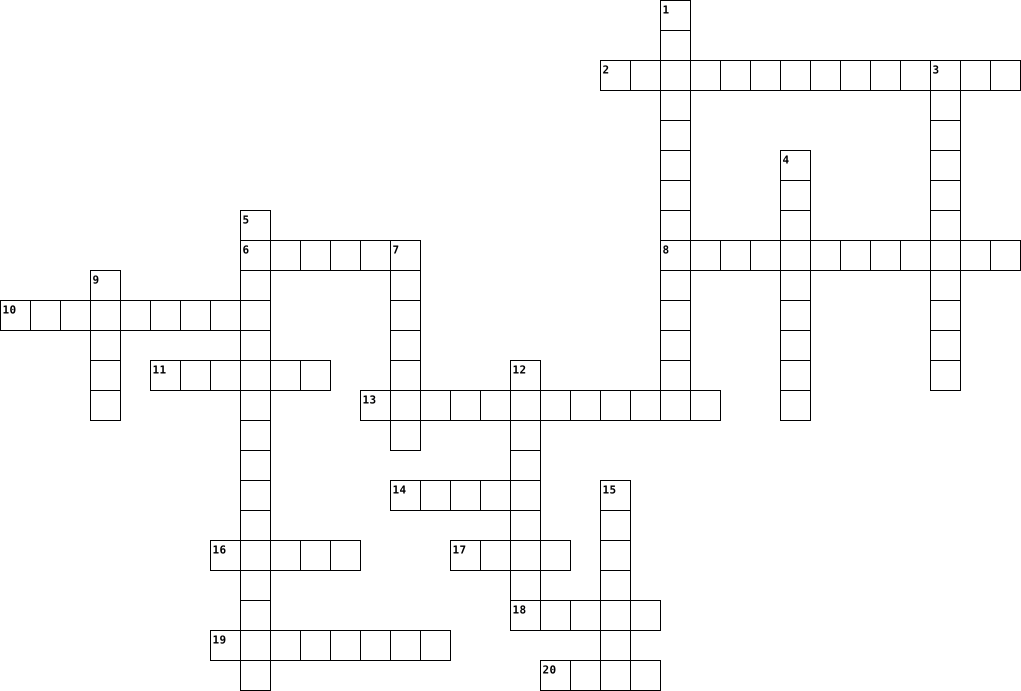
Across
- Last phase of the moon
- Planet with the most rings
- Region between Mars and Jupiter
- Galaxy with no specific shape
- Coldest Planet
- When the moon covers the sun
- Large balls of gas in space
- Was considered a planet
- Earth has one, comes out at night
- Smallest Planet
- Our galaxy
- Center of a star
Down
- Patterns of stars in space
- Number of regions in the sky
- Person who travels in space
- Measure of distance in space
- First phase of the moon
- Hottest Planet
- Instrument that collects light from space
- Biggest Planet
20 Clues: Our galaxy • Hottest Planet • Coldest Planet • Biggest Planet • Smallest Planet • Center of a star • Last phase of the moon • First phase of the moon • Was considered a planet • Patterns of stars in space • Planet with the most rings • Person who travels in space • Large balls of gas in space • Number of regions in the sky • Measure of distance in space • When the moon covers the sun • ...
Chapter 27 Vocabulary 2023-03-20

Across
- process that links separate telescopes so they act as one telescope, producing more detailed images as the distance between them increases.
- dark-colored, smooth plains on the Moon surface.
- the state at which the Moons orbital and rotational periods are equal.
- when Earth passes between the Sun and the Moon, and Earths shadow falls on the Moon; occurs only during a full moon,
- layer of loose, ground-up rock on the lunar surface.
- telescope that uses mirrors to focus visible light.
- time of year during which Earth's axis does not point directly toward the Sun; both hemispheres receive exactly 12 hours of sunlight.
- plane of Earth’s orbit around the Sun.
Down
- light-colored, mountainous, heavily cratered area of the Moon, composed mostly of lunar Breccias.
- closest point in the Moon’s elliptical orbit to Earth.
- percentage of sunlight that is reflected by the surface of a planet or a satellite, such as the Moon.
- all types of electro- magnetic radiation arranged according to wave- length and frequency.
- valley-like structure that meanders across some regions of the Moons Maria.
- material that falls back to the lunar surface after being blasted out by the impact of a space object.
- crater formed when space material impacted on Moons surface.
- farthest point in the Moons elliptical orbit to Earth.
- long trail of ejecta that radiates outward from a Moon crater.
- telescope that uses lenses to focus visible light.
- when the Moon passes between Earth and the Sun and the Moon casts a shadow on Earth, blocking Earth's view of the Sun; can be partial or total.
- the Sun is overhead at its farthest distance either north or south of the equator.
20 Clues: plane of Earth’s orbit around the Sun. • dark-colored, smooth plains on the Moon surface. • telescope that uses lenses to focus visible light. • telescope that uses mirrors to focus visible light. • layer of loose, ground-up rock on the lunar surface. • closest point in the Moon’s elliptical orbit to Earth. • farthest point in the Moons elliptical orbit to Earth. • ...
Moons of Saturn 2023-02-17

Across
- natural satellite in the Solar System.
- Atmosphere of titan is……..
- fifth largest moon.
- the only known object in space other than Earth on which clear evidence of stable bodies of surface liquid has been found.
- an Earth-like hydrological cycle of methane clouds, rain, and liquid flowing across the surface to fill lakes and seas.
- active moon that hides a global ocean of liquid salty water beneath its crust.
- Giovanni Domenico Cassini discovered Saturn's fifth-largest moon on March 11, 1684.
- moon of Saturn (19th largest in the Solar System).
- have significant amounts of phosphorus in its ocean.
- matter from the cloud of gas and dust left over from our sun's formation.
- moon is 4.56 billion years old.
Down
- cratered and contains cracks caused by faults in the ice.
- that it is composed almost entirely of water-ice.
- British astronomer William Herschel spotted a moon orbiting Saturn on 28 August 1789.
- planet’s mass is composed mainly of water in the form of ice and rocky material.
- than the planet mercury. (Larger/Smaller)
- mission and became the first spacecraft to land on Titan.
- Dutch astronomer Christiaan Huygens discovered Saturn's largest moon, on March 25, 1655.
- atmosphere is made mostly of nitrogen like Earth's but with a surface pressure 50 percent higher than Earth's.
- carbon, hydrogen, nitrogen, and oxygen.
- surface temperature is extremely cold, about minus 330 degrees Fahrenheit
- day on This moon is equal to 1.37 Earth days, or one day, 8 hours, and 53 minutes.
- covered by fresh, clean ice, making it one of the most reflective bodies of the Solar System.
- no magnetic field.
- Noted feature of the moon tethys (Two Words)
- is about 500 kilometers (310 miles) in diameter, about a tenth of that of Saturn's largest moon.
26 Clues: no magnetic field. • fifth largest moon. • Atmosphere of titan is…….. • moon is 4.56 billion years old. • natural satellite in the Solar System. • carbon, hydrogen, nitrogen, and oxygen. • than the planet mercury. (Larger/Smaller) • Noted feature of the moon tethys (Two Words) • that it is composed almost entirely of water-ice. • ...
Earth's Motion 2025-02-03

Across
- - the tendency of an object to not want to change its motion
- - the movement around an object
- - the longest daytime hours of the year for the northern hemisphere
- - the study of space
- - the highest high tides, the moon. earth and the sun are all lined up in a straight line
- - divisions of the year (spring, summer, autumn, and winter) marked by particular weather patterns and daylight hours, resulting from the earth's changing position concerning the sun.
- - the force that pulls object towards each other
- - the imaginary line that the sun hits directly during the summer solstice
- - the shapes of the moon visible to earth from the reflection of the sun
- - the lowest high tide, the moon earth and sun are at a 90 angle to each other
- - when the light from the sun on the moon is increasing
- - the shape an object takes as it goes around another object
Down
- - the imaginary line that the sun hits directly during the winter solstice
- - the the earth blocks the sunlight from hitting the moon and the moon falls into the earth's shadow
- - the longest night time hours of the year for the northern hemisphere
- - the spinning around an imaginary axis
- - an imaginary line the goes through the center of an object when it rotates
- - the days with Paul day and night hours
- - when the moon covers then sun and the shadow of the moon falls onto earth
- - the dark shadow of an eclipse which cause a total eclipse
- - when the moon is having the shadow get bigger
- - the lighter shadow during an eclipse which cause a partial eclipse
- - an imaginary line the cuts the earth into equal northern and southern hemispheres
23 Clues: - the study of space • - the movement around an object • - the spinning around an imaginary axis • - the days with Paul day and night hours • - when the moon is having the shadow get bigger • - the force that pulls object towards each other • - when the light from the sun on the moon is increasing • - the dark shadow of an eclipse which cause a total eclipse • ...
Grade 9 Astronomy 2020-11-01

Across
- Another name for a terrestrial planet is ______
- The study of space
- There are lots of these between Mars and Jupiter
- The plant with the smallest orbital period
- Another name for a shooting star
- This motion causes the seasons
- Jupiter, Saturn and Uranus are made of ______
Down
- When the moon is between the Earth and Sun
- A large hole-like shape on the Moon
- The name for a 3/4 moon
- The planet that moves the slowest
- The name of our galaxy is the ______ Way
- The Earth's __________ causes day/night
- This term means the moon is growing
- The _____ moon is at the start of the moon cycle
- The orbital period of this planet is 365 days
- The distance between the Sun and Earth
- The largest star in our solar system
18 Clues: The study of space • The name for a 3/4 moon • This motion causes the seasons • Another name for a shooting star • The planet that moves the slowest • A large hole-like shape on the Moon • This term means the moon is growing • The largest star in our solar system • The distance between the Sun and Earth • The Earth's __________ causes day/night • ...
Moon Vocabulary 2023-11-06

Across
- creciente, crescente, অর্ধচন্দ্র , kwasan, croissant
- luz,বাতি, limyè, lumière
- causa, কারণ , koz, cause
- Disminuir, diminuir, হ্রাস, diminye, diminuer
- después, depois, পরে , apre, après
- Crecer, crescer, হত্তয়া , grandi, grandir
- Reflejar, refletir, প্রতিফলিত করা, reflete, refléter
- Próximo, siguiente, পরবর্তী , pwochen, suivant
Down
- Etapa, fase, পর্যায়, faz, phase
- Cuarto, trimestre, চতুর্থাংশ , trimès, quart
- Aumentar, aumentar, বৃদ্ধি, ogmante, augmenter
- Lunar, চন্দ্র, linè, lunaire
- Ciclo, সাইকেল, sik, faire du vélo
- Sombra, ombra, ছায়া, lonbraj, ombre
- patrón, padrão, প্যাটার্ন , modèl, modèle
- Primero, primeiro, প্রথম, premye, d'abord
16 Clues: luz,বাতি, limyè, lumière • causa, কারণ , koz, cause • Lunar, চন্দ্র, linè, lunaire • Etapa, fase, পর্যায়, faz, phase • Ciclo, সাইকেল, sik, faire du vélo • después, depois, পরে , apre, après • Sombra, ombra, ছায়া, lonbraj, ombre • patrón, padrão, প্যাটার্ন , modèl, modèle • Primero, primeiro, প্রথম, premye, d'abord • Crecer, crescer, হত্তয়া , grandi, grandir • ...
Blood Moon 2025-03-12

Across
- What it it called when a punishment comes from a strong position?
- What element rules Jupiter?
- What rules the 12th house?
- Strength is doing what is right, despite your....?
- What does life put in front of us?
- The two ways of exerting one's strength are pulling up and...?
- advice does the Goddess give us? Strong
- What do you lead with?
- If you are not able to be in control of yourself, you cannot be in control of what?
Down
- What do we need to put into place?
- What is the full moon in March called?
- Strength is shown by what?
- When a person feels threatened it's not real strength but is?
- When Mercury is retrograded remain..?
- Discipline over power creates?
- You should never cast when...?
16 Clues: What do you lead with? • Strength is shown by what? • What rules the 12th house? • What element rules Jupiter? • Discipline over power creates? • You should never cast when...? • What do we need to put into place? • What does life put in front of us? • When Mercury is retrograded remain..? • What is the full moon in March called? • advice does the Goddess give us? Strong • ...
Amplify: Earth Moon and Sun 2023-01-27

Across
- the border between light and dark on the Moon
- a rocky sphere that travels around the planet
- moon a moon phase in which the Moon is not visible from Earth
- moon a moon phase that looks like a half circle from Earth
- moon a moon phase that looks like more than half a circle from Earth
- the relative size of things
- phase the shape of the illuminated part of the Moon as it appears from Earth
Down
- something we observe to be similar over and over again
- eclipse when the Moon is completely dark
- to shine light on an object and make it visible
- the nearly circular path a smaller object travels around a larger object
- moon a moon phase that looks like a full moon
- the star that is the main source of light at the center of our solar system
- an object, diagram or computer program that helps us understand something by making it simpler or easier to see
14 Clues: the relative size of things • eclipse when the Moon is completely dark • the border between light and dark on the Moon • a rocky sphere that travels around the planet • moon a moon phase that looks like a full moon • to shine light on an object and make it visible • something we observe to be similar over and over again • ...
SSE - Extra Credit - Vocabulary Crossword (a-h) 2024-02-02

Across
- a planet that orbits a star outside of our solar system
- an image that helps you understand information
- an imaginary line that goes through the North Pole and South Pole of the Earth
- the amount of space between two things
- describes when there is a lot of visible light; the opposite of dim
- moon phase when the Moon looks like a little less than a full circle
- describes when there is not a lot of visible light; the opposite of bright
- a number that you get when you add up a set of numbers and then divide by how many numbers there are in that set
- moon phase when the Moon looks like a circle
- a set of events that repeats in the same order over and over
- a push or a pull
- a type of gas that plants sometimes take in and that animals release when they breathe
- the distance around a circle
- moon phase when the Moon looks like half of a circle
- a place with conditions where a living thing can survive
Down
- to separate into smaller parts or groups
- a group of stars in the night sky that form a pattern
- the air that surrounds a planet
- one of four main directions; if you are facing north, it is to the right
- a scientist who studies outer space
- the area around a star that is not too hot or too cold for liquid water to exist
- an invisible force that pulls any object down, toward the center of a planet, moon, or other object
- moon phase when the Moon looks like a sliver
- the third planet from the Sun in our solar system
- a rocky object in outer space
25 Clues: a push or a pull • the distance around a circle • a rocky object in outer space • the air that surrounds a planet • a scientist who studies outer space • the amount of space between two things • to separate into smaller parts or groups • moon phase when the Moon looks like a circle • moon phase when the Moon looks like a sliver • ...
planets & moons 2025-03-23

Across
- very reflective, smooth icy moon with cryovolcanoes
- largest object with an aphelion exceeding 1000 AU
- lowest density of any major moon
- first known object to have rings outside the roche limit
- surface area almost equal to texas & has one of the most varied topographies
- only moon with a thicker atmosphere than earth's
- first trans-neptunian object discovered to have rings
- hottest object that could have permanent ice
- most heavily cratered object
- larger object in the largest binary system
- known as the "death star moon" with a large crater
- most volcanic moon
- has 2 trojan/co-orbital moons along with itself, more massive than all smaller moons combined
- object with strongest winds
- second largest plutino
- object with largest impact basin (crater)
Down
- first trans-neptunian object named after a chinese diety
- object with largest storm
- most toxic atmosphere on a terrestrial object
- largest rings on a planet
- object only 4x the size of its only moon
- smaller of the two potato moons, very low albedo
- smallest body with precise measurements confirming hydrostatic equilibrium
- first discovered asteroid belt object
- second brightest kuiper belt object
- biggest moon
- #1 spot for the search for extraterrestrial life
- larger of the two potato moons, will form a ring in 40 million years
- first object discovered with a telescope
- similar mass to earth's hydrosphere, has roughly equal parts ice & non-ice
- has one hemisphere much darker than the other, has third tallest mountain
- closest moon to the sun
- largest object never visited with a spacecraft
33 Clues: biggest moon • most volcanic moon • second largest plutino • closest moon to the sun • object with largest storm • largest rings on a planet • object with strongest winds • most heavily cratered object • lowest density of any major moon • second brightest kuiper belt object • first discovered asteroid belt object • object only 4x the size of its only moon • ...
Bonnie's Space Crossword 🛰️🌌☄️🚀👩🚀 2023-10-19

Across
- ___ is more intense and heats the surface more quickly than indirect sunlight
- 366 days
- The galaxy in which the Solar System is located
- Half sphere
- full moon, half moon, crescent moon
- Example : Lunar and Solar
- Earth takes 24 hours to rotate once on its axis
- A planet made up mostly of rock and metal
- A moon that brings werewolfs to the light
Down
- Man made object that orbits planets
- Just before a new moon there is a ___
- The hottest season
- Example : Uranus and Neptune
- The coldest season
- Summer, Winter, autumn, spring
- Example :Jupiter and Saturn
- The sun is a ___
- Example: The Milky Way
- The ___ divides the Earth into northern and southern hemispheres.
19 Clues: 366 days • Half sphere • The sun is a ___ • The hottest season • The coldest season • Example: The Milky Way • Example : Lunar and Solar • Example :Jupiter and Saturn • Example : Uranus and Neptune • Summer, Winter, autumn, spring • Man made object that orbits planets • full moon, half moon, crescent moon • Just before a new moon there is a ___ • ...
year 7 science revision 2022-11-17

Across
- Caused by variations in hours of daylight
- days are getting longer and warmer
- Half a globe
- smaller amount of visible moon (not new)
- moon is on the day side of earth
- moon is getting brighter
Down
- moon is getting less bright
- when the moon casts a shadow on the earth
- bigger chunk of moon visible (not full moon)
- moon is on the night side of earth
- when the earth casts a shadow on the moon
- days are getting shorter and cooler
- days can be 24 hours during summer here
13 Clues: Half a globe • moon is getting brighter • moon is getting less bright • moon is on the day side of earth • days are getting longer and warmer • moon is on the night side of earth • days are getting shorter and cooler • days can be 24 hours during summer here • smaller amount of visible moon (not new) • Caused by variations in hours of daylight • ...
Phases of Matter 2025-09-01

Across
- Energy that is transferred of from warmer things to cooler things
- State of matter that has a definite shape and definite volume
- Phase change in which a solid is converted directly to a gas
- A type of reaction that releases energy to its surroundings
- Phase change in which a liquid turns into a solid
- A physically distinctive form of matter, like solids, liquids, and gases
- State of matter that does not have a definite volume and shape
- The temperature at which a substance changes from a solid to a liquid
- Phase change in which a liquid turns into a gas
- Phase change in which a gas turns into a liquid
Down
- Phase change in which a gas is converted directly to a solid
- Phase change in which a solid turns into a liquid
- State of matter that has a definite volume but does not have a definite shape State of matter that has a definite shape and definite volume
- Anything that has mass and takes up space
- The temperature at which a substance changes from a liquid to a gas
- Physical change in the state of matter from one state to another
- A type of reaction that absorbs energy from its surroundings
17 Clues: Anything that has mass and takes up space • Phase change in which a liquid turns into a gas • Phase change in which a gas turns into a liquid • Phase change in which a solid turns into a liquid • Phase change in which a liquid turns into a solid • A type of reaction that releases energy to its surroundings • ...
Landing On The Moon 2013-02-11

Across
- What do you have to climb down to get on the moon?
- A space launch
- Which flag did the first man on the moon put on the moon?
- What was the spaceflight called?
- What was the date they landed?
- What only comes out at night?
- When you go in space there is no......
Down
- What did the first man on the moon run out of?
- Who was with the first man on the moon?
- Who was the first man on the moon?
- What is your job called if you go in space?
- What month did the first man on the moon get to the moon?
- Finsh the quote what Neil armstrong said "one gaint leap for...."
- How do you get to space?
14 Clues: A space launch • How do you get to space? • What only comes out at night? • What was the date they landed? • What was the spaceflight called? • Who was the first man on the moon? • When you go in space there is no...... • Who was with the first man on the moon? • What is your job called if you go in space? • What did the first man on the moon run out of? • ...
Facts about the Earth, Sun, and Moon 2015-12-06

Across
- The first man to walk on the Moon
- The only planet known to have life
- The Moon uses this to affect the tides of the ocean
- The Earth, Sun, and Moon live here
- Our Sun is this kind of star
- This does not exist on the Moon
- Transmits data to Earth
Down
- The moon does this around the Earth every 29 days
- Occurs when the Moon is between the Sun and Earth
- The moon has 1/6th of this compared to the Earth
- Occurs when Earth is between the Sun and Moon
- The sun is one of these
- The center of the solar system
- Earth is the _______ planet from the Sun
- Our solar system is found in this part of the universe
15 Clues: The sun is one of these • Transmits data to Earth • Our Sun is this kind of star • The center of the solar system • This does not exist on the Moon • The first man to walk on the Moon • The only planet known to have life • The Earth, Sun, and Moon live here • Earth is the _______ planet from the Sun • Occurs when Earth is between the Sun and Moon • ...
PHASES OF MATTER 2017-03-07

Across
- the motion of molecules in a liquid
- matter w/no definite shape, but definite volume
- my science teacher
- matter changing it's state or phase
- liquid to a gas (at the surface)
- liquid to a gas
- solid to a gas
- gas to a solid
Down
- matter w/definite shape & definite volume
- the motion of molecules in a solid
- anything that has mass and takes up space
- the motion of molecules in a gas
- gas to a liquid
- matter w/no definite shape and no definite volumne
- solid to a liquid
- liquid to a solid
- liquid to a gas (below the surface)
17 Clues: solid to a gas • gas to a solid • gas to a liquid • liquid to a gas • solid to a liquid • liquid to a solid • my science teacher • the motion of molecules in a gas • liquid to a gas (at the surface) • the motion of molecules in a solid • the motion of molecules in a liquid • matter changing it's state or phase • liquid to a gas (below the surface) • ...
Phases of Matter 2023-05-02

Across
- Energy that is transferred of from warmer things to cooler things
- State of matter that has a definite shape and definite volume
- Phase change in which a solid is converted directly to a gas
- A type of reaction that releases energy to its surroundings
- Phase change in which a liquid turns into a solid
- A physically distinctive form of matter, like solids, liquids, and gases
- State of matter that does not have a definite volume and shape
- The temperature at which a substance changes from a solid to a liquid
- Phase change in which a liquid turns into a gas
- Phase change in which a gas turns into a liquid
Down
- Phase change in which a gas is converted directly to a solid
- Phase change in which a solid turns into a liquid
- State of matter that has a definite volume but does not have a definite shape
- Anything that has mass and takes up space
- The temperature at which a substance changes from a liquid to a gas
- Physical change in the state of matter from one state to another
- A type of reaction that absorbs energy from its surroundings
17 Clues: Anything that has mass and takes up space • Phase change in which a liquid turns into a gas • Phase change in which a gas turns into a liquid • Phase change in which a solid turns into a liquid • Phase change in which a liquid turns into a solid • A type of reaction that releases energy to its surroundings • ...
Man on the Moon 2023-04-17

Across
- A person who is trained to travel in a spacecraft
- The first person to set foot on the moon
- A vehicle designed to travel in space, such as a rocket or a spaceship
- The act of landing a spacecraft on the surface of the moon
- A depression on the surface of the moon, often formed by the impact of a meteorite
- The astronaut who stayed in the spacecraft in orbit around the moon during the Apollo 11 mission
Down
- The spacecraft used to land on the moon during the Apollo missions
- The type of rocket used to launch the Apollo spacecraft into space
- The location on the moon where the Apollo 11 mission landed
- The second person to set foot on the moon
- The act of walking on the surface of the moon
- The vehicle used to explore the moon's surface during the later Apollo missions
- A rock that was collected from the surface of the moon during the Apollo missions
- The name of the lunar module that landed on the moon during the Apollo 11 mission
- The mission that first landed humans on the moon
15 Clues: The first person to set foot on the moon • The second person to set foot on the moon • The act of walking on the surface of the moon • The mission that first landed humans on the moon • A person who is trained to travel in a spacecraft • The act of landing a spacecraft on the surface of the moon • The location on the moon where the Apollo 11 mission landed • ...
Q1 Reflection 2025-10-30

Across
- This is a huge collection of gas, dust, dark matter, stars, and solar systems
- This is the remains of ancient organisms preserved in rock
- The time it takes for the Earth to complete a full rotation
- This is only possible because of both Earths tilt and the revolution of Earth around the Sun
- Another name for this is Terrestrial
- This was originally formed from dust and gas
- This doesn't happen every month because of the Moons wobble while orbiting Earth
Down
- Caused by the Moon's gravitational pull on Earth's oceans
- An object moving around another
- Another name for this is Jovian
- The effect of this force depends on mass and distance
- The Moon has 8 __ because of the unlit side appearing to move from Earth
- A law that says that in undisturbed land the youngest strata will be on top and the oldest strata will be on the bottom
- This type of fossil has to be widespread, short lived, and Easily recognizable
- the time it takes for Earth to complete a revolution around the Sun
- An object spinning on its axis
16 Clues: An object spinning on its axis • An object moving around another • Another name for this is Jovian • Another name for this is Terrestrial • This was originally formed from dust and gas • The effect of this force depends on mass and distance • Caused by the Moon's gravitational pull on Earth's oceans • This is the remains of ancient organisms preserved in rock • ...
Alphabet 2023-06-15

Across
- A collection of written or printed pages bound together. Books can contain stories, information, or pictures and are read for learning or entertainment.
- A head covering that can be worn for protection, fashion, or ceremonial purposes. Hats come in different shapes, sizes, and materials.
- A musical instrument with six strings played by strumming or plucking. Guitars are versatile and can be used to play various genres of music.
- A large, herbivorous mammal with a long trunk, tusks, and big ears. Elephants are known for their intelligence, social behavior, and size.
- A structure built by birds or other animals to protect and raise their offspring. Nests are usually made from twigs, leaves, and other materials found in the environment.
- A popular Italian dish consisting of a round, flat bread topped with sauce, cheese, and various toppings. Pizza is baked until the cheese melts and the crust is crispy.
- A vast body of saltwater that covers a significant portion of the Earth's surface. Oceans are home to diverse marine life and play a crucial role in the planet's climate system.
Down
- The reproductive structure of a plant, often brightly colored and fragrant. Flowers are responsible for producing seeds and are commonly used in bouquets or gardens for their beauty.
- A lightweight object made of fabric or paper that is flown in the air using wind. Kites have strings and a frame to keep them stable in flight.
- A garment worn on the upper body for warmth or fashion. Jackets come in different styles and materials and often have sleeves and a front opening.
- A domesticated mammal and one of the most popular pets. Dogs are known for their loyalty, companionship, and ability to be trained for various tasks.
- A large, carnivorous mammal of the cat family. Lions are known for their majestic appearance, strength, and being the "king of the jungle."
- Cream A frozen dessert made from dairy products, sweeteners, and various flavors. Ice cream is a popular treat enjoyed in cones, cups, or as toppings.
- A round fruit with red, green, or yellow skin and a crisp texture. Apples are often used in pies, salads, and juices.
- A small domesticated carnivorous mammal with soft fur, a short snout, and retractable claws. Cats are commonly kept as pets and are known for their independence and agility.
- The natural satellite of the Earth, visible in the night sky. The moon reflects sunlight and goes through phases, from new moon to full moon and back.
16 Clues: A round fruit with red, green, or yellow skin and a crisp texture. Apples are often used in pies, salads, and juices. • A head covering that can be worn for protection, fashion, or ceremonial purposes. Hats come in different shapes, sizes, and materials. • ...
Space Crossword Puzzle 2023-01-24

Across
- huge rotating collection of gas, dust, and billions of stars, planets, and other celestial objects
- large, round celestial object that travels around a star, dominates its orbit, and has the shape of a sphere
- celestial object that orbits the Sun and has a spherical shape but does not dominate its orbit
- extremely dense quantity of matter in space from which no light or matter can escape
- darkening of a celestial object due to the positioning of another celestial object
- the scientific study of what is beyond Earth
- everything that exists, including all energy, matter and space
- all of the phases of the moon
- producing and giving off light
- massive collection of gases held together by its own gravity and emitting huge amounts of light energy
- chunk of ice and dust that travels in a very long orbit around the Sun
Down
- any object that exists in space
- approximately 150 million kilometres
- the brightness of stars in the night sky as they appear from Earth
- the brightness of stars as if they were all located 33 ly away from Earth
- closed path of a celestial object as it travels around another celestial object
16 Clues: all of the phases of the moon • producing and giving off light • any object that exists in space • approximately 150 million kilometres • the scientific study of what is beyond Earth • everything that exists, including all energy, matter and space • the brightness of stars in the night sky as they appear from Earth • ...
Moon Crossword 2019-02-11

Across
- phase How the moon appears to us on earth
- A force that ties to pull 2 objects towards each other.
- Half of the moon
- The majority of the moon's light is being shown
- Turning off
- eclipse an eclipse in which the moon appears darkened as it passes into the earth's shadow.
- moon In between the earth and the sun
- How one object moves around another
Down
- tide Comes between a 1st and 3rd quarter moon.(low change in water level)
- Brighten with light
- Very little of the moon's light is being shown
- tide Comes between a full and new moon.(high change in water level)
- moon A phase in which all of the moon is lit up
- Turning on
14 Clues: Turning on • Turning off • Half of the moon • Brighten with light • How one object moves around another • moon In between the earth and the sun • phase How the moon appears to us on earth • Very little of the moon's light is being shown • moon A phase in which all of the moon is lit up • The majority of the moon's light is being shown • ...
Lunar Cycle Crossword Puzzle 2022-03-03

Across
- another word for orbit
- When most but not all of the left side of the moon is visible
- when the entire moon is visible
- when only a "toenail" on the left side of the moon is visible
- when the entire right half of the moon is shown
- to rotate or turn
Down
- the center of the milky way galaxy
- what orbits around the earth
- when the entire left side of the moon is visible
- when most but not all of the right side of the moon is visible
- 4 different times of the year with different weathers
- A "toenail" shown on the right side of the moon
- when the moon appears to be missing
- What makes earth tilt on its side
14 Clues: to rotate or turn • another word for orbit • what orbits around the earth • when the entire moon is visible • What makes earth tilt on its side • the center of the milky way galaxy • when the moon appears to be missing • A "toenail" shown on the right side of the moon • when the entire right half of the moon is shown • when the entire left side of the moon is visible • ...
The Universe 2022-11-16

Across
- - atmosphere
- - hottest
- - largest
- -pattern
- - invisible
Down
- - shapes
- - Hubbles Space Telescope
- -holes
- - heavenly
- - path
10 Clues: -holes • - path • - shapes • -pattern • - hottest • - largest • - heavenly • - invisible • - atmosphere • - Hubbles Space Telescope
Moon Facts 2021-09-02

Across
- Last name of the first man who walked on the moon
- It takes about 28 days for the moon to ______ around Earth.
- The moon has ______, valleys and old volcanoes.
- moon is moving ________ from Earth
- The moon is Earth's only natural _________.
- The side of the moon we can see
Down
- The moon has _________ that cause cracks in the moon
- The moon has no _________.
- The _____ is what gives the moon it's light
- Something that revolves around Earth
- The side of the moon we cannot see
- The moon causes _________
- You would weigh _______ on the moon.
13 Clues: The moon causes _________ • The moon has no _________. • The side of the moon we can see • The side of the moon we cannot see • moon is moving ________ from Earth • Something that revolves around Earth • You would weigh _______ on the moon. • The _____ is what gives the moon it's light • The moon is Earth's only natural _________. • ...
All About the Moon 2022-06-20

Across
- The moon is covered by ____, as well as dust from comets and asteroids.
- The moon reflects light coming from the _____.
- It is 238,855 miles away from the moon.
- The moon rotates on it's own ____.
- What is tucked away in craters near the moon's poles.
- Neil Armstrong and Buzz Aldrin are _____. They were the first people to set foot on the moon on July 20, 1969.
- This can be seen with a naked eye.
- The astronauts conducted ____ and installed equipment while on the moon.
Down
- People used their observations of the Moon to create ______.
- The moon is Earth's only natural ______.
- Latin word for "seas".
- The moon has almost no atmosphere and only about one-sixth of the Earth's _____.
- Today, we study the moon using ______.
13 Clues: Latin word for "seas". • The moon rotates on it's own ____. • This can be seen with a naked eye. • Today, we study the moon using ______. • It is 238,855 miles away from the moon. • The moon is Earth's only natural ______. • The moon reflects light coming from the _____. • What is tucked away in craters near the moon's poles. • ...
Ancient Mesopotamia 2023-11-01

Across
- The first known writing system, cutting marks into damp clay with a sharp reed.
- A complex society with advanced social and cultural development.
- A region in the Middle East, including Mesopotamia, known for its fertile land and crescent shape.
- People who study stars, planets, and phases of the moon.
- Plants cultivated for food, such as wheat, barley, and dates, which were important in ancient Mesopotamia.
- Someone who writes for a living.
- The two main rivers that flow through Mesopotamia, providing water and fertile soil for agriculture.
- Greek word that means “the land between the rivers"
Down
- The practice of cultivating soil, growing crops, and raising livestock for food.
- The sixth king of Babylon, known for creating one of the earliest known written legal codes.
- a large temple in the middle of the city-states, intended to honor its God.
- A group of many different lands under one ruler.
- Digging canals to let water flow from the rivers to their fields.
- Places that have its own government, and was not part of any larger governing state.
- Fine particles of soil and sediment carried by rivers and deposited during flooding, providing nutrients for crops.
- Worship of many gods and/or goddesses
16 Clues: Someone who writes for a living. • Worship of many gods and/or goddesses • A group of many different lands under one ruler. • Greek word that means “the land between the rivers" • People who study stars, planets, and phases of the moon. • A complex society with advanced social and cultural development. • ...
The Space Race 2025-03-01

Across
- – "Apollo 11's landing module"
- – "NASA's moon program"
- – "Moon-related"
- – "Rocket series for moon missions"
- – "The universe, in Russian"
- – "NASA program before Apollo"
- – "Soviet spacecraft series"
- – "First satellite in space"
Down
- – "Second man on the moon, Buzz"
- – "Apollo 11’s destination"
- – "Path around a planet"
- – "First moonwalker, Neil"
- – "Astronaut’s space vehicle"
- – "First man in space, Yuri"
- – "US space agency"
15 Clues: – "Moon-related" • – "US space agency" • – "NASA's moon program" • – "Path around a planet" • – "First moonwalker, Neil" • – "Apollo 11’s destination" • – "The universe, in Russian" • – "First man in space, Yuri" • – "Soviet spacecraft series" • – "First satellite in space" • – "Astronaut’s space vehicle" • – "Apollo 11's landing module" • – "NASA program before Apollo" • ...
Popular Diets 2021-01-26

Across
- a high-fat, adequate-protein, low-carbohydrate diet that in medicine is used mainly to treat hard-to-control epilepsy in children; diet forces the body to burn fats rather than carbohydrates.
- diet based on a points system
- high-protein, low-carb weight loss diet split into four phases — two weight loss phases and two maintenance phases; phases are primarily based on eating unlimited high-protein foods and mandatory oat bran
- emphasizes whole foods, lean protein, vegetables, fruits, nuts, and seeds, while discouraging processed foods, sugar, dairy, and grains; claims that you should eat the same foods that your hunter-gatherer ancestors ate before agriculture developed.
Down
- diet that provides around 30% of its calories as fat
- a way of eating based on the traditional cuisine of countries bordering the Mediterranean Sea;is typically high in vegetables, fruits, whole grains, beans, nut and seeds, and olive oil.
- a low-glycemic load diet that instructs its followers to stick to eating a specific ratio of 40% carbs, 30% protein and 30% fat
- eating high protein foods (meat, poultry, fish and eggs) and high-fat foods (cream, butter, cheese) you consume fewer calories. Carbohydrates and sugars such as bread, potatoes, rice, chocolate, chips, cereals and sugar are severely restricted.
- a lower-carb diet that emphasizes lean meats, unsaturated fats and low-glycemic-index carbs; has three different phases: two for weight loss and a third for weight maintenance.
- eliminates meat, dairy, eggs, and animal-derived products, such as gelatin, honey, albumin, whey, casein, and some forms of vitamin D3; consuming mostly vegetables
10 Clues: diet based on a points system • diet that provides around 30% of its calories as fat • a low-glycemic load diet that instructs its followers to stick to eating a specific ratio of 40% carbs, 30% protein and 30% fat • ...
Fly Me to the Moon Crossword 2024-02-16

Across
- The amount of successful missions to the Moon up until 2019
- The name of the planet that impacted with Earth to form the moon
- Where earth and other planets are orbiting the Sun
- The first manned mission to the Moon
- The center of the solar system
- The planet which the moon orbits
Down
- The moon is a _____ as wide as the Earth
- The first mission to the Moon
- A body of rock that orbits Earth
- The number of people that have walked on the Moon
- First successful American mission to the Moon was _______4
- About how many billion years ago the Moon was formed
- US Apollo missions that landed humans on the Moon and brought them back
13 Clues: The first mission to the Moon • The center of the solar system • A body of rock that orbits Earth • The planet which the moon orbits • The first manned mission to the Moon • The moon is a _____ as wide as the Earth • The number of people that have walked on the Moon • Where earth and other planets are orbiting the Sun • About how many billion years ago the Moon was formed • ...
Space Race 2026-06-04

Across
- race between USSR and U.S. to get the first man on the moon before the other
- Capitalist country
- Enlarged spacecraft (2 astronauts)
- Failed U.S. articifical satellite
- Agency focused on space exploration
- USSR leader during the Space Race
- Final Goal of the Space Race
Down
- Program by NASA to get humans on the moon
- "Intercontinental ballistic missile"
- Soviet Union satellite
- Communist Country
- Second person to be on the moon
- President of the U.S. during the Space Race
- First man on the moon
- Spaceflight that landed people on the moon
15 Clues: Communist Country • Capitalist country • First man on the moon • Soviet Union satellite • Final Goal of the Space Race • Second person to be on the moon • Failed U.S. articifical satellite • USSR leader during the Space Race • Enlarged spacecraft (2 astronauts) • Agency focused on space exploration • "Intercontinental ballistic missile" • Program by NASA to get humans on the moon • ...
Sun, Moon, and Earth 2023-05-05

Across
- A hot star full of hydrogen and helium
- An idea representing Earth in the middle of the solar system
- A more extensive viewing of the Moon
- A pull of gravity
- The act of rotating on an axis
- When a planet moves in the shadow of another planet
- When the sun shines on the moon but is shown as a semicircle
- All of space and its contents
- A smaller viewing of the Moon
- When the Sun, Moon, and Earth align which covers the Moon from Earth's shadow
- An oval-shaped path
- The curved shape in the waxing or waning moon
- When the ocean level decreases
- When a planet revolves around another planet
Down
- The distance between planets
- When the ocean level rises
- When an object in space rotates around a planet
- A division of the year based on Earth's rotation
- A period of moderate tides
- A force that pulls everything down on Earth
- A straight line that tells where the planet is rotating
- When the ocean level increases and decreases
- Different parts of the moon are shown based on the Sun's Revolution
- Ocean Level that stops at ground level
- The distance that light travels in one year
25 Clues: A pull of gravity • An oval-shaped path • When the ocean level rises • A period of moderate tides • The distance between planets • All of space and its contents • A smaller viewing of the Moon • The act of rotating on an axis • When the ocean level decreases • A more extensive viewing of the Moon • A hot star full of hydrogen and helium • Ocean Level that stops at ground level • ...
8th Grade Astronomical Science 2 (A Beka Book, Science: Earth and Space, pp. 310-329) 2017-04-28

Across
- the most volcanically active body in the solar system
- speediest planet
- two "new planets" that were later named dwarf planets
- the largest moon in the solar system
- the first new planet discovered
- Jupiter's four moons (Ganymede, Callisto, Io, & Europa)
- Mercury, Venus, Earth, & Mars
- Earth's only natural satellite
- Jupiter, Saturn, Uranus, & Neptune
- the second largest planet
- Mars's two moons
- the red planet
- the second largest moon and the only one that has a thick atmosphere
- the biggest storm seen on Jupiter
- what happens when a full moon passes through the earth's shadow
- has the fastest rotation of any planet
Down
- the largest known mountain in the solar system
- Neptune's largest moon; experiences the coldest known temperatures in the solar system
- planets that are made primarily of gas
- the "morning star" & "evening star"
- an object that revolves around another object
- the planet discovered mathematically before it was seen
- discovered Uranus
- moving backward, from east to west
- Latin for seas; the moon's dark patches
- what happens when a new moon gets between the earth and the sun, at least partially blocking the sun
- the lighter areas on the moon
- about 93,000,000 miles from the sun
28 Clues: the red planet • speediest planet • Mars's two moons • discovered Uranus • the second largest planet • Mercury, Venus, Earth, & Mars • the lighter areas on the moon • Earth's only natural satellite • the first new planet discovered • the biggest storm seen on Jupiter • moving backward, from east to west • Jupiter, Saturn, Uranus, & Neptune • the "morning star" & "evening star" • ...
Voyager Grand Tour of the Outer Planets 2025-10-30

Across
- The planets and their moons
- Picture sent back from space
- Referring to the outer planets
- Long voyage through space
- Field of study of the universe
- A celestial body's shape
- Ringed jewel of the solar system
- Volcanically active Jovian moon
- Sideways-rotating ice giant
- Feature of gas giants
- Largest moon in the solar system
- Famous astronomer, Sagan
- Moon of Uranus with strange terrain
- Spacecraft that explored outer planets
- Planetary atmospheric light show
- Maneuver to gain speed
- Saturn's largest moon with atmosphere
- Farthest planet in Grand Tour
Down
- Agency behind the mission
- Prefix for the sun's sphere of influence
- Great Red Spot on Jupiter
- Relating to a planet's magnetic field
- Neptune's largest, retrograde moon
- Geysers observed on Triton
- Robotic spacecraft type
- Icy moon of Jupiter
- To discover new things
- Largest planet visited first
- Narrator of "Cosmos"
- Predecessor mission to Jupiter
- Natural satellite of a planet
- Communication from spacecraft
- Phonograph disc aboard Voyager
- Material of the record carried
- Close approach to a celestial body
- Used for assist maneuvers
- Used to transmit and receive signals
- Information collected by spacecraft
- Type of giant planet
- Pertaining to our star system
40 Clues: Icy moon of Jupiter • Narrator of "Cosmos" • Type of giant planet • Feature of gas giants • To discover new things • Maneuver to gain speed • Robotic spacecraft type • A celestial body's shape • Famous astronomer, Sagan • Agency behind the mission • Great Red Spot on Jupiter • Long voyage through space • Used for assist maneuvers • Geysers observed on Triton • The planets and their moons • ...
Science 2020-02-11

Across
- When the Earth is closest to the sun
- What hot always goes to
- When the moon gets smaller
- When the moon gets larger
- The transfer of heat by the movement of warmed matter
- Moon is almost full
- The path the earth takes around the sun
- Our star in the solar system
- Has almost the same diameter as Earth.
- longest day of the year
- Caused by the Earth's tilt
- Uses electromagnetic rays
Down
- Equal amount of daylight and darkness
- The Earth turning
- transfer of energy by direct contact of objects with different temperatures
- What cold air does
- Moon is completely dark
- What hot air does
- When the Earth is tilted toward the sun
- Moon is just a sliver
- Number of days it takes the earth to make one revolution
21 Clues: The Earth turning • What hot air does • What cold air does • Moon is almost full • Moon is just a sliver • What hot always goes to • Moon is completely dark • longest day of the year • When the moon gets larger • Uses electromagnetic rays • When the moon gets smaller • Caused by the Earth's tilt • Our star in the solar system • When the Earth is closest to the sun • ...
All About Space 2024-05-28

Across
- Jupiter's largest moon.
- Where the Apollo missions were launched from.
- Layer of gases that surrounds the Earth.
- The large volcano on Mars.
- Person trained to be on a spacecraft.
- The closest planet to the Sun.
- First to walk on the moon.
- Planet that spins on its side.
- When the moon passes in front of the Sun.
- The sixth planet from the Sun.
- Program that took astronauts to the moon.
Down
- Our galaxy.
- Discovered most of the planets.
- This is known as a shooting star.
- The planet with the highest gravity.
- Where most space missions were/are controlled from.
- Natural satellite of the Earth.
- The hottest planet.
- Where people are currently living in space.
- Center of the solar system.
- Orbit around the sun takes 365 days.
21 Clues: Our galaxy. • The hottest planet. • Jupiter's largest moon. • The large volcano on Mars. • First to walk on the moon. • Center of the solar system. • The closest planet to the Sun. • Planet that spins on its side. • The sixth planet from the Sun. • Discovered most of the planets. • Natural satellite of the Earth. • This is known as a shooting star. • ...
Sept 2023 2023-09-19

Across
- Michigan's "Furniture City"
- End of summer shopping
- Uppercase
- Star system
- Michigan's first capital
- School subject
- Simple or grades K-5
- Cherry Capital
Down
- Plant Life
- Moon phase
- Script or longhand
- Also a moon phase
- Formal wear
- Numbers tool
- Study of organisms
- Animal life
- Artistic penmanship
- UP people
- Leafy green
- Cozy outfit
- Greenery
- Moon sliver
22 Clues: Greenery • UP people • Uppercase • Plant Life • Moon phase • Formal wear • Animal life • Leafy green • Cozy outfit • Star system • Moon sliver • Numbers tool • School subject • Cherry Capital • Also a moon phase • Script or longhand • Study of organisms • Artistic penmanship • Simple or grades K-5 • End of summer shopping • Michigan's first capital • Michigan's "Furniture City"
Eclipses 2025-09-18

Across
- path one celestial body takes around another.
- Eclipses/When the Earth passes between the Sun and the Moon, casting a shadow on the Moon.
- to the sky or outer space.
- scientific term for the alignment of three celestial bodies.
- outermost layer of the Sun visible during a total solar eclipse.
- Path/The narrow track on Earth where a total solar eclipse is visible.
Down
- straight-line positioning of the Sun, Moon, and Earth during an eclipse.
- lighter, outer part of the Moon’s shadow during an eclipse.
- darkest part of the Moon’s shadow during an eclipse.
- Eclipses/When the Moon passes between the Earth and the Sun, blocking sunlight.
- Moon/The phase of the Moon when lunar eclipses can occur.
- Moon/The phase of the Moon when solar eclipses can occur.
- dark area produced when an object blocks light.
- Eclipse/An eclipse where the Sun or Moon is completely covered.
- Eclipse/An eclipse where only part of the Sun or Moon is covered.
15 Clues: to the sky or outer space. • path one celestial body takes around another. • dark area produced when an object blocks light. • darkest part of the Moon’s shadow during an eclipse. • Moon/The phase of the Moon when lunar eclipses can occur. • Moon/The phase of the Moon when solar eclipses can occur. • lighter, outer part of the Moon’s shadow during an eclipse. • ...