
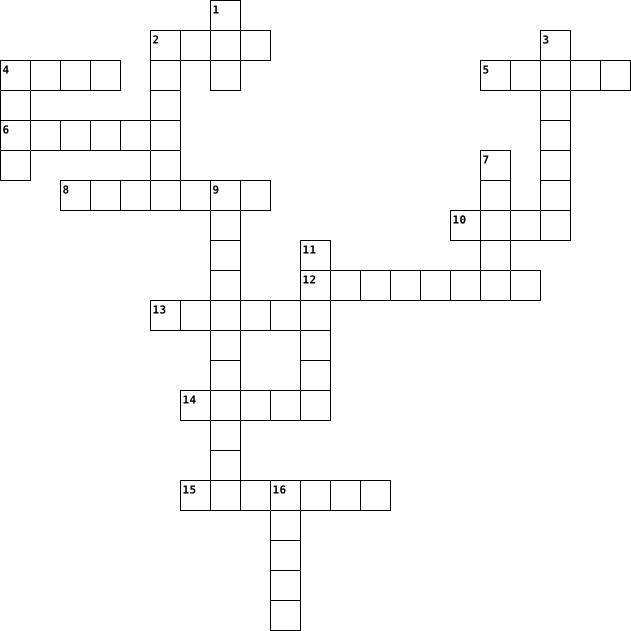
moon phases Crossword Puzzles
Final Exam: Semester 2 2020-04-27

Across
- model of the solar system with the sun in the center
- known as terrestrial planets; rocky, dense, and small
- type of currents caused by wind
- eclipse that occurs during a new moon when the moon creates a shadow on the earth
- forms on the ocean floor where two plates collide and one subducts; deepest part of the ocean
- occurs at night when cool air over the land replaces warm, rising air over the water
- layer of the atmosphere which contains the ozone layer
- causes waves
- where most water is found on earth
- occurs when warm moist air meets cool dry air; contains strong winds and thunderstorms
- known as gas giants; large atmospheres, many moons
- model of the solar system with the earth in the center
- one of the most abundant elements on ocean water; the othre is chlorine
- as depth in the ocean increases, density and salinity both __________
- small rocky body in space found mainly between mars and jupiter
- where most freshwater is located
- eclipse that occurs during a full moon when the earth creates a shadow on the moon
- type of currents caused by density
- moon phase when the moon is furthest from the sun
Down
- storm that uses warm ocean water as its fuel
- small body in space which contains ice and a dust tail
- causes earth to have seasons
- how much salt is in ocean water
- the change of liquid water to vapor by heating
- proposed the heliocentric model of the solar system
- the change of water vapor to liquid water by cooling
- without this force, our moon would fly off into space
- moon phase when the moon is closest to the sun
- occurs during the day when cool air over the water replaces warm, rising air over the land
- forms when there's an unstable atmosphere of warm rising air surrounded by cool sinking air
- created by the gravitational pull of the moon
- forms on the ocean floor where two plates pull apart; long underwater mountain chain
- the milky way is this type of galaxy
- proposed the geocentric model of the solar system
34 Clues: causes waves • causes earth to have seasons • how much salt is in ocean water • type of currents caused by wind • where most freshwater is located • where most water is found on earth • type of currents caused by density • the milky way is this type of galaxy • storm that uses warm ocean water as its fuel • created by the gravitational pull of the moon • ...
Wernher von Braun and The Space Race 2023-02-06

Across
- Wernher von braun prefered it over LOR
- The ship that would land people on the moon.
- The first man in space was Yuri ____.
- The rocket that got man to the moon.
- During most of the Space Race von Braun worked in _____.
- "We choose to go to the Moon in this decade and do other things, not because they are easy but because they are hard"-President ______.
Down
- Wernher von Braun was originally a(n) ______ scientist.
- The first satellite sent to space by the Russians.
- The month of the first landing on the moon.
- The place where the astronauts can be in space without a suit.
- The first person on the moon
- The third American space program and the first to land an astronauts on the moon.
- The first American space program.
- A natural satellite.
- The first American to orbit the Earth.
15 Clues: A natural satellite. • The first person on the moon • The first American space program. • The rocket that got man to the moon. • The first man in space was Yuri ____. • Wernher von braun prefered it over LOR • The first American to orbit the Earth. • The month of the first landing on the moon. • The ship that would land people on the moon. • ...
Sun, Earth, Moon 2024-05-01

Across
- no hay en la luna
- fase de la Luna cuando el área iluminada aumenta
- phase when less than half the Moon is seen
- spinning of a planet on its axis
- to shine light on an object and make it visible
- Adecuado o lo suficientemente bueno para vivir en o en
- una fase lunar en la que la Luna no es visible desde la Tierra
- passing of the Moon between Earth and the Sun
- El cuerpo celeste luminoso
Down
- phase of the Moon when the illuminated area decreases
- something we drink
- Orbita en Ingles
- una system con el sol y planetas
- phase when more than half the Moon is visible
- a moon phase that looks like a full circle from the Earth
- an eclipse in which the moon appears darkened as it passes into the earth's shadow.
- El satelite natural de la Tierra
17 Clues: Orbita en Ingles • no hay en la luna • something we drink • El cuerpo celeste luminoso • una system con el sol y planetas • spinning of a planet on its axis • El satelite natural de la Tierra • phase when less than half the Moon is seen • phase when more than half the Moon is visible • passing of the Moon between Earth and the Sun • ...
Lunar Cycle/Seasons 2021-05-09

Across
- Energy that is hitting the earth directly, bringing warmer tempatures
- The earth tilted away from the sun will bring this season
- Turning on it's axis
- The beginning of the lunar cycle
- Light on the right, looks like the letter D
- Moon is FULL of light
- Light is growing, BIG amount of light on the right side of the moon
Down
- Light is growing, small amount of light on the right side of the moon
- The earth tilted toward from the sun will bring this season
- Light on the left, half the moon is lit, the C in _DOC
- Light in Left, small amount of light on the left side of the moon
- Light in Left, BIG amount of light on the left side of the moon
- Energy that is hitting the earth indirectly, bringing cooler tempatures
- Going around another object
- "Rapper" that tells us the moon is losing light on the left
15 Clues: Turning on it's axis • Moon is FULL of light • Going around another object • The beginning of the lunar cycle • Light on the right, looks like the letter D • Light on the left, half the moon is lit, the C in _DOC • The earth tilted away from the sun will bring this season • The earth tilted toward from the sun will bring this season • ...
The Space Race: Apollo 11 (Slides) 2024-01-22

Across
- Russia and America have worked together in space exploration since which war ended?
- During the Apollo 11 mission, which astronaut remained in the command module?
- The first man to walk on the moon.
- One of the last men to walk on the moon.
- How many astronauts were killed when a fire broke out during a manned launch-pad test in 1967?
- Who was during the Apollo 11 mission?
- How long (in minutes) did it take Aldrin to join Armstrong on the moon after he took his first steps?
Down
- In July of 1969,the Eagle touched down on the edge of what?
- Where did the astronauts land when they returned to Earth?
- The number of Americans that have walked on the Moon.
- In March of 1969, Apollo 9 tested what for the first time in orbit?
- Who manned the lunar module with Neil Armstrong during the Apollo 11 mission?
- Where is the Kennedy Space Center located?
- What did our astronauts plant on the moon?
- How is the moon's surface described?
- Apollo 8 took three _____ to the dark side of the moon.
- John F. Kennedy's 1961 national goal was to beat who to the moon?
- Which Apollo mission was the first manned mission to successfully orbit the Earth?
18 Clues: The first man to walk on the moon. • How is the moon's surface described? • Who was during the Apollo 11 mission? • One of the last men to walk on the moon. • Where is the Kennedy Space Center located? • What did our astronauts plant on the moon? • The number of Americans that have walked on the Moon. • Apollo 8 took three _____ to the dark side of the moon. • ...
vocab 2023-11-16

Across
- Getting smaller
- division of the year because of Earth's rotation
- Furthest extent of the tide on a shoreline
- 19 years, when a new moon falls on the same day
- Phase of the moon when it is bulging, but not full
- an angled or sloped position
- very long-period waves that move through the ocean in response to the forces exerted by the moon and sun
- a tide just after a new or full moon, when there is the greatest difference between high and low water
- orbital motion around another object
- The Moon's sunlit proportion as seen from Earth
- Opposite of high tide
Down
- Pull of gravity
- Getting bigger
- "C" shaped moon
- half of a sphere
- spinning on an axis
- Moderate tide
- imaginary line on which a body rotates
18 Clues: Moderate tide • Getting bigger • Pull of gravity • Getting smaller • "C" shaped moon • half of a sphere • spinning on an axis • Opposite of high tide • an angled or sloped position • orbital motion around another object • imaginary line on which a body rotates • Furthest extent of the tide on a shoreline • 19 years, when a new moon falls on the same day • ...
Vocabulary Review 2025-04-03

Across
- book
- Bush
- Rock
- Picture
- Table
- Grass
- In
- Sky
- Moon
- On
Down
- Computer
- Chair
- Butterfly
- Map
- Pencil
- Eraser
- Sun
- Mountain
18 Clues: In • On • Map • Sky • Sun • book • Bush • Rock • Moon • Chair • Table • Grass • Pencil • Eraser • Picture • Computer • Mountain • Butterfly
CA2 Review! 2015-02-03

Across
- The unit for work
- A unit of length scientists use to describe distances in space
- A phase of the moon where the whole moon is illuminated by the sun
- The average distance between the Earth and the Sun
- When the moon appears to growing smaller
- A rapidly rotating storm system with a low pressure system in the middle that forms over the ocean
- The property of a substance which determines how quickly it heats up or cools down
- A phase of the moon where more than half of the moon is illuminated by the sun
- Our sun is currently in the _________ stage of its life
- The type of galaxy we live in
- A type of star that our sun will become next (in 5 billion years)
- The part of the Lunar Cycle when the moon isn't reflecting any of the Sun's light to Earth so it appears completely dark
- Part of the universe containing stars, planets, and nebulas
- The tides that occur when the moon is in its first quarter or third quarter
- The distance an object travels in a certain amount of time
Down
- The phase of the moons where less than half of it can be seen from Earth
- A push or a pull
- When a force is applied and an object moves a distance
- Found at the center of a hurricane
- A measurement that tells you speed and direction
- The part of the Lunar Cycle when the moon starts at New Moon and ends at Full Moon
- A term used to describe the 'brightness' of a star
- Speeding up, slowing down, or changing direction
- The overall force acting on an object. It contains magnitude (the number) and a direction
- The tendency of an object in motion to stay in motion or an object at rest to stay at rest
- The force that governs all motion in our universe
- The tides that are more extreme than usual (High tide is higher, low tide is lower)
- The source of convection currents in the ocean and air
- Clouds of dust and gas that can collapse to form stars
- The unit for force
30 Clues: A push or a pull • The unit for work • The unit for force • The type of galaxy we live in • Found at the center of a hurricane • When the moon appears to growing smaller • A measurement that tells you speed and direction • Speeding up, slowing down, or changing direction • The force that governs all motion in our universe • A term used to describe the 'brightness' of a star • ...
Astronomy 2023-01-20

Across
- dim small star
- small rock body
- system of stars, gas and dust
- force of attraction
- bowl shaped hole
- block the sun or moon
- study of celestial objects
- frozen leftover of solar system
- radioactive ray
- star pattern
- ordered universe
- start of universe
Down
- another word for outer space
- small planet
- 85% of universe
- first quarter moon
- intense gravity region
- Russian astronaut
- fully illuminated moon
- layer of sun
- black hole boundary
21 Clues: small planet • star pattern • layer of sun • dim small star • 85% of universe • small rock body • radioactive ray • bowl shaped hole • ordered universe • Russian astronaut • start of universe • first quarter moon • force of attraction • black hole boundary • block the sun or moon • intense gravity region • fully illuminated moon • study of celestial objects • another word for outer space • ...
Astronomy 2023-01-20

Across
- dim small star
- small rock body
- system of stars, gas and dust
- force of attraction
- bowl shaped hole
- block the sun or moon
- study of celestial objects
- frozen leftover of solar system
- radioactive ray
- star pattern
- ordered universe
- start of universe
Down
- another word for outer space
- small planet
- 85% of universe
- first quarter moon
- intense gravity region
- Russian astronaut
- fully illuminated moon
- layer of sun
- black hole boundary
21 Clues: small planet • star pattern • layer of sun • dim small star • 85% of universe • small rock body • radioactive ray • bowl shaped hole • ordered universe • Russian astronaut • start of universe • first quarter moon • force of attraction • black hole boundary • block the sun or moon • intense gravity region • fully illuminated moon • study of celestial objects • another word for outer space • ...
Astronomy Vocab 2024-03-07

Across
- the universe
- a large, hot ball of gas
- a planet orbiting a star other than the Sun
- Moon the phase of the Moon that occurs when the Moon is opposite the Sun as seen from Earth
- a Moon shape that is larger than a first or third quarter Moon, but smaller than a full Moon
- Clouds the galaxies closest to the Milky Way
Down
- a chunk of ice, dust, and rock material a few kilometers in size
- pertaining to the Sun
- the path one object takes to travel around another object
- planet an object that orbits the Sun and is big enough to be round but doesn’t clear away all objects near its orbit
- an object orbiting a larger object
- a type of dwarf planet that has an orbit beyond Neptune
- getting smaller
- pertaining to the Moon
- a day of the year when the Sun’s rays shine straight down on the equator
15 Clues: the universe • getting smaller • pertaining to the Sun • pertaining to the Moon • a large, hot ball of gas • an object orbiting a larger object • a planet orbiting a star other than the Sun • Clouds the galaxies closest to the Milky Way • a type of dwarf planet that has an orbit beyond Neptune • the path one object takes to travel around another object • ...
Tides 2024-03-29

Across
- Occurs between high tides or at right angles to the moon
- takes about ____ hours to change tides
- Currents move counter-clockwise in this hemisphere
- Is higher when the moon and sun line up
- there is a ___ of water on the side of the earth facing the moon and the opposite
- The daily rotation of the moon and the ____ are related to tides
- Lower when the moon and sun line up
Down
- this is the bay in canada has the most dramatic tidal range
- Currents move clockwise in this hemisphere
- The periodic rise and fall of sea level
- Majority of the force that influences tides
- Where do tides occur
- The moons _____ pulls on ocean water and causes the ocean to bulge towards the moon
- Tides are caused by the sun and the
- In a ____ there are 2 high and low tides
15 Clues: Where do tides occur • Tides are caused by the sun and the • Lower when the moon and sun line up • takes about ____ hours to change tides • The periodic rise and fall of sea level • Is higher when the moon and sun line up • In a ____ there are 2 high and low tides • Currents move clockwise in this hemisphere • Majority of the force that influences tides • ...
Week 31 - Tides, Gravity, and Eclipses 2021-03-29

Across
- a ___ eclipse can only occur during the full moon
- the brightest phase of the lunar cycle (2 words)
- how many high and low tides we have each day
- our solar system in located in the ____ galaxy (2 words)
- the tide with the smallest difference between high and low tides (2 words)
- the type of eclipse that happens when the alignment is sun/moon/earth (2 words)
- the smallest area of an eclipse, where the most complete eclipse occurs
- the ___ tide can only occur during the full and new moon phase
Down
- the larger area of an eclipse, where a partial eclipse occurs
- the closer a planet is to the sun the ___ its orbit
- gravity causes the planets to ___ the sun
- the type of eclipse that happens when the alignment is sun/earth/moon (2 words)
- the farther away a planet is from the sun the ___ its orbit
- the ___ tide can only occur during the first quarter and last quarter moon phase
- the ___ between the Earth and the moon can affect the timing of eclipses
- the driving force between most everything that happens in our solar system
- the tide with the largest difference between high and low tides (2 words)
- a solar eclipse can only occur during which phase of the moon cycle? (2 words)
18 Clues: gravity causes the planets to ___ the sun • how many high and low tides we have each day • the brightest phase of the lunar cycle (2 words) • a ___ eclipse can only occur during the full moon • the closer a planet is to the sun the ___ its orbit • our solar system in located in the ____ galaxy (2 words) • the farther away a planet is from the sun the ___ its orbit • ...
Chapter 4 Review 2024-02-26

Across
- tide when there is a first quarter moon
- one of the planets with no moon
- tide when the sun and moon are in line with earth
- little "planets" ranging in size
- two central points of an ellipse
- once believed to be the centre of the universe
- scientist who discovered gravity
- symmetrically shaped oval
- tide that occurs when gravitational forces work against each other
Down
- pieces of space debris smaller than the smallest asteroids
- large cloud of gas and dust floating in space
- tide when coastlines are in line with moon
- to revolve around
- sixth planet from the sun
- force that resists motion
- tide occurs when coastlines are NOT in line with moon
- man who formulated the three laws of planetary motion
- asteroid-sized chunk of rock with a "tail"
- time it takes for a comet to complete its orbit
19 Clues: to revolve around • sixth planet from the sun • force that resists motion • symmetrically shaped oval • one of the planets with no moon • little "planets" ranging in size • two central points of an ellipse • scientist who discovered gravity • tide when there is a first quarter moon • tide when coastlines are in line with moon • asteroid-sized chunk of rock with a "tail" • ...
Space Race Achievements 2023-08-20

Across
- - Soviet human spaceflight program.
- - First soft landing on the Moon.
- - Rocket used in Mercury program.
- - Russian space traveler.
- - Soviet rocket engineer.
- - NASA moon probes.
- - Early US satellite program.
- - US rocket engine manufacturer.
- - US launch site.
Down
- - Soviet spacecraft designer.
- - Early communication satellite.
- - Early American rocket.
- - First artificial satellite.
- - US manned space program.
- - US satellite series.
- - Soviet moon probe series.
- - Term for astronaut.
- - First living creature in space.
- - Soviet lunar probes.
- - First human in space.
20 Clues: - US launch site. • - NASA moon probes. • - Term for astronaut. • - US satellite series. • - Soviet lunar probes. • - First human in space. • - Early American rocket. • - Russian space traveler. • - Soviet rocket engineer. • - US manned space program. • - Soviet moon probe series. • - Soviet spacecraft designer. • - First artificial satellite. • - Early US satellite program. • ...
be2 2023-11-30
Across
- moon
- sink
- chair
- fridge
- hammock
- clay
- cupboard
- cooker
- Japan
- between
Down
- pot
- museum
- laundry
- sofa
- solar
- comfortable
- screen
- wheel
18 Clues: pot • moon • sink • sofa • clay • chair • solar • Japan • wheel • museum • fridge • screen • cooker • laundry • hammock • between • cupboard • comfortable
ksp 2023-09-07

Across
- only moon of duna
- green glow
- does this even exist
- first moon of kerbin
- only other place besides kerbin to have breathable air
- jools icey moon
- first planet from kerbol
Down
- mint ice cream moon
- home of the kerbals
- yellow
- the kerbal red planet
- far far away
- only gas giant in ksp
- gaynamyde
- the final boss of ksp
15 Clues: yellow • gaynamyde • green glow • far far away • jools icey moon • only moon of duna • mint ice cream moon • home of the kerbals • does this even exist • first moon of kerbin • the kerbal red planet • only gas giant in ksp • the final boss of ksp • first planet from kerbol • only other place besides kerbin to have breathable air
Beretta Crossword 2024-02-28

Across
- a group of billions of stars. Earth in the Milky Way galaxy
- the amount of material in something
- moon the phase of the moon when the sunlit side of the moon is not visible on earth
- vapor the gaseous state of water
- a hole formed by an object hitting a surface
- the shape of the visible part of the moon
- the mixture of gases surrounding Earth
- a mass of ice, rock, and gas orbiting the sun
- a form of oxygen that forms a thin protective layer in the stratosphere
Down
- to make an object appear larger
- to soak in
- anything that takes up space and has mass
- the process by which liquid water changes into water vapor
- rain, snow, sleet, or hail that falls from clouds
- moon the curved shape of the visible part of the moon before and after the new moon
15 Clues: to soak in • to make an object appear larger • vapor the gaseous state of water • the amount of material in something • the mixture of gases surrounding Earth • anything that takes up space and has mass • the shape of the visible part of the moon • a hole formed by an object hitting a surface • a mass of ice, rock, and gas orbiting the sun • ...
Grade 8: The Earth and Beyond 2013-10-17

Across
- The pathway that a planet follows around a star.
- The type of eclipse where the Moon comes between the Sun and the Earth and blocks out the light.
- Nuclear _______ in the Sun gives off large amounts of energy.
- The name of the comet that takes 76 years to orbit the Sun.
- Heat is transferred by the vertical movement of air.
- The name of the latest Mars rover.
- The phase of the Moon just before full moon.
- When the Moon is going from new moon to full moon and getting bigger every night.
Down
- The name for incoming solar radiation.
- The fourth planet from the Sun.
- The phase of the Moon during which we can see a lunar eclipse.
- Circular movement around an axis.
- The name of Saturn's largest moon.
- Heat energy is transferred from particle to particle in this way.
14 Clues: The fourth planet from the Sun. • Circular movement around an axis. • The name of Saturn's largest moon. • The name of the latest Mars rover. • The name for incoming solar radiation. • The phase of the Moon just before full moon. • The pathway that a planet follows around a star. • Heat is transferred by the vertical movement of air. • ...
The moon 2013-03-21

Across
- _______ is the force that brings objects together
- the moon has ________
- the moon is ______ than the earth
- the moon _______ the earth becuase of the earth's gravity
Down
- the moon also has _________
- the moon is very ___ at day time
- the ____ is slowly drifting away from the earth
- the moon is only 1 _______ of the earth
- the moon is made of several ______
- there is no ___ on the moon
- the moon is very ____ at night
11 Clues: the moon has ________ • the moon also has _________ • there is no ___ on the moon • the moon is very ____ at night • the moon is very ___ at day time • the moon is ______ than the earth • the moon is made of several ______ • the moon is only 1 _______ of the earth • the ____ is slowly drifting away from the earth • _______ is the force that brings objects together • ...
Sun, Earth and Moon Systems 2024-02-26

Across
- The slant of Earth’s axis
- In the shortest unbroken line
- When the Moon appears to be getting larger
- When the full moon passes into Earth’s shadow, causing the Moon to appear reddish in color when the Sun, Earth, and the Moon directly line up; lasts 1–3½ hours
- When the Moon passes between Earth and the Sun, covering all or part of the Sun; occurs when the Sun, the Moon, and Earth directly line up; lasts for less than 12 minutes
- The movement of one object around a center or another object
- When the Moon appears to be getting smaller
- Half of a sphere
Down
- The attraction between two objects due to the invisible force of gravity
- Angled or spread out
- The Moon’s repeated pattern of movement and changes in appearance due to its position relative to Earth and the Sun
- The four natural divisions of the year based on changes in temperature due to varying amounts of sunlight received (both intensity and number of daylight hours vary); caused by the tilt of Earth during its revolution
- The imaginary line through Earth that extends from the North Pole to the South Pole and is the center of Earth’s rotation
- The spinning of Earth on its axis that causes day and night to occur
- The shape of the illuminated portion of the Moon as seen by an observer, usually on Earth
- The rise and fall of sea levels caused by the gravitational attraction of the Moon and the Sun
- A curved path followed by a satellite as it revolves around an object
17 Clues: Half of a sphere • Angled or spread out • The slant of Earth’s axis • In the shortest unbroken line • When the Moon appears to be getting larger • When the Moon appears to be getting smaller • The movement of one object around a center or another object • The spinning of Earth on its axis that causes day and night to occur • ...
flash16 2024-06-16

Across
- Horizons, Pluto mission
- Mars rover
- Shuttle disaster in 1986
- US space station
- Private spaceflight company
- First artificial satellite
- Tereshkova, first woman in space
- Explored Martian surface
- Famous aborted moon mission
Down
- NASA's two-man missions
- First to reach the moon
- Jupiter probe
- Space probe launched in 1977
- First man in space
- Space telescope launched in 1990
- First human spaceflight
- NASA's first manned program
- Pathfinder, Mars lander
- International Space Station
- First manned moon landing
20 Clues: Mars rover • Jupiter probe • US space station • First man in space • NASA's two-man missions • First to reach the moon • Horizons, Pluto mission • First human spaceflight • Pathfinder, Mars lander • Shuttle disaster in 1986 • Explored Martian surface • First manned moon landing • First artificial satellite • NASA's first manned program • Private spaceflight company • ...
Space race 2023-09-01

Across
- (Moon mission)
- (Data transmission)
- (Moon landing)
- (Russian launch site)
- (Astronaut's meal)
- (Astronaut's step)
- (Soviet moon probe)
- (EVA)
- (Astronaut program)
- (Soviet cosmonaut)
- (Space program)
- (American space agency)
- (Path around Earth)
- (First man in space)
Down
- (Spacecraft launcher)
- (Crew compartment)
- (Control center)
- (Water landing)
- (Astronaut's activity)
- (Vehicle)
- (Spacecraft part)
- (Russian astronaut)
- (First satellite)
- (Rocket type)
- (Moon-related)
- (Space explorer)
- (Liftoff event)
- (Two-person craft)
- (Circling in space)
- (Soviet spacecraft)
30 Clues: (EVA) • (Vehicle) • (Rocket type) • (Moon mission) • (Moon landing) • (Moon-related) • (Water landing) • (Liftoff event) • (Space program) • (Control center) • (Space explorer) • (Spacecraft part) • (First satellite) • (Crew compartment) • (Astronaut's meal) • (Astronaut's step) • (Two-person craft) • (Soviet cosmonaut) • (Data transmission) • (Russian astronaut) • (Soviet moon probe) • (Circling in space) • ...
Nature 2023-07-19

Across
- A waterfall is a natural feature where water flows over a steep vertical drop. It creates a beautiful and calming sight and sound.
- A flower is the reproductive structure of a plant. It comes in various shapes, colors, and scents, and it attracts pollinators.
- A rainbow is a colorful arc that appears in the sky after rain. It is formed by the reflection, refraction, and dispersion of light.
- A beach is a sandy or rocky area along the shore of a body of water. It is a popular destination for swimming and relaxation.
- The sky is the vast expanse above us, where we see clouds, the sun, the moon, and the stars. It can be blue, gray, or colorful.
- Stars are celestial bodies that twinkle in the night sky. They are distant suns that emit light and can form constellations.
- The moon is Earth's natural satellite. It appears as a bright object in the night sky and goes through different phases.
- Wildlife refers to animals and plants that live and thrive in their natural habitats. They contribute to the biodiversity of the Earth.
- The sun is a bright and shining star in the sky. It provides light and heat, and it helps plants grow through photosynthesis.
- A desert is a barren and arid region with little rainfall. It is characterized by sandy dunes, rocky landscapes, and extreme temperatures.
Down
- An earthquake is a sudden shaking or trembling of the Earth's surface. It is caused by the movement of tectonic plates beneath the surface.
- A butterfly is an insect with colorful wings. It undergoes a transformation from a caterpillar and symbolizes beauty and freedom.
- A mountain is a large landform that rises high above the surrounding area. It is often covered in snow and has steep slopes.
- An ocean is a large body of saltwater that covers most of the Earth's surface. It is home to diverse marine life and ecosystems.
- A forest is a large area covered with trees. It is home to many plants and animals and provides oxygen and habitats for life.
- A river is a flowing body of water that usually starts from a source, such as a mountain or a spring, and flows into a larger body.
16 Clues: The moon is Earth's natural satellite. It appears as a bright object in the night sky and goes through different phases. • A mountain is a large landform that rises high above the surrounding area. It is often covered in snow and has steep slopes. • ...
ksp 2023-09-07

Across
- only moon of duna
- green glow
- does this even exist
- first moon of kerbin
- only other place besides kerbin to have breathable air
- jools icey moon
- first planet from kerbol
Down
- mint ice cream moon
- home of the kerbals
- yellow
- the kerbal red planet
- far far away
- only gas giant in ksp
- gaynamyde
- the final boss of ksp
15 Clues: yellow • gaynamyde • green glow • far far away • jools icey moon • only moon of duna • mint ice cream moon • home of the kerbals • does this even exist • first moon of kerbin • the kerbal red planet • only gas giant in ksp • the final boss of ksp • first planet from kerbol • only other place besides kerbin to have breathable air
space power 2023-10-08

Across
- Part of a spacecraft
- Celestial body visited by astronauts
- Moon mission program
- Launch vehicle
- U.S. space agency
- Path of a celestial object
- Astronaut's activity outside spacecraft
- Force that keeps objects in orbit
Down
- Russian astronaut
- Touchdown on a celestial body
- First artificial Earth satellite
- U.S. President who initiated moon missions
- Red planet
- Artificial space object
- Relating to the moon
15 Clues: Red planet • Launch vehicle • Russian astronaut • U.S. space agency • Part of a spacecraft • Moon mission program • Relating to the moon • Artificial space object • Path of a celestial object • Touchdown on a celestial body • First artificial Earth satellite • Force that keeps objects in orbit • Celestial body visited by astronauts • Astronaut's activity outside spacecraft • ...
cell cycle and cancer 2025-06-02

Across
- happens in s phase of the cell cycle
- regulatory protein subunit to the cyclin dependent kinase
- gene that prevents, acts as brakes for, uncontrolled cell division
- sister chromatids pulled apart by the spindle fibers in this phase
- cell division in which the result is two identical daughter cells
- moment of cell cycle when cell is checked for error in any phases before proceeding to next phase
- uncontrolled cell division
- formation of two new cells in cell division
Down
- fibers that attach to chromosomes during cell division
- keeps the DNA together, apart from all other organelles in the cell
- enzyme that regulates the cell cycle
- chromosomes attach to spindle fibers and align in the middle
- g1, s, and g2 phases happen in this part of cell cycle
- unit of condensed DNA strand two of which make up the chromosome
- phase in which the cell's nucleic envelope breaks down and chromosomes condense
15 Clues: uncontrolled cell division • happens in s phase of the cell cycle • enzyme that regulates the cell cycle • formation of two new cells in cell division • fibers that attach to chromosomes during cell division • g1, s, and g2 phases happen in this part of cell cycle • regulatory protein subunit to the cyclin dependent kinase • ...
The Moon 2014-02-23

Across
- the large dark areas on the Moon and other planets
- the young Earth use to be covered in ________.
- material that falls back to the lunar surface after being blasted out by the impact of a space object.
- when the Moon passes directly between the Sun and the Earth
- long trail ejecta that radiates outward from a Moon carter
- Moon crater formed when space material impacted on the lunar surface.
- light-colored basaltic,heavily created areas of the Moon,composed mostly of lunar breccias
Down
- amount of sunlight that is reflected
- an idea on how the Moon might have been made
- the early Earth had a _________ with another planet, forming the moon.
- when the Moon passes though Earth's shadow.
- the sinuous trenches or valleys observed on the surface of the moon.
- the study of celestial objects
13 Clues: the study of celestial objects • amount of sunlight that is reflected • when the Moon passes though Earth's shadow. • an idea on how the Moon might have been made • the young Earth use to be covered in ________. • the large dark areas on the Moon and other planets • long trail ejecta that radiates outward from a Moon carter • ...
Math and Science 2024-05-10

Across
- Closest planet to Earth
- Graph that uses pictures
- Group of stars name
- White fluffy cloud
- Scientist who studies the weather
- Grey, big blanket cloud
- The name for when it rains, snows, sleets or hails
- Mass of ice that floats on water
Down
- Graph that uses bars
- Moon phase where it is half moon
- Studies the world around them
- Moon The phase of the moon when it is whole
- Scientist who studies animals
- Scientist who studies animals
- Wispy high cloud
- Tool to measure the mass of something
- Has 6 faces, 12 edges, 8 vertices
- Closest star to Earth
- Slowly moving ice over land
- The name for all of our planets and stars
20 Clues: Wispy high cloud • White fluffy cloud • Group of stars name • Graph that uses bars • Closest star to Earth • Closest planet to Earth • Grey, big blanket cloud • Graph that uses pictures • Slowly moving ice over land • Studies the world around them • Scientist who studies animals • Scientist who studies animals • Moon phase where it is half moon • Mass of ice that floats on water • ...
Category 3 - Part I 2013-12-09

Across
- Moon is decreasing in size
- Season experience when Earth is tilted towards the sun
- Caused by Earth's tilt and revolution
- Season experience when Earth is tilted away from the sun
- Caused by the moon's gravity and Earth's rotation
- Tide that occurs during a Full Moon
Down
- Side of Earth facing towards the sun
- More than half of the moon has light
- Less than half of the moon has light
- Side of Earth facing away from the sun
- Moon is increasing in size
- Tide that occurs during the Third Quarter Moon
- Moon phase not visible from Earth
13 Clues: Moon is decreasing in size • Moon is increasing in size • Moon phase not visible from Earth • Tide that occurs during a Full Moon • Side of Earth facing towards the sun • More than half of the moon has light • Less than half of the moon has light • Caused by Earth's tilt and revolution • Side of Earth facing away from the sun • Tide that occurs during the Third Quarter Moon • ...
The sky 2025-12-24

Across
- and the moon in the________
- The moons moves around the eart
- moon when we do not see the moon
- The sun rises in________
- Whuch one used for watching stars at night
- _______is round in shape
- The sun sets in_______
Down
- moon. Moon is arc shaped
- The sun is big ball of_______
- ______is the big star
- _______looks tiny
- We can see stars, the
- The _____is a big round ball
- sun. Which of the following gives us both heat and light
14 Clues: _______looks tiny • ______is the big star • We can see stars, the • The sun sets in_______ • moon. Moon is arc shaped • The sun rises in________ • _______is round in shape • and the moon in the________ • The _____is a big round ball • The sun is big ball of_______ • The moons moves around the eart • moon when we do not see the moon • Whuch one used for watching stars at night • ...
The Moon 2014-02-23

Across
- the young Earth use to be covered in ________.
- amount of sunlight that is reflected
- when the Moon passes though Earth's shadow.
- the early Earth had a _________ with another planet, forming the moon.
- material that falls back to the lunar surface after being blasted out by the impact of a space object.
- an idea on how the Moon might have been made
- light-colored basaltic,heavily created areas of the Moon,composed mostly of lunar breccias
Down
- long trail ejecta that radiates outward from a Moon carter
- Moon crater formed when space material impacted on the lunar surface.
- when the Moon passes directly between the Sun and the Earth
- the large dark areas on the Moon and other planets
- the study of celestial objects
- the sinuous trenches or valleys observed on the surface of the moon.
13 Clues: the study of celestial objects • amount of sunlight that is reflected • when the Moon passes though Earth's shadow. • an idea on how the Moon might have been made • the young Earth use to be covered in ________. • the large dark areas on the Moon and other planets • long trail ejecta that radiates outward from a Moon carter • ...
Earth and Space 2018-09-18

Across
- Big Bang scientist with a telescope
- All about the sun
- Large Moon of Jupiter
- Most abundant element in the universe
- Space Person
- Celestial Body with a tail
- How to remember the Solar System
- When the moon is shrinking
- The origin of comets and some asteroids
- Another word for the Gas Giants
Down
- How Stars make heat
- To do with the moon
- Pathway of planets
- The study of space
- The singularity did this to form the universe
- What will happen to the sun when it starts to die (2 words)
- The moon is one to the earth
- Our Galaxy
- Third rock from the sun
19 Clues: Our Galaxy • Space Person • All about the sun • Pathway of planets • The study of space • How Stars make heat • To do with the moon • Large Moon of Jupiter • Third rock from the sun • Celestial Body with a tail • When the moon is shrinking • The moon is one to the earth • Another word for the Gas Giants • How to remember the Solar System • Big Bang scientist with a telescope • ...
The cell cycle 2025-12-10

Across
- the second growth phase
- organelle and powerhouse
- divided cytoplasm
- the first growth phase
- spread phase
- through out phases
- non favorable process
- More than one cancer
- the synthesis phase
- the resting phase
- the cell cycle
Down
- cell death
- the final phase
- DNA structcer
- during synthesis
- cycle interphase
- comes from failure
- non favorable/favorable
- growing tumor
- DNA separated phase
- regulated process
21 Clues: cell death • spread phase • DNA structcer • growing tumor • the cell cycle • the final phase • during synthesis • divided cytoplasm • regulated process • the resting phase • cycle interphase • comes from failure • through out phases • DNA separated phase • the synthesis phase • More than one cancer • non favorable process • the first growth phase • the second growth phase • non favorable/favorable • ...
unt 5 project 2026-05-26

Across
- pre-set
- a noise you make when you're in pain
- doing something with someone at the same time
- crouch down
- decline
- can separate
- the use of matching words or phases
- a type of joke
- planned movement
Down
- legal process
- data
- loneliness or isolates
- nullify
- strong feeling
- a contrast to reality
- artificial representation
- act of saving
- keeping calm
- ability to use
- to make known
20 Clues: data • pre-set • nullify • decline • crouch down • can separate • keeping calm • legal process • act of saving • to make known • strong feeling • ability to use • a type of joke • planned movement • a contrast to reality • loneliness or isolates • artificial representation • the use of matching words or phases • a noise you make when you're in pain • doing something with someone at the same time
Space 2023-07-02

Across
- A large celestial body that orbits a star, such as Earth. Planets have their own unique features and may support life.
- A natural satellite that orbits a planet. Earth has one moon, and it can be seen in the night sky as it goes through different phases.
- A person who travels and works in space. Astronauts undergo special training and wear spacesuits to survive in the harsh environment.
- The explosive death of a massive star, resulting in a burst of energy and the creation of heavy elements.
- Hole An extremely dense object with a gravitational pull so strong that nothing, not even light, can escape it.
- A large system of stars, planets, and other celestial objects bound together by gravity. Our solar system is part of the Milky Way.
- A rocky object that orbits the Sun, usually found in the asteroid belt between Mars and Jupiter.
- An instrument used to observe distant objects in space, allowing us to see planets, stars, galaxies, and other celestial wonders.
Down
- A celestial object made of ice, dust, and rock that orbits the Sun. When it gets close to the Sun, it forms a glowing tail.
- A glowing ball of gas that produces heat and light. Our Sun is a star, and stars can be seen twinkling in the night sky.
- Vehicles designed for space exploration, such as rockets, shuttles, and satellites. They allow humans to study and travel in space.
- A cloud of gas and dust in space. Nebulas can be colorful and often serve as birthplaces for stars.
- The vast expanse that contains everything—stars, galaxies, planets, and more. It is incredibly vast and holds countless mysteries.
- System Our very own system of planets, moons, asteroids, and comets orbiting around our star, the Sun.
14 Clues: A rocky object that orbits the Sun, usually found in the asteroid belt between Mars and Jupiter. • A cloud of gas and dust in space. Nebulas can be colorful and often serve as birthplaces for stars. • System Our very own system of planets, moons, asteroids, and comets orbiting around our star, the Sun. • ...
Moon Brand 2022-12-08

Across
- a maniac
- Sal's middle name
- to pretend or exaggerate illness
- a moon phase where you see the whole moon
- something gramps calls gram in the book
- another word for a shoe
- a place in kentucky
- Mary Lou's mother
Down
- name of book
- a reptile in the book
- Sal's and Phoebe's ELA teacher
- cadaver The mother of Mr. Birkway and Mrs. Cadaver
- Sal's first kiss in the book
- a corspe
14 Clues: a maniac • a corspe • name of book • Sal's middle name • Mary Lou's mother • a place in kentucky • a reptile in the book • another word for a shoe • Sal's first kiss in the book • Sal's and Phoebe's ELA teacher • to pretend or exaggerate illness • something gramps calls gram in the book • a moon phase where you see the whole moon • cadaver The mother of Mr. Birkway and Mrs. Cadaver
Science Snapshot 2 2021-02-11

Across
- A _____ moon appears after a third quarter moon
- A ______ quarter moon appears after a full moon
- Shape, texture and _____ are examples of physical properties
- It takes 1 _____ for the moon to complete every phase
- The _____ quarter moon appears after a new moon
- A small rock
Down
- A large rock
- describes whether something is rough or smooth
- measures the lengthing
- The best way to record the pattern of the moon
- A _____ moon appears after a first quarter moon
11 Clues: A large rock • A small rock • measures the lengthing • describes whether something is rough or smooth • The best way to record the pattern of the moon • A _____ moon appears after a third quarter moon • A ______ quarter moon appears after a full moon • The _____ quarter moon appears after a new moon • A _____ moon appears after a first quarter moon • ...
Chapter 1-4 2015-10-22

Across
- a measurement of distance or dimension
- a substance can be scratched without difficulty
- takes a broad view on a body of observations
- visual property corresponding in humans
- is describes how shiny a substance is
- is a measurement of the gravitational force of attraction.
- have a definite volume but no definite space
- is the exact science of applying knowledge from one or more scientific fields
- which the vapor pressure of a liquid is equal to the pressure on the liquid
- is a measurement of the amount of matter in an object
- is a found on stars and common in the universe
- it is a group of hypothesis that has been supported with repeated testing
- capacity of substance to be drawn into thin wires
- a measurement of the amount of space a substance occupies
- it has a definite shape and take up a definite amount of space
Down
- which are composed of an atoms that can not be broken
- is perceived by the sense of smell
- is a educated or scientific guess which is based on observation
- the capacity of a substance to be beaten into thin sheets
- it is highly compressible fluid
- is a processin which molecules changes from the solid to a vapor phases without passing to a liquid phases
- is a separation of solid components from liquid components by letting the solid part.
- capacity of substance to let the flow of energy or electricity
- is a separation of votile component from the nonvotile components .
- which is made up of two or more elements
- is a separation of solid components from liquid components of a mixture.
- is the scientific study of life
- which the solid and liquid phases of substance are in equilibrium at atmospheric pressure
- that helps determine the use of many different materials
- it is a component of physical science
30 Clues: it is highly compressible fluid • is the scientific study of life • is perceived by the sense of smell • is describes how shiny a substance is • it is a component of physical science • a measurement of distance or dimension • visual property corresponding in humans • which is made up of two or more elements • takes a broad view on a body of observations • ...
Electrical technology and it's application 2024-11-12

Across
- a device that steps up or down the voltage.
- three phase circuits have this many phrases.
- a component that store energy in a electric field.
- Opposition to AC current symbolised by Z.
Down
- rotating component in a AC generator.
- the angle difference between the phases in a three phase system.
- a type of current that changes direction periodically.
- A term used to describe equal voltage and phase angle in all phases
- unit of frequency
9 Clues: unit of frequency • rotating component in a AC generator. • Opposition to AC current symbolised by Z. • a device that steps up or down the voltage. • three phase circuits have this many phrases. • a component that store energy in a electric field. • a type of current that changes direction periodically. • the angle difference between the phases in a three phase system. • ...
The modern astronomy 2014-05-01

Across
- The point at which the moon is closest to earth
- eclipse An eclipse of the moon,moon passes through earth's shadow
- The point in the orbit of a planet where it is closest to the sun
- motion The apparent westward motion of the planets with respect to the stars
- The place in the orbit of a planet where it is furthest away from the sun
- The study of the universe
- The path an object makes as it goes around another object in space
- The point where the moon is furthest from the earth
- The motion of one body about another
Down
- Earth centered universe
- An oval path
- A slow motion of earths axis that traces out a cone over a period of 26000 years
- unit Average distance from the earth to the sun
- Sun centered universe
- Any of a system of bright elongated streaks,sometimes associated with a crater on the moon
- Smooth areas on the moon
- The depression at the summit of a volcano caused by a meteorite impact
- The spinning of a body about its axis
- eclipse An eclipse of the sun,the sun passes through earths shadow
19 Clues: An oval path • Sun centered universe • Earth centered universe • Smooth areas on the moon • The study of the universe • The motion of one body about another • The spinning of a body about its axis • The point at which the moon is closest to earth • unit Average distance from the earth to the sun • The point where the moon is furthest from the earth • ...
Mid-Autumn Festival 2025-09-28

Across
- – A round pastry enjoyed during the Mid-Autumn Festival.
- – Japanese moon-viewing celebration.
- – Korean festival similar to the Mid-Autumn Festival.
- – Honored during Korean Chuseok with offerings.
- – What families do when they gather together for the festival.
- – Rice dumplings eaten during Japanese moon-viewing.
- – Colorful light often carried by children or displayed at night.
Down
- – The festival is linked to this autumn season of crops.
- – Hopes or dreams made under the bright full moon.
- – Half-moon shaped rice cake from Korea.
- – The animal said to live on the moon with Chang’e.
- – The Moon Goddess in Chinese legend.
- – Traditional word puzzle often written on lanterns.
- – Another word for a celebration or holiday.
- – The moon’s brightest and roundest phase.
15 Clues: – Japanese moon-viewing celebration. • – The Moon Goddess in Chinese legend. • – Half-moon shaped rice cake from Korea. • – The moon’s brightest and roundest phase. • – Another word for a celebration or holiday. • – Honored during Korean Chuseok with offerings. • – Hopes or dreams made under the bright full moon. • – The animal said to live on the moon with Chang’e. • ...
Space Moons 2022-03-01

Across
- Saturn's moon, second largest
- Neptune's moon
- Mars moon
- Jupiter's second moon
- Mars other moon
Down
- Jupiter's fourth moon
- Jupiter's third moon
- Saturns other moon
- Plutos moon
- Jupiter's first moon
10 Clues: Mars moon • Plutos moon • Neptune's moon • Mars other moon • Saturns other moon • Jupiter's third moon • Jupiter's first moon • Jupiter's fourth moon • Jupiter's second moon • Saturn's moon, second largest
Space 2022-03-24

Across
- blocking
- the darkest part of a shadow
- holds the sun, moon, and earth
- spinning around its own axis
- when the moon is completely lit
- one object orbits another object
- order for a solar eclipse
- when the sun is blocked
- location to witness a total eclipse
- the partial shadow
Down
- differences in the appearance of the moon
- when the moon is completely darkened
- when the moon is blocked
- order for a lunar eclipse
14 Clues: blocking • the partial shadow • when the sun is blocked • when the moon is blocked • order for a solar eclipse • order for a lunar eclipse • the darkest part of a shadow • spinning around its own axis • holds the sun, moon, and earth • when the moon is completely lit • one object orbits another object • location to witness a total eclipse • when the moon is completely darkened • ...
Earth and Space 2017-05-08

Across
- our planet
- the largest galaxy
- trained space person
- space transport
- Moon shadows Earth
- night sky body
- largest planet
- big moon
Down
- millions of Stars
- small moon
- rock from space
- existing matter and space
- frozen space gas
- big bright star
- dwarf planet
- the Red planet
16 Clues: big moon • small moon • our planet • dwarf planet • night sky body • largest planet • the Red planet • rock from space • space transport • big bright star • frozen space gas • millions of Stars • the largest galaxy • Moon shadows Earth • trained space person • existing matter and space
space 4 2025-08-01

Across
- Related to things that come from outside Earth.
- A planet that orbits a star outside our solar system.
- The planet we live on, the third from the sun.
- The largest planet in our solar system.
- moon The phase of the moon when its whole face is lit and visible.
- A large group of stars, dust, and gas held together by gravity.
- Between or involving stars.
- round To revolve or circulate around something.
- matter A type of invisible matter believed to make up most of the universe.
- Between or involving different galaxies.
- around To move in a circle or orbit around something.
Down
- The counting of numbers backward to zero before a launch or event.
- The moon phase when half of the moon is lit and visible.
- The curved shape of the moon when it is less than half full.
- When one celestial body blocks the light of another.
- Between or relating to planets.
- A layer of Earth’s atmosphere filled with charged particles.
- A being from outside Earth.
- A theoretical space allowing faster-than-light travel in science fiction.
- The force that pulls objects toward each other.
- saucer A round-shaped UFO, often linked with alien stories.
- star A bright streak of light from a meteor burning in the sky.
- To join a spacecraft with another object or station in space.
- down To set or disappear below the horizon, like the sun.
24 Clues: A being from outside Earth. • Between or involving stars. • Between or relating to planets. • The largest planet in our solar system. • Between or involving different galaxies. • The planet we live on, the third from the sun. • Related to things that come from outside Earth. • The force that pulls objects toward each other. • ...
Space Science III 8th Grade WP 2026-05-05

Across
- crafts that travel through space, collecting and transmitting data back
- tide occurring when Earth, moon, and sun form a 90 degree angle
- occurs when Earth blocks sunlight to the moon, only happens during a full moon
- one of the four planets nearest the Sun, Mercury, Venus, Earth and Mars
- protects against the harmful effects of the space environment
- blocking of sunlight to Earth that occurs when the moon is between the sun and Earth
- large group of planets and moons that revolve around the Sun
- any device that attempts to simulate the environment of space
- collects light from space and magnifies images of objects
- characteristics that make up the planets
- any planet beyond the asteroid belt, including Jupiter, Saturn, Uranus and Neptune
Down
- transport satellites and astronauts to space, reusable
- layer of gases surrounding a planet, star, or moon
- powerful engines that are used to send objects such as satellites and space probes into space
- describes planets that are rocky and Earth-like in size
- tide that occurs when Sun, Earth, and moon form a straight line
- buildings that house telescopes
- combination lab and apartment in space for astronauts
- large planet made mostly of gases
- small spacecraft, or the part of a larger one that contains the instruments or crew
20 Clues: buildings that house telescopes • large planet made mostly of gases • characteristics that make up the planets • layer of gases surrounding a planet, star, or moon • combination lab and apartment in space for astronauts • transport satellites and astronauts to space, reusable • describes planets that are rocky and Earth-like in size • ...
Sun-Moon-Earth 2021-10-11

Across
- Completely illuminated
- Increase
- Phases lasting 27.3 days
- Night Eclipse
- Imaginary line
- Decrease
Down
- One object around another
- Dark
- Day Eclipse
- Spin
10 Clues: Dark • Spin • Increase • Decrease • Day Eclipse • Night Eclipse • Imaginary line • Completely illuminated • Phases lasting 27.3 days • One object around another
Nicholas Johnson (Mitosis) 2026-01-20

Across
- produces proteins
- middle
- contains phases
- forms into a cell
- cell replication
Down
- apart
- cell completes splitting
- mutation
- division of cells
- sister
10 Clues: apart • middle • sister • mutation • contains phases • cell replication • produces proteins • division of cells • forms into a cell • cell completes splitting
Moon Review Crossword Puzzle English 2025-04-07

Across
- the force that attracts one object towards the center of another object
- an object, diagram, or computer program that helps us understand something by making it simpler or easier to see
- the star that is the main source of light at the center of the solar system
- the nearly circular path a smaller object travels around a larger object
- something we observe to be similar over and over again
- the phase when we only see the illuminated side of the moon
- the study of outer space
- the phase when we only see the dark side of the moon
Down
- the shape of the illuminated part of the moon as it appears from Earth
- the phase when we see more than half of the illuminated side of the moon
- to shine light on an object and make it visible
- the border between light and dark on the moon
- a rocky sphere that travels around a planet
- the phase when we see less than half of the illuminated side of the moon
- the phase when we see half of the illuminated side of the moon
15 Clues: the study of outer space • a rocky sphere that travels around a planet • the border between light and dark on the moon • to shine light on an object and make it visible • the phase when we only see the dark side of the moon • something we observe to be similar over and over again • the phase when we only see the illuminated side of the moon • ...
ESM Crossword Puzzle 2025-11-05

Across
- When the Sun is blocked from view by the Moon
- A hemisphere experiences this when it's tilted away from the Sun
- An event where one object in space blocks another from view
- An imaginary line halfway between the North and South Poles
- When the Moon passes into the Earth's shadow
- The phase when the sunlit side of the Moon is facing away from Earth
- Any phase when the sunlit side of the Moon appears to shrink over time
Down
- An imaginary line through an object around which it spins
- Any phase when less than half of the sunlit side of the Moon can be seen
- A half of the Earth, either north or south of the Equator
- The phase when the sunlit side of the Moon is facing towards Earth
- A hemisphere experiences this when it's tilted towards the Sun
- The time it takes a planet to rotate once
- Any phase when more than half of the sunlit side of the Moon can be seen
- Any phase when the sunlit side of the Moon appears to grow over time
15 Clues: The time it takes a planet to rotate once • When the Moon passes into the Earth's shadow • When the Sun is blocked from view by the Moon • An imaginary line through an object around which it spins • A half of the Earth, either north or south of the Equator • An event where one object in space blocks another from view • ...
APOLLO 11 2020-11-17

Across
- module a spacecraft that carries astronauts from the command module to the surface of the moon and back
- How many people were in the mission?
- First man on the moon
- the initial acent of rocket from its launching
- molten rock in the earth's crust
- an exploratory walk by an astronaut on the surface of the moon
- One of the astronauts was named Michael
- a highwayman who robs on foot
- module a space module in which astronauts can live and control the spacecraft and communicate with earth
Down
- In what month was the mission?
- man-made equipment that orbits around the earth or the moon
- situated beyond the moon or its orbit around the earth
- view a situation or topic as if viewed from an altitude or distance
- Association in charge of apollo 11
- Where did they arrive?
- How many days did the mission left?control center the operational center for a group of related activities
- a landing of a spacecraft in the sea at the end of a space flight
- constructed with standardized
18 Clues: First man on the moon • Where did they arrive? • a highwayman who robs on foot • constructed with standardized • In what month was the mission? • molten rock in the earth's crust • Association in charge of apollo 11 • How many people were in the mission? • One of the astronauts was named Michael • the initial acent of rocket from its launching • ...
Sun Earth moon 2023-01-31

Across
- an imaginary line that runs horizontally around earth's widest part
- the star that the axis is tilted towards
- the period when the lunar illumination is increasing
- the half of the earth above the equator
- the number of days from waxing crescent to full moon
- the darkest part of a shadow
- tide occurs when the solar and lunar tides cancel each other out during 1st and last quarter
- the number of days it takes the moon to travel a quarter of its orbit
Down
- when sun's rays hits the earth at a 90 degree angle
- the orbiting of the earth
- the spinning of the earth
- also known as a blood moon
- occurs when the earth's axis is tilted towards the sun
- a line that runs from the north to south pole
- created by the gravitational pull of the moon
- occurs when the earth's axis is tilted away from the sun
- when the moon is greater than 50% illuminated but less than full
- occurs when the moon is directly in between the earth and the sun
18 Clues: the orbiting of the earth • the spinning of the earth • also known as a blood moon • the darkest part of a shadow • the half of the earth above the equator • the star that the axis is tilted towards • a line that runs from the north to south pole • created by the gravitational pull of the moon • when sun's rays hits the earth at a 90 degree angle • ...
The modern astronomy 2014-05-01

Across
- The point at which the moon is closest to earth
- eclipse An eclipse of the moon,moon passes through earth's shadow
- eclipse An eclipse of the sun,the sun passes through earths shadow
- motion The apparent westward motion of the planets with respect to the stars
- Earth centered universe
- The point in the orbit of a planet where it is closest to the sun
- Sun centered universe
- A slow motion of earths axis that traces out a cone over a period of 26000 years
- The depression at the summit of a volcano caused by a meteorite impact
- The study of the universe
Down
- The motion of one body about another
- An oval path
- The place in the orbit of a planet where it is furthest away from the sun
- The point where the moon is furthest from the earth
- unit Average distance from the earth to the sun
- Any of a system of bright elongated streaks,sometimes associated with a crater on the moon
- The spinning of a body about its axis
- The path an object makes as it goes around another object in space
- Smooth areas on the moon
19 Clues: An oval path • Sun centered universe • Earth centered universe • Smooth areas on the moon • The study of the universe • The motion of one body about another • The spinning of a body about its axis • The point at which the moon is closest to earth • unit Average distance from the earth to the sun • The point where the moon is furthest from the earth • ...
Phases of Matter 2023-12-17

Across
- a noticeably different form or state of the same substance
- a measure of how hot or cold something is
- to provide evidence that goes against a claim
- the way molecules in a substance move around relative to each other
- flows and can take the shape of its container
- the energy that an object has because it is moving
- holds its shape and does not take the shape of its container
Down
- to change from a liquid to a solid
- a pull between two molecules that is always the same for a substance
- to change from a liquid to a gas
- has no visible shape and fills its container
- the relative size of things
- to change from a solid to a liquid
- to change from a gas to a liquid
- a group of atoms joined together in a particular way
15 Clues: the relative size of things • to change from a liquid to a gas • to change from a gas to a liquid • to change from a liquid to a solid • to change from a solid to a liquid • a measure of how hot or cold something is • has no visible shape and fills its container • to provide evidence that goes against a claim • flows and can take the shape of its container • ...
Phases of Matter 2024-05-08

Across
- Phase of matter where particles move freely and occasionally bounce off each other
- Phase of matter that has charged particles
- When a gas turns into a solid
- Rapid vaporization
- When a gas turns into plasma (ionized)
- When plasma turns into a gas
- When a gas turns into a liquid
Down
- When a liquid turns into a gas
- Phase of matter that has the most energy
- When a liquid turns into a solid
- When a solid turn into a gas without going through the liquid phase
- Phase of matter where particles are a little more spread out that the particles in a solid
- When a solid turning into a liquid
- Heat is being absorbed
- Heat is being released
15 Clues: Rapid vaporization • Heat is being absorbed • Heat is being released • When plasma turns into a gas • When a gas turns into a solid • When a liquid turns into a gas • When a gas turns into a liquid • When a liquid turns into a solid • When a solid turning into a liquid • When a gas turns into plasma (ionized) • Phase of matter that has the most energy • ...
Phases of Matter 2024-11-15

Across
- type of phase of matter
- as matter is heated up the vibrational energy ______
- as molecular vibrational energy increases a solid will eventually ______
- In a liquid molecules slide over one another
- when a liquid becomes a gas while boiling
- in a solid molecules are tightly packed and vibrating about a ______ position
- as a substance increases in vibrational energy the molecules will move _____ from one another
- gasses have no definite _____ or shape
- type of phase of matter
Down
- adding and removing _______ energy can cause a change of state of matter
- when a solid turns directly into a gas
- as molecular vibrational energy decreases the liquid will eventually _______
- all matter is made up of these
- when a gas becomes a liquid
- type of phase of matter
- when a liquid becomes a gas
- as matter is cooled down the vibrational energy ______
17 Clues: type of phase of matter • type of phase of matter • type of phase of matter • when a gas becomes a liquid • when a liquid becomes a gas • all matter is made up of these • when a solid turns directly into a gas • gasses have no definite _____ or shape • when a liquid becomes a gas while boiling • In a liquid molecules slide over one another • ...
6th Grade 2020-07-29

Across
- prize
- spaceship
- everywhere
- astronaut
- clean
- first
- another
- suddenly
- helpful
- third
- moon
Down
- excited
- yesterday
- second
- swimming
- earth
- careful
- quickly
- friendly
- slowly
- decide
- sick
- cough
- dream
24 Clues: sick • moon • prize • earth • clean • first • cough • dream • third • second • slowly • decide • excited • careful • quickly • another • helpful • swimming • friendly • suddenly • spaceship • yesterday • astronaut • everywhere
space theme 2024-02-01

Across
- - Universe.
- - Not human.
- - Dark.
- - Stars.
- - Night.
- - Glow.
- - Ringed planet.
- - Hunter constellation.
- - Star sparkle.
Down
- - Star burst.
- - Full of sunshine.
- - Bright.
- - Moon-related.
- - Day.
- - Path.
- - Red.
- - Streak.
- - Vast.
- - Empty.
- - Above.
20 Clues: - Day. • - Red. • - Dark. • - Glow. • - Path. • - Vast. • - Stars. • - Night. • - Empty. • - Above. • - Bright. • - Streak. • - Universe. • - Not human. • - Star burst. • - Moon-related. • - Star sparkle. • - Ringed planet. • - Full of sunshine. • - Hunter constellation.
Phases of matter 2024-05-02

Across
- Ionized gas
- Gas to Plasma
- Gas to Solid
- Plasma to Gas
- How close Molecules are together
- Solid to Gas
- takes the shape of the container
Down
- Solid to Liquid
- Liquid to Gas
- Fills the container
- Temperature changing one matter to another
- Liquid to solid
- How much molecules move
- Gas to Liquid
- Rigid state of matter
15 Clues: Ionized gas • Gas to Solid • Solid to Gas • Liquid to Gas • Gas to Plasma • Gas to Liquid • Plasma to Gas • Solid to Liquid • Liquid to solid • Fills the container • Rigid state of matter • How much molecules move • How close Molecules are together • takes the shape of the container • Temperature changing one matter to another
Apollo Missions Puzzle 2023-09-14

Across
- The first mission to physically land and walk on the moon
- The round compartment containing all the life and computer devices on the Apollo rocket
- Where Commander Jim lived and Flight Control was based
- The moon mission where 3 astronauts lost their lives on the launch pad.
- Do you remember Commander Jim's wife's name?
- Jack Swiggert's title on the Apollo mission
- Famous movie quote: "Put a square peg into a ____ hole."
- The first one-man missions to go into space
- After the accident, this gas was filling the spacecraft at dangerous levels
- The spider leg looking lander that brought the astronauts to the moon surface
- The short name given to the lunar exploration module
- The launch location of all Apollo missions. ____ Space Center
Down
- The primary fuel source used in rocket launches...in liquid form!
- Commander Jim's first trip around the moon was in this mission?
- The protective layer that was damaged in the Apollo 13 incident
- The small capsule where the astronauts fly the rocket
- The last moon mission in 1972
- The director of flight control in Houston. Gene _____
- The mission specialist who was pretty ill during the flight to the moon. ___ Haise
- The two-man mission to study maneuvering in space
- The commander of the Apollo 13 mission. Jim ____
21 Clues: The last moon mission in 1972 • Jack Swiggert's title on the Apollo mission • The first one-man missions to go into space • Do you remember Commander Jim's wife's name? • The commander of the Apollo 13 mission. Jim ____ • The two-man mission to study maneuvering in space • The short name given to the lunar exploration module • ...
Solar System 2013-04-10
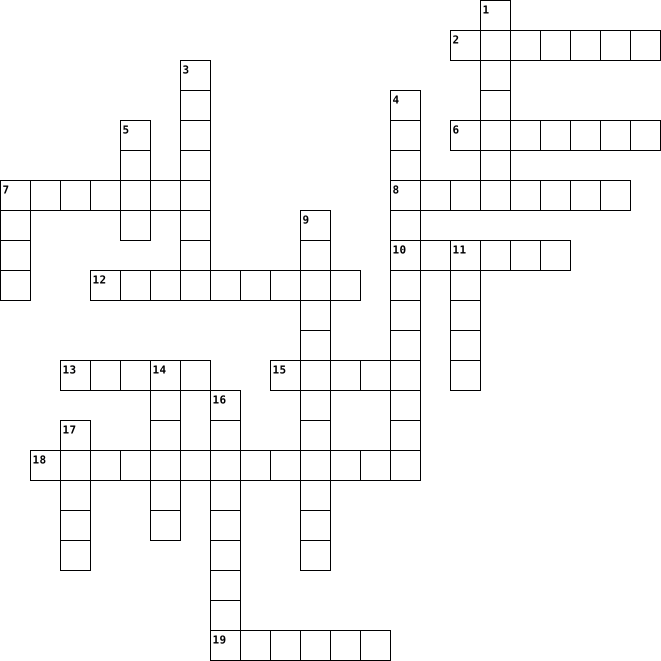
Across
- The closest planet to the Sun, has no atmosphere
- One of the four gas giants, mainly known for its Great Red Spot
- Brief streaks of light created by the friction of a meteorite
- Small, rocky bodies that orbit the Sun, mostly iregular shape
- The largest star in the Solar System
- A space object that has reaches Earth
- One of the inner rocky planets, knonw for its sulfuric acid cloud
- A icy space object that creates a tail called coma as it gets near the Sun
- A moon phae just before the Full Moon
- The second largest plaent in the Solar System, known for its amazing icy rings
Down
- One of the four gas giants, the furthest planet from the Sun
- The side of the Moon that is not visible to the Earth
- Large holes that are created due to mostly space impacts
- Our natural satellite
- The planet that is roughly half the size of Earth. Red coloured from oxide iron
- A large space area where asteroids are being held together by Jupiter's gravity
- The only planet that can foster life
- One of the four gas giants, with a thick atmosphere out of helium, hydrogen and methane
- The high and light areas of the Moon
- The dark and shallow areas of the Moon
20 Clues: Our natural satellite • The largest star in the Solar System • The only planet that can foster life • The high and light areas of the Moon • A space object that has reaches Earth • A moon phae just before the Full Moon • The dark and shallow areas of the Moon • The closest planet to the Sun, has no atmosphere • The side of the Moon that is not visible to the Earth • ...
Ch. 13/14 Science Vocab Words 2013-03-03

Across
- The natural environment in which a living thing gets all that it needs to live.
- A property of matter representing the mass per unit volume.
- A wet, swampy area that is often flooded with water.
- A system that uses underwater sound waves to measure distance and locate objects.
- A narrow stream of water that breaks through sandbars and rapidly back into deeper water.
- The flat or gently sloping land that lies submerged around the edges of a continent and that extends from the shoreline to the continental slope.
- A disturbance of wind patterns and ocean currents in the Pacific Ocean that causes temporary climate changes in many parts of the world.
- Microscopic floating organisms that live in water and, like plants, convert sunlight and carbon dioxide into food.
- A shoreline area where fresh water from a river mixes with salt water from the ocean.
- The vertical movement of deep water up to the surface.
- A tide of small range occurring during the first- and third- quarter phases of the Moon.
- A tide of large range occurring during the new and full moons, resulting in an extra-high tidal bulge and an extra-low tidal dip.
- The difference in height between high tide and low tide.
Down
- An opening in the sea floor from which heated water rises and mixes with the ocean water above.
- A large community of kelp, a type of seaweed that can attach to the ocean floor.
- The movement of water from the surface to greater depths
- A mass of moving ocean water.
- The measure of the amount of dissolved salt contained in water.
- The narrow ocean margin between the high-tide mark and the low-tide mark.
- The overall direction and movement of water as waves strike the shore at an angle.
- The periodic rising and falling of the water level of the ocean due to the gravitational pulls of the Moon and the Sun.
- The portion of animals that are caught in a net and then thrown away as unwanted.
22 Clues: A mass of moving ocean water. • A wet, swampy area that is often flooded with water. • The vertical movement of deep water up to the surface. • The movement of water from the surface to greater depths • The difference in height between high tide and low tide. • A property of matter representing the mass per unit volume. • ...
Midterm Vocabulary Review 2023-12-10

Across
- a model that places the Earth in the center of the universe and the planets and stars revolve around it.
- a huge collection of stars, gas, and dust.
- when Earth’s rotation axis is tilted neither toward or away from the Sun.
- precipitation that soaks into the soil.
- when the majority of the moon is illuminated.
- the line on which an object rotates.
- a long, deep valley on the ocean floor through which old ocean floor sinks back toward the mantle.
- the process by which water vapor turns into liquid.
- large objects made of dust and ice that orbit the Sun.
- a very large, thick mass of ice that stays frozen from one year to the next and has the ability to move.
- water that is saltier than fresh water, but not as salty as seawater
- the orbit of one object around another object.
Down
- a chunk of rock or metal from space that falls through the atmosphere, or layer of gasses, surrounding Earth.
- a person who studies the topography of the ocean floor.
- the total amount of water on a planet.
- The concentration of dissolved salt in a given volume of water.
- consists of the Sun and everything that orbits, or travels around, the Sun.
- an occurrence during which the Moon’s shadow appears on Earth’s surface.
- when a liquid changes into a gas.
- the central, darker part of a shadow where light is totally blocked.
- underwater mountains that do not reach the surface.
- phases of the Moon during which more of the Moon’s near side is lit each night.
- a stream or river that flows into and joins a main river.
- the water found underground in the cracks and spaces in soil, sand and rock.
- areas of salty water that fill enormous basins on the Earth's surface.
- an idea that the universe, as we know it, started with an infinitely hot and dense single point that inflated and stretched.
26 Clues: when a liquid changes into a gas. • the line on which an object rotates. • the total amount of water on a planet. • precipitation that soaks into the soil. • a huge collection of stars, gas, and dust. • when the majority of the moon is illuminated. • the orbit of one object around another object. • underwater mountains that do not reach the surface. • ...
What can we see around us? 2022-01-28
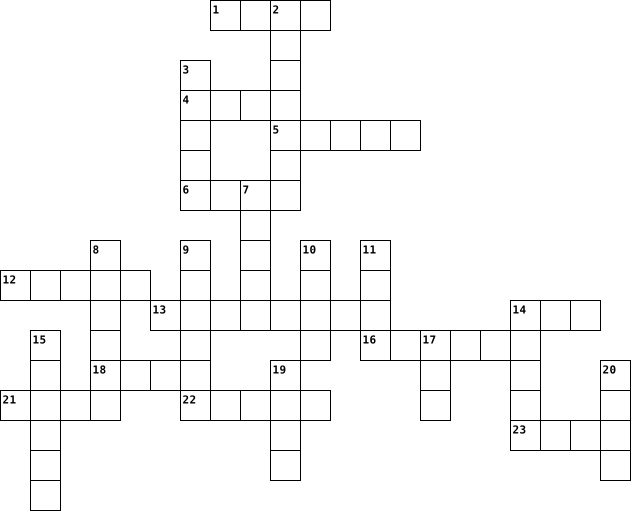
Across
- farm
- rain
- beach
- snow
- cloud
- mountain
- sky
- desert
- lake
- tree
- river
- moon
Down
- rainbow
- grass
- ocean
- jungle
- flower
- star
- wind
- storm
- forest
- sun
- leaf
- pond
24 Clues: sky • sun • farm • rain • snow • star • wind • lake • leaf • pond • tree • moon • grass • beach • ocean • cloud • storm • river • jungle • flower • forest • desert • rainbow • mountain
5th six weeks review 2024-03-08

Across
- the boundary that makes mountains
- water above the ground
- the boundary that makes faults
- water that has to move to reach the surface or ground
- the tide in the 1st and 3rd quarter
- the moon is getting smaller
Down
- the boundary that makes mid ocean ridges
- moon phase when the earth is between the moon and the sun
- moon phase when the moon is between the sun and the earth
- the tide during new moon and full moon
- water in the ground
- the moon is getting bigger
12 Clues: water in the ground • water above the ground • the moon is getting bigger • the moon is getting smaller • the boundary that makes faults • the boundary that makes mountains • the tide in the 1st and 3rd quarter • the tide during new moon and full moon • the boundary that makes mid ocean ridges • water that has to move to reach the surface or ground • ...
Biological Bases of Behaviour 2012-01-18

Across
- / a type of neruotransmitter that determines memory and muscle action; related with Alzheimer's disease
- / part of the neuron that passes messages away from the cell body to other neurons, muscles, or glands
- / a type of neurotransmitter that determines learning, attention and emotion; related with schizophrenia
- / A chemical messenger that travels from one neuron to another.
- / a type of the neurotransmitter that determines hunger, sleep, arousal and mood; is related with depression
- / Covering of axon in some neurons; helps speed neural impulse
- / one of the three phases of communication wihthin a neuron; neuron waiting for the next release of impulse
- / nervous system that consists of brain and spinal cord
- / cell body that maintains the health of the neuron
- / part of the brain that controls memory and understanding of language
- / inty fluid filled gap between the axon terminal of one neuron and the dendrites of another
- / 'Almond';in front of the hippocampus; responsible for anxiety, emotion, and fear
Down
- / part of the brain that controls visual perception and touch sensation
- / main component of the central nervous system
- / part of the neuron that receive messages from other cells
- / one of the three phases of communication wihthin a neuron; the neuron 'recharges' itself
- / chemical messengers in human nervous system
- / which side of the brain hemisphere uses logic
- / which side of the brain hemisphere uses feeling
- / chemicals manufactured by endocrine glands; circulates around the body to produce bodily changes
- / part of the brain that controls reasons, planning, impulsivity and personality
- / part of the central nervous system that is involved in relaying nerual information to and from the brain
- / one of the three phases of communication wihthin a neuron; the neural impulse is released
- / back of the brain that controls balance and coordination of the body
24 Clues: / chemical messengers in human nervous system • / main component of the central nervous system • / which side of the brain hemisphere uses logic • / which side of the brain hemisphere uses feeling • / cell body that maintains the health of the neuron • / nervous system that consists of brain and spinal cord • ...
The Moon By:Tameisha 2013-03-21

Across
- The moon's ____ is a hot mass.
- Quarter The moon is about _____________ the size of earth.
- The moon has been ________ away slowly ever since.
- The moon has gradually moved away from the ______.
- The moon is made out of _______ layers.
- The _______ impact "splashed off" rocks and other matireal into space.
- The moon is in the shape of a ______.
Down
- The moon moves away from the earth every ____.
- The silvery colour of the moon is an effect of _________.
- _________ is the force that attracts objects together.
- The most popular theroy is that the moon is a small _______.
- This early _____ was at first closer to the earth.
12 Clues: The moon's ____ is a hot mass. • The moon is in the shape of a ______. • The moon is made out of _______ layers. • The moon moves away from the earth every ____. • The moon has been ________ away slowly ever since. • The moon has gradually moved away from the ______. • This early _____ was at first closer to the earth. • ...
the moon by kevin 2013-03-21

Across
- the moons __ is a hot mass
- we still use the word __ to describe things on the moon
- the moon has no __ of its own
- the moon is made of several __
- we only see one of the faces of the moon __
Down
- the small planet that hit the earth was named __
- the __ is the rocky ball in space
- under the surface lies a rocky __
- the moon __ around the earth
- the moon is about one __ as wide as the earth
- the earth used to have a rocky __
- there is no __ on the moon
12 Clues: the moons __ is a hot mass • there is no __ on the moon • the moon __ around the earth • the moon has no __ of its own • the moon is made of several __ • the __ is the rocky ball in space • under the surface lies a rocky __ • the earth used to have a rocky __ • we only see one of the faces of the moon __ • the moon is about one __ as wide as the earth • ...
rshfghfgh 2025-06-17

Across
- Completely different or on the other side.
- One thousand million (1 000 000 000).
- The shape of the Moon we see in the sky.
- One complete spin of Earth on its axis (24 hours).
- The four parts of the year: spring, summer, fall, and winter.
- A bowl‐shaped hole on the surface of the Moon or a planet.
- Tool that makes distant objects look closer.
- One full trip of Earth around the Sun (1 year).
Down
- The moon phase when the whole Moon is bright and round.
- The imaginary line an object spins around.
- The direction opposite to how a clock’s hands move.
- The moon phase when we cannot see the Moon at all.
- Small rocky bodies that orbit the Sun, mostly between Mars and Jupiter.
- The very top point of the Earth’s axis.
- Able to be seen with your eyes.
- A dark shape made when something blocks light.
- To lean or slant; Earth’s axis is at an angle.
17 Clues: Able to be seen with your eyes. • One thousand million (1 000 000 000). • The very top point of the Earth’s axis. • The shape of the Moon we see in the sky. • The imaginary line an object spins around. • Completely different or on the other side. • Tool that makes distant objects look closer. • A dark shape made when something blocks light. • ...
unt 5 project 2026-05-26

Across
- crouch down
- strong feeling
- a contrast to reality
- a type of joke
- data
- loneliness or isolates
- decline
- legal process
- a noise you make when you're in pain
- nullify
Down
- doing something with someone at the same time
- act of saving
- can separate
- planned movement
- keeping calm
- pre-set
- artificial representation
- to make known
- ability to use
- the use of matching words or phases
20 Clues: data • pre-set • decline • nullify • crouch down • can separate • keeping calm • act of saving • to make known • legal process • strong feeling • a type of joke • ability to use • planned movement • a contrast to reality • loneliness or isolates • artificial representation • the use of matching words or phases • a noise you make when you're in pain • doing something with someone at the same time
Astronomy 2022-06-10

Across
- eclipse Occurs when the Moon passes directly between the Sun and Earth and blocks the sun/casts a shadow over part of Earth
- cycle Our moon's cycle ( new moon to full moon to new) is about 1 month long.
- Inner Planets: smaller, rocky, terrestrial
- Planets: large, low-density gas giants, Jovian
- Huge, hot, bright balls of gas that make light/ energy by nuclear fusion (converting Hydrogen to Helium)
- A curved path a planet takes around a star
- pull The force between two objects like the Earth and the Sun and the Earth and the moon.
- Sun the largest star closest to Earth. It is a main sequence star
- Caused by the tilt of Earth on its axis as it revolves around the Sun. Winter solstice:Dec 21, Summer Solstice: June 21
- An escaped asteroid (meteoroid) that has hit earth's surface. (A meteor is the flash of light you see as it burns up in the atmosphere)
Down
- An object traveling around another on a set path or orbit.
- (of the moon) pertaining to the period during which the visible surface of the moon increases
- All of space and everything in it
- phases The changing appearance of the Moon as seen from Earth. New moon, waxing crescent, 1st quarter, waxing gibbous,full moon, waning gibbous,last quarter and waning crescent .
- A small, rocky object that orbits the sun; most asteroids are located in a band between the orbits of Mars and Jupiter
- eclipse Occurs at a full moon when Earth is directly between the moon and the sun.
- becoming less bright, intense, or strong
- A spinning motion of a planet about its axis.
- A natural satellite that revolves around a planet.
- the regular rise and fall of the ocean's surface influenced by the moon's gravity pulling on earth
- A ball of frozen dust and rock that orbits the sun and has a tail that reflects light from sun
- system sun, planets, and all the other objects that revolve around the sun
- bang The theory that the universe originated in a huge explosion that released all matter and energy.
- A collection of billions of stars, dust, and gas bound together by gravity. We live in the spiral shaped MILKY WAY
- of Earth Earth has seasons because its axis is tilted 23.5 degrees; the tilted axis always points toward the North Star (Polaris)
25 Clues: All of space and everything in it • becoming less bright, intense, or strong • Inner Planets: smaller, rocky, terrestrial • A curved path a planet takes around a star • A spinning motion of a planet about its axis. • Planets: large, low-density gas giants, Jovian • A natural satellite that revolves around a planet. • ...
Carlos Inner & Outer Planets Vocabulary Assignment 2026-01-16

Across
- mars moon
- steep slope
- Largest moon of Saturn,liquid methane lakes
- Outer planets
- Largest moon of Neptune,retrograde orbit
- limit were planet tear thing apart
- radio detection
- Largest moon of Jupiter,larger than mercury
- impact in mercury
- Largest volcano in solar system located in mars
- structures of dust, ice, and rock orbiting giant planetsGalileanMoons
Down
- inner planets
- separation of water and methane
- mars moon
- Largest Cannon in solar system located in mars
- Fast Flowing air current
- highland region on venus
17 Clues: mars moon • mars moon • steep slope • inner planets • Outer planets • radio detection • impact in mercury • Fast Flowing air current • highland region on venus • separation of water and methane • limit were planet tear thing apart • Largest moon of Neptune,retrograde orbit • Largest moon of Saturn,liquid methane lakes • Largest moon of Jupiter,larger than mercury • ...
Earth's Moon 2013-11-28

Across
- the moon is not visible
- an almost full moon
- Moon's gravity compared to Earth's
- when the moon is in Earth's shadow
- the moon does this to sunlight
Down
- going around something in an orbit
- when the moon blocks the sun
- Moon's mass compared to Earth's
- spinning on an axis
- almost new moon
- an object that revolves around something in an orbit
- the lit side of the moon is completely visible
12 Clues: almost new moon • an almost full moon • spinning on an axis • the moon is not visible • when the moon blocks the sun • the moon does this to sunlight • Moon's mass compared to Earth's • going around something in an orbit • Moon's gravity compared to Earth's • when the moon is in Earth's shadow • the lit side of the moon is completely visible • ...
Astronomy Terms 2022-03-17

Across
- The time it takes for an object (such as a planet) to go around another object (such as the sun).
- The smallest terrestrial planet and the planet closest to the sun. Scorching temperatures here by day, extremely cold temperatures here by night due to the almost non-existent atmosphere.
- The path of an object as it revolves around another object in space
- Each of the four divisions of the year (spring, summer, autumn, and winter) marked by particular weather patterns and daylight hours, resulting from the earth's changing position and tilt with regard to the sun.
- Planet located in the habitable zone of the solar system, with conditions that allow for the presence of large amounts of liquid water. This planet has one moon, luna.
- This type of eclipse occurs when the moon passes directly between the Sun and Earth and casts a shadow over part of Earth.
- A system of millions or billions of stars, together with gas and dust, held together by gravitational attraction.
- Becoming more full.
- Gas giant with the strongest magnetosphere in the solar system, the most moons and a giant red spot- a megastorm, that is twice the size of earth.
- An object that orbits a planet and is not man made - the moon is an example of one on earth.
- Phase of the moon where more than half is illuminated, but the moon is not quite full.
- The time at which the tide reaches its highest level (occurs when the sun and/or moon are in line with the earth)
- Becoming less full.
Down
- This type of eclipse occurs at a full moon when Earth is directly between the moon and the sun. Light that normally would illuminate the moon is blocked by the earth casting a shadow on the moon.
- The time it takes for an object (such as a planet or a moon) to spin a full 360° on its axis.
- Gas giant with the most prominent ring system.
- Cold, blue gas giant with a prominent dark spot.
- Earth's "twin" planet with a runaway greenhouse gas effect. The atmosphere here is always hot and filled with clouds of sulfuric acid. This planet rotates backwards and a day here is longer than a year.
- The distance that light travels in one year. Used to measure HUGE distances in space.
- The tide with the greatest difference between consecutive low and high tides. Caused by the alignment of the sun and the moon, so gravitational pull on the earth's oceans is amplified.
- The average distance between Earth and the sun, about 150 million km. A unit used for measuring distances between planets in our solar system.
- The time at which the tide reaches its lowest level (occurs when the sun and moon are not aligned)
- A ball of hot gas, primarily hydrogen and helium, that undergoes nuclear fusion. The closes one of these to Earth is our Sun.
- Icy gas giant that rotates on its side.
- the tide with the least difference between consecutive low and high tides. Occurs when sun and moon are at right angles to each other, canceling out some of the effects of gravity on the earth's oceans.
- The alternate rising and falling of the sea, usually twice in each lunar day at a particular place, due to the gravitational attraction of the moon and sun.
- Red planet that shows evidence of flowing water at one point in its history. Home to Olympus Mons, the largest volcano in the solar system.
27 Clues: Becoming more full. • Becoming less full. • Icy gas giant that rotates on its side. • Gas giant with the most prominent ring system. • Cold, blue gas giant with a prominent dark spot. • The path of an object as it revolves around another object in space • The distance that light travels in one year. Used to measure HUGE distances in space. • ...
Solar system 2014-05-04

Across
- period between a new moon and full moon
- people who go out in space
- is the closest planet to earth and the second to sun
- heat released from sun in forms of
- has moon triton
- closest planet to sun
Down
- largest planet in our solar system
- shape of ellipse
- first person to use telescope to study moon
- period between full moon to new moon
- instrument used to study space and stars
- people who study planets
- biggest star in our solar system
13 Clues: has moon triton • shape of ellipse • closest planet to sun • people who study planets • people who go out in space • biggest star in our solar system • largest planet in our solar system • heat released from sun in forms of • period between full moon to new moon • period between a new moon and full moon • instrument used to study space and stars • ...
Difficult Space 2025-08-31

Across
- The smallest constellation in our solar system
- The Largest Volcano in Space
- Color of the hottest stars
- The largest constellation in our solar system
- Coldest moon in our Solar System
- The brightest star in the sky
- This planet rotates on its side
- Largest moon in the solar system
- Place of Diamond Rain
- The sun is mostly composed of this element
Down
- The constellation the North Star resides in
- This planet's day is 117 Earth days long
- The North Star
- Jupiter's closest Moon
- Pluto's largest moon
- Planet with the fastest rotation
- Planet with the fastest orbit
- Planet with the most moons
18 Clues: The North Star • Pluto's largest moon • Place of Diamond Rain • Jupiter's closest Moon • Color of the hottest stars • Planet with the most moons • The Largest Volcano in Space • The brightest star in the sky • Planet with the fastest orbit • This planet rotates on its side • Coldest moon in our Solar System • Planet with the fastest rotation • Largest moon in the solar system • ...
Space and Earth 2020-04-15

Across
- A type of spacecraft used to fly astronauts into space and back to Earth.
- A plate boundary where plates slide past each other is called a _________ boundary.
- A plate boundary where plates move away from each other is called a ________ boundary.
- The phase of the moon where more than half of the moon is lit by the sun.
- The type of force within Earth that breaks down or destroys land.
- When the visible portion of the moon is completely lit.
- The ________ position is where Earth is found, not too close or too far from the sun.
- Living place in space where experiments are conducted.
- The layer of Earth that is the most dense.
- The point on Earth's surface directly above the focus.
- One _____________ unit is 93 million miles, the distance Earth is from the sun.
- When the moon appears to be getting smaller.
- The movement of an object around another object.
- Object falling through Earth's atmosphere and burns up before hitting the ground.
- A plate boundary where plates move towards each other is called a ________ boundary.
- The thinnest layer on Earth.
- The type of eclipse that occurs when the Sun, moon and Earth are aligned in that order and the moon blocks out the sun.
- The type of force within Earth that creates more land.
- When the moon appears to be growing/ increasing.
- This is caused by the tilt of the Earth/ different amounts of sunlight per day.
- A gravitational curved path around an object.
- The ________ scale is used to measure seismic waves from earthquakes.
- A device that uses mirrors or lenses to magnify objects very far away.
- The natural rise and fall of large bodies of water caused by the sun and the moon.
- Tectonic plates that are found under bodies of water are called __________ plates.
Down
- An object that revolves around something bigger.
- The point of origin of an earthquake.
- Types of waves that travel through the Earth that helped us understand there are layers.
- When the visible portion of the moon is completely dark.
- An object composed of dust, rock and ICE and has a "tail".
- An attractive force between two objects/ the bigger the object the stronger the pull.
- The layer of Earth that creates Earth's magnetic field.
- _____________ plates are the shifting pieces of Earth’s crust.
- A time when the sun reaches its highest or lowest point in the sky creating the longest or shortest days of the year.
- The fracture of Earth's crust due to an earthquake.
- The type of eclipse that occurs when the moon is inside the Earth's umbra. the Sun, Earth and moon are aligned in that order.
- _______ currents that allow Earth's crust to move.
- Tectonic plates that are found under land masses are called __________ plates.
- The name of our galaxy.
- The model of the solar system that has the sun as the center.
- The mixture of gases that surround a star or planet.
- The phase of the moon when 1/2 the moon is lit by the sun.
- The supercontinent that occurred about 225 million years ago.
- The model of the solar system that has the Earth as the center.
- Large rock in space that are similar to the composition of planets.
- A layer within the Earth's atmosphere that protects it from the sun's harmful UV rays.
- The layer that has convection currents.
- The phase of the moon where less than half of the moon is lit by the sun.
- A time in which the amount of daylight and night time is equal.
- when an object spins on its axis.
50 Clues: The name of our galaxy. • The thinnest layer on Earth. • when an object spins on its axis. • The point of origin of an earthquake. • The layer that has convection currents. • The layer of Earth that is the most dense. • When the moon appears to be getting smaller. • A gravitational curved path around an object. • An object that revolves around something bigger. • ...
Jupiter 2024-02-05

Across
- THE PULL THAT KEEPS COMETS FROM HITTIN EARTH
- NAMED AFTER ROMAN'S _______ GOD
- MOON MADE OF HUGE BALLS OF ICE AND ROCKS
- ONE OF THE GASES THAT MAKES UP JUPITER
- NOT TERRESTRIAL
- JUPITER'S SMALLEST MOON
- HOURS TO ROTATE
- JUPITER'S MOON THAT HAS VOLCANOES
- ONE OF THE GASES THAT MAKES UP JUPITER
- THE BIGGEST PLANET
Down
- THE SAME AS SATURN
- JUPITER'S STRIPES
- JUPITER'S BIGGEST MOON
- JUPITER'S NATURAL SATELLITES
- WHERE WE GET OUR INFORMATION ABOUT JUPITER
- TEMPERATURE ON JUPITER
- EARTH YEARS TO MAKE A REVOLUTION
17 Clues: NOT TERRESTRIAL • HOURS TO ROTATE • JUPITER'S STRIPES • THE SAME AS SATURN • THE BIGGEST PLANET • JUPITER'S BIGGEST MOON • TEMPERATURE ON JUPITER • JUPITER'S SMALLEST MOON • JUPITER'S NATURAL SATELLITES • NAMED AFTER ROMAN'S _______ GOD • EARTH YEARS TO MAKE A REVOLUTION • JUPITER'S MOON THAT HAS VOLCANOES • ONE OF THE GASES THAT MAKES UP JUPITER • ONE OF THE GASES THAT MAKES UP JUPITER • ...
Moon Rising 2020-03-24

Across
- night wing born under two moons
- x sky wing queen
- sister of the mud wing dragonet of destiny
- sand wing dragonet of destiny
- big supporter of queen glory
- night wing dragonet of destiny
- royal ice wing brother
Down
- young sand wing raised by queen thorn
- queen of the rain wings
- brother of the mud wing dragonet of destiny
- mud wing dragonet of destiny
- sea wing dragonet of destiny
- anemone's brother
- royal ice wing sister
14 Clues: x sky wing queen • anemone's brother • royal ice wing sister • royal ice wing brother • queen of the rain wings • mud wing dragonet of destiny • sea wing dragonet of destiny • big supporter of queen glory • sand wing dragonet of destiny • night wing dragonet of destiny • night wing born under two moons • young sand wing raised by queen thorn • ...
Moon Cycle 2023-01-24

Across
- the amount of time it takes for a planet to complete one orbit around a star or stars
- a moon phase in which the Moon is not visible from Earth
- to shine light on an object
- the border between light and dark on the Moon
- helps us understand something by making it simpler
- when the illuminated portion is getting bigger, as viewed from Earth
- phase that looks like a full circle from Earth
Down
- the relative size of things
- the illuminated part of the Moon as seen from Earth
- the nearly circular path a smaller object (like the Moon) travels around a larger object (like Earth)
- when the illuminated portion is getting smaller, as viewed from Earth
- a moon phase that looks like a half-circle from Earth
- a rocky sphere that travels around a planet
- phase that looks like more than half a circle
14 Clues: the relative size of things • to shine light on an object • a rocky sphere that travels around a planet • the border between light and dark on the Moon • phase that looks like more than half a circle • phase that looks like a full circle from Earth • helps us understand something by making it simpler • the illuminated part of the Moon as seen from Earth • ...
Moon Mission 2025-12-01

Across
- a step by step set of instructions used to complete a task
- able to operate or make decisions without direct human control
- the layer of loose dust and rock on the Moon's surface
- a bowl-shaped dent formed by an impact on the Moon
- the physical features of the land, like hills or craters
- a place on the Moon where astronauts can live and work
Down
- a trained person who travels into space
- the path one object takes as it travels around another
- a machine designed to carry out tasks automatically
- NASA's program to return humans to the moon
- material collected from the Moon for study
- the force that pulls objects toward a planet or moon
- a robot vehicle used to explore the lunar surface
- the event when a rocket lifts off from Earth
14 Clues: a trained person who travels into space • material collected from the Moon for study • NASA's program to return humans to the moon • the event when a rocket lifts off from Earth • a robot vehicle used to explore the lunar surface • a bowl-shaped dent formed by an impact on the Moon • a machine designed to carry out tasks automatically • ...
Astronomy Crossword (English - 2) 2020-04-12

Across
- Moon is also known as … in Latin
- When a full-moon or new-moon appears when Moon is at its farthest distance from Earth (apogee), it appears smaller in size. It is also called as …-moon.
- Name of the space module Neil Armstrong and Edwin Aldrin landed on Moon.
- A cavity on the surface of Moon caused by an impact of a solid object
- A unit of time defined by a natural period related to the motion of Moon
- Name of the hypothesized Mars-sized planet that is said to be collided with Gaia (the early-earth) that resulted in the formation of Moon 4.5 billion years ago
- This compound is found in large amount (around 45%) on the surface of Moon.
Down
- NASA’s space programme to send crewed space missions to Moon
- Name of the India’s first mission to Moon
- Name of one of the prominent features on the visible surface of Moon; named after an astronomer who discovered swaying in the inclination of the plane of the Moon’s orbit relative to the ecliptic (plane of the earth’s orbit)
- Plural of a Latin name (meaning ‘sea’) for large, dark Basaltic plains on Moon
- The regularly observable phenomena on Earth caused due to the revolution of Moon
12 Clues: Moon is also known as … in Latin • Name of the India’s first mission to Moon • NASA’s space programme to send crewed space missions to Moon • A cavity on the surface of Moon caused by an impact of a solid object • Name of the space module Neil Armstrong and Edwin Aldrin landed on Moon. • A unit of time defined by a natural period related to the motion of Moon • ...
Space 2025-11-24

Across
- the blue planet
- where the sun, moon and earth line up
- different in the southern hemisphere to the northern hemisphere
- the amount of hours in a day
- the fifth closest planet to the sun
- the red planet
- something there is nothing of in space
- the smallest planet
- earth only has one of it
Down
- three quarters of earth is covered in it
- the first phase of the moon
- the seventh phase of the moon
- a dwarf planet
- the only planet with a ring around it
- what is earth in?
- a huge star
- what earth is primarily made up of
- follows a path
18 Clues: a huge star • a dwarf planet • follows a path • the red planet • the blue planet • what is earth in? • the smallest planet • earth only has one of it • the first phase of the moon • the amount of hours in a day • the seventh phase of the moon • what earth is primarily made up of • the fifth closest planet to the sun • where the sun, moon and earth line up • ...
Tides 2023-02-23

Across
- The moon is pulling in the water and oceans to make tides.
- Dry land not in water.
- The tide is rising and lowering but still around average
- The moon is only half illuminated and is in the stage when there are neap tides (The first half).
- you need this for a very sunny day at the beach.
- The moon is in a stage when there is a spring tide and is on the other side of the earth
- A beach on the brink of an ocean.
- is WATER, DIRT, PLANTS and just the things in the world(Not modern day technology)
Down
- a liquid that can turn into ice if it freezes and you drink it.
- this is the biggest object in space and the planets orbit it.
- The moon is half illuminated and in another stage with neap tides.
- The moon is in front of the earth and the tides are in a spring tide.
- The tide is rising and lowering and is way above or way below average
- The rising and lowering in water.
14 Clues: Dry land not in water. • A beach on the brink of an ocean. • The rising and lowering in water. • you need this for a very sunny day at the beach. • The tide is rising and lowering but still around average • The moon is pulling in the water and oceans to make tides. • this is the biggest object in space and the planets orbit it. • ...
DaSean 2025-01-10

Across
- To happen once a year.
- When light or energy passes through a medium and is deflected.
- Accumulation of particles into a massive object that has a gravitational field.
- The force of gravity; to pull objects with mass towards each other.
- The change in the direction of light due to a change in the medium.
- Observing or thinking of something in a different way or from a different viewpoint
- Having to do with the sun or sunlight
- Determined by or resembling a moon.
Down
- Height above a certain level; typically sea level
- Occurring every day; happening during the day rather than at night.
- The circular movement of an object around another object.
- An astronomical event where an object cannot be seen because it is blocked by the shadow of another object in front of it.
- A star in the constellation Ursa Minor or the “Little Bear”. This is commonly referred to as the North Star.
- Regularity in the world. Elements are repeated in a predictable manner
- Electromagnetic or light waves from space are bent, causing what we see to be slightly different than what is actually there.
- A distinct period or stage in a series of events; the process of change or development.
16 Clues: To happen once a year. • Determined by or resembling a moon. • Having to do with the sun or sunlight • Height above a certain level; typically sea level • The circular movement of an object around another object. • When light or energy passes through a medium and is deflected. • Occurring every day; happening during the day rather than at night. • ...
Astronomy Crossword English #2 2020-04-10

Across
- A cavity on the surface of Moon caused by an impact of a solid object
- When a full-moon or new-moon appears when Moon is at its farthest distance from Earth (apogee), it appears smaller in size. It is also called as …-moon.
- The regularly observable phenomena on Earth caused due to the revolution of Moon
- Moon is also known as … in Latin
- Name of the hypothesized Mars-sized planet that is said to be collided with Gaia (the early-earth) that resulted in the formation of Moon 4.5 billion years ago
- NASA’s space programme to send crewed space missions to Moon
Down
- Name of the India’s first mission to Moon
- A unit of time defined by a natural period related to the motion of Moon
- Plural of a Latin name (meaning ‘sea’) for large, dark Basaltic plains on Moon
- This compound is found in large amount (around 45%) on the surface of Moon.
- Name of one of the prominent features on the visible surface of Moon named after an astronomer who discovered swaying in the inclination of the plane of the Moon’s orbit relative to the ecliptic (plane of the earth’s orbit)
- Name of the space module Neil Armstrong and Edwin Aldrin landed on Moon.
12 Clues: Moon is also known as … in Latin • Name of the India’s first mission to Moon • NASA’s space programme to send crewed space missions to Moon • A cavity on the surface of Moon caused by an impact of a solid object • A unit of time defined by a natural period related to the motion of Moon • Name of the space module Neil Armstrong and Edwin Aldrin landed on Moon. • ...
Halloween 2025-10-28

Across
- dark
- party
- black cat
- ghost
- haunted house
- monster
- vampire
- blood
- candy
- candle
Down
- bat
- halloween
- autumn
- moon
- skelton
- pumpkin
- scared
- witch
18 Clues: bat • dark • moon • party • ghost • blood • candy • witch • autumn • scared • candle • skelton • pumpkin • monster • vampire • halloween • black cat • haunted house
DaSean 2025-01-10

Across
- Electromagnetic or light waves from space are bent, causing what we see to be slightly different than what is actually there.
- Height above a certain level; typically sea level
- When light or energy passes through a medium and is deflected.
- Determined by or resembling a moon.
- The circular movement of an object around another object.
- The force of gravity; to pull objects with mass towards each other.
- Having to do with the sun or sunlight
Down
- Regularity in the world. Elements are repeated in a predictable manner
- A distinct period or stage in a series of events; the process of change or development.
- The change in the direction of light due to a change in the medium.
- Observing or thinking of something in a different way or from a different viewpoint
- Accumulation of particles into a massive object that has a gravitational field.
- Occurring every day; happening during the day rather than at night.
- An astronomical event where an object cannot be seen because it is blocked by the shadow of another object in front of it.
- A star in the constellation Ursa Minor or the “Little Bear”. This is commonly referred to as the North Star.
- To happen once a year.
16 Clues: To happen once a year. • Determined by or resembling a moon. • Having to do with the sun or sunlight • Height above a certain level; typically sea level • The circular movement of an object around another object. • When light or energy passes through a medium and is deflected. • The change in the direction of light due to a change in the medium. • ...
Science Q1 review 2024-10-25

Across
- the coldest season
- keeps planets in orbit around the sun
- when the earth is lined up between the moon and sun
- when the moon seems to be getting smaller
- when the moon is in between the earth and sun
- bones or an artifact left behind long ago
- gaseous planets
- latin word meaning dug or dug up
Down
- oldest layer of rock on the bottom youngest at the top
- going around something
- the warmest season
- stretches space and time its invisible and very destructive
- the terrestrial planets
- different layers of rock
- the moon phase when it seems the moon is not there
- a spin on an axis
16 Clues: gaseous planets • a spin on an axis • the coldest season • the warmest season • going around something • the terrestrial planets • different layers of rock • latin word meaning dug or dug up • keeps planets in orbit around the sun • when the moon seems to be getting smaller • bones or an artifact left behind long ago • when the moon is in between the earth and sun • ...
Apollo Space Mission 2025-04-23

Across
- the commander of Apollo 9
- when you leave the earth's atmosphere
- the last Apollo mission
- the first time they got a lunar rover
- the third time they landed on the moon
- the first crew to make it to the moon
- the Apollo 11 space mission Commander
Down
- the commander of apollo 8
- the commander of the Apollo 1
- the Apollo to see if they can land on the moon
- the crew that went around the moon without landing
- the first Apollo without a crew
- the second crew to make it to the moon
- something important that needs to be Carried out
- the commander of the Apollo 16
- the commander of Apollo 7
16 Clues: the last Apollo mission • the commander of apollo 8 • the commander of Apollo 9 • the commander of Apollo 7 • the commander of the Apollo 1 • the commander of the Apollo 16 • the first Apollo without a crew • when you leave the earth's atmosphere • the first time they got a lunar rover • the first crew to make it to the moon • the Apollo 11 space mission Commander • ...
HALLLOWEEN (30 words) 2023-10-13

Across
- One of the four phases of the moon, occurring when the earth lies between the sun and the moon so that the moon is visible as a fully illuminated disc.
- A woman who is believed to have magical powers and uses them to help or harm people.
- A large, round container for cooking in, usually supported over a fire, and used by witches to brew potions and cast spells.
- The spirit of a dead person imagined as visiting the living and usually appearing as a pale, almost transparent form.
- A structure of thin, sticky threads made by a spider.
- Sweet foods made mostly of sugar or syrup and usually cooked or baked.
- A small creature that looks like an insect with eight thin legs.
- A dead body that is prevented from decaying by being treated with special substances before being wrapped in cloth.
- A covering for the face, worn to hide one's identity, to frighten or to cause laughter.
- Exclamation used by children to ask for candies when calling at someone's home in costume on Halloween.
- An imaginary creature in stories that is a person who changes into a wolf at the time of the full moon.
- A large, black bird with a loud cry.
- An apple with a sweet coating, especially of toffee and often on a stick inserted in the centre.
- An object that looks like a person dressed in old, torn clothes and that stands in a garden or field to frighten birds away.
- A frightening creature that is a dead person who has been brought back to life, but without human qualities.
- An evil being, often represented in human form but with a tail and horns.
- A light made from a hollow pumpkin with holes cut into the sides like the eyes and mouth of a person's face, inside which there is a candle.
Down
- A small, furry animal with four legs and a tail, often kept as a pet, associated with bad luck and evil.
- A bird with a flat face and large eyes that hunts small mammals at night.
- A place in the ground where a dead person is buried.
- A small candy shaped and coloured to look like a kernel of corn.
- A large imaginary creature that looks very ugly and frightening.
- A building often perceived as being inhabited by disembodied spirits of the deceased who may have been former residents.
- The frame of bones supporting a human or animal body.
- Clothes worn in order to look like someone else, especially for a party or as part of an entertainment.
- A dead person who comes back to life and sucks blood from other people at night.
- A flying nocturnal mammal, often the size of a mouse.
- A place, often next to a church, where dead people are buried.
- A long box used to bury or cremate a dead person.
- A man who is believed to have magical powers and uses them to help or harm people.
30 Clues: A large, black bird with a loud cry. • A long box used to bury or cremate a dead person. • A place in the ground where a dead person is buried. • A structure of thin, sticky threads made by a spider. • The frame of bones supporting a human or animal body. • A flying nocturnal mammal, often the size of a mouse. • ...
space 2025-10-06

Across
- The Goddess of the moon
- Ancient Greek God of the sun
- A group of stars
- Location on the moon named after a German astronomer
- Sings love cats
- Explorer Second ever satellite launched by the USA
- Jupiter’s largest moon
- The brightest thing in the universe
Down
- Satellite launched by the USSR in 1957
- What surrounds us?
- What is the biggest star in the constellation Lyra?
- The nearest galaxy to us
- Who is the best character on Red Dwarf (according to us)
- Minions tonight we steal the moon!
- Way Which galaxy do we live in?
15 Clues: Sings love cats • A group of stars • What surrounds us? • Jupiter’s largest moon • The Goddess of the moon • The nearest galaxy to us • Ancient Greek God of the sun • Way Which galaxy do we live in? • Minions tonight we steal the moon! • The brightest thing in the universe • Satellite launched by the USSR in 1957 • What is the biggest star in the constellation Lyra? • ...
Celestial Cycles 2026-05-06

Across
- a gravitationally bound system of many stars, gas, planets, and other space debris.
- largest planet in our Solar System
- when the moon is becoming less illuminated.
- variations in Earth's climate during a year. Caused by the tilt of the Earth.
- middle of a planets spin.
- moon moon phase when the moon is completely on the night side of the Earth.
- a single revolution around a star.
Down
- round celestial object in a cleared orbit around a star.
- a single rotation of a planet around its axis.
- when the moon is becoming more illuminated.
- moon phase when the moon is completely on the day side of the Earth.
- furthest planet from the sun in our Solar System.
- large ball of burning hydrogen and helium.
- causes the seasons on Earth.
14 Clues: middle of a planets spin. • causes the seasons on Earth. • largest planet in our Solar System • a single revolution around a star. • large ball of burning hydrogen and helium. • when the moon is becoming more illuminated. • when the moon is becoming less illuminated. • a single rotation of a planet around its axis. • furthest planet from the sun in our Solar System. • ...
Microbiology 2 Virology Tutorial 1 2022-02-16

Across
- The latent period of viral replication is composed of the eclipse and ____________ phases.
- Another term for a bacterial virus
- Rod-shaped viruses are said to have _________ symmetry
- This virus was eradicated in 1977
- Another term for the number of viruses released after lysis of the host cell
- Extracellular form of a virus
- Smallest morphological unit of a virus visible with an electron microscope
- An enzyme used to make holes in the cell wall of the host
- A _____________ host cell allows the complete replication cycle of a virus to occur
Down
- An assay that can be used to quantitate bacterial viruses in a suspension
- Spherical viruses are said to have ___________ symmetry
- Protein structure that houses the genetic material of a virus
- The first of five phases required for viral replication
- Animal viruses often have these structures on their periphery
- A viral enzyme that cleaves glycosidic bonds in animal connective tissue
- Another term for bursting of the host cell with concomitant release of viruses
16 Clues: Extracellular form of a virus • This virus was eradicated in 1977 • Another term for a bacterial virus • Rod-shaped viruses are said to have _________ symmetry • Spherical viruses are said to have ___________ symmetry • The first of five phases required for viral replication • An enzyme used to make holes in the cell wall of the host • ...
Gravity lives up 2024-10-25

Across
- are made out of any layer
- a moon phase that the moon is fully lit up in the sky
- it is set up in the sky sun, moon, earth
- Hot cocoa,cold,warn fires
- Less mass ring around the planets
- pool,Hot,lemonade,No school
- layers of rock
- one full circle around the sun
Down
- rock and minerals setting into the bottom of a rock
- with out gravity
- what fossils are made out of
- spinning around the sun
- a moon that is fully covered and is showing no light to it
- Gas giants
- shows up in the sky sun,earth,moon
- planets held by gravity and rotate around the sun
16 Clues: Gas giants • layers of rock • with out gravity • spinning around the sun • are made out of any layer • Hot cocoa,cold,warn fires • pool,Hot,lemonade,No school • what fossils are made out of • one full circle around the sun • Less mass ring around the planets • shows up in the sky sun,earth,moon • it is set up in the sky sun, moon, earth • ...
braylon 4 2023-02-28

Across
- barely noticeable
- darkest shadow
- dark colored lava filled craters
- causes the seasons
- light colored old and cratered areas
- imaginary line through poles
- orbit
- going in the shadow
- maximum and minimum hours of sunlight
Down
- moon shrinking
- small planet crash into earth
- causes day and night
- lightest shadow
- moon growing
- sun blocked
- patterns of weather
- extra high high tide
- hole from something impacting a space body
- moon blocked
19 Clues: orbit • sun blocked • moon growing • moon blocked • moon shrinking • darkest shadow • lightest shadow • barely noticeable • causes the seasons • patterns of weather • going in the shadow • causes day and night • extra high high tide • imaginary line through poles • small planet crash into earth • dark colored lava filled craters • light colored old and cratered areas • ...
Tides and Moon 2023-12-12

Across
- the difference in height between an area's high tide and low tide.
- water level that has risen as a result of the moon's gravitational pull on the Earth.
- Phase where we see the left half of the moon
- the lowest level of high tide when the difference between low and high tide is the least, occurring when the gravitational pull of the sun counteracts that of the moon.
- The moon is getting smaller in the sky
- water level that has dropped as a result of the moon's gravitational pull on the Earth.
- Phase when we can't see the moon
Down
- strong current that runs along the surface of the ocean from shore to open sea. Also called rip current.
- Phase that we can see the whole moon
- tidal wave. Tide flowing upstream against the current of a river, forming a wave of water.
- Phase where we see the right half of the moon
- The moon is getting larger in the sky
- tide occuring during the times of full and new moon that "springs" to above-average highs and lows.
- gravitational pull exerted by one object, such as the sun or moon, that raises tides on another object, such as the Earth.
- rise and fall of the ocean's waters
15 Clues: Phase when we can't see the moon • rise and fall of the ocean's waters • Phase that we can see the whole moon • The moon is getting larger in the sky • The moon is getting smaller in the sky • Phase where we see the left half of the moon • Phase where we see the right half of the moon • the difference in height between an area's high tide and low tide. • ...
The Space Race 2026-01-15

Across
- US space agency
- Michael ____ stayed in the module
- Neil ____ first man on the moon
- The ____ has landed
- President who promised the moon
- Buzz ____ walked on the moon
Down
- One giant leap for ____-kind
- Yuri ____ first man in space
- ____ 11 mission
- ____ we have a problem
- First artificial satellite
- Alan ____ first American in space
- Space ____ between US and USSR
- The ____ V rocket
- John ____ orbited the Earth
15 Clues: US space agency • ____ 11 mission • The ____ V rocket • The ____ has landed • ____ we have a problem • First artificial satellite • John ____ orbited the Earth • One giant leap for ____-kind • Yuri ____ first man in space • Buzz ____ walked on the moon • Space ____ between US and USSR • Neil ____ first man on the moon • President who promised the moon • Michael ____ stayed in the module • ...
me 2022-12-09

Across
- made
- dog
- train
- web
- other
- proof
- polar
- police
- moon
Down
- aid
- linwr
- flung
- old
- bear
- cream
- well
- made
- self
- super
- alot
20 Clues: aid • old • dog • web • made • bear • well • made • self • alot • moon • linwr • flung • train • cream • other • proof • polar • super • police