
moon phases Crossword Puzzles
Love and Justice 2025-05-19

Across
- One of the four kings; the blonde one
- Molly’s Japanese name
- The Pegasus that protects Elysion
- Rei has two of these as pets
- Tree that sprouts from Jupiter’s tiara when she does a certain attack
- The name of the circus that the Amazon quartet comes from
- Makoto is good at this; something you do when you make sweets
- Ami likes coming to this place to study
- Sport Minako loves to play
Down
- Sailor Star ____ aka Seiya
- Queen ____, the villain from the 4th season
- _____ Tokyo; 30th century city that the Senshi live in
- Name of the school that the Senshi go to
- First name of the creator of Sailor Moon
- The aliens whose source of life is the Makai tree
- Princess _____, the moon Princess
- Something Usagi eats often
- Name of the final villain Sailor Moon faces
- Color of the crystal Mamoru has
- Sailor Moon’s first weapon
20 Clues: Molly’s Japanese name • Sailor Star ____ aka Seiya • Something Usagi eats often • Sailor Moon’s first weapon • Sport Minako loves to play • Rei has two of these as pets • Color of the crystal Mamoru has • Princess _____, the moon Princess • The Pegasus that protects Elysion • One of the four kings; the blonde one • Ami likes coming to this place to study • ...
Northwind crossword puzzle 2026-01-09

Across
- a series of thoughts occurring during sleep
- a recessed body of water directly connected to a large body of water
- underbrush
- in an acutely disturbed state of mind
- the movement of water caused by the moon
- an experience involving the perception of something not present
- a narrow waterway
- a bug larva
- a small arm of the sea
- chaos
- a stone commonly used to start fires
Down
- to put something in danger
- the place people in Norway believe you go when your ghost leaves your body
- a disease caused by fecal matter infected with bacterium vibrio cholerae getting into the food and water we eat and drink
- a long, deep, narrow passage of water
- a journey
- a body of water moving in a definite direction
- the regular rise and fall of the ocean caused by the moon
- a rustling or shuffling sound
- the front of a water vessel
20 Clues: chaos • a journey • underbrush • a bug larva • a narrow waterway • a small arm of the sea • to put something in danger • the front of a water vessel • a rustling or shuffling sound • a stone commonly used to start fires • in an acutely disturbed state of mind • a long, deep, narrow passage of water • the movement of water caused by the moon • a series of thoughts occurring during sleep • ...
elements compounds and mixtures 2023-12-08

Across
- the fourth state of matter
- atoms that are not bonded chemically
- same atoms bonded together
- bonded physical
- different atoms bonded together
Down
- matter with unique properties
- bonded through chemical reactions
- everything with mass and takes up space
- different forms of matter
- building block of matter
10 Clues: bonded physical • building block of matter • different forms of matter • the fourth state of matter • same atoms bonded together • matter with unique properties • different atoms bonded together • bonded through chemical reactions • atoms that are not bonded chemically • everything with mass and takes up space
Module 4 The natural world 2023-06-09

Across
- soft
- wonder
- diamond
- star
- above
Down
- world
- sun
- twinkle
- bright
- moon
- smooth
11 Clues: sun • soft • moon • star • world • above • bright • wonder • smooth • twinkle • diamond
Module 4 The natural world 2023-05-29

Across
- diamond
- soft
- world
- sun
- above
Down
- moon
- wonder
- twinkle
- bright
- smooth
- star
11 Clues: sun • moon • soft • star • world • above • wonder • bright • smooth • diamond • twinkle
Chinese New Year 2025-01-26

Across
- parade
- dumplings
- snake
- festival
- envelope
- moon
Down
- pagoda
- red
- China
- lanterns
- fireworks
11 Clues: red • moon • China • snake • pagoda • parade • lanterns • festival • envelope • dumplings • fireworks
CHEMISTRY 2024-05-04

Across
- attracting and retaining molecules.
- of making emulsion.
- particles' range in size.
- of particles in dispersed phase.
- of bond in chemisorption.
- enhancing rate of chemical reaction.
- system with both liquids.
Down
- system classification based on physical states.
- used to stabilize emulsions.
- of changing sol into insoluble precipitate.
- in the same phase as reactants.
- of catalysis with different phases.
12 Clues: of making emulsion. • particles' range in size. • of bond in chemisorption. • system with both liquids. • used to stabilize emulsions. • in the same phase as reactants. • of particles in dispersed phase. • attracting and retaining molecules. • of catalysis with different phases. • enhancing rate of chemical reaction. • of changing sol into insoluble precipitate. • ...
Maori Gods 2014-09-22

Across
- God father
- God of cultivated foods
- Whale Rider
- God of War
- God of uncultivated foods
- God of the sea
Down
- God of Death
- First woman created
- Mischief maker
- God of the winds
- God of earthquakes
- Woman in the moon
- Earth mother
- God of fire
- God of the forests
- Moon Father
16 Clues: God father • God of War • Whale Rider • God of fire • Moon Father • God of Death • Earth mother • Mischief maker • God of the sea • God of the winds • Woman in the moon • God of earthquakes • God of the forests • First woman created • God of cultivated foods • God of uncultivated foods
The moon facts 2025-11-20

Across
- Spacecrafts by NASA sent to the moon
- Where the earth is located
- When the moon shines bright
- the big shining thing in the sky during the day
Down
- what do you use to see the nightsky clearly?
- Big holes in the moons surface
- A popular space organisation
- When the moon is in a shadow
- the big grey rock in the sky during the night
- the number of the apollo spacecraft that made it to the moon with people
10 Clues: Where the earth is located • When the moon shines bright • A popular space organisation • When the moon is in a shadow • Big holes in the moons surface • Spacecrafts by NASA sent to the moon • what do you use to see the nightsky clearly? • the big grey rock in the sky during the night • the big shining thing in the sky during the day • ...
MOON MUNCHIES SPACE SEARCH 2026-04-21

Across
- The most important meal of the day
- The sound you hear when you take a bite
- To go around the Earth like the Moon
- The brand that makes these treats
- Where the Moon Munchies live
Down
- What you pour into the bowl
- The tiny lights in the sky next to the Moon
- A hole on the moon (or a big chocolate chip!)
- The shape of a Moon Munchie
- The flavor of the chips in the cereal
10 Clues: What you pour into the bowl • The shape of a Moon Munchie • Where the Moon Munchies live • The brand that makes these treats • The most important meal of the day • To go around the Earth like the Moon • The flavor of the chips in the cereal • The sound you hear when you take a bite • The tiny lights in the sky next to the Moon • A hole on the moon (or a big chocolate chip!)
Tides 2023-02-14

Across
- causes tides
- highest tide of all
- when the left side of the moon is lit
- water level
- lowest tide of all
- has to do with the ocean
- when the moon is not visible
Down
- portion of the coastline
- when the moon is fully lit up
- when the right half of the moon is lit
10 Clues: water level • causes tides • lowest tide of all • highest tide of all • portion of the coastline • has to do with the ocean • when the moon is not visible • when the moon is fully lit up • when the left side of the moon is lit • when the right half of the moon is lit
Space 2026-05-12

Across
- one stars is important he called_____
- The Universe is____years old.
- sun has a family of planet_____
- second person walk on the moon is _____
Down
- the universe is getting___all the time
- the surface of the sun is____
- ____human walk on the moon
- galaxie shaped like a ______
- rocky have ____ moon
- the sun shape is _____
10 Clues: rocky have ____ moon • the sun shape is _____ • ____human walk on the moon • galaxie shaped like a ______ • the surface of the sun is____ • The Universe is____years old. • sun has a family of planet_____ • one stars is important he called_____ • the universe is getting___all the time • second person walk on the moon is _____
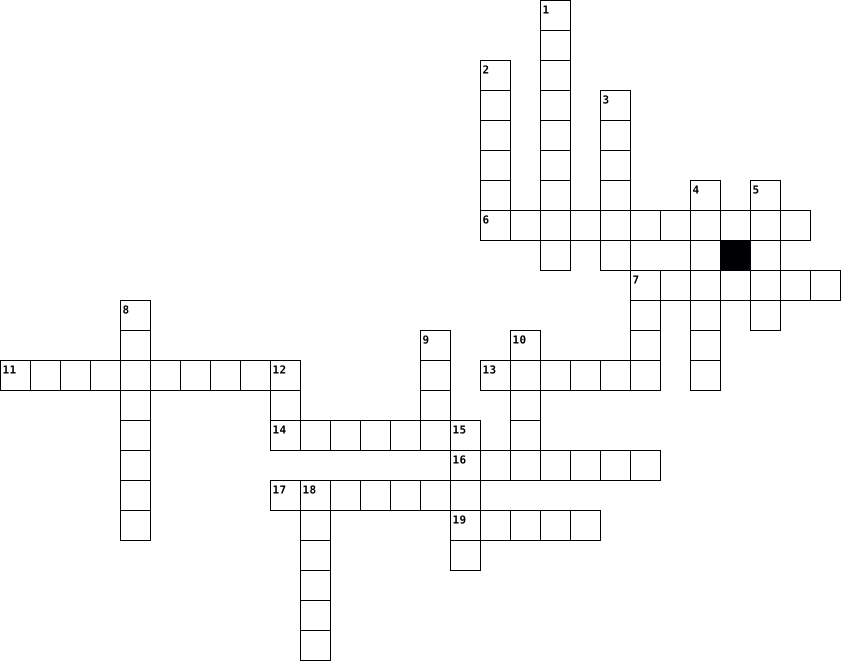
space 2022-09-22
Across
- the system that includes all our planets and the sun
- this planet heats up to 1400 degrees
- we have labeled jupiter and saturn this because of how the terrain is
- organisms that we believe live in space and that they are green and short
- it has 14 moons and is known for being super blue
- this spaceship brought Neil armstrong to the moon
- the biggest planet in our solar system made of gas
- the largest moon of saturn
Down
- a region of spacetime where gravity is so strong that nothing can escape from getting sucked into it
- we sent these to the moon and mars to explore the rocky terrain
- this planet has rings and is a gas planet
- floating pieces of rock that travel through space
- a day in this planet is a year on earth and it is the 2nd planet to the sun
- the planet we are trying to live on
- the galaxy that our solar system is in
- humans have landed on this and it is considered a satellite for earth
- it is no longer considered a planet
- the energy source of all planets
- is the home to 7 billion organisms
- known for its funny name and it has small rings
20 Clues: the largest moon of saturn • the energy source of all planets • is the home to 7 billion organisms • the planet we are trying to live on • it is no longer considered a planet • this planet heats up to 1400 degrees • the galaxy that our solar system is in • this planet has rings and is a gas planet • known for its funny name and it has small rings • ...
astronomy terminology 2022-11-21

Across
- A massive ball of gas that generates prodigious amounts of energy
- person who made this crossword
- a physicist who studies astronomy
- a small frozen mass that travels around the sun
- between or among stars
- a giant ball of gas
- When the Moon or a planet appears especially close either to another planet or to a bright star.
- any celestial body orbiting around a planet or star
- A star ending its life in a huge explosion is called a …
- of or relating to or associated with the moon
Down
- a mass that enters earth's atmosphere, becoming incandescent
- the 3rd planet from the sun
- of or relating to or caused by gravitation
- relating to the sun or utilizing the energies of the sun
- The changing illumination of the Moon (or other body) over time.
- a dwarf planet
- A solid body orbiting the Sun that consists of metal and rock.
- An event that occurs when the shadow of a planet or moon falls upon a second body.
- a giant planet with a ring of ice particles
- small extraterrestrial body that hits the earth's atmosphere
- the second nearest planet to the sun
- A vast collection of stars, gas, and dust.
22 Clues: a dwarf planet • a giant ball of gas • between or among stars • the 3rd planet from the sun • person who made this crossword • a physicist who studies astronomy • the second nearest planet to the sun • of or relating to or caused by gravitation • A vast collection of stars, gas, and dust. • a giant planet with a ring of ice particles • ...
Crossword 2012-12-01

Across
- first production-ready, hydrogen fuelled car
- what not to use while driving
- a half-bidet-half-toilet
- time travel can be achieved by going at the speed of _____
- the most used web browser
- the game console that is being released on the 30th of November
- the last name of the (supposedly) first person to land on the moon
- The south korean government plans to digitalise all textbooks in upper secondary schools by ____
- Which wii u set costs $300?
- washlets make "doing your business" much more _______
- the year america first landed on the moon
- what year was George Orwell’s prediction made?
- space is nothing: it's a ______
- where is songdo located?
- what is the plan that aims to digitalise textbooks in all schools in South Korea called?
- the washlet was created by a Japanese company called ____
Down
- Which wii u set costs $350?
- based on George Orwell’s prediction
- the moon ________ light
- the only waste material of the hydrogen fuelled car
- size of songdo
- the year the Australian government created the school laptop program
- The south korean government plans to digitalise all textbooks in elementary schools by ____
- The Van Allen radiation belts are in the Earth's ________ field
- When you are moving, time is going ______
- The moon has no ___
26 Clues: size of songdo • The moon has no ___ • the moon ________ light • a half-bidet-half-toilet • where is songdo located? • the most used web browser • Which wii u set costs $350? • Which wii u set costs $300? • what not to use while driving • space is nothing: it's a ______ • based on George Orwell’s prediction • the year america first landed on the moon • ...
Spelling List 13 - Vocab. 2024-03-18

Across
- To bring formal charges against a government official
- A representation of the Moon’s continuous orbit around the Earth
- representative
- The path that an object takes around another object in space
- First president of the United States
- When each side in a disagreement gives up some of what they want to reach an agreement
- A design or sequence that is repeated
- The act of moving from one country to another country to live
- A moon, planet or machine that orbits a planet or star
Down
- to urge or drive forward by the exertion of strong moral pressure
- Small, rocky objects that orbit the Sun
- Relating to a system of government in which the national government shares power with other levels of government, such as states
- Changing from a Full moon to a New Moon (getting smaller) (lit part is on left)
- The activities of leaders running a government
- To spin (usually on an axis)
- to provide with a quality, ability, or asset
- Large, spherical object orbiting the Sun
- A dark area made by blocking light from reaching a part of the surface
- The shapes of the illuminated portion of the Moon as seen by an observer, usually from Earth
- settle or find a solution to a problem
20 Clues: representative • To spin (usually on an axis) • First president of the United States • A design or sequence that is repeated • settle or find a solution to a problem • Small, rocky objects that orbit the Sun • Large, spherical object orbiting the Sun • to provide with a quality, ability, or asset • The activities of leaders running a government • ...
Solar System 2023-10-30

Across
- Large pieces of rock with irregular shape floating between mars and jupiter
- This field of rocks lies between mars and jupiter
- In 2006 this planet was classified as a dwarf planet.
- The first person to walk on the moon
- This planet has at least 24 moons
- The first migrant farmworker to become an astronaut
- A huge group of stars
- A day on this planet takes slightly more than an Earth year
Down
- 70% of the surface is covered by water
- A small rock that usually burns up when entering the Earth's atmosphere
- This occurs when the moon passes between the sun and Earth
- One million Earths can fit inside this celestial body
- This planet completed only 1 orbit around the since its discovery
- This planet has the strongest pull of gravity in the Solar System
- This occurs when the Earth passes between the sun and moon
- A small body made out of dust, rock, gas and ice
- This planet has the largest volcano in the Solar System
- This object causes the tides on Earth
- A force that pulls all objects toward each other
- The closest planet to the sun
- This is the only planet in our Solar System to rotate on its side.
21 Clues: A huge group of stars • The closest planet to the sun • This planet has at least 24 moons • The first person to walk on the moon • This object causes the tides on Earth • 70% of the surface is covered by water • A small body made out of dust, rock, gas and ice • A force that pulls all objects toward each other • This field of rocks lies between mars and jupiter • ...
Saturn: Celestial Masterpiece of the Solar System 2025-05-01

Across
- Six-sided geometric storm feature at the ringed planet's north pole.
- Sixth planet from the sun, known for its prominent circling structures.
- Second most abundant element on gas giants, after hydrogen.
- Mass per unit volume; famously low for the ringed planet.
- Solid, frozen water; the primary component of the ringed planet's adornments.
- Flat discs of ice and rock particles orbiting the sixth planet.
- A spacecraft's flight past a celestial body without orbiting or landing.
- A natural satellite orbiting a planet.
- Term describing the larger planets mostly made of hydrogen and helium.
- Saturn's largest moon, possessing a thick nitrogen atmosphere.
Down
- Vast body of saline water, possibly hidden beneath Enceladus's crust.
- An unmanned exploratory spacecraft sent into space (like Huygens).
- Scattered fragments or wreckage, possibly the origin of the famous rings.
- State of matter composing most of the giant planets (like hydrogen or helium).
- A rising column of water vapor and ice, erupting from Enceladus.
- Extremely delicate and light, seeming too perfect for this world.
- A major atmospheric disturbance (like the Great White Spot).
- Famous NASA/ESA mission that orbited the sixth planet for 13 years.
- The curved path of a celestial object around a star, planet, or moon.
- Moon famous for a large crater resembling a fictional space station.
20 Clues: A natural satellite orbiting a planet. • Mass per unit volume; famously low for the ringed planet. • Second most abundant element on gas giants, after hydrogen. • A major atmospheric disturbance (like the Great White Spot). • Saturn's largest moon, possessing a thick nitrogen atmosphere. • Flat discs of ice and rock particles orbiting the sixth planet. • ...
Astronomy 2023-11-28

Across
- The moon has 8 __________
- The Moon gives us ________
- The _____ is at the center of a planet
- The sun is a big _____
Down
- What are we on right now?
- The _______ gives us gravity
- The biggest star in the universe
- What is Mars?
- The moon is on a 5 degrees ______
- Summer is my favorite __________
10 Clues: What is Mars? • The sun is a big _____ • What are we on right now? • The moon has 8 __________ • The Moon gives us ________ • The _______ gives us gravity • The biggest star in the universe • Summer is my favorite __________ • The moon is on a 5 degrees ______ • The _____ is at the center of a planet
Astronomy Crossword 2016-09-21

Across
- Dwarf planet in the Kuiper belt.
- Abbreviation for The National Aeronautics and Space Administration.
- DISCOVERIES What has allowed us to know as many things about the planets as we do.
- Farthest planet from the sun in our solar system.
- The name of the star that allows us to live on Earth.
- Planet that has 9 times the radius of the earth.
- Unit of length used informally to express astronomical distances.
- Luminous sphere of plasma held together by its own gravity.
Down
- Neil Armstrong's footsteps are still visible on this area from 1969.
- Seventh planet from the Sun.
- More of a theory than fact. Many people believe their is life on this planet.
- Study of space.
- First name on first man to walk on the moon.
- This planet has the longest rotation period in the entire solar system.
- The name of the program that played a large role in the race to space.
- Last name of first person to walk on the moon.
- Largest planet in our solar system.
- Planet where your weight would be 38% of your weight on Earth.
- Last name of Neil Armstrong's partner on the voyage to the moon.
- Where our solar system is located.
20 Clues: Study of space. • Seventh planet from the Sun. • Dwarf planet in the Kuiper belt. • Where our solar system is located. • Largest planet in our solar system. • First name on first man to walk on the moon. • Last name of first person to walk on the moon. • Planet that has 9 times the radius of the earth. • Farthest planet from the sun in our solar system. • ...
Astronomy 2025-02-18

Across
- what is when something goes around something
- what is to center of the sun
- what is a pulling force based on an objects mass
- what is the shape of orbit around the sun
- what causes seasons
- what is what our atmosphere is mostly made of
- what is what the sun made of
- what cant you see during a solar eclipse
- what is a pure black moon
- what is the man trying to get to Mars
- what is when the day and night is the same
- what is the way the sun rises and sets
- what is the outer planets
Down
- what tides are strong
- what is a earth year
- what is when the planets spin around the sun
- what is when the moon is growing
- is earth the largest inner planet (true of false)
- what is when something spins on its axis
- what is when the angle of the suns rays hit to moon at different angles so we see it a different shapes
- what tides are weak
- what can't we see during a solar eclipse
- what is what earth only has
- what is when the moon is shrinking
- what is the longest/shortest day of the year
- what is the surface of the inner planets
26 Clues: what causes seasons • what tides are weak • what is a earth year • what tides are strong • what is a pure black moon • what is the outer planets • what is what earth only has • what is to center of the sun • what is what the sun made of • what is when the moon is growing • what is when the moon is shrinking • what is the man trying to get to Mars • ...
space 2022-04-22

Across
- the US orbital navigation satellites
- the first satellite to orbit the earth
- the repurposed ICBM whose second version launched Gemini
- the Russian space agency
- the series of probes to use a once-in-a-lifetime planetary alignment to do flybys of a ton of outer planets and leave the solar system
- US probes that went to mercury, venus, mars, and that did first flybys and orbits of planets
- soviet program to land on the moon, went from before the US did it to after apollo
- russia's current manned capsule
- the atlas used a stage and a ____ design
- JFK's ____ speech, famous for declaring america will go to the moon before the 1960's end
- the most recent US rover to land on mars's nickname
- what did allan Shepard play on the moon?
- the oldest satellite in orbit
Down
- intercontenital _________ missile
- the rocket that launched the first US satellite
- repurposed Saturn V third stage, first US space station
- the US's program to return to the moon
- the mars helicopter's nickname
- first working rover, first wheeled rover, and first rover to not be attached to its lander
- a type of rocket that does not enter orbit
- Boeings still-being-tested capsule
21 Clues: the Russian space agency • the oldest satellite in orbit • the mars helicopter's nickname • russia's current manned capsule • intercontenital _________ missile • Boeings still-being-tested capsule • the US orbital navigation satellites • the US's program to return to the moon • the first satellite to orbit the earth • the atlas used a stage and a ____ design • ...
Galileo Discoveries 2024-11-20

Across
- Astronomical discovery on the Moon
- Astronomical device he made improvements to
- Astronomical discovery on Saturn
- A theory not created by Galileo, but studied by him
- "Geometric" device created by Galileo
Down
- The largest moon on Jupiter
- The second largest moon on Jupiter, and the third largest in the solar system
- What the church believed his claim on "the Earth revolving around the Sun" was
- The fourth largest moon on Jupiter
- The third largest moon on Jupiter
10 Clues: The largest moon on Jupiter • Astronomical discovery on Saturn • The third largest moon on Jupiter • Astronomical discovery on the Moon • The fourth largest moon on Jupiter • "Geometric" device created by Galileo • Astronomical device he made improvements to • A theory not created by Galileo, but studied by him • ...
Mars Vocab Crosword 2013-10-03

Across
- What shape is Mar's orbit?
- The tallest volcano in the solar system.
- Mars was named after a _____ god.
- The height of Olympus Mons (in miles).
- A day on mars lasts about ___________ hours.
- The cause of Mars' red color.
Down
- What is the range of Mars' axle's tilt?
- Mars' larger moon.
- Mars is the god of ___.
- Mars' density is about ____ times the density of water.
- A large natural satellite that orbits a planet.
- Mars is a satellite of this object.
- Mars' smaller moon.
- Of what element does Mars contain most of?
- Does Mars have a global magnetic field?
- This important compound may be frozen in Mars' poles.
- Does Mars have an atmosphere?
- Mars is the ______ planet from the Sun.
- A year on mars is almost as long as ___ years on Earth.
19 Clues: Mars' larger moon. • Mars' smaller moon. • Mars is the god of ___. • What shape is Mar's orbit? • Does Mars have an atmosphere? • The cause of Mars' red color. • Mars was named after a _____ god. • Mars is a satellite of this object. • The height of Olympus Mons (in miles). • What is the range of Mars' axle's tilt? • Does Mars have a global magnetic field? • ...
Lunar Cycle Crossword 2021-10-24

Across
- Moon the moon is fully illuminated
- Quarter makes a D shape
- banana shape
- light on left, losing light
- spinning of something on its axis
Down
- somethings orbit around another object
- more than half, but not full
- Quarter makes a C shape
- light on right, growing bright
- Moon The moon is showing us no light
10 Clues: banana shape • Quarter makes a C shape • Quarter makes a D shape • light on left, losing light • more than half, but not full • light on right, growing bright • spinning of something on its axis • Moon the moon is fully illuminated • Moon The moon is showing us no light • somethings orbit around another object
Uranus 2013-09-06

Across
- discovered Miranda
- third largest planet in the solar system
- extremely large canyon in Titania
- second largest moon of Uranus
Down
- discovered Ariel
- the most striking feature of Miranda
- largest moon of Uranus
- 2 Only one space probe that has visited Uranus
- the smallest and innermost moon of Uranus
- Darkest moon of Uranus
10 Clues: discovered Ariel • discovered Miranda • largest moon of Uranus • Darkest moon of Uranus • second largest moon of Uranus • extremely large canyon in Titania • the most striking feature of Miranda • third largest planet in the solar system • the smallest and innermost moon of Uranus • 2 Only one space probe that has visited Uranus
Eclipse Crossword 2024-02-23

Across
- If you are not in the path of totality, you can still experience a ____________ eclipse if the Moon does not completely block the Sun.
- The next solar eclipse that can be seen from Oklahoma will occur on _______ 8, 2024.
- Because looking at the Sun is always dangerous, during an eclipse we should be concerned about eye _____________.
- During a solar eclipse, the Earth is darkened by the Moon’s
- The Moon sometimes appears in this shape. The Sun also can appear in this shape when the Moon is blocking the view.
- The __________ is the darkest part of the Moon’s shadow during an eclipse
Down
- This is the curved path around a star, a planet, or even a moon.
- Eclipse _________________ have a special solar filter that blocks out harmful ultraviolet and infrared rays from the Sun.
- This term means related to the moon.
- This word means referring to the Sun.
- A solar eclipse can only occur during a new _______.
- The Sun is our closest __________.
12 Clues: The Sun is our closest __________. • This term means related to the moon. • This word means referring to the Sun. • A solar eclipse can only occur during a new _______. • During a solar eclipse, the Earth is darkened by the Moon’s • This is the curved path around a star, a planet, or even a moon. • ...
Planets of the Solar System 2021-04-28

Across
- transfer of heat
- rock moving through the solar system
- rock that falls to earth from space
- occurs during new and full moon
- rocky objects that orbit the sun
- snowballs of frozen gases, rock, and dust
Down
- orbits the sun but isn't a moon
- passing into a shadow of a celestial body
- tide seven days after a spring tide
- the sun and all the objects that orbit it
- when chuncks of rock enter the atmosphere
- the star that earth orbits
- giant spheres of hot gas
- the universal force of attraction
- orbits around a planet
15 Clues: transfer of heat • orbits around a planet • giant spheres of hot gas • the star that earth orbits • orbits the sun but isn't a moon • occurs during new and full moon • rocky objects that orbit the sun • the universal force of attraction • tide seven days after a spring tide • rock that falls to earth from space • rock moving through the solar system • ...
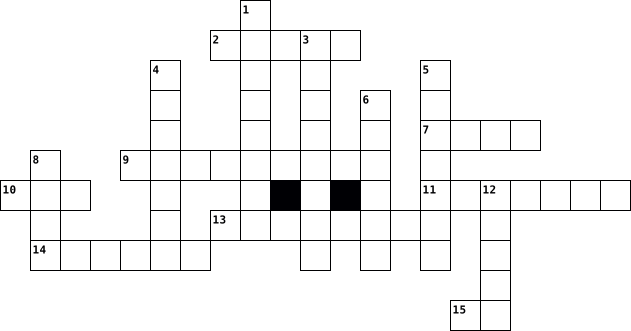
Planets 2018-02-09
Across
- Only planet with live on it
- Planet Earth is a _________ planet
- How many moons does Saturn have?
- Planet Jupiter is a _________ planet
- What is the farthest planet from the Sun?
- Belt Separates the inner planets
- Has rings around it
- Jupiter's moon
Down
- Comet A comet that is visible to earth every 75 years
- How many moons does Neptune have?
- Has a big red circle on it which is a storm
- Uranus's moon
- Mars moon
- Fourth planet from the sun
- Used to be considered a planet but is now a dwarf planet
15 Clues: Mars moon • Uranus's moon • Jupiter's moon • Has rings around it • Fourth planet from the sun • Only planet with live on it • How many moons does Saturn have? • How many moons does Neptune have? • Belt Separates the inner planets • Planet Earth is a _________ planet • Planet Jupiter is a _________ planet • What is the farthest planet from the Sun? • ...
Astronomy Crossword 2024-10-14

Across
- spinning on an axis
- the sun's faint outer atmosphere
- the gass layer above the photosphere
- any planet visible before sunrise
- the bright surface of the sun.
- any planet visible in the evening
- the moon's closest approach to earth
- the apparent path of the sun around the sky
- when the moon passes through the earth's shadow
Down
- when the moon passes in front of the sun
- occurs every 1st/3rd quarter
- when earth is closest to the sun
- earth's shadow
- occurs every full/new moon
- when earth is farthest from the sun
15 Clues: earth's shadow • spinning on an axis • occurs every full/new moon • occurs every 1st/3rd quarter • the bright surface of the sun. • the sun's faint outer atmosphere • when earth is closest to the sun • any planet visible before sunrise • any planet visible in the evening • when earth is farthest from the sun • the gass layer above the photosphere • ...
M17 2026-04-14

Across
- Généralement, l'axe d'hélice est confondu avec l'axe
- Pour éviter un fonctionnement anormal des pales d'hélice, les constructeurs mettent en place des
- permet de réduire les vibrations et le bruit
- La distance horizontale réélement effectuée par une hélice en 1 tour correspond au pas
- Afin de diminuer les vibrations, le cône d'hélice doit être centré et :
- Les différentes phases de vol nécessitent une vitesse d'hélice constante et un pas d'hélice
- le rapport puissance recueillie sur la puissance fournie
- système de synchronisme hélice permettant de désengager automatiquement le système pendant les phases de décollage et d'aterrissage
- Lorsqu'une hélice touche le sol et n'est plus réparable, il faut examiner avec précaution
Down
- Le phénomène de résonnance au sol peut mener l'avion à sa
- permet la mesure du balourd de l'hélice
- Le nettoyage des pales aluminium d'une hélice doit être fait avec une solution
- La transmission de courant à l'hélice en rotation peut se faire à l'aide d'une piste en cuivre et des
- l'indication de l'ampèremetre de dégivrage hélice baissera en cas de :
- A la sortie d'un stockage de 3 ans, une hélice doit en subir un
- Le pas géométrique H d'une hélice est fonction de l'angle
- Lorsqu'une hélice fonctionne en moulinet elle fournit la puissance sur l' :
- défaut qui a tendance à faire tourner l'hélice de manière imparfaite autour de son axe et générant des vibrations
- Lorsque la vitesse périphérique d'une hélice dépasse les 310 m/s, la portance des pales va
- La fonction reverse est possible sur un moteur à hélice lorsque l'avion est
20 Clues: permet la mesure du balourd de l'hélice • permet de réduire les vibrations et le bruit • Généralement, l'axe d'hélice est confondu avec l'axe • le rapport puissance recueillie sur la puissance fournie • Le phénomène de résonnance au sol peut mener l'avion à sa • Le pas géométrique H d'une hélice est fonction de l'angle • ...
One Giant Leap – The 1969 Moon Landing 2025-05-30

Across
- Field that people began to look up to after the mission
- Name of the mission that landed humans on the Moon
- One thing the astronauts collected from the Moon
- First man to walk on the Moon
Down
- Second astronaut to walk on the Moon
- What the Apollo 11 mission explored
- Astronaut who stayed in orbit
- Celestial body humans landed on in 1969
- Planet the astronauts safely returned to
- U.S. space agency that ran the mission
10 Clues: Astronaut who stayed in orbit • First man to walk on the Moon • What the Apollo 11 mission explored • Second astronaut to walk on the Moon • U.S. space agency that ran the mission • Celestial body humans landed on in 1969 • Planet the astronauts safely returned to • One thing the astronauts collected from the Moon • Name of the mission that landed humans on the Moon • ...
science vocab 2023-04-06

Across
- used to see small things
- its made of atoms but are still small
- kind of weather
- we cunduct
- hard
- liquid to gas
- falling water
- is a liquid
- caused by the moon
Down
- takes shape of the container
- white and puffy in the sky
- its hot
- billions of miles away
- gas to liquid
- everything is made of
- is seen at night
- spread out molecules
- clouds cause
- we learn
19 Clues: hard • its hot • we learn • we cunduct • is a liquid • clouds cause • gas to liquid • liquid to gas • falling water • kind of weather • is seen at night • caused by the moon • spread out molecules • everything is made of • billions of miles away • used to see small things • white and puffy in the sky • takes shape of the container • its made of atoms but are still small
Solar System 2013-04-10

Across
- night as hot as day, poles as hot as equator
- most of the lands are covered by water
- second largest planet
- The 1st planet
- Pluto's moon
- most come from the asteroid belt, few others blasted into space from the Moon and Mars
- has 63 moon
Down
- air pressure is only about 1% on Earth
- brief streaks of light
- a fuzzy spot
- thick atmosphere:made from helium,hydrogen and oxygen
- has the strongest wind in the solar system
- ice, rock, some metal
- belt small,solid,rocky,orbit close to the Sun
- What are Jupiter's clouds made from?
15 Clues: has 63 moon • a fuzzy spot • Pluto's moon • The 1st planet • second largest planet • ice, rock, some metal • brief streaks of light • What are Jupiter's clouds made from? • air pressure is only about 1% on Earth • most of the lands are covered by water • has the strongest wind in the solar system • night as hot as day, poles as hot as equator • ...
Solar System 2013-04-10

Across
- belt small,solid,rocky,orbit close to the Sun
- air pressure is only about 1% on Earth
- has the strongest wind in the solar system
- has 63 moon
- thick atmosphere:made from helium,hydrogen and oxygen
- What are Jupiter's clouds made from?
- brief streaks of light
Down
- a fuzzy spot
- most come from the asteroid belt, few others blasted into space from the Moon and Mars
- Pluto's moon
- The 1st planet
- most of the lands are covered by water
- ice, rock, some metal
- second largest planet
- night as hot as day, poles as hot as equator
15 Clues: has 63 moon • a fuzzy spot • Pluto's moon • The 1st planet • ice, rock, some metal • second largest planet • brief streaks of light • What are Jupiter's clouds made from? • air pressure is only about 1% on Earth • most of the lands are covered by water • has the strongest wind in the solar system • night as hot as day, poles as hot as equator • ...
Space revision 2018 2018-05-22

Across
- The planet with the largest mass
- Our galaxy
- The storm on jupiter
- The hottest planet
- The amount of planets in our solar system
- The scientist who discovered gravity
- The former planet, now dwarf planet
Down
- The rocket that humans first sent to the moon
- When the sun blocks the moon
- The term used for the planets jupiter, saturn, uranus, and neptune
- The nearest galaxy to us
- The polish scientist who discovered that the earth orbited the sun
- When the moon blocks the sun
- Mars' nickname
- The releaser of all the energy in our solar system
15 Clues: Our galaxy • Mars' nickname • The hottest planet • The storm on jupiter • The nearest galaxy to us • When the sun blocks the moon • When the moon blocks the sun • The planet with the largest mass • The former planet, now dwarf planet • The scientist who discovered gravity • The amount of planets in our solar system • The rocket that humans first sent to the moon • ...
Space Race 2022-04-29

Across
- cared the first man to land on the moon
- soviet union word for astronaut
- one of the first men on the moon
- the war that was going on during the space race
- a different way to say soviet union
- the first satellite for the us
- This was the first satellite in space. It
Down
- first dog in space
- going around somthing
- launched by the Soviets in 1957.
- first man on the moon
- one of the sides in this war
- in 1958 Eisenhower created this administration
- soviet union´s second rocket in space
- president of the us
15 Clues: first dog in space • president of the us • going around somthing • first man on the moon • one of the sides in this war • the first satellite for the us • soviet union word for astronaut • launched by the Soviets in 1957. • one of the first men on the moon • a different way to say soviet union • soviet union´s second rocket in space • cared the first man to land on the moon • ...
1400 T0p@nGa T!ime 2022-04-28

Across
- Also known as the red planet
- high amount of this on mars' surface
- someone who makes predictions on the future
- fifth largest planet in the solar systems
- made to move across the surface of a planet
- earths atmosphere made up of mostly this
- earth meaning in German
Down
- mars was named after this roman god
- the larger moon that orbits mars
- the smaller moon that orbits mars
- found beneath the poles the surface of mar
- how many moons does mars have
- earth has no
- earth has only one of these
- how many active probes orbit mars
15 Clues: earth has no • earth meaning in German • earth has only one of these • Also known as the red planet • how many moons does mars have • the larger moon that orbits mars • the smaller moon that orbits mars • how many active probes orbit mars • mars was named after this roman god • high amount of this on mars' surface • earths atmosphere made up of mostly this • ...
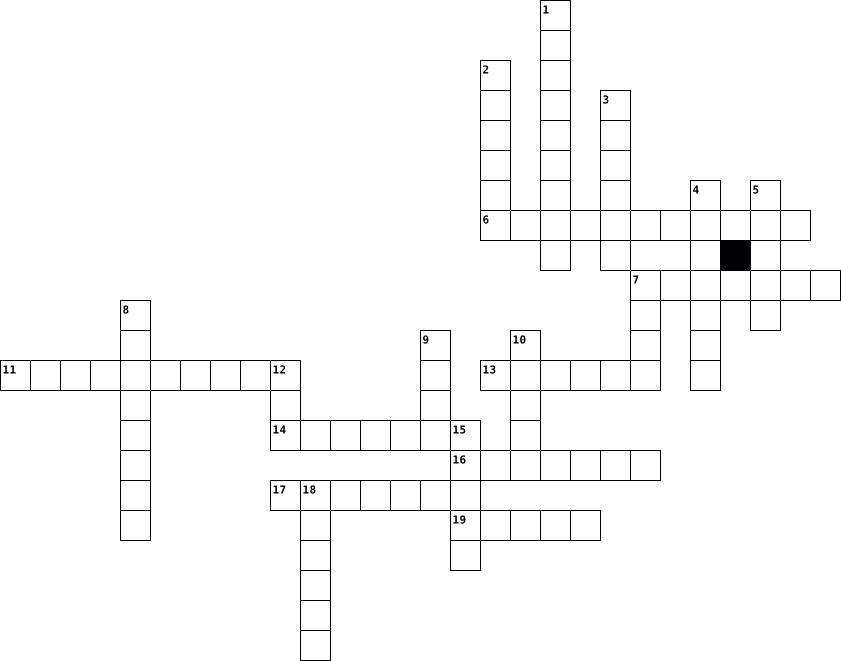
space 2022-09-22
Across
- the system that includes all our planets and the sun
- this planet heats up to 1400 degrees
- we have labeled jupiter and saturn this because of how the terrain is
- organisms that we believe live in space and that they are green and short
- it has 14 moons and is known for being super blue
- this spaceship brought Neil armstrong to the moon
- the biggest planet in our solar system made of gas
- the largest moon of saturn
Down
- a region of spacetime where gravity is so strong that nothing can escape from getting sucked into it
- we sent these to the moon and mars to explore the rocky terrain
- this planet has rings and is a gas planet
- floating pieces of rock that travel through space
- a day in this planet is a year on earth and it is the 2nd planet to the sun
- the planet we are trying to live on
- the galaxy that our solar system is in
- humans have landed on this and it is considered a satellite for earth
- it is no longer considered a planet
- the energy source of all planets
- is the home to 7 billion organisms
- known for its funny name and it has small rings
20 Clues: the largest moon of saturn • the energy source of all planets • is the home to 7 billion organisms • the planet we are trying to live on • it is no longer considered a planet • this planet heats up to 1400 degrees • the galaxy that our solar system is in • this planet has rings and is a gas planet • known for its funny name and it has small rings • ...
Space By Gotye 2021-03-19

Across
- a space center named after a president
- a place in space where they conduct space studies
- Earths only actual natural satellite
- The first name of the first person to be on the moon
- an optical instrument using lenses, curved mirrors,
- the innermost and darkest part of a shadow, where the light source is completely blocked by the occluding body
- a person that goes to space
- a combinaton of planets orbiting a central star
- a small rocky or metallic body in outer space.
- the first mission that lead human beings to the moon
- the man that stayed in the command module comlubia in apolllo 11
Down
- all of space including including planets, stars, galaxies, and all other forms of matter and energy.
- One of the orbiters from NASA's Space Shuttle program
- a sixth crewed spaceflight in NASA's Gemini program.that was launched on March 16, 1966,
- an icy, small Solar System body
- a mission that's goal is to reach the moon easily
- apollo's 11 misssion commander
- a person who studies space
- the study of space
- a group of people that work together and control what we do in space
- an astronomical object that is luminous
- a space exploration technology company
22 Clues: the study of space • a person who studies space • a person that goes to space • apollo's 11 misssion commander • an icy, small Solar System body • Earths only actual natural satellite • a space center named after a president • a space exploration technology company • an astronomical object that is luminous • a small rocky or metallic body in outer space. • ...
Astronomical Phenomena 2023-12-11

Across
- Ancient astronomers such as _____ were aware to the precession of the equinoxes.
- ______ have been identifying patterns of the stars thousandsting constellations for thousand of years.
- This is when planets move across the sky
- Comet, with their distinctive _____
- The position of stars and constellations shift due to Earth's precession. What is this?
- They interpret the appearance of comets as what?
- The invention that made astronomers explore the night sky more is called what?
- It is the pattern of the stars
- What is the event when the appearance of a new, exceptionally bright star in the night sky was noted by ancient astronomers.
- It is when multiple meteors appear to radiate from a specific point in the sky
Down
- The changing position of the sun causes what?
- Constellations also served as ____ purposes
- They often interpreted the appearance of these as omens
- What is a exceptionally bright star?
- Earth casting shadow on the moon is ____ eclipse
- It is the faint, triangular glow of sunlight scattered by interplanetary dust along the solar system.
- Astronomers relied on these observations to study the night sky before the telescopes were invented.
- This is when either when moon passes the sun or the earth.
- Whaeclipsees the sun during a lunar eclipse
- Earth casting _____ on the moon on lunar eclipse
20 Clues: It is the pattern of the stars • Comet, with their distinctive _____ • What is a exceptionally bright star? • This is when planets move across the sky • Constellations also served as ____ purposes • Whaeclipsees the sun during a lunar eclipse • The changing position of the sun causes what? • Earth casting shadow on the moon is ____ eclipse • ...
Ch. 5 Earth, Moon, and Sun 2024-02-15

Across
- The chart that can help you find constellations in the sky
- A cold mixture of dust and ice that give off a long trail of light
- Which one of Newton's laws says that an object in motion will stay in motion until acted upon by an outside force
- The tide that occurs during the moon's first-quarter phase
- A push or pull
- The force that attracts all objects toward each other
- A giant ball of hot gas
- Where stars generally appear to move (east to what)
- The tendency of an object to resist a change in motion
- The tide that occurs during new moon
- The amount if matter in an object
Down
- The force of gravity on an object
- An object that orbits the sun
- A pattern or a group of stars
- The narrow band in the sky that planets move through
- An object that orbits a planet
- What the apparent motion of objects in the sky depend on
- A streak of light produced when a small object burns up entering Earth's atmosphere
- The moon phase when the moon and Sun are at opposite sides of Earth
- The rise and fall of ocean water
- The brightest object in the night sky (other than the moon)
21 Clues: A push or pull • A giant ball of hot gas • An object that orbits the sun • A pattern or a group of stars • An object that orbits a planet • The rise and fall of ocean water • The force of gravity on an object • The amount if matter in an object • The tide that occurs during new moon • Where stars generally appear to move (east to what) • ...
Science vocab 2023-10-13

Across
- A period of moderate tides when the sun and the moon are at right angle from each other.
- a spectrum of electromatic radiation
- a shift of wavelength in the Electromagnetic spectrum.
- A faint star of enormous density
- a device used to separate light into different wavelengths
- a reaction where the nuclei come together to form a large nucleus
- the distance light travels in space for a year
- a star that has collapsed
- a group of solar sytems
- a graph that shows the heat of a star
Down
- The theory that the universe began at one point and has been expanding and cooling every since
- The spring movement of the tide during a new moon or full moon
- the movement of the earths ocean due to the gravity of the moon
- how much something is pushed on by gravity
- where a star explodes
- a probe that we send in space to collect pictures
- everything we know exists in here
- An immense cloud of gas in interstellar space.
- A rotating circumstellar disk of gas around a newly formed star.
- the force that pulls us to the ground
- a burning ball of a gas that produces light
21 Clues: where a star explodes • a group of solar sytems • a star that has collapsed • A faint star of enormous density • everything we know exists in here • a spectrum of electromatic radiation • the force that pulls us to the ground • a graph that shows the heat of a star • how much something is pushed on by gravity • a burning ball of a gas that produces light • ...
The Tides 2023-10-06

Across
- meaning land
- moon phase of the moon when neap tide
- the length of a wave
- the bottom of a wave
Down
- the moons pull on the earth
- moon phase of the moon when spring tide
- the top of a wave
- the height of a wave
- the pull on the earth
- meaning water
10 Clues: meaning land • meaning water • the top of a wave • the height of a wave • the length of a wave • the bottom of a wave • the pull on the earth • the moons pull on the earth • moon phase of the moon when neap tide • moon phase of the moon when spring tide
Year 8 Space Science Revision 2013-03-17

Across
- The furthest planet from the Sun.
- The head of a comet is composed of the nucleus and the ......
- Comets come from the Kuiper Belt or the ......
- The season which occurs when sunlight is shining directly onto a hemisphere.
- These are caused by the gravitational pull of the Moon on Earth's water.
- The planet famous for its beautiful rings.
- Known as the "Red Planet".
- The time that it takes for a planet to rotate once on its axis.
- Earth's "twin" planet which has an extremely thick atmosphere composed of carbon dioxide.
Down
- The largest planet with the Great Red Spot.
- This belt it located between Mars and Jupiter.
- No longer officially considered a planet.
- Closest planet to Earth.
- The shortest and longest days of the year are known as the Winter and Summer ......
- The time for a planet to orbit the Sun once.
- The phase of the moon where less than half is lit by the Sun.
- Another name for a shooting star.
- This planet has an axis tilted over so far that it rotates on its side.
- The type of eclipse which occurs when the Sun is blocked out by the Moon.
- The Earth's only natural satellite.
20 Clues: Closest planet to Earth. • Known as the "Red Planet". • The furthest planet from the Sun. • Another name for a shooting star. • The Earth's only natural satellite. • No longer officially considered a planet. • The planet famous for its beautiful rings. • The largest planet with the Great Red Spot. • The time for a planet to orbit the Sun once. • ...
How well do you know your work? 2012-11-11

Across
- Found in your mouth and used for breaking up food
- The moon's _______________________ pull has an effect on the Earth's tides
- The tide that occurs when there is very little difference between high and low tides
- Liquid with a density of 1g/ml
- A rocky object that orbits a planet
- Earth;s moon is a natural __________________.
- A balanced diet should include _____________ portions of fruit and vegetables every day
- The first stomach compartment of a ruminant
- Organ that stops food from going down your windpipe
- Stomach of a bird
- Liquid substance in your mouth that helps with digestion
- Also known as the large intestine
Down
- The prediction you make at the start of a scientific investigation
- The term for the weight of a substance in a given volume of the substance
- Bringing up food to feed young or aid digestion
- A useless organ/pouch found off your large intestine
- A mineral you need to make sure your bones stay strong and healthy
- The stuff you need in your diet to prevent constipation
- Cutting up a newspaper is an example of what kind of change?
- Contains a lot of Vitamin C
- The phase of the moon when we can't see the moon
21 Clues: Stomach of a bird • Contains a lot of Vitamin C • Liquid with a density of 1g/ml • Also known as the large intestine • A rocky object that orbits a planet • The first stomach compartment of a ruminant • Earth;s moon is a natural __________________. • Bringing up food to feed young or aid digestion • The phase of the moon when we can't see the moon • ...
TSA Earth Science 1st Semester Epic Exam Review 2021-12-13

Across
- legend states she is perhaps the greatest bio teacher of all time
- An imaginary pole that Earth rotates, or spins around.
- When Earth is directly between the sun and the moon, casting a shadow on the moon
- The path that an object in space follows as it moves around another object
- Greatest living creature
- While the Northern Hemisphere is having summer the Southern Hemisphere is having _______.
- The spinning motion of Earth around its own axis.
- Earth's yearlong orbit around the sun
- We have winter when the Northern Hemisphere is tilted ___ from the sun.
- It takes the earth __ ______ to complete 1 rotation.
Down
- The direction of the Earth and moon's orbit
- force with which the earth, moon, or other massively large object attracts another object towards itself.
- We have ________ because Earth is tilted on its axis.
- When the moon passes between the earth and the sun, blocking the sun
- In these High Hills Proudly Does She Stand
- When we have winter, the Southern Hemisphere has _____.
- Force is a quantity that is measured using the standard metric unit known as the...
- All objects upon earth experience a force of gravity that is directed
- The earth revolves around the ____.
- We have summer when the Northern Hemisphere is tilted _____ the sun.
20 Clues: Greatest living creature • The earth revolves around the ____. • Earth's yearlong orbit around the sun • In these High Hills Proudly Does She Stand • The direction of the Earth and moon's orbit • The spinning motion of Earth around its own axis. • It takes the earth __ ______ to complete 1 rotation. • We have ________ because Earth is tilted on its axis. • ...
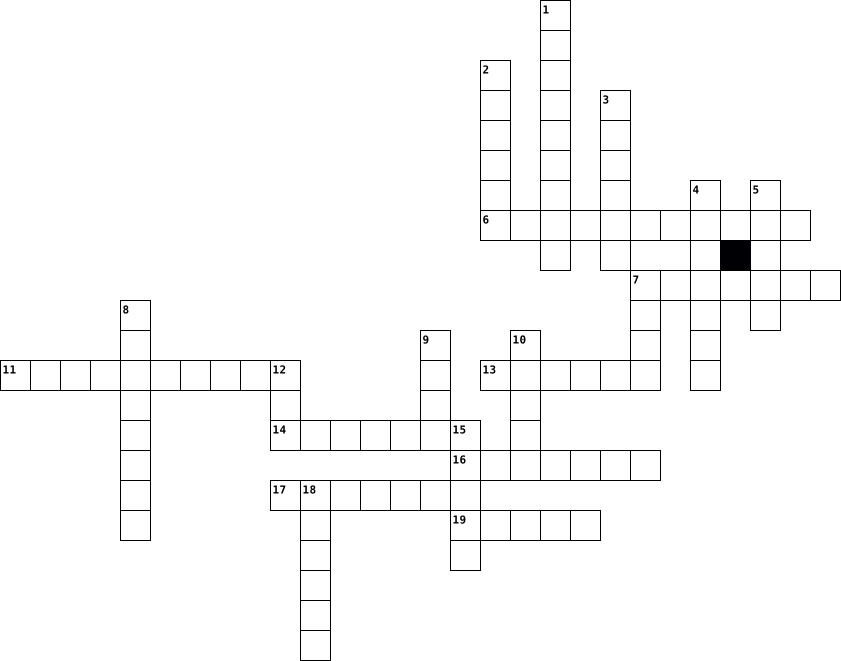
space 2022-09-22
Across
- the system that includes all our planets and the sun
- this planet heats up to 1400 degrees
- we have labeled jupiter and saturn this because of how the terrain is
- organisms that we believe live in space and that they are green and short
- it has 14 moons and is known for being super blue
- this spaceship brought Neil armstrong to the moon
- the biggest planet in our solar system made of gas
- the largest moon of saturn
Down
- a region of spacetime where gravity is so strong that nothing can escape from getting sucked into it
- we sent these to the moon and mars to explore the rocky terrain
- this planet has rings and is a gas planet
- floating pieces of rock that travel through space
- a day in this planet is a year on earth and it is the 2nd planet to the sun
- the planet we are trying to live on
- the galaxy that our solar system is in
- humans have landed on this and it is considered a satellite for earth
- it is no longer considered a planet
- the energy source of all planets
- is the home to 7 billion organisms
- known for its funny name and it has small rings
20 Clues: the largest moon of saturn • the energy source of all planets • is the home to 7 billion organisms • the planet we are trying to live on • it is no longer considered a planet • this planet heats up to 1400 degrees • the galaxy that our solar system is in • this planet has rings and is a gas planet • known for its funny name and it has small rings • ...
Investigation 7 Review 2022-11-16

Across
- light travels in ________
- light is a combination of electric and __________ energy
- the dark areas on a light spectrum are called ________ lines
- the country that the US was in a conflict with during the 1960s was called the ________ union
- a conflict between the US and USSR during the 1960s
- a competition between the US and USSR to get to the moon first
- energy with a long wavelength has ________ energy
- a unique "fingerprint" that all light sources give off is called a light_______________
- energy with a short wavelength has _______ energy
- when an object is moving closer and squishing lightwaves together
Down
- the name of the lunar module that landed on the moon
- a tool that separates light into different wavelengths
- the _______ telescope gave us the first clear images of deep space
- the mission that landed people on the moon for the first time
- light is a form of _________ energy
- last name of the first person to walk on the moon
- the study of light
- last name of the first man in space
- the distance between two waves
- when an object is moving away and stretching lightwaves apart
- the _____ Webb telescope is the newest telescope to take pictures of deep space
- the bright lines that show up in a spectrum are _______ lines
22 Clues: the study of light • light travels in ________ • the distance between two waves • light is a form of _________ energy • last name of the first man in space • last name of the first person to walk on the moon • energy with a long wavelength has ________ energy • energy with a short wavelength has _______ energy • a conflict between the US and USSR during the 1960s • ...
Space crossword 2020-04-06

Across
- when our view of the moon or the sun is blocked
- the biggest planet in the solar system
- brightest object in the night sky - causes our tides
- the name of a miniature planet, companions of a Disney princess
- brightest star in the night sky, Harry Potter's godfather
- Stephen, famous mathematician and physicist
- the Milky Way's closest neighbour, tv show
- used to look at the night sky more closely
- in the night sky - used for navigation
- first to spot the moons of Jupiter - Italian, Queen lyric
- closest planet to the sun, used in thermometers
- 'blank' Aldrin - second man on the moon, Woody's friend.
Down
- Albert - famous physicist
- how scientists think it all started, tv show
- green patterns sometimes formed in the night sky
- the 'blank' belt, rocks between mars and jupiter
- Queen's famous guitar playing astrophysicist
- somebody that studies space
- orbit Earth - help with weather, GPS and television
- the 'red planet', chocolate bar
- the densest & darkest objects in the universe
- famous for his belt, carries a bow and arrow
- too small to be a planet, Mickey Mouse's pet
- Neil, first man on the moon
- telescope that is in space - named after a famous astronomer
25 Clues: Albert - famous physicist • somebody that studies space • Neil, first man on the moon • the 'red planet', chocolate bar • the biggest planet in the solar system • in the night sky - used for navigation • the Milky Way's closest neighbour, tv show • used to look at the night sky more closely • Stephen, famous mathematician and physicist • ...
Science 8 review 2023-06-08

Across
- Relating to the sun
- When light takes in energy
- a proposed answer to a question
- What happened/the result of the cause
- "Survival of the Fittest"
- When light bounces back from an object
- The distance between the crest and rest position
- energy in motion
- Something spinning on its axis like the Earth
- This matters because..
- A magnet that is charged and can be turned off and on
- The path around another celestial object
Down
- stored energy
- Is a push or a pull resulting from the interaction of objects
- The distance between the crest of one wave and another wave
- Relating to the moon
- the reason why something happens
- To be pulled toward something else
- information that is used to support or refute a claim
- Happens when the earth is in between the sun and moon OR when the moon is between the sun and Earth
- To be lit up
- Magnet A magnet that is permanent
- When light bends as it passes through a medium
- the ability to do work or make a change
- To change from one thing to another
- To be pushed away from something else
- Phase New, Crescent, Quarter, Full, Gibbous,
27 Clues: To be lit up • stored energy • energy in motion • Relating to the sun • Relating to the moon • This matters because.. • "Survival of the Fittest" • When light takes in energy • a proposed answer to a question • the reason why something happens • To be pulled toward something else • To change from one thing to another • What happened/the result of the cause • ...
The Solar System (English Version of Crossword) 2025-05-24

Across
- – The largest planet with the Great Red Spot.
- – An instrument used to observe distant objects.
- – A giant cloud of dust and gas where stars are born.
- – The U.S. space agency.
- – A moon of Jupiter with an icy ocean.
- – A icy object that develops a tail when near the Sun.
- – The smallest and closest planet to the Sun.
- – A robotic vehicle exploring planets (e.g., Curiosity).
- – A dwarf planet in the Kuiper Belt.
- – The hottest planet with a toxic atmosphere.
- – The only known planet with liquid water and life.
- – The windiest planet with the strongest storms.
- – One of Mars’ two moons.
- – Famous for its beautiful rings.
- – Neptune’s largest moon, orbits backward.
Down
- – Earth’s natural satellite.
- – Saturn’s largest moon with a thick atmosphere.
- – The largest object in the asteroid belt.
- – A streak of light caused by a burning space rock (shooting star).
- Hole – A region of space with gravity so strong nothing escapes.
- – A rocky body orbiting the Sun, mostly found in the asteroid belt.
- – The force that keeps planets in motion around the Sun.
- – A gas giant that rotates on its side.
- – Known as the "Red Planet," home to Olympus Mons.
- – The path a planet or satellite follows around a star.
25 Clues: – The U.S. space agency. • – One of Mars’ two moons. • – Earth’s natural satellite. • – Famous for its beautiful rings. • – A dwarf planet in the Kuiper Belt. • – A moon of Jupiter with an icy ocean. • – A gas giant that rotates on its side. • – The largest object in the asteroid belt. • – Neptune’s largest moon, orbits backward. • ...
elements compounds and mixtures 2023-12-08

Across
- the fourth state of matter
- atoms that are not bonded chemically
- same atoms bonded together
- bonded physical
- different atoms bonded together
Down
- matter with unique properties
- bonded through chemical reactions
- everything with mass and takes up space
- different forms of matter
- building block of matter
10 Clues: bonded physical • building block of matter • different forms of matter • the fourth state of matter • same atoms bonded together • matter with unique properties • different atoms bonded together • bonded through chemical reactions • atoms that are not bonded chemically • everything with mass and takes up space
Solar system 2023-06-07
Across
- One of Jupiter's largest moons, known for its volcanic activity.
- The third planet from the Sun and the only known planet to support life.
- The largest moon in our solar system, orbiting around Jupiter.
- Saturn's largest moon and the second-largest moon in our solar system.
- The sixth planet from the Sun, recognized for its prominent ring system.
- The star at the center of our solar system, providing heat and light to the planets.
- Space Station (ISS) A habitable space station that serves as a research laboratory and home for astronauts from multiple countries
- The fourth planet from the Sun and often referred to as the "Red Planet."
- Space Telescope A powerful telescope orbiting Earth, capturing stunning images of celestial objects.
- The second planet from the Sun and the hottest planet in our solar system.
Down
- Earth's natural satellite, orbiting around our planet.
- Cosmic objects made of ice, dust, and rock that orbit the Sun, often exhibiting a visible coma and tail.
- Formerly considered the ninth planet, now classified as a dwarf planet.
- The seventh planet from the Sun and the coldest planet in our solar system.
- The eighth and farthest planet from the Sun, known for its striking blue color.
- Rocky objects that orbit the Sun, mainly found in the asteroid belt between Mars and Jupiter.
- A moon of Saturn with geysers that emit plumes of water vapor.
- Rover Robotic vehicles sent to explore the surface of Mars and gather data.
- The largest planet in our solar system, known for its colorful bands and numerous moons.
- The closest planet to the Sun and the smallest planet in our solar system.
20 Clues: Earth's natural satellite, orbiting around our planet. • The largest moon in our solar system, orbiting around Jupiter. • A moon of Saturn with geysers that emit plumes of water vapor. • One of Jupiter's largest moons, known for its volcanic activity. • Saturn's largest moon and the second-largest moon in our solar system. • ...
Pō Mahina 2023-01-18

Across
- night
- moon
- decrease, get smaller
- 10 nights
- the name of the very last moon phase in the Hawaiian calendar.
- the name of the first moon phase in the Hawaiian calendar
Down
- round, circular
- the name of the 16th moon phase in the Hawaiian calendar. This is one of the full moons.
- month
- big, large
10 Clues: moon • night • month • 10 nights • big, large • round, circular • decrease, get smaller • the name of the first moon phase in the Hawaiian calendar • the name of the very last moon phase in the Hawaiian calendar. • the name of the 16th moon phase in the Hawaiian calendar. This is one of the full moons.
Rainbows & The Moon 2025-08-28

Across
- Bending of light causing rainbows
- Earth’s natural satellite
- Color between blue and violet
- Moon shape less than half full
- When the sun, moon, and Earth align
Down
- Range of visible colors
- Circular depression on the moon’s surface
- Path the moon follows around Earth
- Essential for rainbow formation
- Object that disperses white light
10 Clues: Range of visible colors • Earth’s natural satellite • Color between blue and violet • Moon shape less than half full • Essential for rainbow formation • Bending of light causing rainbows • Object that disperses white light • Path the moon follows around Earth • When the sun, moon, and Earth align • Circular depression on the moon’s surface
Introducing the Sun-Earth-Moon System 2022-09-27

Across
- imaginary rotation line of Earth
- about one fourth the diameter of Earth
- the moon revolves around this planet
- the widest point across the equator
- 108 Earths can fit across its diameter
- the organization of our solar system
- gather light so we can see dim objects
- receive electromagnetic waves
Down
- time it takes for Earth to rotate once
- Identify elements on stars using light
- ground-based robots
- one revolution of the moon around Earth
- one revolution of Earth around the sun
- Earth's journey around the sun
- man-made ones orbit other planets
15 Clues: ground-based robots • receive electromagnetic waves • Earth's journey around the sun • imaginary rotation line of Earth • man-made ones orbit other planets • the widest point across the equator • the moon revolves around this planet • the organization of our solar system • time it takes for Earth to rotate once • Identify elements on stars using light • ...
Mars and earth crossword 2022-04-29

Across
- the outermost layer of earth
- solid bulk of earths interior
- dense center of the earth
- A canyon system system on mars equator
- ice poles beneath the surface of mars
- a space exploration vehicle
- the larger moon for mars
Down
- the third layer of earth
- a star which the earth orbits
- an celestial body orbiting earth or other planets
- a shield volcano mountain on mars
- a crater on a planet or moon from an meteorite
- fourth planet from the sun
- when an orbit from an planet lines up opposite of a other planet
- the smaller moon for mars
15 Clues: the third layer of earth • the larger moon for mars • dense center of the earth • the smaller moon for mars • fourth planet from the sun • a space exploration vehicle • the outermost layer of earth • a star which the earth orbits • solid bulk of earths interior • a shield volcano mountain on mars • ice poles beneath the surface of mars • A canyon system system on mars equator • ...
Astronomy Quiz 2026-06-04

Across
- Earths only natural satellite
- Manmade object furthest away from Earth
- Independent groups óf stars in the universe
- a person trained for space flight
- the man who discovered gravity
- massive glowing cloud of gas in interstellar space
- the largest moon of Saturn
- the Earth first artifical satellite
- famous telescope named after a famous astronomer
- one of the moons brightest craters
Down
- our galaxy
- nearest major galaxy to the milkyway
- eigth and furthest known planet orbiting the Sun
- closest planet to the sun
- a famous NASA programme to land man on the moon
15 Clues: our galaxy • closest planet to the sun • the largest moon of Saturn • Earths only natural satellite • the man who discovered gravity • a person trained for space flight • one of the moons brightest craters • nearest major galaxy to the milkyway • the Earth first artifical satellite • Manmade object furthest away from Earth • Independent groups óf stars in the universe • ...
To the Moon...and back 2022-12-25

Across
- nasa affilate laboratory
- autonomous vehicle
- space telescope James
- first powered flight on another planet
- ~671 million mph
- point of no return
- swan constellation
- first human in space
Down
- spheres found in eagle crater
- of mars origin
- harp in the sky
- son and moon of mars
- the twins
- Florida's space center
- earth-like moon
- first successful mars landing
- potentially habitable exoplanet
- estrellita blanco
- solar energy visible during eclipse
19 Clues: the twins • of mars origin • harp in the sky • earth-like moon • ~671 million mph • estrellita blanco • autonomous vehicle • point of no return • swan constellation • son and moon of mars • first human in space • space telescope James • Florida's space center • nasa affilate laboratory • spheres found in eagle crater • first successful mars landing • potentially habitable exoplanet • ...
Science vocab 2022-10-25

Across
- One moon phase with spring tides
- Pull from the moon causing tides
- Medium high and low tides
- periodic rise and fall of water
- One moon phase with spring tides
Down
- One moon phase with neap tides
- One moon phase with nap tides
- Highest and lowest tides
- Main gravitational pull source
- Number of high & low tides per day
10 Clues: Highest and lowest tides • Medium high and low tides • One moon phase with nap tides • One moon phase with neap tides • Main gravitational pull source • periodic rise and fall of water • One moon phase with spring tides • Pull from the moon causing tides • One moon phase with spring tides • Number of high & low tides per day
Astronomy- Nathan Droster- 2nd 2019-04-12

Across
- small space rock moving through our solar system
- a mixture of hydrogen, helium, and oxygen.
- when the moon is covered by the earths shadow
- a state at which all possible states of a system is shown
- the two times of the year at which the sun is the farthest away from the earth
- States that every particle attracts every other particle
- an object that orbits a planet
- a cycle that starts at January 1st and ends December 31st thus making it 360 days in a year
- a space of which illumination is partial
- a mixture of ice and dust
- An object that orbits a star, is large enough to have become rounded by its own gravity
- A streak of light in the sky produced by a meteoroid burning by the earth's atmosphere
Down
- the rise and fall of the sea
- a rotation around a star or a planet
- occurs when the moon is between earth and the sun
- the darkest part of a planets shadow
- the rotation around a star
- a group of stars in a shape of something.
- a hole either on the earth or moon, caused by an impact
- occurs when the sun and the moon are aligned with earth
- the two times of the year at which the sun is the closest to earth
- A force that attracts objects towards planets with varying results
- an imaginary line that expands from north to south
- when the difference from low tide and high tide are minimal
- how a planet moves around it's axis
- partial or total covering of an object.
- large and dark basaltic plains on the moon
27 Clues: a mixture of ice and dust • the rotation around a star • the rise and fall of the sea • an object that orbits a planet • how a planet moves around it's axis • a rotation around a star or a planet • the darkest part of a planets shadow • partial or total covering of an object. • a space of which illumination is partial • a group of stars in a shape of something. • ...
7jasper6 2018-03-13

Across
- the part that is a little lighter
- The dark part of the shadow
- the periodic rise and fall of the sea level under the gravitational pull of the moon
- a chunk of rock or metal from space that falls through the atmosphere
- any two bodies in the universe attract each other
- a hole formed by impact
- real or imaginary line on which something rotates
- an object that orbits the earth
- is a force which tries to pull two objects toward each other
- movement of one object around a center or another object
- a loose collection of ice and dust that orbits the sun
- a part or step in a process
Down
- plural form of mare
- the Sun and Moon are at right angles to the Earth
- When the Earth moves between the sun and the moon
- Moon passes in front of the Sun
- a giant moving rock
- a repeating path that one object in space takes around another
- occur when the Moon is either new or full
- grouping of stars that people imagine to represent a figure or object
- an object that orbits a star
- a system of timekeeping that defines the beginning and length and divisions of the year.
- the act or process of moving or turning around a central point
- the time of the year when the sun passes overhead the farthest north
- either of the two points on the celestial sphere where the celestial equator intersects the ecliptic
- occurs when one object in space blocks an observer from seeing another object in space
- a ball of hot gas that undergoes nuclear fusion
27 Clues: plural form of mare • a giant moving rock • a hole formed by impact • The dark part of the shadow • a part or step in a process • an object that orbits a star • Moon passes in front of the Sun • an object that orbits the earth • the part that is a little lighter • occur when the Moon is either new or full • a ball of hot gas that undergoes nuclear fusion • ...
25.26 Midterm Review 2025-12-10

Across
- the Earth's magnetic field is caused by convection currents in the ____________________
- the earth is at the center of the solar system in the ___________ model
- this type of rock has been changed by extreme heat and pressure
- Earth's __________ takes 24 hours; causes day and night
- the process of dense oceanic crust sinking below less dense continental at a trench
- when the lit part of the moon is getting brighter, we say the moon is ______________
- when the lit part of the moon is getting smaller, we say the moon is ______________
- plates collide into each other at a ____________ boundary
- these moons are more than half lit up
- a small rocky body out in space
Down
- _______________ in the mantle causes plate movement
- a chunk of rock, dust and ice that orbits the sun
- a small rocky body that has hit Earth's surface
- if the heat source is removed, a convection current will __________
- this theory explains the formation of the universe
- minerals must be naturally occurring, meaning they can only be ________ in nature, we cannot make them
- the season the northern hemisphere experiences when it is tilted towards the sun is _____________.
- gravity and ________ combine forces to keep our planets in orbit around the sun
- the strength of the force of gravity depends on _______ and the distance between objects
- the moon phase during which a solar eclipse can occur
- this type of rock is formed when melted rock cools and solidifies
- pressure and ____________ increase as you go deeper and deeper inside the Earth
- the Earth experiences seasons because our axis is ___________ as we revolve around the sun
- matching coastlines, climate clues and matching animal _________ on seperated continents were Wegener's evidence for continental drift
24 Clues: a small rocky body out in space • these moons are more than half lit up • a small rocky body that has hit Earth's surface • a chunk of rock, dust and ice that orbits the sun • this theory explains the formation of the universe • _______________ in the mantle causes plate movement • the moon phase during which a solar eclipse can occur • ...
The Solar System 2017-01-15

Across
- Venus is the ___________ night sky object after the Moon.
- This word is Greek for "wanderer"
- Mars has the largest _____________ in the solar system
- Earth’s magnetic field protects us from the effects of the solar _______
- The Solar System includes all objects under the Sun’s __________ influence
- Gases on Uranus and Neptune are almost all completely ________
- The Sun would collapse if the energy released by ______ didn’t balance the force of gravity
- Jupiter is mostly made of __________ and helium
- Mercury is the ___________ moving planet
- This planet is tilted almost completely on its side
- This moon of Jupiter has the most volcanoes in the Solar System
- Sunspots increase and decrease on ________ year cycles
Down
- Solar flares are caused when the ___________ fields of sunspots connect
- The average distance from Earth to the Sun is one __________ Unit
- The outer planets are sometimes called _________ which means "like Jupiter"
- Earth has the largest ___________ for its size.
- The light of the sun is radiated from the ______________
- A star’s energy comes from hydrogen being fused into ___________
- Mars's red surface is evidence that it once had _________ on its surface.
- This moon of Jupiter has liquid water and possibly life
- Venus's thick CO2 atmosphere creates a strong __________ effect
- Jupiter's Great Red Spot is an enormous __________
- Saturn is distinguished by its large __________
23 Clues: This word is Greek for "wanderer" • Mercury is the ___________ moving planet • Earth has the largest ___________ for its size. • Jupiter is mostly made of __________ and helium • Saturn is distinguished by its large __________ • Jupiter's Great Red Spot is an enormous __________ • This planet is tilted almost completely on its side • ...
Space Science 2013-06-02

Across
- The inside of the sun that makes energy.
- Earth's magnetic field stimulating molecules atmosphere.
- I device that NASA has up in space for re search.
- White dwarf has used up all of its fuel and cooled off.
- Distance measured galaxies.
- the quality or condition of being dense.
- What robots collect from mars and the moon.
- When the entire moon is lit up.
- North and South.
- When a rock enters Earth's atmosphere.
- A birth nursery for new stars.
- Darker patches on the sun that are cooler than the rest.
Down
- Only in that part of its orbit that is close to the sun.
- When something spins on its axis.
- Eruption of magnetic energy released on the sun.
- What keeps you in place on Earth.
- A faintly colored luminous ring.
- When a star is at the end of its life
- The height of a thing above a reference level.
- A collection of large mass stars and planets.
- The time during which such an obscuration occurs.
- belt Where most of the asteroids are found.
- When something orbits.
- When the moon is all black.
- bowl shaped depression on the moon.
- A ball of gas and heat.
- America's space program
27 Clues: North and South. • When something orbits. • A ball of gas and heat. • America's space program • Distance measured galaxies. • When the moon is all black. • A birth nursery for new stars. • When the entire moon is lit up. • A faintly colored luminous ring. • When something spins on its axis. • What keeps you in place on Earth. • bowl shaped depression on the moon. • ...
The Space crossword 2024-04-25

Across
- A wrinkle in time
- The star that gives us life
- Michael Jordan once said: welcome to the-
- A theoretical particle
- Small rocky bodies or something that keeps your pants on
- When light or electromagnetic radiation is stretched as it moves
- When the moon is in front of the sun
- A picture in the sky
- A trainee astronaut
- The fasted spacecraft launched by NASA
- A spacecraft or the name of a raccoon
- A feminine name or a comet
- A fictional Star Trek character
Down
- Something an alien would say
- A celestial body that orbits a star
- This makes apples fall out of trees
- A theoretical fabric
- My relationship status plus ity
- The study of the origin, evolution, and fate of the universe
- A telescope
- A spacecraft that orbits Earth, often used for photos or navigation
- A marvel superhero
- The boundary surrounding a black hole
- An object that light can not escape
- The second word of a David Bowie hit
- A former planet
- Where Frank Sinatra may fly to
- The first syllable of a Nicki Minaj song
- Jupiter's fifth largest moon
- A Saturn moon or Zeus' father
- A martian
31 Clues: A martian • A telescope • A former planet • A wrinkle in time • A marvel superhero • A trainee astronaut • A theoretical fabric • A picture in the sky • A theoretical particle • A feminine name or a comet • The star that gives us life • Something an alien would say • Jupiter's fifth largest moon • A Saturn moon or Zeus' father • Where Frank Sinatra may fly to • My relationship status plus ity • ...
The Space Crossword 2023-09-19

Across
- NASA’s rover on Mars (9)
- India’s first satellite (9)
- Freckles on our Moon’s surface caused due to absence of atmosphere (7)
- Powerful and luminous explosion of a star (9)
- A dwarf planet (4)
- Blue planet named after Greek God of Sea (7)
- Slowest rotating planet (5)
- Shapes of galaxies: ________, Spiral and Irregular (9)
- Mars’s moons: ______ and Deimos (6)
- The unseen astronomical body at centre of our galaxy (9)
- Our galaxy (8)
- The North Star is called (7)
Down
- Jupiter’s super smooth icy moon (6)
- The largest known star in the universe (7)
- A planet outside our Solar System (9)
- The comet that visits us every 75-79 years (7)
- Largest moon of solar system (8)
- A planet knocked off its orbital path (5)
- Planet rotating on its side (6)
- The force that holds the universe together (7)
- Colossal storm on Jupiter: Great ___(3) ____ (4)
- Largest moon of Saturn (5)
- India’s rover on moon (7)
- Distance travelled by light in 1 year (9)
- Luminescent giant cloud of dust and gas in space (6)
- The first animal to make an orbital spaceflight (5)
- Name of cloud of icy debris predicted at extremities of our solar system (4)
27 Clues: Our galaxy (8) • A dwarf planet (4) • NASA’s rover on Mars (9) • India’s rover on moon (7) • Largest moon of Saturn (5) • India’s first satellite (9) • Slowest rotating planet (5) • The North Star is called (7) • Planet rotating on its side (6) • Largest moon of solar system (8) • Jupiter’s super smooth icy moon (6) • Mars’s moons: ______ and Deimos (6) • ...
Climate Crossword 2025-01-10

Across
- the presence of substances and heat in environmental media
- the radiation from the sun that can be used to generate electricity
- a real or imaginary straight line going through the center of an object that is spinning
- occurs when the Moon passes between the Earth and the Sun
- a regular, repeating path that one object in space takes around another one
- occurs when the Earth is positioned between the Sun and the Moon
- Astrophysicist Neil deGrasse Tyson coined the term in a 1977 article in the magazine Natural History.
- one half of a sphere
- an object that orbits a planet or something else that is not a star
- the apparent rising of the sun above the horizon
Down
- happens when Earth's moon is in a total lunar eclipse
- to circle around a center point
- long-term shifts in temperature and weather patterns
- the current rise in the average temperature of Earth's air and oceans
- a group of stars seen as forming a figure or design in the sky
- the star around which the planets revolve
- the planet on which we live
- a natural luminous body visible in the sky especially at night
- the four periods of the year
- to move in a curved path round a center or axis
20 Clues: one half of a sphere • the planet on which we live • the four periods of the year • to circle around a center point • the star around which the planets revolve • to move in a curved path round a center or axis • the apparent rising of the sun above the horizon • long-term shifts in temperature and weather patterns • happens when Earth's moon is in a total lunar eclipse • ...
Rockets 2013-05-09

Across
- First animal that went into space.
- First man of the moon.
- Top of small toy rocket.
- What ignites the small rocket engine of a rocket.
- Country who put man on the moon.
- Designed and made fist liquid fuel rocket.
- Best angle for distance of projectile objects.
Down
- Second man on the moon.
- Famous Colorado astronaut.
- The wings of a rocket.
- Substance used by early Chinese to launch first rockets.
- 600 A.D. the Chinese used gunpowder for entertainment to set off …
- National Aeronautics and Space Administration is commonly called...
- Best angle for height of projectile objects.
- Rocket's Body.
15 Clues: Rocket's Body. • The wings of a rocket. • First man of the moon. • Second man on the moon. • Top of small toy rocket. • Famous Colorado astronaut. • Country who put man on the moon. • First animal that went into space. • Designed and made fist liquid fuel rocket. • Best angle for height of projectile objects. • Best angle for distance of projectile objects. • ...
TCAP Packet terms 2015-04-24

Across
- when the moon is being blocked by the sun
- moon ninety dgree angle
- winds that prevail around the world
- when the breeze is going from the land to the sea
- do not the dependent clause
- a consumer that eat only other consumer
- needs the independent clause
Down
- a consumer that eat both plants and animals
- when the sun is being blocked by the moon
- a consumer that eat only producers
- there are eight
- moon's straight angle
- when the breeze is going from the sea to the land
- there are four of them
- the Earths tilt create these
15 Clues: there are eight • moon's straight angle • there are four of them • moon ninety dgree angle • do not the dependent clause • the Earths tilt create these • needs the independent clause • a consumer that eat only producers • winds that prevail around the world • a consumer that eat only other consumer • when the sun is being blocked by the moon • ...
Astronomy Crossword Puzzle 2021-09-29

Across
- Can be a Spiral, Elliptical, or Irregular
- When Days or Nights are Long/Short
- A Giant Star in the Center of our Solar System
- Can Also be a Meteorite and Meteoroid
- When the Moon Seems to Get Larger
- Made of Ice and Dust
- The Sun is the Center
- A Full Spin on a Planets Axis
Down
- The Earth is the Center
- When the Moon Seems to Get Smaller
- A Planets Orbit Around the Sun
- Our Planet
- When Days and Nights are Equal
- A Natural Satellite Around Earth and More
- Can be Lunar or Solar
15 Clues: Our Planet • Made of Ice and Dust • The Sun is the Center • Can be Lunar or Solar • The Earth is the Center • A Full Spin on a Planets Axis • A Planets Orbit Around the Sun • When Days and Nights are Equal • When the Moon Seems to Get Larger • When the Moon Seems to Get Smaller • When Days or Nights are Long/Short • Can Also be a Meteorite and Meteoroid • ...
Solar System Vocabulary 2021-09-03

Across
- Shape of the planets
- Path a planet takes around the sun
- Smallest planet in the solar system
- Scientist who visits space
- Hottest Planet
- Not considered to be a planet anymore!
- Scientist who studies space
Down
- Length of time taken up by one orbit of the sun
- Happens when the Sun's light is blocked by the Moon
- Force that holds the Moon in orbit around the Earth
- Gas Giant
- Our star
- Takes 24 hours on Earth
- Famous scientist who came up with theories about gravity and the solar system
- Object that orbits a planet
- Object that orbits a planet
16 Clues: Our star • Gas Giant • Hottest Planet • Shape of the planets • Takes 24 hours on Earth • Scientist who visits space • Object that orbits a planet • Object that orbits a planet • Scientist who studies space • Path a planet takes around the sun • Smallest planet in the solar system • Not considered to be a planet anymore! • Length of time taken up by one orbit of the sun • ...
Tides Crossword 2023-11-01

Across
- Also Causes neap tides.
- The more what the more gravitational pull.
- The waters height.
- Drastic Tides are called what?
- When there is a Neap tide the sun moon and earth will be in a what?
- Force that pulls .
- Determines weather it is Spring Tide or Neap Tide.
Down
- Non drastic tides are considered?
- The Moon Orbit affects the what?
- 90 degree angle with the sun moon and earth
- Causes spring tides.
- Causes neap tides.
- This happens when the tide is above average.
- Also causes spring tides.
- This happens when the tide is below average.
15 Clues: The waters height. • Causes neap tides. • Force that pulls . • Causes spring tides. • Also Causes neap tides. • Also causes spring tides. • Drastic Tides are called what? • The Moon Orbit affects the what? • Non drastic tides are considered? • The more what the more gravitational pull. • 90 degree angle with the sun moon and earth • This happens when the tide is above average. • ...
Vocab 2019-04-04

Across
- An imaginary line that passes through a planets center
- The partial or blocking of one object in space by another
- the attractive force between objects
- A system of organizing time that defines the beaning length
- the curved path of a celestial object or spacecraft around a star, planet, or moon, especially a periodic elliptical revolution.
- the movement of one object around a center or another object, a forceful overthrow of a government by the people or any sudden or grand change
- The darkest part of a shadow
- eclipse The blocking of sunlight to each that occurs to when the moon is
- solar System, states that a planet is a body that orbits the Sun
- A huge ball of gas held together by gravity
- A large pit caused by the impact of a mediator
- a small body of matter from outer space that enters the earth's atmosphere
Down
- tide The tide did with the least different between low and high tides
- tide The tide with the greatest difference between low and high tides
- the part of a shadow surrounding the darkest part
- eclipse The blocking of sunlight to the moon that occurs when earth is directly above it
- A loose collection of ice and dust that orbits the sun
- is the process or act of turning or circling around something.
- an artificial body placed in orbit around the earth or moon
- The periodic rise and fall id the level of water in the ocean
- A pattern or grouping stars
- of universal gravitation The scientific laws that states that every object in the unavis
- Dark flat areas on the moon surface formed from huge lava flows
- One different apparent shapes of the part
24 Clues: A pattern or grouping stars • The darkest part of a shadow • the attractive force between objects • One different apparent shapes of the part • A huge ball of gas held together by gravity • A large pit caused by the impact of a mediator • the part of a shadow surrounding the darkest part • An imaginary line that passes through a planets center • ...
Pluto Puzzles 2019-03-05

Across
- This moon is named after the ferryman who brought new souls to the Underworld.
- Charon is half the size of ____.
- This moon is named after a many-headed monster that can regrow two heads for every one lost.
- Pluto's atmosphere ____ closer to the sun.
- Icy cloud around solar system
- Pluto's atmosphere ____ further from the sun.
- Charon was discovered by astronomer ____.
- Pluto's orbit is tilted ____ degrees.
- Pluto's atmosphere is made of mainly ____ and ____ gases.
- 4th officially recognized dwarf planet.
- Pluto's orbit is more ___ than the other planets.
- Pluto is a ____ planet.
- Ring of dwarf planets, moons and comets past Neptune
- Nix and Hydra were discovered by a ___ space telescope team.
- This moon is named after the river that separates the Underworld and the world of the living.
- Pluto was demoted in 200_ (Spell it out).
Down
- Pluto was demoted because it did not clear its ____.
- Charon is ____ locked onto Pluto.
- 3rd officially recognized dwarf planet.
- 5th officially recognized dwarf planet.
- If Earth is a nickel, Pluto is a ____.
- Nix orbits around Pluto every ____ days.
- Direction of Pluto's rotation
- Pluto is half the width of the ____.
- Pluto was discovered in 1930 by astronomer ____.
- The naming system of Pluto and its moons was begun by a young girl named ____.
- Pluto’s surface area is almost equal to that of ____.
- 2nd officially recognized dwarf planet.
- This moon is named after the goddess of the night.
- This moon is named after the three-headed canine guardian of the Underworld.
- Greek god of the Underworld
- Pluto’s average temperature is 37 ____ (the unit).
32 Clues: Pluto is a ____ planet. • Greek god of the Underworld • Direction of Pluto's rotation • Icy cloud around solar system • Charon is half the size of ____. • Charon is ____ locked onto Pluto. • Pluto is half the width of the ____. • Pluto's orbit is tilted ____ degrees. • If Earth is a nickel, Pluto is a ____. • 3rd officially recognized dwarf planet. • ...
Earth in Space Vocab ++ 2024-02-02

Across
- second day of the week
- refreshing beverage
- A place to live on the moon
- what mslewis will give you if you complete this in class
- the sun, its planets, and all other objects in orbit around the sun (or other star)
- the moon revolving around the Earth)
- Need them on the moon
- A way to
- object that rev olves around a larger object in space
- Summer and Winter days, longest number of hours of daylight (summer) fewest number of hours of daylight ( winter)
- a piece of rock from space that enters Earth's atmosphere and burns, creating a bright streak of light across the sky
- the distance traveled by light over the span of one year186,000 miles per second 300,000,000 meters per second
- Human need in outer space
- spinning of a planet, moon, sun, or other object around its axis
- to bounce back from a surface as contact is made
Down
- group of millions of stars, planets and other space objects
- force of attraction between any two objects
- A Way to travel to other worlds
- One complete rotation of a planet on it’s axis
- regular changes in the moon's appearance as seen from Earth
- one object going around another object
- The National Aeronautics and Space Administration
- one celestial body obscures (covers over or blocks) another
- Spring and Autumn days with equal hours of daylight and night time
- The distance between the Sun and Earth, used as a standard measurement when discussing distances in outer space.
- the gravitationally curved path of an object about a point in space
- means "of or about the moon"
- One complete revolution of a planet around it’s star
28 Clues: A way to • refreshing beverage • Need them on the moon • second day of the week • Human need in outer space • A place to live on the moon • means "of or about the moon" • A Way to travel to other worlds • the moon revolving around the Earth) • one object going around another object • force of attraction between any two objects • One complete rotation of a planet on it’s axis • ...
Unit 8 Vocabulary 2025-05-20

Across
- The time in the morning when the sun appears; sunrise.
- Relating to the Moon.
- I think I'll ____ in early tonight.
- The darker stage of twilight.
- The state of being tired and ready to sleep.
- The long hike really ____ out the children.
- All day and all night; continuous.
- Full of or lit by stars.
- A large bowl-shaped depression in the surface of a planet or moon.
- Feeling sleepy or lethargic.
- She was still working in the ____ hours of the morning.
- Active or occurring at night.
- jet lag can disrupt your ____ rhythm.
- He heard a strange noise in the ____ of night.
- The universe regarded as an orderly, harmonious whole.
- The curved shape of the moon or a thin slice of something.
Down
- To relax after a period of work or tension.
- The sky or universe as seen from Earth.
- A group of stars forming a recognizable pattern.
- A state of sleep (often used poetically).
- Illuminated by the light of the moon.
- The first appearance of light in the sky before sunrise.
- On weekends, I love to ____ in until noon.
- It's getting late; let's ____ it a night and continue tomorrow.
- Working the ____ shift can be tough on your sleep schedule.
- To fall asleep gradually. ____ off.
- Pertaining to the sky or heavens.
- A substance that raises levels of physiological or nervous activity in the body.
- Relating to astronomy or outer space.
- Easily annoyed or angered.
- The curved path of a celestial object or spacecraft around a star, planet, or moon.
- To fall asleep (informal). ____ off.
- The birds begin singing at first ____.
33 Clues: Relating to the Moon. • Full of or lit by stars. • Easily annoyed or angered. • Feeling sleepy or lethargic. • The darker stage of twilight. • Active or occurring at night. • Pertaining to the sky or heavens. • All day and all night; continuous. • I think I'll ____ in early tonight. • To fall asleep gradually. ____ off. • To fall asleep (informal). ____ off. • ...
NASA & Space Exploration 2026-03-31

Across
- The abbreviation for the Space Launch System, referring to the rocket Orion is attached to.
- The German rocket scientist who designed the Saturn rockets which carried astronauts to the Moon.
- When the rocket is being fueled with supercold fuel for liftoff, the terms _____ and LH2 are used.
- The first human in space was _____________.
- Apollo 11's mission commander.
- What dog orbited the Earth on Sputnik II?
- Astronaut who played golf on the moon.
- When Orion returns it will __________ in the North Pacific Ocean off the California coast.
- Launch is a ______ if it is postponed.
- The ISS travels 5 miles in one __________.
- The ISS has been continually occupied by people since ________, 2000.
Down
- LAS refers to the _____________, a way to turn off the engines and return the Orion capsule safely to the Earth.
- The very first animal sent to space in 1947.
- The space shuttle that was lost in an explosion on January 28, 1986.
- NASA's first space station.
- The International Space Station is the size of a _________ field.
- What orbiter (ship) flew the first space shuttle mission?
- The Soviet Union kicked off the Space Race by launching _________ into orbit.
- The U.S. President who established the goal that America would put a man on the moon by the end of the 1960s.
- __________ refers to the crew boarding the Orion Crew Module before launch.
- How many Apollo missions landed astronauts on the moon?
- The name of the program that will bring NASA astronauts to the Moon in the 21st century.
- In 1961, the U.S. sent a chimpanzee named ______ into orbit.
- The Apollo 11 Lunar Excursion Module name.
- Astronaut who spent 340 days in space on one mission.
- This Apollo mission was struck by lightning TWICE during their liftoff.
26 Clues: NASA's first space station. • Apollo 11's mission commander. • Astronaut who played golf on the moon. • Launch is a ______ if it is postponed. • What dog orbited the Earth on Sputnik II? • The Apollo 11 Lunar Excursion Module name. • The ISS travels 5 miles in one __________. • The first human in space was _____________. • The very first animal sent to space in 1947. • ...
Space Race 2026-06-04

Across
- Organized spaceflight objective.
- Subject in which the Space Race is studied.
- Successful accomplishment.
- Beginning of a space mission.
- Celestial objects observed from space.
- Journey through the atmosphere or space.
- Person trained to travel in space.
- Study and discovery beyond Earth.
- American space agency founded in 1958.
- Instrument used to observe distant objects.
- National feeling inspired by achievements.
- Finding new knowledge through exploration.
- Yuri ___ became the first human in space.
- First name of Kennedy.
- Sequence before a rocket launch.
- Path followed by an object around a planet.
- Field advanced by the Space Race.
- Lasting impact of the Space Race.
- Monitoring spacecraft during flight.
- Small spacecraft carrying astronauts.
- President who challenged America to reach the Moon.
- Word completing Soviet ___.
- First name of Gagarin.
- Essential element of space missions.
Down
- Program that landed humans on the Moon.
- Competition between the United States and Soviet Union in space.
- Object placed into orbit around Earth.
- Nation that ultimately landed humans on the Moon.
- Principle often associated with American space efforts.
- Final frontier explored during the Cold War.
- What many believed space exploration represented.
- Nation that launched the first satellite.
- Nation competing to reach space milestones.
- Destination of the Apollo missions.
- Group of astronauts aboard a spacecraft.
- First artificial satellite launched into orbit.
- Force affecting space travel.
- Vehicle used to reach space.
- New technologies created through competition.
- Innovations created during the competition.
- Planet from which all missions launched.
- First American human spaceflight program.
- Soviet space traveler.
- Program preparing astronauts for moon missions.
- Global rivalry that fueled the Space Race.
- Exciting journey into the unknown.
46 Clues: First name of Kennedy. • Soviet space traveler. • First name of Gagarin. • Successful accomplishment. • Word completing Soviet ___. • Vehicle used to reach space. • Beginning of a space mission. • Force affecting space travel. • Organized spaceflight objective. • Sequence before a rocket launch. • Study and discovery beyond Earth. • Field advanced by the Space Race. • ...
Adarsh Package design vocab crossword 2018-11-28

Across
- the limit of something
- things fitting together
- something spinning
- getting something across
Down
- looking in a mirror
- A line that is horizontal
- The edge of something
- Phases that you go through
- A line that is vertical
9 Clues: something spinning • looking in a mirror • The edge of something • the limit of something • things fitting together • A line that is vertical • getting something across • A line that is horizontal • Phases that you go through
Ancient China 2025-05-13

Across
- Wall of China A massive wall built to protect China from invaders.
- A calendar based on the phases of the moon, used in ancient China for tracking time
- A traditional Chinese medical practice involving inserting needles into the body to relieve pain or treat illness.
- Examination a way to choose government workers based on their skills and knowledge instead of their family background. It started during the Tang Dynasty.
- Road An ancient network of trade routes connecting China to Europe, Asia, and Africa.
- A fine ceramic material developed in China, often used for making vases and dishes.
- A system in which neighboring countries would send gifts to the Chinese emperor in exchange for protection and trade..
- Relating to an emperor or empire.
- The art of beautiful handwriting, often used in Chinese writing.
Down
- A poor farmer, often working the land in Ancient China.
- A system of government that has very specific and organized ways of getting things done. This involves many steps to get something done.
- The ruler of an empire.
- A Chinese philosophy that emphasizes living in harmony with the Dao (the way or path).
- A philosophy based on the teachings of Confucius, emphasizing moral values, respect, and social harmony.
- a person or object that can predict the future
- A precious stone highly valued in Ancient China, used for jewelry, tools, and ceremonial objects.
- The belief that the emperor’s right to rule comes from divine/god's approval.
- A valuable fabric produced from silkworms.
- Dynasty The first imperial dynasty of China, famous for the unification of China and the construction of the Great Wall.
- A Chinese philosophy that believes in strict laws and harsh punishments to maintain order in society.
20 Clues: The ruler of an empire. • Relating to an emperor or empire. • A valuable fabric produced from silkworms. • a person or object that can predict the future • A poor farmer, often working the land in Ancient China. • The art of beautiful handwriting, often used in Chinese writing. • Wall of China A massive wall built to protect China from invaders. • ...
Ancient China 2025-05-13

Across
- Wall of China A massive wall built to protect China from invaders.
- A system of government that has very specific and organized ways of getting things done. This involves many steps to get something done.
- Calendar A calendar based on the phases of the moon, used in ancient China for tracking time
- Examination a way to choose government workers based on their skills and knowledge instead of their family background. It started during the Tang Dynasty.
- The art of beautiful handwriting, often used in Chinese writing.
- A fine ceramic material developed in China, often used for making vases and dishes.
- A poor farmer, often working the land in Ancient China.
- A system in which neighboring countries would send gifts to the Chinese emperor in exchange for protection and trade..
- Dynasty The first imperial dynasty of China, famous for the unification of China and the construction of the Great Wall.
Down
- A valuable fabric produced from silkworms.
- The ruler of an empire.
- A Chinese philosophy that emphasizes living in harmony with the Dao (the way or path).
- A philosophy based on the teachings of Confucius, emphasizing moral values, respect, and social harmony.
- A traditional Chinese medical practice involving inserting needles into the body to relieve pain or treat illness.
- A precious stone highly valued in Ancient China, used for jewelry, tools, and ceremonial objects.
- A Chinese philosophy that believes in strict laws and harsh punishments to maintain order in society.
- a person or object that can predict the future
- of Heaven The belief that the emperor’s right to rule comes from divine/god's approval.
- Road An ancient network of trade routes connecting China to Europe, Asia, and Africa.
- Relating to an emperor or empire.
20 Clues: The ruler of an empire. • Relating to an emperor or empire. • A valuable fabric produced from silkworms. • a person or object that can predict the future • A poor farmer, often working the land in Ancient China. • The art of beautiful handwriting, often used in Chinese writing. • Wall of China A massive wall built to protect China from invaders. • ...
Wound Management Crossword 2018-06-18

Across
- method of documenting wound healing phases
- type of check when first looked at
- layer of skin
- wound that has been infected
- breaking open the surgical incision along the suture
- gauze type of dressing
- skin system
- first stage of wound healing
Down
- compulsory method of cleaning hands
- type of ulcer in the circulatory system
- second stage of wound healing
- small amount of cells collected for lab
- type of method to join two skin flaps
- necrotic wound
- bundle of suture items
- end stage care
- many bacteria invading
- after wound has healed
18 Clues: skin system • layer of skin • necrotic wound • end stage care • bundle of suture items • many bacteria invading • after wound has healed • gauze type of dressing • wound that has been infected • first stage of wound healing • second stage of wound healing • type of check when first looked at • compulsory method of cleaning hands • type of method to join two skin flaps • ...
Science Ch. 6 Review Guide 2024-05-21

Across
- all natural objects in space are called
- the system of stars our solar system is a part of
- Orion, the Big Dipper, and the Little Dipper are all examples of _____.
- Who was the first man to step onto the moon?
- the Red Planet
- It takes the moon about one _____ to orbit Earth.
- large storm on Jupiter's surface
- earth's closest star that produces light and heat energy
- what Saturn's rings are made up of
- What makes the seasons?
- Earth's natural satellite
- a hole on the surface of a moon or planet made by asteroids and meteoroids have hit it
- only planet tipped on its side
- Mercury, Venus, Earth, and Mars all have this common characteristic
- the hottest and brightest planet
- number of planets in our solar system
- the sun's _____ helps all the planets of the solar system orbit it
Down
- planet that is 300 times larger than Earth
- How do we account for the extra 1/4 day that it takes Earth to orbit the sun?
- planet with the longest orbit around the sun
- the earth rotates on its _____
- a tool that tells time by using the sun
- Earth is different from all other planets because it is _____
- What does the gravity of the moon pull that is on Earth?
- a giant ball of hot, glowing gas
- We send ______ to other planets and places that humans cannot explore
- another name for the outer planets
- the first four planets in the solar system
- The moon _____ the sun's light
- smallest planet in the solar system
30 Clues: the Red Planet • What makes the seasons? • Earth's natural satellite • the earth rotates on its _____ • The moon _____ the sun's light • only planet tipped on its side • a giant ball of hot, glowing gas • large storm on Jupiter's surface • the hottest and brightest planet • another name for the outer planets • what Saturn's rings are made up of • ...
7.4 CW 1 2026-01-05

Across
- the amount of energy carried by sunlight over a given area
- an imaginary line through Earth from the North Pole to the South Pole about which Earth rotates
- an imaginary line around Earth halfway between the North and South Poles
- an event that occurs when Earth moves between the sun and the moon, causing Earth’s shadow to fall on the moon
- the distance north or south of the equator measured in degrees
- a tide with the smallest difference between high and low tides that occurs when the sun and moon are at right angles
- a period of the year caused by Earth’s tilted axis and its orbit around the sun
- the path Earth follows as it revolves around the sun
- a gravitationally bound system consisting of the sun and the objects that orbit it
- an event that occurs when the moon moves between Earth and the sun, blocking sunlight
- an eclipse in which only part of the light source is blocked
Down
- the highest water level reached during a tidal cycle
- the curved path an object follows as it moves around another object in space
- an event in which one object in space blocks the light from another
- an eclipse in which the light source is completely blocked
- a large object that orbits a star and does not produce its own light
- the force of attraction between objects with mass
- the regular rise and fall of ocean water caused mainly by the gravitational pull of the moon
- the lowest water level reached during a tidal cycle
- a tide with the greatest difference between high and low tides that occurs during new and full moons
20 Clues: the force of attraction between objects with mass • the lowest water level reached during a tidal cycle • the highest water level reached during a tidal cycle • the path Earth follows as it revolves around the sun • the amount of energy carried by sunlight over a given area • an eclipse in which the light source is completely blocked • ...
Earth Science 2018-09-18

Across
- The typical temperature and weather variations in a general geographic area.
- A period of increasing illumination of the Moon’s surface.
- The cyclical change in Earth’s temperature and climate due to the tilt of Earth’s axis.
- Tides achieving higher high tides and lower low tides.
- The increase in temperatures due to greenhouse gases in the Earth’s atmosphere.
- The period when the length of daylight and night time hours are equal.
- The attractive force between two celestial bodies.
- Tides achieving higher low tides and lower high tides.
- Sun, Moon and Earth alignment, when the Moon shadow blocks the Sun
- The motion of a planet as it travels around the Sun.
- Imaginary line joining the North and South poles.
Down
- The darkest inner section of a shadow.
- The angle of 23.50 the Earth’s axis makes from the vertical
- The act of creating new offspring for the continuation of a species.
- The lighter outer shadow formed from overlapping light sources.
- The spinning of a planet (or moon) on its axis.
- Imaginary line dividing the Earth into 2 hemispheres.
- The period when daylight hours are longest and night time hours are shortest.
- Sun, Earth and Moon alignment, when the Earth’s shadow blocks the Moo
- A period of decreasing illumination of the Moon’s surface.
- The early onset of spring resulting in shorter periods of winter.
- A period of reduced energy consumption and rest to avoid cold temperatures.
- The act of moving to a new location to seek out food supplies or avoid poor weather.
- The rise and fall of Earth’s waters due to gravitational attraction of the Sun and Moon.
- The day to day changes in temperature, rainfall and humidity, etc.
25 Clues: The darkest inner section of a shadow. • The spinning of a planet (or moon) on its axis. • Imaginary line joining the North and South poles. • The attractive force between two celestial bodies. • The motion of a planet as it travels around the Sun. • Imaginary line dividing the Earth into 2 hemispheres. • Tides achieving higher high tides and lower low tides. • ...
Science 2022-04-22

Across
- waves in which the vibration of the medium is parallel
- uppermost region of the Earth's atmosphere
- a thick, aqueous (water-based) solution in which the organelles are found
- latitude on the Earth 23.5 degrees south of the equator
- type of wind that blows from the ocean to the land
- imaginary line around the middle of a planet.
- means the moon is shrinking
- the lowest layer of Earth's atmosphere
- located inside the cytosol found in the plant cell and animal cell.
- latitude on the Earth at 66.5 degrees south
- a membrane-bound organelle that contains the DNA of the cell
- a scalar quantity that refers to "how much ground an object has covered" during its motion.
- a wave vibrating at right angles to the direction
Down
- line of latitude around the Earth, at 66°3 north
- When the Earth casts a shadow on the moon
- means the moon is growing
- layer of Earth's atmosphere that extends 311-621 Miles
- When the Moon casts a shadow on the Earth
- is a vector quantity that refers to "how far out of place an object is’’
- an instrument that can be use to observe small object
- extends from about 50 to 85 km (31 to 53 miles) above
- the cell's “garbage disposal.”
- type of wind that blows from the land to the ocean
- It is the second layer of the atmosphere
- the most northerly circle of latitude on Earth
- Platform where the slide with the specimen is placed
- adjustment knob Large knob used for focusing the image under low power
- source Provides light for viewing the specimen
- orbits the earth and reflects sunlight
- part of the microscope that connects the eyepiece tube to the base.
30 Clues: means the moon is growing • means the moon is shrinking • the cell's “garbage disposal.” • the lowest layer of Earth's atmosphere • orbits the earth and reflects sunlight • It is the second layer of the atmosphere • When the Earth casts a shadow on the moon • When the Moon casts a shadow on the Earth • uppermost region of the Earth's atmosphere • ...
Astronomy Chapter 2 Review Activity 2023-10-17

Across
- The science that studies the universe
- What occurs when the moon moves between the sun and the Earth and casts a shadow.
- The point in a moon's orbit when it is farthest from its parent planet.
- The path of an object as it goes around another object in space
- The slightly oval shape that an orbit follows.
- The apparent westward drift of planets resulting from the combination of their motion and the Earth's motion
- A bright streak that radiates out from a crater.
- The turning, or spinning, of a body on its axis
- The slight cone shaped movement of where, in the sky, Earth's axis points
Down
- What occurs when the Earth moves between the sun and the moon
- A round depression in the surface of the moon.
- The dark, relatively smooth areas on the moon's surface.
- The name for the model of the solar system with the Sun at the center
- The point in a moon's orbit where it is closest to its parent planet.
- The motion of a body, such as a planet or moon, along its orbit around some point in space
- The name for the model of the solar system with Earth at the center
- A distance of approximately 150 million kilometers, the units that a planet's distance to the sun uses.
- The point in a body's orbit where it is closest to its parent star.
- The uppermost layer of the moon's geology which is made of grey debris that came from the bombardment from space.
- The changes in the amount of the moon that is lit throughout the month.
- The point in a body's orbit where it is farthest from its parent star.
21 Clues: The science that studies the universe • A round depression in the surface of the moon. • The slightly oval shape that an orbit follows. • The turning, or spinning, of a body on its axis • A bright streak that radiates out from a crater. • The dark, relatively smooth areas on the moon's surface. • What occurs when the Earth moves between the sun and the moon • ...
Space Exploration 2025-06-27

Across
- Scientific field studying life in the universe
- Abbreviation for Earth's only permanently crewed space station
- Bubble-like region influenced by the solar wind
- Icy moon of Jupiter suspected to harbor a subsurface ocean
- NASA spacecraft designed for deep-space missions
- Region of the solar system beyond Neptune, home to Pluto
- Region of space between stars
- Historic NASA program that landed humans on the Moon
- NASA's current program aiming to return humans to the Moon
- Clue
- Condition experienced by astronauts in orbit
- Saturn’s largest moon, with a dense atmosphere
- Orbiter that studied Saturn and its moons from 2004–2017
- Mars rover that landed in Gale Crater in 2012
- First human spaceflight program by the Soviet Union
Down
- Russian rocket scientist often called the "father of astronautics"
- NASA probe launched in 1977, now in interstellar space
- Ice volcanoes that eject volatiles like ammonia or methane
- Chemical indicator that suggests the presence of life
- Layer of loose, fragmented material on the surface of the Moon or Mars
- Device used for adjusting a spacecraft’s velocity or position
- Type of orbital transfer named after a German engineer
- Speed needed to break free from a celestial body’s gravity
- Infrared space telescope launched in 2021 to succeed Hubble
- Mars rover launched in 2020 to search for signs of life
- Major hazard for astronauts in deep space
- A planet located outside our solar system
- First artificial satellite, launched in 1957
- First human in space
- Reusable heavy-lift launch vehicle developed by SpaceX
- Private aerospace company founded by Elon Musk
31 Clues: Clue • First human in space • Region of space between stars • Major hazard for astronauts in deep space • A planet located outside our solar system • First artificial satellite, launched in 1957 • Condition experienced by astronauts in orbit • Mars rover that landed in Gale Crater in 2012 • Scientific field studying life in the universe • ...
Introduction to Planetary Astronomy: Terrestrial Planets 2022-03-30

Across
- This planet has a reddish hue because its surface rusted
- caused larger rocks to stick together with other rocks in the protoplanetary nebula
- smooth lava plains on the moon are caused by this geological process
- Venus is believed to have vast surface __________ before the dramatic volcanic activity and a runaway greenhouse removed all the surface water
- most of the cratering in the universe happened in the ________ billion years
- Earth is the only terrestrial planet to have a _____________ which protects its from solar and galactic particle radiation (2wrds)
- the reason that venus is so much hotter than earth (3wrds)
- conservation law that caused the gas cloud to flatten into the protoplanetary disk
- Water was on the surface of mars ___________ of years ago
- this location has the thinnest lava in the solar system
- Large __________ are thought to have caused Earth's moon, Venus spinning backwards and mercury's odd core
- main chemical in Mars' Atmosphere
- the new set of missions heading to the moon, and setting the first woman on the moon in 2024 is called ________
Down
- conservation law that caused the gas cloud to spin
- the reason for 3km high cliffs on mercury
- the nitrogen that makes up the earth's atmosphere is made from UV light breaking apart this outgassed element
- caused small flakes to stick together in the early protoplanetary nebula(2wrds)
- coronae on venus are caused by this geologic surface process
- only Earth and Mars have these (2wrds)
- long crack features seen in the mare on the moon
- the amount of times stronger Venus's surface pressure is than Earth's
- is considered the terrestrial planet with the oldest geological surface
- is the largest volcano in the solar system
- venus has _____ impact craters on its surface
- ices only condensed outside of the ________ in the protoplanetary nebula (2wrds)
- This is one of the largest of this type in the solar system, and is the remnant of the largest impact crater on Mars (2wrds)
- Earth's oxygen atmosphere came from ________ on the planet
27 Clues: main chemical in Mars' Atmosphere • only Earth and Mars have these (2wrds) • the reason for 3km high cliffs on mercury • is the largest volcano in the solar system • venus has _____ impact craters on its surface • long crack features seen in the mare on the moon • conservation law that caused the gas cloud to spin • ...
Beans In Space 2025-05-16

Across
- A Very famous Astronomer
- Not Time, But Distance
- Our Stars Real Name
- The Galaxy We Live in
- Second Planet From The Sun
- The Largest moon of Pluto
- The Seventh Planet From The Sun
- The Third Closest Moon to Jupiter of all Four Galilean Moons
- The closest Galaxy to the Milkyway
- Where all of Us Live
- The Second Largest Moon in The Solar System
- Never Existed
- Think of the Hubble Space Telescope
- One of The Best Named Moons of Pluto
- The Largest Black Hole ever
- Beautiful clouds of gasses in deep space
- A Cloud of Debris and Rocks Around The Sun
- The Eighth Planet From The Sun
- An Imaginary Group of Stars
- First Planet From The Sun
- The Last Asteroid Belt
- Also known as the ISS
- Not A Planet Anymore
- Sixth Planet From The Sun
Down
- The First Asteroid Belt
- The Fourth Closest Moon to Jupiter of all Four Galilean Moons
- When a Really Big Star Dies, It can Collapse into This
- The Thing Something has when Moving Around a Body That has More Mass Than it
- The Closest Star(s) to the Solar System (4 Light Years)
- The Second Closest Moon to Jupiter of all Four Galilean Moons
- There are 8 of these recognized in the Solar System
- The most visible Object in Space
- One of the First Deep-Space Probes Humanity has Ever Made
- Matter has This When its Moving Making it Harder to Stop
- A Big Disk in Space
- The Most Abundant Element in the Universe
- The Orbital time for the ISS
- Fifth Planet From The Sun
- Keeps Your Feet on the Ground
- This Type of Star Contains The Most Dense and Strong Material ever Theorized
- The Closest Moon to Jupiter of all Four Galilean Moons
- The Second largest Black Hole
- Fourth Planet From The Sun
- Everything has it
- The North Star
45 Clues: Never Existed • The North Star • Everything has it • Our Stars Real Name • A Big Disk in Space • Where all of Us Live • Not A Planet Anymore • The Galaxy We Live in • Also known as the ISS • Not Time, But Distance • The Last Asteroid Belt • The First Asteroid Belt • A Very famous Astronomer • The Largest moon of Pluto • Fifth Planet From The Sun • First Planet From The Sun • ...
The Solar System 2014-04-29

Across
- The area where Pluto is located
- How many asteroids are discovered each month(2 words)
- What may cause asteroids to break up
- Asteroids that cross the Earths orbit(2 words)
- Direction a comet tail always points in relation to the Sun
- What would happen if Saturn were put in a giant bathtub
- Also known as falling or shooting stars
- What happens when Earth passes through a comet tail(2 words)
- Olympus Mons compared to Mt.Everest(3 words)
- Only planet known to have life
- The kind of pull that Neptune has on Uranus
- The type of acid in the clouds of Venus
- Where short-period comets come from(2 words)
- Closest planet to the Sun
- Planet named after the god of the sea
- How many times is the air pressure on Venus compared to the Earth
- Planet most likely to be visited first by humans
- Largest planet in the Solar System
- Planet most famous for its rings
Down
- Planet with the strongest winds
- What causes a meteor to vaporize
- Process that makes Venus so hot (2 words)
- Substance that gives Mars its red color
- The biggest moon in the Solar System
- A substance in the clouds of Jupiter
- Why Mercury has such long days(2 words)
- Where long-period comets come from(2 words)
- How many Earth days make up a year on Mercury(2 words)
- Rocks from space that hit the surface of the Earth
- Writer that has moons named after his characters
- Rocky bodies usually located between Mars and Jupiter
- Moon of Jupiter that may have liquid water
- What causes the gaps in Saturns rings
- Type of machines moving on the Martian surface right now
- Planet closest in size to the Earth
- A moon that orbits its planet opposite to how the planets goes
- Moon with an atmosphere much like an early Earth
- The unusual way that Uranus rotates
- The mass of Pluto compared to our Moon(2 words)
- Planet most joked about
- Gas that causes Uranus to look blue-green
- A moon of Pluto
42 Clues: A moon of Pluto • Planet most joked about • Closest planet to the Sun • Only planet known to have life • Planet with the strongest winds • The area where Pluto is located • What causes a meteor to vaporize • Planet most famous for its rings • Largest planet in the Solar System • Planet closest in size to the Earth • The unusual way that Uranus rotates • ...
Introduction to Planetary Astronomy: Terrestrial Planets 2020-10-28

Across
- This planet has a reddish hue because its surface rusted
- caused larger rocks to stick together with other rocks in the protoplanetary nebula
- smooth lava plains on the moon are caused by this geological process
- Venus is believed to have vast surface __________ before the dramatic volcanic activity and a runaway greenhouse removed all the surface water
- most of the cratering in the universe happened in the ________ billion years
- Earth is the only terrestrial planet to have a _____________ which protects its from solar and galactic particle radiation (2wrds)
- the reason that venus is so much hotter than earth (3wrds)
- conservation law that caused the gas cloud to flatten into the protoplanetary disk
- Water was on the surface of mars ___________ of years ago
- this location has the thinnest lava in the solar system
- Large __________ are thought to have caused Earth's moon, Venus spinning backwards and mercury's odd core
- main chemical in Mars' Atmosphere
- the new set of missions heading to the moon, and setting the first woman on the moon in 2024 is called ________
Down
- conservation law that caused the gas cloud to spin
- the reason for 3km high cliffs on mercury
- the nitrogen that makes up the earth's atmosphere is made from UV light breaking apart this outgassed element
- caused small flakes to stick together in the early protoplanetary nebula(2wrds)
- coronae on venus are caused by this geologic surface process
- only Earth and Mars have these (2wrds)
- long crack features seen in the mare on the moon
- the amount of times stronger Venus's surface pressure is than Earth's
- is considered the terrestrial planet with the oldest geological surface
- is the largest volcano in the solar system
- venus has _____ impact craters on its surface
- ices only condensed outside of the ________ in the protoplanetary nebula (2wrds)
- This is one of the largest of this type in the solar system, and is the remnant of the largest impact crater on Mars (2wrds)
- Earth's oxygen atmosphere came from ________ on the planet
27 Clues: main chemical in Mars' Atmosphere • only Earth and Mars have these (2wrds) • the reason for 3km high cliffs on mercury • is the largest volcano in the solar system • venus has _____ impact craters on its surface • long crack features seen in the mare on the moon • conservation law that caused the gas cloud to spin • ...
Tides 2024-09-13

Across
- periodic rise and fall of the sea surface.
- This color flag is shown on the beach when there are hazardous conditions and strong rip currents
- we compare a tide to a wave, the low tide would be this
- This color flag is shown on the beach when hazardous marine life is possible
- The term used when the moon is closest to the earth during its orbit
- These type of tides occur when the sun and moon are at right angles to each other.
- These type of tides occur when the sun. moon, and earth are in alignment.
- difference between the high tide and the low tide in one day.
- zone that is submerged under high tide and exposed to air at low tide
- we compare a tide to a wave, the high tide would be this
- point of Earth closest to the moon is called this
- of tide that has two high tides and two low tides each tidal day, but the heights of the two high tides,low tides are not equal.
- of tide that has one high and low tide each day.
- these type of daily tides there is a higher high tide, a lower high tide, a higher low tide and a lower low tide.
Down
- of tide that has two high and two low tides a day.
- This force that causes the water of the ocean to shifts away from the center of rotation
- we compare a tide to a wave, the tidal range would be this
- the attraction between two masses is known as this
- bulge,The egg-shaped water envelop that surrounds the Earth is known as a
- point furthest from the moon is called the
- zone that never is submerged but does get splashed by waves or ocean spray
- The term used when the earth is closest to the sun during its orbit
- tides occur how often every month
- A tide can be seen as a global-scale
- celestial body has the greatest gravitational effect on the earth
25 Clues: tides occur how often every month • A tide can be seen as a global-scale • periodic rise and fall of the sea surface. • point furthest from the moon is called the • of tide that has one high and low tide each day. • point of Earth closest to the moon is called this • the attraction between two masses is known as this • ...
Winter Solstice 2017-12-14

Across
- when earth's orbit take it closest or farthest from the sun
- Christians may honor this Apostle on December 21
- Ancient Roman Winter Solstice festival
- Sun directly over this parallel on December solstice
- Wolf Moon is a name for the full moon this month
- Sun directly over this parallel on June solstice
- This event in March marks winter's end
Down
- describes wobble in earth's axis with period of 26,000 years
- Latin term meaning 'the Sun stands still'
- This 4-sided top is used for Hanukkah games
- winter solstice was important to builders of this ring of stone
- Long Nights Moon is one name for the full moon this month
- The tilt in this determines summer and winter
- This Feast was a pre-Christian solstice festival in Scandinavia
14 Clues: Ancient Roman Winter Solstice festival • This event in March marks winter's end • Latin term meaning 'the Sun stands still' • This 4-sided top is used for Hanukkah games • The tilt in this determines summer and winter • Christians may honor this Apostle on December 21 • Wolf Moon is a name for the full moon this month • Sun directly over this parallel on June solstice • ...
Science puzzle 2024-02-01

Across
- the South Pole
- a wind that blows from the land to the sea
- which hot material rises while cold material sinks.
- an imaginary horizontal line around the middle of Earth.
- 90° angle
- the time at which the Moon disappears below the
- transfer of heat through movement of a fluid
- the northernmost point on Earth.
- horizon
- current the circular motion of a fluid (such as air)
- the appearance of the Moon, as seen by an
- an imaginary line through the center of Earth that connects the North Pole
- the line along which the sky appears to meet the
Down
- on Earth
- that strikes Earth’s surface at close to
- a wind that blows from the land to the sea
- or sea
- hemisphere the half of Earth north of the equator
- change from a gas to a liquid
- the time at which the Moon appears above the
- horizon
21 Clues: or sea • horizon • horizon • on Earth • 90° angle • the South Pole • change from a gas to a liquid • the northernmost point on Earth. • that strikes Earth’s surface at close to • the appearance of the Moon, as seen by an • a wind that blows from the land to the sea • a wind that blows from the land to the sea • transfer of heat through movement of a fluid • ...
Jael's Crossword puzzle 2022-03-31

Across
- Something that is homogeneous is uniform in nature or character throughout.
- composed of different substances or the same substance in different phases, as solid ice and liquid water.
- A solution in which no more solute can be dissolved at a given temperature and pressure
- in which the particles are gas bubbles and the medium is a liquid.
- any substance consisting of particles substantially larger than atoms or ordinary molecules
- the measure of how much of a given substance there is mixed with another substance.
- apable of mixing in any ratio without separation of two phases miscible liquids.
Down
- scattering of a beam of light by a medium containing small suspended particles
- a homogeneous, molecular mixture of two or more substances.
- metallic substance composed of two or more elements, as either a compound or a solution
- Unsaturated hydrocarbons are hydrocarbons that have double or triple covalent bonds between adjacent carbon atoms.
- having the power of dissolving; causing solution.
- not forming a homogeneous mixture when added together.
- a system of liquid or solid particles uniformly distributed in a finely divided state through a gas, usually air.
- a compound which produces ions when dissolved in a solution such as water.
- mixture of two or more liquids in which one is present as droplets, of microscopic or ultramicroscopic size, distributed throughout the other.
- the substance dissolved in a given solution.
17 Clues: the substance dissolved in a given solution. • having the power of dissolving; causing solution. • not forming a homogeneous mixture when added together. • a homogeneous, molecular mixture of two or more substances. • in which the particles are gas bubbles and the medium is a liquid. • a compound which produces ions when dissolved in a solution such as water. • ...
Solar Eclipse 2024-03-30

Across
- The edge of the sun's atmosphere that during totality will produce a faint glow around the moon
- The path of _______ is the area under which a total eclipse of the sun is viewable from Earth during a total solar eclipse
- Solar Eclipse ________ are specialized eyewear that stop harmful UV rays from entering your eyes preventing lasting damage
- an eclipse where the moon gets in the way of the sun's light and casts its shadow on Earth
- A ________ ring is a flash or bright burst of sunlight that occurs just before and after totality during a total solar eclipse
Down
- an eclipse where the moon only covers part of the sun
- the nearly straight-line configuration of three celestial bodies
- A type of eclipse where the moon completely obscures the sun as it orbits the Earth
- Baily's _____ are bright spots and points of light that appear around the edge of the moon as totality begins or ends
- an eclipse where Earth gets in the way of the sun's light hitting the moon
- an eclipse where the Moon covers the Sun, but the Sun can be seen around the edges of the Moon - Also known as a ring of fire eclipse
11 Clues: an eclipse where the moon only covers part of the sun • the nearly straight-line configuration of three celestial bodies • an eclipse where Earth gets in the way of the sun's light hitting the moon • A type of eclipse where the moon completely obscures the sun as it orbits the Earth • ...
Earth and Space Crossword with Extension 2020-04-04

Across
- an imaginary line that passes through the Earth's center and the north and sound poles
- the effect observed when Earth passes exactly between the Moon and the Sun, casting its shadow on the full Moon
- the sphere of the earth that includes the watery part of the earth's surface, including oceans, lakes, and water vapor
- the sphere of the earth that includes the layer of air or other gases around earth, held in place by gravity
- the sphere of the earth where there are living things
- a group of stars in a pattern given a name by people
- the curved path of an object in space that is followed by an object around a planet, moon, or star
- beyond Earth
- the sphere of the earth which includes rocks, minerals, and landforms that shape the earth
Down
- a round object that orbits the Sun and does not orbit a planet
- the preserved remains of organisms that lived long ago and changed into oil, coal, or natural gas
- rain, snow, sleet, or hail that falls from clouds
- the visual effect created when the Moon passes exactly between Earth and the Sun
- the action of spinning around an axis or center
- a dark area or shape that is made when something stands between a light and the surface
- an object, such as a moon, that orbits another object, such a planet.
- a group of billions of stars. Earth is in the Milky Way galaxy
- all the plants and animals that live in a particular area and how they interact with each other and the environment
- a natural resource that can replenish itself naturally over time. Air, plants, water, sunlight, and animals are renewable resources.
- the movement of one object around another object
20 Clues: beyond Earth • the action of spinning around an axis or center • the movement of one object around another object • rain, snow, sleet, or hail that falls from clouds • a group of stars in a pattern given a name by people • the sphere of the earth where there are living things • a round object that orbits the Sun and does not orbit a planet • ...