
moon phases Crossword Puzzles
Fantasy Book- Where the Mountain Meets the Moon crossword puzzle by: Rian Chudzinski 2021-06-03

Across
- lives in the Village of Moon and Rain, is Minli's friend and kills the Green Tiger
- The dragon that got mad at the village of Fruitless Mountain and her children dragons saved the people but died, so she was sad and sacrificed herself too
- It was on the dragons back and it was why it couldn't fly, Minli sold got and they got fortunes
- The mountain where the Old Man and the Moon is sitting at the top
- Helps Minli on her adventure and can't fly until the end
- The elder that lives in the Village of Moon rain and saves the dragon from the Green Tigers poison
- The Magistrate that is nice and gives Mini one of the Borrowed lines
- After the dragon can fly he goes back to the village mountain and he lifts the curse
- The old king of the city of Bright Moon and was ruthless leader
- The main character that goes out to find better fortune
- The wise man who sells the goldfishes
Down
- A mountain that is just bare rock
- the City where the Magistrate is and the borrowed lines.
- Minli's friend that helps her in the city of Bright Moonlight and has a buffalo
- One of the lines is the torn page from the Old Man and the Moons book, The other is a string of destiny that the Old Man and the Moon gave to the lions.
- The Magistrate Tigers anger and it tries to get revenge on everyone
- The person that has the book of everyone's future
- the place where Da-A-Fu lives and seeds fall from the sky
- person that worries about Minli
- tells Minli all of the stories
20 Clues: tells Minli all of the stories • person that worries about Minli • A mountain that is just bare rock • The wise man who sells the goldfishes • The person that has the book of everyone's future • The main character that goes out to find better fortune • the City where the Magistrate is and the borrowed lines. • Helps Minli on her adventure and can't fly until the end • ...
Natural satellite system 2024-06-07

Across
- Saturn's largest moon
- Mars' moon
- Neptune's largest moon
- Mars' moon
- Mercury and Venus don't have any moons
Down
- One of Mars' moons
- Pluto's largest moon
- One of Mars' moons
- Largest moon of Jupiter
- Earth's natural satellite
10 Clues: Mars' moon • Mars' moon • One of Mars' moons • One of Mars' moons • Pluto's largest moon • Saturn's largest moon • Neptune's largest moon • Largest moon of Jupiter • Earth's natural satellite • Mercury and Venus don't have any moons
Astronomy Crossword 2021-04-19

Across
- Very electrically charged particles that make up our sun, another state of matter
- The theory that says a cosmic expansion started the universe.
- Large planets made out of gas.
- The force of attraction between everything in the universe
- A small, frozen mass that travels around the Sun in a very elliptical orbit
- The second-largest planet in the solar system, which could float in water.
- The phase of the moon in between waxing gibbous and waning gibbous
- A moon of Jupiter with volcanos.
- The abbreviation for the International Space Station
- The universe is made up of mostly this element.
- Stuff from space that has fallen to the Earth.
- The distance from the Earth to the Sun, 93 million miles.
- A belt of asteroids around Neptune, named after a famous astronomer.
- The largest object in the solar system
- The name of a defunct space telescope
- A type of eclipse that causes the moon to pass between the Sun and Earth and obscure the Sun either totally or partially
- The type of tide when the Sun and Moon are aligned. The larger tide.
- The closest planet to the sun
- The path when a planet or moon orbits around
Down
- The farthest planet from the sun, made of molten rock, methane, water, and ammonia.
- Small rocks that orbit the Sun
- The name for a large group of stars, gas, planets, and dust.
- A method involving exponents that helps for working with very large or very small numbers.
- A super-dense remnant of an exploded star
- A word for the theory of the structure of spacetime
- A black hole with so much stuff around it it glows.
- The largest planet in the solar system with 63 moons
- Earth's hot sister planet
- The largest moon for Saturn, very yellow
- A planet with strong electromagnetic field that protects it
- e=
- A type of eclipse where the Earth interrupts the light shining on the Moon
- A very small area of space with such a strong gravitational pull that when items are sucked into it, they can never come out.
- The third largest planet, made of methane so it reflects blue light and appears blue.
- The branch of science that deal with space
- A large cloud of dust and gas that forms solar systems and stars.
36 Clues: e= • Earth's hot sister planet • The closest planet to the sun • Small rocks that orbit the Sun • Large planets made out of gas. • A moon of Jupiter with volcanos. • The name of a defunct space telescope • The largest object in the solar system • The largest moon for Saturn, very yellow • A super-dense remnant of an exploded star • The branch of science that deal with space • ...
Space 2013-02-11

Across
- their is no .......... in space
- The first man to land on the moon
- earth has one of these it comes out at night
- System In here, there are the planets, the sun, and much more
- What year did the first man land on the moon
- frozen rain
- This probe went to Venus
- How long did neil armstrong live for
- the thing they only had 60 secions left of at one point
- You should not look directly at these
Down
- A space station
- what mouth did the rocket land on
- when did neil armstrong die
- created when a stat calapes
- The seventh planet from the sun
- what number was the ship (apollo .... )
- Sometimes these crash to Earth
- the ..... around you
18 Clues: frozen rain • A space station • the ..... around you • This probe went to Venus • when did neil armstrong die • created when a stat calapes • Sometimes these crash to Earth • their is no .......... in space • The seventh planet from the sun • what mouth did the rocket land on • The first man to land on the moon • How long did neil armstrong live for • ...
Earth Science 2024-02-09

Across
- The Tides when the sun and moon are at a specific angle
- An imaginary line that an object spins around
- The Earth rotates on this axis as it revolves around the sun
- the act of turning on a axis
- Oceans highest level
- The sun is right above the equator
- A regular tide
- A circular movement of a planet
- Tides soon after a new or full moon
Down
- Oceans lowest level
- Differences in tide height
- A imaginary line around the middle of a planet
- The force of the moon to the water on Earth
- A curved path around a planet
- The measurable amount of a property
- Long-period waves that move through to ocean
- The force of a planet towards the center
- What causes winter and summer
18 Clues: A regular tide • Oceans lowest level • Oceans highest level • Differences in tide height • the act of turning on a axis • A curved path around a planet • What causes winter and summer • A circular movement of a planet • The sun is right above the equator • The measurable amount of a property • Tides soon after a new or full moon • The force of a planet towards the center • ...
The First Person on the Moon Dies 2012-10-09

Across
- What is Neil Armstrong going to be remembered as?
- Which war did he fight in as a naval aviator?
- Who was the other man that landed on the moon with Neil Armstrong?
- What problem did Neil Armstrong have that caused his death?
- What license did he get before his driver's license?
- What is the name of the spaceship that first landed on the moon?
- What did he complete at the University of Southern California?
- What job did Neil Armstrong have?
- During what time did Neil Armstrong serve in the Navy?
- How old was Neil Armstrong when he died?
Down
- Where did the Apollo astronauts want to land on?
- What did he study at Purdue University?
- Who was the first man on the moon?
- What was Neil Armstrong interested in when he was a child?
- Where is Neil Armstrong from?
15 Clues: Where is Neil Armstrong from? • What job did Neil Armstrong have? • Who was the first man on the moon? • What did he study at Purdue University? • How old was Neil Armstrong when he died? • Which war did he fight in as a naval aviator? • Where did the Apollo astronauts want to land on? • What is Neil Armstrong going to be remembered as? • ...
complete the following crossword puzzle below 2017-05-09

Across
- Color of sticky looking moss found under a rock in the garden
- Anna's family used this to eat instead of knives and forks.
- Path which moon travels around the planet.
- country that aunt comfort lives.
- It began to skip up and down like a shiny beach ball.
- Instrument used to decode earth language.
Down
- Zorni picked up this amount of small stones and place them in a pile near the path
- chipper and Jill skipped this meal so the could go moon watching
- musical instrument that Rhody had at home.
- Language that Anna's family speaks
- A round metal disc gleamed in the centre of his forehead.
- on what piece of furniture did Rhody father tied her twin brothers
- Place where chunk of moon fell off.
- color of Rhody's dog.
- Mrs. Melkie's husband had disappeared for this amount of years.
15 Clues: color of Rhody's dog. • country that aunt comfort lives. • Language that Anna's family speaks • Place where chunk of moon fell off. • Instrument used to decode earth language. • musical instrument that Rhody had at home. • Path which moon travels around the planet. • It began to skip up and down like a shiny beach ball. • ...
Space 2026-06-02

Across
- type of planet that is too small to be considered a regular planet
- the motion of moving around another object
- the gravitational phenomenon that causes us to only see one side of the Moon
- we have sent rovers to this planet
- area of gas and dust where stars are "born"
- the unit used to measure distance inside our solar system
- Earth's natural satellite
- Jupiter's moon that is believed to have water under its icy crust
Down
- region between the inner planets and outer planets
- the motion of spinning on an axis
- a massive system that is held together by gravity that includes countless stars, nebulas, planets, etc.
- the path of one object around another object
- the object at the center of our solar system
- a result of the gravitational pull between the Earth, Sun, and Moon
- the unit used to measure distance outside of our solar system
15 Clues: Earth's natural satellite • the motion of spinning on an axis • we have sent rovers to this planet • the motion of moving around another object • area of gas and dust where stars are "born" • the path of one object around another object • the object at the center of our solar system • region between the inner planets and outer planets • ...
Planets of the solar system 2021-04-23

Across
- orbits of planets around the Sun
- representing the earth as the center(former)
- during full or new moon, the Sun, the Moon and Earth are all aligned
- body of matter in orbit around the sun or a star and thought to be a planet
- fading or becoming less strong or powerful
- distance in degrees North and South of the equator.
- a small fragment of an orbiting body that has fallen to Earth, generating heat
- transfer of thermal energy
- imaginary line that lies at 0 degrees latitude
- tool that astronomers use to see faraway object
- fixed luminous point in the night sky which is a large
- a gradual decrease in magnitude or extent
- force a force that attracts any two objects with mass.
- rising position
- the star around which the earth orbits
- natural satellite of the earth
- a space of partial illumination
- the collection of eight planets and their moons in orbit around the sun
- periodic rise and fall of sea level
- has not cleared the area of its orbit of smaller debris
- attracts a body toward the center of the earth
- a kind of radiation including visible light
Down
- time of year during which Earth’s axis is at a 90 degree angle to the Sun
- obscuring of the light from one celestial body
- distance in degrees East and West of the prime meridian.
- point of orbit of a planet closest to the sun
- body made of rock and ice
- when the Moon passes between Earth and the Sun and the Moon casts a shadow on Earth, blocking Earth’s view of the Sun
- spacecraft that travels through space to collect science
- tide that occurs during the first- or third-quarter Moon, when the Sun, the Moon, and Earth form a right angle
- celestial body moving in an elliptical orbit
- optical instrument designed to make distant objects appear nearer
- point of orbit is further from the sun
- the angular distance of a point north or south of the celestial equator.
- short-term periods with specific weather conditions
- representing the sun as the center(current)
- metallic object
- the dark central part of a sunspot
- group of stars that form a pattern
- he time taken by a celestial body to make a complete round in its orbit.
- piece of interplanetary material that falls toward Earth and enters its
- action of rotating
42 Clues: rising position • metallic object • action of rotating • body made of rock and ice • transfer of thermal energy • natural satellite of the earth • a space of partial illumination • orbits of planets around the Sun • the dark central part of a sunspot • group of stars that form a pattern • periodic rise and fall of sea level • point of orbit is further from the sun • ...
Astronomy 2024-11-09

Across
- Type of Telescope that is used to study the radio waves traveling through space.
- Telescopes/other instruments that are launched into space to collect data on distant planets, galaxies and celestial bodies. Example - The Hubble Space Telescope
- All of the matter and energy are in what?
- An object that orbits the Earth
- An object with a terrestrial/rocky or gaseous surface that orbits the sun.
- Sun, A star in the Milky Way galaxy that is in the center of the Solar System and is located in "the goldilocks zone".
- Orbit around the nearest planet and may have craters/special features.
- Occurs when an object in space passes directly between two other objects or between the object and the viewer.
- Type of Telescope that uses curved mirrors and light to produce magnified images of objects out in space.
- The visible surface of the Sun that emits the light that we see. It is the lowest area of the Sun's atmosphere.
- A spiral-like galaxy where Earth is located
- Made up of gas, dust, and billions of stars and have different shapes (elliptical, spiral, irregular)
Down
- The outermost layer of the Sun's atmosphere. It emits light, but is visible as a white halo during a solar eclipse.
- Bright arch-like loops that may erupt from the photosphere into the Corona. They release large amounts of energy into outer space.
- Occurs when the moon passes directly between the Sun and the Earth, blocking the Sun's light and casting a shadow over a certain area on Earth. This can only occur during a New Moon (No Moon).
- Type of Telescope that uses convex lenses and to produce magnified images of objects out in space.
- An instruments launched into space to study planets and environments that are too dangerous for humans.
- The dark spots of the Sun that appear on the photosphere. They are actually moving areas of magnetic activity with temperatures that are cooler that the area of their location in the photosphere.
- Are in the belt between Mars and Jupiter and have different shapes.
- Occurs when Earth passes directly between the Sun and the Moon, blocking the sun's light. As a result, the Earth's shadow hits the moon and casts a shadow over the moon. Can only occur when it is a Full Moon.
- Gas and dust remnants that are found from the formation of the universe.
21 Clues: An object that orbits the Earth • All of the matter and energy are in what? • A spiral-like galaxy where Earth is located • Are in the belt between Mars and Jupiter and have different shapes. • Orbit around the nearest planet and may have craters/special features. • Gas and dust remnants that are found from the formation of the universe. • ...
Rside-11.1&12.1-Morganc 2015-03-04

Across
- a small and cool star that is the most common in the milky way.
- the largest size of stars.
- a conciliation of seven stars.
- the darkest part of a shadow.
- The form of a star after a supernova.
- the way earth spins on its axis.
- A small rocky or metallic body traveling through space.
- Stars with no more hydrogen.
- when earth passes in front of the sun blocking light front the moon.
- diagram A diagram showing the different types of stars and their relationship.
- a very dense mass of matter that had so much gravitational pull light cannot escape.
- formations of stars that people think look like things on earth.
- how stars burn.
- a cloud of dust and gas.
- the amount of light on the moon being seen from a viewer on earth.
- matter in-between stars systems.
- a model showing celestial bodies revolving around earth.
- Astroids and comets are examples of
- a shooting star.
- a giant molecular cloud in the early stages of a star.
- the change in wave length.
- the reason why the earth has seasons.
- made a version of the telescope and was a astronomer, physicist, mathematician, inventor, and philosopher.
- moon when 50 percent of the moon is showing.
Down
- a conciliation including the big dipper.
- Mathematician and physicist who made the model showing the sun as the center of our solar system.
- sized stars.
- burning masses of gas.
- when thier is sunlight on all of the moon that is visible.
- a model showing celestial bodies revolving around the sun.
- When the moon passes in front of the sun blocking light from earth.
- the logest days and nights.
- the explosion after a star dies.
- someone who studies celestial bodies.
- The oldest and coolest stars. they are thought to be 13.8 billion years old.
- A mathematician in the scientific revolution.
- the smallest stars.
- Said that earth was the center of the universe.
- a part of a show in which some light shines.
- the kind of telescope used to see through space dust.
40 Clues: sized stars. • how stars burn. • a shooting star. • the smallest stars. • burning masses of gas. • a cloud of dust and gas. • the largest size of stars. • the change in wave length. • the logest days and nights. • Stars with no more hydrogen. • the darkest part of a shadow. • a conciliation of seven stars. • the way earth spins on its axis. • the explosion after a star dies. • ...
Tides 2024-09-13

Across
- This causes the water of the ocean to shifts away from the center of rotation
- Spring tides occur how often every month
- The point of Earth closest to the moon is called this
- Type of tide that has two high tides and two low tides each tidal day, but the heights of the two high tides are not equal.
- Tidal zone that never is submerged but does get splashed by waves or ocean spray
- the attraction between two masses is known as this
- These type of tides occur when the sun and moon are at right angles to each other.
- If we compare a tide to a wave, the high tide would be this
- A tide can be seen as a global-scale
- The point furthest from the moon is called the
- This color flag is shown on the beach when hazardous marine life is possible
- bulge, The egg-shaped water envelop that surrounds the Earth is known as a
- This color flag is shown on the beach when there are hazardous conditions and strong rip currents
Down
- The periodic rise and fall of the sea surface.
- The term used when the earth is closest to the sun during its orbit
- If we compare a tide to a wave, the tidal range would be this
- This celestial body has the greatest gravitational effect on the earth
- Type of tide that has one high and low tide each day.
- Tidal zone that is submerged under high tide and exposed to air at low tide
- The term used when the moon is closest to the earth during its orbit
- Type of tide that has two high and two low tides a day.
- These type of tides occur when the sun. moon, and earth are in alignment.
- In these type of daily tides there is a higher high tide, a lower high tide, a higher low tide and a lower low tide.
- The difference between the high tide and the low tide in one day.
- If we compare a tide to a wave, the low tide would be this
25 Clues: A tide can be seen as a global-scale • Spring tides occur how often every month • The periodic rise and fall of the sea surface. • The point furthest from the moon is called the • the attraction between two masses is known as this • The point of Earth closest to the moon is called this • Type of tide that has one high and low tide each day. • ...
Asteroid Alert 2023-03-02

Across
- a system of millions of stars, and huge clouds of dust and gas, held together by gravity and the force of attraction
- an adjective used to describe something related to the Moon
- the group of planets and moons that orbit the Sun
- a line through the center of an object, such as the Earth, that the object rotates around
- the property of reflecting light
- the region in the solar system that contains many asteroids
- the type of brightness of an object in space that appears at a standard distance of 32.6 light-years or 10 parsecs
- the phenomenon that occurs when the Sun, Earth, and Moon align on the night of a full Moon, causing the Earth to block light from the Sun and cast a shadow on the Moon
- one of the distinct shapes of the Moon as seen from the Earth, caused by the position of the Earth, Sun and Moon
- a large, bowl-shaped hole in the ground normally caused by explosions or impacts
- a lump of frozen gases, rock and dust that orbits the Sun
- space debris, a comet, or an asteroid that passes through the Earth's atmosphere
Down
- a large, spherical object in space that orbits a star and is large enough that its gravity clears other objects from its orbit
- the type of brightness of an object in space appears from the Earth
- a natural phenomenon by which all things with mass are brought toward one another
- an adjective used to describe a substance that has the characteristics of a gas
- a type of object that exists in the Universe, such as a planet or star, also known as a celestial body
- a rocky object that orbits the Sun
- an adjective used to describe something that repeats itself in the same order over a period of time
- abbreviation for an object in space, such as an asteroid, whose orbit will bring it close to the Earth
- a meteoroid that has passed through the Earth's atmosphere and hit the ground
- a small lump of ice or rock formed when an asteroid or comet breaks apart
22 Clues: the property of reflecting light • a rocky object that orbits the Sun • the group of planets and moons that orbit the Sun • a lump of frozen gases, rock and dust that orbits the Sun • an adjective used to describe something related to the Moon • the region in the solar system that contains many asteroids • ...
space 2021-07-26

Across
- a collection of 8 planets and their moons in orbit of the moon
- an artificial object placed to orbit the sun or moon to gather information
- a unit of astronomical distance
- a meteor that has fallen to earth
- a small body of matter from space that has entered earth
- a spot that appears time to time appearing dark by contrast
Down
- a celestial body orbiting the sun
- an object made from ice and dust
- millions or billions of stars held together by gravitational pull
- the path of a celestial object around a star, planet, or moon
- a luminous point in the sky like the sun
- a small rock orbiting the sun
- visible by reflecting light from the sun
- the star that earth orbits
14 Clues: the star that earth orbits • a small rock orbiting the sun • a unit of astronomical distance • an object made from ice and dust • a celestial body orbiting the sun • a meteor that has fallen to earth • a luminous point in the sky like the sun • visible by reflecting light from the sun • a small body of matter from space that has entered earth • ...
Earth & Space Science 2025-12-12

Across
- How long does it take Earth to make one rotation?
- the motion the earth makes when it orbits the Sun
- a group of stars forming a pattern
- How long does it take the moon to orbit Earth once?
- causes day and night
- What is the motion the moon makes around the Earth?
Down
- How long does it take the Earth to orbit the Sun once?
- What is the force that keeps the planets in orbit around the sun?
- when the entire moon is lit up
- the closest star to Earth
- the season with the shortest amount of daylight
- What is the object in space that does not create its own light?
- What does the Sun provide to Earth?
- the imaginary line that the Earth rotates around
14 Clues: causes day and night • the closest star to Earth • when the entire moon is lit up • a group of stars forming a pattern • What does the Sun provide to Earth? • the season with the shortest amount of daylight • the imaginary line that the Earth rotates around • How long does it take Earth to make one rotation? • the motion the earth makes when it orbits the Sun • ...
Eclipses 2021-03-07

Across
- It is unsafe to view this type of eclipse without eye protection.
- When the Earth's shadow completely blocks the moon, as seen from Earth
- This celestial body gets blocked from view during a Lunar Eclipse.
- A blocking of the light from one celestial body by the passage of another celestial body, creating a shadow
- A Solar Eclipse can only be seen during the _______.
Down
- When the moon completely covers the Sun, as seen from Earth
- The fully shaded, darkest part of a shadow
- During a Lunar Eclipse, the moon is in this phase
- During a Solar Eclipse, the moon is in this phase
- A Lunar Eclipse can only be seen during the _______.
- This celestial body gets blocked from view during a Solar Eclipse.
- The partially shaded part of a shadow
12 Clues: The partially shaded part of a shadow • The fully shaded, darkest part of a shadow • During a Lunar Eclipse, the moon is in this phase • During a Solar Eclipse, the moon is in this phase • A Lunar Eclipse can only be seen during the _______. • A Solar Eclipse can only be seen during the _______. • When the moon completely covers the Sun, as seen from Earth • ...
Vocab U1 L1 2022-09-01

Across
- Earth orbits the sun in 365 days
- The part of the moon we see is getting larger
- an orbit is the path that a particular object follows as it travels around another body in space
- darker, inner shadow that extends behind the moon
- lighter, larger shadow
- group of stars in a specific pattern that moves through night and doesn't change shape or size.
- the change in the sunlight area of one celestial body as seen from another celestial body
Down
- The shadow of Earth falls on the moon
- The shadow of the moon falls on Earth
- Earth spins through both poles(South and North) on an imaginary axis.
- the part of the moon we see is getting smaller
- happens when the shadow of one celestial body falls on another
12 Clues: lighter, larger shadow • Earth orbits the sun in 365 days • The shadow of Earth falls on the moon • The shadow of the moon falls on Earth • The part of the moon we see is getting larger • the part of the moon we see is getting smaller • darker, inner shadow that extends behind the moon • happens when the shadow of one celestial body falls on another • ...
ES Chapter 22C Sun, Moon, and Earth System Ideas 2020-04-14

Across
- the time it takes the earth to complete one rotation
- the time it takes the earth to orbit the sun
- the earth casts its shadow on the moon's surface
- the moon casts its shadow on the earth's surface
- the phase of the moon that begins the lunar cycle
- the amount of time it takes the moon to orbit the earth
- a phase which is not quite full
Down
- special constellations that line the sun's ecliptic
- to an earth-bound observer, the sun's motions
- a phase which is not quite a quarter
- caused by the tilt of the earth's axis in relation to sun
- the phase of the moon halfway through the lunar cycle
- the earth's spinning on its axis
- the shape of the earth's orbit around the sun
- the sun's apparent path against the background of stars
15 Clues: a phase which is not quite full • the earth's spinning on its axis • a phase which is not quite a quarter • the time it takes the earth to orbit the sun • to an earth-bound observer, the sun's motions • the shape of the earth's orbit around the sun • the earth casts its shadow on the moon's surface • the moon casts its shadow on the earth's surface • ...
Astronomy Crossword 2021-11-29

Across
- The planet farthest from the sun with the longest year (248 earth years) (now called a "dwarf planet")
- Found between Mars and Jupiter
- The red planet due to iron oxide
- The shape of a planets's orbit
- First planet to be located with the help of a telescope
- The planet closest to the sun with the shortest year (88 earth days)
- The largest planet with the shortest day (one day every 10 hours)
Down
- The distance light travels in one Earth year (about 6 trillion miles)
- Planet in our solar system that is less dense than water
- The phase of the moon where the moon cannot be seen
- Caused when the moon blocks out the sun or the earth blocks out the moon
- The planet with the hottest surface temperature
- Planet with 13 known moons
- Star that is 93 million miles from earth
- A place where no molecules are present
15 Clues: Planet with 13 known moons • Found between Mars and Jupiter • The shape of a planets's orbit • The red planet due to iron oxide • A place where no molecules are present • Star that is 93 million miles from earth • The planet with the hottest surface temperature • The phase of the moon where the moon cannot be seen • First planet to be located with the help of a telescope • ...
Patterns in Space 2025-03-11

Across
- One revolution around the Sun is called [BLANK]
- Season occurring when the North Hemisphere is tilted away from the Sun
- A group of stars that make a shape/picture
- The spinning of an object around its axis
- Gravity gets [BLANK] with distance
- An imaginary line that goes through the center of the Earth
- The first Moon Phase following a Full Moon
- The movement of one object around another object
Down
- The Moon Phase where the first half of the Moon is visible
- The amount of daylight and darkness are [BLANK] during both Spring and Fall
- Force that pulls everything to Earth (or other objects in space)
- The tilt of Earth's axis causes these
- Season occurring when the North Hemisphere is tilted towards the Sun
- A dark area or shape made by an object blocking a source of light
- The Moons gravitational pull causes these
15 Clues: Gravity gets [BLANK] with distance • The tilt of Earth's axis causes these • The spinning of an object around its axis • The Moons gravitational pull causes these • A group of stars that make a shape/picture • The first Moon Phase following a Full Moon • One revolution around the Sun is called [BLANK] • The movement of one object around another object • ...
The Moon 2020-10-21

Across
- a space vehicle
- a large system of stars
- any body in the sky, except the moon, that appears as a fixed point of light in the night sky
- a natural body in space, as a moon, that revolves around a planet
- a natural satellite that goes around any planet
Down
- any of the nine large bodies revolving around the sun
- a piece of stone of any size
- the force of attraction by which objects tend to fall toward the center of a mass
- place where planets, stars, and galaxies are found
- the star that is the central body of the solar system
10 Clues: a space vehicle • a large system of stars • a piece of stone of any size • a natural satellite that goes around any planet • place where planets, stars, and galaxies are found • any of the nine large bodies revolving around the sun • the star that is the central body of the solar system • a natural body in space, as a moon, that revolves around a planet • ...
The Moon 2020-10-21

Across
- a space vehicle
- a large system of stars
- any body in the sky, except the moon, that appears as a fixed point of light in the night sky
- a natural body in space, as a moon, that revolves around a planet
- a natural satellite that goes around any planet
Down
- any of the nine large bodies revolving around the sun
- a piece of stone of any size
- the force of attraction by which objects tend to fall toward the center of a mass
- place where planets, stars, and galaxies are found
- the star that is the central body of the solar system
10 Clues: a space vehicle • a large system of stars • a piece of stone of any size • a natural satellite that goes around any planet • place where planets, stars, and galaxies are found • any of the nine large bodies revolving around the sun • the star that is the central body of the solar system • a natural body in space, as a moon, that revolves around a planet • ...
Moon Stuff 2021-10-08

Across
- when the earth blocks light from the moon
- the movement of an object around another
- when the moon is all the way black
- an imaginary line about which a body rotates
- Getting bigger
Down
- When the moon is fully lit
- when the moon blocks light from the earth
- Earth has one at 23.5*
- the movement of an object on its axis
- Getting smaller
10 Clues: Getting bigger • Getting smaller • Earth has one at 23.5* • When the moon is fully lit • when the moon is all the way black • the movement of an object on its axis • the movement of an object around another • when the moon blocks light from the earth • when the earth blocks light from the moon • an imaginary line about which a body rotates
THE MOON 2021-06-14

Across
- unmarried
- WASTE
- CHARM
- KIND
- SAD
Down
- GLITTER
- legend
- SMELL
- WORSHIP
- DARK
10 Clues: SAD • DARK • KIND • SMELL • WASTE • CHARM • legend • GLITTER • WORSHIP • unmarried
Moon/Tides 2022-02-09

Across
- - An ox-like animal with horns and shaggy fur
- - Is a powerful, proud, pride, lazy
- - A body covered with feathers
- - Has eight legs and two pedipalps
Down
- - A wedged-shaped or pear-shaped
- - It's firm, chewy, soft
- - very long-period waves that move through the ocean in response to the forces exerted by the moon and sun
- - A large natural object that orbits
- - A sea creature with a flat round body covered by a shell
- turtle - long paddle-like front flippers
10 Clues: - It's firm, chewy, soft • - A body covered with feathers • - A wedged-shaped or pear-shaped • - Has eight legs and two pedipalps • - Is a powerful, proud, pride, lazy • - A large natural object that orbits • turtle - long paddle-like front flippers • - An ox-like animal with horns and shaggy fur • - A sea creature with a flat round body covered by a shell • ...
Moon Puzzle 2019-04-04

Across
- It rarely happens but when it does the moon is very red
- I'm a small dark spot on the moon
- How many days it takes to orbit the sun
- I'm second and last stage of the moon and just a sliver
Down
- At the end of the month you can see all of me
- In 1969 where did astronauts first land?
- It only happens once a year and when it does it gets very dark
- This place is the only planet you can live on
- I'm pale lines surrounding the moon's craters
- These are caused by the gravitational pull of the moon
10 Clues: I'm a small dark spot on the moon • How many days it takes to orbit the sun • In 1969 where did astronauts first land? • At the end of the month you can see all of me • This place is the only planet you can live on • I'm pale lines surrounding the moon's craters • These are caused by the gravitational pull of the moon • ...
Harvest Moon 2023-12-02

Across
- Opposite of rough
- The low-pitched sound resembling a deep voice
- a period of keeping awake during the time usually spent asleep, especially to keep watch or pray.
- A large woodwind instrument with a long, curved metal tube
- Not standing
- Unyielding and difficult to bend or move
Down
- Belief in a higher power
- An old gold coin
- A repetitive up and down motion
- Very scared
10 Clues: Very scared • Not standing • An old gold coin • Opposite of rough • Belief in a higher power • A repetitive up and down motion • Unyielding and difficult to bend or move • The low-pitched sound resembling a deep voice • A large woodwind instrument with a long, curved metal tube • ...
Titan (Moon) 2022-11-14

Across
- Saturn's largest moon.
- Could contain _____ under it's surface.
- Titan's discoverer.
- Name of probe that landed on Titan.
- Titan is larger than.
- 5% of Titan's atmosphere.
Down
- 95% of Titan's atmosphere.
- titan's gravity compared to Earth's.
- Titan was almost a ___ if it weren't for Saturn.
- Titan's surface.
10 Clues: Titan's surface. • Titan's discoverer. • Titan is larger than. • Saturn's largest moon. • 5% of Titan's atmosphere. • 95% of Titan's atmosphere. • Name of probe that landed on Titan. • titan's gravity compared to Earth's. • Could contain _____ under it's surface. • Titan was almost a ___ if it weren't for Saturn.
Sailor Moon 2022-04-28

Across
- Sailor Moon's daughter
- Sailor Mercury
- Sailor Moon's cat
- Sailor Venus
- antagonist
Down
- Sailor Jupiter
- Sailor Moon's mother
- Sailor Mars
- protagonist of Sailor Moon
- The author of Sailor Moon
10 Clues: antagonist • Sailor Mars • Sailor Venus • Sailor Jupiter • Sailor Mercury • Sailor Moon's cat • Sailor Moon's mother • Sailor Moon's daughter • The author of Sailor Moon • protagonist of Sailor Moon
moon landing 2025-10-23

Across
- one small step for man, one giant leap for mankind^Phrase spoken by Neil Armstrong upon stepping onto the lunar surface
- space agency responsible for the Apollo program
- 11^First manned mission to land on the Moon
- command module of Apollo 11
Down
- year Apollo 11 landed on the Moon
- lunar module of Apollo 11
- of Tranquility^The location on the Moon where Apollo 11 landed
- Armstrong^Astronaut who first set foot on the Moon
- F. Kennedy^President of the United States who announced the Apollo program
- Aldrin^Second astronaut to walk on the Moon during Apollo 11
10 Clues: lunar module of Apollo 11 • command module of Apollo 11 • year Apollo 11 landed on the Moon • 11^First manned mission to land on the Moon • space agency responsible for the Apollo program • Armstrong^Astronaut who first set foot on the Moon • Aldrin^Second astronaut to walk on the Moon during Apollo 11 • of Tranquility^The location on the Moon where Apollo 11 landed • ...
sky science - by Shayne-Lyn. 2024-02-05

Across
- CHUNKS OF ROCK AND METAL IN OUTER SPACE THAT ORBIT THE SUN
- LESS THAN HALF A MOON IS LIT
- ECLIPSE, THE EARTH BLOCKS THE SUNLIGHT FROM REACHING THE MOON
- A GROUPOF STARS FORMING A RECONIZABLE PATERN
- THE SPINNING OF AN OBJECT ON A AXIS
- EARTHS NATURAL SATELITE
- A MEDIUM SIZE STAR THAT IS AT THE CENTER OF OUR SOLAR SYSTEM AND PROVIDES US WITH SUNLIGHT AND HEAT
Down
- A SMALLER CELESTRIAL BODY THAT IS MADE FROM DUST, ICE, AND SMALL ROCKY PARTICALS
- THE MOVMENT OF ONE OBJECT OF ONE AROUND ANOTHER OBJECT
- THE COLECTION OF EIGHT PLANETS AND THEIR MOONS IN ORBIT AROUND THE SUN TOGETHER WITH ASTROIDS, METEORITES,AND COMETS
- MORE THAN HALF OF THE MOON IS LIT
- THE LIT PART OF THE MOON IS GETING BIGGER
- THE LIT PART OF THE MOON IS GETING BIGGER
13 Clues: EARTHS NATURAL SATELITE • LESS THAN HALF A MOON IS LIT • MORE THAN HALF OF THE MOON IS LIT • THE SPINNING OF AN OBJECT ON A AXIS • THE LIT PART OF THE MOON IS GETING BIGGER • THE LIT PART OF THE MOON IS GETING BIGGER • A GROUPOF STARS FORMING A RECONIZABLE PATERN • THE MOVMENT OF ONE OBJECT OF ONE AROUND ANOTHER OBJECT • ...
Sky Science -Emily S 2024-02-05

Across
- A medium size star that is at the center of our solar system and provides us with sunlight at heat.
- The movement of one object around another object
- chunks of metal and rock that orbit the sun.
- The lit part of the moon is getting smaller
- System- The collection of eight planets and their moons in orbit around the sun together with asteroids, meteorites, and comets.
- The spinning of an object on an axis.
- Less than half the moon is lit.
Down
- A group of stars forming a recognizable pattern
- The lit part of the moon is getting bigger
- A smaller celestial body that is made from ice, dust, and small rocky particles
- eclipse- The earth blocks the sunlight from reaching the moon.
- More than half the moon is lit.
12 Clues: More than half the moon is lit. • Less than half the moon is lit. • The spinning of an object on an axis. • The lit part of the moon is getting bigger • The lit part of the moon is getting smaller • chunks of metal and rock that orbit the sun. • A group of stars forming a recognizable pattern • The movement of one object around another object • ...
Sun, Moon and Stars Music4Memories 2020-01-15

Across
- Frank Sinatra wanted to see what spring is like on Jupiter and _ _ _ _?
- “When you wish upon a star, makes no ______ who you are
- What kind of moon is sailing over a cardboard sea?
- What is it when a moon hits your eye?
- To which side of the street should you direct your feet?
Down
- Moonlight becomes you and goes with what part of you?
- In the nursery rhyme “Hey Diddle Diddle” who jumped over the moon with the cat?
- What colour was the moon that saw me standing alone?
- “Bring me sunshine in your _ _ _ _ _”
- Where should you put a falling star (if you want to keep it for a rainy day)?
- What colour were the sails in the sunset?
- Which river will I be crossing in style?
12 Clues: “Bring me sunshine in your _ _ _ _ _” • What is it when a moon hits your eye? • Which river will I be crossing in style? • What colour were the sails in the sunset? • What kind of moon is sailing over a cardboard sea? • What colour was the moon that saw me standing alone? • Moonlight becomes you and goes with what part of you? • ...
The Solar System 2014-11-05

Across
- the sideways planet that is made of chemicals
- center of the solar system
- has a giant canyon longer than the distance across the USA
- a large space rock
- narrow rings circle around this planet
- the air around a planet
- the planet closest to the sun
- a ball of ice
- a path in the solar system
Down
- orange and white clouds travel around this planet
- the force that attracts all objects to another
- nearly as large as earth
- the blue planet
- bounces off the moon and makes the moon look white in color
- scientists who study objects in space
- known as the lost planet because it is very far away
- the planet we live on
- has a crater called Copernicus
18 Clues: a ball of ice • the blue planet • a large space rock • the planet we live on • the air around a planet • nearly as large as earth • center of the solar system • a path in the solar system • the planet closest to the sun • has a crater called Copernicus • scientists who study objects in space • narrow rings circle around this planet • the sideways planet that is made of chemicals • ...
Mars Vocab Crosword 2024-01-26

Across
- Mars' density is about ____ times the density of water.
- Does Mars have an atmosphere?
- A year on mars is almost as long as ___ years on Earth.
- What is the range of Mars' axle's tilt?
- Mars is the ______ planet from the Sun.
- Does Mars have a global magnetic field?
- Mars' larger moon.
- Mars is a satellite of this object.
- A day on mars lasts about ___________ hours.
Down
- The tallest volcano in the solar system.
- The cause of Mars' red color.
- A large natural satellite that orbits a planet.
- Mars' smaller moon.
- Mars is the god of ___.
- Mars was named after a _____ god.
- Of what element does Mars contain most of?
- What shape is Mar's orbit?
- This important compound may be frozen in Mars' poles.
18 Clues: Mars' larger moon. • Mars' smaller moon. • Mars is the god of ___. • What shape is Mar's orbit? • The cause of Mars' red color. • Does Mars have an atmosphere? • Mars was named after a _____ god. • Mars is a satellite of this object. • What is the range of Mars' axle's tilt? • Mars is the ______ planet from the Sun. • Does Mars have a global magnetic field? • ...
Richard Nixon 2023-01-26

Across
- how were the treated when they returned from the moon
- froze the number of strategic ballistic missile launchers at existing levels
- due to shortages
- what the US went through when Nixon came to office
- period of high inflation
- First to step on the moon
- listening devices
- relaxation in tension
- Nixons national security advisor
- a list of prominent people seen as unsympathetic to the administration
Down
- Soviet Union and China
- Worked on Nixon's Campaign in NY
- imposed and embargo, or ban, on shipping oil to the U.S.
- Nixons belligerent Vice-President
- first crew to land on the moon
- Nixon hoped to remove the US from war
- decided to join other nations in recognizing China
- spending more money in a year than the government recieves
18 Clues: due to shortages • listening devices • relaxation in tension • Soviet Union and China • period of high inflation • First to step on the moon • first crew to land on the moon • Worked on Nixon's Campaign in NY • Nixons national security advisor • Nixons belligerent Vice-President • Nixon hoped to remove the US from war • what the US went through when Nixon came to office • ...
Earth, Sun and Moon Crossword 2012-09-30

Across
- How long the Earth takes to complete one rotation. 1 ______.
- The smallest of the Earth, Sun and Moon.
- The planet that was recently called a dwarf planet.
- The circular path of the Earth around the Sun.
- A complete orbit, takes 365 days
- The shortest day of the year is called the _______ solstice.
- The Earth is ________ away from the Sun than from the Moon.
Down
- The largest of the Earth, Sun and Moon.
- It separates the inner planets and outer planets.
- The closest planet to the sun.
- The Earth spinning on its axis.
- The longest day of the year is called the _______ solstice.
- The only planet in the Solar System that can support life.
13 Clues: The closest planet to the sun. • The Earth spinning on its axis. • A complete orbit, takes 365 days • The largest of the Earth, Sun and Moon. • The smallest of the Earth, Sun and Moon. • The circular path of the Earth around the Sun. • It separates the inner planets and outer planets. • The planet that was recently called a dwarf planet. • ...
Astronomy-Albright-6th grade science 2019-04-02

Across
- A system of organizing a time that defines the beginning, Length, and the divisions of a year
- the alternate rising and falling of the sea, usually twice in each lunar day at a particular place, due to the attraction of the moon and sun.
- The movement of an object around another object
- the fully shaded inner region of a shadow cast by an opaque object
- a large, bowl-shaped cavity in the ground or on the surface of a planet or the moon, typically one caused by an explosion or the impact of a meteorite or other celestial body.
- an obscuring of the light from one celestial body by the passage of another between it and the observer or between it and its source of illumination.
- a fixed luminous point in the night sky
- determined by, or resembling the moon.
- a group of stars forming a recognizable pattern
- the season of spring.
- a small body moving in the solar system that would become a meteor if it entered the earth's atmosphere.
- a celestial object consisting of ice and dust
- The spinning motion of a planet on its axis
- The path of an object as it revolves around another object
Down
- An objects that orbit a star
- each of the aspects of the moon or a planet, according to the amount of its illumination,
- Newton's Slaw of universal gravitation states that every particle attracts every other particle in the universe with a force which is directly proportional to the product of their masses and inversely proportional to the square of the distance between their centers.
- an eclipse in which the sun is obscured by the moon.
- he shadow cast by the earth or moon over an area experiencing a partial eclipse.
- a flying rock
- An object that orbits a planet
- the time or date (twice each year) at which the sun crosses the celestial equator when day and night are of equal length
- a tide just after the first or third quarters of the moon when there is least difference between high and low water.
- Either of the two days of the year on which the sun reaches its greatest distance north or south of the equator
- an imaginary line about which a body rotates.
- the female of a horse or other equine animal.
- is the force by which a planet or other body draws objects toward its center
27 Clues: a flying rock • the season of spring. • An objects that orbit a star • An object that orbits a planet • determined by, or resembling the moon. • a fixed luminous point in the night sky • The spinning motion of a planet on its axis • an imaginary line about which a body rotates. • the female of a horse or other equine animal. • a celestial object consisting of ice and dust • ...
Structure and Motion in the Solar System 2022-10-11

Across
- Moon
- an object that orbits the Sun and if big enough to be round but doesnt clear away all objects near its orbit
- the path an object takes to travel around another object
- the amount of matter that is in something
- a property of matter by which it continues in its existing state of rest or uniform motion in a straight line, unless that state is changed by an external force
- the average distance between an object and the object it is orbiting
- the distance light travels in 1 year. About equal to 9.5 trillion kilometers
- an object that orbits a star and is massive enough for its own gravity to force it into a spherical shape
- when the Moon is farthest from Earth
- the area around the Earth extending out to just beyond the Moons orbit. This includes all 5 Lagrange points
- when the Moon passes excatly between Earth and Sun
Down
- an abject that naturally orbits around another
- spinning on an axis
- a large planet mostly composed of helium and/or hydrogen. These planets, like Jupiter and Saturn in our solar system, don’t have hard surfaces and instead have swirling gases above a solid core.
- an extremely dense cosmic object that can form after a star becomes a supernova
- a force of attraction between two masses
- a day of the year when Earths North Pole is leaning either toward the Sun or away from the Sun
- when Earth is exactly between the Moon and the Sun, and the Moon passes through the Earths shadow
- the stage of a star when it becomes very large and had a relatively cool surface
- when the Moon is closest to Earth
- sun
- 5 points in space where objects sent there tend to stay put.
- an imaginary axle that a planet spins on
- when a person, place or thing is in a sloped position
- 3 dimensional space and time are woven together into a single thing.
25 Clues: sun • Moon • spinning on an axis • when the Moon is closest to Earth • when the Moon is farthest from Earth • a force of attraction between two masses • an imaginary axle that a planet spins on • the amount of matter that is in something • an abject that naturally orbits around another • when the Moon passes excatly between Earth and Sun • ...
Space and Weather 2023-02-25

Across
- Summer, winter, fall, ...
- It makes things look closer and larger.
- A circular path or a way around a star that an object, like a planet or a moon, follows.
- The name of the shape of planets
- Natural satellite of earth, visible during the night as it reflects light from the sun.
- A star made of hot gases, so hot that it gives off light and heat.
- Light the moon reflects from the sun.
- To move in a circle around a center or an axis.
Down
- A hole made when a large rock moving through space hits the moon.
- Light and heat from the sun.
- A person who is trained to travel in a spacecraft or in space.
- A group of stars that form a star picture.
- A space snowball made of dust and ice that orbits the sun.
- To move something in a sloping position.
- An imaginary line about which a body rotates.
15 Clues: Summer, winter, fall, ... • Light and heat from the sun. • The name of the shape of planets • Light the moon reflects from the sun. • It makes things look closer and larger. • To move something in a sloping position. • A group of stars that form a star picture. • An imaginary line about which a body rotates. • To move in a circle around a center or an axis. • ...
Astronomy 2019-04-03

Across
- the fully shaded inner region of a shadow cast by an opaque object, especially the area on the earth or moon experiencing the total phase of an eclipse.
- an imaginary line about which a body rotates.
- a fixed luminous point in the night sky which is a large
- a small body of matter that enter's earth's atmosphere.
- a celestial body moving in an elliptical orbit around a star.
- the time or date (twice each year) at which the sun crosses the celestial equator, when day and night are of equal length (about September 22 and March 20)
- a chart or series of pages showing the days, weeks, and months of a particular year, or giving particular seasonal information.
- the alternate rising and falling of the sea, usually twice in each lunar day at a particular place, due to the attraction of the moon and sun.
- a small body moving in the solar system that would become a meteor if it entered the earth's atmosphere.
- either of the two times in the year, the summer solstice and the winter solstice, when the sun reaches its highest or lowest point in the sky at noon, marked by the longest and shortest days.
- the force that attracts a body toward the center of the earth, or toward any other physical body having mass.
- an object placed for orbit around the earth or the moon.
- a group of stars forming a recognizable pattern that is traditionally named after its apparent form or identified with a mythological figure. Modern astronomers divide the sky into eighty-eight constellations with defined boundaries.
- the action of rotating around an axis or center.
- eclipse an eclipse in which the moon appears darkened as it passes into the earth's shadow.
Down
- a bowl-shaped depression, or hollowed-out area, produced by the impact of a meteorite, volcanic activity, or an explosion.
- the curved path of a celestial object or spacecraft around a star, planet, or moon, especially a periodic elliptical revolution
- dark, basaltic plains on Earth's Moon, formed by ancient volcanic eruptions.
- an obscuring of the light from one celestial body by the passage of another between it and the observer or between it and its source of illumination.
- a distinct period or stage in a series of events or a process of change or development.
- every particle attracts every other particle in the universe with a force which is directly proportional to the product of their masses and inversely proportional to the square of the distance between their centers
- the partially shaded outer region of the shadow cast by an opaque object.
- a forcible overthrow of a government or social order, in favor of a new system.
- a celestial object consisting of ice and dust.
- eclipse an eclipse in which the sun is obscured by the moon.
- tide a tide just after a new or full moon, when there is the greatest difference between high and low water.
- tide a tide just after the first or third quarters of the moon when there is least difference between high and low water.
- of universal
28 Clues: of universal • an imaginary line about which a body rotates. • a celestial object consisting of ice and dust. • the action of rotating around an axis or center. • a small body of matter that enter's earth's atmosphere. • a fixed luminous point in the night sky which is a large • an object placed for orbit around the earth or the moon. • ...
Tides crossword puzzle 2024-03-22

Across
- Upward motion of ocean water is called ______
- What pulls on ocean water and causes the ocean to bulge towards the moon?
- What occurs when the Earth,Moon,and sun are at right angles and the tidal range is the lowest?
- Collapsing waves are called _______
- Horizontal movement of ocean water in the top 100-200
- What are ocean waves caused by?
Down
- What moon phase occurs during a spring tide?
- Ocean current caused by the differences in temperature and salinity
- What occurs when the Earth,Moon,and sun are all aligned and the tidal range is the largest?
- Where do Tides occur?
- How many hours does it take for a tide to change?
- The periodic rise and fall of sea level is _____
- range What is the difference in height between high and low tide called?
- What does the ocean carry?
- How many high tides and low tides are their a day?
15 Clues: Where do Tides occur? • What does the ocean carry? • What are ocean waves caused by? • Collapsing waves are called _______ • What moon phase occurs during a spring tide? • Upward motion of ocean water is called ______ • The periodic rise and fall of sea level is _____ • How many hours does it take for a tide to change? • How many high tides and low tides are their a day? • ...
The Space Race 2026-01-19

Across
- The powerful "V" (Five) rocket used to launch the moon missions.
- Alan ______, the first American in space.
- The backward counting to the moment of a rocket's launch.
- John ______, the first American to orbit the Earth.
- The name of the NASA program that landed men on the moon.
- The first human to walk on the lunar surface: Neil ______.
- Relating to the moon (e.g., the ______ Module).
- The U.S. President who challenged the nation to reach the moon.
Down
- The Texas city home to Mission Control.
- The landing of a spacecraft by parachute into the ocean.
- The curved path of a celestial object or spacecraft around a planet.
- The small, pressurized section of the rocket where astronauts lived.
- The two-man spaceflight program that preceded Apollo.
- The world's first artificial satellite, launched by the USSR in 1957.
- Yuri ______, the first human to travel into outer space
15 Clues: The Texas city home to Mission Control. • Alan ______, the first American in space. • Relating to the moon (e.g., the ______ Module). • John ______, the first American to orbit the Earth. • The two-man spaceflight program that preceded Apollo. • Yuri ______, the first human to travel into outer space • The landing of a spacecraft by parachute into the ocean. • ...
SpAcE CaRtEr RoHdE HR 1 2019-04-10

Across
- a fixed luminous point in the night sky which is a large, remote incandescent body like the sun.
- the partially shaded outer region of the shadow cast by an opaque object.
- A celestial body moving in an elliptical orbit around a star.
- plural form of mare
- an imaginary line about which a body rotates.
- An artificial body placed in orbit around the earth or moon or another planet in order to collect information or for communication.
- a small body of matter from outer space that enters the earth's atmosphere, becoming incandescent as a result of friction and appearing as a streak of light.
- eclipse an eclipse in which the sun is obscured by the moon.
- the alternate rising and falling of the sea, usually twice in each lunar day at a particular place, due to the attraction of the moon and sun.
- an imaginary line about which a body rotates.
- a celestial object consisting of a nucleus of ice and dust and, when near the sun, a “tail” of gas and dust particles pointing away from the sun.
- a small body moving in the solar system that would become a meteor if it entered the earth's atmosphere.
- a forcible overthrow of a government or social order, in favor of a new system.
- a large, bowl-shaped cavity in the ground or on the surface of a planet or the moon, typically one caused by an explosion or the impact of a meteorite or other celestial body.
Down
- tied tide just after a new or full moon, when there is the greatest difference between high and low water.
- tide a tide just after the first or third quarters of the moon when there is least difference between high and low water.
- the fully shaded inner region of a shadow cast by an opaque object, especially the area on the earth or moon experiencing the total phase of an eclipse.
- a chart or series of pages showing the days, weeks, and months of a particular year, or giving particular seasonal information.
- eclipse an eclipse in which the moon appears darkened as it passes into the earth's shadow.
- a distinct period or stage in a series of events or a process of change or development.
- a fixed luminous point in the night sky which is a large, remote incandescent body like the sun.
- either of the two times in the year, the summer solstice and the winter solstice, when the sun reaches its highest or lowest point in the sky at noon, marked by the longest and shortest days.
- the time or date (twice each year) at which the sun crosses the celestial equator, when day and night are of equal length (about September 22 and March 20).
- an obscuring of the light from one celestial body by the passage of another between it and the observer or between it and its source of illumination.
- the curved path of a celestial object or spacecraft around a star, planet, or moon, especially a periodic elliptical revolution.
- the force that attracts a body toward the center of the earth, or toward any other physical body having mass.
- of universal gravitation Newton's law of universal gravitation states that every particle attracts every other particle in the universe with a force which is directly proportional to the product of their masses and inversely proportional to the square of the distance between their centers.
27 Clues: plural form of mare • an imaginary line about which a body rotates. • an imaginary line about which a body rotates. • eclipse an eclipse in which the sun is obscured by the moon. • A celestial body moving in an elliptical orbit around a star. • the partially shaded outer region of the shadow cast by an opaque object. • ...
THE UNIVERSE 2023-06-29

Across
- Mercury
- Moon
- Helmet
- Full Moon
- Astronaut
- Shadow
Down
- Constellation
- Shootimg Star
- Jupiter
9 Clues: Moon • Helmet • Shadow • Mercury • Jupiter • Full Moon • Astronaut • Constellation • Shootimg Star
Space 2024-02-19

Across
- ғарыш (space)
- ғарышкер (cosmonaut)
- планета (planet)
- зерттеу (explore)
- Юрий Гагарин (Yuri Gagarin)
- ай (moon)
Down
- ғарыш кемесі(spacecraft)
- Байқоңыр (Baikonur)
- зерттеуші (explorer)
- күн (sun)
- спутник (satellite)
- ғарыш айлағы (spacepor)
- ауыл (village)
13 Clues: күн (sun) • ай (moon) • ғарыш (space) • ауыл (village) • планета (planet) • зерттеу (explore) • Байқоңыр (Baikonur) • спутник (satellite) • зерттеуші (explorer) • ғарышкер (cosmonaut) • ғарыш айлағы (spacepor) • ғарыш кемесі(spacecraft) • Юрий Гагарин (Yuri Gagarin)
space 2023-06-21

Across
- rocks
- ice giant
- rings
- dark
- keeps you safe in space.
- bright
- space company
Down
- the smallest planet
- the only one with water.
- light cannot escape me.
- hot
- Halley
- moon of Saturn
13 Clues: hot • dark • rocks • rings • Halley • bright • ice giant • space company • moon of Saturn • the smallest planet • light cannot escape me. • the only one with water. • keeps you safe in space.
Ella11 2018-03-16

Across
- the alternate rising and falling of the sea, usually twice in each lunar day at a particular place, due to the attraction of the moon and sun
- a large, bowl-shaped cavity in the ground or on the surface of a planet or the moon
- a small body moving in the solar system that would become a meteor if it entered the earth's atmosphere
- an obscuring of the light from one celestial body by the passage of another between it and the observer
- an eclipse in which the sun is obscured by the moon
- a satellite is an artificial object which has been intentionally placed into orbit
- A calendar is a system of organizing days for social, religious, commercial or administrative purposes
- Newton's law of universal gravitation states that a particle attracts every other particle in the universe with a force which is directly proportional to the product of their masses and inversely proportional to the square of the distance between their centers.
- a tide just after a new or full moon, when there is the greatest difference between high and low water
- the partially shaded outer region of the shadow cast by an opaque object
- the curved path of a celestial object or spacecraft around a star, planet, or moon,
- plural form of mare3
Down
- A planet is an astronomical body orbiting a star
- A meteoroid is a small rocky or metallic body in outer space
- A comet is an icy small Solar System body that, when passing close to the Sun
- the force that attracts a body toward the center of the earth, or toward any other physical body having mass
- A constellation is a group of stars that are considered to form imaginary outlines or meaningful patterns
- a distinct period or stage in a process of change or forming part of something's development
- time or date (twice each year) at which the sun crosses the celestial equator
- a revolution is a fundamental change in political power and political organization
- an eclipse in which the moon appears darkened as it passes into the earth's shadow
- A rotation is a circular movement of an object around a center of rotation
- a tide just after the first or third quarters of the moon when there is the least difference between high and low water
- of the two times in the year, the summer solstice and the winter solstice, when the sun reaches its highest or lowest point in the sky at noon, marked by the longest and shortest days.
- the fully shaded inner region of a shadow cast by an opaque object, especially the area on the earth or moon experiencing the total phase of an eclipse
- an imaginary line about which a body rotates
26 Clues: plural form of mare3 • an imaginary line about which a body rotates • A planet is an astronomical body orbiting a star • an eclipse in which the sun is obscured by the moon • A meteoroid is a small rocky or metallic body in outer space • the partially shaded outer region of the shadow cast by an opaque object • ...
Healthcare Influencers 2021-08-16

Across
- Author of the most famous medical textbook
- Performed the first surgery
- studied Huntington's disease
- Father of psychoanalysis
- Created the first polio vaccine
Down
- Used vaccination to control infections
- Established the five phases of grief
- Father of evidence-based medicine
- Appointed professor of pathological anatomy
- Invented penicillin
10 Clues: Invented penicillin • Father of psychoanalysis • Performed the first surgery • studied Huntington's disease • Created the first polio vaccine • Father of evidence-based medicine • Established the five phases of grief • Used vaccination to control infections • Author of the most famous medical textbook • Appointed professor of pathological anatomy
audris puzzle 2023-04-07

Across
- mixtures of 2 or more medals
- the study of stars or phases
- the largest religion in India today
- going without food
- a process of birth
Down
- to set up or create
- granson
- the state of perfect peace
- buddha: the enlighted on
- the most important language of ancient India
10 Clues: granson • going without food • a process of birth • to set up or create • buddha: the enlighted on • the state of perfect peace • mixtures of 2 or more medals • the study of stars or phases • the largest religion in India today • the most important language of ancient India
states of matter 2022-10-20

Across
- take the shape of the container its in
- also known as heat
- also known as phases
- gas to liquid
Down
- solid to gas
- liquid to gas
- solid to a liquid
- liquid to solid
- have a definite shape and a definite volume
- has no definite shape and no definite volume
10 Clues: solid to gas • liquid to gas • gas to liquid • liquid to solid • solid to a liquid • also known as heat • also known as phases • take the shape of the container its in • have a definite shape and a definite volume • has no definite shape and no definite volume
Vocabulary Review 2025-10-08

Across
- The attractive force between any two objects with mass; what holds the solar system together.
- A huge ball of gas, held together by gravity, that produces light and heat through nuclear fusion.
- Numerical data gathered through measurements and observations.
- The spinning of Earth on its axis, which causes day and night.
- Rocky object that orbits the Sun, mostly found in a belt between Mars and Jupiter.
- A large, round celestial body that orbits a star and has cleared its orbital path.
- Describes the Moon when the illuminated portion is growing larger as seen from Earth.
- A star and all the objects that orbit around it, held by its gravitational pull.
- An icy, dusty object that orbits the Sun and develops a tail when it nears the Sun.
- The 23.5-degree slant of Earth's axis, which is the main cause of the seasons.
- A celestial body that orbits the Sun and is nearly round, but hasn't cleared its orbital path (e.g., Pluto).
- A large planet composed mainly of hydrogen and helium, like Jupiter or Saturn.
- Data collected using one or more of the five senses or with the help of scientific tools.
- Occurs twice a year when the Sun crosses the celestial equator, meaning day and night are of nearly equal length.
- A moon phase where less than half of the Moon is illuminated.
Down
- Scientific data or facts gathered through observation or experimentation to support a conclusion.
- The imaginary line that passes through Earth's center from the North Pole to the South Pole.
- A unit of distance equal to the average distance between Earth and the Sun (AU).
- The four natural divisions of the year caused by the Earth's tilt and revolution around the Sun.
- The periodic rise and fall of sea level, mainly caused by the gravitational pull of the Moon and Sun.
- A term for the inner, rocky planets: Mercury, Venus, Earth, and Mars.
- A tide that occurs during the full and new moon, producing the greatest difference between high and low water.
- A well-substantiated explanation of some aspect of the natural world, based on a body of facts.
- A testable prediction or educated guess based on observations and prior knowledge.
- A tide that occurs during the first and third quarter moon, producing the smallest difference between high and low water.
- The curved path of a celestial body or spacecraft around a star, planet, or moon.
- Occurs twice a year when the Sun reaches its highest or lowest point in the sky, marking the longest and shortest days.
- Occurs when one celestial body, like the Moon, blocks the light from another, like the Sun.
- The motion of one body around another, like the Earth orbiting the Sun.
29 Clues: A moon phase where less than half of the Moon is illuminated. • Numerical data gathered through measurements and observations. • The spinning of Earth on its axis, which causes day and night. • A term for the inner, rocky planets: Mercury, Venus, Earth, and Mars. • The motion of one body around another, like the Earth orbiting the Sun. • ...
Asteroid Alert Vocabulary 2023-03-20

Across
- A distinctive cone-shaped structure that only forms in rock as a result of high pressure, such as underneath a meteorite impact.
- An adjective used to describe something related to the Moon.
- How bright an object in space appears from the Earth.
- The process by which the age of a fossil or rock is determined through measuring the decay of radioactive isotopes.
- To decrease in size, also known as waning - normally applied to the time when the illuminated part of the Moon is getting steadily smaller progressively each night.
- To increase in size, also known as waxing-normally applied to the time when the illuminated part of the moon is getting progressively larger each night.
- The phenomenon that occurs when the Sun, Earth, and Moon align on the night of a full Moon, causing the Earth to block light from the Sun and cast a shadow on the Moon.
- Space debris, a comet, or an asteroid that passes through the Earth’s atmosphere.
- A rocky object that orbits the Sun.
- An object that exists in the Universe, such as a planet or star, also known as a celestial body.
- The region in the Solar System that contains many asteroids.
- The galaxy that the Solar System belongs to , containing several hundred billion stars and shaped like a spiral.
- A meteor that occurs randomly and not as part of a meteor shower.
- Microscopic lines that form in the rocks of meteorite impact craters.
- A natural phenomenon by which all things with all things with mass are brought towards one another.
Down
- A lump of frozen gasses, rock, and dust that orbits the Sun.
- How bright an object in space appears at a standard distance of 32.6 light-years or 10 parsecs.
- An adjective used to describe a substance that has the characteristics of a gas.
- The phenomenon that occurs when the Sun, Earth, and Moon align, causing the Moon to block light from the Sun and briefly leave the Earth in Darkness.
- A part of the year that differs in terms of climate and daylight, caused by the Earth’s tilted axis as it orbits the Sun.
- A small lump of ice or rock formed when an asteroid or comet breaks apart.
- A line through the center of an object, such as the Earth, that the object rotates around.
- An object in space, such as an asteroid, whose orbit will bring it close to the Earth.
- The route an object will travel through space.
- One of the distinct shapes of the moon as seen from the Earth, caused by the position of the Earth, Sun, and Moon.
- The group of planets and moons that orbit the sun.
- The property of reflecting light.
- An increased amount of meteor sightings that appear to come from the same point in the sky over a short period of time.
- A thumbprint-shaped depression on the surface of a meteorite.
- A large, bowl-shaped hole in the ground normally caused by explosions or impacts.
- The act of turning or Spinning in a circle-the Earth rotates around an axis, creating night and day.
- A system of millions of stars, and huge clouds of dust and gas, held together by gravity and the force of attraction.
- An adjective used to describe something that repeats itself in the same order over a period of time.
- A meteoroid that has passed through the Earth’s atmosphere and hit the ground.
- The curved path a planet or object takes as it travels through space.
- A large, spherical object in space that orbits a star and is large enough that its gravity clears other objects from its orbit.
36 Clues: The property of reflecting light. • A rocky object that orbits the Sun. • The route an object will travel through space. • The group of planets and moons that orbit the sun. • How bright an object in space appears from the Earth. • A lump of frozen gasses, rock, and dust that orbits the Sun. • An adjective used to describe something related to the Moon. • ...
Solar System 2021-10-19
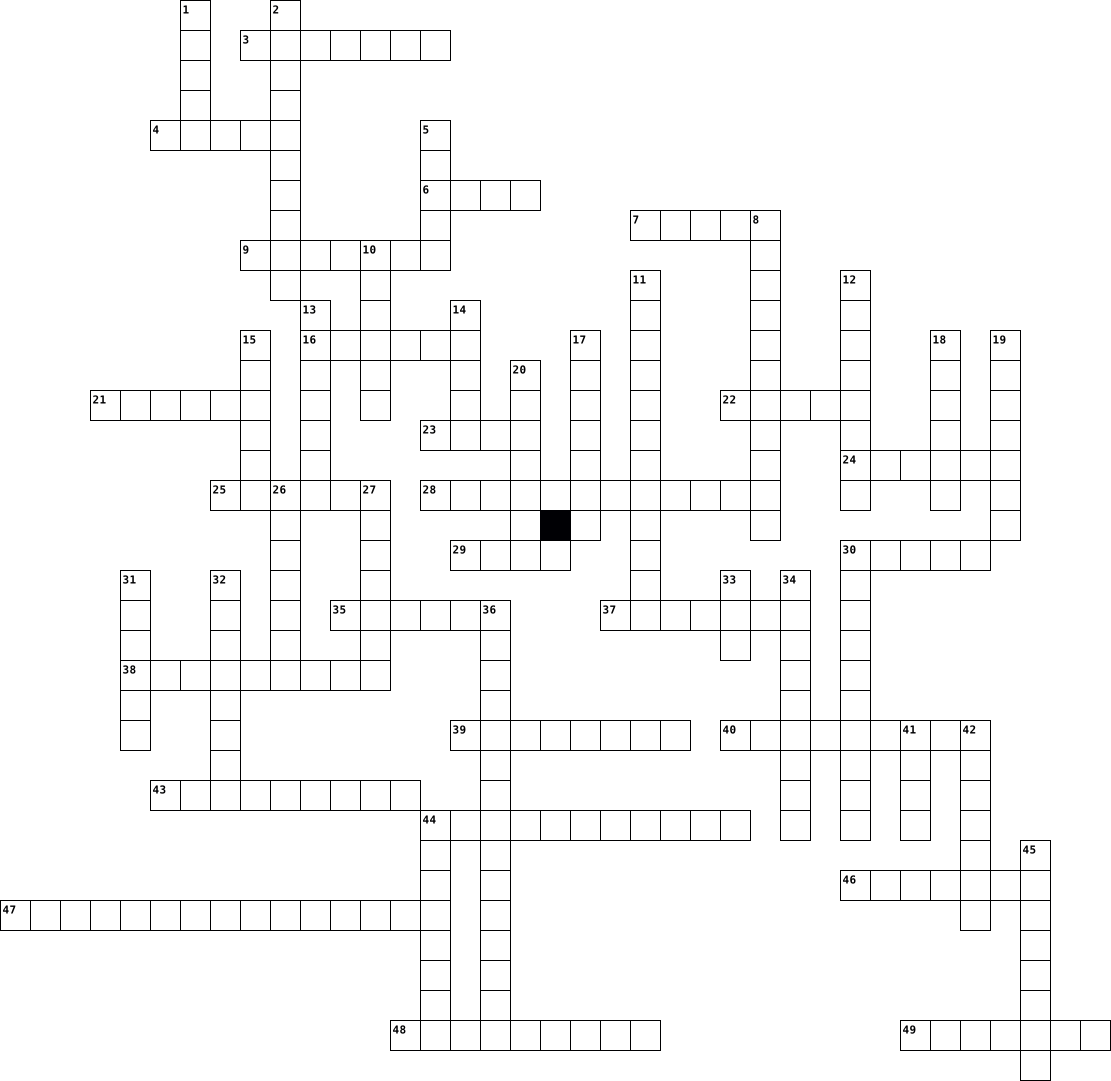
Across
- planet closest to the sun
- 2nd planet from the sun. Hottest planet in our solar system.
- 4th planet from the sun. Also called the red planet.
- A very heavy flow of water, which is greater than the normal flow of water and goes over the stream's normal channel.
- A long period of dry weather
- A bowl-shaped area on the surface of a planet or moon.
- A large body in space that orbits a star. Our solar system has 8, plus the dwarf planet.
- a round model of the Earth
- A giant ball of hot gas in space.
- 6th planet from the sun. Gas giant. Known for its rings.
- A streak of light in the sky produced by the burning of a meteoroid in Earth's atmosphere.
- Occurs at a full moon when Earth is directly between the moon and the sun. SEM ( sun, Earth, moon)
- A natural body orbiting around a planet.
- 3rd planet from the sun. Only planet with water and living things.
- or moon.
- 8th planet from the sun
- a slide of large masses of snow and ice and mud down a mountain
- a large, destructive fire that spreads quickly over woodland or brush, due to dry /drought land.
- A severe storm that develops over tropical oceans and whose strong winds of more than 120 km/h spiral in toward the intensely low-pressure storm center
- The study of the moon, stars, and other objects in space
- The sun and all of the planets and other bodies that orbit around it
- Earth has seasons because its axis is tilted as it moves around the sun.
- all objects seen in the sky (the Sun, Moon, stars, and planets)
- A meteoroid that has hit earth's surface.
- A force of attraction between objects that is due to their masses.
Down
- of axis 23.5 degrees
- half of the earth
- A ball of frozen dust and rock that orbits the sun and has a tail that glows
- An object that orbits the sun and is spherical, but has not cleared the area of its orbit.
- A collection of stars, dust, and gas bound together by gravity
- When the moon blocks the sun, happens during a new moon. SME ( sun, moon, earth)
- All of space and everything in it
- The partial or total blocking of one object in space by another
- The path of an object as it revolves around another object in space
- The movement of an object as it turns or spins around an axis. 24 hours = 1 day
- 5th planet from the sun. Largest planet in our solar system. Gas Giant.
- 7th planet from the sun
- Point at which, everywhere on Earth, days and nights are nearly equal in length
- A rapidly whirling, funnel-shaped cloud that reaches down to touch Earth's surface.
- A tropical cyclone occurring in the western Pacific or Indian oceans
- The movement of one object around another central object. 365 Days/ 1 year to revolve around the sun.
- oval
- the striking of one object against another; the shock caused by a collision
- Main source of energy for life on earth.
- The star at the center of our solar system
- A chunk of rock or dust in space
- intense rainstorm with strong winds that forms over oceans in the tropics
- The imaginary line that passes through Earth's center and the North and South poles.
- An imaginary circle around the middle of the earth, halfway between the North Pole and the South Pole
- Point at which days are longest in one hemisphere and shortest in another
- a small rocky body orbiting the sun
51 Clues: oval • or moon. • half of the earth • of axis 23.5 degrees • 7th planet from the sun • 8th planet from the sun • planet closest to the sun • a round model of the Earth • A long period of dry weather • A chunk of rock or dust in space • All of space and everything in it • A giant ball of hot gas in space. • a small rocky body orbiting the sun • A natural body orbiting around a planet. • ...
matariki 2022-06-22

Across
- the turning of the moon
- clusters of stars
- earth sky meets
- food
- its really cold
- name moon
Down
- sunrise
- full moon
- planning following a route
- chosen expert priest
10 Clues: food • sunrise • full moon • name moon • earth sky meets • its really cold • clusters of stars • chosen expert priest • the turning of the moon • planning following a route
Space Crossword 2023 2023-05-25

Across
- The force that keeps planets in orbit around the Sun.
- The force that opposes motion between two surfaces in contact.
- The seventh planet from the Sun.
- The layer of the Earth's atmosphere where most weather occurs.
- The unit used to measure distances between stars.
- The force that pushes objects away from each other.
- The fifth and largest planet from the Sun.
- The study of the universe as a whole.
- The study of the planets, moons, asteroids, and comets in our solar system.
- The sixth planet from the Sun, known for its prominent rings.
- The closest star to Earth.
- The study of the origin and development of the universe.
- The third planet from the Sun and our home.
- The outermost layer of the Earth's atmosphere.
- The bright center of a galaxy, containing millions or billions of stars.
- The second smallest planet in our solar system and the recent focus of space exploration.
- The unit used to measure distances within our solar system.
- The phase of the moon when it appears fully illuminated.
- The phase of the moon when it is more than half but not fully illuminated.
- A unit used to measure how far light travels in one year
- The largest moon in our solar system, orbiting Jupiter.
Down
- The region of space beyond Earth's atmosphere where there is no gravity.
- A word used to describe the state of space that has no atmosphere or air pressure.
- The study of celestial objects and phenomena
- The study of the Earth's atmosphere and weather.
- The phase of the moon when it cannot be seen.
- The path that one celestial body takes around another.
- The process by which a star releases energy
- The phenomenon that causes the apparent shift in the position of a star
- The bright streak of light caused by a meteoroid entering Earth's atmosphere.
- The layer of the Earth's atmosphere that contains the ozone layer
- The name of our galaxy.
- The study of the Moon, its features, and its exploration.
- The largest planet in our solar system
- The phase of the moon when it appears as a thin crescent.
- A device used to magnify distant objects.
- The study of space travel and exploration.
- The smallest planet in our solar system.
- The study of the structure and properties of matter and energy.
- A natural satellite that orbits a planet.
- The process by which plants use sunlight to make food.
41 Clues: The name of our galaxy. • The closest star to Earth. • The seventh planet from the Sun. • The study of the universe as a whole. • The largest planet in our solar system • The smallest planet in our solar system. • A device used to magnify distant objects. • A natural satellite that orbits a planet. • The fifth and largest planet from the Sun. • ...
Astro: Unit 2 2024-10-10

Across
- occur at every new and full moon,not just in spring
- any plant visible in the evening sky
- the apparent of the sun around the sky
- Any planet in the sky visible shortly after sunrise
- Occur at 1st and 3rd quarter moon, when moon and sun pull at right angles to each other
- June 22, the sun is further north
- July 4th, earths furthest away from the sun
Down
- December 22 the sun is furthest south
- January 4th,earths closets point to the sun
- Motion of a body around a point located outside the body
- The bright surface of the sun
- Region of total shadow of earth
- The turning of a body about an axis through its center
- Partail shadow of earth with the sun peeking around the edge of earth
- When the moon covers the suns dics entirely
15 Clues: The bright surface of the sun • Region of total shadow of earth • June 22, the sun is further north • any plant visible in the evening sky • December 22 the sun is furthest south • the apparent of the sun around the sky • January 4th,earths closets point to the sun • When the moon covers the suns dics entirely • July 4th, earths furthest away from the sun • ...
Toby: solarsystem (1 rogue word) 2022-07-05

Across
- The one that destroyed its moon and has rings
- The on that is as big as pluto but that no one knows.
- A moon that you could fly on by pedal power (72 kelvin there)
- most volcanic moon in the solar system
- the other one with rings
- to be a water world until earth was (referred to as earths sister sometimes.)
- earths nearest star (2 words)
Down
- Saturn's moon with hydrothermal vents.
- The star in our universe
- Used to be a planet
- the rougue one. An instrument shaped like a tear
- Cleared out 99.9% of the astoried belt and crossed it
- The one no one knows about that was for a brief time a planet.
13 Clues: Used to be a planet • The star in our universe • the other one with rings • earths nearest star (2 words) • Saturn's moon with hydrothermal vents. • most volcanic moon in the solar system • The one that destroyed its moon and has rings • the rougue one. An instrument shaped like a tear • The on that is as big as pluto but that no one knows. • ...
LESSON VII 2025-02-11

Across
- stem that means cry out
- stem that means group
- stem that means touch
- a word that means in relating to the moon
- a word that means to love something but not be great at it
- stem that means love
- a word that means to call out loud or cry out loud
Down
- a word that means to be touching or intertwined between each other
- a word that means to seperate people from a group
- a word that means to cry out
- a word that means to happen or occur under the moon
- stem that means moon
- a word that means a person who is crazy and is believed to be crazy from the moon
13 Clues: stem that means moon • stem that means love • stem that means group • stem that means touch • stem that means cry out • a word that means to cry out • a word that means in relating to the moon • a word that means to seperate people from a group • a word that means to call out loud or cry out loud • a word that means to happen or occur under the moon • ...
Solar Eclipse Crossword 2025-02-11

Across
- Our moon blocking the Sun, preventing sunlight from hitting us
- A big ball of rock orbiting the Earth
- The acronym for the most well-known space agency
- The continent where you can view the eclipse from
- The object that produces sunshine
- Specially made glasses to look at the eclipse
- Light coming from the Sun
- One of the many animals affected by the solar eclipse
Down
- The point where the moon fully covers the sun
- Our earth blocking the Sun, making the moon glow red
- An object blocking another object's light
- The condition where your vision is partly or fully obstructed
- The empty void of black once we leave Earth
13 Clues: Light coming from the Sun • The object that produces sunshine • A big ball of rock orbiting the Earth • An object blocking another object's light • The empty void of black once we leave Earth • The point where the moon fully covers the sun • Specially made glasses to look at the eclipse • The acronym for the most well-known space agency • ...
Astronomy 2019-04-03

Across
- eclipse an eclipse in which the moon appears darkened as it passes into the earth's shadow.
- tide a tide just after the first or third quarters of the moon when there is least difference between high and low water.
- a chart or series of pages showing the days, weeks, and months of a particular year, or giving particular seasonal information.
- a distinct period or stage in a series of events or a process of change or development.
- a group of stars forming a recognizable pattern that is traditionally named after its apparent form or identified with a mythological figure. Modern astronomers divide the sky into eighty-eight constellations with defined boundaries.
- an object placed for orbit around the earth or the moon.
- a small body moving in the solar system that would become a meteor if it entered the earth's atmosphere.
- of universal
- dark, basaltic plains on Earth's Moon, formed by ancient volcanic eruptions.
- the action of rotating around an axis or center.
- the partially shaded outer region of the shadow cast by an opaque object.
- an obscuring of the light from one celestial body by the passage of another between it and the observer or between it and its source of illumination.
- a celestial object consisting of ice and dust.
Down
- a fixed luminous point in the night sky which is a large
- the fully shaded inner region of a shadow cast by an opaque object, especially the area on the earth or moon experiencing the total phase of an eclipse.
- a celestial body moving in an elliptical orbit around a star.
- the alternate rising and falling of the sea, usually twice in each lunar day at a particular place, due to the attraction of the moon and sun.
- a forcible overthrow of a government or social order, in favor of a new system.
- every particle attracts every other particle in the universe with a force which is directly proportional to the product of their masses and inversely proportional to the square of the distance between their centers
- tide a tide just after a new or full moon, when there is the greatest difference between high and low water.
- either of the two times in the year, the summer solstice and the winter solstice, when the sun reaches its highest or lowest point in the sky at noon, marked by the longest and shortest days.
- the time or date (twice each year) at which the sun crosses the celestial equator, when day and night are of equal length (about September 22 and March 20)
- eclipse an eclipse in which the sun is obscured by the moon.
- a bowl-shaped depression, or hollowed-out area, produced by the impact of a meteorite, volcanic activity, or an explosion.
- an imaginary line about which a body rotates.
- the force that attracts a body toward the center of the earth, or toward any other physical body having mass.
- a small body of matter that enter's earth's atmosphere.
- the curved path of a celestial object or spacecraft around a star, planet, or moon, especially a periodic elliptical revolution
28 Clues: of universal • an imaginary line about which a body rotates. • a celestial object consisting of ice and dust. • the action of rotating around an axis or center. • a small body of matter that enter's earth's atmosphere. • a fixed luminous point in the night sky which is a large • an object placed for orbit around the earth or the moon. • ...
SpAcE CaRtEr RoHdE HR 1 2019-04-10

Across
- a chart or series of pages showing the days, weeks, and months of a particular year, or giving particular seasonal information.
- a distinct period or stage in a series of events or a process of change or development.
- the force that attracts a body toward the center of the earth, or toward any other physical body having mass.
- a small body moving in the solar system that would become a meteor if it entered the earth's atmosphere.
- a fixed luminous point in the night sky which is a large, remote incandescent body like the sun.
- either of the two times in the year, the summer solstice and the winter solstice, when the sun reaches its highest or lowest point in the sky at noon, marked by the longest and shortest days.
- tide a tide just after the first or third quarters of the moon when there is least difference between high and low water.
- a fixed luminous point in the night sky which is a large, remote incandescent body like the sun.
- the partially shaded outer region of the shadow cast by an opaque object.
- an obscuring of the light from one celestial body by the passage of another between it and the observer or between it and its source of illumination.
- the curved path of a celestial object or spacecraft around a star, planet, or moon, especially a periodic elliptical revolution.
- eclipse an eclipse in which the sun is obscured by the moon.
Down
- plural form of mare
- eclipse an eclipse in which the moon appears darkened as it passes into the earth's shadow.
- A celestial body moving in an elliptical orbit around a star.
- an imaginary line about which a body rotates.
- the alternate rising and falling of the sea, usually twice in each lunar day at a particular place, due to the attraction of the moon and sun.
- An artificial body placed in orbit around the earth or moon or another planet in order to collect information or for communication.
- a forcible overthrow of a government or social order, in favor of a new system.
- tied tide just after a new or full moon, when there is the greatest difference between high and low water.
- of universal gravitation Newton's law of universal gravitation states that every particle attracts every other particle in the universe with a force which is directly proportional to the product of their masses and inversely proportional to the square of the distance between their centers.
- a large, bowl-shaped cavity in the ground or on the surface of a planet or the moon, typically one caused by an explosion or the impact of a meteorite or other celestial body.
- a celestial object consisting of a nucleus of ice and dust and, when near the sun, a “tail” of gas and dust particles pointing away from the sun.
- the time or date (twice each year) at which the sun crosses the celestial equator, when day and night are of equal length (about September 22 and March 20).
- a small body of matter from outer space that enters the earth's atmosphere, becoming incandescent as a result of friction and appearing as a streak of light.
- the fully shaded inner region of a shadow cast by an opaque object, especially the area on the earth or moon experiencing the total phase of an eclipse.
- an imaginary line about which a body rotates.
27 Clues: plural form of mare • an imaginary line about which a body rotates. • an imaginary line about which a body rotates. • eclipse an eclipse in which the sun is obscured by the moon. • A celestial body moving in an elliptical orbit around a star. • the partially shaded outer region of the shadow cast by an opaque object. • ...
SpAcE CaRtEr RoHdE HR 1 2019-04-10

Across
- a chart or series of pages showing the days, weeks, and months of a particular year, or giving particular seasonal information.
- a distinct period or stage in a series of events or a process of change or development.
- the force that attracts a body toward the center of the earth, or toward any other physical body having mass.
- a small body moving in the solar system that would become a meteor if it entered the earth's atmosphere.
- a fixed luminous point in the night sky which is a large, remote incandescent body like the sun.
- either of the two times in the year, the summer solstice and the winter solstice, when the sun reaches its highest or lowest point in the sky at noon, marked by the longest and shortest days.
- tide a tide just after the first or third quarters of the moon when there is least difference between high and low water.
- a fixed luminous point in the night sky which is a large, remote incandescent body like the sun.
- the partially shaded outer region of the shadow cast by an opaque object.
- an obscuring of the light from one celestial body by the passage of another between it and the observer or between it and its source of illumination.
- the curved path of a celestial object or spacecraft around a star, planet, or moon, especially a periodic elliptical revolution.
- eclipse an eclipse in which the sun is obscured by the moon.
Down
- plural form of mare
- eclipse an eclipse in which the moon appears darkened as it passes into the earth's shadow.
- A celestial body moving in an elliptical orbit around a star.
- an imaginary line about which a body rotates.
- the alternate rising and falling of the sea, usually twice in each lunar day at a particular place, due to the attraction of the moon and sun.
- An artificial body placed in orbit around the earth or moon or another planet in order to collect information or for communication.
- a forcible overthrow of a government or social order, in favor of a new system.
- tied tide just after a new or full moon, when there is the greatest difference between high and low water.
- of universal gravitation Newton's law of universal gravitation states that every particle attracts every other particle in the universe with a force which is directly proportional to the product of their masses and inversely proportional to the square of the distance between their centers.
- a large, bowl-shaped cavity in the ground or on the surface of a planet or the moon, typically one caused by an explosion or the impact of a meteorite or other celestial body.
- a celestial object consisting of a nucleus of ice and dust and, when near the sun, a “tail” of gas and dust particles pointing away from the sun.
- the time or date (twice each year) at which the sun crosses the celestial equator, when day and night are of equal length (about September 22 and March 20).
- a small body of matter from outer space that enters the earth's atmosphere, becoming incandescent as a result of friction and appearing as a streak of light.
- the fully shaded inner region of a shadow cast by an opaque object, especially the area on the earth or moon experiencing the total phase of an eclipse.
- an imaginary line about which a body rotates.
27 Clues: plural form of mare • an imaginary line about which a body rotates. • an imaginary line about which a body rotates. • eclipse an eclipse in which the sun is obscured by the moon. • A celestial body moving in an elliptical orbit around a star. • the partially shaded outer region of the shadow cast by an opaque object. • ...
Earth-Sun-Moon System 2025-10-23

Across
- The darkest part of a shadow where the light is completely blocked
- The movement of Earth around the Sun
- The Moon looks almost full but not completely round
- The path that Earth or another planet follows around the Sun
- The Moon looks like a thin curved shape like a banana
- When the lighted part of the Moon is getting smaller each night
- A type of solar eclipse where the Moon looks smaller than the Sun leaving a ring of fire around it
Down
- A day when day and night are equal in length all over the world
- The lighter outer part of a shadow where some light still reaches
- When one space object blocks the light of another
- The time when the Sun is the farthest north or south of the equator giving the longest or shortest day
- When the lighted part of the Moon is getting bigger each night
- A time of the year with special weather patterns such as spring summer fall and winter
- The spinning of Earth on its axis
- An imaginary line through the Earth from the North Pole to the South Pole
15 Clues: The spinning of Earth on its axis • The movement of Earth around the Sun • When one space object blocks the light of another • The Moon looks almost full but not completely round • The Moon looks like a thin curved shape like a banana • The path that Earth or another planet follows around the Sun • When the lighted part of the Moon is getting bigger each night • ...
Chapter 10 Vocabulary 2016-04-27

Across
- the process by which molecules undergo the a spontaneous transition from the liquid phase to the gas phase.
- The temperature at which a solid and liquid phase may coexist in equilibrium.
- The pressure required to liquefy a gas (vapor) at its critical temperature.
- a phenomenon in which the surface of a liquid, where the liquid is in contact with gas, acts like a thin elastic sheet.
- the enthalpy change experienced on a mole by mole basis of some substance undergoing a phase change from liquid to vapor/gas.
- the temperature at which a liquid changes to a solid.
- the settling of particles or sediment onto a surface.
- the law that the product of the pressure and the volume of one gram molecule of an ideal gas is equal to the product of the absolute temperature of the gas and the universal gas constant.
- the temperature and pressure at which solid, liquid, and vapor phases of a particular substance coexist in equilibrium.
- Also called migration. an intermingling of molecules, ions, etc., resulting from random thermal agitation, as in the dispersion of a vapor in air.
Down
- a chart showing the thermodynamic conditions of a substance at different pressures and temperatures.
- the point at which two phases of a substance initially become indistinguishable from one another.
- Liquid that evaporates at room temperature, or vaporizes easily.
- rapid change of water into steam.
- The interaction between contacting surfaces of a liquid and a solid that distorts the liquid surface from a planar shape and causes the liquid to rise or fall in a narrow tube.
- the transition from the solid phase to the gas phase without passing through an intermediate liquid phase.
- The temperature above which a gas cannot be liquefied; the temperature above which a substance cannot exhibit distinct gas and liquid phases.
- the amount of energy needed to change one mole of a substance from the solid phase to the liquid phase at constant temperature and pressure.
- a gas that does not behave as an ideal gas due to interactions between gas molecules.
- temperature at which a liquid boils and turns into vapor.
- the flow of a gas through a small orifice at such density that the mean distance between the molecules is large compared with the diameter of the orifice.
- the condition existing when a chemical reaction and its reverse reaction proceed at equal rates
22 Clues: rapid change of water into steam. • the temperature at which a liquid changes to a solid. • the settling of particles or sediment onto a surface. • temperature at which a liquid boils and turns into vapor. • Liquid that evaporates at room temperature, or vaporizes easily. • The pressure required to liquefy a gas (vapor) at its critical temperature. • ...
Lost and Found 2014-08-27

Across
- friend
- Partner
- they found jamee
- Called
- ex
- Sick
Down
- pool
- music
- friend
- /Sister
- Cruch
- moon monster/Moon
- friend of Darcey
- charlotte/Mean Lady
14 Clues: ex • pool • Sick • music • Cruch • friend • friend • Called • /Sister • Partner • they found jamee • friend of Darcey • moon monster/Moon • charlotte/Mean Lady
Astronomy-Pickarts 2nd 2019-04-02

Across
- The movement of an object around another object.
- A loose collection of ice and dust that orbits the sun, typically in a long, narrow orbit
- A meteor that survives its passes through the earth's atmosphere such that part of it strikes the ground.
- An object that orbits a star, is large enough to have become rounded by its own gravity, and has cleared the area of its orbit.
- The fully shaded inner region of a shadow cast by an opaque object, especially the area on the earth or moon experiencing the total phase of an eclipse.
- An object that orbits a planet
- A ball of hot gas, primarily hydrogen and helium, that undergoes nuclear function.
- Eclipse An eclipse in which the moon appears darkened as it passes into the earth's shadow.
- Tide A tide just after the first or third quarters of the moon when there is a least difference between high and low water.
- Tide A tide just after a new or full moon, when there is the greatest difference between high and low water.
- The force that attracts a body toward the center of the Earth, or toward another physical body having mass.
- a distinct period or stage in a series of events of a process of change or development.
Down
- The path of an object as it revolves around another object in space.
- Either of the two days of the year on which neither hemisphere is titled toward or away from the sun.
- A pattern or grouping of stars that people imagine to represent a figure or object.
- The partially shaded outer region of the shadow cast by an opaque object.
- Either of the two days of the year on which the sun reaches its greatest distance north or south of the equator.
- An obscuring of the light from one celestial body by the passage of another between it and the observer or between it and its illumination.
- The spinning motion of a planet on its axis.
- of universal gravitation
- A streak of light in the sky produced by the burning of a meteoroid in Earth's atmosphere
- A system of organizing time that defines the beginning, length, and divisions of a year.
- An imaginary line that passes through a planet's center and its north and south poles, about which the planet rotates.
- A large, level basalt plain on the surface of the moon, appearing dark by contrast with highland areas.
- A large, bowl-shaped cavity in the ground or on the surface of a planet or the moon, typically one caused by an explosion or the impact of a meteorite or other celestial body.
- Eclipse An eclipse in which the sun is obscured by the moon.
- The alternate rising and falling of the sea, usually twice in each lunar day at a particular place, due to the attraction of the sun and the moon.
27 Clues: of universal gravitation • An object that orbits a planet • The spinning motion of a planet on its axis. • The movement of an object around another object. • Eclipse An eclipse in which the sun is obscured by the moon. • The path of an object as it revolves around another object in space. • The partially shaded outer region of the shadow cast by an opaque object. • ...
astronomy riske 2018-03-19

Across
- a forcible overthrow of a government or social order in favor of a new system.
- a celestial body moving in an elliptical orbit around a star.
- a tide just after a new or full moon, when there is the greatest difference between high and low water.
- a small body of matter from outer space that enters the earth's atmosphere, becoming incandescent as a result of friction and appearing as a streak of light.
- a large, level basalt plain on the surface of the moon, appearing dark by contrast with highland areas.
- an obscuring of the light from one celestial body by the passage of another between it and the observer or between it and its source of illumination.
- a celestial object consisting of a nucleus of ice and dust and, when near the sun, a “tail” of gas and dust particles pointing away from the sun.
- an eclipse in which the sun is obscured by the moon.
- states that a particle attracts every other particle in the universe with a force which is directly proportional to the product of their masses and inversely proportional to the square of the distance between their centers
- an artificial body placed in orbit around the earth or moon or another planet in order to collect information or for communication.
- he time or date (twice each year) at which the sun crosses the celestial equator, when day and night are of equal length (about September 22 and March 20).
- an imaginary line about which a body rotate
- a chart or series of pages showing the days, weeks, and months of a particular year, or giving particular seasonal information.
Down
- a small body moving in the solar system that would become a meteor if it entered the earth's atmosphere.
- a group of stars forming a recognizable pattern that is traditionally named after its apparent form or identified with a mythological figure. Modern astronomers divide the sky into eighty-eight constellations with defined boundaries.
- distinct period or stage in a process of change or forming part of something's development
- a fixed luminous point in the night sky that is a large, remote incandescent body like the sun
- the action of rotating around an axis or center.
- either of the two times in the year, the summer solstice and the winter solstice, when the sun reaches its highest or lowest point in the sky at noon, marked by the longest and shortest days.
- a large, bowl-shaped cavity in the ground or on the surface of a planet or the moon, typically one caused by an explosion or the impact of a meteorite or other celestial body.
- a tide just after the first or third quarters of the moon when there is the least difference between high and low water.
- an eclipse in which the moon appears darkened as it passes into the earth's shadow.
- the force that attracts a body toward the center of the earth, or toward any other physical body having mass. For most purposes Newton's laws of gravity apply, with minor modifications to take the general theory of relativity into account.
- the alternate rising and falling of the sea, usually twice in each lunar day at a particular place, due to the attraction of the moon and sun.
- the partially shaded outer region of the shadow cast by an opaque object.
- the curved path of a celestial object or spacecraft around a star, planet, or moon, especially a periodic elliptical revolution.
- the fully shaded inner region of a shadow cast by an opaque object, especially the area on the earth or moon experiencing the total phase of an eclipse.
27 Clues: an imaginary line about which a body rotate • the action of rotating around an axis or center. • an eclipse in which the sun is obscured by the moon. • a celestial body moving in an elliptical orbit around a star. • the partially shaded outer region of the shadow cast by an opaque object. • ...
10 Vocabulary Words of Lunar Phases 2022-11-01

Across
- gravitational pull from the moon
- going around an axis
- change of appearance as moon revolves around earth
- when the earth is between the moon and sun
Down
- when the phase of the moon decreases the amount of light
- when the moon is between the earth and sun
- pulls two objects towards each other
- when a phase of the moon increase the amount of light
- an object that goes around
9 Clues: going around an axis • an object that goes around • gravitational pull from the moon • pulls two objects towards each other • when the moon is between the earth and sun • when the earth is between the moon and sun • change of appearance as moon revolves around earth • when a phase of the moon increase the amount of light • ...
SDLC -SW PROCESS MODELS 2022-02-03

Across
- Essential in Rapid Application Model
- Multiple versions can be released
- small model is designed initially.
- Best suited for projects with quick results
- Elaboration phase is performed in this model
- Needs sound knowledge of Mathematics
- Emphasis on state of all SDLC phases
Down
- combination of iterative +incremental model
- Development and integration is seen here
- one criteria for selecting a process model
- Are we building the right system ?
- Risk Analysis is supported here
- Traditional model
- Specific features developed in cycles
- special process model
15 Clues: Traditional model • special process model • Risk Analysis is supported here • Multiple versions can be released • Are we building the right system ? • small model is designed initially. • Essential in Rapid Application Model • Needs sound knowledge of Mathematics • Emphasis on state of all SDLC phases • Specific features developed in cycles • ...
ph 2022-03-24

Across
- to be afraid of something
- words, but not a complete sentence
- an animal that lives underground
- CVS is a
- an animal that lives in the ocean
- reading sounds of letter
- talk into to make your voice louder
Down
- to change into something else
- when you ask a famous person to sign their name
- bar, pie, and line are types of a
- solid liquid and gas are three __ of matter
- a picture
- a boys name
- prize for winning
- fake
15 Clues: fake • CVS is a • a picture • a boys name • prize for winning • reading sounds of letter • to be afraid of something • to change into something else • an animal that lives underground • bar, pie, and line are types of a • an animal that lives in the ocean • words, but not a complete sentence • talk into to make your voice louder • solid liquid and gas are three __ of matter • ...
C49 2026-06-06

Across
- Molecule donating electron pair to metal
- Binding of metal by multidentate ligand
- Equilibrium in multiple phases
- Equilibrium in single phase
- Hypothetical charge of atom in molecule
- Solid formation from ionic reaction
- Constant for sparingly soluble salts
Down
- Charge of atom in compound
- Making atoms and charges equal in redox reaction
- Ion present from multiple sources
- Unchanging system condition
- Ion formed by coordination of molecules
- Measure of complex ion formation strength
- Multiplication of ion concentrations
- Oxidation or reduction part of redox equation
15 Clues: Charge of atom in compound • Unchanging system condition • Equilibrium in single phase • Equilibrium in multiple phases • Ion present from multiple sources • Solid formation from ionic reaction • Multiplication of ion concentrations • Constant for sparingly soluble salts • Binding of metal by multidentate ligand • Hypothetical charge of atom in molecule • ...
C45 2026-06-06

Across
- Attraction between unlike molecules
- Weak repulsion from magnetic field
- Attraction involving hydrogen and electronegative atom
- Energy required to increase surface area
- Ease of distorting electron cloud
- Movement from high to low concentration
- Liquid rising in narrow tube
- Theory describing gas behavior
Down
- Attraction between polar molecules
- Attraction between like molecules
- Weak attraction to magnetic field
- Resistance to flow of a liquid
- Gas escaping through tiny opening
- Separation of positive and negative charges
- Boundary between two phases
15 Clues: Boundary between two phases • Liquid rising in narrow tube • Resistance to flow of a liquid • Theory describing gas behavior • Attraction between like molecules • Weak attraction to magnetic field • Gas escaping through tiny opening • Ease of distorting electron cloud • Attraction between polar molecules • Weak repulsion from magnetic field • Attraction between unlike molecules • ...
space jacob soczynski 2021-11-01

Across
- sucks everything in
- a north-south line
- big ball of gas
- a small telescope
- collection of stars and gas and dust
- light reflection off earth
Down
- dirty snowball
- second full moon in one month
- when see moon shadow
- light caused by a small object entering earth
- tilting of the moon
- when sun is directly above at noon
12 Clues: dirty snowball • big ball of gas • a small telescope • a north-south line • sucks everything in • tilting of the moon • when see moon shadow • light reflection off earth • second full moon in one month • when sun is directly above at noon • collection of stars and gas and dust • light caused by a small object entering earth
PACU 2016-01-31

Across
- SIGN OF ACUTE ISCHEMIA
- INITIAL TREATMENT OF LARYNGOSPASM
- AGENT FOR BENZODIAZIPINES
- MOST IMPORTANT INDICATOR OF BRAIN FUNCTION
- CERTIFIED PERIANESTHESIA NURSE
- SYSTEMIC RESPONSE TO INFECTION
- AMERICAN SOCIETY OF PERIANESTHESIA NURSES
- "FORGETAZAM"
- NEW PACU RN'S BEST FRIEND
- NON-DEPOLARIZING NEUROMUSCULAR AGENT
Down
- IMPORTANT ASPECT OF CARE OF SICKLE-CELL PATIENT
- TEMPERATURE LESS THAN 96.8 DEGREES
- THE FRAMEWORK FOR PERIANESTHESIA NURSING IN ALL PHASES OF CARE
- FREQUENT CYSTOSCOPY POSTOP COMPLAINT
- GI PROCEDURE WHICH COMMONLY REQUIRES INTUBATION
- ANTIBIOTICS THAT CAN PROLONG NEUROMUSCULAR BLOCKADE
- NUMERICAL SCORING SYSTEM
- CERTIFIED AMBULATORY PERIANESTHESIA NURSE
- RARE COMPLICATION AFTER THYROID SURGERY
- "MILK OF ANESTHESIA"
20 Clues: "FORGETAZAM" • "MILK OF ANESTHESIA" • SIGN OF ACUTE ISCHEMIA • NUMERICAL SCORING SYSTEM • AGENT FOR BENZODIAZIPINES • NEW PACU RN'S BEST FRIEND • CERTIFIED PERIANESTHESIA NURSE • SYSTEMIC RESPONSE TO INFECTION • INITIAL TREATMENT OF LARYNGOSPASM • TEMPERATURE LESS THAN 96.8 DEGREES • FREQUENT CYSTOSCOPY POSTOP COMPLAINT • NON-DEPOLARIZING NEUROMUSCULAR AGENT • ...
PACU 2016-01-31

Across
- Numerical Scoring System
- Frequent postop complaint of cystoscopy patients
- Initial treatment of Laryngospasm
- American society of perianesthesia nurses
- Certified ambulatory perianesthesia nurse
- Reversal agent for Benzodiazipines
- "Forgetazam"
- Rare complication after thyroid surgery
- Most Important of brain function
Down
- Sign of acute ischemia
- Antibotics that can prolong neuromuscular block
- Important aspect of care of Sickle-cell patient
- Certified perianesthesia nurse
- The framework for perianesthesia practice in all phases of care
- Temperature less than 96.8
- New PACU RN's best friend
- GI procedure which commonly requires intubation
- Systematic response to infection
- "Milk of Anesthesia"
- Non-depolarizing neuromuscular blocking agent
20 Clues: "Forgetazam" • "Milk of Anesthesia" • Sign of acute ischemia • Numerical Scoring System • New PACU RN's best friend • Temperature less than 96.8 • Certified perianesthesia nurse • Systematic response to infection • Most Important of brain function • Initial treatment of Laryngospasm • Reversal agent for Benzodiazipines • Rare complication after thyroid surgery • ...
SpAcE CaRtEr RoHdE HR 1 2019-04-10

Across
- a fixed luminous point in the night sky which is a large, remote incandescent body like the sun.
- the partially shaded outer region of the shadow cast by an opaque object.
- A celestial body moving in an elliptical orbit around a star.
- plural form of mare
- an imaginary line about which a body rotates.
- An artificial body placed in orbit around the earth or moon or another planet in order to collect information or for communication.
- a small body of matter from outer space that enters the earth's atmosphere, becoming incandescent as a result of friction and appearing as a streak of light.
- eclipse an eclipse in which the sun is obscured by the moon.
- the alternate rising and falling of the sea, usually twice in each lunar day at a particular place, due to the attraction of the moon and sun.
- an imaginary line about which a body rotates.
- a celestial object consisting of a nucleus of ice and dust and, when near the sun, a “tail” of gas and dust particles pointing away from the sun.
- a small body moving in the solar system that would become a meteor if it entered the earth's atmosphere.
- a forcible overthrow of a government or social order, in favor of a new system.
- a large, bowl-shaped cavity in the ground or on the surface of a planet or the moon, typically one caused by an explosion or the impact of a meteorite or other celestial body.
Down
- tied tide just after a new or full moon, when there is the greatest difference between high and low water.
- tide a tide just after the first or third quarters of the moon when there is least difference between high and low water.
- the fully shaded inner region of a shadow cast by an opaque object, especially the area on the earth or moon experiencing the total phase of an eclipse.
- a chart or series of pages showing the days, weeks, and months of a particular year, or giving particular seasonal information.
- eclipse an eclipse in which the moon appears darkened as it passes into the earth's shadow.
- a distinct period or stage in a series of events or a process of change or development.
- a fixed luminous point in the night sky which is a large, remote incandescent body like the sun.
- either of the two times in the year, the summer solstice and the winter solstice, when the sun reaches its highest or lowest point in the sky at noon, marked by the longest and shortest days.
- the time or date (twice each year) at which the sun crosses the celestial equator, when day and night are of equal length (about September 22 and March 20).
- an obscuring of the light from one celestial body by the passage of another between it and the observer or between it and its source of illumination.
- the curved path of a celestial object or spacecraft around a star, planet, or moon, especially a periodic elliptical revolution.
- the force that attracts a body toward the center of the earth, or toward any other physical body having mass.
- of universal gravitation Newton's law of universal gravitation states that every particle attracts every other particle in the universe with a force which is directly proportional to the product of their masses and inversely proportional to the square of the distance between their centers.
27 Clues: plural form of mare • an imaginary line about which a body rotates. • an imaginary line about which a body rotates. • eclipse an eclipse in which the sun is obscured by the moon. • A celestial body moving in an elliptical orbit around a star. • the partially shaded outer region of the shadow cast by an opaque object. • ...
Meiosis and its Phases 2023-09-21

Across
- Exchange of genetic material between chromatids of homologous chromosomes.
- having a single set of unpaired chromosomes.
- is a cell division in which four haploid cells are formed
- Meiosis II is also called ... division
- phase between meiosis I and and II.
Down
- the stage where chromosomes experience independent assortment
- first substage of Prophase I
- Meiosis I is also called ... division
- is a reproductive cell of an animal or plant.
- the paired homologous chromosomes are referred as ....
- The phase most cells spend 95% of their time in.
- The pairing of homologous chromosomes
- How many cells are produced in meiosis?
- crossing over occurs at ...
- consists of four chromatids.
15 Clues: crossing over occurs at ... • first substage of Prophase I • consists of four chromatids. • phase between meiosis I and and II. • Meiosis I is also called ... division • The pairing of homologous chromosomes • Meiosis II is also called ... division • How many cells are produced in meiosis? • having a single set of unpaired chromosomes. • ...
Night Sky 2023-10-30

Across
- appears to be growing
- big and round moon
- star you see in the day
- no moon
- thin sliver
Down
- improved by Galileo
- moon is getting smaller
- one lunar cycle
- earth's satellite
9 Clues: no moon • thin sliver • one lunar cycle • earth's satellite • big and round moon • improved by Galileo • appears to be growing • moon is getting smaller • star you see in the day
african american lit 2023-01-10

Across
- the power to make laws
- a group of people living in the same place
- excellent order
- A person who believes that violence is unjustifiable
- the power to give orders
- coming exposed after being concealed
- a consequence
Down
- fool or cheat
- a distinct period in a series of events
- dance to popular music
- the right to vote
- necessary to make a whole complete
- forming necessary base
13 Clues: fool or cheat • a consequence • excellent order • the right to vote • dance to popular music • the power to make laws • forming necessary base • the power to give orders • necessary to make a whole complete • coming exposed after being concealed • a distinct period in a series of events • a group of people living in the same place • ...
Water Crossword 2018-12-20

Across
- different states of water
- not liquid or gas
- water as a gas in the air
- not solid or gas
- not liquid or solid
- water becoming a gas
- not liquid or gas
- another word for H20
Down
- less than 1% of water on Earth
- 97% of water on Earth
- 27% water on Earth
- water moving downward through openings in the soil
- rain, snow, sleet, or hail
- water source undreground\
14 Clues: not solid or gas • not liquid or gas • not liquid or gas • 27% water on Earth • not liquid or solid • water becoming a gas • another word for H20 • 97% of water on Earth • different states of water • water as a gas in the air • water source undreground\ • rain, snow, sleet, or hail • less than 1% of water on Earth • water moving downward through openings in the soil
U4 Earth In Soace 2025-02-06

Across
- the outer part of a shadow such as the shadow cast by Earth or the moon in which sunlight is only partially blocked
- 21
- an imaginary line on which it spins
- Halfway between summer and winter solstice
- The entire Sun is blocked out by the Moon's shadow,
- Halfway between winter and summer solstice: around March 21
Down
- Inner cone shaped part of a shadow when all light is blocked during an eclipse.
- Moon phase that occurs when the Moon is between Earth and the Sun
- Solstice, is the shortest day in the northern hemisphere
- a ring (or annulus) of sunlight is still visible around the Moon's disk.
- occurs when the new moon passes directly between the Earth and the Sun
- move or cause to move in a circle around an axis or center
- spherical shape
- is the Earth's movement around the sun
- Sun's rays directly at the equator
- Solstice, The sun travels directly over the Tropic of Cancer
16 Clues: 21 • spherical shape • Sun's rays directly at the equator • an imaginary line on which it spins • is the Earth's movement around the sun • Halfway between summer and winter solstice • The entire Sun is blocked out by the Moon's shadow, • Solstice, is the shortest day in the northern hemisphere • move or cause to move in a circle around an axis or center • ...
Roman's Q1 Crossword Puzzle 2025-11-04

Across
- when you can only see the unlit side of the moon
- during this season in the northern hemisphere the earth's distance from the sun is the shortest
- made of gas and have larger masses
- layers of rock that are formed
- occurs when the earth blocks light from reaching the moon
- made of metal and rocks with smaller masses
- are remains or impressions of ancient organisms preserved in rocks
- the force of attraction between any two objects with mass
- used to define and identify geologic periods
Down
- this occurs when particles of rock erode and eventually settle in
- are the regular rise and fall of ocean water caused mainly by the pull of Moon's gravity
- occurs when the moon blocks the light from the sun
- means the lighting of the moon is increasing
- to spin on an axis
- during this season in the northern hemisphere the earth's distance from the sun is the longest
- means moving around another object
16 Clues: to spin on an axis • layers of rock that are formed • made of gas and have larger masses • means moving around another object • made of metal and rocks with smaller masses • means the lighting of the moon is increasing • used to define and identify geologic periods • when you can only see the unlit side of the moon • occurs when the moon blocks the light from the sun • ...
Space Vocabulary 2025-04-30

Across
- A small body of matter from outer space that enters the earth's atmosphere, becoming incandescent as a result of friction and appearing as a streak of light
- Any natural object that astronomers study
- The different appearances of the Moon as seen from Earth, caused by the changing amounts of the lunar surface illuminated by the Sun as it orbits Earth
- A time or date at which the sun reaches its maxmum or minimum declination marked by the longest and shortest days of the year
- happens when the Moon passes between the Sun and Earth, blocking the Sun's light and creating a shadow on Earth
- The star which the earth orbits
- A small, rocky or metallic body that orbits the sun, typically found in the main asteroid belt between Mars and Jupiter
Down
- The movement of one celestial body around another
- The force that attracts a body toward the center of the earth
- A celestial body moving in an elliptical orbit around a star
- happens when the Earth comes between the Sun and the Moon, blocking sunlight from reaching the Moon and casting a shadow on it
- An imaginary line which a body rotates
- The natural satellite of Earth
- A tendency to do nothing or to remain unchanged
- The alternate rising and falling of the sea, usually twice in each lunar day at a particular place, due to the attraction of the moon and sun
15 Clues: The natural satellite of Earth • The star which the earth orbits • An imaginary line which a body rotates • Any natural object that astronomers study • A tendency to do nothing or to remain unchanged • The movement of one celestial body around another • A celestial body moving in an elliptical orbit around a star • ...
Ocean Motions # 1 2026-02-17

Across
- Used to measure the tide level out at sea
- Used to measure the tide level along the coastline
- Tides that occur during the first and last quarter of the moon, when the sun, earth, and moon form a right angle
- Large heap or swell of ocean water on Earth caused by the gravitational pull of the Moon (and Sun)
- Area on the coast that is found between the high and low tides
Down
- Tides that occur twice a month during the new moon and full moon, when the sun, moon, and earth are in a straight line
- Lowest local sea level
- Tides caused by the gravitational pull between the moon and the earth
- Tides caused by the gravitational pull between the sun and the Earth
- Highest local sea level
10 Clues: Lowest local sea level • Highest local sea level • Used to measure the tide level out at sea • Used to measure the tide level along the coastline • Area on the coast that is found between the high and low tides • Tides caused by the gravitational pull between the sun and the Earth • Tides caused by the gravitational pull between the moon and the earth • ...
Q1 Reflection Crossword Puzzle 2025-10-30

Across
- These planets are also known as gas giants
- When the moon is fully lit from Earth's view
- The law of superposition helps scientists find the ____ age of rocks
- The season in the Northern hemisphere when it is pointed toward the sun
- The type of eclipse when the Earth blocks the sun's light from reaching the moon
- To spin on an axis
- To move around another object
Down
- Only _____ planets have a true surface
- Gravity makes matter clump together to form ____, rocks, and planets
- The _____ layers of rock are at the bottom in undisturbed layers of rock
- The remains or impressions of ancient organisms preserved in rock
- Why seasons occur
- The force that keeps the planets in orbit around the sun
- When the moon is fully darkened from Earth's view
- The type of eclipse when the moon blocks the sun's light from reaching Earth light from reaching a part of Earth
- ____ fossils are used to define and identify geologic periods.
16 Clues: Why seasons occur • To spin on an axis • To move around another object • Only _____ planets have a true surface • These planets are also known as gas giants • When the moon is fully lit from Earth's view • When the moon is fully darkened from Earth's view • The force that keeps the planets in orbit around the sun • ...
Q1 Reflection 2025-10-30

Across
- Gravity does this to get you to stay on the ground
- The rock that is the layers of sedimentary rock
- When you can see the whole side of the moon that is illuminated
- The planets that are made of gas and are more dense
- When the Earth blocks the sunlight from the moon
- The season when people like to do things like skiing and sledding
- The remains or impressions of ancient organisms
- When something is leftover or left behind by something
- The force that holds the universe together
Down
- When the moon covers up the light from the sun
- The law that says the oldest rock is on the bottom and the youngest rock is on the top
- The movement of an object spinning on its axis
- The planets that are rocky and are hotter
- The movement of one object going around another object
- When you can not see the illuminated side of the moon at all
- The season when the temperatures are the highest of the year
16 Clues: The planets that are rocky and are hotter • The force that holds the universe together • When the moon covers up the light from the sun • The movement of an object spinning on its axis • The rock that is the layers of sedimentary rock • The remains or impressions of ancient organisms • When the Earth blocks the sunlight from the moon • ...
Basic animal reproduction 2023-01-17

Across
- maintains pregnancy
- Cycle this cycle Includes two phases
- regulates the development,
- causes ovulation
- Is the release of an egg cell from the ovaries
Down
- Is the time in which a female is pregnant
- fluctuates sexual behaviour
- Produce eggs, Produce female hormones
- paired, oval-shaped organs
- hormones Assist in developing an animal’s puberty, fertility and sexuality
- and physiology
11 Clues: and physiology • causes ovulation • maintains pregnancy • paired, oval-shaped organs • regulates the development, • fluctuates sexual behaviour • Cycle this cycle Includes two phases • Produce eggs, Produce female hormones • Is the time in which a female is pregnant • Is the release of an egg cell from the ovaries • ...
Moon Phases 2023-02-21

Across
- The different stages of illumination of the surface of the moon.
Down
- The silver sliver of illuminated moon surface.
2 Clues: The silver sliver of illuminated moon surface. • The different stages of illumination of the surface of the moon.
Moon features and eclipse 2022-04-21

Across
- basaltic moon plains
- lighter cratered regions of the moon
- filamentous, high-albedo deposits occurring radial or subradial to impact craters
- an eclipse in which the moon appears darkened as it passes into the earth's shadow
- when the moon is fully lit up by the sun
- a bowl-shaped depression, or hollowed-out area, produced by the impact of a meteorite, volcanic activity, or an explosion
Down
- a fissure or narrow channel on the moon's surface
- when the earth only sees the dark side of the moon
- an eclipse in which the sun is obscured by the moon
- the layer of unconsolidated rocky material covering bedrock.
10 Clues: basaltic moon plains • lighter cratered regions of the moon • when the moon is fully lit up by the sun • a fissure or narrow channel on the moon's surface • when the earth only sees the dark side of the moon • an eclipse in which the sun is obscured by the moon • the layer of unconsolidated rocky material covering bedrock. • ...
astronomy 2023-11-20

Across
- It must orbit a star. It must be big enough to have enough gravity to force it into a spherical shape. It must be big enough that its gravity cleared away any other objects of similar size near its orbit around the Sun.
- to get less and less, or to decline.
- moving around itself
- longest and shortest day of the year
- spring summer winter and fall
- lean
- a curved path
- mix of gasses that surround a planet
Down
- a force that attracts things
- a moon that gets more sunlight on it as the days go by
- is any moon that appears more than half-lighted but less than full
- the shape of a moon that is less than half-illuminated
- day night equal length
- very long-period waves that move through the ocean in response to the forces created by the moon
- an oval
- any massive self-luminous celestial body of gas that shines by radiation derived from its internal energy sources.
16 Clues: lean • an oval • a curved path • moving around itself • day night equal length • a force that attracts things • spring summer winter and fall • to get less and less, or to decline. • longest and shortest day of the year • mix of gasses that surround a planet • a moon that gets more sunlight on it as the days go by • the shape of a moon that is less than half-illuminated • ...
Q1 Reflection Crossword Puzzle 2025-10-30

Across
- These planets are also known as gas giants
- When the moon is fully lit from Earth's view
- The law of superposition helps scientists find the ____ age of rocks
- The season in the Northern hemisphere when it is pointed toward the sun
- The type of eclipse when the Earth blocks the sun's light from reaching the moon
- To spin on an axis
- To move around another object
Down
- Only _____ planets have a true surface
- Gravity makes matter clump together to form ____, rocks, and planets
- The _____ layers of rock are at the bottom in undisturbed layers of rock
- The remains or impressions of ancient organisms preserved in rock
- Why seasons occur
- The force that keeps the planets in orbit around the sun
- When the moon is fully darkened from Earth's view
- The type of eclipse when the moon blocks the sun's light from reaching Earth light from reaching a part of Earth
- ____ fossils are used to define and identify geologic periods.
16 Clues: Why seasons occur • To spin on an axis • To move around another object • Only _____ planets have a true surface • These planets are also known as gas giants • When the moon is fully lit from Earth's view • When the moon is fully darkened from Earth's view • The force that keeps the planets in orbit around the sun • ...
Solar System Crossword Puzzle 2022-11-30

Across
- The object that revolves around Earth.
- This planet is the closest one to the sun.
- The force that pulls objects towards each other.
- This gas planet is well known for its rings.
- The planet we live on.
- The lighter part of the shadow outside of the umbra.
- This type of lunar eclipse is when the moon is entirely within the Earth's umbra.
- The type of eclipse caused by the umbra of the Moon's shadow hitting Earth's surface.
Down
- The type of eclipse that happens when the Moon falls into the umbra of Earth's shadow.
- The galaxy we live in.
- Earth's neighbor, often referred to as "The Red Planet".
- This type of lunar eclipse is when the moon is partially within the Earth's umbra.
- The force that causes day and night on Earth.
- The star of our solar system.
- The darkest part of a shadow.
- This dwarf planet was once classified as a planet with the other 8 main planets.
16 Clues: The galaxy we live in. • The planet we live on. • The star of our solar system. • The darkest part of a shadow. • The object that revolves around Earth. • This planet is the closest one to the sun. • This gas planet is well known for its rings. • The force that causes day and night on Earth. • The force that pulls objects towards each other. • ...
Q1 Reflection 2024-10-28

Across
- The material that builds up and compresses into rock
- The axis of earth that divides the northern and southern hemispheres
- When an object spins on its axis
- A group of planets in our solar system that are very light, rocky, and icy
- One of the variables that causes the force of gravity
- A type of fossil that helps date rock strata
- When the moon appears fully illuminated in the night sky
- A single layer in a stack of sedimentary rock
- When an object orbits around another object
Down
- When the moon blocks out the sun from earth's perspective
- A group of planets in our solar system that are very dense and rocky
- When the earth blocks the moon from the sun and appears red
- When the light from the sun directly hits earth in a certain spot
- When the moon appears dark in the night sky
- A force of attraction between any two objects with mass
- Remains or impression of ancient organisms preserved in rock
16 Clues: When an object spins on its axis • When the moon appears dark in the night sky • When an object orbits around another object • A type of fossil that helps date rock strata • A single layer in a stack of sedimentary rock • The material that builds up and compresses into rock • One of the variables that causes the force of gravity • ...
Astronomy Extra Credit 2024-05-07

Across
- Three laws that describe the motion of planets around the Sun.
- When the Moon passes between the Earth and the Sun, blocking all or part of the Sun's light.
- The device that was created that started the astronomical revolution of research and observation
- An optical instrument that gathers and magnifies light to observe distant objects.
- A small rock or particle in space.
- A vast system of stars, gas, and dust bound together by gravity.
- The increase in the illuminated part of the Moon or a planet.
- An American astronomer who played a crucial role in the development of the Big Bang Theory and the concept of an expanding universe.
- Electromagnetic radiation with longer wavelengths than visible light, often used in astronomical observations to detect heat.
- When the Earth passes between the Sun and the Moon, causing the Earth's shadow to fall on the Moon.
- The visible surface of a star, including the Sun, where energy is emitted as light.
- The region around a planet that protects the atmosphere from solar winds
- A highly magnetized, rotating neutron star that emits beams of electromagnetic radiation.
- Giant A large, cool star in the later stages of its life cycle.
- Less than half illuminated Moon or planet.
- A group of stars forming a recognizable pattern in the sky.
- The process by which two atomic nuclei combine to form a heavier nucleus, releasing energy.
- composed mostly of gas, including Jupiter and Saturn.
- A highly dense remnant of a massive star's core after a supernova explosion, composed mostly of neutrons.
- A natural light display in the Earth's sky, predominantly seen in high-latitude regions.
- A system comprising the Sun and the celestial bodies that orbit it, including planets, moons, and asteroids.
- Moon The Moon phase where the entire face is visible from Earth.
- Unit (AU) The average distance from the Earth to the Sun, approximately 93 million miles (150 million kilometers).
- A celestial object consisting of a nucleus of ice and dust that develops a bright, fuzzy tail when near the Sun.
- Rocky planets, including Mercury, Venus, Earth, and Mars.
- The scientific study of celestial objects such as stars, planets, and galaxies.
- A Danish astronomer known for his accurate and comprehensive astronomical observations.
- Moon The Moon phase where the side facing Earth is not visible.
- A planet that orbits a star outside our solar system.
- Relating to the space between stars, often containing gas, dust, and cosmic rays.
Down
- A space telescope launched into low Earth orbit, providing clear images of distant galaxies and nebulae.
- The change in frequency or wavelength of a wave in relation to an observer moving relative to the source of the wave.
- More than half but less than fully illuminated Moon or planet.
- The apparent shift in the position of an object when viewed from different angles.
- The name given to the moon when it is at its closest orbital path from Earth
- A hypothetical region of space containing a large number of comets, located far beyond the orbit of Pluto.
- Having the Earth at the center, as in the geocentric model of the solar system.
- Having the Sun at the center, as in the heliocentric model of the solar system.
- The prevailing cosmological model that explains the origin of the universe.
- Hole A region of spacetime exhibiting gravitational acceleration so strong that nothing—no particles or even electromagnetic radiation—can escape from it.
- The different appearances of the Moon or a planet as seen from Earth during its orbit.
- The obscuring of one celestial body by another, such as a solar or lunar eclipse.
- Pertaining to the sky or the heavens.
- A meteoroid that enters the Earth's atmosphere and burns up due to friction with the air, also known as a shooting star.
- The study of the interaction between matter and electromagnetic radiation, particularly used to analyze the composition of celestial objects.
- The path an object takes around another, often used to describe the path of planets around the Sun.
- A Renaissance mathematician and astronomer who formulated a model of the universe that placed the Sun rather than the Earth at the center.
- A meteoroid that survives its journey through Earth's atmosphere and lands on the Earth's surface.
- A small rocky body that orbits the Sun, typically found in the asteroid belt between Mars and Jupiter.
- A luminous celestial object consisting of a mass of gas that generates light and heat through nuclear reactions.
- The god name that is given to the new NASA Moon/Mars missions
- A cloud of gas and dust in space, often the birthplace of stars.
- A hypothetical form of matter that is believed to make up approximately 85% of the matter in the universe.
- The decrease in the illuminated part of the Moon or a planet.
- A celestial body that orbits the Sun, is spherical in shape, and has cleared its orbit of other debris.
- An explosive event that occurs during the death throes of a massive star.
- A small, dense remnant of a star that has exhausted the nuclear fuel in its core.
- The god name that was given to the NASA moon missions
- The force that attracts objects with mass towards each other.
- year The distance that light travels in one year, approximately 5.88 trillion miles (9.46 trillion kilometers).
60 Clues: A small rock or particle in space. • Pertaining to the sky or the heavens. • Less than half illuminated Moon or planet. • composed mostly of gas, including Jupiter and Saturn. • The god name that was given to the NASA moon missions • A planet that orbits a star outside our solar system. • Rocky planets, including Mercury, Venus, Earth, and Mars. • ...
Neil Armstrong 2023-04-12

Across
- his daughter
- the program he was in
- rocket he flew in
- what he did to get to the moon
- where he was for three days
Down
- what he loved
- where he landed
- place before space
- second person on the moon
- where Neil Armstrong worked
- fireball
11 Clues: fireball • his daughter • what he loved • where he landed • rocket he flew in • place before space • the program he was in • second person on the moon • where Neil Armstrong worked • where he was for three days • what he did to get to the moon
Neil Armstrong 2023-04-12

Across
- his daughter
- the program he was in
- rocket he flew in
- what he did to get to the moon
- where he was for three days
Down
- what he loved
- where he landed
- place before space
- second person on the moon
- where Neil Armstrong worked
- fireball
11 Clues: fireball • his daughter • what he loved • where he landed • rocket he flew in • place before space • the program he was in • second person on the moon • where Neil Armstrong worked • where he was for three days • what he did to get to the moon
Science Crossword 2023-11-08

Across
- Something you surf on
- When our moon gets slimmer
- center of our solar system
- What all are planets do around the center of our solar system
- When the moon covers the sun
- The thing that pulls us to the center of our planet
Down
- The thing that creates waves
- What our sun does at the beginning of a day
- Something you watch at the beach
- smallest units of matter
- When our moon gets bigger
11 Clues: Something you surf on • smallest units of matter • When our moon gets bigger • When our moon gets slimmer • center of our solar system • The thing that creates waves • When the moon covers the sun • Something you watch at the beach • What our sun does at the beginning of a day • The thing that pulls us to the center of our planet • ...
Neil Armstrong 2023-04-12

Across
- his daughter
- the program he was in
- rocket he flew in
- what he did to get to the moon
- where he was for three days
Down
- what he loved
- where he landed
- place before space
- second person on the moon
- where Neil Armstrong worked
- fireball
11 Clues: fireball • his daughter • what he loved • where he landed • rocket he flew in • place before space • the program he was in • second person on the moon • where Neil Armstrong worked • where he was for three days • what he did to get to the moon
Neil Armstrong 2023-04-12

Across
- his daughter
- the program he was in
- rocket he flew in
- what he did to get to the moon
- where he was for three days
Down
- what he loved
- where he landed
- place before space
- second person on the moon
- where Neil Armstrong worked
- fireball
11 Clues: fireball • his daughter • what he loved • where he landed • rocket he flew in • place before space • the program he was in • second person on the moon • where Neil Armstrong worked • where he was for three days • what he did to get to the moon